
The MacArthur Study Bible (ESV)
COLOSSIANS—NOTE ON 3:7 In these you too once walked. Before their conversion (cf. Eph. 2:1–5; Titus 3:3–4).
COLOSSIANS—NOTE ON 3:8 put . . . away. A Greek word used for taking off clothes (cf. Acts 7:58; Rom. 13:12–14; 1 Pet. 2:1). Like one who removes his dirty clothes at day's end, believers must discard the filthy garments of their old, sinful lives. anger. A deep, smoldering bitterness; the settled heart attitude of an angry person (cf. Eph. 4:31; James 1:19–20). wrath. Unlike God's settled and righteous wrath (see note on Rom. 1:18), this is a sudden outburst of sinful anger, usually the eruption that flows out of "anger" (see note on Gal. 5:20; cf. Luke 4:28; Acts 19:28; Eph. 4:31). malice. From the Greek term that denotes general moral evil. Here it probably refers to the damage caused by evil speech (cf. 1 Pet. 2:1). slander. The normal translation when this word refers to God is "blasphemy." But here, since it refers to people, it is better translated "slander." To slander people, however, is to blaspheme God (James 3:9; cf. Matt. 5:22; James 3:10).
COLOSSIANS—NOTE ON 3:9–10 put off . . . put on. See notes on v. 8; Eph. 4:24– 25. These words are the basis for the command of v. 8. Because the old man died in Christ, and the new man lives in Christ—because that is the fact of new creation or regeneration (2 Cor. 5:17)—believers must put off remaining sinful deeds and be continually renewed into the Christlikeness to which they are called.
COLOSSIANS—NOTE ON 3:9 old self. The old, unregenerate self, originating in Adam (see notes on Rom. 5:12–14; 6:6; cf. Eph. 4:22).
COLOSSIANS—NOTE ON 3:10 new self. The new, regenerate self, which replaces the old self; this is the essence of what believers are in Christ (cf. Eph. 4:17; 5:1, 8, 15). The reason believers still sin is their unredeemed flesh (see notes on Rom. 6:6, 12; 7:5). renewed. See note on 2 Cor. 4:16; cf. Rom. 12:2; 2 Cor. 3:18. This Greek verb contains a sense of contrast with the former reality. It describes a new quality of life that never before existed (cf. Rom. 12:2; Eph. 4:22). Just like a baby is born complete but immature, the new self is complete, but has the capacity to grow. knowledge. See note on Col. 1:9. A deep, thorough knowledge, without which there can be no spiritual growth or renewal (2 Tim. 3:16–17; 1 Pet. 2:2). image of its creator. It is God's plan that believers become progressively more like Jesus Christ, the one who made them (cf. Rom. 8:29; 1 Cor. 15:49; 1 John 3:2). See notes on Phil. 3:12–14, 19–20.
COLOSSIANS—NOTE ON 3:11 Even as individual believers must discard old, sinful habits, the body of Christ must realize its unity and destroy the old barriers that separated people (cf. Gal. 3:28; Eph. 2:15). Greek. A Gentile, or non-Jew (see note on Rom. 1:14). Jew. A descendant of Abraham through Isaac (see note on Rom. 2:17). barbarian. See note on Rom. 1:14. Scythian. An ancient nomadic and warlike people that invaded the Fertile Crescent in the seventh century B.C. Noted for their savagery, they were the most hated and feared of all the so-called barbarians. slave, free. A social barrier had always existed between slaves and freemen; Aristotle had referred to slaves as "a living tool." But faith in Christ removed the separation (1 Cor. 12:13; Gal. 3:28; cf. Philem. 6). Christ is all, and in all. Because Jesus Christ is the Savior of all believers, he is equally the all-sufficient Lord of them all.
COLOSSIANS—NOTE ON 3:12 then. In view of what God has done through Jesus Christ for the believer, Paul described the behavior and attitude God expects in response (vv. 12–17). God's chosen. This designates true Christians as those who have been chosen by God. No one is converted solely by his own choice, but only in response to God's effectual, free, uninfluenced, and sovereign grace (see notes on John 15:16; Rom. 8:29; 9:14–23; Eph. 1:4; 2 Thess. 2:13–14; 2 Tim. 1:8–9; 1 Pet. 1:1–2; cf. Acts 13:46–48; Rom. 11:4–5). beloved. Election means believers are the objects of God's incomprehensible special love (cf. John 13:1; Eph. 1:4–5). Put on. See note on Col. 3:9–10. compassionate hearts. It is a Hebraism that connotes the internal organs of the human body as used figuratively to describe the seat of the emotions (cf. Matt. 9:36; Luke 6:36; James 5:11). kindness. Refers to a goodness toward others that pervades the entire person, mellowing all harsh aspects (cf. Matt. 11:29–30; Luke 10:25–37). humility. See notes on Rom. 12:3, 10; Phil. 2:3; cf. Matt. 18:4; John 13:14–16; James 4:6, 10. This is the perfect antidote to the self-love that poisons human relationships. meekness. See notes on Matt. 5:5, Gal. 5:23. It is the willingness to suffer injury or insult rather than to inflict such hurts. patience. See note on Col. 1:11; cf. Rom. 2:4. It is also translated "longsuffering," the opposite of quick anger, resentment, or revenge, and thus epitomizes Jesus Christ (1 Tim. 1:16; cf. 2 Pet. 3:15). It endures injustice and troublesome circumstances with hope for coming relief.
Titles of Christ
Titles of Christ
Name or Title Significance Biblical Reference Adam, Last Adam First of the new race of the redeemed 1 Cor. 15:45 Alpha and Omega The beginning and ending of all things Rev. 21:6 Bread of Life The one essential food John 6:35 Cornerstone A sure foundation for life Eph. 2:20 Chief Shepherd Protector, sustainer, and guide 1 Pet. 5:4 Firstborn from the Dead Leads us into resurrection and eternal life Col. 1:18 Good Shepherd Provider and caretaker John 10:11 Great Shepherd of the Sheep Trustworthy guide and protector Heb. 13:20 High Priest A perfect sacrifice for our sins Heb. 3:1 Holy One of God Sinless in his nature Mark 1:24 Immanuel (God with Us) Stands with us in all life's circumstances Matt. 1:23 King of kings, Lord of lords The Almighty, before whom every knee will bow Rev. 19:16 Lamb of God Gave his life as a sacrifice on our behalf John 1:29 Light of the World Brings hope in the midst of darkness John 9:5 Lord of Glory The power and presence of the living God 1 Cor. 2:8 Mediator between God and Men
Brings us into God's presence redeemed and forgiven 1 Tim. 2:5
Only Son from the Father The unique, one-of-a-kind Son of God John 1:14 Prophet Faithful proclaimer of the truths of God Acts 3:22 Savior Delivers from sin and death Luke 1:47 Offspring of Abraham Mediator of God's covenant Gal. 3:16 Son of Man Identifies with us in our humanity Matt. 11:19 The Word Present with God at the creation John 1:1 ©1997 by Thomas Nelson, Inc.
COLOSSIANS—NOTE ON 3:13 as the Lord has forgiven. See notes on Matt. 18:23–34; Eph. 4:32. Because Christ as the model of forgiveness has forgiven all our sins totally (Col. 1:14; 2:13–14), believers must be willing to forgive others.
COLOSSIANS—NOTE ON 3:14 perfect harmony. See notes on Eph. 4:3; Phil. 1:27; 2:2. Supernatural love poured into the hearts of believers is the adhesive of the church. Cf. Rom. 5:5 and 1 Thess. 4:9.
COLOSSIANS—NOTE ON 3:15 the peace of Christ. The Greek word "peace" here refers to both the call of God to salvation and consequent peace with him (see note on Rom. 5:1), and the attitude of rest or security (Phil. 4:7) believers have because of that eternal peace.
COLOSSIANS—NOTE ON 3:16 word of Christ. This is Scripture, the Holy Spiritinspired Scripture, the word of revelation he brought into the world. dwell in you richly. See notes on Eph. 5:18. "Richly" may be more fully rendered "abundantly or extravagantly rich," and "dwell" means "to live in" or "to be at home." Scripture should permeate every aspect of the believer's life and control every thought, word, and deed (cf. Ps. 119:11; Matt. 13:9; Phil. 2:16; 2 Tim. 2:15). This concept is parallel to being filled with the Spirit in Eph. 5:18 since the results of each are the same. In Eph. 5:18, the power and motivation for all the effects is the filling of the Holy Spirit; here it is the word richly dwelling. Those two realities are really one. The Holy Spirit fills the life controlled by his word. This emphasizes that the filling of the Spirit is not some ecstatic or emotional experience, but a steady controlling of the life by obedience to the truth of God's word. psalms and hymns and spiritual songs. See note on Eph. 5:19.
COLOSSIANS—NOTE ON 3:17 do everything in the name of the Lord Jesus. This simply means to act consistently with who he is and what he wants (see note on 1 Cor. 10:31).
COLOSSIANS—NOTE ON 3:18–4:1 Paul discusses the new self 's relationships to others. This passage is also a brief parallel to Eph. 5:19–6:9 (see notes there).
COLOSSIANS—NOTE ON 3:18 submit. See notes on Eph. 5:22–23. The Greek verb denotes willingly putting oneself under someone or something (cf. Luke 2:51; 10:17, 20; Rom. 8:7; 13:1, 5; 1 Cor. 15:27–28; Eph. 1:22).
COLOSSIANS—NOTE ON 3:19 love. See notes on Eph. 5:25–29. This is a call for the highest form of love, which is rendered selflessly (cf. Gen. 24:67; Eph. 5:22– 28; 1 Pet. 3:7). be harsh. The form of this Greek verb is better translated "stop being bitter," or "do not have the habit of being bitter." Husbands must not be harsh or angrily resentful toward their wives.
COLOSSIANS—NOTE ON 3:20 in everything. See notes on Eph. 6:1–3. The only limit on a child's obedience is when parents demand something contrary to God's word. For example, some children will act contrary to their parents' wishes even in coming to Christ (cf. Luke 12:51–53; 14:26).
COLOSSIANS—NOTE ON 3:21 provoke. See notes on Eph. 6:4. This word has the connotation of not stirring up or irritating.
COLOSSIANS—NOTE ON 3:22–4:1 See notes on Eph. 6:5–9; see Introduction to Philemon: Historical and Theological Themes. Paul upholds the duties of slave and master, of which the modern parallel is the duties of employee and employer. Scripture never advocates slavery, but recognizes it as an element of ancient society that could have been more beneficial if slaves and masters had treated each other properly. Here, Paul followed Christ's example and used slavery as a motif for spiritual instruction, likening the believer to one who is a slave and servant to Jesus Christ and seeing service to an earthly master as a way to serve the Lord.
COLOSSIANS—NOTE ON 3:22 Slaves. See note on Rom. 1:1. eye-service. See notes on Eph. 6:6. This refers to working only when the master is watching, rather than recognizing the Lord is always watching, and how our work concerns him (Col. 3:23–24). Cf. 1 Tim. 6:1–2; Titus 2:9–10; 1 Pet. 2:18–21.
COLOSSIANS—NOTE ON 3:24–25 inheritance as your reward. See note on Eph. 6:7–8. The Lord ensures the believer that he will receive a just, eternal compensation for his efforts (cf. Rev. 20:12–13), even if his earthly boss or master does not compensate fairly (Col. 3:25). God deals with obedience and disobedience impartially (cf. Acts 10:34; Gal. 6:7). Christians are not to presume on their faith in order to justify disobedience to an authority or employer (cf. Philem. 18).
COLOSSIANS—NOTE ON 4:1 Masters. See note on Eph. 6:9.
COLOSSIANS—NOTE ON 4:2 Continue. The Greek word for "continue" means "to be courageously persistent" or "to hold fast and not let go" and refers here to persistent prayer (Acts 1:14; Rom. 12:12; Eph. 6:18; 1 Thess. 5:17; cf. Luke 11:5–10; 18:1–8). being watchful. In its most general sense this means to stay awake while praying. But Paul has in mind the broader implication of staying alert for specific needs about which to pray, rather than being vague and unfocused. Cf. Matt. 26:41; Mark 14:38; Luke 21:36.
COLOSSIANS—NOTE ON 4:3 a door. An opportunity (1 Cor. 16:8–9; 2 Cor. 2:12). the mystery of Christ. See notes on Col. 1:26–27 and 2:2–3.
COLOSSIANS—NOTE ON 4:5 outsiders. This refers to unbelievers. See notes on Eph. 5:15–16. Believers are called to so live that they establish the credibility of the Christian faith and that they make the most of every evangelistic opportunity.
COLOSSIANS—NOTE ON 4:6 gracious. To speak what is spiritual, wholesome, fitting, kind, sensitive, purposeful, complimentary, gentle, truthful, loving, and thoughtful (see notes on Eph. 4:29–31). seasoned with salt. Just as salt not only flavors, but prevents corruption, the Christian's speech should act not only as a blessing to others, but as a purifying influence within the decaying society of the world.
COLOSSIANS—NOTE ON 4:7 Tychicus. The name means "fortuitous" or "fortunate." He was one of the Gentile converts Paul took to Jerusalem as a representative of the Gentile churches (Acts 20:4). He was a reliable companion of Paul and a capable leader, since he was considered as a replacement for Titus and Timothy on separate occasions (2 Tim. 4:12; Titus 3:12). He had the responsibility to deliver Paul's letters to the Colossians, the Ephesians (Eph. 6:21), and Philemon (Col. 4:9).
COLOSSIANS—NOTE ON 4:9 Onesimus. The runaway slave whose return to his master was the basis for Paul's letter to Philemon (see Introduction to Philemon: Background and Setting).
COLOSSIANS—NOTE ON 4:10 Aristarchus. The Greek name of a Jewish (cf. v. 11) native of Thessalonica (Acts 20:4; 27:2). He was one of Paul's companions who was seized by a rioting mob in Ephesus (Acts 19:29) and also accompanied Paul on his trip to Jerusalem and his voyage to Rome (Acts 27:2). Mark. See notes on Acts 13:5, 13; see Introduction to Mark: Author and Date. After having fallen out of favor with Paul for some time, Mark is seen here as one of Paul's key helpers (cf. 2 Tim. 4:11).
COLOSSIANS—NOTE ON 4:11 Jesus who is called Justus. Possibly one of the Roman Jews who believed Paul's message (Acts 28:24). kingdom of God. See note on Col. 1:13.
COLOSSIANS—NOTE ON 4:12 Epaphras. See Introduction: Background and Setting. mature and fully assured. His goal for the Colossian believers was the same as Paul's (cf. 1:28–2:2).
COLOSSIANS—NOTE ON 4:13 Laodicea. See note on 2:1. Hierapolis. A city in Phrygia 20 miles west of Colossae and 6 miles north of Laodicea (see Introduction: Background and Setting).
COLOSSIANS—NOTE ON 4:14 Luke. Paul's personal physician and close friend who traveled frequently with him on his missionary journeys and wrote the Gospel of Luke and Acts see Introductions to the Gospel of Luke and Acts: Author and Date. Demas. A man who demonstrated substantial commitment to the Lord's work before the attraction of the world led him to abandon Paul and the ministry (2 Tim. 4:9–10; Philem. 24).
COLOSSIANS—NOTE ON 4:15 Nympha and the church. A church met in her house, probably in Laodicea.
COLOSSIANS—NOTE ON 4:16 when this letter has been read among you. This letter was to be publicly read in the churches in Colossae and in Laodicea. letter from Laodicea. A separate letter from Paul, usually identified as the epistle to the Ephesians. The oldest manuscripts of Ephesians do not contain the words "in Ephesus," indicating that in all likelihood it was a circular letter intended for several churches in the region. Tychicus may have delivered Ephesians to the church at Laodicea first.
COLOSSIANS—NOTE ON 4:17 Archippus. Most likely the son of Philemon (Philem. 2). Paul's message to him to fulfill his ministry is similar to the exhortation to Timothy (2 Tim. 4:5).
COLOSSIANS—NOTE ON 4:18 with my own hand. Paul usually dictated his letters to an amanuensis (recording secretary), but would often add his own greeting in his own writing at the end of his letters (cf. 1 Cor. 16:21; Gal. 6:11; 2 Thess. 3:17; Philem. 19). Remember my chains. See note on Phil. 1:16; see Introduction to Ephesians: Background and Setting. Cf. Heb. 13:3.
1 Thessalonians
1 Thessalonians 1 • 1 Thessalonians 2 • 1 Thessalonians 3 • 1 Thessalonians 4 • 1 Thessalonians 5 Introduction to 1 Thessalonians
Title Author and Date Background and Setting Historical and Theological Themes Interpretive Challenges Outline Footnotes Study Notes
Introduction to 1 Thessalonians
Title
In the Greek NT, 1 Thessalonians is listed literally as "To the Thessalonians." This represents the apostle Paul's first canonical correspondence to the church in the city of Thessalonica (cf. 1:1).
Author and Date
The apostle Paul identified himself twice as the author of this letter (1:1; 2:18). Silvanus (Silas) and Timothy (3:2, 6), Paul's traveling companions on the second missionary journey when the church was founded (Acts 17:1–9), were also mentioned in Paul's greeting (1 Thess. 1:1). Though Paul was the single inspired author, most of the first person plural pronouns (we, us, our) refer to all three. However, during Timothy's visit back to Thessalonica, they refer only to Paul and Silvanus (3:1–2, 6). Paul commonly used such editorial plurals because the letters came with the full support of his companions.
Paul's authorship has not been questioned until recently by radical critics. Their attempts to undermine Pauline authorship have failed in light of the combined weight of evidence favoring Paul such as: 1) the direct assertions of Paul's authorship (1:1; 2:18); 2) the letter's perfect correlation with Paul's travels in Acts 16–18; 3) the multitude of intimate details regarding Paul; and 4) the confirmation by multiple, early historical verifications starting with Marcion's canon in A.D. 140.
The first of Paul's two letters written from Corinth to the church at Thessalonica is dated c. A.D. 51. This date has been archeologically verified by an inscription in the temple of Apollos at Delphi (near Corinth), which dates Gallio's service as proconsul in Achaia to A.D. 51–52 (Acts 18:12–17). Since Paul's letter to the churches of Galatia was probably written c. A.D. 49–50, this was his second piece of canonical correspondence.
Background and Setting
Thessalonica (modern Salonica) lies near the ancient site of Therma on the Thermaic Gulf at the northern reaches of the Aegean Sea. This city became the capital of Macedonia (c. 168 B.C.) and enjoyed the status of a "free city," which was ruled by its own citizenry (Acts 17:6) under the Roman Empire. Because it was located on the main east-west highway, Via Egnatia, Thessalonica served as the hub of political and commercial activity in Macedonia, and became known as "the mother of all Macedonia." The population in Paul's day reached 200,000 people.
Paul had originally traveled 100 miles from Philippi via Amphipolis and Apollonia to Thessalonica on his second missionary journey (A.D. 50; Acts 16:1– 18:22). As his custom was upon arrival, he sought out the synagogue in which to teach the local Jews the gospel (Acts 17:1–2). On that occasion, he dialogued with them from the OT concerning Christ's death and resurrection in order to prove that Jesus of Nazareth was truly the promised Messiah (Acts 17:2–3). Some Jews believed and soon after, Hellenistic proselytes and some wealthy women of the community also were converted (Acts 17:4). Mentioned among these new believers were Jason (Acts 17:5), Gaius (Acts 19:29), Aristarchus (Acts 20:4), and Segundus (Acts 20:4).
Because of their effective ministry, the Jews had Paul's team evicted from the city (Acts 17:5–9), so they went south to evangelize Berea (Acts 17:10). There Paul had a similar experience to Thessalonica with conversions followed by hostility, so the believers sent Paul away. He headed for Athens, while Silvanus and Timothy remained in Berea (Acts 17:11–14). They rejoined Paul in Athens (cf. Acts 17:15–16 with 1 Thess. 3:1), from which Timothy was later dispatched back to Thessalonica (3:2). Apparently, Silas afterwards traveled from Athens to Philippi while Paul journeyed on alone to Corinth (Acts 18:1). It was after Timothy and Silvanus rejoined Paul in Corinth (Acts 18:5), that he wrote 1 Thessalonians in response to Timothy's good report of the church.
Paul undoubtedly had multiple reasons for writing, all coming out of his supreme concern for the flock from which he had been separated. Some of Paul's purposes clearly included: 1) encouraging the church (1 Thess. 1:2–10); 2) answering false allegations (2:1–12); 3) comforting the persecuted flock (2:13– 16); 4) expressing his joy in their faith (2:17–3:13); 5) reminding them of the importance of moral purity (4:1–8); 6) condemning the sluggard lifestyle (4:9– 12); 7) correcting a wrong understanding of prophetic events (4:13–5:11); 8) defusing tensions within the flock (5:12–15); and 9) exhorting the flock in the basics of Christian living (5:16–22).
Historical and Theological Themes
Both letters to Thessalonica have been referred to as "the eschatological epistles." However, in light of their more extensive focus upon the church, they would better be categorized as the church epistles. Five major themes are woven together in 1 Thessalonians: 1) an apologetic theme with the historical correlation between Acts and 1 Thessalonians; 2) an ecclesiastical theme with the portrayal of a healthy, growing church; 3) a pastoral theme with the example of shepherding activities and attitudes; 4) an eschatological theme with the focus on future events as the church's hope; and 5) a missionary theme with the emphasis on gospel proclamation and church planting.
Interpretive Challenges
Primarily the challenges for understanding this epistle involve the sections that are eschatological in nature: 1) the coming wrath (1:10; 5:9); 2) Christ's return (2:19; 3:13; 4:15; 5:23); 3) the rapture of the church (4:13–18); and 4) the meaning and time of the day of the Lord (5:1–11).
Outline
I. Paul's Greeting (1:1) II. Paul's Personal Thoughts (1:2–3:13)
A. Thanksgiving for the Church (1:2–10)
B. Reminders for the Church (2:1–16) C. Concerns for the Church (2:17–3:13) III. Paul's Practical Instructions (4:1–5:22)
A. On Moral Purity (4:1–8)
B. On Disciplined Living (4:9–12) C. On Death and the Rapture (4:13–18) D. On Holy Living and the Day of the Lord (5:1–11)
E. On Church Relationships (5:12–15)
F. On the Basics of Christian Living (5:16–22) IV. Paul's Benediction (5:23–24)
V. Paul's Final Remarks (5:25–28)
THE FIRST LETTER OF PAUL TO THE THESSALONIANS
1 Thessalonians
Greeting
1 THESSALONIANS 1 †Paul, Silvanus, and Timothy,
To the church of the Thessalonians in God the Father and the Lord Jesus Christ:
Grace to you and peace.
The Thessalonians' Faith and Example
give thanks to God always for all of you, constantly [1] mentioning you in our prayers, 3†remembering before our God and Father your work of faith and labor of love and steadfastness of hope in our Lord Jesus Christ. 4†For we know, brothers [2] loved by God, that he has chosen you, 5†because our gospel came to you not only in word, but also in power and in the Holy Spirit and with full conviction. You know what kind of men we proved to be among you for your sake. 6†And you became imitators of us and of the Lord, for you received the word in much affliction, with the joy of the Holy Spirit, 7†so that you became an example to all the believers in Macedonia and in Achaia. 8†For not only has the word of the Lord sounded forth from you in Macedonia and Achaia, but your faith in God has gone forth everywhere, so that we need not say anything. 9†For they themselves report concerning us the kind of reception we had among you, and how you turned to God from idols to serve the living and true God, 10†and to wait for his Son from heaven, whom he raised from the dead, Jesus who delivers us from the wrath to come.
Paul's Ministry to the Thessalonians
1 THESSALONIANS 2 †For you yourselves know, brothers, [1] that our coming to you was not in vain. 2†But though we had already suffered and been shamefully treated at Philippi, as you know, we had boldness in our God to declare to you the gospel of God in the midst of much conflict. 3†For our appeal does not spring from error or impurity or any attempt to deceive, 4†but just as we have been approved by God to be entrusted with the gospel, so we speak, not to please man, but to please God who tests our hearts. 5‡For we never came with words of flattery, [2] as you know, nor with a pretext for greed—God is witness. 6†Nor did we seek glory from people, whether from you or from others, though we could have made demands as apostles of Christ. 7‡But we were gentle [3] among you, like a nursing mother taking care of her own children. 8So, being affectionately desirous of you, we were ready to share with you not only the gospel of God but also our own selves, because you had become very dear to us.
you remember, brothers, our labor and toil: we worked night and day, that we might not be a burden to any of you, while we proclaimed to you the gospel of God. 10†You are witnesses, and God also, how holy and righteous and blameless was our conduct toward you believers. 11For you know how, like a father with his children, 12†we exhorted each one of you and encouraged you and charged you to walk in a manner worthy of God, who calls you into his own kingdom and glory.
we also thank God constantly [4] for this, that when you received the word of God, which you heard from us, you accepted it not as the word of men but as what it really is, the word of God, which is at work in you believers. 14†For you, brothers, became imitators of the churches of God in Christ Jesus that are in Judea. For you suffered the same things from your own countrymen as they did from the Jews, 15‡†who killed both the Lord Jesus and the prophets, and drove us out, and displease God and oppose all mankind 16†by hindering us from speaking to the Gentiles that they might be saved—so as always to fill up the measure of their sins. But God's wrath has come upon them at last! [5]
Paul's Longing to See Them Again
since we were torn away from you, brothers, for a short time, in person not in heart, we endeavored the more eagerly and with great desire to see you face to face, 18†because we wanted to come to you—I, Paul, again and again— but Satan hindered us. 19†For what is our hope or joy or crown of boasting before our Lord Jesus at his coming? Is it not you? 20For you are our glory and joy.
1 THESSALONIANS 3 †Therefore when we could bear it no longer, we were willing to be left behind at Athens alone, 2†and we sent Timothy, our brother and God's coworker [1] in the gospel of Christ, to establish and exhort you in your faith, 3†that no one be moved by these afflictions. For you yourselves know that we are destined for this. 4†For when we were with you, we kept telling you beforehand that we were to suffer affliction, just as it has come to pass, and just as you know. 5†For this reason, when I could bear it no longer, I sent to learn about your faith, for fear that somehow the tempter had tempted you and our labor would be in vain.
Timothy's Encouraging Report
now that Timothy has come to us from you, and has brought us the good news of your faith and love and reported that you always remember us kindly and long to see us, as we long to see you— 7for this reason, brothers, [2] in all our distress and affliction we have been comforted about you through your faith. 8†For now we live, if you are standing fast in the Lord. 9†For what thanksgiving can we return to God for you, for all the joy that we feel for your sake before our God, 10†as we pray most earnestly night and day that we may see you face to face and supply what is lacking in your faith?
may our God and Father himself, and our Lord Jesus, direct our way to you, 12†and may the Lord make you increase and abound in love for one another and for all, as we do for you, 13†so that he may establish your hearts blameless in holiness before our God and Father, at the coming of our Lord Jesus with all his saints.
A Life Pleasing to God
1 THESSALONIANS 4 †Finally, then, brothers, [1] we ask and urge you in the Lord Jesus, that as you received from us how you ought to walk and to please God, just as you are doing, that you do so more and more. 2For you know what instructions we gave you through the Lord Jesus. 3†For this is the will of God, your sanctification: [2] that you abstain from sexual immorality; 4†that each one of you know how to control his own body [3] in holiness and honor, 5†not in the passion of lust like the Gentiles who do not know God; 6†that no one transgress and wrong his brother in this matter, because the Lord is an avenger in all these things, as we told you beforehand and solemnly warned you. 7†For God has not called us for impurity, but in holiness. 8†Therefore whoever disregards this, disregards not man but God, who gives his Holy Spirit to you.
concerning brotherly love you have no need for anyone to write to you, for you yourselves have been taught by God to love one another, 10for that indeed is what you are doing to all the brothers throughout Macedonia. But we urge you, brothers, to do this more and more, 11†and to aspire to live quietly, and to mind your own affairs, and to work with your hands, as we instructed you, 12†so that you may walk properly before outsiders and be dependent on no one.
The Coming of the Lord
we do not want you to be uninformed, brothers, about those who are asleep, that you may not grieve as others do who have no hope. 14†For since we believe that Jesus died and rose again, even so, through Jesus, God will bring with him those who have fallen asleep. 15†For this we declare to you by a word from the Lord, [4] that we who are alive, who are left until the coming of the Lord, will not precede those who have fallen asleep. 16†For the Lord himself will descend from heaven with a cry of command, with the voice of an archangel, and with the sound of the trumpet of God. And the dead in Christ will rise first. 17†Then we who are alive, who are left, will be caught up together with them in the clouds to meet the Lord in the air, and so we will always be with the Lord. 18†Therefore encourage one another with these words.
The Day of the Lord
1 THESSALONIANS 5 †Now concerning the times and the seasons, brothers, [1] you have no need to have anything written to you. 2†For you yourselves are fully aware that the day of the Lord will come like a thief in the night. 3†While people are saying, "There is peace and security," then sudden destruction will come upon them as labor pains come upon a pregnant woman, and they will not escape. 4†But you are not in darkness, brothers, for that day to surprise you like a thief. 5†For you are all children [2] of light, children of the day. We are not of the night or of the darkness. 6†So then let us not sleep, as others do, but let us keep awake and be sober. 7For those who sleep, sleep at night, and those who get drunk, are drunk at night. 8†But since we belong to the day, let us be sober, having put on the breastplate of faith and love, and for a helmet the hope of salvation. 9†For God has not destined us for wrath, but to obtain salvation through our Lord Jesus Christ, 10†who died for us so that whether we are awake or asleep we might live with him. 11Therefore encourage one another and build one another up, just as you are doing.
Final Instructions and Benediction
ask you, brothers, to respect those who labor among you and are over you in the Lord and admonish you, 13†and to esteem them very highly in love because of their work. Be at peace among yourselves. 14‡And we urge you, brothers, admonish the idle, [3] encourage the fainthearted, help the weak, be patient with them all. 15See that no one repays anyone evil for evil, but always seek to do good to one another and to everyone. 16‡†Rejoice always, 17†pray without ceasing, 18†give thanks in all circumstances; for this is the will of God in Christ Jesus for you. 19†Do not quench the Spirit. 20†Do not despise prophecies, 21‡but test everything; hold fast what is good. 22Abstain from every form of evil.
may the God of peace himself sanctify you completely, and may your whole spirit and soul and body be kept blameless at the coming of our Lord Jesus Christ. 24†He who calls you is faithful; he will surely do it.
25Brothers, pray for us.
26†Greet all the brothers with a holy kiss.
put you under oath before the Lord to have this letter read to all the brothers.
28†The grace of our Lord Jesus Christ be with you.
Footnotes
Footnotes for 1 Thessalonians, Chapter
[1] 1:2 Or without ceasing
[2] 1:4 Or brothers and sisters. The plural Greek word adelphoi (translated
"brothers") refers to siblings in a family. In New Testament usage, depending on the context, adelphoi may refer either to men or to both men and women who are siblings (brothers and sisters) in God's family, the church
[1] 2:1 Or brothers and sisters; also verses 9, 14, 17
[2] 2:5 Or with a flattering speech
[3] 2:7 Some manuscripts infants
[4] 2:13 Or without ceasing
[5] 2:16 Or completely, or forever
[1] 3:2 Some manuscripts servant
[2] 3:7 Or brothers and sisters
[1] 4:1 Or brothers and sisters; also verses 10, 13
[2] 4:3 Or your holiness
[3] 4:4 Or how to take a wife for himself; Greek how to possess his own vessel
[4] 4:15 Or by the word of the Lord
[1] 5:1 Or brothers and sisters; also verses 4, 12, 14, 25, 26, 27
[2] 5:5 Or sons; twice in this verse [3] 5:14 Or disorderly, or undisciplined
Study Notes
1 THESSALONIANS—NOTE ON 1:1 Paul. Biographical details for the former Saul of Tarsus (Acts 9:11) can be found in Acts 9:1–30 and 11:19–28:31; see note on Rom. 1:1. For autobiographical material, see 2 Cor. 11:16–12:10; Gal. 1:11– 2:21; Phil. 3:4–6; and 1 Tim. 1:12–17. Silvanus. A companion of Paul on the second missionary journey (Acts 15–18), later a writer for Peter (1 Pet. 5:12), also called Silas. Timothy. Paul's most notable disciple (Phil. 2:17–23) who traveled on the second and third missionary journeys and stayed near Paul during his first Roman imprisonment (Phil. 1:1; Col. 1:1; Philem. 1). Later he served in Ephesus (1 Tim. 1:3) and spent some time in prison (Heb. 13:23). Paul's first letter to Timothy, while he was ministering in the church at Ephesus, instructed him regarding life in the church (cf. 1 Tim. 3:15). In his second letter, Paul called Timothy to be strong (2 Tim. 2:1) and faithfully preach as he faced death and was about to turn his ministry over to Timothy (2 Tim. 4:1–8). God the Father and the Lord Jesus Christ. Since Paul's initial converts were Jewish, he made it unmistakably clear that this "church" was not a Jewish assembly, but rather one that gathered in the name of Jesus, the Son of God (Acts 17:2–3), who is both Lord God and Messiah. This emphasis on the equality between God and the Lord Jesus is a part of the introduction in all Paul's epistles (cf. 1 John 2:23).
1 THESSALONIANS—NOTE ON 1:2 our prayers. Paul and his companions prayed frequently for the entire flock, and three of those prayers are offered in this letter (1:2–3; 3:11–13; 5:23–24).
1 THESSALONIANS—NOTE ON 1:3 work of faith. The threefold combination of faith, hope, and love is a Pauline favorite (5:8; 1 Cor. 13:13; Col. 1:4–5). Paul refers here to the fulfillment of ministry duties that resulted from these three spiritual attitudes (cf. 1 Thess. 1:9–10).
1 THESSALONIANS—NOTE ON 1:4 he has chosen you. The church is commonly called "the elect" (cf. Rom. 8:33; Col. 3:12; 2 Tim. 2:10; Titus 1:1). In salvation, the initiating will is God's, not man's (cf. John 1:13; Acts 13:46–48; Rom. 9:15– 16; 1 Cor. 1:30; Col. 1:13; 2 Thess. 2:13; 1 Pet. 1:1–2; see notes on Eph. 1:4–5). Man's will participates in response to God's promptings, as Paul makes clear when he says the Thessalonians received the word (1 Thess. 1:6) and they turned to God from idols (v. 9). These two responses describe faith and repentance, which God repeatedly calls sinners to throughout Scripture (e.g., Acts 20:21).
1 THESSALONIANS—NOTE ON 1:5 our gospel. Paul called his message "our gospel," because it was for him and all sinners to believe and especially for him to preach. He knew it did not originate with him, but was divinely authored; thus he also called it "the gospel of God" (2:2, 9; Rom. 1:1). Because the person who made forgiveness possible is the Lord Jesus, he also referred to it as "the gospel of Christ" (1 Thess. 3:2). only in word. It had to come in word (cf. Rom. 10:13– 17), and not word only, but in Holy Spirit power (cf. 2 Cor. 2:4–5) and in confidence (cf. Isa. 55:11). what kind of men. The quality of the message was confirmed by the character of the lives of the preachers. Paul's exemplary life served as an open book for all men to read, establishing the credibility of the power and grace of God essential to making the message of redemption believable to sinners (see note on 2 Cor. 1:12).
1 THESSALONIANS—NOTE ON 1:6 imitators. The Thessalonians had become third generation mimics of Christ. Christ is the first; Paul is the second; and the Thessalonians are the third (1 Cor. 4:16; 11:1). joy of the Holy Spirit. Cf. Rom. 14:17. Joy in the midst of suffering evidenced the reality of their salvation, which included the indwelling Holy Spirit (1 Cor. 3:16; 6:19).
1 THESSALONIANS—NOTE ON 1:7 example. The Greek word was used to describe a seal that marked wax or a stamp that minted coins. Paul commended the Thessalonians for being model believers leaving their mark on others. in Macedonia and in Achaia. The two Roman provinces that comprised Greece, Macedonia being to the north and Achaia to the south.
1 THESSALONIANS—NOTE ON 1:8 sounded forth. The idea is to reverberate. Wherever the Thessalonians went, the gospel given by the word of the Lord was heard. It resulted in a local outreach to Thessalonica, a national outreach to Macedonia and Achaia, and an international outreach to regions beyond. we need not say anything. Though it may appear that this church developed such a testimony in only three Sabbaths of preaching (cf. Acts 17:2) spanning as little as 15 days, it is better to understand that Paul preached three Sabbaths in the synagogue before he had to relocate elsewhere in the city. In all likelihood, Paul spent months not weeks, which accounts for: 1) the two collections he received from Philippi (Phil. 4:16); 2) the time he worked night and day (1 Thess. 2:9; 2 Thess. 3:8); and 3) the depth of pastoral care evidenced in the letter (1 Thess. 2:7–8, 11).
1 THESSALONIANS—NOTE ON 1:9 turned. This word describes what the Bible elsewhere calls repentance (Matt. 3:1–2; 4:17; Acts 2:38; 3:19; 5:31; 20:21). Salvation involves a person's turning from sin and trusting in false gods to Christ. See notes on 2 Cor. 7:8–11. to serve the living and true God. Those converted to Christ abandoned the worship of dead idols to become willing slaves to the living God.
1 THESSALONIANS—NOTE ON 1:10 to wait. This is a recurring theme in the Thessalonian letters (3:13; 4:15–17; 5:8, 23; 2 Thess. 3:6–13; cf. Acts 1:11; 2 Tim. 4:8; Titus 2:11–13). These passages indicate the imminency of the deliverance; it was something Paul felt could happen in their lifetime. delivers us from the wrath to come. This can mean to evacuate out of a current distress (Rom. 7:24; Col. 1:13) or to exempt from entering into a distress (John 12:27; 2 Cor. 1:10). The wrath can refer either to God's temporal wrath to come on the earth (Rev. 6:16–17; 19:15) or to God's eternal wrath (John 3:36; Rom. 5:9–10). First Thessalonians 5:9 develops the same idea (see note there). The emphasis in both passages on Christ's work of salvation from sin favors this being understood as the deliverance from the eternal wrath of God in hell because of salvation.
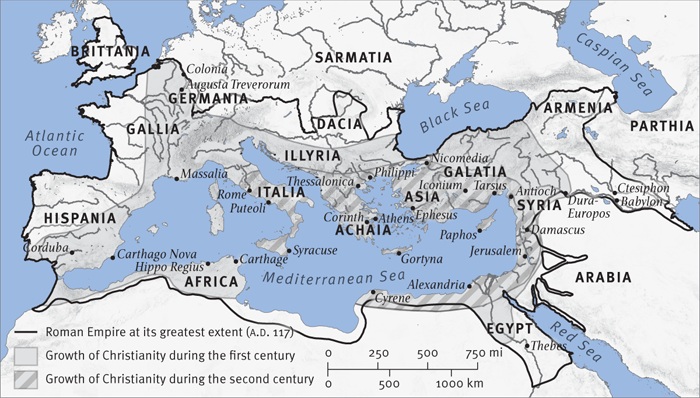
The Spread of Christianity in the First Two Centuries
The stability, relative safety in travel, and universal system of laws and government of the Roman Empire helped in the spread of the gospel throughout the first few centuries of the Christian church. Christianity first centered around Jerusalem and Syria, but soon spread to Asia, Achaia, and even Rome. Despite persecution, Christians during the second century a.d. continued to carry the gospel to places as far as Spain, Gallia, and North Africa. Eventually even Roman emperors came to recognize Christianity as a legal religion and sponsored many of its activities.
1 THESSALONIANS—NOTE ON 2:1 not in vain. Paul's ministry among the Thessalonians was so fruitful that not only were people saved and a vibrant, reproducing church planted, but the church also grew and flourished even after Paul left (cf. 1:5–8).
1 THESSALONIANS—NOTE ON 2:2 shamefully treated at Philippi. Paul and Silas had been brutalized in Philippi before coming to Thessalonica (cf. Acts 16:19– 24, 37). They suffered physically when beaten (Acts 16:22–23) and incarcerated (Acts 16:24). They were arrogantly mistreated with false accusations (Acts 16:20–21) and illegally punished in spite of their Roman citizenship (Acts 16:37). much conflict. Like their treatment in Philippi, Paul's team was falsely accused of civil treason in Thessalonica (Acts 17:7) and suffered physical intimidation (Acts 17:5–6).
1 THESSALONIANS—NOTE ON 2:3 error or impurity . . . deceive. Paul used three distinctly different words to affirm the truthfulness of his ministry, each expressing a contrast with what was characteristic of false teachers. He first asserted that "his message" was true and not erroneously false. His "manner of life" was pure, not sexually wicked. His "method of ministry" was authentic, not deceptive (see notes on 2 Cor. 4:2).
1 THESSALONIANS—NOTE ON 2:4 approved by God. It could be that some false teachers came into the church to discredit Paul's ministry. This would account for his emphasis in vv. 1–12 on his divine appointment, approval, integrity, and devotion to the Thessalonians. Cf. Acts 9:15; 16:9–10.
1 THESSALONIANS—NOTE ON 2:5–6 words of flattery. Paul used three disclaimers to affirm the purity of his motives for ministry: 1) he denied being a smoothtalking preacher who tried to make favorable impressions in order to gain influence for selfish advantage; 2) he did not pretend to be poor and work night and day (cf. v. 9) as a pretense to get rich in the ministry at their expense; and 3) he didn't use his honored position as an apostle to seek personal glory, only God's glory (cf. 1 Cor. 10:31).
1 THESSALONIANS—NOTE ON 2:6 apostles of Christ. This plural is designed to include Paul with the Twelve for the sake of emphasizing his unique authority. Silvanus and Timothy were "apostles [messengers]" of the church (cf. Rom. 16:7; Phil. 2:25).
1 THESSALONIANS—NOTE ON 2:7–8 gentle . . . like a nursing mother. Paul may have had in mind Moses' portrayal of himself as a nursing mother to Israel (cf. Num. 11:12). He used the same tender picture with the Corinthians (cf. 2 Cor. 12:14–15) and the Galatians (cf. Gal. 4:19). Paul's affection for the Thessalonians was like that felt by a mother willing to sacrifice her life for her child, as was Christ who was willing to give up his own life for those who would be born again into the family of God (cf. Matt. 20:28)
1 THESSALONIANS—NOTE ON 2:9 worked night and day. Paul explained this in 2 Thess. 3:7–9. He did not ask for any money from the Thessalonians but rather lived on what he earned and what the Philippians sent (Phil. 4:16), so that his motives could not be questioned, unlike the false teachers who always sought money (cf. 1 Pet. 5:2). the gospel of God. Cf. Rom. 1:1. The good news from God that Paul preached included these truths: 1) the authority and truthfulness of Scripture (1 Thess. 2:13); 2) the deity of Christ (Rom. 10:9); 3) the sinfulness of mankind (Rom. 3:23); 4) Christ's death and resurrection (1 Cor. 15:4–5); and 5) salvation by God's grace through man's faith (Eph. 2:8–9). Paul's summary of the gospel is in 1 Cor. 15:1–5.
1 THESSALONIANS—NOTE ON 2:10 You are witnesses. Under OT law it took two or more witnesses to verify truth (Num. 35:30; Deut. 17:6; 19:15; 2 Cor. 13:1).
Here Paul called on both the Thessalonians and God as witnesses to affirm his holy conduct in the ministry. Cf. 2 Cor. 1:12.
1 THESSALONIANS—NOTE ON 2:12 exhorted . . . encouraged . . . charged. Paul used these three words to describe his fatherly relationship with the Thessalonians since they were his children in the faith. They emphasized the personal touch of a loving father (cf. 1 Cor. 4:14–15). his own kingdom and glory. This speaks of the sphere of eternal salvation (cf. Col. 1:13–14) culminating in the splendor of heaven.
1 THESSALONIANS—NOTE ON 2:13 the word of God. Paul's message from God is equated with the OT (Mark 7:13). It was the message taught by the apostles (Acts 4:31; 6:2). Peter preached it to the Gentiles (Acts 11:1). It was the word Paul preached on his first missionary journey (Acts 13:5, 7, 44, 48–49), his second (Acts 16:32; 17:13; 18:11), and his third (Acts 19:10). Cf. Col. 1:25. which is at work. The work of God's word includes: saving (Rom. 10:17; 1 Pet. 1:23); teaching and training (2 Tim. 3:16–17); guiding (Ps. 119:105); counseling (Ps. 119:24); reviving (Ps. 119:154); restoring (Ps. 19:7); warning and rewarding (Ps. 19:11); nourishing (1 Pet. 2:2); judging (Heb. 4:12); sanctifying (John 17:17); freeing (John 8:31–32); enriching (Col. 3:16); protecting (Ps. 119:11); strengthening (Ps. 119:28); making wise (Ps. 119:97–100); rejoicing the heart (Ps. 19:8); and prospering (Josh. 1:8–9). All this is summarized in Ps. 19:7–9 (see notes there).
1 THESSALONIANS—NOTE ON 2:14 imitators. Not only were the Thessalonians imitators of Paul and the Lord (cf. 1:6), but also of the churches in Judea in the sense that they both were persecuted for Christ's sake (cf. Acts 4:1–4; 5:26; 8:1). They drank Christ's cup of suffering (Matt. 26:39) and walked in the way of the OT prophets (Matt. 21:33–46; Luke 13:34).
1 THESSALONIANS—NOTE ON 2:15 who killed . . . the Lord Jesus. There is no question that the Jews were responsible for the death of their Messiah, though the Romans carried out the execution. It was the Jews who brought the case against him and demanded his death (cf. Luke 23:1–24, 34–38), just as they had killed the prophets (cf. Acts 7:51–52).
1 THESSALONIANS—NOTE ON 2:15–16 oppose all mankind. Just as it is God's will that all men be saved (1 Tim. 2:4; 2 Pet. 3:9), so it was the will of the Jews that no one find salvation in Christ (1 Thess. 2:16). Paul at one time had embraced this blasphemy of trying to prevent gospel preaching (cf. 1 Tim. 1:12– 17).
1 THESSALONIANS—NOTE ON 2:16 wrath has come upon them. God's wrath (cf. 1:10; 5:9) on the Jews who "fill up the measure of their sins" (cf. Matt. 23:32; Rom. 2:5), thus filling up the cup of wrath, can be understood: 1) historically of the Babylonian exile (Ezek. 8–11); 2) prophetically of Jerusalem's destruction in
A.D. 70; 3) eschatologically of Christ's second coming in judgment (Rev. 19); or 4) soteriologically in the sense that God's promised eternal wrath for unbelievers is so certain that it is spoken of as having come already, as does the apostle John (cf. John 3:18, 36). This context relates to the fourth option.
1 THESSALONIANS—NOTE ON 2:17 torn away. Paul had been forcedly separated from his spiritual children (cf. Acts 17:5–9). His motherly (1 Thess. 2:7) and fatherly instincts (v. 11) had been dealt a severe blow. Lit., the Thessalonians had been orphaned by Paul's forced departure.
1 THESSALONIANS—NOTE ON 2:18 Satan hindered us. Satan, which means "adversary," continually attempted to tear down the church that Christ promised to build (cf. Matt. 16:18). He was said to be present at the churches of Jerusalem (Acts 5:1–10), Smyrna (Rev. 2:9–10), Pergamum (Rev. 2:13), Thyatira (Rev. 2:24), Philadelphia (Rev. 3:9), Ephesus (1 Tim. 3:6–7), and Corinth (2 Cor. 2:1– 11). He thwarted Paul in the sense that a military foe would hinder the advance of his enemy. This could very possibly refer to the pledge that Jason made (Acts 17:9), if that pledge was a promise that Paul would not return to Thessalonica.
1 THESSALONIANS—NOTE ON 2:19 crown of boasting. The Bible speaks of eternal life like a wreath awarded for an athletic victory. It is spoken of in terms of: 1) the imperishable wreath that celebrates salvation's victory over corruption (1 Cor. 9:25); 2) the righteous wreath that celebrates salvation's victory over unrighteousness (2 Tim. 4:8); 3) the unfading wreath of glory that celebrates salvation's victory over defilement (1 Pet. 5:4); 4) the wreath of life that celebrates salvation's victory over death (James 1:12, Rev. 2:10); and here 5) the wreath of exultation, which celebrates salvation's victory over Satan and mankind's persecution of believers. at his coming. "Coming," or parousia, lit. means "to be present." It can be understood as: 1) actual presence (Phil. 2:2); 2) moment of arrival (1 Cor. 16:17); or 3) expected coming (2 Cor. 7:6). In regard to Christ and the future, it can refer to: 1) Christ's coming at the rapture (1 Thess. 4:15), or 2) Christ's second coming prior to his 1,000-year millennial reign (Matt. 24:37; Rev. 19:11–20:6). Paul referred directly to Christ's coming four times in 1 Thessalonians (see also 1 Thess. 3:13; 4:15; 5:23) and once indirectly (1:10). Context indicates Paul most likely refers here to Christ's coming for the rapture of the church.
1 THESSALONIANS—NOTE ON 3:1 bear it no longer. The agony of separation between spiritual parent Paul and his children in Thessalonica became unbearably painful (cf. v. 5). at Athens alone. Paul and Silas stayed behind while Timothy returned (v. 2). This would not be the last time that Timothy went to a church in Paul's place (cf. 1 Cor. 4:17; 16:10; Phil. 2:19–24; 1 Tim. 1:3).
1 THESSALONIANS—NOTE ON 3:2 establish . . . exhort . . . your faith. This was a common ministry concern and practice of Paul's (cf. Acts 14:22; 15:32; 18:23). Paul's concern did not focus on health, wealth, self-esteem, or ease of life, but rather the spiritual quality of life. Their faith was of supreme importance in Paul's mind as evidenced by five mentions in 1 Thess. 3:1–10 (see also 3:5–7, 10). Faith includes the foundation of the body of doctrine (cf. Jude 3) and their believing response to God in living out that truth (cf. Heb. 11:6).
1 THESSALONIANS—NOTE ON 3:3 destined. God had promised Paul future sufferings when he commended him to ministry through Ananias (Acts 9:16). Paul reminded the Thessalonians of this divine appointment so that they would not think that: 1) God's plan was not working out as evidenced by Paul's troubles, or 2) Paul's afflictions demonstrated God's displeasure with him. To think that way would upset the church's confidence in Paul and fulfill Satan's deceptive purposes (1 Thess. 3:5). Cf. 2 Cor. 4:8–15; 6:1–10; 11:23–27; 12:7– 10.
1 THESSALONIANS—NOTE ON 3:4 suffer affliction. Paul had told them to expect him to suffer as he had already suffered before his Thessalonian experience (2:14–16; Acts 13–14). During (Acts 17:1–9) and following (Acts 17:10–18:11) his time at Thessalonica, Paul also knew tribulation.
1 THESSALONIANS—NOTE ON 3:5 the tempter. Satan had already been characterized as a hinderer (2:18) and now as a tempter in the sense of trying/testing for the purpose of causing failure (cf. Matt. 4:3; 1 Cor. 7:5; James 1:12–18). Paul was not ignorant of Satan's schemes (2 Cor. 2:11; 11:23) nor vulnerable to his methods (Eph. 6:11), so Paul took action to counterattack Satan's expected maneuver and to assure that all his efforts were not useless (cf.
1 Thess. 2:1).
1 THESSALONIANS—NOTE ON 3:6 your faith and love. Timothy returned to report the Thessalonians' trust in God, their response to one another, and to Paul's ministry. This news convinced Paul that Satan's plans to disrupt God's work had not been successful, and settled Paul's anxiety (v. 7).
1 THESSALONIANS—NOTE ON 3:8 standing fast. Pictured here is an army that refuses to retreat even though it is being assaulted by the enemy. This is a frequent Pauline injunction (1 Cor. 16:13; Gal. 5:1; Eph. 6:11, 13–14; Phil. 1:27; 4:1; 2 Thess. 2:15).
1 THESSALONIANS—NOTE ON 3:9 joy. Paul, like John (3 John 4), found the highest sense of ministry joy in knowing that his children in the faith were growing and walking in the truth. It led him to the worship of God in thanksgiving and rejoicing.
1 THESSALONIANS—NOTE ON 3:10 pray. As to frequency, Paul prayed night and day just as he worked night and day (2:9). As to fervency, Paul prayed superabundantly (cf. Eph. 3:20). lacking. Paul was not criticizing the church but rather acknowledging that they had not yet reached their full potential, for which he prayed and labored (1 Thess. 3:10). The themes of chs. 4–5 deal with areas of this lack.
1 THESSALONIANS—NOTE ON 3:11 direct our way. Paul knew that Satan had hindered his return (2:18). Even though Timothy had visited and returned with a good report, Paul still felt the urgency to see his spiritual children again. Paul followed the biblical admonition of the Psalms (Ps. 37:1–5) and Proverbs (Prov. 3:5–6) to entrust difficult situations to God.
1 THESSALONIANS—NOTE ON 3:12 love for one another. With over 30 positive and negative "one anothers" in the NT, love appears by far most frequently (cf. 4:9; Rom. 12:10; 13:8; 2 Thess. 1:3; 1 Pet. 1:22; 1 John 3:11, 23; 4:7, 11; 2 John 5). It is the overarching term that includes all of the other "one anothers." Its focus is on believers in the church. for all. In light of the fact that God loved the world and sent his Son to die for human sin (John 3:16), believers who were loved when they were unlovely (Rom. 5:8) are to love unbelievers (see notes on Matt. 5:43–44). Other NT commands concerning all men include pursuing peace (Rom. 12:18), doing good (Gal. 6:10), being patient (Phil. 4:5), praying (1 Tim.
2:1), showing consideration (Titus 3:2), and honoring (1 Pet. 2:17).
1 THESSALONIANS—NOTE ON 3:13 blameless in holiness. Paul prayed that there would be no grounds of accusation because of unholiness. Cf. 1 Cor. 1:8; 2 Cor. 11:2; Eph. 5:25–27; 1 Pet. 4:16–17; Jude 24. his saints. Since this exact term is not used elsewhere in the NT of angels (see note on Jude 14), but is commonly used for believers, it is best to understand the coming of the Lord to rapture all his church (see notes on 1 Thess. 4:13–18) and take them to heaven to enjoy his presence (see notes on John 14:1–3).
1 THESSALONIANS—NOTE ON 4:1 in the Lord Jesus. To give added weight to his words, Paul appealed here to the fact that he wrote with the authority of Christ himself (see vv. 2, 15; 5:27; 2 Thess. 3:6, 12). please God. Cf. 1 Thess. 2:4, 15; 2 Cor. 5:9; Eph. 5:10, 17; Col. 1:10; Heb. 11:6; 13:15–16; 1 John 3:22. This is done by obedience to the word of God (cf. 1 Thess. 4:3).
1 THESSALONIANS—NOTE ON 4:3 the will of God. All of God's word contains God's will—both affirmations and prohibitions. Specifically, God's will includes salvation (1 Tim. 2:4); self-sacrifice (Rom. 12:1–2); Spirit filling (Eph. 5:18); submission (1 Pet. 2:13–15); suffering (1 Pet. 3:17); satisfaction (1 Thess. 5:18); settledness (Heb. 10:36); and particularly here—sanctification, which literally refers to a state of being set apart from sin to holiness. In this context, it means being set apart from sexual impurity in particular, holding oneself away from immorality by following the instruction in 1 Thess. 4:4–8.
1 THESSALONIANS—NOTE ON 4:4 control his own body. (See esv footnote.) Two interpretations are usually offered. The term can mean: 1) the wife (cf. Ruth 4:10 lxx; 1 Pet. 3:7), which one acquires, or 2) the body (2 Cor. 4:7; 2 Tim. 2:21), which one possesses. The latter is most likely since: 1) the reference in 1 Pet. 3:7 is used only in a comparative sense ("someone weaker") referring to general humanity, not femaleness; 2) being married does not guarantee sexual purity; 3) Paul would be contradicting what he taught in 1 Cor. 7 about the superlative state of singleness (cf. 1 Cor. 7:8–9); and 4) if taken in the sense of marrying a wife, Paul would be talking to men only and ignoring how women were to stay pure. Cf. note on 1 Cor. 9:27.
1 THESSALONIANS—NOTE ON 4:5 the Gentiles. Used here in a spiritual sense referring to non-Christians, and indicated by the defining statement, "who do not know God." See notes on Eph. 4:17–18.
1 THESSALONIANS—NOTE ON 4:6 wrong his brother. The context, which remains unchanged throughout vv. 1–8, demands that this refer to all the destructive social and spiritual implications of illegitimate sexual activity. See notes on Matt. 18:6–10. avenger. This means it is God who ultimately works out just recompense for such sins (cf. Col. 3:4–7; Heb. 13:4).
1 THESSALONIANS—NOTE ON 4:7 called us. Whenever the epistles refer to the "call" of God, it is always a reference to his effectual, saving call, never to a general plea. It is linked to justification (cf. Rom. 8:30).
1 THESSALONIANS—NOTE ON 4:8 gives his Holy Spirit to you. God's Spirit is a free gift to all who believe in the Lord Jesus Christ for salvation. Cf. Acts 2:38; Rom. 8:9; 1 Cor. 3:16; 12:13; 2 Cor. 6:16.
1 THESSALONIANS—NOTE ON 4:9–10 taught by God to love. Through God's word (Ps. 119:97–102) and by God himself, they were loving believers (cf. Rom. 5:5; 1 John 2:7–11; 3:14; 4:7–8, 12).
1 THESSALONIANS—NOTE ON 4:11 live quietly. This refers to one who does not present social problems (see note on 1 Tim. 2:2) or generate conflict among those people in his life, but whose soul rests easy even in the midst of difficulty (cf. 1 Pet. 3:4). Paul later deals with those who did not "mind their own affairs" at Thessalonica (cf. 2 Thess. 3:6–15). work with your hands. Greek culture looked down on manual labor but Paul exalts it (see note on Eph. 4:28).
1 THESSALONIANS—NOTE ON 4:12 outsiders. Non-Christians are in view here (cf. 1 Cor. 5:2; Col. 4:5; 1 Tim. 3:7).
1 THESSALONIANS—NOTE ON 4:13–18 Even though Paul's ministry in Thessalonica was brief, it is clear the people had come to believe in and hope for the reality of their Savior's return (cf. 1:3, 9–10; 2:19; 5:1–2; 2 Thess. 2:1, 5). They were living in expectation of that coming, eagerly awaiting Christ. Verse 13 of 1 Thess. 4 (cf. 2 Thess. 2:1–3) indicates they were even agitated about some things that were happening to them that might affect their participation in it. They knew Christ's return was the climactic event in redemptive history and didn't want to miss it. The major question they had was, "What happens to the Christians who die before he comes? Do they miss his return?" Clearly, they had an imminent view of Christ's return, and Paul had left the impression it could happen in their lifetime. Their confusion came as they were being persecuted, an experience they thought they were to be delivered from by the Lord's return (cf. 1 Thess. 3:3–4).
1 THESSALONIANS—NOTE ON 4:13 those who are asleep. Sleep is the familiar NT euphemism for death, which describes the appearance of the deceased (see note on 1 Cor. 11:30). It describes the dead body, not the soul (cf. 2 Cor. 5:1–9; Phil. 1:23). Sleep is used of Jarius's daughter (Matt. 9:24) whom Jesus raised from the dead and Stephen who was stoned to death (Acts 7:60; cf. John 11:11; 1 Cor. 7:39; 15:6, 18, 51; 2 Pet. 3:4). Those who sleep are identified in 1 Thess. 4:16 as "the dead in Christ." The people, in ignorance, had come to the conclusion that those who die miss the Lord's return and they were grieved over their absence at such a glorious event. Thus the departure of a loved one brought great anguish to the soul. But there is no reason for Christians to sorrow when a brother dies as if some great loss to that person has come.
1 THESSALONIANS—NOTE ON 4:14 God will bring with him. As Jesus died and rose, so also will those who die believing in him rise again so they can be taken to heaven with the Lord (see notes on John 14:1–3; 1 Cor. 15:51–58). These texts describe the rapture of the church, which takes place when Jesus comes to collect his redeemed and take them back to heaven. Those who have died before that time (called "those who have fallen asleep") will be gathered and taken back to heaven with the Lord.
1 THESSALONIANS—NOTE ON 4:15 a word from the Lord. Was Paul referring to some saying of Jesus found in the Gospels? No. There are none exact or even close. The only explicit reference to the rapture in the Gospels is John 14:1–3. Some suggest that Jesus had said the words while on earth, their substance being recorded later in such places as Matt. 24:30–31 and John 6:39–40; 11:25–26. Similarities between this passage in 1 Thessalonians and the Gospel accounts include a trumpet (Matt. 24:31), a resurrection (John 1:26), and a gathering of the elect (Matt. 24:31). Yet dissimilarities between it and the canonical sayings of Christ far outweigh the resemblances. Some of the differences between Matt. 24:30–31 and 1 Thess. 4:15–17 are as follows: 1) in Matthew the Son of Man is coming on the clouds (but see Mark 13:26; Luke 21:27), in 1 Thessalonians ascending believers are in them; 2) in the former the angels gather, in the latter Christ does personally; 3) in the former nothing is said about resurrection, while in the latter this is the main theme; and 4) Matthew records nothing about the order of ascent, which is the principal lesson in Thessalonians. On the other hand, did he mean a statement of Jesus that was spoken but not recorded in the
Gospels (Acts 20:35)? No. There is reason to conclude this since Paul affirmed that he taught the rapture as a heretofore hidden truth (1 Cor. 15:51), i.e., "a mystery." Apparently, the Thessalonians were informed fully about the day of the Lord judgment (cf. 1 Thess. 5:1–2), but not the preceding event—the rapture of the church. Until Paul revealed it as the revelation from God to him, it had been a secret, with the only prior mention being Jesus' teaching in John 14:1–3. This was new revelation of what had previously been an unrevealed mystery. we who are alive, who are left. This refers to Christians alive at the time of the rapture, those who live on this earth to see the coming of the Lord for his own. Since Paul didn't know God's timing, he lived and spoke as if it could happen in his lifetime. As with all early Christians, he believed the event was near (cf. Rom. 13:11; 1 Cor. 6:14; 10:11; 16:22; Phil. 3:20–21; 1 Tim. 6:14; Titus 2:13). Those alive at the rapture will follow those dead who rise first (1 Thess. 4:16).
1 THESSALONIANS—NOTE ON 4:16 the Lord himself will descend. This fulfills the pledge of John 14:1–3 (cf. Acts 1:11). Until then, he remains in heaven (cf. 1 Thess. 1:10; Heb. 1:1–3). archangel. Very little is known about the organization or rank of angels (cf. Col. 1:17). While only Michael is named as an archangel (Jude 9), there seems to be more than one in the archangelic ranks (Dan. 10:13). Perhaps it is Michael, the archangel, whose voice is heard as he is identified with Israel's resurrection in Dan. 12:1–3. At that moment (cf. 1 Cor. 15:52, "twinkling of an eye"), the dead rise first. They will not miss the rapture, but be the first participants. trumpet of God. Cf. 1 Cor. 15:52. This trumpet is not the judgment trumpets of Rev. 8–11, but is illustrated by the trumpet of Ex. 19:16– 19, which called the people out of the camp to meet God. It will be a trumpet of deliverance (cf. Zeph. 1:16; Zech. 9:14).
1 THESSALONIANS—NOTE ON 4:17 caught up. After the dead come forth, their spirits, already with the Lord (2 Cor. 5:8; Phil. 1:23), are now being joined to resurrected new bodies (see notes on 1 Cor. 15:35–50); the living Christians will be raptured, lit. "snatched away" (cf. John 10:28; Acts 8:39). This passage, along with John 14:1–3 and 1 Cor. 15:51–52, forms the biblical basis for "the rapture" of the church. The time of the rapture cannot be conclusively determined from this passage alone. However, when other texts such as Rev. 3:10 and John 14:3 are consulted and compared to the texts about Christ's coming in judgment (Matt. 13:34–50; 24:29–44; Rev. 19:11–21) at the end of a seven-year tribulation, it has to be noted that there is a clear difference between the character of the "rapture" in that there is no mention of any judgment, while the other texts feature judgment. So then, it is best to understand that the rapture occurs at a time different from the coming of Christ in judgment. Thus, the rapture has been described as pre-tribulational (before the wrath of God unfolded in the judgments of Rev. 6–19). This event includes complete transformation (cf. 1 Cor. 15:51–52; Phil. 3:20–21) and union with the Lord Jesus Christ that never ends.
1 THESSALONIANS—NOTE ON 4:18 encourage one another. The primary purpose of this passage is not to teach a scheme of prophecy, but rather to provide encouragement to those Christians whose loved ones have died. The comfort here is based on the following: 1) the dead will be resurrected and will participate in the Lord's coming for his own; 2) when Christ comes the living will be reunited forever with their loved ones; and 3) they all will be with the Lord eternally (v. 17).
1 THESSALONIANS—NOTE ON 5:1 Now. Paul used familiar Greek words here to indicate a change of topics within the same general subject of prophecy (cf. 4:9, 13; 1 Cor. 7:1, 25; 8:1; 12:1; 16:1). The expression here points to the idea that within the broader context of the end time coming of the Lord Jesus, the subject is changing from a discussion of the blessings of the rapture of believers to the judgment of unbelievers. times and the seasons. These two terms mean the measurement of time and the character of the times respectively (cf. Dan. 2:21; Acts 1:7). Many of them expected the Lord to come in their lifetime and were confused and grieved when their fellow believers died before his coming (see notes on 1 Thess. 4:13–18). They were concerned about the delay. Apparently, the Thessalonians knew all that God intended believers to know about coming judgment, and Paul had taught them what they hadn't known about the rapture (4:13–18), so Paul exhorted them to live godly lives in light of coming judgment on the world, rather than to be distracted by probing into issues of prophetic timing. They could not know the timing of God's final judgment, but they knew well that it was coming unexpectedly (5:2).
1 THESSALONIANS—NOTE ON 5:2 day of the Lord. There are 19 indisputable uses of "the day of the Lord" in the OT and four in the NT (cf. Acts 2:20; 2 Thess. 2:2; 2 Pet. 3:10). The OT prophets used "day of the Lord" to describe near historical judgments (see Isa. 13:6–22; Ezek. 30:2–19; Joel 1:15; Amos 5:18–20; Zeph. 1:14–18) or far eschatological divine judgments (see Joel 2:30–32; 3:14; Zech. 14:1; Mal. 4:1, 5). It is also referred to as the "day of vengeance." The NT calls it a day of "wrath," day of "visitation," and "the great day of God the Almighty" (Rev. 16:14). These are terrifying judgments from God (cf. Joel 2:30–
31; 2 Thess. 1:7–10) for the overwhelming sinfulness of the world. The future "day of the Lord" that unleashes God's wrath falls into two parts: 1) the end of the seven-year tribulation period (cf. Rev. 19:11–21), and 2) the end of the Millennium. These two are actually 1,000 years apart and Peter refers to the end of the 1,000-year period in connection with the final "day of the Lord" (cf. 2 Pet. 3:10; Rev. 20:7–15). Here, Paul refers to that aspect of the "day of the Lord," which concludes the tribulation period. a thief in the night. This phrase is never used to refer to the rapture of the church. It is used of Christ's coming in judgment on the day of the Lord at the end of the seven-year tribulation, which is distinct from the rapture of the church (see note on 1 Thess. 4:15), and it is used of the judgment that concludes the Millennium (2 Pet. 3:10). As a thief comes unexpectedly and without warning, so will the day of the Lord come in both its final phases.
1 THESSALONIANS—NOTE ON 5:3 peace and security. Just as false prophets of old fraudulently forecast a bright future, in spite of the imminence of God's judgment (Jer. 6:14; 8:11; 14:13–14; Lam. 2:14; Ezek. 13:10, 16; Mic. 3:5), so they will again in future days just before the final day of the Lord destruction. labor pains. The Lord used this same illustration in the Olivet Discourse (see note on Matt. 24:8). It portrays the inevitability, suddenness, inescapable nature, and painfulness of the day of the Lord.
1 THESSALONIANS—NOTE ON 5:4 But you . . . brothers. Paul dramatically shifts from the third person plural pronoun (three times in v. 3) to the second person plural. Because the church is raptured before the judgment of the day of the Lord, believers will not be present on earth to experience its terrors and destruction (v. 3). not in darkness. Believers have no part in the day of the Lord, because they have been delivered from the domain of darkness and transferred to the kingdom of light (Col. 1:13). Jesus taught that to believe in him would remove a person from spiritual darkness (John 8:12; 12:46). The contrast between believers and the lost is emphatic, and Paul draws it out all the way through 1 Thess. 5:7. Believers will not experience the wrath of God because they are different in nature. Unbelievers are in darkness (cf. v. 2, "in the night"), engulfed in mental, moral, and spiritual darkness because of sin and unbelief (cf. John 1:5; 3:19; 8:12; 2 Cor. 4:6; Eph. 4:17–18; 5:8, 11). All these people are children of Satan, (cf. John 8:44) who is called "the power of darkness" (Luke 22:53). The day of the Lord will overtake them suddenly and with deadly results.
1 THESSALONIANS—NOTE ON 5:5 children of light. This is a Hebrew expression that characterizes believers as children of God, their heavenly Father, who is light and in whom is no darkness at all (1 John 1:5–7). Cf. Luke 16:8; John 8:12; 12:36. Believers live in a completely different sphere of life than those who will be in the day of the Lord.
1 THESSALONIANS—NOTE ON 5:6 let us not sleep. Because believers have been delivered from the domain of darkness, they are taken out of the night of sin and ignorance and put into the light of God. Because Christians are in the light, they should not sleep in spiritual indifference and comfort, but be alert to the spiritual issues around them. They are not to live like the sleeping, darkened people who will be jolted out of their coma by the day of the Lord (v. 7), but to live alert, balanced, godly lives under control of the truth.
1 THESSALONIANS—NOTE ON 5:8 breastplate. Paul pictured the Christian life in military terms as being a life of soberness (alertness) and proper equipping. The "breastplate" covers the vital organs of the body. "Faith" is an essential protection against temptations, because it is trust in God's promise, plan, and truth. It is unwavering belief in God's word that protects us from temptation's arrows. Looking at it negatively, it is unbelief that characterizes all sin. When believers sin, they have believed Satan's lie. Love for God is essential, as perfect love for him yields perfect obedience to him. Elsewhere the warrior's breastplate has been used to represent righteousness (Isa. 59:17; Eph. 6:14). Faith elsewhere is represented by a soldier's shield (Eph. 6:16). The "helmet" is always associated with salvation in its future aspects (cf. Isa. 59:17; Eph. 6:17). Our future salvation is guaranteed, nothing can take it away (Rom. 13:11). Paul again combined faith, love, and hope (cf. 1 Thess. 1:3). See notes on Eph. 6:10–17.
1 THESSALONIANS—NOTE ON 5:9 wrath. This is the same wrath referred to in 1:10 (see notes there). In this context (note especially the contrast), it appears obvious that this wrath refers to God's eternal wrath, not his temporal wrath during the tribulation period (cf. Rom. 5:9).
1 THESSALONIANS—NOTE ON 5:10 awake or asleep. This analogy goes back to 4:13–15 and refers to being physically alive or dead with the promise that, in either case, we will one day live together (cf. 4:17; John 14:1–3) forever with the Savior who died as the substitute for our sins. Cf. Rom. 4:9; Gal. 1:4; 2 Cor. 5:15, 21.
1 THESSALONIANS—NOTE ON 5:12 respect. This means that the people are to know their pastors well enough to have an intimate appreciation for them and to respect them because of their value. The work of pastors is summarized in a threefold description that includes: 1) laboring, working to the point of exhaustion; 2) overseeing, lit. "standing before the flock to lead them in the way of righteousness"; and 3) instructing in the truths of God's word. Cf. Heb. 13:7, 17.
1 THESSALONIANS—NOTE ON 5:13 esteem. In addition to knowing pastors (see notes on v. 12), congregations are to think rightly and lovingly of their pastors, not because of their charm or personality, but because of the fact that they work for the Chief Shepherd as his special servants (cf. 1 Pet. 5:2–4). They are also to submit to their leadership so that "peace" prevails in the church.
1 THESSALONIANS—NOTE ON 5:14–15 we urge you. Paul has discussed how the pastors are to serve the people and how the people are to respond to the pastors (vv. 12–13). In these verses, he presents how the people are to treat each other in the fellowship of the church. The "idle," those out of line, must be warned and taught to get back in line. The "fainthearted," those in fear and doubt, must be encouraged and made bold. The "weak," those without spiritual and moral strength, must be held up firmly. Patience, forgiveness, and acts of goodness must prevail among all the people.
1 THESSALONIANS—NOTE ON 5:16–22 Paul gave a summary of the Christian's virtues. These verses provide the foundational principles for a sound spiritual life in brief, staccato statements that, in spite of their brevity, give believers the priorities for successful Christian living.
1 THESSALONIANS—NOTE ON 5:16 Rejoice. Joy is appropriate at all times. Cf. Phil. 2:17–18; 3:1; 4:4.
1 THESSALONIANS—NOTE ON 5:17 pray. This does not mean pray repetitiously or continuously without a break (cf. Matt. 6:7–8), but rather pray persistently (cf. Luke 11:1–13; 18:1–8) and regularly (cf. Eph. 6:18; Phil. 4:6; Col. 4:2, 12).
1 THESSALONIANS—NOTE ON 5:18 give thanks. Thanklessness is a trait of unbelievers (cf. Rom. 1:21; 2 Tim. 3:1–5). "This is the will of God" includes 1 Thess. 5:16–17.
1 THESSALONIANS—NOTE ON 5:19 quench. The fire of God's Spirit is not to be doused with sin. Believers are also instructed to not grieve the Holy Spirit (Eph.
4:30), but to be controlled by the Holy Spirit (Eph. 5:18) and to walk by the Holy Spirit (Gal. 5:16).
1 THESSALONIANS—NOTE ON 5:20 prophecies. This phrase can refer to a spoken revelation from God (cf. Acts 11:27–28; 1 Tim. 1:18; 4:14), but most often refers to the written word of Scripture (cf. Matt. 13:14; 2 Pet. 1:19–21; Rev. 1:3; 22:7, 10, 18–19). These "prophecies" are authoritative messages from God through a well recognized spokesman for God that, because of their divine origin, are not to be treated lightly. When God's word is preached or read, it is to be received with great seriousness.
1 THESSALONIANS—NOTE ON 5:21–22 test everything. This call for careful testing and discernment is in response to the command of v. 20. One is never to downgrade the proclamation of God's word, but to examine the preached word carefully (cf. Acts 17:10–11). What is found to be "good" is to be wholeheartedly embraced. What is "evil" or unbiblical is to be shunned.
1 THESSALONIANS—NOTE ON 5:23 God . . . sanctify you. Having concluded all the exhortations beginning in 4:1, and especially from 5:16–22, Paul's ending benediction acknowledged the source for obeying and fulfilling them all. It is not within human power to be sanctified in all these ways (cf. Zech. 4:6; 1 Cor. 2:4– 5; Eph. 3:20–21; Col. 1:29). Only God (cf. Rom. 15:33; 16:20; Phil. 4:9; Heb. 13:20 for references to God as "peace") "himself" can separate us from sin to holiness "completely." spirit and soul and body. This comprehensive reference makes the term "completely" more emphatic. By using spirit and soul, Paul was not indicating that the immaterial part of man could be divided into two substances (cf. Heb. 4:12). The two words are used interchangeably throughout Scripture (cf. Heb. 6:19; 10:39; 1 Pet. 2:11; 2 Pet. 2:8). There can be no division of these realities, but rather they are used as other texts use multiple terms for emphasis (cf. Deut. 6:5; Matt. 22:37; Mark 12:30; Luke 10:27). Nor was Paul a believer in a three-part human composition (cf. Rom. 8:10; 1 Cor. 2:11; 5:3–5; 7:34; 2 Cor. 7:1; Gal. 6:18; Col. 2:5; 2 Tim. 4:22), but rather two parts: material and immaterial. at the coming. This fourth mention of Christ's parousia refers to the rapture of the church as it has previously at 1 Thess. 2:19; 3:13; 4:15.
1 THESSALONIANS—NOTE ON 5:24 calls you. This, as every time the divine call is mentioned in the NT, refers to God's effectual call of his chosen ones to salvation (cf. 2:12; 4:7; Rom. 1:6–7; 8:28; 1 Cor. 1:9; Eph. 4:1, 4; 2 Tim. 1:9; 1 Pet. 2:9; 5:10; 2 Pet. 1:10). The God who calls will also bring those whom he calls to glory and none will be lost (cf. John 6:37–44; 10:28–29; Rom. 8:28–39; Phil. 1:6; Jude 24).
1 THESSALONIANS—NOTE ON 5:26 holy kiss. This gesture of affection is commanded five times in the NT (Rom. 16:16; 1 Cor. 16:20; 2 Cor. 13:12; 1 Pet. 5:14) and refers to the cultural hug and kiss greeting of the first century, which for Christians was to be done righteously in recognition that believers are brothers and sisters in the family of God.
1 THESSALONIANS—NOTE ON 5:27 Public reading was the foundation of spiritual accountability (cf. Gal. 4:16; 2 Thess. 3:14).
1 THESSALONIANS—NOTE ON 5:28 Cf. Rom. 16:20–24 and 2 Thess. 3:18.
2 Thessalonians
2 Thessalonians 1 • 2 Thessalonians 2 • 2 Thessalonians 3 Introduction to 2 Thessalonians
Title Author and Date Background and Setting Historical and Theological Themes Interpretive Challenges Outline Footnotes Study Notes
Introduction to 2 Thessalonians
Title
In the Greek NT, 2 Thessalonians is listed as "To the Thessalonians." This represents the apostle Paul's second canonical correspondence to the fellowship of believers in the city of Thessalonica (cf. 1:1).
Author and Date
Paul, as in 1 Thessalonians, identified himself twice as the author of this letter (1:1; 3:17). Silvanus (Silas) and Timothy, Paul's colaborers in founding the church, were present with him when he wrote. Evidence, both within this letter and with regard to vocabulary, style, and doctrinal content, strongly supports Paul as the only possible author. The time of this writing was surely a few months after the first epistle, while Paul was still in Corinth with Silas and Timothy (1:1; Acts 18:5) in late A.D. 51 or early A.D. 52 (see Introduction to 1 Thessalonians: Author and Date).
Background and Setting
For the history of Thessalonica, see Introduction to 1 Thessalonians: Background and Setting. Some have suggested that Paul penned this letter from Ephesus (Acts 18:18–21), but his 18-month stay in Corinth provided ample time for both of the Thessalonian epistles to be authored (Acts 18:11).
Apparently, Paul had stayed apprised of the happenings in Thessalonica through correspondence and/or couriers. Perhaps the bearer of the first letter brought Paul back an update on the condition of the church, which had matured and expanded (2 Thess. 1:3); but pressure and persecution had also increased. The seeds of false doctrine concerning the Lord had been sown, and the people's behavior was disorderly. So Paul wrote to his beloved flock who were: 1) discouraged by persecution and needed incentive to persevere; 2) deceived by false teachers who confused them about the Lord's return; and 3) disobedient to divine commands, particularly by refusing to work. Paul wrote to address those three issues by offering: 1) comfort for the persecuted believers (1:3–12); 2) correction for the falsely taught and frightened believers (2:1–15); and 3) confrontation for the disobedient and undisciplined believers (3:6–15).
Historical and Theological Themes
Although chs. 1–2 contain much prophetic material because the main issue was a serious misunderstanding generated by false teachers about the coming day of the Lord (Paul reveals that the day had not come and would not until certain other events occur), it is still best to call this "a pastoral letter." The emphasis is on how to maintain a healthy church with an effective testimony in proper response to sound eschatology and obedience to the truth.
Eschatology dominates the theological issues. One of the clearest statements on personal eschatology for unbelievers is found in 1:9. Church discipline is the major focus of 3:6–15, which needs to be considered along with Matt. 18:15–20; 1 Cor. 5:1–13; Gal. 6:1–5 and 1 Tim. 5:19–20 for understanding the complete biblical teaching on this theme.
Interpretive Challenges
Eternal reward and retribution are discussed in 2 Thess. 1:5–12 in such general terms that it is difficult precisely to identify some of the details with regard to exact timing. Matters concerning the day of the Lord (2:2), the restrainer (2:6– 7), and the lawless one (2:3–4, 8–10) provide challenging prophetic material to interpret.
Outline
I. Paul's Greeting (1:1–2) II. Paul's Comfort for Affliction (1:3–12)
A. By Way of Encouragement (1:3–4)
B. By Way of Exhortation (1:5–12) III. Paul's Correction for Prophetic Error (2:1–17)
A. Prophetic Crisis (2:1–2)
B. Apostolic Correction (2:3–12) C. Pastoral Comfort (2:13–17) IV. Paul's Concern for the Church (3:1–15)
A. Regarding Prayer (3:1–5)
B. Regarding Undisciplined Living (3:6–15) V. Paul's Benediction (3:16–18)
THE SECOND LETTER OF PAUL TO THE THESSALONIANS
2 Thessalonians
Greeting
2 THESSALONIANS 1 ‡Paul, Silvanus, and Timothy,
To the church of the Thessalonians in God our Father and the Lord Jesus Christ:
2Grace to you and peace from God our Father and the Lord Jesus Christ.
Thanksgiving
ought always to give thanks to God for you, brothers, [1] as is right, because your faith is growing abundantly, and the love of every one of you for one another is increasing. 4†Therefore we ourselves boast about you in the churches of God for your steadfastness and faith in all your persecutions and in the afflictions that you are enduring.
The Judgment at Christ's Coming
is evidence of the righteous judgment of God, that you may be considered worthy of the kingdom of God, for which you are also suffering— 6†since indeed God considers it just to repay with affliction those who afflict you, 7†and to grant relief to you who are afflicted as well as to us, when the Lord Jesus is revealed from heaven with his mighty angels 8†in flaming fire, inflicting vengeance on those who do not know God and on those who do not obey the gospel of our Lord Jesus. 9†They will suffer the punishment of eternal destruction, away from [2] the presence of the Lord and from the glory of his might, 10†when he comes on that day to be glorified in his saints, and to be marveled at among all who have believed, because our testimony to you was believed. 11†To this end we always pray for you, that our God may make you worthy of his calling and may fulfill every resolve for good and every work of faith by his power, 12†so that the name of our Lord Jesus may be glorified in you, and you in him, according to the grace of our God and the Lord Jesus Christ.
The Man of Lawlessness
2 THESSALONIANS 2 †Now concerning the coming of our Lord Jesus Christ and our being gathered together to him, we ask you, brothers, [1] 2†not to be quickly shaken in mind or alarmed, either by a spirit or a spoken word, or a letter seeming to be from us, to the effect that the day of the Lord has come. 3‡Let no one deceive you in any way. For that day will not come, unless the rebellion comes first, and the man of lawlessness [2] is revealed, the son of destruction, [3] 4who opposes and exalts himself against every so-called god or object of worship, so that he takes his seat in the temple of God, proclaiming himself to be God. 5†Do you not remember that when I was still with you I told you these things? 6†And you know what is restraining him now so that he may be revealed in his time. 7†For the mystery of lawlessness is already at work. Only he who now restrains it will do so until he is out of the way. 8†And then the lawless one will be revealed, whom the Lord Jesus will kill with the breath of his mouth and bring to nothing by the appearance of his coming. 9‡The coming of the lawless one is by the activity of Satan with all power and false signs and wonders, 10†and with all wicked deception for those who are perishing, because they refused to love the truth and so be saved. 11†Therefore God sends them a strong delusion, so that they may believe what is false, 12†in order that all may be condemned who did not believe the truth but had pleasure in unrighteousness.
Stand Firm
we ought always to give thanks to God for you, brothers beloved by the Lord, because God chose you as the firstfruits [4] to be saved, through sanctification by the Spirit and belief in the truth. 14To this he called you through our gospel, so that you may obtain the glory of our Lord Jesus Christ. 15†So then, brothers, stand firm and hold to the traditions that you were taught by us, either by our spoken word or by our letter.
may our Lord Jesus Christ himself, and God our Father, who loved us and gave us eternal comfort and good hope through grace, 17comfort your hearts and establish them in every good work and word.
Pray for Us
2 THESSALONIANS 3 †Finally, brothers, [1] pray for us, that the word of the Lord may speed ahead and be honored, [2] as happened among you, 2†and that we may be delivered from wicked and evil men. For not all have faith. 3†But the Lord is faithful. He will establish you and guard you against the evil one. [3] 4And we have confidence in the Lord about you, that you are doing and will do the things that we command. 5†May the Lord direct your hearts to the love of God and to the steadfastness of Christ.
Warning Against Idleness
we command you, brothers, in the name of our Lord Jesus Christ, that you keep away from any brother who is walking in idleness and not in accord with the tradition that you received from us. 7†For you yourselves know how you ought to imitate us, because we were not idle when we were with you, 8‡nor did we eat anyone's bread without paying for it, but with toil and labor we worked night and day, that we might not be a burden to any of you. 9It was not because we do not have that right, but to give you in ourselves an example to imitate. 10For even when we were with you, we would give you this command: If anyone is not willing to work, let him not eat. 11‡For we hear that some among you walk in idleness, not busy at work, but busybodies. 12Now such persons we command and encourage in the Lord Jesus Christ to do their work quietly and to earn their own living. [4]
for you, brothers, do not grow weary in doing good. 14†If anyone does not obey what we say in this letter, take note of that person, and have nothing to do with him, that he may be ashamed. 15†Do not regard him as an enemy, but warn him as a brother.
Benediction
may the Lord of peace himself give you peace at all times in every way. The Lord be with you all.
Paul, write this greeting with my own hand. This is the sign of genuineness in every letter of mine; it is the way I write. 18†The grace of our Lord Jesus Christ be with you all.
Footnotes
Footnotes for 2 Thessalonians, Chapter
[1] 1:3 Or brothers and sisters. The plural Greek word adelphoi (translated
"brothers") refers to siblings in a family. In New Testament usage, depending on the context, adelphoi may refer either to men or to both men and women who are siblings (brothers and sisters) in God's family, the church [2] 1:9 Or destruction that comes from
[1] 2:1 Or brothers and sisters; also verses 13, 15
[2] 2:3 Some manuscripts sin
[3] 2:3 Greek the son of perdition (a Hebrew idiom) [4] 2:13 Some manuscripts chose you from the beginning
[1] 3:1 Or brothers and sisters; also verses 6, 13
[2] 3:1 Or glorified
[3] 3:3 Or evil
[4] 3:12 Greek eat their own bread
Study Notes
2 THESSALONIANS—NOTE ON 1:1–2 See note on 1 Thess. 1:1.
2 THESSALONIANS—NOTE ON 1:3 ought always to give thanks. There is a spiritual obligation to thank God in prayer when he accomplishes great things in the lives of his saints. That was the case with the obedient Thessalonians, who had demonstrated growth in faith and love since the first letter. This was in direct answer to Paul's prayers (cf. 1 Thess. 1:3; 3:12).
2 THESSALONIANS—NOTE ON 1:4 steadfastness and faith. Nowhere was their growth in faith and love (v. 3) more evident than in the way they patiently and faithfully endured hostilities and suffering from the enemies of Christ. Although there was no need to speak, since the Thessalonians' lives spoke clearly enough (1 Thess. 1:8), Paul's joy before the Lord over their perseverance bubbled up.
2 THESSALONIANS—NOTE ON 1:5 suffering. Having a right attitude toward suffering is essential, and that required attitude is concern for the kingdom of God. They were not self-centered, but concentrated on God's kingdom. Their focus was not on personal comfort, fulfillment, and happiness, but on the glory of God and the fulfillment of his purposes. They were not moaning about the injustice of their persecutions. Rather, they were patiently enduring the sufferings they did not deserve (v. 4). This very attitude was positive proof that God's wise process of purging, purifying, and perfecting through suffering was working to make his beloved people worthy of the kingdom (cf. 2:12) by being perfected (cf. James 1:2–4; 1 Pet. 5:10). For believers, afflictions are to be expected (cf. 1 Thess. 3:3) as they live and develop Christian character in a satanic world. Suffering is not to be thought of as evidence that God has forsaken them, but evidence that he is with them, perfecting them (cf. Matt. 5:10; Rom. 8:18; 2 Cor. 12:10). So the Thessalonians demonstrated that their salvation, determined by faith alone in the Lord Jesus Christ, was genuine because they, like Christ, were willing to suffer on account of God and his kingdom. They suffered unjustly as objects of man's wrath against Christ and his kingdom (Acts 5:41; Phil. 3:10; Col. 1:24). "Kingdom of God" is used here in its spiritual sense of salvation (see note on Matt. 3:2).
2 THESSALONIANS—NOTE ON 1:6 God . . . to repay. Just as the righteous judgment of God works to perfect believers (v. 5), so it works to "repay" the wicked (cf. v. 8). Vindication and retribution are to be exercised by God, not man, in matters of spiritual persecution (cf. Deut. 32:35; Prov. 25:21–22; Rom. 12:19–21; 1 Thess. 5:15; Rev. 19:2). When God repays and how God repays are to be determined by him.
2 THESSALONIANS—NOTE ON 1:7 relief . . . as well as to us. Paul was a fellowsufferer for the just cause of Christ. He, like the Thessalonians, hoped for that ultimate rest and reward for their suffering for the kingdom that was to come when Christ returned to judge the ungodly. The Lord Jesus promised this twofold coming for rest and retribution (cf. Matt. 13:40–43; 24:39–41; 25:31– 33; Luke 21:27–28, 34–36; John 5:24–29). when the Lord Jesus is revealed. This undoubtedly refers to Christ being unveiled in his coming as Judge. The first aspect of this revealing occurs at the end of the seven-year tribulation period (cf. Matt. 13:24–30, 36–43; 24:29–51; 25:31–46; Rev. 19:11–15). The final and universal revelation of Christ as Judge occurs at the great white throne judgment following Christ's millennial reign on the earth (Rev. 20:11–15). Angels always accompany Christ in his coming for judgment (cf. Matt. 13:41, 49; 24:30–31; 25:31; Rev. 14:14–15).
2 THESSALONIANS—NOTE ON 1:8 in flaming fire. Fire is a symbol of judgment (cf. Ex. 3:2; 19:16–20; Deut. 5:4; Ps. 104:4; Isa. 66:15–16; Matt. 3:11–12; Rev. 19:12). inflicting vengeance. Lit. these words mean "to give full punishment" (cf. Deut. 32:35; Isa. 59:17; 66:15; Ezek. 25:14; Rom. 12:19). do not know God. Cf. 1 Thess. 4:5. This speaks to the lack of a personal relationship with God through Jesus Christ (cf. John 17:3; Gal. 4:8; Eph. 2:12; 4:17–18; Titus 1:16). Retribution is not dealt out because of persecuting Christians, but rather because they did not obey God's command to believe (cf. Acts 17:30–31; Rom. 1:5; 10:16; 15:18; 16:19) and call upon the name of the Lord to be saved from their sin (Rom. 10:9–13; 1 Cor. 16:22; Heb. 10:26–31). Salvation is never obtained by works but always by placing one's faith alone in the Lord Jesus Christ (Eph. 2:8–10).
2 THESSALONIANS—NOTE ON 1:9 eternal destruction. See note on Matt. 25:46. Paul explained the duration and extent of what is elsewhere in Scripture called "hell." First, it is forever, thus it is not a reversible experience. Second, destruction means ruin and does not involve annihilation, but rather a new state of conscious being that is significantly worse than the first (cf. Rev. 20:14–15). This is described as the absence of God's presence and glory (cf. Matt. 8:12;
22:13; 25:30; Luke 16:24–26).
2 THESSALONIANS—NOTE ON 1:10 when he comes. When the day of the Lord arrives bringing retribution and ruin for unbelievers. As Christ's great glory is displayed, the result will be rest and relief for believers and the privilege of sharing his glory (cf. Phil. 3:21; 1 John 3:2). This is the glorious manifestation of believers, of which Paul spoke (Rom. 8:18–19). At the time, all believers will adore and worship Christ, including those in the Thessalonian church who believed Paul's testimony of the gospel.
2 THESSALONIANS—NOTE ON 1:11 we always pray. Paul's prayer life is exemplified four times in this letter (cf. v. 12; 2:16–17; 3:1–5, 16). Here he prayed as he did in 1:5, that they might behave in ways consistent with their identity as Christians (cf. 1 Thess. 2:19; Eph. 4:1; Col. 1:10), living up to their calling to salvation (cf. Rom. 8:30; 11:29; Gal. 4:13–15; 1 Cor. 1:26; Col. 1:3–5; 1 Thess. 2:12) with lives marked by goodness and powerful works of faith.
2 THESSALONIANS—NOTE ON 1:12 so that. The worthy walk of v. 11 allows God to be glorified in us, the light of all purposes (cf. 2:14; 1 Cor. 10:31; 1 Pet. 4:11).
2 THESSALONIANS—NOTE ON 2:1 coming of our Lord Jesus Christ. This is the fifth mention of Christ's coming in the Thessalonian letters (cf. 1 Thess. 2:19; 3:13; 4:15; 5:23; see note on 1 Thess. 2:19). The aspect of his particular coming in view here is identified by the next phrase "our being gathered together," which conveys the idea of all believers meeting together with the Lord Jesus, obviously referring to the rapture of the church described in 1 Thess. 4:13–18 and John 14:1–3. Cf. Heb. 10:25 for the only other use of this phrase in the NT. This was the event the Thessalonians were anticipating (cf. 1 Thess. 1:10; 3:13; 5:9).
2 THESSALONIANS—NOTE ON 2:2 quickly shaken. This term has been used of an earthquake (Acts 16:26) and a ship at anchor slipping its mooring in the midst of a heavy wind. Along with the word "alarmed," it describes the state of agitation and distress that had gripped the church. They were greatly distressed because they had expected the rapture, the gathering together to the Lord, to take place before the day of the Lord. They had expected to be taken to glory and heavenly rest, not left to persecution and divine wrath. Paul must have taught them that they would miss the day of the Lord (1 Thess. 5:2–5; cf. Rev. 3:10), but they had become confused by the persecution they were experiencing, thinking they may have been in the day of the Lord. This error had been reinforced by some messages to them claiming that they were indeed in the day of the Lord. Paul noted the source of these as "spirit," "spoken word," and "letter." A "spirit" would most likely refer to a false prophet claiming divine revelation as in 1 John 4:1–3. A "spoken word" would refer to a sermon or speech given, while a "letter" indicated a written report. The powerful but harmful effect of this false information was gained by claiming it was from the apostle Paul ("seeming to be from us"). Whoever was telling them they were in the day of the Lord claimed that it came from Paul, who heard it, preached it, and wrote it. Thus their lie was given supposed apostolic sanction. The result was shock, fear, and alarm. Obviously, they had expected the rapture before the day of the Lord. For if they had expected it after, they would have rejoiced because Christ's coming was to be soon. Apostolic authenticity in this letter that corrects the error was important and accounts for Paul's care to close the letter in his distinctive handwriting (2 Thess. 3:17; cf. Gal. 6:11). the day of the Lord. See note on 1 Thess. 5:2 for discussion of this "day." The idea that the day of the Lord had already come conflicted with what Paul had previously taught them about the rapture. This error, which so upset the Thessalonians, is what Paul corrected in 2 Thess. 2:3– 12, where he showed that the day hadn't come and couldn't until certain realities were in place, most especially "the man of lawlessness" (v. 3).
2 THESSALONIANS—NOTE ON 2:3–4 the rebellion. The day of the Lord cannot occur until a deliberate abandonment of a formerly professed position, allegiance, or commitment occurs (the term was used to refer to military, political, or religious rebellion). Some have suggested, on questionable linguistic evidence, that this refers to "departure" in the sense of the rapture. Context, however, points to a religious defection, which is further described in v. 4. The language indicates a specific event, not general apostasy, which exists now and always will. Rather, Paul has in mind the apostasy. This is an event that is clearly and specifically identifiable and unique, the consummate act of rebellion, an event of final magnitude. The key to identifying the event is to identify the main person, which Paul does, calling him the "man of lawlessness." Some texts have "man of sin," but there is no real difference in meaning since sin equals lawlessness (1 John 3:4). This is the one who is called "the prince who is to come" (Dan. 9:26) and "a little horn" (Dan. 7:8), whom John calls "the beast" (Rev. 13:2–10, 18) and most know as the Antichrist. The context and language clearly identify a real person in future times who actually does the things prophesied of him in Scripture. He is also called "the son of destruction" or perdition, a term used of Judas Iscariot (John 17:12). This "apostasy" is the abomination of desolation that takes place at the midpoint of the tribulation, spoken of in Dan. 9:27; 11:31 and Matt. 24:15 (see notes there). This man is not Satan, although Satan is the force behind him (2 Thess. 2:9) and he has motives like the desires of the devil (cf. Isa. 14:13–14). Paul is referring to the very act of ultimate apostasy that reveals the final Antichrist and sets the course for the events that usher in the day of the Lord. Apparently, he will be seen as supportive of religion so that God and Christ will not appear as his enemies until the apostasy. He exalts himself and opposes God by moving into the temple, the place for worship of God, declaring himself to be God and demanding the worship of the world. In this act of satanic self-deification, he commits the great apostasy in defiance of God. For the first three and a half years of the tribulation, he maintains relations with Israel, but halts those (cf. Dan. 9:27); and for the last three and a half years, there is great tribulation under his reign (cf. Dan. 7:25; 11:36–39; Matt. 24:15–21; Rev. 13:1–8) culminating with the day of the Lord.
2 THESSALONIANS—NOTE ON 2:5 I told you. The imperfect tense is used, indicating repeated action in past time. Apparently, Paul on numerous occasions had taught them the details of God's future plans. Here, he reminded them of the issues that proved the false teachers wrong about the day of the Lord. Paul had before told them that the revealing of the Antichrist preceded the day of the Lord; since he has not yet been revealed, they could not possibly be in that day.
2 THESSALONIANS—NOTE ON 2:6 restraining. While the Thessalonians already had been taught and thus knew what was restraining the coming of the Antichrist, Paul does not say specifically in this letter; thus many suggestions have been made to identify the restraining force of vv. 6–7. These include: 1) human government; 2) preaching of the gospel; 3) the binding of Satan; 4) the providence of God; 5) the Jewish state; 6) the church; 7) the Holy Spirit; and 8) Michael. Whatever now restrains the Antichrist of vv. 3–4, 8–10 from being revealed in the fullness of his apostasy and evil, must be more than human or even angelic power. The power that holds back Satan from bringing the final apostasy and unveiling of his Satan-possessed false Christ must be divinely supernatural. It must be God's power in operation that holds back Satan, so that the man of sin, the son of destruction, won't be able to come until God permits it by removing the restraining power. The reason for the restraint was so that Antichrist would be revealed at God's appointed time and no sooner, just as was Christ (cf. Gal. 4:4), because God controls Satan.
2 THESSALONIANS—NOTE ON 2:7 the mystery of lawlessness. This is the spirit of lawlessness already prevalent in society (cf. 1 John 3:4; 5:17), but still a mystery in that it is not fully revealed as it will be in the one who so blatantly opposes God that he blasphemously assumes the place of God on earth that God has reserved for Jesus Christ. The spirit of such a man is already in operation (cf. 1 John 2:18; 4:3), but the man who fully embodies that spirit has not come. For more on mystery, see notes on Matt. 13:11; 1 Cor. 2:7; Eph. 3:4–5. out of the way. This refers not to spatial removal (therefore it could not be the rapture of the church) but rather "a stepping aside." The idea is "out of the way," not gone (cf. Col. 2:14 where our sins are taken out of the way as a barrier to God); see note on 2 Thess. 2:3–4. This restraint will be in place until the Antichrist is revealed, at the midpoint of the tribulation, leaving him 42 months to reign (Dan. 7:25; Rev. 13:5).
2 THESSALONIANS—NOTE ON 2:8 then the lawless one will be revealed. At the divinely decreed moment in the middle of the tribulation when God removes the divine restraint, Satan, who has been promoting the spirit of lawlessness (v. 7), is finally allowed to fulfill his desire to imitate God by indwelling a man who will perform his will as Jesus did God's. This also fits God's plan for the consummation of evil and the judgment of the day of the Lord. the Lord Jesus will kill. Death occurs at God's hand (cf. Dan. 7:26; Rev. 17:11) and this man and his partner, the false prophet, will be cast alive into the lake of fire, which burns with brimstone, where he will be eternally separated from God. (Rev. 19:20; 20:10). his coming. The aspect of his coming in view here is not the rapture of the church, but the Lord's coming in judgment on that day when he conquers the forces of Satan and sets up his millennial kingdom (Rev. 19:11–21).
2 THESSALONIANS—NOTE ON 2:9–10 the lawless one. This "lawless one" will do mighty acts pointing to himself as supernaturally empowered. His whole operation will be deceptive, luring the world to worship him and be damned. The career of the coming lawless one is more fully described in Rev. 13:1–18 (see notes there).
2 THESSALONIANS—NOTE ON 2:10 those who are perishing. His influence is limited to deceiving the unsaved, who will believe his lies (cf. Matt. 24:24; John 8:41–44). They perish in the deception because of Satan-imposed blindness to the truth of the saving gospel. Cf. John 3:19–20; 2 Cor. 4:4.
2 THESSALONIANS—NOTE ON 2:11 strong delusion. People who prefer to love sin and lies rather than gospel truth will receive severe, divine recompense, as do all sinners. God himself will send judgment that insures their fate in the form of a "strong delusion" so that they continue to believe what is false. They accept evil as good and a lie as the truth. Thus does God use Satan and Antichrist as his instruments of judgment (cf. 1 Kings 22:19–23).
2 THESSALONIANS—NOTE ON 2:12 condemned. As God has always judged willful rejection by giving men over to impurity and degrading passions (Rom. 1:24– 28), so in the last days God will sovereignly seal the fate of those who persist in following Satan and his counterfeit Christ. As in all ages, those who habitually reject the truth are judged by being left to the consequences of their sin.
2 THESSALONIANS—NOTE ON 2:13–14 be saved . . . sanctification. Just as there were specific elements in the character of the Antichrist (vv. 10–12), so there are characteristics of the saved. In these two verses, Paul swept through the features of salvation, noting that believers are "beloved by the Lord," chosen for salvation from eternity past (cf. Rev. 13:8; 17:8), set apart from sin by the Spirit, and called to eternal glory, i.e., the sharing of the very "glory of our Lord Jesus Christ." Paul's main point in this section was to remind the Thessalonians that there was no need to be agitated or troubled (2 Thess. 2:2) thinking they had missed the rapture and thus were in the day of the Lord judgment. They were destined for glory, not judgment, and would not be included with those deceived and judged in that day.
2 THESSALONIANS—NOTE ON 2:15 stand firm . . . hold. This direct exhortation called for appropriate response to the great truths Paul had just written. In place of agitation should come strength and a firm stand. In place of false teaching should come faithful adherence to the truth.
2 THESSALONIANS—NOTE ON 2:16–17 Now may. This is one of many benedictions Paul has given in his letters. In it, he invoked God's power based on his love and grace, as the true source of encouragement and strength (cf. 3:5, 16).
2 THESSALONIANS—NOTE ON 3:1 pray for us. Paul frequently enlisted prayer support from the churches for his ministry (cf. Rom. 15:30–32; Eph. 6:18–19; Col. 4:2–3; 1 Thess. 5:25; Philem. 22). In particular, he asked them to pray that the word of God would continue to spread rapidly as it had been already (cf. Acts 6:7; 12:24; 13:44–49), and be received with the honor it deserved.
2 THESSALONIANS—NOTE ON 3:2 wicked and evil men. These were Paul's enemies at Corinth, where he ministered when he wrote (cf. Acts 18:9–17), who were perverse and aggressively unrighteous in their opposition of him and the gospel.
2 THESSALONIANS—NOTE ON 3:3 the Lord is faithful. Cf. Lam. 3:23. God is faithful in regard to creation (Ps. 119:90), his promises (Deut. 7:9; 2 Cor. 1:18; Heb. 10:23), salvation (1 Thess. 5:24), temptation (1 Cor. 10:13), suffering (1 Pet. 4:19), and here faithful to strengthen and protect from Satan (cf. John 17:15; Eph. 6:16; 1 Thess. 3:5).
2 THESSALONIANS—NOTE ON 3:5 Another of Paul's benedictions (cf. v. 16; 2:16– 17), so common in his letters.
2 THESSALONIANS—NOTE ON 3:6 we command you. Paul's directions were not mere suggestions but rather they carried the weight and authority of a judge's court order, which the apostle delivered and enforced (cf. vv. 4, 6, 10, 12). Here, he required separation so that obedient Christians were not to fellowship with habitually disobedient believers. This is further explained at v. 14. the tradition. There were false traditions (Mark 7:2–13; Col. 2:8) and true (cf. 2 Thess. 2:15). Paul's traditions were the inspired teachings he had given.
2 THESSALONIANS—NOTE ON 3:7 imitate us. Paul called for them to imitate him (cf. v. 9; 1 Thess. 1:6) because he imitated Christ's example (cf. 1 Cor. 4:16; 11:1; Eph. 5:1).
2 THESSALONIANS—NOTE ON 3:8–10 worked. The specific issue related to working diligently to earn one's living. Though Paul had the "right" as an apostle to receive support, he chose rather to earn his own living to set an example (cf. 1 Cor. 9:3–14; Gal. 6:4; 1 Tim. 5:17–18).
2 THESSALONIANS—NOTE ON 3:11–12 we hear. Word had come that, in spite of Paul teaching them to work and writing to them about it (1 Thess. 4:11), some were still not willing to work (cf. 1 Tim. 5:13). These were commanded to settle down and begin an ordered life of work.
2 THESSALONIANS—NOTE ON 3:13 do not grow weary. The hard-working believers were tired of having to support the lazy, and were ready to stop all help to those in need, giving up all charity. Paul reminded them that the truly needy still required help and that the Thessalonians must not be negligent toward them.
2 THESSALONIANS—NOTE ON 3:14 have nothing to do with him. This means to "mix it up" in the sense of social interaction. Blatantly disobedient Christians were to be disfellowshipped (v. 6) to produce shame and, hopefully, repentance if they refused to obey the word of God. See Matt. 18:15–17; 1 Cor. 5:9–13; Gal. 6:1 for additional details on how to deal with those engaged in unrepentant and repeated sin.
2 THESSALONIANS—NOTE ON 3:15 enemy . . . brother. The purpose of this disfellowship discipline is not final rejection. While an unrepentant pattern of sin is to be dealt with decisively, it is to be continually kept in mind that the one with whom one deals is a brother in the Lord, so all further warnings to him about his sin are done with a brotherly attitude. For instruction on the manner of church discipline, see notes on Matt. 18:15–20.
2 THESSALONIANS—NOTE ON 3:16 the Lord of peace. Paul knew this characteristic of God would be most meaningful to reflect upon in light of the intense spiritual battle that raged all around the Thessalonians (cf. 1:2; 1 Thess. 1:1; 5:23). Cf. Paul's other benedictions to this church in 2 Thess. 3:5; 2:16–17; 1 Thess. 3:11–13; 5:23.
2 THESSALONIANS—NOTE ON 3:17 sign of genuineness. Paul often wrote through a secretary (cf. Rom. 16:22). When that was the case, as most likely with this letter, Paul added an identifying signature (cf. 1 Cor. 16:21; Col. 4:18) so that readers could be sure he was truly the author (see note on 2 Thess. 2:2).
2 THESSALONIANS—NOTE ON 3:18 Cf. 1 Thess. 5:28.
1 Timothy
1 Timothy 1 • 1 Timothy 2 • 1 Timothy 3 • 1 Timothy 4 • 1 Timothy 5 • 1 Timothy 6 Introduction to 1 Timothy
Title Author and Date Background and Setting Historical and Theological Themes Interpretive Challenges Outline Footnotes Study Notes
Introduction to 1 Timothy
Title
This is the first of two inspired letters Paul wrote to his beloved son in the faith. Timothy received his name, which means "one who honors God," from his mother (Eunice) and grandmother (Lois), devout Jews who became believers in the Lord Jesus Christ (2 Tim. 1:5) and taught Timothy the OT Scriptures from his childhood (2 Tim. 3:15). His father was a Greek (Acts 16:1) who may have died before Timothy met Paul.
Timothy was from Lystra (Acts 16:1–3), a city in the Roman province of Galatia (part of modern Turkey). Paul led Timothy to Christ (1 Tim. 1:2, 18; 1 Cor. 4:17; 2 Tim. 1:2), undoubtedly during his ministry in Lystra on his first missionary journey (Acts 14:6–23). When he revisited Lystra on his second missionary journey, Paul chose Timothy to accompany him (Acts 16:1–3). Although Timothy was very young (probably in his late teens or early twenties, since about 15 years later Paul referred to him as a young man, 1 Tim. 4:12), he had a reputation for godliness (Acts 16:2). Timothy was to be Paul's disciple, friend, and colaborer for the rest of the apostle's life, ministering with him in Berea (Acts 17:14), Athens (Acts 17:15), Corinth (Acts 18:5; 2 Cor. 1:19), and accompanying him on his trip to Jerusalem (Acts 20:4). He was with Paul in his first Roman imprisonment and went to Philippi (Phil. 2:19–23) after Paul's release. In addition, Paul frequently mentions Timothy in his epistles (Rom. 16:21; 2 Cor. 1:1; Phil. 1:1; Col. 1:1; 1 Thess. 1:1; 2 Thess. 1:1; Philem. 1). Paul often sent Timothy to churches as his representative (1 Cor. 4:17; 16:10; Phil. 2:19; 1 Thess. 3:2), and 1 Timothy finds him on another assignment, serving as pastor of the church at Ephesus (1 Tim. 1:3). According to Heb. 13:23, Timothy was imprisoned somewhere and released.
Author and Date
Many modernist critics delight in attacking the plain statements of Scripture and, for no good reason, deny that Paul wrote the Pastoral Epistles (1, 2 Timothy, Titus). Ignoring the testimony of the letters themselves (1 Tim. 1:1; 2 Tim. 1:1; Titus 1:1) and that of the early church (which is as strong for the Pastoral
Epistles as for any of Paul's epistles, except Romans and 1 Corinthians), these critics maintain that a devout follower of Paul wrote the Pastoral Epistles in the second century. As proof, they offer five lines of supposed evidence: 1) the historical references in the Pastoral Epistles cannot be harmonized with the chronology of Paul's life given in Acts; 2) the false teaching described in the Pastoral Epistles is the fully developed Gnosticism of the second century; 3) the church organizational structure in the Pastoral Epistles is that of the second century, and is too well developed for Paul's day; 4) the Pastoral Epistles do not contain the great themes of Paul's theology; and 5) the Greek vocabulary of the Pastoral Epistles contains many words not found in Paul's other letters, nor in the rest of the NT.
While it is unnecessary to dignify such unwarranted attacks by unbelievers with an answer, occasionally such an answer does enlighten. Thus, in reply to the critics' arguments, it can be pointed out that: 1) This contention of historical incompatibility is valid only if Paul was never released from his Roman imprisonment mentioned in Acts. But he was released, since Acts does not record Paul's execution, and Paul himself expected to be released (Phil. 1:19, 25–26; 2:24; Philem. 22). The historical events in the Pastoral Epistles do not fit into the chronology of Acts because they happened after the close of the Acts narrative which ends with Paul's first imprisonment in Rome. 2) While there are similarities between the heresy of the Pastoral Epistles and second-century Gnosticism (see Introduction to Colossians: Background and Setting), there are also important differences. Unlike second-century Gnosticism, the false teachers of the Pastoral Epistles were still within the church (cf. 2 Tim. 1:3–7) and their teaching was based on Judaistic legalism (1 Tim. 1:7; Titus 1:10, 14; 3:9). 3) The church organizational structure mentioned in the Pastoral Epistles is, in fact, consistent with that established by Paul (Acts 14:23; Phil. 1:1). 4) The Pastoral Epistles do mention the central themes of Paul's theology, including the inspiration of Scripture (2 Tim. 3:15–17); election (2 Tim. 1:9; Titus 1:1–2); salvation (Titus 3:5–7); the deity of Christ (Titus 2:13); his mediatorial work (1 Tim. 2:5), and substitutionary atonement (1 Tim. 2:6). 5) The different subject matter in the Pastoral Epistles required a different vocabulary from that in Paul's other epistles. Certainly a pastor today would use a different vocabulary in a personal letter to a fellow pastor than he would in a work of systematic theology.
The idea that a "pious forger" wrote the Pastoral Epistles faces several further difficulties: 1) The early church did not approve of such practices and surely would have exposed this as a ruse, if there had actually been one (cf. 2 Thess.
2:1–2; 3:17). 2) Why forge three letters that include similar material and no deviant doctrine? 3) If a counterfeit, why not invent an itinerary for Paul that would have harmonized with Acts? 4) Would a later, devoted follower of Paul have put the words of 1 Tim. 1:13, 15 into his master's mouth? 5) Why would he include warnings against deceivers (2 Tim. 3:13; Titus 1:10), if he himself were one?
The evidence seems clear that Paul wrote 1 Timothy and Titus shortly after his release from his first Roman imprisonment (c. A.D. 62–64), and 2 Timothy from prison during his second Roman imprisonment (c. A.D. 66–67), shortly before his death.
Background and Setting
After being released from his first Roman imprisonment (cf. Acts 28:30), Paul revisited several of the cities in which he had ministered, including Ephesus. Leaving Timothy behind there to deal with problems that had arisen in the Ephesian church, such as false doctrine (1 Tim. 1:3–7; 4:1–3; 6:3–5), disorder in worship (2:1–15), the need for qualified leaders (3:1–14), and materialism (6:6– 19), Paul went on to Macedonia, from where he wrote Timothy this letter to help him carry out his task in the church (cf. 3:14–15).
Historical and Theological Themes
First Timothy is a practical letter containing pastoral instruction from Paul to Timothy (cf. 3:14–15). Since Timothy was well versed in Paul's theology, the apostle had no need to give him extensive doctrinal instruction. This epistle does, however, express many important theological truths, such as the proper function of the law (1:5–11), salvation (1:14–16; 2:4–6); the attributes of God (1:17); the fall (2:13–14); the person of Christ (3:16; 6:15–16); election (6:12); and the second coming of Christ (6:14–15).
Interpretive Challenges
There is disagreement over the identity of the false teachers (1:3) and the genealogies (1:4) involved in their teaching. What it means to be "handed over to Satan" (1:20) has also been a source of debate. The letter contains key passages in the debate over the extent of the atonement (2:4–6; 4:10). Paul's teaching on the role of women (2:9–15) has generated much discussion, particularly his declaration that they are not to assume leadership roles in the church (2:11–12). How women can be saved by bearing children (2:15) has also confused many. Whether the fact that an elder must be "the husband of one wife" excludes divorced or unmarried men has been disputed (3:1), as well as whether Paul refers to deacons' wives or deaconesses (3:11). Those who believe Christians can lose their salvation cite 4:1 as support for their view. There is a question about the identity of the widows in 5:3–16—are they needy women ministered to by the church, or an order of older women ministering to the church? Does "double honor" accorded to elders who rule well (5:17–18) refer to respect or money? These will all be dealt with in their respective notes.
Outline
I. Greeting (1:1–2) II. Instructions Concerning False Doctrine (1:3–20)
A. The False Doctrine at Ephesus (1:3–11)
B. The True Doctrine of Paul (1:12–17) C. The Exhortation to Timothy (1:18–20) III. Instructions Concerning the Church (2:1–3:16)
A. The Importance of Prayer (2:1–8)
B. The Role of Women (2:9–15) C. The Qualifications for Leaders (3:1–13) D. The Reason for Paul's Letter (3:14–16) IV. Instructions Concerning False Teachers (4:1–16)
A. The Description of False Teachers (4:1–5)
B. The Description of True Teachers (4:6–16) V. Instructions Concerning Pastoral Responsibilities (5:1–6:2)
A. The Responsibility to Sinning Members (5:1–2)
B. The Responsibility to Widows (5:3–16) C. The Responsibility to Elders (5:17–25) D. The Responsibility to Slaves (6:1–2) VI. Instructions Concerning the Man of God (6:3–21)
A. The Peril of False Teaching (6:3–5)
B. The Peril of Loving Money (6:6–10) C. The Proper Character and Motivation of a Man of God (6:11–16)
D. The Proper Handling of Treasure (6:17–19)
E. The Proper Handling of Truth (6:20–21)
THE FIRST LETTER OF PAUL TO TIMOTHY
1 Timothy
Greeting
1 TIMOTHY 1 †Paul, an apostle of Christ Jesus by command of God our Savior and of Christ Jesus our hope, 2†To Timothy, my true child in the faith: Grace, mercy, and peace from God the Father and Christ Jesus our Lord.
Warning Against False Teachers
I urged you when I was going to Macedonia, remain at Ephesus so that you may charge certain persons not to teach any different doctrine, 4†nor to devote themselves to myths and endless genealogies, which promote speculations rather than the stewardship [1] from God that is by faith. 5†The aim of our charge is love that issues from a pure heart and a good conscience and a sincere faith. 6†Certain persons, by swerving from these, have wandered away into vain discussion, 7‡†desiring to be teachers of the law, without understanding either what they are saying or the things about which they make confident assertions.
we know that the law is good, if one uses it lawfully, 9‡†understanding this, that the law is not laid down for the just but for the lawless and disobedient, for the ungodly and sinners, for the unholy and profane, for those who strike their fathers and mothers, for murderers, 10†the sexually immoral, men who practice homosexuality, enslavers, [2] liars, perjurers, and whatever else is contrary to sound [3] doctrine, 11†in accordance with the gospel of the glory of the blessed God with which I have been entrusted.
Christ Jesus Came to Save Sinners
thank him who has given me strength, Christ Jesus our Lord, because he judged me faithful, appointing me to his service, 13†though formerly I was a blasphemer, persecutor, and insolent opponent. But I received mercy because I had acted ignorantly in unbelief, 14†and the grace of our Lord overflowed for me with the faith and love that are in Christ Jesus. 15†The saying is trustworthy and deserving of full acceptance, that Christ Jesus came into the world to save sinners, of whom I am the foremost. 16†But I received mercy for this reason, that in me, as the foremost, Jesus Christ might display his perfect patience as an example to those who were to believe in him for eternal life. 17†To the King of ages, immortal, invisible, the only God, be honor and glory forever and ever. [4] Amen.
charge I entrust to you, Timothy, my child, in accordance with the prophecies previously made about you, that by them you may wage the good warfare, 19†holding faith and a good conscience. By rejecting this, some have made shipwreck of their faith, 20†among whom are Hymenaeus and Alexander, whom I have handed over to Satan that they may learn not to blaspheme.
Pray for All People
1 TIMOTHY 2 ‡†First of all, then, I urge that supplications, prayers, intercessions, and thanksgivings be made for all people, 2†for kings and all who are in high positions, that we may lead a peaceful and quiet life, godly and dignified in every way. 3†This is good, and it is pleasing in the sight of God our Savior, 4†who desires all people to be saved and to come to the knowledge of the truth. 5†For there is one God, and there is one mediator between God and men, the man [1] Christ Jesus, 6†who gave himself as a ransom for all, which is the testimony given at the proper time. 7†For this I was appointed a preacher and an apostle (I am telling the truth, I am not lying), a teacher of the Gentiles in faith and truth.
desire then that in every place the men should pray, lifting holy hands without anger or quarreling; 9‡†likewise also that women should adorn themselves in respectable apparel, with modesty and self-control, not with braided hair and gold or pearls or costly attire, 10†but with what is proper for women who profess godliness—with good works. 11†Let a woman learn quietly with all submissiveness. 12†I do not permit a woman to teach or to exercise authority over a man; rather, she is to remain quiet. 13‡For Adam was formed first, then Eve; 14and Adam was not deceived, but the woman was deceived and became a transgressor. 15†Yet she will be saved through childbearing—if they continue in faith and love and holiness, with self-control.
Qualifications for Overseers
1 TIMOTHY 3 ‡†The saying is trustworthy: If anyone aspires to the office of overseer, he desires a noble task. 2†Therefore an overseer [1] must be above reproach, the husband of one wife, [2] sober-minded, self-controlled, respectable, hospitable, able to teach, 3†not a drunkard, not violent but gentle, not quarrelsome, not a lover of money. 4†He must manage his own household well, with all dignity keeping his children submissive, 5†for if someone does not know how to manage his own household, how will he care for God's church? 6†He must not be a recent convert, or he may become puffed up with conceit and fall into the condemnation of the devil. 7†Moreover, he must be well thought of by outsiders, so that he may not fall into disgrace, into a snare of the devil.
Qualifications for Deacons
likewise must be dignified, not double-tongued, [3] not addicted to much wine, not greedy for dishonest gain. 9†They must hold the mystery of the faith with a clear conscience. 10†And let them also be tested first; then let them serve as deacons if they prove themselves blameless. 11†Their wives likewise must [4] be dignified, not slanderers, but sober-minded, faithful in all things. 12†Let deacons each be the husband of one wife, managing their children and their own households well. 13For those who serve well as deacons gain a good standing for themselves and also great confidence in the faith that is in Christ Jesus.
The Mystery of Godliness
hope to come to you soon, but I am writing these things to you so that, 15†if I delay, you may know how one ought to behave in the household of God, which is the church of the living God, a pillar and buttress of the truth. 16†Great indeed, we confess, is the mystery of godliness: He [5] was manifested in the flesh, vindicated [6] by the Spirit, [7] seen by angels, proclaimed among the nations, believed on in the world, taken up in glory.
Some Will Depart from the Faith
1 TIMOTHY 4 ‡†Now the Spirit expressly says that in later times some will depart from the faith by devoting themselves to deceitful spirits and teachings of demons, 2†through the insincerity of liars whose consciences are seared, 3†who forbid marriage and require abstinence from foods that God created to be received with thanksgiving by those who believe and know the truth. 4†For everything created by God is good, and nothing is to be rejected if it is received with thanksgiving, 5†for it is made holy by the word of God and prayer.
A Good Servant of Christ Jesus
you put these things before the brothers, [1] you will be a good servant of Christ Jesus, being trained in the words of the faith and of the good doctrine that you have followed. 7†Have nothing to do with irreverent, silly myths. Rather train yourself for godliness; 8†for while bodily training is of some value, godliness is of value in every way, as it holds promise for the present life and also for the life to come. 9†The saying is trustworthy and deserving of full acceptance. 10†For to this end we toil and strive, [2] because we have our hope set on the living God, who is the Savior of all people, especially of those who believe.
11Command and teach these things. 12†Let no one despise you for your youth, but set the believers an example in speech, in conduct, in love, in faith, in purity. 13†Until I come, devote yourself to the public reading of Scripture, to exhortation, to teaching. 14†Do not neglect the gift you have, which was given you by prophecy when the council of elders laid their hands on you. 15†Practice these things, immerse yourself in them, [3] so that all may see your progress. 16†Keep a close watch on yourself and on the teaching. Persist in this, for by so doing you will save both yourself and your hearers.
Instructions for the Church
1 TIMOTHY 5 †Do not rebuke an older man but encourage him as you would a father, younger men as brothers, 2older women as mothers, younger women as sisters, in all purity.
widows who are truly widows. 4†But if a widow has children or grandchildren, let them first learn to show godliness to their own household and to make some return to their parents, for this is pleasing in the sight of God. 5†She who is truly a widow, left all alone, has set her hope on God and continues in supplications and prayers night and day, 6†but she who is self-indulgent is dead even while she lives. 7†Command these things as well, so that they may be without reproach. 8†But if anyone does not provide for his relatives, and especially for members of his household, he has denied the faith and is worse than an unbeliever.
a widow be enrolled if she is not less than sixty years of age, having been the wife of one husband, [1] 10†and having a reputation for good works: if she has brought up children, has shown hospitality, has washed the feet of the saints, has cared for the afflicted, and has devoted herself to every good work. 11†But refuse to enroll younger widows, for when their passions draw them away from Christ, they desire to marry 12†and so incur condemnation for having abandoned their former faith. 13†Besides that, they learn to be idlers, going about from house to house, and not only idlers, but also gossips and busybodies, saying what they should not. 14†So I would have younger widows marry, bear children, manage their households, and give the adversary no occasion for slander. 15†For some have already strayed after Satan. 16†If any believing woman has relatives who are widows, let her care for them. Let the church not be burdened, so that it may care for those who are truly widows.
the elders who rule well be considered worthy of double honor, especially those who labor in preaching and teaching. 18†For the Scripture says, "You shall not muzzle an ox when it treads out the grain," and, "The laborer deserves his wages." 19†Do not admit a charge against an elder except on the evidence of two or three witnesses. 20†As for those who persist in sin, rebuke them in the presence of all, so that the rest may stand in fear. 21†In the presence of God and of Christ Jesus and of the elect angels I charge you to keep these rules without prejudging, doing nothing from partiality. 22†Do not be hasty in the laying on of hands, nor take part in the sins of others; keep yourself pure. 23†(No longer drink only water, but use a little wine for the sake of your stomach and your frequent ailments.) 24†The sins of some men are conspicuous, going before them to judgment, but the sins of others appear later. 25†So also good works are conspicuous, and even those that are not cannot remain hidden.
1 TIMOTHY 6 ‡†Let all who are under a yoke as slaves [1] regard their own masters as worthy of all honor, so that the name of God and the teaching may not be reviled. 2†Those who have believing masters must not be disrespectful on the ground that they are brothers; rather they must serve all the better since those who benefit by their good service are believers and beloved.
False Teachers and True Contentment
Teach and urge these things. 3†If anyone teaches a different doctrine and does not agree with the sound [2] words of our Lord Jesus Christ and the teaching that accords with godliness, 4†he is puffed up with conceit and understands nothing. He has an unhealthy craving for controversy and for quarrels about words, which produce envy, dissension, slander, evil suspicions, 5†and constant friction among people who are depraved in mind and deprived of the truth, imagining that godliness is a means of gain. 6†Now there is great gain in godliness with contentment, 7for we brought nothing into the world, and [3] we cannot take anything out of the world. 8†But if we have food and clothing, with these we will be content. 9†But those who desire to be rich fall into temptation, into a snare, into many senseless and harmful desires that plunge people into ruin and destruction. 10†For the love of money is a root of all kinds of evils. It is through this craving that some have wandered away from the faith and pierced themselves with many pangs.
Fight the Good Fight of Faith
as for you, O man of God, flee these things. Pursue righteousness, godliness, faith, love, steadfastness, gentleness. 12†Fight the good fight of the faith. Take hold of the eternal life to which you were called and about which you made the good confession in the presence of many witnesses. 13†I charge you in the presence of God, who gives life to all things, and of Christ Jesus, who in his testimony before [4] Pontius Pilate made the good confession, 14†to keep the commandment unstained and free from reproach until the appearing of our Lord Jesus Christ, 15†which he will display at the proper time—he who is the blessed and only Sovereign, the King of kings and Lord of lords, 16†who alone has immortality, who dwells in unapproachable light, whom no one has ever seen or can see. To him be honor and eternal dominion. Amen.
for the rich in this present age, charge them not to be haughty, nor to set their hopes on the uncertainty of riches, but on God, who richly provides us with everything to enjoy. 18†They are to do good, to be rich in good works, to be generous and ready to share, 19†thus storing up treasure for themselves as a good foundation for the future, so that they may take hold of that which is truly life.
Timothy, guard the deposit entrusted to you. Avoid the irreverent babble and contradictions of what is falsely called "knowledge," 21†for by professing it some have swerved from the faith.
Grace be with you. [5]
Footnotes
Footnotes for 1 Timothy, Chapter
[1] 1:4 Or good order
[2] 1:10 That is, those who take someone captive in order to sell him into slavery
[3] 1:10 Or healthy
[4] 1:17 Greek to the ages of ages
[1] 2:5 men and man render the same Greek word that is translated people in verses 1 and 4
Footnotes for 1 Timothy, Chapter 3
[1] 3:2 Or bishop; Greek episkopos; a similar term occurs in verse 1
[2] 3:2 Or a man of one woman; also verse 12
[3] 3:8 Or devious in speech
[4] 3:11 Or Wives, likewise, must, or Women, likewise, must
[5] 3:16 Greek Who; some manuscripts God; others Which
[6] 3:16 Or justified
[7] 3:16 Or vindicated in spirit
[1] 4:6 Or brothers and sisters. The plural Greek word adelphoi (translated
"brothers") refers to siblings in a family. In New Testament usage, depending on the context, adelphoi may refer either to men or to both men and women who are siblings (brothers and sisters) in God's family, the church [2] 4:10 Some manuscripts and suffer reproach
[3] 4:15 Greek be in them
[1] 5:9 Or a woman of one man
[1] 6:1 Greek bondservants
[2] 6:3 Or healthy
[3] 6:7 Greek for; some manuscripts insert [it is] certain [that]
[4] 6:13 Or in the time of
[5] 6:21 The Greek for you is plural
Study Notes
1 TIMOTHY—NOTE ON 1:1 apostle of Christ Jesus. See notes on 2 Cor. 12:11–12; cf. Acts 1:2; 2:42; Rom. 1:1; Eph. 2:20. God our Savior. A title unique to the Pastoral Epistles (1, 2 Timothy, Titus) that has its roots in the OT (Ps. 18:46; 25:5; 27:9; Mic. 7:7; Hab. 3:18). God is by nature a saving God and the source of our salvation, which he planned from eternity past (see note on 1 Tim. 4:10; cf. 2 Thess. 2:13). Christ Jesus our hope. Christians have hope for the future because Christ purchased salvation for them on the cross in the past (Rom. 5:1– 2), sanctifies them through his Spirit in the present (Gal. 5:16–25), and will lead them to glory in the future (Col. 1:27; 1 John 3:2–3).
1 TIMOTHY—NOTE ON 1:2 Timothy. See Introduction: Title. true child in the faith. Only Timothy (2 Tim. 1:2; 2:1) and Titus (Titus 1:4) received this special expression of Paul's favor. "Child" emphasizes Paul's role as spiritual father to Timothy. "True" speaks of the genuineness of Timothy's faith (cf. 2 Tim. 1:5). Timothy was Paul's most cherished pupil, and protégé (1 Cor. 4:17; Phil. 2:19– 22). Grace, mercy, and peace. Paul's familiar greeting that appears in all his epistles (see note on Rom. 1:7), but with the addition here of "mercy" (cf. 2 Tim. 1:2). Mercy frees believers from the misery that accompanies the consequences of sin.
1 TIMOTHY—NOTE ON 1:3–11 In his opening charge to halt the spread of false teaching in the church at Ephesus, Paul characterizes the false teachers and their doctrine.
1 TIMOTHY—NOTE ON 1:3 going to Macedonia, remain at Ephesus. Before Paul left Ephesus, he likely began the confrontation with the expulsion of Hymenaeus and Alexander (v. 20), then assigned Timothy to stay on and complete what he had begun. charge. This refers to a military command—it demands that a subordinate obey an order from a superior (cf. 2 Tim. 4:1). certain persons. The false teachers were few in number, yet had a wide influence. Several reasons point toward these men being elders in the church at Ephesus and in the churches in the surrounding region: 1) They presumed to be teachers (1 Tim. 1:7), a role reserved for elders (3:2; 5:17). 2) Paul himself had to excommunicate Hymenaeus and Alexander, which implies they occupied the highest pastoral positions. 3) Paul detailed the qualifications of an overseer (3:1–7), implying that unqualified men, who needed to be replaced by qualified ones, were occupying those roles. 4) Paul stressed that sinning overseers were to be publicly disciplined (5:19–22). not to teach any different doctrine. A compound word made up of two Greek words that mean "of a different kind" and "to teach." The false teachers were teaching doctrine different than apostolic doctrine (cf. 6:3–4; Acts 2:42; Gal. 1:6–7). This had to do with the gospel of salvation. Apparently they were teaching another gospel (see notes on Gal. 1:6–9) and not the "gospel of the glory of the blessed God" (1 Tim. 1:11).
1 TIMOTHY—NOTE ON 1:4 myths and endless genealogies. Legends and fanciful stories manufactured from elements of Judaism (v. 7; cf. Titus 1:14), which probably dealt with allegorical or fictitious interpretations of OT genealogical lists. In reality, they were "teachings of demons" (1 Tim. 4:1), posing as God's truth (cf. 4:7).
1 TIMOTHY—NOTE ON 1:5 our charge. See note on v. 3, where the verb form "charge" is used (also in v. 18). The purpose of the instruction in vv. 3–4 is the spiritual virtue defined in v. 5. Timothy was to deliver this charge to the church. The goal of preaching the truth and warning of error is to call men to true salvation in Christ, which produces a love for God from a purified heart (2 Tim. 2:22; 1 Pet. 1:22), a cleansed conscience (Heb. 9:22; 10:14), and genuine faith (Heb. 10:22). love. This is the love of choice and the will, characterized by selfdenial and self-sacrifice for the benefit of others, and it is the mark of a true Christian (John 13:35; Rom. 13:10; 1 John 4:7–8; see notes on 1 Cor. 13:1–7). In contrast, false doctrine produces only conflict and "speculations" (1 Tim. 1:4; 6:3–5). good conscience. Cf. 1:19; 3:9; 4:2; see note on 2 Cor. 1:12. The Greek word for "good" refers to that which is perfect and produces pleasure and satisfaction. God created man with a "conscience" as his self-judging faculty. Because God has written his law on man's heart (see note on Rom. 2:15), man knows the basic standard of right and wrong. When he violates that standard, his conscience produces guilt, which acts as the mind's security system that produces fear, guilt, shame, and doubt as warnings of threats to the soul's wellbeing (cf. John 8:9; 1 Cor. 8:7, 10, 12; Titus 1:15; Heb. 10:22). On the other hand, when a believer does God's will, he enjoys the affirmation, assurance, peace, and joy of a good conscience (cf. Acts 23:1; 24:16; 2 Tim. 1:3; Heb. 13:18; 1 Pet. 3:16, 21).
1 TIMOTHY—NOTE ON 1:6 vain discussion. Cf. Titus 1:10. Refers to speech that is aimless and has no logical end. It is essentially irrelevant and will not accomplish anything spiritual or edifying to believers. False doctrine leads nowhere, but to the deadening end of human speculation and demonic deception (cf. 6:3–5).
1 TIMOTHY—NOTE ON 1:7 desiring to be teachers. The false teachers wanted the kind of prestige enjoyed by Jewish rabbis; but they were not concerned at all about truly learning the law and teaching it to others (cf. 6:4; Matt. 23:5–7). Instead, they imposed on believers in Ephesus a legalistic heresy that offered salvation by works.
1 TIMOTHY—NOTE ON 1:7–8 the law. The Mosaic law is in view here, not just law in general. These were Jewish would-be teachers who wanted to impose circumcision and the keeping of Mosaic ceremonies on the church as necessary for salvation. They plagued the early church (see notes on Gal. 3–5; Phil. 3:1– 8).
1 TIMOTHY—NOTE ON 1:8 the law is good. The Greek word for "good" can be translated "useful." The law is good or useful because it reflects God's holy will and righteous standard (Ps. 19:7; Rom. 7:12), which accomplishes its purpose in showing sinners their sin (Rom. 3:19) and their need for a savior (Gal. 3:24). The law forces people to recognize that they are guilty of disobeying God's commands, and it thereby condemns every person and sentences them to hell (see notes on Rom. 3:19–20).
1 TIMOTHY—NOTE ON 1:9–10 strike their fathers . . . perjurers. These sins are violations of the second half of the Ten Commandments—those dealing with relationships among people. These specific sins undoubtedly characterized the false teachers, since they are characteristic behaviors related to false doctrine (v. 10). Killing of "fathers" and "mothers" is a violation of the fifth commandment (Ex. 20:12; cf. 21:15–17), which forbids everything from dishonor to murder. Murder is in violation of the sixth commandment (Ex. 20:13). "Sexually immoral" and "homosexuality" violate the seventh commandment (Ex. 20:14), which prohibits sexual activity outside the marriage bed. Because the theft of children was commonplace in Paul's day, he mentions "enslavers" in connection with the eighth commandment (Ex. 20:15), which prohibits stealing. Finally, "liars" and "perjurers" are violators of the ninth commandment (Ex. 20:16).
1 TIMOTHY—NOTE ON 1:9 for the just. Those who think they are righteous will never be saved (Luke 5:32) because they do not understand the true purpose of the law. The false teachers, with their works system of personally achieved selfrighteousness (in their own minds), had shown clearly that they misunderstood the law completely. It was not a means to self-righteousness, but a means to selfcondemnation, sin, conviction, repentance, and pleading to God for mercy (1 Tim. 1:15). See notes on Luke 18:9–14; Rom. 5:20; Gal. 3:10–13, 19. lawless . . . profane. These first six characteristics, expressed in three couplets, delineate sins from the first half of the Ten Commandments, which deal with a person's relationship to God. "Lawless" describes those who have no commitment to any law or standard, which makes such people "disobedient." Those who are "ungodly" have no regard for anything sacred, which means they are "sinners" because they disregard God's law. "Unholy" people are indifferent to what is right, which leads them to be the "profane," who step on or trample what is sacred (cf. Heb. 10:29).
1 TIMOTHY—NOTE ON 1:10 sound doctrine. A familiar emphasis in the Pastoral Epistles (cf. 2 Tim. 4:3; Titus 1:9; 2:1). "Sound" refers to that which is healthy and wholesome. It is the kind of teaching that produces spiritual life and growth, which implies that false doctrine produces spiritual disease and debilitation.
1 TIMOTHY—NOTE ON 1:11 the gospel of the glory. The gospel reveals God's glory; that is, the perfections of his person or his attributes, including his holiness (hatred of sin) and justice (demand of punishment for violations of his law) and grace (forgiveness of sin). Those particular attributes are key to any effective gospel presentation. entrusted. This Greek word refers to committing something of value to another. God entrusted Paul with the communication and guardianship of his revealed truth. Cf. 2:7; 6:20–21; Rom. 15:15–16; 1 Cor. 4:1– 2; 9:17; 2 Cor. 5:18–20; Gal. 2:7; Col. 1:25; 1 Thess. 2:4.
1 TIMOTHY—NOTE ON 1:12–17 Paul's testimony of his own salvation in these verses provides a contrast between his proper understanding of the law and the misconceptions of the false teachers, and between the glory of the true gospel and the emptiness of false doctrine.
1 TIMOTHY—NOTE ON 1:12 judged me faithful. God's sovereign purpose for Paul and for all believers works through personal faith. Until Paul was turned by the Holy Spirit from self-righteous works (see Phil. 3:4–7) to faith alone in Christ, he could not be used by God. He was in the same condition as the useless false teachers (1 Tim. 1:6–7).
1 TIMOTHY—NOTE ON 1:13 a blasphemer, persecutor, and insolent opponent. This verse indicates that experience of Paul when he saw himself, in the light of God's law, for who he really was (see notes on Rom. 7:7–12). A "blasphemer" speaks evil of and slanders God. Paul violated the first half of the Ten Commandments through his overt attacks against Christ (cf. Acts 9:4–5; 22:7–8; 26:9, 14–15). As a "persecutor" and an "insolent opponent," Paul violated the second half through his attacks on believers. Cf. note on 1 Tim. 1:20. I had acted ignorantly in unbelief. Paul was neither a Jewish apostate nor a Pharisee who clearly understood Jesus' teaching and still rejected him. He was a zealous, fastidious Jew trying to earn his salvation, thus lost and damned (see notes on Phil. 3:4–7). His plea of ignorance was not a claim to innocence nor an excuse denying his guilt. It was simply a statement indicating that he did not understand the truth of Christ's gospel and was honestly trying to protect his religion. His willing repentance when confronted by Christ (cf. Rom. 7:9; Phil. 3:8–9) is evidence that he had not understood the ramifications of his actions—he truly thought he was doing God a service (Acts 26:9).
1 TIMOTHY—NOTE ON 1:14 grace. God's loving forgiveness, by which he grants salvation apart from any merit on the part of those he saves (see notes on Rom. 3:24; Gal. 1:6). faith and love. Attitudes frequently linked with salvation in the NT (cf. Eph. 1:15; 3:17; Col. 1:4, 23). They are gifts of God's grace in Christ.
1 TIMOTHY—NOTE ON 1:15 The saying is trustworthy. A phrase unique to the Pastoral Epistles (cf. 3:1; 4:9; 2 Tim. 2:11; Titus 3:8), which announces a statement summarizing key doctrines. The phrase "deserving of full acceptance" gives the statement added emphasis. Apparently, these sayings were well known in the churches, as concise expressions of cardinal gospel truth. to save sinners. This faithful saying was based on the statements of Jesus recorded in Matt. 9:13 and Luke 19:10. I am the foremost. Lit., "first," in rank. Few could be considered a worse sinner than someone who blasphemed God and persecuted his church (see note on Eph. 3:8). Paul's attitude toward himself dramatically changed (cf. Phil. 3:7–9; see notes on Rom. 7:7–12).
1 TIMOTHY—NOTE ON 1:16 for this reason. Paul was saved so that God could display to all his gracious and merciful patience with the most wretched sinners. an example. Paul was living proof that God could save any sinner, no matter how great a one he might be. The account of Paul's conversion has been instrumental in the salvation of many. Paul's testimony is repeated six other times in the NT (Acts 9, 22, 26; Gal. 1–2; Phil. 3:1–14).
1 TIMOTHY—NOTE ON 1:17 God receives all the praise for sovereignly saving Paul. This is one of the many doxologies Paul wrote (cf. Rom. 11:33–36).
1 TIMOTHY—NOTE ON 1:18 Timothy. See Introduction: Title. prophecies previously made about you. The Greek word for "previously made" lit. means "leading the way to," implying that a series of prophecies had been given about Timothy in connection with his receiving his spiritual gift (see note on 4:14). These prophecies specifically and supernaturally called Timothy into God's service. wage the good warfare. Paul urged Timothy to fight the battle against the enemies of Christ and the gospel. Cf. 2 Cor. 10:3–5; 2 Tim. 2:3–4; 4:7.
1 TIMOTHY—NOTE ON 1:19 faith . . . faith. The first is subjective and means continuing to believe the truth. The second is objective, referring to the content of the Christian gospel. a good conscience. See note on v. 5. shipwreck. A good conscience serves as the rudder that steers the believer through the rocks and reefs of sin and error. The false teachers ignored their consciences and the truth, and as a result, suffered shipwreck of the Christian faith (the true doctrine of the gospel), which implies severe spiritual catastrophe. This does not imply loss of salvation for a true believer (see notes on Rom. 8:31–39), but likely indicates the tragic loss that comes to the apostate. They had been in the church, heard the gospel, and rejected it in favor of the false doctrine defined in 1 Tim. 1:3–7. Apostasy is a turning away from the gospel, having once known it. See notes on Heb. 2:3–4; 3:12–19; 6:1–8; 10:26–31.
1 TIMOTHY—NOTE ON 1:20 Hymenaeus and Alexander. Hymenaeus is mentioned in 2 Tim. 2:17 in connection with Philetus, another false teacher. Alexander may be the opponent of the faith referred to in 2 Tim. 4:14–15. Nothing else is known about these two men (see note on 1 Tim. 1:3). I have handed over to Satan. Paul put both men out of the church, thus ending their influence and removing them from the protection and insulation of God's people. They were no longer in the environment of God's blessing but under Satan's control. In some instances God has turned believers over to Satan for positive purposes, such as revealing the genuineness of saving faith, keeping them humble and dependent on him, enabling them to strengthen others, or offering God praise (cf. Job 1:1–22; Matt. 4:1–11; Luke 22:31–33; 2 Cor. 12:1–10; Rev. 7:9–15). God hands some people over to Satan for judgment, such as King Saul (1 Sam. 16:12–16; 28:4–20), Judas (John 13:27), and the sinning member in the Corinthian church (see notes on 1 Cor. 5:1–5). may learn not to blaspheme. See note on 1 Tim. 1:13. Paul learned not to blaspheme when confronted by the true understanding of the law and the gospel. That was what those men needed. God, the inspired text seems to indicate, would teach them and show them grace as he had Paul. But that evangelistic work could not go on at the expense of the purity of the church.
1 TIMOTHY—NOTE ON 2:1–8 The Ephesian church had evidently stopped praying for the lost, since Paul urged Timothy to make it a priority again. The Judaistic false teachers in Ephesus, by a perverted gospel and the teaching that salvation was only for Jews and Gentile proselytes to Judaism, would have certainly restricted evangelistic praying. Religious exclusivism (salvation only for the elite) would preclude the need for prayer for the lost.
1 TIMOTHY—NOTE ON 2:1 supplications. The Greek word is from a root that means "to lack," "to be deprived," or "to be without." Thus this kind of prayer occurs because of a need. The lost have a great need for salvation, and believers should always be asking God to meet that need. intercessions. This word comes from a root meaning "to fall in with someone," or "to draw near so as to speak intimately." The verb from which this word derives is used of Christ's and the Spirit's intercession for believers (Rom. 8:26; Heb. 7:25). Paul's desire is for the Ephesian Christians to have compassion for the lost, to understand the depths of their pain and misery, and to come intimately to God pleading for their salvation. See notes on Titus 3:3–4. all people. The lost in general, not the elect only. God's decree of election is secret—believers have no way of knowing who is elect until they respond. The scope of God's evangelistic efforts is broader than election (Matt. 22:14; John 17:21, 23; see note on 1 Tim. 2:4).
1 TIMOTHY—NOTE ON 2:2 kings and all who are in high positions. Because so many powerful and influential political rulers are hostile to God, they are often the targets of bitterness and animosity. But Paul urges believers to pray that these leaders might repent of their sins and embrace the gospel, which meant that the Ephesians were even to pray for the salvation of the Roman emperor, Nero, a cruel and vicious blasphemer and persecutor of the faith. a peaceful and quiet life. "Quiet" refers to the absence of external disturbances; "peaceful" refers to the absence of internal ones. While it remains uncompromising in its commitment to the truth, the church is not to agitate or disrupt the national life. When it manifests love and goodness to all and prays passionately for the lost, including rulers, the church may experience a certain amount of religious freedom. Persecution should only be the result of righteous living, not civil disobedience (see notes on Titus 3:1–4; 1 Pet. 2:13–23). godly and dignified.
"Godly" is a key word in this letter (1 Tim. 3:16; 4:7–8; 6:3, 5–6, 11; cf. 2 Tim. 3:5; Titus 1:1), indicating that there needed to be a call back to holy living, which had been negatively affected by the false doctrine. Godliness refers to having the proper attitude and conduct before God in everything; "dignified" can be translated "moral earnestness," and refers to holy behavior before men.
1 TIMOTHY—NOTE ON 2:3 God our Savior. See note on 1:1.
1 TIMOTHY—NOTE ON 2:4 desires all people to be saved. The Greek word for "desires" is not that which normally expresses God's will of decree (his eternal purpose), but God's will of desire. There is a distinction between God's desire and his eternal saving purpose, which must transcend his desires. God does not want men to sin. He hates sin with all his being (Ps. 5:4; 45:7); thus, he hates its consequences—eternal wickedness in hell. God does not want people to remain wicked forever in eternal remorse and hatred of himself. Yet, God, for his own glory, and to manifest that glory in wrath, chose to endure "vessels . . . prepared for destruction" for the supreme fulfillment of his will (Rom. 9:22). In his eternal purpose, he chose only the elect out of the world (John 17:6) and passed over the rest, leaving them to the consequences of their sin, unbelief, and rejection of Christ (cf. Rom. 1:18–32). Ultimately, God's choices are determined by his sovereign, eternal purpose, not his desires. See note on 2 Pet. 3:9. the knowledge of the truth. Meaning "to be saved." See note on 2 Tim. 3:7.
1 TIMOTHY—NOTE ON 2:5 there is one God. There is no other way of salvation (Acts 4:12); hence there is the need to pray for the lost to come to know the one true God (cf. Deut. 4:35, 39; 6:4; Isa. 43:10; 44:6; 45:5–6, 21, 22; 46:9; 1 Cor. 8:4, 6). mediator. This refers to someone who intervenes between two parties to resolve a conflict or ratify a covenant. Jesus Christ is the only "mediator" who can restore peace between God and sinners (Heb. 8:6; 9:15; 12:24). the man Christ Jesus. The absence of the article before "man" in the Greek suggests the translation, "Christ Jesus, himself a man." Only the perfect God-Man could bring God and man together. Cf. Job 9:32–33.
1 TIMOTHY—NOTE ON 2:6 a ransom. This describes the result of Christ's substitutionary death for believers, which he did voluntarily (John 10:17–18), and reminds one of Christ's own statement in Matt. 20:28, "a ransom for many." The "all" is qualified by the "many." Not all will be ransomed (though his death would be sufficient), but only the many who believe by the work of the Holy Spirit and for whom the actual atonement was made. See note on 2 Pet. 3:9.
Christ did not pay a ransom only; he became the object of God's just wrath in the believer's place—he died his death and bore his sin (cf. 2 Cor. 5:21; 1 Pet. 2:24). for all. This should be taken in two senses: 1) there are temporal benefits of the atonement that accrue to all people universally (see note on 1 Tim. 4:10), and 2) Christ's death was sufficient to cover the sins of all people. Yet the substitutionary aspect of his death is applied to the elect alone (see above and notes on 2 Cor. 5:14–21). Christ's death is therefore unlimited in its sufficiency, but limited in its application. Because Christ's expiation of sin is indivisible, inexhaustible, and sufficient to cover the guilt of all the sins that will ever be committed, God can clearly offer it to all. Yet only the elect will respond and be saved, according to his eternal purpose (cf. John 17:12). at the proper time. At the appropriate time in God's redemptive plan (see note on Gal. 4:4).
1 TIMOTHY—NOTE ON 2:7 For this. Paul's divine commission was based on the truths delineated in vv. 3–6. preacher. The Greek word derives from the verb that means "to herald," "to proclaim," or "to speak publicly." Paul was a public herald proclaiming the gospel of Christ. apostle. See note on 1:1. I am telling the truth . . . not lying. Paul's emphatic outburst of his apostolic authority and integrity is to emphasize that he was a teacher of the Gentiles. teacher of the Gentiles. The distinctive feature of Paul's apostolic appointment, which demonstrates the universal scope of the gospel. Paul's need to make this distinction suggests he was dealing with some form of Jewish exclusivism that had crippled the Ephesians' interest in praying for Gentiles to be saved.
1 TIMOTHY—NOTE ON 2:8 men. The Greek word for "men" as opposed to women. God intends for men to be the leaders when the church meets for corporate worship. When prayer for the lost is offered during those times, the men are to lead it. every place. Paul's reference to the official assembly of the church (cf. 1 Cor. 1:2; 2 Cor. 2:14; 1 Thess. 1:8). lifting holy hands. Paul is not emphasizing a specific posture necessary for prayer, but a prerequisite for effective prayer (cf. Ps. 66:18). Though this posture is described in the OT (1 Kings 8:22; Ps. 28:2; 63:4; 134:2), so are many others. The Greek word for "holy" means "unpolluted" or "unstained by evil." "Hands" symbolize the activities of life; thus "holy hands" represent a holy life. This basis of effective prayer is a righteous life (James 5:16). without anger or quarreling. "Anger" and righteousness are mutually exclusive (James 1:20; cf. Luke 9:52–56). "Quarreling" refers to a hesitant reluctance to be committed to prayer.
1 TIMOTHY—NOTE ON 2:9–15 Women in the church were living impure and selfcentered lives (cf. 5:6, 11–15; 2 Tim. 3:6), and that practice carried over into the worship service, where they became distractions. Because of the centrality of worship in the life of the church, Paul calls on Timothy to confront the problem.
1 TIMOTHY—NOTE ON 2:9 adorn . . . respectable apparel. The Greek word for "adorn" means "to arrange," "to put in order," or "to make ready." A woman is to arrange herself appropriately for the worship service, which includes wearing decent clothing that reflects a properly adorned, chaste heart. with modesty and self-control. "Modesty" refers to modesty mixed with humility, which carries the underlying idea of shame. It can also refer to a rejection of anything dishonorable to God, or refer to grief over sin. "Self-control" basically refers to self-control over sexual passions. Godly women hate sin and control their passions so as not to lead another into sin. See notes on 1 Pet. 3:3–4. braided hair and gold or pearls or costly attire. Specific practices that were causing distraction and discord in the church. Women in the first century often wove "gold or pearls" or other jewelry into their hair styles ("braided hair") to call attention to themselves and their wealth or beauty. The same was true of those women who wore "costly attire." By doing so they would draw attention to themselves and away from the Lord, likely causing the poorer women to be envious. Paul's point was to forbid the preoccupation of certain women with flaunting their wealth and distracting people from worshiping the Lord.
1 TIMOTHY—NOTE ON 2:10 Those women who have publicly committed themselves to pursuing godliness should support that claim not only in their demeanor, wardrobe, and appearance, but by being clothed with righteous behavior.
1 TIMOTHY—NOTE ON 2:11 Let a woman learn. Women are not to be the public teachers when the church assembles, but neither are they to be shut out of the learning process. The form of the Greek verb translated "learn" is an imperative: Paul is commanding that women be taught in the church. That was a novel concept, since neither first-century Judaism nor Greek culture held women in high esteem. Some of the women in Ephesus probably overreacted to the cultural denigration they had typically suffered and took advantage of their opportunity in the church by seeking a dominant role in leadership. quietly . . . submissiveness. "Quietly" and "submissiveness" ("to line up under") were to characterize the role of a woman as a learner in the context of the church assembly. Paul explains his meaning in v. 12: women are to be silent by not teaching, and they are to demonstrate submission by not usurping the authority of the pastors or elders.
1 TIMOTHY—NOTE ON 2:12 I do not permit. The Greek word for "permit" is used in the NT to refer to allowing someone to do what he desires. Paul may have been addressing a real situation in which several women in Ephesus desired to be public preachers. to teach. Paul used a verbal form of this Greek word that indicates a condition or process and is better translated "to be a teacher." This was an important, official function in the church (see Acts 13:1; 1 Cor. 12:28; Eph. 4:11). Thus Paul is forbidding women from filling the office and role of the pastor or teacher. He is not prohibiting them from teaching in other appropriate conditions and circumstances (cf. Acts 18:26; Titus 2:3–4). exercise authority over. Paul forbids women from exercising any type of authority over men in the church assembly, since the elders are those who rule (1 Tim. 5:17). They are all to be men (as is clear from the requirements in 3:2, 5). remain quiet. See note on 2:11.
1 TIMOTHY—NOTE ON 2:13–14 A woman's subordinate role did not result after the fall as a cultural, chauvinistic corruption of God's perfect design; rather, God established her role as part of his original creation (v. 13). God made woman after man to be his suitable helper (see note on Gen. 2:18; cf. 1 Cor. 11:8–9). The fall actually corroborates God's divine plan of creation (see notes on Gen. 3:1– 7). By nature Eve was not suited to assume the position of ultimate responsibility. By leaving Adam's protection and usurping his headship, she was vulnerable and fell, thus confirming how important it was for her to stay under the protection and leadership of her husband (see notes on 1 Tim. 5:11–12; 2 Tim. 3:6–7). Adam then violated his leadership role, followed Eve in her sin, and plunged the human race into sinfulness—all connected with violating God's planned roles for the sexes. Ultimately, the responsibility for the fall still rests with Adam, since he chose to disobey God apart from being deceived (Rom. 5:12–21; 1 Cor. 15:21–22).
1 TIMOTHY—NOTE ON 2:15 she. That Paul does not have Eve in mind here is clear because the verb translated "will be saved" is future, and he also uses the plural pronoun "they." He is talking about women after Eve. will be saved. The Greek word can also mean "to rescue," "to preserve safe and unharmed," "to heal," or "to deliver from." It appears several times in the NT without reference to spiritual salvation (cf. Matt. 8:25; 9:21–22; 24:22; 27:40, 42, 49; 2 Tim. 4:18). Paul is not advocating that women are eternally saved from sin through childbearing or that they maintain their salvation by having babies, both of which would be clear contradictions of the NT teaching of salvation by grace alone through faith alone (Rom. 3:19–20) sustained forever (Rom. 8:31–39). Paul is teaching that even though a woman bears the stigma of being the initial instrument who led the race into sin, it is women through childbearing who may be preserved or freed from that stigma by raising a generation of godly children (cf. 1 Tim. 5:10). through childbearing. Because mothers have a unique bond and intimacy with their children, and spend far more time with them than do fathers, they have far greater influence in their lives and thus a unique responsibility and opportunity for rearing godly children. While a woman may have led the human race into sin, women have the privilege of leading many out of sin to godliness. Paul is speaking in general terms; God does not want all women to be married (1 Cor. 7:25–40), let alone bear children. if they continue in faith and love and holiness, with self-control. The godly appearance, demeanor, and behavior commanded of believing women in the church (1 Tim. 2:9–12) is motivated by the promise of deliverance from any inferior status and the joy of raising godly children.
1 TIMOTHY—NOTE ON 3:1–13 Paul's purpose in writing this letter was to instruct Timothy regarding the church (vv. 14–15). Of primary importance to any church is that its leaders be qualified to teach and set the example for the rest. These verses delineate those qualifications for pastors and deacons (see also notes on Titus 1:5–9).
1 TIMOTHY—NOTE ON 3:1 The saying is trustworthy. See note on 1:15. aspires . . . desires. Two different Greek words are used. The first means "to reach out after." It describes external action, not internal motive. The second means "a strong passion," and refers to an inward desire. Taken together, these two words aptly describe the type of man who belongs in the ministry—one who outwardly pursues it because he is driven by a strong internal desire. overseer. The word identifies the men who are responsible to lead the church (cf. 5:17; 1 Thess. 5:12; Heb. 13:7). In the NT the words "overseer," "elder," and "pastor" are used interchangeably to describe the same men (Acts 20:17, 28; Titus 1:5–9; 1 Pet. 5:1–2). Overseers (pastors, elders) are responsible to lead (1 Tim. 5:17), preach and teach (5:17), help the spiritually weak (1 Thess. 5:12–14), care for the church (1 Pet. 5:1–2), and ordain other leaders (1 Tim. 4:14).
1 TIMOTHY—NOTE ON 3:2 must. The use of this Greek particle stresses emphatically that living a blameless life is absolutely necessary for church leaders. above reproach. Lit., "not able to be held" in a criminal sense; there is no valid accusation of wrongdoing that can be made against him. No overt, flagrant sin can mar the life of one who must be an example for his people to follow (cf. v. 10; 4:16; 5:7; Ps. 101:6; Phil. 3:17; 2 Thess. 3:9; Heb. 13:7; 1 Pet. 5:3). This is the overarching requirement for elders; the rest of the qualifications elaborate on what it means to be blameless. Titus 1:6–7 uses another Greek word to mean the same thing. the husband of one wife. Lit., in Greek a "one-woman man." This says nothing about marriage or divorce (for comments on that, see note on 1 Tim. 3:4). The issue is not the elder's marital status, but his moral and sexual purity. This qualification heads the list, because it is in this area that leaders are most prone to fail. Various interpretations of this qualification have been offered. Some see it as a prohibition against polygamy—an unnecessary injunction since polygamy was not common in Roman society and clearly forbidden by Scripture (Gen. 2:24), the teaching of Jesus (Matt. 19:5–6; Mark 10:6–9), and Paul (Eph. 5:31). A polygamist could not even have been a church member, let alone a church leader. Others see this requirement as barring those who remarried after the death of their wives. But, as already noted, the issue is sexual purity, not marital status. Further, the Bible encourages remarriage after widowhood (1 Tim. 5:14; 1 Cor. 7:39). Some believe that Paul here excludes divorced men from church leadership. That again ignores the fact that this qualification does not deal with marital status. Nor does the Bible prohibit all remarriage after divorce (see notes on Matt. 5:31–32; 19:9; 1 Cor. 7:15). Finally, some think that this requirement excludes single men from church leadership. But if that were Paul's intent, he would have disqualified himself (1 Cor. 7:8). A "one-woman man" is one totally devoted to his wife, maintaining singular devotion, affection, and sexual purity in both thought and deed. To violate this is to forfeit blamelessness and no longer be "above reproach" (Titus 1:6–7). Cf. Prov. 6:32–33. sober-minded. The Greek word lit. means "wineless," but is here used metaphorically to mean "alert," "watchful," "vigilant," or "clear-headed." Elders must be able to think clearly. self-controlled. A "self-controlled" man is disciplined, knows how to properly order his priorities, and is serious about spiritual matters. respectable. The Greek word means "orderly." Elders must not lead chaotic lives; if they cannot order their own lives, how can they bring order to the church? hospitable. From a compound Greek word meaning "love of strangers" (see notes on Rom. 12:13; Heb. 13:2; cf. 1 Pet. 4:9). As with all spiritual virtues, elders must set the example; their lives and homes are to be open so all can see their spiritual character. able to teach. Used only here and in 2 Tim. 2:24. The only qualification relating to an elder's giftedness and spiritual ability, and the only one that distinguishes elders from deacons. The preaching and teaching of God's word is the overseer/pastor/elder's primary duty (1 Tim.
4:6, 11, 13; 5:17; 2 Tim. 2:15, 24; Titus 2:1).
1 TIMOTHY—NOTE ON 3:3 not a drunkard. More than a mere prohibition against drunkenness (see note on Eph. 5:18). An elder must not have a reputation as a drinker; his judgment must never be clouded by alcohol (cf. Prov. 31:4–5; 1 Cor. 6:12); his lifestyle must be radically different from the world and lead others to holiness, not sin (Rom. 14:21). See note on 1 Tim. 5:23. not violent. Lit., "not a giver of blows." Elders must react to difficult situations calmly and gently (2 Tim. 2:24–25), and under no circumstances with physical violence. gentle. Considerate, genial, gracious, quick to pardon failure, and one who does not hold a grudge. not quarrelsome. "Peaceful," "reluctant to fight"; one who does not promote disunity or disharmony. not a lover of money. Elders must be motivated by love for God and his people, not money (cf. Titus 1:7; 1 Pet. 5:2). A leader who is in the ministry for money reveals a heart set on the world, not the things of God (Matt. 6:24; 1 John 2:15). Covetousness characterizes false teachers (Titus 1:11; 2 Pet. 2:1–3, 14; Jude 11), but not Paul's ministry (Acts 20:33; 1 Cor. 9:1–16; 2 Cor. 11:9; 1 Thess. 2:5).
1 TIMOTHY—NOTE ON 3:4 manage his own household well. The elder's home life, like his personal life, must be exemplary. He must be one who "manages" (presides over, has authority over) "his own household" (everything connected with his home, not merely his wife and children) "well" (intrinsically good; excellently). Issues of divorce should be related to this matter. A divorced man gives no evidence of a well-managed home, but rather that divorce shows weakness in his spiritual leadership. If there has been a biblically permitted divorce, it must have been so far in the past as to have been overcome by a long pattern of solid family leadership and the rearing of godly children (v. 4; Titus 1:6). submissive. A military term referring to soldiers ranked under one in authority. An elder's children must be believers (see note on "believers" in Titus 1:6), well-behaved, and respectful.
1 TIMOTHY—NOTE ON 3:5 care for God's church. An elder must first prove in the intimacy and exposure of his own home his ability to lead others to salvation and sanctification. There he proves God has gifted him uniquely to spiritually set the example of virtue, to serve others, resolve conflicts, build unity, and maintain love. If he cannot do those essential things there, why would anyone assume he would be able to do them in the church?
1 TIMOTHY—NOTE ON 3:6 not be a recent convert . . . conceit. Putting a new convert into a leadership role would tempt him to pride. Elders, therefore, are to be drawn from the spiritually mature men of the congregation (see notes on 5:22). fall into the condemnation of the devil. Satan's condemnation was due to pride over his position. It resulted in his fall from honor and authority (Isa. 14:12–14; Ezek. 28:11–19; cf. Prov. 16:18). The same kind of fall and judgment could easily happen to a new and weak believer put in a position of spiritual leadership.
1 TIMOTHY—NOTE ON 3:7 well thought of by outsiders. A leader in the church must have an unimpeachable reputation in the unbelieving community, even though people there may disagree with his moral and theological stands. How can he make a spiritual impact on those who do not respect him? Cf. Matt. 5:48 and Phil. 2:15.
1 TIMOTHY—NOTE ON 3:8 Deacons. From a word group meaning "to serve." Originally referring to menial tasks such as waiting on tables (see notes on Acts 6:1–4), "deacon" came to denote any service in the church. Deacons serve under the leadership of elders, helping them exercise oversight in the practical matters of church life. Scripture defines no official or specific responsibilities for deacons; they are to do whatever the elders assign them or whatever spiritual ministry is necessary. dignified. Serious in mind and character; not silly or flippant about important matters. not double-tongued. Deacons must not say one thing to some people and something else to others; their speech must not be hypocritical, but honest and consistent. not addicted to much wine. Not preoccupied with drink (see note on 1 Tim. 3:3). not greedy for dishonest gain. Like elders (see note on v. 3), deacons must not abuse their office to make money. Such a qualification was especially important in the early church, where deacons routinely handled money, distributing it to those in need.
1 TIMOTHY—NOTE ON 3:9 the mystery. See notes on Matt. 13:11; 1 Cor. 2:7; Eph. 3:4–5. Appearing frequently in Paul's writings (cf. Rom. 11:25; 16:25; Eph. 1:9; 3:9; 6:19; Col. 2:2), the word "mystery" describes truth previously hidden, but now revealed, including Christ's incarnation (1 Tim. 3:16), Christ's indwelling of believers (Col. 1:26–27), the unity of Jews and Gentiles in the church (Eph. 3:4–6), the gospel (Col. 4:3), lawlessness (2 Thess. 2:7), and the rapture of the church (1 Cor. 15:51–52). a clear conscience. See note on 1 Tim. 1:5.
1 TIMOTHY—NOTE ON 3:10 tested first. The present tense of this verb indicates an ongoing evaluation of deacons' character and service by the church. blameless. See note on v. 2.
1 TIMOTHY—NOTE ON 3:11 wives. The Greek word gynē can mean either "wife" or "woman" (see esv footnote). Paul likely here refers not to deacons' wives, but to the women who serve as deacons. The use of the word "likewise" (cf. v. 8) suggests a third group in addition to elders and deacons. Also, since Paul gave no requirements for elders' wives, there is no reason to assume these would be qualifications for deacons' wives. dignified. See note on v. 8. not slanderers. "Slanderers" is the plural form of diabolos—a title frequently given to Satan (Matt. 4:5, 8, 11; 13:39; Luke 4:3, 5–6, 13; 8:12; 1 Pet. 5:8; 1 John 3:8; Rev. 2:10; 12:9, 12; 20:2, 10). The women who serve must not be slanderous and malicious in their speech. sober-minded. See note on 1 Tim. 3:2. faithful in all things. Women servants in the church, like their male counterparts (see note on v. 2), must be absolutely trustworthy in all aspects of their lives and ministries.
1 TIMOTHY—NOTE ON 3:12 husband of one wife. See note on v. 2. managing their children . . . households. See note on v. 4.
1 TIMOTHY—NOTE ON 3:14–16 These verses mark a transition point between the positive instruction of the first three chapters and the warnings of the last three. They reveal the heart of the church's mission (v. 15) and message (v. 16).
1 TIMOTHY—NOTE ON 3:14–15 hope to come to you soon. The Greek grammar suggests Paul's meaning is "These things I write, although I had hoped to come to you sooner." Delayed in Macedonia (see Introduction: Background and Setting), Paul sent Timothy this letter.
1 TIMOTHY—NOTE ON 3:15 how one ought to behave. The second half of this verse expresses the theme of this epistle—setting things right in the church. household of God. Believers are members of God's household (Gal. 6:10; Eph. 2:19; Heb. 3:6; 1 Pet. 4:17) and must act accordingly. This is not a reference to any building, but to the people who make up the true church. church of the living God. The church is God's possession (Acts 20:28; Eph. 1:14; Titus 2:14; 1 Pet. 2:9). The title "the living God" has a rich OT heritage (Deut. 5:26; Josh. 3:10; 1 Sam. 17:26, 36; 2 Kings 19:4, 16; Ps. 42:2; 84:2; Isa. 37:4, 17; Jer. 10:10; 23:26; Dan. 6:20, 26; Hos. 1:10). pillar and buttress. Paul's imagery may have referred to the magnificent temple of Diana (Artemis) in Ephesus, which was supported by 127 gold-plated marble pillars. The word translated
"buttress" appears only here in the NT and denotes the foundation on which a building rests. The church upholds the truth of God's revealed word. the truth. The content of the Christian faith recorded in Scripture and summed up in 1 Tim. 3:16.
1 TIMOTHY—NOTE ON 3:16 This verse contains part of an early church hymn, as its uniformity, rhythm, and parallelism indicate. Its six lines form a concise summary of the truth of the gospel. mystery of godliness. "Mystery" is that term used by Paul to indicate truth hidden in the OT age and revealed in the NT (see note on v. 9). "Godliness" refers to the truths of salvation and righteousness in Christ, which produce holiness in believers; namely, the manifestation of true and perfect righteousness in Jesus Christ. He was manifested. This reference is clearly to Christ, who manifested the invisible God to mankind (John 1:1–4; 14:9; Col. 1:15; Heb. 1:3; 2 Pet. 1:16–18). in the flesh. Not sinful, fallen human nature here (cf. Rom. 7:18, 25; 8:8; Gal. 5:16–17), but merely humanness (cf. John 1:14; Rom. 1:3; 8:3; 9:5; 1 Pet. 3:18; 1 John 4:2–3; 2 John 7). vindicated by the Spirit. "Vindicated" means "righteous," so that "spirit" may be written with lowercase "s" indicating a declaration of Christ's sinless spiritual righteousness (John 8:46; 2 Cor. 5:21; Heb. 4:15; 5:9; 7:26; 1 Pet. 2:21–22; 1 John 2:1), or it could refer to his vindication by the Holy Spirit (Rom. 1:4). seen by angels. Both by fallen (see notes on Col. 2:15; 1 Pet. 3:18–20) and elect (Matt. 28:2; Luke 24:4–7; Acts 1:10–11; Heb. 1:6–9) angels. proclaimed among the nations. Or, Gentiles. See Matt. 24:14; 26:13; 28:19–20; Mark 13:10; Acts 1:8. taken up in glory. See Acts 1:9–10; Phil. 2:8–11; Heb. 1:3. Christ's ascension and exaltation showed that the Father was pleased with him and accepted his work fully.
1 TIMOTHY—NOTE ON 4:1–5 After already noting the presence of false teachers at Ephesus (1:3–7, 18–20), and countering some of their erroneous teaching with the positive instruction of chs. 2–3, Paul deals directly with the false teachers themselves in this passage, focusing on their origin and content.
1 TIMOTHY—NOTE ON 4:1 the Spirit expressly says. Paul repeats to Timothy the warning he had given many years earlier to the Ephesian elders (Acts 20:29–30). The Holy Spirit through the Scriptures has repeatedly warned of the danger of apostasy (cf. Matt. 24:4–12; Acts 20:29–30; 2 Thess. 2:3–12; Heb. 3:12; 5:11– 6:8; 10:26–31; 2 Pet. 3:3; 1 John 2:18; Jude 18). in later times. The period from the first coming of Christ until his return (Acts 2:16–17; Heb. 1:1–2; 9:26; 1 Pet. 1:20; 1 John 2:18). Apostasy will exist throughout that period, reaching a climax shortly before Christ returns (cf. Matt. 24:12). depart from the faith. Those who fall prey to the false teachers will abandon the Christian faith. The Greek word for "depart" is the source of the English word "apostatize," and refers to someone moving away from an original position. These are professing or nominal Christians who associate with those who truly believe the gospel, but defect after believing lies and deception, thus revealing their true nature as unconverted. See notes on 1 John 2:19 and Jude 24. deceitful spirits. Those demonic spirits, either directly or through false teachers, who have wandered away from the truth and lead others to do the same. The most defining word to describe the entire operation of Satan and his demons is "deception" (cf. John 8:44; 1 John 4:1–6). teachings of demons. Not teaching about demons, but false teaching that originates from them. To sit under such teaching is to hear lies from the demonic realm (Eph. 6:12; James 3:15; 2 John 7–11). The influence of demons will reach its peak during the tribulation (2 Thess. 2:9; Rev. 9:2–11; 16:14; 20:2–3, 8, 10). Satan and demons constantly work the deceptions that corrupt and pervert God's word.
1 TIMOTHY—NOTE ON 4:2 insincerity of liars. Lit., "hypocritical lie-speakers." These are the human false teachers who propagate demon doctrine (cf. 1 John 4:1). seared. A medical term referring to cauterization. False teachers can teach their hypocritical lies because their consciences have been desensitized (cf. Eph. 4:19), as if all the nerves that make them feel had been destroyed and turned into scar tissue by the burning of demonic deception. consciences. See note on 1 Tim. 1:5.
1 TIMOTHY—NOTE ON 4:3 forbid marriage . . . abstinence from foods. A sample of the false teaching at Ephesus. Typically, it contained elements of truth, since Scripture commends both singleness (1 Cor. 7:25–35) and fasting (Matt. 6:16–17; 9:14–15). The deception came in making such human works a prerequisite for salvation—a distinguishing mark of all false religion. This ascetic teaching was probably influenced both by the Jewish sect known as the Essenes, and contemporary Greek thought (which viewed matter as evil and spirit as good). Paul addressed this asceticism in Col. 2:21–23 (see notes there). Neither celibacy nor any form of diet saves or sanctifies.
1 TIMOTHY—NOTE ON 4:4 everything created by God is good. The false teachers' asceticism contradicted Scripture, which teaches that since God created both marriage and food (Gen. 1:28–31; 2:18–24; 9:3), they are intrinsically good (Gen. 1:31) and to be enjoyed with gratitude by believers. Obviously food and marriage are essential for life and procreation.
1 TIMOTHY—NOTE ON 4:5 made holy. Set apart or dedicated to God for holy use. The means for so doing are thankful prayer and an understanding that the word of God has set aside the temporary Mosaic dietary restrictions (Mark 7:19; Acts 10:9–15; Rom. 14:1–12; Col. 2:16–17). Contrast the unbeliever whose inner corruption and evil motives corrupt every good thing (Titus 1:15).
1 TIMOTHY—NOTE ON 4:6 trained . . . words of the faith . . . good doctrine. Continual feeding on the truths of Scripture is essential to the spiritual health of all Christians (2 Tim. 3:16–17), but especially of spiritual leaders like Timothy. Only by reading the word, studying it, meditating on it, and mastering its contents can a pastor fulfill his mandate (2 Tim. 2:15). Timothy had been doing so since childhood (2 Tim. 3:15), and Paul urged him to continue (cf. 1 Tim. 4:16; 2 Tim. 3:14). "Words of the faith" is a general reference to Scripture, God's revealed truth. "Good doctrine" indicates the theology Scripture teaches.
1 TIMOTHY—NOTE ON 4:7 Have nothing to do with irreverent, silly myths. In addition to being committed to God's Word (see note on v. 6), believers must avoid all false teaching. Paul denounced such error as "irreverent" (the opposite of what is holy), "silly myths" (muthos, from which the English word "myths" derives). See notes on 2 Tim. 2:14–18. train . . . godliness. "Godliness" (a proper attitude and response toward God; see note on 1 Tim. 2:2) is the prerequisite from which all effective ministry flows. "Train" is an athletic term denoting the rigorous, self-sacrificing exercise an athlete undergoes. Spiritual self-discipline is the path to godly living (cf. 1 Cor. 9:24–27).
1 TIMOTHY—NOTE ON 4:8 some value. Bodily training is limited both in extent and duration; it affects only the physical body during this earthly life. value in every way. In time and eternity.
1 TIMOTHY—NOTE ON 4:9 saying is trustworthy. See note on 1:15.
1 TIMOTHY—NOTE ON 4:10 hope. Believers are saved in hope and live and serve in light of that hope of eternal life (Titus 1:2; 3:7; see note on Rom. 5:2). Working to the point of exhaustion and suffering rejection and persecution are acceptable because believers understand they are doing God's work—which is the work of salvation. That makes it worth all of the sacrifices (Phil. 1:12–18, 27–30; 2:17; Col. 1:24–25; 2 Tim. 1:6–12; 2:3–4, 9–10; 4:5–8). the Savior of all people, especially of those who believe. Paul is obviously not teaching universalism, that all people will be saved in the spiritual and eternal sense, since the rest of Scripture clearly teaches that God will not save everyone. Most will reject him and spend eternity in hell (Matt. 25:41, 46; Rev. 20:11–15). Yet, the Greek word translated "especially" must mean that all people enjoy God's salvation in some way like those who believe enjoy his salvation. The simple explanation is that God is the Savior of all people, only in a temporal sense, while of believers in an eternal sense. Paul's point is that while God graciously delivers believers from sin's condemnation and penalty because he was their substitute (2 Cor. 5:21), all people experience some earthly benefits from the goodness of God. Those benefits are: 1) common grace—a term that describes God's goodness shown to all mankind universally (Ps. 145:9) in restraining sin (Rom. 2:15) and judgment (Rom. 2:3–6), maintaining order in society through government (Rom. 13:1–5), enabling man to appreciate beauty and goodness (Ps. 50:2), and showering him with temporal blessings (Matt. 5:45; Acts 14:15– 17; 17:25); 2) compassion—the broken-hearted, loving pity that God shows to undeserving, unregenerate sinners (Ex. 34:6, 7; Ps. 86:5; Dan. 9:9; Matt. 23:37; Luke 19:41–44; cf. Isa. 16:11–13; Jer. 48:35–37); 3) admonition to repent—God constantly warns sinners of their fate, demonstrating the heart of a compassionate Creator who has no pleasure in the death of the wicked (Ezek. 18:30–32; 33:11); and 4) the gospel invitation—salvation in Christ is indiscriminately offered to all (Matt. 11:28–29; 22:2–14; John 6:35–40; Rev. 22:17; cf. John 5:39–40). God is, by nature, a saving God. That is, he finds no pleasure in the death of sinners. His saving character is revealed even in how he deals with those who will never believe, but only in these four temporal ways. See notes on 1 Tim. 2:6.
1 TIMOTHY—NOTE ON 4:12 Let no one despise you for your youth. Greek culture placed great value on age and experience. Since Timothy was in his thirties, still young by the standards of that culture, he would have to earn respect by being a godly example. Because he had been with Paul since a young teenager, Timothy had much experience to mature him, so that looking down on him because he was under 40 was inexcusable. set . . . an example. Paul lists five areas in which Timothy was to be an example to the church: "speech" (cf. Matt. 12:34–37; Eph. 4:25, 29, 31); "conduct" (righteous living; cf. Titus 2:10; 1 Pet. 1:15; 2:12; 3:16); "love" (self-sacrificial service for others; cf. John 15:13); "faith" (not belief, but faithfulness or commitment; cf. 1 Cor. 4:2); and "purity" (especially sexual purity; cf. 1 Tim. 3:2). Timothy's exemplary life in those areas would offset the disadvantage of his youth.
1 TIMOTHY—NOTE ON 4:13 Until I come. See note on 3:14–15. devote . . . teaching. These things were to be Timothy's constant practice; his way of life. "Reading" refers to the custom of public reading of Scripture in the church's worship service, followed by the exposition of the passage that had been read (cf. Neh. 8:1–8; Luke 4:16–27). "Exhortation" challenges those who hear the word to apply it in their daily lives. It may involve rebuke, warning, encouragement, or comfort. "Teaching" refers to systematic instruction from the word of God (cf. 1 Tim. 3:2; Titus 1:9).
1 TIMOTHY—NOTE ON 4:14 the gift. That grace given to Timothy and to all believers at salvation, which consisted of a God-designed, Spirit-empowered spiritual ability for the use of ministry (see notes on Rom. 12:4–8; 1 Cor. 12:4– 12; 1 Pet. 4:10–11). Timothy's gift (cf. 2 Tim. 1:6) was leadership with special emphasis on preaching (2 Tim. 4:2), and teaching (1 Tim. 4:6, 11, 13; 6:2). by prophecy. Timothy's gift was identified by a revelation from God (see note on 1:18) and apostolic confirmation (2 Tim. 1:6), probably when he joined Paul on the apostle's second missionary journey (Acts 16:1–3). elders laid their hands on you. See note on 1 Tim. 5:22. This public affirmation of Timothy's call to the ministry likely took place at the same time as the prophecy (cf. 2 Tim. 1:6). His call to the ministry was thus confirmed subjectively (by means of his spiritual gift), objectively (through the prophecy made about him), and collectively (by the affirmation of apostles and the church, represented by the elders).
1 TIMOTHY—NOTE ON 4:15 progress. The word was used in military terms of an advancing force and in general terms of advancement in learning, understanding, or knowledge. Paul exhorted Timothy to let his progress toward Christlikeness be evident to all.
1 TIMOTHY—NOTE ON 4:16 on yourself and on the teaching. The priorities of a godly leader are summed up in his personal holiness and public teaching. All of Paul's exhortations in vv. 6–16 fit into one or the other of those two categories. you will save both yourself. Perseverance in believing the truth always accompanies genuine conversion (see note on Matt. 24:13; cf. John 8:31; Rom. 2:7; Phil. 2:12–13; Col. 1:23). your hearers. By careful attention to his own godly life and faithful preaching of the word, Timothy would continue to be the human instrument God used to bring the gospel and to save some who heard him. Though salvation is God's work, it is his pleasure to do it through human instruments.
1 TIMOTHY—NOTE ON 5:1 rebuke. Some translations add "sharply" to the word "rebuke," which fills out the intensity of the Greek term. An older sinning believer is to be shown respect by not being addressed with harsh words (cf. 2 Tim. 2:24–25). an older man. In this context, the Greek is indicating older men generally, not the office of elder. The younger Timothy was to confront sinning older men with deference and honor, which is clearly inferred from OT principles (cf. Lev. 19:32; Job 32:4, 6; Prov. 4:1–4; 16:31; 20:29). encourage. This Greek word, which is related to a title for the Holy Spirit (paracletos; cf. John 14:16, 26; 15:26; 16:7), refers to coming alongside someone to help. It may best be translated strengthen. We are to strengthen our fellow believers (cf. Gal. 6:1–2) in the same way the Scripture (Rom. 15:4) and the Holy Spirit do.
1 TIMOTHY—NOTE ON 5:3–16 This section supports the mandate of Scripture that women who have lost the support of their husbands are to be cared for (cf. Ex. 22:22–24; Deut. 27:19; Isa. 1:17). God's continual compassion for widows only reinforces this command (cf. Ps. 68:5; 146:9; Mark 12:41–44; Luke 7:11–17).
1 TIMOTHY—NOTE ON 5:3 Honor. "To show respect or care," "to support," or "to treat graciously." Although it includes meeting all kinds of needs, Paul had in mind here not only this broad definition, but primarily financial support (cf. Ex. 20:12; Matt. 15:1–6; 27:9). truly widows. Not all widows are truly alone and without resources. Financial support from the church is mandatory only for widows who have no means to provide for their daily needs.
1 TIMOTHY—NOTE ON 5:4 widow has children or grandchildren. Families, not the church, have the first responsibility for their own widows. return to their parents. Children and grandchildren are indebted to those who brought them into the world, reared them, and loved them. Fulfilling this responsibility is a mark of godly obedience (cf. Ex. 20:12).
1 TIMOTHY—NOTE ON 5:5 left all alone. See note on v. 3. The form of this Greek word denotes a permanent condition of being forsaken and left without resources. She is "really" a widow, since there is no family to support her. set her hope on God. A continual state or settled attitude of hope in God (cf. 1 Kings 17:8–16; Jer. 49:11). Since she has no one else, she pleads with God as her only hope.
1 TIMOTHY—NOTE ON 5:6 dead even while she lives. A widow who lives a worldly, immoral, ungodly life may be alive physically, but her lifestyle proves she is unregenerate and spiritually dead (cf. Eph. 2:1).
1 TIMOTHY—NOTE ON 5:7 without reproach. See notes on 3:2 and Phil. 2:15. "Without reproach" means "blameless," so that no one can fault their conduct.
1 TIMOTHY—NOTE ON 5:8 if. Better translated, "since." Paul negatively restated the positive principle of v. 4, using the Greek construction that implies the condition is true, suggesting that there were numerous violations of that principle at Ephesus. Any believer who fails to obey this command is guilty of: 1) denying the principle of compassionate Christian love (cf. John 13:35; Rom. 5:5; 1 Thess. 4:9); and 2) being "worse than an unbeliever." Most pagans naturally fulfill this duty, so believers who have God's command and power to carry it out and do not, behave worse than pagans. Cf. 1 Cor. 5:1–2.
1 TIMOTHY—NOTE ON 5:9 be enrolled. This was not a list of those widows eligible for specially recognized church support (all widows in the church who had no other means of support were; v. 3), but rather those eligible for specially recognized church ministry (cf. Titus 2:3–5). not less than sixty. In NT culture, 60 was considered retirement age. By that age, older women would have completed their child-rearing and would have the time, maturity, and character to devote their lives in service to God and the church. They also would not be likely to remarry and become preoccupied with that commitment. the wife of one husband. Lit., "one-man woman" (cf. 1 Tim. 3:2, 12). It does not exclude women who have been married more than once (cf. v. 14; 1 Cor. 7:39), but it refers to a woman totally devoted and faithful to her husband, a wife who had displayed purity of thought and action in her marriage.
1 TIMOTHY—NOTE ON 5:10 has brought up children. This views the godly widow as a Christian mother who has nourished or reared children who have followed the Lord (see note on 2:15). washed the feet of the saints. The menial duty of slaves. It is used literally and metaphorically of widows who have humble servants' hearts (see notes on John 13:4–17). every good work. Cf. Dorcas in Acts 9:36–39.
1 TIMOTHY—NOTE ON 5:11 passions. This is an expression that includes all that is involved in the marriage relationship, including sexual passion. Paul saw the danger that younger widows might want to escape from their vows to remain single (see note on v. 12) and be devoted only to God's service (cf. Num. 30:9); he knew the negative impact such feelings could have on young widows' personal lives and ministry within the church. Such women were also marked out by false teachers as easy prey (2 Tim. 3:6–7), causing them to leave the truth (1 Tim. 5:15).
1 TIMOTHY—NOTE ON 5:12 abandoned their former faith. This refers to a specific covenant young widows made when asking to be included on the widows' list. Likely, they promised to devote the rest of their lives in service to the church and the Lord. Though well-meaning at the time of their need and bereavement, they were surely to desire marriage again (see v. 11), and thus renege on their original pledge.
1 TIMOTHY—NOTE ON 5:13 gossips. Such people speak nonsense, talk idly, make empty charges, or even accuse others with malicious words. This idleness and talk also made them suitable targets for the false teachers (1:6). busybodies. Lit., "one who moves around." The implication is that such people pry into things that do not concern them; they do not mind their own business.
1 TIMOTHY—NOTE ON 5:14 bear children. The younger widows were still of childbearing age. Although they had lost their first husbands, there was still the potential privilege and blessing of remarrying and having children (see notes on 2:15; cf. Ps. 127:3, 5). manage their households. The Greek term denotes all the aspects of household administration, not merely the rearing of children. The home is the domain where a married woman fulfills herself in God's design. See notes on Titus 2:4–5.
1 TIMOTHY—NOTE ON 5:15 Some of the young widows had given up their commitment to serve Christ (see notes on vv. 11–12), perhaps either by following false teachers and spreading their false doctrine or by marrying unbelievers and bringing disgrace upon the church. Satan. The devil, the believer's adversary (see notes on Job 1:6–12; 2:1–7; Isa. 14:12–15; Ezek. 28:12–15; Rev. 12:9).
1 TIMOTHY—NOTE ON 5:16 woman. Paul restates the message of vv. 4–8 with the addition that as the situation warrants, Christian women are included in this responsibility for support of widows.
1 TIMOTHY—NOTE ON 5:17–25 The source of much of the Ephesian church's difficulties was the inadequacy of the pastors. So Paul explains to Timothy how to restore proper pastoral oversight. He sets forth the church's obligations in regard to honoring, protecting, rebuking, and selecting elders.
1 TIMOTHY—NOTE ON 5:17 elders. This identifies the "overseer" (3:1) who is also called pastor (Eph. 4:11). See notes on 1 Tim. 3:1–7 and Titus 1:6–9. rule well. Elders are spiritual rulers in the church. Cf. 1 Thess. 5:12–13 and Heb. 13:7, 17. double honor. Elders who serve with greater commitment, excellence, and effort should have greater acknowledgment from their congregations. This expression does not mean such men should receive exactly twice as much remuneration as others, but because they have earned such respect they should be paid more generously. especially. Means "chiefly" or "particularly." Implicit is the idea that some elders will work harder than others and be more prominent in ministry. labor. Lit., "work to the point of fatigue or exhaustion." The Greek word stresses the effort behind the work more than the amount of work. preaching and teaching. See note on 1 Tim. 4:13. The first emphasizes proclamation, along with exhortation and admonition, and calls for a heart response to the Lord. The second is an essential fortification against heresy and puts more stress on instruction.
1 TIMOTHY—NOTE ON 5:18 For the Scripture says. A typical formula for introducing biblical references, in this instance both an OT (Deut. 25:4) and NT (Luke 10:7) one. It is also very significant that this is a case of one NT writer (Paul) affirming the inspiration of another by referring to Luke's writing as "Scripture" (cf. 2 Pet. 3:15–16), which shows the high view that the early church took of NT Scripture.
1 TIMOTHY—NOTE ON 5:19 two or three witnesses. Serious accusations against elders must be investigated and confirmed by the same process as established in Matt. 18:15–20 (see notes there). This process for the whole church also applies to elders. This demand does not place elders beyond accusation, but protects them from frivolous, evil accusers, by demanding the same process of confirmation of sin as for all in the church.
1 TIMOTHY—NOTE ON 5:20 those who persist in sin. Elders who continue in any kind of sin after the confrontation of two or three witnesses, especially any that violates the qualifications to serve (3:2–7). in the presence of all. The other elders and the congregation. The third step of confrontation, established in Matt. 18:17, is to tell the church, so that they can all confront the person and call him to repentance.
1 TIMOTHY—NOTE ON 5:21 God . . . Christ Jesus . . . charge. Cf. 6:13; see note on 2 Tim. 4:1. the elect angels. The unfallen angels, as opposed to Satan and his demons. This indicates that God's sovereign purpose to choose those beings who would be part of his eternal kingdom included angels whom he chose to eternal glory. Christians are also called "elect" (Rom. 8:33). without prejudging . . . partiality. All discipline of elders is to be done fairly, without prejudgment or personal preference, according to the standards of Scripture.
1 TIMOTHY—NOTE ON 5:22 Do not be hasty in the laying on of hands. The ceremony that affirmed a man's suitability for and acceptance into public ministry as an elder/pastor/overseer. This came from the OT practice of laying hands on a sacrificial animal to identify with it (Ex. 29:10, 15, 19; Lev. 4:15; cf. Num. 8:10; 27:18–23; Deut. 34:9; Matt. 19:15; Acts 8:17–18; 9:17; Heb. 6:2). "Hasty" refers to proceeding with this ceremony without a thorough investigation and preparation period to be certain of the man's qualifications (as in 1 Tim. 3:1–7). take part in the sins of others. This refers to the sin of hasty ordination, which makes those responsible culpable for the man's sin of serving as an unqualified elder and, thus, misleading people. keep yourself pure. Paul wanted Timothy, by not participating in the recognition of unqualified elders, to remain untainted by others' sins. The church desperately needed qualified spiritual leaders, but the selection had to be carefully executed.
1 TIMOTHY—NOTE ON 5:23 No longer drink only water. "Water" in the ancient world was often polluted and carried many diseases. Therefore Paul urged Timothy not to risk illness, not even for the sake of a commitment to abstinence from wine. Apparently Timothy avoided wine, so as not to place himself in harm's way (see note on 3:3). use a little wine . . . ailments. Paul wanted Timothy to use wine which, because of fermentation, acted as a disinfectant to protect his health problems due to the harmful effects of impure water. With this advice, however, Paul was not advocating that Timothy lower the high standard of behavior for leaders (cf. Num. 6:1–4; Prov. 31:4–5).
1 TIMOTHY—NOTE ON 5:24 sins . . . are conspicuous. The sins of some people are manifest for all to see, thus disqualifying them out of hand for service as elders. going before them to judgment. The known sins of the unqualified announce those men's guilt and unfitness before all. "Judgment" refers to the church's process for determining men's suitability to serve as elders. later. The sins of other candidates for elder will come to light in time, perhaps even during the scrutiny of the evaluation process.
1 TIMOTHY—NOTE ON 5:25 The same is true of good works. Some are evident; others come to light later. Time and truth go hand in hand. The whole emphasis in this instruction regarding choosing elders, according to the qualifications of 3:1–7, is to be patient, fair, impartial, and pure (5:21–25). Such an approach will yield the right choices.
1 TIMOTHY—NOTE ON 6:1–2 The Ephesian believers may have been struggling to maintain a biblical work ethic in the world of slavery, so these verses form Paul's instruction on that subject. Essentially, first-century slaves resembled the indentured servants of the American colonial period. In many cases, slaves were better off than day-laborers, since much of their food, clothing, and shelter was provided. The system of slavery served as the economic structure in the Roman world, and the master-slave relationship closely parallels the twentieth-century employer-employee relationship. For more on slaves, see Introduction to Philemon: Background and Setting.
1 TIMOTHY—NOTE ON 6:1 under a yoke. A colloquial expression describing submissive service under another's authority, not necessarily describing an abusive relationship (cf. Matt. 11:28–30). slaves. They are people who are in submission to another. It carries no negative connotation and is often positive when used in connection with the Lord serving the Father (Phil. 2:7), and believers serving God (1 Pet. 2:16), the Lord (Rom. 1:1; Gal. 1:10; 2 Tim. 2:24; James 1:1), non-Christians (1 Cor. 9:19), and other believers (Gal. 5:13). masters. The Greek word for "master," while giving us the English word "despot," does not carry a negative connotation. Instead, it refers to one with absolute and unrestricted authority. all honor. This translates into diligent and faithful labor for one's employer. See notes on Eph. 6:5–9 and Col. 3:22–25. the teaching. The revelation of God summed up in the gospel. How believers act while under the authority of another affects how people view the message of salvation Christians proclaim (see notes on Titus 2:5–14). Displaying a proper attitude of submission and respect, and performing quality work, help make the gospel message believable (Matt. 5:48).
1 TIMOTHY—NOTE ON 6:2 believing masters. The tendency might be to assume one's equality in Christ with a Christian master, and disdain the authority related to work roles. On the contrary, working for a Christian should produce more loyal and diligent service out of love for the brethren. Teach. Lit., "to call to one's side." The particular emphasis here is on a strong urging, directing, and insisting on following the principles for correct behavior in the workplace.