
II. Nehemiah's Second Term as Governor (13:1–31)
I. Nehemiah's First Term as Governor (1:1–12:47)
A. Nehemiah's Return and Reconstruction (1:1–7:73a)
1. Nehemiah goes to Jerusalem (1:1–2:20) 2. Nehemiah and the people rebuild the walls (3:1–7:3) 3. Nehemiah recalls the first return under Zerubbabel (7:4–73a) B. Ezra's Revival and Renewal (7:73b–10:39)
1. Ezra expounds the law (7:73b–8:12) 2. The people worship and repent (8:13–9:37) 3. Ezra and the priests renew the covenant (9:38–10:39) C. Nehemiah's Resettlement and Rejoicing (11:1–12:47)
1. Jerusalem is resettled (11:1–12:26) 2. The people dedicate the walls (12:27–47) II. Nehemiah's Second Term as Governor (13:1–31)
Nehemiah
Report from Jerusalem
NEHEMIAH 1 ‡‡†The words of Nehemiah the son of Hacaliah.
Now it happened in the month of Chislev, in the twentieth year, as I was in Susa the capital, [1] 2†that Hanani, one of my brothers, came with certain men from Judah. And I asked them concerning the Jews who escaped, who had survived the exile, and concerning Jerusalem. 3†And they said to me, "The remnant there in the province who had survived the exile is in great trouble and shame. The wall of Jerusalem is broken down, and its gates are destroyed by fire."
Nehemiah's Prayer
soon as I heard these words I sat down and wept and mourned for days, and I continued fasting and praying before the God of heaven. 5‡†And I said, "O LORD God of heaven, the great and awesome God who keeps covenant and steadfast love with those who love him and keep his commandments, 6†let your ear be attentive and your eyes open, to hear the prayer of your servant that I now pray before you day and night for the people of Israel your servants, confessing the sins of the people of Israel, which we have sinned against you. Even I and my father's house have sinned. 7†We have acted very corruptly against you and have not kept the commandments, the statutes, and the rules that you commanded your servant Moses. 8‡†Remember the word that you commanded your servant Moses, saying, 'If you are unfaithful, I will scatter you among the peoples, 9but if you return to me and keep my commandments and do them, though your outcasts are in the uttermost parts of heaven, from there I will gather them and bring them to the place that I have chosen, to make my name dwell there.' 10†They are your servants and your people, whom you have redeemed by your great power and by your strong hand. 11†O Lord, let your ear be attentive to the prayer of your servant, and to the prayer of your servants who delight to fear your name, and give success to your servant today, and grant him mercy in the sight of this man."
Now I was cupbearer to the king.
Nehemiah Sent to Judah
NEHEMIAH 2 †In the month of Nisan, in the twentieth year of King Artaxerxes, when wine was before him, I took up the wine and gave it to the king. Now I had not been sad in his presence. 2†And the king said to me, "Why is your face sad, seeing you are not sick? This is nothing but sadness of the heart." Then I was very much afraid. 3†I said to the king, "Let the king live forever! Why should not my face be sad, when the city, the place of my fathers' graves, lies in ruins, and its gates have been destroyed by fire?" 4†Then the king said to me, "What are you requesting?" So I prayed to the God of heaven. 5†And I said to the king, "If it pleases the king, and if your servant has found favor in your sight, that you send me to Judah, to the city of my fathers' graves, that I may rebuild it." 6†And the king said to me (the queen sitting beside him), "How long will you be gone, and when will you return?" So it pleased the king to send me when I had given him a time. 7†And I said to the king, "If it pleases the king, let letters be given me to the governors of the province Beyond the River, that they may let me pass through until I come to Judah, 8†and a letter to Asaph, the keeper of the king's forest, that he may give me timber to make beams for the gates of the fortress of the temple, and for the wall of the city, and for the house that I shall occupy." And the king granted me what I asked, for the good hand of my God was upon me.
Nehemiah Inspects Jerusalem's Walls
I came to the governors of the province Beyond the River and gave them the king's letters. Now the king had sent with me officers of the army and horsemen. 10†But when Sanballat the Horonite and Tobiah the Ammonite servant heard this, it displeased them greatly that someone had come to seek the welfare of the people of Israel.
I went to Jerusalem and was there three days. 12Then I arose in the night, I and a few men with me. And I told no one what my God had put into my heart to do for Jerusalem. There was no animal with me but the one on which I rode. 13‡†I went out by night by the Valley Gate to the Dragon Spring and to the Dung Gate, and I inspected the walls of Jerusalem that were broken down and its gates that had been destroyed by fire. 14†Then I went on to the Fountain Gate and to the King's Pool, but there was no room for the animal that was under me to pass. 15†Then I went up in the night by the valley and inspected the wall, and I turned back and entered by the Valley Gate, and so returned. 16And the officials did not know where I had gone or what I was doing, and I had not yet told the Jews, the priests, the nobles, the officials, and the rest who were to do the work.
I said to them, "You see the trouble we are in, how Jerusalem lies in ruins with its gates burned. Come, let us build the wall of Jerusalem, that we may no longer suffer derision." 18†And I told them of the hand of my God that had been upon me for good, and also of the words that the king had spoken to me. And they said, "Let us rise up and build." So they strengthened their hands for the good work. 19†But when Sanballat the Horonite and Tobiah the Ammonite servant and Geshem the Arab heard of it, they jeered at us and despised us and said, "What is this thing that you are doing? Are you rebelling against the king?" 20†Then I replied to them, "The God of heaven will make us prosper, and we his servants will arise and build, but you have no portion or right or claim [1] in Jerusalem."
Rebuilding the Wall
NEHEMIAH 3 ‡†Then Eliashib the high priest rose up with his brothers the priests, and they built the Sheep Gate. They consecrated it and set its doors. They consecrated it as far as the Tower of the Hundred, as far as the Tower of Hananel. 2And next to him the men of Jericho built. And next to them [1] Zaccur the son of Imri built.
sons of Hassenaah built the Fish Gate. They laid its beams and set its doors, its bolts, and its bars. 4And next to them Meremoth the son of Uriah, son of Hakkoz repaired. And next to them Meshullam the son of Berechiah, son of Meshezabel repaired. And next to them Zadok the son of Baana repaired. 5†And next to them the Tekoites repaired, but their nobles would not stoop to serve their Lord. [2]
the son of Paseah and Meshullam the son of Besodeiah repaired the Gate of Yeshanah. [3] They laid its beams and set its doors, its bolts, and its bars. 7And next to them repaired Melatiah the Gibeonite and Jadon the Meronothite, the men of Gibeon and of Mizpah, the seat of the governor of the province Beyond the River. 8†Next to them Uzziel the son of Harhaiah, goldsmiths, repaired. Next to him Hananiah, one of the perfumers, repaired, and they restored Jerusalem as far as the Broad Wall. 9Next to them Rephaiah the son of Hur, ruler of half the district of [4] Jerusalem, repaired. 10Next to them Jedaiah the son of Harumaph repaired opposite his house. And next to him Hattush the son of Hashabneiah repaired. 11†Malchijah the son of Harim and Hasshub the son of Pahath-moab repaired another section and the Tower of the Ovens. 12Next to him Shallum the son of Hallohesh, ruler of half the district of Jerusalem, repaired, he and his daughters.
and the inhabitants of Zanoah repaired the Valley Gate. They rebuilt it and set its doors, its bolts, and its bars, and repaired a thousand cubits [5] of the wall, as far as the Dung Gate.
14Malchijah the son of Rechab, ruler of the district of Beth-haccherem, repaired the Dung Gate. He rebuilt it and set its doors, its bolts, and its bars.
Shallum the son of Col-hozeh, ruler of the district of Mizpah, repaired the Fountain Gate. He rebuilt it and covered it and set its doors, its bolts, and its bars. And he built the wall of the Pool of Shelah of the king's garden, as far as the stairs that go down from the city of David. 16†After him Nehemiah the son of Azbuk, ruler of half the district of Beth-zur, repaired to a point opposite the tombs of David, as far as the artificial pool, and as far as the house of the mighty men. 17After him the Levites repaired: Rehum the son of Bani. Next to him Hashabiah, ruler of half the district of Keilah, repaired for his district. 18After him their brothers repaired: Bavvai the son of Henadad, ruler of half the district of Keilah. 19†Next to him Ezer the son of Jeshua, ruler of Mizpah, repaired another section opposite the ascent to the armory at the buttress. [6] 20After him Baruch the son of Zabbai repaired another section from the buttress to the door of the house of Eliashib the high priest. 21After him Meremoth the son of Uriah, son of Hakkoz repaired another section from the door of the house of Eliashib to the end of the house of Eliashib. 22After him the priests, the men of the surrounding area, repaired. 23After them Benjamin and Hasshub repaired opposite their house. After them Azariah the son of Maaseiah, son of Ananiah repaired beside his own house. 24After him Binnui the son of Henadad repaired another section, from the house of Azariah to the buttress 25and to the corner. Palal the son of Uzai repaired opposite the buttress and the tower projecting from the upper house of the king at the court of the guard. After him Pedaiah the son of Parosh 26†and the temple servants living on Ophel repaired to a point opposite the Water Gate on the east and the projecting tower. 27After him the Tekoites repaired another section opposite the great projecting tower as far as the wall of Ophel.
the Horse Gate the priests repaired, each one opposite his own house. 29†After them Zadok the son of Immer repaired opposite his own house. After him Shemaiah the son of Shecaniah, the keeper of the East Gate, repaired. 30After him Hananiah the son of Shelemiah and Hanun the sixth son of Zalaph repaired another section. After him Meshullam the son of Berechiah repaired opposite his chamber. 31†After him Malchijah, one of the goldsmiths, repaired as far as the house of the temple servants and of the merchants, opposite the Muster Gate, [7] and to the upper chamber of the corner. 32†And between the upper chamber of the corner and the Sheep Gate the goldsmiths and the merchants repaired.
Opposition to the Work
NEHEMIAH 4 ‡ [1] Now when Sanballat heard that we were building the wall, he was angry and greatly enraged, and he jeered at the Jews. 2†And he said in the presence of his brothers and of the army of Samaria, "What are these feeble Jews doing? Will they restore it for themselves? [2] Will they sacrifice? Will they finish up in a day? Will they revive the stones out of the heaps of rubbish, and burned ones at that?" 3Tobiah the Ammonite was beside him, and he said, "Yes, what they are building—if a fox goes up on it he will break down their stone wall!" 4‡Hear, O our God, for we are despised. Turn back their taunt on their own heads and give them up to be plundered in a land where they are captives. 5Do not cover their guilt, and let not their sin be blotted out from your sight, for they have provoked you to anger in the presence of the builders.
6So we built the wall. And all the wall was joined together to half its height, for the people had a mind to work.
[3] But when Sanballat and Tobiah and the Arabs and the Ammonites and the Ashdodites heard that the repairing of the walls of Jerusalem was going forward and that the breaches were beginning to be closed, they were very angry. 8And they all plotted together to come and fight against Jerusalem and to cause confusion in it. 9†And we prayed to our God and set a guard as a protection against them day and night.
Judah it was said, [4] "The strength of those who bear the burdens is failing. There is too much rubble. By ourselves we will not be able to rebuild the wall." 11‡And our enemies said, "They will not know or see till we come among them and kill them and stop the work." 12At that time the Jews who lived near them came from all directions and said to us ten times, "You must return to us." [5] 13‡So in the lowest parts of the space behind the wall, in open places, I stationed the people by their clans, with their swords, their spears, and their bows. 14And I looked and arose and said to the nobles and to the officials and to the rest of the people, "Do not be afraid of them. Remember the Lord, who is great and awesome, and fight for your brothers, your sons, your daughters, your wives, and your homes."
The Work Resumes
15When our enemies heard that it was known to us and that God had frustrated their plan, we all returned to the wall, each to his work. 16‡From that day on, half of my servants worked on construction, and half held the spears, shields, bows, and coats of mail. And the leaders stood behind the whole house of Judah, 17who were building on the wall. Those who carried burdens were loaded in such a way that each labored on the work with one hand and held his weapon with the other. 18‡And each of the builders had his sword strapped at his side while he built. The man who sounded the trumpet was beside me. 19And I said to the nobles and to the officials and to the rest of the people, "The work is great and widely spread, and we are separated on the wall, far from one another. 20In the place where you hear the sound of the trumpet, rally to us there. Our God will fight for us."
21So we labored at the work, and half of them held the spears from the break of dawn until the stars came out. 22I also said to the people at that time, "Let every man and his servant pass the night within Jerusalem, that they may be a guard for us by night and may labor by day." 23So neither I nor my brothers nor my servants nor the men of the guard who followed me, none of us took off our clothes; each kept his weapon at his right hand. [6]
Nehemiah Stops Oppression of the Poor
NEHEMIAH 5 ‡‡Now there arose a great outcry of the people and of their wives against their Jewish brothers. 2For there were those who said, "With our sons and our daughters, we are many. So let us get grain, that we may eat and keep alive." 3There were also those who said, "We are mortgaging our fields, our vineyards, and our houses to get grain because of the famine." 4And there were those who said, "We have borrowed money for the king's tax on our fields and our vineyards. 5Now our flesh is as the flesh of our brothers, our children are as their children. Yet we are forcing our sons and our daughters to be slaves, and some of our daughters have already been enslaved, but it is not in our power to help it, for other men have our fields and our vineyards."
6I was very angry when I heard their outcry and these words. 7†I took counsel with myself, and I brought charges against the nobles and the officials. I said to them, "You are exacting interest, each from his brother." And I held a great assembly against them 8†and said to them, "We, as far as we are able, have bought back our Jewish brothers who have been sold to the nations, but you even sell your brothers that they may be sold to us!" They were silent and could not find a word to say. 9So I said, "The thing that you are doing is not good. Ought you not to walk in the fear of our God to prevent the taunts of the nations our enemies? 10†Moreover, I and my brothers and my servants are lending them money and grain. Let us abandon this exacting of interest. 11†Return to them this very day their fields, their vineyards, their olive orchards, and their houses, and the percentage of money, grain, wine, and oil that you have been exacting from them." 12†Then they said, "We will restore these and require nothing from them. We will do as you say." And I called the priests and made them swear to do as they had promised. 13†I also shook out the fold [1] of my garment and said, "So may God shake out every man from his house and from his labor who does not keep this promise. So may he be shaken out and emptied." And all the assembly said "Amen" and praised the LORD. And the people did as they had promised.
Nehemiah's Generosity
from the time that I was appointed to be their governor in the land of Judah, from the twentieth year to the thirty-second year of Artaxerxes the king, twelve years, neither I nor my brothers ate the food allowance of the governor. 15†The former governors who were before me laid heavy burdens on the people and took from them for their daily ration [2] forty shekels [3] of silver. Even their servants lorded it over the people. But I did not do so, because of the fear of God. 16†I also persevered in the work on this wall, and we acquired no land, and all my servants were gathered there for the work. 17Moreover, there were at my table 150 men, Jews and officials, besides those who came to us from the nations that were around us. 18†Now what was prepared at my expense [4] for each day was one ox and six choice sheep and birds, and every ten days all kinds of wine in abundance. Yet for all this I did not demand the food allowance of the governor, because the service was too heavy on this people. 19†Remember for my good, O my God, all that I have done for this people.
Conspiracy Against Nehemiah
NEHEMIAH 6 †Now when Sanballat and Tobiah and Geshem the Arab and the rest of our enemies heard that I had built the wall and that there was no breach left in it (although up to that time I had not set up the doors in the gates), 2†Sanballat and Geshem sent to me, saying, "Come and let us meet together at Hakkephirim in the plain of Ono." But they intended to do me harm. 3†And I sent messengers to them, saying, "I am doing a great work and I cannot come down. Why should the work stop while I leave it and come down to you?" 4And they sent to me four times in this way, and I answered them in the same manner. 5†In the same way Sanballat for the fifth time sent his servant to me with an open letter in his hand. 6†In it was written, "It is reported among the nations, and Geshem [1] also says it, that you and the Jews intend to rebel; that is why you are building the wall. And according to these reports you wish to become their king. 7†And you have also set up prophets to proclaim concerning you in Jerusalem, 'There is a king in Judah.' And now the king will hear of these reports. So now come and let us take counsel together." 8Then I sent to him, saying, "No such things as you say have been done, for you are inventing them out of your own mind." 9For they all wanted to frighten us, thinking, "Their hands will drop from the work, and it will not be done." But now, O God, [2] strengthen my hands.
when I went into the house of Shemaiah the son of Delaiah, son of Mehetabel, who was confined to his home, he said, "Let us meet together in the house of God, within the temple. Let us close the doors of the temple, for they are coming to kill you. They are coming to kill you by night." 11But I said, "Should such a man as I run away? And what man such as I could go into the temple and live? [3] I will not go in." 12And I understood and saw that God had not sent him, but he had pronounced the prophecy against me because Tobiah and Sanballat had hired him. 13For this purpose he was hired, that I should be afraid and act in this way and sin, and so they could give me a bad name in order to taunt me. 14Remember Tobiah and Sanballat, O my God, according to these things that they did, and also the prophetess Noadiah and the rest of the prophets who wanted to make me afraid.
The Wall Is Finished
the wall was finished on the twenty-fifth day of the month Elul, in fiftytwo days. 16†And when all our enemies heard of it, all the nations around us were afraid and fell greatly in their own esteem, for they perceived that this work had been accomplished with the help of our God. 17‡Moreover, in those days the nobles of Judah sent many letters to Tobiah, and Tobiah's letters came to them. 18For many in Judah were bound by oath to him, because he was the son-in-law of Shecaniah the son of Arah: and his son Jehohanan had taken the daughter of Meshullam the son of Berechiah as his wife. 19Also they spoke of his good deeds in my presence and reported my words to him. And Tobiah sent letters to make me afraid.
NEHEMIAH 7 Now when the wall had been built and I had set up the doors, and the gatekeepers, the singers, and the Levites had been appointed, 2†I gave my brother Hanani and Hananiah the governor of the castle charge over Jerusalem, for he was a more faithful and God-fearing man than many. 3†And I said to them, "Let not the gates of Jerusalem be opened until the sun is hot. And while they are still standing guard, let them shut and bar the doors. Appoint guards from among the inhabitants of Jerusalem, some at their guard posts and some in front of their own homes." 4The city was wide and large, but the people within it were few, and no houses had been rebuilt.
Lists of Returned Exiles
my God put it into my heart to assemble the nobles and the officials and the people to be enrolled by genealogy. And I found the book of the genealogy of those who came up at the first, and I found written in it: 6‡These were the people of the province who came up out of the captivity of those exiles whom Nebuchadnezzar the king of Babylon had carried into exile. They returned to Jerusalem and Judah, each to his town. 7They came with Zerubbabel, Jeshua, Nehemiah, Azariah, Raamiah, Nahamani, Mordecai, Bilshan, Mispereth, Bigvai, Nehum, Baanah.
The number of the men of the people of Israel: 8the sons of Parosh, 2,172. 9The sons of Shephatiah, 372. 10The sons of Arah, 652. 11The sons of Pahath-moab, namely the sons of Jeshua and Joab, 2,818. 12The sons of Elam, 1,254. 13The sons of Zattu, 845. 14The sons of Zaccai, 760. 15The sons of Binnui, 648. 16The sons of Bebai, 628. 17The sons of Azgad, 2,322. 18The sons of Adonikam, 667. 19The sons of Bigvai, 2,067. 20The sons of Adin, 655. 21The sons of Ater, namely of Hezekiah, 98. 22The sons of Hashum, 328. 23The sons of Bezai, 324. 24The sons of Hariph, 112. 25The sons of Gibeon, 95. 26The men of Bethlehem and Netophah, 188. 27The men of Anathoth, 128. 28The men of Beth-azmaveth, 42. 29The men of Kiriath-jearim, Chephirah, and Beeroth, 743. 30The men of Ramah and Geba, 621. 31The men of Michmas, 122. 32The men of Bethel and Ai, 123. 33The men of the other Nebo, 52. 34The sons of the other Elam, 1,254. 35The sons of Harim, 320. 36The sons of Jericho, 345. 37The sons of Lod, Hadid, and Ono, 721. 38The sons of Senaah, 3,930.
39The priests: the sons of Jedaiah, namely the house of Jeshua, 973. 40The sons of Immer, 1,052. 41The sons of Pashhur, 1,247. 42The sons of Harim, 1,017.
43The Levites: the sons of Jeshua, namely of Kadmiel of the sons of Hodevah, 74. 44The singers: the sons of Asaph, 148. 45The gatekeepers: the sons of Shallum, the sons of Ater, the sons of Talmon, the sons of Akkub, the sons of Hatita, the sons of Shobai, 138.
46The temple servants: the sons of Ziha, the sons of Hasupha, the sons of Tabbaoth, 47the sons of Keros, the sons of Sia, the sons of Padon, 48the sons of Lebana, the sons of Hagaba, the sons of Shalmai, 49the sons of Hanan, the sons of Giddel, the sons of Gahar, 50the sons of Reaiah, the sons of Rezin, the sons of Nekoda, 51the sons of Gazzam, the sons of Uzza, the sons of Paseah, 52the sons of Besai, the sons of Meunim, the sons of Nephushesim, 53the sons of Bakbuk, the sons of Hakupha, the sons of Harhur, 54the sons of Bazlith, the sons of Mehida, the sons of Harsha, 55the sons of Barkos, the sons of Sisera, the sons of Temah, 56the sons of Neziah, the sons of Hatipha.
57The sons of Solomon's servants: the sons of Sotai, the sons of Sophereth, the sons of Perida, 58the sons of Jaala, the sons of Darkon, the sons of Giddel, 59the sons of Shephatiah, the sons of Hattil, the sons of Pochereth-hazzebaim, the sons of Amon.
60All the temple servants and the sons of Solomon's servants were 392.
61The following were those who came up from Tel-melah, Tel-harsha, Cherub, Addon, and Immer, but they could not prove their fathers' houses nor their descent, whether they belonged to Israel: 62the sons of Delaiah, the sons of Tobiah, the sons of Nekoda, 642. 63Also, of the priests: the sons of Hobaiah, the sons of Hakkoz, the sons of Barzillai (who had taken a wife of the daughters of Barzillai the Gileadite and was called by their name). 64These sought their registration among those enrolled in the genealogies, but it was not found there, so they were excluded from the priesthood as unclean. 65†The governor told them that they were not to partake of the most holy food until a priest with Urim and Thummim should arise.
Totals of People and Gifts
66The whole assembly together was 42,360, 67besides their male and female servants, of whom there were 7,337. And they had 245 singers, male and female. 68Their horses were 736, their mules 245, [1] 69their camels 435, and their donkeys 6,720.
70Now some of the heads of fathers' houses gave to the work. The governor gave to the treasury 1,000 darics [2] of gold, 50 basins, 30 priests' garments and 500 minas [3] of silver. [4] 71And some of the heads of fathers' houses gave into the treasury of the work 20,000 darics of gold and 2,200 minas of silver. 72And what the rest of the people gave was 20,000 darics of gold, 2,000 minas of silver, and 67 priests' garments.
the priests, the Levites, the gatekeepers, the singers, some of the people, the temple servants, and all Israel, lived in their towns.
And when the seventh month had come, the people of Israel were in their towns.
Ezra Reads the Law
NEHEMIAH 8 ‡†And all the people gathered as one man into the square before the Water Gate. And they told Ezra the scribe to bring the Book of the Law of Moses that the LORD had commanded Israel. 2So Ezra the priest brought the Law before the assembly, both men and women and all who could understand what they heard, on the first day of the seventh month. 3†And he read from it facing the square before the Water Gate from early morning until midday, in the presence of the men and the women and those who could understand. And the ears of all the people were attentive to the Book of the Law. 4†And Ezra the scribe stood on a wooden platform that they had made for the purpose. And beside him stood Mattithiah, Shema, Anaiah, Uriah, Hilkiah, and Maaseiah on his right hand, and Pedaiah, Mishael, Malchijah, Hashum, Hashbaddanah, Zechariah, and Meshullam on his left hand. 5†And Ezra opened the book in the sight of all the people, for he was above all the people, and as he opened it all the people stood. 6†And Ezra blessed the LORD, the great God, and all the people answered, "Amen, Amen," lifting up their hands. And they bowed their heads and worshiped the LORD with their faces to the ground. 7‡Also Jeshua, Bani, Sherebiah, Jamin, Akkub, Shabbethai, Hodiah, Maaseiah, Kelita, Azariah, Jozabad, Hanan, Pelaiah, the Levites, [1] helped the people to understand the Law, while the people remained in their places. 8†They read from the book, from the Law of God, clearly, [2] and they gave the sense, so that the people understood the reading.
This Day Is Holy
Nehemiah, who was the governor, and Ezra the priest and scribe, and the Levites who taught the people said to all the people, "This day is holy to the LORD your God; do not mourn or weep." For all the people wept as they heard the words of the Law. 10‡Then he said to them, "Go your way. Eat the fat and drink sweet wine and send portions to anyone who has nothing ready, for this day is holy to our Lord. And do not be grieved, for the joy of the LORD is your strength." 11So the Levites calmed all the people, saying, "Be quiet, for this day is holy; do not be grieved." 12And all the people went their way to eat and drink and to send portions and to make great rejoicing, because they had understood the words that were declared to them.
Feast of Booths Celebrated
the second day the heads of fathers' houses of all the people, with the priests and the Levites, came together to Ezra the scribe in order to study the words of the Law. 14†And they found it written in the Law that the LORD had commanded by Moses that the people of Israel should dwell in booths [3] during the feast of the seventh month, 15‡and that they should proclaim it and publish it in all their towns and in Jerusalem, "Go out to the hills and bring branches of olive, wild olive, myrtle, palm, and other leafy trees to make booths, as it is written." 16†So the people went out and brought them and made booths for themselves, each on his roof, and in their courts and in the courts of the house of God, and in the square at the Water Gate and in the square at the Gate of Ephraim. 17†And all the assembly of those who had returned from the captivity made booths and lived in the booths, for from the days of Jeshua the son of Nun to that day the people of Israel had not done so. And there was very great rejoicing. 18†And day by day, from the first day to the last day, he read from the Book of the Law of God. They kept the feast seven days, and on the eighth day there was a solemn assembly, according to the rule.
The People of Israel Confess Their Sin
NEHEMIAH 9 †Now on the twenty-fourth day of this month the people of Israel were assembled with fasting and in sackcloth, and with earth on their heads. 2†And the Israelites separated themselves from all foreigners and stood and confessed their sins and the iniquities of their fathers. 3†And they stood up in their place and read from the Book of the Law of the LORD their God for a quarter of the day; for another quarter of it they made confession and worshiped the LORD their God. 4‡On the stairs of the Levites stood Jeshua, Bani, Kadmiel, Shebaniah, Bunni, Sherebiah, Bani, and Chenani; and they cried with a loud voice to the LORD their God. 5Then the Levites, Jeshua, Kadmiel, Bani, Hashabneiah, Sherebiah, Hodiah, Shebaniah, and Pethahiah, said, "Stand up and bless the LORD your God from everlasting to everlasting. Blessed be your glorious name, which is exalted above all blessing and praise.
[1] "You are the LORD, you alone. You have made heaven, the heaven of heavens, with all their host, the earth and all that is on it, the seas and all that is in them; and you preserve all of them; and the host of heaven worships you. 7You are the LORD, the God who chose Abram and brought him out of Ur of the Chaldeans and gave him the name Abraham. 8†You found his heart faithful before you, and made with him the covenant to give to his offspring the land of the Canaanite, the Hittite, the Amorite, the Perizzite, the Jebusite, and the Girgashite. And you have kept your promise, for you are righteous.
you saw the affliction of our fathers in Egypt and heard their cry at the Red Sea, 10†and performed signs and wonders against Pharaoh and all his servants and all the people of his land, for you knew that they acted arrogantly against our fathers. And you made a name for yourself, as it is to this day. 11And you divided the sea before them, so that they went through the midst of the sea on dry land, and you cast their pursuers into the depths, as a stone into mighty waters. 12By a pillar of cloud you led them in the day, and by a pillar of fire in the night to light for them the way in which they should go. 13‡You came down on Mount Sinai and spoke with them from heaven and gave them right rules and true laws, good statutes and commandments, 14and you made known to them your holy Sabbath and commanded them commandments and statutes and a law by Moses your servant. 15You gave them bread from heaven for their hunger and brought water for them out of the rock for their thirst, and you told them to go in to possess the land that you had sworn to give them.
16"But they and our fathers acted presumptuously and stiffened their neck and did not obey your commandments. 17†They refused to obey and were not mindful of the wonders that you performed among them, but they stiffened their neck and appointed a leader to return to their slavery in Egypt. But you are a God ready to forgive, gracious and merciful, slow to anger and abounding in steadfast love, and did not forsake them. 18Even when they had made for themselves a golden [2] calf and said, 'This is your God who brought you up out of Egypt,' and had committed great blasphemies, 19‡you in your great mercies did not forsake them in the wilderness. The pillar of cloud to lead them in the way did not depart from them by day, nor the pillar of fire by night to light for them the way by which they should go. 20You gave your good Spirit to instruct them and did not withhold your manna from their mouth and gave them water for their thirst. 21†Forty years you sustained them in the wilderness, and they lacked nothing. Their clothes did not wear out and their feet did not swell.
you gave them kingdoms and peoples and allotted to them every corner. So they took possession of the land of Sihon king of Heshbon and the land of Og king of Bashan. 23†You multiplied their children as the stars of heaven, and you brought them into the land that you had told their fathers to enter and possess. 24†So the descendants went in and possessed the land, and you subdued before them the inhabitants of the land, the Canaanites, and gave them into their hand, with their kings and the peoples of the land, that they might do with them as they would. 25And they captured fortified cities and a rich land, and took possession of houses full of all good things, cisterns already hewn, vineyards, olive orchards and fruit trees in abundance. So they ate and were filled and became fat and delighted themselves in your great goodness.
they were disobedient and rebelled against you and cast your law behind their back and killed your prophets, who had warned them in order to turn them back to you, and they committed great blasphemies. 27Therefore you gave them into the hand of their enemies, who made them suffer. And in the time of their suffering they cried out to you and you heard them from heaven, and according to your great mercies you gave them saviors who saved them from the hand of their enemies. 28But after they had rest they did evil again before you, and you abandoned them to the hand of their enemies, so that they had dominion over them. Yet when they turned and cried to you, you heard from heaven, and many times you delivered them according to your mercies. 29And you warned them in order to turn them back to your law. Yet they acted presumptuously and did not obey your commandments, but sinned against your rules, which if a person does them, he shall live by them, and they turned a stubborn shoulder and stiffened their neck and would not obey. 30Many years you bore with them and warned them by your Spirit through your prophets. Yet they would not give ear. Therefore you gave them into the hand of the peoples of the lands. 31Nevertheless, in your great mercies you did not make an end of them or forsake them, for you are a gracious and merciful God.
therefore, our God, the great, the mighty, and the awesome God, who keeps covenant and steadfast love, let not all the hardship seem little to you that has come upon us, upon our kings, our princes, our priests, our prophets, our fathers, and all your people, since the time of the kings of Assyria until this day. 33Yet you have been righteous in all that has come upon us, for you have dealt faithfully and we have acted wickedly. 34Our kings, our princes, our priests, and our fathers have not kept your law or paid attention to your commandments and your warnings that you gave them. 35Even in their own kingdom, and amid your great goodness that you gave them, and in the large and rich land that you set before them, they did not serve you or turn from their wicked works. 36‡Behold, we are slaves this day; in the land that you gave to our fathers to enjoy its fruit and its good gifts, behold, we are slaves. 37†And its rich yield goes to the kings whom you have set over us because of our sins. They rule over our bodies and over our livestock as they please, and we are in great distress.
[3] "Because of all this we make a firm covenant in writing; on the sealed document are the names of [4] our princes, our Levites, and our priests.
The People Who Sealed the Covenant
NEHEMIAH 10 ‡ [1] "On the seals are the names of [2] Nehemiah the governor, the son of Hacaliah, Zedekiah, 2Seraiah, Azariah, Jeremiah, 3Pashhur, Amariah, Malchijah, 4Hattush, Shebaniah, Malluch, 5Harim, Meremoth, Obadiah, 6Daniel, Ginnethon, Baruch, 7Meshullam, Abijah, Mijamin, 8Maaziah, Bilgai, Shemaiah; these are the priests. 9And the Levites: Jeshua the son of Azaniah, Binnui of the sons of Henadad, Kadmiel; 10and their brothers, Shebaniah, Hodiah, Kelita, Pelaiah, Hanan, 11Mica, Rehob, Hashabiah, 12Zaccur, Sherebiah, Shebaniah, 13Hodiah, Bani, Beninu. 14The chiefs of the people: Parosh, Pahath-moab, Elam, Zattu, Bani, 15Bunni, Azgad, Bebai, 16Adonijah, Bigvai, Adin, 17Ater, Hezekiah, Azzur, 18Hodiah, Hashum, Bezai, 19Hariph, Anathoth, Nebai, 20Magpiash, Meshullam, Hezir, 21Meshezabel, Zadok, Jaddua, 22Pelatiah, Hanan, Anaiah, 23Hoshea, Hananiah, Hasshub, 24Hallohesh, Pilha, Shobek, 25Rehum, Hashabnah, Maaseiah, 26Ahiah, Hanan, Anan, 27Malluch, Harim, Baanah.
The Obligations of the Covenant
rest of the people, the priests, the Levites, the gatekeepers, the singers, the temple servants, and all who have separated themselves from the peoples of the lands to the Law of God, their wives, their sons, their daughters, all who have knowledge and understanding, 29†join with their brothers, their nobles, and enter into a curse and an oath to walk in God's Law that was given by Moses the servant of God, and to observe and do all the commandments of the LORD our Lord and his rules and his statutes. 30†We will not give our daughters to the peoples of the land or take their daughters for our sons. 31And if the peoples of the land bring in goods or any grain on the Sabbath day to sell, we will not buy from them on the Sabbath or on a holy day. And we will forego the crops of the seventh year and the exaction of every debt.
also take on ourselves the obligation to give yearly a third part of a shekel [3] for the service of the house of our God: 33for the showbread, the regular grain offering, the regular burnt offering, the Sabbaths, the new moons, the appointed feasts, the holy things, and the sin offerings to make atonement for Israel, and for all the work of the house of our God. 34†We, the priests, the Levites, and the people, have likewise cast lots for the wood offering, to bring it into the house of our God, according to our fathers' houses, at times appointed, year by year, to burn on the altar of the LORD our God, as it is written in the Law.
obligate ourselves to bring the firstfruits of our ground and the firstfruits of all fruit of every tree, year by year, to the house of the LORD; 36also to bring to the house of our God, to the priests who minister in the house of our God, the firstborn of our sons and of our cattle, as it is written in the Law, and the firstborn of our herds and of our flocks; 37and to bring the first of our dough, and our contributions, the fruit of every tree, the wine and the oil, to the priests, to the chambers of the house of our God; and to bring to the Levites the tithes from our ground, for it is the Levites who collect the tithes in all our towns where we labor. 38And the priest, the son of Aaron, shall be with the Levites when the Levites receive the tithes. And the Levites shall bring up the tithe of the tithes to the house of our God, to the chambers of the storehouse. 39For the people of Israel and the sons of Levi shall bring the contribution of grain, wine, and oil to the chambers, where the vessels of the sanctuary are, as well as the priests who minister, and the gatekeepers and the singers. We will not neglect the house of our God."
The Leaders in Jerusalem
NEHEMIAH 11 ‡‡†Now the leaders of the people lived in Jerusalem. And the rest of the people cast lots to bring one out of ten to live in Jerusalem the holy city, while nine out of ten [1] remained in the other towns. 2And the people blessed all the men who willingly offered to live in Jerusalem.
are the chiefs of the province who lived in Jerusalem; but in the towns of Judah everyone lived on his property in their towns: Israel, the priests, the Levites, the temple servants, and the descendants of Solomon's servants. 4And in Jerusalem lived certain of the sons of Judah and of the sons of Benjamin. Of the sons of Judah: Athaiah the son of Uzziah, son of Zechariah, son of Amariah, son of Shephatiah, son of Mahalalel, of the sons of Perez; 5and Maaseiah the son of Baruch, son of Col-hozeh, son of Hazaiah, son of Adaiah, son of Joiarib, son of Zechariah, son of the Shilonite. 6All the sons of Perez who lived in Jerusalem were 468 valiant men.
7And these are the sons of Benjamin: Sallu the son of Meshullam, son of Joed, son of Pedaiah, son of Kolaiah, son of Maaseiah, son of Ithiel, son of Jeshaiah, 8and his brothers, men of valor, 928. [2] 9Joel the son of Zichri was their overseer; and Judah the son of Hassenuah was second over the city.
10Of the priests: Jedaiah the son of Joiarib, Jachin, 11Seraiah the son of Hilkiah, son of Meshullam, son of Zadok, son of Meraioth, son of Ahitub, ruler of the house of God, 12and their brothers who did the work of the house, 822; and Adaiah the son of Jeroham, son of Pelaliah, son of Amzi, son of Zechariah, son of Pashhur, son of Malchijah, 13and his brothers, heads of fathers' houses, 242; and Amashsai, the son of Azarel, son of Ahzai, son of Meshillemoth, son of Immer, 14and their brothers, mighty men of valor, 128; their overseer was Zabdiel the son of Haggedolim.
15And of the Levites: Shemaiah the son of Hasshub, son of Azrikam, son of Hashabiah, son of Bunni; 16and Shabbethai and Jozabad, of the chiefs of the Levites, who were over the outside work of the house of God; 17and Mattaniah the son of Mica, son of Zabdi, son of Asaph, who was the leader of the praise, [3] who gave thanks, and Bakbukiah, the second among his brothers; and Abda the son of Shammua, son of Galal, son of Jeduthun. 18All the Levites in the holy city were 284.
19The gatekeepers, Akkub, Talmon and their brothers, who kept watch at the gates, were 172. 20And the rest of Israel, and of the priests and the Levites, were in all the towns of Judah, every one in his inheritance. 21†But the temple servants lived on Ophel; and Ziha and Gishpa were over the temple servants.
22The overseer of the Levites in Jerusalem was Uzzi the son of Bani, son of Hashabiah, son of Mattaniah, son of Mica, of the sons of Asaph, the singers, over the work of the house of God. 23For there was a command from the king concerning them, and a fixed provision for the singers, as every day required. 24And Pethahiah the son of Meshezabel, of the sons of Zerah the son of Judah, was at the king's side [4] in all matters concerning the people.
Villages Outside Jerusalem
as for the villages, with their fields, some of the people of Judah lived in Kiriath-arba and its villages, and in Dibon and its villages, and in Jekabzeel and its villages, 26and in Jeshua and in Moladah and Beth-pelet, 27in Hazar-shual, in Beersheba and its villages, 28in Ziklag, in Meconah and its villages, 29in Enrimmon, in Zorah, in Jarmuth, 30Zanoah, Adullam, and their villages, Lachish and its fields, and Azekah and its villages. So they encamped from Beersheba to the Valley of Hinnom. 31The people of Benjamin also lived from Geba onward, at Michmash, Aija, Bethel and its villages, 32Anathoth, Nob, Ananiah, 33Hazor, Ramah, Gittaim, 34Hadid, Zeboim, Neballat, 35Lod, and Ono, the valley of craftsmen. 36And certain divisions of the Levites in Judah were assigned to Benjamin.
Priests and Levites
NEHEMIAH 12 ‡†These are the priests and the Levites who came up with Zerubbabel the son of Shealtiel, and Jeshua: Seraiah, Jeremiah, Ezra, 2Amariah, Malluch, Hattush, 3Shecaniah, Rehum, Meremoth, 4Iddo, Ginnethoi, Abijah, 5Mijamin, Maadiah, Bilgah, 6Shemaiah, Joiarib, Jedaiah, 7Sallu, Amok, Hilkiah, Jedaiah. These were the chiefs of the priests and of their brothers in the days of Jeshua.
8And the Levites: Jeshua, Binnui, Kadmiel, Sherebiah, Judah, and Mattaniah, who with his brothers was in charge of the songs of thanksgiving. 9And Bakbukiah and Unni and their brothers stood opposite them in the service. 10‡And Jeshua was the father of Joiakim, Joiakim the father of Eliashib, Eliashib the father of Joiada, 11Joiada the father of Jonathan, and Jonathan the father of Jaddua.
in the days of Joiakim were priests, heads of fathers' houses: of Seraiah, Meraiah; of Jeremiah, Hananiah; 13of Ezra, Meshullam; of Amariah, Jehohanan; 14of Malluchi, Jonathan; of Shebaniah, Joseph; 15of Harim, Adna; of Meraioth, Helkai; 16of Iddo, Zechariah; of Ginnethon, Meshullam; 17of Abijah, Zichri; of Miniamin, of Moadiah, Piltai; 18of Bilgah, Shammua; of Shemaiah, Jehonathan; 19of Joiarib, Mattenai; of Jedaiah, Uzzi; 20of Sallai, Kallai; of Amok, Eber; 21of Hilkiah, Hashabiah; of Jedaiah, Nethanel.
the days of Eliashib, Joiada, Johanan, and Jaddua, the Levites were recorded as heads of fathers' houses; so too were the priests in the reign of Darius the Persian. 23†As for the sons of Levi, their heads of fathers' houses were written in the Book of the Chronicles until the days of Johanan the son of Eliashib. 24And the chiefs of the Levites: Hashabiah, Sherebiah, and Jeshua the son of Kadmiel, with their brothers who stood opposite them, to praise and to give thanks, according to the commandment of David the man of God, watch by watch. 25Mattaniah, Bakbukiah, Obadiah, Meshullam, Talmon, and Akkub were gatekeepers standing guard at the storehouses of the gates. 26These were in the days of Joiakim the son of Jeshua son of Jozadak, and in the days of Nehemiah the governor and of Ezra, the priest and scribe.
Dedication of the Wall
at the dedication of the wall of Jerusalem they sought the Levites in all their places, to bring them to Jerusalem to celebrate the dedication with gladness, with thanksgivings and with singing, with cymbals, harps, and lyres. 28And the sons of the singers gathered together from the district surrounding Jerusalem and from the villages of the Netophathites; 29also from Beth-gilgal and from the region of Geba and Azmaveth, for the singers had built for themselves villages around Jerusalem. 30†And the priests and the Levites purified themselves, and they purified the people and the gates and the wall.
I brought the leaders of Judah up onto the wall and appointed two great choirs that gave thanks. One went to the south on the wall to the Dung Gate. 32And after them went Hoshaiah and half of the leaders of Judah, 33and Azariah, Ezra, Meshullam, 34Judah, Benjamin, Shemaiah, and Jeremiah, 35and certain of the priests' sons with trumpets: Zechariah the son of Jonathan, son of Shemaiah, son of Mattaniah, son of Micaiah, son of Zaccur, son of Asaph; 36†and his relatives, Shemaiah, Azarel, Milalai, Gilalai, Maai, Nethanel, Judah, and Hanani, with the musical instruments of David the man of God. And Ezra the scribe went before them. 37†At the Fountain Gate they went up straight before them by the stairs of the city of David, at the ascent of the wall, above the house of David, to the Water Gate on the east.
other choir of those who gave thanks went to the north, and I followed them with half of the people, on the wall, above the Tower of the Ovens, to the Broad Wall, 39†and above the Gate of Ephraim, and by the Gate of Yeshanah, [1] and by the Fish Gate and the Tower of Hananel and the Tower of the Hundred, to the Sheep Gate; and they came to a halt at the Gate of the Guard. 40So both choirs of those who gave thanks stood in the house of God, and I and half of the officials with me; 41and the priests Eliakim, Maaseiah, Miniamin, Micaiah, Elioenai, Zechariah, and Hananiah, with trumpets; 42and Maaseiah, Shemaiah, Eleazar, Uzzi, Jehohanan, Malchijah, Elam, and Ezer. And the singers sang with Jezrahiah as their leader. 43†And they offered great sacrifices that day and rejoiced, for God had made them rejoice with great joy; the women and children also rejoiced. And the joy of Jerusalem was heard far away.
Service at the Temple
that day men were appointed over the storerooms, the contributions, the firstfruits, and the tithes, to gather into them the portions required by the Law for the priests and for the Levites according to the fields of the towns, for Judah rejoiced over the priests and the Levites who ministered. 45†And they performed the service of their God and the service of purification, as did the singers and the gatekeepers, according to the command of David and his son Solomon. 46For long ago in the days of David and Asaph there were directors of the singers, and there were songs [2] of praise and thanksgiving to God. 47†And all Israel in the days of Zerubbabel and in the days of Nehemiah gave the daily portions for the singers and the gatekeepers; and they set apart that which was for the Levites; and the Levites set apart that which was for the sons of Aaron.
Nehemiah's Final Reforms
NEHEMIAH 13 ‡‡On that day they read from the Book of Moses in the hearing of the people. And in it was found written that no Ammonite or Moabite should ever enter the assembly of God, 2†for they did not meet the people of Israel with bread and water, but hired Balaam against them to curse them—yet our God turned the curse into a blessing. 3†As soon as the people heard the law, they separated from Israel all those of foreign descent.
before this, Eliashib the priest, who was appointed over the chambers of the house of our God, and who was related to Tobiah, 5prepared for Tobiah a large chamber where they had previously put the grain offering, the frankincense, the vessels, and the tithes of grain, wine, and oil, which were given by commandment to the Levites, singers, and gatekeepers, and the contributions for the priests. 6†While this was taking place, I was not in Jerusalem, for in the thirty-second year of Artaxerxes king of Babylon I went to the king. And after some time I asked leave of the king 7‡and came to Jerusalem, and I then discovered the evil that Eliashib had done for Tobiah, preparing for him a chamber in the courts of the house of God. 8And I was very angry, and I threw all the household furniture of Tobiah out of the chamber. 9†Then I gave orders, and they cleansed the chambers, and I brought back there the vessels of the house of God, with the grain offering and the frankincense.
also found out that the portions of the Levites had not been given to them, so that the Levites and the singers, who did the work, had fled each to his field. 11So I confronted the officials and said, "Why is the house of God forsaken?" And I gathered them together and set them in their stations. 12Then all Judah brought the tithe of the grain, wine, and oil into the storehouses. 13And I appointed as treasurers over the storehouses Shelemiah the priest, Zadok the scribe, and Pedaiah of the Levites, and as their assistant Hanan the son of Zaccur, son of Mattaniah, for they were considered reliable, and their duty was to distribute to their brothers. 14†Remember me, O my God, concerning this, and do not wipe out my good deeds that I have done for the house of my God and for his service.
those days I saw in Judah people treading winepresses on the Sabbath, and bringing in heaps of grain and loading them on donkeys, and also wine, grapes, figs, and all kinds of loads, which they brought into Jerusalem on the Sabbath day. And I warned them on the day when they sold food. 16†Tyrians also, who lived in the city, brought in fish and all kinds of goods and sold them on the Sabbath to the people of Judah, in Jerusalem itself! 17Then I confronted the nobles of Judah and said to them, "What is this evil thing that you are doing, profaning the Sabbath day? 18†Did not your fathers act in this way, and did not our God bring all this disaster [1] on us and on this city? Now you are bringing more wrath on Israel by profaning the Sabbath."
soon as it began to grow dark at the gates of Jerusalem before the Sabbath, I commanded that the doors should be shut and gave orders that they should not be opened until after the Sabbath. And I stationed some of my servants at the gates, that no load might be brought in on the Sabbath day. 20Then the merchants and sellers of all kinds of wares lodged outside Jerusalem once or twice. 21But I warned them and said to them, "Why do you lodge outside the wall? If you do so again, I will lay hands on you." From that time on they did not come on the Sabbath. 22Then I commanded the Levites that they should purify themselves and come and guard the gates, to keep the Sabbath day holy. Remember this also in my favor, O my God, and spare me according to the greatness of your steadfast love.
those days also I saw the Jews who had married women of Ashdod, Ammon, and Moab. 24And half of their children spoke the language of Ashdod, and they could not speak the language of Judah, but only the language of each people. 25And I confronted them and cursed them and beat some of them and pulled out their hair. And I made them take oath in the name of God, saying, "You shall not give your daughters to their sons, or take their daughters for your sons or for yourselves. 26Did not Solomon king of Israel sin on account of such women? Among the many nations there was no king like him, and he was beloved by his God, and God made him king over all Israel. Nevertheless, foreign women made even him to sin. 27Shall we then listen to you and do all this great evil and act treacherously against our God by marrying foreign women?"
one of the sons of Jehoiada, the son of Eliashib the high priest, was the son-in-law of Sanballat the Horonite. Therefore I chased him from me. 29‡Remember them, O my God, because they have desecrated the priesthood and the covenant of the priesthood and the Levites.
30Thus I cleansed them from everything foreign, and I established the duties of the priests and Levites, each in his work; 31†and I provided for the wood offering at appointed times, and for the firstfruits.
Remember me, O my God, for good.
Footnotes
Footnotes for Nehemiah, Chapter
[1] 1:1 Or the fortified city
[1] 2:20 Or memorial
[1] 3:2 Hebrew him
[2] 3:5 Or lords
[3] 3:6 Or of the old city
[4] 3:9 Or foreman of half the portion assigned to; also verses 12, 14, 15, 16, 17,
[5] 3:13 A cubit was about 18 inches or 45 centimeters [6] 3:19 Or corner; also verses 20, 24, 25
[7] 3:31 Or Hammiphkad Gate
[1] 4:1 Ch 3:33 in Hebrew
[2] 4:2 Or Will they commit themselves to God?
[3] 4:7 Ch 4:1 in Hebrew
[4] 4:10 Hebrew Judah said
[5] 4:12 The meaning of the Hebrew is uncertain [6] 4:23 Probable reading;
Hebrew each his weapon the water
[1] 5:13 Hebrew bosom
[2] 5:15 Compare Vulgate; Hebrew took from them with food and wine afterward
[3] 5:15 A shekel was about 2/5 ounce or 11 grams [4] 5:18 Or prepared for me
[1] 6:6 Hebrew Gashmu
[2] 6:9 Hebrew lacks O God
[3] 6:11 Or would go into the temple to save his life
[1] 7:68 Ezra 2:66 and the margins of some Hebrew manuscripts; Hebrew lacks
Their horses . . . 245
[2] 7:70 A daric was a coin weighing about 1/4 ounce or 8.5 grams [3] 7:70 A mina was about 1 1/4 pounds or 0.6 kilogram [4] 7:70 Probable reading; Hebrew lacks minas of silver
[1] 8:7 Vulgate; Hebrew and the Levites
[2] 8:8 Or with interpretation, or paragraph by paragraph
[3] 8:14 Or temporary shelters
[1] 9:6 Septuagint adds And Ezra said
[2] 9:18 Hebrew metal
[3] 9:38 Ch 10:1 in Hebrew
[4] 9:38 Hebrew lacks the names of
[1] 10:1 Ch 10:2 in Hebrew
[2] 10:1 Hebrew lacks the names of
[3] 10:32 A shekel was about 2/5 ounce or 11 grams
[1] 11:1 Hebrew nine hands
[2] 11:8 Compare Septuagint; Hebrew Jeshaiah, and after him Gabbai, Sallai,
[3] 11:17 Compare Septuagint, Vulgate; Hebrew beginning
[4] 11:24 Hebrew hand
[1] 12:39 Or of the old city
[2] 12:46 Or leaders
[1] 13:18 The Hebrew word can mean evil, harm, or disaster, depending on the context
Study Notes
NEHEMIAH—NOTE ON 1:1–7:73a Nehemiah returns to Jerusalem and successfully leads a 52-day "rebuilding of the wall" project (cf. 6:15).
NEHEMIAH—NOTE ON 1:1–2:20 This section details how Nehemiah became the governor of Judah (cf. 5:14; 8:9; 10:1; 12:26).
NEHEMIAH—NOTE ON 1:1 The words of Nehemiah. The personal records of this famous royal cupbearer, whose name means "Jehovah comforts" (cf. 3:16; 7:7; 8:9; 10:1; 12:26, 47), contribute greatly to this book. Unlike Esther and Mordecai, named after Mesopotamian deities Ishtar and Marduk, Nehemiah was given a Hebrew name. Hacaliah. Nehemiah's father is mentioned again in Neh. 10:1, but nowhere else in the OT. Chislev. This is in November/December 446
B.C., four months before Nisan (March/April), when Nehemiah came before the king to get permission to go to Jerusalem (2:1). twentieth year. The twentieth year (c. 446/445 B.C.) in the reign of Persian king Artaxerxes (c. 464–423 B.C.; cf. 2:1). Susa. Also known as Shushan, this city was situated east of Babylon, about 150 miles north of the Persian Gulf. Susa was one of the Medo-Persian strongholds, a wintering city for many officials, and the setting of Esther.
NEHEMIAH—NOTE ON 1:2 Hanani. Apparently a sibling of Nehemiah (cf. 7:2), he had gone to Jerusalem in the second return under Ezra's leadership (c. 458 B.C.). Jews . . . Jerusalem. Nehemiah was deeply concerned about the people and the city, especially during the previous 13 years, since the second return under Ezra (458 B.C.).
NEHEMIAH—NOTE ON 1:3 wall of Jerusalem . . . gates. The opposition had successfully thwarted the Jews' attempts to reestablish Jerusalem as a distinctively Jewish city capable of withstanding its enemies' assaults, which could possibly lead to another destruction of the newly rebuilt temple (c. 516
B.C.; cf. Ezra 4:7–23).
NEHEMIAH—NOTE ON 1:4 sat down and wept and mourned for days. Although Nehemiah was neither a prophet nor a priest, he had a deep sense of Jerusalem's significance to God and was greatly distressed that affairs there had not advanced the cause and glory of God.
NEHEMIAH—NOTE ON 1:5–11 This prayer represents one of the Scripture's most moving confessions and intercessions before God (cf. Ezra 9:6–15; Dan. 9:4– 19).
NEHEMIAH—NOTE ON 1:5 keeps covenant and steadfast love with those who love him. After 70 years of captivity in Babylon, God kept his promise to restore his people to the Promised Land. The promise appeared to be failing, and Nehemiah appealed to God's character and covenant as the basis by which he must intervene and accomplish his pledges to his people.
NEHEMIAH—NOTE ON 1:6 we have sinned against you. Nehemiah may have believed that the sins of the returnees (cf. Ezra 9–10) had prompted God to change his mind and withhold his favor from the Jews.
NEHEMIAH—NOTE ON 1:7 commandments . . . statutes . . . rules. Those which are recorded in Exodus, Leviticus, Numbers, and Deuteronomy.
Timeline of Nehemiah
TimeLine of Nehemiah Reference Date Event
1:1, 4 446 B.C. (Chislev) November/December Nehemiah hears of problems and prays.
2:1–6 445 B.C. (Nisan) March/April Nehemiah is dispatched to Jerusalem.
3:1; 6:15 445 B.C. (Ab) July/August Nehemiah starts the wall. 6:15 445 B.C. (Elul) August/September Nehemiah completes the wall.
7:73b 445 B.C. (Tishri) September/October Feast of Trumpets celebrated (implied).
8:13–15 445 B.C. (Tishri) September/October Feast of Booths celebrated.
9:1 445 B.C. (Tishri) September/October Time of confession.
12:27 445 B.C. (Tishri) September/October Wall dedicated.
2–12 445–433 B.C. Nehemiah's first term as governor.
13:6 433–424 B.C. (?) Nehemiah returns to Persia.
No ref. 433–? B.C. Malachi prophesies in Jerusalem during Nehemiah's absence.
13:1, 4, 7 424–? B.C. Nehemiah returns and serves a second term as governor (Neh. 13).
©1997 by Thomas Nelson, Inc.
NEHEMIAH—NOTE ON 1:8 Remember. Not a reminder to God as if he had forgotten, but a plea to activate his word.
NEHEMIAH—NOTE ON 1:8–9 the word . . . Moses. This represents a summary of various Mosaic writings. On "scatter" (v. 8) see Deut. 4:25–28 and 28:63–65. On "gather" see Deut. 4:29–31 and 30:1–5.
NEHEMIAH—NOTE ON 1:10 redeemed by your great power and by your strong hand. His allusion to the exodus redemption recalled the faithful and strong hand of God that had brought Israel out of bondage once before and grounded his confidence in God's power as the basis of his appeal for a second deliverance that will be as successful as the first.
NEHEMIAH—NOTE ON 1:11 who delight to fear your name. Nehemiah alluded to the fact that Israel was the place that God had chosen for his name to dwell (v. 9); the people desired to fear his name and, thus, were praying for God's intervention. in the sight of this man. The reference to King Artaxerxes anticipated the discussion in 2:1ff. cupbearer to the king. As an escort of the monarch at meals, the cupbearer had a unique advantage to petition the king. Not only did the king owe him his life, since the cupbearer tested all the king's beverages for possible poison, thus putting his own life at risk, but he also became a close confidant. God sovereignly used this relationship between a Gentile and Jew to deliver his people, such as he did with Joseph, Daniel, Esther, and Mordecai.
NEHEMIAH—NOTE ON 2:1 Nisan. March/April 445 B.C. twentieth year. See note on 1:1. wine was before him. Since the act of tasting wine to ensure it was not dangerous to the king strengthened the trust between king and cupbearer, this was the appropriate time for Nehemiah to win Artaxerxes' attention and approval. Not surprisingly, kings often developed so much trust in their cupbearers that the latter became counselors to the kings. Now I had not been sad. Sadness was a dangerous emotion to express in the king's presence. The king wanted his subjects to be happy, since this reflected the well-being brought about by his administrative prowess.
NEHEMIAH—NOTE ON 2:2 very much afraid. He feared that either his countenance, his explanation, or his request would anger the king and thus lead to his death (cf. Est. 4:11 with 5:1–3).
NEHEMIAH—NOTE ON 2:3 graves . . . gates. Nehemiah's deep concern and sadness over the condition of Jerusalem and his people was expressed in his reference to tombs and gates. A tomb was a place to show respect for dead community members who birthed the living generation and passed on their spiritual values to them. Tombs were also the place where the present generation hoped to be honored by burial at death. Gates were emblematic of the life of the city, since the people gathered for judicial procedure or basic social interaction near the gates. The burned gates represented the death of social life, i.e., the end of a community of people.
NEHEMIAH—NOTE ON 2:4 What are you requesting? The king rightly interpreted Nehemiah's sad countenance as a desire to take action on behalf of his people and homeland. His immediate response to the king's question illustrates how continual his prayer life was (cf. 1:6). God of heaven. See note on Ezra 1:2.
NEHEMIAH—NOTE ON 2:5 that I may rebuild it. The request undeniably referred to the city walls, for there could be no permanence without walls, but it also may have included political and administrative rebuilding as well.
NEHEMIAH—NOTE ON 2:6 the queen. Since Esther was the queen of the previous king Ahasuerus (Xerxes) c. 486–464 B.C. and the stepmother of Artaxerxes, it could be that she had previously influenced the present king and queen to be favorably disposed to the Jews. return. This presupposes that Nehemiah was being dispatched on his desired mission and upon its completion would return to Persia (cf. Neh. 13:6).
NEHEMIAH—NOTE ON 2:7 let letters be given me. Official letters transferred a portion of the king's authority to Nehemiah. In this context, he needed to pass through the lands of Judah's enemies who could harm him or prevent him from rebuilding Jerusalem. The roads upon which messengers, ambassadors, and envoys of all sorts traveled had stations where such letters could be inspected for passage. Three months of travel from Susa to Jerusalem was long, dangerous, and ridden with protocol where letters were required for passage. The danger associated with the passage, but particularly the administrative authority which Nehemiah carried in the letters, led Artaxerxes to send captains of the army and horsemen with Nehemiah for protection (2:9). See notes on Ezra 1:11 and 7:8–9.
NEHEMIAH—NOTE ON 2:8 and a letter to Asaph, the keeper of the king's forest. Lumber was a very precious commodity. This is illustrated in a document from one ancient city in Mesopotamia in which a forest official is taken to court for cutting down a tree. Forests were carefully guarded, and written permission from the king would assure Nehemiah of the lumber he would need to build the citadel, wall reinforcements, and his own residence from which he would administrate the reconstruction. fortress. This edifice located next to the temple on the northwest side was a fortified building for the purpose of guarding the temple. It was subsequently rebuilt by Herod and named Antonia. the good hand of my God was upon me. This refrain is common to both Ezra and Nehemiah. It is a frequent reminder in these inspired books that God works through his servants to accomplish his will (cf. Ezra 1:5; 7:6).
NEHEMIAH—NOTE ON 2:9–3:1 The journey from Persia to Jerusalem and the preparation period was to be three to four months (cf. 2:1 with 6:15).
NEHEMIAH—NOTE ON 2:9 I came to the governors. Nehemiah's encroachment upon their provincial control posed a tremendous threat to these officials. If handled improperly, disregard for the other local officials would have put Nehemiah's life and the lives of those in Jerusalem in jeopardy. To prevent such a reaction, God had moved the Persian king to dispatch royal army captains and horsemen to accompany Nehemiah and to guard against such attacks.
NEHEMIAH—NOTE ON 2:10 Sanballat . . . Tobiah. These men were probably also behind the opposition described in Ezra 4:7–23 which stopped the work in Jerusalem. Sanballat served as governor of Samaria (Horonaim being a town in Moab, he was probably a Moabite) and Tobiah of the region east of the Jordan. These district magistrates were leaders of Samaritan factions (see Neh. 6) to the north and east. They had lost any recourse to prevent Judah from rebuilding since God's people were authorized to fortify their settlement against attack from enemies such as these two officials. To overtly attack or oppose the Jews would be to oppose the Persian king.
NEHEMIAH—NOTE ON 2:11–16 Nehemiah spent three days discerning what course to follow before informing anyone of his plan; then, he wisely viewed the terrain in secret and surveyed the southern end of the city, noting the broken and burnt conditions of the walls and gates.
NEHEMIAH—NOTE ON 2:13, 15Valley Gate. Nehemiah began and ended his trip at the same spot (cf. 3:13) on the west side.
NEHEMIAH—NOTE ON 2:13 Dragon Spring. The exact location is unknown, although it is somewhere in the southern section of Jerusalem. Dung Gate. At the southern tip of the city (cf. 3:13; 12:31) a common sewer ran to the Kidron Brook into the Valley of Hinnom.
NEHEMIAH—NOTE ON 2:14 Fountain Gate. The exact location is unknown, although it was somewhere in the southern section of Jerusalem, probably on the east side. King's Pool. Possibly the pool of Siloam (cf. 3:15).
NEHEMIAH—NOTE ON 2:15 the valley. The Kidron Valley, running north and south to the east of the temple mount.
NEHEMIAH—NOTE ON 2:17 we may no longer suffer derision. The destruction of the city by Nebuchadnezzar brought great reproach upon Israel, but particularly upon their God. Nehemiah assured the Jews (v. 20) that because God would prosper them in this endeavor for his glory, they should move ahead.
NEHEMIAH—NOTE ON 2:18 The sight of Nehemiah's credentials and his motivating message revived their drooping spirits to begin the building despite the bitter taunts of influential men (vv. 19–20).
NEHEMIAH—NOTE ON 2:19 Sanballat . . . Tobiah. See note on 2:10. Geshem the Arab. This ruler most likely officiated to the south of Jerusalem.
NEHEMIAH—NOTE ON 2:20 God of heaven. Cf. Neh. 1:5 and see note on Ezra 1:2. Not only did Nehemiah have the king's permission and was not rebelling, but he had God's protection. Those enemies who tried to intimidate against the work had neither, since they were not commissioned by God or the king.
Jerusalem at the Time of Nehemiah
Though Nehemiah gives a careful listing of the sections of Jerusalem's walls that were rebuilt, it is difficult to be certain exactly which walls and gates he was referring to. The city had extended beyond the city of David and the Temple Mount by the time of Hezekiah, but it appears that only the Temple Mount and the city of David were enclosed within Nehemiah's walls. An ambitious project nonetheless, it was completed in only 52 days, providing Jerusalem with some measure of protection from its enemies.
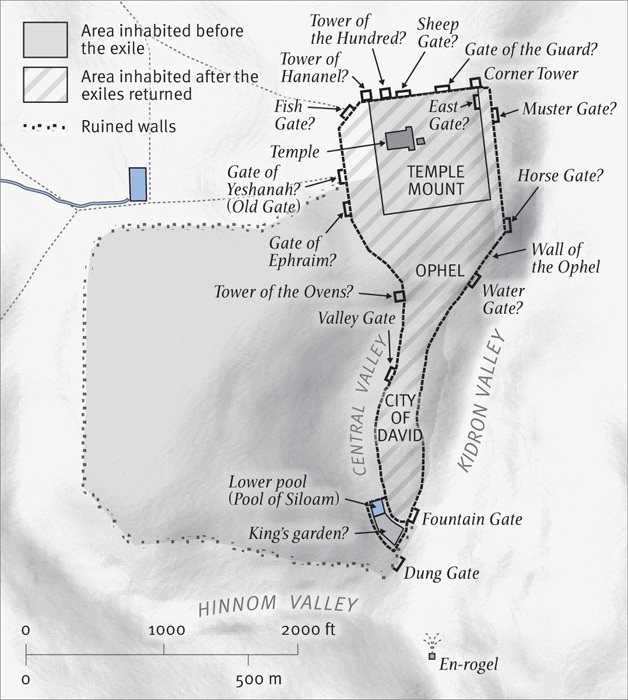
NEHEMIAH—NOTE ON 3:1–7:3 A detailed account of rebuilding the wall is given.
NEHEMIAH—NOTE ON 3:1 Eliashib the high priest. The grandson of Jeshua the high priest in Zerubbabel's era (cf. Neh. 12:10). built. On the fourth of Ab, (July/August) 445 B.C. (cf. 6:15). Sheep Gate. This is located in the northeast section of Jerusalem (cf. 3:32; 12:39). The narrative moves around the perimeter of Jerusalem in a counterclockwise direction. Tower of the Hundred . . . Tower of Hananel. This northern section of Jerusalem opened up to the central Benjamin plateau where enemy forces could attack most easily from the north. The rest of the perimeter of the city was protected by the natural valley topography.
NEHEMIAH—NOTE ON 3:3 Fish Gate. So named because merchants sold fish on the northern side of Jerusalem. Men of Tyre and other coastal towns routinely brought fish to sell (cf. 12:39; 13:16).
NEHEMIAH—NOTE ON 3:5 nobles would not stoop to serve their Lord. One explanation, beyond just the laziness of the rich, is that these nobles had been pledged to Tobiah for personal gain (6:17–19).
NEHEMIAH—NOTE ON 3:6 Gate of Yeshanah. Believed to be in the northwest corner of Jerusalem (cf. 12:39).
NEHEMIAH—NOTE ON 3:8 Broad Wall. On the western side of the northern sector (cf. 12:38).
NEHEMIAH—NOTE ON 3:11 Tower of the Ovens. On the western side of Jerusalem (cf. 12:38).
NEHEMIAH—NOTE ON 3:13 Valley Gate. See note on 2:13, 15. Dung Gate. See note on 2:13.
NEHEMIAH—NOTE ON 3:15 Pool of Shelah. See note on 2:14. king's garden. In the southeast sector.
NEHEMIAH—NOTE ON 3:16 tombs of David. Cf. 2:5. Presumably in the southeast sector. house of the mighty men. This location is probably associated with David's mighty men (cf. 2 Sam. 23:8–39).
NEHEMIAH—NOTE ON 3:19 the armory. Located on the eastern side of Jerusalem.
NEHEMIAH—NOTE ON 3:26 Ophel. An area south of the temple mount, near the Water Gate, where the temple servants lived (cf. 2 Chron. 27:3; 33:14; Neh. 11:21). Water Gate. Near the Gihon Spring on the east side of Jerusalem (cf. 8:16; 12:37).
NEHEMIAH—NOTE ON 3:28 Horse Gate. In the northeast sector.
NEHEMIAH—NOTE ON 3:29 East Gate. Possibly located to the east of the temple mount.
NEHEMIAH—NOTE ON 3:31 Muster Gate. In the northeast sector.
NEHEMIAH—NOTE ON 3:32 Sheep Gate. Having traveled around Jerusalem in a counterclockwise direction, the narrative ends where it began (cf. 3:1; 12:39).
NEHEMIAH—NOTE ON 4:1–23 This section describes the intimidation and opposition to the project.
NEHEMIAH—NOTE ON 4:2 the army of Samaria. While it is a possibility that his intentions were to provoke the Samaritans to action, which would have brought the Persian overlord down on Samaria swiftly, harassment and mockery (v. 3) became the primary strategy to prevent the reconstruction of the walls.
NEHEMIAH—NOTE ON 4:4–5 Nehemiah's dependence on his sovereign God is never more evident than in his prayer (cf. 1:5–11; 2:4).
NEHEMIAH—NOTE ON 4:7–8 the Ashdodites. Added to the list of enemies already given are the dwellers of Ashdod, one of the former Philistine cities to the west of Jerusalem. Apparently they came to the point where they were at least contemplating a full-scale attack on Jerusalem because of the rapid progress of the wall.
NEHEMIAH—NOTE ON 4:9 The Jews exhibited a balance between faith in God and readiness, employing some of the wall builders as guards.
NEHEMIAH—NOTE ON 4:10 much rubble. Lit., "dust," the term refers to the rubble or ruins of the prior destruction (586 B.C.), which they had to clear away before they could make significant progress on the rebuilding of the walls.
NEHEMIAH—NOTE ON 4:11–12 Part of the strategy of the enemy coalition was to frighten and intimidate the Jews by making them think their army would soon surprise them with a massive force that would quickly engulf them.
NEHEMIAH—NOTE ON 4:13–15 stationed the people. Nehemiah and the others had received word that Sanballat had mustered the army of Samaria (4:2). In fact, God made sure the strategy was known by letting the nearby Jews know, so they would report it to Judah's leaders. Though vigilant, armed, and ready,
Nehemiah and those he led consistently gave God the glory for their victories and construction successes.
Seven Attempts to Stop Nehemiah's Work
Seven Attempts to Stop Nehemiah's Work 1. 2:19 Sanballat, Tobiah, and Geshem mocked Nehemiah. 2. 4:1–3 Sanballat and Tobiah mocked Nehemiah. 3. 4:7–23 The enemy threatened a military attack. 4. 6:1–4 Sanballat and Geshem attempted to lure Nehemiah outside of Jerusalem to Ono. 5. 6:5–9 Sanballat threatened Nehemiah with false charges. 6. 6:10–14 Shemaiah, Noadiah, and others were paid to prophesy falsely and discredit Nehemiah. 7. 6:17–19 Tobiah had spies in Jerusalem and wrote Nehemiah letters in order to frighten him. ©1997 by Thomas Nelson, Inc.
NEHEMIAH—NOTE ON 4:16–18a The threats cut the work force in half, and even those who worked carried weapons in case of attack (cf. v. 21).
NEHEMIAH—NOTE ON 4:18b–20 trumpet. Among other functions, trumpets were used to sound an alarm in the event of danger or to summon soldiers to battle. Nehemiah kept a trumpeter at his side always, so that the alarm could be sounded immediately. His plan also included perpetual diligence (vv. 22–23).
NEHEMIAH—NOTE ON 5:1–13 Enemy opposition and difficult times in general had precipitated economic conditions that had a devastating effect on Judah's fragile life. The effect of this extortion on the morale of the returnees was worse than the enemy opposition.
NEHEMIAH—NOTE ON 5:1–5 Jewish brothers. Perhaps this refers again to the nobles who would not work and had alliances with the enemies (see note on 3:5). The people were fatigued with hard labor, drained by the relentless harassment of enemies, poor and lacking the necessities of life, lacking tax money and borrowing for it, and working on the wall in the city rather than getting food from the country. On top of this came complaints against the terrible exploitation and extortion by the rich Jews who would not help, but forced people to sell their homes and children, while having no ability to redeem them back. Under normal conditions, the law offered the hope of releasing these young people through the remission of debts which occurred every seven years or in the fiftieth year of jubilee (Lev. 25). The custom of redemption made it possible to "buy back" the enslaved individual at almost any time, but the desperate financial situation of those times made that appear impossible.
NEHEMIAH—NOTE ON 5:7 I brought charges against the nobles and the officials. The commitment of the nobles and rulers to the reconstruction project was negligible (cf. 3:5), while their loyalty to Tobiah and others in opposition added to their opportunistic attitudes, placing them close to the status of opposition. They had become the enemy from within. exacting interest. This can refer to normal interest or it can signify excessive interest, i.e., usury. According to Mosaic law, the Jews were forbidden to take interest from their brothers on the loan of money, food, or anything else. If the person was destitute, they should consider it a gift. If they could pay it back later, it was to be without interest (see Lev. 25:36–37; Deut. 23:19–20). Such generosity marked the godly (see Ps. 15:5; Jer. 15:10; cf. Prov. 28:8). Interest could be taken from foreigners (Deut. 23:20). Interest loans were known to exceed 50 percent at times in ancient nations. Such usury took advantage of people's desperation and was virtually impossible to repay, consuming their entire family assets and reducing the debtors to permanent slavery. See notes on Deut. 23:19–20 and 24:10–13.
NEHEMIAH—NOTE ON 5:8 We . . . have bought back. Nehemiah denounced with just severity the evil conduct of selling a brother by means of usury. He contrasted it with his own action of redeeming with his own money some of the Jewish exiles, who through debt had lost their freedom in Babylon.
NEHEMIAH—NOTE ON 5:10 Moreover, I. Nehemiah set the example again by making loans, but not in exacting usury.
NEHEMIAH—NOTE ON 5:11 Return to them. To remedy the evil that they had brought, those guilty of usury were to return the property they had confiscated from those who couldn't pay the loans back, as well as returning the interest they had charged (see notes on Luke 19:2–10).
NEHEMIAH—NOTE ON 5:12 swear. The consciences of the guilty were struck by Nehemiah's words, so that their fear, shame, and contrition caused them to pledge the release of their loans and restore property and interest, including setting slaves free. This cancellation of debt had a profoundly unifying effect on both sides of the indebtedness. The proceedings were formally consummated with the people binding themselves by a solemn oath from the priests (with them as administrators) that they would be faithful to the pledge.
NEHEMIAH—NOTE ON 5:13 shook out the fold. This curse rite from the governor, Nehemiah, called down God's wrath upon anyone who would not follow through with his commitment to release debts. The people agreed and did as they had promised.
NEHEMIAH—NOTE ON 5:14 twentieth year. See note on 1:1. thirty-second year. The year Nehemiah returned to Artaxerxes in Persia (c. 433 B.C.; cf. 13:6). ate the food allowance of the governor. This refers to the provisions from the Persian administration, but from which he had chosen not to partake because it would have to come from taxing his poverty-stricken people (5:15). The statement is testimony to the wealth of Nehemiah gained as the king's cupbearer in Persia. Verses 17–18 record that he supported 150 men with abundant provisions who ruled with him (and their families), indicating the personal wealth he had brought from Babylon.
NEHEMIAH—NOTE ON 5:15 forty shekels. Approximately one pound of silver. because of the fear of God. Nehemiah would not exact usury from his fellow countrymen as his predecessors had, because he viewed it as an act of disobedience toward God.
NEHEMIAH—NOTE ON 5:16 we acquired no land. Even though the time to purchase property from those forced to sell couldn't have been better, Nehemiah maintained a consistent personal policy not to take advantage of another's distress. He worked on the wall rather than spending his time building personal wealth.
NEHEMIAH—NOTE ON 5:18 the food allowance of the governor. See note on 5:14. In the ancient Near East, it was customary to calculate the expense of a king's establishment, not by the quantity of money, but by the quantity of his provisions (cf. 1 Kings 4:22; 18:19; Eccles. 5:11).
NEHEMIAH—NOTE ON 5:19 Remember for my good. The first of four such prayers (cf. 13:14, 22, 31).
NEHEMIAH—NOTE ON 6:1 Sanballat and Tobiah and Geshem. See notes on 2:10, 19.
NEHEMIAH—NOTE ON 6:2 sent to me. This suggests either a letter or an oral message delivered by messenger to Nehemiah. Satisfied that they could not prevent Nehemiah's project from succeeding by open military engagement (see note on 4:13–15), they decided to overcome him by deception. plain of Ono. Located south of Joppa on the western extremity of Judah along the seacoast.
NEHEMIAH—NOTE ON 6:3 And I sent messengers. Because he knew they were luring him into a trap, he sent representatives, who themselves might have been killed or imprisoned for ransom.
NEHEMIAH—NOTE ON 6:5 open letter. Official letters were typically rolled up and sealed with an official signet by the letter's sender or one of his assisting officials. An open or unsealed letter was not only a sign of disrespect and open criticism, but also suggested the information therein was public knowledge. The goal of this document was to intimidate Nehemiah into stopping the work.
NEHEMIAH—NOTE ON 6:6 It is reported among the nations. The letter suggested that Nehemiah's intent to revolt was common knowledge which would get back to the king of Persia if he didn't come to the requested conference. you and the Jews intend to rebel. This information would have brought Persian troops against the Jews had it been true. Even though Judah had a reputation for breaking its allegiances with its overlord kings, on this occasion that was not the case. building the wall . . . become their king. Artaxerxes had commissioned the rebuilding of the wall based on his relationship of trust with Nehemiah. Once the project was accomplished, the king expected Nehemiah to return to Susa. Allegations that Nehemiah was fortifying the city so that he might be made king would seriously violate the Persian king's trust, if not create a war. The plot was an attempt to intimidate Nehemiah with the idea that a wedge was to be driven between Nehemiah and Artaxerxes so that Nehemiah would come to the meeting with those enemies—a meeting that would have featured his death.
NEHEMIAH—NOTE ON 6:7 set up prophets to proclaim. If there were such prophets, Sanballat actually hired them to feed incorrect information generating the false rumor (cf. 6:10–14). By dispatching such prophets to make public proclamations that Nehemiah had made himself king, the Persian imperial rule would have appeared to be supplanted.
NEHEMIAH—NOTE ON 6:10 Shemaiah. When the open letter failed to intimidate Nehemiah into stopping the work and coming to a meeting, his enemies decided to try intimidation from within. They hired a false prophet (v. 12), Shemaiah, to lure Nehemiah into the Holy Place in the temple for refuge from a murder plot. To enter and shut himself in the Holy Place would have been a desecration of the house of God and would have caused people to question his reverence for God. Shemaiah was the son of a priest who was an intimate friend of Nehemiah. This plan would give them grounds to raise an evil report against Nehemiah, who was not a priest and had no right to go into the Holy Place (cf. 6:13). It could also make the people question his courage (6:11). Other disloyal Jews included: 1) the nobles (3:5; 6:17); 2) Jews who lived near Sanballat (4:12); 3) Noadiah (6:14); 4) Meshullam (6:17–19); 5) Eliashib (13:4, 7); and 6) the high priest's grandson (13:28). the house of God. This is a frequently used name for the temple (cf. 8:16; 10:32–39; 11:11, 16, 22; 12:40; 13:4, 7, 9, 11, 14).
NEHEMIAH—NOTE ON 6:15 Elul. August/September, 445 B.C. Knowing that the project lasted 52 days, it commenced on the fourth of Ab (July/August) 445 B.C.
NEHEMIAH—NOTE ON 6:16 this work had been accomplished with the help of our God. While modern readers might be tempted to exalt the leadership qualities that brought the work to completion, Nehemiah's conclusion was seen through the eyes of his enemies, i.e., God works through faithful people, but it is God who works. This is a change from the attitudes indicated in 4:1 and 5:9.
NEHEMIAH—NOTE ON 6:17–19 many letters to Tobiah. Nehemiah added a footnote that in the days of building the wall, the nobles of Judah who refused to work (3:5) were in alliance and correspondence with Tobiah because, although his ancestors were Ammonites (2:19), he had married into a respectable Jewish family. Shemaiah was from the family of Arah (Ezra 2:5); his son Jehohanan was the son-in-law of Meshullam who shared in the work of building (Neh. 3:4, 30). According to 13:4, the high priest, Eliashib, was related to Tobiah (which is a Jewish name). The meddling of these nobles, by trying to play both sides through reports to Tobiah and to Nehemiah (6:19), only widened the breach as Tobiah escalated efforts to frighten the governor.
NEHEMIAH—NOTE ON 7:2 Hanani. Cf. 1:2. the castle. See note on 2:8.
NEHEMIAH—NOTE ON 7:3 In the ancient Near East, it was customary to open the city gates at sunrise and close them at sunset. Nehemiah recommended that this not be done, because of the hostility of the enemies. Rather the gates were to be kept shut until well into the heat of the morning when everyone was up and active. When the gates were shut, they were to be guarded by sentinels at watch stations and in front of their own vulnerable homes (v. 4).
NEHEMIAH—NOTE ON 7:5a my God put it into my heart. Throughout the book, Nehemiah claimed the hand of God was at work in all circumstances (cf. 2:8, 18; 6:16).
NEHEMIAH—NOTE ON 7:5b–6 I found the book of the genealogy. Nehemiah discovered a record of the people made by Ezra in Babylon before the first group returned, a listing of the people who had come with Zerubbabel.
NEHEMIAH—NOTE ON 7:6–73a Nehemiah gave the list of those in the first return from Persia to Jerusalem under Zerubbabel in 538 B.C. See notes on Ezra 2:1–70. Minor discrepancies are possibly due to Ezra listing those who intended to depart, while Nehemiah listed those who actually arrived; or some other unknown reason.
NEHEMIAH—NOTE ON 7:65 Urim and Thummim should arise. One of the methods used to discern the will of God on a specific matter. See note on Ex. 28:30.
NEHEMIAH—NOTE ON 7:73b–10:39 God gave revival under Ezra's spiritual leadership.
NEHEMIAH—NOTE ON 7:73b–8:12 The revival began with an exposition of God's word.
NEHEMIAH—NOTE ON 7:73b seventh month. The month of Tishri (September/October), 445 B.C., less than one week after completing the walls (cf. 6:15). The Feast of Booths, or Tabernacles, usually began on the fifteenth day (cf. 6:14 with Lev. 23:33–44), but here it began on the second (cf. Neh. 8:13), and it was a feast to which the whole nation was called. Usually the Feast of Trumpets occurred on the first day (cf. Lev. 23:23–25).
NEHEMIAH—NOTE ON 8:1–2 the Book of the Law. In response to the people's request, Ezra brought the law of the Lord, which he had set his heart to study, practice, and teach to the people (cf. Ezra 7:10). At this time, the law was a scroll, as opposed to a text consisting of bound pages. Such a reading was required every seven years at the Feast of Booths, or Tabernacles (cf. Deut. 31:10–13), even though it had been neglected since the Babylonian captivity until this occasion.
NEHEMIAH—NOTE ON 8:1 Water Gate. See note on 3:26. Ezra. This is the first mention of Ezra in the book of Nehemiah, though he had been ministering in Jerusalem since 458 B.C. (cf. Ezra 7:1–10:44).
NEHEMIAH—NOTE ON 8:3 read . . . understand. Here is the general summary of the event of reading and explaining the Scripture from daybreak to noon, a period of at least six hours (more detail is added in vv. 4–8).
NEHEMIAH—NOTE ON 8:4 platform . . . beside him. The platform was big enough to hold 14 people for the long hours of reading and explaining (v. 8). The men, probably priests, stood with Ezra to show agreement.
NEHEMIAH—NOTE ON 8:5 stood. In respect at the reading of God's word, as though they were in the presence of God himself, the people stood for all the hours of the exposition.
NEHEMIAH—NOTE ON 8:6 blessed the Lord. A praise befitting the reading. In a synagogue, the reading is preceded by a benediction. The response of "Amen, Amen" was an affirmation of what Ezra prayed.
NEHEMIAH—NOTE ON 8:7–8 Some of the Levites assisted Ezra with the people's understanding of the Scripture by reading and explaining it.
NEHEMIAH—NOTE ON 8:8 gave the sense. This may have involved translation for people who were only Aramaic speakers in exile, but more likely it means "to break down" the text into its parts so that the people could understand it. This was an exposition or explanation of the meaning and not just translation. so that the people understood the reading. In this act of instruction, Ezra's personal commitment to study the law, practice it in his own life, and then teach it (Ezra 7:10) was reflected.
NEHEMIAH—NOTE ON 8:9 governor. See note on 5:14. Ezra the priest. Cf. Ezra 7:11–12, 21; 10:10, 16. wept as they heard the words of the Law. When they heard and understood God's law, they understood their violations of it. Not tears of joy, but penitent sorrow (Neh. 8:10) came forth as they were grieved by conviction (8:11) over the distressing manifestations of sin in transgressing the Lord's commands and the consequent punishments they had suffered in their captivity.
NEHEMIAH—NOTE ON 8:10–12 the joy of the Lord is your strength. The event called for a holy day of worship to prepare them for the hard days ahead (cf. 12:43), so they were encouraged to rejoice. The words they had heard did remind them that God punishes sin, but also that God blesses obedience. That was reason to celebrate. They had not been utterly destroyed as a nation, in spite of their sin, and were, by God's grace, on the brink of a new beginning. That called for celebration.
NEHEMIAH—NOTE ON 8:13–9:37 The Jews celebrated the Feast of Booths, or Tabernacles, and confessed their history of sins.
NEHEMIAH—NOTE ON 8:13 in order to study the words of the Law. The smaller group that gathered to Ezra consisted of those who had teaching responsibilities: the heads of the fathers' houses to their families, and the priests and Levites to the general population in the community (Mal. 2:6–7).
NEHEMIAH—NOTE ON 8:14 Cf. Ex. 23:16; Lev. 23:33–44; Num. 29:12–38; Deut. 16:13–17 for details on the Feast of Booths, or Tabernacles.
NEHEMIAH—NOTE ON 8:15–16 they should proclaim it and publish it. Proclamations such as this carried the authority of the administration represented by leaders such as Nehemiah, who was the governor, and Ezra, the priest and scribe (8:9) who had been used to reestablish the city, its worship, and its social life. The people responded to their directive.
NEHEMIAH—NOTE ON 8:16 Water Gate. See notes on 3:26 and 12:37. Gate of Ephraim. This is believed to have been near the Old Gate (cf. 3:6; 12:39).
NEHEMIAH—NOTE ON 8:17 from the days of Jeshua . . . great rejoicing. The Feast of Booths, or Tabernacles, had been celebrated since Joshua (2 Chron. 7:8– 10; Ezra 3:4), but not with such joy.
NEHEMIAH—NOTE ON 8:18 This was more than was required and arose from the exuberant zeal of the people.
NEHEMIAH—NOTE ON 9:1 this month. Tishri (September/October), 445 B.C. (cf. 7:73b; 8:2). with fasting and in sackcloth, and with earth. The outward demonstration of deep mourning and heaviness of heart for their iniquity seems to have been done in the spirit of the Day of Atonement which was normally observed on the tenth day of the seventh month (cf. Lev. 16:1–34; 23:26–32).
NEHEMIAH—NOTE ON 9:2 separated themselves from all foreigners. This call for divorcing all lawful wives taken from among the heathen was needed, since the last time, prompted 13 years before by Ezra (see notes on Ezra 10) had only been partially successful. Many had escaped the required action of divorce and kept their pagan wives. Perhaps new defaulters had appeared also, and were confronted for the first time with this necessary action of divorce. Nehemiah's efforts were successful in removing this evil mixture.
NEHEMIAH—NOTE ON 9:3 they stood . . . read . . . made confession and worshiped. The succession of events helped to reestablish the essential commitment of Israel to God and his law. They read for three hours about the sins of their fathers and for three more hours confessed that they had been partakers of similar evil deeds. In response to all of this, they worshiped.
NEHEMIAH—NOTE ON 9:4–37 This long confession of sin in the context of the recitation of God's mighty redemptive acts on Israel's behalf is an expression of worship (v. 3) that recalls some of the psalms in their theme and worshipful purpose. This season of national humiliation centered on adoring God for his great mercy in the forgiveness of their multiplied iniquities, in delivering them from judgment, protecting them, and blessing them graciously. Apparently, this great prayer of worship offered to God was recited by a group of Levites (vv. 4– 5) indicating it had been prepared and adopted beforehand, probably by Ezra. This prayer initiated the three hours of confession and worship (v. 3), which led to a national promise of obedience to God in the future (v. 38).
NEHEMIAH—NOTE ON 9:6 have made heaven. The recitation was ordered historically, although themes of promise and judgment are traced through Israel's history with God. The first feature is the celebration of God's greatness as Creator (cf. Gen. 1–2). the host of heaven worships you. The praise that Israel offered on earth was also echoed in the heavens by angelic hosts.
NEHEMIAH—NOTE ON 9:8 found his heart faithful before you. The Abrahamic Covenant (Gen. 12:1–3; 15:4–7; 17:1–9) was based on God's faithfulness to his word and given to a man who was faithful to him. See notes on Gen. 15:6 and Rom. 4, where the faithful heart of Abraham is discussed. made with him the covenant to give to his offspring the land. The covenant was a covenant of salvation, but also involved the Promised Land. The people, having just returned from captivity, understandably emphasized that feature of the covenant, since God had returned them to the land.
NEHEMIAH—NOTE ON 9:9–12 This section of the prayer of praise and confession recounts the exodus (see Ex. 2–15).
NEHEMIAH—NOTE ON 9:10 made a name for yourself. God established his righteous reputation over the powers of Egypt by the miracles of immense power performed in Egypt.
NEHEMIAH—NOTE ON 9:13–19 The months at Sinai are remembered (see Ex. 19– 40).
NEHEMIAH—NOTE ON 9:17 they . . . appointed a leader. The Hebrew of this statement is almost a repeat of Num. 14:4, which records the discontent of the people with God's plan and Moses' leadership.
NEHEMIAH—NOTE ON 9:19–21 This section remembers the 38 years of wandering in the wilderness (cf. Num. 9–19).
NEHEMIAH—NOTE ON 9:21 they lacked nothing. The same word is used in Ps. 23:1, "I shall not want." Even during the long season of chastisement, God miraculously cared for their every need.
NEHEMIAH—NOTE ON 9:22–25 These verses encompass the period of possessing the Promised Land, as recorded in Num. 20–Josh. 24.
NEHEMIAH—NOTE ON 9:22 gave them kingdoms and peoples. Canaan was comprised of a number of politically semi-autonomous groups all loosely connected under the waning authority of Egypt. The Lord divided Canaan into tribal districts, thus apportioning the land for Israel's possession.
NEHEMIAH—NOTE ON 9:23 multiplied their children. A nation of offspring was another aspect of the promise made to Abraham (Gen. 12:1–3). God told Abraham that his descendants would be like the stars of heaven (Gen. 15:5) and Ex. 1:1–3 reminded Israel that their multiplication in Egypt was nothing short of miraculous.
NEHEMIAH—NOTE ON 9:24 subdued before them. Moses said in Ex. 15:3, "The Lord is a man of war." As Israel's military leader and king, he led them into battle to defeat their enemies and take the land.
NEHEMIAH—NOTE ON 9:26–31 This section summarizes the period from the judges to the Assyrian deportation (722 B.C.) and Babylonian exile (586 B.C.). See 2 Kings 17–25.
NEHEMIAH—NOTE ON 9:26 who had warned them. God's prophets brought them to God's court to be judged by his law. This theme is repeated throughout the message (vv. 29–30, 34).
NEHEMIAH—NOTE ON 9:32 Now, therefore. Having reviewed the faithfulness of God to the Abrahamic Covenant (vv. 7–8) throughout Israel's national history, the prayer picks up with the present time confessing their unfaithfulness to (vv. 33–35) and renewed commitment to the Mosaic Covenant (vv. 36–38). kings of Assyria until this day. This statement sweeps across a summary of Assyrian, Babylonian, and Persian domination of the nation for almost four centuries up to that time.
NEHEMIAH—NOTE ON 9:36–37 in the land . . . over our bodies. The praise prayer rejoices that the Jews have been returned to the land, but grieves that Gentiles still rule over them.
NEHEMIAH—NOTE ON 9:37 rich yield goes to the kings. Because God's people continued in widespread sin, enemy kings enjoyed the bounty that would have been Israel's.
NEHEMIAH—NOTE ON 9:38–10:39 The nation makes a New Covenant with God to keep the Mosaic law. Though well intended, as they had been in Ex. 24:1–8, their failure was forthcoming (see note on Neh. 13:10–13).
NEHEMIAH—NOTE ON 9:38 Because of all this. The history of God's faithfulness, in spite of Israel's unfaithfulness, is the ground of a pledge and promise that the people make to obey God and not repeat the sins of their fathers. we make a firm covenant in writing. An agreement, or covenant, was a binding contract between two parties. In short, it was a formalized relationship with commitments to loyalty. In this case, the nation initiated this covenant with God.
NEHEMIAH—NOTE ON 10:1–27 The list of sealed signatures on the covenant was from the leaders. Surprisingly, Ezra's name is not listed.
NEHEMIAH—NOTE ON 10:28 temple servants. See note on Ezra 2:43–54. who have separated themselves. These are those who 1) had followed the demand of Ezra and Nehemiah to divorce pagan spouses or 2) had been left in the land but never joined themselves to any heathen, thus remaining separate. Intermarriage with the nations had previously precipitated an influence in Israel that had culminated in Babylonian slavery, thus playing a major role in Israel's unfaithfulness to the covenant.
NEHEMIAH—NOTE ON 10:29 a curse and an oath. Covenants characteristically were ratified by an oath ceremony in which the parties swore to the terms of the covenant. A curse rite was often included wherein the slaughtering of an animal indicated similar consequences for the covenant breaker. Israel's pledged adherence to the law was thus solemnly affirmed.
NEHEMIAH—NOTE ON 10:30 not give our daughters . . . or take their daughters. Parents controlled marriages, so this part of the covenant came from them. Again, it stressed the serious matter of marrying a heathen from an idolatrous people (see Ezra 10).
NEHEMIAH—NOTE ON 10:32–39 The remainder of the conditions the people made in their covenant involved matters of the temple.
NEHEMIAH—NOTE ON 10:32–33 We also take on ourselves the obligation. What the people were committing themselves to do by covenant turned into law requiring a one-third shekel temple tax. The Mosaic ordinance required one-half of a shekel (see Ex. 30:11–16), but the severe economic straits of the time led to the reduced amount. By the time of Christ, the people had returned to the Mosaic stipulation of one-half of a shekel. See note on Matt. 17:24.
NEHEMIAH—NOTE ON 10:34 The carrying of the wood for the constantly burning altar (Lev. 6:12 ff.) had formerly been the duty of the temple servants, but few of them had returned from Babylon (Neh. 7:60) so more people were chosen to assist in this task.
NEHEMIAH—NOTE ON 10:35–39 Laws for all the offerings and tithes were reinstated so as not to "neglect the house of our God" (v. 39).
NEHEMIAH—NOTE ON 10:35–37 firstfruits . . . firstborn . . . firstborn. These laws required the firstfruits of the ground (see Ex. 23:19; 34:26; Deut. 26:2), the firstfruits of the trees (see Lev. 19:24; Num. 18:13), the firstborn sons redeemed by the estimated price of the priest (see Num. 18:15), and the firstborn of the herds and flocks (see Ex. 13:12; Num. 18:15–17). All of this was kept at the storehouses near the temple and distributed for the support of the priests and Levites. The Levites then gave a tenth of what they received to the priests (cf. Num. 18:26).
NEHEMIAH—NOTE ON 11:1–13:31 Details of Nehemiah exercising his governorship are given in this section.
NEHEMIAH—NOTE ON 11:1–12:26 Jerusalem and Judah are resettled.
NEHEMIAH—NOTE ON 11:1 cast lots. A method of decision-making that God honored (Prov. 16:33). Nehemiah redistributed the population so that one out of every 10 Jews lived in Jerusalem. The other nine were free to reestablish their family heritage in the land.
NEHEMIAH—NOTE ON 11:3–24 The people who dwelt in Jerusalem are identified.
NEHEMIAH—NOTE ON 11:21 Ophel. See note on 3:26.
NEHEMIAH—NOTE ON 11:25–36 These are the places where 90 percent of the people dwelt outside of Jerusalem (cf. Ezra 2:21–23, 27, 34).
NEHEMIAH—NOTE ON 12:1–26 Originally there were 24 courses of priests, each course serving in the temple for a period of two weeks per year or for one month biannually (see 1 Chron. 24:1–20). Only four of those courses returned from Babylon (see Neh. 7:39–42; Ezra 2:36–39) but these were divided into 24 courses of which 22 are listed here. Perhaps two are omitted because their families had become extinct, because no sons were born since the time Zerubbabel originally named them. This then is a selective rather than exhaustive listing of priests and Levites from the time of Zerubbabel and Jeshua, recording the key priests and Levites through three generations of high priests: 1) Jeshua who came in the initial return with Zerubbabel c. 538 B.C. (Neh. 12:1– 11); 2) Joiakim, the son of Jeshua (vv. 12–21); 3) Eliashib (cf. 3:1) the son of Joiakim (12:22–23); 4) a miscellaneous group who served in the days of Joiakim (vv. 24–26).
NEHEMIAH—NOTE ON 12:1 Zerubbabel . . . Jeshua. See note on Ezra 2:2.
NEHEMIAH—NOTE ON 12:10–11 This record lists six generations of high priests beginning with Jeshua. The Jonathan of v. 11 is the Johanan of v. 22.
NEHEMIAH—NOTE ON 12:12–21 Each of the 22 families in vv. 1–7 is repeated, except one (cf. Hattush; v. 2). Perhaps by the time of Joiakim's high priesthood, this family had become extinct, the fathers having no male offspring.
NEHEMIAH—NOTE ON 12:22 Darius the Persian. This refers to Darius II, c. 423– 404 B.C.
NEHEMIAH—NOTE ON 12:23 Book of the Chronicles. Lit., "were written on the scroll of the matters of the days." This involved precise genealogical records kept in the administrative archives of Judah.
NEHEMIAH—NOTE ON 12:27–13:3 The walls were dedicated.
NEHEMIAH—NOTE ON 12:27–43 the dedication of the wall. In the same manner marking the dedications of the temple in Solomon's day (2 Chron. 5–7) and the rebuilt temple several decades earlier (Ezra 6:16–18), the rebuilt walls were dedicated with the music of thanksgiving (most likely shortly after the events of Neh. 9).
NEHEMIAH—NOTE ON 12:30 purified. See Lev. 16:30 for the sense of moral purity in this symbolic act.
NEHEMIAH—NOTE ON 12:31–40 They probably assembled at the Valley Gate on the west. One of the choirs was led by Ezra (v. 36), the other accompanied by Nehemiah (v. 38). Moving in different directions (v. 38), they assembled together in the temple area (v. 40).
NEHEMIAH—NOTE ON 12:31 Dung Gate. See notes on 2:13 and 3:13.
NEHEMIAH—NOTE ON 12:36 the musical instruments of David. This phrase could refer to the same kind of instruments David's musicians used or the actual instruments constructed in David's time, now being used centuries later. Cf. 1 Chron. 15:16; 23:5; 2 Chron. 29:26; Ezra 3:10. the man of God. See note on Deut. 33:1; cf. Acts 13:22.
NEHEMIAH—NOTE ON 12:37 Fountain Gate. See note on 2:14. Water Gate. See notes on 3:26 and 8:16.
NEHEMIAH—NOTE ON 12:38 to the north. This second choir marched clockwise to the north (cf. 12:31). Tower of the Ovens. See note on 3:11.
NEHEMIAH—NOTE ON 12:39 Gate of Ephraim. See note on 8:16. Gate of Yeshanah. See note on 3:6. Fish Gate. See note on 3:3. Tower of Hananel. See note on 3:1. Tower of the Hundred. See note on 3:1. Sheep Gate. See notes on 3:1, 32. Gate of the Guard. Located in the northeast section of Jerusalem.
NEHEMIAH—NOTE ON 12:43 for God had made them rejoice with great joy. The God of all joy (cf. 1 Chron. 12:40; Neh. 8:10; Ps. 16:11; 33:1; 43:4; Gal. 5:22) activated their inner joy which brought corporate celebration. Though these may have been few and far between, moments like this characterized the life of obedience and blessing that God had set before Israel.
NEHEMIAH—NOTE ON 12:44–47 A listing of miscellaneous temple activities is given.
NEHEMIAH—NOTE ON 12:44 required by the Law. Cf. Lev. 7:34–36 and Deut. 18:1–5.
NEHEMIAH—NOTE ON 12:45 the command of David . . . Solomon. Cf. 1 Chron. 25–26.
NEHEMIAH—NOTE ON 12:47 the sons of Aaron. The priests.
NEHEMIAH—NOTE ON 13:1–31 Nehemiah left Jerusalem in the thirty-second year of Artaxerxes c. 433 B.C. (cf. 5:14; 13:6) and returned to Persia as he promised (cf. 2:6). During his absence, the people returned to their former ways, led by the high priest Eliashib (13:4–5). Such a defection called for the needed reforms of vv. 1–3 and 10–30. It was during Nehemiah's absence that Malachi also wrote his prophetic book indicting both priests and people for their sinful defection. Possibly having heard of Eliashib's evil, Nehemiah returned (vv. 4–7). Nehemiah 13 was the last portion of the OT to be written.
NEHEMIAH—NOTE ON 13:1–2 On that day they read from the Book of Moses. Not surprisingly, as they read on the regular calendar cycle, they were confronted with areas in which their thinking and practice had wavered from the
Scriptures, specifically with regard to the requirements of Deut. 23:3–6.
NEHEMIAH—NOTE ON 13:2 Balaam. See Num. 22–24.
NEHEMIAH—NOTE ON 13:3 This was done in compliance with their recent pledge (cf. 10:26–29) before Nehemiah left for Persia.
NEHEMIAH—NOTE ON 13:4 Tobiah. See note on 2:10. Eliashib had allied with Israel's enemy for some personal gain and taken it to such an extreme as to desecrate the house of God.
NEHEMIAH—NOTE ON 13:6 I went to the king. Nehemiah returned to Persia as he promised (cf. 2:6) c. 433 B.C., in the thirty-second year of Artaxerxes (cf. 5:14). It is unknown exactly how long Nehemiah remained in Persia, perhaps until c. 424 B.C., but in that interval the disobedience developed.
NEHEMIAH—NOTE ON 13:7–9 Nehemiah's response to the desecration of the temple was similar to Christ's almost five centuries later (cf. Matt. 21:12–13; John 2:13–17).
NEHEMIAH—NOTE ON 13:9 vessels of the house of God. In order to accommodate Tobiah, they had moved the utensils of the house of God from their rightful place and put idols in the temple courts.
NEHEMIAH—NOTE ON 13:10–13 In Nehemiah's absence, the Jews violated their previous covenant with God regarding offerings (cf. 10:35–39) as reported by Mal. 1:6–14 and 3:8–12. In his presence, it was immediately restored (see notes on Neh. 9:38–10:39).
NEHEMIAH—NOTE ON 13:10 had fled each to his field. By neglecting the tithe, the people failed to support the Levites. Consequently, they had to abandon their responsibilities in the house of God and perform field labor in order to survive.
NEHEMIAH—NOTE ON 13:14 Remember me. This refrain is used three times here, once after each rebuke (cf. 13:22–31).
NEHEMIAH—NOTE ON 13:15–17 They went against their previous agreement by violating the Sabbath (cf. 10:31).
NEHEMIAH—NOTE ON 13:16 Tyrians. A Phoenician coastal town 20 miles south of Sidon.
NEHEMIAH—NOTE ON 13:18 Jeremiah had rebuked their fathers for the same things (see Jer. 17:21ff.). By such acts their fathers had brought the misery of exile and oppression, and they were doing the same—increasing God's wrath against them.
NEHEMIAH—NOTE ON 13:19–22 Nehemiah had to force compliance with threats.
NEHEMIAH—NOTE ON 13:23–29 Both the priests and the people had married pagans of the land in violation of the Mosaic law (cf. Ex. 34:15–16; Deut. 7:3), the earlier reforms of Ezra (cf. Ezra 9–10), and their own covenant (cf. Neh. 10:30). Malachi spoke against this sin (Mal. 2:10–16).
NEHEMIAH—NOTE ON 13:23 Ashdod. See note on 4:7–8. Ammon, and Moab. Neighboring countries east of the Jordan whose beginnings were by Lot's incestuous relationship with his two daughters (cf. Gen. 19:30–38).
NEHEMIAH—NOTE ON 13:28 Even the grandson of the high priest (cf. 12:10) sinfully married a daughter of Sanballat (see note on 2:10).
NEHEMIAH—NOTE ON 13:29–30 Malachi 2:1–8 recognizes the uncleanness within the priesthood.
NEHEMIAH—NOTE ON 13:31 Remember me. Nehemiah prayed this for the third time (cf. 13:14, 22), desiring God's blessing on his obedient efforts.
Esther
Esther 1 • Esther 2 • Esther 3 • Esther 4 • Esther 5 • Esther 6 • Esther 7 •
Esther 8 • Esther 9 • Esther 10 Introduction to Esther
Title Author and Date Background and Setting Historical and Theological Themes Interpretive Challenges Outline Footnotes Study Notes
Introduction to Esther
Title
"Esther" serves as the title without variation through the ages. This book and the book of Ruth are the only OT books named after women. As with Song of Solomon, Obadiah, and Nahum, the NT does not quote or allude to Esther.
"Hadassah" (2:7), meaning "myrtle," was the Hebrew name of Esther, which came either from the Persian word "star" or possibly from the name of the Babylonian love goddess, Ishtar. As the orphaned daughter of her father Abihail, Esther grew up in Persia with her older cousin, Mordecai, who raised her as if she were his own daughter (2:7, 15).
Author and Date
The author remains unknown, although Mordecai, Ezra, and Nehemiah have been suggested. Whoever penned Esther possessed a detailed knowledge of Persian customs, etiquette, and history, plus particular familiarity with the palace at Susa (1:5–7). He also exhibited intimate knowledge of the Hebrew calendar and customs, while additionally showing a strong sense of Jewish nationalism. Possibly a Persian Jew, who later moved back to Israel, wrote Esther.
Esther appears as the seventeenth book in the literary chronology of the OT and closes the OT historical section. Only Ezra 7–10, Nehemiah, and Malachi report later OT history than Esther. The account in Esther ends in 473 B.C. before Ahasuerus died by assassination (c. 465 B.C.). Esther 10:2 speaks as though Ahasuerus's reign has been completed, so the earliest possible writing date would be after his reign around mid-fifth century B.C. The latest reasonable date would be prior to 331 B.C. when Greece conquered Persia.
Background and Setting
Esther occurred during the Persian period of world history, c. 539 B.C. (Dan. 5:30–31) to c. 331 B.C. (Dan. 8:1–27). Ahasuerus ruled from c. 486 to 465 B.C.; Esther covers the 483–473 B.C. portion of his reign. The name Ahasuerus represents the Hebrew transliteration of the Persian name "Khshayarsha," while "Xerxes" represents his Greek name.
The events of Esther occurred during the wider time span between the first return of the Jews after the 70-year captivity in Babylon (Dan. 9:1–19) under Zerubbabel c. 538 B.C. (Ezra 1–6) and the second return led by Ezra c. 458 B.C. (Ezra 7–10). Nehemiah's journey (the third return) from Susa to Jerusalem (Neh. 1–2) occurred later (c. 445 B.C.).
Esther and Exodus both chronicle how vigorously foreign powers tried to eliminate the Jewish race and how God sovereignly preserved his people in accordance with his covenant promise to Abraham c. 2100–2075 B.C. (Gen. 12:1–3; 17:1–8). As a result of God's prevailing, Est. 9–10 records the beginning of Purim—a new annual festival in the twelfth month (February/March) to celebrate the nation's survival. Purim became one of two festivals given outside of the Mosaic legislation to still be celebrated in Israel (Hanukkah, or the Festival of Lights, is the other, cf. John 10:22).
Historical and Theological Themes
All 167 verses of Esther have ultimately been accepted as canonical, although the absence of God's name anywhere has caused some to unnecessarily doubt its authenticity. The Greek Septuagint (LXX) added an extra 107 apocryphal verses that supposedly compensated for this lack. Along with Song of Solomon, Ruth, Ecclesiastes, and Lamentations, Esther stands with the OT books of the Megilloth, or "five scrolls." Rabbis read these books in the synagogue on five special occasions during the year—Esther being read at Purim (cf. 9:20–32).
The historical genesis for the drama played out between Mordecai (a Benjamite descendant of Saul—2:5) and Haman (an Agagite—3:1, 10; 8:3, 5; 9:24) goes back almost 1,000 years when the Jews exited from Egypt (c. 1445 B.C.) and were attacked by the Amalekites (Ex. 17:8–16), whose lineage began with Amalek, grandson of Esau (Gen. 36:12). God pronounced his curse on the Amalekites, which resulted in their total elimination as a people (Ex. 17:14; Deut. 25:17–19). Although Saul (c. 1030 B.C.) received orders to kill all the Amalekites, including their king Agag (1 Sam. 15:2–3), he disobeyed (1 Sam. 15:7–9) and incurred God's displeasure (1 Sam. 15:11, 26; 28:18). Samuel finally hacked Agag into pieces (1 Sam. 15:32–33). Because of his lineage from Agag, Haman carried deep hostility toward the Jews.
The time of Esther arrived 550 years after the death of Agag, but in spite of such passage of time, neither Haman the Agagite nor Mordecai the Benjamite had forgotten the tribal feud that still smoldered in their souls. This explains why Mordecai refused to bow down to Haman (Est. 3:2–3) and why Haman so viciously attempted to exterminate the Jewish race (3:5–6, 13). As expected, God's prophecy to extinguish the Amalekites (Ex. 17:14; Deut. 25:17–19) and God's promise to preserve the Jews (Gen. 17:1–8) prevailed.
Because of God's faithfulness to save his people, the festival of Purim (named after the Akkadian word for "lot"—Est. 3:7; 9:26), an annual, two-day holiday of feasting, rejoicing, sending food to one another, and giving gifts to the poor (9:21–22), was decreed to be celebrated in every generation, by every family, in every province and city (9:27–28). Esther later added a new feature of fasting with lamentation (9:31). Purim is not biblically mentioned again, although it has been celebrated throughout the centuries in Israel.
Esther could be compared to a chess game. God and Satan (as invisible players) moved real kings, queens, and nobles. When Satan put Haman into place, it was as if he announced "Check." God then positioned Esther and Mordecai in order to put Satan into "Checkmate!" Ever since the fall of man (Gen. 3:1–19), Satan has attempted to spiritually sever God's relationship with his human creation and disrupt God's covenant promises with Israel. For example, Christ's line through the tribe of Judah had been murderously reduced to Joash alone, who was rescued and preserved (2 Chron. 22:10–12). Later, Herod slaughtered the infants of Bethlehem, thinking Christ was among them (Matt. 2:16). Satan tempted Christ to denounce God and worship him (Matt. 4:9). Peter, at Satan's insistence, tried to block Christ's journey to Calvary (Matt. 16:22). Finally, Satan entered into Judas who then betrayed Christ to the Jews and Romans (Luke 22:3–6). While God was not mentioned in Esther, he was everywhere apparent as the One who opposed and foiled Satan's diabolical schemes by providential intervention.
In Esther, all of God's unconditional covenant promises to Abraham (Gen. 17:1– 8) and to David (2 Sam. 7:8–16) were jeopardized. However, God's love for Israel is nowhere more apparent than in this dramatic rescue of his people from pending elimination. "Behold, he who keeps Israel will neither slumber nor sleep" (Ps. 121:4).
Interpretive Challenges
The most obvious question raised by Esther comes from the fact that God is nowhere mentioned, as in Song of Solomon. Nor does the writer or any participant refer to the law of God, the Levitical sacrifices, worship, or prayer. The skeptic might ask, "Why would God never be mentioned when the Persian king receives over 175 references? Since God's sovereignty prevailed to save the Jews, why does he then not receive appropriate recognition?"
It seems satisfying to respond that if God desired to be mentioned, he could just as sovereignly have moved the author to write of him as he acted to save Israel. This situation seems to be more of a problem at the human level than the divine, because Esther is the classic illustration of God's providence as he, the unseen power, controls everything for his purpose. There are no miracles in Esther, but the preservation of Israel through providential control of every event and person reveals the omniscience and omnipotence of Jehovah. Whether he is named is not the issue. He is clearly the main character in the drama.
Second, "Why were Mordecai and Esther so secular in their lifestyles?" Esther (2:6–20) does not seem to have the zeal for holiness like Daniel (Dan. 1:8–20). Mordecai kept his and Esther's Jewish heritage secret, unlike Daniel (Dan. 6:5). The law of God was absent in contrast to Ezra (Ezra 7:10). Nehemiah had a heart for Jerusalem that seemingly eluded the affections of Esther and Mordecai (Neh. 1:1–2:5).
The following observations help to shed some light on these issues. First, this short book does not record everything. Perhaps Mordecai and Esther actually possessed a deeper faith than becomes apparent here (cf. Est. 4:16). Second, even godly Nehemiah did not mention his God when talking to King Artaxerxes (Neh. 2:1–8). Third, the Jewish festivals, which provided structure for worship, had been lost long before Esther, e.g., Passover (2 Kings 23:22) and Booths (Neh. 8:17). Fourth, possibly the anti-Jewish letter written by the Samaritans to Ahasuerus several years earlier had frightened them (c. 486 B.C.; Ezra 4:6). Fifth, the evil intentions of Haman did not just first surface when Mordecai refused to bow down (Est. 3:1–2). Most likely they were long before shared by others, which would have intimidated the Jewish population. Sixth, Esther did identify with her Jewish heritage at a most appropriate time (7:3–4). And yet, the nagging question of why Esther and Mordecai did not seem to have the same kind of open devotion to God as did Daniel remains. Further, Nehemiah's prayer (Neh. 1:5–11, esp. v. 7) seems to indicate a spiritual lethargy among the Jewish exiles in Susa. So this issue must ultimately be resolved by God, since he alone knows human hearts.
Outline
I. Esther Replaces Vashti (1:1–2:18)
A. Vashti's Insubordination (1:1–22)
B. Esther's Coronation (2:1–18) II. Mordecai Overcomes Haman (2:19–7:10)
A. Mordecai's Loyalty (2:19–23)
B. Haman's Promotion and Decree (3:1–15) C. Esther's Intervention (4:1–5:14) D. Mordecai's Recognition (6:1–13)
E. Haman's Fall (6:14–7:10) III. Israel Survives Haman's Genocide Attempt (8:1–10:3)
A. Esther and Mordecai's Advocacy (8:1–17)
B. The Jews' Victory (9:1–19) C. Purim's Beginning (9:20–32) D. Mordecai's Fame (10:1–3)
Esther
The King's Banquets
ESTHER 1 †Now in the days of Ahasuerus, the Ahasuerus who reigned from India to Ethiopia over 127 provinces, 2†in those days when King Ahasuerus sat on his royal throne in Susa, the capital, [1] 3†in the third year of his reign he gave a feast for all his officials and servants. The army of Persia and Media and the nobles and governors of the provinces were before him, 4while he showed the riches of his royal glory and the splendor and pomp of his greatness for many days, 180 days. 5And when these days were completed, the king gave for all the people present in Susa, the citadel, both great and small, a feast lasting for seven days in the court of the garden of the king's palace. 6There were white cotton curtains and violet hangings fastened with cords of fine linen and purple to silver rods [2] and marble pillars, and also couches of gold and silver on a mosaic pavement of porphyry, marble, mother-of-pearl and precious stones. 7Drinks were served in golden vessels, vessels of different kinds, and the royal wine was lavished according to the bounty of the king. 8And drinking was according to this edict: "There is no compulsion." For the king had given orders to all the staff of his palace to do as each man desired. 9†Queen Vashti also gave a feast for the women in the palace that belonged to King Ahasuerus.
Queen Vashti's Refusal
10On the seventh day, when the heart of the king was merry with wine, he commanded Mehuman, Biztha, Harbona, Bigtha and Abagtha, Zethar and Carkas, the seven eunuchs who served in the presence of King Ahasuerus, 11to bring Queen Vashti before the king with her royal crown, [3] in order to show the peoples and the princes her beauty, for she was lovely to look at. 12†But Queen Vashti refused to come at the king's command delivered by the eunuchs. At this the king became enraged, and his anger burned within him.
13Then the king said to the wise men who knew the times (for this was the king's procedure toward all who were versed in law and judgment, 14†the men next to him being Carshena, Shethar, Admatha, Tarshish, Meres, Marsena, and Memucan, the seven princes of Persia and Media, who saw the king's face, and sat first in the kingdom): 15"According to the law, what is to be done to Queen
Vashti, because she has not performed the command of King Ahasuerus delivered by the eunuchs?" 16Then Memucan said in the presence of the king and the officials, "Not only against the king has Queen Vashti done wrong, but also against all the officials and all the peoples who are in all the provinces of King Ahasuerus. 17For the queen's behavior will be made known to all women, causing them to look at their husbands with contempt, since they will say, 'King Ahasuerus commanded Queen Vashti to be brought before him, and she did not come.' 18This very day the noble women of Persia and Media who have heard of the queen's behavior will say the same to all the king's officials, and there will be contempt and wrath in plenty. 19†If it please the king, let a royal order go out from him, and let it be written among the laws of the Persians and the Medes so that it may not be repealed, that Vashti is never again to come before King Ahasuerus. And let the king give her royal position to another who is better than she. 20So when the decree made by the king is proclaimed throughout all his kingdom, for it is vast, all women will give honor to their husbands, high and low alike." 21This advice pleased the king and the princes, and the king did as Memucan proposed. 22†He sent letters to all the royal provinces, to every province in its own script and to every people in its own language, that every man be master in his own household and speak according to the language of his people.
Esther Chosen Queen
ESTHER 2 †After these things, when the anger of King Ahasuerus had abated, he remembered Vashti and what she had done and what had been decreed against her. 2Then the king's young men who attended him said, "Let beautiful young virgins be sought out for the king. 3And let the king appoint officers in all the provinces of his kingdom to gather all the beautiful young virgins to the harem in Susa the capital, under custody of Hegai, the king's eunuch, who is in charge of the women. Let their cosmetics be given them. 4And let the young woman who pleases the king be queen instead of Vashti." This pleased the king, and he did so.
there was a Jew in Susa the citadel whose name was Mordecai, the son of Jair, son of Shimei, son of Kish, a Benjaminite, 6†who had been carried away from Jerusalem among the captives carried away with Jeconiah king of Judah, whom Nebuchadnezzar king of Babylon had carried away. 7†He was bringing up Hadassah, that is Esther, the daughter of his uncle, for she had neither father nor mother. The young woman had a beautiful figure and was lovely to look at, and when her father and her mother died, Mordecai took her as his own daughter. 8†So when the king's order and his edict were proclaimed, and when many young women were gathered in Susa the citadel in custody of Hegai, Esther also was taken into the king's palace and put in custody of Hegai, who had charge of the women. 9†And the young woman pleased him and won his favor. And he quickly provided her with her cosmetics and her portion of food, and with seven chosen young women from the king's palace, and advanced her and her young women to the best place in the harem. 10†Esther had not made known her people or kindred, for Mordecai had commanded her not to make it known. 11And every day Mordecai walked in front of the court of the harem to learn how Esther was and what was happening to her.
12Now when the turn came for each young woman to go in to King Ahasuerus, after being twelve months under the regulations for the women, since this was the regular period of their beautifying, six months with oil of myrrh and six months with spices and ointments for women— 13when the young woman went in to the king in this way, she was given whatever she desired to take with her from the harem to the king's palace. 14†In the evening she would go in, and in the morning she would return to the second harem in custody of Shaashgaz, the king's eunuch, who was in charge of the concubines. She would not go in to the king again, unless the king delighted in her and she was summoned by name.
the turn came for Esther the daughter of Abihail the uncle of Mordecai, who had taken her as his own daughter, to go in to the king, she asked for nothing except what Hegai the king's eunuch, who had charge of the women, advised. Now Esther was winning favor in the eyes of all who saw her. 16†And when Esther was taken to King Ahasuerus, into his royal palace, in the tenth month, which is the month of Tebeth, in the seventh year of his reign, 17the king loved Esther more than all the women, and she won grace and favor in his sight more than all the virgins, so that he set the royal crown [1] on her head and made her queen instead of Vashti. 18†Then the king gave a great feast for all his officials and servants; it was Esther's feast. He also granted a remission of taxes to the provinces and gave gifts with royal generosity.
Mordecai Discovers a Plot
when the virgins were gathered together the second time, Mordecai was sitting at the king's gate. 20Esther had not made known her kindred or her people, as Mordecai had commanded her, for Esther obeyed Mordecai just as when she was brought up by him. 21†In those days, as Mordecai was sitting at the king's gate, Bigthan and Teresh, two of the king's eunuchs, who guarded the threshold, became angry and sought to lay hands on King Ahasuerus. 22And this came to the knowledge of Mordecai, and he told it to Queen Esther, and Esther told the king in the name of Mordecai. 23†When the affair was investigated and found to be so, the men were both hanged on the gallows. [2] And it was recorded in the book of the chronicles in the presence of the king.
Haman Plots Against the Jews
ESTHER 3 †After these things King Ahasuerus promoted Haman the Agagite, the son of Hammedatha, and advanced him and set his throne above all the officials who were with him. 2†And all the king's servants who were at the king's gate bowed down and paid homage to Haman, for the king had so commanded concerning him. But Mordecai did not bow down or pay homage. 3Then the king's servants who were at the king's gate said to Mordecai, "Why do you transgress the king's command?" 4†And when they spoke to him day after day and he would not listen to them, they told Haman, in order to see whether Mordecai's words would stand, for he had told them that he was a Jew. 5And when Haman saw that Mordecai did not bow down or pay homage to him, Haman was filled with fury. 6†But he disdained to lay hands on Mordecai alone. So, as they had made known to him the people of Mordecai, Haman sought to destroy all the Jews, the people of Mordecai, throughout the whole kingdom of Ahasuerus.
the first month, which is the month of Nisan, in the twelfth year of King Ahasuerus, they cast Pur (that is, they cast lots) before Haman day after day; and they cast it month after month till the twelfth month, which is the month of Adar. 8†Then Haman said to King Ahasuerus, "There is a certain people scattered abroad and dispersed among the peoples in all the provinces of your kingdom. Their laws are different from those of every other people, and they do not keep the king's laws, so that it is not to the king's profit to tolerate them. 9†If it please the king, let it be decreed that they be destroyed, and I will pay 10,000 talents [1] of silver into the hands of those who have charge of the king's business, that they may put it into the king's treasuries." 10‡†So the king took his signet ring from his hand and gave it to Haman the Agagite, the son of Hammedatha, the enemy of the Jews. 11And the king said to Haman, "The money is given to you, the people also, to do with them as it seems good to you."
the king's scribes were summoned on the thirteenth day of the first month, and an edict, according to all that Haman commanded, was written to the king's satraps and to the governors over all the provinces and to the officials of all the peoples, to every province in its own script and every people in its own language. It was written in the name of King Ahasuerus and sealed with the king's signet ring. 13†Letters were sent by couriers to all the king's provinces with instruction to destroy, to kill, and to annihilate all Jews, young and old, women and children, in one day, the thirteenth day of the twelfth month, which is the month of Adar, and to plunder their goods. 14†A copy of the document was to be issued as a decree in every province by proclamation to all the peoples to be ready for that day. 15†The couriers went out hurriedly by order of the king, and the decree was issued in Susa the citadel. And the king and Haman sat down to drink, but the city of Susa was thrown into confusion.
Esther Agrees to Help the Jews
ESTHER 4 †When Mordecai learned all that had been done, Mordecai tore his clothes and put on sackcloth and ashes, and went out into the midst of the city, and he cried out with a loud and bitter cry. 2He went up to the entrance of the king's gate, for no one was allowed to enter the king's gate clothed in sackcloth. 3And in every province, wherever the king's command and his decree reached, there was great mourning among the Jews, with fasting and weeping and lamenting, and many of them lay in sackcloth and ashes.
Esther's young women and her eunuchs came and told her, the queen was deeply distressed. She sent garments to clothe Mordecai, so that he might take off his sackcloth, but he would not accept them. 5†Then Esther called for Hathach, one of the king's eunuchs, who had been appointed to attend her, and ordered him to go to Mordecai to learn what this was and why it was. 6Hathach went out to Mordecai in the open square of the city in front of the king's gate, 7‡and Mordecai told him all that had happened to him, and the exact sum of money that Haman had promised to pay into the king's treasuries for the destruction of the Jews. 8Mordecai also gave him a copy of the written decree issued in Susa for their destruction, that he might show it to Esther and explain it to her and command her to go to the king to beg his favor and plead with him on behalf of her people. 9And Hathach went and told Esther what Mordecai had said. 10Then Esther spoke to Hathach and commanded him to go to Mordecai and say, 11†"All the king's servants and the people of the king's provinces know that if any man or woman goes to the king inside the inner court without being called, there is but one law—to be put to death, except the one to whom the king holds out the golden scepter so that he may live. But as for me, I have not been called to come in to the king these thirty days."
12And they told Mordecai what Esther had said. 13Then Mordecai told them to reply to Esther, "Do not think to yourself that in the king's palace you will escape any more than all the other Jews. 14†For if you keep silent at this time, relief and deliverance will rise for the Jews from another place, but you and your father's house will perish. And who knows whether you have not come to the kingdom for such a time as this?" 15Then Esther told them to reply to Mordecai, 16†"Go, gather all the Jews to be found in Susa, and hold a fast on my behalf, and do not eat or drink for three days, night or day. I and my young women will also fast as you do. Then I will go to the king, though it is against the law, and if I perish, I perish." 17Mordecai then went away and did everything as Esther had ordered him.
Esther Prepares a Banquet
ESTHER 5 On the third day Esther put on her royal robes and stood in the inner court of the king's palace, in front of the king's quarters, while the king was sitting on his royal throne inside the throne room opposite the entrance to the palace. 2†And when the king saw Queen Esther standing in the court, she won favor in his sight, and he held out to Esther the golden scepter that was in his hand. Then Esther approached and touched the tip of the scepter. 3‡†And the king said to her, "What is it, Queen Esther? What is your request? It shall be given you, even to the half of my kingdom." 4†And Esther said, "If it please the king, let the king and Haman come today to a feast that I have prepared for the king." 5Then the king said, "Bring Haman quickly, so that we may do as Esther has asked." So the king and Haman came to the feast that Esther had prepared. 6And as they were drinking wine after the feast, the king said to Esther, "What is your wish? It shall be granted you. And what is your request? Even to the half of my kingdom, it shall be fulfilled." 7Then Esther answered, "My wish and my request is: 8If I have found favor in the sight of the king, and if it please the king to grant my wish and fulfill my request, let the king and Haman come to the feast that I will prepare for them, and tomorrow I will do as the king has said."
Haman Plans to Hang Mordecai
9And Haman went out that day joyful and glad of heart. But when Haman saw Mordecai in the king's gate, that he neither rose nor trembled before him, he was filled with wrath against Mordecai. 10Nevertheless, Haman restrained himself and went home, and he sent and brought his friends and his wife Zeresh. 11†And Haman recounted to them the splendor of his riches, the number of his sons, all the promotions with which the king had honored him, and how he had advanced him above the officials and the servants of the king. 12Then Haman said, "Even Queen Esther let no one but me come with the king to the feast she prepared. And tomorrow also I am invited by her together with the king. 13†Yet all this is worth nothing to me, so long as I see Mordecai the Jew sitting at the king's gate." 14†Then his wife Zeresh and all his friends said to him, "Let a gallows [1] fifty cubits [2] high be made, and in the morning tell the king to have Mordecai hanged upon it. Then go joyfully with the king to the feast." This idea pleased Haman, and he had the gallows made.
The King Honors Mordecai
ESTHER 6 †On that night the king could not sleep. And he gave orders to bring the book of memorable deeds, the chronicles, and they were read before the king. 2And it was found written how Mordecai had told about Bigthana and Teresh, two of the king's eunuchs, who guarded the threshold, and who had sought to lay hands on King Ahasuerus. 3And the king said, "What honor or distinction has been bestowed on Mordecai for this?" The king's young men who attended him said, "Nothing has been done for him." 4†And the king said, "Who is in the court?" Now Haman had just entered the outer court of the king's palace to speak to the king about having Mordecai hanged on the gallows [1] that he had prepared for him. 5And the king's young men told him, "Haman is there, standing in the court." And the king said, "Let him come in." 6‡So Haman came in, and the king said to him, "What should be done to the man whom the king delights to honor?" And Haman said to himself, "Whom would the king delight to honor more than me?" 7And Haman said to the king, "For the man whom the king delights to honor, 8†let royal robes be brought, which the king has worn, and the horse that the king has ridden, and on whose head a royal crown [2] is set. 9†And let the robes and the horse be handed over to one of the king's most noble officials. Let them dress the man whom the king delights to honor, and let them lead him on the horse through the square of the city, proclaiming before him: 'Thus shall it be done to the man whom the king delights to honor.'" 10†Then the king said to Haman, "Hurry; take the robes and the horse, as you have said, and do so to Mordecai the Jew, who sits at the king's gate. Leave out nothing that you have mentioned." 11So Haman took the robes and the horse, and he dressed Mordecai and led him through the square of the city, proclaiming before him, "Thus shall it be done to the man whom the king delights to honor."
Mordecai returned to the king's gate. But Haman hurried to his house, mourning and with his head covered. 13†And Haman told his wife Zeresh and all his friends everything that had happened to him. Then his wise men and his wife Zeresh said to him, "If Mordecai, before whom you have begun to fall, is of the Jewish people, you will not overcome him but will surely fall before him."
Esther Reveals Haman's Plot
they were yet talking with him, the king's eunuchs arrived and hurried to bring Haman to the feast that Esther had prepared.
ESTHER 7 So the king and Haman went in to feast with Queen Esther. 2†And on the second day, as they were drinking wine after the feast, the king again said to Esther, "What is your wish, Queen Esther? It shall be granted you. And what is your request? Even to the half of my kingdom, it shall be fulfilled." 3†Then Queen Esther answered, "If I have found favor in your sight, O king, and if it please the king, let my life be granted me for my wish, and my people for my request. 4†For we have been sold, I and my people, to be destroyed, to be killed, and to be annihilated. If we had been sold merely as slaves, men and women, I would have been silent, for our affliction is not to be compared with the loss to the king." 5Then King Ahasuerus said to Queen Esther, "Who is he, and where is he, who has dared [1] to do this?" 6†And Esther said, "A foe and enemy! This wicked Haman!" Then Haman was terrified before the king and the queen.
Haman Is Hanged
7And the king arose in his wrath from the wine-drinking and went into the palace garden, but Haman stayed to beg for his life from Queen Esther, for he saw that harm was determined against him by the king. 8†And the king returned from the palace garden to the place where they were drinking wine, as Haman was falling on the couch where Esther was. And the king said, "Will he even assault the queen in my presence, in my own house?" As the word left the mouth of the king, they covered Haman's face. 9†Then Harbona, one of the eunuchs in attendance on the king, said, "Moreover, the gallows [2] that Haman has prepared for Mordecai, whose word saved the king, is standing at Haman's house, fifty cubits [3] high." 10†And the king said, "Hang him on that." So they hanged Haman on the gallows that he had prepared for Mordecai. Then the wrath of the king abated.
Esther Saves the Jews
ESTHER 8 †On that day King Ahasuerus gave to Queen Esther the house of Haman, the enemy of the Jews. And Mordecai came before the king, for Esther had told what he was to her. 2And the king took off his signet ring, which he had taken from Haman, and gave it to Mordecai. And Esther set Mordecai over the house of Haman.
3Then Esther spoke again to the king. She fell at his feet and wept and pleaded with him to avert the evil plan of Haman the Agagite and the plot that he had devised against the Jews. 4When the king held out the golden scepter to Esther, 5†Esther rose and stood before the king. And she said, "If it please the king, and if I have found favor in his sight, and if the thing seems right before the king, and I am pleasing in his eyes, let an order be written to revoke the letters devised by Haman the Agagite, the son of Hammedatha, which he wrote to destroy the Jews who are in all the provinces of the king. 6For how can I bear to see the calamity that is coming to my people? Or how can I bear to see the destruction of my kindred?" 7Then King Ahasuerus said to Queen Esther and to Mordecai the Jew, "Behold, I have given Esther the house of Haman, and they have hanged him on the gallows, [1] because he intended to lay hands on the Jews. 8But you may write as you please with regard to the Jews, in the name of the king, and seal it with the king's ring, for an edict written in the name of the king and sealed with the king's ring cannot be revoked."
king's scribes were summoned at that time, in the third month, which is the month of Sivan, on the twenty-third day. And an edict was written, according to all that Mordecai commanded concerning the Jews, to the satraps and the governors and the officials of the provinces from India to Ethiopia, 127 provinces, to each province in its own script and to each people in its own language, and also to the Jews in their script and their language. 10And he wrote in the name of King Ahasuerus and sealed it with the king's signet ring. Then he sent the letters by mounted couriers riding on swift horses that were used in the king's service, bred from the royal stud, 11†saying that the king allowed the Jews who were in every city to gather and defend their lives, to destroy, to kill, and to annihilate any armed force of any people or province that might attack them, children and women included, and to plunder their goods, 12on one day throughout all the provinces of King Ahasuerus, on the thirteenth day of the twelfth month, which is the month of Adar. 13A copy of what was written was to be issued as a decree in every province, being publicly displayed to all peoples, and the Jews were to be ready on that day to take vengeance on their enemies. 14So the couriers, mounted on their swift horses that were used in the king's service, rode out hurriedly, urged by the king's command. And the decree was issued in Susa the citadel.
Mordecai went out from the presence of the king in royal robes of blue and white, with a great golden crown [2] and a robe of fine linen and purple, and the city of Susa shouted and rejoiced. 16The Jews had light and gladness and joy and honor. 17†And in every province and in every city, wherever the king's command and his edict reached, there was gladness and joy among the Jews, a feast and a holiday. And many from the peoples of the country declared themselves Jews, for fear of the Jews had fallen on them.
The Jews Destroy Their Enemies
ESTHER 9 †Now in the twelfth month, which is the month of Adar, on the thirteenth day of the same, when the king's command and edict were about to be carried out, on the very day when the enemies of the Jews hoped to gain the mastery over them, the reverse occurred: the Jews gained mastery over those who hated them. 2The Jews gathered in their cities throughout all the provinces of King Ahasuerus to lay hands on those who sought their harm. And no one could stand against them, for the fear of them had fallen on all peoples. 3†All the officials of the provinces and the satraps and the governors and the royal agents also helped the Jews, for the fear of Mordecai had fallen on them. 4For Mordecai was great in the king's house, and his fame spread throughout all the provinces, for the man Mordecai grew more and more powerful. 5The Jews struck all their enemies with the sword, killing and destroying them, and did as they pleased to those who hated them. 6‡In Susa the citadel itself the Jews killed and destroyed 500 men, 7and also killed Parshandatha and Dalphon and Aspatha 8and Poratha and Adalia and Aridatha 9and Parmashta and Arisai and Aridai and Vaizatha, 10†the ten sons of Haman the son of Hammedatha, the enemy of the Jews, but they laid no hand on the plunder.
11That very day the number of those killed in Susa the citadel was reported to the king. 12†And the king said to Queen Esther, "In Susa the citadel the Jews have killed and destroyed 500 men and also the ten sons of Haman. What then have they done in the rest of the king's provinces! Now what is your wish? It shall be granted you. And what further is your request? It shall be fulfilled." 13†And Esther said, "If it please the king, let the Jews who are in Susa be allowed tomorrow also to do according to this day's edict. And let the ten sons of Haman be hanged on the gallows." [1] 14So the king commanded this to be done. A decree was issued in Susa, and the ten sons of Haman were hanged. 15‡†The Jews who were in Susa gathered also on the fourteenth day of the month of Adar and they killed 300 men in Susa, but they laid no hands on the plunder.
the rest of the Jews who were in the king's provinces also gathered to defend their lives, and got relief from their enemies and killed 75,000 of those who hated them, but they laid no hands on the plunder. 17This was on the thirteenth day of the month of Adar, and on the fourteenth day they rested and made that a day of feasting and gladness. 18‡But the Jews who were in Susa gathered on the thirteenth day and on the fourteenth, and rested on the fifteenth day, making that a day of feasting and gladness. 19Therefore the Jews of the villages, who live in the rural towns, hold the fourteenth day of the month of Adar as a day for gladness and feasting, as a holiday, and as a day on which they send gifts of food to one another.
The Feast of Purim Inaugurated
Mordecai recorded these things and sent letters to all the Jews who were in all the provinces of King Ahasuerus, both near and far, 21obliging them to keep the fourteenth day of the month Adar and also the fifteenth day of the same, year by year, 22as the days on which the Jews got relief from their enemies, and as the month that had been turned for them from sorrow into gladness and from mourning into a holiday; that they should make them days of feasting and gladness, days for sending gifts of food to one another and gifts to the poor.
23So the Jews accepted what they had started to do, and what Mordecai had written to them. 24For Haman the Agagite, the son of Hammedatha, the enemy of all the Jews, had plotted against the Jews to destroy them, and had cast Pur (that is, cast lots), to crush and to destroy them. 25But when it came before the king, he gave orders in writing that his evil plan that he had devised against the Jews should return on his own head, and that he and his sons should be hanged on the gallows. [2] 26†Therefore they called these days Purim, after the term Pur. Therefore, because of all that was written in this letter, and of what they had faced in this matter, and of what had happened to them, 27the Jews firmly obligated themselves and their offspring and all who joined them, that without fail they would keep these two days according to what was written and at the time appointed every year, 28that these days should be remembered and kept throughout every generation, in every clan, province, and city, and that these days of Purim should never fall into disuse among the Jews, nor should the commemoration of these days cease among their descendants.
Queen Esther, the daughter of Abihail, and Mordecai the Jew gave full written authority, confirming this second letter about Purim. 30Letters were sent to all the Jews, to the 127 provinces of the kingdom of Ahasuerus, in words of peace and truth, 31that these days of Purim should be observed at their appointed seasons, as Mordecai the Jew and Queen Esther obligated them, and as they had obligated themselves and their offspring, with regard to their fasts and their lamenting. 32†The command of Queen Esther confirmed these practices of Purim, and it was recorded in writing.
The Greatness of Mordecai
ESTHER 10 ‡King Ahasuerus imposed tax on the land and on the coastlands of the sea. 2And all the acts of his power and might, and the full account of the high honor of Mordecai, to which the king advanced him, are they not written in the Book of the Chronicles of the kings of Media and Persia? 3†For Mordecai the Jew was second in rank to King Ahasuerus, and he was great among the Jews and popular with the multitude of his brothers, for he sought the welfare of his people and spoke peace to all his people.
Footnotes
Footnotes for Esther, Chapter
[1] 1:2 Or the fortified city
[2] 1:6 Or rings
[3] 1:11 Or headdress
[1] 2:17 Or headdress
[2] 2:23 Or suspended on a stake
[1] 3:9 A talent was about 75 pounds or 34 kilograms
[1] 5:14 Or stake; twice in this verse [2] 5:14 A cubit was about 18 inches or 45 centimeters
[1] 6:4 Or suspended on a stake
[2] 6:8 Or headdress
[1] 7:5 Hebrew whose heart has filled him
[2] 7:9 Or stake; also verse 10
[3] 7:9 A cubit was about 18 inches or 45 centimeters
[1] 8:7 Or stake
[2] 8:15 Or headdress
[1] 9:13 Or stake
[2] 9:25 Or suspended on a stake
Study Notes
ESTHER—NOTE ON 1:1 Ahasuerus. See Introduction: Background and Setting. reigned . . . over 127 provinces. The kingdom comprised 20 regions (3:12; 8:9; 9:3), which were further divided into provinces ruled over by governors (3:12). India to Ethiopia. Ethiopia, not Asia Minor, is mentioned as representing the western edge of the kingdom to avoid any remembrance of the king's previous defeat by the Greeks c. 481–479 B.C. (cf. 8:9). This description also avoided any confusion with the Ahasuerus of Dan. 9:1.
ESTHER—NOTE ON 1:2 his royal throne in Susa. Susa, the winter residence, was one of four capital cities; the other three included Babylon, Ecbatana (Ezra 6:2), and Persepolis. The citadel refers to the fortified palace complex built above the city for protection.
ESTHER—NOTE ON 1:3 the third year. C. 483 B.C. This probably included the planning phase for Ahasuerus's later campaign against Greece in which the king suffered a humiliating defeat (c. 481–479 B.C.). Persia and Media. Cyrus the Persian inherited Media and thus the name Media became just as prominent as Persia (c. 550 B.C.).
ESTHER—NOTE ON 1:9 Queen Vashti. Greek literature records her name as Amestris. She gave birth (c. 483 B.C.) to Ahasuerus's third son, Artaxerxes, who later succeeded his father Ahasuerus on the throne (Ezra 7:1).
ESTHER—NOTE ON 1:12 Vashti refused. Her reason is not recorded, although suggestions have included 1) that her appearance would have involved lewd behavior before drunken men, or 2) that she was still pregnant with Artaxerxes.
ESTHER—NOTE ON 1:14 the seven princes. These highest ranking officials (cf. Ezra 7:14) were perhaps equivalent to the magi of Dan. 1:20.
ESTHER—NOTE ON 1:19 may not be repealed. The irrevocable nature of Persian law (cf. Dan. 6:8, 12, 15) played an important role in how the rest of Esther concluded (cf. 8:8).
ESTHER—NOTE ON 1:22 letters. The efficient Persian communication network (a rapid relay by horses) played an important role in speedily publishing kingdom edicts (cf. 3:12–14; 8:9–10, 14; 9:20, 30).
ESTHER—NOTE ON 2:1 After these things. Most likely during the latter portion of the king's ill-fated war with Greece (c. 481–479 B.C.). he remembered Vashti. The king was legally unable to restore Vashti (cf. 1:19–22), so the counselors proposed a new plan with promise.
ESTHER—NOTE ON 2:5 Mordecai. See Introduction: Historical and Theological Themes. He was among the fourth generation of deported Jews. Kish. Mordecai's great grandfather who actually experienced the Babylonian deportation. After Babylon fell to Medo-Persia (c. 539 B.C.), Jews were moved to other parts of the new kingdom. Kish represents a Benjamite family name that could be traced back (c. 1100 B.C.) to Saul's father (1 Sam. 9:1).
ESTHER—NOTE ON 2:6 Jeconiah. Former king of Judah (also known as Jehoiachin and Coniah) who was deported c. 597 B.C. (cf. 2 Kings 24:14–15; 2 Chron. 36:9–10). Due to his disobedience, the Lord removed his descendants from the line of David to Christ (Jer. 22:24–30). The family of Mordecai and Esther were part of the good figs in Jer. 24:1–7.
ESTHER—NOTE ON 2:7 Esther. See Introduction: Title.
ESTHER—NOTE ON 2:8 Esther . . . was taken. It is impossible to tell if Esther went voluntarily or against her will.
ESTHER—NOTE ON 2:9 pleased him. That she pleased Hegai points to God's providential control.
ESTHER—NOTE ON 2:10 not made known her people. Possibly because of the hostile letter mentioned in Ezra 4:6 or the anti-Semitic sentiments of Haman and other like-minded people.
The Historical Chronology of Esther
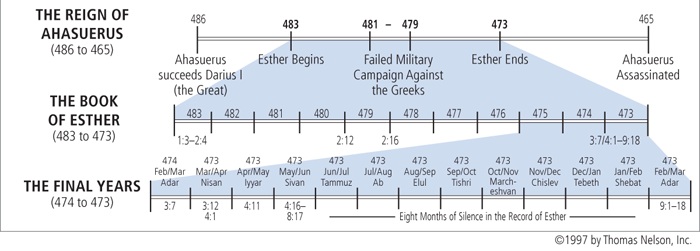
ESTHER—NOTE ON 2:14 the second harem. The place of concubines.
ESTHER—NOTE ON 2:15 was winning favor. According to the Lord's providential plan.
ESTHER—NOTE ON 2:16 Tebeth. The tenth month corresponding to December/January the seventh year. C. 479–478 B.C. Four years had elapsed since Vashti's fall from favor.
ESTHER—NOTE ON 2:18 granted a remission of taxes. The Hebrew phrase may also indicate release from military service.
ESTHER—NOTE ON 2:19 the second time. Perhaps the king intended to add the second best to his concubine collection.
ESTHER—NOTE ON 2:21 the king's gate. Indicates the strong possibility that Mordecai held a position of prominence (cf. 3:2; Dan. 2:49). became angry. Perhaps in revenge over the loss of Vashti.
ESTHER—NOTE ON 2:23 hanged on the gallows. The Persian execution consisted of being impaled (cf. Ezra 6:11). It is likely that they were the inventors of crucifixion. book of the chronicles. The king would five years later (Ahasuerus's twelfth year) read these Persian records as the turning point in Esther (6:1–2).
ESTHER—NOTE ON 3:1 After these things. Sometime between the seventh (2:16) and twelfth year (3:7) of the king's reign. Haman the Agagite. See Introduction:
Historical and Theological Themes.
ESTHER—NOTE ON 3:2 did not bow down. There is a question as to whether Esther and Mordecai were inclined to obey the Mosaic law. This refusal may be more likely grounded in the family feud between the Benjamites and the Agagites (see Introduction: Historical and Theological Themes), than Mordecai's allegiance to the second commandment (Ex. 20:4–6).
ESTHER—NOTE ON 3:4 he was a Jew. It seems evident from Haman's fury and attempted genocide, that there were strong anti-Semitic attitudes in Susa, which seems to explain Mordecai's reluctance to reveal his true ethnic background.
ESTHER—NOTE ON 3:6 the people of Mordecai. Haman was being satanically used to target the entire Jewish race in an unsuccessful attempt to change the course of redemptive history and God's plans for Israel.
ESTHER—NOTE ON 3:7 Nisan. The time period March/April. Ironically, the Jews should have been celebrating the Passover to remind them of a former deliverance. twelfth year. C. 474 B.C. Pur . . . lots. A lot would be like modern dice, which were cast to determine future decisions (cf. the Hebrew lot, 1 Chron. 26:14; Neh. 10:34; Jonah 1:7). Proverbs 16:33 states that God providentially controlled the outcome of the lot. Adar. February/March. There would have been an 11-month interval between Haman's decree and its expected fulfillment.
ESTHER—NOTE ON 3:8 a certain people. Haman never divulged their identity.
ESTHER—NOTE ON 3:9 10,000 talents. The exact dollar amount is uncertain, but reportedly it would have weighed 375 tons and equaled almost 70 percent of the king's annual revenue. Since this sum would have been derived from the plunder of the Jews, it indicates that they had grown prosperous.
ESTHER—NOTE ON 3:10–11 The king would have easily been eager to eliminate any rebellion against his authority (cf. 3:8), although he did not seem to be interested in the money.
ESTHER—NOTE ON 3:10 the enemy of the Jews. Cf. 7:6; 8:1; 9:10, 24.
ESTHER—NOTE ON 3:12 sealed . . . king's signet ring. This would be equivalent to the king's signature. The date has been calculated by historians to be April 7, 474 B.C.
ESTHER—NOTE ON 3:13 to annihilate. An ambitious plot to annihilate the Jews in just one day. Historians have calculated the date to be March 7, 473 B.C. The king had unwittingly approved this provision that would kill his own queen.
ESTHER—NOTE ON 3:14 as a decree. It would be irrevocable (cf. 1:19; 8:5–8).
ESTHER—NOTE ON 3:15 into confusion. No specific reason is stated. Most likely even this pagan population was puzzled at the extreme and deadly racism of the king and Haman.
ESTHER—NOTE ON 4:1 sackcloth and ashes. An outward sign of inward distress and humiliation (cf. Jer. 6:26; Dan. 9:3; Matt. 11:21). Mordecai realized that he had prompted this genocidal retaliation by Haman.
ESTHER—NOTE ON 4:4 She sent garments. Mordecai could then enter the king's gate (cf. 4:2) and talk with Esther directly (cf. Neh. 2:2).
ESTHER—NOTE ON 4:5 Hathach. A trusted eunuch who knew of Esther's Jewish background.
ESTHER—NOTE ON 4:7–8 That Mordecai possessed this specific knowledge and a copy of the edict further evidences his prominent position in Persia.
ESTHER—NOTE ON 4:11 golden scepter. In order to protect the king's life from would-be assassins, this practice prevailed. Seemingly, the king would extend the scepter (a sign of kingly authority) only to those whom he knew and from whom he welcomed a visit (cf. 5:2; 8:4). these thirty days. Perhaps Esther feared she had lost favor with the king since he had not summoned her recently.
ESTHER—NOTE ON 4:14 relief and deliverance. Mordecai exhibited a healthy faith in God's sovereign power to preserve his people. He may have remembered the Lord's promise to Abraham (cf. Gen. 12:3; 17:1–8). you . . . will perish. Mordecai indicated that Esther would not escape the sentence or be overlooked because of her prominence (cf. Est. 4:13). such a time as this. Mordecai indirectly appealed to God's providential timing.
ESTHER—NOTE ON 4:16 fast. The text does not mention prayer being included such as was Daniel's practice (Dan. 9:3), though it surely was. perish. Esther's heroic willingness to die for the sake of her fellow Jews is commendable.
ESTHER—NOTE ON 5:2 she won favor. This actually means that Esther first found favor with the God of Israel (cf. Prov. 21:1).
ESTHER—NOTE ON 5:3 What is your request? Esther deferred her real wish until 7:2–3.
ESTHER—NOTE ON 5:3, 6 even to the half of my kingdom. Royal hyperbole that was not intended to be taken at face value (cf. Mark 6:22–23).
ESTHER—NOTE ON 5:4 a feast. The first of two (cf. 5:4–8; 6:14–7:1) that Esther prepared. God would providentially intervene between the two (6:1–2).
ESTHER—NOTE ON 5:11 the number of his sons. At least 10 sons were fathered by Haman (cf. 9:13), who personified sinful pride (cf. Prov. 16:18; 1 Cor. 10:12; Gal. 6:3).
ESTHER—NOTE ON 5:13 this is worth nothing to me. Haman expressed raging fixation on killing Mordecai.
ESTHER—NOTE ON 5:14 gallows. A stake on which a human would be impaled to death and/or displayed after death (cf. 2:23). fifty cubits. Approximately 75 feet or almost 8 stories high. Perhaps the gallows involved displaying a shorter stake atop a building or wall to attain this height.
ESTHER—NOTE ON 6:1 the book. Five years (cf. 2:16 with 3:7) had intervened since Mordecai's loyal, but as yet unrewarded, act (cf. 2:23). At exactly the proper moment, God providentially intervened so that the king suffered insomnia, called for the book of records, read of Mordecai's unrewarded deeds five years past, and then desired to reward him (cf. Dan. 6:18).
ESTHER—NOTE ON 6:4 Who is in the court? The drama intensified as Haman arrived at just the wrong time and for just the wrong reason.
ESTHER—NOTE ON 6:6–7 Haman ironically defined the honor to be given to Mordecai at Haman's expense. To his potential wealth from the Jewish plunder, he thought public acclaim would be added.
ESTHER—NOTE ON 6:8 royal robes . . . royal crown. An honor which involved being treated as though the recipient were the king himself (cf. 8:15). This is reminiscent of Joseph in Egypt (Gen. 41:39–45). History affirms that horses were adorned with the royal crown.
ESTHER—NOTE ON 6:9 the square of the city. Whereas Mordecai had been there the day before in sackcloth and ashes (4:1, 6), he arrived with royal honor.
ESTHER—NOTE ON 6:10 Mordecai the Jew. Cf. 8:7; 9:29, 31; 10:3. Why the king did not remember Haman's edict against the Jews remains unknown.
ESTHER—NOTE ON 6:12 mourning. Deservedly, Haman has inherited Mordecai's distress (cf. 4:1–2). What a difference a day makes! His imagined honors had quickly turned to unimaginable humiliation. his head covered. An extreme sign of shame (cf. 2 Sam. 15:30; Jer. 14:3–4).
ESTHER—NOTE ON 6:13 you have begun to fall. Neither divine prophecy (Ex. 17:14) nor biblical history (1 Sam. 15:8–9) stood in Haman's favor. Haman's entourage seemed to have some knowledge of this biblical history.
ESTHER—NOTE ON 6:14 Haman to the feast. Like a lamb led to slaughter, Haman was escorted off to his just due.
ESTHER—NOTE ON 7:2 second day. The first-day reference point included the first banquet. This refers to the second banquet on the second day (cf. 5:8). What is your wish . . . ? This was the third time that the king inquired (cf. 5:3, 6).
ESTHER—NOTE ON 7:3 my people. This plea paralleled God's message through Moses to Pharaoh, "Let my people go," almost 1,000 years earlier (Ex. 7:16).
ESTHER—NOTE ON 7:4 sold. Refers back to Haman's bribe (cf. 3:9; 4:7). destroyed . . . killed . . . annihilated. Esther recounted the exact language of Haman's decree (cf. 3:13).
ESTHER—NOTE ON 7:6 This wicked Haman! Similar to Nathan's famous accusation against King David, "You are the man" (2 Sam. 12:7). Haman's honor had quickly turned to humiliation, and then to horror.
ESTHER—NOTE ON 7:8 assault the queen. Blinded by anger, Ahasuerus interpreted Haman's plea to be an act of violence against Esther rather than a plea for mercy.
ESTHER—NOTE ON 7:9 Harbona. Cf. 1:10. Moreover. Because the place prepared by Haman for Mordecai's execution towered above the city, it became the obvious spot for Haman's death. Mordecai whose word saved. Haman heard the third capital offense charged against him. One, he manipulated the king in planning to kill the queen's people. Two, he was perceived to accost the queen. Three, he planned to execute a man whom the king had just greatly honored for extreme loyalty to the kingdom.
ESTHER—NOTE ON 7:10 they hanged Haman. The ultimate expression of justice (cf. Ps. 9:15–16).
ESTHER—NOTE ON 8:1 the house of Haman. Property of a traitor by Persian custom returned to the king. In this case, he gave it to his queen, Esther, who put Mordecai over it (8:2). The outcome for Haman's wife Zeresh and his wise men is unknown (5:14; 6:12–13). Haman's 10 sons later died (9:7–10).
ESTHER—NOTE ON 8:5 to revoke. This proved to be impossible in light of the inflexible nature of the king's edicts (1:19). However, a counter-decree was possible (cf. 8:8, 11–12).
ESTHER—NOTE ON 8:9 Sivan. Refers to the period May/June. It had been two months and 10 days since Haman's decree (cf. 3:12); eight months and 20 days remained until both decrees became simultaneously effective (cf. 3:13).
ESTHER—NOTE ON 8:11 the king allowed. Just as the king had permitted Haman, so he allowed the Jews to defend themselves and to plunder their spoil (cf. 9:10, 15–16).
ESTHER—NOTE ON 8:15 Mordecai went out. This second reward exceeded the first (cf. 6:6–9). Blue and white were the royal colors of the Persian Empire.
ESTHER—NOTE ON 8:17 many . . . peoples . . . Jews. The population realized that the God of the Jews greatly exceeded anything that the pantheon of Persian deities could offer (cf. Ex. 15:14–16; Ps. 105:38; Acts 5:11), especially in contrast to their recent defeat by the Greeks.
ESTHER—NOTE ON 9:1 twelfth month. During the period February/March. Here is a powerful statement with regard to God's providential preservation of the Jewish race in harmony with God's unconditional promise to Abraham (Gen. 17:1–8). This providential deliverance stands in contrast to God's miraculous deliverance of the Jews from Egypt; yet in both cases the same end had been accomplished by the supernatural power of God.
ESTHER—NOTE ON 9:3 the fear of Mordecai. Pragmatically, the nation had a change of heart toward the Jews, knowing that the king, the queen, and Mordecai were the ranking royal officials of the land. To be pro-Jewish would put one in favor with the king and his court and put one on the side of God, the ultimate King (cf. Rev. 19:16).
ESTHER—NOTE ON 9:6–7 Five hundred men died in Susa.
ESTHER—NOTE ON 9:10 laid no hand. Unlike Saul, who did take the plunder (cf. 1 Sam. 15:3 with 15:9), the Jews focused only on the mission at hand, i.e., to preserve the Jewish race (cf. Est. 9:15–16), even though the king's edict permitted this (8:11).
ESTHER—NOTE ON 9:12 further is your request? Even this pagan king served the cause of utterly blotting out the Amalekites in accord with God's original decree (Ex. 17:14) by allowing for a second day of killing in Susa to eliminate all Jewish enemies.
ESTHER—NOTE ON 9:13 be hanged. I.e., be publicly displayed.
ESTHER—NOTE ON 9:15–16 Over 1,500 years earlier God had promised to curse those who curse Abraham's descendants (Gen. 12:3).
ESTHER—NOTE ON 9:15 fourteenth day. Another 300 men died the second day of killing in Susa, bringing the total dead in Susa to 810.
ESTHER—NOTE ON 9:16 killed. Outside of Susa, only one day of killing occurred, in which 75,000 enemies died.
ESTHER—NOTE ON 9:18–19 This section recounted why Purim would be celebrated for two days rather than one.
ESTHER—NOTE ON 9:20–25 A brief summary of God's providential intervention on behalf of the Jews.
ESTHER—NOTE ON 9:26 Purim. The first and last biblically revealed, non-Mosaic festival with perpetual significance.
ESTHER—NOTE ON 9:29 second letter. An additional letter (cf. v. 20 for the first letter), which added "fasting" and "lamentations" to the prescribed activity of Purim.
ESTHER—NOTE ON 9:32 recorded in writing. This could be the chronicle referred to in 10:2, or another archival type document. It certainly does not hint that Esther wrote this canonical book.
ESTHER—NOTE ON 10:1–3 Apparently a postscript.
ESTHER—NOTE ON 10:3 Mordecai . . . was second. Mordecai joined the top echelon of Jewish international statesmen like Joseph, who ranked second in the Egyptian dynasty (Gen. 41:37–45), and Daniel, who succeeded in both the Babylonian (Dan. 2:46–49; 5:29) and Medo-Persian Empires (Dan. 6:28). sought the welfare. Less than 10 years later (c. 465 B.C.), Ahasuerus was assassinated. There are no further details concerning Esther and Mordecai. What Mordecai did for less than a decade on behalf of Israel, Jesus Christ will do for all eternity as the Prince of Peace (Isa. 9:6–7; Zech. 9:9–10)
Title Author and Date Background and Setting Historical and Theological Themes Interpretive Challenges Outline Footnotes Study Notes
Introduction to Job
Title
As with other books of the Bible, Job bears the name of the narrative's primary character. This name might have been derived from the Hebrew word for "persecution," thus meaning "persecuted one," or from an Arabic word meaning "repent," thus bearing the name "repentant one." The author recounts an era in the life of Job, in which he was tested and the character of God was revealed. New Testament writers directly quote Job two times (Rom. 11:35; 1 Cor. 3:19), plus Ezek. 14:14, 20 and James 5:11 show Job was a real person.
Author and Date
The book does not name its author. Job is an unlikely candidate because the book's message rests on Job's ignorance of the events that occurred in heaven as they related to his ordeal. One Talmudic tradition suggests Moses as author since the land of Uz (1:1) was adjacent to Midian where Moses lived for 40 years, and he could have obtained a record of the story there. Solomon is also a good possibility due to the similarity of content with parts of the book of Ecclesiastes, as well as the fact that Solomon wrote the other Wisdom books (except Psalms, and he did author Ps. 72; 127). Though he lived long after Job, Solomon could have written about events that occurred long before his own time, in much the same manner as Moses was inspired to write about Adam and Eve. Elihu, Isaiah, Hezekiah, Jeremiah, and Ezra have also been suggested as possible authors, but without support.
The date of the book's writing may be much later than the events recorded therein. This conclusion is based on: 1) Job's age (42:16); 2) his life span of nearly 200 years (42:16), which fits the patriarchal period (Abraham lived 175 years; Gen. 25:7); 3) the social unit being the patriarchal family; 4) the Chaldeans who murdered Job's servants (Job 1:17) were nomads and had not yet become city dwellers; 5) Job's wealth being measured in livestock rather than gold and silver (1:3; 42:12); 6) Job's priestly functions within his family (1:4–5); and 7) a basic silence on matters such as the covenant of Abraham, Israel, the exodus, and the law of Moses. The events of Job's odyssey appear to be patriarchal. Job, on the other hand, seemed to know about Adam (31:33) and the Noahic flood (12:15). These cultural/historical features found in the book appear to place the events chronologically at a time probably after Babel (Gen. 11:1–9) but before or contemporaneous with Abraham (Gen. 11:27ff.).
Background and Setting
This book begins with a scene in heaven that explains everything to the reader (1:6–2:10). Job was suffering because God was contesting with Satan. Job never knew that, nor did any of his friends, so they all struggled to explain suffering from the perspective of their ignorance, until finally Job rested in nothing but faith in God's goodness and the hope of his redemption. That God vindicated his trust is the culminating message of the book. When there are no rational or even theological explanations for disaster and pain, trust God.
Historical and Theological Themes
The occasion and events that follow Job's sufferings present significant questions for the faith of believers in all ages. Why does Job serve God? Job is heralded for his righteousness, being compared with Noah and Daniel (Ezek. 14:14–20), and for his spiritual endurance (James 5:11). Several other questions are alluded to throughout Job's ordeal, for instance, "Why do the righteous suffer?" Though an answer to that question may seem important, the book does not set forth such an answer. Job never knew the reasons for his suffering and neither did his friends. The righteous sufferer does not appear to learn about any of the heavenly court debates between God and Satan that precipitated his pain. In fact, when finally confronted by the Lord of the universe, Job put his hand over his mouth and said nothing. Job's silent response in no way trivialized the intense pain and loss he had endured. It merely underscored the importance of trusting God's purposes in the midst of suffering because suffering, like all other human experiences, is directed by perfect divine wisdom. In the end, the lesson learned was that one may never know the specific reason for his suffering; but one must trust in Sovereign God. That is the real answer to suffering.
The book treats two major themes and many other minor ones, both in the narrative framework of the prologue (chs. 1–2) and epilogue (42:7–17), and in the poetic account of Job's torment that lies in between (3:1–42:6). A key to understanding the first theme of the book is to notice the debate between God and Satan in heaven and how it connects with the three cycles of earthly debates between Job and his friends. God wanted to prove the character of believers to Satan and to all demons, angels, and people. The accusations are by Satan, who indicted God's claims of Job's righteousness as being untested, if not questionable. Satan accused the righteous of being faithful to God only for what they could get. Since Job did not serve God with pure motives, according to Satan, the whole relationship between him and God was a sham. Satan's confidence that he could turn Job against God came, no doubt, from the fact that he had led the holy angels to rebel with him (see note on Rev. 12:4). Satan thought he could destroy Job's faith in God by inflicting suffering on him, thus showing in principle that saving faith could be shattered. God released Satan to make his point if he could, but he failed, as true faith in God proved unbreakable. Even Job's wife told him to curse God (Job 2:9), but he refused; his faith in God never failed (see 13:15). Satan tried to do the same to Peter (see Luke 22:31–34) and was unsuccessful in destroying Peter's faith (see John 21:15–19). When Satan has unleashed all that he can do to destroy saving faith, it stands firm (cf. Rom. 8:31–39). In the end, God proved his point with Satan that saving faith can't be destroyed no matter how much trouble a saint suffers, or how incomprehensible and undeserved it seems.
A second and related theme concerns proving the character of God to men. Does this sort of ordeal, in which God and his opponent Satan square off, with righteous Job as the test case, suggest that God is lacking in compassion and mercy toward Job? Not at all. As James says, "You have heard of the steadfastness of Job, and you have seen the purpose of the Lord, how the Lord is compassionate and merciful" (James 5:11). It was to prove the very opposite (Job 42:10–17). Job says, "Shall we receive good from God, and shall we not receive evil?" (2:10). God's servant does not deny that he has suffered. He does deny that his suffering is a result of sin. Nor does he understand why he suffers. Job simply commits his ordeal with a devout heart of worship and humility (42:5–6) to a sovereign and perfectly wise Creator—and that was what God wanted him to learn in this conflict with Satan. In the end, God flooded Job with more blessings than he had ever known.
The major reality of the book is the inscrutable mystery of innocent suffering. God ordains that his children walk in sorrow and pain, sometimes because of sin (cf. Num. 12:10–12), sometimes for chastening (cf. Heb. 12:5–12), sometimes for strengthening (cf. 2 Cor. 12:7–10; 1 Pet. 5:10), and sometimes to give opportunity to reveal his comfort and grace (2 Cor. 1:3–7). But there are times when the compelling issue in the suffering of the saints is unknowable because it is for a heavenly purpose that those on earth can't discern (cf. Ex. 4:11; John 9:1–3).
Job and his friends wanted to analyze the suffering and look for causes and solutions. Using all of their sound theology and insight into the situation, they searched for answers, but found only useless and wrong ideas, for which God rebuked them in the end (Job 42:7). They couldn't know why Job suffered because what happened in heaven between God and Satan was unknown to them. They thought they knew all the answers, but they only intensified the dilemma by their insistent ignorance.
By spreading out some of the elements of this great theme, we can see the following truths in Job's experience:
1) There are matters going on in heaven with God that believers know nothing about; yet, they affect their lives;
2) Even the best effort at explaining the issues of life can be useless;
3) God's people do suffer. Bad things happen all the time to good people, so one cannot judge a person's spirituality by his painful circumstances or successes;
4) Even though God seems far away, perseverance in faith is a most noble virtue since God is good and one can safely leave his life in his hands;
5) The believer in the midst of suffering should not abandon God, but draw near to him, so out of the fellowship can come the comfort—without the explanation; and
6) Suffering may be intense, but it will ultimately end for the righteous and God will bless abundantly.
Interpretive Challenges
The most critical interpretive challenge involves the book's primary message. Although often thought to be the pressing issue of the book, the question of why Job suffers is never revealed to Job, though the reader knows that it involves God's proving a point to Satan—a matter that completely transcends Job's ability to understand. James' commentary on Job's case (5:11) draws the conclusion that it was to show God's compassion and mercy, but without apology, offers no explanation for Job's specific ordeal. Readers find themselves, putting their proverbial hands over their mouths, with no right to question or accuse the all-wise and all-powerful Creator, who will do as he pleases, and in so doing, both proves his points in the spiritual realm to angels and demons and defines his compassion and mercy. Engaging in "theodicy," i.e., man's attempt to defend God's involvement in calamity and suffering, is shown to be appropriate in these circumstances, though in the end, it is apparent that God does not need nor want a human advocate. The book of Job poignantly illustrates Deut. 29:29, "The secret things belong to the Lord our God . . . "
The nature of Job's guilt and innocence raises perplexing questions. God declared Job perfect, upright, fearing God, and shunning evil (Job 1:1). But Job's comforters raised a critical question based on Job's ordeal: Had not Job sinned? On several occasions Job readily admitted to having sinned (7:21; 13:26). But Job questioned the extent of his sin as compared to the severity of his suffering. God rebuked Job in the end for his demands to be vindicated of the comforters' accusations (chs. 38–41). But he also declared that what Job said was correct and what the comforters said was wrong (42:7).
Another challenge comes in keeping separate the pre-understandings that Job and his comforters brought to Job's ordeal. At the outset, all agreed that God punishes evil, rewards obedience, and no exceptions are possible. Job, due to his suffering innocently, was forced to conclude that exceptions are possible in that the righteous also suffer. He also observed that the wicked prosper. These are more than small exceptions to the rule, thus forcing Job to rethink his simple understanding about God's sovereign interaction with his people. The type of wisdom Job comes to embrace was not dependent merely on the promise of reward or punishment. The long, peevish, disputes between Job and his accusers were attempts to reconcile the perceived inequities of God's retribution in Job's experiences. Such an empirical method is dangerous. In the end, God offered no explanation to Job, but rather called all parties to a deeper level of trust in the Creator, who rules over a sin-confused world with power and authority directed by perfect wisdom and mercy. See notes on Ps. 73.
Understanding this book requires 1) understanding the nature of wisdom, particularly the difference between man's wisdom and God's, and 2) admitting that Job and his friends lacked the divine wisdom to interpret Job's