
II. The Second Return under Ezra (7:1–10:44)
A. Cyrus's Decree to Return (1:1–4)
B. Treasures to Rebuild the Temple (1:5–11) C. Those Who Returned (2:1–70) D. Construction of the Second Temple (3:1–6:22)
1. Building begins (3:1–13) 2. Opposition surfaces (4:1–5) 3. Excursus on future opposition (4:6–23) 4. Construction renewed (4:24–5:2) 5. Opposition renewed (5:3–6:12) 6. Temple completed and dedicated (6:13–22) II. The Second Return under Ezra (7:1–10:44)
A. Ezra Arrives (7:1–8:36)
B. Ezra Leads Revival (9:1–10:44)
Ezra
The Proclamation of Cyrus
EZRA 1 ‡†In the first year of Cyrus king of Persia, that the word of the LORD by the mouth of Jeremiah might be fulfilled, the LORD stirred up the spirit of Cyrus king of Persia, so that he made a proclamation throughout all his kingdom and also put it in writing:
says Cyrus king of Persia: The LORD, the God of heaven, has given me all the kingdoms of the earth, and he has charged me to build him a house at Jerusalem, which is in Judah. 3Whoever is among you of all his people, may his God be with him, and let him go up to Jerusalem, which is in Judah, and rebuild the house of the LORD, the God of Israel—he is the God who is in Jerusalem. 4And let each survivor, in whatever place he sojourns, be assisted by the men of his place with silver and gold, with goods and with beasts, besides freewill offerings for the house of God that is in Jerusalem."
rose up the heads of the fathers' houses of Judah and Benjamin, and the priests and the Levites, everyone whose spirit God had stirred to go up to rebuild the house of the LORD that is in Jerusalem. 6†And all who were about them aided them with vessels of silver, with gold, with goods, with beasts, and with costly wares, besides all that was freely offered. 7†Cyrus the king also brought out the vessels of the house of the LORD that Nebuchadnezzar had carried away from Jerusalem and placed in the house of his gods. 8†Cyrus king of Persia brought these out in the charge of Mithredath the treasurer, who counted them out to Sheshbazzar the prince of Judah. 9‡And this was the number of them: 30 basins of gold, 1,000 basins of silver, 29 censers, 1030 bowls of gold, 410 bowls of silver, and 1,000 other vessels; 11†all the vessels of gold and of silver were 5,400. All these did Sheshbazzar bring up, when the exiles were brought up from Babylonia to Jerusalem.
The Exiles Return
EZRA 2 ‡†Now these were the people of the province who came up out of the captivity of those exiles whom Nebuchadnezzar the king of Babylon had carried captive to Babylonia. They returned to Jerusalem and Judah, each to his own town. 2†They came with Zerubbabel, Jeshua, Nehemiah, Seraiah, Reelaiah, Mordecai, Bilshan, Mispar, Bigvai, Rehum, and Baanah.
The number of the men of the people of Israel: 3‡the sons of Parosh, 2,172. 4The sons of Shephatiah, 372. 5The sons of Arah, 775. 6The sons of Pahath-moab, namely the sons of Jeshua and Joab, 2,812. 7The sons of Elam, 1,254. 8The sons of Zattu, 945. 9The sons of Zaccai, 760. 10The sons of Bani, 642. 11The sons of Bebai, 623. 12The sons of Azgad, 1,222. 13The sons of Adonikam, 666. 14The sons of Bigvai, 2,056. 15The sons of Adin, 454. 16The sons of Ater, namely of Hezekiah, 98. 17The sons of Bezai, 323. 18The sons of Jorah, 112. 19The sons of Hashum, 223. 20The sons of Gibbar, 95. 21‡The sons of Bethlehem, 123. 22The men of Netophah, 56. 23The men of Anathoth, 128. 24The sons of Azmaveth, 42. 25The sons of Kiriath-arim, Chephirah, and Beeroth, 743. 26The sons of Ramah and Geba, 621. 27The men of Michmas, 122. 28The men of Bethel and Ai, 223. 29The sons of Nebo, 52. 30The sons of Magbish, 156. 31The sons of the other Elam, 1,254. 32The sons of Harim, 320. 33The sons of Lod, Hadid, and Ono, 725. 34The sons of Jericho, 345. 35The sons of Senaah, 3,630.
priests: the sons of Jedaiah, of the house of Jeshua, 973. 37The sons of Immer, 1,052. 38The sons of Pashhur, 1,247. 39The sons of Harim, 1,017.
40The Levites: the sons of Jeshua and Kadmiel, of the sons of Hodaviah, 74. 41The singers: the sons of Asaph, 128. 42The sons of the gatekeepers: the sons of Shallum, the sons of Ater, the sons of Talmon, the sons of Akkub, the sons of Hatita, and the sons of Shobai, in all 139.
temple servants: the sons of Ziha, the sons of Hasupha, the sons of Tabbaoth, 44the sons of Keros, the sons of Siaha, the sons of Padon, 45the sons of Lebanah, the sons of Hagabah, the sons of Akkub, 46the sons of Hagab, the sons of Shamlai, the sons of Hanan, 47the sons of Giddel, the sons of Gahar, the sons of Reaiah, 48the sons of Rezin, the sons of Nekoda, the sons of Gazzam, 49the sons of Uzza, the sons of Paseah, the sons of Besai, 50the sons of Asnah, the sons of Meunim, the sons of Nephisim, 51the sons of Bakbuk, the sons of Hakupha, the sons of Harhur, 52the sons of Bazluth, the sons of Mehida, the sons of Harsha, 53the sons of Barkos, the sons of Sisera, the sons of Temah, 54the sons of Neziah, and the sons of Hatipha.
sons of Solomon's servants: the sons of Sotai, the sons of Hassophereth, the sons of Peruda, 56the sons of Jaalah, the sons of Darkon, the sons of Giddel, 57the sons of Shephatiah, the sons of Hattil, the sons of Pochereth-hazzebaim, and the sons of Ami.
58All the temple servants and the sons of Solomon's servants were 392.
following were those who came up from Tel-melah, Tel-harsha, Cherub, Addan, and Immer, though they could not prove their fathers' houses or their descent, whether they belonged to Israel: 60the sons of Delaiah, the sons of Tobiah, and the sons of Nekoda, 652. 61Also, of the sons of the priests: the sons of Habaiah, the sons of Hakkoz, and the sons of Barzillai (who had taken a wife from the daughters of Barzillai the Gileadite, and was called by their name). 62These sought their registration among those enrolled in the genealogies, but they were not found there, and so they were excluded from the priesthood as unclean. 63†The governor told them that they were not to partake of the most holy food, until there should be a priest to consult Urim and Thummim.
whole assembly together was 42,360, 65besides their male and female servants, of whom there were 7,337, and they had 200 male and female singers. 66Their horses were 736, their mules were 245, 67their camels were 435, and their donkeys were 6,720.
68Some of the heads of families, when they came to the house of the LORD that is in Jerusalem, made freewill offerings for the house of God, to erect it on its site. 69†According to their ability they gave to the treasury of the work 61,000 darics [1] of gold, 5,000 minas [2] of silver, and 100 priests' garments.
the priests, the Levites, some of the people, the singers, the gatekeepers, and the temple servants lived in their towns, and all the rest of Israel [3] in their towns.
Rebuilding the Altar
EZRA 3 ‡†When the seventh month came, and the children of Israel were in the towns, the people gathered as one man to Jerusalem. 2†Then arose Jeshua the son of Jozadak, with his fellow priests, and Zerubbabel the son of Shealtiel with his kinsmen, and they built the altar of the God of Israel, to offer burnt offerings on it, as it is written in the Law of Moses the man of God. 3†They set the altar in its place, for fear was on them because of the peoples of the lands, and they offered burnt offerings on it to the LORD, burnt offerings morning and evening. 4†And they kept the Feast of Booths, as it is written, and offered the daily burnt offerings by number according to the rule, as each day required, 5and after that the regular burnt offerings, the offerings at the new moon and at all the appointed feasts of the LORD, and the offerings of everyone who made a freewill offering to the LORD. 6From the first day of the seventh month they began to offer burnt offerings to the LORD. But the foundation of the temple of the LORD was not yet laid. 7†So they gave money to the masons and the carpenters, and food, drink, and oil to the Sidonians and the Tyrians to bring cedar trees from Lebanon to the sea, to Joppa, according to the grant that they had from Cyrus king of Persia.
Rebuilding the Temple
in the second year after their coming to the house of God at Jerusalem, in the second month, Zerubbabel the son of Shealtiel and Jeshua the son of Jozadak made a beginning, together with the rest of their kinsmen, the priests and the Levites and all who had come to Jerusalem from the captivity. They appointed the Levites, from twenty years old and upward, to supervise the work of the house of the LORD. 9And Jeshua with his sons and his brothers, and Kadmiel and his sons, the sons of Judah, together supervised the workmen in the house of God, along with the sons of Henadad and the Levites, their sons and brothers.
10And when the builders laid the foundation of the temple of the LORD, the priests in their vestments came forward with trumpets, and the Levites, the sons of Asaph, with cymbals, to praise the LORD, according to the directions of David king of Israel. 11†And they sang responsively, praising and giving thanks to the LORD,
"For he is good, for his steadfast love endures forever toward Israel."
And all the people shouted with a great shout when they praised the LORD, because the foundation of the house of the LORD was laid. 12†But many of the priests and Levites and heads of fathers' houses, old men who had seen the first house, wept with a loud voice when they saw the foundation of this house being laid, though many shouted aloud for joy, 13so that the people could not distinguish the sound of the joyful shout from the sound of the people's weeping, for the people shouted with a great shout, and the sound was heard far away.
Adversaries Oppose the Rebuilding
EZRA 4 †Now when the adversaries of Judah and Benjamin heard that the returned exiles were building a temple to the LORD, the God of Israel, 2†they approached Zerubbabel and the heads of fathers' houses and said to them, "Let us build with you, for we worship your God as you do, and we have been sacrificing to him ever since the days of Esarhaddon king of Assyria who brought us here." 3†But Zerubbabel, Jeshua, and the rest of the heads of fathers' houses in Israel said to them, "You have nothing to do with us in building a house to our God; but we alone will build to the LORD, the God of Israel, as King Cyrus the king of Persia has commanded us."
4Then the people of the land discouraged the people of Judah and made them afraid to build 5†and bribed counselors against them to frustrate their purpose, all the days of Cyrus king of Persia, even until the reign of Darius king of Persia.
in the reign of Ahasuerus, in the beginning of his reign, they wrote an accusation against the inhabitants of Judah and Jerusalem.
The Letter to King Artaxerxes
the days of Artaxerxes, Bishlam and Mithredath and Tabeel and the rest of their associates wrote to Artaxerxes king of Persia. The letter was written in Aramaic and translated. [1] 8‡Rehum the commander and Shimshai the scribe wrote a letter against Jerusalem to Artaxerxes the king as follows: 9Rehum the commander, Shimshai the scribe, and the rest of their associates, the judges, the governors, the officials, the Persians, the men of Erech, the Babylonians, the men of Susa, that is, the Elamites, 10†and the rest of the nations whom the great and noble Osnappar deported and settled in the cities of Samaria and in the rest of the province Beyond the River. 11†(This is a copy of the letter that they sent.) "To Artaxerxes the king: Your servants, the men of the province Beyond the River, send greeting. And now 12†be it known to the king that the Jews who came up from you to us have gone to Jerusalem. They are rebuilding that rebellious and wicked city. They are finishing the walls and repairing the foundations. 13‡Now be it known to the king that if this city is rebuilt and the walls finished, they will not pay tribute, custom, or toll, and the royal revenue will be impaired. 14Now because we eat the salt of the palace and it is not fitting for us to witness the king's dishonor, therefore we send and inform the king,
order that search may be made in the book of the records of your fathers. You will find in the book of the records and learn that this city is a rebellious city, hurtful to kings and provinces, and that sedition was stirred up in it from of old. That was why this city was laid waste. 16We make known to the king that if this city is rebuilt and its walls finished, you will then have no possession in the province Beyond the River."
The King Orders the Work to Cease
17The king sent an answer: "To Rehum the commander and Shimshai the scribe and the rest of their associates who live in Samaria and in the rest of the province Beyond the River, greeting. And now 18the letter that you sent to us has been plainly read before me. 19†And I made a decree, and search has been made, and it has been found that this city from of old has risen against kings, and that rebellion and sedition have been made in it. 20And mighty kings have been over Jerusalem, who ruled over the whole province Beyond the River, to whom tribute, custom, and toll were paid. 21†Therefore make a decree that these men be made to cease, and that this city be not rebuilt, until a decree is made by me. 22And take care not to be slack in this matter. Why should damage grow to the hurt of the king?"
when the copy of King Artaxerxes' letter was read before Rehum and Shimshai the scribe and their associates, they went in haste to the Jews at Jerusalem and by force and power made them cease. 24†Then the work on the house of God that is in Jerusalem stopped, and it ceased until the second year of the reign of Darius king of Persia.
Rebuilding Begins Anew
EZRA 5 †Now the prophets, Haggai and Zechariah the son of Iddo, prophesied to the Jews who were in Judah and Jerusalem, in the name of the God of Israel who was over them. 2†Then Zerubbabel the son of Shealtiel and Jeshua the son of Jozadak arose and began to rebuild the house of God that is in Jerusalem, and the prophets of God were with them, supporting them.
the same time Tattenai the governor of the province Beyond the River and Shethar-bozenai and their associates came to them and spoke to them thus: "Who gave you a decree to build this house and to finish this structure?" 4They [1] also asked them this: "What are the names of the men who are building this building?" 5†But the eye of their God was on the elders of the Jews, and they did not stop them until the report should reach Darius and then an answer be returned by letter concerning it.
Tattenai's Letter to King Darius
6This is a copy of the letter that Tattenai the governor of the province Beyond the River and Shethar-bozenai and his associates, the governors who were in the province Beyond the River, sent to Darius the king. 7They sent him a report, in which was written as follows: "To Darius the king, all peace. 8†Be it known to the king that we went to the province of Judah, to the house of the great God. It is being built with huge stones, and timber is laid in the walls. This work goes on diligently and prospers in their hands. 9Then we asked those elders and spoke to them thus: 'Who gave you a decree to build this house and to finish this structure?' 10We also asked them their names, for your information, that we might write down the names of their leaders. [2] 11†And this was their reply to us: 'We are the servants of the God of heaven and earth, and we are rebuilding the house that was built many years ago, which a great king of Israel built and finished. 12†But because our fathers had angered the God of heaven, he gave them into the hand of Nebuchadnezzar king of Babylon, the Chaldean, who destroyed this house and carried away the people to Babylonia. 13†However, in the first year of Cyrus king of Babylon, Cyrus the king made a decree that this house of God should be rebuilt. 14‡And the gold and silver vessels of the house of God, which Nebuchadnezzar had taken out of the temple that was in Jerusalem and brought into the temple of Babylon, these Cyrus the king took out of the temple of Babylon, and they were delivered to one whose name was
Sheshbazzar, whom he had made governor; 15and he said to him, "Take these vessels, go and put them in the temple that is in Jerusalem, and let the house of God be rebuilt on its site." 16Then this Sheshbazzar came and laid the foundations of the house of God that is in Jerusalem, and from that time until now it has been in building, and it is not yet finished.' 17Therefore, if it seems good to the king, let search be made in the royal archives there in Babylon, to see whether a decree was issued by Cyrus the king for the rebuilding of this house of God in Jerusalem. And let the king send us his pleasure in this matter."
The Decree of Darius
EZRA 6 ‡†Then Darius the king made a decree, and search was made in Babylonia, in the house of the archives where the documents were stored. 2†And in Ecbatana, the capital that is in the province of Media, a scroll was found on which this was written: "A record. 3†In the first year of Cyrus the king, Cyrus the king issued a decree: Concerning the house of God at Jerusalem, let the house be rebuilt, the place where sacrifices were offered, and let its foundations be retained. Its height shall be sixty cubits [1] and its breadth sixty cubits, 4with three layers of great stones and one layer of timber. Let the cost be paid from the royal treasury. 5†And also let the gold and silver vessels of the house of God, which Nebuchadnezzar took out of the temple that is in Jerusalem and brought to Babylon, be restored and brought back to the temple that is in Jerusalem, each to its place. You shall put them in the house of God."
therefore, Tattenai, governor of the province Beyond the River, Shetharbozenai, and your associates the governors who are in the province Beyond the River, keep away. 7Let the work on this house of God alone. Let the governor of the Jews and the elders of the Jews rebuild this house of God on its site. 8‡Moreover, I make a decree regarding what you shall do for these elders of the Jews for the rebuilding of this house of God. The cost is to be paid to these men in full and without delay from the royal revenue, the tribute of the province from Beyond the River. 9And whatever is needed—bulls, rams, or sheep for burnt offerings to the God of heaven, wheat, salt, wine, or oil, as the priests at Jerusalem require—let that be given to them day by day without fail, 10†that they may offer pleasing sacrifices to the God of heaven and pray for the life of the king and his sons. 11†Also I make a decree that if anyone alters this edict, a beam shall be pulled out of his house, and he shall be impaled on it, and his house shall be made a dunghill. 12May the God who has caused his name to dwell there overthrow any king or people who shall put out a hand to alter this, or to destroy this house of God that is in Jerusalem. I Darius make a decree; let it be done with all diligence."
The Temple Finished and Dedicated
13Then, according to the word sent by Darius the king, Tattenai, the governor of the province Beyond the River, Shethar-bozenai, and their associates did with all diligence what Darius the king had ordered. 14†And the elders of the Jews built and prospered through the prophesying of Haggai the prophet and Zechariah the son of Iddo. They finished their building by decree of the God of Israel and by decree of Cyrus and Darius and Artaxerxes king of Persia; 15†and this house was finished on the third day of the month of Adar, in the sixth year of the reign of Darius the king.
16And the people of Israel, the priests and the Levites, and the rest of the returned exiles, celebrated the dedication of this house of God with joy. 17They offered at the dedication of this house of God 100 bulls, 200 rams, 400 lambs, and as a sin offering for all Israel 12 male goats, according to the number of the tribes of Israel. 18†And they set the priests in their divisions and the Levites in their divisions, for the service of God at Jerusalem, as it is written in the Book of Moses.
Passover Celebrated
the fourteenth day of the first month, the returned exiles kept the Passover. 20For the priests and the Levites had purified themselves together; all of them were clean. So they slaughtered the Passover lamb for all the returned exiles, for their fellow priests, and for themselves. 21†It was eaten by the people of Israel who had returned from exile, and also by every one who had joined them and separated himself from the uncleanness of the peoples of the land to worship the LORD, the God of Israel. 22‡†And they kept the Feast of Unleavened Bread seven days with joy, for the LORD had made them joyful and had turned the heart of the king of Assyria to them, so that he aided them in the work of the house of God, the God of Israel.
Ezra Sent to Teach the People
EZRA 7 ‡†Now after this, in the reign of Artaxerxes king of Persia, Ezra the son of Seraiah, son of Azariah, son of Hilkiah, 2son of Shallum, son of Zadok, son of Ahitub, 3son of Amariah, son of Azariah, son of Meraioth, 4son of Zerahiah, son of Uzzi, son of Bukki, 5son of Abishua, son of Phinehas, son of Eleazar, son of Aaron the chief priest— 6†this Ezra went up from Babylonia. He was a scribe skilled in the Law of Moses that the LORD, the God of Israel, had given, and the king granted him all that he asked, for the hand of the LORD his God was on him.
there went up also to Jerusalem, in the seventh year of Artaxerxes the king, some of the people of Israel, and some of the priests and Levites, the singers and gatekeepers, and the temple servants. 8‡And Ezra [1] came to Jerusalem in the fifth month, which was in the seventh year of the king. 9For on the first day of the first month he began to go up from Babylonia, and on the first day of the fifth month he came to Jerusalem, for the good hand of his God was on him. 10†For Ezra had set his heart to study the Law of the LORD, and to do it and to teach his statutes and rules in Israel.
is a copy of the letter that King Artaxerxes gave to Ezra the priest, the scribe, a man learned in matters of the commandments of the LORD and his statutes for Israel: 12‡†"Artaxerxes, king of kings, to Ezra the priest, the scribe of the Law of the God of heaven. Peace. [2] And now 13I make a decree that anyone of the people of Israel or their priests or Levites in my kingdom, who freely offers to go to Jerusalem, may go with you. 14†For you are sent by the king and his seven counselors to make inquiries about Judah and Jerusalem according to the Law of your God, which is in your hand, 15and also to carry the silver and gold that the king and his counselors have freely offered to the God of Israel, whose dwelling is in Jerusalem, 16with all the silver and gold that you shall find in the whole province of Babylonia, and with the freewill offerings of the people and the priests, vowed willingly for the house of their God that is in Jerusalem. 17†With this money, then, you shall with all diligence buy bulls, rams, and lambs, with their grain offerings and their drink offerings, and you shall offer them on the altar of the house of your God that is in Jerusalem. 18Whatever seems good to you and your brothers to do with the rest of the silver and gold, you may do, according to the will of your God. 19The vessels that have been given you for the service of the house of your God, you shall deliver before the God of Jerusalem. 20And whatever else is required for the house of your God, which it falls to you to provide, you may provide it out of the king's treasury.
21"And I, Artaxerxes the king, make a decree to all the treasurers in the province Beyond the River: Whatever Ezra the priest, the scribe of the Law of the God of heaven, requires of you, let it be done with all diligence, 22†up to 100 talents [3] of silver, 100 cors [4] of wheat, 100 baths [5] of wine, 100 baths of oil, and salt without prescribing how much. 23Whatever is decreed by the God of heaven, let it be done in full for the house of the God of heaven, lest his wrath be against the realm of the king and his sons. 24We also notify you that it shall not be lawful to impose tribute, custom, or toll on anyone of the priests, the Levites, the singers, the doorkeepers, the temple servants, or other servants of this house of God.
you, Ezra, according to the wisdom of your God that is in your hand, appoint magistrates and judges who may judge all the people in the province Beyond the River, all such as know the laws of your God. And those who do not know them, you shall teach. 26Whoever will not obey the law of your God and the law of the king, let judgment be strictly executed on him, whether for death or for banishment or for confiscation of his goods or for imprisonment."
27Blessed be the LORD, the God of our fathers, who put such a thing as this into the heart of the king, to beautify the house of the LORD that is in Jerusalem, 28and who extended to me his steadfast love before the king and his counselors, and before all the king's mighty officers. I took courage, for the hand of the LORD my God was on me, and I gathered leading men from Israel to go up with me.
Genealogy of Those Who Returned with Ezra
EZRA 8 ‡These are the heads of their fathers' houses, and this is the genealogy of those who went up with me from Babylonia, in the reign of Artaxerxes the king: 2Of the sons of Phinehas, Gershom. Of the sons of Ithamar, Daniel. Of the sons of David, Hattush. 3Of the sons of Shecaniah, who was of the sons of Parosh, Zechariah, with whom were registered 150 men. 4Of the sons of Pahath-moab, Eliehoenai the son of Zerahiah, and with him 200 men. 5Of the sons of Zattu, [1] Shecaniah the son of Jahaziel, and with him 300 men. 6Of the sons of Adin, Ebed the son of Jonathan, and with him 50 men. 7Of the sons of Elam, Jeshaiah the son of Athaliah, and with him 70 men. 8Of the sons of Shephatiah, Zebadiah the son of Michael, and with him 80 men. 9Of the sons of Joab, Obadiah the son of Jehiel, and with him 218 men. 10Of the sons of Bani, [2] Shelomith the son of Josiphiah, and with him 160 men. 11Of the sons of Bebai, Zechariah, the son of Bebai, and with him 28 men. 12Of the sons of Azgad, Johanan the son of Hakkatan, and with him 110 men. 13Of the sons of Adonikam, those who came later, their names being Eliphelet, Jeuel, and Shemaiah, and with them 60 men. 14Of the sons of Bigvai, Uthai and Zaccur, and with them 70 men.
Ezra Sends for Levites
gathered them to the river that runs to Ahava, and there we camped three days. As I reviewed the people and the priests, I found there none of the sons of Levi. 16Then I sent for Eliezer, Ariel, Shemaiah, Elnathan, Jarib, Elnathan, Nathan, Zechariah, and Meshullam, leading men, and for Joiarib and Elnathan, who were men of insight, 17and sent them to Iddo, the leading man at the place Casiphia, telling them what to say to Iddo and his brothers and [3] the temple servants at the place Casiphia, namely, to send us ministers for the house of our God. 18And by the good hand of our God on us, they brought us a man of discretion, of the sons of Mahli the son of Levi, son of Israel, namely Sherebiah with his sons and kinsmen, 18; 19also Hashabiah, and with him Jeshaiah of the sons of Merari, with his kinsmen and their sons, 20; 20besides 220 of the temple servants, whom David and his officials had set apart to attend the Levites. These were all mentioned by name.
Fasting and Prayer for Protection
I proclaimed a fast there, at the river Ahava, that we might humble ourselves before our God, to seek from him a safe journey for ourselves, our children, and all our goods. 22For I was ashamed to ask the king for a band of soldiers and horsemen to protect us against the enemy on our way, since we had told the king, "The hand of our God is for good on all who seek him, and the power of his wrath is against all who forsake him." 23So we fasted and implored our God for this, and he listened to our entreaty.
Priests to Guard Offerings
24Then I set apart twelve of the leading priests: Sherebiah, Hashabiah, and ten of their kinsmen with them. 25And I weighed out to them the silver and the gold and the vessels, the offering for the house of our God that the king and his counselors and his lords and all Israel there present had offered. 26†I weighed out into their hand 650 talents [4] of silver, and silver vessels worth 200 talents, [5] and 100 talents of gold, 27†20 bowls of gold worth 1,000 darics, [6] and two vessels of fine bright bronze as precious as gold. 28And I said to them, "You are holy to the LORD, and the vessels are holy, and the silver and the gold are a freewill offering to the LORD, the God of your fathers. 29Guard them and keep them until you weigh them before the chief priests and the Levites and the heads of fathers' houses in Israel at Jerusalem, within the chambers of the house of the LORD." 30So the priests and the Levites took over the weight of the silver and the gold and the vessels, to bring them to Jerusalem, to the house of our God.
we departed from the river Ahava on the twelfth day of the first month, to go to Jerusalem. The hand of our God was on us, and he delivered us from the hand of the enemy and from ambushes by the way. 32We came to Jerusalem, and there we remained three days. 33On the fourth day, within the house of our God, the silver and the gold and the vessels were weighed into the hands of Meremoth the priest, son of Uriah, and with him was Eleazar the son of Phinehas, and with them were the Levites, Jozabad the son of Jeshua and Noadiah the son of Binnui. 34The whole was counted and weighed, and the weight of everything was recorded.
35At that time those who had come from captivity, the returned exiles, offered burnt offerings to the God of Israel, twelve bulls for all Israel, ninety-six rams, seventy-seven lambs, and as a sin offering twelve male goats. All this was a burnt offering to the LORD. 36†They also delivered the king's commissions to the king's satraps [7] and to the governors of the province Beyond the River, and they aided the people and the house of God.
Ezra Prays About Intermarriage
EZRA 9 †After these things had been done, the officials approached me and said, "The people of Israel and the priests and the Levites have not separated themselves from the peoples of the lands with their abominations, from the Canaanites, the Hittites, the Perizzites, the Jebusites, the Ammonites, the Moabites, the Egyptians, and the Amorites. 2†For they have taken some of their daughters to be wives for themselves and for their sons, so that the holy race [1] has mixed itself with the peoples of the lands. And in this faithlessness the hand of the officials and chief men has been foremost." 3†As soon as I heard this, I tore my garment and my cloak and pulled hair from my head and beard and sat appalled. 4†Then all who trembled at the words of the God of Israel, because of the faithlessness of the returned exiles, gathered around me while I sat appalled until the evening sacrifice. 5‡And at the evening sacrifice I rose from my fasting, with my garment and my cloak torn, and fell upon my knees and spread out my hands to the LORD my God, 6saying: "O my God, I am ashamed and blush to lift my face to you, my God, for our iniquities have risen higher than our heads, and our guilt has mounted up to the heavens. 7From the days of our fathers to this day we have been in great guilt. And for our iniquities we, our kings, and our priests have been given into the hand of the kings of the lands, to the sword, to captivity, to plundering, and to utter shame, as it is today. 8‡†But now for a brief moment favor has been shown by the LORD our God, to leave us a remnant and to give us a secure hold [2] within his holy place, that our God may brighten our eyes and grant us a little reviving in our slavery. 9†For we are slaves. Yet our God has not forsaken us in our slavery, but has extended to us his steadfast love before the kings of Persia, to grant us some reviving to set up the house of our God, to repair its ruins, and to give us protection [3] in Judea and Jerusalem.
now, O our God, what shall we say after this? For we have forsaken your commandments, 11which you commanded by your servants the prophets, saying, 'The land that you are entering, to take possession of it, is a land impure with the impurity of the peoples of the lands, with their abominations that have filled it from end to end with their uncleanness. 12Therefore do not give your daughters to their sons, neither take their daughters for your sons, and never seek their peace or prosperity, that you may be strong and eat the good of the land and leave it for an inheritance to your children forever.' 13‡And after all that has come upon us for our evil deeds and for our great guilt, seeing that you, our God, have punished us less than our iniquities deserved and have given us such a remnant as this, 14†shall we break your commandments again and intermarry with the peoples who practice these abominations? Would you not be angry with us until you consumed us, so that there should be no remnant, nor any to escape? 15†O LORD, the God of Israel, you are just, for we are left a remnant that has escaped, as it is today. Behold, we are before you in our guilt, for none can stand before you because of this."
The People Confess Their Sin
EZRA 10 †While Ezra prayed and made confession, weeping and casting himself down before the house of God, a very great assembly of men, women, and children, gathered to him out of Israel, for the people wept bitterly. 2†And Shecaniah the son of Jehiel, of the sons of Elam, addressed Ezra: "We have broken faith with our God and have married foreign women from the peoples of the land, but even now there is hope for Israel in spite of this. 3†Therefore let us make a covenant with our God to put away all these wives and their children, according to the counsel of my lord [1] and of those who tremble at the commandment of our God, and let it be done according to the Law. 4†Arise, for it is your task, and we are with you; be strong and do it." 5†Then Ezra arose and made the leading priests and Levites and all Israel take oath that they would do as had been said. So they took the oath.
6Then Ezra withdrew from before the house of God and went to the chamber of Jehohanan the son of Eliashib, where he spent the night, [2] neither eating bread nor drinking water, for he was mourning over the faithlessness of the exiles. 7†And a proclamation was made throughout Judah and Jerusalem to all the returned exiles that they should assemble at Jerusalem, 8†and that if anyone did not come within three days, by order of the officials and the elders all his property should be forfeited, and he himself banned from the congregation of the exiles.
all the men of Judah and Benjamin assembled at Jerusalem within the three days. It was the ninth month, on the twentieth day of the month. And all the people sat in the open square before the house of God, trembling because of this matter and because of the heavy rain. 10And Ezra the priest stood up and said to them, "You have broken faith and married foreign women, and so increased the guilt of Israel. 11†Now then make confession to the LORD, the God of your fathers and do his will. Separate yourselves from the peoples of the land and from the foreign wives." 12‡Then all the assembly answered with a loud voice, "It is so; we must do as you have said. 13But the people are many, and it is a time of heavy rain; we cannot stand in the open. Nor is this a task for one day or for two, for we have greatly transgressed in this matter. 14Let our officials stand for the whole assembly. Let all in our cities who have taken foreign wives come at appointed times, and with them the elders and judges of every city, until the fierce wrath of our God over this matter is turned away from us." 15†Only
Jonathan the son of Asahel and Jahzeiah the son of Tikvah opposed this, and Meshullam and Shabbethai the Levite supported them.
the returned exiles did so. Ezra the priest selected men, [3] heads of fathers' houses, according to their fathers' houses, each of them designated by name. On the first day of the tenth month they sat down to examine the matter; 17and by the first day of the first month they had come to the end of all the men who had married foreign women.
Those Guilty of Intermarriage
there were found some of the sons of the priests who had married foreign women: Maaseiah, Eliezer, Jarib, and Gedaliah, some of the sons of Jeshua the son of Jozadak and his brothers. 19They pledged themselves to put away their wives, and their guilt offering was a ram of the flock for their guilt. [4] 20Of the sons of Immer: Hanani and Zebadiah. 21Of the sons of Harim: Maaseiah, Elijah, Shemaiah, Jehiel, and Uzziah. 22Of the sons of Pashhur: Elioenai, Maaseiah, Ishmael, Nethanel, Jozabad, and Elasah.
23Of the Levites: Jozabad, Shimei, Kelaiah (that is, Kelita), Pethahiah, Judah, and Eliezer. 24Of the singers: Eliashib. Of the gatekeepers: Shallum, Telem, and Uri.
25And of Israel: of the sons of Parosh: Ramiah, Izziah, Malchijah, Mijamin, Eleazar, Hashabiah, [5] and Benaiah. 26Of the sons of Elam: Mattaniah, Zechariah, Jehiel, Abdi, Jeremoth, and Elijah. 27Of the sons of Zattu: Elioenai, Eliashib, Mattaniah, Jeremoth, Zabad, and Aziza. 28Of the sons of Bebai were Jehohanan, Hananiah, Zabbai, and Athlai. 29Of the sons of Bani were Meshullam, Malluch, Adaiah, Jashub, Sheal, and Jeremoth. 30Of the sons of Pahath-moab: Adna, Chelal, Benaiah, Maaseiah, Mattaniah, Bezalel, Binnui, and Manasseh. 31Of the sons of Harim: Eliezer, Isshijah, Malchijah, Shemaiah, Shimeon, 32Benjamin, Malluch, and Shemariah. 33Of the sons of Hashum: Mattenai, Mattattah, Zabad, Eliphelet, Jeremai, Manasseh, and Shimei. 34Of the sons of Bani: Maadai, Amram, Uel, 35Benaiah, Bedeiah, Cheluhi, 36Vaniah, Meremoth, Eliashib, 37Mattaniah, Mattenai, Jaasu. 38Of the sons of Binnui: [6] Shimei, 39Shelemiah, Nathan, Adaiah, 40Machnadebai, Shashai, Sharai, 41Azarel, Shelemiah, Shemariah, 42Shallum, Amariah, and Joseph. 43Of the sons of Nebo: Jeiel, Mattithiah, Zabad, Zebina, Jaddai, Joel, and Benaiah. 44†All these had married foreign women, and some of the women had even borne children. [7]
Footnotes
Footnotes for Ezra, Chapter
[1] 2:69 A daric was a coin weighing about 1/4 ounce or 8.5 grams [2] 2:69 A mina was about 1 1/4 pounds or 0.6 kilogram [3] 2:70 Hebrew all Israel
[1] 4:7 Hebrew written in Aramaic and translated in Aramaic, indicating that
4:8–6:18 is in Aramaic; another interpretation is The letter was written in the Aramaic script and set forth in the Aramaic language
[1] 5:4 Septuagint, Syriac; Aramaic We
[2] 5:10 Aramaic of the men at their heads
[1] 6:3 A cubit was about 18 inches or 45 centimeters
[1] 7:8 Aramaic he
[2] 7:12 Aramaic Perfect (probably a greeting) [3] 7:22 A talent was about 75 pounds or 34 kilograms [4] 7:22 A cor was about 6 bushels or 220 liters [5] 7:22 A bath was about 6 gallons or 22 liters
[1] 8:5 Septuagint; Hebrew lacks of Zattu
[2] 8:10 Septuagint; Hebrew lacks Bani
[3] 8:17 Hebrew lacks and
[4] 8:26 A talent was about 75 pounds or 34 kilograms [5] 8:26 Revocalization; the number is missing in the Masoretic Text [6] 8:27 A daric was a coin weighing about 1/4 ounce or 8.5 grams [7] 8:36 A satrap was a Persian official
[1] 9:2 Hebrew offspring
[2] 9:8 Hebrew nail, or tent-pin
[3] 9:9 Hebrew a wall
[1] 10:3 Or of the Lord
[2] 10:6 Probable reading; Hebrew where he went
[3] 10:16 Syriac; Hebrew And there were selected Ezra . . .
[4] 10:19 Or as their reparation
[5] 10:25 Septuagint; Hebrew Malchijah
[6] 10:38 Septuagint; Hebrew Bani, Binnui
[7] 10:44 Or and they put them away with their children
Study Notes
EZRA—NOTE ON 1:1–3a These verses are almost identical to 2 Chron. 36:22–23. The preexilic history of 1 and 2 Chronicles gave the postexilic returnees direction regarding the Davidic kingship, the Aaronic priesthood, and temple worship. This book continues the story.
EZRA—NOTE ON 1:1 first year. C. 538 B.C. Cyrus king of Persia. C. 550–530
B.C. The Lord had prophesied through Isaiah, who said of Cyrus, "He is my shepherd," and declares of Jerusalem, "She will be built," and to the temple, "Your foundation shall be laid" (Isa. 44:28). The historian Josephus records an account of the day when Daniel read Isaiah's prophecy to Cyrus, and in response he was moved to declare the proclamation of Ezra 1:2–4 (538 B.C.). by the mouth of Jeremiah. Jeremiah had prophesied the return of the exiles after a 70year captivity in Babylon (Jer. 25:11; 29:10–14; cf. Dan. 9:2). This was no isolated event, but rather an outworking of the covenant promises made to Abraham in Gen. 12:1–3. the Lord stirred up. A strong expression of the fact that God sovereignly works in the lives of kings to effect his purposes (Prov. 21:1; Dan. 2:21; 4:17). made a proclamation. This was the most common form of spoken, public communication, usually from the central administration. The king would dispatch a herald, perhaps with a written document, into the city. In order to address the people, he would either go to the city gate, where people often congregated for social discourse, or gather the people together in a square, occasionally by the blowing of a horn. The herald would then make the proclamation to the people. A document called the Cyrus Cylinder, recovered in reasonably good condition by archeologists, commissions people from many lands to return to their cities to rebuild the temples to their gods, apparently as some sort of general policy of Cyrus. Whether or not this document was an extension of the proclamation made to the exiles in this passage must remain a matter of speculation (cf. Ezra 6:2–5). put it in writing. Proclamations were oral statements, usually made by a herald, which were often written down for recordkeeping.
EZRA—NOTE ON 1:2–4 It is possible that Daniel played a part in the Jews' receiving such favorable treatment (cf. Dan. 6:25–28). According to the Jewish historian Josephus, he was Cyrus's prime minister who shared Isaiah's prophecies with Cyrus (Isa. 44:28; 46:1–4). The existence of such documents, written over a century before Cyrus was born, led him to acknowledge that all his power came from the God of Israel and prompted him to fulfill the prophecy.
EZRA—NOTE ON 1:2 Lord, the God of heaven. The God of Israel was recognized as the utmost divine authority (cf. 5:12; 6:9–10; 7:12, 21, 23), who sovereignly dispenses authority to human monarchs. a house. This refers to the second temple, which would be built after the return to the land by Zerubbabel.
EZRA—NOTE ON 1:5 whose spirit God had stirred. The primary underlying message of Ezra and Nehemiah is that the sovereign hand of God is at work in perfect keeping with his plan at his appointed times. The 70 years of captivity were complete, so God stirred up not only the spirit of Cyrus to make the decree, but his own people to go and build up Jerusalem and the temple (cf. 1:1).
EZRA—NOTE ON 1:6 all who were about them. A basic similarity to the exodus is seen throughout Ezra and Nehemiah. One can hear faint echoes of the Egyptians supplying treasures in order to provide splendor for the tabernacle (cf. Ex. 11:2; 12:35–36). Here other nations around Israel are called to contribute. They were assisted by some of their captive countrymen, who had been born in Babylon and chose to remain, and perhaps by some Babylonians and Assyrians who were favorably disposed to Cyrus and/or the Jews.
EZRA—NOTE ON 1:7 the vessels of the house of the Lord. Cf. Ezra 6:5. These were the vessels that Nebuchadnezzar removed when he sacked the temple (c. 605–586 B.C.; 2 Kings 24:13; 25:14–15; Dan. 1:2). God had preserved them (2 Chron. 36:7) with the Babylonians (cf. Dan. 5:1–4) for the return as prophesied by Jeremiah (Jer. 27:22).
Postexilic Returns to Jerusalem
PostExilic Returns to Jerusalem Sequence Date Scripture Jewish Leader Persian Ruler First 538 Ezra 1–6 Zerubbabel, Joshua Cyrus Second 458 Ezra 7–10 Ezra Artaxerxes Third 445 Nehemiah 1–13 Nehemiah Artaxerxes ©1997 by Thomas Nelson, Inc.
EZRA—NOTE ON 1:8 Sheshbazzar the prince of Judah. Cf. 1:11 and 5:14–16.
Nothing is said about this man biblically except in Ezra. Most likely, he was a political appointee of Cyrus to oversee Judah. He is not to be confused with Zerubbabel, who was the leader recognized by the Jews (cf. 2:2; 3:2, 8; 4:2–3; 5:2) and by God (cf. Hag. 1–2; Zech. 4). While Zerubbabel did not serve as king, he was in the Davidic line of Messiah (cf. Hag. 2:23; Matt. 1:12).
EZRA—NOTE ON 1:9–11 The 2,499 articles counted in vv. 9–10 are only representative of the total of 5,400 mentioned in v. 11.
EZRA—NOTE ON 1:11 exiles. Those whom Nebuchadnezzar had taken into Babylonian captivity from Jerusalem, whose return probably occurred early in the reign of Cyrus (c. 538/537 B.C.). Babylonia to Jerusalem. A journey taking three to five months (cf. 7:8–9).
EZRA—NOTE ON 2:1–70 This list is given almost identically in Neh. 7:6–73 (see notes there).
EZRA—NOTE ON 2:1 the province. This refers to Judah, reduced from an illustrious, independent, and powerful kingdom to an obscure, servile province of the Persian Empire. The returning Jews were still considered subjects of Cyrus living in a Persian province.
EZRA—NOTE ON 2:2 Zerubbabel. This man was the rightful leader of Judah in that he was of the lineage of David through Jehoiachin (cf. 1 Chron. 3:17). He did not serve as king (cf. the curse on Jehoiachin's line, Jer. 22:24–30), but was still in the messianic line because the curse was bypassed (cf. Matt. 1:12; Luke 3:27). The curse of the messianic line for Christ was bypassed in Luke's genealogy by tracing the lineage through David's son Nathan. His name means "offspring of Babylon," indicating his place of birth. He, rather than Cyrus's political appointee Sheshbazzar (cf. Ezra 1:11), led Judah according to God's will. Jeshua. The high priest of the first return whose name means "Jehovah saves." He is called Joshua in Hag. 1:1 and Zech. 3:1. His father Jozadak (Ezra 3:2) had been exiled (cf. 1 Chron. 6:15). He came from the lineage of Levi, Aaron, Eleazar, and Phinehas; thus he was legitimately in the line of the high priest (cf. Num. 25:10–13). Nehemiah . . . Mordecai. These are not the same men in Nehemiah or Esther.
EZRA—NOTE ON 2:3–20 Various Jewish families are listed.
EZRA—NOTE ON 2:21–35 These were people from various Judean cities.
EZRA—NOTE ON 2:36–42 Priests and Levites. See Neh. 12:1–9 for additional details.
EZRA—NOTE ON 2:43–54 temple servants. These were descendants of the Gibeonites who performed servile duties at the temple.
EZRA—NOTE ON 2:55–58 Here are descendants of Solomon's servants.
EZRA—NOTE ON 2:59–62 Those whose genealogical information could not be verified.
EZRA—NOTE ON 2:63 Urim and Thummim. See note on Ex. 28:30. These objects, kept in the breastpiece of the high priest, were used to determine God's will.
EZRA—NOTE ON 2:64–65 This gross amount is 12,000 more than the particular numbers given in the catalogue, when added together. Reckoning up the smaller numbers, we will find they amount to 29,818 in this chapter, and to 31,089 in the parallel chapter of Nehemiah. Ezra also mentions 494 persons omitted by Nehemiah, and Nehemiah mentions 1,765 not noticed by Ezra. If, therefore, Ezra's surplus is added to the sum in Nehemiah, and Nehemiah's surplus to the number in Ezra, they will both become 31,583. Subtracting this from 42,360, there is a deficiency of 10,777. These are omitted, because they did not belong to Judah and Benjamin, or to the priests, but to the other tribes. The servants and singers, male and female, are reckoned separately (v. 65), so that putting all these items together, the number of all who went with Zerubbabel amounted to 50,000 with 8,000 beasts of burden.
EZRA—NOTE ON 2:69 darics . . . minas. A daric was a Persian coin, named after Darius I. This would have amounted to approximately 1,100 pounds of gold. A mina weighed about 1.2 pounds, so this would represent 3 tons of silver (cf. 1 Chron. 29:7).
EZRA—NOTE ON 2:70 temple servants. See note on vv. 43–54.
EZRA—NOTE ON 3:1–13 The worship and regular calendar resumed. The altar was probably rebuilt in 537 B.C.
EZRA—NOTE ON 3:1 After their arrival, they were occupied with their own dwellings in and around Jerusalem. After that work was done, they turned to building the altar of burnt offering in time for the feasts, resolved to celebrate as if the temple had been completed. The month (c. September/October 537 B.C.) of the Feasts of Trumpets, Atonement, and Booths, or Tabernacles (cf. v. 4) was the seventh month. Such an assembly had not convened for 70 years. They obeyed according to Lev. 23:24–44. Over 90 years later, Nehemiah and Ezra would lead a similar celebration (cf. Neh. 8:13–18).
EZRA—NOTE ON 3:2 Jeshua . . . and Zerubbabel. The recognized spiritual and civil leaders, respectively. See notes on 2:2. as it is written in the Law of Moses. The burnt offerings were in accord with Lev. 1:3–17.
EZRA—NOTE ON 3:3 set the altar. This was all that was needed to reestablish temple worship (cf. v. 6). They reset it on its old foundation, so it occupied its sacred site. the peoples of the lands. The settlers who had come to occupy the land during the 70 years of Israel's absence were deportees brought in from other countries by the Assyrians and the Babylonians. These inhabitants saw the Jews as a threat and quickly wanted to undermine their allegiance to God (cf. 4:1–2). burnt offerings. These were the most common offerings for sin (cf. 3:2).
EZRA—NOTE ON 3:4 number according to the rule. According to Num. 29:12– 38.
EZRA—NOTE ON 3:7 masons . . . carpenters . . . cedar trees. The process of rebuilding the temple sounds similar to the original construction under Solomon (1 Kings 5–6; 1 Chron. 22; 2 Chron. 2). Sidonians . . . Joppa. The materials were shipped from the Phoenician ports of Sidon and Tyre south to Joppa, the main seaport, about 35 miles from Jerusalem. grant that they had from Cyrus. Cf. Ezra 1:2–4.
EZRA—NOTE ON 3:8 second year . . . second month. C. April/May 536 B.C. This officially ended the 70-year captivity that began in 605 B.C.
EZRA—NOTE ON 3:11 they sang. Their song of praise is similar to Ps. 136:1.
EZRA—NOTE ON 3:12 the first house. The temple built by Solomon (cf. 1 Kings 5–7). wept with a loud voice. The first temple had been destroyed 50 years earlier. The old men, who would have been about 60 years or older, knew that this second temple did not begin to match the splendor of Solomon's temple nor did the presence of God reside within it (cf. Hag. 2:1–4; Zech. 4:9–10). The nation was small and weak, the temple smaller and less beautiful by far. There were no riches as in David and Solomon's days. The ark was gone. But most disappointing was the absence of God's Shekinah glory. Thus the weeping. shouted . . . for joy. For those who did not have a point of comparison, this was a great moment. Possibly Ps. 126 was written and sung for this occasion.
EZRA—NOTE ON 4:1 the adversaries. Cf. 5:3–17. These were Israel's enemies in the region, who resisted their reestablishment.
EZRA—NOTE ON 4:2 we have been sacrificing to him. This false claim represented the syncretistic worship of the Samaritans, whose ancestry came from intermarriage with foreign immigrants in Samaria after 722 B.C. (cf. v. 10). In the British Museum is a large cylinder and inscribed on it are the annals of Esarhaddon, an Assyrian king (c. 681–669 B.C.), who deported a large population of Israelites from Palestine. A consequent settlement of Babylonian colonists took their place and intermarried with remaining Jewish women and their descendants. The result was the mongrel race called Samaritans. They had developed a superstitious form of worshiping God (cf. 2 Kings 17:26–34).
EZRA—NOTE ON 4:3 we alone. Idolatry had been the chief cause for Judah's deportation to Babylon, and they wanted to avoid it altogether. While they still had their spiritual problems (chs. 9–10), they rejected any form of mixed religion, particularly this offer of cooperation that had sabotage as its goal (cf. 4:4–5). King Cyrus . . . commanded us. Cf. 1:2–4 (c. 538 B.C.). This note gave authority to their refusal.
EZRA—NOTE ON 4:5 frustrate. This caused a 16-year delay (c. 536–520 B.C.). As a result, the people took more interest in their personal affairs than spiritual matters (cf. Hag. 1:2–6). Darius. Darius ruled Persia c. 521–486 B.C.
EZRA—NOTE ON 4:6–23 This section represents later opposition, which Ezra chose to put here as a parenthetical continuation of the theme "opposition to resettling and rebuilding Judah" (see Introduction: Interpretive Challenges). He first referred to the opposition from Israel's enemies under King Ahasuerus (a regal title) or Xerxes (c. 486–464 B.C.), who ruled at the time of Esther (4:6). Ezra 4:7–23 then recounts opposition in Nehemiah's day under Artaxerxes I (c. 464–423 B.C.) expressed in a detailed letter of accusation against the Jews (4:7– 16). It was successful in stopping the work, as the king's reply indicates (vv. 17– 23). Most likely, this opposition is that also spoken of in Neh. 1:3. All this was the ongoing occurrence of severe animosity between the Israelites and
Samaritans, which was later aggravated when the Samaritans built a rival temple on Mount Gerizim (cf. John 4:9). The opposition to Zerubbabel picks up again at Ezra 4:24–5:2 during the reign of Darius I, who actually reigned before either Ahasuerus or Artaxerxes.
EZRA—NOTE ON 4:6 they wrote an accusation. The word translated "accusation" means "a complaint." Satan, meaning "legal adversary" or "opponent," is a related term.
EZRA—NOTE ON 4:7–8 letter . . . letter. Two different words are used here. The first is an official document as opposed to a simple letter. The second is the generic term for letter. The context verifies the choices of two different terms, since two different letters are indicated.
EZRA—NOTE ON 4:8–6:18 Since this section contains predominantly correspondence, it is written in Aramaic (also 7:12–26) rather than Hebrew, generally reflecting the diplomatic language of the day (cf. 2 Kings 18:26; Isa. 36:11).
EZRA—NOTE ON 4:10 Osnappar. Most likely another name for the Assyrian king Ashurbanipal, c. 669–633 B.C. settled . . . cities of Samaria. The race of Samaritans resulted from the intermarriage of these immigrants with the poor people who were not taken captive to Nineveh (see note on v. 2 and 2 Kings 17:24–41).
EZRA—NOTE ON 4:11 Artaxerxes. See note on vv. 6–23. Beyond the River. West of the Euphrates River.
EZRA—NOTE ON 4:12 Jews. This name was generally used after the captivity because the exiles who returned were mainly of Judah. Most of the people of the 10 northern tribes were dispersed, and the largest number of returnees came from the two southern tribes.
EZRA—NOTE ON 4:13–14 This accusation is full of hypocrisy. They did not relish paying taxes either, but they did hate the Jews.
EZRA—NOTE ON 4:15 book of the records. An administrative document called a "memorandum" kept on file in the royal archives. city was laid waste. A reference to Jerusalem's destruction by the Babylonian king Nebuchadnezzar (c. 586 B.C.).
EZRA—NOTE ON 4:19 I made a decree. This was no simple routine order given to one person, but rather a major edict to a large group of people.
EZRA—NOTE ON 4:21 make a decree. No small order for one or two workers, but rather the efforts of 50,000 were called to a halt. The king was commissioning a decree of great significance. The original language calls for the difference. This decree would not lose its authority until the king established a new decree.
EZRA—NOTE ON 4:23 letter. Another official document, as opposed to a generic letter, came from Artaxerxes, for the transfer of authority to the regional leaders to establish the decree. Without the king's official administrative correspondence, the decree could not be established.
EZRA—NOTE ON 4:24 stopped . . . ceased. For 16 years, from 536 B.C. to 520 B.C., work on rebuilding was halted.
EZRA—NOTE ON 5:1 Haggai and Zechariah. The book of Haggai is styled as a "royal administrative correspondence" (cf. Hag. 1:13) sent from the Sovereign King of the Universe through the "messenger of the Lord," Haggai (Hag. 1:13). Part of its message is addressed specifically to Zerubbabel, the political leader, and Joshua, the religious leader, telling them to "be strong . . . work" on the temple because God was with them (Hag. 2:4). These two prophets gave severe reproaches and threats if the people did not return to the building and promised national prosperity if they did. Not long after the exiles heard this message, the temple work began afresh after a 16-year hiatus. See notes on Haggai and Zechariah.
EZRA—NOTE ON 5:2 prophets of God. These would be in addition to Haggai and Zechariah.
EZRA—NOTE ON 5:3 Tattenai. Most likely a Persian official. Who gave you a decree . . . ? In other words, "Who gave you royal permission to build?" Cf. Ezra 5:9.
EZRA—NOTE ON 5:5 But the eye of their God was on the elders. God's hand of protection, which led this endeavor, allowed the work to continue while official communication was going on with Darius, the Persian king (see note on 4:5).
EZRA—NOTE ON 5:8 huge stones, and timber. This technique of using beams and stone blocks was a well-known form of wall construction. The reason for mentioning it here was it seemed to be a preparation for conflict, or battle. Including this piece of information served as a threat to the Persian official who wanted no such conflict.
EZRA—NOTE ON 5:11 this was their reply. They sent back a report (official document for the archives). a great king of Israel. Solomon built the first temple (c. 966–960; 1 Kings 5–7).
EZRA—NOTE ON 5:12 gave them into the hand of Nebuchadnezzar. The expression is used commonly in royal administrative correspondence when a more powerful administrator, such as a king, relinquishes some of his authority to an underling and yet keeps the lower administrative official completely under his command. The point here is that God, as king of the universe, satisfied his wrath by relinquishing the authority for this administrative action to Nebuchadnezzar. The greatest king the ancient Near East has ever known was merely a petty official in the administration of the sovereign Lord.
EZRA—NOTE ON 5:13 Cyrus . . . decree. Cf. Ezra 1:2–4.
EZRA—NOTE ON 5:14, 16 Sheshbazzar . . . laid the foundations. This seems to contradict the statement in 3:8–10 that Zerubbabel, Jeshua, and the Jewish workmen laid the foundation, but it actually does not, since Sheshbazzar was the political appointee of the Persian king over the Jews and thus is given official credit for work actually done by them. See note on 1:8.
EZRA—NOTE ON 6:1 Darius the king made a decree. Rather than a public edict, this was a simple order issued to a small group of officials.
EZRA—NOTE ON 6:1–2 Babylonia . . . Ecbatana. Ecbatana was one of the Persian capitals, 300 miles northeast of Babylon in the foothills, where Cyrus and others had their summer homes.
EZRA—NOTE ON 6:2 was written. A particular kind of document called a memorandum (Ezra 4:15; Mal. 3:16). Administrative officials often kept these documents of administrative decisions made, or issues remaining to be settled, to retain the details of administrative action for future reference.
EZRA—NOTE ON 6:3 first year. C. 538 B.C. (cf. 1:2–4). be sixty cubits . . . sixty cubits. These dimensions exceed those of Solomon's temple (cf. 1 Kings 6:2).
EZRA—NOTE ON 6:5 Nebuchadnezzar took. See note on 1:7.
EZRA—NOTE ON 6:6–7 God so favored the Jews (cf. 5:5) that, through Darius, he forbade the officials from interfering with the building project.
EZRA—NOTE ON 6:8–10 Not only could the officials not hinder the building, but they also had to help finance it by giving the Jews some of their portion of taxes collected for the Persian king. The Jews could draw from the provincial treasury.
EZRA—NOTE ON 6:10 pray for the life of the king and his sons. This was essentially the same self-serving motive that prompted Cyrus to decree that all captured peoples should return to their countries, rebuild the temples that Nebuchadnezzar and others had destroyed, and placate the offended deities. He wanted all the gods on his side, including Israel's God.
EZRA—NOTE ON 6:11 pulled . . . impaled . . . be made a dunghill. Typical punishment for a serious infraction (cf. Rev. 22:18–19). This was specifically directed at the hostile Samaritans.
EZRA—NOTE ON 6:14 prospered. Cf. Hag. 1:7–11. by decree of the God of Israel . . . by decree of Cyrus. This is not the normal term for a command, but it is the same word translated "decree" or "administrative order" throughout the book. The message here is powerful. It was the decree from God, the Sovereign of the universe, that gave administrative authority to rebuild the temple. The decrees (same word) of three of the greatest monarchs in the history of the ancient Near East were only a secondary issue. God rules the universe and he raises up kings, then pulls them from their thrones when they have served his administration. Artaxerxes. Although he did not contribute to the project under Zerubbabel, he did under Ezra (cf. Ezra 7:11–26).
EZRA—NOTE ON 6:15 Adar . . . sixth year. The twelfth month (February/March) in 516 B.C.
EZRA—NOTE ON 6:18 divisions. Cf. 1 Chron. 24, where the priestly divisions are delineated. Although David arranged the priests and Levites in order according to families, it was Moses who assigned their rights, privileges, and duties (see notes on Num. 3–4). the Book of Moses. I.e., the Pentateuch.
EZRA—NOTE ON 6:19 Passover. Cf. Lev. 23:4–8. Other notable Passovers include Hezekiah's (2 Chron. 30:1–22) and Josiah's (2 Chron. 35:1–19). first month.
March/April.
EZRA—NOTE ON 6:21 the uncleanness of the peoples. These were proselytes to Judaism, who had confessed their spiritual uncleanness before the Lord, been circumcised, and renounced idolatry to keep the Passover (v. 22).
EZRA—NOTE ON 6:22 turned the heart of the king of Assyria to them. By turning the heart of the king in their favor in allowing them to complete the rebuilding, God encouraged his people. They understood the verse, "The king's heart is . . . in the hand of the Lord" (Prov. 21:1) better through this ordeal. The title "king of Assyria" was held by every king who succeeded the great NeoAssyrian Empire regardless of what country they may have come from.
EZRA—NOTE ON 6:22–7:1 The book of Esther fits in this 59-year gap between the completion of the temple (c. 516 B.C.) under Zerubbabel (Ezra 1–6) and the second return (c. 458 B.C.) under Ezra (Ezra 7–10). Ezra 4:6 provides a glimpse into this period also.
EZRA—NOTE ON 7:1–10:44 This section covers the return of the second group to Judah, led by Ezra (c. 458 B.C.).
EZRA—NOTE ON 7:1 Artaxerxes. King of Persia from 464–423 B.C. Ezra. See Introduction: Author and Date. son of. Ezra traced his lineage back through such notable high priests as Zadok (1 Kings 2:35), Phinehas (Num. 25:10–13), and Eleazar (Num. 3:4).
EZRA—NOTE ON 7:6 a scribe skilled in the Law. Ezra's role as a scribe was critical to reinstate the nation since the leaders had to go back to the law and interpret it. This was no small task because many aspects of life had changed in the intervening 1,000 years since the law was first given. Tradition says Ezra had the law memorized and could write it from recall. the hand of the Lord his God was on him. This refrain occurs throughout the books of Ezra and Nehemiah. Its resounding presence assures the reader that it was not by the shrewd leadership skills of a few men that Judah, with its temple and walls, was rebuilt in the midst of a powerful Medo-Persian Empire. Rather it was the sovereign hand of the wise and powerful King of the universe that allowed this to happen.
EZRA—NOTE ON 7:7 temple servants. See note on 2:43–54. seventh year. C. 458 B.C.
EZRA—NOTE ON 7:8–9 The four-month journey from Babylon to Jerusalem, covering almost 1,000 miles, started in March/April and ended in July/August.
EZRA—NOTE ON 7:10 study . . . do . . . teach. The pattern of Ezra's preparation is exemplary. He studied before he attempted to live a life of obedience, and he studied and practiced the law in his own life before he opened his mouth to teach that law. But the success of Ezra's leadership did not come from his strength alone, but most significantly because "the good hand of his God was on him" (7:9).
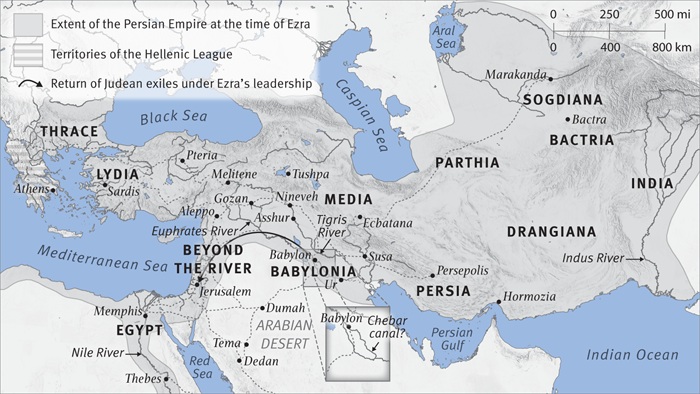
The Persian Empire at the Time of Ezra
During the time of Ezra the Persian Empire had reached its greatest extent, engulfing nearly the entire Near East. In 539 B.C. the Persians under Cyrus the Great defeated the Babylonians and absorbed their territory into the empire, including the lands of Israel and Judah (known as Beyond the River). The next year Cyrus allowed the people of Judah to return home under the leadership of Zerubbabel and rebuild the temple of the Lord. Later, around 458 B.C., another group of Judean exiles returned under Ezra's leadership.
EZRA—NOTE ON 7:11 copy of the letter. The original was usually kept for a record. The letter was addressed to Ezra because the decree recorded therein was the critical administrative document. Decrees were commonly embedded in letters. The letter in essence authorized the document into Ezra's hands so that he could carry it and read it to its intended audience.
EZRA—NOTE ON 7:12–26 This is a remarkable decree that evidences God's sovereign rule over earthly kings and his intent to keep the Abrahamic, Davidic, and New Covenants with Israel. This section is in Aramaic, as was 4:8–6:18.
EZRA—NOTE ON 7:12 king of kings. Though it was true that Artaxerxes ruled over other kings, Jesus Christ is the ultimate King of kings (cf. Rev. 19:16), who alone can genuinely make that claim since he will rule over all kings in his coming kingdom (cf. Rev. 11:15).
EZRA—NOTE ON 7:14 seven counselors. This number was according to the Persian tradition (cf. Est. 1:14).
EZRA—NOTE ON 7:17 then. The royal decree protocol recorded in the opening words of 7:13–16 leads up to the section introduced by this word.
EZRA—NOTE ON 7:22 up to 100 talents. Approaching 4 tons in weight. to . . . 100 cors. Approximately 750 bushels. to . . . 100 baths. Six hundred gallons.
EZRA—NOTE ON 7:25 you, Ezra. The letter in which the decree was embedded was written to Ezra. The king turned to him in a demonstration of administrative trust and granted him permission to appoint magistrates and judges for the region. The effect of this decision would be to offer a measure of local autonomy to the Jews.
EZRA—NOTE ON 8:1–14 from Babylonia. The list that follows no doubt includes those who lived in the surrounding areas. The total number of males in this section is 1,496 plus the men named, so with the addition of the women and children the number easily approaches 7,000 to 8,000. Just as these had not gone with the first group of returnees, so many Jews remained in Babylon after this group had departed. During the 70 years, many of the exiles had settled into a comfortable lifestyle. No small conflict arose between those who returned and those who stayed in Babylon.
EZRA—NOTE ON 8:15 river . . . Ahava. An unknown location where a canal/river flowed into the Euphrates. This was in Babylon and chosen for the place where the returning Jews would render vows for several days in preparation to leave.
none of the sons of Levi. There were no Levites who chose to return, so Ezra pursued such needed men by sending a command to Iddo, who was chief of the temple servants. Iddo's influence brought 38 Levites and 220 temple servants (vv. 16–20).
EZRA—NOTE ON 8:21–23 I proclaimed a fast. They would soon begin the long journey. Such travel was dangerous, for the roads were frequented by thieves who robbed for survival. Even messengers traveled with caravans to ensure their safety. Ezra and the people did not want to confuse the king regarding their trust in God's protection so they entreated him for safety with a prayerful fast. God honored their prayer of faith with his protection.
EZRA—NOTE ON 8:26 weighed . . . 650 talents. Over 25 tons. worth 200 talents. Almost 8 tons.
EZRA—NOTE ON 8:27 bowls . . . worth 1,000 darics. About 20 pounds. See note on 2:69.
EZRA—NOTE ON 8:31 Ahava. See note on v. 15. first month. See note on 7:8–9. The 12-day delay occurred because of a three-day delay searching for more Levites (8:15) and the fast that sought God's protection (8:21).
EZRA—NOTE ON 8:36 They also delivered the king's commissions. The plural "commissions" may account for a change of terminology. This would include the decrees plus other edicts in the official correspondence Artaxerxes gave to Ezra to deliver, to support the Jews and their building of the temple.
EZRA—NOTE ON 9:1 After these things had been done. This refers to the implementation of the different trusts and duties committed to him. priests . . . Levites. As was the case before the Assyrian and Babylonian deportations, the spiritual leadership defaulted along with the people (cf. Isa. 24:2; Jer. 5:30–31; 6:13–15; Hosea 4:9; Mal. 2:1–9; 2 Tim. 4:2–4). abominations. The reason for this exclusiveness was to keep the people pure. In the first settlement, Israel was warned not to make covenants with the nations, which would result in intermarriages and inevitably the worship of foreign gods (Ex. 34:10–17; Deut. 7:1–5). To a great extent, the continual violation of this precipitated the 70-year exile from which they had just returned. Ezra found out it had happened again and called for immediate repentance. Nehemiah (Neh. 13:23–27) and Malachi (Mal. 2:14–16) later encountered the same sin. It is unthinkable that the Jews would so quickly go down the same disastrous path of idolatry. Neither wrath from God in the exile to Babylon, nor grace from God in the return was enough to keep them from defecting again. Canaanites . . . Amorites. See notes on Josh. 3:10.
EZRA—NOTE ON 9:2 holy race. The seed of Abraham that God had set apart (cf. Gen. 13:15–16; 17:4–14) was not to be mixed with other nations; and if so, it violated God's covenant (cf. Deut. 7:2–3). This marriage with Gentile women would bring idolatry into the next generation for certain, so Ezra reacted strongly.
EZRA—NOTE ON 9:3 tore . . . pulled . . . sat. An outward expression of a grieving, disturbed spirit over sin (cf. 2 Chron. 34:27) characterized Ezra as he saw the people returning to their old ways, which would bring judgment again.
EZRA—NOTE ON 9:4 trembled at the words. In contrast to those who participated in the intermarriage, there were those who saw it as an abomination. They greatly feared the Lord's judgment on them again (cf. Isa. 66:2, 5) and sat with Ezra until the gathering of the people for the evening sacrifice, when there was surely public prayer and confession as Ezra fasted, lamented, and prayed (Ezra 9:5) in an effort to lead the leaders and people to repent.
EZRA—NOTE ON 9:5–15 Ezra's priestly prayer of intercession and confession is like Daniel's (Dan. 9:1–20) and Nehemiah's (Neh. 1:4–11), in that he used plural pronouns that identified himself with the people's sin, even though he did not participate in it. The use of "we," "our" and "us" demonstrates Ezra's understanding that the sin of the few is sufficient to contaminate the many.
EZRA—NOTE ON 9:8 a secure hold within his holy place. Lit., a "nail" or "tentpin" (see esv footnote)—a figure of speech that indicated permanence and prominence.
EZRA—NOTE ON 9:8–9 favor . . . steadfast love. God had been true to his character and his covenant (cf. Lam. 3:22–23) in restoring Israel, Jerusalem, and the temple.
EZRA—NOTE ON 9:9 protection. Lit., a "wall" (see esv footnote) As a people scattered all over the Fertile Crescent, the Jews were vulnerable to the nations. Together in Judah, with God as protector, they were safe. The "wall" does not exclude the walls of Jerusalem yet to be built, but it speaks more broadly of
God's provision for protection.
EZRA—NOTE ON 9:10–12 your commandments. This is not a quotation of any single text of Scripture, but rather a summation of God's commands on the subject (cf. Ex. 34:15–17; Deut. 7:1–6).
EZRA—NOTE ON 9:13–14 See a similar situation in the first exodus, when the Israelites engaged in idolatry and immorality led by Aaron, who was then confronted by Moses (Ex. 32:1–35).
EZRA—NOTE ON 9:14 no remnant. Ezra feared that this sin would provoke the ultimate judgment of God and the abrogation of God's unconditional covenants. While God would judge sin, the coming of Messiah and Paul's insights on God's continued faithfulness in his promise to the Jews (Rom. 9–11) assures that God's calling of Israel as a beloved people and nation is irrevocable (Rom. 11:25–29).
EZRA—NOTE ON 9:15 none can stand before you. All were reckoned guilty and had no right to stand in God's presence, yet they came penitently seeking the grace of forgiveness.
EZRA—NOTE ON 10:1 prayed and made confession, weeping and casting himself down. Ezra's contrite spirit before the people was evident, and they joined him. These extreme expressions of contrition demonstrated the seriousness of the sin and the genuineness of their repentance.
EZRA—NOTE ON 10:2 Shecaniah. This leader, not involved in the mixed marriages since his name does not appear in the list in vv. 18–44 (though his father and five paternal uncles do appear in v. 26), was bold and chose to obey God rather than please his relatives. hope for Israel in spite of this. This hope is centered in God's covenant love and forgiveness of truly repentant sinners.
EZRA—NOTE ON 10:3 make a covenant. Shecaniah calls for the people and leaders to accomplish the specific action of divorcing the wives and children and acknowledges that Ezra has counseled a course of action consistent with Scripture (cf. 2 Chron. 29:10). those who tremble. Cf. Isa. 66:2, 5. This refers to those who take the word of God seriously, especially his judgment on their sin. according to the Law. They wanted to get in line with God's law as revealed in Deut. 7:2–3.
EZRA—NOTE ON 10:4 your task. Ezra is acknowledged as the chief spiritual leader with appropriate divine authority and human responsibility to take on the execution of this formidable task of dealing with divorces for so many (cf. vv. 18–44).
EZRA—NOTE ON 10:5 take oath. The oath in relation to the covenant specified in 10:3. Cf. Neh. 10:28–39 for the content of a later oath under similar conditions.
EZRA—NOTE ON 10:7 a proclamation was made. A proclamation was delivered orally by a herald. It often had the force of law as did this one. Not participating in the assembly, as some might have been tempted to do, meant not just losing your property, but being ostracized from Israel.
EZRA—NOTE ON 10:8 three days. The message had to go out, and the people were required to respond within 72 hours. Since only the territories of Judah and Benjamin were involved, the greatest distance would have been no more than 40–50 miles.
EZRA—NOTE ON 10:9 all the men. Serious consequences highlighted the gravity of the situation, and thus everyone came. ninth month. December/January, the time of the heaviest rains and coldest weather, especially in Jerusalem, which is over 2,500 feet in elevation.
EZRA—NOTE ON 10:11 confession. . . . Separate. Here are the two essential elements of repentance—agreeing with God and taking righteous action to separate from sin.
EZRA—NOTE ON 10:12–14 all . . . the people are many. This demonstrates how widespread this sin was among the people. With the heavy rain and the large number of people to be processed, the whole operation could go long, so the people made an administrative suggestion for dealing with the magnitude of the problem. For each unlawful marriage, a questioning or court session could be locally conducted. All of these details had to be treated with great care; thus, delegating the court process was a suggestion much like Jethro's back in the wilderness (cf. Ex. 18).
EZRA—NOTE ON 10:15 opposed this. It is unclear whether these four opposed the delay in dealing with the situation or whether they opposed dealing with the sin at all. It was, however, a good plan and brought about a reasonably fast resolution.
EZRA—NOTE ON 10:16–17 tenth month . . . first month. It took three months to rectify the situation in all cases, after which the people were prepared to celebrate Passover with a clear conscience.
EZRA—NOTE ON 10:18 the sons of Jeshua the son of Jozadak and his brothers. At the head of the list of those who had intermarried were the descendants and other relatives of the high priest who first returned with Zerubbabel and led in the temple reconstruction. They set the example for all the people in giving the appropriate trespass offering (v. 19).
EZRA—NOTE ON 10:18–44 Given the fact that it took three months to resolve the situation, this list of 113 men could represent only those in leadership (cf. "the people are many," 10:13). There were apparently more violators among the people. Even though the problem was dealt with directly, it would eventually reappear (cf. Neh. 9; 10; 13).
EZRA—NOTE ON 10:44 An appropriate provision was doubtlessly made for the divorced wives and the children.
Nehemiah
Nehemiah 1 • Nehemiah 2 • Nehemiah 3 • Nehemiah 4 • Nehemiah 5 •
Nehemiah 6 • Nehemiah 7 • Nehemiah 8 • Nehemiah 9 • Nehemiah 10 • Nehemiah 11 • Nehemiah 12 • Nehemiah 13 Introduction to Nehemiah
Title Author and Date Background and Setting Historical and Theological Themes Interpretive Challenges Outline Footnotes Study Notes
Introduction to Nehemiah
Title
Nehemiah ("Jehovah comforts") is a famous cupbearer, who never appears in Scripture outside of this book. As with the books of Ezra and Esther, named after his contemporaries (see Introductions to Ezra and Esther), the book recounts selected events of his leadership and was titled after him. Both the Greek Septuagint (LXX) and the Latin Vulgate named this book "Second Ezra." Even though the two books of Ezra and Nehemiah are separate in most English Bibles, they may have once been joined together in a single unit as currently in the Hebrew texts. New Testament writers do not quote Nehemiah.
Author and Date
Though much of this book was clearly drawn from Nehemiah's personal diaries and written from his first person perspective (1:1–7:5; 12:27–43; 13:4–31), both Jewish and Christian traditions recognize Ezra as the author. This is based on external evidence that Ezra and Nehemiah were originally one book as reflected in the LXX and Vulgate; it is also based on internal evidence such as the recurrent "hand of the Lord" theme that dominates both Ezra and Nehemiah and the author's role as a priest-scribe. As a scribe, he had access to the royal archives of Persia, which accounts for the myriad of administrative documents found recorded in the two books, especially in the book of Ezra. Very few people would have been allowed access to the royal archives of the Persian Empire, but Ezra proved to be the exception (cf. Ezra 1:2–4; 4:9–22; 5:7–17; 6:3–12).
The events in Neh. 1 commence late in the year 446 B.C., the twentieth year of the Persian king, Artaxerxes (464–423 B.C.). The book follows chronologically from Nehemiah's first term as governor of Jerusalem c. 445–433 B.C. (Neh. 1– 12) to his second term, possibly beginning c. 424 B.C. (Neh. 13). Nehemiah was written by Ezra sometime during or after Nehemiah's second term, but no later than 400 B.C.
Background and Setting
True to God's promise of judgment, he brought the Assyrians and Babylonians to deliver his chastisement upon wayward Judah and Israel. In 722 B.C. the Assyrians deported the 10 northern tribes and scattered them all over the then known world (2 Kings 17). Several centuries later, c. 605–586 B.C., God used the Babylonians to sack, destroy, and nearly depopulate Jerusalem (2 Kings 25) because Judah had persisted in her unfaithfulness to the covenant. God chastened his people with 70 years of captivity in Babylon (Jer. 25:11).
During the Jews' captivity, world empire leadership changed hands from the Babylonians to the Persians (c. 539 B.C.; Dan. 5), after which Daniel received most of his prophetic revelation (cf. Dan. 6; 9–12). The book of Ezra begins with the decree of Cyrus, a Persian king, to return God's people to Jerusalem to rebuild God's house (c. 539 B.C.), and chronicles the reestablishment of Judah's national calendar of feasts and sacrifices. Zerubbabel and Joshua led the first return (Ezra 1–6) and rebuilt the temple. Esther gives a glimpse of the Jews left in Persia (c. 483–473 B.C.) when Haman attempted to eliminate the Jewish race. Ezra 7–10 recounts the second return led by Ezra in 458 B.C. Nehemiah chronicles the third return to rebuild the wall around Jerusalem (c. 445 B.C.).
At that time in Judah's history, the Persian Empire dominated the entire Near Eastern world. Its administration of Judah, although done with a loose hand, was mindful of disruptions or any signs of rebellion from its vassals. Rebuilding the walls of conquered cities posed the most glaring threat to the Persian central administration. Only a close confidant of the king himself could be trusted for such an operation. At the most critical juncture in Judah's revitalization, God raised up Nehemiah to exercise one of the most trusted roles in the empire, the King's cupbearer and confidant. Life under the Persian king Artaxerxes (c. 464– 423 B.C.) had its advantages for Nehemiah. Much like Joseph, Esther, and Daniel, he had attained a significant role in the palace that then ruled the ancient world, a position from which God could use him to lead the rebuilding of Jerusalem's walls in spite of its implications for Persian control of that city.
Several other historical notes are of interest. First, Esther was Artaxerxes' stepmother (see note on Est. 1:9) and could have easily influenced him to look favorably upon the Jews, especially Nehemiah. Second, Daniel's prophetic 70 weeks began with the decree to rebuild the city issued by Artaxerxes in 445 B.C. (cf. Neh. 1–2; see notes on Dan. 9:24–26). Third, the Elephantine papyri (Egyptian documents), dated to the late fifth century B.C., support the account of Nehemiah by mentioning Sanballat the governor of Samaria (Neh. 2:19),
Jehohanan (6:18; 12:23), and Nehemiah's being replaced as governor of Jerusalem by Bigvai (c. 410 B.C.; Neh. 10:16). Finally, Nehemiah and Malachi represent the last of the OT canonical writings, both in terms of the time the events occurred (ch. 13; Mal. 1–4) and the time when they were recorded by Ezra. Thus the next messages from God for Israel do not come until over 400 years of silence had passed, after which the births of John the Baptist and Jesus Christ were announced (Matt. 1; Luke 1–2).
With the full OT revelation of Israel's history prior to Christ's incarnation being completed, the Jews had not yet experienced the fullness of God's various covenants and promises to them. While there was a Jewish remnant, as promised to Abraham (cf. Gen. 15:5), it does not appear to be even as large as at the time of the exodus (Num. 1:46). The Jews neither possessed the land (Gen. 15:7) nor did they rule as a sovereign nation (Gen. 12:2). The Davidic throne was unoccupied (cf. 2 Sam. 7:16), although the high priest was of the line of Eleazar and Phinehas (cf. Num. 25:10–13). God's promise to consummate the New Covenant of redemption awaited the birth, crucifixion, and resurrection of Messiah (cf. Heb. 7–10).
Historical and Theological Themes
Careful attention to the reading of God's word in order to perform his will is a constant theme. The spiritual revival came in response to Ezra's reading of "the Book of the Law of Moses" (8:1). After the reading, Ezra and some of the priests carefully explained its meaning to the people in attendance (8:8). The next day, Ezra met with some of the fathers of the households, the priests, and Levites, in order to "study the words of the Law" (8:13). The sacrificial system was carried on with careful attention to perform it "as it is written in the Law" (10:34, 36). So deep was their concern to abide by God's revealed will that they took "a curse and an oath to walk in God's Law" (10:29). When the marriage reforms were carried out, they acted in accordance with what "they read from the Book of Moses" (13:1).
A second major theme, the obedience of Nehemiah, is explicitly referred to throughout the book because the book is based on the memoirs or first person accounts of Nehemiah. God worked through the obedience of Nehemiah; however, he also worked through the wrongly motivated, wicked hearts of his enemies. Nehemiah's enemies failed, not so much as a result of the success of Nehemiah's strategies, but because "God had frustrated their plan" (4:15). God used the opposition of Judah's enemies to drive his people to their knees in the same way that he used the favor of Cyrus to return his people to the land, to fund their building project, and even to protect the reconstruction of Jerusalem's walls. Not surprisingly, Nehemiah acknowledged the true motive of his strategy to repopulate Jerusalem: "my God put it into my heart" (7:5). It was he who accomplished it.
Another theme in Nehemiah, as in Ezra, is opposition. Judah's enemies started rumors that God's people had revolted against Persia. The goal was to intimidate Judah into forestalling reconstruction of the walls. In spite of opposition from without and heartbreaking corruption and dissension from within, Judah completed the walls of Jerusalem in only 52 days (6:15), experienced revival after the reading of the law by Ezra (8:1ff.), and celebrated the Feast of Tabernacles (8:14ff.; c. 445 B.C.).
The book's detailed insight into the personal thoughts, motives, and disappointments of Nehemiah makes it easy for the reader to primarily identify with him, rather than "the sovereign hand of God" theme and the primary message of his control and intervention into the affairs of his people and their enemies. But the exemplary behavior of the famous cupbearer is eclipsed by God who orchestrated the reconstruction of the walls in spite of much opposition and many setbacks; the "good hand of God" theme carries through the book of Nehemiah (1:10; 2:8, 18).
Interpretive Challenges
First, since much of Nehemiah is explained in relationship to Jerusalem's gates (cf. Neh. 2; 3; 8; 12), one needs to see the map "Jerusalem at the Time of Nehemiah" for an orientation. Second, the reader must recognize that the timeline of chs. 1–12 encompassed about one year (445 B.C.), followed by a long gap of time (over 20 years) after Neh. 12 and before Neh. 13 (see "Timeline of Nehemiah"). Finally, it must be recognized that Nehemiah actually served two governorships in Jerusalem, the first from 445–433 B.C. (cf. Neh. 5:14; 13:6) and the second beginning possibly in 424 B.C. and extending to no longer than 410 B.C.
Outline