
VII. (Epilogue) The King's Assignment (28:16–20)
VI. The King's Atonement (24:1–28:15)
A. Discourse 5: The Olivet Discourse (24:1–25:46)
1. The destruction of the temple (24:1–2) 2. The signs of the times (24:3–31) 3. The parable of the fig tree (24:32–35) 4. The lesson of Noah (24:36–44) 5. The parable of the two servants (24:45–51) 6. The parable of the 10 virgins (25:1–13) 7. The parable of the talents (25:14–30) 8. The judgment of the nations (25:31–46) B. Narrative 5: The Crucifixion and Resurrection (26:1–28:15)
1. The plot to kill the King (26:1–5) 2. Mary's anointing (26:6–13) 3. Judas's betrayal (26:14–16) 4. The Passover (26:17–30) 5. The prophecy of Peter's denial (26:31–35) 6. Jesus' agony (26:36–46) 7. Jesus' arrest (26:47–56) 8. The trial before the Sanhedrin (26:57–68) 9. Peter's denial (26:69–75) 10. Judas's suicide (27:1–10) 11. The trial before Pilate (27:11–26) 12. The soldiers' mocking (27:27–31) 13. The crucifixion (27:32–56) 14. The burial (27:57–66) 15. The resurrection (28:1–15) VII. (Epilogue) The King's Assignment (28:16–20)
THE GOSPEL ACCORDING TO
Matthew
The Genealogy of Jesus Christ
MATTHEW 1 †The book of the genealogy of Jesus Christ, the son of David, the son of Abraham.
was the father of Isaac, and Isaac the father of Jacob, and Jacob the father of Judah and his brothers, 3†and Judah the father of Perez and Zerah by Tamar, and Perez the father of Hezron, and Hezron the father of Ram, [1] 4and Ram the father of Amminadab, and Amminadab the father of Nahshon, and Nahshon the father of Salmon, 5‡and Salmon the father of Boaz by Rahab, and Boaz the father of Obed by Ruth, and Obed the father of Jesse, 6and Jesse the father of David the king.
And David was the father of Solomon by the wife of Uriah, 7and Solomon the father of Rehoboam, and Rehoboam the father of Abijah, and Abijah the father of Asaph, [2] 8†and Asaph the father of Jehoshaphat, and Jehoshaphat the father of Joram, and Joram the father of Uzziah, 9and Uzziah the father of Jotham, and Jotham the father of Ahaz, and Ahaz the father of Hezekiah, 10and Hezekiah the father of Manasseh, and Manasseh the father of Amos, [3] and Amos the father of Josiah, 11†and Josiah the father of Jechoniah and his brothers, at the time of the deportation to Babylon.
after the deportation to Babylon: Jechoniah was the father of Shealtiel, [4] and Shealtiel the father of Zerubbabel, 13and Zerubbabel the father of Abiud, and Abiud the father of Eliakim, and Eliakim the father of Azor, 14and Azor the father of Zadok, and Zadok the father of Achim, and Achim the father of Eliud, 15and Eliud the father of Eleazar, and Eleazar the father of Matthan, and Matthan the father of Jacob, 16†and Jacob the father of Joseph the husband of Mary, of whom Jesus was born, who is called Christ.
all the generations from Abraham to David were fourteen generations, and from David to the deportation to Babylon fourteen generations, and from the deportation to Babylon to the Christ fourteen generations.
The Birth of Jesus Christ
the birth of Jesus Christ [5] took place in this way. When his mother Mary had been betrothed [6] to Joseph, before they came together she was found to be with child from the Holy Spirit. 19†And her husband Joseph, being a just man and unwilling to put her to shame, resolved to divorce her quietly. 20†But as he considered these things, behold, an angel of the Lord appeared to him in a dream, saying, "Joseph, son of David, do not fear to take Mary as your wife, for that which is conceived in her is from the Holy Spirit. 21†She will bear a son, and you shall call his name Jesus, for he will save his people from their sins." 22†All this took place to fulfill what the Lord had spoken by the prophet: 23†"Behold, the virgin shall conceive and bear a son, and they shall call his name Immanuel" (which means, God with us). 24†When Joseph woke from sleep, he did as the angel of the Lord commanded him: he took his wife, 25but knew her not until she had given birth to a son. And he called his name Jesus.
The Visit of the Wise Men
MATTHEW 2 ‡Now after Jesus was born in Bethlehem of Judea in the days of Herod the king, behold, wise men [1] from the east came to Jerusalem, 2†saying, "Where is he who has been born king of the Jews? For we saw his star when it rose [2] and have come to worship him." 3When Herod the king heard this, he was troubled, and all Jerusalem with him; 4†and assembling all the chief priests and scribes of the people, he inquired of them where the Christ was to be born. 5They told him, "In Bethlehem of Judea, for so it is written by the prophet: 6†"'And you, O Bethlehem, in the land of Judah, are by no means least among the rulers of Judah; for from you shall come a ruler who will shepherd my people Israel.'"
7Then Herod summoned the wise men secretly and ascertained from them what time the star had appeared. 8†And he sent them to Bethlehem, saying, "Go and search diligently for the child, and when you have found him, bring me word, that I too may come and worship him." 9After listening to the king, they went on their way. And behold, the star that they had seen when it rose went before them until it came to rest over the place where the child was. 10When they saw the star, they rejoiced exceedingly with great joy. 11†And going into the house they saw the child with Mary his mother, and they fell down and worshiped him. Then, opening their treasures, they offered him gifts, gold and frankincense and myrrh. 12‡And being warned in a dream not to return to Herod, they departed to their own country by another way.
The Flight to Egypt
13Now when they had departed, behold, an angel of the Lord appeared to Joseph in a dream and said, "Rise, take the child and his mother, and flee to Egypt, and remain there until I tell you, for Herod is about to search for the child, to destroy him." 14And he rose and took the child and his mother by night and departed to Egypt 15†and remained there until the death of Herod. This was to fulfill what the Lord had spoken by the prophet, "Out of Egypt I called my son."
Herod Kills the Children
Herod, when he saw that he had been tricked by the wise men, became furious, and he sent and killed all the male children in Bethlehem and in all that region who were two years old or under, according to the time that he had ascertained from the wise men. 17†Then was fulfilled what was spoken by the prophet Jeremiah: 18"A voice was heard in Ramah, weeping and loud lamentation, Rachel weeping for her children; she refused to be comforted, because they are no more."
The Return to Nazareth
when Herod died, behold, an angel of the Lord appeared in a dream to Joseph in Egypt, 20saying, "Rise, take the child and his mother and go to the land of Israel, for those who sought the child's life are dead." 21And he rose and took the child and his mother and went to the land of Israel. 22†But when he heard that Archelaus was reigning over Judea in place of his father Herod, he was afraid to go there, and being warned in a dream he withdrew to the district of Galilee. 23†And he went and lived in a city called Nazareth, that what was spoken by the prophets might be fulfilled: "He shall be called a Nazarene."
John the Baptist Prepares the Way
MATTHEW 3 †In those days John the Baptist came preaching in the wilderness of Judea, 2†"Repent, for the kingdom of heaven is at hand." 3†For this is he who was spoken of by the prophet Isaiah when he said, "The voice of one crying in the wilderness: 'Prepare [1] the way of the Lord; make his paths straight.'"
John wore a garment of camel's hair and a leather belt around his waist, and his food was locusts and wild honey. 5Then Jerusalem and all Judea and all the region about the Jordan were going out to him, 6†and they were baptized by him in the river Jordan, confessing their sins.
when he saw many of the Pharisees and Sadducees coming to his baptism, he said to them, "You brood of vipers! Who warned you to flee from the wrath to come? 8†Bear fruit in keeping with repentance. 9†And do not presume to say to yourselves, 'We have Abraham as our father,' for I tell you, God is able from these stones to raise up children for Abraham. 10†Even now the axe is laid to the root of the trees. Every tree therefore that does not bear good fruit is cut down and thrown into the fire.
baptize you with water for repentance, but he who is coming after me is mightier than I, whose sandals I am not worthy to carry. He will baptize you with the Holy Spirit and fire. 12†His winnowing fork is in his hand, and he will clear his threshing floor and gather his wheat into the barn, but the chaff he will burn with unquenchable fire."
The Baptism of Jesus
13Then Jesus came from Galilee to the Jordan to John, to be baptized by him. 14†John would have prevented him, saying, "I need to be baptized by you, and do you come to me?" 15†But Jesus answered him, "Let it be so now, for thus it is fitting for us to fulfill all righteousness." Then he consented. 16‡And when Jesus was baptized, immediately he went up from the water, and behold, the heavens were opened to him, [2] and he saw the Spirit of God descending like a dove and coming to rest on him; 17†and behold, a voice from heaven said, "This is my beloved Son, [3] with whom I am well pleased."
The Temptation of Jesus
MATTHEW 4 †Then Jesus was led up by the Spirit into the wilderness to be tempted by the devil. 2†And after fasting forty days and forty nights, he was hungry. 3†And the tempter came and said to him, "If you are the Son of God, command these stones to become loaves of bread." 4†But he answered, "It is written, "'Man shall not live by bread alone, but by every word that comes from the mouth of God.'"
the devil took him to the holy city and set him on the pinnacle of the temple 6†and said to him, "If you are the Son of God, throw yourself down, for it is written, "'He will command his angels concerning you,' and "'On their hands they will bear you up, lest you strike your foot against a stone.'"
said to him, "Again it is written, 'You shall not put the Lord your God to the test.'" 8Again, the devil took him to a very high mountain and showed him all the kingdoms of the world and their glory. 9†And he said to him, "All these I will give you, if you will fall down and worship me." 10†Then Jesus said to him, "Be gone, Satan! For it is written, "'You shall worship the Lord your God and him only shall you serve.'"
the devil left him, and behold, angels came and were ministering to him.
Jesus Begins His Ministry
when he heard that John had been arrested, he withdrew into Galilee. 13†And leaving Nazareth he went and lived in Capernaum by the sea, in the territory of Zebulun and Naphtali, 14so that what was spoken by the prophet Isaiah might be fulfilled: 15†"The land of Zebulun and the land of Naphtali, the way of the sea, beyond the Jordan, Galilee of the Gentiles— 16the people dwelling in darkness have seen a great light, and for those dwelling in the region and shadow of death, on them a light has dawned."
that time Jesus began to preach, saying, "Repent, for the kingdom of heaven is at hand."
Jesus Calls the First Disciples
walking by the Sea of Galilee, he saw two brothers, Simon (who is called Peter) and Andrew his brother, casting a net into the sea, for they were fishermen. 19And he said to them, "Follow me, and I will make you fishers of men." 20Immediately they left their nets and followed him. 21†And going on from there he saw two other brothers, James the son of Zebedee and John his brother, in the boat with Zebedee their father, mending their nets, and he called them. 22Immediately they left the boat and their father and followed him.
Jesus Ministers to Great Crowds
he went throughout all Galilee, teaching in their synagogues and proclaiming the gospel of the kingdom and healing every disease and every affliction among the people. 24†So his fame spread throughout all Syria, and they brought him all the sick, those afflicted with various diseases and pains, those oppressed by demons, epileptics, and paralytics, and he healed them. 25†And great crowds followed him from Galilee and the Decapolis, and from Jerusalem and Judea, and from beyond the Jordan.
The Sermon on the Mount
MATTHEW 5 ‡†Seeing the crowds, he went up on the mountain, and when he sat down, his disciples came to him.
The Beatitudes
2And he opened his mouth and taught them, saying: 3†"Blessed are the poor in spirit, for theirs is the kingdom of heaven.
4†"Blessed are those who mourn, for they shall be comforted.
5†"Blessed are the meek, for they shall inherit the earth.
are those who hunger and thirst for righteousness, for they shall be satisfied.
7†"Blessed are the merciful, for they shall receive mercy.
8†"Blessed are the pure in heart, for they shall see God.
9†"Blessed are the peacemakers, for they shall be called sons [1] of God.
are those who are persecuted for righteousness' sake, for theirs is the kingdom of heaven.
11"Blessed are you when others revile you and persecute you and utter all kinds of evil against you falsely on my account. 12Rejoice and be glad, for your reward is great in heaven, for so they persecuted the prophets who were before you.
Salt and Light
are the salt of the earth, but if salt has lost its taste, how shall its saltiness be restored? It is no longer good for anything except to be thrown out and trampled under people's feet.
14"You are the light of the world. A city set on a hill cannot be hidden. 15Nor do people light a lamp and put it under a basket, but on a stand, and it gives light to all in the house. 16†In the same way, let your light shine before others, so that they may see your good works and give glory to your Father who is in heaven.
Christ Came to Fulfill the Law
not think that I have come to abolish the Law or the Prophets; I have not come to abolish them but to fulfill them. 18†For truly, I say to you, until heaven and earth pass away, not an iota, not a dot, will pass from the Law until all is accomplished. 19†Therefore whoever relaxes one of the least of these commandments and teaches others to do the same will be called least in the kingdom of heaven, but whoever does them and teaches them will be called great in the kingdom of heaven. 20†For I tell you, unless your righteousness exceeds that of the scribes and Pharisees, you will never enter the kingdom of heaven.
Anger
have heard that it was said to those of old, 'You shall not murder; and whoever murders will be liable to judgment.' 22†But I say to you that everyone who is angry with his brother [2] will be liable to judgment; whoever insults [3] his brother will be liable to the council; and whoever says, 'You fool!' will be liable to the hell [4] of fire. 23So if you are offering your gift at the altar and there remember that your brother has something against you, 24leave your gift there before the altar and go. First be reconciled to your brother, and then come and offer your gift. 25†Come to terms quickly with your accuser while you are going with him to court, lest your accuser hand you over to the judge, and the judge to the guard, and you be put in prison. 26Truly, I say to you, you will never get out until you have paid the last penny. [5]
Lust
have heard that it was said, 'You shall not commit adultery.' 28But I say to you that everyone who looks at a woman with lustful intent has already committed adultery with her in his heart. 29†If your right eye causes you to sin, tear it out and throw it away. For it is better that you lose one of your members than that your whole body be thrown into hell. 30And if your right hand causes you to sin, cut it off and throw it away. For it is better that you lose one of your members than that your whole body go into hell.
Divorce
was also said, 'Whoever divorces his wife, let him give her a certificate of divorce.' 32†But I say to you that everyone who divorces his wife, except on the ground of sexual immorality, makes her commit adultery, and whoever marries a divorced woman commits adultery.
Oaths
you have heard that it was said to those of old, 'You shall not swear falsely, but shall perform to the Lord what you have sworn.' 34†But I say to you, Do not take an oath at all, either by heaven, for it is the throne of God, 35or by the earth, for it is his footstool, or by Jerusalem, for it is the city of the great King. 36And do not take an oath by your head, for you cannot make one hair white or black. 37Let what you say be simply 'Yes' or 'No'; anything more than this comes from evil. [6]
Retaliation
have heard that it was said, 'An eye for an eye and a tooth for a tooth.' 39†But I say to you, Do not resist the one who is evil. But if anyone slaps you on the right cheek, turn to him the other also. 40And if anyone would sue you and take your tunic, [7] let him have your cloak as well. 41†And if anyone forces you to go one mile, go with him two miles. 42Give to the one who begs from you, and do not refuse the one who would borrow from you.
Love Your Enemies
have heard that it was said, 'You shall love your neighbor and hate your enemy.' 44‡But I say to you, Love your enemies and pray for those who persecute you, 45so that you may be sons of your Father who is in heaven. For he makes his sun rise on the evil and on the good, and sends rain on the just and on the unjust. 46†For if you love those who love you, what reward do you have? Do not even the tax collectors do the same? 47And if you greet only your brothers, [8] what more are you doing than others? Do not even the Gentiles do the same? 48†You therefore must be perfect, as your heavenly Father is perfect.
Giving to the Needy
MATTHEW 6 ‡"Beware of practicing your righteousness before other people in order to be seen by them, for then you will have no reward from your Father who is in heaven.
when you give to the needy, sound no trumpet before you, as the hypocrites do in the synagogues and in the streets, that they may be praised by others. Truly, I say to you, they have received their reward. 3But when you give to the needy, do not let your left hand know what your right hand is doing, 4†so that your giving may be in secret. And your Father who sees in secret will reward you.
The Lord's Prayer
5"And when you pray, you must not be like the hypocrites. For they love to stand and pray in the synagogues and at the street corners, that they may be seen by others. Truly, I say to you, they have received their reward. 6But when you pray, go into your room and shut the door and pray to your Father who is in secret. And your Father who sees in secret will reward you.
when you pray, do not heap up empty phrases as the Gentiles do, for they think that they will be heard for their many words. 8Do not be like them, for your Father knows what you need before you ask him. 9†Pray then like this: "Our Father in heaven, hallowed be your name. [1] 10†Your kingdom come, your will be done, [2] on earth as it is in heaven. 11Give us this day our daily bread, [3] 12†and forgive us our debts, as we also have forgiven our debtors. 13†And lead us not into temptation, but deliver us from evil. [4]
14For if you forgive others their trespasses, your heavenly Father will also forgive you, 15†but if you do not forgive others their trespasses, neither will your Father forgive your trespasses.
Fasting
when you fast, do not look gloomy like the hypocrites, for they disfigure their faces that their fasting may be seen by others. Truly, I say to you, they have received their reward. 17But when you fast, anoint your head and wash your face, 18that your fasting may not be seen by others but by your Father who is in secret. And your Father who sees in secret will reward you.
Lay Up Treasures in Heaven
19"Do not lay up for yourselves treasures on earth, where moth and rust [5] destroy and where thieves break in and steal, 20†but lay up for yourselves treasures in heaven, where neither moth nor rust destroys and where thieves do not break in and steal. 21For where your treasure is, there your heart will be also.
eye is the lamp of the body. So, if your eye is healthy, your whole body will be full of light, 23but if your eye is bad, your whole body will be full of darkness. If then the light in you is darkness, how great is the darkness!
one can serve two masters, for either he will hate the one and love the other, or he will be devoted to the one and despise the other. You cannot serve God and money. [6]
Do Not Be Anxious
25"Therefore I tell you, do not be anxious about your life, what you will eat or what you will drink, nor about your body, what you will put on. Is not life more than food, and the body more than clothing? 26†Look at the birds of the air: they neither sow nor reap nor gather into barns, and yet your heavenly Father feeds them. Are you not of more value than they? 27And which of you by being anxious can add a single hour to his span of life? [7] 28And why are you anxious about clothing? Consider the lilies of the field, how they grow: they neither toil nor spin, 29†yet I tell you, even Solomon in all his glory was not arrayed like one of these. 30†But if God so clothes the grass of the field, which today is alive and tomorrow is thrown into the oven, will he not much more clothe you, O you of little faith? 31Therefore do not be anxious, saying, 'What shall we eat?' or 'What shall we drink?' or 'What shall we wear?' 32†For the Gentiles seek after all these things, and your heavenly Father knows that you need them all. 33†But seek first the kingdom of God and his righteousness, and all these things will be added to you.
34"Therefore do not be anxious about tomorrow, for tomorrow will be anxious for itself. Sufficient for the day is its own trouble.
Judging Others
MATTHEW 7 †"Judge not, that you be not judged. 2For with the judgment you pronounce you will be judged, and with the measure you use it will be measured to you. 3Why do you see the speck that is in your brother's eye, but do not notice the log that is in your own eye? 4Or how can you say to your brother, 'Let me take the speck out of your eye,' when there is the log in your own eye? 5You hypocrite, first take the log out of your own eye, and then you will see clearly to take the speck out of your brother's eye.
not give dogs what is holy, and do not throw your pearls before pigs, lest they trample them underfoot and turn to attack you.
Ask, and It Will Be Given
7"Ask, and it will be given to you; seek, and you will find; knock, and it will be opened to you. 8For everyone who asks receives, and the one who seeks finds, and to the one who knocks it will be opened. 9Or which one of you, if his son asks him for bread, will give him a stone? 10Or if he asks for a fish, will give him a serpent? 11†If you then, who are evil, know how to give good gifts to your children, how much more will your Father who is in heaven give good things to those who ask him!
The Golden Rule
whatever you wish that others would do to you, do also to them, for this is the Law and the Prophets.
by the narrow gate. For the gate is wide and the way is easy [1] that leads to destruction, and those who enter by it are many. 14†For the gate is narrow and the way is hard that leads to life, and those who find it are few.
A Tree and Its Fruit
of false prophets, who come to you in sheep's clothing but inwardly are ravenous wolves. 16†You will recognize them by their fruits. Are grapes gathered from thornbushes, or figs from thistles? 17So, every healthy tree bears good fruit, but the diseased tree bears bad fruit. 18A healthy tree cannot bear bad fruit, nor can a diseased tree bear good fruit. 19Every tree that does not bear good fruit is cut down and thrown into the fire. 20Thus you will recognize them by their fruits.
I Never Knew You
everyone who says to me, 'Lord, Lord,' will enter the kingdom of heaven, but the one who does the will of my Father who is in heaven. 22†On that day many will say to me, 'Lord, Lord, did we not prophesy in your name, and cast out demons in your name, and do many mighty works in your name?' 23†And then will I declare to them, 'I never knew you; depart from me, you workers of lawlessness.'
Build Your House on the Rock
then who hears these words of mine and does them will be like a wise man who built his house on the rock. 25And the rain fell, and the floods came, and the winds blew and beat on that house, but it did not fall, because it had been founded on the rock. 26And everyone who hears these words of mine and does not do them will be like a foolish man who built his house on the sand. 27And the rain fell, and the floods came, and the winds blew and beat against that house, and it fell, and great was the fall of it."
The Authority of Jesus
28And when Jesus finished these sayings, the crowds were astonished at his teaching, 29†for he was teaching them as one who had authority, and not as their scribes.
Jesus Cleanses a Leper
MATTHEW 8 †When he came down from the mountain, great crowds followed him. 2†And behold, a leper [1] came to him and knelt before him, saying, "Lord, if you will, you can make me clean." 3And Jesus [2] stretched out his hand and touched him, saying, "I will; be clean." And immediately his leprosy was cleansed. 4†And Jesus said to him, "See that you say nothing to anyone, but go, show yourself to the priest and offer the gift that Moses commanded, for a proof to them."
The Faith of a Centurion
he entered Capernaum, a centurion came forward to him, appealing to him, 6"Lord, my servant is lying paralyzed at home, suffering terribly." 7And he said to him, "I will come and heal him." 8†But the centurion replied, "Lord, I am not worthy to have you come under my roof, but only say the word, and my servant will be healed. 9For I too am a man under authority, with soldiers under me. And I say to one, 'Go,' and he goes, and to another, 'Come,' and he comes, and to my servant, [3] 'Do this,' and he does it." 10†When Jesus heard this, he marveled and said to those who followed him, "Truly, I tell you, with no one in Israel [4] have I found such faith. 11†I tell you, many will come from east and west and recline at table with Abraham, Isaac, and Jacob in the kingdom of heaven, 12†while the sons of the kingdom will be thrown into the outer darkness. In that place there will be weeping and gnashing of teeth." 13†And to the centurion Jesus said, "Go; let it be done for you as you have believed." And the servant was healed at that very moment.
Jesus Heals Many
14And when Jesus entered Peter's house, he saw his mother-in-law lying sick with a fever. 15He touched her hand, and the fever left her, and she rose and began to serve him. 16†That evening they brought to him many who were oppressed by demons, and he cast out the spirits with a word and healed all who were sick. 17†This was to fulfill what was spoken by the prophet Isaiah: "He took our illnesses and bore our diseases."
The Cost of Following Jesus
when Jesus saw a crowd around him, he gave orders to go over to the other side. 19†And a scribe came up and said to him, "Teacher, I will follow you wherever you go." 20†And Jesus said to him, "Foxes have holes, and birds of the air have nests, but the Son of Man has nowhere to lay his head." 21†Another of the disciples said to him, "Lord, let me first go and bury my father." 22†And Jesus said to him, "Follow me, and leave the dead to bury their own dead."
Jesus Calms a Storm
23And when he got into the boat, his disciples followed him. 24†And behold, there arose a great storm on the sea, so that the boat was being swamped by the waves; but he was asleep. 25And they went and woke him, saying, "Save us, Lord; we are perishing." 26†And he said to them, "Why are you afraid, O you of little faith?" Then he rose and rebuked the winds and the sea, and there was a great calm. 27†And the men marveled, saying, "What sort of man is this, that even winds and sea obey him?"
Jesus Heals Two Men with Demons
when he came to the other side, to the country of the Gadarenes, [5] two demon-possessed [6] men met him, coming out of the tombs, so fierce that no one could pass that way. 29†And behold, they cried out, "What have you to do with us, O Son of God? Have you come here to torment us before the time?" 30†Now a herd of many pigs was feeding at some distance from them. 31†And the demons begged him, saying, "If you cast us out, send us away into the herd of pigs." 32And he said to them, "Go." So they came out and went into the pigs, and behold, the whole herd rushed down the steep bank into the sea and drowned in the waters. 33The herdsmen fled, and going into the city they told everything, especially what had happened to the demon-possessed men. 34†And behold, all the city came out to meet Jesus, and when they saw him, they begged him to leave their region.
Jesus Heals a Paralytic
MATTHEW 9 †And getting into a boat he crossed over and came to his own city. 2†And behold, some people brought to him a paralytic, lying on a bed. And when Jesus saw their faith, he said to the paralytic, "Take heart, my son; your sins are forgiven." 3†And behold, some of the scribes said to themselves, "This man is blaspheming." 4†But Jesus, knowing [1] their thoughts, said, "Why do you think evil in your hearts? 5†For which is easier, to say, 'Your sins are forgiven,' or to say, 'Rise and walk'? 6But that you may know that the Son of Man has authority on earth to forgive sins"—he then said to the paralytic—"Rise, pick up your bed and go home." 7And he rose and went home. 8When the crowds saw it, they were afraid, and they glorified God, who had given such authority to men.
Jesus Calls Matthew
Jesus passed on from there, he saw a man called Matthew sitting at the tax booth, and he said to him, "Follow me." And he rose and followed him.
10And as Jesus [2] reclined at table in the house, behold, many tax collectors and sinners came and were reclining with Jesus and his disciples. 11†And when the Pharisees saw this, they said to his disciples, "Why does your teacher eat with tax collectors and sinners?" 12†But when he heard it, he said, "Those who are well have no need of a physician, but those who are sick. 13†Go and learn what this means, 'I desire mercy, and not sacrifice.' For I came not to call the righteous, but sinners."
A Question About Fasting
the disciples of John came to him, saying, "Why do we and the Pharisees fast, [3] but your disciples do not fast?" 15†And Jesus said to them, "Can the wedding guests mourn as long as the bridegroom is with them? The days will come when the bridegroom is taken away from them, and then they will fast. 16†No one puts a piece of unshrunk cloth on an old garment, for the patch tears away from the garment, and a worse tear is made. 17†Neither is new wine put into old wineskins. If it is, the skins burst and the wine is spilled and the skins are destroyed. But new wine is put into fresh wineskins, and so both are preserved."
A Girl Restored to Life and a Woman Healed
he was saying these things to them, behold, a ruler came in and knelt before him, saying, "My daughter has just died, but come and lay your hand on her, and she will live." 19And Jesus rose and followed him, with his disciples. 20†And behold, a woman who had suffered from a discharge of blood for twelve years came up behind him and touched the fringe of his garment, 21for she said to herself, "If I only touch his garment, I will be made well." 22†Jesus turned, and seeing her he said, "Take heart, daughter; your faith has made you well." And instantly [4] the woman was made well. 23†And when Jesus came to the ruler's house and saw the flute players and the crowd making a commotion, 24†he said, "Go away, for the girl is not dead but sleeping." And they laughed at him. 25But when the crowd had been put outside, he went in and took her by the hand, and the girl arose. 26And the report of this went through all that district.
Jesus Heals Two Blind Men
as Jesus passed on from there, two blind men followed him, crying aloud, "Have mercy on us, Son of David." 28When he entered the house, the blind men came to him, and Jesus said to them, "Do you believe that I am able to do this?" They said to him, "Yes, Lord." 29†Then he touched their eyes, saying, "According to your faith be it done to you." 30†And their eyes were opened. And Jesus sternly warned them, "See that no one knows about it." 31But they went away and spread his fame through all that district.
Jesus Heals a Man Unable to Speak
32As they were going away, behold, a demon-oppressed man who was mute was brought to him. 33And when the demon had been cast out, the mute man spoke. And the crowds marveled, saying, "Never was anything like this seen in Israel." 34†But the Pharisees said, "He casts out demons by the prince of demons."
The Harvest Is Plentiful, the Laborers Few
Jesus went throughout all the cities and villages, teaching in their synagogues and proclaiming the gospel of the kingdom and healing every disease and every affliction. 36†When he saw the crowds, he had compassion for them, because they were harassed and helpless, like sheep without a shepherd.
he said to his disciples, "The harvest is plentiful, but the laborers are few; 38†therefore pray earnestly to the Lord of the harvest to send out laborers into his harvest."
The Twelve Apostles
MATTHEW 10 ‡†And he called to him his twelve disciples and gave them authority over unclean spirits, to cast them out, and to heal every disease and every affliction. 2†The names of the twelve apostles are these: first, Simon, who is called Peter, and Andrew his brother; James the son of Zebedee, and John his brother; 3†Philip and Bartholomew; Thomas and Matthew the tax collector; James the son of Alphaeus, and Thaddaeus; [1] 4†Simon the Cananaean, and Judas Iscariot, who betrayed him.
Jesus Sends Out the Twelve Apostles
twelve Jesus sent out, instructing them, "Go nowhere among the Gentiles and enter no town of the Samaritans, 6†but go rather to the lost sheep of the house of Israel. 7†And proclaim as you go, saying, 'The kingdom of heaven is at hand.' 8†Heal the sick, raise the dead, cleanse lepers, [2] cast out demons. You received without paying; give without pay. 9‡Acquire no gold nor silver nor copper for your belts, 10no bag for your journey, nor two tunics [3] nor sandals nor a staff, for the laborer deserves his food. 11And whatever town or village you enter, find out who is worthy in it and stay there until you depart. 12As you enter the house, greet it. 13†And if the house is worthy, let your peace come upon it, but if it is not worthy, let your peace return to you. 14†And if anyone will not receive you or listen to your words, shake off the dust from your feet when you leave that house or town. 15†Truly, I say to you, it will be more bearable on the day of judgment for the land of Sodom and Gomorrah than for that town.
Persecution Will Come
I am sending you out as sheep in the midst of wolves, so be wise as serpents and innocent as doves. 17†Beware of men, for they will deliver you over to courts and flog you in their synagogues, 18and you will be dragged before governors and kings for my sake, to bear witness before them and the Gentiles. 19†When they deliver you over, do not be anxious how you are to speak or what you are to say, for what you are to say will be given to you in that hour. 20For it is not you who speak, but the Spirit of your Father speaking through you. 21‡Brother will deliver brother over to death, and the father his child, and children will rise against parents and have them put to death, 22†and you will be hated by all for my name's sake. But the one who endures to the end will be saved. 23When they persecute you in one town, flee to the next, for truly, I say to you, you will not have gone through all the towns of Israel before the Son of Man comes.
disciple is not above his teacher, nor a servant [4] above his master. 25†It is enough for the disciple to be like his teacher, and the servant like his master. If they have called the master of the house Beelzebul, how much more will they malign [5] those of his household.
Have No Fear
26"So have no fear of them, for nothing is covered that will not be revealed, or hidden that will not be known. 27What I tell you in the dark, say in the light, and what you hear whispered, proclaim on the housetops. 28†And do not fear those who kill the body but cannot kill the soul. Rather fear him who can destroy both soul and body in hell. [6] 29†Are not two sparrows sold for a penny? [7] And not one of them will fall to the ground apart from your Father. 30But even the hairs of your head are all numbered. 31Fear not, therefore; you are of more value than many sparrows. 32†So everyone who acknowledges me before men, I also will acknowledge before my Father who is in heaven, 33†but whoever denies me before men, I also will deny before my Father who is in heaven.
Not Peace, but a Sword
not think that I have come to bring peace to the earth. I have not come to bring peace, but a sword. 35‡For I have come to set a man against his father, and a daughter against her mother, and a daughter-in-law against her mother-in-law. 36And a person's enemies will be those of his own household. 37Whoever loves father or mother more than me is not worthy of me, and whoever loves son or daughter more than me is not worthy of me. 38†And whoever does not take his cross and follow me is not worthy of me. 39Whoever finds his life will lose it, and whoever loses his life for my sake will find it.
Rewards
receives you receives me, and whoever receives me receives him who sent me. 41†The one who receives a prophet because he is a prophet will receive a prophet's reward, and the one who receives a righteous person because he is a righteous person will receive a righteous person's reward. 42†And whoever gives one of these little ones even a cup of cold water because he is a disciple, truly, I say to you, he will by no means lose his reward."
Messengers from John the Baptist
MATTHEW 11 †When Jesus had finished instructing his twelve disciples, he went on from there to teach and preach in their cities.
2Now when John heard in prison about the deeds of the Christ, he sent word by his disciples 3†and said to him, "Are you the one who is to come, or shall we look for another?" 4†And Jesus answered them, "Go and tell John what you hear and see: 5the blind receive their sight and the lame walk, lepers [1] are cleansed and the deaf hear, and the dead are raised up, and the poor have good news preached to them. 6And blessed is the one who is not offended by me."
7As they went away, Jesus began to speak to the crowds concerning John: "What did you go out into the wilderness to see? A reed shaken by the wind? 8What then did you go out to see? A man [2] dressed in soft clothing? Behold, those who wear soft clothing are in kings' houses. 9What then did you go out to see? A prophet? [3] Yes, I tell you, and more than a prophet. 10†This is he of whom it is written, "'Behold, I send my messenger before your face, who will prepare your way before you.'
I say to you, among those born of women there has arisen no one greater than John the Baptist. Yet the one who is least in the kingdom of heaven is greater than he. 12†From the days of John the Baptist until now the kingdom of heaven has suffered violence, [4] and the violent take it by force. 13For all the Prophets and the Law prophesied until John, 14†and if you are willing to accept it, he is Elijah who is to come. 15He who has ears to hear, [5] let him hear.
to what shall I compare this generation? It is like children sitting in the marketplaces and calling to their playmates, 17"'We played the flute for you, and you did not dance; we sang a dirge, and you did not mourn.'
18For John came neither eating nor drinking, and they say, 'He has a demon.' 19†The Son of Man came eating and drinking, and they say, 'Look at him! A glutton and a drunkard, a friend of tax collectors and sinners!' Yet wisdom is justified by her deeds." [6]
Woe to Unrepentant Cities
20Then he began to denounce the cities where most of his mighty works had been done, because they did not repent. 21†"Woe to you, Chorazin! Woe to you, Bethsaida! For if the mighty works done in you had been done in Tyre and Sidon, they would have repented long ago in sackcloth and ashes. 22‡But I tell you, it will be more bearable on the day of judgment for Tyre and Sidon than for you. 23†And you, Capernaum, will you be exalted to heaven? You will be brought down to Hades. For if the mighty works done in you had been done in Sodom, it would have remained until this day. 24But I tell you that it will be more tolerable on the day of judgment for the land of Sodom than for you."
Come to Me, and I Will Give You Rest
that time Jesus declared, "I thank you, Father, Lord of heaven and earth, that you have hidden these things from the wise and understanding and revealed them to little children; 26†yes, Father, for such was your gracious will. [7] 27All things have been handed over to me by my Father, and no one knows the Son except the Father, and no one knows the Father except the Son and anyone to whom the Son chooses to reveal him. 28‡Come to me, all who labor and are heavy laden, and I will give you rest. 29†Take my yoke upon you, and learn from me, for I am gentle and lowly in heart, and you will find rest for your souls. 30For my yoke is easy, and my burden is light."
Jesus Is Lord of the Sabbath
MATTHEW 12 At that time Jesus went through the grainfields on the Sabbath. His disciples were hungry, and they began to pluck heads of grain and to eat. 2†But when the Pharisees saw it, they said to him, "Look, your disciples are doing what is not lawful to do on the Sabbath." 3†He said to them, "Have you not read what David did when he was hungry, and those who were with him: 4†how he entered the house of God and ate the bread of the Presence, which it was not lawful for him to eat nor for those who were with him, but only for the priests? 5†Or have you not read in the Law how on the Sabbath the priests in the temple profane the Sabbath and are guiltless? 6†I tell you, something greater than the temple is here. 7†And if you had known what this means, 'I desire mercy, and not sacrifice,' you would not have condemned the guiltless. 8†For the Son of Man is lord of the Sabbath."
A Man with a Withered Hand
9He went on from there and entered their synagogue. 10†And a man was there with a withered hand. And they asked him, "Is it lawful to heal on the Sabbath?"—so that they might accuse him. 11He said to them, "Which one of you who has a sheep, if it falls into a pit on the Sabbath, will not take hold of it and lift it out? 12Of how much more value is a man than a sheep! So it is lawful to do good on the Sabbath." 13Then he said to the man, "Stretch out your hand." And the man stretched it out, and it was restored, healthy like the other. 14But the Pharisees went out and conspired against him, how to destroy him.
God's Chosen Servant
aware of this, withdrew from there. And many followed him, and he healed them all 16†and ordered them not to make him known. 17This was to fulfill what was spoken by the prophet Isaiah: 18†"Behold, my servant whom I have chosen, my beloved with whom my soul is well pleased.
I will put my Spirit upon him, and he will proclaim justice to the Gentiles. 19†He will not quarrel or cry aloud, nor will anyone hear his voice in the streets; 20†a bruised reed he will not break, and a smoldering wick he will not quench, until he brings justice to victory; 21and in his name the Gentiles will hope."
Blasphemy Against the Holy Spirit
22Then a demon-oppressed man who was blind and mute was brought to him, and he healed him, so that the man spoke and saw. 23†And all the people were amazed, and said, "Can this be the Son of David?" 24†But when the Pharisees heard it, they said, "It is only by Beelzebul, the prince of demons, that this man casts out demons." 25Knowing their thoughts, he said to them, "Every kingdom divided against itself is laid waste, and no city or house divided against itself will stand. 26And if Satan casts out Satan, he is divided against himself. How then will his kingdom stand? 27And if I cast out demons by Beelzebul, by whom do your sons cast them out? Therefore they will be your judges. 28†But if it is by the Spirit of God that I cast out demons, then the kingdom of God has come upon you. 29Or how can someone enter a strong man's house and plunder his goods, unless he first binds the strong man? Then indeed he may plunder his house. 30Whoever is not with me is against me, and whoever does not gather with me scatters. 31†Therefore I tell you, every sin and blasphemy will be forgiven people, but the blasphemy against the Spirit will not be forgiven. 32†And whoever speaks a word against the Son of Man will be forgiven, but whoever speaks against the Holy Spirit will not be forgiven, either in this age or in the age to come.
A Tree Is Known by Its Fruit
33"Either make the tree good and its fruit good, or make the tree bad and its fruit bad, for the tree is known by its fruit. 34You brood of vipers! How can you speak good, when you are evil? For out of the abundance of the heart the mouth speaks. 35The good person out of his good treasure brings forth good, and the evil person out of his evil treasure brings forth evil. 36†I tell you, on the day of judgment people will give account for every careless word they speak, 37for by your words you will be justified, and by your words you will be condemned."
The Sign of Jonah
some of the scribes and Pharisees answered him, saying, "Teacher, we wish to see a sign from you." 39†But he answered them, "An evil and adulterous generation seeks for a sign, but no sign will be given to it except the sign of the prophet Jonah. 40†For just as Jonah was three days and three nights in the belly of the great fish, so will the Son of Man be three days and three nights in the heart of the earth. 41†The men of Nineveh will rise up at the judgment with this generation and condemn it, for they repented at the preaching of Jonah, and behold, something greater than Jonah is here. 42†The queen of the South will rise up at the judgment with this generation and condemn it, for she came from the ends of the earth to hear the wisdom of Solomon, and behold, something greater than Solomon is here.
Return of an Unclean Spirit
43"When the unclean spirit has gone out of a person, it passes through waterless places seeking rest, but finds none. 44Then it says, 'I will return to my house from which I came.' And when it comes, it finds the house empty, swept, and put in order. 45†Then it goes and brings with it seven other spirits more evil than itself, and they enter and dwell there, and the last state of that person is worse than the first. So also will it be with this evil generation."
Jesus' Mother and Brothers
he was still speaking to the people, behold, his mother and his brothers stood outside, asking to speak to him. [1] 48‡But he replied to the man who told him, "Who is my mother, and who are my brothers?" 49And stretching out his hand toward his disciples, he said, "Here are my mother and my brothers! 50†For whoever does the will of my Father in heaven is my brother and sister and mother."
The Parable of the Sower
MATTHEW 13 ‡That same day Jesus went out of the house and sat beside the sea. 2And great crowds gathered about him, so that he got into a boat and sat down. And the whole crowd stood on the beach. 3†And he told them many things in parables, saying: "A sower went out to sow. 4†And as he sowed, some seeds fell along the path, and the birds came and devoured them. 5†Other seeds fell on rocky ground, where they did not have much soil, and immediately they sprang up, since they had no depth of soil, 6but when the sun rose they were scorched. And since they had no root, they withered away. 7†Other seeds fell among thorns, and the thorns grew up and choked them. 8Other seeds fell on good soil and produced grain, some a hundredfold, some sixty, some thirty. 9He who has ears, [1] let him hear."
The Purpose of the Parables
10Then the disciples came and said to him, "Why do you speak to them in parables?" 11†And he answered them, "To you it has been given to know the secrets of the kingdom of heaven, but to them it has not been given. 12For to the one who has, more will be given, and he will have an abundance, but from the one who has not, even what he has will be taken away. 13†This is why I speak to them in parables, because seeing they do not see, and hearing they do not hear, nor do they understand. 14‡Indeed, in their case the prophecy of Isaiah is fulfilled that says: "'You will indeed hear but never understand, and you will indeed see but never perceive. 15For this people's heart has grown dull, and with their ears they can barely hear, and their eyes they have closed, lest they should see with their eyes and hear with their ears and understand with their heart and turn, and I would heal them.'
16But blessed are your eyes, for they see, and your ears, for they hear. 17†For truly, I say to you, many prophets and righteous people longed to see what you see, and did not see it, and to hear what you hear, and did not hear it.
The Parable of the Sower Explained
18"Hear then the parable of the sower: 19†When anyone hears the word of the kingdom and does not understand it, the evil one comes and snatches away what has been sown in his heart. This is what was sown along the path. 20†As for what was sown on rocky ground, this is the one who hears the word and immediately receives it with joy, 21yet he has no root in himself, but endures for a while, and when tribulation or persecution arises on account of the word, immediately he falls away. [2] 22†As for what was sown among thorns, this is the one who hears the word, but the cares of the world and the deceitfulness of riches choke the word, and it proves unfruitful. 23†As for what was sown on good soil, this is the one who hears the word and understands it. He indeed bears fruit and yields, in one case a hundredfold, in another sixty, and in another thirty."
The Parable of the Weeds
24He put another parable before them, saying, "The kingdom of heaven may be compared to a man who sowed good seed in his field, 25†but while his men were sleeping, his enemy came and sowed weeds [3] among the wheat and went away. 26So when the plants came up and bore grain, then the weeds appeared also. 27And the servants [4] of the master of the house came and said to him, 'Master, did you not sow good seed in your field? How then does it have weeds?' 28He said to them, 'An enemy has done this.' So the servants said to him, 'Then do you want us to go and gather them?' 29But he said, 'No, lest in gathering the weeds you root up the wheat along with them. 30Let both grow together until the harvest, and at harvest time I will tell the reapers, Gather the weeds first and bind them in bundles to be burned, but gather the wheat into my barn.'"
The Mustard Seed and the Leaven
31He put another parable before them, saying, "The kingdom of heaven is like a grain of mustard seed that a man took and sowed in his field. 32†It is the smallest of all seeds, but when it has grown it is larger than all the garden plants and becomes a tree, so that the birds of the air come and make nests in its branches."
told them another parable. "The kingdom of heaven is like leaven that a woman took and hid in three measures of flour, till it was all leavened."
Prophecy and Parables
these things Jesus said to the crowds in parables; indeed, he said nothing to them without a parable. 35†This was to fulfill what was spoken by the prophet: [5] "I will open my mouth in parables; I will utter what has been hidden since the foundation of the world."
The Parable of the Weeds Explained
36Then he left the crowds and went into the house. And his disciples came to him, saying, "Explain to us the parable of the weeds of the field." 37†He answered, "The one who sows the good seed is the Son of Man. 38The field is the world, and the good seed is the sons of the kingdom. The weeds are the sons of the evil one, 39and the enemy who sowed them is the devil. The harvest is the close of the age, and the reapers are angels. 40Just as the weeds are gathered and burned with fire, so will it be at the close of the age. 41The Son of Man will send his angels, and they will gather out of his kingdom all causes of sin and all lawbreakers, 42and throw them into the fiery furnace. In that place there will be weeping and gnashing of teeth. 43†Then the righteous will shine like the sun in the kingdom of their Father. He who has ears, let him hear.
The Parable of the Hidden Treasure
kingdom of heaven is like treasure hidden in a field, which a man found and covered up. Then in his joy he goes and sells all that he has and buys that field.
The Parable of the Pearl of Great Value
45"Again, the kingdom of heaven is like a merchant in search of fine pearls, 46who, on finding one pearl of great value, went and sold all that he had and bought it.
The Parable of the Net
the kingdom of heaven is like a net that was thrown into the sea and gathered fish of every kind. 48When it was full, men drew it ashore and sat down and sorted the good into containers but threw away the bad. 49†So it will be at the close of the age. The angels will come out and separate the evil from the righteous 50and throw them into the fiery furnace. In that place there will be weeping and gnashing of teeth.
New and Old Treasures
51"Have you understood all these things?" They said to him, "Yes." 52†And he said to them, "Therefore every scribe who has been trained for the kingdom of heaven is like a master of a house, who brings out of his treasure what is new and what is old."
Jesus Rejected at Nazareth
53And when Jesus had finished these parables, he went away from there, 54†and coming to his hometown he taught them in their synagogue, so that they were astonished, and said, "Where did this man get this wisdom and these mighty works? 55†Is not this the carpenter's son? Is not his mother called Mary? And are not his brothers James and Joseph and Simon and Judas? 56And are not all his sisters with us? Where then did this man get all these things?" 57†And they took offense at him. But Jesus said to them, "A prophet is not without honor except in his hometown and in his own household." 58†And he did not do many mighty works there, because of their unbelief.
The Death of John the Baptist
MATTHEW 14 ‡†At that time Herod the tetrarch heard about the fame of Jesus, 2and he said to his servants, "This is John the Baptist. He has been raised from the dead; that is why these miraculous powers are at work in him." 3†For Herod had seized John and bound him and put him in prison for the sake of Herodias, his brother Philip's wife, [1] 4because John had been saying to him, "It is not lawful for you to have her." 5And though he wanted to put him to death, he feared the people, because they held him to be a prophet. 6†But when Herod's birthday came, the daughter of Herodias danced before the company and pleased Herod, 7so that he promised with an oath to give her whatever she might ask. 8†Prompted by her mother, she said, "Give me the head of John the Baptist here on a platter." 9†And the king was sorry, but because of his oaths and his guests he commanded it to be given. 10He sent and had John beheaded in the prison, 11and his head was brought on a platter and given to the girl, and she brought it to her mother. 12†And his disciples came and took the body and buried it, and they went and told Jesus.
Jesus Feeds the Five Thousand
when Jesus heard this, he withdrew from there in a boat to a desolate place by himself. But when the crowds heard it, they followed him on foot from the towns. 14†When he went ashore he saw a great crowd, and he had compassion on them and healed their sick. 15Now when it was evening, the disciples came to him and said, "This is a desolate place, and the day is now over; send the crowds away to go into the villages and buy food for themselves." 16†But Jesus said, "They need not go away; you give them something to eat." 17They said to him, "We have only five loaves here and two fish." 18And he said, "Bring them here to me." 19Then he ordered the crowds to sit down on the grass, and taking the five loaves and the two fish, he looked up to heaven and said a blessing. Then he broke the loaves and gave them to the disciples, and the disciples gave them to the crowds. 20And they all ate and were satisfied. And they took up twelve baskets full of the broken pieces left over. 21And those who ate were about five thousand men, besides women and children.
Jesus Walks on the Water
22Immediately he made the disciples get into the boat and go before him to the other side, while he dismissed the crowds. 23And after he had dismissed the crowds, he went up on the mountain by himself to pray. When evening came, he was there alone, 24†but the boat by this time was a long way [2] from the land, [3] beaten by the waves, for the wind was against them. 25†And in the fourth watch of the night he came to them, walking on the sea. 26But when the disciples saw him walking on the sea, they were terrified, and said, "It is a ghost!" and they cried out in fear. 27But immediately Jesus spoke to them, saying, "Take heart; it is I. Do not be afraid."
28And Peter answered him, "Lord, if it is you, command me to come to you on the water." 29He said, "Come." So Peter got out of the boat and walked on the water and came to Jesus. 30But when he saw the wind, [4] he was afraid, and beginning to sink he cried out, "Lord, save me." 31Jesus immediately reached out his hand and took hold of him, saying to him, "O you of little faith, why did you doubt?" 32And when they got into the boat, the wind ceased. 33†And those in the boat worshiped him, saying, "Truly you are the Son of God."
Jesus Heals the Sick in Gennesaret
when they had crossed over, they came to land at Gennesaret. 35And when the men of that place recognized him, they sent around to all that region and brought to him all who were sick 36†and implored him that they might only touch the fringe of his garment. And as many as touched it were made well.
Traditions and Commandments
MATTHEW 15 Then Pharisees and scribes came to Jesus from Jerusalem and said, 2†"Why do your disciples break the tradition of the elders? For they do not wash their hands when they eat." 3†He answered them, "And why do you break the commandment of God for the sake of your tradition? 4For God commanded, 'Honor your father and your mother,' and, 'Whoever reviles father or mother must surely die.' 5But you say, 'If anyone tells his father or his mother, "What you would have gained from me is given to God," [1] 6†he need not honor his father.' So for the sake of your tradition you have made void the word [2] of God. 7You hypocrites! Well did Isaiah prophesy of you, when he said: 8‡"'This people honors me with their lips, but their heart is far from me; 9in vain do they worship me, teaching as doctrines the commandments of men.'"
What Defiles a Person
10And he called the people to him and said to them, "Hear and understand: 11†it is not what goes into the mouth that defiles a person, but what comes out of the mouth; this defiles a person." 12Then the disciples came and said to him, "Do you know that the Pharisees were offended when they heard this saying?" 13He answered, "Every plant that my heavenly Father has not planted will be rooted up. 14†Let them alone; they are blind guides. [3] And if the blind lead the blind, both will fall into a pit." 15†But Peter said to him, "Explain the parable to us." 16And he said, "Are you also still without understanding? 17Do you not see that whatever goes into the mouth passes into the stomach and is expelled? [4] 18But what comes out of the mouth proceeds from the heart, and this defiles a person. 19For out of the heart come evil thoughts, murder, adultery, sexual immorality, theft, false witness, slander. 20These are what defile a person. But to eat with unwashed hands does not defile anyone."
The Faith of a Canaanite Woman
21And Jesus went away from there and withdrew to the district of Tyre and Sidon. 22†And behold, a Canaanite woman from that region came out and was crying, "Have mercy on me, O Lord, Son of David; my daughter is severely oppressed by a demon." 23But he did not answer her a word. And his disciples came and begged him, saying, "Send her away, for she is crying out after us." 24†He answered, "I was sent only to the lost sheep of the house of Israel." 25But she came and knelt before him, saying, "Lord, help me." 26†And he answered, "It is not right to take the children's bread and throw it to the dogs." 27She said, "Yes, Lord, yet even the dogs eat the crumbs that fall from their masters' table." 28Then Jesus answered her, "O woman, great is your faith! Be it done for you as you desire." And her daughter was healed instantly. [5]
Jesus Heals Many
went on from there and walked beside the Sea of Galilee. And he went up on the mountain and sat down there. 30And great crowds came to him, bringing with them the lame, the blind, the crippled, the mute, and many others, and they put them at his feet, and he healed them, 31so that the crowd wondered, when they saw the mute speaking, the crippled healthy, the lame walking, and the blind seeing. And they glorified the God of Israel.
Jesus Feeds the Four Thousand
32Then Jesus called his disciples to him and said, "I have compassion on the crowd because they have been with me now three days and have nothing to eat. And I am unwilling to send them away hungry, lest they faint on the way." 33†And the disciples said to him, "Where are we to get enough bread in such a desolate place to feed so great a crowd?" 34†And Jesus said to them, "How many loaves do you have?" They said, "Seven, and a few small fish." 35And directing the crowd to sit down on the ground, 36he took the seven loaves and the fish, and having given thanks he broke them and gave them to the disciples, and the disciples gave them to the crowds. 37And they all ate and were satisfied. And they took up seven baskets full of the broken pieces left over. 38†Those who ate were four thousand men, besides women and children. 39And after sending away the crowds, he got into the boat and went to the region of Magadan.
The Pharisees and Sadducees Demand Signs
MATTHEW 16 †And the Pharisees and Sadducees came, and to test him they asked him to show them a sign from heaven. 2‡He answered them, [1] "When it is evening, you say, 'It will be fair weather, for the sky is red.' 3And in the morning, 'It will be stormy today, for the sky is red and threatening.' You know how to interpret the appearance of the sky, but you cannot interpret the signs of the times. 4An evil and adulterous generation seeks for a sign, but no sign will be given to it except the sign of Jonah." So he left them and departed.
The Leaven of the Pharisees and Sadducees
5When the disciples reached the other side, they had forgotten to bring any bread. 6†Jesus said to them, "Watch and beware of the leaven of the Pharisees and Sadducees." 7And they began discussing it among themselves, saying, "We brought no bread." 8But Jesus, aware of this, said, "O you of little faith, why are you discussing among yourselves the fact that you have no bread? 9Do you not yet perceive? Do you not remember the five loaves for the five thousand, and how many baskets you gathered? 10Or the seven loaves for the four thousand, and how many baskets you gathered? 11How is it that you fail to understand that I did not speak about bread? Beware of the leaven of the Pharisees and Sadducees." 12†Then they understood that he did not tell them to beware of the leaven of bread, but of the teaching of the Pharisees and Sadducees.
Peter Confesses Jesus as the Christ
when Jesus came into the district of Caesarea Philippi, he asked his disciples, "Who do people say that the Son of Man is?" 14And they said, "Some say John the Baptist, others say Elijah, and others Jeremiah or one of the prophets." 15He said to them, "But who do you say that I am?" 16†Simon Peter replied, "You are the Christ, the Son of the living God." 17†And Jesus answered him, "Blessed are you, Simon Bar-Jonah! For flesh and blood has not revealed this to you, but my Father who is in heaven. 18†And I tell you, you are Peter, and on this rock [2] I will build my church, and the gates of hell [3] shall not prevail against it. 19†I will give you the keys of the kingdom of heaven, and whatever you bind on earth shall be bound in heaven, and whatever you loose on earth shall be loosed [4] in heaven." 20†Then he strictly charged the disciples to tell no one that he was the Christ.
Jesus Foretells His Death and Resurrection
that time Jesus began to show his disciples that he must go to Jerusalem and suffer many things from the elders and chief priests and scribes, and be killed, and on the third day be raised. 22And Peter took him aside and began to rebuke him, saying, "Far be it from you, Lord! [5] This shall never happen to you." 23†But he turned and said to Peter, "Get behind me, Satan! You are a hindrance [6] to me. For you are not setting your mind on the things of God, but on the things of man."
Take Up Your Cross and Follow Jesus
Jesus told his disciples, "If anyone would come after me, let him deny himself and take up his cross and follow me. 25For whoever would save his life [7] will lose it, but whoever loses his life for my sake will find it. 26†For what will it profit a man if he gains the whole world and forfeits his soul? Or what shall a man give in return for his soul? 27†For the Son of Man is going to come with his angels in the glory of his Father, and then he will repay each person according to what he has done. 28†Truly, I say to you, there are some standing here who will not taste death until they see the Son of Man coming in his kingdom."
The Transfiguration
MATTHEW 17 †And after six days Jesus took with him Peter and James, and John his brother, and led them up a high mountain by themselves. 2†And he was transfigured before them, and his face shone like the sun, and his clothes became white as light. 3†And behold, there appeared to them Moses and Elijah, talking with him. 4†And Peter said to Jesus, "Lord, it is good that we are here. If you wish, I will make three tents here, one for you and one for Moses and one for Elijah." 5†He was still speaking when, behold, a bright cloud overshadowed them, and a voice from the cloud said, "This is my beloved Son, [1] with whom I am well pleased; listen to him." 6†When the disciples heard this, they fell on their faces and were terrified. 7But Jesus came and touched them, saying, "Rise, and have no fear." 8And when they lifted up their eyes, they saw no one but Jesus only.
as they were coming down the mountain, Jesus commanded them, "Tell no one the vision, until the Son of Man is raised from the dead." 10†And the disciples asked him, "Then why do the scribes say that first Elijah must come?" 11He answered, "Elijah does come, and he will restore all things. 12†But I tell you that Elijah has already come, and they did not recognize him, but did to him whatever they pleased. So also the Son of Man will certainly suffer at their hands." 13Then the disciples understood that he was speaking to them of John the Baptist.
Jesus Heals a Boy with a Demon
14And when they came to the crowd, a man came up to him and, kneeling before him, 15said, "Lord, have mercy on my son, for he is an epileptic and he suffers terribly. For often he falls into the fire, and often into the water. 16And I brought him to your disciples, and they could not heal him." 17†And Jesus answered, "O faithless and twisted generation, how long am I to be with you? How long am I to bear with you? Bring him here to me." 18And Jesus rebuked the demon, [2] and it [3] came out of him, and the boy was healed instantly. [4] 19†Then the disciples came to Jesus privately and said, "Why could we not cast it out?" 20†He said to them, "Because of your little faith. For truly, I say to you, if you have faith like a grain of mustard seed, you will say to this mountain, 'Move from here to there,' and it will move, and nothing will be impossible for you." [5]
Jesus Again Foretells Death, Resurrection
they were gathering [6] in Galilee, Jesus said to them, "The Son of Man is about to be delivered into the hands of men, 23and they will kill him, and he will be raised on the third day." And they were greatly distressed.
The Temple Tax
they came to Capernaum, the collectors of the two-drachma tax went up to Peter and said, "Does your teacher not pay the tax?" 25He said, "Yes." And when he came into the house, Jesus spoke to him first, saying, "What do you think, Simon? From whom do kings of the earth take toll or tax? From their sons or from others?" 26And when he said, "From others," Jesus said to him, "Then the sons are free. 27However, not to give offense to them, go to the sea and cast a hook and take the first fish that comes up, and when you open its mouth you will find a shekel. [7] Take that and give it to them for me and for yourself."
Who Is the Greatest?
MATTHEW 18 ‡At that time the disciples came to Jesus, saying, "Who is the greatest in the kingdom of heaven?" 2And calling to him a child, he put him in the midst of them 3†and said, "Truly, I say to you, unless you turn and become like children, you will never enter the kingdom of heaven. 4Whoever humbles himself like this child is the greatest in the kingdom of heaven.
receives one such child in my name receives me, 6†but whoever causes one of these little ones who believe in me to sin, [1] it would be better for him to have a great millstone fastened around his neck and to be drowned in the depth of the sea.
Temptations to Sin
to the world for temptations to sin! [2] For it is necessary that temptations come, but woe to the one by whom the temptation comes! 8‡And if your hand or your foot causes you to sin, cut it off and throw it away. It is better for you to enter life crippled or lame than with two hands or two feet to be thrown into the eternal fire. 9And if your eye causes you to sin, tear it out and throw it away. It is better for you to enter life with one eye than with two eyes to be thrown into the hell [3] of fire.
The Parable of the Lost Sheep
that you do not despise one of these little ones. For I tell you that in heaven their angels always see the face of my Father who is in heaven. [4] 12What do you think? If a man has a hundred sheep, and one of them has gone astray, does he not leave the ninety-nine on the mountains and go in search of the one that went astray? 13And if he finds it, truly, I say to you, he rejoices over it more than over the ninety-nine that never went astray. 14†So it is not the will of my [5] Father who is in heaven that one of these little ones should perish.
If Your Brother Sins Against You
your brother sins against you, go and tell him his fault, between you and him alone. If he listens to you, you have gained your brother. 16†But if he does not listen, take one or two others along with you, that every charge may be established by the evidence of two or three witnesses. 17†If he refuses to listen to them, tell it to the church. And if he refuses to listen even to the church, let him be to you as a Gentile and a tax collector. 18†Truly, I say to you, whatever you bind on earth shall be bound in heaven, and whatever you loose on earth shall be loosed [6] in heaven. 19†Again I say to you, if two of you agree on earth about anything they ask, it will be done for them by my Father in heaven. 20†For where two or three are gathered in my name, there am I among them."
The Parable of the Unforgiving Servant
Peter came up and said to him, "Lord, how often will my brother sin against me, and I forgive him? As many as seven times?" 22†Jesus said to him, "I do not say to you seven times, but seventy times seven. [7]
the kingdom of heaven may be compared to a king who wished to settle accounts with his servants. [8] 24†When he began to settle, one was brought to him who owed him ten thousand talents. [9] 25†And since he could not pay, his master ordered him to be sold, with his wife and children and all that he had, and payment to be made. 26So the servant [10] fell on his knees, imploring him, 'Have patience with me, and I will pay you everything.' 27†And out of pity for him, the master of that servant released him and forgave him the debt. 28†But when that same servant went out, he found one of his fellow servants who owed him a hundred denarii, [11] and seizing him, he began to choke him, saying, 'Pay what you owe.' 29†So his fellow servant fell down and pleaded with him, 'Have patience with me, and I will pay you.' 30He refused and went and put him in prison until he should pay the debt. 31†When his fellow servants saw what had taken place, they were greatly distressed, and they went and reported to their master all that had taken place. 32Then his master summoned him and said to him, 'You wicked servant! I forgave you all that debt because you pleaded with me. 33And should not you have had mercy on your fellow servant, as I had mercy on you?' 34†And in anger his master delivered him to the jailers, [12] until he should pay all his debt. 35So also my heavenly Father will do to every one of you, if you do not forgive your brother from your heart."
Teaching About Divorce
MATTHEW 19 †Now when Jesus had finished these sayings, he went away from Galilee and entered the region of Judea beyond the Jordan. 2And large crowds followed him, and he healed them there.
Pharisees came up to him and tested him by asking, "Is it lawful to divorce one's wife for any cause?" 4†He answered, "Have you not read that he who created them from the beginning made them male and female, 5†and said, 'Therefore a man shall leave his father and his mother and hold fast to his wife, and the two shall become one flesh'? 6So they are no longer two but one flesh. What therefore God has joined together, let not man separate." 7†They said to him, "Why then did Moses command one to give a certificate of divorce and to send her away?" 8†He said to them, "Because of your hardness of heart Moses allowed you to divorce your wives, but from the beginning it was not so. 9†And I say to you: whoever divorces his wife, except for sexual immorality, and marries another, commits adultery." [1]
disciples said to him, "If such is the case of a man with his wife, it is better not to marry." 11But he said to them, "Not everyone can receive this saying, but only those to whom it is given. 12†For there are eunuchs who have been so from birth, and there are eunuchs who have been made eunuchs by men, and there are eunuchs who have made themselves eunuchs for the sake of the kingdom of heaven. Let the one who is able to receive this receive it."
Let the Children Come to Me
13Then children were brought to him that he might lay his hands on them and pray. The disciples rebuked the people, 14†but Jesus said, "Let the little children come to me and do not hinder them, for to such belongs the kingdom of heaven." 15And he laid his hands on them and went away.
The Rich Young Man
behold, a man came up to him, saying, "Teacher, what good deed must I do to have eternal life?" 17†And he said to him, "Why do you ask me about what is good? There is only one who is good. If you would enter life, keep the commandments." 18‡He said to him, "Which ones?" And Jesus said, "You shall not murder, You shall not commit adultery, You shall not steal, You shall not bear false witness, 19Honor your father and mother, and, You shall love your neighbor as yourself." 20†The young man said to him, "All these I have kept. What do I still lack?" 21†Jesus said to him, "If you would be perfect, go, sell what you possess and give to the poor, and you will have treasure in heaven; and come, follow me." 22When the young man heard this he went away sorrowful, for he had great possessions.
23And Jesus said to his disciples, "Truly, I say to you, only with difficulty will a rich person enter the kingdom of heaven. 24†Again I tell you, it is easier for a camel to go through the eye of a needle than for a rich person to enter the kingdom of God." 25†When the disciples heard this, they were greatly astonished, saying, "Who then can be saved?" 26But Jesus looked at them and said, "With man this is impossible, but with God all things are possible." 27†Then Peter said in reply, "See, we have left everything and followed you. What then will we have?" 28†Jesus said to them, "Truly, I say to you, in the new world, [2] when the Son of Man will sit on his glorious throne, you who have followed me will also sit on twelve thrones, judging the twelve tribes of Israel. 29And everyone who has left houses or brothers or sisters or father or mother or children or lands, for my name's sake, will receive a hundredfold [3] and will inherit eternal life. 30†But many who are first will be last, and the last first.
Laborers in the Vineyard
MATTHEW 20 †"For the kingdom of heaven is like a master of a house who went out early in the morning to hire laborers for his vineyard. 2†After agreeing with the laborers for a denarius [1] a day, he sent them into his vineyard. 3†And going out about the third hour he saw others standing idle in the marketplace, 4†and to them he said, 'You go into the vineyard too, and whatever is right I will give you.' 5So they went. Going out again about the sixth hour and the ninth hour, he did the same. 6†And about the eleventh hour he went out and found others standing. And he said to them, 'Why do you stand here idle all day?' 7They said to him, 'Because no one has hired us.' He said to them, 'You go into the vineyard too.' 8†And when evening came, the owner of the vineyard said to his foreman, 'Call the laborers and pay them their wages, beginning with the last, up to the first.' 9And when those hired about the eleventh hour came, each of them received a denarius. 10Now when those hired first came, they thought they would receive more, but each of them also received a denarius. 11And on receiving it they grumbled at the master of the house, 12saying, 'These last worked only one hour, and you have made them equal to us who have borne the burden of the day and the scorching heat.' 13†But he replied to one of them, 'Friend, I am doing you no wrong. Did you not agree with me for a denarius? 14Take what belongs to you and go. I choose to give to this last worker as I give to you. 15Am I not allowed to do what I choose with what belongs to me? Or do you begrudge my generosity?' [2] 16†So the last will be first, and the first last."
Jesus Foretells His Death a Third Time
as Jesus was going up to Jerusalem, he took the twelve disciples aside, and on the way he said to them, 18"See, we are going up to Jerusalem. And the Son of Man will be delivered over to the chief priests and scribes, and they will condemn him to death 19†and deliver him over to the Gentiles to be mocked and flogged and crucified, and he will be raised on the third day."
A Mother's Request
the mother of the sons of Zebedee came up to him with her sons, and kneeling before him she asked him for something. 21†And he said to her, "What do you want?" She said to him, "Say that these two sons of mine are to sit, one at your right hand and one at your left, in your kingdom." 22†Jesus answered, "You do not know what you are asking. Are you able to drink the cup that I am to drink?" They said to him, "We are able." 23†He said to them, "You will drink my cup, but to sit at my right hand and at my left is not mine to grant, but it is for those for whom it has been prepared by my Father." 24†And when the ten heard it, they were indignant at the two brothers. 25‡But Jesus called them to him and said, "You know that the rulers of the Gentiles lord it over them, and their great ones exercise authority over them. 26It shall not be so among you. But whoever would be great among you must be your servant, [3] 27and whoever would be first among you must be your slave, [4] 28†even as the Son of Man came not to be served but to serve, and to give his life as a ransom for many."
Jesus Heals Two Blind Men
as they went out of Jericho, a great crowd followed him. 30†And behold, there were two blind men sitting by the roadside, and when they heard that Jesus was passing by, they cried out, "Lord, [5] have mercy on us, Son of David!" 31The crowd rebuked them, telling them to be silent, but they cried out all the more, "Lord, have mercy on us, Son of David!" 32And stopping, Jesus called them and said, "What do you want me to do for you?" 33They said to him, "Lord, let our eyes be opened." 34And Jesus in pity touched their eyes, and immediately they recovered their sight and followed him.
The Triumphal Entry
MATTHEW 21 †Now when they drew near to Jerusalem and came to Bethphage, to the Mount of Olives, then Jesus sent two disciples, 2saying to them, "Go into the village in front of you, and immediately you will find a donkey tied, and a colt with her. Untie them and bring them to me. 3†If anyone says anything to you, you shall say, 'The Lord needs them,' and he will send them at once." 4This took place to fulfill what was spoken by the prophet, saying, 5†"Say to the daughter of Zion, 'Behold, your king is coming to you, humble, and mounted on a donkey, and [1] on a colt, the foal of a beast of burden.'"
6The disciples went and did as Jesus had directed them. 7†They brought the donkey and the colt and put on them their cloaks, and he sat on them. 8†Most of the crowd spread their cloaks on the road, and others cut branches from the trees and spread them on the road. 9†And the crowds that went before him and that followed him were shouting, "Hosanna to the Son of David! Blessed is he who comes in the name of the Lord! Hosanna in the highest!" 10And when he entered Jerusalem, the whole city was stirred up, saying, "Who is this?" 11And the crowds said, "This is the prophet Jesus, from Nazareth of Galilee."
Jesus Cleanses the Temple
Jesus entered the temple [2] and drove out all who sold and bought in the temple, and he overturned the tables of the money-changers and the seats of those who sold pigeons. 13†He said to them, "It is written, 'My house shall be called a house of prayer,' but you make it a den of robbers."
14And the blind and the lame came to him in the temple, and he healed them. 15†But when the chief priests and the scribes saw the wonderful things that he did, and the children crying out in the temple, "Hosanna to the Son of David!" they were indignant, 16†and they said to him, "Do you hear what these are saying?" And Jesus said to them, "Yes; have you never read, "'Out of the mouth of infants and nursing babies you have prepared praise'?"
17And leaving them, he went out of the city to Bethany and lodged there.
Jesus Curses the Fig Tree
18In the morning, as he was returning to the city, he became hungry. 19†And seeing a fig tree by the wayside, he went to it and found nothing on it but only leaves. And he said to it, "May no fruit ever come from you again!" And the fig tree withered at once.
20When the disciples saw it, they marveled, saying, "How did the fig tree wither at once?" 21†And Jesus answered them, "Truly, I say to you, if you have faith and do not doubt, you will not only do what has been done to the fig tree, but even if you say to this mountain, 'Be taken up and thrown into the sea,' it will happen. 22And whatever you ask in prayer, you will receive, if you have faith."
The Authority of Jesus Challenged
when he entered the temple, the chief priests and the elders of the people came up to him as he was teaching, and said, "By what authority are you doing these things, and who gave you this authority?" 24Jesus answered them, "I also will ask you one question, and if you tell me the answer, then I also will tell you by what authority I do these things. 25†The baptism of John, from where did it come? From heaven or from man?" And they discussed it among themselves, saying, "If we say, 'From heaven,' he will say to us, 'Why then did you not believe him?' 26But if we say, 'From man,' we are afraid of the crowd, for they all hold that John was a prophet." 27So they answered Jesus, "We do not know." And he said to them, "Neither will I tell you by what authority I do these things.
The Parable of the Two Sons
28"What do you think? A man had two sons. And he went to the first and said, 'Son, go and work in the vineyard today.' 29And he answered, 'I will not,' but afterward he changed his mind and went. 30And he went to the other son and said the same. And he answered, 'I go, sir,' but did not go. 31†Which of the two did the will of his father?" They said, "The first." Jesus said to them, "Truly, I say to you, the tax collectors and the prostitutes go into the kingdom of God before you. 32†For John came to you in the way of righteousness, and you did not believe him, but the tax collectors and the prostitutes believed him. And even when you saw it, you did not afterward change your minds and believe him.
The Parable of the Tenants
another parable. There was a master of a house who planted a vineyard and put a fence around it and dug a winepress in it and built a tower and leased it to tenants, and went into another country. 34†When the season for fruit drew near, he sent his servants [3] to the tenants to get his fruit. 35†And the tenants took his servants and beat one, killed another, and stoned another. 36Again he sent other servants, more than the first. And they did the same to them. 37†Finally he sent his son to them, saying, 'They will respect my son.' 38But when the tenants saw the son, they said to themselves, 'This is the heir. Come, let us kill him and have his inheritance.' 39And they took him and threw him out of the vineyard and killed him. 40When therefore the owner of the vineyard comes, what will he do to those tenants?" 41†They said to him, "He will put those wretches to a miserable death and let out the vineyard to other tenants who will give him the fruits in their seasons."
said to them, "Have you never read in the Scriptures: "'The stone that the builders rejected has become the cornerstone; [4] this was the Lord's doing, and it is marvelous in our eyes'?
I tell you, the kingdom of God will be taken away from you and given to a people producing its fruits. 44†And the one who falls on this stone will be broken to pieces; and when it falls on anyone, it will crush him." [5]
the chief priests and the Pharisees heard his parables, they perceived that he was speaking about them. 46And although they were seeking to arrest him, they feared the crowds, because they held him to be a prophet.
The Parable of the Wedding Feast
MATTHEW 22 And again Jesus spoke to them in parables, saying, 2†"The kingdom of heaven may be compared to a king who gave a wedding feast for his son, 3and sent his servants [1] to call those who were invited to the wedding feast, but they would not come. 4†Again he sent other servants, saying, 'Tell those who are invited, See, I have prepared my dinner, my oxen and my fat calves have been slaughtered, and everything is ready. Come to the wedding feast.' 5But they paid no attention and went off, one to his farm, another to his business, 6while the rest seized his servants, treated them shamefully, and killed them. 7†The king was angry, and he sent his troops and destroyed those murderers and burned their city. 8Then he said to his servants, 'The wedding feast is ready, but those invited were not worthy. 9†Go therefore to the main roads and invite to the wedding feast as many as you find.' 10And those servants went out into the roads and gathered all whom they found, both bad and good. So the wedding hall was filled with guests.
when the king came in to look at the guests, he saw there a man who had no wedding garment. 12†And he said to him, 'Friend, how did you get in here without a wedding garment?' And he was speechless. 13†Then the king said to the attendants, 'Bind him hand and foot and cast him into the outer darkness. In that place there will be weeping and gnashing of teeth.' 14†For many are called, but few are chosen."
Paying Taxes to Caesar
15Then the Pharisees went and plotted how to entangle him in his words. 16†And they sent their disciples to him, along with the Herodians, saying, "Teacher, we know that you are true and teach the way of God truthfully, and you do not care about anyone's opinion, for you are not swayed by appearances. [2] 17†Tell us, then, what you think. Is it lawful to pay taxes to Caesar, or not?" 18But Jesus, aware of their malice, said, "Why put me to the test, you hypocrites? 19†Show me the coin for the tax." And they brought him a denarius. [3] 20And Jesus said to them, "Whose likeness and inscription is this?" 21†They said, "Caesar's." Then he said to them, "Therefore render to Caesar the things that are Caesar's, and to God the things that are God's." 22When they heard it, they marveled. And they left him and went away.
Sadducees Ask About the Resurrection
same day Sadducees came to him, who say that there is no resurrection, and they asked him a question, 24†saying, "Teacher, Moses said, 'If a man dies having no children, his brother must marry the widow and raise up children for his brother.' 25Now there were seven brothers among us. The first married and died, and having no children left his wife to his brother. 26So too the second and third, down to the seventh. 27After them all, the woman died. 28In the resurrection, therefore, of the seven, whose wife will she be? For they all had her."
29But Jesus answered them, "You are wrong, because you know neither the Scriptures nor the power of God. 30†For in the resurrection they neither marry nor are given in marriage, but are like angels in heaven. 31And as for the resurrection of the dead, have you not read what was said to you by God: 32†'I am the God of Abraham, and the God of Isaac, and the God of Jacob'? He is not God of the dead, but of the living." 33And when the crowd heard it, they were astonished at his teaching.
The Great Commandment
34But when the Pharisees heard that he had silenced the Sadducees, they gathered together. 35†And one of them, a lawyer, asked him a question to test him. 36†"Teacher, which is the great commandment in the Law?" 37†And he said to him, "You shall love the Lord your God with all your heart and with all your soul and with all your mind. 38This is the great and first commandment. 39†And a second is like it: You shall love your neighbor as yourself. 40†On these two commandments depend all the Law and the Prophets."
Whose Son Is the Christ?
41Now while the Pharisees were gathered together, Jesus asked them a question, 42†saying, "What do you think about the Christ? Whose son is he?" They said to him, "The son of David." 43†He said to them, "How is it then that David, in the Spirit, calls him Lord, saying, 44†"'The Lord said to my Lord, Sit at my right hand, until I put your enemies under your feet'?
then David calls him Lord, how is he his son?" 46And no one was able to answer him a word, nor from that day did anyone dare to ask him any more questions.
Seven Woes to the Scribes and Pharisees
MATTHEW 23 Then Jesus said to the crowds and to his disciples, 2†"The scribes and the Pharisees sit on Moses' seat, 3†so practice and observe whatever they tell you—but not what they do. For they preach, but do not practice. 4They tie up heavy burdens, hard to bear, [1] and lay them on people's shoulders, but they themselves are not willing to move them with their finger. 5†They do all their deeds to be seen by others. For they make their phylacteries broad and their fringes long, 6and they love the place of honor at feasts and the best seats in the synagogues 7and greetings in the marketplaces and being called rabbi [2] by others. 8‡But you are not to be called rabbi, for you have one teacher, and you are all brothers. [3] 9And call no man your father on earth, for you have one Father, who is in heaven. 10Neither be called instructors, for you have one instructor, the Christ. 11The greatest among you shall be your servant. 12Whoever exalts himself will be humbled, and whoever humbles himself will be exalted.
woe to you, scribes and Pharisees, hypocrites! For you shut the kingdom of heaven in people's faces. For you neither enter yourselves nor allow those who would enter to go in. [4] 15†Woe to you, scribes and Pharisees, hypocrites! For you travel across sea and land to make a single proselyte, and when he becomes a proselyte, you make him twice as much a child of hell [5] as yourselves.
to you, blind guides, who say, 'If anyone swears by the temple, it is nothing, but if anyone swears by the gold of the temple, he is bound by his oath.' 17You blind fools! For which is greater, the gold or the temple that has made the gold sacred? 18And you say, 'If anyone swears by the altar, it is nothing, but if anyone swears by the gift that is on the altar, he is bound by his oath.' 19You blind men! For which is greater, the gift or the altar that makes the gift sacred? 20So whoever swears by the altar swears by it and by everything on it. 21And whoever swears by the temple swears by it and by him who dwells in it. 22And whoever swears by heaven swears by the throne of God and by him who sits upon it.
to you, scribes and Pharisees, hypocrites! For you tithe mint and dill and cumin, and have neglected the weightier matters of the law: justice and mercy and faithfulness. These you ought to have done, without neglecting the others. 24†You blind guides, straining out a gnat and swallowing a camel!
to you, scribes and Pharisees, hypocrites! For you clean the outside of the cup and the plate, but inside they are full of greed and self-indulgence. 26You blind Pharisee! First clean the inside of the cup and the plate, that the outside also may be clean.
to you, scribes and Pharisees, hypocrites! For you are like whitewashed tombs, which outwardly appear beautiful, but within are full of dead people's bones and all uncleanness. 28So you also outwardly appear righteous to others, but within you are full of hypocrisy and lawlessness.
29"Woe to you, scribes and Pharisees, hypocrites! For you build the tombs of the prophets and decorate the monuments of the righteous, 30†saying, 'If we had lived in the days of our fathers, we would not have taken part with them in shedding the blood of the prophets.' 31Thus you witness against yourselves that you are sons of those who murdered the prophets. 32Fill up, then, the measure of your fathers. 33You serpents, you brood of vipers, how are you to escape being sentenced to hell? 34†Therefore I send you prophets and wise men and scribes, some of whom you will kill and crucify, and some you will flog in your synagogues and persecute from town to town, 35†so that on you may come all the righteous blood shed on earth, from the blood of innocent Abel to the blood of Zechariah the son of Barachiah, [6] whom you murdered between the sanctuary and the altar. 36†Truly, I say to you, all these things will come upon this generation.
Lament over Jerusalem
Jerusalem, Jerusalem, the city that kills the prophets and stones those who are sent to it! How often would I have gathered your children together as a hen gathers her brood under her wings, and you would not! 38†See, your house is left to you desolate. 39†For I tell you, you will not see me again, until you say, 'Blessed is he who comes in the name of the Lord.'"
Jesus Foretells Destruction of the Temple
MATTHEW 24 ‡†Jesus left the temple and was going away, when his disciples came to point out to him the buildings of the temple. 2†But he answered them, "You see all these, do you not? Truly, I say to you, there will not be left here one stone upon another that will not be thrown down."
Signs of the Close of the Age
he sat on the Mount of Olives, the disciples came to him privately, saying, "Tell us, when will these things be, and what will be the sign of your coming and of the close of the age?" 4And Jesus answered them, "See that no one leads you astray. 5For many will come in my name, saying, 'I am the Christ,' and they will lead many astray. 6†And you will hear of wars and rumors of wars. See that you are not alarmed, for this must take place, but the end is not yet. 7For nation will rise against nation, and kingdom against kingdom, and there will be famines and earthquakes in various places. 8†All these are but the beginning of the birth pains.
they will deliver you up to tribulation and put you to death, and you will be hated by all nations for my name's sake. 10†And then many will fall away [1] and betray one another and hate one another. 11And many false prophets will arise and lead many astray. 12And because lawlessness will be increased, the love of many will grow cold. 13†But the one who endures to the end will be saved. 14†And this gospel of the kingdom will be proclaimed throughout the whole world as a testimony to all nations, and then the end will come.
The Abomination of Desolation
when you see the abomination of desolation spoken of by the prophet Daniel, standing in the holy place (let the reader understand), 16†then let those who are in Judea flee to the mountains. 17Let the one who is on the housetop not go down to take what is in his house, 18and let the one who is in the field not turn back to take his cloak. 19And alas for women who are pregnant and for those who are nursing infants in those days! 20Pray that your flight may not be in winter or on a Sabbath. 21†For then there will be great tribulation, such as has not been from the beginning of the world until now, no, and never will be. 22†And if those days had not been cut short, no human being would be saved. But for the sake of the elect those days will be cut short. 23Then if anyone says to you, 'Look, here is the Christ!' or 'There he is!' do not believe it. 24†For false christs and false prophets will arise and perform great signs and wonders, so as to lead astray, if possible, even the elect. 25See, I have told you beforehand. 26†So, if they say to you, 'Look, he is in the wilderness,' do not go out. If they say, 'Look, he is in the inner rooms,' do not believe it. 27For as the lightning comes from the east and shines as far as the west, so will be the coming of the Son of Man. 28†Wherever the corpse is, there the vultures will gather.
The Coming of the Son of Man
after the tribulation of those days the sun will be darkened, and the moon will not give its light, and the stars will fall from heaven, and the powers of the heavens will be shaken. 30†Then will appear in heaven the sign of the Son of Man, and then all the tribes of the earth will mourn, and they will see the Son of Man coming on the clouds of heaven with power and great glory. 31†And he will send out his angels with a loud trumpet call, and they will gather his elect from the four winds, from one end of heaven to the other.
The Lesson of the Fig Tree
the fig tree learn its lesson: as soon as its branch becomes tender and puts out its leaves, you know that summer is near. 33So also, when you see all these things, you know that he is near, at the very gates. 34†Truly, I say to you, this generation will not pass away until all these things take place. 35†Heaven and earth will pass away, but my words will not pass away.
No One Knows That Day and Hour
concerning that day and hour no one knows, not even the angels of heaven, nor the Son, [2] but the Father only. 37†For as were the days of Noah, so will be the coming of the Son of Man. 38For as in those days before the flood they were eating and drinking, marrying and giving in marriage, until the day when Noah entered the ark, 39and they were unaware until the flood came and swept them all away, so will be the coming of the Son of Man. 40‡Then two men will be in the field; one will be taken and one left. 41Two women will be grinding at the mill; one will be taken and one left. 42Therefore, stay awake, for you do not know on what day your Lord is coming. 43†But know this, that if the master of the house had known in what part of the night the thief was coming, he would have stayed awake and would not have let his house be broken into. 44†Therefore you also must be ready, for the Son of Man is coming at an hour you do not expect.
then is the faithful and wise servant, [3] whom his master has set over his household, to give them their food at the proper time? 46Blessed is that servant whom his master will find so doing when he comes. 47Truly, I say to you, he will set him over all his possessions. 48But if that wicked servant says to himself, 'My master is delayed,' 49and begins to beat his fellow servants [4] and eats and drinks with drunkards, 50the master of that servant will come on a day when he does not expect him and at an hour he does not know 51†and will cut him in pieces and put him with the hypocrites. In that place there will be weeping and gnashing of teeth.
The Parable of the Ten Virgins
MATTHEW 25 ‡†"Then the kingdom of heaven will be like ten virgins who took their lamps [1] and went to meet the bridegroom. [2] 2Five of them were foolish, and five were wise. 3For when the foolish took their lamps, they took no oil with them, 4but the wise took flasks of oil with their lamps. 5As the bridegroom was delayed, they all became drowsy and slept. 6But at midnight there was a cry, 'Here is the bridegroom! Come out to meet him.' 7Then all those virgins rose and trimmed their lamps. 8And the foolish said to the wise, 'Give us some of your oil, for our lamps are going out.' 9But the wise answered, saying, 'Since there will not be enough for us and for you, go rather to the dealers and buy for yourselves.' 10And while they were going to buy, the bridegroom came, and those who were ready went in with him to the marriage feast, and the door was shut. 11Afterward the other virgins came also, saying, 'Lord, lord, open to us.' 12But he answered, 'Truly, I say to you, I do not know you.' 13Watch therefore, for you know neither the day nor the hour.
The Parable of the Talents
it will be like a man going on a journey, who called his servants [3] and entrusted to them his property. 15†To one he gave five talents, [4] to another two, to another one, to each according to his ability. Then he went away. 16He who had received the five talents went at once and traded with them, and he made five talents more. 17So also he who had the two talents made two talents more. 18But he who had received the one talent went and dug in the ground and hid his master's money. 19Now after a long time the master of those servants came and settled accounts with them. 20And he who had received the five talents came forward, bringing five talents more, saying, 'Master, you delivered to me five talents; here I have made five talents more.' 21His master said to him, 'Well done, good and faithful servant. [5] You have been faithful over a little; I will set you over much. Enter into the joy of your master.' 22And he also who had the two talents came forward, saying, 'Master, you delivered to me two talents; here I have made two talents more.' 23†His master said to him, 'Well done, good and faithful servant. You have been faithful over a little; I will set you over much. Enter into the joy of your master.' 24†He also who had received the one talent came forward, saying, 'Master, I knew you to be a hard man, reaping where you did not sow, and gathering where you scattered no seed, 25so I was afraid, and I went and hid your talent in the ground. Here you have what is yours.' 26†But his master answered him, 'You wicked and slothful servant! You knew that I reap where I have not sown and gather where I scattered no seed? 27Then you ought to have invested my money with the bankers, and at my coming I should have received what was my own with interest. 28So take the talent from him and give it to him who has the ten talents. 29†For to everyone who has will more be given, and he will have an abundance. But from the one who has not, even what he has will be taken away. 30†And cast the worthless servant into the outer darkness. In that place there will be weeping and gnashing of teeth.'
The Final Judgment
the Son of Man comes in his glory, and all the angels with him, then he will sit on his glorious throne. 32‡Before him will be gathered all the nations, and he will separate people one from another as a shepherd separates the sheep from the goats. 33And he will place the sheep on his right, but the goats on the left. 34†Then the King will say to those on his right, 'Come, you who are blessed by my Father, inherit the kingdom prepared for you from the foundation of the world. 35For I was hungry and you gave me food, I was thirsty and you gave me drink, I was a stranger and you welcomed me, 36I was naked and you clothed me, I was sick and you visited me, I was in prison and you came to me.' 37Then the righteous will answer him, saying, 'Lord, when did we see you hungry and feed you, or thirsty and give you drink? 38And when did we see you a stranger and welcome you, or naked and clothe you? 39And when did we see you sick or in prison and visit you?' 40†And the King will answer them, 'Truly, I say to you, as you did it to one of the least of these my brothers, [6] you did it to me.'
41"Then he will say to those on his left, 'Depart from me, you cursed, into the eternal fire prepared for the devil and his angels. 42For I was hungry and you gave me no food, I was thirsty and you gave me no drink, 43I was a stranger and you did not welcome me, naked and you did not clothe me, sick and in prison and you did not visit me.' 44Then they also will answer, saying, 'Lord, when did we see you hungry or thirsty or a stranger or naked or sick or in prison, and did not minister to you?' 45Then he will answer them, saying, 'Truly, I say to you, as you did not do it to one of the least of these, you did not do it to me.' 46†And these will go away into eternal punishment, but the righteous into eternal life."
The Plot to Kill Jesus
MATTHEW 26 When Jesus had finished all these sayings, he said to his disciples, 2†"You know that after two days the Passover is coming, and the Son of Man will be delivered up to be crucified."
the chief priests and the elders of the people gathered in the palace of the high priest, whose name was Caiaphas, 4and plotted together in order to arrest Jesus by stealth and kill him. 5†But they said, "Not during the feast, lest there be an uproar among the people."
Jesus Anointed at Bethany
when Jesus was at Bethany in the house of Simon the leper, [1] 7†a woman came up to him with an alabaster flask of very expensive ointment, and she poured it on his head as he reclined at table. 8†And when the disciples saw it, they were indignant, saying, "Why this waste? 9For this could have been sold for a large sum and given to the poor." 10But Jesus, aware of this, said to them, "Why do you trouble the woman? For she has done a beautiful thing to me. 11†For you always have the poor with you, but you will not always have me. 12†In pouring this ointment on my body, she has done it to prepare me for burial. 13†Truly, I say to you, wherever this gospel is proclaimed in the whole world, what she has done will also be told in memory of her."
Judas to Betray Jesus
14Then one of the twelve, whose name was Judas Iscariot, went to the chief priests 15†and said, "What will you give me if I deliver him over to you?" And they paid him thirty pieces of silver. 16And from that moment he sought an opportunity to betray him.
The Passover with the Disciples
on the first day of Unleavened Bread the disciples came to Jesus, saying, "Where will you have us prepare for you to eat the Passover?" 18†He said, "Go into the city to a certain man and say to him, 'The Teacher says, My time is at hand. I will keep the Passover at your house with my disciples.'" 19And the disciples did as Jesus had directed them, and they prepared the Passover.
it was evening, he reclined at table with the twelve. [2] 21And as they were eating, he said, "Truly, I say to you, one of you will betray me." 22And they were very sorrowful and began to say to him one after another, "Is it I, Lord?" 23He answered, "He who has dipped his hand in the dish with me will betray me. 24The Son of Man goes as it is written of him, but woe to that man by whom the Son of Man is betrayed! It would have been better for that man if he had not been born." 25Judas, who would betray him, answered, "Is it I, Rabbi?" He said to him, "You have said so."
Institution of the Lord's Supper
as they were eating, Jesus took bread, and after blessing it broke it and gave it to the disciples, and said, "Take, eat; this is my body." 27And he took a cup, and when he had given thanks he gave it to them, saying, "Drink of it, all of you, 28†for this is my blood of the [3] covenant, which is poured out for many for the forgiveness of sins. 29†I tell you I will not drink again of this fruit of the vine until that day when I drink it new with you in my Father's kingdom."
Jesus Foretells Peter's Denial
when they had sung a hymn, they went out to the Mount of Olives. 31†Then Jesus said to them, "You will all fall away because of me this night. For it is written, 'I will strike the shepherd, and the sheep of the flock will be scattered.' 32†But after I am raised up, I will go before you to Galilee." 33Peter answered him, "Though they all fall away because of you, I will never fall away." 34†Jesus said to him, "Truly, I tell you, this very night, before the rooster crows, you will deny me three times." 35Peter said to him, "Even if I must die with you, I will not deny you!" And all the disciples said the same.
Jesus Prays in Gethsemane
Jesus went with them to a place called Gethsemane, and he said to his disciples, "Sit here, while I go over there and pray." 37And taking with him Peter and the two sons of Zebedee, he began to be sorrowful and troubled. 38†Then he said to them, "My soul is very sorrowful, even to death; remain here, and watch [4] with me." 39†And going a little farther he fell on his face and prayed, saying, "My Father, if it be possible, let this cup pass from me; nevertheless, not as I will, but as you will." 40And he came to the disciples and found them sleeping. And he said to Peter, "So, could you not watch with me one hour?
and pray that you may not enter into temptation. The spirit indeed is willing, but the flesh is weak." 42Again, for the second time, he went away and prayed, "My Father, if this cannot pass unless I drink it, your will be done." 43And again he came and found them sleeping, for their eyes were heavy. 44So, leaving them again, he went away and prayed for the third time, saying the same words again. 45Then he came to the disciples and said to them, "Sleep and take your rest later on. [5] See, the hour is at hand, and the Son of Man is betrayed into the hands of sinners. 46Rise, let us be going; see, my betrayer is at hand."
Betrayal and Arrest of Jesus
he was still speaking, Judas came, one of the twelve, and with him a great crowd with swords and clubs, from the chief priests and the elders of the people. 48‡Now the betrayer had given them a sign, saying, "The one I will kiss is the man; seize him." 49And he came up to Jesus at once and said, "Greetings, Rabbi!" And he kissed him. 50†Jesus said to him, "Friend, do what you came to do." [6] Then they came up and laid hands on Jesus and seized him. 51†And behold, one of those who were with Jesus stretched out his hand and drew his sword and struck the servant [7] of the high priest and cut off his ear. 52†Then Jesus said to him, "Put your sword back into its place. For all who take the sword will perish by the sword. 53†Do you think that I cannot appeal to my Father, and he will at once send me more than twelve legions of angels? 54†But how then should the Scriptures be fulfilled, that it must be so?" 55At that hour Jesus said to the crowds, "Have you come out as against a robber, with swords and clubs to capture me? Day after day I sat in the temple teaching, and you did not seize me. 56But all this has taken place that the Scriptures of the prophets might be fulfilled." Then all the disciples left him and fled.
Jesus Before Caiaphas and the Council
those who had seized Jesus led him to Caiaphas the high priest, where the scribes and the elders had gathered. 58And Peter was following him at a distance, as far as the courtyard of the high priest, and going inside he sat with the guards to see the end. 59†Now the chief priests and the whole Council [8] were seeking false testimony against Jesus that they might put him to death, 60†but they found none, though many false witnesses came forward. At last two came forward 61†and said, "This man said, 'I am able to destroy the temple of God, and to rebuild it in three days.'" 62And the high priest stood up and said, "Have you no answer to make? What is it that these men testify against you?" [9] 63†But Jesus remained silent. And the high priest said to him, "I adjure you by the living God, tell us if you are the Christ, the Son of God." 64†Jesus said to him, "You have said so. But I tell you, from now on you will see the Son of Man seated at the right hand of Power and coming on the clouds of heaven." 65†Then the high priest tore his robes and said, "He has uttered blasphemy. What further witnesses do we need? You have now heard his blasphemy. 66What is your judgment?" They answered, "He deserves death." 67Then they spit in his face and struck him. And some slapped him, 68saying, "Prophesy to us, you Christ! Who is it that struck you?"
Peter Denies Jesus
69Now Peter was sitting outside in the courtyard. And a servant girl came up to him and said, "You also were with Jesus the Galilean." 70But he denied it before them all, saying, "I do not know what you mean." 71And when he went out to the entrance, another servant girl saw him, and she said to the bystanders, "This man was with Jesus of Nazareth." 72And again he denied it with an oath: "I do not know the man." 73After a little while the bystanders came up and said to Peter, "Certainly you too are one of them, for your accent betrays you." 74†Then he began to invoke a curse on himself and to swear, "I do not know the man." And immediately the rooster crowed. 75†And Peter remembered the saying of Jesus, "Before the rooster crows, you will deny me three times." And he went out and wept bitterly.
Jesus Delivered to Pilate
MATTHEW 27 †When morning came, all the chief priests and the elders of the people took counsel against Jesus to put him to death. 2†And they bound him and led him away and delivered him over to Pilate the governor.
Judas Hangs Himself
when Judas, his betrayer, saw that Jesus [1] was condemned, he changed his mind and brought back the thirty pieces of silver to the chief priests and the elders, 4saying, "I have sinned by betraying innocent blood." They said, "What is that to us? See to it yourself." 5†And throwing down the pieces of silver into the temple, he departed, and he went and hanged himself. 6But the chief priests, taking the pieces of silver, said, "It is not lawful to put them into the treasury, since it is blood money." 7So they took counsel and bought with them the potter's field as a burial place for strangers. 8Therefore that field has been called the Field of Blood to this day. 9†Then was fulfilled what had been spoken by the prophet Jeremiah, saying, "And they took the thirty pieces of silver, the price of him on whom a price had been set by some of the sons of Israel, 10and they gave them for the potter's field, as the Lord directed me."
Jesus Before Pilate
Jesus stood before the governor, and the governor asked him, "Are you the King of the Jews?" Jesus said, "You have said so." 12But when he was accused by the chief priests and elders, he gave no answer. 13Then Pilate said to him, "Do you not hear how many things they testify against you?" 14But he gave him no answer, not even to a single charge, so that the governor was greatly amazed.
The Crowd Chooses Barabbas
15Now at the feast the governor was accustomed to release for the crowd any one prisoner whom they wanted. 16And they had then a notorious prisoner called Barabbas. 17So when they had gathered, Pilate said to them, "Whom do you want me to release for you: Barabbas, or Jesus who is called Christ?" 18For he knew that it was out of envy that they had delivered him up. 19Besides, while he was sitting on the judgment seat, his wife sent word to him, "Have nothing to do with that righteous man, for I have suffered much because of him today in a dream." 20Now the chief priests and the elders persuaded the crowd to ask for Barabbas and destroy Jesus. 21The governor again said to them, "Which of the two do you want me to release for you?" And they said, "Barabbas." 22Pilate said to them, "Then what shall I do with Jesus who is called Christ?" They all said, "Let him be crucified!" 23And he said, "Why, what evil has he done?" But they shouted all the more, "Let him be crucified!"
Pilate Delivers Jesus to Be Crucified
24So when Pilate saw that he was gaining nothing, but rather that a riot was beginning, he took water and washed his hands before the crowd, saying, "I am innocent of this man's blood; [2] see to it yourselves." 25†And all the people answered, "His blood be on us and on our children!" 26†Then he released for them Barabbas, and having scourged [3] Jesus, delivered him to be crucified.
Jesus Is Mocked
the soldiers of the governor took Jesus into the governor's headquarters, [4] and they gathered the whole battalion [5] before him. 28†And they stripped him and put a scarlet robe on him, 29†and twisting together a crown of thorns, they put it on his head and put a reed in his right hand. And kneeling before him, they mocked him, saying, "Hail, King of the Jews!" 30†And they spit on him and took the reed and struck him on the head. 31†And when they had mocked him, they stripped him of the robe and put his own clothes on him and led him away to crucify him.
The Crucifixion
they went out, they found a man of Cyrene, Simon by name. They compelled this man to carry his cross. 33†And when they came to a place called Golgotha (which means Place of a Skull), 34†they offered him wine to drink, mixed with gall, but when he tasted it, he would not drink it. 35†And when they had crucified him, they divided his garments among them by casting lots. 36Then they sat down and kept watch over him there. 37†And over his head they put the charge against him, which read, "This is Jesus, the King of the Jews." 38†Then two robbers were crucified with him, one on the right and one on the left. 39And those who passed by derided him, wagging their heads 40†and saying, "You who would destroy the temple and rebuild it in three days, save yourself! If you are the Son of God, come down from the cross." 41So also the chief priests, with the scribes and elders, mocked him, saying, 42†"He saved others; he cannot save himself. He is the King of Israel; let him come down now from the cross, and we will believe in him. 43He trusts in God; let God deliver him now, if he desires him. For he said, 'I am the Son of God.'" 44And the robbers who were crucified with him also reviled him in the same way.
The Death of Jesus
from the sixth hour [6] there was darkness over all the land [7] until the ninth hour. [8] 46†And about the ninth hour Jesus cried out with a loud voice, saying, "Eli, Eli, lema sabachthani?" that is, "My God, my God, why have you forsaken me?" 47And some of the bystanders, hearing it, said, "This man is calling Elijah." 48And one of them at once ran and took a sponge, filled it with sour wine, and put it on a reed and gave it to him to drink. 49But the others said, "Wait, let us see whether Elijah will come to save him." 50†And Jesus cried out again with a loud voice and yielded up his spirit.
behold, the curtain of the temple was torn in two, from top to bottom. And the earth shook, and the rocks were split. 52†The tombs also were opened. And many bodies of the saints who had fallen asleep were raised, 53and coming out of the tombs after his resurrection they went into the holy city and appeared to many. 54†When the centurion and those who were with him, keeping watch over Jesus, saw the earthquake and what took place, they were filled with awe and said, "Truly this was the Son [9] of God!"
55There were also many women there, looking on from a distance, who had followed Jesus from Galilee, ministering to him, 56†among whom were Mary Magdalene and Mary the mother of James and Joseph and the mother of the sons of Zebedee.
Jesus Is Buried
it was evening, there came a rich man from Arimathea, named Joseph, who also was a disciple of Jesus. 58He went to Pilate and asked for the body of Jesus. Then Pilate ordered it to be given to him. 59And Joseph took the body and wrapped it in a clean linen shroud 60and laid it in his own new tomb, which he had cut in the rock. And he rolled a great stone to the entrance of the tomb and went away. 61Mary Magdalene and the other Mary were there, sitting opposite the tomb.
The Guard at the Tomb
next day, that is, after the day of Preparation, the chief priests and the Pharisees gathered before Pilate 63and said, "Sir, we remember how that impostor said, while he was still alive, 'After three days I will rise.' 64Therefore order the tomb to be made secure until the third day, lest his disciples go and steal him away and tell the people, 'He has risen from the dead,' and the last fraud will be worse than the first." 65Pilate said to them, "You have a guard [10] of soldiers. Go, make it as secure as you can." 66So they went and made the tomb secure by sealing the stone and setting a guard.
The Resurrection
MATTHEW 28 †Now after the Sabbath, toward the dawn of the first day of the week, Mary Magdalene and the other Mary went to see the tomb. 2†And behold, there was a great earthquake, for an angel of the Lord descended from heaven and came and rolled back the stone and sat on it. 3His appearance was like lightning, and his clothing white as snow. 4†And for fear of him the guards trembled and became like dead men. 5But the angel said to the women, "Do not be afraid, for I know that you seek Jesus who was crucified. 6†He is not here, for he has risen, as he said. Come, see the place where he [1] lay. 7†Then go quickly and tell his disciples that he has risen from the dead, and behold, he is going before you to Galilee; there you will see him. See, I have told you." 8So they departed quickly from the tomb with fear and great joy, and ran to tell his disciples. 9†And behold, Jesus met them and said, "Greetings!" And they came up and took hold of his feet and worshiped him. 10†Then Jesus said to them, "Do not be afraid; go and tell my brothers to go to Galilee, and there they will see me."
The Report of the Guard
they were going, behold, some of the guard went into the city and told the chief priests all that had taken place. 12†And when they had assembled with the elders and taken counsel, they gave a sufficient sum of money to the soldiers 13†and said, "Tell people, 'His disciples came by night and stole him away while we were asleep.' 14And if this comes to the governor's ears, we will satisfy him and keep you out of trouble." 15So they took the money and did as they were directed. And this story has been spread among the Jews to this day.
The Great Commission
the eleven disciples went to Galilee, to the mountain to which Jesus had directed them. 17†And when they saw him they worshiped him, but some doubted. 18†And Jesus came and said to them, "All authority in heaven and on earth has been given to me. 19†Go therefore and make disciples of all nations, baptizing them in [2] the name of the Father and of the Son and of the Holy Spirit, 20†teaching them to observe all that I have commanded you. And behold, I am with you always, to the end of the age."
Footnotes
Footnotes for Matthew, Chapter 1
[1] 1:3 Greek Aram; also verse 4
[2] 1:7 Asaph is probably an alternate spelling for Asa; some manuscripts read
Asa; also verse 8
[3] 1:10 Amos is probably an alternate spelling for Amon; some manuscripts read
Amon; twice in this verse [4] 1:12 Greek Salathiel; twice in this verse [5] 1:18 Some manuscripts of the Christ
[6] 1:18 That is, legally pledged to be married
Footnotes for Matthew, Chapter
[1] 2:1 Greek magi; also verses 7, 16
[2] 2:2 Or in the east; also verse 9
[1] 3:3 Or crying: Prepare in the wilderness
[2] 3:16 Some manuscripts omit to him
[3] 3:17 Or my Son, my (or the) Beloved
[1] 5:9 Greek huioi; see preface
[2] 5:22 Some manuscripts insert without cause
[3] 5:22 Greek says Raca to (a term of abuse) [4] 5:22 Greek Gehenna; also verses 29, 30
[5] 5:26 Greek kodrantes, Roman copper coin (Latin quadrans) worth about 1/64 of a denarius (which was a day's wage for a laborer) [6] 5:37 Or the evil one
[7] 5:40 Greek chiton, a long garment worn under the cloak next to the skin [8]
5:47 Or brothers and sisters. The plural Greek word adelphoi (translated "brothers") refers to siblings in a family. In New Testament usage, depending on the context, adelphoi may refer either to brothers or to brothers and sisters
[1] 6:9 Or Let your name be kept holy, or Let your name be treated with reverence
[2] 6:10 Or Let your kingdom come, let your will be done
[3] 6:11 Or our bread for tomorrow
[4] 6:13 Or the evil one; some manuscripts add For yours is the kingdom and the power and the glory, forever. Amen
[5] 6:19 Or worm; also verse 20
[6] 6:24 Greek mammon, a Semitic word for money or possessions [7] 6:27 Or a single cubit to his stature; a cubit was about 18 inches or 45 centimeters
[1] 7:13 Some manuscripts For the way is wide and easy
[1] 8:2 Leprosy was a term for several skin diseases; see Leviticus 13
[2] 8:3 Greek he
[3] 8:9 Greek bondservant
[4] 8:10 Some manuscripts not even in Israel
[5] 8:28 Some manuscripts Gergesenes; some Gerasenes
[6] 8:28 Greek daimonizomai; also verse 33; elsewhere rendered oppressed by demons
[1] 9:4 Some manuscripts perceiving
[2] 9:10 Greek he
[3] 9:14 Some manuscripts add much, or often
[4] 9:22 Greek from that hour
[1] 10:3 Some manuscripts Lebbaeus, or Lebbaeus called Thaddaeus
[2] 10:8 Leprosy was a term for several skin diseases; see Leviticus 13
[3] 10:10 Greek chiton, a long garment worn under the cloak next to the skin [4]
10:24 Greek bondservant; also verse 25
[5] 10:25 Greek lacks will they malign
[6] 10:28 Greek Gehenna
[7] 10:29 Greek assarion, Roman copper coin (Latin quadrans) worth about 1/16 of a denarius (which was a day's wage for a laborer)
[1] 11:5 Leprosy was a term for several skin diseases; see Leviticus 13
[2] 11:8 Or Why then did you go out? To see a man . . .
[3] 11:9 Some manuscripts Why then did you go out? To see a prophet?
[4] 11:12 Or has been coming violently
[5] 11:15 Some manuscripts omit to hear
[6] 11:19 Some manuscripts children (compare Luke 7:35) [7] 11:26 Or for so it pleased you well
[1] 12:46 Some manuscripts insert verse 47: Someone told him, "Your mother and your brothers are standing outside, asking to speak to you"
[1] 13:9 Some manuscripts add here and in verse 43 to hear
[2] 13:21 Or stumbles
[3] 13:25 Probably darnel, a wheat-like weed [4] 13:27 Greek bondservants; also verse 28
[5] 13:35 Some manuscripts Isaiah the prophet
[1] 14:3 Some manuscripts his brother's wife
[2] 14:24 Greek many stadia, a stadion was about 607 feet or 185 meters [3]
14:24 Some manuscripts was out on the sea
[4] 14:30 Some manuscripts strong wind
[1] 15:5 Or is an offering
[2] 15:6 Some manuscripts law
[3] 15:14 Some manuscripts add of the blind
[4] 15:17 Greek is expelled into the latrine
[5] 15:28 Greek from that hour
[1] 16:2 Some manuscripts omit the following words to the end of verse 3
[2] 16:18 The Greek words for Peter and rock sound similar [3] 16:18 Greek the gates of Hades
[4] 16:19 Or shall have been bound . . . shall have been loosed
[5] 16:22 Or "[May God be] merciful to you, Lord!"
[6] 16:23 Greek stumbling block
[7] 16:25 The same Greek word can mean either soul or life, depending on the context; twice in this verse and twice in verse 26
[1] 17:5 Or my Son, my (or the) Beloved
[2] 17:18 Greek it
[3] 17:18 Greek the demon
[4] 17:18 Greek from that hour
[5] 17:20 Some manuscripts insert verse 21: But this kind never comes out except by prayer and fasting
[6] 17:22 Some manuscripts remained
[7] 17:27 Greek stater, a silver coin worth four drachmas or approximately one shekel
[1] 18:6 Greek causes . . . to stumble; also verses 8, 9
[2] 18:7 Greek stumbling blocks
[3] 18:9 Greek Gehenna
[4] 18:10 Some manuscripts add verse 11: For the Son of Man came to save the lost
[5] 18:14 Some manuscripts your
[6] 18:18 Or shall have been bound . . . shall have been loosed
[7] 18:22 Or seventy-seven times
[8] 18:23 Greek bondservants; also verses 28, 31
[9] 18:24 A talent was a monetary unit worth about twenty years' wages for a laborer [10] 18:26 Greek bondservant; also verses 27, 28, 29, 32, 33
[11] 18:28 A denarius was a day's wage for a laborer [12] 18:34 Greek torturers
[1] 19:9 Some manuscripts add and whoever marries a divorced woman commits adultery; other manuscripts except for sexual immorality, makes her commit adultery, and whoever marries a divorced woman commits adultery
[2] 19:28 Greek in the regeneration
[3] 19:29 Some manuscripts manifold
[1] 20:2 A denarius was a day's wage for a laborer [2] 20:15 Or is your eye bad because I am good?
[3] 20:26 Greek diakonos
[4] 20:27 Greek bondservant (doulos) [5] 20:30 Some manuscripts omit Lord
[1] 21:5 Or even
[2] 21:12 Some manuscripts add of God
[3] 21:34 Greek bondservants; also verses 35, 36
[4] 21:42 Greek the head of the corner
[5] 21:44 Some manuscripts omit verse 44
[1] 22:3 Greek bondservants; also verses 4, 6, 8, 10
[2] 22:16 Greek for you do not look at people's faces
[3] 22:19 A denarius was a day's wage for a laborer
[1] 23:4 Some manuscripts omit hard to bear
[2] 23:7 Rabbi means my teacher, or my master; also verse 8
[3] 23:8 Or brothers and sisters
[4] 23:13 Some manuscripts add here (or after verse 12) verse 14: Woe to you, scribes and Pharisees, hypocrites! For you devour widows' houses and for a pretense you make long prayers; therefore you will receive the greater condemnation
[5] 23:15 Greek Gehenna; also verse 33
[6] 23:35 Some manuscripts omit the son of Barachiah
[1] 24:10 Or stumble
[2] 24:36 Some manuscripts omit nor the Son
[3] 24:45 Greek bondservant; also verses 46, 48, 50
[4] 24:49 Greek bondservants
[1] 25:1 Or torches
[2] 25:1 Some manuscripts add and the bride
[3] 25:14 Greek bondservants; also verse 19
[4] 25:15 A talent was a monetary unit worth about twenty years' wages for a laborer [5] 25:21 Greek bondservant; also verses 23, 26, 30
[6] 25:40 Or brothers and sisters
[1] 26:6 Leprosy was a term for several skin diseases; see Leviticus 13
[2] 26:20 Some manuscripts add disciples
[3] 26:28 Some manuscripts insert new
[4] 26:38 Or keep awake; also verses 40, 41
[5] 26:45 Or Are you still sleeping and taking your rest?
[6] 26:50 Or Friend, why are you here?
[7] 26:51 Greek bondservant
[8] 26:59 Greek Sanhedrin
[9] 26:62 Or Have you no answer to what these men testify against you?
[1] 27:3 Greek he
[2] 27:24 Some manuscripts this righteous blood, or this righteous man's blood
[3] 27:26 A Roman judicial penalty, consisting of a severe beating with a multilashed whip containing imbedded pieces of bone and metal [4] 27:27 Greek the praetorium
[5] 27:27 Greek cohort; a tenth of a Roman legion, usually about 600 men [6]
27:45 That is, noon
[7] 27:45 Or earth
[8] 27:45 That is, 3 P.M.
[9] 27:54 Or a son
[10] 27:65 Or Take a guard
[1] 28:6 Some manuscripts the Lord
[2] 28:19 Or into
Greek Aram; also verse
Study Notes
MATTHEW—NOTE ON 1:1 book of the genealogy of Jesus Christ. This phrase is viewed by some as Matthew's title for the entire Gospel. The Greek phrase translated "book of the genealogy" is exactly the same phrase used in Gen. 5:1 in the LXX. Jesus. The Hebrew Jeshua means "the Lord is Salvation." son of David. A messianic title used as such in only the synoptic Gospels (see notes on Matt. 22:42–45). son of Abraham. Takes his royal lineage all the way back to the nation's inception in the Abrahamic Covenant (Gen. 12:1–3).
MATTHEW—NOTE ON 1:2 For a comparison of this genealogy and the one given by Luke, see note on Luke 3:23–38.
MATTHEW—NOTE ON 1:3 Tamar. It is unusual for women to be named in genealogies. Matthew names five: "Tamar" was a Canaanite woman who posed as a prostitute to seduce Judah (Gen. 38:13–30). "Rahab" (Matt. 1:5) was a Gentile and a prostitute (Josh. 2:1). "Ruth" (Matt. 1:5) was a Moabite woman (Ruth 1:3) and a worshiper of idols. "Bathsheba" ("wife of Uriah," Matt. 1:6) committed adultery with David (2 Sam. 11). And "Mary" (Matt. 1:16) bore the stigma of pregnancy outside of wedlock. Each of these women is an object lesson about the workings of divine grace.
MATTHEW—NOTE ON 1:5–6 Salmon the father of Boaz by Rahab . . . Jesse the father of David the king. This is not an exhaustive genealogy. Several additional generations must have elapsed between Rahab (in Joshua's time) and David (v. 6)—nearly four centuries later. Matthew's genealogy (like most of the biblical ones) sometimes skips over several generations between well known characters in order to abbreviate the listing.
MATTHEW—NOTE ON 1:8 Joram the father of Uzziah. Cf. 1 Chron. 3:10–12. Matthew skips over Ahaziah, Joash, and Amaziah, going directly from Joram to Uzziah (Azariah)—using a kind of genealogical shorthand. He seems to do this intentionally in order to make a symmetrical threefold division in Matt. 1:17.
MATTHEW—NOTE ON 1:11 Josiah the father of Jeconiah. Again, Matthew skips a generation between Josiah and Jeconiah (cf. 1 Chron. 3:14–16). Jeconiah is also called Jehoiachin (2 Kings 24:6; 2 Chron. 36:8) and sometimes Coniah (Jer.
22:24). Jeconiah's presence in this genealogy presents an interesting dilemma. A curse on him forbade any of his descendants from the throne of David forever (Jer. 22:30). Since Jesus was heir through Joseph to the royal line of descent, but not an actual son of Joseph and thus not a physical descendant through this line, the curse bypassed him.
MATTHEW—NOTE ON 1:12 Shealtiel the father of Zerubbabel. See 1 Chron. 3:17–19, where Zerubbabel is said to be the offspring of Pedaiah, Shealtiel's brother. Elsewhere in the OT, Zerubbabel is always called the son of Shealtiel (e.g., Hag. 1:1; Ezra 3:2; Neh. 12:1). Possibly Shealtiel adopted his nephew (see note on Hag. 2:23). Zerubbabel is the last character in Matthew's list who appears in any of the OT genealogies.
MATTHEW—NOTE ON 1:16 Joseph the husband of Mary, of whom Jesus was born. The pronoun "whom" is singular, referring to Mary alone. The unusual way in which this final entry is phrased underscores the fact that Jesus was not Joseph's literal offspring. The genealogy nonetheless establishes his claim to the throne of David as Joseph's legal heir.
MATTHEW—NOTE ON 1:17 fourteen generations. The significance of the number 14 is not clear, but Matthew's attention to numbers—a distinctly Hebrew characteristic—is evident throughout the Gospel. The systematic ordering may be an aid for memorization. Notice that Matthew counts Jeconiah in both the third and fourth groups, representing both the last generation before the Babylonian captivity and the first generation after.
MATTHEW—NOTE ON 1:18 betrothed. Jewish betrothal was as binding as modern marriage. A divorce was necessary to terminate the betrothal (v. 19) and the betrothed couple were regarded legally as husband and wife (v. 19)—although physical union had not yet taken place. See note on Luke 2:5. with child from the Holy Spirit. See Matt. 1:20, 23 and Luke 1:26–35.
MATTHEW—NOTE ON 1:19 Joseph . . . a just man . . . resolved to divorce her quietly. Stoning was the legal prescription for this sort of adultery (Deut. 22:23– 24). Joseph's righteousness meant he was also merciful; thus he did not intend to "disgrace" Mary. The phrase "a just man" is a Hebraism suggesting that he was a true believer in God who had thereby been declared righteous, and who carefully obeyed the law (see Gen. 6:9). To "divorce her" would be to obtain a legal divorce (Matt. 19:8–9; Deut. 24:1), which according to the Jewish custom was necessary in order to dissolve a betrothal (see note on Matt. 1:18).
MATTHEW—NOTE ON 1:20 an angel of the Lord. This is one of only a few such angelic visitations in the NT, most of which are associated with Christ's birth. For others, see 28:2; Acts 5:19; 8:26; 10:3; 12:7–10; 27:23; Rev. 1:1. in a dream. As if to underscore the supernatural character of Christ's advent, Matthew's narrative of the event describes five such revelatory dreams: Matt. 1:20; 2:12, 13, 19, 22. Here the angel told Joseph he was to take Mary into his own home.
MATTHEW—NOTE ON 1:21 Jesus. See v. 25; Luke 1:31. The name actually means "Savior" (see note on Matt. 1:1).
MATTHEW—NOTE ON 1:22 to fulfill. Matthew points out fulfillments of OT prophecies no less than a dozen times (cf. 2:15, 17, 23; 4:14; 8:17; 12:17; 13:14, 35; 21:4; 26:54–56; 27:9, 35). He quotes from the OT more than 60 times, more frequently than any other NT writer except Paul in Romans.
MATTHEW—NOTE ON 1:23 virgin. Scholars sometimes dispute whether the Hebrew term in Isa. 7:14 means "virgin" or "maiden." Matthew is quoting here from the LXX, which uses the unambiguous Greek term for "virgin" (see note on Isa. 7:14). Thus Matthew, writing under the Spirit's inspiration, ends all doubt about the meaning of the word in Isa. 7:14. Immanuel. Cf. Isa. 8:8, 10.
MATTHEW—NOTE ON 1:24 took his wife. See note on Luke 2:5.
MATTHEW—NOTE ON 2:1–2 Bethlehem. A small village on the southern outskirts of Jerusalem. Hebrew scholars in Jesus' day clearly expected Bethlehem to be the birthplace of the Messiah (cf. Mic. 5:2; John 7:42). in the days of Herod the king. This refers to Herod the Great, the first of several important rulers from the Herodian dynasty who are named in Scripture. This Herod, founder of the famous line, ruled from 37–4 B.C. He is thought to have been Idumean, a descendant of the Edomites, offspring of Esau. Herod was ruthless and cunning. He loved opulence and grand building projects, and many of the most magnificent ruins that can be seen in modern Israel date back to the days of Herod the Great. His most famous project was the rebuilding of the temple at Jerusalem (see note on Matt. 24:1). That project alone took several decades and was not completed until long after Herod's death (cf. John 2:20). See note on Matt. 2:22. wise men from the east. The number of wise men is not given. The traditional notion that there were three stems from the number of gifts they brought. These were not kings, but Magi, magicians, or astrologers—possibly Zoroastrian wise men from Persia whose knowledge of the Hebrew Scriptures could be traced back to the time of Daniel (cf. Dan. 5:11). saying. This present participle conveys the idea of continuous action. It suggests they went around the city questioning everyone they met.
MATTHEW—NOTE ON 2:2 star. This could not have been a supernova or a conjunction of planets, as some modern theories suggest, because of the way the star moved and settled over one place (cf. v. 9). It is more likely a supernatural reality similar to the Shekinah that guided the Israelites in the days of Moses (Ex. 13:21).
MATTHEW—NOTE ON 2:4 chief priests. These were the temple hierarchy. They were mostly Sadducees (see note on 3:7). scribes. Primarily Pharisees, i.e., authorities on Jewish law. Sometimes they are referred to as "lawyers" (see note on Luke 10:25). They were professional scholars whose specialty was explaining the application of the law. They knew exactly where the Messiah was to be born (Matt. 2:5), but lacked the faith to accompany the Magi to the place where he was.
MATTHEW—NOTE ON 2:6 This ancient prophecy from Mic. 5:2 was written in the eighth century B.C. The original prophecy, not quoted in full by Matthew, declared the deity of Israel's Messiah: "from you shall come forth for me one who is to be ruler in Israel, whose coming forth is from of old, from ancient days." a ruler who will shepherd my people Israel. This portion of Matthew's quote actually seems to be a reference to God's words to David when Israel's kingdom was originally established (2 Sam. 5:2; 1 Chron. 11:2). The Greek word for "ruler" evokes the image of strong, even stern, leadership. "Shepherd" emphasizes tender care. Christ's rule involves both (cf. Rev. 12:5).
MATTHEW—NOTE ON 2:8 that I too may come and worship him. Herod actually wanted to kill the child (vv. 13–18), whom he saw as a potential threat to his throne.
MATTHEW—NOTE ON 2:11 into the house. By the time the wise men arrived, Mary and Joseph were situated in a house, not a stable (cf. Luke 2:7). the child with Mary his mother. Whenever Matthew mentions Mary in connection with her child, Christ is always given first place (cf. Matt. 2:13–14, 20–21). gold and frankincense and myrrh. Gifts suitable for a king (cf. Isa. 60:6). The fact that Gentiles would offer such worship had prophetic significance as well (Ps. 72:10).
MATTHEW—NOTE ON 2:12–13 in a dream. See note on 1:20.
MATTHEW—NOTE ON 2:15 the death of Herod. Recent scholarship sets this date at 4 B.C. It is probable that the stay in Egypt was very brief—perhaps no more than a few weeks. Out of Egypt. This quotation is from Hos. 11:1 (see note there, which speaks of God's leading Israel out of Egypt in the exodus. Matthew suggests that Israel's sojourn in Egypt was a pictorial prophecy rather than a specific verbal one such as Matt. 2:6; cf. 1:23. These are called "types," and all are always fulfilled in Christ and identified clearly by the NT writers. Another example of a type is found in John 3:14. See note on Matt. 2:17.
MATTHEW—NOTE ON 2:16 killed all the male children. Herod's act is all the more heinous in light of his full knowledge that the Lord's Anointed One was the target of his murderous plot.
MATTHEW—NOTE ON 2:17 fulfilled. See note on v. 15. Again, this prophecy is in the form of a type. Verse 18 quotes Jer. 31:15 (see note there, which speaks of all Israel's mourning at the time of the Babylonian captivity (c. 586 B.C.). That wailing prefigured the wailing over Herod's massacre.
Family Tree of Herod
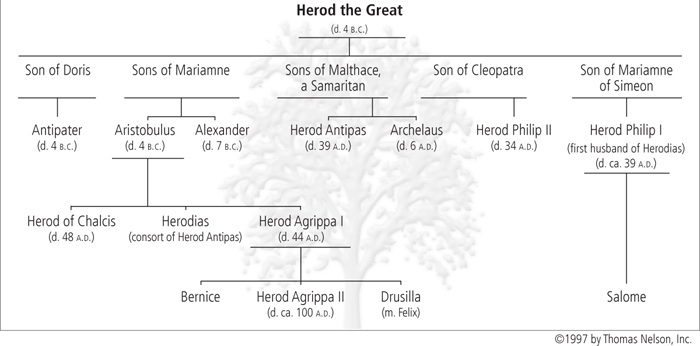
MATTHEW—NOTE ON 2:19 in a dream. See note on 1:20.
MATTHEW—NOTE ON 2:22 Archelaus. Herod's kingdom was divided three ways and given to his sons: Archelaus ruled Judea, Samaria, and Idumea; Herod Philip II ruled the regions north of Galilee (Luke 3:1); and Herod Antipas ruled Galilee and Perea (Luke 3:1). History records that Archelaus was so brutal and ineffective that he was deposed by Rome after a short reign and replaced with a governor appointed by Rome. Pontius Pilate was the fifth governor of Judea. Herod Antipas is the main Herod in the Gospel accounts. He was the one who had John the Baptist put to death (Matt. 14:1–12) and examined Christ on the eve of the crucifixion (Luke 23:7–12).
MATTHEW—NOTE ON 2:23 He shall be called a Nazarene. Nazareth, an obscure town 70 miles north of Jerusalem, was a place of lowly reputation, and nowhere mentioned in the OT. Some have suggested that "Nazarene" is a reference to the Hebrew word for branch in Isa. 11:1. Others point out that Matthew's statement that "prophets" had made this prediction may be a reference to verbal prophecies nowhere recorded in the OT. A still more likely explanation is that Matthew is using "Nazarene" as a synonym for someone who is despised or detestable—for that was how people from the region were often characterized (cf. John 1:46). If that is the case, the prophecies Matthew has in mind would include Ps. 22:6–8; Isa. 49:7; 53:3.
MATTHEW—NOTE ON 3:1 John the Baptist. Cf. Mark 1:2–14; Luke 1:5–25, 57– 80; 3:3–20; John 1:6–8, 19–39. the wilderness of Judea. The region to the immediate west of the Dead Sea—an utterly barren desert. The Jewish sect of the Essenes had significant communities in this region. But there is no biblical evidence to suggest that John was in any way connected with that sect. John seems to have preached near the northern end of this region, close by where the Jordan flows into the Dead Sea (Matt. 3:6). This was a full day's journey from Jerusalem and seems an odd location to announce the arrival of a King. But it is perfectly in keeping with God's ways (1 Cor. 1:26–29).
MATTHEW—NOTE ON 3:2 Repent. This is no mere academic change of mind, nor mere regret or remorse. John the Baptist spoke of repentance as a radical turning from sin that inevitably became manifest in the fruit of righteousness (v. 8). Jesus' first sermon began with the same imperative (4:17). For a discussion of the nature of repentance, see notes on 2 Cor. 7:8–11. the kingdom of heaven. This is an expression unique to Matthew's Gospel. Matthew uses the word "heaven" as a euphemism for God's name—to accommodate his Jewish readers' sensitivities (cf. Matt. 23:22). Throughout the rest of Scripture, the kingdom is called "the kingdom of God." Both expressions refer to the sphere of God's dominion over those who belong to him. The kingdom is now manifest in heaven's spiritual rule over the hearts of believers (Luke 17:21); and one day it will be established in a literal earthly kingdom (Rev. 20:4–6). is at hand. In one sense the kingdom is a present reality, but in its fullest sense it awaits a yetfuture fulfillment.
MATTHEW—NOTE ON 3:3 spoken of by the prophet Isaiah. John's mission had long ago been described in Isa. 40:3–5 (see notes there). All four of the Gospels cite this passage as a prophecy pointing to John the Baptist (see note on Luke 3:6).
MATTHEW—NOTE ON 3:4 a garment of camel's hair and a leather belt. Practical and long-wearing clothes, but far from comfortable or fashionable. John evokes the image of Elijah (2 Kings 1:8)—and the Israelites were expecting Elijah before the day of the Lord (Mal. 4:5). locusts. These were an allowed food (Lev. 11:22).
MATTHEW—NOTE ON 3:6 baptized. The symbolism of John's baptism likely had its roots in OT purification rituals (cf. Lev. 15:13). Baptism had also long been administered to Gentile proselytes coming into Judaism. The baptism of John thus powerfully and dramatically symbolized repentance. Jews accepting John's baptism were admitting they had been as Gentiles and needed to become the people of God genuinely, inwardly (an amazing admission, given their hatred of Gentiles). The people were repenting in anticipation of the Messiah's arrival. The meaning of John's baptism differs somewhat from Christian baptism (cf. Acts 18:25). Actually, Christian baptism altered the significance of the ritual, symbolizing the believer's identification with Christ in his death, burial, and resurrection (Rom. 6:3–5; Col. 2:12).
MATTHEW—NOTE ON 3:7 Pharisees and Sadducees. See note on John 3:1. The Pharisees were a small (about 6,000), legalistic sect of the Jews who were known for their rigid adherence to the ceremonial fine points of the law. Their name means "separated ones." Jesus' interaction with the Pharisees was usually adversarial. He rebuked them for using human tradition to nullify Scripture (Matt. 15:3–9), and especially for rank hypocrisy (15:7–8; 22:18; 23:13, 23, 25, 29; Luke 12:1). The Sadducees were known for their denial of things supernatural. They denied the resurrection of the dead (Matt. 22:23) and the existence of angels (Acts 23:8). Unlike the Pharisees, they rejected human tradition and scorned legalism. They accepted only the Pentateuch as authoritative. They tended to be wealthy, aristocratic members of the priestly tribe, and in the days of Herod their sect controlled the temple (see note on Matt. 2:4), though they were fewer in number than the Pharisees. Pharisees and Sadducees had little in common. Pharisees were ritualists; Sadducees were rationalists. Pharisees were legalists; Sadducees were liberals. Pharisees were separatists; Sadducees were compromisers and political opportunists. Yet they united together in their opposition to Christ (22:15–16, 23, 34–35). John publicly addressed them as deadly snakes. the wrath to come. See note on Luke 3:7. John's preaching echoed the familiar OT theme of promised wrath in the day of the Lord (e.g., Ezek. 7:19; Zeph. 1:18; see Introduction to Joel: Historical and Theological Themes). This must have been a particularly stinging rebuke to the Jewish leaders, who imagined that divine wrath was reserved only for non-Jews.
MATTHEW—NOTE ON 3:8 fruit in keeping with repentance. See note on v. 2. Repentance itself is not a work, but works are its inevitable fruit. Repentance and faith are inextricably linked in Scripture. Repentance means turning from one's sin, and faith is turning to God (cf. 1 Thess. 1:9). They are like opposite sides of the same coin. That is why both are linked to conversion (Mark 1:15; Acts 3:19; 20:21). Notice that the works John demanded to see were "fruit" of repentance. But repentance itself is no more a "work" than faith is (see note on 2 Tim. 2:25).
MATTHEW—NOTE ON 3:9 Abraham as our father. See John 8:39–44. They believed that merely being descendants of Abraham, members of God's chosen race, made them spiritually secure. But Abraham's real descendants are those who share his faith (cf. Rom. 4:16). And "those of faith . . . are the sons of Abraham" (Gal. 3:7, 29). See note on Luke 3:8.
MATTHEW—NOTE ON 3:10 the axe is laid to the root. Irreversible judgment was imminent (see note on 11:3).
MATTHEW—NOTE ON 3:11 Three types of baptism are referred to here: 1) with water for repentance. John's baptism symbolized cleansing (see note on 3:6); 2) with the Holy Spirit. All believers in Christ are Spirit-baptized (1 Cor. 12:13); and 3) with . . . fire. Because fire is used throughout this context as a means of judgment (Matt. 3:10, 12), this must speak of a baptism of judgment upon the unrepentant.
MATTHEW—NOTE ON 3:12 winnowing fork. A tool for tossing grain into the wind so that the chaff is blown away.
MATTHEW—NOTE ON 3:14 John would have prevented him. John's baptism symbolized repentance, and John saw this as inappropriate for the One he knew was the spotless Lamb of God (cf. John 1:29).
MATTHEW—NOTE ON 3:15 it is fitting for us to fulfill all righteousness. Christ was here identifying himself with sinners. He will ultimately bear their sins; his perfect righteousness will be imputed to them (2 Cor. 5:21). This act of baptism was a necessary part of the righteousness he secured for sinners. This first public event of his ministry is also rich in meaning: 1) it pictured his death and resurrection (cf. Luke 12:50); 2) it therefore prefigured the significance of Christian baptism (see note on Matt. 3:6); 3) it marked his first public identification with those whose sins he would bear (Isa. 53:11; 1 Pet. 3:18); and 4) it was a public affirmation of his messiahship by testimony directly from heaven (see note on Matt. 3:17).
MATTHEW—NOTE ON 3:16–17 Jesus . . . the Spirit of God . . . a voice from heaven. Here all three Persons of the Trinity are clearly delineated. See note on Luke 3:22. The Father's command to hear his Son and the Spirit's vindication and empowerment (see note on Matt. 12:31) officially inaugurated Christ's ministry.
MATTHEW—NOTE ON 3:17 my beloved Son, with whom I am well pleased. This heavenly pronouncement combines language from Ps. 2:7 and Isa. 42:1— prophecies that would have been well known to those with messianic expectations. Cf. Matt. 17:5; Mark 1:11; 9:7; Luke 3:22; 9:35.
MATTHEW—NOTE ON 4:1 led up by the Spirit . . . to be tempted by the devil. God himself is never the agent of temptation (James 1:13), but here—as in the book of Job—God uses even satanic tempting to serve his sovereign purposes. Christ was tempted in all points (Heb. 4:15; 1 John 2:16); Satan tempted him with "the lust of the flesh" (Matt. 4:2–3); "the lust of the eyes" (vv. 8–9); and "the pride of life" (vv. 5–6).
MATTHEW—NOTE ON 4:2 forty days and forty nights. Similarly, Moses was without food or drink on Sinai for "forty days and forty nights" (Deut. 9:9), and Elijah also fasted that long (1 Kings 19:8). See note on Matt. 12:40.
MATTHEW—NOTE ON 4:3 If you are the Son of God. The conditional "if" carries the meaning of "since" in this context. There was no doubt in Satan's mind who Jesus was; but Satan's design was to get him to violate the plan of God and employ the divine power that he had set aside in his humiliation (cf. Phil. 2:7).
MATTHEW—NOTE ON 4:4 It is written. All three of Jesus' replies to the devil were taken from Deuteronomy. This one, from Deut. 8:3, states that God allowed Israel to hunger, so that he might feed them with manna and teach them to trust him to provide for them. So the verse is directly applicable to Jesus' circumstances and a fitting reply to Satan's temptation. every word that comes from the mouth of God. A more important source of sustenance than food, it nurtures our spiritual needs in a way that benefits us eternally, rather than merely providing temporal relief from physical hunger.
MATTHEW—NOTE ON 4:5 pinnacle of the temple. This was probably a roof with a portico at the southeast corner of the temple complex, where a massive retaining wall reached from a level well above the temple mount, deep into the Kidron Valley. According to the Jewish historian Josephus, this was a drop of nearly 450 feet.
MATTHEW—NOTE ON 4:6 for it is written . . . lest you strike your foot against a stone. Notice that Satan also quoted Scripture (Ps. 91:11–12)—but utterly twisted its meaning, employing a passage about trusting God to justify testing him.
MATTHEW—NOTE ON 4:7 it is written. Christ replied with another verse from Israel's wilderness experience (Deut. 6:16)—recalling the experience at Massah, where the grumbling Israelites put the Lord to the test, angrily demanding that Moses produce water where there was none (Ex. 17:2–7).
MATTHEW—NOTE ON 4:9 I will give you. Satan is the "ruler of this world" (John 12:31; 14:30; 16:11), and the "god of this world" (2 Cor. 4:4). The whole world lies in his power (1 John 5:19). This is illustrated in Dan. 10:13 (see note there, where demonic power controlled the kingdom of Persia, so that a demon is called the "prince of the kingdom of Persia."
MATTHEW—NOTE ON 4:10 For it is written. Here Christ was citing and paraphrasing Deut. 6:13–14. Again, these relate to the Israelites' wilderness experiences. Christ, like them, was led into the wilderness to be tested (cf. Deut. 8:2). Unlike them, he withstood every aspect of the test.
MATTHEW—NOTE ON 4:11 angels came and were ministering to him. Psalm 91:11–12—the verse Satan tried to twist—was thus fulfilled in God's way, and in God's perfect timing.
MATTHEW—NOTE ON 4:12 John had been arrested. John was imprisoned for his bold rebuke of Herod Antipas. See 14:3–4.
MATTHEW—NOTE ON 4:13 leaving Nazareth. Some time elapsed between vv. 12 and 13. Jesus' stay in Nazareth ended abruptly when he was violently rejected by the people of Nazareth, who tried to murder him (see Luke 4:16–30). Capernaum. He settled in this important town on the trade route at the north end of the Sea of Galilee. Capernaum was the home of Peter and Andrew (Matt. 4:18), James and John (v. 21), and Matthew (9:9). A comparison of the Gospels reveals that Christ had already ministered extensively in Capernaum (see note on Luke 4:23).
MATTHEW—NOTE ON 4:15 Galilee of the Gentiles. This name was used even in Isaiah's time because Galilee lay on the route through which all Gentiles passed in and out of Israel. In Jesus' time, the region of Galilee had become an important center of Roman occupation. The prophecy cited by Matthew is from Isa. 9:1–2. See Isa. 42:6–7.
MATTHEW—NOTE ON 4:17 From that time Jesus began to preach. This marks the beginning of his public ministry. Notice that his message was an exact echo of what John the Baptist preached. Repent, for the kingdom of heaven is at hand. See note on 3:2. The opening word of this first sermon sets the tone for Jesus' entire earthly ministry (cf. Luke 5:32). Repentance was a constant motif in all his public preaching. And in his closing charge to the apostles, he commanded them to preach repentance as well (Luke 24:47).
MATTHEW—NOTE ON 4:18 two brothers. Jesus had encountered Peter and Andrew before, near Bethabara, in the Jordan region, where Andrew (and perhaps Peter as well) had become a disciple of John the Baptist (John 1:35–42). They left John to follow Jesus for a time before returning to fishing in Capernaum. Perhaps they had returned to Capernaum during Jesus' earlier ministry here (see note on Luke 4:23). Here he called them to follow him in long-term discipleship.
MATTHEW—NOTE ON 4:21 James the son of Zebedee. This James is easy to distinguish from the other men named James in the NT, because he is never mentioned in Scripture apart from his brother John. His martyrdom by Herod Agrippa I marked the beginning of a time of severe persecution in the early church (Acts 12:2). For information on others named James, see note on Matt. 10:2; Introduction to James: Author and Date.
MATTHEW—NOTE ON 4:23 teaching . . . proclaiming the gospel . . . healing. The three main aspects of Christ's public ministry.
MATTHEW—NOTE ON 4:24 Syria. The area immediately northeast of Galilee.
MATTHEW—NOTE ON 4:25 Decapolis. A confederation of 10 Hellenized cities south of Galilee and mostly east of the Jordan. The league of cities was formed shortly after Pompey's invasion of Palestine (c. 64 B.C.) to preserve Greek culture in the Semitic region. These cities were naturally Gentile strongholds.
MATTHEW—NOTE ON 5:1–7:29 The Sermon on the Mount introduces a series of five important discourses recorded in Matthew (see Introduction: Historical and Theological Themes). This sermon is a masterful exposition of the law and a potent assault on Pharisaic legalism, closing with a call to true faith and salvation (7:13–29). Christ expounded the full meaning of the law, showing that its demands were humanly impossible (cf. 5:48). This is the proper use of the law with respect to salvation: it closes off every possible avenue of human merit and leaves sinners dependent on nothing but divine grace for salvation (cf. Rom. 3:19–20; Gal. 3:23–24). Christ plumbed the depth of the law, showing that its true demands went far beyond the surface meaning of the words (Matt. 5:28, 39, 44) and set a standard that is higher than the most diligent students of the law had heretofore realized (5:20). See note on Luke 6:17–49.
MATTHEW—NOTE ON 5:1 he sat down. This was the normal posture for rabbis while teaching (cf. 13:1–2; 26:55; Mark 4:1; 9:35; Luke 5:3; John 6:3; 8:2). See note on Luke 4:20.
MATTHEW—NOTE ON 5:3 Blessed. The word lit., means "happy, fortunate, blissful." Here it speaks of more than a surface emotion. Jesus was describing the divinely bestowed well-being that belongs only to the faithful. The Beatitudes demonstrate that the way to heavenly blessedness is antithetical to the worldly path normally followed in pursuit of happiness. The worldly idea is that happiness is found in riches, merriment, abundance, leisure, and such things. The real truth is the very opposite. The Beatitudes give Jesus' description of the character of true faith. poor in spirit. The opposite of self-sufficiency. This speaks of the deep humility of recognizing one's utter spiritual bankruptcy apart from God. It describes those who are acutely conscious of their own lostness and hopelessness apart from divine grace (cf. 9:12; Luke 18:13). See note on Matt. 19:17. theirs is the kingdom of heaven. See note on 3:2. Notice that the truth of salvation by grace is clearly presupposed in this opening verse of the Sermon on the Mount. Jesus was teaching that the kingdom is a gracious gift to those who sense their own poverty of spirit.
MATTHEW—NOTE ON 5:4 those who mourn. This speaks of mourning over sin, the godly sorrow that produces repentance leading to salvation without regret (2 Cor. 7:10). The "comfort" is the comfort of forgiveness and salvation (cf. Isa. 40:1–2).
MATTHEW—NOTE ON 5:5 the meek. Gentleness or meekness is the opposite of being out of control. It is not weakness, but supreme self-control empowered by the Spirit (cf. Gal. 5:23). The statement that the meek "shall inherit the earth" is quoted from Ps. 37:11.
MATTHEW—NOTE ON 5:6 hunger and thirst for righteousness. This is the opposite of the self-righteousness of the Pharisees. It speaks of those who seek
God's righteousness rather than attempting to establish a righteousness of their own (Rom. 10:3; Phil. 3:9). What they seek will fill them, i.e., it will satisfy their hunger and thirst for a right relationship with God.
MATTHEW—NOTE ON 5:7 they shall receive mercy. The converse is also true. Cf. James 2:13.
MATTHEW—NOTE ON 5:8 see God. Not only with the perception of faith, but in the glory of heaven. Cf. Heb. 12:14 and Rev. 22:3–4.
MATTHEW—NOTE ON 5:9 peacemakers. See vv. 44–45 for more on this quality.
MATTHEW—NOTE ON 5:10 persecuted. Cf. James 5:10–11 and 1 Pet. 4:12–14. See note on Luke 6:22.
MATTHEW—NOTE ON 5:13 salt . . . lost its taste, how shall its saltiness be restored? Salt is both a preservative and a flavor enhancer. No doubt its use as a preservative is what Jesus had mostly in view here. Pure salt cannot lose its flavor or effectiveness, but the salt that is common in the Dead Sea area is contaminated with gypsum and other minerals and may have a flat taste or be ineffective as a preservative. Such mineral salts were useful for little more than keeping footpaths free of vegetation.
MATTHEW—NOTE ON 5:16 light shine. A godly life gives convincing testimony of the saving power of God. That brings him glory. Cf. 1 Pet. 2:12.
MATTHEW—NOTE ON 5:17 Do not think . . . abolish the Law or the Prophets. Jesus was neither giving a new law nor modifying the old, but rather explaining the true significance of the moral content of Moses' law and the rest of the OT. "The Law or the Prophets" speaks of the entirety of the OT Scriptures, not the rabbinical interpretations of them. fulfill. This speaks of fulfillment in the same sense that prophecy is fulfilled. Christ was indicating that he is the fulfillment of the law in all its aspects. He fulfilled the moral law by keeping it perfectly. He fulfilled the ceremonial law by being the embodiment of everything the law's types and symbols pointed to. And he fulfilled the judicial law by personifying God's perfect justice (cf. 12:18, 20).
MATTHEW—NOTE ON 5:18 until heaven and earth pass away . . . until all is accomplished. Here Christ was affirming the utter inerrancy and absolute authority of the OT as the word of God—down to the smallest stroke or letter.
Again (see note on v. 17), this suggests that the NT should not be seen as supplanting and abrogating the OT, but as fulfilling and explicating it. For example, all the ceremonial requirements of the Mosaic law were fulfilled in Christ and are no longer to be observed by Christians (Col. 2:16–17). Yet not the smallest letter or stroke is thereby erased; the underlying truths of those Scriptures remain—and in fact the mysteries behind them are now revealed in the brighter light of the gospel. not an iota, not a dot. An "iota" refers to the smallest Hebrew letter, the yohd, which is a meager stroke of the pen, like an accent mark or an apostrophe. The "dot" is a tiny extension on a Hebrew letter, like the serif in modern typefaces.
MATTHEW—NOTE ON 5:19 will be called least . . . will be called great. The consequence of practicing or teaching disobedience of any of God's word is to be called least in the kingdom of heaven (see note on James 2:10). Determining rank in the kingdom of heaven is entirely God's prerogative (cf. Matt. 20:23), and Jesus declares that he will hold those in lowest esteem who hold his word in low esteem. There is no impunity for believers who disobey, discredit, or belittle God's law (see note on 2 Cor. 5:10). That Jesus does not refer to loss of salvation is clear from the fact that, though offenders will be called least, they will still be in the kingdom of heaven. The positive result is that whoever keeps and teaches God's word, he shall be called great in the kingdom of heaven. Here again Jesus mentions the two aspects of doing and teaching. Kingdom citizens are to uphold every part of God's law both in their living and in their teaching.
MATTHEW—NOTE ON 5:20 unless your righteousness exceeds that of the scribes and Pharisees. On the one hand, Jesus was calling his disciples to a deeper, more radical holiness than that of the Pharisees. Pharisaism had a tendency to soften the law's demands by focusing only on external obedience. In the verses that follow, Jesus unpacks the full moral significance of the law and shows that the righteousness the law calls for actually involves an internal conformity to the spirit of the law, rather than mere external compliance to the letter. will never enter the kingdom of heaven. On the other hand, this sets up an impossible barrier to works-salvation. Scripture teaches repeatedly that sinners are capable of nothing but a flawed and imperfect righteousness (e.g., Isa. 64:6). Therefore the only righteousness by which sinners may be justified is the perfect righteousness of God that is imputed to those who believe (Gen. 15:6; Rom. 4:5).
MATTHEW—NOTE ON 5:21–22 You have heard . . . But I say to you. See vv. 27, 31, 33, 38, 43. The quotes are from Ex. 20:13; Deut. 5:17. Jesus was not altering the terms of the law in any of these passages. Rather, he was correcting what they had "heard"—the rabbinical understanding of the law (see note on Matt. 5:38).
MATTHEW—NOTE ON 5:22 You fool! Lit., "empty-headed." Jesus suggested here that the verbal abuse stems from the same sinful motives (anger and hatred) that ultimately lead to murder. The internal attitude is what the law actually prohibits, and therefore an abusive insult carries the same kind of moral guilt as an act of murder. hell. A reference to the Hinnom Valley, southwest of Jerusalem. Ahaz and Manasseh permitted human sacrifices there during their reigns (2 Chron. 28:3; 33:6), and therefore it was called "the Valley of Slaughter" (Jer. 19:6). In Jesus' day, it was a garbage dump where fires burned continually and was thus an apt symbol of eternal fire.
MATTHEW—NOTE ON 5:25 Come to terms quickly. Jesus calls for reconciliation to be sought eagerly, aggressively, quickly—even if it involves self-sacrifice. It is better to be wronged than to allow a dispute between brethren to be a cause for dishonoring Christ (1 Cor. 6:7). accuser. This speaks of one's adversary in a law case. prison. Debtor's prison, where the person could work to earn back what he had defrauded.
MATTHEW—NOTE ON 5:27 Quoted from Ex. 20:14 and Deut. 5:18.
MATTHEW—NOTE ON 5:29 tear it out and throw it away. Jesus was not advocating self-mutilation (for this would not in fact cure lust, which is actually a problem of the heart). He was using this graphic hyperbole to demonstrate the seriousness of sins of lust and evil desire. The point is that it would be "better" (v. 30) to lose a member of one's own body than to bear the eternal consequences of the guilt from such a sin. Sin must be dealt with drastically because of its deadly effects.
MATTHEW—NOTE ON 5:31 It was also said. See note on Deut. 24:1–4. The rabbis had taken liberty with what Scripture actually said. They referred to Deut. 24:1– 4 as if it were given merely to regulate the paperwork when one sought divorce (see note on Matt. 19:7). Thus, they had wrongly concluded that men could divorce their wives for anything that displeased them, as long as they gave "a certificate of divorce." But Moses provided this as a concession to protect the woman who was divorced (see notes on 19:7–9), not to justify or legalize divorce under all circumstances.
MATTHEW—NOTE ON 5:32 except . . . sexual immorality. See note on 19:9. Divorce was allowed in cases of adultery. Luke 16:18 must be understood in the light of this verse. makes her commit adultery. The assumption is that divorced people will remarry. If the divorce was not for sexual immorality, any remarriage is adultery, because God does not acknowledge the divorce. For more on divorce, see note on 1 Cor. 7:15.
MATTHEW—NOTE ON 5:33 You shall not swear falsely. This expresses teaching from Lev. 19:12; Num. 30:2; Deut. 23:21, 23.
MATTHEW—NOTE ON 5:34 Do not take an oath at all. Cf. James 5:12. This should not be taken as a universal condemnation of oaths in all circumstances. God himself confirmed a promise with an oath (Heb. 6:13–18; cf. Acts 2:30). Christ himself spoke under oath (Matt. 26:63–64). And the law prescribed oaths in certain circumstances (e.g., Num. 5:19, 21; 30:2–3). What Christ is forbidding here is the flippant, profane, or careless use of oaths in everyday speech. In that culture, such oaths were often employed for deceptive purposes. To make the person being victimized believe the truth was being told, the Jews would swear by "heaven," "earth," "Jerusalem," or their own "heads" (Matt. 5:34–36), not by God, hoping to avoid divine judgment for their lie. But it all was in God's creation, so it drew him in and produced guilt before him, exactly as if the oath were made in his name. Jesus suggested that all our speech should be as if we were under an oath to tell the truth (v. 37).
MATTHEW—NOTE ON 5:38 An eye for an eye. The law did establish this standard as a principle for limiting retribution to that which was just (Ex. 21:24; Lev. 24:20; Deut. 19:21). Its design was to ensure that the punishment in civil cases fit the crime. It was never meant to sanction acts of personal retaliation. So again (see notes on Matt. 5:17–18) Jesus made no alteration to the true meaning of the law. He was merely explaining and affirming the law's true meaning.
MATTHEW—NOTE ON 5:39 Do not resist the one who is evil. Like v. 38, this deals only with matters of personal retaliation, not criminal offenses or acts of military aggression. Jesus applied this principle of non-retaliation to affronts against one's dignity (v. 39), lawsuits to gain one's personal assets (v. 40), infringements on one's liberty (v. 41), and violations of property rights (v. 42). He was calling for a full surrender of all personal rights.
MATTHEW—NOTE ON 5:41 forces. The word speaks of coercion. The NT picture of this is when Roman soldiers forced Simon the Cyrene to carry Jesus' cross (27:32).
MATTHEW—NOTE ON 5:43 love your neighbor and hate your enemy. The first half of this is found in Moses' law (Lev. 19:18). The second part was found in how the scribes and Pharisees explained and applied that OT command. Jesus' application was exactly the opposite, resulting in a much higher standard: love for one's neighbors should extend even to those neighbors who are enemies (Matt. 5:44). Again, this was no innovation, since even the OT taught that God's people should do good to their enemies (Prov. 25:21).
MATTHEW—NOTE ON 5:44–45 Love your enemies . . . that you may be sons of your Father. This plainly teaches that God's love extends even to his enemies. This universal love of God is manifest in blessings which God bestows on all indiscriminately. Theologians refer to this as common grace. This must be distinguished from the everlasting love God has for the elect (Jer. 31:3), but it is a sincere goodwill nonetheless (cf. Ps. 145:9).
MATTHEW—NOTE ON 5:46 tax collectors. Disloyal Israelites hired by the Romans to tax other Jews for personal profit. They became symbols for the worst kind of people. Cf. 9:10–11; 11:19; 18:17; 21:31; Mark 2:14–16; Luke 5:30; 7:25, 29, 34; 18:11–13. Matthew had been one of them (see notes on Matt. 9:9; Mark 2:15).
MATTHEW—NOTE ON 5:48 You therefore must be perfect. Christ sets an unattainable standard. This sums up what the law itself demanded (James 2:10). Though this standard is impossible to meet, God could not lower it without compromising his own perfection. He who is perfect could not set an imperfect standard of righteousness. The marvelous truth of the gospel is that Christ has met this standard on our behalf (see note on 2 Cor. 5:21).
MATTHEW—NOTE ON 6:1–18 Here Christ expands the thought of 5:20, showing how the Pharisees' righteousness was deficient by exposing their hypocrisy in the matters of giving to the poor (6:1–4); prayer (vv. 5–15); and fasting (vv. 16– 18). All of these acts are supposed to be worship rendered to God, never displays of self-righteousness to gain the admiration of others.
MATTHEW—NOTE ON 6:2 hypocrites. This word had its origins in Greek theater, describing a character who wore a mask. The term, as used in the NT, normally described an unregenerate person who was self-deceived. they have received their reward. Cf. vv. 5 and 16. Their reward is that they were seen by men, nothing more. God does not reward hypocrisy, but he does punish it (cf. 23:13– 23).
MATTHEW—NOTE ON 6:4 sees in secret. Cf. vv. 6, 18; Jer. 17:10; Heb. 4:13. God is omniscient.
MATTHEW—NOTE ON 6:7 empty phrases. Prayers are not to be merely recited, nor are our words to be repeated thoughtlessly, or as if they were automatic formulas. But this is not a prohibition against importunity (see notes on Luke 11:1–8).
MATTHEW—NOTE ON 6:9 like this. Cf. Luke 11:2–4. The prayer is a model, not merely a liturgy. It is notable for its brevity, simplicity, and comprehensiveness. Of the six petitions, three are directed to God (Matt. 6:9–10) and three toward human needs (vv. 11–13).
MATTHEW—NOTE ON 6:10 your will be done. All prayer, first of all, willingly submits to God's purposes, plans, and glory. See note on 26:39.
MATTHEW—NOTE ON 6:12 forgive us our debts. The parallel passage (Luke 11:4) uses a word that means "sins," so that in context, spiritual debts are intended. Sinners are debtors to God for their violations of his laws (see notes on Matt. 18:23–27). This request is the heart of the prayer; it is what Jesus stressed in the words that immediately follow the prayer (6:14–15; cf. Mark 11:25).
MATTHEW—NOTE ON 6:13 lead us not into temptation. Cf. Luke 22:40. God does not tempt men (James 1:13), but he will subject them to trials that may expose them to Satan's assaults, as in the case of Job and Peter (Luke 22:31–32). This petition reflects the believing one's desire to avoid the dangers of sin altogether. God knows what one's need is before one asks (Matt. 6:8), and he promises that no one will be subjected to testing beyond what can be endured. He also promises a way of escape—often through endurance (1 Cor. 10:13). But still, the proper attitude for the believer is the one expressed in this petition.
MATTHEW—NOTE ON 6:15 neither will your Father forgive your trespasses. This is not to suggest that God will withdraw justification from those who have already received the free pardon he extends to all believers. Forgiveness in that sense—a permanent and complete acquittal from the guilt and ultimate penalty of sin—belongs to all who are in Christ (cf. John 5:24; Rom. 8:1; Eph. 1:7). Yet, Scripture also teaches that God chastens his children who disobey (Heb. 12:5–7). Believers are to confess their sins in order to obtain a day-to-day cleansing (1 John 1:9). This sort of forgiveness is a simple washing from the worldly defilements of sin, not a repeat of the wholesale cleansing from sin's corruption that comes with justification. It is like a washing of the feet rather than a bath (cf. John 13:10). Forgiveness in this latter sense is what God threatens to withhold from Christians who refuse to forgive others (cf. Matt. 18:23–35).
MATTHEW—NOTE ON 6:16–17 when you fast. This indicates that fasting is assumed to be a normal part of one's spiritual life (cf. 1 Cor. 7:5). Fasting is associated with sadness (Matt. 9:14–15), prayer (17:21), charity (Isa. 58:3–6), and seeking the Lord's will (Acts 13:2–3; 14:23).
MATTHEW—NOTE ON 6:20 treasures. Don't amass earthly wealth. Jesus commends the use of financial assets for purposes which are heavenly and eternal. See notes on Luke 16:1–9.
MATTHEW—NOTE ON 6:22–23 This is an argument from the lesser to the greater. The analogy is simple. If your eye is bad, no light can come in and you are left with darkness because of that malady. How much worse when the problem is not merely related to external perception, but an internal corruption of one's whole nature, so that the darkness actually emanates from within and affects one's whole being. Jesus was indicting them for their superficial earthly religion that left their hearts dark. See note on Luke 11:34.
MATTHEW—NOTE ON 6:24 money. Earthly, material treasures. See note on Luke 16:13.
MATTHEW—NOTE ON 6:26 your heavenly Father feeds them. Obviously this in no way advocates a sinful kind of idleness (Prov. 19:15). Birds are not idle, either. But it is God who provides them with food to eat.
MATTHEW—NOTE ON 6:29 Solomon in all his glory. The glory and pageantry of Solomon's kingdom was famous worldwide. Cf. 2 Chron. 9.
MATTHEW—NOTE ON 6:30 you of little faith. Cf. 8:26; 14:31; 16:8; 17:20. This was the Lord's recurring rebuke of the weak disciples.
MATTHEW—NOTE ON 6:32 Gentiles. I.e., those outside the people of promise and outside the blessing of God. Cf. Eph. 4:17–19.
MATTHEW—NOTE ON 6:33 the kingdom. This is the same as the kingdom of heaven. See note on 3:2. It refers to the sphere of salvation. Jesus was urging them to seek salvation—and with it would come the full care and provision of God. Cf. Rom. 8:32; Phil. 4:19; 1 Pet. 5:7.
MATTHEW—NOTE ON 7:1 Judge not. As the context reveals, this does not prohibit all types of judging (v. 16). There is a righteous kind of judgment we are supposed to exercise with careful discernment (John 7:24). Censorious, hypocritical, self-righteous, or other kinds of unfair judgments are forbidden; but in order to fulfill the commandments that follow, it is necessary to discern dogs and swine (Matt. 7:6) from one's own brethren (vv. 3–5).
MATTHEW—NOTE ON 7:6 Do not give dogs what is holy. This principle is why Jesus himself did not do miracles for unbelievers (13:58). This is to be done in respect for what is holy, not merely out of contempt for the dogs and swine. Nothing here contradicts the principle of 5:44. That verse governs personal dealings with one's enemies (see note there); this principle governs how one handles the gospel in the face of those who hate the truth.
MATTHEW—NOTE ON 7:11 you . . . are evil. Jesus presupposes the doctrine of human depravity (see note on Rom. 1:18–3:20). how much more. If earthly fathers give what their sons need (Matt. 7:9–10), will not God give to his sons what they ask (vv. 7–8)? See note on James 1:17.
MATTHEW—NOTE ON 7:12 whatever you wish that others would do to you. Versions of the "Golden Rule" existed before Christ, in the rabbinic writings and even in Hinduism and Buddhism. All of them cast the rule as a negative command, such as Rabbi Hillel's version, "What is hateful to yourself do not to someone else." Jesus made it a positive command, enriching its meaning and underscoring that this one imperative aptly summarizes the whole gist of the ethical principles contained in the Law and the Prophets.
MATTHEW—NOTE ON 7:13–29 This closing section of the Sermon on the Mount is a gospel application. Here are two gates, two ways, two destinations, and two groups of people (vv. 13–14); two kinds of trees and two kinds of fruit (vv. 17– 20); two groups at the judgment (vv. 21–23); and two kinds of builders, building on two kinds of foundations (vv. 24–28). Christ is drawing the line as clearly as possible between the way that leads to destruction and the way that leads to life.
MATTHEW—NOTE ON 7:13–14 Both the narrow gate and the wide gate are assumed to provide the entrance to God's kingdom. Two ways are offered to people. The narrow gate is by faith, only through Christ, constricted and precise. It represents true salvation in God's way that leads to life eternal. The wide gate includes all religions of works and self-righteousness, with no single way (cf. Acts 4:12), but it leads to hell, not heaven.
MATTHEW—NOTE ON 7:14 gate is narrow. Christ continually emphasized the difficulty of following him (10:38; 16:24–25; John 15:18–19; 16:1–3; cf. Acts 14:22). Salvation is by grace alone, but is not easy. It calls for knowledge of the truth, repentance, submission to Christ as Lord, and a willingness to obey his will and word. See notes on Matt. 19:16–28.
MATTHEW—NOTE ON 7:15 false prophets. These deceive not by disguising themselves as sheep, but by impersonating true shepherds. They promote the wide gate and the wide way. sheep's clothing. This may refer to the woolen attire that was the characteristic garb of a shepherd.
MATTHEW—NOTE ON 7:16 You will recognize them by their fruits. See note on 3:8. False doctrine cannot restrain the flesh, so false prophets manifest wickedness. Cf. 2 Pet. 2:12–22.
MATTHEW—NOTE ON 7:21 Not everyone who says . . . but the one who does. The barrenness of this sort of faith demonstrates its real character (cf. v. 20)—the faith that says but does not do is really unbelief. Jesus was not suggesting that works are meritorious for salvation, but that true faith will not fail to produce the fruit of good works. This is precisely the point of James 1:22–25 and 2:26.
MATTHEW—NOTE ON 7:22 did we not prophesy . . . cast out demons . . . do many mighty works? Notice that far from being totally devoid of works of any kind, these people were claiming to have done some remarkable signs and wonders. In fact, their whole confidence was in these works—further proof that these works, spectacular as they might have appeared, could not have been authentic. No one so bereft of genuine faith could possibly produce true good works. A bad tree cannot bear good fruit (v. 18).
MATTHEW—NOTE ON 7:23 lawlessness. All sin is lawlessness (1 John 3:4), i.e., rebellion against the law of God (cf. Matt. 13:41).
MATTHEW—NOTE ON 7:24–27 The house represents a religious life; the rain represents divine judgment. Only the house built on the foundation of obedience to God's word stands, which calls for repentance, rejection of salvation by works, and trust in God's grace to save through his merciful provision. See notes on James 1:22–25.
MATTHEW—NOTE ON 7:29 not as their scribes. The scribes quoted others to establish the authority of their teachings; Jesus was his own authority (28:18). This matter of authority was a major issue between Jesus and the Jews, who felt their authority challenged. See note on 21:23. Cf. Mark 1:22; 11:28–33; Luke 4:32; 20:2–8; John 12:49–50; 14:10.
MATTHEW—NOTE ON 8:1 down from the mountain. Cf. 5:1.
MATTHEW—NOTE ON 8:2 if you will. He had no doubt about Christ's power, only his will (cf. Mark 1:40–45).
MATTHEW—NOTE ON 8:4 say nothing to anyone. Publicity over such miracles might hinder Christ's mission and divert public attention from his message. Mark records that this is precisely what happened. In this man's exuberance over the miracle, he disobeyed; as a result, Christ had to move his ministry away from the city and into the desert regions (Mark 1:45). the gift that Moses commanded. A sacrifice of two birds, one of which was killed and the other set free (Lev. 14:4–7). a proof to them. I.e., the priests.
MATTHEW—NOTE ON 8:5 Capernaum. See note on 4:13. centurion. A Roman military officer who commanded (cf. v. 9) 100 men. Luke indicates that the centurion appealed to Jesus through intermediaries (Luke 7:3–6)—because of his own sense of unworthiness (Matt. 8:8; cf. Luke 7:7). Matthew makes no mention of the intermediaries.
MATTHEW—NOTE ON 8:8 I am not worthy to have you come under my roof. Jewish tradition held that a person who entered a Gentile's house was ceremonially defiled (cf. John 18:28). The centurion, undoubtedly familiar with this law, felt unworthy of having Jesus suffer such an inconvenience for his sake. He also had faith enough to know that Christ could heal by merely speaking a word (see note on Matt. 8:10).
MATTHEW—NOTE ON 8:10 with no one in Israel have I found such faith. This centurion understood Jesus' absolute authority (vv. 8–9). Even some of Jesus' own disciples did not see things so clearly (cf. v. 26).
MATTHEW—NOTE ON 8:11 many . . . from east and west. Gentiles, in the kingdom with Abraham, will enjoy salvation and the blessing of God (cf. Isa. 49:8–12; 59:19; Mal. 1:11; Luke 13:28–29).
MATTHEW—NOTE ON 8:12 sons of the kingdom. The Hebrew nation, physical heirs of Abraham. will be thrown into. This was exactly opposite to the rabbinical understanding, which suggested that the kingdom would feature a great feast in the company of Abraham and the Messiah—open to Jews only. weeping and gnashing. See note on 22:13. Cf. 24:51; 25:30; Luke 13:28. This expression describes the eternal agonies of those in hell.
MATTHEW—NOTE ON 8:13 as you have believed. Sometimes faith was involved in the Lord's healings (in this case not by the one being healed, as in 9:2; 15:28); other times it was not a factor (8:14–16; Luke 22:51).
MATTHEW—NOTE ON 8:16 oppressed by demons. This means "demonized," or under the internal control of a demon. All of the cases of demonization dealt with by Christ involved the actual indwelling of demons who utterly controlled the bodies of their victims, even to the point of speaking through them (Mark 5:5–9), causing derangement (John 10:20), violence (Luke 8:29), or rendering them mute (Mark 9:17–22).
MATTHEW—NOTE ON 8:17 spoken by the prophet Isaiah. See note on healing and the atonement at Isa. 53:4–5. Matthew was citing that passage here. Christ bore both the guilt and the curse of sin (cf. Gal. 3:13). Both physical healing and ultimate victory over death are guaranteed by Christ's atoning work, but these will not be fully realized until the very end (1 Cor. 15:26).
MATTHEW—NOTE ON 8:18 the other side. The eastern shore of the lake.
MATTHEW—NOTE ON 8:19 a scribe. As a scribe, this man was breaking with his fellow scribes by publicly declaring his willingness to follow Jesus. Nonetheless, Jesus evidently knew that he had not counted the cost in terms of suffering and inconvenience.
MATTHEW—NOTE ON 8:20 Son of Man. See notes on Mark 2:10 and John 1:51.
This is the name Jesus used for himself more than any other. It is used 83 times in the Gospels, always by Jesus himself. It was a messianic title (Dan. 7:13–14), with an obvious reference to the humanity and the humility of Christ. Yet, it also speaks of his everlasting glory, as Dan. 7:13–14 shows (cf. Matt. 24:27; Acts 7:56).
MATTHEW—NOTE ON 8:21 let me first go and bury my father. This does not mean that the man's father was already dead. The phrase "I must bury my father" was a common figure of speech meaning, "Let me wait until I receive my inheritance."
MATTHEW—NOTE ON 8:22 leave the dead to bury their own dead. Let the world (the spiritually dead) take care of mundane things.
MATTHEW—NOTE ON 8:24 there arose a great storm. The Sea of Galilee is more than 690 feet below sea level. To the north, Mount Hermon rises 9,200 feet, and from May to October strong winds often sweep through the narrow surrounding gorges into this valley, causing extremely sudden and violent storms. he was asleep. Just before the disciples saw one of the most awesome displays of his deity, they were given a touching picture of his humanity. He was so weary that not even the violent tossing of the boat awakened him—even though the disciples feared they would drown (v. 25).
MATTHEW—NOTE ON 8:26 you of little faith. See note on 6:30. calm. Cf. Ps. 65:7 and 89:9.
MATTHEW—NOTE ON 8:27 winds and sea obey him. This was convincing proof of his deity (cf. Ps. 29:3–4; 89:9; 93:4; 107:25–29).
MATTHEW—NOTE ON 8:28 country of the Gadarenes. This refers to a small town on the lake opposite Tiberius, perhaps where the modern village of Khersa (Kursi) is located. Some ancient tombs are there, and the shoreline descends steeply into the water, exactly matching the description of the terrain in this account. two demon-possessed men. Mark 5:2 and Luke 8:27 mention only one of the men. Evidently one was more dominant than the other.
MATTHEW—NOTE ON 8:29 to torment us before the time? Evidently, even the demons not only recognized the deity of Jesus, but also knew there was a divinely appointed time for their judgment and he would be their judge. Their eschatology was factually correct, but it is one thing to know the truth, and quite another thing to love it (cf. James 2:19).
MATTHEW—NOTE ON 8:30 herd of many pigs. Mark 5:13 adds that there were 2,000 in this herd. Such a large herd of unclean animals suggests that Gentiles dominated the region. It also suggests that the number of demons was large (cf. Mark 5:9).
MATTHEW—NOTE ON 8:31 the demons begged him. Luke 8:31 relates they pleaded not to be sent into the abyss, meaning the pit, the underworld, the prison of bound demons who disobeyed (see notes on 2 Pet. 2:4; Jude 6). They knew Jesus had the power and authority to send them there if he desired.
MATTHEW—NOTE ON 8:34 begged him to leave. Perhaps they were concerned with the financial impact from the loss of the pigs. More likely, they were all ungodly people frightened to be in the presence of such spiritual power (cf. Mark 5:14–15).
MATTHEW—NOTE ON 9:1 his own city. Capernaum (see note on 4:13). Jesus had left there to get away from the crowds for a time (8:18).
MATTHEW—NOTE ON 9:2 your sins are forgiven. The fact that the man was brought on a bed indicates that his paralysis was severe. Jesus' words of forgiveness may indicate that the paralysis was a direct consequence of the man's own sin. Cf. John 9:1–3; see notes on Luke 5:20–26.
MATTHEW—NOTE ON 9:3 This man is blaspheming. This would be a true judgment about anyone but God incarnate, for only the One who has been sinned against has the prerogative to forgive. Jesus' words to the man were therefore an unequivocal claim of divine authority.
MATTHEW—NOTE ON 9:4 knowing their thoughts. Cf. 12:25 and John 2:24. Though the Lord Jesus humbled himself (Phil. 2:4–8) and set aside the independent use of his divine prerogatives in incarnation (John 5:30), he was still fully God and, therefore, omniscient. See Mark 13:32 and Luke 2:52.
MATTHEW—NOTE ON 9:5 which is easier. It is certainly easier to claim the power to pronounce absolution from sin than to demonstrate the power to heal. Christ actually proved his power to forgive by instantly healing the man of his paralysis. If he could do the apparently harder, he could also do what seemed easier. The actual forgiving of the sins was in reality the more difficult task, however, because it ultimately required him to sacrifice his life.
MATTHEW—NOTE ON 9:9 sitting at the tax booth. Matthew's own humility is seen here. He did not disguise his past or make any excuse for it. Whereas Mark 2:14 and Luke 5:27 employ his former name, Levi, Matthew himself used the name by which he was known after becoming a disciple (cf. Mark 3:18; Luke 6:15). Tax collectors were among the most despised persons in this society. The money they collected was often partly extorted for personal gain (cf. Luke 19:8) and partly a tax for Rome, which made them not only thieves, but also traitors to the Jewish nation (see notes on Matt. 5:46; Mark 2:15).
MATTHEW—NOTE ON 9:11 tax collectors. See note on 5:46.
MATTHEW—NOTE ON 9:12 well . . . sick. The Pharisees thought they were well— religiously pure and whole. The outcasts knew they were not. Salvation can't come to the self-righteous.
MATTHEW—NOTE ON 9:13 Go and learn what this means. This phrase was commonly used as a rebuke for those who did not know something they should have known. The verse Jesus cites is Hos. 6:6 (cf. 1 Sam. 15:22; Mic. 6:6–8), which emphasizes the absolute priority of the law's moral standards over the ceremonial requirements. The Pharisees tended to focus on the outward, ritual, and ceremonial aspects of God's law—to the neglect of its inward, eternal, and moral precepts. In doing so, they became harsh, judgmental, and self-righteously scornful of others. Jesus repeated this same criticism in Matt. 12:7.
MATTHEW—NOTE ON 9:14 disciples of John. Luke implies that the Pharisees asked this question (see note on Luke 5:33; cf. Mark 2:18–20). Evidently, some Pharisees were still present when John's disciples came. Both groups together may have asked this question. the Pharisees fast. Cf. Luke 18:12.
MATTHEW—NOTE ON 9:15 then they will fast. See note on 6:16–17. Using the analogy of a wedding party, Jesus answered that as long as Christ was present with them, there was too much joy for fasting, which was connected to seasons of sorrow and intense prayer.
MATTHEW—NOTE ON 9:16 unshrunk cloth on an old garment. That new cloth does not work on old material is analogous to trying to patch New Covenant truth onto old Mosaic ceremonial forms.
MATTHEW—NOTE ON 9:17 new wine put into old wineskins. Animal skins were used for fermentation of wine because of their elasticity. As the wine fermented, pressure built up, stretching the wineskin. A previously stretched skin lacked elasticity and would rupture, ruining both wine and wineskin. Jesus used this as an illustration to teach that the forms of old rituals, such as the ceremonial fastings practiced by the Pharisees and John's disciples, were not fit for the new wine of the New Covenant era (cf. Col. 2:17). In both analogies (Matt. 9:16–17), the Lord was saying that what the Pharisees did in fasting or any other ritual had no part with the gospel.
MATTHEW—NOTE ON 9:18 ruler. Jairus (Mark 5:22; Luke 8:41) was a ruler of the synagogue.
MATTHEW—NOTE ON 9:20 discharge of blood for twelve years. This woman's affliction not only was serious physically but also left her permanently unclean for ceremonial reasons (cf. Lev. 15:25–27). This meant she would have been shunned by all, including her own family, and excluded from both synagogue and temple. the fringe of his garment. Cf. Matt. 14:36. Probably one of the tassels that were sown to the corners of a garment in order to remind the wearer to obey God's commandments (Num. 15:38–40; Deut. 22:12).
MATTHEW—NOTE ON 9:22 made you well. Lit., "saved you."
MATTHEW—NOTE ON 9:23 flute players . . . crowd making a commotion. Typical fixtures at a time of mourning in that culture (cf. 2 Chron. 35:25). The crowd at a funeral usually included professional mourners, women whose task it was to wail plaintively while reciting the name of the departed one, as well as any other loved ones who had died recently. The result was a noisy, chaotic din.
MATTHEW—NOTE ON 9:24 sleeping. Jesus was not saying that her death was a misdiagnosis. This was a prophecy that she would live again. He made a similar comment about Lazarus's death (John 11:11)—and then had to explain to the disciples that he was speaking metaphorically (John 11:14). Sleep is a designation for death in the NT (cf. 1 Cor. 11:30; 15:51; 1 Thess. 5:10). they laughed at him. How quickly their paid act of mourning turned to derision!
MATTHEW—NOTE ON 9:27 Son of David. Cf. 1:1; 12:23; 21:9, 15. A messianic title (see note on 1:1). See 20:29–34 for a remarkably similar, but separate, account.
MATTHEW—NOTE ON 9:29 According to your faith. See note on 8:13.
MATTHEW—NOTE ON 9:30 See that no one knows. See note on 8:4.
MATTHEW—NOTE ON 9:34 the prince of demons. The Pharisees had seen enough of Jesus' power to know it was God's power. But, in their willful unbelief, they said his was the power of Satan. See note on 12:24; cf. 25:41; Mark 3:22; Luke 11:15.
MATTHEW—NOTE ON 9:35 every disease and . . . affliction. Jesus banished illness in an unprecedented healing display, giving impressive evidence of his deity, and making the Jews' rejection all the more heinous. See note on 12:15.
MATTHEW—NOTE ON 9:36 he had compassion for them. Here the humanity of Christ allowed expression of his attitude toward sinners in terms of human passion. He was moved with compassion. Whereas God, who is immutable, is not subject to the rise and fall and change of emotions (Num. 23:19), Christ, who was fully human with all the faculties of humanity, was on occasion moved to literal tears over the plight of sinners (Luke 19:41; see note on Luke 13:34). God himself expressed similar compassion through the prophets (Ex. 33:19; Ps. 86:15; Jer. 9:1; 13:17; 14:17). they were harassed and helpless. The people's spiritual needs were even more desperate than the need for physical healing. Meeting that need would require more laborers (Matt. 9:37).
MATTHEW—NOTE ON 9:37 harvest. Cf. Luke 10:1–2. This was for the ultimate purpose that they might come to him and escape the harvest of judgment they could not otherwise avoid. There will be a harvest of damnation for those not in the harvest of salvation.
MATTHEW—NOTE ON 9:38 therefore pray. Jesus affirmed the fact that believers' prayers participate in the fulfillment of God's plans.
MATTHEW—NOTE ON 10:1–2 disciples . . . apostles. "Disciple" means "student," one who is being taught by another. "Apostle" refers to a qualified representative who is sent on a mission. The two terms emphasize different aspects of their calling.
MATTHEW—NOTE ON 10:1 gave them authority. See note on 2 Cor. 12:12. Jesus delegated his power and authority to the apostles to show clearly that he and his kingdom were sovereign over the physical and spiritual realms, the effects of sin, and the efforts of Satan. This was an unheard of display of power, never before seen in all redemptive history, to announce Messiah's arrival and authenticate him plus his apostles who preached his gospel. This power was a preview of the power Christ will exhibit in his earthly kingdom, when Satan will be bound (Rev. 20) and the curse on physical life curtailed (Isa. 65:20–25).
MATTHEW—NOTE ON 10:2 The names of the twelve apostles. The Twelve are always listed in a similar order (cf. Mark 3:16–19; Luke 6:13–16; Acts 1:13). Peter is always named first. The list contains three groups of four. The three subgroups are always listed in the same order, and the first name in each subgroup is always the same, though there is some variation in the order within the subgroups—but Judas Iscariot is always named last. Peter . . . Andrew . . . James . . . John. The first subgroup of four are the most familiar to us. These two sets of brothers, all fishermen, represent an inner circle of disciples often seen closest to Jesus (see note on Matt. 17:1).
MATTHEW—NOTE ON 10:3 James the son of Alphaeus. There are four men in the NT named James: 1) the apostle James, brother of John (see note on 4:21); 2) the disciple mentioned here, also called "James the younger" (Mark 15:40); 3) James, father of Judas (not Iscariot, Luke 6:16); and 4) James, the Lord's halfbrother (Gal. 1:19; Mark 6:3), who wrote the epistle that bears the name. He also played a leading role in the early Jerusalem church (Acts 12:17; 15:13; Gal. 1:19). Thaddaeus. Elsewhere he is called Judas, son of James (Luke 6:16; Acts 1:13).
MATTHEW—NOTE ON 10:4 Simon the Cananaean. The Cananaeans were the party of the Zealots, a group determined to overthrow Roman domination in Palestine. Simon was probably a member of the Zealot party before coming to Christ. See note on Mark 3:18.
MATTHEW—NOTE ON 10:5–11:1 This is the second of five major discourses recorded in Matthew (see Introduction: Historical and Theological Themes).
MATTHEW—NOTE ON 10:5 Go nowhere among the Gentiles. Christ did not forbid the disciples to preach to Gentiles or Samaritans if they encountered them on the way, but they were to take the message first to the covenant people, in the regions nearby (cf. Rom. 1:16).
MATTHEW—NOTE ON 10:6 lost sheep of the house of Israel. Cf. 15:24 and Jer. 50:6. Jesus narrowed this priority even more when he said the gospel was only for those who knew they were spiritually sick (Matt. 9:13) and needed a physician (Luke 5:31–32).
MATTHEW—NOTE ON 10:7 at hand. See note on 3:2.
MATTHEW—NOTE ON 10:8 You received without paying; give without pay. Jesus was giving them great power, to heal the sick and raise the dead. If they sold these gifts for money, they could have made quite a fortune. But that would have obscured the message of grace Christ sent them to preach. So he forbade them to charge money for their ministry. Yet they were permitted to accept support to meet their basic needs, for a workman is worthy of such support (v. 10).
MATTHEW—NOTE ON 10:9–10 See note on Luke 9:3. The restrictions on what they were to carry were unique for this mission. See Luke 22:36 where, on a later mission, Christ gave completely different instructions. The point here was to teach them to trust the Lord to supply their needs through the generosity of the people to whom they ministered, and to teach those who received the blessing of their ministry to support the servants of Christ. Cf. 1 Tim. 5:18.
MATTHEW—NOTE ON 10:13 peace. This is equivalent to the Hebrew shalom and refers to prosperity, well-being, or blessing.
MATTHEW—NOTE ON 10:14 listen to your words. The priority was to preach that the King had come and his kingdom was near. The message was the main thing. The signs and wonders were to authenticate it. shake off the dust from your feet. It was common for Jews to shake the dust off their feet—as an expression of disdain—when returning from Gentile regions. Paul and Barnabas also did this when expelled from Antioch (Acts 13:51). This was a visible protest, signifying that they regarded the place as no better than a pagan land.
MATTHEW—NOTE ON 10:15 Sodom and Gomorrah. Those cities and the entire surrounding region were judged without warning, and with the utmost severity. See notes on Gen. 19:1–29.
MATTHEW—NOTE ON 10:16 wolves. Used to describe false prophets who persecute the true ones and seek to destroy the church (cf. 7:15; Luke 10:3; Acts 20:29). See note on Luke 10:3.
MATTHEW—NOTE ON 10:17 deliver you over. This is a technical word, in this context, used for delivering a prisoner for punishment. Persecution of believers has often been the official policy of governments. Such persecutions give opportunity for testifying to the truth of the gospel. Cf. John 16:1–4 and 2 Tim. 4:16.
MATTHEW—NOTE ON 10:19 do not be anxious. See note on Luke 12:11.
MATTHEW—NOTE ON 10:21–23 These verses clearly have an eschatological significance that goes beyond the disciples' immediate mission. The persecutions he describes seem to belong to the tribulation period that precedes Christ's second coming, alluded to in v. 23.
MATTHEW—NOTE ON 10:22 one who endures to the end. See note on 24:13.
MATTHEW—NOTE ON 10:24 not above. If the teacher (Christ) suffers, so will his pupils. If they attack the master (Christ) with blasphemies, so will they curse the servants. This was the promise of persecution. Cf. John 15:20.
MATTHEW—NOTE ON 10:25 Beelzebul. The Philistine deity associated with satanic idolatry. The name came to be used for Satan, the prince of demons (see notes on 2 Kings 1:2; Luke 11:15).
MATTHEW—NOTE ON 10:28 fear him. God is the one who destroys in hell. Cf. Luke 12:5. Persecutors can only harm the body.
MATTHEW—NOTE ON 10:29 apart from your Father. Not merely "without his knowledge"; Jesus was teaching that God providentially controls the timing and circumstances of such insignificant events as the death of a sparrow. Even the number of hairs on our heads is controlled by his sovereign will (v. 30). In other words, divine providence governs even the smallest details and even the most mundane matters. These are very powerful affirmations of the sovereignty of God.
MATTHEW—NOTE ON 10:32 acknowledges me. The person who acknowledges Christ as Lord in life or in death, if necessary, is the one whom the Lord will acknowledge before God as his own. See notes on 2 Tim. 2:10–13.
MATTHEW—NOTE ON 10:33 See note on Luke 12:9.
MATTHEW—NOTE ON 10:34 not . . . peace, but a sword. Though the ultimate end of the gospel is peace with God (John 14:27; Rom. 8:6), the immediate result of the gospel is frequently conflict. Conversion to Christ can result in strained family relationships (Matt. 10:35–36), persecution, and even martyrdom. Following Christ presupposes a willingness to endure such hardships (vv. 32–33, 37–39). Though he is called "Prince of Peace" (Isa. 9:6), Christ will have no one deluded into thinking that he calls believers to a life devoid of all conflict.
MATTHEW—NOTE ON 10:35–36 Quoted from Mic. 7:6.
MATTHEW—NOTE ON 10:38 take his cross. Here is Jesus' first mention of the word "cross" to his disciples (see note on 16:21). To them it would have evoked a picture of a violent, degrading death (see note on 27:31). He was demanding total commitment from them—even unto physical death—and making this call to full surrender a part of the message they were to proclaim to others. This same call to life-or-death devotion to Christ is repeated in 16:24; Mark 8:34; Luke 9:23; 14:27. For those who come to Christ with self-renouncing faith, there will be true and eternal life (Matt. 10:39).
MATTHEW—NOTE ON 10:40 Whoever receives you receives me. Christ lives in his people. They also come in his name as his ambassadors (2 Cor. 5:20). Therefore, how they are treated is how he is treated (cf. Matt. 18:5; 25:45; Luke 9:48).
MATTHEW—NOTE ON 10:41 prophet . . . righteous person. This expands on the principle of v. 40. To welcome Christ's emissaries is tantamount to welcoming him (cf. 25:40).
MATTHEW—NOTE ON 10:42 little ones. Believers. See notes on 18:3–10 and 25:40.
MATTHEW—NOTE ON 11:1 in their cities. I.e., in Galilee. Meanwhile, the disciples were also ministering in the Jewish towns in and around Galilee (10:5– 6).
MATTHEW—NOTE ON 11:3 Are you the one who is to come, or shall we look for another? John the Baptist had introduced Christ as One who would bring a fierce judgment and "chaff he will burn with unquenchable fire" (3:12). He was understandably confused by the turn of events: he was imprisoned, and Christ was carrying on a ministry of healing, not judgment, in Galilee, far from Jerusalem, the city of the King—and not finding a completely warm reception there (cf. 8:34). John wondered if he had misunderstood Jesus' agenda. It would be wrong to interpret this as a wavering of his faith (11:7).
MATTHEW—NOTE ON 11:4 tell John. He sent John's disciples back as eyewitnesses of many miracles. Evidently he performed these miracles in their presence just so that they could report back to John that they had personally seen proof that he was indeed the Messiah (cf. Isa. 29:18–19; 35:5–10). Notice, however, that he offered no further explanation to John, knowing exactly how strong John's faith was (cf. 1 Cor. 10:13).
MATTHEW—NOTE ON 11:10 Quoted from Mal. 3:1.
MATTHEW—NOTE ON 11:11 least . . . is greater than he. John was greater than the OT prophets because he actually saw with his eyes and personally participated in the fulfillment of what they only prophesied (vv. 10, 13; cf. 1 Pet. 1:10–11). But all believers after the cross are greater still, because they participate in the full understanding and experience of something John merely foresaw in shadowy form—the actual atoning work of Christ.
MATTHEW—NOTE ON 11:12 the kingdom of heaven has suffered violence. From the time he began his preaching ministry, John the Baptist evoked a strong reaction. Having been imprisoned already, John ultimately fell victim to Herod's savagery. But the kingdom can never be subdued or opposed by human violence. Notice that where Matthew says, "the violent take it by force," Luke has, "everyone forces his way into it" (Luke 16:16). So the sense of this verse may be rendered this way: "The kingdom presses ahead relentlessly, and only the relentless press their way into it." Thus again Christ is magnifying the difficulty of entering the kingdom (see notes on Matt. 7:13–14).
MATTHEW—NOTE ON 11:14 he is Elijah. I.e., he is the fulfillment of Mal. 4:5–6 (see Matt. 17:12–13). The Jews were aware that Elijah had not died (cf. 2 Kings 2:11). This does not suggest that John was Elijah returned. In fact, John himself denied that he was Elijah (John 1:21); yet he came in the spirit and power of Elijah (Luke 1:17). If they had believed, John would have been the fulfillment of the Elijah prophecies. See notes on Mark 9:13 and Rev. 11:5–6.
MATTHEW—NOTE ON 11:16 like children. See note on Luke 7:32.
MATTHEW—NOTE ON 11:19 eating and drinking. See note on Luke 7:34.
MATTHEW—NOTE ON 11:21 Woe to you, Chorazin! . . . Bethsaida! Both were cities very close to Capernaum, near the northern shore of the Sea of Galilee. Tyre . . . Sidon. Phoenician cities on the shore of the Mediterranean. The prophecy about the destruction of Tyre and Sidon in Ezek. 26–28 was fulfilled in precise detail.
MATTHEW—NOTE ON 11:22, 24 more bearable. This indicates that there will be degrees of punishment in hell for the ungodly ( see notes on 10:15; Mark 6:11; Luke 12:47–48; Heb. 10:29 ).
MATTHEW—NOTE ON 11:23 Capernaum . . . exalted . . . brought down. Capernaum, chosen by Jesus to be his headquarters, faced an even greater condemnation. Curiously, there is no record that the people of that city ever mocked or ridiculed Jesus, ran him out of town, or threatened his life. Yet the sin of that city—indifference to Christ—was worse than Sodom's gross wickedness (cf. 10:15).
MATTHEW—NOTE ON 11:25 wise and understanding . . . little children. There is sarcasm in these words as the Jewish leaders are ironically identified as wise and intelligent and the followers of Christ as the little children (cf. 18:3–10)—yet God has revealed to those followers the truth of the Messiah and his gospel. Cf. 13:10–17.
MATTHEW—NOTE ON 11:26 such was your gracious will. Cf. Luke 10:21–22. This is a powerful affirmation of the sovereignty of God over all the affairs of men; and in the verse that follows, Christ claimed that the task of executing the divine will had been committed to him—a claim that would be utterly blasphemous if Jesus were anything less than sovereign God himself.
MATTHEW—NOTE ON 11:28–30 Come to me, all who labor and are heavy laden. There is an echo of the first beatitude (5:3) in this passage. Note that this is an open invitation to all who hear—but phrased in such a way that the only ones who will respond to the invitation are those who are burdened by their own spiritual bankruptcy and the weight of trying to save themselves by keeping the law. The stubbornness of humanity's sinful rebellion is such that without a sovereignly bestowed spiritual awakening, all sinners refuse to acknowledge the depth of their spiritual poverty. That is why, as Jesus says in v. 27, our salvation is the sovereign work of God. But the truth of divine election in v. 27 is not incompatible with the free offer to all in vv. 28–30.
MATTHEW—NOTE ON 11:29 you will find rest. I.e., from the endless, fruitless effort to save oneself by the works of the law (cf. Heb. 4:1–3, 6, 9–11). This speaks of a permanent respite in the grace of God that is apart from works (Matt. 11:30).
MATTHEW—NOTE ON 12:2 not lawful to do on the Sabbath. Actually, no law prohibited the plucking of grain in order to eat on the Sabbath. Gleaning handfuls of grain from a neighbor's field to satisfy one's immediate hunger was explicitly permitted (Deut. 23:25). What was prohibited was labor for the sake of profit. Thus a farmer could not harvest for profit on the Sabbath, but an individual could glean enough grain to eat.
MATTHEW—NOTE ON 12:3 He said. Jesus' answer in vv. 3–8 points out that the Sabbath laws do not restrict deeds of necessity (vv. 3–4); service to God (vv. 5– 6); or acts of mercy (vv. 7–8). He reaffirmed that the Sabbath was made for man's benefit and God's glory. It was never intended to be a yoke of bondage to the people of God (Mark 2:27). See note on Luke 6:9.
MATTHEW—NOTE ON 12:4 bread of the Presence. The consecrated bread of the Presence, 12 loaves baked fresh each Sabbath, which was usually eaten by the priests only (Lev. 24:5–9). God was not offended by David's act, done to satisfy a legitimate need when his men were weak with hunger (1 Sam. 21:4–6). See notes on Mark 2:26 and Luke 6:3.
MATTHEW—NOTE ON 12:5 profane the Sabbath and are guiltless? I.e., the priests have to do their work on the Sabbath, proving that some aspects of the Sabbath restrictions are not inviolable moral absolutes, but rather precepts pertaining to the ceremonial features of the law.
MATTHEW—NOTE ON 12:6 greater than the temple. This was a straightforward claim of deity. The Lord Jesus was God incarnate—God dwelling in human flesh —far superior to a building that God merely visited.
MATTHEW—NOTE ON 12:7 mercy, and not sacrifice. Quoted from Hos. 6:6. See note on Matt. 9:13.
MATTHEW—NOTE ON 12:8 the Son of Man is lord of the Sabbath. Christ has the prerogative to rule over not only their man-made sabbatarian rules, but also over the Sabbath itself—which was designed for worshiping God. Again, this was an inescapable claim of deity—and as such it prompted the Pharisees' violent outrage (v. 14).
MATTHEW—NOTE ON 12:10 Is it lawful to heal on the Sabbath? Jewish tradition prohibited the practice of medicine on the Sabbath, except in lifethreatening situations. But no actual law in the OT forbade the giving of medicine, healing, or any other acts of mercy on the Sabbath. It is always lawful to do good.
MATTHEW—NOTE ON 12:15 he healed them all. See note on 9:35. In all of OT history there was never a time or a person who exhibited such extensive healing power. Physical healings were very rare in the OT. Christ chose to display his deity by healing, raising the dead, and liberating people from demons. That not only showed the Messiah's power over the physical and spiritual realms, but also demonstrated the compassion of God toward those affected by sin. See note on John 11:35.
MATTHEW—NOTE ON 12:16 ordered them not to make him known. See note on 8:4. Here Christ seems concerned about the potential zealotry of those who would try to press him into the conquering-hero mold that the rabbinical experts had made out of messianic prophecy (see note on 12:18).
MATTHEW—NOTE ON 12:18 Behold, my servant. Verses 18–21 are quoted from Isa. 42:1–4, to demonstrate that (contrary to the typical first-century rabbinical expectations) the Messiah would not arrive with political agendas, military campaigns, and great fanfare, but with gentleness and meekness—declaring righteousness even "to the Gentiles."
MATTHEW—NOTE ON 12:19 not quarrel or cry aloud. The Messiah would not try to stir up a revolution or force his way into power.
MATTHEW—NOTE ON 12:20 bruised reed . . . smoldering wick. The reed was used by shepherds to fashion a small musical instrument. Once cracked or worn, it was useless. A smoldering wick was also useless for giving light. These represent people who are deemed useless by the world. Christ's work was to restore and rekindle such people, not to "break" them. This speaks of his tender compassion toward the lowliest of the lost. He came not to gather the strong for a revolution, but to show mercy to the weak. Cf. 1 Cor. 1:26–29.
MATTHEW—NOTE ON 12:23 Son of David. See note on 1:1.
MATTHEW—NOTE ON 12:24 Beelzebul. See note on 10:25. After all the displays of Jesus' deity, the Pharisees declared that he was from Satan—exactly opposite the truth, and they knew it (see note on 12:31; cf. 9:34; Mark 3:22; Luke 11:15).
MATTHEW—NOTE ON 12:28 kingdom of God has come. That was precisely true. The King was in their midst, displaying his sovereign power. He showed it by demonstrating his ability to bind Satan and his demons (v. 29).
MATTHEW—NOTE ON 12:31 blasphemy against the Spirit. The sin he was confronting was the Pharisees' deliberate rejection of that which they knew to be of God (cf. John 11:48; Acts 4:16). They could not deny the reality of what the Holy Spirit had done through him, so they attributed to Satan a work that they knew was of God (Matt. 12:24; Mark 3:22).
MATTHEW—NOTE ON 12:32 will be forgiven. Someone never exposed to Christ's divine power and presence might reject him in ignorance and be forgiven— assuming the unbelief gives way to genuine repentance. Even a Pharisee such as Saul of Tarsus could be forgiven for speaking against Jesus or persecuting his followers—because his unbelief stemmed from ignorance (1 Tim. 1:13). But those who know his claims are true and reject him anyway sin "against the Holy Spirit"—because it is the Holy Spirit who testifies of Christ and makes his truth known to us (John 15:26; 16:14–15). No forgiveness was possible for these Pharisees who witnessed his miracles firsthand, knew the truth of his claims, and still blasphemed the Holy Spirit—because they had already rejected the fullest possible revelation. See notes on Heb. 6:4–6 and 10:29.
MATTHEW—NOTE ON 12:36 every careless word. The most seemingly insignificant sin—even a slip of the tongue—carries the full potential of all hell's evil (cf. James 3:6). No infraction against God's holiness is therefore a trifling thing, and each person will ultimately give account of every such indiscretion. There is no truer indication of a bad tree than the bad fruit of speech (Matt. 12:33, 35). The poisonous snakes were known by their poisonous mouths revealing evil hearts (v. 34; cf. Luke 6:45). Every person is judged by his words, because they reveal the state of his heart.
MATTHEW—NOTE ON 12:38 we wish to see a sign from you. They were hoping for a sign of astronomical proportions (Luke 11:16). Instead, he gives them a "sign" from Scripture. See notes on Matt. 16:1 and 21:21.
MATTHEW—NOTE ON 12:39 An evil and adulterous generation. This speaks of spiritual adultery—unfaithfulness to God (cf. Jer. 5:7–8).
MATTHEW—NOTE ON 12:40 three days and three nights. Quoted from Jonah 1:17. This sort of expression was a common way of underscoring the prophetic significance of a period of time. An expression like "forty days and forty nights" (see note on Matt. 4:2) may in some cases simply refer to a period of time longer than a month. "Three days and three nights" was an emphatic way of saying "three days," and by Jewish reckoning this would be an apt way of expressing a period of time that includes parts of three days. Thus, if Christ was crucified on a Friday, and his resurrection occurred on the first day of the week, by Hebrew reckoning this would qualify as three days and three nights. All sorts of elaborate schemes have been devised to suggest that Christ might have died on a Wednesday or Thursday, just to accommodate the extreme literal meaning of these words. But the original meaning would not have required that sort of wooden interpretation. See note on Luke 13:32.
MATTHEW—NOTE ON 12:41 men of Nineveh . . . repented. See Jonah 3:5–10. The revival in Nineveh under Jonah's preaching was one of the most extraordinary spiritual revivals the world has ever seen. Some have suggested that the repentance of the Ninevites stopped short of saving faith, because the city reverted within one generation to its old pagan ways (cf. Nah. 3:7–8). From Jesus' words here, however, it is clear that the revival under Jonah represented authentic saving conversions. Only eternity will reveal how many souls from that one generation were swept into the kingdom as a result of the revival.
MATTHEW—NOTE ON 12:42 queen of the South. See 1 Kings 10:1–13. The queen of Sheba came to see Solomon's glory (see note on Matt. 6:29) and in the process encountered the glory of Solomon's God (1 Kings 10:9).
MATTHEW—NOTE ON 12:45 the last state of that person is worse than the first. The problem is that the evil spirit found the house "empty" (v. 44). This is the description of someone who attempts moral reform without ever being indwelt by the Holy Spirit. Reform apart from regeneration is never effective and eventually reverts back to pre-reform behavior.
MATTHEW—NOTE ON 12:46 brothers. These are actual siblings (half-brothers) of Jesus. Matthew explicitly connects them with Mary, indicating that they were not cousins or Joseph's sons from a previous marriage, as some of the church Fathers imagined. They are mentioned in all the Gospels (Mark 3:31; Luke 8:19–21; John 7:3–5). Matthew and Mark give the names of four of Jesus' brothers, and mention that he had sisters as well (Matt. 13:55; Mark 6:3).
MATTHEW—NOTE ON 12:48–49 Jesus was not repudiating his earthly family (cf. John 19:26–27). Rather, he was emphasizing the supremacy and eternality of spiritual relationships (cf. Matt. 10:37). After all, even his own family needed him as Savior (cf. John 7:5).
MATTHEW—NOTE ON 12:50 does the will of my Father. This is not salvation by works. Doing the will of God is the evidence of salvation by grace. See notes on 7:21–27.
MATTHEW—NOTE ON 13:1–52 This is the third of five discourses featured in Matthew (see Introduction: Historical and Theological Themes).
MATTHEW—NOTE ON 13:3 parables. Parables were a common form of teaching in Judaism. The Greek term for "parable" appears 45 times in the LXX. A parable is a long analogy, often cast in the form of a story. Before this point in his ministry, Jesus had employed many graphic analogies (cf. 5:13–16), but their meaning was fairly clear in the context of his teaching. Parables required more explanation (cf. 13:36) and Jesus employed them to obscure the truth from unbelievers while making it clearer to his disciples (vv. 11–12). For the remainder of his Galilean ministry, he did not speak to the multitudes except in parables (v. 34). Jesus' veiling the truth from unbelievers this way was both an act of judgment and an act of mercy. It was "judgment" because it kept them in the darkness that they loved (cf. John 3:19), but it was "mercy" because they had already rejected the light, so any exposure to more truth would only increase their condemnation. See note on Matt. 13:13.