Chapter 2 What Steps Do I Need to Take to Right the Wrongs Around Me?
Will anyone who feels a love-hate relationship with the infamous “CNN news crawl” please step forward?
Good. I’m glad I’m not alone.
Sure, we’re all probably a bit better informed thanks to the news that scrolls across the bottom of our television screens. But is it possible these bite-sized nuggets also serve as some sort of placebo—causing us to think we’re interacting with the brokenness in our cities, country, and world when in reality we’ve moved on as quickly as the next headline scrolls across the screen?
“In the end there are only two possible attitudes which Christians can adopt toward the world. One is escape and the other engagement.”
JOHN STOTT, ISSUES FACING CHRISTIANS TODAY
Drive-by news watching, while efficient, isn’t all that effective. I might feel a bit better about my world awareness, but I haven’t really grappled with the tough and systemic issues that lie behind political turmoil, regional oppression, and worldwide poverty.
I can’t help but wonder if we’re replicating this shallowness in the justice opportunities we offer students. The two-hour, two-day, and two-week bursts of serving the poor that our ministries offer may soothe our collective conscience, but are we truly righting wrongs? Or do our current ministries, just like the CNN news crawl, make us think we’re “world Christians” when in reality we’re more like tourists passing through quickly before we return to life-as-usual?11
THE DEEP DESIGN: BIG PICTURE
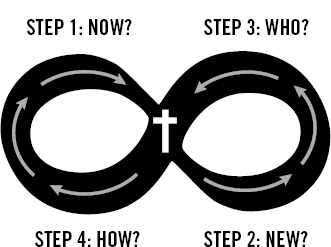
To help us move past the shallow news crawl and seek God’s justice for our broken world, we’ve developed a four-step process called Deep Design. Step One provides the opportunity to discern God’s transforming justice work currently. Step Two allows you and your students to reflect upon fresh insights about justice from Scripture, historical leaders and thinkers, current research, and experience. Step Three invites you and your students to observe and hear the stories of others who are integrating these new insights into their justice work and then compare their journeys with your own. Step Four is the final culminating step that helps your ministry apply what you’ve learned from Steps 1, 2, and 3 to your efforts in seeking God’s justice in the world around you.
To read more about the Deep Design and what it means for your youth ministry, check out our free additional Deep Justice resources available at www.fulleryouthinstitute.org/deep-justice.
Each step in the Deep Design process can be represented in a simple, oneword question:
• Step One (Discernment): Now? By asking Now?, we’re considering what type of justice work the King is already doing, as well as factors that are either hindering transformation or creating space for it.
• Step Two (Reflection): New? In Step Two, we reflect upon New insights that can help us create even more space for the King’s justice work that we’ve identified in Step One.
• Step Three (Observation): Who? By looking at examples of other leaders and youth workers Who have already applied these New insights to their own settings, we can begin brainstorming some initial ways to translate those New understandings into tangible justice work.
• Step Four (Application): How? The fourth and final step gives us the chance to pick and choose from what we’ve learned in the first three steps to arrive at How we can best contribute to kingdom justice in the midst of the brokenness that surrounds us.
For you who like pictures (probably most of us), we’ve created a diagram of our Deep Design.
What’s that cross doing in the middle of the Deep Design?
As we work through the Deep Design process, how do we know if our work is aligned with God’s will and work? Although our finite brains prevent us from ever fully knowing, one way we understand God’s activity is through his revelation, which we know primarily from Scripture. We have placed the cross at the heart of our Deep Design as a reminder that we want all of our justice to revolve around the model and grace of Christ.
We first introduced the Deep Design in our previous book, Deep Ministry in a Shallow World. In that book, we provided specific sub-questions to ask at each step of the process. This book follows the same progression through the four steps with one major difference. Because of our commitment to engage with diverse authors who have unique experiences with God’s justice in our broken world, we’ve simplified the four steps, giving each author freedom to dig through the four basic questions of Now? New? Who? and How? in ways that match his or her own passions, convictions, and stories.
THE THEOLOGY THAT DRIVES OUR DEEP JUSTICE: THE KINGDOM OF GOD
The many diverse authors and youth ministry leaders we profile in this book are united in one strong message: We need a theology to both shape our motives and drive our methods for righting wrongs.
After all, most of us—whether we know it or not (and usually we don’t)—have one or more theological themes in the driver’s seat of our lives. For some of us, it’s grace doing the steering. For others, it’s love. Maybe for you it’s hope. Or peace. Or freedom.
More and more church leaders are opening up the front doors of their thinking and ministries to the kingdom of God. According to theologian Stanley Grenz, “If we were to point to one topic that above all others has been the recipient of the labors of biblical scholars and theologians in the twentieth century, it would no doubt be the kingdom of God.”
We use the terms “kingdom,” “kingdom of God,” and “kingdom of heaven” interchangeably. The only references to the “kingdom of heaven” in Scripture are in the book of Matthew.
What do we mean by the kingdom of God? We mean that which is under the rule of God, our King. The kingdom is not a geographical place but rather the order of perfect love, righteousness, justice, and peace that offers hope to our broken world. As others are touched by the kingdom, they are transformed by the King’s love and power.
What’s our role in the kingdom? The kingdom is present and active in the world around us. Our role is to acknowledge it and participate in it as it advances and expands. Yet it is God, working in and through us, who is still the ultimate worker.
If the kingdom is already present, why is our world still broken? This is a theological question that has plagued Christ’s followers ever since Jesus proclaimed, “The time has come, the kingdom of God is near. Repent and believe the good news!” (Mark 1:15). The best answer we can give is to join with a large number of scholars and leaders who believe in the “already/not yet” of God’s kingdom. While the kingdom is already here, we are not yet experiencing the entirety of its power and presence. If you liken the kingdom to a banquet, we’re getting plenty of delicious food already—but not the entire five-course meal.
“Scholars agree with what any of us can see in the Gospels: Jesus came announcing that the kingdom of God was at hand.”
GLEN H. STASSEN AND DAVID P. GUSHEE, KINGDOM ETHICS
“Another image may help us understand this ‘available’ aspect of the kingdom…Think of visiting in a home where you have not been before. It is a fairly large house, and you sit for a while with your host in a living room or on the veranda. Dinner is announced, and he ushers you down a hall, saying at a certain point, ‘Turn, for the dining room is at hand,’ or more likely, ‘Here’s the dining room.’ Similarly Jesus directs us to his kingdom.”
DALLAS WILLARD, THE DIVINE CONSPIRACY
How does the kingdom relate to deep justice? Since the kingdom of God isn’t just a way to be blessed but also a way to be a blessing, seeking the kingdom increases our desire to right wrongs. The kingdom invites all people—rich or poor, powerful or marginalized—to join in God’s liberating gospel that is ever-revolutionary and ever-expanding.
Now let’s look at how the four steps of the Deep Design can guide us as we seek to be part of God’s bringing about his kingdom in our world.
STEP ONE IN THE DEEP DESIGN (DISCERNMENT):
How are we NOW living out the kingdom?
As we use Step One of the Deep Design to assess what is happening in our youth ministries, it quickly becomes clear that we face choices about how we seek God’s justice Now:
• Do we best let kids and adults know about the King by sharing about him with our words or showing him through our deeds?
• Do we best accomplish God’s will on earth by working to right wrongs or praying for God to do it himself?
• Does God want us to work through existing organizations and ministries or launch new and more entrepreneurial approaches to serving the poor?
• Does the freedom God intends start with individuals or with social systems and structures?
• Do we know we’ve been successful when people have their spiritual need for Christ fulfilled or their physical needs for food and shelter met?
• Where do we first try to fix brokenness—in our own towns or in the nations of the world where the poverty is even greater?
“The kingdom of God is a culture that takes form in world culture… The kingdom of God is not primarily a religious culture but a power that liberates and frees persons within their existing culture to experience the ‘human’ culture that belongs by right of God’s creation to each person. No longer are individuals oppressed by impersonal and tyrannical world powers; they are liberated (as in the exodus) to become a new people whose social relationships become the source of personal identity, and power is transformed into covenant love.”
RAY S. ANDERSON, THE SHAPE OF PRACTICAL THEOLOGY: EMPOWERING MINISTRY WITH THEOLOGICAL PRAXIS
These are all great questions that must be considered. But each of them contains a trap we can easily fall into. It’s that little word or.
Often unknowingly, most of us have Now adopted “either/or” views about the kingdom.
Either the kingdom is about social change or it’s about individual salvation.
Either this world is under God’s reign or it is under Satan’s.
Either we live in denial of the injustice and sin that surrounds us or we are paralyzed by our despair.
These simplistic either/or choices are no match for the complexity of the kingdom. Whether it’s because we don’t understand the kingdom complexity or because we just like to keep things “simple,” the more our youth ministries Now try to slice the kingdom into narrow either/or categories, the more we miss out on the God-sized beauty of the whole.
Unfortunately, we are passing this either/or kingdom thinking on to our students. As we’ll unpack throughout the rest of this book, most youth groups have 20/20 vision when it comes to certain aspects of Jesus’ teachings but are blind to others. In our justice work Now, we too often invite into our youth ministries a few of our “favorite” commandments from the King, but kick out the rest.
STEP TWO IN THE DEEP DESIGN (REFLECTION): WHAT ARE NEW WAYS WE CAN EMBODY THE KINGDOM?
The Jesus we serve was and is a revolutionary. Just as he kicked over the moneychangers’ tables in the first century, Jesus kicks aside our tendency to perpetuate our incomplete—and often comfortable—views of kingdom justice in the twenty-first century.
Part of what made Jesus so provocative was the way he embodied not a narrow either/or kingdom, but God’s both/and kingdom.
Jesus himself lived with the daily tension of being both fully God and fully human.
He offered people both physical healing and spiritual forgiveness.
He came both to fulfill the law and to usher in a new understanding of grace.
He understood both the depravity of human sin and the potential within each of us to participate in kingdom work and living.
He lived knowing both that the future of Christianity rested with his disciples and that they (and we) would betray him.
His death and resurrection makes salvation a gift both available to all and accepted by only some.
Given the stakes, the ways Jesus was able to live out justice in the midst of these both/and tensions is mindblowing. Which might just mean it’s kingdom-sized too.
We’ve already introduced one big both/and of the kingdom of God: The kingdom is both already and not yet.
To read more about the both/and tensions of the kingdom, check out our free Deep Justice resources available at www.fulleryouthinstitute.org/deep-justice
BACK TO THE CRACKED ROADS
So with this both/and nature of the kingdom in mind, let’s take another look at the story of the town with the cracked roads that we considered in . Imagine that your youth ministry is located in this town. Upon hearing of your interest in justice work, the mayor invites you to help fix the roads. Always eager to engage your students in deeper justice, you accept her invitation.
When you arrive at the cracked roads, full of both ideas and pickaxes, the mayor warns you of a peculiar local construction tradition that you’re expected to obey. In your town, work is done using one hand, but not the other. Left or right, it doesn’t matter. What matters is that you and your students can only dig up broken roads, stir up asphalt, and lay down new roads using one hand.
The result? Your work is slow. And frustrating.
Unfortunately, our either/or views of the kingdom resemble this bizarre construction ritual. For centuries, we believers have chosen one approach to the kingdom and proclaimed it the best. We’ve mastered our one kingdom strategy while our other hand hangs at our side—useless. We’ve even criticized others for their slow, one-handed, justice work without noticing how similarly our own work crawls forward.
What the Both/And Kingdom Does Not Mean…
Right about now we can hear the “heretic alarms” going off in some of your brains. As we talk about moving from the either/or to the both/and kingdom, let us clarify a few things that kingdom justice does not mean.
• Both/and kingdom justice does not mean Jesus is one of many ways to relationship with God. Call us conservative (believe us, we’ve been called way worse), but we take Jesus seriously when he proclaims himself the way, the truth, and the life (John 14:6). There might be many ways to experience Jesus, but fundamentally, Jesus is the path to real life in the present and eternal life in the future.
• Both/and kingdom justice does not mean we take Scripture’s commands any less seriously. We aren’t saying that it’s time to water down Scripture so it’s less extreme and less demanding. Instead, it’s time to understand exactly how demanding it is by embracing all of its teachings.
The reality is that no single hand, no single approach, can contain the fullness of the kingdom to heal a broken world. Not even our favorite.
The hand of truth needs the hand of love.
The hand of holiness needs the hand of grace.
The hand on the right needs the hand on the left.
It’s when these individually valid, but incomplete, hands work together that we can experience the full—and often mysterious—power of the King to heal our world’s brokenness. Usually this means not just trying to combine the two ends of the either/or spectrum, but rather embracing a New more grand, more holistic kingdom perspective.
STEP THREE IN THE DEEP DESIGN (OBSERVATION): WHO IS APPLYING THESE KINGDOM INSIGHTS THAT WE CAN LEARN FROM?
In figuring out how to go deeper in our kingdom justice, it’s helpful to have examples of other leaders and activists who are already partnering with the broken and brokenhearted. The goal of the Who step is to observe other ministries and leaders who have come up with New insights about the both/and kingdom and are already trying to go deeper.
In this book, we’ve invited some of our nation’s top justice thinkers and leaders to share their best ideas about bringing God’s deep justice to a broken world. We’ve intentionally invited a diverse group to share their experiences and expertise—urban, small-town, and suburban; church and parachurch; male and female; white, black, and brown; serving in places like Los Angeles, Seattle, Chicago, Minneapolis, Philadelphia, Mendenhall, Memphis, and Washington, D.C. These people aren’t perfect, but their willingness to try new ideas and dig, kick, and pickaxe their way into deeper justice can pave the way for our own kingdom work.
One important warning: You and your youth ministry will never be successful if you try to follow someone else’s justice journey exactly.
If you don’t get that warning, you should stop reading this book. It will mess you up. Seriously. Please put the book down and walk away.
The truth is that you live in a different community, you work with different students, your students have different parents, your community has different needs, your ministry has its own history, and you have your own leadership style. So view the experiences of those profiled in the Who section of each chapter not as a blueprint to follow precisely, but a springboard you use to plunge into your own deeper justice.
STEP FOUR IN THE DEEP DESIGN (APPLICATION): GIVEN EVERYTHING, HOW CAN WE GO DEEPER IN OUR JUSTICE?
Once we’ve reflected on New depth in Step Two of our Deep Design and studied the examples of others in Step Three, we are well equipped to answer the final synthesizing question: Given all that we’ve learned, How is God prodding our ministry into deeper justice?
The fourth step is where we invite you to wade through the material from Now, New, and Who and prayerfully design your own youth ministry plan to right wrongs. To do this, we’ve included at the end of each chapter a short list of Deep Justice Application Questions for you to use with your own ministries and leadership teams. We’ve also given you some Deep Justice Recommended Action Steps that will help you figure out How to move into deep justice in your own life as well as in your youth ministry.
It might help if you think of each chapter like a jigsaw puzzle. Studying Now, New, and Who is a bit like dumping a box of puzzle pieces on a table. In the final section, by mulling over some strategic questions and practical recommendations, your youth ministry gets to figure out How to put those pieces together into a puzzle that helps you right wrongs. Sure, we’ll give you some strong hints, but we believe the best “kingdom picture” for your students is something God can show you and your team.
A TALE OF TWO SECTIONS
We’re applying this four-step Deep Design in both sections of this book. The first section, Both/And Kingdom Thinking, helps us peel back the layers of inadequate either/or theologies and philosophies that keep our youth ministries from the deep core of the both/and kingdom. The second section, Both/And Kingdom Living, helps us apply what we’ve discovered in the first section to three areas crucial to deep justice: race, money, and class.
Regardless of the topic, you’ll note from the shape of the diagram (which resembles the mathematical sign of “infinity”) that every time your youth ministry reaches one of its goals, you’ve basically created a new Now for yourself. This means the Deep Design process never ends. It’s a constant loop of discernment, reflection, observation, and application. This feedback loop means that the CNN news crawl will never be enough to help us seek hope and healing for our broken world. Since the both/and kingdom is always evolving, our justice must also be constantly on the move.
DEEP JUSTICE APPLICATION QUESTIONS:
The best way to experience the Deep Design is with a team. What students, parents, adult volunteers, church leaders, and community members would you like to invite to discuss Now, New, Who, and How with you?
Of the list of kingdom either/ors given on , which phrases best describe your approach to justice Now? What’s good about that? What’s not so good about that?
What New changes would be introduced into your justice if the both/and kingdom of God was in the driver’s seat?
Who do you admire for their work in service and social justice? What have you already learned from these people? What else do you think they can teach you?
After reading these first two chapters, what initial ideas do you have about How to go deeper in kingdom justice with your students?
What types of resistance might you meet from parents, other pastors, or your church as you and your students try to right wrongs around you? How can you network with key leaders and parents in your church so that you have the support you need to seek deep justice?
NOTES
For more on the Deep Design, please see our previous book, Deep Ministry in a Shallow World (Grand Rapids: Zondervan, 2006).
Had we been gearing this as an academic text, we would have labeled this filter “Christopraxis,” meaning that our “praxis,” or theologically grounded practices, is determined by God’s activity as seen through Christ.
Stanley Grenz, Theology for the Community of God (Grand Rapids: Eerdmans, 1994), 492.
Adapted from Grenz, Theology for the Community of God, 22.
George Eldon Ladd, The Gospel of the Kingdom (Grand Rapids: Eerdmans, 1959), 41, 52–65.