Chapter 1 What’s Deep Justice and How Do I Know If I’m Doing It?
Ice cream has the power to bring deep justice to our broken world.
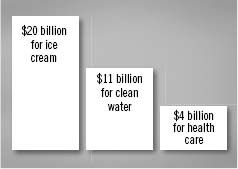
Guess how much money you, I, the kids in our ministries, and every other American spend each year on mint chocolate chip, strawberry, jamoca almond fudge, rainbow sherbet, just plain vanilla, and all other ice cream flavors?
Go ahead. Take a guess.
$20 billion.
For those of you who like to see a lot of zeroes, that’s $20,000,000,000.
Compare that $20 billion with other figures recently released by the United Nations. Providing clean water and basic sanitation for the entire world would cost $7 billion a year for the next ten years.
An additional $4 billion a year for the next ten years could finance basic health care that would prevent the deaths of 3 million infants each year.
So for $11 billion a year for the next decade, just over half of what Americans spend on ice cream, we could give the world clean water and basic sanitation and prevent the deaths of millions of babies. But since there is no Give-Up-Ice-Cream-for-World-Health movement, odds are good that we’ll keep eating our mint chocolate chip and much of the world will lack water and health care.
Does that seem just to you?
On September 11, 2001, the terrorists who hijacked four U.S. planes claimed 2,792 lives. Our entire nation—and much of the world—was glued to radios, televisions, and the Internet, desperate to find out why and how so many had been killed.
Yet on that same day nearly three times as many people were killed by HIV/AIDS worldwide. And that same number of people died from HIV/AIDS on September 12, 2001. And on September 13. And that many people have died because of AIDS every day since then. Yet as AIDS rips apart children, families, villages, and entire nations, the world remains disengaged. Tragically, so do our churches and youth ministries.
Does that seem just to you?
Many of us slept on comfortable mattresses last night, and with a flick of a thermostat switch, we kept our homes at temperatures we considered ideal. Last night, approximately 600,000 homeless people sought shelter on U.S. streets. Making matters worse, an estimated 38 percent of those homeless persons were children.
Does that seem just to you?
Perhaps the most alarming statistic of all is that this injustice and poverty is happening in a world in which 2.1 billion of us, or 33 percent of the world’s total population, claim to be followers of Christ, who taught in Matthew 25:40 that whatever we do for the “least of these brothers and sisters,” we are actually doing for him.
Does that seem just to you?
It doesn’t seem just to us either.
A growing number of youth ministries are alarmed by the brokenness of our world and are determined to restore justice.
Maybe you lead one of them.
Some of you are partnering with faith communities of different ethnic and economic backgrounds to create job centers, food co-ops, and college scholarship funds to counter the injustice in your town. Others of you are mobilizing kids and families to mentor under-resourced kids at your local school as well as serve as advocates at your school district for increased funding. Still others are raising up groups of kids who care about the AIDS pandemic—in the United States, in Africa, and in Asia (which is now being called the “new Africa” of AIDS).
“The church should consist of communities of loving defiance. Instead it consists largely of comfortable clubs of conformity.”
RONALD J. SIDER, RICH CHRISTIANS IN AN AGE OF HUNGER
The good news is that our hearts are in the right place. The bad news is that many of us are novices who might be doing more harm than good.
This book is for youth workers—rookies and veterans—who don’t want to waste another minute doing mediocre service.
It’s for youth workers of all colors and classes who hunger to learn from one another, as well as from the people who are most in need of justice.
It’s for youth workers—urban, suburban, small-town, and rural—who want to see and be a part of God’s deep justice.
WHAT IS DEEP JUSTICE, ANYWAY?
One of the authors of this book, Jeremy Del Rio, wanted to tell his five-year-old son why he was spending so much time on the phone and at his computer, working on his chapters. So Jeremy described social justice to Judah in two very simple words: righting wrongs.
I don’t think I’ve ever heard a better definition.
Deep justice is about righting wrongs.
Righting wrongs is only possible when we understand the difference between service and social justice. Service is vital to the life of faith, a high calling modeled for us consistently by Jesus. But his call to love is also a call to look for more lasting solutions.
God’s doesn’t extend his call only to the church in the U.S. or the West. In fact, we would all be wise to remember God is already at work in those who have needs. We don’t have to muster up our own solutions and “go get ’em” in the name of justice. Often the keys to overcoming poverty and oppression lie within those communities that are the most broken and brokenhearted. Our primary role as youth ministries is simply to come alongside those who are struggling and remove the obstacles that hinder those solutions.
Enter deep justice.
THE PARABLE OF THE CRACKED ROADS
Once upon a time, three youth ministries decided to address an unusual—and dire—problem permeating their city. Somehow, their streets and sidewalks had fallen prey to alarming cracks that crisscrossed the entire town. These cracks were two-to-four inches wide and several feet long, making the roads dangerous and virtually undriveable. No one knew the exact cause of the cracks, yet residents felt trapped in their homes and ventured to work, school, and church only when necessary.
In an effort to fix the town’s problem, the first youth ministry surveyed the damage and came up with a Quick-And-Easy-Physical-Solution. Their plan was to use a thin layer of topcoat to cover the cracks and render the roads driveable and the sidewalks walkable. Residents stood and watched as the adult leaders and kids poured out of their minivans, mixed up the topcoat, and spread it across the cracks like a layer of chocolate icing on a cake. Pleased with the quick repair, the townfolk hugged the kids and cheered as the youth ministry drove off in minivans.
Interestingly for we who care about justice, 62 percent of the world’s Christians live in Africa, Asia, and Latin America.
The topcoat worked.
For a few weeks.
But the weight of the cars, the heat of the sun, and the pounding of the rain soon eroded the topcoat. The cracks reappeared, and residents retreated again to their homes. Some thought the cracks were not as severe as they’d been before the topcoat, but no one could be sure.
The second youth ministry, upon examining the town’s broken roads, adopted a different strategy. Recognizing that there was a lot they didn’t know, the youth figured they’d better learn more about their town’s needs and neighbors before making things right. They divided up into teams, some interviewing the residents and others visiting home improvement stores to learn about the type of cement that would best address the problem.
The neighbors had ideas for road repairs that the youth ministry never would have thought of. As a result, the youth ministry was able to develop a Warmand-Fuzzy-Relational-Solution in which the youth ministry and the neighbors worked side by side filling in the cracks with a customized cement.
The cement worked. For six whole months. But to the students’ chagrin, a new series of cracks began to crisscross the roads. Their new friends told them that even though the Warm-and-Fuzzy-Relational-Solution had fixed the old cracks, an entirely new set of cracks had emerged, rendering the roads almost as hazardous.
To find out some facts about U.S. poverty that will probably surprise your students, see .
The third youth ministry, having heard about the first two well-intentioned-but-failed strategies, knew that neither topcoat nor a brand-new cement would make things right. Like those in the second youth ministry, these students spent several days interviewing neighbors and hearing stories and dreams about crack-free driving as well as the pain and fear caused by the unsafe driving conditions. Wanting to avoid the mistakes of the first two youth ministries, the third youth ministry adopted a more radical repair strategy.
The students decided to divide into two teams. The first team was tasked with repairing the current cracks. Recognizing that the very foundation of the city’s roads was not right, the team members worked with their new friends to jackhammer large sections of road, dig up the resulting rubble, re-level the foundations, and then lay a brand-new asphalt surface for the roads.
In order to prevent the cracks from reappearing, the second team investigated a few deeper and more complex questions. First, the youth looked into why the faulty roads had been built in the first place, and lobbied at city hall to change the construction code so defective roads would never be built again. Second, they asked their neighbors why they’d been unable to fix their own roads, and raised funds to provide the construction and cement-laying training their neighbors would need to keep the roads shipshape in the future.
This Deep-Systemic-Solution did the trick. Thanks to the new stable foundation and the neighbors’ new training, the broken roads were fixed—for good.
WHAT’S THE DIFFERENCE BETWEEN NOT-SO-DEEP SERVICE AND TRULY DEEP JUSTICE?
Have you ever noticed the pervasiveness of cracks throughout the streets and sidewalks of your own city or town? The heat of the sun, the wear and tear of cars, and the shifting soil all mean one thing: Pavement is going to crack.
The same is true of our social systems and our relationships. Due to sin, they crack. They break. As a result of this breakdown, our world experiences poverty, disease, oppression, racism, greed, and corruption.
Youth ministries doing only shallow service look at the world’s brokenness, feel bad about it, and offer a few Band-Aids. They offer free turkeys to the homeless on Thanksgiving or send clothes to a child in Zambia at Christmas. The good news is that the turkey and clothes fix what’s broken.
The bad news is that they fix brokenness for only a few hours.
Youth ministries engaged in deep justice take a different approach. Like their more shallow counterparts, they see the cracks, feel bad about them, and send turkeys and T-shirts. Yet they couple their service with deeper questions like, How did these wrongs come to exist in the first place? How can we help the poor and marginalized fix their own problems? What does God want us to do that will make a difference beyond today?
It’s not that it’s bad to give out turkeys and T-shirts. It’s just that we’ll never right the deep wrongs underlying class divisions, racism, and oppression in our world if that’s all we do.
“On the one hand we are called to play the Good Samaritan on life’s roadside; but that will be only an initial act. One day we must come to see that the whole Jericho road must be transformed so that men and women will not be constantly beaten and robbed as they make their journey on life’s highway. True compassion is more than flinging a coin to a beggar; it is not haphazard and superficial. It comes to see that an edifice which produces beggars needs restructuring.”
MARTIN LUTHER KING JR., “BEYOND VIETNAM: A TIME TO BREAK SILENCE,” A SPEECH DELIVERED ON APRIL 4, 1967
THREE LAYERS OF DEPTH
Just like the first youth ministry facing the cracked roads, when we encounter something that’s broken in our world, our first response is usually to respond with some sort of physical, tangible help. We send money, we distribute sandwiches, or we paint buildings.
Recognizing that the money runs out, the sandwiches are eaten quickly, and the paint eventually fades, some youth ministries go a step deeper and offer a relational response. Like the second youth ministry fixing the cracked roads, they take the time to get to know those they are serving, try to learn from them, and even continue the friendship—in person or long distance—for months and years to come.
As we develop deep relationships with others, and as we see victims of injustice not en masse but as individuals with real names, faces, and stories, we will realize there is an even deeper level of response: a systemic response. But few youth ministries are willing to do whatever it takes—for however long it takes—until the systems that perpetuate the brokenness are fixed.
THE TOP OR THE BOTTOM OF THE CLIFF
Imagine one of your students runs into your youth room, shouting that some people who were walking in the hills near your church have fallen down a cliff and need help. You, your adult leaders, and all of your students drop whatever you’re doing and race to help those who have fallen from the cliff. You call 911 and provide basic first aid until the paramedics arrive.
The next week, a different student races into your youth room, shouting that the same thing has happened. Again you all drop whatever you’re doing and run to help the bruised and battered bodies lying at the bottom of the cliff.
It happens again the next week.
And the next week.
And the next.
Finally, you realize that while your first-aid efforts are helpful, maybe it’s time for you to do more than race to the bottom of the cliff and bind up wounds. Maybe it’s time for you to shift from a Level 1 or Level 2 response into the more rigorous, but longer-term, help of Level 3.
Maybe it’s time for you to camp out at the top of the cliff and stop people from falling in—or maybe being kicked in—to begin with.
NOT-SO-DEEP SERVICE VS. TRULY DEEP JUSTICE
Throughout this book we’ll be exploring ways we can move beyond shallow service so we can seek deeper justice for a broken world. But the table below provides a brief comparison.
DEEP JUSTICE ASKS WHY
As the last row in the table above indicates, deep justice is not afraid to ask why the world is broken, and then take steps to fix it.
Why invites us to truly listen to and get to know the voiceless in our world.
Why requires a long-term perspective because poverty and powerlessness cannot be eliminated in weekend bursts of activism.
Why invites us to interact with social systems—because we cannot truly help individuals until we also change the systems that rob dignity.
Why forces us to face the truth about our own participation in the systems and structures that rob the poor of opportunities.
One word of warning: Why is not a popular question. Others may question you and your motives when you ask why. Bishop Oscar Romero, the martyred leader of the Nicaraguan church, once commented, “When I feed the poor, they call me a saint. When I ask why the poor are poor, they call me a communist.” Deep justice means not only asking why, but being prepared to do something about the answer.
DEEP JUSTICE IS MORE THAN A PROJECT
It’s so tempting to try to distill deep justice into a “project,” or maybe even two or three “projects” that we “go and do” with our kids. That’s a little bit like saying a marriage basically boils down to a few overnighters and a handful of dinner dates each year. But justice, like marriage, is a daily commitment to be empowered by God’s grace to love and serve others every day.
Like a fancy Valentine’s Day dinner or an anniversary weekend, justice “projects” may play a part—perhaps even a significant part—in our justice journey. But the real reflection of our commitment to justice isn’t whether we raise enough money to take kids on a weeklong spring break trip to serve in a Guatemalan orphanage; it’s whether we are willing to view those we serve as “partners” instead of “projects” the other 51 weeks of the year.
DEEP JUSTICE IN REAL-LIFE KIDS
You may be wondering if 13- and 17-year-olds are capable of deep justice. We know they are. We’ve seen it with our own eyes.
When Kristin was a sophomore in our church’s youth ministry, Sarah, her small group leader, started sending out monthly e-mail newsletters to Kristin and the other girls in her group. At the end of every newsletter, Sarah reminded the girls of our spring break trip to inner-city San Francisco, encouraging them to go.
When it came time to sign up for the trip, Kristin was the only one from her small group who signed up. She didn’t know anyone else going on the trip, and she almost chickened out. But Sarah kept prodding her to go, and Kristin packed her bags and headed to San Francisco with the rest of the team.
During the trip, not only did Kristin fall in love with service, she fell in love with helping the homeless experience kingdom justice. Kristin’s commitment to deep justice was crystallized when she and one of our adult leaders met J.R., a homeless man hanging out near the San Francisco Convention Center. Kristin offered her extra sack lunch to J.R. and started asking J.R. questions about his life, his family, and his life in San Francisco.
J.R. responded with a tirade against the government, the middle and upper classes, and Christians. While not a member of the government, Kristin is upper-middle class and a Christian. She remembers, “I left that lunch determined not to be the type of apathetic Christian J.R. hated.”
She came back and dove into our church’s Beverage Crew, a ministry in which high school students not only hit the streets to offer drinks to homeless persons, but also to build relationships with them and try to understand why they have ended up on the streets. As she’s gotten to truly know people living out on the streets, she’s realized “some of them choose to be there, but others just end up there. We don’t know their stories until we talk to them. And we need to figure out how to help them help themselves.”
“We are God’s demonstration community of the rule of Christ in the city. On a tract of earth’s land purchased with the blood of Christ, Jesus the kingdom developer has begun building new housing. As a sample of what will be, he has erected a model home of what will eventually fill the urban neighborhood. Now he invites the urban world into that model home to take a look at what will be.”
HARVIE CONN, PLANTING AND GROWING URBAN CHURCHES: FROM DREAM TO REALITY
Over time, Kristin’s commitment to justice on behalf of the homeless has grown deeper. Her junior year, not only did she join the team going to San Francisco during spring break, but she also served as the student shepherd and wrote morning devotionals for the entire group. The next year, Kristin was the student director for the San Francisco trip. She helped plan the trip, organized the training meetings ahead of time, and helped coach the teams in how to build relationships with those who are homeless.
Probably just as importantly, Kristin encouraged her friend, Brittany, to go on the San Francisco trip when they were both juniors. Like Kristin, Brittany loved it. In fact, she loved it so much that now Brittany is pursing a Global Studies major in college so she can right wrongs by learning about the economic, social, and political factors that compound our world’s brokenness.
Or take Marcus, a high school senior in our church who received a Hi8 video camera as a Christmas gift when he was in sixth grade and has been making movies ever since. He started with freeze-frame animation with potatoes. “We didn’t have any Mr. Potato Head toys around, so we used real potatoes,” Marcus recalls.
Marcus’ passion for and skills in moviemaking grew during the next several years. As a student at a Los Angeles public high school that is 80 percent Asian, Marcus was bothered by the friction he saw every day between students of different races and socioeconomic levels. In response, he and his friend decided to write, direct, and produce Viola, a full-length film about two students—one white American girl and one Chinese-American boy—and the lessons they learn about “fitting in” with people who are different from them.
“We got more than we bargained for,” Marcus recalls. Viola involved ten months of pre- and post production and 300 high school students, including his entire school orchestra as the musicians who performed the score. But once it was completed, Viola was screened at a major Pasadena theatre and was also accepted at several film festivals. Even more importantly for Marcus, this justice movie made entirely by high school students has provoked great conversations about race at both his school and our church. As one junior at Marcus’ high school commented, “The movie very realistically portrayed the stereotypes that are a part of our lives today. It wasn’t sugarcoated like other movies. It was exactly like what my friends and I have gone through.”
But when it comes to Marcus and deep justice, the show must go on. Since Viola, Marcus has worked on a number of other projects, all geared to spark conversation and insight about racial and economic injustices. He’s even done a film in which, instead of casting an experienced actor to play the part of a homeless man, he cast an actual homeless man in the role.
Marcus’ passion for deep justice isn’t limited to filmmaking. He’s also the vice president of “My Friend and I,” a service organization at his school in which students with mental disabilities and students without mental disabilities are matched. Marcus has lunch with his buddy, Jeffrey, every week, and Jeffrey has even started having lunch with Marcus and his friends on other days too. “At first it was awkward when Jeffrey joined us. My friends even criticized me and made fun of both Jeffrey and me. But as they got to know Jeffrey, and he became a regular at our lunch table, they got to like him.”
Marcus’ small group leader, Jeff, has played a major role in Marcus’ desire to change how others think about race, class, and disabilities. “It wasn’t so much what Jeff has said about any of that; it’s more how he has put us in positions that force us to think about it. The more I see and the more I serve, the more I realize how many wrongs need to be righted. We can’t just meet people’s needs short term; we have to help them learn how to meet their own needs long term.”
Many youth workers realize that conceptions of “suburban” and “urban” aren’t as fixed as they once were, as more and more towns are becoming blends of suburban and urban culture. While the poverty rate in U.S. large cities (18.8 percent) is still higher than in the suburbs (9.4 percent), because the suburbs are experiencing greater population growth, the suburban poor (a total of 12 million) now outnumber the inner-city poor (a total of 10.8 million).
These stories confirm two things. First, God can use ordinary kids like Kristin and Marcus to bring about deep justice in a broken world. Second, God often works through us as youth workers to do it.
DEEP JUSTICE IS POSSIBLE IN YOUR SETTING WITH YOUR KIDS
Your setting is unlike any other. You may be working with kids whose allowances rival your own salary, or you may be working with kids who live on the streets. Your ministry may be out in the heartlands of rural America where the closest neighbor is a long walk away, or it may be in the hood where your closest neighbor is less than a foot away.
Either way, deep justice is for you. More importantly, it’s for your students.
We’ve written this book with the hope that it will encourage and equip you to seek kingdom justice for our broken world regardless of your particular ministry setting. Suburban, urban, rural, or something in between, our prayer is that every chapter helps you dig deeper into the injustices in your community and your world so you can unearth the hope and freedom of the gospel.
WHY DEEP JUSTICE IS IMPORTANT IN YOUR YOUTH MINISTRY
Our mission at the Fuller Youth Institute (FYI) at Fuller Seminary is to turn research into resources that transform youth and family ministry. In our own experience and our conversations with youth leaders around the country, we’re encountering revolutionaries who recognize that service and justice aren’t just for adults. Not only are teenagers able to right the wrongs around them, but they are also like wet cement themselves. We want to make the right impression. Maybe a young Martin Luther King Jr. is sitting before you on Sunday. Perhaps you’re giving a future Mother Teresa a ride home after church tomorrow night.
For more on the mission and free resources offered by the Fuller Youth Institute, including our free FYI E-Journal, go to www.fulleryouthinstitute.org.
Even more likely, you are rubbing shoulders every day with kids who will some day be spouses, parents, bus drivers, administrators, teachers, business entrepreneurs, and political leaders. As philosopher and theologian Dallas Willard reminds us, “We are becoming who we will be—forever.”
That’s true for that moldable 15-year-old you’re taking out to coffee after school today. And it’s just as true for us as adults.
So let’s stop slapping Band-Aids on the gaping wounds of injustice around us. Instead, let’s dig through the rubble of our broken world and experience the deep grace and hope of our Lord Jesus Christ.
According to a study by the Corporation for National and Community Service, an estimated 15.5 million U.S. teenagers, or 55 percent of Americans between ages 12 and 18—participate in volunteer activities. This is close to twice the adult rate of 29 percent.
DEEP JUSTICE APPLICATION QUESTIONS:
What signs of brokenness can you see in the kids and families in your youth ministry? How about in your city? In our country? Around the world?
In thinking about our broken world, Gary A. Haugen, president of the International Justice Mission, writes, “Over time I have come to see questions about suffering in the world not so much as questions about God’s character but as questions about the obedience and faith of God’s people.” What do you think about that?
What have been some of your well-meaning, but shallow, adventures in service? Looking back, what would you have changed?
Of the three layers described on (physical response, relational response, systemic response), which is most common in your ministry? What’s good about that? What’s not so good about that?
What are the costs of shallow service—for you, for your students, for adults and volunteers, and for the poor and marginalized?
Why are you interested in deeper justice within your youth ministry? What are some of the barriers you might face as you pursue deep justice?
How would you describe your ministry setting—suburban, urban, rural, or something in between? How do the backgrounds of the students in your ministry influence the ways you seek deep justice for our broken world?
NOTES
State of the World 2004, Worldwatch Institute, www.worldwildlife.org/news/displayPR.cfm?prID=122.
United Nations Development Program 2005 Human Development Report. See hdr.undp.org
U.S. Department of Health and Human Services, “Ending Chronic Homelessness: Strategies for Action,” March 2003.
National Alliance to End Homelessness, “A Plan, Not a Dream: How to End Homelessness in Ten Years,” 2000.
“Major Religions of the World Ranked by Number of Adherents,” http://www.adherents.com/Religions_ By_Adherents.xhtml.
Tony Campolo, “Reflections on Youth Ministry in a Global Context,” Starting Right, edited by Kenda Creasy Dean, Chap Clark, and Dave Rahn (Grand Rapids: Zondervan, 2001), 92.
Alan Berube and Elizabeth Kneebone, “Two Steps Back: City and Suburban Povery Trends 1999–2005”(Washington, D.C.: The Brookings Institution, December 2006).
Dallas Willard, The Divine Conspiracy (New York: Harper Collins, 1998), 11.
“First Lady Says More Teens Volunteering,” New York Times, November 30, 2005.
10Gary A. Haugen, Good News About Injustice (Downers Grove, IL: InterVarsity Press, 1999), 100.