
Chapter 26
Chapter 25
Chapter 26 Whether this is the "fullness of joy" that the Lord promises My God and my Lord, my hope and the joy of my heart, tell my soul whether this is that joy of which you tell us through your
Son, "Ask and you shall receive, that your joy may be full" (John 16:24). For I have found a joy that is full and more than full.
Indeed, when the heart, the mind, the soul, and the whole human being are filled with that joy, there will still remain joy beyond measure. The whole of that joy will therefore not enter into those who rejoice; instead, those who rejoice will enter wholly into that joy. Speak, Lord; tell your servant inwardly in his heart whether this is the joy into which your servants will enter who "enter into the joy of the Lord" (Matthew 25:21). But surely the joy with which your chosen ones will rejoice is something "no eye has seen, nor ear heard, nor has it entered into the heart of man"
(1 Corinthians 2:9). Therefore, Lord, I have not yet expressed or conceived how greatly your blessed ones will rejoice. They will indeed rejoice as much as they love, and they will love as much as they know. How much will they know you then. Lord, and how much will they love you? Truly in this life "eye has not seen, nor has ear heard, nor has it entered into the heart of man" how much they will love and know you in that life.
O God, I pray that I will know and love you that I might rejoice in you. And if I cannot do so fully in this life, I pray that I might grow day by day until my joy comes to fullness. Let the knowledge of you grow in me here, and there let it be full. Let your love grow in me here, and there let it be full, so that my joy here is great in hope, and my joy there is full in reality. O Lord, by your Son you command us—or rather, you counsel us—to ask, and you promise that we will receive, "that our joy may be full." Lord, I ask what you counsel us through our "Wonderful Counselor" (Isaiah 9:6).
Let me receive what you promise through your truth, "that my joy may be full." O truthful God, I ask that I may receive, "that my joy may be full." Until then, let my mind ponder on it, my tongue speak of it. Let my heart love it and my mouth proclaim it. Let my soul hunger for it, my flesh thirst for it, my whole being long for it, until I "enter into the joy of my Lord" (Matthew 25:21), who is
God, Three in One, "blessed for ever. Amen" (Romans 1:25).

GAUNILO S REPLY ON
BEHALF OF THE FOOL

Someone who either doubts or denies that there is any such nature* as that than which nothing greater can be thought is told that its existence is proved in the following way. First, the very person who denies or entertains doubts about this being has it in his understanding, since when he hears it spoken of he under stands what is said. Further, what he understands must exist in reality as well, and not only in the understanding. The argu ment for this claim goes like this: to exist in reality is greater than to exist only in the understanding. Now if that being exists only in the understanding, then whatever also exists in reality is greater than it. Thus, that which is greater than everything else6 will be less than something, and not greater than everything else, which is of course a contradiction. And so that which is greater than everything else, which has already been proved to exist in the understanding, must exist not only in the understanding but also in reality, since otherwise it could not be greater than every thing else.
He can perhaps reply, "The only reason this is said to exist in my understanding is that I understand what is said. But in the same way, could I not also be said to have in my understanding any number of false things that have no real existence at all in them selves, since if someone were to speak of them I would under stand whatever he said? Unless perhaps it is established that this being is such that it cannot be had in thought in the same way that any false or doubtful things can, and so I am not said to think of what I have heard or to have it in my thought, but to understand it and have it in my understanding, since I cannot think of it in any other way except by understanding it, that is, by comprehending in genuine knowledge the fact that it actually exists.
6. Gaunilo regularly says 'mains omnibus', which literally translated is "greater than everything." English idiom demands "greater than every thing else," and I have translated it accordingly, but I thought it important to note the discrepancy.
Gaunilo's Reply on Behalf of the Fool "But first of all, if this were true, there would be no difference in this case between having the thing in the understanding at one time and then later understanding that the thing exists, as there is in the case of a painting, which exists first in the mind of the painter and then in the finished work.
"Furthermore, it is nearly impossible to believe that this being, once someone had heard it spoken of, cannot be thought not to exist, in just the same way that even God can be thought not to exist. For if that were so, why bother with all this argument against someone who denies or doubts that such a nature exists?
"Finally, it must be proved to me by some unassailable argu ment that this being merely needs to be thought in order for the understanding to perceive with complete certainty that it un doubtedly exists. It is not enough to tell me that it exists in my understanding, since I understand it when I hear about it. I still think I could likewise have any number of other doubtful or even false things in my understanding if I heard them spoken of by someone whose words I understand, and especially if I am so taken in by him that, as often happens, I believe himas I still do not believe in that being.
"Accordingly, that example of the painter, who already has in his understanding the picture that he is going to paint, is not a close enough analogy to support this argument. For before that picture is painted, it is contained in the craft of the painter, and any such thing in the craft of a craftsman is nothing but a part of his intelligence. For, as Saint Augustine says, 'when a carpenter is about to make a chest in reality, he first has it in his craft. The chest that exists in reality is not a living thing, but the chest that exists in his craft is a living thing, since the soul of the craftsman, in which all those things exist before they are produced, is alive.'7 Now how can they be living things in the living soul of the craftsman unless they are nothing other than the knowledge or intelligence of his soul itself? By contrast, except for things that are recognized as belonging to the nature of the mind itself, when the understand ing upon hearing or thinking of something perceives that it is true, that truth is undoubtedly distinct from the understanding that grasps it. So even if it is true that there is something than which a greater cannot be thought, that thing, when it is heard
7. In Iohannem, tractate 1, n. 17.
Gaunilo's Reply on Behalf of the Fool
and understood, is not the same sort of thing as a picture that exists in the understanding of the painter before it is painted.
"There is a further argument, which I mentioned earlier. When I hear someone speak of that which is greater than everything else that can be thought (which, it is alleged, can be nothing other than
God himself), I can no more think of it or have it in my under standing in terms of anything whose genus or species I already know, than I can think of God himself—and indeed, for this very reason I can also think of God as not existing. For I do not know the thing itself, and I cannot form an idea of it on the basis of something like it, since you yourself claim that it is so great that nothing else could be like it. Now if I heard something said about a man I do not know at all, whose very existence is unknown to me,
I could think of him in accordance with that very thing that a man is, on the basis of that knowledge of genus or species by which I know what a man is or what men are. Nonetheless, it could happen that the one who spoke of this man was lying, and so the man whom I thought of would not exist. But I would still be thinking of him on the basis of a real thing: not what that particu lar man would be, but what any given man is.
"But when I hear someone speak of 'God' or 'something greater than everything else,' I cannot have it in my thought or under standing in the same way as this false thing. I was able to think of the false thing on the basis of some real thing that I actually knew.
But in the case of God, I can think of him only on the basis of the word. And one can seldom or never think of any truth solely on the basis of a word. For in thinking of something solely on the basis of a word, one does not think so much of the word itself
(which is at least a real thing: the sound of letters or syllables) as of the meaning of the word that is heard. And in the present case, one does not do this as someone who knows what is customarily meant by the word and thinks of it on the basis of a thing that is real at least in thought. Instead, one thinks of it as someone who does not know the meaning of the word, who thinks only of the impression made on his mind by hearing the word and tries to imagine its meaning. It would be surprising if one ever managed to reach the truth about something in this way. Therefore, when I hear and understand someone saying that there exists something greater than everything else that can be thought, it is in this way, and this way only, that it is present in my understanding. So
Gaunilo's Reply on Behalf of the Fool much, then, for the claim that that supreme nature already exists in my understanding.
"Then I am offered the further argument that this thing neces sarily exists in reality, since if it did not, everything that exists in reality would be greater than it. And so this thing, which of course has been proved to exist in the understanding, would not be greater than everything else. To that argument I reply that if we are to say that something exists in the understanding that cannot even be thought on the basis of the true nature of anything whatever, then I shall not deny that even this thing exists in my understanding. But since there is no way to derive from this the conclusion that this thing also exists in reality, there is simply no reason for me to concede to him that this thing exists in reality until it is proved to me by some unassailable argument.
"And when he says that this thing exists because otherwise that which is greater than everything else would not be greater than everything else, he does not fully realize whom he is addressing.
For I do not yet admit—indeed, I actually deny, or at least doubt— that this being is greater than any real thing. Nor do I concede that it exists at all, except in the sense that something exists (if you want to call it 'existence') when my mind tries to imagine some completely unknown thing solely on the basis of a word that it has heard. How, then, is the fact that this greater being has been proved to be greater than everything else supposed to show me that it exists in actual fact? For I continue to deny, or at least doubt, that this has been proved, so that I do not admit that this greater being exists in my understanding or thought even in the way that many doubtful and uncertain things exist there. First I must become certain that this greater being truly exists somewhere, and only then will the fact that it is greater than everything else show clearly that it also subsists* in itself.
"For example, there are those who say that somewhere in the ocean is an island, which, because of the difficulty—or rather, impossibility-of finding what does not exist, some call 'the Lost
Island'. This island (so the story goes) is more plentifully endowed than even the Isles of the Blessed with an indescribable abun dance of all sorts of riches and delights. And because it has neither owner nor inhabitant, it is everywhere superior in its abundant riches to all the other lands that human beings inhabit.
Gaunilo's Reply on Behalf of the Fool
"Suppose someone tells me all this. The story is easily told and involves no difficulty, and so I understand it. But if this person went on to draw a conclusion, and say, 'You cannot any longer doubt that this island, more excellent than all others on earth, truly exists somewhere in reality. For you do not doubt that this island exists in your understanding, and since it is more excellent to exist not merely in the understanding, but also in reality, this island must also exist in reality. For if it did not, any land that exists in reality would be greater than it. And so this more excellent thing that you have understood would not in fact be more excellent.'-If, I say, he should try to convince me by this argument that I should no longer doubt whether the island truly exists, either I would think he was joking, or I would not know whom I ought to think more foolish: myself, if I grant him his conclusion, or him, if he thinks he has established the existence of that island with any degree of certainty, without first showing that its excellence exists in my understanding as a thing that truly and undoubtedly exists and not in any way like something false or uncertain."
In this way the fool might meet the objections brought against him up to this point. The next assertion is that this greater being is such that even in thought it cannot fail to exist, and that in turn rests entirely on the claim that otherwise this being would not be greater than everything else. To this argument he can make the very same response, and say, "When did I ever say that any such thing as that 'greater than everything else' exists in actual fact, so that on that basis I am supposed to accept the claim that it exists to such a degree that it cannot even be thought not to exist? There fore, you must first prove by some absolutely incontestable argu ment that there exists some superior nature,* i.e., one that is greater and better than all others that exist, so that from this we can also prove all of the qualities that that which is greater and better than all other things must necessarily possess." So instead of saying that this supreme thing cannot be thought not to exist, perhaps it would be better to say that it cannot be understood not to exist, or even to be capable of not existing. For in the strict sense of the word, false things cannot be understood, even though they can of course be thought in the same way that the fool thought that God does not exist.
Furthermore, I know with absolute certainty that I myself exist, but nonetheless I also know that I can fail to exist. But I understand
Gaunilo's Reply on Behalf of the Fool beyond all doubt that the supreme being that exists, namely God, both exists and cannot fail to exist. Now I do not know whether I can think I do not exist even while I know with absolute certainty that I do exist. But if I can, why can I not do the same for anything else that I know with the same certainty? And if I cannot, it is not God alone who cannot be thought not to exist.
The rest of this book is argued so truly, so lucidly and magnifi cently, full of so much that is useful, and fragrant with the aroma of devout and holy feeling, that it should by no means be belittled on account of the claims made at the beginning, which are indeed accurately understood, but less compellingly argued. Rather, those claims should be demonstrated more solidly, and then the whole book can be accorded great honor and praise.
ANSELM'S REPLY
TO GAUNILO

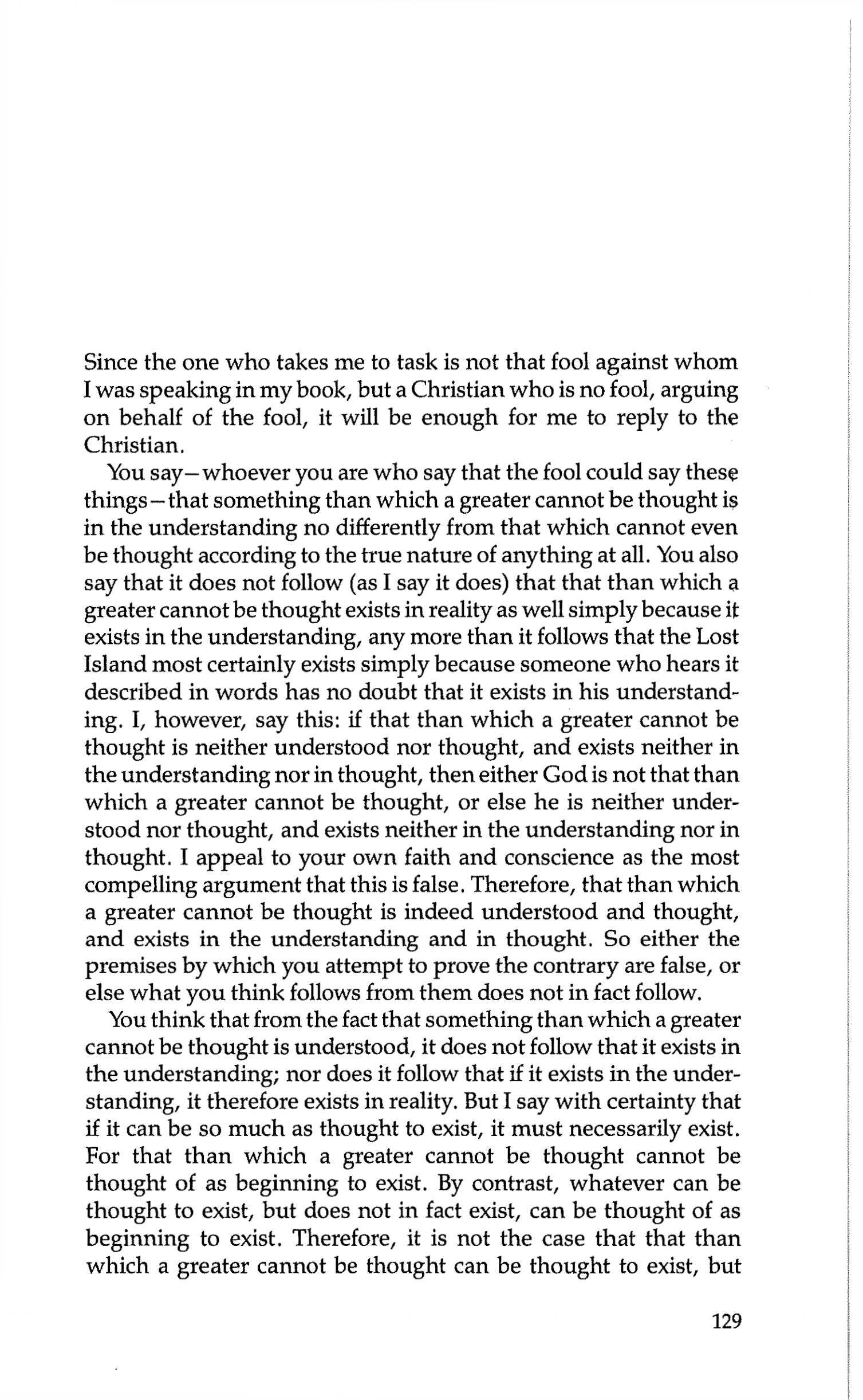
Since the one who takes me to task is not that fool against whom I was speaking in my book, but a Christian who is no fool, arguing on behalf of the fool, it will be enough for me to reply to the Christian.
You say—whoever you are who say that the fool could say these things—that something than which a greater cannot be thought is in the understanding no differently from that which cannot even be thought according to the true nature of anything at all. You also say that it does not follow (as I say it does) that that than which a greater cannot be thought exists in reality as well simply because it exists in the understanding, any more than it follows that the Lost
Island most certainly exists simply because someone who hears it described in words has no doubt that it exists in his understand ing. I, however, say this: if that than which a greater cannot be thought is neither understood nor thought, and exists neither in the understanding nor in thought, then either God is not that than which a greater cannot be thought, or else he is neither under stood nor thought, and exists neither in the understanding nor in thought. I appeal to your own faith and conscience as the most compelling argument that this is false. Therefore, that than which a greater cannot be thought is indeed understood and thought, and exists in the understanding and in thought. So either the premises by which you attempt to prove the contrary are false, or else what you think follows from them does not in fact follow.
You think that from the fact that something than which a greater cannot be thought is understood, it does not follow that it exists in the understanding; nor does it follow that if it exists in the under standing, it therefore exists in reality. But I say with certainty that if it can be so much as thought to exist, it must necessarily exist.
For that than which a greater cannot be thought cannot be thought of as beginning to exist. By contrast, whatever can be thought to exist, but does not in fact exist, can be thought of as beginning to exist. Therefore, it is not the case that that than which a greater cannot be thought can be thought to exist, but
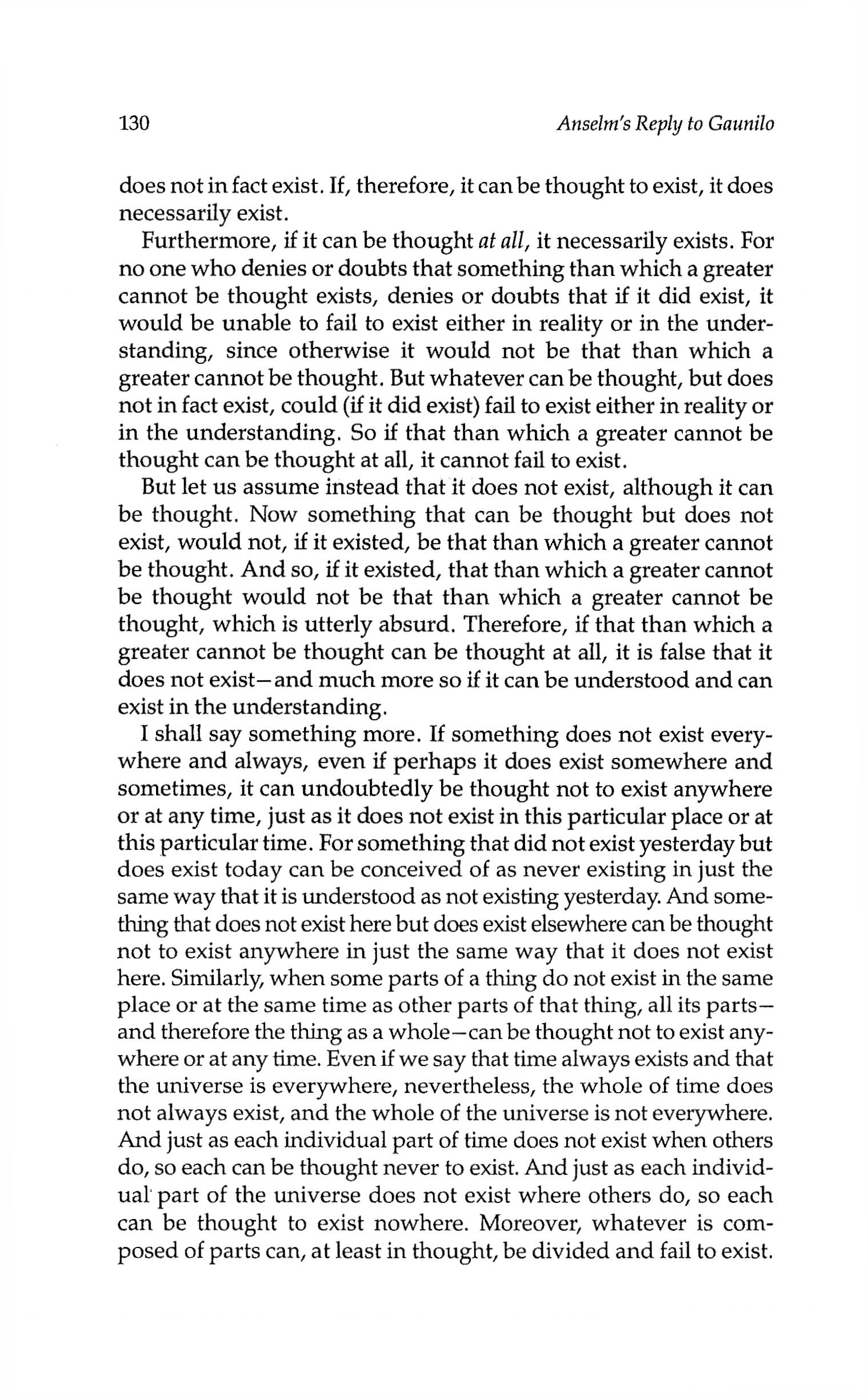
Anselm's Reply to Gaunilo does not in fact exist. If, therefore, it can be thought to exist, it does necessarily exist.
Furthermore, if it can be thought at all, it necessarily exists. For no one who denies or doubts that something than which a greater cannot be thought exists, denies or doubts that if it did exist, it would be unable to fail to exist either in reality or in the under standing, since otherwise it would not be that than which a greater cannot be thought. But whatever can be thought, but does not in fact exist, could (if it did exist) fail to exist either in reality or in the understanding. So if that than which a greater cannot be thought can be thought at all, it cannot fail to exist.
But let us assume instead that it does not exist, although it can be thought. Now something that can be thought but does not exist, would not, if it existed, be that than which a greater cannot be thought. And so, if it existed, that than which a greater cannot be thought would not be that than which a greater cannot be thought, which is utterly absurd. Therefore, if that than which a greater cannot be thought can be thought at all, it is false that it does not exist—and much more so if it can be understood and can exist in the understanding.
I shall say something more. If something does not exist every where and always, even if perhaps it does exist somewhere and sometimes, it can undoubtedly be thought not to exist anywhere or at any time, just as it does not exist in this particular place or at this particular time. For something that did not exist yesterday but does exist today can be conceived of as never existing in just the same way that it is understood as not existing yesterday. And some thing that does not exist here but does exist elsewhere can be thought not to exist anywhere in just the same way that it does not exist here. Similarly, when some parts of a thing do not exist in the same place or at the same time as other parts of that thing, all its parts— and therefore the thing as a whole—can be thought not to exist any where or at any time. Even if we say that time always exists and that the universe is everywhere, nevertheless, the whole of time does not always exist, and the whole of the universe is not everywhere.
And just as each individual part of time does not exist when others do, so each can be thought never to exist. And just as each individ ual part of the universe does not exist where others do, so each can be thought to exist nowhere. Moreover, whatever is com posed of parts can, at least in thought, be divided and fail to exist.
Anselm's Reply to Gaunilo
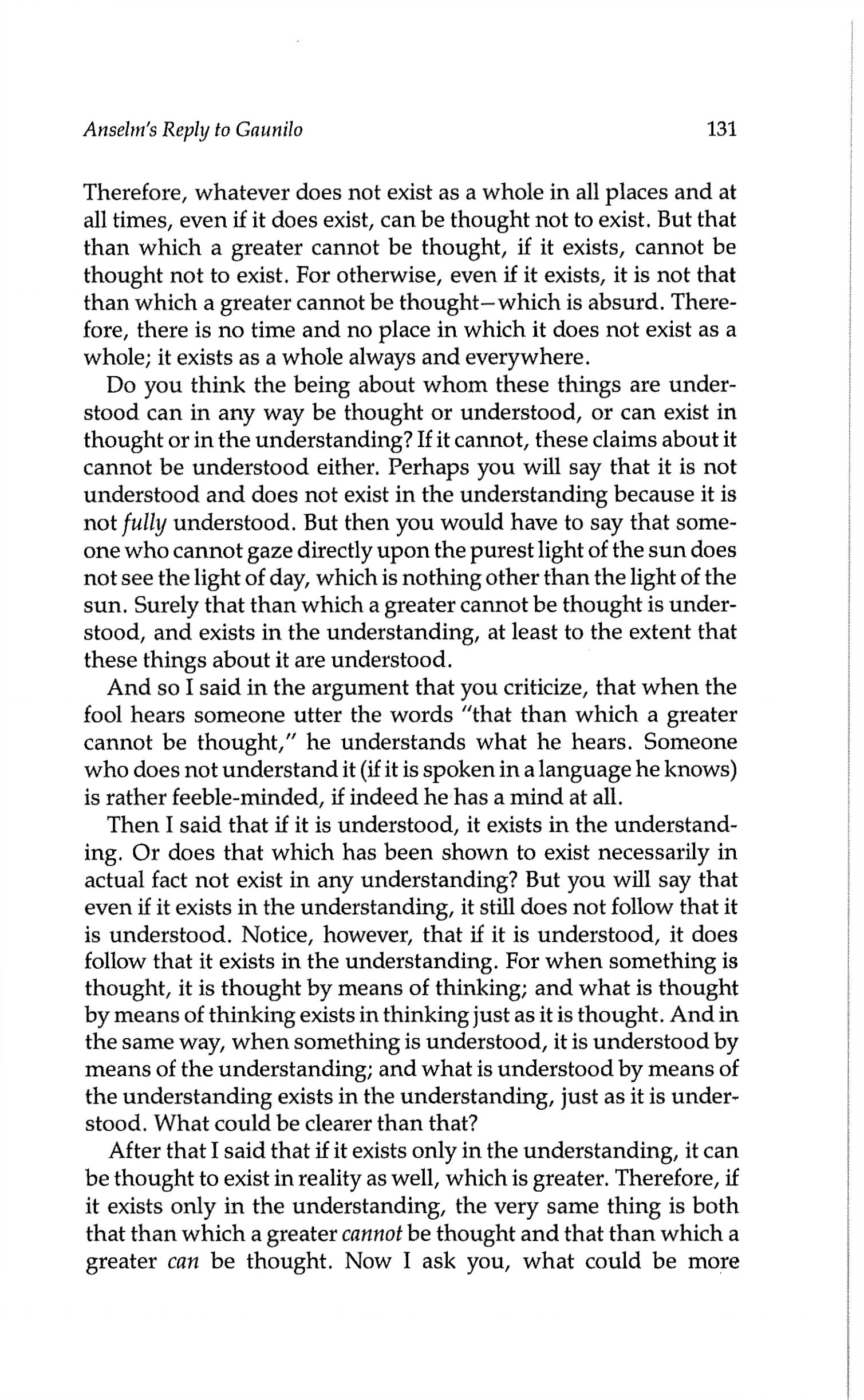
Therefore, whatever does not exist as a whole in all places and at all times, even if it does exist, can be thought not to exist. But that than which a greater cannot be thought, if it exists, cannot be thought not to exist. For otherwise, even if it exists, it is not that than which a greater cannot be thought-which is absurd. There fore, there is no time and no place in which it does not exist as a whole; it exists as a whole always and everywhere.
Do you think the being about whom these things are under stood can in any way be thought or understood, or can exist in thought or in the understanding? If it cannot, these claims about it cannot be understood either. Perhaps you will say that it is not understood and does not exist in the understanding because it is not fully understood. But then you would have to say that some one who cannot gaze directly upon the purest light of the sun does not see the light of day, which is nothing other than the light of the sun. Surely that than which a greater cannot be thought is under stood, and exists in the understanding, at least to the extent that these things about it are understood.
And so I said in the argument that you criticize, that when the fool hears someone utter the words "that than which a greater cannot be thought," he understands what he hears. Someone who does not understand it (if it is spoken in a language he knows) is rather feeble-minded, if indeed he has a mind at all.
Then I said that if it is understood, it exists in the understand ing. Or does that which has been shown to exist necessarily in actual fact not exist in any understanding? But you will say that even if it exists in the understanding, it still does not follow that it is understood. Notice, however, that if it is understood, it does follow that it exists in the understanding. For when something is thought, it is thought by means of thinking; and what is thought by means of thinking exists in thinking just as it is thought. And in the same way, when something is understood, it is understood by means of the understanding; and what is understood by means of the understanding exists in the understanding, just as it is under stood. What could be clearer than that?
After that I said that if it exists only in the understanding, it can be thought to exist in reality as well, which is greater. Therefore, if it exists only in the understanding, the very same thing is both that than which a greater cannot be thought and that than which a greater can be thought. Now I ask you, what could be more
Anselm's Reply to Gaunilo logical? For if it exists only in the understanding, can it not be thought to exist in reality as well? And if it can, does not the one who thinks it, think something greater than that thing is if it exists only in the understanding? So if that than which a greater cannot be thought exists only in the understanding, it is that than which a greater can be thought: what more logical conclusion could there be? But of course that than which a greater cannot be thought is not the same in anyone's understanding as that than which a greater can be thought. Does it not follow, therefore, that if that than which a greater cannot be thought exists in any understand ing at all, it does not exist only in the understanding? For if it exists only in the understanding, it is that than which a greater can be thought, which is absurd.
But, you say, this is just the same as if someone were to claim that it cannot be doubted that a certain island in the ocean, surpassing all other lands in its fertility (which, from the dif ficulty— or rather, impossibility— of finding what does not exist, is called "the Lost Island"), truly exists in reality, because someone can easily understand it when it is described to him in words. I say quite confidently that if anyone can find for me something existing either in reality or only in thought to which he can apply this inference in my argument, besides that than which a greater cannot be thought, I will find and give to him that Lost Island, never to be lost again. In fact, however, it has already become quite clear that that than which a greater cannot be thought cannot be thought not to exist, since its existence is a matter of such certain truth. For otherwise it would not exist at all.
Finally, if someone says that he thinks it does not exist, I say that when he thinks this, either he is thinking something than which a greater cannot be thought, or he is not. If he is not, then he is not thinking that it does not exist, since he is not thinking it at all. But if he is, he is surely thinking something that cannot be thought not to exist. For if it could be thought not to exist, it could be thought to have a beginning and an end, which is impossible. Therefore, someone who is thinking it, is thinking something that cannot be thought not to exist. And of course someone who is thinking this does not think that that very thing does not exist. Otherwise he would be thinking something that cannot be thought. Therefore, that than which a greater cannot be thought cannot be thought not to exist.
Anselm's Reply to Gaunilo
When I say that this supreme being cannot be thought not to exist, you reply that it would perhaps be better to say that it cannot be understood not to exist, or even to be capable of not existing. But in fact it was more correct to say that it cannot be thought not to exist. For if I had said that this thing cannot be understood not to exist, you (who say that in the strict sense of the word false things cannot be understood) might well object that nothing that exists can be understood not to exist, since, after all, it is false that something that exists does not exist. Consequently, it is not God alone who cannot be understood not to exist. But if any of those things that most certainly exist can be understood not to exist, then other things that are certain can likewise be understood not to exist. If, however, we say 'thought' [rather than 'understood'] this objection will have no force if it is examined properly. For even if nothing that actually exists can be understood not to exist, everything can be thought not to exist, except for that which exists supremely. Indeed, all and only those things that have a begin ning or end, or are made up of parts, as well as whatever does not exist always and everywhere as a whole (as I discussed earlier), can be thought not to exist. The only thing that cannot be thought not to exist is that which has neither beginning nor end, and is not made up of parts, and which no thought discerns except as wholly present always and everywhere.
So you should realize that you can indeed think of yourself as not existing even while you know with absolute certainty that you exist. I am amazed that you said you did not know this. For we think of many things as not existing that we know exist, and we think of many things as existing that we know do not exist-not judging, but imagining, that things are as we are thinking of them. And so we can in fact think of something as not existing even while we know that it exists, since we can think the one thing and know the other at the very same time. And yet we cannot think of something as not existing even while we know that it exists, since we cannot think of it as existing and not existing at the same time. So if someone distinguishes the two senses of this statement in this way, he will understand that in one sense noth ing can be thought of as not existing when we know that it exists, and in another sense anything besides that than which a greater cannot be thought can be thought not to exist, even when we know that it exists. Thus God alone cannot be thought not to exist,
Anselm's Reply to Gaunilo but nonetheless it is also true that there are many things that cannot be thought not to exist while they actually exist. I think, however, that I adequately explained in my book the sense in which God is thought not to exist.8
Now as for the other objections you raise against me on behalf of the fool, anyone with much sense at all can easily see through them, so I had judged it best not to bother proving this. But since
I hear that some readers think they have some force against me, I will deal with them briefly. First, you repeatedly say that I argue that that which is greater than everything else exists in the under standing; and that if it exists in the understanding, it also exists in reality, for otherwise that which is greater than everything else would not be greater than everything else. Nowhere in anything I said can such an argument be found. For "that which is greater than everything else" and "that than which a greater cannot be thought" do not have the same force in proving that the thing spoken of exists in reality. For if someone says that that than which a greater cannot be thought is not something existing in reality, or is capable of not existing, or can be thought not to exist, he is easily refuted. For whatever does not exist is capable of not existing, and whatever is capable of not existing can be thought not to exist. Now whatever can be thought not to exist, if it does exist, is not that than which a greater cannot be thought.
And if it does not exist, it would not be that than which a greater cannot be thought even if it were to exist. But it makes no sense to say that that than which a greater cannot be thought, if it exists, is not that than which a greater cannot be thought, and that if it
[does not exist but] were to exist, it would not be that than which a greater cannot be thought. It is therefore evident that it exists, that it is not capable of not existing, and that it cannot be thought not to exist. For otherwise, if it exists, it is not the thing spoken of; and if it [does not exist but] were to exist, it would not be the thing spoken of.
This does not seem to be so easily proved with regard to what is said to be greater than everything else. For it is not as evident that something that can be thought not to exist is not that which is greater than everything else that exists, as it is that such a thing is not that than which a greater cannot be thought. Nor is it indubita
8. See chapter 4 of the Proslogion.
Anselm's Reply to Gau nil o
ble that if there is something greater than everything else, it is the same as that than which a greater cannot be thought, or that if such a thing were to exist, there would not exist another thing just like it. But these things are certainly true of what is called "that than which a greater cannot be thought." For what if someone were to say that something exists that is greater than everything else that exists, and yet that this very thing can be thought not to exist, and that something greater than it can be thought, although that greater thing does not actually exist? Can it be just as easily inferred in this case that it is not greater than everything else that exists, as it was perfectly certain in the previous case that it was not that than which a greater cannot be thought? In the second case we would need another premise, besides the mere fact that this being is said to be "greater than everything else," whereas in the first case there was no need for anything more than the expression "that than which a greater cannot be thought." There fore, since "that than which a greater cannot be thought" proves things about itself and through itself that cannot be proved in the same way about what is said to be "greater than everything else," you have unjustly criticized me for saying things I did not say, when they differ greatly from what I actually said.
If, however, this can be proved through some further argu ment, you should not have criticized me for saying something that can be proved. And that it can in fact be proved should be easily perceived by anyone who knows that it can be proved for that than which a greater cannot be thought. For that than which a greater cannot be thought cannot be understood as anything other than the one thing that is greater than everything else. Therefore, just as that than which a greater cannot be thought is understood and exists in the understanding, and therefore is affirmed to exist in actual fact, even so that which is said to be greater than everything else is with necessity inferred to be understood, to exist in the understanding, and consequently to exist in reality. So you see how right you were to compare me to that stupid man who was willing to affirm the existence of the Lost Island solely because the island would be understood if someone described it.
But you also raise the objection that all sorts of false or doubtful things can be understood, and exist in the understanding, in the vety same way as the being I was talking about. I wonder what force you thought this objection could have against me. I was
Anselm's Reply to Gaunilo simply trying to prove something that was still in doubt, and for that it was enough for me to show that this being is understood, and exists in the understanding, in some way or other, since on that basis the argument would go on to determine whether it exists only in the understanding, like a false thing, or also in reality, like a real thing. For if false and doubtful things are understood, and exist in the understanding, in the sense that one who hears them spoken of understands what the speaker means, there is no rea son that the being I was discussing could not be understood or exist in the understanding.
But how can these two claims of yours be consistent: first, that if someone spoke of false things, you would understand whatever he said; and second, that if what you heard is not had in thought in the same way that false things are, you would not say that you think it and have it in your thought, but rather that you under stand it and have it in your understanding, since you cannot think this thing without understanding it, that is, comprehending in genuine knowledge that it exists in reality? How, I ask, can these be consistent: that false things are understood, and that to under stand is to comprehend in genuine knowledge that something exists? You should realize that this objection has no force against me. If false things can indeed be understood in some sense, and your definition of understanding applies not to all but only to some cases of understanding, then I should not have been crit icized for saying that that than which a greater cannot be thought is understood and exists in the understanding even before it was certain that it exists in reality.
Next, you say that it is nearly impossible to believe that when this thing has been spoken of and heard, it cannot be thought not to exist in the way that even God can be thought not to exist. Let those who have acquired even a meager knowledge of disputation and argument reply on my behalf. Is it rational for someone to deny [the existence of] what he understands, simply because it is said to be the same as something [whose existence] he denies because he does not understand it? Or if [its existence] is some times denied because it is only partly understood, and it is the same as something that is not understood at all, are not things in doubt more easily proved to be true of what exists in some under standing than of what exists in no understanding? Therefore, it is impossible to believe that someone would deny [the existence of]
Anselm's Reply to Gaunilo
that than which a greater cannot be thought, which he under stands to some extent when he hears of it, simply because he denies [the existence of] God, whose meaning he is not thinking of in any way. Or, if he also denies [the existence of] that than which a greater cannot be thought, because he does not fully understand it, is it not easier to prove [the existence of] what is understood to some extent than to prove what is not understood at all? So it was not irrational for me to prove against the fool that God exists by making use of the expression "that than which a greater cannot be thought," since he would understand that ex pression to some extent, whereas he might not understand 'God' at all.
You go to some trouble to show that that than which a greater cannot be thought is not the same sort of thing as a picture, not yet painted, in the understanding of the painter, but your argument is not to the point. I did not bring up the picture that is thought out beforehand in order to claim that it was the same sort of thing as the being I was discussing, but merely so I could show that something exists in the understanding that would not be under stood to exist [in reality].
Again, you say that when you hear "that than which a greater cannot be thought," you cannot think it in accordance with some thing that you know by genus or species, or have it in your understanding, since you do not know the thing itself and cannot infer it on the basis of something similar. But that is clearly wrong.
For since every lesser good, insofar as it is good, is similar to a greater good, it is clear to every reasonable mind that by raising our thoughts from lesser goods to greater goods, we can infer a great deal about that than which a greater cannot be thought on the basis of those things than which a greater can be thought.
Who, for example, is unable to think (even if he does not believe that what he thinks exists in reality) that if something that has a beginning and end is good, then something that has a beginning but never ceases to exist is much better? And that just as the latter is better than the former, so something that has neither beginning nor end is better still, even if it is always moving from the past through the present into the future? And that something that in no way needs or is compelled to change or move is far better even than that, whether any such thing exists in reality or not? Can such a thing not be thought? Can anything greater than this be
Anselm's Reply to Gaunilo thought? Or rather, is not this an example of inferring that than which a greater cannot be thought on the basis of those things than which a greater can be thought? So there is in fact a way to infer that than which a greater cannot be thought. And so in this way it is easy to refute a fool who does not accept the sacred authority, if he denies that one can infer that than which a greater cannot be thought on the basis of other things. But if an orthodox
Christian were to deny this, he should recall that "since the creation of the world the invisible things of God—his everlasting power and divinity-have been clearly seen through the things that have been made" (Romans 1:20).
But even if it were true that that than which a greater cannot be thought cannot be thought or understood, it would not be false that [the expression] "that than which a greater cannot be thought" can be thought and understood. For just as one can use the word
'ineffable', even though the thing that is said to be ineffable cannot be spoken of; and just as 'unthinkable' can be thought, even though the thing to which the word 'unthinkable' applies cannot be thought; in the same way, when someone says "that than which nothing greater can be thought," that which is heard can undoubtedly be thought and understood, even though the thing itself than which a greater cannot be thought cannot be thought or understood.
For even if someone is foolish enough to say that something than which a greater cannot be thought does not exist, he will surely not be shameless enough to say that he cannot understand or think what he is saying. Or, if such a person does turn up, not only should his words be repudiated, but he himself should be ridiculed. So anyone who denies the existence of something than which a greater cannot be thought surely understands and thinks the denial that he is making. Now he cannot understand or think this denial without its parts. And one part of it is "that than which a greater cannot be thought." Therefore, whoever denies this, understands and thinks that than which a greater cannot be thought. Now it is quite clear that something that cannot fail to exist can be thought and understood in the same way. And one who thinks this is thinking something greater than is one who thinks something that can fail to exist. Therefore, if, while he is thinking that than which a greater cannot be thought, he thinks that it can fail to exist, he is not thinking that than which a greater
Anselm's Reply to Gatinilo
cannot be thought. But it is not possible for the same thing at the same time both to be thought and not to be thought. Therefore, someone who thinks that than which a greater cannot be thought does not think that it can, but rather that it cannot, fail to exist. For this reason the thing that he is thinking exists necessarily, since whatever can fail to exist is not what he is thinking.
I believe I have now shown that my proof in the foregoing book that that than which a greater cannot be thought exists in reality was no weak argument, but a quite conclusive one, one that is not weakened by the force of any objection. For the signification of this expression has such great force that the thing it expresses is, from the mere fact that it is understood or thought, necessarily proved both to exist in reality and to be whatever we ought to believe about the divine nature. Now we believe about the divine nature every thing that can be thought, absolutely speaking, better for some thing to be than not to be. For example, it is better to be eternal than not eternal, good than not good, and indeed goodness itself, rather than not goodness itself. That than which something greater cannot be thought cannot fail to be anything of this sort.
So one must believe that that than which a greater cannot be thought is whatever we ought to believe about the divine nature.
I am grateful for your kindness both in your criticisms and in your praise of my book. For since you lavished such great praise on the things you found worthy of acceptance, it is quite clear that you criticized the things that seemed weak to you, not from ill will but in a friendly spirit.

GLOSSARY References to the Monologion and Proslogion are given by an ZM' or a 'P', respectively, followed by the number of the relevant chapter, accident: An accident is a feature something has that does not belong to its essence* (in sense 2). For example, as Anselm under stands it, the essence of a human being is to be rational, animal, and mortal. So any feature that a human being has, other than being rational, animal, and mortal, is an accident. To say that something is "subject to accidents" or "susceptible of accidents" is simply to say that it can have such features that do not belong to its essence.
In M25 Anselm asks whether God is subject to accidents. It would seem that he must be. Such a feature as "being greater than all other natures" seems to be an accident, for example, because it is not part of God's essence to be greater than any other natures.
As Anselm argues in M15, if God had not created anything, he would not be the greatest, since there would be nothing else to compare him to. But nothing about his essence would be changed.
It therefore seems that being greater than other natures is accidental to God. But if something is subject to accidents, it is changeable, and of course God is supposed to be supremely unchangeable.
Anselm's solution to the problem is to distinguish between acci dents that do imply a change and those that do not. body: The word 'body' is used more broadly in philosophy than in ordinary language. Any material object at all is a body in the philosophical sense. So chairs and tables are bodies, as are the bodies of human beings and other living creatures. consubstantial: The Nicene Creed says that God the Son is consubstantial with the Father; that is, God the Son is one in being with the Father. Whatever the Father is, the Son is, and vice versa.
It might be helpful for the reader to have the relevant portions of the Nicene Creed. The italicized phrases are those that Anselm deals with explicitly in the Monologion. Following each phrase is the number of the chapter in which he argues for that phrase.
Glossary I believe in one Lord, Jesus Christ, the only-begotten Son (42) of God, begotten of the Father (42) before all worlds (32), God from God, Light from Light, true God from true God, begotten (40-41), not made (29), consubstantial zoith the Father (29). Through him all things were made
(29). ... I believe in the Holy Spirit, the Lord and Giver of life, who proceeds from the Father and the Son (50, 54). efficient cause: In M6 Anselm distinguishes three sorts of causes.
The efficient cause is the one that more or less corresponds to our ordinary English usage of the word 'cause'. The efficient cause of x is whatever brings about or produces x. The material cause of a thing is the matter out of which it is made; the instrumental cause of a thing is any tool that was used in.bringing it about. To use a standard example, the material cause of a marble statue is the marble it is made of, the instrumental cause is the sculptor's chisel or other tools, and the efficient cause is the sculptor.
In this passage Anselm is generally careful to use different prepositions for each of the three causes. A thing is said to come about "by the agency of" an efficient cause, "from" a material cause, and "by means of" an instrumental cause. essence: Anselm uses the word 'essence' in three ways:
(1) It signifies the individual thing that exists. In this usage "an essence" is synonymous with "an existent being."
(2) It signifies the nature of a thing. For example the essence of a human being is to be rational, animal, and mortal. Such other features as being tall or short, dark or fair, male or female are accidents.* (3) Occasionally it simply means 'existence'. essentially: See substantially/essentially. eternal: To say that God is eternal is not to say that he exists at all times. Rather, it is to say that God exists outside time altogether.
That is, he exists in such a way that he has no past, present, or future. All of his existence is simultaneous. Anselm explicates and argues for the doctrine of eternity in M21 and P13 and 18-20. impassible: This word comes from the Latin 'pati', "to undergo or suffer," which is contrasted with 'agere', "to do or act." To say that God is impassible therefore means that he cannot suffer or un dergo anything. He cannot be acted upon by anything else; he
Glossary
simply acts. Anselm explicates and argues for the doctrine of impassibility in P8. nature: 'Nature' is interchangeable with essence* in both sense (1) and sense (2). When Anselm says that God is a nature, he simply means that God is an individual existent being. posterior to: There are a number of different ways in which something can be posterior to something else. For example, x is posterior to y if (i) x is later in time than y, or (ii) x is caused by y, or (iii) the existence or truth of x is explained by the existence or truth of y, but not vice versa. quality/quantity/quiddity: These three terms (Anselm uses only the first two) are associated with three different kinds of questions one can ask about a thing. One can ask "Quid est?" or "What is it?"
The answer to that question will tell you a thing's quiddity—in other words, its essence* (in sense 2). One can ask "Qualis est?" or "What sort of thing is it?" The answer to that question will tell you some quality that a thing has, such as justice or goodness. Finally, one can ask "Quantum est?" or "How great is it?" The answer to that question will tell you something about the quantity of the thing, as for example whether it is great or small. Anselm argues in M16 that when we apply words like 'just' and 'great' to God, they do not signify some quality or quantity of God's. Rather, they signify his essence. For example, justice is not a quality God has, as if God were one thing and his justice were some other thing.
Rather, justice is what God is. relative: "Daughter," for example, is a relative (or "relative term"), since it implies a relation to a parent. Someone is called a daugh ter, not because of what she is in herself, but because of the relation she has to someone else. relatively: Anselm claims that relatives* are not said substan tially* of things. In the sentence "Mary is a daughter," 'daughter' is not said substantially of Mary, since it does not signify her essence or substance. Instead, it is said relatively of Mary. If instead one said "Mary is rational," 'rational' would be said sub stantially of Mary, since being rational is part of the essence of being human.
Glossary several: The Latin word 'plures' means "more than one." Wherever possible I have translated it thus; elsewhere I have translated it as 'several'. The reader should therefore keep in mind that 'several' need not imply a large number; it simply implies more than one. simple: To say that God is simple is to say that he has no parts.
More specifically, Anselm argues that God has no spatial parts (in M21), no temporal parts (in M21 and P18; see eternal*), and no metaphysical parts (in M17 and P18). subsist: 'Subsist' means "to exist (as a substance)." In other words, saying that a substance subsists is exactly the same as saying that it exists. But accidents* do not subsist; they can only exist in a substance, not as a substance. subsistent: An individual existent being; a thing that subsists, substance: The word 'substance' is used in a variety of ways:
(1) It can be used interchangeably with essence* in either sense (1) or sense (2).
(2) It can be used to signify the individual thing that underlies accidents.* In M79 Anselm argues that individual things are properly called substances because they "stand under" ('substant') accidents. Anselm argues in M26 that God can be called a sub stance in sense (1) but not in sense (2), because he does not, strictly speaking, have any accidents.
(3) It has a technical usage in Trinitarian theology. It was (and remains) customary in the Western Church to speak of God as three persons in one substance, not as three substances. So An selm realized that his suggestion in M79 that one can speak of God as three substances would be likely to raise eyebrows. He therefore explains in the Prologue that he was following the usage of the Eastern Church, which speaks of the Trinity as being three ouoiai in one DTrooraou;. Since the standard Latin translations for ouoia and UKOoraou; are 'substantia' and 'persona', respectively, it turns out that the Eastern Church speaks of God as three sub stances in one person, and so Anselm's usage is within the scope of orthodoxy. substantially/essentially: In the sentence "Socrates is human,"
'human' is said substantially (or essentially) of Socrates. That is, 'human' signifies something belonging to Socrates's substance* or essence* (in sense (2)). Contrast this with 'pale' in "Socrates is
Glossary
pale." Being pale is not part of Socrates's substance or essence, and so in that sentence 'pale' is not said substantially of Socrates. So when Anselm asks what can be said of God substantially, he is asking what terms (if any) signify God's essence. For example,
'Creator' would not be said substantially of God, since it is not part of God's essence to be the Creator. God was, as Anselm would insist, free either to create or not to create, just as he chose. In M15
Anselm argues that certain words are indeed said substantially of God, and he proposes a way of deciding which ones those are.
Sustainer: Recently the practice has arisen of speaking of the Trinity as "Creator, Redeemer, and Sustainer" rather than as "Father, Son, and Holy Spirit." It is therefore important for me to point out that when Anselm uses the word "Sustainer" he is not referring exclusively to the Holy Spirit. When the word is first introduced in M14, it refers to God the Father. Later, after Anselm has argued that all three persons of the Trinity are Creator, we can assume that all three are also Sustainer, since he argues in M13 that the same agency both creates and sustains all things. unqualified/in an unqualified sense (Latin, simplex I simpliciter):
According to Anselm, when one says, for example, that a creature is good, one must qualify that statement in various ways. A creature can only be good in a certain respect or for a certain purpose or to a certain degree. God, by contrast, can be called an unqualified good, or good in an unqualified sense. That is, he is good, period; no qualification of the statement is necessary (or even possible).
The same goes for saying that God exists in an unqualified sense.
Creatures exist for a time or in a certain way or to a certain extent; God just exists, period.
Word: The Prologue to the Gospel according to John states, "In the beginning was the Word. And the Word was with God; and the Word was God. All things were made through him, and without him was nothing made." As Anselm explains it, 'Word' is a particularly apt name for God the Son, since he is God's utterance of himself and of creation (see M33). In keeping with these words from Scripture as well as the Nicene Creed (see consubstantial*),
Anselm argues that this utterance or Word existed in the beginning (that is, eternally: M32); that he is God (M29); and that all things were made through him (M29).

INDEX accidents: 141; as related to 107-8,110-13,142; of other immutability, 44-45; God has eternal things, 107-8,112 existence: in reality vs. in the none, 44-46 understanding, 99-100,121-24, Augustine: 3-4, 99/7., 122 129,131-32 existence of God: proof from belief (see also faith): 77, 86-87; in existence, 12-13; proof from the whole Trinity, 87; necessary goodness, 10-12; proof from for understanding, 99; vs. belief greatness, 12; proof from levels in, 88 of dignity, 13-15; proofs from Boethius: definition of eternity in, "that than which a greater 43 n.; definition of person in, cannot be thought," 99-101 88 n. faith: in what is composites: 31-32, 36, 111; all incomprehensible, 77; living vs. things in time and place are dead, 87-88 composites, 41,130-31 craftsman: 15,122; analogous to God: cannot be thought not to God as Creator, 23; exist, 100-101,125-26,129-30, disanalogous to God as Creator, 132-34,136; creatures exist 24-25 through him, 12-13; does not creatures: changeable, 47; exist from nothing or through different levels of dignity, 13-14, nothing, 15-18; does not have 50-51, 79-80; do not exist in an but is his qualities, 29-31,107; unqualified sense, 47-48,113, exists always, 43-44; exists from 145; exist from God, 15,18-20; himself, 15-18; exists exist through God, 12-15,18-20; everywhere, 42-43; exists in an imitate the Word, 50-51, 79-80; made by God, 10,18-20; made from nothing, 20-22,113; not unqualified sense, 47-48,113, 145; exists through himself, 12-13,15-18,102; good through nothing before they were made, himself, 10-12, 27; great 22, 55; sustained in existence by God, 26, 47,113 through himself, 12; greater than can be thought, 109; the Holy Spirit, see Spirit; in what sense he is a substance, 45-47, elements: 18 eternity: definition in Boethius, 144; has no accidents (in the 43 n.; of God: 32-33, 35-44, 47, strict sense) 44-45,141; is the
Index God (continued) matter: 15,16,18-20 memory: as designating God the supreme truth, 33, 38; Lord and Ruler of all, 89-90; made Father, 65-66, 72-73 mercy of God: 102,104-7 creatures from nothing, 19-22, 56, 70,102; not a body, 29,102; Monologion: circumstances of its the only God, 90; only object of composition, 3-4, 93; meaning prayer and worship, 89-90; of the title, 94; original title, 93 percipient, 51,102; relation to nothing: in what sense creatures time and place, 35-44,107-8, were made from nothing, 20-22; 110-13; the reward of those who love him, 83-84; the Son, see in what sense nothing exists before or after God, 33-35; Word; source of goodness, 10-12; source of greatness, 12; nothing exists through nothing, sustains creation, 26, 47-48, 90;
utters creatures before he makes them, 22-24; whatever it is omnipotence of God: 102,103, better to be than not to be, 115-16 omnipresence of God: 26-27, 28-29,102,139 35-43,107-8 Holy Spirit: see Spirit omniscience of God: 102 hope: 86 painter: illustration of the immanence: of God in creation, difference between existing in 26-27, 41-43,112 the understanding and existing immortality of the soul: 81-85 in reality, 100,122-23,137 person: definition of, in Boethius, immutability of God: 19, 44-46, 88 n.; God as one, 4, 88-89,144; God as three, 4, 88-89,144 47-48, 50,113 impassibility of God: 102,104, place: 35-38, 39-44 142-43 incomprehensibility: of God, Proslogion: circumstances of its 77-79,109; of God's knowledge composition, 93; meaning of the or utterance of creation, 56; of title, 94; original title, 93 God's knowledge or utterance relations: some do not imply of himself, 77 ineffability of the Trinity: 57-58, mutability, 44-45 relatives: 13, 27-29, 57,143 88-89; does not prevent true conclusions about God, 78-79 say in one's heart (- think): 65-66, justice of God: 29-30,104-7
Scripture: authority of, 3 Lost Island: 124-25,129,132,135 signs (see also words): perceptible love: as designating God the Holy vs. imperceptible, 23-24 Spirit, 71-73,114; necessary for simplicity of God: 31-32, 36-39, living faith, 87-88 45, 46,110,114,144
Index
soul (- rational mind): happiness, false things, 121,124-25,133, 81-82,114-17; immortal, 85; key 135-36; vs. thinking, 125,133 utterance (see also Word, words): to understanding God, 79-80; made for loving God, 81-82; 74-77; three kinds, 23; in God is the same as understanding, 49, mirror and image, 80; misery, 52-53, 55; of creatures within 82, 84; most excellent creature, 50-51, 79-80; not a body, 29; not bounded by place, 43; wholly the divine reason, 23-25 present in more than one place, Word (God the Son): 145;
Spirit (God the Holy Spirit): as begotten by the Father, 59-61, 70; born from the Father, 58-59, great as the Father and Son, 6769,114; breathed out, 70-71; 76; coeternal with the Father, Creator, 70; essence, etc., of the 5253; consubstantial with the Father and Son, 71; mutual love Father, 48-49, 56,113-14,141-42; of the Father and Son, 66-67, Creator, 56-57; creatures always exist in him, 55; distinguishing 114; neither begotten nor unbegotten, 69-70; not a son, characteristics, 58-62; essence of the Father, 62-64; exists 69; not created, 70; proceeds from the Father and the Son, 67, through himself, 62-63; image 6869, 71,114; properly called of the Father, 53-54, 58-59, 76; Spirit, 71; spirated, 71 n, made all things, 48, 56; not a Word of creation, 54; not substance: 144; in what sense God created, 49, 70; one, not several, is a substance, 45-46; individual 4950, 53-54, 75-77; only of the vs. universal, 46-47; one in Father, 76-77; signified by God, 4, 88-89,144; three in God, 4, 88-89,144 'understanding7, 65-66, 72-73; Son (not Daughter), 60-61; the substantially: 144-45; what can be truth of creatures, 50-51; the said substantially of God, truth of the Father, 64-65 27-29, 31-32 words: born from the memory, 65-66; likenesses of things, time: 35-37, 38-44 5054, 74; meaning when transcendence of God: 26-27, applied to God, 45-46, 78-79; 107-8,112 natural, 23-24; natural vs. truth: has no beginning or end, 33 conventional, 24 n,; vehicle of thought and knowledge, 23-24, understanding: as designating God the Son, 65-66, 72-73; of 5354, 65-66, 74

"The works translated here present some of the most profound issues in mediaeval philosophy, including the 'ontological argument' for the existence of God, perhaps the most contro versial philosophical argument ever formulated. Anselm's work comes at that point in the Middle Ages where dialectic and rigorous argument had begun to distinguish philosophy from Scripture studies and 'wisdom literature' generally. Yet he has not developed the arcane and technical scholastic vocabulary that can make later mediaeval philosophy seem so impenetrable and forbidding. As such, these texts are ideal for introducing philosophy students to the mediaeval period. Williams's trans lations are scrupulously faithful and accurate without being slavishly literal, and yet are lively and graceful to both the eye and the ear."
—Paul Vincent Spade, Indiana University Thomas Williams is Associate Professor of Philosophy,
University of South Florida.
978087220297990000