
Chapter 80
Chapter 78
And so if anyone wishes to talk about this with someone, what will he say the Father, the Son, and the Spirit of both are three of, unless perhaps for lack of a strictly appropriate word he is forced to choose one of those words that cannot be said in the plural of the supreme essence in order to signify that which cannot be said by a suitable word? For example, he might say that this wondrous
Trinity is one essence or nature and three persons or substances.78
For these two words are more fittingly chosen to signify the plurality within the supreme essence, since 'person' is said only of an individual rational nature, and 'substance' is principally said of individuals, which especially constitute a plurality. For it is indi viduals that especially stand under (i.e., underlie) accidents,* and therefore they more properly take the name of 'substance'.79
Hence it had already become evident above80 that the supreme essence, which does not underlie any accidents, cannot properly be called a substance unless 'substance' is being used instead of 'essence'.81 Therefore, by this argument of necessity that supreme and unified Trinity or threefold Unity can be blamelessly called one essence and three persons or three substances.
Chapter 80 That he is Lord of all and rules all and is the only God It therefore seems—indeed, it is unhesitatingly declared-that that which is called God is not nothing, and that the name 'God' is properly assigned only to this supreme essence. Surely everyone who says that God exists (whether one God or more than one) understands him to be nothing other than a substance that he thinks human beings ought to worship because of his preeminent dignity, and to entreat in any pressing need, beyond every nature that is not God. Now what is as deserving of worship because of his dignity, or as properly the object of prayer for anything at all, as the supremely good and supremely powerful spirit, who is
78. See the glossary entry for substance* (3).
79. See the glossary entry for substance* (2).
80. In chapter 36.
81. See the glossary entry for substance* (1) and (2).
Monologion Lord of all and rules all? For just as it has been established82 that all things were made and are sustained through his supremely good and supremely wise omnipotence, so also it is altogether absurd to suppose that he is not the Lord of the things he made, or that they are ruled by something less powerful or less good or less wise, or even by no reason at all, but merely by the unstable disorder of chance. For it is he alone through whom it goes well for anything, without whom it goes well for nothing, and from whom and through whom and in whom all things exist.83 Therefore, since he alone is not only the good Creator but also the most powerful Lord and most wise Ruler of all things, it is utterly clear that it is he alone whom all other natures should lovingly worship and worshipfully love with all their power, from whom alone they ought to hope for good things, to whom alone they ought to flee from troubles, to whom alone they ought to pray for anything at all. Truly, therefore, he is not merely God; he is the only God, ineffably three and one.
82. In chapter 13.
83. Cf. Romans 11:36: "Tor from him and through him and in him all things exist."
PROSLOGION

Prologue After I had published, at the urging of some of my brethren, a short work as a pattern for meditation on the reason of faith, adopting the role of someone who, by reasoning silently to him self, investigates things he does not know, I began to wonder, when I considered that it is constructed out of a chaining together of many arguments, whether it might be possible to find a single argument that needed nothing but itself alone for proof, that would by itself be enough to show that God really exists; that he is the supreme good, who depends on nothing else, but on whom all things depend for their being and for their well-being; and whatever we believe about the divine nature. And so I often turned my thoughts to this with great diligence. Sometimes I thought I could already grasp what I was looking for, and some times it escaped my mind completely. Finally, I gave up hope. I decided to stop looking for something that was impossible to find.
But when I tried to stifle that thought altogether, lest by occupying my mind with useless speculation it should keep me from things I could actually accomplish, it began to hound me more and more, although I resisted and fought against it. Then one day, when my violent struggle against its hounding had worn me down, the thing I had despaired of finding presented itself in the very clash of my thoughts, so that I eagerly embraced the thought I had been taking such pains to drive away.
Therefore, thinking that what I had rejoiced to discover would please a reader if it were written down, I wrote about it and about a number of other things in the work that follows, adopting the role of someone trying to raise his mind to the contempla tion of God and seeking to understand what he believes. Since
I had judged that neither this work nor the one I mentioned earlier deserved to be called a book, or to bear the name of an author, and yet I did not think they ought to be sent out without so much as a title by which they might induce someone who came across them to read them, I gave each a title. The first I called
"A pattern for meditation on the rational basis of faith"; the second I called "Faith seeking understanding." But since both works had been transcribed under these titles by several readers,
I was encouraged by a number of people (especially by Hugo, the Most Reverend Archbishop of Lyons, Apostolic Legate to
Proslogion France, who commanded me by his apostolic authority) to put my own name on these works. And so, in order to do so more suitably, I named the first Monologion, which means a speech made to oneself, and the second Proslogion, which means a speech made to another.
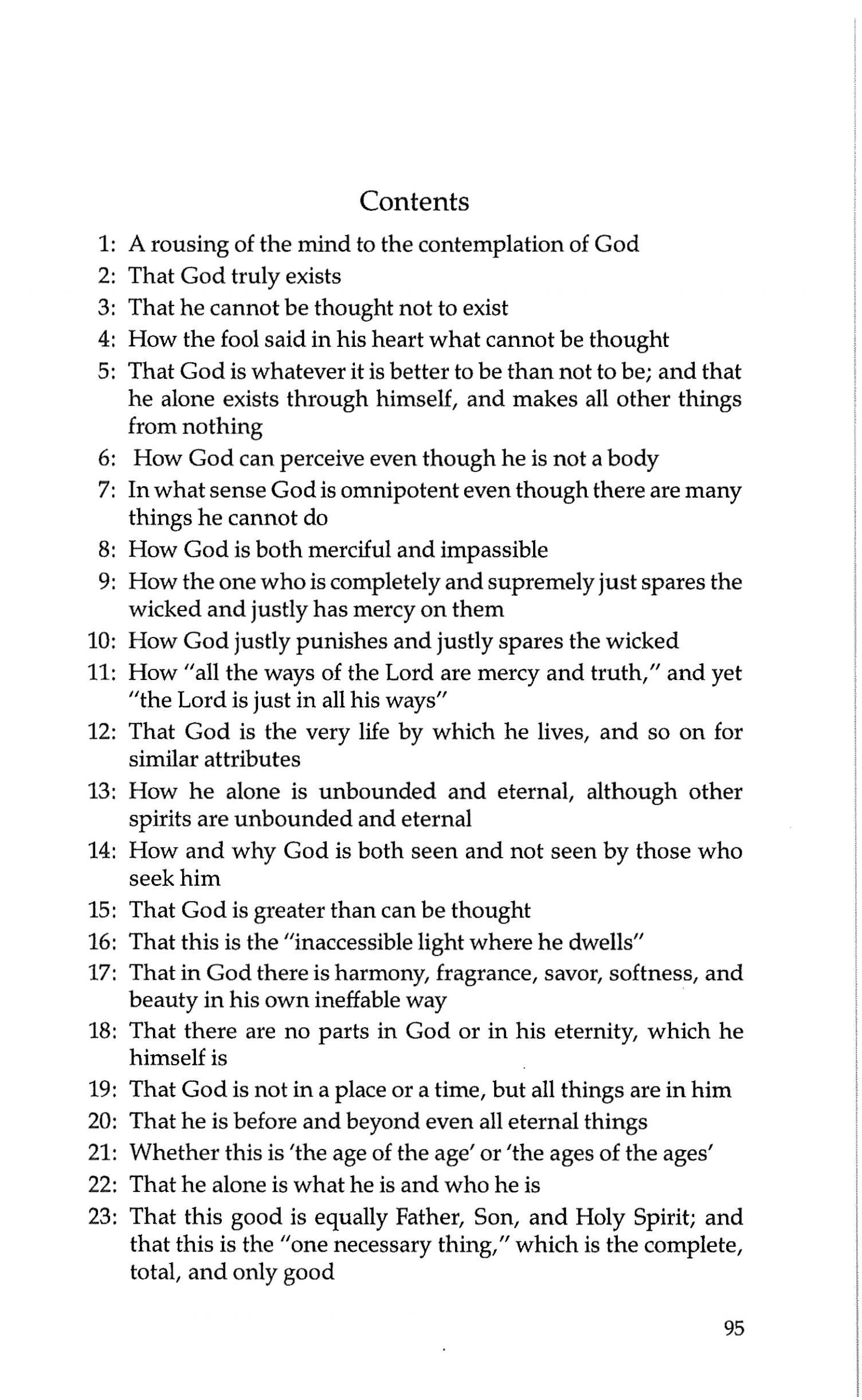
Contents 1: A rousing of the mind to the contemplation of God 2: That God truly exists 3: That he cannot be thought not to exist
4: How the fool said in his heart what cannot be thought 5: That God is whatever it is better to be than not to be; and that he alone exists through himself, and makes all other things from nothing 6: How God can perceive even though he is not a body
7: In what sense God is omnipotent even though there are many things he cannot do 8: How God is both merciful and impassible
9: How the one who is completely and supremely just spares the wicked and justly has mercy on them 10: How God justly punishes and justly spares the wicked
11: How "all the ways of the Lord are mercy and truth," and yet "the Lord is just in all his ways"
12: That God is the very life by which he lives, and so on for similar attributes 13: How he alone is unbounded and eternal, although other spirits are unbounded and eternal 14: How and why God is both seen and not seen by those who seek him 15: That God is greater than can be thought
16: That this is the "inaccessible light where he dwells"
17: That in God there is harmony, fragrance, savor, softness, and beauty in his own ineffable way 18: That there are no parts in God or in his eternity, which he himself is 19: That God is not in a place or a time, but all things are in him
20: That he is before and beyond even all eternal things 21: Whether this is 'the age of the age' or 'the ages of the ages'
22: That he alone is what he is and who he is 23: That this good is equally Father, Son, and Holy Spirit; and that this is the "one necessary thing," which is the complete, total, and only good
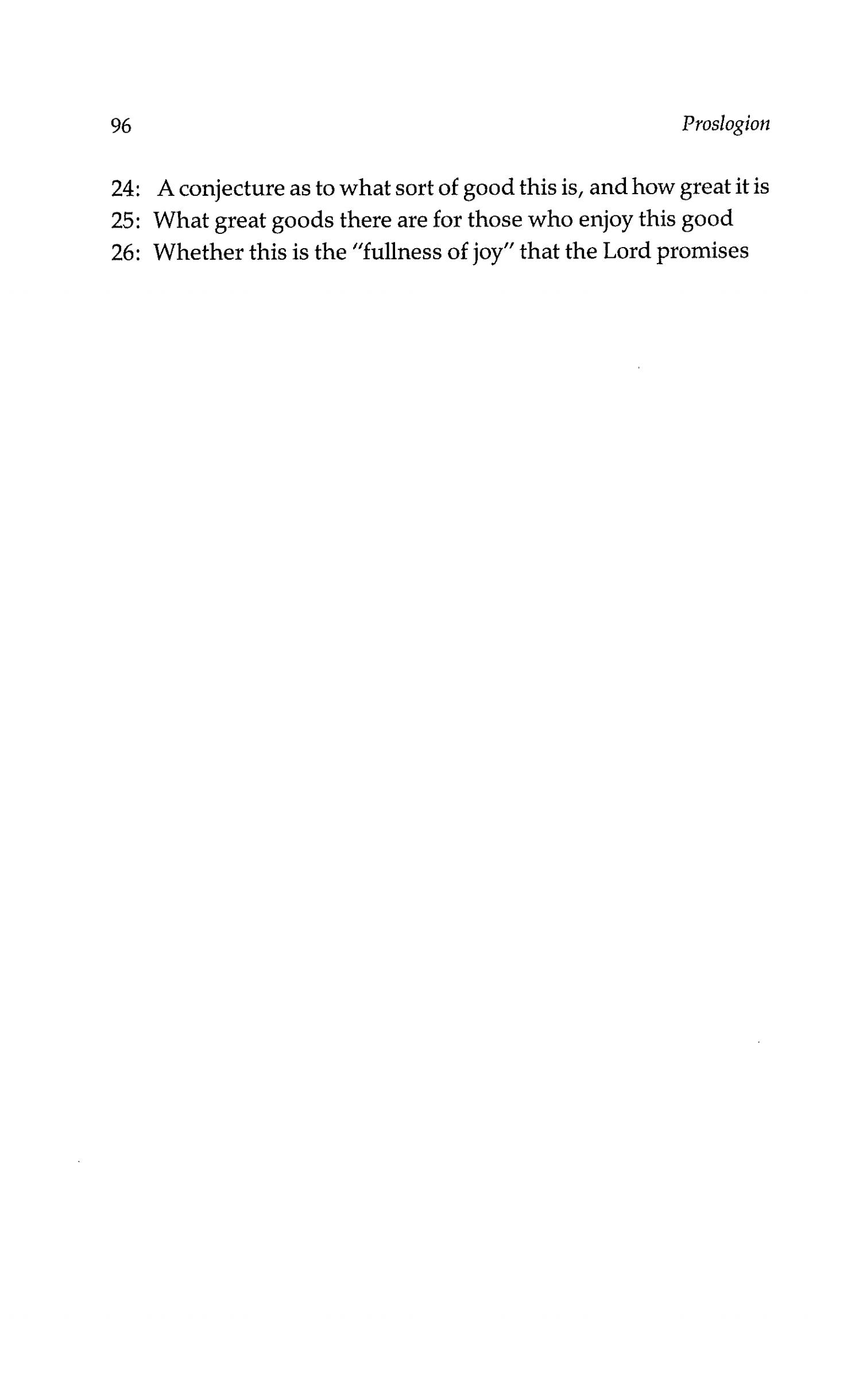
Proslogion 24: A conjecture as to what sort of good this is, and how great it is
25: What great goods there are for those who enjoy this good 26: Whether this is the "fullness of joy" that the Lord promises