Search this book · ఈ పుస్తకంలో వెతకండి
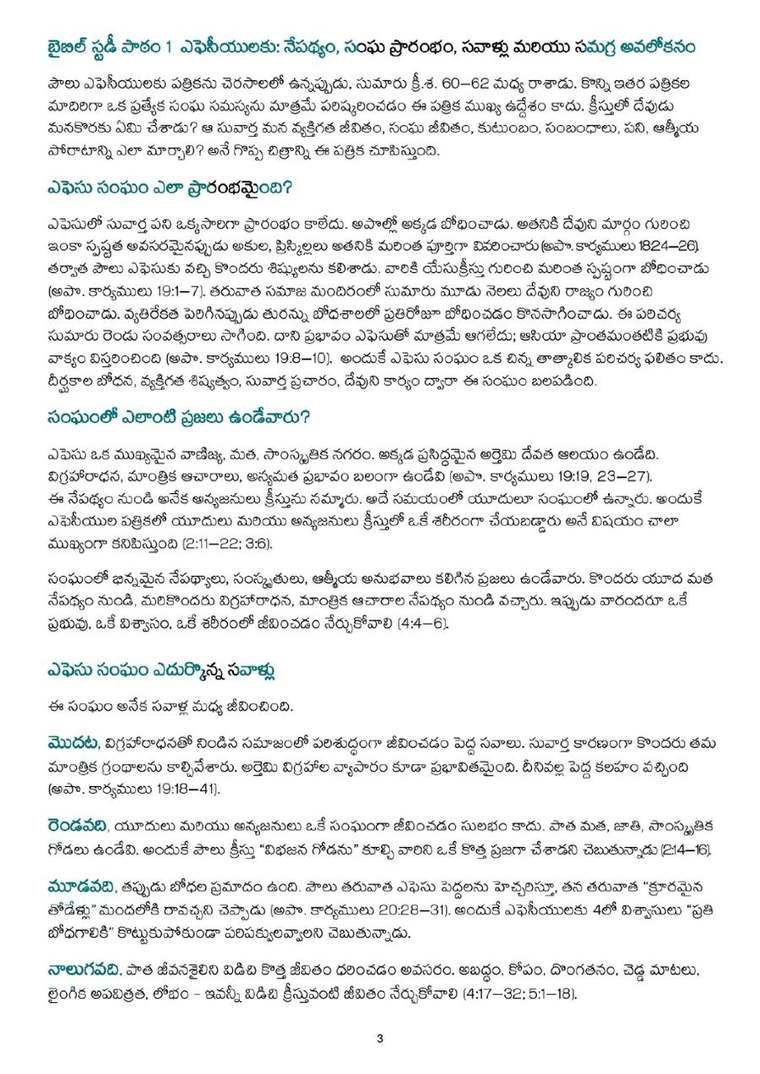
పౌలు ఎఫెసీయులకు పత్రికను చెరసాలలో ఉన్నప్పుడు, సుమారు క్రీ.శ. 60-62 మధ్య రాశాడు. కొన్ని ఇతర పత్రికల మాదిరిగా ఒక ప్రత్యేక సంఘ సమస్యను మాత్రమే పరిష్కరించడం ఈ పత్రిక ముఖ్య ఉద్దేశం కాదు. క్రీస్తులో దేవుడు మనకొరకు ఏమి చేశాడు? ఆ సువార్త మన వ్యక్తిగత జీవితం, సంఘ జీవితం, కుటుంబం, సంబంధాలు, పని, ఆత్మీయ పోరాటాన్ని ఎలా మార్చాలి? అనే గొప్ప చిత్రాన్ని ఈ పత్రిక చూపిస్తుంది.
ఎఫెసు సంఘం ఎలా ప్రారంభమైంది?
ఎఫెసులో సువార్త పని ఒక్కసారిగా ప్రారంభం కాలేదు. అపొల్లో అక్కడ బోధించాడు. అతనికి దేవుని మార్గం గురించి ఇంకా స్పష్టత అవసరమైనప్పుడు అకుల, ప్రిస్కిల్లలు అతనికి మరింత పూర్తిగా వివరించారు (అపొ. కార్యములు 18:24-26). తర్వాత పౌలు ఎఫెసుకు వచ్చి కొందరు శిష్యులను కలిశాడు. వారికి యేసుక్రీస్తు గురించి మరింత స్పష్టంగా బోధించాడు (అపొ. కార్యములు 19:1-7). తరువాత సమాజ మందిరంలో సుమారు మూడు నెలలు దేవుని రాజ్యం గురించి బోధించాడు. వ్యతిరేకత పెరిగినప్పుడు తురన్ను బోధశాలలో ప్రతిరోజూ బోధించడం కొనసాగించాడు. ఈ పరిచర్య సుమారు రెండు సంవత్సరాలు సాగింది. దాని ప్రభావం ఎఫెసుతో మాత్రమే ఆగలేదు; ఆసియా ప్రాంతమంతటికి ప్రభువు వాక్యం విస్తరించింది (అపొ. కార్యములు 19:8-10). అందుకే ఎఫెసు సంఘం ఒక చిన్న తాత్కాలిక పరిచర్య ఫలితం కాదు. దీర్ఘకాల బోధన, వ్యక్తిగత శిష్యత్వం, సువార్త ప్రచారం, దేవుని కార్యం ద్వారా ఈ సంఘం బలపడింది.
సంఘంలో ఎలాంటి ప్రజలు ఉండేవారు?
ఎఫెసు ఒక ముఖ్యమైన వాణిజ్య, మత, సాంస్కృతిక నగరం. అక్కడ ప్రసిద్ధమైన అర్తెమి దేవత ఆలయం ఉండేది. విగ్రహారాధన, మాంత్రిక ఆచారాలు, అన్యమత ప్రభావం బలంగా ఉండేవి (అపొ. కార్యములు 19:19, 23-27).
ఈ నేపథ్యం నుండి అనేక అన్యజనులు క్రీస్తును నమ్మారు. అదే సమయంలో యూదులూ సంఘంలో ఉన్నారు. అందుకే ఎఫెసీయుల పత్రికలో యూదులు మరియు అన్యజనులు క్రీస్తులో ఒకే శరీరంగా చేయబడ్డారు అనే విషయం చాలా ముఖ్యంగా కనిపిస్తుంది (2:11-22; 3:6).
సంఘంలో భిన్నమైన నేపథ్యాలు, సంస్కృతులు, ఆత్మీయ అనుభవాలు కలిగిన ప్రజలు ఉండేవారు. కొందరు యూద మత నేపథ్యం నుండి, మరికొందరు విగ్రహారాధన, మాంత్రిక ఆచారాల నేపథ్యం నుండి వచ్చారు. ఇప్పుడు వారందరూ ఒకే ప్రభువు, ఒకే విశ్వాసం, ఒకే శరీరంలో జీవించడం నేర్చుకోవాలి (4:4-6).
ఎఫెసు సంఘం ఎదుర్కొన్న సవాళ్లు
ఈ సంఘం అనేక సవాళ్ల మధ్య జీవించింది.
మొదట, విగ్రహారాధనతో నిండిన సమాజంలో పరిశుద్ధంగా జీవించడం పెద్ద సవాలు. సువార్త కారణంగా కొందరు తమ మాంత్రిక గ్రంథాలను కాల్చివేశారు. అర్తెమి విగ్రహాల వ్యాపారం కూడా ప్రభావితమైంది. దీనివల్ల పెద్ద కలహం వచ్చింది (అపొ. కార్యములు 19:18-41).
రెండవది, యూదులు మరియు అన్యజనులు ఒకే సంఘంగా జీవించడం సులభం కాదు. పాత మత, జాతి, సాంస్కృతిక గోడలు ఉండేవి. అందుకే పౌలు క్రీస్తు “విభజన గోడను” కూల్చి వారిని ఒకే కొత్త ప్రజగా చేశాడని చెబుతున్నాడు (2:14-16).
మూడవది, తప్పుడు బోధల ప్రమాదం ఉంది. పౌలు తరువాత ఎఫెసు పెద్దలను హెచ్చరిస్తూ, తన తరువాత “క్రూరమైన తోడేళ్లు” మందలోకి రావచ్చని చెప్పాడు (అపొ. కార్యములు 20:28-31). అందుకే ఎఫెసీయులకు 4లో విశ్వాసులు “ప్రతి బోధగాలికి” కొట్టుకుపోకుండా పరిపక్వులవ్వాలని చెబుతున్నాడు.
నాలుగవది, పాత జీవనశైలిని విడిచి కొత్త జీవితం ధరించడం అవసరం. అబద్ధం, కోపం, దొంగతనం, చెడ్డ మాటలు, లైంగిక అపవిత్రత, లోభం - ఇవన్నీ విడిచి క్రీస్తువంటి జీవితం నేర్చుకోవాలి (4:17-32; 5:1-18).
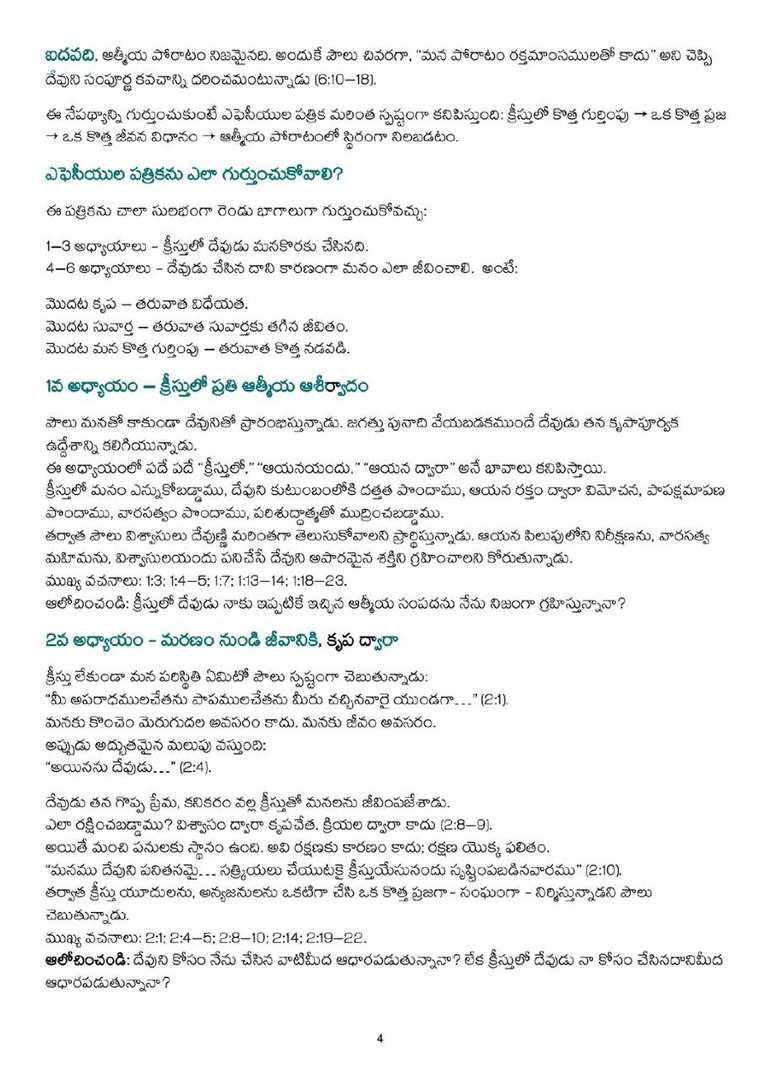
ఐదవది, ఆత్మీయ పోరాటం నిజమైనది. అందుకే పౌలు చివరగా, “మన పోరాటం రక్తమాంసములతో కాదు” అని చెప్పి దేవుని సంపూర్ణ కవచాన్ని ధరించమంటున్నాడు (6:10-18).
ఈ నేపథ్యాన్ని గుర్తుంచుకుంటే ఎఫెసీయుల పత్రిక మరింత స్పష్టంగా కనిపిస్తుంది: క్రీస్తులో కొత్త గుర్తింపు → ఒక కొత్త ప్రజ → ఒక కొత్త జీవన విధానం → ఆత్మీయ పోరాటంలో స్థిరంగా నిలబడటం.
ఎఫెసీయుల పత్రికను ఎలా గుర్తుంచుకోవాలి?
ఈ పత్రికను చాలా సులభంగా రెండు భాగాలుగా గుర్తుంచుకోవచ్చు:
1-3 అధ్యాయాలు - క్రీస్తులో దేవుడు మనకొరకు చేసినది.
4-6 అధ్యాయాలు - దేవుడు చేసిన దాని కారణంగా మనం ఎలా జీవించాలి. అంటే:
మొదట కృప – తరువాత విధేయత.
మొదట సువార్త – తరువాత సువార్తకు తగిన జీవితం.
మొదట మన కొత్త గుర్తింపు – తరువాత కొత్త నడవడి.
1వ అధ్యాయం – క్రీస్తులో ప్రతి ఆత్మీయ ఆశీర్వాదం
పౌలు మనతో కాకుండా దేవునితో ప్రారంభిస్తున్నాడు. జగత్తు పునాది వేయబడకముందే దేవుడు తన కృపాపూర్వక ఉద్దేశాన్ని కలిగియున్నాడు.
ఈ అధ్యాయంలో పదే పదే “క్రీస్తులో,” “ఆయనయందు,” “ఆయన ద్వారా” అనే భావాలు కనిపిస్తాయి.
క్రీస్తులో మనం ఎన్నుకోబడ్డాము, దేవుని కుటుంబంలోకి దత్తత పొందాము, ఆయన రక్తం ద్వారా విమోచన, పాపక్షమాపణ పొందాము, వారసత్వం పొందాము, పరిశుద్ధాత్మతో ముద్రించబడ్డాము.
తర్వాత పౌలు విశ్వాసులు దేవుణ్ణి మరింతగా తెలుసుకోవాలని ప్రార్థిస్తున్నాడు. ఆయన పిలుపులోని నిరీక్షణను, వారసత్వ మహిమను, విశ్వాసులయందు పనిచేసే దేవుని అపారమైన శక్తిని గ్రహించాలని కోరుతున్నాడు.
ముఖ్య వచనాలు: 1:3; 1:4-5; 1:7; 1:13-14; 1:18-23.
ఆలోచించండి: క్రీస్తులో దేవుడు నాకు ఇప్పటికే ఇచ్చిన ఆత్మీయ సంపదను నేను నిజంగా గ్రహిస్తున్నానా?
2వ అధ్యాయం – మరణం నుండి జీవానికి, కృప ద్వారా
క్రీస్తు లేకుండా మన పరిస్థితి ఏమిటో పౌలు స్పష్టంగా చెబుతున్నాడు:
“మీ అపరాధములచేతను పాపములచేతను మీరు చచ్చినవారై యుండగా...” (2:1).
మనకు కొంచెం మెరుగుదల అవసరం కాదు. మనకు జీవం అవసరం.
అప్పుడు అద్భుతమైన మలుపు వస్తుంది:
“అయినను దేవుడు...” (2:4).
దేవుడు తన గొప్ప ప్రేమ, కనికరం వల్ల క్రీస్తుతో మనలను జీవింపజేశాడు.
ఎలా రక్షించబడ్డాము? విశ్వాసం ద్వారా కృపచేత. క్రియల ద్వారా కాదు (2:8-9).
అయితే మంచి పనులకు స్థానం ఉంది. అవి రక్షణకు కారణం కాదు; రక్షణ యొక్క ఫలితం.
“మనము దేవుని పనితనమై... సత్క్రియలు చేయుటకై క్రీస్తుయేసునందు సృష్టింపబడినవారము” (2:10).
తర్వాత క్రీస్తు యూదులను, అన్యజనులను ఒకటిగా చేసి ఒక కొత్త ప్రజగా – సంఘంగా – నిర్మిస్తున్నాడని పౌలు చెబుతున్నాడు.
ముఖ్య వచనాలు: 2:1; 2:4-5; 2:8-10; 2:14; 2:19-22.
ఆలోచించండి: దేవుని కోసం నేను చేసిన వాటిమీద ఆధారపడుతున్నానా? లేక క్రీస్తులో దేవుడు నా కోసం చేసినదానిమీద ఆధారపడుతున్నానా?
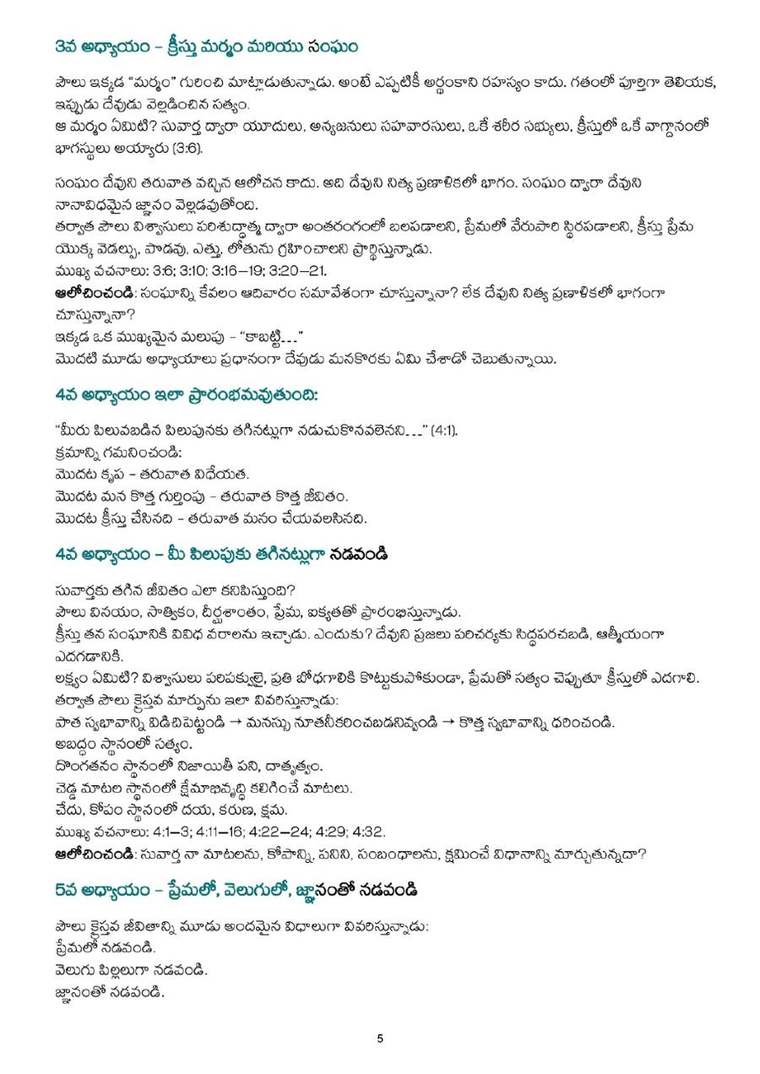
3వ అధ్యాయం – క్రీస్తు మర్మం మరియు సంఘం
పౌలు ఇక్కడ “మర్మం” గురించి మాట్లాడుతున్నాడు. అంటే ఎప్పటికీ అర్థంకాని రహస్యం కాదు. గతంలో పూర్తిగా తెలియక, ఇప్పుడు దేవుడు వెల్లడించిన సత్యం.
ఆ మర్మం ఏమిటి? సువార్త ద్వారా యూదులు, అన్యజనులు సహవారసులు, ఒకే శరీర సభ్యులు, క్రీస్తులో ఒకే వాగ్దానంలో భాగస్థులు అయ్యారు (3:6).
సంఘం దేవుని తరువాత వచ్చిన ఆలోచన కాదు. అది దేవుని నిత్య ప్రణాళికలో భాగం. సంఘం ద్వారా దేవుని నానావిధమైన జ్ఞానం వెల్లడవుతోంది.
తర్వాత పౌలు విశ్వాసులు పరిశుద్ధాత్మ ద్వారా అంతరంగంలో బలపడాలని, ప్రేమలో వేరుపారి స్థిరపడాలని, క్రీస్తు ప్రేమ యొక్క వెడల్పు, పొడవు, ఎత్తు, లోతును గ్రహించాలని ప్రార్థిస్తున్నాడు.
ముఖ్య వచనాలు: 3:6; 3:10; 3:16-19; 3:20-21.
ఆలోచించండి: సంఘాన్ని కేవలం ఆదివారం సమావేశంగా చూస్తున్నానా? లేక దేవుని నిత్య ప్రణాళికలో భాగంగా చూస్తున్నానా?
ఇక్కడ ఒక ముఖ్యమైన మలుపు – “కాబట్టి...”
మొదటి మూడు అధ్యాయాలు ప్రధానంగా దేవుడు మనకొరకు ఏమి చేశాడో చెబుతున్నాయి.
4వ అధ్యాయం ఇలా ప్రారంభమవుతుంది:
“మీరు పిలువబడిన పిలుపునకు తగినట్లుగా నడుచుకొనవలెనని...” (4:1).
క్రమాన్ని గమనించండి:
మొదట కృప – తరువాత విధేయత.
మొదట మన కొత్త గుర్తింపు – తరువాత కొత్త జీవితం.
మొదట క్రీస్తు చేసినది – తరువాత మనం చేయవలసినది.
4వ అధ్యాయం – మీ పిలుపుకు తగినట్లుగా నడవండి
సువార్తకు తగిన జీవితం ఎలా కనిపిస్తుంది?
పౌలు వినయం, సాత్వికం, దీర్ఘశాంతం, ప్రేమ, ఐక్యతతో ప్రారంభిస్తున్నాడు.
క్రీస్తు తన సంఘానికి వివిధ వరాలను ఇచ్చాడు. ఎందుకు? దేవుని ప్రజలు పరిచర్యకు సిద్ధపరచబడి, ఆత్మీయంగా ఎదగడానికి.
లక్ష్యం ఏమిటి? విశ్వాసులు పరిపక్వులై, ప్రతి బోధగాలికి కొట్టుకుపోకుండా, ప్రేమతో సత్యం చెప్పుతూ క్రీస్తులో ఎదగాలి.
తర్వాత పౌలు క్రైస్తవ మార్పును ఇలా వివరిస్తున్నాడు:
పాత స్వభావాన్ని విడిచిపెట్టండి → మనస్సు నూతనీకరించబడనివ్వండి → కొత్త స్వభావాన్ని ధరించండి.
అబద్ధం స్థానంలో సత్యం.
దొంగతనం స్థానంలో నిజాయితీ పని, దాతృత్వం.
చెడ్డ మాటల స్థానంలో క్షేమాభివృద్ధి కలిగించే మాటలు.
చేదు, కోపం స్థానంలో దయ, కరుణ, క్షమ.
ముఖ్య వచనాలు: 4:1-3; 4:11-16; 4:22-24; 4:29; 4:32.
ఆలోచించండి: సువార్త నా మాటలను, కోపాన్ని, పనిని, సంబంధాలను, క్షమించే విధానాన్ని మార్చుతున్నదా?
5వ అధ్యాయం – ప్రేమలో, వెలుగులో, జ్ఞానంతో నడవండి
పౌలు క్రైస్తవ జీవితాన్ని మూడు అందమైన విధాలుగా వివరిస్తున్నాడు:
ప్రేమలో నడవండి.
వెలుగు పిల్లలుగా నడవండి.
జ్ఞానంతో నడవండి.
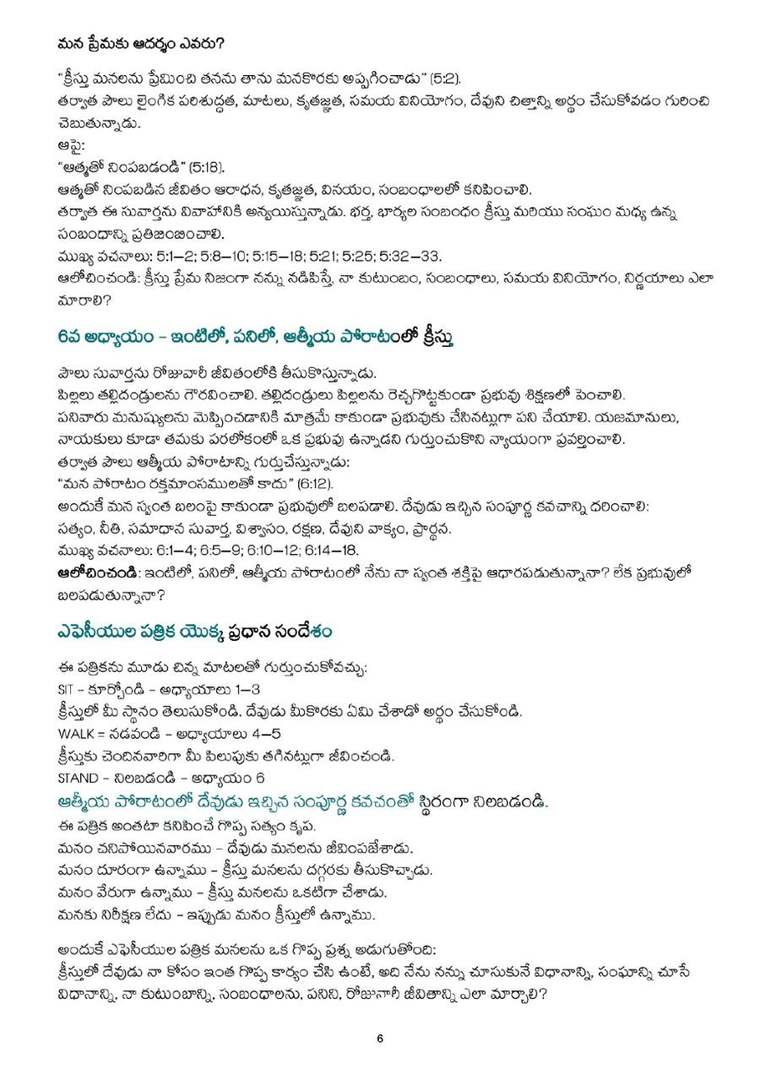
మన ప్రేమకు ఆదర్శం ఎవరు?
“క్రీస్తు మనలను ప్రేమించి తనను తాను మనకొరకు అప్పగించాడు” (5:2).
తర్వాత పౌలు లైంగిక పరిశుద్ధత, మాటలు, కృతజ్ఞత, సమయ వినియోగం, దేవుని చిత్తాన్ని అర్థం చేసుకోవడం గురించి చెబుతున్నాడు.
ఆపై:
“ఆత్మతో నింపబడండి” (5:18).
ఆత్మతో నింపబడిన జీవితం ఆరాధన, కృతజ్ఞత, వినయం, సంబంధాలలో కనిపించాలి.
తర్వాత ఈ సువార్తను వివాహానికి అన్వయిస్తున్నాడు. భర్త, భార్యల సంబంధం క్రీస్తు మరియు సంఘం మధ్య ఉన్న సంబంధాన్ని ప్రతిబింబించాలి.
ముఖ్య వచనాలు: 5:1-2; 5:8-10; 5:15-18; 5:21; 5:25; 5:32-33.
ఆలోచించండి: క్రీస్తు ప్రేమ నిజంగా నన్ను నడిపిస్తే, నా కుటుంబం, సంబంధాలు, సమయ వినియోగం, నిర్ణయాలు ఎలా మారాలి?
6వ అధ్యాయం – ఇంటిలో, పనిలో, ఆత్మీయ పోరాటంలో క్రీస్తు
పౌలు సువార్తను రోజువారీ జీవితంలోకి తీసుకొస్తున్నాడు.
పిల్లలు తల్లిదండ్రులను గౌరవించాలి. తల్లిదండ్రులు పిల్లలను రెచ్చగొట్టకుండా ప్రభువు శిక్షణలో పెంచాలి.
పనివారు మనుష్యులను మెప్పించడానికి మాత్రమే కాకుండా ప్రభువుకు చేసినట్లుగా పని చేయాలి. యజమానులు, నాయకులు కూడా తమకు పరలోకంలో ఒక ప్రభువు ఉన్నాడని గుర్తుంచుకొని న్యాయంగా ప్రవర్తించాలి.
తర్వాత పౌలు ఆత్మీయ పోరాటాన్ని గుర్తుచేస్తున్నాడు:
“మన పోరాటం రక్తమాంసములతో కాదు” (6:12).
అందుకే మన స్వంత బలంపై కాకుండా ప్రభువులో బలపడాలి. దేవుడు ఇచ్చిన సంపూర్ణ కవచాన్ని ధరించాలి:
సత్యం, నీతి, సమాధాన సువార్త, విశ్వాసం, రక్షణ, దేవుని వాక్యం, ప్రార్థన.
ముఖ్య వచనాలు: 6:1-4; 6:5-9; 6:10-12; 6:14-18.
ఆలోచించండి: ఇంటిలో, పనిలో, ఆత్మీయ పోరాటంలో నేను నా స్వంత శక్తిపై ఆధారపడుతున్నానా? లేక ప్రభువులో బలపడుతున్నానా?
ఎఫెసీయుల పత్రిక యొక్క ప్రధాన సందేశం
ఈ పత్రికను మూడు చిన్న మాటలతో గుర్తుంచుకోవచ్చు:
SIT – కూర్చోండి – అధ్యాయాలు 1-3
క్రీస్తులో మీ స్థానం తెలుసుకోండి. దేవుడు మీకొరకు ఏమి చేశాడో అర్థం చేసుకోండి.
WALK = నడవండి – అధ్యాయాలు 4-5
క్రీస్తుకు చెందినవారిగా మీ పిలుపుకు తగినట్లుగా జీవించండి.
STAND – నిలబడండి – అధ్యాయం 6
ఆత్మీయ పోరాటంలో దేవుడు ఇచ్చిన సంపూర్ణ కవచంతో స్థిరంగా నిలబడండి.
ఈ పత్రిక అంతటా కనిపించే గొప్ప సత్యం కృప.
మనం చనిపోయినవారము – దేవుడు మనలను జీవింపజేశాడు.
మనం దూరంగా ఉన్నాము – క్రీస్తు మనలను దగ్గరకు తీసుకొచ్చాడు.
మనం వేరుగా ఉన్నాము – క్రీస్తు మనలను ఒకటిగా చేశాడు.
మనకు నిరీక్షణ లేదు – ఇప్పుడు మనం క్రీస్తులో ఉన్నాము.
అందుకే ఎఫెసీయుల పత్రిక మనలను ఒక గొప్ప ప్రశ్న అడుగుతోంది:
క్రీస్తులో దేవుడు నా కోసం ఇంత గొప్ప కార్యం చేసి ఉంటే, అది నేను నన్ను చూసుకునే విధానాన్ని, సంఘాన్ని చూసే విధానాన్ని, నా కుటుంబాన్ని, సంబంధాలను, పనిని, రోజువారీ జీవితాన్ని ఎలా మార్చాలి?
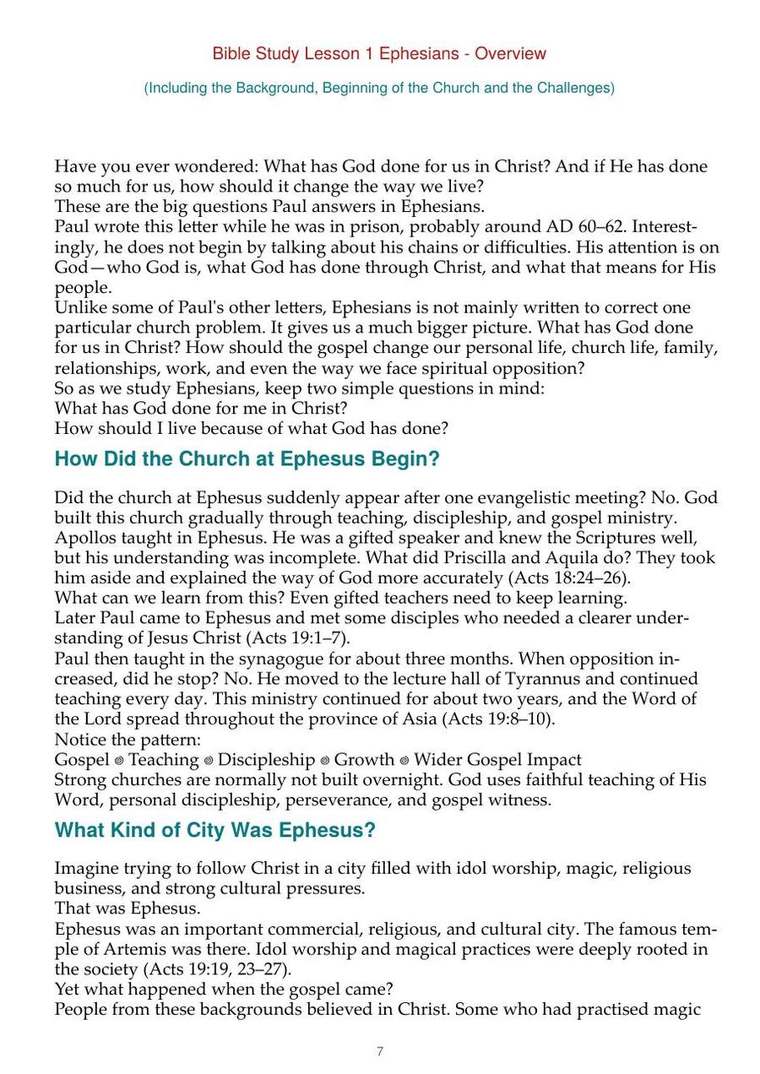
(Including the Background, Beginning of the Church and the Challenges)
Have you ever wondered: What has God done for us in Christ? And if He has done so much for us, how should it change the way we live?
These are the big questions Paul answers in Ephesians.
Paul wrote this letter while he was in prison, probably around AD 60–62. Interestingly, he does not begin by talking about his chains or difficulties. His attention is on God—who God is, what God has done through Christ, and what that means for His people.
Unlike some of Paul’s other letters, Ephesians is not mainly written to correct one particular church problem. It gives us a much bigger picture. What has God done for us in Christ? How should the gospel change our personal life, church life, family, relationships, work, and even the way we face spiritual opposition?
So as we study Ephesians, keep two simple questions in mind:
What has God done for me in Christ?
How should I live because of what God has done?
How Did the Church at Ephesus Begin?
Did the church at Ephesus suddenly appear after one evangelistic meeting? No. God built this church gradually through teaching, discipleship, and gospel ministry.
Apollos taught in Ephesus. He was a gifted speaker and knew the Scriptures well, but his understanding was incomplete. What did Priscilla and Aquila do? They took him aside and explained the way of God more accurately (Acts 18:24–26).
What can we learn from this? Even gifted teachers need to keep learning.
Later Paul came to Ephesus and met some disciples who needed a clearer understanding of Jesus Christ (Acts 19:1–7).
Paul then taught in the synagogue for about three months. When opposition increased, did he stop? No. He moved to the lecture hall of Tyrannus and continued teaching every day. This ministry continued for about two years, and the Word of the Lord spread throughout the province of Asia (Acts 19:8–10).
Notice the pattern:
Gospel → Teaching → Discipleship → Growth → Wider Gospel Impact
Strong churches are normally not built overnight. God uses faithful teaching of His Word, personal discipleship, perseverance, and gospel witness.
What Kind of City Was Ephesus?
Imagine trying to follow Christ in a city filled with idol worship, magic, religious business, and strong cultural pressures.
That was Ephesus.
Ephesus was an important commercial, religious, and cultural city. The famous temple of Artemis was there. Idol worship and magical practices were deeply rooted in the society (Acts 19:19, 23–27).
Yet what happened when the gospel came?
People from these backgrounds believed in Christ. Some who had practised magic
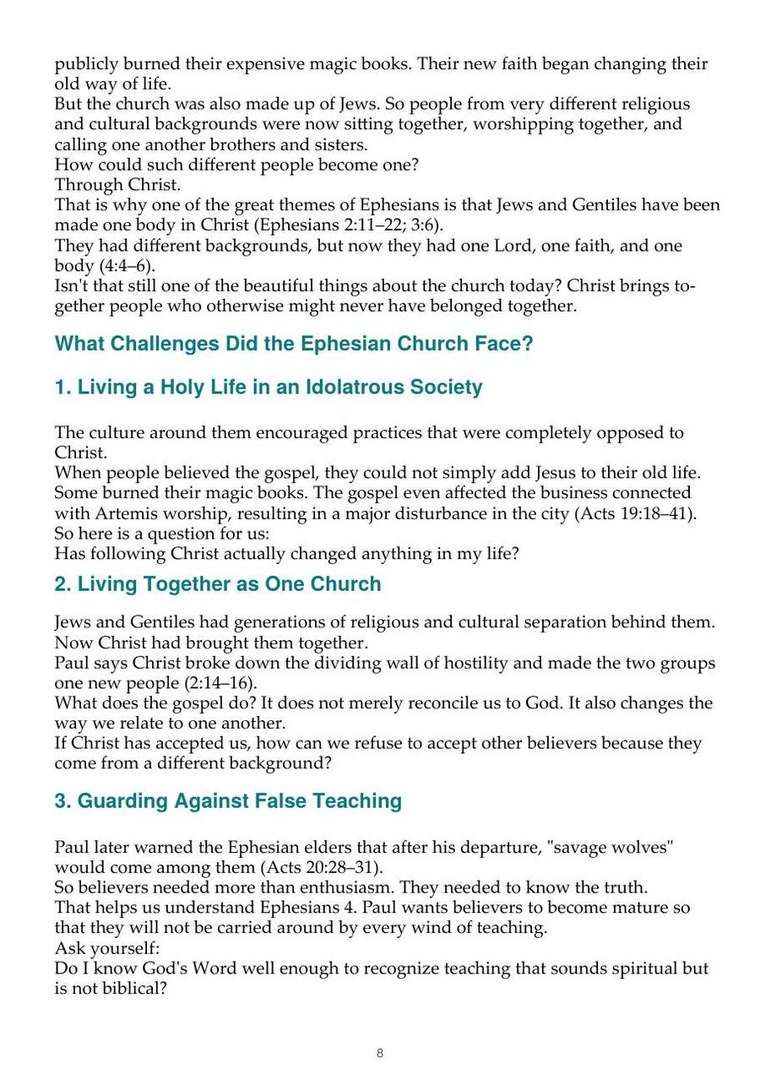
publicly burned their expensive magic books. Their new faith began changing their old way of life.
But the church was also made up of Jews. So people from very different religious and cultural backgrounds were now sitting together, worshipping together, and calling one another brothers and sisters.
How could such different people become one?
Through Christ.
That is why one of the great themes of Ephesians is that Jews and Gentiles have been made one body in Christ (Ephesians 2:11–22; 3:6).
They had different backgrounds, but now they had one Lord, one faith, and one body (4:4–6).
Isn’t that still one of the beautiful things about the church today? Christ brings together people who otherwise might never have belonged together.
What Challenges Did the Ephesian Church Face? 1. Living a Holy Life in an Idolatrous Society
The culture around them encouraged practices that were completely opposed to Christ.
When people believed the gospel, they could not simply add Jesus to their old life.
Some burned their magic books. The gospel even affected the business connected with Artemis worship, resulting in a major disturbance in the city (Acts 19:18–41).
So here is a question for us:
Has following Christ actually changed anything in my life?
2. Living Together as One Church
Jews and Gentiles had generations of religious and cultural separation behind them. Now Christ had brought them together.
Paul says Christ broke down the dividing wall of hostility and made the two groups one new people (2:14–16).
What does the gospel do? It does not merely reconcile us to God. It also changes the way we relate to one another.
If Christ has accepted us, how can we refuse to accept other believers because they come from a different background?
3. Guarding Against False Teaching
Paul later warned the Ephesian elders that after his departure, "savage wolves"
would come among them (Acts 20:28–31).
So believers needed more than enthusiasm. They needed to know the truth.
That helps us understand Ephesians 4. Paul wants believers to become mature so that they will not be carried around by every wind of teaching.
Ask yourself:
Do I know God’s Word well enough to recognize teaching that sounds spiritual but is not biblical?
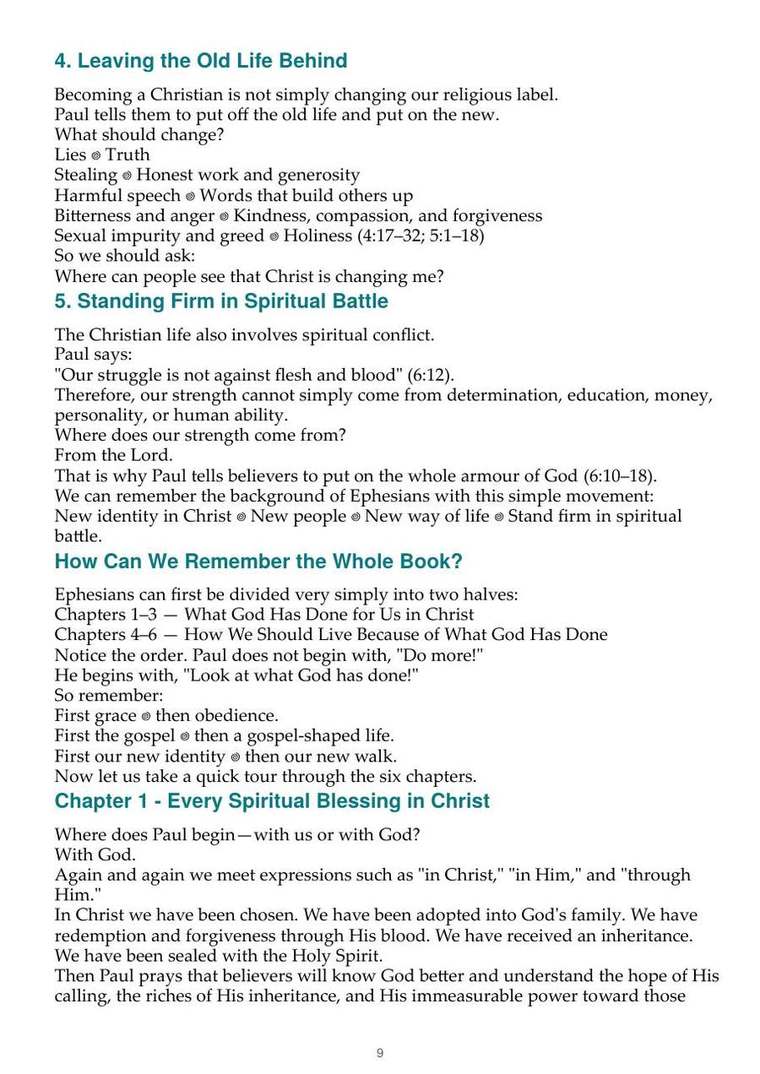
4. Leaving the Old Life Behind
Becoming a Christian is not simply changing our religious label.
Paul tells them to put off the old life and put on the new.
What should change?
Lies → Truth
Stealing → Honest work and generosity
Harmful speech → Words that build others up
Bitterness and anger → Kindness, compassion, and forgiveness
Sexual impurity and greed → Holiness (4:17–32; 5:1–18)
So we should ask:
Where can people see that Christ is changing me?
5. Standing Firm in Spiritual Battle
The Christian life also involves spiritual conflict.
Paul says:
"Our struggle is not against flesh and blood" (6:12).
Therefore, our strength cannot simply come from determination, education, money, personality, or human ability.
Where does our strength come from?
From the Lord.
That is why Paul tells believers to put on the whole armour of God (6:10–18).
We can remember the background of Ephesians with this simple movement:
New identity in Christ → New people → New way of life → Stand firm in spiritual battle.
How Can We Remember the Whole Book?
Ephesians can first be divided very simply into two halves:
Chapters 1–3 — What God Has Done for Us in Christ
Chapters 4–6 — How We Should Live Because of What God Has Done Notice the order. Paul does not begin with, "Do more!"
He begins with, "Look at what God has done!"
So remember:
First grace → then obedience.
First the gospel → then a gospel-shaped life.
First our new identity → then our new walk.
Now let us take a quick tour through the six chapters.
Chapter 1 - Every Spiritual Blessing in Christ
Where does Paul begin—with us or with God?
With God.
Again and again we meet expressions such as "in Christ," "in Him," and "through Him."
In Christ we have been chosen. We have been adopted into God’s family. We have redemption and forgiveness through His blood. We have received an inheritance.
We have been sealed with the Holy Spirit.
Then Paul prays that believers will know God better and understand the hope of His calling, the riches of His inheritance, and His immeasurable power toward those
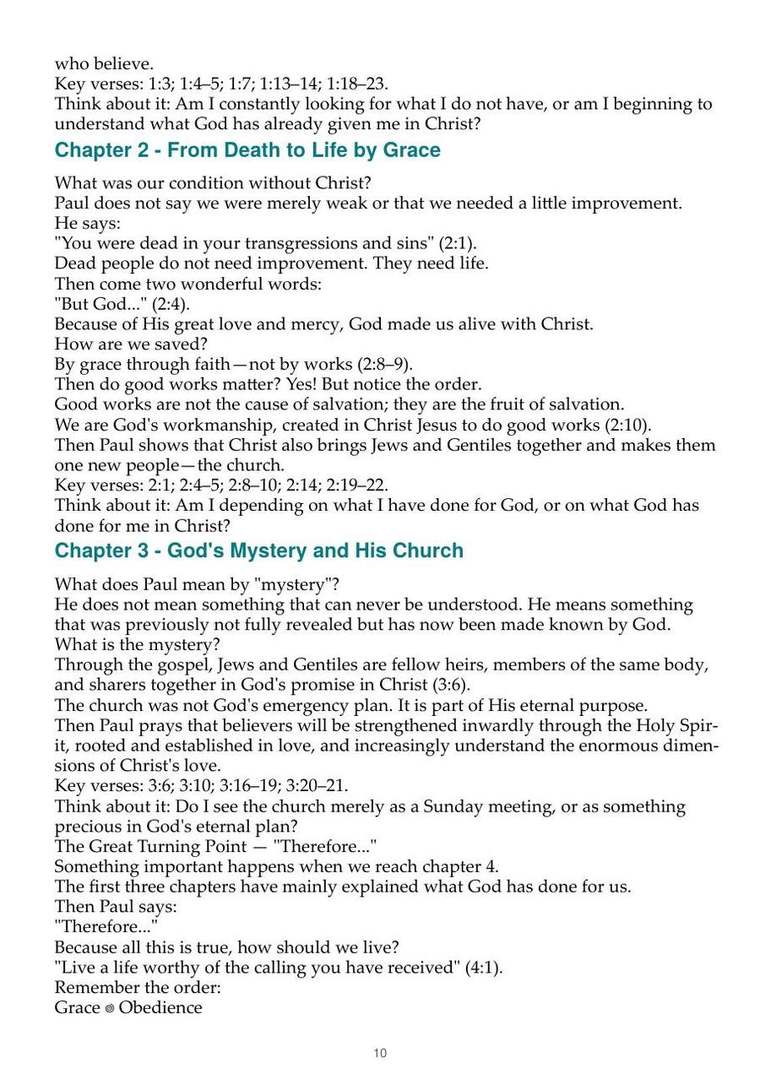
who believe.
Key verses: 1:3; 1:4–5; 1:7; 1:13–14; 1:18–23.
Think about it: Am I constantly looking for what I do not have, or am I beginning to understand what God has already given me in Christ?
Chapter 2 - From Death to Life by Grace
What was our condition without Christ?
Paul does not say we were merely weak or that we needed a little improvement.
He says:
"You were dead in your transgressions and sins" (2:1).
Dead people do not need improvement. They need life.
Then come two wonderful words:
"But God..." (2:4).
Because of His great love and mercy, God made us alive with Christ.
How are we saved?
By grace through faith—not by works (2:8–9).
Then do good works matter? Yes! But notice the order.
Good works are not the cause of salvation; they are the fruit of salvation.
We are God’s workmanship, created in Christ Jesus to do good works (2:10).
Then Paul shows that Christ also brings Jews and Gentiles together and makes them one new people—the church.
Key verses: 2:1; 2:4–5; 2:8–10; 2:14; 2:19–22.
Think about it: Am I depending on what I have done for God, or on what God has done for me in Christ?
Chapter 3 - God’s Mystery and His Church
What does Paul mean by "mystery"?
He does not mean something that can never be understood. He means something that was previously not fully revealed but has now been made known by God.
What is the mystery?
Through the gospel, Jews and Gentiles are fellow heirs, members of the same body, and sharers together in God’s promise in Christ (3:6).
The church was not God’s emergency plan. It is part of His eternal purpose.
Then Paul prays that believers will be strengthened inwardly through the Holy Spirit, rooted and established in love, and increasingly understand the enormous dimensions of Christ’s love.
Key verses: 3:6; 3:10; 3:16–19; 3:20–21.
Think about it: Do I see the church merely as a Sunday meeting, or as something precious in God’s eternal plan?
The Great Turning Point — "Therefore..."
Something important happens when we reach chapter 4.
The first three chapters have mainly explained what God has done for us.
Then Paul says:
"Therefore..."
Because all this is true, how should we live?
"Live a life worthy of the calling you have received" (4:1).
Remember the order:
Grace → Obedience
New identity → New life
What Christ has done → How we now live
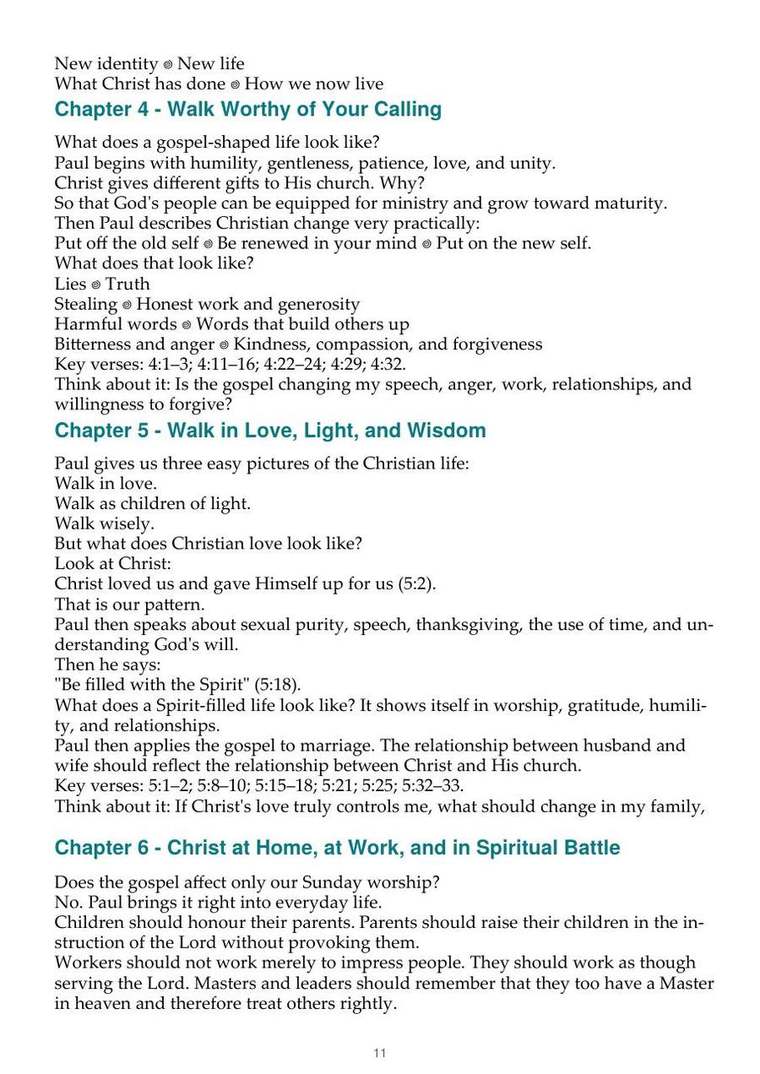
Chapter 4 - Walk Worthy of Your Calling
What does a gospel-shaped life look like?
Paul begins with humility, gentleness, patience, love, and unity.
Christ gives different gifts to His church. Why?
So that God’s people can be equipped for ministry and grow toward maturity.
Then Paul describes Christian change very practically:
Put off the old self → Be renewed in your mind → Put on the new self.
What does that look like?
Lies → Truth
Stealing → Honest work and generosity
Harmful words → Words that build others up
Bitterness and anger → Kindness, compassion, and forgiveness
Key verses: 4:1–3; 4:11–16; 4:22–24; 4:29; 4:32.
Think about it: Is the gospel changing my speech, anger, work, relationships, and willingness to forgive?
Chapter 5 - Walk in Love, Light, and Wisdom
Paul gives us three easy pictures of the Christian life:
Walk in love.
Walk as children of light.
Walk wisely.
But what does Christian love look like?
Look at Christ:
Christ loved us and gave Himself up for us (5:2).
That is our pattern.
Paul then speaks about sexual purity, speech, thanksgiving, the use of time, and understanding God’s will.
Then he says:
"Be filled with the Spirit" (5:18).
What does a Spirit-filled life look like? It shows itself in worship, gratitude, humility, and relationships.
Paul then applies the gospel to marriage. The relationship between husband and wife should reflect the relationship between Christ and His church.
Key verses: 5:1–2; 5:8–10; 5:15–18; 5:21; 5:25; 5:32–33.
Think about it: If Christ’s love truly controls me, what should change in my family,
Chapter 6 - Christ at Home, at Work, and in Spiritual Battle
Does the gospel affect only our Sunday worship?
No. Paul brings it right into everyday life.
Children should honour their parents. Parents should raise their children in the instruction of the Lord without provoking them.
Workers should not work merely to impress people. They should work as though serving the Lord. Masters and leaders should remember that they too have a Master in heaven and therefore treat others rightly.
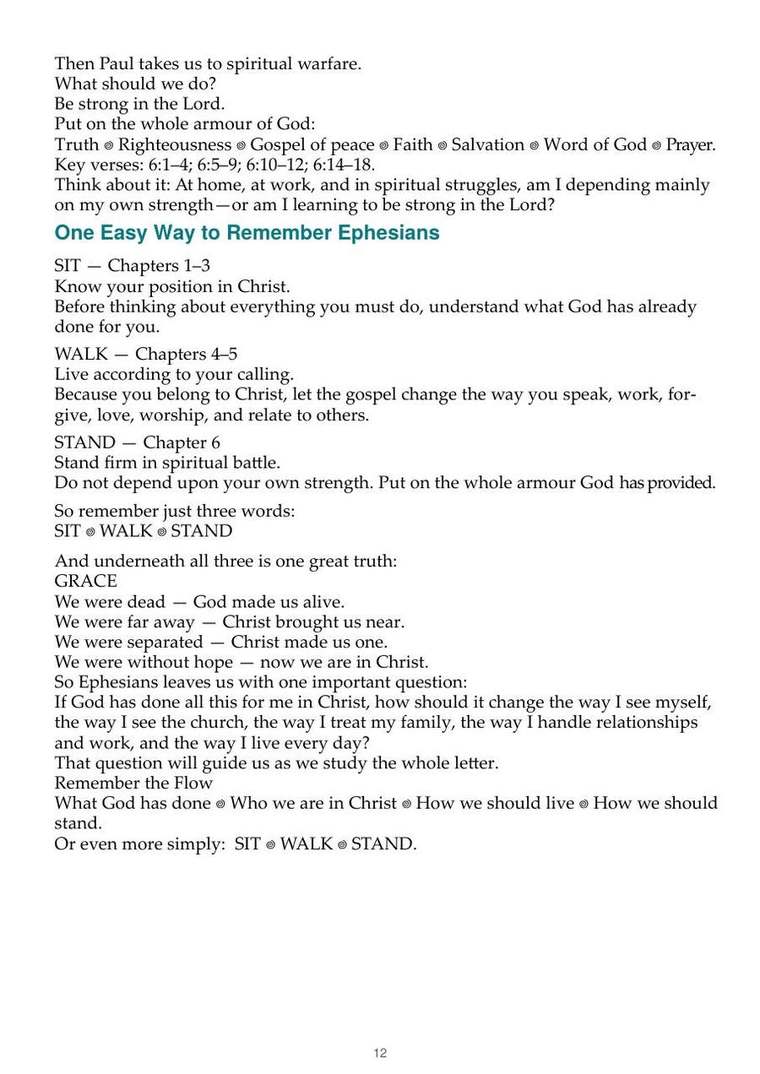
Then Paul takes us to spiritual warfare.
What should we do?
Be strong in the Lord.
Put on the whole armour of God:
Truth → Righteousness → Gospel of peace → Faith → Salvation → Word of God → Prayer. Key verses: 6:1–4; 6:5–9; 6:10–12; 6:14–18.
Think about it: At home, at work, and in spiritual struggles, am I depending mainly on my own strength—or am I learning to be strong in the Lord?
One Easy Way to Remember Ephesians
SIT — Chapters 1–3
Know your position in Christ.
Before thinking about everything you must do, understand what God has already done for you.
WALK — Chapters 4–5
Live according to your calling.
Because you belong to Christ, let the gospel change the way you speak, work, forgive, love, worship, and relate to others.
STAND — Chapter 6
Stand firm in spiritual battle.
Do not depend upon your own strength. Put on the whole armour God has provided. So remember just three words:
SIT → WALK → STAND
And underneath all three is one great truth:
GRACE
We were dead — God made us alive.
We were far away — Christ brought us near.
We were separated — Christ made us one.
We were without hope — now we are in Christ.
So Ephesians leaves us with one important question:
If God has done all this for me in Christ, how should it change the way I see myself, the way I see the church, the way I treat my family, the way I handle relationships and work, and the way I live every day?
That question will guide us as we study the whole letter.
Remember the Flow
What God has done → Who we are in Christ → How we should live → How we should stand.
Or even more simply: SIT → WALK → STAND.
Original PDF pages · అసలు పేజీలు (Telugu 4 · English 6)
తెలుగు · Telugu edition
English edition