
Parable Nine
S H E P H E R D O F H E R M A S
78 (IX.1)
Μετά το γράφαι pe τάς έντολάς και παραβολάς τον ποιρένος, τον άγγέλον τής ρετανοίας, ήλθε προς pe και λέγβι ροιθέλω σοι δεΐζαι, Οσα σοι έδειξε το πνεύρα το άγιον το λάλησαν ρβτά σον έν ρορφή τής εκκλησίαςέκβΐνο γάρ το πνβνρα 6 νιος τον θβον έστιν.
2. επειδή γάρ άσθβνέστβρος τή σαρκί ής, ονκ έδηλώθη σοι δι άγγέλον. οτβ ονν ένβδνναρώθης διά τον πνεύρατος καϊ ΐσχνσας τή ίσχύι σον, ώστβ δύ νασθαι σβ άγγβλον ίδβΐν, τότβ ρέν ονν έδηλώθη σοι διά τής εκκλησίας ή οίκοδορή τού πύργονκαλώς καϊ σβρνώς πάντα ώς ύπό παρθένον έώρακας. νύν δέ ύπό άγγέλον βλέπεις, διά τού αυτού ρέν πνεύρατος3. δεΐ δέ σε άκριβέστερον ύπ' έρού πάντα ίδεΐν.
εις τούτο γάρ έδόθην ύπό τού ένδόζον άγγέλον εις τον οίκον σον κατοικήσαι, Ινα δννατώς πάντα ΐδης, μηδέν δειλαινόρενος ώς καϊ τό πρότερον.
4. καϊ απήγαγε με εις τήν Άρκαδίαν, εις όρος τι ραστώδες, καϊ έκάθισέ ρε έπϊ τό άκρον τού ορονς, καϊ εδειξέ ροι πεδίον ρέγα, κύκλω δέ τού πεδίον Ορη δώδεκα, άλλην καϊ άλλην ίδέαν έχοντα τά όρη.
5. τό πρώτον ήν μέλαν ώς άσβόλητό δέ δεύτερον φιλόν, βοτάνας μή έχον τό δέ τρίτον ακανθών καϊ τριβόλων πλήρες6. τό δέ τέταρ τον βοτάνας έχον ήμιζήρονς, τά ρέν επάνω τών βοτά νων χλωρά, τά δέ προς ταΐς ρίζαις ζηράτινές δέ βοτάναι, όταν ό ήλιος έπικεκαύκει, ζηραϊ έγίνοντο-
PARABLES 78 (IX.l) Parable Nine
78 (IX. 1)
After I wrote the commandments and parables of the shepherd, the angel of repentance, he came to me and said, "I want to show you everything that the Holy Spirit showed you when he spoke with you in the form of the church; for that Spirit is the Son of God. 2. For since you were too weak in the flesh, these things were not explained to you by the angel. When, later, you were empowered through the Spirit and became strong, so that you could see the angel, then the building of the tower was explained to you by the church. You saw all things in a good and rev erent way, as shown by the virgin. And now you are seeing by the angels help, through the same Spirit. 3. But you must observe all things more accurately with my help. This is why I was appointed by the glorious angel to dwell in your house, that you may see all things powerfully, without being frightened as you were earlier." 4. And he led me out to Arcadia, to a certain mountain shaped like a breast, and he seated me on the peak of the mountain and showed me a great plain, with twelve mountains surrounding the plain, each mountain having its own appearance. 5. The first was black as soot. The second was barren, with no veg etation. The third was full of thorns and thistles. 6. The fourth had plants that were half withered, green near the top but withered at the roots. And some of the plants with164 παραβολή θ' Μ L L Ε: initium similitudinis E: initium
C2: om. A 1: παρ ipov άκρ. πάντα μαθβΐν A L2 (Ε) 165 άκριβίστερον . . . iheiv Μ L
S H E P H E R D OF HERMAS
7. τό Se πέμπτον Ορος ήν τραχί) λίαν, βοτάνας Se είχε χλωράς. το Se έκτον ορος όλον σχισρών εγερεν, ας ρέν ρεγάλας, ας 8έ ρικράςεΐχον 8έ βοτάνας αί σχισραί, ον λίαν 8έ ήσαν ενθαλείς αί βοτάναι, ράλλον 8έ ώς ρεραραρρέναι ήσαν. 8. το 8έ έβ8ορον ορος είχεν βοτάνας ιλαράς, καί όλον τό Ορος ενθηνονν ήν, καί πάν γένος κτηνών καί όρνέων ένέρετο βίς τό Ορος εκείνοκαί όσον έβόσκετο τά κτήνη καί τά πετεινά, ράλλον καί ράλλον αί βοτάναι τον ορονς εκείνον έθαλλον. τό 8έ όγ8οον όρος πηγών πλήρες ήν, καί πάν γένος τής κτίσεως τον κνρίον έποτίζετο έκ τών πηγών τον ορονς εκείνον. 9. τό 8έ ένατον όρος όλως ν8ωρ ονκ είχεν καί όλον έρηρώ8ες ήν, είχεν 8έ έν αντω θηρία καί ερπετά θανάσιρα, 8ιαφθείροντα άνθρώπονς. τό 8έ 8έκατον Ορος είχε 8έν8ρα μέγιστα, καί όλον κατάσκιον ήν, καί νπό τήν σκέπην τών 8έν8ρων πρόβατα κατέκειντο άναπανόρενα καί ραρνκώμενα.
10. τό δβ έν8έκατον Ορος λίαν σνν8εν8ρον ήν, καί τά 8έν8ρα εκείνα κατάκαρπα ήν, άλλοις καί άλλοις καρποΐς κεκοσρηρένα, ΐνα ί8ών τις αυτά έπιθνρήση φαγεΐν έκ τών καρπών αντών. τό 8έ 8ω8έκατον Ορος όλον ήν λενκόν, καί ή πρόσοφις αντον ιλαρά λίαν καί ενπρεπέστατον ήν έν αντω τό Ορος.
79 (ΙΧ.2)
Εις ρέσον 8έ τον πε8ίον ε8ειζέ ροι πέτραν μεγάλην λενκήν έκ τον πε8ίον άναβεβηκνΐαν. ή 8έ πέτρα νψη-
PARABLES
79 (IX.2)
ered when the sun scorched them. 7. The fifth mountain was very rugged, but had green plants. The sixth mountain was completely full of rifts, some great and some small.
There were plants in the rifts; the plants, however, were not flourishing but were wilted. 8. The seventh moun tain had healthy plants and the entire mountain was flour ishing, with every kind of animal and bird feeding on it.
And the more the animals and birds grazed, the more the plants of the mountain thrived. The eighth mountain was full of springs, and every species of the Lord s creation was drinking from them. 9. The ninth mountain had no water whatsoever and was a complete wasteland; on it were wild beasts and poisonous reptiles that were destroying people.
The tenth mountain had great trees and was completely shaded; sheep were lying at rest under the shade of the trees, chewing the cud. 10. The eleventh mountain was fully covered with fruit-bearing trees laden with various kinds of fruit, so that anyone who saw those trees would want to eat their fruit. And the twelfth mountain was com pletely white, with a cheerful appearance, a mountain ex tremely attractive in and of itself.
79 (IX.2)
In the middle of the plain he showed me an enormous white rock that had sprung up out of the plain. The rock
S H E P H E R D OF HERMAS
2. παλαιά δε ήν ή πέτρα εκείνη πύλην εκκεκορρενην εχονσαώς πρόσφατος δέ έδόκει ροι είναι ή έκκόλαφις τής πύλης, ή δέ πύλη ούτως εστιλβεν υπέρ τον ήλιον, ώστε ρε θανράζειν έπϊ τή λαρπηδόνι τής πύλης.
3. κύκλω δέ τής πύλης είστήκεισαν παρθένοι δώδεκα, αί ονν τέσσαρες αί εις τάς γωνίας έστηκνΐαι ένδοξότεραί ροι έδόκονν είναικαί αί άλλαι δέ ένδοξοι ήσαν. είστήκεισαν δέ εις τά τέσσαρα ρέρη τής πύλης, άνά ρέσον αυτών άνά δύο παρθένοι.
4. ένδεδνρέναι δέ ήσαν λινούς χιτώνας καί περιεζωσρέναι ήσαν εύπρεπώς, έξω τούς ώρονς έχον σαι τούς δεξιούς ώς ρέλλονσαι φορτίον τι βαστάζειν. ούτως έτοιραι ήσανλίαν γάρ ίλαραί ήσαν καί πρόθνροι. 5. ρετά τό ίδεΐν ρε ταύτα έθαύραζον έν έραντώ, ότι ρεγάλα καϊ ένδοξα πράγρατα έβλεπον. καϊ πάλιν ήπορούρην έπϊ ταΐς παρθένοις, οτι τρνφεραϊ ονσαι ούτως ανδρείως είστήκεισαν ώς ρέλλονσαι όλον τον ούρανόν βαστάζειν.
6. καϊ λέγει ροι δ ποιρήν τί έν σεαντω διαλογίζη καϊ άπορη καϊ σεαντω λύπην έπισπάσαι; όσα γάρ ού δύνη νοήσαι, ρή επιχειρεί ώς
σννετος ών, αλλ έρωτα τον κύριον, ΐνα λαβών σύν εσιν νοήσης αυτά. 7. τά οπίσω σον ίδεΐν ού δύνη, τά δέ ερπροσθέν σον βλέπεις, ά ονν ίδεΐν ού δύνη, έασον, καί
σεαντόν ρή στρέβλον ά βλέπεις δέ, εκείνων κατακνρίενε, καί περί τών λοιπών ρή περιεργάζονπάντα δέ σοι έγώ δηλώσω, όσα έάν σοι
PARABLES
79 (IX.2)
was higher than the mountains, square-shaped, large enough to hold the entire world. 2. That rock was ancient, and had a gate chiseled into it. But the chiseling of the gate appeared recent to me. And the gate shone brighter than the sun, so that I was amazed at its radiance. 3. Around the gate stood twelve virgins. The four who stood at the corners seemed particularly glorious to me (although the others were also glorious); these stood at the four sides of the gate, each of them with two virgins between them.
4. They were clothed in linen tunics and beautifully belted; their right shoulders were uncovered, as if they were about to lift a burden. Thus they were prepared; and they were exceedingly cheerful and eager. 5. After I had observed these things I began to marvel at the great and glorious things I was seeing. And I became perplexed again at the virgins, because even though they were delicate, they stood like men, as if they were about to lift up the entire sky. 6. And the shepherd said to me, "Why are you debating within yourself and perplexed, causing yourself grief? Do not try to comprehend what is beyond your power, as if you could understand, but ask the Lord for the understanding necessary to comprehend these things. 7. You cannot see what lies behind you; but you do see what lies ahead. And so, let go of what you cannot see and do not bother yourself about it. But exercise mastery over what you do see, with out being overly inquisitive about the rest. I will explain to you everything I show you. Consider now the rest."
166 ώ? M L L Ci: om A (E) 167 eao-ov και A L 2 Ε Cl; om. Μ Ll 168 €' γώ . . . σοι A Ll Ε Cl: om. Μ L
S H E P H E R D OF HERMAS
80 (IX.3)
Έΐδον βξ άνδρας έληλυθότας υψηλούς καί ένδοξους καϊ δροίους τή ιδέαέκάλβσαν δβ πλήθος τι ανδρών, κάκβΐνοι δέ οί έληλυθότβς υψηλοί άνδρβς καί λίαν καλοί καί δυνατοί ήσαν καί έκέλβυσαν αυτούς οί έξ άνδρες οίκοδομβΐν επάνω τής πέτρας πύργον τινά. ήν δέ ρέγας θόρυβος τών ανδρών έκβίνων τών έληλυθότων οίκοδομβΐν τδν πύργον, ώδβ κάκβΐ πβριτρβχόντων κύκλω τής πύλης2. αί δέ παρθένοι έστηκυΐαι πβρί τήν πύλην βλβγον τοΐς άνδράσι σπβύδβιν
οίκοδορηθήναι τον πύργον. έκπβπβτάκβισαν δέ τάς χβΐρας αί παρθένοι ώς ρέλλουσαί τι λαρβάνβιν παρά τών αν δρών.
3. οί δέ βξ άνδρβς έκέλβυον έκ βυθού τίνος λίθους άναβαίνβιν καί ύπάγβιν βίς τήν οίκοδορήν τού πύργου, άνέβησαν δέ λίθοι ι τβτράγωνοι λαμπροί, ρή
4. οί δέ βξ άνδρβς έκάλουν τάς παρθένους καί έκέλβυσαν αύτάς τούς λίθους πάντας τούς ρέλλοντας βίς τήν οίκοδορήν ύπάγβιν τού πύργου βαστάζβιν καί διαπορβύβσθαι διά τής πύλης, καί έπιδιδόναι τοΐς άνδράσι τοΐς ρέλλουσιν οίκοδορβίν τδν πύργον.
5. αί δέ παρθένοι τούς δέκα λίθους τούς πρώτους τούς έκ τού βυθού άναβάντας έπβτίθουν άλλτ^λαις καί κατά ένα λίθον έβάσταζον ομού.
7 0 μή cj. R. Anger
PARABLES
80 (IX.3)
80 (IX.3)
I saw six tall and glorious men coming, who all looked alike. And they called a great multitude of men. Those who were coming were also tall men, very beautiful, and strong.
The six men commanded them to build a tower upon the rock. There was a great disturbance among those men who had come to build the tower, as they were running back and forth around the gate. 2. The virgins who were stand ing beside the gate began telling the men to hurry and build the tower. And the virgins stretched out their hands as if they were about to take something from the men.
3. The six men ordered stones to come up out of a great depth for the building of the tower. Ten stones came up, square, bright, and unhewed. 4. The six men called the virgins and ordered them to lift all the stones that were about to appear for the building of the tower, then to pass through the gate and give them to the men who were about to build it. 5. The virgins took the first ten stones that came up from the depths and loaded them on one another; and they were carrying them in unison, like a single stone [Or: one stone at a time].
S H E P H E R D OF HERMAS
81 (IX.4)
Καθώς δβ βστάθησαν ομού κύκλω τής πύλης, ούτως ββάσταζον αί δοκούσαι δυνατοί βίναι, καϊ ύπό τάς γωνίας τού λίθου ύποδβδυκυΐαι ήσαν αί δβ άλλαι έκ τών πλευρών τού λίθου ύποδβδύκβισαν, καϊ ούτως ββάσταζον πάντας τούς λίθουςδιά δβ τής πύλης διίφβρον αυτούς, καθώς βκβλβύσθησαν, καϊ βπβδίδουν τοΐς άνδράσιν βίς τδν πύργονβκβΐνοι δβ βχοντβς τούς λίθους
2. ή οικοδομή δβ τού πύργου βγβνβτο βπϊ τήν πβτραν τήν ρβγάλην καϊ βπάνω τής πύλης, ήρρόσθησαν οί ι λίθοι βκβΐνοι, καί βνβπλησαν δλην τήν πβτραν. καϊ βγβνοντο βκβΐνοι
θβρίλιος τής οίκοδορής τού πύργου, ή δβ πίτρα καϊ ή πύλη ήν βαστάζουσα όλον τδν πύργον.
3. ρβτά δβ τούς ι' λίθους άλλοι άνββησαν έκ τού βυθού κβ /173 λίθοικαϊ ούτοι ήρρόσθησαν βίς τήν οίκοδορήν τού πύργου, βασταζόρβνοι ύπό τών παρθένων καθώς καϊ οί πρότε ροι, ρβτά δβ τούτους άνββησαν λβ'- καϊ ούτοι ομοίως ήρρόσθησαν βίς τον πύργον. ρβτά δβ τούτους βτβροι άνββησαν λίθοι μ - καί ούτοι πάντβς εβλήθησαν βίς τήν οίκοδομήν τού πύργουβγβνοντο ούν στοίχοι τβσσαρβς βν τοΐς θβρβλίοις τού πύργου.
4. καί βπαύσαντο βκ τού βυθού άναβαίνοντβςβπαύσαντο δβ καϊ οί οίκοδορούντβς ρικρόν. καϊ πάλιν βπβταζαν οί βζ άνδρβς τώ πλήθβι τού Οχλου βκ τών ορίων παραφίρβιν λίθους βίς τήν οίκοδορήν τού πύργου.
PARABLES
81 (IX.4)
81 (IX.4)
The strong-looking virgins carried the stone by getting up under its corners, standing in the same formation as they were around gate; and the others got up under the sides of the stone. That is how they carried all the stones. They brought them through the gate, just as they were ordered, and handed them over to the men in the tower. Once the men had the stones, they began to build. 2. The tower was built on the enormous rock and above the gate. Those ten stones were fit together and filled the entire rock. And they became a foundation for the building of the tower. The rock and the gate were supporting the entire tower. 3. Af ter the ten stones, another twenty-five stones came up from the depths. And these were fit into the building of the tower, carried by the virgins like the earlier ones. After these, thirty-five came up; these were likewise fit into the tower. After these another forty came up; all these were also placed in the building of the tower. And so there were four tiers in the foundations of the tower. 4. The stones stopped coming up from the depths, and those who were doing the building also stopped for a while. Then the six men again issued orders for the multitude of the crowd to bring stones from the mountains for the building of the tower. 5. And so stones of various colors were brought from the mountains, hewn by men and given over to the virgins.
171 et? . . . λίθους A L L Ε C 2: οί Cl 1 7 2 καί ένβπλησαν . . . εκείνοι L 2 Ε (Ll Cl): om. A 173 K€' L L: κ A: te Ε 174 βγβνοντο . . . πύργου L 2 (Ll Ε C C): om. A
S H E P H E R D OF HERMAS
μημένοι ύπό τών ανδρών καϊ έπβδίδοντο ταΐς παρθένοιςαί δβ παρθένοι διέφβρον αντονς δια της πύλης καϊ βπβδίδονν βίς τήν οίκοδορήν τον πνργον. καί όταν βίς τήν οίκοδορήν ετέθησαν οί λίθοι οί ποικίλοι, όροιοι βγβνοντο λβνκοί καί τάς χρόας τάς προτέρας ήλλασσον.
6. τινές δβ λίθοι έπβδίδοντο νπό τών ανδρών βίς τήν οίκοδορήν, καί ονκ έγίνοντο λαρπροί, άλλ' οίοι βτβθησαν, τοιούτοι καί ήσαν ον γάρ ήσαν άπο τών παρθένων έπιδβδομένοι ονδέ
7. βΐδον δβ οί βξ άνδρβς τονς λίθονς τούτονς άπρβπβΐς έν τή οικοδομή καί έκέλβνσαν αντονς άρθήναι καί άπβνβχθήναι κάτω βίς τδν Ϊδιον τόπον Οθβν ήνέχθησαν.
8. καί λέγονσι τοΐς άνδράσι τοΐς παρβρφέρονσι τούς λίθονςόλως νρβΐς ρή έπιδίδοτβ βίς τήν οίκοδορήν λίθονςτίθβτβ δέ αν τονς παρά τον πνργον, ΐνα αί παρθένοι διά τής πνλης παρβνέγκωσιν αντονς καί έπιδιδώσιν βίς τήν οίκο δορήν. έάν γάρ, φασίν,
διά τών χβιρών τών παρθέ νων τοντων ρή διβνβχθώσι διά τής πνλης, τάς χρόας αντών άλλάξαι ον δύνανταιμή κοπιάτβ ονν, φασίν,
82 (ΙΧ.5)
Καί έτβλέσθη έκβίνη τή ήμερα ή οικοδομή, ούκ άπβτβλέσθη δβ ό πύργοςβρβλλβ γάρ πάλιν έποικοδομβΐσθαιέγένβτο δέ ανοχή τις 1 7 9 τής οικοδομής.
PARABLES
82 (IX.5)
The virgins carried them through the gate and gave them over for the building of the tower. When the various stones were placed in the building, they changed their former colors and all alike became white. 6. But some of the stones were instead given over by the men for the building; these did not become bright but remained as they were when placed in the building. For they were not given over by the virgins nor carried through the gate. And so these stones were not suitable for the building of the tower. 7. The six men saw these stones that were not suitable for the tower and ordered them to be removed and carried back down to the place from which they had been brought. 8. They said to the men who were bringing in the stones, "You must not hand over any of the stones for the building of the tower yourselves. But place them next to the tower, that the vir gins may carry them through the gate and hand them over for the building. For if they are not carried through the gate by the hands of the virgins," they said, "they cannot change their colors. And so," they said, "do not labor in vain."
82 (IX.5)
The building was finished on that day, but the tower was not completed, for it was still to have some construction done on it, and there was a delay in the building. The six
1 7 5 επι,οεΒομένοι, ούδβ Μ A Ε C C: om. L L 1 7 6 ούδβ . . . παρενηνεγμενου A (L L) Ε C C: om. Μ
177 φασίν (C 1): φησίν Μ A: om. L L Ε Ι"
S H E P H E R D OF HERMAS
ταΐς Se παρθένοις έπέταξαν άπο τον πνργον ρή άναχωρβΐν. έ8όκει Se ροι τάς παρθβνονς καταλελεΐφθαι τον φνλάσσειν τον πνργον.
2. ρβτά Se το άναχωρήσαι πάντας καϊ άναπαήναι λβγω τω ποιρένιτί οτι, φηρί, κνριβ, ον σννετελέσθη ή οίκο8ορή τον πνργον; ονπω, φησί, δύναται άποτβλβσθήναι 6 πύργος, βάν ρή ελθη
κύριος αυτού καϊ 8οκιράση τήν οίκο8ορήν ταύτην, ΐνα βάν τινβς λίθοι σαπροϊ βύρβθώσιν, άλλάξη αυτούςπρος γάρ τδ εκείνον θέλημα οίκο8ομβΐται δ πύργος.
3. ήθβλον, φηρί, κύριβ, τούτον τού πύργον γνώναι τί βστιν ή οίκοδορή αύτη, καϊ πβρϊ τής πέτρας καϊ πύλης καϊ τών ορέων και τών παρθένων, καϊ τών λίθων τών εκ τού βνθού άναβεβηκότων καϊ ρή λελατο μη μένων, άλλ' ούτως απελθόντων εις τήν οίκοδορήν.
είτα λε', είτα ρ , καί περϊ τών λίθων τών άπεληλνθότων εις τήν οίκοδορήν καί πάλιν ήρρενων καϊ εις τόπον ΐδιον άποτεθειρενων περϊ πάντων τούτων άνάπανσον τήν φνχήν ρον, κύριε, καϊ γνώρισαν ροι αυτά.
5. εάν, φησί, κενόσπονδος ρή εύρεθής, πάντα γνώση, ρετ ολίγας γάρ ήρερας ελενσόρεθα ενθάδε, και τά λοιπά οφει τά επερχόμενα τώ πύργω τούτω καϊ πάσας τάς παραβολάς ακριβώς γνώση.
6. και ρετ ολίγας ήρερας ήλθορεν εις τον τόπον ον κεκαθίκαρεν, καί λέγει ροι· άγωρεν παρά τον πύργον ό γάρ αύθεντης τού πύργον έρχεται κατανοήσαι αυτόν, και ήλθορεν
PARABLES
82 (IX.5)
men ordered those who had been building it to leave and get some rest. But they commanded the virgins not to leave the tower. It seemed to me that the virgins stayed to guard the tower. 2. After everyone had left to find some rest, I said to the shepherd, "Why is it, Lord, that the build ing of the tower has not been completed?" "The tower cannot be finished," he replied, "until its lord comes and examines the building, so that if some of the stones are found to be rotten he can change them. For the tower is built because of his will." 3. "I want to know, Lord," I said,
"what the building of this tower is, and about the rock and gate and the mountains and the virgins, and about the stones that have come up from the depths without being hewed, but have come in this way for the building. 4. And why first the ten stones were placed for the foundation, then twenty-five, then thirty-five, then forty, and about the stones that came into the tower but then were removed and taken to their own place. Put my soul to rest about all these matters, Lord, and explain them to me." 5. "If it turns out that your interests are not simply frivolous," he replied,
"you will come to understand everything. For after a few days we will come back here, and you will see the rest of what is to happen to this tower, and you will understand all these parables accurately." 6. After a few days we came to the place where we had been sitting, and he said to me,
"Let us go to the tower. For the ruler of the tower is coming 180 ώο-et Μ Ll : om. A L2 Ε C C 181 ά^απατ^αι Μ Ε C C: άναπανθήναι A: add aliquid Ll (L 2) 182 K e ' L L C C: κ A: te Ε
S H E P H E R D OF HERMAS
7. καί επερωτά 6 ποιρήν τάς παρθένονς βί άρα παραγβγόνβι 6 δεσπότης τον πνρ γον. αί δβ εφησαν μέλλειν αντον ερχεσθαι κατανοήσαι τήν οίκοδορήν.
83 (ΙΧ.6)
Και ίδον ρβτά ρικρδν βλέπω παράταξιν πολλών αν δρών έρχορένων καί βίς τδ ρέσον άνήρ τις ύφηλός τώ ρεγέθει, ώστβ τδν πνργον ύπερέχειν.
2. καί οί έξ άνδρβς οί βίς τήν οίκοδορήν έφεστώτες βκ δεξιών καί αριστερών περιεπάτησαν ρετ αντον, καί πάντες οί εις τήν οίκοδορήν έργασάμενοι ρετ αντον ήσαν, καί έτεροι πολλοί κύκλω αυτού ένδοξοι, αί δέ παρθένοι αί τηρούσαι τδν πύργον προσδραρούσαι κατεφίλησαν αυτόν, καί ήρξαντο εγγύς αυτού περιπατεΐν κύκλω τού πύργον.
3. κατενόει δέ δ άνήρ εκείνος τήν οίκοδορήν ακριβώς, ώστε αυτόν καθ 9 ένα λίθον φηλαφάν. κρα τών δέ τινα ράβδον τή χειρί κατά ενα λίθον τών ώκοδορημένων τρις ετνπτε.
4. καϊ όταν έπάτασσεν, έγένοντο αυτών τίνες ρέλανες ώσεϊ άσβόλη, τινές δέ έφωριακότες, τινές δέ σχισμάς έχοντες, τινές δέ κολο βοί, τινές δέ ούτε λενκοί οντε μέλανες, τινές δέ τρα χείς καί μή σνμφωνούντες τοΐς έτέροις λίθοις, τινές δέ σπίλονς πολλούς έχοντεςαύται ήσαν αί ποικιλίαι τών λίθων τών σαπρών ευρεθέντων εις τήν οίκοδορήν.
PARABLES
83 (IX.6)
to examine it." We came to the tower, and there was no one beside it except the virgins. 7. The shepherd asked the vir gins if the master of the tower had arrived. They replied that he was about to come to examine the building.
83 (IX.6)
And look! After a short while I saw a large company of men coming. In their midst was a man so tall that he rose above the tower. 2. The six men who were in charge of the build ing walked along with him on his right side and left; and everyone who had been working on the building was with him, with many other glorious people all around. The vir gins who were keeping watch over the tower ran up and kissed him, and they started walking near him around the tower. 3. That man examined the building carefully, touch ing each stone, one by one. He took a rod in his hand and struck each and every stone of the building three times.
4. When he hit them, some became black as soot, some became rough, some developed cracks, some were broken off, and some were neither white nor black; some became uneven and did not fit with the other stones, and some de veloped numerous stains. These were the various kinds of rotten stones found in the building. 5. And so he ordered all these to be taken out of the tower and placed next to it,
S H E P H E R D OF HERMAS
ενεχθήναι καϊ τεθήναι παρά τον πνργον, καϊ βτβρονς ενεχθήναι λίθονς καϊ έμβληθήναι βίς τον τόπον αν τών. 6. καϊ έπηρώτησαν αντόν οί οίκοδορονντβς, βκ τίνος ορονς θβλβι ενεχθήναι λίθονς καϊ έμβληθήναι βίς τον τόπον αντών. καϊ βκ μέν τών ορέων ονκ εκ ελενσεν ενεχθήναι, βκ Se τίνος πε8ίον εγγύς οντος εκελενσεν ενεχθήναι.
7. καϊ ώρύγη τό πε8ίον, καϊ βνρβθησαν λίθοι λαρπροϊ τετράγωνοι, τινβς Se καϊ στρογγυλοί, όσοι Se ποτβ ήσαν λίθοι βν τώ πβ8ίω βκβίνω, πάντβς ήνβχθησαν, καϊ διά της πύλης ββαστάζοντο ύπό τών παρθένων.
8. και βλατορήθησαν οί τβτράγωνοι λίθοι καί ετέθησαν εις τον τόπον τών ηρμένων οί 8έ στρογγυλοί ούκ ετέθησαν εις τήν οίκο8ορήν, ότι σκληροί ήσαν εις τό λατορηθήναι αυτούς, και βρα8έως έγένετο.
ετέθησαν 8έ παρά τον πύργον, ώς μελλόντων αυτών λατομείσθαι καϊ τίθεσθαι εις τήν οίκο8ομήν λίαν γάρ λαρπροϊ ήσαν.
84 (ΙΧ.7)
Ταύτα ονν σνντελέσας ό άνήρ ό έν8οξος καϊ κύριος όλον τού πύργον προσεκαλέσατο τον ποιρένα, καϊ παρέ8ωκεν αύτώ τούς λίθονς πάντας τούς παρά τον πύργον κειρένονς, τούς άποβεβλημένονς έκ τής οίκο8ομής, καϊ λέγει αύτώ2. επιμελώς καθάρισον τούς λίθονς τούτονς καϊ θές αυτούς εις τήν οίκο8ομήν τού πύργον, τούς 8νναμένονς άρρόσαι τοΐς λοιποΐςτούς 8έ ρή άρρόζοντας ρΐφον ρακράν άπο τού πύργον.
PARABLES
84 (IX.7)
and other stones to be brought and put in their place.
6. The builders asked him from which mountain he wanted the replacement stones to be brought. He ordered them not to be brought from the mountains, but from a plain nearby. 7. The plain was dug up, and bright square stones were found, along with some that were rounded. All the stones that were in that plain were brought and carried through the gate by the virgins. 8. The square stones were hewed and used to replace the ones that had been re moved. But the round stones were not placed in the build ing, because they were too hard to hew and it took a long time. But they were placed beside the tower, because they were about to be hewed and placed in the building. For they were very bright.
84 (IX.7)
When the glorious man, the lord of the entire tower, had finished these things, he called to the shepherd and deliv ered over to him all the stones that were lying beside the tower, which had been thrown out from the building. He said to him, 2. "Clean these stones carefully and place the ones that can be fit together with the rest in the building of the tower; but those that do not fit cast far away from the 184 βραδέως eyevero cj. Gebhardt: tardum videbatur ut circumciderentur (circumcidere eos L 1, thus βίς τδ λατομηθήναι αντονς) L L: longa eratfabnca Ε: βραδέως έγένοντο A
S H E P H E R D OF HERMAS
ρβτά πάντων ών έληλύθει. αί δβ παρθένοι κύ κλω τού πύργον είστήκεισαν τηρούσαι αύτον. 4. λέγω τώ ποιρένιπώς ούτοι οι λίθοι δύνανται εις τήν οίκο δορήν τού πύργον άπελθείν άποδεδοκιμασμένοί; απο κριθείς ροι λέγειβλέπεις, φησί, τούς λίθονς τούτονς; βλέπω, φηρί, κύριε, έγώ, φησί, τδ πλείστον ρέρος τών λίθων τούτων λατομήσω καί βαλώ εις τήν οίκο δορήν, καί άρρόσονσι μετά τών λοιπών λίθων. 5. πώς, φημί, κύριε, δύνανται περικοπέντες τδν αύτδν τόπον πληρώσαι; αποκριθείς λέγει ροιοσοι ρικροί εύρεθήσονται, εις μέσην τής οικοδομής βληθήσονται, όσοι δέ μείζονες, εξώτεροι τεθήσονται καί σνγκρατήσονσιν αυτούς.
ελθωρεν καί καθαρίσωρεν τούς λίθονς τούτονς, καί βάλωρεν αυτούς εις τήν οίκοδορήν τά γάρ κύκλω τού πύργον πάντα καθαρισθήναι δει, ρήποτε ό δεσπότης έξάπινα ελθη καί τά περί τδν πύργον ρνπαρά εύρη καί προσοχθίση, καί ούτοι οί λίθοι ούκ άπελεύσονται εις τήν οίκοδορήν τού πύργον, κάγώ άρελής δόξω είναι παρά τώ δεσπότη.
7. καί ρετά ήρέρας δύο ήλθορεν πρδς τδν πύργον, καί λέγει ροικατανοήσωμεν τούς λίθονς πάντας καί ϊδωμεν τούς δνναμένονς εις τήν οίκοδομήν άπελθείν. λέγω αύτώκύριε, κατανοήσωρεν. καί μετά ημέρας δύο 1 8 5 ταύτα . . . πνργον L 1 (L 2 Ε) C 1: om. Α 1 8 6 ημέρας δύο A L 2 Ε C 1: triduum L
PARABLES
84 (IX.7)
tower/' 3. When he ordered the shepherd to do these things he went away from the tower with everyone who had come; but the virgins stood around the tower to watch over it. 4. I said to the shepherd, "How can these stones that have not passed muster go back into the tower?" He answered me, "Do you see these stones?" "Yes, I see them,
Lord," I said. "I will hew most of these stones," he said, "and place them in the building, and they will fit with the other stones." 5. "How, Lord," I asked, "can they be trimmed to fill the same spot?" He answered me, "All those that are found to be small will be placed in the mid dle of the building; but those that are large will be placed facing outward to provide them with support." 6. Having told me these things he said to me, "Let us go and after two days return to wash these stones and place them in the building. For everything around the tower must be cleaned, lest the master come suddenly and find that it is dirty around the tower and be provoked; and these stones then will not go into the building of the tower and I will seem careless to the master." 7. After two days we came to the tower and he said to me, "Let's examine all the stones and see which ones can go into the building." I replied to him, "Yes, Lord, let's examine them."
S H E P H E R D OF HERMAS
85 (IX.8)
Keu άρζάρενοι πρώτον τονς ρέλανας κατενοούμεν λίθονς. καί οίοι έκ της οικοδομής ετέθησαν, τοιούτοι καϊ ευρέθησαν, καϊ εκελενσεν αντονς δ ποιμήν έκ τον πνργον ρετενεχθήναι καϊ χωρισθήναι.
2. είτα κατενό ησε τονς έφωριακότας, καϊ λαβών έλατόρησε πολλονς έζ αντών, καϊ έκέλενσε τάς παρθένονς άραι αντονς καϊ βαλεΐν εις τήν οίκοδορήν. καϊ ήραν αντονς αί παρθέ νου καϊ έθηκαν εις τήν οίκοδορήν τον πνργον μέσον, τονς δέ λοιπούς έκέλενσε μετά τών μελάνων τεθήναν καϊ γάρ καϊ οντοι ρέλανες ευρέθησαν.
3. είτα κατενόει τούς τάς σχισράς έχοντας· καϊ έκ τούτων πολλονς έλατόρησε καϊ έκέλενσε διά τών παρθένων εις τήν οίκοδορήν άπενεχθήναι· έζώτεροι δέ ετέθησαν, ότι •υγιέστεροι ευρέθησαν, οί δέ λοιποί διά τό πλήθος τών σχισράτων ονκ ήδννήθησαν λατορηθήναι· διά ταύτην ούν τήν αίτίαν άπεβλήθησαν άπο τής οίκοδορής τού πύργον.
4. είτα κατενόει τούς κολοβούς, καϊ ευρέθη σαν πολλοί έν αύτοΐς μέλανες, τινές δέ σχισμάς μεγάλας πεποιηκότες· καϊ έκέλενσε καϊ τούτονς τεθήναι μετά τών άποβεβλημένων, τούς δέ περισσεύοντας αυτών καθαρίσας και λατομήσας εκελενσεν εις τήν οίκοδομήν τεθήναι. αί δέ παρθένοι αυτούς άρασαι εις ρέσην τήν οίκοδομήν τού πύργον ήρροσαν ασθενέ στεροι γάρ ήσαν.
5. είτα κατενόει τούς ήρίσεις λενκούς, ήρίσεις δέ ρέλανας· καϊ πολλοί έζ αυτών ευρέ θησαν μέλανες, έκέλενσε δέ καϊ τούτονς άρθήναι
PARABLES
85 (IX.8)
85 (IX.8)
We began by examining the black stones, and found them to be just as they were when they were placed outside the building. The shepherd ordered them to be carried out and removed from the tower. 2. Then he examined those that had a rough surface; and he took and hewed many of these, and ordered the virgins to take them and place them in the building. The virgins took them and placed them in the building, in the middle of the tower. He ordered the rest to be put with the black stones because they were also black. 3. Then he began to examine the ones that had cracks. He hewed many of these and ordered them to be brought into the building by the virgins. They were placed facing outward, because they were especially strong. But the rest could not be hewed because they had too many cracks; so they were cast away from the building of the tower. 4. Then he began to examine the ones that were bro ken off. Many of them were found to be black, and some had developed great cracks. He ordered these to be set with those that had been cast out. But after he cleaned and hewed most of these, he ordered them to be placed inside the building. The virgins took these and fit them in the middle of the building of the tower, because they were rather weak. 5. Then he began to examine the stones that had been half white and half black. Many of these were found to be black. He ordered them to be taken away with 187 άρθήναι A L 1 Ε: add καϊ τβθήναι L
S H E P H E R D OF HERMAS
ρετά τών άποβεβληρένων. οί δέ λοιποί πάντες ήρθη σαν ύπό τών παρθένων λενκοί γάρ οντες ήρρόσθη σαν ύπ αντών τών παρθένων εις τήν οίκοδορήν εξώτεροι δέ ετέθησαν, οτι υγιείς ευρέθησαν, ώστε δύνασθαι αντονς κρατεΐν τονς εις τό ρέσον τεθένταςδλως γάρ έξ αντών ουδέν έκολοβώθη.
6. είτα κατενόει τονς τραχείς καί σκληρούς, καί ολίγοι έξ αυτών άπεβλήθησαν διά τδ μή δύνασθαι λατομηθήναι· σκληροί γάρ λίαν ευρέθησαν, οί δέ λοιποί αυτών έλατορήθησαν καί ήρθησαν ύπό τών παρθένων καί εις ρέσην τήν οίκοδορήν τού πύργον ήρρόσθησαν ασθενέστεροι γάρ ήσαν. 7. είτα κατενόει τούς έχοντας τούς σπίλονς, καί έκ τούτων ελάχιστοι έμελάνησαν, καί άπεβλήθησαν προς τούς λοιπούς, οί δέ περισσεύ οντες λαρπροϊ καϊ υγιείς
ευρέθησαν καϊ ούτοι ήρ ρόσθησαν ύπό τών παρθένων εις τήν οίκοδορήν εξώ τεροι δέ ετέθησαν διά τήν ίσχνρότητα αυτών.
86 (ΙΧ.9)
Ειτα ήλθε κατανοήσαι τούς λενκούς καί στρογγύλονς λίθονς, καί λέγει ροιτί ποιούρεν περί τούτων τών λίθων; τί, φηρί, έγώ γινώσκω, κύριε; ουδέν ονν επι νοείς περϊ αυτών; 2. έγώ, φηρί, κύριε, ταύτην τήν τέχνην ούκ εχω, ουδέ λατόρος ειμί, ουδέ δύναμαι νοήσαι.
ού βλέπεις αυτούς, φησί, λίαν στρογγύ λονς Οντας; καϊ έάν αυτούς θελήσω τετραγώνονς ποιήσαι, πολύ δεΐ άπ' αυτών άποκοπήναν δεΐ δέ έξ αυτών
PARABLES
86 (IX.9)
those that had been cast out. But all the rest were taken by the virgins. And since they were white, they were fit by the virgins themselves into the tower. But they were placed facing outward, because they were sound and able to sup port those in the middle. For nothing at all was broken off from them. 6. Then he began to examine the stones that were rugged and hard. A few of these were cast away be cause they could not be hewed, for they were extremely hard. But the rest were hewed and taken by the virgins and fit into the middle of the building of the tower. For they were somewhat weak. 7. Then he began to examine the stones that had stains; a few of these had turned black and were cast out with the others. But most of them were found to be bright and sound; these were fit into the building by the virgins. They were placed facing outward because of their considerable strength.
86 (IX.9)
Then he came to examine the stones that were white and rounded, and he said to me, "What should we do with these stones?" "How would I know, Lord?" I replied.
"Then don't you notice anything about them?" 2. "I don't have the right skill, Lord," I said. "I am not a stone mason and do not understand." "Don't you see that they are ex tremely rounded?" he asked. "And if I want to make them square, I will have to cut a good deal away from them? But
S H E P H E R D OF HERMAS
3. βί ονν, φημί, κνριβ, ανάγκη εστί, τί σεαντόν βασανίζεις καί ονκ έκλέγη εις τήν οίκοδορήν ονς θέλεις, καί άρρόζεις εις αντήν; έξελέξατο εξ αντών τονς ρείζονας καί λαμπρούς, καί ελατδρησεν αντονς· αί δε παρθένοι άρασαι ήρροσαν εις τά εξώτερα ρέρη τής οίκοδορής.
4. οί δέ λοιποί οί περισσεύσαντες ήρθησαν καί άπετέθησαν εις τδ πεδίον, δθεν ήνέχθησαν ονκ άπεβλήθη σαν δέ, οτι, φησί, λείπει τώ πύργω ετι ρικρδν οίκοδομηθήναι. πάντως δέ θέλει δ δεσπότης τον πνργον τούτονς
5. εκλήθησαν δέ γνναΐκες δώδεκα, ενειδέσταται τώ χαρακτήρι, ρέλανα ένδεδνρέναι, περιεζωσμέναι καί εξω τονς ώμονς έχονσαι,
καί τάς τρίχας λελνρέναι. έδοκούσαν δέ ροι αί γνναΐ κες αύται άγριαι είναι, έκέλενσε δέ αντάς ό ποιρήν άραι τονς λίθονς τονς άποβεβλημένονς έκ τής οικο δομής καί άπενεγκεΐν αντονς εις τά Ορη, όθεν καί ήνέχθησαν.
6. αι δέ ίλαραί ήραν καί άπήνεγκαν πάν τας τούς λίθονς καί έθηκαν, όθεν ελήφθησαν, καί μετά τό άρθήναι πάντας τονς λίθονς καί ρηκέτι κεΐσθαι λίθον κύκλω τού πύργον, λέγει ροι δ ποιρήν κνκλώσωρεν τον πύργον καί ΐδωμεν, μή τι ελάττωμα έστιν έν αύτώ. καί έκύκλενον έγώ μετ αυτού. 7. ίδών δέ ό ποιμήν τον πύργον ευπρεπή Οντα τή οίκοδορή, λίαν ιλαρός ήν ό γάρ πύργος ούτως ήν ώκοδορηρένος, ώστε με ίδόντα έπιθνμεΐν τήν οίκοδομήν αυτού· ούτω γάρ ήν ώκοδομημένος, ωσάν έξ ενός λίθον, μή
PARABLES
86 (IX.9)
some of them must be placed in the building." 3. "If so, Lord," I said, "why create such a burden for yourself? Why not simply pick the ones you want for the building and fit them into it?" So he chose the biggest and brightest among them and hewed them. And the virgins took them and fit them into the outer parts of the building. 4. The others, which were left over, were taken and set in the plain from which they had been brought. But they were not cast away,
"because," he said, "there is still a small portion of the tower yet to be built, and the Master of the tower wants these stones to be fit into the building, since they are so bright." 5. Twelve women were called, extremely beautiful in appearance, dressed in black, belted, with uncovered shoulders and loose hair. These women seemed wild to me. The shepherd ordered them to remove the stones that had been cast out from the building and to take them away to the mountains from which they had been brought.
6. They cheerfully took all the stones and carried them away to return them to the place from which they had been removed. After all the stones and been taken away and there were no more stones around the tower, the shepherd said to me, "Let us go around the tower to make sure there is no defect in it." And I went around with him. 7. When the shepherd saw that the tower was beautifully built, he was extremely cheerful. The tower was so built that I mar veled at the construction. For it was built as if it came from 190 τούτους A L 1: τούτον L 2 Ε 1 9 1 πβριβζωσαμύναι . . . βχονσαι L 1 ( L 2 Ε): om. A
S H E P H E R D OF HERMAS
έχων μίαν άρρογήν iv έαντώ. έφαίνβτο δέ δ λίθος ώς έκ της πέτρας έκκβκολαμμένοςμονόλιθος yap ροι έδόκβι βίναι.
87 (ΙΧ.10)
ιλαρός ήμην τοιαύτα αγαθά βλέπων, λέγβι δέ ροι ό ποιρήν νπαγβ καί φέρβ άσββστον καϊ οστρακον λβπτόν, Ινα τονς τύπονς τών λίθων τών ήρρένων καϊ βίς τήν οίκοδορήν βββληρένων αναπληρώσωδβΐ γάρ τον πνργον τά κύκλω πάντα όραλά γβνέσθαι.
2. καϊ εποίησα καθώς έκέλβνσβ, καϊ ήνβγκα προς αύτον. ύπηρέτβι ροι, φησί, καϊ εγγύς τό έργον τβλβσθήσβται. έπλήρωσβν ονν τούς τύπονς τών λίθων τών βίς τήν οίκοδορήν άπβληλνθότων καί έκέλβνσβ σαρωθήναι τά κύκλω τού πύργον καϊ καθαρά γβνέσθαι3. αί δέ παρθένοι λαβούσαι σάρονς έσάρωσαν και πάντα τά κοπριά ήραν έκ τού πύργον, καϊ βρραναν ύδωρ, καϊ έγένβτο δ τόπος ιλαρός καϊ βύπρβπέστατος τού πύργον.
4. λέγβι ροι ό ποιρήν πάντα, φησί, κβκάθαρταιέάν βλθη ό κύριος έπισκέφασθαι τον πύργον, ούκ έχβι ήρας ουδέν ρέρφασθαι. ταύτα βίπών ήθβλβν ύπάγβιν 5. έγώ δέ έπβλαβόρην αυτού τής πήρας καί ήρζάμην αύτον όρκίζβιν κατά τού κνρίον, ΐνα μοι έπιλύση, ά βδβιζέ μοι. λέγβι μοιμικρόν έχω άκαιρβθήναι καί πάντα σοι επιλύσωβκδβζαί ρβ ώδβ έως βρχοραι.
6. λέγω αύτώκύριβ, ρόνος ών ώδβ έγώ τί ποιήσω; ούκ βΐ, φησί, Κάγώ πβριπατών μβτ αντον
PARABLES
87 (IX.10)
a solitary stone, without a single joint. The stone seemed to be chiseled out from the rock; for it looked like a monolith to me.
87 (IX.10)
As I walked with him I was cheerful, seeing such good things. And the shepherd said to me, "Go and bring some lime and a small pottery sherd, so that I can fill in the impressions left by the stones that were taken away and placed in the building. For the entire area around the building of the tower must be made level." 2.1 did just as he ordered and brought the materials to him. "Help me," he said, "and the work will soon be finished." Then he filled up the impressions left by the stones that had gone away into the building and he ordered the area around the tower swept and made clean. 3. The virgins took brooms and swept; they took all the refuse out from the tower, and they sprinkled water around. The area of the tower became bright and very beautiful. 4. The shepherd said to me, "Ev erything is clean. If the lord comes to inspect the tower, he will not be able to blame us for anything." When he said these things he wanted to leave. 5. But I grabbed hold of his bag and began pleading with him by the Lord to explain what he had shown me. He said to me, "I am too busy just now; but soon I will explain everything to you. Wait for me here until I return." 6.1 said to him, "Lord, what am I to do here by myself?" "You are not by yourself," he said, "for 192 περίπατων μετ αντον A L 2 Ε: μετ αντον C 1: om. L
S H E P H E R D OF HERMAS
μόνοςαί yap παρθένοι αύται ρετά σον είσι. παράδος ονν, φημί, ανταΐς με. προσκαλείται αντάς ό ποιρήν καϊ λέγει ανταΐς· παρατίθεραι ύρΐν τούτον έως έρχοραικαϊ άπήλθεν.
7. εγώ δέ ήρην ρόνος ρετά τών παρθένων ήσαν δέ ίλαρώτεραι καϊ προς έρέ εν εΐχον ράλιστα δέ αί δ' αί ένδοζότεραι αντών.
88 (ΙΧ.11)
Αέγονσί ροι αί παρθένοισήρερον δ ποιρήν ώδε ονκ έρχεται, τί ονν, φηρί, ποιήσω έγώ; ρέχρις δφέ, φα σίν,
περίρεινον αντόν. καϊ έάν έλθη, λαλήσει ρετά σον, έάν δέ ρή έλθη, ρενεΐς ρεθ' ηρών ώδε εως έρχεται.
2. λέγω ανταΐς· έκδέζοραι αντόν εως δφέ· έάν δέ μή ελθη, άπελεύσομαι εις τον οίκον καϊ πρωϊ έπανήζω. αί δέ άποκριθεΐσαι λέγονσί μοι· ήμΐν παρ εδόθης· ον δννασαι άφ' ηρών άναχωρήσαι.
3. πον ονν, φηρί, ρενώ; μεθ' ημών, φασί, κοιμηθήση ώς αδελφός, καϊ ονχ ώς άνήρ. ημέτερος γάρ αδελφός εΐ, καϊ τον λοιπόν ρέλλορεν ρετά σον κατοικεΐν λίαν γάρ σε άγαπώρεν. έγώ δέ ήσχννόρην ρετ αντών ρένειν.
4. καϊ ή δοκούσα πρώτη αντών είναι ήρξατό ρε καταφιλεΐν καϊ περιπλέκεσθαι· αί δέ άλλαι όρώσαι έκείνην περιπλεκορένην ροι καϊ αύται ήρζαντό ρε καταφιλεΐν καϊ περιάγειν κύκλω τού πύργον καϊ παίζειν ρετ έρού. 5. κάγώ ώσεϊ νεώτερος έγεγόνειν καϊ ήρζάρην καϊ αυτός παίζειν ρετ αυτών αί ρέν γάρ έχόρενον, αί δέ ώρχούντο, αί δέ ήδον έγώ δέ σιγήν
PARABLES 88 ( I X . l l ) these virgins are with you." "Then hand me over to their care," I said. The shepherd called them and said to them,
"I am putting this one in your care until I return." Then he went away. 7. I was alone with the virgins. But they were very cheerful and treated me well, especially the four who were so glorious.
88 (IX. 11)
The virgins said to me, "The shepherd is not coming back today." "What then will I do?" I asked. "Wait for him till this evening," they replied. "If he comes, he will speak with you; if he does not come, you will stay with us here until he does." 2.1 said to them, "I will wait for him till this evening; but if he does not come, I will go home and return early in the morning." But they answered me, "You have been handed over to us; you cannot leave us." 3. "But where then will I stay?" I asked. "You will sleep with us," they re plied, "but as a brother, not a husband. For you are our brother, and we will be living with you from now on be cause we love you so much." But I was embarrassed to stay with them. 4. Then the one who appeared to be their leader began to kiss me and hold me in her arms. When the others saw her holding me, they also began to kiss me, leading me around the tower and playing with me. 5. It was as if I were young again, and I began also to play with them.
For some of them were prancing, others dancing, and I 9 3 μέχρις όφέ, φασίν L L Ε: μέχρις ore φασίν eXOrj A
S H E P H E R D OF HERMAS
έχων μβτ αντών κύκλω τού πύργον πβριβπάτονν καϊ Ιλαρός ήρην ρβτ αυτών. 6. όφίας δβ γβνορένης ήθβλον βίς τον οίκον ύπάγβιν αί δβ ούκ άφήκαν, άλλά κατέσχον ρβ. καί βρβινα ρβτ αυτών τήν νύκτα, καί έκοιρήθην
7. έστρωσαν γάρ αί παρ θένοι τούς λινούς χιτώνας έαντών χαραί, καί έρέ άνέκλιναν βίς τό ρέσον αυτών, καί ούδβν Ολως έποίονν βί ρή προσηύχοντοκάγώ ρβτ αυτών άδιαλβίπτως προσηνχόρην καί ούκ έλασσον βκβίνων. καί βχαιρον αί παρθένοι ούτω ρον προσβνχορένον. καί έρβινα έκβΐ ρέχρι τής αύριον έως ώρας δβντέρας μβτά τών παρ θένων.
8. βίτα παρήν ό ποιρήν, καί λέγβι ταϊς παρθένοιςρή τινα αύτώ ύβριν πβποιήκατβ; έρωτα, φασίν, αυτόν, λέγω αύτώκύριβ, βύφράνθην ρβτ αυ τών ρβίνας. τί, φησίν, έδβίπνησας; έδβίπνησα, φηρί, κνριβ, ρήματα κνρίον όλην τήν νύκτα, καλώς, φησίν, έλαβόν σβ; ναι, φηρί, κύριβ. 9. νύν, φησί, τί θέλβις πρώτον άκούσαι; καθώς, φηρί, κύριβ, άπ' αρχής έδβιζας· ερωτώ σβ, κύριβ, ΐνα καθώς άν σβ έπβρωτήσω, ούτω ροι καί δήλωσης, καθώς βούλβι, φησίν, ούτω σοι καί επιλύσω, καί ουδέν όλως άποκρύφω άπο σού.
89 (ΙΧ.12)
ΐΐρώτον, φηρί, πάντων, κύριβ, τούτο ροι δήλωσον ή πέτρα καί ή πύλη τίς έστιν; ή πέτρα, φησίν, αύτη καί ή πύλη ό νιος τού θβού έστι. πώς, φηρί, κύριβ, ή πέτρα παλαιά έστιν, ή δέ πύλη καινή; άκονβ, φησί, καί
PARABLES
89 (IX.12)
others singing. But I was keeping silent, walking around the tower with them, feeling happy to be with them.
6. When evening came I wanted to go home. They did not let me, but kept me there. And I spent the night with them, sleeping beside the tower. 7. For the virgins spread their linen tunics on the ground and had me lie down in their midst; and they were doing nothing at all, except praying. I was praying with them constantly, no less than they. The virgins were glad that I was praying like this. And I stayed there with them till eight o'clock the next morning. 8. Then the shepherd arrived and said to the virgins, "Have you mistreated [Or: dishonored] him in any way?" "Ask him," they replied. "Lord," I said, "I was glad to stay with them."
"What did you have for dinner?" he asked. "All night long, Lord," I replied, "I dined on the words of the Lord." "Did they receive you well?" he asked. "Yes, Lord," I replied.
9. "Now," he said, "what do you want to hear first?" "Just as you informed me from the beginning, Lord," I replied, "I would like you to show me whatever I ask about." "I will ex plain just as you wish," he said, "and hide nothing at all from you."
89 (IX.12)
"First of all, Lord," I said, "show me this: what are the rock and the gate?" "This rock and the gate," he said, "are the Son of God." "Why, Lord," I asked, "is the rock ancient but the gate new?" "Listen, you fool," he said, "and under194 καϊ βκοι,μήθην A: om. L L Ε 195 παρθένων A L 2 Ε C C: add et cum adorassemus deum L
S H E P H E R D OF HERMAS
2. ό μβν νιος τον θβον πάσης τής κτίσβως αντον προγβνβστβρός βστιν, ώστβ σύρβονλον αντον γβνβσθαι τω πατρί τής κτίσβως αντονδιά τοντο καϊ παλαιά ή πβτρα.
ή δβ πύλη, φηρί, διατί καινή, κνριβ; 3. οτι, φησίν, βπ' έσχατων τών ήρβρών τής σνντβλβίας φανβρδς βγβνβτο, διά τοντο καινή βγβνβτο ή πνλη, ΐνα οί μέλλοντβς σώζβσθαι
δι αντής βίς τήν βασιλβίαν βίσέλθωσι τον θβον. 4. βΐδβς, φησίν, τονς λίθονς τονς διά τής πνλης βίσβληλνθότας βίς τήν οίκοδομήν τον πνργον βββλημένονς, τονς δβ ρή βίσ βληλνθότας πάλιν άπο βββληρβνονς βίς τον Ϊδιον τό πον; ειδοι^ φηρί, κνριβ. οντω, φησίν, βίς τήν βασι λβίαν τον θβον ονδβίς βίσβλβύσβται, βί ρή λάβοι τό
5. βάν γάρ βίς πόλιν θβλήσης βίσβλθβίν τινα, κάκβίνη ή πόλις πβριτβτβιχισρένη κύκλω καί μίαν βχη πνλην, μήτι δύνη βίς βκβίνην τήν πόλιν βίσβλθβίν, βί μή διά τής πύλης ής βχβΐ; πώς γάρ, φημί, κύριβ, δύναται γβνβσθαι άλλως; βί ονν βίς τήν πόλιν ού δύνη βίσβλθβίν βί μή διά τής πύλης ής βχβι, ονορα τον νίού αντον.
ούτω, φησί, καί βίς τήν βασιλβίαν τού θβού άλλως βίσβλθβίν ού δύναται άνθρωπος βί ρή διά τού όνόρατος τού νίού αυτού τού ήγαπηρβνον ύπ αυτού.
6. €ΐδβ9, φησί, τον όχλον τον οίκοδορούντα τον πύρ γον; βΐδον, φηρί, κύριβ. βκβΐνοι, φησί, πάντβς άγγβλοι βνδοζοί βίσιτούτοις ούν πβριτβτβίχισται δ κύριος, ή δβ πύλη ό νιος τού θβού βστιν αύτη ρία βϊσοδός βστι προς τον κύριον. άλλως ονν ούδβϊς βίσβλβύσβται προς αυτόν βί ρή διά τού νίού αυτού. 7. βίδβς, φησί, τούς βζ
PARABLES
89 (IX.12)
stand. 2. The Son of God is older than all his creation, and so he became the Father s counselor for his creation. That is why the rock is ancient." "But why is the gate new,
Lord?" I asked. 3. "Because," he said, "he has been re vealed in the last days of its completion. This is why the gate is new, so that those who are about to be saved may en ter through it into the kingdom of God. 4. Did you notice," he asked, "that the stones that entered through the gate were placed in the building of the tower, whereas the ones that did not enter were cast out again into their own place?" "Yes, I saw this, Lord," I replied. "In the same way," he said, "no one will enter the kingdom of God with out taking the name of his Son. 5. For if you want to enter a walled city with a single gate, can you enter except through the gate?" "How could it be otherwise, Lord?" I said. "If then you cannot enter the city except through its gate," he said, "neither can anyone enter the kingdom of God in any way except through the name of the Son who is his be loved. 6. You saw," he asked, "the crowd of people building the tower?" "I saw them, Lord," I replied. "All those," he said, "are glorious angels. The Lord, therefore, is sur rounded by them like a wall. And the gate is the Son of God; this is the one entrance to the Lord. No one can enter in to him in any other way, except through his Son. 7. You
196 δια . . . πέτρα PAm (καϊ . . . ) (A Ε C 2) Cl; om. L L παλαιά ή πέτρα P A m C 1: παλαιός έστιν A Ε C
197 σώζβσθαι A L L Ε· ζην Cl 198 TOy vlov αντον Ε Cl: τον νιοι) C 2:filii dei L L: τό άγιον αντον A ί" ής βχβι PAm Ll; eius L 2 Cl: illam E: add αυτής A
S H E P H E R D OF HERMAS
άνδρας καϊ τον ρέσον αντών βνδοξον καϊ ρέγαν άνδρα τδν πβριπατούντα πβρϊ τδν πνργον καϊ τονς λίθονς άποδοκιράσαντα έκ τής οίκοδορής; βΐδον, φηρί, κνριβ.
8. ό βνδοζος, φησίν, άνήρ δ νιος τον θβον έστι, κάκβΐνοι οί βξ οί ένδοξοι άγγβλοι βίσι δβξιά καί βνώννρα σνγκρατούντβς αντον. τούτων, φησί, τών αγγέλων τών ένδοξων ούδβίς βίσβλβύσβται προς τδν θβδν άτβρ αυτού· δς άν τδ δνορα αυτού
90 (ΙΧ.13)
2. αί δέ παρθένοι αύται τίνβς βίσιν; αύται, φησίν, άγια πνβύρατά βίσι· καί άλλως άνθρωπος ού δύναται βύρβθήναι
βίς τήν βασιλβίαν τού θβού, έάν ρή αύται αύτον ένδύσωσι τδ βνδνρα αυτών έάν γάρ τδ ονορα ρδνον λάβης, τδ δέ βνδνρα παρά τούτων ρή λάβης, ουδέν ώφβλήση· αύται γάρ αί παρθένοι δννάρβις βίσι τού νίού τού θβού. έάν τδ δνορα φορής, τήν δέ δύναριν ρή φορής αυτού, βίς ράτην έση τδ ονορα αυτού φορών.
3. τούς δέ λίθονς, φησίν, ονς βίδβς άποβββληρένονς, ούτοι τδ ρέν ονορα έφδρβσαν, τδν δέ ίρατισρδν τών παρθένων ούκ ένβδύσαντο. ποίος, φηρί, ίρατισρδς αυτών έστι, κύριβ; αυτά τά δνόρατα, φησίν, ίρατισρός έστιν αυτών, δς άν τδ δνορα τού νίού τού θβού φορή, καί τούτων δφβίλβι τά δνόρατα φορβΐν καί γάρ αυτός δ νιος τά
PARABLES
90 (IX.13)
saw," he asked, "the six men and the glorious and great man in their midst, who walked around the tower and rejected the stones from the building?" "I saw these things, Lord," I replied. 8. "The glorious man," he said, "is the Son of God, and those six are the glorious angels who support him on the right hand and the left. None of these glorious angels," he said, "will enter into the presence of God without him.
Whoever does not receive his name will not enter the king dom of God."
90 (IX. 13)
"But what is the tower?" I asked. "This tower," he replied, "is the church." 2. "And who are these virgins?" "These," he said, "are holy spirits. No one can be found in the king dom of God if these do not clothe him in their clothing. It will be of no use for you to receive the name alone without receiving the clothing from them. For these virgins are the powers of the Son of God. If you bear the name but not his power, it will be in vain. 3. The stones you saw cast out," he said, "these bore the name but were not clothed in the vir gins' garments." "What are their garments like, Lord?" I asked. "The names they have are their garments," he re plied. "Whoever bears the name of the Son of God ought also to bear their names. For even the Son himself bears
2 0 0 αντον L L Ε: τον θβον A 2 0 1 ή L L Ε: om. A 202 βνρβθήναι A L 2: ventre L 1: intrare Ε
S H E P H E R D OF HERMAS
ονόματα τών παρθένων τούτων φορβΐ. 4. όσους, φησί, λίθους βΐδβς βίς τήν οίκοδορήν τού πύργου βίσβληλυθότας, έπιδβδορένους διά τών χβιρών αυτών καί μβίναντας βίς τήν οίκοδομήν,
τούτων τών παρθένων τήν δύναμιν ένδβδυμένοι βίσι. 5. διά τούτο βλέπβις τον πύργον μονόλιθον γβγονότα μβτά
τής πέτρας· ούτω καί οί πιστβύσαντβς τώ κυρίω διά τού υιού αυτού καί ένδιδυσκόμβνοι τά πνβύρατα ταύτα, έσονται βίς βν πνβύρα, βν σώρα, καί μία χρόα τών ίρατίων αυτών, τών τοιούτων δέ τών φορούντων τά δνόρατα τών παρθένων εστίν ή κατοικία βίς τον πύργον.
6. οι ούν, φηρί, κύριβ, άποβββληρένοι λίθοι διατί άπββλήθησαν; διήλθον γάρ διά τής πύλης, καί διά τών χβιρών τών παρθένων ετέθησαν βίς τήν οίκοδορήν τού πύρ γου, έπβιδή πάντα σοι, φησί, ρέλβι, καί ακριβώς έξβτάζβις, άκουβ πβρί τών άποβββλημένων λίθων.
7. ούτοι, φησί, πάντβς τό Ονομα τού υιού τού θβού έλαβον, έλαβον δέ καί τήν δύναμιν τών παρθένων τούτων, λαβόντβς ούν τά πνβύρατα ταύτα ένβδυναρώθησαν καί ήσαν ρβτά τών δούλων τού θβού, καί ήν αυτών βν πνβύρα καί βν σώμα καί βν βνδυματά γάρ αυτά έφρόνουν καί δικαιοσύνην βίργάζοντο.
8. μβτά ούν χρόνον τινά άνβπβίσθησαν ύπό τών γυναικών ών βίδβς ρέλανα ίράτια ένδβδυρένων, τούς ώρους έζω έχουσών καί τάς τρίχας λβλυρένας καί βύρόρφων. ταύτας ίδόντβς έπβθύρησαν αυτών καί ένβδύσαντο τήν δύναριν αυτών, τών δέ παρθένων άπβδύσαντο τό βνδυρα καί
PARABLES
90 (IX.13)
the names of the virgins. 4. All the stones you saw enter ing into the building of the tower, which were given over through their hands and remained in the building," he said, "are clothed with the power of these virgins. 5. This is why you see the tower formed as a monolith with the rock.
So too those who believe in the Lord through his Son and are clothed with these spirits will be one spirit and one body, and their garments will be one color. And those who bear the names of the virgins will dwell in the tower."
6. "And so, Lord," I asked, "why were the rejected stones cast out? For they too went through the tower and were placed in the building of the tower through the hands of the virgins." "Since you are concerned about everything," he said, "and make such careful inquiry, hear about the stones that were cast out. 7. All of these," he said, "received the name of the Son of God and the power of these virgins.
And so, they were empowered by receiving these spirits and they accompanied the slaves of God, sharing one spirit, one body, and one clothing. For they were harmoni ous with one another and did what was righteous. 8. And then, after some time, they were seduced by the women you saw wearing black garments, with uncovered shoul ders, loose hair, and beautiful figures. When these men saw them they desired them and clothed themselves in their power, taking off the clothing and power of the vir gins. 9. And so they were cast out from the house of God
203 r0y . . , οίκοδομήν Ε L 2 (L 1): om. A 2°4 μ€τά L L Ε: om. A 205 το βνδνμα καϊ (L 1) Ε: om. A L
S H E P H E R D OF HERMAS
από τού οϊκον τον θβον καϊ εκείναις παρεδόθησαν οί δβ ρή άπατηθεντες τω κάλλει τών γνναικών τούτων ερειναν βν τώ οίκω τού θβού. έχεις, φησί, τήν επίλνσιν τών άποβεβληρενων.
91 (ΙΧ.14)
Τι ονν, φηρί, κύριβ, βάν ούτοι οί άνθρωποι, τοιούτοι οντες, ρβτανοήσωσι καί άποβάλωσι τάς επιθνμίας τών γνναίκών τούτων, καί επανακάμφωσιν βπϊ τάς παρθενονς καί βν τή δννάρβι αυτών καί βν τοΐς εργοις αυτών πορβνθώσιν, ούκ βίσβλβύσονται βίς τδν οίκον τού θβού; 2. βίσβλβύσονται, φησίν, βάν τούτων τών γνναίκών άποβάλωσι τά βργα, τών δβ παρθένων άναλάβωσι τήν δύναριν καί βν τοΐς βργοις αυτών πορενθώσι. διά τούτο γάρ καί τής οικοδομής ανοχή βγβνβτο, ϊνα, βάν μετανοήσωσιν ούτοι, άπβλθωσιν εις τήν οίκο δομήν τού πύργον. εάν δε ρή ρετανοήσωσι, τότε άλλοι είσελεύσονται, καί ούτοι εις τέλος εκβληθήσονται.
3. επί τούτοις πάσιν ηύχαρίστησα τώ κνρίω, ότι εσπλαγχνίσθη επί πάσι τοΐς επικαλονρενοις τώ όνόρατι αυτού καί εξ απέστειλε τον άγγέλον τής ρετ ά νοιας εις ήρας τούς άραρτήσαντας εις αυτόν καί άνεκαίνισεν ηρών τό πνεύρα καί ήδη κατεφθαρρενων ηρών καί ρή εχόντων ελπίδα τού ζήν άνενεωσε τήν ζωήν ηρών. 4. νύν, φημί, κύριε, δήλωσόν ροι, διατί δ πύργος χαραί ούκ ώκοδόρηται, άλλ' επί τήν πετραν καί επί τήν πύλην. ετι, φησίν, άφρων εΐ καί άσύνε-
PARABLES
91 (IX.14)
and handed over to those women. But the ones who were not led astray by the beauty of these women remained in the house of God. Now you have the interpretation of those who were cast out," he said.
91 (IX.14)
"What then, Lord," I asked, "if these people, even if they are like this, repent and cast away their desires for these women and return to the virgins and proceed in their power and their works—will they not enter the house of God?" 2. "They will enter," he said, "if they cast off the works of these women and take up the power of the vir gins and proceed in their works. This is why the building has been delayed, so that if they repent, they may enter the building of the tower. But if they do not repent, then others will enter and they will be cast out once and for all."
3. I gave thanks to the Lord for all these things, since he showed compassion to everyone who called on his name, sending the angel of repentance to those of us who sinned against him, renewing our spirits. And he restored our lives even when we were already corrupt and had no hope of living. 4. "Now, Lord," I said, "show me why the tower is not built on the ground but on the rock and the gate." "Are you still foolish and ignorant?" he said. "I have to ask you
S H E P H E R D OF HERMAS
ανάγκην έχω, φημί, κνριβ, πάντα έπερωτάν σβ, ότι ούδ' όλως ουδέν δύναμαι νοήσαι· τά γάρ πάντα ρβγάλα καϊ ενδοξά έστι καϊ δνσνόητα τοις άνθρώποις. 5. άκονβ, φησί· τό ονορα τον νίού τον θβον μέγα έστι και άχώρητον, και τον κόσρον Ολον βαστάζει, εί ονν πάσα ή κτίσις τος;
διά τον νίον τον θεον βαστά ζεται, τί δοκεΐς τονς κεκληρένονς ύπ' αντον καί τό ονορα φορούντας τον νίον τον θεον καϊ πορενομενονς ταΐς έντολαΐς αντον; 6. βλέπεις ονν ποίονς βαστάζει; τούς εξ Ολης καρδίας φορονντας τό ονορα αντον. αυτός ονν θερέλιος αντοΐς έγένετο καί ήδέως αντονς βαστάζει, ότι ονκ έπαισχύνονται τό ονορα αντον φορεΐν.
92 (ΙΧ.15)
τών τά ρέλανα ίράτια ένδεδνρένων. άκονε, φησί, τών παρθένων τά δνόρατα καί τών γνναικών
2. ή ρέν πρώτη ΤΙίστις, ή δέ δεντέρα Εγκράτεια, ή δέ τρίτη Αύναρις, ή δέ τετάρτη Μακροθνρία· αί δέ έτεραι άνά ρέσον τούτων σταθεΐσαι ταύτα έχονσι τά δνό ρατα· Άπλότης, Ακακία, Άγνεία, Ίλαρότης, Αλήθεια, %ύνεσις, Όρόνοια, Αγάπη, ταύτα τά δνόρατα ό φο ρών καί τό ονορα τού νίού τού θεού δννήσεται εις τήν βασιλείαν τού θεού είσελθεΐν.
PARABLES
92 (IX.15)
everything, Lord," I said, "because I can grasp nothing at all. For all these are great and glorious matters, and hard for anyone to grasp." 5. "Listen," he said. "The name of the Son of God is great and boundless, and it supports the en tire world. If then all creation is supported by the Son of God, what do you think of those who are called by him, bearing the name of the Son of God and proceeding in his commandments? 6. You see what sort of people he sup ports? They are who bear his name with their whole heart.
And so, he has become their foundation, and he supports them gladly because they are not ashamed to bear his name."
92 (IX. 15)
"Show me, Lord," I said, "the names of the virgins and of these women wearing black garments." "Listen," he said.
"These are the names of the stronger virgins, the ones who stood at the corners. 2. The first is Faith, the second SelfBestraint, the third Power, and the fourth Patience. And the others who stood between them are named Simplicity,
Innocence, Holiness, Cheerfulness, Truth, Understand ing, Harmony, and Love. The one who bears these names and the name of the Son of God will be able to enter the kingdom of God. 3. Listen also," he said, "to the names of the women with the black garments. Four of these also are
2 0 7 ασύνετος A L 2 Ε: add ideo interrogas L
208 κτίσις A: add ifeiLL (E) 209 γνναικών: add illarum L L: add harum Ε 2 1 0 καί τών γυναικών . . . ονόματα (L L Ε): om. Α
S H E P H E R D OF HERMAS
σων. καί έκ τούτων τέσσαρες βίσι δυνατώτβραιή πρώτη Απιστία, ή δευτέρα Άκρασία, ή δέ τρίτη Απεί θεια, ή δέ τετάρτη Άπατη, αί δέ ακόλουθοι αυτών καλούνται Αύπη, ΐΐονηρία, Ασέλγεια, Όξυχολία, Ψεύδος, Αφροσύνη, Καταλαλιά, Μίσος, ταύτα τά δνό
δ φορών τού θβού δούλος τήν βασιλβίαν ρέν οφβται τού θβού, βίς αυτήν δβ ούκ βίσβλβύσβται.
4. οί λίθοι δέ, φηρί, κύριβ, οί έκ τού βυθού ήρροσρένοι βίς τήν οίκοδορήν τίνβς βίσιν; οί ρέν πρώτοι, φησίν, οί ι οί βίς τά θβρέλια τβθβιρένοι, πρώτη γενεάοί δέ κβ δευτέρα γβνβά ανδρών δικαίων οί δέ λβ ρατα / προφήται τού θβού καί διάκονοι αυτούοί δέ ρ απόστολοι καί διδάσκαλοι τού κηρύγρατος τού υιού τού θβού. 5. διατί ούν, φηρί, κύριβ, αί παρθένοι καί τούτους τούς λίθους έπέδωκαν βίς τήν οίκοδορήν τού πύργου, διβνέγκασαι διά τής πύλης; 6. ούτοι γάρ, φησί, πρώτοι ταύτα τά πνβύρατα έφόρβσαν, καί όλως άπ' αλλήλων ούκ άπ έστησαν, ούτβ τά πνβύρατα άπο τών ανθρώπων ούτβ οί άνθρωποι άπο τών πνβυράτων, άλλά παρέρβιναν τά πνβύρατα αύτοΐς ρέχρι τής κοιρήσβως αυτών, καί βί ρή ταύτα τά πνβύρατα ρβτ αυτών έσχήκβισαν, ούκ άν βύχρηστοι γβγόνβισαν τή οίκοδορή τού πύργου τούτου.
93 (ΙΧ.16)
"Ετι μ-οι, φηρί, κύριβ, δήλωσον. τί, φησίν, επιζητείς; διατί, φηρί, κύριβ, οί λίθοι έκ τού βυθού άνέβησαν καί
PARABLES
93 (IX.16)
more powerful than the rest: the first is Disbelief, the second Lack of Self-Control, the third Disobedience, and the fourth Deceit. And the ones that come after them are called Sorrow, Wickedness, Licentiousness, Short Temper,
Lying, Foolishness, Slander, and Hatred. The slave of God who bears these names will see the kingdom of God but will not enter it." 4. "But what, Lord, are the stones from the depths that were fit in the building?" I asked. "The first ten stones, which were placed as the foundation," he said,
"are the first generation; but the twenty-five are the second generation of upright men; the thirty-five are the prophets and ministers of God; and the forty are the apostles and teachers who proclaim the Son of God." 5. "And so why,
Lord," I asked, "have the virgins handed over these stones for the building of the tower after carrying them through the gate?" 6. "It is because these first ones," he replied,
"bore these spirits; and at no time did they leave one an other—neither the spirits the people nor the people the spirits, but the spirits remained with them until they died.
And if they had not had these spirits with them, they would have been of no use for the building of this tower."
93 (IX. 16)
"Show me something else, Lord," I said. "What do you want to know?" he replied. "Why, Lord," I asked, "did the stones arise from the depths and come to be placed in the 2 1 1 ονόματα Α Ε: πνεύματα L L
S H E P H E R D OF HERMAS
εις τήν οίκοδομήν ετέθησαν, πεφορηκότες τα πνεύ ματα ταύτα; 2. ανάγκην, φησίν, εΐχον δί ύδατος άναβήναι, ΐνα ζωοποιηθώσιν ούκ ήδύναντο γάρ άλ λως είσελθεΐν εις τήν βασιλείαν τού θεού, εί ρή τήν νέκρωσιν άπέθεντο τής ζωής αυτών τής προτέρας.
3. έλαβον ούν καί ούτοι οί κεκοιρηρένοι τήν σφρα γίδα τού νίού τού θεού καί είσήλθον εις τήν βασιλείαν τού θεού-
τού θεού, νεκρός έστιν όταν δέ λάβη τήν σφραγίδα, άποτίθεται τήν νέκρωσιν καί άναλαρβάνει τήν ζωήν. 4. ή σφραγίς ονν τό ύδωρ εστίν εις τό ύδωρ ονν καταβαίνονσι νεκροί καί άναβαίνονσι ζών τες, κάκείνοις ονν έκηρύχθη ή σφραγίς αύτη καί έχρήσαντο αυτή, ΐνα είσέλθωσιν εις τήν βασιλείαν τού θεού. 5. Start, φηρί, κύριε, καί οί ρ λίθοι ρετ αυτών άνέβησαν έκ τού βνθού, ήδη έσχηκότες τήν σφραγίδα; ότι, φησίν, ούτοι οί απόστολοι καί οί διδάσκαλοι οί κηρύζαντες τό ονορα τού νίού τού θεού, κοιρηθέντες έν δννάρει καί πίστει τού νίού τού θεού έκήρνζαν καί τοΐς προκεκοιρηρένοις ονορα
6. κατέβησαν ονν ρετ αυτών εις τό ύδωρ καί πάλιν άνέβη σαν άλλ' ούτοι ρέν ζώντες κατέβησαν καί ζώντες άνέβησαν εκείνοι δέ οί προκεκοιρηρένοι νεκροί κατ έβησαν, ζώντες δέ άνέβησαν.
Ί. διά τούτων ονν έζωοποιήθησαν καί έπέγνωσαν τό ονορα τού νίού τού θεού· διά τούτο καί σννανέβησαν ρετ αυτών, καί σννηρρόσθησαν εις τήν οίκοδορήν τού πύργον, καί
PARABLES
93 (IX.16)
building, when they had borne these spirits?" 2. "They had to rise up from the water," he replied, "in order to be made alive. For they could enter the kingdom of God in no other way, except by laying aside the death of their former life.
3. And so these who had died received the seal of the Son of God and entered into the kingdom of God. For before a person bears the name of God," he said, "he is dead. But when he receives the seal, he lays aside death and takes up life. 4. And so the seal is the water. They go down into the water dead, therefore, and rise up living. Thus this seal was proclaimed also to those people, and they made use of it, that they might enter the kingdom of God." 5. "Why,
Lord," I said, "did the forty stones also come up with them from the depths, already having the seal?" "Because," he replied, "when these apostles and teachers who pro claimed the name of the Son of God died in the power and faith of the Son of God, they delivered their proclamation even to those who had died previously and gave them the seal of the proclamation. 6. So they went down with them into the water and again rose up from it. And these went down living and rose up living. But those who died before went down dead, and rose up living. 7. Through these people, therefore, they were made alive and came to know the name of the Son of God. For this reason also they rose up with them and were fit together with them into the building of the tower; and without being hewed they were
212 και . . . θβον L L Ε: om. A 213 όνομα A: add τον νίον L L Ε 214 προκβκοιμημβνοις L J Ε: κβκοιμ-ημβνοις A L
S H E P H E R D OF HERMAS
άλατόρητοι σννωκοδομήθησαν εν δικαιοσύνη γάρ εκοιμήθησαν καϊ iv μεγάλη άγνεία· ρόνον δβ τήν σφραγίδα ταύτην ούκ βΐχον. έχεις ονν καϊ τήν τούτων επίλνσιν. εχω, φημί, κύριβ.
94 (ΙΧ.17)
Νυι/ ονν, κύριβ, πβρϊ τών δρβων μοι δήλωσον διατί άλλαι και άλλαι βίσιν αί ίδβαι καί ποικίλαι; άκονβ, φησί. τά Ορη ταύτα
δώδβκά βίσι φνλαί αί κατοικούσαι δλον τδν κόσρον. βκηρύχθη ονν βίς ταύτας δ νιος τού θβού διά τών αποστόλων.
2. διατι δβ ποικίλα καί άλλη καί άλλη ίδβα εστί τά Ορη, δήλωσον μοι, κύριβ. άκονβ, φησίν. αί δώδβκα φνλαί αύται αί κατοικούσαι όλον τδν κόσρον δώδβκα έθνη βίσι· ποικίλα δβ βίσι τή φρονήσβι καί τώ νοί· οία ούν βίδες τά Ορη ποικίλα, τοιαύταί είσι καί τούτων αί ποικιλίαι τού νοός τών εθνών καί ή φρόνησις. δηλώσω δε σοι καί ενός εκαστον τήν πράζιν.
3. πρώτον, φηρί, κύριε, τούτο δήλωσον, διατί ούτω ποικίλα Οντα τά όρη, εις τήν οίκοδορήν όταν ετέθησαν οί λίθοι αυτών, μια χρόα εγενοντο λαμπροί, ώς καί οί εκ τού βνθού άναβεβηκότες λίθοι; 4. ότι, φησί, πάντα τά έθνη τά ύπό τον ούρανόν κατοικούντα, άκούσαντα καί πιστεύσαντα επί τώ όνόρατι εκλήθησαν τού νίού
PARABLES
94 (IX.17)
put into the building together. For they died in righteous ness and great purity—only they did not have this seal.
And so now you have the interpretation of these things."
"Yes I have, Lord," I replied.
94 (IX.17)
"Now then, Lord, explain to me about the mountains. Why do they appear to be distinct from one another and differ ent?" "Listen," he said: "these twelve mountains are tribes that inhabit the entire earth. And so the Son of God was proclaimed to them through the apostles." 2. "But show me, Lord, why the mountains are different and distinct in appearance." "Listen," he said. "These twelve tribes that inhabit the entire earth are twelve nations. And they differ in what they both think and understand. Just as you saw there were different mountains, so also there are differ ences in understanding and thought among these nations.
But I will show you the workings of each one." 3. "First, Lord," I said, "show me something else. Why is it that even though the mountains are different, the stones taken from them became bright with one color when placed in the building, like the stones that came up out of the depths?"
4. "This," he replied, "is because all the nations that dwell under the sky were called by the name of the Son of God after they heard and believed in the name of the Son of God. And so, when they received the seal they had one
2 1 5 ταντα P A m : add τά δώδβκα A L L : add quos vides L L (E) 2 1 6 τον vlov L L E: om. A
S H E P H E R D OF HERMAS
ένα νούν, καί μία πίστις αντών έγένετο καϊ μία αγά πη, καϊ τά πνεύματα τών παρθένων μβτά τού ονόματος έφόρεσαν διά τούτο ή οικοδομή τού πύργον ριά χρόα βγβνβτο λαρπρά ώς ό ήλιος. 5. ρβτά δβ τό βίσβλθβίν αυτούς βπϊ τό αυτό καϊ γβνβσθαι βν σώρα, τινές έζ αυτών βρίαναν βαντούς καϊ έζεβλήθησαν βκ τού γβνονς τών δικαίων, καϊ πάλιν βγβνοντο, οίοι πρότβροι ήσαν, ράλλον δβ καϊ χβίρονβς.
95 (ΙΧ.18)
βπβγνωκότβς; ό μή γινώσκων, φησί, θβον καί πονηρβνόρβνος βχβι κόλασίν τινα τής πονηρίας αυτού, ό δβ θβον βπιγνούς ούκετι όφβίλβι πονηρβύβσθαι, άλλ' άγαθοποιεΐν.
2. βάν ονν δ δφβίλων άγαθοποιβίν πονηρβύηται, ού δοκβί πλείονα πονηρίαν ποιεΐν παρά τον ρή γινώσκοντα τον θεον; διά τούτο οί ρή εγνωκότες θεον Πώς, φηρί, κύριβ, βγβνοντο χβίρονβς, θβον καί πονηρενόμενοι κεκριρενοι είσίν εις θάνατον, οί δέ τον θεον έγνωκότες καϊ τά ρεγαλεία αυτού έωρακότες καί πονηρενόρενοι δισσώς κολασθήσονται καϊ άποθανούνται εις τον αιώνα, ούτως ονν καθαρισθήσεται ή εκκλησία τού θεού,
καϊ παραδεδομένονς τοΐς πνεύμασι τοΐς πονηροΐς καϊ εκείθεν έκβληθέντας· καϊ εσται έν σώρα τών κεκαθαρρένων. ώσπερ καϊ ό πύρ γος έγένετο ώς έζ ενός λίθον γεγονώς ρετά τό καθαρισθήναι αύτον, ούτως εσται καί ή εκκλησία τού θεού
PARABLES
9 5 (IX.18)
thought and one understanding, and their faith became one, as did their love; and they bore the spirits of the vir gins along with the name. For this reason the building of the tower became bright as the sun, with one color. 5. But after they entered into unity with one another and became one body together, some of them defiled themselves and were cast out from the race of the upright, and they again became as they were formerly, only somewhat worse."
95 (IX.18)
"How, Lord," I asked, "did they become worse after com ing to know God?" "The one who does evil without know ing God," he said, "receives a certain punishment for his evil; but the one who has come to know God should no longer do evil but good. 2. And so, if the one who should do good does evil, does he not appear to have done a greater evil than the one who does not know God? This is why those who have not known God and done evil are con demned to death, but those who have known God and seen his great works yet still have done evil will be punished twice over, and will die forever. Thus the church of God will be cleansed. 3. You yourself have seen how the stones were taken from the tower and handed over to the evil spirits and cast out from there.. So too there will be one body of those who have been cleansed. For just as the tower appeared to have been made from a single stone af ter it was cleansed, so also will the church of God be after it
2 1 7 θβον L 2: dominum L 1: χριστον A 2 1 8 τον θβον L L Ε: om. A 219 ήρρβνονς A L 2: eiectos L 1 Ε
S H E P H E R D OF HERMAS
ρετά τό καθαρισθήναι αντήν καϊ άποβληθήναι τούς πονηρούς καί ύποκριτάς καϊ βλασφήμονς καί διψύχονς καϊ πονηρενορενονς ποικίλαις πονηρίαις.
4. ρβτά το τούτονς άποβληθήναι εσται ή εκκλησία τον θβον βν σώρα, ρία φρόνησις, βΐς νούς, ρία πίστις, ρία αγάπηκαϊ τότβ ό νιος τον θβον άγαλλίάσβται καϊ εύφρανθήσεται βν αντοΐς άπειληφώς τον λαόν αντον καθαρον. ρβγάλως, φηρί, κνριβ, καϊ ενδόξως πάντα εχει.
5. ετι, φηρί, κνριβ, τών δρέων βνός βκάστον δήλωσον ροι τήν δύναριν καϊ τάς πράξεις, Ινα πάσα φνχή πεποιθνΐα επϊ τον κύριον άκούσασα δοζάση τό ρέγα καϊ θανραστόν καϊ ενδοζον ονορα αυτού, άκονε, φησί, τών όρεων τήν ποικιλίαν καϊ τών δώδεκα εθνών.
96 (ΙΧ.19)
Έικ τού πρώτον όρονς τού ρελανος οί πιστεύσαντες τοιούτοι είσιν άποστάται καϊ βλάσφηροι εις τον κύριον καϊ προδόται τών δούλων τού θεού. τούτοις δε ρετάνοια ούκ εστι, θάνατος δε εστι, καϊ διά τούτο και ρελανες είσικαϊ γάρ τό γένος αυτών άνορόν εστίν.
οί πιστεύσαντες τοιούτοι είσιν ύποκριταί καϊ διδάσκαλοι πο νηρίας, καί ούτοι ούν τοΐς προτέροις Οροιοί είσι, ρή έχοντες καρπον οικαιοσννηςως γαρ το ορος αντων ΔΔΙ άκαρπον, ούτω καί οί άνθρωποι οί τοιούτοι Ονομα μεν εχονσιν, άπο δε τής πίστεως κενοί είσι καί ουδείς εν αύτοΐς καρπός αληθείας, τούτοις ονν ρετάνοια κείται,
PARABLES
96 ( I X . 1 9 )
is cleansed, when the evildoers, hypocrites, and blasphem ers are removed, along with the doubleminded and those who do different kinds of evil. 4. When these are removed, the church of God will be one body, with one thought, one understanding, one faith, one love. And then the Son of God will exult and be glad in them, when he has received his people clean." "All these things are great and glorious,
Lord," I said. 5. "And now, Lord, show me the power and workings of each of the mountains, that when every soul that trusts in the Lord has heard, it may glorify his great, marvelous, and glorious name." "Listen," he said, "to the differences among the mountains and the twelve nations.
96 (IX.19)
"As to the believers from the first mountain, which was black: they are apostates and blasphemers against the Lord and betrayers of the slaves of God. There is no repentance for these, but death; this is why these stones are black. For also their kind is outside the law. 2. As to the believers from the second mountain, which was barren: they are hypo crites and teachers of evil. And so these are like the first, because they have no fruit of righteousness. For just as their mountain bears no fruit, so too such people have the name but are devoid of faith and bear no fruit of truth among themselves. And so repentance is available to them,
2 2 0 φιλον L 1 Mpers: νφηλοΰ A E: arido (= ξηροΰ) L
2 2 1 αντών A Ε Mpers: add stenlis est ac L 1 (L 2)
S H E P H E R D OF HERMAS
εάν ταχύ μετανοήσωσιν eav Se βρα8ύνωσι, μετά τών προτέρων εσται 6 θάνατος αντών.
3. 8ιατί, φημί, κύριε, τούτοις μετάνοια εστι, τοΐς 8ε πρώτοις ούκ εστι; παρά τι γάρ αί αύται αί πράξεις αυτών είσι. 8ιά τούτο, φησί, τούτοις ρετάνοια κείται, οτι ούκ εβλασφήμησαν τον κύριον αυτών ού8ε εγενοντο προ8όται τών 8ούλων τού θεού8ιά 8ε τήν έπιθνρίαν τού λήμματος ύπεκρίθησαν καί βδιδα^εν έκαστος τάς επιθνμίας τών ανθρώπων τών άμαρτανόντων. άλλά τίσονσι 8ίκην τινά· κείται 8ε αύτοΐς μετάνοια 8ιά το μή γενέσθαι αυτούς βλασφήμονς μη8ε προ8ότας.
97 (ΙΧ.20)
Έκ 8ε τού ορονς τού τρίτον τού έχοντος άκανθας καϊ τριβόλονς οί πιστεύσαντες τοιούτοι είσιν
οί μεν πλούσιοι, οί 8ε πραγματείαις πολλαΐς ερπεφνρρενοι. οί μεν τρίβολοί είσιν οί πλούσιοι, αί 8ε άκανθαι οί εν ταΐς πραγρατείαις ταΐς ποικίλαις ερπεφνρρενοι.
κολλώνται τοΐς 8ούλοις τού θεού, άλλ' άποπλανώνται πνιγόρενοι ύπο τών πράξεων αυτών οί 8ε πλούσιοι 8νσκολως κολλώνται τοΐς 8ούλοις τού θεού, φοβούρενοι ρή τι αίτισθώσιν ύπ' αυτών οί τοιούτοι ονν 8νσκόλως είσελεύσονται εις τήν βασιλείαν τού θεού. 3. ώσπερ γάρ εν τριβόλοις γνρνοΐς ποσϊ περιπατεΐν 8ύσκολόν εστίν, ούτω καϊ τοΐς τοιούτοις 8ύσκολόν εστίν εις τήν
PARABLES
97 (IX.20)
if they repent quickly; but if they delay, their death will be with the first group." 3. "Why, Lord," I asked, "is repen tance available to these people but not to the first? For their deeds seem to be about the same." "Bepentance is available to them," he said, "because they did not blas pheme their Lord nor become betrayers of the slaves of God. But they acted hypocritically because they longed for material goods; and each of them has taught others the passions of sinners. They will pay a penalty. Still, repen tance is available to them because they did not become blasphemers or betrayers.
97 (IX.20)
"As to the believers from the third mountain, which has thorns and thistles: some of them are wealthy and others are wrapped up in many business affairs. The thistles are the wealthy and the thorns are those wrapped up in various business affairs. 2. And so, these who are wrapped up in many and various business affairs do not cling to the slaves of God, but go astray, strangled by their activities. And the wealthy cling to the slaves of God only with difficulty, out of fear that these may beg something from them. Such people will enter the kingdom of God only with difficulty.
3. For just as it is difficult to walk among thistles with bare feet, so also is it difficult for such people to enter the 2 2 2 εισιν L L Ε Mpers: add τίνες A 2 2 3 εξ αντών A Ε Mpers: om. L L 2 2 4 ovv . . . ov L L (E): om. A
S H E P H E R D OF HERMAS
4. άλλά τούτοις πάσι μετάνοια εστι, ταχινή δε, ΐν δ τοΐς προτεροις χρδνοις ούκ είργάσαντο, νύν άναδράρωσιν ταΐς ήρεραις καί αγαθόν τι ποιήσωσιν. εάν ονν ρετανοήσωσι καί αγα θόν τι ποιήσωσι,
98 (ΙΧ.21)
Έκ δε τού τέταρτον ορονς τού έχοντος βοτάνας πολλάς, τά ρεν επάνω τών βοτάνων χλωρά, τά δε προς ταΐς ρίζαις ξηρά, τίνες δε καί άπο τού ήλίον ξηραινόρεναι, οί πιστεύσαντες τοιούτοι είσιν οί ρεν δίφν χοι, οί δε τον κύριον έχοντες επί τά χείλη, επί τήν καρδίαν δε ρή έχοντες.
2. διά τούτο τά θερελια αυτών ξηρά εστι καί δύναριν ρή έχοντα, καί τά ρήρατα αυτών ρόνα ζώσι, τά δε έργα αυτών νεκρά εστίν, οί τοιούτοι ούτε ζώσιν ούτε
τεθνήκασιν. όροιοι ονν είσι τοΐς διψύχοιςκαί γάρ οί δίφνχοι ούτε χλωροί είσιν ούτε ξηροίούτε γάρ ζώσιν ούτε τεθνήκασιν.
3. ώσπερ γάρ αύται αί βοτάναι ήλιον ίδούσαι εξηράνθησαν, οντω καί οί δίφνχοι, όταν θλΐφιν άκούσωσι, διά τήν δειλίαν αυτών είδωλολατρούσι καί τό ονορα επαισχύνονται τού κνρίον αυτών. 4. οί τοιούτοι ονν ούτε ζώσιν
PARABLES
98 (IX.21)
kingdom of God. 4. There is repentance for all such people; but they must do it quickly and so make amends in the present for what they neglected to do before, and thus do some good. If they repent and do something good, they will live to God; but if they remain in their activities, they will be handed over to those women, who will put them to death.
98 (IX.21)
"As to the believers from the fourth mountain, which has many plants that are green near the top but withered near the roots, some of which are withered by the sun: they include the doubleminded and those who have the Lord on their lips, but not in their hearts. 2. This is why their foundations are withered and powerless, and why their words alone are living, but their deeds are dead. Such plants do not live, but neither have they died. They are therefore like the doubleminded. For the doubleminded are also neither green nor withered, for they do not live nor have they died. 3. For just as these plants were withered when they saw the sun, so also with the doubleminded: when they hear of affliction, they commit idolatry out of cowardice and are ashamed of the name of their Lord.
4. Such people therefore neither live nor have died. But 2 2 5 εάν . . . ποιήσωσι L L Ε: και A 226 τώ θεω A L 2 E: om. Ll 227 γνναιξίν L L Ε: πράξεσιν A 228 οντε ζώσιν οντε L L Ε: om. A 229 οντε ζώσιν L L Ε: om. A
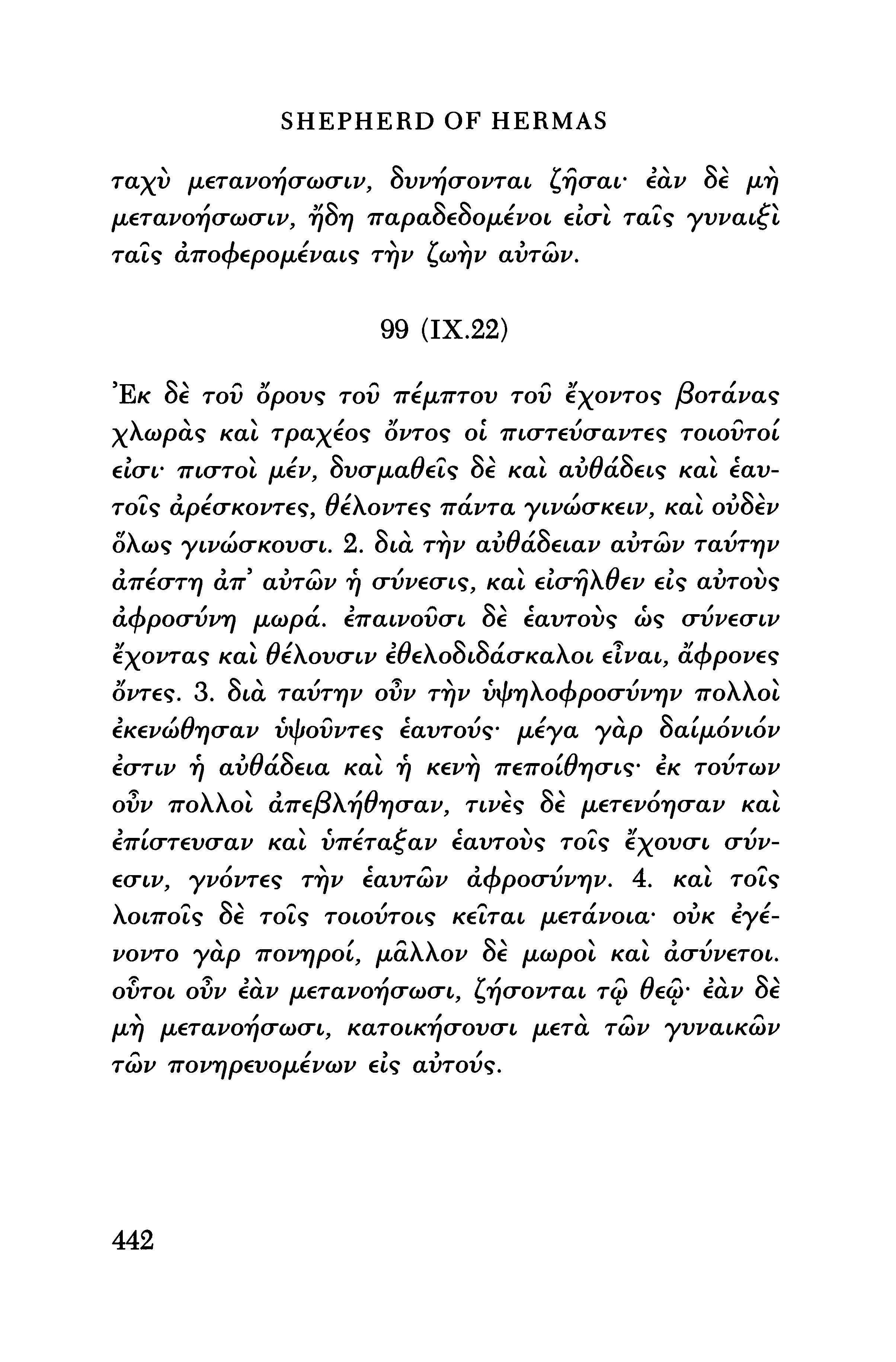
S H E P H E R D OF HERMAS
ταχύ μετανοήσωσιν, δυνήσονται ζήσαιεάν 8ε μή μετανοήσωσιν, ήδη παραδεχόμενοι είσι ταΐς γυναιξί ταΐς άποφερομεναις τήν ζωήν αυτών.
99 (ΙΧ.22)
Έκ Se του ορούς του περπτου του έχοντος βοτάνας χλωράς καί τραχεος οντος οί πιστεύσαντες τοιούτοι είσιπιστοί ρεν, δυσμαθεΐς δε καί αυθάδεις καί εαυτοΐς άρεσκοντες, θελοντες πάντα γινώσκειν, καί ούδεν δλως γινώσκουσι.
2. διά τήν αύθάδειαν αυτών ταύτην άπεστη άπ' αυτών ή σύνεσις, καί είσήλθεν εις αυτούς αφροσύνη ρωρά. επαινούσι δε εαυτούς ώς σύνεσιν έχοντας καί θελουσιν εθελοδιδάσκαλοι είναι, άφρονες οντες. 3. διά ταύτην ούν τήν ύφηλοφροσύνην πολλοί εκενώθησαν ύφούντες εαυτούςρεγα γάρ δαίμόνιόν εστίν ή αύθάδεια καί ή κενή πεποίθησιςεκ τούτων ούν πολλοί άπεβλήθησαν, τίνες δε μετενδησαν καί επίστευσαν καί υπέταξαν εαυτούς τοΐς εχουσι σύν εσιν, γνόντες τήν εαυτών άφροσύνην.
4. καί τοΐς λοιποΐς δε τοΐς τοιούτοις κείται ρετάνοιαούκ εγενοντο γάρ πονηροί, μάλλον δε μωροί καί ασύνετοι, ούτοι ούν εάν μετανοήσωσι, ζήσονται τώ θεώεάν δε μή μετανοήσωσι, κατοικήσονσι μετά τών γυναικών τών πονηρευομενων εις αυτούς.
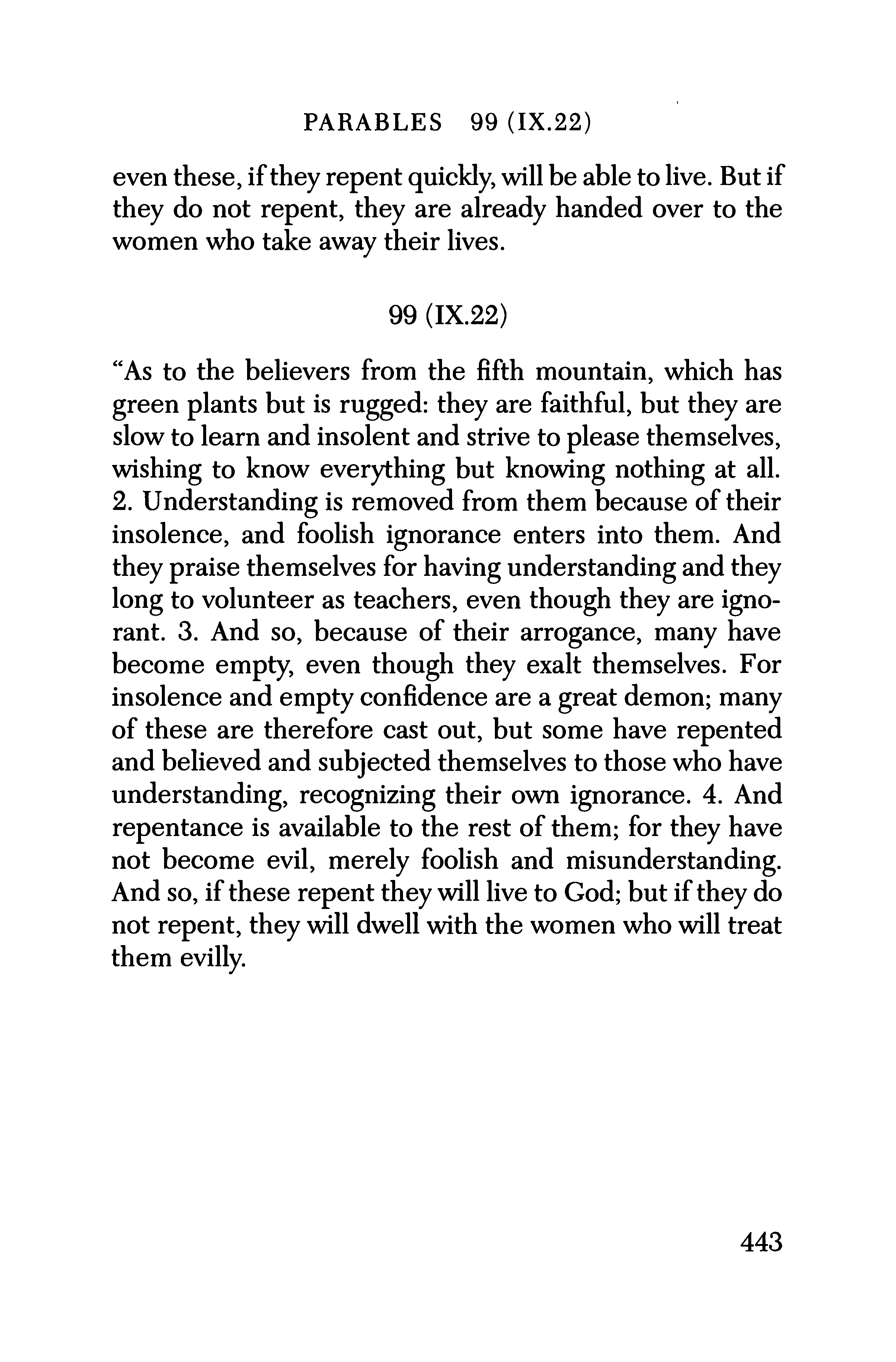
PARABLES
99 (IX.22)
even these, if they repent quickly, will be able to live. But if they do not repent, they are already handed over to the women who take away their lives.
99 (IX.22)
"As to the believers from the fifth mountain, which has green plants but is rugged: they are faithful, but they are slow to learn and insolent and strive to please themselves, wishing to know everything but knowing nothing at all.
2. Understanding is removed from them because of their insolence, and foolish ignorance enters into them. And they praise themselves for having understanding and they long to volunteer as teachers, even though they are igno rant. 3. And so, because of their arrogance, many have become empty, even though they exalt themselves. For insolence and empty confidence are a great demon; many of these are therefore cast out, but some have repented and believed and subjected themselves to those who have understanding, recognizing their own ignorance. 4. And repentance is available to the rest of them; for they have not become evil, merely foolish and misunderstanding.
And so, if these repent they will live to God; but if they do not repent, they will dwell with the women who will treat them evilly.
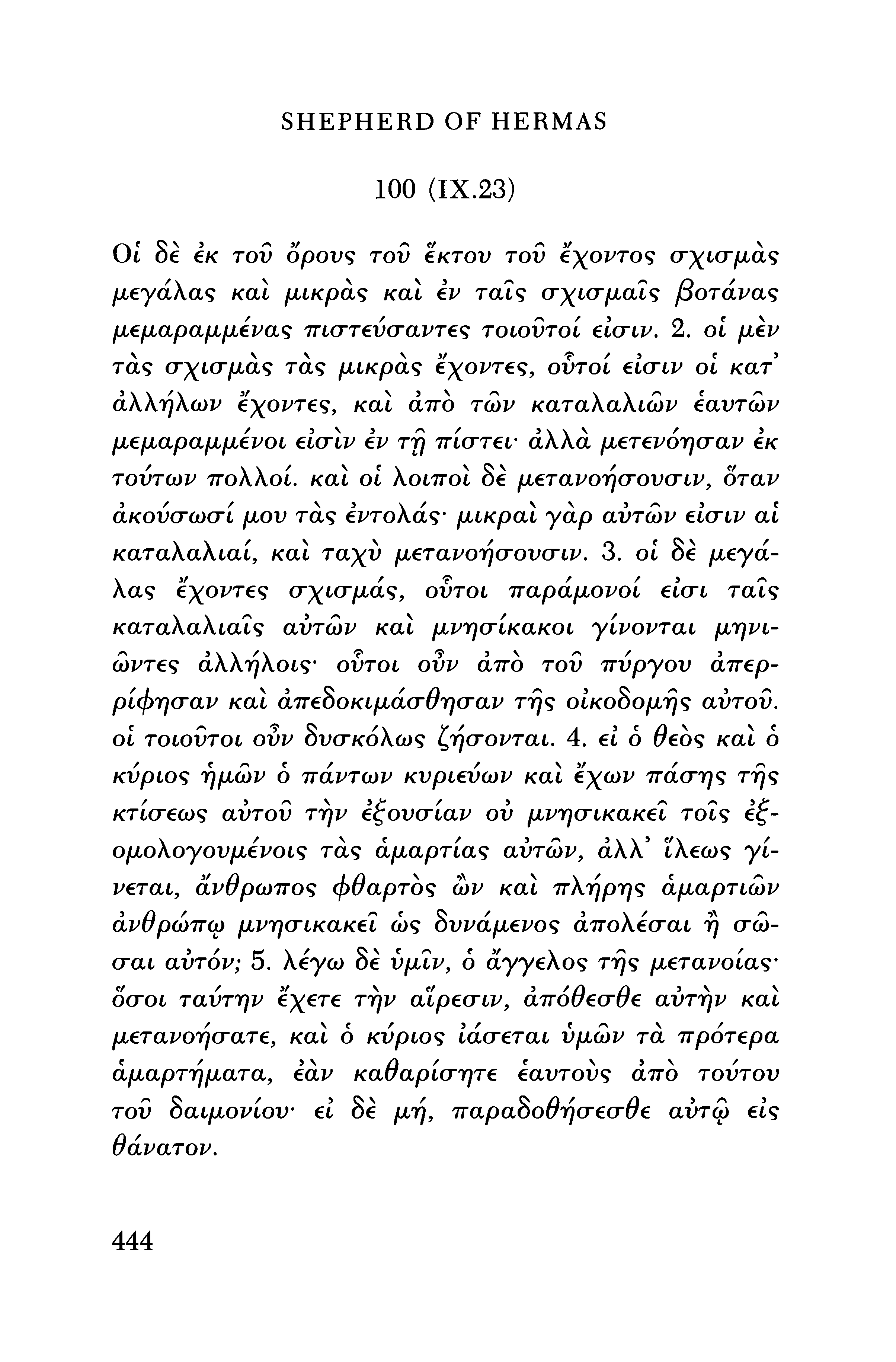
S H E P H E R D OF HERMAS
100 (IX.23)
Ot δε εκ τον ορονς τον έκτον τον έχοντος σχισράς ρεγάλας καϊ ρικράς καϊ εν ταΐς σχισμαΐς βοτάνας μεμαραρρενας πιστεύσαντες τοιούτοι είσιν.
2. ot ρεν τάς σχισράς τάς ρικράς έχοντες, οντοί είσιν οί κατ αλλήλων έχοντες, καί άπο τών καταλαλιών εαντών ρεραραρρενοι είσίν εν τή πίστει· άλλά μετενόησαν εκ τούτων πολλοί, καί οί λοιποί δε ρετανοήσονσιν, όταν άκούσωσί ρον τάς εντολάς· ρικραί γάρ αυτών είσιν αί καταλαλιαι, καί ταχύ ρετανοήσονσιν.
3. ot δε ρεγά λας έχοντες σχισράς, ούτοι παράρονοί είσι ταΐς καταλαλιαις αυτών καί μνησίκακοι γίνονται μηνιώντες άλλήλοις· ούτοι ονν άπδ τού πύργον απερ ρίφθησαν καί άπεδοκιράσθησαν τής οικοδομής αυτού, οί τοιούτοι ονν δνσκδλως ζήσονται.
4. εί δ θεδς καί δ κύριος ηρών δ πάντων κνριεύων καί έχων πάσης τής κτίσεως αυτού τήν εζονσίαν ού ρνησικακεΐ τοΐς εζομολογονμενοις τάς άραρτίας αυτών, άλλ' Ιλεως γί νεται, άνθρωπος φθαρτός ών καί πλήρης άραρτιών άνθρώπω ρνησικακεΐ ώς δννάμενος άπολεσαι ή σώσαι αύτον; 5. λεγω δε ύμΐν, δ άγγελος τής μετανοίας· οσοι ταύτην έχετε τήν αίρεσιν, άπόθεσθε αυτήν καί ρετανοήσατε, καί δ κύριος ίάσεται ύρών τά πρότερα άραρτήρατα, εάν καθαρίσητε εαντούς άπο τούτον τού δαιρονίον εί δε ρή, παραδοθήσεσθε αύτώ εις θάνατον.
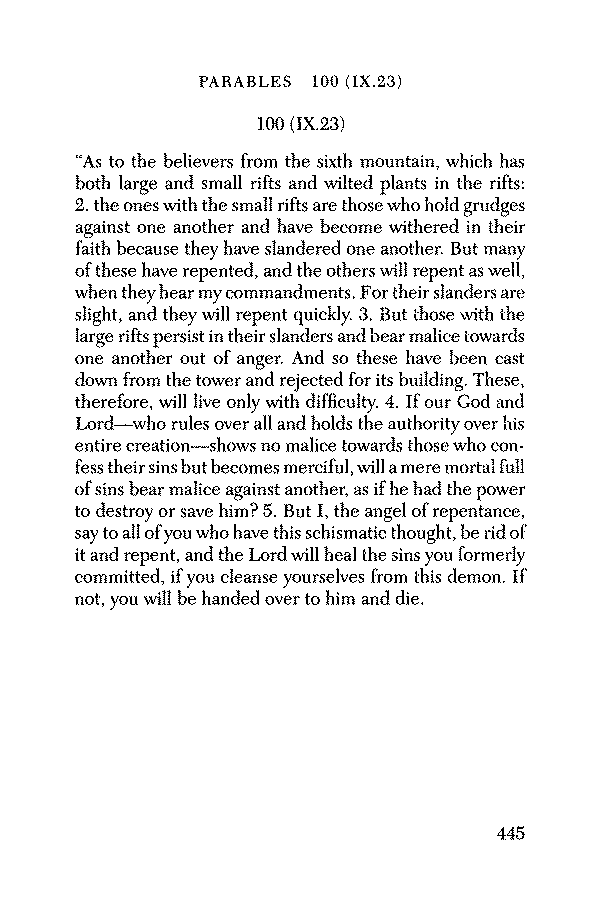
PARABLES
100 (IX.23)
100 (IX.23)
"As to the believers from the sixth mountain, which has both large and small rifts and wilted plants in the rifts:
2. the ones with the small rifts are those who hold grudges against one another and have become withered in their faith because they have slandered one another. But many of these have repented, and the others will repent as well, when they hear my commandments. For their slanders are slight, and they will repent quickly. 3. But those with the large rifts persist in their slanders and bear malice towards one another out of anger. And so these have been cast down from the tower and rejected for its building. These, therefore, will live only with difficulty. 4. If our God and Lord—who rules over all and holds the authority over his entire creation—shows no malice towards those who con fess their sins but becomes merciful, will a mere mortal full of sins bear malice against another, as if he had the power to destroy or save him? 5. But I, the angel of repentance, say to all of you who have this schismatic thought, be rid of it and repent, and the Lord will heal the sins you formerly committed, if you cleanse yourselves from this demon. If not, you will be handed over to him and die.
S H E P H E R D OF HERMAS
101 (IX.24)
3Εκ δε τον έβδομου ορονς, εν ω βοτάναι χλωραϊ και ίλαραί, και όλον το ορός ενθηνούν, και πάν γένος κτηνών και τα πετεινα τον ουρανού
ενέμοντο τάς βοτάνας iv τούτω τω όρει, καί αί βοτάναι, άς εν έμοντο, μάλλον ενθαλεΐς εγίνοντο, οι πιστεύσαντες τοιούτοι εισι2. πάντοτε απλοί και άκακοι και μακά
εγίνοντο, μηδέν κατ αλλήλων έχοντες, άλλα πάντοτε άγαλλιώμενοι επι τοις δούλοις τον θεού και ενδεδνμένοι το πνεύμα το άγιον τούτων των παρθένων και πάντοτε σπλάγχνον έχοντες επι πάντα άνθρωπον, και εκ των κόπων αντών παντι άνθρώπω εχορηγησαν άνονειδίστως και άδιστάκτως.
επληθννεν αυτούς εν τοις κόποις τών χειρών αντών και έχαρίτωσεν αντονς εν πάση πράξει αντών. 4. λέγω δε νμίν τοΐς τοιούτοις ονσιν εγώ 6 άγγελος της μετανοί αςδιαμείνατε τοιούτοι, και ονκ έζαλειφθησεται το σπέρμα υμών εως αιώνοςέδοκίμασε γαρ υμάς
κύριος και ενέγραφεν νμάς εις τον αριθμόν τον ημέτερον, και ολον τό σπέρμα νμών κατοικήσει μετά τον ν ιού τού θεούεκ γάρ τού πνεύματος
2 3 1 και μακάριοι Α Ε: om. L L 232 νηπιότητα L L Ε: ηπιότητα Α 233 πμβνματος L L Ε: σπέρματος Α
PARABLES
101 (IX.24)
101 (IX.24)
"As to the believers from the seventh mountain, where green and healthy plants grow and the entire mountain flourishes, with every kind of animal and bird of the air grazing among its plants—plants that thrive all the more, even when grazed: 2. these believers have become simple, innocent, and fortunate at all times, holding no grudge against one another but always rejoicing in the slaves of God, wearing the holy spirit of these virgins and always be ing compassionate to everyone. And they have provided what is needed to everyone out of their own labors, with out reproach or hesitation. 3. And so, when the Lord saw their simplicity and all their child-like innocence, he filled them through the labors of their hands and favored them in their every deed. 4. But I, the angel of repentance, say to you who are like this: stay this way, and your descendants will never be obliterated. For the Lord has approved of you and inscribed you among our number, and all your descendants will dwell with the Son of God. For you have received a portion of his Spirit.
234 iXdfiere A E: estis L L
S H E P H E R D OF HERMAS
102 (IX.25)
'E/c δε τον ορονς τον όγδόον, ov "ήσαν αί πολλαι πηγαϊ και πάσα η κτίσις τον κνρίον εποτίζετο εκ των πηγών, οι πιστεύσαντες τοιούτοι είσιν 2. απόστολοι και διδά σκαλοι οι κηρύξαντες εις όλον τον κόσμον και οι διδάξαντες σεμνώς και άγνώς τον λόγον τον κνρίον και μηδέν όλως νοσφισάμενοι εις επιθνμίαν πονηράν, άλλα πάντοτε εν δικαιοσύνη και άληθεία πορενθεντες, καθώς και παρέλαβον το πνεύμα τό άγιον. τών τοι ούτων ονν η πάροδος μετά τών αγγέλων εστίν.
103 (ΙΧ.26)
Έκ δε τού ορονς τού ενάτον τού έρημώδονς, τού τα ερπετά και θηρία εν αύτώ έχοντος τά διαφθείροντα τονς άνθρώπονς,
οί πιστεύσαντες τοιούτοι είσιν 2. οί μεν τονς σπίλονς έχοντες διάκονοι εισι κακώς διακονησαντες και διαρπάσαντες χηρών και ορφανών την ζωην και έαντοίς περιποιησάμενοι εκ της δια κονίας ης ελαβον διακονησαιεάν ονν έπιμείνωσι τη αύτη έπιθνμία, άπέθανον και ουδεμία αύτοΐς ελπις ζωης· εάν δε επιστρέφωσι και άγνώς τελειώσωσι την διακονίαν αυτών, δννησονται ζησαι.
3. οί δε εφωριακότες, ούτοι οί άρνησάμενοί εισι και μη έπιστρέφαντες επι τον κύριον εαυτών, άλλα χερσωθέντες και γενόμενοι ερημώδεις, μη κολλώμενοι τοις δούλοις τού θεού, άλλα μονάζοντες άπολλύονσι τάς έαντών φνχάς.
PARABLES
103 (IX.26)
102 (IX.25)
"As to the believers from the eighth mountain, where there were many springs that provided drink to all the creatures of the Lord: 2. they are apostles and teachers who proclaimed their message throughout the whole world and taught the word of the Lord with reverence and holiness. They misappropriated nothing for their own evil desire, but always proceeded in righteousness and truth, just as they received the Holy Spirit. And so their path lies with the angels.
103 (IX.26)
"As to the believers from the ninth mountain, which is a wasteland and has reptiles and wild beasts that destroy people: 2. the stones that are stained are ministers who have ministered badly, snatching away the livelihood of widows and orphans and providing a living for themselves out of the ministry they have received. If therefore they re main in this desire, they die with no hope of life. But if they convert and complete their ministry in a holy way, they will be able to live. 3. But the stones that have a rough surface are those who have denied the Lord and not returned to him. They have become a deserted wasteland, not clinging to the slaves of God but destroying their own souls in isola2 3 5 τά . . . ανθρώπους A L 2: om. L 1 Ε
S H E P H E R D OF HERMAS
4. ώς γάρ άμπελος εν φραγμώ τινι καταλειφθείσα αμελείας τυγχάνουσα καταφθείρεται καί ύπό τών βο τάνων ερημούται καϊ τω χρόνω αγρία γίνεται, και ούκετι εύχρηστος εστι τω δεσπότη εαυτής, ούτω και οί τοιούτοι άνθρωποι εαυτούς άπεγνώκασι και γίνονται άχρηστοι τω κυρίω εαυτών άγριωθεντες.
5. τούτοις ούν μετάνοια γίνεται, εάν μη εκ καρδίας εύρεθώσιν ηρνημενοιεάν δε εκ καρδίας εύρεθη ηρνημενος τις, ούκ οϊδα, εί δύναται ζησαι.
λεγω, Ινα τις άρνησάμενος μετάνοιαν λάβηαδύνατον γάρ εστι σωθηναι τον μέλλοντα νύν άρνείσθαι τον κύριον εαυτούάλλ' εκείνοις τοΐς πάλαι ηρνημενοις δοκεΐ κείσθαι μετάνοια, εί τις ούν μέλλει μετανοείν, ταχινός γενεσθω πριν τον πύργον άποτελεσθηναιεί δε μη, ύπό τών γυναικών καταφθαρησεται εις θάνατον.
7. και οί κολοβοί, ούτοι δόλιοι εισι και κατάλαλοικαι τά θηρία, ά είδες εις το Ορος, ούτοι είσιν. ώσπερ γάρ τά θηρία διαφθείρει τω εαυτών ίώ τον άνθρωπον και άπολλύει, ούτω και τών τοιούτων ανθρώπων τά ρήματα διαφθείρει τον άνθρω πον και άπολλύει.
8. ούτοι ούν κολοβοί είσιν άπό της πίστεως αυτών διά την πράζιν ην εχουσιν εν εαυτοΐςτίνες δε μετενόησαν και εσώθησαν. και οί λοιποί οί τοιούτοι οντες δύνανται σωθηναι, εάν μετανοησωσιν εάν δε μη μετανοησωσιν, άπό τών γυναικών εκείνων, ων την δύναμιν εχουσιν, άποθανούνται.
PARABLES
103 (IX.26)
tion. 4. For just as a vine left untended on a fence is ruined and overrun with weeds, and after a time grows wild and is no longer of any use to its master, so also people like this have despaired of themselves and become useless to their own Lord because they have grown wild. 5. Thus repen tance can come to these people, if they are found not to have denied the Lord from their hearts; but if one of them is found to have done so, I do not know if he can live. 6.1 am not saying that at the present time someone can deny the Lord and receive repentance; for the one who is about to deny his Lord now cannot be saved. But repentance ap pears to be available to those who made a denial before now. And so, if anyone is about to repent, let him do so quickly before the tower is completed. Otherwise, he will be destroyed by the women. 7. And the stones that were broken off are the deceitful and slanderers. They are also the wild beasts you saw on the mountain. For just as the wild beasts annihilate and destroy a person with their poi son, so also the words of such people annihilate and de stroy him. 8. These are therefore broken off from their faith because of what they did to one another. But some have repented and been saved. And the rest who are like this can be saved if they repent. If they do not, they will be put to death by those very women whose power they exert.
236 OVK A L2 E: om. Li 2 3 7 €t9 . · · ημέρας A L 1 E: om. L
S H E P H E R D OF HERMAS
104 (IX.27)
Έ κ δε τού ορονς τον δεκάτου, ον ήσαν δένδρα σκεπάζοντα πρόβατα τίνα, οί πιστεύσαντες τοιούτοι είσιν 2. επίσκοποι καϊ φιλόξενοι, οϊτινες ήδέως εις τούς οΐκονς έαντών πάντοτε ύπεδέξαντο τονς δούλονς τον θεού άτερ ύποκρίσεωςοί δε επίσκοποι πάντοτε τονς ύστερημένονς και τάς χήρας τή διακονία έαντών αδιαλείπτως έσκέπασαν καί άγνώς άνεστράφησαν πάντοτε.
3. ούτοι ονν πάντες σκεπασθήσονται ύπό τού κνρίον διαπαντός. οί ονν ταύτα εργασάμενοι ένδοξοι εισι παρά τω θεώ και ήδη ό τόπος αυτών μετά τών αγγέλων εστίν, εάν επιμείνωσιν έως τέλονς λειτονργούντες τω κνρίω.
105 (ΙΧ.28)
Έκ δε τού ορονς τού ένδεκάτον, ον ήσαν δένδρα καρπών πλήρη, άλλοις και άλλοις καρποΐς κεκοσμημένα, οί πιστεύσαντες τοιούτοι είσιν 2. οί παθόντες υπέρ τού ονόματος τού νίού τού θεού,
οι καί προθύμως επαθον εξ όλης της καρδίας και παρέδωκαν τάς ψνχάς αυτών. 3. διατί ονν, φημί, κύριε, πάντα μεν τά δένδρα καρπούς έχει, τινές δε εξ αυτών καρποί εύειδέστεροί είσιν; άκονε, φησίν όσοι ποτέ επαθον διά τό Ονομα, ένδοξοι εισι παρά τω θεώ, καί πάντων τούτων αί άμαρτίαι άφηρέθησαν, ότι επαθον διά τό Ονομα
PARABLES
105 (IX.28)
104 (IX.27)
"As to the believers from the tenth mountain, where there were trees providing shelter for some sheep: 2. they are bishops and those who are hospitable, who always gladly welcomed the slaves of God into their homes without hy pocrisy. And through their ministry, the bishops always provided constant shelter for those in need and for the widows, and they always conducted themselves in a holy way. 3. And so all these will be sheltered by the Lord at all times. Thus those who engage in such works are glorious before God and already have their place with the angels, if they continue serving the Lord until the end.
105 (IX.28)
"As to the believers from the eleventh mountain, where there were laden fruit trees, adorned with various kinds of fruit: 2. they are those who have suffered for the name of the Son of God—suffered willingly from their whole heart and handed over their lives." 3. "Why, then, Lord," I asked,
"do all the trees have fruit, but some fruits are more beau tiful than others?" "Listen," he said; "all those who at one time or another have suffered for the sake of the name are glorious before God and the sins of all of them are for given, because they suffered for the name of the Son of 238 T O y vl0y ro{) Qe0y Α: domini L L: eius Ε 239 όνομα A: add, domini L L: add eius Ε
S H E P H E R D OF HERMAS
ποικίλου είσιν, τινές δε υπερέχοντες, άκουε. 4. όσοι, φησίν, έπ' έζουσίαν άχθέντες έζητάσθησαν καί ουκ ήρνήσαντο, άλλ* επαθον προθύμως, ούτοι μάλλον ενδοξότεροι εισι παρά τω κυρίωτούτων
καρπός εστίν 6 υπερέχων, όσοι δε δειλοί καί εν δισταγμώ εγένοντο καί έλογίσαντο έν τοις καρδίαις αυτών, πότερον άρνήσονται ή όμολογήσουσι, καί επαθον, τού των οι καρποί ελάττους είσιν, ότι άνέβη επί την καρδίαν αυτών ή βουλή αύτηπονηρά γάρ ή βουλή αύτη, ΐνα δούλος κύριον Ιδιον άρνήσηται.
5. βλέπετε ούν ύμεΐς οί ταύτα βουλευόμενοι, μήποτε ή βουλή αύτη διαμείνη έν ταΐς καρδίαις υμών καί άποθάνητε τω θεώ. ύμεΐς δε οί πάσχοντες ένεκεν τού ονόματος δοζάζειν οφείλετε τον θεόν, οτι άξιους υμάς ήγήσατο ό θεός, ΐνα τούτο το όνομα βαστάζητε καί πάσαι ημών αί άμαρτίαι ίαθώσιν.
6. ούκούν μακαρίζετε εαυ τούςάλλα δοκεΐτε έργον μέγα πεποιηκέναι, εάν τις υμών διά τον θεόν
πάθη. ζωήν ύμΐν ό κύριος χαρί ζεται, καί ού νοείτεαί γάρ άμαρτίαι υμών κατεβάρησαν, καί εί μή πεπόνθατε ένεκεν τού ονόματος κυρίου, διά τάς αμαρτίας υμών τεθνήκειτε άν τω θεώ. 7. ταύτα ύμΐν λέγω τοις διστάζουσι περί αρνήσεως ή όμολογήσεωςομολογείτε οτι κύριον έχετε, μήποτε αρνούμενοι παραδοθήσησθε εις δεσμωτήριον.
8. εί τά εθνη τους δούλους αυτών κολάζουσιν, εάν τις άρνήσηται τον κύριον εαυτού, τί δοκεΐτε ποιήσει ό κύριος ύμΐν, ός εχεΐ πάντων τήν έζουσίαν; άρατε τάς βουλάς ταύτας άπό τών καρδιών υμών, ΐνα διαπαντός ζήσητε τω θεώ.
PARABLES
105 (IX.28)
God. But listen to why they have different kinds of fruit and some is superior. 4. All those," he said, "who have been led before an authority and interrogated, and suffered willingly without making a denial, are more glorious be fore the Lord. Their fruit is superior. But all those who have been cowardly and filled with doubt and who have questioned in their heart whether to deny the Lord or con fess him, and then suffered anyway—their fruit is inferior, because this notion arose in their heart. For it is an evil no tion for a slave to deny his own lord. 5. And so, you who are thinking about doing these things, take care or this notion may stay in your heart and you may die to God. But you who suffer on account of the name should glorify God, be cause he considered you worthy to bear this name and to be healed of all your sins. 6. Consider yourselves fortunate.
But realize that you have done a great work, if any of you suffers for God. The Lord graciously gives you life, and you do not understand it, for your sins have weighed you down; and if you did not suffer on account of the name of the Lord, you would have died to God because of your sins. 7.1 say these things to you who cannot decide whether to deny or confess. Confess that you have a master [Or: the Lord], lest after making a denial you be delivered over to prison.
8. If the outsiders punish their slaves for denying their own lord, what do you suppose the Lord who has authority over all things will do to you? Remove these notions from your heart, that you may live to God at all times.
240 διά τον Oebv A Ε: om. L L
S H E P H E R D OF HERMAS
106 (IX.29)
Έκ δε τον ορονς τον δωδεκάτον τον λενκού οί πιστεύσαντες τοιούτοι είσιν ώς νήπια βρέφη είσιν, οις ουδεμία κακία αναβαίνει επί την καρδίαν ουδέ έγνω σαν, τί εστι πονηρία, άλλα πάντοτε εν νηπιότητι διέμειναν.
2. οί τοιοντοί ονν άδιστάκτως κατοικήσονσιν εν τή βασιλεία τον θεού, οτι εν ούδενί πράγματι εμίαναν τάς εντολάς τον θεον, άλλα μετά νηπιότητος διέμειναν πάσας τάς ημέρας της ζωής αντών έν τή αύτη φρονήσει.
3. όσοι ονν διαμενείτε, φησί, καί εσεσθε ώς τά βρέφη, κακίαν μή έχοντες, πάντων τών προειρημένων ενδοξότεροι εσεσθεπάντα γάρ τά βρέ φη ενδοζά εστι παρά τω θεώ καί πρώτα παρ αντώ. μακάριοι ονν νμείς, όσοι αν άρητε άφ' έαντών τήν πονηρίαν, ένδνσησθε δέ τήν άκακίαν πρώτοι πάντων ζήσεσθε τω θεώ. 4. μετά τό σνντελέσαι αντόν τάς παραβολάς τών ορέων λέγω αντώκνριε, ννν μοι δήλωσον περί τών λίθων τών ηρμένων εκ τον πεδίον καί εις τήν οίκοδομήν τεθειμένων αντί τών λίθων τών ηρμένων εκ τον πνργον, καί τών στρογγυλών τών τεθέντων εις τήν οίκοδομήν καί τών ετι στρογγυλών όντων.
107 (ΙΧ.30)
"Ακονε, φησίν, καί περί τούτων πάντων, οί λίθοι οί έκ τού πεδίον ηρμένοι καί τεθειμένοι εις τήν οίκοδομήν
PARABLES
107 (IX.30)
106 (IX.29)
"As to the believers from the twelfth mountain, which was white: they are like young infants, who have never had evil arise in their hearts, nor have they known what is evil, but have always remained in their childlike innocence. 2. Such people will certainly dwell in the kingdom of God, because they have not defiled the commandments of God by any thing they have done, but with childlike innocence they have remained in the same state of mind all the days of their lives. 3. And so, all of you who remain like this," he said, "innocent as infants, will be more glorious than every one mentioned before. For every infant is glorious before God and preeminent with him. Thus you who remove evil from yourselves and are clothed in innocence are fortu nate; you will live as preeminent above all others before God." 4. After he completed the parables of the mountains
I said to him, "Lord, now explain to me about the stones that were taken from the plain and set in the building in place of the ones removed from the tower, and about the round stones that were set in the building, and about those that are still round."
107 (IX.30)
"Listen," he said, "about all these things as well. The stones that were taken from the plain and set in the building of
S H E P H E R D OF HERMAS
τον πύργον αντί τών άποβεβλη μένων αί ρίζαι είσί τον ορονς τον λενκού τούτον. 2. έπεί ονν οί πιστεύσαντες έκ τού ορονς τού λενκού πάντες άκακου ευρέθησαν, έκέλενσεν 6 κύριος τού πνργον τούτονς έκ τών ρι ζών
τού ορονς τούτον βληθήναι εις τήν οίκοδομήν τού πύργον εγνω γάρ οτι, έάν άπέλθωσιν βίς τήν οίκοδομήν τού πύργον οί λίθοι ούτοι, διαμενούσι λαμ προί, καί ουδείς αυτών μελανήσει.
3. quodsi de ce teris montibus adiecisset, necesse habuisset rursus visitare earn turrem atque purgare. hi autem omnes candidi inventi sunt, οί πιστεύσαντες καί μέλλοντες πιστεύειν έκ τού αυτού γάρ γένονς είσιν. μακάριον το γένος τούτο οτι άκακόν εστι. 4. άκονε νύν καί περί τών λίθων τών στρογγυλών καί λαμπρών, καί αυτοί πάντες έκ τού ορονς τού λενκού είσιν. audi autem quare rotundi sunt reperti. divitiae suae eos pusillum obscuraverunt a veritate atque obfuscaverunt; a deo vero numquam recesserunt, nec ullum verbum malum processit de ore eorum, sed omnis aequitas et virtus veritatis.
5. horum ergo mentem cum vidisset dominus, posse eos veritati favere, bonos quoque permanere, iussit et opes eorum circumcidi, non enim in totum tolli, ut possint aliquid boni facere de eo quod eis relictum est; et vivent deo, quoniam ex bono genere sunt, ideo ergo pusillum circumcisi sunt et positi sunt in structuram turris huius.
241 τών ριζών L L (E): om. A 2 4 2 The following Latin text is that of L 1 (the Vulgate version).
PARABLES
107 (IX.30)
the tower to replace the ones cast out are the roots of this white mountain. 2. And so, since all the believers from the white mountain have been found innocent, the Lord of the tower ordered them to be taken from the roots of this mountain for the building of the tower. For he knew that if these stones came into the building of the tower, they would remain bright and none of them would turn black.
3. But if he had added some from other mountains, he would have had to visit this tower again and cleanse it. But all these—both those who believe and those who are about to believe—have been found white, for they are of the same kind. This kind is fortunate because it is innocent.
4. Listen now also about the stones that are round and bright. All these are also from the white mountain. But lis ten to why they have been discovered to be round. Their riches have partially blinded and obstructed them from the truth. Still, they have never departed from God, nor has any evil word come forth from their mouths, but only what is upright and worthy of the truth. 5. And so, when the Lord saw their minds, that they were able to counte nance truth and to remain good, he ordered their riches to be cut away—but not to be removed entirely, that they may be able to do something good from what was left to them. And they will live to God, since they are of a good kind. And so they were trimmed a bit and set in this tower building.
S H E P H E R D OF HERMAS
108 (IX.31)
Ceteri vero, qui adhuc rotundi remanserunt neque aptati sunt in earn structuram, 243 quia nondum acceperunt sigillum, repositi sunt suo loco; valde enim rotundi reperti sunt. 2. oportet autem circumcidi hoc saeculum ab illis et vanitates opum suarum, et tunc convenient in dei regnum. necesse est enim eos intrare in dei regnum; hoc enim ge nus innocuum benedixit dominus. ex hoc ergo genere non intercidet quisquam. etenim licet quis eorum temptatus a nequissimo diabolo aliquid deliquerit, cito recurret ad dominum suum. 3. felices vos iudico omnes
2 4 4 ego nuntius paenitentiae, quicumque estis innocentes sicut infantes, quoniam pars vestra bona est et honorata apud deum.
4. dico autem omnibus vobis, quicumque sigillum hoc accepistis, simplicitatem habere neque offensarum memores esse neque in malitia vestra permanere aut in memoria offensarum amaritudinis; 245 in unum quoque spiritum fieri, et has malas scissuras permedicare ac tollere a vobis, ut dominus pecorum gaudeat de his. 5. χαρήσβται δβ, βάν πάντα νγιή βνρβθή καί μη διαπβπτωκότα τινά βζ αντών. βάν δβ βνρβθή τινα βζ αντών διαπβπτωκότα, oval τοις ποιμβσιν βσται.
6. βάν δβ και αντοί οι ποιμβνβς βνρβθώσιν διαπβπτωκότβς, τί βρονσιν τω δβσπότη τον ποιμνίον; οτι άπο τών προβάτων διβπβο~αν; ον πιστβνθήσονταιάπιστον yap πράγμα βστιν, ποι μένα νπο προβάτων παθβϊν τι. μάλλον δβ κολασθή2 4 3 aptati . . . structura S: apti sunt in ea structure Α Ο Ζ
244 omnes SAO: om. Ζ 245 amantudinis S c A c: amaritudines S A Z: et amaritudinis Ο
PARABLES
108 (IX.31)
108 (IX.31)
"But the others, which have remained round until now and were not fit into the building, because they have not yet re ceived the seal: these were returned to their own place.
For they were found to be extremely round. 2. For this age must be cut away from them, along with the vanities of their wealth, and then they will be suitable for the king dom of God. For they must enter the kingdom of God, for the Lord has blessed this innocent kind. And so, no one of this kind will perish. Even if one of them is tempted by the most wicked devil and commits a sin, he will quickly return to his Lord. 3. I, the angel of repentance, judge all of you fortunate, you who are innocent as infants, since your part is good and honorable before God. 4. But I say to all of you who have received this seal: hold on to your simplicity and do not bear grudges or remain in your evil ways or dwell on the bitterness of past indignities. Be one in spirit, heal these evil schisms and remove them from yourselves, that the Lord of the flocks may rejoice in them. 5. He will re joice if all of them are found healthy and none of them has been scattered. But woe to the shepherds if any of the sheep are found scattered. 6. And if the shepherds them selves are found scattered, what will they say to the Lord of the flock? That they were scattered because of the sheep?
No one would believe them. For it would be beyond belief that the shepherd could suffer from the sheep. Instead
S H E P H E R D OF HERMAS
et ego sum pastor, et validissime oportet me de vobis reddere rationem. σονται διά τό ψεύδος αντών.
109 (IX.32)
Remediate ergo vos, dum adhuc turris aedificatur. 2. dominus habitat in viris amantibus pacem; ei enimvero pax cara est, a litigiosis vero et perditis malitiae longe abest. reddite igitur ei spiritum integrum, sicut accepistis. 3. si enim dederis fulloni vestimentum novum integrum, idque integrum 2 4 7 iterum vis recipere, fullo autem si scissum tibi illud reddat, recipies illud? nonne statim scandescis et eum convicio 2 4 8 persequeris, dicens: vestimentum inte grum tibi dedi. quare scidisti illud et inutile redigisti, et propter scissuram, quam in eo fecisti, in usu esse non po test? nonne haec omnia verba dices fulloni ergo et de scissura quam in vestimento tuo fecerit? 4. si igitur tu doles de vestimento tuo et quaereris quod non illud integrum recipias, quid putas dominum tibi facturum, qui spiritum in tegrum tibi dedit, et tu eum totum inutilem redigisti, ita ut nullo usu esse possit domino suo? inutilis enim esse coepit usus eius, cum sit corruptus a te. nonne igitur dominus spiritus eius propter hoc factum tuum morte te
2 4 9 adficiet?
5. plane, inquam, omnes eos, quoscumque invenerit in memoria offensarum permanere, adficiet. clementiam, inquit, eius calcare nolite, sed potius honorificate eum,
2 4 6 The Greek in this chapter is from Antiochus, Π,ανΒέκτης της αγίας γραφής 247 novum . . . integrum 2 S A: integrum novum Ζ 2 4 8 convicio S Z: continuo A 249 morte te cj. Gebhardt
PARABLES
109 (IX.32)
they will be punished because of their lie. I am myself a shepherd, and so am all the more pressed to give an ac count for you.
109 (IX.32)
"Therefore, heal yourselves while the tower is being built.
2. The Lord dwells with those who love peace. For indeed, peace is dear to him, but he keeps his distance from those who are contentious and destroyed by malice. And so, re turn your spirit to him intact, just as you received it. 3. For if you give a new garment to a cleaner, intact, and you want to receive it back from him intact, but the cleaner gives it back to you torn, will you accept it? Will you not immedi ately grow livid and hound him with abuse, saying, Ί gave you this garment in one piece! Why did you tear it and ruin it? It cannot be worn now that you have made this tear in it!' Won't you say something like this to the cleaner for tearing your garment? 4. And so, if you are upset about your garment and complain that you have not received it back intact, what do you think the Lord will do to you? For he gave you his spirit intact but you brought it back com pletely worthless, so that it can be of no use to its Lord. For it is no longer good for anything, once you have destroyed it. Will the Lord of this spirit not hand you over to death because of what you have done?" 5. "Certainly," I replied,
"he will punish everyone who bears grudges." "Do not," he said, "trample on his mercy, but rather honor him, since he
S H E P H E R D OF HERMAS
quod tam patiens est ad delicta vestra, et non est sicut vos. agite enim paenitentiam; utile 2 5 0 est vobis.
110 (IX.33)
τον θεού. έάν πεισθήτε αύτοΐς καί άκούσητε τών ρημάτων μον καί πορενθήτε έν αντοΐς
καί κατορθώσητε τάς οδούς νμών, ζήσαι δύνασθε, έάν δέ παραμείνητε τή δολιότητι καί μνησικακία, ουδείς τών τοιούτων ζήσει τω θεώ. ταύτα πάντα παρ
2. λέγει μοι 6 ποιμήν πάντα με έπηρώτησας; ναι, φημί, κύριε, τι οτι, φησίν, ούκ έπηρώτησας περί τών τύπων τών λίθων τών άπεληλνθότων εις τήν οίκοδομήν, ων έζεπληρώσαμεν; έπελαθόμην, φημί, κύριε.
λελάληται ύμΐν. καί μετανοήσαντες έζ ολης καρδίας αυτών, καί έπεί ei8ei^ 255 ό κύριος
τήν μετάνοιαν αυτών καλήν καί καθαράν καί δνναμένονς παραμεΐναι έν τή μετάνοια αυτών, έκέλενσεν τάς αμαρτίας αυτών τάς προτέρας έζαλειφθήναι. οί yap τύποι ούτοι αί άμαρτίαι αυτών ήσαν. έζωμαλίσθησαν ονν εις το μηκέτι φαίνεσθαι αύτάς.
2 5 0 utile S: utiles A: utilem Z™d.
PARABLES
110 (IX.33)
is so patient with your sins and is not like you. And so come and repent, for it is good for you.
110 (IX.33)
"All these things written above I, the shepherd, the angel of repentance, have shown and spoken to the slaves of God. And so, if you believe them and hear my words and proceed in them and correct your ways, you will be able to live. But if you persist in being deceitful and dwell on in dignities—no one like this will live to God. I have told you everything that I needed to say." 2. The shepherd said to me, "Have you asked me everything?" I replied, "Yes,
Lord, I have." "But why have you not asked me about the impressions left by the stones placed in the building, which we filled in?" "I forgot, Lord," I replied. 3. "Listen, now," he said, "concerning these. These are the ones who now have heard my commandments and repented from their whole heart; and when the Lord saw that their repentance was good and pure, and that they were able to remain in it, he ordered their former sins to be expunged. These im pressions, therefore, were their sins, and they have been leveled over so that they may no longer be seen."
2 Ε 254 Χβλάληται νμίν L 1: add τά ρήματα F: verba praedicta sunt vobis L 253 παρ . . . λαληθήναι (Ll): om. F L 2: locutus sum vobis propter vos Ε 255 4π€1 €lSep U Ε: βπβώβν F (L2) 256 κύριος L Ε: θβός F 257 The Greek in this chapter is from F.