
Another Parable, Second
S H E P H E R D OF HERMAS
8. άντϊ αγρών ονν αγοράζετε φνχάς θλιβορένας, καθά τις δυνατός εστι, καϊ χήρας καϊ ορφανούς έπισκέπτεσθε καϊ ρή παραβλέπετε αντονς, καί τον πλούτον ύρών καϊ τάς παρατάξεις πάσας εις τοιούτονς αγρούς και οικίας δαπανάτε, ας ελάβετε παρά τον θεον. 9. et? τοντο γάρ έπλούτισεν ύράς 6 δεσπότης, ΐνα ταύτας τάς διακονίας τελεσητε αντωπολν βελτιόν εστι τοι ούτους αγρούς άγοράζειν καί κτήρατα καί οΐκονς, ονς εύρήσεις εν τή πόλει σον, όταν έπιδη ρήσης εις αυτήν.
10. αύττ; ή πολντελεια καλή καί ιλαρά, λύπην ρή εχονσα ρηδέ φόβον, εχονσα δέ χαράν. τήν ονν πολντέλειαν τών εθνών ρή πράσσετε·
άσύρφορον γάρ έστιν ύρΐν τοΐς δούλοις τού θεού11. τήν δέ ιδίαν πολντέλειαν πράσσετε, έν ή δύνασθε χαρήναικαί ρή παραχαράσσετε ρηδέ τού άλλοτρίον άφησθε ρηδέ έπιθνρεΐτε αυτούπονηρον γάρ έστιν αλλότριων έπιθνρεΐν.
51 (Π) ΙΙεριπατούντός ρον εις τον άγρόν καί κατανοούντος πτελέαν καί άρπελον, καί διακρίνοντος περί αυτών καί τών καρπών αυτών, φανερούταί ροι ό ποιρήν καϊ λέγειτί σύ έν έαντώ ζητείς περί τής πτελέας καί τής άρπέλον; σνζητώ, φηρί, κύριε, ότι εύπρεπέσταταί εί σιν άλλτ^λαις. 2. ταύτα τά δύο δένδρα, φησίν, εις τύπον κείνται τοΐς δούλοις τού θεού. ήθελον, φηρί,
PARABLES 51 (II) guarded. 8. Instead of fields, then, purchase souls that have been afflicted, insofar as you can, and take care of widows and orphans and do not neglect them; spend your wealth and all your furnishings for such fields and houses as you have received from God. 9. For this is why the Mas ter made you rich, that you may carry out these ministries for him. It is much better to purchase the fields, goods, and houses you find in your own city when you return to it.
10. This kind of extravagance is good and makes one glad; it has no grief or fear, but joy instead. And so, do not partic ipate in the extravagance sought by outsiders; for it is of no profit for you who are slaves of God. 11. But participate in your own extravagance in which you can rejoice. And do not counterfeit or touch what belongs to another, or desire it. For it is evil to desire someone else's goods. But do your own work, and you will be saved."
Another Parable 51 (II) While I was walking in the field and considering an elm tree and a vine, reflecting on them and their fruits, the shepherd appeared to me and said, "Why are you asking yourself about the elm tree and the vine?" "I am thinking,
Lord," I replied, "that they are extremely well suited for one another." 2. "These two trees," he replied, "symbolize the slaves of God." "I would like to know," I said, "what
6 μή πράσσετε A Ε: nolite cupere L 1 (L 2) 7 πονηρον . . . επιθνμείν A Ε L 2: om. L
S H E P H E R D OF HERMAS
γνώναι τον τύπον τών δένδρων τούτων ών λέγεις, βλέπεις, φησί, τήν πτελέαν καϊ τήν άρπελον; βλέπω, φηρί, κύριε. 3. ή άρπελος, φησίν, αύτη καρπόν φέρει, ή δέ πτελέα ξύλον άκαρπόν έστιν άλλ' ή άρπελος αύτη έάν ρή άναβή έπϊ τήν πτελέαν, ού δύναται καρποφορήσαι πολύ έρριρρένη χαμαί, και όν φέρει καρπόν, σεσηπότα φέρει ρή κρεραρένη έπϊ τής πτελέας. όταν ονν έπιρριφή ή άρπελος έπϊ τήν πτελέαν, και παρ
4. βλέπεις ονν, ότι καϊ ή πτελέα πολύν καρπόν δίδωσιν, ούκ ελάσσονα τής άρπελον, μάλλον δέ καϊ πλεί ονα, πώς, φημί, κύριε, πλείονα;
ότι, φησίν, ή άρπελος κρεμάμενη έπϊ τήν πτελέαν τον καρπόν πολύν καϊ καλόν δίδωσιν, έρριρρένη δέ χαμαϊ ολίγον καϊ σαπρόν φέρει, αύτη ονν ή παραβολή εις τούς δούλονς τού θεού κείται, εις πτωχόν καϊ πλούσιον.
5. πώς, φημί, κύριε, γνώρισόν ροι. άκονε, φησίν ό μέν πλούσιος έχει χρήματα, τά δέ προς τον κύριον πτω χεύει, περισπώμενος περϊ τον πλούτον έαντού, καϊ λίαν
ρικράν έχει τήν εντενζιν και τήν έξομολόγησιν προς τον κύριον, καϊ ήν έχει, βληχράν καϊ μικράν καϊ άλλην
έπϊ τον πένητα ό πλούσιος και χορηγή αύτώ τά δέοντα, πιστεύει οτι έάν έργάσηται εις τον πένητα δννήσεται τον μισθόν εύρεΐν παρά τώ θεώ· ότι ό πένης πλούσιος έστιν έν τή έντεύζει αυτού καϊ έν τή εξομο λογήσει,
και δύναμιν μεγάλην έχει παρά τώ θεώ ή εντενξις αυτού, επιχορηγεί ονν ό πλούσιος τώ πένητι
PARABLES 51 (II) these two trees you are speaking about symbolize." "You see," he said, "the elm and the vine?" "I see them, Lord," I replied. 3. "This vine," he said, "bears fruit; but the elm is a tree that does not. Yet if this vine did not grow up onto the elm, it could not bear much fruit, since it would be lying on the ground, and the fruit it bore would be rotten, since it would not be clinging to the elm. And so, when the vine at taches to the elm, it bears fruit both of itself and because of the elm. 4. And so you see that the elm also gives much fruit—no less than the vine, but rather more." "How does it bear more, Lord" I asked. "Because," he said, "it is by clinging to the elm that the vine gives an abundance of good fruit; but when it is lying on the ground it bears just a little rotten fruit. And so this parable applies to the slaves of God, the poor and the rich." 5. "How so, Lord?" I asked.
"Explain it to me." "Listen," he said. "The rich person has money, but is poor towards the Lord, since he is distracted by his wealth. The prayer and confession he makes to the Lord are very small—weak, small, and of no real effect.
And so, when the rich person depends upon the one who is poor and supplies him with what he needs, he believes that by helping the one who is poor he will find his recompense before God. For the poor person is rich in his petition and confession, and his petition has a great effect before God.
And so the rich person supplies everything to the one who 2 : om. A L
0 x : avov A: apud dominum L 2: άγνήν cj. Dibelius: άνω cj. Tischendorf: om. Ll Ε C
11 άλλην cj. Lake: α[}ην P
2 (L 2): άναπλή A: om. Ll
S H E P H E R D OF HERMAS
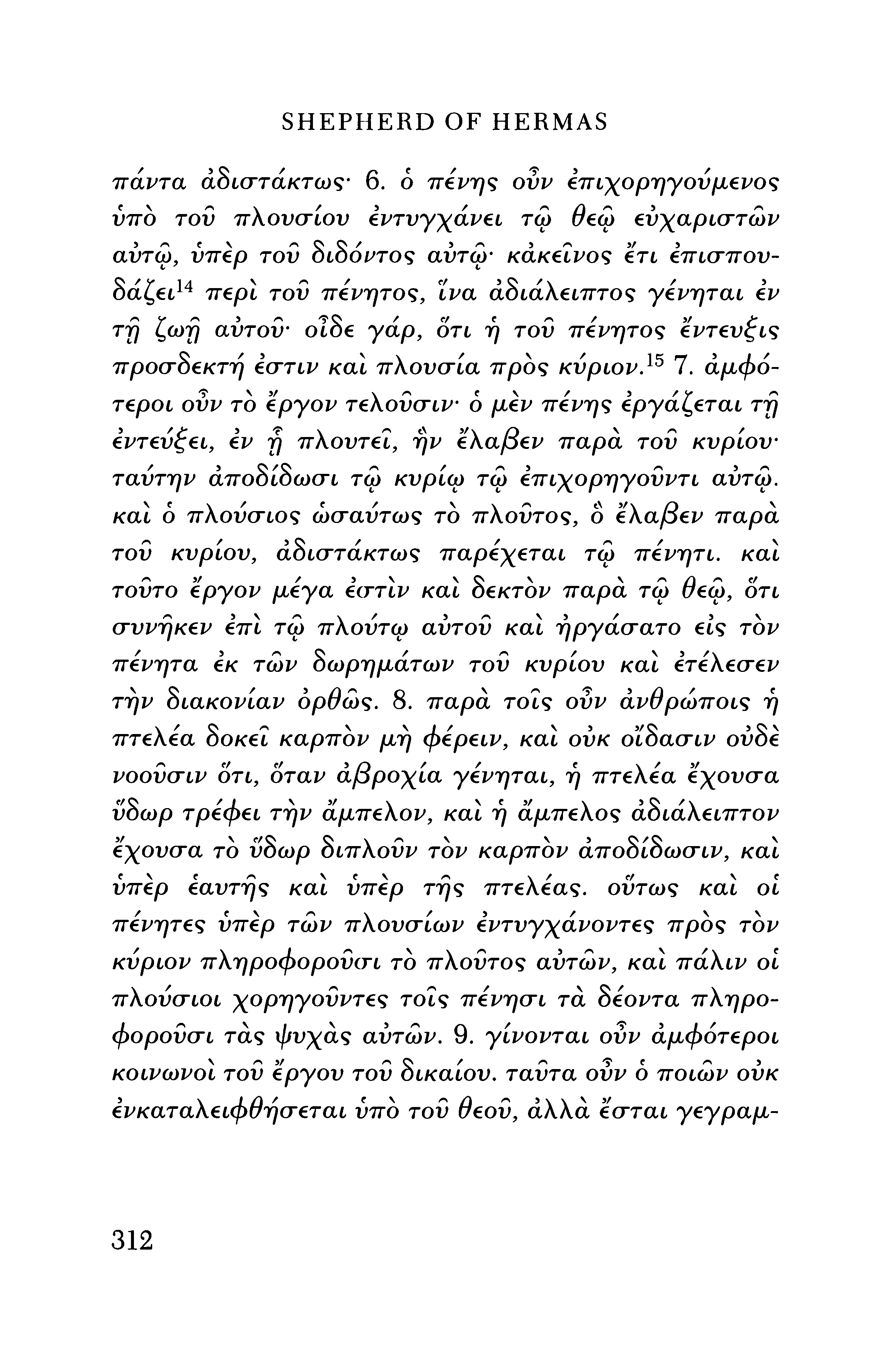
πάντα άδιστάκτως6. ό πένης ονν επιχορηγούμενος ύπό τού πλονσίον έντνγχάνει τω θεω ευχάριστων αύτώ, υπέρ τού δίδοντος αύτώκάκεΐνος ετι έπισπονδάζει
περί τού πένητος, ΐνα αδιάλειπτος γένηται εν τή ζωή αυτούοίδε γάρ, οτι ή τού πένητος εντενζις προσδεκτή εστίν καϊ πλονσία προς κύριον.
7. άρφότεροι ούν το έργον τελούσιν 6 ρέν πένης εργάζεται τή έντεύζει, έν ή πλοντέί, ήν έλαβεν παρά τού κνρίον ταύτην άποδίδωσι τω κνρίω τω έπιχορηγούντι αύτω. και 6 πλούσιος ωσαύτως το πλούτος, δ ελαβεν παρά τού κνρίον, άδιστάκτως παρέχεται τω πένητι. καϊ τούτο έργον ρέγα έστιν καϊ δεκτόν παρά τω θεω, οτι σννήκεν έπϊ τω πλούτω αυτού καϊ ήργάσατο εις τον πένητα έκ τών δωρηράτων τού κνρίον καϊ έτέλεσεν τήν διακονίαν ορθώς. 8. παρά τοΐς ονν άνθρώποις ή πτελέα δοκεΐ καρπόν ρή φέρειν, καϊ ούκ οΐδασιν ουδέ νοούσιν οτι, Οταν άβροχία γένηται, ή πτελέα εχονσα ύδωρ τρέφει τήν άρπελον, καϊ ή άρπελος άδιάλειπτον έχονσα το ύδωρ διπλούν τον καρπον άποδίδωσιν, καϊ υπέρ έαντής καϊ υπέρ τής πτελέας. ούτως καϊ οί πένητες υπέρ τών πλονσίων έντνγχάνοντες προς τον κύριον πληροφορούσι το πλούτος αυτών, καϊ πάλιν οί πλούσιοι χορηγούντες τοΐς πένησι τά δέοντα πληρο φορούσι τάς φνχάς αυτών. 9. γίνονται ονν αμφότεροι κοινωνοί τού έργον τού δίκαιον, ταύτα ονν ό ποιών ούκ ένκαταλειφθήσεται ύπό τού θεού, άλλά εσται γεγραρ-
P A R A B L E S
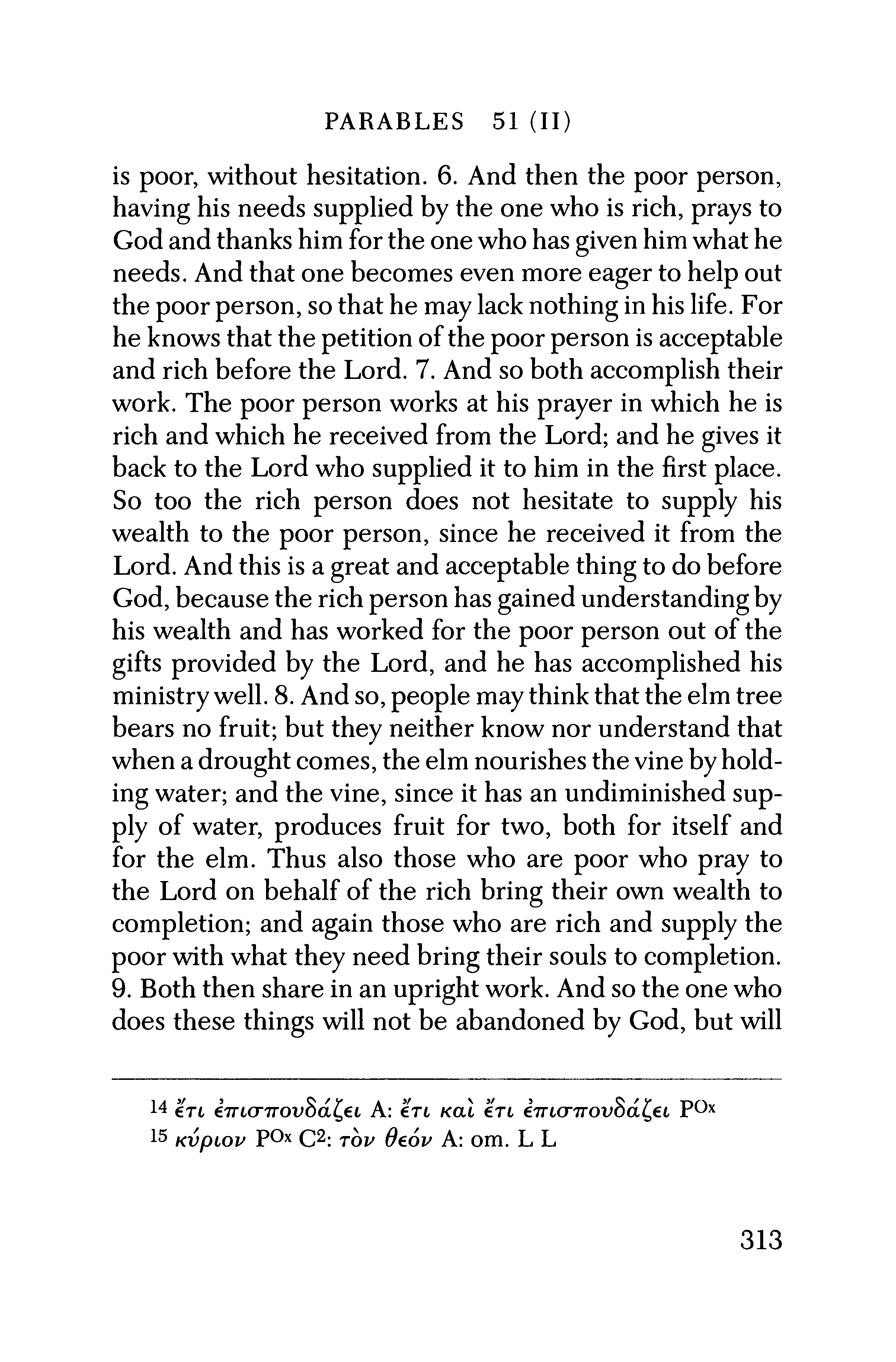
5 1 (II) is poor, without hesitation. 6. And then the poor person, having his needs supplied by the one who is rich, prays to God and thanks him for the one who has given him what he needs. And that one becomes even more eager to help out the poor person, so that he may lack nothing in his life. For he knows that the petition of the poor person is acceptable and rich before the Lord. 7. And so both accomplish their work. The poor person works at his prayer in which he is rich and which he received from the Lord; and he gives it back to the Lord who supplied it to him in the first place.
So too the rich person does not hesitate to supply his wealth to the poor person, since he received it from the Lord. And this is a great and acceptable thing to do before God, because the rich person has gained understanding by his wealth and has worked for the poor person out of the gifts provided by the Lord, and he has accomplished his ministry well. 8. And so, people may think that the elm tree bears no fruit; but they neither know nor understand that when a drought comes, the elm nourishes the vine by hold ing water; and the vine, since it has an undiminished sup ply of water, produces fruit for two, both for itself and for the elm. Thus also those who are poor who pray to the Lord on behalf of the rich bring their own wealth to completion; and again those who are rich and supply the poor with what they need bring their souls to completion.
9. Both then share in an upright work. And so the one who does these things will not be abandoned by God, but will
P ° x 2 : τον θεόν A: om. L L 15 κνρίον P ° x C