
Quadratus Fragment
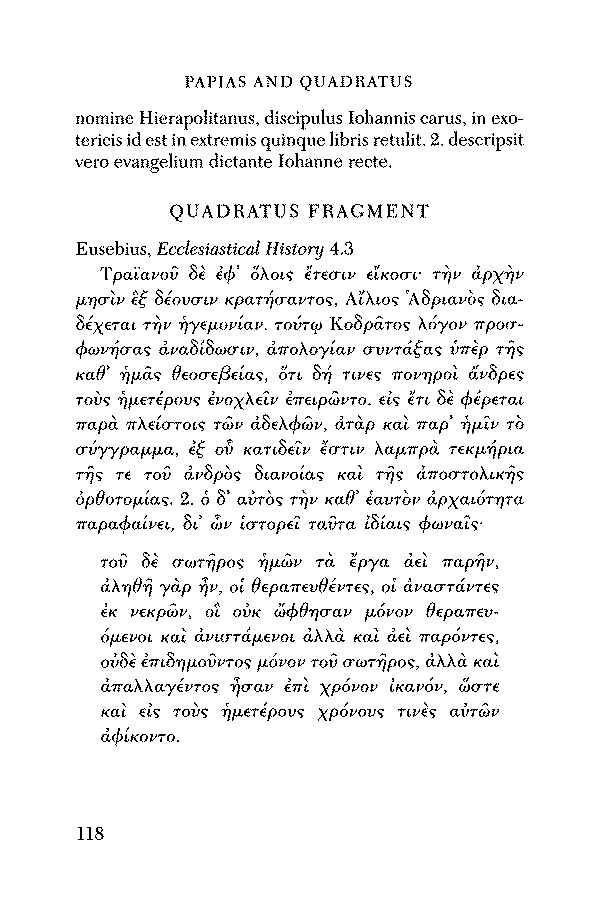
PAPIAS AND QUADRATUS
nomine Hierapolitanus, discipulus Iohannis cams, in exotericis id est in extremis quinque libris retulit. 2. descripsit vero evangelium dictante Iohanne recte.
QUADRATUS F R A G M E N T
Eusebius, Ecclesiastical History 4.3
3 όλους βτβσιν είκοσιτήν αρχήν μησίν έζ δέονσιν κρατήσαντος, Αΐλιος Αδριανός δια δέχεται τήν ήγερονίαν. τοντω Κοδράτος λόγον προσφωνήσας άναδίδωσιν, άπολογίαν σνντάζας νπέρ τής καθ" ήρας θεοσέβειας, ότι δή τίνες πονηροί άνδρες τονς ήρετέρονς ένοχλείν έπειρώντο. εις ετι δέ φέρεται Ύραϊανον δέ έφ παρά πλείστοις τών αδελφών, άτάρ καί παρ 3 ήμΐν τό σνγγραρρα, έζ ον κατιδεΐν εστίν λαμπρά τεκρήρια τής τε τον ανδρός διανοίας καί τής αποστολικής όρθοτομίας.
2. ό δ' αντός τήν καθ 3 έαντον αρχαιότητα παραφαίνει, δι ών ιστορεί ταντα ίδίαις φωναΐςτον δέ σωτήρος ηρών τά έργα άεί παρήν, αληθή γάρ ήν, οί θεραπενθέντες, οί άναστάντες έκ νεκρών, οΧ ονκ ώφθησαν ρόνον θεραπενόμενοι καί άνιστάρενοι άλλά καί άεί παρόντες, ονδέ έπιδηρονντος μόνον τον σωτήρος, άλλά καί άπαλλαγέντος ήσαν έπι χρόνον ίκανόν, ώστε καί εις τονς ήρετέρονς χρόνονς τινές αντών άφίκοντο.
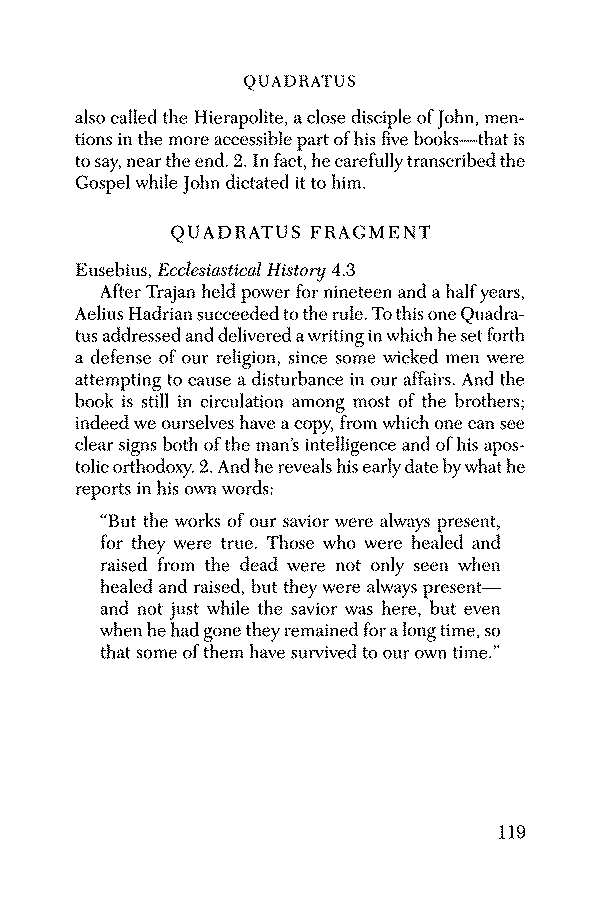
QUADRATUS
also called the Hierapolite, a close disciple of John, men tions in the more accessible part of his five books—that is to say, near the end. 2. In fact, he carefully transcribed the Gospel while John dictated it to him.
QUADRATUS F R A G M E N T
Eusebius, Ecclesiastical History 4.3
After Trajan held power for nineteen and a half years, Aelius Hadrian succeeded to the rule. To this one Quadra tus addressed and delivered a writing in which he set forth a defense of our religion, since some wicked men were attempting to cause a disturbance in our affairs. And the book is still in circulation among most of the brothers; indeed we ourselves have a copy, from which one can see clear signs both of the man's intelligence and of his apos tolic orthodoxy. 2. And he reveals his early date by what he reports in his own words:
"But the works of our savior were always present, for they were true. Those who were healed and raised from the dead were not only seen when healed and raised, but they were always present— and not just while the savior was here, but even when he had gone they remained for a long time, so that some of them have survived to our own time."


E P I S T L E TO DIOGNETUS
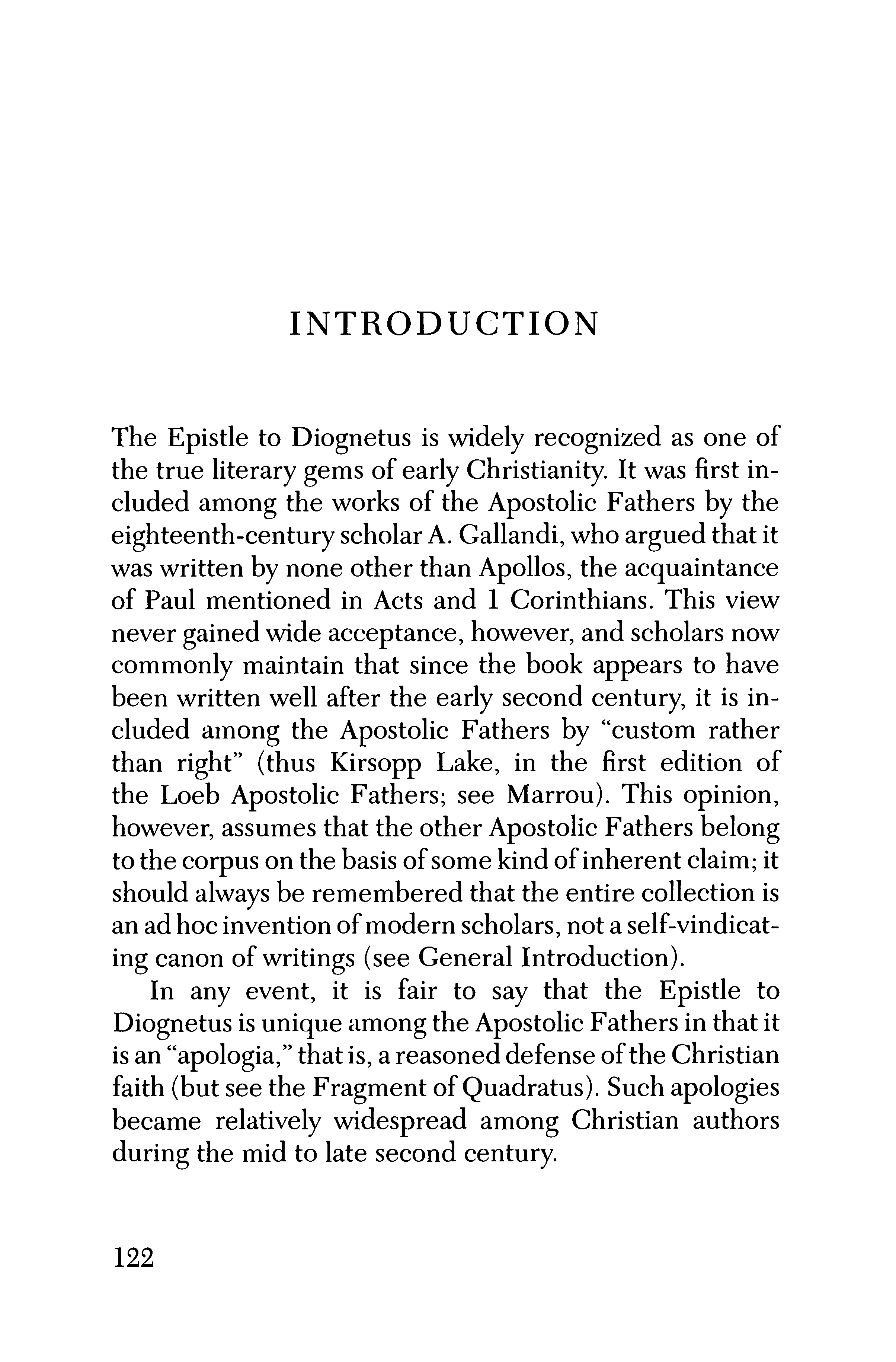
INTRODUCTION
The Epistle to Diognetus is widely recognized as one of the true literary gems of early Christianity. It was first in cluded among the works of the Apostolic Fathers by the eighteenth-century scholar A. Gallandi, who argued that it was written by none other than Apollos, the acquaintance of Paul mentioned in Acts and 1 Corinthians. This view never gained wide acceptance, however, and scholars now commonly maintain that since the book appears to have been written well after the early second century, it is in cluded among the Apostolic Fathers by "custom rather than right" (thus Kirsopp Lake, in the first edition of the Loeb Apostolic Fathers; see Marrou). This opinion, however, assumes that the other Apostolic Fathers belong to the corpus on the basis of some kind of inherent claim; it should always be remembered that the entire collection is an ad hoc invention of modern scholars, not a self-vindicating canon of writings (see General Introduction).
In any event, it is fair to say that the Epistle to Diognetus is unique among the Apostolic Fathers in that it is an "apologia," that is, a reasoned defense of the Christian faith (but see the Fragment of Quadratus). Such apologies became relatively widespread among Christian authors during the mid to late second century.
INTRODUCTION
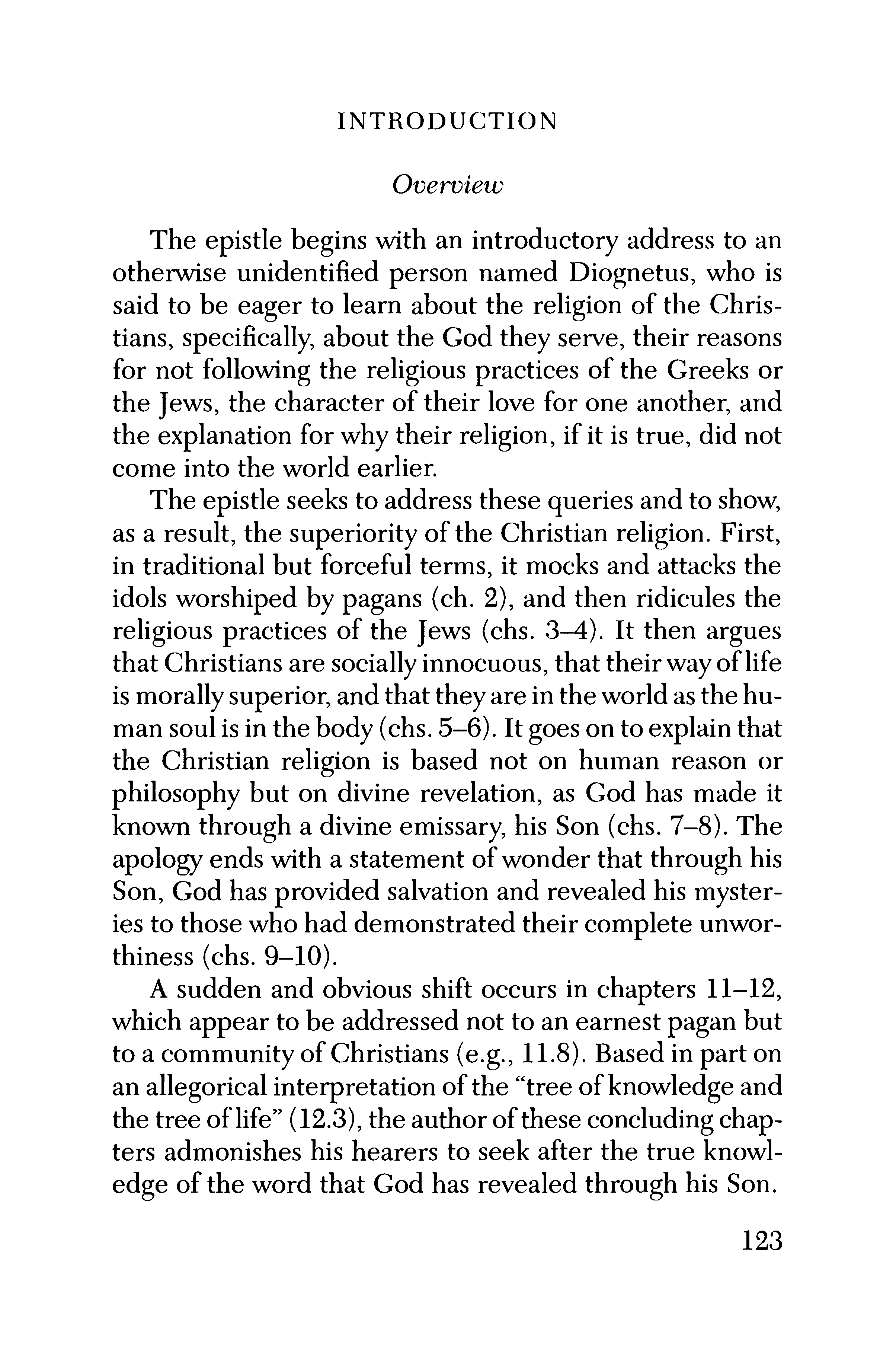
Overview The epistle begins with an introductory address to an otherwise unidentified person named Diognetus, who is said to be eager to learn about the religion of the Chris tians, specifically, about the God they serve, their reasons for not following the religious practices of the Greeks or the Jews, the character of their love for one another, and the explanation for why their religion, if it is true, did not come into the world earlier.
The epistle seeks to address these queries and to show, as a result, the superiority of the Christian religion. First, in traditional but forceful terms, it mocks and attacks the idols worshiped by pagans (ch. 2), and then ridicules the religious practices of the Jews (chs. 3-4). It then argues that Christians are socially innocuous, that their way of life is morally superior, and that they are in the world as the hu man soul is in the body (chs. 5-6). It goes on to explain that the Christian religion is based not on human reason or philosophy but on divine revelation, as God has made it known through a divine emissary, his Son (chs. 7-8). The apology ends with a statement of wonder that through his
Son, God has provided salvation and revealed his myster ies to those who had demonstrated their complete unworthiness (chs. 9-10).
A sudden and obvious shift occurs in chapters 11-12, which appear to be addressed not to an earnest pagan but to a community of Christians (e.g., 11.8). Based in part on an allegorical interpretation of the "tree of knowledge and the tree of life" (12.3), the author of these concluding chap ters admonishes his hearers to seek after the true knowl edge of the word that God has revealed through his Son.
DIOGNETUS
Integrity The sudden shift in content and presupposed audience in chapters 11-12, along with differences in vocabulary, writing style, attitudes toward Judaism (which become more positive, as in the affirmation of the law and prophets in 11.6), and genre (the final chapters appear to be a hom ily) have led virtually all scholars to acknowledge that the concluding section comes from a different work from the apology of chapters 1-10. Some have supposed that the two works are by the same author, delivered on different occasions for different audiences (Barnard); but most have thought that they were composed by different au thors. It is impossible to say how the two different works came to be combined, but our sole manuscript witness it self indicates a problem with the text at this point: at the end of chapter 10 a marginal note reads, "and here the copy has a break."
There are other problems with the text, and scholars have proposed a number of emendations to restore its sense (see the Greek apparatus). In particular, an obvious lacuna occurs in 7.6, which, according to a note in the mar gin, was found in the copyist s ancient exemplar. Unfortu nately, there is no way to know how much of the interven ing text has been lost, whether just a few words or a page or more.
Author An inordinate number of conjectures, most of them fantastic, have been put forward for the authorship of the anonymous work embodied in chapters 1-10: Apollos,
INTRODUCTION
Clement of Rome, Quadratus, the heretic Marcion, his fol lower Apelles, the apologists Aristides of Athens or Theophilus of Antioch, the heresiologist Hippolytus of Rome, the Alexandrian scholar Pantaenus, the martyr Lucian of Antioch, Ambrosius, and others (see Tanner, Meecham,
Marrou). Out of the frustration born of our ignorance, one nineteenth-century editor (J. Donaldson) conjectured that it had been forged by Henri Estienne (Stephanus), the sixteenth-century printer who produced the editio princeps, or if not by him, then possibly by an unknown
Greek exile during the Renaissance, after the fall of Con stantinople.
As a rule, scholars have been less interested in estab lishing the authorship of the fragmentary treatise or hom ily preserved in chapters 11-12, although, among others, the names of Pantaenus, Melito of Sardis, and most com monly, Hippolytus of Rome have been proposed.
The sole manuscript that preserved the text, which is it self now lost (see below), attributed the entire work, along with several other documents that it contained, to Justin
Martyr. But there are substantial differences in style and contents between Justin's apologies and the Epistle to Diognetus: Justin, for example, embraced the Old Testa ment and used its text extensively to establish prophetic proofs for the Christian claims about Jesus; the Epistle to Diognetus makes no appeal to the Old Testament and ac knowledges nothing positive in Judaism. Justin saw the Logos manifesting itself in the world before the coming of Jesus, for example in the great Greek philosophers; the Epistle to Diognetus has nothing but scorn for Greek phi losophers and maintains that before the coming of Christ, no one had any inkling of the true nature of God. Justin
DIOGNETUS
claimed that pagan idols are real and demonic, the Epistle to Diognetus insists they are lifeless with no ties to any thing beyond themselves.
As a result, we do not know who the author was. The most that can be said about him is that he was a highly educated, rhetorically trained, Greek-speaking Christian broadly familiar with philosophical commonplaces found among Platonic and Stoic thinkers (see Tanner).
Recipient Like other early Christian apologies, the book is ad dressed to an individual, an otherwise unknown "Diog netus." The name is not uncommon and literally means
"born of Zeus." Because he is called "most excellent"—an elevated title of respect—Diognetus is sometimes thought to have been a high-ranking administrative official (the emperor himself?) or some other member of the Roman elite. Most commonly it has been suggested that he was
Diognetus, the tutor of Marcus Aurelius mentioned in the Meditations 1, 6, or possibly the procurator of Alexandria,
Claudius Diognetus (ca. 200 CE), mentioned in the papyri (see Marrou). But none of the proposed identities has won widespread support. It may even be that Diognetus is an imaginary person, a pagan invented for the occasion, to whom the apology could be addressed, much as "most ex cellent Theophilus" ("beloved of God" or "one who loves
God") addressed in Luke and Acts is sometimes thought to be a cipher for the Christian audience of the books, rather than the name of a historical individual (see Luke 1:3; Acts
1:1).
INTRODUCTION
Date The wide range of dates proposed for the work corre sponds to the various speculations concerning its author ship (see Marrou). While scholars continue to suggest pre cise dates, most today prefer to speak in broader terms, maintaining, for example that it was written sometime be tween 150 and 310. It maybe possible, however, to be a bit more specific. The book embodies concerns and emphases comparable to other apologists of the second century, al though it shows no familiarity with (or, at least, regard for) arguments based on "proof from prophecy" or with the "lo gos doctrine" that proved so popular among most of them; it makes almost no use of the writings that later came to be canonized as the Christian Scriptures; and its strik ing christological views and theological assertions (esp. chs. 7-8) are not characterized by the nuance and re finement found among equally educated Christian authors at later times. It may be, then, that this should be regarded as one of the earlier apologies, written during the second half of the second century, possibly closer to the beginning than the end of that period.
Textual Tradition and Editions The Epistle to Diognetus is poorly attested. It is never mentioned, let alone cited, by any of the church Fathers; moreover, it survived into modern times in only one manu script of the thirteenth or fourteenth century, and even this manuscript has now been destroyed.
The manuscript was a 260-page codex containing
DIOGNETUS
twenty-two different Christian works, principally of an apologetic and polemical nature, spanning a thousand years. The first five treatises, including the Epistle to Diognetus, were attributed in the manuscript to Justin
Martyr (see Marrou). The manuscript was serendipitously discovered by a young cleric in 1436, in a pile of packing paper in a fish shop in Constantinople; it soon passed into the hands of the Dominicans. In the early sixteenth cen tury it was acquired by the German humanist Johannes
Reuchlin (d. 1522) and some time after his death, later in that century, by the Alsatian monastery of Maursmiinster.
Around 1794 the manuscript came to the municipal library of Strasbourg, where it remained until August 24, 1870, when it was destroyed by fire during the bombing of the city in the Franco-German war.
The Parisian printer Henri Estienne (Stephanus) pub lished the editio princeps of the epistle in 1592, based on a transcription he had made in 1586. Another transcription had been produced by B. Haus in 1580 and a third around
1590 by J. J. Beurer (this transcription is lost, but Ste phanus included a collation of it in an appendix to his edi tion). In addition, two careful collations of the manuscript were made in the nineteenth century for Otto s edition of the text, one by E. Cunitz in 1842 and the other by E.
Reuss in 1861.
The important differences among the transcriptions of Stephanus, Haus, and Beurer and the 1742 edition pub lished by Prudentius of S. Maur are reflected in the appa ratus, along with various conjectures suggested by such editors as Stephanus, Lachmann, Bunsen, Gebhardt, and Hilgenfeld.
INTRODUCTION
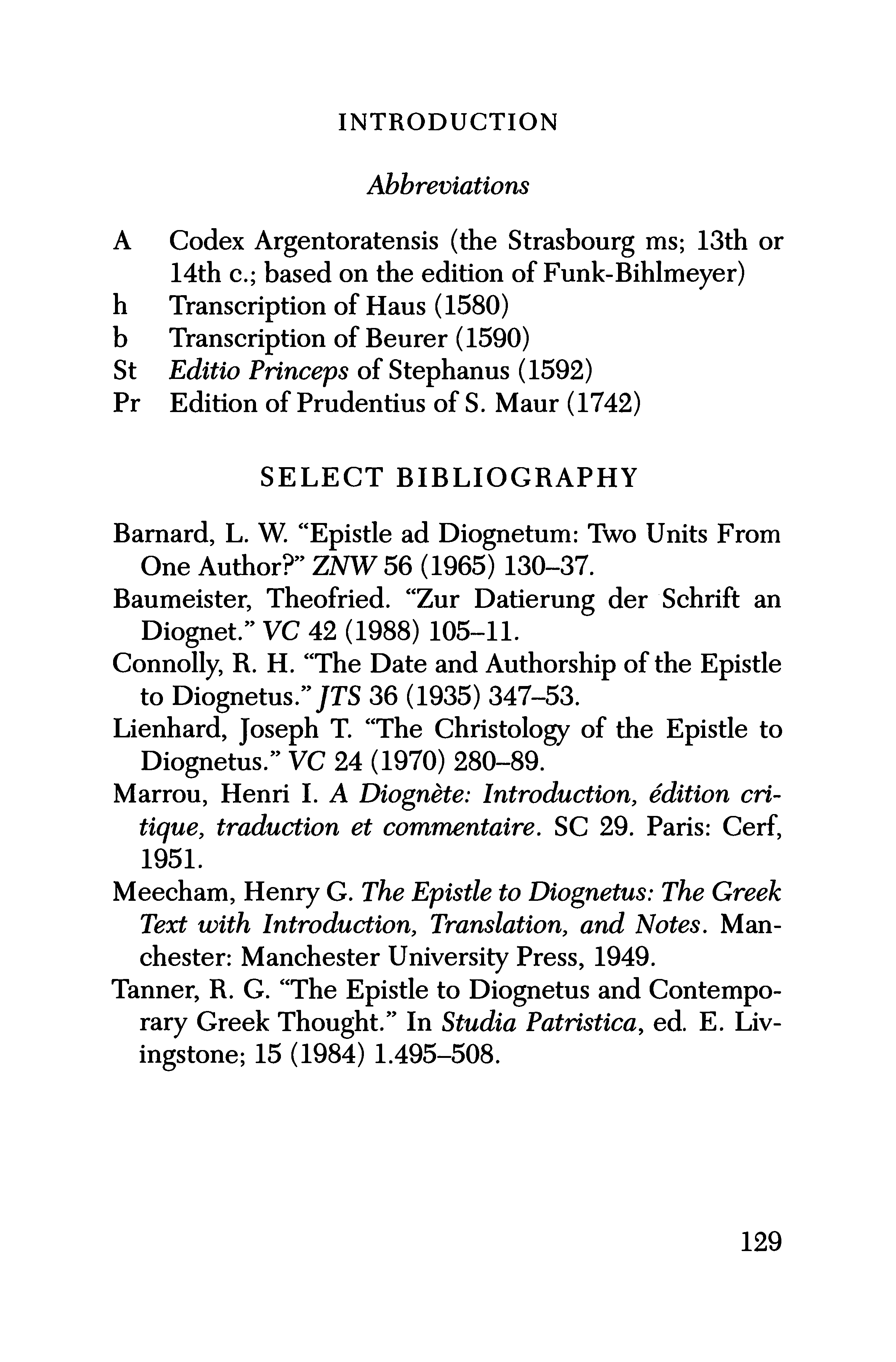
Abbreviations A Codex Argentoratensis (the Strasbourg ms; 13th or 14th c.; based on the edition of Funk-Bihlmeyer) h Transcription of Haus (1580) b Transcription of Beurer (1590) St Editio Princeps of Stephanus (1592) Pr Edition of Prudentius of S. Maur (1742)
S E L E C T
B I B L I O G R A P H Y
Barnard, L. W. "Epistle ad Diognetum: Two Units From One Author?" ZNW 56 (1965) 130-37.
Baumeister, Theofried. "Zur Datierung der Schrift an Diognet." VC 42 (1988) 105-11.
Connolly, R. H. "The Date and Authorship of the Epistle to Diognetus."/TS 36 (1935) 347-53.
Lienhard, Joseph T. "The Christology of the Epistle to Diognetus." VC 24 (1970) 280-89.
Marrou, Henri I. A Diognete: Introduction, edition cri tique, traduction et commentaire.
SC 29. Paris: Cerf, 1951.
Meecham, Henry G. The Epistle to Diognetus: The Greek Text with Introduction, Translation, and Notes. Man chester: Manchester University Press, 1949.
Tanner, R. G. "The Epistle to Diognetus and Contempo rary Greek Thought." In Studia Patristica, ed. E. Liv ingstone; 15 (1984) 1.495-508.
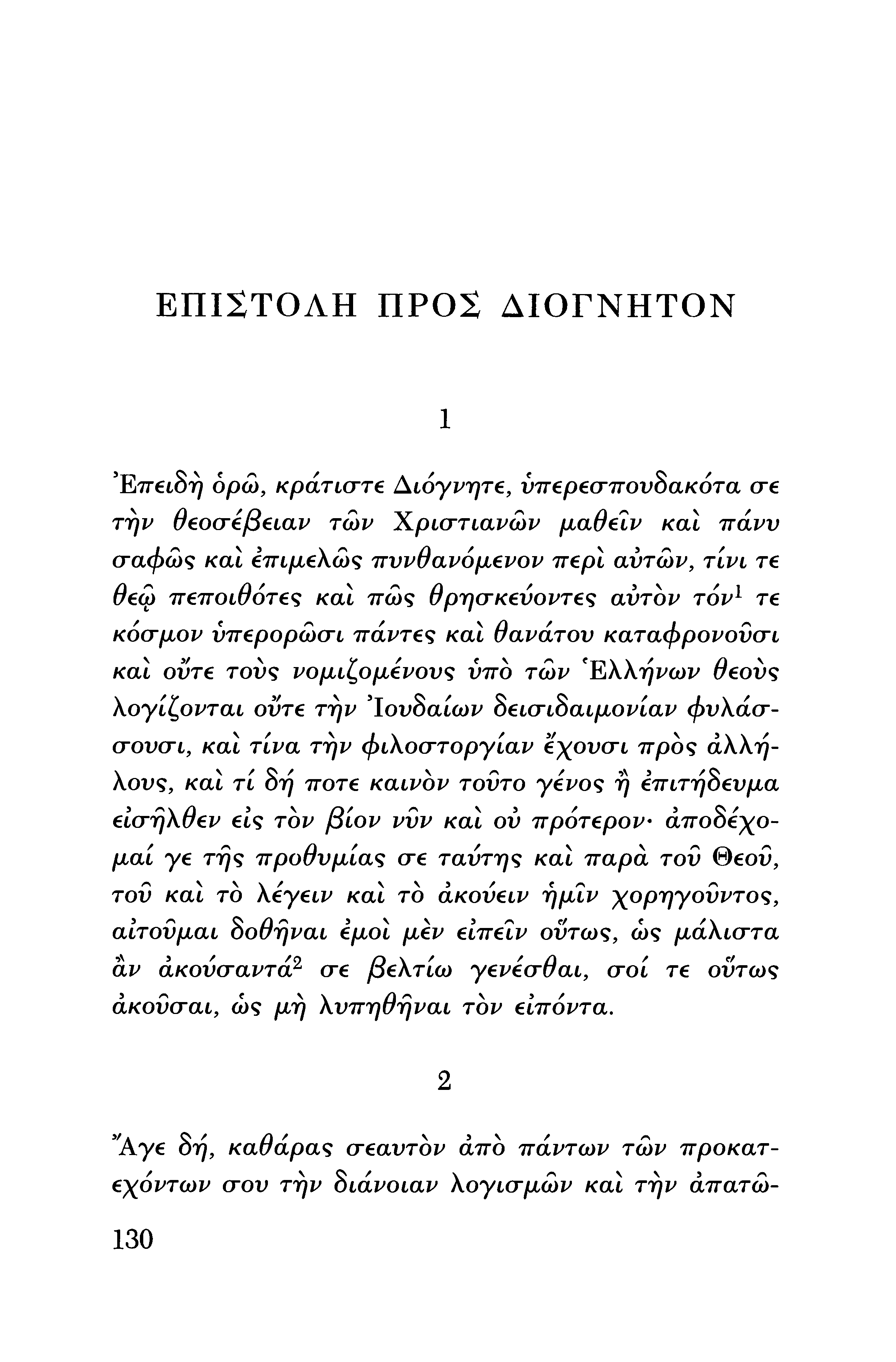
"Επειδή ορώ, κράτιστε Αιόγνητε, ύπερεσπονδακότα σε τήν θεοσέβειαν τών Χριστιανών μαθεΐν και πάνυ σαφώς και επιμελώς πννθανόμενον περϊ αντών, τίνι τε θεώ πεποιθότες καϊ πώς θρησκεύοντες αντον τον
τε κόσρον νπερορώσι πάντες καϊ θάνατον καταφρονούσι καϊ οντε τούς νομιζομένονς νπό τών "Ελλήνων θεούς λογίζονται οντε τήν Ίονδαίων δεισιδαιμονίαν φνλάσσονσι, καϊ τίνα τήν φιλοστοργίαν εχονσι προς άλλή λονς, καϊ τί δή ποτε καινον τοντο γένος ή έπιτήδενμα είσήλθεν εις τον βίον ννν καϊ ον πρότεροναποδέχο μαι γε τής προθνμίας σε ταύτης καϊ παρά τού θεού, τού καϊ το λέγειν καϊ το άκούειν ήμΐν χορηγούντος, αίτούραι δοθήναι εροϊ μέν ειπείν ούτως, ώς μάλιστα άν άκούσαντά
"Κγε δή, καθάρας σεαντον άπο πάντων τών προκατεχόντων σον τήν διάνοιαν λογισμών καϊ τήν άπατώ-
E P I S T L E TO DIOGNETUS
ι Since I see, most excellent Diognetus, that you are ex tremely eager to learn about the religion of the Christians and are making such an exacting and careful inquiry about them, wishing to discover which God they obey and how they worship him, so that they all despise the world and disdain death, neither giving credence to those thought to be gods by the Greeks nor keeping the superstition of the Jews, and what deep affection they have for one another, and just why this new race or way of life came into being now and not before, I welcome this eagerness of yours and ask God—who enables us both to speak and to hear—that I may be allowed to speak in such a way that you derive special benefit by hearing, and that you hear in such a way that the speaker not be put to grief.
And so come, purge yourself of all the notions that previ ously constrained your understanding, leave behind your
E P I S T L E TO DIOGNETUS 2
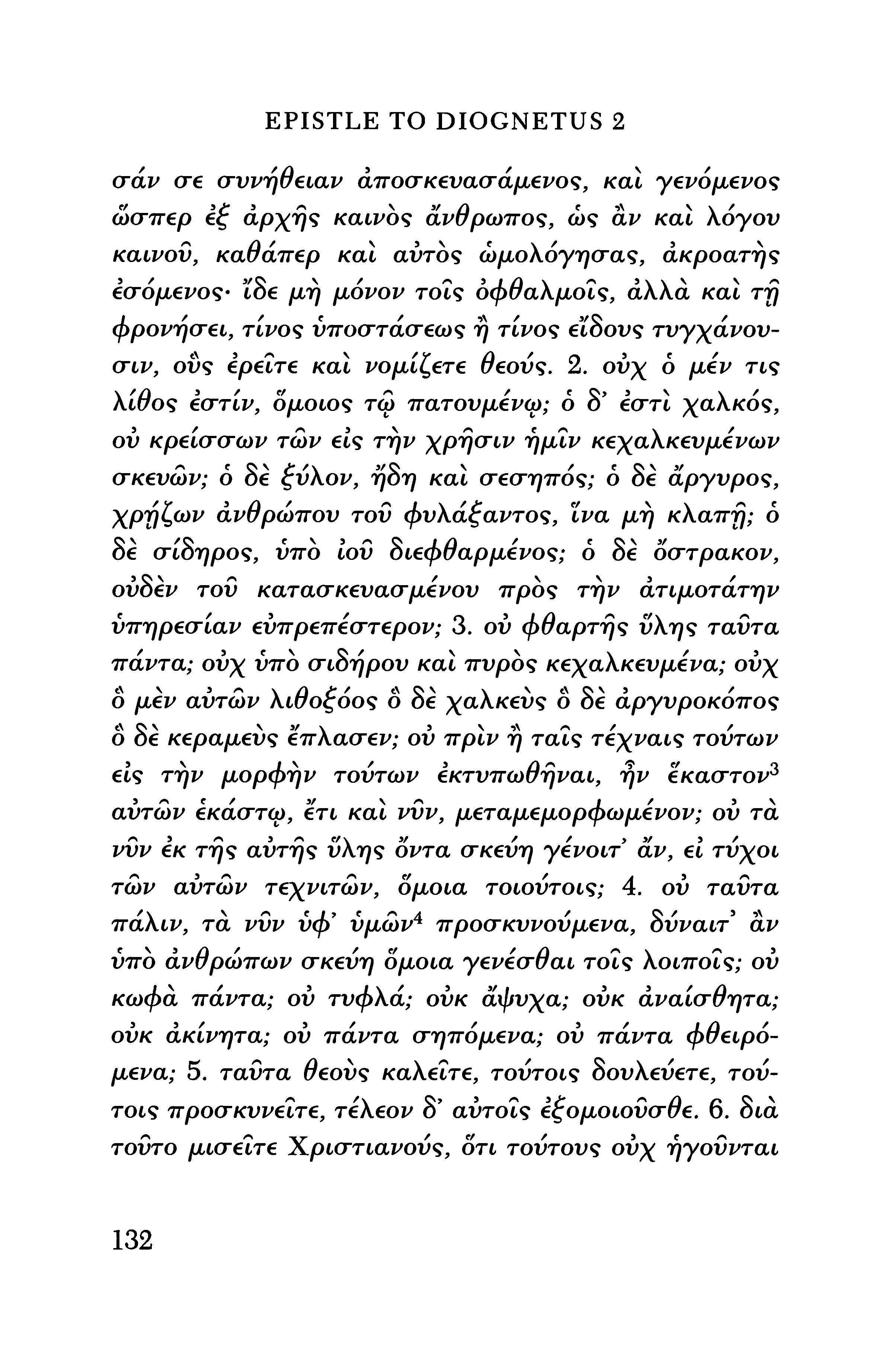
σαν σβ σννήθειαν άποσκενασάμενος, και γενόμενος ώσπβρ βζ αρχής καινός άνθρωπος, ώς άν καϊ λόγον καινού, καθάπβρ καί αυτός ώμολόγησας, ακροατής έσόμενοςΐδε μή μόνον τοΐς όφθαλμοΐς, άλλά καϊ τή φρονήσει, τίνος υποστάσεως ή τίνος βϊδονς τνγχάνονσιν, ονς έρεΐτε καϊ νομίζβτβ θεούς. 2. ονχ ό μβν τις λίθος εστίν, όμοιος τώ πατονμένω; ό δ' εστί χαλκός, ον κρεισσων τών εις τήν χρήσιν ήμΐν κεχαλκενμενων σκενών; ό δε ζύλον, ήδη και σεσηπός; ό δέ άργνρος, χρήζων άνθρωπον τον φνλάζαντος, ΐνα μή κλαπή; ό δέ σίδηρος, νπό ιού διεφθαρμένος; ό δέ οστρακον, ουδέν τον κατασκενασμένον προς τήν άτιμοτάτην νπηρεσίαν ενπρεπέστβρον; 3. ον φθαρτής νλης ταντα πάντα; ονχ νπό σιδήρον και πνρός κεχαλκενμένα; ονχ ο μέν αντών λιθοζόος ο δέ χαλκενς ο δβ άργνροκόπος ό δέ κεραμενς επλασεν; ον πριν ή ταΐς τέχναις τούτων εις τήν μορφήν τούτων έκτνπωθήναι, ήν εκαστον
αυτών έκάστω, ετι καϊ νύν, μεταμεμορφωμένον; ού τά νύν έκ τής αυτής ύλης Οντα σκεύη γένοιτ' άν, εί τύχοι τών αυτών τεχνιτών, όμοια τοιούτοις; 4. ού ταύτα πάλιν, τά νύν ύφ' υμών
προσκννούμενα, δύναιτ άν ύπό ανθρώπων σκεύη όμοια γενέσθαι τοΐς λοιποΐς; ού κωφά πάντα; ού τνφλά; ούκ άψυχα; ούκ αναίσθητα; ούκ ακίνητα; ού πάντα σηπόμβνα; ού πάντα φθειρόμενα; 5. ταύτα θεούς καλεΐτβ, τούτοις δονλεύετε, τού τοις προσκυνείτε, τέλεον δ' αύτοΐς έζομοιούσθε.
E P I S T L E TO DIOGNETUS 2
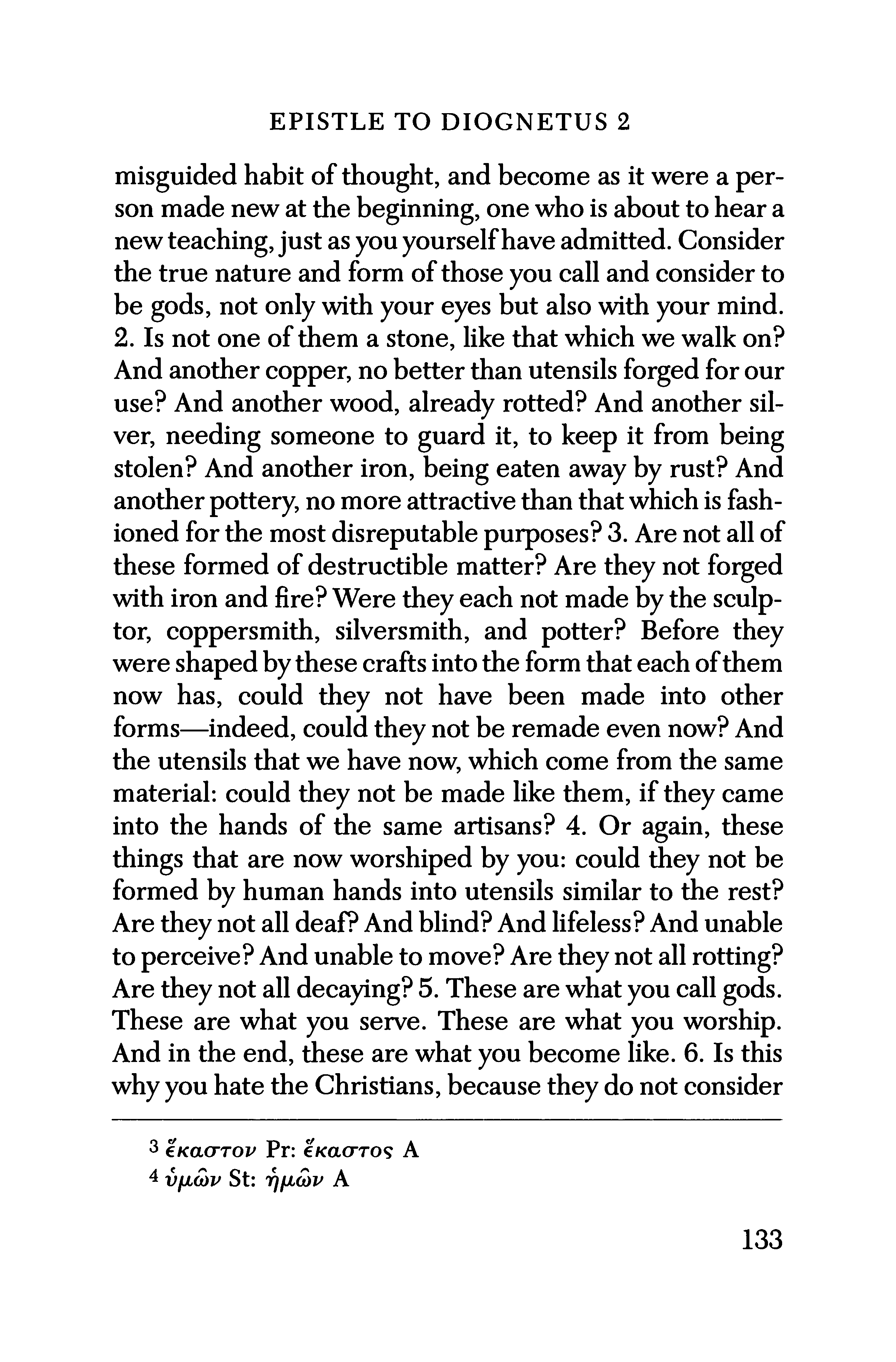
misguided habit of thought, and become as it were a per son made new at the beginning, one who is about to hear a new teaching, just as you yourself have admitted. Consider the true nature and form of those you call and consider to be gods, not only with your eyes but also with your mind.
2. Is not one of them a stone, like that which we walk on?
And another copper, no better than utensils forged for our use? And another wood, already rotted? And another sil ver, needing someone to guard it, to keep it from being stolen? And another iron, being eaten away by rust? And another pottery, no more attractive than that which is fash ioned for the most disreputable purposes? 3. Are not all of these formed of destructible matter? Are they not forged with iron and fire? Were they each not made by the sculp tor, coppersmith, silversmith, and potter? Before they were shaped by these crafts into the form that each of them now has, could they not have been made into other forms—indeed, could they not be remade even now? And the utensils that we have now, which come from the same material: could they not be made like them, if they came into the hands of the same artisans? 4. Or again, these things that are now worshiped by you: could they not be formed by human hands into utensils similar to the rest?
Are they not all deaf? And blind? And lifeless? And unable to perceive? And unable to move? Are they not all rotting?
Are they not all decaying? 5. These are what you call gods.
These are what you serve. These are what you worship.
And in the end, these are what you become like. 6. Is this why you hate the Christians, because they do not consider
E P I S T L E TO DIOGNETUS 3
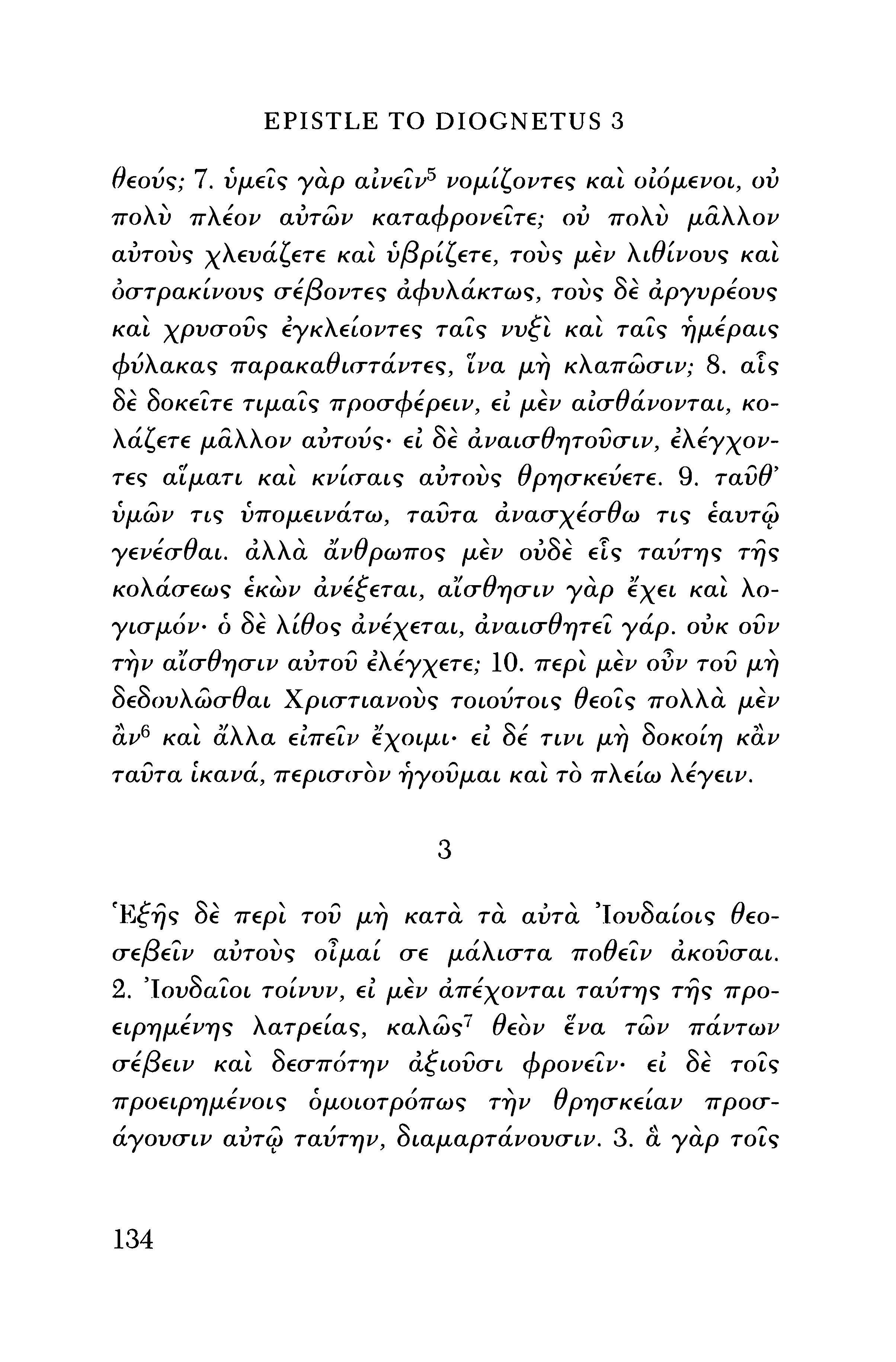
νομίζοντες καϊ οίόμενοι, ού πολύ πλέον αντών καταφρονείτε; ον πολύ μάλλον αντονς χλενάζετε καϊ υβρίζετε, τούς μεν λιθίνονς καϊ οστρακίνονς σέβοντες άφνλάκτως, τονς δέ άργνρέονς καϊ χρνσούς έγκλείοντες ταίς ννζϊ καϊ ταΐς ήμέραις φύλακας παρακαθιστάντες, ΐνα ρή κλαπώσιν; 8. αις δε δοκεΐτε τιραΐς προσφερειν, εί μέν αισθάνονται, κο λάζετε μάλλον αύτούς' εί οέ άναισθητούσιν, ελέγχον τες αΐματι και κνίσαις αυτούς θρησκεύετε.
9. ταύθ' υμών τις ύπομεινάτω, ταύτα άνασχέσθω τις έαντώ γενέσθαι, άλλά άνθρωπος ρέν ού8έ εις ταύτης τής κολάσεως εκών άνέζεται, αΐσθησιν γάρ έχει καί λογισρόν6 δέ λίθος ανέχεται, άναισθητεΐ γάρ. ούκ ούν τήν αΐσθησιν αυτού ελέγχετε; 10. περί ρέν ονν τού ρή δεδονλώσθαι Χριστιανούς τοιούτοις θεοΐς πολλά ρέν άν θεούς; 7. ύμεΐς γάρ αίνεΐν 6 καί άλλα ειπείν έχοιρί' εί δέ τινι μή δοκοίη καν ταύτα ικανά, περισσον ηγούμαι καί το πλείω λέγειν.
Εζής δέ περϊ τού μή κατά τά αυτά Ίονδαίοις θεοσεβεΐν αυτούς οΐμαί σε μάλιστα ποθεΐν άκούσαι.
θεον ένα τών πάντων σέβειν καί δεσπότην άζιούσι φρονεΐν· εί δέ τοΐς προειρηρένοις όροιοτρόπως τήν θρησκείαν προσάγονσιν αύτώ ταύτην, διαμαρτάνονσιν.
E P I S T L E TO DIOGNETUS 3
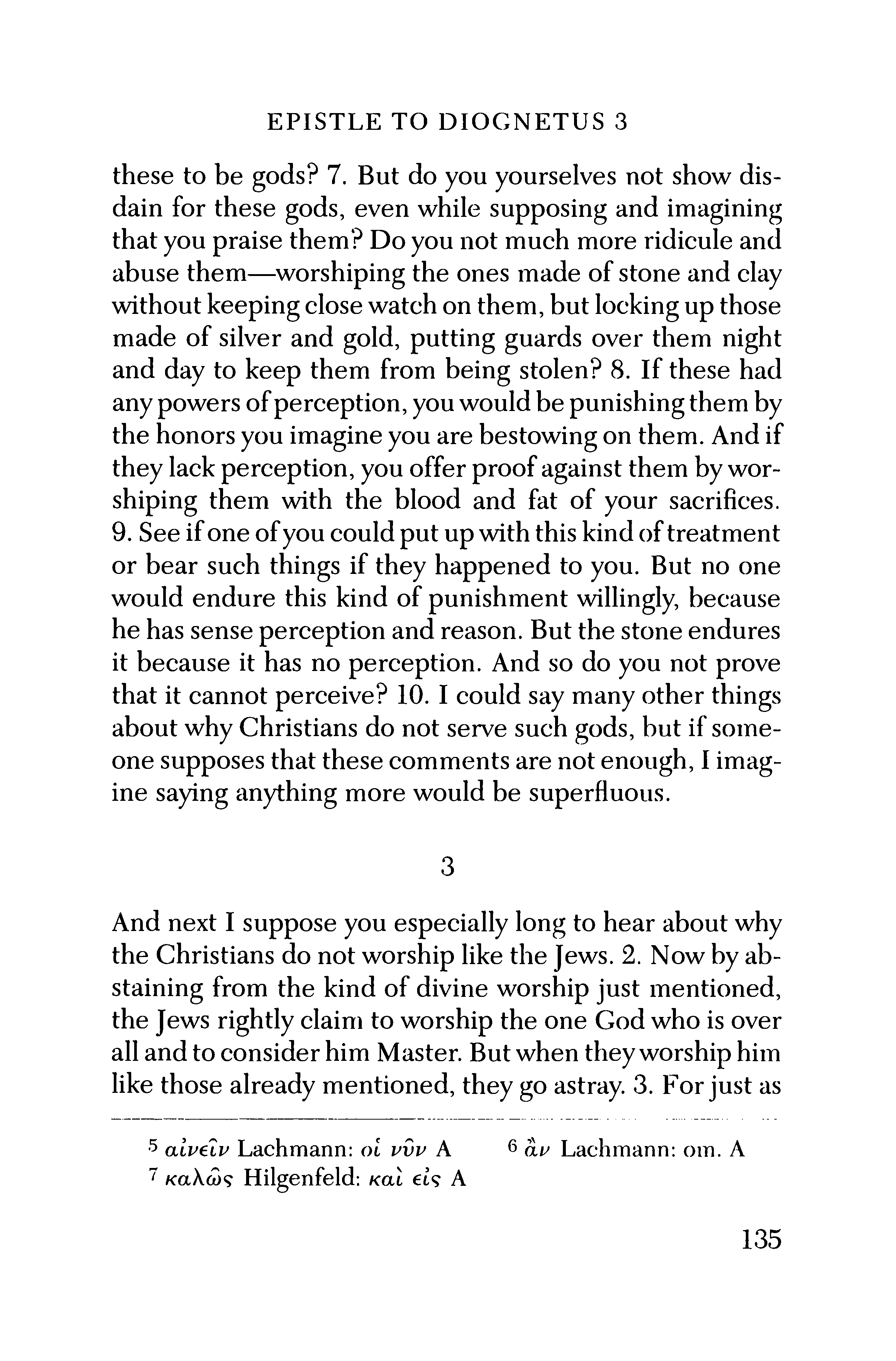
these to be gods? 7. But do you yourselves not show dis dain for these gods, even while supposing and imagining that you praise them? Do you not much more ridicule and abuse them—worshiping the ones made of stone and clay without keeping close watch on them, but locking up those made of silver and gold, putting guards over them night and day to keep them from being stolen? 8. If these had any powers of perception, you would be punishing them by the honors you imagine you are bestowing on them. And if they lack perception, you offer proof against them by wor shiping them with the blood and fat of your sacrifices.
9. See if one of you could put up with this kind of treatment or bear such things if they happened to you. But no one would endure this kind of punishment willingly, because he has sense perception and reason. But the stone endures it because it has no perception. And so do you not prove that it cannot perceive? 10. I could say many other things about why Christians do not serve such gods, but if some one supposes that these comments are not enough, I imag ine saying anything more would be superfluous.
And next I suppose you especially long to hear about why the Christians do not worship like the Jews. 2. Now by ab staining from the kind of divine worship just mentioned, the Jews rightly claim to worship the one God who is over all and to consider him Master. But when they worship him like those already mentioned, they go astray. 3. For just as 5 aiveiv Lachmann: ot vvv A
Lachmann: om. A 7 καλώς Hilgenfeld: καί eh A
E P I S T L E TO DIOGNETUS 4
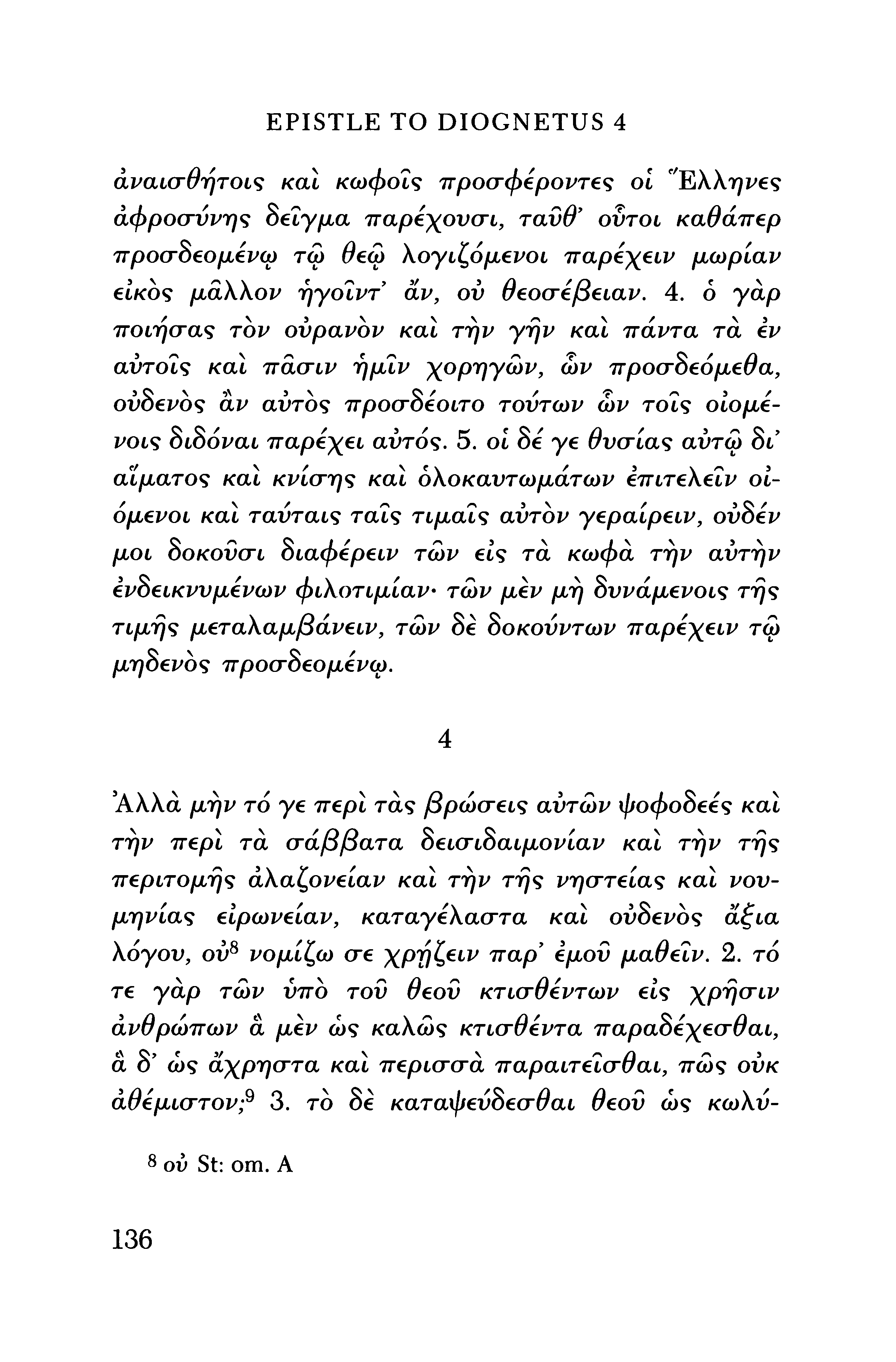
άναισθήτοις καϊ κωφοΐς προσφέροντες οί "Έλληνες αφροσύνης δείγμα παρέχουσι, ταύθ' ούτοι καθάπερ προσδεομένω τω θεώ λογιζόμενοι παρέχειν μωρίαν είκός μάλλον ήγοίντ άν, ού θεοσέβειαν.
4. ό γάρ ποιήσας τον ούρανόν καί τήν γήν καϊ πάντα τά εν αύτοΐς καϊ πάσιν ήρΐν χορηγών, ών προσδεόμεθα, ούδενός άν αυτός προσδέοιτο τούτων ών τοΐς οίομενοις διδόναι παρέχει αυτός. 5. οι δε γε θυσίας αύτώ δι αίματος καϊ κνίσης καϊ ολοκαυτωμάτων έπιτελεΐν οίόμενοι καϊ ταύταις ταΐς τιμαΐς αύτον γεραίρειν, ουδέν μοι δοκούσι διαφέρειν τών εις τά κωφά τήν αυτήν ένδεικνυρένων φιλοτιμίαν* τών μέν μή δυνάμενοις τής τιμής μεταλαμβάνειν, τών δέ δοκούντων παρέχειν τώ ρηδενός προσδεορένω.
Άλλά μήν τό γε περϊ τάς βρώσεις αυτών φοφοδεές καϊ τήν περϊ τά σάββατα δεισιδαιμονίαν και τήν τής περιτομής άλαζονείαν και τήν τής νηστείας και νουμηνίας είρωνείαν, καταγέλαστα και ούδενός άζια λόγου, ού 8 νορίζω σε χρήζειν παρ έμού μαθεΐν.
2. το τε γάρ τών ύπό τού θεού κτισθέντων εις χρήσιν ανθρώπων ά μέν ώς καλώς κτισθέντα παραδέχεσθαι, ά δ' ώς άχρηστα καϊ περισσά παραιτεΐσθαι, πώς ούκ άθέμιστον;
E P I S T L E TO DIOGNETUS 4
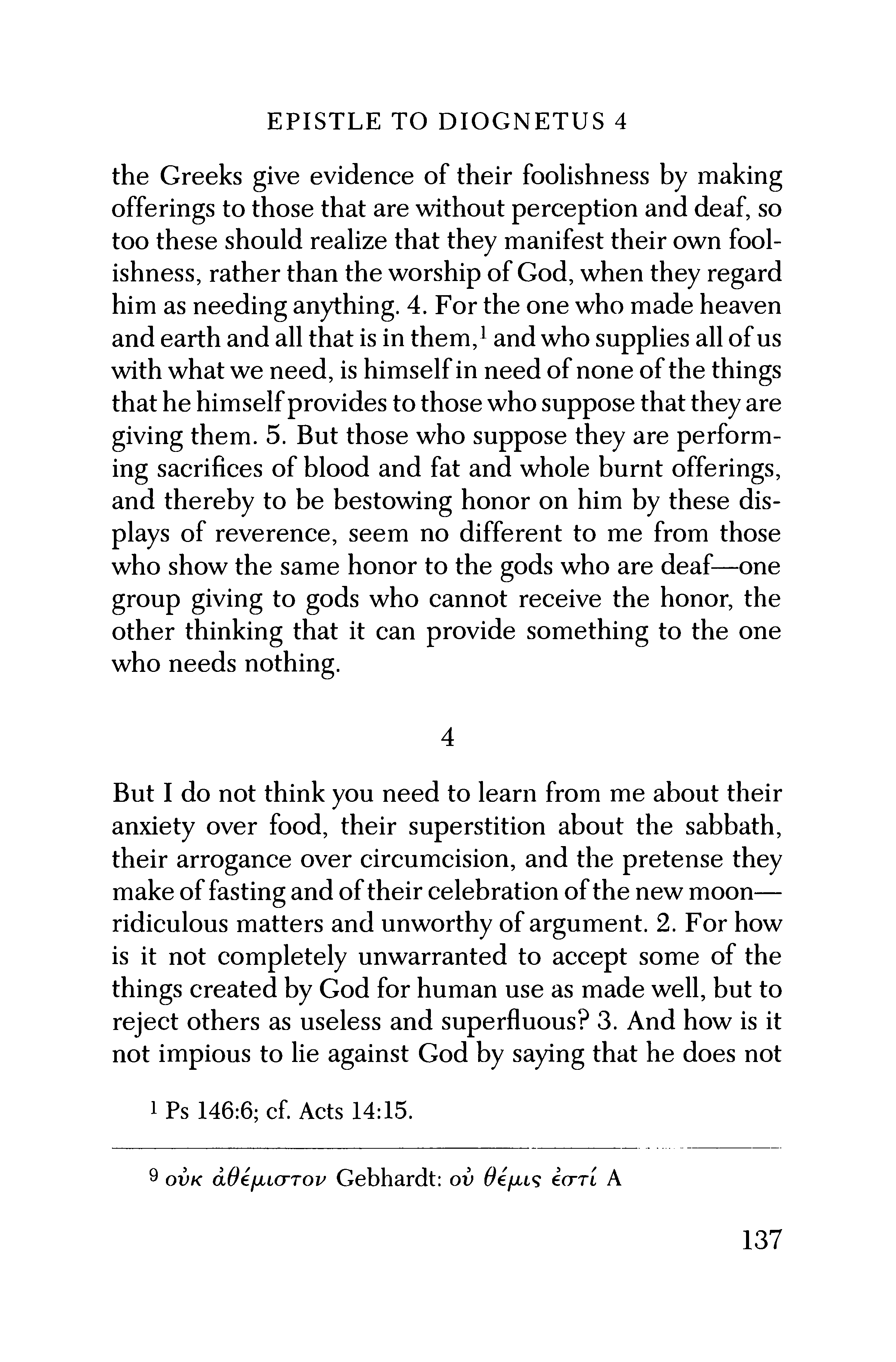
the Greeks give evidence of their foolishness by making offerings to those that are without perception and deaf, so too these should realize that they manifest their own fool ishness, rather than the worship of God, when they regard him as needing anything. 4. For the one who made heaven and earth and all that is in them, 1 and who supplies all of us with what we need, is himself in need of none of the things that he himself provides to those who suppose that they are giving them. 5. But those who suppose they are perform ing sacrifices of blood and fat and whole burnt offerings, and thereby to be bestowing honor on him by these dis plays of reverence, seem no different to me from those who show the same honor to the gods who are deaf—one group giving to gods who cannot receive the honor, the other thinking that it can provide something to the one who needs nothing.
But I do not think you need to learn from me about their anxiety over food, their superstition about the sabbath, their arrogance over circumcision, and the pretense they make of fasting and of their celebration of the new moon— ridiculous matters and unworthy of argument. 2. For how is it not completely unwarranted to accept some of the things created by God for human use as made well, but to reject others as useless and superfluous? 3. And how is it not impious to lie against God by saying that he does not 1 Ps 146:6; cf. Acts 14:15.
E P I S T L E TO DIOGNETUS 5
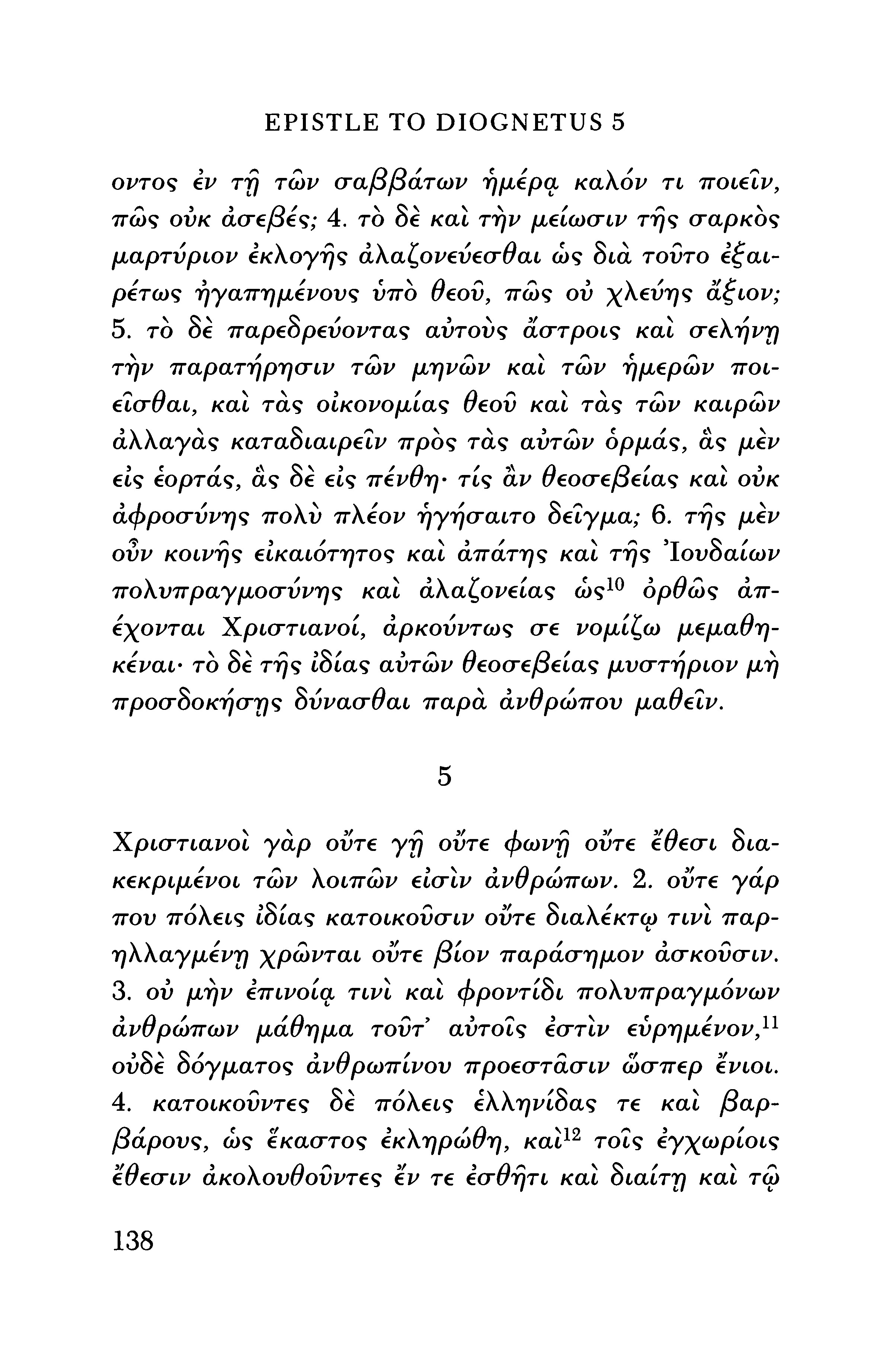
οντος iv τή τών σαββάτων ημέρα καλόν τι ποιεΐν, πώς ονκ ασεβές; 4. τό δέ καϊ τήν ρείωσιν τής σαρκός μαρτύρων εκλογής άλαζονεύεσθαι ώς διά τούτο έζαιρέτως ήγαπηρένονς ύπό θεού, πώς ού χλεύης άξιον; 5. τό δβ παρεδρεύοντας αυτούς άστροις καϊ σελήνη τήν παρατήρησιν τών μηνών και τών ήμερων ποιεΐσθαι, και τάς οικονομίας θεού καϊ τάς τών καιρών άλλαγάς καταδιαιρεΐν προς τάς αυτών όρράς, ας μέν εις έορτάς, ας δέ εις πένθητις άν θεοσέβειας καϊ ούκ αφροσύνης πολύ πλέον ήγήσαιτο δείγμα; 6. τής μέν ονν κοινής είκαιότητος καϊ άπατης καϊ τής Ίονδαίων πολνπραγμοσύνης καϊ αλαζονείας ώς
ορθώς άπέχονται Χριστιανοί, αρκούντως σε νομίζω μεμαθηκέναΐ' τό δέ τής ίδιας αυτών θεοσέβειας μνστήριον μή προσδοκήσης δύνασθαι παρά άνθρωπον μαθεΐν.
Χριστιανοί γάρ ούτε γη ούτε φωνή οντε εθεσι δια κεκριμένοι τών λοιπών είσίν ανθρώπων.
2. ούτε γάρ πον πόλεις ίδιας κατοικούσιν ούτε διαλέκτω τινϊ παρηλλαγμένη χρώνται ούτε βίον παράσημον άσκούσιν.
3. ού μήν έπινοία τινϊ καϊ φροντίδι πολνπραγμόνων ανθρώπων μάθημα τούτ αύτοΐς έστιν εύρημένον,
E P I S T L E TO DIOGNETUS 5
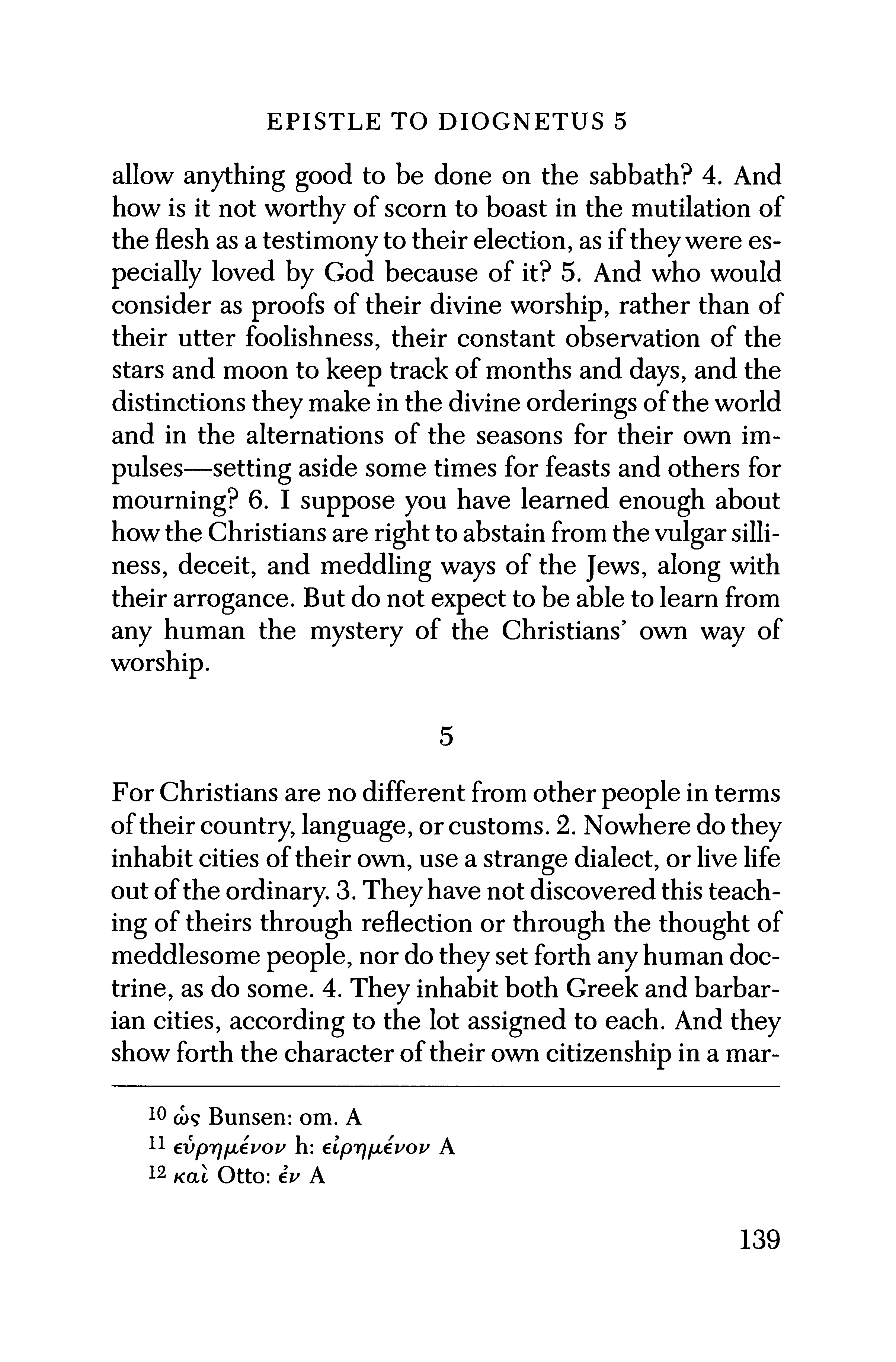
allow anything good to be done on the sabbath? 4. And how is it not worthy of scorn to boast in the mutilation of the flesh as a testimony to their election, as if they were es pecially loved by God because of it? 5. And who would consider as proofs of their divine worship, rather than of their utter foolishness, their constant observation of the stars and moon to keep track of months and days, and the distinctions they make in the divine orderings of the world and in the alternations of the seasons for their own im pulses—setting aside some times for feasts and others for mourning? 6. I suppose you have learned enough about how the Christians are right to abstain from the vulgar silli ness, deceit, and meddling ways of the Jews, along with their arrogance. But do not expect to be able to learn from any human the mystery of the Christians' own way of worship.
For Christians are no different from other people in terms of their country, language, or customs. 2. Nowhere do they inhabit cities of their own, use a strange dialect, or live life out of the ordinary. 3. They have not discovered this teach ing of theirs through reflection or through the thought of meddlesome people, nor do they set forth any human doc trine, as do some. 4. They inhabit both Greek and barbar ian cities, according to the lot assigned to each. And they show forth the character of their own citizenship in a mar1 0 ώς Bunsen: om. A 11 ενρημενον h: είρημενον A 12 καϊ Otto: iv A
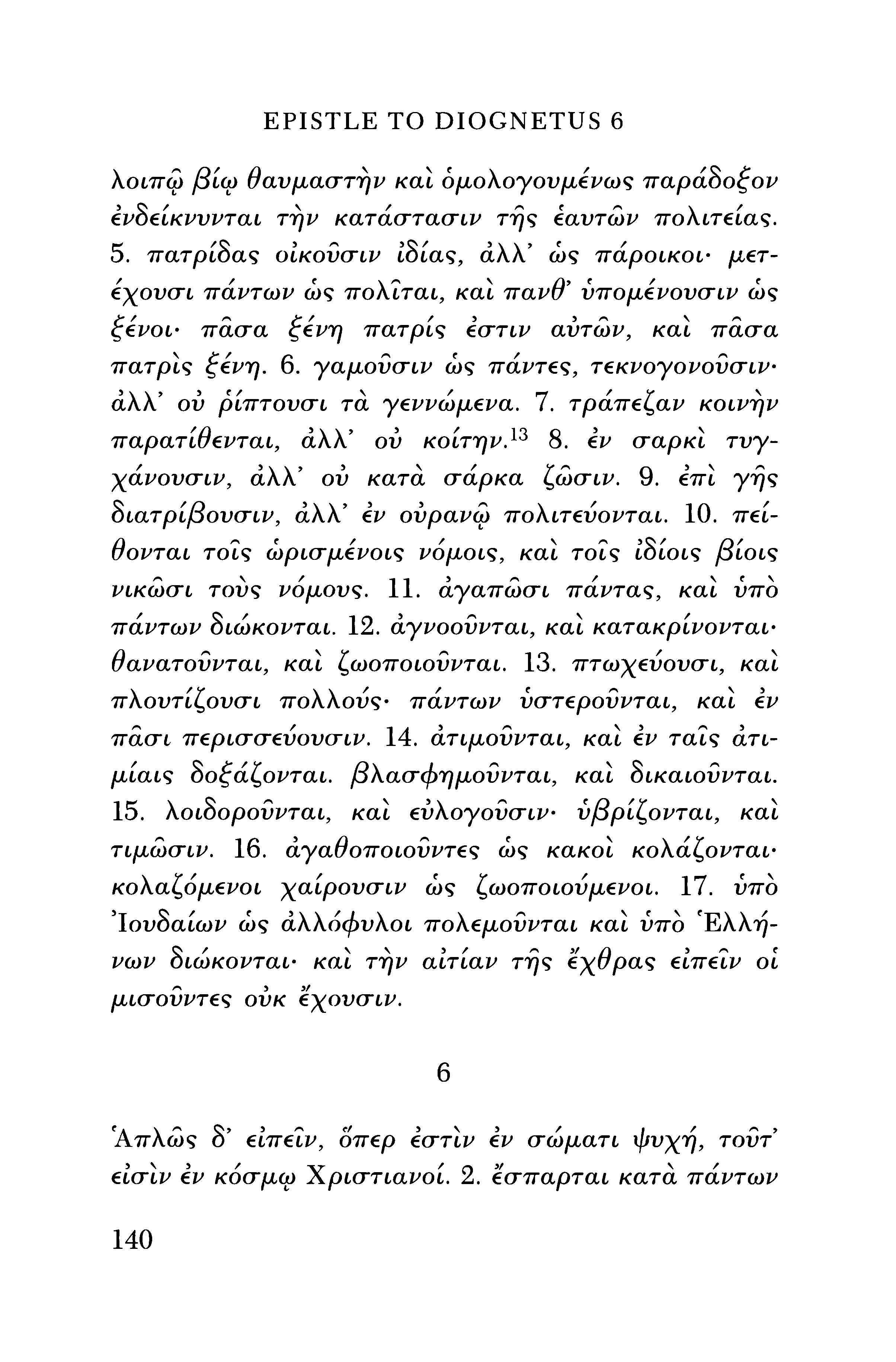
E P I S T L E TO DIOGNETUS 6
λοιπώ βίω θαυραστήν καϊ ομολογουμένως παράδοξον ενδείκνυνται τήν κατάστασιν τής εαυτών πολιτείας.
5. πατρίδας οίκούσιν ιδίας, άλλ' ώς πάροικοιμετ έχουσα πάντων ώς πολΐται, καϊ πανθ' ύπομένουσιν ώς ξένοιπάσα ξένη πατρίς έστιν αυτών, καϊ πάσα πατρίς ξένη. 6. γαμουσιν ώς πάντες, τεκνογονούσινάλλ' ού ρίπτουσι τά γεννώμενα.
10. πεί θονται τοϊς ώρισμένοις νόμοις, καϊ τοΐς ιδίοις βίοις νικώσι τούς νόμους.
13. πτωχεύουσι, καϊ πλουτίζουσι πολλούςπάντων ύστερούνται, καϊ έν πάσι περισσεύουσιν.
14. άτιμούνται, καϊ έν ταΐς άτιμίαις δοξάζονται, βλασφημούνται, καϊ δικαιούνται.
17. ύπό Ιουδαίων ώς αλλόφυλοι πολεμούνται καϊ ύπό 'Ελλτ^νων διώκονταικαϊ τήν αίτίαν τής έχθρας ειπείν οί μισούντες ούκ εχουσιν.
E P I S T L E TO DIOGNETUS 6
velous and admittedly paradoxical way by following local customs in what they wear and what they eat and in the rest of their lives. 5. They live in their respective countries, but only as resident aliens; they participate in all things as citi zens, and they endure all things as foreigners. Every for eign territory is a homeland for them, every homeland for eign territory. 6. They marry like everyone else and have children, but they to not expose them once they are born.
7. They share their meals but not their sexual partners.
8. They are found in the flesh but do not live according to the flesh. 9. They live on earth but participate in the life of heaven. 10. They are obedient to the laws that have been made, and by their own lives they supersede the laws.
11. They love everyone and are persecuted by all. 12. They are not understood and they are condemned. They are put to death and made alive. 13. They are impoverished and make many rich. They lack all things and abound in every thing. 14. They are dishonored and they are exalted in their dishonors. They are slandered and they are acquit ted. 15. They are reviled and they bless, mistreated and they bestow honor. 16. They do good and are punished as evil; when they are punished they rejoice as those who have been made alive. 17. They are attacked by Jews as for eigners and persecuted by Greeks. And those who hate them cannot explain the cause of their enmity.
To put the matter simply, what the soul is in the body, this is what Christians are in the world. 2. The soul is spread
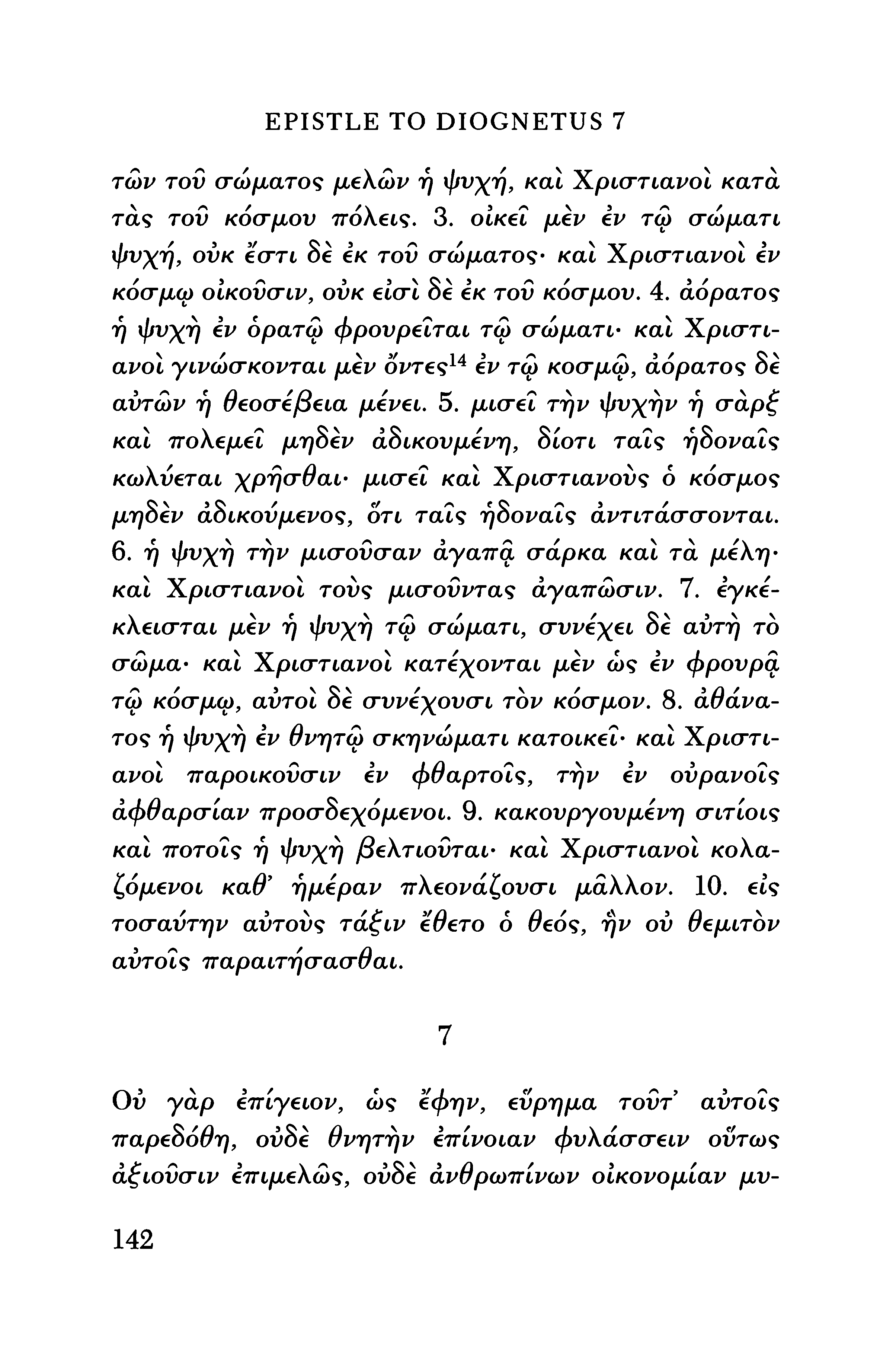
E P I S T L E TO DIOGNETUS 7
3. οικεί μεν εν τώ σώματι φνχή, ονκ εστί δέ έκ τον σώματοςκαϊ Χριστιανοί έν κόσμω οίκούσιν, ονκ είσϊ δέ έκ τον κόσμον.
έν τώ κοσμώ, αόρατος δβ αντών ή θεοσέβεια μένει. 5. μισεί τήν φνχήν ή σαρξ καϊ πολεμεί μηδέν άδικονμένη, δίοτι ταΐς ήδοναΐς κωλύεται χρήσθαιμισεί καϊ Χριστιανούς ό κόσμος μηδέν αδικούμενος, ότι ταΐς ήδοναΐς αντιτάσσονται.
6. ή φνχή τήν μισούσαν αγαπά σάρκα καϊ τά μέληκαϊ Χριστιανοί τούς μισούντας άγαπώσιν.
7. έγκέκλεισται μέν ή φνχή τώ σώματι, σννέχει δέ αυτή τό σώμακαϊ Χριστιανοί κατέχονται μέν ώς έν φρονρά τώ κόσμω, αύτοϊ δέ σννέχονσι τον κόσμον.
8. αθάνα τος ή φνχή έν θνητώ σκηνώματι κατοικείκαϊ Χριστι ανοί γινώσκονται μέν οντες ανοί παροικούσιν έν φθαρτοΐς, τήν έν ούρανοΐς άφθαρσίαν προσδεχόμενοι.
9. κακονργονμένη σιτίοις καϊ ποτοΐς ή φνχή βελτιούταικαϊ Χριστιανοί κολαζόμενοι καθ' ήμέραν πλεονάζονσι μάλλον.
10. εις τοσαύτην αυτούς τάξιν εθετο ό θεός, ήν ού θεμιτόν αύτοΐς πα/οαιττ^σασ-^αι.
Ού γάρ έπίγειον, ώς εφην, εύρημα τούτ αύτοΐς παρεδόθη, ούδβ θνητήν έπίνοιαν φνλάσσειν ούτως άξιούσιν επιμελώς, ούδβ ανθρωπίνων οίκονομίαν μν-
E P I S T L E TO DIOGNETUS 7
throughout all the limbs of the body; Christians are spread throughout the cities of the world. 3. The soul lives in the body, but it does not belong to the body; Christians live in the world but do not belong to the world. 4. The soul, which is invisible, is put under guard in the visible body;
Christians are known to be in the world, but their worship of God remains invisible. 5. The flesh hates the soul and at tacks it, even though it has suffered no harm, because it is hindered from indulging in its pleasures. And the world hates the Christians, even though it has suffered no harm, because they are opposed to its pleasures. 6. The soul loves the flesh that hates it, along with its limbs; Christians love those who hate them. 7. The soul is imprisoned in the body, but it sustains [Or: constrains] the body; Christians are detained in the prison of the world, but they sustain
[Or: constrain] the world. 8. The soul, which is immortal, dwells in a mortal tent; Christians temporarily dwell in perishable surroundings but await that which is imperish able in the heavens. 9. The soul grows stronger even when mistreated by what the body eats and drinks; Christians in crease daily even when punished. 10. God has appointed them to such a position, and it would not be right for them to abandon it.
For, as I have said, this is no earthly discovery that has been handed over to them, nor is it a mortal idea that, in their judgment, merits such diligent oversight. Nor have they been entrusted with the administration of merely human
E P I S T L E TO DIOGNETUS 7
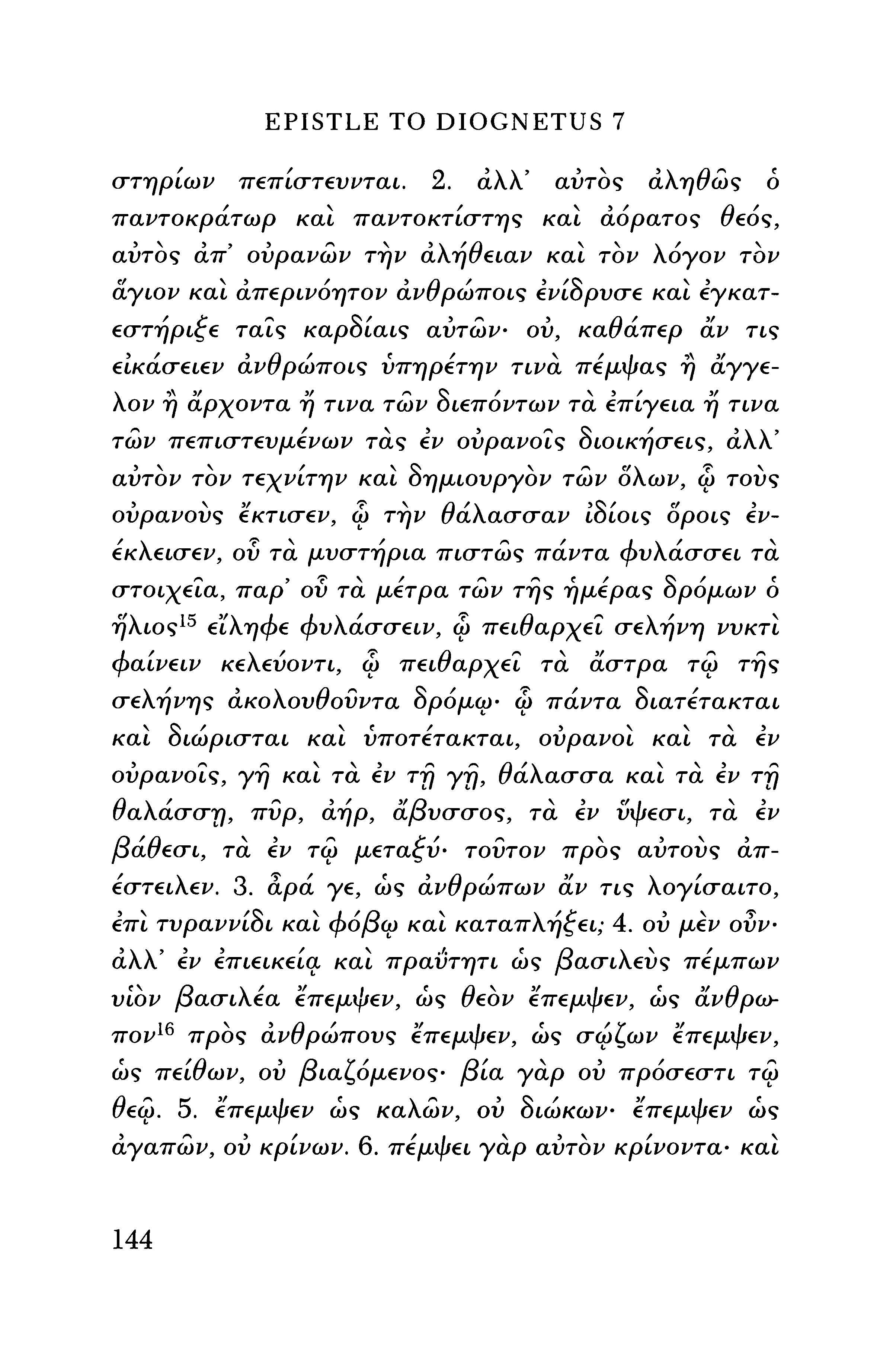
παντοκράτωρ καϊ παντοκτίστης καϊ αόρατος θεός, αυτός άπ' ουρανών τήν άλήθειαν καί τον λόγον τον άγιον καί άπερινόητον ανθρώπους ενίδρυσε καί εγκατεστήρυξε ταΐς καρδίαυς αυτώνού, καθάπερ άν τις είκάσευεν ανθρώπους ύπηρετην τυνά πεμφας ή άγγελον ή άρχοντα ή τινα τών διεπόντων τά επίγεια ή τυνα τών πεπιστευμενων τάς εν ούρανοΐς διοικήσεις, άλλ' αύτον τον τεχνίτην καί δημιουργόν τών όλων, ω τούς ουρανούς εκτισεν, ω τήν θάλασσαν ιδίους όρους ενεκλευσεν, ού τά μυστήρυα πυστώς πάντα φυλάσσει τά στοιχεία, παρ ού τά ρέτρα τών τής ήρερας δρόρων ό ήλιος
εϊληφε φυλάσσειν, ω πειθαρχεί σελήνη νυκτί φαίνειν κελεύοντι, ω πειθαρχεί τά άστρα τώ τής σελήνης άκολουθούντα δρόμωω πάντα διατβτακται καί διώρισται καί ύποτετακται, ουρανοί καί τά εν ούρανοΐς, γή καί τά εν τή γη, θάλασσα καί τά εν τή θαλασσή, πύρ, άήρ, άβυσσος, τά εν ύφεσι, τά εν βάθεσι, τά εν τώ μεταξύτούτον προς αυτούς άπεστευλεν.
3. άρα γε, ώς ανθρώπων άν τις λογίσαιτο, επί τυραννίδι καί φόβω καί καταπλήξει; 4. ού μεν ούνάλλ' εν επιείκεια καί πραύτητι ώς βασιλεύς πέμπων υίόν βασιλέα επεμφεν, ώς θεον επεμφεν, ώς άνθρω πον
προς ανθρώπους επεμφεν, ώς σώζων επεμφεν, ώς πείθων, ού βιαζόμενοςβία γάρ ού πρόσεστι τώ θεώ. 5. επεμφεν ώς καλών, ού διώκωνεπεμφεν ώς αγαπών, ού κρίνων. 6. πεμφει γάρ αυτόν κρίνοντακαί
E P I S T L E TO DIOGNETUS 7
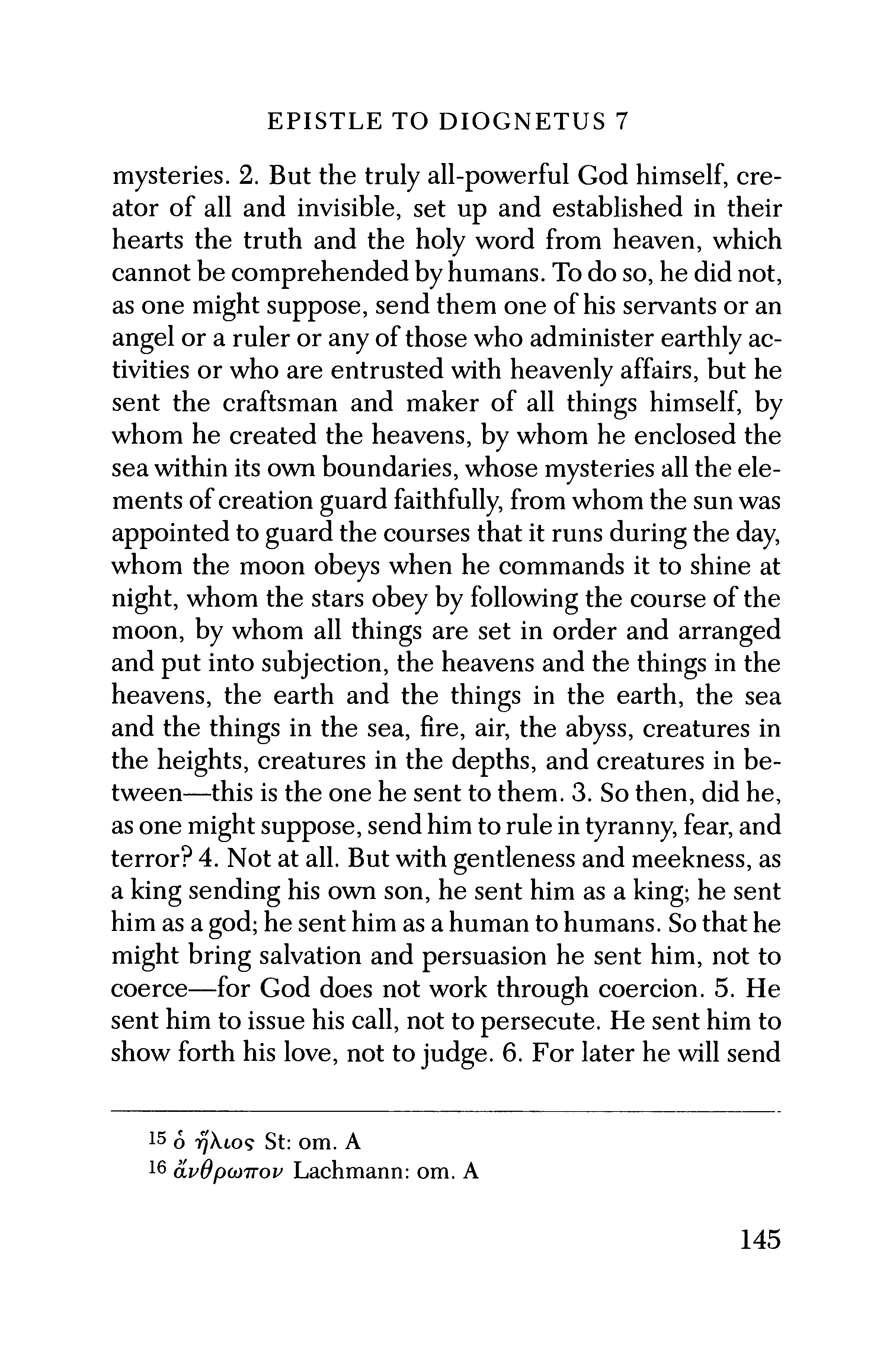
mysteries. 2. But the truly all-powerful God himself, cre ator of all and invisible, set up and established in their hearts the truth and the holy word from heaven, which cannot be comprehended by humans. To do so, he did not, as one might suppose, send them one of his servants or an angel or a ruler or any of those who administer earthly ac tivities or who are entrusted with heavenly affairs, but he sent the craftsman and maker of all things himself, by whom he created the heavens, by whom he enclosed the sea within its own boundaries, whose mysteries all the ele ments of creation guard faithfully, from whom the sun was appointed to guard the courses that it runs during the day, whom the moon obeys when he commands it to shine at night, whom the stars obey by following the course of the moon, by whom all things are set in order and arranged and put into subjection, the heavens and the things in the heavens, the earth and the things in the earth, the sea and the things in the sea, fire, air, the abyss, creatures in the heights, creatures in the depths, and creatures in be tween—this is the one he sent to them. 3. So then, did he, as one might suppose, send him to rule in tyranny, fear, and terror? 4. Not at all. But with gentleness and meekness, as a king sending his own son, he sent him as a king; he sent him as a god; he sent him as a human to humans. So that he might bring salvation and persuasion he sent him, not to coerce—for God does not work through coercion. 5. He sent him to issue his call, not to persecute. He sent him to show forth his love, not to judge. 6. For later he will send
1 5 ό ήλιος St: om. A 1 6 άνθρωπον Lachmann: om. A
E P I S T L E TO DIOGNETUS 8
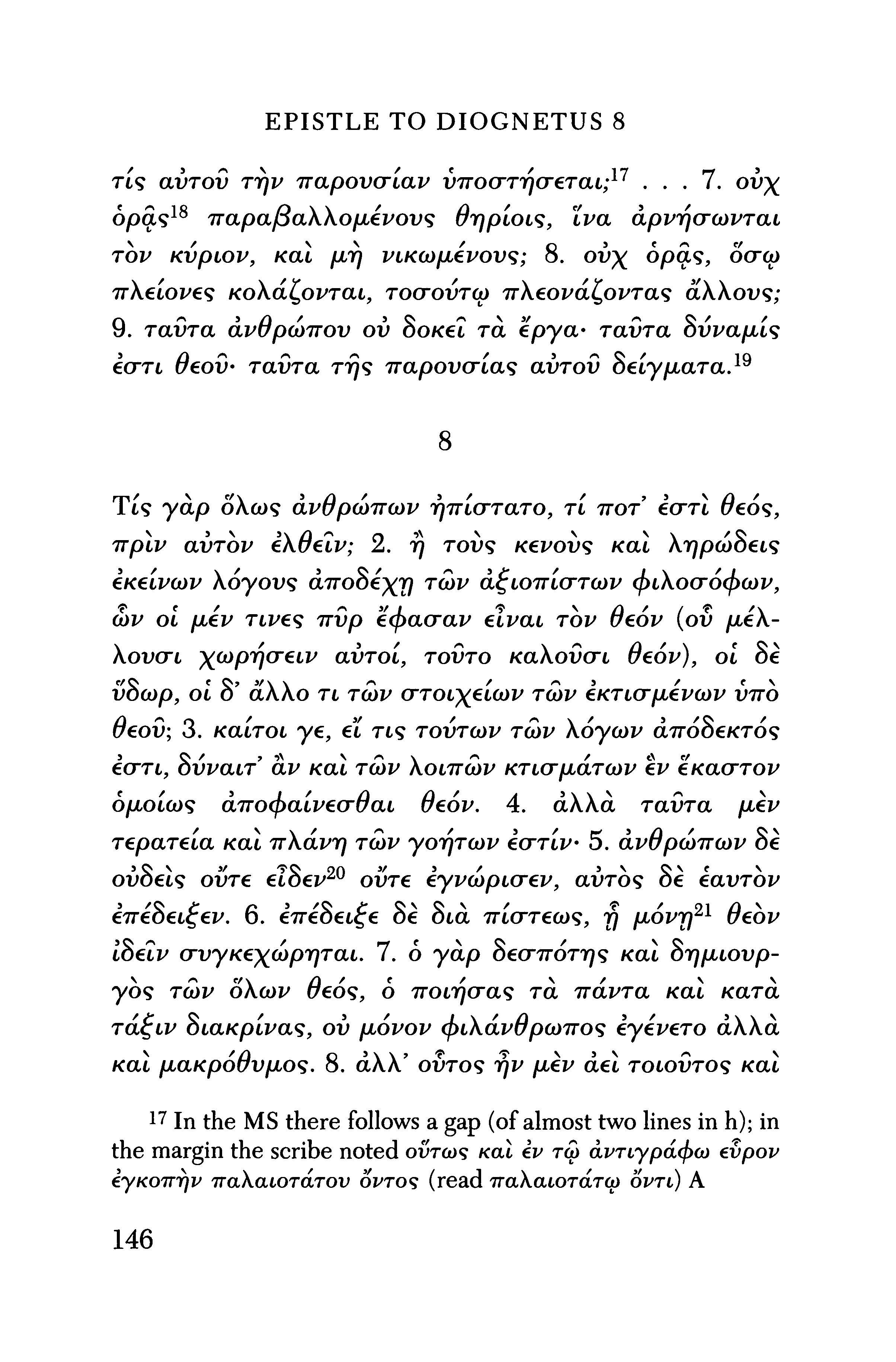
παραβαλλομένονς θηρίοις, ΐνα άρνήσωνται τον κνρίον, καί ρή νικωμένονς; 8. ονχ όρας, όσω πλείονες κολάζονται, τοσοντω πλεονάζοντας άλλονς; 9. ταντα άνθρωπον ον So κει τά έργαταντα δνναμίς έστι θεονταντα τής παρονσίας αντον δείγματα.
Ύίς γάρ όλως ανθρώπων ήπίστατο, τί ποτ εστί θεός, πριν αντόν έλθείν; 2. ή τονς κενονς καί ληρώδεις εκείνων λόγονς άποδέχη τών άζιοπίστων φιλοσόφων, ών οί μεν τίνες πνρ εφασαν είναι τον θεον (ον μέλλονσι χωρήσειν αντοί, τοντο καλονσι θεον), οί δε νδωρ, οί δ' άλλο τι τών στοιχείων τών εκτισρένων νπό θεον-, 3. καίτοι γε, εΐ τις τοντων τών λόγων αποδεκτός εστι, δνναιτ' άν καί τών λοιπών κτισμάτων έν εκαστον όροίως άποφαίνεσθαι θεον.
4. άλλά ταντα μέν τερατεία καί πλάνη τών γοήτων εστίν5. ανθρώπων δέ ονδείς οντε είδεν
7. ό γάρ δεσπότης καί δημιονργός τών όλων θεός, ό ποιήσας τά πάντα καί κατά τάζιν διακρίνας, ον μόνον φιλάνθρωπος έγένετο άλλά καί μακρόθνμος.
8. άλλ' οντος ήν μέν άεί τοιοντος καί 1 7 In the MS there follows a gap (of almost two lines in h); in the margin the scribe noted όντως καί εν τώ αντιγράφω ενρον εγκοπήν παλαιοτάτον οντος (read παλαιοτάτω όντι) Α
E P I S T L E TO DIOGNETUS 8
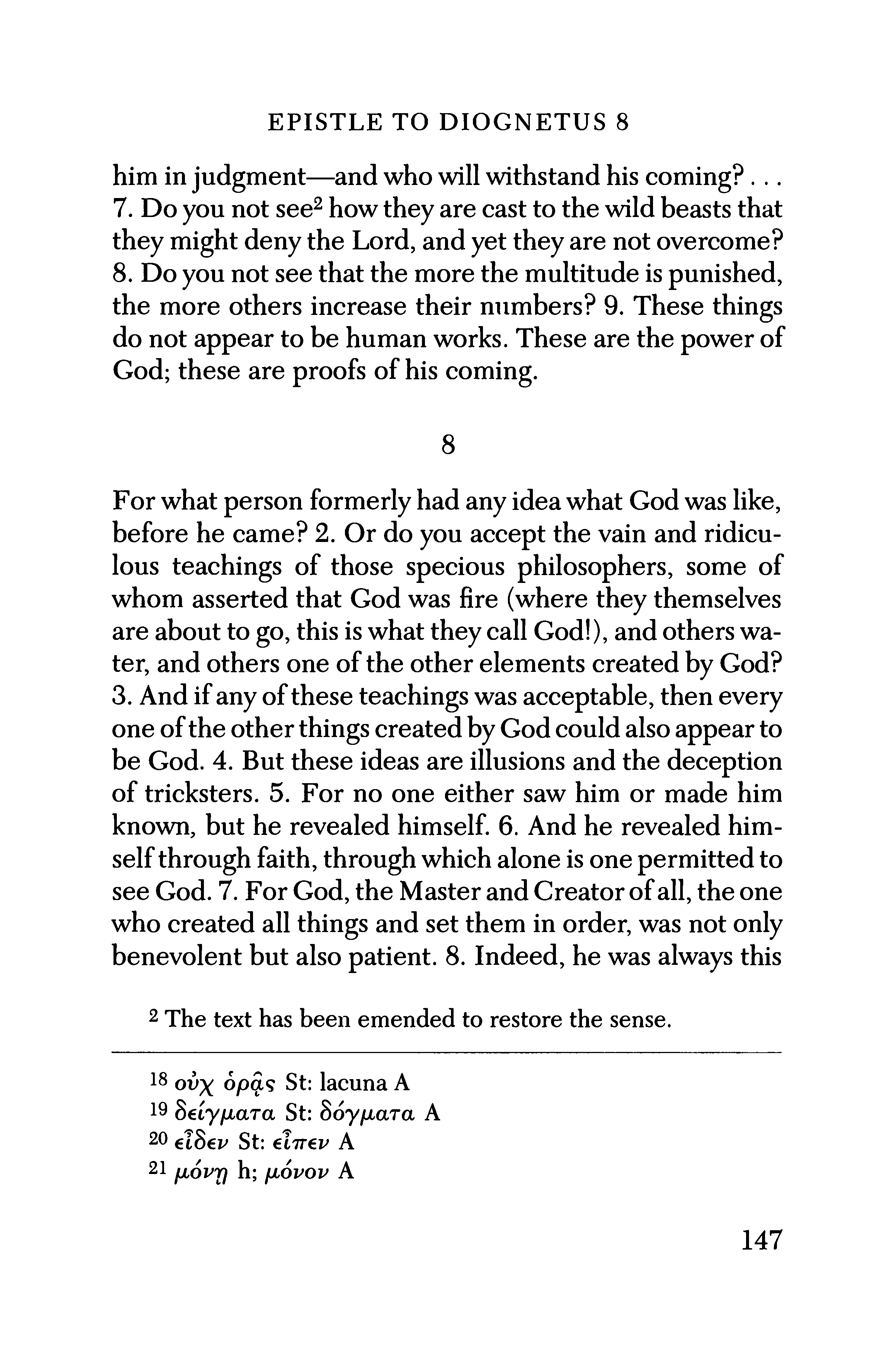
him in judgment—and who will withstand his coming? . . .
7. Do you not see 2 how they are cast to the wild beasts that they might deny the Lord, and yet they are not overcome?
8. Do you not see that the more the multitude is punished, the more others increase their numbers? 9. These things do not appear to be human works. These are the power of God; these are proofs of his coming.
For what person formerly had any idea what God was like, before he came? 2. Or do you accept the vain and ridicu lous teachings of those specious philosophers, some of whom asserted that God was fire (where they themselves are about to go, this is what they call God!), and others wa ter, and others one of the other elements created by God?
3. And if any of these teachings was acceptable, then every one of the other things created by God could also appear to be God. 4. But these ideas are illusions and the deception of tricksters. 5. For no one either saw him or made him known, but he revealed himself. 6. And he revealed him self through faith, through which alone is one permitted to see God. 7. For God, the Master and Creator of all, the one who created all things and set them in order, was not only benevolent but also patient. 8. Indeed, he was always this
2 The text has been emended to restore the sense.
1 8 ονχ οράς St: lacuna A 19 δείγματα St: δόγματα A 2 0 εϊδεν St: εΐπεν A 2 1 μόντ) h; μόνον A
E P I S T L E TO DIOGNETUS 9
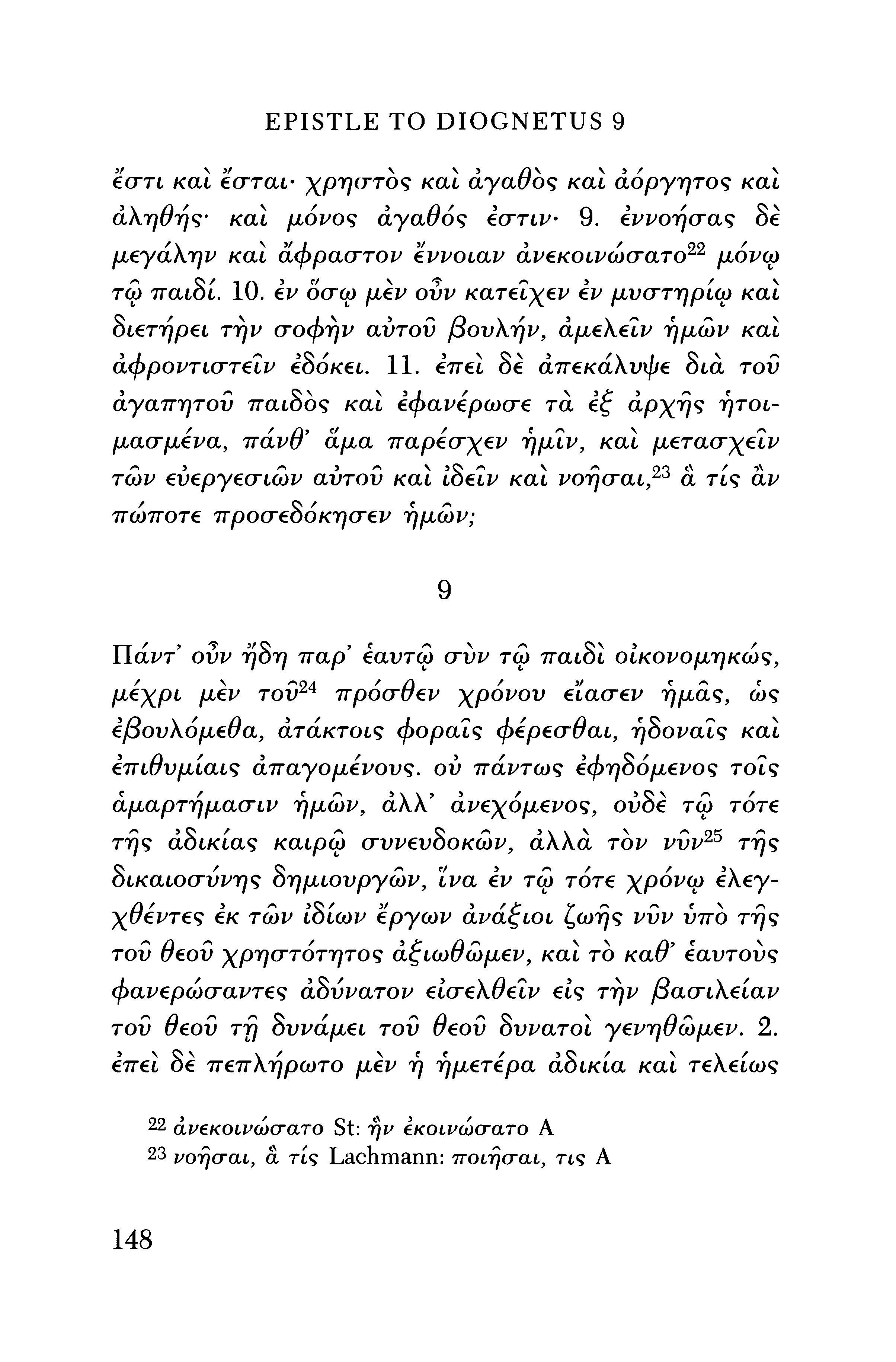
βστι καί εσται· χρηστός καϊ αγαθός καϊ άόργητος καϊ αληθήςκαϊ μόνος αγαθός βστιν· 9. βννοήσας δβ μβγάλην καϊ άφραστον βννοιαν άνβκοινώσατο
μόνω τω παιδί. 10. βν όσω μβν ονν κατβΐχβν βν μνστηρίω καϊ διβτήρβι τήν σοφήν αντον βονλήν, άμβλβίν ημών καϊ άφροντιστβΐν βδόκβι. 11. βπβϊ δβ άπβκάλνφβ διά τον αγαπητού παιδός καϊ βφανβρωσβ τά βζ αρχής ήτοιμασμβνα, πάνθ' άμα παρβσχβν ήρΐν, καϊ μβτασχβΐν τών βνβργβσιών αντον καϊ ίδβΐν καϊ νοήσαι,
πρόσθβν χρόνον βϊασβν ημάς, ώς ββονλόμβθα, άτάκτοις φοραΐς φβρβσθαι, ήδοναΐς καϊ βπιθνρίαις άπαγομβνονς. ον πάντως βφηδόμβνος τοΐς άμαρτήμασιν ημών, άλλ' άνβχόμβνος, ονδβ τώ τότβ τής αδικίας καιρώ σννβνδοκών, άλλά τον ννν
τής δικαιοσύνης δηριονργών, ΐνα βν τώ τότβ χρόνω βλβγχθβντβς βκ τών ιδίων βργων ανάξιοι ζωής νύν ύπό τής τού θβού χρηστότητος άξιωθώμβν, καϊ τό καθ' βαντούς φανβρώσαντβς αδύνατον βίσβλθβΐν βίς τήν βασιλβίαν τού θβού τή δννάμβι τού θβού δννατοί γβνηθώμβν.
2. eVet δβ πβπλήρωτο μβν ή ήμβτβρα αδικία καί τβλβίως 2 2 άνβκοινώσατο St: βκοινώσατο Α 2 3 νοήσαι, ά τίς Lachmann: ποιήσαι, τις Α
E P I S T L E TO DIOGNETUS 9
way, and is and will be: kind and good and without anger and true. He alone is good. 9. And when he had a great and inexpressible thought, he communicated it to his child alone. 10. And so, as long as he enshrouded it in a mystery and kept his wise plan to himself, he seemed not to care for us or give us any heed. 11. But when he revealed it through his beloved child and showed the things prepared from the beginning, he shared all things with us at once, that we might participate in and see and understand his kindly acts. Who among us would have ever expected these things?
And so, having arranged all things by himself, along with his child, he permitted us—while it was still the former time—to be borne along by disorderly passions, as we wished, carried off by our pleasures and desires. He took no delight at all in our sins, but he endured them. Nor did he approve of the former time of unrighteousness, but he was creating the present age of righteousness, so that even though at that time our works proved that we were unwor thy of life, we might in the present be made worthy by the kindness of God. And when we had demonstrated that we were powerless to enter the kingdom of God on our own, we were enabled by the power of God. 2. For our unrigh teous way of life came to fruition and it became perfectly
2 4 ττάντ . . . μεν τον Lachmann: πάντ ονν r;8et π. e. σ. τ. παίδι οικονομικώς μέχρι μεν ονν τον Α 2 5 ννν Hefele: νουν Α
E P I S T L E TO DIOGNETUS 9
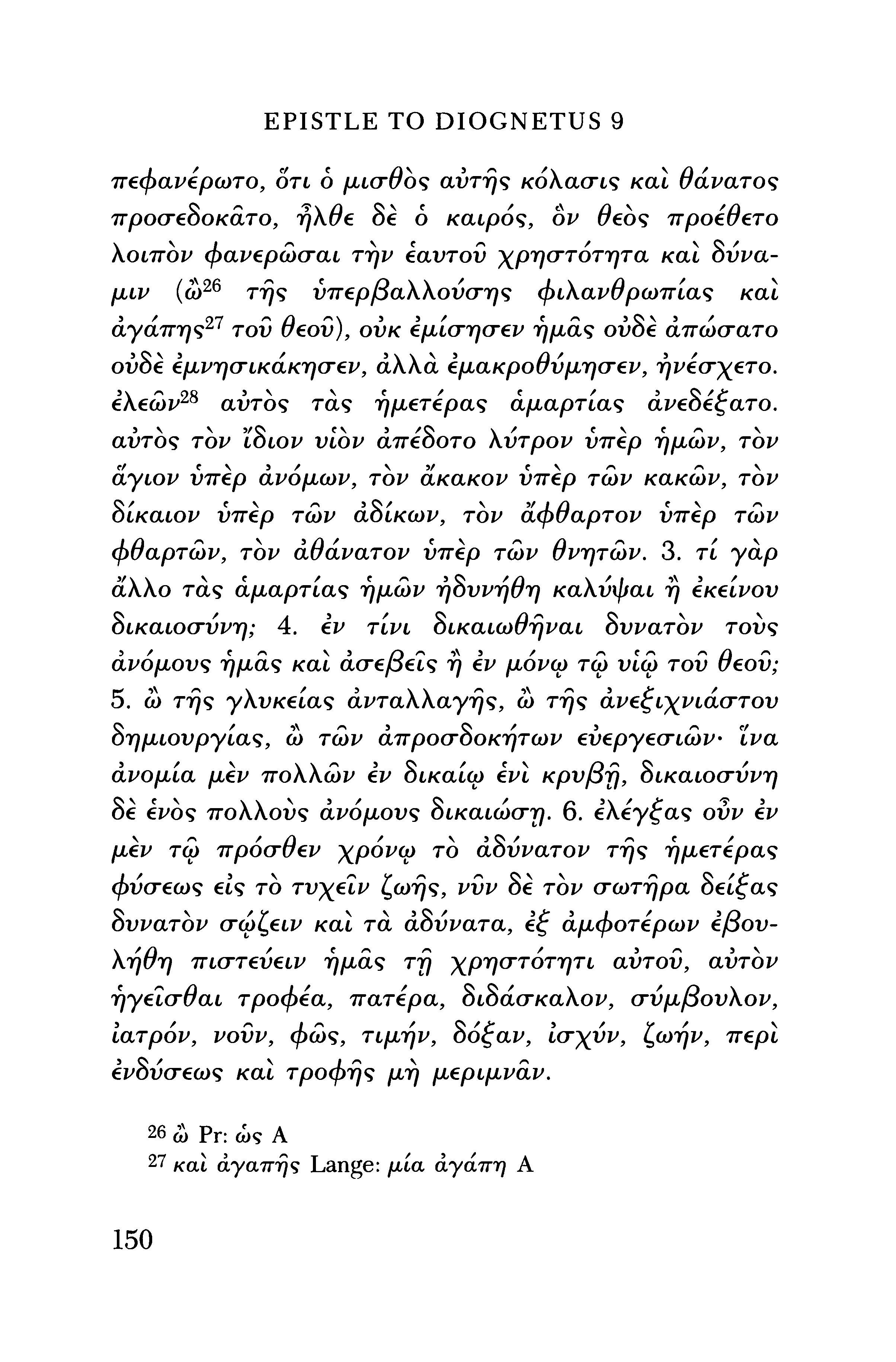
πβφανέρωτο, ότι ό μισθός αυτής κόλασις και θάνατος προσβδοκάτο, ήλθβ δέ ό καιρός, όν θβός προέθβτο λοιπόν φανβρώσαι τήν εαυτού χρηστότητα και δνναριν (ώ
τον θβον), ονκ βμίσησβν ημάς ουδέ άπώσατο ούδβ βμνησικάκησβν, άλλά βμακροθύμησβν, ήνέσχβτο. βλβών
αυτός τάς ήμβτβρας αμαρτίας άνβδέζατο. αυτός τον Ιδιον νίόν άπβδοτο λύτρον ύπβρ ημών, τον άγιον ύπβρ άνομων, τον άκακον ύπβρ τών κακών, τον δίκαιον ύπβρ τών άδικων, τον άφθαρτον ύπβρ τών φθαρτών, τον άθάνατον ύπβρ τών θνητών.
3. τί γάρ άλλο τάς αμαρτίας ηρών ήδννήθη καλύφαι ή βκβίνον δικαιοσύνη; 4. βν τίνι δικαιω^τραι δυνατόν τούς άνόμονς ημάς καϊ άσβββΐς ή βν μόνω τώ νίω τού θβού; 5. ώ τής γλνκβίας ανταλλαγής, ώ τής άνβζιχνιάστον δημιονργίας, ώ τών απροσδόκητων βύβργβσιώνΐνα ανομία ρβν πολλών βν δικαίω βνϊ κρνβή, δικαιοσύνη δβ βνός πολλούς άνόρονς δικαίωση.
6. βλβγζας ούν βν μβν τώ πρόσθβν χρόνω τό αδύνατον τής ήμβτβρας φύσβως βίς τό τνχβΐν ζωής, νύν δβ τον σωτήρα δβίξας δννατόν σώζβιν καί τά αδύνατα, βζ άμφοτβρων ββονλήθη πιστβύβιν ημάς τή χρηστότητι αυτού, αυτόν ήγβΐσθαι τροφβα, πατέρα, διδάσκαλον, σύμβονλον, ίατρόν, νούν, φώς, τιμήν, δόζαν, ίσχύν, ζωήν, πβρί ένδύσβως καί τροφής μή μβριμνάν.
E P I S T L E TO DIOGNETUS 9
clear that it could expect only punishment and death as its ultimate reward. But then, when the time arrived that God had planned to reveal at last his goodness and power (Oh, the supreme beneficence and love of God!), he did not hate us, destroy us, or hold a grudge against us. But he was patient, he bore with us, and out of pity for us he took our sins upon himself. He gave up his own Son as a ransom for us, the holy one for the lawless, the innocent one for the wicked, the righteous one for the unrighteous, the imper ishable one for the perishable, the immortal one for the mortal. 3. For what else could hide our sins but the righ teousness of that one? 4. How could we who were lawless and impious be made upright except by the Son of God alone? 5. Oh, the sweet exchange! Oh, the inexpressible creation! Oh, the unexpected acts of beneficence! That the lawless deeds of many should be hidden by the one who was upright, and the righteousness of one should make up right the many who were lawless! 6. Since he clearly dem onstrated in the former time that we could not possibly, by our very nature, obtain life, and since he now revealed the savior who has the power to save even what is powerless— for both reasons he has wanted us to believe in his kind ness, to consider him our nurse, father, teacher, counselor, physician, mind, light, honor, glory, strength, and life, and to have no concern over what to wear or eat.
E P I S T L E TO DIOGNETUS 10
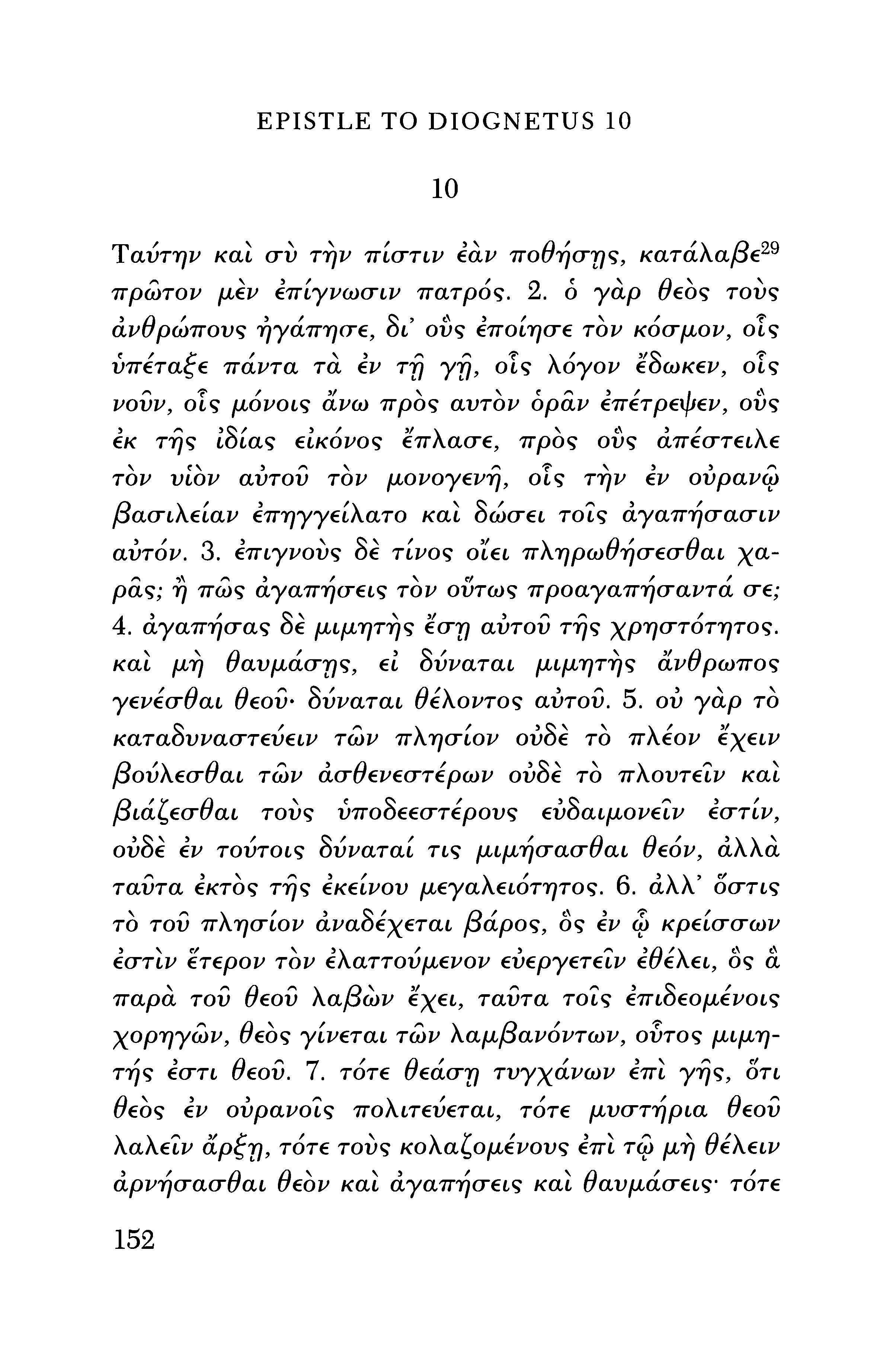
2. ό γάρ θβός τονς ανθρώπους ήγάπησβ, δι ονς βποίησβ τον κόσμον, οις ύπβταζβ πάντα τά βν τή γη, οις λόγον βδωκβν, οίς νούν, οίς μόνοις άνω προς αντόν όράν βπβτρβφβν, ονς βκ της ίδιας βίκόνος βπλασβ, προς ονς άπβστβιλβ τον νίόν αυτού τον ρονογβνή, οις τήν βν ούρανώ βασιλβίαν βπηγγβίλατο καί δώσβι τοις άγαπήσασιν αυτόν.
3. βπιγνούς δβ τίνος οϊβι πληρωθήσβσθαι χα ράς; ή πώς άγαπήσβις τον ούτως προαγαπήσαντά σβ; 4. άγαπήσας δβ μιμητής βση αυτού τής χρηστότητος. καί ρή θανμάσης, βί δύναται μιμητής άνθρωπος γβνβσθαι θβούδύναται θβλοντος αυτού. 5. ού γάρ τό καταδνναστβύβιν τών πλησίον ούδβ τό πλβον βχβιν βούλβσθαι τών άσθβνβστβρων ούδβ τό πλοντβΐν καί βιάζβσθαι τούς ύποδββστβρονς βύδαιμονβΐν βστιν, ούδβ βν τούτοις δύναται τις /χιμηο-αο-^αι θβον, άλλά ταύτα βκτός τής βκβίνον μβγαλβιότητος.
6. άλλ' όστις τό τού πλησίον άναδβχβται βάρος, ός βν ω κρβίσσων βστιν βτβρον τον βλαττούμβνον βύβργβτβΐν βθβλβι, ός ά παρά τού θβού λαβών βχβι, ταύτα τοΐς βπιδβομβνοις χορηγών, θβός γίνβται τών λαμβανόντων, οντος μιμη τής έστι θβού. 7. τότβ θβάση τνγχάνων βπϊ γής, ότι θβός βν ούρανοΐς πολιτβύβται, τότβ μυστήρια θβού λαλβΐν άρξη, τότβ τούς κολαζορβνονς βπϊ τώ μή θβλβιν άρνήσασθαι θβον καϊ άγαπήσβις καϊ θανμάσβιςτότβ
E P I S T L E TO DIOGNETUS 10
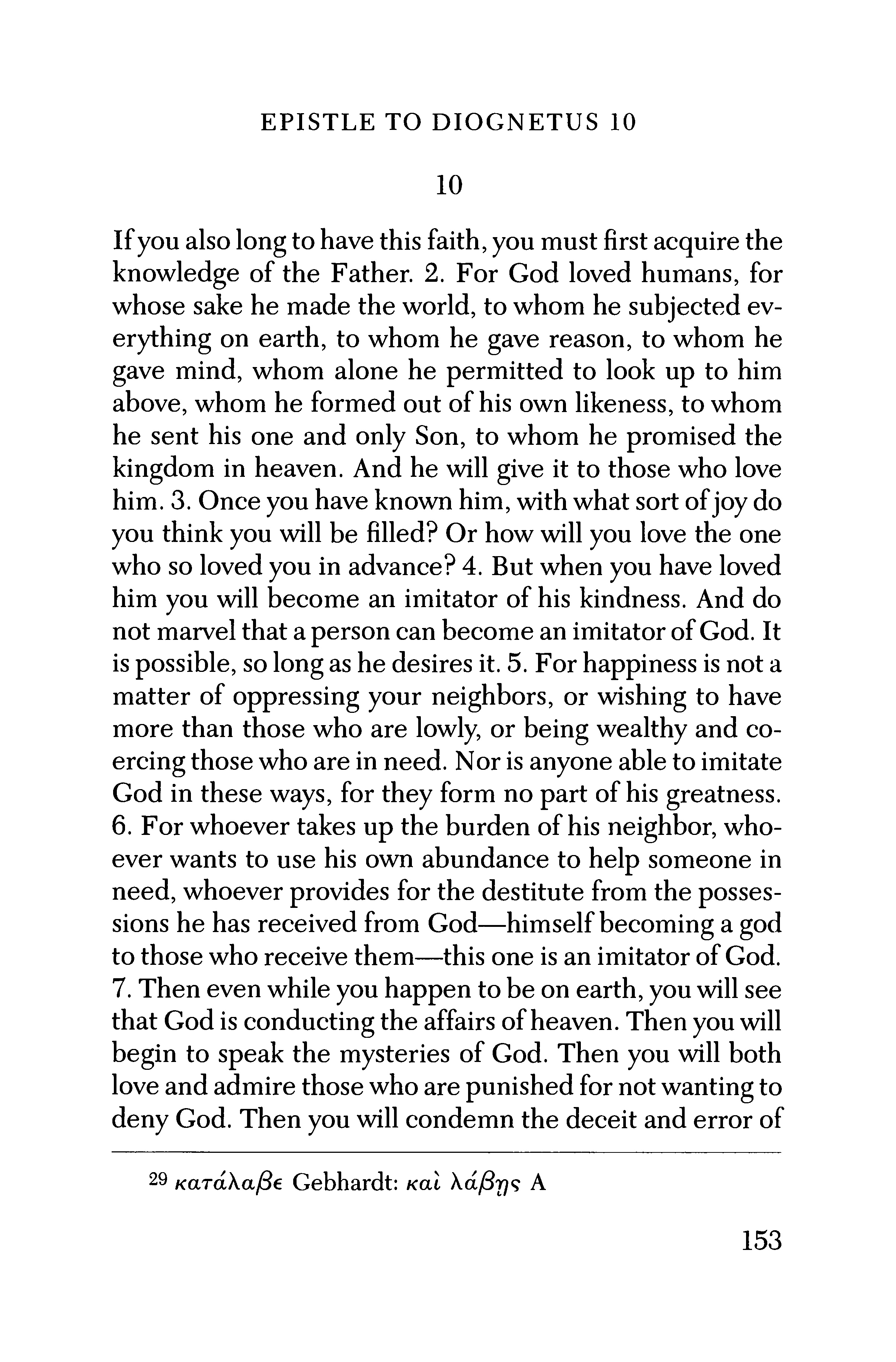
If you also long to have this faith, you must first acquire the knowledge of the Father. 2. For God loved humans, for whose sake he made the world, to whom he subjected ev erything on earth, to whom he gave reason, to whom he gave mind, whom alone he permitted to look up to him above, whom he formed out of his own likeness, to whom he sent his one and only Son, to whom he promised the kingdom in heaven. And he will give it to those who love him. 3. Once you have known him, with what sort of joy do you think you will be filled? Or how will you love the one who so loved you in advance? 4. But when you have loved him you will become an imitator of his kindness. And do not marvel that a person can become an imitator of God. It is possible, so long as he desires it. 5. For happiness is not a matter of oppressing your neighbors, or wishing to have more than those who are lowly, or being wealthy and co ercing those who are in need. Nor is anyone able to imitate
God in these ways, for they form no part of his greatness.
6. For whoever takes up the burden of his neighbor, who ever wants to use his own abundance to help someone in need, whoever provides for the destitute from the posses sions he has received from God—himself becoming a god to those who receive them—this one is an imitator of God.
7. Then even while you happen to be on earth, you will see that God is conducting the affairs of heaven. Then you will begin to speak the mysteries of God. Then you will both love and admire those who are punished for not wanting to deny God. Then you will condemn the deceit and error of 2 9 κατάλαβε Gebhardt: καϊ λάβης A
E P I S T L E TO DIOGNETUS 11
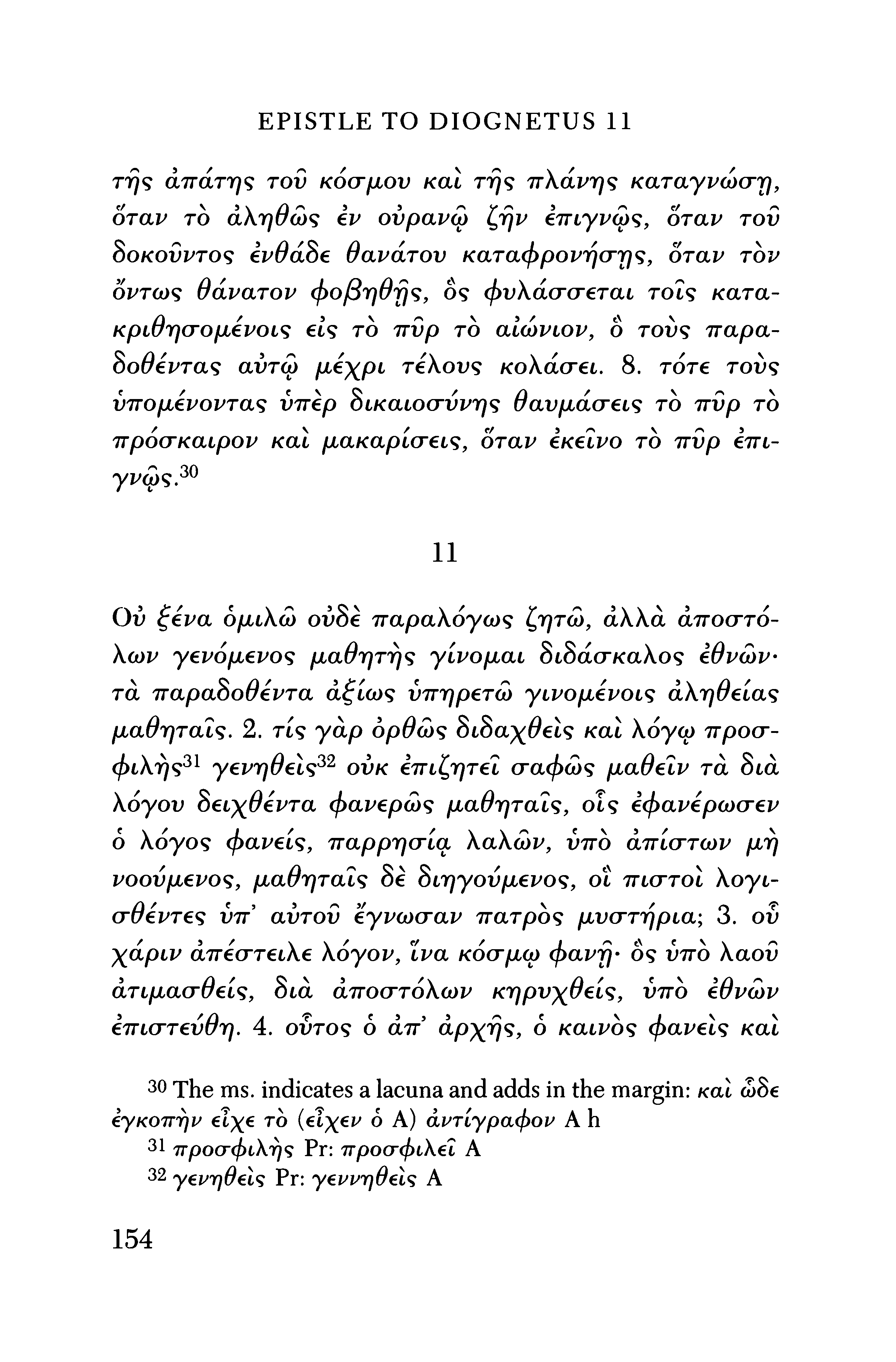
τής άπατης τον κόσμον καϊ τής πλάνης καταγνώση, όταν τό αληθώς iv ούρανώ ζήν επιγνώς, Οταν τον δοκούντος ενθάδε θάνατον καταφρόνησης, όταν τον Οντως θάνατον φοβηθής, ός φνλάσσεται τοΐς κατακριθησομενοις εις τό πνρ τό αίώνιον, 6 τονς παραδοθεντας αντω ρεχρι τελονς κολάσει.
8. τότε τονς ύπορενοντας νπερ δικαιοσύνης θανμάσεις τό πύρ τό πρόσκαιρον καϊ μακαρίσεις, Οταν εκείνο τό πύρ επιγνώς.
Ού ξένα ομιλώ ούδε παραλόγως ζητώ, άλλά αποστό λων γενόμενος μαθητής γίνομαι διδάσκαλος εθνώντά παραδοθέντα άξίως υπηρετώ γινομενοις αληθείας μαθηταΐς.
ούκ επιζητεί σαφώς μαθεΐν τά διά λόγον δειχθεντα φανερώς μαθηταΐς, οΐς εφανερωσεν
γενηθεϊς ό λόγος φανείς, παρρησία λαλών, ύπό άπιστων ρή νοούμενος, μαθηταΐς δε διηγούμενος, ot πιστοί λογισθεντες ύπ' αυτού έγνωσαν πατρός μυστήρια-, 3. ον χάριν απέστειλε λόγον, ΐνα κόσμω φανήός ύπό λαού ατιμασθείς, διά αποστόλων κηρνχθείς, ύπό εθνών επιστεύθη.
4. ούτος ό άπ' αρχής, ό καινός φανείς καϊ 3 0 The ms. indicates a lacuna and adds in the margin: καϊ ώδε εγκοπήν είχε τό (είχεν ό Α) αντίγραφαν A h
E P I S T L E TO DIOGNETUS 11
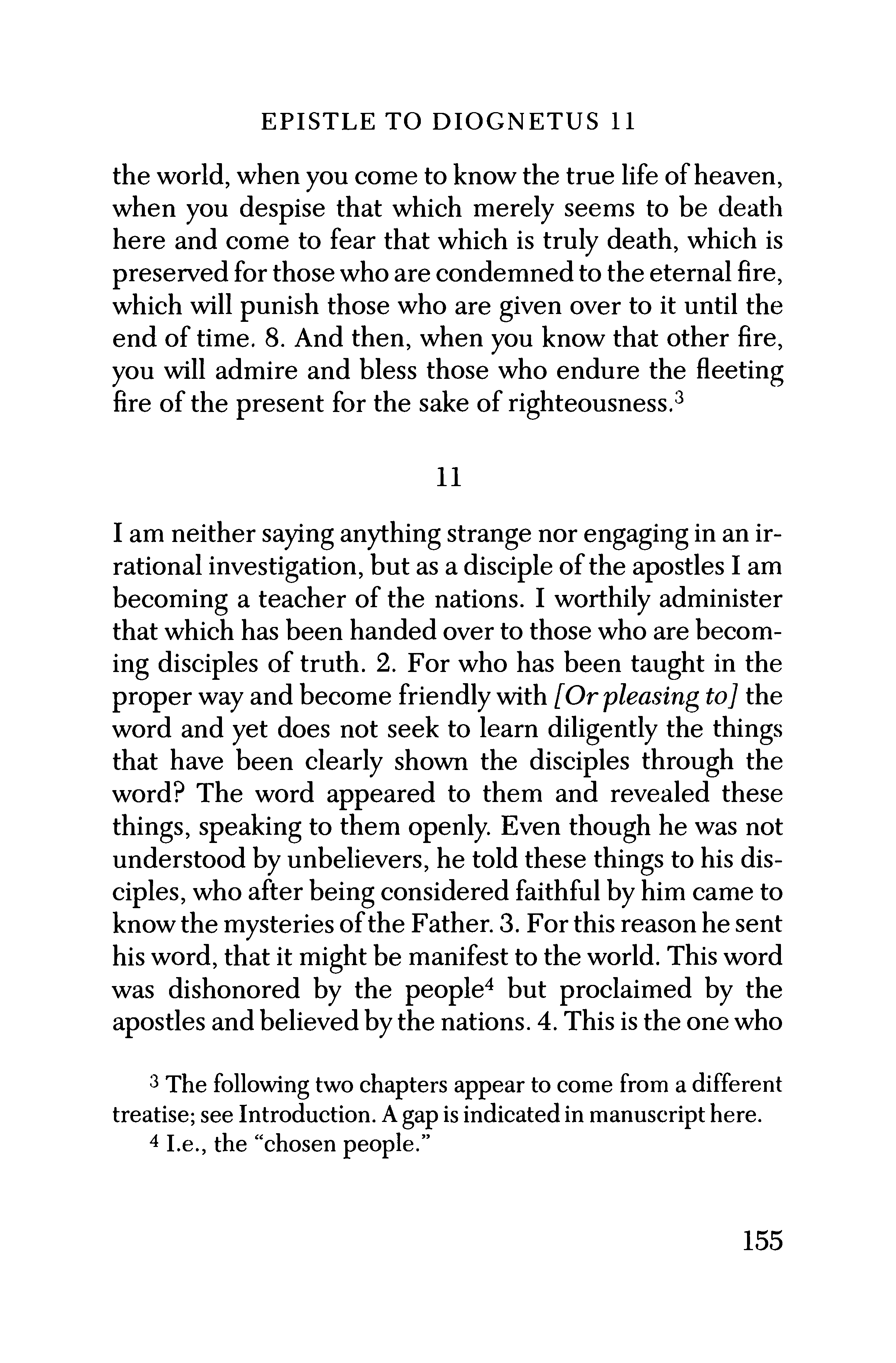
the world, when you come to know the true life of heaven, when you despise that which merely seems to be death here and come to fear that which is truly death, which is preserved for those who are condemned to the eternal fire, which will punish those who are given over to it until the end of time. 8. And then, when you know that other fire, you will admire and bless those who endure the fleeting fire of the present for the sake of righteousness.
I am neither saying anything strange nor engaging in an ir rational investigation, but as a disciple of the apostles I am becoming a teacher of the nations. I worthily administer that which has been handed over to those who are becom ing disciples of truth. 2. For who has been taught in the proper way and become friendly with [Or pleasing to] the word and yet does not seek to learn diligently the things that have been clearly shown the disciples through the word? The word appeared to them and revealed these things, speaking to them openly. Even though he was not understood by unbelievers, he told these things to his dis ciples, who after being considered faithful by him came to know the mysteries of the Father. 3. For this reason he sent his word, that it might be manifest to the world. This word was dishonored by the people 4 but proclaimed by the apostles and believed by the nations. 4. This is the one who 3 The following two chapters appear to come from a different treatise; see Introduction. A gap is indicated in manuscript here.
4 I.e., the "chosen people."
E P I S T L E TO DIOGNETUS 12
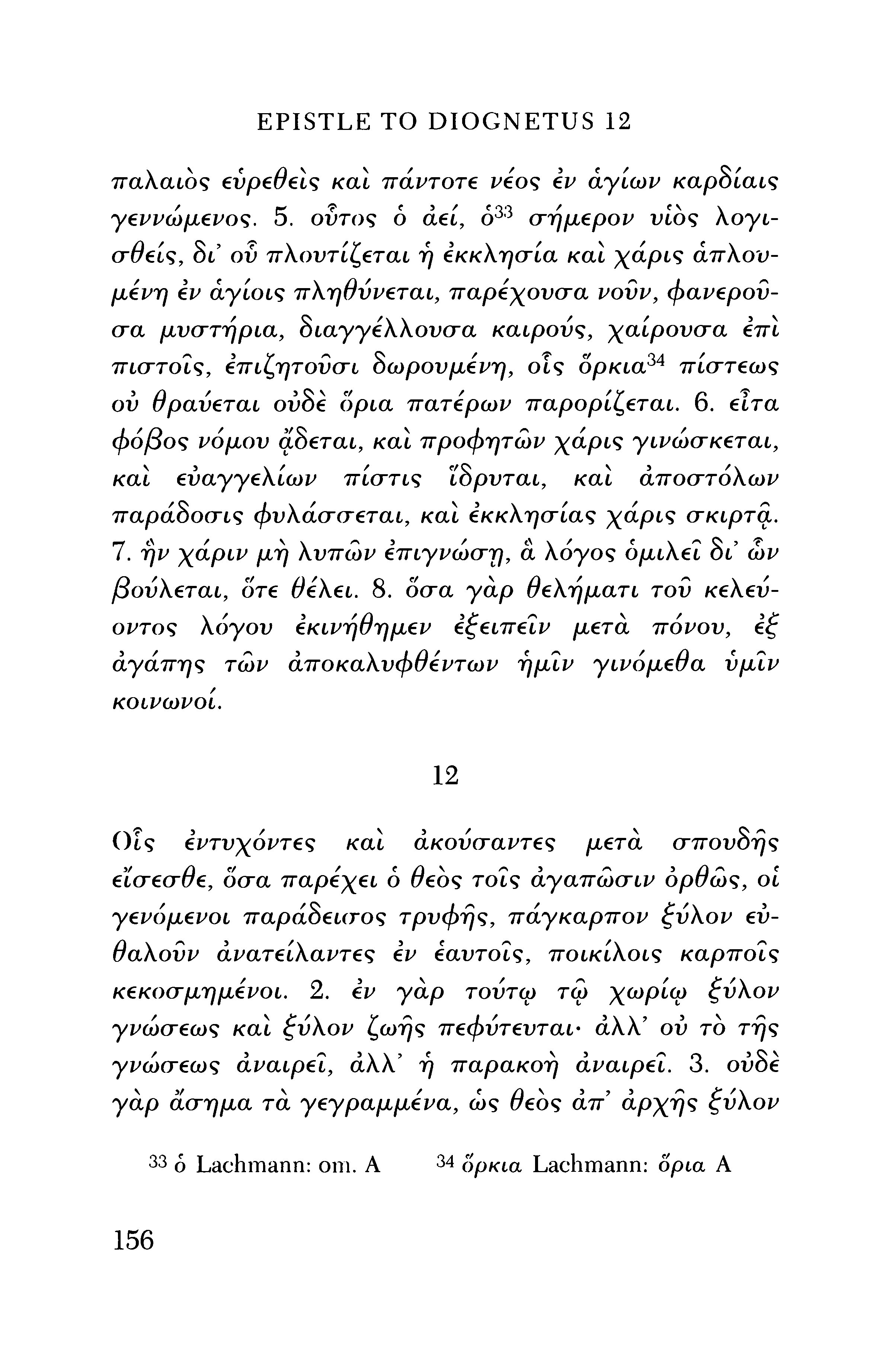
5. οντος 6 άεί, ό 3 3 σήμερον νιος λογι σθείς, δι' ον πλοντίζεται ή εκκλησία καϊ χάρις άπλονρενη εν άγίοις πληθύνεται, παρεχονσα νούν, φανερούσα μυστήρια, διαγγελλονσα καιρούς, χαίρονσα επϊ πιστοίς, επιζητούσι δωρονμενη, οις όρκια
6. βιτα φόβος νόρον αδεται, καϊ προφητών χάρις γινώσκεται, καϊ ευαγγελίων πίστις ΐδρυται, καϊ αποστόλων παράδοσις φυλάσσεται, καϊ εκκλησίας χάρις σκιρτά.
8. όσα γάρ θελήματι τού κελεύοντος λόγου εκινήθημεν εζειπείν μετά πόνου, εζ αγάπης τών άποκαλυφθεντων ήμΐν γινόμεθα ύμΐν κοινωνοί.
Οΐς εντυχόντες καϊ άκούσαντες μετά σπονδής εΐσεσθε, όσα παρέχει ό θεός τοΐς άγαπώσιν ορθώς, οί γενόμενοι παράδεισος τρνφής, πάγκαρπον ξύλον εύθαλούν άνατείλαντες εν εαυτοΐς, ποικίλοις καρποΐς κεκοσμημενοι.
2. εν γάρ τούτω τώ χωρίω ζύλον γνώσεως καί ξύλον ζωής πεφύτευταιάλλ' ού τό τής γνώσεως αναιρεί, άλλ' ή παρακοή αναιρεί.
3 4 ορκια Lachmann: όρια A
E P I S T L E TO DIOGNETUS 12
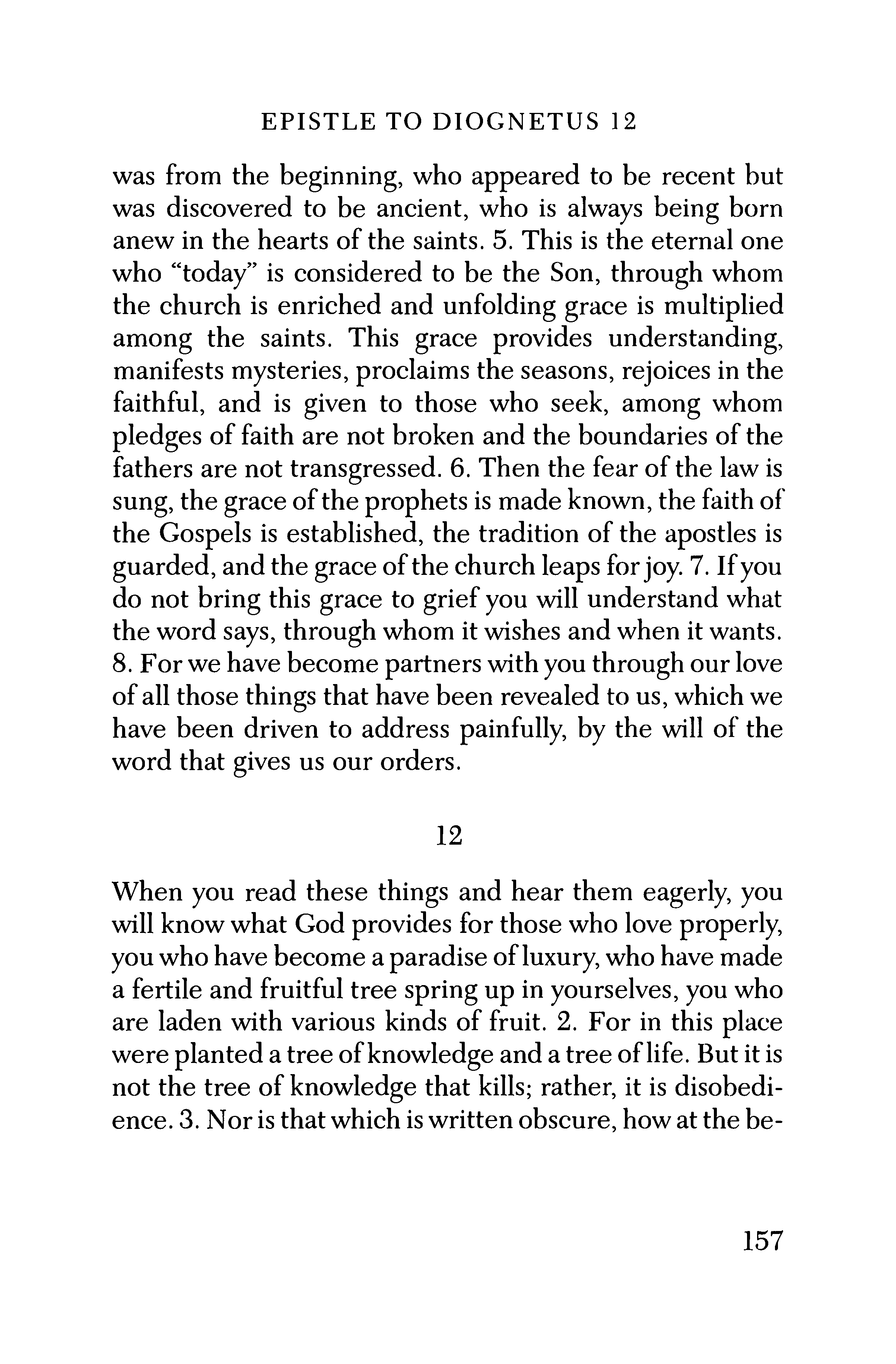
was from the beginning, who appeared to be recent but was discovered to be ancient, who is always being born anew in the hearts of the saints. 5. This is the eternal one who "today" is considered to be the Son, through whom the church is enriched and unfolding grace is multiplied among the saints. This grace provides understanding, manifests mysteries, proclaims the seasons, rejoices in the faithful, and is given to those who seek, among whom pledges of faith are not broken and the boundaries of the fathers are not transgressed. 6. Then the fear of the law is sung, the grace of the prophets is made known, the faith of the Gospels is established, the tradition of the apostles is guarded, and the grace of the church leaps for joy. 7. If you do not bring this grace to grief you will understand what the word says, through whom it wishes and when it wants.
8. For we have become partners with you through our love of all those things that have been revealed to us, which we have been driven to address painfully, by the will of the word that gives us our orders.
When you read these things and hear them eagerly, you will know what God provides for those who love properly, you who have become a paradise of luxury, who have made a fertile and fruitful tree spring up in yourselves, you who are laden with various kinds of fruit. 2. For in this place were planted a tree of knowledge and a tree of life. But it is not the tree of knowledge that kills; rather, it is disobedi ence. 3. Nor is that which is written obscure, how at the be-
E P I S T L E TO DIOGNETUS 12
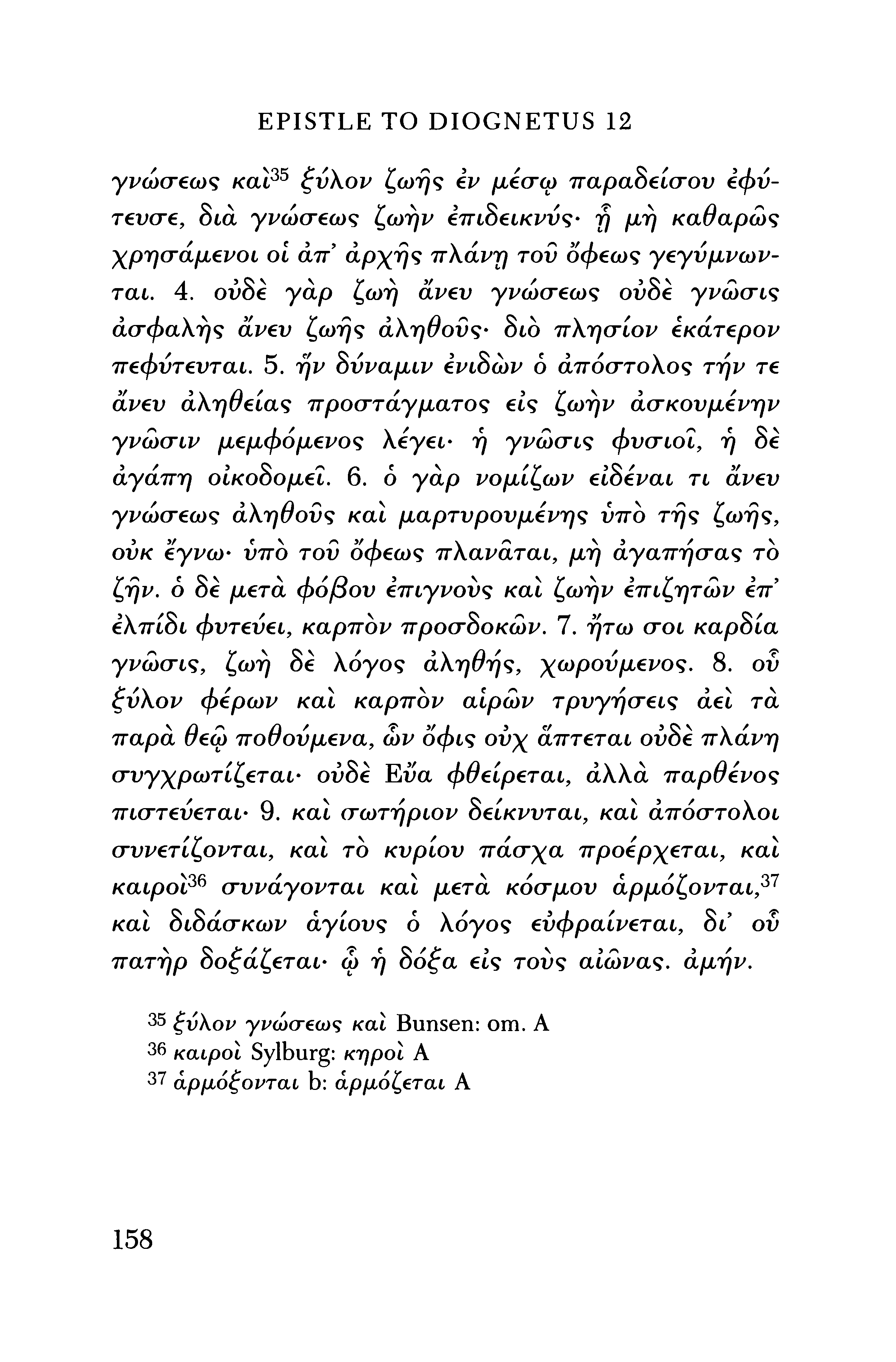
ξύλον ζωής iv μέσω παραδείσου έφύτενσε, διά γνώσεως ζωήν έπιδεικνύςή μή καθαρώς χρησάμενοι οί άπ' αρχής πλάνη τον οφεως γεγύμνωνται. 4. ονδε γάρ ζωή άνεν γνώσεως ονδέ γνώσις ασφαλής άνεν ζωής αληθούςδιό πλησίον έκάτερον πεφύτενται.
5. ήν δύναμιν ένιδών 6 απόστολος τήν τε άνεν αληθείας προστάγματος εις ζωήν άσκονμένην γνώσιν μεμφόμενος λέγειή γνώσις φνσιοΐ, ή δέ αγάπη οικοδομεί.
6. ό γάρ νομίζων είδέναι τι άνεν γνώσεως αληθούς καί μαρτνρονρένης νπό τής ζωής, ονκ έγνωνπό τον οφεως πλανάται, μή άγαπήσας τό ζήν. ό δέ μετά φόβον έπιγνούς καί ζωήν επιζητών έπ' έλπίδι φντεύει, καρπόν προσδοκών.
8. ον ξνλον φέρων καί καρπόν αίρών τρνγήσεις άεί τά παρά θεώ ποθούμενα, ών όφις ούχ άπτεται ουδέ πλάνη σνγχρωτίζεταιουδέ Εύα φθείρεται, άλλά παρθένος πιστεύεται9. καί σωτήριον δείκννται, καί απόστολοι σννετίζονται, καί τό κνρίον πάσχα προέρχεται, καί καιροί γνώσεως καί
καί διδάσκων άγίονς ό λόγος ευφραίνεται, δι ον πατήρ δοξάζεταιω ή δόξα εις τούς αιώνας, αμήν.
3 5 ξνλον γνώσεως καί Bunsen: om. A 3 6 καιροί Sylburg: κηροί A 3 7 άρμόξονται b: αρμόζεται A
E P I S T L E TO DIOGNETUS 12
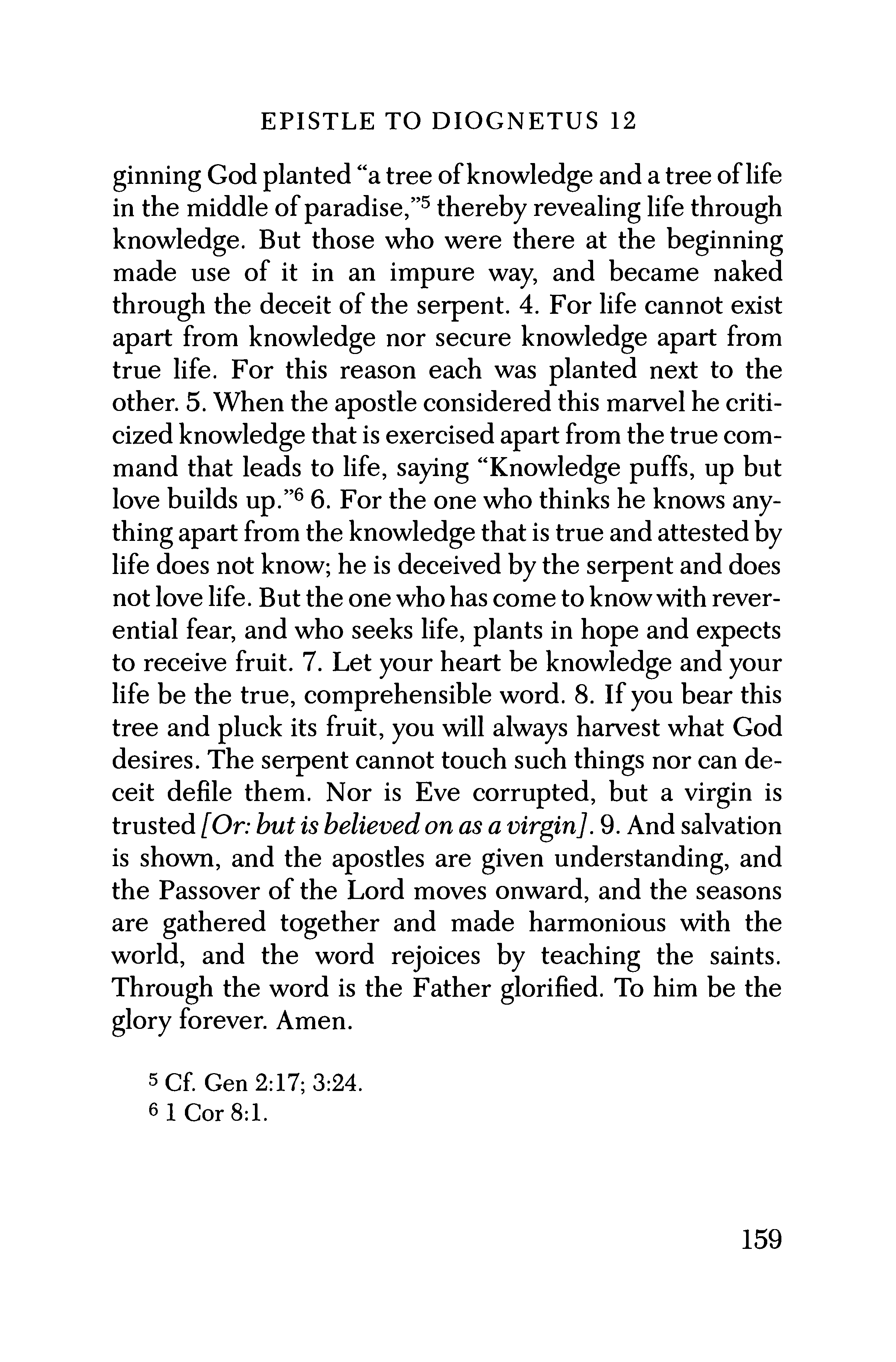
ginning God planted "a tree of knowledge and a tree of life in the middle of paradise,"
5 thereby revealing life through knowledge. But those who were there at the beginning made use of it in an impure way, and became naked through the deceit of the serpent. 4. For life cannot exist apart from knowledge nor secure knowledge apart from true life. For this reason each was planted next to the other. 5. When the apostle considered this marvel he criti cized knowledge that is exercised apart from the true com mand that leads to life, saying "Knowledge puffs, up but love builds up."
6 6. For the one who thinks he knows any thing apart from the knowledge that is true and attested by life does not know; he is deceived by the serpent and does not love life. But the one who has come to know with rever ential fear, and who seeks life, plants in hope and expects to receive fruit. 7. Let your heart be knowledge and your life be the true, comprehensible word. 8. If you bear this tree and pluck its fruit, you will always harvest what God desires. The serpent cannot touch such things nor can de ceit defile them. Nor is Eve corrupted, but a virgin is trusted [Or: but is believed on as a virgin]. 9. And salvation is shown, and the apostles are given understanding, and the Passover of the Lord moves onward, and the seasons are gathered together and made harmonious with the world, and the word rejoices by teaching the saints.
Through the word is the Father glorified. To him be the glory forever. Amen.
5Cf. Gen 2:17; 3:24.
6 1 Cor 8:1.


THE SHEPHERD OF HERMAS
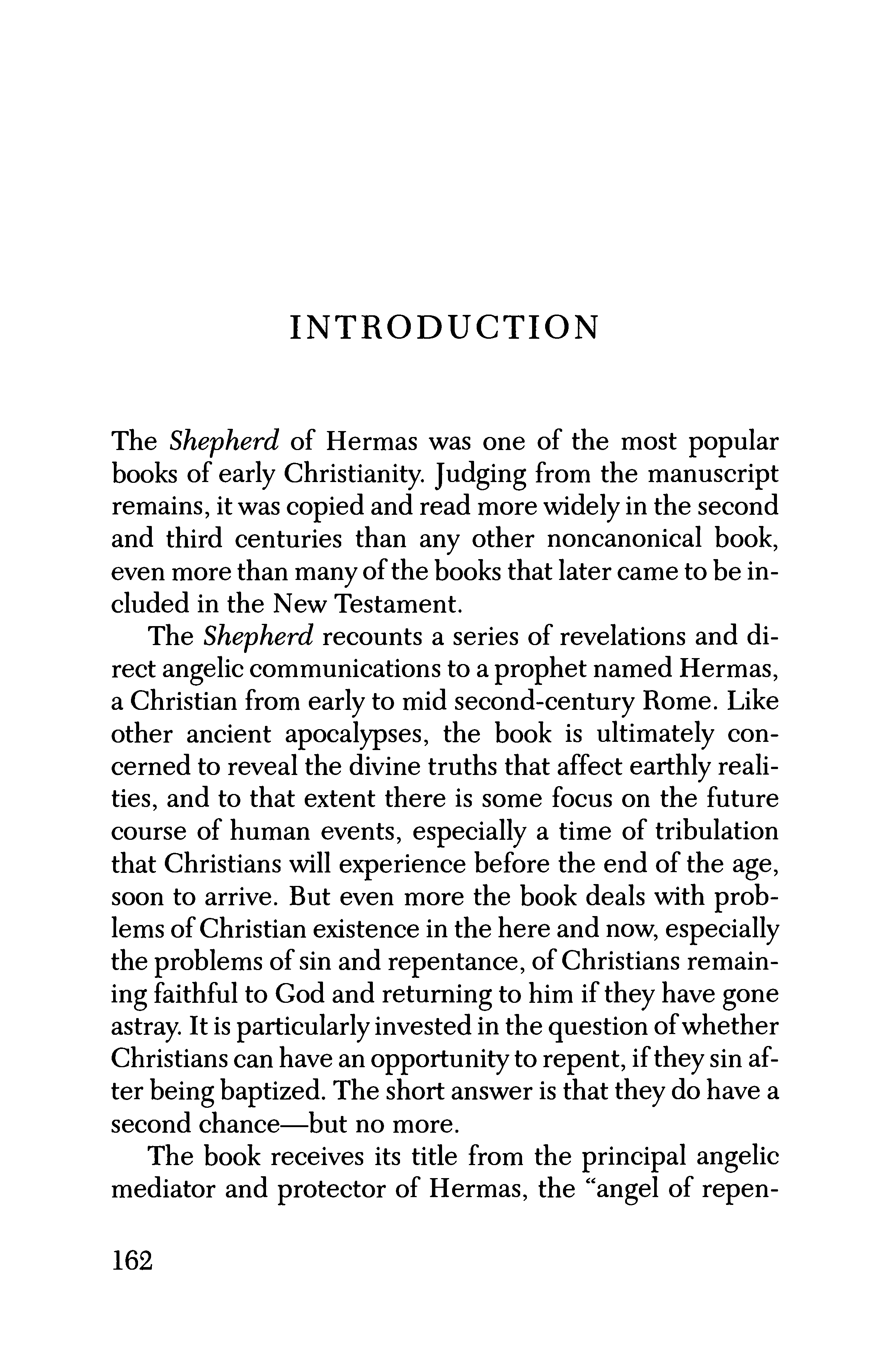
INTRODUCTION
The Shepherd of Hermas was one of the most popular books of early Christianity. Judging from the manuscript remains, it was copied and read more widely in the second and third centuries than any other noncanonical book, even more than many of the books that later came to be in cluded in the New Testament.
The Shepherd recounts a series of revelations and di rect angelic communications to a prophet named Hermas, a Christian from early to mid second-century Rome. Like other ancient apocalypses, the book is ultimately con cerned to reveal the divine truths that affect earthly reali ties, and to that extent there is some focus on the future course of human events, especially a time of tribulation that Christians will experience before the end of the age, soon to arrive. But even more the book deals with prob lems of Christian existence in the here and now, especially the problems of sin and repentance, of Christians remain ing faithful to God and returning to him if they have gone astray. It is particularly invested in the question of whether
Christians can have an opportunity to repent, if they sin af ter being baptized. The short answer is that they do have a second chance—but no more.
The book receives its title from the principal angelic mediator and protector of Hermas, the "angel of repen-
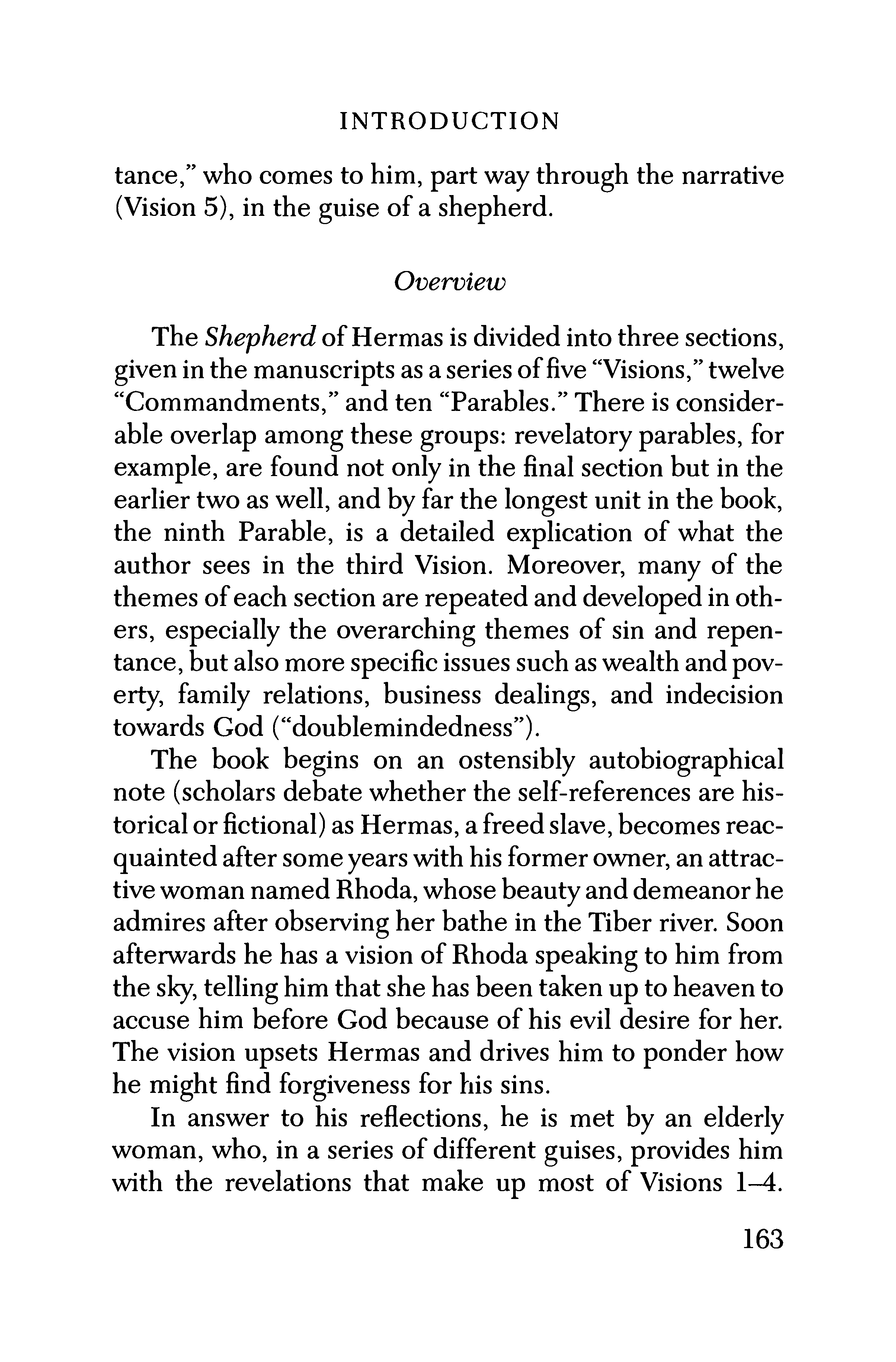
INTRODUCTION
tance," who comes to him, part way through the narrative (Vision 5), in the guise of a shepherd.
Overview The Shepherd of Hermas is divided into three sections, given in the manuscripts as a series of five "Visions," twelve
"Commandments," and ten "Parables." There is consider able overlap among these groups: revelatory parables, for example, are found not only in the final section but in the earlier two as well, and by far the longest unit in the book, the ninth Parable, is a detailed explication of what the author sees in the third Vision. Moreover, many of the themes of each section are repeated and developed in oth ers, especially the overarching themes of sin and repen tance, but also more specific issues such as wealth and pov erty, family relations, business dealings, and indecision towards God ("doublemindedness").
The book begins on an ostensibly autobiographical note (scholars debate whether the self-references are his torical or fictional) as Hermas, a freed slave, becomes reacquainted after some years with his former owner, an attrac tive woman named Rhoda, whose beauty and demeanor he admires after observing her bathe in the Tiber river. Soon afterwards he has a vision of Rhoda speaking to him from the sky, telling him that she has been taken up to heaven to accuse him before God because of his evil desire for her.
The vision upsets Hermas and drives him to ponder how he might find forgiveness for his sins.
In answer to his reflections, he is met by an elderly woman, who, in a series of different guises, provides him with the revelations that make up most of Visions 1-4.
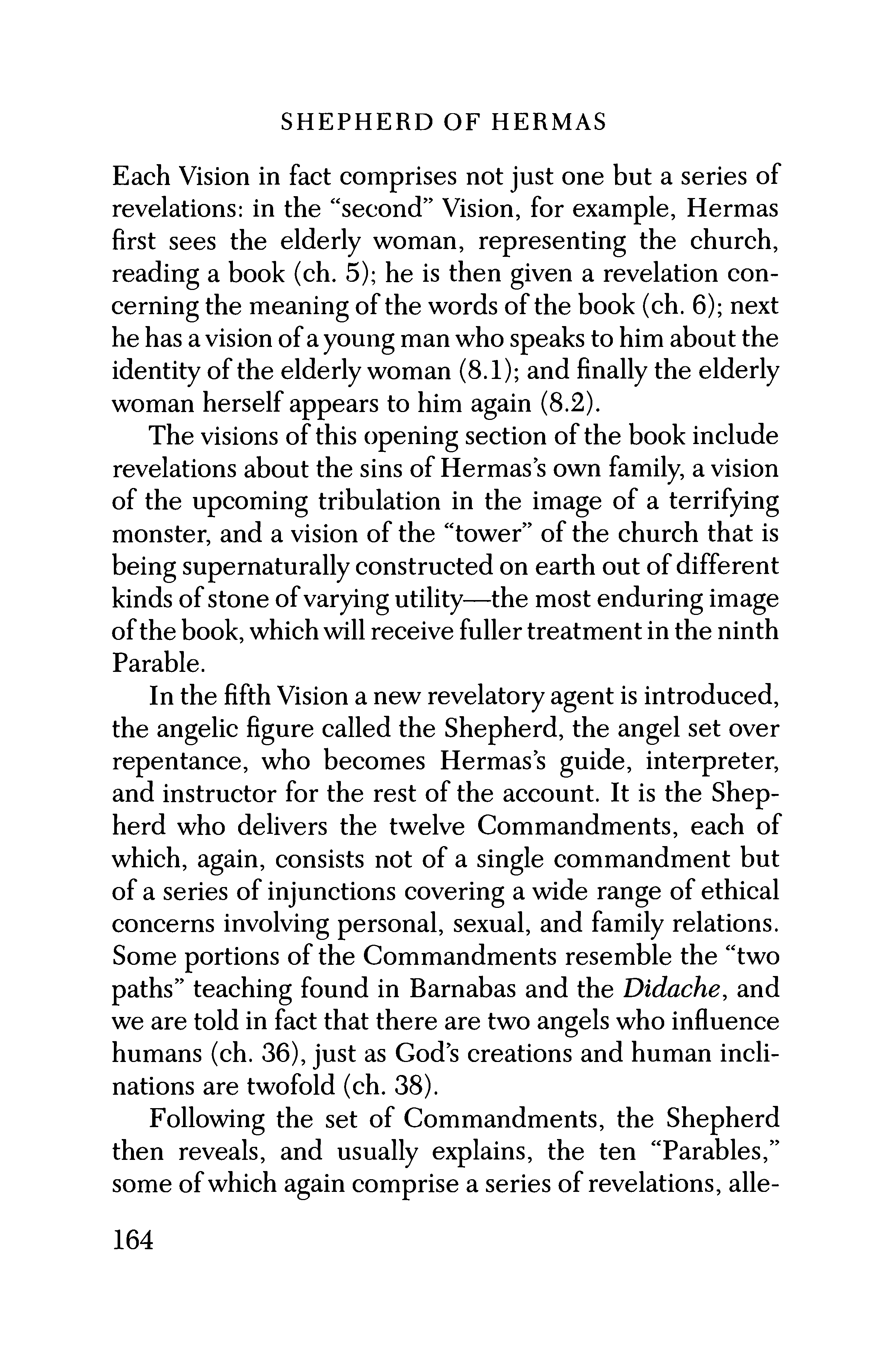
S H E P H E R D OF HERMAS
Each Vision in fact comprises not just one but a series of revelations: in the "second" Vision, for example, Hermas first sees the elderly woman, representing the church, reading a book (ch. 5); he is then given a revelation con cerning the meaning of the words of the book (ch. 6); next he has a vision of a young man who speaks to him about the identity of the elderly woman (8.1); and finally the elderly woman herself appears to him again (8.2).
The visions of this opening section of the book include revelations about the sins of Hermas s own family, a vision of the upcoming tribulation in the image of a terrifying monster, and a vision of the "tower" of the church that is being supernaturally constructed on earth out of different kinds of stone of varying utility—the most enduring image of the book, which will receive fuller treatment in the ninth
Parable.
In the fifth Vision a new revelatory agent is introduced, the angelic figure called the Shepherd, the angel set over repentance, who becomes Hermass guide, interpreter, and instructor for the rest of the account. It is the Shep herd who delivers the twelve Commandments, each of which, again, consists not of a single commandment but of a series of injunctions covering a wide range of ethical concerns involving personal, sexual, and family relations.
Some portions of the Commandments resemble the "two paths" teaching found in Barnabas and the Didache, and we are told in fact that there are two angels who influence humans (ch. 36), just as Gods creations and human incli nations are twofold (ch. 38).
Following the set of Commandments, the Shepherd then reveals, and usually explains, the ten "Parables," some of which again comprise a series of revelations, alle-
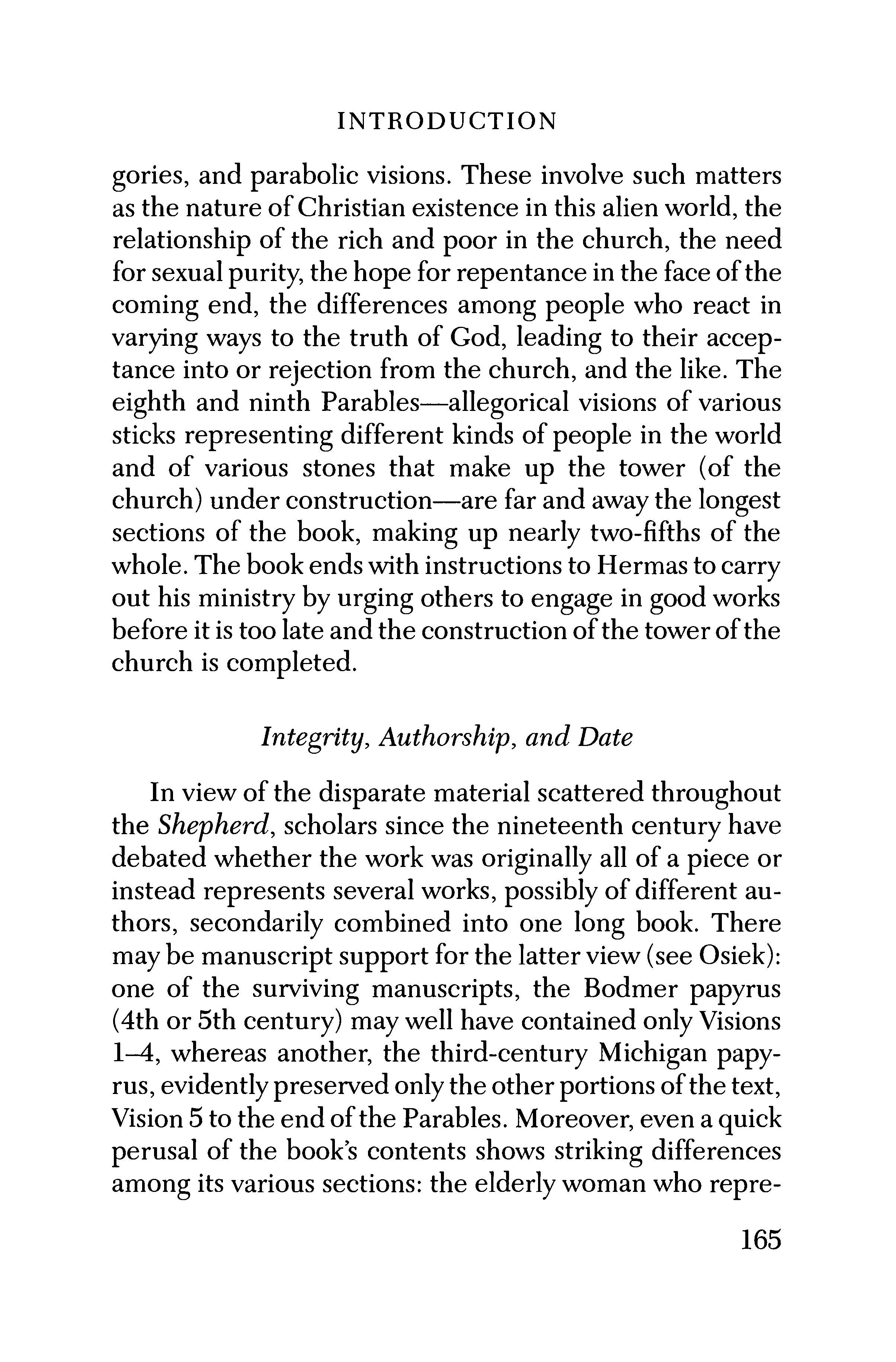
INTRODUCTION
gories, and parabolic visions. These involve such matters as the nature of Christian existence in this alien world, the relationship of the rich and poor in the church, the need for sexual purity, the hope for repentance in the face of the coming end, the differences among people who react in varying ways to the truth of God, leading to their accep tance into or rejection from the church, and the like. The eighth and ninth Parables—allegorical visions of various sticks representing different kinds of people in the world and of various stones that make up the tower (of the church) under construction—are far and away the longest sections of the book, making up nearly two-fifths of the whole. The book ends with instructions to Hermas to carry out his ministry by urging others to engage in good works before it is too late and the construction of the tower of the church is completed.
Integrity, Authorship, and Date In view of the disparate material scattered throughout the Shepherd, scholars since the nineteenth century have debated whether the work was originally all of a piece or instead represents several works, possibly of different au thors, secondarily combined into one long book. There may be manuscript support for the latter view (see Osiek): one of the surviving manuscripts, the Bodmer papyrus
(4th or 5th century) may well have contained only Visions 1-4, whereas another, the third-century Michigan papy rus, evidently preserved only the other portions of the text,
Vision 5 to the end of the Parables. Moreover, even a quick perusal of the books contents shows striking differences among its various sections: the elderly woman who repre-
S H E P H E R D OF HERMAS
sents the "church" is the divine revealer and interpreter in Visions 1-4, but then disappears for the rest of the book; the shepherd, on the other hand, is absent in this earlier portion but assumes a similar role beginning in Vision 5 to the end. In addition, there appear to be internal discrepan cies throughout the book, for example, between the earlier simple vision of the building of the tower in the third vision and the much fuller explication of the image in the ninth
Parable.
And so some modern scholars have argued that the book is a composite piece, with portions written at differ ent times and by different authors (Giet). Others have countered this view, pointing out that (a) when Tertullian and Clement of Alexandria, two of our earliest witnesses to the book (earlier than either of the manuscripts mentioned above), quote the text, they refer to portions of the book that were supposedly, according to this view, circulating independently of one another (this would suggest that the book was a unity from the outset), and (b) extensive simi larities tie the various sections of the book together, for ex ample, the emphasis on sin, repentance, doublemindedness, purity, and the like (Joly, Henne; see Osiek). As a result, some have maintained that the author wrote differ ent sections of the book at different times, creating the ap parent difficulties. Brox, for example, maintains that Vi sions 1-4 were written first; then, somewhat later, Vision 5 through Parable 8; and finally, at a still later time, Parables
9-10. One more recent suggestion is that the composite character of the book results from its origin as an oral, rather than a written, text (Osiek). In any event, the major ity of scholars today appear to favor the notion of a solitary author.
INTRODUCTION
It is difficult to say much about the authors identity apart from the autobiographical information he himself provides, assuming that this information is to be taken as historical self-description. He was evidently a freedman who lived in Rome (thus references to the Tiber in ch. 1 and the Via Campana in ch. 22) and involved with the church there, but not as one of its leaders, of whom he speaks in the third person. His general moral concerns, somewhat superficial theological reflections, especially with regard to christology (e.g., in Parables 5 and 9), and general literary skill have made most interpreters suspect that he was not among the intellectual elite in the church.
In any event, some scholars have seen his text as ripe for a sociohistorical analysis of the church in Rome (see Osiek,
Maier, Lampe, and Jeffers).
Similar considerations have contributed to the view that he was writing some time early in the second century.
It is worth noting, for example, that Hermas speaks of the "presbyters" and the "bishops" of the church in Rome (and other leaders, such as apostles, deacons, and teachers), but says nothing about a solitary bishop. Moreover, never does
Hermas quote other books that later came to be accepted into the canon as authoritative: his only explicit quotation is of a now-lost work, the Book of Eldad and Modat (7.4).
Several other considerations have often played a role in determining his date; unfortunately, these considerations do not harmonize well with one another:
(a) At the beginning of the third century, Origen main tained that this Hermas was none other than the person mentioned by the apostle Paul in Romans 16:14.
(b) Hermas himself mentions someone named "Clem ent" in the second Vision (8.2), and indicates that he was a
S H E P H E R D OF HERMAS
kind of foreign correspondent for the Roman church. It has frequently been thought that this is the same person ultimately responsible for the book of 1 Clement, written in the mid 90s (according to Eusebius, the third bishop of Rome).
(c) The Muratorian Canon - a list of books that belong to the New Testament, produced possibly in the second half of the second century—indicates that the Shepherd is not to be included among the Scriptures because it was written "recently" by Hermas, while his brother, Pius, was serving as the bishop of Rome. Eusebius (Eccl. Hist. 4,11) indicates that Pius was bishop from 140 to 154.
It is difficult to reconcile these three indications of a proximate date for the book, since the time between Pauls letter to the Romans (early 60s?) and Pius of Rome is some
80-90 years. It may be, in any event, that Origen was sim ply making a best guess at the identity of Hermas, wanting to make his book "apostolic" (Origen cites it as a scriptural authority), and that, on the other hand, the author of the Muratorian canon was trying to distance Hermas from the times of the apostles, since he did not consider the book on a par with the emerging Christian Scriptures (the date of the Muratorian canon is itself a matter of dispute; see
Osiek and the literature she cites). Moreover, the refer ence to Clement of Rome is not altogether useful, since 1
Clement never mentions this person, let alone claims him as its author (see Introduction there). It is true that Euse bius locates Clement as bishop of Rome towards the end of the first century, but it is possible that Clement assumed a variety of roles in the Roman congregation at different times (on whether Clement was actually a "bishop," see In troduction to 1 Clement).
INTRODUCTION
We are left with general considerations of theme, theol ogy, and presumed historical and ecclesiastical situation to date the book. These suggest that it was written, possibly over a stretch of time, during the early part of the second century, perhaps 110-40 CE.
Early Reception, Manuscript Tradition, and Abbreviations The Shepherd is cited by a number of early church writ ers in both the East and West (Irenaeus, Clement of Alex andria, Terullian, Origen, Jerome, Augustine, and others; see Osiek), some of whom (e.g., Clement of Alexandria) considered it to be Scripture, others of whom (Athanasius and the author of the Muratorian canon) considered it noncanonical but useful for reading. It was also accorded canonical standing in several surviving manuscripts: the fourth-century Codex Sinaiticus, for example, includes it, along with the Epistle of Barnabas, among the books of the New Testament, and it is cited as canonical in a list preserved in a New Testament manuscript of the sixthcentury, the Greek-Latin Codex Claromontanus (along with the Epistle of Barnabas, the Acts of Paul, and the Apocalypse of Peter).
The editio princeps (from the Latin Vulgate; see below) was published by J. Le Fevre d'Etaples in 1513 in Paris
{Liber trium vivorum et trium spiritualium virginum); the first attempt at a critical edition was made by Cotelier in 1672, based on the Latin text and several then available
Greek fragments. The fuller Greek text was not discovered until the mid-nineteenth century, and even now the Greek of the entire book is not completely preserved: no Greek is
S H E P H E R D OF HERMAS
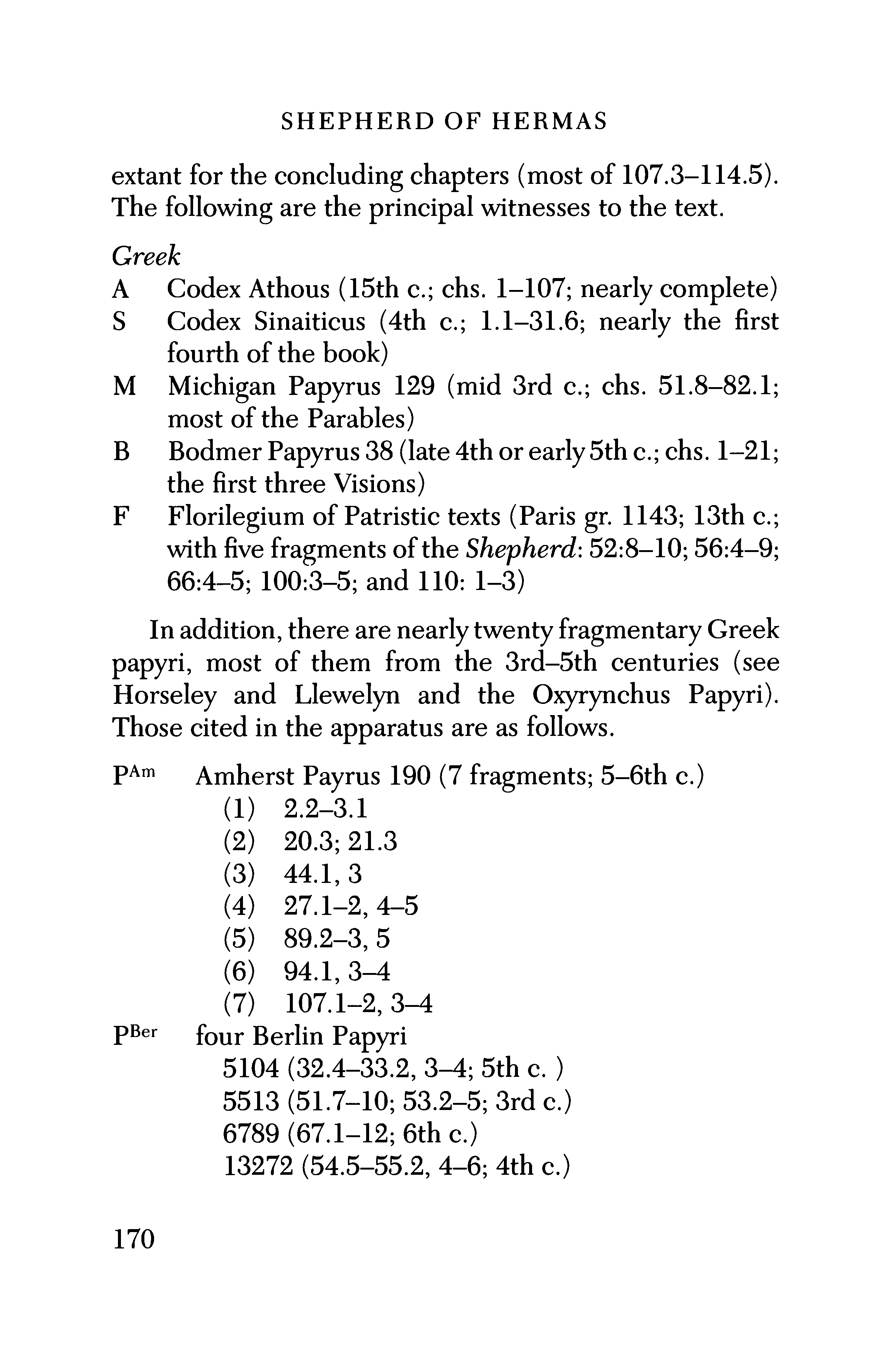
extant for the concluding chapters (most of 107.3-114.5).
The following are the principal witnesses to the text.
Greek A Codex Athous (15th c ; chs. 1-107; nearly complete) S Codex Sinaiticus (4th c ; 1.1-31.6; nearly the first fourth of the book) Μ Michigan Papyrus 129 (mid 3rd c.; chs. 51.8-82.1; most of the Parables) Β Bodmer Papyrus 38 (late 4th or early 5th c ; chs. 1-21; the first three Visions) F Florilegium of Patristic texts (Paris gr. 1143; 13th c ; with five fragments of the Shepherd: 52:8-10; 56:4-9;
66:4-5; 100:3-5; and 110: 1-3) In addition, there are nearly twenty fragmentary Greek papyri, most of them from the 3rd-5th centuries (see
Horseley and Llewelyn and the Oxyrynchus Papyri).
Those cited in the apparatus are as follows.
P A m Amherst Payrus 190 (7 fragments; 5-6th c.) (1) 2.2-3.1
(2) 20.3; 21.3
(3) 44.1,3 (4) 27.1-2,4-5 (5) 89.2-3,5 (6) 94.1,3-4 (7) 107.1-2,3-4 pBer f o u r Berlin Papyri 5104 (32.4-33.2, 3-4; 5th c. ) 5513 (51.7-10; 53.2-5; 3rd c.) 6789 (67.1-12; 6th c.) 13272 (54.5-55.2, 4-6; 4th c.)
INTRODUCTION
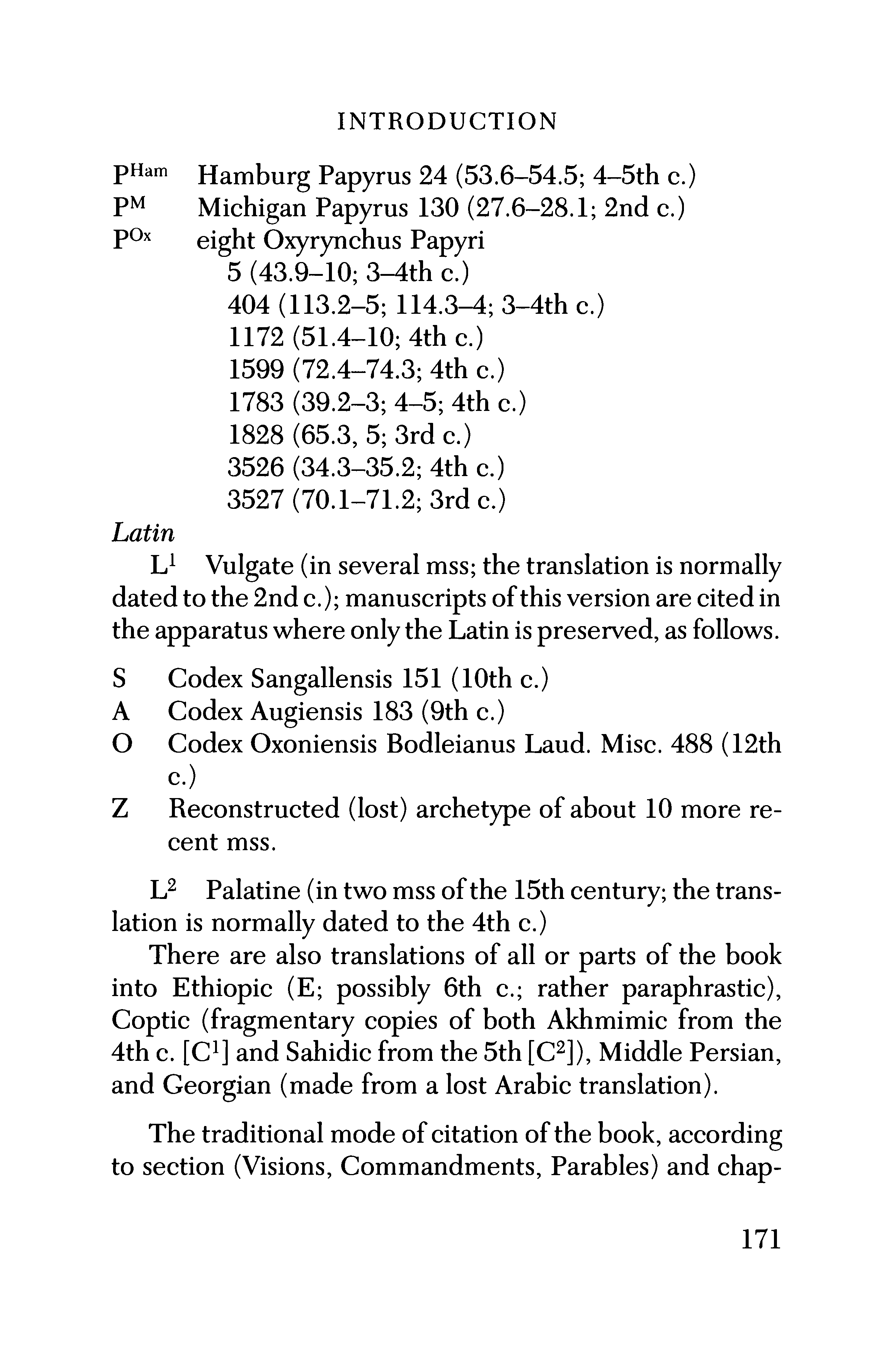
pHam Hamburg Papyrus 24 (53.6-54.5; 4-5th c.) P M Michigan Papyrus 130 (27.6-28.1; 2nd c.)
P° x eight Oxyrynchus Papyri 5 (43.9-10; 3-4th c.) 404 (113.2-5; 114.3-4; 3-4th c.) 1172 (51.4-10; 4th c.) 1599 (72.4-74.3; 4th c.) 1783 (39.2-3; 4-5; 4th c.) 1828 (65.3, 5; 3rd c.) 3526 (34.3-35.2; 4th c.) 3527(70.1-71.2; 3rd c.) Latin
Vulgate (in several mss; the translation is normally dated to the 2nd a); manuscripts of this version are cited in the apparatus where only the Latin is preserved, as follows.
L S Codex Sangallensis 151 (10th c.) A Codex Augiensis 183 (9th c.) Ο Codex Oxoniensis Bodleianus Laud. Misc. 488 (12th c ) Ζ Reconstructed (lost) archetype of about 10 more re cent mss.
Palatine (in two mss of the 15th century; the trans lation is normally dated to the 4th c.) L There are also translations of all or parts of the book into Ethiopic (E; possibly 6th c ; rather paraphrastic),
Coptic (fragmentary copies of both Akhmimic from the 4th c. [C 1] and Sahidic from the 5th [C 2]), Middle Persian, and Georgian (made from a lost Arabic translation).
The traditional mode of citation of the book, according to section (Visions, Commandments, Parables) and chap-
S H E P H E R D OF HERMAS
ters and verses within each section (for example, Vision 3.13.2) was replaced in Molly Whittaker s 1956 edition by consecutively numbered chapters. This has caused some confusion over the years, as scholars have used either one or both of these systems. The text and translation here fol low Whittaker s chapter numbers, with the more tradi tional references given in parentheses.
S E L E C T
B I B L I O G R A P H Y
Bonner, C. A Papyrus Codex of the Shepherd of Hermas.
University of Michigan Studies, Humanistic Series 22.
Ann Arbor: University of Michigan Press, 1934.
Brox, Norbert. Der Hirt des Hermas. KAV 7. Gottingen:
Vandenhoeck and Ruprecht, 1991.
Carlini, Α., and Luigi Ciaccone, eds. Papyrus Bodmer XXXVIII: Erma: II Pastore. Cologny-Geneve: Bibliotheca Bodmeriana, 1991.
Dibelius, M. Der Hirt des Hermas.
Die apostolischen Vater. HNT 4. Tubingen: Mohr-Siebeck, 1923.
Giet, Stanislas. Hermas et les pasteurs: Les Trois Auteurs du Pasteur d'Hermas.
Paris: Presses universitaires du France, 1963.
Henne, Philippe. La Christologie chez Clement de Rome et dans le Pasteur d'Hermas.
Freibourg, Suisse: Editions universitaires, 1992.
L'Unite du Pasteur d'Hermas:
Tradition et redac tion. CahRB 31. Paris: J. Gabalda, 1992.
Horsley, G. H. R., and S. R. Llewelyn, eds. New Docu ments Illustrating Early Christianity.
Sydney: Ancient History Documentary Research Center, Macquarie University Press, 1981-98; 2.160-61.
INTRODUCTION
Jeffers, James S. Conflict at Rome: Social Order and Hier archy in Early Christianity.
Minneapolis: Fortress, 1991.
Joly, Robert. Hermas: he Pasteur: introduction, texte, cri tique, traduction et notes. SC 53. Paris: Cerf, 1958; repr
1978.
Lampe, Peter. Die Stadtromischen Christen in den ersten beiden Jahrhunderten:
Untersuchungen zur Sozialgeschichte.
Tubingen: Mohr-Siebeck, 1987.
Lappa-Zizicas, Eurydice. "Cinq fragments du Pasteur d'Hermas dans un manuscrit de la Bibliotheque
Nationale de Paris." RSR 53 (1965) 251-56.
Maier, Harry O. The Social Setting of the Ministry as Reflected in the Writings of Hermas, Clement and Ignatius. Waterloo, Ontario: Wilfrid Laurier University
Press, 1991.
Osiek, Carolyn. Shepherd of Hermas. Hermeneia. Minne apolis: Fortress, 1999.
The Oxyrhynchus Papri, vol. 50. London: British Acad emy, 1983; 14-21.
Snyder, Graydon F. The Shepherd of Hermas. Vol 6 of The Apostolic Fathers: A New Translation and Commentary, ed. R. M. Grant. Camden, N.J.: Thomas Nelson & Sons,
1968.
Whittaker, Molly. Der Hirt des Hermas. Die apostolischen Vater. Vol. I. Berlin: Akademie Verlag, 1956; 2d ed.,
1967.
Wilson, J. C. Five Problems in the Interpretation of the Shepherd of Hermas: Authorship, Genre, Canonicity, Apocalyptic, and the Absence of the Name 'Jesus Chnst.'
Lewiston: Mellen Biblical Press, 1995.