
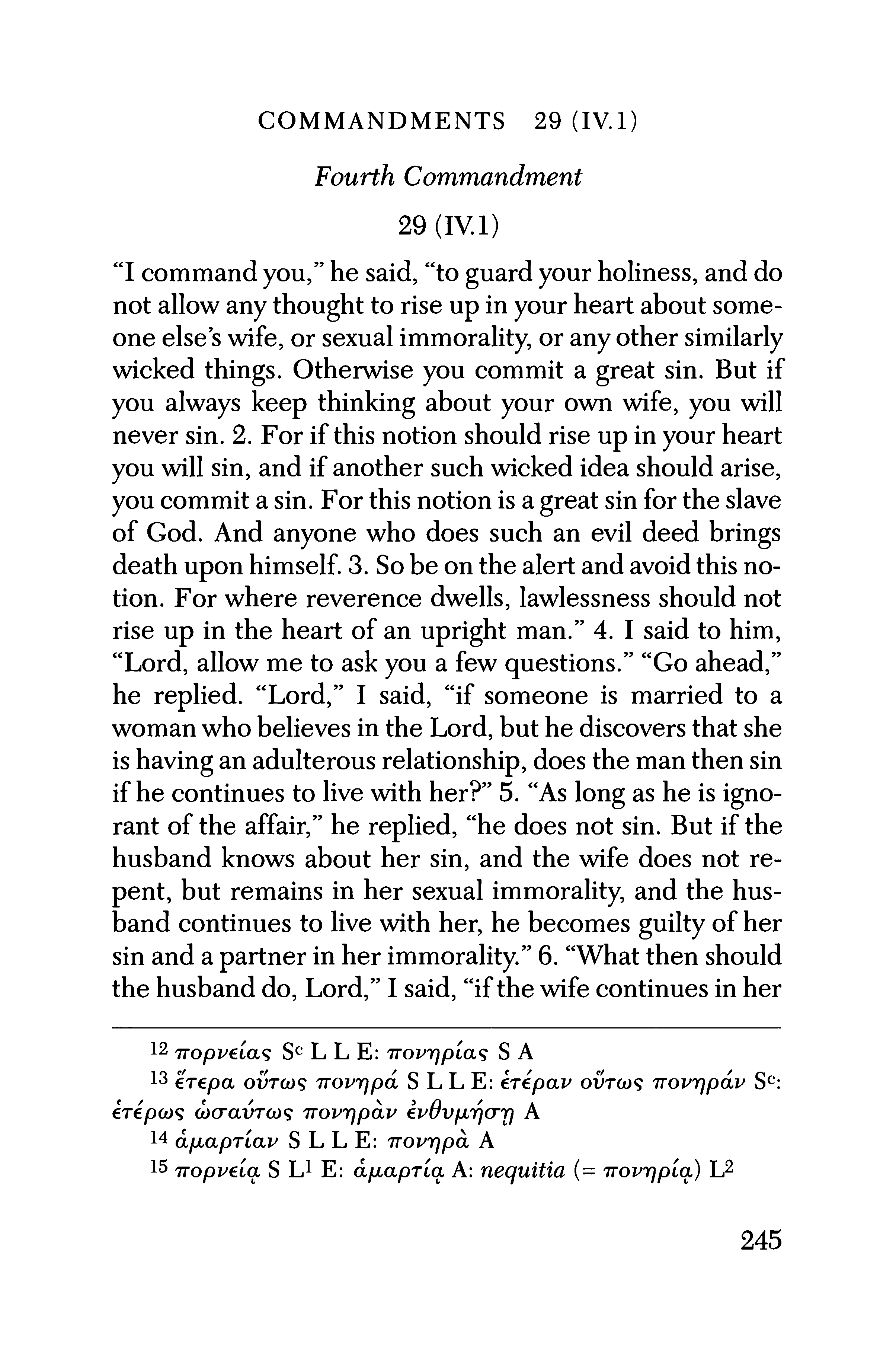
Fourth Commandment
S H E P H E R D OF HERMAS
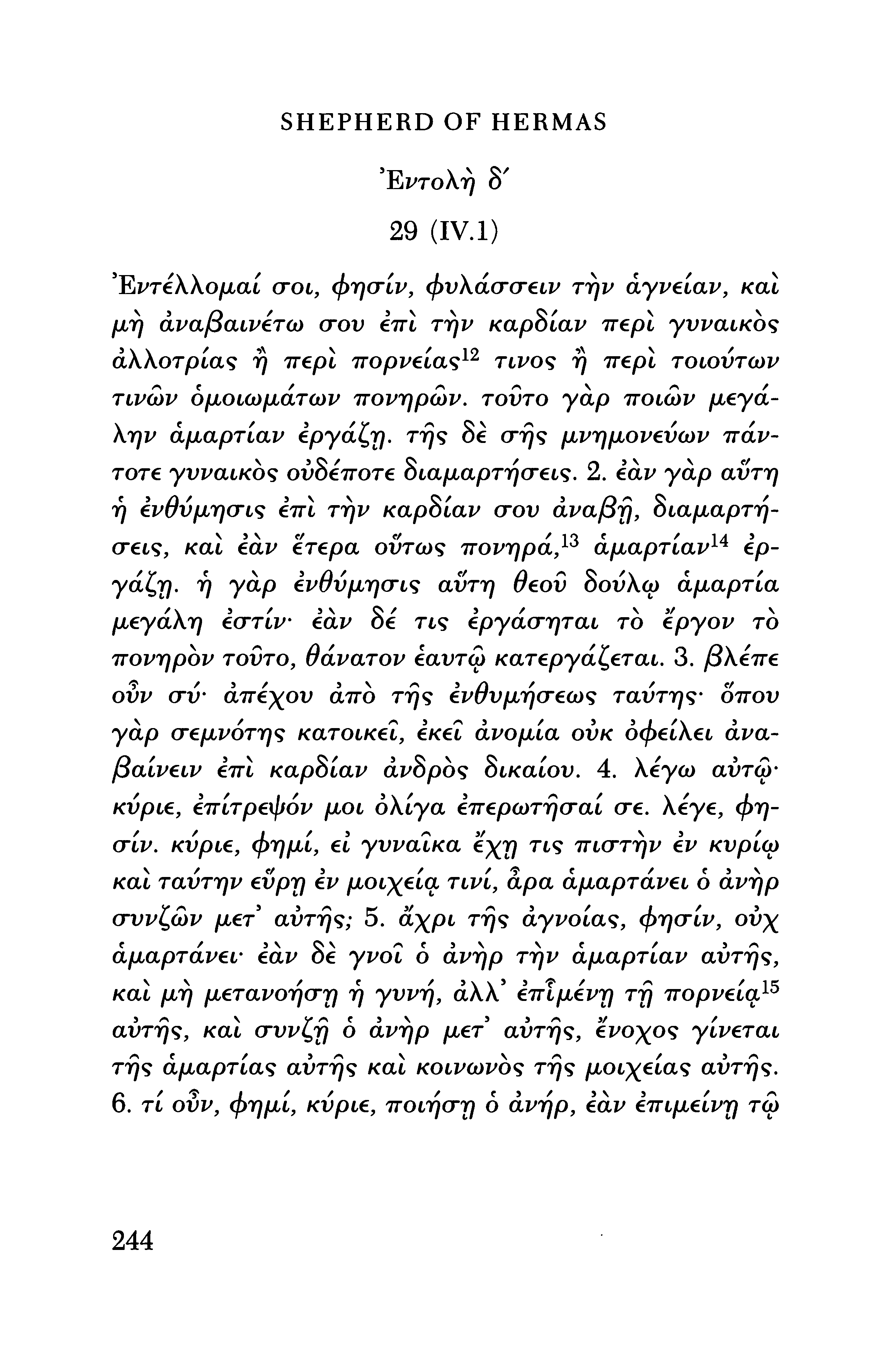
Εντολή δ / 29 (IV.l) 'Έιντέλλοραί croi, φησίν, φνλάσσειν τήν άγνείαν, καί μή άναβαινέτω σον έπϊ τήν καρδίαν περί γνναικος αλλότριας ή περί πορνείας
τίνος ή περί τοιούτων τινών ομοιωμάτων πονηρών, τούτο γάρ ποιών μεγάλην άμαρτίαν έργάζη. τής δέ σής μνημονεύων πάν τοτε γνναικος ουδέποτε διαμαρτήσεις.
2. έάν yap αύτη ή ένθύμησις έπϊ τήν καρδίαν σον άναβή, διαραρτήσεις, καϊ έάν έτερα ούτως πονηρά,
έρ γάζη. ή γάρ ένθύμησις αύτη θεού δούλω αμαρτία μεγάλη έστιν έάν δέ τις έργάσηται το έργον το πονηρον τούτο, θάνατον έαντώ κατεργάζεται.
3. βλέπε ούν σύάπέχον άπο τής ένθνρήσεως ταύτηςδπον γάρ σεμνότης κατοικεί, έκεΐ ανομία ούκ οφείλει άναβαίνειν έπϊ καρδίαν άνδρος δικαίον.
4. λέγω αύτώκύριε, έπίτρεφόν μοι ολίγα έπερωτήσαί σε. λέγε, φη σίν. κύριε, φηρί, εί γνναΐκα εχη τις πιστήν έν κνρίω
άραρτίαν καϊ ταύτην εύρη έν μοιχεία τινί, άρα άμαρτάνει 6 άνήρ σννζών ρετ αυτής; 5. άχρι τής άγνοιας, φησίν, ούχ άραρτάνειέάν δέ γνοΐ ο άνήρ τήν άραρτίαν αυτής, καϊ μή μετανοήση ή γννή, άλλ' έπϊμένη τή πορνεία
αυτής, καϊ σννζή 6 άνήρ μετ αυτής, ένοχος γίνεται τής αμαρτίας αυτής καϊ κοινωνός τής μοιχείας αυτής.
COMMANDMENTS
29 (IV.l) Fourth Commandment 29 (IV.l) "I command you," he said, "to guard your holiness, and do not allow any thought to rise up in your heart about some one else's wife, or sexual immorality, or any other similarly wicked things. Otherwise you commit a great sin. But if you always keep thinking about your own wife, you will never sin. 2. For if this notion should rise up in your heart you will sin, and if another such wicked idea should arise, you commit a sin. For this notion is a great sin for the slave of God. And anyone who does such an evil deed brings death upon himself. 3. So be on the alert and avoid this no tion. For where reverence dwells, lawlessness should not rise up in the heart of an upright man." 4. I said to him,
"Lord, allow me to ask you a few questions." "Go ahead," he replied. "Lord," I said, "if someone is married to a woman who believes in the Lord, but he discovers that she is having an adulterous relationship, does the man then sin if he continues to live with her?" 5. "As long as he is igno rant of the affair," he replied, "he does not sin. But if the husband knows about her sin, and the wife does not re pent, but remains in her sexual immorality, and the hus band continues to live with her, he becomes guilty of her sin and a partner in her immorality." 6. "What then should the husband do, Lord," I said, "if the wife continues in her
12 πορνείας S c L L Ε: πονηρίας S A 13 έτερα ούτως πονηρά S L L Ε: ετέραν ούτως πονηράν S c: ετέρως ωσαύτως πονηράν ενθύμηση Α 14 άμαρτίαν S L L Ε: πονηρά Α 15 πορνεία S L 1 Ε: αμαρτία A: nequitia (= πονηρία) L
S H E P H E R D OF HERMAS
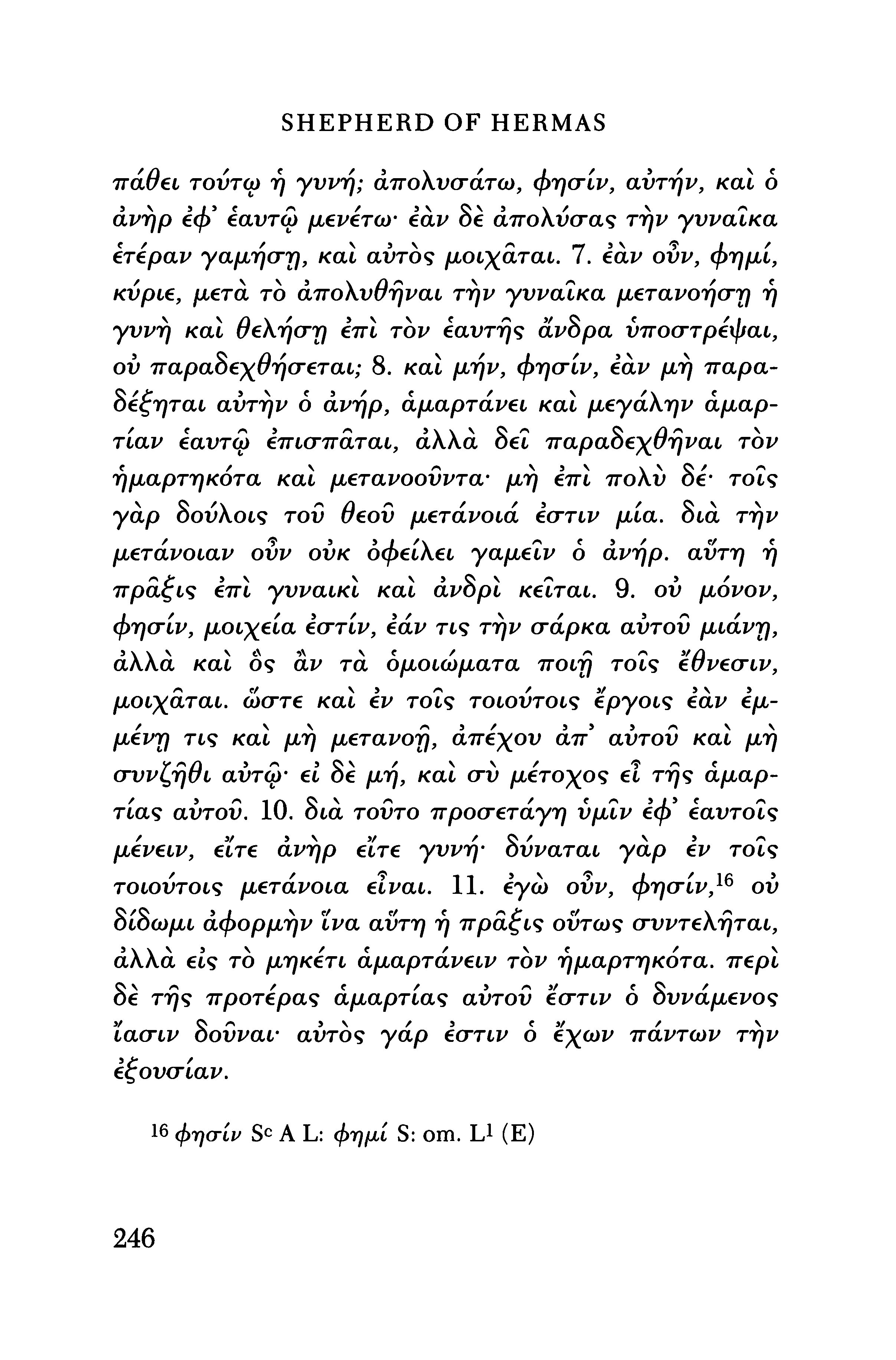
πάθει τούτω ή γυνή; άπολυσάτω, φησίν, αυτήν, καϊ 6 άνήρ έφ 3 έαυτώ μενέτωέάν δέ άπολύσας τήν γυναίκα έτέραν γαρήση, καϊ αυτός μοιχάται.
7. έάν ούν, φηρί, κύριε, μετά το άπολυθήναι τήν γυναίκα ρετανοήση ή γυνή καϊ θελήση έπϊ τον εαυτής άνδρα ύποστρέφαι, ού παραδεχθήσεται; 8. καϊ ρήν, φησίν, έάν ρή παραδέζηται αυτήν 6 άνήρ, άραρτάνει καϊ ρεγάλην άραρ τίαν έαυτώ έπισπάται, άλλά δει παραδεχθήναι τον ήραρτηκότα καϊ ρετανοούνταρή έπϊ πολύ δέτοΐς γάρ δούλοις τού θεού μετάνοια έστιν μία. διά τήν μετάνοιαν ούν ούκ οφείλει γαμεΐν ο άνήρ. αύτη ή πράζις έπϊ γυναικϊ καϊ άνδρϊ κείται.
9. ού μόνον, φησίν, μοιχεία εστίν, έάν τις τήν σάρκα αυτού μιάνη, άλλά καϊ δς άν τά ομοιώματα ποιή τοΐς εθνεσιν, μοιχάται. ώστε και έν τοΐς τοιούτοις έργοις έάν έμμένη τις καϊ μή μετανοή, άπέχου άπ* αυτού καϊ μή συνζήθι αύτώεί δέ μή, καϊ σύ μέτοχος εΐ τής αμαρ τίας αυτού.
έαυτοΐς μένειν, είτε άνήρ είτε γυνήδύναται γάρ έν τοΐς τοιούτοις μετάνοια είναι.
ού δίδωμι άφορρήν ΐνα αύτη ή πράζις ούτως συντελήται, άλλά εις το ρηκέτι άραρτάνειν τον ήραρτηκότα. περϊ δέ τής προτέρας αμαρτίας αυτού εστίν ό δυνάρενος ΐασιν δούναιαυτός γάρ έστιν ό έχων πάντων τήν έζουσίαν.
1 6 φησίν S c A L: φημί S: om. L 1 (Ε)
COMMANDMENTS
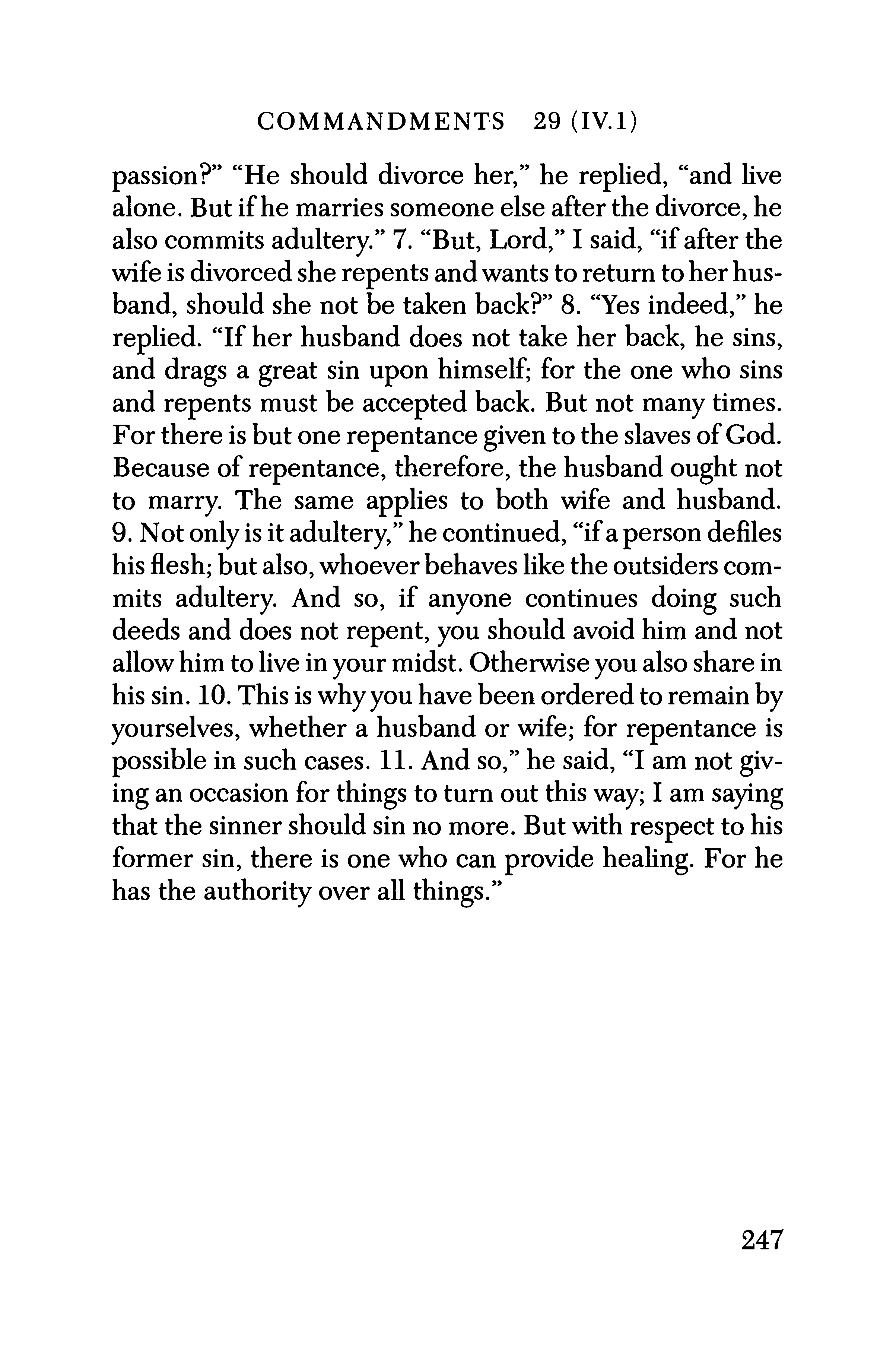
29 (IV.l) passion?" "He should divorce her," he replied, "and live alone. But if he marries someone else after the divorce, he also commits adultery." 7. "But, Lord," I said, "if after the wife is divorced she repents and wants to return to her hus band, should she not be taken back?" 8. "Yes indeed," he replied. "If her husband does not take her back, he sins, and drags a great sin upon himself; for the one who sins and repents must be accepted back. But not many times.
For there is but one repentance given to the slaves of God.
Because of repentance, therefore, the husband ought not to marry. The same applies to both wife and husband.
9. Not only is it adultery," he continued, "if a person defiles his flesh; but also, whoever behaves like the outsiders com mits adultery. And so, if anyone continues doing such deeds and does not repent, you should avoid him and not allow him to live in your midst. Otherwise you also share in his sin. 10. This is why you have been ordered to remain by yourselves, whether a husband or wife; for repentance is possible in such cases. 11. And so," he said, "I am not giv ing an occasion for things to turn out this way; I am saying that the sinner should sin no more. But with respect to his former sin, there is one who can provide healing. For he has the authority over all things."
S H E P H E R D OF HERMAS
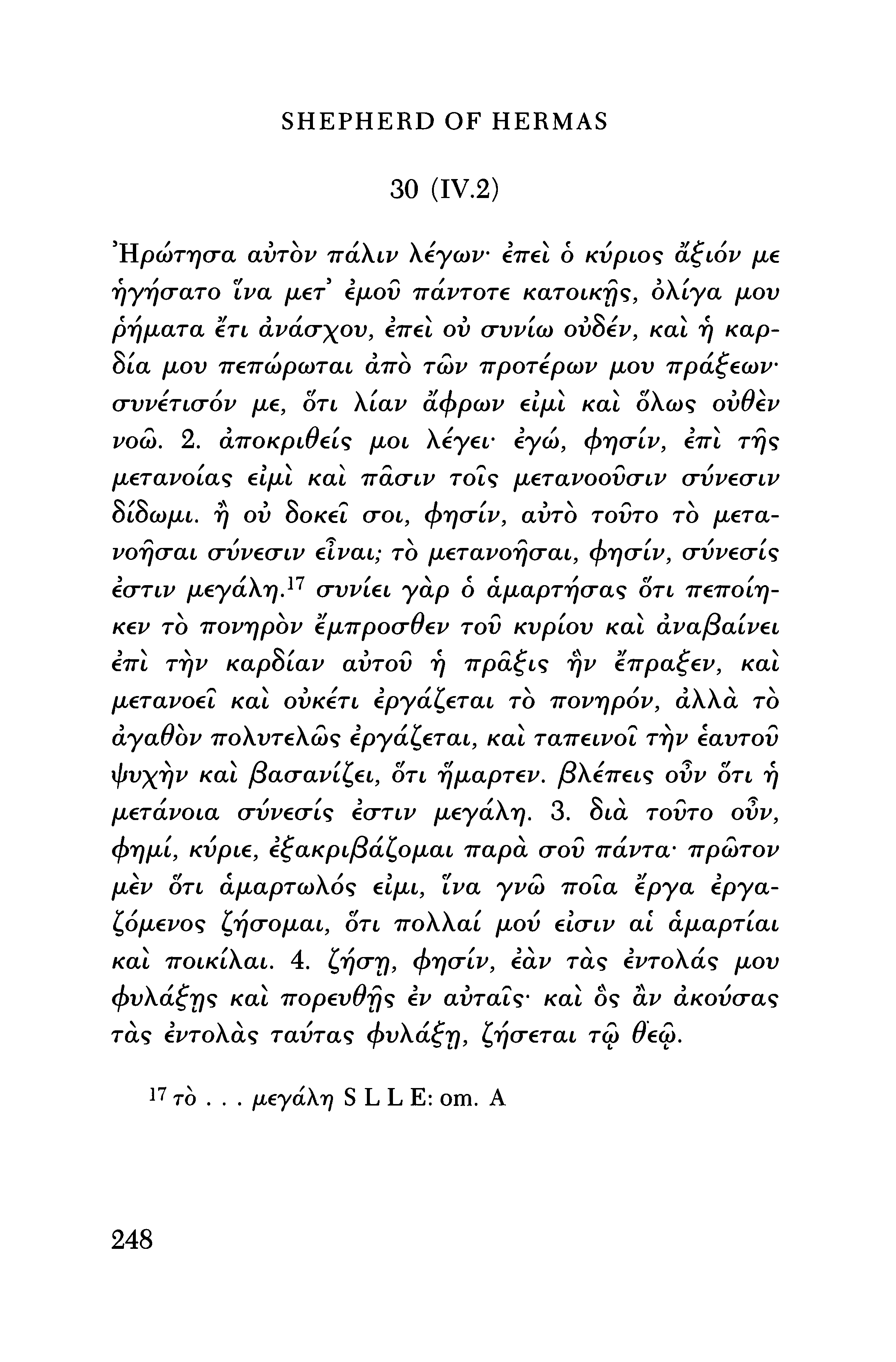
30 (IV.2)
'ΐΐρώτησα αντον πάλιν λίγων έπεϊ ό κύριος άξιον pe ήγήσατο ΐνα ρετ έμού πάντοτε κατοικής, ολίγα ρον ρήρατα ετι άνάσχον, έπεϊ ον σννίω ουδέν, καϊ ή καρ δία ρον πεπώρωται άπο τών προτέρων ρον πράξεων σννέτισόν ρε, οτι λίαν άφρων είμι καϊ δλως ονθέν νοώ. 2. αποκριθείς ροι λέγειέγώ, φησίν, έπϊ τής ρετανοίας είρϊ καϊ πάσιν τοις μετανοούσιν σύνεσιν δίδωμι. ή ού δοκεΐ σοι, φησίν, αύτο τούτο το μετανοήσαι σύνεσιν είναι; το μετανοήσαι, φησίν, σύνεσίς έστιν μεγάλη.
σννίει γάρ 6 άραρτήσας οτι πεποίηκεν το πονηρον έρπροσθεν τού κνρίον καϊ αναβαίνει έπι τήν καρδίαν αυτού ή πράξις ήν έπραξεν, καϊ ρετανοεϊ καϊ ούκετι εργάζεται το πονηρον, άλλά το αγαθόν πολντελώς εργάζεται, καϊ ταπεινοί τήν έαντού φνχήν καϊ βασανίζει, οτι ήραρτεν. βλέπεις ούν οτι ή ρετάνοια σύνεσίς έστιν ρεγάλη.
3. διά τούτο ονν, φημί, κύριε, έξακριβάζομαι παρά σού πάνταπρώτον ρέν οτι αμαρτωλός είρι, ϊνα γνώ ποία έργα έργαζόρενος ζήσοραι, ότι πολλαι ρού είσιν αί άραρτίαι καϊ ποικίλαι.
4. ζήση, φησίν, έάν τάς έντολάς ρον φνλάξης και πορενθής έν αύταίςκαί ός άν άκουσας τάς έντολάς ταύτας φνλάξη, ζήσεται τώ θεώ.
COMMANDMENTS
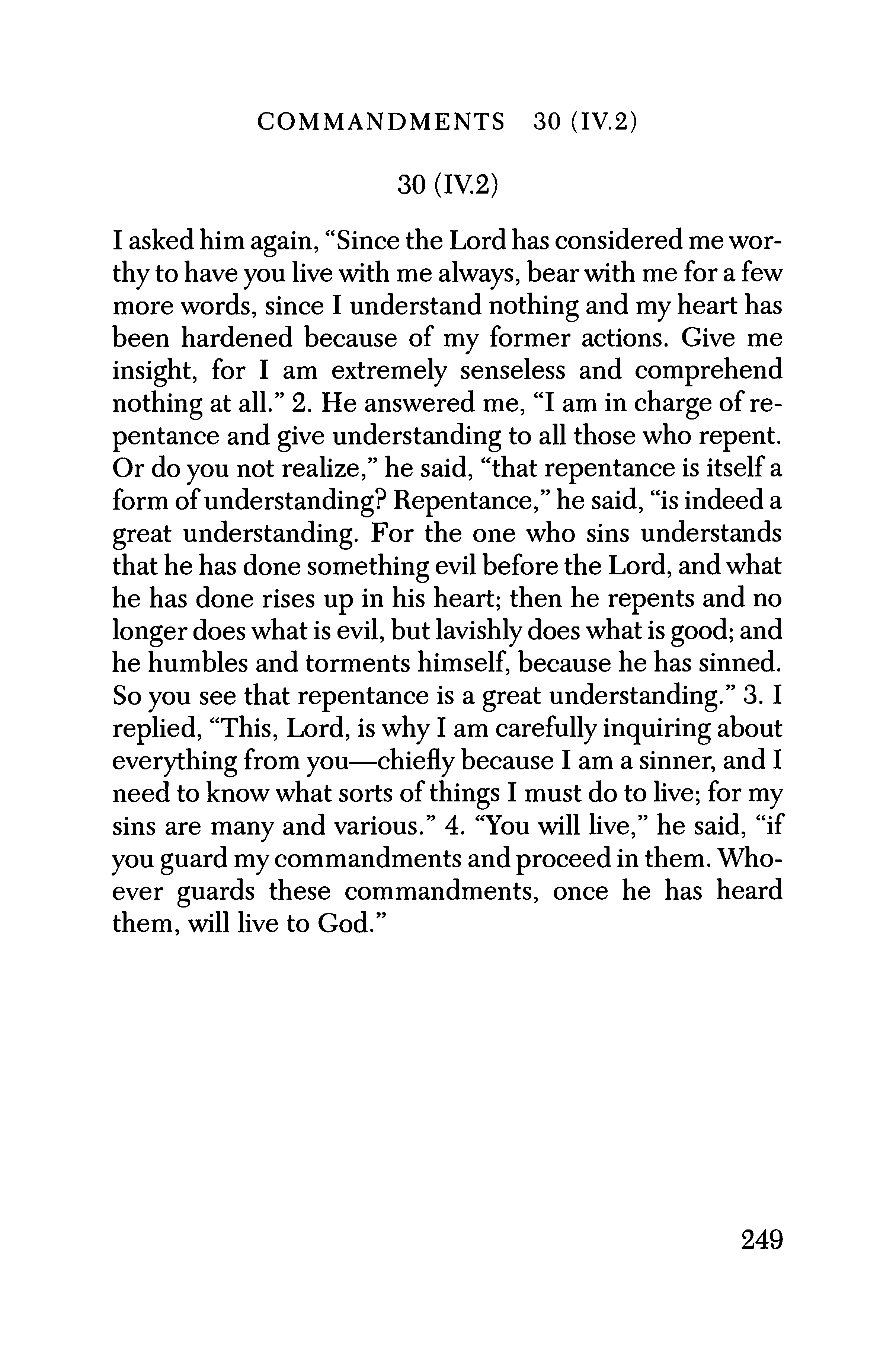
30 (IV.2)
30 (IV.2)
I asked him again, "Since the Lord has considered me wor thy to have you live with me always, bear with me for a few more words, since I understand nothing and my heart has been hardened because of my former actions. Give me insight, for I am extremely senseless and comprehend nothing at all." 2. He answered me, "I am in charge of re pentance and give understanding to all those who repent.
Or do you not realize," he said, "that repentance is itself a form of understanding? Repentance," he said, "is indeed a great understanding. For the one who sins understands that he has done something evil before the Lord, and what he has done rises up in his heart; then he repents and no longer does what is evil, but lavishly does what is good; and he humbles and torments himself, because he has sinned.
So you see that repentance is a great understanding." 3. I replied, "This, Lord, is why I am carefully inquiring about everything from you—chiefly because I am a sinner, and I need to know what sorts of things I must do to live; for my sins are many and various." 4. "You will live," he said, "if you guard my commandments and proceed in them. Who ever guards these commandments, once he has heard them, will live to God."
S H E P H E R D OF HERMAS
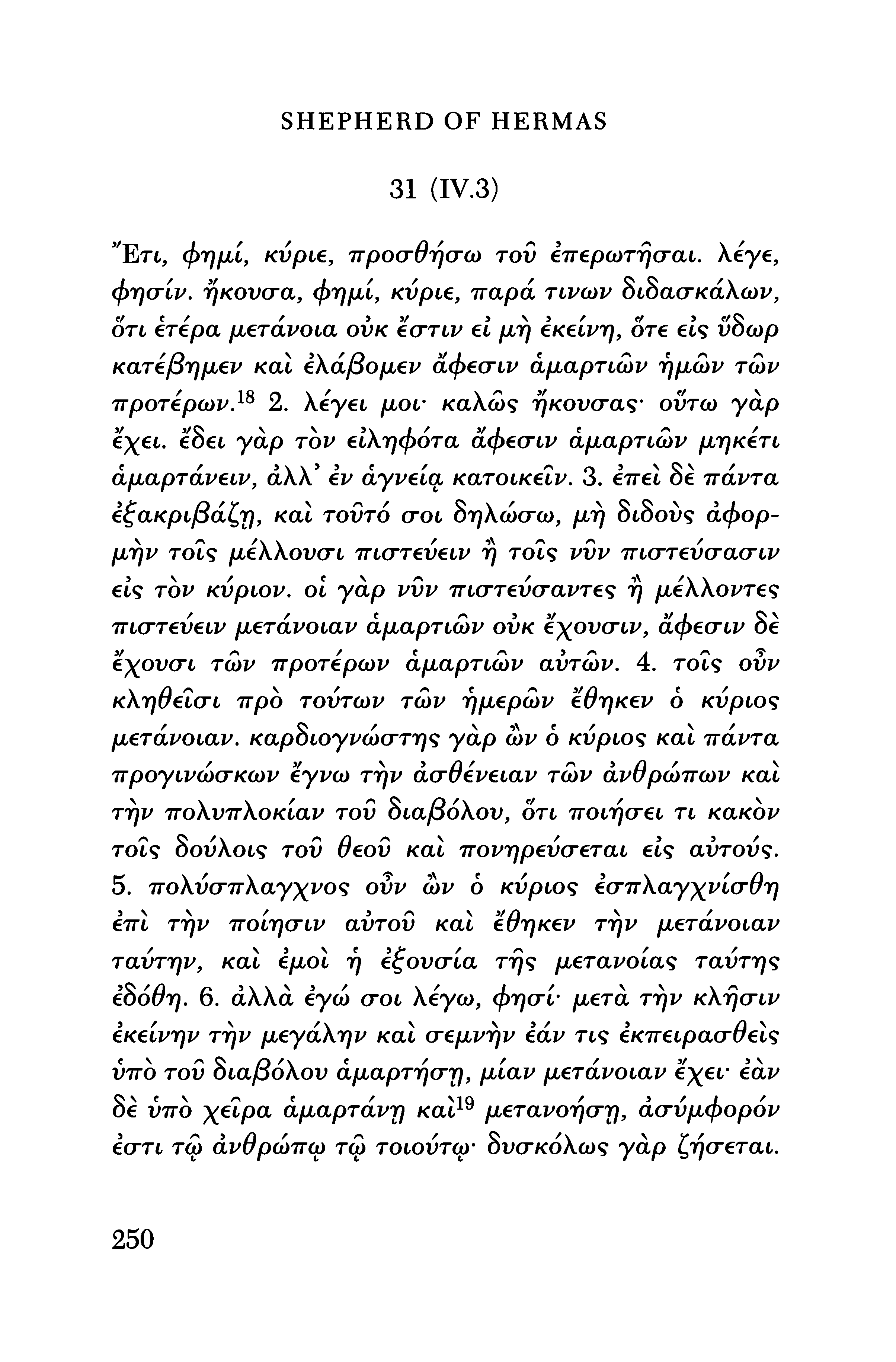
31 (IV.3)
"Ετι, φηρί, κνριβ, προσθήσω τον έπερωτήσαι. λέγε, φησίν. ήκονσα, φηρί, κνριβ, παρά τίνων διδασκάλων, οτι έτερα ρβτάνοια ονκ βστιν βί μή εκείνη, δτβ βίς ύδωρ κατέβημεν καί έλάβομεν άφβσιν αμαρτιών ηρών τών προτέρων.
2. λβγβι μοικαλώς ήκονσαςοντω γάρ έχει. έδει γάρ τον βίληφότα άφβσιν αμαρτιών μηκέτι άμαρτάνβιν, άλλ' βν άγνβία κατοικεΐν.
3. έπεϊ δβ πάντα έζακριβάζη, καί τοντο σοι δηλώσω, μή διδούς άφορμήν τοΐς μέλλονσι πιστεύειν ή τοΐς ννν πιστεύσασιν βίς τον κνρίον. οί γάρ ννν πιστεύσαντες ή μέλλοντες πιστβνβιν μβτάνοιαν αμαρτιών ονκ βχονσιν, άφβσιν δέ έχονσι τών προτέρων αμαρτιών αντών.
4. τοΐς ονν κληθβΐσι προ τούτων τών ήρβρών βθηκβν 6 κύριος ρβτάνοιαν. καρδιογνώστης γάρ ών 6 κύριος καί πάντα προγινώσκων βγνω τήν άσθένβιαν τών ανθρώπων καί τήν πολνπλοκίαν τού διαβόλον, οτι ποιήσει τι κακόν τοΐς δούλοις τού θεού καί πονηρεύσεται εις αυτούς.
5. πολύσπλαγχνος ονν ών 6 κύριος έσπλαγχνίσθη έπι τήν ποίησιν αυτού καί εθηκεν τήν μετάνοιαν ταύτην, καί έμοί ή έζονσία τής μετανοίας ταύτης εδόθη. 6. άλλά έγώ σοι λέγω, φησί· μετά τήν κλήσιν έκείνην τήν μεγάλην καί σεμνήν έάν τις έκπειρασθείς ύπό τού διαβόλον άραρτήση, μίαν μετάνοιαν έχειέάν δέ ύπό χείρα άμαρτάνη καί
COMMANDMENTS
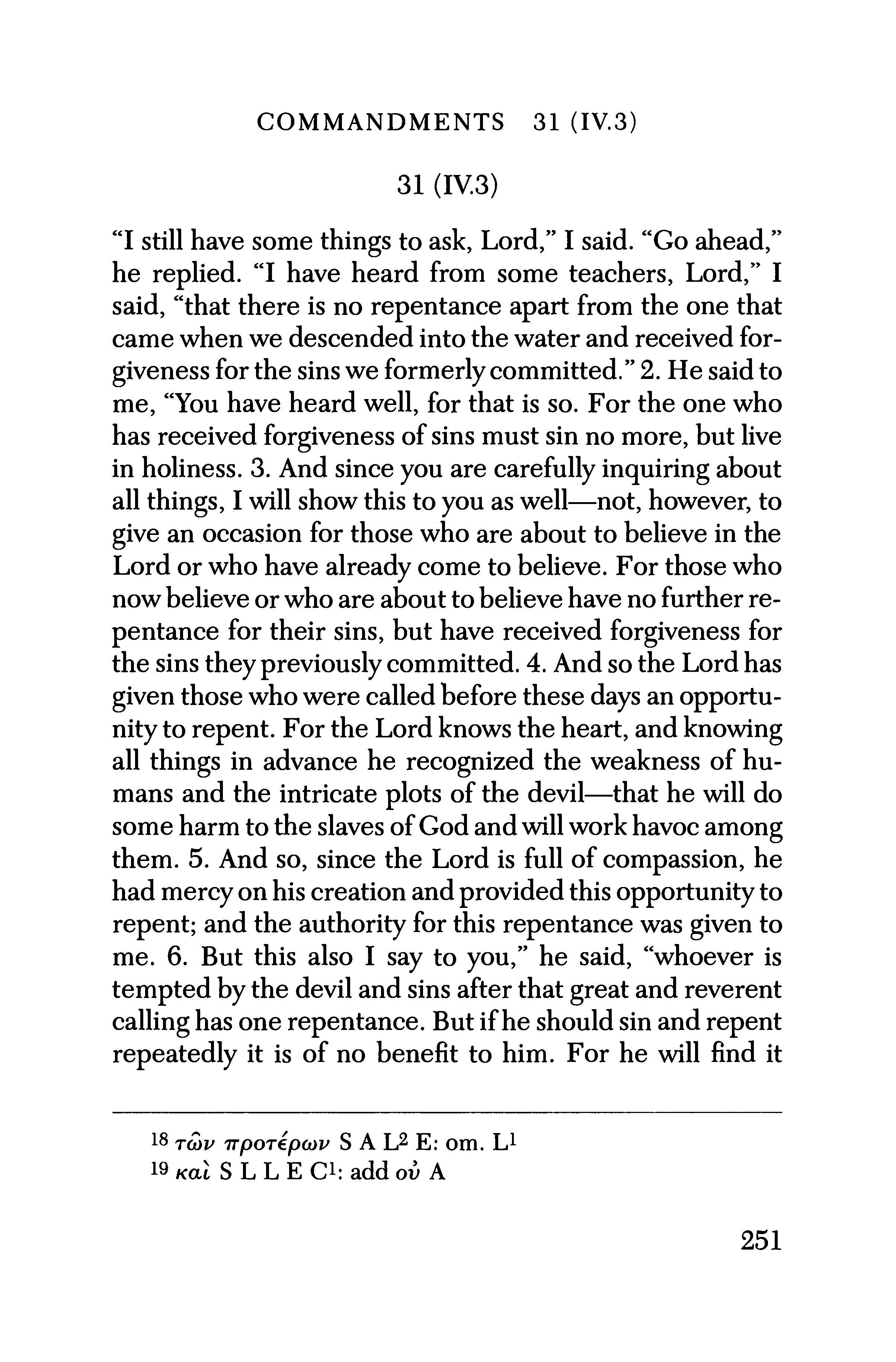
31 (IV.3)
31 (IV.3)
"I still have some things to ask, Lord," I said. "Go ahead," he replied. "I have heard from some teachers, Lord," I said, "that there is no repentance apart from the one that came when we descended into the water and received for giveness for the sins we formerly committed." 2. He said to me, "You have heard well, for that is so. For the one who has received forgiveness of sins must sin no more, but live in holiness. 3. And since you are carefully inquiring about all things, I will show this to you as well—not, however, to give an occasion for those who are about to believe in the Lord or who have already come to believe. For those who now believe or who are about to believe have no further re pentance for their sins, but have received forgiveness for the sins they previously committed. 4. And so the Lord has given those who were called before these days an opportu nity to repent. For the Lord knows the heart, and knowing all things in advance he recognized the weakness of hu mans and the intricate plots of the devil—that he will do some harm to the slaves of God and will work havoc among them. 5. And so, since the Lord is full of compassion, he had mercy on his creation and provided this opportunity to repent; and the authority for this repentance was given to me. 6. But this also I say to you," he said, "whoever is tempted by the devil and sins after that great and reverent calling has one repentance. But if he should sin and repent repeatedly it is of no benefit to him. For he will find it
19 και S L L Ε Ci; add ού A
S H E P H E R D OF HERMAS
7. λβγω αύτώ· έζωοποιήθην ταντα παρά σον άκουσας όντως ακριβώςοιδα γαρ οτι, eav ρηκέτι προσθήσω ταΐς άραρτίαις ρον, σωθήσοραι. σωθήση, φησίν, καϊ πάντες όσου έάν ταντα ποιήσωσιν.
32 (IV.4)
Ή ρώτησα αντόν πάλιν λέγων κύριε, έπεϊ άπαξ άνέχη ρον, έτι ροι καϊ τοντο 8ήλωσον. λέγε, φησίν.
έάν γννη, φηρί, κύριε, ή πάλιν άνήρ τις κοιρηθή καϊ γαρήση τις έξ αντών, ρήτι άραρτάνει ό γαρών; 2. ονχ άραρτάνει, φησίν έάν Se έφ' έαντώ ρείνη τις, περισσοτέραν έαντώ τιρήν καϊ
3. τήρει ονν τήν άγνείαν καϊ τήν σερνότητα, καϊ ζήση τώ θβώ. ταύτα σοι Οσα λαλώ ή καϊ ρέλλω λαλεΐν, φύλασσε άπο τον ννν, άφ' ής ροι παρεδόθης ήρέρας, καϊ βίς τον οίκον σον κατοικήσω.
4. τοΐς δβ προτέροις σον παραπτώρασιν άφβσις έσται, έάν τάς έντολάς ρον φνλάξης. καϊ πάσι δβ άφβσις εσται, έάν τάς έντολάς ρον ταύτας φνλάξωσι καϊ πορβνθώσιν έν τή άγνότητι ταύτη.
2 0 επεί . . . φησίν S A L L E : om. C ] 2 1 περισσοτεραν . . . καϊ S A L L E : om. C
2 2 βάν . . . άμαρτάνβι S A L 2 Ε C 1: om. L ]
COMMANDMENTS
32 (IV.4)
difficult to live." 7.1 said to him, "I have been made alive by hearing these things from you so accurately. For I know that if I no longer increase my sins, I will be saved." "You will be saved," he replied, "as will everyone else who does these things."
32 (IV.4)
I asked him again, "Lord, since you have borne with me once, reveal this to me as well." "Speak," he said. "Lord," I said, "if a wife or, again, a husband, should die and the sur vivor marry, does the one who marries commit a sin?"
2. "That one does not sin," he said, "but anyone who re mains alone has provided a superior honor for himself and a great glory to the Lord. But if such a one does marry, it is not a sin. 3. And so, maintain your purity and reverence, and you will live to God. From now on, from this day in which you have been entrusted to me, guard all these things that I say and am about to say to you, and I will reside in your house. 4. For your former transgressions will be forgiven if you guard my commandments. And everyone will be forgiven, if they guard these my com mandments and proceed in this purity."