
Papias Fragments
FRAGMENTS OF PAPIAS AND
QUADRATUS
PAPIAS F R A G M E N T S
Irenaeus, Against Heresies, 5.33.3-4; Eusebius, Ecclesias tical History, 3.39.1
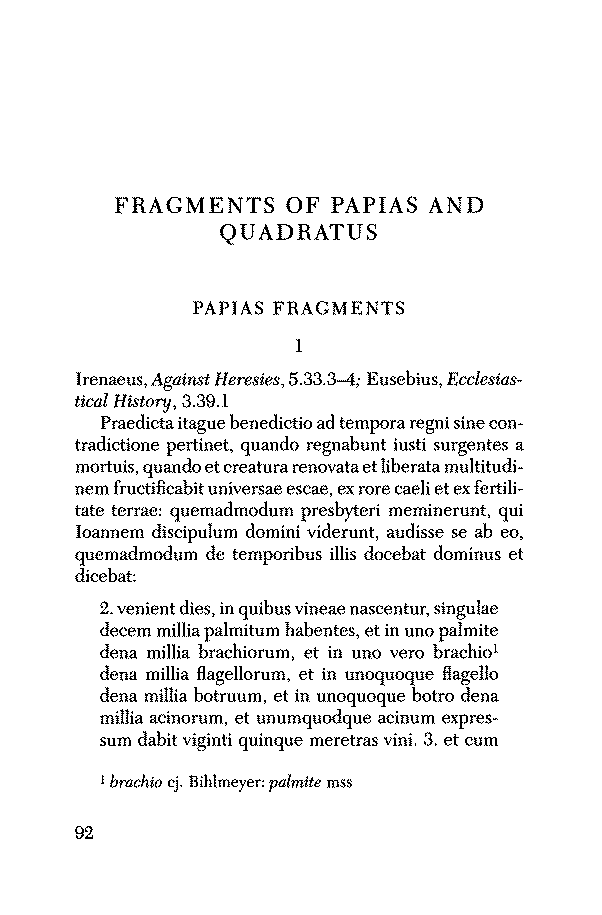
Praedicta itague benedictio ad tempora regni sine contradictione pertinet, quando regnabunt iusti surgentes a mortuis, quando et creatura renovata et liberata multitudinem fructificabit universae escae, ex rore caeli et ex fertilitate terrae: quemadmodum presbyteri meminerunt, qui
Ioannem discipulum domini viderunt, audisse se ab eo, quemadmodum de temporibus illis docebat dominus et dicebat:
2. venient dies, in quibus vineae nascentur, singulae decern millia palmitum habentes, et in uno palmite dena millia brachiorum, et in uno vero brachio
dena millia flagellorum, et in unoquoque flagello dena millia botruum, et in unoquoque botro dena millia acinorum, et unumquodque acinum expressum dabit viginti quinque meretras vini. 3. et cum
1 brachio cj. Bihlmeyer: palmite mss
FRAGMENTS OF PAPIAS AND
QUADRATUS
PAPIAS F R A G M E N T S
Irenaeus, Against Heresies 5.33.3-4; Greek: Eusebius, Ec clesiastical History 3.39.1
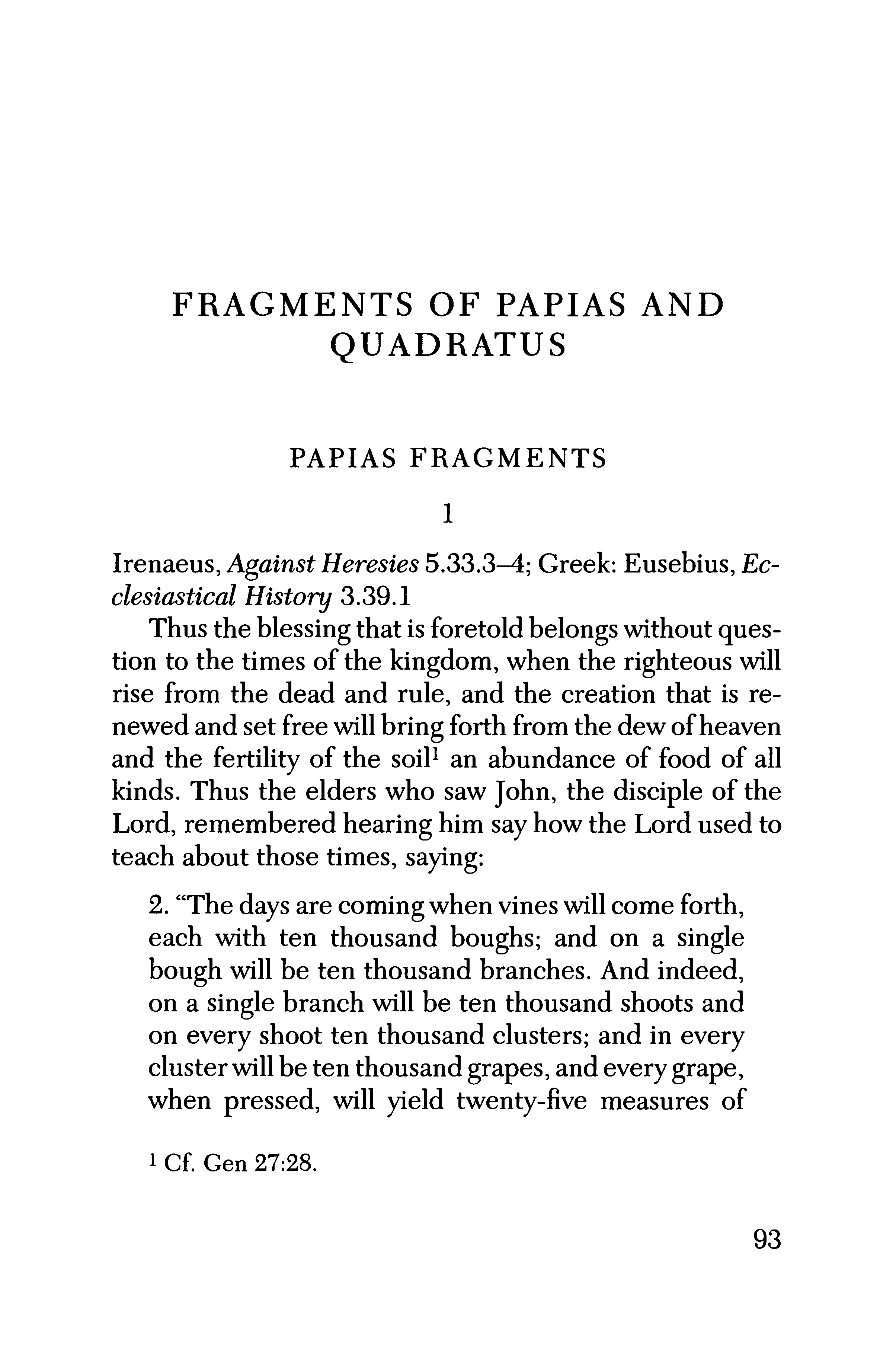
Thus the blessing that is foretold belongs without ques tion to the times of the kingdom, when the righteous will rise from the dead and rule, and the creation that is re newed and set free will bring forth from the dew of heaven and the fertility of the soil 1 an abundance of food of all kinds. Thus the elders who saw John, the disciple of the Lord, remembered hearing him say how the Lord used to teach about those times, saying:
2. "The days are coming when vines will come forth, each with ten thousand boughs; and on a single bough will be ten thousand branches. And indeed, on a single branch will be ten thousand shoots and on every shoot ten thousand clusters; and in every cluster will be ten thousand grapes, and every grape, when pressed, will yield twenty-five measures of 1 Cf. Gen 27:28.
PAPIAS AND QUADRATUS
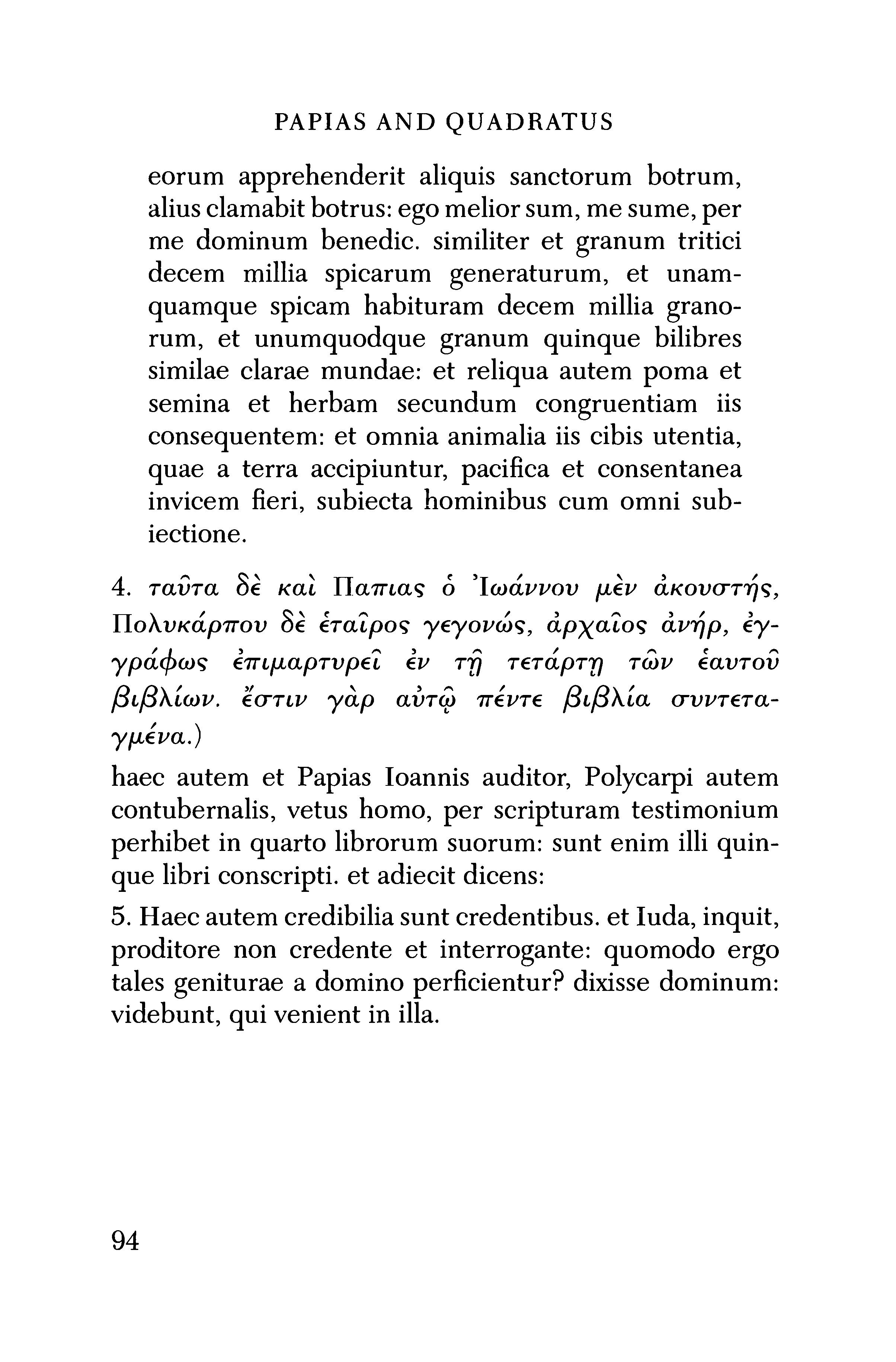
eorum apprehenderit aliquis sanctorum botrum, alius clamabit botrus: ego melior sum, me sume, per me dominum benedic. similiter et granum tritici decern millia spicarum generaturum, et unamquamque spicam habituram decern millia granorum, et unumquodque granum quinque bilibres similae clarae mundae: et reliqua autem poma et semina et herbam secundum congruentiam iis consequentem: et omnia animalia iis cibis utentia, quae a terra accipiuntur, pacifica et consentanea invicem fieri, subiecta hominibus cum omni subiectione.
4. ταντα δέ καϊ Πάπιας ό Ίωάννον μεν άκονστής, ΤΙολνκάρπον δέ εταίρος γεγονώς, αρχαίος άνήρ, εγ γράφως έπιραρτνρεί έν τή τετάρτη τών έαντον βιβλίων, εστίν γάρ αντω πέντε βιβλία σνντεταγμένα.) haec autem et Papias Ioannis auditor, Polycarpi autem contubernalis, vetus homo, per scripturam testimonium perhibet in quarto librorum suorum: sunt enim illi quin que libri conscripti. et adiecit dicens:
5. Haec autem credibilia sunt credentibus. et luda, inquit, proditore non credente et interrogante: quomodo ergo tales geniturae a domino perficientur? dixisse dominum: videbunt, qui venient in ilia.
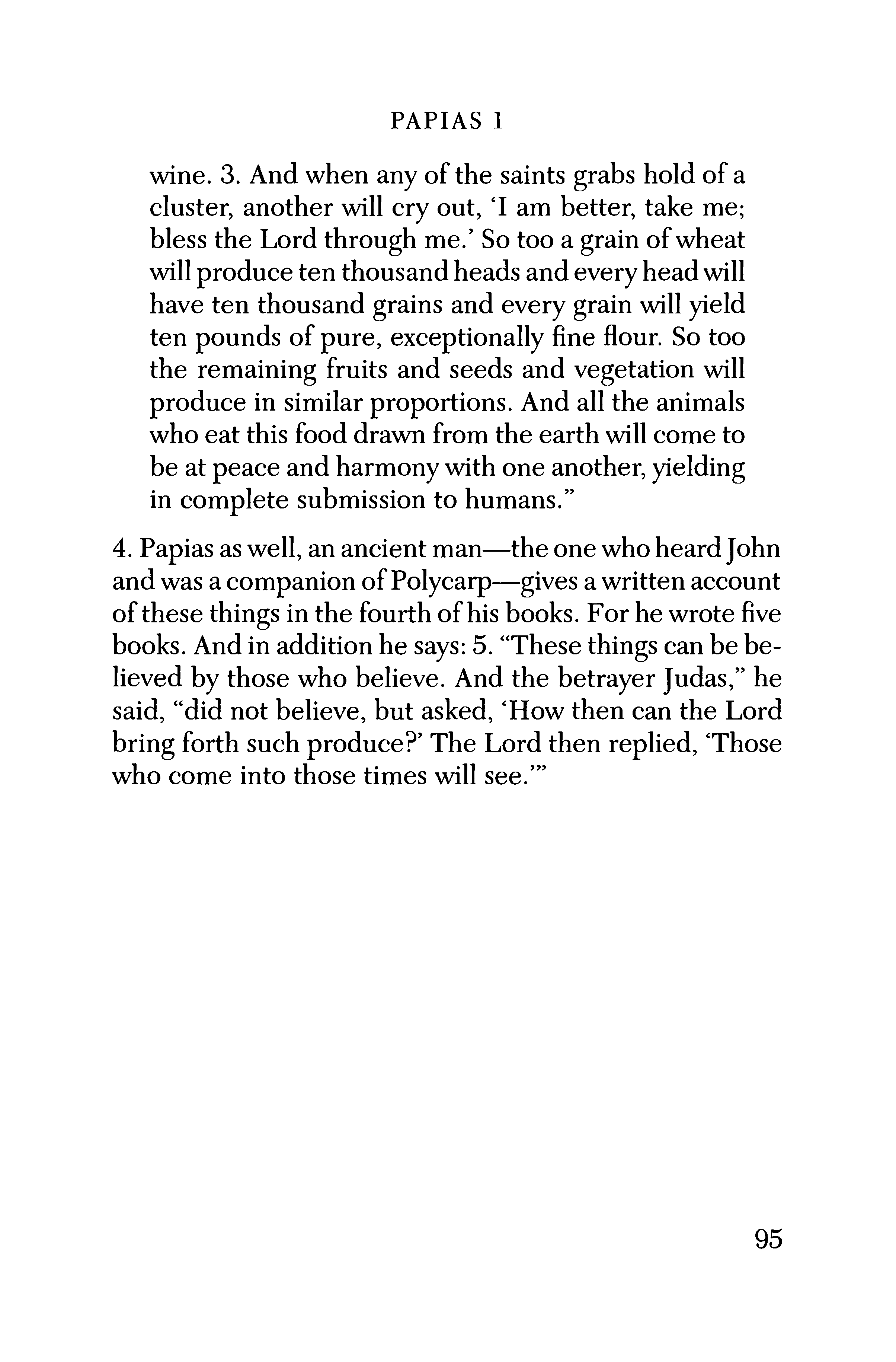
PAPIAS 1 wine. 3. And when any of the saints grabs hold of a cluster, another will cry out, Ί am better, take me; bless the Lord through me.' So too a grain of wheat will produce ten thousand heads and every head will have ten thousand grains and every grain will yield ten pounds of pure, exceptionally fine flour. So too the remaining fruits and seeds and vegetation will produce in similar proportions. And all the animals who eat this food drawn from the earth will come to be at peace and harmony with one another, yielding in complete submission to humans."
4. Papias as well, an ancient man—the one who heard John and was a companion of Polycarp—gives a written account of these things in the fourth of his books. For he wrote five books. And in addition he says: 5. "These things can be be lieved by those who believe. And the betrayer Judas," he said, "did not believe, but asked, 'How then can the Lord bring forth such produce?' The Lord then replied, Those who come into those times will see.'"
PAPIAS AND QUADRATUS
Eusebius, Ecclesiastical History 2.15
Τοσούτον δ' έπέλαμφεν ταΐς τών ακροατών τον Πέτρου διαζ^οίαις ευσέβειας φέγγος, ώς ρή τή εις άπαξ ίκανώς εχειν άρκεΐσθαι άκοή μηδέ τή άγράφω τον θείον κηρύγματος διδασκαλία, παρακλήσεσιν δε παντοίαις Μάρκον, ον το εύαγγελιον φέρεται, άκόλονθον Οντα ΐίετρον, λιπαρήσαι ώς άν καϊ διά γραφής υπόμνημα τής διά λόγου παραδοθείσης αύτοΐς καταλείφοι διδασκαλίας, μή πρότερόν τε άνεΐναι ή κατεργάσασθαι τον άνδρα, καϊ ταύτη αίτιους γενέσθαι τής τού λεγομένου κατά Μάρκον εύαγγελιον γραφής, γνόντα δέ τό πραχθέν φασι τον άποστόλον άνακαλύφαντος αύτώ τού πνεύματος, ήσθήναι τή τών ανδρών προθυμία κυρώσαί τε τήν γραφήν εις εντευζιν ταΐς έκκλησίαις.
Κλήρης έν έκτω τών 'Ύποτυπώσεων παρατβ^βιται τήν ίστορίαν, σννεπιμαρτνρεΐ δέ αύτώ καϊ ό Ίεραπολίτης επίσκοπος ονόματι Πάπιας, του δέ Μάρκον μνημονεύειν τον ΐίετρον έν τή πρότερα επιστολή· ήν καϊ συντάξαι φασϊν έπ αυτής "Ρώμης.
Eusebius, Ecclesiastical History 3.39
Του δβ Πάπια συγγράμματα πέντε τον αριθμόν φέρεται, ά καϊ έπιγέγραπται Αογίων κυριακών έζηγήσεως. τούτων καϊ Ειρηναίος ώς μόνον αύτώ γραφέν-
PAPIAS 3
Eusebius, Ecclesiastical History 2.15
But such a light of piety shone on the minds of those who heard Peter that they were not nearly satisfied with a single hearing or with an unwritten account of the divine proclamation. And so with all kinds of entreaties they begged Mark (whose Gospel is now in circulation), a fol lower of Peter, that he might leave behind a written record of the teaching that had been given to them orally. And they did not rest until they had prevailed upon him. To this extent they were the impetus for the writing called the Gospel according to Mark. And they say that when the apostle came to know what had happened, after the Spirit revealed it to him, he delighted in their eagerness and au thorized the writing to be read in the churches. Clement passes along this story in the sixth book of the Outlines, and the one who is called Papias, the bishop of Hierapolis, cor roborates his account, pointing out in addition that Peter makes mention of Mark in his first epistle, which also they maintain was composed in Rome itself.
Eusebius, Ecclesiastical History, 3.39
There are five books written by Papias in circulation, entitled "An Exposition of the Sayings of the Lord."
Irenaeus remembers these as the only ones Papias wrote,
PAPIAS AND
QUADRATUS
Iren. V 33.4). 2. και 6 μέν Ειρηναίος ταντα. αυτός γε μην 6 ΐίαπίας κατά το προοίμιον τών αντον λόγων άκροατήν μέν και αντόπτην ουδαμώς έαντον γενέσθαι τών ιερών αποστόλων εμφαίνει, παρειληφέναι δέ τά τής πίστεως παρά τών έκείνοις γνωρίμων διδάσκει δι ών φησιν λέζεων 3. ονκ όκνήσω δέ σοι καϊ όσα ποτέ παρά τών πρεσβντέρων καλώς εμαθον καϊ καλώς έμνημόνενσα, σνγκατατάξαι ταΐς έρμηνείαις, διαβεβαιούμενος υπέρ αντών άλήθειαν. ον γάρ τοΐς τά πολλά λέγονσιν εχαιρον ώσπερ οί πολλοί, άλλά τοΐς τάληθή διδάσκονσιν, ονδέ τοΐς τάς αλλότριας έντολάς μνημονεύονσιν, άλλά τοΐς τάς παρά τον κνρίον τή πίστει δεδομένας καί άπ' αυτής παραγινομένας τής αληθείας.
4. εί δέ πον καί παρηκολονθηκώς τις τοΐς πρεσβντέροις έλθοι, τονς τών πρεσβντέρων άνέκρινον λόγονςτί Ανδρέας ή τί ΐΐέτρος εΐπεν ή τί Φίλιππος ή τί Θωμάς ή Ιάκωβος ή τί Ιωάννης ή Ματθαίος ή τις έτερος τών τον κνρίον μαθητών, ά τε Άριστίων καί ό πρεσβύτερος Ιωάννης, τού κνρίον μαθηταϊ, λέγονσιν. ού γάρ τά έκ τών βιβλίων τοσούτον ρε ώφελεΐν ύπελάμβανον, όσον τά παρά ζώσης φωνής καϊ μενούσης.
. . .
PAPIAS 3 as he somewhere says, "And Papias as well, an ancient man—the one who heard John and was a companion of Polycarp—gives a written account of these things in the fourth of his books. For he wrote five books."
2 2. Thus Irenaeus. But Papias himself, in the preface of his work, makes it clear that he himself neither heard nor saw in per son any of the holy apostles. Instead, he declares that he received the matters of faith from those known to them. As he says:
3. "I also will not hesitate to draw up for you, along with these expositions, an orderly account of all the things I carefully learned and have carefully re called from the elders; for I have certified their truth. For unlike most people, I took no pleasure in hearing those who had a lot to say, but only those who taught the truth, and not those who recalled commandments from strangers, but only those who recalled the commandments which have been given faithfully by the Lord and which proceed from the truth itself. 4. But whenever someone arrived who had been a companion of one of the elders, I would carefully inquire after their words, what Andrew or Peter had said, or what Philip or what Thomas had said, or James or John or Matthew or any of the other disciples of the Lord, and what things Aristion and the elder John, disciples of the Lord, were say ing. For I did not suppose that what came out of books would benefit me as much as that which came from a living and abiding voice." . . .
2 Cf. Irenaeus, Adv. Haer. 5.33.4 (fragment 1)
PAPIAS AND QUADRATUS
7. καϊ 6 νύν δέ ήμΐν δηλούμενος Πάπιας τούς μβν τών αποστόλων λόγους παρά τών αύτοΐς παρηκολουθηκότων όμολογβΐ παρειληφέναι, Άριστίωνος δβ καϊ τού πρεσβυτέρου Ιωάννου αύτήκοον εαυτόν φησι γενέ σθαι, όνομαστί γούν πολλάκις αυτών μνημονεύσας, έν τοΐς αυτού συγγράμμασιν τίθησιν αυτών παρα δόσεις, και ταύτα δ' ήμΐν ούκ εις τό άχρηστον ειρήσθω.
8. άξιον δβ ταις άποδοθείσαις τού Παπία φωναΐς προσάφαι λέξεις ετέρας αυτού, δι' ών παράδοξα τινα ιστορεί και άλλα, ώς άν έκ παρα δόσεως εις αυτόν έλθόντα.
9. τό μέν ούν κατά τήν Ίεράπολιν Φίλιππον τον άποστόλον άμα ταΐς θυγατράσιν διατρΐφαι, διά τών πρόσθεν (Eus. Eccl. Hist.
3.31) δβδηλωται, ώς δβ κατά τούς αυτούς ό Πάπιας γενόμενος διήγησιν παρειληφέναι θαυμασίαν ύπό τών τού Φιλίππου θυγατέρων μνημονεύει, τά νύν σημειωτέον, νεκρού γάρ άνάστασιν κατ αυτόν γεγονυΐαν ιστορεί, καϊ αύ πάλιν έτερον παράδοξον περί Ίούστον τον έπικληθέντα Βαρσαβάν γεγονός, ώς δηλητήριον φάρρακον έρπιόντος καϊ μηδέν αηδές διά τήν τού κυρίου χάριν ύπομείναντος.
. . .
11. καϊ άλλα δέ ό αυτός ώς έκ παραδόσεως άγραφου εις αυτόν ήκοντα παρατέθειται, ξένας τέ τινας παραβολάς τού σωτήρος καϊ διδασκαλίας αυτού καί τινα άλλα μυθικώτερα.
12. έν οις καϊ χιλιάδα τινά φησιν ετών έσεσθαι μετά τήν έκ νεκρών άνάστασιν, σωματικώς τής Χριστού βασιλείας έπϊ ταυτησϊ τής γής ύποστησομένης.
. . .
PAPIAS 3 7. This Papias, whom we have just been discussing, ac knowledges that he received the words of the apostles from those who had been their followers, and he indicates that he himself had listened to Aristion and the elder John.
And so he often recalls them by name, and in his books he sets forth the traditions that they passed along. These re marks should also be of some use to us. 8. But it would be worthwhile to supplement these remarks of Papias with some of his other words, through which he recounts cer tain miracles and other matters, which would have come to him from the tradition. 9. We have already seen that the apostle Philip resided in Hieropolis with his daughters;
but now I should point out that Papias, who was their contemporary, recalls an amazing story that he learned from Philip s daughters. For he indicates that a person was raised from the dead in his own time. Moreover, he tells another miracle about Justus (also called Barsabbas), who drank deadly poison but suffered no ill effects because he was sustained by the grace of the Lord. . . .
11. And he sets forth other matters that came to him from the unwritten tradition, including some bizarre parables of the Savior, his teachings, and several other more legendary accounts. 12. Among these things he says that after the res urrection of the dead there will be a thousand-year period, during which the Kingdom of Christ will exist tangibly, here on this very earth. . . .
3 See Eccl Hist 3.31.
PAPIAS AND QUADRATUS
14. και άλλας δέ τή ιδία γραφή παραδίδωσιν Άριστίωνος τον πρόσθεν δεδηλωμένου τών τον κνρίον λόγων διηγήσεις καϊ τον πρεσβντέρον Ίωάννον παραδόσεις, έφ' άς τονς φιλοραθεΐς άναπεμφαντες, άναγκαίως ννν προσθήσομεν ταΐς προεκτεθείσαις αντον φωναΐς παράδοσιν, ήν περϊ Μάρκου τον τό εύαγγελιον γεγραφότος έκτέθειται διά τούτων 15. και τούθ' ό πρεσβύτερος ελεγεν Μάρκος μέν έρμηνεντής ΐίετρον γενόμενος, όσα έμνημόνενσεν, ακριβώς εγραφεν, ού μέντοι τάζει, τά ύπό τού κνρίον
ή λεχθέντα ή πραχθένταούτε γάρ ήκονσεν τού κνρίον ούτε παρηκολούθησεν αύτώ, ύστερον δέ, ώς έφην, ΐΐέτρω, ός προς τάς χρείας έποιεΐτο τάς διδασκαλίας, άλλ' ούχ ώσπερ σύνταξιν τών κνριακών ποιούμενος λο γίων, 3 ώστε ουδέν ήμαρτεν Μάρκος, ούτως ένια γράφας ώς άπεμνημόνενσεν ενός γάρ έποιήσατο πρόνοιαν, τού ρηδέν ών ήκονσεν παραλιπεΐν ή φεύσασθαί τι έν αύτοΐς. ταύτα μέν ούν ίστόρηται τώ Πάπια* 16. περϊ τού Μάρκον. περϊ δέ τού Ματθαίον ταύτ εΐρηται· Ματθαίος μέν ονν Έβραί'δι διαλβκτω τά Xdyia σννετάξατο,
PAPIAS 3 14. And in his own book he passes along other accounts of the sayings of the Lord from Aristion, whom we have al ready mentioned, as well as traditions from the elder John.
We have referred knowledgeable readers to these and now feel constrained to add to these reports already quoted from him a tradition that he gives about Mark, who wrote the Gospel. These are his words:
15. "And this is what the elder used to say, 'When Mark was the interpreter [Or: translator] of Peter, he wrote down accurately everything that he re called of the Lord's words and deeds—but not in order. For he neither heard the Lord nor accompa nied him; but later, as I indicated, he accompanied
Peter, who used to adapt his teachings for the needs at hand, not arranging, as it were, an orderly compo sition of the Lord's sayings. And so Mark did nothing wrong by writing some of the matters as he remem bered them. For he was intent on just one purpose: to leave out nothing that he heard or to include any falsehood among them.'"
This then is what Papias says about Mark. 16. And this is what he says about Matthew:
"And so Matthew composed the sayings in the He brew tongue, and each one interpreted [Or: trans lated] them to the best of his ability."
PAPIAS AND QUADRATUS
17. κέχρηται δ' 6 αντος μαρτνρίαις άπο της Ίωάννον προτέρας επιστολής και άπο τής ΐίετρον ομοίως, έκτέθειται δέ καϊ άλλην ϊστορίαν πβρϊ γνναικός βπϊ πολλαις άμαρτίαις διαβληθβίσης βπϊ τον κνρίον, ήν το καθ' Εβραίους εύαγγελιον περιέχει.
Apollinaris of Laodicea, from several sources Ονκ απέθανε τή αγχόνη Ιούδας, άλλ' έπεβίω καθ αιρεθείς προ τον άποπνιγήναι. καϊ τοντο δηλούσιν αί τών αποστόλων ΐΐράξεις, οτι πρηνής γενόμενος ελάκησε μέσος, καϊ έζεχύθη τά σπλάγχνα αντον. τοντο δε σαφεστερον ιστορεί Πάπιας ό Ίωάννον μαθητής λέγων όντως εν τώ δ' τής εζηγήσεως τών κνριακών λόγων 2. Μεγα δε ασεβείας υπόδειγμα εν τούτω τώ κόσμω περιεπάτησεν ό Ιούδας πρησθεϊς επϊ τοσούτον τήν σάρκα, ώστε μηδέ οπόθεν άμαξα ραδίως διέρχεται εκείνον δύνασθαι διελθεΐν, άλλά μηδέ αυτόν μόνον τον τής κεφαλής ογκον αυτού, τά μέν γάρ βλέφαρα τών οφθαλμών αυτού φασϊ τοσούτον έζοιδήσαι, ώς αυτόν μέν καθόλον τό φώς μή βλέπειν, τούς οφθαλμούς δέ αυτού μηδέ ύπό ιατρού διά διόπτρας όφθήναι δύνασθαιτοσούτον βάθος εΐχον άπο τής έξ ωθεν επιφανείας, τό δέ αίδοΐον αυτού πάσης μέν
PAPIAS 4 17. And Papias made use of the testimonies found in the first epistle of John, and from the epistle of Peter as well.
And he set forth another account about a woman who was falsely accused of many sins before the Lord,
4 which is also found in the Gospel according to the Hebrews.
Apollinaris of Laodicea, from several sources Judas did not die by hanging, but he survived after be ing taken down, before he had choked to death. The Acts of the Apostles signifies this as well: "Falling headfirst he burst forth in the middle, and his intestines spilled out."
And Papias, the disciple of John, relates this very clearly in the fourth book of his Exposition of the Sayings of the Lord:
2. "But Judas went about in this world as a great model of impiety. He became so bloated in the flesh that he could not pass through a place that was eas ily wide enough for a wagon—not even his swollen head could fit. They say that his eyelids swelled to such an extent that he could not see the light at all; and a doctor could not see his eyes even with an optical device, so deeply sunken they were in the surrounding flesh. And his genitals became more
4Cf. John 7:53-8:11.
5 Acts 1:18.
PAPIAS AND QUADRATUS
άσχημοσύνης αηδέστερου καϊ μείζον φαίνεσθαι, φέρεσθαι δε δι αντον εκ παντός τον σώματος σνρρεοντας ίχώράς τε και σκώληκας εις ύβριν δι αντών μόνων τών αναγκαίων.
3. μετά πολλάς δέ βασάνονς καϊ τιμωρίας έν ίδίω, φασί, χωρίω τελεντήσ αντος, άπο τής όδμής έρημον καϊ άοίκητον τό χωρίον μέχρι τής ννν γενέσθαι, άλλ' ονδέ ρέχρι τής σήμερον δύνασθαι τινα εκείνον τον τόπον παρελθεΐν, έάν μή τάς ρίνας ταΐς χερσϊν έπιφράξη, τοσαύτη διά τής σαρκός αυτού και έπϊ τής γής έκρνσις έχώρησεν.
Jerome, Lives of Illustnous Men 18 Papias, Iohannis auditor, Hierapolitanus in Asia episcopus, quinque tan turn scripsit volumina, quae praenotavit
Explanatio Sermonum Domini, in quibus quum se in praefatione asserat non varias opiniones sequi, sed aposto lus habere auctores, ait: considerabam, quid Andreas, quid Petrus dixissent, quid Philippus, quid Thomas, quid Iacobus, quid Iohannes, quid Matthaeus, vel alius quilibet discipulorum domini: quid etiam Aristion et senior
Iohannes, discipuli domini, loquebantur. non enim tantum mihi libri ad legendum prosunt, quantum viva vox usque hodie in suis auctoribus personans.
. . . Hie dicitur mille annorum Iudaicam edidisse δεντέρω-
PAPIAS 5 disgusting and larger than anyone's; simply by re lieving himself, to his wanton shame, he emitted pus and worms that flowed through his entire body.
3. And they say that after he suffered numerous tor ments and punishments, he died on his own land, and that land has been, until now, desolate and unin habited because of the stench. Indeed, even to this day no one can pass by the place without holding his nose. This was how great an outpouring he made from his flesh on the ground."
Jerome, Lives of Illustrious Men 18 Papias, the hearer of John and bishop of Hierapolis in Asia, wrote only five volumes, which he called An Exposi tion of the Sayings of the Lord. When he claims in the Pref ace that he did not follow various opinions, but had the apostles as his authorities, he says:
"I used to make careful inquiry into what Andrew and Peter said, and what Philip said, and Thomas, and James, and John, and Matthew, and any of the other disciples of the Lord; and what Aristion and the elder John, the Lord's disciples, would say. For books that can be read are less useful to me than a living voice that resounds through authorities still alive in our own day."
... He is said to have propagated the Jewish tradition of the
PAPIAS AND QUADRATUS
σιν, quern secuti sunt Irenaeus et Apollinarius et caeteri, qui post resurrectionem aiunt in carne cum Sanctis domi num regnaturum.
Maximus the Confessor, Scholia on Dionysius the Areopagite; On the Heavenly Hierarchy
Τούς κατά θεον άκακίαν άσκούντας παΐδας έκάλονν, ώς και Πάπιας δηλοΐ βιβλίω πρώτω τών κνριακών εξηγήσεων.
Maximus the Confessor, On the Ecclesiastical Hierarchy 7 Ταύτα φησιν αίνιττόμενος οίμαι ΤΙαπίαν τον Ίεραπόλεως τής κατ Άσίαν τότε γενόρενον επίσκοπον καϊ συνακράσαντα τώ θείω ευαγγελιστή Ιωάννη, ούτος γάρ 6 Πάπιας εν τώ τετάρτω αυτού βιβλίω τών κυριακών εξηγήσεων τάς διά βρωράτων εΐπεν εν τή άναστάσει απολαύσεις . . . καϊ Ειρηναίος δέ 6 Αουγδούνου έν τώ κατά αιρέσεων πέρπτω λόγω τό αυτό φησι και παράγει μάρτυρα τών ύπ' αυτού είρημένων τον λεχθέντα ΤΙαπίαν.
Andrew of Caesarea, On the Apocalypse, preface ΤΙερϊ μέντοι τού θεοπνεύστου τής βίβλου (τής Άποκαλύφεως
PAPIAS 8 millennium, adopted by Irenaeus, Apollinarius, and oth ers, who say that the Lord will rule in the flesh, with his saints, after the resurrection.
Maximus the Confessor, Scolia on Dionysius the Areopagite, On the Heavenly Hierarchy 2
They used to call those who were trained in divine innocence "children," as Papias shows in the first book of The Expositions of the Lord's Sayings.
Maximus the Confessor, On the Ecclesiastical Hierarchy 7 When he said these things, I think he [i.e., Dionysius the Areopagite] was alluding to Papias who was then a bishop of Hierapolis in Asia, flourishing during the time of the Evangelist John. For this Papias, in his fourth book of The Expositions of the Lord's Sayings, spoke about the pleasures of food in the resurrection . . . And Irenaeus of Lyons says the same thing in the fifth book of his work,
Against Heresies, citing this one we have named, Papias, as a witness to the things he said.
Andreas of Caesarea, On the Apocalypse, preface Nonetheless, we think it superfluous to speak at length about the inspiration of the book [i.e., the Apocalypse of
PAPIAS AND
QUADRATUS
λόγον ηγούμεθα, τών μακαρίων Τρηγορίον φηρϊ τού θεολόγου καϊ Κυρίλλου, προσέτι δέ καϊ τών αρχαι οτέρων Παπιού, Ειρηναίου, Μεθοδίου, και Ιππολύτου ταύτη προσραρτυρούντων τό άζιόπιστον.
Andrew of Caesarea, On the Apocalypse
Πάπιας δέ ούτως έπϊ λέξεωςένίοις δέ αυτών, δηλαδή τών πάλαι θείων αγγέλων, καϊ τής περϊ τήν γήν διακοσρήσεως έδωκεν άρχειν, καϊ καλώς άρχειν παρηγγύησε. και έζής φησίν εις ουδέν δέ συνέβη τελευτήσαι τήν τάζιν αυτών.
Anastasius of Sinai, Contemplations on the Hexameron
Ααβόντες τάς άφορμάς έκ ΤΙαπίου τού πάνυ, τού Ιεραπολίτου, τού έν τώ έπιστηθίω φοιτήσαντος, καϊ Κλήμεντος καϊ ΤΙανταίνου τού τής Άλεζανδρέων ιερέως, καϊ Αμμωνίου τού σοφωτάτου, τών αρχαίων καϊ προ τών 5 συνόδων εξηγητών, εις Χριστον καϊ τήν έκκλησίαν πάσαν τήν έζαήρερον νοησάντων.
5 προ τών cj. Bihlmeyer: πρώτων mss
PAPIAS10 John], since such blessed writers as Gregory (I mean the theologian) and Cyril, not to mention such ancient writ ers as Papias, Irenaeus, Methodius, and Hippolytus have borne witness to its trustworthiness.
Andreas of Caesarea, On the Apocalypse 34 And the following is exactly what Papias says:
"He appointed some of them (he clearly means the holy angels of old) to rule over the administration of the earth, and he ordered them to rule it well."
And later he says, "But it turned out that their assignment came to nothing."
Anastasius of Sinai, Contemplations on the Hexamaron 1 They take their lead from the renowned Papias of Hierapolis, the close companion of the one who leaned on Jesus' breast, and Clement, and Pantaenus the priest of the Alexandrian church, and the most wise Ammonius— ancient exegetes who lived before the councils, who understood the entire six days of creation to refer to Christ and the church.
Ill
PAPIAS AND QUADRATUS
Anastasius of Sinai, Contemplations on the Hexameron 7 Οί μέν ούν αρχαιότεροι τών εκκλησιαστικών εξ ηγητών,
λέγω δη Φίλων ό φιλόσοφος καϊ τών απο στόλων όρόχρονος, καϊ Πάπιας ό πολύς, ό Ιωάννου τού εύαγγελιστού φοιτητής, ό *Ιεραπολίτης.
. . . και οί άρφ' αυτούς πνενρατικώς τά περϊ παραδείσου εθεώρησαν εις τήν Χριστού έκκλησίαν αναφερόμενοι.
Philip of Side, Ecclesiastical History Πάπιας Ίεραπόλεως επίσκοπος, ακουστής τού θεο λόγου "Ιωάννου γενόμενος, ΐίολυκάρπου δε εταίρος, πέντε λόγους κυριακών λογίων εγραφεν. εν οίς άπαρίθμησιν αποστόλων ποιούμενος μετά ΐίετρον καϊ Ίωάννην, Φίλιππον καϊ θωμάν και Ματθαίον, εις μαθητάς τού κυρίου άνεγραφεν Άριστίωνα καϊ Ίωάννην έτερον, όν και πρεσβύτερον έκάλεσεν.
2. Πάπιας έν τώ δευτέρω λόγω λέγει, ότι Ιωάννης ό θεολόγος καϊ "Ιάκωβος ό αδελφός αυτού ύπό Ιουδαίων άνηρέθησαν.
Πάπιας ό είρηρένος ίστόρησεν ώς παραλαβών άπο τών θυγατέρων Φι λίππου, ότι Βαρσαβάς, ό και Ίούστος δοκιμαζόμενος ύπό τών άπιστων, ιόν έχίδνης πιών έν ονόματι τού Χριστού απαθής διεφυλάχθη. ιστορεί δέ και άλλα
PAPIAS12
Anastasius of Sinai, Contemplations on the Hexameron 7 And so, the very ancient exegetes of the church, I mean the philosopher Philo, who lived in the time of the apos tles, and the great Papias of Hierapolis, who was a close companion of the Evangelist John . . . and those who were their associates, understood the stories about Paradise in a spiritual way, as referring to the church of Christ.
Philip of Side, Ecclesiastical History Papias, bishop of Hierapolis, hearer of the theologian
John and friend of Polycarp, wrote five books about the sayings of the Lord. In these, in a list that he made of the apostles, after Peter and John, Philip and Thomas and Matthew, he indicated that Aristion and another John, whom he also called an elder, were disciples of the Lord...
Papias was also mistaken about the future millennium; Irenaeus got his ideas from him. 2. In his second book
Papias says that John the theologian and his brother James were killed by Jews. And this Papias we have been discuss ing related a story that he evidently received from the daughters of Philip, that when Barsabbas, also called
Justus, was put to the test by unbelievers, he drank snake poison but was preserved unharmed by the name of Christ. And he tells other amazing stories—especially one
PAPIAS AND
QUADRATUS
George the Sinner, Chronicle Μετά δέ Αομετιανόν έβασίλενσε Nepoua? έτος εν, δς άνακαλεσάμενος Ίωάννην έκ τής νήσου άπέλνσεν οίκεΐν έν Έφέσω. μόνος τότε περιών τώ βίω έκ τών ιβ' ραθητών και συγγ ραφάρενος τό κατ αύτον εύαγ γελιον μαρτυρίου κατηζίωται.
2. ΙΙαπίας γάρ ό Ίεραπόλεως επίσκοπος, αυτόπτης τούτου γενόμενος, έν τώ δευτέρω λόγω τών κυριακών λογίων φάσκει, ότι ύπό "Ιουδαίων άνηρέθηπληρώσας δηλαδή μετά τού άδβλφού τήν τού Χριστού περί αυτών πρόρρησιν καϊ τήν εαυτών όμολογίαν περϊ τούτου και συγκατάθεσιν ειπών γάρ ό κύριος προς αυτούςΔύνασθε πιείν τό ποτήριον, ό έγώ πίνω; καϊ κατανευσάντων προθύμως καϊ συνθεμένων τό ποτήριον μου, φησίν, πίεσθε, καϊ τό βάπτισμα, δ έγώ βαπτίζομαι, βαπτισθήσεσθε. καϊ είκότωςαδύνατον γάρ θεον φεύσασθαι.
3. ούτω δέ και ό πολυμαθής "Ωριγένης έν τή κατά Ματθαίον ερμη νεία δια/^ββαιούται, ώς ότι μεμαρτύρηκεν
PAPIAS13 about Manaim s mother, who was raised from the dead.
And he relates that those who were raised from the dead by Christ lived until the time of Hadrian.
George the Sinner, Chronicle And after Domitian, Nerva reigned for one year. He re called John from his island and allowed him to live in Ephesus. He alone of the twelve disciples remained alive at that time; and after he composed his Gospel he was found worthy to become a martyr. 2. For Papias, bishop of Hierapolis, an eyewitness of John, asserts in the second book of the Lords sayings that John was killed by Jews.
And so he, along with his brother, clearly fulfilled the pre diction of Christ about them and the confession and con sent that they gave to it. For the Lord said to them, "Are you able to drink the cup that I drink?" And when they eagerly nodded their assent and agreed to do so, he said,
"You will drink my cup, and you will be baptized with the baptism that I experience."
6 And it makes sense that this happened, because God cannot lie. 3. So too the polymath
Origen sets forth clearly in his commentary on Matthew
that John was martyred, indicating that he learned this from the successors to the apostles.
6 Mark 10:38-39.
7 Origen, Commentary on Matthew 16.6.
7 re cj. Bihlmeyer: om. ms
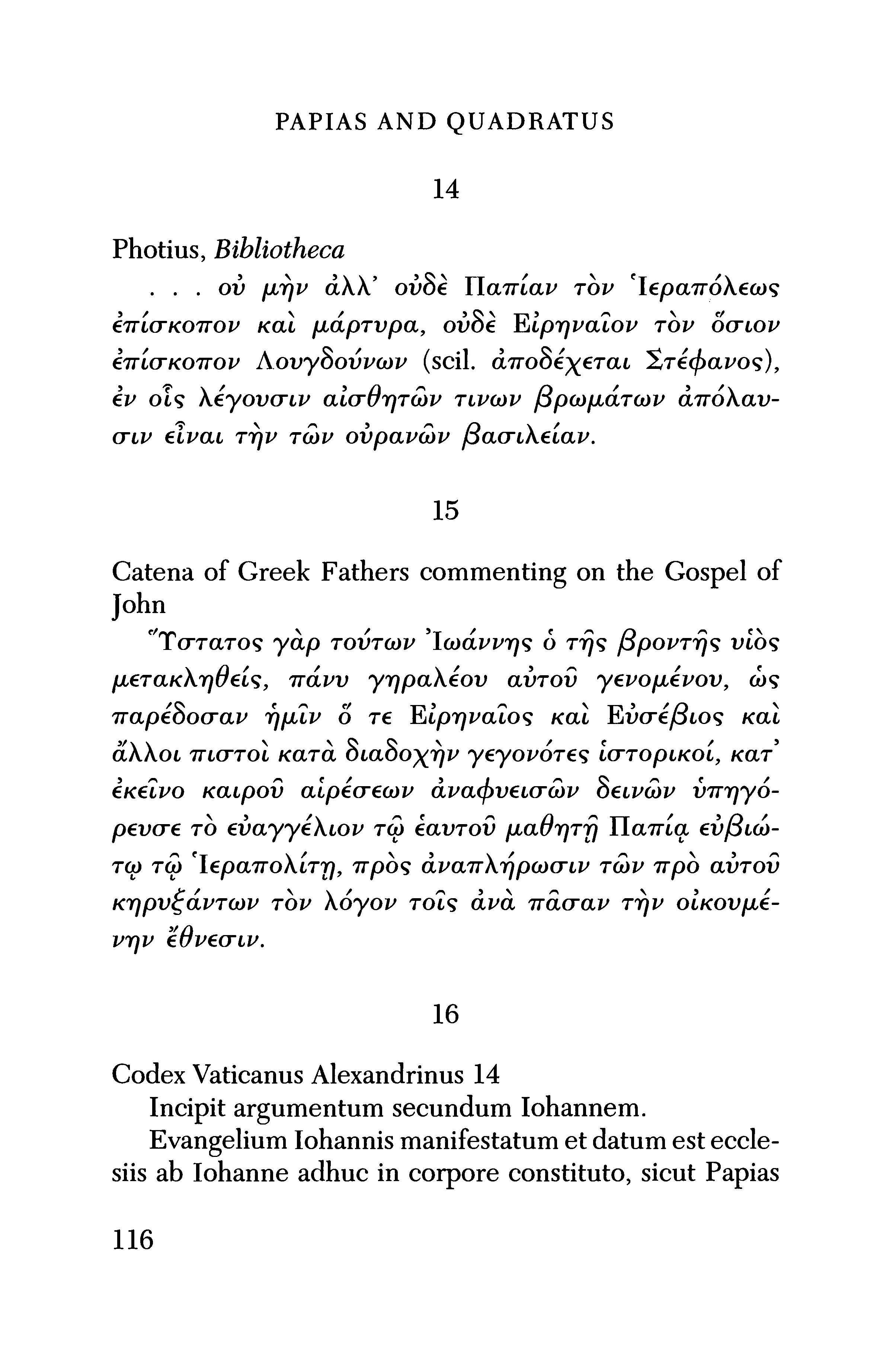
PAPIAS AND QUADRATUS
Photius, Bibliotheca . . . ού μήν άλλ' ούδβ Υίαπίαν τον Ίεραπόλεως επίσκοπον καί μάρτυρα, ούδβ Είρηναΐον τον οσιον επίσκοπον Κουγδούνων (scil. αποδέχεται Στέφανος), έν οις λέγονσιν αισθητών τίνων βρωμάτων άπόλαυσιν είναι τήν τών ουρανών βασιλείαν.
Catena of Greek Fathers commenting on the Gospel of John "Ύστατος γάρ τούτων "Ιωάννης 6 τής βροντής νιος ρετακληθείς, πάνυ γηραλέον αυτού γενομένου, ώς παρέδοσαν ήμΐν 6 τε Ειρηναίος καί Εύσέβιος καί άλλοι πιστοί κατά διαδοχήν γεγονότες ιστορικοί, κατ έκεΐνο καιρού αιρέσεων άναφνεισών δεινών ύπηγόρενσε το εύαγγελιον τω εαυτού μαθητή Τίαπία εύβιώτω τώ Ίεραπολίτη, προς άναπλήρωσιν τών προ αυτού κηρυζάντων τον λόγον τοΐς άνά πάσαν τήν οίκουμένην εθνεσιν.
Codex Vaticanus Alexandrinus 14 Incipit argumentum secundum Iohannem.
Evangelium Iohannis manifestatum et datum est ecclesiis ab Iohanne adhuc in corpore constituto, sicut Papias
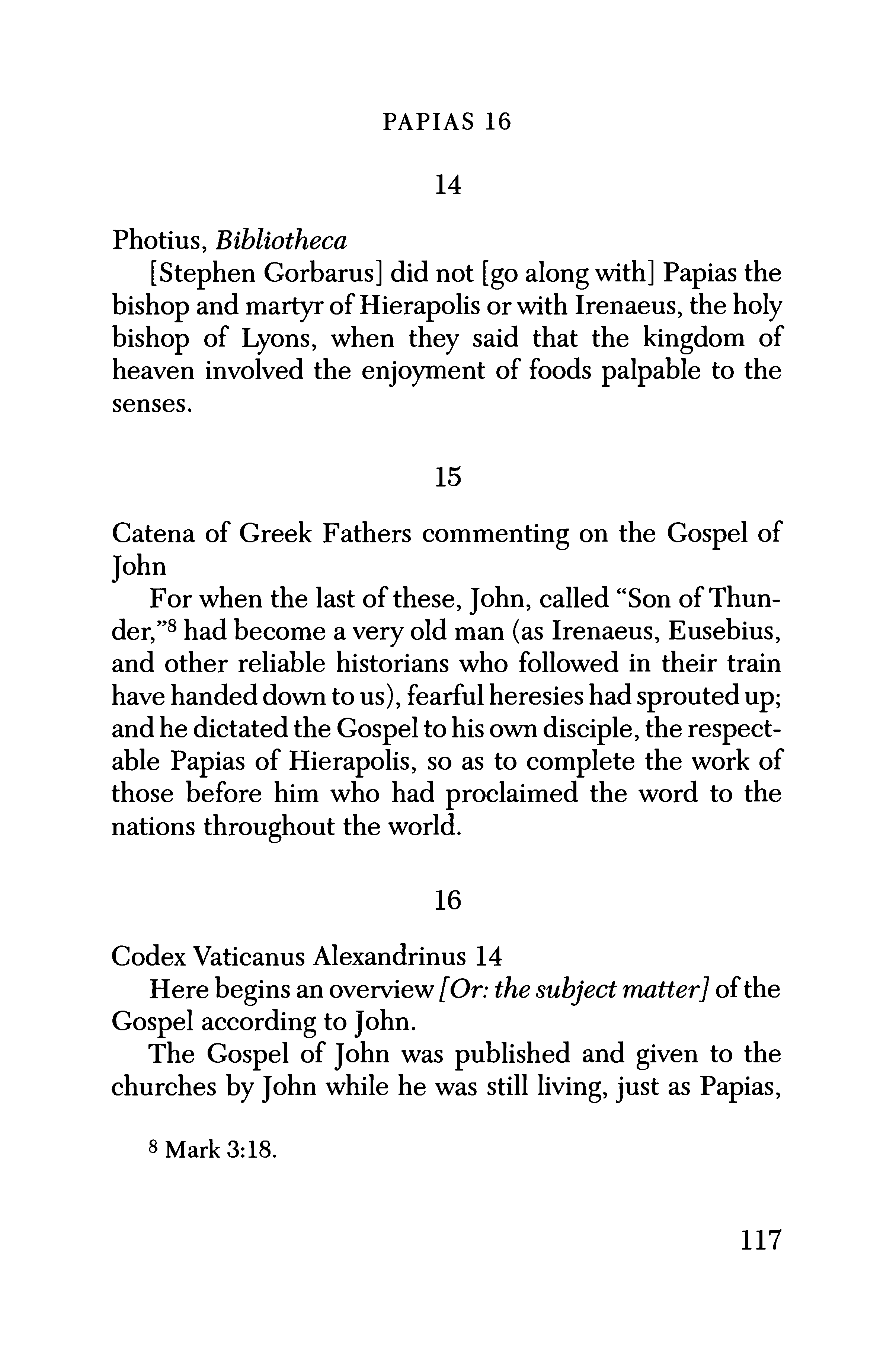
PAPIAS 16
Photius, Bibliotheca [Stephen Gorbarus] did not [go along with] Papias the bishop and martyr of Hierapolis or with Irenaeus, the holy bishop of Lyons, when they said that the kingdom of heaven involved the enjoyment of foods palpable to the senses.
Catena of Greek Fathers commenting on the Gospel of John For when the last of these, John, called "Son of Thun der,"
8 had become a very old man (as Irenaeus, Eusebius, and other reliable historians who followed in their train have handed down to us), fearful heresies had sprouted up; and he dictated the Gospel to his own disciple, the respect able Papias of Hierapolis, so as to complete the work of those before him who had proclaimed the word to the nations throughout the world.
Codex Vaticanus Alexandrinus 14 Here begins an overview [Or: the subject matter] of the Gospel according to John.
The Gospel of John was published and given to the churches by John while he was still living, just as Papias,
8 Mark 3:18.