
Eleventh Commandment
S H E P H E R D OF HERMAS
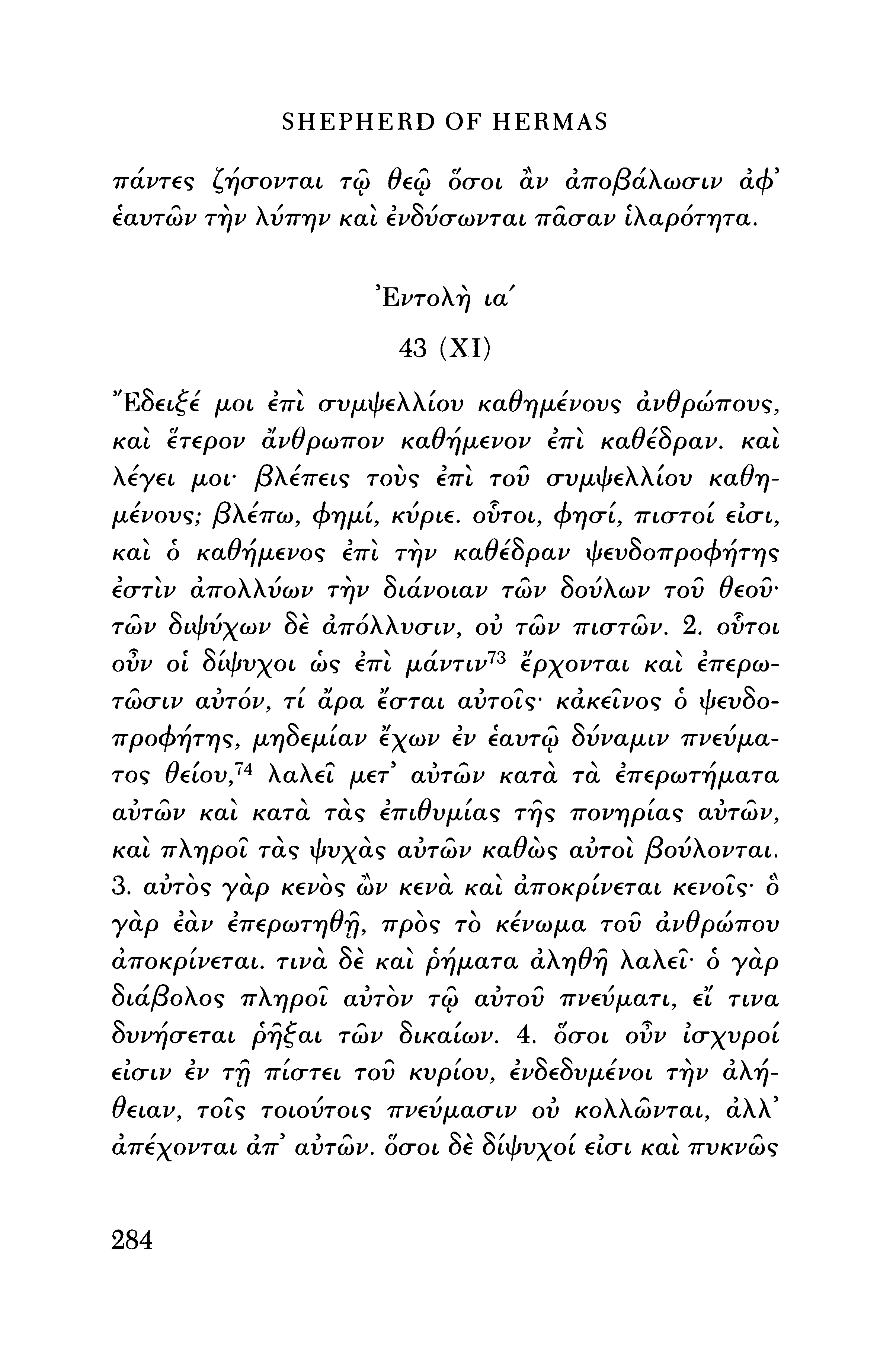
Εντολή ια 43 (XI) "Εδειξε ροι έπι σνρφελλίον καθημένονς άνθρώπονς, και έτερον άνθρωπον καθήρενον έπι καθέδραν. και λέγει ροιβλέπεις τονς έπι τον σνρφελλίον καθηρένονς; βλέπω, φηρί, κύριε, ούτοι, φησί, πιστοί είσι, καϊ ό καθήμενος έπϊ τήν καθέδραν φενδοπροφήτης εστίν άπολλύων τήν διάνοιαν τών δούλων τού θεούτών διφύχων δέ άπόλλνσιν, ού τών πιστών.
έρχονται και έπερωτώσιν αύτον, τί άρα εσται αύτοΐςκάκεΐνος ό φενδο π ροφήτης, ρηδερίαν έχων έν έαντώ δύναριν πνεύρα τος θείον,
λαλεί ρετ αυτών κατά τά έπερωτήρατα αυτών καϊ κατά τάς έπιθνρίας τής πονηρίας αυτών, καϊ πληροΐ τάς φνχάς αυτών καθώς αύτοϊ βούλονται.
3. αυτός γάρ κενός ών κενά καϊ αποκρίνεται κενοΐςό γάρ έάν έπερωτηθή, προς τό κένωμα τού άνθρωπον αποκρίνεται, τινά δέ καϊ ρήρατα αληθή λαλεΐό γάρ διάβολος πληροΐ αυτόν τώ αυτού πνεύρατι, εΐ τινα δννήσεται ρήζαι τών δικαίων.
4. όσοι ονν ίσχνροί είσιν έν τή πίστει τού κνρίον, ένδεδνρένοι τήν άλήθειαν, τοΐς τοιούτοις πνεύρασιν ού κολλώνται, άλλ' άπέχονται άπ' αυτών, όσοι δέ δίφνχοι είσι καί πνκνώς
COMMANDMENTS
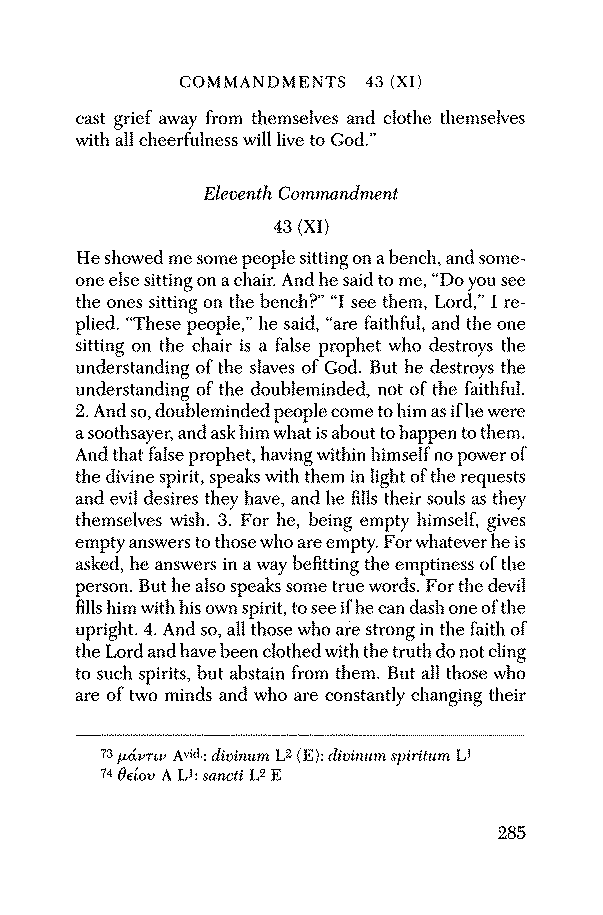
43 (XI) cast grief away from themselves and clothe themselves with all cheerfulness will live to God."
Eleventh Commandment 43 (XI) He showed me some people sitting on a bench, and some one else sitting on a chair. And he said to me, "Do you see the ones sitting on the bench?" "I see them, Lord," I re plied. "These people," he said, "are faithful, and the one sitting on the chair is a false prophet who destroys the understanding of the slaves of God. But he destroys the understanding of the doubleminded, not of the faithful.
2. And so, doubleminded people come to him as if he were a soothsayer, and ask him what is about to happen to them.
And that false prophet, having within himself no power of the divine spirit, speaks with them in light of the requests and evil desires they have, and he fills their souls as they themselves wish. 3. For he, being empty himself, gives empty answers to those who are empty. For whatever he is asked, he answers in a way befitting the emptiness of the person. But he also speaks some true words. For the devil fills him with his own spirit, to see if he can dash one of the upright. 4. And so, all those who are strong in the faith of the Lord and have been clothed with the truth do not cling to such spirits, but abstain from them. But all those who are of two minds and who are constantly changing their
7 3 μάντιν Α νί(ί·: divinum L 2 (Ε): divinum spintum L
74 θβίον A U: sancti L 2 Ε
S H E P H E R D OF HERMAS
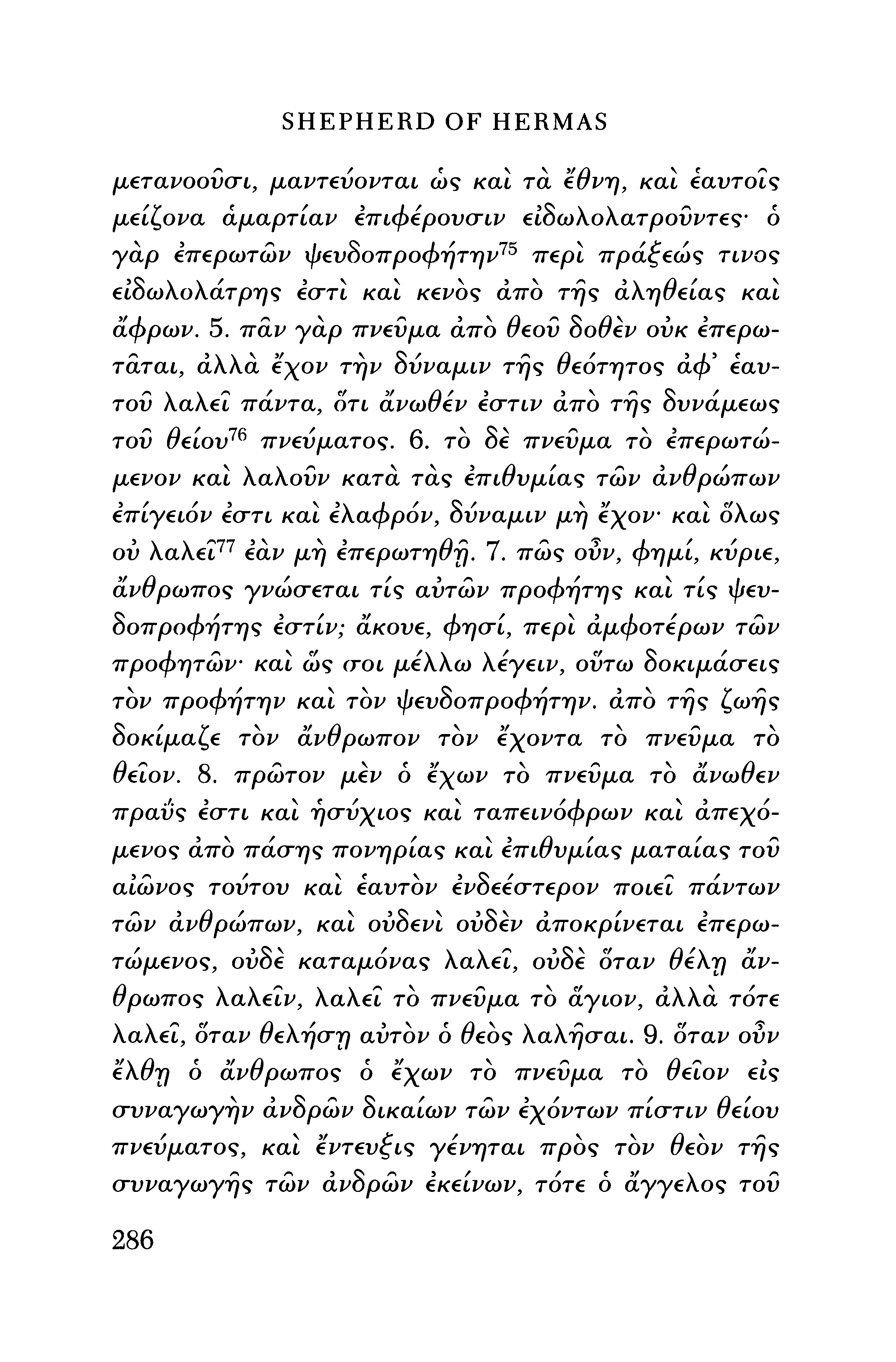
ρετανοούσι, μαντεύονται ώς καϊ τά έθνη, καϊ έαντοΐς μείζονα άμαρτίαν έπιφέρονσιν είδωλολατρούντες-
πβρϊ πράξεως τίνος ειδωλολάτρης εστί καϊ κενός άπο της αληθείας καϊ άφρων. 5. πάν γάρ πνενρα άπο θεον δοθέν ονκ έπερωτάται, άλλά έχον τήν δύναριν τής θεότητος άφ' έαν τον λαλεί πάντα, ότι άνωθεν εστίν άπο τής δννάρεως τού θείον
6. τό δβ πνεύρα τό επερωτώρενον καϊ λαλούν κατά τάς επιθνρίας τών ανθρώπων επίγειόν εστι καϊ έλαφρόν, δύναριν ρή έχον και όλως ού λαλεΐ
7. πώς ονν, φηρί, κύριε, άνθρωπος γνώσεται τίς αυτών προφήτης καϊ τίς φενδοπροφήτης εστίν; άκονε, φησί, περϊ άρφοτερων τών προφητών καϊ ώς σοι ρελλω λέγειν, ούτω δοκιμάσεις τον προφήτην καϊ τον φενδοπροφήτην. άπο τής ζωής δοκίραζε τον άνθρωπον τον έχοντα τό πνεύμα τό θείον.
8. πρώτον μέν ό έχων τό πνεύμα τό άνωθεν πρανς έστι καϊ ήσύχιος καϊ ταπεινόφρων καϊ άπεχόρενος άπο πάσης πονηρίας και έπιθνρίας ραταίας τού αιώνος τούτον καϊ έαντον ένδεέστερον ποιεί πάντων τών ανθρώπων, καϊ ούδενϊ ουδέν αποκρίνεται έπερωτώρενος, ουδέ καταρόνας λαλεΐ, ουδέ όταν θέλη άν θρωπος λαλεΐν, λαλεΐ τό πνεύρα τό άγιον, άλλά τότε λαλεΐ, όταν θελήση αυτόν ό θεός λαλήσαι.
9. Οταν ονν έλθη ό άνθρωπος ό έχων τό πνεύρα τό θείον εις σνναγωγήν ανδρών δικαίων τών εχόντων πίστιν θείον πνεύρατος, καϊ έντενζις γένηται προς τον θεον τής σνναγωγής τών ανδρών εκείνων, τότε ό άγγελος τού
COMMANDMENTS
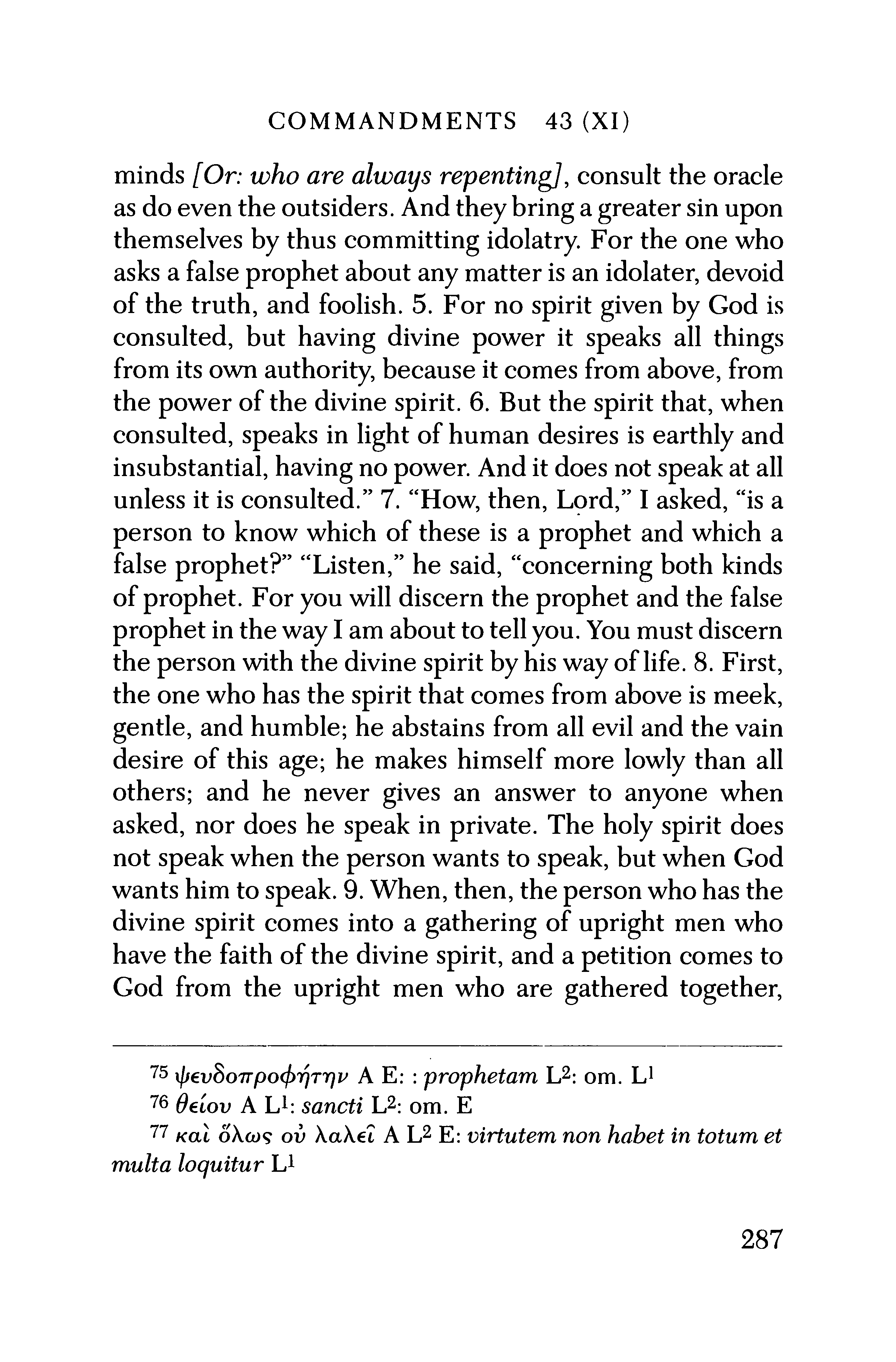
43 (XI) minds [Or: who are always repenting], consult the oracle as do even the outsiders. And they bring a greater sin upon themselves by thus committing idolatry. For the one who asks a false prophet about any matter is an idolater, devoid of the truth, and foolish. 5. For no spirit given by God is consulted, but having divine power it speaks all things from its own authority, because it comes from above, from the power of the divine spirit. 6. But the spirit that, when consulted, speaks in light of human desires is earthly and insubstantial, having no power. And it does not speak at all unless it is consulted." 7. "How, then, Lord," I asked, "is a person to know which of these is a prophet and which a false prophet?" "Listen," he said, "concerning both kinds of prophet. For you will discern the prophet and the false prophet in the way I am about to tell you. You must discern the person with the divine spirit by his way of life. 8. First, the one who has the spirit that comes from above is meek, gentle, and humble; he abstains from all evil and the vain desire of this age; he makes himself more lowly than all others; and he never gives an answer to anyone when asked, nor does he speak in private. The holy spirit does not speak when the person wants to speak, but when God wants him to speak. 9. When, then, the person who has the divine spirit comes into a gathering of upright men who have the faith of the divine spirit, and a petition comes to God from the upright men who are gathered together,
7 5 φενδοπροφήτην A Ε: : prophetam L 2: om. L
7 6 θείον A L 1: sancti L 2: om. Ε 7 7 καϊ ολως ον λαλεΐ A L 2 Ε: virtutem non habet in totum et multa loquitur L
S H E P H E R D OF HERMAS
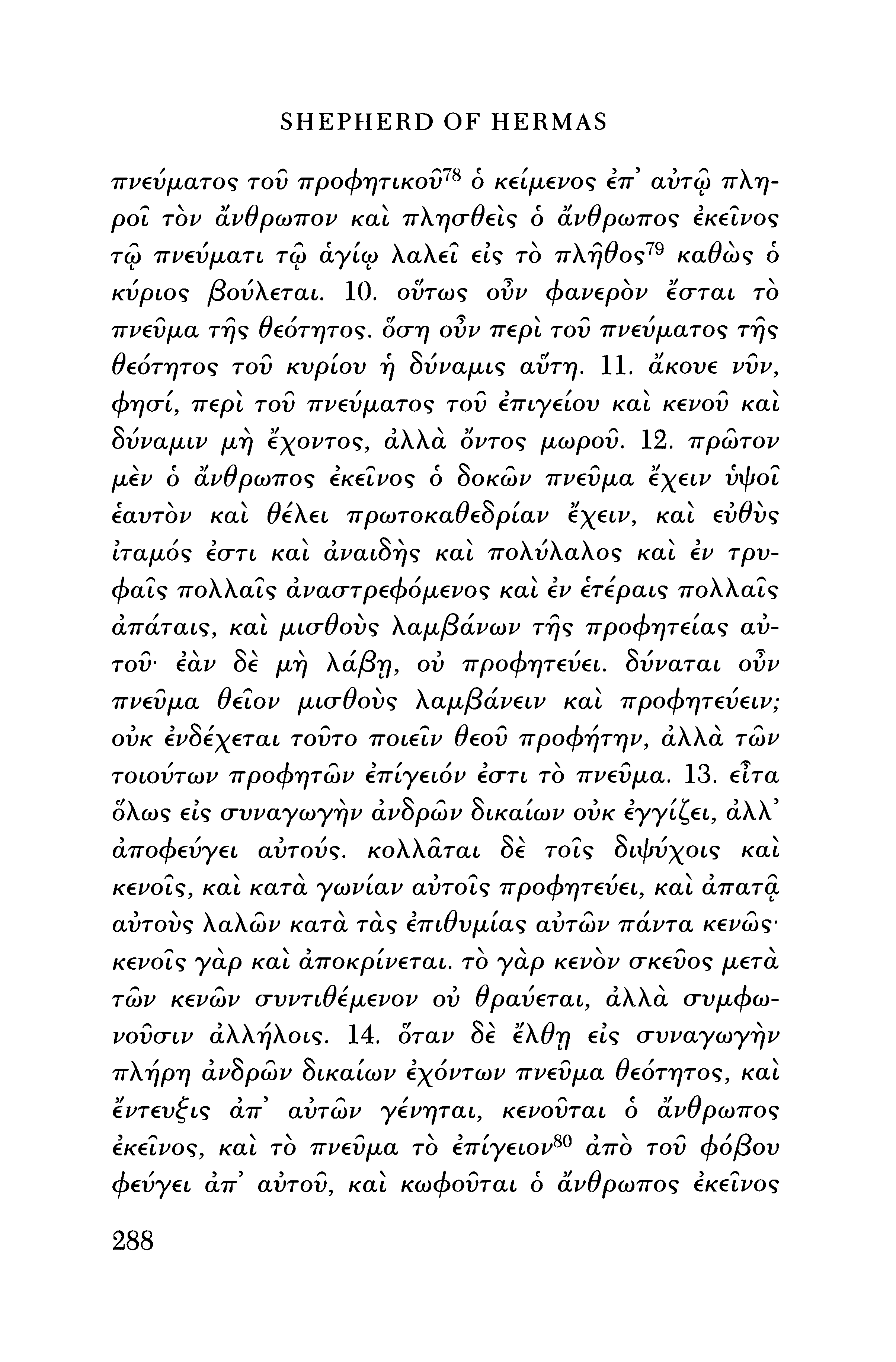
6 κείμενος επ' αύτώ πλη ροί τον άνθρωπον καί πληο-θεϊς 6 άνθρωπος εκείνος τώ πνεύρατι τώ άγίω λαλεί εϊς το πλήθος
11. άκονε νύν, φησί, περί τού πνεύρατος τού επιγείον και κενού και δύναριν μή έχοντος, άλλά οντος μωρού.
12. πρώτον μέν ό άνθρωπος εκείνος ό δοκών πνεύμα έχειν ύφοΐ έαντον καϊ θέλει πρωτοκαθεδρίαν εχειν, καϊ ευθύς ίταρός έστι καϊ αναιδής καϊ πολύλαλος καϊ έν τρνφαίς πολλαΐς άναστρεφόρενος καϊ έν έτέραις πολλαΐς άπάταις, καϊ μισθούς λαμβάνων τής προφητείας αυ τού· έάν δέ ρή λάβη, ού προφητεύει, δύναται ονν πνεύρα θείον μισθούς λαμβάνειν καϊ προφητεύειν; ούκ ενδέχεται τούτο ποιείν θεού προφήτην, άλλά τών τοιούτων προφητών έπίγειόν έστι τό πνεύρα.
13. είτα όλως εις σνναγωγήν ανδρών δικαίων ούκ εγγίζει, άλλ' αποφεύγει αυτούς, κολλάται δέ τοΐς διψύχοις καί κενοΐς, καί κατά γωνίαν αύτοΐς προφητεύει, καί άπατα αυτούς λαλών κατά τάς έπιθνρίας αυτών πάντα κενώςκενοΐς γάρ καί αποκρίνεται, τό γάρ κενόν σκεύος ρετά τών κενών σνντιθέρενον ού θραύεται, άλλά σνρφωνούσιν άλλήλοις.
14. όταν δέ έλθη εις σνναγωγήν πλήρη ανδρών δικαίων εχόντων πνεύρα θεότητος, καϊ έντενξις άπ αυτών γένηται, κενούται ό άνθρωπος εκείνος, καϊ τό πνεύρα τό έπίγειόν
COMMANDMENTS
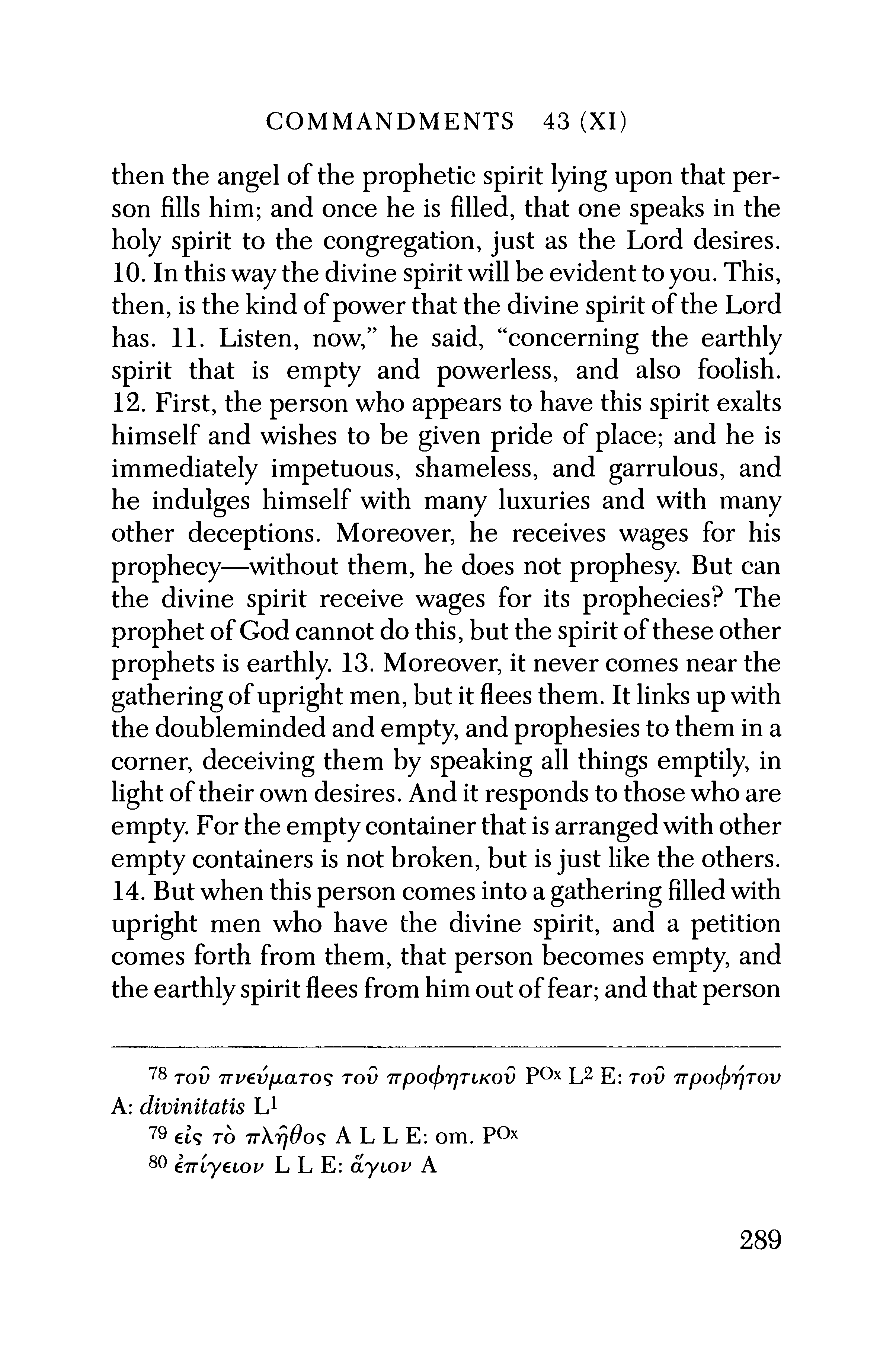
4 3 (XI) then the angel of the prophetic spirit lying upon that per son fills him; and once he is filled, that one speaks in the holy spirit to the congregation, just as the Lord desires.
10. In this way the divine spirit will be evident to you. This, then, is the kind of power that the divine spirit of the Lord has. 11. Listen, now," he said, "concerning the earthly spirit that is empty and powerless, and also foolish.
12. First, the person who appears to have this spirit exalts himself and wishes to be given pride of place; and he is immediately impetuous, shameless, and garrulous, and he indulges himself with many luxuries and with many other deceptions. Moreover, he receives wages for his prophecy—without them, he does not prophesy. But can the divine spirit receive wages for its prophecies? The prophet of God cannot do this, but the spirit of these other prophets is earthly. 13. Moreover, it never comes near the gathering of upright men, but it flees them. It links up with the doubleminded and empty, and prophesies to them in a corner, deceiving them by speaking all things emptily, in light of their own desires. And it responds to those who are empty. For the empty container that is arranged with other empty containers is not broken, but is just like the others.
14. But when this person comes into a gathering filled with upright men who have the divine spirit, and a petition comes forth from them, that person becomes empty, and the earthly spirit flees from him out of fear; and that person
S H E P H E R D OF HERMAS
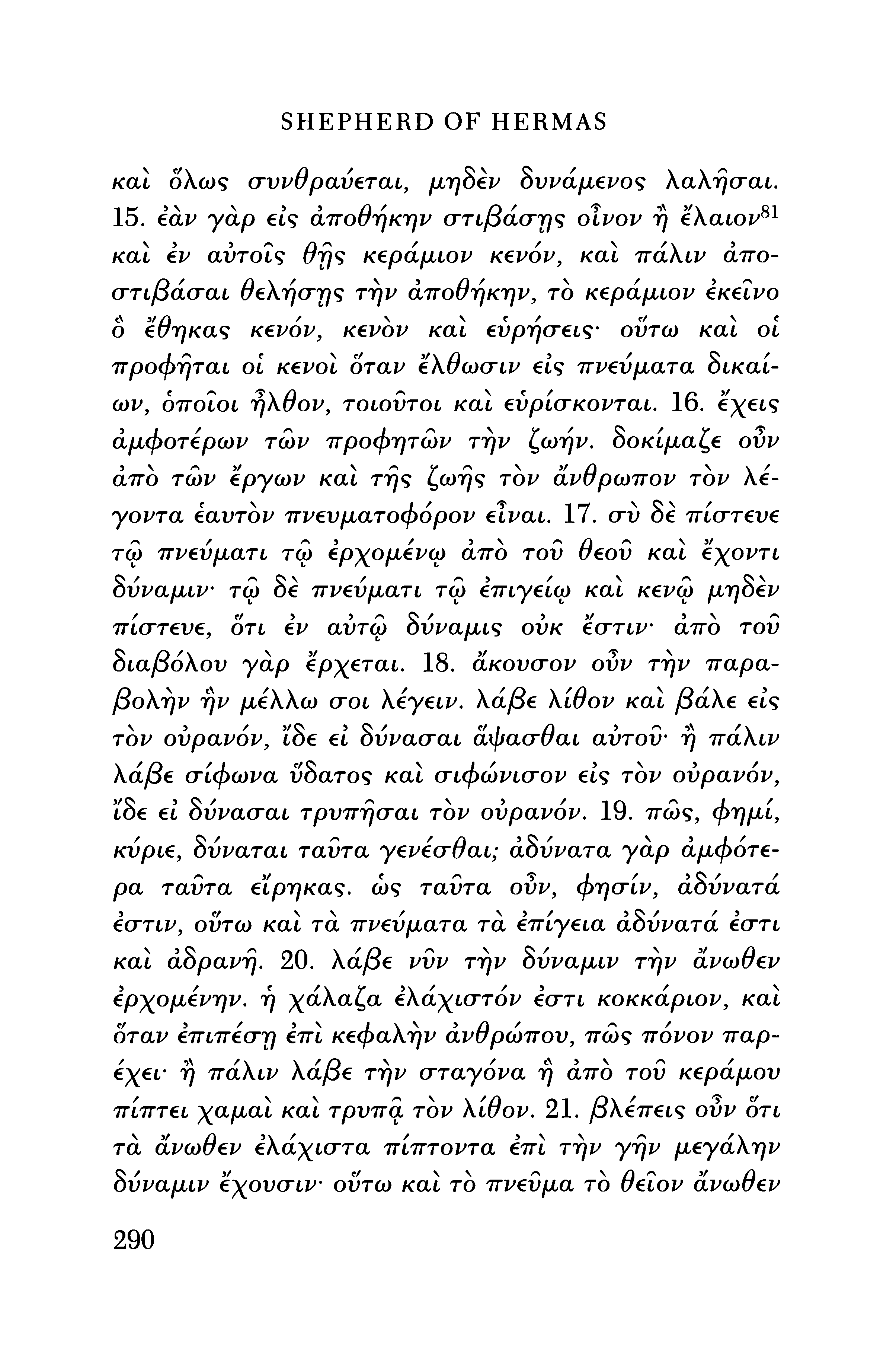
καί βν αύτοϊς θής κβράριον κβνόν, καί πάλιν άποστιβάσαι θέλησης την άποθήκην, το κβράριον εκείνο δ βθηκας κβνόν, κβνόν καί εύρήσειςοντω καί οί προφήται οί κβνοί όταν ελθωσιν βίς πνεύρατα δικαί ων, οποίοι ήλθον, τοιούτοι καί ευρίσκονται.
16. βχβις άρφοτβρων τών προφητών τήν ζωήν. δοκίραζβ ονν άπο τών έργων καί τής ζωής τον άνθρωπον τον λέ γοντα έαντον πνβνρατοφόρον βίναι. 17. σν δέ πίστβνβ τώ πνεύρατι τώ έρχορένω άπο τον θβον καί βχοντι δύναριν τώ δέ πνβνρατι τώ έπιγβίω καί κβνώ ρηδέν πίστβνβ, ότι έν αντω δνναρις ονκ έστιν άπο τον διαβόλον γάρ έρχεται.
18. άκονσον ονν τήν παραβολήν ήν ρέλλω σοι λέγειν, λάβε λίθον καί βάλε εις τον ονρανόν, ιδε εί δννασαι άφασθαι αντονή πάλιν λάβε σίφωνα νδατος καί σιφώνισον εις τον ονρανόν, ΐδε εί δννασαι τρνπήσαι τον ονρανόν.
19. πώς, φηρί, κύριε, δύναται ταύτα γενέσθαι; αδύνατα γάρ αμφότε ρα ταύτα εΐρηκας. ώς ταύτα ούν, φησίν, αδύνατα έστιν, ούτω καί τά πνεύρατα τά επίγεια αδύνατα έστι καί αδρανή. 20. λάβε νύν τήν δύναριν τήν άνωθεν έρχορένην. ή χάλαζα ελάχιστον έστι κοκκάριον, καί όταν έπιπέση έπι κεφαλήν άνθρωπον, πώς πόνον παρ έχειή πάλιν λάβε τήν σταγόνα ή άπο τού κεράρον πίπτει χαραί καί τρνπά τον λίθον. 21. βλέπεις ούν ότι τά άνωθεν ελάχιστα πίπτοντα έπι τήν γήν ρεγάλην δύναριν εχονσιν ούτω καί τό πνεύμα τό θείον άνωθεν
COMMANDMENTS
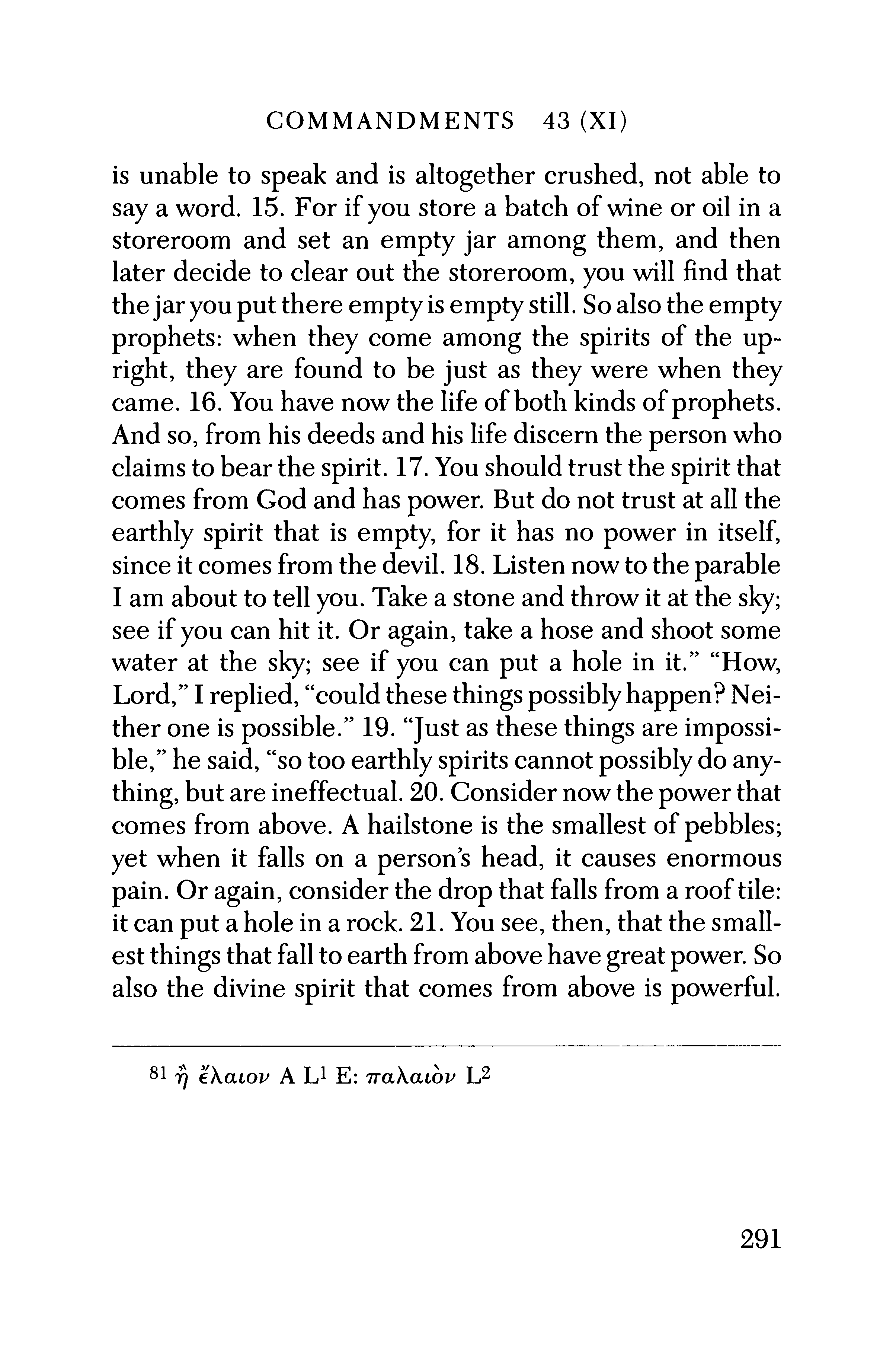
43 (XI) is unable to speak and is altogether crushed, not able to say a word. 15. For if you store a batch of wine or oil in a storeroom and set an empty jar among them, and then later decide to clear out the storeroom, you will find that the jar you put there empty is empty still. So also the empty prophets: when they come among the spirits of the up right, they are found to be just as they were when they came. 16. You have now the life of both kinds of prophets.
And so, from his deeds and his life discern the person who claims to bear the spirit. 17. You should trust the spirit that comes from God and has power. But do not trust at all the earthly spirit that is empty, for it has no power in itself, since it comes from the devil. 18. Listen now to the parable
I am about to tell you. Take a stone and throw it at the sky; see if you can hit it. Or again, take a hose and shoot some water at the sky; see if you can put a hole in it." "How,
Lord," I replied, "could these things possibly happen? Nei ther one is possible." 19. "Just as these things are impossi ble," he said, "so too earthly spirits cannot possibly do any thing, but are ineffectual. 20. Consider now the power that comes from above. A hailstone is the smallest of pebbles; yet when it falls on a person s head, it causes enormous pain. Or again, consider the drop that falls from a roof tile: it can put a hole in a rock. 21. You see, then, that the small est things that fall to earth from above have great power. So also the divine spirit that comes from above is powerful.
81 r) eXaiov A L 1 Ε: παλαιον L