
Tenth Commandment
S H E P H E R D OF HERMAS
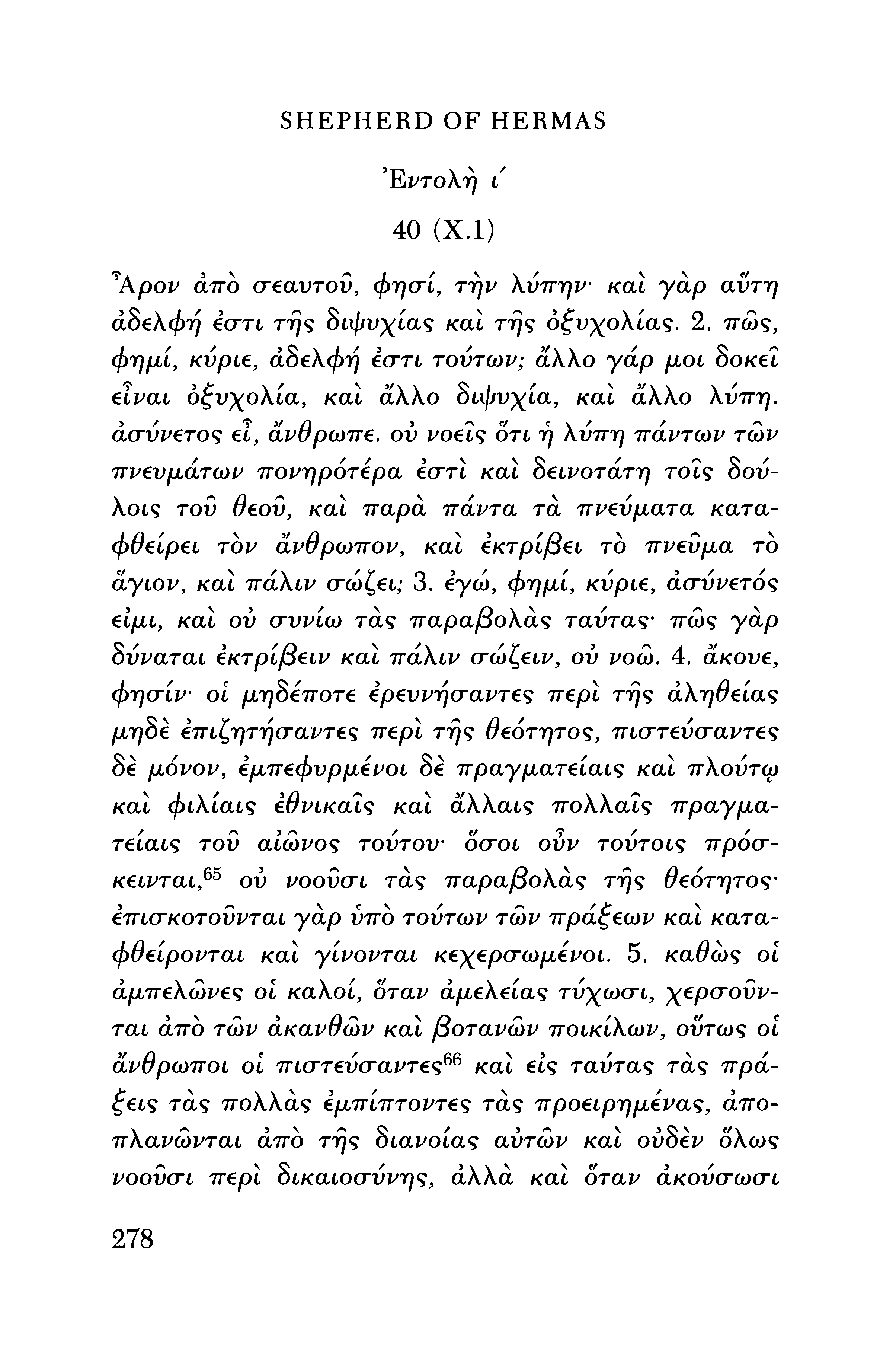
( X . l ) ^Apov άπο σβαυτον, φησί, τήν λύπην καϊ γάρ αύτη αδελφή έστι τής διφνχίας καϊ τής όξνχολίας.
2. πώς, φηρί, κνριβ, αδελφή έστι τούτων; άλλο γάρ ροι δοκεΐ βΐναι όξνχολία, καϊ άλλο διψυχία, καϊ άλλο λύπη. άσύνβτος βϊ, άνθρωπβ. ού νοβΐς οτι ή λύπη πάντων τών πνβνράτων πονηρότερα εστί καϊ δεινότατη τοΐς δούλοις τού θεού, καϊ παρά πάντα τά πνεύρατα καταφθείρει τον άνθρωπον, καϊ εκτρίβει τό πνεύρα τό άγιον, καϊ πάλιν σώζει; 3. εγώ, φηρί, κύριε, ασύνετος είρι, και ού σννίω τάς παραβολάς ταύταςπώς γάρ δύναται εκτρίβειν καϊ πάλιν σώζειν, ού νοώ. 4. άκονε, φησίν οί ρηδεποτε ερεννήσαντες περί τής αληθείας ρηδέ επιζητήσαντες περί τής θεότητος, πιστεύσαντες δέ μόνον, έρπεφνρρένοι δέ πραγματείαις καί πλούτω καί φιλίαις έθνικαΐς καί άλλαις πολλαΐς πραγρατείαις τού αιώνος τούτον Οσοι ονν τούτοις πρόσ κεινται,
ού νοούσι τάς παραβολάς τής θεότητος· έπισκοτούνται γάρ ύπό τούτων τών πράξεων καϊ καταφθείρονται καϊ γίνονται κεχερσωρένοι.
5. καθώς οί αμπελώνες οί καλοί, όταν άρελείας τύχωσι, χερσούνται άπο τών ακανθών καϊ βοτάνων ποικίλων, ούτως οί άνθρωποι οί πιστεύσαντες
καϊ εις ταύτας τάς πρά ξεις τάς πολλάς εμπίπτοντες τάς προειρημένας, άποπλανώνται άπο τής διανοίας αυτών και ουδέν όλως νοούσι περί δικαιοσύνης, άλλά καί όταν άκούσωσι
COMMANDMENTS
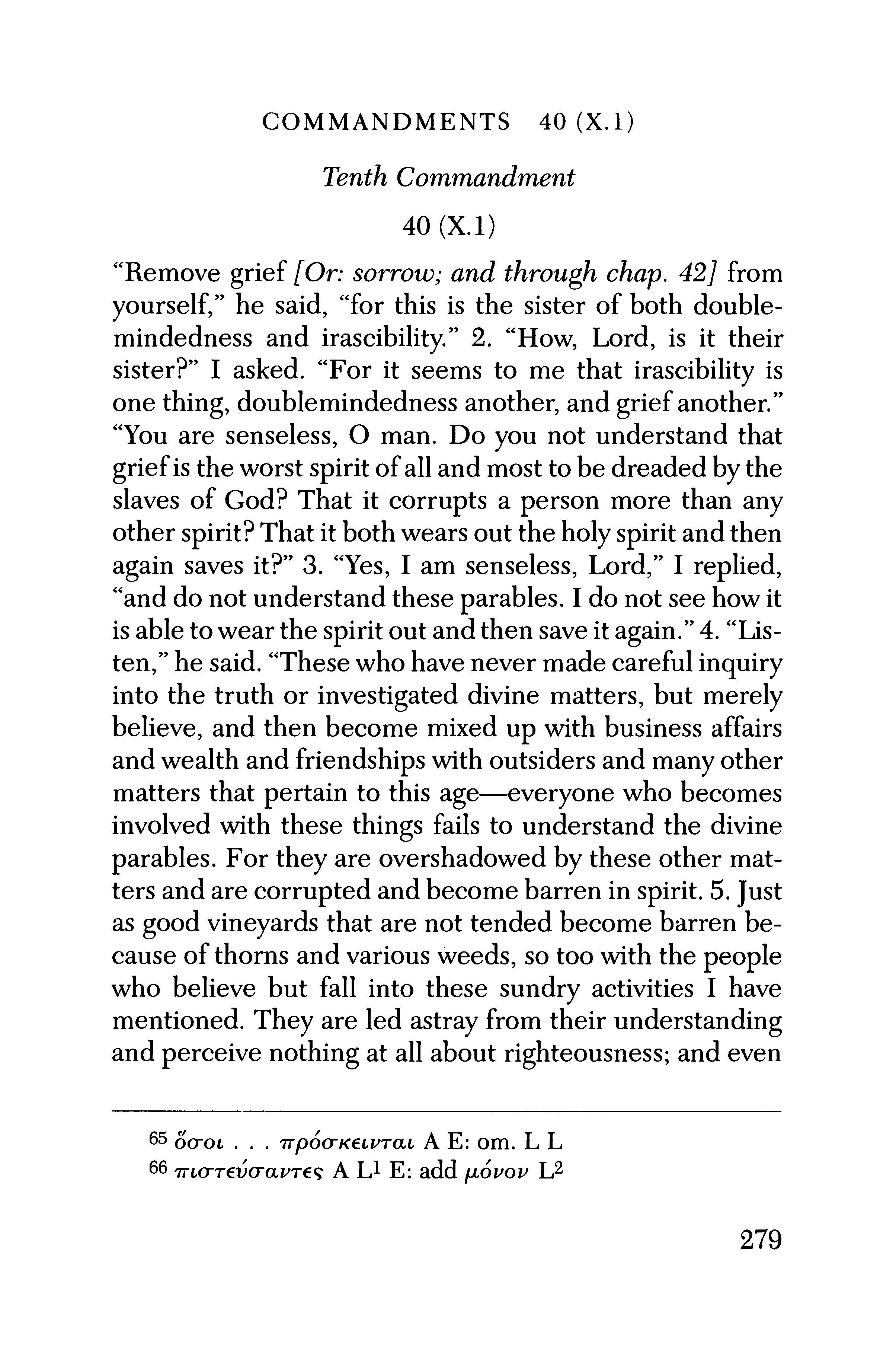
40 ( X . l ) Tenth Commandment 40 (X.1) "Remove grief [Or: sorrow; and through chap. 42] from yourself," he said, "for this is the sister of both double mindedness and irascibility." 2. "How, Lord, is it their sister?" I asked. "For it seems to me that irascibility is one thing, doublemindedness another, and grief another."
"You are senseless, Ο man. Do you not understand that grief is the worst spirit of all and most to be dreaded by the slaves of God? That it corrupts a person more than any other spirit? That it both wears out the holy spirit and then again saves it?" 3. "Yes, I am senseless, Lord," I replied,
"and do not understand these parables. I do not see how it is able to wear the spirit out and then save it again." 4. "Lis ten," he said. "These who have never made careful inquiry into the truth or investigated divine matters, but merely believe, and then become mixed up with business affairs and wealth and friendships with outsiders and many other matters that pertain to this age—everyone who becomes involved with these things fails to understand the divine parables. For they are overshadowed by these other mat ters and are corrupted and become barren in spirit. 5. Just as good vineyards that are not tended become barren be cause of thorns and various weeds, so too with the people who believe but fall into these sundry activities I have mentioned. They are led astray from their understanding and perceive nothing at all about righteousness; and even
S H E P H E R D OF HERMAS
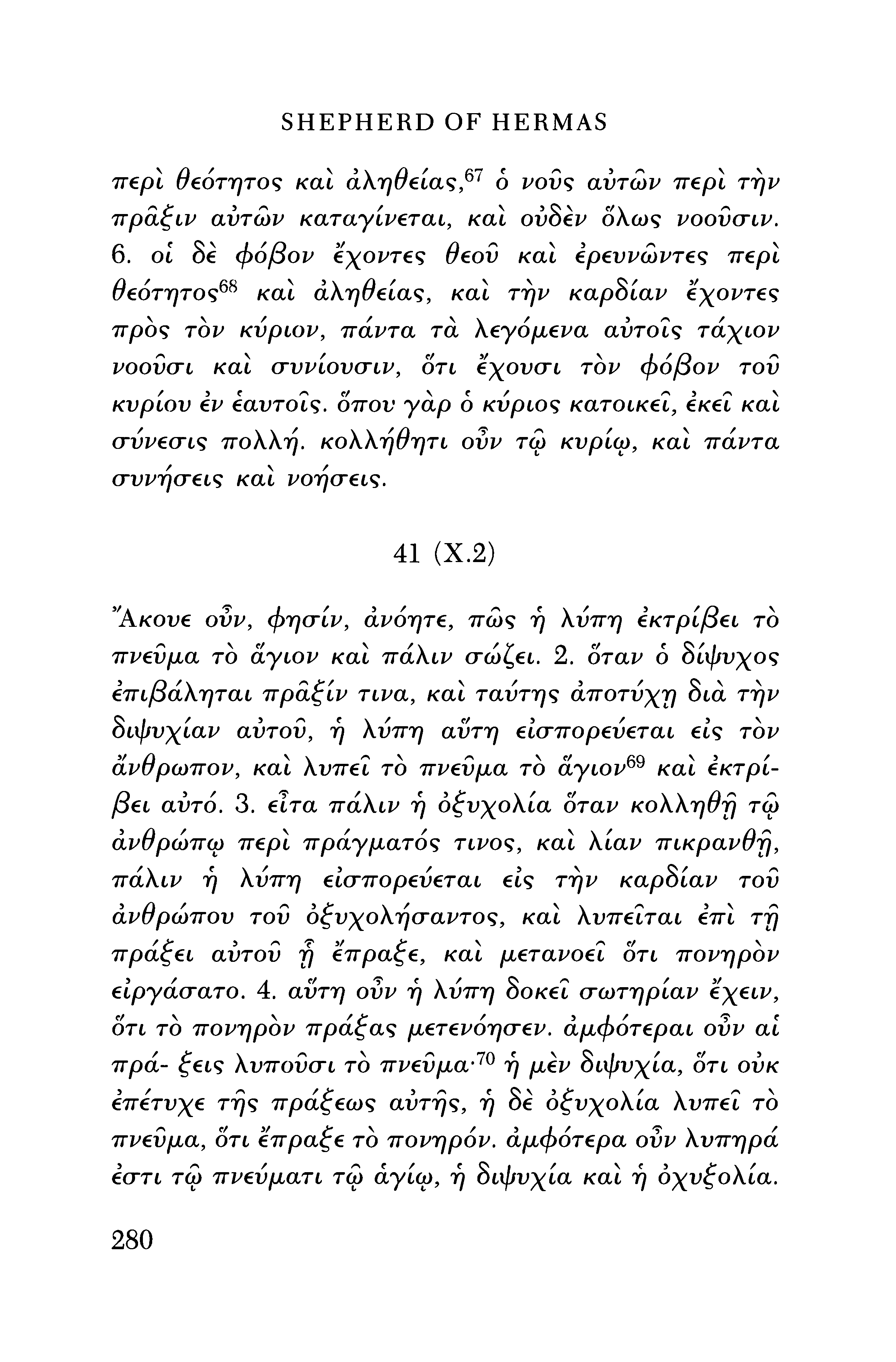
καϊ αληθείας, καϊ τήν καρδίαν έχοντες προς τον κύριον, πάντα τά λεγόρενα αύτοΐς τάχιον νοούσι καί σννίονσιν, ότι εχονσι τον φόβον τού κνρίον εν έαντοΐς. όπου γάρ ό κύριος κατοικεί, εκεί καϊ σύνεσις πολλή, κολλήθητι ονν τώ κνρίω, καϊ πάντα σννήσεις και νοήσεις.
41 (Χ.2) "Ακονε ονν, φησίν, ανόητε, πώς ή λύπη εκτρίβει τό πνεύρα τό άγιον καϊ πάλιν σώζει.
2. όταν ό δίφνχος επιβάληται πράζιν τινα, καϊ ταύτης άποτύχη διά τήν διφνχίαν αυτού, ή λύπη αύτη είσπορεύεται εις τον άνθρωπον, καϊ λνπεΐ τό πνεύρα τό άγιον
καϊ εκτρί βει αυτό. 3. βιτα πάλιν ή όζνχολία όταν κολληθή τώ άνθρώπω περϊ πράγρατός τίνος, καϊ λίαν πικρανθή, πάλιν ή λύπη είσπορεύεται εις τήν καρδίαν τού άνθρωπον τού όξνχολήσαντος, καί λνπείται επί τή πράξει αυτού ή έπραξε, καί ρετανοεί οτι πονηρον είργάσατο.
4. αύτη ούν ή λύπη δοκεΐ σωτηρίαν εχειν, ότι τό πονηρον πράζας ρετενόησεν. άρφότεραι ονν αί πράζεις λνπούσι τό πνεύρα·
ή ρέν διφνχία, ότι ούκ έπέτνχε τής πράξεως αυτής, ή δέ όζνχολία λνπεΐ τό πνεύρα, ότι επραζε τό πονηρον. αμφότερα ούν λνπηρά έστι τώ πνεύρατι τώ άγίω, ή διφνχία καί ή όχνζολία.
COMMANDMENTS
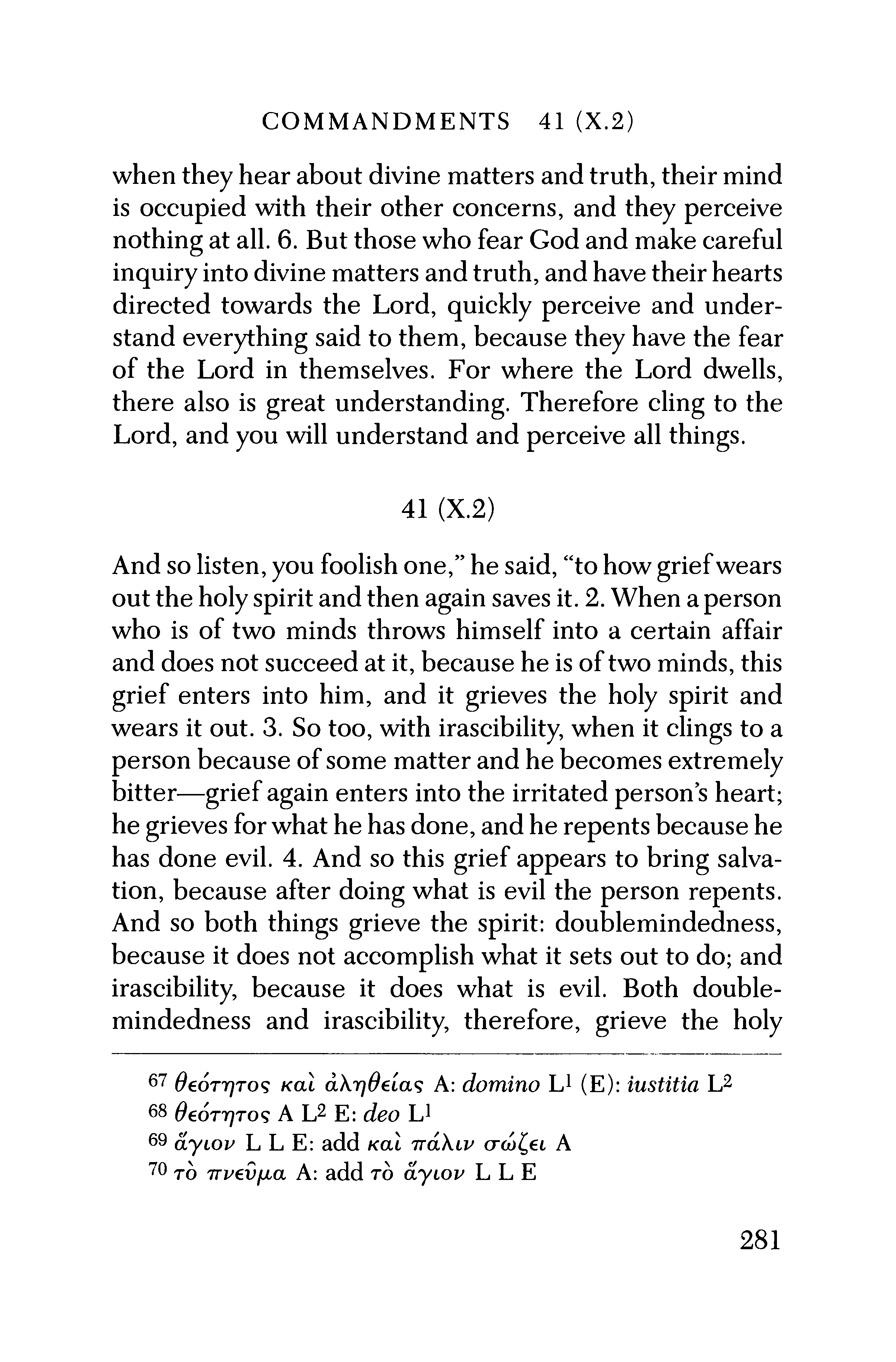
41 (Χ.2) when they hear about divine matters and truth, their mind is occupied with their other concerns, and they perceive nothing at all. 6. But those who fear God and make careful inquiry into divine matters and truth, and have their hearts directed towards the Lord, quickly perceive and under stand everything said to them, because they have the fear of the Lord in themselves. For where the Lord dwells, there also is great understanding. Therefore cling to the Lord, and you will understand and perceive all things.
41 (X.2) And so listen, you foolish one," he said, "to how grief wears out the holy spirit and then again saves it. 2. When a person who is of two minds throws himself into a certain affair and does not succeed at it, because he is of two minds, this grief enters into him, and it grieves the holy spirit and wears it out. 3. So too, with irascibility, when it clings to a person because of some matter and he becomes extremely bitter—grief again enters into the irritated person s heart; he grieves for what he has done, and he repents because he has done evil. 4. And so this grief appears to bring salva tion, because after doing what is evil the person repents.
And so both things grieve the spirit: doublemindedness, because it does not accomplish what it sets out to do; and irascibility, because it does what is evil. Both double mindedness and irascibility, therefore, grieve the holy
67 θεότητος καϊ αληθείας A: domino L 1 (E): iustitia L
S H E P H E R D OF HERMAS
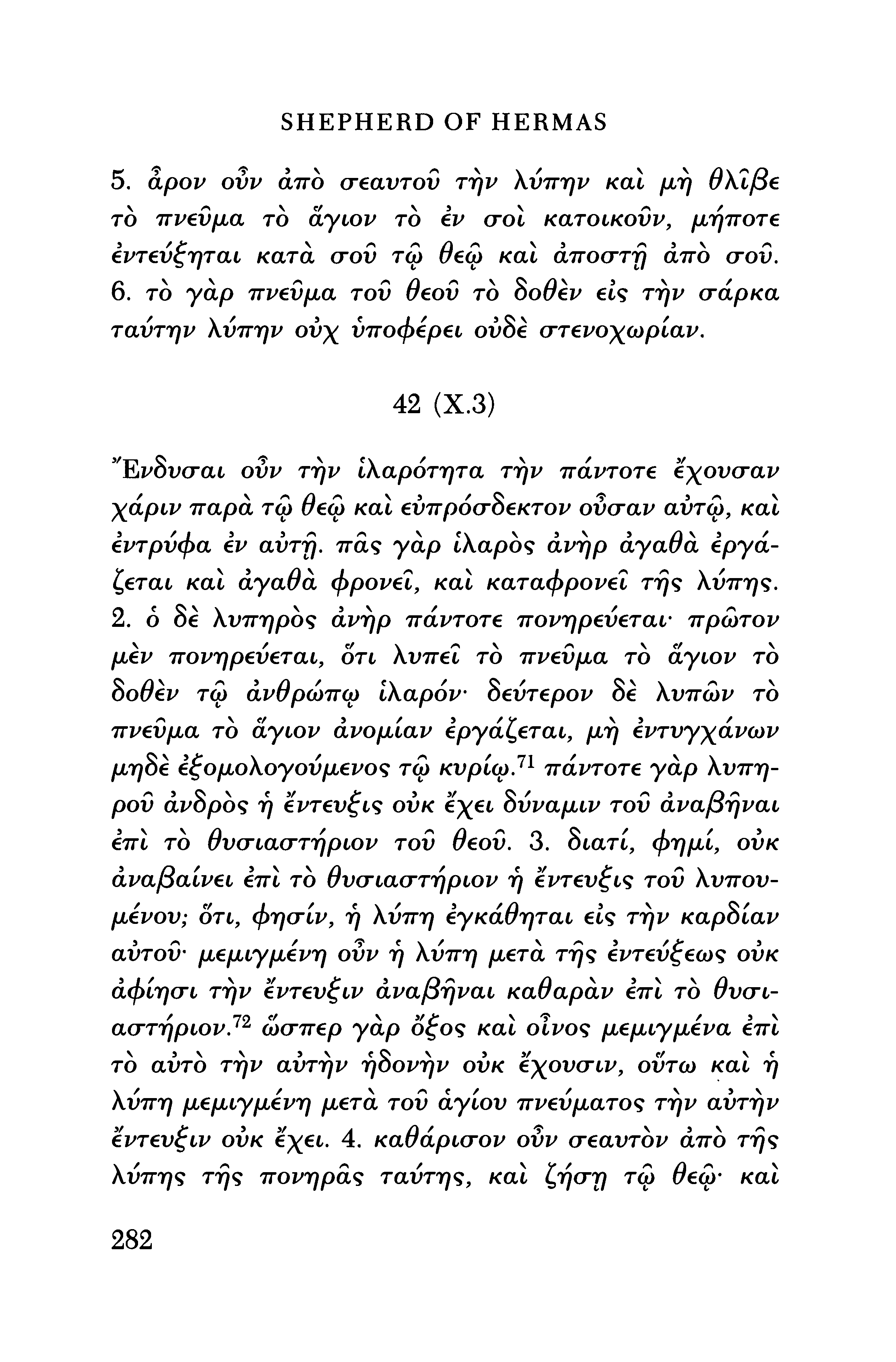
5. άρον ονν άπο σεαντού τήν λύπην καϊ ρή θλίβε το πνενρα το άγιον το iv σοι κατοικονν, ρήποτε έντεύζηται κατά σον τω θεω και άποστή άπο σον.
6. τό γάρ πνενρα τον θεον το δοθέν εις τήν σάρκα ταύτην λύπην ούχ υποφέρει ούδε στενοχωρίαν.
42 (Χ.3) "Ενδνσαι ονν τήν ιλαρότητα τήν πάντοτε εχονσαν χάριν παρά τω θεω και εύπρόσδεκτον ονσαν αύτώ, και εντρυφά εν αύτη. πάς γάρ Ιλαρός άνήρ αγαθά εργά ζεται καϊ αγαθά φρονεί, και καταφρονεί τής λύπης.
2. ό δε λνπηρός άνήρ πάντοτε πονηρεύεται· πρώτον μεν πονηρεύεται, ότι λνπεΐ τό πνεύμα τό άγιον τό δοθέν τώ άνθρώπω ίλαρόν δεύτερον δέ λνπών τό πνεύρα τό άγιον άνομίαν εργάζεται, μή έντνγχάνων μηδέ έζ ομολόγου μένος τώ κνρίω.
πάντοτε γάρ λνπηρού ανδρός ή εντενζις ούκ έχει δύναριν τού άναβήναι έπϊ τό θνσιαστηρίον τού θεού. 3. διατί, φημί, ούκ αναβαίνει έπϊ τό θνσιαστηρίον ή εντενζις τού λνπονρένον; οτι, φησίν, ή λύπη έγκάθηται εις τήν καρδίαν αυτού· μεμιγμένη ονν ή λύπη μετά τής έντεύζεως ούκ άφίησι τήν εντενζιν άναβήναι καθαράν έπϊ τό θνσι αστηρίον.
ώσπερ γάρ Οζος καϊ οίνος μεμιγμένα έπϊ τό αυτό τήν αυτήν ήδονήν ούκ εχονσιν, ούτω και ή λύπη μεμιγμένη μετά τού άγίον πνεύματος τήν αυτήν εντενζιν ούκ έχει. 4. καθάρισον ούν σεαντόν άπο τής λύπης τής πονηράς ταύτης, καϊ ζήση τώ θεώκαϊ
COMMANDMENTS
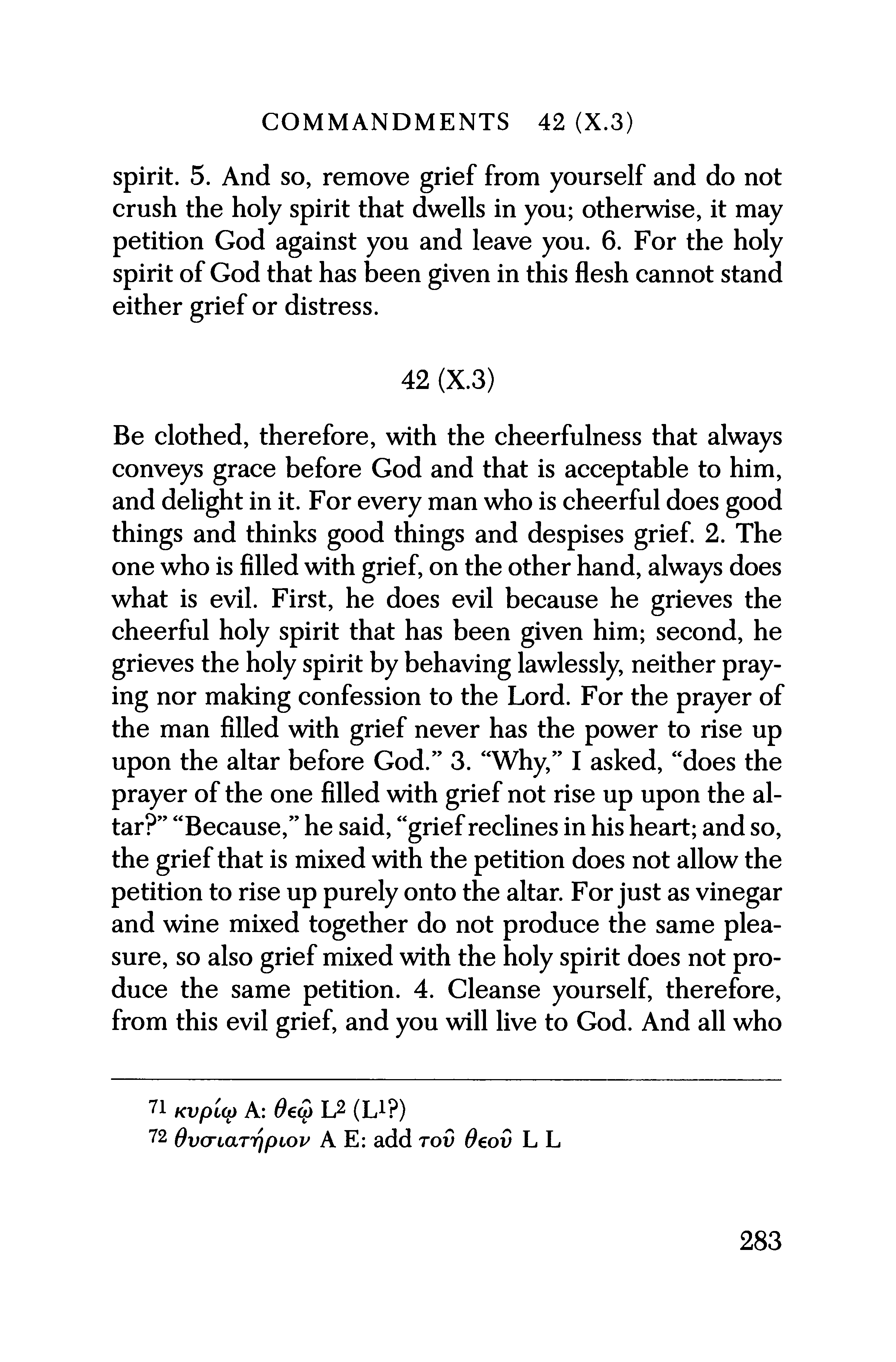
42 (X.3) spirit. 5. And so, remove grief from yourself and do not crush the holy spirit that dwells in you; otherwise, it may petition God against you and leave you. 6. For the holy spirit of God that has been given in this flesh cannot stand either grief or distress.
42 (X.3) Be clothed, therefore, with the cheerfulness that always conveys grace before God and that is acceptable to him, and delight in it. For every man who is cheerful does good things and thinks good things and despises grief. 2. The one who is filled with grief, on the other hand, always does what is evil. First, he does evil because he grieves the cheerful holy spirit that has been given him; second, he grieves the holy spirit by behaving lawlessly, neither pray ing nor making confession to the Lord. For the prayer of the man filled with grief never has the power to rise up upon the altar before God." 3. "Why," I asked, "does the prayer of the one filled with grief not rise up upon the al tar?" "Because," he said, "grief reclines in his heart; and so, the grief that is mixed with the petition does not allow the petition to rise up purely onto the altar. For just as vinegar and wine mixed together do not produce the same plea sure, so also grief mixed with the holy spirit does not pro duce the same petition. 4. Cleanse yourself, therefore, from this evil grief, and you will live to God. And all who 71 κνρίω Α: θβώ L 2 (U?) 72 θνσιατήριον A Ε: add τον θβον L L