
Fifth Commandment
S H E P H E R D OF HERMAS
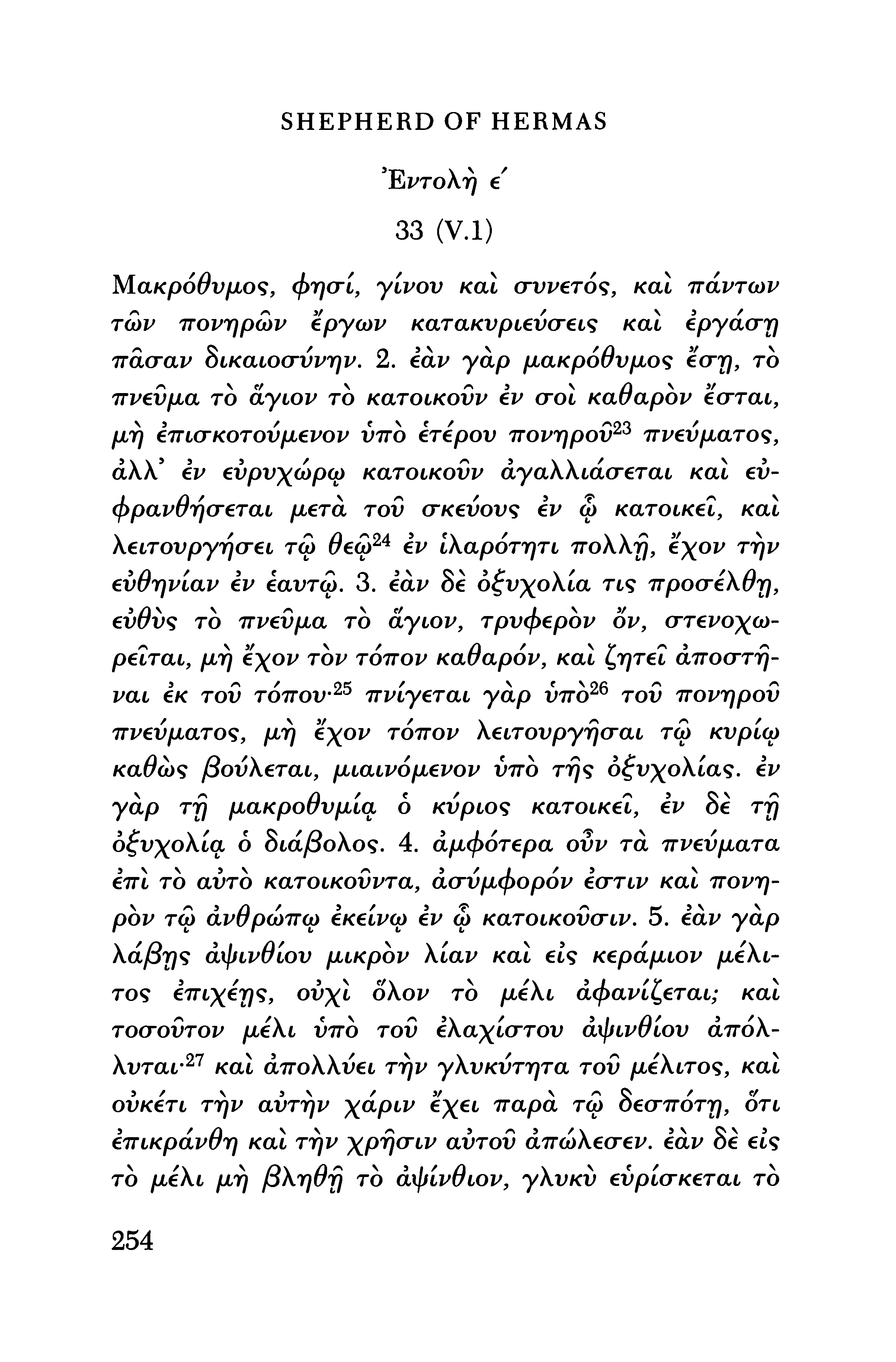
"Εντολή ε 33 (V.l) Μακρόθνρος, φησί, γίνον καϊ σννετός, καϊ πάντων τών πονηρών έργων κατακνριεύσεις καϊ έργάση πάσαν δικαιοσννην.
2. έάν γάρ ρακρόθνρος εση, το πνεύρα το άγιον το κατοικούν έν σοι καθαρον εσται, ρή έπισκοτούρενον ύπό έτερον πονηρον 22, πνεύρατος, άλλ' έν εύρνχώρω κατοικονν άγαλλιάο-εται καϊ εύφρανθήσεται ρετά τον σκεύονς έν ω κατοικεί, καϊ λειτονργήσει τώ θεώ
έν ίλαρότητι πολλή, έχον τήν εύθηνίαν έν έαντώ. 3. έάν δέ δζνχολία τις προσέλθη, ευθύς το πνενρα το άγιον, τρνφερον ον, στενοχω ρείται, ρή έχον τον τόπον καθαρον, καϊ ζητεί άποστήναι έκ τον τόπον
τον πονηρον πνενρατος, ρή έχον τόπον λειτονργήσαι τώ κνρίω καθώς βονλεται, ριαινόρενον νπό τής όξνχολίας. έν γάρ τή ρακροθνρία ό κύριος κατοικεί, έν δέ τή όξνχολία ό διάβολος.
4. άρφότερα ονν τά πνεύρατα έπϊ τό αυτό κατοικούντα, άσύρφορόν έστιν καϊ πονη ρον τώ άνθρώπω έκείνω έν ω κατοικούσιν.
5. έάν γάρ λάβης άφινθίον ρικρόν λίαν καϊ εις κεράμιον μέλι τος έπιχέης, ούχϊ όλον τό μέλι αφανίζεται; καϊ τοσούτον μέλι ύπό τού ελάχιστον άφινθίον άπόΧλνται-
καϊ άπολλύει τήν γλνκύτητα τού μέλιτος, καϊ ούκετι τήν αυτήν χάριν έχει παρά τώ δεσπότη, ότι έπικράνθη καϊ τήν χρήσιν αυτού άπώλεσεν. έάν δέ εις τό ρέλι ρή βληθή τό άφινθίον, γλνκύ ευρίσκεται τό
COMMANDMENTS
33 ( V I )
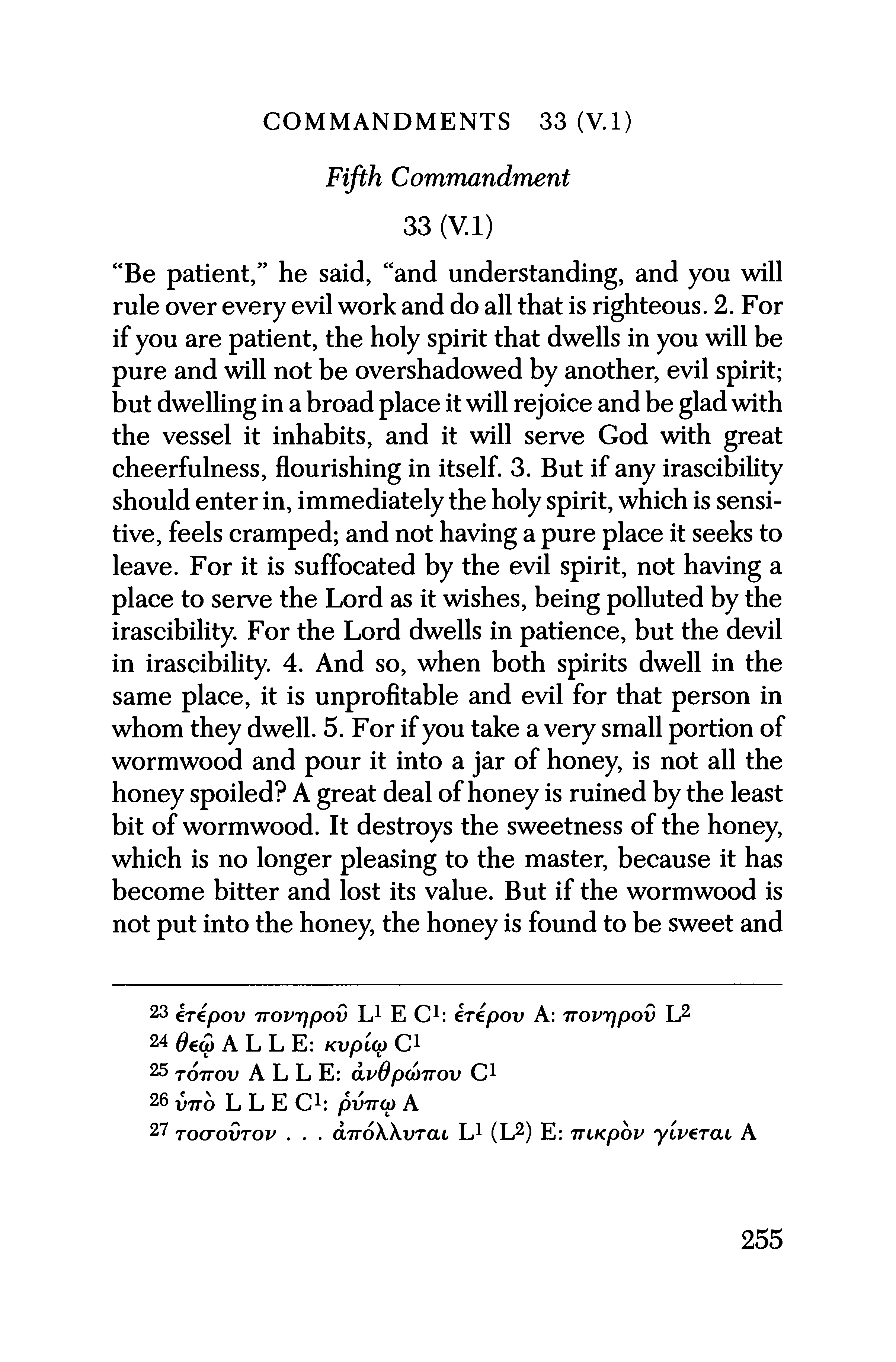
Fifth Commandment 33 (VI) "Be patient," he said, "and understanding, and you will rule over every evil work and do all that is righteous. 2. For if you are patient, the holy spirit that dwells in you will be pure and will not be overshadowed by another, evil spirit; but dwelling in a broad place it will rejoice and be glad with the vessel it inhabits, and it will serve God with great cheerfulness, flourishing in itself. 3. But if any irascibility should enter in, immediately the holy spirit, which is sensi tive, feels cramped; and not having a pure place it seeks to leave. For it is suffocated by the evil spirit, not having a place to serve the Lord as it wishes, being polluted by the irascibility. For the Lord dwells in patience, but the devil in irascibility. 4. And so, when both spirits dwell in the same place, it is unprofitable and evil for that person in whom they dwell. 5. For if you take a very small portion of wormwood and pour it into a jar of honey, is not all the honey spoiled? A great deal of honey is ruined by the least bit of wormwood. It destroys the sweetness of the honey, which is no longer pleasing to the master, because it has become bitter and lost its value. But if the wormwood is not put into the honey, the honey is found to be sweet and 2 3 έτερον πονηρον L 1 Ε C 1: έτερον Α: πονηρον L
2 6 νπό L L Ε C 1: ρνπω A 2 7 τοσοντον . . . άπόΧΚνται L 1 (L 2) Ε: πικρόν γίνεται A
S H E P H E R D OF HERMAS
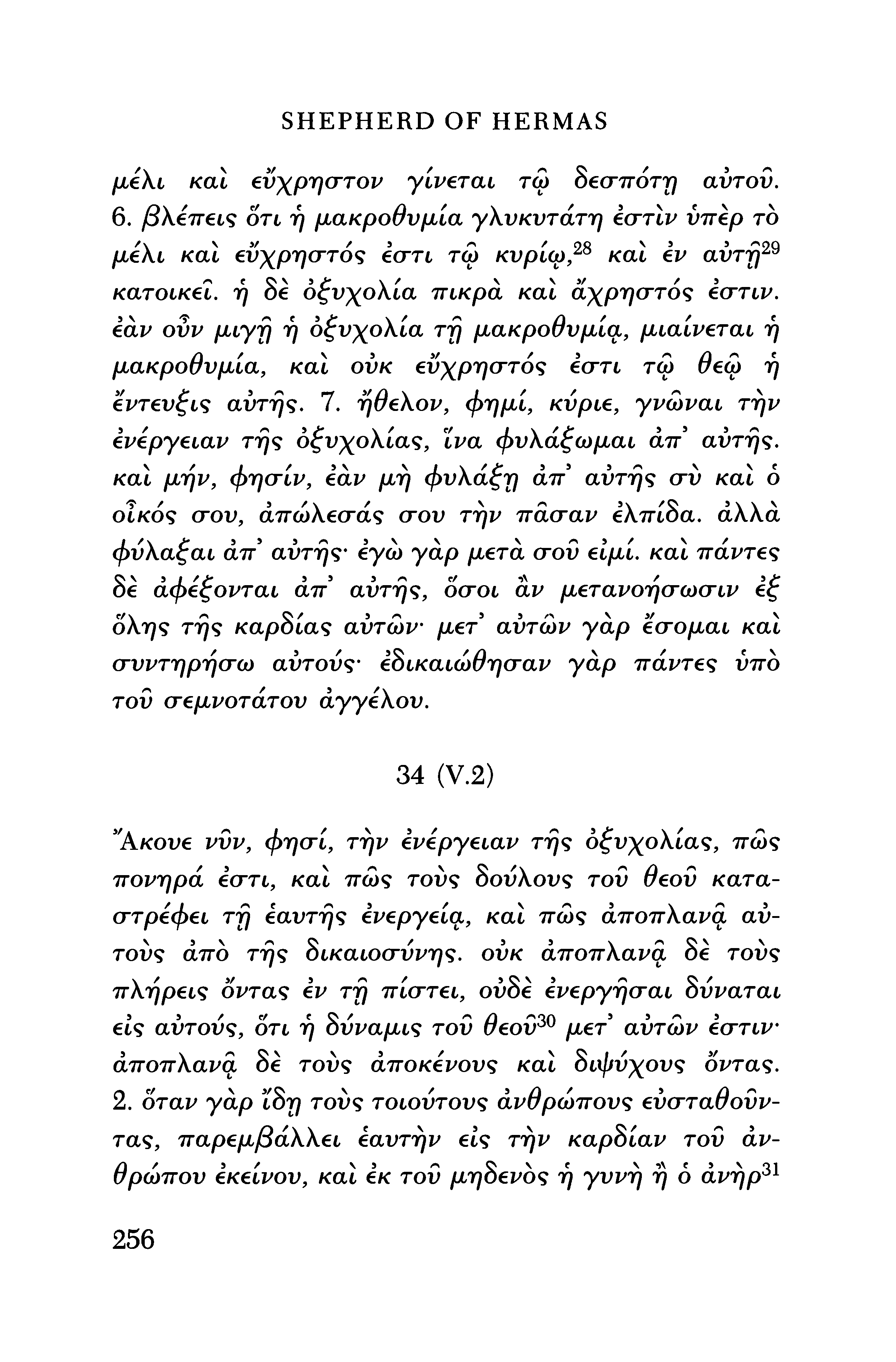
6. βλέπεις οτι ή ρακροθνρία γλνκντάτη εστίν υπέρ τό ρέλι και ενχρηστός εστι τώ κνρίω,
κατοικεί, ή δε όζνχολία πικρά και άχρηστος εστίν, εάν ονν ριγή ή όζνχολία τή ρακροθνρία, ριαίνεται ή μακροθνμία, καϊ ονκ ενχρηστός εστι τώ θεώ ή εντενζις αυτής.
7. ήθελον, φηρί, κύριε, γνώναι τήν ένέργειαν τής όζνχολίας, ΐνα φνλάζωμαι άπ' αντής. καϊ μήν, φησίν, εάν μή φνλάζη άπ' αντής σν και ό οίκος σον, άπώλεσάς σον τήν πάσαν ελπίδα, άλλά φνλαζαι άπ αντής· εγώ γάρ μετά σον ειμί. καϊ πάντες δέ άφέζονται άπ' αντής, Οσοι άν μετανοήσωσιν έζ όλης τής καρδίας αντών ρετ αντών γάρ έσομαι καϊ σνντηρήσω αντονς· έδικαιώθησαν γάρ πάντες νπό τον σερνοτάτον άγγέλον.
34 (V.2) Άκονε ννν, φησί, τήν ένέργειαν τής όζνχολίας, πώς πονηρά έστι, και πώς τονς δονλονς τον θεον κατα στρέφει τή εαυτής ενεργεία, καϊ πώς αποπλανά αν τονς άπο τής δικαιοσύνης, ούκ αποπλανά δέ τούς πλήρεις όντας έν τή πίστει, ουδέ ένεργήσαι δύναται εις αυτούς, ότι ή δύναρις τού θεού
2. όταν γάρ ϊδη τούς τοιούτονς άνθρώπονς εύσταθούντας, παρερβάλλει έαντήν εις τήν καρδίαν τού άν θρωπον εκείνον, καϊ έκ τού ρηδενός ή γννή ή ό άνήρ
COMMANDMENTS
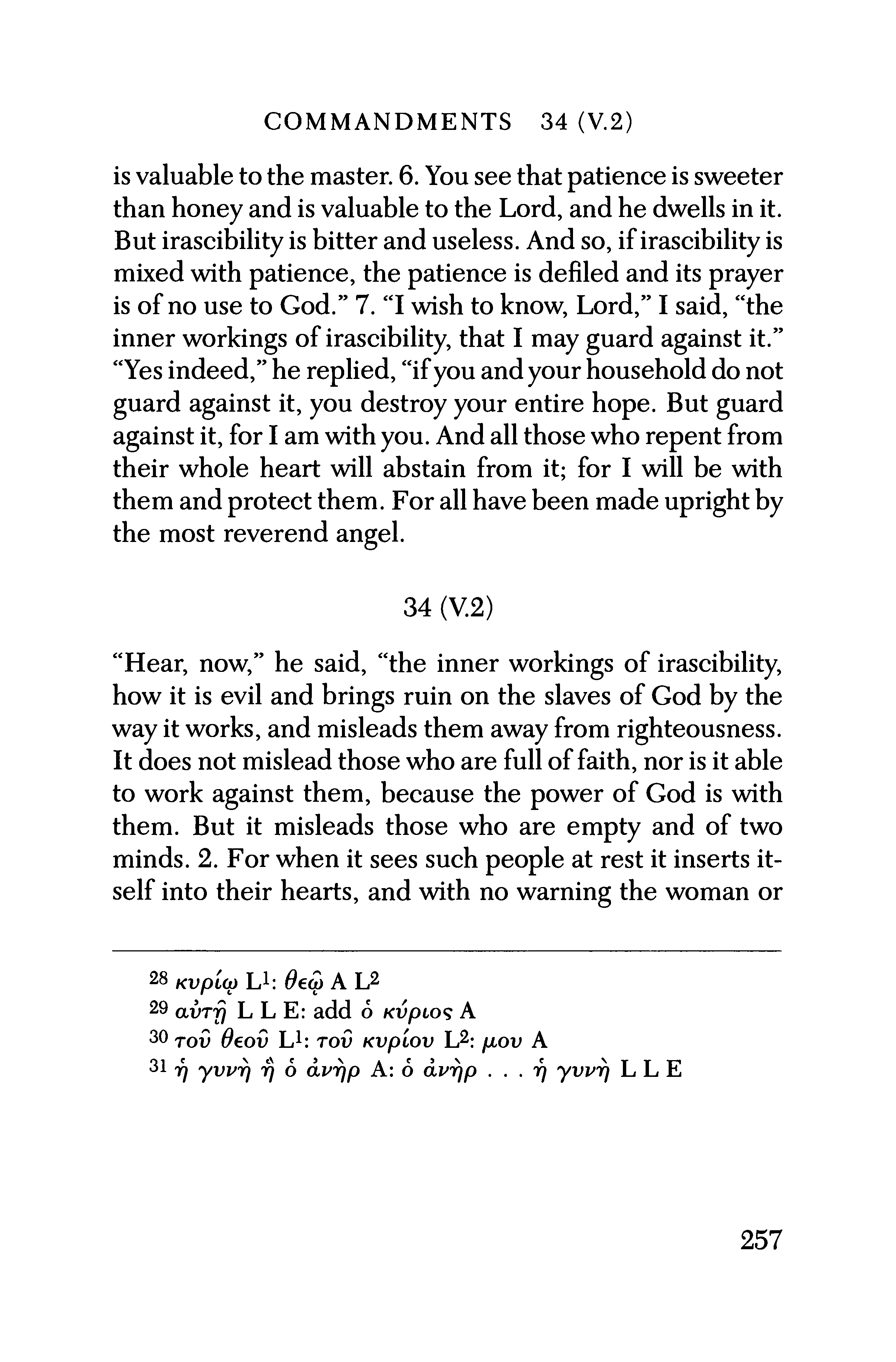
34 (V.2) is valuable to the master. 6. You see that patience is sweeter than honey and is valuable to the Lord, and he dwells in it.
But irascibility is bitter and useless. And so, if irascibility is mixed with patience, the patience is defiled and its prayer is of no use to God." 7. "I wish to know, Lord," I said, "the inner workings of irascibility, that I may guard against it."
"Yes indeed," he replied, "if you and your household do not guard against it, you destroy your entire hope. But guard against it, for I am with you. And all those who repent from their whole heart will abstain from it; for I will be with them and protect them. For all have been made upright by the most reverend angel.
34 (V.2) "Hear, now," he said, "the inner workings of irascibility, how it is evil and brings ruin on the slaves of God by the way it works, and misleads them away from righteousness.
It does not mislead those who are full of faith, nor is it able to work against them, because the power of God is with them. But it misleads those who are empty and of two minds. 2. For when it sees such people at rest it inserts it self into their hearts, and with no warning the woman or 28 κνρίω L l : θεώ A L2 29 avrrj L L E: add ό κύριος A 3 0 rod θεον L 1 : rov κνρίον L 2 : μον A 3 1 r) yvvr) rj 6 άνήρ A: 6 άνήρ . . . ή γννή L L Ε
S H E P H E R D OF HERMAS
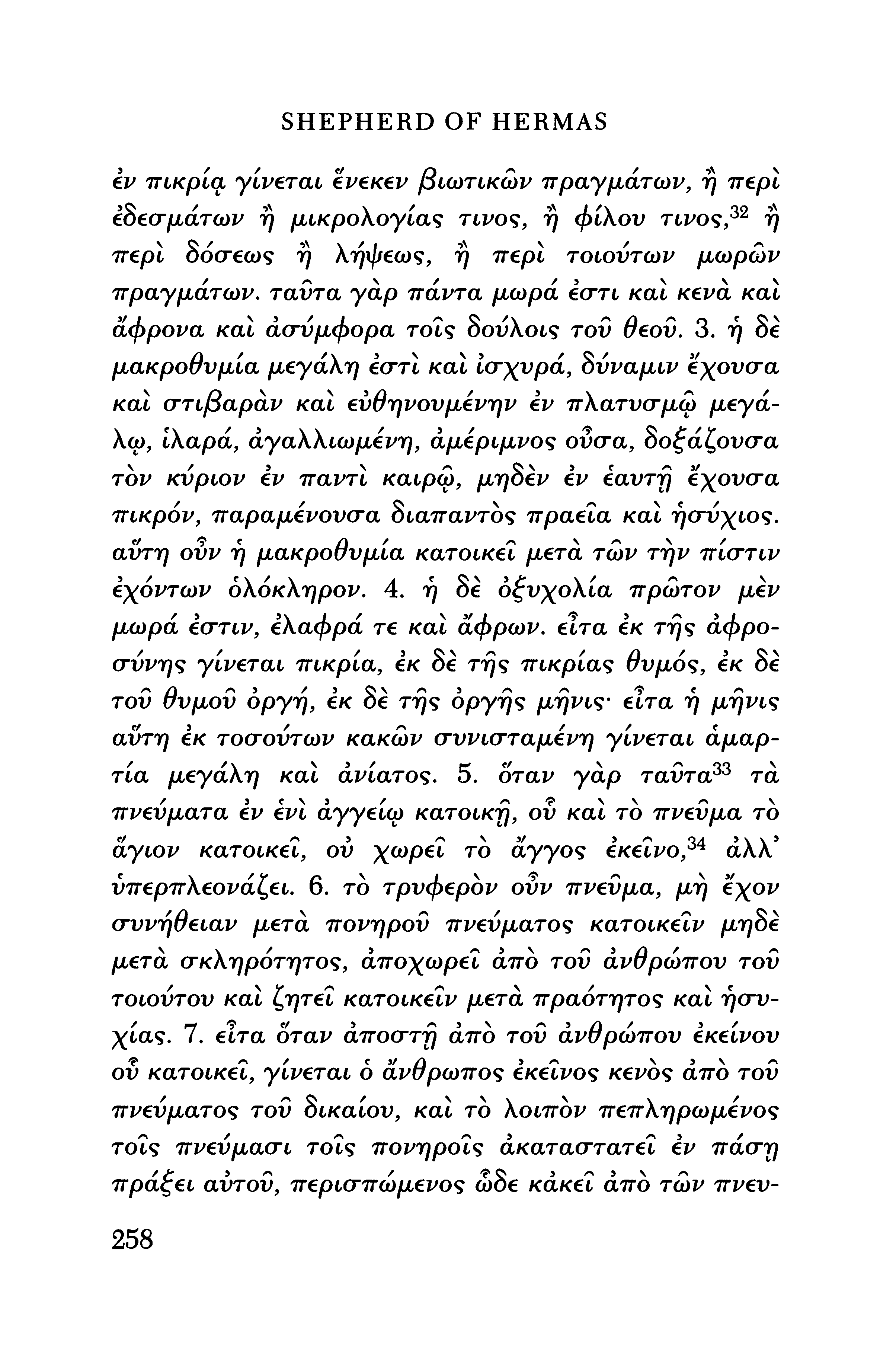
έν πικρία γίνεται ένεκεν βιωτικών πραγράτων, ή περί εδεσμάτων ή μικρολογίας τίνος, ή φίλον τίνος,
ή περί δόσεως ή λήψεως, ή περί τοιούτων μωρών πραγμάτων, ταντα γάρ πάντα ρωρά εστι καϊ κενά καϊ άφρονα καϊ άσύρφορα τοΐς δούλοις τον θεον. 3. ή δέ ρακροθνρία ρεγάλη έστι καϊ ισχυρά, δύναμιν εχονσα καϊ στιβαράν καϊ εύθηνονμένην έν πλατνσμώ μεγάλω, ιλαρά, άγαλλιωμένη, αμέριμνος ούσα, δοξάζονσα τον κνρίον έν παντϊ καιρώ, μηδέν έν έαντή εχονσα πικρόν, παραρένονσα διαπαντός πραεΐα καϊ ήσύχιος. αύτη ονν ή ρακροθνρία κατοικεί ρετά τών τήν πίστιν εχόντων όλόκληρον.
4. ή δέ όζνχολία πρώτον ρέν ρωρά έστιν, ελαφρά τε καϊ άφρων, είτα έκ τής αφρο σύνης γίνεται πικρία, έκ δέ τής πικρίας θνρός, έκ δέ τού θνρού οργή, έκ δέ τής οργής ρήνιςείτα ή ρήνις αύτη έκ τοσούτων κακών σννισταρένη γίνεται άραρτία ρεγάλη καϊ ανίατος.
τά πνεύρατα έν ένϊ άγγείω κατοική, ον καϊ τό πνεύρα τό άγιον κατοικεί, ού χωρεί τό άγγος εκείνο,
6. τό τρνφερόν ονν πνεύμα, μή έχον σννήθειαν μετά πονηρού πνεύρατος κατοικεΐν ρηδέ ρετά σκληρότητος, αποχωρεί άπο τού άνθρωπον τού τοιούτον καϊ ζητεί κατοικεΐν ρετά πραότητος καϊ ήσνχίας. 7. είτα όταν άποστή άπο τού άνθρωπον εκείνον ον κατοικεί, γίνεται ό άνθρωπος εκείνος κενός άπο τού πνεύρατος τού δίκαιον, καϊ τό λοιπόν πεπληρωμένος τοΐς πνεύμασι τοΐς πονηροΐς άκαταστατεΐ έν πάση πράξει αυτού, περισπώμενος ώδε κάκεΐ άπο τών πνεν-
COMMANDMENTS
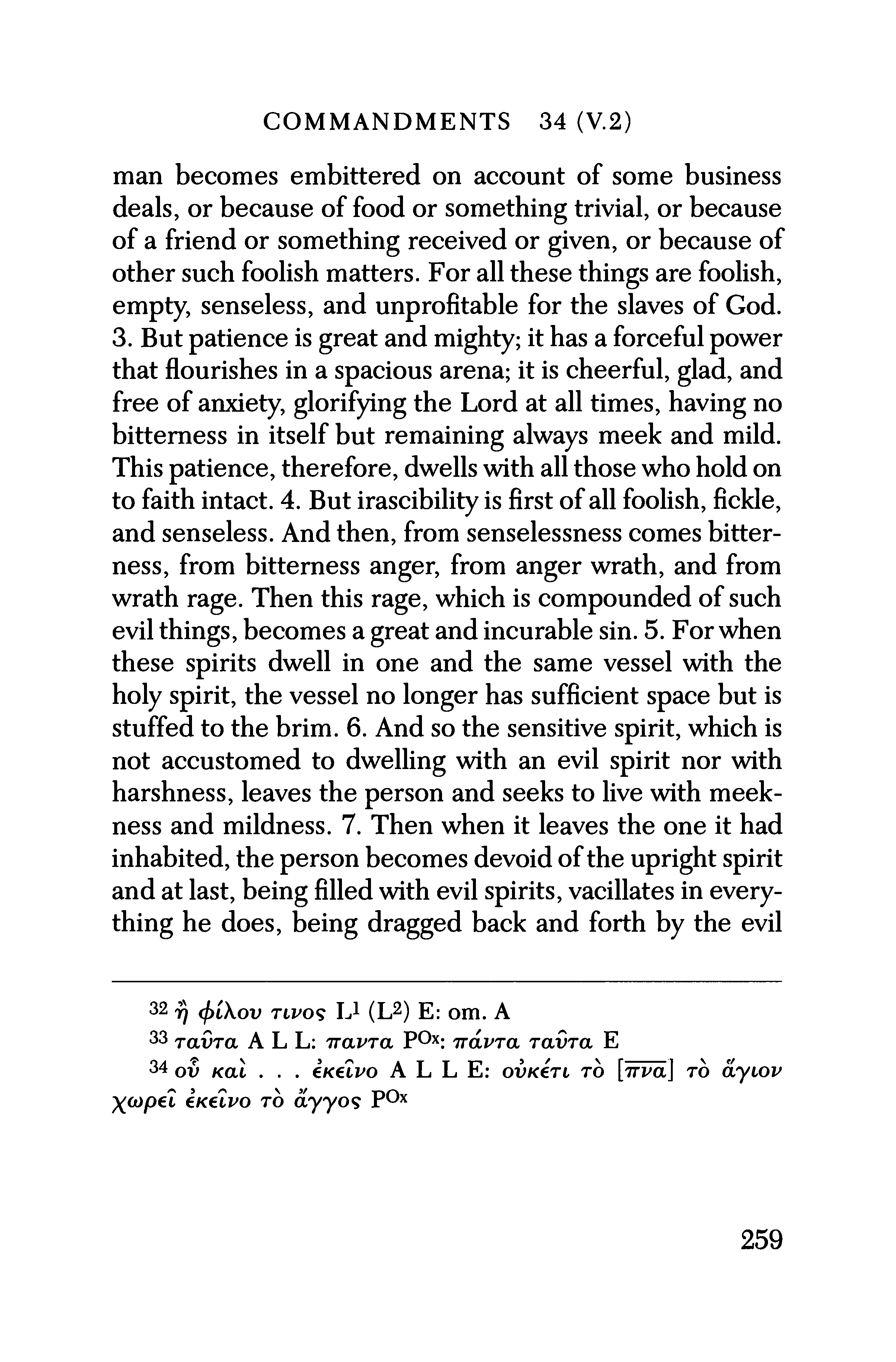
34 (V.2) man becomes embittered on account of some business deals, or because of food or something trivial, or because of a friend or something received or given, or because of other such foolish matters. For all these things are foolish, empty, senseless, and unprofitable for the slaves of God.
3. But patience is great and mighty; it has a forceful power that flourishes in a spacious arena; it is cheerful, glad, and free of anxiety, glorifying the Lord at all times, having no bitterness in itself but remaining always meek and mild.
This patience, therefore, dwells with all those who hold on to faith intact. 4. But irascibility is first of all foolish, fickle, and senseless. And then, from senselessness comes bitter ness, from bitterness anger, from anger wrath, and from wrath rage. Then this rage, which is compounded of such evil things, becomes a great and incurable sin. 5. For when these spirits dwell in one and the same vessel with the holy spirit, the vessel no longer has sufficient space but is stuffed to the brim. 6. And so the sensitive spirit, which is not accustomed to dwelling with an evil spirit nor with harshness, leaves the person and seeks to live with meek ness and mildness. 7. Then when it leaves the one it had inhabited, the person becomes devoid of the upright spirit and at last, being filled with evil spirits, vacillates in every thing he does, being dragged back and forth by the evil
3 2 ή φίλου τίνος L 1 (L 2) Ε: om. A 3 3 ταντα A L L : πάντα P 0 x : πάντα ταντα Ε 3 4 ον καϊ . . . εκείνο A L L Ε: ονκέτι το [πνα] το άγιον χωρεΐ εκείνο το άγγος Ρ ° χ