
Chapter 10 Conclusion: The Compositional History Of The Didache
Chapter 10
CONCLUSION: THE COMPOSITIONAL HISTORY OF THE DIDACHE
The aim of Part I has been to show that the Didache is not a unified whole, but is made up of different redactional layers which themselves incorporate barely adapted, previously existing traditions. Five stages in the composition of the Didache have been identified.
1. The Peri/Base Layer Consisting of:
The Long Title; 1.1-5a; 2.1-5.2a; 6.1-7 A a, c, e, 4a; 9.1-5a; 11.3a, 4-6; 16.1-6, 8-9.
At the foundation of the whole lies the Peri/Base layer. This composition provides a base for the later insertions. From this analysis it is apparent that the author of the Peri/Base layer was concerned to provide instruction regarding baptism, eucharist and apostles. A version of the ancient Jewish
Two Ways teaching was used as a baptismal rule, expanded by the Teknon unit (3.1-7), the Law Summary unit (1.2b, c; 2.1) and a further sayings collection (1.3-5a), itself comprising five originally independent sayings.
The resultant community code was then commended as a whole to those who sought baptism (6.1) and certain other legal details and attitudes added in 6.2-3. A description of the baptismal rite and accompanying fast followed in 7.1a, c, e, 4a, and the eucharist that the initiates were consequently entitled to join (cf. 9.5a) was ordered in 9.1-5a. The Peri/Base layer goes on to consider the management of apostles and then concludes, in traditional style, with an eschatological warning (16.1-6, 8-9) that incorporates a previously existing 'apocalypse' (16.3-6, 8-9).
The practice of incorporating whole sections of previously existing tradition, which themselves had incorporated or gathered further originally separate traditions/sayings, means that the Peri/Base layer includes (excluding the redactional comments of the compiler) nine previously separate units of tradition.
10. Conclusion: The Compositional History of the Didache
2. The Prophet Layer: 10.1-7; 11.7-9, 12; 12.1-5 The creation of the Prophet document appears to have been precipitated by the base document's limitations with regard to the ministry of prophets.
This was the case in that the original teaching on the eucharist (9.1-5a) took no account of the practice of prophesying over the eschatological meal and so failed to regulate this behaviour. Further, the Peri document, if its teaching on apostles was applied to wandering prophets, was in danger of extinguishing the prophetic ministry altogether. Thus, it appears that, in response to the need for fuller teaching on prophets, the Prophet document was written. This document remained faithful to the teaching of the Peri/
Base document where practicable, but re-framed conditions for wandering prophets so that they did not have to be forever on the move to avoid accusations of falsity.
While the Prophet document was initially independent of the Peri/Base document, the similarities of subject and language between these two texts appear to have prompted the later insertion of the Prophet text into the original version of the Didache. The common subject matter and language of Did. 9 and 10 provided a basis for the juxtaposition of the two eucharistic prayers, and the remainder of the Prophet text, concerning the testing and reception of prophets, was considered suitable for insertion after the Base layer's parallel teaching on the reception of apostles (11.3a, 4-6).
The Prophet document, which became the Prophet layer upon incorporation into the Didache, is thus a unified text. Although it appears to have been written under the influence of the Peri/Base layer it does not incorporate (unchanged) any previously existing units of tradition.
3. The Modifying Teacher Layer:
1.5b-6; 5.2b; 7.1b, d, 2-3, 4b; 8.1-2a, 2c-3; 11.1-2, 9-10; 13.1-15.2
The contribution of the modifying teacher is tied, by definition, to the text that it modifies. On this basis it can be confidently concluded that this layer was added to a version of the Didache to which the Prophet document had already been added, since this layer is modified by the teacher's material.
A desire for financial stability appears as a central motivation for the teacher's modifications. This may be seen directly in the modifications regarding giving (1.5b-6) and support for prophet/teachers (13.1-7), and indirectly in the teacher's desire to create institutional differentiation
The Gospel of Matthew's Dependence on the Didache between traditional Judaism and Christianity (7.Id, 2-3,4b; 8.1-2a, 2c-3;
14.1). This had financial implications for the modifier because institutional separation brings with it a channelling of resources away from the old hierarchy and towards the new one (cf. 13.3).
The modifying teacher's efforts to re-draw the rulings of the Didache show a respect for the existing text, inasmuch as orthodoxy is demonstrated by endorsing the existing instructions. However, a desire to challenge the thrust of the basic Teaching prompts the quotation of three alternative traditions (at 1.6; 13.3a, 4-7 and 14.3). The modifier's desire to create institutional separation between Christians and Jews provides a motive for introducing two further traditions, regarding baptism (7.1c, 2-3, 4b) and prayer (8.2c). Consequently, besides the modifying teacher's own contributions, six additional authors are also quoted.
4. Gospel Layer: 8.2b; 113b; 15.3-4 The raw addition of the Prophet document to the Peri/Base text, combined with the subversive activities of the modifying teacher, created a text that was sometimes unclear or self-contradictory. In addition to these difficulties the appearance of Matthew's record of the direct speech of Jesus created a situation where contradictions were not only internal, but also external in relation to Matthew's work. The inclusion of the Gospel layer suggests that an interpolator, recognizing the authority of the Didache but also its conflict with Matthew's Gospel, chose to preserve the text of the Didache at the same time as ultimately subordinating it to the authority of the gospel. Thus, where there is a conflict between the Didache and the gospel regarding prayer (8.2b; 15.4), prophets (11.3b), discipline, almsgiving or any other matter (15.3-4), the authority of the gospel is ultimately upheld.
5. The Jerusalem Addition: 16.7
With the addition of the Gospel layer the history of the basic text comes to a close. Following Matthew's presentation of the teaching of Jesus there was no need for further additions to be made to the Didache. However, in the particular version of the Didache preserved in the Jerusalem manuscript, there was at least one further twist in the tail. The loss of the ending of Did. 16, after verse 8, created an apparent ambiguity as to who would participate in the resurrection. With the loss of a final judgment scene the resurrection appeared to function as an indiscriminate final reward. Using
10. Conclusion: The Compositional History of the Didache
a thread of information remaining from the quotation of Zech. 14.5 in 16.8, a later scribe chose to indicate, by inserting 16.7, that the resurrection of 16.6 was selective, and that therefore only the 'holy ones' would receive this final benefit.
6. Essential Conclusions from Part I For the sake of completeness, Part I attempted to present a full analysis of the compositional history of the Didache. This is a complex task and one that is unlikely to be correct in every detail. Progress towards Part II, however, requires the tenability of just two of these conclusions.
First, it is vital that the Didache should be seen as containing at least two units composed by different authors at different times.1 The foregoing analysis goes well beyond this basic requirement in that it identifies four different redactional layers, of which the first three were said to contain a total of sixteen previously existing units of tradition. This means that my method for establishing Matthew's dependence on the Didache includes, in this regard at least, a substantial margin for error.
One other, more specific, conclusion from the preceding Part is also essential to the following discussion. This is the view, put forward in Chapter 8, that references to the 'gospel' were added after earlier layers of the text had been laid down. On this basis, all parts of the text that predate these additions may theoretically have been available to Matthew. If, as argued in detail above, Did. 8.2b, 11.3b and 15.3-4 represents the full extent of the 'Gospel layer', then Matthew's use of every other part of the text (besides 16.7) cannot be ruled out. By the same token, however, should the Gospel layer be shown to include more text than I have allowed, then any parts so included could not have been used by Matthew.
To sum up, if the diagram overleaf represents an even approximately accurate assessment of the compositional history of the Didache, then the ground is prepared for Part II.
This is vital for the effectiveness of the arguments offered in Part II. A summary of this mode of argument was offered in Chapter 1.
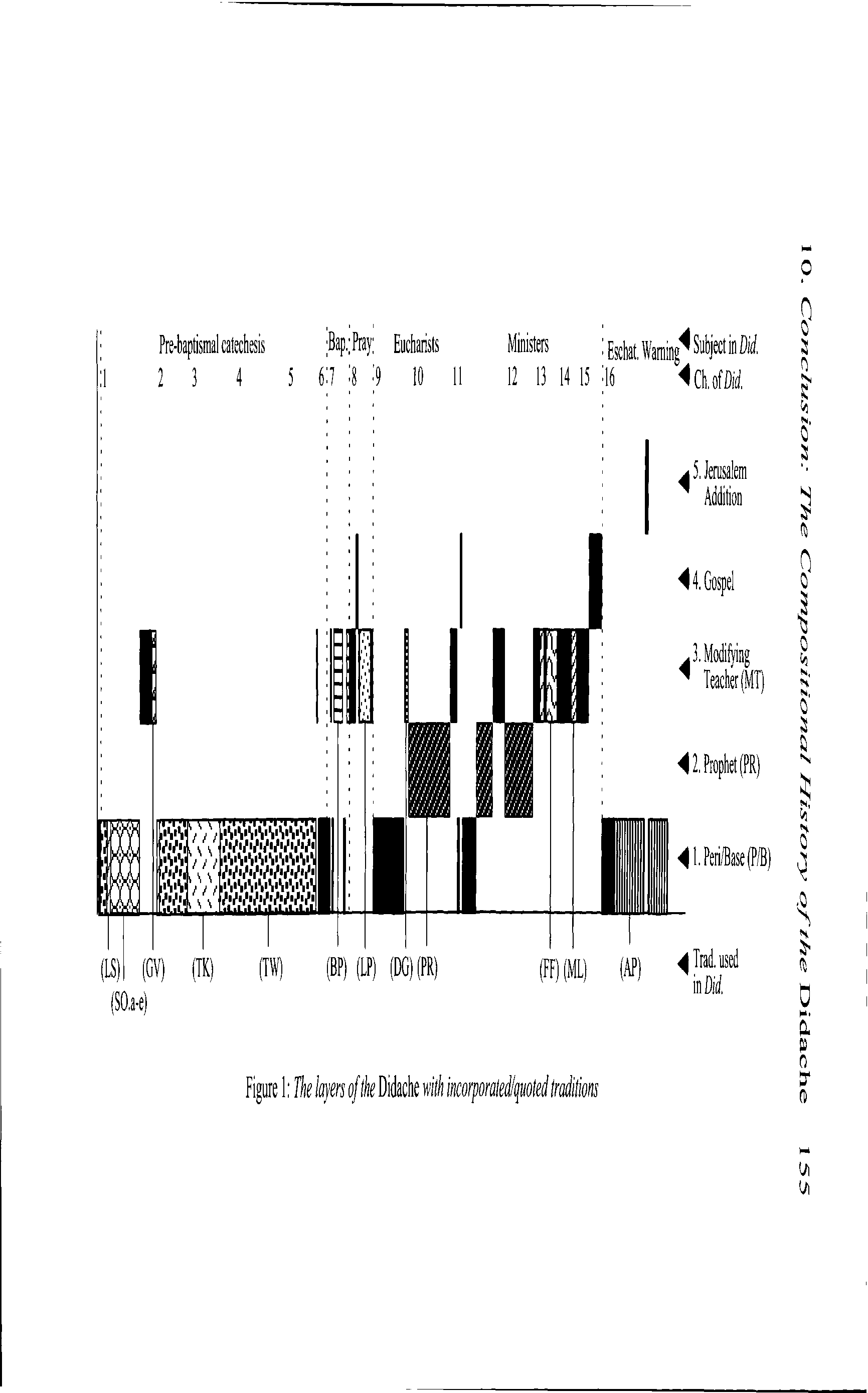
The Gospel of Matthew's Dependence on the Didache 7. Summary Diagram The results of Part I are summarized in Figure 1, opposite. The Didache's chapter numbers, alongside indications of major subject areas, are arranged across the top of the page (note that the long title is included before Did.
1.1). In the body of the diagram the redactional layers rise from the oldest to the youngest.
Patterned blocks indicate sayings and traditions which existed prior to their incorporation into the Didache. A pattern that recurs in two or three places signifies the same tradition on each occasion.
Each incorporated tradition has a two letter label. These correspond to labels used in column B in the text of the Didache at the beginning of this volume. These letters have the following meanings:
Within the Peri/Base layer:
LS = Law Summary unit {Did. 1.2b, d-e; 2.1) SO = Sayings Onion {Did. 1.3-5a) [within the Sayings Onion, a = 1.3b; b = 1.3c; c = 1.4a; d = 1.4b; e = 1.5a]
TK = Teknon unit {Did. 3.1-7) TW= Two Ways {Did. 1.1-2a; 2.2-7; 3.8-5.2a) AP = Apocalypse {Did. 16.3-6, 8-9) The Prophet layer consists of one originally external tradition:
PR = The Prophet Document {Did 10.1-7; 11.7-9, 12; 12.1-5) Within the Modifying Teacher layer:
GV = 'Let the gift sweat in your hand' {Did. 1.6) BP = Threefold baptismal tradition {Did. 7. Id, 2-3, 4b)
LP = Lord's Prayer {Did. 8.2c) DG = 'Do not give what is holy to dogs' {Did. 9.5b)
FF = Firstfruits tradition {Did. 13.3a, 5-7) ML = Malachi 1.11 {Did. 14.3)
SI S"
S § Po I 1. Peri/Base (P/B) 3. Modifying
Teacher (MT) I 2. Prophet (PR) Eschat. Warning^ Subject in Did.
I 5. Jerusalem
^ C h . of Did.
Addition Trad, used 4. Gospel in Did.
(AP) Figure 1: The layers of the Didache with incorporated/quoted traditions
14 15 (SO.a-e) (TK) (TW)
(BP) (LP)
(DG) (PR)
(FF) (ML)
Ministers Pre-baptismal catechesis (LS) (GV)
The Gospel of Matthew's Dependence on the Didache 7. Essential Conclusions from Part I For the sake of completeness, Part I attempted to present a full analysis of the compositional history of the Didache. This is a complex task and one that is unlikely to be correct in every detail. Progress towards Part II, however, requires the tenability of just two of these conclusions.
First, it is vital that the Didache should be seen as containing at least two units composed by different authors at different times.2 The foregoing analysis goes well beyond this basic requirement in that it identifies four different redactional layers, of which the first three were said to contain a total of sixteen previously existing units of tradition. This means that my method for establishing Matthew's dependence on the Didache includes, in this regard at least, a substantial margin for error.
One other, more specific, conclusion from the preceding Part is also essential to the following discussion. This is the view, put forward in Chapter 8, that references to the 'gospel' were added after earlier layers of the text had been laid down. On this basis, all parts of the text that predate these additions may theoretically have been available to Matthew. If, as argued in detail above, Did. 8.2b, 11.3b and 15.3-4 represents the full extent of the 'Gospel layer', then Matthew's use of every other part of the text (besides 16.7) cannot be ruled out. By the same token, however, if the Gospel layer could be shown to include more text than I have allowed, then any parts so included could not have been used by Matthew.
If it may be accepted that various diverse elements of the Didache were composed by more than one author at one time, and that references to 'the gospel' appear in one of the text's later redactional layers, then the ground is prepared for Part II.
This is vital for the effectiveness of the arguments offered in Part II. A summary of this mode of argument was offered in Chapter 1.
Part II
THE POINTS OF CONTACT BETWEEN THE DIDACHE AND
MATTHEW'S GOSPEL
INTRODUCTION TO PART II
The introductory chapter observed that, if the Didache is a multi-layered document, then the presence of four references to 'the gospel' cannot be taken as proving a post-Matthean date for the whole text. It is now possible to add detail to this general observation in the light of Part I.
The foregoing analysis of the Didache'$ composition concludes that the four appeals to 'the gospel' are restricted to a final redactional layer (the Gospel layer 8.2b; 11.3b; 15.3-4). This means that the use of 'gospel' in these verses may not be taken as requiring a similar knowledge of Matthew's Gospel by the rest of the Didache. Indeed the opposite implication might almost be taken, in that the need to subordinate the earlier layers of the Didache to the gospel implies that they were somehow out of tune with that text; a feature which may have arisen through ignorance of Matthew's work. Be that as it may, if 8.2b; 11.3b and 15.3-4 form a final and self-contained layer of the Didache, then references to 'the gospel' in this layer need not be taken as indicating a post-Matthean date for the other layers of the Didache (less the Jerusalem addition at 16.7).
If the references to 'the gospel' do not demonstrate that the earlier layers of the Didache were composed after the writing of Matthew's Gospel, then Matthew's direct dependence upon the first three layers of the Didache becomes a live possibility. Indeed, if the conclusions of Part I are even approximately correct, then it becomes possible to present a positive argument for Matthew's direct dependence on the Didache.
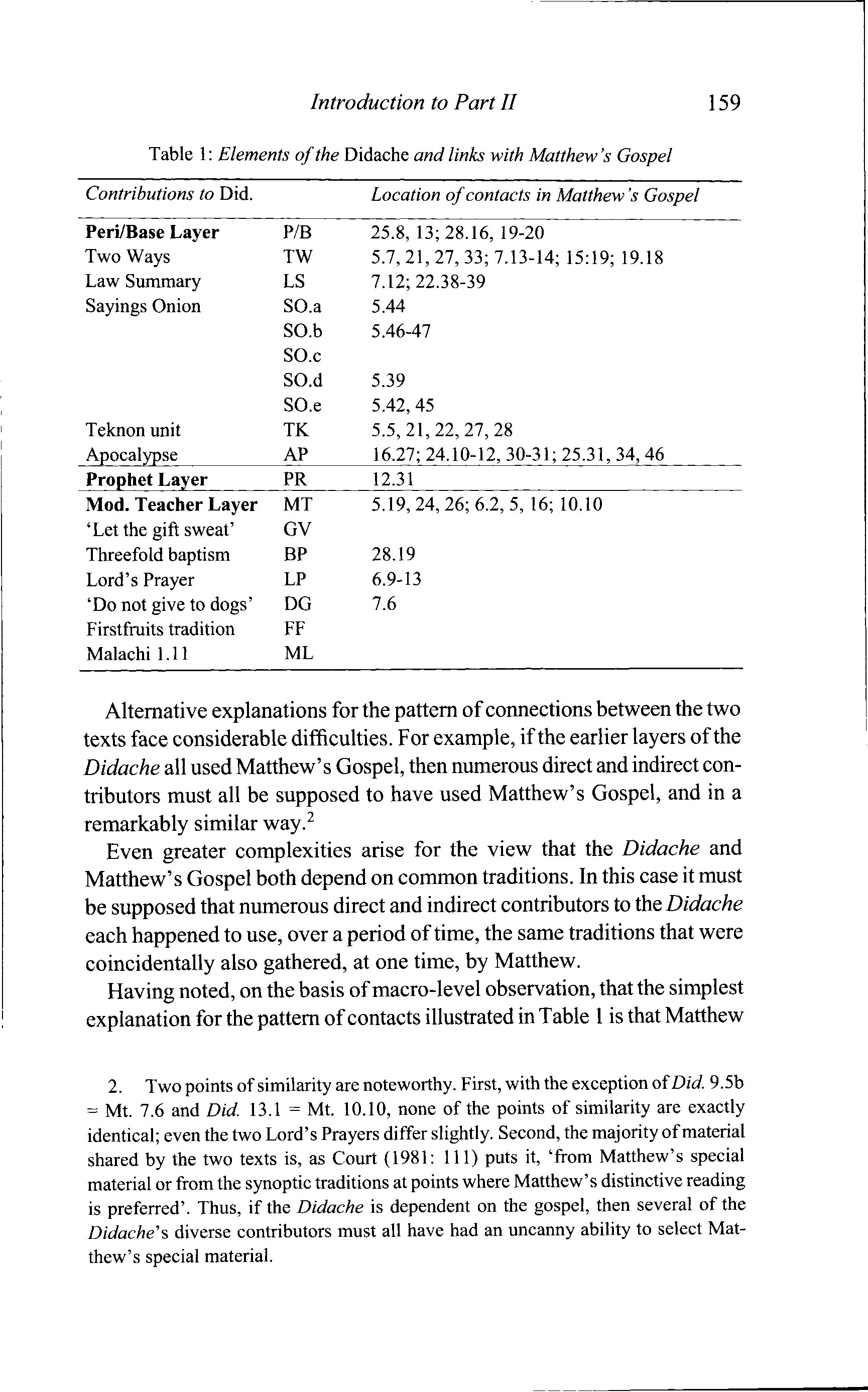
Part I identified 18 separate direct and indirect contributions to the first three layers of the Didache. These are listed below in Table 1 (alongside the two letter codes also used with the text of the Didache at the beginning of this volume). Alongside each of these elements are listed points in Matthew's Gospel commonly observed as having a link with the Didache.l
This table (opposite) shows that 14 of the 18 direct and indirect contributions to the Didache have one or more points of contact with Matthew's
Gospel. Taken at face value, this pattern of connection is most readily explained if the diverse elements of the Didache were brought together by the creators of the first three layers, and the resulting composite document was then used by the author of Matthew's Gospel.
See, for example, links examined and/or listed in, Jefford (1989: esp. 160-61); Court (1981: 111); Massaux (1993: esp. 181-82); Tuckett (1996) and Koster (1957).
Introduction to Part II
Table 1: Elements of the Didache and links with Matthew's Gospel Contributions to Did.
Location of contacts in Matthew's Gospel P/B TW LS SO.a SO.b SO.c SO.d SO.e TK AP PR MT GV BP LP DG FF ML Peri/Base Layer Two Ways Law Summary Sayings Onion 25.8, 13; 28.16, 19-20 5.7, 21, 27, 33; 7.13-14; 15:19; 19.18
7.12; 22.38-39 5.44
5.46-47 5.39
5.42, 45 5.5,21,22,27,28 16.27; 24.10-12, 30-31; 25.31, 34, 46 12.31
5.19, 24, 26; 6.2, 5, 16; 10.10
Teknon unit Apocalypse Prophet Layer Mod. Teacher Layer 'Let the gift sweat'
Threefold baptism Lord's Prayer 28.19
6.9-13 7.6
'Do not give to dogs'
Firstfruits tradition Malachil.ll Alternative explanations for the pattern of connections between the two texts face considerable difficulties. For example, if the earlier layers of the Didache all used Matthew's Gospel, then numerous direct and indirect contributors must all be supposed to have used Matthew's Gospel, and in a remarkably similar way.2
Even greater complexities arise for the view that the Didache and Matthew's Gospel both depend on common traditions. In this case it must be supposed that numerous direct and indirect contributors to the Didache each happened to use, over a period of time, the same traditions that were coincidentally also gathered, at one time, by Matthew.
Having noted, on the basis of macro-level observation, that the simplest explanation for the pattern of contacts illustrated in Table 1 is that Matthew
Two points of similarity are noteworthy. First, with the exception of Did. 9.5b = Mt. 7.6 and Did. 13.1 = Mt. 10.10, none of the points of similarity are exactly identical; even the two Lord's Prayers differ slightly. Second, the majority of material shared by the two texts is, as Court (1981: 111) puts it, 'from Matthew's special material or from the synoptic traditions at points where Matthew's distinctive reading is preferred'. Thus, if the Didache is dependent on the gospel, then several of the Didache's diverse contributors must all have had an uncanny ability to select Matthew's special material.
The Gospel of Matthew's Dependence on the Didache depended directly on the first three layers of the Didache, it is appropriate to test this hypothesis at the micro-level. In testing whether or not each individual point of contact may be credibly understood as due to Matthew's direct use of the Didache it is not necessary to show that this is the only possible explanation for a particular parallel between the two texts. That is to say, the implications of the macro-level observation will only be undermined if, for some reason, the micro-level investigation reveals that Matthew cannot have depended upon the Didache in a particular instance.
Thus, the following studies need only show that Matthew's direct use of the Didache is feasible in each case. However, in the interests of thoroughness, I shall attempt to show that Matthew's direct use of the Didache is probable, and not merely possible, at the majority of their individual points of contact.