
Chapter 12 MATTHEW'S GOSPEL AND THE PROPHET LAYER
Chapter 12
MATTHEW'S GOSPEL AND THE PROPHET LAYER
At the start of the following discussion of the single link between the Prophet layer and Matthew's Gospel {Did. 11.7 = Mt. 12.31) two preliminary points may be recalled. First, as noted in the introduction to Part
II, Matthew's direct knowledge of the first three layers of the Didache provides the simplest explanation for the pattern of contacts between the two texts. Second, the Prophet layer (10.1-7; 11.7-9,12; 12.1-5) is, according to the analysis offered in Part I, modified by the Modifying Teacher layer (at 11.1-2, 10-11 and 13.1-15.2). If, as argued in the preceding chapter, Matthew knew the Modifying Teacher layer, then it follows that he must also have known that which it modified, including the Prophet layer. These two initial points set up the hypothesis of Matthew's direct knowledge of Did. 11.7, which this short chapter is designed to test.
1. The Unforgivable Sin: Matthew 12.31 atfdDidache 11.7
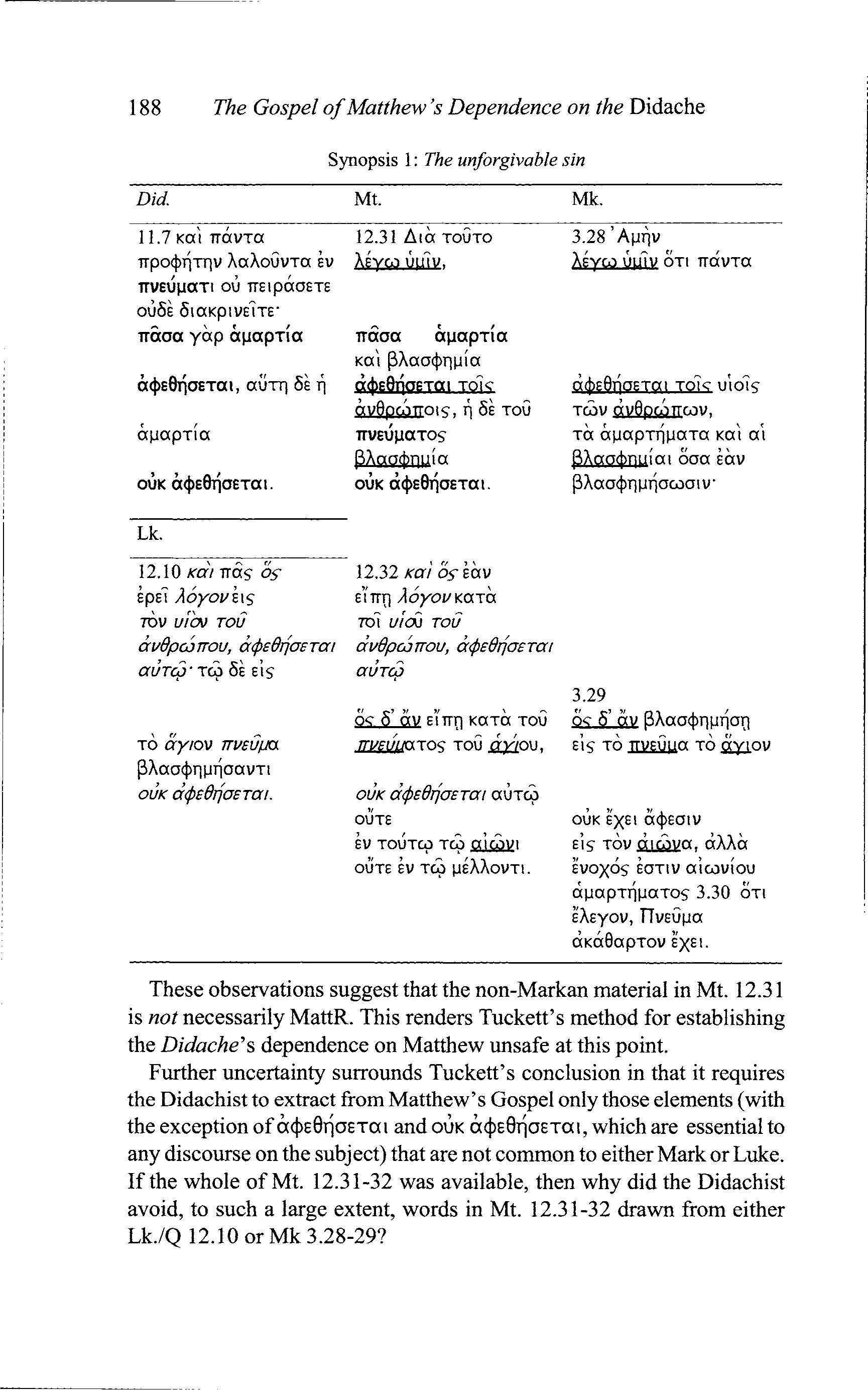
Synopsis 1 (on p. 188) illustrates the verbal and conceptual similarities between Mt. 12.31 and Did. 11.7, and thus suggests that there is likely to be a literary connection between the two. Three types of explanation for this relationship are logically possible. Either, the Didache presupposes/ depends upon Matthew's Gospel, or Matthew presupposes/depends upon the Didache or both texts refer to a common source.
The most recent and exacting exponent of the view that the Didache presupposes Matthew's Gospel is Christopher Tuckett (1996).l
At the heart of Tuckett's case for the Didache's knowledge of Matthew's Gospel is his application of Koster's method for establishing the dependence of one text on another.
Tuckett (1996: 95), who describes this method as 'exemplary', explains its mechanics as follows:
1. Tuckett's article first appeared in 1989.
12. Matthew's Gospel and the Prophet Layer
If material which owes its origin to the redactional activity of [one author] reappears in another work, then the latter presupposes the finished work of [the former].
Tuckett (1996: 95) goes on to warn that one must not rule out the possibility that a feature could have been added to the tradition by two independent redactors. Nor should one assume that any dependence which is established on the basis of this criterion is necessarily direct: the later document may be several stages removed from the earlier one.
In the final analysis, however, Tuckett (1996: 95) concludes that this criterion is really the only one which ultimately can determine whether
[one text presupposes another].
The application of this method to the particular instance in hand means that, if Tuckett is able to identify examples of Matthew's redaction of Mark, which also appear in the Did. 11.7, then his case is made. To this end Tuckett (1996:104-105) observes that 'theDidache's wording agrees exactly with Matthew's redaction of Mark in Mt 12.31/Mk 3.28'.
This bold statement prompts one obvious question: is the non-Markan material in Mt. 12.31 necessarily original to Matthew, that is, MattR?
There is nothing in Matthew's additions to Lk./Q 12.10 and Mk 3.28-29 which could be described as necessarily Matthean. Further, there is no clear motive for the creation of such additions since Matthew appears to have conflated the parallel traditions preserved by Mark and Luke,2 and thus has twice as much material as he needs to express the essential thrust of this passage already. The additional material does nothing to clarify, modify or otherwise enhance the (somewhat obscure) point being made, and so sits uneasily under the description 'MattR'.
If Matthew's inclusion of these additional elements is unlikely to have been driven by a clarifying or modifying motive, then it is possible that some other factor was at work. An author who sought to conflate Mk
3.28-29 and Lk./Q 12.10 with some other source might reasonably be expected to create a long-winded discourse such as Mt. 12.31-32. It is plausible, therefore, that what Tuckett ascribes to MattR is in fact the product of Matthew's attempt to be faithful to an additional source.
Koster (1957: 216) expresses the confident belief that Matthew combines the Markan and Q versions of this saying.
The Gospel of Matthew's Dependence on the Didache Synopsis 1: The unforgivable sin Did Mt.
Mk.
11.7 Ken TTavTcc 12.31 Aid TOUTO
3.28'AMIIV
AEVCO umv OTI TTpoc(>rJTr|V AaAouvTa EV Asyco UJJIV.
TTVEUHaTl OU TTElpdoETE O\J5E SiaKpivslTE* iraaa yap ajjapTia TTaoa apapTia KCU a(|)£6r)aETai TOIC \s\6is dc|)£8iia£Tai TO1<:
CK^EBTIOETOCI, auTT] SE r| TCOV av8pCOTTCJV» Ta d|japTri|JO(Ta Ka'i ai pAaac()r|iJiai oaa sdv dv8pcoTTOK. r\ 5E TOU djjapTia TTVEU|jaTOS BAaocbrmia OUK a(()E9T]OETai.
OUK ac|>£8Tia£Tai.
Lk.
12.32 Kai o?kav 12.10 Kai Trds of Epsi Aoyovkis 7ov uibo TOU dvdpojTTOu, d(j)£dqo£Tai auTc3'TG?8z sis E'ITTT] Aoyoi/Kcujbi
7OI UIOJ TOU
dvdpcQTrou, d(p£drjo£Tai auTcp 3.29 o<r 5 av pAaoc()r||jrjOT] sis TO TTVsujja TO dyiov 6<? 5' dv E'ITTT] KaTa TOU TrwuuaTOs TOU dy/o\).
TO dytOV 7Tl/£U/L/a OUK d<p£0T]a£Tai auTcp OUK d<p£0rj<J£T(XI.
OUK E'XEI dc|)£aiv EIS TOV diGJva. dAAd OUTE EV TOUTCO TCO cdcJVl E'VOXOS EOTIV aicoviou dpapTTiijaTos 3.30 OTI sAsyov, TTvEujja
OUTE EV TCO JJEAAOVTI.
These observations suggest that the non-Markan material in Mt. 12.31 is not necessarily MattR. This renders Tuckett's method for establishing the Didache'§ dependence on Matthew unsafe at this point.
Further uncertainty surrounds Tuckett's conclusion in that it requires the Didachist to extract from Matthew's Gospel only those elements (with the exception of a<j>E0rjoeTai and OUK ac|)e0TiaeTai, which are essential to any discourse on the subject) that are not common to either Mark or Luke.
If the whole of Mt. 12.31-32 was available, then why did the Didachist avoid, to such a large extent, words in Mt. 12.31-32 drawn from either
Lk./Q 12.10 or Mk 3.28-29?
12. Matthew's Gospel and the Prophet Layer
An alternative explanation for the presence of non-Markan elements in Mt. 12.31 is that Matthew included another source in his conflation of Mk 3.28-29 with Lk./Q 12.10. An entirely suitable candidate for such an additional source is Did. 11.7, a text that shows signs of independent origin,3 addresses the subject in hand, and contains almost every word that Matthew cannot have derived from either Mark or Luke/Q.
Before rushing to conclude, on this basis, that Mt. 12.31 depends on Did. 11.7 one further possible explanation for their similarities must be noted. Koster (1957: 216) observes that Mark's version of the unforgivable sin is almost entirely different from that in Luke. He takes this, with some justification, as showing that a saying of this type circulated in various forms in early Christianity. This makes it possible that Matthew and the Didache both had independent access to a saying, or similar sayings, of this type. Taken in isolation Koster's argument is feasible. However, this explanation for the similarities between Mt. 12.31 and Did. 11.7 requires the hypothecation of yet another lost tradition of which Matthew and the Didache are the sole surviving representatives.
In conclusion, the view that the Didache here presupposes Matthew's finished Gospel, while not impossible, requires superfluous redactional activity on the part of Matthew and remarkably exact selection of those redactional elements by the Didachist. Koster's proposal of a shared common tradition is also technically feasible, but multiplies the hypothecation of lost sources. By contrast, the view that Mt. 12.31 conflates related teaching preserved in Mk. 3.28-29, Lk./Q 12.10 and Did. 11.7 is consistent with Matthew's conflationary practice,4 does not require the additional hypothecation of lost sources, and plausibly explains the shape of Matthew's long-winded treatment of the subject of the unforgivable sin. Of the available options, therefore, the most probable is that Matthew knew and used Did. 11.7.
Koster (1957: 216-17) argues that the Didache contains a more original version of the saying than does any of the Synoptic Gospels. While this type of argument is fraught with difficulty, Koster makes a reasonable case.
For scholars who accept the Two Source Hypothesis it is conventional to see Matthew as an author who conflates 'Q' with Mark's Gospel. For further examples of Matthew's conflationary activity see Chapter 11, § 3.1. and Chapters 13,14 and 15.