Chapter 16 CONCLUSION
Chapter 16
CONCLUSION
Bryennios's discovery of the Didache held out the tantalizing promise of new insight into little known aspects of early Christian belief and practice.
However, ongoing failure to establish its location within the web of early Christian life and literature means that its full potential has yet to be realized.
The aim of this volume has been to secure one dimension of the Didache's original context. I chose to examine its relationship to Matthew's
Gospel because some form of connection with this gospel is all but undeniable. Of course, there is a world of difference between establishing
'some form of connection' and pinpointing a connection of a particular type. In this case, however, two factors promised to overcome the usual problem of perpetually reversible dependency arguments: Matthew's Gospel and the Didache share numerous unique similarities and the Didache is a distinctively composite creation. I use the term 'distinctively composite' to convey the sense, not only that the Didache was laid down in layers, but also that it contains previously existing elements that have maintained their prior form. To use a crude illustration, the Didache may be likened to a fish pie within which whole fish and substantial pieces offish, of distinctly different types, may still be distinguished (for example, the Two
Ways tractate, the Sayings Onion, the Teknon unit, the Prophet Document, the closing Apocalypse, and so on).
The composite character of the Didache promises to provide a means of establishing its relationship to Matthew's Gospel because points of connection between the two texts occur within so many of the separate elements incorporated into the Didache, as well as within the editorial comments of the Didache's direct contributors. This combination of factors is best explained, I propose, if Matthew took small pieces from the variety of separate whole traditions within the Didache's 'pie', as well as from the editorial comment that surrounds them, and mixed them, with related resources from elsewhere, to make a dish in which whole distinct tradi-
16. Conclusion
tions are no longer apparent. Rather, Matthew's creation is one in which elements from different resources are thoroughly mixed together to create a unified whole.1
While accepting the limitations of this analogy it succeeds in holding simultaneously in view the distinctively composite nature of the Didache as well as the presence of multiple contacts between the two texts. If my
'fish pie' analogy is even approximately correct, then the two mainstream explanations for the texts' relationship face considerable difficulties.
Take, to begin with, the idea that the Didache consistently depends upon Matthew's Gospel. This proposal requires the various creators of the whole traditions that ultimately became incorporated into the Didache, separately and in each case, to refer to fragments of Matthew's Gospel in the process of creating these whole and self-contained traditions. Not only that but they must also be supposed to have selected fragments that are often widely dispersed in Matthew's Gospel and closely conflated with material from other sources. In addition to the activity of these indirect contributors it is also necessary to propose a repeated homage to Matthew's Gospel by editors who directly contributed to the Didache, most particularly the editor of the third redactional layer.2 As a result, therefore, it is necessary to imagine a queue of indirect contributors, each with diverse backgrounds, interests and styles, lining up over a period of time to draw inspiration from 1.
Analogies, while useful in some respects, are seldom capable of conveying the full complexity of the case. The analogy of the unified fish pie is, strictly speaking, most appropriate when applied to Matthew's teaching discourses, such as the Sermon on the Mount and the Apocalyptic Discourse. Most scholars recognize a combination of literary craftsmanship combined with a use of prior sources in the construction of Jesus' speeches. Carson, while arguing for the unity of the text, bears witness to a general recognition that this unity was forged, largely successfully, by the combination of prior sources. Carson (1984: 17) thus states: 'The question of the unity of Matthew's
Gospel has little to do with source-critical questions. Instead it deals with how well the evangelist has integrated his material to form cohesive pericopes and a coherent whole. In sections very difficult to interpret (e.g., Matt 24), it is sometimes argued that the evangelist has sewn together diverse traditions that by nature are incapable of genuine coherence. Failing to understand the material, he simply passed it on without recognizing that some of his sources were mutually incompatible.
There are so many signs of high literary craftsmanship in this Gospel that such skepticism is unjustified.'
Whether or not my analysis of the compositional history of the Didache is correct in detail, it remains the case that points of contact with Matthew's Gospel occur within parts of the Didache that may, with some confidence, be attributed to both direct and indirect contributors.
The Gospel of Matthew's Dependence on the Didache Matthew's Gospel. Their work must then be gathered by direct contributors who have a similar surgeon's instinct for selecting from the gospel material that is 'from Matthew's special material or from the synoptic traditions at points where Matthew's distinctive rendering is preferred' (Court
1981: 111). This picture is incredible. I conclude, therefore, that the first three layers of the Didache cannot have depended upon Matthew's Gospel.
The majority of scholars in the contemporary debate agree that the Didache did not directly depend on Matthew's Gospel.3 They propose, instead, that both texts held a number of separate traditions in common.
This approach overcomes two important difficulties. First, evidence to suggest the antiquity of the Didache's traditions relative to Matthew's
Gospel need not be over-ridden, since it is possible that the Didache preserves the sources it shares with Matthew more faithfully than did the evangelist. Second, this reading avoids the need for a row of direct and indirect contributors who each picked out fragments of Matthew's special material from Matthew's unified text. Instead, it may be imagined that Matthew and the Didachist both fished in the same pool of early traditions and gathered a number in common. Matthew, it may then be proposed, conflated these with other related material to create substantial discourses as well as shorter speeches of Jesus, while the Didachist preserved them more or less in their original state.
The shared use of common traditions provides an initially plausible explanation for the presence of similar material in both the gospel and the Didache's whole incorporated traditions. Even here, however, high levels of coincidence must be appealed to. The first of which is that Matthew and the Didache must have had access to a range of diverse traditions that are
It is interesting to note that the line of approach used is not based on a compositional analysis. Instead, these scholars tend to prefer 'development' arguments. That is to say, evidence is found to suggest that Matthew's version of a particular saying is, for some reason or another, more developed than the similar saying found in the Didache. A small selection of these types of observation have been made in the preceding discussion. In most cases, however, I have favoured a compositional approach in the belief that this type of argument is less easily reversed than the tracing of supposed developments. Nonetheless, it is noteworthy that arguments in favour of the antiquity of the Didache, in relation to Matthew's Gospel, may consistently be made where they share similar material - even if, on occasion, such arguments are not the only possible explanation for the differences between the two texts. Scholars who detect ancient traditions in the Didache, relative to their counterparts in Matthew's Gospel include, amongst others, Koster (1957); Rordorf (1991); Kloppenborg (1979) and van de Sandt (2002).
16. Conclusion
distinctively similar to one another in comparison with those preserved in other early Christian documents. This implies, not only that they fished at the same lake, but that they fished the same part of that lake at a similar time (without drawing directly from one another's catch). Other factors suggest, however, that this is unlikely to have been the case. The compositional analysis in Part I noted that the Didache's Base layer appears to have been written by a Jew to a Gentile audience and by someone with no identifiable interest in the ministry of prophets. The Prophet layer, by contrast, is solely concerned with regulating, protecting and making viable the prophetic ministry. Then again, the Modifying Teacher layer appears to have been written to an audience with a Jewish, rather than a Gentile, background. Furthermore, this author felt unable to modify the base text directly but was forced to recognize and accept its authoritative status; an authority likely to have been established over a period of time. These factors combine to suggest that these layers were contributed by different editors at different times and in different contexts. This observation decreases the likelihood that Matthew and the Didachists fished the same part of the lake at the same time, thus increasing the coincidence required to explain their shared knowledge of otherwise unknown forms of tradition. On the other hand, this difficulty does not arise if Matthew knew and used the Didache. In this case there would be nothing surprising about the reappearance in Matthew's Gospel of elements from several of the Didache's diverse range of incorporated traditions.
The independent use of shared traditions requires an even greater level of coincidence when it is observed that these separate traditions are sometimes similarly juxtaposed by both Matthew and the Didache. For example, the concept of two ways is juxtaposed with the golden rule in Did. 1.1
(TW)4 and 1.2e (LS); while a similar combination appears in Mt. 7.13 and 7.12. Instructions to be meek and merciful occur in Did. 3.7 (TK) and 3.8
(TW); and also in Mt. 5.5 and 5.7. A call for perfection is linked with loving beyond those who love you in Did. 1.4b(r) (P/B) and 1.3c (SO.b); and also in Mt. 5.46, 47 and 5.48. Separate traditions set alongside one another in the Didache also re-appear in similar juxtaposition in Matthew's account of Jesus' response to the rich young ruler. Thus, Matthew combines the idea of entering life (Mt. 19.17) with a keeping of the commandments
The two letter codes used in this discussion refer to separate traditions identified as having been incorporated into the Didache during the process of its composition (cf. Part I). A key to these codes may be found in the introduction to the full text of the Didache at the beginning of this volume.
The Gospel of Matthew's Dependence on the Didache (Mt. 19.18), including love of neighbour (Mt. 19.19), to attain the goal of moral perfection (Mt. 19.21). A uniquely similar arrangement appears in the Didache's combination of the 'way of life' (Did. 1.1 - TW) with a demand to love the neighbour (Did. 1.2d - LS) to attain moral perfection
(Did. 1.4b[r] - P/B) and keep the commandments (Did. 2.2 - TW). On the other hand, complex coincidence need not be appealed to if Matthew knew and used the Didache directly. In this case the reappearance of separate traditions in similar juxtaposition is entirely to be expected.5
Although demanding high levels of coincidence, an appeal to the independent use of shared traditions provides a theoretically possible explanation for similarities to Matthew's Gospel that occur within one of the Didache's incorporated units. However, this explanation is very much more difficult to apply when the point of contact occurs within the Didache's redactional material. For example, a point of contact falls within Did.
11.1 -2 (= Mt. 5.17-20) which is highly likely to be an original creation of the modifying teacher (cf. Chapter 11, section 4 and Chapter 7, section 4).
There are also strong reasons for supposing that Did. 1.5b is an original composition, crafted for this specific location, by the modifying teacher.
First, it only makes sense in response to the preceding instructions regarding giving. Second, resort is made to an obscure proverb, in Did. 1.6, to support the authority of 1.5b. This suggests that 1.5b has no previous authoritative pedigree of its own and thus, that the reappearance of a reference to paying back the last penny in Mt. 5.26 is unlikely to be due to the shared use of a common tradition.6 A very similar circumstance occurs in Did. 14.2, where the modifying teacher calls readers to be reconciled before making sacrifice. Support for this instruction is sought, in Did.
14.3, from the tangentially relevant Mai. 1.11. This suggests that Did. 14.2 did not have a prior pedigree of its own to which appeal could be made, a circumstance that sits at odds with Matthew's apparent knowledge of a saying of the Lord that directly addresses the relevant subject (Mt. 5.24).
If both texts depended on a common source, then why does Matthew present it as a saying of Jesus, while the modifier mentions no authoritative source at all? This problem does not arise, however, if Matthew knew and used Did. 14.2. Under these circumstances the original contribution of 5.
Even though an extraordinary set of coincidences is required, it is still theoretically possible that Matthew and the Didachists made independent use of several previously existing traditions, perhaps already clustered in groups. However, to account for the spread of points of contact between the two texts any such clusters would need to be so large as to be all but indistinguishable from the Didache itself.
For a full discussion of this point see Chapter 11, § 2.
16. Conclusion
the modifying teacher could be understood as a Lord's word because it stood within a text entitled 'The Teaching of the Lord, etc.'7
In all, therefore, an explanation for the several similarities between Matthew's Gospel and the Didache which proposes their independent use of common resources must overcome the following difficulties: the coincidental knowledge, at different times and circumstances, of several forms of tradition that are not known in any other text; the similar juxtaposition, on a number of occasions, of those separate traditions; and Matthew's consistent attribution of all this material to Jesus, even though the original creativity of one of the Didache's redactors is evident on at least three occasions. On the other hand, if Matthew directly used the Didache, then none of these factors presents a difficulty. Under these circumstances it would be natural to expect redactional as well as traditional elements within the Didache to reappear in the gospel, sometimes in similar combination.
Further, it would be unsurprising to find this material consistently treated as the direct speech of Jesus, since, from Matthew's point of view, it all appears under the title, The Teaching of the Lord, by the Twelve Apostles, to the Gentiles'.
So far I have pointed out complications facing the two mainstream explanations for the connections between the Didache and Matthew's Gospel, while at the same time seeking to show that these difficulties do not apply if Matthew depended directly on the Didache. If this latter solution is so simple, it may reasonably be asked, then why has it not been seriously considered in the past? I offered an initial response to this question in Chapter 1, but must now return to the crucial matter of the presence of four appeals to 'the gospel' in Did. 8.2b, 11.3b and 15.3-4.
These references to a 'gospel' present an obvious obstacle to the view that Matthew directly depended upon the Didache. If, as is highly likely, these lines were written with knowledge of Matthew's Gospel,8 then a significant qualification must be added to any theory of Matthew's use of the Didache; namely, that the references to 'the gospel' were inserted after the Didache's earlier layers had been made use of by Matthew.
For a full discussion of this point see Chapter 11, § 1. Additional points of contact that fall within direct contributions to the Didache (on the basis of the analysis presented in Part I) include: the long title, the call to be perfect (1.4b[r]), and the linking verses prior to the closing apocalypse (16.1-2).
Strictly speaking, if the 'gospel' referred to was an oral or lost gospel, then it would not follow that these references must have been written after the creation of Matthew's text. However, as discussed in Chapter 8, § 1, it appears highly likely that Matthew's Gospel is in view here.
The Gospel of Matthew's Dependence on the Didache At first sight, this assignment of the gospel references in Did. 8.2b;
11.3b and 15.3-4 to a wholly separate redactional layer may seem a rather lame attempt to sidestep evidence that is hostile to my overall thesis.9 It is not the case, however, that these gospel references present a puzzle for my argument alone, or that they present fewer difficulties for the alternative hypotheses. This can be illustrated by the crucial example of the Lord's
Prayer in Did. 8. What must be wrestled with here is that Did. 8.2b instructs its readers to pray 'as the Lord commanded in his gospel', but the immediately ensuing prayer is unlikely to have appeared in any manuscript of Matthew's work.10 Those who propose the Didache's dependence on Matthew at this point must provide some explanation for the absence of Matthew's version of the prayer. A related problem is posed for those who see the Didache as compiled by someone who sometimes reveals a direct knowledge of Matthew's Gospel, but who prefers to quote that gospel's sources, rather than the gospel itself.11 These scholars must explain why
Jesus direct instructions, as recorded in Matthew's Gospel, are set up as a standard in 8.2b and then set aside in 8.2c.
Since the combination of an appeal to the gospel in 8.2b and its nonquotation in 8.2c presents a puzzle for any theory that sees these two lines as composed by the same author, it may be preferable to see them as belonging to two different redactional layers. Under these circumstances the disjunction between 8.2b and 8.2c need not be due to editorial incompetence, but may be explained in terms of a later contributor's respect for the basic text. Thus, a later interpolator may have wished to point readers to Matthew's version of the Lord's Prayer, while at the same time being unwilling to make direct alterations to the established document. The insertion of 8.2b achieves this goal, even though the resulting text is somewhat awkward. A similar effect is created when the modifying teacher avoids direct revision of the host, but nonetheless manages to alter its force by inserting new material. Here again the reading that results is sometimes awkward and self-contradictory.
As well as providing an explanation for the disjunction between Did.
8.2b and 8.2c, two further factors favour the proposal that 8.2b; 11.3b and 15.3-4 were inserted to subordinate the Didache to Matthew's Gospel.
Full details of my reasoning for the separation of Did. 8.2b; 11.3b and 15.3-4 from the rest of the Didache'?, compositional history may be found in Part I, especially in Chapter 7, §§ 3, 5, 7; Chapter 8, and Chapter 11, § 3.
10. See Chapter 11, §3.1.
11. See the comments of Niederwimmer and Koster quoted on pp. 134-35.
16. Conclusion
First, such an understanding allows each of the four references to 'the gospel' to perform a similar function; something which cannot be achieved if Did. 8.2b is seen as a quotation formula, since it is not possible for Did.
15.3, 4 to operate in this way. Second, this proposal presents a credible motive for the inclusion of appeals to 'the gospel'. Matthew's proposed conflationary practice results in divergences between his text and related teaching in the Didache, which in turn creates a need for guidance as to which set of instructions should be followed. Such guidance is provided by appeal to 'the gospel' at those points where the differences between the two texts are most likely to cause confusion (8.2b; 11.3b and 15.3) as well as a catch-all indication that Matthew's Gospel should be seen as having the final word (15.4). By contrast, it is difficult to detect a credible motive for the inclusion of references to 'the gospel of the Lord' by someone who also added the Lord's Prayer or, for example, rules regarding visitors. In this case the interpolator's additional contributions would be immediately undermined by their simultaneous recognition of the ultimate authority of Matthew's divergent instructions.
On closer inspection, therefore, the assignment of Did. 8.2b; 11.3b and 15.3, 4 to a separate redactional layer provides the only explanation for their inclusion that does not require inconsistent or eccentric behaviour on the part of their contributor. This in turn means that, while there are severe obstacles to the view that the Didache depended on Matthew's Gospel, or that both texts independently used common traditions, there is no barrier to the conclusion that Matthew knew and used the first three layers of the Didache. Indeed, the evidence points overwhelmingly in this direction.
The preceding discussion identified 26 points of contact between the two texts (listed at the end of Chapter 15). Of this total, six fall within material attributed to the original creativity of the Didache's redactors, while the remainder occur within 11 of the 15 passages identified as separate traditions incorporated into the Didache. Individual analyses of each of these points of contact found positive evidence for Matthew's knowledge of the Didache in 22 of the 26 instances, and found no evidence to preclude
Matthew's direct knowledge of the Didache in the other four. Even if my specific identification of layers and incorporated traditions within the Didache is inaccurate or incomplete, it remains undeniable both that the Didache has a distinctively composite character, and that it contains widely dispersed and unique points of contact with Matthew's Gospel. I conclude that the only credible explanation for this combination of factors is Matthew's direct dependence on those elements of the Didache that pre-date the interpolation of the four appeals to external authority of 'the gospel'.
The Gospel of Matthew ys Dependence on the Didache When Archbishop Bryennios stumbled across a manuscript of the Didache he came to believe that he had made a sensational find. However, ongoing failure to establish its location within the web of early Christian life and literature has severely weakened the impact of his discovery. The above case for Matthew's direct knowledge of the Didache will, I hope, lead to a secure appraisal of the Didache's place within the life of the first
Christians.12 Once this location has been established, the frustrated potential of Bryennios's remarkable discovery may finally come to fruition.13
12. The hypothesis of Matthew's use of the Didache opens up a number of new questions, or places old questions in a new light. Among these are the nature of the Didache*s relationship to the several other texts of the New Testament with which it shares points of contact. A very partial exploration of this question has been undertaken above in relation to Luke's and Mark's Gospels and, to an even lesser extent, with regard to 1 Corinthians and Revelation. If the Didache is a pre-Matthean text, then studies of its relationship to other first-century texts should serve, not only to confirm this conclusion, but also to assist in the more specific identification of the Didache's dates, authorships and provenances.
13. If Matthew knew the Didache then a great many implications follow, some of which are noted in the preceding discussion. One implication treated in partial detail is that the Didache provides evidence for a new solution to the Synoptic Problem; namely, that Matthew used Mark's Gospel to provide the spine of his account and supplemented this with relevant material from the Didache, Luke's Gospel (possibly
Revelation) and other sources. This solution places the Didache in a 'Q-like' position in that there is evidence for Luke's and Matthew's combined knowledge of the Base layer of the Didache. However, the Didache also provides evidence for Matthew's direct knowledge of Luke's Gospel, thus obviating the need for a more extensive 'Q' to explain the remainder of the double tradition. This provides an example of how a new perspective on the Didache opens up the possibility of new solutions to otherwise unsolved puzzles. The Didache's ability to answer this and other questions will provide its own means of further identifying and confirming its place amongst the documents of the first Christians.
BIBLIOGRAPHY
Aldridge, R.E.
Alfonsi, L.
'The Lost Ending of the Didache\ VigChr 53: 1-15.
4 Aspetti della struttura letteraria della AI5C<XTI\ Studi classic! in onore de Q.
Cataudella 2: 465-81.
Alon, G.
'Halakah in the Teaching of the Twelve Apostles {Didache)\ in Draper (ed.) 1996:165-94.
Audet, J.-P.
'Affinites Litteraires et Doctrinales du "Manuel de Discipline"', Revue Biblique 59: 219-38.
La Didache. Instructions des Apotres (Etudes bibliques; Paris: Gabalda).
'Literary and Doctrinal Relationships of the "Manual of Discipline'", in Draper (ed.) 1996: 129-47.
Balabanski, V.
Eschatology in the Making: Mark, Matthew and the Didache (SNTSMS, 97; Cambridge: Cambridge University Press).
Bammel, E.
'Pattern and Prototype of Didache 16', in Draper (ed.) 1996: 364-72.
Barr, D.L.
'The Apocalypse of John as oral enactment', Int 40: 243-56.
Bartlet, J.V.
Bauer, W., W.F.
'The Didache Reconsidered', JTS 22: 239-49.
Arndt and F.W. Gingrich A Greek-English Lexicon of the New Testament (Chicago: Chicago Univer-
sity Press).
Benoit, A.
LeBapteme Chretien au Second Siecle: La Theologie de Peres (Paris: Presses Universitaires de France).
Betz, H.D.
The Sermon on the Mount: A Commentary on the Sermon on the Mount, including the Sermon on the Plain (Matthew 5:3-7:27 and Luke 6:20-49)
(Hermeneia; Minneapolis: Fortress Press).
Betz, J.
'The Eucharist in the Didache', in Draper (ed.) 1996: 244-75.
Boring, M.E.
Sayings of the Risen Jesus: Christian Prophecy in the Synoptic Tradition (SNTSMS, 46; Cambridge: Cambridge University Press).
The Gospel of Matthew's Dependence on the Didache Bouley, A.
From Freedom to Formula: The Evolution of the Eucharistic Prayer from Oral Improvisation to Written Texts (Catholic University of America Studies in Christian Antiquity, 21; Washington, DC: Catholic University of America
Press).
Bradshaw, P.F.
Daily Prayer in the Early Church: A Study of the Origin and Early Development of the Divine Office (Alcuin Club Collections, 63; London: SPCK).
Brown, G., and G. Yule
Discourse Analysis (Cambridge Textbooks in Linguistics; Cambridge: Cambridge University Press).
Bryennios, P.
AiSccxri TCOV SCOSEKCX CXTTOOTOACOV EK TOU kpoaoAuniTiKou X£ipoypa<|>ou VUV TTpCOTOV EK5l5o|JEVr) JJETCX TTpoAEyO|JEVCOV KOn ar)MElCOOECOV EV CMS
Ken TT\S IUVOV|;ECOS TTJS TT. A., T % UTTO icoavv, TOU XpuaooTO|jou, auyKpiais KCU [lipos CXVEKSOTOV CXTTO TOU auToux^ipoypcxcfjou (Constantinople: Voutyra).
Bultmann, R.
The History of the Synoptic Tradition (trans. J. Marsh; Oxford: Blackwell).
Butler, B.C.
'The Literary Relations of Didache, Ch. XVF, JTS 11: 265-83.
'The "Two Ways" in the Didache9, JTS 12: 27-38.
Carrington, P.
The Early Christian Church, I (2 vols.; Cambridge: Cambridge University Press).
Carson, D.A.
'Matthew', in F.E. Gaebelein (ed.), The Expositor's Bible Commentary, VIII (Grand Rapids, MI: Zondervan): 1-599.
Catchpole, D.R.
The Quest for Q (Edinburgh: T. & T. Clark).
Cody, A.
'The Didache: An English Translation', in Jefford (ed.) 1995: 3-14.
Connolly, R.H.
'The Use of the Didache in the Didascalia', JTS 24: 147-57.
'The "Didache" in Relation to the Epistle of Barnabas', JTS 33: 237-53.
Court, J.M.
'The Didache and Matthew's Gospel', SJT34: 109-120.
Reading the New Testament (New Testament Readings; London: Routledge).
Creed, J.M.
Cullmann, O.
'The Didache', JTS 39: 370-87.
Early Christian Worship (SBT, 10; London: SCM Press).
The Christology of the New Testament (London: SCM Press).
Dehandschutter, B.
'The Text of the Didache: Some Comments on the Edition of Klaus Wengst', in Jefford (ed.) 1995: 37-46.
Dibelius, M.
'Die Mahl-Gebete der Didache', ZNW31: 32-41.
Bibliography
Dix, G.
The Shape of the Liturgy (Westminster: Dacre).
Downing, F.G.
'Redaction Criticism: Josephus' Antiquities and the Synoptic Gospels',
JSNT 9: 29-AS.
Draper, J.A.
A Commentary on the Didache in the Light of the Dead Sea Scrolls and Related Documents (unpublished PhD dissertation, Cambridge University).
'The Jesus Tradition in the Didache', in D. Wenham (ed.), Gospel Perspectives. V. The Jesus Tradition Outside the Gospels (5 vols.; Sheffield: JSOT
Press): 269-89.
'Torah and Troublesome Apostles in the Didache Community', NovT33A:
347-72.
'Christian Self-Definition against the "Hypocrites" in Didache 8', in E.H.
Lovering (ed.), Society of Biblical Literature 1992 Seminar Papers (Atlanta, GA: Scholars Press): 362-77.
'Social Ambiguity and the Production of Text: Prophets, Teachers, Bishops, and Deacons and the Development of the Jesus Tradition in the Community of the Didache\ in Jefford (ed.) 1995: 284-312.
'The Didache in Modern Research: An Overview', in Draper (ed.) 1996:
1-42.
'The Jesus Tradition in the Didache\ in Draper (ed.) 1996: 72-91.
'Christian Self-Definition against the "Hypocrites" in Didache VHP, in Draper (ed.) 1996: 223-43.
'Torah and Troublesome Apostles in the Didache Community', in Draper (ed.) 1996: 340-63.
Draper, J.A. (ed.)
1996a 1996b 1996c 1996d The Didache in Modern Research (AGJU, 37; Leiden: E.J. Brill)
Drews, P.
'Untersuchungen zur Didache', ZNW5: 53-79.
Dungan, D.L.
The Sayings of Jesus in the Churches of Paul: The Use of the Synoptic Tradition in the Regulation of Early Church Life (Oxford: Basil Blackwell).
Ehrman, B.D.
The Apostolic Fathers, I (LCL, L24; Cambridge, MA: Harvard University Press)
Finkelstein, L.
'The "birkat ha-mazon'", JQR 19: 211-63.
1928-29 Flusser, D.
'Paul's Jewish-Christian Opponents in the Didache\ in Draper (ed.) 1996:
195-211.
Funk, F.X.
Doctrinae duodecim apostolorum, Canones ecclesiastici ac reliquae doctrinae duarum viarum expositiones veteres (Tubingen: Henrici Laupp).
Garrow, A.J.P.
Revelation (New Testament Readings; London: Routledge).
Gero, S.
'The So-called Ointment Prayer in the Coptic Version of the Didache: A Reevaluation', HTR 70: 67-84.
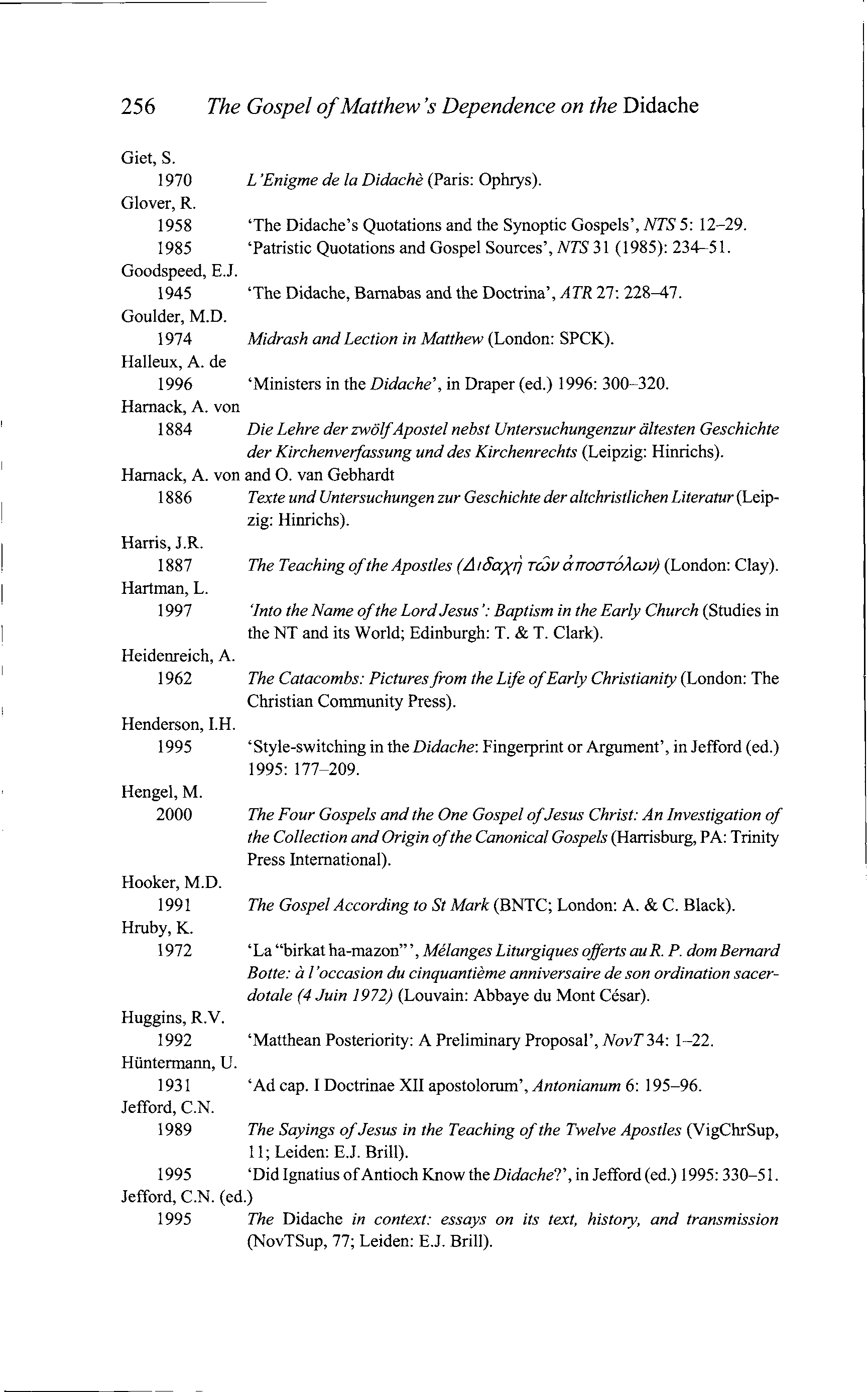
The Gospel of Matthew's Dependence on the Didache Giet, S.
L 'Enigme de la Didache (Paris: Ophrys).
Glover, R.
'The Didache's Quotations and the Synoptic Gospels', NTS 5: 12-29.
'Patristic Quotations and Gospel Sources', NTS 31 (1985): 234-51.
Goodspeed, EJ.
'The Didache, Barnabas and the Doctrina', ATR 27: 228^7.
Goulder, M.D.
Midrash and Lection in Matthew (London: SPCK).
Halleux, A. de
'Ministers in the Didache\ in Draper (ed.) 1996: 300-320.
Harnack, A. von
Die Lehre der zwolfApostel nebst Untersuchungenzur dltesten Geschichte der Kirchenverfassung und des Kirchenrechts (Leipzig: Hinrichs).
Harnack, A. von and O. van Gebhardt
Texte und Untersuchungen zur Geschichte der altchristlichen Literatur (Leipzig: Hinrichs).
Harris, J.R.
The Teaching of the Apostles (A iSaxn TCOV anooroXcov) (London: Clay).
Hartman, L.
'Into the Name of the Lord Jesus': Baptism in the Early Church (Studies in the NT and its World; Edinburgh: T. & T. Clark).
Heidenreich, A.
The Catacombs: Pictures from the Life of Early Christianity (London: The Christian Community Press).
Henderson, I.H.
' Style-switching in the Didache'. Fingerprint or Argument', in Jefford (ed.) 1995: 177-209.
Hengel, M.
The Four Gospels and the One Gospel of Jesus Christ: An Investigation of the Collection and Origin of the Canonical Gospels (Harrisburg, PA: Trinity
Press International).
Hooker, M.D.
The Gospel According to St Mark (BNTC; London: A. & C. Black).
Hruby, K.
' La "birkat ha-mazon"', Melanges Liturgiques ojferts au R. P. dom Bernard Botte: a I 'occasion du cinquantieme anniversaire de son ordination sacerdotale (4 Juin 1972) (Louvain: Abbaye du Mont Cesar).
Huggins, R.V.
'Matthean Posteriority: A Preliminary Proposal', NovT34: 1-22.
Huntermann, U.
'Ad cap. I Doctrinae XII apostolorum', Antonianum 6: 195-96.
Jefford, C.N.
The Sayings of Jesus in the Teaching of the Twelve Apostles (VigChrSup, 11; Leiden: E.J. Brill).
'Did Ignatius of Antioch Know the Didachel\ in Jefford (ed.) 1995: 330-51.
Jefford, C.N. (ed.)
The Didache in context: essays on its text, history, and transmission (NovTSup, 77; Leiden: E.J. Brill).
Bibliography
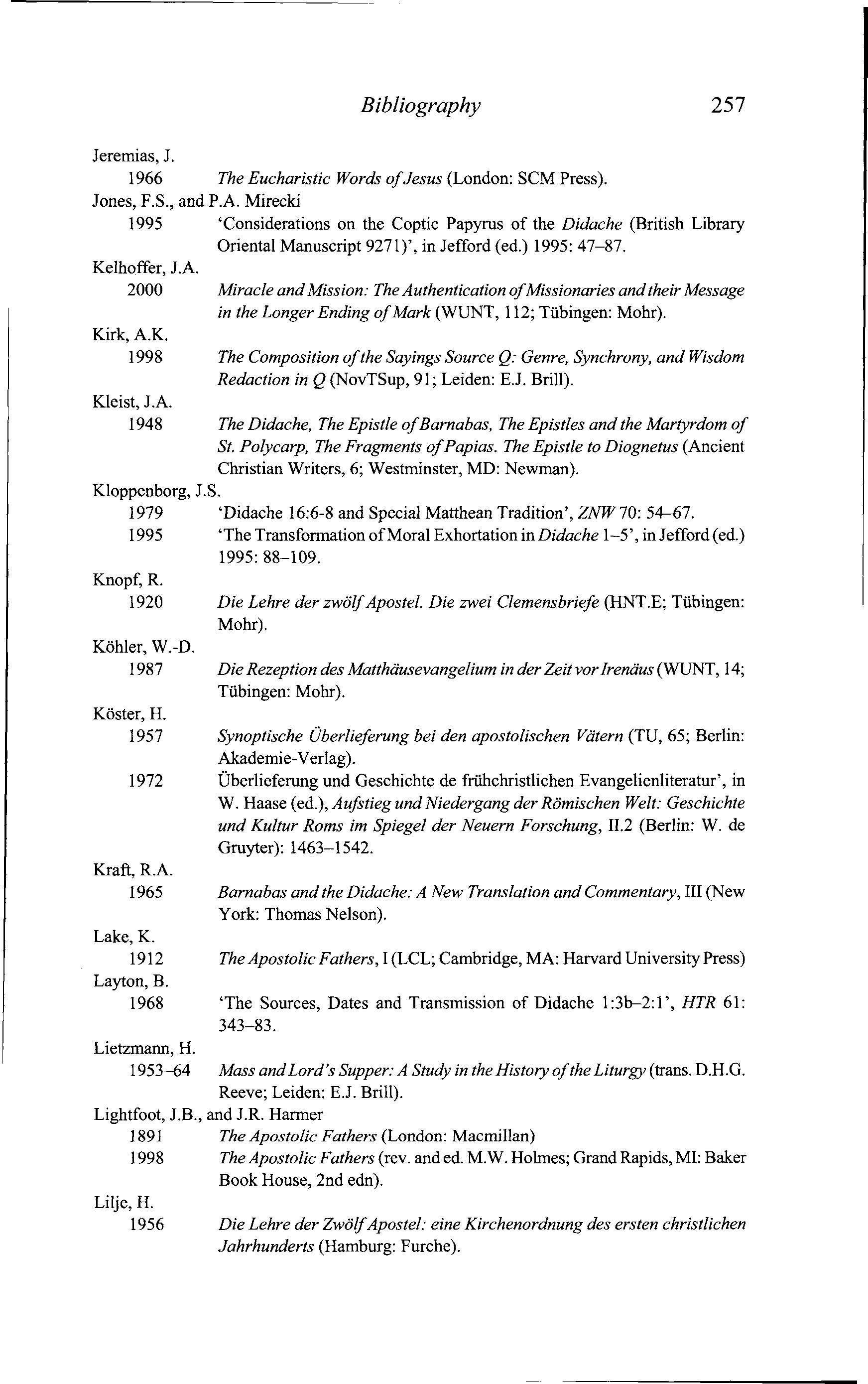
Jeremias, J.
The Eucharistic Words of Jesus (London: SCM Press).
Jones, F.S., and P.A. Mirecki
'Considerations on the Coptic Papyrus of the Didache (British Library Oriental Manuscript 9271)', in Jefford (ed.) 1995: 47-87.
Kelhoffer, J.A.
Miracle and Mission: The Authentication of Missionaries and their Message in the Longer Ending of Mark (WUNT, 112; Tubingen: Mohr).
Kirk, A.K.
The Composition of the Sayings Source Q: Genre, Synchrony, and Wisdom Redaction in Q (NovTSup, 91; Leiden: EJ. Brill).
Kleist, J.A.
The Didache, The Epistle of Barnabas, The Epistles and the Martyrdom of St. Polycarp, The Fragments ofPapias. The Epistle to Diognetus (Ancient
Christian Writers, 6; Westminster, MD: Newman).
Kloppenborg, J.S.
'Didache 16:6-8 and Special Matthean Tradition', ZNW70: 54-67.
' The Transformation of Moral Exhortation in Didache 1 -5', in Jefford (ed.) 1995: 88-109.
Knopf, R.
Die Lehre der zwolfApostel Die zwei Clemensbriefe (HNT.E; Tubingen:
Mohr).
Kohler, W.-D.
Die Rezeption des Matthdusevangelium in der Zeit vor Irendus (WUNT, 14; Tubingen: Mohr).
Koster, H.
Synoptische Uberlieferung bei den apostolischen Va'tern (TU, 65; Berlin:
Akademie-Verlag).
Uberlieferung und Geschichte de fruhchristlichen Evangelienliteratur', in W. Haase (ed.), Aufstieg und Niedergang der Romischen Welt: Geschichte und Kultur Roms im Spiegel der Neuern Forschung, II.2 (Berlin: W. de
Gruyter): 1463-1542.
Kraft, R.A.
Barnabas and the Didache: A New Translation and Commentary, III (New York: Thomas Nelson).
Lake, K.
The Apostolic Fathers, I (LCL; Cambridge, MA: Harvard University Press)
Layton, B.
'The Sources, Dates and Transmission of Didache 1:3b—2:1', HTR 61:
343-83.
Lietzmann, H.
1953-64 Mass and Lord's Supper: A Study in the History of the Liturgy (trans. D.H.G.
Reeve; Leiden: EJ. Brill).
Lightfoot, J.B., and J.R. Harmer
The Apostolic Fathers (London: Macmillan)
The Apostolic Fathers (rev. and ed. M. W. Holmes; Grand Rapids, MI: Baker Book House, 2nd edn).
Lilje, H.
Die Lehre der ZwolfApostel: eine Kirchenordnung des ersten christlichen Jahrhunderts (Hamburg: Furche).
The Gospel of Matthew's Dependence on the Didache Luz, U.
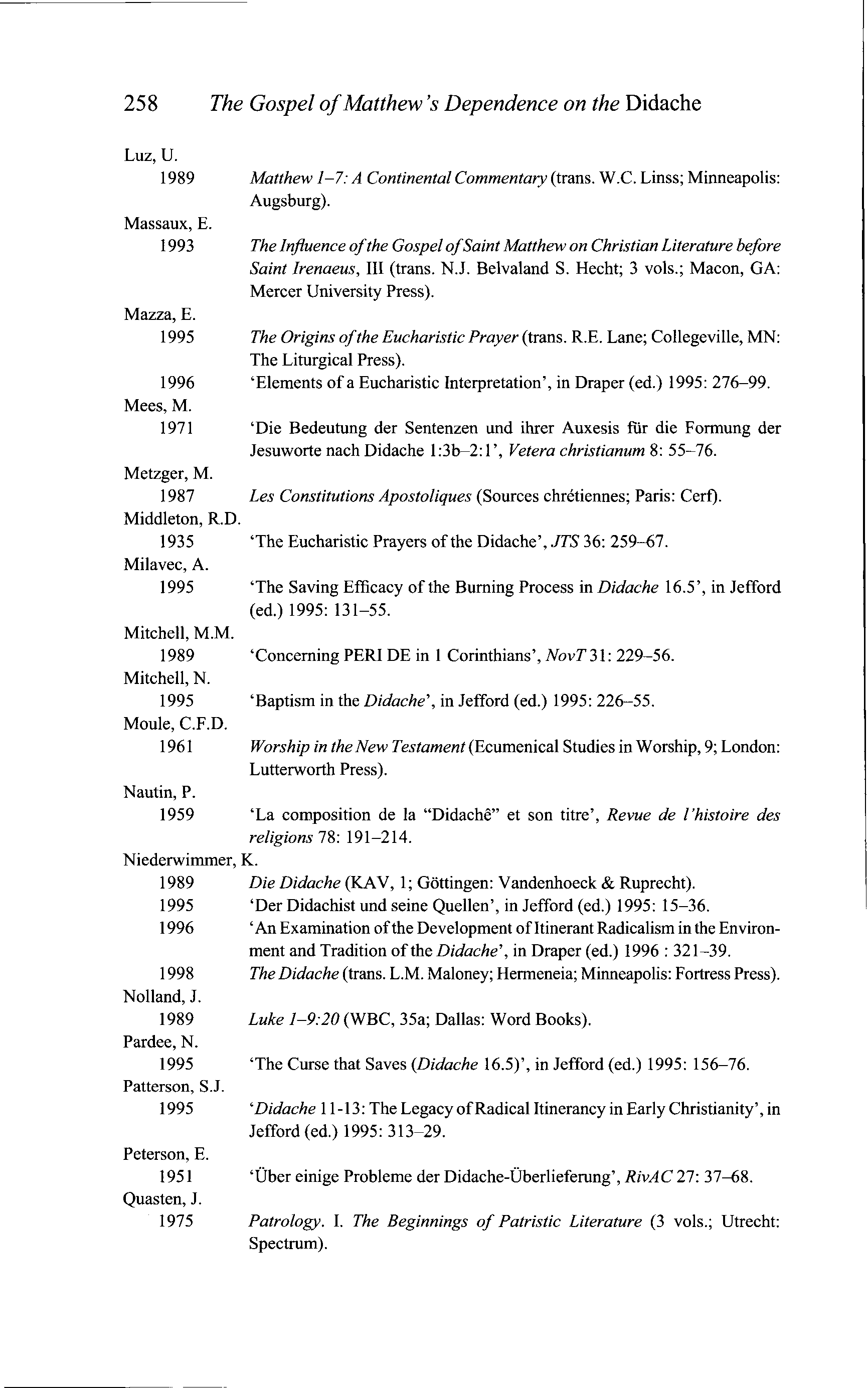
Matthew 1-7: A Continental Commentary (trans. W.C. Linss; Minneapolis:
Augsburg).
Massaux, E.
The Influence of the Gospel of Saint Matthew on Christian Literature before Saint Irenaeus, III (trans. N.J. Belvaland S. Hecht; 3 vols.; Macon, GA:
Mercer University Press).
Mazza, E.
The Origins of the Eucharistic Prayer (trans. R.E. Lane; Collegeville, MN:
The Liturgical Press).
'Elements of a Eucharistic Interpretation', in Draper (ed.) 1995: 276-99.
Mees, M.
'Die Bedeutung der Sentenzen und ihrer Auxesis fur die Formung der Jesuworte nach Didache 1:3b—2:1', Vetera christianum 8: 55-76.
Metzger, M.
Les Constitutions Apostoliques (Sources chretiennes; Paris: Cerf).
Middleton, R.D.
'The Eucharistic Prayers of the Didache', JTS 36: 259-67.
Milavec, A.
'The Saving Efficacy of the Burning Process in Didache 16.5', in Jefford (ed.) 1995: 131-55.
Mitchell, M.M.
'Concerning PERI DE in 1 Corinthians', NovT 31: 229-56.
Mitchell, N.
'Baptism in the Didache\ in Jefford (ed.) 1995: 226-55.
Moule, C.F.D.
Worship in the New Testament (Ecumenical Studies in Worship, 9; London:
Lutterworth Press).
Nautin, P.
'La composition de la "Didache" et son titre', Revue de I'histoire des religions 78: 191-214.
Niederwimmer, K.
Die Didache (KAV, 1; Gottingen: Vandenhoeck & Ruprecht).
'Der Didachist und seine Quellen', in Jefford (ed.) 1995: 15-36.
'An Examination of the Development of Itinerant Radicalism in the Environment and Tradition of the Didache\ in Draper (ed.) 1996 : 321-39.
The Didache (trans. L.M. Maloney; Hermeneia; Minneapolis: Fortress Press).
Nolland, J.
Luke 1-9:20 (WBC, 35a; Dallas: Word Books).
Pardee, N.
'The Curse that Saves {Didache 16.5)', in Jefford (ed.) 1995: 156-76.
Patterson, S.J.
'Didache 11-13: The Legacy of Radical Itinerancy in Early Christianity', in Jefford (ed.) 1995: 313-29.
Peterson, E.
'Uber einige Probleme der Didache-Uberlieferung', RivAC 27: 37-68.
Quasten, J.
Patrology. I. The Beginnings of Patristic Literature (3 vols.; Utrecht:
Spectrum).
Bibliography
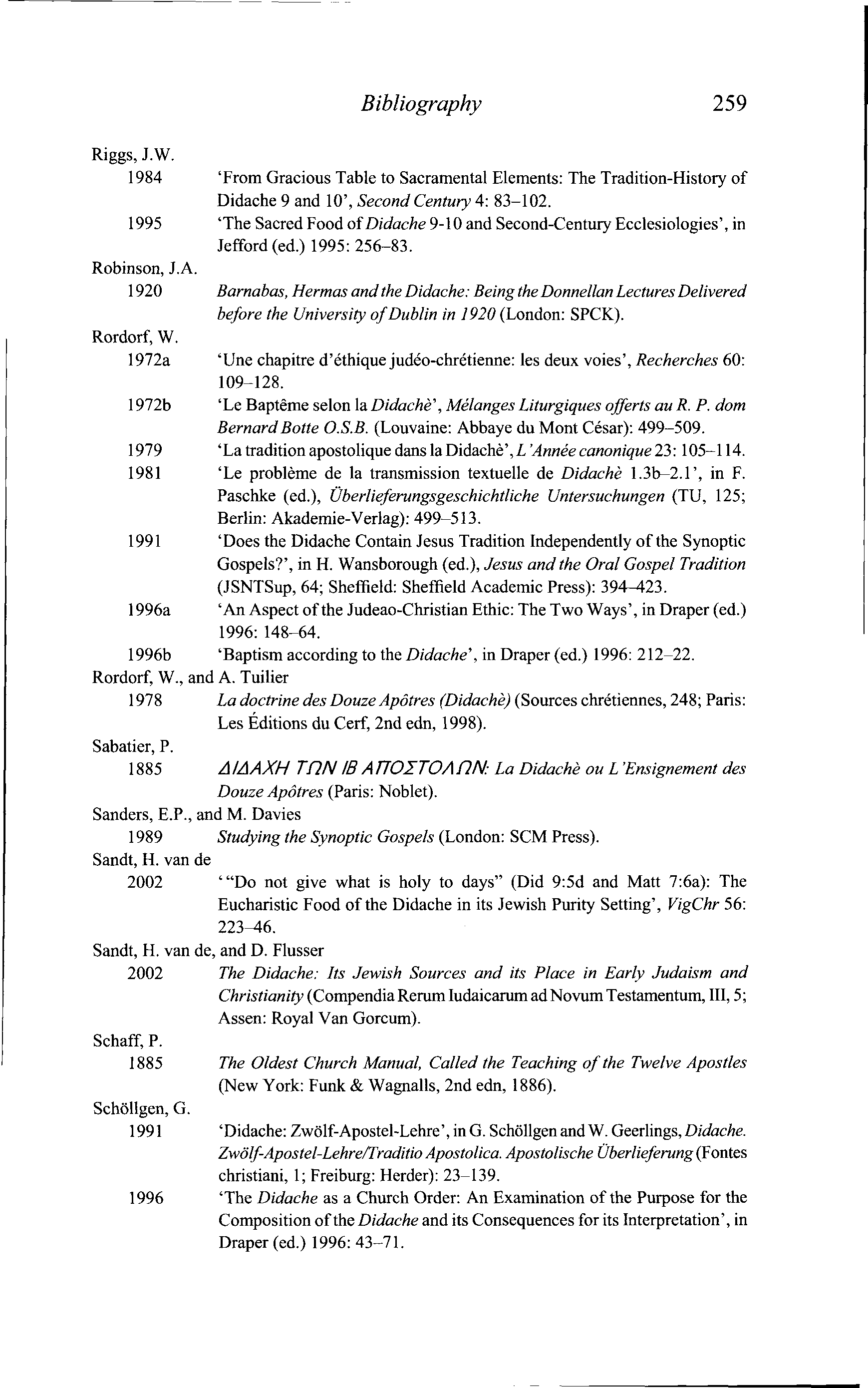
Riggs, J.W.
'From Gracious Table to Sacramental Elements: The Tradition-History of Didache 9 and 10', Second Century 4: 83-102.
'The Sacred Food of Didache 9-10 and Second-Century Ecclesiologies', in Jefford(ed.) 1995: 256-83.
Robinson, J.A.
Barnabas, Hermas and the Didache: Being the Donnellan Lectures Delivered before the University of Dublin in 1920 (London: SPCK).
Rordorf, W.
'Une chapitre d'ethique judeo-chretienne: les deux voies', Recherches 60:
109-128.
'Le Bapteme selon la Didache\ Melanges Liturgiques offerts au R. P. dom BernardBotte O.S.B. (Louvaine: Abbaye du Mont Cesar): 499-509.
1972a 1972b
'La tradition apostolique dans la Didache', L 'Anne'e canonique 23:105-114.
'Le probleme de la transmission textuelle de Didache 1.3b—2.1', in F.
Paschke (ed.), Uberlieferungsgeschichtliche Untersuchungen (TU, 125; Berlin: Akademie-Verlag): 499-513.
'Does the Didache Contain Jesus Tradition Independently of the Synoptic Gospels?', in H. Wansborough (ed.), Jesus and the Oral Gospel Tradition
(JSNTSup, 64; Sheffield: Sheffield Academic Press): 394-423.
'An Aspect of the Judeao-Christian Ethic: The Two Ways', in Draper (ed.) 1996:148-64.
'Baptism according to the Didache', in Draper (ed.) 1996: 212-22.
Rordorf, W., and A. Tuilier
1996a 1996b La doctrine des Douze Apotres (Didache) (Sources chretiennes, 248; Paris:
Les Editions du Cerf, 2nd edn, 1998).
Sabatier, P.
AIAAXH TflN IB AJ7OITOAI1N: La Didache ou L 'Ensignement des Douze Apotres (Paris: Noblet).
Sanders, E.P., and M. Davies
Studying the Synoptic Gospels (London: SCM Press).
Sandt, H. van de
'"Do not give what is holy to days" (Did 9:5d and Matt 7:6a): The Eucharistic Food of the Didache in its Jewish Purity Setting', VigChr 56:
223^6.
Sandt, H. van de, and D. Flusser The Didache: Its Jewish Sources and its Place in Early Judaism and Christianity (Compendia Rerum Iudaicarum ad Novum Testamentum, III, 5;
Assen: Royal Van Gorcum).
Schaff, P.
The Oldest Church Manual, Called the Teaching of the Twelve Apostles (New York: Funk & Wagnalls, 2nd edn, 1886).
Schollgen, G.
'Didache: Zwolf-Apostel-Lehre', in G. Schollgen and W. Geerlings, Didache.
Zwolf-Apostel-Lehre/Traditio Apostolica. Apostolische Uberlieferung (Fontes christiani, 1; Freiburg: Herder): 23-139.
'The Didache as a Church Order: An Examination of the Purpose for the Composition of the Didache and its Consequences for its Interpretation', in Draper (ed.) 1996: 43-71.
The Gospel of Matthew's Dependence on the Didache Seelinger, H.R.
'Considerations on the Background and Purpose of the Apocalyptic Final Chapter of the Didache\ in Draper (ed.) 1996: 373-82.
Sperber, D., and D. Wilson
Relevance: Communication and Cognition (Oxford: Basil Blackwell).
Stanton, G.N.
The Gospels and Jesus (Oxford Bible Series; Oxford: Oxford University Press).
Streeter, B.H.
Talley, TJ.
The Four Gospels (London: Macmillan).
'The Literary Structure of Eucharistic Prayer', Worship 58: 404-420.
Taylor, C.
The Teaching of the Twelve Apostles, with Illustrations from the Talmud (Cambridge: Deighton Bell).
Tuckett, CM.
'Synoptic Tradition in the Didache', in J.-M. Severin (ed.), The New Testament in Early Christianity (Leuven: Leuven University Press): 197-230.
'Synoptic Tradition in the Didache\ in Draper (ed.) 1996: 92-128.
Tuilier, A.
'La Didache et le Probleme Synoptique', in Jefford (ed.) 1995: 110-30.
Vielhauer, P.
'The Final Chapter of the Didache', in E.S. Hennecke and W. Schneemelcher (eds.), New Testament Apocrypha II (Philadelphia: Westminster Press).
Vokes, F.E.
The Riddle of the Didache: Fact or Fiction, Heresy or Catholicism? (London:
SPCK).
Voobus, A.
The Liturgical Traditions in the Didache (Stockholm: Estonian Theological Society in Exile).
Wedderburn, A.J.M.
Baptism and Resurrection: Studies in Pauline Theology against Its GraecoRoman Background (WUNT, 44; Tubingen: Mohr).
Wengst, K.
Didache (Apostellehre), Barnabasbrief Zweiter Klemesbrief Schrift an Diognet (Darmstadt: Wissenschaftliche Buchgesellschaft).
Wenham, D.
The Rediscovery of Jesus' Eschatological Discourse (Gospel Perspectives, 4; Sheffield: JSOT Press).
West, P.H.
1967-68 'A Primitive Version of Luke in the Composition of Matthew', NTS 14:
75-95.
INDEXES
INDEX OF REFERENCES
BIBLE 5.5
Old Testament Exodus 10.4
XVlll, XIX, 159,239, 240, 247 xviii, xix,
13.21
19.9
20.2-17 Daniel
7.13
5.7
38, 48, 49, 52-54, 58, 190-96, 198, 200, 207,213,
159,239, 240, 247
177-79, 185,248 xxvi, xxvii, 177 5.10
5.17-20 Deuteronomy
8.10
5.17
2 Samuel 22.10
xxvi, xxvii, 159 Nahum 5.19-20 5.19
1.3
1 Kings 8.10
Zechariah 178,243 xxvi, xxvii, 178 46, 49, 5254,153, 193, 194,
14.5
Psalms
xi, 84, 85, 240-42
84, 239
5.20
18.9-12
xvi, xvii, 5.21-48 5.21-28 5.21-26 5.21
36.9
36.11
36.18
36.20
68.4
104.3
Malachi xi, 121, 1.11
159, 170, 241, 243 xvi, xvii, 123,138, 161, 162,
5.22
159,241,
138,161, 162, 185 xxx, xxxi, Tobit 12.8
Isaiah 5.23-24 80, 170
55,215 52,55 52,55 52,55 51-55, 196 6.9-10 64.1-4 64.1-2 64.1
64.2-3 64.4
5.24
Sirach xi,76, 164 159, 161, 243, 248
xvi, xvii, 12.1
5.25-26 5.26
New Testament Matthew
5.3-7 224,241
159, 163, 164, 185, Ezekiel
1.4
The Gospel of Matthew's Dependence on the Didache
xxii, xxiii, 5, 159,
73,202 xxiv, xxv, 5,79, 159:
181-83,
xiv, xv, ) 5.46
6.15
6.16-18 6.16
Matthew (cont.
XIV, XV, 228, 23234, 243,
xiv, xv, 222, 228, 232-34,
xiv, xv, 222, 228, 234, 243,
136, 139, 174, 175,
167-70, 173, 174,
173, 175, 176, 185,
xxii, xxiii, 220, 222, 236, 243,
xvi, xvii, xviii, xix, 5.47
5.27
6.17
6.18
6.32
7.6
159, 170, 241,243 xviii, xix, 5.48
5.28
159,241,
xvi, xvii, 5.33
159,241,
219,227,
227,230
xiv, xv,
7.7-11 7.9-10 7.12
5.38-48 6.1-18 159,217, 218,222, 234, 235, 243, 247 xiv, xv, 5.38-42 5.38
5.39-42 5.39
6.1-16 7.13-14 159, 222, 227, 230,
xiv, xv, 222, 227,
xiv, xv, 222, 227,
xiv, xv, 6.1-4 6.2
159,217 218,222, 235, 236, 243, 247
xxviii, xxix, 133, 7.13
5.40
159, 171
165-67, 174, 176 xxii, xxiii, 6.3
6.4
6.5-16 7.14
7.21
10.1
10.5-15 10.6
10.8
10.10
5.41
6.5
5.42
159,171,
5, 133,
xxii, xxiii, 133, 159, 222, 227, 230-32 159,222, 227, 230-
227,232 xiv, xv, 6.6
6.7
6.8
6.9-14 6.9-13 5.42
159, 183, 184,243 37, 197,
133, 140,
188,243 xxvi, xxvii, 5, 5.43-48 5.43
5.44
10.22
6.9
10.40-42
xxii, xxiii, 159,219, 222, 224, 227, 232, 233, 243 xiv, xv, 6.10
11.1
11.12
12.31-32 12.31
xxii, xxiii, 6.11
xxii, xxiii, 5.45
6.12
159, 222, 233, 234,
159,232,
xxii, xxiii, 6.13
159, 186-
5.46-47 6.14-15 6.14
12.32
13.10-17
Index of References
25.31-34 25.31-32 25.31
xxxii, xxxiii, 202,204, 213,214,
xxx, xxxi, xxxii, xxxiii, 201 xxx, xxxi,
xxx, xxxi,
37, 197, 198,200-
159, 190, 203, 207, 213,214,
39, xxxii, xxxiii, 13.31
14.19
15.19
xx, xxi, 24.10
159, 238, 239, 243
209, 214
xxxii, xxxiii, 46, 50, 56, 159, 190, 207, 208, 213,214,
xvi, xvii, 159,210-
xxxii, xxxiii, 15.24
15.36
16-18
16.25-28 16.25
16.26
16.27
24.11
25.32-46 25.32
25.33
25.34
24.12
24.13
159,211
xxxii, xxxiii, 46, 50,51, 159, 190,
180, 181,
xiv, xv, 25.35
25.36
25.37
25.38
25.39
25.40
25.41
25.42
25.43
25.44
25.45
25.46
24.14
24.15-16 24.15
24.21
24.23-24 24.24
24.29-31 24.29-30 24.29
24.30-31 18.15-17 18.23
19.1-28.5
19.17-21 19.17-20 19.17
19.18
159, 248
xiv, xv,
218,219,
xiv, xv xiv, xv 24.30
19.19
19.21
26.64
27.3-10 28.16-20 190, 198200, 204, 207,213 xxxii, xxxiii, 20.17
22.37-40 22.37-39 24.31
198-200, 204,213
xxx, xxxi, 215,243
xxx, xxxi, 28.16
159, 180,
xiv, xv, xxii, xxiii.
22.38-39 22.38
22.39
23.9
24.32-25.45
24.42
28.17
28.18
28.19-20 28.19
190, 196, 198-200, 202, 207, 213,214,
200, 202 202, 203 159, 190, 198-200,
25.1-13 25.1
25.8
25.13
144, 159, 179-81,
xiv, xv, 159,243 39, 43, 209,213,
24.1-36 24.9
24.10-22 24.10-12 28.20
25.31-46 180,181
The Gospel of Matthew's Dependence on the Didache 228, 230, 231,243 225, 226, 228, 230,
78, 22426, 228, 234, 235,
232, 233,
225, 233 225, 226, 228, 232 226, 228,
225, 226, 228,231 225, 228, 230-34,
225,228, 234, 243
187-89,
235, 243
178, 179
205, 206
200, 202 37, 195, 197,198, 200-202,
201,202
206, 207 203, 205,
203, 205,
190-96, 198,204207,215 204-206 215,243
13.9-23 13.9-13 13.9
13.12
13.13
Mark 3.20
3.28-29
188, 189, 230, 243 186,188
238, 239 209,214
208,210,
208, 210
167, 177 240,241,
167, 17375, 177, 229, 243 170, 171
170, 171 167, 168, 174, 175, 177,229 171, 172, 174,243
39, 19193, 19597, 200, 202, 203,
6.30
3.28
3.29
4.10-12 4.30
6.41
7.21-22 7.21
8.34-9.1
8.35-9.1
8.35
8.36
8.37
8.38
6.31
13.14-15 13.14
13.19
13.21-22 13.22
13.24-27 13.24
6.32-35 6.32-34 6.32
6.33
6.34
13.25
6.35
13.26-27 13.26
9.1
9.2-8 9.38
9.39-42 9.41
10.1-16.8
10.17-22 6.36
13.27
13.35
14.22
14.51-52 14.51
14.62
6.46
10.27
11.1-4 11.11-12 12.10
11.25
12.24-25 12.28
12.31
12.38-44 12.40-44 12.35
12.57-59 12.58-59 12.59
13.23-24 13.23
13.24
15.4
15.6
15.24
16.16-17 16.16
18.18-23 21.8
21.19
22.19
24.30
Luke
224,226-
225, 226
232,243 225, 226, 228, 232,
219,225, 226, 228,
230,231 225,226,
6.20-21 6.27-38 6.27-36 6.27-34 6.27-31 6.27-30 6.27-28 6.27
12.40
12.41-44 12.44
6.28
6.29-30 6.29
13.1-32 13.1-13
Index of References
3.9
6.9-11 6.9-10 7.9-17 7.14-17 12.11
13.5
13.6
13.7
13.8
13.14
14.1-5 14.12
19.11
19.14
19.19-21 20.4
20.11-15 21.7
22.3
22.15
37,47
37,47 37,47
38,47
37,47 39,43 37,47 31,38 125,182 John 2 Thessalonians 1.4-6 2.3-11 2.3
2.8
2.12
2.13-14
6.11
6.12
6.53-58
25,35
38,39
Acts 2.42
Titus 2.12
1 Corinthians 2.9
30, 46, 50, 51,55,
30,31,37 1 Peter 2.11
4.12-13 4.12
36,37 33,36
11.24
12.3
Revelation
204, 206,
37,47 37,47 1.1
1.7
Galatians 3.13
30,31 2.9
2.10
3.9-10 1 Thessalonians 4.14
OTHER ANCIENT REFERENCES
32.5
41,45,50-
Qumran 1QS
4.3
29, 75, 226, 227, 229, 238
7,99 216,217, 220-24, 227-30, 236,237 149, 150,
7,10 90,91, 153,221 xiv, xv, 144, 153, 217,218, 222, 235, 236, 243, 247, 248
224, 226,
Epistle of Barnabas 1.1-6.3
1.1-6.1
1.1-6 18-20 5, 67, 72, 83,84,91 72,84
88, 90,
Jewish Literature Birkat Ha-Mazon I II III
19.2
1.1-5 Christian Literature Apostolic Constitutions
1.1-3 1.1-2 Didache VII
50,55
40,50
56,60 41,48,49, 55,56,64
5, 67, 126, 178, 181 29,67,71, 75, 78, 8385, 90, 92, 98-101, 126, 142, 1-13 1-10 1-6
32.1-5 32.1
32.2
32.3
32.4-5 32.4
1.1
1-5 1.2-6 1.2-5
The Gospel of Matthew's Dependence on the Didache 2.2-3 240,241,
xvi, xvii, 240, 243,
xvi, xvii,
xvi, xvii xvi, xvii xvi, xvii 85, xvi, xvii 73, 83, 85 90,91, 150, 153, 240-42 67, 83, 84 xvi, xvii, 73,85 241-43 xvi, xvii,
xviii, xix,
xviii, xix,
xviii, xix,
xviii, xix,
xviii, xix, 84, 239, 240,243,
90,91, 153,221 xviii, xix, 71,239, 240, 243,
xviii, xix xviii, xix xviii, xix, 71,73, xviii, xix xviii, xix,
xviii, xix 81-83, 143,148, 149,153, 216,22022, 226, 230,231, 234, 240, 241,243, 247-49 71,75-77, 83, 85, 90, 91,113, 120-22, 127, 128, 142, 151, 163,217,
xiv, xv, xvi, xvii, 70,71,7377, 82, 120, 153, 163-65, 185,217, 220-22, 226, 233, 236, 242, 243, 248 xvi, xvii, 76,77,91, 126, 152, 153, 164, 221,248 149, 150
xvi, xvii, 69, 70, 75, 86, 87, 90, 91, 148, 150, 153, 218,221,
69, 70, 75, 85,90,91, 153,221 Didache (cont.) 227,229 xiv, xv, 54, 69, 70, 75, 85-87, 90,91, 148, 150, 153,21719,221, 222, 224, 226, 227, 234, 235, 240,241, 243,247,
5-7, 10, 67-71,7375,82 3, 67-70, 75, 77, 82, 85, 87, 90, 91,131 75, 77-80, 82, 83, 85, 87,91, 142, 143, 148, 150, 153,216, 219-21, 224, 227,
xiv, xv, 2.2
1.2
2.3
2.4
2.5
2.6
2.7
1.5-6 3.1-7 1.3-2.1
3.1-6 3.1
1.5
1.3-6 3.2-3 3.2
3.3
1.3-5 3.4
3.5
3.6
1.6
3.7
1.3-4 1.3
2.1-5.2
2.1-7 2.1-3 2.1
10, 67, 69, 70, 79-83, 86, 143, 153, 170, 218-22, 224, 226, 232,233,
81,82,
xiv, xv, 3.8-5.2
3.8
3.9
3.10
4.1
1.4-5.2
1.4-2.1
1.4-5 2.2-6.1
2.2-5.2
2.2-7 4.2
4.3
1.4
10,71,75, 76, 78, 79, 4.4
Index of References
4.5
4.6
4.7
4.8
4.9
4.10
4.11
4.12
4.13
4.14
135,151, 152,16568, 171, 173-77, 185,243 xxii, xxiii, 5, 96, 97, 166, 171 113,124, 125,128, 135, 140, 151,152, 165, 167, 168,173-
xxii, 2-5, 94, 95, 102, 122,
xxii, xxiii, XVlll, XIX xviii, xix xviii, xix xx, xxi, 73 xx, xxi xx, xxi xx, xxi, 88 xx, xxi xx, xxi xx, xxi, 58, 121 xx, xxi, 238, 239,
xx, xxi, 73, 85, 8790, 100, 126-28,
149, 150 7, 28, 93, 97, 101, 105, 106,
xxii, xxiii, 73, 87-90, 100, 101, 105, 126, 143, 149,
-. 10, 100, 7.1-4 7.1-3 7.1
8.1
10, 20, 90, 93-103, 105, 106, 113,122, 123,12628,131, 147, 15153, 17981,185,
xxiii, 10 8.2-3 5.1
5.2-6.2
5.2
8.2
7.2-4 7.2-3 125,12935, 136, 137,13941, 152, 153, 155, 158,171, 172,249-
xxii, xxiii 10, 94-96, 113,122, 123, 128, 151-53, 179, 180 xxii, xxiii, 94-96, 122 xxii, xxiii, 94-96, 123 xxii, xxiii, 6.1-7.1
6.1-3 7.2
7.3
8.3
9-10 13,14,28, 92,104 12-15, 17, 19-28,31, 93, 102, 121,125, 126,151,
19-21,93, 97, 101, 104-109, 111,126, 142,149-
xxiv, xxv, 20, 26, 93, 97, 103 23,24 14,20,21, 23,25
xxiv, xxv, 6.1
7.4
10, 93-96, 101, 102, 105, 106, 113,12224, 127, 128, 14953, 179,
3, 5, 6, 124, 136, 167, 170, 171, 17477, 229
3, 96, 97, 124, 125, 134, 135, 136, 139,
113, 124, 125, 128,
6.2-10.6
6.2-3 147, 148,
xxii, xxiii, 73, 74, 76, 100, 101, 105, 143, 147-49,
xxii, xxiii, 9.1-5 6.2
9.1
8.1-11.2
8.1-3 6.3
9.2-5 9.2-4 100, 101, 105,123,
68,71,72
9.2-3 9.2
7-16 7-15 7-10 8.1-2 13,26
The Gospel of Matthew's Dependence on the Didache 10.5 xxvi, xxvii, 18, 11.4-6 93, 101, 103, 105, 106, 109, 111,148-
xxvi, xxvii, 101, Didache (cont.) 9.3-10.5
9.3-4 9.3
xxiv, xxv,
xxiv, xxv, 22, 24, 27,
xxiv, xxv, 5, 14, 17, 19,21,22, 27, 28, 9395, 98, 108,113, 123,12528,131, 132, 147, 148, 150, 153, 159, 181, 182,
12-15, 1728,31,93, 121, 125, 126, 151,
28, 107109,111, 112,151, 153,186 107, 108,
xxiv, xxv, 19, 24, 27,
xxvi, xxvii, 1410.6
11.4
9.4-5 9.4
19,21-23, 27, 28, 98,
xxvi, xxvii, 102, 103, 109 xxvi, xxvii, 101, 11.5
10.7
9.5
107,110 xxvi, xxvii, 101, 11.6
107-12,
33,102, 104,113, 118-22, 127, 128, 140, 151, 177-79, 185,186, 243, 248 xxvi, xxvii, 120, 102, 107, 110,111 28, 101, 102, 104 101,103, 107-109, 111-14, 151,153,
xxvi, xxvii, 5, 10.9
11-15 11-12
11.1-6 11.1-2 11.7-12 11.7-9 11.7-8 11.7
102,107, 108,11012, 18689, 230,
109,111 xxvi, xxvii, 107.
11.1
10.1-7 126, 177,
xxvi, xxvii, 33, 11.8-9 11.8
11.2
10.1-6 120, 178
28,101-
xxvi, xxvii, 2-5, 93, 101106, 109, 129-33, 135, 136, 137, 140, 141, 14852, 155, 158,249-
xxvi, xxvii, 108; 11.3-13.2
11.3-13 11.3-6 10.1
11.9-10 11.9
14, 15, 19, 21-23, 26,
13, 14, 17, 19,23,24
xxiv, xxv, 113,115,
101, 108, 113-19, 121, 122, 127, 128, 140, 186 xxviii, xxix, 113, 11.3
10.2-5 11.10-11 10.2-3 10.2
18,26 xxiv, xxv, 10.3
18,19,21, 23, 24, 26
xxiv, xxv, 11.10
10.4-5 10.4
114,116, 118-20 18,27
Index of References
184,243 116,119 116,117 xxviii, xxix, 10, 11.11
14.3
XXVlll, xxix, 113,
XXX, XXXI,
13.3-7 13.3-4 13.3
121,123, 128, 138, 139, 152, 154, 162,
3,5,6,11 121, 137,
xxx, xxxi, 115-18, 120, 121,
xxviii, xxix, 101, 11.12
116-23, 125, 140, 146, 152,
xxviii, xxix, 10,
15.1-2 103, 107109,11114,151, 153,186
107, 109, 111,112, 114,151, 153,186 xxviii, xxix, 109 13.4-7 13.4
15.1
121,127 xxx, xxxi, 12-15 12.1-5 15.2
117,124 10,11624, 140,
xxviii, xxix, 116,
3-5, 12832, 135, 136-41, 152,155, 158,249,
xxx, xxxi, 2, 129-35, 136, 137,
xxx, xxxi, 2, 129-33, 135, 138, 139, 152,
7, 29, 30, 35,38-41, 43, 47, 50, 54, 55, 65, 92, 93, 104, 105, 143, 148, 152, 190, 191,195200, 202, 213-15, 217,219, 230, 238 93, 104106, 14850,215 65, 66, 104, 105, 143, 148, 149, 249 15.3-4 13.5-7 12.1
13.5
xxviii, xxix, 110
xxviii, xxix, 117, 12.2-3 12.2
13.6
15.3
xxviii, xxix, 117, 12.3-5 12.3
110,111 xxviii, xxix xxviii, xxix xxviii, xxix, 118 13.7
15.4
12.4
137, 138,
121,122, 128, 137-
121,125, 127, 13739, 161,
xxx, xxxi,
14.1-16.8
14.1-15.4
12.5
13-14
13.1-15.2
121, 122 113,128, 140, 151,
111,11619, 121, 122, 127, 140, 141,
116-18, 120, 121,
xxviii, xxix, 116-
14.1-15.2
14.1-3 13.1-7 14.1-2 14.1
13.1-3 13.1-2 121,123, 125, 128, 152,161,
xxx, xxxi, 16.1-6 13.1
14.2
121, 123, 137, 138, 161-64, 185,242, 243, 248 19, 159 xxviii, xxix, 11616.1-2 13.2
19, 183,
The Gospel of Matthew's Dependence on the Didache Didache (cont.) 16.6
16.1 xxx, xxxi, 65, 66, 105,215,
16.2 xxx, xxxi, 56, 65, 105, 143, 149,241 16.7
16.3-9
16.3-8 56,65 16.3-6 30,36,54, 65, 66, 104,153, 190, 196, 200,213-
16.8-9 16.3-5 43,200, 202-204, 214,243 16.3-4
16.3 xxx, xxxi, 40, 50, 58, 60,61, 200,211 16.4-5 57, 105,
16.4 xxx, xxxi, 16.8 xxxii, xxxiii, 36, 40, 47, 53, 57-60, 62, 63, 149, 192, 197, 200, 202 16.5 xxxii, xxxiii, 2939,41,4649, 54, 56, 16.9
59-62, 65, 195, 197, 198,201, 202, 205,
xxxii, xxxiii, 41, 43, 44, 46, 53, 54, 59, 60, 62, 63, 153,203207,214,
xxxii, xxxiii, 3, Doctrina Apostolorum
73,74 70,71,74
73,74
1.1
1.3
2.2
3.1
4.8
4.13
6.1-4 6.1
6.4
11,29,43, 44, 46, 49, 64, 65, 104, 129, 152,153, 155,158 xi, 30, 36, 56, 59, 6466, 93, 104-106, 148-50, 153, 190, 193, 196, 200, 207209,211, 213-15,
xxxii, xxxiii, 35, 36, 39-43, 46, 48-50, 52-55, 57, 59-62, 64, 65, 152, 153, 19096, 198, 200, 20315,243 xxxii, xxxiii, 30, 54, 55, 5963, 149, 196,210-
Gospel of Thomas 6a 14a 80, 170 80, 170 Justin Martyr First Apology 65-66
Dialogue with 47.4.11
93.1
Trypho
Q 12.10
16.16-17 188, 189
Classical References Clement of Rome 1st Epistle of Clement to Corinthians 13.2
Pliny the Younger Letter to Trajan 10.96.7
Papyri P.Oxy xiv, 1782 78,85
INDEX OF AUTHORS
Aldridge, R.E. 38, 39,42,44,45 Alfonsi,L. 10
Alon,G. 25
Arndt,W.F. 20,31, 146 Audet, J.-P. 2, 3, 10, 15, 22, 23, 38, 68, Dungan, D.L. 184
Finkelstein, L. 19
Flusser,D. 1, 100, 144, 147 Funk,F.X. 32
69,72,74,84,87,89,117,130, 132, 134, 142, 145, 146, 214 Garrow, A.J.P. 47,69,182 Gebhardt, O. van 29 Gero, S. 13
Giet, S. 2,29,134 Gingrich, F.W. 20,31,146 Glover, R. 2, 13, 82, 91,166, 174-76, Balabanski, V. 202
Barr,D.L. 48
Bartlet,J.V. 66
Bauer, W. 20,31,146 Betz,H.D. 169,183 Betz,J. 13-17,20-24,48 Boring, M.E. 118, 119 Bouley,A. 13-16,22 Brown, G. 69, 97 Bryennios, P. 1, 3, 13, 32, 145, 244, 252
Bultmann, R. 182
Butler, B.C. 2,238 200,214 Goodspeed, E.J. 68
Goulder, M.D. 167,168,183 Halleux,A. de 10 Harnack, A. van 10, 29, 69, 145 Harris, J.R. 29
Hartman, L. 94, 179 Heidenreich, A. 182
Henderson, I.H. 203
Hengel,M. 229
Hooker, M.D. 192,193 Huggins,R.V. 229
Huntermann, U. 69
Carrington, P. 4
Carson, D.A. 245^ Catchpole, D.R. 216,220,231 Connolly, R.H. 73,78,84 Court, J.M. 6, 69, 158, 215, 246 Creed, J.M. 13
Cullmann, O. 16
Jefford, C.N. 2, 3, 7, 80, 85, 86, 142, 148, 158,163,165,170,217 Jeremias, J. 13, 17 Davies, M. 229
Dibelius,M. 16,22 Dix,G. 13
Downing, F.G. 229
Draper, J.A. 2-4, 7, 16, 17, 22, 32, 33, 38, Kirk,A.K. 76,78,81,224 Kleist,J.A. 144
Kloppenborg, J.S. 2, 66, 68, 83, 87, 89, 91,200,214,246 Knopf, R. 10,121,137,139,145 K6hler,W.-D. 2
Koster, H. 2, 6, 7, 10, 131-35, 139, 158, 68,70,72,79,84,91,94,95,99, 100, 103-105, 110, 114, 115, 119, 124, 125, 142, 147, 165, 166, 169, 172, 175-78
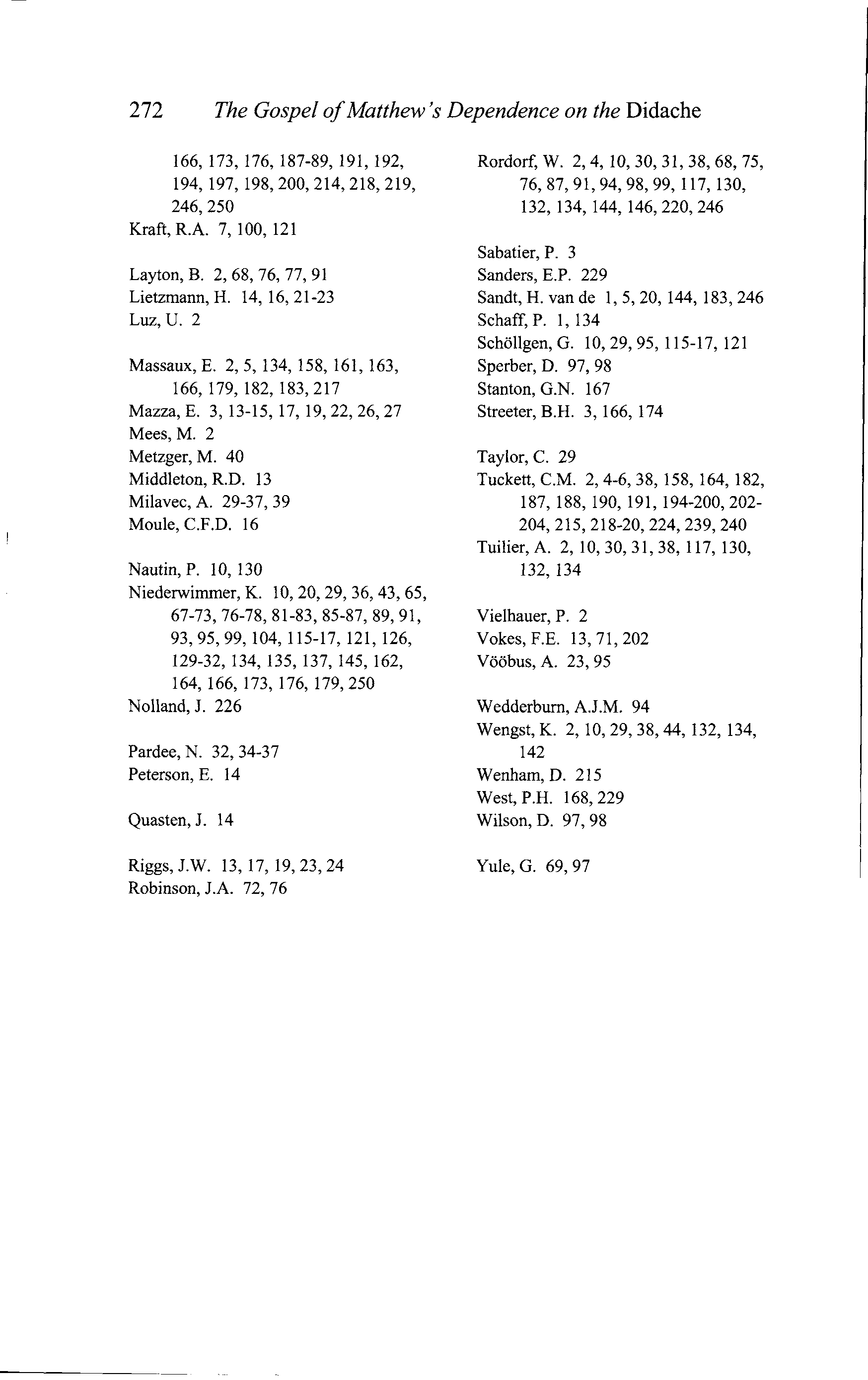
The Gospel of Matthew's Dependence on the Didache Rordorf, W. 2,4, 10, 30, 31, 38, 68, 75,
166, 173, 176, 187-89, 191, 192, 194, 197, 198, 200, 214, 218, 219, 246, 250 Kraft, R.A. 7,100,121 76,87,91,94,98,99,117,130, 132,134,144,146,220,246 Sabatier, P. 3
Sanders, E.P. 229
Sandt, H. van de 1,5, 20, 144, 183, 246 Schaff,P. 1,134 Schollgen, G. 10, 29, 95, 115-17, 121 Sperber,D. 97,98 Stanton, G.N. 167
Streeter, B.H. 3, 166, 174 Layton, B. 2, 68, 76, 77, 91 Lietzmann, H. 14,16,21-23 Luz,U. 2
Massaux, E. 2, 5,134, 158,161,163, 166,179,182,183,217 Mazza, E. 3, 13-15, 17, 19, 22, 26, 27 Mees,M. 2
Metzger, M. 40
Middleton, R.D. 13
Milavec, A. 29-37, 39 Moule,C.F.D. 16
Taylor, C. 29
Tuckett, CM. 2, 4-6, 38,158,164,182, 187, 188, 190, 191, 194-200,202204, 215, 218-20, 224, 239, 240 Tuilier, A. 2, 10, 30, 31, 38, 117, 130,
Nautin,P. 10,130 Niederwimmer, K. 10, 20, 29, 36, 43, 65, 132,134 67-73, 76-78, 81-83, 85-87, 89, 91, 93,95,99,104,115-17,121,126, 129-32, 134, 135, 137, 145, 162, 164,166,173,176,179,250 Nolland,J. 226
Vielhauer, P. 2
Vokes,F.E. 13,71,202 V66bus,A. 23,95 Wedderburn, A.J.M. 94
Wengst, K. 2,10, 29, 38, 44, 132, 134, Pardee,N. 32,34-37 Peterson, E. 14
Wenham,D. 215
West,P.H. 168,229 Wilson, D. 97,98 Quasten, J. 14
Riggs,J.W. 13, 17, 19,23,24 Robinson, J.A. 72,76 Yule,G. 69,97