
Chapter 8 THE GOSPEL LAYER: 8.2b; 11.3b; 15.3-4
Chapter 8
THE GOSPEL LAYER:
8.2b; 11.3b; 15.3-4 The Didache's four references to 'the gospel' have, as noted in Chapter 1, profoundly influenced perceptions of the whole text's relationship to Matthew's Gospel.
The following chapter challenges the assumption that these verses demonstrate the post-Matthean composition or compilation of the Didache, arguing instead that 8.2b; 11.3b and 15.3-4 are best understood as a distinct and final1 contribution to the host text.
Prior to any attempt to assess the relationship of Did. 8.2b; 11.3b and 15.3-5 to the rest of the Didache it is necessary to consider a number of preliminary issues.
1. Preliminary Issues 1.1. The Redactional Unity o/Didache 8.2b; 11.3b and 15.3-4
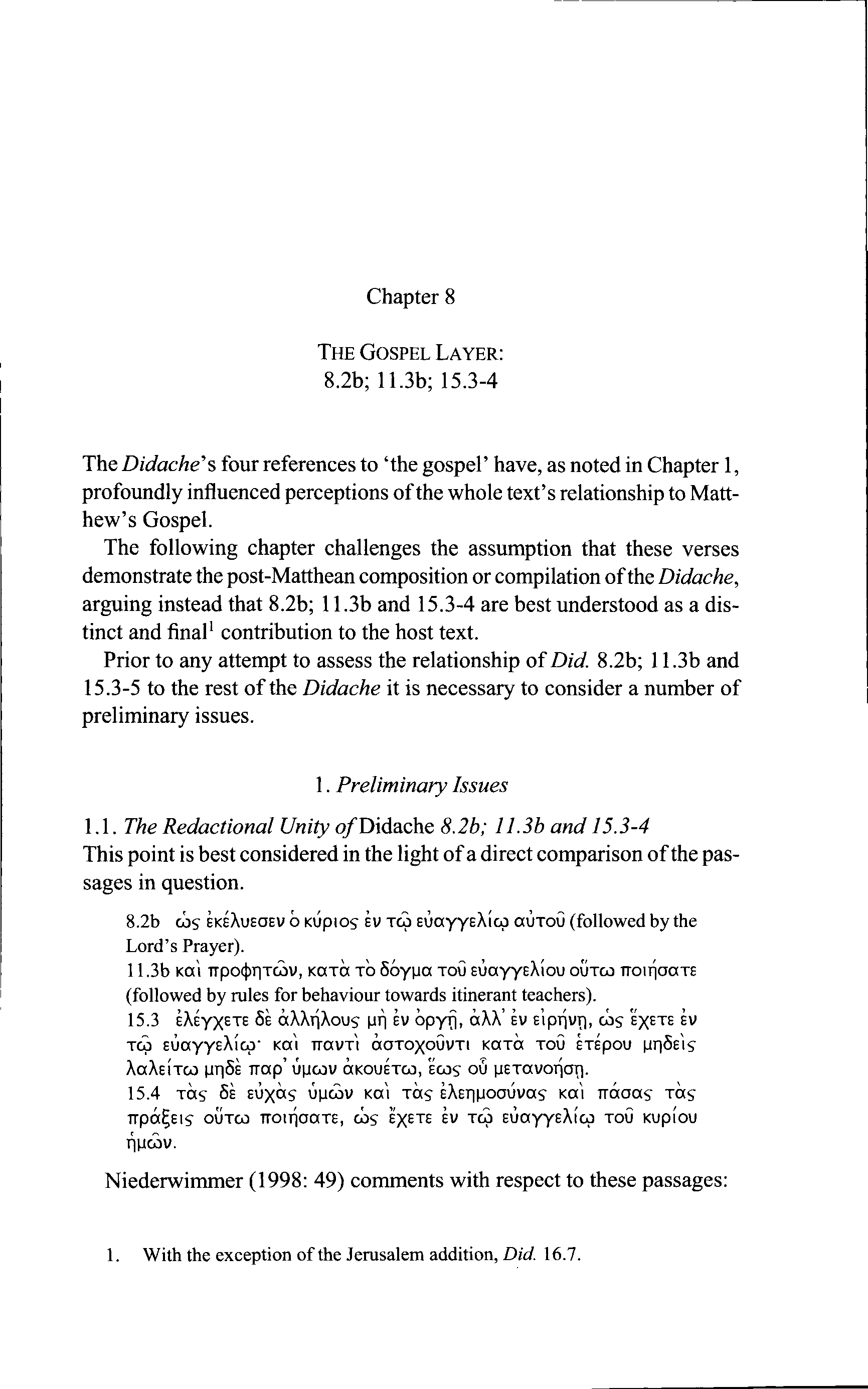
This point is best considered in the light of a direct comparison of the passages in question.
8.2b cos EKEAUEOEV b Kupios EV TOO EuayysAico CXUTOU (followed by the Lord's Prayer).
11.3b KCU Trpo())r|Tcov, Kara TO Soypa TOG suayyeXiou OUTGO TroirjacxTe (followed by rules for behaviour towards itinerant teachers).
15.3 eXeyxETE 6E aAArjAous \ST\ EV opyfj, aAA' EV EiprjvT], cos E'XETE EV TOO EuayysAico' KCU TTCXVTI CXOTOXOUVTI Kara TOG ETEpou MH^EIS
ACXAEITCO MTISE Trap' upcov CXKOUETCO, ECOS OU jJETavo^ari.
15.4
TCXS 6E suxas upcov Kai ras EAsTiMoauvas Kai Traoas ras OUTCO TTOiriaaTE, cos E'XETE EV TCO EuayyEAicp TOU Kupiou
Niederwimmer (1998: 49) comments with respect to these passages:
With the exception of the Jerusalem addition, Did 16.7.
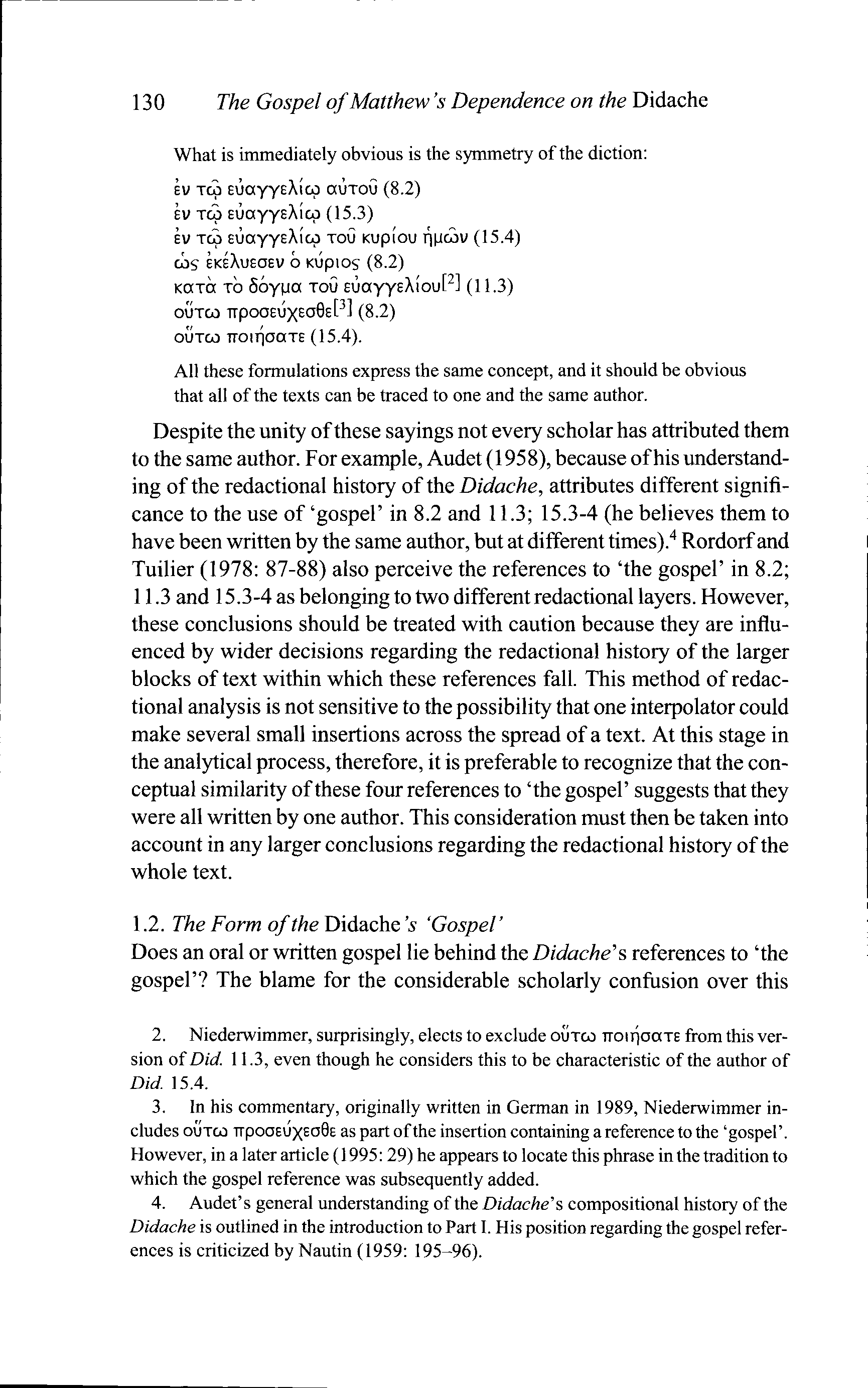
The Gospel of Matthew's Dependence on the Didache What is immediately obvious is the symmetry of the diction: ev TCO euayyeXiop CXUTOU (8.2) EV TCO siiayyEAico (15.3) EV TCO EuayyEAico xou Kupiou rmcov (15.4) cos EKEAUEGEV b Kupios (8.2) Kara TO Soyjja TOU EuayysAiout2] (11.3) OUTGO TTpoaE\Jxeo8£[3] (8.2) OUTGO TTOirjaaTE (15.4).
All these formulations express the same concept, and it should be obvious that all of the texts can be traced to one and the same author.
Despite the unity of these sayings not every scholar has attributed them to the same author. For example, Audet (1958), because of his understanding of the redactional history of the Didache, attributes different significance to the use of 'gospel' in 8.2 and 11.3; 15.3-4 (he believes them to have been written by the same author, but at different times).4 Rordorf and Tuilier (1978: 87-88) also perceive the references to 'the gospel' in 8.2;
11.3 and 15.3-4 as belonging to two different redactional layers. However, these conclusions should be treated with caution because they are influenced by wider decisions regarding the redactional history of the larger blocks of text within which these references fall. This method of redactional analysis is not sensitive to the possibility that one interpolator could make several small insertions across the spread of a text. At this stage in the analytical process, therefore, it is preferable to recognize that the conceptual similarity of these four references to 'the gospel' suggests that they were all written by one author. This consideration must then be taken into account in any larger conclusions regarding the redactional history of the whole text.
1.2. The Form of the Didache's 'Gospel'
Does an oral or written gospel lie behind the Didache's references to 'the gospel'? The blame for the considerable scholarly confusion over this
Niederwimmer, surprisingly, elects to exclude OUTCO TTOirjocxTE from this version of Did. 11.3, even though he considers this to be characteristic of the author of Did 15.4.
In his commentary, originally written in German in 1989, Niederwimmer includes OUTCO TTpooEUXEO0E as part of the insertion containing a reference to the 'gospel'.
However, in a later article (1995:29) he appears to locate this phrase in the tradition to which the gospel reference was subsequently added.
Audet's general understanding of the Didache's compositional history of the Didache is outlined in the introduction to Part I. His position regarding the gospel references is criticized by Nautin (1959: 195-96).
8. The Gospel Layer: 8.2b; 11.3b; 15.3-4
issue may perhaps be laid at Koster's door. His approach to this question was to treat each mention of 'the gospel' on its own merits. This approach is commendable at a certain stage in the analytical process, but it runs the risk of missing the wood for the trees if individual results are not also viewed against a broader backcloth. That Koster has failed in this regard is illustrated by his extraordinarly complex conclusion (1957: 240):
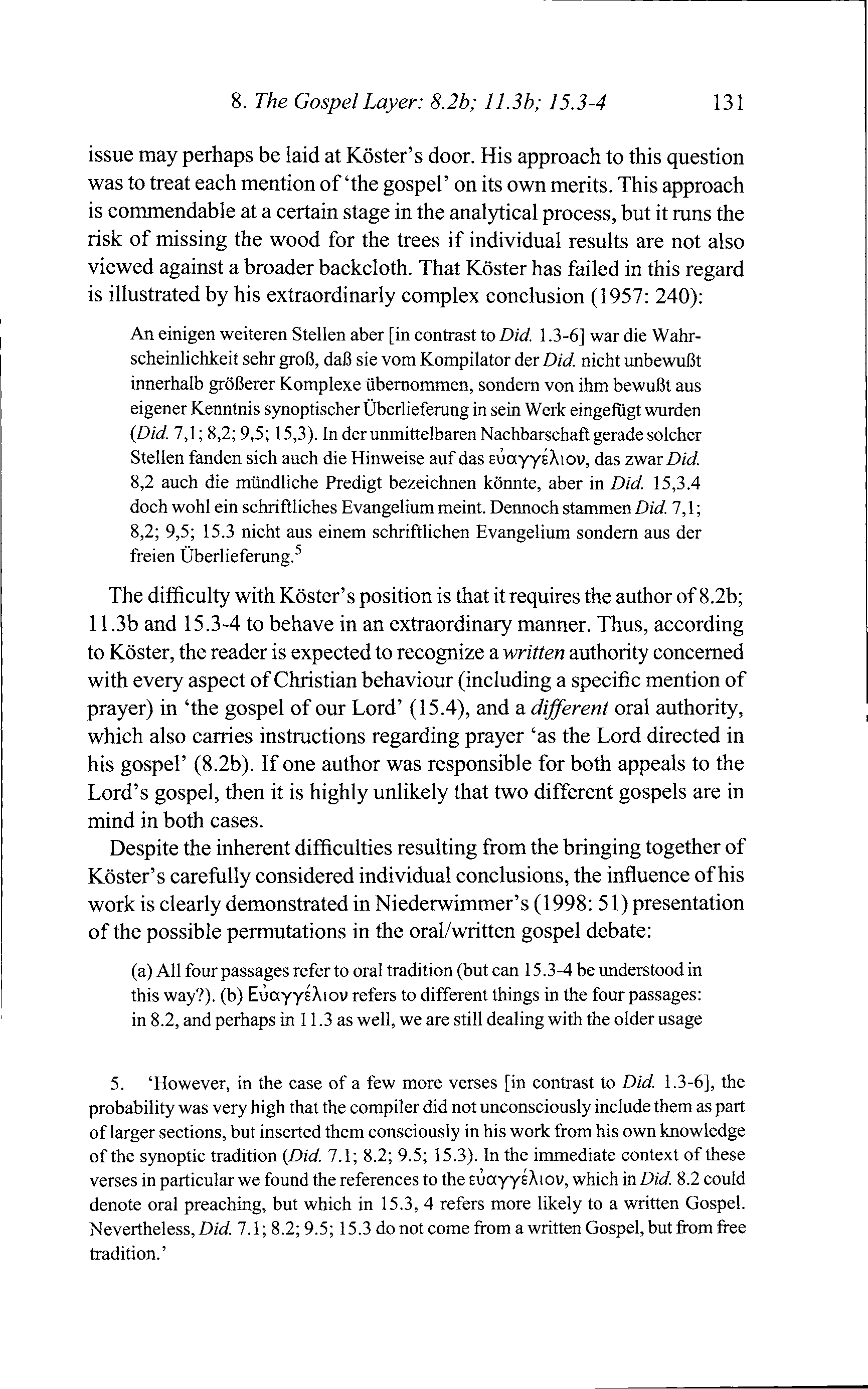
An einigen weiteren Stellen aber [in contrast to Did. 1.3-6] war die Wahrscheinlichkeit sehr groB, daB sie vom Kompilator der Did nicht unbewuBt innerhalb groBerer Komplexe ubernommen, sondern von ihm bewuBt aus eigener Kenntnis synoptischer Uberlieferung in sein Werk eingefugt wurden
(Did. 7,1; 8,2; 9,5; 15,3). In der unmittelbaren Nachbarschaft gerade solcher Stellen fanden sich auch die Hinweise auf das suayyEAiov, das zwar Did.
8,2 auch die mundliche Predigt bezeichnen konnte, aber in Did. 15,3.4 doch wohl ein schriftliches Evangelium meint. Dennoch stammen D/af. 7,1;
8,2; 9,5; 15.3 nicht aus einem schriftlichen Evangelium sondern aus der freien Uberlieferung.5
The difficulty with Koster's position is that it requires the author of 8.2b; 11.3b and 15.3-4 to behave in an extraordinary manner. Thus, according to Koster, the reader is expected to recognize a written authority concerned with every aspect of Christian behaviour (including a specific mention of prayer) in 'the gospel of our Lord' (15.4), and a different oral authority, which also carries instructions regarding prayer 'as the Lord directed in his gospel' (8.2b). If one author was responsible for both appeals to the Lord's gospel, then it is highly unlikely that two different gospels are in mind in both cases.
Despite the inherent difficulties resulting from the bringing together of Koster's carefully considered individual conclusions, the influence of his work is clearly demonstrated in Niederwimmer's (1998: 51) presentation of the possible permutations in the oral/written gospel debate:
(a) All four passages refer to oral tradition (but can 15.3-4 be understood in this way?), (b) EuayysXiov refers to different things in the four passages: in 8.2, and perhaps in 11.3 as well, we are still dealing with the older usage
'However, in the case of a few more verses [in contrast to Did. 1.3-6], the probability was very high that the compiler did not unconsciously include them as part of larger sections, but inserted them consciously in his work from his own knowledge of the synoptic tradition (Did. 7.1; 8.2; 9.5; 15.3). In the immediate context of these verses in particular we found the references to the euayyeAiov, which in Did. 8.2 could denote oral preaching, but which in 15.3, 4 refers more likely to a written Gospel.
Nevertheless, Did. 7.1; 8.2; 9.5; 15.3 do not come from a written Gospel, but from free tradition.'
The Gospel of Matthew's Dependence on the Didache (meaning the 'living voice of the good news' [viva vox evangelii]); in contrast, euayyeAiov in 15.3 and 4 (but also 11.3?) already refers to a gospel in written form (evangelium scriptum): thus Koester. Audet adopted a similar opinion, seeing in 8.2 and 9.5 reference to an oral gospel, and in 11.3 and 15.3-4 to a written gospel. Rordorf and Tuilier employed this notion to distinguish a hypothetical second layer of redaction: only the second redactor could have understood EuayyeAiov in 15.3-4 as evangelium scriptum. But not only is this hypothesis of a double redaction questionable, in my opinion; the conceptual consistency of the clauses in which the key word 'gospel' appears does not suggest such an idea. Finally, we cannot completely exclude (c), the possibility that the redactor means the same thing in all four passages, namely, a written gospel, known to him and his readers and, because it preserves the words of Jesus, serving as a norm of faith and life. Koester also accepted this construal for 15.3-4, and considered it possible for 11.3; even for 8.2 he did not wish to exclude it absolutely.
If one author is likely to have been responsible for all four of the Didache's references to 'the gospel' (as argued above), then it is also highly likely that this author had one authoritative 'gospel' in mind in each case. The question of whether an oral or written tradition is referred to thus becomes a question of which type of source sits most easily with all four references to this 'gospel'.
The reference to the gospel in Did. 15.3-4 indicates the presence of an external authority, in the possession of the readers, which may be consulted by them for final guidance with respect to church discipline, prayer, alms and all aspects of Christian behaviour. Scholars are in general agreement that Did. 15.3-4 probably refers to a written gospel.6
The reference to the gospel in 11.3b is followed by a set of instructions which, by virtue of their complex redactional history, are sometimes far from clear or self-consistent. This invites the possibility that the purpose of 11.3b was to point the reader to a more coherent and authoritative set of instructions on the subject of visitors and teachers. This suggests that the 'gospel' in view was at a more advanced state of stabilization than the text of the Didache itself. This is suggestive of a written text.
Of the four references to 'the gospel' the only instance where an appeal to a written text is problematic is 8.2b. The difficulty is twofold. First, and less significantly, the phrase 'as the Lord commanded in his gospel' could be taken as referring either to the spoken instructions of the Lord which have been passed on orally, or to a written account of those spoken instruc6.
Niederwimmer (1998: 50-51) cites Audet, Koster and Wengst, in addition to himself, as in favour of a written gospel at 15.3,4.1 am not aware of any scholar who sees a reference to an oral gospel in 15.3, 4.
8. The Gospel Layer: 8.2b; 11.3b; 15.3-4
tions. However, since this formula may be taken either way it poses no obstacle to understanding 'the gospel' as a written text which reports the spoken directions of Jesus, as occurs in all our extant gospels. The second difficulty is that the version of the Lord's Prayer recorded in Did. 8.2c does not appear in this precise form in any written gospel now known. It was Koster's (1957: 203-209) careful observation of this fact which caused him to consider the possibility that an oral tradition is referred to here.
However, this does not exclude the possibility that an unknown written gospel is in view, or, as is argued below, that the mention of 'the gospel' in 8.2b serves a function other than to introduce a quotation from that written text.
In conclusion, since only one entity is likely to be behind the Didache's repeated use of the term 'gospel', and since a written text is possible in all four instances, and preferable in three of those four, then it may be concluded that a written, rather than an oral, authority is likely to be indicated in each case.
1.3. The Identity of the Written Gospel Given the written form of the Didache's 'gospel', there are two possible texts to which it could refer; either the Gospel of Matthew, or some other gospel that is now lost. Matthew's Gospel is the only possible candidate among the extant texts because it is the only one that carries instructions for every dimension of behaviour mentioned by the Didache in connection with 'the gospel'; namely, prayer (Mt. 6.9-13; Did. 8.2b), prophets and visitors (Mt. 10.10, 40-42; Did. 11.3b), church discipline (Mt. 18.15-17;
Did. 15.3) and almsgiving (e.g. Mt. 5.42; 6.1-4; Did. 15.4).
A further point in favour of the identification of Matthew's Gospel with the Didache's 'gospel' may be found in Did. 15.3. This verse is interesting because, unlike 15.4, it does not simply refer to the 'gospel' and expect the reader to find all that they need to know on the subject in this external and superior text. Instead, 15.3 adds the detail, 'and let no one speak to anyone who wrongs another, let him not hear from you until he has repented' (15.3). If Matthew's instructions (18.15-17) are referred to in Did. 15.3, then a motive for the addition of this explanatory note may be offered. Matthew's reference to treating someone 'as a pagan or tax collector' may have seemed obscure or outdated to the person responsible for Did. 15.3. This could explain the inclusion of the supplementary note that to treat someone in this way meant to refuse to talk to them.
Given that Matthew's Gospel is the only extant gospel which contains teaching on church discipline, and given that this teaching also provides
The Gospel of Matthew's Dependence on the Didache an explanation for the additional note in Did. 15.3, it may be concluded that Matthew's Gospel is a strong candidate for the text behind the Didache's references to 'the gospel'.
The piece of evidence that causes the greatest difficulty for the straightforward identification of the Didache's 'gospel' with Matthew's text is the conundrum posed by Did. 8.1-3. Here, Did. 8.2b calls upon its readers to pray 'as the Lord directed in his gospel' but the prayer that follows is not a quotation from any extant version of Matthew's Gospel. There is one particular variation that exemplifies the problem.7 The Didache's prayer has 'TTaTsp r)pcov b EV TCO oupavcp', while all known manuscripts of Matthew's Gospel read 'TTaTep r)|jc2>v b ev TOIS oupavois'. This means either that the author ofDid. 8.2c quoted from an eccentric version of Matthew's Gospel which has now been lost, or that Did. 8.2c is not a quotation from Matthew's Gospel at all. The former possibility cannot be completely discounted but it does require a curious set of circumstances. First, there is no evident reason why a copyist should have introduced 'TCO oupavcp' for 'TOIS oupavois', since this change carries no theological significance and such a change disrupts a passage likely to be widely known in another form. Second, if such a variant did arise it is unlikely to have been preserved by later copyists because of the tendency to assimilate variant versions of the Lord's Prayer to the mainstream Matthean text (seen, for example, in manuscripts of Lk. 11.1-4). This means that, if Did. 8.2c derives from Mt. 6.9-14, then a very unusual version of Matthew's Gospel must have been used. Further, the author who used that unusual version must also have assumed that the Lord's Prayer was not already well known to the Didache's potential audience in its standard Matthean form.
The difficulties associated with seeing Did. 8.2c as a direct quotation from Matthew's Gospel led Koster (1957: 240) to a new position:8
Es ergibt sich also, daB der Kompilator der Did wohl schon ein schriftliches Evangelium kannte, aber nicht selbst benutzte, sondern nur auf dasselbe verwies.9
Other variations are noted and further discussed below. See also Niederwimmer (1998: 135, Table 9 and 136-37).
Prior to Koster (1957) it was fairly common for scholars to see Matthew's Gospel behind 8.2b, so e.g. Schaff (1885:188) and Massaux (1993:154-55). See also
Wengst (1984: 26-27). Koster (1957: 203-209) presented a powerful case for the nonquotation of Matthew's Gospel in Did 8.2c. Koster's line has also been taken by Audet (1958: 171-73); Giet (1970: 200); Rordorf and Tuilier (1978: 86).
'Thus, the result is that the compiler of the Didache is likely to have known a written gospel, but he himself did not use it; he only referred to it.'
8. The Gospel Layer: 8.2b; 11.3b; 15.3-4
Niederwimmer (1998: 51) follows this lead when, at the end of the passage quoted at length above, he adds the observation: 'Notabene: This understanding does not mean that the author also quotes this gospel'. Thus
Koster and Niederwimmer imagine that the Didachist could have referred to a written gospel at 8.2b, while not quoting from that gospel at 8.2c.
This is an extraordinary position. It requires that an author who regards the Lord's gospel as normative for every aspect of Christian behaviour
(15.4) including, specifically, prayer (8.2b; 15.4), should immediately turn aside from that gospel to quote a different tradition as exemplary for Christian practice (8.2c). If one author was responsible for 8.2b and 8.2c, then it is hard to believe that the latter is not a quotation taken from the gospel mentioned in the former. Herein lies the difficulty for the view that 'the gospel' is that according to Matthew, since Did. 8.2c appears not to be a direct quotation of Matthew's Lord's Prayer.
This raises a further possibility, that Matthew's Gospel is not in mind in Did. 8.2b and that another 'lost' gospel, containing this similar but different version of the Lord's Prayer, is directly quoted instead. Technically this is always a possibility, but it is not one without difficulties. In this case it is necessary to hypothecate a gospel that shares Matthew's otherwise unique combination of teaching on prayer, visitors, discipline and alms. In addition it is necessary to hypothecate the loss, without further trace, of a text that had sufficient authority and availability to be simply deferred to as a guide (without quotation) 'in everything that you do'
(15.4).10 Hypotheses of this kind must always be considered, but perhaps only as a last resort. This invites discussion of a fourth possible explanation for the pattern of Did. 8.1-3.
The potential contradiction within Did. 8.1-3 could be reconciled if this passage was in fact laid down in two separate stages. Thus, if Did. 8.1 -2a,
2c-3 were composed as an act of Christian self-definition by the modifying teacher (cf. Chapter 7, section 7), then it need not have been taken from Matthew's Gospel. The subsequent publication of Matthew's Gospel and its rise to authoritative status might, however, have created a motive for the later insertion of the instruction to pray 'as the Lord directed in his
10. This position also requires that 8.2b serves as a formula designed to introduce a quotation from 'the gospel'. However, this cannot be the function of the reference to the gospel in either 11.3b or 15.3-4. In the case of 11.3b this is because this verse is followed by a multilayered text which cannot have been lifted in this form from another text. In the case of 15.3-4 there is an indication of the gospel's content in 15.3, but 15.4 is far from a quotation formula in that the reader is here invited to consult the gospel without any further indication of the precise content of that authority.
The Gospel of Matthew's Dependence on the Didache gospel'. This is the case because a discrepancy between the versions of the Lord's Prayer in Did. 8 and Mt. 6 could have caused confusion in later liturgical practice.11 This circumstance invites one of two responses.
Either the text of Did. 8.2c could have been altered to make it match the Matthean tradition, or instruction could have been given to guide the reader's perception of the Didache's version of the Lord's Prayer in relation to that provided by Matthew. The eccentricities of'the Didache's prayer mean that it is highly unlikely that the first option was taken. This leaves the possibility that 8.2b was designed to subordinate the Didache's prayer to the 'superior' version in Matthew's Gospel, while preserving the established text of the Didache as it had been received.12
The interpretation of 'gospel' in Did. 8.1-3 is far from straightforward.
However, a reading which sees this term as part of a redactor's attempt to subordinate the Didache to the superior authority of Matthew's Gospel has two points in its favour. First, it does not require the hypothecation of a definitive 'gospel', remarkably similar to Matthew's, which has now disappeared. Second, a subordinating function for 'gospel' in Did. 8.2b is fully consistent with the way in which this term is used in Did. 15.3-4. In the latter instance the Christian is directed to this external source for ultimately authoritative advice regarding every aspect of Christian behaviour, including a specific reference to prayer.
With regard to the identity of the 'gospel' referred to in the Didache, therefore, it may be concluded that the strongest candidate is Matthew's
Gospel. The popularity of this gospel in the early Church makes it compatible with the role of 'the definitive gospel'. Matthew's Gospel addresses all the issues mentioned in the Didache in connection with the gospel, and does so in a way which makes sense of the explanatory comment in Did.
15.3. The mention of the gospel at 8.2b creates a difficulty for this view if this line is seen as introducing a quotation from that gospel, which appears not to be Matthew's, in 8.2c. However, the possibility that 8.2b was not intended to serve as part of a quotation formula is suggested by the fact that,in£)/t/. 11.3band 15.3-4, appeals to the 'gospel', far from introducing quotations, are used to subordinate the Didache to an external authority. A similar function is attributable to Did. 8.2b if it was an insertion designed
11. In Chapter 11, § 3 it will be argued that Matthew directly quoted from the modifying teacher's work in Did. 8. This offers an explanation for the very close relationship between the two texts.
12. Examples of the common technique of altering the force of a text by means of interpolation, rather than by direct alteration, may be found in the contributions of the modifying teacher.
8. The Gospel Layer: 8.2b; 11.3b; 15.3-4
to subordinate the Didache's prayer to a version that was understood to be the directly expressed 'instructions of the Lord'. The Lord's Prayer in Matthew's Gospel is presented in precisely these terms. I conclude, therefore, that the 'gospel' appealed to in the Didache was in fact that according to Matthew.
2. The 'Gospel' References and the Modifying Teacher Layer So far I have argued that Did. 8.2b; 11.3b and 15.3-4 were all contributed by someone who used the term 'gospel' to refer to the Gospel of Matthew.
If this is the case, then what implications follow for the redactional status of these insertions?
The relationship of Did. 8.2b; 11.3b and 15.3-4 to the rest of the text boils down to the question of whether or not these verses could have been written by the modifying teacher. This is the case because 8.2b and 15.3-4 both presuppose the presence of the Modifying Teacher layer and so could not have been added to the whole in its absence. The following analysis will concentrate, therefore, on each of the 'gospel' verses in turn and will ask whether they could have been written by the modifying teacher.
2.1. Didache 75.3-4 To suggest that Did. 15.3-4 was written by the modifying teacher is to claim that the section 14.1-15.4 was penned as a continuous whole. The first indication that this might not be the case is provided by the eccentric order in which subjects are addressed. Thus, the issue of discipline is mentioned in 14.1-3, and also in 15.3, but advice on the appointment of bishops and deacons intervenes in 15.1-2. This arrangement causes Knopf
(1920: 38) to suggest that 15.3 should be attached to 14.2 so that 'If the case in 14.2 occurs, and those concerned cannot be reconciled with one another, the other members of the community should intervene and gently put them right'.13
Knopf's attempt to reconstruct the text in this way is understandable but difficult to justify. There is good reason to suppose that Did. 14.1-15.2 was written by one author because these verses all show a consistency with the interests or compositional techniques of the modifying teacher
(cf. Chapter 7, section 5). The return to the subject of discipline in 15.3 may therefore be attributed, either to this author's return from a digression to readdress the subject after realizing that it had been incompletely
13. This translation of Knopf is from Niederwimmer 1998: 203 n. 1.
13 8 The Gospel of Matthew's Dependence on the Didache considered three verses earlier, or to the work of a new and separate author who wished to supplement the teacher's earlier contribution.
That two separate authors were responsible for Did. 14.1-15.2 andDid.
15.3-4 is also suggested by the fact that the 'gospel' is appealed to in one case but not in the other. This is significant because the gospel is presented in 15.4 as an ultimate authority, beyond even the authority of the preceding text, for 'all that you undertake'. If the author who held this view of the gospel in 15.4 was also responsible for writing 14.1-3, then why was the gospel not mentioned in support of the instruction to 'be reconciled' in 14.2? This is particularly surprising if the gospel in question is that of Matthew, since Mt. 5.23-24 reads:
5.23 So if you are offering your gift at the altar, and there remember that your brother has something against you, 5.24 leave your gift there before the altar and go; first be reconciled to your brother, and then come and offer your gift (RSV).
This text offers much more direct support for the instruction 'be reconciled before sacrificing' (14.2) than does the somewhat oblique appeal to Mai. 1.11 actually used in Did. 14.3. The fact that Malachi 1.11 was preferred to Mt. 5.23-24 invites an explanation. If one author was responsible for the whole of 14.1-15.4, then it must be supposed that Malachi was preferred in 14.3 because its superior authority made even oblique support for the instruction in 14.2 preferable to that offered by the gospel. This explanation is difficult to sustain under a 'one author' hypothesis, however, because the author of Did. 15.4 evidently understands the gospel to be a text with ultimate authority in the direction of Christian behaviour. An alternative explanation for the use of Malachi at Did. 14.3 is that 'the gospel' was not known to, or understood as authoritative by, the author of 14.1-3. In this case the author of Did. 14.1-3 cannot also have composed Did. 15.3-4.
The case for the separation of 15.3-4 from the immediately preceding text is further supported by the observation that these appeals to 'the gospel' ultimately undermine the efforts of the modifying teacher. That is to say, the effect of 15.3-4 is to send the reader to consult the gospel, whose authority is to be accepted even over the careful modifications of the teacher. This would be like my including advice that a better study of Matthew's relationship to the Didache can in fact be found elsewhere. I might make such a statement when the alternative study contains an argument with which I agree, but not when it proposes an opposing view. It is true that Matthew's Gospel is essentially in accordance with the line taken
8. The Gospel Layer: 8.2b; 11.3b; 15.3-4
by the modifying teacher in Did. 14.1-3; however, as will be considered in the following sections, this is not the case with all the teacher's instructions.
In summary, Did. 15.3-4 does not stand in continuity with the work of the modifying teacher in 14.1-15.2 for three reasons. First, the single topic of church discipline is considered in two separate places. Second, the teacher's failure to appeal to the gospel in 14.3 suggests that an authoritative gospel to which readers could be referred was not available in this case, while such was available to the author of 15.3-4. Third, the efforts of the teacher to explain the need for reconciliation between church members was perhaps unnecessary if this same author was immediately willing to subordinate this teaching to the superior authority of the gospel.
2.2. Didache 8.2b The problem of a contributor who immediately subordinates their additions to the superior authority of the gospel is again raised by the idea that the whole of Did. 8.1-3 was composed by one person. If the gospel referred to was Matthew's, then it must be proposed that this author demanded one action in 8.2b (pray as Jesus commands, as reported in Matthew's Gospel), and another in 8.2c (pray according to the slightly different wording set out below). Koster (1957:209,240) attempts to sidestep this difficulty by proposing that a not fully authoritative gospel is referred to in Did. 8.2b.
This position is, however, very difficult to sustain. The text refers to the personal directions of the Lord, and this suggests that the author of 8.2b believed the gospel to be an authentic conduit of the teaching of Jesus. It is difficult to suppose that such a text could have been understood as only partially authoritative by author or readers. The treatment of the gospel in Did. 15.4 adds to the impression that this 'gospel of the Lord' was an ultimate authority. Thus, the problem remains. Why does 8.2b point the reader to the directions of the Lord in the gospel, while 8.2c appears to carry a version of that prayer that does not come from any known gospel?14
The answer to this question may be that 8.2b was inserted into the Didache by the same person who also wrote 15.3-4, and for the same reason; namely, as a means of subordinating the teaching of the Didache to the authority of Matthew's Gospel, especially where the two texts are at variance.
In summary, those who see Did. 8.1-3 as the work of one author must explain why the direct speech of Jesus in Mt. 6 appears to be appealed to in 8.2b, but is not adhered to in 8.2c. Given the difficulties of this position
14. § 1.3, above, concluded that 'gospel' is likely to refer to Matthew's Gospel rather than a lost text.
The Gospel of Matthew's Dependence on the Didache it is perhaps preferable to suppose that the function of Did. 8.2b was to assure the reader that Matthew's version of the prayer was the one to be followed. This solution coheres with the apparently similar function of Did. 15.3-4, where the gospel is appealed to as an external authority without further quotation.
2.3. Didache 77.56
In Chapter 7 it was concluded that the Modifying Teacher layer included, among other verses, Did. 8.2a, 2c-3; 11.1-2,10-11; 13.1-15.2. Given that 8.2b and 15.3-4 could only have been added to the Didache alongside or after the addition of this layer, and given that 11.3b was added by the same hand as 8.2b and 15.3-4, it follows that 11.3b must have been added either alongside or after the modifying teacher's addition of 11.1 -2,10-11;
13.1-15.2. This section considers which of these two alternatives is the more likely.
The Didache's rules for the treatment of church leaders provokes the most substantial bout of activity on the part of the modifying teacher. An initial attempt to establish the legitimacy of the modifier's alterations is presented in 11.1 -2; insertions that gainsay the previously existing version of the Didache are then made in 11.10-11 and 13.1-7; and additional instructions regarding the selection of leaders offered in 15.1-2. Is it likely that the person responsible for these alterations should, at the same time, undermine their efforts by referring the reader to the external authority of the 'gospel'? Such an act of self-abrogation would be required if the modifying teacher were also responsible for the appeal to the 'gospel' in 11.3b.
Another factor draws a question mark over the modifying teacher's authorship of Did. 11.3b. The modifier appeals to the practice of the ancient prophets in 11.11 and an otherwise unknown text quoted at 13.3a,
5-7. If this teacher also knew and was prepared to point to the 'gospel' at 11.3b, then why was this authority not directly employed in the defence of the wider position? That is to say, the attribution of 11.3b to the modifying teacher requires that this author ranked the practice of the ancient prophets and the text quoted at 13.3a, 5-7 in higher esteem than the gospel. Such a conclusion is at odds with the description of the gospel as that 'of the Lord' which provides guidance for all aspects of Christian behaviour. If this authority was so satisfactory, then why was it not quoted? If it was not agreeable, then why is it mentioned at all?
These difficulties are multiplied if the gospel in question is that according to Matthew. The instructions for travelling disciples in Mt. 10.5-15, and for those who receive them in Mt. 10.40-42, do not support the modifier's
8. The Gospel Layer: 8.2b; 11.3b; 15.3-4
contention that prophets, teachers and workers should receive the community's firstfruits (Did. 13.1-7). For example, Mt. 10.8 explicitly states that:
'You received without payment; give without payment'. It is unlikely, therefore, that the modifying teacher would have included a cross-reference to this gospel in 11.3b.
In summary, the proposal that the modifying teacher was also responsible for the inclusion of the appeal to the gospel at 11.3b is difficult to sustain because it requires the immediate subordination of this author's own extensive emendations of the host text to a separate, and not necessarily agreeable, authority.
3. Summary and Conclusion: The Gospel Layer This chapter began with an attempt to establish some preliminary questions.
It was concluded that 8.2b; 11.3b and 15.3-4 were all written by the same hand, all referred to the same 'gospel' and in doing so very probably referred to the Gospel of Matthew. It was then noted that, according to the results of the preceeding redactional survey, these lines could only have been added alongside or after the addition of the Modifying Teacher layer.
The possibility that these lines formed part of this teacher's work was then considered, but was rejected for three reasons. First, because of discontinuities in the treatment of subject matter in Did. 14.1-15.4. Second, the teacher's failure to appeal to the gospel when this would have forcefully supported the modifications being made. Third, it was considered unlikely that the teacher would have made careful modifications of the host text while then immediately pointing readers to the superior authority of the (not always agreeable) gospel.
Having concluded that Did. 8.2b; 11.3b and 15.3-4 were not composed by the modifying teacher, and given that these lines could not have been added prior to the addition of the Modifying Teacher layer, it follows that these verses constitute a separate redactional layer.