
Chapter 4 ELEMENTS WITHIN DIDACHE 1-5
Chapter 4
ELEMENTS WITHIN DIDACHE 1-5
This chapter is concerned to isolate the various elements that comprise the Didache's pre-baptismal catechism. At its simplest Did. 1-5 is a Two
Ways tractate into which a number of previously existing traditions have been incorporated. The first step in isolating these traditions is to compare
Did. 1-5 with the very similar Two Ways tradition found in Barnabas 1820. Two sections of the Didache'§ opening chapters immediately stand out by virtue of their absence from Barnabas 18-20; namely, Did. 1.3-6 and 3.1-6. This suggests that these two sections have a separate status with respect to the Two Ways.
1. The Separate Status o/Didache 1.3-6 The presence of an addition to the Two Ways tradition beginning in Did.
1.3 is not at all controversial.1 This separate status is generally suggested by a lack of connection with the Two Ways tradition of Barnabas 18-20 and by the more distinctively Christian content of these verses in comparison to the uniformly Jewish character of the surrounding text.
However, the precise extent of this interpolation is far from straightforward. The difficulty arises because of the presence of a Latin text, parallel to Did. 1-6, which omits Did. 1.3b-2.1. This Doctrina apostolorum is commonly viewed as recording a stage in the process of the Didache's composition prior to the insertion of the so-called sectio evangelica (seen by most as comprising 1.3b—2.1). At this stage only a very minor issue is at stake; namely, should the sectio be described as 1.3-6 or 1.3b-2.1 ? However, the question of whether the Didache depends on a source represented by the Doctrina apostolorum will be important in later discussion. An excursus to consider this question is therefore appropriate at this point.
'Without any doubt, 1.3b-2.1 represents a subsequent interpolation in the text of the "basic document'" (Niederwimmer 1998: 68).
The Gospel of Matthew's Dependence on the Didache Excursus: The Didache and the Doctrina apostolorum
Kloppenborg (1995: 90) states: 'In the case of the Didache and the Doctrina apostolorum the extremely high degree of agreement both in wording and order makes a literary relationship between the two virtually inescapable'.
If there is a literary relationship between the two texts, as seems highly likely,2 then one of two options presents itself. The first, adopted by a majority of scholars, is that the Didache is dependent on the Doctrina.
This position is confidently asserted by Audet (1996: 134-35):
When one compares the so-called Latin version (i.e. the Doctrina apostolorum of Schlect) attentively with the Greek text which it is supposed to translate (i.e. the Duae viae of the Didache), one is faced with a fact which is very strange for a translation: whereas the (Christian!) translator would naturally have manipulated the text he had to translate, it would appear, on the contrary, that he has worked hard to make it hark back to the distant origins, in such a way that the alleged translation of the Duae viae of the Didache seems still more strongly coloured by Judaism than the Duae viae of the Didache itself. This sounds very unlikely.
At first sight Audet's point sounds compelling, and he certainly has some weighty scholarly support (Layton 1968:379; Draper 1996a: 9; Kloppenborg 1995: 90; Rordorf 1991: 400; 1996a: 149; Niederwimmer 1998:
31,50). Draper (1996a: 13) even goes so far as to say that 'Audet.. .established beyond dispute that the Doctrina apostolorum could not be an abbreviation of the Didache'. However, Audet's claim that a translator would have had to 'work hard' to produce the Doctrina from the Didache is overstated. That is to say, almost the only significant difference between the two texts is the omission of Did. 1.3b—2.1 and Did. 7-16 in the Doctrina. This would not have been difficult to achieve given that Did.
1.3-6 is very different in style and tone from the Two Ways material that surrounds it. Of course, a motive for such an omission must be provided if this possibility is to be taken seriously. Such a motive will be considered in due course.
Before simply accepting Audet's analysis of the relationship between the Doctrina and the Didache it is worth observing the peculiar circumstances that this conclusion creates. First, Audet's thesis demands that 2.
Goodspeed (1945: 228—47) supposes that both Didache and Barnabas are directly dependent on the Doctrina. This is not generally accepted in the case of Barnabas. Cf. Kloppenborg (1995: 90).
4. Elements within Didache 1-5
1.3b—2.1 was interpolated into the Didache. This requires very unusual behaviour on the part of the interpolator. Any text is profoundly influenced by the way in which it is introduced.3 An interpolator is therefore likely to create a new heading to introduce new material. According to Audet, however, the interpolator chose to set new material under an element of the base text (1.3a) that had previously served as a heading for the continuing base (namely, 2.2-7). Having done so Audet's interpolator must then provide a replacement heading for 2.2-7 at the end of the interpolation. Niederwimmer (1998: 86-87) accepts this pattern of events but admits that it creates certain difficulties:
The compiler of the Didache interrupted the text of his source (the 'basic document') at 1.3a in order to introduce the sectio evangelica, as we call it.
Now, having completed the interpolation, he saw himself faced with the task of creating a transition to the source. This is accomplished by 2.1. The Didachist was apparently inspired by the final clause of the source... (1.3 a).
In the source this refers to the series of prohibitions that follows (2.2-7). It now occurred to the compiler that he could describe the commandments in the sectio and the series of prohibitions in the basic document as two successive concretions of the fundamental commandment (1.2). Therefore he writes SeuTEpa 5e EVToAr) xfjs SiSaxfis (2.1) and thus implicitly makes the commandments of the sectio the TTpcoxri evroAri, and the following commandments the Seuxepa EVTOAT] (but without any thought of such a thing as the double love commandment). One cannot call this arrangement particularly skillful. This division thus created remains an emergency construction behind which there is no deeply reflective theological conception but simply a literary principle of order.
According to Niederwimmer, the interpolator was 'inspired' by the line, 'Here is the teaching that flows from these words' (1.3a) in writing 'The second commandment of the teaching means' (2.1) and referred therein to a second commandment 'without any thought' of the double love command mentioned in 1.2. The result, he admits, is not skilful. This is something of an understatement. The effect of this interpolator's forgetfulness of the significance of 'Seimpa' is to create, by means of 2.1, considerable confusion regarding the status of 1.3b-6. Does the interpolation interpret the first commandment while 2.2-7 expands the second (Harnack 1884:
45-47; Hiintermann 1931: 195-96), or is it a primary interpretation of the second commandment, while 2.2-7 is a secondary one (Niederwimmer
1998: 86)?
A striking example of how headings influence the interpretation of ensuing text may be found in Brown and Yule (1983: 139-40). This example is reproduced by Court (1997: 57-58) and Garrow (1997: 3).
The Gospel of Matthew's Dependence on the Didache Thus, the view that 1.3b-6 was inserted by someone who also added the linking line at 2.1 requires two curious actions on their part. First, a surprising unwillingness to provide a tailor-made heading for the new material, preferring instead to borrow an existing one. Second, a hurried ineptitude in referring to the 'second commandment' when creating a new heading for the ensuing base text.
If, on the other hand, the interpolation began at 1.3a, then 'Here is the teaching that flows from these words' introduces the insertion in a wholly conventional way. Further, if the base text into which the interpolation was made already contained 2.1, then its reference to the second commandment is, in its original context, entirely logical: a statement of the double love commandment (1.2) flows through the linking line, 'The second commandment of the teaching means' (2.1), into an interpretation of that second commandment (2.2-7).
If it is likely that Did. 1.3a provided the original heading for the ensuing interpolation, then the presence of this line in the Doctrina speaks in favour of the Doctrinist's knowledge of Did. 1.3a, and the interpolation that it introduced, rather than the reverse.
A second problem for the view that the Didache depends on the Doctrina is the repetition of another element from the section Did. 1.3-6 later in the Doctrina. The line in question resembles Did. 1.5a: 'The Father wishes us to give from his gifts to all', and appears in Doctrina 4.8: 'The Lord wishes to give to all from his gifts'. Niederwimmer (1998: 82 n. 93) comments on this feature as follows:
Irritatingly, this single sentence from the sectio Christiana [sic] (1.3b—2.1) has a parallel in Doctrina, but in a different place - 4.8... One may suppose that this sentence was also in the Didache'& source, at the same place (i.e. after 4.8). The Didachist omitted it there (at 4.8), understandably enough, in order to avoid having a doublet.
Niederwimmer's explanation of the omission of Doctrina 4.8 (end) in Did. 4.8 is dependent on his thesis that the Didachist composed the whole
Didache by combining, at one sitting, a collection of previously existing sources.4 In this circumstance he proposes that it is possible that the 4.
Few scholars concur with Niederwimmer's assertion that Did. 1.3b—2.1 was not a later interpolation into a previously existing version of the Didache. For example,
Draper (1996d: 342) responds to Niederwimmer's hypothesis of a single author using various resources, by saying, 'This seems to fly in the face of the way a community rule evolves by trial and error, by erasing words or phrases, by inserting new words or phrases above the line or in the margin, which are later incorporated into the text. This
4. Elements within Didache 7-5
Didachist might, having written 1.5a, have chosen to omit the line in question when it reappeared in his source at Doctrina 4.8 (end). However, this assumes a somewhat sudden interest in avoiding doublets on the part of the Didachist. Repetitions of almost identical instructions occur elsewhere in Did. 1-5. This is the case in that elements of the 'way of death' are exactly antithetical to elements of the 'way of life'. As a result there are multiple condemnations of murder, adultery, theft, magic and equivocation. There is a double call to treasure the words that have been heard
(3.8 and 4.1). And on the smallest scale, there is a doublet within two verses that could easily have been avoided:5
1.4b If someone takes away from you what is yours, do not ask for it back, 1.5a Give to everyone what he asks of you, and do not ask for it back.
Thus, Niederwimmer must suppose that his Didachist was disinterested in all these repetitions, however closely juxtaposed, and yet chose, curiously, to avoid a doublet created by verses three chapters apart. Given the unsatisfactory nature of Niederwimmer's explanation for the 'irritating' re-emergence of Did. 1.5a in Doctrina 4.8 (end) a different solution may be preferable.
An alternative explanation for the absence of 'The Lord wishes to give to all from his gifts' from the Didache's version of 4.8, despite the appearance of this line in the parallel verse in the Doctrina, is that the Doctrinist took this line from Did. 1.5a and incorporated it into Doctrina 4.8. According to this solution the Doctrinist must have known a version of the Didache that contained 1.5 a, and, by implication, the insertion of which this line is a part.
In voicing the possibility that the Doctrina depends on the Didache my first duty is to explain the omission of Did. 1.3b—2.1 and Did. 7-16.1 aim to do this by suggesting that the Doctrina is the product of a conflation of a version of the Two Ways similar to that found in the Epistle of Barnabas and the Two Ways within the Didache.6 process is graphically displayed in the manuscript of the Community Rule from Qumran. Certainly whole new sections may have been added from time to time, but one should not hypothesize a wholesale, consistent composition for every change.' My own view of the composition of Did 1-5 does, however, come close to Niederwimmer's inasmuch as I think that these chapters at least (with the exception of 1.5b-6) were put together at one time using various previously established sources. This process is discussed in Chapter 9.
Niederwimmer himself (1998: 78) explicitly notes the presence of this doublet.
Yokes (1938: 17-21) argues that the Doctrina corrected the Two Ways to be
The Gospel of Matthew's Dependence on the Didache I propose that the author of the Doctrina wanted to write a discrete version of the Two Ways, on the basis that this was the teaching of the Apostles and therefore valuable for instruction, possibly of catechumens.
The fact that Did. 7-16 is omitted is not surprising given that these chapters were clearly not for the instruction of the individual (they are omitted in later texts that also appear to be dependent on the Didache such as the Apostolic Church Order and Epitome). The resources available to the Doctrinist for the creation of this edition of the Two Ways were a copy of the Didache and a version of the Two Ways similar to that used in Barnabas
18-20.
The opening verses show distinct signs of the conflation of'the Didache's 'way of life and death' and Barnabas''s 'way of light and darkness'. Thus
Doctrina 1.1a reads: 'There are two ways in the world, that of life and that of death, of light and of darkness'. Audet (1996: 145 n. 24) admits that conflation may be the cause of this doubling, although he proposes that 1QS and an unknown text are the conflated sources:7
It is not absolutely impossible...that the double qualification, 'life and death, light and darkness,' which characterises the LatinDuae viae among all the recensions, is the result of the encounter of two distinct currents in the transmission which carry the one or the other.
If, as Audet allows, a combination of two separate strands took place before the Didache came to depend on the Doctrina, then the Didachist is required to reverse that process by choosing to include only the 'life and death' strand in his work. The need for this regressive move is avoided if the Doctrina's unique double qualification was created by the simple conflation of Did. 1.1a and a text such as Barnabas 18.
In Doctrina 1.1b the influence of a 'Barnabas' Two Ways may be seen in the reference to an angel of good and an angel of iniquity; Barnabas has one angel who is Lord from all eternity to all eternity, and another who stands paramount over this present age of iniquity.
After this conflationary opening I propose that the Doctrinist chose to follow the Didache for the lines leading up to 1.3a. However, at this point the Doctrinist noted that the following sayings were absent from the 'Barnabas' version, and furthermore, that they had the appearance of material from the gospels that had been interpolated into the original apostles' text. found in Didache in the light of Barnabas 18-20. Similarly Robinson (1920: 73-83).
See Niederwimmer (1998: 32 n. 17).
Few scholars support Audet's contention that the Doctrina is dependent on 1QS (Draper 1996a: 13-14).
4. Elements within Didache 1-5
The Doctrinist therefore omitted this section and went on to pick up the thread of the Two Ways at 2.2.8 (The order of the commandments against murder and adultery being changed under the influence of the LXX.)
For almost all of the rest of the copying process the Doctrinist followed the Didache, choosing to incorporate 3.1-7, despite its absence from Barnabas, perhaps because it was not obviously parallel to the gospels. However, in the extant Doctrina the 'TEKVOV pou' phrase, so distinctively repeated in Did. 3.1-7, is reduced to just one introductory instance {Doctrina 3.1).
On reaching Did. 4.3: 'You shall judge justly. You shall not show partiality in calling people to task,' the Doctrinist writes. 'You shall judge justly, knowing that you will be judged', an addition that may betray the influence of Mt. 7.
A very close adherence to Did. 4.8 is then interrupted by the insertion, by the Doctrinist, of a portion of Did. 1.5a (indicating the presence in his source of Did. 1.3b—2.1) as discussed above.
At the end of the Two Ways, further interesting features occur. Thus Did. 5.2b-6.2 reads:
5.2b May you (pi.) be delivered, children [TEKVCX], from all this. 6.1 See to it that no one leads you (sg. and following) astray from this way of the teaching, since the one who does so teaches apart from God. 6.2 For if you are able to bear the whole yoke of the Lord, you will be perfect, but if you cannot, do what you can.
The parallel passage in Doctrina 6.1-4 reads:
6.1 Abstain, my son \fili], from all these things, and see that no one leads you astray from this Teaching; otherwise you will be taught outside true instruction. 6.4 If you do these things daily with reflection, you will be near the Living God, but if you do not do them, you will be far from the truth...
The first noteworthy point is the use of TEKVCX in Did. 5.2b despite the use of TEKVOV in Did. 3.1,2, 3, 4, 5, 6 and 4.1. This variation does not 8.
Connolly (1923: 152)'.. .the witness of [the Doctrina apostolorum, the Apostolic Church Order and the Life of Schnudi], (to the omission of 1.3b-2.1) is of doubtful value owing to the character of the documents themselves: for reasons can be adduced why the authors of these documents might purposely have omitted the passage'. Interestingly the Apostolic Church Order Statute 52 appears to know the Didache's references to 'the gospel' although it omits a good deal of the Didache which was almost certainly present in any version that contained these references. Niederwimmer (1998:
13-14) thinks that Apostolic Church Order and Epitome cannot be dependent on the Didache because of the omission of 1.3b—2.1 in them also.
The Gospel of Matthew's Dependence on the Didache occur in the Doctrina, where^z// is used in 3.1,4.13 and, significantly, in 6.1. This difference between the two texts is most readily explained if the Didache*s erratic use of the terms TEKVOV and TEKVOC was homogenized on being copied by the Doctrinist.
A second observation concerns the surprisingly non-dualistic closure of the Doctrina. In other extant examples, the Two Ways teaching ends with straightforward and sometimes graphic damnation for those who follow the 'way of death' (1QS 3 is particularly gruesome). In the Doctrina, however, failure to keep the instruction merely results in being 'far from the truth', implying that a journey towards the truth is still possible. An explanation for this unusual conclusion might be provided if the Doctrina was influenced by Did. 6.2 where the call to perfection is combined with an acceptance that perfection may only be acquired over time. The Doctrina appears to take a similar stance, while incorporating more familiar language regarding the destination of those who follow one way or the other, such as can be found in Barnabas 21. Here again, therefore, the distinctive shape of the Doctrina can be explained in terms of its conflation of the Didache and a 'Barnabas' Two Ways.
This conflation theory provides an explanation for the omission of Did.
1.3b—2.1 from the Doctrina and for differences in content between the two texts. Further, it challenges those who espouse the Didache's dependence on the Doctrina to explain the omission of the 'Barnabas' elements of the Doctrina from the Didache's version of the Two Ways, for example, the additional references to light, dark and angels.
So, did the Doctrinist omit 1.3b—2.1 from a text of the Didache that already contained these verses, or did the Didache depend on the shorter
Doctrinal At first sight the second option seems more likely. However, closer inspection exposes some problems with this view. First, it requires the interpolator to add a heading at the end of the insertion rather than, as would be more normal, at the beginning. Second, it is difficult to account for the presence ofDid. 1.5a in Doctrina 4.8 (end) if the Doctrinist knew nothing of Did. 1.3b-2.1. Third, the relative smoothness and consistency of the Doctrina, when compared with jagged edges in the Didache, poses an awkward question of Audet's view. Finally, I have sought to challenge the central positive element of Audet's case by showing that the Doctrinal omission ofDid. 1.3a-2.1 is credibly the product of the Doctrinist's conflation of the Didache with a 'Barnabas' Two Ways. In the light of these combined factors it is probable that the Doctrina depends on the Didache, rather than the reverse. At the very least, it is unsafe to construct any hypothesis on the basis of the Didache's dependence on the Doctrina.
4. Elements within Didache 7-5
If the Doctrina is not relevant to the pre-history of the Didache, then where does this leave the question of the existence, or extent, of any insertion into Did. 1? This question is best answered by examining the text itself.
It was noted above that there is a natural flow fromZJW. 1.2 straight into 2.1 in the use of the term Seuxepa. There is another sequence of sense in the negative form of the golden rule (1.2) leading into the negative admonitions of Did. 2.2-7. Both these elements of continuity are disturbed by the presence of Did. 1.3-6. First, as discussed above, 1.3-6 confuses the status of the reference to a 'second' commandment in 2.1. Second, the introduction of a set of positive admonitions in 1.3-5a sits uneasily with the negative form of the immediately preceding golden rule. This suggests that, while 1.2 and 2.1 are likely to have been added to the Didache by the same hand at the same time, it is unlikely that 1.3-6 was also contributed at the same point in the text's evolution. I conclude, therefore, that Did.
1.3-6 represents an addition, of at least one layer, to the basic Two Ways document. In the following discussion I shall therefore use the term 1.3-6 to describe the interpolation that is usually referred to as 1.3b—2.1.
2. Two Layers within Didache 1.3-6 While scholars have universally identified Z)/d. 1.3-6 (or 1.3b—2.1) as separate from the rest of Did. 1-5, there has been less consideration of evidence that two or more layers may exist within this short section. However,
Rordorf (1991: 410-11) notes that:
The passage is composed of two units, which have already been joined together before the Didachist came to use them. Did 1.3-4 speaks of the attitude of the Christian to those who wish him ill, with regard to whom he has no freedom of movement. Did. 1.5-6 speaks of the attitude of the Christian to those who wish to take advantage of him, and here he has the possibility of thrusting their attempts aside.
I intend to dispute Rordorf s view that 1.3-6 was a complete unit prior to addition to the Didache in due course. At this stage, however, I wish to consider his observation that there is a distinct change of key between the first and second halves of this section. Rordorf identifies this change as occurring between 1.4 and 1.5.1 believe, however, that it should be located between, 'Give to everyone what he asks of you, and do not ask for it back, for the Father wants people to share with everyone the gifts that have been freely granted to them' (1.5a), and 'Blessed is the one who gives
The Gospel of Matthew's Dependence on the Didache according to the commandment, for he is guiltless. Woe to the one who receives' (1.5b).9
Did. 1.5a clearly states that, following the example of the Father's generosity, its readers should give to everyone who asks without expecting repayment. By contrast, 1.5b-610 not only suggests that repayment should be sought, but that an unworthy receiver deserves to be imprisoned until repayment is achieved.11
This contradiction is best explained if Did. 1.5b-6 were added at some point after the teaching of 1.5a had been received, implemented and subsequently abused.12 If the instruction to give without asking repayment was adhered to in any measure, then the opportunity for abuse, and the need for a defence against such abuse, is readily apparent. Did. 1.5b-6 functions as a suitable defence against abuse of the commandment by making clear that only those in genuine need may ask for assistance and that if their request is found to be false, then they should be forced to repay their debt. The saying in Did. 1.6, possibly from a version of Sirach 12.1,13 further suggests that the author is here reflecting bitterly on the experience of the command's abuse. The use of a piece of old Jewish wisdom reminds readers that giving should not be naive, as it appears to have been in the 9.
Manuscript evidence from the Georgian version and the Apostolic Constitutions might suggest that there is a break after 1.4 or after 1.5a, respectively. However, neither of these texts provide a strong basis for conclusions of this type; the Georgian text is now lost, and the Apostolic Constitutions sometimes omits material that is inconvenient or confusing (e.g. Did. 6.2 and a shortening of Did. 11-12).
10. The unity of Did. 1.5b-6 is sometimes disputed. Layton (1968: 369) says:
'the...possibility of contradiction between verses 1.5 and 1.6, makes [1.6] liable to suspicion as a gloss which has crept into the text from the margin of some manuscript'.
Layton has failed to note, however, that the point of contradiction is not between 1.5 and 1.6 but between 1.5a and 1.5b-6. Kirk (1998: 91) observes that 'a proverb can be appended to an admonition or prohibition as a motive or rationale'. Since 1.6 is entirely supportive of the force of 1.5b, it is natural to see 1.5b-6 as a unity.
11. Robinson (1920: 52-53) notes the contradiction between 1.5aand 1.5c. However, he attributes this to 'the Didachist's eagerness to appear original [which has] lead him into futility'.
12. Rordorf (1991: 411) notes: '.. .the progressively more cautious reflections on almsgiving [1.5a-6] which must reflect unpleasant experiences in this connection'.
Niederwimmer (1998: 87): 'The Didachist is already aware of some bad experiences: the Christian obligation to give support can also be misused and exploited. Through the addition of v.6 the Didachist seeks to protect the Christian willingness to give alms
(which he affirms, and to which neophytes are invited) against exploitative misuse.'
13. Niederwimmer (1998: 83-86) expresses uncertainty regarding the precise origin of this saying.
4. Elements within Didache 7-5
earlier experience of the community. Niederwimmer (1998: 86) notes:
'One receives the impression that the Didachist wanted, by quoting the aphorism [1.6], to restrict the appeal to unconditional almsgiving that existed in his tradition'. Niederwimmer supposes that the whole of 1.3-6 was laid down at the same time. However, this suggests that the Didachist was prepared to state a tradition and then contradict it in a single breath. It is perhaps easier to imagine that 1.5b-6 represents a modification of a version of the Didache that already existed prior to the addition of 1.5b-6.
Further indications that Did. 1.5a and 1.5b-6 belong to different layers may be found in the stylistic differences between 1.3-5a and 1.5b-6. The former consists of pithy sayings set out in regular and easily memorized patterns, while the latter is more laboured and discursive.
A temporal gap between these two sections is also suggested by the use of the term 'commandment' in 1.5b. Layton (1968: 365-66) suggests:
' "The" (TTJV) commandment can only be the one given immediately prior'.
In the context, this conclusion seems highly likely.14 This in turn suggests that the teaching on giving laid down in 1.5a had achieved a fixed status prior to the addition of 1.5b-6. Thus the author of 1.5b-6 was required to modify the thrust of 1.5a by means of a further addition, rather than by simply altering 1.5a itself. This modification is achieved by first affirming the validity of the existing text: 'Blessed is the one who gives according to the commandment' (1.5b), and then proceeding to present circumstances under which the 'commandment' should be disregarded. This rhetorical manoeuvering does not suggest that the whole of 1.3-6 was added to the Didache by one author at one time.
On the basis of these contradictions of style and content it may be concluded that a temporal gap existed between the inclusion of the instructions in Did. 1.3-5a and the composition of a modifying response to those instructions in Did. 1.5b-6.
3. Didache 1.3b-5a: A Collection of Independent Sayings Having sought to establish that Did. 1.3-5a and Did. 1.5b-6 belong to different layers of the Didache it is now possible to consider the history of Did. 1.3-5a.
14. Alternatively,Niederwimmer (1998: 82-83) comments: '[KCCTCX probably refers to a commandment of the Lord, but it is not clear which concrete commandment the Didachist has in mind. Is the reference here to the word of the Lord quoted just before (in v.5a)? Or does it simply mean "in the right way, as the Lord has commanded us," without any thought of a specific saying?'
The Gospel of Matthew's Dependence on the Didache At the heart of these verses is Did. 1.4a. This awkward line is often considered a later interpolation. For example, Niederwimmer (1998:76) writes:
In my opinion, the history of the interpolation [1.4a] can be reconstructed as follows: (1) At an early time a glossator intervened in the traditional text, because he missed the motif of resistance of fleshly desires in the previous lines, and this was one of the fundamental motifs of early Christian catechesis. Compare, for example... 1 Pet 2:11... Titus 2:12.1 think, then, that this motif was introduced by means of a gloss (in some such form as CXTTEXOU TCOV oapKtKcov ETTI6U|JICOV, 'avoid the fleshly passions').
The uncomfortable location of 1.4a rightly inspires questions regarding its origins. However, that same awkwardness demands a clear answer to two further questions. First, given the wealth of injunctions against every kind of passion of the flesh elsewhere in Did. 1-5, why was the inclusion of 1.4a thought necessary at all? Second, if there was such a necessity, why was this line inserted in such an awkward position?15 Given that these questions are not easily answered by those who propose that 1.4a is a later interpolation, it is worth considering the possibility that this line was original, even pivotal, to a previously existing group of sayings (1.3b5a) which was later inserted into the Didache as a whole.
I propose that Did. 1.4a provides the hub, or central gnomic saying, that holds together the whole of Did. 1.3b-5a. Kirk (1998: 163) observes: 'a gnomic saying by nature is hermeneutically open and...as a result will always form a highly interactive hermeneutical relationship with its rhetorical context'. He goes on to give examples of how a line that can seem odd in context is actually deliberately reshaped by that context as a means of developing its meaning. An instance can be found in the golden rule from Lk. 6.31. Kirk (1998: 163) notes: 'Verse 31.. .has long been a bone of contention in exegesis of the passage, for it seems to advocate a mild reciprocity ethic present in most everyday social relations and thus in collision with the radical ethic of the sayings flanking it'. He goes on to argue, however, that because the golden rule is hermeneutically open it can be interpreted in terms of the radical sayings with which it is juxtaposed.
A similar observation may be made regarding the notoriously awkward 15. That the position was felt to be awkward in the history of the text is demonstrated by P.Oxy 1782. Connolly (1923: 153) notes that in this manuscript the variant reading of 1.4 may be because '"Abstain from fleshly lusts" come[s] in somewhat abruptly... and the person responsible for our little book seems to have felt they called for a word of introduction'. The version of 1.4a in P.Oxy 1782 reads: 'aKoue TI as 5EI
TTOIOUVTCX ocooai aou TO rrveu|ja. TT[P]COTOV TTCXVTCOV CXTTOGXOU TCOV aapKe[i]Kcov
ETTI0UMEICOV\
4. Elements within Didache 1-5
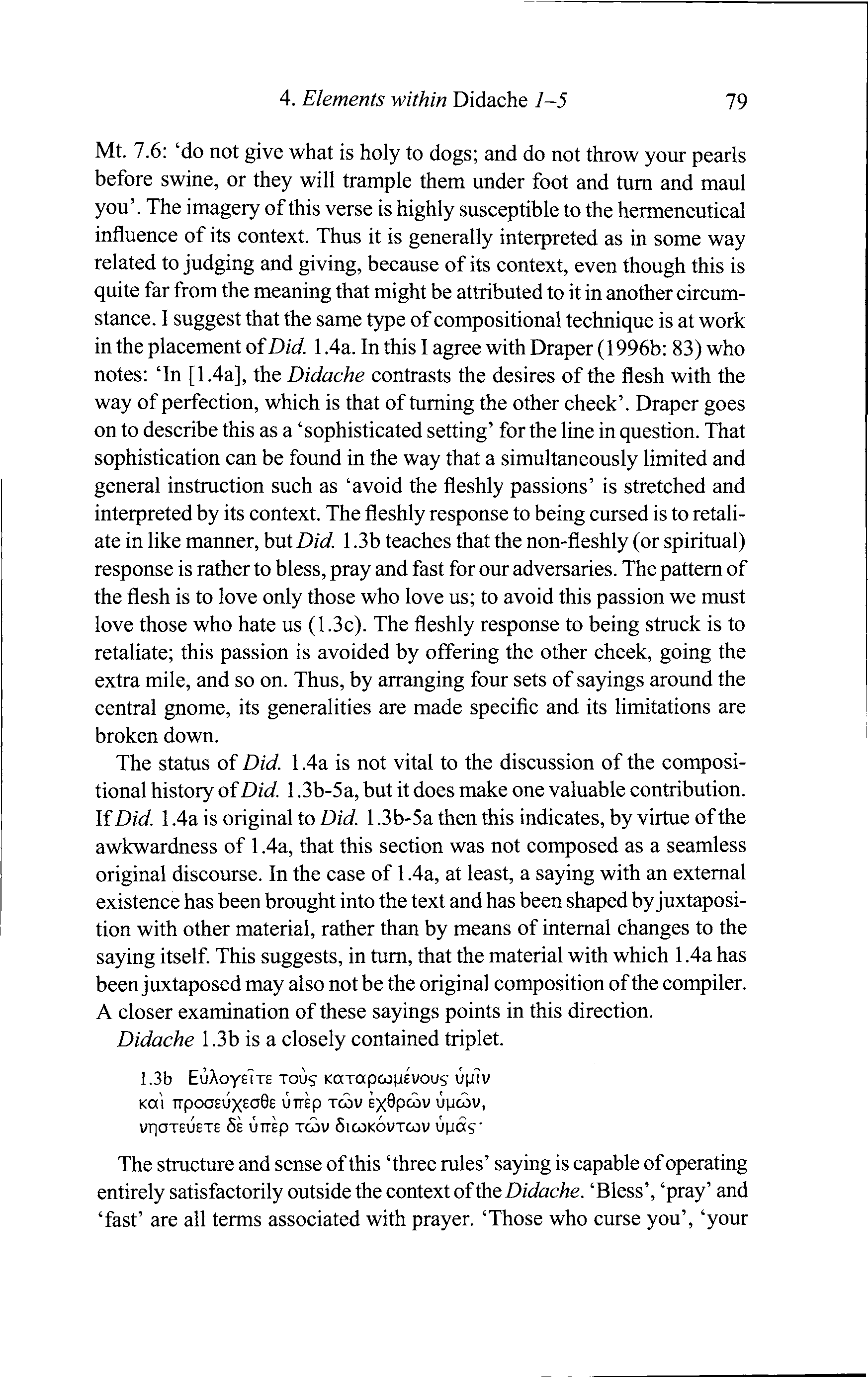
Mt. 7.6: 'do not give what is holy to dogs; and do not throw your pearls before swine, or they will trample them under foot and turn and maul you'. The imagery of this verse is highly susceptible to the hermeneutical influence of its context. Thus it is generally interpreted as in some way related to judging and giving, because of its context, even though this is quite far from the meaning that might be attributed to it in another circumstance. I suggest that the same type of compositional technique is at work in the placement of Did. 1.4a. In this I agree with Draper (1996b: 83) who notes: 'In [1.4a], the Didache contrasts the desires of the flesh with the way of perfection, which is that of turning the other cheek'. Draper goes on to describe this as a 'sophisticated setting' for the line in question. That sophistication can be found in the way that a simultaneously limited and general instruction such as 'avoid the fleshly passions' is stretched and interpreted by its context. The fleshly response to being cursed is to retaliate in like manner, but Did. 1.3b teaches that the non-fleshly (or spiritual) response is rather to bless, pray and fast for our adversaries. The pattern of the flesh is to love only those who love us; to avoid this passion we must love those who hate us (1.3c). The fleshly response to being struck is to retaliate; this passion is avoided by offering the other cheek, going the extra mile, and so on. Thus, by arranging four sets of sayings around the central gnome, its generalities are made specific and its limitations are broken down.
The status of Did. 1.4a is not vital to the discussion of the compositional history of Did. 1.3b-5a, but it does make one valuable contribution.
If Did. 1.4a is original to Did. 1.3b-5a then this indicates, by virtue of the awkwardness of 1.4a, that this section was not composed as a seamless original discourse. In the case of 1.4a, at least, a saying with an external existence has been brought into the text and has been shaped by juxtaposition with other material, rather than by means of internal changes to the saying itself. This suggests, in turn, that the material with which 1.4a has been juxtaposed may also not be the original composition of the compiler.
A closer examination of these sayings points in this direction.
Didache 1.3b is a closely contained triplet.
1.3b EiiAoyeTxE xous KaTapcojjevous KCXI TTpoaeuxeoSe UTTEP TCGV sx6pcov UJJCOV, vr)<jTEueTE 5E UTTEP TCOV SICOKOVTCOV u p a s '
The structure and sense of this 'three rules' saying is capable of operating entirely satisfactorily outside the context of the Didache. 'Bless', 'pray' and 'fast' are all terms associated with prayer. 'Those who curse you', 'your
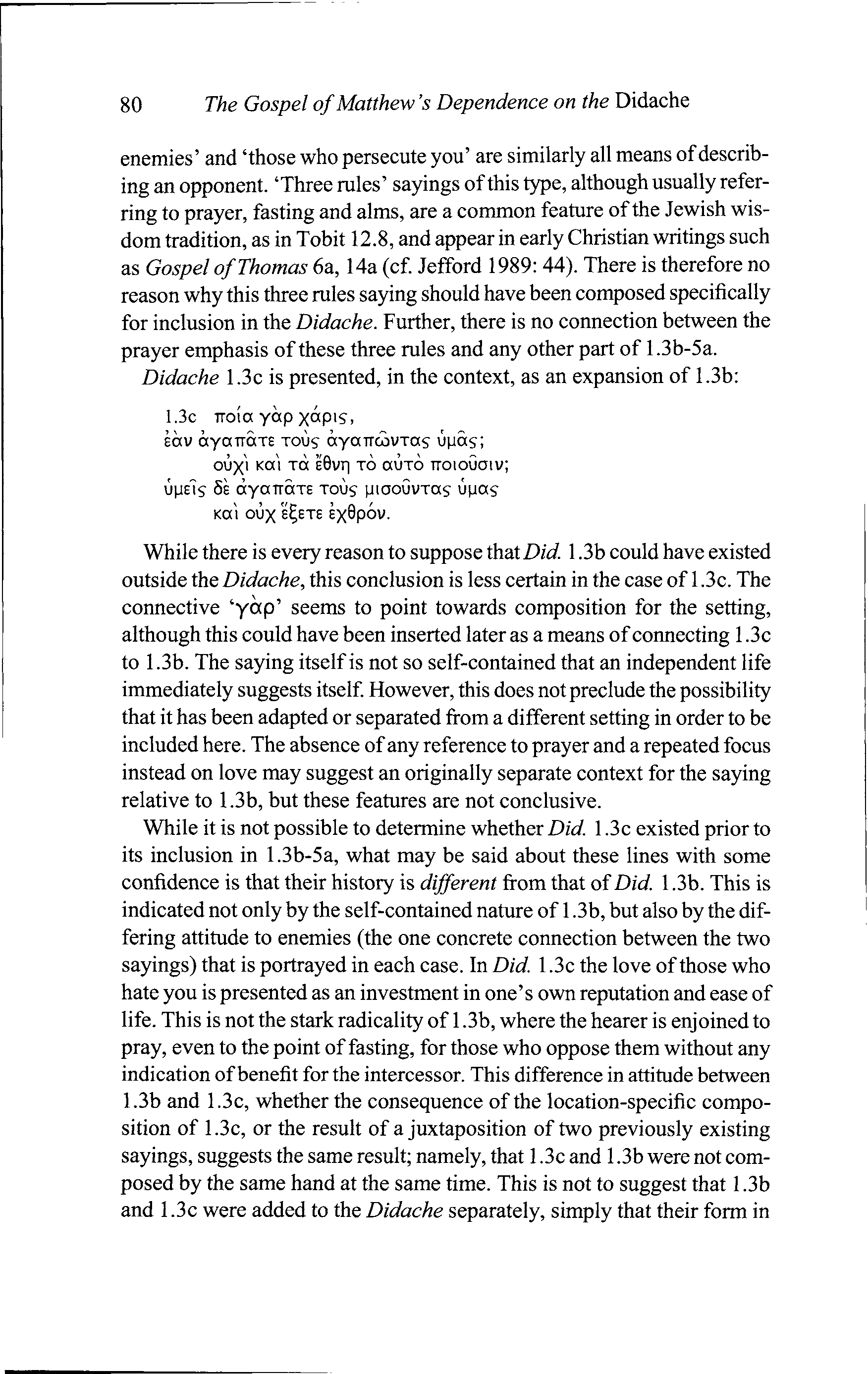
The Gospel of Matthew's Dependence on the Didache enemies' and 'those who persecute you' are similarly all means of describing an opponent. 'Three rules' sayings of this type, although usually referring to prayer, fasting and alms, are a common feature of the Jewish wisdom tradition, as in Tobit 12.8, and appear in early Christian writings such as Gospel of Thomas 6a, 14a (cf. Jefford 1989: 44). There is therefore no reason why this three rules saying should have been composed specifically for inclusion in the Didache. Further, there is no connection between the prayer emphasis of these three rules and any other part of 1.3b-5a.
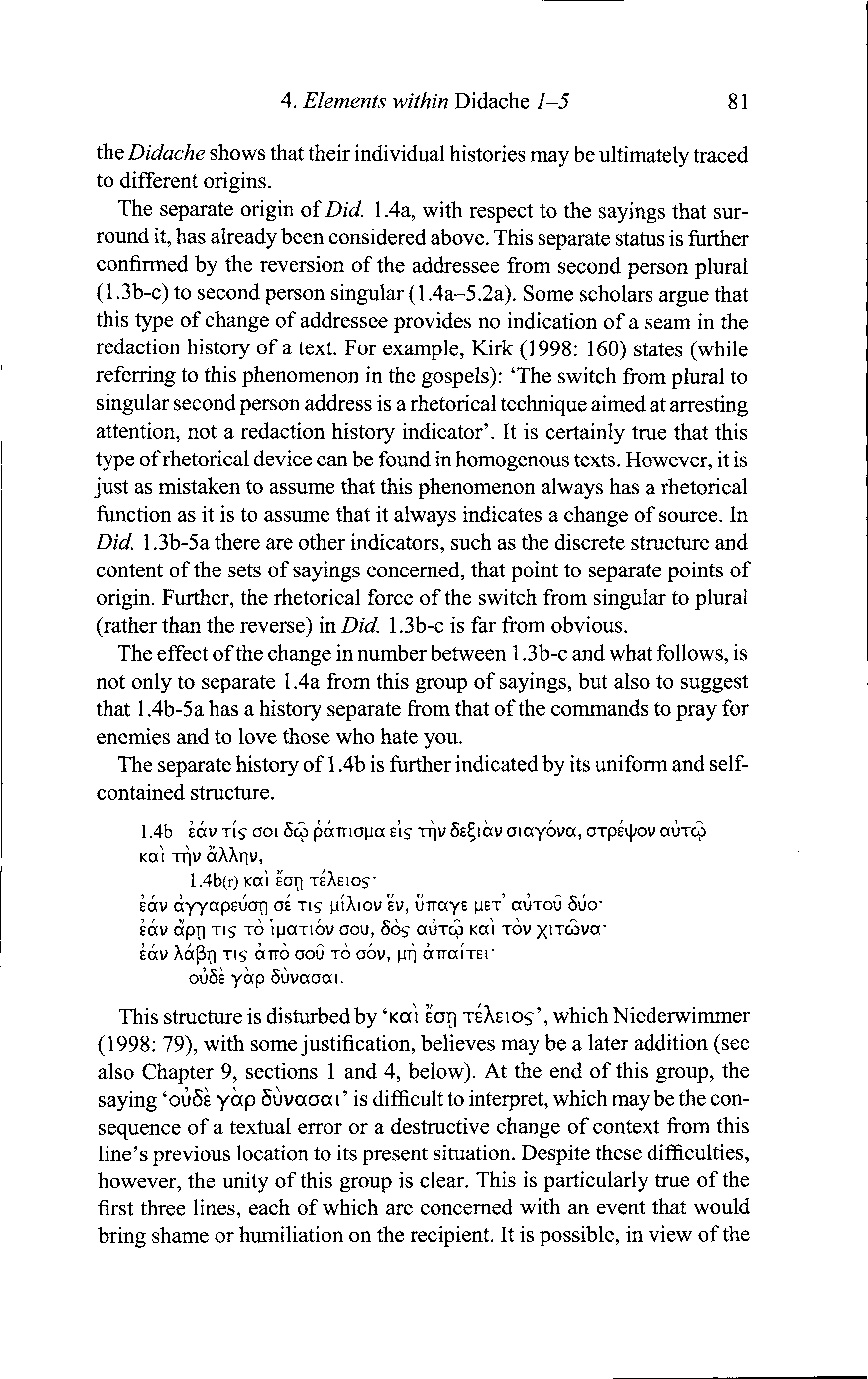
Didache 1.3c is presented, in the context, as an expansion of 1.3b:
1.3c TToia yapxapis, eav ayaTTaxE xous ayccTTGovxas upas; ouxi Ken xa 60vrj xo auxo TTOIOUGIV; \j|jeis 5e ayanaxE xous piaouvxas upas KCU oux e£exe exflpov.
While there is every reason to suppose that Did. 1.3b could have existed outside the Didache, this conclusion is less certain in the case of 1.3c. The connective 'yap' seems to point towards composition for the setting, although this could have been inserted later as a means of connecting 1.3c to 1.3b. The saying itself is not so self-contained that an independent life immediately suggests itself. However, this does not preclude the possibility that it has been adapted or separated from a different setting in order to be included here. The absence of any reference to prayer and a repeated focus instead on love may suggest an originally separate context for the saying relative to 1.3b, but these features are not conclusive.
While it is not possible to determine whether Did. 1.3c existed prior to its inclusion in 1.3b-5a, what may be said about these lines with some confidence is that their history is different from that of Did. 1.3b. This is indicated not only by the self-contained nature of 1.3b, but also by the differing attitude to enemies (the one concrete connection between the two sayings) that is portrayed in each case. In Did. 1.3c the love of those who hate you is presented as an investment in one's own reputation and ease of life. This is not the stark radicality of 1.3b, where the hearer is enjoined to pray, even to the point of fasting, for those who oppose them without any indication of benefit for the intercessor. This difference in attitude between 1.3b and 1.3c, whether the consequence of the location-specific composition of 1.3c, or the result of a juxtaposition of two previously existing sayings, suggests the same result; namely, that 1.3c and 1.3b were not composed by the same hand at the same time. This is not to suggest that 1.3b and 1.3c were added to the Didache separately, simply that their form in
4. Elements within Didache 7-5
the Didache shows that their individual histories may be ultimately traced to different origins.
The separate origin of Did. 1.4a, with respect to the sayings that surround it, has already been considered above. This separate status is further confirmed by the reversion of the addressee from second person plural
(1.3b-c) to second person singular (1.4a-5.2a). Some scholars argue that this type of change of addressee provides no indication of a seam in the redaction history of a text. For example, Kirk (1998: 160) states (while referring to this phenomenon in the gospels): The switch from plural to singular second person address is a rhetorical technique aimed at arresting attention, not a redaction history indicator'. It is certainly true that this type of rhetorical device can be found in homogenous texts. However, it is just as mistaken to assume that this phenomenon always has a rhetorical function as it is to assume that it always indicates a change of source. In Did. 1.3b-5a there are other indicators, such as the discrete structure and content of the sets of sayings concerned, that point to separate points of origin. Further, the rhetorical force of the switch from singular to plural
(rather than the reverse) in Did. 1.3b-c is far from obvious.
The effect of the change in number between 1.3b-c and what follows, is not only to separate 1.4a from this group of sayings, but also to suggest that 1.4b-5a has a history separate from that of the commands to pray for enemies and to love those who hate you.
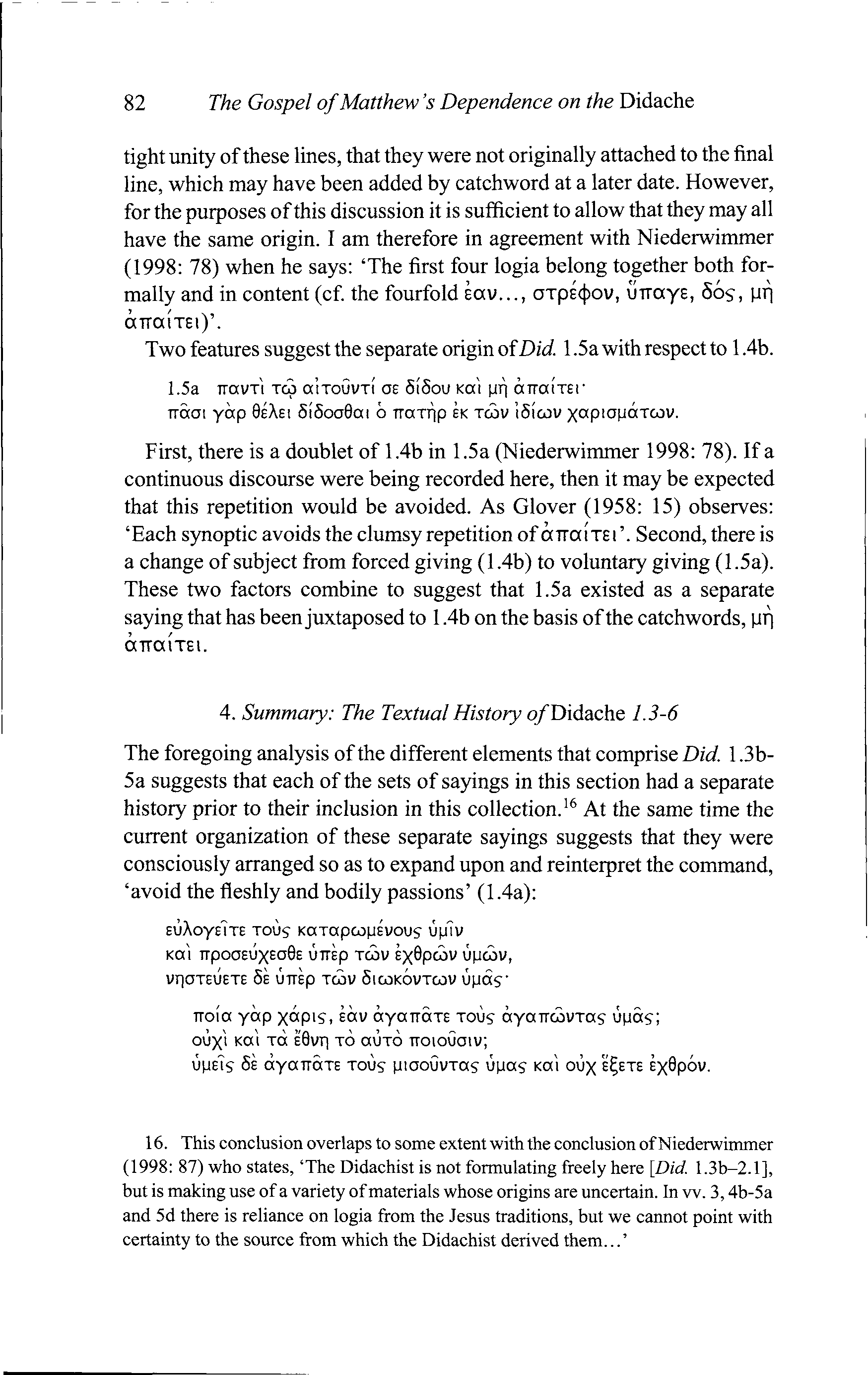
The separate history of 1.4b is further indicated by its uniform and selfcontained structure.
1.4b ECCV xis ooi 5cp paTTiaMa sis Ti\v 5e£iav aiayova, aTpsv|;ov OUTGO Kai TT|V CXAATIV, 1.4b(r) KCU ear] TEAEIOS'
ECCV ayyapeuoTi as TIS \i\k\ov EV, uirayE MET' CCUTOU 5uo* lav dfpr| xts TO ipaTiov oou, 56s auTco KCU xov XITGOVCC
EOCV Aa(3Ti TIS OCTTO oou TO oov, \ix\ aTraiTEi* OU5E yap Suvaacu.
This structure is disturbed by 'KCU ear) TEAEIOS', which Niederwimmer (1998: 79), with some justification, believes may be a later addition (see also Chapter 9, sections 1 and 4, below). At the end of this group, the saying 'OI>5E yap Suvaaa i' is difficult to interpret, which may be the consequence of a textual error or a destructive change of context from this line's previous location to its present situation. Despite these difficulties, however, the unity of this group is clear. This is particularly true of the first three lines, each of which are concerned with an event that would bring shame or humiliation on the recipient. It is possible, in view of the
The Gospel of Matthew's Dependence on the Didache tight unity of these lines, that they were not originally attached to the final line, which may have been added by catchword at a later date. However, for the purposes of this discussion it is sufficient to allow that they may all have the same origin. I am therefore in agreement with Niederwimmer
(1998: 78) when he says: The first four logia belong together both formally and in content (cf. the fourfold eav..., aTpec|)ov, (mays, 56s, \xx\ aTTCUTEl)'.
Two features suggest the separate origin of Did 1.5a with respect to 1.4b.
1.5a TTavri TCO CUTOGVTI as 5i5ou KCU \IT\ airaixer Traai yap SeAei 5i5oa0ai o iraxrip EK TCOV iSicov
First, there is a doublet of 1.4b in 1.5a (Niederwimmer 1998: 78). If a continuous discourse were being recorded here, then it may be expected that this repetition would be avoided. As Glover (1958: 15) observes:
'Each synoptic avoids the clumsy repetition of aiT/aiTS i'. Second, there is a change of subject from forced giving (1.4b) to voluntary giving (1.5a).
These two factors combine to suggest that 1.5a existed as a separate saying that has been juxtaposed to 1.4b on the basis of the catchwords, \ir\ arraiTei.
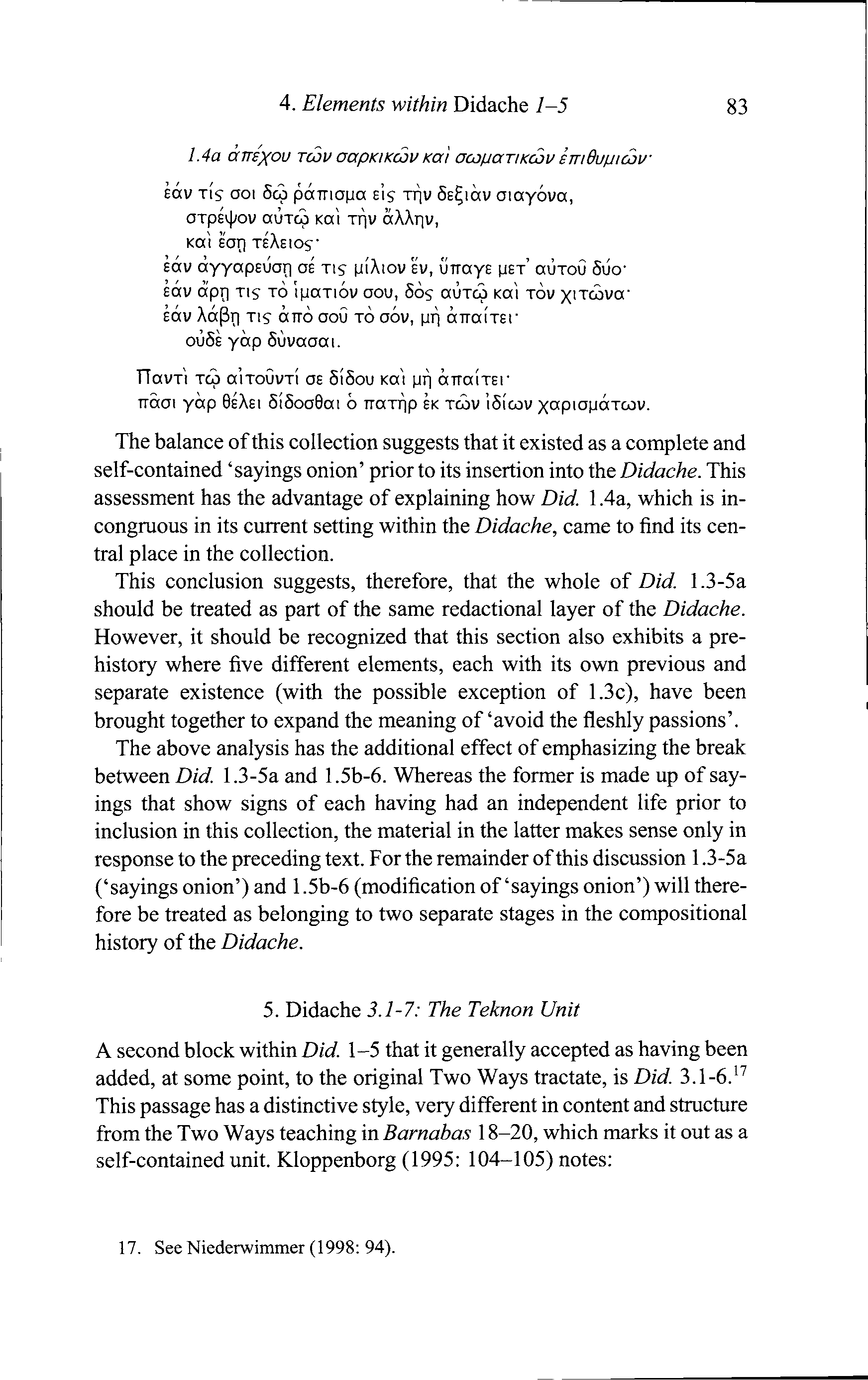
4. Summary: The Textual History o/Didache 1.3-6 The foregoing analysis of the different elements that comprise Did. 1.3b5a suggests that each of the sets of sayings in this section had a separate history prior to their inclusion in this collection.16 At the same time the current organization of these separate sayings suggests that they were consciously arranged so as to expand upon and reinterpret the command,
'avoid the fleshly and bodily passions' (1.4a):
TOUS KccTapcoMEvous u|iiv KCn TTpOGElJX£CJ0E UTTEp TGOV ExSpGOV U|JCC>V,
VrjOTEUETE 5E UTTEp TGOV SlCOKOVTCOV U|JaS'
TTOta yap X«PlS, ecxv ayairaTE TOUS ayaircovTas' i Kai TCX E0VT] TO auTo TTOIOUOIV; 5E ayaTTaTE TO\JS MioouvTas was Kai oux E^ETE 16. This conclusion overlaps to some extent with the conclusion of Niederwimmer
(1998: 87) who states, 'The Didachist is not formulating freely here [Did 1.3b-2.1], but is making use of a variety of materials whose origins are uncertain. In w . 3,4b-5a and 5d there is reliance on logia from the Jesus traditions, but we cannot point with certainty to the source from which the Didachist derived them...'
4. Elements within Didache 1-5
1.4a amxou TCJV oapKiKcovKai acojucm/ccoi/ enidufj edcv TIS aoi SGO paTTia|ja eis Tr|v 5e£iav aiayova, oxpevpov auTco Ka'i xr|v aAAriv,
Kai EOTJ TEAEIOS*
lav dyyapEuar] as TIS MiAiov EV, uirayE MET' auTou 5uo Eav apr] TIS TO ipaTiov aou, 56s auTcp Kai TOV
Eav AaPri TIS OCTTO aou TO aov, JJTI anaiTEr OU5E yap Suvaaai. ri TCO aiTouvTi as Si Sou Ka'i pr| a TTaai yap 0EAEI 5i5oa0ai b TraTrjp EK TGOV iSfcov xapiopaTcov.
The balance of this collection suggests that it existed as a complete and self-contained 'sayings onion' prior to its insertion into the Didache. This assessment has the advantage of explaining how Did. 1.4a, which is incongruous in its current setting within the Didache, came to find its central place in the collection.
This conclusion suggests, therefore, that the whole of Did. 1.3-5a should be treated as part of the same redactional layer of the Didache.
However, it should be recognized that this section also exhibits a prehistory where five different elements, each with its own previous and separate existence (with the possible exception of 1.3c), have been brought together to expand the meaning of 'avoid the fleshly passions'.
The above analysis has the additional effect of emphasizing the break between Did. 1.3-5a and 1.5b-6. Whereas the former is made up of sayings that show signs of each having had an independent life prior to inclusion in this collection, the material in the latter makes sense only in response to the preceding text. For the remainder of this discussion 1.3-5a
('sayings onion') and 1.5b-6 (modification of'sayings onion') will therefore be treated as belonging to two separate stages in the compositional history of the Didache.
5. Didache 3.1-7: The Teknon Unit A second block within Did. 1-5 that it generally accepted as having been added, at some point, to the original Two Ways tractate, is Did. 3.1-6.17
This passage has a distinctive style, very different in content and structure from the Two Ways teaching in Barnabas 18-20, which marks it out as a self-contained unit. Kloppenborg (1995: 104-105) notes:
17. See Niederwimmer (1998: 94).
The Gospel of Matthew's Dependence on the Didache The repetitive use of the phrase TEKVOV JJOU. . .places this section squarely within the idiom of sapiential discourse. The symmetry in the construction of this section has been noted by many scholars and is often taken as an indication of independent origin. R.H. Connolly [1932:2A\-A2\ observed, moreover, that of the twenty-five terms that are used for vices or faults in 3.1-6, fully nineteen do not appear elsewhere in the Didache.
The different vocabulary and grammar of Did. 3.1-6 is especially accentuated by the rhythmical and carefully structured repetitions of this section, in contrast to the comparatively loose organization of the Two
Ways instructions.
While there is every reason to suppose that Did. 3.1-6 was inserted into the original Two Ways tractate, the same level of certainty does not apply in the case of Did. 3.7. This verse contains the term TTpaus, which also appears in Barnabas 18. Almost all of Barnabas 18-20 appears in Did. 15, so it is likely that a call to be meek also appeared at some point in the Didache's Two Ways. However, it is also the case that a call to be meek provides a fitting conclusion to the Teknon teaching. This is the case structurally in that the Teknon teaching begins with a positive call, in the present imperative active, to flee from all evil. Did. 3.7 uses the same tense, otherwise unusual in the context, for the positive instruction to be meek.
The content ofDid. 3.7 also rounds off the Teknon teaching in that meekness is opposite to the anger, zeal, quarrelsomeness, hot-temper, passion, obscene speech, bold gazes, soothsayings, lies, theft, avarice, vainglory, grumbling, slander and stubborn wilfulness censured in the preceding lines.
Further, and perhaps most significantly, the promise that 'the meek shall inherit the earth' (cf. Ps. 36.11 LXX) provides a positive consequence to endorsed behaviour to balance the negative consequences of the proscribed behaviours (murderous acts, adultery, idolatry, theft, slander), all of which wickedness leads to disinheritance and banishment (cf. Ps. 36.9, 18, 20, etc.). Draper (1985: 272) adds: '3:7 forms part of the "Tugendkatalog" from the earliest stratum of the Way of Life (cf. 1QS 4:3) which has been embellished from Psalm 36: II'.18
There is a case, therefore, for suggesting that the Teknon teaching (in its exposition of Ps. 36), and the Two Ways tractate (insofar as it is parallel to the Two Ways found in Barnabas), both contained a reference to meekness. Such a sharing provides an attractive explanation for the insertion of the Teknon teaching just before Did. 3.7 in the Two Ways. Thus, it may
18. Audet (1958: 320) thinks that Did 3.7 records an independent saying, but this is unlikely given its links with both Ps. 36 and Barnabas 18.
4. Elements within Didache 1-5
be supposed that, because the tail of the Teknon unit shared a reference to meekness with the Two Ways, this point of similarity was seen as a suitable anchorage point for its insertion. Anchorage from the tail, rather than the head, would explain why the flow of the Two Ways teaching (2.2-7) into the head of the Teknon teaching, at 3.1, is so abrupt and apparently random.19
In conclusion, therefore, the Teknon teaching appears to represent a sapiential exposition of Ps. 36 which had a life independent of the Didache prior to its insertion into the Two Ways. The style and content of this addition has little in common with either Did. 1.3-5a or 1.5b-6, and is therefore likely to be the work of a different author.
6. Other Additions to the Base Two Ways The discrete character of Did. 1.3-6 and 3.1-6/7 clearly identifies them as later additions to the Two Ways teaching. However, this does not necessarily mean that the remainder of Did. 1-5 is free from other additions. It is not possible to trace the minutiae of each potential insertion, but there are two points, Did. 1.2 and 5.2, where evidence of minor additions will have significance for subsequent discussion.
6.1. Didache 1.2
In the case of Did. 1.2 there is an overlap with the Two Ways tradition as found in Barnabas in that the first command of the 'way of light' is to 'love your maker'. However, the double love command and golden rule in the Didache are notably absent from Barnabas.20 This omission, despite the memorable character of these teachings, suggests that they were not present in the version of the Two Ways available to Barnabas. Consequently, it is likely that this teaching was not a standard feature of the Two Ways tradition, and thus, at some stage in the life of the Two Ways text used in the Didache these summaries of the Law were added to the whole. Thus Niederwimmer (1998: 65) suggests:
19. The Oxyrynchus papyrus 1782 illustrates that at least one copyist perceived a radical break between Did. 2.7 and 3.1; a series of black and red chevrons are used to separate the two chapters.
20. 'The Didachist did not construct Didache 1.2a-b with the assistance of the Two
Ways source alone, since the wording of the "double love commandment" in Barnabas does not indicate a knowledge of materials that could have led to the more complete rendering of the "double love commandment" that appears in the Didache'
(Jefford 1989: 35).
The Gospel of Matthew's Dependence on the Didache We must apparently imagine that the Two Ways tractate, in its introduction, originally spoke only of the commandment to love God {Barn. 19.2).
At some point a redactor expanded the command to love God by adding the commandment to love one's neighbour, and so constructed the double commandment. In doing so, he made the doubling explicit by inserting 'first' and 'second'.
Niederwimmer seems to suggest here that the Didache represents the creation of the double love command. However, it is not fanciful to suppose that the double love commandment could have functioned as a complete unit in itself. As Hultgren (quoted in Jefford 1989: 34) comments:
Two reasons can be given [in justification that this commandment could have functioned as a unit]. First, the double commandment of love would have been a characteristic and rather important teaching (whether of Jesus, or attributed to him). We have other examples in which Jewish teachers of the period summarised the Torah, and one can expect that the same would have been done by Jesus or the teachers of the primitive community (as Rom 13.9 gives evidence for the latter). Furthermore, this summary could be used on various occasions and in several connections. We have independent traditions in which it is used, viz., Mark and Q.
It is possible, therefore, that the double love command and the negative golden rule were known as important teachings independent of the Two
Ways. Their insertion into the Two Ways may be credibly accounted for by the overlap between 'Love the God who made you' (Did. 1.2) and the first half of the double love command. This overlap creates a suitable point at which the double love command may be woven into the text of the Didache. Thus, where the two traditions essentially overlap, as in 'Love the God who made you' and 'Love the Lord God', the version in the host text is preserved. Where this overlap does not occur the incoming text is played out in full.
The inclusion of the negative golden rule may be by virtue of its association with the double love command in the experience of the interpolator, or because it was similarly seen as a summary of the Torah, important for Christians, which deserved a place at the start of the Two Ways exposition of the commandments.
If it is the case that 1.2b, d-e was added to an existing form of the Two Ways then one of the linking devices in either 1.3a or 2.1 may also be attributed to this interpolator. This is the case since the insertion of an initial summary of the Law requires a means of showing that the following instructions are subsequent details, which fill out the broad cloth painted by the opening commands. Either 'Here is the teaching that flows from these words', or 'The second commandment of the doctrine' would serve
4. Elements within Didache 7-5
this function equally well. However, as argued above, it is more likely that the second of these two options was used (cf. section 1, above).
None of the following discussions are affected by the question of whether or not Did. 1.2b, d-e was copied from the Two Ways source or not. The question of significance here is whether or not these verses formed an additional part of the collection of sayings quoted in Did. 1.3b-5a. Three factors suggest that this is not the case. First, 1.3b-5a stands alone as a balanced set of sayings concerned with what it means to 'avoid the fleshly passions' (according to the discussion in section 3, above) and 1.2b, d-e does not fall easily within the structure of this unit. Second, there is a disjunction between the negative form of the golden rule in 1.2e and the positive instructions of 1.3b-5a which does not suggest that they originally belonged together. Third, as noted in section 1, above, the flow from 1.2b, d-e straight into 2.1 is disturbed by the intrusion of 1.3-6. It is not likely, therefore, that both 1.2b, d-e and 1.3-6 were added to the whole at one time.
With regard to the status of 1.2b,d-e. It is possible to gather the following pieces of evidence: these verses do not appear in the Two Ways teaching in Barnabas and so it is likely that they do not belong to the Two
Ways tradition used in the Didache. The likelihood of their later addition is further enhanced by the case for the independent existence of these Law summaries, and the credible basis for their inclusion in the Didache provided by the overlap between the double love command and the opening command of the Two Ways. The use of 'second' in both 1.2 and 2.1 suggests that the latter verse may also have been added with the double love command and the golden rule as a means of restoring the flow of sense from the interpolation back into the host text. In concluding that 1.2b, d-e and 2.1 are likely to have been added to an older version of the Two Ways it is crucial to note that this addition appears not to have been made at the same time as the insertion of Did. 1.3-5a, since the latter interrupts the flow from Did. 1.2 into 2.1.
6.2. Didache 5.2
At the end of the Two Ways teaching there is a further detail of the history of the text that will be important in subsequent discussion. This is the point at which a free-standing version of the Two Ways teaching could have ended.
Three possible end-points of a free-standing Two Ways document may be proposed: 5.2a, 5.2b or 6.1.21
21. Niederwimmer (1998: 120); Kloppenborg (1995: 97); Audet (1958: 352) and Rordorf (1996a: 153 n. 36) favour 6.1 as a closing point.
The Gospel of Matthew fs Dependence on the Didache To establish which of these potential end-points is the most likely it is necessary to note, first of all, that 5.2a, 5.2b and 6.1 were added to the text at three different times, either singly or as part of larger elements.
Thus, Did. 5.2a is almost identical to the parallel 'way of darkness' in Barnabas 20 and so there can be little doubt that this verse forms part of the original Two Ways tractate.
Did. 5.2b, on the other hand, does not appear in Barnabas, and further, it introduces a form of address, 'TSKva', which is contrary to the preceding text in that neither this word, nor the plural form of address, occur elsewhere in the Two Ways material.22 It is unlikely, therefore, that 5.2b was originally written by the same hand as 5.2a.
The reversion in Did. 6.1 to the singular form of address suggests the possibility that 5.2a and 6.1 belonged together in an original version of the Two Ways. However, two factors indicate that 6.1 did not follow on directly from 5.2a in the original Two Ways source. First, 6.1 is absent from the Barnabas account of the Two Ways. Second, the expression,
'See that no one leads you astray from this way of the teaching', implies that, in the conception of the author of 6.1, the Two Ways is a complete and established entity of which the author has an objective view.
Otherwise the call to adhere to 'this way of the teaching' could be taken as referring to the way of the teaching that has just been mentioned, namely, the 'way of death'.
If Did. 5.2a, 5.2b and 6.1 were all added to the Didache at different times, then the question of which verses could have closed the Two Ways document arises.
Two factors suggest that 5.2b could never have formed the end of a freestanding document. First, the most likely motivation for adding additional material to the Two Ways teaching would be to enjoin readers to keep the teaching therein. It is surprising, therefore, that 5.2b contains only half of what might be expected. That is to say that rather than finishing the text with parallel injunctions to live the 'way of life' and reject the 'way of death', only the latter point is emphasized.
Second, a superior motivation for the addition of 5.2b may be found in the presence, rather than the absence, of 6.1. In this circumstance the text would run (picking it up towards the end of the 'way of death'):
22. There is one exception in that the plural form of address is also used in Did. 4.11.
4. Elements within Didache 1-5
5.2a ... Those.. .who are murderers of children, corrupters of God's creatures, who turn away from the needy, who oppress the afflicted, defenders of the rich and unjust judges of the poor, altogether sinful.
6.1
See that no one leads you astray from this way of teaching, since the one who does so teaches apart from God.
This juxtaposition could take place if the author of 6.1 were commending the whole of the Two Ways teaching much as someone might say,
'Don't stray from what it says in this book', while handing over the volume in question. A later reader of the resultant combined text might, however, perceive an unhelpful ambiguity, since it could be taken that the readers are being enjoined to let no one lead them astray from the 'way of death'! In this circumstance the insertion of 5.2b, while clumsy, does serve a feasible purpose in that it clarifies the potential ambiguity:
5.2a ... Those...who are murderers of children, corrupters of God's creatures, who turn away from the needy, who oppress the afflicted, defenders of the rich and unjust judges of the poor, altogether sinful.
5.2b May you (pi.) be delivered, children, from all this.
6.1
See that no one leads you astray from this way of teaching, since the one who does so teaches apart from God.
If it may be concluded that 5.2b was unlikely ever to have been the last line of a free-standing Two Ways document, then one of the other two options for this function, 5.2a or 6.1, may be preferred. The case for Did.
6.1 is very much dependent on the presence of a parallel to Did. 6.1 (and 5.2b) in the Doctrina apostolorum. It is certainly the presence of 6.1 in the Doctrina apostolorum that causes Niederwimmer (1998: 45,120), Kloppenborg (1995: 97) and Audet (1958: 352) to suppose that this verse belonged to the Didachist's Two Ways source. However, as discussed in the excursus above, the inconsistency of the sequence Did. 5.2a-5.2b-6.1, when compared with the relatively smooth parallel in the Doctrina, suggests that the Doctrina is a later document, and thus that it does not provide evidence of the presence of Did. 6.1 in the version of the Two Ways known to the Didachist. Without the support of the Doctrina the case for Did. 6.1 as an end-point to the base Two Ways collapses entirely.
Given that, in the absence of evidence from the Doctrina, Did. 6.1 shows few signs of acting as a postscript to the Two Ways teaching23 it is prefer23. As a later postscript to the Two Ways teaching, Did. 6.1 could only have functioned as an attempt to bolster the authority of the preceding text. However, the long established and highly orthodox basis of the Two Ways teaching means that it is
The Gospel of Matthew's Dependence on the Didache able to consider the possibility that it served a different function as part of a larger addition to the Didache. In Chapter 5, section 2, below, it will be argued that 6.1 serves as a linking verse that provides a smooth transition from the Two Ways into the ensuing baptismal liturgy (7.1). Without this verse, it will be argued, the following instructions could not have made sense. If this conclusion is justified, then it is likely that Did. 6.1 was added as part of a larger layer of Christian instruction, rather than as an additional support to the authority of the Two Ways.
If neither 6.1 or 5.2b serve as credible end-points for the free-standing Two Ways document, then it may be concluded that any further layers that were added to the Two Ways were appended to the end of 5.2a. That this verse is the most likely end-point of the Two Ways document is strongly supported by the exactly parallel ending in the version of this teaching found in Barnabas 20.
7. The Two Ways: Didache l.l-2a, c; 2.1-7; 3.8-5.2a With the removal of Did. 1.3-6; 3.1-7; 1.2b, d-e; 2.1 and 5.2b the base
Two Ways may be limited to: 1. l-2a, c; 2.2-7 and 3.8-5.2a. The presence of parallels to almost all of this material in Barnabas 18-20 suggests that these verses record a Two Ways tractate into which additional elements, outlined above, were incorporated.
8. Summary: Elements within Didache 7-5 This chapter has been solely concerned with the isolation of the various elements that comprise the Didache's pre-baptismal catechism. This is not the same as attempting to identify when these elements were added to Didache; a question addressed in Chapter 7 with respect to Did. 1.5b-6, and in Chapter 9 with respect to the remaining verses. All that is required unlikely to have needed support against generalized attacks; no such defence is provided in Barnabas. If Did. 6.1 was specially added in response to a specific challenge, then it is remarkable that this response is no more pointed than the general,
'See to it that no one leads you astray from this way of the doctrine'. In addition, as noted above, such an addition creates a curious ambiguity in the absence of 5.2b, thus requiring the addition of this insert also. The complications involved in the addition of these final lines as the end of a free-standing Two Ways document would therefore be so great, relative to the benefit gained, that it is hard to imagine that such a course could ever have been taken.
4. Elements within Didache 1-5
at this preparatory stage is the identification of elements in Did 1-5 that derive from different points of origin.
8.1. Two Ways The similarity of Did 1. l-2a, c; 2.2-7 and 3.8-5.2a to the Two Ways material in Barnabas 18-20 and the distinct difference in style and content between these verses and Did. 1.2b, d-e; 1.3-6 and 3.1 -7 suggests that Did.
1.1 -2a,c; 2.2-7 and 3.8-5.2a represents a Two Ways source separate from the surrounding material.24
8.2. Law Summary Unit Did. 1.2b, d-e and 2.1 contains the double love command and a negative version of the golden rule that links back, at Did. 2.1, into the continuing
Two Ways. This distinctive expansion of the Two Ways instruction to 'love the God who created you' is not present in the Barnabas Two Ways and so is taken as an additional separate element.
8.3. Sayings Onion The collection of sayings at Did. 1.3-5a expand the command to love the neighbour and interrupt the flow, both in terms of content and style, from the negative golden rule (1.2c) into the negative instructions following
Did. 2.1. While generally recognized as an addition to the Two Ways, scholars have overlooked the crucial possibility that this unit contains five elements, themselves of separate origin.
8.4. Modification of Sayings Onion If Did. 1.5b-6 seeks to modify the immediately preceding call to 'give without asking back', then it is highly unlikely to have been written by the person who also contributed Did. 1.3-5a. In addition, within Did. 1.5b-6, a further saying of separate origin is quoted in 1.6b, 'Let your charitable gift sweat in your hands until you know to whom you give'.
24. The origins of this unit cannot be traced precisely. For some time it was believed that Barnabas was the direct source for these verses. However, the more recent scholarly consensus supposes that Didache and Barnabas were both dependent on a common written document. This is the view of Glover (1958:22); Rordorf (1991:
396); Layton(1968: 379); Draper (1996a: 10,13,16); Kloppenborg (1995: 88-92) and Niederwimmer (1998: 31). The widespread extent of this type of tradition in the Old
Testament and Apocrypha (Niederwimmer 1998: 59-62) suggests that the tradition expressed in Did 1.1-2a, c; 2.2-7 and 3.8-5.2a may well be pre-Christian.
The Gospel of Matthew's Dependence on the Didache In summary, this chapter has argued that Did. 1-5 contains work derived from nine points of origin: a Two Ways tractate, a summary of the Law, a collection of five sayings arranged around a central gnome, and a modification of those sayings which itself appeals to an external authority.
The end of this chapter marks the completion of three major preparatory tasks concerning the prayers in Did. 9-10, the integrity of Did. 16 and the elements within Did. 1-5. It is now possible to progress to a more direct consideration of the compositional history of the Didache.