
Chapter 2 THE 'EUCHARISTIC' PRAYERS IN DIDACHE 9 AND 10
Chapter 2
THE 'EUCHARISTIC' PRAYERS IN DIDACHE 9 AND 10
Since Bryennios's publication of the Didache in 1883, scholars have struggled to present a coherent understanding of chs. 9-10. These chapters have been variously understood as referring to:
An agape.1
A eucharist.2
A satisfying eucharist.3
A fellowship meal followed by a eucharist.4
The term' agape' is used throughout this discussion to denote a fellowship meal that is intended to satisfy hunger as well as to symbolize the fellowship of the community. Mazza's (1996: 285-86) criticism of the anachronistic use of this term is justified.
However, 'agape' provides a convenient term that is widely used to denote one of the possible meal types in Did. 9 and 10. Jeremias (1966:118) lists the following representatives of the view thaXDid. 9 and 10 describe only an agape: Ladeuze, Kattenbusch,
Drews, Ermoni, van Crombrugghe, Baumgartner, Cagin, Knopf, Ferris, Goossens, Brinktrine, Connolly, Dolger, Cirlot, Dix. Of these authors the most recent appears to be Dix (1945). To this list may be added Vokes (1938: 197-207) and Gero (1977: 82).
The term' eucharist' is used throughout to describe the meal of bread and wine instituted by Jesus. Jeremias (1966:118) lists the following representatives of this view:
Batiffol, Volker in 1927, Casel, Greiff in 1932 and Bricout. To this list may be added:
Middleton (1935: 259-61), Creed (1938: 374, 386-87) and Glover (1958: 26-27).
Bouley (1981: 89-99) is a more recent supporter of this type of view. His reading is unusual, supposing that Did. 9.2 is non-sacramental, while Did. 9.3-4 represents a sacramental thanksgiving over the bread and Did. 10.2-5 a sacramental thanksgiving over the wine. Bouley also allows for a full meal between these two events. Riggs (1984) proposes an understanding of the development of the prayers in Did. 9 and 10 that leads to their ultimate use for a eucharist only (see § 2.2 in this chapter).
This type of eucharist supposes that the enj oyment of a meal in a community is also experienced as a eucharist. J. Betz (1996:247) cites Reicke and Lilje as exponents of this view. Mazza (1995: 12^1) also proposes this solution.
Jeremias (1966: 118) who subscribes to this view himself lists: Zahn, Dibelius, von de Goltz, Hennecke, Stapper, Hupfeld, Quasten, Arnold, Bultmann, Schneider and
The Gospel of Matthew's Dependence on the Didache 5.
A eucharist followed by an agape.5
Simple table prayers, reworked out of eucharistic prayers, used in ascetic circles.6
J. Betz (1996: 247) sums up this range of options by remarking, 'This large number of interpretations shows the uncertainty of the state of the research, the hypothetical character of the explanations and the difficulty of the question'. Mazza (1996: 283) concurs, 'On the meaning of...
Didache 9-10, there have been many interpretations, none of which are outstanding'.
The unsatisfactory nature of these conclusions is caused by an apparently unresolvable tension within the evidence. The situation is similar to that of someone trying to cover all four corners of a mattress with an insufficiently large fitted sheet. Although three corners may be covered satisfactorily the inclusion of the fourth may only be achieved at the expense of one of the others.
In the case of Did. 9 and 10 there are five liturgical actions located within 9.2-4,9.5,10.1,10.2-5 and 10.6. When these verses are considered independent of their context within Did. 9 and 10, the actions described may be identified relatively straightforwardly. However, as the following two sections aim to show, confusion arises when attempts are made to combine all five actions within one liturgical event.
1. The Five Actions o/Didache 9 and 10 1.1. Didache 10.1: A Full Meal After you have had your fill (6MTrAr}a6f]vai), give thanks thus:
With respect to the action referred to in Did. 10.1 there is almost universal agreement among scholars that this verse should be seen as referring back to a literally filling meal.7 There are two powerful arguments in perhaps without complete justification, Audet. J. Betz (1996:247), who also subscribes to a version of this view, lists: Lessig, Stahlin, Jungmann, Batley, Goppelt, Danielou and Adam.
Lietzmann (1953-64: 192) is isolated in this view.
Peterson (1951). This view, a product of the sceptical American school, is not currently influential.
Bouley (1981: 96) interprets Quasten( 1975: 31-32) as supposing that an actual meal is not referred to here. Other opponents of the literal interpretation of E|JTTAr)GSfivai include the small number of earlier scholars mentioned by Jeremias in n. 2, above.
2. The 'Eucharistic' Prayers in Didache 9 and 10
favour of a literal interpretation of eMTTAriaSfjvai. One is expressed by J.
Betz (1996: 249):
The expression E|JTTAr|a0fjvai in 10:1.. .is a rubric, and so cannot be taken in an extended sense, but must rather be understood literally.. .it then points to the preceding food and drink as a genuine meal.
A second important observation is made by Mazza (1995: 16-17):
The verb 'to satisfy fully'.. .immediately recalls the expression - one that is almost a technical term - from Deuteronomy 8.10: 'kai fage kai emplesthese'.8
The level of overall support for a literal interpretation of E|JTTXr|O0fivai may be measured by observing that only one of the interpretations ofDid.
9 and 10, listed in the introduction above, contemplates the absence of a full meal within the overall liturgy of Did. 9 and 10.9
1.2. Didache 10.6: An Invitation to a Eucharist Let grace come and let this world pass away.
Hosanna to the God of David.
If anyone is holy let him come, if anyone is not let him repent.
Maranatha. Amen.
Before attempting to assess the function of this verse it is necessary to consider whether or not the phrase, 'If anyone is holy, let him come. If anyone is not let him repent', should be taken as a liturgical proclamation or as a rubric.
The fact that every other line of this verse has a proclamatory character suggests that it is highly likely that the invitation to the holy would also have been spoken aloud. This is the view taken by the majority of scholars.10 The opposing view must argue, with Bouley (1981: 95), that 'The admonition of 10.6 may well be another of the general directives awkwardly inserted by the author in the midst of liturgical formulas'. Bouley's own admission that the insertion of a rubric in the midst of spoken liturgical formulas is 'awkward' confirms that it is more natural to accept the orality of the whole of Did. 10.6. If, for the time being, Did. 10.6 is taken
Mazza (1995: 17) goes on to give other examples of the technical use of this term in Deuteronomy.
Audet (1958:430-31) argues for a literal interpretation. For the list of scholars who actively or passively accept this view see references in nn. 1,2,4,5 and 6, above.
10. See those listed in n. 4, above.
The Gospel of Matthew's Dependence on the Didache independent of its context,11 then the conclusion that the whole verse was intended to be spoken aloud, perhaps as a responsive dialogue (Lietzmann
1953-64: 192), is difficult to avoid.
As a proclaimed liturgy Did. 10.6 issues three invitations, two of which appear to carry a dual force. As J. Betz (1996: 271) states:
The community implores: 'Let grace come and let the world pass away!'
Further 'Maranatha!' These prayers/cries relate primarily to the future event of the fulfilment of salvation, but nevertheless still have a second dimension of meaning, which even though it is not overt should still not be mistaken: they indicate that the future Parousia event, the future coming of Jesus, experiences a foretaste and anticipation here and now in the event of the Lord's Supper.12
The inherent ambiguity in the force of Maranatha13 means that it is possible to interpret this cry as focusing on the Parousia, a future event that lies beyond the boundaries of the service. This allows for the possibility that Did. 10.6 acts as a closing liturgy that sends the congregation out into the world.14 However, this interpretation is extremely difficult to sustain so long as the invitation to the holy to 'come' is accepted as part of this spoken liturgy. In this circumstance it is necessary to suppose that the holy were invited to 'come' in the sense of 'go into the world'. This interpretation is not only contrary to the obvious reading of 'come', it also creates an awkward situation for those who are not holy, but who may not 'come' until they have repented. Must they stay behind until they are holy enough to leave?
It has also been suggested that the invitation to the holy, and the ban on the unholy, refers back to a preceding meal.15 However, in this case,
11. Bouley (1981: 95) recognizes that an oral invitation to the holy in 10.6 provides a strong indication of a following eucharist. Because he perceives a eucharist as already described in Did 9.3-10.5, Bouley must propose his awkward reading of this invitation.
12. Concerning the force of Maranatha, J. Betz (1996: 272) follows Lietzmann (1953-64: 193), Dibelius (1938:40) and Cullmann (1963: 208-216) in perceiving, in combination with a call for the ultimate Parousia, a eucharistic focus in this acclamation. Moule (1961: 44) also considers this possibility, although he is ultimately more sceptical.
13. Moule (1961: 70-71) and J. Betz (1996:271-72) both consider the alternative grammatical possibilities within Maranatha. These allow for the indicative, 'Our Lord has come', as well as for the more common imperative reading.
14. In an informal conversation, Jonathan Draper appeared to support this view.
15. This is the force of Bouley's argument (1981:95). However, Bouley recognizes that this is only feasible if the invitation and prohibition were not spoken aloud.
2. The 'Eucharistic' Prayers in Didache 9 and 10
because the prohibitions of Did. 9.5 appear within a rubric, the invitation and prohibition would only have been publicly announced after the event in question had already taken place.
In conclusion, the three invitations of Did. 10.6 strongly indicate a forthcoming event. This eschatologically significant event is one to which the Lord and the holy are invited. In these circumstances J. Betz (1996:
249) is justified in concluding, in line with several other scholars,16 that The command in 10:6, that only the holy should come while the unholy do penance, presents the eucharist as only now happening, not as already having happened.
Similarly, Jeremias (1966: 118) concludes:
The liturgical ejaculations in 10.6, which greet the coming Lord, and the warning 'if anyone is holy, let him come; if he is not let him repent' are meaningful only as the introduction to the Eucharist (not as the conclusion of an Agape or a Eucharist).
1.3. Didache 10.2-5: Thanksgiving After a Meal Did. 10.2-5 is commonly accepted as a prayer of thanksgiving after a meal akin to the Jewish Birkat Ha-Mazon}1 The fact that scholars who espouse very different understandings of Did. 9 and 10 all agree on this point is a powerful argument in its favour. Mazza (1995: 17) notes that 'Since the studies of Finkelstein, Dibelius, and Hruby the connection between the Birkat Ha-Mazon and Didache 10 no longer requires demonstration'. Finkelstein (1928-29: 215-16) seeks to illustrate the relationship between Did. 10.2-5 and the Birkat Ha-Mazon by providing parallel translations:
16. See those listed in n. 4, above. In addition, Riggs (1984: 97) and Niederwimmer (1998: 143), 'If we allow the text to stand as it has been handed down we have scarcely any other choice but to suppose that 10.6 is the invitation to the Lord's
Supper, which follows immediately thereafter'.
17. Riggs (1984: 91) cites several supporters of this view: Oesterley; Finkelstein;
Dibelius; Middleton; Baumstark; R. Grant and C. Richardson; Audet; Bouyer; Koster;
Voobus; Talley; Verheul; Rordorf and Tuilier. Among those disagreeing with this view Riggs cites Peterson, J. Betz and Kilmartin. Draper (1996a: 26) also mentions
Taylor and Turner, von der Goltz and Klein. Mazza (1995:4,17), himself a supporter of this connection, also cites Bouyer and Hruby.
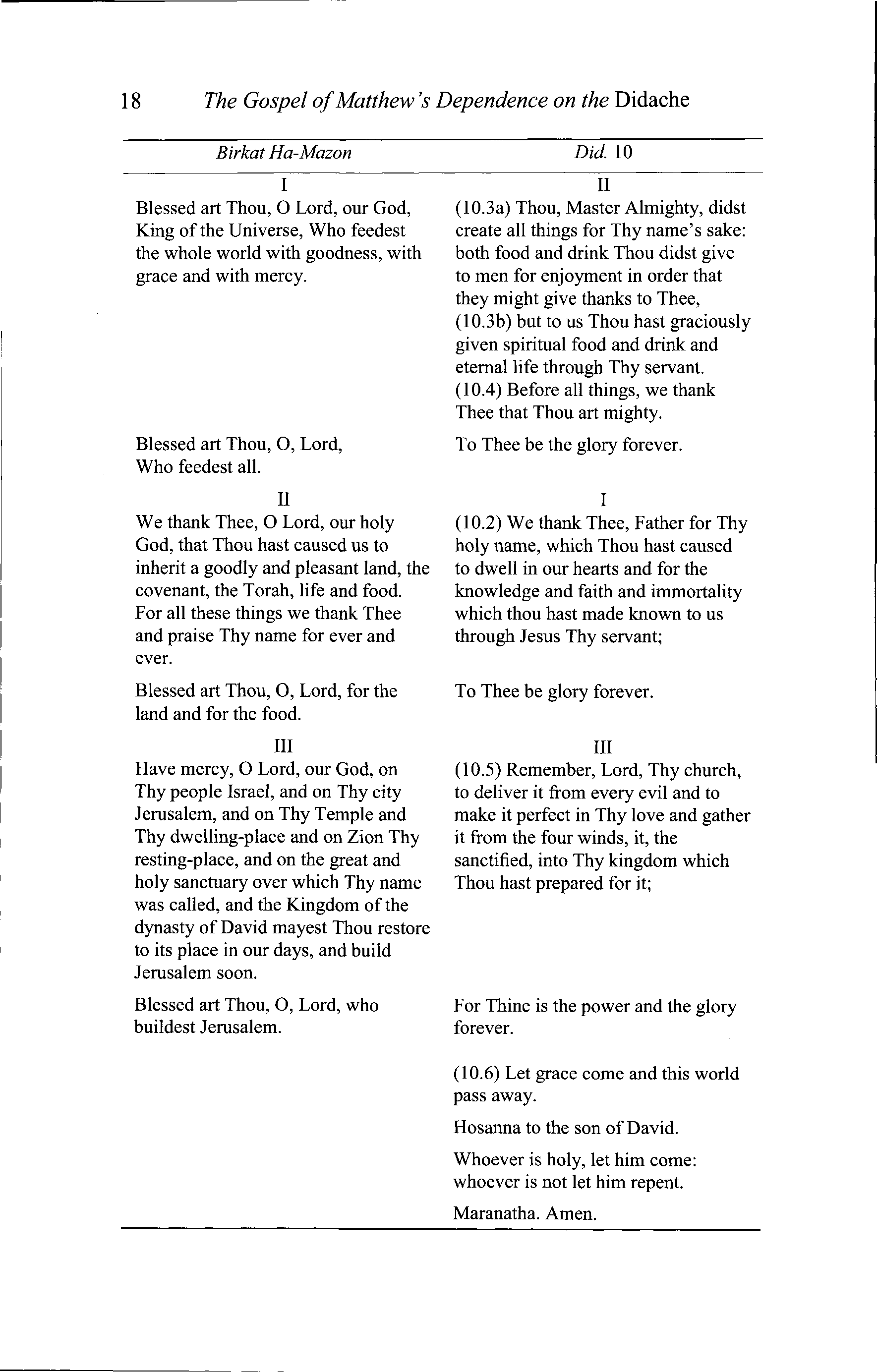
The Gospel of Matthew's Dependence on the Didache Birkat Ha-Mazon Did. 10
II (10.3a) Thou, Master Almighty, didst create all things for Thy name's sake: both food and drink Thou didst give to men for enjoyment in order that they might give thanks to Thee, (10.3b) but to us Thou hast graciously given spiritual food and drink and eternal life through Thy servant.
(10.4) Before all things, we thank Thee that Thou art mighty.
I Blessed art Thou, O Lord, our God, King of the Universe, Who feedest the whole world with goodness, with grace and with mercy.
Blessed art Thou, O, Lord, Who feedest all.
To Thee be the glory forever.
II We thank Thee, O Lord, our holy God, that Thou hast caused us to inherit a goodly and pleasant land, the covenant, the Torah, life and food.
For all these things we thank Thee and praise Thy name for ever and ever.
I (10.2) We thank Thee, Father for Thy holy name, which Thou hast caused to dwell in our hearts and for the knowledge and faith and immortality which thou hast made known to us through Jesus Thy servant; Blessed art Thou, O, Lord, for the land and for the food.
To Thee be glory forever.
Ill Have mercy, O Lord, our God, on Thy people Israel, and on Thy city Jerusalem, and on Thy Temple and Thy dwelling-place and on Zion Thy resting-place, and on the great and holy sanctuary over which Thy name was called, and the Kingdom of the dynasty of David mayest Thou restore to its place in our days, and build Jerusalem soon.
Ill (10.5) Remember, Lord, Thy church, to deliver it from every evil and to make it perfect in Thy love and gather it from the four winds, it, the sanctified, into Thy kingdom which Thou hast prepared for it; Blessed art Thou, O, Lord, who buildest Jerusalem.
For Thine is the power and the glory forever.
(10.6) Let grace come and this world pass away.
Hosanna to the son of David.
Whoever is holy, let him come: whoever is not let him repent.
Maranatha. Amen.
2. The 'Eucharistic' Prayers in Didache 9 and 10
These two prayers undoubtedly exhibit common structural and conceptual similarities. Further, if the content ofDid. 10.1, with its reference to a filling meal may be taken into account, then there is little doubt that Did.
10.2-5 acts, at least in part, as a thanksgiving after a meal. However, a certain degree of caution is necessary before drawing more detailed conclusions from the supposed relationship between these two prayers. First, although they may reflect ancient tradition, it is not possible to be certain of the exact content of this type of prayer at the time ofDid. 10's composition. Mazza (1995: 19) also invites caution when he suggests that We can show that the Didache has not inverted the first two strophes of the Birkat Ha-Mazon [as Finkelstein portrays]. The transition between the Jewish and the Christian prayer-texts has been more complicated than that.
The Didache has eliminated the first strophe of the Birkat Ha-Mazon and has substituted another text that at once expresses.. .Christian tidings.
Mazza (1995: 28) also suggests that 'Didache 10.5 departs from the Birkat Ha-Mazon in order to draw from other Jewish prayers, such as the tenth blessing of the Amidah prayer or from the Ahabhah Rabbah\18
In addition to these variations there is a clear discrepancy between the Birkat Ha-Mazon and Did. 10.3b, where spiritual food and drink are mentioned. This apparent addition to the standard structure of the prayer suggests, if the proximity of Did. 10.6 may be taken into account, that Did.
10.2-5 acts, not only as a prayer after a meal, but also as a transitional prayer from physical food (10.1, 3a) to the eating of spiritual food and drink (10.3b, 6) at a following eucharist.
In summary then, the essential and agreed action described in Did. 10.25 is a prayer of thanksgiving after a satisfying meal. However, the addition of Did. 10.3b implies that this prayer also serves as a prayer before the spiritual meal indicated by the invitatory liturgy of Did. 10.6.
1.4. Didache 9.1-5: Preparation for a Eucharist An overwhelming weight of evidence suggests that Did. 10.1 refers to a filling meal. This is taken as fact, with strong justification, by the vast majority of scholars. The effect of this consensus is to skew the way in which Did. 9.1 -5 is read. That is to say that, because Did. 10.1 refers to a full meal, and the adjacent Did. 9.5 refers to a meal, then the meal in Did.
9.5 must be the same full meal that is mentioned in Did. 10.1. While this reasoning is understandable it seriously distorts the evidence provided by Did. 9.1-5. For the time being, therefore, the shadow of Did. 10.1 should
18. A reference to the Amidah in Did. 9 and 10 is also suggested in Riggs (1984:92).
The Gospel of Matthew's Dependence on the Didache be removed from the consideration of Did. 9.1-5 so that evidence of the actions described by these verses may be evaluated on its own terms.
When Did. 9.1 -5 is considered independently of its proximity to Did. 10 it gives no indication that it serves as a prelude to a filling meal. An important obstacle to such an understanding of these prayers is the fact that the second thanksgiving is said over a fragment of bread. An extraordinary violation of Jewish practice would be required to allow the breaking of bread to precede the opening Berakah. However, the fact that the term
KAaapaxos rather than apxos19 is used here suggests that a single fragment was all that was on offer. A very large fragment would be required to satisfy the hunger of even the smallest congregation.20
A meal prayer concerning a cup and a fragment of bread is already suggestive of a eucharist. This suggestion is further emphasized by the technical language, parallel to the language concerning baptism (Did. 7.1), of Did. 9.1: 'Concerning the eucharist, eucharistize in this way'. While this title could be taken to apply to a eucharist beyond Did. 9 it is nonetheless the case that this title certainly also embraces Did. 9.
Concerning Did. 9.2-4, J. Betz (1996: 249) notes that The sayings in these verses offer a pronounced eucharistic colour which can hardly be ignored. Thus the fact that the bread and cup, the specific eucharistic elements, are blessed, though not conclusive in itself, is nevertheless noteworthy. If, however, the text speaks of the holy 'vine' of David, of klasma, of life and immortality, of spiritual food and (likewise) drink, then it not only alludes distantly to the eucharist which only appears in 10.6, but reveals a close and immediate reference to such a kind of sacramental
Lord's meal.
J. Betz (1996: 250) thus concludes:
If one considers the texts as isolated units, in terms of their content and development, not according to their external place in the framework of the 19. Niederwimmer (1998: 148), after wrestling with this problem prefers apxos to xAaa|jaTos. However, the fact that KAaaijaTOS" presents the more difficult reading provides strong evidence in its favour. Further, Niederwimmer's amendment creates its own syntactical difficulties; see Niederwimmer (1998: 150).
20. Bauer et al (1957:433) note that KAaoMCCTOs refers to 'fragment, piece, crumb' or 'the remains of a meal' in every other instance where it appears in the New Testament and early Christian literature. Van de Sandt (2002: 223) notes that the elements blessed are merely symbolic of the whole meal and do not necessarily constitute the entire menu. This observation would be fair if the thanksgiving were over a loaf. However, the presence of a fragment poses a larger puzzle. A specific explanation for the presence of a 'fragment' is offered below in § 3.1 in this chapter.
2. The 'Eucharistic' Prayers in Didache 9 and 10
Didache's celebration, then it leads to the conclusion that they are genuine eucharistic prayers and that the meal ordered by them is a genuine Lord's meal. They have also been evaluated in this way by a row of reputable researchers for a long time.21
This conclusion is all the more compelling because it is inconvenient for Betz's ultimate thesis, in which he suggests that these eucharistic prayers were downgraded to serve as a rule for an agape (1996: 251). That this reading ofDid. 9.1 -5 is also inconvenient for the majority of interpreters22 provides some explanation for why this evidence has not been more widely considered.
1.5. Five Incompatible Actions The above interpretations of the actions described in Did. 9 and 10 have sought to evaluate the evidence, as far as possible, independent of the influence of the surrounding context. The reason for this approach is not to suggest that this context should not be allowed to influence these interpretations but simply to make plain the nature of the challenge that faces scholars who seek to make sense of the whole of Did. 9 and 10.
In summary then, the five actions so far considered in Did. 9 and 10 include:
Did. 9.2-4: thanksgivings prior to a eucharist.
Did. 9.5: the eating of a eucharist (implied).
Did. 10.1: a filling meal (implied).
Did. 10.2-3a, 4-5: a thanksgiving after a filling meal.
Did. 10.3b, 6: preparation for, and invitation to, a eucharist.
These five actions, including two eucharists, cannot all take place within one continuous liturgy. This perhaps explains the 'large number of interpretations.. .the uncertainty of the state of the research, the hypothetical character of the explanations and the difficulty of the question' (J. Betz
1996: 247). As the following review seeks to show scholars have, in the main, sought to overcome the problem of two eucharists by seeking an alternative interpretation of either Did. 9.2-5, or Did. 10.6.
21. J. Betz (1996: 250) lists: Rauschen, Batiffol, Volker, Ruch, Casel, Goguel, Snape, Quasten, Rietschel and Graff, Reicke, Cayre, Lilje, Lietzmann (1953-64:189—
94). This interpretation was first taken up by the author of Apostolic Constitutions VII.
22. This interpretation causes difficulties for almost every scholar except the small minority who perceive only one meal within Did 9 and 10.
The Gospel of Matthew's Dependence on the Didache 2. Attempts to Modify the Five Actions o/Didache 9 and 10
2.1. Alternative Readings o/Didache 10.6
Scholars who favour a eucharist between Did. 9.5 and 10.1 face the challenge of explaining the presence of Did. 10.6. Bouley claims that the invitation to the holy to 'come', is an awkwardly inserted rubric that refers to the foregoing eucharist rather than a future one. However, the proclamatory character of Did. 10.6 makes this alternative very unlikely.23 Draper favours an interpretation that sees Did. 10.6 as a liturgy of dismissal. However, it is difficult to read 'come' in an opposite sense, and problems are created as to the fate of the unholy, who may not 'come' ,24 A further option, adopted by Lietzmann (1953-64: 192), is simply to relocate Did. 10.6. By locating this verse between Did. 9.4 and 9.5, Lietzmann neatly co-ordinates both sets of verses that lead into a eucharist. Unfortunately, the challenge in hand is to account for the text as it stands. The fact that Lietzmann is alone in his eccentric solution is an indication of its unsatisfactory nature.25 However, it should be recognized that this undesirable action was forced upon a highly respected scholar by the quality of the evidence for two eucharists in one liturgy. A similar approach is taken by the author of the Apostolic Constitutions VII, who re-places the offending invitation to the holy after the final 'Amen' of Did. 10.6. In this location it may better serve, as Bouley would also like it to, as a reflexive rubric. However, like
Lietzmann, this solution fails to explain the authentic, difficult text. Finally the option adopted by Mazza (1995), who sees a satisfying eucharist at Did. 9.5/10.1,26 is simply to ignore the question altogether.27
In summary, attempts to ignore or re-place Did. 10.6 do not provide 23. See § 1.2 in this chapter.
24. See § 1.2 in this chapter.
25. J. Betz (1996: 247) emphasizes Lietzmann's complete isolation, despite the otherwise revered status of Mass and Lord's Supper. See also Dibelius's (1938) critique of Lietzmann.
26. This is in itself a difficult, though not impossible, thesis to sustain. While the concept of sacral full meals is strong in Judaism, the idea of a full eschatologicalmeal is more problematic. Mazza's view is also unsupported by New Testament evidence of the full incorporation of the eucharist within the full meal that accompanied it.
27. Mazza might be expected to refer to 10.6, either after his consideration of Did.
10.5 (1995: 29), or after his consideration of Did. 9 (1995: 40); it occurs in neither.
Interestingly, the only reference that Mazza makes to Did. 10.6, in an article first published in 1979 (reproduced in 1996: 279), is one agreeing with Audet's method for dating this verse before the fall of Jerusalem.
2. The 'Eucharistic' Prayers in Didache 9 and 10
satisfactory explanations for its content and location. The most uncontrived interpretation of this verse remains, therefore, that it introduces a further liturgical event, which, in context, is most likely to be a eucharist.
2.2. Alternative Readings o/Didache 9.2-5 The great majority of scholars are persuaded by the strong arguments, recited above, that Did. 10.1 refers to a filling meal, that Did. 10.2-5 acts as a thanksgiving after a meal, and that Did. 10.6 serves as an introduction to a eucharist.28 Taken together these three actions form a coherent flow of events, which also echo the snippets of evidence regarding eucharistic practice to be found in the New Testament.29 As soon as this flow of events is assumed it becomes infeasible to consider the possibility that Did. 9.2-5 also introduces a eucharist. Alternative explanations for the presence of these thanksgivings must be found.
By far the most common interpretation of Did. 9.2-5, in these circumstances, is to treat them as prayers before a filling meal. However, this solution fails to take account of the eucharistic character of these prayers, and the fact that the second blessing is made over a fragment, not a whole loaf.30
Audet's solution to this difficulty is to propose a new, semi-eucharistic service that he names 'the breaking of bread' or 'the minor eucharist'. This theory has found no supporters and is derided by Voobus (1968: 64) as having 'not one shred of evidence in its support'. However, it should be noted, as with Lietzmann, that Audet's theory is not the result of a crazed fancy, but the response of a respected scholar to a very puzzling circumstance. Audet's response is unsatisfactory, but it does at least attempt to deal with the evidence, rather than forcing it into the convenient mould of an 'agape'.
J. Betz and Riggs are two more recent scholars who have sought to deal justly with the evidence of two eucharists within Did. 9 and 10. Betz
(1996: 274) argues that Did. 9.2-4 had its origins in a primitive eucharist that became redundant in the course of developing eucharistic theology.
Rather than discard these outdated prayers, Betz proposes, they were downgraded to serve as a formal introduction to the agape. Betz further suggests that Did. 10.3a was added to the overall liturgy at this point so as to refer back to the satisfying nature of the preceding agape.
Betz's theory is commendable in that it at least addresses the problem 28. See n. 4, above.
29. The eucharist follows a full meal in Mk 14, Mt. 26 and 1 Cor. 11.
30. See § 1.4 in this chapter.
The Gospel of Matthew's Dependence on the Didache of the eucharistic character of Did. 9. However, his thesis is highly conjectural, in that it supposes a process of 'downgrading' for which there is no evidence. Further, Betz must argue that, although these prayers were put to a new use, they were not adapted in the most obvious detail so as logically to suit that use. That is to say that the term KAaanaxos survived such a supposed downgrading, when a change to apros" (a change made by Apostolic Constitutions in its paraphrase of Did. 9.4) would have clarified an otherwise confusing detail. Further, Betz's addition of 10.3a to the following thanksgiving violates, as Riggs points out, one of the most secure parallels between Did. 10.2-5 and the Birkat Ha-Mazon.
Riggs (1984) critiques Betz's solution, but his own alternative requires an even more unlikely turn of events. Riggs suggests that Did. 9 and 10 record several stages in a developing liturgy. Thus the oldest prayer is
Did. 10.2-5 (less the 5ia phrases), which was used as a restructured Birkat Ha-Mazon by the Christian community. At a later stage Did. 9.2-3 was used to pray over the bread and wine before the meal. At this stage also
Did. 9.4 was added to parallel 10.5, and the Christian phrases from Did. 9 were added to Did. 10. At a third stage Riggs (1984:101) claims that'The bread and cup prayers, as well as a Thanksgiving prayer, occur before the cultic event. The meal has dropped out, and the elements themselves have become something sacred.'
Riggs's explanation is ingenious in that it explains the inherent tensions between the various parts of the liturgy as a product of its successive developments. However, Riggs fails to explain the continued existence of the extant text. The most pressing problem in this regard is why a redundant and confusing reference to a full meal should have been retained in a set of instructions for a rite from which the full meal has 'dropped out'.
In summary, attempts to explain the eucharistic character of Did. 9.2-5 by ignoring the problem, inventing new services, or suggesting a multiple layering of the text, all fail to explain its surviving form. The considerable difficulty experienced by scholars who seek to avoid a eucharistic interpretation of these verses serves to reinforce the case for their relationship to a eucharist.
2.3. Conclusion This section began by suggesting that trying to fit all of the actions described by Did. 9 and 10 into one liturgy was like trying to cover a large mattress with a small sheet. Creative solutions to the problem posed by Did. 9 and 10 have included rearrangements of the text and the invention of new services. However, the fact that so many solutions have been
2. The 'Eucharistic' Prayers in Didache 9 and 10
offered, while none has proved satisfactory, suggests the impossibility of the task. In these circumstances an entirely new approach to the problem is invited.
3. An Alternative Solution: Two Separate Liturgies Before presenting my solution to the problems posed by Did. 9 and 10 it is helpful to note one farther action within these chapters that has been universally overlooked by scholars, for understandable reasons.
3.1. A Sixth Action Up until this point the assumption has been maintained that there are only five actions described or implied by Did. 9 and 10. However, there is evidence to suggest that there are in fact six.
The presence of the term KA6CGMC(TOS implies the existence of a farther action, one that is not considered even by scholars who see Did. 9.2-4 as preparations for a eucharist. The presence of broken bread at this point in a meal is highly unusual. That is to say that a Jewish table blessing would almost always precede the fraction of the bread rather than follow it.31
This is also the case in each of the New Testament accounts of the meal prayers of Jesus.32 The presence of a 'fragment' before the thanksgiving therefore suggests an action of breaking the bread before the beginning of the meal. Such a bread breaking would be most likely to happen at a fall meal. The sixth action is therefore, according to this reading, the sharing of a fall meal before the thanksgiving over the cup and the fragment.33
3.2. Two Parallel Liturgies A previously unconsidered solution to the problems posed by the collection of incompatible actions in Did. 9 and 10 is that they represent two separate accounts of the same liturgical event. Thus, following the consensus, the pattern of events in Did. 10 is a fall meal followed by a prayer that creates a connection between the past fall meal and the forthcoming
31. Alon (1996: 186) mentions a possible exception to this rule in Rabbi Hiyya bar
Ashi.
32. For example: Mt. 14.19; 15.36; Mk 6.41; 14.22; Lk. 22.19; 24.30; Jn 6.11; ICor. 11.24.
3 3. This pattern presents an interesting parallel with the progress of events in Jn 6.
In Jn 6.12, when the crowd are described as filled (eveTTXriG0r|aav), the disciples then gather up the fragments (KAaoMCXTa), and Jesus goes on to deliver the most strongly eucharistic discourse in the whole of John's Gospel (Jn 6.53-58).
The Gospel of Matthew's Dependence on the Didache eucharistic meal. At the same time Did. 9 describes precisely the same pattern of events. The presence of a fragment at the beginning of the liturgy may be accounted for as the remains of a preceding filling meal, which are then prayed over in preparation for a eucharist consisting of one cup and one fragment.
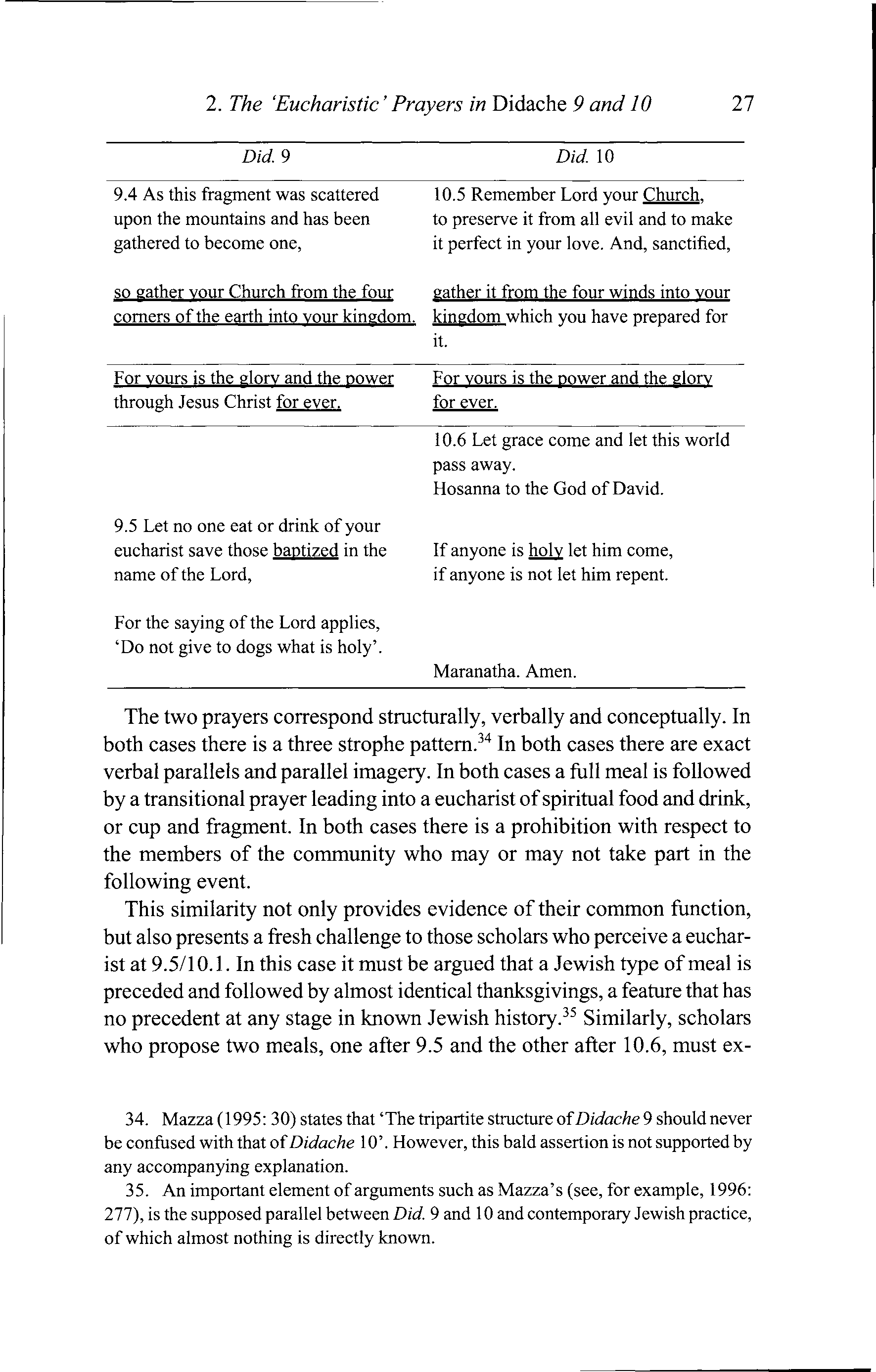
The parallels between the actions described in both prayers is emphasized by the striking level of similarity between the structure and wording of each chapter.
In the table below, verbal and conceptual similarities occurring in parallel strophes are underlined, while similarities that appear in different strophes are italicized. References to the eucharistic elements are in bold type.
Recognition that the rubrics of Did. 9.2 and 9.3 would not have been spoken aloud increases the similarity between the opening sequences of both sets of prayers.
Did 9 Did 10 10.1 After you have had your fill, give thanks thus:
9.1 Concerning the eucharist, give thanks thus:
10.2
We give thanks to you holy Father for your holy Name which you have made to dwell in our hearts and for the knowledge, faith and immortality which you have revealed to us through Jesus vour servant.
9.2 First, concerning the cup:
We give thanks to you, our Father, for the holy vine of David your servant which you have revealed to us through Jesus vour servant.
To you be glorv for ever.
To you be glory for ever.
9.3 And concerning the fragment:
We give thanks to you, our Father, 10.3a You Lord almighty have created everything for the sake of your Name; you have given human beings food and drink to partake with enjoyment so that they might give thanks; 10.3b but to us you have given the grace of spiritual food and drink and of eternal life For the life and knowledge, which you have revealed to us through Jesus vour servant. through Jesus vour servant.
10.4 Above all we give you thanks because you are mighty.
To you be glorv for ever.
To you be glorv for ever.
2. The 'Eucharistic' Prayers in Didache 9 and 10
Did. 9
Did 10 9.4 As this fragment was scattered upon the mountains and has been gathered to become one, 10.5 Remember Lord your Church, to preserve it from all evil and to make it perfect in your love. And, sanctified, so gather vour Church from the four corners of the earth into vour kingdom. gather it from the four winds into vour kingdom which you have prepared for it.
For vours is the glory and the power through Jesus Christ for ever.
For vours is the power and the glory for ever.
10.6 Let grace come and let this world pass away.
Hosanna to the God of David.
9.5 Let no one eat or drink of your eucharist save those baptized in the name of the Lord, If anyone is holy let him come, if anyone is not let him repent.
For the saying of the Lord applies, 'Do not give to dogs what is holy'.
Maranatha. Amen.
The two prayers correspond structurally, verbally and conceptually. In both cases there is a three strophe pattern.34 In both cases there are exact verbal parallels and parallel imagery. In both cases a full meal is followed by a transitional prayer leading into a eucharist of spiritual food and drink, or cup and fragment. In both cases there is a prohibition with respect to the members of the community who may or may not take part in the following event.
This similarity not only provides evidence of their common function, but also presents a fresh challenge to those scholars who perceive a eucharist at 9.5/10.1. In this case it must be argued that a Jewish type of meal is preceded and followed by almost identical thanksgivings, a feature that has no precedent at any stage in known Jewish history.35 Similarly, scholars who propose two meals, one after 9.5 and the other after 10.6, must ex34. Mazza (1995: 30) states that 'The tripartite structure of Didache 9 should never be confused with that of Didache 10'. However, this bald assertion is not supported by any accompanying explanation.
35. An important element of arguments such as Mazza's (see, for example, 1996:
277), is the supposed parallel between Did. 9 and 10 and contemporary Jewish practice, of which almost nothing is directly known.
The Gospel of Matthew's Dependence on the Didache plain why the supposed theological differences between these two meals is not more strongly reflected in the preparatory prayers in each case.
The parallel liturgy theory is, of course, also open to criticism. The remarkably similar language in both chapters is taken by several scholars as an indication that the parallel sections of these chapters were written at the same time by the same author(s). While such similarity of language might usually be taken as an indication of common authorship this is not necessarily the case with liturgical texts. That is to say that liturgical language forms are often preserved by a sequence of authors who wish to maintain, and express their membership of, the stream of liturgical tradition.
It is undoubtedly the case that, had these prayers been found in separate first-century Christian liturgies, they would be seen as performing identical functions. However, the most obvious objection to a two liturgy hypothesis is that it does not take the text as it stands. That is to say that it is necessary to show how this text was used, rather than how its component parts may have been used. However, there is evidence to suggest (considered in Chapter 6 below),36 that Did. 9 and 10 belonged to two separate layers of tradition which, when joined together in the Didache, were juxtaposed by subject. It is therefore possible that, during the period when these liturgies were in regular use, such a juxtaposition would not have caused any confusion. However, as this form fell out of use it is understandable that these chapters came to be seen as a continuous whole. This is clearly the interpretation made in Apostolic Constitutions VII where, however, those aspects of Did. 9 and 10 that make such a running together impractical have been modified.37
In conclusion then, I have sought to demonstrate that Did. 9 and Did. 10 represent two separate, alternative accounts of a prayer that creates a transition between a full meal and a symbolic meal. Seen as two separate texts, the notorious difficulties associated with the order of events envisaged by Did. 9-10 are resolved.
36. This discussion will conclude that Did 9 belongs to a layer that also includes
6.1-3; parts of 7.1-4; and 11.3-6, less references to prophets and the gospel. This layer, it will be proposed, was interwoven with a layer consisting of at least 10.1-7; 11.7-12.
37. Hence KAaajjaTOs is omitted and the invitation to the holy (10.6) is moved to a position where it may feasibly function as a retrospective rubric.