
Chapter 14 MATTHEW'S GOSPEL AND DIDACHE 1.1-6
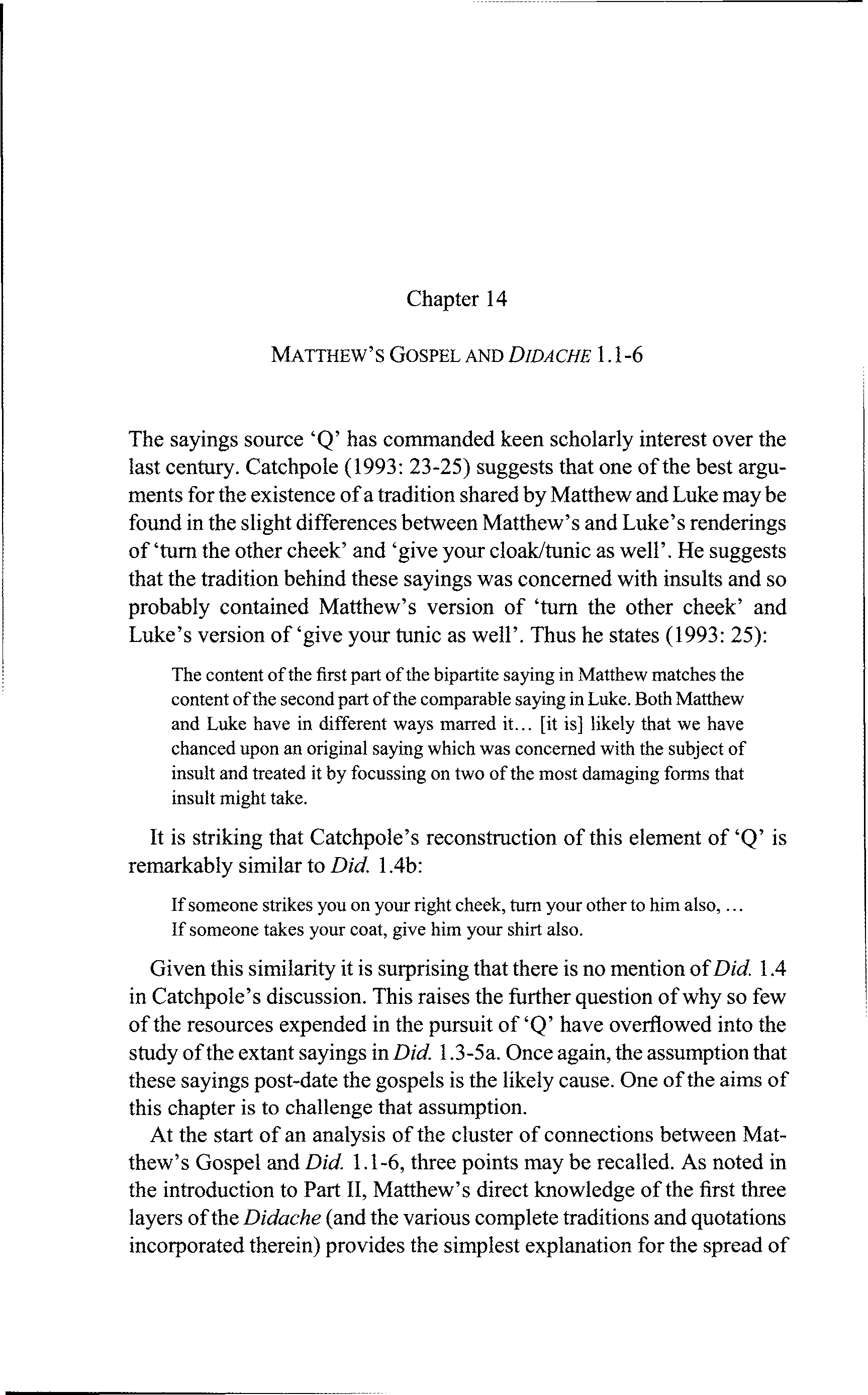
Chapter 14
MATTHEW'S GOSPEL AND DIDACHE 1.1-6
The sayings source 'Q' has commanded keen scholarly interest over the last century. Catchpole (1993: 23-25) suggests that one of the best arguments for the existence of a tradition shared by Matthew and Luke may be found in the slight differences between Matthew's and Luke's renderings of 'turn the other cheek' and 'give your cloak/tunic as well'. He suggests that the tradition behind these sayings was concerned with insults and so probably contained Matthew's version of 'turn the other cheek' and Luke's version of 'give your tunic as well'. Thus he states (1993: 25):
The content of the first part of the bipartite saying in Matthew matches the content of the second part of the comparable saying in Luke. Both Matthew and Luke have in different ways marred it... [it is] likely that we have chanced upon an original saying which was concerned with the subject of insult and treated it by focussing on two of the most damaging forms that insult might take.
It is striking that Catchpole's reconstruction of this element of 'Q' is remarkably similar to Did. 1.4b:
If someone strikes you on your right cheek, turn your other to him also,...
If someone takes your coat, give him your shirt also.
Given this similarity it is surprising that there is no mention of Did. 1.4 in Catchpole's discussion. This raises the further question of why so few of the resources expended in the pursuit of 'Q' have overflowed into the study of the extant sayings in Did. 1.3-5a. Once again, the assumption that these sayings post-date the gospels is the likely cause. One of the aims of this chapter is to challenge that assumption.
At the start of an analysis of the cluster of connections between Matthew's Gospel and Did. 1.1-6, three points may be recalled. As noted in the introduction to Part II, Matthew's direct knowledge of the first three layers of the Didache (and the various complete traditions and quotations incorporated therein) provides the simplest explanation for the spread of
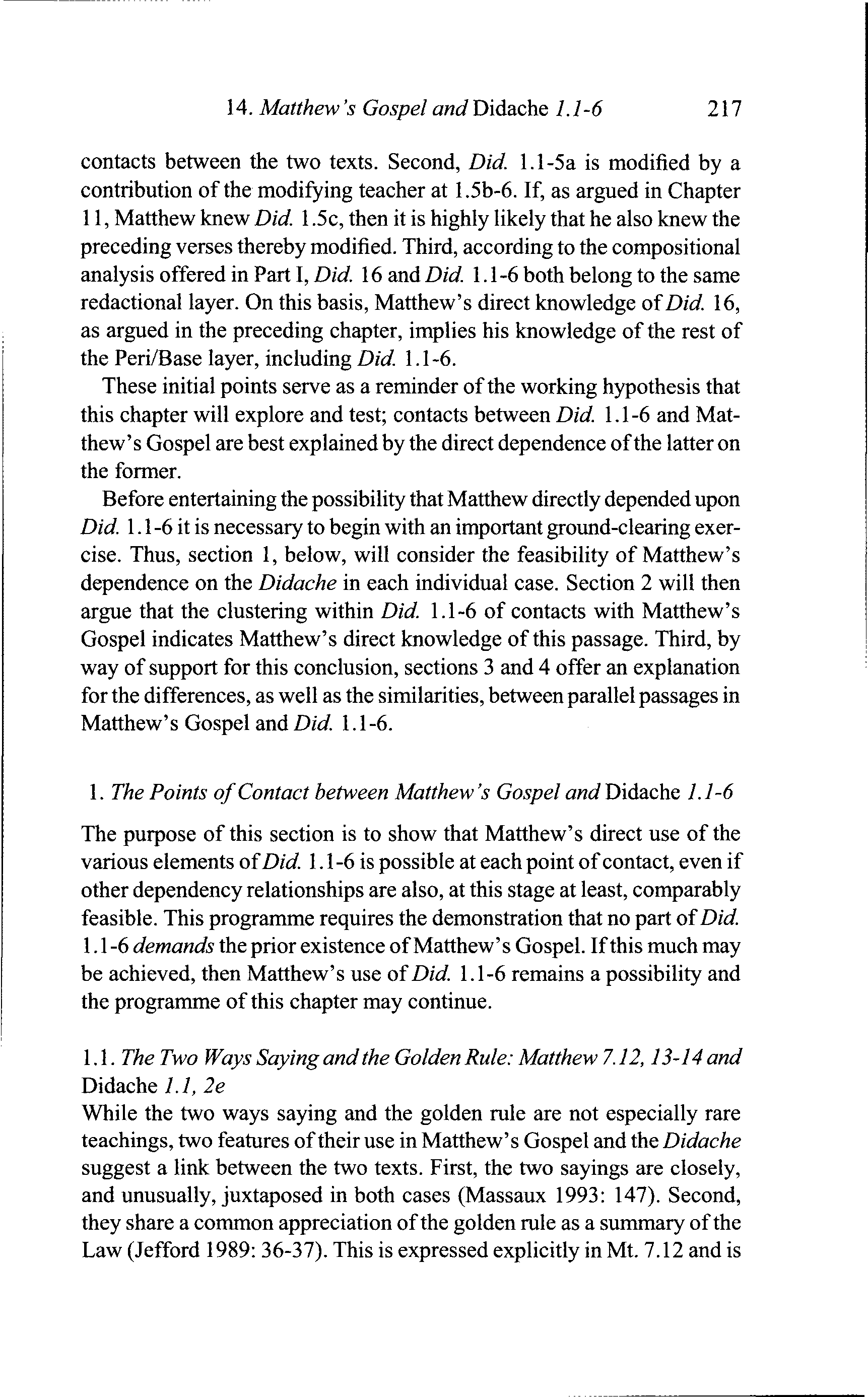
14. Matthew's Gospel and Didache 1.1-6
contacts between the two texts. Second, Did. 1.1-5a is modified by a contribution of the modifying teacher at 1.5b-6. If, as argued in Chapter
11, Matthew knew Did. 1.5c, then it is highly likely that he also knew the preceding verses thereby modified. Third, according to the compositional analysis offered in Part I, Did. 16 and Did. 1.1-6 both belong to the same redactional layer. On this basis, Matthew's direct knowledge of Did. 16, as argued in the preceding chapter, implies his knowledge of the rest of the Peri/Base layer, including Did. 1.1-6.
These initial points serve as a reminder of the working hypothesis that this chapter will explore and test; contacts between Did. 1.1-6 and Matthew's Gospel are best explained by the direct dependence of the latter on the former.
Before entertaining the possibility that Matthew directly depended upon Did. 1.1 -6 it is necessary to begin with an important ground-clearing exercise. Thus, section 1, below, will consider the feasibility of Matthew's dependence on the Didache in each individual case. Section 2 will then argue that the clustering within Did. 1.1-6 of contacts with Matthew's
Gospel indicates Matthew's direct knowledge of this passage. Third, by way of support for this conclusion, sections 3 and 4 offer an explanation for the differences, as well as the similarities, between parallel passages in Matthew's Gospel and Did. 1.1-6.
1. The Points of Contact between Matthew's Gospel and Didache 1.1-6 The purpose of this section is to show that Matthew's direct use of the various elements of Did. 1.1-6 is possible at each point of contact, even if other dependency relationships are also, at this stage at least, comparably feasible. This programme requires the demonstration that no part of Did.
1.1-6 demands the prior existence of Matthew's Gospel. If this much may be achieved, then Matthew's use of Did. 1.1-6 remains a possibility and the programme of this chapter may continue.
1.1. The Two Ways Saying and the Golden Rule: Matthew 7.12,13-14 and Didache 1.1, 2e While the two ways saying and the golden rule are not especially rare teachings, two features of their use in Matthew's Gospel and the Didache suggest a link between the two texts. First, the two sayings are closely, and unusually, juxtaposed in both cases (Massaux 1993: 147). Second, they share a common appreciation of the golden rule as a summary of the Law (Jefford 1989: 36-37). This is expressed explicitly in Mt. 7.12 and is
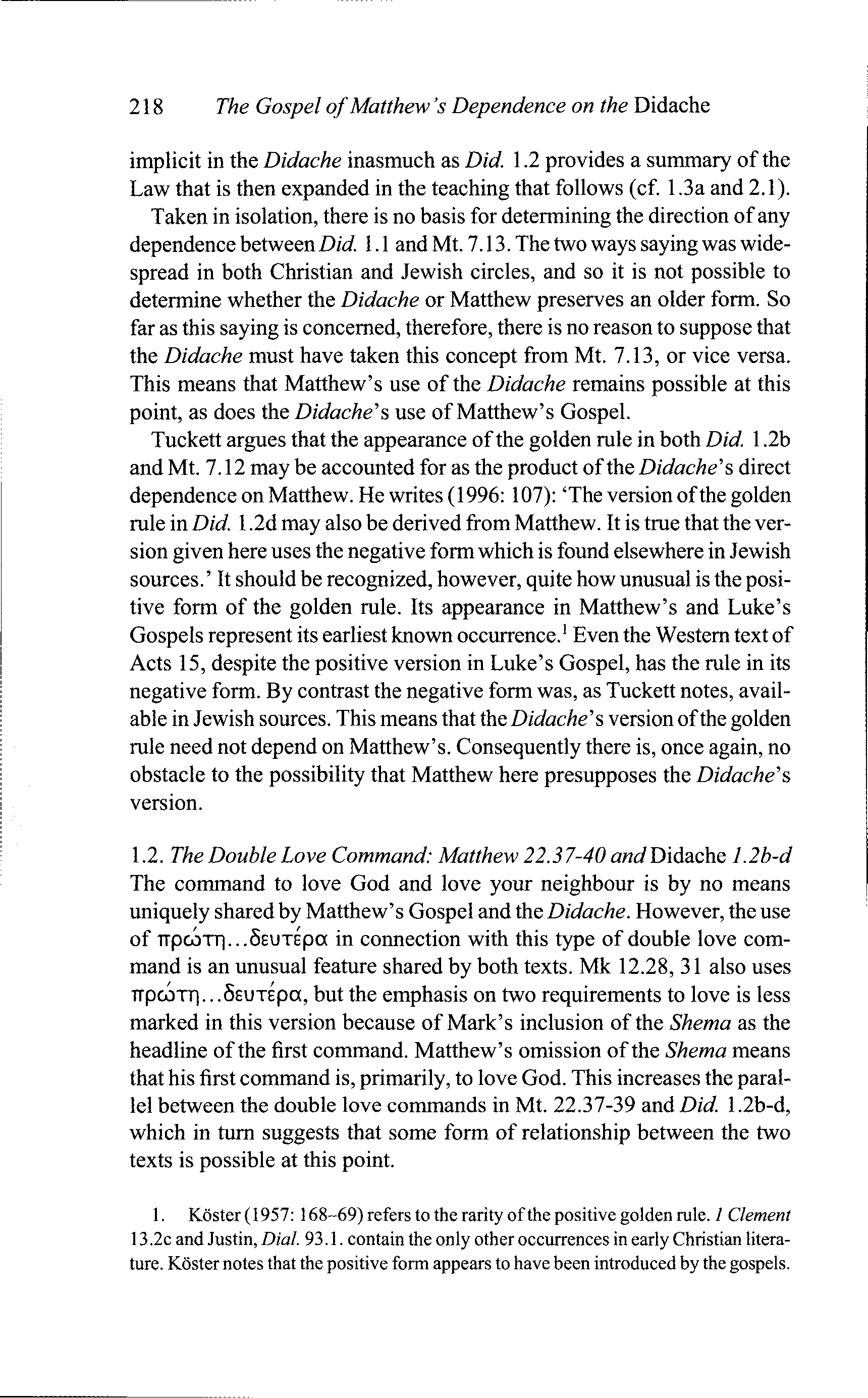
The Gospel of Matthew's Dependence on the Didache implicit in the Didache inasmuch as Did. 1.2 provides a summary of the Law that is then expanded in the teaching that follows (cf. 1.3a and 2.1).
Taken in isolation, there is no basis for determining the direction of any dependence between Did. 1.1 andMt. 7.13. The two ways saying was widespread in both Christian and Jewish circles, and so it is not possible to determine whether the Didache or Matthew preserves an older form. So far as this saying is concerned, therefore, there is no reason to suppose that the Didache must have taken this concept from Mt. 7.13, or vice versa.
This means that Matthew's use of the Didache remains possible at this point, as does the Didache's use of Matthew's Gospel.
Tuckett argues that the appearance of the golden rule in both Did. 1.2b and Mt. 7.12 may be accounted for as the product of the Didache'§ direct dependence on Matthew. He writes (1996:107): 'The version of the golden rule in Did. 1.2d may also be derived from Matthew. It is true that the version given here uses the negative form which is found elsewhere in Jewish sources.' It should be recognized, however, quite how unusual is the positive form of the golden rule. Its appearance in Matthew's and Luke's
Gospels represent its earliest known occurrence.1 Even the Western text of Acts 15, despite the positive version in Luke's Gospel, has the rule in its negative form. By contrast the negative form was, as Tuckett notes, available in Jewish sources. This means that the Didache's version of the golden rule need not depend on Matthew's. Consequently there is, once again, no obstacle to the possibility that Matthew here presupposes the Didache's version.
1.2. The Double Love Command: Matthew 22.37-40 and'Didache 1.2b-d The command to love God and love your neighbour is by no means uniquely shared by Matthew's Gospel and the Didache. However, the use of TTpcoTr)...5euT6pa in connection with this type of double love command is an unusual feature shared by both texts. Mk 12.28, 31 also uses
Trpcoxri.. .SeuTepcx, but the emphasis on two requirements to love is less marked in this version because of Mark's inclusion of the Shema as the headline of the first command. Matthew's omission of the Shema means that his first command is, primarily, to love God. This increases the parallel between the double love commands in Mt. 22.37-39 and Did. 1.2b-d, which in turn suggests that some form of relationship between the two texts is possible at this point.
K6ster(1957: 168-69) refers to the rarity of the positive golden rule. 1 Clement
13.2c and Justin, Dial. 93.1. contain the only other occurrences in early Christian literature. Koster notes that the positive form appears to have been introduced by the gospels.
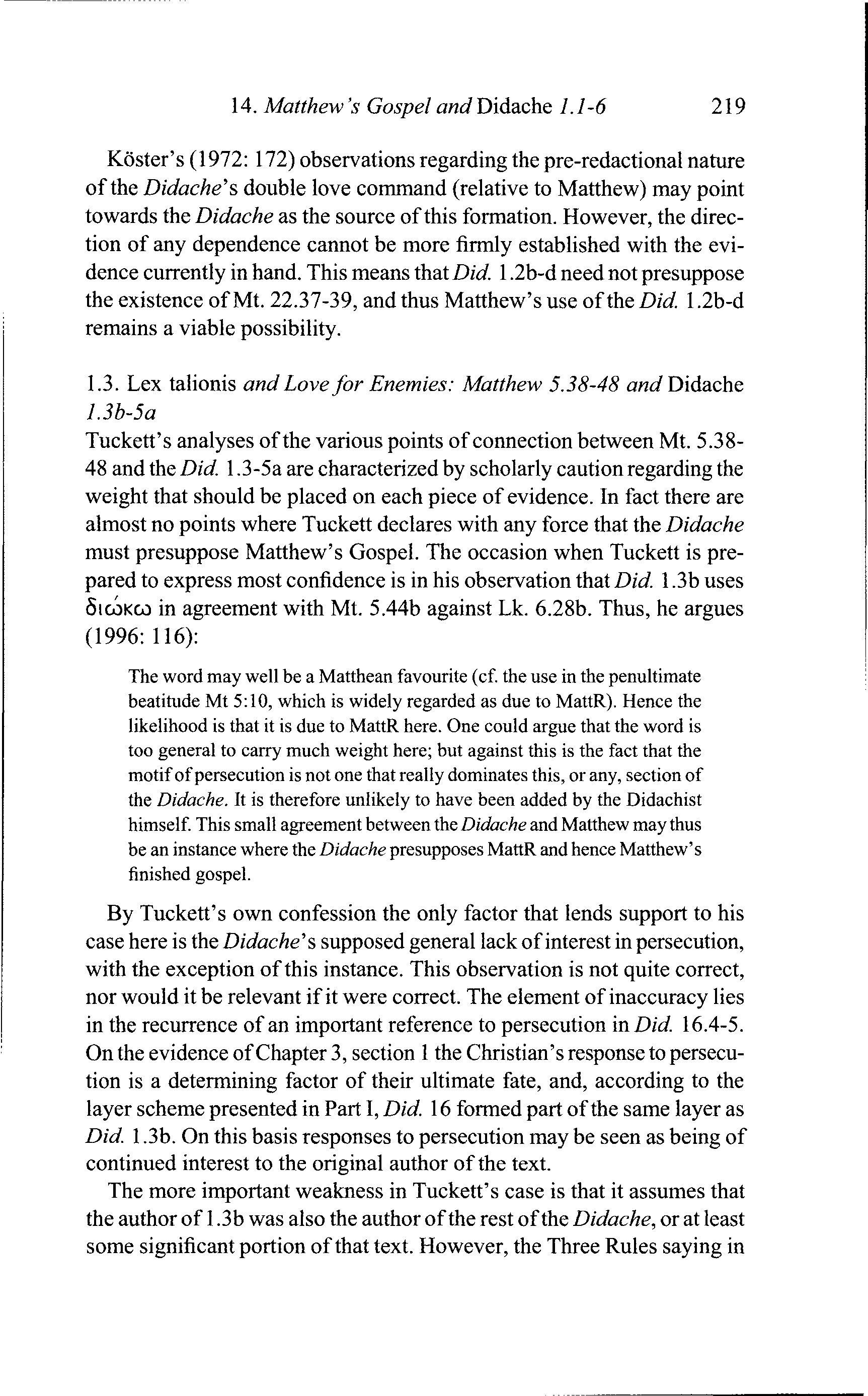
14. Matthew's GospelawdDidache 1.1-6
Koster's (1972:172) observations regarding the pre-redactional nature of the Didache's double love command (relative to Matthew) may point towards the Didache as the source of this formation. However, the direction of any dependence cannot be more firmly established with the evidence currently in hand. This means that Did. 1.2b-d need not presuppose the existence of Mt. 22.37-39, and thus Matthew's use of the Did. 1.2b-d remains a viable possibility.
1.3. Lex talionis and Love for Enemies: Matthew 5.38-48 and Didache 1.3b-5a Tuckett's analyses of the various points of connection between Mt. 5.3848 and the Did. 1.3-5a are characterized by scholarly caution regarding the weight that should be placed on each piece of evidence. In fact there are almost no points where Tuckett declares with any force that the Didache must presuppose Matthew's Gospel. The occasion when Tuckett is prepared to express most confidence is in his observation that Did. 1.3b uses
SICOKCO in agreement with Mt. 5.44b against Lk. 6.28b. Thus, he argues (1996: 116):
The word may well be a Matthean favourite (cf. the use in the penultimate beatitude Mt 5:10, which is widely regarded as due to MattR). Hence the likelihood is that it is due to MattR here. One could argue that the word is too general to carry much weight here; but against this is the fact that the motif of persecution is not one that really dominates this, or any, section of the Didache. It is therefore unlikely to have been added by the Didachist himself. This small agreement between the Didache and Matthew may thus be an instance where the Didache presupposes MattR and hence Matthew's finished gospel.
By Tuckett's own confession the only factor that lends support to his case here is the Didache's supposed general lack of interest in persecution, with the exception of this instance. This observation is not quite correct, nor would it be relevant if it were correct. The element of inaccuracy lies in the recurrence of an important reference to persecution in Did. 16.4-5.
On the evidence of Chapter 3, section 1 the Christian's response to persecution is a determining factor of their ultimate fate, and, according to the layer scheme presented in Part I, Did. 16 formed part of the same layer as Did. 1.3b. On this basis responses to persecution may be seen as being of continued interest to the original author of the text.
The more important weakness in Tuckett's case is that it assumes that the author of 1.3b was also the author of the rest of the Didache, or at least some significant portion of that text. However, the Three Rules saying in
The Gospel of Matthew's Dependence on the Didache which 5ICOKCO appears is likely to have been already independently formed prior to its incorporation into the collection of sayings in Did. 1.3b-5a (cf.
Chapter 4, section 3). For Tuckett's argument to carry any weight, therefore, he must show that persecution is a motif that is recognizably alien to the Three Rules saying in Did. 1.3b. However, as Rordorf (1991: 402) notes:
In fact the verb SICOKCO can scarcely carry the weight given it by Tuckett; on the contrary, I believe precisely that the specifically Didache expression
'fast for those who persecute you' presupposes a concrete background of persecution from the Jewish side.2
Not only is there a lack of any concrete evidence that Did. 1.3-5a must presuppose the existence of Matthew's Gospel, but there is also evidence that the Didache here preserves sayings that are more ancient than those found in either Matthew's or Luke's Gospels. As noted at the start of this chapter, Catchpole's (1993: 23-25) reconstruction of the tradition behind
Matthew's and Luke's versions of 'turn the other cheek' and 'give your cloak/tunic as well' is remarkably similar to Did. 1.4b. This suggests either a knowledge of the evangelists' source on the part of the Didachist, or that the Didache was used and adapted by both Matthew and Luke.
Further details of the case for Matthew's use of Did. 1.3-5a will be set out in due course. In the meantime it need only be noted that Matthew's use of these verses remains a possibility, if only one possibility among others.
1.4. The Last Penny: Matthew 5.26 and Didache 1.5c An argument for Matthew's direct use of Did. 1.5c has already been presented in Chapter 11, section 2.
2. The Implication of Multiple Points of Contact within Didache 1.1-6 The discussion in section 1, above, set out to establish that there are several points of contact between Matthew's Gospel and Did. 1.1-6 and that none of these requires the Didache's knowledge of Matthew's Gospel.
This means that Matthew's knowledge of Did. 1.1-6 remains a possibility.
The aim of this section is to go beyond this point and show that Matthew's use of these verses is not merely possible, but probable.
To achieve this result it is necessary to recall observations made in Part I regarding the compositional history of Did. 1.1-6. Here it was observed that these verses became part of the whole in four separate stages:
The article which I cite as Tuckett (1996) was first published in 1989.
14. Matthew's Gospel and Didache 1.1-6
TW: At the root of everything lies the original Two Ways document. This accounts fox Did. l.l-2a, c and 2.2-7; 3.8-5.2a.
LS: Prior to the incorporation of this Two Ways teaching into the Didache a Law Summary including the second half of the double love command and the golden rule was added (1.2b, d, e), along with a linking line to restore the flow of the text (2.1) (Chapter 4, section 6).
SO: Upon the creation of the Base layer of the Didache the Two Ways teaching was taken (already including 1.2b, d, e and 2.1) and a discreet collection of sayings (1.3b-5a) was inserted into it as a means of fleshing out the significance of the commands in 1.2. The creator of the Didache introduced this collection of sayings with 'TOUTCOV 5e xcov Aoycov f|
5i5ccxr) SGTIV auxri' (1.3a), and also inserted the comment 4Kcn lor\ xeXeios' (1.4b(r)) (cf. Chapter 4, section 3).
MT: Some time later a teacher found it necessary to offer a modification of the rules for giving and generosity set out in Did. 1.4b-5a. To this end the modifying teacher added Did. 1.5b-6, which itself includes the quotation of an external authority in 1.6 (see Chapter 7, section 4).
Further, it was noted that Did. 1.3b-5a comprises a collection of separate sayings gathered around a central gnome. These sayings appear to have been formed independently of one another, and to have been virtually unaltered in the course of their collection (cf. Chapter 4, section 3).
SO.a: 1.3b a Three Rules saying.
SO.b: 1.3c a saying on making friends of enemies.
SO.c: 1.4a a saying regarding fleshly passions.
SO.d: 1.4b a set of sayings regarding response to insults.
SO.e: 1.5a a saying regarding giving.
This compositional history means that the text of Did. 1.1-6 may be seen as ultimately deriving from ten originally separate points of origin: the Two Ways source, the Law Summary, an 'onion' of five originally separate sayings (with redactional comment at 1.3a and 1.4b(r)), and a later modification of those sayings, which itself included the quotation of an external authority.
By contrast, there is good evidence to suggest that Matthew's Sermon on the Mount, although dependent on various different sources, was created by one author at one time, and further, that this author reshaped his sources to create a text that conformed to a unified style and agenda.
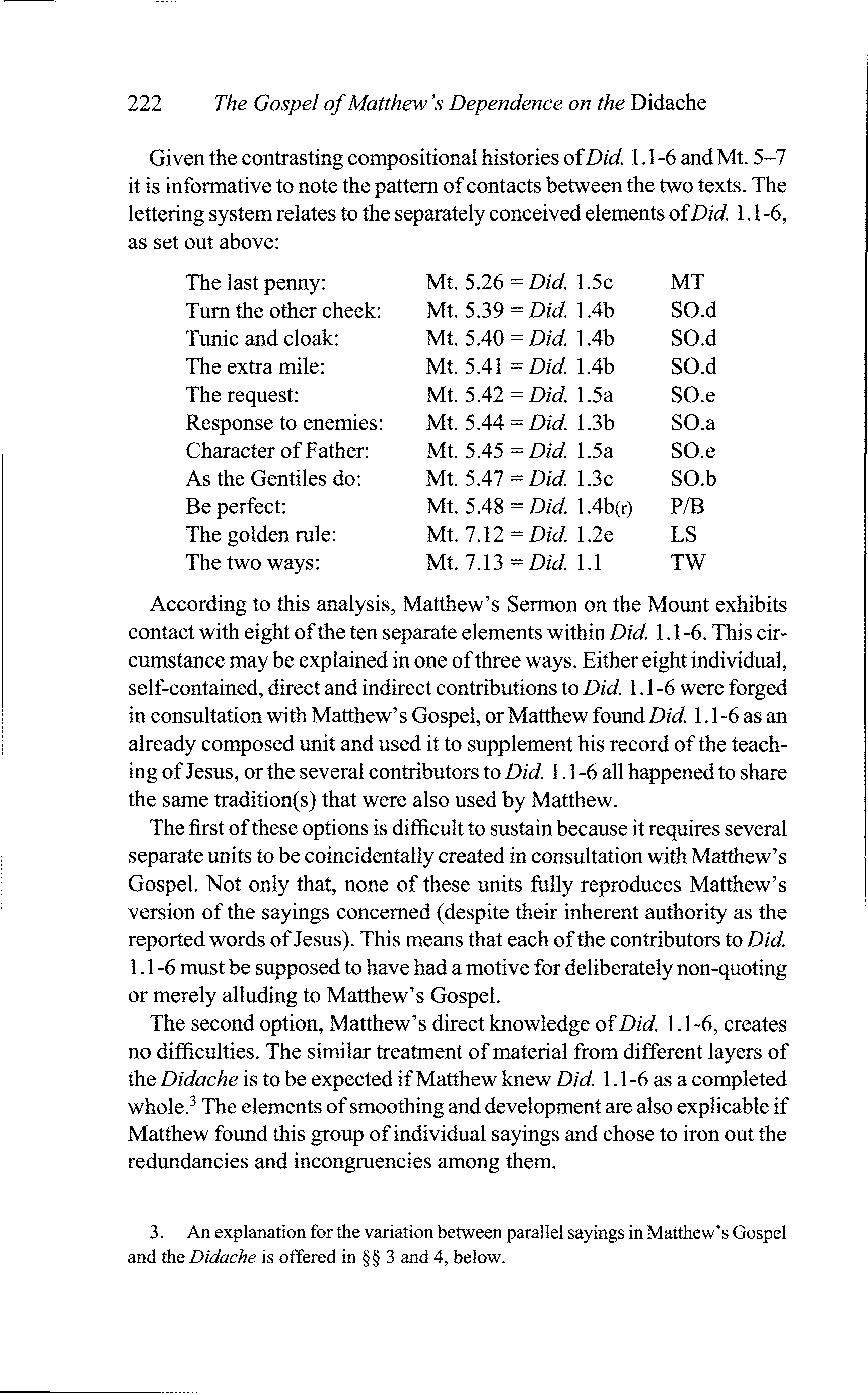
The Gospel of Matthew's Dependence on the Didache Given the contrasting compositional histories of Did. 1.1-6 and Mt. 5-7 it is informative to note the pattern of contacts between the two texts. The lettering system relates to the separately conceived elements of Did. 1.1-6, as set out above:
1.5c 1.4b 1.4b 1.4b 1.5a 1.3b 1.5a 1.3c l.4b(r) l.2e l.l Mt. 5.26 = Did 1 Mt. 539 = Did. ] Mt. 5.40 = Did. 1
Mt. 5.4\= Did. ] Mt. 5.42 = Did ] Mt. 5.44 = Did. ] Mt. 5.45= Did 1 MT SO.d SO.d SO.d SO.e SO.a SO.e SO.b P/B LS TW The last penny:
Turn the other cheek:
Tunic and cloak:
The extra mile:
The request:
Response to enemies:
Character of Father:
As the Gentiles do:
Be perfect:
The golden rule:
The two ways:
Mt. 5.47 = Did. 1
Mt. 5 AS = Did 1 Mt. 7.12 = Did '
Mt. 7.13= Did.
According to this analysis, Matthew's Sermon on the Mount exhibits contact with eight of the ten separate elements within Did. 1.1-6. This circumstance may be explained in one of three ways. Either eight individual, self-contained, direct and indirect contributions to Did. 1.1-6 were forged in consultation with Matthew's Gospel, or Matthew found Did. 1.1 -6 as an already composed unit and used it to supplement his record of the teaching of Jesus, or the several contributors to Did. 1.1-6 all happened to share the same tradition(s) that were also used by Matthew.
The first of these options is difficult to sustain because it requires several separate units to be coincidentally created in consultation with Matthew's
Gospel. Not only that, none of these units fully reproduces Matthew's version of the sayings concerned (despite their inherent authority as the reported words of Jesus). This means that each of the contributors to Did.
1.1-6 must be supposed to have had a motive for deliberately non-quoting or merely alluding to Matthew's Gospel.
The second option, Matthew's direct knowledge of Did. 1.1-6, creates no difficulties. The similar treatment of material from different layers of the Didache is to be expected if Matthew knew Did. 1.1 -6 as a completed whole.3 The elements of smoothing and development are also explicable if Matthew found this group of individual sayings and chose to iron out the redundancies and incongruencies among them.
An explanation for the variation between parallel sayings in Matthew' s Gospel and the Didache is offered in §§ 3 and 4, below.
14. Matthew's Gospel and Didache 1.1-6
Given that Matthew's direct knowledge of Did. 1.1-6 provides a satisfactory explanation for the relationship between these two texts, there is no particular reason to multiply entities by considering the possible intervention of a common tradition or traditions. However, this view is theoretically possible and thus demands attention.
The theory that each contributor to Did. 1.1-6 referred to tradition(s) also used by Matthew is unlikely to be correct for one of two reasons. If a single common tradition is proposed, then the creation of Did. 1.1-6 must be seen as a piece-by-piece reconstruction of that original source. In the end this hypothesis suffers from very similar difficulties to the idea that the contributors to the Didache each faithfully consulted Matthew's Gospel and so built up a composite parallel to a unified whole. Alternatively, if more than one common tradition was involved, then it must be supposed that the direct and indirect contributors to the Didache each happened to consult and bring together the same separate traditions, at different times, that were also consulted and brought together by Matthew, at one time.
The larger the number of shared traditions the more coincidence is required for the parallel collections in both Matthew's Gospel and Did. 1.1-6.
The shared tradition theory is thus in a cleft stick. A single common tradition requires the gradual reconstruction by the direct and indirect contributors to Did. 1.1-6 of their own source; multiple common traditions require the coincidental gathering of dispersed material by both Matthew and the various contributors to Did. 1.1-6. It is simpler, and very much more probable, therefore, to suppose that Matthew, in his search for examples of the teaching of Jesus, found the sayings gathered in Did. 1.1-6 and incorporated them into his Sermon.
3. A General Explanation for the Differences between Didache 1.1-6 and its Contacts in Matthew's Gospel One point that the foregoing analysis of the relationship between Did. 1.16 and Matthew's Gospel did not consider is a possible explanation for the verbal differences between these two texts, despite their extensive conceptual similarity. This does not mean that the above conclusion is invalid, since, even without this detail, Matthew's use of Did. 1.1-6 remains the simplest explanation for the connections between Matthew's unified Sermon and the composite teachings of Did. 1.1-6. However, these dissimilarities in wording present a puzzle that is worthy of further exploration.
Before attempting to provide an explanation for the differences between Did. 1.1-6 and similar passages in Matthew's Gospel it is necessary to
The Gospel of Matthew's Dependence on the Didache consider the relationship of Luke's Gospel to Did. 1.1-6 and of Luke's
Gospel to Matthew's Gospel in connection with these passages.
3.1. Luke's Gospel and Didache 1.2-5a Tuckett (1996: 127-28) is representative of the common view that Did.
1.3-5a presupposes the existence of Luke's Gospel:
The result of this detailed analysis of Did 1:3-5 a in relation to the synoptic parallels in Mt 5 and Lk 6 shows that this section of the Didache appears on a number of occasions to presuppose the redactional activity of both evangelists, perhaps Luke more clearly than Matthew. This suggests very strongly that the Didache here presupposes the gospels of Matthew and Luke in their finished forms.4
Despite the widespread currency of this view, it is, once again, difficult to sustain in the light of the compositional history of Did. 1.1-6 proposed in Part I. Here it was argued that Did. 1.3b-5a is made up of five originally separate sayings (cf. Chapter 4, section 3), and that Did. 1.2b, d-e was not added to the Didache at the same time as this sayings collection. If these suggestions are correct then Did. 1.2-5a may be said to contain material from the six separate points of origin (labelled LS and SO.a-e).
Compared with the complex compositional history of Did. 1.2-5a, Lk.
6.27-38 has a strong structural and thematic unity. This whole unit is built along similar lines to the collection of sayings in Did. 1.3b-5a, although on a larger scale. Thus the positive golden rule at Lk. 6.31 serves as the central gnome, which is then expanded and interpreted by the sayings set on either side. As Kirk (1998: 163) notes: 'Verse 31...has long been a bone of contention in exegesis of the passage, for it seems to advocate a mild reciprocity ethic present in most everyday social relations and thus in collision with the radical ethic of the sayings flanking it'. He goes on to argue cogently that because the golden rule is hermeneutically open it is interpreted in terms of the radical sayings with which it is juxtaposed.
A structural presentation of Lk. 6.27-36, illustrating its similarity to the arrangement of the sayings collection in Did. 1.3b-5a, is set out below:
The confident tone of this conclusion, with regard to Did. 1.1 -6' s presupposition of Matthew's Gospel, may suggest that I have failed to mention some important element of Tuckett's case in my § 1, above. This is not the case. The presence of SICOKCO in Mt. 5.44 and Did. 1.3b is indeed the centrepiece of Tuckett's argument. Its merits are discussed in § 1.3, above.
14. Matthew's Gospel and Didache 1.1-6
6.27 But I say to you that hear, Love your enemies, do good to the ones hating you, 6.28 bless the ones cursing you. pray concerning the ones insulting you.
6.29 To the one striking you (sg) on the cheek, turn also the other; and from the one taking your (sg) cloak also the tunic do not prevent.
6.30 To every one asking you - give, and from anyone taking what is yours, do not ask back.
6.31 And as you wish that men may do to you, do to them the same.
6.32 And if you love the ones loving you, what thanks is to you?
For even sinners love those who love them.
6.33 And if you do good to ones doing good to you, what thanks is to you?
Even sinners do the same.
6.34 And if you lend from whom you hope to receive, what thanks is to you?
Even sinners lend to sinners to receive as much again.
6.35 But love your enemies, and do good and lend, nothing despairing and your reward will be great, and you will be sons of the Most High because he is kind to the unthankful and the evil.
6.36 Be merciful just as your Father is merciful.
Above the central gnome at 6.31 (italicized) Luke has created four pairs of sayings. The first two pairs (6.27b, 28) are themselves pairs of opposed responses. The second two pairs (6.29, 30) are also linked in that they both respond to the actions of another, rather than their words or attitudes.
The whole set of sayings is suitably headed by 'love your enemies' since all the following sayings may be seen as subordinate to that theme, and they all serve to radicalize the significance of the central golden rule.
In the next three verses (6.32, 33, 34) Luke then elaborates on three positive actions, 'love, do good, lend', that arise from the actions approved of in Lk. 6.27-31. These three actions are then reinforced once again, in this same order, in Lk. 6.35a. The theme of reward, which emerges in 6.32-34, then reappears once more in conjunction with 'love, do good, lend' in Lk. 6.35b. A summary statement, 'Be merciful, just as you Father is merciful', then rounds off the whole at Lk. 6.36.
The Gospel of Matthew's Dependence on the Didache Luke's discourse thus has a balance of sayings around the central gnome.
This structure suggests that this arrangement has not been subsequently disrupted, but that it was put together by one person at one time.5 The content of the 'onion' also has a unity in its repeated calls to love, do good, and give/lend; however, this unity is not so great as to imply that the whole passage was created independent of any prior sources. In 6.27-31, in particular, the differing structures of the first four pairs of sayings suggests that this group was forged from originally separate sayings.6 On the basis of this analysis, Lk. 6.27-36 may be described as a unified discourse in that it was forged, by one author at one time, from prior sources.
Given the contrasting compositional histories of Did. 1.2-5a and Lk.
6.27-36 the pattern of contacts between the two texts is, once again, informative. The letter annotations relate to the separately conceived elements of Did. 1.2-5a, as set out above:
Love your enemies:
Lk. 6.27 = Did. 1.3c and 1.3b SO.b and SO.a Those hating you:
Lk. 6.27 = Did. 1.3c SO.b Blessing for curse:
Lk. 6.28 = Did. 1.3b SO.a The other cheek:
Lk. 6.29 = Did. 1.4b SO.d Cloak and tunic:
Lk. 6.29 = Did. 1.4b SO.d Give to all who ask:
Lk. 6.30 = Did. 1.5a SO.e Do not ask back:
Lk. 6.30 = Did. 1.5a SO.e Golden rule:
Lk. 6.31 = Did. 1.2e LS Love the loving ones:
Lk. 6.32 = Did. 1.3c SO.b What thanks due?:
Lk. 6.32, 33, 34 = Did. 1.3c SO.b According to this analysis Lk. 6.27-36 exhibits a dense concentration of contacts with five of the six separate elements within Did. 1.2-5a. This is more likely to be due to Luke's knowledge of the complex of separate sayings in Did. 1.2-5a, which he then forged into a unity, than to repeated homage to Lk. 6.27-36 by five separate and indirect contributors to Did.
1.2-5a.7
This point is frequently disputed by commentators (e.g. Nolland 1989: 297).
However, a forward glance to the table of connections between Did 1.2-5a and Lk.
6.27-34 shows that every line of Lk. 6.27-34 is paralleled in Did. 1.2-5a. It would be remarkable, therefore, if part of Lk. 6.27-34 were a later interpolation, since neither the structure of the whole, nor the link with Did. 1, is disrupted by this putative insertion.
For example, the change in the number of addressees in 6.29, compared with the other sayings in the group suggests that, at some point, this saying did not belong to the group in which it is now found. Incidentally, this variation also occurs in the parallel saying in the Didache.
The proposal that Did. 1.2-5a depends on a gospel harmony does not ease this
14. Matthew's Gospel and Didache 1.1-6
The proposal of Luke's use of Did. 1.2-5a also serves to provide a possible explanation for the emergence of a positive form of the golden rule.8 The Didache has a negative version of the rule (1.2d) which, by virtue of compositional history of Did. 1, is expanded by a set of positive instructions (1.3-5a). This curious arrangement need not persist if Luke was responsible for reworking the gathered elements of Did. 1.2-5a. To iron out this mismatch it is possible that Luke changed the golden rule to a positive form so as to make it consistent with the positive sayings by which it is expanded and interpreted.
In summary, the presence of a dense sequence of contacts between the non-unified text of Did. 1.2-5a and the unified text of Lk. 6.27-36 is explained most easily by Luke's reworking of the Didache's separate sayings into an extended set of sayings arranged around a central gnome which he then used as exemplary of the teaching of Jesus in his Sermon on the Plain.
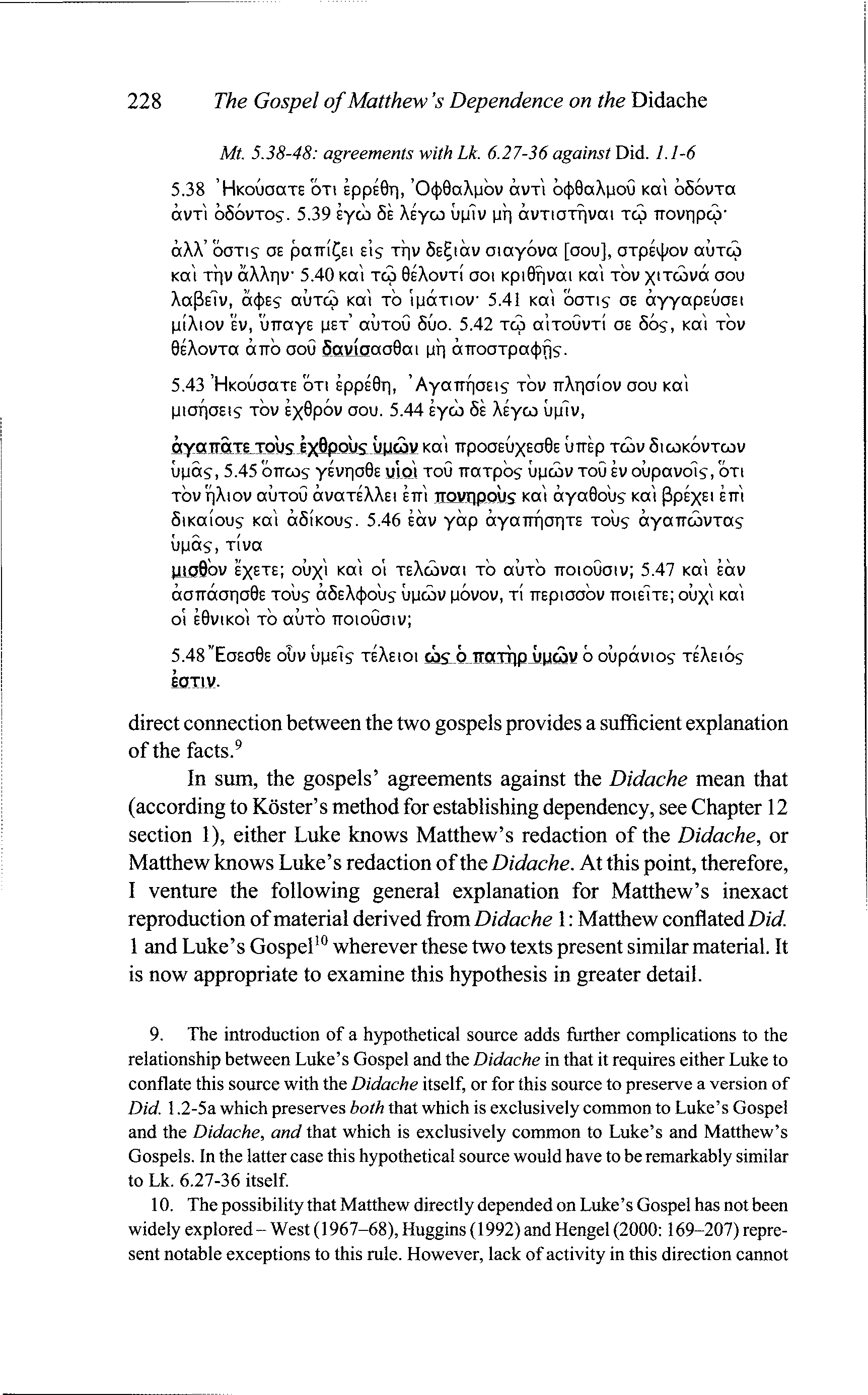
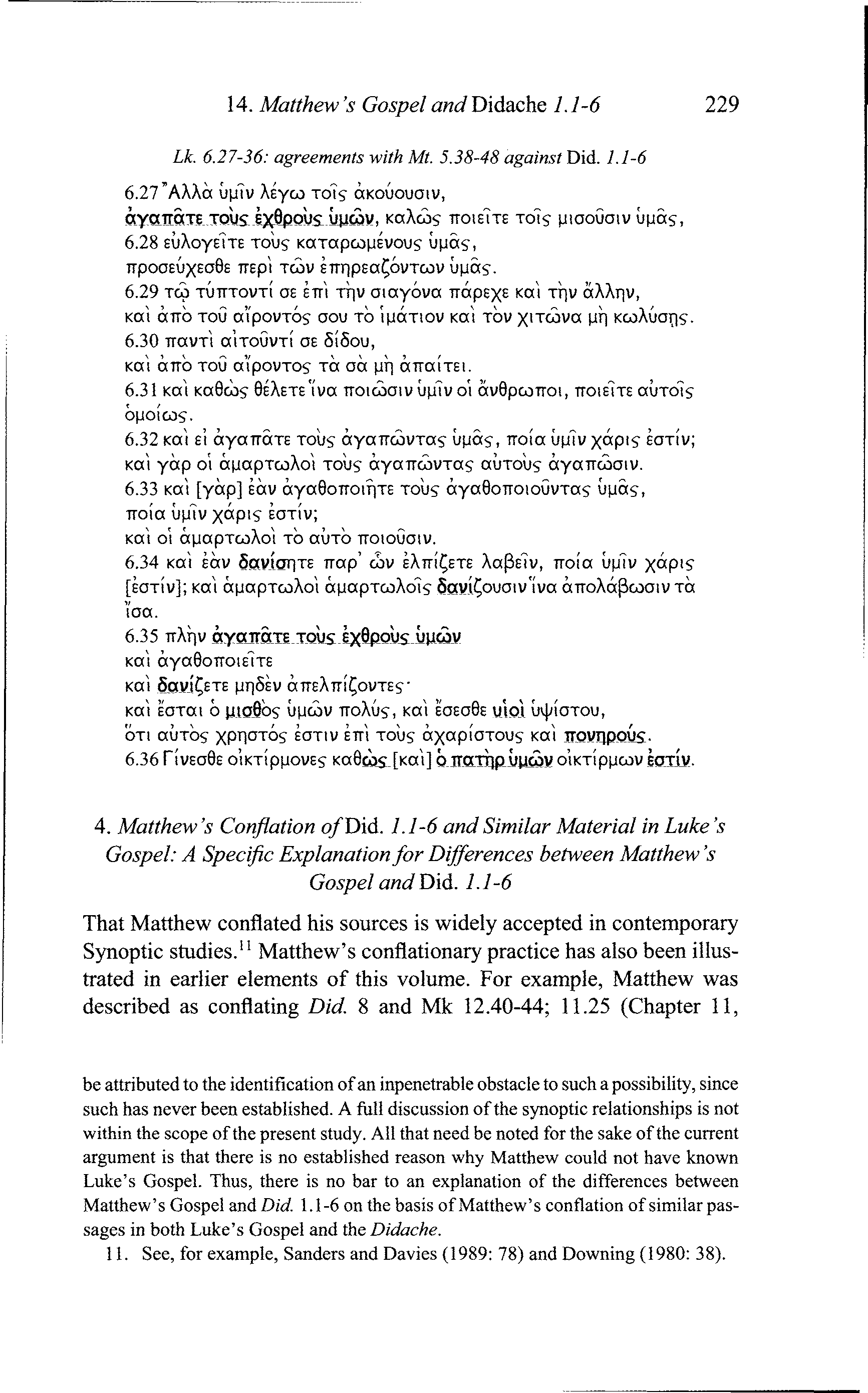
3.2. Evidence for Direct Contact between Matthew's and Luke's Gospels If Luke's Gospel depended upon Did. 1.2-5a and Matthew's Gospel also depended upon Did. 1.1-6, then important implications follow for the relationship between Matthew's and Luke's Gospels. This is the case because of a number of instances of agreement between these gospels against the Didache. The texts overleaf show these agreements underlined and highlighted in bold.
The agreements between the gospels against the Didache can only be explained by one of three means. Either the collection of agreements is coincidental, or Matthew and Luke both made use of a text (now lost) that had previously gathered material from Did. 1.1 -6, or Matthew knew Luke' s
Gospel directly (or vice versa).
The number of agreements against the Didache makes pure coincidence highly unlikely. Defence of the second option also incurs considerable complication. This is the case because any intermediate text supposed to have been used independently by both gospel writers must have contained all their points of exclusive agreement. This means ultimately that any proposed hypothetical text must be conceived as being remarkably similar to either Matthew or Luke's version of Did. 1. This situation is not impossible, but it does require an unnecessary multiplication of entities when a difficulty. Here it must be proposed that separate contributions to Did. 1.2-5a were all made with reference to a gospel harmony in each individual case. Dependence on shared traditions is also problematic for the reasons initially outlined in Chapter 1.
See n. 1 of this Chapter.
The Gospel of Matthew's Dependence on the Didache Mt. 5.38-48: agreements withLk. 6.27-36 against Did. 1.1-6
5.38 'HKouaaxe o n eppeSrj, '0<|>9aA|jbv avri oc|>8aA|joG KCU bSovxa avri bSovTos. 5.39 eyco 5e Xeyco h[f\v [IT] avTtaxr)vai T<£> TrovrjpGp* aAA' oaxis OE pccTn^ei eis xr|v SE^ICXV atayova [aou], axpe^ov auxco
KCU xrjv aAAr|v 5.40 KCU xcp 0sAovxi aot Kpt0r]vai KCU xbv xixcova aou Aa(3eiv, a<t)Es auxco KCU xb ipaxiov 5.41 Kat baxts oe ayyapeuaet jjtAiov Iv, uiTaye pex' auxou 5uo. 5.42 XGO aixouvxi oe 60s, Km xbv
SeAovxa OCTTO OOU 5avioao8ai \ix] a 5.43 'HKouaaxe bxi spp£0r), ' AyaTrrjoets xbv TrAT]aiov aou KCU
Miarjasis xbv exSpbv aou. 5.44 eycb 5e Aeyco v\nv, ayccTraxE xoug Ex6poug upcov Kai TTpoaeuxeaSe UTrep xcov SICOKOVXCOV upocs, 5.45 OTTCOS yevrjaSe 11101 xou naxpbs UJJGOV XOU EV oupavois, o n xbv rjAiov auxou avaxeAAei ITTI TTOVTipous Kai ayaBous Kai (3pexEl ^Tri
Kai aSiKous. 5.46 lav yap ayaTTT)ar|XE xous ayaiTcovxas , Tiva bv E'XEXE; OUX» Kai oi xsAcovai xb auxb TTOIOUOIV; 5.47 Kai sav xous aSsA^ous upcov JJOVOV, xi iTEpiaabv TTOIEIXE; OUX'I Ka\ oi EBVIKOI xb auxb TTOIOUOIV; 5.48"Easa0E ouv upsTs XEAEIOI COS b TraxTip upcov b oupavios XEAEIOS kriv. direct connection between the two gospels provides a sufficient explanation of the facts.9
In sum, the gospels' agreements against the Didache mean that (according to Koster's method for establishing dependency, see Chapter 12 section 1), either Luke knows Matthew's redaction of the Didache, or Matthew knows Luke's redaction of the Didache. At this point, therefore,
I venture the following general explanation for Matthew's inexact reproduction of material derived from Didache 1: Matthew conflated Did.
1 and Luke's Gospel10 wherever these two texts present similar material. It is now appropriate to examine this hypothesis in greater detail.
The introduction of a hypothetical source adds further complications to the relationship between Luke's Gospel and the Didache in that it requires either Luke to conflate this source with the Didache itself, or for this source to preserve a version of Did. 1.2-5a which preserves both that which is exclusively common to Luke's Gospel and the Didache, and that which is exclusively common to Luke's and Matthew's
Gospels. In the latter case this hypothetical source would have to be remarkably similar to Lk. 6.27-36 itself.
10. The possibility that Matthew directly depended on Luke's Gospel has not been widely explored - West (1967-68), Huggins (1992) and Hengel (2000:169-207) represent notable exceptions to this rule. However, lack of activity in this direction cannot
14. Matthew's Gospel and Didache L1-6
Lk. 6.27-36: agreements with Mt. 5.38-48 against Did. 1.1-6 6.27"AAAa UJJIV Aeyco TOIS CCKOUOUOIV, ayaTraTE TOUS sxBpous uiicav, KaAeos TTOIE'ITE TOIS M»OOGOIV upas,
6.28 euAoyetTe xobs KaTapconsvous upas, Trpoa£ux£o0£ Trept TGOV ETrrjpEa^ovTcov upas.
6.29 TCO TUTTTOVTI OE ITTI xf|v atayova napexE KCU TT\V aAAr|V, Kai aTrb TOU aTpovxos oou TO IMOCTIOV Kai TOV xiTcova |irj KcoAuaris6.30 Travx'i aWouvTi OE 5i5ou, Ka'i OCTTO TOU a'ipovTos TCX aa jjr| auaiTEi.
6.31 Kal KaScios SEAETE'IVCX TTOICOOIV h\f\v o\ avSpcoTroi, TTOIEITE aifTois b|joicos.
6.32 Ka'i £i ayairaTE TOUS ayaircovTas UM«S, iToia v\fw x«p»S EOTIV; Kat yap oi a|japTcoAo\ TOUS ayaTrcovTas auTOus ayaTrcaaiv.
6.33 Kat [yap] ECXV aya0o7To»r]TE TOUS ayaSoTroiouvTas upas, Troia ujiiv X^PlS" EOTIV; Kai oi aiaapTcoAot TO auTO TTOIOUOIV.
6.34 Ka'i lav SaviaTiTE TTap' cov EATTI^ETE Aapsiv, noia ujjtv x^PlS [EOTIV]; Kai apapTcoAoi aMapTcoAois Savi^ouoivlva aTToAaPcooiv Ta
'ioa.
6.35 iJ^^ Ka't Ka'i Savi^ETE \xr\8kv a Kai EOTai b yiofibs UMGOV TTOAUS, Kai EOEOSE uloi
OTI auTos XP^OTOS EOTIV ETTI TOUS axapioTous Kat 6.36 rivEo0E oiKTtpMovEs Ka9wsL[Ka\] b TraxTip u|jcov OIKT'IPMCOV EOTJV.
4. Matthew's Conflation of Did. 1.1-6 and Similar Material in Luke's Gospel: A Specific Explanation for Differences between Matthew's
Gospel and Did. 1.1-6 That Matthew conflated his sources is widely accepted in contemporary
Synoptic studies.11 Matthew's conflationary practice has also been illustrated in earlier elements of this volume. For example, Matthew was described as conflating Did. 8 and Mk 12.40-44; 11.25 (Chapter 11, be attributed to the identification of an inpenetrable obstacle to such a possibility, since such has never been established. A full discussion of the synoptic relationships is not within the scope of the present study. All that need be noted for the sake of the current argument is that there is no established reason why Matthew could not have known
Luke's Gospel. Thus, there is no bar to an explanation of the differences between Matthew's Gospel and Did. 1.1-6 on the basis of Matthew's conflation of similar passages in both Luke's Gospel and the Didache.
11. See, for example, Sanders and Davies (1989: 78) and Downing (1980: 38).
The Gospel of Matthew's Dependence on the Didache section 3); Mk 3.28-29 and Did. 11.7 (Chapter 12, section 1); and Mk 13 and Did. 16 (Chapter 13, sections 2.1-4). It is therefore possible that Matthew here conflated Did. 1.1-6 with similar material that he also found in Luke's Gospel. This theory is now expounded, albeit briefly, in an attempt to provide a possible explanation for some of the differences between Matthew's Gospel and the material which, according to this hypothesis, he drew from Did. 1.1-6.
4.1. Turn the Other Cheek, Tunic and Cloak, Extra Mile, etc.: Lk. 6.29-30 = Mt. 5.38-42 = Did. 1.4b Lk.
Mt.
Did.
5.38 'hteouaaTE cm eppeSrj, ' O<j)0aA|jbv avri 6<t>0aA|jou Ken OSOVTCC
OCVTI OSOVTOS.
5.39 eyco 5e Asyco ujiiv |jf| avTtoTrjvai TCO
TTOVTIPCO'
1.4b
6.29 TOO TUTTTOVTl OZ ETTl CxAA' OOTIS OE pOTT^El
ECCV TIS OOl Scp p a l TT)V oiayova TrapsxE sis TTIV SE£ICCV oiayova EIS TTJV 8E£IGCV aiayova, [oou], oxpEvpov auTco OTplv|;ov auTco Kai TT]V aAAT]V.
Kai TT|V aAAT]V
KOI TT|V aAAT]V,
Kai EOT] TEAEIOS"
Kai aTrb TOU aipovTOS" oou 5.40 Kai TCO 0EAOVT!
OOI Kpi0f]vai Kai TOV x^Taiva oou Aa(3s7v. excess auTco Kai TO iMaxiov TO ifJOTlOV Kai TOV xiTcova \ix\ sav ayyapEiioT] OE TIS MiAiov EV, unayE MET' auToG Suo* sav apTj TIS TO IMCXTIOV oou, 5os auTco Kai 5.41 Kai OOTIS OE ayyapsuasi MiAiov EV, uTrayE MHT' auTou ouo.
5.42 TCO aiTOUVTi OE 6.30 TravTi aiToGvTi OE 5i5ou, Kai aTrb TOU a'ipovTos Ta oa \IT\ aTraiTEi. sav Aa^T] TIS OCTTO OOU TO OOV, |Jr| CKTTaiTEr £os, Kai TOV 0EAOVTO OU6E yap Suvaoai.
OCTTO OOU
oavioao0ai [cf. Lk. 6.35] |jr| aTrooTpa(|)?]s.
14. Matthew's Gospel and Didache 1.1-6
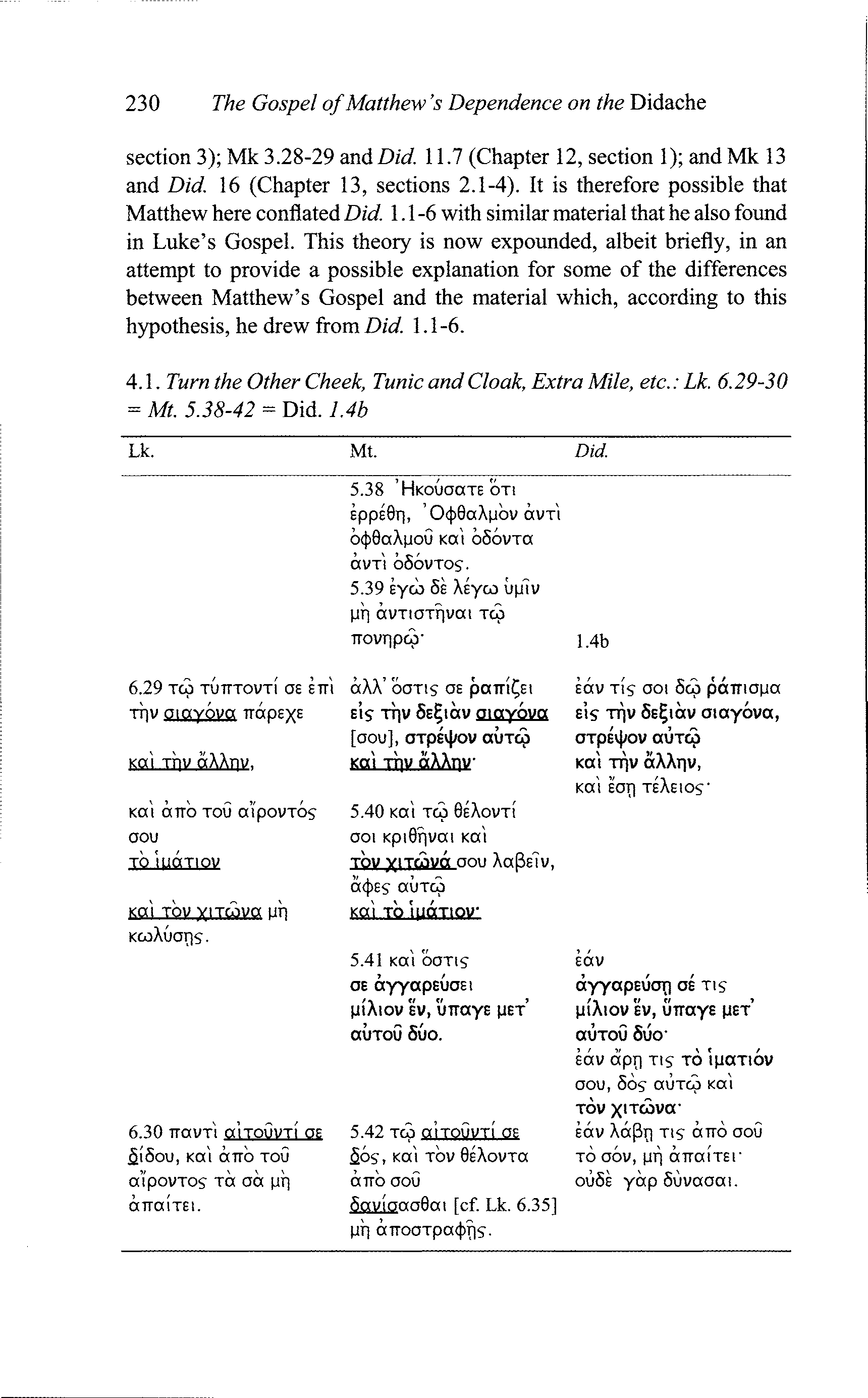
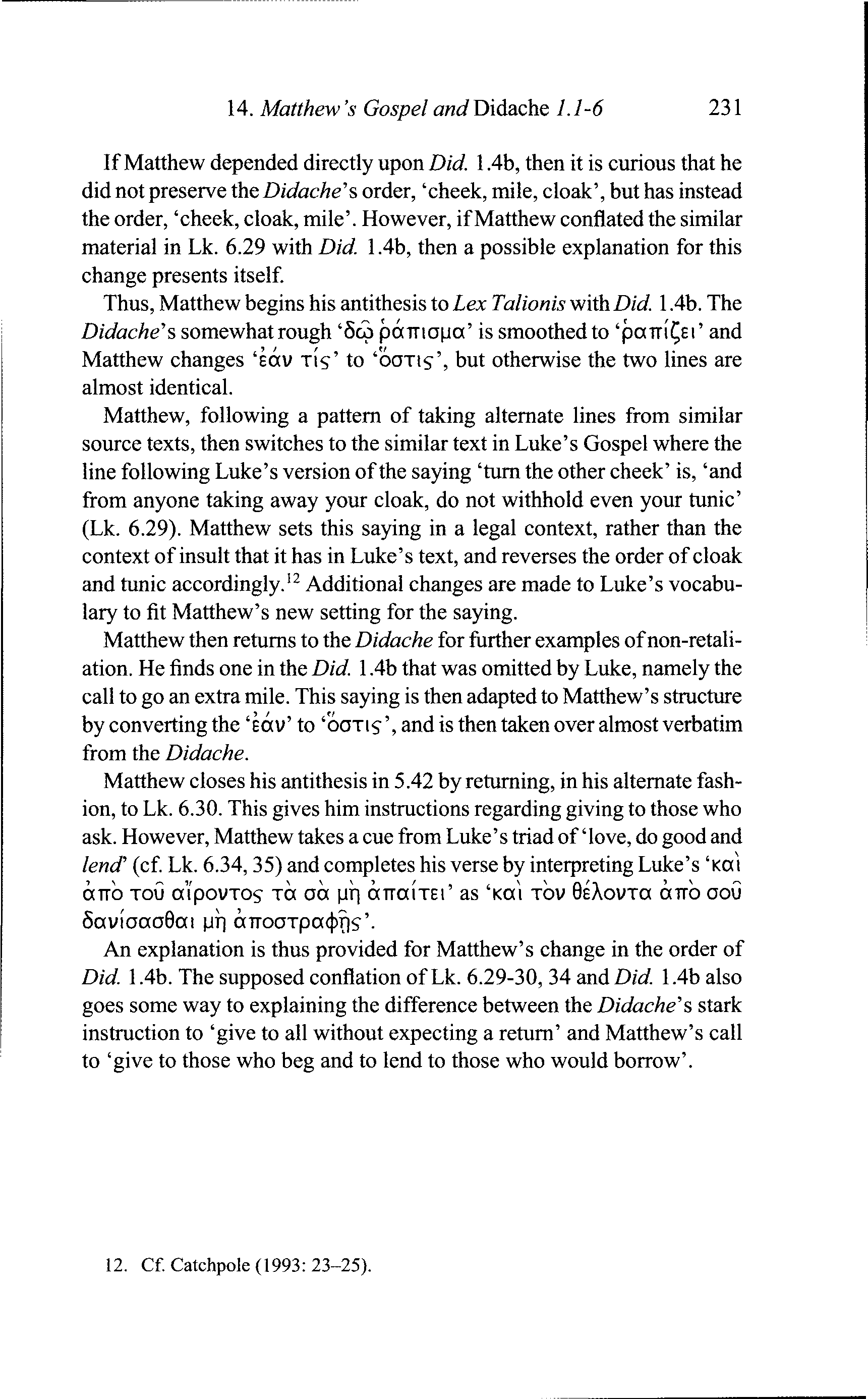
If Matthew depended directly upon Did. 1.4b, then it is curious that he did not preserve the Didache's order, 'cheek, mile, cloak', but has instead the order, 'cheek, cloak, mile'. However, if Matthew conflated the similar material in Lk. 6.29 with Did. 1.4b, then a possible explanation for this change presents itself.
Thus, Matthew begins his antithesis to Lex Talionis with Did. 1.4b. The Didache'§ somewhat rough '5GO paTnapa' is smoothed to 'paTTi^Ei' and Matthew changes 'eav TIS' to 'ocms\ but otherwise the two lines are almost identical.
Matthew, following a pattern of taking alternate lines from similar source texts, then switches to the similar text in Luke's Gospel where the line following Luke's version of the saying 'turn the other cheek' is, 'and from anyone taking away your cloak, do not withhold even your tunic'
(Lk. 6.29). Matthew sets this saying in a legal context, rather than the context of insult that it has in Luke's text, and reverses the order of cloak and tunic accordingly.12 Additional changes are made to Luke's vocabulary to fit Matthew's new setting for the saying.
Matthew then returns to the Didache for further examples of non-retaliation. He finds one in the Did. 1.4b that was omitted by Luke, namely the call to go an extra mile. This saying is then adapted to Matthew's structure by converting the 'eav' to 'OGTIS \ and is then taken over almost verbatim from the Didache.
Matthew closes his antithesis in 5.42 by returning, in his alternate fashion, to Lk. 6.30. This gives him instructions regarding giving to those who ask. However, Matthew takes a cue from Luke's triad of 'love, do good and lend' (cf. Lk. 6.34,35) and completes his verse by interpreting Luke's 'KCU
CCTTO TOU oupovxos TCX oa \xx\ CKTTaiTei' as 'KCU TOV 0EAOVTCX aub aou 5aviaao0ai \xx\ cxTTooxpa^ris'.
An explanation is thus provided for Matthew's change in the order of Did. 1.4b. The supposed conflation of Lk. 6.29-30, 34 and Did. 1.4b also goes some way to explaining the difference between the Didache's stark instruction to 'give to all without expecting a return' and Matthew's call to 'give to those who beg and to lend to those who would borrow'.
12. Cf.Catchpole (1993: 23-25).
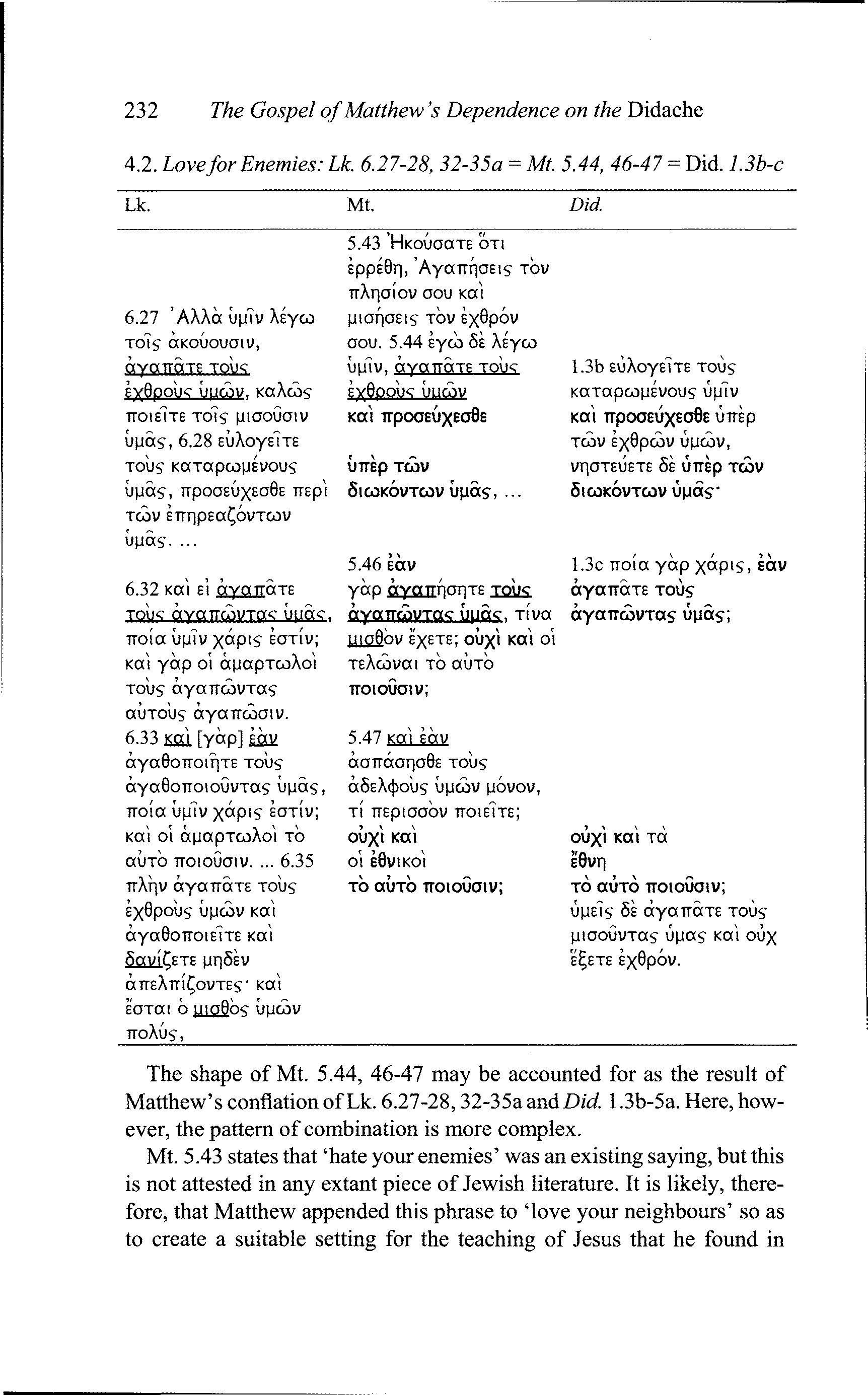
The Gospel of Matthew's Dependence on the Didache 4.2. Love for Enemies: Lk. 6.27-28, 32-35a = Mt. 5.44, 46-47 = Did. 1.3b-c
Lk.
Did Mt.
5.43 HKOuaaTE OTI £PPE6T], 'AyaTTT]aEis TOV TrArjaiov oou Kai 6.27 'AAAa u|Jiv Asyco MiafjOEis TOV ExSpbv aou. 5.44 sycb 6E Asyco
TOIS CXKOUOUGIV,
ayaTraTE T O I K 1.3b EuAoyE^TE TOUS UMIV. ayaTraTE TOU<T EY6pou<: UMCOV KaTapcoMEVOUs UM^V Ey8poiK UMCOV. KOACCK Kai TTpoaeuxEoBe TTOIEITE TOIS Mia°ucnv Kai TTpoaEvJx£o9E UTTEP upas, 6.28 EuAoyslTE TCOV ExSpcov UMCOV, TOUS KaTapcojJEVOus ujjas, TrpoaEuxHo8E Trepi TCOV ETIT|pEa£bvTCOV
UTTEp TCOV
VrjOTEUETE 5 E UTTEp TCOV
SlCOKOVTCOV UMOCS*
SICOKOVTCOVUMSCS, . . .
upas. ...
5.46 lav 1.3c Troia y a p X^?[S, ECXV 6.32 Kai ei ayaTraTE yap ayaTrr)OT|T£ TOUC ayaTraTE TOUS ayaTrcovTas upas; TOU<7 ayaTrcovTa<r u p a c Troia UJJTV X^PlS EOTIV; Kai yap oi apapTcoAoi ayaircovTac upac. Tiva Mio8bv E'XSTE; ouxi Kai oi TsAcovai TO auTO TToiouaiv; TOUS ayaiTcovTas auTous ayaTTcoaiv.
6.33 Ked [yap] sav 5.47 Kai sav aya8oTroi?)TE TOUS aaTrdaT]o8E TOUS aya8oTroiouvTas upas, Troia ujiiv x^PlS EOTIV; Kai oi apapTcoAoi TO
6(6EA())OUS UMCOV MOVOV,
TI TTEpiaobv TTOIETTE; ouxi Kai oi E0viKoi J \ \ V oux» Kai Ta auTO TTOiouaiv. ... 6.35
E'8VTI TrAr|V ayaTraTE TOUS TO auTO TToiouaiv; TO auTO TToiouoiv; EXSpous UMCOV Kai ayaSoTTOislTE Kai UMBIS 5E ayaTraTE TOUS MiaouvTas UMas Kai oux
£ £T£ £ X POV.
aTTEATri^ovTES' Kai EOTai b jjio8b<r UMCOV TTOAUS, The shape of Mt. 5.44, 46-47 may be accounted for as the result of Matthew's conflation of Lk. 6.27-28,32-35a and Did 1.3b-5a. Here, however, the pattern of combination is more complex.
Mt. 5.43 states that 'hate your enemies' was an existing saying, but this is not attested in any extant piece of Jewish literature. It is likely, therefore, that Matthew appended this phrase to 'love your neighbours' so as to create a suitable setting for the teaching of Jesus that he found in
14. Matthew's Gospel and Didache 1.1-6
Lk. 6.27.13 Thus 'love your enemies' is taken by Matthew from Luke's Gospel.
The immediately following 'pray for those who persecute you' in Mt.
5.44 is a combination of the last two lines of the Three Rules saying in Did. 1.3b.
Mt. 5.46-47 then reworks Did. 1.3c with reference to Lk. 6.32-35a. Matthew essentially follows Did. 1.3c, but imports the concept of 'reward' from Lk. 6.35a to replace the 'grace' of Did. 1.3c.
The Didache's single warning against common reciprocity is presented in double form in Mt. 5.46-47, possibly a reflection of the triple form found in Lk. 6.32-34. In Matthew the two actions considered are 'love', taken from Did. 1.3c and 'greet', which is not found in either Luke's
Gospel or the Didache. Common reciprocity is described by Matthew as exhibited by tax collectors (5.46) and Gentiles (5.47). The former is unique to Matthew; the latter may derive from Did. 1.3c.
In all, therefore, three of the differences between Did. 1.3b-c and Mt.
5.44, 46-47 may be accounted for by the hypothesis of Matthew's conflation of the Didache with Luke's Gospel.
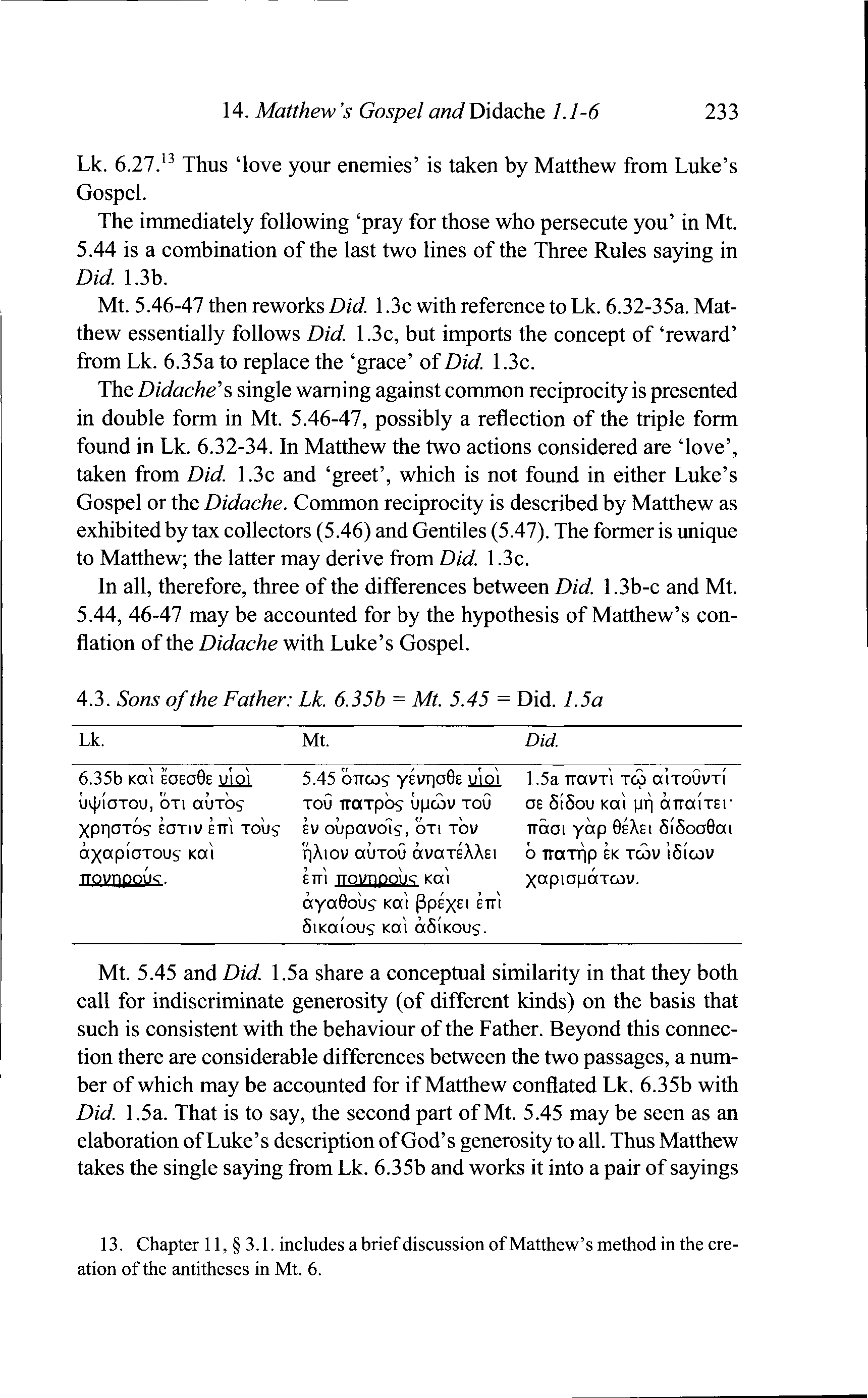
4.3. Sons of the Father: Lk. 6.35b = Mt. 5.45 = Did. 1.5a Tk Mt ~Did.
6.35b KCU EOEOSE uloi 5.45 OTTCOS yevrioBe uioi
1.5a TTCXVTI TCO CUTOUVTI
uvpioxou, OTI auTos TOU TTaxpbs UIJGOV xou as 5i5ou Kai \ir\ aTTaixer
EOTIV ETTl TOUS
EV OUpaVOlS, OTI TOV TTOCOl y a p 0EAEI 5l5oG0C(l KCU rjAiov auTou avaTeAAei
6 TTCCTTIP EK TGOV
TTOvr]pou<:.
ETTI TTovrjpoij^ Kai xaPl°MO(TCOV- \ Mt. 5.45 and Did. 1.5a share a conceptual similarity in that they both call for indiscriminate generosity (of different kinds) on the basis that such is consistent with the behaviour of the Father. Beyond this connection there are considerable differences between the two passages, a number of which may be accounted for if Matthew conflated Lk. 6.35b with Did. 1.5a. That is to say, the second part of Mt. 5.45 may be seen as an elaboration of Luke's description of God's generosity to all. Thus Matthew takes the single saying from Lk. 6.35b and works it into a pair of sayings
13. Chapter 11, § 3.1. includes a brief discussion of Matthew's method in the creation of the antitheses in Mt. 6.
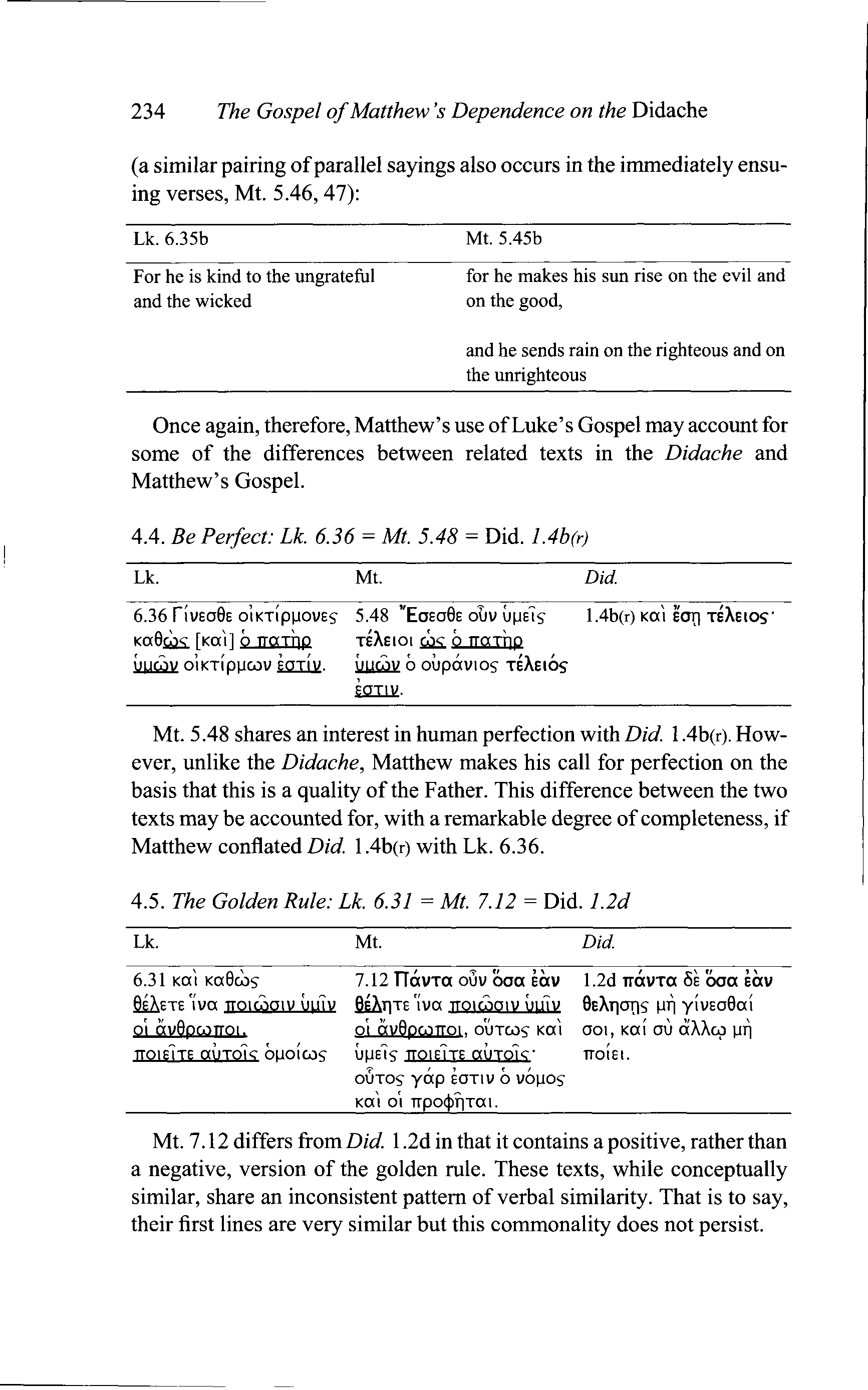
The Gospel of Matthew's Dependence on the Didache (a similar pairing of parallel sayings also occurs in the immediately ensuing verses, Mt. 5.46, 47):
Lk. 6.35b Mt. 5.45b For he is kind to the ungrateful for he makes his sun rise on the evil and and the wicked on the good, and he sends rain on the righteous and on the unrighteous Once again, therefore, Matthew's use of Luke's Gospel may account for some of the differences between related texts in the Didache and Matthew's Gospel.
4.4. Be Perfect: Lk 6.36 = Mt. 5.48 = Did. L4b(r) ~LL Mt ~Did.
6.36 rivEO0E oiKTipMOVEs 5.48 "EOEOSE OUV upsls 1.4b(r) Kai Ear) TEAEIOS'
Ka0£££ [Kai] b TraTT]p TEAEIOI &$. b Trarrip upcjv oiKTippcov EOTIV. ujjcov b oupavios TEAEIOS SOTIV.
Mt. 5.48 shares an interest in human perfection with Did. 1.4b(r). However, unlike the Didache, Matthew makes his call for perfection on the basis that this is a quality of the Father. This difference between the two texts may be accounted for, with a remarkable degree of completeness, if Matthew conflated Did. 1.4b(r) with Lk. 6.36.
4.5. The Golden Rule: Lk 6.31 = Mt. 7.12 = Did. 1.2d ~Lk.
Mt ~Did.
6.31 Kai KaScos 7.12 TTavTa ouv o a a EOCV 1.2d TTOCVTCC 5E o a a EOCV SEASTS 'iva TTOIC2>OIV u ^ v QEATITE 'iva TTOICOOIV upiv BEATIOTIS pr| yiveoSai oi av8pcoTroi. oi avSpcoTToi. OUTCOS Kai aoi, Kai ou a'AAco prj
TTOIEITE auToi<r buoico<r UJ.JSI<? TTOIETTE auToTc TTO!EI.
OUTOS y a p EOTIV b vopos Kai oi TTpoforjTai.
Mt. 7.12 differs from Did. 1.2d in that it contains a positive, rather than a negative, version of the golden rule. These texts, while conceptually similar, share an inconsistent pattern of verbal similarity. That is to say, their first lines are very similar but this commonality does not persist.
14. Matthew's Gospel and Didache 1.1-6
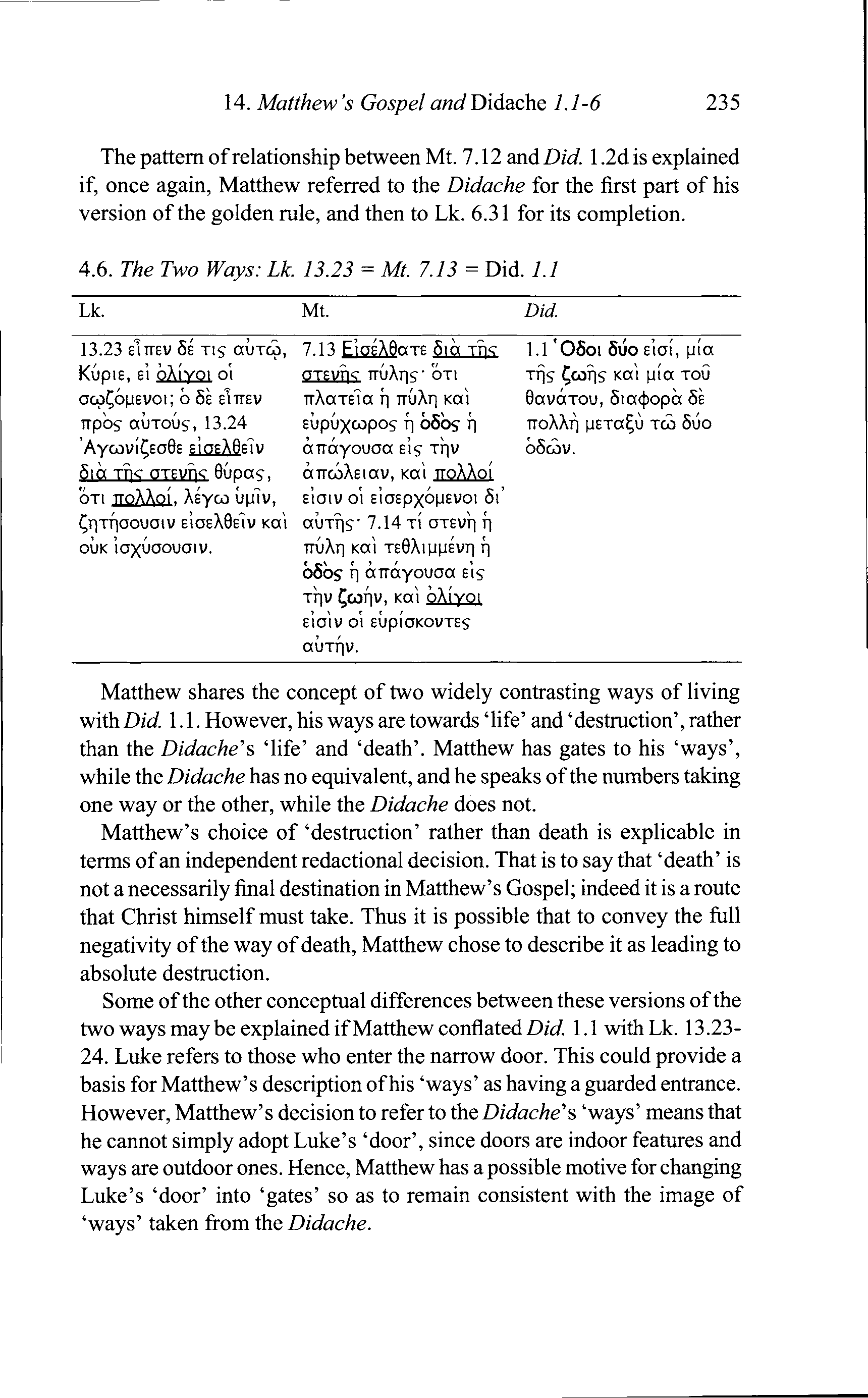
The pattern of relationship between Mt. 7.12 and Did. 1.2d is explained if, once again, Matthew referred to the Didache for the first part of his version of the golden rule, and then to Lk. 6.31 for its completion.
4.6. The Two Ways: Lk. 13.23 = Mt. 7.13 = Did. 1.1
Tk Mt ~Did.
13.23 EITTEV SE TIS OUTGO, 7.13 EiosA0aTS 5ia Tf)<?
1.1 ?O5oi 5uo eiai, pia KupiE, si bAiyoi oi oTsvf|<^ TTUATIS' OTI T % ^corjs Kai pia TOU aco^bpEvoi; b 5E EITTEV TrAaTEia f| TruAri Kai 0avaTou, 5ia(()opa 5E Trpbs auTOUs, 13.24 supuxcopos T\ bSbs T] TTOAATI peTa^u TCO 6UO Aycovi^EO0E EJOEAOETV aTTayouaa EIS Trjv b5c£>v.
5ia Tf)<: OT£V?)<: 0upas, aTrcoAsiav, Kai TTOAAOJ OTI TTOAAOI. Asyco uplv, E'IOIV oi EiaEpxbpEvoi 6T £r|TriGouaiv E'IOEAOE^V Kai auT?)s" 7.14 TI OTEVT] f|
OUK iaxuaouoiv.
TTUAT] Kai TEOAIPPEVT] fj f| aTTayouaa B\S Trjv ^COTIV, Ka'i bAiyoi 6IOIV OI Matthew shares the concept of two widely contrasting ways of living withDid. 1.1. However, his ways are towards 'life' and 'destruction', rather than the Didache's 'life' and 'death'. Matthew has gates to his 'ways', while the Didache has no equivalent, and he speaks of the numbers taking one way or the other, while the Didache does not.
Matthew's choice of 'destruction' rather than death is explicable in terms of an independent redactional decision. That is to say that 'death' is not a necessarily final destination in Matthew's Gospel; indeed it is a route that Christ himself must take. Thus it is possible that to convey the full negativity of the way of death, Matthew chose to describe it as leading to absolute destruction.
Some of the other conceptual differences between these versions of the two ways may be explained if Matthew conflated Did. 1.1 with Lk. 13.2324. Luke refers to those who enter the narrow door. This could provide a basis for Matthew's description of his 'ways' as having a guarded entrance.
However, Matthew's decision to refer to the Didache's 'ways' means that he cannot simply adopt Luke's 'door', since doors are indoor features and ways are outdoor ones. Hence, Matthew has a possible motive for changing
Luke's 'door' into 'gates' so as to remain consistent with the image of 'ways' taken from the Didache.
The Gospel of Matthew's Dependence on the Didache Luke also speaks of the number of those who will be saved, which, if taken up by Matthew, would explain the inclusion of this element in Mt.
7.13 despite its absence from Did. 1.1.
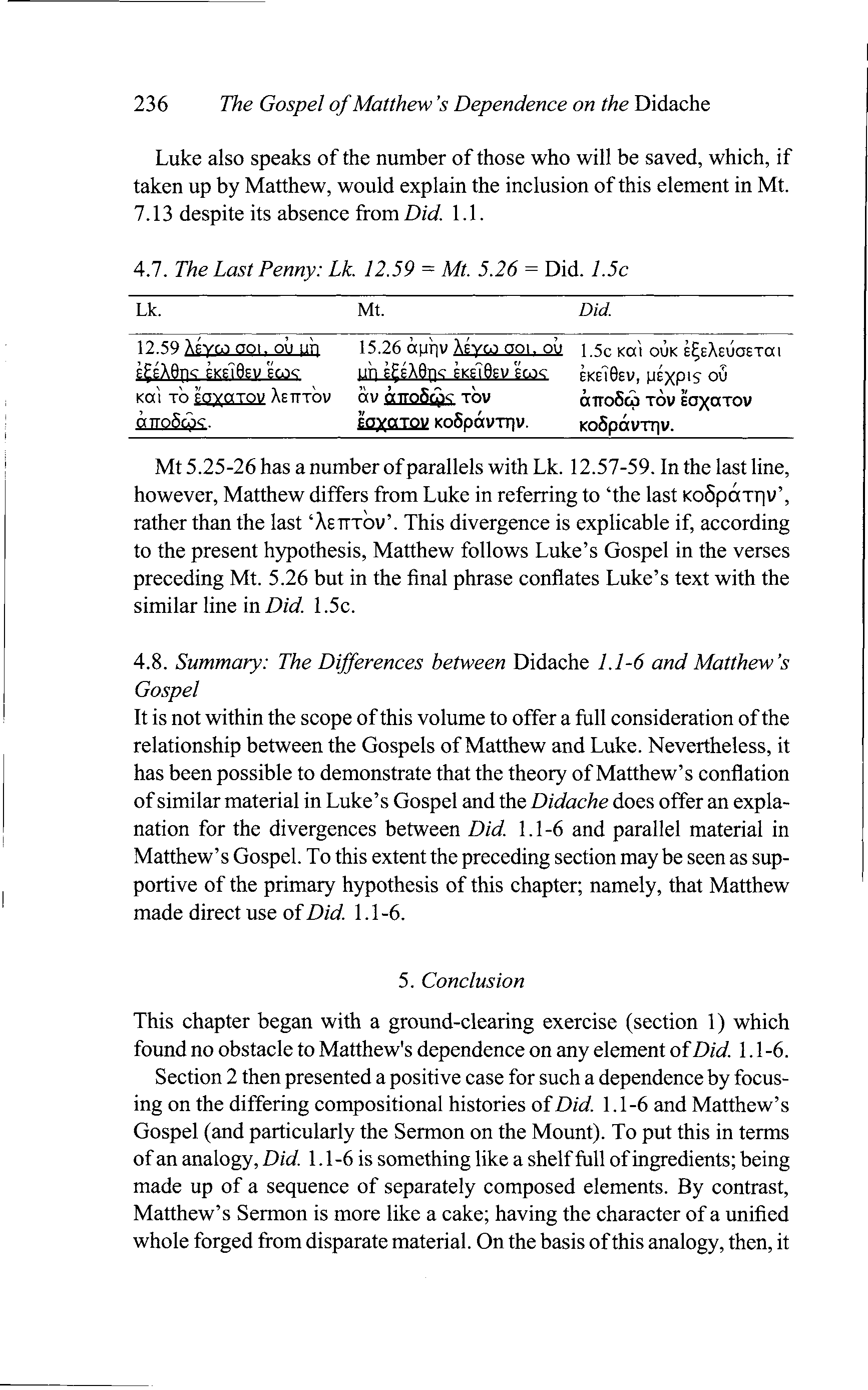
4.7. The Last Penny: Lk. 12.59 = Mt. 5.26 = Did. 1.5c 1±.
Mt ~Did.
12.59 Asycaooi. ou \ix\ 15.26 a\iT[V Asyco ooi. oh i.5 c Ken OUK E^EAEUOETCCI %A8 IQ \AT\ s^sABflc SKS78SV SCOC
EKE70EV, HEYOIS OU
KCU TO Eoxaxov AETTTOV av airoScp^ TOV aiToScp TOV EOXCCTOV Sk KoSpavTTiv.
Mt 5.25-26 has a number of parallels with Lk. 12.57-59. In the last line, however, Matthew differs from Luke in referring to 'the last Ko5paxr|v', rather than the last 'AETTTOV'. This divergence is explicable if, according to the present hypothesis, Matthew follows Luke's Gospel in the verses preceding Mt. 5.26 but in the final phrase conflates Luke's text with the similar line in Did. 1.5c.
4.8. Summary: The Differences between Didache 1.1-6 and Matthew's Gospel It is not within the scope of this volume to offer a full consideration of the relationship between the Gospels of Matthew and Luke. Nevertheless, it has been possible to demonstrate that the theory of Matthew's conflation of similar material in Luke's Gospel and the Didache does offer an explanation for the divergences between Did. 1.1-6 and parallel material in Matthew's Gospel. To this extent the preceding section may be seen as supportive of the primary hypothesis of this chapter; namely, that Matthew made direct use of Did. 1.1-6.
5. Conclusion This chapter began with a ground-clearing exercise (section 1) which found no obstacle to Matthew's dependence on any element of Did. 1.1-6.
Section 2 then presented a positive case for such a dependence by focusing on the differing compositional histories of Did. 1.1-6 and Matthew's
Gospel (and particularly the Sermon on the Mount). To put this in terms of an analogy, Did. 1.1-6 is something like a shelf full of ingredients; being made up of a sequence of separately composed elements. By contrast,
Matthew's Sermon is more like a cake; having the character of a unified whole forged from disparate material. On the basis of this analogy, then, it
14. Matthew's Gospel and Didache 1.1-6
is unlikely that the units within Did 1.1-6 were independently created under the influence of Matthew's text. It is more credible to suppose that Matthew found the sequence of elements gathered in Did. 1.1-6 and combined them with one another, and with material from other resources, to create his
Sermon.
In sections 3-4 an additional piece of evidence was considered in support of the above conclusion. Here it was suggested that the differences between Did. 1.1-6 and similar passages in Matthew's Gospel may be explained by Matthew's conflation of like material from both the Didache and Luke's
Gospel. This latter suggestion has larger implications that cannot be explored in full in this monograph. However, so far as the issue may be taken, an explanation for the relationship between Matthew's Gospel, Luke's Gospel and Did. 1.1-6, simpler than the somewhat complex proposals usually offered,14 may credibly be proposed on this basis.
In conclusion, the direct dependence of Matthew's Gospel on Did. 1.1-6 provides an explanation of the relationship between these two texts that is very much simpler than any of the alternatives, especially given the presence of material common to Luke's Gospel within Did. 1.1-6. The conclusion that Matthew directly depended upon Did. 1.1-6 has been arrived at without relying on observations made previously in Part II; however, it is a conclusion that is fully consistent with those findings.
14. Some scholars, e.g. Vokes (1938: 63); Robinson (1920: 50-58) and Layton (1968: 377) explain the triangular relationship between Did. 1.1-6 and Matthew's and Luke's Gospels by proposing that the Didache was dependent on both of the gospels or some later harmony of the two. This type of explanation further complicates the process by which, it must be proposed, each individual layer and unit within Did. 1.1-6 came to be formed.