
Chapter 13 MATTHEW'S GOSPEL AND DIDACHE 16
Chapter 13
MATTHEW'S GOSPEL AND DIDACHE 16
Having considered the contacts between Matthew's Gospel in the Modifying Teacher and Prophet layers, attention now turns to the earliest layer of the Didache, the Peri/Base layer. The number and complexity of the points of contact within this layer invites their treatment in three separate chapters. The first of these concerns the parallels between Did. 16 and certain elements of Matthew's Gospel.
The version of Did. 16 preserved in the incomplete Jerusalem manuscript is widely regarded as sharing some form of link with Mt. 24. The present chapter begins with a critique of Christopher Tuckett's view that this connection is due to the Didache's presupposition of Matthew's Gospel. This is then followed by the presentation of a case for the direct dependence of Mt. 16.27; 24.10-12, 30-31; 25.31-34, 46 on Did 16.3-6, 8-9.
1. Didache 16's Presupposition of Matthew 24 Tuckett (1996: 95), the principal proponent of the view that Did. 16 presupposes Mt. 24, notes that Did 16 is widely recognized as containing a significant cluster of links with the synoptic tradition and it may be regarded as an important test case in the discussion of the problem of synoptic tradition in the Didache.
Tuckett's method for establishing the Didache*s dependence on Matthew's Gospel (see Chapter 12, section 1) requires a single instance where Did.
16 preserves Matthew's redaction of Mark's Gospel. He finds what appears to be a suitable example in Did. 16.8:
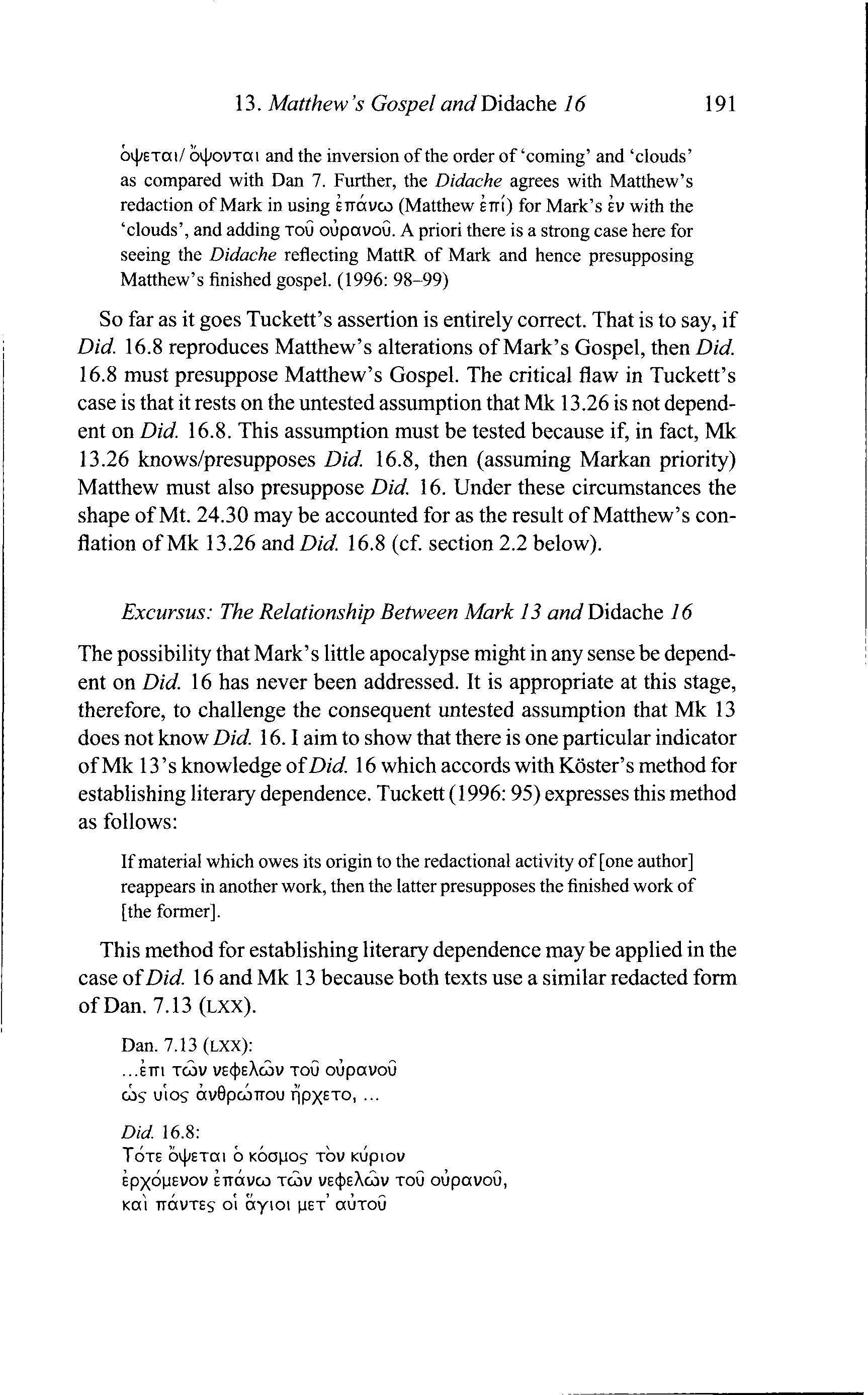
The most significant connection between the Didache and material in both Matthew and Mark occurs in Did 16:8 (TOTE ovpeTcn b KOGIJOS TOV
Kuptov epxopevov STravco TCOV vec^eXcav xou oupavou). The allusion to Dan 7:13 here is very similar to that in Mt 24:30 (cf. Mk 13:26). The very close relationship between the Didache and Matthew has often been noted.
In particular the Didache shares with Mark and Matthew the use of
13. Matthew's Gospel and Didache 16
OIJ;ETCU/ cxpovTca and the inversion of the order of 'coming' and 'clouds' as compared with Dan 7. Further, the Didache agrees with Matthew's redaction of Mark in using ETTCXVCO (Matthew ern) for Mark's EV with the 'clouds', and adding TOU oupavou. A priori there is a strong case here for seeing the Didache reflecting MattR of Mark and hence presupposing
Matthew's finished gospel. (1996: 98-99) So far as it goes Tuckett's assertion is entirely correct. That is to say, if Did. 16.8 reproduces Matthew's alterations of Mark's Gospel, then Did.
16.8 must presuppose Matthew's Gospel. The critical flaw in Tuckett's case is that it rests on the untested assumption that Mk 13.26 is not dependent on Did. 16.8. This assumption must be tested because if, in fact, Mk
13.26 knows/presupposes Did. 16.8, then (assuming Markan priority) Matthew must also presuppose Did. 16. Under these circumstances the shape of Mt. 24.30 may be accounted for as the result of Matthew's conflation of Mk 13.26 and Did. 16.8 (cf. section 2.2 below).
Excursus: The Relationship Between Mark 13 and Didache 16 The possibility that Mark's little apocalypse might in any sense be dependent on Did. 16 has never been addressed. It is appropriate at this stage, therefore, to challenge the consequent untested assumption that Mk 13 does not know Did. 16.1 aim to show that there is one particular indicator of Mk 13 's knowledge ofDid. 16 which accords with Koster's method for establishing literary dependence. Tuckett (1996:95) expresses this method as follows:
If material which owes its origin to the redactional activity of [one author] reappears in another work, then the latter presupposes the finished work of [the former].
This method for establishing literary dependence may be applied in the case of Did. 16 and Mk 13 because both texts use a similar redacted form of Dan. 7.13 (LXX).
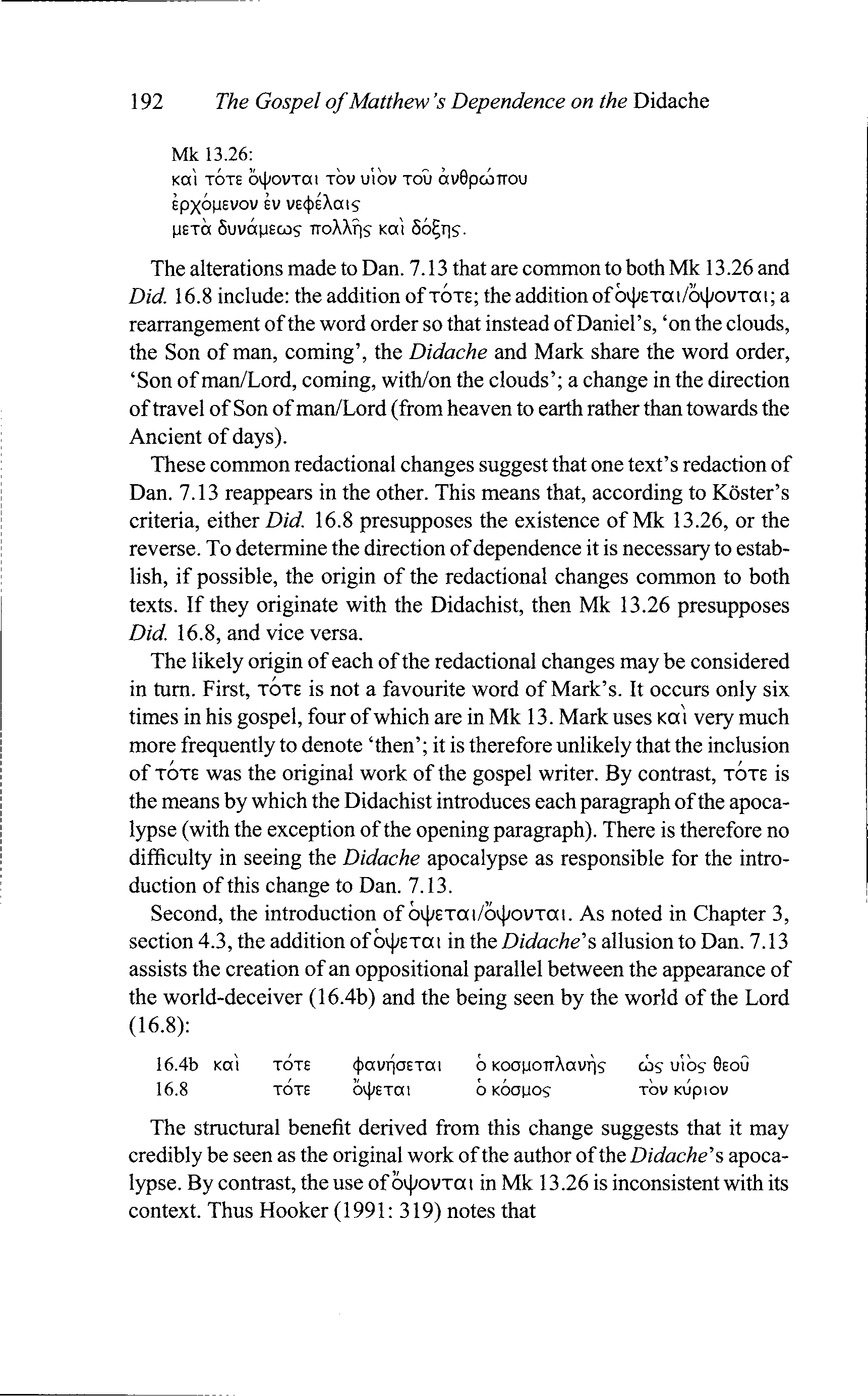
Dan. 7.13 (LXX):
...em TCOV VEC()EACOV TOU oupavou cos VJIOS avSpcoTTOu rjpx£TO, ...
Did. 16.8:
TOTE ovpETca b KOO|JOS TOV Kupiov
EpXO|JEVOV ETTCXVCO TCOV V E ^ E X C O V TOU OUpCXVOU,
Kca rravTEs oi ayioi JJET' CXUTOU
The Gospel of Matthew's Dependence on the Didache Mk 13.26:
KCU TOTE OV|K>VTCXl TOV UlOV TOU CCvBpCOTTOU
ev VE(()6Aais KOU The alterations made to Dan. 7.13 that are common to both Mk 13.26 and Did. 16.8 include: the addition of TOTE; the addition of bipETai/ovpovTai; a rearrangement of the word order so that instead of Daniel's, 'on the clouds, the Son of man, coming', the Didache and Mark share the word order,
'Son of man/Lord, coming, with/on the clouds'; a change in the direction of travel of Son of man/Lord (from heaven to earth rather than towards the Ancient of days).
These common redactional changes suggest that one text's redaction of Dan. 7.13 reappears in the other. This means that, according to Koster's criteria, either Did. 16.8 presupposes the existence of Mk 13.26, or the reverse. To determine the direction of dependence it is necessary to establish, if possible, the origin of the redactional changes common to both texts. If they originate with the Didachist, then Mk 13.26 presupposes
Did. 16.8, and vice versa.
The likely origin of each of the redactional changes may be considered in turn. First, TOTE is not a favourite word of Mark's. It occurs only six times in his gospel, four of which are in Mk 13. Mark uses KOU very much more frequently to denote 'then'; it is therefore unlikely that the inclusion of TOTE was the original work of the gospel writer. By contrast, TOTE is the means by which the Didachist introduces each paragraph of the apocalypse (with the exception of the opening paragraph). There is therefore no difficulty in seeing the Didache apocalypse as responsible for the introduction of this change to Dan. 7.13.
Second, the introduction of b^ETai/bvpovTcxi. As noted in Chapter 3, section 4.3, the addition of bvpETai in the Didache's allusion to Dan. 7.13 assists the creation of an oppositional parallel between the appearance of the world-deceiver (16.4b) and the being seen by the world of the Lord
(16.8):
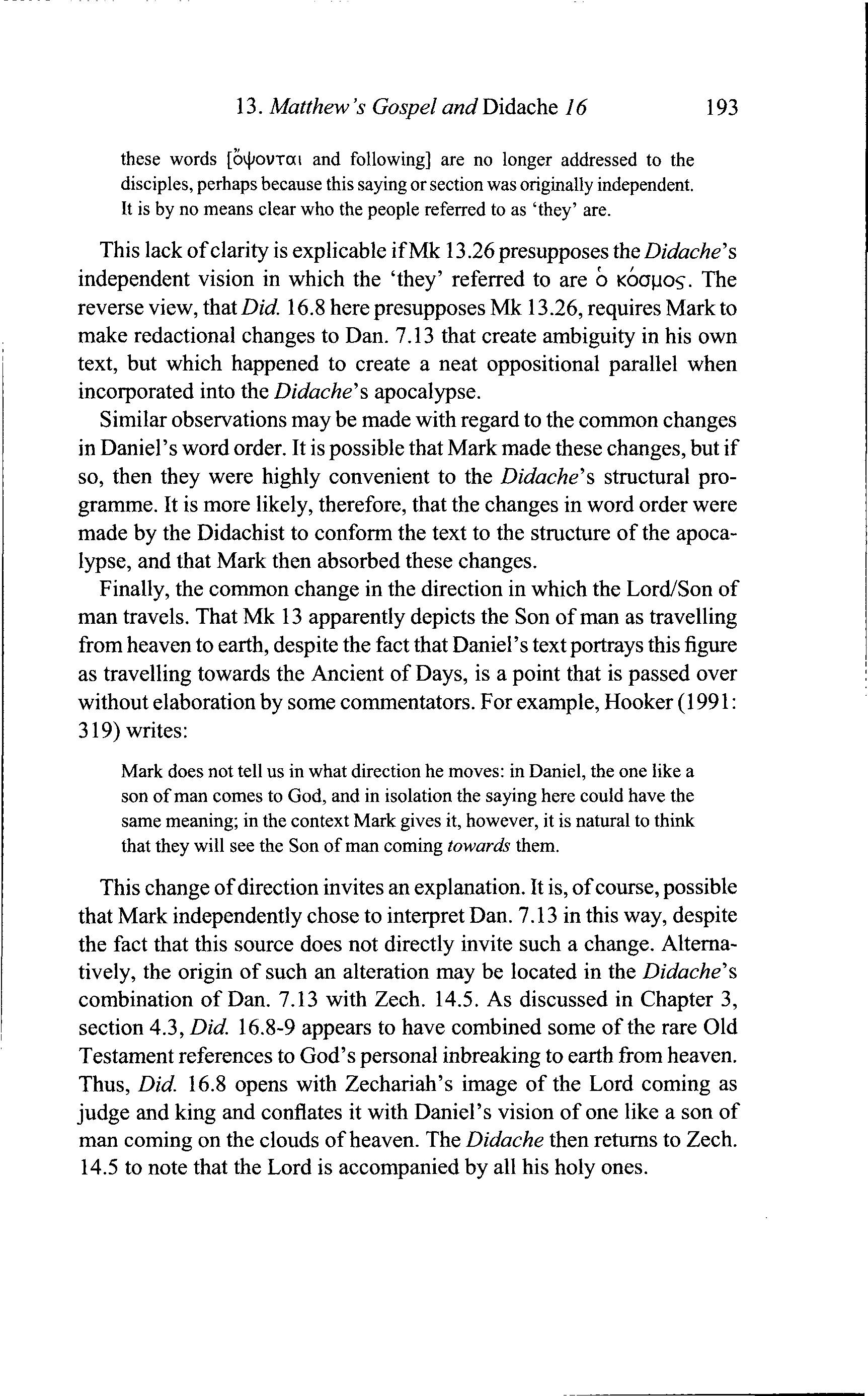
16.4b Ken TOTE ^cxvrjaETCxi b KOopoTrAavris cos utbs 8eoG 16.8
TOTE bvpSTcu
b KOOJJOS
TOV Kupiov The structural benefit derived from this change suggests that it may credibly be seen as the original work of the author of the Didache^ apocalypse. By contrast, the use of bipovTCU inMk 13.26 is inconsistent with its context. Thus Hooker (1991: 319) notes that
13. Matthew's Gospel and Didache 16
these words [ovpovTou and following] are no longer addressed to the disciples, perhaps because this saying or section was originally independent.
It is by no means clear who the people referred to as 'they' are.
This lack of clarity is explicable if Mk 13.26 presupposes the Didache's independent vision in which the 'they' referred to are b Koapos. The reverse view, that Did. 16.8 here presupposes Mk 13.26, requires Mark to make redactional changes to Dan. 7.13 that create ambiguity in his own text, but which happened to create a neat oppositional parallel when incorporated into the Didache*s apocalypse.
Similar observations may be made with regard to the common changes in Daniel's word order. It is possible that Mark made these changes, but if so, then they were highly convenient to the Didache's structural programme. It is more likely, therefore, that the changes in word order were made by the Didachist to conform the text to the structure of the apocalypse, and that Mark then absorbed these changes.
Finally, the common change in the direction in which the Lord/Son of man travels. That Mk 13 apparently depicts the Son of man as travelling from heaven to earth, despite the fact that Daniel's text portrays this figure as travelling towards the Ancient of Days, is a point that is passed over without elaboration by some commentators. For example, Hooker (1991:
319) writes:
Mark does not tell us in what direction he moves: in Daniel, the one like a son of man comes to God, and in isolation the saying here could have the same meaning; in the context Mark gives it, however, it is natural to think that they will see the Son of man coming towards them.
This change of direction invites an explanation. It is, of course, possible that Mark independently chose to interpret Dan. 7.13 in this way, despite the fact that this source does not directly invite such a change. Alternatively, the origin of such an alteration may be located in the Didache*s combination of Dan. 7.13 with Zech. 14.5. As discussed in Chapter 3, section 4.3, Did. 16.8-9 appears to have combined some of the rare Old
Testament references to God's personal inbreaking to earth from heaven.
Thus, Did. 16.8 opens with Zechariah's image of the Lord coming as judge and king and conflates it with Daniel's vision of one like a son of man coming on the clouds of heaven. The Didache then returns to Zech.
14.5 to note that the Lord is accompanied by all his holy ones.
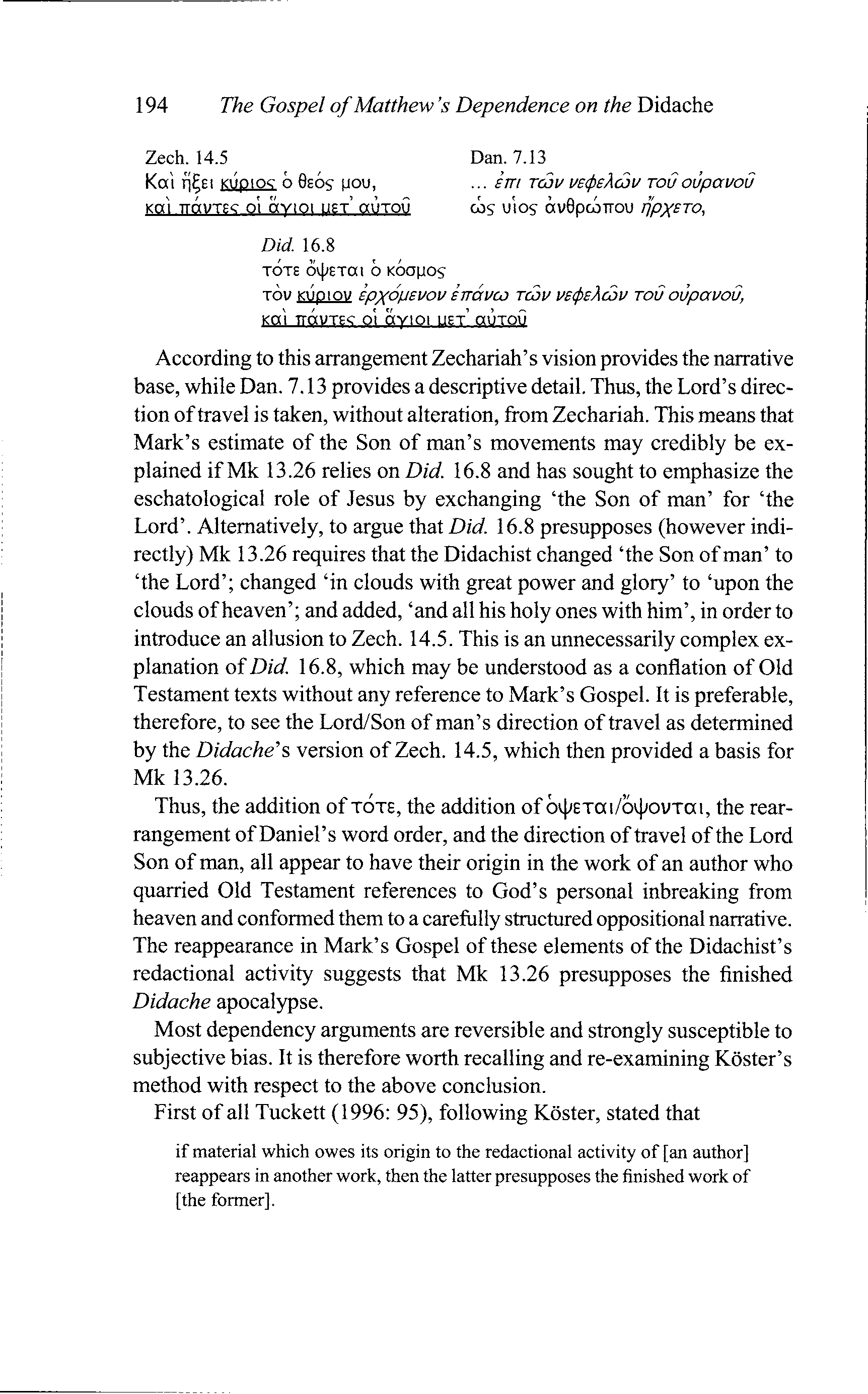
The Gospel of Matthew's Dependence on the Didache Zech. 14.5
Dan. 7.13
Ken fj^ei Kupicx b 9EOS MOU, ... irn TOJV vefaAcov rou oupai/ou Ken TT6(VTEC oi aytoi \IZT auTou cos uios avSpconou rjp Did. 16.8
TOTE OVpETai O KOO|JOS TOV Kuptov epxoiJevov enavGj TCOI/ vecpsXcov rou ovpavou,
Koa TravTE^ oi ayioi MET' CXUTOU According to this arrangement Zechariah's vision provides the narrative base, while Dan. 7.13 provides a descriptive detail. Thus, the Lord's direction of travel is taken, without alteration, from Zechariah. This means that Mark's estimate of the Son of man's movements may credibly be explained if Mk 13.26 relies on Did. 16.8 and has sought to emphasize the eschatological role of Jesus by exchanging 'the Son of man' for 'the Lord'. Alternatively, to argue that Did. 16.8 presupposes (however indirectly) Mk 13.26 requires that the Didachist changed 'the Son of man' to 'the Lord'; changed 'in clouds with great power and glory' to 'upon the clouds of heaven'; and added, 'and all his holy ones with him', in order to introduce an allusion to Zech. 14.5. This is an unnecessarily complex explanation of Did. 16.8, which may be understood as a conflation of Old
Testament texts without any reference to Mark's Gospel. It is preferable, therefore, to see the Lord/Son of man's direction of travel as determined by the Didache9s version of Zech. 14.5, which then provided a basis for Mk 13.26.
Thus, the addition of TOTE, the addition of o^ETai/cxpovTOU, the rearrangement of Daniel's word order, and the direction of travel of the Lord
Son of man, all appear to have their origin in the work of an author who quarried Old Testament references to God's personal inbreaking from heaven and conformed them to a carefully structured oppositional narrative.
The reappearance in Mark's Gospel of these elements of the Didachist's redactional activity suggests that Mk 13.26 presupposes the finished
Didache apocalypse.
Most dependency arguments are reversible and strongly susceptible to subjective bias. It is therefore worth recalling and re-examining Koster's method with respect to the above conclusion.
First of all Tuckett (1996: 95), following Koster, stated that if material which owes its origin to the redactional activity of [an author] reappears in another work, then the latter presupposes the finished work of [the former].
13. Matthew's Gospel and Didache 16
A potential difficulty in the application of this criterion can be that it is not always possible to state with confidence that a piece of redactional activity is original to a particular author. The viability of the argument presented above depends crucially, therefore, on the quality of the evidence that suggests the unique hand of the author of the Didache"'s apocalypse in the creation of the version of Dan. 7.13 now found in Did. 16.8.
It was further noted that Tuckett (1996: 95) warns:
Such a criterion must of course be applied with care, and one must not rule out the possibility that a feature could have been added to the tradition by two independent redactors.
The level of coincidence required for the independent redaction of Dan.
7.13 in both Mk 13.26 and Did. 16.8 is unusually high because of the four redactional steps involved: the addition of TOTS, the addition of b^Tai/ cxpovxai, the rearrangement of Daniel's word order, and the direction of travel of the Lord/Son of man. It is unlikely, therefore, that the similarities between these two versions of Dan. 7.13 were created by changes made by two independent redactors.
Tuckett (1996: 95) finally cautions that Nor should one assume that any dependence which is established on the basis of this criterion is necessarily direct: the later document may be several stages removed from the earlier one.
Once again, this is a warning that must be heeded. All that can be concluded on the basis of the evidence considered above is that Mk 13.26 appears to presuppose the existence of Did. 16.3-9 at some remove or other.
Tuckett (1996:95) sums up this methodological discussion by stating that Nevertheless, this criterion is really the only one which ultimately can determine whether [one] text.. .presupposes [another text].
This observation is important because too often dependency arguments are constructed on the basis of the possibility that general similarities and differences between two texts may be accounted for by the dependence of one text upon the other. Such arguments are close to worthless because they are almost always reversible. Thus, although a line of development from Did. 16 to Mk 13 could certainly be drawn1 the reverse is also
For example, there is no difficulty in reading Mk 13.13,4b 5e uTrojjeivas eis oiiTos oco0f]aeTai', as a redactional development of Did. 16.5, 'oi 5e
VJTTOJJElVaVTGS EV TV\ TTIOT81 COJTCOV GCG0r)aOVTai UTl"' QUTOU TOU KCXTa0e|jaTOs\
The Gospel of Matthew's Dependence on the Didache conceivable, with the notable exception of the relationship between Did.
16.8 and Mk 13.26.
In conclusion, Mk 13.26 appears to have known a version of Dan. 7.13 redacted by the author of Did. 16.8. On the basis that Did. 16.3-6,8-9 is a unified text (cf. Chapter 3), it may be concluded that whoever penned Mk
13.26 (and the other verses that form a unity with this verse) knew the whole of Did 16.3-6, 8-9.2
I now return to the question of the relationship between Mt. 24 and Did.
16. If Did. 16.8 was a source, at whatever remove, for Mk 13.26, and if Mk 13 was a source for Matthew's eschatological discourse, then it is a logical impossibility that Did. 16.3-6,8-9 could presuppose the existence of Matthew's Gospel. This argument, if cogent, removes the centrepiece of Tuckett's case for the Didache's presupposition of Matthew's Gospel.
The remainder of Tuckett's argument regarding the relationship between Did. 16 and Mt. 24 runs as follows. First, he notes that Many who have argued against any dependence of the Didache on Matthew's gospel have appealed to the peculiar pattern in the parallels between the Didache and the synoptic gospels. It is said that Did 16 only shows links with material peculiar to Mt 24 in the synoptic tradition: the Didache does not have any links with material from Mt 24 which Matthew has derived from Mark. Hence, it is argued, the Didache is more likely to be dependent on the source(s) which lie behind Mt 24 and which were available to Matthew alone; if the Didache were dependent on Matthew, one would expect some of Matthew's Markan material to be reflected as well. Such an argument is in danger of ignoring some of the evidence of Did 16 itself. For the text of Did 16 contains possible allusions to synoptic and so on. However, it is also possible to conceive of circumstances under which the direction of development between these two texts might be reversed.
Additional support for Mark's knowledge of Did. 16.3-6,8-9 may be found in a further indicator of the extreme antiquity and importance of the Didache apocalypse.
In Chapter 3, § 4.3 it was argued that the rendering of Isa. 64.4 in Did. 16.9 was created by the Didachist so as to complete the sense and structure of the closing apocalypse. It is noteworthy therefore that in 1 Cor. 2.9 Paul quotes an identical version of this verse.
It is unlikely that the various redactional changes involved were found by the Didachist 'ready made' for insertion into the apocalypse, so it is probable that Did. 16.9 represents the first occurrence of this rendering of Isa. 64.4. Paul's quotation therefore implies that the Didache's apocalypse predates the writing of 1 Corinthians, and thus is highly likely to predate the composition of Mark's Gospel. The issue of Paul's relationship to the Didache is beyond the scope of this project. I aim to publish further research on this subject in due course.
13. Matthew's Gospel and Didache 16
material in four verses common to Matthew and Mark (and which Matthew presumably derived from Mark). (1996: 96)
Tuckett then goes on to consider, in turn, those occasions where the Didache contains material common to Matthew and Mark. With reference to Did. 16.4 he writes:
Did 16:4 mentions the Koa|JOTTAavr)s who, it is said, will do (Troirjoei) signs and wonders (on|jeia Kai xepaxa) and will perform iniquities a OUSETTOTE yeyovev e£ CUGDVOS. The language used is similar to that of Matthew and Mark. Mk 13:22/Mt 24:24 refers to the coming of false messiahs and false prophets who will perform anjjeio; Kai TEpaxa, 'leading astray' the elect; and in Mk 13:19/Mt 24:21 the coming tribulation is said to be such as never has been (ou ysyovsv) since the creation of the world. (1996: 96)
These overlaps do not carry the significance attributed to them by Tuckett when the unjustified assumption of Markan priority relative to the Didache's apocalypse is removed. Thus, if Did. 16 is presupposed by Mk
13, then it is unsurprising that the Didache's expectations about the coming world-deceiver should be picked up by Mark, and subsequently, by Matthew. Ironically, Koster (1972: 182) comes close to this explanation when he argues that, since Mk 13.19,22 come from the Vorlage used by Mark in Mk 13, the Didache here shows contact only with Mark's source and not with Mark's Gospel itself.
Koster has been justly criticized for taking this route because of the lack of evidence for the form of Mark's Vorlage. However, if Mark's source was in fact Did. 16, or some derivative of that text, then Koster's case need only be amended to the extent that, since Mk 13.19, 22 come from Did. 16, it is logically impossible that Did. 16 could be dependent on either
Mark or Matthew (assuming Markan priority).
The next instance where Tuckett notes a possible link between the Didache and Markan material used by Matthew is in the phrases, 'oi 5E uTTOMEivavxes EV TT\ TTIOTEI auxcov oco0r]GovTai UTT'
CXUTOU xou KOCTOCOEMCXTOS' in Did. 16.5, and 'b 5E uuoiJEivas £is TEAOS OUTOS aco0riGETai' inMk 13.13/Mt. 24.13; 10.22. The connection between Mk
13.13 and Did. 16.5 is entirely to be expected if Mk 13 depends on the Didache apocalypse. This enigmatic line of the Didache is pivotal to the structure and perlocutionary force of that discourse (cf. Chapter 3, section
1) and so may be expected to recur in later versions of this eschatological scheme. Mark's simplification and interpretation of the line (in making the perseverence to the 'end' and through the omission of the enigmatic reference to 'the curse itself) suggests, although it does not compel, develop-
The Gospel of Matthew's Dependence on the Didache ment ixomDid. 16.5 to Mk 13.13. Further, as Tuckett (1996: 98) notes,
'Many regard the verses [Mk 13.13] as pre-Markan and it is certainly not easy to point to any clear Markan characteristics'. If Mk 13.13 is indeed pre-Markan, and derives in the first instance (like Mk 13.26) from the Didache's apocalypse, then the reappearance of Mark's version of this line in Mt. 24.13; 10.22 serves only to demonstrate a relationship between Matthew and Mark and nothing more.
It is at this stage in Tuckett's programme that he addresses the important case of the use of Dan. 7.13 in Did. 16.8, Mk 13.26 and Mt. 24.30. As argued above, the relationship between these four texts points to Did. 16.8 as the source of the redacted form of Dan. 7.13 which reappears in Mark and Matthew. As such this instance points to Mark's presupposition of the Didache and not, as Tuckett proposes, to the Didache's presupposition of Matthew.
Tuckett concludes this section with the following rebuttal to those who claim that the Didache cannot have known Matthew because it appears only to know that in Matthew which is not common to Mark:
Thus Did 16 has links not only with Matthew's special material, but also with material common to Matthew and Mark and, in the last instance considered, presupposes Matthew's redaction of Mark (1996: 101).
Tuckett's response to his opponents is justified inasmuch as they claim too much and so invite Tuckett's correction. However, as Tuckett himself would attest, the crucial piece of evidence is contained in 'the last instance'; if the Didache presupposes Matthew's redaction of Mark, then
Tuckett's case is as good as sealed. However, if, as argued above, Matthew shows knowledge ofMark's redaction of the Didache, then the centrepiece of his case is removed.
Tuckett's argument continues with a consideration of those passages where Did. 16 reflects material that is peculiar to Matthew in the synoptic tradition. Here Tuckett attempts to continue the application of Koster's method by considering first of all whether or not the material peculiar to Mt. 24 is, by origin, Matthean redaction. If he can prove that it is, then its reappearance in Did. 16 will provide almost certain evidence of the Didache's presupposition of Matthew's Gospel.
Tuckett's progress in this line of argument is obstructed by his inability to prove that the material peculiar to Matthew in Mt. 24.10-12 and 24.30a,
31 is original to that writer. Tuckett bases his case for the MattR status of these verses entirely on the fact that 'Within Matthean scholarship there is
13. Matthew's Gospel and Didache 16
widespread agreement that [Mt. 24.10-12] are due to MattR' (1996:101102),3 and with reference to Mt. 24.30a, 31 (1996: 104), 'Again many would ascribe this material to MattR in Matthew, though the limited extent makes any certainty impossible'.4 The fact that a number of scholars have decided that these verses are MattR is not sufficient to make
Tuckett's case. What is required is convincing evidence that these verses are entirely Matthew's work. Such evidence cannot be provided, and so this section of Tuckett's article does not further his overall thesis.
Tuckett's argument for the direct dependence of Did. 16 on Mt. 24 closes at this point. Although he succeeds in exposing the inaccuracy of the claim of his dialogue partners (that the Didache and Matthew only share material peculiar to Matthew), he fails to show that the Didache presupposes
Matthew's redaction of Mark. This means that the case for Didache 16's use of Matthew has not been made and alternative explanations for their relationship remain worthy of exploration.
2. Matthew's Gospel Depends Directly upon Didache 16 The commonly proposed alternative to the view that Did. 16 directly depends on, or presupposes, Mt. 24 suggests that both texts draw on a hypothetical common tradition. This particular view will be examined more closely at the close of this chapter. The other possible alternative, that Mt.
24 depends directly on Did. 16, has not previously been considered; an omission which may be attributed to the commonly held belief that Did.
16 must post-date Mt. 24. However, as the earlier excursus sought to demonstrate, this assumption is far from soundly based. There is therefore no obstacle to the possibility that Matthew used Did. 16. directly.
The case for Mt. 24's direct dependence on Did. 16 requires the defence of four propositions:
Tuckett (1996: 102 n. 43) lists Lambrecht, Didier, Kilpatrick, Burnett, Kiihschelm and Gundry as proponents of this view. A trawl through these authors will produce a collection of arguments for proposing Matthew's originality in these verses.
However, it is extremely difficult to identify Matthew's original creation with any real confidence because he so clearly relied on written sources. Thus, that which may appear characteristic of Matthew may simply be characteristic of one of his sources.
In this case (1996: 104 n. 48) Lambrecht and Gundry are cited. The note continues, 'Clearly Matthew is using traditional ideas and phraseology so that in that sense Matthew's language is traditional; the question is whether Matthew himself has supplied this traditional language'. This is, of course, an impossible question to answer, and so it can make no contribution to the debate in hand.
The Gospel of Matthew fs Dependence on the Didache 1.
There is a definite connection of some kind between the two texts.
That connection cannot be due to the Didache's direct or indirect dependence on Matthew's Gospel.
Direct dependence by Matthew upon Did. 16 is plausible or probable.
Matthew's Gospel and Did. 16 are unlikely to have shared a common tradition.
The density of parallels between Did. 16.3-6, 8 andMt. 24.10-12,30a, 31 means that the first of these propositions creates no difficulties. Tuckett
(1996: 101) is correct in asserting that 'The existence of links between Did 16 and material peculiar to Mt 24 is accepted by all'.5
The second proposition was defended in this chapter's excursus, where it was argued that Did. 16.3-6, 8-9 contains an original redaction of Dan.
7.13, which then reappears in Mark's and Matthew's Gospels. If this observation is correct, then both gospels must presuppose the existence of Didache's eschatological discourse. Further points in support of this proposition are contained in the following section.
What follows addresses the third proposition. (The fourth will be considered in section 4, below.) This entails the examination of individual points of contact between the two texts to consider whether Matthew's direct use of Did. 16 is plausible or probable in each case.
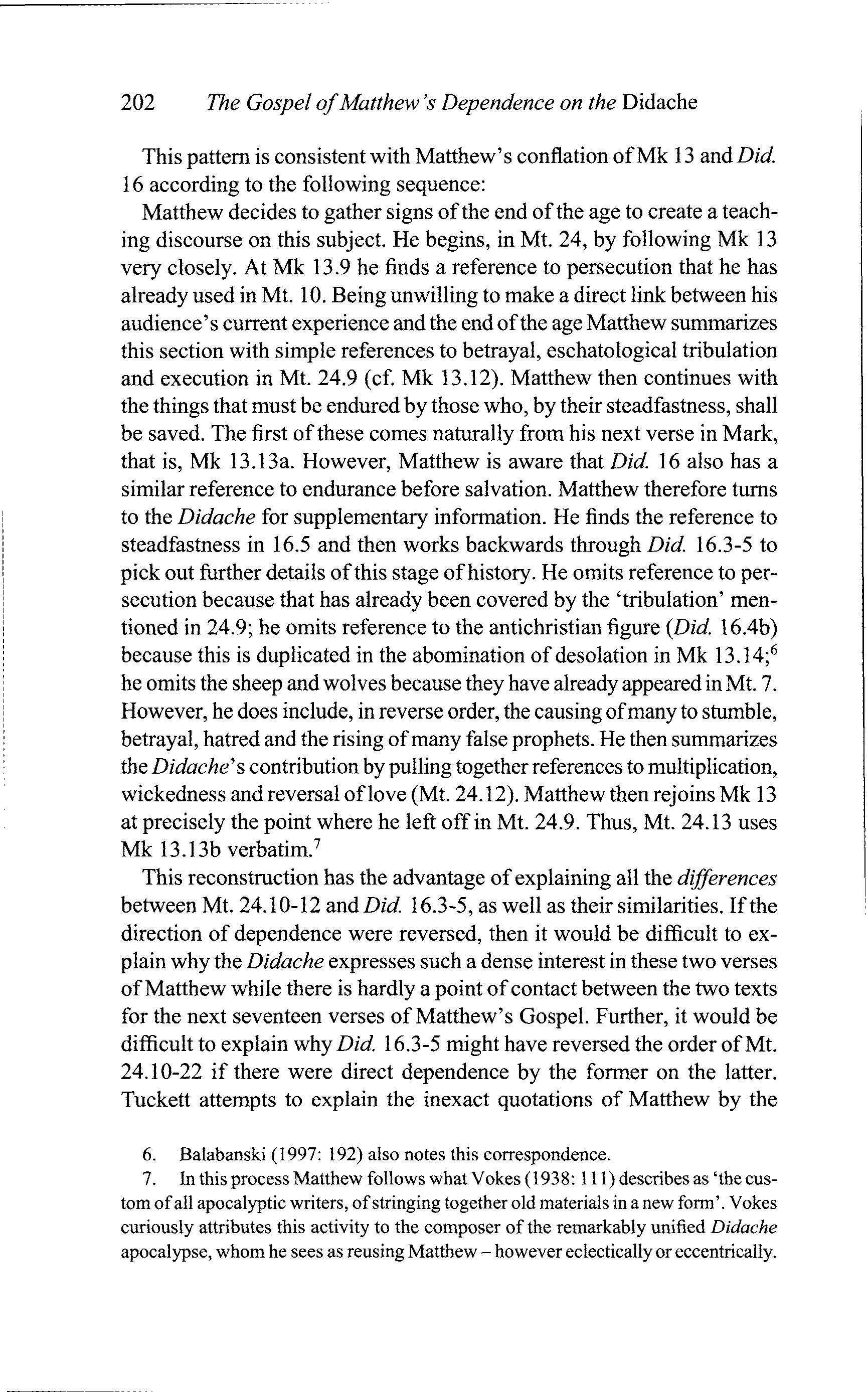
2.1. Matthew 24.10-12 and Didache 16.3-5 Synopsis 2 shows that Mt. 24.9b follows Mk 13.13a almost verbatim.
Matthew then abruptly breaks off from Mk 13 and immediately introduces material parallel to Did. 16.3-5. Mt. 24.13 then continues with verbatim use of Mk 13.13b.
Synopsis 2: Events endured before the end ~~Mk M t ~Did.
24.9 XOXE
TrapaScoaouaiv i)\ia<; BATvpiv 13.12
KCCI TrapaScoosi afieA<|xK CCSEA^OV eis 0avaxov Kai TTaxfjp XIKVOV, KCU Euavaaxriaovxai xsKva ETTI yovsTs KCU Savaxcoaouotv auxou<r* Kai aTroKXEVouaiv uu 5.
Scholars such as Kloppenborg (1979); Koster (1957) and Glover (1958) see the link as an indirect one, but detect it nonetheless.
13. Matthew's Gospel andDidache 16
Mk Mt.
Did 13.13a Kai EOEOSE Kai EOEOSE
UlOOUUEVOl UTTO TTaVTCOV
UlOOUUEVOt UTTO TTaVTCOV
16.3 Evyap Tats
TCOV E0VCOV
Si a TO ovoua fjou.
Si a TO ovoua uou. 24.10 oi Kai TOTE 1v|/Eu5oTTpo<()fJTai Kai oi TTOXXOI Kai aXXfjXous Ta TTpopaTa E'IS XUKOUS OTpa<()TiaETaiu EIS \i\oos 16.4 au^avouarjs ycxp 3TTgpg5cooouoiv Ka\
ZMIOT1OOUOIV I
Kai 3Trapa5cooouoi...
2Miaf]aouoiv ... 16.5 TOTE T]^£l r| TGOV avSpCOTTCOV Tf|V TTUpCOOlV TfJS
24.11 KCU TTOXXOI
Kai 4aKav5aXio8rioovTai EyEp6r|aovTai KCU TTOXXOI Kai auoXouvTai, TTXavrjaouaiv TTOXXOUS* 24.12 Kai 5ia TO t TT]V g y g n r j TCOV TTOXXCOV.
;ac 24.13 b SE UTTOUEiva<: E'K
T?Ao<^ OVTQ<^
aco0r|O£Tai. 24.14 Kai oi SE UTTouEivavTEs EV 13.13b b 5E {JTTOMEII
TTl TTIOTEI aUTODV
acoOrjoovTai \JTT' auTou
E'K TEXO<: OUTO<:
acoSrjaETai.
Krjpux6r)0STai TOUTO TO EuayylXiov TT\S TOU KaTa0£|JCXTOS.
EV O X T ] T?) OlKOUUEVr] £ I S
uapTupiov Traoiv TO\S E0VEOIV, Kai TOTE
T]£EI TO TEXOS.
]TE TO 24.15 ' O T O V ouv i'Sr|T£
13.14 ' O T O V SE I5T
pSsXuyua TT\<; fpnMwww^...
TO pSEXuyj^a Trj<^ spnuwews...
The Gospel of Matthew's Dependence on the Didache This pattern is consistent with Matthew's conflation of Mk 13 and Did.
16 according to the following sequence:
Matthew decides to gather signs of the end of the age to create a teaching discourse on this subject. He begins, in Mt. 24, by following Mk 13 very closely. At Mk 13.9 he finds a reference to persecution that he has already used in Mt. 10. Being unwilling to make a direct link between his audience's current experience and the end of the age Matthew summarizes this section with simple references to betrayal, eschatological tribulation and execution in Mt. 24.9 (cf. Mk 13.12). Matthew then continues with the things that must be endured by those who, by their steadfastness, shall be saved. The first of these comes naturally from his next verse in Mark, that is, Mk 13.13a. However, Matthew is aware that Did. 16 also has a similar reference to endurance before salvation. Matthew therefore turns to the Didache for supplementary information. He finds the reference to steadfastness in 16.5 and then works backwards through Did. 16.3-5 to pick out further details of this stage of history. He omits reference to persecution because that has already been covered by the 'tribulation' mentioned in 24.9; he omits reference to the antichristian figure {Did. 16.4b) because this is duplicated in the abomination of desolation in Mk 13.14;6 he omits the sheep and wolves because they have already appeared in Mt. 7.
However, he does include, in reverse order, the causing of many to stumble, betrayal, hatred and the rising of many false prophets. He then summarizes the Didache's contribution by pulling together references to multiplication, wickedness and reversal of love (Mt. 24.12). Matthew then rejoins Mk 13 at precisely the point where he left off in Mt. 24.9. Thus, Mt. 24.13 uses
Mk 13.13b verbatim.7
This reconstruction has the advantage of explaining all the differences between Mt. 24.10-12 andDid. 16.3-5, as well as their similarities. If the direction of dependence were reversed, then it would be difficult to explain why the Didache expresses such a dense interest in these two verses of Matthew while there is hardly a point of contact between the two texts for the next seventeen verses of Matthew's Gospel. Further, it would be difficult to explain why Did. 16.3-5 might have reversed the order of Mt.
24.10-22 if there were direct dependence by the former on the latter.
Tuckett attempts to explain the inexact quotations of Matthew by the 6.
Balabanski (1997: 192) also notes this correspondence.
In this process Matthew follows what Vokes (1938: 111) describes as 'the custom of all apocalyptic writers, of stringing together old materials in a new form'. Vokes curiously attributes this activity to the composer of the remarkably unified Didache apocalypse, whom he sees as reusing Matthew - however eclectically or eccentrically.
13. Matthew's Gospel and Didache 16
Didache by claiming that the Didache is in the habit of alluding to Matthew, without quoting directly. The image he conjures is of the Didache breathing the atmosphere of Matthew's Gospel. Henderson (1995: 182) notes:
That individuality which asserts itself wherever the Didache resembles the synoptics is so pronounced that Tuckett must remind the reader at least eight times about the freedom with which the Didache appropriates material which is in synoptic styles.8
This appeal to free allusion could explain the differences in the wording between Matthew's Gospel and the Didache, but it makes the extreme localization of these allusions all the more puzzling. What Tuckett proposes in the end is that the Didache breathes the atmosphere of Matthew, but is careful only to inhale almost exclusively non-Markan air. Given that twenty-nine verses of Mt. 24.1-36 appear to derive from Mk 13, it is remarkable that almost all of these so-called allusions should be densely located in five of the seven non-Markan verses.
In summary, the relationship between Did. 16.3-5 and Mt. 24.10-12, may be understood most plausibly as the product of Matthew's conflation of teaching on 'what must be endured prior to salvation' from both Mk
13.1-13 and Did 16.3-5.
2.2. Matthew 24.30-31 and Didache 16.6, 8 As Tuckett (1996: 103) observes, 'Parallels between Did 16.6 and Mt
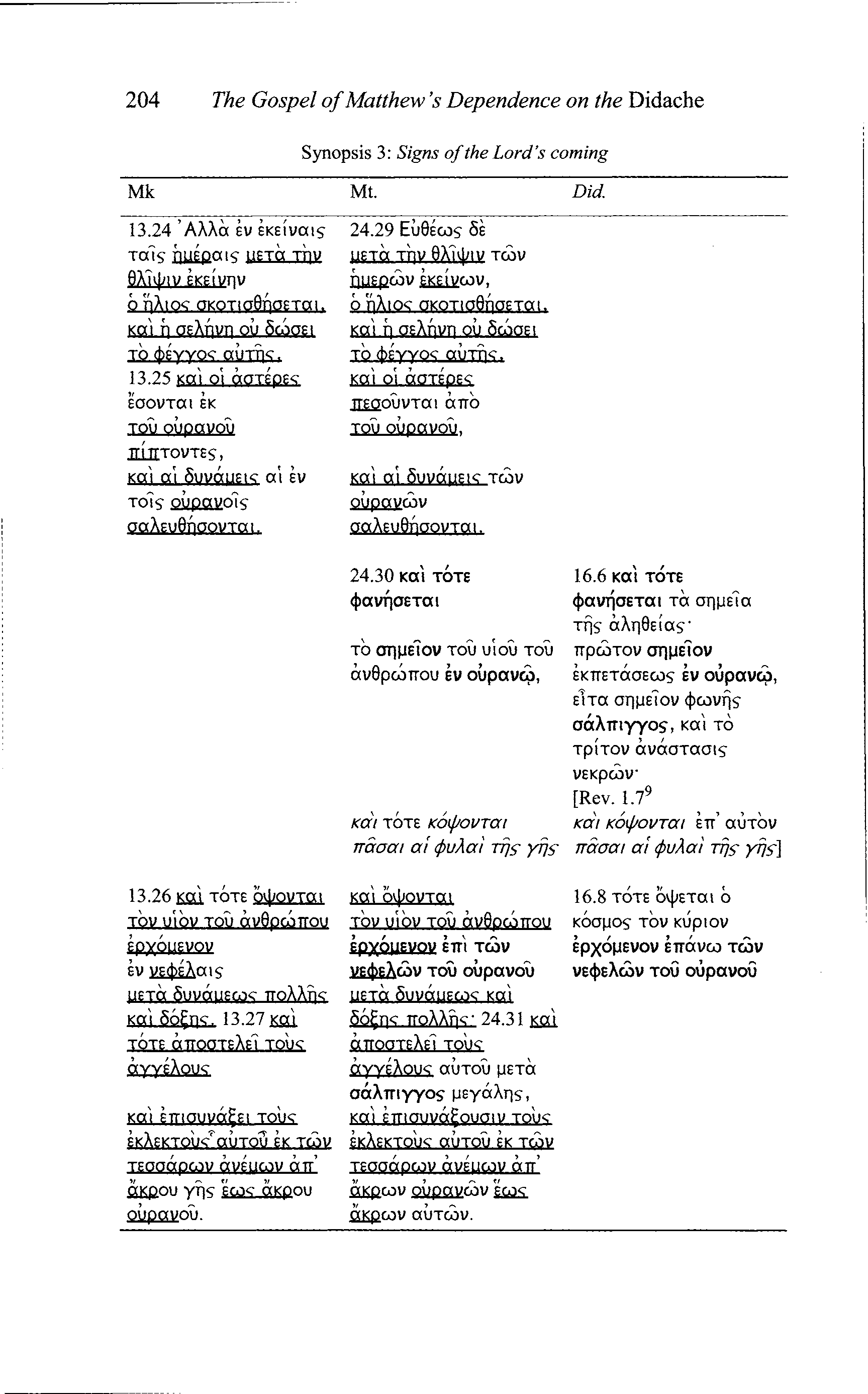
24.30a, 31 are also widely recognised'. Here several features of the relationship between Mt. 24.10-12 and Did. 16.3-5 are repeated. Once again, as can be seen in Synopsis 3 (opposite), there is a strong relationship between the Didache and the non-Markan material in Matthew. Once again, a motive for the inclusion of this material at this particular point may be found in Matthew's desire to supplement Mark's material with information on a closely related subject to be found in the Didache.9
Henderson (1995: 182 n. 11) cites the page numbers for these eight occasions from the 1989 version of Tuckett's article. These are: 1989: 198-99 and n. 11,201 n.
19, 207-208, 211 n. 68, 212 and n. 71, 222 n. 108 and 226.
It is not within the scope of this proj ect to consider Matthew' s relationship with the book of Revelation. However, Matthew's inclusion of the further detail 'KCU TOTE
KovpovTcct Traced cu <|>uAcu Trjs yr)s' may indicate his knowledge of the account of the coming of the Son of man in Rev. 1.7.
The Gospel of Matthew's Dependence on the Didache Synopsis 3: Signs of the Lord's coming Mk Mt.
Did 13.24 'AXXa EV EKEi
24.29 EUBECOS 5E
8XK|;IV £KEt
Tf|V
fJETCX TT]V BXT^/l V TCOV
EKEJVCOV.
b OKOTio8r|OETai.
Kai f| ou SCOPE \ j OKOTia8f|OETai.
Kai f) O£Xf|vr| ou SCOPE i TO fysyycx: auTf|<:.
Kai oi TO 4>£yyoc auT?|<:.
13.25 xca oi aoT£p£<: laovxaiEK TOU oupavou anb TOU oupavou.
JliJITOVTES, Kca ai SuvapEK ai iv TOIS oupavoic oaX£u8noovTai.
Kai ai SuvapEK TCOV oupavcov 16.6 Kai TOTE (|>avTia£Tai TCX 24.30 Kai TOTE <|>avf|aeTai
TO 0T||JElOV TOU UlOU TOU
TTpCOTOV (
cxvSpcoTTou iv oupavep, EKTTETaaEcos EV oupavep,
E!TO PTIMETOV <()COV%
aaXTTiyyos, Kai TO TpiTOV avaoTapis VEKpCOV [Rev. 1.79
Kai TOTE KOi/jovrai Kai KOipovrai EH' auTov naaai a! <puAal rrjf yfjs' rraaai a! (puAai rfjf
Kai bipovTai 16.8 TOTE ovpETai b 13.26 KSI TOTE ov|;ovTai TOV uibv TOU av8pcoiTou TOV uibv TOU av8pcoiTou KOPJJOS TOV Kupiov
ETTl TCOV
* TOU oupavou UETa 5uva|j£co<: Kai Sofoc TTOXX?!^- 24.31 Kai
ETTaVCO TCOV
VEC()EXCOV TOU oiipavoG £V Kai 56gr|<r. 13.2
CXTTOPTEXET TOUC
TOTE OCTTOOTEXET TOUC
auTou [ISTCX Kai ETTiouvafouoiv TOUC
£KX£KTOU<^aUTOU EK TCOV
EKXEKTOIK aUTOU £K TCOV
TEOpgpcov avE^cov CXTT'
TEPPapcov avEfJcov ocrr' aKpou y?is £co<: cxKpou aKpcov oupavcov ECO<: oupavou. aKpcov auTcov.
13. Matthew's Gospel and Didache 16
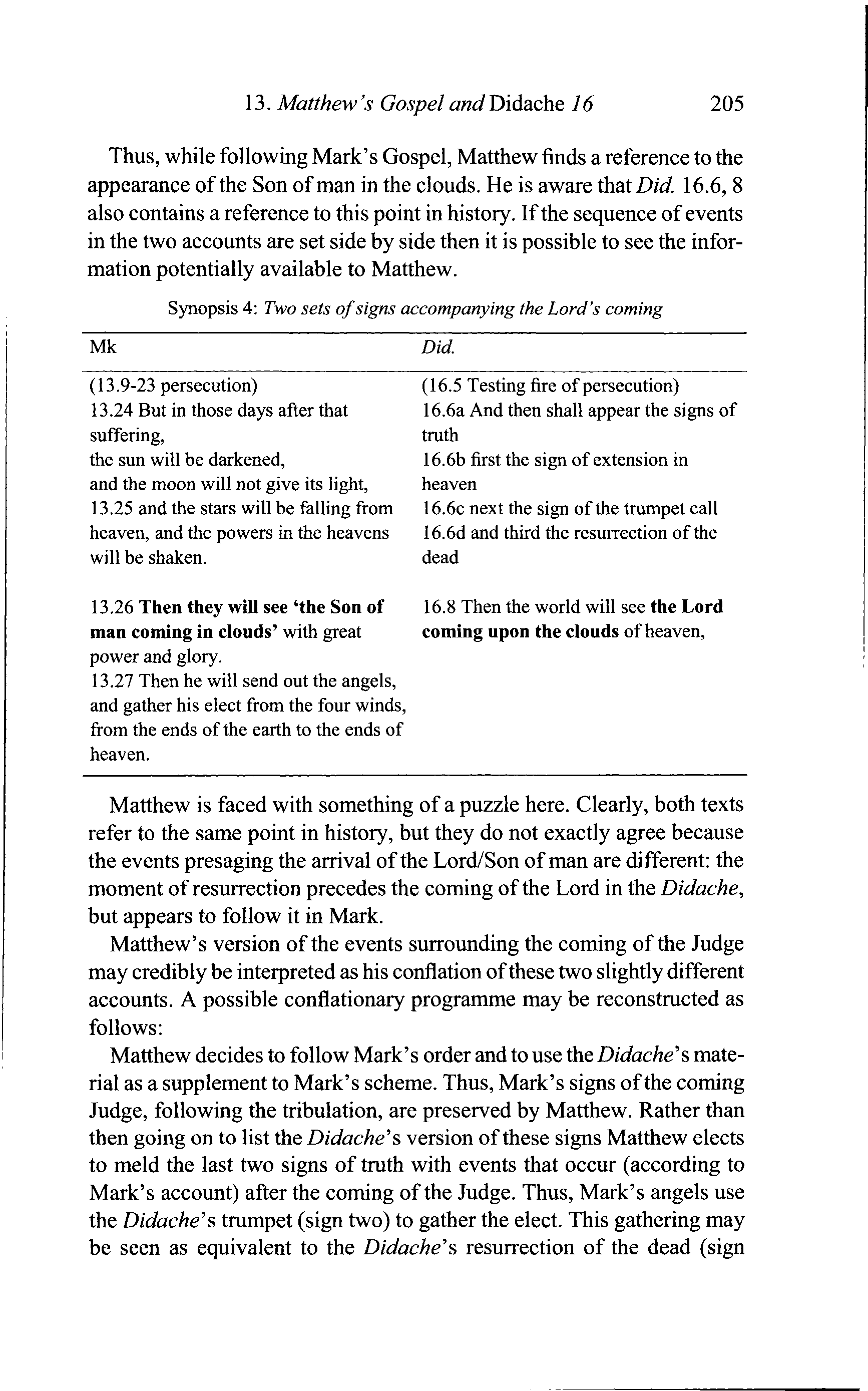
Thus, while following Mark's Gospel, Matthew finds a reference to the appearance of the Son of man in the clouds. He is aware that Did 16.6, 8 also contains a reference to this point in history. If the sequence of events in the two accounts are set side by side then it is possible to see the information potentially available to Matthew.
Synopsis 4: Two sets of signs accompanying the Lord's coming ~Mk ~Did.
(13.9-23 persecution) (16.5 Testing fire of persecution) 13.24 But in those days after that 16.6a And then shall appear the signs of suffering, truth the sun will be darkened, 16.6b first the sign of extension in and the moon will not give its light, heaven 13.25 and the stars will be falling from 16.6c next the sign of the trumpet call heaven, and the powers in the heavens 16.6d and third the resurrection of the will be shaken. dead 13.26 Then they will see 'the Son of 16.8 Then the world will see the Lord man coming in clouds' with great coming upon the clouds of heaven, power and glory.
13.27 Then he will send out the angels, and gather his elect from the four winds, from the ends of the earth to the ends of heaven.
Matthew is faced with something of a puzzle here. Clearly, both texts refer to the same point in history, but they do not exactly agree because the events presaging the arrival of the Lord/Son of man are different: the moment of resurrection precedes the coming of the Lord in the Didache, but appears to follow it in Mark.
Matthew's version of the events surrounding the coming of the Judge may credibly be interpreted as his conflation of these two slightly different accounts. A possible conflationary programme may be reconstructed as follows:
Matthew decides to follow Mark's order and to use the Didache's material as a supplement to Mark's scheme. Thus, Mark's signs of the coming
Judge, following the tribulation, are preserved by Matthew. Rather than then going on to list the Didache's version of these signs Matthew elects to meld the last two signs of truth with events that occur (according to Mark's account) after the coming of the Judge. Thus, Mark's angels use the Didache*s trumpet (sign two) to gather the elect. This gathering may be seen as equivalent to the Didache's resurrection of the dead (sign
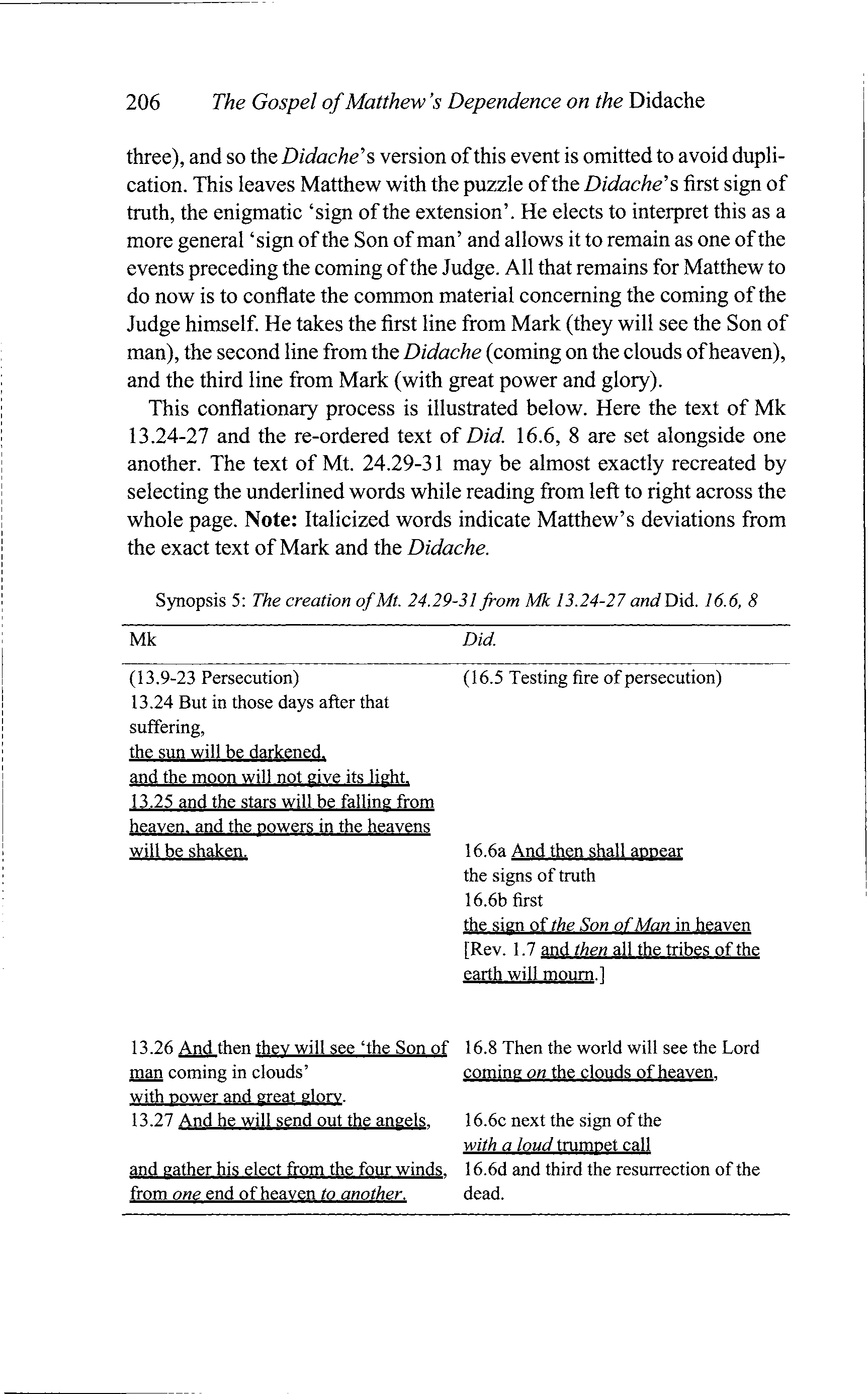
The Gospel of Matthew's Dependence on the Didache three), and so the Didache's version of this event is omitted to avoid duplication. This leaves Matthew with the puzzle of the Didache's first sign of truth, the enigmatic 'sign of the extension'. He elects to interpret this as a more general 'sign of the Son of man' and allows it to remain as one of the events preceding the coming of the Judge. All that remains for Matthew to do now is to conflate the common material concerning the coming of the Judge himself. He takes the first line from Mark (they will see the Son of man), the second line from the Didache (coming on the clouds of heaven), and the third line from Mark (with great power and glory).
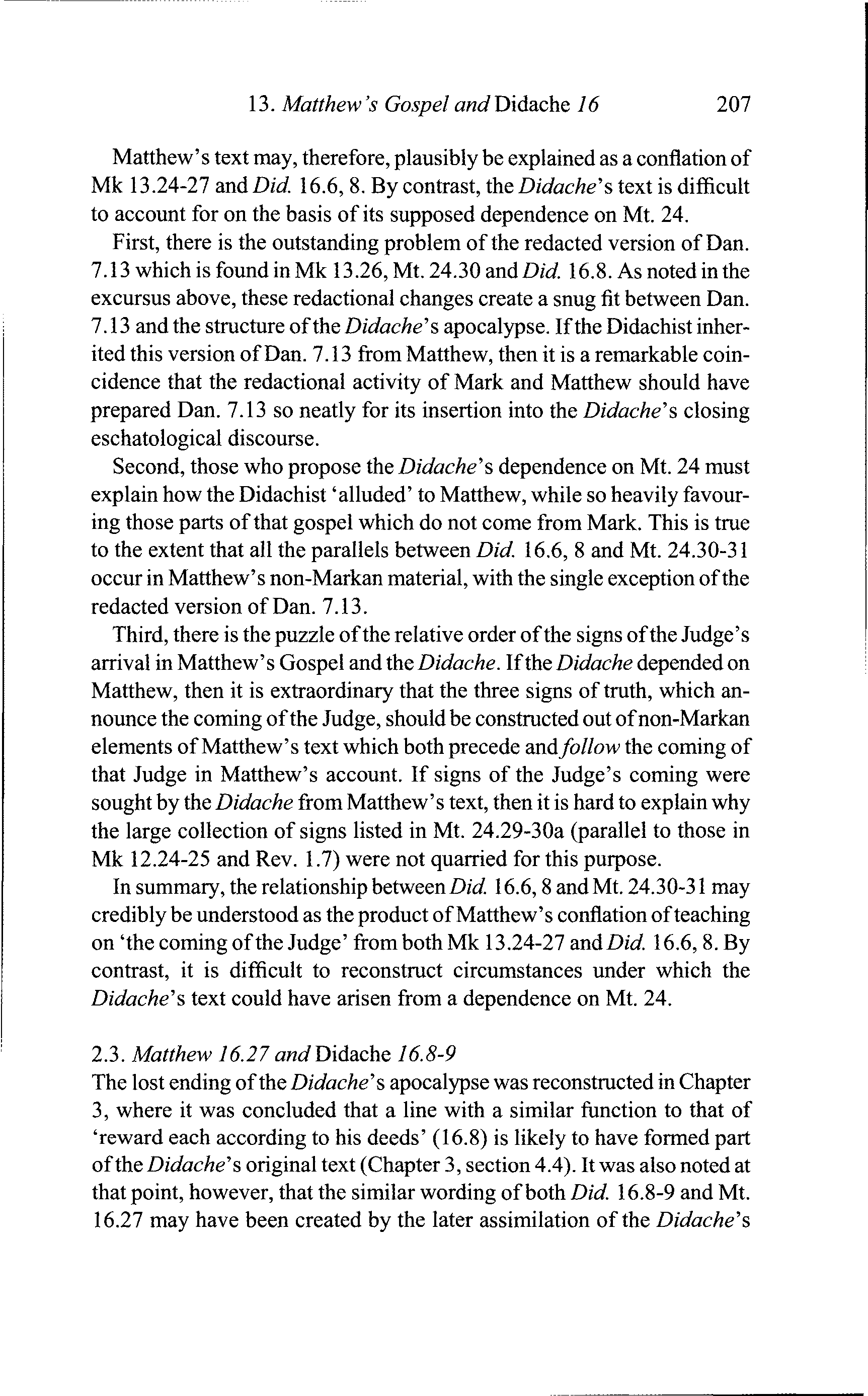
This conflationary process is illustrated below. Here the text of Mk 13.24-27 and the re-ordered text of Did. 16.6, 8 are set alongside one another. The text of Mt. 24.29-31 may be almost exactly recreated by selecting the underlined words while reading from left to right across the whole page. Note: Italicized words indicate Matthew's deviations from the exact text of Mark and the Didache.
Synopsis 5: The creation ofMt. 24.29-31 from Mk 13.24-27 andDid. 16.6, 8 Mk Did.
(16.5 Testing fire of persecution) (13.9-23 Persecution) 13.24 But in those days after that suffering, the sun will be darkened. and the moon will not give its light.
13.25 and the stars will be falling from heaven, and the powers in the heavens will be shaken.
16.6a And then shall appear the signs of truth 16.6b first the sign of the Son of Man in heaven [Rev. 1.7 and then all the tribes of the earth will mourn. 1
13.26 And then they will see 'the Son of 16.8 Then the world will see the Lord man coming in clouds' with power and great glorv. coming on the clouds of heaven.
16.6c next the sign of the with a loud trumpet call 13.27 And he will send out the angels. and gather his elect from the four winds. from one end of heaven to another.
16.6d and third the resurrection of the dead.
13. Matthew's Gospel and Didache 16
Matthew's text may, therefore, plausibly be explained as a conflation of Mk 13.24-27 and Did. 16.6, 8. By contrast, the Didache's text is difficult to account for on the basis of its supposed dependence on Mt. 24.
First, there is the outstanding problem of the redacted version of Dan.
7.13 which is found in Mk 13.26, Mt. 24.30 and Did. 16.8. As noted in the excursus above, these redactional changes create a snug fit between Dan.
7.13 and the structure of the Didache"'s apocalypse. If the Didachist inherited this version of Dan. 7.13 from Matthew, then it is a remarkable coincidence that the redactional activity of Mark and Matthew should have prepared Dan. 7.13 so neatly for its insertion into the Didache's closing eschatological discourse.
Second, those who propose the Didache's dependence on Mt. 24 must explain how the Didachist 'alluded' to Matthew, while so heavily favouring those parts of that gospel which do not come from Mark. This is true to the extent that all the parallels between Did. 16.6, 8 and Mt. 24.30-31 occur in Matthew's non-Markan material, with the single exception of the redacted version of Dan. 7.13.
Third, there is the puzzle of the relative order of the signs of the Judge's arrival in Matthew's Gospel and the Didache. If the Didache depended on Matthew, then it is extraordinary that the three signs of truth, which announce the coming of the Judge, should be constructed out of non-Markan elements of Matthew's text which both precede andfollow the coming of that Judge in Matthew's account. If signs of the Judge's coming were sought by the Didache from Matthew's text, then it is hard to explain why the large collection of signs listed in Mt. 24.29-30a (parallel to those in Mk 12.24-25 and Rev. 1.7) were not quarried for this purpose.
In summary, the relationship between Did. 16.6,8 and Mt. 24.30-31 may credibly be understood as the product of Matthew's conflation of teaching on 'the coming of the Judge' from both Mk 13.24-27 andDid. 16.6,8. By contrast, it is difficult to reconstruct circumstances under which the Didache's text could have arisen from a dependence on Mt. 24.
2.3. Matthew 16.27 and Didache 16.8-9 The lost ending of the Didache's apocalypse was reconstructed in Chapter
3, where it was concluded that a line with a similar function to that of 'reward each according to his deeds' (16.8) is likely to have formed part of the Didache's original text (Chapter 3, section 4.4). It was also noted at that point, however, that the similar wording of both Did. 16.8-9 and Mt.
16.27 may have been created by the later assimilation of the Didache's
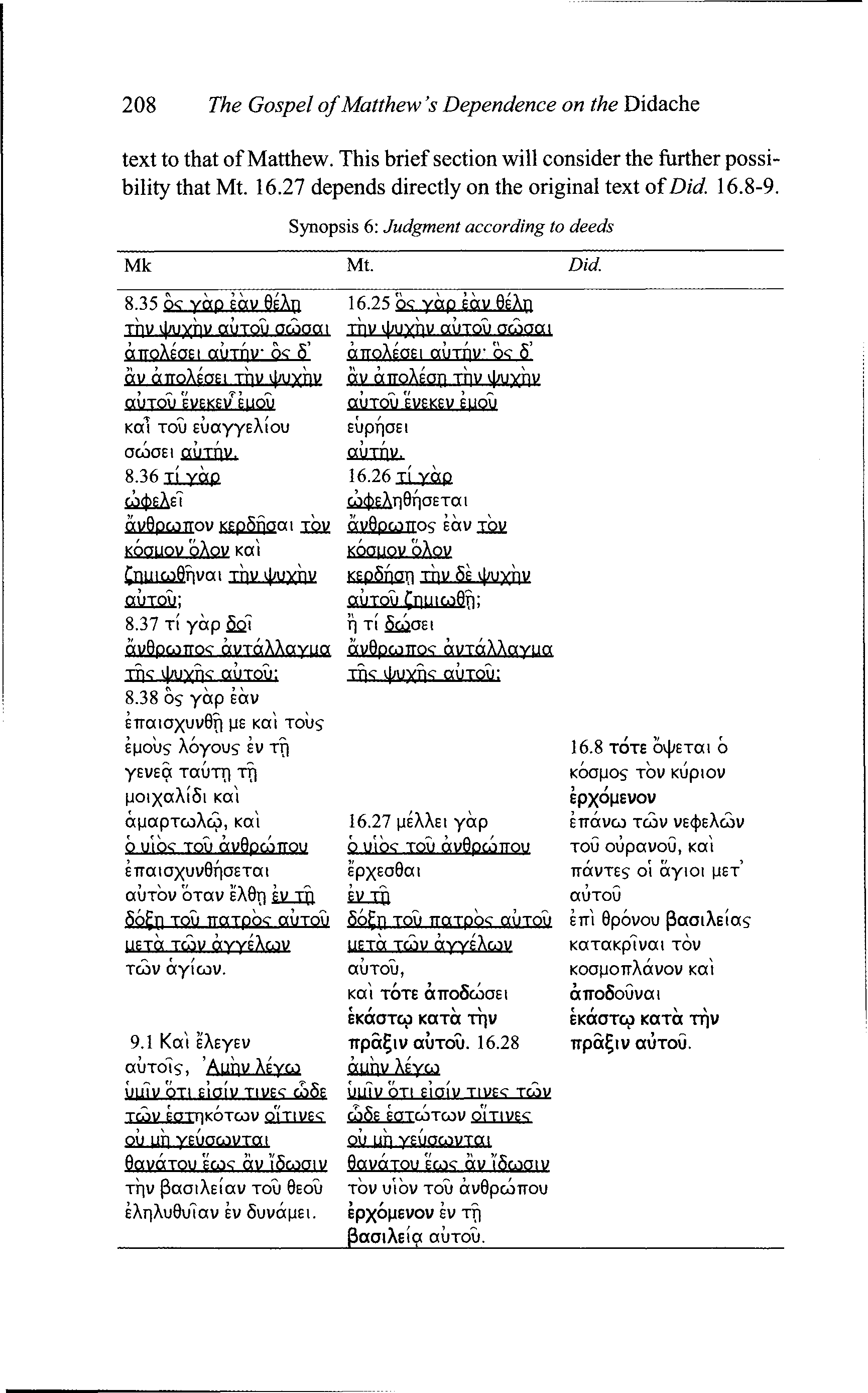
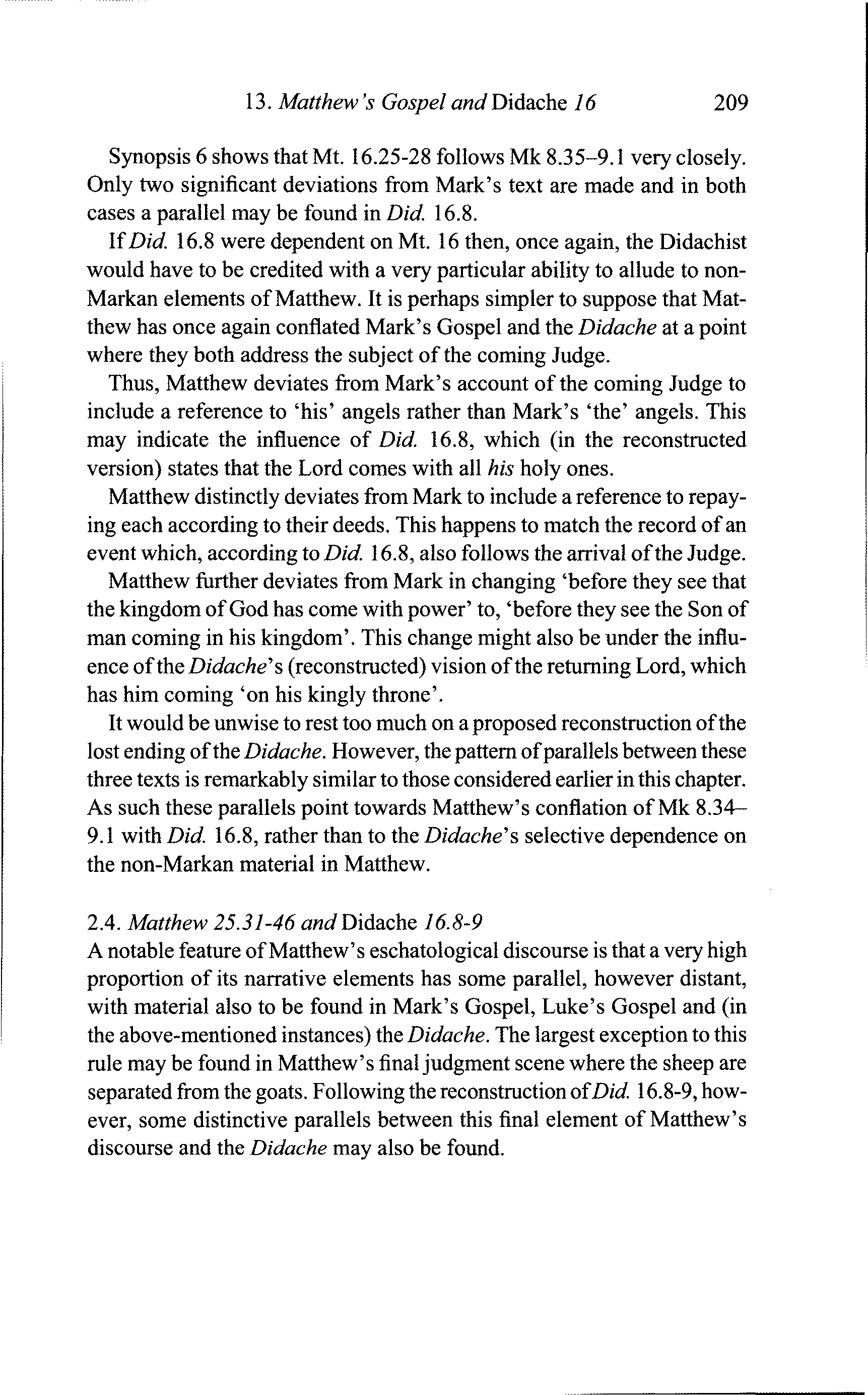
The Gospel of Matthew's Dependence on the Didache text to that of Matthew. This brief section will consider the further possibility that Mt. 16.27 depends directly on the original text of Did. 16.8-9.
Synopsis 6: Judgment according to deeds Mk Mt.
Did 8.35 be yap £av 8EAT] 16.25 be yap Eav I TTIV OAtYnv auTou ocSoai TTIV vbuyriv auTou ocooai aTToAeosi auTr)v be 5' ay aTToAsosi Tf|v | auTrjv oc 5'
aUTOU EVEKEV^EfJQU
Kal TOU euayyeAiou ocoaei auTrjv.
8.36 T! yap
aUTOU EVEKEV EjJOU
EUprjOEl 16.26 T( yap av8pcoTTOv KEpSfjoai TOV Eav TOV oAov K£p5f|Or] KOOUOV oAov Kai auTou:
8.37 TI yap avTaAAaYua T) TI Scoasi avTaAAavua Trie auTou:
8.38 6s yap sav ETraiaxiiv8?i pe Kai TOUS Ejaous Aoyous EV TT\ ysvsa 16.8 TOTE OVpETat 0
KOO(JOS TOV KUpiOV
Kai ajjapxcoAcp, Kai o utbc TOU av8pcoTTOu ETTavco TCOV VE<J)EACOV 16.27 JJEAAEI y a p b uibe TOU avSpcoTrou EpX£o8ai TOU oupavou, Kai TravTEs oi ayioi MET' auTou ETri 8pbvou PaaiAeiaKaTaKpivai TOV KoaMOTrAavov Kai airo8ouvai EKaaxep KaTa TT|V TTpa^iv auTou. auTOV oTav lA8r) EV TQ 5ofa TOU TTaTpcxauTou EV T^) 66§r| TOU naTpbe auTou EAcov \IBTCH TCOV ayyEAcov auTou, Kai TOTE aiToScoaEi BKaaTco KaTa TT]V TTpa^iv auxou. 16.28 a(jr|v Asyco fj£Ta TCOV ayyE TCOV ayicov.
9.1 Kai 1'AsyEv 'A|jr)v Asyco uu7v OTI sioiv U|i7v OTt EtOlV TlVEe TCOV
CO5E EOTCOTCOV
ou \ir\ 8avaTou ECO<: av 'i5eooiv TGJV EOTriKOTcov omvsc ou \ix] yEuocovTat 8avaTou s'co<: av TOV uibv TOU av8pcoTTOu ipxopevov EV T?J PaaiAeia auTou.
TOU 6EOU £Ar|Au8u7av EV SuvajjEi.
13. Matthew fs Gospel and Didache 16
Synopsis 6 shows that Mt. 16.25-28 follows Mk 8.35-9.1 very closely.
Only two significant deviations from Mark's text are made and in both cases a parallel may be found in Did. 16.8.
If Did. 16.8 were dependent on Mt. 16 then, once again, the Didachist would have to be credited with a very particular ability to allude to nonMarkan elements of Matthew. It is perhaps simpler to suppose that Matthew has once again conflated Mark's Gospel and the Didache at a point where they both address the subject of the coming Judge.
Thus, Matthew deviates from Mark's account of the coming Judge to include a reference to 'his' angels rather than Mark's 'the' angels. This may indicate the influence of Did. 16.8, which (in the reconstructed version) states that the Lord comes with all his holy ones.
Matthew distinctly deviates from Mark to include a reference to repaying each according to their deeds. This happens to match the record of an event which, according to Did. 16.8, also follows the arrival of the Judge.
Matthew further deviates from Mark in changing 'before they see that the kingdom of God has come with power' to, 'before they see the Son of man coming in his kingdom'. This change might also be under the influence of the Didache's (reconstructed) vision of the returning Lord, which has him coming 'on his kingly throne'.
It would be unwise to rest too much on a proposed reconstruction of the lost ending of the Didache. However, the pattern of parallels between these three texts is remarkably similar to those considered earlier in this chapter.
As such these parallels point towards Matthew's conflation of Mk 8.349.1 with Did. 16.8, rather than to the Didache'§ selective dependence on the non-Markan material in Matthew.
2.4. Matthew 25.31-46 and Didache 16.8-9 A notable feature of Matthew's eschatological discourse is that a very high proportion of its narrative elements has some parallel, however distant, with material also to be found in Mark's Gospel, Luke's Gospel and (in the above-mentioned instances) the Didache. The largest exception to this rule may be found in Matthew's final judgment scene where the sheep are separated from the goats. Following the reconstruction of Did. 16.8-9, however, some distinctive parallels between this final element of Matthew's discourse and the Didache may also be found.
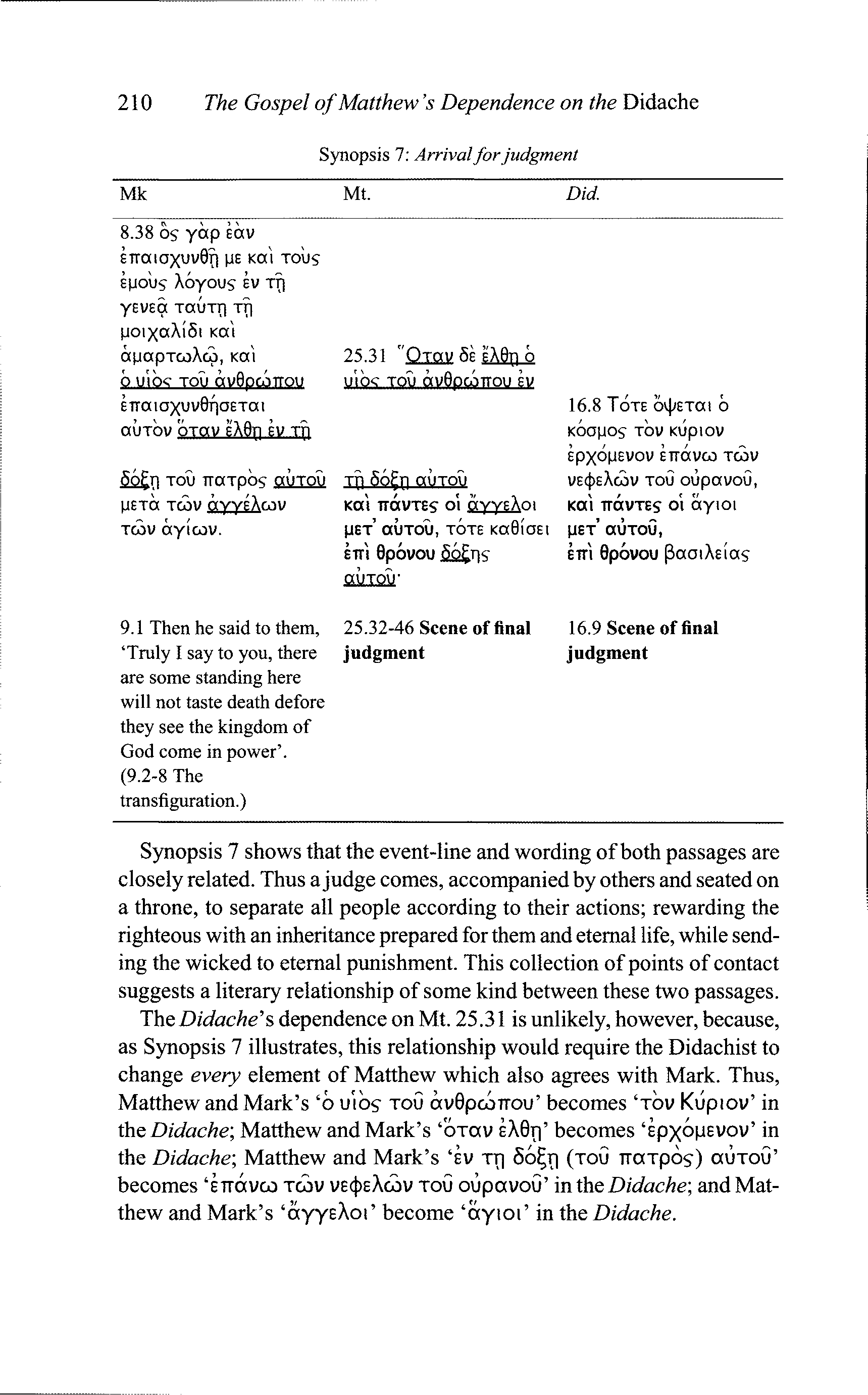
The Gospel of Matthew's Dependence on the Didache Synopsis 7: Arrival for judgment Mk Mt.
Did.
8.38 6s yap eav 6TTaiaxuv0r] pe KCU TOUS EJJOUS Xoyous ev T?J yeveg TauTT) T?J 25.31 "Oiav 5s sA8r] b ib TOU av8ocoTTOu ev b uicx: TOU avSpcoTTOu
16.8 TOTE O^ETOU b
auxbv oxav sA8n EV xn KOOjJOS TOV KUpiOV
£pXO|JEVOV ETTOCVCO TCOV
VEC|>EACOV TOU oupavou, Kai TTOCVTES ot ayioi MET' auTou, TT\ QUTOU
I TOU TTC(TpOS aUTOU
JJETCX TCOV ayysAcov Kai TrdvTEs 01 ayysAoi TCOV ayicov.
JJET' auTou, TOTE KaSias km Bpovou jSo£rjs auTou'
ETTI 0p6vou 16.9 Scene of final judgment 9.1 Then he said to them, 25.32-46 Scene of final 'Truly I say to you, there judgment are some standing here will not taste death defore they see the kingdom of God come in power'.
(9.2-8 The transfiguration.) Synopsis 7 shows that the event-line and wording of both passages are closely related. Thus a judge comes, accompanied by others and seated on a throne, to separate all people according to their actions; rewarding the righteous with an inheritance prepared for them and eternal life, while sending the wicked to eternal punishment. This collection of points of contact suggests a literary relationship of some kind between these two passages.
The Didache's dependence on Mt. 25.31 is unlikely, however, because, as Synopsis 7 illustrates, this relationship would require the Didachist to change every element of Matthew which also agrees with Mark. Thus,
Matthew and Mark's 'b vYos TOU avOpcorrou' becomes 'TOV Kupiov' in the Didache; Matthew and Mark's 'oxav EA0T]' becomes 'epxojjsvov' in the Didache; Matthew and Mark's 'ev xr) 5o£r] (TOU TTCXTpos) auTou' becomes 'ETTOCVCO TODV vec|)6Acov TOU oupavou' in the Didache; and Matthew and Mark's 'ayysAoi' become 'ayioi' in the Didache.
13. Matthew's Gospel and Didache 16
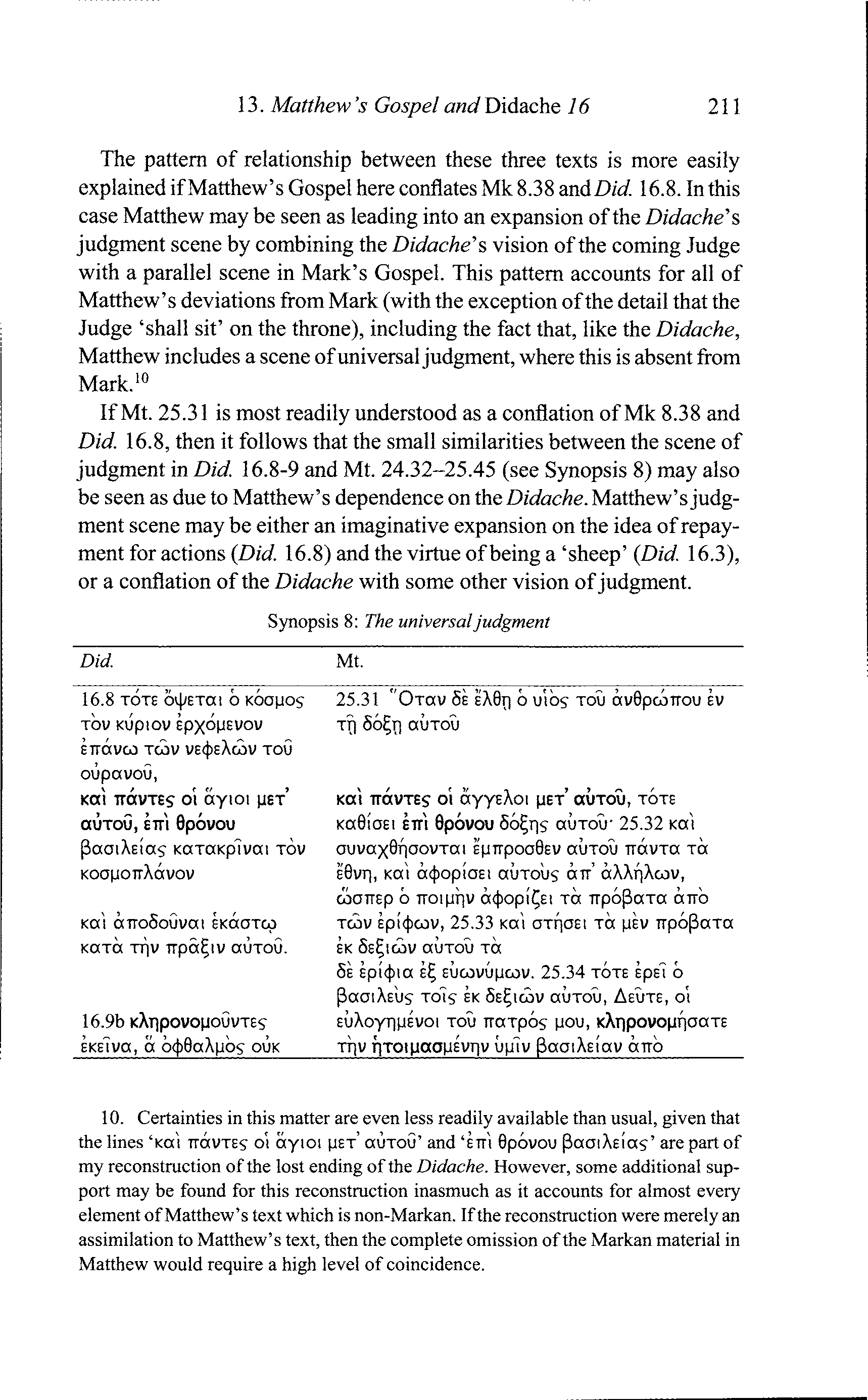
The pattern of relationship between these three texts is more easily explained if Matthew's Gospel here conflates Mk 8.38 zndDid. 16.8. In this case Matthew may be seen as leading into an expansion of the Didache's judgment scene by combining the Didache's vision of the coming Judge with a parallel scene in Mark's Gospel. This pattern accounts for all of Matthew's deviations from Mark (with the exception of the detail that the Judge 'shall sit' on the throne), including the fact that, like the Didache,
Matthew includes a scene of universal judgment, where this is absent from Mark.10
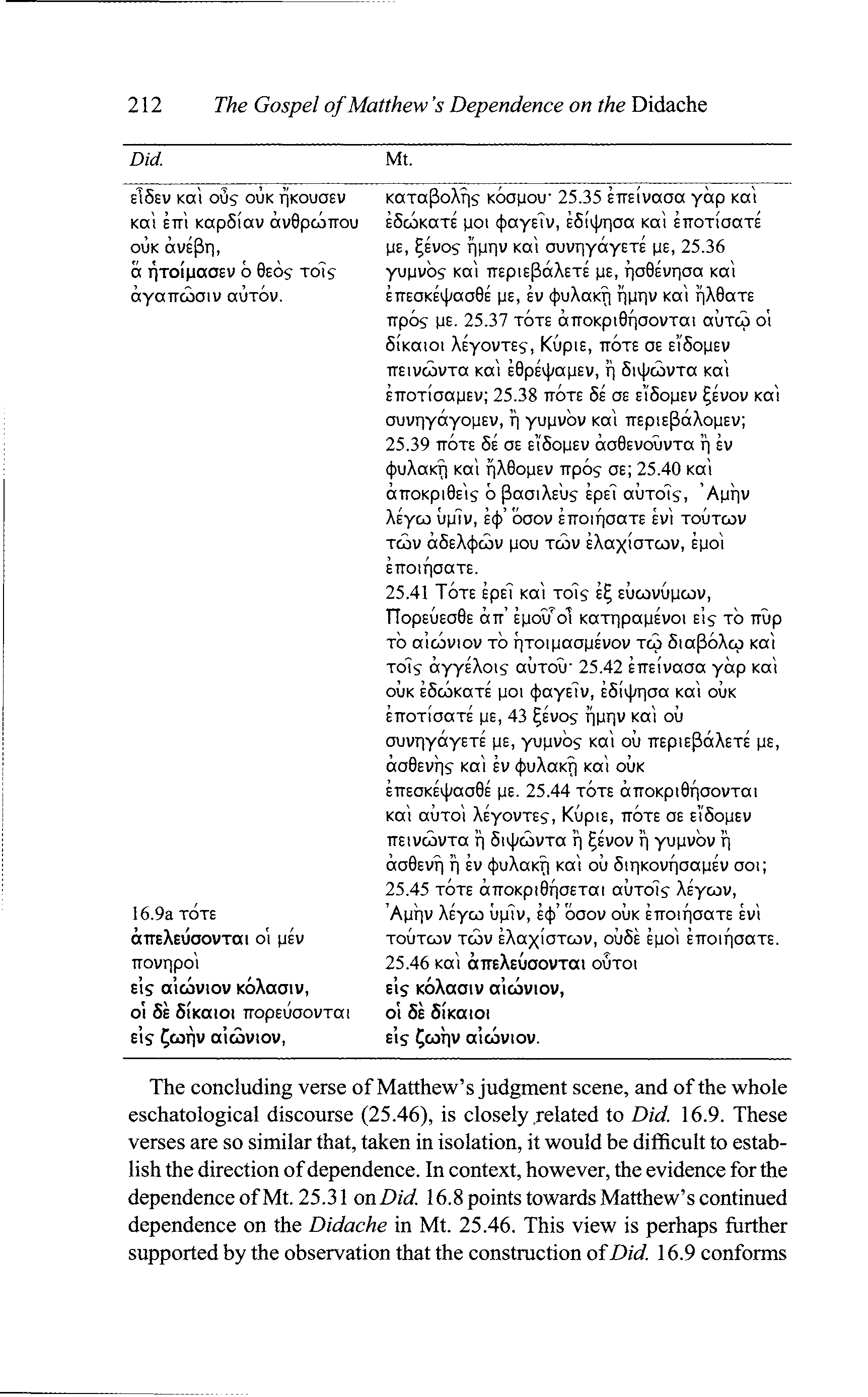
If Mt. 25.31 is most readily understood as a conflation of Mk 8.38 and Did. 16.8, then it follows that the small similarities between the scene of judgment in Did. 16.8-9 and Mt. 24.32-25.45 (see Synopsis 8) may also be seen as due to Matthew's dependence on the Didache. Matthew's judgment scene may be either an imaginative expansion on the idea of repayment for actions (Did. 16.8) and the virtue of being a 'sheep' (Did. 16.3), or a conflation of the Didache with some other vision of judgment.
Synopsis 8: The universal judgment ~~Did.
M t 16.8 TOTE ovpeTcu b KOGMOS 25.31 "OTCCV 5E E'X0TI b uibs TOU av0pcoTTou EV TOV KUplOV EpXO|JEVOV
T?j 56§T) CXUTOU
ETravco TCOV VE^EAODV TOU oupavou, Kai TTOCVTES oi ayioi IJET'
KCCI TTOCVTES oi ayysAoi HET' OCUTOU, TOTE auTou, ETTI Bpovou KaSioEi ETH Bpovou 5o£r)s CXUTOU* 25.32 Ken
KaTCXKplvai TOV ouvax6r]oovTat E|jTrpoa0EV CCUTOU TravTcc TCX v E0vr|, Kai atopiesi auTous OCTT' aAAr]Acov,
CDOTTEp O TTOl(jr|V d(()Opi^£l TCX TTpO^aTa CXTTO Kai ocrroSouvai EKCXOTCO TCOV Epicficov, 25.33 Kai oTriasi Ta |JEV Trpb
KaTa TX)V TTpa^iv auTou.
EK SE^ICOV auTou Ta 5E epicj>ia E^ EUCOVU|JCOV. 25.34 TOTE Epsi b PaaiAsus TOTS EK SE^ICOV auTou, AEUTE, OI
16.9b KATIPOVOMOUVTES
EuAoyrjiJEVoi TOU TraTpbs M°u, , a b(|)8aA|jbs OUK TT]V fiTOi|jaoM£vr|v UM^V ftaaiAsiav a 10. Certainties in this matter are even less readily available than usual, given that the lines 'Kai TTOCVTES OI ayioi MET' auTou' and 'ETTI Bpovou paoiAsias' are part of my reconstruction of the lost ending of the Didache. However, some additional support may be found for this reconstruction inasmuch as it accounts for almost every element of Matthew's text which is non-Markan. If the reconstruction were merely an assimilation to Matthew's text, then the complete omission of the Markan material in Matthew would require a high level of coincidence.
The Gospel of Matthew's Dependence on the Didache Did.
Mt.
KOOMOU* 25.35 ETTEivaoa y a p Kai ET5SV KOU ous OUK rJKouoEV e6coKaT8 \io\ ^ayefv, e6tv(;Tiaa Ken Kai 6TT\ KapSiav av0pcoTrou ME, ^EVOS ripriv KCU auvriyayETE JJE, 25.36
OUK ave^Ti, KCU TTEpisPaXETE JJE, fiaSEvrioa Ka' a T]Toi|jao6v b 0s6s TOIS p [is, EV (^uXaKr) riMTiv Kon ayaTrcooiv auTOV.
TTpOS M^- 25.37 TOTE aiTOKpi0T]OOVTai aUTCO Ol SiKaioi XeyovTEs, Kupis, TTOTE OE EI'SOMEV
TTEIVCOVTCC Ka'i E0pEv(/aM£V, r) 5ivpc2)VTa Ken
v; 25.38 TTOTE 5E OE EISOMEV ^EVOV Ka'i
r] yuMvbv K<X\ TTEPIEPOCXOMEV; 25.39 TTOTE 5E OE E'ISOMEV ao0£VouvTa f] EV (|)uXaKr) Kai rjX0OM£V TTpos OE; 25.40 Kal aTTOKpi0Evis b PaoiXsus EpsT auTois, ' AMT]V Xlyco UM^V, £(()' boov ETroif]aaTE EVI TOUTCOV
TCOV aSsX^cov MOU TCOV sXaxioTcov, EMO'I ETroif]oaTE.
25.41 TOTE Epsi Kai TOIS S£ EUCOVUMCOV, TTopEU£O0E CXTT' EMOlTb! KCCTTpaMEVOl ElS TO TTUp
TO aicovtov TO T]ToiMaoM£VOV TOO Sia^bXco xai TOIS ayysXois auTou* 25.42 ETrsivaoa y a p Kai
OUK ESCOKOTE MOI c()ayETv, sSivprioa Kat OUK ETTOTlOaTE M£, 4 3 ^EVOS f)MTlV KOI OU ouvriyayETE M£> yuMvbs Kai ou TTEpiEpaXETE M£, aa0£viis Ka'i EV c()uXaKr) Ka'i OUK £TTEOKEv|;ao0£ M£- 25.44 TOTE aTTOKpt0riaovTai
Kai auToi XsyovTEs, KupiE, TTOTE OE E'I'SOMEV TTEivcovTa X] SivpcovTa ?) ^EVOV x] yuMvbv x\ ao0EV?) r) EV (j)uXaK?i Kai ou 5ir|KovT]oaMEV ooi;
25.45 TOTE aTTOKpi0fioETai auTois Xsycov, 16.9a TOTS 'AMTIV Xsyco UMIV, EC|)' boov OUK ETroiiiaaTE EVI
6(TTEX£UOOVTai o'l |JEV TOUTCOV TCOV iXaxioTcov, OU6E EMOI ETToir)oaTE.
TTovrjpot 25.46 Kai aTTEXsuaovTai OUTOI els KoXaaiv aicoviov, oi 5E 5iKaioi sis CWTlv aicoviov.
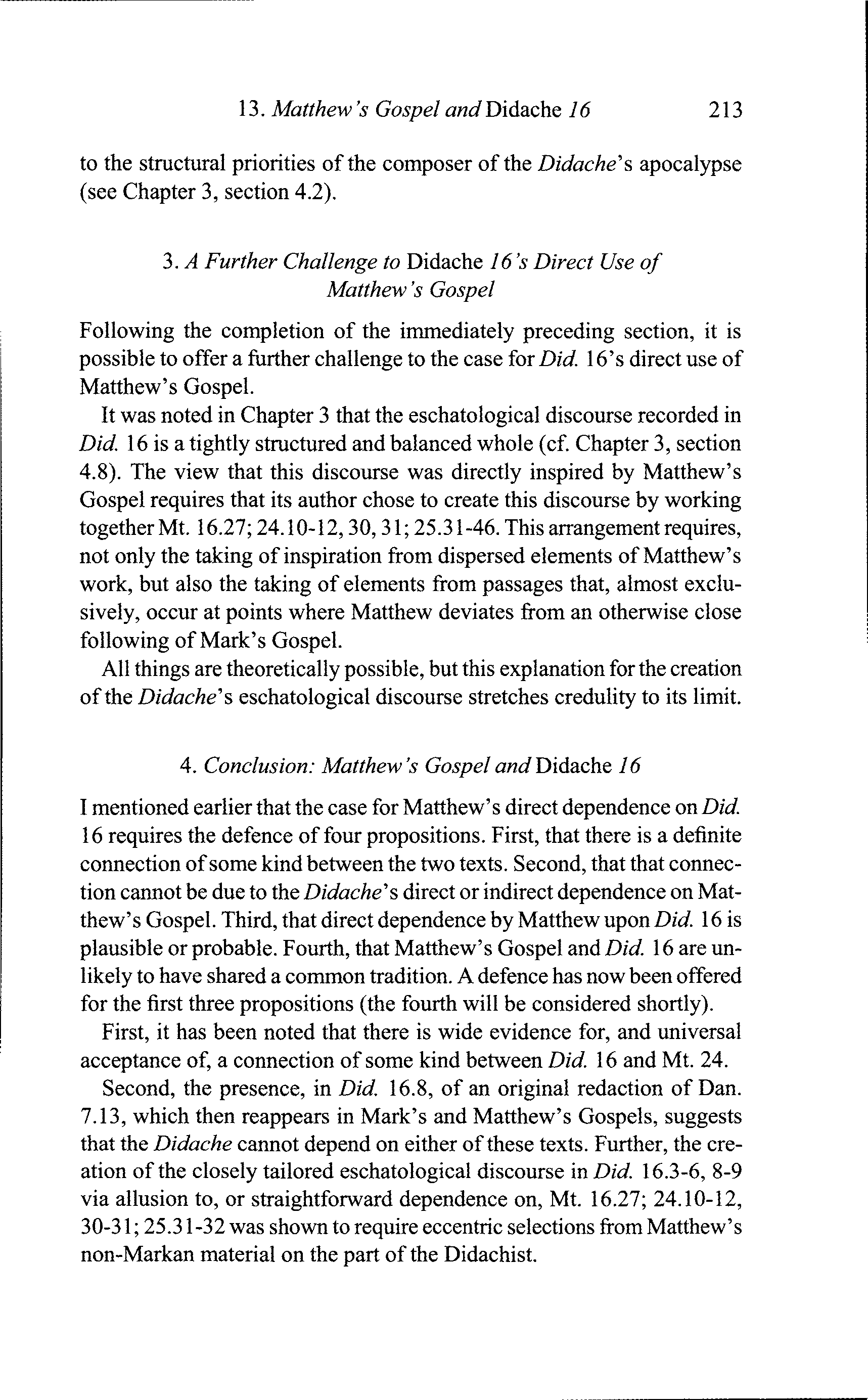
EIS aicoviov KoXaaiv, oi 81 SIKOCIOI TTopeuoovTai sis £cor|v aicoviov, The concluding verse of Matthew's judgment scene, and of the whole eschatological discourse (25.46), is closely related to Did 16.9. These verses are so similar that, taken in isolation, it would be difficult to establish the direction of dependence. In context, however, the evidence for the dependence of Mt. 25.31 onDid. 16.8 points towards Matthew's continued dependence on the Didache in Mt. 25.46. This view is perhaps further supported by the observation that the construction of Did. 16.9 conforms
13. Matthew's Gospel and Didache 16
to the structural priorities of the composer of the Didache *s apocalypse (see Chapter 3, section 4.2).
3. A Further Challenge to Didache 16's Direct Use of Matthew's Gospel Following the completion of the immediately preceding section, it is possible to offer a further challenge to the case for Did. 16's direct use of Matthew's Gospel.
It was noted in Chapter 3 that the eschatological discourse recorded in Did. 16 is a tightly structured and balanced whole (cf. Chapter 3, section
4.8). The view that this discourse was directly inspired by Matthew's Gospel requires that its author chose to create this discourse by working together Mt. 16.27; 24.10-12,30,31; 25.31-46. This arrangement requires, not only the taking of inspiration from dispersed elements of Matthew's work, but also the taking of elements from passages that, almost exclusively, occur at points where Matthew deviates from an otherwise close following of Mark's Gospel.
All things are theoretically possible, but this explanation for the creation of the Didache"'s eschatological discourse stretches credulity to its limit.
4. Conclusion: Matthew's Gospel andDidache 16 I mentioned earlier that the case for Matthew's direct dependence on Did.
16 requires the defence of four propositions. First, that there is a definite connection of some kind between the two texts. Second, that that connection cannot be due to the Didache's direct or indirect dependence on Matthew's Gospel. Third, that direct dependence by Matthew upon Did. 16 is plausible or probable. Fourth, that Matthew's Gospel and Did. 16 are unlikely to have shared a common tradition. A defence has now been offered for the first three propositions (the fourth will be considered shortly).
First, it has been noted that there is wide evidence for, and universal acceptance of, a connection of some kind between Did. 16 and Mt. 24.
Second, the presence, in Did. 16.8, of an original redaction of Dan.
7.13, which then reappears in Mark's and Matthew's Gospels, suggests that the Didache cannot depend on either of these texts. Further, the creation of the closely tailored eschatological discourse in Did. 16.3-6, 8-9 via allusion to, or straightforward dependence on, Mt. 16.27; 24.10-12,
30-31; 25.31 -32 was shown to require eccentric selections from Matthew's non-Markan material on the part of the Didachist.
The Gospel of Matthew fs Dependence on the Didache Third, it has been shown, in section 2 above, that the relationship between Mark's Gospel, Did. 16 and Mt. 16,24 and 25 may plausibly be explained by Matthew's conflation of Mark's Gospel and the Didache where they address similar subjects.
At this stage, therefore, it is possible to observe that there is no obstacle to the view that Matthew depended directly on the unified discourse preserved in Did, 16.3-6, 8-9. Indeed, the proposal that Matthew conflated related material from Mark's Gospel and Did. 16 provides an explanation for both the similarities and the differences between Mt. 24.10-12 = Did.
16.3-5; Mt. 24.30-31 =Did. 16.6,8;andMt. 16.27 = Did. 16.8. An explanation for Matthew's deviations from his otherwise largely faithful use of Mk 8.34-9.1 and 13.1-32 is also offered by this hypothesis.
The case for Matthew's direct use of Did. 16 is further supported by the conclusions drawn in Chapters 11 and 12, above; if Matthew knew the Modifying Teacher layer and/or the Prophet layer, then there is every reason to suppose that he also knew the Peri/Base layer. In addition, Matthew's direct knowledge of Did. 16 is consistent with the observation made in the introduction to Part II, where it was noted that Matthew's knowledge of the Didache provides the simplest explanation for the spread of contacts between the first three layers of the Didache and Matthew's text.
Having said all this, there is one further possible explanation for the presence of material held in common by Matthew's Gospel and Did. 16.
This is the widely held view that Mt. 24 and Did. 16 depend on common tradition.11 This hypothesis was developed by scholars who considered it unlikely, for some of the reasons discussed above, that Did. 16 depended directly on Mt. 24. This belief, combined with the assumption that Did. 16 cannot pre-date Matthew's Gospel, led to the proposal that both texts depend on a common source(s) or tradition(s).
This view has two important weaknesses. First, the assumption that Did.
16 could not pre-date Matthew's Gospel (and thus could not be a direct source for it) is without foundation. Not only is there no positive basis for such an assumption,12 but there are strong indications of the extreme antiquity of the Didache's eschatological discourse (see the excursus earlier in this chapter). Second, if the case for Matthew's direct use of Did. 16 is plausible, then the introduction of further hypothetical entities is unneces11. This is the view expressed by: Koster (1957: 173-90); Audet (1958); Glover
(1958: 21-25) and Kloppenborg (1979).
12. Possible bases for this assumption are noted in the introductory chapter, and an attempt to expose their weaknesses is offered in the course of Part I.
13. Matthew's Gospel and Didache 16
sary. Not only that, but it is extremely difficult to reconstruct a suitable tradition/source for such a role. This is the case because Did. 16.3-6, 8-9 shows every sign of being an original work inspired by a number of different ideas and sources.13 It is highly unlikely, therefore, that Matthew should happen to have supplemented his Markan source with material similarly, but independently, formed. A more realistic possibility is that Did. 16.3-6, 8-9 was known by Matthew as a separate discourse prior to its incorporation into the Didache. However, in view of the numerous other points of contact between the rest of the Didache and Matthew's
Gospel14 it is more likely that Matthew knew Did. 16.3-6, 8-9 as the conclusion of 'The Teaching of the Lord, by the Twelve Apostles, to the Gentiles', and thus used it to supplement Mark's words of Jesus with regard to the events of the End.
13. Old Testament sources for this discourse appear to include Dan. 7.13, Zech.
14.5 and Isa. 64.1-4 (Chapter 3, § 4.3.) 14. In addition to the points of contact noted above and below in Chapters 11 to 15, there is also a possible link between Did. 16.1 and Mt. 24.42 and 25.1 -13 as noted, for example, by Court (1981: 113) and Tuckett (1996:108). This contact is not considered in full because the clarity of any link with Matthew's Gospel is blurred by similarities between Did. 16.1, Mk 13.35 and Lk. 12.35. However, two observations may be made regarding this point of connection. First, there is no indication that Did. 16.1 must presuppose the existence of Matthew's Gospel. To this effect Tuckett (1996:
108) admits: 'Certainty is not possible... There is nothing here that is so clearly MattR that it could only have derived from Matthew's gospel.' This point having been noted, it is also interesting to observe that Did. 16.1 -6, 8-9 (as a whole) contains a number of the elements seen by Wenham (1984) as likely to have appeared in an eschatological scheme known by Matthew, Mark, Luke and Paul. Wenham (1984:365) offers the concluding observation: 'If anything, Matthew appears from our study as the evangelist who most often and most fully reproduces the pre-synoptic form of the tradition'. This conclusion chimes with evidence gathered from elsewhere in the present volume. For example, the excursus in this chapter argues thai Did. 16.8 is presupposed by Mk 13.26.
It is significant, therefore, that an additionalparallel between Mark's little apocalypse and Did. 16 occurs atMk 13.35 =Did. 16.1. This is suggestive of Mark's knowledge of the tightly structured apocalypse quoted in Did. 16.3-6,8-9 in its present context. If this is the case, then there is no possibility (assuming Markan priority) that Did. 16.1 was written after the creation of Matthew's Gospel. Under these circumstances it is most likely that Matthew knew the Didache's apocalypse in its present context, rather than as an independently existing tradition.