
Chapter 5 THE PERI LAYER: 6.1-3; 7.1a, c, e, 4a; 9.1-5a; 11.3a, 4-6; 16.1-6,8-9
Chapter 5
THE PERI LAYER:
6.1-3; 7.1a, c, e, 4a; 9.1-5a; 11.3a, 4-6; 16.1-6, 8-9 This chapter takes up a loose thread left at the end of Chapter 2, where it was concluded that the eucharistic prayers within Did. 9 and 10 belong to two separate redaetional layers. The first aim of this chapter is to identify those parts of the Didache that belong to the same redaetional layer as Did. 9. (This layer will be referred to, for the time being, as the 'Peri' layer because of the recurrence of the formula 'mp\ 5e' within it.) Towards the close of this chapter, one further thread, made available by Chapter 3, will also be addressed; namely, the redaetional status of Did. 16 in relation to the Peri layer.
1. The Peri Layer Baptism: Didache 7.7a,1 c, e, 4a One verse that has several strong connections with Did. 9.1 -5 is Did. 1 A?
At a stylistic level this verse follows the distinctive pattern of introduction that is used in Did. 9.1:
9.1
TTep\ 5E xfjs Euxapicmas, OUTCOS EuxapiairjaaTE'
7.1a TTep\ SE TOU PaTTTtojjaTos, OUTGO (3aTrriaaTE'
Did. 7.1 also has strong functional coherence in relation to the eueharist of Did. 9. The fact that Did. 9.5 states that only the baptized may partake of the eueharist, suggests that instructions concerning the means by which such eligibility may be achieved are likely to have been included along with instructions regarding the eueharist.3
There is, therefore, good reason to suppose that the Peri layer contained instructions concerning baptism followed by instructions concerning the 1.
The redaetional status of 7.lb, d will be considered in Chapter 7, §§ 6 and 9.
Niederwimmer 1998: 144.
Baptism is immediately followed by the eueharist in the account provided by Justin, First Apology 65-66.
The Gospel of Matthew's Dependence on the Didache eucharist. However, the identification of the extent of those instructions is not straightforward. In their present form the rules for baptism show strong signs of having been amended. To establish the extent of the original Peri layer, therefore, it is necessary to consider the nature and effect of that amendment.
Two signs suggest both the presence and the extent of an addition made to Did. 7. First, the threefold formulae for baptism in 7.1 (with articles) and 7.3 (without articles), are inconsistent with the reference to baptism 'in the name of the Lord' to be found inDid. 9.5. Draper (1996b: 78) expresses the view that 'The trinitarian baptismal formula in 7:1 is probably a later redactional retouch, since a slightly different formula is given in 7:3, and the earlier formula sis ovopa Kupiou has survived in 9:5'.4
A second sign that Did. 7 is not the work of one hand can be found in the change of addressee that takes place, without rhetorical purpose, in the course of the baptismal instructions. Rordorf (1996b: 214) says:
I do not believe that one could deny an important change of perspective between Didache 7:1 and 7:2ff, which is expressed precisely in the fact that the beginning of the chapter is addressed to a plurality of persons, whereas what follows is addressed to one person only. This fact alone proves that the chapter could not have been written by the same hand.
Rordorf goes on to suggest that 7.1, being plural, addresses a more primitive situation than 7.2-3. This, he argues, is indicative of a change from a primitive situation, where many members of a church may baptize, to a later one where only an authorized individual may do so. While this is possible, Rordorf s point is perhaps overplayed, since 7.1 could simply be addressed to more than one community. However, even if Rordorf may be on uncertain ground regarding this particular basis for the supposed antiquity of 7.1 relative to 7.2-3, his point regarding the change in addressee
(and therefore of author) still stands.
If the change of addressee is indicative of an amendment, then the identification of text addressed to plural recipients should reveal what remains, in these instructions, of what may be traced back to the Peri layer.
Rordorf (1996b: 215) observes, with respect to Did. 7.4a and 7.1:
.. .the same situation [plural addressees] is reflected in Didache 7:4a, where the term b Panri^cov to designate the one who administers baptism
Rordorf (1996b: 217) is certain that the text of 9.5 is a more ancient baptism formula. Wedderburn (1987) suggests that the formula 'into the name of the Lord' (9.5) may be even more ancient than baptism 'into the name of the Lord Jesus', as commonly found in the New Testament (cf. Hartman 1997).
5. The Peri Layer
indicates the absence of a specific minister; for this reason, it seems to me that Didache 7:4a is drawn from the same source as Didache 7:1. Didache
7:2-3,4b, in turn, is addressed directly to the one who administers baptism.
Niederwimmer(1998: 125) agrees:
In my opinion 7.2-3 is also redactional, in contrast to the original and more rigorous demand to baptize 'with living water'... I also consider 7.4a to be old tradition, and 7.4b to be redactional.
The picture that emerges, therefore, is one where the original Peri text reads something approximating to:
Concerning baptism, baptize thus:
[After you have repeated all these things]5 Baptize in the name of the Lord in running water.
Before the baptism, let the one baptizing and the one being baptized, and others who are able, fast.
This text, addressed to unknown plural recipients, is then altered by the addition of instructions addressed to an individual. The fact that these additions show no concession to their new context, both in the different addressee and in the apparent absence of any need to describe how long the baptizer and others should fast, suggest that the amendment has been made by inserting a text with a previously separate existence. As Schollgen
(1996: 48) observes: 'With vv.2,3,4b, which differ from the context in their use of the second person singular address, the author may well have worked in pre-existent traditional material'.6
A further indication that the changes in Did. 7 are the product of an insertion, rather than poor editorial retouching (so Draper 1996c: 226), may be found in the fact that the baptismal formula in Did. 9.5 has escaped amendment.
The inserted text, addressed to a singular addressee, may be approximately reconstructed as follows:
Baptize in the name of the Father, the Son and the Holy Spirit in running water.
If you do not have running water baptize in other water; if you cannot in cold, then in warm, 5.
Later discussion will conclude that 7. lb is likely to have been added as part of the third layer of the Didache (cf. Chapter 7, § 10). This line is removed, therefore, in the immediately following discussion.
Voobus (1968: 34) is sceptical of this.
The Gospel of Matthew's Dependence on the Didache But if you have neither, pour water on the head thrice in the name of Father, Son, and Holy Spirit.
Command the one being baptized to fast for one or two days beforehand.
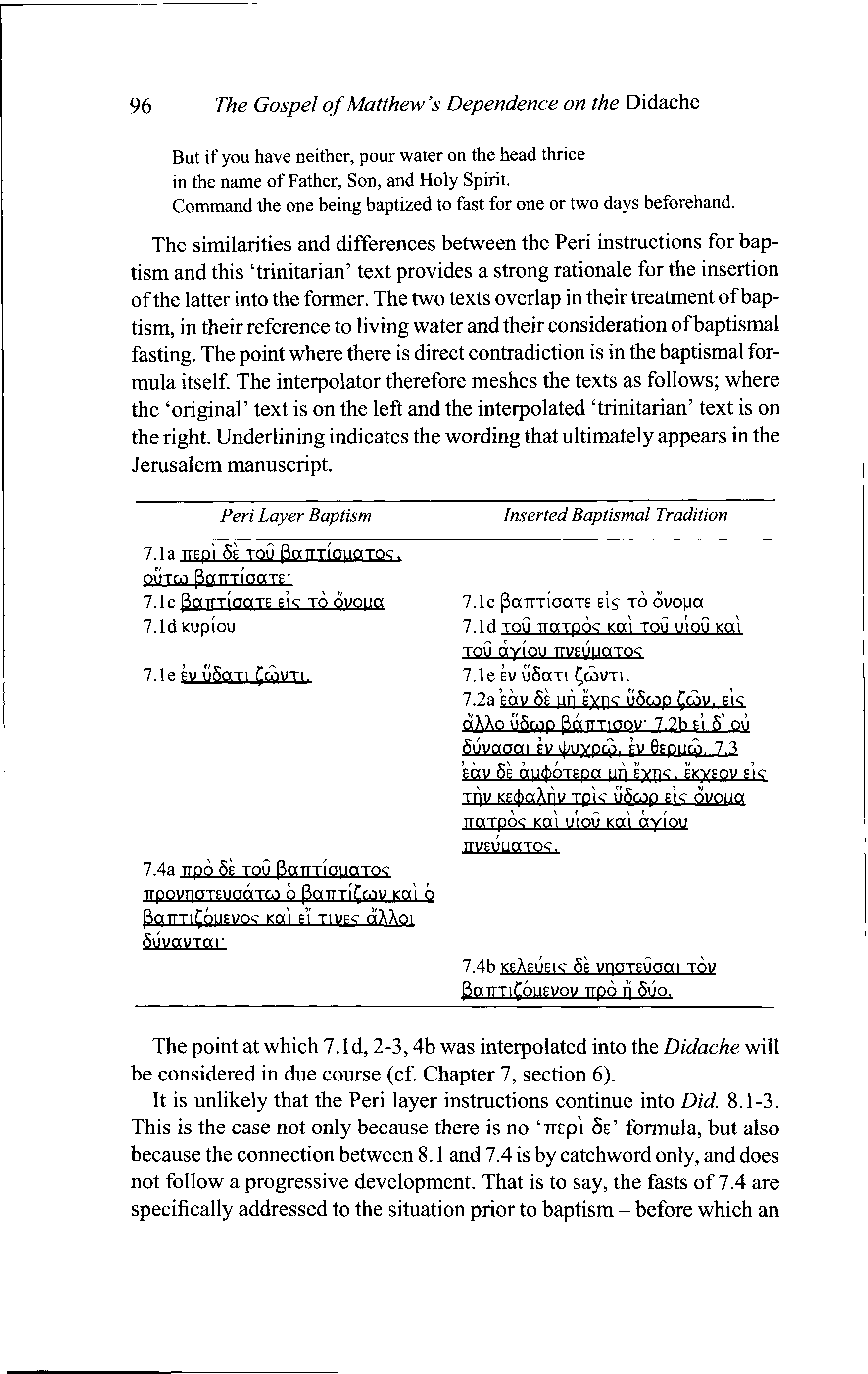
The similarities and differences between the Peri instructions for baptism and this Trinitarian' text provides a strong rationale for the insertion of the latter into the former. The two texts overlap in their treatment of baptism, in their reference to living water and their consideration of baptismal fasting. The point where there is direct contradiction is in the baptismal formula itself. The interpolator therefore meshes the texts as follows; where the 'original' text is on the left and the interpolated 'trinitarian' text is on the right. Underlining indicates the wording that ultimately appears in the Jerusalem manuscript.
Peri Layer Baptism Inserted Baptismal Tradition
7A a. TTSOI 5E TOU
XTTTlOaTE"
7.1c ftaTrrioaTE EK TO ovojja 7.1dKupiou 7.1c (JaTTTiaaTE sis TO 6'vou.a 7.Id TOU TTaTpo<: Koa TOU uiou xai TOU a y i o u TTVEU|jaTO<r 7.1e EV u5om £GOVTI.
7.2a sav 6s yr) EXTK uScop £GOI d'AAo u'Scop paTTTioov 7.2b EI Suvaoai EV v|AJYpc2>. EV SEppcp.
'scxv 5E ap^OTEpa [ir\ £XT1^- £K> 7.1e EV ii5cm ECOVTI.
;. EK 5' ou 7.3 fEOV E K Tr|v KE(()aAr|v TpK u5cop EK ovoua TTaTp6<: Kai uiou Km aytou TTV£UUaTQ<r.
7.4a Trpo 5s TOU (3aTTTiOMaTO<:
TTpovr)OTSuoaTco o ftaTrrifeov Koa b ftaTrTi^QMSVcx' KCU S'I TIVEC a'AAoi 5uvavTar 7.4b KEAEUEK 5E vr)OTEuoai TOV TTOO ri 5uo.
The point at which 7. Id, 2-3,4b was interpolated into the Didache will be considered in due course (cf. Chapter 7, section 6).
It is unlikely that the Peri layer instructions continue into Did. 8.1-3.
This is the case not only because there is no 'nepi 5E' formula, but also because the connection between 8.1 and 7.4 is by catchword only, and does not follow a progressive development. That is to say, the fasts of 7.4 are specifically addressed to the situation prior to baptism - before which an
5. The Peri Layer
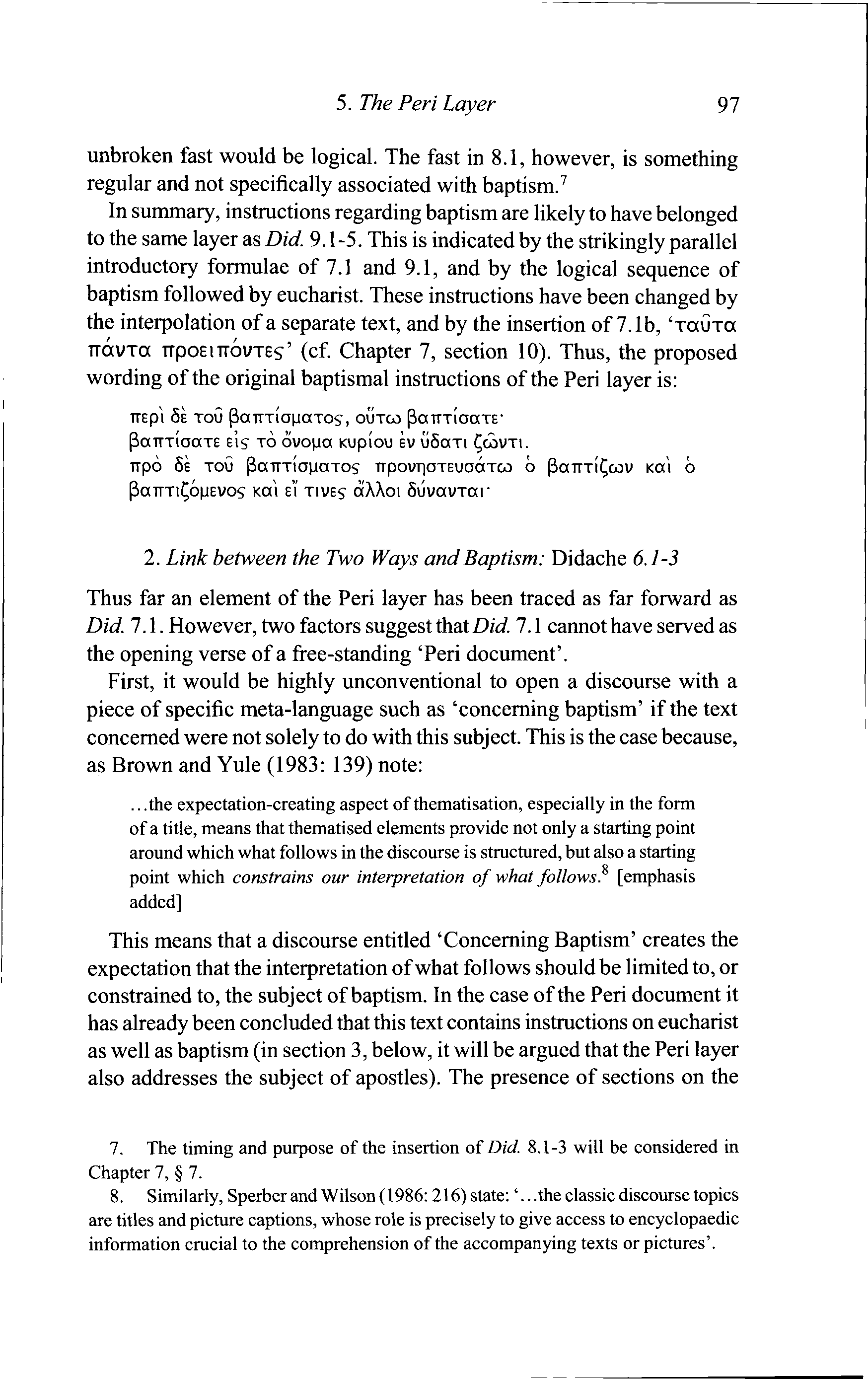
unbroken fast would be logical. The fast in 8.1, however, is something regular and not specifically associated with baptism.7
In summary, instructions regarding baptism are likely to have belonged to the same layer as Did. 9.1-5. This is indicated by the strikingly parallel introductory formulae of 7.1 and 9.1, and by the logical sequence of baptism followed by eucharist. These instructions have been changed by the interpolation of a separate text, and by the insertion of 7.1b, 'TCCGTCX
TTavxcc TTpOEiTTovxes' (cf. Chapter 7, section 10). Thus, the proposed wording of the original baptismal instructions of the Peri layer is:
Trspi 5e xoG PaTTTianaxos, OUTCO (3aTrnaaTE- (BaTrnaaxe els TO ovopa Kupiou ev (iScm ^ npo Ss TOU (3aTma|jaTos TTpovr|OTEUoaTco b (3aTm£cov KCU b
(3aiTTi£6|jevos KCU E'I TIVES ciAAoi Suvavxar 2. Link between the Two Ways and Baptism: Didache 6.1-3
Thus far an element of the Peri layer has been traced as far forward as Did. 7.1. However, two factors suggest that Did. 7.1 cannot have served as the opening verse of a free-standing 'Peri document'.
First, it would be highly unconventional to open a discourse with a piece of specific meta-language such as 'concerning baptism' if the text concerned were not solely to do with this subject. This is the case because, as Brown and Yule (1983: 139) note:
.. .the expectation-creating aspect of thematisation, especially in the form of a title, means that thematised elements provide not only a starting point around which what follows in the discourse is structured, but also a starting point which constrains our interpretation of what follows*
[emphasis added] This means that a discourse entitled 'Concerning Baptism' creates the expectation that the interpretation of what follows should be limited to, or constrained to, the subject of baptism. In the case of the Peri document it has already been concluded that this text contains instructions on eucharist as well as baptism (in section 3, below, it will be argued that the Peri layer also addresses the subject of apostles). The presence of sections on the 7.
The timing and purpose of the insertion of Did. 8.1-3 will be considered in Chapter 7, § 7.
Similarly, Sperber and Wilson (1986:216) state:'.. .the classic discourse topics are titles and picture captions, whose role is precisely to give access to encyclopaedic information crucial to the comprehension of the accompanying texts or pictures'.
The Gospel of Matthew's Dependence on the Didache eucharist and apostles, in a text headed 'Concerning Baptism', may only be explained if the latter instructions could be seen as a sub-section of 'Concerning Baptism'. This requires an unnatural understanding of eucharist and apostles. Further, the similar style in which the paragraphs on baptism, eucharist and apostles are introduced suggests that they are subsections which are each intended to carry equal weight. This parity requires the three sections to be equally subordinate to a main heading of some kind.9
Second, if 7.1 were the opening verse of a free-standing Peri document, then the process of baptism would be remarkably undemanding for the initiate. That is to say, the newcomer would only be required to receive a washing in running water, presumably 'in the name of the Lord' (cf. 9.5), in order to be transformed from an outsider (9.5; cf. 10.6) into a person worthy of participating in the eschatological feast. Given this mismatch it is preferable to suppose that 7.1 was originally preceded by some mechanism to show that the initiate had stepped into a new state of membership.
Rordorf (1996a: 156) notes (having previously argued that the Didache was addressed to a Gentile audience): 'The situation of those first converts from Paganism seeking baptism [meant that] it was necessary to instruct them, prior to their baptism, in the rudiments of ethical behaviour in accordance with faith in one God'.10 This suggests thatDid. 7.1 is likely to have been preceded by a set of requirements to be laid on the initiate prior to baptism. Such a requirement is amply described by the Two Ways tradition recorded in Did. 1-5.
That Did. 7.1 was indeed designed to follow from the Didache's augmented Two Ways tradition is indicated by a number of factors. First, the curious juxtaposition of two distinctly different types of text (a traditional
Jewish ethical exposition and a manual of Christian liturgical instruction), requires an explanation. The 'principle of relevance', a linguistic phenomenon noted by Sperber and Wilson (1986), notes that each succeeding part of any discourse, however constructed, must contain some element that makes it relevant to that discourse at the point of introduction. This means, for example, that, even in a collection of unrelated aphorisms, each new saying may be seen as relevant simply because it belongs to the common
The nature and location of this main heading will be discussed in Chapter 9.
10. That pre-baptismal catechesis was a feature of Gentile conversion from the earliest times is intimated by the remarks of Pliny the Younger in his letter to Trajan,
10.96.7 regarding the ethical promises made by Christians prior to their sharing in a common meal.
5. The Peri Layer
genre 'aphorism'. Similarly, as occurs elsewhere in the Didache, a new layer of text may be considered relevant to the preceding text because it contains common subject matter or a common catchword. In the case of Did. 1-5 and Did. 7.1, however, there is almost no overlap of wording or genre that explains their combination. However, the fact that they are combined suggests that the person responsible for their juxtaposition considered one to be relevant to the other. The location of such relevance may be found in the fact that Did. 1-5 invites initiates to step from the 'way of death' to the 'way of life', thus providing a suitable preamble to baptism. As N. Mitchell (1995: 250) notes:
There can be little doubt, in the opinion of most contemporary scholars,11 that the materials of Did 1.1-6. la should be understood as instructions which are designed primarily for catechumens. The very structure of the Two Ways schema in 1.1-6.la invites decision.
The functional logic of the relationship between Did. 1-5 and Did. 7 is supported by evidence of the use of Two Ways types of instruction in baptismal catechesis in the early Christian centuries. As Rordorf (1996a: 158—
59) notes:
There was, without doubt, an uninterrupted tradition of prebaptismal ethical instruction in the Christian church of the first two centuries, a tradition which has its roots in Judaism, which has its Sitz im Leben in the context of the initiation of Gentile converts, and which led to the instruction of the Christian catechumens at the end of the second century. The duae viae has its place in this tradition.
Further, Rordorf (1996a: 152) notes the longstanding appreciation (even before the discoveries made at Qumran) of the relationship between Jewish proselyte catechetical instruction and the duae viae. He continues:
'Although we might be poorly informed of the baptism of Jewish proselytes in the primitive Christian epoch, the parallels which it presents to Christian baptism are undeniable'. Records of Jewish proselyte baptism from the end of the first century CE show that the Law was recited prior to the washing. While it is possible that this practice developed in imitation of the Christian baptism this nonetheless suggests that that which was imitated contained a recitation of an ethical code prior to baptism, as is found in the Didache.
If Did. 1-5 did indeed provide a suitable preamble to baptism, then Did.
7.1 must always have been preceded by linking lines that explain the role 11. Mitchell cites Niederwimmer (1989: 88); Draper (1991: 359) and Rordorf
(1972b: 503).
The Gospel of Matthew's Dependence on the Didache of the ancient Two Ways teaching in relation to the baptismal rite. Without such intervening material a spoken liturgy that drove straight through from 5.2a (the end of the Two Ways, cf. Chapter 4, section 6) into 7.1 would sound ridiculous and would be potentially misleading; the impression could be given that initiation was into the 'way of death', rather than the 'way of life'.
The intervention of Did. 6.1 between 5.2a and 7. la is vital to the transition between the two texts. This verse presents the Two Ways as a valid expression of the community rule to which initiates should seek to adhere.
The vital service performed by 6.1, in binding the Two Ways and the baptismal liturgy together, suggests that it formed an original element of the Peri layer.
The inclusion of Did. 6.1 as part of the Peri layer still leaves a question mark over the status of 6.2-3. From a liturgical point of view these verses are a little clumsy. That is to say that it would be neater to pass straight from the summarizing statement of 6.1 into the baptism without the added details of 6.2-3. However, this clumsiness does not in itself disqualify 6.23 from the Peri layer since, if these instructions were considered important for initiates at the time at which the Peri layer was composed, it is difficult to see where else they could have been included. A factor which suggests that these two verses were added as part of the Peri layer is the parallel use of the 'TTspi 5e' formula in Did. 6.3 and 7.1 (TTepi 5E TTIS (3pcoaecos
...TTEp'i 5E TOU PaTTTioiiaxos...)-12 The strong connection between 6.3 and 6.2, in terms of their shared interest in 'doing what you are able' with respect to the 'yoke of the Lord',13 leads towards the further conclusion that 6.2 and 6.3 were written by the same author. These considerations mean that, although the section 6.2-3 is liturgically untidy, it is likely to have been added at the same time as 6.1 and the instructions regarding baptism, eucharist (and apostles).
The beginning of this section argued that 7.1 is unlikely ever to have been the opening verse of a free-standing document. This position was taken because of the need for a preamble to baptism, and for a main heading under which sub-sections on baptism, eucharist and apostles could sit.
The former of these requirements was satisfied by Did. 1-5, thus creating a need for linking verses between Did. 1-5 and 7.1, which, it has been argued, is satisfied by Did. 6.1 (along with 6.2-3). I therefore conclude
12. So Kraft (1965: 161-63).
13. Flusser (1996: 199) and Draper (1995:290) take 'the yoke of the Lord' to refer to the Torah.
5. The Peri Layer
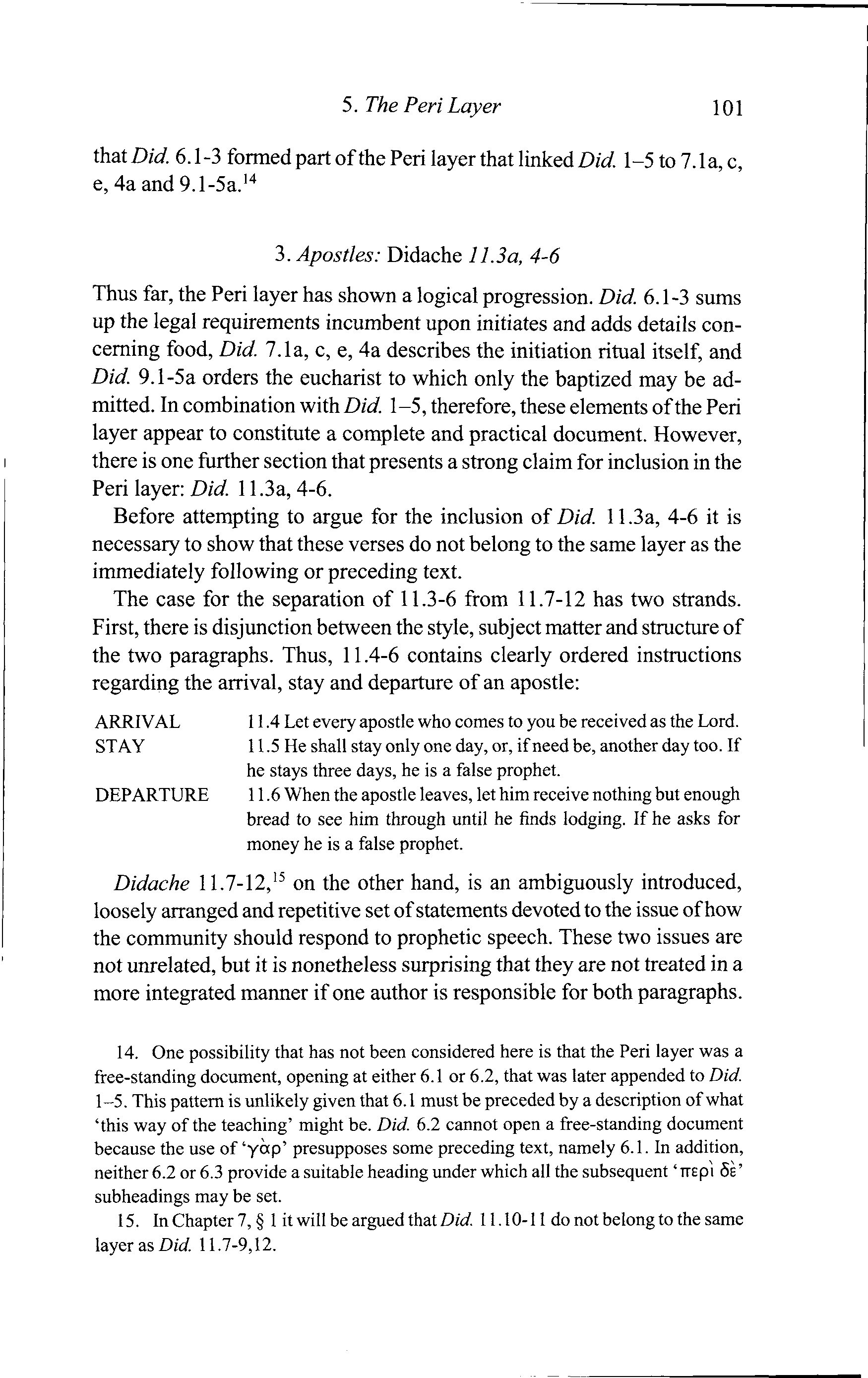
thedDid 6.1-3 formed part ofthe Peri layer that UnkedDid. 1-5 to 7.1a, c, e,4aand9.1-5a.14
3. Apostles: Didache 11.3a, 4-6 Thus far, the Peri layer has shown a logical progression. Did. 6.1-3 sums up the legal requirements incumbent upon initiates and adds details concerning food, Did. 7.1a, c, e, 4a describes the initiation ritual itself, and Did. 9.1-5a orders the eucharist to which only the baptized may be admitted. In combination with Did. 1-5, therefore, these elements ofthe Peri layer appear to constitute a complete and practical document. However, there is one farther section that presents a strong claim for inclusion in the Peri layer: Did. 11.3a, 4-6.
Before attempting to argue for the inclusion of Did. 11.3a, 4-6 it is necessary to show that these verses do not belong to the same layer as the immediately following or preceding text.
The case for the separation of 11.3-6 from 11.7-12 has two strands.
First, there is disjunction between the style, subject matter and structure of the two paragraphs. Thus, 11.4-6 contains clearly ordered instructions regarding the arrival, stay and departure of an apostle:
ARRIVAL 11.4 Let every apostle who comes to you be received as the Lord.
STAY 11.5 He shall stay only one day, or, if need be, another day too. If he stays three days, he is a false prophet.
DEPARTURE
11.6 When the apostle leaves, let him receive nothing but enough bread to see him through until he finds lodging. If he asks for money he is a false prophet.
Didache 11.7-12,15 on the other hand, is an ambiguously introduced, loosely arranged and repetitive set of statements devoted to the issue of how the community should respond to prophetic speech. These two issues are not unrelated, but it is nonetheless surprising that they are not treated in a more integrated manner if one author is responsible for both paragraphs.
14. One possibility that has not been considered here is that the Peri layer was a free-standing document, opening at either 6.1 or 6.2, that was later appended to Did.
1-5. This pattern is unlikely given that 6.1 must be preceded by a description of what
'this way ofthe teaching' might be. Did. 6.2 cannot open a free-standing document because the use of 'yo:p' presupposes some preceding text, namely 6.1. In addition, neither 6.2 or 6.3 provide a suitable heading under which all the subsequent 'nepi 5e' subheadings may be set.
15. In Chapter 7, § 1 it will be argued that Did. 11.10-11 do not belong to the same layer as Did. 11.7-9,12.
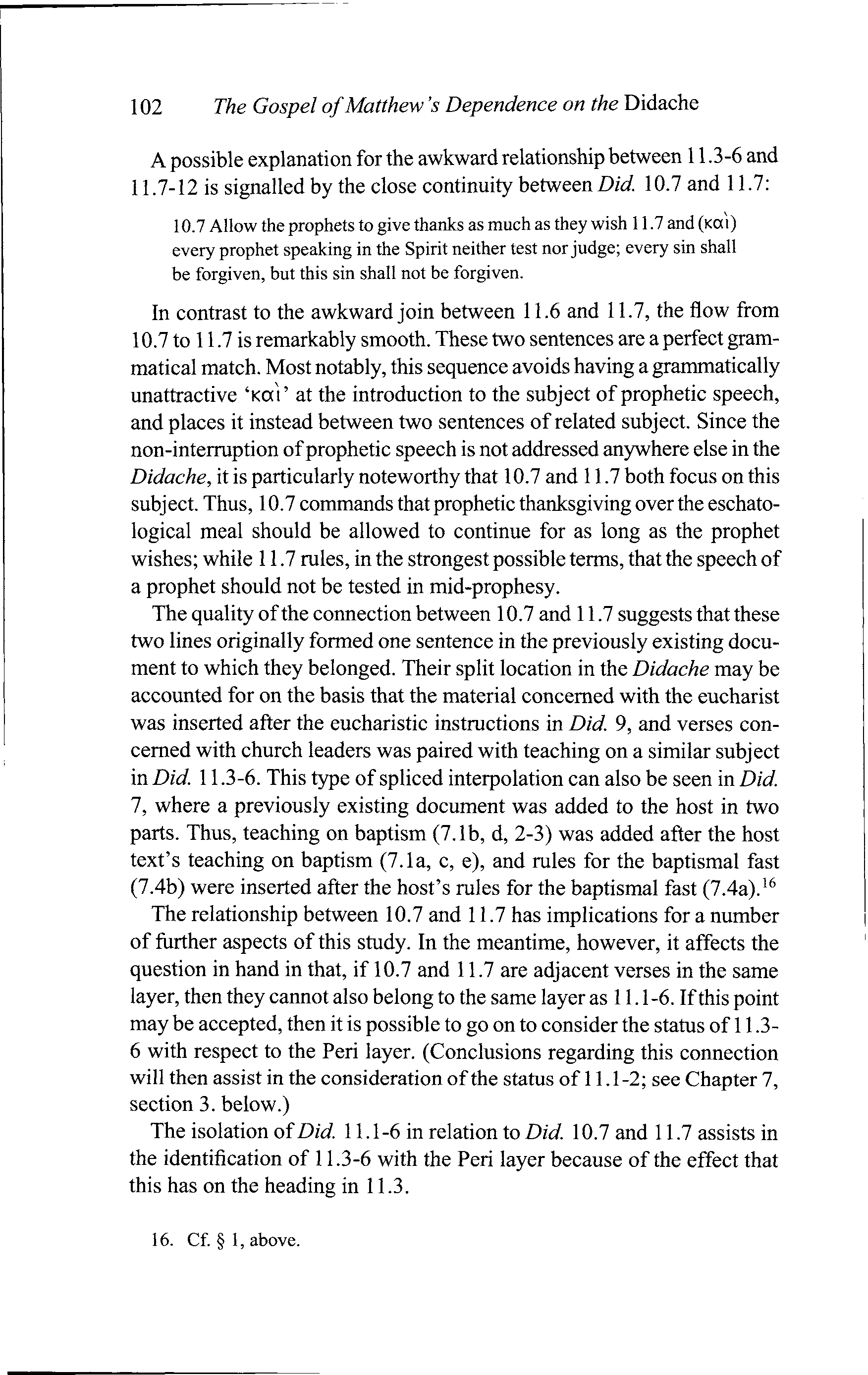
The Gospel of Matthew's Dependence on the Didache A possible explanation for the awkward relationship between 11.3-6 and 11.7-12 is signalled by the close continuity between Did. 10.7 and 11.7:
10.7 Allow the prophets to give thanks as much as they wish 11.7 and (KCU) every prophet speaking in the Spirit neither test nor judge; every sin shall be forgiven, but this sin shall not be forgiven.
In contrast to the awkward join between 11.6 and 11.7, the flow from 10.7 to 11.7 is remarkably smooth. These two sentences are a perfect grammatical match. Most notably, this sequence avoids having a grammatically unattractive 'KCU' at the introduction to the subject of prophetic speech, and places it instead between two sentences of related subject. Since the non-interruption of prophetic speech is not addressed anywhere else in the Didache, it is particularly noteworthy that 10.7 and 11.7 both focus on this subject. Thus, 10.7 commands that prophetic thanksgiving over the eschatological meal should be allowed to continue for as long as the prophet wishes; while 11.7 rules, in the strongest possible terms, that the speech of a prophet should not be tested in mid-prophesy.
The quality of the connection between 10.7 and 11.7 suggests that these two lines originally formed one sentence in the previously existing document to which they belonged. Their split location in the Didache may be accounted for on the basis that the material concerned with the eucharist was inserted after the eucharistic instructions in Did. 9, and verses concerned with church leaders was paired with teaching on a similar subject in Did. 11.3-6. This type of spliced interpolation can also be seen in Did.
7, where a previously existing document was added to the host in two parts. Thus, teaching on baptism (7.1b, d, 2-3) was added after the host text's teaching on baptism (7.1a, c, e), and rules for the baptismal fast
(7.4b) were inserted after the host's rules for the baptismal fast (7.4a).16
The relationship between 10.7 and 11.7 has implications for a number of further aspects of this study. In the meantime, however, it affects the question in hand in that, if 10.7 and 11.7 are adjacent verses in the same layer, then they cannot also belong to the same layer as 11.1-6. If this point may be accepted, then it is possible to go on to consider the status of 11.36 with respect to the Peri layer. (Conclusions regarding this connection will then assist in the consideration of the status of 11.1 -2; see Chapter 7, section 3. below.) The isolation of Did. 11.1 -6 in relation to Did. 10.7 and 11.7 assists in the identification of 11.3-6 with the Peri layer because of the effect that this has on the heading in 11.3.
16. Cf. § 1, above.
5. The Peri Layer
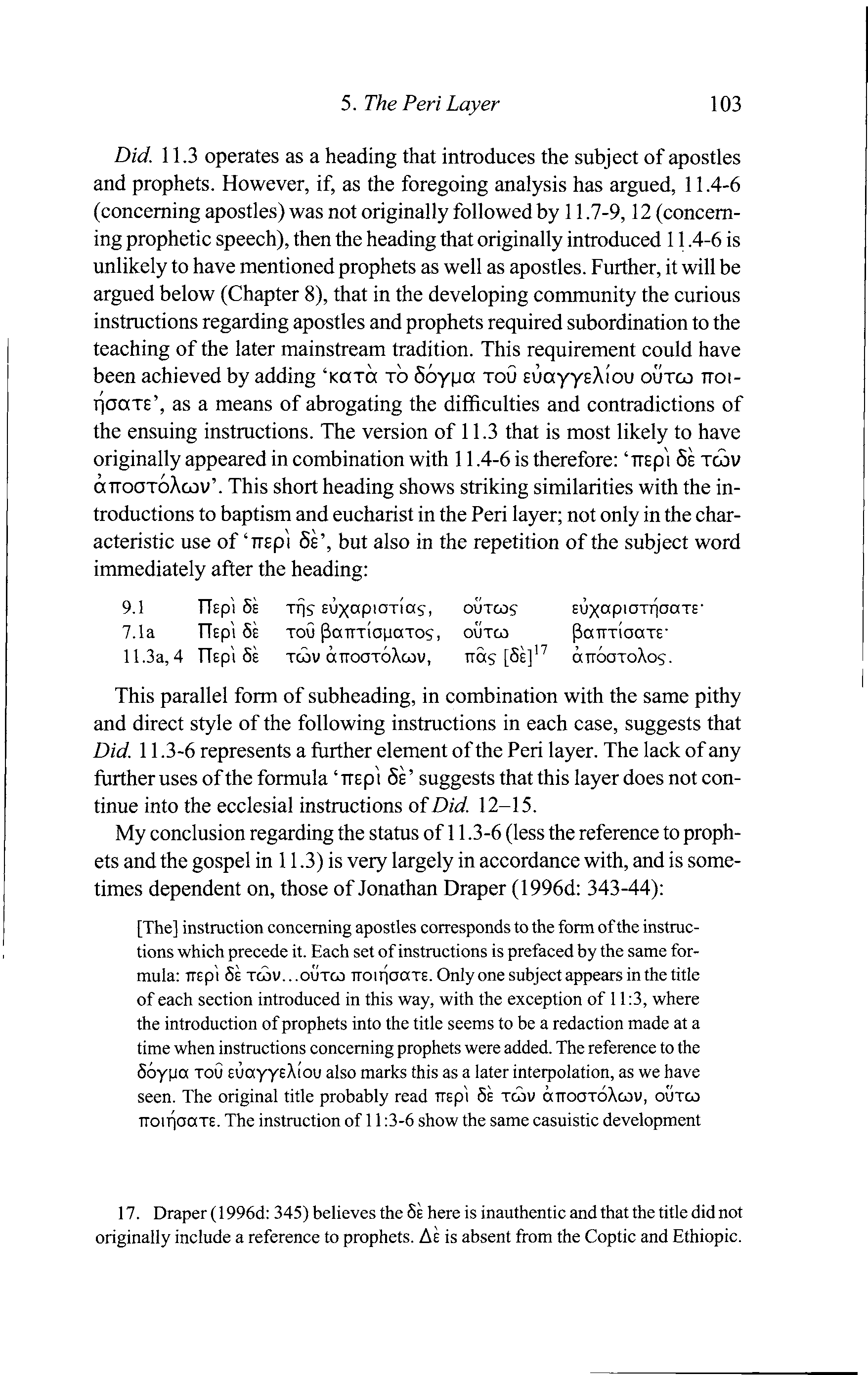
Did 11.3 operates as a heading that introduces the subject of apostles and prophets. However, if, as the foregoing analysis has argued, 11.4-6
(concerning apostles) was not originally followed by 11.7-9,12 (concerning prophetic speech), then the heading that originally introduced 11.4-6 is unlikely to have mentioned prophets as well as apostles. Further, it will be argued below (Chapter 8), that in the developing community the curious instructions regarding apostles and prophets required subordination to the teaching of the later mainstream tradition. This requirement could have been achieved by adding 'Kara TO Soypa xou EuayyeAiou OUTGO TTOIrjacxTe', as a means of abrogating the difficulties and contradictions of the ensuing instructions. The version of 11.3 that is most likely to have originally appeared in combination with 11.4-6 is therefore: cTT6p\ 5e TCOV aTTOGToAcov'. This short heading shows striking similarities with the introductions to baptism and eucharist in the Peri layer; not only in the characteristic use of 'Trepi 5e', but also in the repetition of the subject word immediately after the heading:
Se 5e 5e 9.1
7.1a 11.3a, 4 TTepi TTepi TTepi OUTCOS TTJS euxcxpioricxs, OUTGO TOU ^aTTTlOIJaTOS, 1 7
CXTTOOTOAOS.
TTOCS [5e]
TCOV QTTOOToAcOV,
This parallel form of subheading, in combination with the same pithy and direct style of the following instructions in each case, suggests that Did. 11.3-6 represents a further element of the Peri layer. The lack of any further uses of the formula 'nepi 6s' suggests that this layer does not continue into the ecclesial instructions of Did. 12-15.
My conclusion regarding the status of 11.3-6 (less the reference to prophets and the gospel in 11.3) is very largely in accordance with, and is sometimes dependent on, those of Jonathan Draper (1996d: 343-44):
[The] instruction concerning apostles corresponds to the form of the instructions which precede it. Each set of instructions is prefaced by the same formula: rrepi 5e TGOV. . .OUTGO TTOir]aaTe. Only one subject appears in the title of each section introduced in this way, with the exception of 11:3, where the introduction of prophets into the title seems to be a redaction made at a time when instructions concerning prophets were added. The reference to the Soypa TOU euayyeAiou also marks this as a later interpolation, as we have seen. The original title probably read TTepi 5e TGOV aTTooToAcov, OUTGO e. The instruction of 11:3-6 show the same casuistic development
17. Draper (1996d: 345) believes the 5e here is inauthentic and that the title did not originally include a reference to prophets. Ae is absent from the Coptic and Ethiopic.
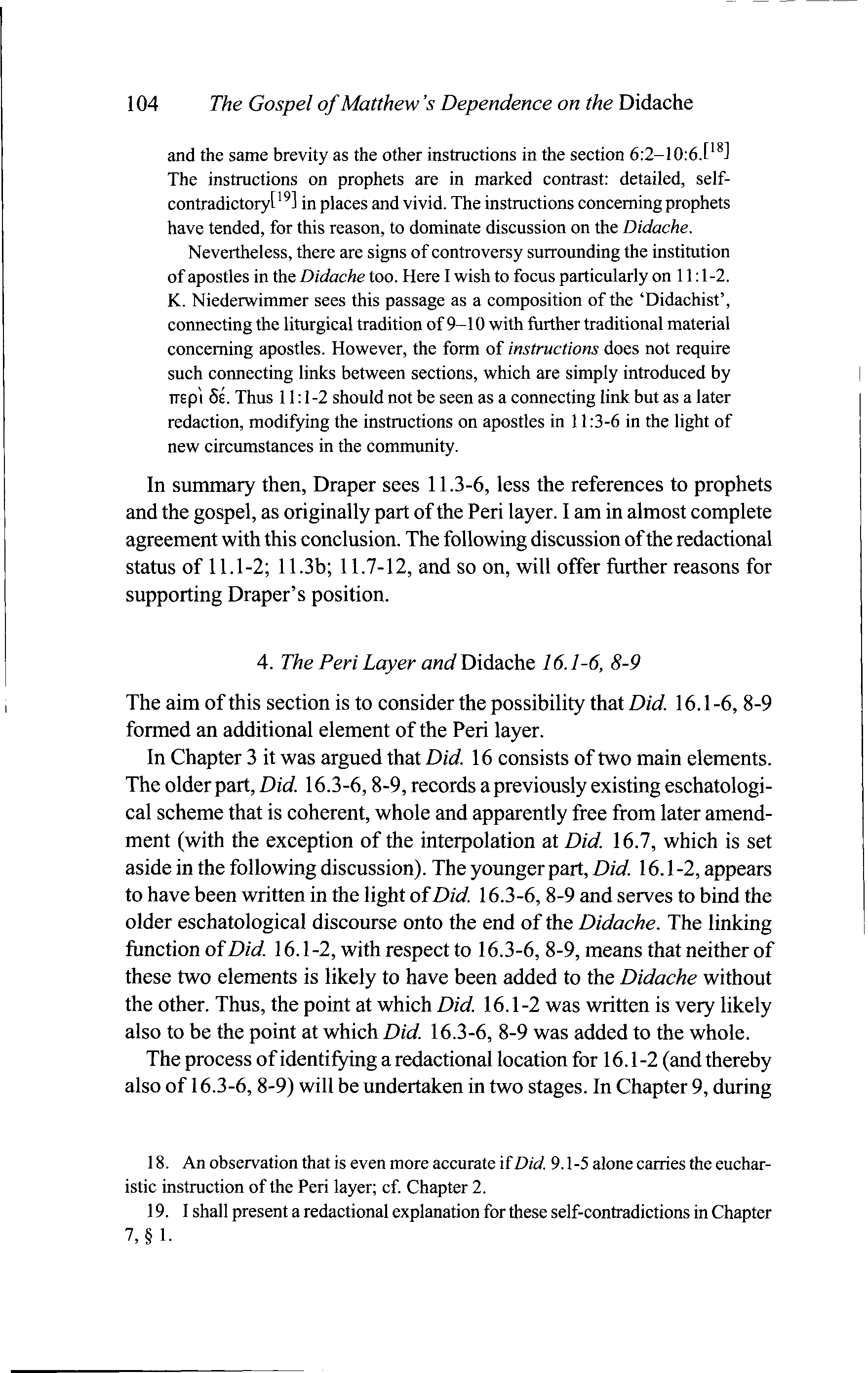
The Gospel of Matthew's Dependence on the Didache and the same brevity as the other instructions in the section 6:2-10:6.t18]
The instructions on prophets are in marked contrast: detailed, selfcontradictoryt19] in places and vivid. The instructions concerning prophets have tended, for this reason, to dominate discussion on the Didache.
Nevertheless, there are signs of controversy surrounding the institution of apostles in the Didache too. Here I wish to focus particularly on 11:1-2.
K. Niederwimmer sees this passage as a composition of the 'Didachist', connecting the liturgical tradition of 9-10 with further traditional material concerning apostles. However, the form of instructions does not require such connecting links between sections, which are simply introduced by TT6p\ 5e. Thus 11:1-2 should not be seen as a connecting link but as a later redaction, modifying the instructions on apostles in 11:3-6 in the light of new circumstances in the community.
In summary then, Draper sees 11.3-6, less the references to prophets and the gospel, as originally part of the Peri layer. I am in almost complete agreement with this conclusion. The following discussion of the redactional status of 11.1-2; 11.3b; 11.7-12, and so on, will offer further reasons for supporting Draper's position.
4. The Peri Layer andDidache 16.1-6, 8-9 The aim of this section is to consider the possibility that Did. 16.1-6, 8-9 formed an additional element of the Peri layer.
In Chapter 3 it was argued that Did. 16 consists of two main elements.
The older part, Did. 16.3-6,8-9, records apreviously existing eschatological scheme that is coherent, whole and apparently free from later amendment (with the exception of the interpolation at Did. 16.7, which is set aside in the following discussion). The younger part, Did. 16.1-2, appears to have been written in the light of Did. 16.3-6, 8-9 and serves to bind the older eschatological discourse onto the end of the Didache. The linking function of Did. 16.1-2, with respect to 16.3-6, 8-9, means that neither of these two elements is likely to have been added to the Didache without the other. Thus, the point at which Did. 16.1-2 was written is very likely also to be the point at which Did. 16.3-6, 8-9 was added to the whole.
The process of identifying a redactional location for 16.1 -2 (and thereby also of 16.3-6, 8-9) will be undertaken in two stages. In Chapter 9, during 18. An observation that is even more accurate if Did. 9.1 -5 alone carries the eucharistic instruction of the Peri layer; cf. Chapter 2.
19. I shall present a redactional explanation for these self-contradictions in Chapter
7,§1.
5. The Peri Layer
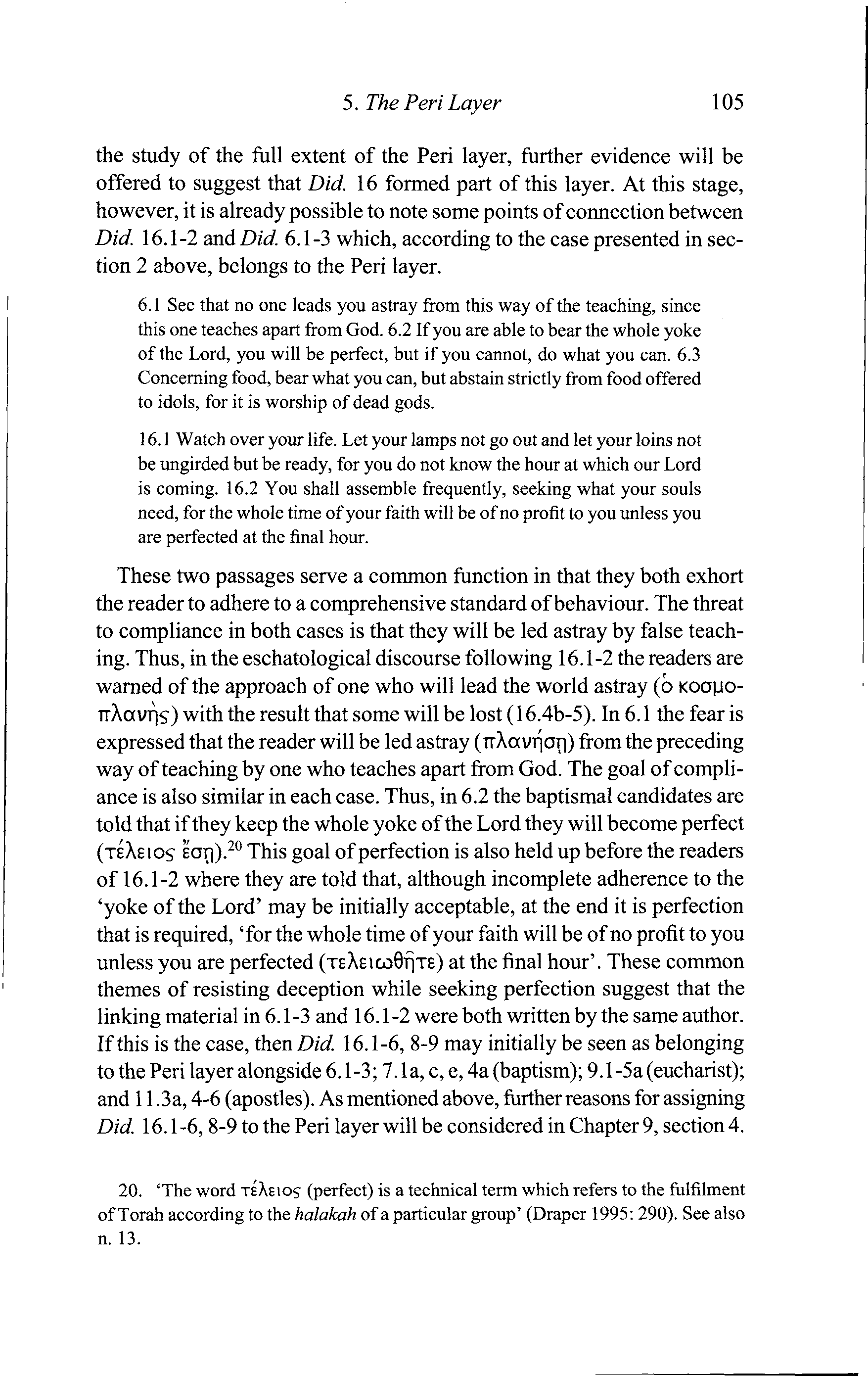
the study of the full extent of the Peri layer, further evidence will be offered to suggest that Did. 16 formed part of this layer. At this stage, however, it is already possible to note some points of connection between Did. 16.1-2 and Did. 6.1-3 which, according to the case presented in section 2 above, belongs to the Peri layer.
6.1 See that no one leads you astray from this way of the teaching, since this one teaches apart from God. 6.2 If you are able to bear the whole yoke of the Lord, you will be perfect, but if you cannot, do what you can. 6.3
Concerning food, bear what you can, but abstain strictly from food offered to idols, for it is worship of dead gods.
16.1 Watch over your life. Let your lamps not go out and let your loins not be ungirded but be ready, for you do not know the hour at which our Lord is coming. 16.2 You shall assemble frequently, seeking what your souls need, for the whole time of your faith will be of no profit to you unless you are perfected at the final hour.
These two passages serve a common function in that they both exhort the reader to adhere to a comprehensive standard of behaviour. The threat to compliance in both cases is that they will be led astray by false teaching. Thus, in the eschatological discourse following 16.1-2 the readers are warned of the approach of one who will lead the world astray (b KOGMOTTXavris) with the result that some will be lost (16.4b-5). In 6.1 the fear is expressed that the reader will be led astray (TTACXvr\or\) from the preceding way of teaching by one who teaches apart from God. The goal of compliance is also similar in each case. Thus, in 6.2 the baptismal candidates are told that if they keep the whole yoke of the Lord they will become perfect
(TEXEIOS EOT]).20 This goal of perfection is also held up before the readers of 16.1-2 where they are told that, although incomplete adherence to the 'yoke of the Lord' may be initially acceptable, at the end it is perfection that is required, 'for the whole time of your faith will be of no profit to you unless you are perfected (TEAEICOOTJTE) at the final hour'. These common themes of resisting deception while seeking perfection suggest that the linking material in 6.1 -3 and 16.1-2 were both written by the same author.
If this is the case, then Did. 16.1-6, 8-9 may initially be seen as belonging to the Peri layer alongside 6.1-3; 7.1a, c, e, 4a (baptism); 9.1-5a(eucharist); and 11.3a, 4-6 (apostles). As mentioned above, further reasons for assigning
Did. 16.1-6, 8-9 to the Peri layer will be considered in Chapter 9, section 4.
20. 'The word TSXEIOS (perfect) is a technical term which refers to the fulfilment of Torah according to the halakah of a particular group' (Draper 1995: 290). See also n. 13.
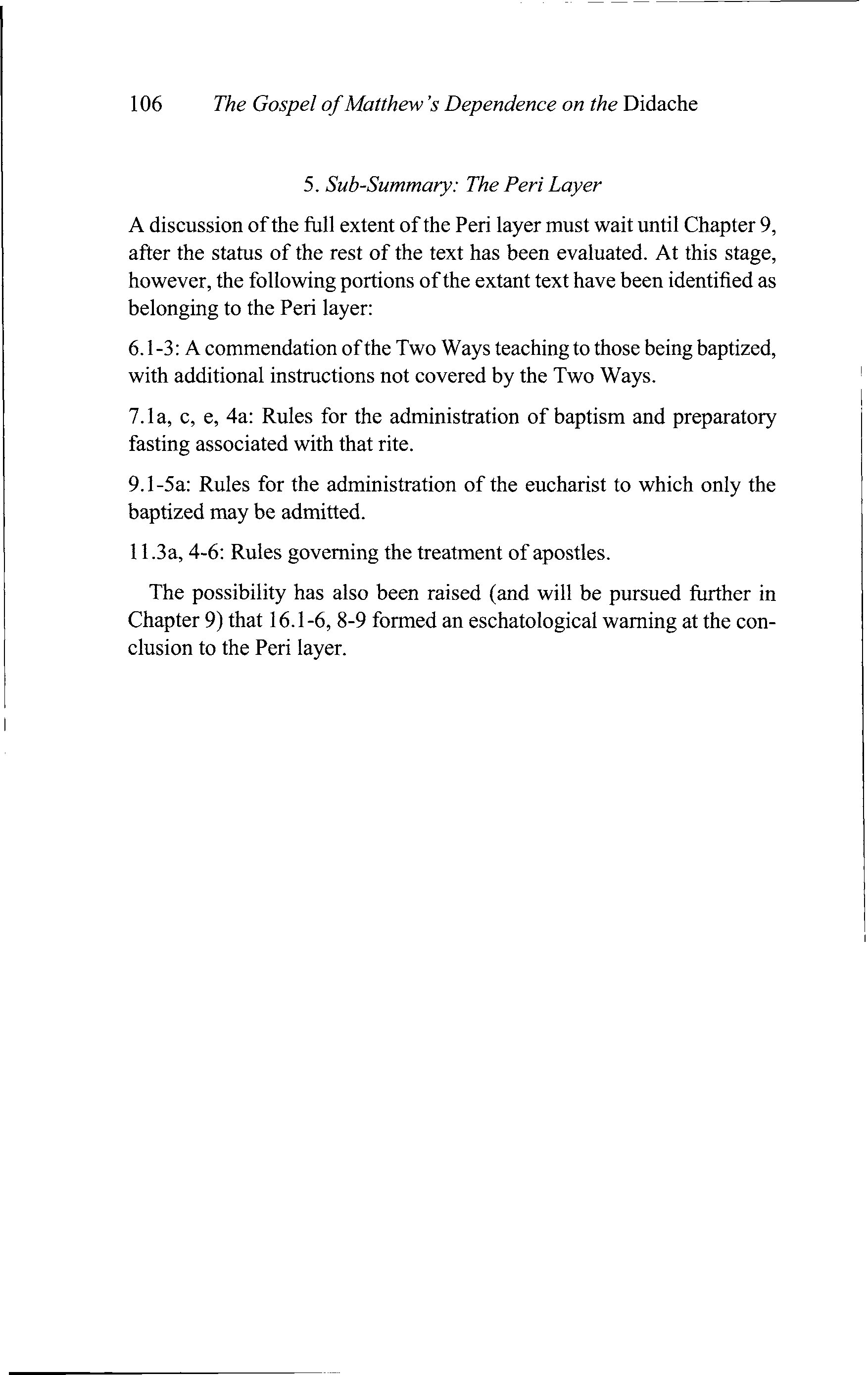
The Gospel of Matthew's Dependence on the Didache 5. Sub-Summary: The Peri Layer A discussion of the full extent of the Peri layer must wait until Chapter 9, after the status of the rest of the text has been evaluated. At this stage, however, the following portions of the extant text have been identified as belonging to the Peri layer:
6.1-3: A commendation of the Two Ways teaching to those being baptized, with additional instructions not covered by the Two Ways.
7.1a, c, e, 4a: Rules for the administration of baptism and preparatory fasting associated with that rite.
9.1-5a: Rules for the administration of the eucharist to which only the baptized may be admitted.
11.3a, 4-6: Rules governing the treatment of apostles.
The possibility has also been raised (and will be pursued further in Chapter 9) that 16.1-6, 8-9 formed an eschatological warning at the conclusion to the Peri layer.