
Chapter 15 Further Points Of Contact Between Matthew'S Gospel And The Peri/Base Layer
Chapter 15
FURTHER POINTS OF CONTACT BETWEEN MATTHEW'S GOSPEL
AND THE PERI/BASE LAYER
Having considered, in Chapters 13 and 14, the dense collection of contacts between Matthew's Gospel and Did. 16 and Did. 1, this short chapter now turns to examine links that occur at further points within the Didache's
Peri/Base layer.
At the outset it should be noted that, if these additional points of contact do indeed fall within the Peri/Base layer (as conceived in Part I), then evidence for Matthew's direct use of elements of this layer may be taken as evidence of Matthew's knowledge of the whole of that layer, including these additional elements. Beyond this point, however, the purpose of this chapter is independently to consider whether there is any feature of these contacts which demands that their author knew Matthew's Gospel. If no such feature can be identified, then the viability of the hypothesis proposed in the introduction to Part II is maintained.
1. Vice List: Matthew 15.19 and Didache 5.1
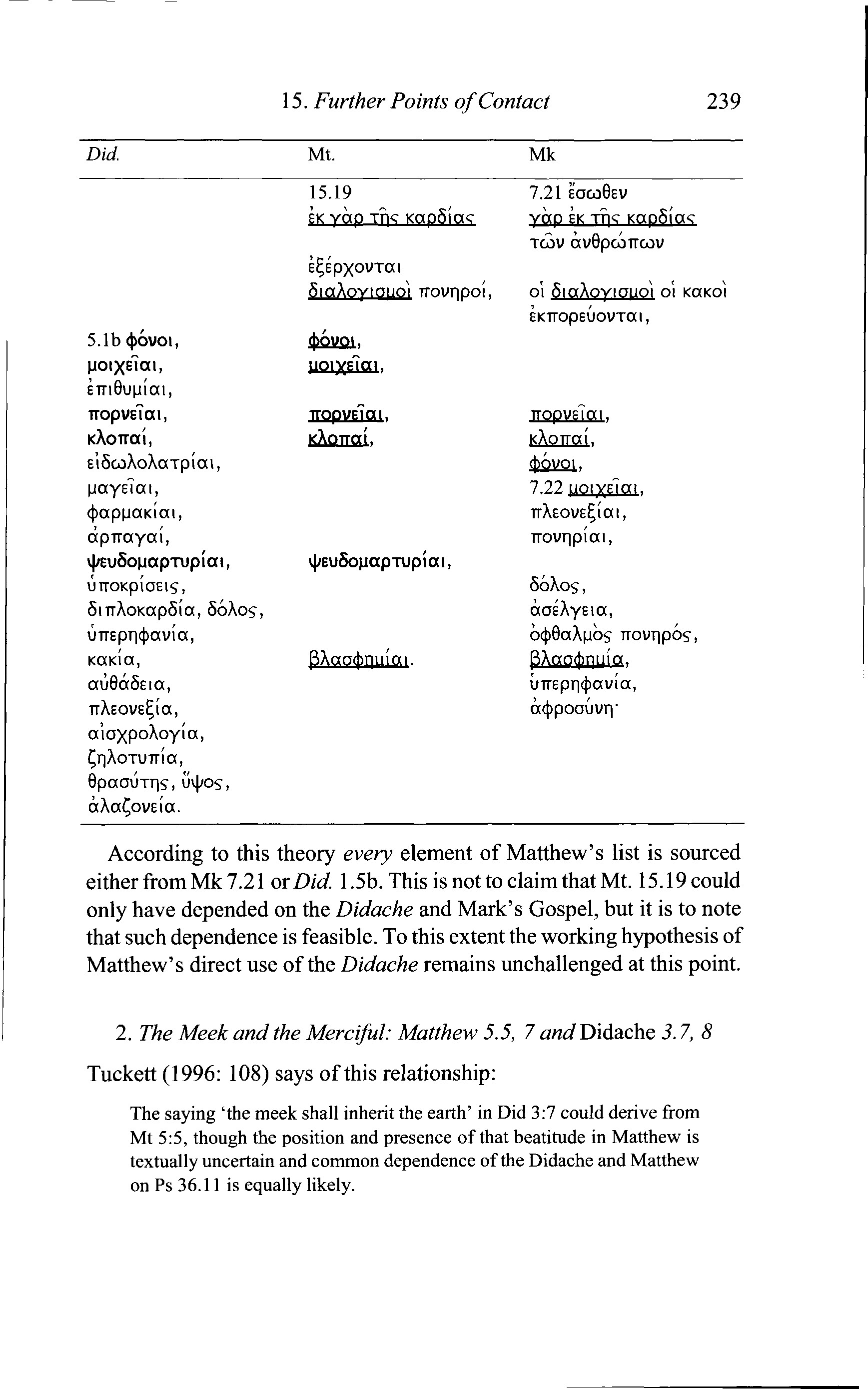
Butler (1961: 33) suggests that the order of the vices in Did. 5.1 is explicable if the Didache were editing a list similar to that in Barnabas 20 in the light of the list in Mt. 15.19. Taken in isolation this is theoretically possible, although it does not immediately account for the Didache's inclusion of vices that appear neither in Barnabas, nor in Matthew's Gospel, for example ETTISUMICXI, aiaxpoXoyia, £r)AoxuTTia and aXa^oveia. At the same time, however, Butler's view is not the only viable explanation for the similarities between Mt. 15.19 and Did. 5.1; an alternative possibility is that Mt. 15.19 represents the conflation of the vice lists in Did. 5.1 and Mk 7.21, as set out below.
15. Further Points of Contact
Mk Mt.
Did 15.19
7.21 EOCO0EV
yap EK TTI<^ Kap§!a<:
EK yap TT)<? Kap5ia<:
TCOV avSpcoTTcov SiaXoyioiJoi TTovr|poi. oi §iqXQyio|JO^ o\ KaKoi EKTTOpEUOVTai, (|>6voi.
5.1b<|>6voi, pOlXE^Otl.
TTopveiai.
TTOpvslai.
TTOpVEfai, KXoiTai, Ei5coXoXaTpiai, (jaysTai, icXoTrai.
KXoTTai. c()6voi.
7.22 jjoixs^ai. dpTrayai, vpeuSopapTupiai, TTOvripiai, vpEuSonapTupiai, SoXos, aasXyEta, 5iTrXoKap5ia, SoXos, \JTTEpr|(|>avia, KaKta, au8a5Eia, pXaa^riniai.
UTTEpr|c|)avia, a<t>poa(iVTy aiaxpoXoyia, 0paauTr|s, uvpos, aXa^ovEia.
According to this theory every element of Matthew's list is sourced either from Mk 7.21 ovDid. 1.5b. This is not to claim that Mt. 15.19could only have depended on the Didache and Mark's Gospel, but it is to note that such dependence is feasible. To this extent the working hypothesis of Matthew's direct use of the Didache remains unchallenged at this point.
2. The Meek and the Merciful: Matthew 5.5, 7 and Didache 3.7, t Tuckett (1996: 108) says of this relationship:
The saying 'the meek shall inherit the earth' in Did 3:7 could derive from Mt 5:5, though the position and presence of that beatitude in Matthew is textually uncertain and common dependence of the Didache and Matthew on Ps 36.11 is equally likely.
The Gospel of Matthew's Dependence on the Didache Despite this apparently balanced assessment Tuckett is not justified in placing both options on an even footing. To say that Did. 3.7 is equally likely to have been derived from Ps. 36 or Mt. 5.5 is to neglect the very superior claim of Ps. 36. As discussed in Chapter 4, section 5, the whole of Did. 3.1-7 has the form of a piece of Jewish Wisdom literature based on an exposition of Ps. 36. It was also noted that the common reference to the inheritance of the meek in both Ps. 36 and Barnabas 19 may explain why the Teknon material was inserted into the Two Ways, and why it was inserted at precisely this point. Thus, there is every reason to suppose that Did. 3.7, like the verses that precede it, derives from Ps. 36. Under these circumstances there is no basis for supposing that Mt. 5.5 was anywhere in view.
Conversely, the close combination of references to the meek and the merciful in both Did. 3.7, 8 and Mt. 5.5, 7 provides evidence for Matthew's direct dependence on the Didache. In Part I it was noted that Did. 3.7 forms a part of the Teknon unit, an exposition of Ps. 36 inserted into the Two Ways tractate. Did. 3.8, on the other hand, does not fall within the Teknon unit, belonging instead to the Two Ways tractate. It is noteworthy, therefore, that elements from these originally separate traditions, closely juxtaposed in the Didache, should reappear in similarly close combination amongst Matthew's non-Lukan beatitudes. This circumstance can either be explained as the product of remarkable coincidence, or as the result of Matthew's conflation of Luke's beatitudes with the instructions to be meek and merciful in Did. 3.7 and 3.8.
3 The Commandments: Didache 1.2a, 4b(r); 2.2 and Matthew 19.17-21 Matthew's version of Jesus' response to the rich young man is, in many ways, very similar to that recorded in Mk 10.17-22 (and Lk. 18.18-23).
However, Matthew deviates from these accounts in four respects. First, he has Jesus preface the listing of the commandments with the phrase, 'If you wish to enter into life'. Second, he places the commandments themselves in the future, rather than the present tense. Third, he adds a call to iove your neighbour as yourself as an additional commandment. Fourth, he replaces Mark's 'one thing is lacking' with 'if you wish to be perfect
(TEAEIOS)'.
Each of these changes could be explained if Matthew conflated Mk 10.17-22 with Did. 2.2-3. Thus, the Didache's presentation of the commandments as part of the 'way of life' would account for Matthew's insertion of 'If you wish to enter into life'. The Didache's placement of the
15. Further Points of Contact
commandments in the future tense then gives rise to the similar pattern in Matthew. The Didache maintenance of a close link between the command to love the neighbour (1.2) and the commandments that spell out the meaning of that command (cf. 2.1 leading into 2.2-3) would account for Matthew's inclusion of neighbour love as part of the essential list of commandments. Finally, the Didache's presentation of 'TEAEIOS' as the goal of its ethical instructions (1.4b[r]; see also 6.2 and 16.2) would explain why Matthew replaced Mark's 'one thing is lacking' with 'if you wish to be perfect
(TEAEIOS)'.
This is not to suggest that Matthew could only have adapted Mk 10.1722 under the influence of Did. 2.2-3. However, the differences and similarities between the two texts are neatly accounted for by Matthew's use of the Didache at this point.
4. The Commandments: Matthew 5.21, 27, 33 and Didache 2.2-3 The quotation of elements of the decalogue in Matthew's antitheses has never provoked particular comment because a source, for the first two at least, is so readily provided by the Old Testament. However, this ready source has blinded scholars to the curiosity of the prohibition 'You shall not swear falsely (OUK ETTiopKT]GEis)'. This extremely unusual Greek word for 'swear falsely' is not only a New Testament hapax, it does not appear in any contemporary Jewish or Christian text other than Mt. 5, Did. 2.3 and, in a different form, the Jewish halakah of Pseudo-Phocylides. This coincidence suggests a further point of connection between the Didache and Matthew's Gospel. If such does exist, then there is insufficient evidence to determine, in isolation at least, the direction of any dependence. To this extent, therefore, Matthew's direct use of the Didache remains feasible in this instance.
5. Fencing the Law: Matthew 5.21, 22, 27, 28 and Didache 3.2-3 In terms of direct verbal parallels the connection between Did. 3.2-3 and Mt. 5.22,28 is not especially strong. However, their similar understanding of the relationship between anger and murder, lust and adultery is striking and raises the possibility of a connection between the two texts.
As observed in Chapter 4, section 5, the 'Teknon unit' (Did. 3.1-7) has the character of an independently conceived Jewish Wisdom exposition of Ps. 36, which was later incorporated into the Two Ways tractate. This immediately suggests three reasons why it is unlikely to have been written
The Gospel of Matthew's Dependence on the Didache in the light of Matthew's Gospel. First, all the raw material for this unit is available in Ps. 36 and so knowledge of Matthew's Gospel is unnecessary to explain its content. Second, the idea of a 'fence to the law' is characteristic of Jewish wisdom and so appeal to a Christian text need not be used to explain its form. Third, to maintain the theory that the Didache used
Matthew's Gospel, the composer of the Teknon unit must be supposed to have had a particular, or coincidental, reason for making selections only from Matthew's special material.
Given that the direct dependence of the Teknon unit on Matthew's Gospel is highly unlikely, three other possible explanations for their similarity remain, besides appeal to sheer coincidence. It is possible that both
Matthew and the composer of the Teknon unit made use of a common source, or that Matthew knew the Teknon unit before it was incorporated into the Didache, or that Matthew knew the Teknon unit in its present context. Of these options the first is unlikely since Ps. 36 appears to provide the inspiration for Did. 3.1-7, while this is very much less obviously the case for Matthew's text. The second option requires Matthew to use a tradition which, coincidentally, was later incorporated into a text with numerous other similarities to Matthew's work. The third option, by contrast, merely requires Matthew to draw material from the Teknon unit alongside his use of several other of the Didache's diverse elements. This option is particularly attractive when it is observed that the direct speech of Jesus recorded in Mt. 5.21-28 includes points of similarity not only with Did. 3.2-3, but also with Did. 1.5b and 14.2 (cf. Chapter 11, sections 1 and 2).
In conclusion, there is nothing to suggest the Didache's knowledge of Matthew's Gospel in this instance. Indeed, the similarities between the two texts at this point suggest Matthew's knowledge of the Teknon unit after it had been incorporated into the Didache.
6. Summary: The Peri/Base Layer and Matthew's Gospel The last three chapters have sought to show that, taken in isolation, each point of contact between Matthew's Gospel and the Peri/Base layer may feasibly be explained as due to Matthew's direct knowledge of the Didache.
Further, it has been noted that in most cases Matthew's knowledge of the Didache is not only feasible but probable.
This result offers piece-by-piece confirmation of the hypothesis proposed in the introduction to Part II; namely, that the several links between the first three layers of the Didache and Matthew's Gospel are most simply
15. Further Points of Contact
explained by Matthew's direct use of these layers of the Didache to supplement the words of Jesus available from other sources.
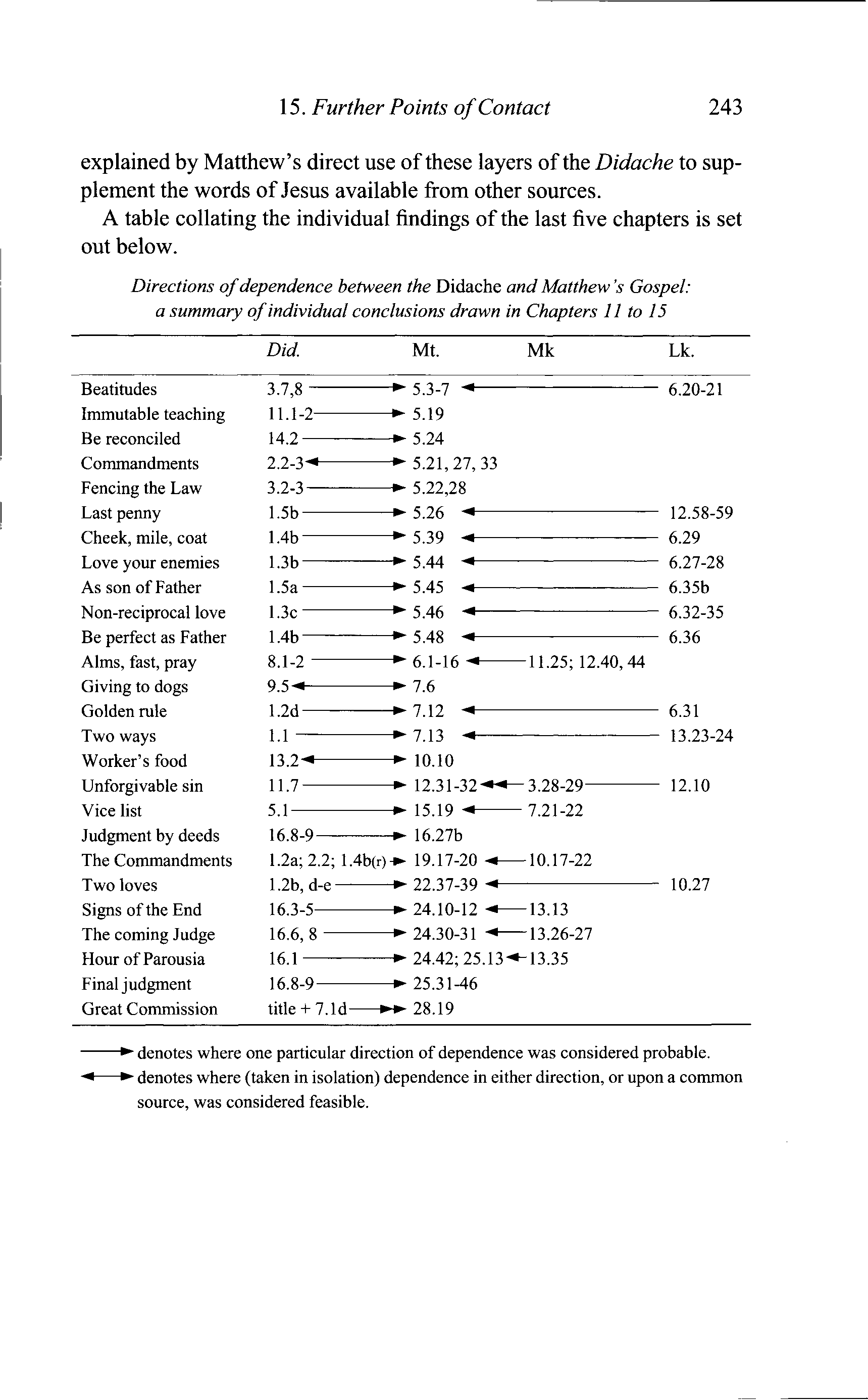
A table collating the individual findings of the last five chapters is set out below.
Directions of dependence between the Didache and Matthew's Gospel: a summary of individual conclusions drawn in Chapters 11 to 15
Did Mt.
Mk Lk.
Beatitudes Immutable teaching Be reconciled Commandments Fencing the Law Last penny Cheek, mile, coat Love your enemies As son of Father Non-reciprocal love Be perfect as Father Alms, fast, pray Giving to dogs Golden rule Two ways Worker's food Unforgivable sin Vice list Judgment by deeds The Commandments Two loves Signs of the End The coming Judge Hour of Parousia Final judgment Great Commission 3.7,8 6.20-21 12.10
1.2a; 2.2; 1.4b(r) 1.2b, d-e 16.3-5 16.6, 8 16.1
16.8-9 title+ 7.Id 10.27 i 13.13
13.26-27 •24.42; 25.13^-13.35
25.31-46 28.19
* denotes where one particular direction of dependence was considered probable.
* denotes where (taken in isolation) dependence in either direction, or upon a common source, was considered feasible.