
Chapter 3 THE INTEGRITY OF DIDACHE 16
Chapter 3
THE INTEGRITY OF DIDACHE 16
The two most significant collections of points of contact between the Didache and Matthew's Gospel occur in Did. 16 and Did. 1. For this reason two substantial chapters are now devoted to Did. 16 and Did. 1-5 in turn.
The first part of the present chapter focuses on the interpretation of the enigmatic phrase 'those who persevere in their faith shall be saved by the curse itself (16.5). The answer given is pivotal to discussion of a second classic problem associated with the Didache's final chapter; the extent and content of the text's original ending. In the course of this latter debate it will also be necessary to consider the history and function of Did. 16.7.
The preparatory elements of this chapter take a long time to reach their conclusion. However, once completed, they not only assist the process of reconstructing the compositional history of Did. 16, but also contribute to crucial elements in the ensuing case for Matthew's use of the Didache's closing eschatological discourse.1
1. The Curse that Saves A number of interpretations of 'the curse that saves' in 16.5 have been offered since the rediscovery of the Didache. By far the most popular among these is an equation of the 'curse' with Jesus.2
The grammar of the sentence in question may be read in one of two ways. AVTOG may be seen as a masculine or neuter third person singular
This latter factor need not directly occupy the reader's attention at this stage.
The discussion to which the reconstruction of the lost ending of the Didache is relevant takes place in Chapter 13.
See Milavec (1995: 139^2) for a discussion of the history of this mainstream position. Scholars cited as supporting this line include: Taylor (1886: 100); Harris
(1887: 68); Harnack and von Gebhardt (1886: 62); Wengst (1984: 99); Schollgen (1991: 78-79); Giet (1970: 252) and Niederwimmer (1989: 265).
The Gospel of Matthew's Dependence on the Didache pronoun so that 'oi §E UTTOMSIVCXVTES EV xrj TTIOXEI auxcov
IITT' auToG TOU Kaxa0E|jaxos' is read as, 'but those who persevere in their belief will be saved by [agency of] him, the curse'. However, in this case, there should be a masculine or neuter noun to which auxoO refers.
The likely candidates are eliminated, since KXIOIS (creation), mjpcoais (burning process) and TTIGXIS (faith) are feminine nouns. Given the absence of a suitable referent, it is preferable, therefore, to read auxou as an intensive adjectival pronoun agreeing with the neuter noun KaxaSspaxos, thus, 'saved by [the agency of] the curse itself.
To read the phrase 'the curse itself as a covert reference to Jesus requires an already established association between Jesus and 'the curse' in the mind of the author/hearers. Such a connection is not made in the preceding (or following) text. To read 'the curse' as another name for Christ it is necessary, therefore, to propose that Christ was so well known as 'the curse' by the Didache's intended hearers that this interpretation did not need to be spelt out in the Didache itself.
Scholars who wish to see 'the curse' as a reference to Jesus generally rely, as evidence for an association between these two terms in early Christianity, on Gal. 3.13, 'Christ redeemed us from the curse (Kaxapa) of the Law by becoming a curse for us - for it is written, "Cursed is every one who hangs on a tree."' On this basis, and with additional reference to 1 Cor.
12.3, Rordorf and Tuilier (1978: 198) conclude: 'The notion of curse was therefore so widely dispersed in the early church that one will not be surprised that the noun Kaxa0E|ja might here designate Christ himself.3
There are, however, a number of difficulties with this view. An initial group of problems lies in the assumption that Gal. 3.13 provides a basis for the common association of Jesus with 'xo Kaxa0E(ja'. First, if 1 Cor.
2.9 contains a quotation oi Did. 16.94 (as reconstructed in section 4 below), and if Galatians was written after 1 Corinthians, then Gal. 3.13 cannot be used to interpret Did. 16.5. Second, even if Did. 16.5 is, contrary to my argument in Chapter 13, a post-Pauline text, then it is unclear why
Kaxa0E|ja should be used inDid. 16.5 if it depended on an idea expressed in Gal. 3.13, where Kaxapa is used. Third, if Did. 16.5 does rely on a Paul3.
This translation appears in Milavec 1995: 143. The original text reads, 'La notion de malediction etait done tres repandue dans l'Eglise primitive, et on ne s'etonnera pas que le substantif KaxaSena puisse designer ici le Christ lui-meme'.
Observations regarding the antiquity of Did 16.3-6, 8-9 may be found in the excursus on the relationship between Mk 13 and Did. 16 in Chapter 13. For a specific reference to the relationship between Did. 16.9 and 1 Cor. 2.9 see n. 2 at the end of this excursus in Chapter 13.
3. The Integrity o/Didache 16
ine interpretative key, then it is surprising that a closer relation to the Pauline tradition is not more evident in the remainder of the text. As Milavec(1995: 142) notes:
The resolution of the obscure meaning of Did 16.5 through an appeal to Paul (e.g., Gal 3:13; 1 Cor 12:3) is considerably weakened when one notes that the Didache originated within a community which exhibited no dependence upon Pauline theology or Pauline letters.
Categorical statements regarding the relationship between Paul and the Didache should perhaps be avoided at this stage. That said, Milavec's point is fair inasmuch as the Didache does appear to be remarkably free from the influence of distinctively Pauline theology.5
An additional appeal to 1 Cor. 12.3 does nothing to support the equation of curse and Christ in common Christian usage. All that this verse shows, if anything, is that opponents of Christianity may have called Christ ava0E|ja. It does not follow that Christians are then likely to have taken up this type of insult as a suitable name for their saviour. If the sign of those who do not speak in the Spirit is that they can say 'Jesus be cursed' (1 Cor.
12.3), then is it likely that Christians would use such a term to describe their Lord?
The idea of a commonly understood association between 'Kaxa0E|ja' and 'Christ' is made particularly problematic by the appearance of the very rare term KaTa0E|ja6 in Rev. 22.3. Here it cannot be interpreted as a covert reference to Christ, since the verse declares that in the New Jerusalem there will 'no longer be any curse'. This suggests that even if some Christians did, however perversely, refer to Christ as 'the curse' this was not a description that was so 'widely dispersed' (as Rordorf and Tuilier would have it
[1978: 198]) that it had reached the circles in which Revelation was read.
Finally, even if in some very particular circumstance Jesus was known as 'the curse', it is unclear why this appellation should be used in Did.
16.5. That is to say, 'Lord' is used to describe Christ on every other occasion where he may be seen as referred to within the Didache, so why might
'the curse' be used in Did. 16.5? 'Those who persevere in their faith shall be saved by the Lord himself would appear to adequately express the meaning favoured by those who see 'the curse' as a reference to Jesus. No 5.
Particularly starkly, Paul's view of the centrality of the crucifixion is entirely absent from the Didache. The Didache does not even mention the cross in its two eucharistic prayers {Did. 9 and 10).
This noun occurs in Rev. 22.3 and Did. 16.5, but nowhere else in early Christian literature, according to Bauer et al. (1957).
The Gospel of Matthew's Dependence on the Didache special service is apparently performed by this metaphor, since it does not illuminate the mode of salvation. For example, it is not as if anyone has been saved from the curse of the testing fire by Christ's taking that curse upon himself, because only those who don't fall away in the course of the fire and who persevere in their faith will be saved. Thus, it is not only unlikely that Jesus was ever described by Christians as 'TO Kaxa0E|ja', but also, there are no unusual circumstances which might explain or justify the use of this metaphor in this particular instance.
In summary, multiple problems arise from equating 'TO KaTa0Ejja' with Christ: not only is it difficult to envisage a concrete circumstance where this equivalence might safely be assumed of a Christian audience, but also, it is difficult to find textual evidence of any kind to support such a notion, least of all evidence that bears a tangible connection to the Didache. Why then has Didache scholarship maintained such a firm stance on this issue?
I suspect that the reason is not because Christ is genuinely seen as likely to have been commonly known as 'the curse', but because he is commonly understood, from our present day perspective, as the one who saves. Thus, if Did. 16.5 had read, 'but those who persevere in their faith shall be saved by the kitchen sink itself, then the assumption would be made that, because
Jesus is the one who saves, 'the kitchen sink' must have been a 'widely dispersed' metaphor for Christ (who washes us of our sins?). This type of automatic interpretative move could perhaps be justified if it were possible to show that Jesus is the only possible agent of the salvation that could be referred to in Did. 16.5. In the following discussion of Milavec's work it will be argued that this is not the case. First of all, however, it is appropriate to note two other interpretations of the enigmatic phrase.
Bryennios suggested that there may be a textual error in Did. 16.5 and that UTT' should read CCTT', so that salvation is from the curse rather than by it. This view, quoted and endorsed by Funk (1887: 48) has been almost entirely ignored in subsequent discussion.7 Such a dismissal is justified inasmuch as this emendation is entirely arbitrary, does nothing to explain the difficult form of the extant text and still provides scant explanation as to why the verse should have been written in this way.
Jonathan Draper (1996d: 362) offers the unique opinion that [T]he phrase urr' CCUTOU TOU KaTaSenaxos is a polemic against Paul and refers to the 'curse of the Law'. This may have been a proverbial expression. .. The instruction of the Didache would then remind the community that they are saved by the very thing which they find brings a curse on 7.
See Pardee (1995: 173 n. 49).
3. The Integrity o/Didache 16
them, namely the Torah. It is to this that they must hold fast if they are to be perfect on the last day.
Draper's interpretation of the 'curse' is dependent on his view that Paul is the one who teaches another teaching, as mentioned in Did. 11.2a. However, as I argue in Chapter 7, section 3, the force of Did. 11.1 -2 is located in its final clause. Thus, the reference to turn-coat teachers is part of a declaration of orthodoxy prior to the introduction of the possibility, in 11.2b, that an alternative teaching may after all be acceptable. It is an unjustified step, therefore, to see a specific engagement with Paul in the reference to teachers who turn to teach another doctrine.
A third view, and one worthy of detailed consideration, is that of Aaron Milavec, who argues that the saving 'curse' is the burning process itself.
Vital to Milavec's argument is his observation of the linguistic parallelism of Did. 16.5. Thus he writes (1995: 137):
The term TTupcoais (burning process) is a derivative of nup (fire) and is only found once in the NT (1 Pet 4:12). The word SoKiMCxaia (verb SoKipa^co) has the sense of 'testing,' normally with the prospect of approving something... The phrase sis Trjv Trupcooiv T % SoKijjaoias (through the burning process of testing), therefore, aptly signals that both positive and negative results could be anticipated. In Did 16.5, accordingly, two divergent results are indeed forthcoming:
A. Negative results of burning For whom?
'many' (unspecified; includes false prophets, the world-deceiver, etc.) Effect?
'entrapped and destroyed [by the burning]'
B. Positive results of the burning For whom?
'the faithful' (those who are not corrupted or deceived as explained in Did 16.4) Effect?
'saved [by the burning=curse]'
Milavec goes on to show that in prophetic and apocalyptic literature of the period this dual role of the eschatological fire is a recurring feature.
Thus, Milavec argues that that which destroys God's enemies is what simultaneously saves and purifies those who remain faithful to him. He concludes (1995: 154):
When the text is examined on its own grounds, the term SoKipaoia (testing) would appear to suggest that both positive and negative results are anticipated. Furthermore, when the metaphor of fire is investigated in the prophetic and apocalyptic literature, multiple instances appear which support the notion that a dual effect was being assigned to the eschatological fire.
Given the linguistic parallelism within the text, therefore, the possibility
The Gospel of Matthew's Dependence on the Didache remains that the Didache had in mind that the elect were to be 'saved by the accursed [burning process] itself {Did. 16.5).
It was observed above that if Jesus may be seen as the only possible agent of salvation, then it is reasonable, if ungainly, to interpret the saving curse as a reference to Christ. What Milavec succeeds in showing is that the 'burning process' may also be seen as an agent of salvation for those who, by their perseverence, survive it. The immediate question is, therefore, which of these two possible agents of salvation is most likely to be in view in Did. 16.5? The several difficulties with interpreting the curse as a reference to Christ have already been listed above. By contrast, these difficulties do not apply in the case of the burning process. First, there is nothing curious in the description of the burning process as 'the curse'.8 Second, the grammar of the phrase in question, which presupposes the hearers' knowledge of what 'the curse itself refers to, is unproblematic if this phrase refers back to the burning process that has just been mentioned. By this means Milavec's solution avoids having to appeal to a Pauline interpretative key.
In a response to Milavec's proposal Pardee raises two objections (1995:
174). First, she notes that [T]he overall context of Did 16.5, specifically the use of acoBrjaovTcu followed by the preposition UTTO, speaks against this theory, since elsewhere oco^co and UTTO together indicate a personal, most likely divine, agent. (In the accompanying footnote she writes, 'In all of the examples which I have checked, oco£co + UTTO is only found with animate agents, i.e., persons or personified entities...') The fact that Pardee found, in the examples she checked, that the agents of salvation were always animate and usually divine is not surprising, since the act of saving generally requires animation. Further, the phrase
'usually divine' indicates that the texts Pardee consulted were primarily religious, and in religious literature the agent of salvation is, of course, most likely to be divine. What is at issue here is not whether GCO£CO + UTTO usually conforms to the pattern Pardee describes, but whether this construction must indicate an animate saviour. To make this case Pardee has to show that a different construction would have been used if salvation by the 'non-human' burning process were intended. Pardee cannot meet this requirement because no such construction exists.9
This issue is discussed more fully below.
Perhaps surprisingly, Milavec (1995: 136) appears to accept Pardee's observation as a potentially valid argument against his position.
3. The Integrity o/Didache 16
Pardee's second objection is very much more substantial and revolves around the semantic range of KaxaSEpaTos and the likelihood that this word would be used to describe the fiery test as conceived by Milavec.
There are some difficulties with Milavec's view of the nature of the test. It is necessary to consider his conception in greater detail before returning to Pardee's second objection.
Milavec understands the burning process of Did. 16.5 to be the fire of final judgment. Thus he can say 'The eschatological fire of the Didache functions "to utterly destroy" (CXTTOAAUIJI being used as an emphatic form of oAAupi) and only takes effect during the last days' (1995: 137 n. 15). It is because Milavec sees the 'false prophets, world-deceiver, etc' as all utterly destroyed by this process that he is willing to argue (1995:151-54) against majority opinion (cf. section 2 in this chapter), that lines describing final judgment have not been lost from the end of Did. 16. This view is also necessary to Milavec's ultimate thesis that the Didache bears witness to the ancient roots of the doctrine of purgatory.
There are, however, considerable difficulties with the equation of the burning process with the final judgment. For this judgment to fall before the arrival of the Lord on the clouds (16.8) is, to say the least, surprising.
Milavec (1995: 151) attempts to address this problem by suggesting that The final coming of the Lord in glory to gather the elect into the kingdom
{Did 16.8 supported by 9.4 and 10.5) needs to occur unimpeded by the world-deceiver and his followers. Accordingly, the Didache envisions the Lord's judgment coming upon the earth, first, to break the power of the world-deceiver and to destroy all hindrances to the kingdom.
Milavec's understanding of events is not impossible, but the idea that the Lord stands in the wings while some other agent executes the final judgment so that he may come 'unimpeded' is not paralleled in any other
Jewish or Christian text.
Further, Milavec overstates the case when he reads aTToAAupi as an emphatic form of oAAupi meaning 'to utterly destroy'. The phrase used to describe those who succumb to the fiery text is 'GKavSaAia0riaovTai
TTOAAOI KCU aTToAouvxaf. 'ATTOAOUVTCXI uses the middle voice of OCTTOAAUMI, which may also be translated as 'lost'. This word for lost is used to describe the sheep and son that are lost and then found in Lk. 15.4,
6,24. It also applies to sheep gone astray in Mt. 10.6; 15.24 and remnants of bread in Jn 6.12. If aTToAAu|Ji may be taken in this way then the preceding 'GKav5aAiG0TiGOVTai' may be read in the more usual sense of'shall cause to stumble/lead into sin', rather than Milavec's somewhat strained
The Gospel of Matthew's Dependence on the Didache 'will be entrapped' (Milavec 1995:137 n. 15). In all, the line 'oKavSaAto0r]oovTai TTOXXOI Kai aiToAouvTai' is most easily read as inferring that the test causes some Christians10 to fall into sin and thus to be lost/ separated from the faithful flock. This is a process which precedes the final judgment, it does not coincide with it.
These difficulties with Milavec's view do not arise if, instead of assuming that the purifying fire is that of the final judgment, the fire is seen as representing persecution. As quoted above, Milavec himself notes: 'The term Tiupcoais (burning process) is a derivative of mip (fire) and is only found once in the New Testament (1 Pet 4:12)'. This unique recurrence of TTupcoois deserves close attention. 1 Pet. 4.12-13 reads:
Beloved, do not be surprised at the fiery ordeal (Trupcooei) that is taking place among you to test (TTEI paapov) you, as though something strange were happening to you. But rejoice insofar as you are sharing Christ's sufferings, so that you may also be glad and shout for joy when his glory is revealed.
Thus, the 'burning process' in this text is used to describe a time of persecution (which ultimately leads to salvation) and not the final fire.
If TTupcoois is seen as a time of persecution prior to the final judgment, then several details of the Didache's apocalypse11 fall into place. First, the flow from Did. 16 A to 16.5 makes sense. Thus, the appearance of the world-deceiver does not simply end in his being thrown into the fire before the Lord has even arrived (16.8). Rather, the arrival of the worlddeceiver provides the means by which Christians will be subjected to a purifying fire of persecution.12 In the course of this persecution some will fall away and be lost from the community, but others will be proved true, and thus will be saved to rejoice when Christ's glory is revealed (cf. 1 Pet.
4.12-13). The curse by which the latter are saved, therefore, represents persecution at the hands of the world-deceiver. Thus, paradoxically, the agent of their salvation is the persecution which reveals the persevering faith of those who, thereby, are saved.
I return now to Pardee's second objection to Milavec's thesis. Pardee contests that the semantic range of KaTaSepcxTOs is unlikely to stretch to the burning fire of testing, as conceived by Milavec. This objection is justi10. Niederwimmer (1998:221) notes:' The continuation (v. 5b) shows that in fact it is not the whole human creation that is in view, but only the Christians. Thus it is probably the threat of persecution that is being presented here.'
11. The use of the term 'apocalypse' to describe Did 16.3-6, 8-9 is one of convenience. A more accurate description would be 'eschatological discourse'.
12. Seen. 10, above.
3. The Integrity o/Didache 16
fied in that Milavec offers no explanation as to why 'Kaxa0E|jaTOs' should be used to describe the eschatological fire. The difficulties here are somewhat similar to those associated with calling Jesus 'the curse'. First, there are no other examples of such a designation, a point made by Pardee (1995:
174). Second, it is not immediately clear why 'the curse' should be chosen as a suitable means of describing an act initiated by God for the ultimate salvation of his faithful people.
If, on the other hand, the 'burning process' refers to a persecution of Christians initiated by the world-deceiver, then 'Kaxa0£|jaTOs' is an entirely feasible means of describing this event. Pardee (1995:174) notes:
'when ava0E|ja can be translated as "curse" it is virtually always in the sense of a pronouncement and not of its ramifications'. This observation causes Pardee (1995: 175) to conclude: 'It is.. .likely that the reference is to Jesus as an "accursed person'". By the same logic, however, the pronouncement of cursed status could be directed at Jesus' followers. If the cursing of Christians was an element of the persecution anticipated by Did
16.5, then the description of this event as 'the curse' (meaning 'the religious anathema laid on us by others')13 creates no difficulties.
The interpretation of 'the curse that saves' as a reference to testing persecution, which ultimately reveals those who are worthy of salvation, is supported by the presence of this idea in several other early Christian eschatologies. For example: Mk 13.9-13a speaks of the various persecutions prior to the End and then notes (in v. 13b): 'But the one who endures to the end shall be saved'; Lk. 21.19 and Mt. 10.22; 24.13 are parallel to Mark's text and express the identical idea; 2 Thess. 1.4-6 speaks of persecutions and afflictions making Christians worthy of the kingdom of God;
1 Pet. 4.12-13, as already noted, speaks of purifying endurance under persecution as the precursor of glorification; Revelation's constant theme is that of salvation through steadfast endurance under religious persecution, for example Rev. 2.10; 3.9-10; 6.9-10; 7.14-17; 12.11; 20.4; 21.7. Revelation's vision of the New Jerusalem where every KCXTa0£}ja will be no longer is entirely consistent with the Didache, when KaTaOepaxos is understood as referring to religious persecution. In each of these cases, with the exception of 1 Peter, there is an association between this persecution and the coming of a figure parallel to the Didache's 'world-deceiver' who comes 'as a son of God' (Did. 16.5). In all three Synoptic Gospels, per13. As, for example, the Jews are said to do in Justin, Dial. 47 A. 11. Evidence that this experience is anticipated, or is already being experienced, may perhaps be found in 1 Cor. 12.3.
The Gospel of Matthew's Dependence on the Didache secution is mentioned in association with the coming of false Christs (Mt.
24.23-24; Mk 13.21-22; Lk. 21.8); in Mt. 24.15-16 and Mk 13.14-15 tribulation is closely associated with the appearance of the abomination of desolation. An equivalent figure may also be found in Paul's 'man of lawlessness' (2 Thess. 2.3) and Revelation's 'beast who makes war on the saints' (Rev. 13.7).
In conclusion, the interpretation of the paradoxical idea 'the curse that saves' as a reference to the world-deceiver's testing persecution is here preferred to previously proposed alternatives for the following reasons. (1) The extant text, 'UTT' auxou xou KaxaSspaxos', may be taken without speculative amendment to 'CXTT' auxou xou KaxaSepaxos'. (2) The grammar of Did. 16.5 may be read in the most conventional way; namely, as referring to 'by the curse itself, rather than 'by him who is a curse'. (3) No appeal to a very specific, external (and possibly anachronistic) Pauline interpretative key is required. (4) If the very rare term 'xo KaxaSepa' is interpreted as referring to persecution, then this use may be seen as consistent with, rather than directly contradictory to, its use in Rev. 22.3. (5) This solution does not necessitate the curious proposal that 'the curse' was widely used by Christians as a reverent appellation for Christ. (6) The dual effect of the purifying fire in Did. 16.5 (for both salvation and exclusion) is taken into account. (7) The semantic range of 'KaxaSejjaxos' is not breached. (8) this interpretation causes Did. 16 to express the idea that faithful endurance under anathematizing persecution leads to salvation; this concept is consistent with eschatological expectation expressed in all three Synoptic Gospels, 2 Thessalonians, 1 Peter and Revelation.
2. The Lost Ending of the Didache Tuckett (1996: 99) observes that 'it is universally agreed that the text at the end of the Didache here is in some disarray and that some further text has probably got lost'.14
14. Scholars who perceive a lost ending include: Aldridge (1999); Audet (1958:
73-74); RordorfandTuilier (1978: 107,199); Draper (1983: 326) and Wengst (1984:
20). Wengst is unusual in speculating as to the content of the final clause which he proposes (p. 91) to be 'aTToSouvat EKCCGXCO Kara xr|V TTpa£iv auxou', on the basis of the longer and more complex parallel text in the Apostolic Constitutions (see Tuckett
1996: 99 n. 34). Aldridge (1999: 7) states (without naming the scholars concerned) that 'Some Didache editions and commentaries attempt to justify chapter 16's ending at the words "the clouds of heaven" (a truncation of Dan. 7:13) by presenting parallel quotations which stop at the same words (such as Matt 26:64, Mk 14:62, or Justin
3. The Integrity o/Didache 16
Four observations suggest that the Jerusalem manuscript of the Didache does not contain a complete version of chapter 16. First, the abrupt closure at 16.8 is narratologically unsatisfactory. The difficulty lies in the incomplete convergence of the two central characters: the world-deceiver and the Lord. As the text stands, according to the above interpretation of the curse that saves, the world-deceiver persecutes humanity in 16.5 and then remains on stage. In 16.8 the dramatic arrival on the clouds brings the Lord onto the same stage but with no apparent consequence for the drama. The situation left by the abrupt ending of the Jerusalem manuscript is that of two archetypal protagonists forever prevented from bringing their meeting to a conclusion.15
Second, a number of Christian eschatological narratives depict the arrival of the Lord followed by a scene of judgment. Thus, in Mt. 25.3146 the Son of man comes in his glory and separates the sheep from the goats, sending the latter to eternal punishment and the former to eternal life. In 2 Thess. 2.3-11 Paul is explicit about the fate of the lawless one; he is doomed to destruction (2.3) and will be destroyed by the Lord Jesus
(2.8). This specific judgment is also accompanied by the kind of general judgment and salvation envisaged by Matthew (2 Thess. 2.12 and 13-14 respectively). Revelation provides a fuller account of a similar storyline.
In Rev. 19.11 the Messiah figure arrives from heaven, engages in battle with and defeats the beast (19.19-21), and a scene of final judgment ultimately ensues where all are either punished or rewarded according to their deeds (20.11-15). Inasmuch as Did. 16 should be seen as parallel to these texts, therefore it may be expected that the arrival of the Lord on the clouds will be followed by, now lost, scenes of judgment and reward.
The particular format of the Jerusalem manuscript also suggests that its scribe wished to indicate the absence of final lines from the text. This point is made by Aldridge (1999: 2-A)\ Martyr's Dialogue with Trypho, 120)'. However, as Aldridge (1999: 7-8) points out, the fact that Did 16 is an eschatological text means that the parallels to be examined should not be Jesus' trial but the eschatological discourses such as Mt. 24.30. Milavec
(1995: 151-54) argues against the existence of a lost ending. His reasoning is, however, strongly influenced by his desire to see the test in 16.5 as the act of final judgment. The weaknesses of this case have been considered in the immediately preceding section.
15. Mk 13 offers no account of a direct conflict between the abomination of desolation and the Son of man. As such this appears to present an example of another occasion where 'narratological expectation' is violated. It is not within the scope of this volume to explain this phenomena; however, I aim to do so in a further study.
The Gospel of Matthew's Dependence on the Didache The Jerusalem manuscript contains seven early Christian writings (plus two other short compositions), extending for 120 folia (240 pages) almost without a break. Each new work begins on the next line following the end of the previous work, with no intervening space, and is indicated only by a quadrupunctum before the title and a great initial before the text proper... The work's single scribe, Leon, wrote in small, neat script, abbreviating heavily, using all available space... There is no unused space in the Jerusalem manuscript.
Except for in the Didache, that is, which ends in the middle of fol. 80b, with the entire half-page being left blank - an extraordinary omission! ...
Leon also punctuates the end of the Didache with the lower point used to terminate sentences (except at the end of a work), omitting the bipunctum cum obelo which he normally uses in the manuscript to indicate the end of a literary work. This point is of considerable importance since Leon was highly conscious of properly formatting the various elements of a work and there are no other such 'errors' in the photographed portions of the manuscript. It is therefore probable that Leon knew his exemplar was defective and left space accordingly.
The incomplete nature of the Jerusalem manuscript is further indicated by the appearance of additional material, beyond 16.8, in texts that appear to depend on Did. 16. The continuation of Did. 16 provided by the Apostolic Constitutions Book VII (hereafter, Const.) is set out below.16
Did 16 Const. VII 16.3 Ev yap Taic EPYOCTOCK r|U£paK 32.1 Ev yap x a k SOVCCTOCK: r
TTAr|8uv8r|oovTai oi ip£u5oTTpo(|)fJTai TrAr|8uv8rjoovTai oi ^ Kai ol 4>8opET<^.
Kai oi (frSops'k xou Aoyou, Kai oTpaforjoovTca TCX TTpoftaTa S K KCU OTpacfrrjoovTca TCX TTpoftaTa SK AUKOIK Kca T) ayaTTr] OTpacfrrjosTaiii AUKOIK Kai r) ayaur) sic |iioo<r SK iiiacx"
16.4a Au^avouoris yap Trj<r TrAr)8uv86iar)s yap Trjc avomc«r. avopia<;.
^uyTiaexai r| ayanr] TCOV TTOAACOV, uior|oouoiv aAArjAoiK jjiorjoouotv yap aAArjAoiK ot av8pcoTTOi Kai Sico^ouoi Kai TrapaScooouoi. xai Sico^ouoi Kat TrpoScooouoi.
16.4b Kai TOTE (|)avT]O£Tai o 32.2 Kai TOTE $avr\o£Ta\ o KooMOTTAavr|<: cos uibs 8eoG Kai TToiqaei arjue'ia Kai TepaTa, Kai r| yf] TTapa5o8riaeTai ei auTou, Kai TToirjoei aSepiTa, a OUSETTOTE ysyovEV E^ aicovos.
16. The Greek text is taken from Metzger (1987: 62, 64). The lettered verse divisions are my own and are intended to assist the discussion in § 4, below.
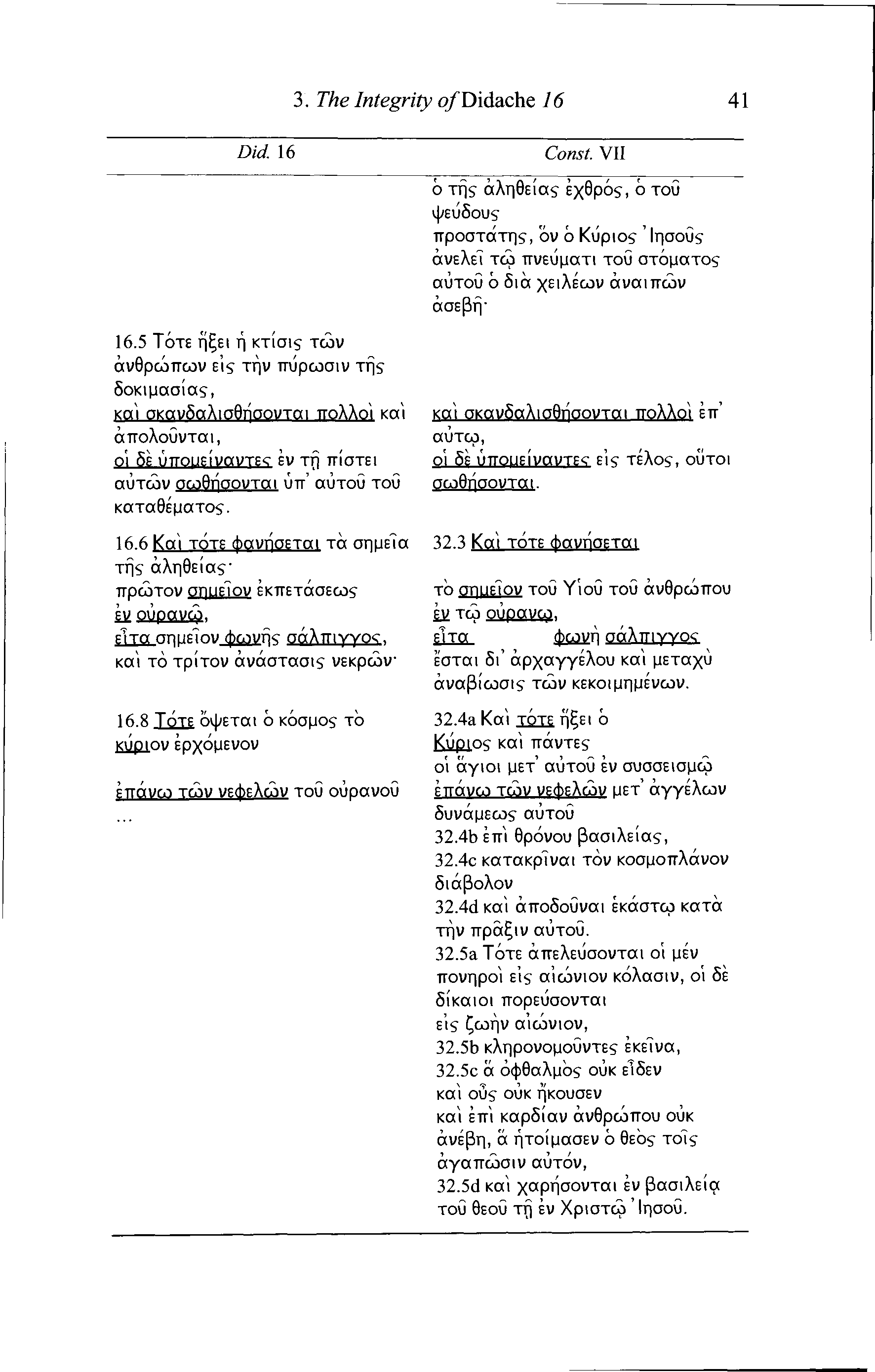
3. The Integrity o/Didache 16
Did. 16
Const. VII aXr|0Eias Ex6pos, b TOU ", bv b Kupios '
TCO TTVEUJjaTl TOU OTOjiaTOS auTou b 5ia XEIXEGOV avamcov 16.5 TOTE x\fy\ r| KTIOIS TGOV avSpcoTTcov eis TTJV irupcooiv Kai QKav5aXio8T]oovTai TTOXXOJ Kai airoXouVrai, KQI OKav5aXio8TioovTai TTOXXOI ETT'
TEXOS, OUTOI
auTco, oi 5E uTTOUsivairrs<: oco8noovTai.
Ol 5s UTTOU£ivaVT£^ EV Tfj TTlOTEl auTcov oco8T]ooi>Tai UTT' auxou TOU 16.6 Kai TOTE ftavrjosTai Ta ornJEia 32.3 Kai TOTE TO orjUElov TOU Yiou TOU av0pcoTTou hi TOO oupavcAp.
EKTTETaOECOS
TTpOOTOV EV oupavco.
EITQ ormElov (|)covfi<:
EITQ (|)covr| OQC ST apxayyEXou Ka\ TO TpiTov avaoTaais 16.8 TOTE ovpETai b Koapos TO Kupiov 32.4a Ken TOTE T]£EI b Kupio<: Kai TTOCVTES OI ayioi PET' auTou ETravco TCOV vsfosXcov MET' ayyEXcov
TCOV V£())EXCOV TOU OUpCXVoG
32.4b ETri P 32.4c KaTaKpivai TOV KOOMOTTXCXVOV StaPoXo 32.4dKai aTTo5ouvat EKCXOTCO TT)V TTpa^lV aUTOU.
32.5a TOTE aTrsXEuaovTai oi \iiv TTovripoi eis aicoviov KoXaoiv, oi 5E StKaioi TTopsuoovTai sis £cor]V aicoviov,
32.5b KXT]POVO|JOUVTES EKEIVO,
32.5c a 6c()8aXMbs OUK EISEV Kai ous OUK rJKouoEV Kai ETTI KapSiav av8pcoTTou OUK avipri, a r|To!paaEV b S I ayaTTcoaiv OUTOV, 32.5d Kai xapriaovTai EV p TOU 0EOU TT) EV XplOTCO ' lr|OOU.
The Gospel of Matthew's Dependence on the Didache A longer ending was also apparently recorded in the Georgian version of the Didache}1 This translation is from Aldridge (1999: 7):
Then the world will see our Lord Jesus Christ, the Son of Man who is [simultaneously] Son of God, coming on the clouds with power and great glory in His holy righteousness to repay every man according to his works before all mankind and before the angels. Amen.
Aldridge (1999: 8-10) draws attention to a third witness to a longer ending of the Didache which has been largely overlooked. This text is the De abrenuntiatione in baptismate ('Baptismal Renunciation', hereafter
Renunciation) of St Boniface. Aldridge (1999: 8-9) notes that this text is 'an eighth century catechetical sermon of St Boniface, reminding new conerts of their baptismal vows in connection with the approaching Advent season, and clearly based on the Didache}* Renunciation opens with the "way of death", summarises the Didache's middle chapters into a list of Christian duties, and continues [with a scene of final judgment and reward].'19
17. The Georgian version of the Didache, apparently written in the early nineteenth century, was found and copied by Simon Pheikrishvili in 1923. It has subsequently been lost and thus no verification of the text can take place. For this reason the value of the text as a witness to the content of the ending of the Didache should not be given any weight. However, the fact that the text appears to have had some continuation beyond Did. 16.8 may be taken as evidence, however insignificant, of a continuation of some kind in the original Didache.
18. Aldridge's claim that Renunciation is 'clearly based on the Didache' requires some expansion. The widespread nature of the Two Ways tradition means that it may not automatically be assumed that Boniface derived his 'way of death' from the original text of the Didache. However, there are a number of points of contact between Renunciation and the Didache. First, they are both explicitly presented as pre-baptismal catechesis. Second, they both preserve the negative form of the golden rule. Third, they both include reference to the return of Christ/the Lord and the resurrection of the dead. It is also striking that both Renunciation and Const, should combine this type of material with almost identical visions of the final judgment and reward - despite the lack of any other sign that Boniface had knowledge of Const. On balance, therefore,
Aldridge's claim should perhaps be modified to the claim that Renunciation is 'probably', rather than 'clearly', based on the Didache.
19. Aldridge (1999: 8 n. 20) notes the various editions of this text: 'Renunciation comes from a manuscript in the Abbey of St Hilary in Melk, Austria (where it is entitled Ammonitio sive praedictio sancti Bonifacii episcopi de abrenuntiatione in baptismate) and is given in Bernhard Pez' Thesaurus anecdotorum novissimus (1721—
29; vol. 4), Edmond Martene's Veterum scriptorum (1724-33), Martin Kropff'sBibliotheca Mellicensis (1747), and J.-P. Migne's PatrologiaLatina (1844-55; vol. 89, col.
87, Sermon 15).'
3. The Integrity o/Didache 16
The striking similarities between the ending of Boniface's Renunciation and Const, 's version of the end of the Didache is highly unlikely to be the product of Boniface's dependence on Const, since none of that work's extensive additions to the rest of the text of the Didache also appear in Boniface's sermon.
In conclusion, the belief that the Didache originally extended beyond 16.8a is supported by narratological study, by comparison with some New
Testament eschatological storylines, by evidence from the punctuation and layout of the Jerusalem manuscript, and by comparison of the Jerusalem manuscript with the versions of Did. 16 preserved in Const., the Georgian version and the Renunciation of Boniface. A detailed reconstruction of the content of this lost ending is offered in section 4, below.
3. The Redactional Status o/Didache 76.7
The attempted reconstruction of the closing lines of the Didache will be assisted if the history of Did. 16.7 may first be established.
Niederwimmer (1998: 225 n. 27) observes that 'Verse 7 is a gloss...
Verse 8 follows well after v.6.' Niederwimmer's point is entirely justified.
In the absence of Did. 16.7 the eschatological discourse exhibits a wellordered narrative structure. Did. 16.3-5 consists of three paragraphs. The first describes signs leading up to the arrival of the world-deceiver. The second (introduced by KOU TOTE) describes that arrival. The third (introduced by TOTE) describes the critical consequence of that arrival. Correspondingly 16.6 (introduced by KOU TOTE) depicts signs leading up to the arrival of the Lord, 16.8 (introduced by TOTE) depicts that arrival, and the lost ending may be expected to show some consequence of that arrival.
The presence of the explanatory aside at Did. 16.7 disrupts this build-up to the arrival of the Lord by focusing attention away from the signs that precede his coming and onto the identity of his companions.
If, as discussed above, it is likely that the original text of the Didache continued into a scene of judgment, then the superfluity of Did. 16.7 is further emphasized. The addition of 16.7 creates a situation where the only characters capable of appearing in the heavenly court are those who have already been judged holy enough to enjoy resurrection. Without the intervention of Did. 16.7, however, the flow of expected story events is entirely conventional. Thus, all the dead are raised at the coming of the Lord (as, for example, in Rev. 20.11-15 and Mt. 25.31-46); they are then judged by him and sent to their punishment or reward.
The possibility that the full version of Did. 16 would have made
The Gospel of Matthew's Dependence on the Didache narrative sense without the inclusion of 16.7 provides a clue as to why this verse may have been added in the extant shorter text. That is to say, once the scene of final judgment is lost from the manuscript a difficulty in the theology of the storyline appears. Without the insertion of 16.7 the shortened text could be taken as making no differentiation between the fate of the just and the unjust, since all, according to 16.6, are apparently resurrected without discrimination. Did. 16.7 introduces a means of creating an element of differentiation by stating that not all the dead will be raised, but only the holy ones.
If it may be concluded that the inclusion of Did. 16.7 makes best sense if the original ending of the Didache had already been lost, then this interpolation should be seen as separate from every other contribution to the Didache and unique to one particular manuscript tradition, of which the Jerusalem manuscript is a member.
4. A Reconstruction of the Lost Ending of the Didache Textual reconstructions generally offer few solid results in return for the considerable energies they consume. It is perhaps for this reason that few scholars have attempted to reconstruct the lost ending of the Didache™
This caution obscures the possibility, however, that there may be sufficient evidence to allow a more thorough investigation of this question than has thus far been considered.
As observed in section 2, above, there is good reason to suppose, from a narratological point of view, that the missing text contained some mention of a meeting between the world-deceiver and the Lord. In this section it was also noted that a narrative pattern in some contemporary apocalypses suggests that a scene of general judgment is likely to have followed the arrival of the Lord.
In addition to these general expectations there is also evidence, of a kind, for the ending of the Didache in Const. VII.32.1-5. It is certainly the case that Const, frequently adds to, and omits from, the text of the Didache, as well as introducing assimilations to the text of the New Testament. However, the fact that the text of Const, does, as independently expected, describe a meeting of the two protagonists and a scene of general judgment suggests that this version of the ending bears some relation to the 20. As noted above, Wengst attempts a short conclusion on the basis of Const.
Aldridge (1999) attempts to show that Const.'s conclusion is at least approximately correct.
3. The Integrity o/Didache 16
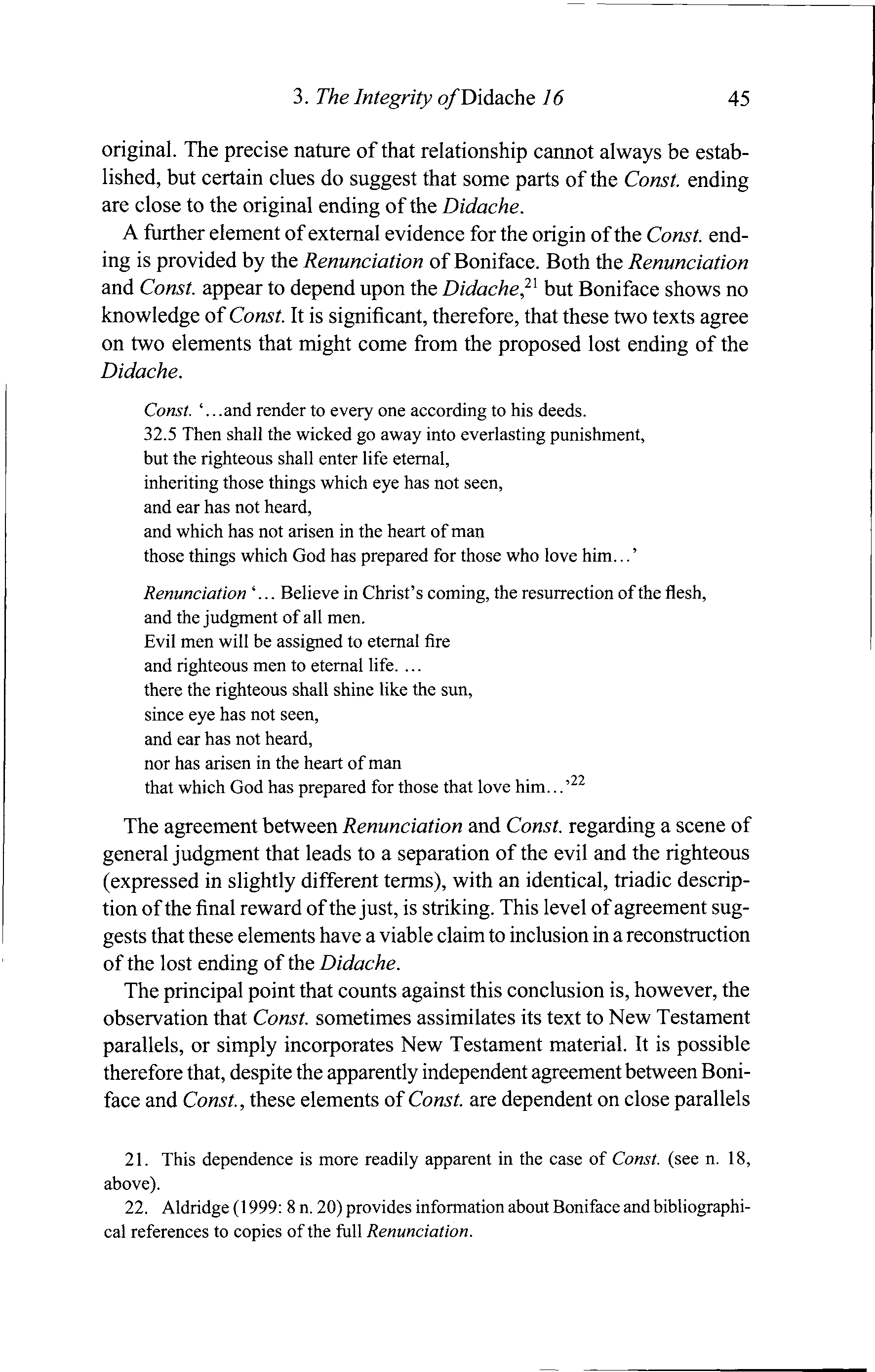
original. The precise nature of that relationship cannot always be established, but certain clues do suggest that some parts of the Const, ending are close to the original ending of the Didache.
A further element of external evidence for the origin of the Const, ending is provided by the Renunciation of Boniface. Both the Renunciation and Const, appear to depend upon the Didache?1 but Boniface shows no knowledge of Const. It is significant, therefore, that these two texts agree on two elements that might come from the proposed lost ending of the Didache.
Const. '.. .and render to every one according to his deeds.
32.5 Then shall the wicked go away into everlasting punishment, but the righteous shall enter life eternal, inheriting those things which eye has not seen, and ear has not heard, and which has not arisen in the heart of man those things which God has prepared for those who love him...'
Renunciation '... Believe in Christ's coming, the resurrection of the flesh, and the judgment of all men.
Evil men will be assigned to eternal fire and righteous men to eternal life. ... there the righteous shall shine like the sun, since eye has not seen, and ear has not heard, nor has arisen in the heart of man that which God has prepared for those that love him... '22
The agreement between Renunciation and Const, regarding a scene of general judgment that leads to a separation of the evil and the righteous
(expressed in slightly different terms), with an identical, triadic description of the final reward of the just, is striking. This level of agreement suggests that these elements have a viable claim to inclusion in a reconstruction of the lost ending of the Didache.
The principal point that counts against this conclusion is, however, the observation that Const, sometimes assimilates its text to New Testament parallels, or simply incorporates New Testament material. It is possible therefore that, despite the apparently independent agreement between Boniface and Const., these elements of Const, are dependent on close parallels
21. This dependence is more readily apparent in the case of Const, (see n. 18, above).
22. Aldridge (1999: 8 n. 20) provides information about Boniface and bibliographical references to copies of the full Renunciation.
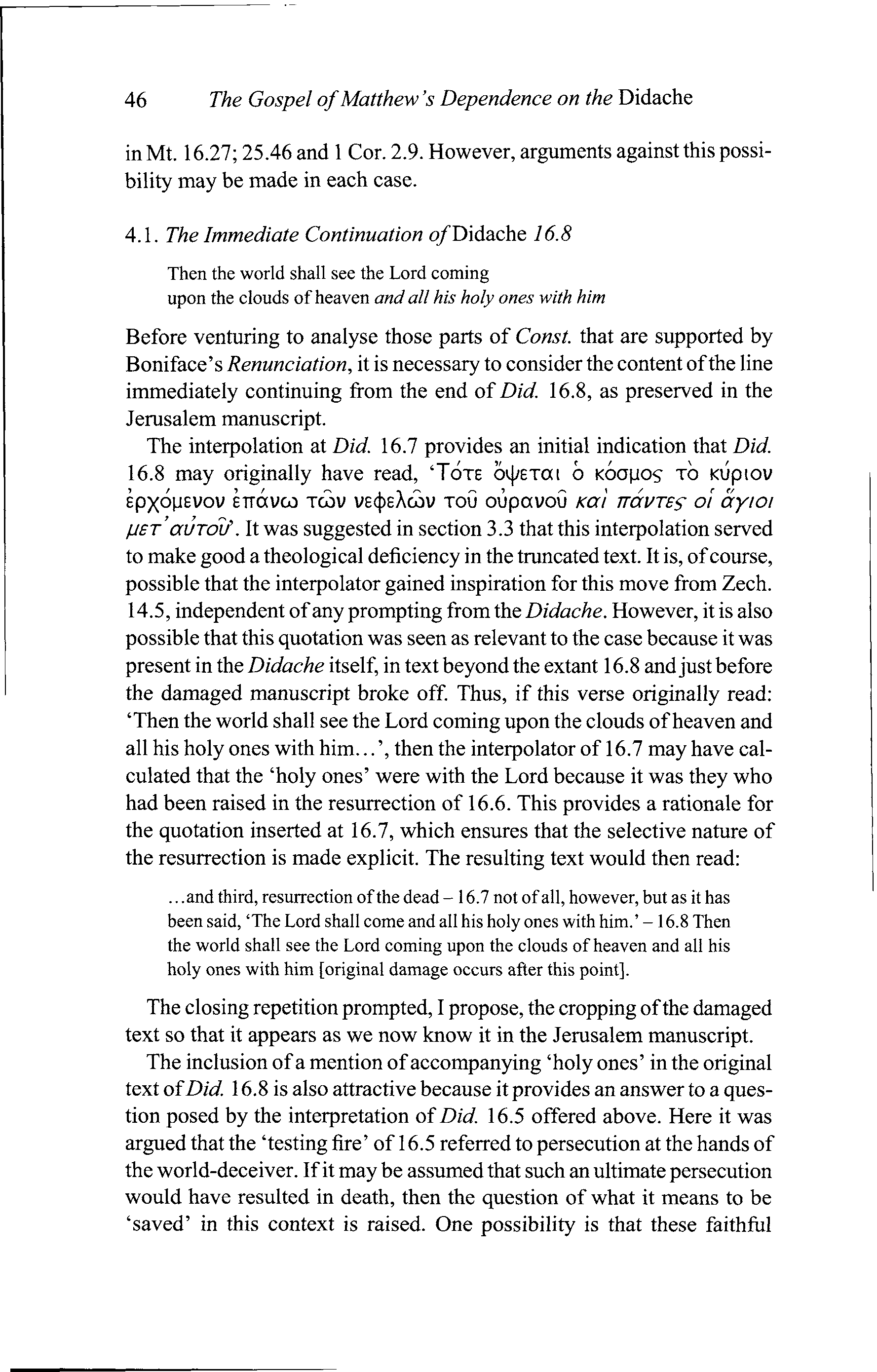
The Gospel of Matthew's Dependence on the Didache in Mt. 16.27; 25.46 and 1 Cor. 2.9. However, arguments against this possibility may be made in each case.
4.1. The Immediate Continuation o/Didache 16.8
Then the world shall see the Lord coming upon the clouds of heaven and all his holy ones with him
Before venturing to analyse those parts of Const, that are supported by Boniface's Renunciation, it is necessary to consider the content of the line immediately continuing from the end of Did. 16.8, as preserved in the Jerusalem manuscript.
The interpolation at Did. 16.7 provides an initial indication that Did.
16.8 may originally have read, 'Tore 6<|/ETOU O KOGMOS TO Kupiov EpxoMEWW eTTavco xeov VEC))EACOV TOU oupavou m\ navTE$ oi ayioi
/L/ST?aurou\ It was suggested in section 3.3 that this interpolation served to make good a theological deficiency in the truncated text. It is, of course, possible that the interpolator gained inspiration for this move from Zech.
14.5, independent of any prompting from the Didache. However, it is also possible that this quotation was seen as relevant to the case because it was present in the Didache itself, in text beyond the extant 16.8 and just before the damaged manuscript broke off. Thus, if this verse originally read:
'Then the world shall see the Lord coming upon the clouds of heaven and all his holy ones with him...', then the interpolator of 16.7 may have calculated that the 'holy ones' were with the Lord because it was they who had been raised in the resurrection of 16.6. This provides a rationale for the quotation inserted at 16.7, which ensures that the selective nature of the resurrection is made explicit. The resulting text would then read:
.. .and third, resurrection of the dead - 16.7 not of all, however, but as it has been said, 'The Lord shall come and all his holy ones with him.' - 16.8 Then the world shall see the Lord coming upon the clouds of heaven and all his holy ones with him [original damage occurs after this point].
The closing repetition prompted, I propose, the cropping of the damaged text so that it appears as we now know it in the Jerusalem manuscript.
The inclusion of a mention of accompanying 'holy ones' in the original text of Did. 16.8 is also attractive because it provides an answer to a question posed by the interpretation of Did. 16.5 offered above. Here it was argued that the 'testing fire' of 16.5 referred to persecution at the hands of the world-deceiver. If it may be assumed that such an ultimate persecution would have resulted in death, then the question of what it means to be
'saved' in this context is raised. One possibility is that these faithful
3. The Integrity o/Didache 16
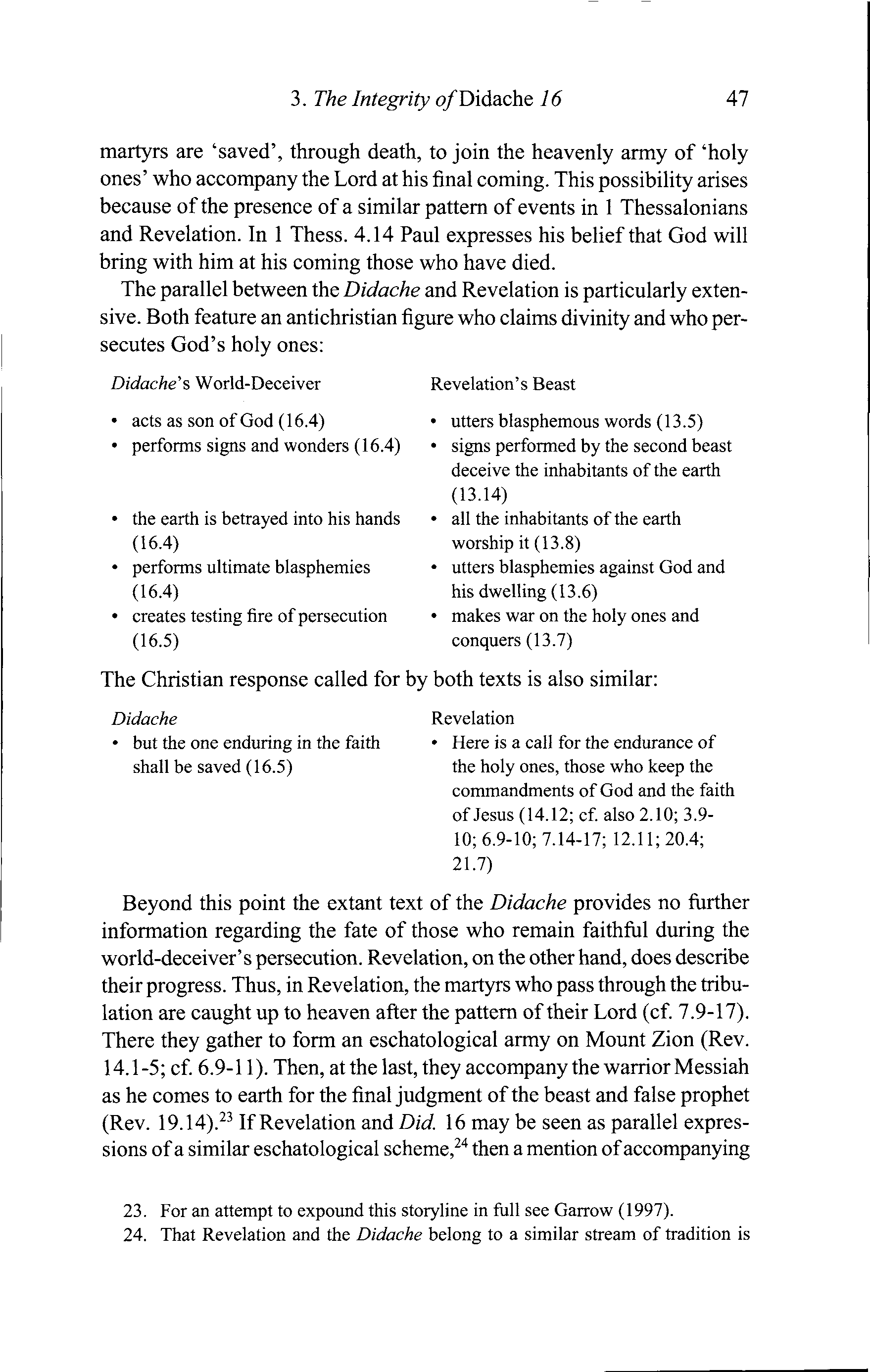
martyrs are 'saved', through death, to join the heavenly army of 'holy ones' who accompany the Lord at his final coming. This possibility arises because of the presence of a similar pattern of events in 1 Thessalonians and Revelation. In 1 Thess. 4.14 Paul expresses his belief that God will bring with him at his coming those who have died.
The parallel between the Didache and Revelation is particularly extensive. Both feature an antichristian figure who claims divinity and who persecutes God's holy ones:
Didache'?, World-Deceiver Revelation's Beast • acts as son of God (16.4) • utters blasphemous words (13.5) • performs signs and wonders (16.4) • signs performed by the second beast deceive the inhabitants of the earth (13.14) • the earth is betrayed into his hands • all the inhabitants of the earth (16.4) worship it (13.8) • performs ultimate blasphemies • utters blasphemies against God and (16.4) his dwelling (13.6) • creates testing fire of persecution • makes war on the holy ones and (16.5) conquers (13.7) The Christian response called for by both texts is also similar:
Didache Revelation • but the one enduring in the faith • Here is a call for the endurance of shall be saved (16.5) the holy ones, those who keep the commandments of God and the faith of Jesus (14.12; cf. also 2.10; 3.910; 6.9-10; 7.14-17; 12.11; 20.4; 21.7) Beyond this point the extant text of the Didache provides no further information regarding the fate of those who remain faithful during the world-deceiver's persecution. Revelation, on the other hand, does describe their progress. Thus, in Revelation, the martyrs who pass through the tribulation are caught up to heaven after the pattern of their Lord (cf. 7.9-17).
There they gather to form an eschatological army on Mount Zion (Rev.
14.1-5; cf. 6.9-11). Then, at the last, they accompany the warrior Messiah as he comes to earth for the final judgment of the beast and false prophet
(Rev. 19.14).23 If Revelation and Did. 16 may be seen as parallel expressions of a similar eschatological scheme,24 then a mention of accompanying
23. For an attempt to expound this storyline in full see Garrow (1997).
24. That Revelation and the Didache belong to a similar stream of tradition is
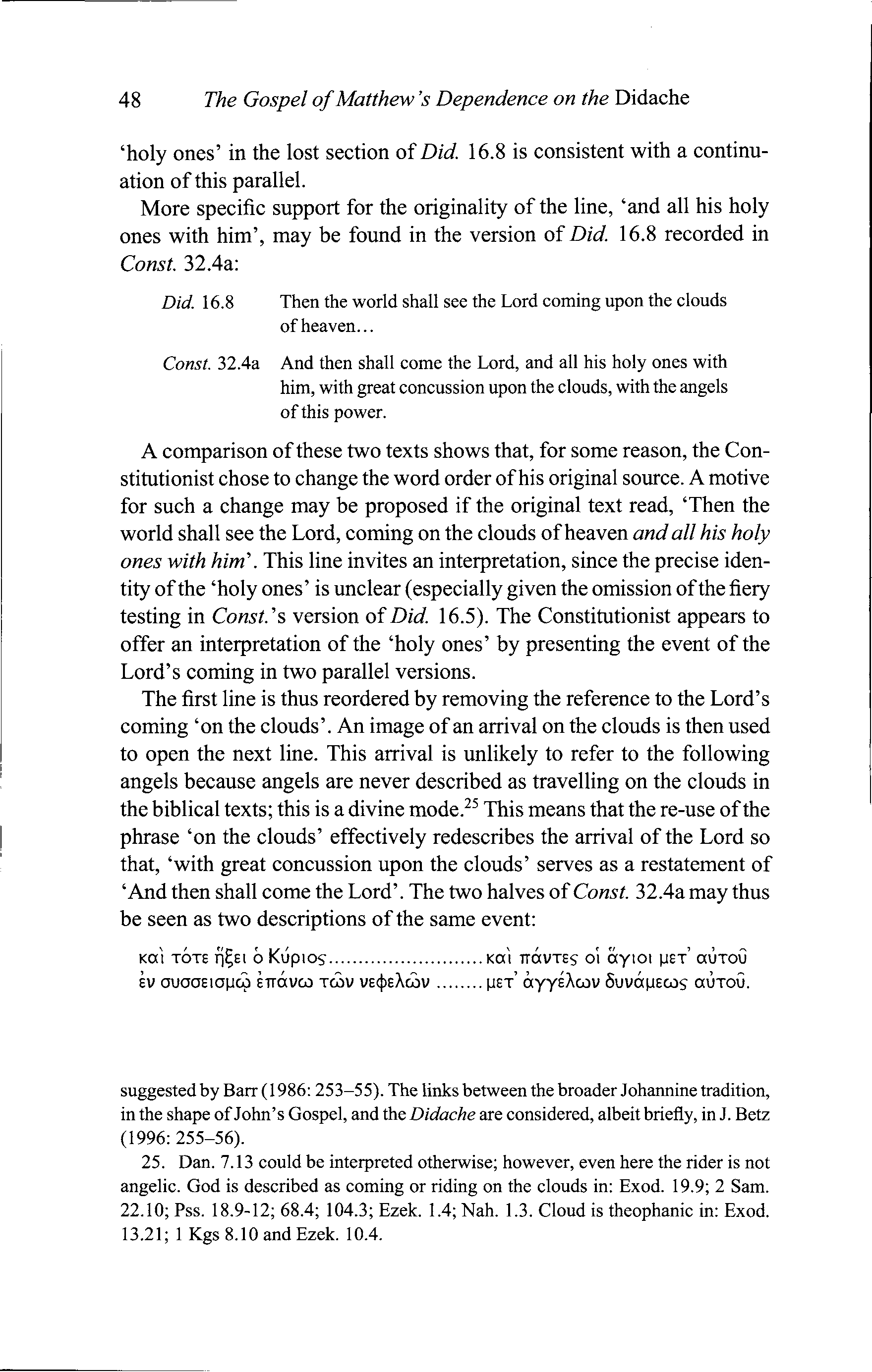
The Gospel of Matthew's Dependence on the Didache 'holy ones' in the lost section of Did. 16.8 is consistent with a continuation of this parallel.
More specific support for the originality of the line, 'and all his holy ones with him', may be found in the version of Did. 16.8 recorded in Const. 32.4a:
Did. 16.8
Then the world shall see the Lord coming upon the clouds of heaven...
Const. 32.4a And then shall come the Lord, and all his holy ones with him, with great concussion upon the clouds, with the angels of this power.
A comparison of these two texts shows that, for some reason, the Constitutionist chose to change the word order of his original source. A motive for such a change may be proposed if the original text read, 'Then the world shall see the Lord, coming on the clouds of heaven and all his holy ones with him\ This line invites an interpretation, since the precise identity of the 'holy ones' is unclear (especially given the omission of the fiery testing in Const.'s version of Did. 16.5). The Constitutionist appears to offer an interpretation of the 'holy ones' by presenting the event of the Lord's coming in two parallel versions.
The first line is thus reordered by removing the reference to the Lord's coming 'on the clouds'. An image of an arrival on the clouds is then used to open the next line. This arrival is unlikely to refer to the following angels because angels are never described as travelling on the clouds in the biblical texts; this is a divine mode.25 This means that the re-use of the phrase 'on the clouds' effectively redescribes the arrival of the Lord so that, 'with great concussion upon the clouds' serves as a restatement of 'And then shall come the Lord'. The two halves of Const. 32.4a may thus be seen as two descriptions of the same event:
KCXI TOTE fj^Ei b Kupios Ken TTCCVTES oi aytoi MET' CCUTOU EV auaaeiGMcc) ETTQVCO TCOV VEC|)EAGC>V MET' ayyEAcov SUVQJJECOS CCUTOU. suggested by Barr (1986: 253-55). The links between the broader Johannine tradition, in the shape of John's Gospel, and the Didache are considered, albeit briefly, in J. Betz
(1996: 255-56).
25. Dan. 7.13 could be interpreted otherwise; however, even here the rider is not angelic. God is described as coming or riding on the clouds in: Exod. 19.9; 2 Sam.
22.10; Pss. 18.9-12; 68.4; 104.3; Ezek. 1.4; Nah. 1.3. Cloud is theophanic in: Exod.
13.21; 1 Kgs 8.10 and Ezek. 10.4.
3. The Integrity o/Didache 16
If the same event is described in both lines, then the 'holy ones' who accompany the Lord in the first line are apparently interpreted, by the Constitutionist, as angels in the second.
The fact that Const, preserves a reference to 'holy ones' even though these figures are immediately interpreted as angels, suggests that a reference to 'holy ones' was present in its source. This is the case simply because it is unlikely that the Constitutionist would have introduced ambiguous characters such as 'holy ones' only to have to immediately clarify their identity.
The original status of 'and all his holy ones with him' is supported by one further detail. The phrase, 'coming upon the clouds of heaven' in Did
16.8 alludes to Dan. 7.13. It is surprising, therefore, that the one who is seen so coming is neither Daniel's 'one like a son of man', nor even the evangelist's 'Son of man', but rather, 'the Lord'. It is possible that the Didachist simply changed 'Son of man' to 'Lord' for some unknowable reason; however, another explanation is suggested if the original text contained a reference to accompanying 'holy ones'. In this circumstance Did
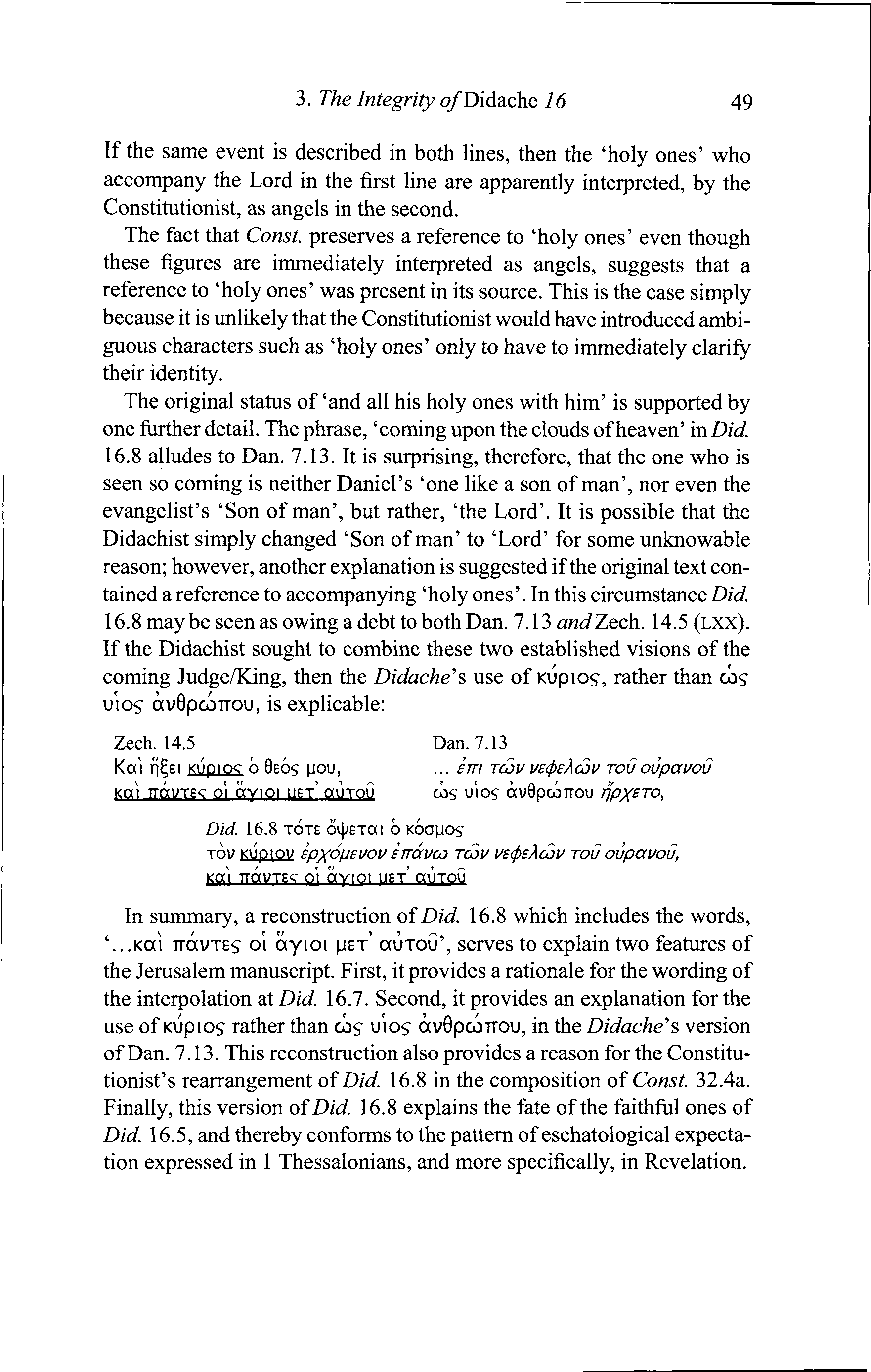
16.8 may be seen as owing a debt to both Dan. 7.13 andZech. 14.5 (LXX).
If the Didachist sought to combine these two established visions of the coming Judge/King, then the Didache's use of Kupios, rather than cos av0pcoTrou, is explicable:
Zech. 14.5
Dan. 7.13
Ken r\^B\ Kupicx b 0E6S pou, ... em TGJV vecpeXcov rodoupavou Kcri TTQVTSC oi gyicM LIST' CXUTOU cos ulos av0pcoTTOu Did.
16.8 TOTE OVpETCU O KOO|JOS
TOV Kupiov epxo/jsi/oi/ enavco TC3I/ vefeAcov rououpai/ou, Ken Train's^ oi ayioi MET' CXUTOG In summary, a reconstruction of Did. 16.8 which includes the words,
'...KOU TTOCVTES oi ayioi MET' OUJTOG', serves to explain two features of the Jerusalem manuscript. First, it provides a rationale for the wording of the interpolation at Did. 16.7. Second, it provides an explanation for the use of Kupios" rather than cos uios avSpcoTrou, in the Didache's version of Dan. 7.13. This reconstruction also provides a reason for the Constitutionist's rearrangement of Did. 16.8 in the composition of Const. 32.4a.
Finally, this version of Did. 16.8 explains the fate of the faithful ones of Did. 16.5, and thereby conforms to the pattern of eschatological expectation expressed in 1 Thessalonians, and more specifically, in Revelation.
The Gospel of Matthew's Dependence on the Didache 4.2. The Authenticity of 'Const. 32.5a Then shall go away the evil into eternal punishment but the righteous shall enter into life eternal
Having made an assessment of the likely continuation ofDid. 16.8 it is possible to return to the question of how much of Const. 32 derives directly from the original text of the Didache. It was noted above that although there is apparently independent agreement between Boniface and Const, with regard to the Didache's final lines, it is possible that these elements of the Const, are in fact assimilations to close parallels in Mt.
16.27; 25.46 and 1 Cor. 2.9. This section focuses on this issue with respect to the relationship between Const. 32.5a, Did. 16 and Mt. 25.46.
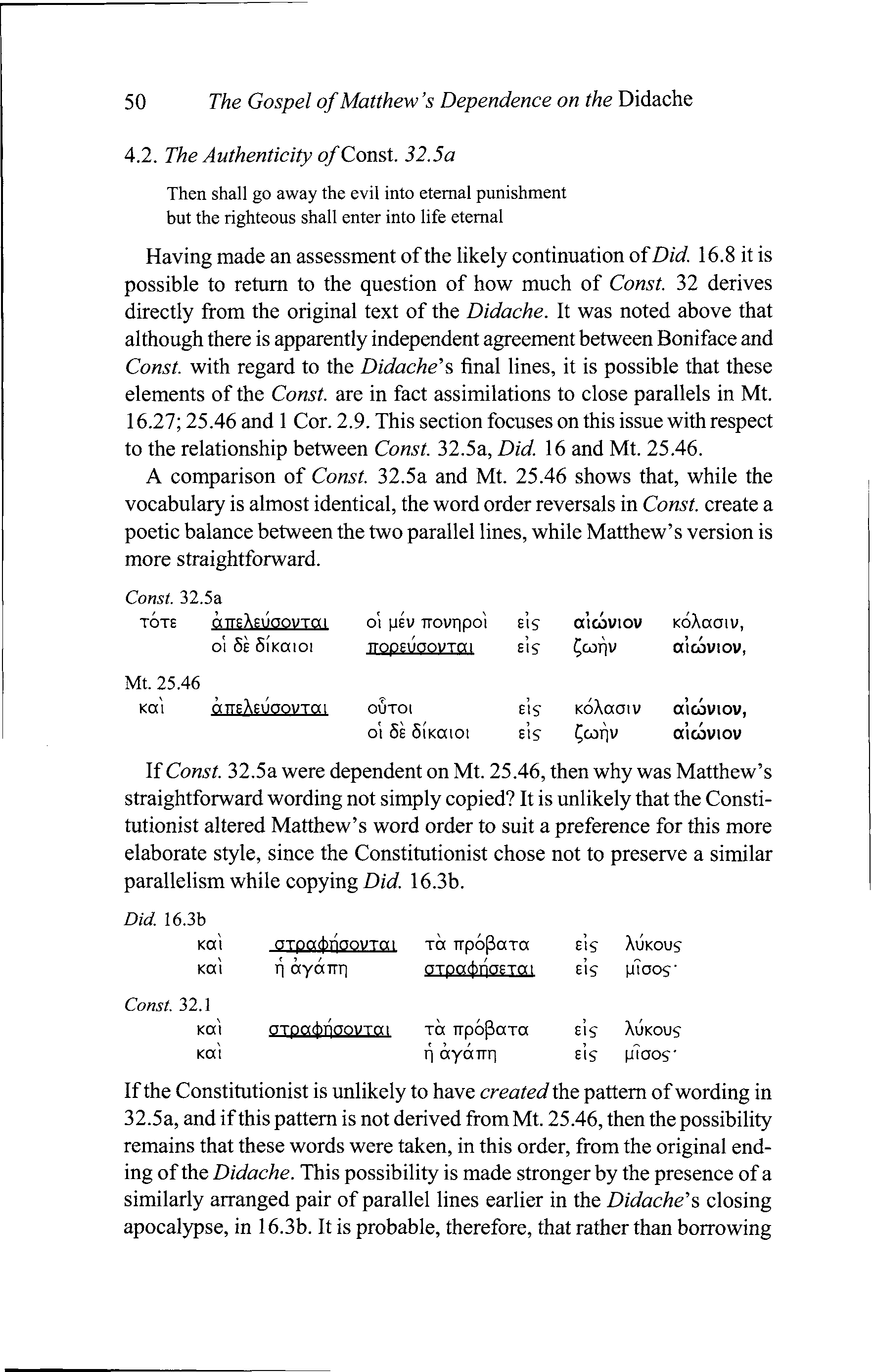
A comparison of Const. 32.5a and Mt. 25.46 shows that, while the vocabulary is almost identical, the word order reversals in Const, create a poetic balance between the two parallel lines, while Matthew's version is more straightforward.
Const. 32.5a TOTE aTrsAsuoovTat oi |JEV TTovripoi sis aicoviov KoAaaiv, oi 5E SIKQIOI TTopsuoovTai sis £cor|v aicoviov, Mt. 25.46
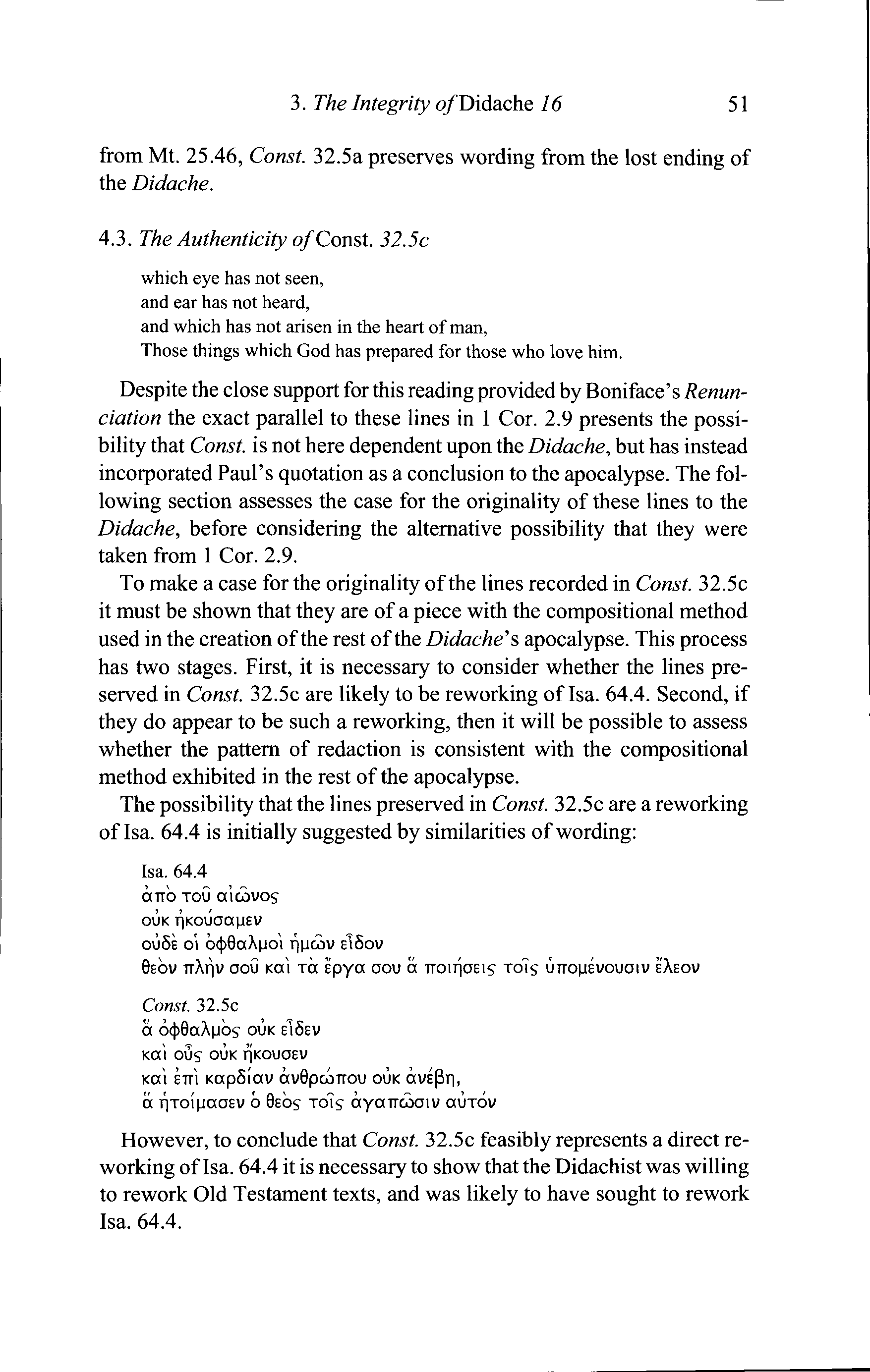
Kai aTTsAsuoovTai OUTOI sis KoAaaiv aicoviov, oi 5E SiKaioi sis Ccor)v aicoviov If Const. 32.5a were dependent on Mt. 25.46, then why was Matthew's straightforward wording not simply copied? It is unlikely that the Constitutionist altered Matthew's word order to suit a preference for this more elaborate style, since the Constitutionist chose not to preserve a similar parallelism while copying £>/<i. 16.3b.
Did 16.3b Kai Kai OTpa<|>T]aovTai TCX TTpo(3aTa OTpa^rjaETai AUKOUS ElS r| ayaTTr] |il OOS'
ElS Const. 32.1
Kai Kai OTpac|)r]aoi/Tai TCX Trpo(3aTa ElS eis AUKOUS lit aos' r| ayaTTTi If the Constitutionist is unlikely to have created the pattern of wording in 32.5a, and if this pattern is not derived from Mt. 25.46, then the possibility remains that these words were taken, in this order, from the original ending of the Didache. This possibility is made stronger by the presence of a similarly arranged pair of parallel lines earlier in the Didache's closing apocalypse, in 16.3b. It is probable, therefore, that rather than borrowing
3. The Integrity o/Didache 16
from Mt. 25.46, Const. 32.5a preserves wording from the lost ending of the Didache.
4.3. The Authenticity of 'Const. 32.5c which eye has not seen, and ear has not heard, and which has not arisen in the heart of man,
Those things which God has prepared for those who love him.
Despite the close support for this reading provided by Boniface's Renunciation the exact parallel to these lines in 1 Cor. 2.9 presents the possibility that Const, is not here dependent upon the Didache, but has instead incorporated Paul's quotation as a conclusion to the apocalypse. The following section assesses the case for the originality of these lines to the Didache, before considering the alternative possibility that they were taken from 1 Cor. 2.9.
To make a case for the originality of the lines recorded in Const. 32.5c it must be shown that they are of a piece with the compositional method used in the creation of the rest of the Didache's apocalypse. This process has two stages. First, it is necessary to consider whether the lines preserved in Const. 32.5c are likely to be reworking of Isa. 64.4. Second, if they do appear to be such a reworking, then it will be possible to assess whether the pattern of redaction is consistent with the compositional method exhibited in the rest of the apocalypse.
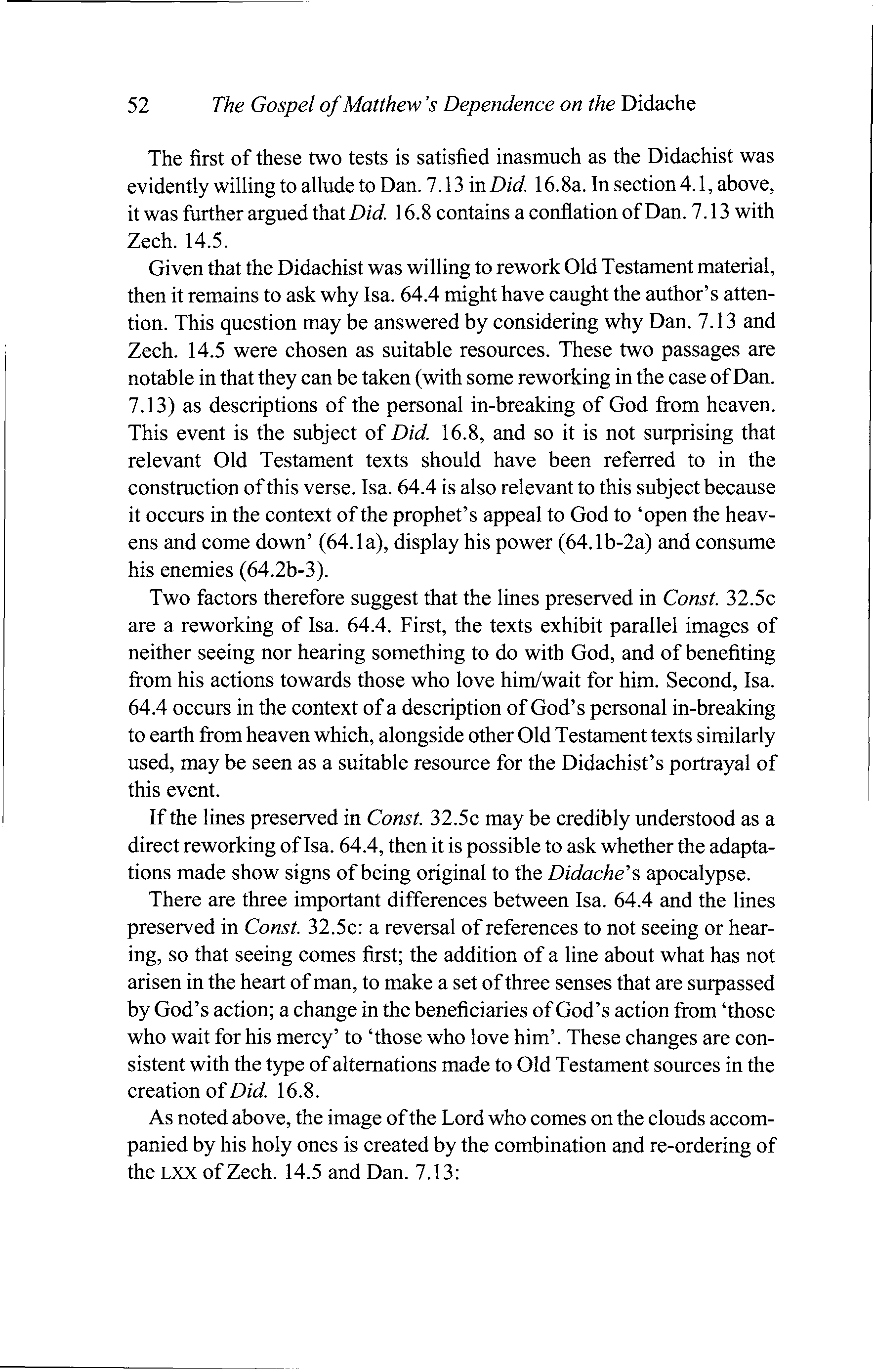
The possibility that the lines preserved in Const. 32.5c are a reworking of Isa. 64.4 is initially suggested by similarities of wording:
Isa. 64.4
OCTTO TOU aicovos OU5E OI b(|>0aA|Jovi r||jcov slSov 0ebv TrAr|v aou KCU TOC i'pya aou a TTOirjasis TOTS UTTOMEVOUOIV EAEOV
Const. 32.5c a 6(()0aA|jbs OUK E15EV
KCH OUS OUK TJKOUOEV
Kon ETH KapSiav avSpcoTTOU OUK av£(3r|, a r|Toi|jaaEV b 0EOS TOIS ayaTTGoaiv auxov
However, to conclude that Const. 32.5c feasibly represents a direct reworking of Isa. 64.4 it is necessary to show that the Didachist was willing to rework Old Testament texts, and was likely to have sought to rework
Isa. 64.4.
The Gospel of Matthew's Dependence on the Didache The first of these two tests is satisfied inasmuch as the Didachist was evidently willing to allude to Dan. 7.13 in Did. 16.8a. In section 4.1, above, it was further argued that Did. 16.8 contains a conflation of Dan. 7.13 with Zech. 14.5.
Given that the Didachist was willing to rework Old Testament material, then it remains to ask why Isa. 64.4 might have caught the author's attention. This question may be answered by considering why Dan. 7.13 and Zech. 14.5 were chosen as suitable resources. These two passages are notable in that they can be taken (with some reworking in the case of Dan.
7.13) as descriptions of the personal in-breaking of God from heaven.
This event is the subject of Did. 16.8, and so it is not surprising that relevant Old Testament texts should have been referred to in the construction of this verse. Isa. 64.4 is also relevant to this subject because it occurs in the context of the prophet's appeal to God to 'open the heavens and come down' (64.1a), display his power (64.1b-2a) and consume his enemies (64.2b-3).
Two factors therefore suggest that the lines preserved in Const. 32.5c are a reworking of Isa. 64.4. First, the texts exhibit parallel images of neither seeing nor hearing something to do with God, and of benefiting from his actions towards those who love him/wait for him. Second, Isa.
64.4 occurs in the context of a description of God's personal in-breaking to earth from heaven which, alongside other Old Testament texts similarly used, may be seen as a suitable resource for the Didachist's portrayal of this event.
If the lines preserved in Const. 32.5c may be credibly understood as a direct reworking of Isa. 64.4, then it is possible to ask whether the adaptations made show signs of being original to the Didache's apocalypse.
There are three important differences between Isa. 64.4 and the lines preserved in Const. 32.5c: a reversal of references to not seeing or hearing, so that seeing comes first; the addition of a line about what has not arisen in the heart of man, to make a set of three senses that are surpassed by God's action; a change in the beneficiaries of God's action from 'those who wait for his mercy' to 'those who love him'. These changes are consistent with the type of alternations made to Old Testament sources in the creation of Did. 16.8.
As noted above, the image of the Lord who comes on the clouds accompanied by his holy ones is created by the combination and re-ordering of the LXX of Zech. 14.5 and Dan. 7.13:
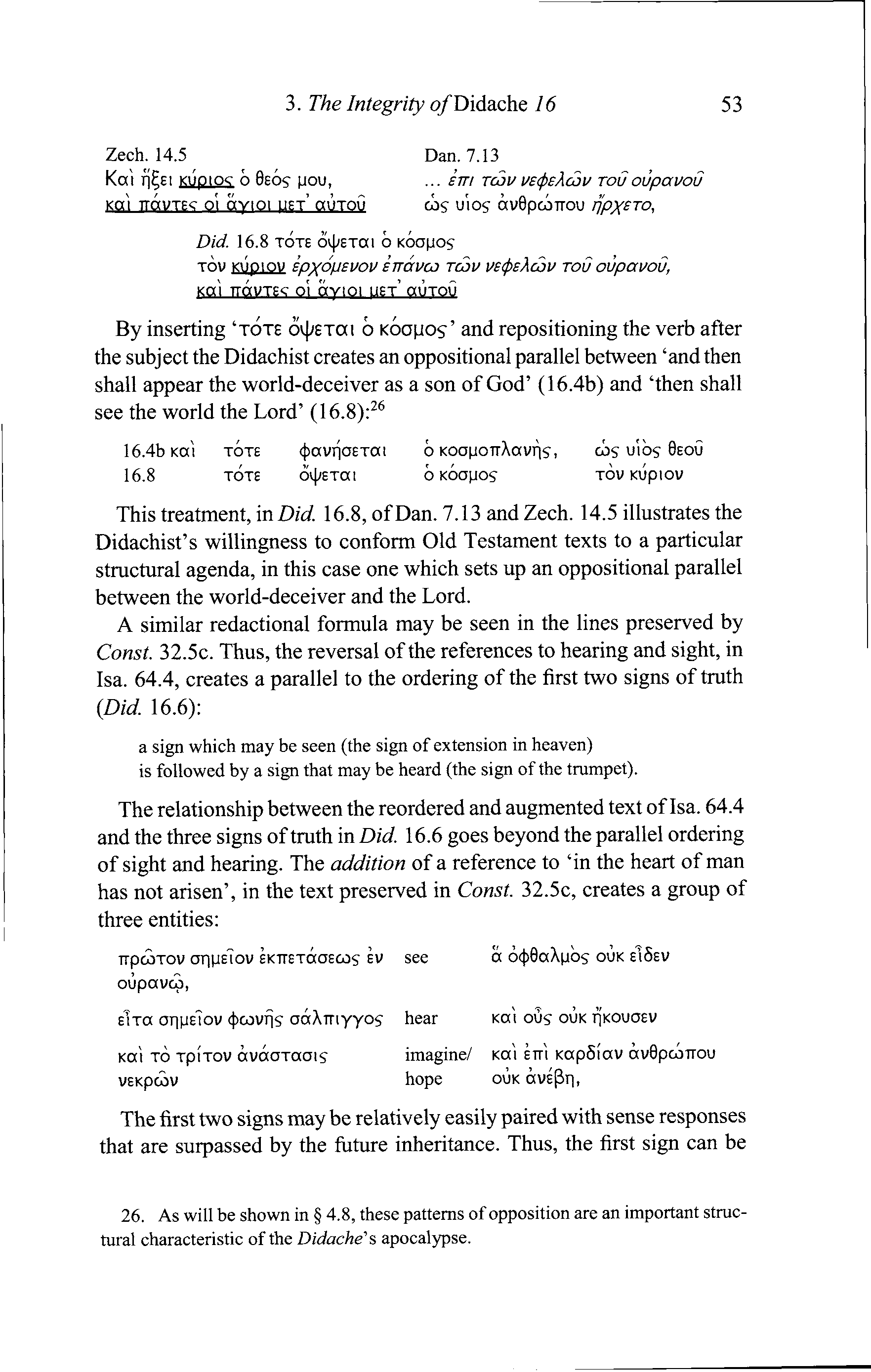
3. The Integrity o/Didache 16
Zech. 14.5
Dan. 7.13
Ken fj£ei Kupicx o 0E6S pou, ... em TCOI/ i/scpsAcoi/ rou ovpavou KOU TravTE<: oi aytoi UST' aurou cos uios avSpcoTTOu Did. 16.8 TOTE ovpETai o Koa|jos TOV Kupiov Epxojjevov indveo TCJV V£(peAc3v rou oupai/ou,
KCXI TTCXVT£<: oi ayioi \ABT auTou By inserting 'TOTE ovpeTai b KOGMOS' and repositioning the verb after the subject the Didachist creates an oppositional parallel between 'and then shall appear the world-deceiver as a son of God' (16.4b) and 'then shall see the world the Lord' (16.8):26
1 6 . 4 b KCU TOTE
((XXVTIGETCXI
6 KOO|JOTTAaVr|Sj
COS UIOS 0EOU
16.8
TOTE OV^ETai OKOGpOS TOV KUpiOV This treatment, in Did. 16.8, of Dan. 7.13 and Zech. 14.5 illustrates the Didachist's willingness to conform Old Testament texts to a particular structural agenda, in this case one which sets up an oppositional parallel between the world-deceiver and the Lord.
A similar redactional formula may be seen in the lines preserved by Const. 32.5c. Thus, the reversal of the references to hearing and sight, in Isa. 64.4, creates a parallel to the ordering of the first two signs of truth
(Did. 16.6): a sign which may be seen (the sign of extension in heaven) is followed by a sign that may be heard (the sign of the trumpet).
The relationship between the reordered and augmented text of Isa. 64.4 and the three signs of truth in Did. 16.6 goes beyond the parallel ordering of sight and hearing. The addition of a reference to 'in the heart of man has not arisen', in the text preserved in Const. 32.5c, creates a group of three entities: pOaAJJOS OUK ElOEV
TTpCOTOV OT||JEIOV EKTTETaOECOS EV
see a o< oupavcp, hear KCU EITCX OTIMETOV (t>cov% aaATTiyyos
OUS OUK rJKOUOEV
imagine/ Kai ETTl KCXpSlCXV CXvSpCOTTOU KCXI TO TptTov avaoTaais hope O\JK CXVEPTI, VEKpCOV The first two signs may be relatively easily paired with sense responses that are surpassed by the future inheritance. Thus, the first sign can be
26. As will be shown in § 4.8, these patterns of opposition are an important structural characteristic of the Didache's apocalypse.
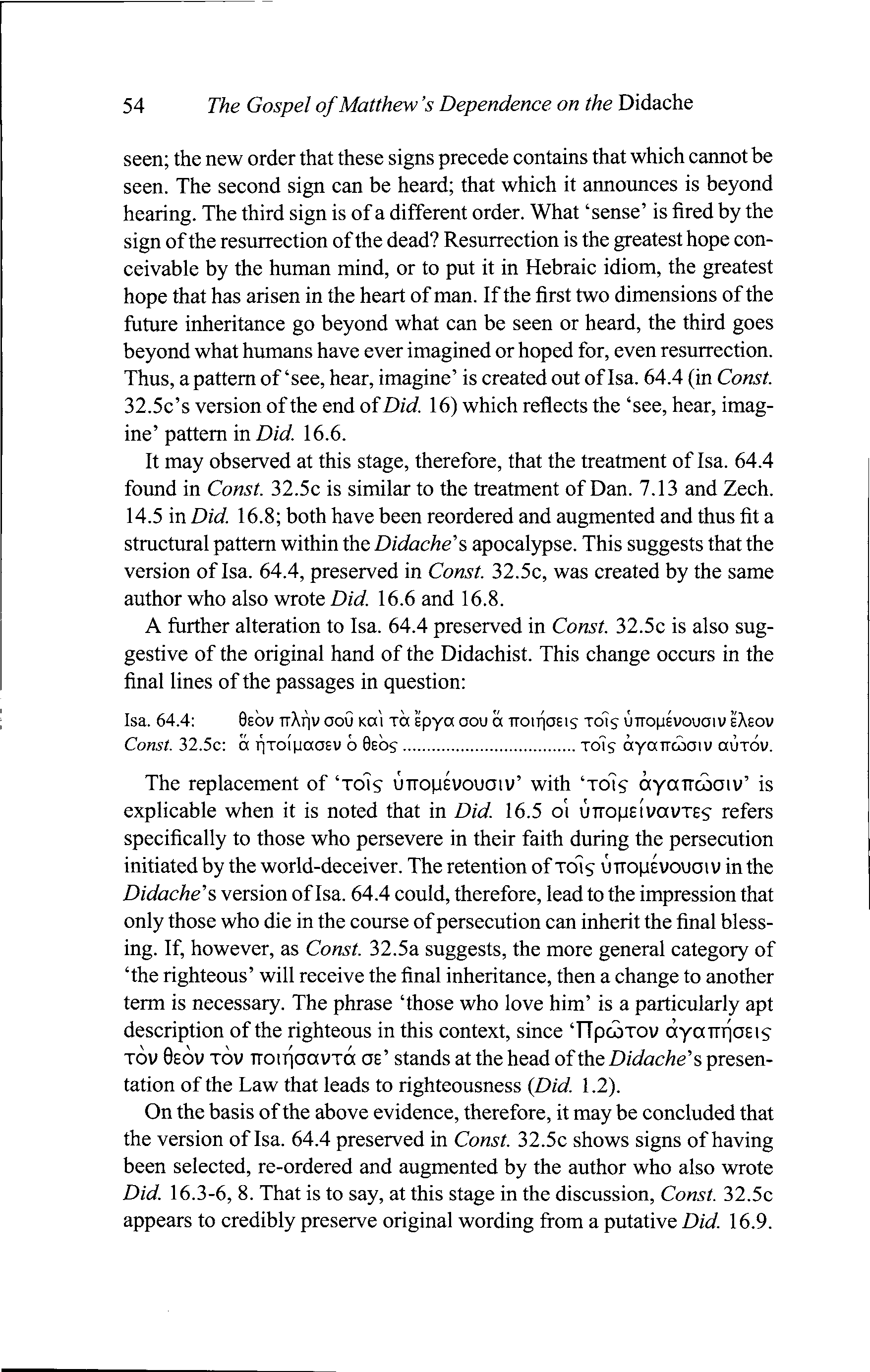
The Gospel of Matthew's Dependence on the Didache seen; the new order that these signs precede contains that which cannot be seen. The second sign can be heard; that which it announces is beyond hearing. The third sign is of a different order. What 'sense' is fired by the sign of the resurrection of the dead? Resurrection is the greatest hope conceivable by the human mind, or to put it in Hebraic idiom, the greatest hope that has arisen in the heart of man. If the first two dimensions of the future inheritance go beyond what can be seen or heard, the third goes beyond what humans have ever imagined or hoped for, even resurrection.
Thus, a pattern of'see, hear, imagine' is created out of Isa. 64.4 (in Const.
32.5c's version of the end ofDid. 16) which reflects the 'see, hear, imagine' pattern in Did. 16.6.
It may observed at this stage, therefore, that the treatment of Isa. 64.4 found in Const. 32.5c is similar to the treatment of Dan. 7.13 and Zech.
14.5 in Did. 16.8; both have been reordered and augmented and thus fit a structural pattern within the Didache's apocalypse. This suggests that the version of Isa. 64.4, preserved in Const. 32.5c, was created by the same author who also wrote Did. 16.6 and 16.8.
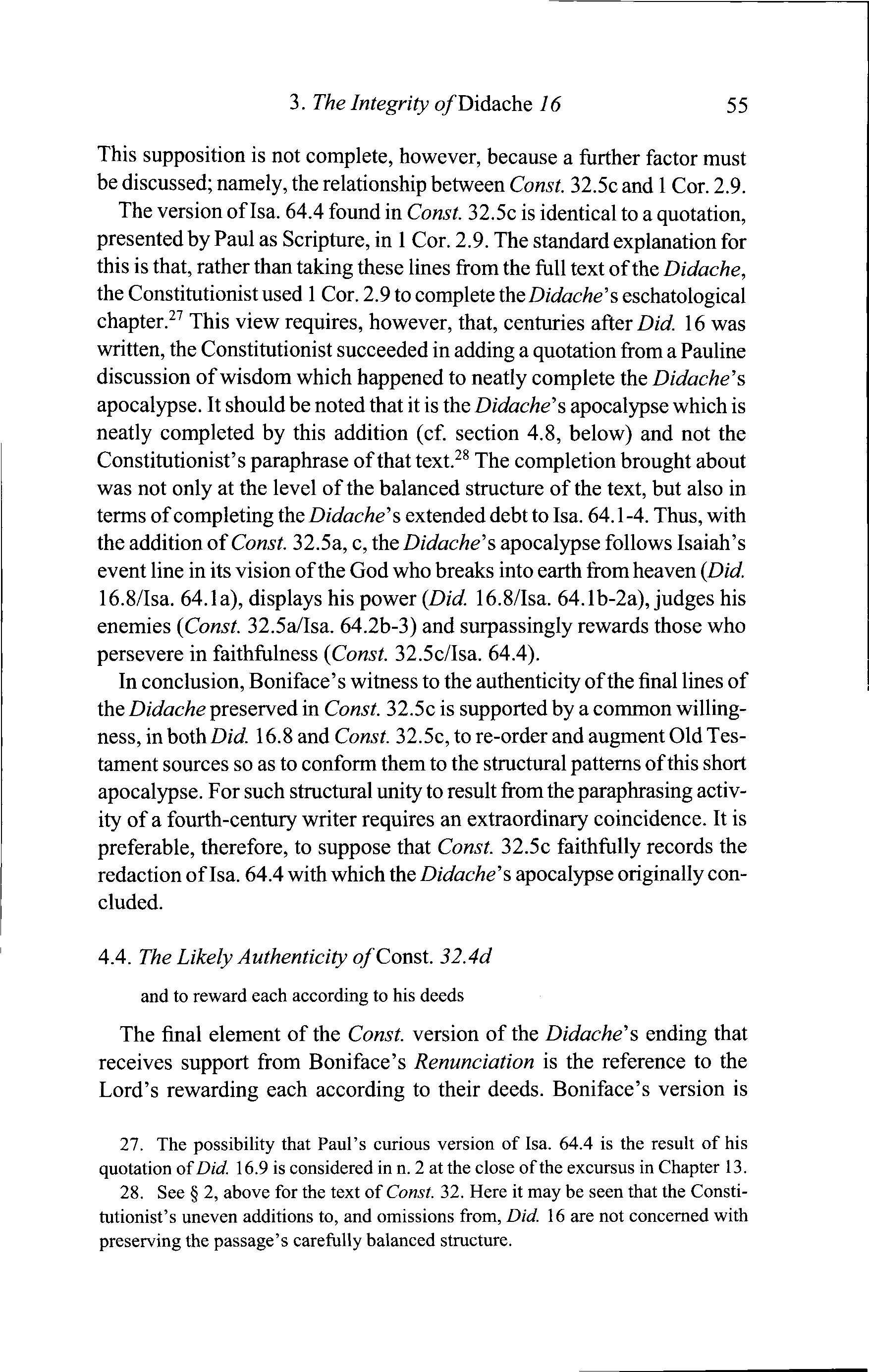
A further alteration to Isa. 64.4 preserved in Const. 32.5c is also suggestive of the original hand of the Didachist. This change occurs in the final lines of the passages in question:
Isa. 64.4:
0ebv TTArjv aou KCU TO epya oou a TToiqaeis TOIS UTTO|J6VOUGIV e'Aeov Const. 32.5c: a rixoipaaev b 0ebs xois ayaiTcoaiv auxov.
The replacement of 'TOIS UTTOJJEVOUOIV' with 'xois ayaTrcooiv' is explicable when it is noted that in Did. 16.5 oi UTTOMEivavxEs refers specifically to those who persevere in their faith during the persecution initiated by the world-deceiver. The retention of xois UTTOMEVOUOIV in the Didache9 s version of Isa. 64.4 could, therefore, lead to the impression that only those who die in the course of persecution can inherit the final blessing. If, however, as Const. 32.5a suggests, the more general category of 'the righteous' will receive the final inheritance, then a change to another term is necessary. The phrase 'those who love him' is a particularly apt description of the righteous in this context, since 'TTpcoxov ayaTTT]OEis xov 0E6V xov TTOirjaavxa OE' stands at the head of the Didache's presentation of the Law that leads to righteousness (Did. 1.2).
On the basis of the above evidence, therefore, it may be concluded that the version of Isa. 64.4 preserved in Const. 32.5c shows signs of having been selected, re-ordered and augmented by the author who also wrote
Did. 16.3-6, 8. That is to say, at this stage in the discussion, Const. 32.5c appears to credibly preserve original wording from a putative Did. 16.9.
3. The Integrity o/Didache 16
This supposition is not complete, however, because a further factor must be discussed; namely, the relationship between Const 32.5c and 1 Cor. 2.9.
The version of Isa. 64.4 found in Const. 32.5c is identical to a quotation, presented by Paul as Scripture, in 1 Cor. 2.9. The standard explanation for this is that, rather than taking these lines from the foil text of the Didache, the Constitutionist used 1 Cor. 2.9 to complete the Didache's eschatological chapter.27 This view requires, however, that, centuries after Did. 16 was written, the Constitutionist succeeded in adding a quotation from a Pauline discussion of wisdom which happened to neatly complete the Didache's apocalypse. It should be noted that it is the Didache's apocalypse which is neatly completed by this addition (cf. section 4.8, below) and not the Constitutionist's paraphrase of that text.28 The completion brought about was not only at the level of the balanced structure of the text, but also in terms of completing the Didache's extended debt to Isa. 64.1-4. Thus, with the addition of Const. 32.5a, c, the Didache's apocalypse follows Isaiah's event line in its vision of the God who breaks into earth from heaven (Did.
16.8/Isa. 64.1a), displays his power (Did. 16.8/Isa. 64.lb-2a), judges his enemies (Const. 32.5a/Isa. 64.2b-3) and surpassingly rewards those who persevere in faithfulness (Const. 32.5c/Isa. 64.4).
In conclusion, Boniface's witness to the authenticity of the final lines of the Didache preserved in Const. 32.5c is supported by a common willingness, in both Did. 16.8and Const. 32.5c, to re-order and augment Old Testament sources so as to conform them to the structural patterns of this short apocalypse. For such structural unity to result from the paraphrasing activity of a fourth-century writer requires an extraordinary coincidence. It is preferable, therefore, to suppose that Const. 32.5c faithfully records the redaction of Isa. 64.4 with which the Didache's apocalypse originally concluded.
4.4. The Likely Authenticity of Const. 32 Ad and to reward each according to his deeds
The final element of the Const, version of the Didache's ending that receives support from Boniface's Renunciation is the reference to the Lord's rewarding each according to their deeds. Boniface's version is
27. The possibility that Paul's curious version of Isa. 64.4 is the result of his quotation of Did. 16.9 is considered in n. 2 at the close of the excursus in Chapter 13.
28. See § 2, above for the text of Const. 32. Here it may be seen that the Constitutionist's uneven additions to, and omissions from, Did. 16 are not concerned with preserving the passage's carefully balanced structure.
The Gospel of Matthew's Dependence on the Didache limited to 'the judgment of all men' and so provides evidence for a line of this type, but not necessarily one exactly as preserved in Const. 32.4d.
Additional evidence for the likely authenticity of a line of this type may be found in Did. 16.2, which warns that the whole time of a person's faith will be of no profit unless they are 'perfected' in the final hour. This implies that the 'perfection' or otherwise with which they have kept the community's halakah will be assessed at some final test.
The structure of the extant part of the Didache apocalypse is also supportive of the existence of such a line inasmuch as the pattern of a dividing test, followed by two consequences of that division, is mirrored in the presentation of the world-deceiver's persecution of humanity:
Did. 16.5: The world-deceiver's test of humanity
DIVIDING TEST:
Then human creation shall pass into the fire of testing
CONSEQUENCE FOR THE EVIL:
and many will be caused to stumble and shall be lost
CONSEQUENCE FOR THE RIGHTEOUS:
but those who persevere in their faith shall be saved by the curse itself.
Const. 32Ac-5a/(Did 16.8-9?): The Lord's test of humanity
DIVIDING TEST:
to judge the world-deceiver and to reward each according to his deeds
CONSEQUENCE FOR THE EVIL:
Then shall go away the evil into eternal punishment
CONSEQUENCE FOR THE RIGHTEOUS:
but the righteous shall enter into life eternal.
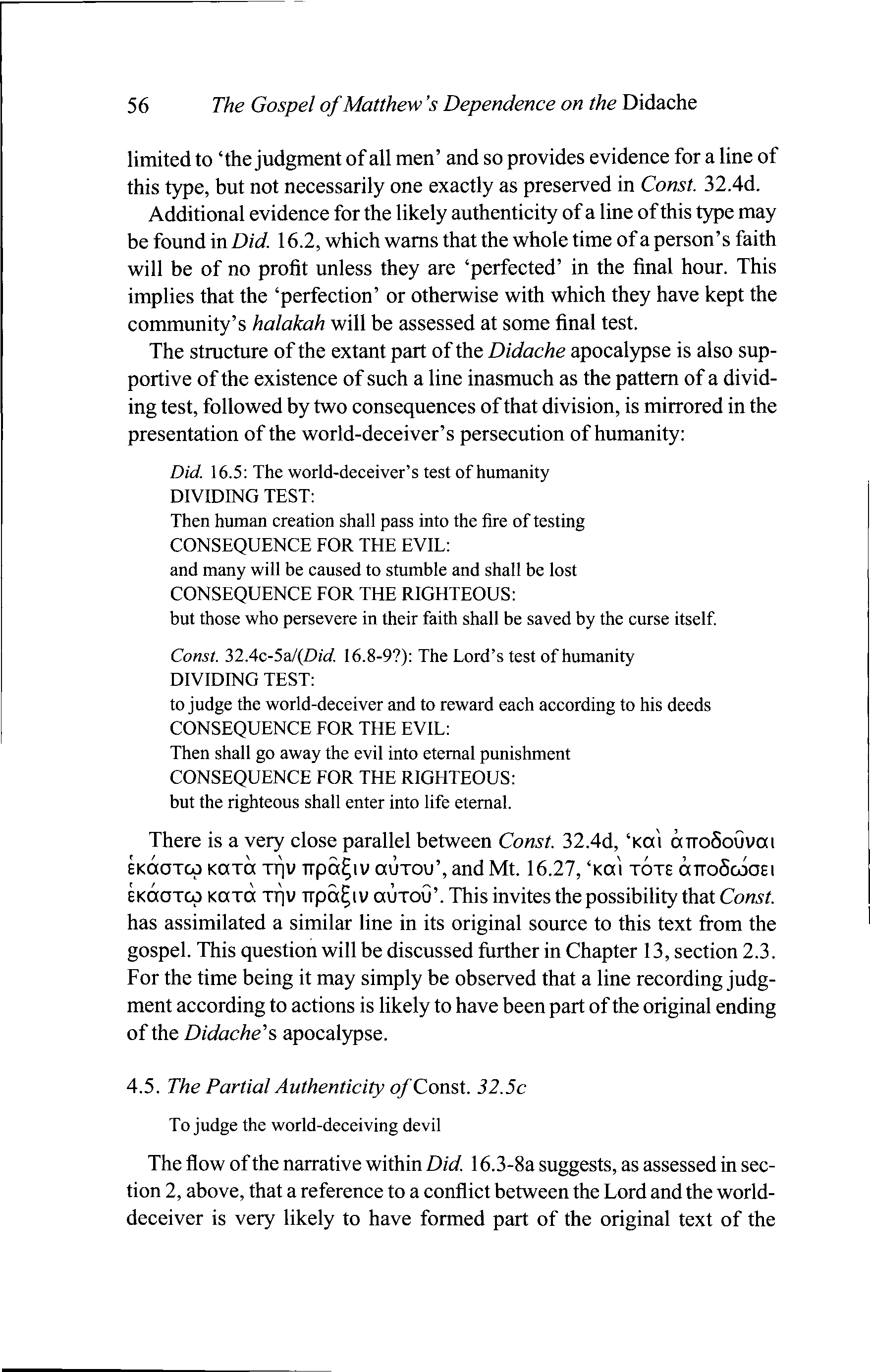
There is a very close parallel between Const. 32.4d, 'Ken aTTo5ouvai EKaoTco Kara xr)V irpa^iv COJTOU', andMt. 16.27, 'KCU TOTS CKTTOSCOOEI
EKaoxcp Kara xr)V TTpa^iv auToG'. This invites the possibility that Const. has assimilated a similar line in its original source to this text from the gospel. This question will be discussed further in Chapter 13, section 2.3.
For the time being it may simply be observed that a line recording judgment according to actions is likely to have been part of the original ending of the Didache''s apocalypse.
4.5. The Partial Authenticity of Const 32.5c To judge the world-deceiving devil The flow of the narrative within Did. 16.3-8a suggests, as assessed in section 2, above, that a reference to a conflict between the Lord and the worlddeceiver is very likely to have formed part of the original text of the
3. The Integrity o/Didache 16
Didache. However, given that this character is portrayed as a human persecutor in Did. 16.4-5, it may be supposed that the original ending described the judgment of the world-deceiver (cf. 16.4b) and not of the world-deceiving devil.
The extreme rarity of the term KOGMOTTACXVTIS, which occurs only here in the New Testament and early Christian literature, means that assimilation to another text is not a likely explanation for the presence of this line in the text of the Const.
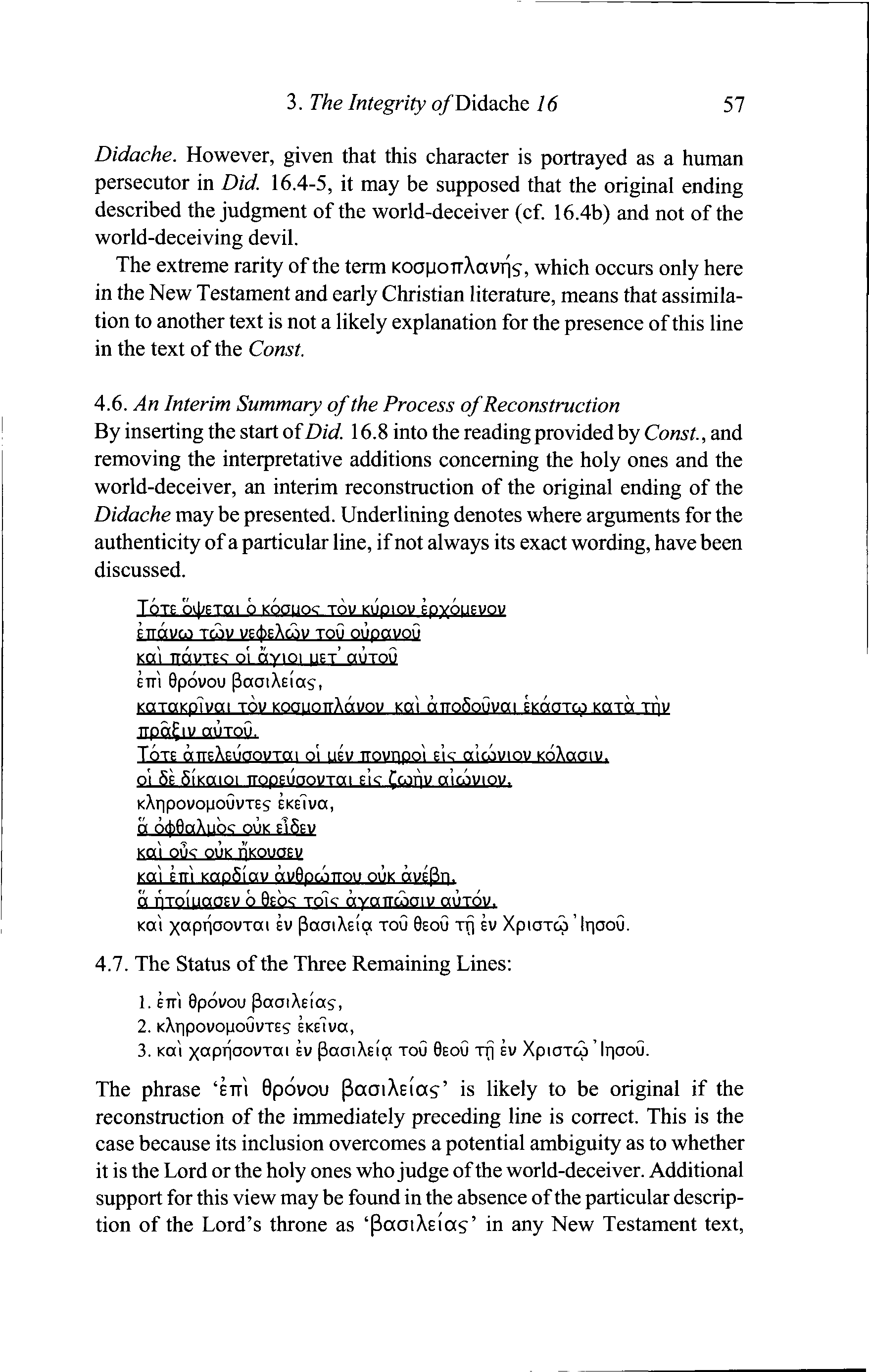
4.6. An Interim Summary of the Process of Reconstruction By inserting the start of Did. 16.8 into the reading provided by Const., and removing the interpretative additions concerning the holy ones and the world-deceiver, an interim reconstruction of the original ending of the Didache may be presented. Underlining denotes where arguments for the authenticity of a particular line, if not always its exact wording, have been discussed.
TOTE ovpsTai o KOOUOC TOV Kupiov spyojjsvov STTOCVCO TG3V vscbsAGav TOU oupavou xa\ TTQVTS^ oi gyiCM MET' QUTOG ETTI Bpovou PaoiXeias, TOV KOOiiOTrAavov KOH aTTo5oGvai smoTc^ Kara TT\V auTou. p ^ TOTE ocTrsAsuoovTai oi UEV Trovripoi si<: alcoviov KoAaoiv. oi 5s SiKcaoi TropsuoovTca E'K ^cor|v aicoviov.
EKETVCX, a 6([)6aApb<: OUK EISEV Koa ou<: OUK rJKOUQEV Kai ETTI KapSiav avBpcoTToiJ OUK ix a T|Toi}jao£v o Ka\ xcxprjaovxai EV (JaaiAeia TOU 8EOG TT\ EV Xpiaxcp '
4.7. The Status of the Three Remaining Lines:
1. km 0p6vou 2. KAripovoia , 3. KCU xapnoovTai EV PaaiAsia TOG 0EOG TT] EV Xpiaxcp IriooG.
The phrase 'eTTi Spovou PaaiXeias' is likely to be original if the reconstruction of the immediately preceding line is correct. This is the case because its inclusion overcomes a potential ambiguity as to whether it is the Lord or the holy ones who judge of the world-deceiver. Additional support for this view may be found in the absence of the particular description of the Lord's throne as '^aoiAeiocs' in any New Testament text,
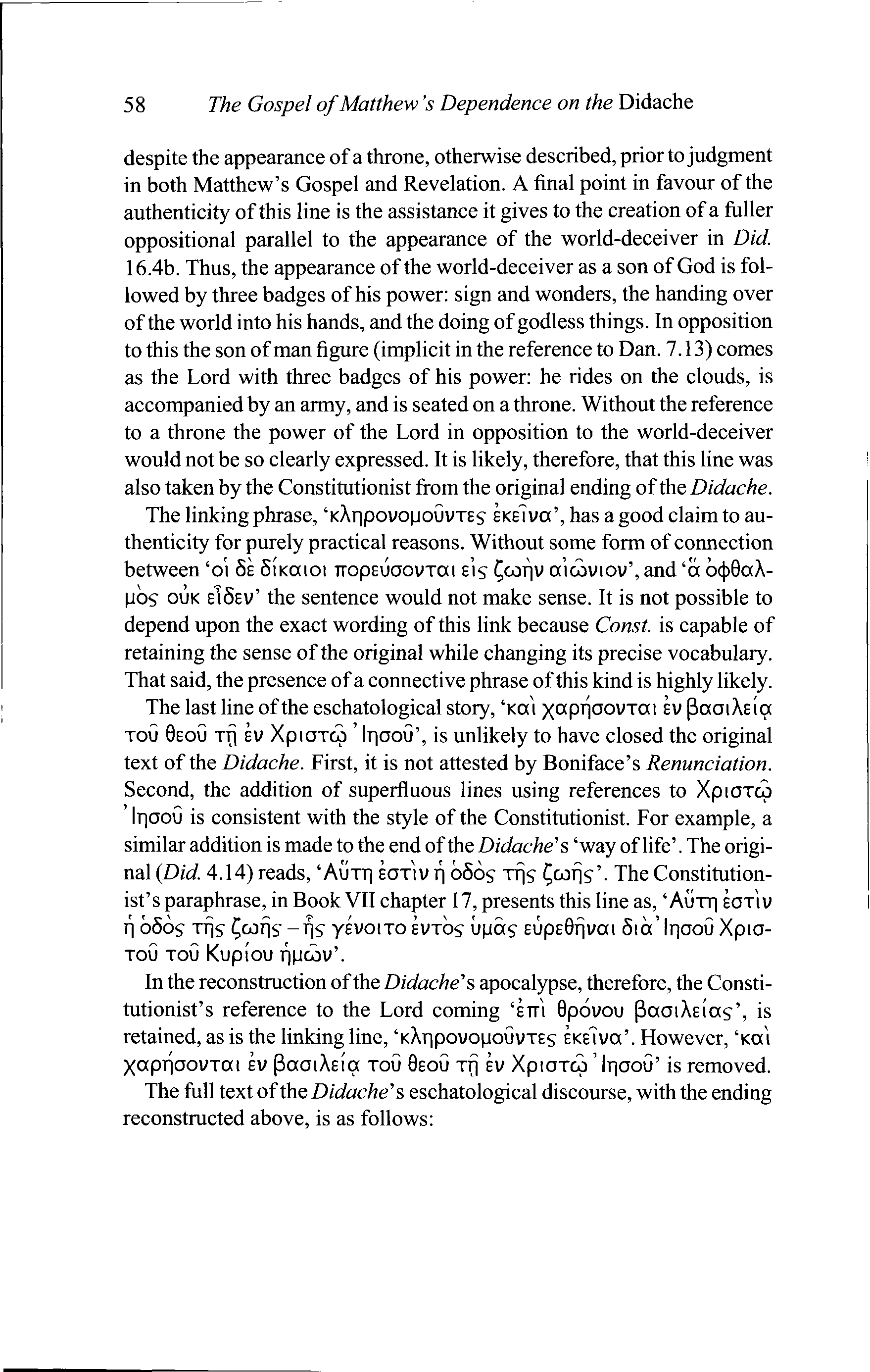
The Gospel of Matthew's Dependence on the Didache despite the appearance of a throne, otherwise described, prior to judgment in both Matthew's Gospel and Revelation. A final point in favour of the authenticity of this line is the assistance it gives to the creation of a fuller oppositional parallel to the appearance of the world-deceiver in Did.
16.4b. Thus, the appearance of the world-deceiver as a son of God is followed by three badges of his power: sign and wonders, the handing over of the world into his hands, and the doing of godless things. In opposition to this the son of man figure (implicit in the reference to Dan. 7.13) comes as the Lord with three badges of his power: he rides on the clouds, is accompanied by an army, and is seated on a throne. Without the reference to a throne the power of the Lord in opposition to the world-deceiver would not be so clearly expressed. It is likely, therefore, that this line was also taken by the Constitutionist from the original ending of the Didache.
The linking phrase, 4KAr)povo|joGvTES' EKEI va', has a good claim to authenticity for purely practical reasons. Without some form of connection between 'oi 5E SIKCUOI TTOPEUGOVTCU sis £cor|V aicoviov', and 'a b(j)0aA- [ibs O\JK EISEV' the sentence would not make sense. It is not possible to depend upon the exact wording of this link because Const, is capable of retaining the sense of the original while changing its precise vocabulary.
That said, the presence of a connective phrase of this kind is highly likely.
The last line of the eschatological story, 'KOU xapr)GOVTC(i EV PaaiXsia TOU 0EOG xfi EV XpiGTco ' IriooG', is unlikely to have closed the original text of the Didache. First, it is not attested by Boniface's Renunciation.
Second, the addition of superfluous lines using references to Xpiorcp ' ITIGOG is consistent with the style of the Constitutionist. For example, a similar addition is made to the end of the Didache's 'way of life'. The original {Did. 4.14) reads,'Auxr| EGTIV r| b5os xfjs £co%\ The Constitutionist's paraphrase, in Book VII chapter 17, presents this line as,' AUTTI EGTIV r| bSos TT\S £cofjs-rjs YEVOITOEVTOS upas Eup£0fjvai 5ia'lr]GoGXpiGxoG xoG Kupiou r)jjcov'.
In the reconstruction of'the Didache's apocalypse, therefore, the Constitutionist's reference to the Lord coming 'km Bpovou (3aGiAEiocs\ is retained, as is the linking line, 'KAr|povo|joGvT£s EKETVCX'. However, 'KCU
XaprJGOVTCci EV (3aGtAEig xoG 0EOG xf] EV XpiGTco' ITIGOG' is removed.
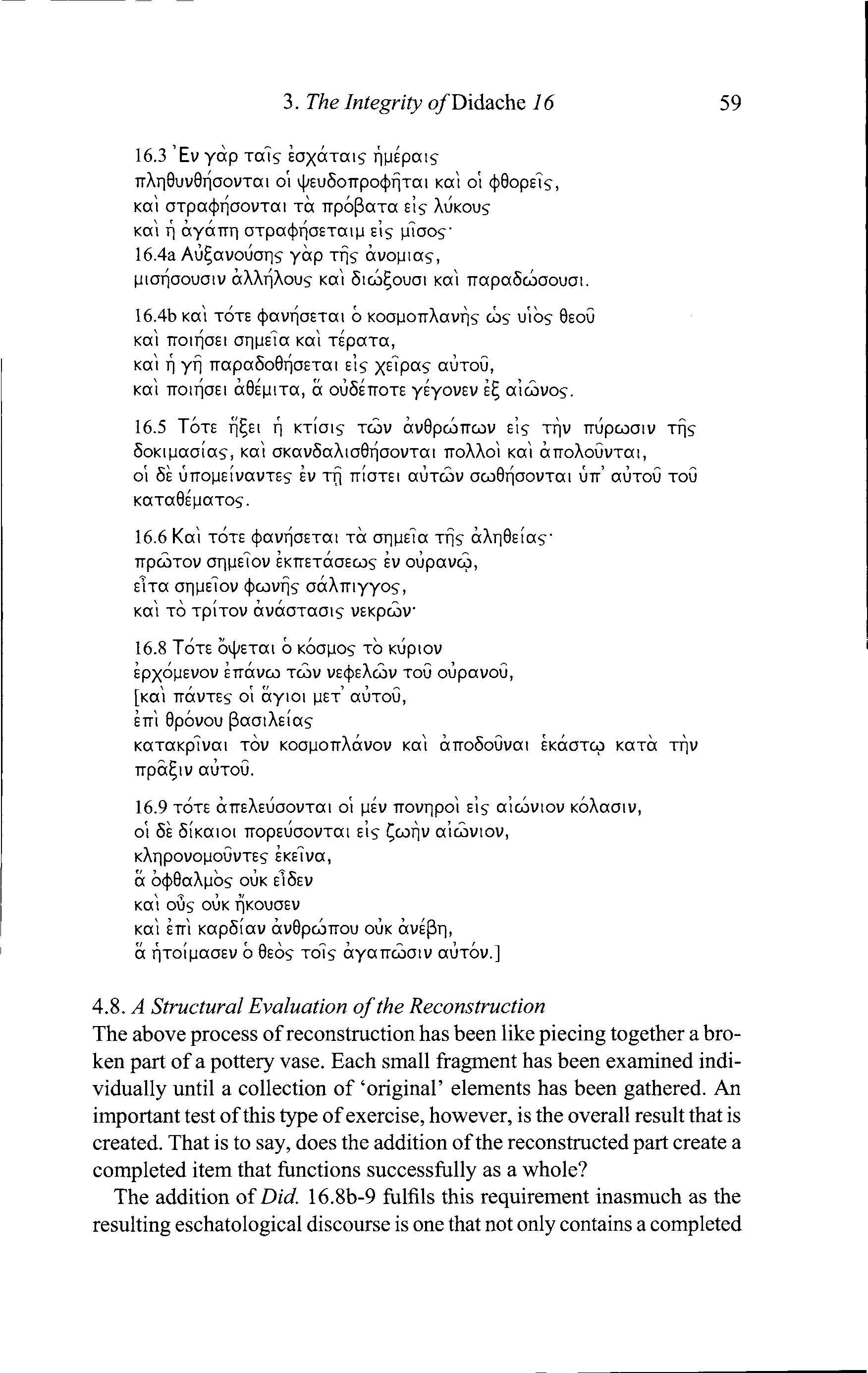
The full text of the Didache's eschatological discourse, with the ending reconstructed above, is as follows:
3. The Integrity o/Didache 16
16.3 Ev yap Tens eaxaxais r||jepais* TTAr|0uv0riaovTai oi vpEuSoTTpo^fiTai mi oi <))0op6Ts, mi orpa<|>rjaovTai r a TTpb(3aTa els AUKOUS mi rj ayaur) OTpa^osTaijj sis |ii°°S'
16.4a Au£avouor|s yap T % avopias, \i\or\oovo\v aAArjAous mi 5ico£ouai mi TTapaScoaouai.
16.4b Kai TOTE (J)avTioETai o KooiJOTTAavris cos uibs 9eou Kai Troirjaei arujela Kai TEpaTa, Ka'i r| yfj TTapa5o8r]aETai eis XE^PaS OCUTOU,
Ka'i TToirjoEi aSeniTa, a OUSETTOTE ysyovsv E^ aicovos.
16.5 TOTE T]£EI r\ KTIOIS
TCOV av9pcoTTcov EIS Tr|v TTupcoaiv T % 5oKi|jaaias, Kai OKavSaAiaBrjaovTai TTOAAOI Kai aTToAouvTai, oi 5E uTTO|jEivavTEs EV TT] TTIOTEI auTcov ocoOrjoovTai UTT' aiiTou TOU
16.6 Kai TOTE (|)avTiaETai TOC armsTa TTIS aAr)0Eias* TTpcoTov ariMETov EKTrETaascos EV oupavco,
EITO or|M£^ov c()covf]s oaAiTiyyos, Kai TO TpiTov a v a o T a o i s VEKpcov 16.8 TOTE ovpETai 6 KOOIJOS TO Kupiov EpXOM^vov ETTavco TCOV VEC))EACOV TOG oupavoG,
[Kai TravTEs oi ayioi )JET' OUTOG, ETTI 0p6vou paoiAsias TOV KoaiJOTTAavov Ka'i aTToSoGvai EKaoTco KaTa Trjv auToG.
16.9 TOTE aTTEAsuoovTai oi IJEV TTOvripoi sis aicoiuov KoAaaiv, oi 5E SiKaioi TTopsuaovTai sis Ccollv aicoviov,
KATIPOVOMOGVTES EKsTva,
a oc()0aA|jbs OUK EISEV
Ka\ OUS OUK rJKOUOEV
Kai ETri KapSiav av0pcoTrou OUK avsPri, a riToipaoEV b 0EOS TOIS ayaTTcoaiv auTov.]
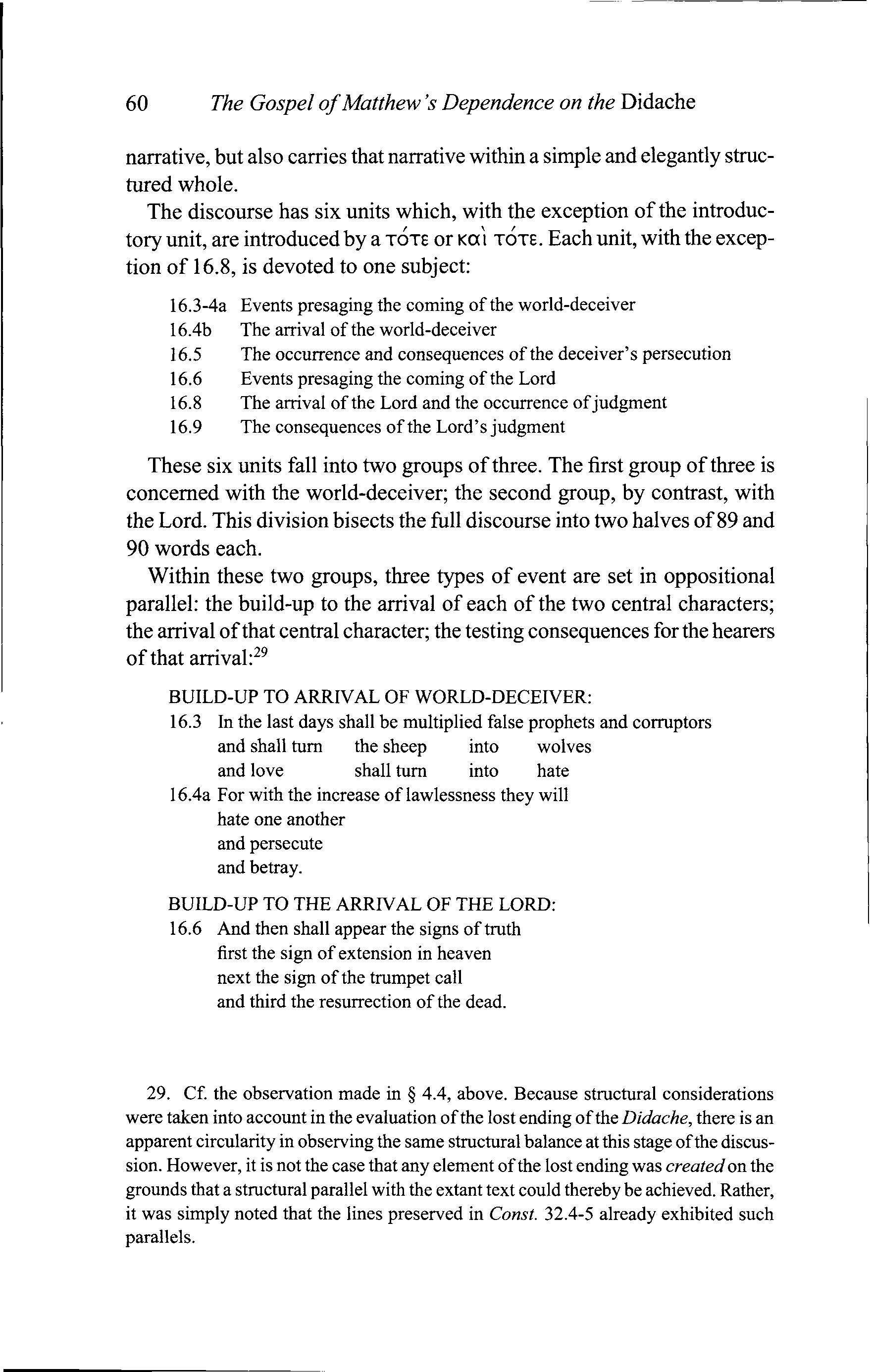
4.8. A Structural Evaluation of the Reconstruction The above process of reconstruction has been like piecing together a broken part of a pottery vase. Each small fragment has been examined individually until a collection of 'original' elements has been gathered. An important test of this type of exercise, however, is the overall result that is created. That is to say, does the addition of the reconstructed part create a completed item that functions successfully as a whole?
The addition of Did. 16.8b-9 fulfils this requirement inasmuch as the resulting eschatological discourse is one that not only contains a completed
The Gospel of Matthew's Dependence on the Didache narrative, but also carries that narrative within a simple and elegantly structured whole.
The discourse has six units which, with the exception of the introductory unit, are introduced by a TOTS or KCU TOTE. Each unit, with the exception of 16.8, is devoted to one subject:
16.3-4a Events presaging the coming of the world-deceiver 16.4b The arrival of the world-deceiver 16.5
The occurrence and consequences of the deceiver's persecution 16.6
Events presaging the coming of the Lord 16.8
The arrival of the Lord and the occurrence of judgment 16.9
The consequences of the Lord's judgment These six units fall into two groups of three. The first group of three is concerned with the world-deceiver; the second group, by contrast, with the Lord. This division bisects the full discourse into two halves of 89 and 90 words each.
Within these two groups, three types of event are set in oppositional parallel: the build-up to the arrival of each of the two central characters; the arrival of that central character; the testing consequences for the hearers of that arrival:29
BUILD-UP TO ARRIVAL OF WORLD-DECEIVER:
16.3 In the last days shall be multiplied false prophets and corruptors and shall turn the sheep into wolves and love shall turn into hate 16.4a For with the increase of lawlessness they will hate one another and persecute and betray.
BUILD-UP TO THE ARRIVAL OF THE LORD:
16.6 And then shall appear the signs of truth first the sign of extension in heaven next the sign of the trumpet call and third the resurrection of the dead.
29. Cf. the observation made in § 4.4, above. Because structural considerations were taken into account in the evaluation of the lost ending of the Didache, there is an apparent circularity in observing the same structural balance at this stage of the discussion. However, it is not the case that any element of the lost ending was created on the grounds that a structural parallel with the extant text could thereby be achieved. Rather, it was simply noted that the lines preserved in Const. 32.4-5 already exhibited such parallels.
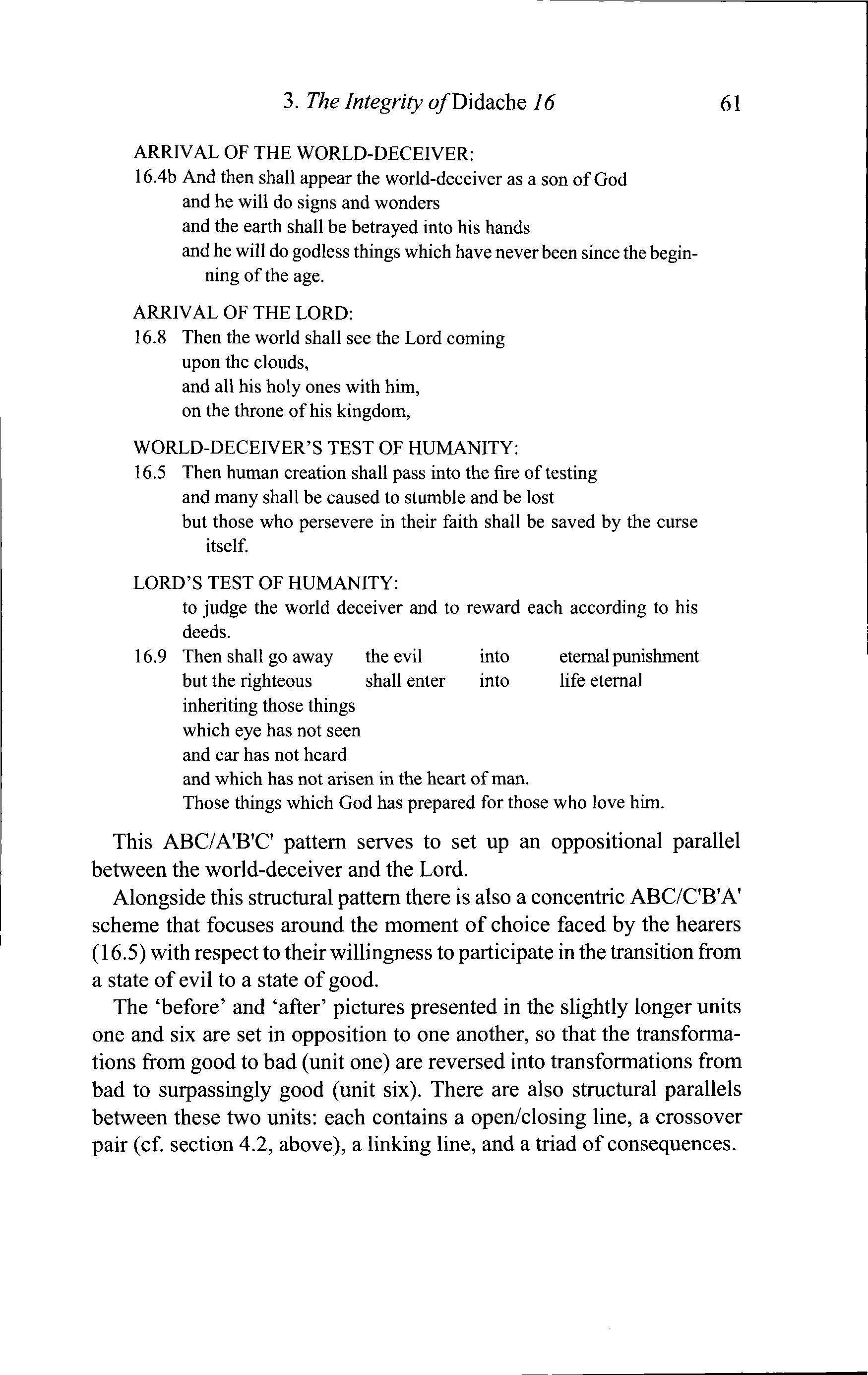
3. The Integrity o/Didache 16
ARRIVAL OF THE WORLD-DECEIVER:
16.4b And then shall appear the world-deceiver as a son of God and he will do signs and wonders and the earth shall be betrayed into his hands and he will do godless things which have never been since the beginning of the age.
ARRIVAL OF THE LORD:
16.8 Then the world shall see the Lord coming upon the clouds, and all his holy ones with him, on the throne of his kingdom,
WORLD-DECEIVER'S TEST OF HUMANITY:
16.5 Then human creation shall pass into the fire of testing and many shall be caused to stumble and be lost but those who persevere in their faith shall be saved by the curse itself.
LORD'S TEST OF HUMANITY:
to judge the world deceiver and to reward each according to his deeds.
16.9 Then shall go away the evil into eternal punishment but the righteous shall enter into life eternal inheriting those things which eye has not seen and ear has not heard and which has not arisen in the heart of man.
Those things which God has prepared for those who love him.
This ABC/AB'C pattern serves to set up an oppositional parallel between the world-deceiver and the Lord.
Alongside this structural pattern there is also a concentric ABC/C'B'A1 scheme that focuses around the moment of choice faced by the hearers
(16.5) with respect to their willingness to participate in the transition from a state of evil to a state of good.
The 'before' and 'after' pictures presented in the slightly longer units one and six are set in opposition to one another, so that the transformations from good to bad (unit one) are reversed into transformations from bad to surpassingly good (unit six). There are also structural parallels between these two units: each contains a open/closing line, a crossover pair (cf. section 4.2, above), a linking line, and a triad of consequences.
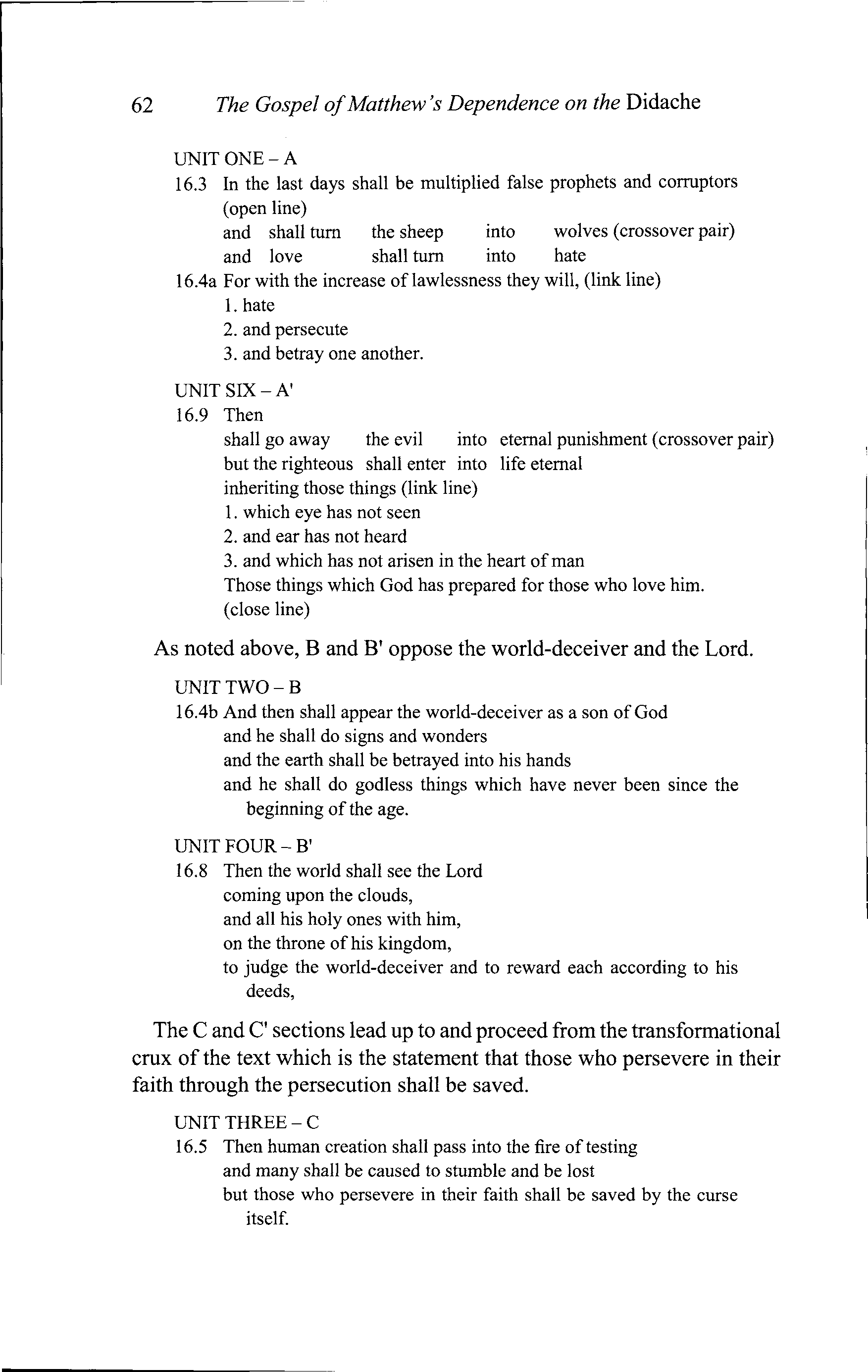
The Gospel of Matthew's Dependence on the Didache
UNIT ONE - A
16.3 In the last days shall be multiplied false prophets and corruptors (open line) and shall turn the sheep into wolves (crossover pair) and love shall turn into hate 16.4a For with the increase of lawlessness they will, (link line) l.hate 2. and persecute 3. and betray one another.
UNIT SIX-A'
16.9 Then shall go away the evil into eternal punishment (crossover pair) but the righteous shall enter into life eternal inheriting those things (link line) 1. which eye has not seen 2. and ear has not heard 3. and which has not arisen in the heart of man
Those things which God has prepared for those who love him.
(close line) As noted above, B and B1 oppose the world-deceiver and the Lord.
UNIT TWO - B
16.4b And then shall appear the world-deceiver as a son of God and he shall do signs and wonders and the earth shall be betrayed into his hands and he shall do godless things which have never been since the beginning of the age.
UNIT FOUR-B f
16.8 Then the world shall see the Lord coming upon the clouds, and all his holy ones with him, on the throne of his kingdom, to judge the world-deceiver and to reward each according to his deeds, The C and C sections lead up to and proceed from the transformational crux of the text which is the statement that those who persevere in their faith through the persecution shall be saved.
UNIT THREE - C
16.5 Then human creation shall pass into the fire of testing and many shall be caused to stumble and be lost but those who persevere in their faith shall be saved by the curse itself.
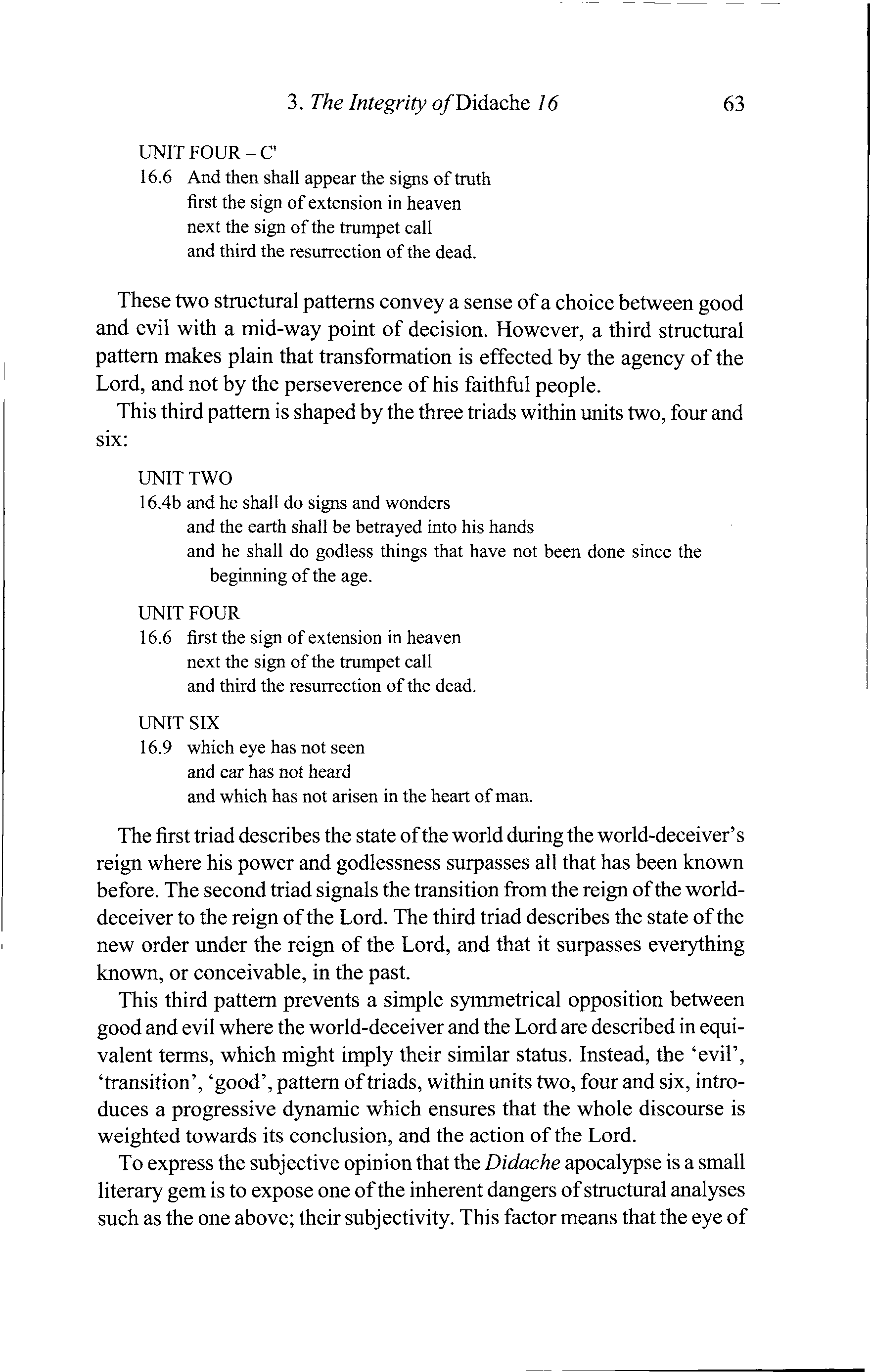
3. The Integrity o/Didache 16
UNIT F O U R - C
16.6 And then shall appear the signs of truth first the sign of extension in heaven next the sign of the trumpet call and third the resurrection of the dead.
These two structural patterns convey a sense of a choice between good and evil with a mid-way point of decision. However, a third structural pattern makes plain that transformation is effected by the agency of the Lord, and not by the perseverence of his faithful people.
This third pattern is shaped by the three triads within units two, four and six:
UNIT TWO 16.4b and he shall do signs and wonders and the earth shall be betrayed into his hands and he shall do godless things that have not been done since the beginning of the age.
UNIT FOUR
16.6 first the sign of extension in heaven next the sign of the trumpet call and third the resurrection of the dead.
UNIT SIX 16.9 which eye has not seen and ear has not heard and which has not arisen in the heart of man.
The first triad describes the state of the world during the world-deceiver's reign where his power and godlessness surpasses all that has been known before. The second triad signals the transition from the reign of the worlddeceiver to the reign of the Lord. The third triad describes the state of the new order under the reign of the Lord, and that it surpasses everything known, or conceivable, in the past.
This third pattern prevents a simple symmetrical opposition between good and evil where the world-deceiver and the Lord are described in equivalent terms, which might imply their similar status. Instead, the 'evil',
'transition', 'good', pattern of triads, within units two, four and six, introduces a progressive dynamic which ensures that the whole discourse is weighted towards its conclusion, and the action of the Lord.
To express the subjective opinion that the Didache apocalypse is a small literary gem is to expose one of the inherent dangers of structural analyses such as the one above; their subjectivity. This factor means that the eye of
The Gospel of Matthew's Dependence on the Didache faith can detect nuances, relationships and parallels where no dispassionate onlooker would otherwise find them. In concluding this structural analysis, therefore, I draw attention once again to the simplest feature of the reconstructed text; its oppositional presentation of the arrival of the worlddeceiver and the arrival of the Lord. This feature, which creates narrative completeness as well as structural elegance, arises only when the proposed
Did. 16.8b-9 is added to the damaged text. If a valid test of a reconstruction is that it reveals an elegant and functional whole where such was not previously evident, then the above reconstruction achieves a remarkably high level of success.
4.9. Summary and Conclusion It was noted first of all that manuscript and narratological evidence indicates the incomplete nature of the Jerusalem manuscript. It was further noted that Apostolic Constitutions VII, the Renunciation of Boniface and the Georgian version of the Didache all contain some form of continuation of the Didache apocalypse, although with incomplete agreement as to its precise contents.
The process of reconstruction began with an examination of the words immediately following the extant version of Did. 16.8. On the basis of information from the interpolation at Did. 16.7, parallel eschatological expectation in 1 Thessalonians and Revelation, the interpretation of 'holy ones' as angels in Const. 32.4a, and the presence of 'Lord' instead of 'son of man' in Did. 16.8 it was concluded that the original text is likely to have read: 'And then the world shall see the Lord, coming on the clouds of heaven, and all his holy ones with him'.
The succeeding sections began by considering those parts of the Const, 's version of the lost ending that are supported by Boniface's Renunciation.
Here it was noted that the Constitutionist reproduced textual and redactional features that also appear in the surviving verses of the Didache's apocalypse, and which are difficult to attribute to the Constitutionist or the New
Testament authors.
A concluding analysis of the structure of the whole eschatological discourse sought to show that, with the addition of the reconstructed ending, the Didache's eschatological discourse appears to function as a carefully structured whole.
The structural unity of the completed discourse favours the accuracy of the general pattern and extent of the above reconstruction. That said, the tendency of the Constitutionist, exhibited elsewhere, to assimilate the
3. The Integrity o/Didache 16
Didache to similar New Testament texts means that the precise vocabulary of every element of the reconstruction can not be identified with full certainty.
5. The Integrity o/Didache 16 This chapter, and hence this conclusion, is concerned with the relationships between the constituent elements of Did. 16.
Three elements of Did. 16 have been identified.
• First, the structurally and conceptually unified eschatological discourse recorded in Did. 16.3-6, 8-9.30
Second, the interpolation at Did. 16.7, added to the manuscript tradition (preserved in the Jerusalem manuscript) from which the final lines of the discourse had been lost.
• Third, by a process of elimination, Did. 16.1-2 must have been written at a time separate from the initial composition of Did.
16.3-6, 8-9 because these verses do not conform to the symmetry of that unified discourse.
Given the separate status of 16.1-2 and 16.3-6, 8-9, there are three possible sequences in which these two sections could have been added to the Didache. Either 16.1-2 was added and then 16.3-6,8-9, or 16.1 -2 was inserted after the addition of 16.3-6, 8-9, or 16.1-2 and 16.3-6, 8-9 were added at the same time.
The first of these options implies that 16.3-6, 8-9 was written as a means of expanding upon and re-framing the briefly expressed expectations in 16.1-2. The difficulty with this view is that 16.3-6, 8-9 appears to represent an original and structurally self-contained reworking of Old
Testament eschatological expectation. To this extent the discourse does not bear the marks of a reactive text struggling to make good the inadequacies of 16.1 -2. It is possible that the eschatological discourse was composed separately and then added to the Didache at a later date, but this requires coincidences in shared references to 'the faith' (16.2 and 16.5),
'the coming of the Lord' (rather than the Son of man) (16.1 and 16.8), and 30. Niederwimmer (1998: 46) writes: '...it is immediately obvious that 16.3-8, which represent a little apocalypse, are a separate unit. I believe that here, too, the Didachist is quoting an older tradition (probably written). Thus I consider 16.3-6,8 the quotation of an old, predidachistic apocalypse, and 16.7 an addition by the didachistic redaction.'
The Gospel of Matthew's Dependence on the Didache the expectation of judgment according to actions (16.231 and 16.8). Thus, this solution is neither impossible, nor especially convincing.
The second option, where 16.1-2 is inserted after the inclusion of 16.36, 8-9, is less credible than the first.32 This requires that, in the initial instance, the self-contained discourse preserved in 16.3-6,8-9 was appended to the Didache without any introduction. And that later, such an introduction was inserted. There is nothing to be said in favour of this view beyond the fact that it is a theoretical possibility.
The third option, where both parts were added to the Didache at the same time, is the most satisfactory. In this case Did. 16.3-6, 8-9 may be seen as a separately existing eschatologieal discourse which was quoted by the author of Did. 16.1-2 as a means of concluding the whole text. The message of 16.1 -2 may be summed up as a call to constant vigilance in preparation for the final judgment, a message that is consistently reinforced by the quotation of 16.3-6, 8-9. This solution accounts for the links between 16.1-2 and what follows, without violating the self-contained and independent character of 16.3-6, 8-9.
31. Cf. discussion of the significance of TEAEIOS in Chapter 5, § 4.
32. Kloppenborg (1979: 57) firmly endorses the view of Bartlet (1921: 247) that 16.1 represents a later interpolation.