
2. Other Works
XXXII
ABBREVIATIONS
OTHER WORKS
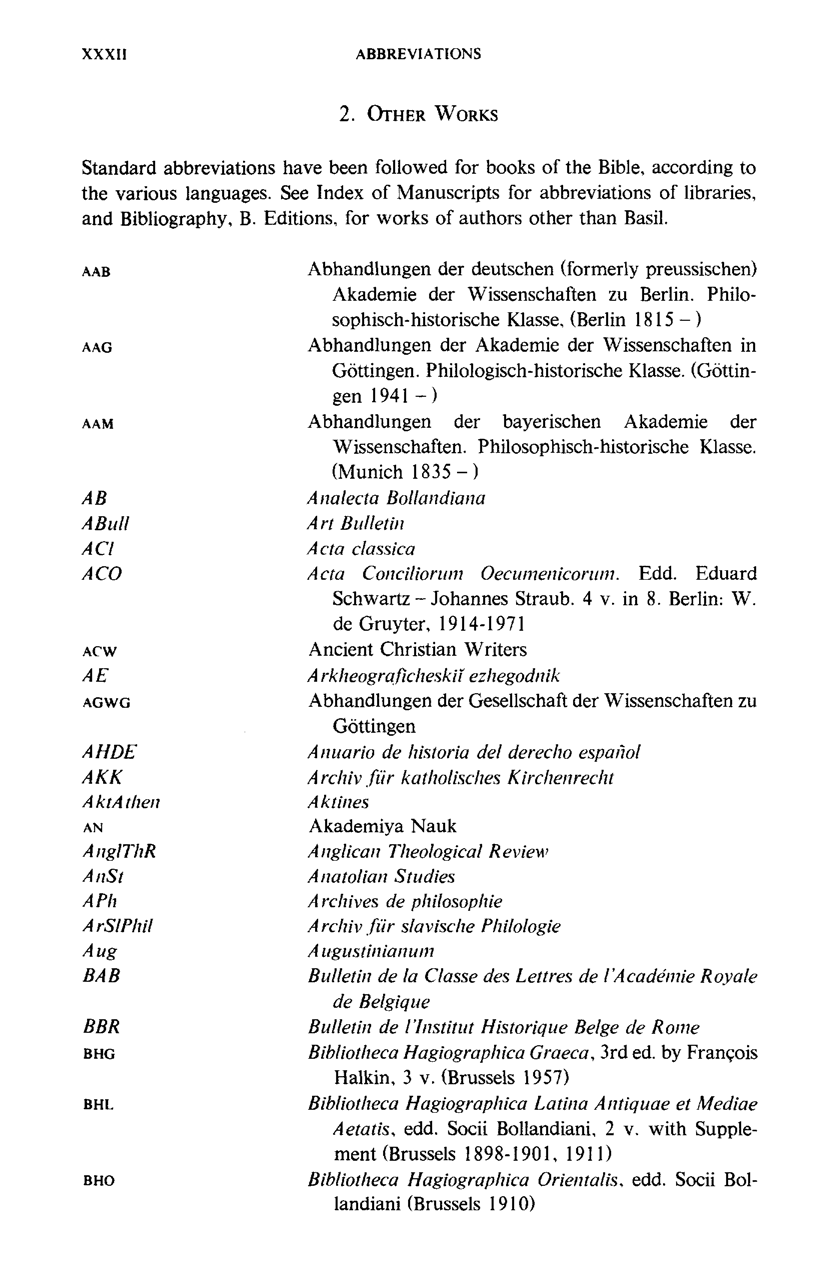
Standard abbreviations have been followed for books of the Bible, according to the various languages. See Index of Manuscripts for abbreviations of libraries, and Bibliography, B. Editions, for works of authors other than Basil.
Abhandlungen der deutschen (formerly preussischen) AAB Akademie der Wissenschaften zu Berlin. Philo sophisch-historische Klasse, (Berlin 1815 - )
Abhandlungen der Akademie der Wissenschaften in AAG Göttingen. Philologisch-historische Klasse. (Göttingen 1941 - )
Abhandlungen der bayerischen Akademie der Wissenschaften. Philosophisch-historische Klasse.
(Munich 1835-) Analeda Bollandiana Art Bulletin Acta classica Acta Conciliorum Oecumenicorum. Edd. Eduard
AAM AB ABull AC I A CO Schwartz - Johannes Straub. 4 v. in 8. Berlin: W. de Gruyter, 1914-1971 Ancient Christian Writers A rkheograficheskiï ezhegodnik ACW AE Abhandlungen der Gesellschaft der Wissenschaften zu
AGWG Göttingen Anuario de historia del derecho espanol Archiv für katholisches Kirchenrecht Aktines A H DE Α Κ Κ Akt A then Akademiya Nauk Anglican Theological Review Anatolian Studies A rchives de philosophie Archiv für slavische Philologie A ugustinianum Bulletin de la Classe des Lettres de l'Académie Royale
AN AnglThR AnSt APh ArSIPhil Aug BAB de Belgique Bulletin de l'Institut Historique Belge de Rome
Bibliotheca Hagiographica Graeca, 3rd éd. by François BBR Halkin, 3 v. (Brussels 1957) Bibliotheca Hagiographica Latina Antiquae et Mediae
BHG Aetatis, edd. Socii Bollandiani, 2 v. with SuppleBHL ment (Brussels 1898-1901, 1911) Bibliotheca Hagiographica Orientalis, edd. Socii BolΒΗΟ landiani (Brussels 1910)
OTHER WORKS
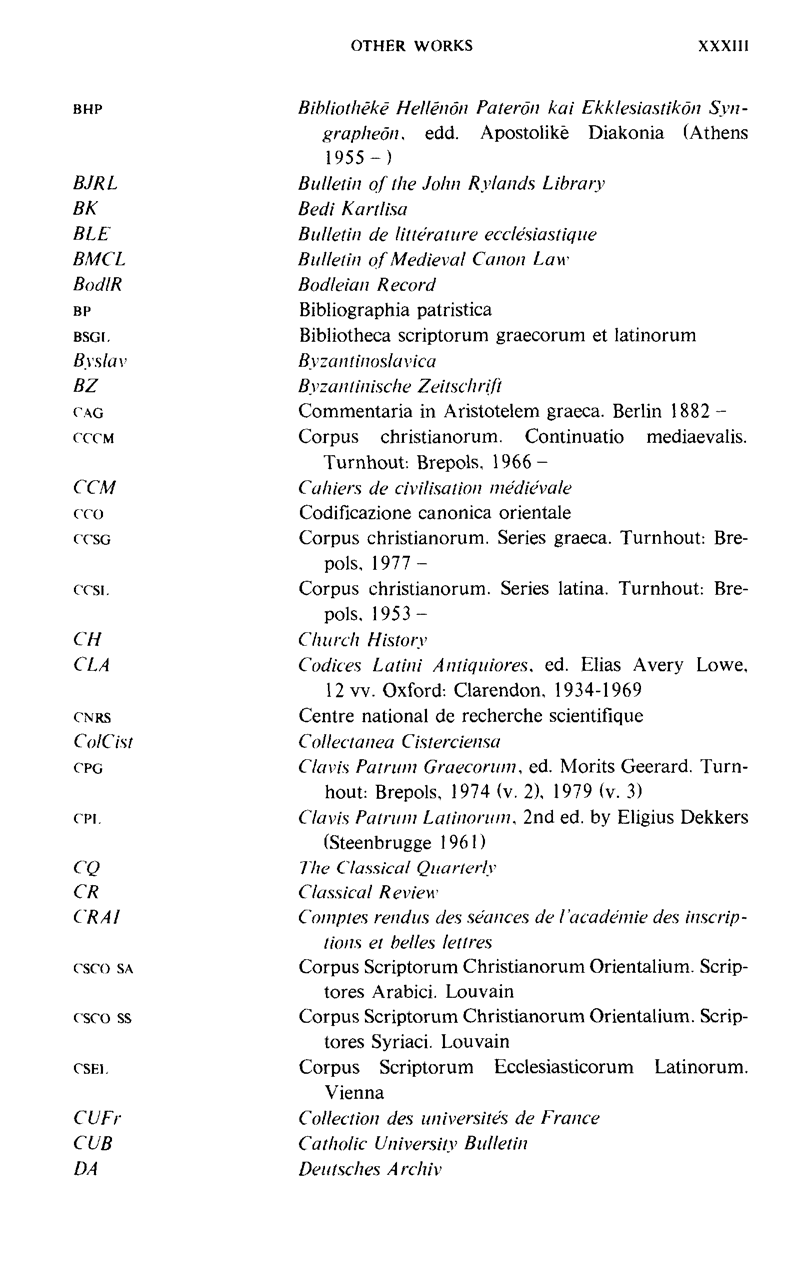
XXX11I Bibliothëkë Hellênôn Paterön kai Ekklesiastikön SynΒΗΡ grapheön, edd. Apostolikè Diakonia (Athens
1955 - ) Bulletin of the John Rylands Library Bedi Kartlisa Bulletin de littérature ecclésiastique Bulletin of Medieval Canon LawBodleian Record
BJRL BK BLE BMCL BodlR Bibliographia patristica Bibliotheca scriptorum graecorum et latinorum
BP BSGI.
By slav BZ ß.VZ07!///70Stov/Cu Byzantinische Zeitschrift Commentaria in Aristotelem graeca. Berlin 1882 Corpus christianorum.
Continuatio mediaevalis.
Turnhout: Brepols, 1966 Cahiers de civilisation médiévale Codificazione canonica orientale Corpus christianorum. Series graeca. Turnhout: BreCAG
CCCM CCM ceo pols, 1977 Corpus christianorum. Series latina. Turnhout: BreCCSG pols, 1953Church History Codices Latini Aniiquiores, ed. Elias Avery Lowe,
CCSI.
CH CLA 12 w. Oxford: Clarendon, 1934-1969 Centre national de recherche scientifique
Collectanea Cisterciensa Clavis Pat rum Graecorum, ed. Morits Geerard. TurnCNRS ColCist CPG hout: Brepols, 1974 (v. 2), 1979 (v. 3) Clavis Patrum Laiinorum, 2nd ed. by Eligius Dekkers
CPI.
(Steenbrugge 1961) The Classical Quarterly Classical Review Comptes rendus des séances de l'académie des inscripCQ
CR CRA1 tions et belles lettres Corpus Scriptorum Christianorum Orientalium. ScripCSCO SA tores Arabici. Louvain Corpus Scriptorum Christianorum Orientalium. ScripC SCO ss tores Syriaci. Louvain Corpus Scriptorum Ecclesiasticorum Latinorum.
Vienna Collection des universités de France Catholic University Bulletin Deutsches A rchiv CSE1.
CUEr CUB DA
XXXIV
ABBREVIATIONS
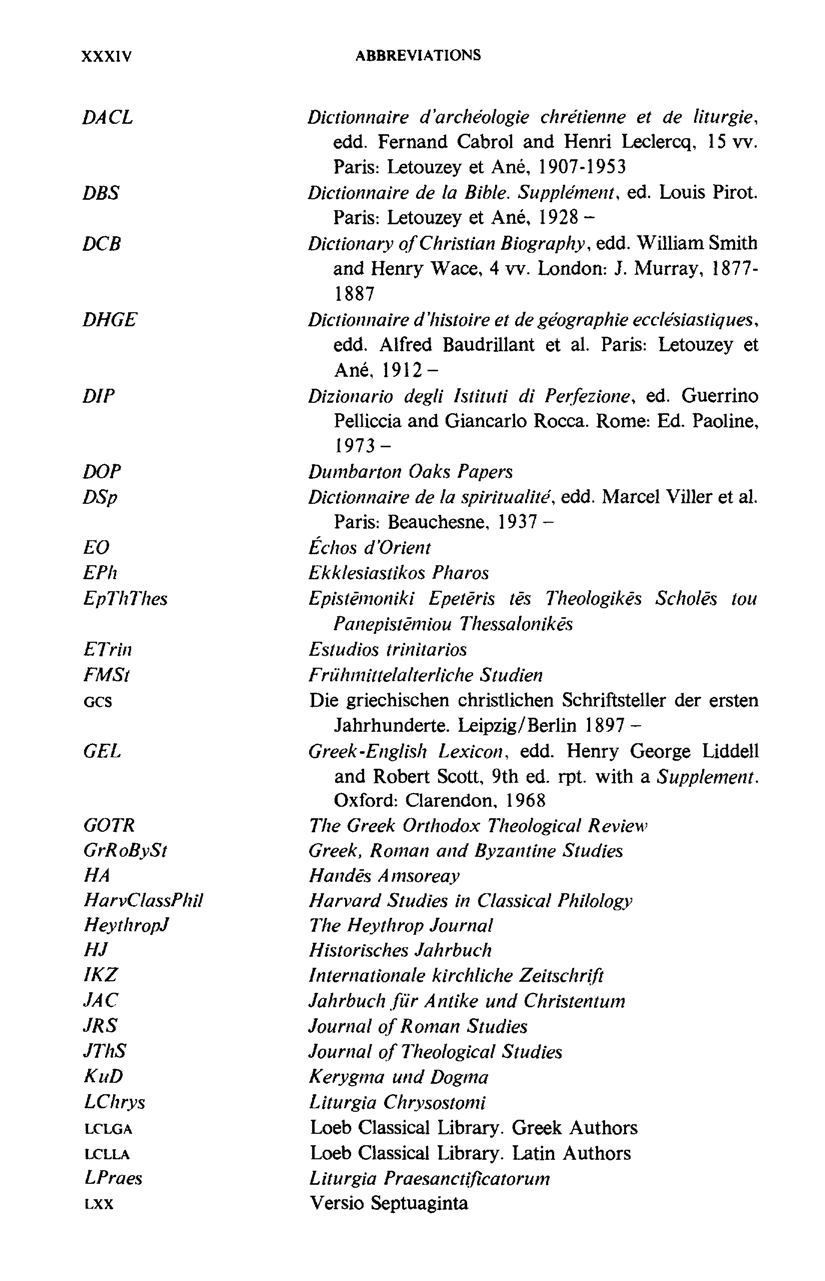
Dictionnaire d'archéologie chrétienne et de liturgie, DA CL edd. Fernand Cabrol and Henri Leclercq, 15 w.
Paris: Letouzey et Ané, 1907-1953 Dictionnaire de la Bible. Supplément, ed. Louis Pirot.
DBS Paris: Letouzey et Ané, 1928 — Dictionary of Christian Biography, edd. William Smith
DCB and Henry Wace, 4 w. London: J. Murray, 1877-
Dictionnaire d'histoire et de géographie ecclésiastiques, DHGE edd. Alfred Baudrillant et al. Paris: Letouzey et
Ané, 1912 — Dizionario degli Istituti di Perfezione, ed. Guerrino DIP Pelliccia and Giancarlo Rocca. Rome: Ed. Paoline,
1973Dumbarton Oaks Papers Dictionnaire de la spiritualité, edd. Marcel Viller et al.
DOP DSp Paris: Beauchesne, 1937 — Ec/70S d'Orient Ekklesiastikus Pharos Epistëmoniki Epetêris tes Theologikês Scholês tou
EO EPh EpThThes Panepistëmiou Thessalonikës Estudios trinitarios Frühmittelalterliche Studien ETrin FMSt Die griechischen christlichen Schriftsteller der ersten
GCS Jahrhunderte. Leipzig/Berlin 1897 — G reek-English Lexicon, edd. Henry George Liddell
GEL and Robert Scott, 9th ed. rpt. with a Supplement.
Oxford: Clarendon, 1968 The Greek Orthodox Theological Review Greek, Roman and Byzantine Studies Handës Amsoreay Harvard Studies in Classical Philology GOTR GrRoBySt HA HarvClassPhil HeythropJ HJ IKZ 3AC JRS JThS KuD LChrys The Heythrop Journal Historisches Jahrbuch Internationale kirchliche Zeitschrift Jahrbuch für Antike und Christentum Journal of Roman Studies Journal of Theological Studies Kerygma und Dogma Liturgia Chrysostomi Loeb Classical Library. Greek Authors Loeb Classical Library. Latin Authors Liturgia Praesandificatorum Versio Septuaginta LCLGA LCLLA LPraes LXX
OTHER WORKS
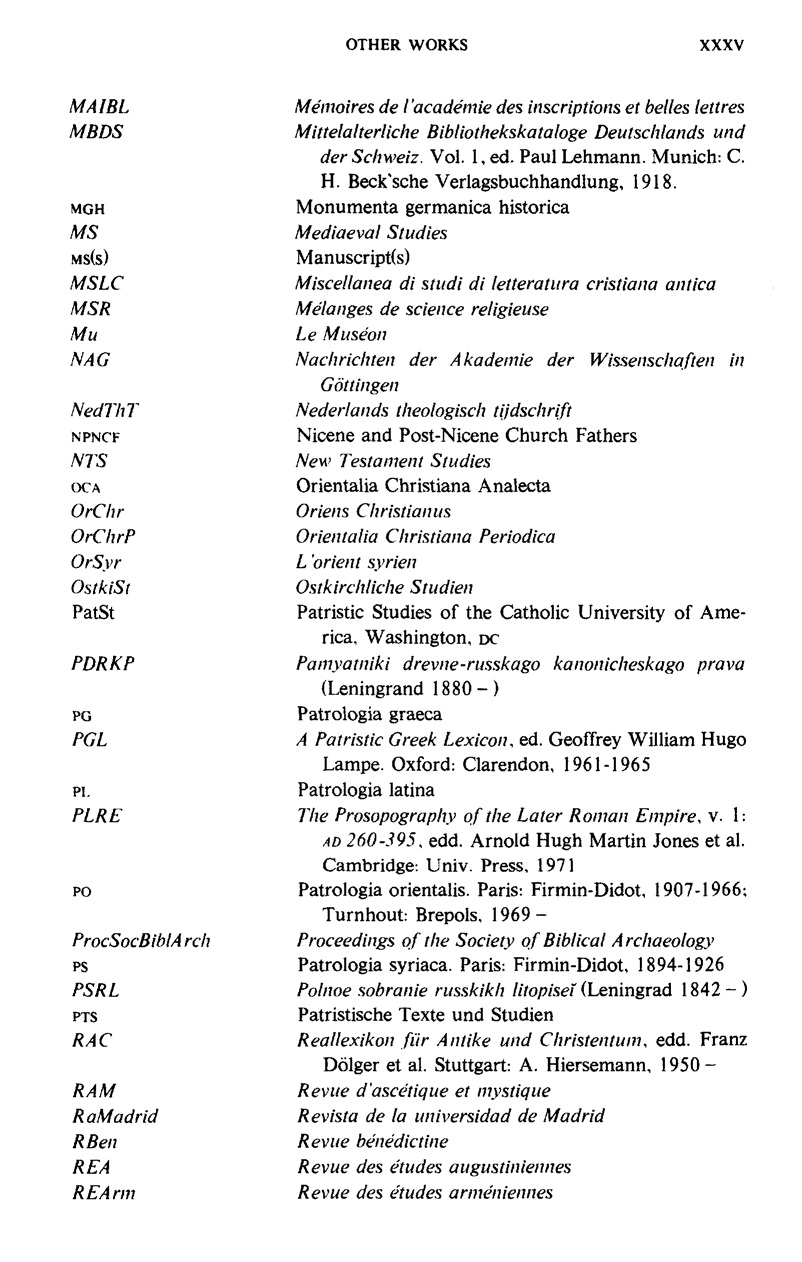
XXXV Mémoires de l'académie des inscriptions et belles lettres Mittelalterliche Bibliothekskataloge Deutschlands und
MAIBL MBDS der Schweiz. Vol. 1, ed. Paul Lehmann. Munich: C.
H. Beck'sche Verlagsbuchhandlung, 1918.
Monumenta germanica historica Mediaeval Studies MGH MS Manuscripts) Miscellanea di stiidi di letteratura cristiana antica
Mélanges de science religieuse Le Muséon Nachrichten der Akademie der Wissenschaften in MS(s) MSLC MSR Mu NAG Göttingen Nederlands theologisch tijdschrift NedThT Nicene and Post-Nicene Church Fathers New Testament Studies Orientalia Christiana Analecta Oriens Christianus Orientalia Christiana Periodica L Orient syrien Ostkirchliche Studien Patristic Studies of the Catholic University of AmeNPNCF
NTS OCA OrChr OrChrP OrSyr OstkiSt PatSt rica, Washington, DC Pamyatniki drevne-russkago kanonicheskago prava
PDRKP (Leningrand 1880-) Patrologia graeca A Patristic Greek Lexicon, ed. Geoffrey William Hugo
PG PGL Lampe. Oxford: Clarendon, 1961-1965 Patrologia latina The Prosopography of the Later Roman Empire, v. 1:
PL Ρ LR Ε AD 260-395, edd. Arnold Hugh Martin Jones et al.
Cambridge-. Univ. Press, 1971 Patrologia orientalis. Paris: Firmin-Didot, 1907-1966;
PO Turnhout: Brepols, 1969 — Proceedings of the Society of Biblical A rchaeology
Patrologia syriaca. Paris: Firmin-Didot, 1894-1926 Polnoe sobranie russkikh litopiseï (Leningrad 1842 - )
Patristische Texte und Studien Reallexikon für Antike und Christentum, edd. Franz
ProcSocBiblArch PS PSRL PTS RAC Dölger et al. Stuttgart: A. Hiersemann, 1950 — Revue d'ascétique et mystique Revista de la universidad de Madrid Revue bénédictine Revue des études augustiniennes Revue des études arméniennes RAM R aMadrid RBen REA REArm
XXXVI
ABBREVIATIONS
REB RECA Revue des études byzantines Paulys Real-Encyclopädie der classischen Altertumswissenschaft, edd. Georg Wissowa - Wilhelm
Kroll et al. Stuttgart/Munich: Α. Druckenmüller, 1894 - ; Supplement Bände, ibid., 1903 Recherches augustiniennes
Revue des études grecques Revue des études latines Realencyklopädie für protestantische Theologie und
Rech Aug REG REL REPThK Kirche, by Johann Jakob Herzog, 3rd ed. by Albert Hauck, 21 w. +. Leipzig: J. C. Hinrichs, 1898-
Revue des sciences religieuses Die Religion in Geschichte und Gegenwart, 3rd ed. by ReSR RGG Κ. Galling, 6 w. + Register. Tübingen: J. C. Β.
Mohr, 1957-1965 Revue d'histoire ecclésiastique Revue d'histoire de l'Eglise de France Rheinisches Museum für Philologie Revue d'histoire des religions Revue internationale des droits de l'antiquité
Rendiconti. Istituto Lombardo di Scienze e Lettere.
RHE RHEF RhM RHR RIDA RILSL Classe di Lettere e Scienze Morali e Storiche Revue Mabillon Revue de l'Orient chrétien Rendiconti della Pontificia Accademia di Archeologia
Revue de philologie, de littérature et d'histoire ancienRM ROC RPAA RPh nes Ricerche religiose Rivista di storia della Chiesa in Italia
Rivista storica di diritto internazionale Rivista degti studi orientait Revue des sciences philosophiques et théologiques
Recherches de science religieuse RR RSCI RSDI RSO RSPhTh RSR Revised Standard Version [of the Bible] Revue de théologie et de philosophie Sitzungsberichte der deutschen Akademie der WissenRSV
RThPh SA BPh schaften zu Berlin. Klasse für Philosophie, Geschichte, Staats-, Rechtsund Wirtschaftswissenschaft
Sitzungsberichte der Heidelberger Akademie der WisSAH senschaften. Philos.-hist. Klasse Sitzungsberichte der bayerischen Akademie der
SAM Wissenschaften. Philosophisch-historische Abteilung
OTHER WORKS
XXXVII Sources chrétiennes. Paris: Cerf, 1941 Sacris erudiri Stimmen aus Maria Laach Studio patristica. Berlin: Akademie Verlag, 1957 —
Society for Promoting Christian Knowledge Studi e testi. Studies and Texts Studia monastica Stoicorum veterum fragmenta, ed. Hans Friedrich August von Arnim. 4 v. Leipzig: Teubner, 1903SC
SE SML SP SPCK ST StMon S VF
Theologische Literaturzeitung Theologisch -praktische Monatschrift Theologie und Philosophie Theologische Quartalschrift Theologische Zeitschrift Travaux et Mémoires Trudy otdela drevnerusskoï literatury Theologische Realenzyklopädie, edd. Gerhard Krause ThLZ ThM ThPh ThQ ThZ TM TODRL TRE Gerhard Müller. Berlin/New York: W. de Gruyter, 1977Texte und Untersuchungen. Berlin 1882 University of California Publications in Classical Philology Verbum Caro Vetera christianorum Vigiliae christianae St. Vladimir's Seminary Quarterly Vestnik otdela obshchestvennikh nauk Akademii Nauk
TU UCalifClass VCaro VetChr VigChr VladQ VOONGr Gruzinskoi SSSR Wiener Studien. Zeitschrift für klassische Philologie
WSi und Patristik Zeitschrift der deutschen Morgenländischen Gesellschaft Zeitschrift für Kirchengeschichte Zeitschrift für katholische Theologie Zeitschrift für neuleslamentliche Wissenschaft und die Kunde der älteren Kirche Zapiski otdela rukopisei Zeitschrift für Papirologie und Epigraphik
Zeitschrift für Theologie und Kirche ZDMG ZKG ZKTh ZNW ZOR ZPE ZThK
Introduction When, early in 1974, the Basilian Fathers began to prepare for the sixteenth centenary of the death of their patron, Basil of Caesarea (330379), it was quickly decided that the best way for a teaching community to mark the anniversary of such a patron was by a scholarly meeting of minds. Thus the idea of the St. Basil Symposium was born. At an initial meeting in Toronto in February, 1974, the Pontifical Institute of Mediaeval Studies, which would celebrate its golden jubilee in 1979, was invited by the Superior General of the Basilian Fathers to join in the preparation of a gathering of outstanding Basil scholars from all over the world, to come together in Toronto in the centennial year to present papers on Saint Basil and to share ideas on this remarkable fourth century figure, who spoke so cogently to his own times and who still speaks so to ours.
The original committee, which remained intact during the entire five years of preparation, consisted of the following: from the Pontifical
Institute, Leonard Boyle, Reginald O'Donnell, Laurence Shook and Edward Synan; from the Basilian Fathers, Robert Barringer, James
Hanrahan, and Wallace Piatt, who was named chairman. Roman Danylak, Chancellor of the Eastern Rite Catholic Eparchy of Toronto, also consented to serve on the committee, providing the essential link with Eastern Catholicism, where Basil is so greatly honoured, and the necessary knowledge of the Orthodox Church, in which Saint Basil occupies so important a place.
From the beginning the idea of the St. Basil Symposium met with enthusiasm from every side. In the ecclesiastical area, Cardinal George
Bernard Flahiff, Archbishop of Winnipeg, provided invaluable advice on procedures, as well as his own good offices in contacting the Vatican
Secretariat for Promoting Christian Unity, where the project received the warmest encouragement from Cardinal Willebrands. He kindly consented, through the Secretariat, to inform the Ecumenical Patriarch of Constantinople, His Holiness Demetrios i, of the projected Symposium.
The Patriarch, underscoring the ecumenical significance of such a meeting, expressed his approval and his desire to be kept informed of the various stages in the preparation of the Symposium. Thus the ecumenical
P. WALLACE PLATT, CSB
dimension of the Symposium was recognized from the early stages and remained a guiding principle throughout. The messages from Pope John
Paul ii, and from the Patriarch, Demetrios i, which appear in this volume, eloquently express the ecumenical force of the Symposium.
Of incalculable importance to the organizing and to the success of the Symposium was the engaging of Dr. Paul Fedwick as Executive
Secretary, in June of 1976. A Basil scholar himself, Dr. Fedwick brought to the Symposium a knowledge of the field and a personal acquaintance with scholars throughout the world who would be valuable participants in the Symposium. Dr. Fedwick invited four of these scholars, Jean
Gribomont (Rome), Stig Y. Rudberg (Lund), Wolf-Dieter Hauschild (Hanover), and Thomas Spidlik (Rome), to serve as "assessors," and to advise on the various themes and topics to be treated in the Symposium.
Unfortunately, before the opening of the Symposium, because called to an important ecclesiastical office, Dr. Hauschild was obliged to withdraw, both as an assessor and as a participant.
In the autumn of 1976 the theme of the Symposium was decided upon:
"Basil of Caesarea: Christianity, Humanism, Asceticism." It was thought that these three aspects of Saint Basil would allow sufficient scope for particular topics within them. Topics were then sketched out and the various scholars invited to treat of them. This provided a good two years of preparation for the papers, which were due by 1 January 1979.
Of the eighteen papers which follow in this volume, ten were presented at the Symposium.1 The order, for the sake of logic and convenience, has been slightly changed from that followed during the Symposium week, 10
June to 16 June 1979, when the papers were given at the rate of two each day, with the exception of Sunday, Thursday, and Saturday, when only one paper was given. The audience for the papers varied from one hundred to one hundred and twenty, and each paper was followed by an hour's discussion period. Some twenty-four minor papers were given on two evenings of the Symposium week.
As an introduction, Dr. Fedwick provides a chronology of the life of Basil, an abridged version of his excellent "Revised Provisional
Chronology of the Life and Works of Basil of Caesarea (330-379)," which appears as Appendix A of The Church and the Charisma of Leadership in Basil of Caesarea, P. J. Fedwick (Toronto 1979). This is followed by ' The paper of Dr. Reinhart Staats (University of Heidelberg), read in English, has been published in Kerygma und Dogma 25 (1979) 232-253, under the title "Die basilianische Verherrlichung des Heiligen Geistes auf dem Konzil zu Konstantinopel 381.
Ein Beitrag zum Ursprung der Formel 'Kerygma und Dogma'."
INTRODUCTION
XLI biographical notes on Saint Basil by Jean Gribomont (Rome), who traces the various stages of the study of Basil's life, and who looks at interior and exterior evidence to determine both chronology and meaning in Basil's works. Father Gribomont's contribution might be characterized as "the works in context."
The two papers which follow treat of manuscripts and editions of Basil's works. Dr. Stig Y. Rudberg provides the fruit of a life-long study of Basilian manuscripts, examining particularly the work of Amand de
Mendieta, which was published in the Revue Bénédictine, from 1940 to 1946, and bringing manuscript and edition information down to the present day. Dr. Fedwick, on the other hand, presents a survey of early translations of the works of Basil into Latin, Syriac, Armenian, Coptic,
Arabic, Georgian, and Slavic, in the period from the fourth to the fourteenth centuries. This represents a study of some five thousand
Basilian manuscripts in Greek and other languages, according to the various categories: ascetic, homiletic, canonical, liturgical, and epistolary.
Two other papers, which appear toward the end of the volume, deal with particular manuscript questions. Sever Voicu (Centre for Christian
Union, Rome) presents a papyrus manuscript of Basil's Asceticon, dating from the sixth or seventh century, while Gabriella Uluhogian (University of Bologna) offers some interesting new information about Basil's works in Armenian manuscripts. Both of these scholars, though not present at the Symposium, enrich the present volume by new information and by valuable commentary.
Milton V. Anastos (University of California, Los Angeles) makes a unique contribution inasmuch as his is the only paper devoted to one particular text, Basil's Contra Eunomium, 1-3. Here is treated one of the crucial questions of Basil's life, the divinity of the Son. In theological controversy, Basil shows himself intrepid in the defence of the creed of Nicaea, as well as skilled and forceful in argument.
John Rist (now Regius Professor, University of Aberdeen) studies Neoplatonism in Basil, its possible sources and its extent. By a close analysis of the De spiritu, only doubtfully by Basil, and of the De Spiritu
Sancto and other works. Rist sees a late knowledge of Plotinus on Basil's part and some influence of Plotinus in his works. The paper makes interesting suggestions about Basil's sources, the date, authenticity, and context of several of his works, the relationship of his work to that of his contemporaries, and the possibility of understanding him apart from any
Neoplatonism.
In "St. Basil and the Rhetorical Tradition," George Kustas (University of New York at Buffalo) shows how the work of Basil of Caesarea offers a
XLII
P. WALLACE PLATT, CSB
remarkable example of the mastery, use and development of classical rhetoric in a Christian writer. Not only is Basil familiar with the terms and devices of the art of rhetoric, but he uses all the possibilities thereof for formulation of doctrine and for effectiveness in teaching. Basil can be said to merit his title "Great" because he joined in his thought and in his life's work the two main cultural currents of the ancient world: philosophy, for which one might now understand theology, and rhetoric. Rhetoric was the indispensable means by which ideas became known and operative in Basil's time. He uses this art honestly, skillfully, and for the highest purposes, with a delight which his reader also enjoys. Basil is in the Ciceronian tradition which viewed rhetoric not so much as the art of persuasion as the art of teaching. The Basilian corpus represents a marriage of pagan art with Christian thought, whose offspring are beauty, clarity, and meaning.
Basil was the outstanding churchman of his time. Konstantinos Bonis (Academy of Athens) shows how Basil's greatness is founded on the ways he fulfilled his episcopal office. He excelled as shepherd, administrator, and teacher, as an opponent of Arianism and other heresies, as an ascetic, and as father of monasticism in the East. Professor Bonis suggests that Basil should be remembered more as the great peacemaker and reconciler of the divided Christian factions rather than for new theological approaches. In all these conflicts the unity of the Church was his final goal.
No topic is of more importance in the study of Basil than that of his teaching on the Holy Spirit. Jaroslav Pelikan (Yale University), in looking to the scriptural basis of this teaching, points out that though the question of the person of the Son was spread over centuries, that of the person of the Holy Spirit was raised, discussed, and decided in about two decades.
Basil's De Spiritu Sancto is one of a small group of treatises that addressed the doctrine of the Holy Spirit directly, determining the form that it was to take in both East and West for a millenium or more. The "spiritual sense" of Scripture in Basil's treatise is the basis for understanding Basil's teaching. His treatise rehearses proofs for the divinity of the Son, which proofs are then analogically applied to show the divinity of the Holy
Spirit. Basil examines language, the written teaching in the apostolic tradition, and the tradition of the liturgy, to argue the equality of the Spirit with the Father and the Son. He establishes the doctrine of the person of the Holy Spirit as part of the depositum fidei. This probably represents his chief contribution to the history of Christian doctrine.
Basil was a great leader, but he was pre-eminently a Christian leader.
Ioannes Karayannopoulos (University of Thessaloniki) looks at Basil in
INTRODUCTION
XU 11 this light to examine his social activity and his dealings with the authorities. Before he became a bishop, Basil had occasion in two funeral orations to outline the character of a good bishop: first in his diocese, a good theologian, a father to the young, a colleague to his peers, a leader among leaders, a protector of the people, a supplier to those in need.
When he became bishop, he fulfilled his own prescriptions even beyond the persons he lauded in his orations. What made Basil so effective a leader in his Church and community was not so much his family wealth, his aristocratic background, nor his education. It was rather his convictions of the power of the Christian life to humanize and civilize, of the strength of moral law, and of the supremacy of spiritual values in circumstances which were materially bad or morally equivocal. His own personal detachment from wealth, health, position and power left him free to conduct himself according to what he conceived as the law of Christ. His social and political activities were seen by him as so many duties of a Christian leader.
The essay by Ramon Teja (University of Santander) on slavery makes an interesting complement to that of Professor Karayannopoulos. Basil accepts slavery, it seems, as the normal order of things. The abnormality for Basil is rather poverty and the subjection of the human spirit by the inequities in this world's goods. It was his brother, Gregory of Nyssa, who was to speak out against the institution of slavery itself.
In a short note, Barnim Treucker (Paderborn) offers some new insights on Basil's relations with various dignitaries and officials during the Later
Roman Empire. After almost twenty years following the publication of his outstanding study, Politische und sozialgeschichtliche Studien zu den
Basilius-Briefen (Frankfurt 1961), Dr. Treucker revises his opinion concerning the senatorial origin of Basil.
The subject of monasticism is central to the study of Basil. The volume present two essays on Basil's monasticism, one by Thomas Spidlik
(Pontifical Institute of Oriental Studies, Rome) outlining the relationship between asceticism and the understanding of scripture, and asceticism and morality. Though a strict moralist, Basil never separates morality from understanding. Right action in freedom, and knowledge of God through Scriptures and the world, underlie his monastic teaching.
Adolph Martin Ritter (University of Marburg) echoes a modern interest in his essay "Monasticism as a Movement of Charismatic Renewal."
Basil's monasticism was part of a movement of considerable popularity which did in fact effect a renewal in the Church. Basil saw its potential and channeled its force by his Rules. This monasticism, it must be noted,
XLIV
P. WALLACE PLATT, CSB
was not so much a protest against existing authority in the Church, as some have suggested, but a sincere search for spiritual revitalization.
Completing the volume are two essays of diverse interests, one by Roger Reynolds (Pontifical Institute, Toronto), "Basil in Western
Canonical Collections," which can be seen as basic to any study of the influence of Basil in the West; and one by Sister Wilma Fitzgerald
(Pontifical Institute, Toronto), who has put into essay form a slide lecture on iconography which provided the Symposium with the varied visual aspects of Basil, bringing him into both intellectual and affective focus.
The few icons reproduced here can give only an impression of the rich display which enhanced the Symposium week.
This volume, it is hoped, will be a landmark in Basil studies and will herald renewed and wider interest in Basil of Caesarea. Like all great men, he belongs not just to Caesarea and the fourth century, but to the world and to all time. The unity of the volume is founded not only on the theme,
"Basil of Caesarea: Christianity, Humanism, Asceticism," but more strongly on the common affection which study of Basil breeds, and which was so evidently operative at the Toronto Symposium.
2 January 1980 P. Wallace Piatt, CSB Ss. Basil and Gregory Places in which in 1979 St. Basil's anniversary was especially commemorated include: 1. Rome, "Augustinianum" (20 January);
2. Rome, "Academia Bessarionis" (9 February); 3. Trente (9 March); 4. Rome, "Circolo Besa" (March); 5. Palermo (26 April); 6. Sicily (May);
7. Poland (May-June); 8. Toronto (10-16 June); 9. Sicily, Abbazia S.
Martino (8 July); 10. Chevetogne (August); 11. Regensburg (August); 12. Sicily, Abbazia Mezzojuso (27-30 August); 13. Oxford (3-8 September); 14. Athens (September); 15. Palermo (14-21 October); 16. Rome,
"San Anselmo" (27-31 October); 17. Philadelphia (9-11 November); 18. Vancouver (16-17 November); 19. Lebanon (November); 20. Messina (3-6 December); 21. Bari (4-6 December).

Vita, Opera, Doctrina
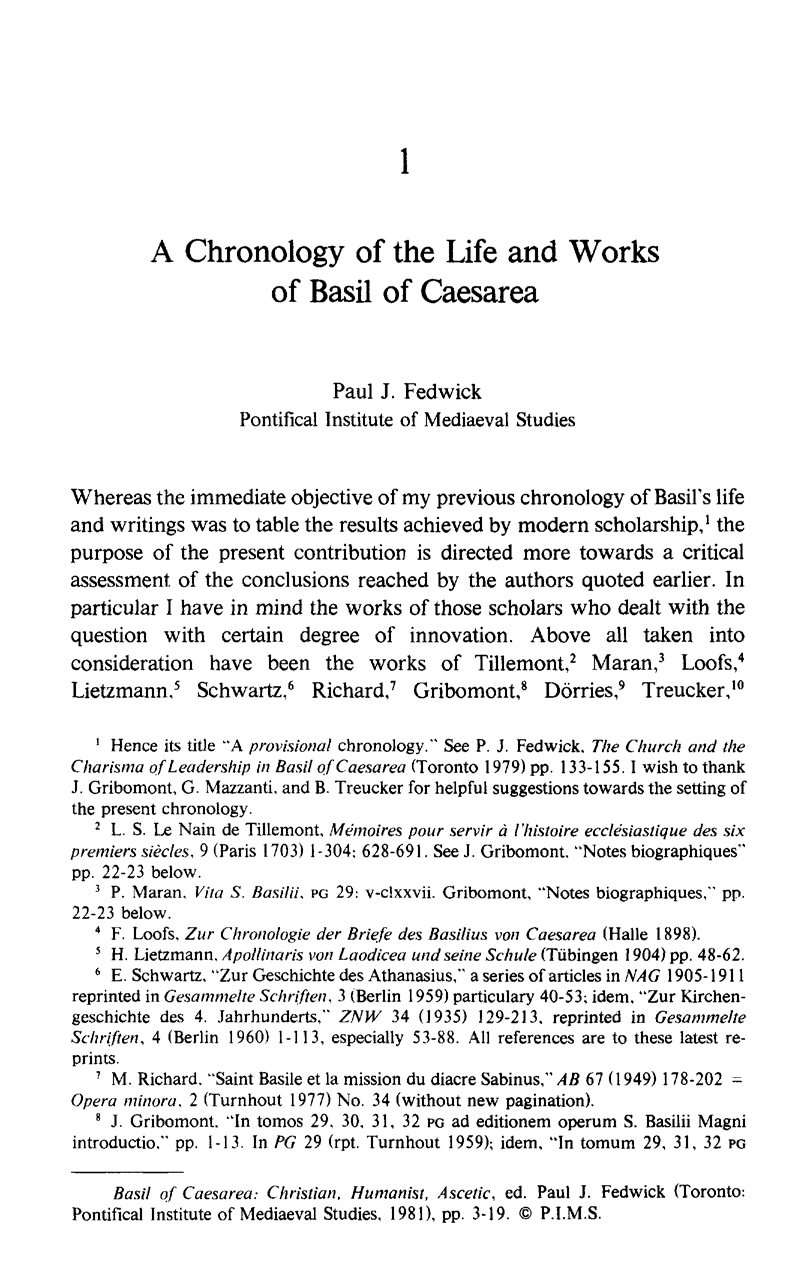
A Chronology of the Life and Works of Basil of Caesarea Paul J. Fedwick Pontifical Institute of Mediaeval Studies
Whereas the immediate objective of my previous chronology of Basil's life and writings was to table the results achieved by modern scholarship,1 the purpose of the present contribution is directed more towards a critical assessment, of the conclusions reached by the authors quoted earlier. In particular I have in mind the works of those scholars who dealt with the question with certain degree of innovation. Above all taken into consideration have been the works of Tillemont,2 Maran,3 Loofs,4
Lietzmann,5 Schwartz,6 Richard,7 Gribomont,8 Domes,9 Treucker,10 1 Hence its title "A provisional chronology." See P. J. Fedwick. The Church and the Charisma of Leadership in Basil of Caesarea (Toronto 1979) pp. 133-155.1 wish to thank
J. Gribomont, G. Mazzanti, and B. Treucker for helpful suggestions towards the setting of the present chronology.
2 L. S. Le Nain de Tillemont, Mémoires pour servir à l'histoire ecclésiastique des six premiers siècles, 9 (Paris 1703) 1-304; 628-691. See J. Gribomont. "Notes biographiques" pp. 22-23 below.
3 P. Maran, Vila S. Basilii, PG 29: v-c!xxvii. Gribomont, "Notes biographiques," pp.
22-23 below.
4 F. Loofs, Zur Chronologie der Briefe des Basilius von Caesarea (Halle 1898).
5 H. Lietzmann, Apoliinaris von Laodicea und seine Schule (Tübingen 1904) pp. 48-62.
6 E. Schwartz, "Zur Geschichte des Athanasius," a series of articles in NAG 1905-1911 reprinted in Gesammelte Schriften, 3 (Berlin 1959) particulary 40-53; idem, "Zur Kirchengeschichte des 4. Jahrhunderts," ZNW 34 (1935) 129-213, reprinted in Gesammelte
Schriften, 4 (Berlin 1960) 1-113, especially 53-88. All references are to these latest reprints.
7 M. Richard. "Saint Basile et la mission du diacre Sabinus," /15 67(1949) 178-202 =
Opera minora. 2 (Turnhout 1977) No. 34 (without new pagination).
8 J. Gribomont. "In tomos 29, 30. 31, 32 PG ad editionem operum S. Basilii Magni introductio." pp. 1-13. In PG 29 (rpt. Turnhout 1959); idem, "In tomum 29, 31, 32 PG
Basil of Caesarea: Christian, Humanist, Ascetic, ed. Paul J. Fedwick (Toronto:
Pontifical Institute of Mediaeval Studies, 1981), pp. 3-19. © P.I.M.S.
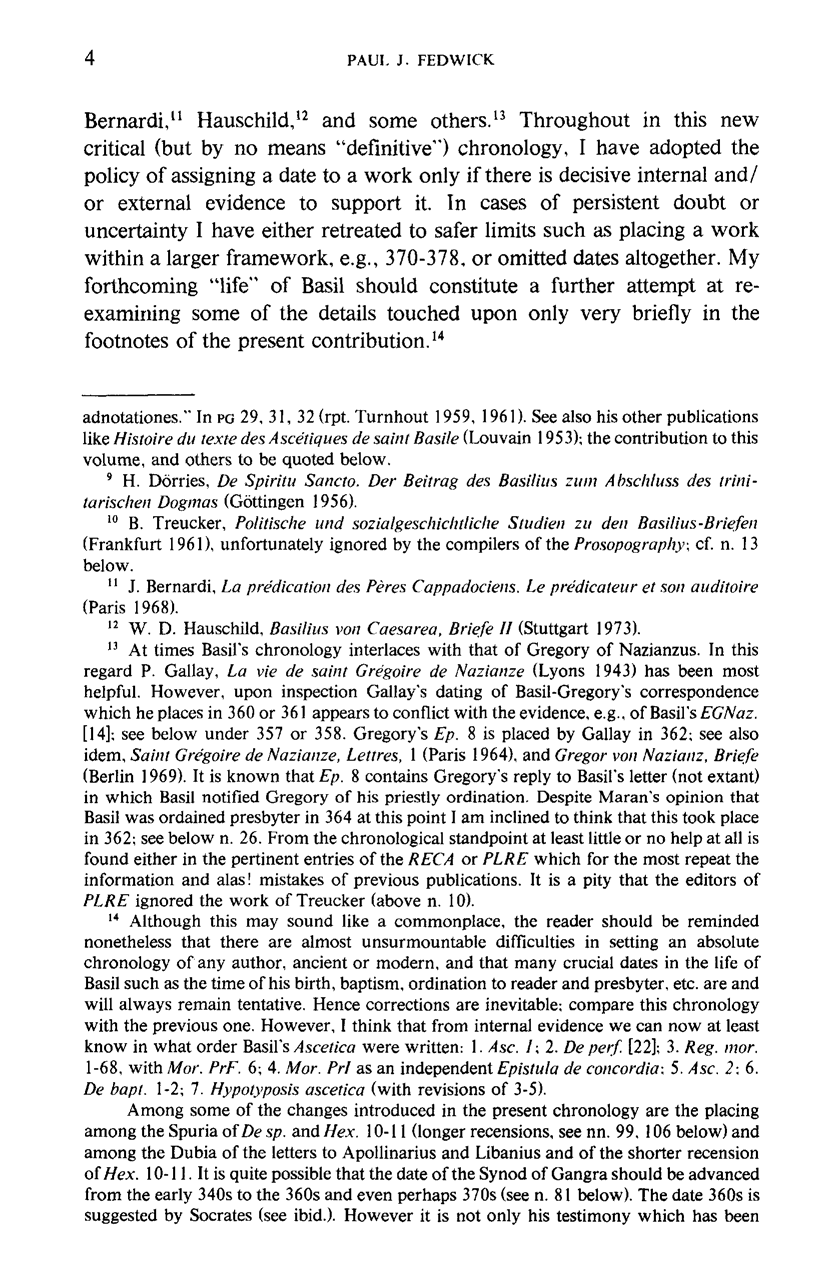
PAUL J. FEDWICK
Bernardi,11 Hauschild,12 and some others.13 Throughout in this new critical (but by no means "definitive") chronology, I have adopted the policy of assigning a date to a work only if there is decisive internal and/ or external evidence to support it. In cases of persistent doubt or uncertainty I have either retreated to safer limits such as placing a work within a larger framework, e.g., 370-378, or omitted dates altogether. My forthcoming "life" of Basil should constitute a further attempt at reexamining some of the details touched upon only very briefly in the footnotes of the present contribution.14 adnotationes." In PG 29, 31, 32 (rpt. Turnhout 1959, 1961 ). See also his other publications like Histoire du texte des Ascétiques de saint Basile (Louvain 1953); the contribution to this volume, and others to be quoted below.
9 H. Dörries, De Spiritu Sancto. Der Beitrag des Basilius zum Abschluss des trinitarischen Dogmas (Göttingen 1956).
10 B. Treucker, Politische und sozialgeschichtliche Studien zu den Basilius-Briefen
(Frankfurt 1961), unfortunately ignored by the compilers of the Prosopography, cf. η. 13 below.
11 J. Bernardi, La prédication des Pères Cappadociens. Le prédicateur et son auditoire
(Paris 1968).
12 W. D. Hauschild, Basilius von Caesarea, Briefe 11 (Stuttgart 1973).
13 At times Basil's chronology interlaces with that of Gregory of Nazianzus. In this regard P. Gallay, La vie de saint Grégoire de Nazianze (Lyons 1943) has been most helpful. However, upon inspection Gallay's dating of Basil-Gregory's correspondence which he places in 360 or 361 appears to conflict with the evidence, e.g., of Basil's EGNaz.
[14]; see below under 357 or 358. Gregory's Ep. 8 is placed by Gallay in 362; see also idem, Saint Grégoire de Nazianze, Lettres, 1 (Paris 1964), and Gregor von Ναζίαιιζ, Briefe
(Berlin 1969). It is known that Ep. 8 contains Gregory's reply to Basil's letter (not extant) in which Basil notified Gregory of his priestly ordination. Despite Maran's opinion that Basil was ordained presbyter in 364 at this point I am inclined to think that this took place in 362; see below n. 26. From the chronological standpoint at least little or no help at all is found either in the pertinent entries of the RECA or PLRE which for the most repeat the information and alas! mistakes of previous publications. It is a pity that the editors of PLRE ignored the work of Treucker (above n. 10).
14 Although this may sound like a commonplace, the reader should be reminded nonetheless that there are almost unsurmountable difficulties in setting an absolute chronology of any author, ancient or modern, and that many crucial dates in the life of Basil such as the time of his birth, baptism, ordination to reader and presbyter, etc. are and will always remain tentative. Hence corrections are inevitable; compare this chronology with the previous one. However, I think that from internal evidence we can now at least know in what order Basil's Ascetica were written: 1. Asc. 1 ; 2. De perf. [22]; 3. Reg. mor.
1-68, with Mor. PrF. 6; 4. Mor. Prl as an independent Epistula de concordia: 5. Asc. 2: 6.
De bapi. 1-2; 7. Hypotyposis ascetica (with revisions of 3-5).
Among some of the changes introduced in the present chronology are the placing among the Spuria of De sp. and Hex. 10-11 (longer recensions, see nn. 99, 106 below) and among the Dubia of the letters to Apollinarius and Libanius and of the shorter recension of Hex. 10-11. It is quite possible that the date of the Synod of Gangra should be advanced from the early 340s to the 360s and even perhaps 370s (see n. 81 below). The date 360s is suggested by Socrates (see ibid.). However it is not only his testimony which has been
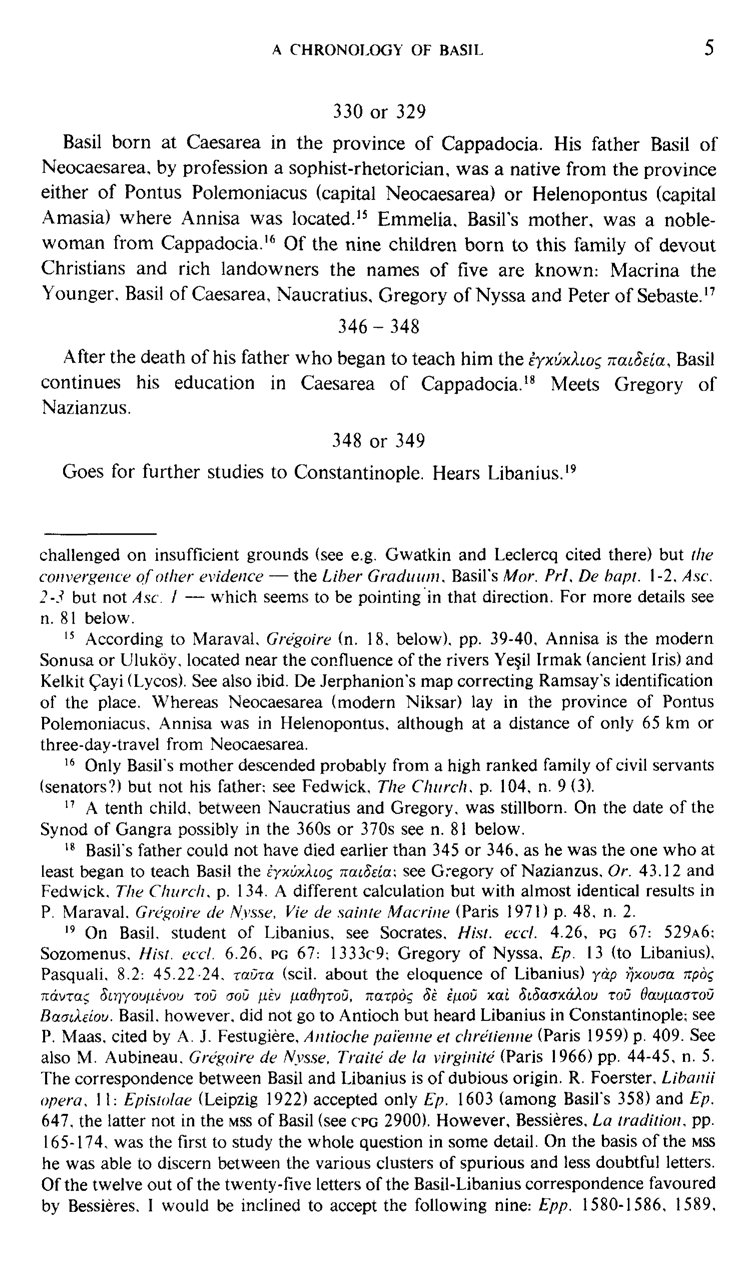
A CHRONOLOGY OF BASIL
330 or 329 Basil born at Caesarea in the province of Cappadocia. His father Basil of Neocaesarea, by profession a sophist-rhetorician, was a native from the province either of Pontus Polemoniacus (capital Neocaesarea) or Helenopontus (capital
Amasia) where Annisa was located.
15 Emmelia, Basil's mother, was a noble woman from Cappadocia.
16 Of the nine children born to this family of devout Christians and rich landowners the names of five are known: Macrina the Younger, Basil of Caesarea, Naucratius, Gregory of Nyssa and Peter of Sebaste.
346-348 After the death of his father who began to teach him the εγκύκλιος παιδεία, Basil continues his education in Caesarea of Cappadocia.
18 Meets Gregory of Nazianzus.
348 or 349
Goes for further studies to Constantinople. Hears Libanius. challenged on insufficient grounds (see e.g. Gwatkin and Leclercq cited there) but the convergence of other evidence — the Liber Graduum. Basil's Mor. Prl. De bapl. 1-2, Asc.
2-3 but not Asc. I — which seems to be pointing in that direction. For more details see a. 81 below.
15 According to Maraval, Grégoire (η. 18. below), pp. 39-40, Annisa is the modern
Sonusa or Ulukoy, located near the confluence of the rivers Yeçil Irmak (ancient Iris) and Kelkit Çayi (Lycos). See also ibid. De Jerphanion's map correcting Ramsay's identification of the place. Whereas Neocaesarea (modern Niksar) lay in the province of Pontus
Polemoniacus, Annisa was in Helenopontus, although at a distance of only 65 km or three-day-travel from Neocaesarea.
16 Only Basil's mother descended probably from a high ranked family of civil servants
(senators?) but not his father; see Fedwick, The Church, p. 104, n. 9 (3).
17 A tenth child, between Naucratius and Gregory, was stillborn. On the date of the Synod of Gangra possibly in the 360s or 370s see n. 81 below.
18 Basil's father could not have died earlier than 345 or 346. as he was the one who at least began to teach Basil the εγκύκλιος παιδεία: see Gregory of Nazianzus, Or. 43.12 and Fedwick. The Church, p. 134. A different calculation but with almost identical results in P. Maraval. Grégoire de Nysse, Vie de sainte Macrine (Paris 1971) p. 48, n. 2.
19 On Basil, student of Libanius, see Socrates. Hist. eccl. 4.26, PG 67: 529A6; Sozomenus, Hist. eccl. 6.26, PG 67: 1333c9; Gregory of Nyssa, Ep. 13 (to Libanius),
Pasquali, 8.2: 45.22-24, ταύτα (seil, about the eloquence of Libanius) γαρ ηχούσα προς πάντας διηγουμενου τοϋ σου μεν μαθητού, πατρός δέ εμού και διδασκάλου τοϋ θαυμαστού
Βασιλείου. Basil, however, did not go to Antioch but heard Libanius in Constantinople; see
P. Maas, cited by A. J. Festugière, Antioche païenne et chrétienne (Paris 1959) p. 409. See also M. Aubineau. Grégoire de Nysse. Traité de la virginité (Paris 1966) pp. 44-45, n. 5.
The correspondence between Basil and Libanius is of dubious origin. R. Foerster, Libanii opera, 11: Episiolae (Leipzig 1922) accepted only Ep. 1603 (among Basil's 358) and Ep.
647. the latter not in the MSS of Basil (see CPG 2900). However, Bessières, La tradition, pp.
165-174, was the first to study the whole question in some detail. On the basis of the MSS he was able to discern between the various clusters of spurious and less doubtful letters.
Of the twelve out of the twenty-five letters of the Basil-Libanius correspondence favoured by Bessières. I would be inclined to accept the following nine: Epp. 1580-1586, 1589,
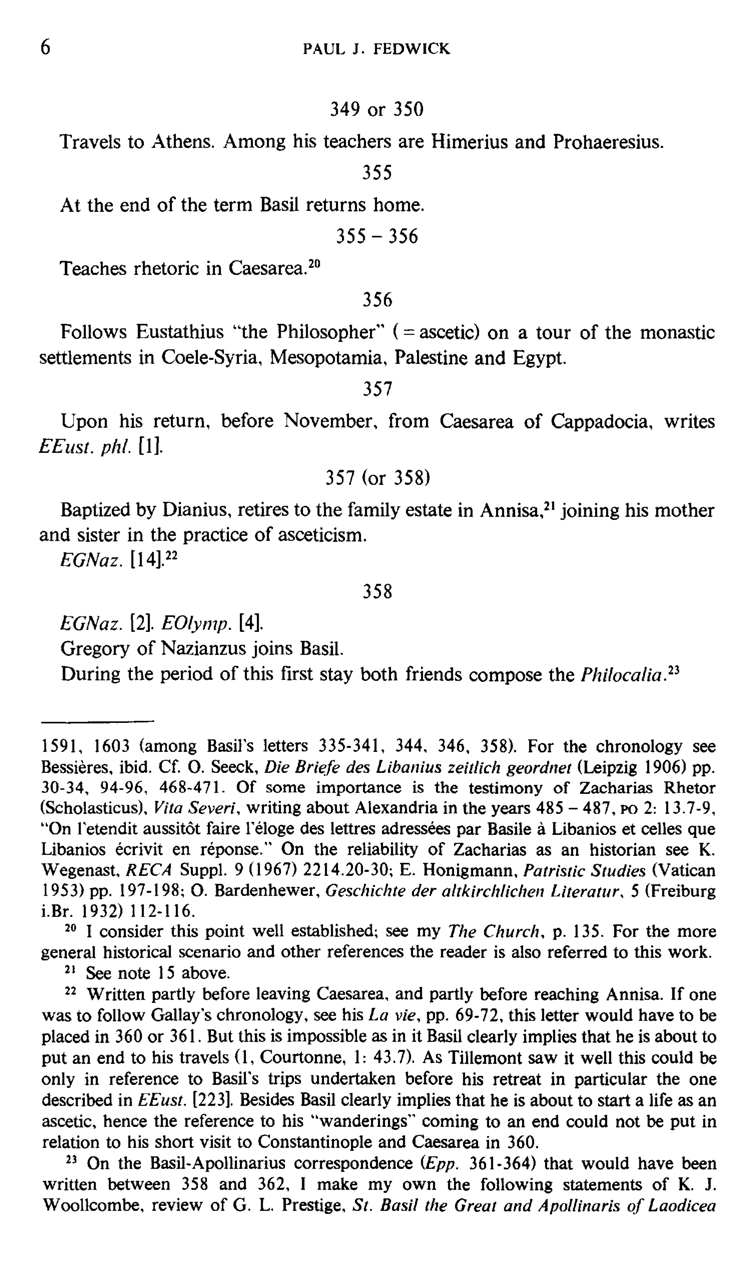
PAUL J. FEDWICK
349 or 350 Travels to Athens. Among his teachers are Himerius and Prohaeresius.
At the end of the term Basil returns home.
355-356 Teaches rhetoric in Caesarea.211
Follows Eustathius "the Philosopher" ( = ascetic) on a tour of the monastic settlements in Coele-Syria, Mesopotamia, Palestine and Egypt.
Upon his return, before November, from Caesarea of Cappadocia, writes EEust. phi. [1].
357 (or 358) Baptized by Dianius, retires to the family estate in Annisa,21 joining his mother and sister in the practice of asceticism.
EGNaz. [14]."
EGNaz. [2], EOlymp. [4], Gregory of Nazianzus joins Basil.
During the period of this first stay both friends compose the Philocalia.21
1591, 1603 (among Basil's letters 335-341, 344, 346, 358). For the chronology see
Bessières, ibid. Cf. Ο. Seeck, Die Briefe des Libanius zeitlich geordnet (Leipzig 1906) pp.
30-34, 94-96, 468-471. Of some importance is the testimony of Zacharias Rhetor (Scholasticus), Vita Severi, writing about Alexandria in the years 485 - 487, PO 2: 13.7-9,
"On retendit aussitôt faire l'éloge des lettres adressées par Basile à Libanios et celles que
Libanios écrivit en réponse." On the reliability of Zacharias as an historian see Κ.
Wegenast, RECA Suppl. 9 (1967) 2214.20-30; Ε. Honigmann, Patristic Studies (Vatican
1953) pp. 197-198; O. Bardenhewer, Geschichte der altkirchlichen Literatur, 5 (Freiburg i.Br. 1932) 112-116.
20 I consider this point well established; see my The Church, p. 135. For the more general historical scenario and other references the reader is also referred to this work.
21 See note 15 above.
22 Written partly before leaving Caesarea, and partly before reaching Annisa. If one was to follow Gallay's chronology, see his La vie, pp. 69-72, this letter would have to be placed in 360 or 361. But this is impossible as in it Basil clearly implies that he is about to put an end to his travels (1, Courtonne, 1: 43.7). As Tillemont saw it well this could be only in reference to Basil's trips undertaken before his retreat in particular the one described in EEust. [223], Besides Basil clearly implies that he is about to start a life as an ascetic, hence the reference to his "wanderings" coming to an end could not be put in relation to his short visit to Constantinople and Caesarea in 360.
23 On the Basil-Apollinarius correspondence (Epp. 361-364) that would have been written between 358 and 362, I make my own the following statements of K. J.
Woollcombe, review of G. L. Prestige, St. Basil the Great and Apollinaris of Laodicea
A CHRONOLOGY
OF BASIL
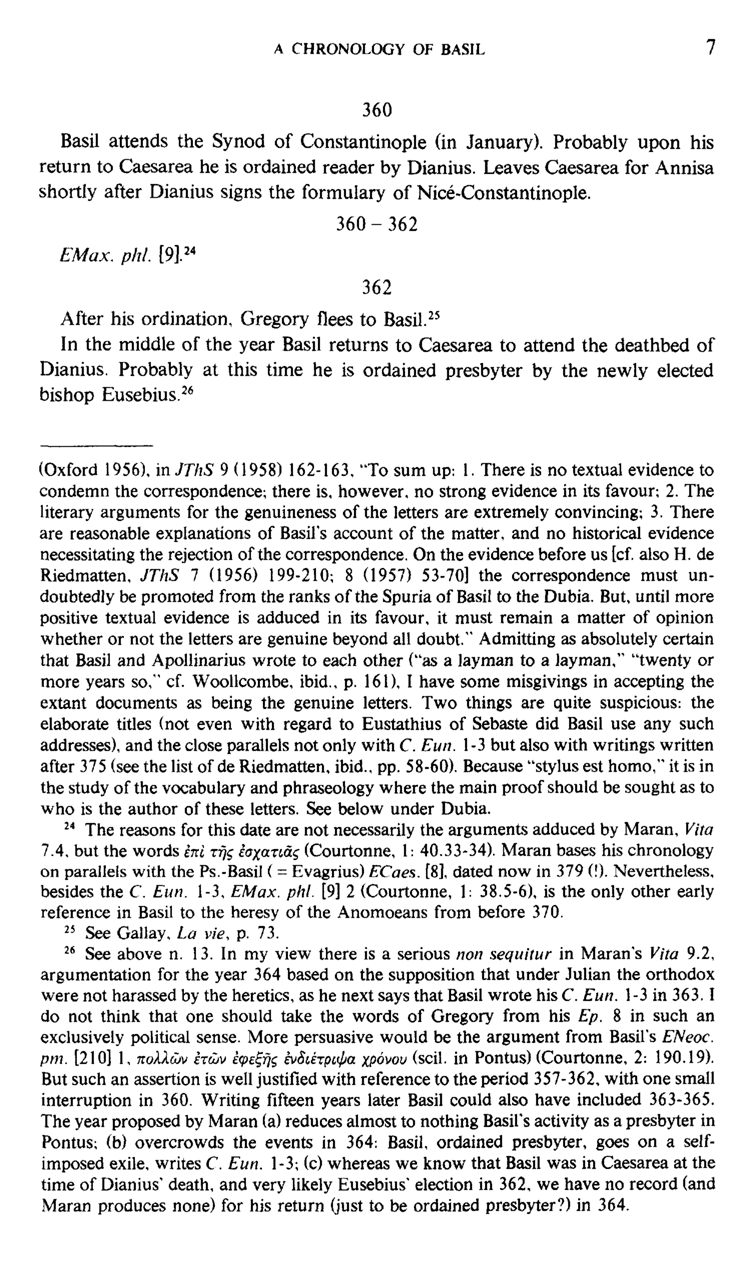
Basil attends the Synod of Constantinople (in January). Probably upon his return to Caesarea he is ordained reader by Dianius. Leaves Caesarea for Annisa shortly after Dianius signs the formulary of Nice-Constantinople.
360-362 EMax. phi. [9]}*
After his ordination, Gregory flees to Basil.
In the middle of the year Basil returns to Caesarea to attend the deathbed of Dianius. Probably at this time he is ordained presbyter by the newly elected bishop Eusebius.
(Oxford 1956), in JThS 9 ( 1958) 162-163, "To sum up: 1. There is no textual evidence to condemn the correspondence; there is, however, no strong evidence in its favour; 2. The literary arguments for the genuineness of the letters are extremely convincing; 3. There are reasonable explanations of Basil's account of the matter, and no historical evidence necessitating the rejection of the correspondence. On the evidence before us [cf. also H. de
Riedmatten, JThS 7 (1956) 199-210; 8 (1957) 53-70] the correspondence must un doubtedly be promoted from the ranks of the Spuria of Basil to the Dubia. But, until more positive textual evidence is adduced in its favour, it must remain a matter of opinion whether or not the letters are genuine beyond all doubt." Admitting as absolutely certain that Basil and Apollinarius wrote to each other ("as a layman to a layman," "twenty or more years so," cf. Woollcombe. ibid., p. 161), I have some misgivings in accepting the extant documents as being the genuine letters. Two things are quite suspicious: the elaborate titles (not even with regard to Eustathius of Sebaste did Basil use any such addresses), and the close parallels not only with C. Eun. 1 -3 but also with writings written after 375 (see the list of de Riedmatten, ibid., pp. 58-60). Because "stylus est homo," it is in the study of the vocabulary and phraseology where the main proof should be sought as to who is the author of these letters. See below under Dubia.
24 The reasons for this date are not necessarily the arguments adduced by Maran, Vita
7.4, but the words έπί της εσχατιάς (Courtonne, 1: 40.33-34). Maran bases his chronology on parallels with the Ps.-Basil ( = Evagrius) ECaes. [8], dated now in 379 (!). Nevertheless, besides the C. Eun. 1-3, EMax. phi. [9] 2 (Courtonne, 1: 38.5-6), is the only other early reference in Basil to the heresy of the Anomoeans from before 370.
25 See Gallay. La vie, p. 73.
26 See above n. 13. In my view there is a serious non sequitur in Maran's Vita 9.2, argumentation for the year 364 based on the supposition that under Julian the orthodox were not harassed by the heretics, as he next says that Basil wrote his C. Eun. 1 -3 in 363.1 do not think that one should take the words of Gregory from his Ep. 8 in such an exclusively political sense. More persuasive would be the argument from Basil's ENeoc. pm. [210] 1, πολλών ετών εφεξής ένδιέτριφα χρόνον (seil, in Pontus) (Courtonne, 2: 190.19).
But such an assertion is well justified with reference to the period 357-362, with one small interruption in 360. Writing fifteen years later Basil could also have included 363-365.
The year proposed by Maran (a) reduces almost to nothing Basil's activity as a presbyter in Pontus; (b) overcrowds the events in 364: Basil, ordained presbyter, goes on a selfimposed exile, writes C. Eun. 1-3; (c) whereas we know that Basil was in Caesarea at the time of Dianius' death, and very likely Eusebius' election in 362, we have no record (and Maran produces none) for his return (just to be ordained presbyter?) in 364.
PAUL J. FEDWICK
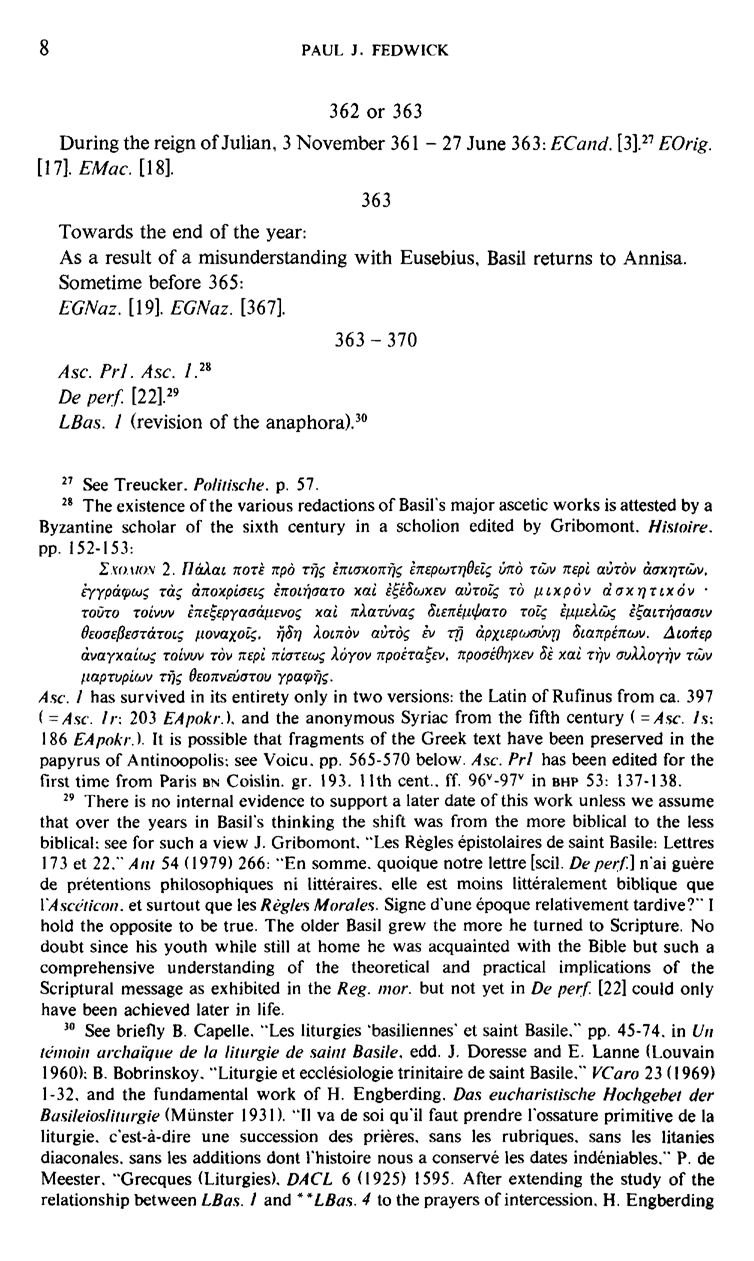
362 or 363 27 EOrig.
[17]. EMac. [IS].
During the reign of Julian, 3 November 361-27 June 363: ECand. [3].
Towards the end of the year:
As a result of a misunderstanding with Eusebius, Basil returns to Annisa.
Sometime before 365:
EGNaz. [19]. EGNaz. [367], 363-370
Asc. Prl. Asc. 1,
De perf. [22].
LBas. 1 (revision of the anaphora).
27 See Treucker. Politische, p. 57.
28 The existence of the various redactions of Basil's major ascetic works is attested by a Byzantine scholar of the sixth century in a scholion edited by Gribomont. Histoire. pp. 152-153:
Σχόλιο* 2. Πάλαι ποτέ itpb της επισκοπής επερωτηθείς ύπό τών περί αυτόν ασκητών, εγγράφως τάς αποκρίσεις έποιήσατο καί έξέδωκεν αύτοϊς τό μικρόν άσκητικόν
• τούτο τοίνυν έπεξεργααάμενος καί πλατύνας διεπέμφατο τοις έμμελώς έξαιτήσασιν θεοσεβεστάτοις μοναχοϊς, ήδη λοιπόν αυτός εν τή άρχιερωσύνη διαπρεπών. Διοπερ άναγκαίως τοίνυν τόν περί πίστεως λόγον προέταξεν, προσέθηκεν δέ καί τήν συλλογήν τώ μαρτυρίων τής θεοπνεύστου γραφής.
Asc. 1 has survived in its entirety only in two versions: the Latin of Rufinus from ca. 397 i=Asc. Ir. 203 EApokr.). and the anonymous Syriac from the fifth century ( =Asc. Is-,
186 EApokrX It is possible that fragments of the Greek text have been preserved in the papyrus of Antinoopolis; see Voicu. pp. 565-570 below. Asc. Prl has been edited for the first time from Paris BN Coislin. gr. 193. 11th cent. ff. 96 v in BHP 53: 137-138.
29 There is no internal evidence to support a later date of this work unless we assume that over the years in Basil's thinking the shift was from the more biblical to the less biblical: see for such a view J. Gribomont. "Les Règles épistolaires de saint Basile: Lettres v-97 173 et 22." A m 54 (1979) 266: "En somme, quoique notre lettre [seil. De perf] n'ai guère de prétentions philosophiques ni littéraires, elle est moins littéralement biblique que
VAscéticon. et surtout que les Règles Morales. Signe d'une époque relativement tardive?" I hold the opposite to be true. The older Basil grew the more he turned to Scripture. No doubt since his youth while still at home he was acquainted with the Bible but such a comprehensive understanding of the theoretical and practical implications of the Scriptural message as exhibited in the Reg. mor. but not yet in De perf. [22] could only have been achieved later in life.
J0 See briefly B. Capelle. "Les liturgies 'basiliennes' et saint Basile." pp. 45-74. in Un témoin archaïque de la liturgie de saint Basile, edd. J. Doresse and E. Lanne (Louvain
1960): B. Bobrinskoy. "Liturgie et ecclésiologie trinitaire de saint Basile," VCaro 23(1969)
1-32, and the fundamental work of H. Engberding. Das eucharistische Hochgebet der
Basileiosliiurgie (Münster 1931). "Il va de soi qu'il faut prendre l'ossature primitive de la liturgie, c'est-à-dire une succession des prières, sans les rubriques, sans les litanies diaconales. sans les additions dont l'histoire nous a conservé les dates indéniables." P. de
Meester. "Grecques (Liturgies). DACL 6 (1925) 1595. After extending the study of the relationship between LBas. I and **LBas. 4 to the prayers of intercession, H. Engberding
A CHRONOLOGY OF BASIL
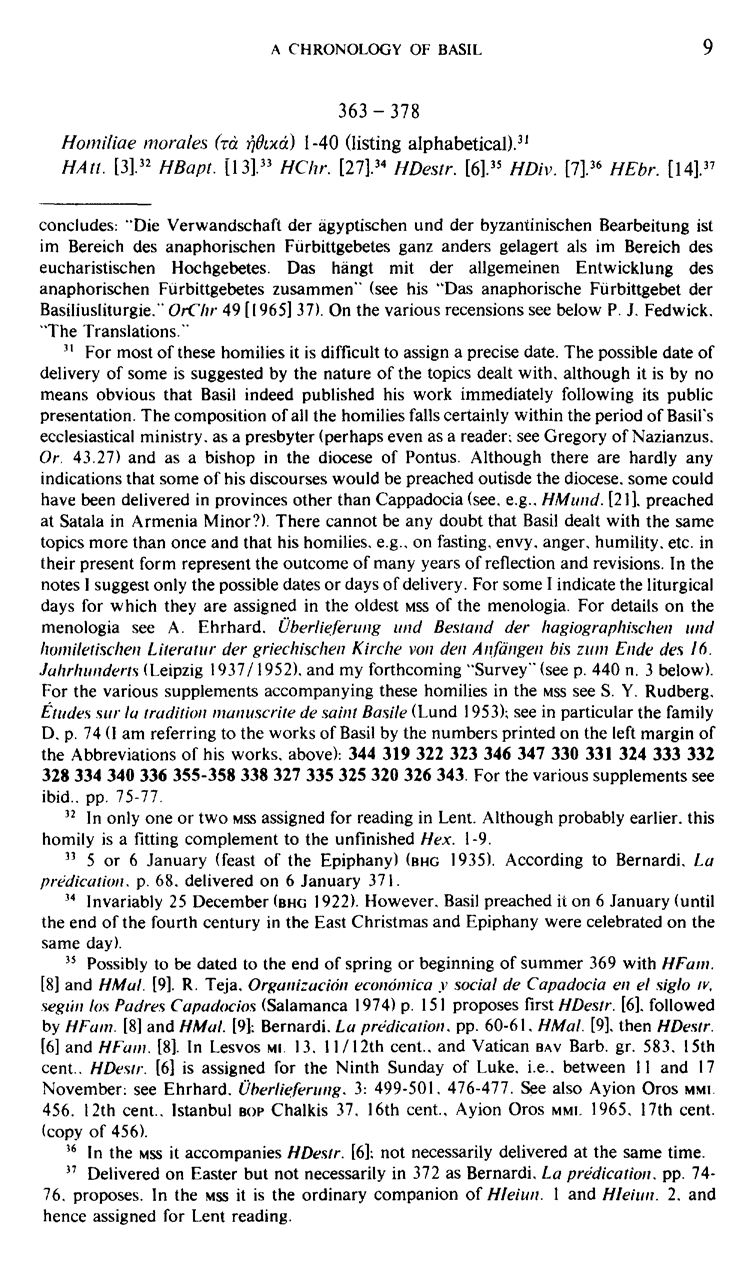
363-378
Homiliae morales (τα ηθικά) 1-40 (listing alphabetical).
32 HBapt. [13].
33 HChr. [27].
34 HDestr. [6].
35 HDiv. [7].
36 HEbr. [14].
HAtt. [3]. concludes: "Die Verwandschaft der ägyptischen und der byzantinischen Bearbeitung ist im Bereich des anaphorischen Fürbittgebetes ganz anders gelagert als im Bereich des eucharistischen Hochgebetes. Das hängt mit der allgemeinen Entwicklung des anaphorischen Fürbittgebetes zusammen" (see his "Das anaphorische Fürbittgebet der
Basiliusliturgie." OrChr 49 [1965] 37). On the various recensions see below P. J. Fedwick.
"The Translations."
" For most of these homilies it is difficult to assign a precise date. The possible date of delivery of some is suggested by the nature of the topics dealt with, although it is by no means obvious that Basil indeed published his work immediately following its public presentation. The composition of all the homilies falls certainly within the period of Basil's ecclesiastical ministry, as a presbyter (perhaps even as a reader; see Gregory of Nazianzus.
Or 43.27) and as a bishop in the diocese of Pontus. Although there are hardly any indications that some of his discourses would be preached outisde the diocese, some could have been delivered in provinces other than Cappadocia (see, e.g.. HMund. [21], preached at Satala in Armenia Minor?). There cannot be any doubt that Basil dealt with the same topics more than once and that his homilies, e.g., on fasting, envy, anger, humility, etc. in their present form represent the outcome of many years of reflection and revisions. In the notes I suggest only the possible dates or days of delivery. For some I indicate the liturgical days for which they are assigned in the oldest MSS of the menologia. For details on the menologia see A. Ehrhard. Überlieferung und Bestand der hagiographischen und homiletischen Literatur der griechischen Kirche von den Anfängen bis zum Ende des 16.
Jahrhunderts (Leipzig 1937/1952), and my forthcoming "Survey" (see p. 440 η. 3 below).
For the various supplements accompanying these homilies in the MSS see S. Y. Rudberg.
Études sur la tradition manuscrite de saint Basile (Lund 1953); see in particular the family
D. p. 74 (1 am referring to the works of Basil by the numbers printed on the left margin of the Abbreviations of his works, above): 344 319 322 323 346 347 330 331 324 333 332
328 334 340 336 355-358 338 327 335 325 320 326 343. For the various supplements see ibid.. pp. 75-77. n In only one or two MSS assigned for reading in Lent. Although probably earlier, this homily is a fitting complement to the unfinished Hex. 1-9.
" 5 or 6 January (feast of the Epiphany) (BHG 1935). According to Bernardi. La prédication, p. 68. delivered on 6 January 371.
54 Invariably 25 December (BHG 1922). However. Basil preached it on 6 January (until the end of the fourth century in the East Christmas and Epiphany were celebrated on the same day).
35 Possibly to be dated to the end of spring or beginning of summer 369 with HFam.
[8] and HMul. [9], R. Teja, Organizacion economica y social de Capadocia en el sigh iv, segiin los Padres Capadocios (Salamanca 1974) p. 151 proposes first HDestr. [6]. followed by HFam. [8] and HMal. [9]: Bernardi. La prédication, pp. 60-61. HMal. [9], then HDestr
[6] and HFam. [8]. In Lesvos MI 13. 11 /12th cent., and Vatican BAV Barb. gr. 583. 15th cent.. HDesir. [6] is assigned for the Ninth Sunday of Luke. i.e.. between II and 17
November: see Ehrhard. Überlieferung. 3: 499-501, 476-477. See also Ayion Oros MMI
456. 12th cent.. Istanbul BOP Chalkis 37. 16th cent, Ayion Oros MMI. 1965, 17th cent
(copy of 456).
,6 In the MSS it accompanies HDesir. [6]; not necessarily delivered at the same time.
" Delivered on Easter but not necessarily in 372 as Bernardi. La prédication, pp. 7476. proposes. In the MSS it is the ordinary companion of HIeiun. 1 and HIeiun. 2. and hence assigned for Lent reading.
PAUL J. FEDWICK
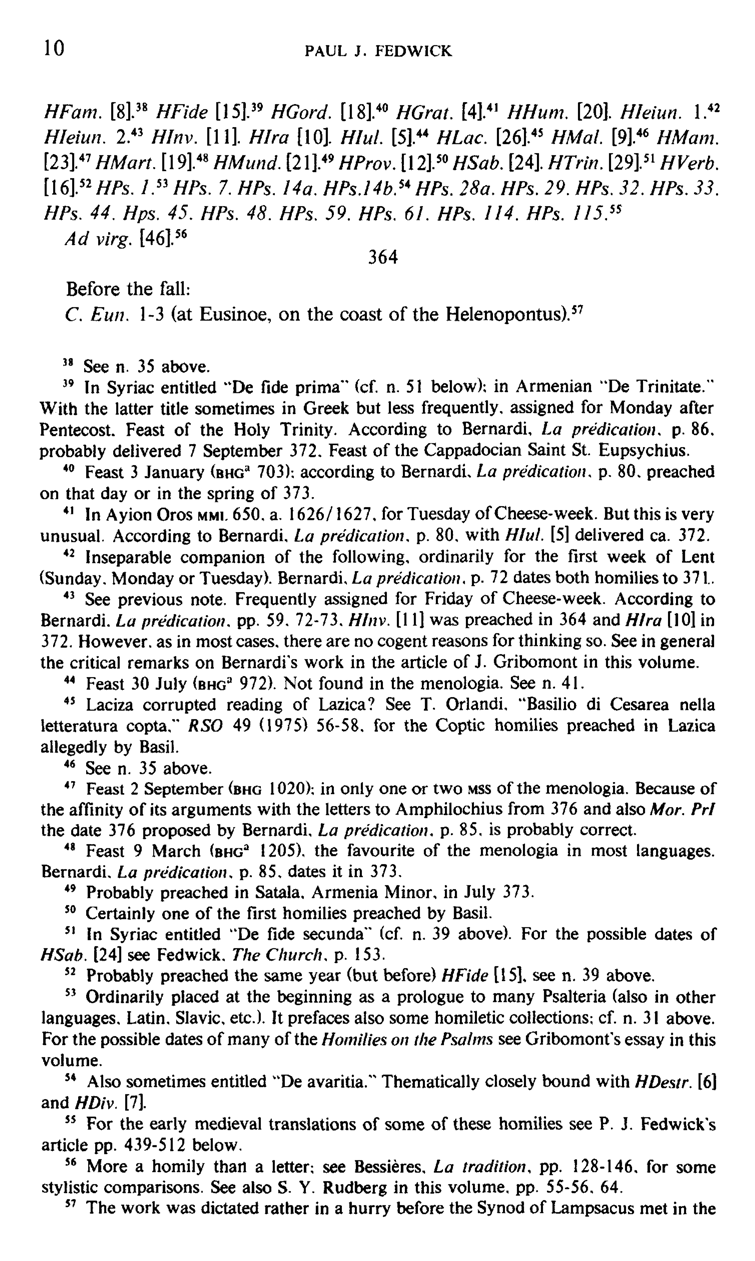
38 HFide [15].
39 HGord. [18].
40 HGrat. [4].
41 HHum. [20]. #/*-/««. I.
HFam. [8].
43 ///nv. [11]. HIra [10]. ///«/. [5].
44 ///.ac. [26].
45 HMal. [9].
46 //A/arn.
[23].
HIeiun. 2.
47 HMart. [19].
48 //Λ/μ/ϊο 1. [21].
49 ///VOV. [12].
50 HSab. [24]. //7W/?. [29].
51 HVerb.
[l6]"HPs.
5iHPs.
7. HPs. 14a. HPs.l4b. s* HPs. 28a. HPs. 29. HPs. 32. HPs. 33.
5S HPs. 44. Hps. 45. HPs. 48. HPs. 59. HPs. 61. HPs. 114. HPs. 1!5.
Ad virg. [46].
Before the fall:
C. Eun. 1-3 (at Eusinoe, on the coast of the Helenopontus).
" See n. 35 above.
9 In Syriac entitled "De fide prima" (cf. η. 51 below); in Armenian "De Trinitate."
With the latter title sometimes in Greek but less frequently, assigned for Monday after Pentecost. Feast of the Holy Trinity. According to Bernardi, La prédication, p. 86. probably delivered 7 September 372. Feast of the Cappadocian Saint St. Eupsychius.
40 Feast 3 January (BHG" 703): according to Bernardi, La prédication, p. 80. preached on that day or in the spring of 373.
41 In Ayion Oros MMI. 650. a. 1626/1627, for Tuesday of Cheese-week. But this is very unusual. According to Bernardi, La prédication, p. 80, with HIul. [5] delivered ca. 372.
42 Inseparable companion of the following, ordinarily for the first week of Lent
(Sunday. Monday or Tuesday). Bernardi, La prédication, p. 72 dates both homilies to 37 L
43 See previous note. Frequently assigned for Friday of Cheese-week. According to Bernardi. La predication, pp. 59. 72-73. Hlnv. [11] was preached in 364 and HIra [10] in 372. However, as in most cases, there are no cogent reasons for thinking so. See in general the critical remarks on Bernardi's work in the article of J. Gribomont in this volume.
44 Feast 30 July (BHG2 972). Not found in the menologia. See n. 41.
45 Laciza corrupted reading of Lazica? See T. Orlandi, "Basilio di Cesarea nella letteratura copta." RSO 49 (1975) 56-58. for the Coptic homilies preached in Lazica allegedly by Basil.
46 See n. 35 above.
47 Feast 2 September (BHG 1020); in only one or two MSS of the menologia. Because of the affinity of its arguments with the letters to Amphilochius from 376 and also Mor. Prl the date 376 proposed by Bernardi, La prédication, p. 85. is probably correct.
48 Feast 9 March (BHGü 1205). the favourite of the menologia in most languages.
Bernardi. La prédication, p. 85, dates it in 373.
49 Probably preached in Satala. Armenia Minor, in July 373. so Certainly one of the first homilies preached by Basil.
51 In Syriac entitled "De fide secunda" (cf. η. 39 above). For the possible dates of HSab. [24] see Fedwick. The Church, p. 153.
52 Probably preached the same year (but before) HFide [15], see n. 39 above.
" Ordinarily placed at the beginning as a prologue to many Psalteria (also in other languages. Latin. Slavic, etc.). It prefaces also some homiletic collections; cf. η. 31 above.
For the possible dates of many of the Homilies on the Psalms see Gribomont's essay in this volume.
54 Also sometimes entitled "De avaritia." Thematically closely bound with HDestr. [6] and HDiv. [7], 55 For the early medieval translations of some of these homilies see P. J. Fedwick's article pp. 439-512 below.
56 More a homily than a letter; see Bessières. La tradition, pp. 128-146, for some stylistic comparisons. See also S. Y. Rudberg in this volume, pp. 55-56, 64.
57 The work was dictated rather in a hurry before the Synod of Lampsacus met in the
A CHRONOLOGY OF BASIL
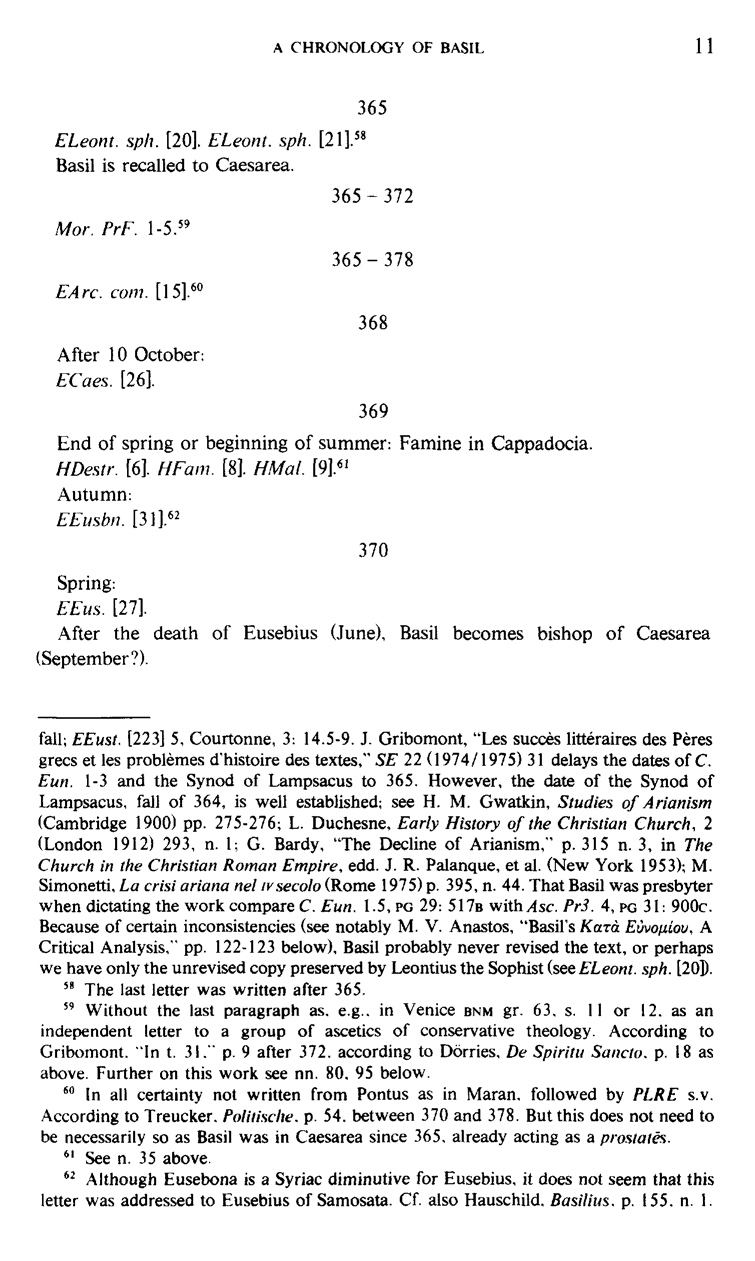
ELeont. sph. [20]. ELeont. sph. [21].58
Basil is recalled to Caesarea.
365-372 Mor. PrF. 1-5.5'
365-378 EArc. com. [15].60
After 10 October:
ECaes. [26],
End of spring or beginning of summer: Famine in Cappadocia.
HDestr. [6]. HFam. [8], HMal. [9].61
Autumn:
EEusbn. [31].62
Spring:
EEus. [27], After the death of Eusebius (June), Basil becomes bishop of Caesarea
(September?). fall; EEust. [223] 5, Courtonne, 3: 14.5-9. J. Gribomont, "Les succès littéraires des Pères grecs et les problèmes d'histoire des textes," SE 22 (1974/1975) 31 delays the dates of C.
Eun. 1-3 and the Synod of Lampsacus to 365. However, the date of the Synod of Lampsacus, fall of 364, is well established; see H. M. Gwatkin, Studies of Arianism
(Cambridge 1900) pp. 275-276; L. Duchesne, Early History of the Christian Church, 2
(London 1912) 293, n. 1; G. Bardy, "The Decline of Arianism," p. 315 n. 3, in The Church in the Christian Roman Empire, edd. J. R. Palanque, et al. (New York 1953); M.
Simonetti, La crisi ariana nel lvsecolo (Rome 1975) p. 395, n. 44. That Basil was presbyter when dictating the work compare C. Eun. 1.5, PG 29: 517B with Asc. Pr3. 4, PG 31: 900c.
Because of certain inconsistencies (see notably M. V. Anastos, "Basil's Κατά Εύνομίου, A Critical Analysis," pp. 122-123 below), Basil probably never revised the text, or perhaps we have only the unrevised copy preserved by Leontius the Sophist (see ELeont. sph. [20]).
5< The last letter was written after 365.
59 Without the last paragraph as. e.g.. in Venice BNM gr. 63. s. 11 or 12. as an independent letter to a group of ascetics of conservative theology. According to Gribomont. "In t 31." p. 9 after 372. according to Dörries, De Spiritu Sancto. p. 18 as above. Further on this work see nn. 80, 95 below.
60 In all certainty not written from Pontus as in Maran, followed by PLRE s.v.
According to Treucker. Politische, p. 54. between 370 and 378. But this does not need to be necessarily so as Basil was in Caesarea since 365, already acting as a prostates.
61 See n. 35 above.
62 Although Eusebona is a Syriac diminutive for Eusebius, it does not seem that this letter was addressed to Eusebius of Samosata. Cf. also Hauschild. Basilius. p. 155. n. 1.
PAUL J. FEDWICK
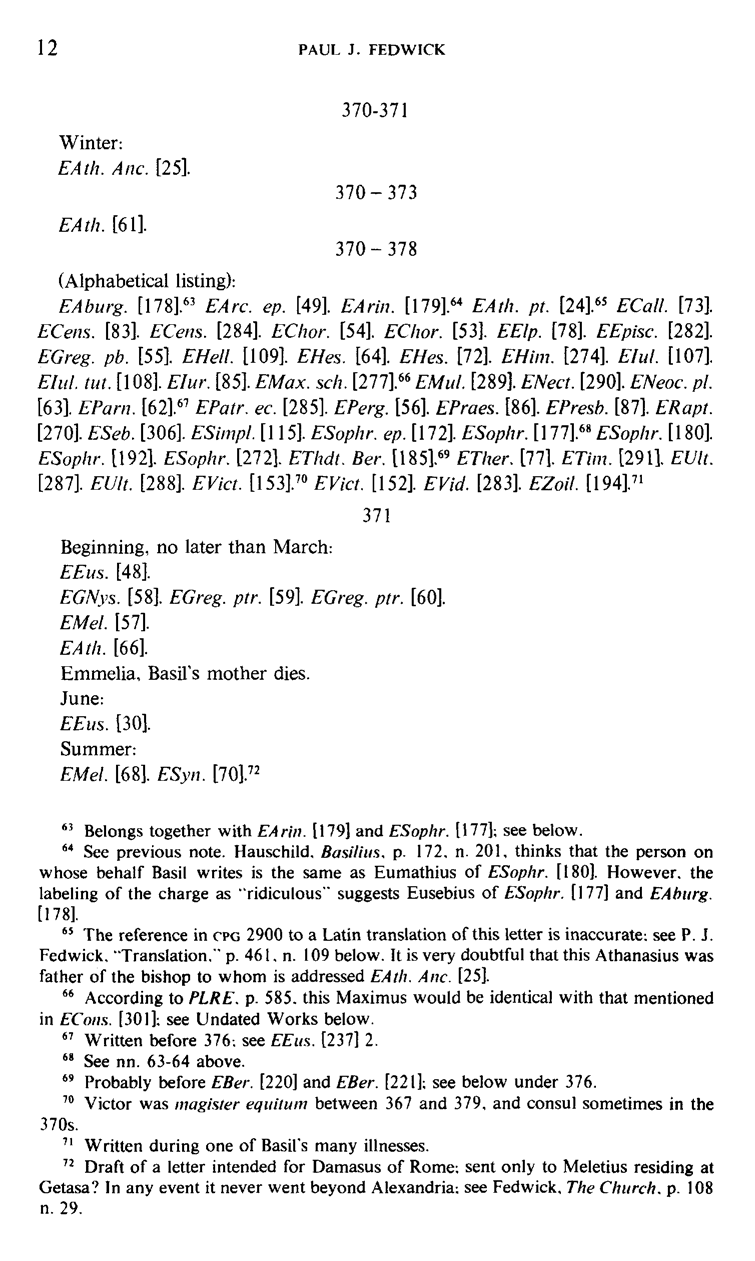
370-371 Winter:
EAth. Anc. [25].
370-373 EAth. [61].
370-378 (Alphabetical listing):
EAburg. [178].
63 EArc. ep. [49]. EArin. [179].
64 EAth. pt. [24].
65 ECall. [73].
ECens. [83]. ECens. [284]. EChor. [54]. £C77or. [53]. EElp. [78]. £-£>/sc. [282].
£O><?g. pb. [55]. £•//<?//. [109]. £7/es. [64]. EHes. [72]. £7///77. [274]. EM. [107].
£7«/. ίκί. [108]. Elur. [85]. £ Ά / ο χ . SC/ï. [277].66 EMul. [289]. £7Vé?Cî. [290]. £7Veoc. pi.
[63], EP«™. [62].67 £Υ>αίΤ. ec. [285]. f W g . [56]. E/Vaes. [86]. EPresb. [87]. £"«a/7/.
[270]. ESeb. [306]. ESi'm/7/. [115]. ESophr. ep. [172]. £So/7/7r. [177].
68 ESophr. [180], fSo/7/77-. [192]. ESophr. [272]. £T/W/. ßer. [185].69 ETher. [77]. £T/m. [291], FiZ/i.
[287]. EUlt. [288]. £T/ci. [153].70 EVid. [152]. £y/i/. [283]. fZo;'/. [194].71
Beginning, no later than March:
EEus. [48].
EGNys. [58]. EGreg. ptr. [59]. f O e g . ptr. [60].
£"A/e/. [57].
£"/l//7. [66], Emmelia, Basil's mother dies.
June:
EEus. [30].
Summer:
EMel. [68]. ESyn. [70].72
63 Belongs together with EArin. [179] and ESophr. [177]; see below.
64 See previous note. Hauschild. Basilius, p. 172, η. 201, thinks that the person on whose behalf Basil writes is the same as Eumathius of ESophr. [180]. However, the labeling of the charge as "ridiculous" suggests Eusebius of ESophr. [177] and EAburg.
[178], 65 The reference in CPG 2900 to a Latin translation of this letter is inaccurate: see P. J.
Fedwick, "Translation." p. 461, n. 109 below. It is very doubtful that this Athanasius was father of the bishop to whom is addressed £4//!. Anc. [25],
66 According to PLRE. p. 585. this Maximus would be identical with that mentioned in ECons. [301]: see Undated Works below.
67 Written before 376. see EEus. [237] 2.
68 See nn. 63-64 above.
69 Probably before EBer. [220] and EBer. [221]; see below under 376.
70 Victor was magister equitum between 367 and 379, and consul sometimes in the 370s.
71 Written during one of Basil's many illnesses.
72 Draft of a letter intended for Damasus of Rome; sent only to Meletius residing at Getasa? In any event it never went beyond Alexandria: see Fedwick, The Church, p. 108 n. 29.
A CHRONOLOGY OF BASIL
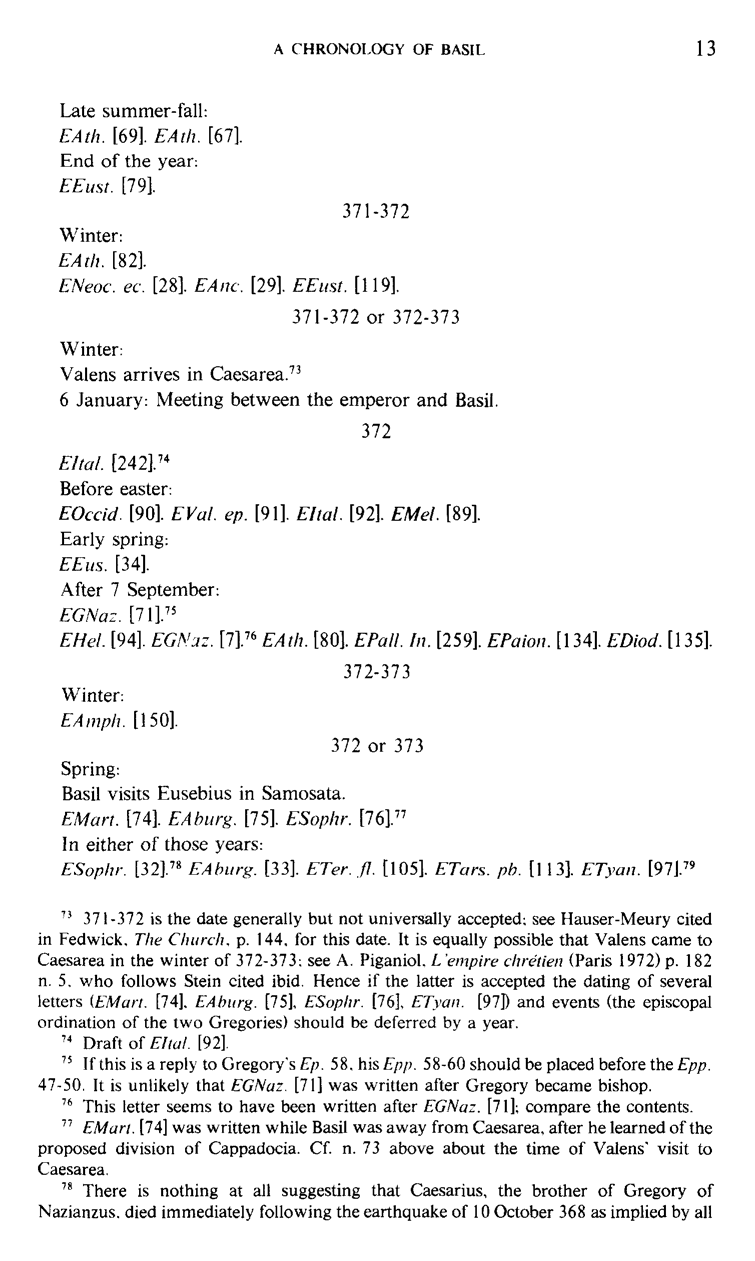
Late summer-fall:
EAth. [69]. EAth. [67].
End of the year:
EEust. [79], 371-372 Winter:
EAth. [82].
ENeoc. ec. [28]. Ε Anc. [29], EEust. [119].
371-372 or 372-373 Winter:
Valens arrives in Caesarea.
6 January: Meeting between the emperor and Basil.
Eltal. [242].
Before easter:
EOccid. [90]. EVal. ep. [91]. Eltal. [92]. EMel. [89].
Early spring:
EEus. [34].
After 7 September:
EGNaz. [71].
7S 76 EAth. [80]. £7V'. //7. [259]. EPaion. [134], £YJ>f'o</. [135].
EHel. [94]. EGNaz. [7].
372-373 Winter:
EAmph. [150].
372 or 373 Spring:
Basil visits Eusebius in Samosata.
EMart. [74]. EAburg. [75], ESophr. [76].
In either of those years:
ESophr. [32].
78 EAburg. [33]. £7>/\ /7. [105]. ETars. pb. [113]. £7>a/7. [97].
75 371-372 is the date generally but not universally accepted; see Hauser-Meury cited in Fedwick. The Church, p. 144, for this date. It is equally possible that Valens came to Caesarea in the winter of 372-373; see A. Piganiol. L 'empire chrétien (Paris 1972) p. 182 n. 5, who follows Stein cited ibid. Hence if the latter is accepted the dating of several letters (EMart. [74]. EAburg. [75], ESophr. [76], ETyan. [97]) and events (the episcopal ordination of the two Gregories) should be deferred by a year.
74 Draft of Eltal. [92].
75 If this is a reply to Gregory's Ep. 58, his Epp. 58-60 should be placed before the Epp.
47-50. It is unlikely that EGNaz. [71] was written after Gregory became bishop.
76 This letter seems to have been written after EGNaz. [71]; compare the contents.
77 EMart. [74] was written while Basil was away from Caesarea, after he learned of the proposed division of Cappadocia. Cf. η. 73 above about the time of Valens' visit to Caesarea.
78 There is nothing at all suggesting that Caesarius, the brother of Gregory of Nazianzus. died immediately following the earthquake of 10 October 368 as implied by all
PAUL J. FEDWICK
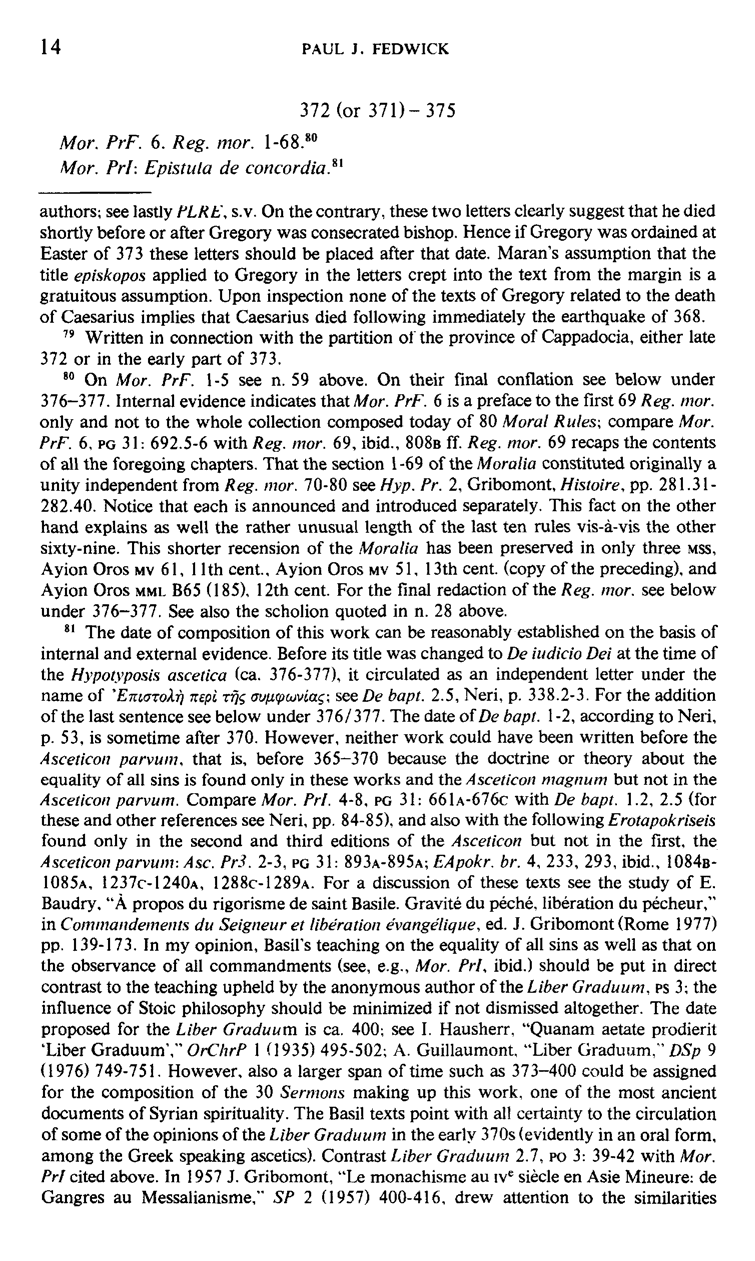
372 (or 371)-375 Mor. PrF. 6. Reg. mor. 1-68.80
Mor. Prl·. Epistula de concordia.*' authors; see lastly PLRE, s.v. On the contrary, these two letters clearly suggest that he died shortly before or after Gregory was consecrated bishop. Hence if Gregory was ordained at Easter of 373 these letters should be placed after that date. Maran's assumption that the title episkopos applied to Gregory in the letters crept into the text from the margin is a gratuitous assumption. Upon inspection none of the texts of Gregory related to the death of Caesarius implies that Caesarius died following immediately the earthquake of 368.
79 Written in connection with the partition of the province of Cappadocia, either late
372 or in the early part of 373.
80 On Mor. PrF. 1-5 see n. 59 above. On their final conflation see below under 376-377. Internal evidence indicates that Mor. PrF. 6 is a preface to the first 69 Reg. mor. only and not to the whole collection composed today of 80 Moral Rules; compare Mor.
PrF. 6, PG 31: 692.5-6 with/teg. mor. 69, ibid., 808B ff. Reg. mor. 69 recaps the contents of all the foregoing chapters. That the section 1-69 of the Moralia constituted originally a unity independent from Reg. mor. 70-80 see Hyp. Pr. 2, Gribomont, Histoire, pp. 281.31282.40. Notice that each is announced and introduced separately. This fact on the other hand explains as well the rather unusual length of the last ten rules vis-à-vis the other sixty-nine. This shorter recension of the Moralia has been preserved in only three MSS,
Ayion Oros MV 61, 11th cent, Ayion Oros MV 51, 13th cent, (copy of the preceding), and Ayion Oros MML B65 (185), 12th cent. For the final redaction of the Reg. mor. see below under 376-377. See also the scholion quoted in n. 28 above.
81 The date of composition of this work can be reasonably established on the basis of internal and external evidence. Before its title was changed to De iudicio Dei at the time of the Hypotyposis ascetica (ca. 376-377), it circulated as an independent letter under the name of 'Επιστολή περί τής συμφωνίας; see De bapt. 2.5, Neri, p. 338.2-3. For the addition of the last sentence see below under 376/377. The date of De bapt. 1-2, according to Neri, p. 53, is sometime after 370. However, neither work could have been written before the Asceticon parvuin, that is, before 365-370 because the doctrine or theory about the equality of all sins is found only in these works and the Asceticon magnum but not in the Asceticon parvum. Compare Mor. Prl. 4-8, PG 31: 661A-676C with De bapt. 1.2, 2.5 (for these and other references see Neri, pp. 84-85), and also with the following Erotapokriseis found only in the second and third editions of the Asceticon but not in the first, the Asceticon parvum-. Asc. Pr3. 2-3, PG 31: 893A-895A; EApokr. br. 4, 233, 293, ibid., 1084B1085A, 1237C-1240A, 1288C-1289A. For a discussion of these texts see the study of E.
Baudry, "À propos du rigorisme de saint Basile. Gravité du péché, libération du pécheur," in Commandements du Seigneur et libération évangélique, ed. J. Gribomont (Rome 1977) pp. 139-173. In my opinion, Basil's teaching on the equality of all sins as well as that on the observance of all commandments (see, e.g., Mor. Prl, ibid.) should be put in direct contrast to the teaching upheld by the anonymous author of the Liber Graduum, PS 3; the influence of Stoic philosophy should be minimized if not dismissed altogether. The date proposed for the Liber Graduum is ca. 400; see I. Hausherr, "Quanam aetate prodierit
'Liber Graduum'," OrChrP 1 (1935) 495-502; A. Guillaumont, "Liber Graduum," DSp 9
(1976) 749-751. However, also a larger span of time such as 373-400 could be assigned for the composition of the 30 Sermons making up this work, one of the most ancient documents of Syrian spirituality. The Basil texts point with all certainty to the circulation of some of the opinions of the Liber Graduum in the early 370s (evidently in an oral form, among the Greek speaking ascetics). Contrast Liber Graduum 2.7, PO 3: 39-42 with Mor.
Prl cited above. In 1957 J. Gribomont, "Le monachisme au ive siècle en Asie Mineure: de
Gangres au Messalianisme," SP 2 (1957) 400-416, drew attention to the similarities
A CHRONOLOGY OF BASIL
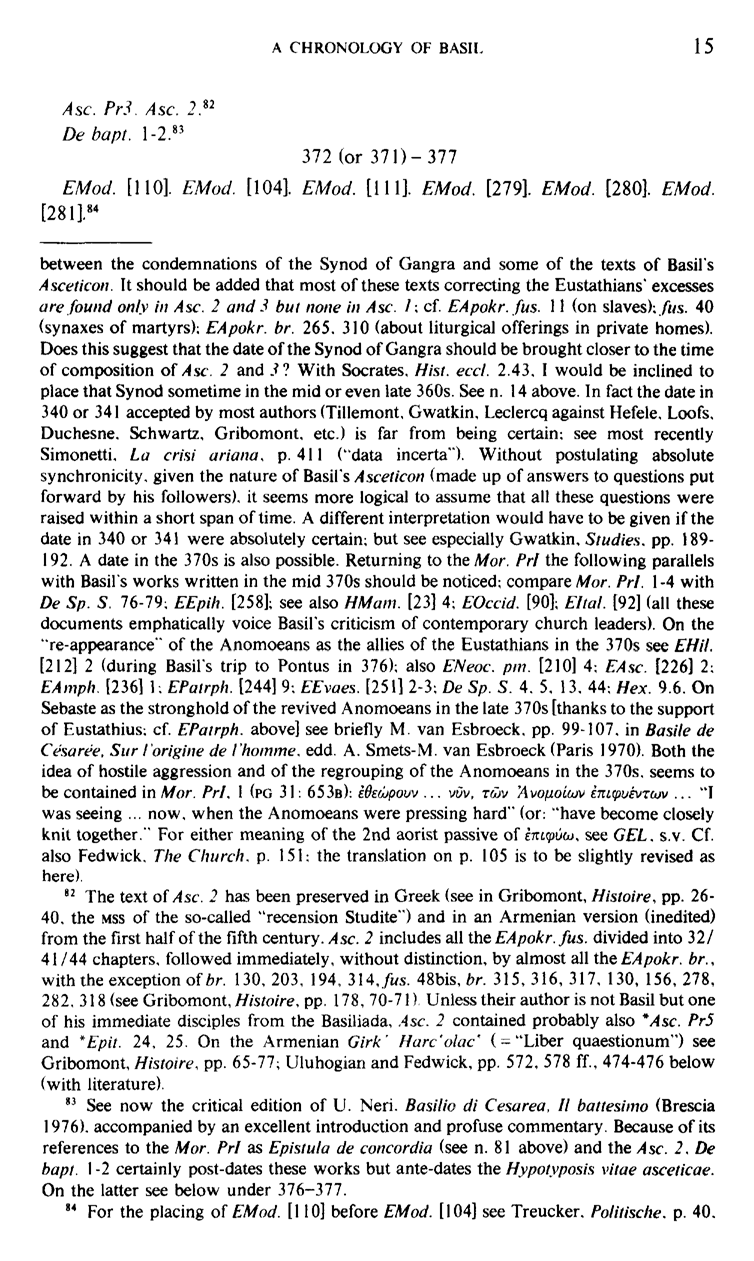
Asc. Pr3. Asc. 2."
De bapt. 1-2.83
372 (or 371)-377 EMod. [110]. EMod. [104]. EMod. [111]. EMod. [279]. EMod. [280]. EMod.
[281].84 between the condemnations of the Synod of Gangra and some of the texts of Basil's
Asceticon. It should be added that most of these texts correcting the Eustathians' excesses are found only in Asc. 2 and J but none in Asc. 1; cf. EApokr. fus. 11 (on slaves); fus. 40
(synaxes of martyrs); EApokr. br. 265. 310 (about liturgical offerings in private homes).
Does this suggest that the date of the Synod of Gangra should be brought closer to the time of composition of Asc. 2 and .?? With Socrates, Hist. eccl. 2.43, I would be inclined to place that Synod sometime in the mid or even late 360s. See n. 14 above. In fact the date in 340 or 341 accepted by most authors (Tillemont, Gwatkin, Leclercq against Hefele, Loofs.
Duchesne. Schwartz, Gribomont, etc.) is far from being certain; see most recently
Simonetti. Z.c7 crisi ariana, p. 411 ("data incerta"). Without postulating absolute synchronicity, given the nature of Basil's Asceticon (made up of answers to questions put forward by his followers), it seems more logical to assume that all these questions were raised within a short span of time. A different interpretation would have to be given if the date in 340 or 341 were absolutely certain; but see especially Gwatkin, Studies, pp. 189192. A date in the 370s is also possible. Returning to the Mor. Prl the following parallels with Basil's works written in the mid 370s should be noticed; compare Mor. Prl. 1-4 with De Sp. S. 76-79; EEpih. [258]; see also HMam. [23] 4; EOccid. [90]; Eltal. [92] (all these documents emphatically voice Basil's criticism of contemporary church leaders). On the "re-appearance" of the Anomoeans as the allies of the Eustathians in the 370s see EHil.
[212] 2 (during Basil's trip to Pontus in 376); also ENeoc. pm. [210] 4; EAsc. [226] 2;
EAmph. [236] 1; EPatrph. [244] 9-, EEvaes. [251] 2-3; De Sp. S. 4. 5. 13. 44; Hex. 9.6. On Sebaste as the stronghold of the revived Anomoeans in the late 370s [thanks to the support of Eustathius: cf. EPatrph. above] see briefly M. van Esbroeck, pp. 99-107. in Basile de
Césarée, Sur l'origine de l'homme, edd. A. Smets-M. van Esbroeck (Paris 1970). Both the idea of hostile aggression and of the regrouping of the Anomoeans in the 370s. seems to be contained in Mor. Prl, 1 (PG 31: 653B): έθεώρουν ... νΰν, τών 'Ανόμοιων έπιφυέντων ... "Ι was seeing ... now, when the Anomoeans were pressing hard" (or: "have become closely knii together." For either meaning of the 2nd aorist passive of έπιφύω, see GEL. s.v. Cf. also Fedwick. The Church, p. 151; the translation on p. 105 is to be slightly revised as here) 12 The text of Asc. 2 has been preserved in Greek (see in Gribomont, Histoire, pp. 2640, the MSS of the so-called "recension Studite") and in an Armenian version unedited) from the first half of the fifth century. Asc. 2 includes all the EApokr. fus. divided into 32/
41/44 chapters, followed immediately, without distinction, by almost all the EApokr. br., with the exception of br. 130,203, 194, 314,/ws. 48bis, br. 315,316,317, 130, 156,278,
282, 318 (see Gribomont, Histoire, pp. 178, 70-71). Unless their author is not Basil but one of his immediate disciples from the Basiliada, Asc. 2 contained probably also *Asc. PrS and "Epit. 24, 25. On the Armenian Girk' Harc'olac' ( = "Liber quaestionum") see
Gribomont, Histoire, pp. 65-77; Uluhogian and Fedwick, pp. 572, 578 ff., 474-476 below
(with literature).
83 See now the critical edition of U. Neri. Basilio di Cesarea, II battesimo (Brescia
1976). accompanied by an excellent introduction and profuse commentary. Because of its references to the Mor. Prl as Epistula de concordia (see n. 81 above) and the Asc. 2, De bapt. I -2 certainly post-dates these works but ante-dates the Hypotyposis vitae asceticae.
On the latter see below under 376-377.
84 For the placing of EMod. [110] before EMod. [104] see Treucker, Politische, p. 40.
PAUL J. FEDWICK
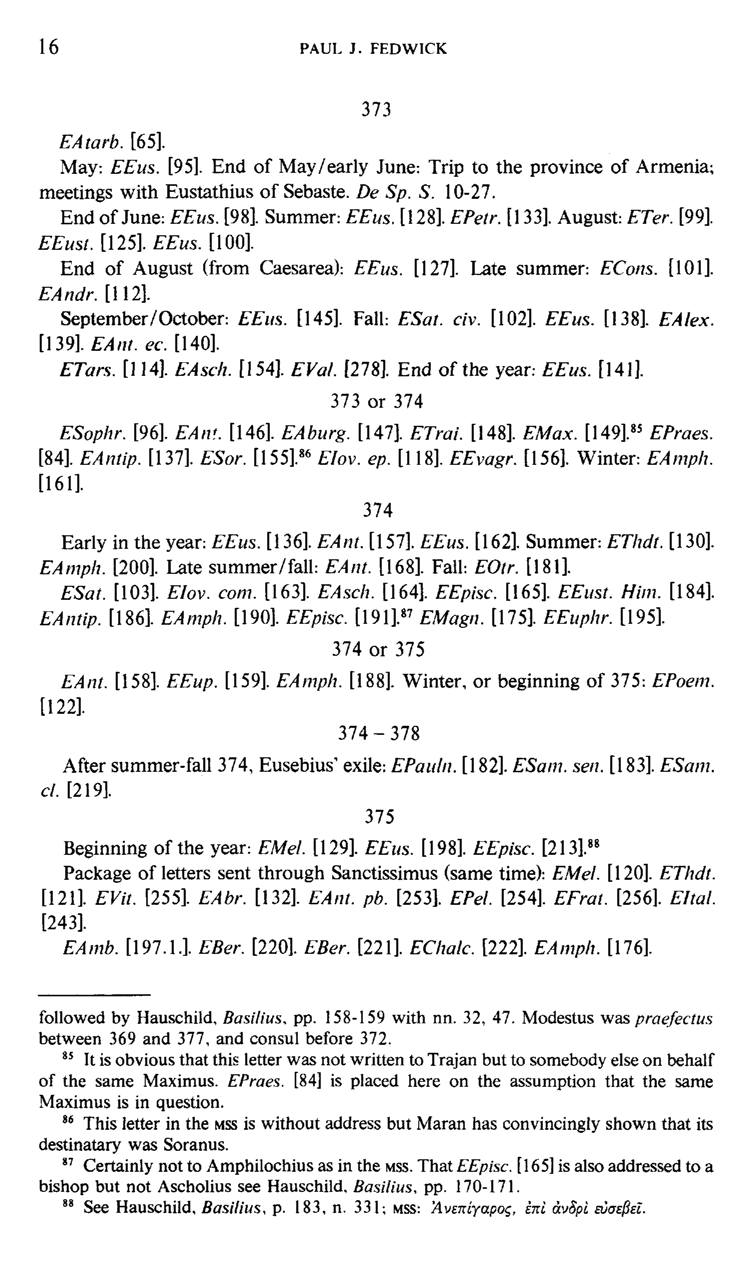
EAtarb. [65], May: EEus. [95]. End of May/early June: Trip to the province of Armenia; meetings with Eustathius of Sebaste. De Sp. S. 10-27.
End of June: EEus. [98]. Summer: EEus. [128]. EPetr. [133]. August: ETer. [99].
EEust. [125]. EEus. [100].
End of August (from Caesarea): EEus. [127]. Late summer: ECons. [101].
EAndr. [112], September/October: EEus. [145]. Fall: ESat. civ. [102]. EEus. [138], EAIex.
[139]. EAnt.ec. [140].
ETars. [114], EAsch. [154]. £Ta/. [278], End of the year.· EEus. [141].
373 or 374 5 F/Ws.
[84]. EAntip. [137]. £Sor. [155].
ESophr. [96], EAnt. [146], £X&Mrg. [147]. £Tra/. [148], EMax. [149].» 86 £7ov. ep. [118]. fFva^r. [156]. Winter: EAmph.
[161].
Early in the year: EEus. [136]. £Xni. [157]. EEus. [162], Summer: £77»i/r. [130].
EAmph. [200], Late summer/fall: f-4/ίί. [168], Fall: EOtr. [181], £Sai. [103], EIov. com. [163]. £>lsc/7. [164]. EEpisc. [165]. £"£Ί«ί. ///m. [184].
EAntip. [186], £Xm/>/?. [190]. EEpisc. [1911 s7 F/l/agn. [175]. Ffw/jAr. [195].
374 or 375 £",4/7/. [158]. EEup. [159]. £Χ/77ρΛ. [188], Winter, or beginning of 375: EPoem.
[122].
374-378 After summer-fall 374, Eusebius' exile: EPauln. [182]. ESam. sen. [183]. ESam. cl. [2191
Beginning of the year: EMel. [129]. EEus. [198], £"£>/sc. [213].
Package of letters sent through Sanctissimus (same time): EMel. [120], EThdt.
[1211 £"Ki7. [255], £>!£/-. [132], £>4/7i. pft. [253]. £7W. [254], EErat. [256], £7ta/.
[243].
EAmb. [197.1.]. £"Äe/-. [220]. Eft?/-. [221]. EChalc. [222]. EAmph. [176]. followed by Hauschild, Basilius, pp. 158-159 with nn. 32, 47. Modestus was praefectus between 369 and 377, and consul before 372.
85 It is obvious that this letter was not written to Trajan but to somebody else on behalf of the same Maximus. EPraes. [84] is placed here on the assumption that the same
Maximus is in question.
86 This letter in the MSS is without address but Maran has convincingly shown that its destinatary was Soranus.
87 Certainly not to Amphilochius as in the MSS. That EEpisc. [165] is also addressed to a bishop but not Ascholius see Hauschild, Basilius, pp. 170-171.
88 See Hauschild, Basilius, p. 183, n. 331; MSS: Άνεπίγαρος, έπί άνδρί εύσεβεί.
A CHRONOLOGY OF BASIL
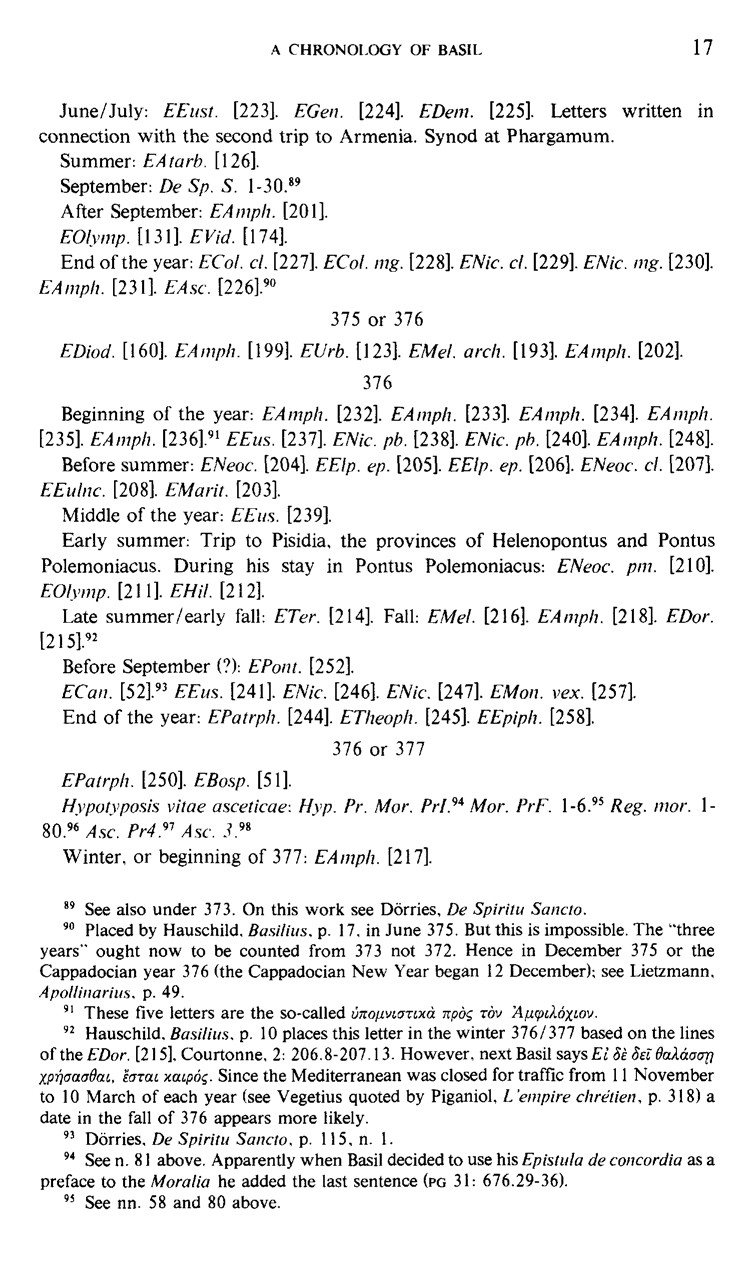
June/July: EEust.
[223]. EGen.
[224]. EDem.
[225]. Letters written in connection with the second trip to Armenia. Synod at Phargamum.
Summer: EAtarb. [126].
September: De Sp. S. 1-30.
After September: EAmph. [201].
EOlymp. [131]. EVid. [174].
End of the year: ECol. cl. [227], ECol. mg. [228]. ENic. ci. [229]. ENic. mg. [230].
EAmph. [231]. EAsc. [226].
375 or 376 EDiod. [160]. EAmph. [199]. EUrb. [123]. O/e/. arch. [193]. f/imp/?. [202].
Beginning of the year: EAmph. [232]. EAmph. [233]. EAmph. [234]. EAmph.
[235]. £Λ/77/;/!. [236].
91 £"£"ws. [237]. f/V/c. /?6. [238]. £7V/c. /76. [240]. EAmph. [248].
Before summer: ENeoc. [204]. £ΐ7/7. <?/>. [205]. EElp. ep. [206]. £7V<?oc. c/. [207].
EEulnc. [208], £7Wa/-(Y. [203], Middle of the year: EEus. [239].
Early summer: Trip to Pisidia, the provinces of Helenopontus and Pontus Polemoniacus. During his stay in Pontus Polemoniacus: ENeoc. pm. [210].
EOlymp. [211]. EH il. [212].
Late summer/early fall: ETer. [214]. Fall: EMel. [216]. EAmph. [218]. EDor.
[215].
Before September (?): EPoni. [252].
ECan. [52].
93 £Îw.s. [241]. ENic. [246]. £7V/c. [247]. EMon. vex. [257].
End of the year: EPatrph. [244], ETheoph. [245]. £"£>//7/7. [258], 376 or 377 EPatrph. [250]. fßo.s/7. [51].
Hypotyposis vitae asceticae: Hyp. Pr. Mor. Prl.9* Mor. PrF. 1-6.95 Reg. mor. 180.96 Asc. Pr491 Asc.
3n Winter, or beginning of 377: EAmph. [217].
89 See also under 373. On this work see Dörries, De Spiritu Sancto.
90 Placed by Hauschild, Basilius, p. 17, in June 375. But this is impossible. The "three years" ought now to be counted from 373 not 372. Hence in December 375 or the Cappadocian year 376 (the Cappadocian New Year began 12 December); see Lietzmann,
Apollinarius. p. 49.
92 Hauschild, Basilius, p. 10 places this letter in the winter 376/377 based on the lines of the EDor. [215], Courtonne, 2: 206.8-207.13. However, next Basil says Ei δέ δει θαλασσή χρήσασθαι, εσται καιρός. Since the Mediterranean was closed for traffic from 11 November to 10 March of each year (see Vegetius quoted by Piganiol, L 'empire chrétien, p. 318) a date in the fall of 376 appears more likely.
93 Dörries, De Spiritu Sancto. p. 115, n. 1.
94 See n. 81 above. Apparently when Basil decided to use his Epistula de concordia as a preface to the Moralia he added the last sentence (PG 31: 676.29-36).
95 See nn. 58 and 80 above.
PAUL J. FEDWICK
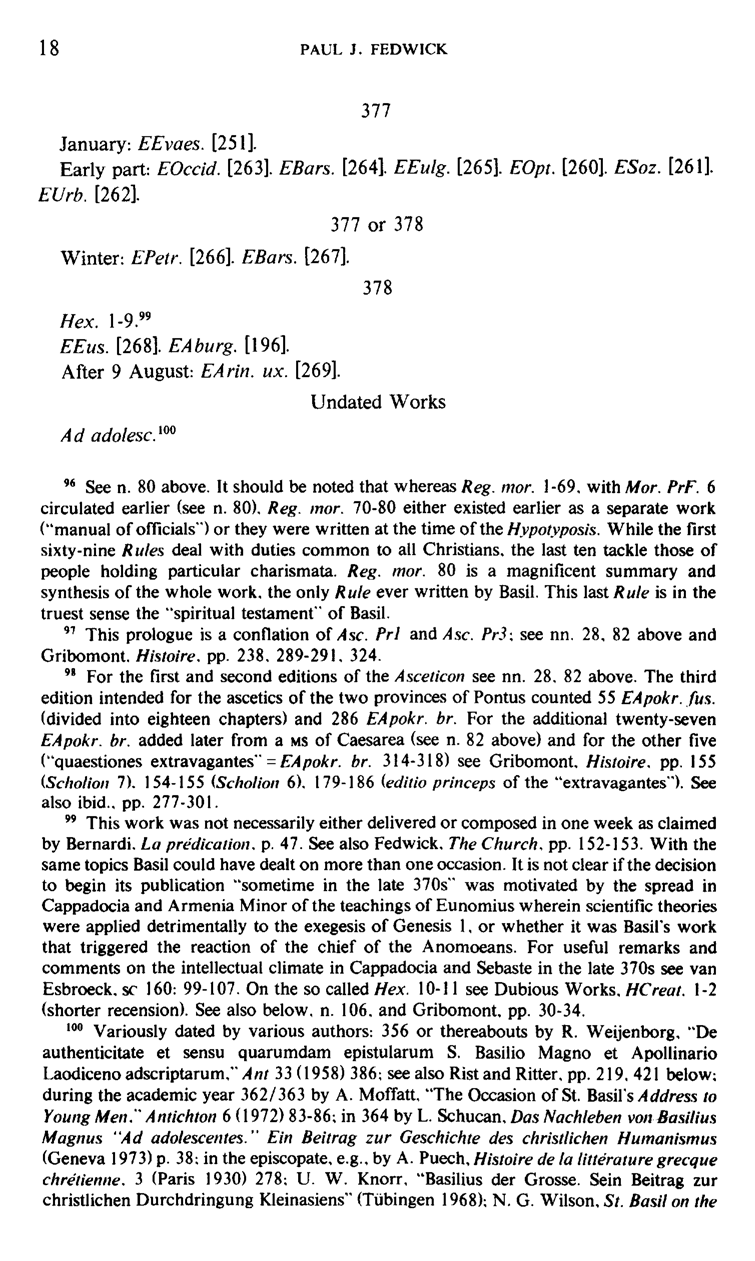
January: EEvaes. [251].
Early part: EOccid. [263]. EBars. [264]. EEulg. [265]. EOpt. [260]. ESoz. [261].
EUrb. [262].
377 or 378 Winter: EPetr. [266]. Eßars. [267].
Hex. 1-9.99
£Fws. [268]. EAburg. [196].
After 9 August: EArin. ux. [269].
Undated Works Adadolesc.100
96 See n. 80 above. It should be noted that whereas Reg. mor. 1-69, with Mor. PrF. 6 circulated earlier (see n. 80). Reg. mor. 70-80 either existed earlier as a separate work
("manual of officials") or they were written at the time of the Hypotyposis. While the first sixty-nine Rules deal with duties common to all Christians, the last ten tackle those of people holding particular charismata. Reg. mor. 80 is a magnificent summary and synthesis of the whole work, the only Rule ever written by Basil. This last Rule is in the truest sense the "spiritual testament" of Basil.
97 This prologue is a conflation of Asc. Prl and Asc. Pr3; see nn. 28, 82 above and Gribomont. Histoire, pp. 238. 289-291, 324.
91 For the first and second editions of the Asceticon see nn. 28. 82 above. The third edition intended for the ascetics of the two provinces of Pontus counted 55 EApokr. fus.
(divided into eighteen chapters) and 286 EApokr. br. For the additional twenty-seven
EApokr. br. added later from a MS of Caesarea (see n. 82 above) and for the other five
("quaestiones extravagantes" =EApokr. br. 314-318) see Gribomont, Histoire, pp. 155
(Schotion 7). 154-155 (Scholion 6). 179-186 (editio princeps of the "extravagantes"). See also ibid.. pp. 277-301.
99 This work was not necessarily either delivered or composed in one week as claimed by Bernardi. La prédication, p. 47. See also Fedwick. The Church, pp. 152-153. With the same topics Basil could have dealt on more than one occasion. It is not clear if the decision to begin its publication "sometime in the late 370s" was motivated by the spread in Cappadocia and Armenia Minor of the teachings of Eunomius wherein scientific theories were applied detrimentally to the exegesis of Genesis 1, or whether it was Basil's work that triggered the reaction of the chief of the Anomoeans. For useful remarks and comments on the intellectual climate in Cappadocia and Sebaste in the late 370s see van
Esbroeck. sc 160: 99-107. On the so called Hex. 10-11 see Dubious Works, HCreat. 1-2
(shorter recension). See also below, n. 106, and Gribomont, pp. 30-34.
100 Variously dated by various authors: 356 or thereabouts by R. Weijenborg, "De authenticitate et sensu quarumdam epistularum S. Basilio Magno et Apollinario
Laodicenoadscriptarum,"/477/ 33 (1958) 386; see also Rist and Ritter, pp. 219, 421 below; during the academic year 362/363 by A. Moffatt "The Occasion of St. Basil's Address to Young Men." Antichton 6 (1972) 83-86; in 364 by L. Schucan, Das Nachleben von Basilius
Magnus "Ad adolescentes." Ein Beitrag zur Geschichte des christlichen Humanismus
(Geneva 1973) p. 38: in the episcopate, e.g., by A. Puech, Histoire de la littérature grecque chrétienne. 3 (Paris 1930) 278; U. W. Knorr, "Basilius der Grosse. Sein Beitrag zur christlichen Durchdringung Kleinasiens" (Tübingen 1968); N. G Wilson, St. Basil on the
A CHRONOLOGY OF BASIL
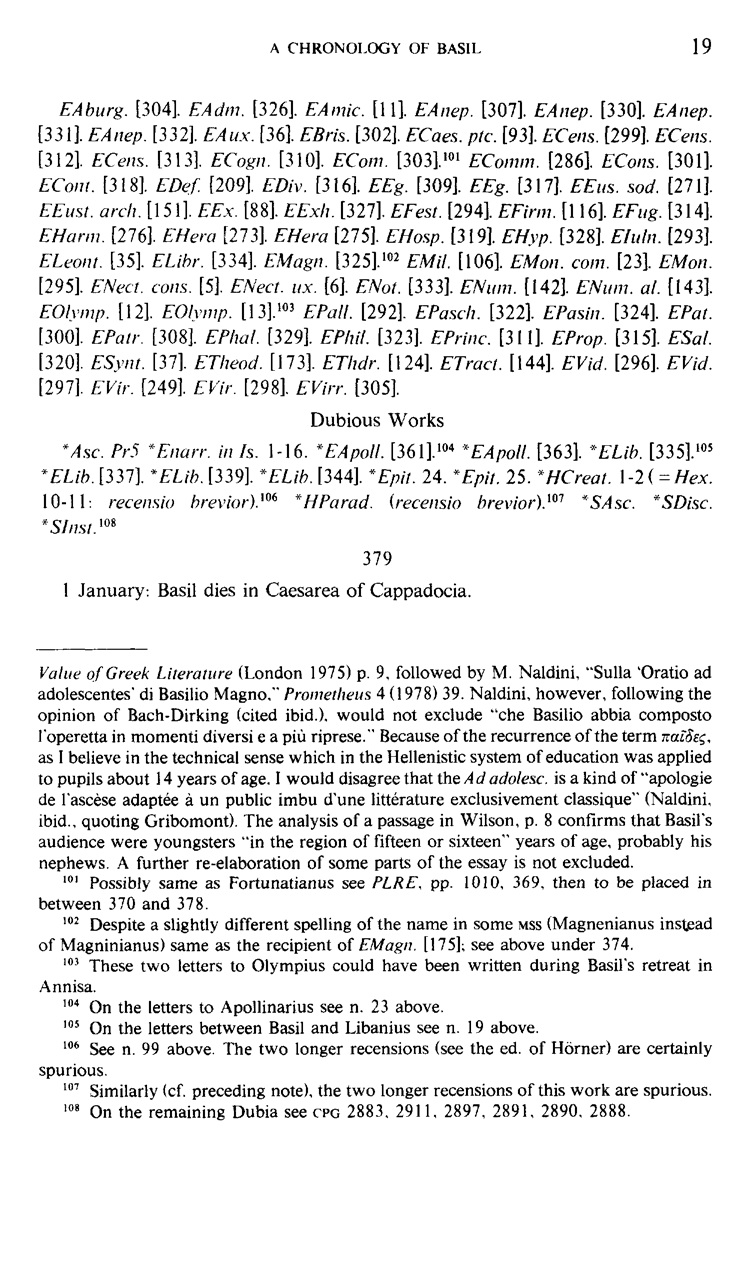
EAburg. [304]. Ε A dm. [326]. EAmic. [11]. EAnep. [307]. EAnep. [330]. EAnep.
[331]. EAnep. [332], E/IMX. [36]. EBris. [302], ECaes. /7/c. [93]. ECens. [299]. ECe/7s.
[312]. ECe/7s. [313], ECogn. [310], ECom. [303], ,01 EC0/77777. [286], ECons. [301].
ECom. [318], EDef. [209], E/>/v. [316]. EEg. [309]. f£g. [317], EEus. sod. [271],
EEwsf. arc/7. [151]. EEx. [88]. ΕίχΛ. [327]. EFest. [294]. fFf'rw. [116]. EEwg. [314],
EHarm. [276]. E//era [273]. EHera [275]. £7/os/J. [319]. E//vp. [328], Eluln. [293],
E/.««/. [35]. ELibr. [334]. EA/ag/7. [325].
102 EA/j7. [106]. EMon. com. [23]. EA/077.
[295]. ENect. cons. [5]. EVeci. ux. [6]. ΕΛΌΛ [333]. E/Vii/77. [142]. ENum. al. [143].
EO/v/77/7. [12]. EOlymp. [13].
103 E/ 5«//. [292]. EPasch. [322]. E/tew. [324]. E/°a7.
[300]. EPatr. [308]. Ε/'Λα/. [329]. EPhil. [323], E/Y/nc. [311]. E/V0/7. [315]. ESal.
[320]. ESY/7/. [37]. ETheod. [173]. ΕΓΛί/r. [124]. E7>ac/. [144]. EVid. [296], EF/W.
[297]. EVir. [249]. Efïr. [298], EK;7r. [305].
Dubious Works *Asc. Pr5 *Enurr. in Is. 1-16. *EApoll. [361].104 * Ε Apoll. [363]. *EZ.ifc. [335].
*ELib. [337], *E/,/'/Y [339]. *EL/fc. [344]. "Epit. 24. *E/7i7. 25. *HCreal.
\-2(=Hex.
10-11: recensio brevior).'
*HParad. (recensio brevior)}"
*SAsc.
*SDisc.
*SInst. m
1 January: Basil dies in Caesarea of Cappadocia.
Value of Greek Literature (London 1975) p. 9, followed by M. Naldini, "Sulla 'Oratio ad adolescentes' di Basilio Magno," Prometheus 4 (1978) 39. Naldini, however, following the opinion of Bach-Dirking (cited ibid.), would not exclude "che Basilio abbia composto l'operetta in momenti diversi e a ρίύ riprese." Because of the recurrence of the term παίδες, as I believe in the technical sense which in the Hellenistic system of education was applied to pupils about 14 years of age. I would disagree that the A d adolesc. is a kind of "apologie de l'ascèse adaptée à un public imbu d'une littérature exclusivement classique" (Naldini. ibid., quoting Gribomont). The analysis of a passage in Wilson, p. 8 confirms that Basil's audience were youngsters "in the region of fifteen or sixteen" years of age, probably his nephews. A further re-elaboration of some parts of the essay is not excluded.
101 Possibly same as Fortunatianus see PLRE, pp. 1010, 369, then to be placed in between 370 and 378.
102 Despite a slightly different spelling of the name in some MSS (Magnenianus instead of Magninianus) same as the recipient of EMagn. [175]; see above under 374,
103 These two letters to Olympius could have been written during Basil's retreat in Annisa.
104 On the letters to Apollinarius see n. 23 above.
105 On the letters between Basil and Libanius see n. 19 above.
106 See n. 99 above. The two longer recensions (see the ed. of Hörner) are certainly spurious 107 Similarly (cf. preceding note), the two longer recensions of this work are spurious.
108 On the remaining Dubia see CPG 2883, 2911, 2897, 2891, 2890, 2888.
Notes biographiques sur s. Basile le Grand Jean Gribomont, OSB Abbazia San Girolamo, Rome Saint Basile a laissé une œuvre abondante, notamment plus de 300 lettres, qui permettent de le suivre dans son activité rayonnante. Ayant vécu au centre d'un groupe de haute qualité intellectuelle et ecclésiale, il n'est pas passé inaperçu: Grégoire de Nysse et Grégoire de Nazianze ont écrit des panégyriques pour les anniversaires de sa mort; en outre, le premier a rédigé une biographie de Macrine, leur sœur aînée, et un Traité sur la virginité dont, il l'avoue, la figure de Basile constitue le modèle; Grégoire de Nazianze, de son côté, a correspondu avec Basile, et l'a évoqué dans ses poèmes; Jérôme l'a rencontré, Athanase l'a loué, Damase a croisé le fer avec lui, Ambroise s'est inspiré de ses écrits, Rufin l'a traduit, Eunome l'a réfuté. Bref, de tous côtés, des témoignages contemporains éclairent son rôle et sa personnalité. Aussi, dès le ve siècle, les historiens ne manquent pas de recueillir les traditions qui circulent à son sujet, non sans que des légendes hagiographiques ne brodent sur ses vertus et ses miracles. Le matériel informatif ne fait donc pas défaut, le problème est plutôt d'apprécier la valeur des notices et de les combiner avec assez de sens historique pour discerner les ressorts profonds de son jeu, les buts réels de ses manœuvres.
Seule l'intelligence des grands courants qui déterminent l'évolution du monde à la fin de l'antiquité, annonçant le haut moyen âge byzantin, donne leur sens aux témoignages basiliens, lesquels établissent en revanche les points de repère les plus précieux sur le parcours de ces
Basil of Caesarea: Christian, Humanist, Ascetic, ed. Paul J. Fedwick (Toronto:
Pontifical Institute of Mediaeval Studies, 1981). pp. 21-48. © P.I.M.S.
JEAN GRIBOMONT, OSB
courants. Pensons par exemple à l'histoire sociale (la famille de Basile, le rôle du moine et de l'homme d'Église dans une société en transformation); à la survivance de la culture classique, ou plutôt à l'élaboration d'une haute culture chrétienne; à la réforme des structures de l'Église impériale, sous les règnes de Constantin, de Constance, de Julian, de Valens, de
Théodose i; à l'établissement de rapports stables et positifs entre l'ascétisme et l'épiscopat; aux formulations dogmatiques, qui font appel à une philosophie plus cohérente, et surtout plus respectueuse des postulats de la foi populaire; à la diplomatie ecclésiastique et à l'accord avec les exigences des grands sièges, dans le respect des traditions locales légitimes. Exégèse et usages canoniques, platonisme et stoïcisme, charismes spontanés et discipline, pauvreté évangélique et institution durable, passé et avenir, partout Basile éprouve les esprits et retient ce qui est solide.
C'est dans les milieux érudits liés à Port Royal qu'à l'âge d'or des études patristiques la documentation essentielle fut soumise à une critique attentive, classée chronologiquement, située par rapport à la grande histoire. Le mérite principal en revient à S. Lenain de Tillemont, qui consacra aux vies de s. Basile, de s. Grégoire de Nazianze, de s. Grégoire de Nysse et de s. Amphiloque un gros volume, le neuvième de ses
Mémoires pour servir l'histoire ecclésiastique des six premiers siècles. ' En réalité, les recherches préparatoires à cette synthèse remontent déjà aux années décisives de la formation du jeune Tillemont à Beauvais, auprès de
G. Hermant, en 1661-1669. Dans La Vie de s. Basile le Grand ... et celle de Grégoire de Nazianze, publiée par G. Hermant en 1674, on trouve une esquisse nette des Mémoires définitifs, où les sources sont systématiquement discutées, avec des notes prolixes consacrées aux points obscurs.2
Les Mauristes étaient en excellents termes avec Tillemont. Quand ils entreprirent l'édition critique de Basile, ils abandonnèrent l'ordre traditionnel de la correspondance pour se conformer, autant que possible, à la chronologie, en fonction des conclusions du grand historien. La Vita
Basilii que dans le dernier tome rédigea dom P. Maran,3 reprit la substance des judicieux Mémoires, non sans que l'esprit critique de dorn J.
Garnier et la timidité conservatrice de Maran n'y laissent aussi leur trace.
Forgé par quatre artisans, ce travail reste solide, puisque les sources principales étaient dès lors bien accessibles. C'est toujours là qu'il faut aller contrôler les données devenues traditionnelles, avant de les mettre en
1 Paris 1703; seconde édition revue et corrigée, Paris 1714.
2 Cf. B. Neveu, Un historien de l'Église à l'école de Port-Royal. Sébastien Le Nain de
Tillemont (La Haye 1966) p. 58.
3 Paris 1730. Cette Vita a été réimprimée dans PG 29: v-clxxvii.
NOTES BIOGRAPHIQUES
question si par hasard une hypothèse veut renouveler l'interprétation d'un document particulier.
Il serait ambitieux de songer à reprendre systématiquement et ab ovo un effort aussi vaste; ce n'est en tout cas pas l'affaire d'une conférence ou d'un congrès. En nous référant donc à ce monument jamais contesté, nous devons apprécier ses présupposés méthodologiques, et consacrer des notes particulières aux points où une mise au point semble utile.
Si Tillemont et les Mauristes ont veillé à reconstituer la chaîne chronologique des événements, ils sont moins préparés à suivre l'évolution des idées, en raison de leur habitude de situer dans l'absolu la doctrine des saints; ils ne cherchent guère à distinguer Basile de son ami de Nazianze, d'Athanase, ni des autres piliers de l'orthodoxie. Depuis lors, la Dogmengeschichte s'est constituée en méthode; ce n'est pas toujours une science infaillible, elle a pu formuler des thèses aventureuses et caduques; elle n'en repose pas moins sur un dossier d'observations. L'influence de la culture de l'antiquité tardive, avec sa rhétorique, son platonisme, son stoïcisme; celle d'Origène, d'Eusèbe de Césarée, de l'opinion homéousienne guidée par Basile d'Ancyre; celle de l'ascétisme eustathien, et, de plus loin, celle du monachisme égyptien ou syrien; les effets précis de la réaction contre
Eunome, ou d'autre part contre des alliés d'Athanase comme Marcel d'Ancyre ou Apollinaire; la connaissance éventuelle d'une littérature chrétienne latine, surtout de Cyprien, qui avait en son temps noué une correspondance avec Firmilien de Césarée; les jeux nuancés de la politique ecclésiastique; voilà autant de domaines où des questions se posent avec une tout autre acuité qu'à l'époque où Garnier et Maran achevaient leur magistrale édition.
Les sciences auxiliaires de l'histoire — l'archéologie,4 la numismatique, la papyrologie — ne semblent guère avoir apporté de faits importants au sujet de la Cappadoce au temps de Valens,5 et nous en restons à peu près aux textes littéraires connus depuis longtemps. Mais notre connaissance des manuscrits ne se limite plus aux bibliothèques parisiennes fouillées par les Mauristes. Sans disposer de documents réellement neufs, on commen4 Voir une brève synthèse, avec bonne bibliographie dans N. Thierry, "L'archéologie cappadocienne en 1978," CCM 22 (1979) 3-22. Si les traces du ive s. chrétien sont si fugaces, c'est peut-être dû en partie à la durée de la domination musulmane; mais cela doit tenir aussi à la modestie des prestations architecturales; ce n'est pas dans la pierre que
Basile entendait construire l'Église ou l'ascèse évangélique. s Bien des faits sont néanmoins rassemblés, c'est évident, par A. H. M. Jones, The Cities of the Eastern Roman Provinces (Oxford 1970); ou encore par les récents éditeurs d'Ammien Marcellin ou de Zosime.
JEAN GRIBOMONT, OSB
ce à voir se dégager les grandes lignes de l'histoire des textes, ce qui conduit à un progrès dans l'intelligence de leur genèse.
Parcourons systématiquement les diverses catégories d'œuvres basiliennes.
A. LA CORRESPONDANCE
Les recherches de Bessières6 ont distingué les grandes familles de manuscrits, chacune avec son ordonnance spécifique du matériel documentaire; ensuite Cavallin7 et Rudberg8 ont confirmé la valeur exceptionnelle de la famille Aa; puis l'édition de Courtonne9 nous a donné ce texte Aa, avec les variantes de quelques manuscrits B. La version allemande de Hauschild,10 en cours de publication, ajoute enfin un commentaire historique solide.
Divers critiques ont décelé les pièces qui ne sortent pas de la plume de Basile. Ce n'est pas ici le lieu de les énumérer toutes; mais on peut observer que si l'on élimine VECaes. [8] (qui revient à Évagre) et les EVid.
[10], EEun. [16], EGNys. [38] et EEust. arch. [189] (qui appartiennent à Grégoire de Nysse), on modifie notablement la base sur laquelle K. Holl avait autrefois reconstruit, avec d'ailleurs une admirable perspicacité, la théologie de Basile.11 Ces lettres restent, au sens large, cappadociennes, et se rattachent indirectement à Basile; mais en les citant comme authentiques, Holl faisait remonter au chef de l'École une élaboration technique des concepts de nature et d'hypostase que Basile n'était peut-être pas sans envisager, mais qu'il refusa délibérément d'exploiter au delà de ce qui lui était indispensable pour réfuter Eunome. Une critique rigoureuse est ici indispensable pour bien marquer les nuances entre la théologie robuste de
Basile et l'élaboration plus subtile brillamment tentée par ses épigones.
La chronologie des Mauristes répartit en trois classes les lettres basiliennes: 1-46, avant l'épiscopat; 47-291, durant l'épiscopat; 292-366, pièces difficiles à situer chronologiquement, avec les pièces douteuses et apocryphes. Ces catégories sont très inégales, comme l'on peut voir. Mais
6 M. Bessières, La tradition manuscrite de la correspondance de saint Basile (Oxford
1923) = JThS 21 (1920-1921) 1-50; 289-310; 22 (1921-1922) 105-137; 23 (1922-1923)
113-133, 225-249, 337-361.
7 A. Cavallin, Studien zu den Briefen des heiligen Basilius (Lund 1944).
8 S. Y. Rudberg, Études sur la tradition manuscrite de saint Basile (Lund 1953).
9 Y. Courtonne. Saint Basile, Lettres, 1-3 (Paris 1957-1966).
10 W. D. Hauschild, Basilius von Caesarea, Briefe II (Stuttgart 1973).
" Κ. Holl, Amphilochius von Ikonium in seinem Verhältnis zu den grossen Kappadoziern (Tübingen 1904).
NOTES BIOGRAPHIQUES
il faut ajouter que l'élimination des pièces inauthentiques, avec quelques rectifications chronologiques (certaines ou vraisemblables), affecte considérablement la première classe, déjà peu nourrie. Outre les ECaes. [8],
EVid. [10], EEun. [16], EGNys. [38], citées plus haut, il faut éliminer les EBas. [39], EBas. [40], Eluln. [41], EChil. [42], Ad iun. [43], EMon. laps.
[44], EMon. laps. [45], et peut-être renvoyer au temps de l'épiscopat les ENect. cons. [5], ENect. ux. [6], De perf. [22], EMon. com. [23], ENeoc. ec.
[28], EAnc. [29], EEus. [30], enfin ESophr. [32] et EAburg. [33].12 Les ELeont. [35], EXwx. [36] et ESynt. [37] manquent dans la tradition manuscrite Aa; ce sont des lettres de recommandation, assez insignifiantes.
Après ces opérations, il reste bien peu de pièces réellement datées d'avant l'épiscopat de Basile, sauf des lettres intéressant Grégoire de Nazianze et vraisemblablement conservées par celui-ci. Mettons à part, en particulier,
['EGNaz. [2], écrite pour être largement diffusée, et, de fait conservée par des manuscrits homilétiques. On serait tenté de conclure qu'avant d'accéder à l'épiscopat, Basile n'avait pas l'habitude de conserver dans ses archives sa correspondance, et que ses amis ne pensaient pas davantage à la postérité. Peut-on par analogie restreindre aussi le nombre des homélies antérieures à l'épiscopat?
Un certain nombre de lettres sont transmises en version syriaque; avec celles-ci on trouve en syriaque quelques pièces non identifiées et apparemment inédites. Malheureusement la version, trop large, généralise tellement les allusions, qu'elle ne conserve guère que des banalités. J'ai tenté à plusieurs reprises d'en tirer quelque information pour l'histoire du corpus, mais jusqu'ici rien d'utile n'en est sorti.
Le plus souvent, les manuscrits de la correspondance de Basile contiennent aussi, en tête ou en queue, la collection des lettres de Grégoire de
Nazianze. Paul Gallay13 s'est attaché au classement de cette seconde collection; quoique disposant des mêmes manuscrits, il aboutit à des résultats sensiblement différents quant à l'autorité des traditions. Il distingue six familles, liées entre elles deux à deux (u v, d f, g h), les quatre premières saluant en outre contre g h. Les manuscrits Aa de Basile, qui transmettent en même temps la correspondance de Grégoire, la présentent en trois recensions: le Patmos M H IT h 57 forme à lui seul la famille f; le
Florence BML gr. 57, 7 appartient à la famille g; enfin le Paris BN Suppl. gr.
334, témoin très tardif (xvie s.), est rattaché à la famille u. Cette famille u,
12 J. Bernardi, La prédication des Pères Cappadociens (Paris 1968) p. 109.
13 P. Gallay, Les manuscrits des lettres de saint Grégoire de Nazianze (Paris 1957), étude préparatoire à l'édition critique.
JEAN GRIBOMONT, OSB
dans ses meilleurs manuscrits, s'identifie à la branche Ab de Basile; or, tandis que Ab est médiocre, texte contaminé et remanié, u passe pour le meilleur témoin de Grégoire. La famille v, proche de u, et elle aussi fort appréciée, est jointe dans les manuscrits à la tradition Bo de Basile, tradition secondaire. La famille d de Grégoire, dans ses meilleurs témoins, se joint elle aussi à la famille basilienne Ab.
De telles divergences d'appréciation ne sont pas aussi paradoxales qu'on ne pourrait le croire. En effet, le critère premier auquel se fie Gallay tient à la conformité des ordres u et v à la disposition primitive censée imposée par Grégoire lui-même à ses propres lettres, lorsqu'il en fit l'envoi à son petit neveu Nicobule. Le critère premier de Bessières était au contraire une méfiance envers les collections logiquement ordonnées; la réunion des lettres adressées à un même correspondant lui semblait s'expliquer par l'activité des recenseurs, tandis qu'il ne comprenait pas que les copistes aient tendu à diviser de tels paquets de lettres.
Il ne serait pas sans intérêt de reconsidérer dans son ensemble le classement des manuscrits des deux correspondances. Il n'est certes pas impossible que chacune ait connu, à l'origine, une histoire indépendante, de sorte que l'autorité des collections pourrait varier. Mais Grégoire ayant envoyé à Nicobule ses propres lettres à la suite d'une anthologie de lettres basiliennes, on peut croire que l'ensemble a (en partie?) une origine commune, avec des transpositions éventuelles dès que chacune des deux anthologies venait à s'enrichir au cours de son histoire.
L'exégèse à donner à chaque lettre devrait sans doute tenir compte, non seulement de la chronologie que la critique estime pouvoir reconstituer, mais aussi de la disposition du matériel dans les diverses collections manuscrites.
La chronologie de Tillemont et des Mauristes a été soigneusement contrôlée par Loofs,14 à propos surtout des relations de Basile avec
Eustathe de Sébaste. Elle a été aussi revue par Lietzmann,15 à propos d'Apollinaire de Laodicée.
Dans ses recherches personnelles, souvent si pénétrantes, toujours si audacieuses, sur l'histoire de l'Église au ive s., Schwartz16 a proposé une datation révolutionnaire pour les documents intéressant l'histoire
14 F. Loofs, Eustathius von Sebaste und die Chronologie der Basilius-Briefe (Halle
1898).
15 H. Lietzmann, Apollinaris von Laodicea und seine Schule (Tübingen 1904) pp. 4862.
16 E. Schwartz, "Zur Kirchengeschichte des vierten Jahrhunderts," ZNW 34 (1935) 169-195 = Gesammelte Schriften, Zur Geschichte der alten Kirche und ihres Recht, 4
(Berlin 1960) 1-110.
NOTES BIOGRAPHIQUES
générale, mais il n'est pas descendu jusqu'à reprendre tous les indices que fournissent les lettres "domestiques," et ceci rend ses thèses assez fragiles.
En relevant et en découvrant l'interprétation exacte d'une souscription d'une lettre de Damase, conservée en latin dans un manuscrit de Vérone,
Richard17 a réussi à illuminer un détail capital des relations de Basile avec Athanase et l'Occident. Il en résulte que, par l'initiative de l'évêque d'Alexandrie, en réponse à une lettre de communion envoyée par Basile
(qui le priait de la faire parvenir à Rome), l'évêque de Césarée a été inscrit parmi les destinataires d'une lettre de communion occidentale, sur laquelle il a pu faire fond durant toute son activité. La doctrine impeccable des livres Contre Eunome a dû jouer un rôle dans cette initiative d'Athanase.
Une telle étude permet de reconstituer, à partir d'un point précis, tout l'horizon ecclésiologique de Basile.
Enfin Hauschild a joint à sa traduction allemande des lettres, dont il a été parlé plus haut, une longue note18 extrêmement attentive, Zur
Chronologie der Briefe. Il y détermine avec précision ce qui est solidement attesté par les textes et ce qui est, à ses yeux, probable. On peut en retenir notamment que VEItai. [242] est un brouillon préparé pour VEItai. [92] (à dater de 372); que les deux colloques avec Eustathe à Sébaste se situent vers le début de juin et la fin d'août 373, les lettres 98-95 descendant donc un an plus tard que ne le pensaient les Mauristes; et que les lettres 203-216 descendent à l'été et jusqu'à l'hiver 376, de nouveau un an plus tard que la chronologie traditionnelle. Ces modifications ne vont pas sans corriger le dessin de la biographie reçue. Dans bien des cas, Hauschild renonce à telle ou telle précision suggérée par les Mauristes, et préfère ignorer l'année exacte d'une lettre.
B. LES HOMéLIES
Ni Tillemont, ni les Mauristes n'ont osé tenter une chronologie de l'œuvre oratoire de Basile, sauf pour l'homélie sur le début des Proverbes, qui se présente elle-même comme l'œuvre d'un débutant, invité par l'évêque président, et que l'on place donc au début du sacerdoce de Basile. Disonsle en passant, il est intéressant de relever l'inspiration très origénienne de ce premier chef d'œuvre.
" M. Richard. "S. Basile et la mission du diacre Sabinus," AB 67 (1949) 189-202 =
Opera minora, 2 (Turnhout 1977) No. 34 (voir quelques compléments au No. 35).
18 Hauschild, Basilius, pp. 9-17.
JEAN GRIBOMONT, OSB
Aujourd'hui, à la suite du classement des manuscrits proposé par Rudberg à partir de la disposition des pièces dans les recueils, et des corrections apportées à ce classement grâce aux groupements de variantes qui se sont manifestés à Rudberg et à Rouillard, à l'occasion de sondages étendus, on commence à avoir une idée de la tradition manuscrite.
L'histoire ancienne des collections n'est pas encore dégagée; plutôt qu'un arbre généalogique, on observe une forêt, mais des sentiers s'y laissent entrevoir.
La disposition imprimée par les Mauristes a des fondements documentaires. Les neuf homélies sur VHexaéméron se présentent toujours en un ensemble cohérent, souvent transmis avec les compléments qu'après la mort de Basile ajouta Grégoire de Nysse (De hominis opificio; Explicatio apologetica in Hexaemeron), ou encore avec les deux Homélies Sur l'origine de l'homme,19 attribuées à Basile ou à Grégoire. Sur cette tradition manuscrite, nous attendons des précisions de la part de notre ami et collègue St. Y. Rudberg. Nous voudrions arriver à savoir si c'est Grégoire de Nysse qui se trouve à l'origine de l'édition de ces homélies, ou si elles ont été diffusées du vivant de l'auteur, avant toute intervention grégorienne.
Les Mauristes ont imprimée ensemble, dans leur tome premier,20 les homélies exégétiques sur les Psaumes (HPs. I, HPs. 7, HPs. 14a, HPs. 14b,
HPs. 28a, HPs. 29, HPs. 32, HPs. 33, HPs. 44, HPs. 45, HPs. 48, HPs. 59, HPs. 61, HPs. 144; ajoutons VHPs. 115, renvoyée à l'appendice, mais aussi attestée que les précédentes). L'HPs. 28b, les HPs. 37 et HPs. 132 n'appartiennent pas à Basile. En fait, déjà beaucoup de manuscrits réunissent les homélies authentiques et les disposent dans l'ordre du texte biblique, ce qui s'explique aisément. Il semble pourtant y avoir lieu de tenir grand compte de la disposition d'autres anciennes collections, qui isolent VHPs.
1, puis la seconde (ou les deux) HPs. 14a et HPs. 14b, puis les HPs. 59, HPs. 61, HPs. 114 et HPs. 115, et enfin les autres. Certes, les manuscrits de ces homélies n'ont jamais encore été collationnés, et la valeur respective des témoins reste donc douteuse; néanmoins, il n'est guère vraisemblable que ce soient des éditeurs médiévaux qui aient pris l'initiative de diviser la collection, si elle était bien ordonnée au départ.
Une lecture un peu critique montre d'ailleurs que ces homélies, qui ne 19 Sur les manuscrits de VHexaéméron qui ajoutent les HCreat. hom. 1-2, cf. A. Smets etM. van Esbroeck, Basile de Césarée, Sur l'origine de l'homme (Paris 1970)pp. 127-134 et 27-62, et H. Hörner, A uctorum incertorum - vulgo Basilii vel Gregorii Nysseni - Sermones De creatione hominis, Sermo De paradise (Leiden 1972).
20 PG 29 et 30.
NOTES BIOGRAPHIQUES
concernent qu'une fraction minime du psautier, ne constituent aucunement un ensemble, répondant à un plan ou à une méthode cohérente.
Sans aller jusqu'à considérer chaque pièce comme isolée, il convient de partir de l'hypothèse qu'il ne s'agit pas ici d'un commentaire suivi, pour lequel il faudrait chercher une date déterminée dans le cours de l'enseignement de Basile.
Le reste des homélies basiliennes a été qualifié de "morales" ou "diverses," ce qui laisse entendre qu'elles répondent encore moins à un plan systématique. Les manuscrits connaissent un nombre infini de dispositions, où l'on retrouve tout au plus de petits groupes relativement cohérents, agglomérés à date ancienne: sur le jeûne, sur la richesse, sur les passions
(colère et envie), sur les martyrs, sur la foi....
Nous avons déjà mentionné un bon travail critique, attentif à tirer des textes le maximum d'information chronologique: La prédication des Pères
Cappadociens, par J. Bernardi.21 Il concerne 117 homélies de Basile et de ses amis. Quelques-unes de ces homélies ont été retouchées au moment de la publication, mais aucune des pièces basiliennes n'est classée dans cette catégorie. Bernardi retient 45 discours basiliens; il a malheureusement mis de côté, systématiquement, toutes les pièces dont l'authenticité a été mise en doute, y compris celles qui n'auraient pas dû être contestées. Bien entendu, il est excellent que ce matériel ait été rapproché des œuvres analogues de Grégoire de Nazianze et de Grégoire de Nysse, car cela permet d'apprécier ce qui est commun au temps et au milieu, et ce qui est propre à Basile. D'autre part, Bernardi a été amené à prendre en considération, d'un point de vue neuf, les deux discours funèbres où son frère et son ami ont honoré la mémoire de notre saint.
Tandis que Grégoire de Nazianze aime ouvrir son cœur et parler de ses épreuves personnelles, ce qui révèle la date de ses discours, Basile commente la parole de Dieu avec une objectivité exceptionnelle; les indices chronologiques sont donc à peine sensibles, et presque toujours discutables. La preuve, c'est qu'en un premier temps Bernardi avait daté d'avant l'épiscopat les homélies sur les Psaumes, adoptant ainsi une suggestion de Maran; mais les points d'appui étaient trop fragiles, et "on peut constater ici qu'à peu près rien n'a subsisté de cette conviction primitive." dit-il finalement lui-même.22
Aussi est-ce avec prudence qu'il propose sa chronologie, et avec prudence que nous devons le suivre. Il espère au moins distinguer.
21 Cf. supra n. 12.
22 La prédication, p. 29 n. 28.
JEAN GRIBOMONT, OSB
comme les Mauristes l'ont fait pour la correspondance, le temps de l'activité sacerdotale, et celui de l'épiscopat; encore admet-il que certaines pièces, comme les HPs. 7, HPs. 14a et HPs. 14b, se situant "à la fin du sacerdoce ou au début de l'épiscopat," tandis que d'autres seraient
"antérieures à 372." Pourtant, les tentatives de rapprochement avec des expériences vécues par Basile me paraissent peu convaincantes; ainsi de l'homélie sur l'envie, qui aurait un lien avec l'opposition manifestée par l'évêque Eusèbe, lors des premiers succès du sacerdoce de Basile; ou encore des éloges de l'intrépidité chrétienne (HPs. 33, homélie sur la colère), rattachée au fameux dialogue de Basile avec le préfet Modestus, dramatisé par Grégoire de Nazianze en une belle page de l'oraison funèbre; ainsi encore la critique des usuriers (HPs. 14b), rapprochée de l'amère aventure des dettes laissées à son décès, en 368, par Césaire, frère de Grégoire de Nazianze. Ces expériences n'étaient pas requises pour justifier les exhortations du moraliste, et aucune d'entre elles ne semble visée par quelque expression spécifique. Je reste aussi sceptique lorsque
Ton croit devoir situer avant l'épiscopat, ou en tout cas avant la construction du grand hospice de la Basiliade (373 au plus tard), une phrase comme: "il est une chose en laquelle nous avons l'avantage sur les riches, nous les pauvres: l'absence de souci" (HPs. 14b. 3). Les responsabilités administratives de l'évêque et du fondateur ne faisaient pas tort, aux yeux de Basile, à Vamerimnia philosophique et évangélique.
Non sans avoir longtemps hésité, j'avoue me rapprocher des thèses de Bernardi au sujet de VHex. 1-9, prédication de carême, soigneusement préparée. Il propose la dernière année de Basile, et même très précisément la semaine du 12 au 16 mars 378. J'ai quelque difficulté à me ranger à cette année 378, car à en juger par la correspondance, relativement abondante et bien datée, l'activité de Basile, à l'approche de la mort, est déjà gravement limitée, tandis que VHex. 1 -9 requiert une vigueur exceptionnelle, tant pour l'effort physique d'intense prédication que pour la rédaction et la publication de cet ensemble, que l'on peut assimiler à un traité. VHex. 1 -9 promettait un nouveau développement sur la création de l'homme, mais je ne suis pas convaincu que ce complément ait été tout prêt, et que seule une crise de santé imprévue ait forcé l'auteur à se dédire.
Quant aux HCreat. 1-2, qui se présentent elles-mêmes comme ce complément, nous y reviendrons plus loin. J'hésite encore à croire Bernardi, lorsqu'il veut que Grégoire de Nazianze, en son discours 28.22, prononcé peut-être à Constantinople au début de 379, plus tard revu et intégré dans le corpus des cinq Discours Théologiques, ait ignoré encore l'existence de
VHex. 1 -9; l'argument du silence me paraît, en ce cas, assez fragile. Mais je concède que VHex. 1-9 doit être postérieur à VEAmph. [236] 5 (de Basile),
NOTES BIOGRAPHIQUES
datée de 376. Ceci est déjà important, et situe avec sécurité à la fin de la vie de Basile cette synthèse de haute vulgarisation, où la foi en un Créateur assume, avec brio, les conceptions platoniciennes de l'origine du monde, et aussi la cosmologie moralisee des anciens. Je tendrais à en rapprocher idéalement, sinon peut-être chronologiquement, VHAtt. [3], que Bernardi met au contraire très tôt. car à son avis "elle sent plus le débutant que l'homme fort de son autorité et sûr de son audience."23
Les blocs les plus cohérents, et peut-être les plus solides, constitués par Bernardi sur la base d'indices convergents, se situent l'un vers 368-369, au point culminant de l'activité sacerdotale, et l'autre au début de l'épiscopat, en 370-373. Le premier est représenté par un groupe d'homélies contre les riches, assez agressives. Cette prédication "socialiste" prend occasion d'une sécheresse exceptionnelle, suivie de famine et de crise économique.
En tête vient l'homélie, origénienne et fort spéculative, HMal. [9\, puis HDestr. [6], puis HDiv. [7] (pièce qui pourtant ne s'insère pas ici avec une évidence absolue; Basile pourrait reprendre les mêmes thèmes, une autre année); enfin le réquisitoire HEam. [8]. L'HPs. 14b. contre les usuriers, se rattache à la même politique anticapitaliste, mais non à ce cycle précis.
L'autre période de fécondité, au début de l'épiscopat, est provoquée par une crise doctrinale, à propos du culte du S. Esprit. Là Bernardi situe
VH Verb. [16] et HFide [15] (identique peut-être à la fameuse prédication du 7 septembre 372, vivement reprochée à Basile par des moines plus à cheval sur la précision dogmatique, et aussi, avec plus de timidité,24 par
Grégoire de Nazianze). Ce n'est que plus tard (377?) que l'on peut situer l'homélie contre les Sabelliens (en pratique, contre la tendance intégriste dont nous venons de parler !). Divers exposés sont proches de ce que l'on peut lire dans le De Sp. S., par ex. dans les HPs. 28a, HPs. 32, HPs. 33.
Bernardi date ces homélies des environs de 375, année de publication du De Sp. S En fait, l'on sait que les chapitres 10-27 du De Sp. S. remontent, pour l'essentiel, à 373 et l'on peut sans difficulté faire remonter un peu plus haut ces exposés trinitaires.
Bernardi situe sous l'épiscopat (370-378) les textes où l'orateur parle avec autorité; par ex. les HIeiun. 1 et HIeiun. 2, qui ouvrent le Carême, et
H Ehr. [14], qui blâme vertement le peuple de la ville pour la façon dont il a célèbre la Pâque; V H Bapt. [13] invitant les catéchumènes à s'inscrire, dès l'Epiphanie (371 ?). pour le baptême de la Pâque prochaine; V H Mund. [21],
23 Ibid.. p. 67.
24 Cf. Grégoire de Nazianze, Ep. 58; Basile, EGNaz. [71J; Grégoire, Ep. 59.
JEAN GRIBOMONT, OSB
qu'il situerait en juillet 372, lors d'un passage de Basile à Satala; les HPs. 1 etHPs. 61, celles sur les Martyrs (HGord. [18] etHMart. [19]). Pour VHPs.
114, bien proche des précédentes, il préfère le temps du sacerdoce, car l'orateur s'excuse d'un retard, dû à une fonction liturgique dans une autre église confiée à ses soins, ce qu'il entendrait de la "paroisse urbaine" à laquelle Basile aurait été affecté. Il y a quelque raison de reconnaître en ces homélies une voix épiscopale, mais bien avant son sacre, Basile avait l'habitude d'élever la voix avec autorité, lorsqu'il estimait devoir annoncer les préceptes de Dieu. L'évêque Eusèbe ne s'est-il pas senti rejeté dans l'ombre par ce subordonné, si supérieur par son rang social et sa culture?
Lorsque Basile a fait un recueil de ses prédications les plus marquantes, at-il usé d'une discrétion telle qu'il a laissé de côté celles dont le ton avait pu offusquer ce prélat?
En somme, Bernardi tend à attribuer à l'activité sacerdotale les œuvres sociales vigoureuses qui préparèrent dans le peuple l'élection à l'épiscopat, et la rendirent plus difficile à l'épiscopat des environs et aux classes dirigeantes. Il concentre sur le début de l'épiscopat les luttes dogmatiques, en gardant en réserve peu d'exposés de ce genre pour les dernières années, celles qui suivirent la rupture avec Eustathe et la constitution d'un front anti-macédonien. C'est aussi au début de l'épiscopat qu'il tend à situer l'activité réformatrice, la proposition à l'ensemble de la cité d'un idéal d'austérité — thèmes que je situerais aussi volontiers durant le sacerdoce.
À la fin de la vie de Basile on constate, avec VHex. 1-9, un enseignement apologétique et d'apparence philosophique, d'une philosophie moins radicale. Une telle courbe n'a rien d'invraisemblable, mais il y a lieu d'en éprouver encore longtemps les divers points d'appui, en la confrontant à toutes les données contrôlables. Pour la période antérieure à l'épiscopat, si les lettres sont relativement rares, il subsiste des œuvres dogmatiques et ascétiques que l'on peut rapprocher des homélies.
La question qui se pose pour les homélies de Basile n'est pas tant celle de leur existence, que celle de leur petit nombre. À côté des centaines d'homélies laissées par un Chrysostome ou un Augustin, les Cappadociens n'offrent chacun tout aü plus qu'une cinquantaine de pièces oratoires. Ils ont évidemment pris la parole bien plus souvent, et nous devons admettre qu'ils n'ont jugé digne de transmettre à la postérité que des compositions d'un certain niveau littéraire, ou des thèses qu'ils estimaient significatives.
Ce serait peut-être une raison d'accorder à leurs publications une importance relative plus grande qu'aux improvisations cueillies au vol!
L'édition du matériel conservé est-elle due à l'auteur lui-même, ou à ses amis survivants? La variété des collections, l'absence de tout ordre systématique (sauf pour VHex. 1-9), le mélange des homélies de dates diver-
NOTES BIOGRAPHIQUES
ses, ne soutiennent pas particulièrement l'idée d'un recueil conçu et réalisé par l'auteur. Peut-être en va-t-il autrement pour Grégoire de Nazianze, qui attachait certainement plus d'importance à sa réputation littéraire.
Quand nous avons considéré les neuf homélies sur VHexaéméron, nous avons laissé en suspens deux homélies, HCreat. 1-2, et une autre,
HParad., qui font suite à VHex. 1-9 dans un certain nombre de manuscrits. La majorité des témoins sont relativement récents, mais l'un au moins remonte à la fin du ixe s., le Genova BF 17. Il existe de nombreux états du texte des homélies sur l'origine de l'homme (on en a distingué cinq), mais le texte court est unanimement reconnu comme le plus ancien.
Une telle instabilité constitué déjà un indice du caractère peu satisfaisant de cette rédaction primitive. Bon nombre de manuscrits attribuent ces homélies à Grégoire de Nysse, et cette hésitation constitue une certaine objection à l'authenticité basilienne. Les versions anciennes, et les témoignages qui très tôt abondent en faveur des neuf homélies traditionnelles, ignorent les trois homélies supplémentaires.
D'autre part, il faut reconnaître que les homélies authentiques annoncent elles-mêmes une suite à venir·,25 et que nos homélies se présentent comme l'œuvre de Basile, en reprenant bien des thèmes chers à l'évêque de Césarée. Ceci a été fort bien mis en relief par A. Smets et M. van
Esbroeck, qui ont récemment donné aux Sources chrétiennes une bonne édition de nos homélies.26 Développant avec subtilité les arguments en faveur de leur authenticité, ils ont fait l'histoire des controverses qui ont suivi la mort de Basile, en particulier de la part d'Eunome, et ils ont rappelé l'effort intense de Grégoire de Nysse pour répondre, à quatre reprises, à l'Apologie dogmatique d'Eunome, et aussi pour reprendre à sa façon VHex. 1-9, vers Pâques 379, puis vers juillet 380. Ces deux derniers ouvrages avaient eux aussi une pointe anti-eunomienne. Ils peuvent expliquer comment des homélies, ébauchées par Basile, mais non terminées, auraient été systématiquement écartées.
Deux ans après cette édition, H. Hörner en a donné une autre, en appendice aux Opera omnia de Grégoire de Nysse.27 Cette fois, l'authenticité basilienne au sens strict est formellement niée. Un nouvel examen de la tradition manuscrite, indépendant du précédent et peut-être encore plus soigné, confirme le regroupement des témoins, mais en explique tout autrement la genèse. Ainsi, le "fin remaniement doctrinal au sujet de la
25 PG 29; 208A.
26 Cf. supra n. 19.
27 Ibid.
JEAN GRIBOMONT, OSB
Trinité" des manuscrits MLK (xve s.; sigles de Hörner), que Smets et van Esbroeck tendaient à attribuer à Grégoire de Nysse en personne, et qu'ils considéraient en tout état de cause comme bien antérieur à des recensions attestées bien plus tôt, ne représente pour Hörner qu'une recension docte, et elle rattache sans scrupule ces manuscrits à un ensemble, plus vaste, de recentiores On doit espérer que l'établissement du texte des homélies sur VHex. 1-9 permettra de reprendre sur une base plus large28 les faits controversés, déjà mis en relief, et de voir ce qui est à retenir des interprétations proposées par les différents éditeurs.
Le regretté E. Amand de Mendieta, qui avait longuement fréquenté ces manuscrits, en y étudiant les homélies supplémentaires, déclare29 reconnaître ses propres impressions dans les thèses qu'au début de son édition,
H. Horner propose quant au problème de l'authenticité.30 L'auteur anonyme, ingenio mediocri, stilo non admodum felici, aurait disposé d'un matériel rassemblé par Basile; il se serait efforcé de l'imiter, en s'inspirant de diverses pages de son œuvre. Il diffère néanmoins tellement de Basile que l'on ne peut traiter les homélies, ni comme une improvisation oratoire prise au vol et non revue, ni même comme un schéma ébauché par l'auteur et retrouvé dans ses papiers.
Même si l'on se rallie à ce point de vue, le chapitre de Smets et van Esbroeck sur les controverses qui ont suivi la mort de Basile est loin d'être inutile. Il montre qu'à côté de Grégoire de Nysse, d'autres héritiers spirituels ont pu tenter de compléter l'œuvre de l'évêque de Césarée, et de répondre à une campagne déchaînée. Les conditions de la publication de l'œuvre authentique pourraient en ces conditions avoir été moins pacifiques que l'on ne pourrait l'imaginer à partir de l'hagiographie qui nous est familière, d'après laquelle la vox populi l'aurait si bien canonisé, que sa figure édifiante se serait imposée telle quelle, à ses amis comme à ses ennemis.
C. LES TRAITéS DOGMATIQUES
Les dates traditionnelles de publication des tomes dogmatiques se trouvent confirmées et précisées par les études récentes, mais leur composition
28 Voir quelques remarques dans J. Gribomont, "Les succès littéraires des Pères grecs et les problèmes d'histoire des textes," SE 22 (1974-1975) 23-49, en particulier pp. 38-40.
29 E. Amand de Mendieta, "Les deux homélies Sur la création de l'homme," pp. 695710, dans Zetesis (Antwerpen-Utrecht 1973).
30 Hörner, Auctorum, p. viii.
NOTES BIOGRAPHIQUES
s'avère avoir été plus tourmentée et plus complexe que ne l'imaginaient Tillemont et les Mauristes.
Le P. B. Sesboué vient de soutenir une thèse sur le C. Eun. 1-3,31 et il y fait état d'une dissertation antérieure, inédite, de Th. Dams, La controverse eunoméenne}1 Nous croyons savoir que L. Doutreleau prépare pour les
Sources chrétiennes une édition critique de l'Apologie d'Eunome, et G. de Durand une édition critique du C. Eun. 1-3; l'introduction, la traduction et le commentaire (réduit) de Sesboué doivent accompagner cette publication. La thèse elle-même (413 + 260 pages) représente avant tout une analyse attentive de la doctrine et de la méthode des deux adversaires, mais elle prend aussi position sur bien des points d'histoire, qu'elle invite à reconsidérer.
L'occasion et la date de VApologie d'Eunome restent discutées. À bon droit, Sesboué se rallie à la proposition de L. R. Wickham:33 VApologie écrite est un remaniement d'un plaidoyer personnel, fait par Eunome au concile de Constantinople de 360. Acace de Césarée et son parti, tout en réussissant à s'imposer en ce concile, avaient dû malgré tout condamner l'anoméisme extrême, et condamner nommément Aèce, le maître d'Eunome. Ce dernier doit donc se justifier, montrer le caractère à la fois traditionnel et logique de sa doctrine, et passer sous silence Vanomoios, affirmant au contraire que le Fils est semblable au Père (selon l'opération, non selon Vousia). Le succès de ce plaidoyer assura à Eunome le siège de
Cyzique, comme doit le reconnaître Basile,34 la même où polémiquement il s'efforce d'établir qu'Eunome n'avait aucune raison de se défendre en ce synode, au milieu d'une cour d'amis.35
On savait déjà que Basile avait suivi de près le déroulement de ce triste synode de 360. Ceux qui voudraient laisser dans l'ombre le point de départ, pleinement orthodoxe, mais de formulation homéenne, de sa théologie trinitaire, doivent minimiser le sens de cette participation; ainsi
S. Giet.36 Mais l'ensemble de la correspondance de Basile, et en particulier 31 B. Sesboué, "L'Apologie d'Eunome de Cyzique et le Contre Eunome de Basile de
Césarée. Présentation, analyse théologique et traduction" (Rome: Pontificia Universitas
Gregoriana, 1979).
52 Th. Dams, "La controverse eunomienne" (Paris: Institut catholique, 1952) (thèse dactylographiée).
33 L. R. Wickham, "The Date of Eunomius' Apology," JThS 20 (1969) 231-240; cf. idem, "Aetius and the Doctrine of Divine Ingeneracy," SP 11 (1972) 259-263.
34 C. Eun. 1.2, PG 29: 505A.
35 Ibid.. 504.
36 S. Giet, "S. Basile et le Concile de Constantinople de 360." JThS 6 (1955) 94-99.
JEAN GRIBOMONT, OSB
l'analyse du C. Eun. 1-3, montrent que son adhésion au Nicaenum s'est effectuée par étapes: il eut à vaincre ses propres hésitations sur le sens sabellien que Marcel d'Ancyre avait donné à homoousios. Une fois éclairé sur ce point, notamment par Apollinaire, il mit un certain temps avant d'imposer à tous, comme condition de sa communion, la confession du
Nicaenum, à laquelle il s'était personnellement rallié. Au moment où il écrit le C. Eun. 1-3, il ne suppose chez ses lecteurs qu'une absence d'opposition au symbole de Nicée; le terrain sur lequel il s'établit est celui de Vhomoios kata panta ou Vhomoios kat' ousian, avec des présupposés radicalement opposés à ceux d'Eunome, mais pas nécessairement nicéens, ni même néo-nicéens.
Et quels sont les destinataires du travail de Basile ? Certainement pas les Eunomiens, car il ne fait aucun effort pour les gagner. Sesboué a pensé à un groupe de moines, destinataires du Mor. PrF, lesquels ont envoyé à
Basile, un peu plus tard, un epitagma (comme les destinataires du C.Eun.
1 -3), le mettant en demeure de leur soumettre une (nouvelle) profession de foi. Mais s'il fallait ainsi identifier ces deux groupes de solliciteurs, Basile se serait, la première fois, montré bien maladroit à les satisfaire, puisqu'il est amené à s'excuser ensuite de ne pas s'être tenu à un vocabulaire et une théologie purement bibliques (le terme a'homoousios, qui apparaît dans le
Mor. PrF. imprimé, PG 31: 688A, n'y est pas soutenu par les bons manuscrits). Les deux groupes de destinataires peuvent être apparentés entre eux, mais ils sont distincts; les moines du Defide sont certainement des gens de l'entourage d'Eustathe, mais ils sont restés en retard sur l'évolution des évêques, car ils n'ont pas eu l'expérience du combat contre
Eunome et du dialogue avec d'autres Églises.
Sesboué cite VEEust. [223] 5, de Basile, qui nous donne de précieux renseignements sur les circonstances de composition du C. Eun. 1-3. Cette lettre, adressée à Eustathe, après la rupture de 375, évoque le souvenir des luttes en commun dans la paix d'une même foi:
Interroge-toi: combien de fois ne nous as-tu pas visité dans la maison Unonè) des bords de l'Iris, lorsqu'était à mes côtés le frère aimé de Dieu.
Grégoire (de Nazianze), qui poursuivait le même idéal de vie que moi? As-tu jamais entendu quelque chose de tel (que l'hérésie d'Apollinaire), en as-tu saisi la moindre apparence (emphasinV. Et à Eusinoé, lorsque, sur le point de partir pour Lampsaque avec tout un groupe d'évêques, vous m'avez fait venir, n'est-ce pas sur la foi que portaient les échanges de vue (logoi)? Est-ce que. tout le temps, les tachygraphes n'étaient pas tous à ma disposition, tandis que je dictais les arguments contre l'hérésie? Est-ce que tes disciples les plus sûrs (gnèsiôtatoi) n'étaient pas tout le temps avec moi?
NOTES BIOGRAPHIQUES
Et le texte continue en passant à un autre ouvrage rédigé en collaboration avec les Eustathiens, VAsceticon-, il rappelle les visites aux fraternités, les nuits de prière en commun, les échanges confiants de questions et réponses sur des sujets spirituels.
Quoique postérieure à la rupture, cette lettre ne laisse pas encore tomber sur le nom et l'influence d'Eustathe la damnatio memoriae qu'imposeront bientôt les amis de Basile. À quoi se rapportent les premiers entretiens avec Grégoire, dans la maison des bords de l'Iris? Sans doute à des contacts purement oraux. Nous ignorons — et c'est bien dommage — où se trouvait Eusinoé; mais le nom de Lampsaque est en revanche tout à fait significatif. C'est là que se réunirent au début du règne de Valentinien, dès qu'il fut permis de réunir un concile, un groupe d'évêques d'Asie mineure d'origine homéenne, guidés par Silvain de Tarse, Eustathe de Sébaste et
Théophile de Costabala. Il s'agissait d'invalider les actes d'Eudoxe et d'Acace, c'est-à-dire ce concile de Constantinople de 360 où Eunome avait, après son Apologie, été promu au siège de Cyzique, et où sa doctrine avait été approuvée; on rejeta même la formule occidentale de Rimini, on proclama Vhomoios kat' ousian, et l'on décida d'envoyer jusqu'à Rome une délégation, qui finit par accepter de souscrire au Nicaenum." et reçut des lettres de communion du pape Libère.
Les discussions préliminaires à Eusinoé eurent évidemment un caractère antieunomien très prononcé. L'appel aux plus sûrs disciples témoins d'Eustathe a pour but de servir de garantie aux souvenirs de
Basile; il nous renseigne sur la part que l'entourage immédiat de l'évêque de Sébaste prit à cette évolution théologique. Que conclure de la mention, parallèle, des tachygraphes? Que ces discussions contre Eunome furent mises par écrit, ce qui invite à les identifier aux trois livres C. Eun. 1 -3, ou, si l'on veut, elles en constituent un premier jet.38 L'EEust. [223] vise, en outre, à montrer au public qu'Eustathe s était pleinement compromis dans cette lutte théologique, et ce groupe de secrétaires apparaît étroitement lié, comme Eusinoé, comme les évêques réunis, comme les fidèles disciples, au mouvement ecclesial et spirituel mené par Eustathe, lequel finira par mener à Rome la délégation asiatique.
L'orientation du discours dans le C.Eun. 1-3 s'explique au mieux, si l'on considère ce public très particulier qui, à la veille de Lampsaque,
37 Sozomène, Hist. eccl. 6.7 (d'après la collection de documents recueillie par Sabinus); cf. M. Simonetti, La crisi ariana net ivsecolo (Rome 1975) p. 394.
" En fait, la lecture du C. Eun. 1-3 suggère de considérer (sauf exceptions?) le texte comme une réaction rapide à VApologie, sans que Basile ait pris le loisir d'une revision à tête reposée
JEAN GRIBOMONT, OSB
attendait une réponse à VApologie de l'hérétique. Le livre m, par exemple, consacré au problème du S. Esprit, est curieusement sobre et rapide. À l'étonnement de B. Sesboué, Basile y concède à trois reprises,39 en dépit de réserves insistantes, que l'Esprit soit présenté comme troisième en dignité, affirmation eunomienne qu'il laisse provisoirement passer, et que contredira plus tard son De Sp. S. Une telle concession surprend, après ce que les livres précédents ont revendiqué au sujet de la dignité du Fils.40
D'où vient ce manque de cohérence dans l'argumentation? Si l'on veut bien songer à la difficulté que trouvera Basile en juin 373, puis à l'impossibilité où il sera au mois d'août de la même année, de convaincre
Eustathe sur ce point précis, on sera tenté d'expliquer la prudence du livre 3 Contre Eunome par la nécessité de ne pas heurter le public qu'il s'agissait de décider.
Faite en fonction de ce genre de lecteur, l'analyse théologique du C.
Eun. 1-3 sera moins exigeante sur la cohérence abstraite du discours, par exemple au sujet de la notion de ousia, notion tour à tour générique et concrète. On comprendra que certaines réfutations du langage eunomien ne tiennent pas compte des postulats personnels de l'hérétique, et ne soient pas attentives à le convaincre. Basile construit sur les postulats de ses lecteurs, ce qui ne prive pas de toute valeur sa démonstration, mais sans aucun doute en conditionne l'expression.
Au point de vue de la chronologie basilienne, cette référence à Lampsaque situe fermement en 364 la composition, sinon la publication définitive, des trois livres Contre Eunome. Cela ne suffit pas pour mettre au clair tout le détail des activités de Basile durant son sacerdoce, tel que l'évoque l'Éloge funèbre de Grégoire de Nazianze.41 L'année exacte de l'ordination, l'histoire des difficultés avec l'évêque Eusèbe, la protestation des moines contre l'évêque, la vénération du peuple, "il vaut mieux n'en rien dire," affirme Grégoire. Je prolongerais volontiers ces tensions et je les rapprocherais de l'an 370, c'est-à-dire du moment où s'imposera la candidature de Basile à l'épiscopat. La fermeté du théologien doit s'être alliée, en ces circonstances, à la force radicale de son ascétisme et à son succès auprès des classes sociales humiliées.
Un point curieux que personne n'a réussi à expliquer, c'est le délai qu'Eunome s'est accordé avant de répondre à Basile; VApologie de l'Apologie ne fut publiée que quatorze ans plus tard, à la veille de la mort de Basile, en 378.
39 PG 29: 656A (deux fois) et 657c.
40 Ibid., 557A, 565c, 568B, 644c, 645B.
41 Or. 43.28.
NOTES BIOGRAPHIQUES
Le De Sp: S. a été édité par Pruche dans les Sources chrétiennes,*1 avec en 1968 une réédition dont il n'est pas exagéré de dire qu'elle est entièrement refondue, et fort améliorée. Malgré tout, cette réédition ne tient pas assez compte des faits acquis par Dörries en 1956, dans une
Abhandlung de l'Académie de Göttingen.43 J'ai peine à croire que Pruche ait réellement lu Dörries, qui a réussi à identifier dans les ch. 10-27 du De
Sp. S. l'écho direct d'un dramatique dialogue, vécu à Sébaste en juin 373, au cours duquel Basile réussit à convaincre son vieux maître et l'amena à partager ses positions. L'insistance entêtée des "amis" de Basile (Théodote de Nicopolis), aussi bien que de ceux d'Eustathe, fit malheureusement échouer cet accord, et transforma la conciliation en ressentiment amer.
Le dialogue de Sébaste a évidemment été retravaillé et complété au moment où il a été intégré dans le De Sp. S.-, on voit en effet des explosions d'hostilité, plus récentes, se surajouter à un franc débat au ton cordial. L'argumentation d'Eustathe et de son entourage aura été réduite au strict nécessaire, elle se limite à introduire les arguments basiliens. Mais cette argumentation des adversaires garde sa cohérence interne; elle suit exactement le progrès de la discussion, et n'est pas du tout, comme il est trop habituel dans les dialogues littéraires, une opposition complaisante que l'auteur s'accorde à soi-même.
Le donné traditionnel, notamment la réflexion d'Origène, joue un rôle considérable dans la substructure du De Sp. S.44
L'influence de Plotin45, à travers le petit opuscule De sp., est surprenante, mais certaine; elle a été étudiée surtout par Dehnhard.46 L'authenticité basilienne de ce **De sp., souvent postulée, n'a jamais été démontrée. Dans les manuscrits, cet opuscule fait suite à un livre inauthentique (numéroté 4-5) adjoint au C. Eun. 1-3 et connu, dès avant 464, de
Timothée Élure. Comme je l'ai remarqué dans une recension,47 la relation à la source plotinienne aide ici à discerner avec certitude les bonnes et les mauvaises leçons, et ce sont les manuscrits MLNPR (sigles de Hayes) qui
42 B. Pruche. Basile de Césarée, Traité du Saint-Esprit (Paris 1947); deuxième édition entièrement refondue, Basile de Césarée, Sur le Saint-Esprit (Paris 1968).
43 H. Dörries. De Spiritu Sancto. Der Beitrag des Basilius zum Abschluss des irinitarischen Dogmas (Göttingen 1956).
44 Cf. J. Gribomont. "Ésotérisme et Tradition dans le Traité du Saint-Esprit de saint
Basile." Oecumenica 2 (1967) 22-58.
45 Enn. 5.1.
46 H. Dehnhard. Das Problem der Abhängigkeil des Basilius von Plotin (Berlin 1964).
Les réserves de J. Rist, dans le présent volume (pp. 193 ss.). renouvellent le sujet, mais elles ne peuvent éliminer les faits essentiels.
47 ßZ 68 (1975) 86-88
JEAN GRIBOMONT, OSB
s'avèrent les meilleurs.48 Ces manuscrits n'étant pas les meilleurs pour le reste des livres 4-5 Contre Eunome, on est en droit de conclure que l'archétype de ces livres ignorait le **De sp., introduit ensuite dans la branche MLNPR, puis passé de là dans les autres témoins. De fait, l'opuscule manque dans l'ancienne version syriaque des livres 4-5 (Londres BL Or.
8606), et on n'en signale aucune citation ancienne. Cela n'empêche point l'opuscule d'être antérieur au De Sp. S., mais rend bien douteux qu'il ait été transmis, à l'origine, dans le corpus basilien. D'autre part, les éléments de vocabulaire qui n'y sont pas repris à Plotin sont très peu basiliens,49 de même que les formules introduisant les citations bibliques.50 J'attribuerais l'opuscule à quelqu'un de l'entourage de Basile, travaillant peut-être pour lui; théologien, du reste, intéressé par les hypostases trinitaires plus que par le jeu de la spéculation néoplatonicienne. Nous connaissons trop peu cet entourage pour avancer un nom; je ne crois pas reconnaître Grégoire de Nysse-, pourquoi pas une femme (Macrine?)?
Le dernier livre du Contre Eunome (divisé, dans les éditions, en 4-5) n'étant certainement pas authentique, il n'y a pas lieu d'utiliser ici directement l'étude que leur a consacré Hayes;51 il est évident, néanmoins, que cette description et ce classement des manuscrits présente un grand intérêt pour le texte authentique des livres 1-3.
D. L'œUVRE ASCéTIQUE
J'ai peu à ajouter à la présentation de l'œuvre ascétique de Basile, que j'ai donnée en 1953.52 Les manuscrits découverts depuis, par Rudberg,53 par
B. Flusin, de l'Institut de Recherche et d'Histoire des Textes,54 et par 48 W. M. Hayes (infra η. 51). Les bonnes leçons les plus caractéristiques de MLNRP sont à la ligne 45 de l'édition Dehnhard μέρει, et à la ligne 92 οίον. Voir aussi lignes 9, 23, 33, probablement aussi 39. 90, 94, mais pas 42 et 69.
49 Je pense par ex. à ligne 1 θειοτέρων, 2 τά αίσθήσει αόρατα, 5 τότε δτε. 6 γένηται μη εύρεΐν, 6 αναχωρεί τοΰ οίχείν, 11-12 ζητήσωμεν ... ζητήσαντες, 20 άϊδίου ζωής...
50 Basile a l'habitude de citer beaucoup l'Écriture, avec des formules fort variées, mais néanmoins aptes à caractériser sa manière; cf. J. Gribomont, "Les lemmes de citation de saint Basile, indice de niveau littéraire," Aug 14 (1974) 513-526, et U. Neri (cité infra n. 69), pp. 33-41. Dans l'opuscule, les formules des lignes 3, 4, 7, 9, 15, etc., sont peu basiliennes.
51 W. M. Hayes, The Greek Manuscript Tradition of (Ps.)Basil's Adversus Eunomium,
Books IVV (Leiden 1972).
52 J. Gribomont, Histoire du texte des Ascétiques de saint Basile (Louvain 1953).
53 Cf. supra n. 8.
54 Je remercie en particulier Bernard Flusin d'une communication du 28 février 1979, me donnant la description d'un manuscrit fort important d'Istanbul BOP HT 105, xe-xie s., donnant le texte complet d'une recension importante dont je ne connaissais qu'un seul témoin gravement mutilé, Vatican BAV Barb. gr. 476, xne s.
NOTES BIOGRAPHIQUES
d'autres, enrichissent la documentation, mais ne semblent pas de nature à modifier les conclusions.
L. Lèbe55 a contesté la date qu'après Tillemont, Maran, J. Lebon,56 j'avais attribuée aux Reg. mor., et il prétend les situer dans la vieillesse de
Basile. Le texte du Mor. Prl est pourtant explicite. L'auteur se qualifie en racontant ses propres expériences d'enfant, d'étudiant, de voyageur,57 sans un mot sur une vie d'ascèse, de ministère ecclésial, d'épiscopat, de relations autorisées; il se présente comme un quelconque fidèle, scandalisé par les divisions entre chrétiens et l'inefficience du clergé, "surtout en ce moment où les Anoméens sont en pleine efflorescence," (τών Ανόμοιων έπιφυέντων).
5* Ce participe peut à la rigueur signifier s'accrocher, s'acharner, mais ce sens dérivé que Lèbe va chercher dans le dictionnaire demanderait une justification objective, que rien à mon avis ne suggère.
Le succès même des Anoméens (360-364), conformément au sens étymologique du verbe, répond parfaitement au contexte, comme dans une formule parallèle de l'épître synodale d'Amphiloque d'Iconium, écrite du vivant de Basile et remplie d'allusions à son œuvre, qui parle des Pères de Nicée qui s'empressèrent de retrancher les premières semences de l'arianisme τότε νεώστι, φυομένην.
Du reste, le même prologue aux Reg. mor. se termine en expliquant que l'auteur, encore jeune, a longtemps attendu qu'une personne plus autorisée fasse appel à la Bible pour ramener les chrétiens à l'unité, et qu'il ne s'est décidé à agir lui-même qu'en raison de la passivité des autres.60 Je demande qu'on m'indique une occasion, au temps du sacerdoce de Basile ou de son épiscopat, où il ait ainsi attendu que d'autres agissent et se soit excusé de faire son devoir.
Lèbe prend argument du fait que Basile, encore jeune laïc, aurait dépassé sa compétence et son autorité en faisant ainsi la leçon aux évêques. Je réponds que la leçon était prise tout entière au Nouveau Testament, l'autorité personnelle du compilateur n'est donc pas en jeu. Celui-ci ne fait que transmettre la parole de Dieu, ce qui est parfaitement conforme à son caractère.61
55 L. Lèbe, "Saint Basile et ses Règles morales," RBen 75 (1965) 193-200.
56 Je fais allusion à un cours de J. Lebon, que j'ai suivi à Louvain en 1946.
57 PG 31: 633A.
58 PG 31: 653B.
" C. Datema. erse 3; 219.32
60 PG 31: 626A.
61 Aussitôt après la lecture de la présente conférence à Toronto, Mgr. Sotirios, l'évêque grec orthodoxe de la ville, me fit remarquer, avec un sourire, que la critique impitoyable à l'égard des évêques s'explique bien mieux de la part d'un jeune homme profondément évangélique, que de celle d'un collègue dans l'épiscopat!
JEAN GRIBOMONT, OSB
Du reste, comme je crois l'avoir montré à plusieurs reprises,62 les points qui semblent le moins monastiques des prescriptions de ce recueil, comme la conduite à tenir par les gens mariés, par les soldats, par le clergé, répondent précisément aux problèmes que posaient les initiatives des
Eustathiens, comme on le voit par le concile de Gangres. Ces questions étaient brûlantes au début de la vocation ascétique de Basile, elles ne sont pas spécifiquement épiscopales.
Après les Reg. mor. vient la collection des Questions ascétiques. Leur ancienne version syriaque atteste que la recension courte, connue depuis toujours par la version latine de Rufin, ne représente pas, comme on l'imaginait, un abrégé capricieux, mais une édition grecque primitive, antérieure aux 55 "Grandes Règles" et aux 313 "Petites Règles" connues par le grec imprimé. Les manuscrits byzantins connaissent différentes formes de VAscéticon, mais toujours dans la recension longue.
Une chronologie relative s'impose: Reg. mor.·, Asc. Ir et Asc. /s, tel que nous le connaissons par Rufin et par les Syriens; Grand Asceticon, sous ses diverses formes, dont la recension "Studite" (-Asc. 2) doit être une des plus anciennes. Il me reste impossible d'assigner à ces diverses étapes des dates précises. Il y a lieu sans doute de dater le Asc. 1 des années du ministère sacerdotal; l'édition longue de VAscéticon, qui montre des institutions plus stabilisées, ne possède pas d'élément qui atteste ni exclue l'épiscopat du saint. La seule considération que l'on puisse faire, c'est que, en devenant évêque, Basile n'a pas dû cesser de distribuer les réponses qui constituent VAscéticon. On est donc amené à situer sous l'épiscopat (assez tard) l'édition la plus complète, à moins que les réponses les plus tardives n'aient pas été jointes à la collection.
Dans la correspondance, on trouve un document assez court, comme une ébauche de règle, le De perf. [22]; c'est le genre des Reg. mor., mais dans une perspective plus nettement conventuelle. Une meilleure intelligence de ce document éclairerait peut-être les étapes de l'évolution ascétique; j'en ai tenté un commentaire, dans un article dans la revue
Antonianum.61
Autour de VAscéticon apparaissent un discours ascétique très ancien64 et 02 J. Gribomont, "Les Règles morales de saint Basile et le Nouveau Testament," SP 2
(1957) 416-426; idem, "Saint Basile," pp. 101-102, dans Théologie de la vie monastique
(Paris 1961); idem, "Saint Basile," pp. 81-85, dans Commandements du Seigneur et libération évangélique (Rome 1977).
63 "Les Règles épistolaires de saint Basile: Lettres 173 et 22," Ant 54 (1979) 255-287.
64 PG31: 881-888.
NOTES BIOGRAPHIQUES
des pénitences tariffées65 qui ne paraissent pas être de la main de Basile, mais devraient appartenir au même milieu, de son vivant ou peu après.
Vers la fin de sa vie, le saint envoya aux communautés pontiques une collection complète, VHypotypose d'ascèse; il y avait fait copier les Reg. mor., avec au complet les citations bibliques, représentées à l'origine par de simples références; dans leur prologue primitif Mor. Prl, il avait ajouté un autre prologue, Mor. PrF, composé après le C. Eun. 1-3 et avant les controverses de 373-375 sur l'Esprit Saint. Je ne vois pas de raison de supposer d'autres retouches apportées, à ce moment, au vieux recueil des
Reg. mor., basées sur un fichier néotestamentaire qui avait dû être établi consciencieusement dès le principe. Après ces pièces, VHypotypose d'ascèse comprenait le Asc. 3, sous sa forme "Vulgate," c'est-à-dire 55
EApokr. fus. (réparties en 18 chapitres) et 287 EApokr. br. (un éditeur ajouta plus tard les 27 dernières EApokr. br., qu'il avait trouvées dans un autre exemplaire, et qui sont peut-être particulièrement tardives).
L'AD ADOLESCENTES
Avec les homélies, copistes et éditeurs ont rangé un bref traité sur la littérature profane et les services qu'elle peut rendre à la formation ascétique.66 Cet opuscule possède un genre littéraire propre, celui des
Moralia de Plutarque. La Renaissance lui a fait un succès exceptionnel, voulant y trouver un éloge chrétien de la culture classique; tel n'était pas le but de l'ouvrage, qui s'attachait, avec toutes les ressources d'une vaste érudition, à discerner une préparation évangélique, et plus spécifiquement ascétique, dans la pédagogie humaniste des Grecs. Platon, et bien d'autres éducateurs, avaient déjà interprété les exemples et les légendes du passé comme une initiation à la philosophie; tout cela, et la philosophie en plus, se voit ici orienté vers la vie spirituelle, à l'usage d'un public habitué à plus de respect envers les grands écrivains qu'envers les prophètes et les apôtres. Systématiquement, l'opuscule fait abstraction de la Bible, il la réserve pour des esprits mieux formés; on peut constater un procédé analogue dans VEGNaz. [2] ou VENect. cons. [5], cela ne fait aucun tort au biblicisme basilien.
Faut-il rapprocher chronologiquement l'opuscule de ces épîtres où Basile, frais émoulu des académies athéniennes, fait montre de bel esprit?
Tillemont, suivi par les auteurs, a voulu réserver entre la fin des études et PG 31: 1305-1308. n°s 1-11.
N. G. Wilson, Saint Basil On the Value of Greek Literature (London 1975).
JEAN GRIBOMONT, OSB
la conversion ascétique une brève période d'enseignement de la rhétorique, et l'on y situerait volontiers notre opuscule. En fait, cette brève activité profane résulte d'un contresens, né peut-être de notre opuscule, dans lequel on a vu le fruit d'un cours systématique. On en a rapproché un mot de l'éloge funèbre de Basile par Grégoire de Nazianze,67 selon lequel, avant de prendre au sérieux l'Évangile, les deux amis avaient "concédé un moment au monde et à son théâtre." Ce temps perdu, selon Grégoire, ce sont les études athéniennes elles-mêmes. L'EEust. phi. [1] de Basile ne laisse aucun intervalle entre le retour de l'université et la poursuite du
"philosophe" Eustathe.68 Par ailleurs, notre opuscule se présente comme adressé à ses neveux par un oncle aux cheveux blancs, à qui une longue vie a procuré expérience et sagesse. Concédons ici une fiction littéraire, les neveux sont là pour la forme, mais un blanc bec aurait-il emprunté cette perruque ? Je croirais plus volontiers que, dans des circonstances qui l'y invitaient, l'évêque de Césarée a pu se distraire en retournant à ses classiques, pour justifier par eux aussi l'idéal austère et aristocratique qu'il avait adopté.
Dans les manuscrits byzantins, l'opuscule n'a pas du tout la place d'honneur que nous sommes habitués à lui réserver.
F. LES LIVRES DE BAPTISMO
On s'était habitué à laisser dormir parmi les Spuria deux livres De bapt. U.
Neri vient de les éditer critiquement,69 et les a montrés liés, par chacune de leurs expressions, à l'œuvre de Basile, typiquement authentiques et par la forme et par le fond, quoique de rédaction peu soignée. Ils représentent la formation, par l'évêque, des catéchistes qui doivent préparer les catéchumènes, et sont transmis par une bonne partie des manuscrits ascétiques, dont les apparentements sont ainsi mieux connus. Le commentaire, rassemblant sur de nombreux points tous les textes majeurs de Basile, et les index afférents, peuvent rendre de précieux services pour le vocabulaire et la théologie de l'auteur. Un aspect important, qui n'était pas traité ailleurs, se révèle ici: la doctrine de Basile sur la situation de l'homme avant la grâce (et le baptême); on comprend mieux comment l'évêque de Césarée s'abstient (à la différence de Macaire et d'Augustin !) d'appliquer Rom. 7 aux baptisés. Même au point de vue purement
67 PG 36: 529c.
68 Voir J. Gribomont, "Eustathe le Philosophe et les voyages du jeune Basile de Césarée," RHE 54 (1959) 121.
69 U. Neri, Basilio di Cesarea, il battesimo (Brescia 1976).
NOTES BIOGRAPHIQUES
linguistique, cet ouvrage "parlé" est significatif, car l'élégance étudiée des grandes œuvres falsifie en quelque façon leur témoignage sur le parler chrétien du ive siècle.
Je ne me sens pas préparé à exprimer ici un jugement sur l'authenticité du *Enarr. in /s. 1-16. que je connais mal, ou sur d'autres œuvres d'authenticité douteuse.
G. LES éLOGES FUNèBRES à I.A MéMOIRE DE BASILE
L'évêque de Césarée a été l'objet, dès son décès, d'une espèce de culte, dont nous conservons des reliques contemporaines: l'éloge funèbre, fort conventionnel, prononcé à Césarée, sans doute le 1er janvier 381,70 par
Grégoire de Nysse son frère, puis le fameux panégyrique écrit par Grégoire de Nazianze71 pour le 1er janvier 382 (Or. 43). Quoique ce panégyrique soit incomparablement plus long que les autres discours de Grégoire, Bernardi n'en estime pas moins qu'il a été réellement déclamé, au cours d'une cérémonie d'apparat.
À ces deux pièces ont doit joindre, dans des genres assez divers, rarement faits pour favoriser des souvenirs confidentiels, objectifs et critiques, les mentions de Basile faites ailleurs par les deux Grégoire ou d'autres contemporains. En général, elles sont élogieuses, mis à part l'acerbe Jérôme ou l'arien Philostorge; du vivant du saint, Grégoire de
Nazianze laisse pourtant échapper quelques plaintes à l'égard de l'autorité impérieuse qui caractérisait Basile, dès qu'il s'agissait des intérêts de l'Église.72
Ces notices ont évidemment leur intérêt, mais je crois devoir souligner les différences d'optique entre Basile et ses amis, qui peuvent rendre leur témoignage fort partial. Grégoire de Nazianze a eu trop d'influence sur les historiens, depuis Tillemont jusqu'aux Historical Sketches de Newman !
Non seulement il avait un tempérament tout opposé à celui de son ami. mais sa politique ecclésiastique, orientée vers l'Egypte et l'Occident, sa culture plus conventionnelle, sa théologie plus attentive aux formules, l'entraînaient dans une direction contraire à Basile et à son Économie.
Plus le concile de Constantinople 381 s'est laissé marquer par cette Économie accueillante à tous et centrée sur le groupe antiochien, plus
Grégoire s'y est opposé, contraint finalement à remettre une démission 70 Bernardi. La prédication, p. 313.
71 Bernardi, ibid., p. 236.
72 Voir S. Giet. Sasimes. Une méprise de saint Basile (Paris 1941) — le meilleur ouvrage de Giet sur saint Basile
JEAN GRIBOMONT, OSB
peu glorieuse. Une analyse attentive constate que Grégoire ne tient aucun compte, en particulier, du Symbole de Constantinople, destiné à devenir le principal Credo œcuménique. Harnack et d'autres savants, appuyés sur cette observation, en étaient venus à nier l'origine constantinopolitaine du document. Ritter a tiré une conclusion bien différente:73 par une interprétation attentive des poèmes de Grégoire, il discerne l'opposition profonde de celui-ci à toute tolérance dogmatique. Il n'ignore point, mais blâme ce
Credo peu rigoureux dans les titres données à l'Esprit.
On sait assez que Grégoire ne pouvait comprendre la réserve de Basile sur ce point que dans une perspective de prudence politique, désireuse d'éviter les menaces d'expulsion de la part de la police impériale; on sait aussi que cette explication ne satisfaisait aucunement Basile. Cette différence de vues oblige à n'utiliser l'éloge funèbre qu'avec un grand souci critique.
Bernardi a par ailleurs bien montré que le panégyrique de Basile forme dyptique avec le Discours 42, l'Adieu au Concile, "contre-attaque systématique contre l'épiscopat pris en bloc."74 Deux ans s'étant déjà écoulés depuis le décès de Basile, le panégyrique est tout autre chose qu'un écho direct, car d'autres préoccupations sont intervenues, qui retiennent déjà l'attention de Grégoire. Bien des facteurs doivent donc être considérés, avant de prendre la rhétorique pour argent comptant.
Grégoire de Nysse avait une toute autre façon de différer de son frère. Il l'admire beaucoup, lui aussi, reprend sa polémique contre Eunome et poursuit sa réflexion sur VHexaéméron et sur la théologie ascétique. Mais c'est avec un changement presque radical d'orientation philosophique.
Grégoire semble avoir l'impression que Basile traitait de haut, sobrement et quelque peu superficiellement, les problèmes discutés dans les écoles.
Lui se donne le loisir de démarquer abondamment ses auteurs, sans trop craindre les contradictions·, il espère sans doute éblouir son lecteur à force d'accumuler les lieux communs. Du vivant de Basile, il n'a presque rien écrit-, dès sa mort, il multiplie les interventions. Nous savons positivement que Basile n'était pas sans faire des réserves sur la compétence de son jeune frère, et il ne l'encourageait peut-être pas à publier ce que certainement ils discutaient oralement dans l'intimité. Smets et van Esbroeck ont évoqué ces relations dans leur introduction aux homélies Sur l'origine de l'homme.75 Tout cela invite à lire aussi d'un œil critique les confidences du
Nysséen.
73 A. M. Ritter, Das Konzil von Konstantinopel und sein Symbol (Göttingen 1965).
74 Bernardi, La prédication, pp. 238 et 227.
75 Basile de Césarée (supra η. 19), pp. 81-115.
NOTES BIOGRAPHIQUES
H. BASILE AU CENTRE DES TENSIONS ET DES CRISES
Avant tout, nous avions à passer en revue les œuvres de Basile, puis les sources contemporaines qui parlent directement de lui. Parmi les éléments les plus utiles à l'intelligence de son action, il faut pourtant compter la découverte des lignes majeures de l'histoire, du sens profond des crises où il fut mêlé.
À mon avis, les recherches sur l'ascèse et la doctrine d'Eustathe de Sébaste,76 et sur les origines du messalianisme, représentent une condition nécessaire à une interprétation sociale et psychologique de l'œuvre spirituelle de Basile. La doctrine du saint n'a pas été élaborée dans le silence de la cellule ou de la bibliothèque, elle se définit peu à peu dans le dialogue, en fonction des réactions du public en face duquel il se trouve.
11 est peu indiqué de commenter les premières pages d'une œuvre basilienne en s'inspirant de ce qui suit, en escomptant que tout cela est déjà explicite dans les intentions de l'auteur. En fait, sa pensée va en se précisant; elle s'avère plus vivante, et plus aggressive, si je puis employer cet adjectif, si on la perçoit, dès le principe, dans sa dépendance à l'égard de la base scripturaire qui se manifestera plus loin, mais qui a été mise à la base de la réflexion. Il est sans doute normal qu'une chaîne d'affirmations bibliques soit prévue et commande la marche du discours. Mais les nuances de l'exégèse et de la polémique doivent être considérées comme un effort d'intelligence qui progresse avec l'exposé. Les analyses qu'en donnent les théologiens paraissent souvent pécher par excès de statisme, donnant trop d'importance à des prises de position relativement improvisées, dont il faut reconnaître le rôle dialectique.
C'est ce que nous avons constaté pour les grandes œuvres, la logique trinitaire du C. Eun. 1-3, le dialogue central du De Sp. S., aussi bien que pour la casuistique de VAscéticon et la politique des Lettres, surtout lorsqu'une série de réponses se prolonge et approfondit un argument. Il est possible que pour les homélies, plus courtes et bien préparées, il en aille parfois autrement Je ne suis guère compétant pour interpréter l'évolution économique et les tensions sociales de la Cappadoce, et apprécier par là la mission et l'efficience de l'évangéliste et de l'évêque. Je voudrais discerner, en particulier, si sa fonction de protecteur des faibles s'est exercée en faveur du
76 Je dois signaler à ce propos le travail très suggestif de G. Dagron, "Les moines et la ville. Le monachisme à Constantinople jusqu'au concile de Chalcédoine," dans MT 4 (Paris
1970) 229-276. J'y reviendrai dans une conférence au cours d'un Colloque basilien à
Chevetogne, en août 1979, à publier dans lrénikon [53 (1980) 123-144].
JEAN GRIBOMONT, OSB
bien commun, ou si ses interventions, comme il le semble parfois, ont défendu des intérêts privés.
Sur le plan dogmatique, on ne peut comprendre Basile, et les Cappadociens, que dans le cadre de l'histoire de l'origénisme. Des études nouvelles sur Apollinaire et, évidemment, sur Eunome et sur Marcel d'Ancyre, seraient nécessaires pour mieux peser les interventions, en revisant les jugements proposés par les formes d'orthodoxie qui ont suivi immédiatement 380. Telles ont été les contributions de Dörries, Dehnhard, Staats. J.
Rist nous a montré que l'histoire du Platonisme exige une critique rigoureuse. Celle de l'exégèse, des institutions canoniques, du droit civil ne peuvent être négligées, ni celle de la culture littéraire et des remous causés par le règne de Julien.
Un des instruments de travail qui rendrait le plus de services pour progresser dans le classement chronologique et l'interprétation des textes serait un lexique-concordance. J'espère publier une liste de plusieurs centaines de mots rares du vocabulaire basilien, avec l'indication des auteurs chez qui l'on retrouve ces mots. Mais ce sont les termes les plus fréquents que l'on devrait suivre dans leurs divers emplois. Le De Spiritu
Sancto de Dörries, l'édition athénienne de VApostoliki Diakonia11 des volumes des Sources chrétiennes (Pruche, Smets-van Esbroeck) ou d'autres (Neri; Commandements du Seigneur et libération évangélique) offrent déjà des index qui ne demandent qu'à être utilisés. Le présent
Symposium, les publications que promet P. Fedwick, les autres colloques basiliens de cette année centenaire stimuleront les efforts.
77 J'ai en main le t. 53 de la BHP, troisième tome de s. Basile, Athènes 1976, édité par E.
D. Moutsoulas et C. G. Papachristopoulos sous la direction générale de C. Bonis. Les index, dressés par P. Bezenitis et P. G. Nicolopoulos, sont remarquablement bien faits.
Manuscripts and Editions of the Works of Basil of Caesarea Stig Y. Rudberg University of Lund
A. THE MANUSCRIPTS
Ancient Greek and Latin literature as we can study it today has been compared to a vast field of ruins. Here and there a column or two remain upright, but most of the ancient buildings have disappeared for ever. This holds true to a great degree, e.g., for Greek lyric poetry and drama. But there are indeed exceptions to this rule. There is a kind of literature that has been copied thousands of times over the centuries with the utmost care and diligence, where the aim of the scribes has been to let nothing get lost but to preserve the text of the original as carefully as human weakness allows.
Of course this care of the scribes was first and foremost devoted to Holy Scripture on the part of the copyists of thousands of biblical manuscripts, many of which are still preserved. But in the second place, and not much less than in the case of the Bible, the monastic scribes made every effort to copy word for word and letter for letter the writings of the Fathers of the Church, and especially of the great Fathers of the fourth century, the three
Cappadocians and saint John Chrysostom. And the owners of the manuscripts, monasteries, churches and individuals, were most anxious to preserve them properly and often provided them with precious and sumptous bindings. That is the reason why so many manuscripts of these categories have survived to our time and why we are still in possession of most works written by the great Fathers just mentioned. One may even
Basil of Caesarea: Christian, Humanist, Ascetic, ed. Paul J. Fedwick (Toronto:
Pontifical Institute of Mediaeval Studies, 1981), pp. 49-65. © P.I.M.S.
STIG Y. RUDBERG
say in a paradoxical way that we have more left than they ever wrote, because, as well as many other great names in ancient literature, they have attracted like magnets quite a lot of dubia and spuria.
After these preliminary remarks, now let us turn to our subject, the manuscripts and editions containing the works of Saint Basil of Caesarea, already during his lifetime called Basil the Great.
The manuscript tradition of the Basilian works is very extensive and complicated. The literary work of Basil can be divided into several genres.
Following the disposition presented by Quasten's Patrology1 we may distinguish between Dogmatic, Ascetic and Educational writings; further
Homilies and Sermons, Letters and Liturgy. Of course further division can be made, e.g., homilies on the Psalms and the so-called moral homilies, letters of friendship, of recommendation, of consolation, etc.
We are happy enough to possess, since a few years back, an excellent reference work, the Clavis Patrum Graecorum by M. Geerard2 listing all the works ascribed to Basil by the manuscripts, in all about 125 pieces. It also notes the incipit and the most recent editions of the different works and is thus a most useful instrumentum studiorum. Still earlier, in 1959 to 1961. Dom Gribomont had given us an excellent survey of the state of research in his Introductio to the reprint of the volumes 29 to 32 of Migne's Patrologia Graeca? There he also expresses a well-founded opinion about the authenticity of several works that have come down to us by the name of St. Basil.
There exists no manuscript containing all -the Basilian works. But among the great mass of manuscripts there are several types, each of which contains a corpus of Basilian writings. There are at least four such corpora that can be clearly distinguished:
1 ) The corpus of the Hexaemeron 2) The corpus of the Moral Homilies and the Homilies on the Psalms
3) The corpus of the Ascetica 4) The corpus of the Letters The total number of manuscripts hitherto known and containing at least one of these four corpora amounts to a little less than 500. It is worth noticing that some of these are of a venerable age: two Basilian manuscripts were certainly, and two other ones were probably written
1 J. Quasten, Patrology, 3 (Utrecht 1960) 204-236.
2 M. Geerard, CPG 2835-3005.
3 J. Gribomont, "In tomos 29, 30, 31, 32 Patrologiae Graecae ad editionem operum
Sancti Basilii Magni Introductio" (Turnhout 1959-1961).
MANUSCRIPTS AND EDITIONS
before the year 900. As a matter of fact, out of the nine still existing dated minuscule manuscripts from the ninth century,4 two contain works of St.
Basil, the Moscow GIM (Sinod.) 117 (with an ascetic corpus, type S) from 880, and the Glasgow HM v.3.5 (with a homiletic corpus) from 899. The two undated manuscripts are the Vatican BAV Vat. gr. 2066, written in uncials (with the Hexaemeron corpus), end of the ninth century, and Vatican BAV Vat. gr. 1673 (mutilated homiletic corpus), end of the ninth or first years of the tenth century. There are half a dozen other manuscripts that were possibly written around the year 900 or even in the last years of the ninth century.
The corpora now mentioned include the great majority of Basil's writings. There remain however a few works falling outside the four corpora, the most important of which are the books C. Eun. 1-3 and the work De Sp. S. Certainly they sometimes appear in the Hexaemeron manuscripts, but in most cases they present their own manuscript tradition. In the view of most scholars, the so-called fourth and fifth books against Eunomius are inauthentic. Their manuscript tradition has recently been examined by Father W. M. Hayes.5 May I add here that the lengthy
Enarr. in Is. 1-16 ascribed to Basil by the manuscripts is mostly considered today as not authentic.
During the last decades there has been some research work done in all these four fields. a. Concerning the Hexaemeron corpus it should first be pointed out that it appears in our manuscripts in three different forms that may be called the small, the normal and the great corpus respectively, i. The small corpus first comprises the nine homilies on the Hexaemeron, then the two anonymous homilies on the creation of man, to which is sometimes added the apocryphal homily on Paradise, ii. The normal corpus found in most manuscripts comprises first the nine homilies on the Hexaemeron, then the treatise of Gregory of Nyssa On the Creation of Man, to which is sometimes added his Apology for Basil's Hexaemeron. iii. The great corpus first comprises Hex. 1-9, then the anonymous HCreat. 1-2, to which is sometimes added the apocryphal HParad., and finally the treatise of Gregory of Nyssa On the Creation of Man, to which sometimes is added his Apology for Basil's Hexeameron} 4 R. Devreesse, Introduction à l'étude des manuscrits grecs (Paris 1954) p. 32. s W. M. Hayes, The Greek Manuscript Tradition of (Ps.) Basil's Adversus Eunomium
Book IV-V (Leiden 1972).
6 In a few MSS the two anonymous homilies on the creation of man are called the homilies 10 and 11 of the Hexaemeron of Basil.
STIG Y. RUDBERG
As to the manuscript tradition of the Hexaemeron homilies no work has as yet been published, but the late Emmanuel Amand de Mendieta and I in 1972 had already completed a book called La tradition manuscrite directe des neuf homélies sur VHexaéméron to be published by the Berlin Academy in the series "Texte und Untersuchungen zur Geschichte der altchristlichen Literatur" (volume 123). Owing to practical difficulties this work will not appear until later this year. All conclusions about the relationship of manuscripts are based upon collations for a new edition, comprising some 120 manuscripts. All the ones known to us and written before the year 1600 have been examined. The main result of this investigation is that they can be divided into two great branches, the first of which we consider as more genuine (closer to the archetype). Each branch can be divided into groups-, to the first branch belong the groups
ABCD, to the second one the groups EFGHI. Group ε is a kind of Vulgata comprising some thirty manuscripts, group G is a recensio docta, aiming at a more Attic language. The last group (i) is the dumping-ground for the hopelessly contaminated manuscripts. b. The Moral Homilies and the Homilies on the Psalms normally appear together in the manuscripts, thus forming one large corpus. The pioneer work on the manuscript tradition remains my thesis from 1953, Études sur la tradition manuscrite de saint Basile, supplemented by my edition of HAtt. [3] from 1962.7 In my thesis I took as a model the method successfully employed by Bessières for the letters, i.e., to base my classification upon the order of the homilies as they appear in the different manuscripts. I thus managed to distinguish fourteen different types of corpora (plus four secondary types). In ten of the main types, the Homilies on the Psalms (fifteen to eighteen in number) occupy the first place and are followed by the other homilies. In four types (DEFH), they are divided into three or four groups, the HPs. I usually being alone in the first place. The type A is a kind of Vulgata, consisting of some forty manuscripts. Its corpus contains 42 homilies ( 17 on the Psalms and 25 "moral" ones). Two of the types (FM) can be geographically localized: they no doubt originate from Southern Italy, because they consist of Italo-Greek manuscripts and contain elements — pseudo-Basilian pieces — which are scarcely to be found elsewhere.
A few years later, I was able to carry out the necessary check by means of collations while preparing my edition of the HAtt. [3], These collations
7 S. Y. Rudberg, Études sur la tradition manuscrite de saint Basile (Lund 1953); idem,
L 'homélie de Basile de Césarée sur le mol "Observe-toi toi-même'' (Uppsala 1962).
MANUSCRIPTS AND EDITIONS
comprised 137 manuscripts. Did they confirm the earlier classification?
The answer was both "Yes" and "No," though with the emphasis on the positive valuation. About one-half of the types earlier distinguished showed such a striking degree of unity that some editing must be assumed. Generally speaking, the conclusion that could be drawn was, not very surprisingly, that manuscripts offering the same type of corpus are likely to offer the same text or, at least, a very similar one. c. For the manuscript tradition of the ascetic works the real pioneer is
Dom Jean Gribomont with his Louvain thesis (also 1953), Histoire du texte des Ascétiques de saint Basile} There he was able to distinguish six different recensions of the corpus asceticum, i.e., of the original Greek text
— he also deals with several old translations, e.g., into Armenian, Syriac, Latin. He called these recensions V (Vulgate), S (Studite, originating from St. Theodore Studites), Ν (probably originating from the monastery of Grottaferrata, founded by St. Nilus), Ο (Oriental, precious survivor of the oldest tradition). M (Misogyne, because it excludes the monastic rules concerning women) and finally B. preserved today only by the manuscript
Vatican BAV Barb. gr. 476, twelfth century. These recensions together are found in some 75 manuscripts, two thirds of which represent the recensions V and 5.
As I had got the opportunity of studying in situ some manuscripts inaccessible to Dom Gribomont. I was able in my thesis to make some additions and corrections. This contribution of mine however by no means altered the results attained by him. The same is true for my collations of a number of ascetic manuscripts in view of the special edition of EGNaz. [2] included in my thesis. This letter and a few others are found also in ascetic manuscripts; as a matter of fact, EGNaz. [2] appears in all recensions except B. d. As far as the Letters are concerned, modern research work started more than sixty years ago. The pioneer is the French Abbé Marius
Bessières. who died in 1918. His posthumous work was originally published in the Journal of Theological Studies, and as a book in Oxford in 1923: La tradition manuscrite de la correspondance de saint Basile.9 He excluded from his examination mutilated manuscripts and those presenting a choice of letters. He thus described a total of 27 manuscripts containing a full corpus of letters, the number of which varies from 200 to 8 (Louvain 1953).
9 With a preface and supplementary notes by C. H. Turner.
STIG Y. RUDBERG
350 letters approximately. By examining the order of the letters he found that the manuscripts can be divided into two principal branches, A and B, the first of which presents three subdivisions or families (Aa, Ab and Ac), the second one four (Bo, Bu, Bx and Bz). Later on, two major contributions were made, both by Swedish scholars and quite naturally based upon Bessières' remarkable research: in 1944, Anders Cavallin published his thesis Studien zu den Briefen des heiligen Basilius, the main result of which is a confirmation and precision of Bessières' pioneer work, and in 1953, in the first part of my own thesis, I dealt with the manuscripts of the letters.10
A document of a most venerable age is the Berlin Papyrus 6795 from the fifth century containing excerpts from the ENect. cons. [5], ENect. ux.
[6], £"/«//7. [293], EAmph. [150] and EGNaz. [2] (in that order).11 In spite of the small number of letters, Bessières believed that he found there the order of the best family Aa,12 which does not seem improbable. Both
Bessières and Cavallin have thoroughly analysed the readings of the papyrus,13 but — as was to be expected — with fairly little gain beyond the fact that the papyrus text seems to have some relationship to the Aa text. In some cases however, it comes closer to the Bo text. I think that the importance of the papyrus can be summarized by quoting Cavallin's words: "Überhaupt ist der Papyrus trotz seines beachtlichen Alters eine allzu schwache Grundlage, als dass man darauf bestimmte Schlüsse hinsichtlich der Hss bauen könnte."14
Cavallin's work was mainly devoted to textual criticism and to problems of authenticity, whereas I myself was happy enough to discover nine "new" manuscripts (i.e., not known to Bessières), six of which proved to belong to the branch A — three to each of the families Aa and Ab. Thus the total which present an epistolary corpus was brought up to 36 (27 plus 9). I also examined some twenty manuscripts presenting a choice of letters. In this connexion I want to touch upon a happy discovery mentioned in my thesis.15 Two mutilated tenth century manuscripts, the Ayion Oros MML 299 (Γ 59) and the present Paris BN
Suppl. gr. 678, revealed themselves as parts of the same codex. The 10 Cavallin (Lund 1944): Rudberg, Études, pp. 20-53.
" First edited by H. Landwehr in Philologus 43 (1884) 110-136. A more recent and better edition is that of C. Schmidt and W. Schubart, Altchristliche Texte (Berlin 1910) pp. 21-37.
12 The five letters are according to the order Aa: 20, 21, 47, 48, 3.
13 Bessières, La tradition, pp. 124-127; Cavallin, Studien, pp. 12-15.
14 Cavallin, Studien, p. 15.
15 See Rudberg, Etudes, p. 29.
MANUSCRIPTS AND EDITIONS
original manuscript contained two corpora of letters, by Gregory of Nazianzus and by Basil respectively. But the remaining parts of the manuscript only contain 66 of Gregory's letters and 40 of Basil's. The division probably took place in the eighteen forties.16 On the whole, I shall not enter here upon the difficult question of authenticity. I just want to stress the fact that among the Letters, 368 in number, there are about forty that are certainly not genuine. Concerning a few of them, there still remains some doubt about the authorship. It is very much to be regretted that the most recent editor (Courtonne)17 cares very little about this problem. As a matter of fact, he publishes several inauthentic letters without mentioning anything about the fact that they do not belong to Basil's genuine correspondence or by adding an unmeaning note like "II nest pas certain que cette lettre soit de S. Basile."18 I shall return to Courtonne's edition a little later on. Already Cavallin in 1944 had clearly shown the inauthenticity of several letters. Concerning one of them, the EGNys. [38], a recent article by Paul Fedwick19 has fully corroborated the conclusions of Cavallin, i.e., that this letter, or "commentary," as Fedwick rightly calls it, on the difference between ousia and hypostasis was written by Gregory of Nyssa, The last thing I want to say about the manuscript tradition is that there are a number of pieces appearing among the letters in the editions but in reality belonging to more than one tradition. Almost thirty "letters" thus appear also in homiletic manuscripts; as a rule, they are not included in the proper corpus but in a "supplement" placed at the end of the collection.20 On the other hand, about fifteen letters appear in the ascetic manuscripts, most of them identical with the above-mentioned "homiletic'" letters. Among these letters should first be mentioned the EGNaz. [2]21, already written by about 359 to Gregory of Nazianzus. This enthusiastic praise of the solitary life is found in almost thirty homiletic and in nearly as many ascetic manuscripts. Firmly established in the homiletic tradition are likewise the Ad virg. [46], and **EMon. laps. [45], found in about sixty and fifty manuscripts respectively. These pieces, probably not genuine, are also presented by a smaller number of ascetic manuscripts.22 The 16 See ibid., p. 29 n. 1.
17 Y. Courtonne. Saint Basile, Lettres, 1-3 (Paris 1957. 1961, 1966).
18 Courtonne, 1: 109 about EMon. laps. [44] that is certainly not genuine (CPG 2900).
" "A Commentary of Gregory of Nyssa or the 38th Letter of Basil of Caesarea,"
OrChrP 44 (1978) 31-51.
20 Cf. Rudberg, Eludes, pp. 59 f., 67 f., 71. etc 21 PG 32: 224A-233B; Courtonne, 1:5-13.
22 See Gribomont, Histoire, pp. 308 ff. A quite special phenomenon found in ascetic
STIG Y. RUDBERG
EOpt. [260] to the Bishop Optimus and Eltal. [243] to the bishops of Italy and Gaul also belong to many homiletic corpora (or rather to the supplements attached to such corpora). EOpt. [260] is found in at least forty-five manuscripts, Eltal. [243] in about thirty. The three so-called canonical letters (EAmph. [188, 199, 217]) have a manuscript tradition of their own and are found in a number of Nomocanon manuscripts. They often, together with some other letters and extracts from De Sp. S., form a small corpus canonicum."
As I said before, I shall not enter upon questions of authenticity. I just want to mention that among the letters the most difficult problems are raised by the correspondence between Basil and Libanius (letters 335-359) and by the letters 361-364 between Basil and Apollinaris. In CPG an account is given of modern research concerning these two groups of letters.24
B. THE EDITIONS
As far as the editions of St. Basil's works are concerned, we are happy enough to possess a remarkable work, published as a series of articles in the Revue Bénédictine from 1940 to 1946 under the title "Essai d'une histoire critique des éditions générales grecques et gréco-latines de saint
Basile de Césarée."25 The author is the great Basilian scholar, the late Emmanuel Amand de Mendieta. As is stated in the title, he is only dealing with editions claiming to publish the Opera omnia of St. Basil. It is obvious that what I can say here, in its essentials, is based on the articles of Amand de Mendieta.
The editio princeps was published by the printer Jerome Froben in Basle in 1532 on the initiative of Erasmus of Rotterdam who wrote the preface in a Ciceronian Latin where he calls Basil the "Christian
Demosthenes." The editor obviously is very proud of presenting for the first time the original text, which is clear from the introductory words:
"En amice lector, thesaurum damus inaestimabilem D. Basilium vere magnum sua lingua disertissime loquentem quern hactenus habuisti
MSS is the conflation of ETheod. [173] and De perf. [22], ibid., pp. 297-299. [Now see also J.
Gribomont, "Les Règles épistolaires de saint Basile: Lettres 173 et 22," Ani 54(1979) 255287. Ed.] 23 See Rudberg, Études, p. 28 and n. 4, to which should now be added E. Honigmann,
Trois mémoires posthumes (Brussels 1961) pp. 52-64, and F. van de Paverd, "Die Quellen der kanonischen Briefe Basileios des Grossen," OrChrP 38 (1972) 5-63.
24 CPG 2900. pp. 162-163; cf. Rudberg, Études, pp. 19-20.
25 RBen 52 (1940) 141-161; 53 (1941) 119-151; 54 (1942) 124-144; 56 (1945-1946) 126-173.
MANUSCRIPTS AND EDITIONS
Latine balbutientem." In this edition only 100 letters are included, but the greatest deficiency is the total absence of the ascetic writings. Only three years later, in 1535. this gap was filled by the Venice edition whose principal author was the cardinal Reginald Pole. After the ascetic corpus proper it also contains C. Eun. 1-3 and one homily already published three years earlier. Already in 1551, the editio princeps was published once again by Froben in Basle but this time in an amplified form. As a matter of fact, he had produced this second edition by simply bringing together the two editions just mentioned into one volume. The only novelty is the addition of the so-called books four and five against Eunomius. As for the manuscripts used for these editions, Dom Gribomont and I myself have made some special inquiries. In his thesis26 Gribomont has proved that the Venice edition is based upon the present Paris BN gr. 504 and, partly, upon the three Venice manuscripts BNM gr. 62, 63, 64. In an article published in the Swedish classical review Eranos21 I have shown — with some probability, I hope — that the manuscript used for the main part of the editio princeps is the present Munich manuscript BSB gr. 141 (earlier in Tübingen).
The next important year in the history of editions is 1618 when there were published in Paris two large volumes constituting together the first edition of Basil that presented a Latin translation printed opposite to the Greek text. It also contains precious notes by the two editors, the Jesuit
Fronton du Duc and the learned Paris printer Fédéric Morel. The most important addition of this edition is a great number of letters. The English scholar Richard Montagu has the credit for this contribution. We cannot determine today the manuscripts collated for the 1618 edition, but we are sure about a few Paris ones, mostly from the fourteenth century.
Only twenty years later, in 1638, a Greco-Latin edition in three large volumes appeared in Paris. It has however no independent value; as Amand de Mendieta puts it, it is a "pure réimpression, moins correcte d'ailleurs."28
A Dominican scholar, François Combefis, had been preparing a new edition of St. Basil's works but died in 1679. In the same year was published posthumously his book Basilius Magnus ex integro recensitus.
It contains a great number of readings and variants collected from Paris 26 See Gribomont. Histoire, pp. 326-329.
27 S. Y. Rudberg. "Welche Handschrift benutzte Erasmus für seine Editio princeps der
Basilius-Homilien?" Eranos 58 (1960) 20-28.
28 RBen 54(1942) 124.
STIG Y. RUDBERG
manuscripts and often difficult to identify. There is also printed the text of two ascetic opuscula that Combefis wrongly thought to be unpublished.
Where Combefis had failed, a Benedictine monk of the St. Maur congregation almost half a century later achieved a complete success by publishing the great edition in three folio volumes that still today, 250 years later, remains unsurpassed. His name is Dom Julien Garnier, and he had the satisfaction of seeing two volumes published in 1721 and 1722 before his death in 1725. The third volume, containing the Letters and the treatise On the Holy Spirit, therefore had to be published by his confrère
Dom Prudentius Maran in 1730. Amand de Mendieta has been able to determine exactly the manuscripts used for this great edition. As was to be expected, it was based almost exclusively on Paris manuscripts. But even so the editors did not use by far all the ones accessible to them. The most regrettable omission concerns the Moral Homilies. Out of twenty-four
Paris manuscripts they have only collated seven, thus neglecting seventeen, several of which date from the ninth, tenth and eleventh centuries.
Here I think it suitable to quote Amand de Mendieta's own verdict:
"Garnier a donc négligé dix-sept manuscrits ... conservés dans des bibliothèques parisiennes, qui lui étaient parfaitement accessibles. Peutêtre a-t-il reculé devant le nombre imposant des manuscrits à faire collationner ou du moins à examiner? En tout cas, on ignore le critère qu'il a pu adopter dans la sélection faite parmi des manuscrits, dont il ne pouvait pas ne pas connaître l'existence."29
The editions published after the great Benedictine edition of 1721-1730 are in reality only reprints of it (with a few additions). In 1839, L. de
Sinner published in Paris three volumes, adding three pseudo-Basilian writings taken from a Moscow edition of 1775. Technically this 1839 edition is of first-rate quality. The best known and most used edition is of course the one in Migne's Patrologia graeca, volumes 29, 30, 31 and 32, first published in 1857. It is technically inferior to the 1839 edition, and this is true to a much greater degree of the reprint of 1886 that presents a deplorable text with a large number of misprints.30
It is worth mentioning finally that several letters had already been published before the editio princeps of 1532. An Aldina of 1499 had in fact among other letters also published forty-four Basilian ones, evidently originating from a manuscript of the family Ab (and more precisely from 29 RBen 56(1945-1946) 139.
10 Ibid., p. 152: "un texte grec déplorable, où foisonnent les coquilles et les fautes d'accentuation."
MANUSCRIPTS AND EDITIONS
the younger group Es within that family).31 In 1528 an edition printed in Grossenhain (Saxony)32 published, together with letters of Gregory of Nazianzus, sixty-one Basilian letters. They are taken from a manuscript closedly related to the Oxford MS CCC gr. 284 (fourteenth century).33 The 100 letters of the editio princeps (Basle 1532) are simply those published by the editions of 1499 and 1528 (44 + 61 = 105, but five are found in both editions).
A few words must be said also about the selection of Basilian works executed by Symeon Metaphrastes in the tenth century and divided into twenty-four chapter (logoi) of very different size.34 This selection is preserved by a great number of manuscripts (a hundred at least) and was first included in an appendix to the 1618 Paris edition. It has been treated by me in a special article called " 'Morceaux choisis' de Basile sélectionnés par Syméon Métaphraste"35 (1964). The editio princeps of this selection was printed in Paris in 1556 and was based on the manuscript Paris BN gr.
507 (eleventh century). But, as I have shown in my article, there are several older manuscripts, the oldest of which, the Vatican BAV Vat. gr.
1598, was probably written in the lifetime of Symeon Metaphrastes. I also believe I have shown that the present edition (PG 32: 1116-1381) ought to be entirely remade by making use of the oldest manuscripts and by identifying all the extracts, some of which are wrongly designated in the editions, while there are others that have not been identified at all.
Finally I want to mention a number of editions of separate Basilian works (I refer to the pieces according to their order in the CPG). a. Stanislas Giet published the Greek text of the Hex. 1-9 (CPG 2835) accompanied by a French translation in 1950 as volume 26 of the wellknown series. Sources chrétiennes. Immediately before his death in 1968 he was able to complete a new revised and augmented edition that was published posthumously in the same year.36 As for the Greek text, Giet mainly reproduces Garnier's Benedictine edition of 1721. The translation
" Epistolae Basilii Magni, Libanii rhetoris, Chionis Platonici, ... (Venice: Apud Aldum
Manutium, 1499). Cf. Rudberg. Études, pp. 48-50.
32 Basilii Magni et Gregorii Nazanzeni (sic) theologorum epistolae graecae nunquam amea edilue (Haganoae [Grossenhain] 1528). Cf. Rudberg, Eludes, pp. 50-51.
" Gribomont, "In tomum 32," p. 3, and Fedwick, "A Commentary," p. 35 think that this MS is the immediate basis of the 1528 edition; as is already pointed out in my Études. p. 51. this conclusion cannot be drawn from my collations.
34 CPG 2908.
35 Eranos 62(1964) 100-119.
36 S. Giet. Basile de Césarée, Homélies sur l'Hexaéméron (Paris 1950; reprint, with supplementary notes. Paris 1968).
STIG Y. RUDBERG
however is on the whole excellent and deserves to remain the standard French text. b. The short piece De spiritu (CPG 2838), in the editions placed at the end of the so-called fifth book against Eunomius, was published by Paul
Henry in his valuable work Les états du texte de Plotin*1 together with a section of Plotinus' Enneads that has obviously served as its source. The most recent edition by Hans Dehnhard in his book Das Problem der Abhängigkeit des Basilius von Plotin111 is entirely based upon Henry. Dehnhard also confirms his opinion about the authenticity of this opusculum. c. The long treatise De Spiritu Sancto (CPG 2839) has also been included in the Sources chrétiennes series (vol. 17), first only in translation by Benoît Pruche, but in the second edition also giving the Greek text.39 But just as Giet did in his edition of the Hexaemeron homilies, Pruche also mainly reproduces the Benedictine text. However while determining the text he also pays attention to the previous edition by C. F. H. Johnston that is based on collations of a number of manuscripts.40 d. I have already briefly mentioned my edition of the HAtt. [3] (CPG
2847), published in 1962, that was based on about 140 manuscripts. It also contains an Index verborum comprising some 1200 words that may be of some use to other editors and to those studying the language of St.
Basil.41 e. Two others of the so-called moral homilies were published by Yves Courtonne in his thesis Saint Basile, Homélies sur la richesse.42 With the Greek text he also gives a French translation of the two homilies HDestr.
[6] and HDiv. [7] (CPG 2850-2851). The manuscript basis of this edition however is rather narrow: only three Paris manuscripts BN gr. 487, 497 and 498. f. The most widely read and the most popular of all Basilian works is probably the treatise Ad adolescentes de legendis libris gent ilium43 (CPG
37 (Brussels 1938) pp. 185-196.
38 (Berlin 1964) pp. 6-12. Hayes, The Manuscript Tradition, p. 22, refers to this short piece as the 'lucubratiuncula' (Garnier's term, PG 29: ccxl).
39 Basile de Césarée, Traité du Saint-Esprit (Paris 1947); with the Greek text, Basile de
Césarée, Sur le Saint-Esprit (Paris 1968).
40 The Book of St. Basil the Great On the Holy Spirit (Oxford 1892).
41 See above n. 7. The "Index graecitatis" is on pp. 130-143.
42 (Paris 1935).
43 See L. Schucan, Das Nachleben von Basilius Magnus "Ad adolescentes" (Geneva 1973). There are mentioned some forty printed Latin translations published before the editio princeps of the Greek original.
MANUSCRIPTS AND EDITIONS
2867). Although it is not at all a homily, our manuscripts include this treatise in the homiletic corpus. However it is worth noticing that in several families of manuscripts the piece does not belong to the proper corpus but to a supplement added at the end.44 There are two modern editions of the treatise, that of Fernand Boulenger45 and that of Nigel G.
Wilson.46 Boulenger's edition, with French translation, in the well-known Budé-series, is based upon all manuscripts available in Paris, twenty-six in number, thirteen of which are used throughout the text. Wilson's text is virtually the same as Boulenger's, but he has the merit of having collated six manuscripts beyond the ones in Paris, among them the oldest dated one. the Glasgow manuscript from 899.47 He also has paid attention to two old Syriac translations and has added a useful commentary. g. Several small ascetic pieces have been edited by Jean Gribomont in his thesis (1953). He thus gives a special edition of the EApokr. fus. 16 based upon thirty-live manuscripts and also edits five small "regulae extravagantes." two of which had not been published before (CPG 2875).
All five seem to be genuine. Finally he gives a new edition of the important Hyp. Pr. (CPG 2884), previously very poorly edited.48 h. A work of contested authenticity, the two books De baptismo (CPG
2896). has been quite recently edited by Umberto Neri.49 The edition is based upon the study of thirty-four manuscripts, eleven of which have been used throughout. The editor himself is in favour of Basil's authorship. i. As concerns the Letters (CPG 2900), I first want to mention that the correspondence between Basil and Libanius already mentioned is found also in the great Libanius edition by Richard Foerster.50 These twenty-five letters (335-359) have been placed after all the Libanius letters, more than
1500 in number, together with a letter from Libanius to Basil not found in the Basilian collection.51 Of Basil's letters there are two modern editions, the first of which in the well-known Loeb series by Roy J. Deferrari with an English translation has not improved the Benedictine text from 1730.52
44 See Rudberg. Eludes, pp. 71, 75-77. 80.
45 Saint Basile. Aux jeunes gens sur la manière de lirer profit des lettres helléniques
(Paris 1935; several reprints).
46 Saint Basil On Greek Literature (London 1975).
47 Cf. above p. 51.
48 See Gribomont. Histoire, pp. 210-214. 179-186. 278-282.
" Basilio di Cesarea. II batiesimo (Brescia 1976). su See above p. 56. R. Foerster. Libanius. 1-11 (Leipzig 1903-1922).
51 Foerster. Libanius. 11: 572-597. These twenty-six letters are numbered 1580-1605
(according to the old edition of J. C. Wolf [Amsterdam 1738]).
52 Saint Basil. The Letters, 1-4 (London 1926-1934; several reprints).
STIG Y. RUDBERG
But the most recent edition in the Budé collection by Yves Courtonne53 has the merit of being based upon manuscripts belonging to the best family (Aa). However Courtonne has omitted one of the oldest Aa manuscripts (Ayion Oros MI 355, tenth century) and has not used a single manuscript of the good family Ab, as I have shown in a series of reviews in Gnomon.54 Courtonne's French translation seems to me on the whole rather good. Finally, in order to make clear the relationship between the families of manuscripts, I gave in my "Études" special editions of three letters, EGNaz. [2], EAmph. [150] and ETheod. [173], the first one based upon 123 manuscripts, the others upon fifty and seventy respectively.55 j . There are also some modern editions of dubious and spurious
Basilian works that ought to be mentioned in this connexion. The lengthy Enarr. in Is. 1-16 (CPG 2911) mostly considered as not authentic appeared in two volumes in the Italian series Corona Pat rum Salesiana, edited by Pietro Trevisan.56 The Greek text is merely a reprint of the Benedictine edition, but there is an Italian translation on the opposite pages. **HVit. br. [33] (CPG 5834) is found in eighteen manuscripts, all of them ascribing it to Basil, fifteen of which were collated by me for the special edition published in Le Muséon with a French translation.57 The previous (and only) edition by Chr. Fr. Matthaei (Moscow 1774), reprinted in the Paris edition of 1839, was based upon one single Moscow manuscript presenting some noticeable lacunas. In all probability the author of this homily is the patriarch Proclus of Constantinople (dead in 446). **HAq.
(CPG 2930) has been edited with an Italian translation by Salvatore Costanza58 on the basis of the seven manuscripts indicated in my
"Études."59 The most interesting fact as concerns the manuscript tradition is that one manuscript, the Vatican BAV Vat. gr. 679 (eleventh century) attributes this short homily to St. John Chrysostom and presents a special type of text. **HInc. (CPG 5835) was first edited by David Amand60 in the Revue Bénédictine on the basis of four manuscripts.61 This editio princeps was supplemented by five other ones discovered by me and presented in 53 See above n. 17. s4 Gnomon 31 (1959) 123-128; 35 (1963) 262-264; 40 (1968) 776-778.
" See Rudberg, Études, pp. 151-168, 193-200, 203-207.
56 San Basilio, Commenta al Profeta Isaia, 1-2 (Turin 1939).
57 S. Y. Rudberg, "L'homélie pseudo-basilienne 'Consolatoria ad aegrotum'." Mu 62
(1959)301-322.
59 See Rudberg, Études, p. 116.
60 From 1957 onwards known as Emmanuel Amand de Mendieta.
61 E. Amand de Mendieta, "L'homélie pseudo-basilienne Sur l'incarnation du Seigneur," RBen 58 (1948) 223-263.
MANUSCRIPTS AND EDITIONS
the same review,62 thanks to which I was able to improve the text at certain points. Like the above-mentioned H Vit. br. [33], this homily also seems to belong to Proclus of Constantinople. **HVirg. (CPG 2081) is. like the Homily on the Incarnation, ascribed to Basil by all manuscripts known to us. David Amand and Matthieu Ch. Moons published in the Revue
Bénédictine the editio princeps of this curious Homily on Virginity.61 The edition is based upon four manuscripts out of eight known to the editors.
As for the date, they place it in the first half of the fourth century. It is impossible to ascribe it to a definite author. In his thesis from 1953 Jean
Gribomont also edited three short sermons found in a minority of ascetic manuscripts, the SFide, SVit. and SCal. (CPG 2892-2894), obviously all spurious.64 Lastly I want to mention two recent editions of the same text,
HCreat. 1-2, belonging to the Hexaemeron corpus and in certain manuscripts called the tenth and eleventh homilies on the Hexaemeron.
These two editions are an example of a great undertaking simultaneously performed by different scholars in different countries, which of course in point of principle should be avoided. In 1970, the two Jesuit scholars
Alexis Smets and Michel van Esbroeck published their edition in the Sources chrétiennes series; they are inclined to regard the two homilies as an authentic work of Basil.65 Two years later, in 1972, Dr. Hadwig
Horner published her edition as a supplementary volume of the JaegerLangerbeck editions of Gregory of Nyssa. This magnificent volume comprises the three textual recensions of the above-mentioned homilies plus the HParad.66 Dr. Horner's opinion about the authenticity is evident from the title of her edition: Auctorum incertorum vulgo Basilii vel
Gregorii Nysseni Sermones etc.67
Just a few words should be said about the old translations of Basil's works. As appears, for example, from the material collected in the CPG, we know of ancient translations of Basilian writings into Latin, Syriac,
Georgian, Armenian, Coptic, Arabic and Old-Slavic. In his thesis Dom Gribomont gives an account of translations of the ascetic writings into all
62 S. Y. Rudberg, "Le texte de l'homélie pseudo-basilienne Sur l'incarnation du Seigneur." RBen 62 (1952) 189-200.
63 "Une curieuse homélie grecque inédite 5///· la virginité," RBen 63 ( 1953) 18-69; 211238. Cf. Rudberg, Études, pp. 115-116.
64 See Gribomont, Histoire, pp. 314-320.
65 Basile de Césarée, Sur l'origine de l'homme (Paris 1970).
66 Gregorii Nysseni opera. Supplementum. Auctorum incertorum ... Sermones De creatione hominis, Sermo De paradiso (Leiden 1972).
67 These three homilies are listed in the CPG under the name of Gregory of Nyssa,
3215-3217. Cf. ibid.. p. 168.
STIG Y. RUDBERG
these languages except Coptic. There are even two Latin translations, the old one of Rufinus and a medieval translation executed by Angelo
Clareno around 1300.
681 for my part just want to call attention to two old Latin translations of homilies that are of importance also for the constitution of the original Greek text just because of their age. The Homilies on the Hexaemeron 1-9 were already translated into Latin, probably in Italy, by Eustathius by about 400, only twenty years after Basil's death. Amand de Mendieta and I published a new edition of this translation in 1958, based upon a dozen old manuscripts.
69 In many cases this Latin text has proved helpful to us while establishing the Greek text.
The well-known and most assiduous translator Rufinus from Aquileia, a younger contemporary of Basil, 70 translated the ascetic R ules mentioned above but also a number of homilies. In the first place, he seems to have translated six homilies — HPs. I, HAtt. [3], HDestr. [6], HInv. [11], HProv.
[12] and HFide [15]. A little later, he completed this series with two other texts, the HPs. 59 and the Ad virg. [46], the text of which he had in all probability drawn from a collection of homilies.
71 These translations seem to have been almost contemporary with that of Eustathius just mentioned.
Five other homilies were translated into Latin at different times and by anonymous authors, namely HGrat. [4], HIul. [5],
72 the HIeiun. 1-2 and the HMart. [19]; the last-mentioned however is abbreviated.
73 Of course every future editor of saint Basil's homilies must take these old trans lations into consideration.
Last of all, a few words about future editions. As for the Hexaemeron homilies, the new edition (for the Berlin corpus) is virtually finished.
What remains to be done is above all to redact an apparatus fontium et testimoniorum, a very complicated task because of the fact that Basil never explicitly refers to his sources but most probably has drawn to a great extent from manuals and summaries. The new edition is based on eleven manuscripts from the ninth and tenth centuries representing the groups A B C ε G; but in order to show more clearly the relationship of the 68 See Gribomont, Histoire, pp. 91-107.
69 Eustathius, Ancienne version latine des neuf homélies sur VHexaéméron de Basile de
Césarée (Berlin 1958).
70 On Rufinus and his work see M. M. Wagner, Rufinus, the Translator (Washington,
D.C. 1945).
71 See above p. 55. [Cf. p. 462. Ed.].
72 E. Amand de Mendieta, "Une ancienne version latine inédite de deux homélies de saint Basile," RBen 57 (1947) 12-81.
73 M. Huglo, "Les anciennes versions latines des homélies de saint Basile," RBen 64
(1954) 129-132.
MANUSCRIPTS AND EDITIONS
manuscripts it is planned to give a special edition of the Hex. 6 (the longest one) based on all manuscripts — twenty-seven in number —- from the ninth, tenth and tenth to eleventh centuries. The death of Emmanual
Amand de Mendieta (in 1976) has delayed the final work. I hope however that the edition will appear within the next few years.
As for the Moral Homilies and the Homilies on the Psalms, no editorial work on a large scale is as yet under way. My edition of the HAtt. [3] has given some valuable hints as to the manuscripts on which a new edition should be based. But collations made for other homilies have shown that relationship between manuscripts found for one homily is not necessarily valid for other homilies.74 The greatest enterprise to be mentioned in this field is that of the French Benedictine Dom Edouard Rouillard who, for a long time, has been preparing an edition of the authentic "moral" homilies to be published in the Sources chrétiennes series in four volumes, the first of which is to be expected in 1980-81. In some articles (from 1958 onwards) Dom Rouillard has given an account of his collations and classification of manuscripts.75
No new editions of the Ascetic writings and the Letters can be expected within the next years, as far as I know.
The subject treated here, "Manuscripts and editions of the works of Basil of Caesarea," is a very extensive one owing to the amazing literary activity of this great father of the Church during his comparatively short life that came to its end on the first of January 379. I hope however that this paper, which of course could have gone into much more detail, has still been able to give an idea of the richness of Basil's works and of the philological and editorial work devoted to it during the last decades.
74 See now especially the edition of the Ad adolesc. by N. G. Wilson (above n. 5), pp. 73-75.
75 E. Rouillard, "Recherches sur la tradition manuscrite des Homélies diverses de saint
Basile." RM 48 (1958) 81-98; idem, "La tradition manuscrite des Homélies diverses de saint Basile," SP 3 ( 1961 ) 116-123; idem. "Peut-on retrouver le texte authentique de la prédication de saint Basile?," SP 7 (1966) 90-101.
Basil's Κατά Εύνομίου, A Critical Analysis Milton V. Anastos* University of California, Los Angeles
A. BOOK 1 (ON GOD THE FATHER)
Basil's treatise against Eunomius, usually cited as C. Eun. 1-3, is one of his most important works.
2 But it has never been published in a critical It is a pleasure to express my gratitude to the Pontifical Institute of Mediaeval Studies and the Congregation of Priests of St. Basil for the invitation to participate in their
Symposium in honor of the sixteenth centenary of the death of St. Basil and for their generous hospitality, supplemented by many fruitful talks with the distinguished scholars who are associated with the Institute and with other members of the Symposium. I am indebted also to my colleague. Professor Gerhart B. Ladner. for his gracious suggestion that 1 take part in the Symposium and to Professors Reginald O'Donnell of the Institute and Arthur Gibson for their friendly co-operation. Special mention should be made of Dr.
Paul J. Fedwick. the editor of this volume, for his many important contributions to Basilian studies I am most grateful for the indispensable assistance of Messrs. Nicholas Goodhue and Stephen Reinert. who not only were responsible for preparing the typescript of this paper under particularly trying conditions but also made many valuable suggestions of a substantive nature which have materially contributed to whatever merit it may have.
I am deeply obliged also to the University of California. Los Angeles, especially to Chancellor Charles E. Young for granting me adequate space in which to continue my work, to Vice Chancellor Harold W. Horowitz, Assistant Chancellor for Planning Adrian
H. Harris. Assistant Executive Vice Chancellor Tallman H. Trask. and Senior Administrative Analyst Donald E. Buck for making the necessary arrangements, to Vice
Chancellor Charles Z. Wilson (who has for many years contributed generously to the support of my researches), to Dr. Allen Yarnell. and to the Committee on Research of the Los Angeles Branch of the Academic Senate, which through the years has provided me with the research assistants without whom I could have made little progress with my projects 1 See glossary of Greek terms at the end of the article.
2 On the text of the C. Eun. 1 -3 as a whole, see CPG 2837. In my references to the C.
Basil of Caesarea: Christian. Humanist, Ascetic, ed. Paul J. Fedwick (Toronto:
Pontifical Institute of Mediaeval Studies, 1981), pp. 67-136. © P.I.M.S.
MILTON V. ANASTOS
edition or translated into any modern language. Nor has it been widely discussed or criticized. For these reasons, I hope that the following summary and critique will prove useful. A fuller presentation of the subject, with a suitable introduction, carefully annotated translation, and detailed examination of Basil's sources would make a substantial volume and should be undertaken soon. In this essay, however, I limit myself to Eun. 1-3 (PG 29: 497-670), I give the number of the book and the paragraph followed in parentheses by the number of the column in PG 29. Thus Book three, chapter five, in PG
29: 600A is referred to as 3.5 (600A). I refer to Eunomius' Apologia (PG 30) similarly, e.g., 1
(812c-813c), which is to be understood as PG 30: 812r-813c. In this essay, I confine myself to the first three books of the Contra Eunomium, since it is now generally agreed, as Walter M. Hayes has fully demonstrated, that the fourth and fifth books were probably written by Didymus the Blind, but certainly not by Basil: The Greek Manuscript Tradition of (Ps.) Basil's Adversus Eunomium, Books IV-V (Leiden 1972). In 1970, Benoît Pruche,
"Didyme l'Aveugle est-il bien l'auteur des livres contre Eunome iv et v attribués à S. Basile de Césarée?" SP 10 (1970) 151-155, still doubted that Didymus was the real author.
Nevertheless, a critical examination of these later books is of great interest, as Elena
Cavalcanti has shown: "'Excerpta' e temi sullo Spirito Santo in Ps.-Basilio 'Adv.
Eunomium,' iv-v." in Forma Futuri, Studi in onore del Cardinale Michèle Pellegrino
(Turin 1975) 1003-1021. Throughout this essay I have enclosed within square brackets words or phrases I have added to clarify the meaning of the texts quoted or paraphrased.
On Basil in general the best guide is P. J. Fedwick. The Church and the Charisma of Leadership in Basil of Caesarea (Toronto 1979), who provides an excellent bibliography out of the vast store of information on Basil which he has accumulated; idem. "The Citations of Basil of Caesarea in the Florilegium of the Pseudo-Antony Melissa," OrChrP
45 (1979) 32-44; idem, "A Commentary of Gregory of Nyssa on the 38th Letter of Basil of Caesarea," OrChrP 44 (1978) 31-51. Among others, note especially J. Verhees.
"Mittelbarkeit Gottes in der Dynamik von Sein und Wirken nach der Trinitätstheologie des Basilius des Grossen," OstkiSt 27 (1978) 3-24; M. Aghiorgoussis, "Image as 'sign'
(semeion) of God: Knowledge of God through the Image according to Saint Basil," GOTR
21 (1976) 19-54; idem, "Applications of the Theme 'Eikon Theou' (Image of God) according to St. Basil the Great," ibid.. 265-288; Κ. G. Bonis (Μπόνης), Βασίλειος
Καισαρείας ό Μέγας (329/30-1.1.379), Βίος χαί έργα, συγγράμματα χαί διδασχαλία (Athens
1975); D. G. Tsamis, Ή πρωτολογία τοϋ Μεγάλου Βασιλείου (Thessaloniki 1970); U. W.
Knorr. "Basilius der Grosse, sein Beitrag zur christlichen Durchdringung Kleinasiens"
(Tübingen 1968): T. Spidlik, La sophiologie de s. Basile (Rome 1961 ). I have quoted Basil's letters from the Budé edition by Y. Courtonne, Saint Basile, Lettres. 1-3 (Paris 19571966); see also idem, Un témoin du n* siècle oriental, saint Basile et son temps d'après sa correspondance (Paris 1973). Always indispensable are B. Altaner and A. Stuiber,
Palrologie; Leben, Schriften und Lehre der Kirchenväter (Freiburg i.Br. 1978), and J.
Quasten, Patrology. 3: The Golden Age of Greek Patristic Literature (Utrecht 1960). In view of the many biblical texts cited by Basil, the following collections of texts illustrating the exegesis of the Bible by the Fathers and later Byzantine theologians are of some interest: J. Reuss, MatthäusMarkusund Johannes-Katenen (Münster 1941); idem.
Matthäus-Kommentare aus der griechischen Kirche (Berlin 1957); idem, JohannesKommentare aus der griechischen Kirche (Berlin 1966); K. Staab, Pauluskommentare aus der griechischen Kirche (Münster 1933); cf. idem. Die Pauluskatenen (Rome 1926); and the materials assembled by J. A. Cramer, Catenae Graecorum Patrum in Novum
Testamentum. 7 vols. (Oxford 1840-1843).
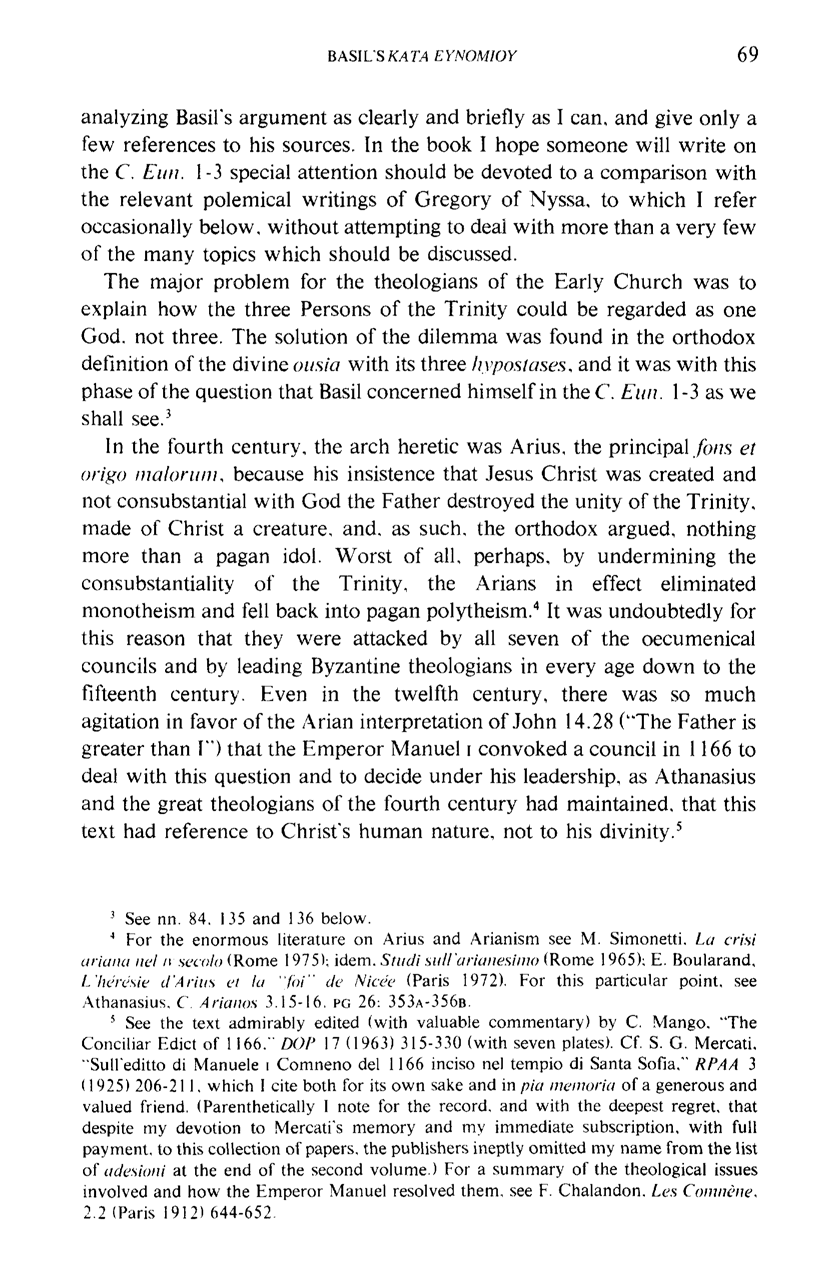
analyzing Basil's argument as clearly and briefly as I can, and give only a few references to his sources. In the book I hope someone will write on the C. Eun. 1 -3 special attention should be devoted to a comparison with the relevant polemical writings of Gregory of Nyssa, to which I refer occasionally below, without attempting to deal with more than a very few of the many topics which should be discussed.
The major problem for the theologians of the Early Church was to explain how the three Persons of the Trinity could be regarded as one
God. not three. The solution of the dilemma was found in the orthodox definition of the divine ousia with its three hypostases, and it was with this phase of the question that Basil concerned himself in the C. Eun. 1-3 as we shall see.
In the fourth century, the arch heretic was Arius, the principal fons et origo malorum, because his insistence that Jesus Christ was created and not consubstantial with God the Father destroyed the unity of the Trinity, made of Christ a creature, and. as such, the orthodox argued, nothing more than a pagan idol. Worst of all, perhaps, by undermining the consubstantiality of the Trinity, the Arians in effect eliminated monotheism and fell back into pagan polytheism.
4 It was undoubtedly for this reason that they were attacked by all seven of the oecumenical councils and by leading Byzantine theologians in every age down to the fifteenth century. Even in the twelfth century, there was so much agitation in favor of the Arian interpretation of John 14.28 ("The Father is greater than I") that the Emperor Manuel ι convoked a council in 1166 to deal with this question and to decide under his leadership, as Athanasius and the great theologians of the fourth century had maintained, that this text had reference to Christ's human nature, not to his divinity.
3 See nn. 84. 135 and 136 below.
4 For the enormous literature on Arius and Arianism see M. Simonetti. La crisi ariana net /> secolo (Rome 1975); idem. Studi sull'arianesimo (Rome 1965); E. Boularand,
L'hérésie d'Arius et lu "foi" de Nicée (Paris 1972). For this particular point, see
Athanasius, C. Arianos 3.15-16. PG 26: 353A-356B.
! See the text admirably edited (with valuable commentary) by C. Mango. "The Conciliar Edict of 1166." DOP 17 (1963) 315-330 (with seven plates). Cf. S. G. Mercati.
"Sull'editto di Manuele ι Comneno del 1166 inciso nel tempio di Santa Sofia." RI'AA 3
(1925) 206-211, which I cite both for its own sake and in pia memoria of a generous and valued friend, (Parenthetically I note for the record, and with the deepest regret, that despite my devotion to Mercati's memory and my immediate subscription, with full payment, to this collection of papers, the publishers ineptly omitted my name from the list of adesioni at the end of the second volume.) For a summary of the theological issues involved and how the Emperor Manuel resolved them, see F. Chalandon. Les Comnène.
2.2 (Paris 1912) 644-652.
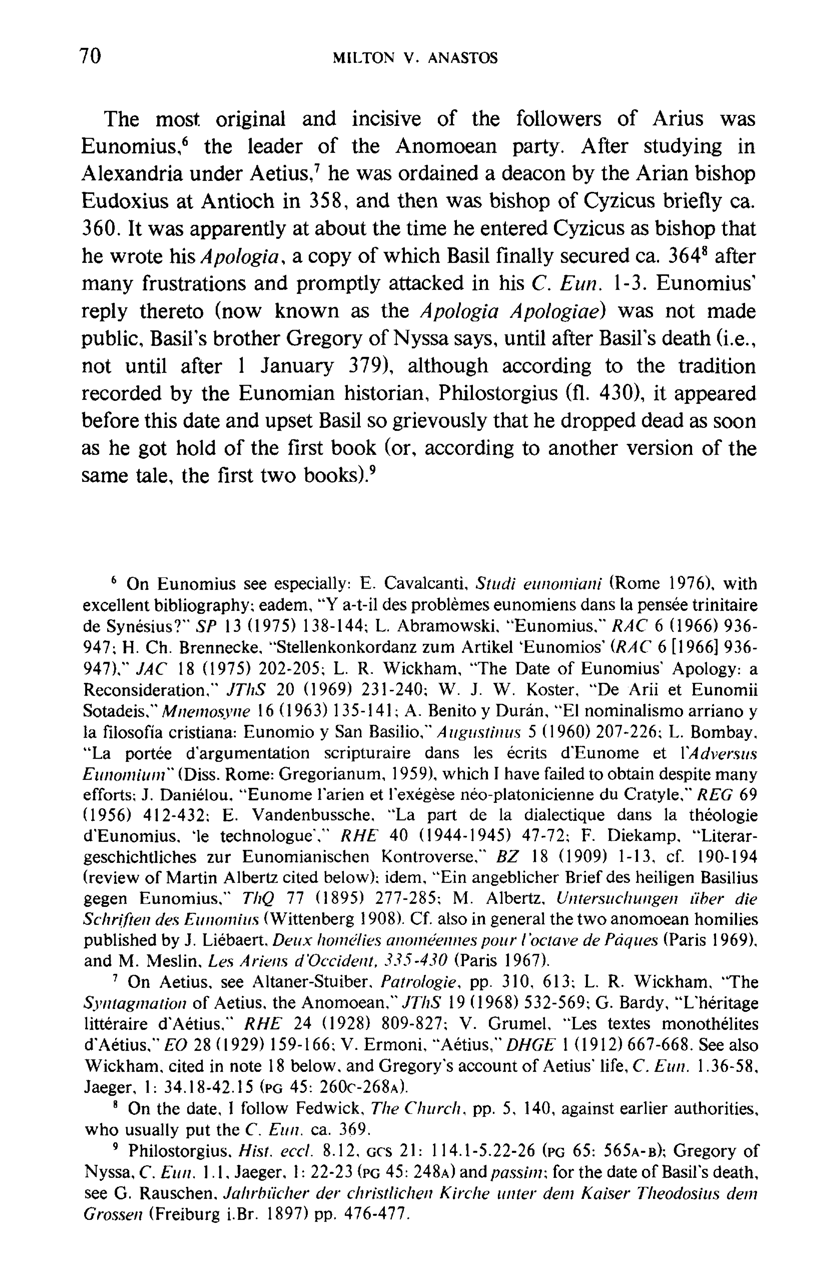
MILTON V. ANASTOS
The most original and incisive of the followers of Arius was Eunomius,6 the leader of the Anomoean party. After studying in Alexandria under Aetius,7 he was ordained a deacon by the Arian bishop
Eudoxius at Antioch in 358, and then was bishop of Cyzicus briefly ca.
360. It was apparently at about the time he entered Cyzicus as bishop that he wrote his Apologia, a copy of which Basil finally secured ca. 3648 after many frustrations and promptly attacked in his C. Eun. 1-3. Eunomius' reply thereto (now known as the Apologia Apologiae) was not made public, Basil's brother Gregory of Nyssa says, until after Basil's death (i.e., not until after 1 January 379), although according to the tradition recorded by the Eunomian historian, Philostorgius (fl. 430), it appeared before this date and upset Basil so grievously that he dropped dead as soon as he got hold of the first book (or, according to another version of the same tale, the first two books).9
6 On Eunomius see especially: E. Cavalcanti, Studi eunomiani (Rome 1976), with excellent bibliography; eadem, "Y a-t-il des problèmes eunomiens dans la pensée trinitaire de Synésius?" SP 13 (1975) 138-144; L. Abramowski, "Eunomius," RAC 6 (1966) 936947; H. Ch. Brennecke, "Stellenkonkordanz zum Artikel 'Eunomios' (RAC 6 [1966] 936947)," JAC 18 (1975) 202-205; L. R. Wickham, "The Date of Eunomius' Apology: a Reconsideration," JThS 20 (1969) 231-240; W. J. W. Koster, "De Arii et Eunomii
Sotadeis." Mnemosyne 16 (1963) 135-141; A. Benito y Durân, "El nominalismo arriano y la filosofia cristiana: Eunomio y San Basilio," Augustinus 5 (1960) 207-226; L. Bombay.
"La portée d'argumentation scripturaire dans les écrits d'Eunome et VAdversus Eunomium" (Diss. Rome: Gregorianum, 1959), which I have failed to obtain despite many efforts; J. Danielou, "Eunome l'arien et l'exégèse néo-platonicienne du Cratyle," REG 69
(1956) 412-432; E. Vandenbussche, "La part de la dialectique dans la théologie d'Eunomius. 'le technologue," RHE 40 (1944-1945) 47-72; F. Diekamp, "Literargeschichtliches zur Eunomianischen Kontroverse," BZ 18 (1909) 1-13, cf. 190-194
(review of Martin Albertz cited below); idem, "Ein angeblicher Brief des heiligen Basilius gegen Eunomius," ThQ 77 (1895) 277-285; M. Albertz, Untersuchungen über die
Schriften des Eunomins (Wittenberg 1908). Cf. also in general the two anomoean homilies published by J. Liébaert. Deux homélies anoméennes pour l'octave de Pâques (Paris 1969), and M. Meslin, Les Ariens d'Occident, 335-430 (Paris 1967).
7 On Aetius, see Altaner-Stuiber, Patrologie, pp. 310, 613; L. R. Wickham, 'The Syntagmation of Aetius, the Anomoean," 777)5 19 (1968) 532-569; G. Bardy, "L'héritage littéraire d'Aétius," RHE 24 (1928) 809-827; V. Grumel, "Les textes monothélites d'Aétius," EO 28 (1929) 159-166; V. Ermoni, "Aetius," DHGE 1(1912) 667-668. See also
Wickham, cited in note 18 below, and Gregory's account of Aetius' life, C. Eun. 1.36-58,
Jaeger, L 34.18-42.15 (PG 45: 260C-268A).
B On the date, 1 follow Fedwick, The Church, pp. 5, 140, against earlier authorities, who usually put the C. Eun. ca. 369.
9 Philostorgius. Hist. eccl. 8.12, GCS 21: 114.1-5.22-26 (PG 65: 565A-B); Gregory of Nyssa, C. Eun. 1.1, Jaeger, 1: 22-23 (PG 45: 248A) and passim; for the date of Basil's death, see G. Rauschen. Jahrbücher der christlichen Kirche unter dem Kaiser Theodosius dem
Grossen (Freiburg i.Br. 1897) pp. 476-477.
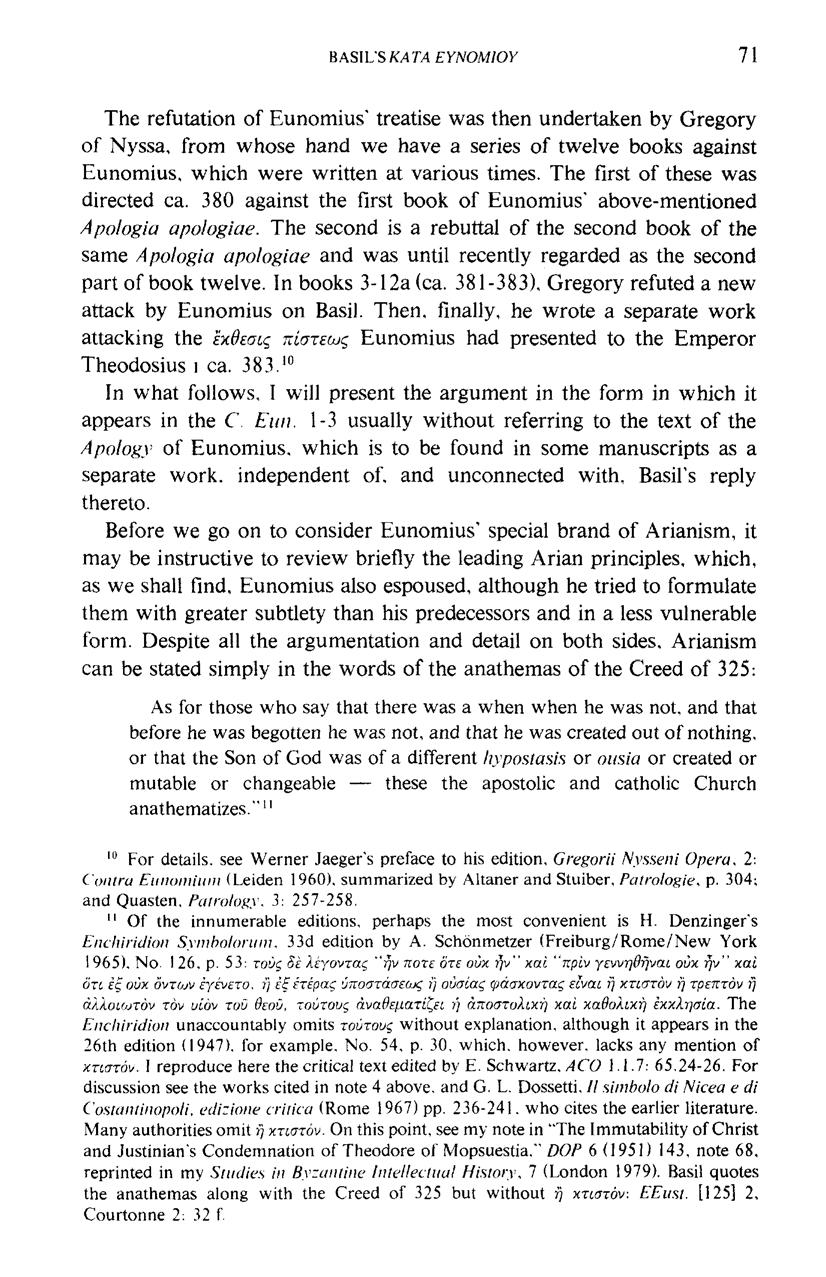
The refutation of Eunomius' treatise was then undertaken by Gregory of Nyssa, from whose hand we have a series of twelve books against Eunomius, which were written at various times. The first of these was directed ca. 380 against the first book of Eunomius' above-mentioned
Apologia apologiae. The second is a rebuttal of the second book of the same Apologia apologiae and was until recently regarded as the second part of book twelve. In books 3-12a (ca. 381-383), Gregory refuted a new attack by Eunomius on Basil. Then, finally, he wrote a separate work attacking the εκθεσίς πίστεως Eunomius had presented to the Emperor
Theodosius ι ca. 383.
In what follows, I will present the argument in the form in which it appears in the C. Eun. 1-3 usually without referring to the text of the Apology of Eunomius. which is to be found in some manuscripts as a separate work, independent of, and unconnected with, Basil's reply thereto.
Before we go on to consider Eunomius' special brand of Arianism, it may be instructive to review briefly the leading Arian principles, which, as we shall find, Eunomius also espoused, although he tried to formulate them with greater subtlety than his predecessors and in a less vulnerable form. Despite all the argumentation and detail on both sides, Arianism can be stated simply in the words of the anathemas of the Creed of 325:
As for those who say that there was a when when he was not, and that before he was begotten he was not, and that he was created out of nothing, or that the Son of God was of a different hypostasis or ousia or created or mutable or changeable — these the apostolic and catholic Church anathematizes.""
10 For details, see Werner Jaeger's preface to his edition, Gregorii Nysseni Opera, 2:
Contra Eunomium (Leiden 1960). summarized by Altaner and Stuiber, Patrologie, p. 304; and Quasten, Patrology. 3: 257-258 " Of the innumerable editions, perhaps the most convenient is H. Denzinger's
Enchiridion Symbolorum. 33d edition by A. Schönmetzer (Freiburg/Rome/New York 1965). No I 26, p. 53: τους δέ λέγοντας "ην ποτέ οτε ούχ ήν" χαί "πριν γεννηθήναι ούχ ην" χαί ότι εξ ούχ όντων έγένετο, ή έξ ετέρας υποστάσεως η ουσίας φάσχοντας είναι ή χτιστον ή τρεπτον ή άλλοιωτον τον υίόν τοΰ θεού, τούτους αναθεματίζει ή αποστολική χαί χαθολιχή εκκλησία. The Enchiridion unaccountably omits τούτους without explanation, although it appears in the 26th edition (1947). for example. No. 54, p. 30, which, however, lacks any mention of χτιστον. 1 reproduce here the critical text edited by E. Schwartz, ACO 1.1.7: 65.24-26. For discussion see the works cited in note 4 above, and G. L. Dossetti, // simbolo di Nicea e di
Costaniinopoli, edizione cririca (Rome 1967) pp. 236-241. who cites the earlier literature.
Many authorities omit ή χτιστον. On this point, see my note in "The Immutability of Christ and Justinian's Condemnation of Theodore of Mopsuestia." DOP 6 (1951) 143, note 68, reprinted in my Studies in Byzantine Intellectual History, 7 (London 1979). Basil quotes the anathemas along with the Creed of 325 but without ή κτιστόν. EEust. [125] 2,
Courtonne 2: 32 f.
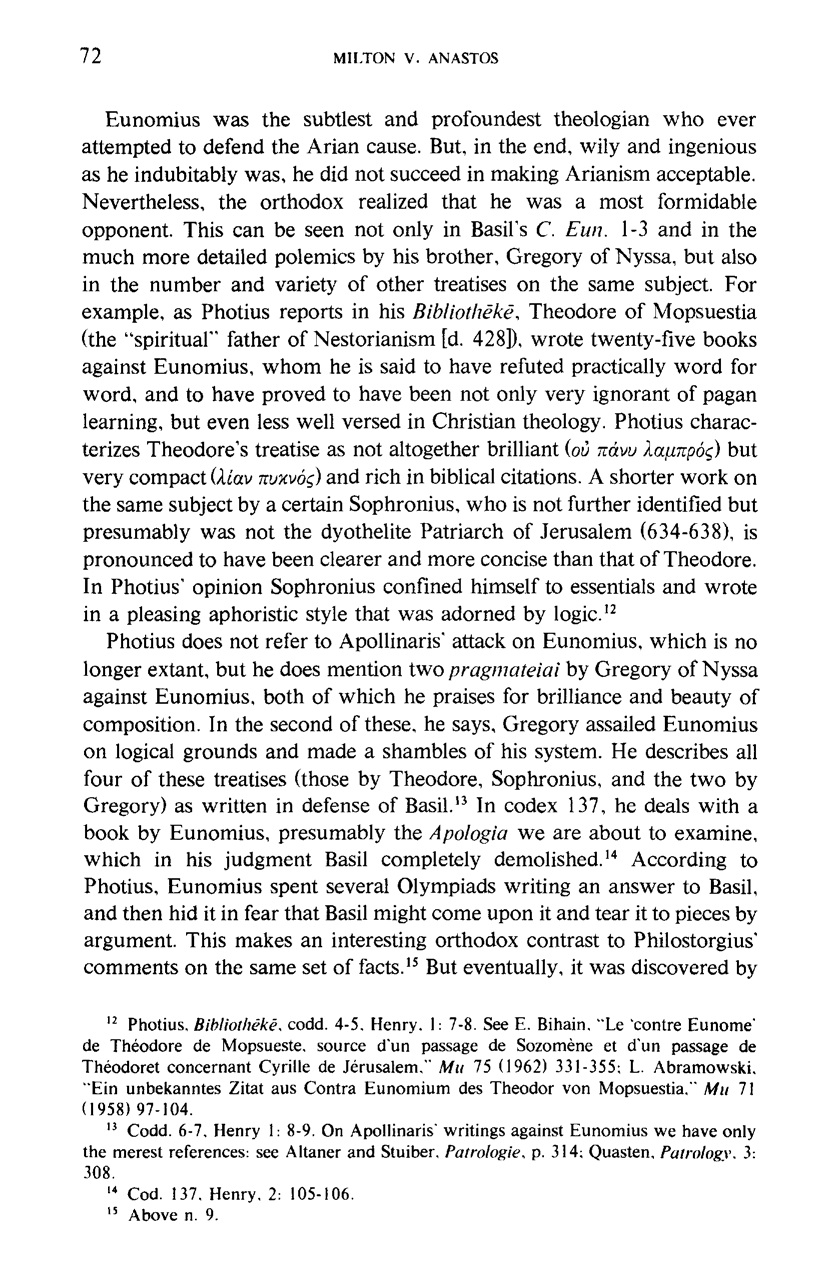
MILTON V. ANASTOS
Eunomius was the subtlest and profoundest theologian who ever attempted to defend the Arian cause. But, in the end, wily and ingenious as he indubitably was, he did not succeed in making Arianism acceptable.
Nevertheless, the orthodox realized that he was a most formidable opponent. This can be seen not only in Basil's C. Eun. 1-3 and in the much more detailed polemics by his brother, Gregory of Nyssa, but also in the number and variety of other treatises on the same subject. For example, as Photius reports in his Bibliothëkê, Theodore of Mopsuestia
(the "spiritual" father of Nestorianism [d. 428]), wrote twenty-five books against Eunomius, whom he is said to have refuted practically word for word, and to have proved to have been not only very ignorant of pagan learning, but even less well versed in Christian theology. Photius characterizes Theodore's treatise as not altogether brilliant (où πάνυ λαμπρός) but very compact (λίαν πυκνός) and rich in biblical citations. A shorter work on the same subject by a certain Sophronius, who is not further identified but presumably was not the dyothelite Patriarch of Jerusalem (634-638), is pronounced to have been clearer and more concise than that of Theodore.
In Photius' opinion Sophronius confined himself to essentials and wrote in a pleasing aphoristic style that was adorned by logic.
Photius does not refer to Apollinaris' attack on Eunomius, which is no longer extant, but he does mention two pragmateiai by Gregory of Nyssa against Eunomius, both of which he praises for brilliance and beauty of composition. In the second of these, he says, Gregory assailed Eunomius on logical grounds and made a shambles of his system. He describes all four of these treatises (those by Theodore, Sophronius, and the two by Gregory) as written in defense of Basil.
13 In codex 137, he deals with a book by Eunomius, presumably the Apologia we are about to examine, which in his judgment Basil completely demolished.
14 According to Photius, Eunomius spent several Olympiads writing an answer to Basil, and then hid it in fear that Basil might come upon it and tear it to pieces by argument. This makes an interesting orthodox contrast to Philostorgius' comments on the same set of facts.
15 But eventually, it was discovered by 12 Photius, Bibliothëkê, codd. 4-5. Henry. I: 7-8. See E. Bihain. "Le 'contre Eunome' de Théodore de Mopsueste, source d'un passage de Sozomène et d'un passage de
Théodoret concernant Cyrille de Jérusalem," Mu 75 (1962) 331-355; L. Abramowski,
"Ein unbekanntes Zitat aus Contra Eunomium des Theodor von Mopsuestia." Mu 71 (1958)97-104.
13 Codd. 6-7, Henry 1: 8-9. On Apollinaris' writings against Eunomius we have only the merest references: see Altaner and Stuiber, Patrologie, p. 314; Quasten, Patrologv. 3:
308.
14 Cod. 137, Henry. 2: 105-106.
" Above n. 9.
BASIL'S ΚΑ TA EYNOMIOY
the three theologians mentioned above, who, in Photius' rather pungent language, laid violent hands upon it and returned it as a malodorous corpse to its author. Photius, who could not abide heretics, deemed
Eunomius to be difficult to understand, a poor stylist, and unsuccessful in the use of logic, despite his pretentions in this field.
What Eunomius set out to do was to present Arian doctrine in a new and more convincing form. He must have hoped that he would be more successful than his predecessors had been in winning acceptance for his views, although he seems to have been reluctant to expose them to scrutiny by orthodox theologians, who apparently had had some difficulty in getting access to his works, if Photius' remarks on this subject can be depended upon.
17 The most astute of the multitude of ingenious arguments on which Eunomius relied was his insistence that agennésia was God's ousia. He apparently first learned this term from his teacher,
Aetius.18 But he made exceedingly effective use of it. Like the earlier Arians, he took agennètos and agenëtos as synonyms (although the orthodox contrasted tham as signifying "unbegotten" and "uncreated," respectively), so that in his vocabulary there was little or no difference between them, since in his judgment "unbegotten" was just about the same as "uncreated." Nor did he distinguish, as the orthodox did,19
16 Cod. 138. Henry 2: 106-108. Photius also mentions a collection of about 40 letters, which are otherwise unknown.
17 Cod. 138.
18 The idea that God's ousia was agennésia is clearly to be found in Aetius'
Syniagmalion I 2 (ει μη τό άγέννητον τήν ύπόστασιν τοϋ θεού παρίστησιν, where ύπόστασιν is a synonym for ούσίαν). 16 (ει τό άγέννιμον ουσίας εστί δηλωτικόν). 30 (very much like 16). But Aetius hardly ever uses the word agenesia itself (cf. ibid.. 32 [bis]). See Wickham's edition
(note 7 above), pp 541. 542. 543-544. with translation and notes (pp. 546. 548. 557-558.
559-560. 566. 567). and idem. "Aetius and the Doctrine of Divine Ingeneracy." SP 1 I (1972)259-263.
" The most complete analysis of patristic theology on the difference between these two concepts is by P. Stiegele. Der Agennesiebegriff in der griechischen Theologie des vierten Jahrhunderts (Freiburg i.Br. 1913). For later contributions of great interest, see G.
L. Prestige. God in Patristic Thought (London 1936. reissued in 1956), pp. 28-54. 136-141.
150-156. who gives an admirable survey, marred only by his failure to refer to the bibliography of the subject; idem. " Άγέν[ν]ητος and γεν[ν]ητός. and Kindred Words in Lusebius and the Early Arians." JThS 24 (1922-1923) 486-496; idem, " Άγέν[ν]ητος and Cognate Words in Athanasius." JThS 34 (1934) 258-265; J. Lebreton. "Άγέννητος dans la tradition philosophique et dans la littérature chrétienne du uc siècle." RSR 26 ( 1926) 431 - 443. who cites the essential literature. Among the most important texts to be noted are
Athanasius. De deer. 28-30. Opitz. 2.1: 24.16-27.8. with notes on parallel passages, etc. (PG
25: 468B-473A); idem. C Ar 1.56-59; 2.3-5. 20. 57-61.71; 3.60. PG 26: 129A-137B. 152B157B. 188c -189(. 268B-277C. 297A-300A. 488c-449c: idem. De syn. 46-48. 51. Opitz. 2.1:
271.13-273.10. 274.25-275.26. with notes, PG 26: 776A-780B. 784A-785B. Cf. also WZ.. see the words άγένι/τος, αγέννιμος. γεντ/τός, γέννι/μα, γεννητύς. Cyril of Alexandria also deals with this problem in his Thesaurus, PG 75: 24 ff. at 29A-B. At first, the Fathers were
MILTON V. ANASTOS
between gennëtos (begotten) and genëtos (created), both of which he understood as meaning "created." He did not attempt to define these terms but made the definition he had in mind clear by his use of the word agennésia. For, as both Basil and Gregory of Nyssa pointed out, by insisting that the Father's ousia was agennésia, he thought he could prove not only that the Son, as begotten, differed from the Father in ousia and that the Father was prior to the Son, but also that the latter was created out of nothing.
Moreover, despite his frequent reference to God as having begotten Jesus, and to Jesus as gennëma or gennëtos, he denied that the Father could have had anything to do with begetting, and, by exploiting the concept of agennésia to the full, he was able to derive from it all the familiar Arian propositions. He differed from Arius, however, and the earlier Arians in two important respects. In the first place, he rejected the adoptionism of some Arians according to which the Son attained his high rank by merit, and assigned him a place just below God in the heavenly scheme — created, but not in time.20 Secondly, because his contention that agennésia was the ousia of God required him to do so, he abjured the Arian denial that it was possible to know the ousia of God.21 inconsistent in their spelling and use of these terms. But is is clear that, even when they were inaccurate in terminology, the orthodox theologians of the fourth century and later repudiated the Arian argument that God. the unbegotten. alone was uncreated — or. in other words, that άγέννητος (unbegotten) was synonymous with άγένητος (uncreated) — and always insisted that Christ, though γεννητός (begotten), was also άγένητος (uncreated).
Note that Leonard Prestige, who is designated as the author of the articles in the JThS cited above, is identical with G. L. Prestige (sic), who wrote God in Patristic Thought, as he obliquely confesses on p. 151.
20 See n. 97 below.
! ) On Arius' adoptionism, see Boularand, L'hérésie d'Arius, 1: 168-174. Simonetti, however. La crisi ariana, p. 54, says that "il subordinazionismo radicale di Ario si colloca perfettamente agli antipodi dell'adozionismo monarchiano di Paolo" [of Samosata]. But, it must be said, Athanasius held a contrary opinion and denounces the Arians for what we should call adoptionist views (C. Arianes 1.37-44, PG 26: 88B-104C, and passim; De sent.
Dion. 23,PG 25: 513A). which he ascribes to Paul of Samosata (C. A r. 1.38; 3.26, 51,PG 26:
89D, 377A, 429B). For example, he attacks Arius and his followers for taking Philippians
2.9-10 ("Wherefore God has also highly exalted him and given him a name which is above every name." etc.) and other similar passages to mean that if Christ was exalted, received grace, and was anointed, etc. (as these texts stated), he was being rewarded for his conduct (1.37, PG 26: 88c: μισθαν τής προαιρέσεως έλαβε: for this meaning οΐπροαίρεσις see
GEL s.v., 6) and, accordingly, was neither God nor the eternal Son of God. Athanasius refused to accept this exegesis because, he said, if the Arians were justified in drawing this conclusion, and if Christ acquired what he had [i.e., being Son of God, etc.] because of his virtue and moral improvement (εξ αρετής ... χαί βελτιώσεως ταύτα έσχηχώς ... ε'ί γε τούτο τών έργων επαθλον εαχε καί προκοπής, PG 29: 8 9 α , 89B), he could not have been truly God or Son or of the ousia of the Father, as of course he was, but only a man by nature and
BASIL'S ΚΑΤΑ EYNOMIOY
Basil begins by saying that, if people would only abstain from tampering with the truth of the Gospel and be satisfied with the tradition of the Apostles and the simplicity of the faith, it would not be necessary for him to break his cherished silence. But since the enemy of the truth, as he calls Eunomius, not only denied the divinity of the Monogenes (the "Only-Begotten"), but also brought confusion to the uncomplicated teaching of the Holy Spirit by drawing upon the vain wisdom of the pagans and misled the simple folk with specious arguments, it became necessary for him, Basil says, to rally behind the truth and refute falsehood, though he claims he was inexperienced in this kind of writing.
As far as he knew, he says, Aetius of Syria was the first to maintain that the Son was unlike God the Father in essence.
22 He was then followed by nothing more. This, Athanasius objects, is not the doctrine of the Church but that of [Paul of] Samosata (PG 29: 89c-D). for Christ was not a man who became God but God who became man (C. Ar. 1.39. PG 26: 92C-93A). The Biblical texts cited by the Arians,
Athanasius and the Nicene theologians maintained, had reference not to Christ's ousia. which was identical with that of the Father, but to his human nature (C. Ar. 1.41, PG 26:
96c: χαί το λεγόμενον νύν, ύπερύφωσεν, où τήν ούσίαν τούΛόγου ύφουμένην σημαίνει - ην γάρ αεί χαί έστιν ίσα Θεώ • άλλα τής ανθρωπότητας εστίν ή ύφωσις. ού πριν γούν εϊρηται ταίτα, ει μή οτε γέγονε σαρξ ό Λόγος, ίνα γένηται ψανερόν ότι τό έταπείνωσε [i.e.. as in Philippians 2.8] καί το ύπερύφωσεν [as in Philippians 2.9] επί τού ανθρωπίνου λέγεται...).
By similar reasoning Athanasius refutes the Arian thesis that Luke 2.52 ("And Jesus increased in wisdom and stature and in favor with God and man") and similar Biblical authorities prove that Jesus
Christ was not truly God's pre-existent Son, who was consubstantial with the Father: C
Ar. 3.26. 51-53. 55 mû passim, PG 26: 377A-380B, 429B-436B, 437B-440B. So far as I can see. Simonetti makes no attempt to deal with the Nicene analysis of the Arten adoptionist arguments in his valuable book, which is by far the fullest and most thorough treatment of Arianism. On the Arian doctrine of the unknowability of God. see Athanasius, C. Ar.
1.6. PG 26: 24A: ... χαί τω Υίω ό Πατήρ αόρατος υπάρχει, καί ούτε όράν, ούτε γινώσχειν τελείως χαί ακριβώς δύναται ό Λόγος τόν εαυτού Πατέρα... : Desyn. 15, PG 26: 708B: ... τω Υίω ό Θεός άρρητος υπάρχει ... ώστε ουδέν τών λεγομένων κατά τε χατάληφιν συνίει έξειπεϊν ό Υιός. αδύνατα γάρ αύτώ τόν Πατέρα τε έξιχνιάσαι ός έστιν εφ' εαυτού, αυτός γάρ ό Υιός τήν εαυτού ούσίαν ούχ οιδεν. τις γούν λόγος συγχωρεί τόν έκ Πατρός όντα αυτόν τόν γεννήσαντα γνώναι έν καταλήφει ; δήλον γάρ ότι τό αρχήν έχον τόν άναρχον, ώς εστίν, έμπερινοήσαι ή έμπεριδράξασθαι ούχ οίον τέ έστιν. On the historical origins of the concept of the unknowability of God, see
H. A. Wolfson. "The Knowability and Describability of God in Plato and Aristotle," llarvClassPliil 56-57 (1947) 233-249; idem. Philo, Foundations of Religious Philosophy in Judaism, Christianity, and Islam, 2 (Cambridge, Mass. 1947) 94-164. See also F.
Graffin - A M. Malingrey. "La tradition syriaque des homélies de Jean Chrysostome sur l'incomprehensibilité de Dieu." in Epektasis (Paris 1972) pp. 603-609.
22 In his Hist. eccl. 3.10.7. Hussey, 1: 415.5-6 (PG 67: 408A), Socrates quotes a letter from Bishop Sophronius of Pompeiopolis in Paphlagonia. who specifically states that Aetius was the first to formulate this doctrine: Άέτιος δέ έν τή ανατολή παραχαράξας εισήγαγε τό κατ' ούσίαν άνόμοιον. Aetius is also so described by Sozomenus, Hist. eccl.
3.19.7,4.12.1.4. 5.14.3, 6.26.12. ces 50: 133.22-27, 154.15-16, 154.21-155.1,213.9-11,
274.11-14 (PG 67: 1097B-C, 1141A-C. 1255c. 1365B). See also Epiphanius, Panarion
(76U.5.9; 3.4 (on Aetius). ces 37: 342.13-14, 27-28; 343.20-21 (PG 42: 517D, 520D, 525A):
MILTON V. ANASTOS
Eunomius, who carried this impiety to its ultimate conclusion and aspired to be known as the initiator and chief of the entire heresy.
Basil's first specific criticism is that Eunomius had pretended he was writing an Apologia so as to be able to claim that he had formulated his doctrine in order to defend himself against attack, and had not set out on his own initiative to win fame for introducing novel ideas. In this way,
Eunomius had thought, he could avoid censure as an innovator and at the same time curry favor with his listeners, since it is natural for people to be attracted to the cause of those who are under attack. By this device he hoped to blame his critics for what he himself had written.
24 Furthermore, Basil quotes Eunomius as adding, accusations were made by the malicious and the quarrelsome, but it was men of discretion who were deeply concerned over the welfare of the multitudes and who refuted false charges.
25 There was no truth in this contention, Basil replies, which was a mere pretext intended by Eunomius to protect himself from suspicion as one responsible for innovations. Nor had Eunomius even been able to name any of these accusers, as he surely would have done, had there been any.
Then, in the next passage reproduced by Basil, Eunomius urges that truth should not be distinguished from falsehood by majority vote, as if the truth lay with the greater number. Nor, says he, should we be confused by the attitude of men of rank or close our ears to men of later times because we have already been convinced by their predecessors. If we were to heed this advice, Basil rejoins, we should be preferring
Eunomius' sophistries and impieties to the entire Christian tradition from the time of the Gospels. Scorning Eunomius' boast that he would set forth the "naked truth," cost what it might, Basil denounces him as arrogant and the "father of falsehood."
Then, in introducing the creed quoted by Eunomius (to be considered below), Basil says that the latter submitted it for two reasons, as Arius had ετόλμησε γάρ ειπείν, άνόμοιον τόν υίόν τω πατρί ύπάρχειν, χαί ού ταύτόν είναι τή θεότητι προς τόν Πατέρα, κτλ. Cf. also the texts cited by Bardy, "L'héritage," pp. 823-826.
23 1.1 (500C-501A).
24 1.2 (501B-D). Wickham, "The Date," argues that Eunomius' Apologia was not a mere literary device, as Basil and Gregory of Nyssa claimed, but was actually presented by Eunomius, presumably at the Council of Constantinople of 360. S. Giet, "Saint Basile et le
Concile de Constantinople de 360," JThS 6 (1955) 94-99, at 95, 96-97, would presumably not disagree with this conclusion.
25 1.2 (504A).
26 1.2 (504A-505B).
27 1.3 (505B-508).
once done with the same innocuous text which, formulated by the ancient Fathers, was couched in simple, untechnical language and avoided controversial matters. First, Arius [and Eunomius] hoped in this way to avoid criticism as innovators since they could claim that they had given their approval to the doctrine of the Fathers. Secondly, they both knew that they would have an opportunity to slip in some notion of their own while pretending to expound the teaching of the Fathers, and thus not be detected in impiety. But. Basil adds, if they were caught, they would seem to be guiltless, since they were allegedly only interpreting the theology of the Fathers and not making any contributions of their own.
Eunomius states his creed in a form which no one could criticize:
We believe in one God. the Father Almighty, by whom are all things, and in one only begotten Son of God, God the Word, our Lord Jesus Christ, by whom are all things, and in one Holy Spirit, the Paraclete.
This, he says, is an adequate summary of Christian dogma for all who 29 and so at first it would appear.
But. Basil explains, this simple credo was used as a bait to catch the unwary who would not realize what Eunomius really intended. For, having disarmed criticism in this way, Eunomius then goes on to explain that the one God whom the Fathers proclaimed was created neither by himself nor by anyone else, wish to be or to appear to be Christians;
30 since, he says, that which creates exists before that which is created, and the created is subsequent to that which creates. No one can be before or after himself. Nor can there be anything prior to God: for, if there were, it then would hold the place of God.
To this pseudo-Aristotelian language, Basil objects that, although Eunomius begins by maintaining that it was obvious that God was unbegotten, he now sets forth to prove this statement, which requires no proof. He is like a man who at high noon would prove to men endowed with good vision that the sun is the brightest star in the heavens. For no pagan or Christian would doubt the ingenerateness of the unbegotten.
There is no need for the syllogisms of Aristotle or Chrysippus to prove that the unbegotten is not begotten, or that he was created neither by 38 1.3-4 (508r-509(), 2 9 1.4 (512A): πιστεύυμεν εις ένα Θεόν Πατέρα παντοκράτορα, έξ ου τά πάντα • χαί εις ένα μονογενή Υίόν τού Θεού. Θεόν Λόγον, τόν Κύριον ημών Ίησοΰν Χριστόν, δι' ου τά πάντα • χαί εις εν Πνεύμα αγιον, τό παράχλητον. See η. 190 below.
1.5 (513D-516A): νβ: τό ποιούν τού γινομένου προϋπάρχειν, καί τό ποιούμενον τού ποιούντος είναι δεύτερον.
MILTON V. ANASTOS
himself nor by another, and that he is neither older nor younger than himself.32
His real purpose in laboring the obvious in this way, however, Basil says, is to show himself to be an agile thinker and also, after having established these propositons, to be able to argue that, since "the maker exists before what is made," the Son came into being subsequent to the Father, and hence that the Son was begotten out of nothing.33 Furthermore, Basil adds, although he agrees that the term agennëtos for the Father is perfectly in accord with his own opinion, he believes it should be avoided because it does not occur in the Bible. For this reason he prefers to use the term Father, both because it means the same as agennëtos and because it adds the idea of his relationship to the Son. For he who truly is the sole Father has no source of origin (έξ ούδενός εστί έτερου), and that which has no source of origin is unbegotten. Therefore God should be designated as Father, not as the unbegotten, unless we are to amend
Matthew 28.19, "Go forth and baptize in the name of the Father," etc., to read "Go forth and baptize in the name of the unbegotten."
Continuing his argument that nothing could exist before God, Eunomius argues that, if neither he himself nor anything else is anterior to him, ακολουθεί τούτω τό άγέννητον. These last four words can be taken to mean simply: "the attribute of being unbegotten [or "ingenerateness"] follows him [God]." But this literal rendition is not suitable here, as the context shows. For Eunomius had been insisting to Basil's great discomfiture that God was not made by himself or by anyone else, primarily so as to provide a basis for the major principle of his theological system. This was, as he formulates it, "Since it has been established that neither he himself [i.e., God] nor anything else existed before him, his ingenerateness is then the logical consequence"
35 [of this lack of sources for his being]. What he meant was that, since there was nothing before God, his ousia was agennésia. In other words, God's agennésia follows inevitably from his being anarchos (which both the orthodox and the 32 1.5(51 6 β - γ ) : ό άγέννητος où γεγέννηται, ούτε αυτός ΰφ' εαυτού, ούτε ΰφ' έτερου, χαί ούτε πρεσβύτερος, ούτε νεώτερος αυτός έστιν εαυτού.
34 1.5(516D-517A). Cf. Gregory of Nyssa C.Eun. 1.535-618. Jaeger. 1 : 181.12-204.21
(PG 45: 416D-44IB).
35 1.5 (517B). Eunomius. Apologia 7 (PG 30: 841c): ούχούν ε'ι μήτε αυτός εαυτού, μηθ' έτερον τι αύτοϋ προϋπάρχειν δέδειχται, προ δέ πάντων αυτός - ακολουθεί τούτω τό άγέννητον μάλλον δέ αυτός έστιν ουσία άγέννητος.
Arians understood as meaning "without beginning or origin"). That is, God was anarchos-, ergo, he was unbegotten and his ousia was agennésia.
But Basil, as well as Gregory in defense of his brother, takes ακολουθεί τούτω τό άγέννητον literally as signifying that "ingenerateness follows"
God in a physical way or at least externally, from outside his ousia.
Accordingly, Basil argues, "If ingenerateness follows God, it indubitably comes to him from outside. But what is external to God is not his ousia."™
That is, they maintain, Eunomius has fallen into a contradiction by insisting that ingenerateness is God's ousia, since what follows God was inevitably external to God, and as such, could not be his ousia. For that which follows is universally recognized to be different from that which is followed. Realizing this difficulty, Basil says, Eunomius sought to eliminate it by adding after ακολουθεί τούτω τό άγέννητον the words μάλλον δέ αυτό έστιν ουσία άγέννητος ("Rather, ingenerateness is his actual ousia"), in order. Basil believed, to fortify in this way his contention that ingenerateness was God's ousia, which the Son, being begotten, could not share, and that consequently the latter was unlike the father in ousia.
38 proves, Eunomius did not intend the last sentence (μάλλον δε, etc.) to modify or correct what he had already written, but merely to add his conclusion that not only was
God anarchos and agennëtos, but also that his very ousia was agennëtos.
Hence, I think Basil (and Gregory too) misrepresented what Eunomius had in mind at this point. For it is clear that Eunomius was using the verb ακολουθεί here in a metaphorical sense, as I have just explained. (Actually, to judge from Gregory's reply on this point, Eunomius objected in his
Apologia apologiae that Basil had failed to understand what he had in Actually, however, as the text translated above
mind.) I doubt that Basil was dishonest in attacking Eunomius in this way. It is more likely that he was merely conforming to the regular Byzantine method of refutation word by word (apparently in the manner of the diatribe by Theodore of Mopsuestia described by Photius).
40 This type of argumentation involved a great deal of captious and pointless criticism, as can be seen, for example, in the iconophile polemic against the 36 1.5(51 7Br): ει γάρ ακολουθεί τώ Θεώ τό άγέννητον. έξωθεν αύτφ παρέπεται δηλονότι, τό δέ έξωθεν τού Θεού ούχ ουσία αυτού έστιν.
17 1.5 (517C-520B). Gregory's analysis of Eunomius, Apologia 7, is to be found in C.
Eun. 1.655-665, Jaeger. L 214.21-217.25 (PG 45: 453A-456C).
38 See n. 35 above.
39 Gregory. C Eun. 1.652-657, Jaeger, 1: 213.25-215.12 (PG 45: 452C-453B).
40 Photius, Henry, 1: 7-8.
MILTON V. ANASTOS
iconoclastic horos of 754 during the Council of 787.4l On the whole, however, it is fair to add, Basil's analysis of Eunomius' Apologia does not often exhibit lapses of this kind.
Having defined God's ousia as agennésia, Eunomius goes on to say that, in describing God as agennëtos, we do this, not just to honor him with a name κατ' έπίνοιαν άνθρωπίνην ("by a human conception"), but to offer him what is most urgently due him (άναγκαώτατον οφλημα) — the confession that he is what he is. For what is said kaf epinoian has no existence except in words and their pronouncement, and is bound to perish with the sound itself.
42 Eunomius resorts to this argument, Basil says, in order more easily to assert that agennésia is the ousia of God, and hence that the Son is unlike the Father in ousia. Accordingly, Basil examines the meaning of epinoia. Eunomius is mistaken, he holds, in contending that words cease to exist after they are uttered. For even with fanciful notions and myths of centaurs, and the like, the false ideas remain in the mind.43
Many things which seem simple and indivisible can be analyzed only by the exercise of thought (epinoia). For example, a body (soma) on first encounter seems to be simple but by careful examination is resolved into its constituent parts, such as color, form, hardness, size, etc. Nevertheless,
Eunomius makes no reference to this or any other such matter, Basil says, nor would he admit that names have significance or subsist apart from their vocal expression (εκφωνήσει). Actually, however, Basil maintains, the concepts derived by epinoia do not vanish with the sound of the words by which they are described but survive in the memory of the person who defined them.
Applying this method of analysis to the New Testament, Basil says that Jesus, in describing God's love for mankind (φιλανθρωπίαν) and the grace bestowed upon men by the incarnation, spoke of himself as the door, the way, the bread, the vine, the shepherd, and light, each of which has a different significance, but all refer to the same subject or person (ύποκείμενον) and one ousia. By designating himself as the light of the world, for example, he indicated the unapproachableness of the glory of the 41 J. D. Mansi. Sacrorum conciliorum nova et umplissima collectio, 13 (Graz 1960)
205-364.
4 2 1.5 (520c): ή τού είναι ö έστιν ομολογία: literally: "the confession of his being what he is," or better, "the confession that he is what he is." Gregory of Nyssa discusses the problem of epinoia in great detail. C. Eun. 2.11-66 passim. Jaeger, 1: 229.29-245.16 and frequently (PG 45: 913B-932C). Cf. now M. S. Troiano. VetChr. 17 (1980) 313-346.
4 3 1.5-6 (521A-C).
44 1.6 (521C-524C-).
godhead, and the illumination he brought by the splendor of knowledge to those who are purified in the eye of their souls. It would be absurd to say that these ideas expire as soon as they are discussed. W
7hy then is it inappropriate to attain some notion of God by way of human thought, especially concerning God's being unbegotten?
Thus, we speak of God as being aphthartos and agennëtos to express various notions. When we turn backwards and see that God is beyond all beginning, we say that he is agennëtos. Then, as we look into the future and realize that he is without limit or end. we describe him as aphthartos.
Both of these terms are the outcome of human contemplation (τη έπινοία θεωρούντων ημών έκάτερα). and no one would deny that they constitute a confession of what God truly is. Eunomius, however, distinguishes between what is said as a result of human thought and a "confession that God is what he is."
Therefore, holding uncompromisingly to his principle that it was improper to honor God by ideas of human origin, Eunomius insisted that, in fulfillment of an obligation (όφλήματος έκτισις) to God, men should simply confess that agennésia was God's ousia. This was the "confession that God is what he is," to which he frequently alludes, in part, perhaps, because this formula seemed to him to resemble the Aristotelian τό τι ψ είναι. He means by this that he deemed the idea of agennésia to be divine and not derived from human speculation. If then, Basil asks, Eunomius is unwilling to consider any theological problem in intellectual terms, as he says, does he limit this restriction solely to the term agennésia, or is he willing that it should apply to other attributes of God as well? If he is willing to do so, Basil says, he would then be admitting that every one of the attributes indicates God's ousia.
Basil's reasoning here is somewhat abstruse. What he means is that, since Eunomius pronounces agennésia, which is only one of the many attributes of God, to be the ousia of God, although he can offer no proof of this proposition, it would only be fair to acknowledge that all of God's attributes also designate his ousia — unless, of course, we should attempt to deal with this question from the point of view of human reason, the applicability of which to these matters Eunomius categorically denied. If Eunomius would concede this point — that is, that ideas about God cannot be put in concepts of human origin — the result would be that all the attributes would designate the same thing. Then there would be no 45 1.7 (524C-525B); NB: Τι ουν άτοπον ούτω χαί έπί τού Θεού τών όλων λαμβάνεσθαί τίνα κατ' έπίνοιαν χαί αυτό τούτο πρώτον, περί ου ό σύμπας ήμϊν κεχίνηται λόγος ;
4 6 1.7 ( 5 2 5 β - γ ) . See η. 42 above.
MILTON V. A N A S T O S
more difference among them than there is between the names Simon, Peter, and Cephas (i.e., in the New Testament), all of which designate the same person.47
Basil demands these conclusions as part of his reductio ad absurdum of Eunomius' principal dogma and does not fail to point out that it would be absurd to claim that God's role as creator, for example, or his foreknowledge, as well as his immutability, agennésia, invisibility, incorruptibility, etc. all indicate his ousia, and that, in disregard of "current usage and the teaching of the Spirit," these attributes are not to be distinguished from each other. Furthermore, Basil says, by identifying the divine attributes
(τά επιλεγόμενα τω Θεώ or ονόματα) in this way, Eunomius would completely overturn his own position. For, once it is admitted that immutability, incorruptibility, indivisibility, and the like all indicate ousia, then it becomes clear that these same attributes indicate the ousia of the Son as well, since he too was immutable, incorruptible, etc. Or, as Basil puts it, the Eunomians would then be showing that, so far from being unlike the Father in ousia because he differed from the Father in respect to only one attribute, agennésia, he was like the Father because for the most part he and the Father had the same attributes.48
As Basil remarks, Eunomius gives no reason for holding that agennésia alone among the attributes of God satisfies the demands of piety and is the only one which contains the "confession that he is what he is." Nor does he explain why he is willing in other cases — i.e., apart from agennésia
— to honor God by concepts [i.e., incorruptibility, indivisibility, etc.] which are the products of human reason. Thus, Basil concludes,
Eunomius is caught in his own devices.49 This rather complicated and tortuous reasoning requires some commentary. In the first place, it should be said, Eunomius apparently readily acceded to the inferences Basil was trying to force upon him. For we learn from Gregory's Contra secundum librum Eunomii that, in his reply to Basil, Eunomius had said that "neither
[God's] righteousness nor his wisdom nor his power nor his goodness nor any of the [other] attributes of God was different from those already mentioned" [i.e., incorruptibility, endlessness, etc.], and that no term should be understood in its own special significance, but that there should
47 1.8 (528A-D). On nn. 47-52, see n. 233 below.
48 1.8 (529A-B); NB: Où γάρ μάλλον διά τό έν μια προσηγορία διάφορον άνόμοιον χατά τήν ούσίαν άποδειχνύειν εξουσιν, ή δια τήν εν τοις πλείοισι χοινωνίαν δμοιον όμολογείν ύπ' αυτής τής ανάγκης τών δεδομένων εχβιασθήαονται.
49 1.8 (529B-C). Gamier in a lengthy note (59) cols. 530-532, vigorously defends the reading μή παραιτείσθαι (in my paraphrase "is willing"). I am in complete accord with him.
BASIL'S ΚΑ TA EYNOMIOY
be one meaning for the entire list of attributes and one form of description should suffice as a definition for each of them.
This means, Gregory points out, "if you are asked for the meaning of the term 'judge,' answer with the definition of 'agennésia,' and if you are required to give the definition of 'righteousness,' be ready to give incorporeal' as your answer. If you are asked what 'incorruption' means, say it has the same meaning as 'mercy' or 'judgment.' Thus, let all the attributes be convertible terms, since there is no specific sense in which one differs from the other."51 In another passage, Gregory quotes
Eunomius as stating that all the attributes of the divine nature agree in meaning with one another, and that there is no difference among them.52
Then Gregory goes one step further than Basil by arguing that since "Father" is one of these attributes, the conclusion is inevitable that God was always the Father from all eternity. Or else, he adds, if Eunomius is unwilling to make this concession, which would overturn his whole system [because it would necessarily mean that the Son was co-eternal with the Father], he will then have to admit that each of the attributes has a meaning of its own.53 so Section 472. Jaeger, 1: 364.9-15 (PG 45: 1068D): δοχεϊ δέ μηδέ τόν τής δικαιοσύνης λόγον έτερον παρά τά είρημένα τυγχάνειν μηδέ τόν τής σοφίας χαί τόν τής δυνάμεως χαί τόν τής αγαθότητας, χαί έκαστου τών θεοπρεπών ονομάτων, καί μηδείς έστω λόγος κατά τό ιδιάζον νοούμενος, άλλ έπί παντί τω καταΑόγ·ω τών ονομάτων, έν ύποχείσθω τό σημαινόμενον, χαί εις υπογραφής λόγος τόν περί έκαστου τών λεγομένων άρον άποπληρούτω.
51 Ibid.. 472-473. 1: 364.15-23 (PG 45: I068D-1069A): xäv έρωτη&ής τό τού χριτού σημαινόμενον, τήν τής άγεννησίας έρμηνείαν άπόχριναι, καν τής δικαιοσύνης δέη τόν όρισμόν άποδούναι, τό άσώματόν σοι πρόχειρον εις τήν άπόκρισιν έστω. τί δέ σημαίνει ή αφθαρσία, όπερ ή τού έλέου πάντως έρείς ή ή τής κρίσεως σί/μασία παρίστησιν. ούτω χαί τά καθ' έκαστα πάντα προς άλληλα μεταχωρείτω. μηδεμιάς ιδιαζούσης έμφάσεως τό έτερον τού έτερου διαστελλούαης. I have borrowed a few felicitous phrases from the admirable translation by M. Day in the NPNCF
5 (New York/London 1893) 297, who. however, gives only a paraphrase of the passage translated at n. 50 above.
52 Gregory, ibid.. 494. 1: 370.19-23 (PG 45: 1076B): ... κατασκευάζει πάσας τάς επιλεγομένας τή θεία φύσει προσηγορίας κατά τό σημαινόμενον άλλήλαις συμφέρεσθαι καί μηδεμίαν έν αύταΐς είναι διαφοράν....
According to Eunomius, Gregory explains, meaningful designations [i.e., in this instance, for divine attributes] derive their significance from the underlying realities which they indicate. Different designations are applied to different realities, and the same to the same. Hence, necessarily, either the reality described is different (if the designations are) or the designations do not differ. C.
Eun.
1.481, Jaeger. 1: 366.18-25 (PG 45: 1072A-B): τών γάρ αληθών φησι λόγων έκ τών υποκειμένων χαί δηλουμένων πραγμάτων λαμβανόντων τήν έπίκρισιν χαί τών έτερων έτέροις πράγμασι συναρμοζομένων, ώσπερ αΰ καί τών αυτών τοις αύτοϊς, εξ ανάγκης δει δυοϊν είναι θάτερον, ή χαί τό πράγμα τό δηλούμενον πάντως έτερον, ή μηδέ τόν δηλούντα λόγον έτερον. It is for this reason that Eunomius in the passages discussed above insists that all the attributes of the divine ousia are interchangeable and have the same meaning. In Apologia 18-19 (PG
30: 853A-D; and see n. 84 below), he argues that if the names differ so do the ousiai.
53 Gregory, ibid,, 494-496. L 370.23-371.5 (PG 45: 1076B-C), in continuation of the passage quoted in n. 52.
MILTON V. ANASTOS
At the bar of orthodox opinion, therefore, it would seem, Eunomius stands convicted, at least on these points. If, however, we should attempt to rehabilitate him for the sake of any modern Eunomians there might still be among us, we could perhaps plead in Eunomius' defense that he was justified in making an exception for agennésia because that was the chief idiôma or property which distinguished the hypostasis (i.e., person) of the Father from the other two members of the Trinity. But even this plea falls to the ground, of course, because agennésia was not the peculiar idiôma of the Father alone, since the Holy Spirit, which proceeds from the Father
(John 15.26 etc.), is also unbegotten.
Then, Eunomius goes on to say, God cannot be known by negation, i.e., by terms expressing the lack of faculties or possessions which he should by nature have anymore than he can be known by the process of human thought, as he had previously argued.54 Basil heatedly repudiates
Eunomius' reference to privatives because, he says quite rightly, it is based upon Aristotle's Categories,55 and not upon the Spirit (by which, as frequently, he means the Bible). But realizing that it would not be sufficient to denounce Eunomius merely for depending upon pagan sources, Basil directs his attack against the argument itself. There are many privative terms, he says, which are used in describing God, such as aphthartos, athanatos, aoratos. Agennëtos also is an epithet of this same sort. When God is called aphthartos, e.g., we mean there is no decay in God. When we say he is aoratos, we mean he cannot be perceived by the eyes. And incorporeality (τό άσώματον) indicates that his ousia is not three dimensional. When we say he is athanatos, we mean he is not subject to dissolution. Similarly, when we say God is agennëtos, we mean birth was not one of his attributes (γέννησιν αύτω μη προσεϊναι).
Actually, Basil says, there is no reason to prefer agennëtos to any of these terms as a confession of God's being what he is. Eunomius chose agennëtos because it was the only one which would serve as the basis for his impiety [i.e., it was the only one which does not apply equally well to both the Father and the Son]. Hence, Basil concludes, if we say with Eunomius that it is not proper to describe God by terms derived from human reason or by privatives, but that agennëtos is a term which is free of these defects, we must also concede that the other attributes of this sort
(aphthartos, etc.) are no less appropriate than agennëtos as descriptions of God.56
54 1.9 (532A).
55 Categories 10 (12a26-b25 and passim).
56 1.9(532A-533C).
The fact is, however, Basil continues, there is no single designation which is adequate to explain God's nature. Of the many terms which we use, some indicate qualities which God has, others those which he lacks.
From the latter we learn what characteristics should not be ascribed to God. The former (good, just, creator, judge, etc.) designate those which are appropriate to him.
57 Agennëtos simply means that God was not born.
But being a negative term, it clearly does not reveal what his ousia was.58
Then going further in his analysis of this term, Basil argues that God's ousia is agennëtos but that agennésia is not his ousia, and he asks
Eunomius how he knows that agennésia is God's ousia. He could not have learned this from common opinion, he says, which indicates only that God is but not what he is, or from the Spirit, or from David, who confessed (Psalm 138 [139].6) that "Such knowledge is too wonderful for me. It is high. I cannot attain unto it," or from Isaiah (53.8: "... who shall declare his generation ?"). Even Paul, in whom Christ spoke and who was raised to the third heaven, confessed that God's "ways are past finding out" (Romans 11.33).
If Paul did not know, how does Eunomius, who cannot even tell what the ousia of the earth is ? From Genesis 1.1 ff. we learn only that God made heaven and earth, and that the earth was "without form and void," but nothing at all about its ousia. We know the qualities of the earth — its color, mass, weight, density, and varieties of form. etc. — but none of these discloses what its ousia is. Nor has its ousia been disclosed in any book by wise or pious men.59
God said that he was the God of Abraham, Isaac, and Jacob and that "this is my name forever" (Exodus 3.15; 6.2-3). But he did not disclose his name further than this or his ousia. Apparently, even his name was beyond the capacity of human ears. But to Eunomius, it seems, he revealed not only his name but also his ousia, with the unfortunate result that this great mystery (aporréton), which was never made known to any of the saints. Eunomius publishes in his books and spouts out to all men indiscriminately, being unwilling to admit that the ousia of God is beyond all human comprehension.60
Actually, this knowledge exceeds not only the powers of men but also of all rational nature (πάσαν λογικην φύσιν). For no one knows the Father
5 7
1.10(533C-536B).
5 8 1.10
( 5 3 6 β - γ ) .
59 1.11-13 (537A-541B). Cf. Gregory of Nyssa, C. Eun. 2.25. 29, 33-34, 174-177.
Jaeger. 1: 233.25-27. 235.5-8. 236.4-20. 275.18-276.1! and passim (PG 45: 917c. 920c.
921A-B. 968B-D).
6 0
1.13(54!C-544A).
MILTON V. ANASTOS
but the Son and the Holy Spirit (Matthew 11.27; 1 Corinthians 2.10-11). If Eunomius and his followers really did know the ousia of God, what capacity did they then leave to the Son or to the Holy Spirit? Man can know of God only his goodness and his wisdom, which he revealed to them.61 Furthermore, Basil continues, what is written about the ousia of God by the theologians is in the form of allegories. Like the pagans, the Hebrews had a material idea of God's ousia as well as many other false and conflicting notions about it. Therefore, it is better to give up the hopeless search for the ousia of God, he said, and take the advice of Paul, who said, "... he who comes to God must believe that he is, and that he rewards those who diligently seek him" (Hebrews 11.6). For salvation is gained not by the search to discover what God is, but confession that he exists.62
Having demonstrated that the ousia of God is incomprehensible and a mystery (aperinoëtos and aporrëtos) for men, Basil proceeds to determine what agennésia is and how it is to be understood. The mind, he says, finding that there is no cause above God, describes his lack of a beginning as agennëton.61 For when, in speaking of men, we say that so and so was born of someone, we have in mind not what he is, but of whom he was born. Similarly, the expression agennëtos indicates not what he is, but his lack of origin.64 Thus Luke, in his genealogy of Christ
(3.23-38), working back from Joseph to Adam, and then to God, did not indicate the ousiai of the persons mentioned, but their order of succession from one to the other. So we, in asking what the source of God was, conclude that "he had no source." This means that which is without beginning and hence the unbegotten. Just as we are not inquiring about ousia when we ask εκ τίνος in the case of men, so also in discussing God, ingenerateness (which is the equivalent of saying έξ ούδενός) has nothing to do with ousia. Hence from the word "unbegotten," we learn not what
God's ousia (Basil wrote physis, which is a synonym of ousia) is, but rather how he came to be.
61 1.14 (544A-C). On the unknowability of God, see Wolfson, works cited in n. 21 above. Cf. Gregory of Nyssa, C. Eun. 2.97-124 and passim, Jaeger, 1: 255.1-262.15 (PG
45: 944A-952C).
6 2
1.14(544C-545A).
6 4 Ibid.: όταν λέγωμεν ότι. Ό δείνα έχ τούδε γέγονεν, ού τό τι έστιν έκαστου, άλλα τό όθεν γέγονε διηγούμεθα • ούτω χαί έν τοις περί Θεού ή άγέννητος φωνή ού τό τι άλλα τό μηδαμόθεν αύτοϋ σημαίνει.
65 1.15 (545C-548B): when we ask, ό δέ Θεός έχ τίνος ; the answer is έξ ούδενός. τό δέ έξ ούδενός τό άναρχόν εστί δηλονότι · τό δέ άναρχον τό άγέννητον. ... τούτο δέ χαί ήμϊν συμβαίνει έχ τής τοϋ άγεννήτου φωνής τό όπως τοϋ Θεού μάλλον ή αυτήν τήν φύσιν διδασχομένοις.
Going on next in his treatise to attack the idea that Christ was begotten of God, Eunomius claims that the agennëtos would never admit (πρόσοιτο) gennésis so as to share his own nature with that which is begotten, and avoids all comparison or association with the begotten.66 Accordingly, he prefers to designate God as agennëtos rather than as Father, and Christ as gennëtos rather than Son. This he did, Basil explains, in order to prove the Son unlike (anomoios) God the Father, and also so that, when his impiety was unmasked, he might seem not to have blasphemed but only to have concocted his heretical scheme to satisfy the demands of the argument.67
But, Basil protests, in denying any synkrisin ("comparison") between the Son and the Father, or any koinönia ("community" [in ousia]) between the begotten and the begetter, Eunomius rejects the New Testament. For in John, Jesus had said, "He that hath seen me hath seen the Father" (14.9;
12.45), and "all mine are thine [i.e., the Father's] and thine are mine"
(17.10). To the same effect, Paul had pronounced Christ to be not only "the image of the invisible God" (Colossians 1.15), who was "in the form
[which Basil takes to be a synonym of ousia] of God" (Philippians 2.6), but also "the express image of his Person" (Hebrews 1.3). These and other pronouncements of "the Holy Spirit" are set at naught, Basil says, by Eunomius' blasphemy.68
Then carrying his point about the lack of communion between the unbegotten and the begotten one step further to one of his major conclusions, Eunomius denies that there was a common ousia of the unbegotten and the begotten, since in order and privilege of time, one was first and the other second.69 Basil begins his reply by noting that he too would deny that there was a common ousia for Father and Son if this were understood to be pre-existing matter, which was cut up and divided between them. This view was no less reprehensible, he believed, than that according to which the Son was unlike the Father. But, he adds, he would accept the idea that there was such a common ousia if this were taken to mean that the Father and the Son shared the same type of being, as, for 66 1.16 (548c): πάσαν σύγχρισιν χαί χοινωνίαν τήν προς τό γεννητόν.
67 This was apparently one of Basil's favorite arguments (as in what he says about Eunomius" choice of Apologia as the title of his treatise).
68 1.17-18 (552A-553B). On the meaning of είχών, see H. J. Sieben, Voces, eine Bibliographie zu Wärtern und Begriffen aus der Patristik (79/S-/97S,)(Berlin/New York
1980), s.v.; Aghiorgoussis. articles cited in η. 2 above; G. B. Ladner, "Eikon," RAC 4
( 1959) 771-786; idem, "The Concept of the Image in the Greek Fathers and the Byzantine
Iconoclastic Controversy," DOP 7 (1953) 3-34; T. Camelot, "La théologie de l'image de
Dieu." RSPhTh 40(1956)443-471. See also nn. 110, 141, 143 below.
1.19(553C-D).
MILTON V. ANASTOS
example, if it was held that light constituted the ousia of both the Father and the Son. Accordingly, there would be a single divinity on account of the unity of the ousia. The difference [between the Father and the Son] would be in number and in the individual properties which distinguished one from the other.
Furthermore, according to the obvious orthodox reply, which Basil does not fail to make, since there was a common ousia, there was no need to have subordination in order (τάξει ύποβεβλήσθαι) or for one to be second to the other chronologically. For, he says, it was not possible for God not to coexist eternally with his own tunelessly illuminated image (Hebrews
1.3) and not have a union (συνάφειαν) with it which transcended all time and the ages. For Christ was described as the "brightness" [of his glory] precisely in order to bring to mind his union [with God], and he was called the express image of his person to indicate his consubstantiality with God
(Hebrews 1.3).
71 This passage is notable because it is one of only five in the C. Eun. 1-3 in which Basil uses the word ομοούσιος, and it is the only one in which the term is applied to the consubstantiality of the Father and the Son. It is well known, of course, that the Holy Spirit is never described as όμοούσιον by Basil in any of his extant works.
In writing of order and priority, Basil remarks, Eunomius preferred to refer to the order (taxis) in rank and number, etc., where one comes literally and physically (εκ τής παρ' ημών θέσεως) before another. For this reason he said that it was improper to speak of taxis in connection with God [i.e., to put God in a series with others], for taxis is also later than the one who brings it into being. But, Basil objects, there is another kind of taxis, the natural one, in which the cause comes first and is followed by the effect, as in fire and the light which comes out of it. The order here is logical and involves no interval (διάστημα). It comes about not by physical placement, but as a consequence of their nature.
73 Thus, in causal relationship the Father comes before the Son in order — not by difference of nature or in time.
Eunomius' next point is that, since God is altogether simple (or, πάντη συνθήκης ελεύθερος), his ousia can include no form, mass, or quantity.
70 1.19 (556A-B): « δέ ούτω τις έκλαμβάνοι τό τής ουσίας κοινόν, ώς τόν τοϋ είναι λόγον ένα χαί τόν αυτόν έπ' άμφοίν θεωρεϊσθαι, ώστε χαί ει καθ' ύπόθεσιν φως ό Πατήρ τω ύποχειμένω νοοϊτο, φώς χαί τήν τοϋ Μονογενούς ούσίαν όμολογεΐσθαι, χαί δνπερ αν τις αποδώ έπί τοΰ
Πατρός τόν τού είναι λόγον, τόν αυτόν τούτον χαί τω Υίω έφαρμόζειν, ... δεχόμεθα
71 1.20 (556c): in line 7 of c. read χρόνων for χρόνον.
12 See pp. 129-134 below.
73 1.20 (557B): ού κατά τήν ήμετέραν θέσιν, αλλ' έχ τής κατά φύσιν αύτοίς ένυπαρχούσης ακολουθίας. On diastema, see the article by Verghese cited in n. 95 below.
Accordingly, he argues, since no such thing can be combined with the ousia of God, it is impossible to liken the begotten to the unbegotten. For likeness in ousia [to the unbegotten] or comparison [with] or participation
[in it] leaves no superiority or difference [i.e., to it] and obviously makes for equality, and equality indicates that the one likened or compared is unbegotten. But, he says, no one would dare say that the Son is equal to the Father, since it is clear (John 14.28) that "the Father who sent me is greater than I."
74 [Eunomius' unexpressed assumption here is that the begotten includes an element of mass or quantity, etc.]
Basil replies that this argument is characteristic of Eunomius, who always begins by making statements that command general assent in the hope that in this way disputants might be inveigled into accepting other more dubious propositons which he sets forth as consequences thereof.
Here, Basil points out, everyone would agree that there could be no form, mass, or quantity in the ousia of God. But then, he says, Eunomius adds his blasphemy, for this generalization does not lead to the conclusion that the Son has no likeness to the Father, since [according to Basil and his followers] the Son also is devoid of form, mass, etc. For this reason, there is no impiety, Basil maintains, in comparing the Son, who is also asynthetos ("uncompounded"), with the Father, since they share these
same qualities.
Furthermore, Eunomius says, continuing the argument interrupted by Basil, God, who is without quantity or form (aposos and aneideos), cannot be equal to or like [anyone else].
76 This is precisely the point, Basil replies.
The Son is also asynthetos-, and the similarity of the Father and Son rests not in identity of form (τοϋ είδους ταυτότητα) but in the ousia itself. Things which have form and shape (morphê and schéma) are alike because of an identity of form. But that which is without form or shape (aneideos and aschêmatisios) has likeness in the ousia. Equality is reckoned not in the calculation of bulk but in identity of dynamis. Since Christ was the dynamis and sophia of God (1 Corinthians 1.24), all of his Father's power dwelt within him. Hence, whatever he sees the Father do, the Son does likewise.77
To Eunomius' objection on this point, that likeness in ousia, comparability, and koinönia (sharing of ousia) leave no difference or superiority
74 1.22 (561A-B); NB: τής κατ' ούσίαν ομοιότητας, ή συγκρίσεως, ή κοινωνίας, μηδεμίαν ύπεροχήν ή διαφοράν χαταλιπούσης, ισότητα δέ σαφώς εργαζομένης, μετά δέ τής ισότητας αγένντιτον άποφαινούσης τόν όμοιούμενον, ή συγκρινόμενον.
7 5 1.22-23 ( 5 6 1 β - γ ) .
7 6 1.23
( 5 6 4 α ) .
7 7 1.23 ( 5 6 4 α - β ) .
MILTON V. ANASTOS
for the Father, and would make the Son equal to the Father, Basil replies that there is a difference arising from the causal relationship, and that Eunomius was like the Jews, who objected to Jesus because he made
"himself equal to God" (John 5.18).
Moreover, Basil says, when Eunomius quoted John 14.28, he over looked Philippians 2.6 ("he thought it not robbery to be equal to God"). At this point, Basil mentions Eunomius' idea that the term Father indicates energeia ("activity, operation") rather than ousia. If we should accept this view, Basil says, and if the Father is greater than the Son, as Eunomius contends, then in this case the energeia is greater than the ergon ("deed, performance achieved"). But every energeia should produce results that are commensurate with it. That is, a great energeia leads to megala erga, small to small. But if the Father is greater than the Son, that would mean that the energeia was not commensurate with its product (ασύμμετρος τω έργω), that God exerted himself in vain to produce a result that matched the magnitude of his energeia, and that he was unable to produce a result equal to his energeia (ού δυνηθέντα τή ενεργεία παρισώσαι τό τέλος). Hence,
Basil concludes, the Eunomians will have to choose one of two alternatives. Either they will have to admit that the term "Father" does not indicate energeia but ousia, and will then have to abandon their view that the Son resembles the Father in energeia. Or else, they will have to give up the dogma that the Father is greater than the Son.
Going on then to consider the general proposition that the Son was inferior to the Father, Basil says one thing is said to be greater than another either as a (a) cause, or (b) in power, or (c) in rank, or (d) in size.
78 1.23-24 (564C-565B). On this passage from Philippians, see W. Foerster, "Ούχ άρπαγμόν ήγήσατο bei den griechischen Kirchenvätern," ZNW 29 (1930) 115-128. On Philippians 2.6-11 in general see Κ. Gamber, "Der Christus-Hymnus im Philipperbrief in liturgiegeschichtlicher Sicht," Biblica 51 (1970) 369-376 (deals solely with the form of the passage); A. Louf, "Une ancienne exégèse de Phil. 2.6 dans le KTâbâ dc Masqâtâ (Livre des Degrés)," in Studiorum Paulinorum Congressus Internationalis Catholicus 1961. 2
(Rome 1963) 523-533; Bo Reicke, "Unité chrétienne et diaconie, Phil. II. 1-11,"
Neotestamentica et Patristica, Supplements to Novum Testamentum 6 (1962) 203-212; P.
Henry, "Kénose," DBS 5 (1957) 7-161, esp. 79, with full bibliography; L. Cerfaux.
"L'hymne au Christ-Serviteur de Dieu (Phil. 2.6-11= Is. LII.13-LIII.12)," in Recueil
Lucien Cerfaux, 2 (Gembloux 1954) 425-437 (treats of the New Testament only); Ε.
Lohmeyer, Kyrios Jesus, eine Untersuchung zu Phil. 2.5-11, SAH 4 (1927-1928); H.
Schumacher, Christus in seiner Präexistenz und Kenose nach Phil. 2.5S (Rome 19141921), esp. 1: 31-32, 139. That is, the Eunomians will either have to give up the notion that the term Father indicates energeia (since they cannot thereby prove the Son's inferiority) or else admit that the Son (if he resembles the Father in energeia as they say) could not be inferior. Basil does not here prove that "Father" denotes ousia (cf. η. 34 above) nor would he ever concede that the Father could be superior to the Son in ousia
(nn. 77, 78, 80, and 81).
The last of these (d) he rules out as inapplicable to beings that lack magnitude or size. (B), he says, is contradicted by John 10.30 ("I and the Father are one"), in which he takes one (έν) to mean equality in power.
Then, as for (c), Christ's position at the right hand of the Father shows that he had τό όμότιμον τής άξιας (i.e., that he had rank as high as that of the Father). But the Father is greater as being the cause (a) and beginning of the Son. Basil denies, however, that μείζων in John 14.28 as thus understood indicates τήν κατ' ούσίαν ύπεροχήν. For, he says, both the Eunomians and Basil agree ουσία ουσίας ... μείζων καί έλάττων ού λέγεται.
Here Basil is undoubtedly referring to Aristotle's Categories-. "Substance does not appear to admit of variations of degree ... no single substance admits of varying degrees within itself... so that substance does not admit of variation of degree."
The next point Basil takes up is that God cannot be compared with the Son, since the Father is incomparable (asynkritos). If this be so, Basil asks, how is his superiority to be understood? For that which is greater is considered to be so as a result of comparison with things which are surpassed. How, then, can the same person be greater (μείζων) and incomparable (άπαράθετος or ασύγκριτος)! When Eunomius wishes to prove that the ousia of the Father is greater than the Son's, he uses the comparative, τό μείζον. But when he sets out to reduce the Son to the level of a created object, he says the Father is incomparable. In exalting the Father and diminishing the glory of the Son, Eunomius loses sight of John
5.23 ("He who does not honor the Son, does not honor the Father"), and Luke 10.16 ("He who rejects me rejects him who sent me").
Then Basil concludes the first book of his treatise with a summary of the previous discussion of the contradictory arguments advanced by Eunomius as noted above. What is incomparable, he now adds, is equally unapproachable and inaccessible to all, and the Son would then be surpassed by the Father as much as everything else is. Hence, since the Son is by this reasoning as inferior to the Father as everything else is, he must be equal to the other inferior beings. This means then that the Son
'' I 25 (565c-568r). On the patristic interpretation of these texts, see T. E. Pollard,
"The Exegesis of John X.30 in the Early Trinitarian Controversies," NTS 3 (1956-1957)
334-349; idem. "The Exegesis of Scripture and the Arian Controversy," BJRL 4 (19581959) 414-429. who, however, does not refer to Basil.
80 Categories 5 (3b33-37): δοκεΐ δέ ή ουσία μή έπιδέχεσθαι τό μάλλον καί τό ήττον ... άλλ' ότι έκαστη ουσία τούθ' όπερ εστίν, ού λέγεται μάλλον καί ήττον. Ibid. (4a8-9): ώστε ούχ αν έπιδέχοιτο ή ουσία τό μάλλον καί ήττον. I have used with only one very slight change the translation by E. M. Edghill. The Works of Aristotle Translated into English, 1 (Oxford
1928).
81 1.26 (569AB). Basil's conclusions as stated below go too far.
MILTON V. ANASTOS
would not be superior to the angels, the heavens, the animals, the plants, etc., which he created, and would not any longer have his special relationship to him who begot him, which is proved by John 10.30 ("I and my Father are one"). On the other hand, if this were so [as, of course,
Basil would not grant], it is absurd to say that the Father is incomparable.
For then there would be no way of discerning the difference between him and the Son.82
B. BOOK 2 (ON THE SON)
At the beginning of Book 2, Basil addresses himself to Eunomius' claim that the Fathers had declared Jesus to be both gennéma and poiëma.
Taking up the latter epithet first, Basil examines Acts 2.36, the one text which he suspects the Eunomians might possibly have had in mind.
According to this passage, the Apostle Peter had said that "God made (έποίησεν) him Lord and Christ." In the first place, Basil objects, these words are irrelevant because nothing is said here about Jesus' having been a poiëma-, and this noun cannot be inferred by the use of the verb
"έποίησεν." Poiëma does occur in other contexts in the New Testament, but never as a designation for Jesus, and this fact must be taken as proof that poiëma was not deemed appropriate for him. Moreover, Kyrios designates power, not ousia. Most important of all, in this passage έποίησεν refers not to Christ's origin, but to his manhood and to the dominion over the universe that was intrusted to him.
Similarly, Basil argues, Eunomius is mistaken when he contends that a difference of names [i.e., God or Father and Christ] betokens a difference of ousia. Peter, Paul, etc. have different names but are of the same ousia.
In most respects all men are alike; each differs from the other only in characteristics or properties (idiomasi), not in ousia. Names do not indicate ousia but the individual qualities which characterize each person.
If difference in names signified difference in ousia, Peter and Paul would be έτερούσιοι whereas they are ομοούσιοι. Similarly, if Eunomius were correct on this point, those who have the same designation would have the same ousia, and those who are perfect and are said to have been deemed worthy of being called God (Ps. 81.6 [LXX]) would be ομοούσιοι with God.
8 2 1.27 (569C-572B).
83 2.1-3 (573A-577B). On Acts 2.36 see Athanasius, C. Ar. 2.11-12, PG 26: 168C-173A.
84 2.4 (577c-580c). On this point see D. L. Balâs, "The unity of human nature in Basil's and Gregory of Nyssa's polemics against Eunomius," SP 14(1976)275-281. See nn. 135,
185 below.
Accordingly it is clear, Basil continues, that since the names represent idiömata, not ousia, the designations "Father" and "Son" have nothing to do with ousia. Furthermore, he says, Eunomius contradicts himself again.
For, if poiëma and gennëma differ from each other, and Jesus was both, the conclusion [in Eunomius' theory] would be that Christ would have had two different ousiai. This is, of course, absurd, Basil maintains, and it is obvious that Eunomius could cite no authorities to prove that Jesus was called poiëma. If he could have done so, he would. Then, addressing himself to Eunomius' claim that he had to deal with those who mistakenly believed that Christ's gennésis was of a corporeal nature, Basil replies that no one, on reading of the divine gennésis, would think it had reference to the result of carnal relations between a man and a woman. Instead, Basil comments, of contending against the misguided few who would suppose that Christ's birth was of a physical nature, Eunomius should have refuted those who refer to Christ as a poiëma. But he refrained from doing so because [as we have seen] this concept was essential to his conviction that the Son was altogether to be differentiated from the Father.85
Nevertheless, Eunomius insisted that Christ was a gennëma and that this was his ousia. His object, Basil notes, in making this point, was to prove in this way that the Father and the Son differed in ousia. But, Basil protests quite correctly, this term was never used for Jesus in the Bible, despite Eunomius" insistence that it was. It is often said that the Father gegennëkenai. but never is Jesus described as gennëma, not even by Peter in his famous confession, when he said "Thou art the Christ, the Son of the living God" (Matthew 16.16), not "Thou art \hc gennëma." Nor does
Paul ever use this term for Jesus. Moreover, common usage of the verb έγέννησε with God as its subject does not justify the designation gennëma for Christ. Since in translating the Hebrew Scriptures into Greek, the translators were careful to reproduce the divine names like Sabaoth,
Adonai, and Eloi with great accuracy, it behoves us to be equally prudent with regard to the names of the Lord.86
God said. "Thou art my Son, this day have 1 begotten thee" (Psalm 2.7), and did not use gennëma, although, if Eunomius were right, he might very well have done so because of the verb γεγέννηκα. Therefore, Basil concludes, we must avoid doing this because we cannot assume the awesome responsibility of imposing our own nomenclature upon him to 85 2.5-6 (580C-584A). Basil's argument at nn. 86-87 is somewhat captious.
86 2.6-7 (584A-585A). Γέννημα had often been used by the orthodox for the Son before the Arians made it a synonym for κτίσμα. Even thereafter Basil, the two Gregories, and others redefined it in an orthodox sense. See PGL, s.v. For Eloi see Mark 15.34 (Psalm
21.2 i.xx. variant [King James version. 22.1]).
MILTON V. ANASTOS
whom God gave a name above every name. Nor dare we add anything to what has been handed down by the Spirit [i.e., the Bible] and the saints.
Parents refer to a child as τέκνον or υιός (the proper terms for έμφυχα), not as gennëma (Matthew 21.28; Genesis 22.8; 27.18; Proverbs 3.11), which is not appropriate for this purpose. Actually gennëma, which is used for the unformed fetus in abortions, is suitable for fruits as in Matthew 26.29
("I will not eat of the fruit \genema] of the vine"), or for serpents (γεννήματα έχιδνών [Matthew 23.33]), but not for children, and for this reason has been rejected by common usage, by Paul, and by the Bible in general especially with reference to the Son of God.
Eunomius held fast to his theory that it was not possible to distinguish between ousia and that which is revealed [or signified] by it (i.e., its name) since the designation indicates the ousia.™ After objecting that Eunomius offers no proof of this proposition, Basil shows that gennëma belongs to the class of nouns that designate not what something actually is (like man, horse, cow), but a relationship with the noun with which it is connected
(like son, slave, friend). Thus, gennëma means an offspring of someone and conveys no idea of ousia, but only that it has a connection with someone.89
Accordingly he vigorously opposes Eunomius' dogma that gennëma was the ousia of Christ. For, he argues, if the ousia is gennëma, and if every gennëma is ousia, this would mean that all gennëmata are consubstantial (ομοούσια), and hence that the creator
90 would have the same ousia as all other creatures which are born.
91 For Eunomius cannot prove that gennëma signifies ousia only for the Son but not for others.
Furthermore, if Eunomius' reasoning is pursued to its necessary conclusion, it would upset his own position. For, since everyone would agree that a gennëma can only be the gennëma [i.e., offspring] of someone, and since gennëma is the ousia, as Eunomius contended, then Christ as God's gennëma would be God's ousia.91
87 2.8
(585B-588A).
88 2.9 (588B): αδύνατον είναι έτερον μέν τι τήν ούσίαν νοεϊν, έτερον δέ τι παρ' αυτήν τό σημαινόμενον, αλλ' αυτήν είναι τήν ύπόστασιν, ην σημαίνει τούνομα, έπαληθευούσης τή ουσία τής προσηγορίας. Here, as on 5 8 4 α and 588D, ύπόστασις means ousia, and is not used as a synonym for πρόσωπον.
89 2.9 (588C-D-589A): TO γάρ γέννημα τίνος λέγεται γέννημα, δ μέντοι ούχ υποστάσεως τίνος έννοιαν έμποιεϊ, άλλα μόνην τήν προς έτερον σχέσιν άποσημαίνει.
9 0 Basil had Christ in mind here, although both God and Christ were regarded as responsible for creation.
2.10 (589A-B): ό δημιουργός τών όλων πάσι τοις γεννήσεως μετειληφόσι τήν αυτήν έχων ούσίαν άναφανήσεται.
9 2 2.10 ( 5 8 9 β - 5 9 2 α ) . νβ 589C: εκείνου εσται ουσία, ου καί γέννημα λέγεται. That is, since
In Basil's opinion, however, this discussion of Christ as the gennëma was only a prelude and preparation for Eunomius' chief heresy. This blasphemy, as Basil calls it, was the doctrine that the Son's ousia had no existence before its formation and that it was begotten by the will of the Father before all things.93 Not daring to declare openly that the Son was begotten έξ ούκ όντων, Basil charges, Eunomius took refuge in the subterfuge that the Son's ousia did not exist before it was begotten, although he really meant that the Son himself was begotten έξ ούκ όντων, and that the Father was not Father from the beginning but only subsequently.
Basil then pursues the question of the fatherhood of God along conventional Athanasian lines by asking, if it is fitting for God to be
Father, why should he not have been Father from the beginning? God had no beginning and never began to be, but always was Father from infinity (έξ άπειρου), and his fatherhood (πατρότης) was coextensive with his eternity. Similarly, the Son, πρό αιώνος ων καί άεί ων, never began to be, but coexisted with the Father (άφ' ού Πατήρ, καί ό Υιός), and the idea
(ennoia) of the Son is co-eval with that of the Father (συνεισέρχεται), since it is obvious that qua Father he was Father of a Son.
94a The Father had no beginning and was not prevented by lack of power to do what he wished, nor did he have to wait, as men and animals do, until he was mature enough to beget. Why then was not the Son from the beginning [i.e.,
"before his formation," as the Eunomians would have it], since there is nothing thought of as coming before him except him from whom he derives his being who preceded him not by any interval but by priority of cause?
95 Since, therefore, the Son's community (κοινωνία) with the Father has been proved to be eternal (άΐδιος), and since our mind moves from Son to Father through no void and joins the Son to the Father without separation (άδιαστάτως). he could not have been created out of nothing.
gennëma is the offspring of someone and gennema is ousia. the ousia will be his of whom he is said to be the gennema.
93 2.1 1 (592B): την ούσίαν τού Υιού γεγεννήσθαι μεν ούκ ουσαν πρό τής ίδιας συστάσεως, είναι δέ γεννϊίθεϊσαν πρό πάντων γνώμη τού Πατρός.
Μ 2.11 ( 5 9 2 β - 5 9 3 α ) .
94· 1 2.12 (593B): Greek texton p. 123 below.
, s 2.12 (593c): πώς ούν ούκ ην τό έξ αρχής (τούτο γάρ εστί τό προ τής ιδίας συστάσεως έν συφίσμασι λεγόμενον παρά τούτων), ό μηδέν έχων προεπινοούμενον εαυτού, ει μή τόν έξού έχει τό είναι, ού διαστήματι υπερέχοντα, άλλα τή αίτια προτεταγμένον .· On diastema and similar words in notes 96-103. see T. Verghese, "Διάστημα and διάστασις in Gregory of Nyssa.
Introduction to a Concept and the Posing of a Problem." in Gregor von Nyssa und die
Philosophie, ed Η Dörrie. et al. (Leiden 1976) pp. 243-260. esp. at 253.
96 2.12 (593c).
MILTON V. ANASTOS
Moreover, Basil taxes the Eunomians with not realizing that, when they say the Son is younger than the Father, they are logically putting a διάστημα of some sort between the Father and the Son — that is, the measure by which the Father is older than the Son. This can be nothing but an intervening period of ages or time, which itself would then be older than the Son. If this be so, the Bible is deceiving us when it says that it was through Jesus that God made τους αιώνας (Hebrews 1.2) and that πάντα δι' αυτού έγένετο (John 1.3). So, though the Eunomians say that Christ was πρό τών αιώνων, they are in effect denying that he was. For the designation for the interval δτε ούχ ψ must be either χρόνος or αιών.
97 But, Basil insists, there never can be a concept older than the existence of the Son.
Gregory carries Basil's analysis of this problem one step further by drawing attention to a paradox. If, he says, any intervening finite
99 period is interspersed between the Father and the Son, the result will be that the Father also will be proved to have had a beginning in time and therefore could not have existed from all eternity, as we know he did. Gregory demonstrates this paradox by a number of illustrations. If, for example, we say that man was created the fifth day after the heavens, we must assume that before the same number of days the heavens did not exist either. Or, if we say that the Law given by Moses was 430 years later than the promise to Abraham, we are bound to admit that before that date
97 In this section (2.13 [596B]), Basil says every interval is commonly understood in terms of [literally, is subject to] either χρόνος or αιών. The former of these is applicable to the world of sense, the latter to the regions above this world: ή μέν γάρ κοινή συνήθεια ή χρονοις ή αίώσιν άπαν διάστημα υποβάλλει - επειδή όπερ έν τοις αίσθητοϊς ό χρόνος, τούτο έν τοις ύπερχοσμίοις ή τού αιώνος φύσις εστίν. That is, he distinguishes between time and aion. In other words, he was prepared to admit that the realm of the αιώνες was beyond time and stood outside of temporal creation. Gregory of Nyssa made a similar distinction between time and the αιώνες. But their point was, of course (here as well as below at nn. 114. 116). that the αιώνες also were created by, and subsequent to. Christ. At the same time, it is only fair to add. it was this concept of the difference between χρόνος and αιών which led to the Arian (and Eunomian) "subterfuge" (if Eunomius was guilty as Basil charged) that Christ was not προαιώνιος but generated along with, or in the realm of. the αιώνες. According to this scheme, there never was a lime when Christ was not. but there was an interval of some sort before he came into being: ήν ποτέ δτε ούχ ην (see η. 11 above). As we shall see
(at nn. 98-103), the Cappadocians fought this notion bitterly but seemed to be unaware that they themselves were guilty of making a very similar argument. For Gregory's view of this relationship between χρόνος and αιών (C. Eun. 1.359 ff, at 370-371, Jaeger 1:
136.8 ff.. at 136.8-22 [PG 45: 364A-368B]). see H. F. Cherniss. "The Platonism of Gregory of Nyssa." UCalifClass 11 (1930) 27. 73. For the vast bibliography on αιών see under the word in: Lexikon der alten Weil (Zurich/Stuttgart 1965). Der kleine Pauly 1 (Stuttgart
\964)-,RAC 1 (Stuttgart 1950);G. Kittel. Theologisches Wörterbuch zum Neuen Testament.
1 (Stuttgart 1933). Cf. PGL. p. 55: αιών β and c. See also Sieben. Voces, s.v. αιών (pp. 2526).
9 8 2.13(596A-C).
99 An infinite interval would have been inconceivable and absurd.
BASIL'S ΚΑ TA EYNOMIOY
God's promise did not exist. Or. to put it another way, if we have two measuring rods, one of which is longer than the other, we can see that the shorter one is, let us say, "x" centimeters shorter than the other. But if we place one of the rods on top of the other so that the difference in their sizes is readily apparent, it will be clear not only that one is longer than the other but also that the longer one begins at a certain point. In order to maintain the eternity of the Father, therefore. Gregory argues, we must eschew all attempts to impose a beginning in time for the Son. Between them there is no prior or posterior. All we can do is to recognize that the Father is before the Son causally, but not temporally. (This concept that there is no past or future in eternity is reminiscent of Plato, Timaeus 37e38a, which may be dependent upon Parmenides 8.1-43.)
100 On this point see Ε Ρ Meijering. " Ήν ποτέ ότε ούχ ην ό Υιός: A Discussion on Time and Eternity." VigChr 28 (1974) 161-168. at 163 n. 15; A. E. Taylor. A Commentary on Plains Timaeus (Oxford 1928) pp. 188-189; M. Baltes. Die Wellentstehung des piaionischen Timaios nach den antiken Interpreten.
2 (Leiden 1978) 110-114: L. Taren.
Parmenides (Princeton 1965) pp. 82-142. 175-201; W. Κ. C. Guthrie. A History of Greek
Philosophy.
2 (Cambridge 1965) 26-31; 5 (1978) 299; F. M. Cornford. Plato and Parmenides (London 1939) pp. 35-39. Guthrie (2: 3D quotes Aristotle Phys. 191a30-3L ούτε γάρ τό öv γίγνεσθαι — είναι γάρ ήδη — έχ τε μή όντος ουδέν άν γενέσθαι ("What is does not come into being, for it is already: and nothing could come into being from what is not"). Cf. W. D Ross. Aristotle's Physics (Oxford 1936) pp. 471-472. On the use made of Platonic texts by Gregory of Nyssa. see Cherniss (as cited in n. 97). pp. 35-36. 79-80 (C
Eun. 3.1.79-82. Jaeger 2: 31.26-32.17 [PG 45: 593C-D]): άλλα μήν πατήρ ό θεός. ούχούν έξ άϊδίου εστίν όπερ εστίν - ού γάρ έγένετο, άλλ' εστί πατήρ ' επί θεού γάρ ο ην, καί εστί καί εσται. ει δέ τι ποτέ μή ην. ούτε εστίν ούτε έσται ... έν γάρ τώ ειπείν ποτέ μή είναι τόν χύριον ούχ απλώς δώσεις τά μή είναι τήν δύναμιν. άλλα τού θεού μή είναι λέξεις την δύναμιν, τού πατρός τής δυνάμεως, ούκούν ή τοϋ μή είναι ποτέ τόν υ'ιόν διά τού σοΰλόγου κατασκευή ουδέν άλλο ή παντός αγαθού έρημίαν πεοί τόν πατέρα κατασκευάζει. Cf. η. 111 below. Note that when it is said that there is no future in eternity, the point is. not that what is will not continue to be. for it is and will never cease to be. but that, as Gregory put it. if what is ever was not any thing or other, it never will be that thing: i.e.. it Is and will never change. Eternity is changeless and can admit neither of subtractions nor additions. This aspect of the divine essence is stressed by Gregory (see Cherniss as cited above) in the second book of his C. Eun.-. ή άχτιστος φύσις ... πέρας ούκ έχει ... ύπερεκπίπτει πάσαν διαστήματος εννοιαν ... ούτε αρχήν ούτε τέλος προαίεται. άλλ ' υπέρ τό έν έκατέρω σημαινόμενον πέφυχεν άεί ωσαύτως έχουσα ... ούτε μείζων ούτε έλάττων έκ προσθήκης ή ύφαιρέσεως γίνεται (C. Eun. 2.69-70. Jaeger. 1: 246.15247.1 [PG 45: 9 3 3 α - β ] ) : "the uncreated nature ... has no limit... it transcends every idea of interval [seil., in space or time; see Verghese as cited in n. 95 above] ... is subject to [i.e.. has] no beginning or end but. being always the same, is by nature superior to the idea expressed by each of these words." Cherniss. p. 35. ascribes Gregory's view of the unchangeableness of God to Plato. Republic 380d-381c. No detailed attempt has as yet been made to connect Gregory's concept of eternal being with Parmenides. But the chief element of the former's ideas on this subject often seem to echo what the latter had said.
Thus, according to Parmenides. Being is ungenerated and indestructible (all references are to Tarân's edition: p. 82 3: άγένητον ... καί άνώλεθρον). "For what origin would you seek for it 9" (82.6: τίνα γάρ γένναν διζήσεαι αυτού : ). [It is not possible] for it to come into being
MILTON V. ANASTOS
While we cannot fail to applaud Gregory for his ingenious use of the idea of eternity, it should be recognized that he did not exploit it adequately. What he should have done was to explain more fully the consequences of his conception of the άχτιστος φύσις ("the uncreated nature"), by which he meant the godhead, i.e., the members of the Trinity, who were the only beings in the universe that were not of a created nature. According to him, uncreated nature had neither beginning nor end.
101 Consequently he should have objected that on the basis of this axiom Eunomius' system was unsatisfactory because it denied that the Son was co-eternal with the Father and assigned him a beginning — whether in time or before time.
Gregory was, of course, aware that the argument so far as he had made it could be turned against him, and that he would have to show why creation should not, like the Son, be declared co-eternal with the Father.
This he does by arguing that, as far as created things are concerned, we push our way back through the aiônes until we come to the point at which they began: τή τών αιώνων καταβολή. All this is the realm of time, and we cannot go beyond it to the ousia which is above time and creation
— and cannot be traversed by the human intellect.
or cease to be (82.13-14: ούτε γενέσθαι οϋτ' όλλυσθαι). "It is or is not" (83.1: έστιν ή ούκ έστιν).
"How could Being be hereafter? and how could it have come into being'.' For, if it came into being, it is not, not even if it will be in the future" (83.19-20). Hence, coming into being and ceasing to be are inconceivable (83.21: τώς γένεσις μέν άπέσβεσται καί απυατος όλεθρος), "It is without beginning or end since coming to be and destruction are far removed from it" (83.27-28: έστιν αναρχον άπαυστον έπεί γένεσις καί 'όλεθρος τήλε μαλ' έπλάχθησαν). "It remains the same and in the same..." (83.29: ταύτόν τ' έν ταύτώι τε μένον),
"It is complete in all dimensions" (84.42-43: τετελεσμένον εστί πάντοθεν). The quotation marks above indicate my free translations, which are in large part, but not altogether, dependent upon Tarân's; the other versions are paraphrases. For exegesis, etc., see Tarân.
The similarity of ideas is striking. But it should be noted that some, like Tarân, doubt that Parmenides held the "notion of atemporal eternity." It is significant for the Cappadocian theology that Gregory (note also Basil: the last few lines of 1.20 [557B-CD was committed to the view that the "uncreated nature" had neither beginning nor end. I am grateful for the valuable contribution of Mr. Nicholas Goodhue in preparing this note.
101 See n. 100.
102 See further at nn. 192-217 below.
103 C. Eun. 1.342-364, Jaeger, 1: 128.17-134.26 (PG 45: 357C-365A) (fifth day of the heavens and the law of Moses: 129.22-130.9 [PG 45: 360AB]; the measuring rods: 130.24131.9 [PG 45: 360D-361A]; conclusion about the Son's being co-eternal with the Father:
131.9-133.7 [PG 45: 361A-364A]; on why Creation is not also co-eternal with the Father:
133.8-134.26 [PG 45: 364A-365A]). See the analysis by Balas, "Eternity," pp. 128-155. See also G. May, "Einige Bemerkungen über das Verhältnis Gregors von Nyssa zu Basilios dem Grossen," in Epektasis, pp. 509-515. Cf. Ε. Mühlenberg,Die Unendlichkeit Gottes bei
Gregor von Nyssa (Göttingen 1966) pp. 106-107, 111-112, 141-142. Athanasius (C. Ar.
1.13 [cf. 1.14][PG 26; 37C-41D]) makes a similar objection to the Arian view. Cf. Meijering
To return, now, to Eunomius' treatise, we find that, in effect, all that he leaves to Jesus Christ by way of dignity, Basil objects, is that he was begotten before the things he himself created, although he says that God begat Christ ούκ όντα. The Son could not have been in existence when he was begotten, Eunomius claims, because what exists has no need of being born.
104 In coming to this conclusion, Basil retorts, Eunomius is inter preting the birth of Jesus in animal and human terms, but he overlooks
John 1.1 ("In the beginning was the word, and the word was with God 105 This text, Basil maintains (along with John
1.4 and 9), excludes the possibility that Christ ever did not exist, since there is nothing prior to the beginning, and it proves the existence from all eternity, the impassible generation, the consubstantiality with the Father and the majesty of Christ's nature. and the word was God").
106 Taken with Revelation 1.8
(according to which the Lord was ό ων καί ό ην), it means that Christ was both everlasting and timeless (άΐδιος ομοίως καί άχρονος).
At this point, Basil makes a brief digression in which he denounces those who claim that they know what precedes the Son.
108 Maintaining that no one can conceive of anything before the Son, 109 he warns everyone who has even slight regard for the truth to abstain from defiling the concept of God with carnal and material fantasies, and to cleave instead to the teaching of the Holy Spirit that the generation of the Son is worthy of God, impassible, indivisible, inseparable and timeless. It should be understood also that the Son is the image of the invisible God, not in the sense of having been manufactured subsequently as a copy of the prototype [i.e., God], but as coexisting and subsisting with him — not (seen. 100 above), pp. 161-168,at 161-162, 164-165; J. Daniélou, L'être et le temps chez
Grégoire de Nysse (Leiden 1970) p. 29; H. A. Wolfson, 77?e Philosophy of the Church
Fathers. 1 (Cambridge, Mass. 1970) 198-232. J. F. Callahan, "Greek Philosophy and the Cappadocian Cosmology," DOP 12 (1958) 29-57, at 56, n. 101, touches upon Gregory's idea of past and future but does not discuss the question at issue here. Neither does B. Otis,
"Gregory of Nyssa and the Cappadocian Conception of Time," SP 14 (1976) 327-357; idem, "Cappadocian Thought as a Coherent System," DOP 12 (1958) 95-124. None of the above-mentioned scholars nor, so far as I can see, anyone else has drawn attention to what I take to be a major flaw in the arguments Basil and Gregory of Nyssa made against Eunomius in the matter of the timeless generation of the Son (see n. 100 above and at nn. 192-217 below).
1 0 5 2.14(597B-C).
106 2.15 ( 6 0 Ι β - γ ) : τήν έξ άϊδίου ΰπαρξιν, τήν απαθή γέννησιν, τό συμφυές τφ Πατρί, τό μεγαλείου τής φύσεως.
1 0 7 2.14 ( 6 0 0 β ) .
108 2.16 ( 6 0 4 β ) : μάταιος έστι νους καί τετύφλωται, τώ οντι μηδέν επισταμένος, ό τά τοϋ
MILTON V. ANASTOS
being a mere reproduction produced by imitation that carries the im pression of the entire nature of God as in a seal.
Admitting that some of his arguments may not appear to be altogether apposite for the divine and eternal subjects with which he is dealing, they nevertheless serve, Basil claims, to refute those who cannot understand the impassible birth of Christ. But he takes it to be obvious that, since
Christ was not only the image and the splendor of the glory of God, but also his sophia, dynamis, ousia and righteousness — not merely as a habit or disposition (έξις) or tendency (έπιτηδειότης) — but as living and active ousia — he must be co-eternal with God who could never be imagined as subsisting without these qualities.
To Eunomius' objection that, if Christ had already existed, he would not have been begotten (ού γεγέννηται), Basil replies that, since Christ was begotten, he existed (ήν), not as unbegotten, but as co-eternal with the Father, who was the cause of his being. The biblical texts (like Psalms
109.3 [LXX]) which refer to Christ's having been begotten indicate that he was caused, and others (like John 1.1) prove his timeless existence before the ages.
In defense of his thesis that the ousia of the Son was created by the Father and that the Son was, therefore, subsequent to, and different in ousia from, the Father, Eunomius had advanced what he thought was a reductio ad absurdum of the orthodox position. That is, he claimed that, if the Son existed before his generation (πρό τής γεννήσεως), he must have been agennëtos. Basil dismisses το πρό τής γεννήσεως τούτο as either non existent or a figment of the imagination altogether devoid of substance.
But if it has any sense, he says, it raises the question of the αιώνες ("the ages").
113 Since, however, they are later than the Son and were created by him, it is pointless to seek anything older than his ousia. This is like asking if the Father existed before his formation (before he came into existence), 114 since the Son was with the Father from all eternity.
Similarly, asking what existed before the birth (γεννήσεως) of the eternal is like asking what will happen after the death of the immortal one. Since the Eunomians describe the Father as anarchos and ai'dios, and equate these
110 2.16 (604C-605A). This passage has proved very difficult for the editors. On 605A, line 4, I read άλλ' ώσπερ instead of ώσπερ. See nn. 68, 141, 143.
1 1 1 2.17 (605B).
112 2.17 (605C-608A); NB: άχρονον xai προαιώνιον ϋπαρξιν. Cf. Gregory of Nyssa, C. Eun.
1.618-651, Jaeger, 1: 204.21-213.24 (PG 45: 441B-452C). See n. 192 below.
113 See nn. 97 and 103 above.
two epithets, they will not concede that the Son, who is not agennëtos [i.e., not anarchos], is aidios. But there is a great difference in the meaning of these terms, Basil holds. Agennëtos means to have no beginning and no cause of being. But aidios signifies what is in being prior to all time and aion.115 Hence, the Son, though not agennëtos, was aidios. Some say that the aiônes are also ai'dioi (eternal) because the word aiön means being forever. But Basil condemns the notion that creation is aidios (eternal) as insane, as is the denial that Christ, the Creator of the universe, was eternal.116
Continuing with his argument that the Son was subsequent to the Father, Eunomius denied that the Father's ousia admitted gennésis or that there was any other ousia which underlay the gennésis of the Son, since he did not exist before he was begotten. Basil rebuts these allegations by appealing to the voice which addressed Moses from the burning bush, saying "έγώ είμι ό ών." This was the Son, who is represented (Exodus 3.214), Basil maintains, both as the angel who appeared in the burning bush and as God speaking to Moses. In this passage. God the Logos, i.e., the Son, reveals himself to have been with God at the beginning.
117 In the next paragraph Basil denounces Eunomius for "blasphemously asserting that the Son once did not exist, i.e., that he did not exist in his own nature, but was created by the grace of God."
Then Eunomius is quoted as denying that the Son and that which he creates are of the same ousia since, according to him, non-being (TO μή ôv)
(out of which the Son fashions the universe) is not ousia. He also "assigns"
(νέμομεν) Christ the same superiority [in the universe] (ύπεροχήν) which the creator has over his creatures. Basil ignores Eunomius' theory that TO μή
6v cannot be regarded as ousia, which, philologically and even meta physically, is quite reasonable. For how can "non-being" ever be regarded as "being" (one of the literal meanings of ousia)! Nevertheless, taking no note of this point, 119 Basil prefers to call attention to Eunomius' arrogance in presuming to make assignments to Christ. This is probably captious criticism. But Basil then goes on to argue that Eunomius would in effect be holding Christ to be of the same ousia as that which he creates.
115 See n. 97 above.
116 2.17 (608c).
118 2.19(61 2 α - 6 1 3 α ) ; νβ: μή είναι ποτέ τον Υΐόν βλασφημοϋντες, ώς τή μέν εαυτού φύσει μή όντα, χάριτι δέ εις τό είναι ύπό τού Θεού παραχθέντα.
1 , 9 Basil regularly uses ousia to signify "essence" or "substance" but never, so far as I can see, as an equivalent for our nouns "being" or "existence," i.e., as the antonym for "non-being" (τό μή ôv).
MILTON V. ANASTOS
He arrives at this conclusion by reasoning firstly that the Father, being agennëtos, must be regarded by Eunomius as different from what he creates (τα γεννητά). Here Basil accepts gennëta in the Eunomian sense as a synonym for genëta (created objects).120 He argues secondly that all created things, being produced out of nothing (εκ τών μή όντων), are of the same ousia, which, overlooking the literal meaning of "being," he takes in the sense of "substance" or "stuff or "matter." Thirdly he concludes that, since Eunomius says the Son was created by God, he too must logically in the Eunomian system be of the same ousia as other creatures. It makes no difference, he says, that Eunomius ranks the Son above the things he creates, because artisans, for example, though superior to the things they fashion, are nevertheless homo-ousioi with them, as is the potter with the clay and the shipwright with the wood he uses.
Next Eunomius proceeds to define Monogenes as meaning him who alone was begotten and created by one alone, by the power of the unbegotten, and who became the most perfect assistant (υπουργός). Basil rejects this definition as unsatisfactory, since in current usage Monogenes signified "the only one who was begotten" (i.e., "of the Father," the indispensable phrase here, which Basil strangely omits, probably because it was obvious). He then repudiates Eunomius' use of the word κτισθείς in conjunction with γεννηθείς as an attempt to show that the designation of the Lord as "begotten" was intended in a physical sense, as in Isaiah 1.2
("I have begotten and raised up children"), Exodus 4.22 ("Israel is my first-born Son"), and, above all. Proverbs 8.22 ("The Lord created me":
Κύριος εκτισέ με). The last of these had been one of the chief biblical authorities to which the Arians always appealed as proof that Christ was a ktisma. But Basil rejects their interpretation for three reasons: first, because this expression occurs only once in the entire Bible; second, because the Book of Proverbs is so full of parables, obscurities, and I M See n. 19 above.
121 2.19(61 3B-C). This peculiar statement about the consubstantiality of artisans with the products of their labor is based by Basil on the fact that the artisans as well as the objects they produce are all σώματα, αισθητά, and γήινα (613c: i.e.. bodies or corporeal entities of some sort, perceptible, and earthly). The argument is not affected by the fact that Basil says the Eunomians took created objects and the Son to be of the same nature because they are all created έχ μή όντων. The context makes it clear that Basil means the Eunomians. despite their terminology, were putting the Son in the same class as created objects. His use of ομοούσιοι at the end of the passage removes all possible doubt, and. of course, φύσις is a synonym for ουσία. On these points, see J. Lebon, "Le sort du consubstantiel' nicéen" (second part). RHE 48 (1953) 632-682. at 635. 641-643. But. a few pages later. Basil reversed himself and denied that it was possible to determine the ousia of a person from what he produces: see p. 110 below
BASIL'S ΚΑ TA EYNOMIOY
enigmas that it is not possible to derive any clear or precise doctrine from it; and third, because other versions of the original Hebrew read not έχτισε but έκτήσατο, which in other texts as, e.g., in Genesis 4.1, means begot.
Basil promised to give a more detailed exegesis of this celebrated passage, but seems never to have done so. Gregory discusses it in detail several times. His three principal conclusions can be summarized, as by van Parys, as-, first, there is no proof that this text was intended to refer to Jesus Christ; second, έχτισε is not a correct translation for the original
Hebrew; and third, even if έκτήσατο is substituted for έκτισε, the meaning of the passage is by no means clear.
Taking monogenes to mean, not "only begotten Son" (that is, sole son), but "begotten by only one." Eunomius interprets gennêtheis as ktistheis, and thus reduces Jesus to a ktisina, who, he adds, "became a most perfect minister" [or "assistant"]. In attacking this bold pronouncement, Basil concentrates upon the meaning of monogenes and Jesus' designation as an hypourgos. If we accept Eunomius' definition of monogenes, Basil says, we shall have to change our terminology radically and define monogenes to mean generation from only one parent, rather than one who has no brothers [or sisters]. Then he argues that God, ό θελήματι μόνω δημιουργών, has no need of the υπουργία which Eunomius is providing. But Basil's chief objection at this point is that, if Christ were a hypourgos, "begotten and created." as Eunomius maintains, he would be nothing more than any number of the "ministering spirits" and would not differ from other members of the created world.
Eunomius' object in denying, as he does, that there was any similarity between the generation of the Son by God the Father and the generation of human beings was, as Basil points out, to eliminate the concept that God was the Father of Jesus Christ, and that they shared the same ousia.
But the doctrine that Jesus was the Son of God was the most important feature of Christianity which distinguished it from the religion of the Jews and the pagans. All kinds of heretics agree that God is creator and
122 2.20(613D-617A).
125 M J. van Parys. Exégèse et théologie dans les livres Contre Eunome de Grégoire de Nysse." in Écriture et culture philosophique dans la pensée de Grégoire de Nysse. ed. M.
Harl (Leiden 1971 ) pp. 179-186: idem. "Exégèse et théologie trinitaire, Prov. 8.22 chez les
Pères Cappadociens." Irénikon 43 (1970) 362-379 (pp. 364-366 on Basil. 366-367 on Gregory of Nazianzus. and 368-378 on Gregory of Nyssa. See also A. Meredith.
'Proverbes. VIII 22 chez Origène, Athanase, Basile et Grégoire de Nysse." in Politique ei théologie chez Athanase d'Alexandrie, ed. C. Kannengiesser (Paris 1974)pp. 349-357. who ignores the work of van Parys cited above, but promises what should be a valuable work on Gregory's Contra Eunomium.
124 2.21 (6I7A-620A): τελειότατος γέγονεν υπουργός. Cf. p. 91 above.
MILTON V. ANASTOS
demiourgos, but we do not recognize as a Christian anyone who thinks it makes no difference whether we confess Father or creator, Son or poiëma.
For we do not believe, Basil says, in the demiourgos and the poiëma, but by the grace of baptism we were sealed in the belief in the Father and the Son.
What Eunomius should have done, therefore, Basil contends, was to eliminate all human elements from the concept of divine generation, which was impassible, and not to reject the whole idea of the generation of the Son by the Father. For Father means that he gave another the origin of being in a nature like his own, and Son means that he acquired the beginning of being by being begotten.125 Furthermore, Basil argues, just because God is said to have been the Father of all creation, we are not to believe, as the Eunomians do, that he was the Father of Jesus Christ and of created beings in the same way. Nor is it correct to take such Scriptural expressions as "the first born of all creation" and the like (Colossians 1.15;
Romans 8.29) to mean that Jesus Christ was created. So, he concludes, just as we who have by the grace of adoption been deemed worthy to call
God our Father, it is fitting that God be called the Father of him who is his Son in nature, and who came forth from his ousia.126
As he proceeds in his argument, Basil claims, Eunomius changes his approach. When he says that, because the terms Father and Son are used, we should not conceive of the Lord's generation in human terms, he is not seeking to show that the generation of the Son by the Father was impassible but rather to deny that he begot the Son at all. But, Basil asks, if the Father did not beget the Son, how could the latter have been a gennema, as Eunomius had argued? This Eunomius did when he was trying to demonstrate that, because of the difference between the unbegotten and the begotten, gennema was the Son's ousia. But, later, realizing that the word "generation" indicates a community οι ousia, he denies that the begotten was begotten. Eunomius claims that he rejects the idea of generation by the Father because it introduced passion (pathos) into the Godhead. But the same objection could be made to the act of creation, Basil replies, which involves effort (χόπος), as do all physical activities. It is no less impious to attribute physical exertion of this kind to God than to say he took part in the act of generation. The point is, however, that God was impassible in both creation and generation.
125 2.22 (620A-621B). See n. 194 below for the Greek text.
126 2.23 (621B-624B); note from the last sentence: τις άφαιρήσεται λόγος τοϋ κατά φύσιν
Υιού, χαί έχ τής ουσίας αύτοϋ προελθόντος, μή ουχί πρεπόντως αυτόν Πατέρα προσαγορεύεσθαι ;
127 2.23 (624C-625A); NB: ει δέ άπαθώς κτίζει, απαθή είναι δέξασθε χαί τήν γέννησιν.
Moreover, Basil continues, the metaphorical language of the Bible, according to which God is said to sleep or be angry or fly, is not to be taken literally. Nor should we inquire about the generation of Christ and ask how it could be. Though it is a mystery and altogether beyond human comprehension, we nevertheless do not abandon our firm faith in the Father and the Son. For, he goes on, if we try to measure everything by the standards of logic and intelligibility and leave nothing to faith, we should be like the heathen and unworthy of Christian blessings.
Then, as Basil remarks. Eunomius advances two contradictory pro positions, maintaining both that identity of title or designation does not in volve identity in ousia (when he is trying to defend his use of poiëma for Christ) and also that difference of designation necessarily betokens difference in ousia. In the next section, Basil deals with Eunomius' objection (which he deems to be his chief error) to the Nicene doctrine that Christ was the begotten light, shining forth from the agennéton phôs, life itself, and goodness itself proceeding from the life-giving source of the Father's goodness. Realizing that this concept that the Father and Son are both light and that the idea of light is one and the same would lead inevitably to the conclusion of kinship of ousia, Eunomius says that the agennéton and the gennëton phôs etc. are not comparable and have no relationship to each other.129 Specifically, to deal with this problem,
Eunomius raises what he takes to be fatal objections to the Nicene theology by suggesting two alternatives. In the first place, if light (phôs) and the unbegotten differ from each other, then God the Father would be composite (synthetos). But this he says is impossible; for the unbegotten cannot be composite. On the other hand, if the light and the unbegotten are identical, then the unbegotten and begotten light, life, and power
(dynamis) will differ as the begotten differs from the unbegotten.130
128 2.24 (625B-628B). On the generation of Christ, Basil says (625D-628A), χαί μή pot λέγε • τις δέ ή γέννησις ; καί ποταπή ; καί πώς αν γένοιτο αύτη ; ού γάρ, επειδή ό τρόπος άρρητος χαί άπερινόητος παντελώς, ήδη χαί τό πάγιον τής εις Πατέρα καί Υίόν πίστεως έκβαλούμεν.
129 2.24-25 (628c-629c). See F. J. Dölger, "Sonne und Sonnenstrahl als Gleichnis in der Logostheologie des christlichen Altertums," Antike und Christentum 1 (1929) 271290. The Nicene definition of Christ as "light from light" is probably derived from Philo.
Cf. F. Ν. Klein. Die Lichtterminologie bei Philon von Alexandrien und in den hermetischen
Schriften (Leiden 1962). Basil attacks two different opinions as Eunomius' major heresy, which he describes as τό κεφάλαιον τού χαχού and τό κεφαλαίου τών κακών, respectively. See at η. 93 above.
130 2.25 (629c). As the editor of the Migne text rightly shows, γεννητόν in the second line of Eunomius' proposition here must be emended to άγέννητον (and the parallel Latin gentium to ingenitum).
MILTON V. ANASTOS
Basil opens his onslaught on Eunomius' idea of the begotten and unbegotten light by asking what degree of measurement divides the unbegotten from the begotten. Is it small or large ? Is there any point at which they come together or not?131 He then rebuts Eunomius by pointing out that the antithesis to light is not light, but darkness. The unbegotten, he argues, might seem to be opposite to the begotten, not in reality, but in the form of the words [i.e., since they are different words].
But light is identical with light in pronunciation and meaning; and it is impossible to demonstrate that there is a light different from light, or that one differs from the other in the same degree that the unbegotten differs from the begotten. Eunomius' purpose in arguing this way about the difference between unbegotten and begotten light as matching the difference between the unbegotten and the begotten was to show that the Son's ousia differed from that of light (so as not even to be called or thought of as light) and consequently that the Father's ousia was in all respects alien to the Son's.
On this point, Basil claims, Eunomius was directly refuted by John 1.9, which pronounces the Son to be "the true light," as also with regard to life by John 14.6 ("I am the life"), and with regard to power by 1 Corinthians
1.24, according to which Christ is God's power. Here again, Basil notes, Eunomius had made the mistake of representing life and power as the opposites of life and power, although the correct antonyms thereto are death and weakness.
The orthodox position on the distinction between the unbegotten Father and the begotten Son, Basil says, is that of the good Son of the good
Father, the eternal light which shone forth from the unbegotten light, the life-giving source which proceeded from the true life, and the power of God, emerging from that which is itself power. On the other hand, darkness, death, and weakness have their place with the prince of this world, the rulers of darkness, the spirits of evil, and with every power that is hostile to the divine nature. None of these was destined by its ousia to oppose the good (for that would reflect discredit upon the Creator), but they fell away into evil by their own choice and by lack of the good. This is the category to which Eunomius had sought to place the Son.132
In defining the orthodox conception of the relation of the unbegotten to the begotten, Basil begins by denying that it is as between the greater and
131 2.25 (629D-632A).
132 2.26-27 (632B-636B).
133 Nor, he continues, is it correct to speak with Eunomius of one ousia as opposed to another. The pagan philosophers had agreed that this was impossible; but the Eunomians were accustomed to disregard ancient thought when it did not support their position. the less, or between intensity and slackening.
134 According to Basil, the correct view was that the differences between Father and Son are indicated by characteristic traits which are aspects of the ousia and lead to a clear and unconfused conception of the Father and the Son. These distinguishing properties mark the distinctions in the common ousia shared by the Father and the Son without damaging the consubstantiality. That is, the divinity is common to both persons, but the individual properties are Fatherhood and Sonship. Thus, from the combination of both these elements [i.e., the common ousia and the individual traits of each of the two Persons], we can reach a sound understanding of what Basil calls the truth. That is, when the unbegotten light is mentioned, we think of the Father, and when we hear of the begotten light, we know that the Son is intended. So far as light is concerned, there is no difference between them; the difference is between unbegotten and begotten. But the distinctions thus defined do not affect the oneness or unity of the ousia. m 133 2.28 (636c): τω άγεννήτω προς τό γεννητόν ουχί κατά τό μάλλον χαί ήττον ή διαφορά, ώς τώ έλάττονι φωτί προς τό πλείον, άλλ ' όση ή τών πάντη άλλήλοις άσυνυπάρχτων διάστασις.
636C-637A: τό δέ άγέννητον ουχί έπίτασίς έστι τού γεννητοΰ · ουδέ μην τό γεννητόν ϋφεσίς τις έστι τοϋ άγεννήτου.
1 3 4 2.28
( 6 3 7 α ) .
135 2.28 (637α-D); see η. 84. The locus classicus for the Cappadocian analysis of the terms ousia and hypostasis is the so-called 38th Letter, which is included in the corpus of Basil's works, but has now been proved to have been written by Gregory of Nyssa: P.
Fedwick, "A Commentary of Gregory of Nyssa" (cited in n. 2 above); R. Hübner, "Gregor von Nyssa als Verfasser der sog. Ep. 38 des Basilius, zum unterschiedlichen Verständnis der ουσία bei den kappadozischen Brüdern," in Epektasis (Paris 1972) pp. 463-490. Despite differences in detail between Basil and Gregory, Basil's understanding of the relation between the divine ousia and the three hypostases was in essential agreement with that of his brother. The best and most detailed analysis of these concepts as used by Basil is by Lebon, "Le sort du 'consubstantiel' nicéen," (see n. 121 above). See also E. Bailleux, "Le personnalisme trinitaire des Pères grecs," MSR 27 ( 1970) 3-25; Wolfson, Philosophy of the Church Fathers. 1: 337-346 (with important discussion of the pagan background); H.
Dörrie. "Zum Ursprung der neuplatonischen Hypostasenlehre," Hermes 82 (1954) 331342; F. Erdin. Das Won Hypostasis, seine bedeutungsgeschichtliche Entwicklung in der ulichristlichen Literatur bis zum Abschluss der trinitarischen Auseinandersetzungen
(Freiburg i.Br. 1939); S. Gonzales, La formula Μία ουσία τρεις υποστάσεις en San Gregorio de Nisa (Rome 1939); M. Gomes de Castro, Die Trinitätslehre des hl. Gregor von Nyssa
(Freiburg i.Br. 1938); A. Grandsire, "Nature et hypostases divines dans saint Basile," RSR
13(1923) 130-152; L. Rougier, "Le sens des termes ουσία, ύπόστασις et πρόσωπον dans les controverses trinitaires postnicéennes," RHR 73 (1916) 48-63; 74 (1917) 133-189; S.
Schlossmann, Persona und πρόσωπον im Recht und im christlichen Dogma (Kiel 1906). See now also Sieben, Voces, under the words ουσία and ύπόστασις; and Cherniss, "The
MILTON V. ANASTOS
Against Eunomius, who held that if the unbegotten and light were not the same God would be proved to be composite, Basil maintains that unbegotten (like begotten) was a distinguishing characteristic of the ousia, not a part of it. Without these distinctive traits, Basil says, it would be impossible to form a distinct idea of the Father or the Son. But these modes of revealing the characteristics of the ousia do not alter the simplicity of the ousia. m Pushing the Son as far away from the Father as possible, Eunomius declared that the ousia of the Son was separated from that of the Father by the law of nature (νόμω φύσεως). This meant, Basil explains, that even if he wished, God was prevented from admitting the Son to community with his ousia, and had to have an ousia that was different from the Son's.
According to Eunomius' pronouncement, God did not have control over himself, and was under the same compulsion as fire, for example, which produces heat by nature, not by exertion of will, and necessarily is the antithesis of cold. On the contrary, Basil retorts, the laws cf nature do not separate the Father from the Son, but produce a necessary and un breakable communion between them.
In attacking the judgment of those who would compare the ousia of God with that of the Son, which he declares to be subject to control [by the Father], Eunomius now refers to the Father's ousia as subject to no Lord, superior to all causation, and free of all regulation.
138 This was inconsistent, Basil observes, with Eunomius' previous assertion of God's subjection to the law of nature and could only reduce the Son to a created object.
Basil then turns to Eunomius' assertion that the activity (energeia) of God's ousia is the consequence of his exalted position (axiôma-. literally,
"rank" or "honor") and appropriate [or related] to it [or in keeping with it].140 Basil seizes upon this statement as a confirmation of his own position. For, he argues, if the Son is the image [or reflection] of God's activity, and the activity is an image of God's exalted position, and the Platonism," p. 38; cf. my "Nestorius was Orthodox," DOP 16 (1962) 124, η. 12, reprinted in my Studies in Byzantine intellectual History, 6 (London 1979).
1 3 6 2.29 (640A-B). In Basil's definition, το ό"έ γεννητόν χαί άγέννητον γνωριστικαί τινές είσιν Ιδιότητες, and he describes the hypostases in general as 'ιδιώματα or oi δειχτικοί τής ιδιότητος αύτοϋ τρόποι, etc.
1 3 7 2.30
( 6 4 1 α - 6 4 4 α ) .
138 2.31 ( 6 4 4 β ) : τήν άδέσποτον χαί πάσης μέν αιτίας κρείττονα, πάντων δέ νόμων έλευθέραν ούσίαν.
1 3 9 2.31 (644B-D).
1 4 0 2.31 (644D-645A): άχόλουθον χαί προσήχουσαν τφ ίδίω άξιώματι ... τήν ένέργειαν.
exalted position is an image of God's ousia (for, as Eunomius had put it, agennésia [which he equated with God's ousia] is an axiôma [645A]), then the Son will be an image of God's ousia.141
This argumentation is complicated and obscure. But, as Basil explains, God's axiôma is a consequence of his ousia, and his activity is analogous to, i.e.. in proportion with, the axiôma. This is only an involuted way of saying that God's exalted rank is inevitably dependent upon his ousia. In other words, what God is (his axiôma) is the result of his ousia, and his activity is also what it is because of what his ousia is. Consequently, the Son, as the energeia — or image [or reflection] — of God, also reflects
[i.e., "is an image of"] God's ousia.
In this context Basil apparently takes είκών to mean something like "reflection" or "consequence." More in keeping with his own position, however, was his statement that, since the energeia was (in Eunomius' words, which Basil repeats five times) 142 the consequence of God's axiôma and appropriate to it. and since the Son was God's energeia, the Son was therefore akin to. or related to, the ousia of God.143 This is not quite the equivalent of an unambiguous declaration that the Son was homo-ousios with the Father. But it enabled Basil at least to claim that, in spite of himself, Eunomius had to concede that the Son was not unlike (anomoios) the Father and was comparable with him (i.e., that the Father was not asynkritos).144
This conclusion could have been set forth much more concisely and without ambiguities. But Basil followed the tortuous path of the argument outlined above (although he takes pains to disclaim Eunomius' premises) in order to show that Eunomius' own statements, properly analyzed and interpreted, came close to supporting the orthodox doctrine of the relation of the Son to the Father's ousia.
In further exploitation of his theory of the significance of the energeia, Eunomius had advanced the thesis that, if one studied created objects, and moved from them to consideration of ousia, he would not only find the Son to be the creation (poiëma) of the Unbegotten, and the Holy Spirit to 141 The principal passages analyzed in the text above are: 645A: αξίωμα μέν έστιν ή άγεννησια, ώς Εύνομίω δοχεϊ · τό δέ αυτό καί ουσία κατά τόν τούτων λόγον, ενέργεια δέ τού Θεού ό Μονογενής, ή ενεργείας είχών....
6 4 5 β : τή ουσία [says Eunomius], τοΰ Θεού ακολουθεί τό αξίωμα • τώ άξιώματι αναλογούσα έστιν ή ενέργεια ... ει τής μέν ενεργείας ό Μονογενής είκών, δέ ενέργεια τού αξιώματος, τό δέ αξίωμα τής ουσίας, ό Μονογενής εσται τής ουσίας είχών.
142 See previous note.
143 2.31 ( 6 4 5 β ) : ακόλουθος δέ καί προσήκουσα τω άξιώματι τού Θεού ή ενέργεια, αύτη δέ εστίν ό Χρίστος κατά τήν τούτων ύπόληφιν, οικείος άρα χαί προσήκων τή ουσία εσται τοϋ Θεού.
144 See at nn. 66, 68, 81 and 82 above, and 150 below.
MILTON V. ANASTOS
be that of the Son, but also would prove from the superiority of the Son [i.e., with regard to the Holy Spirit] the difference in activity, and thus obtain indisputable proof of the difference in ous/a.
145 To this Basil replies that normally it would be possible to draw conclusions from created objects only about the dynamis, wisdom, and skill [of the Creator], not about his ousia.
For it is possible that the Creator may not have exerted all of his strength (ίσχύν) in a particular act of creation and may have used only a portion of it. Even if he did draw upon all of his dynamis, we could then gauge his strength from what he created without learning thereby what his ousia was. But if, because of the simplicity and uncompounded character of the divine nature, Eunomius assumes that the dynamis and ousia would be identical, and that, on account of God's goodness, the whole of the Father's dynamis was utilized in the generation of the Son, and the whole of the Son's power in the production of the Holy Spirit, so that the Son's dynamis and ousia could be seen in the Spirit, and the Father's dynamis and ousia in the Son, then the result would be the opposite of what Eunomius had contemplated.
For we can learn nothing about the ousia of the artisan from the work of his hand, and it is not possible to determine the ousia of the builder from the house he built. But we can learn about the ousia of the begetter from the child he has begotten. Therefore, if the Son was a created thing
(δημιούργημα), he would not reveal the ousia of the Father. But if he does through himself make the Father known to us, he is no creature but the true Son and image of God and the "express image of his Person"
(Hebrews 1.3).
Or, in other words, Basil meant to say, the Son, being begotten of the Father, reveals the ousia of the Father in himself and also his resemblance
(ομοιότητα) to the Father. Here, 146 Basil twice uses όμοιότης to describe the relation between the Father and the Son, although his argument had led naturally to the conclusion that the Son was shown to be of the same ousia as the Father — or, as a Nicene theologian should have said. όμοούσιον τω Πατρί.
I47 On the other hand, he seems not to have realized that his remarks about the relation of the workman to what he produces flatly contradict what he had already said on this subject.
148 In his own mind, he might have been able to resolve this difficulty. But he gives no
1 4 5 2.32 (645C-648D).
1 4 6 In 2.32 (648B-C).
147 For Basil's attitude towards this term see nn. 71 above and 222-229 below.
148 See n. 121 above.
indication that he was aware of it. and it is probable that this is another example of his inability to avoid inconsistencies.
Then Eunomius, scorning, as Basil puts it, the minatory language of the Gospels warning those who blasphemed against the Holy Spirit, claimed that the Holy Spirit was a created thing (dëmiourgëma), almost going so far as to call it an animal (ζώον). Just as the Son was the creature (poiëma) of the unbegotten, Eunomius maintained, so the Paraclete was that of the Son. He even did not hesitate to add that, since the Holy Spirit was an inferior being, the Son was not revered for being his creator, nor was he deemed worthy of comparison with the Father.150
Basil denounces this doctrine of the Holy Spirit as not only blasphemous in itself but also in conflict with the basic theological principle that no activity of the Son can be isolated from the Father, since there is nothing that is the Son's that is not the Father's and nothing that is the Father's that is not the Son's (John 17.10). He also repudiates
Eunomius' notion that the Son alone was the cause of the Holy Spirit and that this particular act of creation should be regarded as demeaning.
Though everything was created by the Son, he adds, the Father is none the less the cause of all things. Moreover, the New Testament proves that the Spirit belongs to both the Son (Romans 8.9: "If any man has not the Spirit of Christ, he is none of his") and to the Father (1 Corinthians 2.12:
"We have received, not the spirit of the world, but the spirit which is of God"). Basil concludes that Eunomius attributed the origin of the Spirit to the Son alone in order to diminish the glory of the Son. But he does not discuss at this point the inappropriateness of designating the Spirit as a creature.151
C. BOOK 3 (ON THE HOLY SPIRIT)
Near the end of the second book, Basil remarks that he intended to discuss the Holy Spirit as soon as he had the opportunity to do so. The editor of the Migne text takes this as an indication that the third book was not issued by Basil along with the first two, and that he intended to take up this subject at some later time.152 This seems to be a reasonable conjecture.
149 For a more serious lapse see at nn. 190-195 and 218 below.
150 2.33 (649A-D); NB: επειδή γάρ τού Πνεύματος, φησί. ποιητής ό Υιός .... τούτο δέ τοιούτον έστιν. ώς μηδιμίαν σεμνότητα τώ δημιουργήσαντι προστιθέναι, διά τούτο ουδέ συγχρίνεσθαι τω Πατρί άξιος, έκ τής ων έποίησεν ευτέλειας τό όμότιμον τής άξιας αφηρημένος.
1 5 1 2 . 3 4 ( 6 5 2 α - γ ) .
152 2.34 ( 6 5 2 α ) : καί περί μέν τούτου κατά σχολήν έρούμεν. On Basil's treatment of the subject, see Fedwick, The Church, pp. 174-202 passim. Inter alia see: M. S. Orphanos, Ό
MILTON V. ANASTOS
The third book Basil finally did write for his Contra Eunomium is devoted to the Holy Spirit, and was presumably completed not much after 364. It begins with a refutation of what he calls Eunomius' blasphemy that, just as the Holy Spirit is third in dignity and order (άξιώματι καί τάξει), it is also third in nature. In the first place, Basil replies, none of the saints supported this doctrine, despite Eunomius' claim that he was relying on their authority. Basil admits that the Son, for example, is second in rank, because the Father is his αρχή καί αίτια. Nevertheless, he is not second in nature because there is one divinity in both of them.
Υιός καί τό Άγιον Πνεύμα εις τήν Τριαδολογίαν τού Μ. Βασιλείου (Athens 1976); J. Verhees,
"Pneuma, Erfahrung und Erleuchtung in der Theologie des Basilius des Grossen," OstkiSi
25 (1976) 43-59; idem, "Die Bedeutung der Transzendenz des Pneuma bei Basilius," ibid.,
285-302; Kei Yamamura, "The Development of the Doctrine of the Holy Spirit in Patristic
Philosophy: St. Basil and St. Gregory of Nyssa," VladQ 18 (1974) 3-21: an article based upon dubious premises, which reaches the bizarre conclusion that Gregory's thought is "a pure philosophy of personal dialogue"; P. Petit, "Émerveillement, prière et esprit chez
Saint Basile le Grand," ColCisi 35 (1973) 81-107, 218-238; a series of articles on Basil's doctrine of the Holy Spirit by Β. Bobrinskoy, P. C. Christou, J. M. Hornus, and T. F.
Torrance in VCaro 89 ( 1969) 1 -99; B. Pruche, Basile de Césarée, Sur le Saint-Esprit (Paris
1968): the best edition and translation with lengthy introduction; idem, "Autour du traité sur le Saint-Esprit de Saint Basile de Césarée," RSR 52 (1964) 204-232; W. D. Hauschild.
Die Pneumatomachen, eine Untersuchung zur Dogmengeschichte des vierten Jahrhunderts
(Hamburg 1967); G. A. Tsananas, "Γα έν τή εκκλησία χαρίσματα τοΰ Άγιου Πνεύματος κατά τόν Μ. Βασίλειον," in Θεολογικόν συμπόσιον, Χαριστήριον Π. Κ. Χρήστου (Thessalonike
1967), pp. 121-140; Α. Heising, "Der Heilige Geist und die Heiligung der Engel in der
Pneumatologie des Basilius von Cäsarea," ZKTh 87 (1965) 257-308, esp. 283-290; H.
Dörries, De Spiritu Sancto, der Beitrag des Basilius zum Abschluss des trim'tarischen
Dogmas (Göttingen 1956); S. de Boer, "Basilius de Grote en de 'homoousie' van de Heilige
Geest," NedThT 18 (1963-1964) 362-380; B. Capelle, "La procession du Saint-Esprit d'après la liturgie grecque de Saint Basile," OrSyr 1 (1962) 69-76; Th. Schermann, Die
Gottheit des Heiligen Geistes nach den griechischen Vätern des vierten Jahrhunderts
(Freiburg i.Br. 1901). For the idea of the divinization of men by the Holy Spirit, see M.
Lot-Borodine, La déification de l'homme selon la doctrine des Pères grecs (Paris 1970); A.
Theodoros, Ή περί θεώσεως τοϋ ανθρώπου διδασκαλία τών 'Ελλήνων Πατέρων τής 'Εκκλησίας μέχρις Ιωάννου τού Δαμασκηνού (Athens 1956); P. Galtier. Le Saint Esprit en nous d'après les Pères grecs (Rome 1946); J. Gross, La divinisation du chrétien d'après les Pères grecs
(Paris 1938). Strangely, Sieben, Voces (η. 68 above), a stupendous new work which will prove indispensable for patristic research, gives none of the bibliography on Basil's doctrine of the Holy Spirit, except that he lists H. Crouzel, "Geist (Heiliger Geist)," RAC 9
(1976) 490-545, whose brief treatment of Basil (at 541-542) is misleading and who refers to practically none of the specialized literature noted above. See now the interesting paper by R. Staats, "Die Basilianische Verherrlichung des Heiligen Geistes auf dem Konzil zu
Konstantinopel 381, ein Beitrag zum Ursprung der Formel 'Kerygmaund Dogma'," KuD
4 (1979) 232-253 (a more appropriate topic for a paper in Kerygma und Dogma could hardly be imagined !).
153 3.1 (656A): φύσει δέ ούκέτι δεύτερος, διότι ή θεότης έν έκατέρω μία. At this point (653B656A) occurs a celebrated passage that was hotly debated by the Greeks and Latins at the Council of Florence in 1439. Basil had written, τις γάρ ανάγκη, ει τω άξιώματι καί τή τάξει τρίτον υπάρχει τό Πνεύμα, τρίτον είναι αυτό καί τή φύσει ; άξιώματι μέν γάρ δευτερεύειν τοϋ Υιο
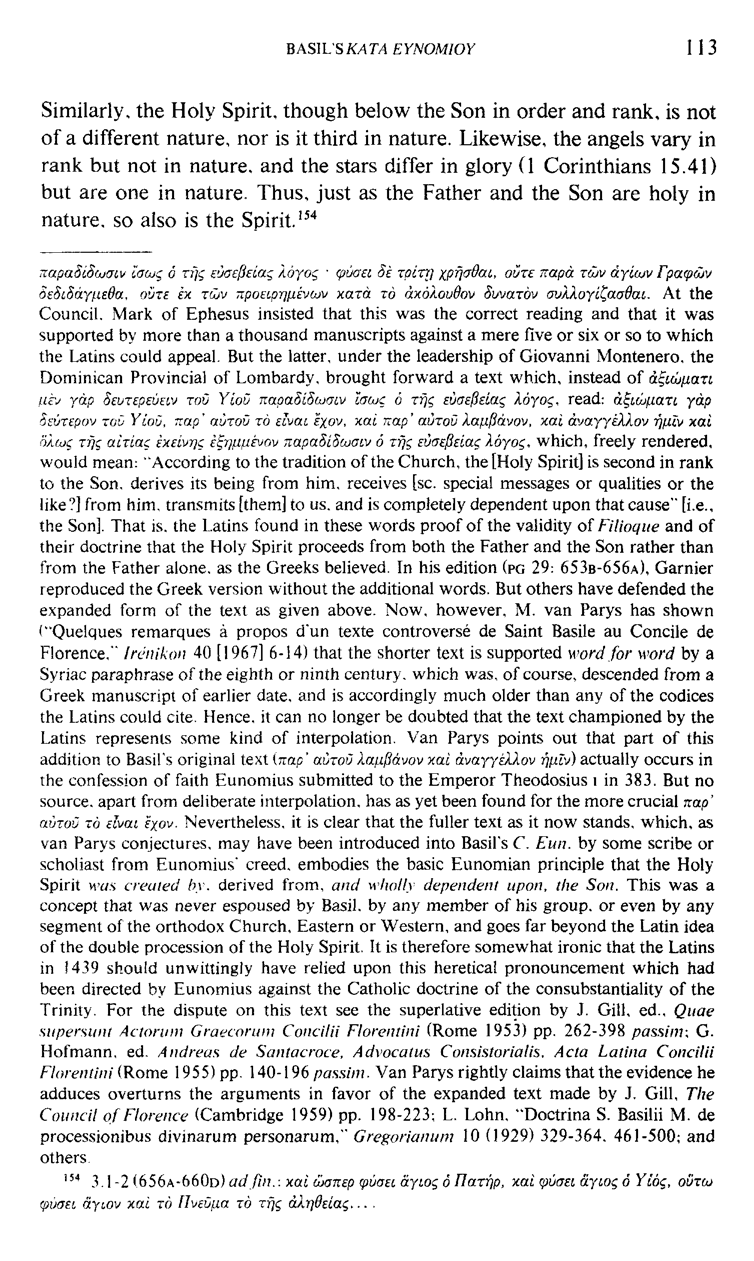
BASIL'S ΚΆ7Μ EYNOMIOY
Similarly, the Holy Spirit, though below the Son in order and rank, is not of a different nature, nor is it third in nature. Likewise, the angels vary in rank but not in nature, and the stars differ in glory (1 Corinthians 15.41) but are one in nature. Thus, just as the Father and the Son are holy in nature, so also is the Spirit.
παραδίδωσιν ίσως ό τής ευσέβειας λόγος · φύσει δέ τρίτη χρήσθαι, ούτε παρά τών άγιων Γραφών δεδιδάγμεθα, ούτε έκ τών προειρημένων κατά τό άκόλουθον δυνατόν συλλογίζασθαι.
At the Council. Mark of Ephesus insisted that this was the correct reading and that it was supported by more than a thousand manuscripts against a mere five or six or so to which the Latins could appeal. But the latter, under the leadership of Giovanni Montenero, the Dominican Provincial of Lombardy, brought forward a text which, instead of άξιώματι ιιέν γάρ δευτερεύειν τοϋ Υιού παραδίδωσιν ίσως ό τής ευσέβειας λόγος, read: άξιώματι γάρ δεύτερον τού Υιού, παρ' αύτοϋ τό είναι έχον, καί παρ' αύτοϋ λαμβάνον, καί άναγγέλλον ήμϊν χαί όλως τής αιτίας εκείνης έξημμένον παραδίδωσιν ό τής ευσέβειας λόγος, which, freely rendered, would mean: "According to the tradition of the Church, the [Holy Spirit] is second in rank to the Son. derives its being from him, receives [sc. special messages or qualities or the like?] from him, transmits [them] to us. and is completely dependent upon that cause" [i.e., the Son]. That is. the Latins found in these words proof of the validity of Eilioque and of their doctrine that the Holy Spirit proceeds from both the Father and the Son rather than from the Father alone, as the Greeks believed. In his edition (PG 29: 653B-656A), Gamier reproduced the Greek version without the additional words. But others have defended the expanded form of the text as given above. Now, however, M. van Parys has shown
("Quelques remarques à propos d'un texte controversé de Saint Basile au Concile de
Florence." Irénikon 40 [1967] 6-14) that the shorter text is supported word for word by a Syriac paraphrase of the eighth or ninth century, which was, of course, descended from a Greek manuscript of earlier date, and is accordingly much older than any of the codices the Latins could cite. Hence, it can no longer be doubted that the text championed by the Latins represents some kind of interpolation. Van Parys points out that part of this addition to Basil's original text (παρ ' αύτοϋ λαμβάνον χαί άναγγέλλον ήμϊν) actually occurs in the confession of faith Eunomius submitted to the Emperor Theodosius ι in 383. But no source, apart from deliberate interpolation, has as yet been found for the more crucial παρ' αυτού τό είναι έχον. Nevertheless, it is clear that the fuller text as it now stands, which, as van Parys conjectures, may have been introduced into Basil's C. Eun. by some scribe or scholiast from Eunomius' creed, embodies the basic Eunomian principle that the Holy
Spirit was created by. derived from, and wholly dependent upon, the Son. This was a concept that was never espoused by Basil, by any member of his group, or even by any segment of the orthodox Church, Eastern or Western, and goes far beyond the Latin idea of the double procession of the Holy Spirit. It is therefore somewhat ironic that the Latins in 1439 should unwittingly have relied upon this heretical pronouncement which had been directed by Eunomius against the Catholic doctrine of the consubstantiality of the Trinity. For the dispute on this text see the superlative edition by J. Gill, ed., Quae supersimi Actorum Graecorum Conctlii Elorentini
(Rome 1953) pp. 262-398 passim; G.
Hofmann, ed. Andreas de Sanlacroce, Advocatus Consistorialis. Acta Latina Concilii Elorentini (Rome 1955) pp. 140-196 passim. Van Parys rightly claims that the evidence he adduces overturns the arguments in favor of the expanded text made by J. Gill, The Council of Elorence (Cambridge 1959) pp. 198-223; L. Lohn, "Doctrina S. Basilii M. de processionibus divinarum personarum," Gregorianum
10 (1929) 329-364. 461-500; and others.
154 3.1-2 (656A-660D)îK/fin.: καί ώσπερ φύσει άγιος ό Πατήρ, καί φύσει άγιος ό Υιός, ούτω φύσει αγιον καί τό Πνεύμα τό τής αληθείας... .
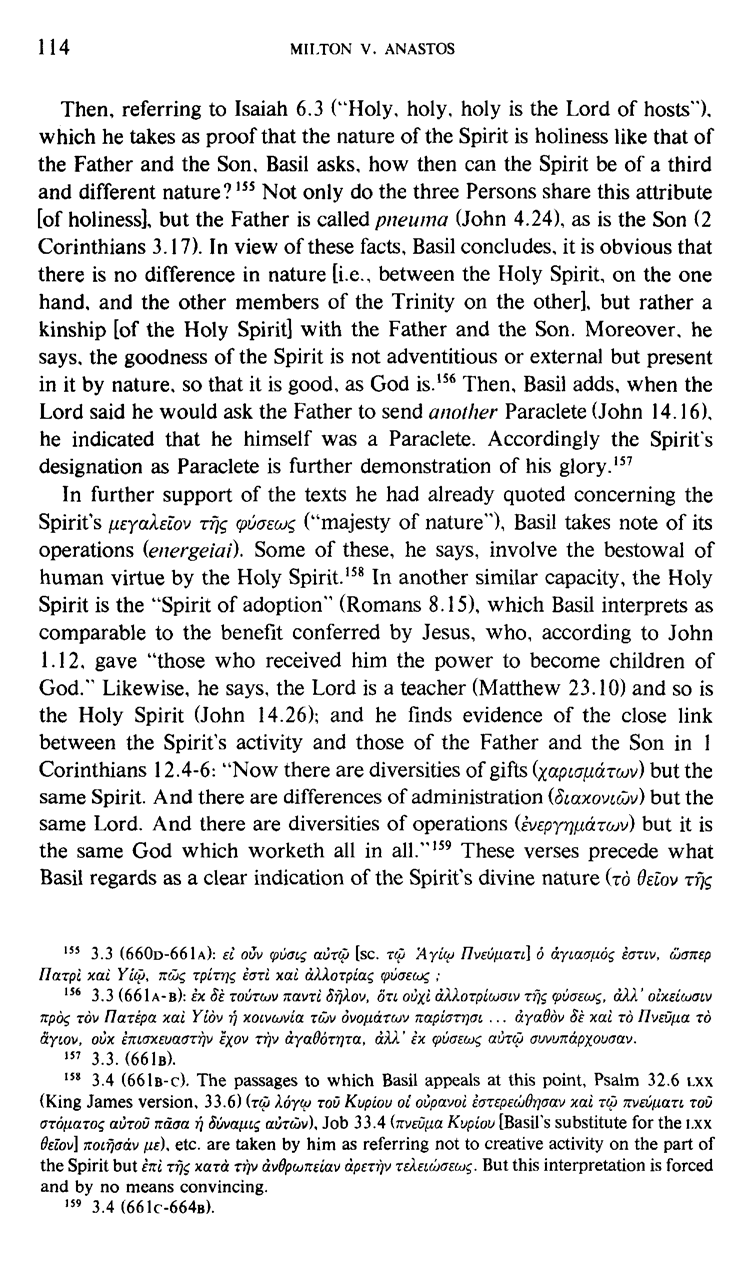
MILTON V. ANASTOS
Then, referring to Isaiah 6.3 ("Holy, holy, holy is the Lord of hosts"), which he takes as proof that the nature of the Spirit is holiness like that of the Father and the Son, Basil asks, how then can the Spirit be of a third and different nature?
155 Not only do the three Persons share this attribute [of holiness], but the Father is called pneuma (John 4.24), as is the Son (2
Corinthians 3.17). In view of these facts, Basil concludes, it is obvious that there is no difference in nature [i.e., between the Holy Spirit, on the one hand, and the other members of the Trinity on the other], but rather a kinship [of the Holy Spirit] with the Father and the Son. Moreover, he says, the goodness of the Spirit is not adventitious or external but present in it by nature, so that it is good, as God is.
156 Then, Basil adds, when the Lord said he would ask the Father to send another Paraclete (John 14.16), he indicated that he himself was a Paraclete. Accordingly the Spirit's designation as Paraclete is further demonstration of his glory.
In further support of the texts he had already quoted concerning the Spirit's μεγαλεϊον τής φύσεως ("majesty of nature"), Basil takes note of its operations (energeiai). Some of these, he says, involve the bestowal of human virtue by the Holy Spirit.
158 In another similar capacity, the Holy Spirit is the "Spirit of adoption" (Romans 8.15), which Basil interprets as comparable to the benefit conferred by Jesus, who, according to John
1.12, gave "those who received him the power to become children of God." Likewise, he says, the Lord is a teacher (Matthew 23.10) and so is the Holy Spirit (John 14.26); and he finds evidence of the close link between the Spirit's activity and those of the Father and the Son in 1
Corinthians 12.4-6: "Now there are diversities of gifts (χαρισμάτων) but the same Spirit. And there are differences of administration (διακονιών) but the same Lord. And there are diversities of operations (ενεργημάτων) but it is the same God which worketh all in all."
159 These verses precede what Basil regards as a clear indication of the Spirit's divine nature (τό θείον τής
155 3.3 (660D-661A): ει ούν φύσις αύτφ [sc. τφ Άγίω Πνεύματι] ό αγιασμός έστιν, ώσπερ
Πατρί καί Υϊώ, πώς τρίτης έστι καί αλλότριας φύσεως ; 156 3.3 ( 6 6 1 α - β ) : έχ δέ τούτων παντί δήλον, ότι ουχί άλλοτρίωσιν τής φύσεως, άλλ' οίχείωσιν προς τόν Πατέρα καί Υίόν ή κοινωνία τών ονομάτων παρίστησι ... αγαθόν δέ καί τό Πνεύμα τό αγιον, ούκ έπισκευαατήν έχον τήν αγαθότητα, άλλ' έκ φύσεως αύτω συνυπάρχουσαν.
1 5 7 3.3. ( 6 6 1 β ) .
158 3.4 (661B-C). The passages to which Basil appeals at this point, Psalm 32.6 LXX
(King James version, 33.6) (τώ λόγω τοϋ Κυρίου οι ουρανοί έστερεώθησαν καί τω πνεύματι τού στόματος αύτοϋ πάσα ή δύναμις αυτών). Job 33.4 (πνεύμα Κυρίου [Basil's substitute for the ι.χχ θείον] ποιήσάν με), etc. are taken by him as referring not to creative activity on the part of the Spirit but έπί τής κατά τήν άνθρωπείαν άρετήν τελειώσεως. But this interpretation is forced and by no means convincing.
1 5 9 3.4(661C-664B).
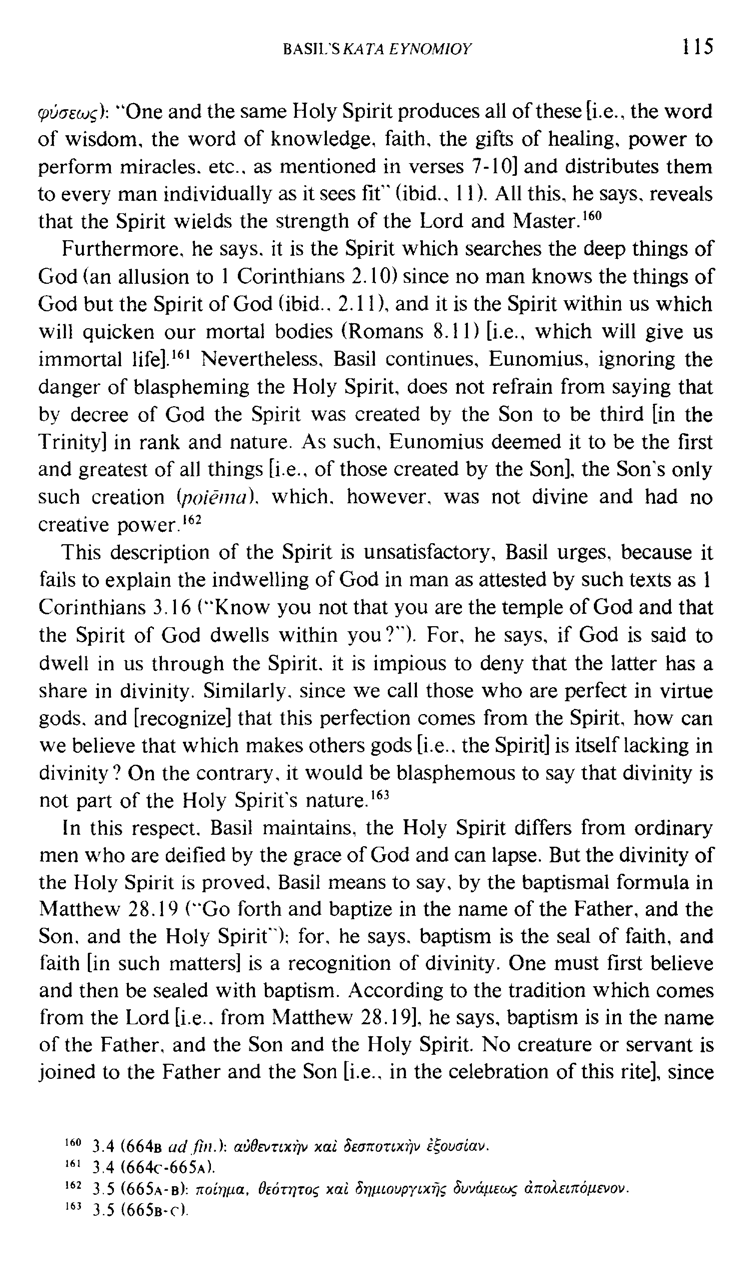
BASILS ΚΑ TA EYNOMIOY
φύσεως): "One and the same Holy Spirit produces all of these [i.e., the word of wisdom, the word of knowledge, faith, the gifts of healing, power to perform miracles, etc.. as mentioned in verses 7-10] and distributes them to every man individually as it sees fit" (ibid., 11). AU this, he says, reveals that the Spirit wields the strength of the Lord and Master.
Furthermore, he says, it is the Spirit which searches the deep things of God (an allusion to 1 Corinthians 2.10) since no man knows the things of God but the Spirit of God (ibid.. 2.11), and it is the Spirit within us which will quicken our mortal bodies (Romans 8.11) [i.e., which will give us immortal life].
161 Nevertheless, Basil continues, Eunomius, ignoring the danger of blaspheming the Holy Spirit, does not refrain from saying that by decree of God the Spirit was created by the Son to be third [in the Trinity] in rank and nature. As such, Eunomius deemed it to be the first and greatest of all things [i.e., of those created by the Son], the Son's only such creation (poiëma). which, however, was not divine and had no creative power.162
This description of the Spirit is unsatisfactory, Basil urges, because it fails to explain the indwelling of God in man as attested by such texts as 1
Corinthians 3.16 ("Know you not that you are the temple of God and that the Spirit of God dwells within you?"). For, he says, if God is said to dwell in us through the Spirit, it is impious to deny that the latter has a share in divinity. Similarly, since we call those who are perfect in virtue gods, and [recognize] that this perfection comes from the Spirit, how can we believe that which makes others gods [i.e., the Spirit] is itself lacking in divinity? On the contrary, it would be blasphemous to say that divinity is not part of the Holy Spirit's nature.163
In this respect. Basil maintains, the Holy Spirit differs from ordinary men who are deified by the grace of God and can lapse. But the divinity of the Holy Spirit is proved, Basil means to say, by the baptismal formula in Matthew 28.19 ("Go forth and baptize in the name of the Father, and the Son, and the Holy Spirit"); for, he says, baptism is the seal of faith, and faith [in such matters] is a recognition of divinity. One must first believe and then be sealed with baptism. According to the tradition which comes from the Lord [i.e.. from Matthew 28.19], he says, baptism is in the name of the Father, and the Son and the Holy Spirit. No creature or servant is joined to the Father and the Son [i.e., in the celebration of this rite], since
1 6 1
3.4 (664C-665A).
162 3.5 ( 6 6 5 α - β ) : ποίημα, θεότητος καί δημιουργικής δυνάμεως άπολειπόμενον.
163 3.5 (665B-C).
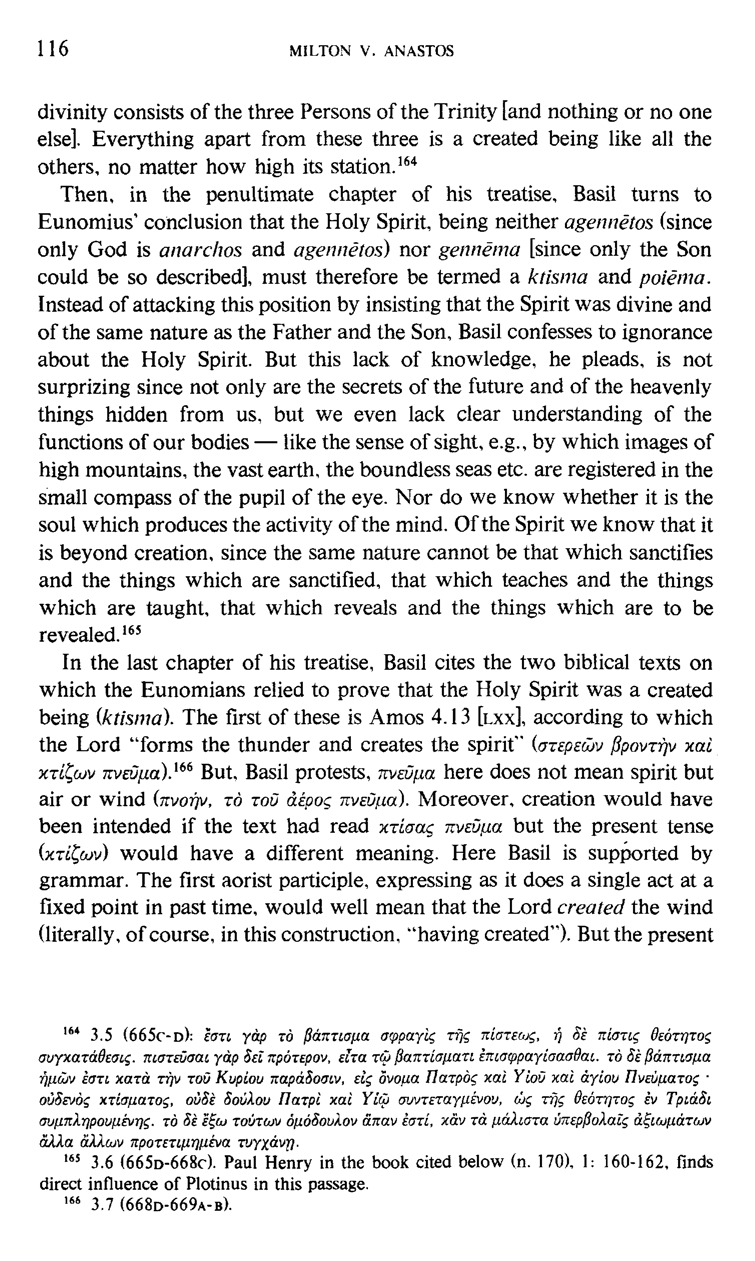
MILTON V. ANASTOS
divinity consists of the three Persons of the Trinity [and nothing or no one else]. Everything apart from these three is a created being like all the others, no matter how high its station.164
Then, in the penultimate chapter of his treatise, Basil turns to Eunomius' conclusion that the Holy Spirit, being neither agennëtos (since only God is anarchos and agennëtos) nor gennëma [since only the Son could be so described], must therefore be termed a ktisma and poiëma.
Instead of attacking this position by insisting that the Spirit was divine and of the same nature as the Father and the Son, Basil confesses to ignorance about the Holy Spirit. But this lack of knowledge, he pleads, is not surprizing since not only are the secrets of the future and of the heavenly things hidden from us, but we even lack clear understanding of the functions of our bodies — like the sense of sight, e.g., by which images of high mountains, the vast earth, the boundless seas etc. are registered in the small compass of the pupil of the eye. Nor do we know whether it is the soul which produces the activity of the mind. Of the Spirit we know that it is beyond creation, since the same nature cannot be that which sanctifies and the things which are sanctified, that which teaches and the things which are taught, that which reveals and the things which are to be revealed.165
In the last chapter of his treatise, Basil cites the two biblical texts on which the Eunomians relied to prove that the Holy Spirit was a created being (ktisma). The first of these is Amos 4.13 [LXX], according to which the Lord "forms the thunder and creates the spirit" (στερεών βροντήν καί κτίζων πνεύμα).
166 But, Basil protests, πνεύμα here does not mean spirit but air or wind (πνοήν, τό τοϋ αέρος πνεύμα). Moreover, creation would have been intended if the text had read κτίσας πνεύμα but the present tense
(κτίζων) would have a different meaning. Here Basil is supported by grammar. The first aorist participle, expressing as it does a single act at a fixed point in past time, would well mean that the Lord created the wind
(literally, of course, in this construction, "having created"). But the present 164 3.5 (665C-D): εστί γάρ τό βάπτισμα αφραγίς τής πίστεως, ή δέ πίστις θεότητας συγχατάθεσις. πιστεύσαι γάρ δει πρότερον, είτα τω βαπτίσματι έπισφραγίσασθαι. τό δέ βάπτισμα ημών έστι κατά τήν τοϋ Κυρίου παράδοσιν, εις όνομα Πατρός καί ΥΊοϋ και άγιου Πνεύματος • ούδενός κτίσματος, ουδέ δούλου Πατρί καί Υίω συντεταγμένου, ώς της θεότητας έν Τριάδι συμπληρουμένης. τό δέ εξω τούτων όμόδουλον άπαν εστί, καν τά μάλιστα ύπερβολαϊς αξιωμάτων άλλα άλλων προτετιμημένα τυγχάνη.
165 3.6 (665D-668C). Paul Henry in the book cited below (n. 170), 1: 160-162, finds direct influence of Plotinus in this passage.
1 6 6 3.7 (668D-669A-B).
BASIL'S ΚΑ ΓΑ EYNOMIOY
tense denotes continued action, and could not be properly used to designate an act of creation, which could have taken place only once.
So Basil was thoroughly justified in explaining this passage as signifying something like the Lord moves or stirs the air or sets it into motion as he chooses. That is, he says, the air mentioned in this verse from Amos is like the thunder, which is not to be understood as having been fashioned into a specific corporeal shape [or object] but is always at the Lord's disposal "to frighten people" (επί φόβω τών ανθρώπων), and is either put into action or brought to rest. Similarly, as the Lord wishes, the wind can be a moving current or cease to blow (παύεται άτρεμοϋντος τοϋ πρότερον κινουμένου). Thus, the thunder, wind, and the whole of creation announce the creator, as Amos had said in this same passage (xai άπαγγέλλων τοις άνθρώποις τόν Χριστόν αύτοϋ). Like the heavens which declare the glory of God (Psalms 18.2 [LXX], [King James version - 19.1]),
Basil concludes, the sound of thunder and the motions of the air give witness to their creator. His reasoning here, as well as his allusion to the voice from heaven which sounded like thunder (John 12.29) and, he says, revealed Christ to mankind, is somewhat fanciful. But it must be conceded that Basil was successful in demonstrating that Eunomius' exegesis was not sound and had to be repudiated.
Eunomius' second citation was from John 1.3 ("All things were made by him"), which he interpreted to mean that the Holy Spirit was included with "all things" and hence proved to have been created. But Basil rejects this interpretation because the Holy Spirit was unique and of a unique nature so that it could not have been classified with "all things" at random. Without specific authorization from the Scriptures, he warns, a pious person should not make inferences about the Holy Spirit. By this he undoubtedly meant that we have no right to assume that a general reference to "all things" is applicable to the Holy Spirit, about which we can hope to acquire true knowledge only when we shall be able to "see face to face." He uses this oblique reference to 1 Corinthians 13.12 to bring his disquisition on the Holy Spirit to a close.
Basil's analysis of these two texts is indisputably to be preferred to Eunomius'. But his open confession of ignorance about the Holy Spirit at this point and in the previous chapter 169 indicates that he had not yet 167 See any grammar of the Greek language: e.g., R. Kühner and B. Gerth. Ausführliche Grammatik der griechischen Sprache. 2.1 (Hanover-Leipzig 1898) 132, 153-154; Η.
W. Smyth. Greek Grammar (Cambridge, Mass. 1956) pp. 421. 429.
168 3.7 (669c).
169 N. 165 above.
MILTON V.
A N A S T O S
formulated his ideas about it in definite form. His lack of enthusiasm for further disputation is betrayed not only by the brevity of the third book of his treatise (9 columns of Greek in PG 29 as against 37 for the first book and 40 for the second) but even more by the relative simplicity of the argumentation. The first two books are much more elaborate in structure and far richer in biblical citation. Possibly Basil had been exhausted by the composition of the first two books and was already making plans to deal with the Holy Spirit in a separate monograph, as he eventually did (in 375).
D. CONCLUSIONS
In these concluding remarks, without attempting to review every phase of the conflict between Basil and Eunomius outlined in this essay, I will, after a few words (a) on the indebtedness of both disputants to the ancient
Greek tradition, make a brief appraisal (b) of Eunomius' theological position, (c) of the relation between Basil and his brother, Gregory of Nyssa, (d) of Basil's rebuttal of Eunomius, (e) of his failure to make extensive use of the Creed of 325, and (f) of his unwillingness to describe the Holy Spirit as θεός and consubstantial with the Father and the Son.
(a) Basil and Gregory of Nyssa, as well as Eunomius' other critics, condemned him not only because of his heretical views but also because he had relied heavily upon ancient rhetoric, logic, and dialectics. It is obvious that he had drawn freely upon pagan learning. But it is also true, as he observes, that his opponents had had recourse to the same sources.
170 Actually, a careful analysis of their works and his would 170 E. Amand de Mendieta, "The Official Attitude of Basil of Caesarea as a Christian
Bishop towards Greek Philosophy and Science," in The Orthodox Churches and die West. ed. D. Baker (Oxford 1976), 25-49; A. Meredith, "Traditional Apologetic in the Contra
Eunomium of Gregory of Nyssa." SP 14 (1976) 315-319; J. de Ghellinck, "Quelques appréciations de la dialectique et d'Aristote durant les conflits trinitaires du ive siècle,"
RHE 26 (1930) 5-42. For Platonic influence on the Cappadocians, see Κ. Gronau, De
Basilio Gregorio Nazianzeno Nyssenoque Piatonis Imitatoribus (Göttingen 1908). Cf. Y.
Courtonne, Saint Basile et l'hellénisme (Paris 1934), who deals almost exclusively with Basil's Hexaemeron. Plotinian influence on Basil's works on the Holy Spirit is examined by H. Dehnhard, Das Problem der Abhängigkeit des Basilius von Plotin. Quellenuntersuchungen zu seinen Schriften De spiritu (Berlin 1964); and P. Henry. Etudes ploliniennes, 1, Les états du texte de Plotin (Paris-Brussels 1938), 130, 156, 159-196. Cf. J.
Trunk, De Basilio Magno Sermonis Attici Iniitalore (Stuttgart 1911). See also Cherniss,
"The Platonism," pp. 1-92; Ε. Mühlenberg, "Die philosophische Bildung Gregors von
Nyssa in den Büchern Contra Eunomium," in Écriture et culture philosophique dans la pensée de Grégoire de Nysse (see n. 123 above), pp. 230-251 ; and Staats, "Die Basilianische
Verherrlichung," p. 235.
demonstrate that at every turn they were dependent upon Greek rhetoric and logic, especially in the form in which these materials were available during the early centuries of the Christian era.
As far as the orthodox were concerned, to quote only one of a multitude of similar texts, an unknown contemporary and ally of Basil's had said that dialectics provided a defense for the dogmas of the Church and protected them from being easily confuted and overturned by their enemies.
171 Similarly, it has been recently argued that Eunomius' doctrine of the Trinity was based on its main outlines upon Neoplatonic principles, according to which the first member, without suffering any loss or diminution, imparts its own characteristics to the being of which it is cause, while all the beings thus caused are successively inferior to their cause and give only an imperfect image of their producer.
(b) As for Eunomius' argument itself, it must be admitted that, in genious as he and Aetius were in attempting to base their entire case on the concept of agennésia, they exposed themselves to a powerful rebuttal for doing so. For it is difficult to deny that Basil and Gregory were fully justified in objecting that Eunomius could not explain why agennésia alone of all similar privative terms (aphtharsia, etc.) and, indeed, of all the attributes of God. should indicate the ousia of God and in itself amount to a ή τού είναι ο έστιν ομολογία. m Nor is it clear why only this attribute should have been implanted by God in the mind of men, as Eunomius believed it was.
He was guilty also of a number of inconsistencies, as we have seen, particularly in his attitude to Christ's status. At times, he concedes, or seems to concede, that Christ was begotten, as when he not only speaks of him as gennëtos and gennëma but also freely uses some forms of the verb gentian to define the nature of the activity by which the agennëtos produced the Monogenes. At other times, however, and this seems to have been one of his most cherished points, he maintains that Christ was not begotten but created.175 This position had, of course, been traditional among the Arians from the very beginning, and Eunomius' tergiversations probably reflect an attempt on his part to meet his critics half way.
171 Quoted by de Ghellinck (see previous note), p. 38, from PG 30: 269c: ή γάρ τής διαλεκτικής δύναμις τείχος έστι τοις δόγμασιν, ούκ έώσα αυτά εύδιάρπαστα είναι καί ευάλωτα τοις βουλομένοις.
172 See the articles by Danielou and Vandenbussche cited in n. 6 above.
173 See n. 42 above.
174 Notes 42-64 above.
175 Notes 66. 83-94 above.
MILTON V. ANASTOS
Moreover, he was inconsistent in declaring God to be incomparable (asynkritos) and at the same time μείζων τοϋ Υ'ιοϋ.
176 As Basil said, it is impossible to be incomparable and greater at the same time. Nor could
Eunomius be defended for holding that the Son was both a poiëma and a gennëma. For on his own premises, since names are indicative of ousia, it could well be argued that, according to him, Christ would then have had two ousiai, one as a poiëma and another as a gennëma}11 Likewise, as Basil points out, Eunomius contradicts himself when he maintains both that identity of title or designation does not involve identity in ousia and also that difference of designation necessarily indicates difference in ousia.
He cannot have it both ways.178
The dispute about gennema as the ousia of Christ is on a somewhat different plane. Basil makes the exceedingly ingenious argument that, if Christ is to be known as the gennëma, and gennema is his ousia, he is therefore proved to have the ousia of God.179 In arguing this way, he took shrewd advantage of Eunomius' words. But what Eunomius probably really meant was that Christ was a gennëma and, as such, his ousia was that of an offspring or dependent of God. That is, Eunomius intended to say, Christ was derived from God and consequently was later than he as well as inferior to him. Thus, Basil must be given credit as an adroit dialectician. But Eunomius' idea was not devoid of merit, and would have been more effective if less cumbersomely expressed.
Nevertheless, like the Arians of the first half of the fourth century, Eunomius was careful to insist that Christ came into being "before the ages" (πρό τών αιώνων) and that there was no time before he was begotten.
180 But he persisted in putting the Father before the Son. For this reason, the orthodox replied that Eunomius was in effect subjecting Christ to the cycle of time for, according to them, it was impossible to maintain that God was in any way older than his Son or temporally prior to him without concluding that the Father as well as the Son had a beginning in time.
181 Eunomius' position was based upon logic and "common sense."
But he collided with the orthodox conviction that the fundamental belief of the Church was a mystery for which no rational explanation was possible.
176 Notes 81-82, 150 above.
177 Notes 83, 85 above.
178 Page 107 and nn. 52, 84, and 88 above.
179 Notes 91-92 above.
180 See n. 97 above.
181 Notes 98-103 above.
182 Seen. 128 above.
BASIL'S ΚΑ ΓΑ EYNOMIOY
(c) A detailed comparison of Basil's treatise with Gregory's polemics against Eunomius would exceed the limits of this essay. Nevertheless, it can be said that, for the most part, since he was especially eager to defend his brother against attack, Gregory's work on this subject followed Basil's lead very closely. It is, however, very much longer and more detailed than
Basil's and includes many additional arguments and examples of all sorts to strengthen and confirm Basil's case. But at the same time, it is clear,
Gregory had an original turn of mind and frequently, 183 was able to invent most ingenious syllogisms with which to confound the opposition.
Furthermore, it was inevitable that a gifted theologian like Gregory would have amended some of Basil's arguments both in the normal process of logical development and in order to counter the objections raised against them by Eunomius in his Apologia apologiae, i.e., in his refutation of Basil's C. Eun. 1-3. For example, Basil had referred to the unity of all men λόγω τής ουσίας as an illustration of the consubstantiality of the Father and the Son and had identified the common ousia which unites all men as the material substratum (τό ύλικόν ύποκείμενον).
Eunomius attacked this comparison as inapplicable to the relationship between the Father and the Son, which, he said, could be represented only in the terms suitable to immaterial essences or beings.
Gregory immediately confessed that Basil had made an error on this point and rectified it by stating that the ousia which was the principle of unity of all mankind was not a material substratum (ούσίαν δέ λέγω νϋν ού τό ύλικόν ύποκείμενον).
1^ His use of νϋν ("now") in this sentence probably suggests that he had himself once held the view espoused by Basil, and that what he was doing was to adhere as closely as he could to Basil's theory while carrying it one step further (as Basil would in all probability have done himself), so as to attain newer and sounder results. This was characteristic of his method; he was indubitably loyal to his brother's basic principles but was inevitably led beyond them. (A full listing of parallel passages would be a difficult task which, however, urgently needs to be done.) 183 See nn. 98-103 above (on the coeternity of the Son and the Father).
184 But see nn. 216-218 below.
185 This particular difference was first pointed out by D. L. Balas, "The Unity of Human Nature in Basil's and Gregory of Nyssa's Polemics against Eunomius," S Ρ 14
(1976) 275-281. See Basil. C. Eun. 2.4 (PG 29: 577c), and n. 84 above; Gregory, C. Eun.
3.5.20-22, 48. 61-62. Jaeger, 2; 167.3-168.4, 177.26-178.3, 182.25-183.11 (PG 45: 745c748B. 757C-D, 764c). For other examples of a similar nature, see the article by G. May cited in n. 103 above.
MILTON V. ANASTOS
(d) In general an impartial critic would have to conclude that Basil argues fairly. Occasionally, he is as captious as his opponent, and he does sometimes give the biblical texts on which he relies an exegesis they cannot sustain.
186 Moreover, he (and Gregory) at least once completely misunderstood — carelessly if not deliberately — what Eunomius had said.
187 But the chief weakness in Basil's case and in the orthodox position as a whole, is his denial that God, who was in his view the aitia and arche of the Son, was prior to him in time.
188 This is a difficult concept, and one that is most troublesome for the ordinary person, who, while perhaps willing to concede that there is no before and after in eternity, cannot easily be convinced that the cause does not actually precede the effect — in time as well as in order. This is one of the great mysteries and requires faith rather than logic.
Obviously, Christian monotheism could not survive if this principle were not established and if it were not agreed that the Son was homo ousios and synaidios with the Father. Basil could tolerate no compromise on these points, although he did at times come perilously close to subordinationism, as we have seen — especially in his discussion of the relation of the Holy Spirit to the Father and the Son.
Actually he makes no attempt to conceal the paradox and un ambiguously puts the Father first and the Son second as the effect of God, his cause (πρότερον and δεύτερον, respectively). But, he explains, this order is not according to "our" [i.e., physical or temporal] way of arranging things but according to the natural sequence which inheres in them [i.e., the Father and the Son], in the relationship which a cause bears to that which is derived from it. It is in this sense, Basil says, that we put the Father before the Son without drawing the conclusion, as Eunomius did, that the Son was younger than the Father or of a different ousia. m In another section, Basil goes on to argue that the Son always existed with the Father, who was the cause of his existence. He then asks himself
186 See n. 158 above.
187 Notes 35-39 above.
188 Note 73 and pp. 93-98 above and nn. 190-196 below.
" ' Notes 153-154 above.
190 1.20 (557A-C): έν τούτοις γάρ πρότερον τό αίτιον λέγομεν, δεύτερον δέ τό έξ αυτού, ού διαστήματι χωρίζοντες άπ' αλλήλων ταύτα, άλλα τω λογισμώ τοϋ αιτιατού προεπινοούντες τό αίτιον, πώς ούν εϋλογον άρνεϊσθαι τήν τάξιν εφ' ών έστι πρότερον καί δεύτερον, ού κατά τήν ήμετέραν θέσιν, άλλ' έχ τής κατά φύσιν αύτοίς ένυπαρχούσης ακολουθίας; τίνος ούν ένεκεν αθετεί τήν τάξιν έπί Θεού λαμβάνεσθαι,- ηγείται, ει έπιδείξειε μηδαμώς άλλως τό πρότερον έπί Θεού νοεϊσθαι, λειπόμενον έξειν, κατ' αυτήν τήν ούσίαν τήν ύπεροχήν έπιδείκνυσθαι. ημείς δέ, κατά μέν τήν τών αιτίων προς τά έξ αυτών σχέσιν, προτετάχθαι τοϋ Υιού τόν Πατέρα φαμέν • κατά δέ τήν τής φύσεως διαφοράν, ούκέτι, ουδέ κατά τήν τοϋ χρόνου ύπεροχήν.
BASIL'S ΚΑΤΑ EYNOMIOY
the question, "When was the Son brought into being by the Father?" To this he replies that, since the Father exists from eternity, so does the Son.
Here Basil relies, as we have seen, 191 on John 1.1 ("In the beginning was the Word"), which he combines with Psalms 109.3 (LXX: "From my womb before the morning star have I begotten thee"). The latter of these he interprets as applying to Christ, and, putting the two verses together, he says the reference to Christ's having been begotten indicates the cause from which the Son derived the beginning of his being; and the "was"
(from John 1.1) reveals his timeless and eternal existence.
193 and C. Eun. 2.22, which defines Father as one who provides another with the "beginning of being" in a nature like his own and Son as one who receives the "beginning of being" from another by being born, But passages like these two 194 cannot be reconciled with texts which lay stress on Christ's eternal being. For they flatly contradict Basil's oft-repeated statement, as in C. Eun. 2.12, 195 that the Son, αεί ών, ούκ ήρξατο τού είναι ποτέ, unless we can follow Plotinus 196 (whom Basil does not cite here) in taking the cause in the generation of eternal beings to be atemporal.
According to Eunomius, however, there was some kind of interval between the cause (the Father) and the Son. although (like Plotinus) he insisted that each successive hypostasis was inferior to the One.
197 Basil rejected these views of Eunomius. But his acknowledgement that the Son had a "beginning of being" (even in the sense of a Plotinian non-temporal cause) and was second to the Father, 198 although he conceived this relationship to be outside of and before time (προαιώνιος), is essentially similar to what Eunomius and the Arians said on the same subject.
For Eunomius was no less insistent than Basil that the production of the Son by the Father was before all time. Basil says Eunomius was not 1.1 Note 112 above.
1.2 2.1 7 (605C-608A); επειδή γεγέννηται, ην [sc. ό Υιός]... ών δέ αεί καί συνών τώ Πατρί, έξ ού καί τήν αίτίαν τής υπάρξεως έχει. Πότε ούν εις τό είναι παρά τού Πατρός παρήχθη ; άφ ' ου έστιν ό Πατήρ ; άλλ ' έξ άϊδίου. φησίν, ό Πατήρ · έξ άϊδίου τοίνυν καί ό Υιός. ...εκ μέν ούν τού
Ευαγγελίου λάβωμεν τό. έν αρχή ην ό Λόγος · èx δέ τού ψαλμού ... τό, έκ γάστρας πρό εωσφόρου γεγέννηκά σε · καί συνθέντες αμφότερα, εϊπωμεν ότι καί ην καί γεγέννηται. αλλά τό μέν, γεγέννηκα, τήν αίτίαν άφ' ης έχει τήν αρχήν τού είναι σημαίνει • τό δέ. ήν, τήν άχρονον αυτού καί προαιώνιον ϋπαρξιν.
'" 1η ηη. 191-192.
1 . 4 2 22 (621 β); Πατήρ μέν γάρ έστιν ό έτέρω τού είναι κατά τήν όμοίαν έαυτώ φύοιν τήν αρχήν παράσχων • υιός δέ ό έξ έτερου γεννητώς τού είναι τήν αρχήν έσχηκώς. (See paraphrase at η. 125 above ) 1 . 5 See summaries at nn. 94-96: also at nn. 53, 98. 105-107. 111-118. etc.
1.6 Enneads 3.7.6. 5.1.6. Henry and Schwyzer. 1: 378.52-54; 2: 274.19-22; n. 188 above 1.7 Ibid.. 2: 276.37-39; nn. 2. 73-74. 95-101. 172; pp. 87-89. 110-111. etc. above.
1.8 Notes 190-196 above. 1 am planning an article on these texts.
MILTON V.
A N A S T O S
199 It is very probable, however, that Eunomius was as careful not to put the Son's generation in time as the Arians had been when they craftily invented the bizarre expression, ψ ποτέ δτε ούχ ην, sincere in making this pronouncement.
200 precisely in order to avoid being accused of holding that ψ χρόνος δτε ούχ ην ("there was a time when he was not"). Eunomius and the Arians 201 were trying to keep faith with the tradition that the Son was begotten or rather created "before the ages" and simultaneously to make him somehow subsequent to the Father but without an origin in time.
Very similarly, Basil, in explaining that the Father was the cause and arche of the Son, was determined to demonstrate that the Father did not precede the Son in time, although the idea of a non-temporal cause and the force of the human analogy of father and son made for great difficulties. But it should be emphasized that he took pains to add in the C.
Eun. 2.12, for example, that the Son did not ever begin to be (ούχ ήρξατο τοΰ είναι ποτέ), in which the indefinite adverb ποτέ ("ever") bears great weight.
201" He no doubt felt that this cautious statement and others like it were sufficient to eliminate the inference that the Son had ever begun to be in time. Hence it is obvious that, so far as the denial that the Son had a temporal beginning is concerned, Eunomius and Basil were seeking the same goal, although of course neither would ever have admitted that this was so.
Both were seeking to explain how one of two eternal co-existent Beings anteceded the other — but without an interval of time between them.
That is, they were attempting to formulate metaphysical principles that exceed the capacity of language and the mind of man. They had gone beyond the bounds of pure reason and inevitably fell into similar inconsistencies. But Gregory failed to grasp this point and kept assailing
Eunomius and the Arians as if they had actually been putting the generation of Christ in time, though they were probably sincere in denying this charge.
202 By concentrating his fire on this accusation, however, and belittling the Arian protests against it, Gregory lost sight of the doctrine he had himself enunciated — that the "uncreated nature," which, as we have seen, signified the members of the Trinity,
203 had neither beginning nor end, 204 and failed to realize that metaphysically
"' Notes 97-98 above; cf. η. 69.
200 See nn. 11 and 100 above.
201 See n. 97 above.
2<" a See n. 195 above.
2 , 2 See n. 97 above.
203 Page 98 above.
204 See n. 100 above.
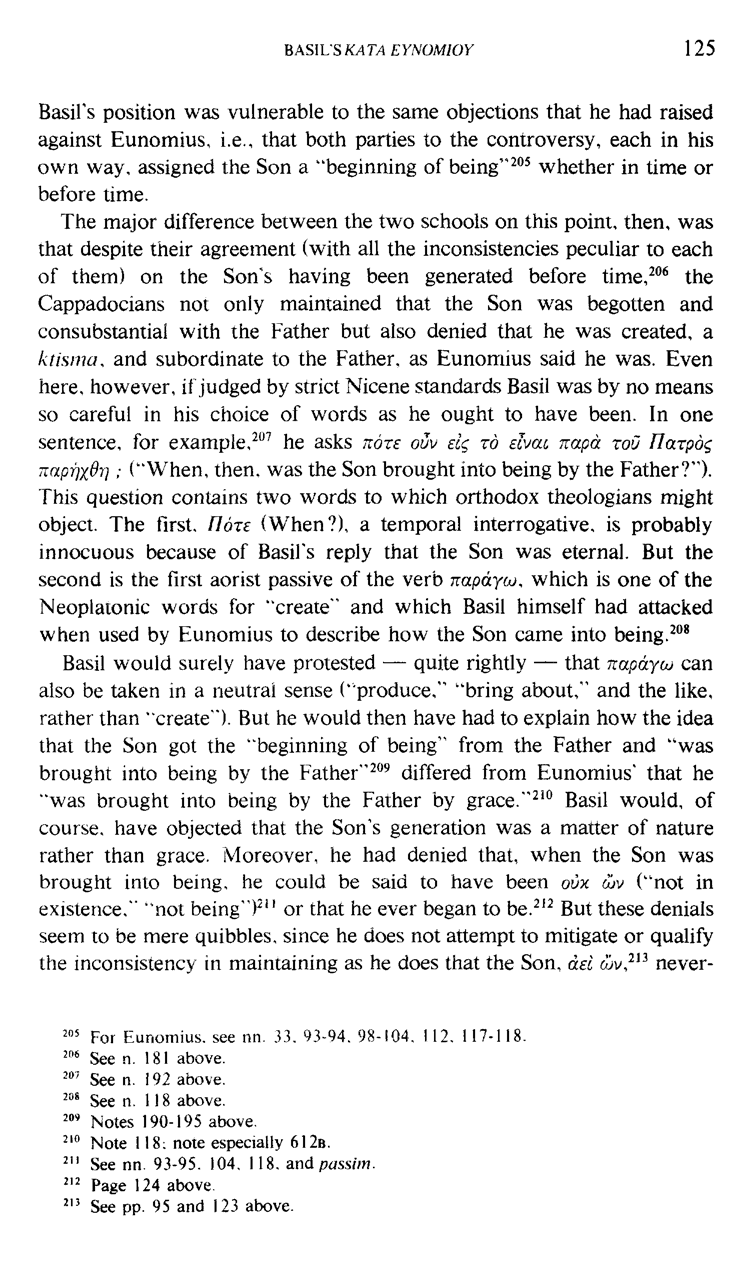
BASIL'S ΚΑΤΑ EYNOMIOY
Basil's position was vulnerable to the same objections that he had raised against Eunomius, i.e., that both parties to the controversy, each in his own way, assigned the Son a "beginning of being"
205 whether in time or before time.
The major difference between the two schools on this point, then, was that despite their agreement (with all the inconsistencies peculiar to each of them) on the Son's having been generated before time,
206 the Cappadocians not only maintained that the Son was begotten and consubstantial with the Father but also denied that he was created, a ktisma, and subordinate to the Father, as Eunomius said he was. Even here, however, if judged by strict Nicene standards Basil was by no means so careful in his choice of words as he ought to have been. In one sentence, for example, 207 he asks πότε ούν εις τό είναι παρά τοϋ Πατρός παρήχθη ,· ("When, then, was the Son brought into being by the Father?").
This question contains two words to which orthodox theologians might object. The first. Πότε (When?), a temporal interrogative, is probably innocuous because of Basil's reply that the Son was eternal. But the second is the first aorist passive of the verb παράγω, which is one of the Neoplatonic words for "create" and which Basil himself had attacked when used by Eunomius to describe how the Son came into being.
Basil would surely have protested — quite rightly — that παράγω can also be taken in a neutral sense ("produce," "bring about," and the like, rather than "create"). But he would then have had to explain how the idea that the Son got the "beginning of being" from the Father and "was brought into being by the Father"
209 differed from Eunomius' that he "was brought into being by the Father by grace."
210 Basil would, of course, have objected that the Son's generation was a matter of nature rather than grace. Moreover, he had denied that, when the Son was brought into being, he could be said to have been ούκ ων ("not in existence," "not being") 2" or that he ever began to be.
212 But these denials seem to be mere quibbles, since he does not attempt to mitigate or qualify the inconsistency in maintaining as he does that the Son, αεί ών,
211 never205 For Eunomius. see nn. 33. 93-94. 98-104. 112. 117-118.
""• See n. 181 above.
207 See n. 192 above.
208 See n. 1 ! 8 above.
2 0' Notes 190-195 above.
210 Note 118: note especially 612B.
211 See nn. 93-95. 104. 118. andpassim.
2,2 Page 124 above 213 See pp. 95 and 123 above.
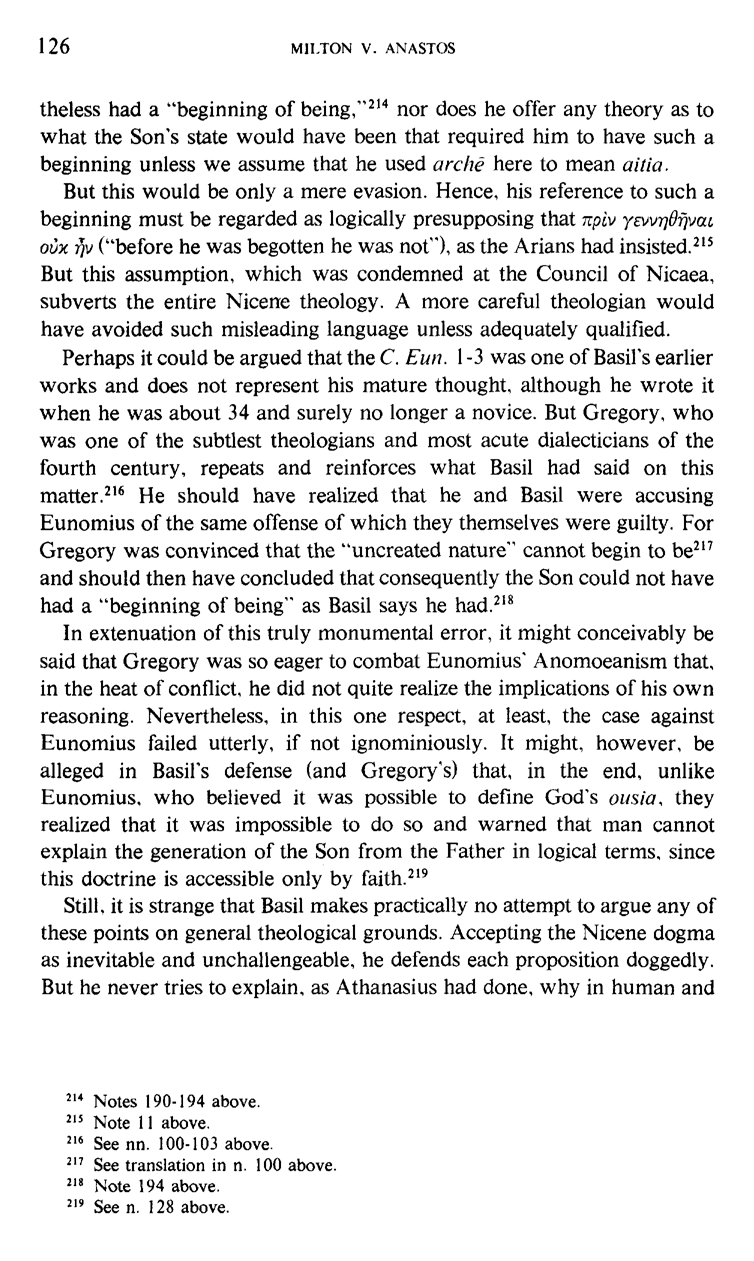
MILTON V. ANASTOS
214 nor does he offer any theory as to what the Son's state would have been that required him to have such a beginning unless we assume that he used arche here to mean aitia. theless had a "beginning of being,"
But this would be only a mere evasion. Hence, his reference to such a beginning must be regarded as logically presupposing that πριν γεννηθήναι ούχ ήν ("before he was begotten he was not"), as the Arians had insisted.
But this assumption, which was condemned at the Council of Nicaea, subverts the entire Nicene theology. A more careful theologian would have avoided such misleading language unless adequately qualified.
Perhaps it could be argued that the C. Eun. 1 -3 was one of Basil's earlier works and does not represent his mature thought, although he wrote it when he was about 34 and surely no longer a novice. But Gregory, who was one of the subtlest theologians and most acute dialecticians of the fourth century, repeats and reinforces what Basil had said on this matter.
216 He should have realized that he and Basil were accusing Eunomius of the same offense of which they themselves were guilty. For Gregory was convinced that the "uncreated nature" cannot begin to be
and should then have concluded that consequently the Son could not have had a "beginning of being" as Basil says he had.
In extenuation of this truly monumental error, it might conceivably be said that Gregory was so eager to combat Eunomius' Anomoeanism that, in the heat of conflict, he did not quite realize the implications of his own reasoning. Nevertheless, in this one respect, at least, the case against Eunomius failed utterly, if not ignominiously. It might, however, be alleged in Basil's defense (and Gregory's) that, in the end, unlike
Eunomius, who believed it was possible to define God's ousia, they realized that it was impossible to do so and warned that man cannot explain the generation of the Son from the Father in logical terms, since this doctrine is accessible only by faith.
Still, it is strange that Basil makes practically no attempt to argue any of these points on general theological grounds. Accepting the Nicene dogma as inevitable and unchallengeable, he defends each proposition doggedly.
But he never tries to explain, as Athanasius had done, why in human and 214 Notes 190-194 above.
215 Note 11 above.
216 Seenn. 100-103 above.
217 See translation in n. 100 above.
218 Note 194 above.
219 Seen. 128 above.
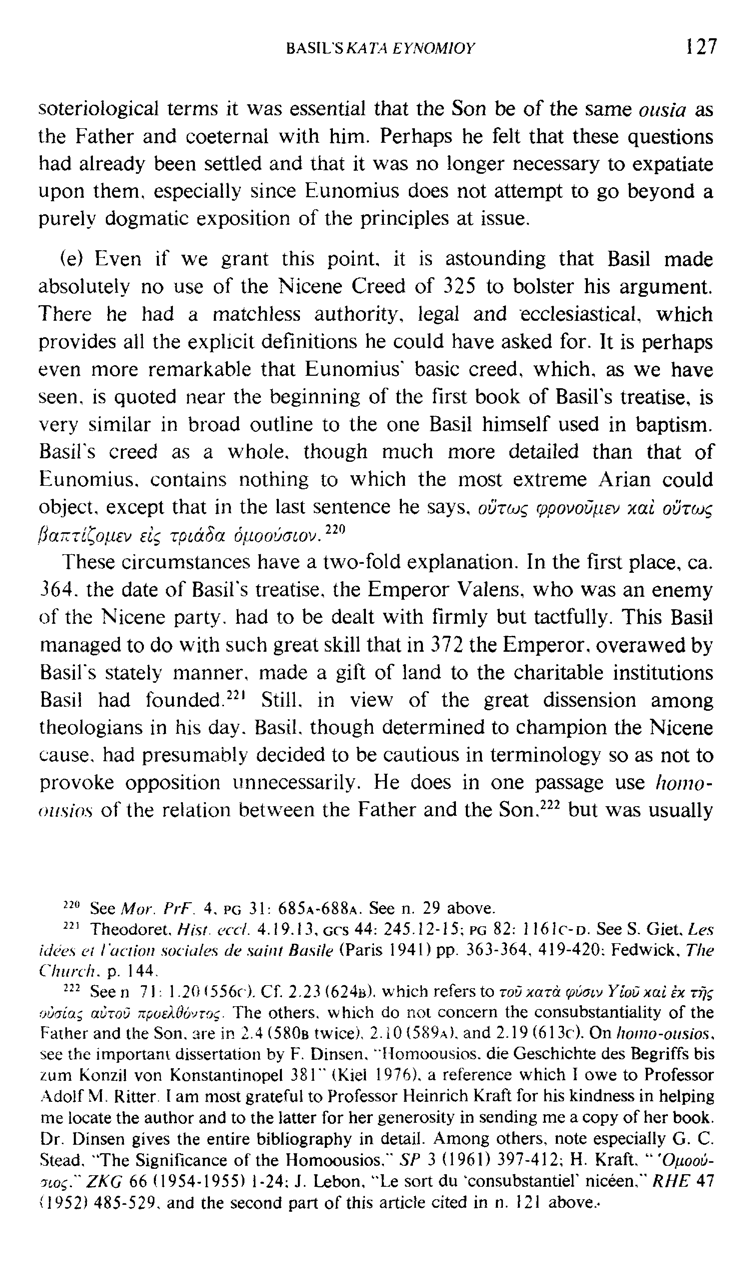
soteriological terms it was essential that the Son be of the same ousia as the Father and coeternal with him. Perhaps he felt that these questions had already been settled and that it was no longer necessary to expatiate upon them, especially since Eunomius does not attempt to go beyond a purely dogmatic exposition of the principles at issue.
(e) Even if we grant this point, it is astounding that Basil made absolutely no use of the Nicene Creed of 325 to bolster his argument.
There he had a matchless authority, legal and ecclesiastical, which provides all the explicit definitions he could have asked for. It is perhaps even more remarkable that Eunomius' basic creed, which, as we have seen, is quoted near the beginning of the first book of Basil's treatise, is very similar in broad outline to the one Basil himself used in baptism.
Basil's creed as a whole, though much more detailed than that of Eunomius, contains nothing to which the most extreme Arian could object, except that in the last sentence he says, ούτως φρονοϋμεν καί ούτως βαπτίζομεν εις τριάδα όμοούσιον.
These circumstances have a two-fold explanation. In the first place, ca.
364. the date of Basil's treatise, the Emperor Valens, who was an enemy of the Nicene party, had to be dealt with firmly but tactfully. This Basil managed to do with such great skill that in 372 the Emperor, overawed by Basil's stately manner, made a gift of land to the charitable institutions
Basil had founded.
221 Still, in view of the great dissension among theologians in his day. Basil, though determined to champion the Nicene cause, had presumably decided to be cautious in terminology so as not to provoke opposition unnecessarily. He does in one passage use homo ousios of the relation between the Father and the Son.
222 but was usually 2 2 0 See Mor. PrF 4, PG 31: 685A-688A. See n. 29 above.
2 2 1 Theodoret, Hist. eccl. 4.19.13, ors 44: 245.12-15; PG 82: 1 161C-D. See S. Giet. Les idées el Taction sociales de saint Basile (Paris 1941) pp. 363-364, 419-420: Fedwick, The Church, p. 144.
222 See η 71 ; 1.20 (556c). Cf. 2.23 (624B), which refers to τού κατά φύσιν Υιού χαί έκ τής ουσίας αύτοϋ προελθύντος. The others, which do not concern the consubstantiality of the Father and the Son. are in 2.4 (580B twice). 2.10 (589A), and 2.19 (613c). On homo-ousios, see the important dissertation by F. Dinsen, "Homoousios. die Geschichte des Begriffs bis zum Konzil von Konstantinopel 381" (Kiel 1976), a reference which I owe to Professor
Adolf VI. Ritter I am most grateful to Professor Heinrich Kraft for his kindness in helping me locate the author and to the latter for her generosity in sending me a copy of her book.
Dr. Dinsen gives the entire bibliography in detail. Among others, note especially G. C.
Stead, "The Significance of the Homoousios.'' SP 3 (1961) 397-412; H. Kraft, "'Ομοού σιος." ZKG 66 (1954-1955) 1-24; J. Lebon, "Le sort du 'consubstantiel' nicéen," RHE 47
(1952) 485-529, and the second part of this article cited in n. 121 above.·
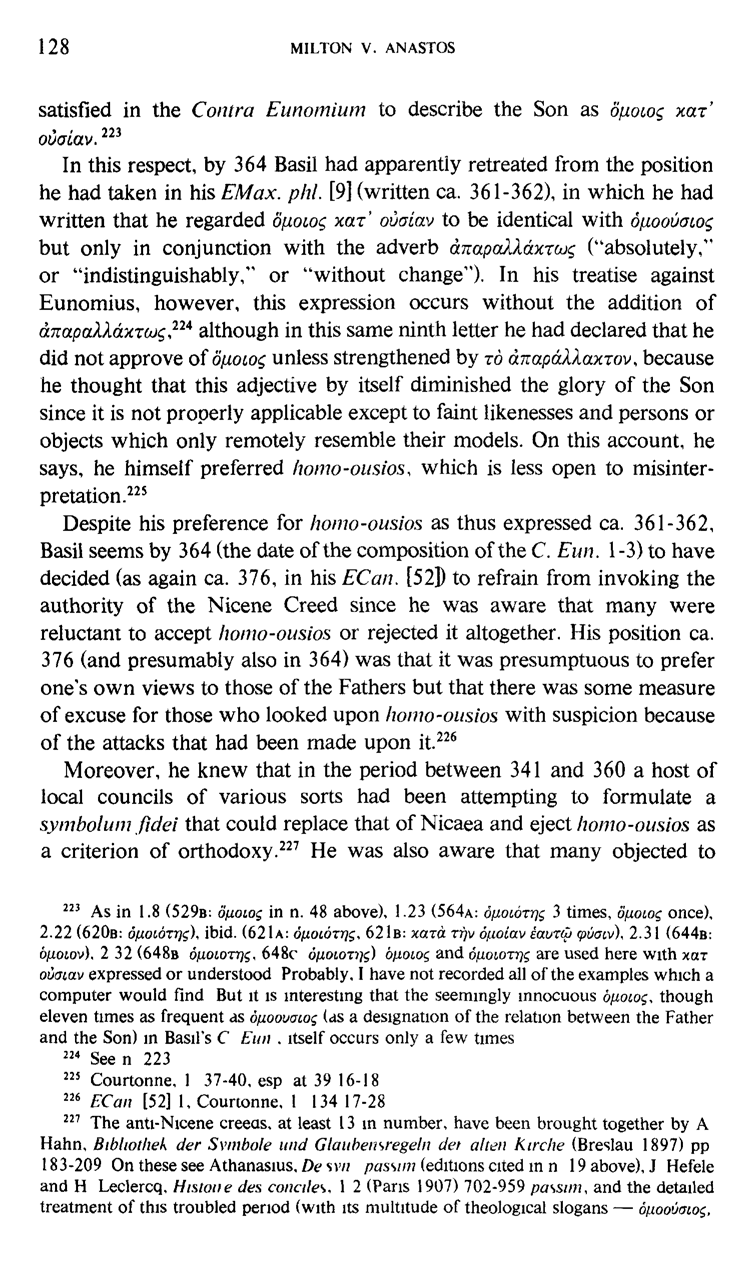
MILTON V. ANASTOS
satisfied in the Contra Eunomium to describe the Son as όμοιος κατ'
» '
In this respect, by 364 Basil had apparently retreated from the position he had taken in his EMax. phi. [9] (written ca. 361-362), in which he had written that he regarded όμοιος κατ' ούσίαν to be identical with ομοούσιος but only in conjunction with the adverb άπαραλλάχτως ("absolutely," or "indistinguishably," or "without change"). In his treatise against Eunomius, however, this expression occurs without the addition of άπαραλλάκτως, 224 although in this same ninth letter he had declared that he did not approve of όμοιος unless strengthened by τό άπαράλλακτον, because he thought that this adjective by itself diminished the glory of the Son since it is not properly applicable except to faint likenesses and persons or objects which only remotely resemble their models. On this account, he says, he himself preferred homo-ousios, which is less open to misinter pretation.
Despite his preference for homo-ousios as thus expressed ca. 361-362.
Basil seems by 364 (the date of the composition of the C. Eun. 1 -3) to have decided (as again ca. 376, in his ECan. [52]) to refrain from invoking the authority of the Nicene Creed since he was aware that many were reluctant to accept homo-ousios or rejected it altogether. His position ca.
376 (and presumably also in 364) was that it was presumptuous to prefer one's own views to those of the Fathers but that there was some measure of excuse for those who looked upon homo-ousios with suspicion because of the attacks that had been made upon it.
Moreover, he knew that in the period between 341 and 360 a host of local councils of various sorts had been attempting to formulate a symbolum fidei that could replace that of Nicaea and eject homo-ousios as 227 He was also aware that many objected to a criterion of orthodoxy.
223 As in 1.8 (529B: όμοιος in n. 48 above), 1.23 (564A: όμοιότης 3 times, όμοιος once),
2.22 (620B: όμοιότης), ibid. (621A: όμοιότης, 621 Β: κατά τήν όμοίαν έαυτω φύσιν), 2.31 ( 6 4 4 β : όμοιον). 2 32 ( 6 4 8 β όμοιοτης. 648c όμοιοτης) όμοιος and όμοιοτης are used here with κατ ούσίαν expressed or understood Probably, I have not recorded all of the examples which a computer would find But it is interesting that the seemingly innocuous όμοιος, though eleven times as frequent as ομοούσιος (as a designation of the relation between the Father and the Son) in Basil's C Eun . itself occurs only a few times
224 See η 223 225 Courtonne, 1 37-40, esp at 39 16-18 226 ECan [52] 1, Courtonne, 1 134 17-28 227 The anti-Nicene creeas, at least 13 in number, have been brought together by A Hahn, Bibliothek der Svmbole und Glaubensregeln der alten Kirche (Breslau 1897) pp
183-209 On these see Athanasius, De s ν« passim (editions cited in η 19 above), J Hefele and Η Leclercq, Histone des conciles, 1 2 (Pans 1907) 702-959 passim, and the detailed treatment of this troubled period (with its multitude of theological slogans — ομοούσιος,
homo-ousios because it was unscriptural. Under these circumstances, in 364 and later, he undoubtedly felt that the Creed of Nicaea was not persuasive and that he would have to confute Eunomius, whose entire treatise was devoted to an attack on the doctrine of the consubstantiality of the Father and the Son as set forth at Nicaea, by argumentation and biblical citations.
He himself, however, was unwavering in his defense of homo-ousios, quoted the Symbol of Nicaea in full in two of his letters, and expounded it in detail so as to prove that it corresponded with sound doctrine.
228 Hence, there could be no doubt whatsoever that he subscribed to the dogma of the consubstantiality of the Father and Son unreservedly and esooused it warmly.
(f) But his attitude to the Holy Spirit was very different. He never claims that the Holy Spirit is God or consubstantial with the Father, as many at the end of the fourth century agreed that it was.
229 But he does vigorously deny that it is a ktisma or third in nature or different in nature from the Father and the Son. On the contrary, he insists, the Holy Spirit has a kinship (οίκείωσιν) with the Father and the Son. In addition, he holds that the Spirit is holy, good, a bestower of special spiritual gifts (such as the sonship of God and the immortality of the body), and one which shares in divinity (i.e., he says it is improper to maintain that the Holy
Spirit is άμέτοχον τής θεότητας or to deny that θεότης is part of its nature).
But he was reluctant to go beyond recognizing that the Holy Spirit was θείον"
0 or making the tortuous argument that, since baptism is performed in the name of the Father, the Son, and the Holy Spirit, and is a seal of faith, faith [presumably as signified by submission to the rite of baptism in the name of the three persons of the Trinity] is a recognition of the divinity
[of each of them].
όμοιούαιος, όμοιος, ανόμοιος, etc.) by Η. M. Gwatkin. Studies of Arianism (Cambridge
1900) pp. 119-139. 146-188 and passim. For brief summaries see the standard histories of the Church, the latest of importance being K. Baus and E. Ewig. Die Reichskirche nach
Konstantin dem Grossen (Freiburg/Basel/Vienna 1973) 38-51. The old classic. J.
Gummerus. Die homöusianische Partei bis zum Tode des Konslantius, ein Beitrag zur
Geschichte des arianischen Streites in den Jahren 356-361 (Leipzig 1900), still retains its value.
228 ECan. [52]. EEust. [125] of 373 (with the Creed), andEAnt.ec. [140] of 373 (with the Creed), ana passim, Courtonne, 1: 133-137; 2: 30-34. 60-62.
229 See Ritter cited in n. 238 below.
230 See n. 239 below.
231 See n. 164 above.
MILTON V. ANASTOS
On the other hand, Gregory of Nyssa unambiguously pronounces the Holy Spirit to be Θεός 232 but never describes it as όμοούσιον τω Πατρί. This resistance to homo-ousion is most clearly revealed in his De sancta trinitate, in which he comes closer to a decisive statement on the consub stantiality of the Spirit and the Father than anywhere else in his works.
For example, he solemnly declares that the Spirit is inseparable from the Father and the Son in conferring immortality, as well as in goodness, holiness, imperishability, wisdom, righteousness, authority, power, etc., and that, since he shares all these qualities with the Father and the Son, the Holy Spirit cannot be excluded from divinity (θεότης) or the name of divinity. Then, strangely, Gregory practically repeats what Eunomius had said about the identity in meaning of all the divine attributes. For, he says, all the attributes used for God are equal in degree and have the same force in designating their object [i.e., God].
233 He differs slightly, however, in admitting, as he and Basil claim Eunomius did not, that the attributes all refer to various characteristics of God.
Gregory even goes so far as to say that, when the meaning of these attributes is analyzed, none of them amounts to less than the designation of God.
234 This last statement would seem to imply that the Holy Spirit could be called God, as Gregory elsewhere
235 designates it to be, although at this point he eliminates this inference by referring to minor beings who were described in the Old Testament as gods.
236 Nevertheless, he does insist on the unity of the Spirit, the Father and the Son in nature, and on their identity in activity (energeia) as well as in divinity, which he says indicates the nature.
232 AdGraecos, ed. F. Mueller, Jaeger, 3.1: 26.6-18 (PG 45: 181A).
233 De s. Trin., ed. Mueller (as in n. 232), 7.19-9.5; Courtonne (Ep. 189) 2: 136.5137.39; Mercati (see below), pp. 74.26-76.7. NB: πάντα γάρ τά θεοπρεπή ονόματα τε καί νοήματα όμοτίμως έχει προς άλληλα τω μηδέν περί τήν τοϋ υποκειμένου διαφωνεϊν σημασίαν ... πάντα τά ονόματα < τά > τή θεία φύσει επιλεγόμενα ισοδυναμεί άλλήλοις κατά τήν τοϋ υποκειμένου ένδειξιν, άλλα κατ' άλλην έμφασιν έπί τό αυτό τήν διάνοιαν όδηγοϋντα... . See nn.
47-52 above. I owe to Dr. Fedwick the timely warning, both in his book, The Church, pp. 154-155, and by personal communication, that this letter was not written by Basil but should be ascribed to Gregory of Nyssa. See CPG 3137; G. Mercati, "La lettera ad Eustazio de Sancta Trinitate ossia la 189 tra le lettere di S. Basilio," ST 11 (1903) 57-82. Dinsen,
"Homoousios," p. 161, notes that Gregory of Nazianzus was the only one of the three
Cappadocians who described the Holy Spirit as homo-ousion with the Father.
234 Mueller, 9.5-8; Courtonne, 2: 137.39-42; Mercati, p. 76.7-10: θεωρούμενα xai συγκρινόμενα προς άλληλα τά ονόματα διά τής έν έκάστοις θεωρούμενης έμφάσεως εύρεθήσεται μηδέν τής τοϋ Θεού προσηγορίας έλαττον έχοντα.
235 See η. 232 above.
236 Mueller, 9.8-14; Courtonne. 2: 137.43-50; Mercati, p. 76.10-17.
237 Mueller, 10.14-11.15, 13.19-23, 15.1-7; Courtonne, 2: 138.1-139.26, 140.29-33.
141.25-31; Mercati. pp. 77.10-78.8, 80.4-8, 81.5-10.
But neither he nor Basil would without tortuous circumlocutions openly confess, as their friend Gregory of Nazianzus did, that the Holy
Spirit was both God and consubstantial with the Father. In private (ιδία) Basil, it is said, agreed on these points, but refrained from making public pronouncements to this effect so as to avoid alienating his opponents, who would have been able to drive him from the Church if he had stated his dogmatic position openly. Since this would have done great damage,
Gregory of Nazianzus argues, Basil deliberately refrained from using controversial terminology in his book on the Holy Spirit [as also, we might add, in the third book of the C. Eun.] and expressed the same ideas in other words, using "Scriptural language, indisputable authorities, and powerful logical arguments."
Basil's orthodox critics were not convinced by this apologia, and protested that it would have been better to cleave to the truth rather than resort to this kind of subterfuge, which, they said, did not win over the opposition anyway. This criticism is not easily parried. In matters of theological definition, there is no substitute for precision of language; and, despite Gregory's defense of Basil, it must be admitted that the terminology applied by the latter to the Holy Spirit is more ambiguous and less satisfactory than that which he sedulously avoided.
Nevertheless, many have defended Basil much as Gregory did. Others have preferred the latter's outspokenness on dogmatic questions to the former's oikonomia ("discretion," "caution," etc.). But Dörries and Amand de Mendieta believe that Basil's unwillingness to make a public avowal of the Holy Spirit as θεός and όμοούσιον τω Πατρί is to be explained by the distinction he made between kërygma and dogma.239 In his system,
238 Gregory of Nazianzus, Ep. 58.4-15, Gallay, GCS 53 (1969) 52.17-54.18; idem.
Lettres. 1 (1964) 74-76: Or. 43.68-69 (PG 36: 588B-589C). On these texts, see Fedwick, The Church, pp. 60. 63: F. Trisoglio, San Gregorio di Nazianzo in un quarantennio di studi
(1925-1965). Rivista Lasalliana 40 (1973) 185; X. Hürth, De Gregorii Nazianzeni orationibus funebribus (Strassburg 1907) pp. 56-71. For Gregory's own position on the Holy Spirit, see A. M. Ritter, Das Konzil von Konstantinopel und sein Symbol (Göttingen
1965) pp. 84. 258-259. 265-266; and J. Plagnieux, Saint Grégoire de Nazianze théologien
(Paris 1952) p. 59. Cf. Athanasius. Ep. ad Pall. (ca. 371 or 372). PG 26: 1168C-D.
239 On kërygma and dogma, see R. P. C. Hanson, "Basil's Doctrine of Tradition in Relation to the Holy Spirit," VigChr 22 (1968) 241-255; E. Amand de Mendieta, The "Unwritten" and "Secret" Apostolic Traditions in the Theological Thought of St. Basil of Caesarea (Edinburgh 1965); idem, "The Pair 'Kèrygma' and 'Dogma' in the Theological
Thought of St. Basil of Caesarea," JThS 16 (1965) 129-142; Dörries, De Spiritu Sancto. pp. 121-128. K. Holl. Amphilochius von Ikonium in seinem Verhältnis zu den grossen
Kappadoziern dargestellt (Tübingen-Leipzig 1904) p. 140 n. 2, rejects the idea of oikonomia and would defend Basil's doctrine of the Holy Spirit as sound rather than evasive. Gamier prints θεός as an epithet of the Holy Spirit in a short essay entitled Περί τοϋ πνεύματος (PG 29: 768B-773A), which is attributed to Basil in several manuscripts and had
MILTON V. ANASTOS
kërygma was the official doctrine of the Church on faith, morals, and discipline, along with the apostolic tradition as set forth in both the Old and New Testaments. This could be disclosed to the general public, to catechumens, and to pagans. But this kërygma was distinguished from dogma — the unwritten customs and practices of the Church, the liturgy, the sacraments, and the theological meaning of these rites. These were disclosed only to those who were fully initiated as Christians by baptism and the eucharist; and apparently some special teaching was restricted to an elite group of gifted individuals, trained as theologians, to whom it was transmitted in secret.
This may seem to be an artificial distinction. But it is clear that Basil made it. A good example of the kërygma would be the confession that the Holy Spirit was not a ktisma but holy by nature and not to be separated from the Father and the Son. Such preliminary and less technical aspects of his pneumatology could be imparted to all. According to the more specialized dogma of the Holy Spirit, however, which was kept secret, the Holy Spirit was acknowledged to be God as well as όμοούσιον and όμότιμον long been rejected as spurious. Henry and, now more decisively, Dehnhard, Dos Problem, have proved it to be authentic. But Dehnhard (pp. 55-56) has shown conclusively that in line 61 of his critical edition, on p. 10 (PG 29: 772B at note 94), θείον is to be read instead of θεός. Hence, Basil never used θεός as an epithet of the Holy Spirit. For this reason it is regrettable that some scholars are so impressed by the evidence that Basil in his own mind really conformed to orthodox doctrine that they do not hesitate to give the impression that he actually did write of the Holy Spirit as θεός. J. N. D. Kelly, Early Christian Doctrines
(New York 1960) pp. 260-261, and others, however, make it clear that Basil, as Kelly says,
"nowhere calls the Spirit God or affirms his consubstantiality, in so many words, although he makes it plain (EEup. [159] 2) that 'we glorify the Spirit with the Father and the Son because we believe that he is not alien to the divine nature'." The 8th Letter, in which the Holy Spirit is declared to be God (Courtonne, 1: 26.41-42, 35.37) is not properly ascribed to Basil: R. Melcher, Der 8. Brief des hl. Basilius, ein Werk des Evagrius Pontikus
(Münster 1923). I have not seen: S. de Boer, "Paradosis, dogma en kërygma naar de opvatting van Basilius de Grote," NedThT 24 (1970) 333-372; K. Kourkoulas, Ai περί θείου κηρύγματος Ίδέαι τοΰ Μεγάλου Βασιλείου (Thessaloniki 1964). In a provocative paper, Staats
(see η. 152 above), maintains that the section on the Holy Spirit in the third article of the Creed of 381 (which makes no mention of consubstantiality with God) probably reflects the influence of Basil and his "dogmatisches Schweigen." Moreover, Staats holds that Basil was fully justified in not describing the Holy Spirit as θεός and όμοούσιον τφ Πατρί in public since, he says, "die voile Homousie des Geistes, die Ineinssetzung von Geist und
Gott, unbedingt in die Verborgenheit des Dogmas gehört. Darüber schweigt Basilius bewusst, weil er es innerlich bejaht" [Staats' italics]. For, Staats adds, only the true Church can really understand this dogma (p. 237), which, with Dörries, he regards as a "Mönchsdogma." This is mystic language, which I take to mean that the doctrine of the Holy Spirit, like that of the Trinity as a whole, is not demonstrable by logic but can only be believed. For this reason, it seems to me, Basil should have been content to concentrate on the requirements of faith and not made the hazardous attempt to explain the unknowable in logical terms (see nn. 95, 190-194 above).
BASIL'S ΚΑ TA EYNOMIOY
with the Father and the Son. Basil's friends, both ancient and modern, agree that this was the doctrine Basil actually favored. But we have only hearsay evidence to this effect, except in so far as his writings, despite his failure to use the apposite technical terms, can be interpreted as supporting this assumption.
EPILOGUE In this essay I have not attempted to compare the C. Eun. 1-3 with Basil's work as a whole. But it would seem that a just estimate of his contribution to theology must take into account the contradictions pointed out above with regard to his explanation of God as the cause of his Son, not to mention others like the one discussed above.
241 These are not lightly to be condoned, especially since it would seem that Basil should and could have avoided them and should perhaps not have attempted to go beyond the frank admission that the relation between the Father and the Son is a mystery that transcends human understanding. It would not be proper, of course, to condemn Basil for not being familiar, if indeed he was not, with Gregory's theory of the "uncreated nature,"
242 which nullifies his idea of the Son's "beginning of being" no less than Eunomius' essentially similar view on the same subject. But it is legitimate to ask why his view of the Son's timeless generation is superior to Eunomius' and also to make use of Gregory's more sophisticated analysis of this problem
243 in appraising Basil's theological system — even though Gregory himself failed to do so.
On the other hand, many scholars see no reason to condemn Basil for his caution in describing the Son as homo-ousion with the Father and his refusal to make public acknowledgement of the Holy Spirit's consub stantiality. There is no doubt about his personal bravery or his courage in retaining the homo-ousion of the Nicene Creed in defiance of the wishes of the Arian Emperor Valens.
244 The question is whether his reluctance to stand by the Nicene terminology in public discussions of theology was as effective as he and Gregory of Nazianzus
245 thought it was. On the other hand, it might be possible to argue, although I am not yet willing to do so,
240 Among these are Dörries, Fedwick, Pruche, Staats, etc.
241 See n. 148 above.
242 See nn. 100-103, 190-195 above.
243 Notes 100-103 above.
244 Gregory of Nyssa, C. Eun. 1.131-146, Jaeger, 1: 66.18-71.2, esp. 68.7-29; PG 45:
292A-296B. esp. 292D-293B.
245 See n. 238 above.
MILTON V ANASTOS that this was a wise policy and that, without using the term homo-ousios but by detailed presentation in the C Eun 1-3 of his reasons for believing in the consubstantiality of the Father and the Son, and of the Holy Spirit
(in Book 3 of this same treatise, as well as in the περί τοϋ άγιου πνεύματος of 375), he was in the end more effective in bringing about the eventual triumph of these dogmas than a mere appeal to the authority of the Nicene
Symbol would have been I am not sure that a critical examination of these questions would confirm the extremely favorable judgment of modern scholarship about Basil's stature as a theologian — especially since his champions can no longer ascribe to him the authorship of the 8th and 38th Letters
246 But it is obvious that this task must now be undertaken Glossary of terms frequently occurring or inadequately defined above άγένητος, άγεννητος - agenetos agennëtos uncreated, unbegotten, respectively η 19 and passim άγεννησία - agennésia ingenerateness Eunomius leading principle η 18 and passim ά'ίδιος - aidios eternal η 116 αίτια (αίτιον) - aitia aition cause nn 73 79, 112, 153, 188, 190-194 αίων, plural αιώνες (nominative), αιώνας (accusative) - aion (aeon) atones, aionas nn 97
άναρχος - anarchos without beginning cf aitia above, only God the Father is anarchos ανόμοιος - anomoios unlike (Eunomius view that the Son was unlike the Father) nn 23, 37, 145, and passim αόρατος - aoratos not visible (of God and the Son) nn 56-58 άπαραθετος - aparathetos incomparable, see asynkrttosbelow άρχη-arche beginning nn 73, 98-103, 190-195, cf aitia above ασύγκριτος - asMikritos incomparable (used by Eunomius of God the Father to indicate he was vastly superior to the Son) nn 66-68, 81-82, 150, 176 άσύνθετος - as\ nlhetos simple, uncompounded (used by Eunomius exclusively of the Father, but applied to the Father and the Son by Basil) nn 74-79 ασώματος-asomatos incorporeal, το ασωμάτου încorporeality η 56 άφθαρτος - aphthartos without limit or end incorruptible, not subject to decay or dissolution, the noun is aphtharsia nn 56-58 γεγεννηχα (gegenneka) I have begotten nn 85-87 γενητος, γεννητος - genetos gennëtos created begotten, respectively nn 19,121,
127, 175 Seenn 135 239
γεννάν - genndiv. to beget: p. 117. γεννιβείς - geimétheis. begotten (first aorist passive participle): nn. 122, 124. γέννημα -gennëma. offspring, that which is born or begotten: nn. 83-92. 177. γέννησις-gennésis. birth, generation. δημιουργός - demiourgos:
(workman), maker, creator; deiniourgema: what he produces: nn. 121. 125. 127. 145. ό θελήματι μόνω δημιουργών: he who [ - God] creates by his will alone: n. 124. διάστημα diastema: interval of time or space: nn. 73. 95-103, 190-195. είκών - eiköiv. image: nn. 68. 110. 141-145. έμφυχα - empsycha. living beings: n. 87. ενέργεια - energeia. activity: nn. 78. 140. 145. 158. 237. έξ ούδενός έστι έτερον, "he is from nothing else": i.e.. God. who has no source of being: n. 34 έξούκ όντων, out of nothing: Eunomius said Christ was created out of nothing: nn.
33. 93-94. 104. 121. 124. ίπίνοια -epinoia: thought, conception: nn. 42-53. έτεροούσιος (έτερούσιος) - helero-ousios: differing in substance or ousia. n. 84. θείον - iheion: divine: n. 239. θεότης -theoiés. divinity: Book 3. άμέτοχον τής θεότητος. not participating in divinity: p. 127. ιδίωμα - idiôma: quality, characteristics; personal individuality (of the members of the Trinity): nn. 70. 84. 135-136. κοινός - kolnos: common (as the divine ousia is to all three Persons): nn. 84, 135136. κοινωνία - koinönia: community of the divine ousia: nn. 84, 135-136. κτίζω: create: n. 166. κτισθείς - ktistheis: created (first aorist passive participle): nn. 122, 124. κτίσμα -ktisma: created object, creature, thing: nn. 86, 165-168. μείζων, μείζον - meizôiv. greater, as in John 14.28: nn. 74, 79, 176. όμοιος - homoios: like, the Son is like the Father in ousia: the noun is homoiotês
(resemblance): nn. 223-229. ομοούσιος - homo-ousios: consubstantial: nn. 71, 84. 91, 121, 145, 222-229. δρας: definition: n. 41. ούχ ουτα: "not being": accusative masculine: Eunomius says God begot the Son before he came into being, i.e., when he was not: nn. 93-94, 104. 121, 124. ουσία - ousia: essence or substance, of the divine essence (synonym of physis)nature: passim πάντη συνθήκης ελεύθερος: altogether free of compositeness; altogether simple and uncompounded; used by Eunomius of God; n. 74. πνεύμαpneuma: spirit: Book 3 of the C Eun ποίημα - poiëma : thing made or created: nn. 83, 150, 162, 165, 177. πραγματεϊαι - pragmateiai: treatises: n. 13. πρό αιώνος ών καί αεί ων. [the Son], being before the ages and always being: n. 95. συνάίδιος - synai'dios: co-eternal: nn. 189-217.
MILTON V. ANASTOS
σύγκρισις - synkrisis: comparison; see asvnkritos above. τέκνονtek non: child: η. 87. υιός: son: passim. τήν κατ' ούσίαν ύπεροχήν: superiority in ousia: η. 79. ύποκείμενον. substratum: η. 185. ύπόστασις - hypostasis: each individual member of the Trinity is an hypostasis: nn.
84, 135, 136. υπουργία-, assistance: n. 124. υπουργός - hypourgos-. minister, assistant: nn. 122-124. φως-phôs-, light: nn. 129-132, 136. χρόνος: time: n. 97.
Basil's "Neoplatonism":
Its Background and Nature John M. Rist* University of Toronto
I. PLATONISM AND CHRISTIANITY: 270-325
A. INTRODUCTION
The word "Platonism" is much less clear than it was once thought to be.
Consequently much older talk about Platonism in the fourth century tends to be meaningless, since it is hard to determine whether "Platonic" influences were supposed to be derived directly from Plato himself, from what are now called Middle Platonist writers active from approximately
100 to 250 AD, from Christian Platonists like Clement of Alexandria and Origen. from Plotinus who can usefully be called the founder, though not the most typical member of the Neoplatonic school, or from Porphyry,
Plotinus' somewhat erratic successor and — so it is said — the most prominent propagator of Neoplatonism in the West. Much of the standard work on Christian Platonism in the fourth century still fails to observe
* Parts of this discussion were read at a symposium on Neoplatonism and Christianity held in Washington, DC, in October 1978, other parts at the Eighth International
Conference on Patristic Studies in Oxford in September 1979. I should like to thank all those who, on these occasions or in Toronto, helped to improve it: especially L.
Abramowski. D. Balâs. P. Burns, J. den Boeft, P. Fedwick, J. Gribomont and A. Ritter. At an earlier stage the whole manuscript was subjected to the searching scrutiny of T. D.
Barnes. Above all Anna Rist forced me to be precise, to call a spade a spade where I was inclined to call it a digging instrument.
Basil of Caesarea: Christian, Humanist, Ascetic, ed. Paul J. Fedwick (Toronto:
Pontifical Institute of Mediaeval Studies. 1981). pp. 137-220. © P.I.M.S.
JOHN M. RIST
these necessary distinctions, or blurs them inaccurately, and despite brilliant pioneering efforts such as that of Pierre Hadot on Marius
Victorinus1 and the considerable improvements made in our recent understanding of the "Platonism" of Ambrose,2 there can be little doubt that the role of philosophy in the background of Christian writers from the mid-third century to the year 379 — particularly, but by no means entirely, in the East — is still largely misunderstood. Essentially the background of Christian thought, from the death of Origen to the 380s at least, must be rewritten. From errors of fact errors of interpretation both theological and more generally ideological have proliferated. To rectify this situation there can be no alternative but to examine the texts with care and in detail, with particular attention to the trap into which many erudite students have fallen, that of the discovery of the false parallel. For false parallels are not only themselves false; they can become the basis on which false deductions about the derivation of ideas are built. The present study can be viewed as little more than preliminary work to what I am convinced is needed: no less than a rewriting of the intellectual history of the fourth century.
Problems in fourth century Platonism can for the most part be traced back to the ambiguous position of Plotinus, pupil of the unofficial
Platonist Ammonius Saccas in Alexandria and teacher of his own variety of Platonism, the Platonism of the philosopher rather than the philologist or historian of philosophy3 — and moreover at Rome ! Let us therefore begin by noting certain peculiar features of Plotinus' philosophy: his
1 P. Hadot and P. Henry, Marius Victorinus: Traités théologiques sur la Trinité (Paris
1960); P. Hadot, Porphyre et Victorinus (Paris 1969).
2 P. Courcelle, "Plotin et s. Ambroise." RPh 76 ( 1950) 29-56; idem, Recherches sur les
Confessions de s. Augustin (Paris 1950) pp. 93-138; A. Solignac, "Nouveaux parallèles entre s. Ambroise et Plotin, Le 'De Jacob et vita beata' et le Περί ευδαιμονίας (Enn. 1.4),"
APh 20 (1956) 148-156; L. Taormina, "Sant'Ambrogio e Plotino," MSLC 4 (1953) 41-85;
P. Hadot, "Platon et Plotin dans 3 sermons de s. Ambroise," REL 34 (1956) 202-220; P.
Courcelle, "Nouveaux aspects du platonisme chez s. Ambroise," REL 34 (1956) 220-226; idem, "Anti-Christian Arguments and Christian Platonism: from Arnobius to St.
Ambrose," in The Conflict Between Paganism and Christianity in the Fourth Century, ed.
A. Momigliano (Oxford 1965)pp. 151-192; idem, Recherches sur les "Confessions"de s.
Augustin (Paris 1968) pp. 311-382; G. Madec, Ambroise et la philosophie (Paris 1974).
Exaggeration has inevitably set in: P. Courcelle. "Ambroise et Calcidius," in Recherches sur s. Ambroise (Paris 1973) pp. 17-24.
! Cf. Plotinus' attitude to Longinus (Porphyry, Vita Plot. 14) and his conversion of Porphyry from a historically accurate account of the Forms (which he had learned from Longinus) to his own version (Vita Plot. 18, with A. H. Armstrong, "The Background of the Doctrine 'That the Intelligibles are not Outside the Intellect'," in Les Sources de Plotin
(Geneva 1960) pp. 391-425.
BASILS "NEOPLATONISM"
concept that part of the soul remains "above" and does not descend — which he admits himself to be outside the tradition;4 his peculiar doctrine of the union of the soul with the One and the claims made by him and on his behalf to have experienced such union in his own person;5 his wholehearted acceptance of a Neopythagorean tradition associated with the names of Moderatus and Eudorus that led to his postulating a first principle which is to be identified not as Nous but rather as the One.6 Such theses by no means won universal approval; even those who genuinely thought of Plotinus as their master took him seriously enough to accept his work as that of a follower of Plato, and therefore frequently go back to the source, to Plato himself rather than to his pupil, for their inspiration.
As we may observe, this tendency to revert to the source is particularly noticeable among those who were less professional philosophers than teachers wishing to employ from time to time, and on their own terms, various philosophical ideas; and such people are particularly visible among the Christians.
But first more basic points: to be influenced by a man's philosophy one has to read him directly or to have access to his work indirectly either through other written documents or through oral sources. Porphyry's edition of Plotinus, the edition which we know today as the Enneads, appeared round about 301 AD. If, therefore, we find allusions to Plotinus' philosophical works before 301, we must assume either an earlier edition, or the circulation of individual works, or an oral tradition. That there was some sort of oral tradition must be regarded as almost certain in view of the number of Plotinus' pupils and their spread over the Mediterranean basin: Porphyry himself went to Sicily at least once, and Amelius retired to Apamea in Syria before Plotinus' death.7 We should therefore consider our problem of the earliest diffusion of Neoplatonism, the Platonism of Plotinus and his philosophical successors, in two stages: the spread of Plotinus' ideas before about 301, and their spread after 301. Both stages, but particularly the latter, are indissolubly linked with, and complicated by, the spread of the knowledge of the works of Porphyry himself as well as the works of Plotinus in their various versions.
4 Enn. 4.8.8.1.
5 Enn. 1.6.7.2-3; 6.7.40.2; 6.9.4.1.15f; 6.9.9.47 ff.; and possibly 4.8.1.1 ff.; Porphyry.
Vita Plot. 23.
6 For Plotinus' background on this matter see especially J. M. Dillon, The Middle
Plaionists (London/Ithaca 1977) pp. 115-135. 344-351.
7 Porphyry. Vila Plot. 2.
JOHN M. RIST
Β. THE EDITION OF EUSTOCHIUS:
PRELIMINARY OBSERVATIONS. 270-301
Let us concentrate on the period before Porphyry's edition of the Enneads.
There is not much to be said. Apart from a reference, which we shall consider, to an edition by Eustochius, presumably compiled during this period, there is virtually no evidence about the influence of Plotinus apart from the work of Porphyry. We have already observed that Plotinus' pupil Amelius retired to Apamea in Syria before Plotinus' death, and apparently set up a school there, 8 but we know nothing of its success; and to judge by the comparatively low estimate in which Amelius was held among later Neoplatonists we may surmise that he either died be fore surrounding himself with an enthusiastic group of pupils or that his version of Platonism was rather unappealing.
9 Amelius was not, of course, the only source from which knowledge of Plotinus' written work might have spread early in the East, but in his case we have concrete evidence of such diffusion: Porphyry, citing a letter of Longinus, tells us
that the latter (his former master) had received from Amelius copies of at least the greater part of Plotinus' writings; and also that Longinus wrote a reply to controversial material now found in Ennead. 5.5 but which he knew as On Ideas.
11 Longinus later urged Porphyry to leave Sicily and come East himself, to bring further copies of Plotinus, if possible in better condition, with him, and to convey in addition any writings which Amelius might have omitted, or which Longinus had not already obtained from Porphyry himself. The date of this request may be very soon after Plotinus' death, or possibly even before, for Longinus perished after the Emperor Aurelian suppressed the Palmyrene Zenobia in 272.
What then do we know of the edition of Eustochius? There is, and has always been, only one apparently secure piece of evidence, a scholion which appears in several manuscripts of the Enneads (A E R J C) after chapter 19 of Ennead 4.4 (A Second Book of Problems about the Soul).
8 Ibid., 2-3.
9 For Amelius' variants on Plotinus see A. H. Armstrong, The Cambridge History of Later Greek and Early Medieval Philosophy (Cambridge 1967) pp. 264-266 and R. Τ.
Wallis, Neoplatonism (London 1972) pp. 94-95.
10 Vita Plot. 19-20.
" Ibid., 20.
12 In general see the Introduction to Henry and Schwyzer's editio maior of Plotinus
(Paris 1951 ff.) 2: ix-xvii; P. Henry, Recherches sur la Préparation Évangélique d'Eusèbe et l'édition perdue des œuvres de Plotin publiée par Eustochius (Paris 1935) pp. 59-133: idem. Études Plotiniennes 1, Les États du texte de Plotin (Paris/Brussels 1938) pp. 68-139.
For scepticism about Eustochius' activities see especially W. Theiler, rev. of Henry,
BASIL'S "NEOPLATONISM"
The scholion tells us that, in the edition of Eustochius, book 2 of the Problems ended here, and that book 3 began with what is chapter 20 of book 2 in the edition of Porphyry. For what it is worth, the scholion mentions Eustochius before Porphyry, a slight additional confirmation of what seems almost certain on more general grounds, that Eustochius' text was the earlier of the two. But we should be careful not to assume, as seems to have been assumed by many of those who take the Eustochian version seriously, that this version must have contained all the material which we find in Porphyry's edition. It might have been much briefer than Porphyry's, indeed just a few treatises — which would make
Porphyry's own silence about its existence more understandable; and it might have contained some material which Porphyry lacks. We shall leave Eustochius at this point, for whatever he may have done has left no trace of its existence, at least until the appearance of Eusebius' Praeparatio evangelica, begun about 313 at Caesarea.13 In this work Eusebius is greatly concerned with Porphyry, so it is appropriate to defer consideration of it until the general question of the influence of Porphyry as an author in his own right, and not simply as the editor and biographer of Plotinus, has been investigated — at least as regards the period of Porphyry's own lifetime and the years immediately after his death. We can then return to Porphyry in Eusebius and appropriately link such an enquiry with a consideration of Plotinus in Eusebius and the vexed problem of Eusebius" possible use of the edition of Eustochius.
C. THE EARLY HISTORY OF PORPHYRY'S
A GAINST THE CHRISTIANS,
DE REGRESSU
ANIMAE,
AND RELATED MATTERS
The question of the influence and spread of Neoplatonic ideas at the time with which we are concerned is not limited to a study of the diffusion of the writings of Plotinus. We have already assigned Amelius comparatively little significance in his own right, though possibly more as a source for Plotinian writings either from his own establishment in Apamea or through the intermediacy of Longinus. The same comparative insignificance cannot be attributed to Porphyry, at least without careful scrutiny, particularly as it has been frequently argued, and is now almost canonical,
Etudes I. BZ 41 ( 1941 ) 169-176; R. Harder. Gnomon 24 ( 1952) 185; E. R. Dodds, CR 66
(1952) 167.
13 ces 43.1 (ed. Mras) lv; T. D. Barnes, "Sossianus Hierocles and the Antecedents of the 'Great Persecution'." HarvClassPhil 80 (1976) 240.
JOHN M. RIST
that his work, especially the fifteen books Against the Christians, was well known in Christian circles even before the year 300, and indeed rebutted in Christian texts which we have in our possession. There is, of course, no doubt that Porphyry had published a large variety of material, including presumably the influential De regressu aniinae, before 300; what we are concerned with, however, is whether Christian writers made use of any material derived from Porphyry which is obviously Neoplatonic, rather than more strictly Platonic or Middle Platonic in content. For, in the absence of such material, evidence for the knowledge and use of Porphyry
(as distinct from Porphyry's sources) is lacking. In practical terms our enquiries must boil down to the following questions: the date of the undoubted responses to Porphyry's Against the Christians by Methodius and Eusebius of Caesarea as well as the date of Against the Christians itself; the supposed references to Porphyry in Arnobius of Sicca's
Adversus Nationes; the sources of Lactantius' anti-Christian opponent Hierocles; and the nature of the Platonic material in Calcidius'
Commentary on the Timaeus. Calcidius in particular, if properly understood, will help us to appreciate why it is not Neoplatonism, either that of Porphyry or of Plotinus, which is the dominant mode of Platonism either in the East or in the West either before the appearance of Eusebius'
Praeparatio, or in the period that follows: the period of the Emperor Constantine's Address to the Assembly of the Saints, of the early writings of Athanasius and of the Council of Nicaea. The Praeparatio, we shall argue, is to be treated as a case apart, and an important one, but, as an additional witness to our discussion of the "early Athanasian" period of Christian intellectual history, we shall also invoke a rather neglected pagan Platonist of late third-century Alexandria: Alexander of Lycopolis, author of an extant treatise against the dualist theses of Mani. i. Observations on the Date of Porphyry's Against the Christians
First of all we are faced with the matter of the date of the work/igai'/tsf the Christians. Until recently the dominant view was that it was written under Claudius Gothicus or Aurelian, 14 but as T. D. Barnes has observed, this depends on deducing, from the statement of Eusebius that Porphyry wrote Against the Christians in Sicily, 15 that he must have written it during his known visit to Sicily between 268 and the early 270s. As 14 For Aurelian see A. Cameron. "The Date of Porphyry's κατά χριστιανών," CQ 18
(1967) 384.
15 Hist. eccl. 6.19.2.
BASIL'S 'NEOPLATONISM"
though Porphyry could not have written it during a later visit to Sicily ! In fact Eusebius' phrase καθ' ημάς ("in my lifetime") may even suggest a later date — as does a passage of Libanius who, comparing Porphyry's antiChristian writings with those of Julian, says that the Emperor's are superior to those of the "old man of Tyre."
16 In short, we need in dependent evidence before locating Against the Christians in or near the reign of Aurelian.
Most of the problems about the date οι Against the Christians have been cleared up by Barnes," but a little can be added. In chapter 16 of his Life of Plotinus. Porphyry tells us that there were many Christians in Plotinus' time, as well as sectaries who had given up traditional philosophy and gone over to Gnosticism, relying on various books of revelations. Plotinus apparently urged his pupils to refute these fraudulent shortcuts to wisdom, and both Amelius. in his forty volumes against the book of Zostrianus, and Porphyry himself took up the challenge. Porphyry's own role, he tells us, was to attack what passed for a book of Zoroaster, which he demonstrated to be a recent forgery. The passage recalls Porphyry's more famous work in this area.· his argument in Against the Christians that the Book of Daniel, perhaps the most influential of all Old Testament writings in many Christian circles, was composed comparatively late, after (or less likely he meant during) the reign of Antiochus Epiphanes (175-164 BC).
We seem to perceive an argument from silence. If Porphyry had already composed Against the Christians in 301 when the final struggle between Christians and pagans in the reign of Diocletian was about to issue in persecution — the army had probably already been purged
19 — it seems likely that he would have mentioned it in the Life of Plotinus. By then at least Porphyry knew that orthodox Christianity was far more of a threat to his Plotinian and Greek heritage than any sub-variety of Gnosticism; and there was no reason to be silent about it if he had already composed the Against the Christians. But, as Barnes has shown, the most likely explanation is that he had not composed it by 301.
16 ()/·. 18.178.
17 T. D. Barnes, "Porphyry Against the Christians: Date and Attribution of the Fragments." JThS 24 (1973) 424-442. I accept most of Barnes' arguments, with the exception of his proposal that Jerome, Ep. 133,9 = Porphyry, ed. Harnack, fr. 82, means that Porphyry spoke of Britain as fertilis tyrannorum. The remark seems more likely to be of Jerome himself, as Barnes himself allows is possible (p. 437).
18 Porphyry, ed. Harnack, fr. 43 (SABPh [1921] 266-284). See M. Casey, "Porphyry and the Origin of the Book of Daniel," JThS 27 (1976) 16-17.
" Lactantius (Div. Inst. 4.27.5) indicates that persecution had already begun in Antioch by 299.
JOHN M. RIST
What then of the refutation by Methodius, bishop of Olympus, and perhaps also of Patara in Lycia, martyred probably in 311 ?20 There is no evidence to suggest that this was written during the third century. Which brings us to the beginning of the fourth century and the evidence of Lactantius, resident, like Methodius, in Asia Minor, but in the imperial capital of Nicomedia. Now according to Lactantius there were two well known attacks on Christianity circulating in Nicomedia in 303, one the work of Sossianus Hierocles, governor of Bithynia and later prefect of Egypt,21 the other written by an unknown "priest of philosophy," according to Lactantius a debauchee and landowner in Asia Minor, who composed three books against Christianity.22 The latter publicist is dismissed by Lactantius as an upstart fool who came to be recognized as such;23 the former is of more interest. Lactantius stresses his lack of originality, but his source, named by Lactantius and suggested in the very title of his work, The Lover of Truth (or perhaps even Truth-loving
Arguments), is not Porphyry but Celsus. From Eusebius' work against Hierocles we learn a significant detail: Hierocles, according to Eusebius, was the first to undertake a systematic comparison of Jesus with Apollonius of Tyana,24 a course, as we hear from Jerome, which was also adopted by Porphyry. It looks as though Eusebius, writing his Contra
Hieroclem in Caesarea (ca. 303),25 did not know of Porphyry's similar tactic, or at least that it antedated Hierocles. At the same time, in Nicomedia, Lactantius is similarly silent about Porphyry's Against the Christians, and it may be deduced from his dependence on Celsus that Hierocles, to whom Porphyry would doubtless have been very congenial, was obliged to pillage other writings — and above all those of Celsus — from an earlier generation.
20 For the chronology of Methodius see T. D. Barnes, "Methodius, Maximus and Valentinus."./77ïS 30 (1979) 47-55. Jerome (Ep. 70.3) says that the length of Methodius' work was 10.000 lines. For Middle Platonism in Methodius' On Free Will see J. Pépin.
"Platonisme et Stoïcisme dans le 'de Autexusio' de Méthode d'Olympe," in Forma Fumri:
Sludi in onore del Cardinale Michèle Pellegrino (Turin 1975) pp. 126-144.
21 For Hierocles see Lactantius. Div. Insi. 5.2.12: De mort. pers. 16.4.
22 Barnes. "Porphyry," pp. 438-439. disposes of the possible identification of this
"priest" with Porphyry himself. For Lactantius' own knowledge of Platonism (which is limited and with a slight Middle Platonic veneer) see most recently M. Perrin. "Le Platon de Lactance." in Lactunce el son temps (Paris 1978) pp. 203-231. Perrin lists other recent discussions.
2' Div. Inst. 5.2.3-11.
24 C. Hier., ors 43.1 (ed Mras. 1954) 370.9-12.
25 For the date see A. Harnack. Chronologie der altchristlichen Literatur bis Eusebius.
2 (1904) 118; Barnes "Sossianus Hierocles," p. 240.
BASIL'S "NEOPLATONISM"
From Lactantius, writing in Nicomedia, let us turn to his master, Arnobius, writing in North Africa at a slightly earlier date. Evidence from this quarter, earlier misinterpreted, will point in the same direction. The probable, and certainly possible date for the second book of Arnobius' treatise Adversus Nationes is 297.26 In a long digression from Arnobius' main theme of the wickedness of pagan religion, he attempts to deal with the views of various misguided philosophers (chapters 11-66). These people, at one point said to be believers in Plato, Cronius, Numenius, or "you name it" (cui libuerit), i.e., anyone other than Christ but no later than the Middle Platonic period (ch. 11 ), are considered (ch. 13) in three groups. They are followers of Mercury (i.e., Hermetists), or of Plato and Pythagoras, or they are "of one mind and people who proceed by the same paths in the unity of their doctrines." The phrase "of one mind"
(unius mentis) has sometimes been interpreted to mean that they claim to derive from one divine Mind or God.27 More likely it refers more generally to a less obviously specifiable group whose basic outlook is similar. Elsewhere (ch. 15) this latter group are called novi viri, modern,
"trendy" people, who, inflated with self-importance, proclaim the natural immortality of the human soul, its kinship with its father and its impeccable purity. We are indebted to Festugière for what seems to be a largely correct identification of the objects of Arnobius' distaste;28 they are. he concluded, no single school. Arnobius is thinking of people with similar basic attitudes, but influenced by a variety of sources: Platonic,
Gnostic. Hermetist. and others. Arnobius has in fact specifically distinguished them from the less eclectic Hermetists, Platonists and Pythagoreans. In their eclecticism, and their arrogance, they even bear some resemblance to the Gnostics denounced by Plotinus.
Festugière made an innocent, but harmful, mistake. He suggested, though he did not show, that seme of the eclectic material was specifically
Neoplatonic.29 Others rushed in where Festugière had feared to tread:
Courcelle attempted to argue, with a series of parallels, that the novi viri,30 the new-fangled people, conscious enemies of Christianity, are to be identified as Porphyry and his clique. Porphyry would thus not only have written the De régressa animae before 297, but the Against the Christians
26 For the date see G. E. McCracken, ACW 7 (1949) 7-11.
" See P. Courcelle, "Les Sages de Porphyre et les 'Viri novi' d'Arnobe," REL 31 (1953)
257-271.
28 A. J. Festugière. "La doctrine des 'Viri novi' sur l'origine et le sort des âmes d'après
Arnobe. 2: 11-66." in Mémorial Lagrange (Paris 1940) pp. 97-132.
29 Festugière. p. 127.
,c Courcelle, "Les Sages"; repeated in "Anti-Christian Arguments," p. 156.
JOHN M. RIST
as well; and he would have written it long enough before this for its existence to have penetrated to the less than major city of Sicca in North
Africa. The parallels adduced by Courcelle, however, are all vague and imprecise. None of them is a doctrine which must be particularly associated with Porphyry (or for that matter with Plotinus), though it is certainly true that Porphyry and Plotinus may (or did) accept some of them as part of the general deposit of religious/philosophical débris which they inherited. In particular one might suppose that the notion of the viri novi concerning the pure impeccable soul might have Neoplatonic associations, but if so Plotinus, as the fount of the doctrine of the upper soul which remains above the level of sin and ordinary social life,31 would be the more likely source. However, such doctrines of a pure soul in some version or other are commonplace among a wide spectrum of philosophers and theologians from the Plato of Republic χ to the obscene
Carpocrates and his new-style agapeistic Christians 32 — with all sorts of other in betweens. In fact, so far from there being good reason to suppose that Arnobius is attacking Porphyry (or even Plotinus), there are good reasons to think that he is not.
33 and in book n he does so. As we have seen, they are Hermetists, Platonists and novi viri. Had he meant Porphyry, why should he not have said so ? He is not, in fact, very clear on the "authorities" of these novi viri, but he does mention Plato again, Arnobius indicates in book ι that he will name his adversaries,
34 and, as we have seen, he makes earlier reference to Plato, Numenius and Cronius. The influence of the latter two, both on Porphyry himself and on others of this period such as Calcidius, is established beyond reasonable doubt. Since Arnobius names them, is it too much to suppose that he read them: that they, not the unnamed
Porphyry, are the sources of the eclectic positions happily identified as eclectic by Festugière?
A further pointer in the same direction is provided if we revert to the role in anti-Christian polemic of Apollonius of Tyana. We have already noticed that, according to Eusebius, Sossianus Hierocles was the first to offer a detailed comparison between Apollonius and Jesus, a task later attempted by Porphyry. Interestingly, however, Arnobius also knows of Apollonius and refers to him. Some would infer the influence of Porphyry. That, however, is most unlikely. Apollonius is allowed no 51 Enn. 2.9.2.4; 4.8.8.1 ff; 4.8.4.31 etc.
52 For Carpocrates see Eusebius, Hist. eccl. 4.7.9, and in general for sexual agape see
A. Nygren, Agape and Eros (Philadelphia 1953) pp. 308-309.
" Adv. Nat. 1.27.
34 E.g., Adv. Nat. 2.36.
BASILS "NEOPLATONISM'
special importance, which he surely would have had if Arnobius had had Porphyry's treatment in mind. Instead he is merely mentioned among a variety of run-of-the-mill magicians like Zoroaster and Julian the Chaldaean.35 Arnobius knows nothing of Porphyry's attitude to Apollonius of Tyana — which while having admittedly no direct bearing on the De régressa certainly confirms his ignorance of the (ex hypothesi notyet-written) Against the Christians.
Now if the arguments which Arnobius directs against influential opponents of Christianity are not directed against the author of Against the Christians, it seems implausible that they are directed against the author of the De régressa or any other Porphyrian text, for these works alone hardly qualify Porphyry as a major opponent of Christianity. At the same time, it would be more than merely implausible to suppose that when dealing with the so-called "positive teachings" of the viri novi Arnobius is thinking of Porphyry's De regressu, while when considering the negative attitudes of these same novi viri to Christianity he is referring to someone else. ii. Porphyry and Victorinus Before leaving the Latins behind, at least temporarily, we shall have to look at another and much more influential work, presumably of a somewhat later period than the fulminations of Arnobius and Lactantius, but still to be dated within the first quarter of the fourth century. It is appropriate to deal with it in this context, however, for by confirming that Calcidius' commentary on the Timaeus is also free of strictly Neoplatonic influence, whether that of Plotinus or of Porphyry, we clear the ground in the Latin West. We can then assert that apart from some philosophically unimportant references to Porphyry in Firmicus Maternus,36 we must
" Adv. Nat. 1.52.
56 For lengthy comment on Firmicus Maternus' use of Porphyry, see P. Henry, Plotin et l'Occident (Louvain 1934) pp. 25-43. Henry believed that Firmicus knows the Life of Plotinus and parts of the Enneads, especially Ennead 3.1. That he knows the Life seems certain; it is probably, as Henry argued against Oppermann, the only written source of his account of Plotinus' death in the Mathesis (8.1.1), datable to between 335 and 337. Neither the more detailed descriptions of Plotinus' leprosy, nor other information at his disposal
(such as the appearance of comets) need imply a second written source. (That comets were indeed to be seen at somewhere near the right time seems clear. See Ho Peng Yoke,
"Ancient and Mediaeval Observations of Comets and Novae in Chinese Sources," in Vistas in Astronomy, ed. A. Beer (Oxford 1962) 5: 157.
Although we may leave aside Henry's vague and quite unconvincing suggestions about Firmicus' knowledge of Enn. 1.4 and 1.6, he also claims a clear reference to Ennead
3.1. He thinks that the phrase "in quadam parte orationis suae" must refer directly to
JOHN M. RIST
await the labours of Marius Victorinus — mainly in his theological writings against the Arians and his translation of a few books of the Platonists into Latin — in order to find significant traces of the influence of Porphyry (let alone of Plotinus) in the West in the fourth century. To deal first with Victorinus: the dates of the anti-Arian treatises may be set between 357 and 363.37 The date of the translation of the libri platonicorum™ must remain uncertain,39 but 350 is a probable approximation.
It has yet to be proved that the libri platonicorum included works by Porphyry.40 Much of what has been proposed as Porphyrian material in the early Augustine is indeed Porphyrian but equally Plotinian and often more generally "Platonic." And it is Plotinus, not Porphyry, whom
Augustine mentions in his relevant writings before the year 400. If such a reading of the evidence is correct, and if Porphyry was not a formative influence on Augustine at this stage of his career,41 more general propositions may be advanced about Neoplatonic influences in the West before 400. At about this date, indeed, Porphyry does become important
Plotinus. But this does not follow. Knowledge of the end of chapter 15 of the Life would be sufficient to explain the rhetorical comment in the Mathesis, which, as Henry himself admits, is hard to attach to specific texts in Enn. 3.1.
Firmicus' remarks in the Mathesis are those of the "religious" man observing (with some relish) the fate of a great figure, Plotinus, who paid too little respect to astrology and stellar destiny. He is probably more interested in Porphyry, perhaps on the trivial grounds that he can be claimed as in some sense Sicilian. He uses the phrase nosier Porphyrins which has plausibly been taken to refer to a claim of this sort, and we may note that the commentators on Aristotle suggest that Porphyry's Isagoge was written in Sicily (see J.
Bidez, Vie de Porphyre [Ghent 1913] pp. 58-59); Augustine too calls Porphyry "Sicilian"
(De cons, evang. 1.15.23; Retract. 2.31). (For discussion, with some scepticism, Hadot,
Porphyre et Victorinus, p. 84.) Later (AD 347), when Firmicus has turned Christian,
Porphyry's Philosophy from Oracles is denounced (De err. prof rel. 13.4); that is to be expected, but there is no evidence that Firmicus gave (or was capable of giving) Porphyry serious philosophical attention. The condemned and now notoriously anti-Christian
Porphyry is a "bad hat." Denunciation need not entail attention.
37 See the Henry-Hadot edition, CSEI. 83: 28-61.
38 Augustine, Conf. 7.13.
39 Cf. Aug., De vita beata 4 with the reading Plotini. Henry, Plotin et l'Occident, pp.
82ff.;C acad. 2.5; 3.41.
40 See (at last) the firm statements of R. J. O'Connell, St. Augustine's Early Theory of Man, AD 386-391 (Cambridge, Mass. 1968) and his damning assessment (pp. 20 ff.) of the work of W. Theiler, Porphyries und Augustin (Halle 1933); R. Beutler, "Porphyrios,"
RECA 22 (1953) 275-313, esp. 301-312: P. Courcelle, Recherches sur les Confessions
(Paris 1956) pp. 157-167 and others.
41 The best case for Porphyrian influence on the early Augustine is made by J. J.
O'Meara in "Porphyry's Philosophy from Oracles in Eusebius's Preparatio evangelica and Augustine's Dialogues of Cassiciacum," RechAug 6 (1969) 103-139, esp. 122-131.
BASILS "NEOPLATONISM"
for Augustine, for in the De consensu evangelistarum Augustine has in mind Porphyry's attack on Gospel consistency in the Against the Christians. In Augustine's later City of God Porphyry figures prominently and frequently as the anti-Christian polemicist par excellence, as a "theological" author in his own right, especially in virtue of his De regressu animae*2 and finally as a recently important Platonist who can be set up in opposition to Plotinus.43
Porphyry is indeed a major source for Victorinus,44 but his writings did not significantly influence Augustine until after 400; and even then
Augustine's concerns, at least in the first instance, were very different from those of Victorinus. Despite his prominence in Rome after Plotinus' death. Porphyry seems to have made surprisingly little immediate philosophical impact. In support of this assertion we shall shortly take up the matter of Calcidius, but first two questions must be faced, both of which demand and can be provided with an answer. First, in the light of earlier neglect of Neoplatonism, what was it that in the first place drew
Victorinus' attention to Porphyry, and perhaps through him to Plotinus?
Second, is there an historical explanation of the silence which in fact envelops Porphyry in the first half of the fourth century in the West? A possible answer to the first question is as follows: Victorinus' attention to Porphyry was primarily and in the first instance the result of his activity as an exponent and commentator on the logical works of Aristotle.45 It is interesting to observe in this connection that according to Jerome46
Victorinus' writings against Arius are composed in the dialectical manner (more dialectico): the Aristotelian manner which the orthodox also claimed to see in the writings of the latter-day Arians Aetius and Eunomius.47 Above all, the Aristotelianism of Victorinus' writings against 42 Frequently the source of (e.g.) 10.9. Despite J. J. O'Meara, Porphyry's Philosophy from Oracles in Augustine (Paris 1959). the De regressu is not to be identified with the Philosophy from Oracles. P. Hadot convincingly replies to O'Meara in "Citations de
Porphyre chez Augustin (à propos d'un livre récent)," RE A 7 (1960) 205-244.
43 DeCiv. Dei 10.23.
44 Hadot. Porphyre et Victorinus.
45 SeersEi. 83: 10-11.
46 De vir. inl. 101.
47 J. Daniélou, "Eunome l'arien et l'exégèse néoplatonicienne du Cratyle," REG 69
(1956) 412-432, esp. p. 429; E. Vandenbussche, "La part de la dialectique dans la théologie d'Eunome le technologue," RHE 10 (1945) 47-72; A. Meredith, "Orthodoxy,
Heresy and Philosophy in the Latter Half of the Fourth Century," The Heythrop J. 16
(1975) 10; Gregory of Nyssa, C. Eun. 2.411, ed. Jaeger, 1: 346; 3.5.6, ed. Jaeger, 1:
153.14. In the first of these passages it is Eunomius who hurls reproaches of "Aristotelian" at Basil, but generally Eunomius and Aetius were on the receiving end. See
L. R. Wickham, "The Syntagmation of Aetius the Anomoean," JThS 19 (1968) 561. It
JOHN M. RIST
Arius is the Aristotelianism of the commentator on the Categories, and the translator of Porphyry's isagoge to the Categories. From Porphyry's logic to Porphyry's philosophy may be but a short step.
As for the second question — why is there so little trace of Porphyry in the West from the time of his death to the time of Victorinus? — the answer we can give is plausible but cannot claim demonstrable certainty.
However, the important fact is often neglected that Porphyry's writings were condemned to the flames by Constantine. We do not have the details of what happened, and the date of the condemnation is unclear, but the fact is indisputable and a likely date may be proposed. In about the year
333 the Emperor Constantine wrote as follows, calling for the destruction of the writings of Arius:
48 "Since Arius has imitated wicked and impious persons, it is just that he should undergo the like ignominy. Wherefore as Porphyry, that enemy of piety, for having composed licentious treatises against Religion, found a suitable recompense, and such as thenceforth branded him with infamy, overwhelming him with deserved reproach, his impious writings having been destroyed.... This therefore I decree, that if anyone shall be detected in concealing a book compiled by Arius and shall not instantly bring it forward and burn it, the penalty for this offence shall be death..." (adapted slightly from Stevenson). Constantine also mentions, in the section of the letter which I have not quoted, that the purpose of destroying Arius' writings is not merely to suppress his
"depraved doctrines" but "that no memorial of him may be by any means left." Presumably he had hoped to achieve the same results in the case of Porphyry — and in the short run I suggest that he succeeded — and if such was his attempt it surely follows that it was not only the Against the Christians which was condemned. The most likely date for such an attack is certainly 324, at the time when Constantine had just completed his
Christian crusade against Licinius in the East. If this suggestion is correct, it enables us to account for much of the silence about Porphyry in the first half of the fourth century: it paid to conceal one's knowledge of his works.
Notice the timing of the anti-Porphyrian tracts: Methodius apparently in the first decade of the fourth century, that is, very soon after Against the Christians was written; Eusebius' Against Porphyry in 25 books
49 at should be noted that Origen already uses τεχνολογία to refer to "professional" Greek logic
(perhaps predominantly Stoic), but the Stoic/Aristotelian distinction had faded by the 4th century. (Origen, C. Celsum 3.39; cf. Sextus Empiricus, Pyrr. hypot. 2.205.)
48 Socrates, Hist. eccl. 1.9.30-31 (H. G. Opitz, Urkunden zur Geschichte des arianischen Streites 318-328 [Berlin 1934], Urkunde 33); Gelasius, Hist. eccl. 2.36.
49 See A. Harnack, Geschichte der altchristlichen Literatur, 2 (Leipzig 1898) 564 f.
BASIL'S "NEOPLATONISM"
roughly the same time, and his Praeparatio Evangelica, Demonstratio Evangel lea, and Ecclesiastical History (at least the version of the latter containing the notorious reference to Porphyry in 6.19.8) not long after 310.50 After that there appears no further need to refute Porphyry, and the work of the fidei defensores. Methodius and Eusebius is put on an established footing by the ban on Porphyry's writings. The work only needed to be done again, we may speculate, after the reign of Julian, who regarded Porphyry not, certainly, as his favourite philosopher, but at least as an important figure in the great tradition.51 Hence new refutations, first by Apollinarius of Laodicea (ca. 370), then by Philostorgius (ca. 425), and later renewed condemnations by Theodosius n and Justinian.
Such was the official fate of Porphyry's writings. What of the man himself? Apart from Constantine's oblique reference to his "suitable recompense" we are virtually in the dark. According to Eunapius he died at an advanced age. and, it was said, in Rome.52 The Suda observes that he lasted until the time of Diocletian, but that is almost certainly a mere deduction from the text of the Life of Plotinus and has no value for fixing a terminus ante quern. We do not know when Porphyry died, though, if Augustine is to be trusted, he worked and wrote when Christianity was under attack.53 It is true that Augustine is referring specifically to the De regressu animae at this time — and the precise date of that work is unknown — but if any credence is to be placed in what Augustine says, he at least supposed Porphyry to be still writing after the outbreak of persecution under Diocletian, and possibly therefore also after Diocletian's death. There is in fact no reason why Porphyry should not have lived until about 310. iii. The Problem of Calcidius The aim of most of the discussion up to this point should now be apparent: neither Porphyry nor Plotinus, except at times the Porphyry of Against the Christians, is prominent in that number of Christian texts in which they have often been supposed to be manifest. Other evidence, largely in Greek, remains to be scrutinized; the one remaining prominent
50 Barnes. "Porphyry." p. 441, points to the great importance of the absence from Eusebius' Eclogue propheticae of any mention of Porphyry's attack on the authenticity of the book of Daniel or of the date of its composition. The Eel. proph. seems to date from soon after 300 51 For Julian the "modern" master is Iamblichus, Or. 4 (146A).
52 Vitae soph. 457.
55 Augustine, De Civ. Dei 10.32.
JOHN M. RIST
Latin text is, as I have stated, the work of Calcidius on the Timaeus.
Fortunately this need not occupy much of our time, for in addition to the massive text and commentary of J. H. Waszink,54 we have, following upon various detailed studies by Waszink's pupils and continuators,55 an eminently sane and convincing reappraisal of the problems surrounding
Calcidius' sources from John Dillon.56 It only remains to confirm, and occasionally but not, I think, uninterestingly to enlarge on Dillon's exposition.
There is no need to discuss at any length the reasons why, until Waszink, it was generally assumed that the Ossius to whom Calcidius' work is dedicated, is to be identified, following certain indications in a number of the manuscripts, with Ossius, bishop of Corduba, ecclesiastical adviser of the emperor from his conversion (and doubtless before) until some time after the Council of Nicaea. One family of manuscripts has it that Calcidius was Ossius' deacon. Waszink and others dismiss this evidence. If Calcidius were a deacon of Ossius of Corduba, he would have rated a mention by Isidore of Seville (560-630) whose policy it is to boast of Spanish writers whenever possible. Rather, says Waszink, Ossius may be an imperial official known of in Milan about 39557 — or he may be someone else. Waszink's arguments, as Dillon has shown, are inadequate, and Dillon's case can be backed up with fresh evidence.
First of all, although it is true that Isidore frequently boasts of Spanish writers and also that he uses Calcidius' commentary,58 all that can be concluded from this is that he may not have known the identity of the author. But Isidore may also have known of a deacon of Ossius and also of the name Calcidius as that of the author of the commentary without identifying the two. To Waszink's second point, that the language of Calcidius has many features in common with that of late fourth-century or even later writers, Dillon rightly replies that this is inconclusive:
Calcidius could, but need not, be late fourth century: that is, he might 54 Timaeus a Calcidio translatus commentarioque instructus. Plato Latinus 4 (London/
Leiden 1962).
55 J. C. M. van Winden, Calcidius on Matter,- His Doctrine and Sources (Leiden 1959):
J. den Boeft. Calcidius on Fate.- His Doctrine and Sources (Leiden 1970).
56 Dillon. The Middle Plalonists, pp. 401-408.
57 Timaeus a Calcidio. p. xvi. Implausible developments of a Milanese Calcidius are available; Courcelle. Recherches sur S. Ambroise, pp. 17-24.
58 J. Fontaine, Isidore de Seville et la culture classique dans l'Espagne Wisigothique
(Paris 1959) p. 658. Dillon, Middle Platonists, p. 402 seems to suggest that Isidore did not know the commentary, but Fontaine's texts seem decisive against this; and perhaps all
Dillon means is that Isidore did not know that Calcidius of Corduba wrote the commentary.
BASIL'S "NEOPLATONISM"
plausibly be put into the late fourth century did not the kind of Platonism he advocates make this unlikely. And Dillon is again right to point out that there is nothing peculiarly Neoplatonic, that is, redolent of the Platonism of Plotinus and Porphyry (let alone Iamblichus) to be found in Calcidius. The sum total of Calcidius' Platonism could be derived from Middle Platonic writers, particularly from Numenius. In fact, as Waszink himself admits, Calcidius' main sources are the Peripatetic Adrastus and some other writer whose views are very like the Platonism of Numenius.59 Dillon himself hesitantly proposes Cronius — we recall him as authoritative among Arnobius' viri novi — as this Platonic source,60 and Cronius is regularly mentioned in company with Numenius.61
There is a further item of information which may help to strengthen this identification. According to Calcidius, Plato did not believe in the transmigration of human souls into animal bodies.62 This thesis, argued in different ways by Porphyry and Iamblichus but not held by Plotinus, might seem to point to a post-Plotinian influence (i.e., that of Porphyry) on the text of Calcidius;63 but interestingly enough there is just one writer in the Platonic/Pythagorean tradition before Plotinus who seems to have held it: none other than Cronius, in his book On Reincarnation.6* Cronius, we should add, though little more than a name to us, was regularly read in the school of Plotinus and was an influence in the education of Origen.65
59 Timaeus a Calcidio. pp. xxxv-cvi. Henry and Schwyzer's index testium (Plotini
Opera 3: 422) lists two parallels between Calcidius and Plotinus, 4.5.1.29-32 = ch. 237 and 6.1.26.11 -12 = ch. 294. Both are too general to indicate derivation.
60 Dillon. The Middle Platonists, p. 407.
61 Porphyry, Vila Plot. 14; Iamblichus, De an. (Wachsmuth, pp. 375.12 ff; 380.6 ff.);
Eusebius, Hist. eccl. 6.19.8. Since Waszink, the most interesting attempt to insist that Numenius, Cronius and others are mediated through Porphyry is that of J. den Boeft.
Calcidius on Fate (Leiden 1970); idem Calcidius on Demons (Leiden 1977). But for Calcidius. chapters 176. 177 and 188, the influence of Middle Platonism, especially Ps.Plutarch De fato. is adequate explanation. The account of fate given by Calcidius has nothing necessarily Plotinian or Porphyrian, nor, as den Boeft interestingly admits, is the Neoplatonic term "One" used in Calcidius' commentary, even in these chapters. As for demons, den Boeft himself admits it is unlikely that Porphyry "has denied the system himself (p. 53). Exactly; this is an unnecessary hypothesis. Middle Platonic exegesis of the Epinomis will account both for Porphyry and for Calcidius.
62 //; Tim. 42c, ch. 196.
63 For Iamblichus and Porphyry see Nemesius of Emesa, De nat. horn. 2, Matthaei, p. 117. This text may seem ambiguous in the case of Porphyry (who is wrongly held to favour transmigration by Wallis, Neoplatonism, p. 113), but that Porphyry rejected transmigration into animal bodies is confirmed by Augustine, De Civ. Dei 10.30, and Aeneas of Gaza, PG 85: 893. In general see H. Dörrie, "Kontroversen um die
Seelenwanderung im Kaiserzeitlichen Piatonismus," Hermes 85 (1957) 414-435.
64 Nemesius. De nat. hom. 2, Matthaei, p. 117.
65 Porphyry. Vita Plot. 14; Eusebius, Hist. eccl. 6.19.8.
JOHN M. RIST
The lack of any clear evidence for Neoplatonic rather than Middle Platonic influence on Calcidius is obviously important for the dating of his work. Advocates of a later date than the early years of the fourth century, and indeed many advocates of an early fourth-century date as well, have no difficulty in admitting that there is much of Numenius (or Cronius) to be found in Calcidius, but claim that this is all mediated through Porphyry's commentary on the Timaeus.66 It is hard to disprove this, since there is no doubt that in his commentary on the Timaeus Porphyry made good use of Numenius; however, the claim is made implausible by the fact that not only does Calcidius not name Porphyry — perhaps, in view of the ban, he may have feared to do so ! — but much more importantly that he quotes nothing that is peculiarly Porphyrian or even Plotinian. To which we must add that whereas Porphyry commented on the whole of Timaeus, with frequent resort to allegorization, Calcidius is selective and neglects allegorical interpretation altogether.67
If we can argue that Calcidius knows no Plotinus and no Porphyry, the task of dating him to the later part of the fourth century, after Victorinus, becomes far more difficult. The nearer Calcidius is in time to Porphyry, the less likely he is to have used him. And a date between 324 and the time of Victorinus is, as I have already observed, not the most suitable period for a Christian to flaunt knowledge of Porphyry's commentary, even anonymously. But in fact there is a further reason for thinking that the work was written even before 324, before Christians were accorded legal recognition — and therefore, incidentally, before bishops obtained official status in the Roman Empire: Calcidius dedicates his work to Ossius, but without giving his Christian patron official recognizance, a neglect hardly likely after 324.68 If Ossius were an imperial official, as Waszink proposed, the omission of his title becomes additionally bizarre.
Of course, we could still say that Ossius is not an imperial official of the 380s, and indeed that he lived at a time when it would have been imprudent or unwise to identify him further, that is, before 324, yet that though named Ossius, he is not Bishop Ossius of Corduba. But then merely to elaborate such a justification is to highlight its implausibility. All in all it can safely be concluded (a) that Calcidius' work falls into the early part of the fourth century, (b) that it is dedicated to Ossius, bishop of 66 Thus van Winden, Calcidius, p. 247. He realizes that Calcidius "represents a prePlotinian style in the evolution of Platonic thinking," but still prefers unnecessarily to introduce Porphyry as an intermediary.
67 Dillon, The Middle Platonisls, p. 403.
68 I owe this point to T. D. Barnes.
BASILS "NEOPLATONISM"
Corduba. and (c) that it reflects the Middle Platonism of Numenius and Cronius, not the Neoplatonism of Porphyry and Plotinus. Thus we conclude that Calcidius' commentary on the Timaeus defends some of those varieties of Platonism which his co-religionist Arnobius rejects. iv. Constantine's Oration to the Assembly of the Saints
Before concluding our general survey of Neoplatonic-Christian relations at the turn of the third and fourth centuries and returning, perhaps a little better prepared, to the question of Plotinus in Eusebius and beyond that to wider problems of the influence of Neoplatonism during the earlier part of the fourth century, particularly in the philosophical centres of Alexandria and Athens, we should glance, however briefly, at a fascinating document, much discussed by historians, but largely neglected by those concerned with the intellectual developments of the fourth century and the relationship between Christianity and paganism during that period. The document is the Oration of the Emperor Constantine to the "Assembly of the Saints," perhaps delivered at Serdica in 321 AD. That it is a genuine document has recently been strongly reaffirmed.
69 An important element in that demonstration, however, has thus far been omitted. In Constantine's discussion of the Greek philosophical tradition
Plato is commended for his theology in terms which would hardly have been used by the emperor after the Council of Nicaea.
In chapter nine the emperor observes that Socrates, who was "buoyed up" by dialectic, makes the worse argument the better,
70 and fools about with arguments which weaken one's confidence in argument, 71 was eventually destroyed through the malice of his fellow-citizens; and that Pythagoras who claimed to practice temperance was detected in a blatant deceit: he published as his own in Italy various kinds of material deriving from the Hebrew prophets which he had picked up in Egypt. Then, says
Constantine, came Plato, who first raised men's minds from the sensible to the intelligible. His teaching on first principles was as follows: he postulated a first god υπέρ τήν ούσίαν — this probably means beyond all
Creation, 72 and is approved by Constantine — and below this there is a "second god." Secondly he distinguished these two beings (δύο ούσίαι)
69 T. D. Barnes. "The Emperor Constantine's Good Friday Sermon," JThS 27 (1976) 414-423. Barnes dated the speech to 317; he now prefers 321.
10 Cf. Plato. A pol. 1 8B.
71 Cf. Plato. Phaedo 90BC\ '
2 Cf. the comment of E. P. Meijering, Orthodoxy and Platonism in Athanasius (Leiden
1974) pp. 6-7 on Athanasius, C. Gentes 11 ; cf. C. Gentes 35 and 40 and Justin, Dial. 4.1.
JOHN M. RIST
numerically, though "the perfection of both is one and the being of the second god has its hyparxis, its existence, from the first." The first god is the demiurge and director of the whole, the second is the logos and son of God. So far so good, says Constantine, but after that Plato went off the rails and introduced a mass of subsidiary gods.
This is clearly a very Christianized Plato, or rather a Christianized Numenius — perhaps mediated by Origen — for it seems beyond doubt that it is some kind of Numenian Plato that Constantine has in mind. The language of first and second gods is certainly Numenian,73 but the application of it is not, for whereas Constantine insists that it is the first god who is the "demiurge" and the director enthroned above the universe,
Numenius associates demiurgic activity with the second god. As fragment 12 has it, the first god is inactive in regard to all works and is king, but the demiurgic god takes command as he progresses through heaven. A fellow pupil with Plotinus of Ammonius in Alexandria, the pagan Origen, in fact brings us nearer to the emperor's position: he wrote a work, presumably against Numenius, arguing that the king (i.e., the first God) is the sole
Creator.74 That Numenius was still of paramount importance in the circles in which Plotinus and Origen moved is certain: he was studied in Plotinus' seminars;75 Plotinus himself was accused of plagiarizing him;76
Amelius transcribed and arranged most of his works, and indeed almost knew them by heart.77
The apparent influence of Numenius, or of Numenian-style Platonism is not the only pointer in the speech to the early fourth century. Indeed it might be argued (perversely) that in any case such influence was brought to bear on (pseudo-) Constantine by Porphyry's commentary on the Timaeus — if the material will bear that degree of irony. But a combination of Numenian language and pre-Nicene theological attitudes would surely suggest not only that the work is to be dated to the first quarter of the fourth century, but that Numenian Platonism is the version
73 Numenius, fr. 11, 12, 15, 16, Des Places. Plotinus, we should observe, is prepared to speak of a second god, but not of a first, probably because "first god" might suggest a Numenian (or other) nous. In his early 6.9 (chronologically no. 9) he allows "first Nature"
(6.9.7.16) and "that (ekeinos) God" (6.9.11.28). Cf. J. M. Rist, "Theos and the One in Some
Texts of Plotinus," MS 24 (1962) 169-180, though I now think that Plotinus is already more unwilling to be Numenian than I suggested then. Christ as "second God" is to be found in Origen, C. Celsum 5.39, 6.61, 7.57. (Numenius is mentioned in 5.38.)
74 Porphyry, Vita Plot. 3.
75 Vita Plot. 14.
76 Vita Plot. 17.
77 Vita Plot. 3.
BASILS "NEOPLATONISM"
of Platonism known to the emperor, or rather to the emperor's theological advisors. For although there seems no reason to deny that Constantine gave the speech himself, it also seems highly likely that the content, perhaps especially the philosophical content, has been ghosted. Where then would the "ghost" come from ? There is no more likely milieu than that of the retinue of Bishop Ossius, the same milieu from which the "Numenian" Calcidius appears. That is not to say that it was Calcidius himself who ghosted the Oration to the Assembly of the Saints. It is too crude for that; the comment on Socrates and Pythagoras is too abrasive and out-of-keeping. But if there was knowledge of school Platonism, such as Calcidius represents, around Ossius, then a less able (and less broadly sympathetic) exponent could have been Constantine's script-writer. The reckless would put forward the name of the bishop himself; after all
Calcidius does suggest in his introduction that Ossius is equipped to write on Plato.
There only remains the matter of the pre-Nicene theological language.
Here the following points should be noted.
(a) In the Platonic material which Constantine finds acceptable, i.e., where the language of first and second gods can be squeezed into a Christian theology of Father and Son, the word homoousios is missing.
Perhaps it was not even included in the "orthodox" and largely scriptural creed originally proposed at Nicaea, and apparently composed by Hermogenes, 78 but was inserted later precisely because it was seen to be intolerable to Eusebius of Nicomedia and the Arians.
79 Its importance was apparently grasped only after the Council of Antioch — where a strongly anti-Arian creed did not include it — and before the time of the final
Nicene decisions; and its appearance at Nicaea is associated with the emperor himself (and his theological advisers), who also added it in as an emendation to a Creed put forward at one point — probably before the adoption of the Nicaenum — by Eusebius of Caesarea.
80 Indeed its 78 Ps.-Basil.. Elnoc. 181], PG 32: 4 5 7 λ : Courtonne, 1: 183.24-26 — a letter written to Pope Innocent i.
?g Ambrose, De fide 3.15 (Opitz. Urkunde 21. p. 42). Arius himself specifically rejected the term as Manichaean in his letter to Alexander; for Arius it suggested that the Son is a part of the Father (Opitz. Urkunde 6, p. 12). Similarly in his Thalia (Athanasius, De synodis 15). Philostorgius. Hist. eccl. 1.7, claims (possibly correctly) that Ossius and Alexander had decided to insert the ομοούσιος before the Council opened. Philostorgius does not say, however, that Ossius and Alexander presented to the assembly a ready-made creed that included the homoousios, as claimed by V. C. de Clercq, Ossius of Cordova
(Washington 1954) p. 257.
80 See Eusebius' own words in a letter to his congregation (Socrates, Hist. eccl. 1.8).
JOHN M. RIST
association with the emperor at Nicaea makes its omission in the Oration to the Assembly of the Saints the more striking; while the history of its appearance at Nicaea renders its absence in 321 intelligible.
(b) The relationship between the first and second gods is that they are two substances (ούσίαι) with a single perfection. This is certainly
Christianized Platonism in that "subordinationist" ideas have been expurgated in part, but the Origenist two substances remains
81 and the emperor remains Platonic enough to add, in phraseology surely un acceptable after Nicaea, or even after Antioch, that the existence
(hyparxis) of the second god comes from the first. The Council of Antioch avoids the ambiguous hyparxis and prefers to speak of the Son's being the image of the Father in all things and of the Father's substance
(hypostasis).* 2 Nicaea too seems to have treated ousia and hypostasis as synonomous, professing one ousia," but to have avoided hyparxis, perhaps as too dangerously associated with and tainted by philosophical assocations. To speak of the Son's having his hyparxis from the Father might, in an Arian context, easily be misread. As for the "two substances"
(ούσίαι), Ossius found that too unacceptable in Eusebius and Narcissus at Nicaea itself.
(c) In the last sentence of his analysis of those parts of Plato which he finds sound, Constantine observes approvingly that "the Father of all things would be rightly held to be the father of his own Logos." Though in peaceful times again this kind of deduction might seem harmless, in times of Arian controversy it might well seem to place the Son too close to the Father's creation — an Arian thesis clearly denounced at Antioch
84 — and indeed suggest that he is a creature.
Scrupulous analysis of the Oration to the Assembly of the Saints might provide further evidence; sufficient is available for our present purpose, which is a limited one: to argue that, written in 321, this document gives
81 Cf. Origen. De oral. 15: έτερος κατ' ούσίαν. For the absence of homoousios in Origen, see R. P. C. Hanson, "Did Origen apply the word homoousios to the Son?" in Epektasis,
Mélanges Patrisiiques offerts au Card. J. Daniélou (Paris 1972) pp. 339-347. Origen's formula is δύο τή ύποστάσει πράγματα εν δέ τη όμονοία χαί τή ταύτότητι τού Πουλήματος (C.
Celsum 8.12).
82 A Greek version (of Ε. Schwartz) is to be found in Opitz, Urkunde 18. There is a suspicious (to the orthodox) use of the verb ύπάρχειν to be found in Arius' Thalia (see note
79 above); cf. letter of Eusebius of Caesarea (Opitz, Urkunde 3); for Arius' use of υπήρξε see
G. C. Stead, "The Platonism of Arius," JThS 15 (1964) 26.
83 Cf. Eusebius, C. Marcellum 1.4.39, GCS 26: 5-10. Socrates tells us that when in Alexandria Ossius began to investigate the terms ousia and hypostasis (Hist. eccl. 3.7).
84 Opitz, Urkunde 18, pp. 38-39.
BASIL'S "NEOPLATONISM"
further support to our proposition that Platonism, in Christian circles at least, still means Middle Platonism.
D. EUSTOCHIUS, PORPHYRY AND EUSEBIUS
Some time between 303 and 307 Eusebius does not know Porphyry's Against the Christians when writing the Eclogae propheticae.ss He published his Chronicle in about 303, but the references to Porphyry may only occur in the second edition (after 326).86 He apparently did not know
Porphyry's polemic when he wrote the Contra Hieroclem (ca. 303).87 His first attack was probably in the rapidly compiled though lengthy Against Porphyry™ later we have the Ecclesiastical History where Porphyry is heard, and. above all. our present concern, the Praeparatio evangelica, with its extensive use both of Porphyry and of Plotinus. Even from the Praeparatio. however, we cannot discover exactly what Porphyry and Plotinus Eusebius had read, and beyond that where he obtained his material. Of course he had access to the library at Caesarea, presumably dating back in some form to the time of Origen, and developed perhaps by Anatolius89 and certainly by Eusebius' master Pamphilus, the martyr and strenuous defender of Origen. What Porphyry do we find in the Praeparatio? The following works are named: De statuts,90 Philosophy from Oracles, Recitatio philologica, Against the Christians, Letter to Anebo, De abstineiuia. On the Soul in Reply to Boethus.9]
From the writings of Porphyry as we know them in Eusebius we cannot construct Porphyry's own metaphysical system, or even the major lines of it in so far as those lines are Neoplatonic. If we had to describe
Porphyry's metaphysics from Eusebius, we should fail, and fail worse 85 Barnes, "Porphyry." pp. 441-442. î6 Ibid.
87 Barnes, "Sossianus Hierocles," p. 241.
88 Harnack, Geschichte. 2: 564 f.
89 For Anatolius. bishop and mathematician, see J. M. Dillon, lamblichi Chalcidensis Fragmenta (Leiden 1973) pp. 8-9; and for different interpretations R. M. Grant,
"Porphyry among the Early Christians,' in Romanitas et Christianitas, Studio Waszink ι Amsterdam 1973) pp. 18! 187. But Grant's dating of Porphyry must be rejected. If Paul of Samosata was condemned in 268, Anatolius probably only remained in Caesarea a short time There is also no reason to accept Grant's suggestion that only Porphyrian work earlier than 279 was collected at Caesarea. Grant makes or follows arbitrary assumptions about the dating of Porphyry's work, especially Against the Christians, and leaves Anatolius at Caesarea too long. His time there was short and his impact on the library presumably limited.
9 0 De statuts 3.7.1.
91 For references see Mras' index.
JOHN M. RIST
than we do now.92 But Porphyry's writings are of a very varied nature, and much of his technical philosophical work appeared in the form of commentaries on Plato and Aristotle. With Plotinus, however, the case is different. If Eusebius knew Plotinus, it was clearly philosophical and indeed Neoplatonic material that he knew; there are no non-philosophical or semi-philosophical Plotinian texts. It becomes therefore a matter of considerable importance for our study of the spread of Neoplatonic ideas to identify exactly what Plotinus Eusebius did know, and then to consider with some care the manner in which he came by his knowledge. There is no doubt, of course, that Eusebius used a text like that of Ennead 5.1 in Praep. ev. 22 and of 4.7 in Praep. ev. 15. I shall, however, defer a consideration of this material until we have had time to look at other proposed evidence. To deal with this, the most convenient method seems to be to consider a set of passages listed in Henry and Schwyzer's index testium91 and in Henry's États du texte de Plotin.9*
(a) Praep. ev. 11.21.1 (543D) and Enn. 1.1.8.9-10. This is an allusion in Plotinus to Numenius' doctrine of nous. Eusebius himself quotes
Numenius On the Soul directly,95 not through the intermediary of Plotinus.
(b) Praep. ev. 11.18.14 (538c) and Enn. 5.9.5.28. Again Eusebius quotes Numenius' On the Soul directly. It is not even clear that Plotinus is alluding to Numenius here. Only the word νομοθέτης might suggest it.
Originally Henry and Schwyzer did not propose it as Numenian. Their restraint may well have been proper.
(c) Praep. ev. 15.6.15 (802D) and Enn. 2.1.1.2. Here Eusebius is quoting not Numenius 96 but Atticus 97 as p. 342. Again there is no question of Eusebius' use of the Enneads.
(d) Praep. ev. 15.7.7 (804c ff.) and Enn. 2.5.3.18. Another confusion (this time on the fifth body) in Henry and Schwyzer. On p. 343 we are rightly referred to Atticus 98 which Eusebius indeed quotes; on p. 424 we
92 For the best brief reconstruction see P. Hadot, "La métaphysique de Porphyre," in Entretiens Hardt 12, Porphyre (Geneva 1966) pp. 125-164 with A. C. Lloyd in The Cambridge History of Later Greek and Early Mediaeval Philosophy (Cambridge 1967) pp. 287-293 and Wallis, Neoplatonism, pp. 110-118.
95 Opera Plolini, 3: 424.
94 Henry, États, p. 155.
95 Fr. 2 (ed. Des Places), fr. 11 (ed. Leemans).
96 As Henry-Schwyzer, 3: 424.
97 Fr. 4, 87 (ed. Baudry).
98 Fr. 5, 66-69 (ed. Baudry).
BASIL'S "NEOPLATONISM"'
again wrongly find mention of Numenius. Again, however, no question of Eusebius' use of Plotinus.
(e) Praep. ev. 15.12.3 (814A) and £"/7«. 3.1.4.1. Perhaps we have merely another confusion about Atticus.99 Certainly Atticus is named as the source of Eusebius, but Henry and Schwyzer originally simply cited a Stoic source,100 and this is probably right. There is no particular reason even to associate Atticus with Ennead 3.1.4; and of Numenius there is no question.
(f) Praep. ev. 11.18 (538c 7-8) and Enn. 5.4 (title). In the États101 Henry observed that Eusebius quotes from Numenius' Περί τοϋ πώς από τού πρώτου αίτιου τό δεύτερον — which sounds rather like the title of Ennead 5.4 — and thinks Eusebius may have Plotinus in mind: first because chapter 18 of Eusebius is located between two other chapters (16 and 20) where Plotinus is quoted; and second because 5.4 is chronologically number 7 and 5.1 is number 10. Eustochius, he thinks, published Plotinus in chronological order; hence Eusebius, using that edition, passed from one treatise to the next.
Wisely Henry and Schwyzer have abandoned all this speculation in their edition of Plotinus.
We may summarize the results of the discussion thus far: Eusebius, as far as we can see, has only read the two treatises of Plotinus which so far we have left aside, that is, Enneads 4.7 (in book 15 of the Praeparatio) and 5.1 (in book 11). It is, therefore, to this material that we must now turn, however briefly, if we are to make any suggestions about the influence of Plotinus on Eusebius and (importantly) on the Christian tradition which depends on Eusebius.
First a basic fact: Eusebius cites only two of Plotinus' tracts. The question which immediately arises is where did he get his knowledge of these tracts. Was it from Porphyry's edition of the Enneads ? If it was, then we have to assert that that edition was at least obtainable in the Eastern Mediterranean by about 317 and that (presumably) the library at Caesarea possessed a copy. Or was it from what has been claimed to be the edition by Eustochius, in which case we may have to deduce that only some of the writings of Plotinus were readily available in about 317 — perhaps indeed a comparatively small number? Or, as has sometimes been suggested, does Eusebius' text go back to the apparently good copies of 9 9 Fr. 8. Baudry pp. 15-16. as Henry-Schwyzer, 3: 344.
1 0 0 1: 259.
">' P. 155.
JOHN M. RIST
some of Plotinus' writings which, as we have already noted, were brought East by Amelius? If so, we have to assume that someone (say Pamphilus) secured the books for Caesarea perhaps soon after 270; in other words that many Christians in at least some parts of the East could have obtained access to much Plotinian thought for at least thirty years before Eusebius wrote his Praeparatio. Perhaps in the end, even if this matter could be resolved, even if we could know the source of Eusebius' knowledge of Plotinus, we might not be able to progress with our primary concern, namely the influence of Plotinus on Christian writers of the fourth century. But we would have to admit that were Plotinus' text, or some of it, already available in the 270s at Caesarea, there would be at least an argument a priori for diffusion of knowledge of that text in the East in the forty or fifty years before the Council of Nicaea.
Let us first look at Eusebius' use of Ennead 5.1 in Praeparatio evangelica book 11. Of this comparatively little need be said: Eusebius knows material corresponding to large chunks of 5.1.4, 5.1.5, 5.1.6 and 5.1.8, as well as the title of the treatise On The Three Basic Hypostases. I do not propose to discuss the textual variations between Plotinus in the Ennead and Plotinus in Eusebius. It seems to me that as the text of Eusebius improves, the two grow closer; but that there is insufficient purely textual evidence to decide upon the question of whether Eusebius' text is dependent on Porphyry's edition or on another. We can only, I think, conclude with a reasonable degree of certainty that Eusebius knows more of Ennead 5.1 than he quotes, presumably in fact the whole of it. 5.1 is number 10 in Porphyry's chronological list. We should finally observe that he quotes it under the same title as that which Porphyry uses; but Porphyry himself tells us that although the treatises were not given titles by Plotinus, he himself has quoted them by what eventually came to be the headings in common use.102 So from Eusebius' similarity of title nothing can be inferred.
The use by Eusebius of material to be found in 4.7, in contrast to his treatment of 5.1, is far more complicated. I shall discuss Ennead 4.7.1.14.7.85.51 under the three sections or pericopae isolated by Henry.103
Section A Enn. 4.7.1.1-4.7.8.28; Praep. ev. 15.22.1-48. These chapters occur in all the MSS of the Enneads and of the Praeparatio, but the titles are different. Eusebius says that the work comes from Plotinus' first book On Porphyry, Vita Plot. 4.
Henry, Recherches.
BASIL'S "NEOPLATONISM"
the Soul (against the Stoics that the soul is not material), whereas Porphyry's edition knows of only one book on the immortality of the soul.
4.28; Praep. ev. 15.22.49-67. This material occurs in the Praeparatio but in only three MSS of the Enneads (JMV). There is clearly a lacuna in the Porphyrian archetype of the Enneads; probably in JMV this has been filled in from manuscripts of the Praeparatio.
Section Β Enn. 4.7.8.28-4.7.8
5.1-4.7.8 s.51; Praep. ev. 15.10, 1-9. Here all MSS of the Enneads are defective; we are left with Eusebius alone. Eusebius' quotation is entitled. Of Plotinus, from the second book on the immortality of the soul against Aristotle who said it is an entelechy.
Section C Enn. 4.7.8
There seems no good reason to deny that Eusebius knows of an edition of Plotinus divided differently from that of Porphyry, i.e., with two books on The Immortality of the Soul. This fact cannot be subverted merely by claiming that Eusebius has made a mistake: it is an odd mistake to make; nor by claiming that although he gets his material from Porphyry, some versions of Porphyry's edition were divided differently from ours.
Porphyry, in fact, as he tells us himself, made a very careful arrangement of the Plotinian material he had, dividing it up to make exactly 54 treatises in 6 books.
104 There seems no way of avoiding the conclusion that Eusebius' Plotinus does not come from Porphyry. And if that is the case, we have to admit that there is no certain evidence in Eusebius that he in fact knew any more than the treatises from which he actually quotes:
Porphyry's 4.7 and 5.1.
Now both these treatises are from the earliest group of Plotinus' writings, being numbers 2 and 10 in the chronological list. The question remains then, where did they come from ? And in practice this means did they come from an edition by Eustochius, from the material in the possession of Amelius, or from some third, presumably written, source.
Obviously the last possibility cannot be ruled out; odd treatises of Plotinus' must have been in circulation, and Eusebius or Pamphilus may have got hold of a few of them. But not necessarily, we may note, more than two.
What about Eustochius' edition? Here we must indeed raise again the question of whether it in fact existed. The evidence is only the scholion to 4.4; the sceptic might suspect some sort of error by the scholiast or in the tradition, but such scepticism should probably be resisted. There may have been an edition by Eustochius, but there is no particular reason at all why Eusebius should have used it; after all it was probably issued in Italy.
Much more likely, it seems to me, is that Eusebius' version derives either Vita Plot. 26.
JOHN M. RIST
from the treatises in the hands of Amelius or from a copy of these or from some other source such as Longinus. Amelius, we recall, had a good deal, but not all, of Plotinus, and Eusebius knew the writings of Amelius, or at least his comments on John's Gospel.105 Perhaps the school of Amelius did indeed affect the Christian community at Caesarea, either in the time of Pamphilus or in that of Eusebius himself. This seems to be at least the likeliest alternative.
There is, perhaps, a further text which may be considered at this point.
The Aristotelian commentator Elias preserves what he calls a quotation from a single book of Plotinus On Voluntary Death-,106 Henry and Schwyzer print it after the treatise On Suicide}01 Westerink has argued strongly that this material, to which parallels can be found in other late
Neoplatonic sources,108 derives in the first place either from Proclus' commentary on the Enneads or from a commentary on Plato's Phaedo.
That may be true, but the source of the material would still be Plotinus himself; and if so, presumably not from Porphyry's edition. That we have non-Porphyrian Plotinus was argued by Henry,109 and presumably we have to agree. The choices are Porphyrian Plotinus, which it is probably not (unless by chance all our manuscripts of the Enneads and the archetype are defective as in 4.7.8s); or non-Plotinus, which is possible but which there is no good reason to suppose; or Plotinus from some other source. That other source could be Eustochius, but why should it be, since all we know of his "edition" is that it included Ennead 4.4 ? More likely the origin of the material again is Apamea, latter-day home of Amelius. Or if not that, Longinus.
But we should recall that Amelius did not publish an edition of Plotinus; he had a collection of material. So there is no reason to suppose that all his material reached Eusebius. In fact Eusebius may well have known little if any more than the two treatises of Plotinus which he quotes. We shall have to bear this possibility in mind as we consider the more general matter of the dissemination of Plotinus' text among Christian communities in the fourth century. And where better to start than in Alexandria, the most important of the Eastern sees and long a los On Amelius see Praep. ev. 11.18.26. Cf. H. Dörrie, "Une exégèse néoplatonicienne du Prologue de l'Évangile de S. Jean (Amélius chez Eusèbe, Prép. ev. 11, 19.1-4)," in Epektasis, pp. 75-87; though Dome's speculation on the sources of Augustine, De Civ. Dei
10.29 is suspect.
106 Prot. Phil. 6. ed. Busse, CAG 18: 15.23-16.2.
107 Enn. 1.9.
108 L. G. Westerink, "Elias und Plotin," BZ 57 (1964) 26-32.
109 "Vers la reconstitution de l'enseignement oral de Plotin," BAB 23 (1937) 337.
BASILS "NEOPLATONISM"
centre of Christian learning? There if anywhere we should look for Plotinus.
E. PAGAN ALEXANDRIA, 270-325
But we find nothing. Already in Plotin et I'Occident110 Henry had pointed to the comparatively slight influence of Plotinus in the East during the fourth century, though, as we have already shown, he may have misstated his position in detail. Plotinus himself, of course, wrote nothing before leaving Alexandria. Of his fellow-pupils with Ammonius, Origen and Erennius, we know comparatively little,111 but it is certain that Origen followed Middle Platonic metaphysics in making an intellect the first principle of reality and in identifying that intellect not with the One
"beyond Being" but with Being itself.112 Longinus too, who had attended the lectures of Ammonius and Origen in Alexandria113 and who later taught in Athens and Palmyra, probably took a similar position,114 despite his having a detailed knowledge of Plotinus' work and a great admiration for its author. I leave the matter of Origen the Christian aside for the moment. At the time of Plotinus' death, therefore, it would be reasonable to assume that the Middle Platonism of Origen and Longinus was still dominant in Alexandria; and it was to remain so for more than a century at least.
We have a further important piece of evidence for late third century Alexandria, the treatise in which Alexander of Lycopolis criticizes the dualism of Mani, recently translated into English and commented by Van der Horst and Mansfeld.115 Alexander seems to have been a professional
Platonist, active in a philosophical school,116 teaching in Alexandria not
110 P. 15.
111 Porphyry. Vila Plot. 3, 14, 20. The fragments of Origen have been collected by K.
O. Weber, Origenes der Neuplatoniker (Munich 1962). Weber's speculations about Origen and Ammonius are unreliable: I should prefer to call Origen a Middle Platonist despite his date; cf. Dillon, The Middle Plalonists, p. 382. His notion of a first principle is probably the subject of the work The King is the Sole Creator, for which see below and Porphyry, Vita
Plot. 3.
112 Proclus. In Plat. Theol. 2.4, ed. Portus pp. 87 f. (Weber fr. 7).
113 Vita Plot. 20.
114 Proclus, In Tim. 1. 332.24 (ed. Diehl); cf. Armstrong, "The Background," p. 393.
115 P. W. Van der Horst and J. Mansfeld, An Alexandrian Platonist against Dualism
(Leiden 1974). They have used Brinkmanns 1895 edition of the Greek text, Alexandri
Lycopolitani contra Manichaei opiniones disputatio. For what follows see especially Van der Horst and Mansfeld. pp. 6-47.
116 Ed. Brinkmann, p. 8.14, ch. 5; Van der Horst-Mansfeld, p. 58.
JOHN M. RIST
much before the year 300, though Van der Horst and Mansfeld mislead in calling him a Neoplatonist.
117 His awareness of and concern with Manichaeism is of great interest: he regards it as a Christian heresy,
apparently sharing common ground on the matter with Arius and thus giving us important evidence about an intellectual concern of both pagans and Christians in Alexandria around 300.
Alexander is not a Neoplatonist; rather his theories bear a marked similarity with those of the pagan Origen,
119 in particular in that he posits a first principle which is not a Plotinian One but an intellect — a fact which should not surprise us since Origen apparently wrote a major work entitled The King is the Sole Creator some time between 260 and 265, in the reign of Gallienus, 120 that is, when he was quite old and familiar with the views of Plotinus.
121 Alexander may even have heard Origen lecture in Alexandria when he himself was young. Beyond doubt the influence of Origen as an Alexandrian master lasted for the best part of two centuries: he is cited by Hierocles (early fifth century) as a mainstream Platonist carrying on the influence of Ammonius Saccas. Hierocles lists the series of masters as Ammonius, Plotinus, Origen, Porphyry, Iamblichus and his successors.
122 and makes Nous supreme, but he does not call it One even though it is in some senee "beyond Being."
Alexander talks of hypostases, 124 The word "hypostasis" is not a regular Middle Platonic term; its philosophical importance derives particularly from Plotinus and Porphyry, but its use by Alexander need not indicate influence from these sources. We should
117 P. 10.
118 Alexander, ed. Brinkmann ch. 2, Van der Horst-Mansfeld p. 52. For corroboration of this view see A. Henrichs and L. Koenen, "Ein griechischer Mani-Codex." ZPE 5
(1970) 97-216. esp. 140. For Arius see Opitz, Urkunde 6; ομοούσιος is attributed to Mani.
119 Van der Horst-Mansfeld evoke Ammonius (Saccas) here (pp. 8-9), though justly criticizing Theiler's "reconstruction" of Ammonius and his principle for doing so (i.e.. where Porphyry differs from Plotinus he goes back to Ammonius !). I should prefer to say even less about Ammonius than Van der Horst-Mansfeld, while a fortiori rejecting W.
Theiler's excesses in his "Ammonios und Porphyrios," in Entretiens Hardt 12 Porphyre
(Geneva 1966). pp. 85-121 ( = Untersuchungen zur ant. Lit. [Berlin 1970] pp. 519-542).
120 Vita Plot. 3.
121 Origen heard Plotinus in Rome, presumably during Porphyry's time there (263-268
AD) (Vita Plot. 14).
122 Cf. Photius. Bibl. 214. 251 (ed. Henry), and J. M. Rist, "Hypatia," Phoenix 19
(1965) 218. though the influence of Iamblichus is much greater than I then believed.
123 Brinkmann, pp. 24.18-19.
124 Brinkmann, p. 39.18; Plato. Rep. 509B. Cf. H. Dörrie, "Zum Ursprung der neuplatonischen Hypostasenlehre." Hermes 82 (1954) 331-342, and idem, "Hypostasis,
Wort und Bedeutungsgeschichte," NAG (1955) 35-92. Note the use of ύποστάαις in the Theaeteius Commentary, ed. Diels-Sohubart. col. 63.20. 68.3); and "Hypostasis." p. 64.
BASILS "NEOPLATONISM"
note that Alexander does not talk of three hypostases in the charac teristically Plotinian manner exhibited by the title of Ennead 5.1: On the
Three Basic Hypostases.
Alexander's use of hypostases tells us that the word was by his time current in Alexandria, not that he got it from Porphyry or Plotinus; and indeed we know that it was used there, perhaps particularly in the Christian circles with which Alexander was familiar. A somewhat similar situation seems to exist in regard to his attitude to matter, very well documented by Van der Horst and Mansfeld. Alexander believes that matter derives from the first principle which, as we have seen, is Intellect
— a view similar to that advanced by certain Neopythagoreans, 126 but which cannot be found in Middle Platonism. The derivation of matter, however, was at the centre of controversy, as a well-known passage of the heretical Hermogenes (criticized by Tertullian) makes clear. According to Hermogenes, God made things (a) out of Himself, or (b) de nihilo, or (c) out of something else.
127 The last is Hermogenes' view, and most Middle Platonists would have agreed; the first (out of Himself) seems to be that of Alexander.
128 though he wishes to understand this in some sort of noncorporeal sense (τά εφεξής μένοντος τοϋ θεού υποστάσεις είσιν). The clumsy and muddled nature of this formulation should be compared with the relevant argument of Plotinus for a totally transcendent first principle which makes things and leaves them outside of itself.
129 Though Alexander's view has resemblances to Plotinus', as with the use of the word "hypostasis" itself, he can hardly have known Plotinus' own work and produced such confusion. Alexander's μένοντος may be designed to protect the First Principle from "movement," thus reminding us of Numenius' static first principle.
130 and contradicting Origen.
As to the relation between matter and evil Alexander is simplistic.
Plotinus wishes to argue both that matter is the last product deriving ultimately from the One, and that it is evil in its effects, though not in itself; for in itself it is absolute non-being. And he does not find the 125 Cf. Enn. 2.9.1.40 ff.
126 Eudorus. apud Simplicius, //; Phys. 181, 33-34D; Moderatus. apud Simplicius, ibid.. 231. 5 ff. D.
127 Tertullian, Adv. Herrn , ed. Waszink p. 16.11 ff 128 Van der Horst-Mansfeld p. 18; ed. Brinkmann p. 24.16 ff.
129 Enn. 6.8.19.18. Porphyry too holds that all (including matter) comes from the One: αφ' εαυτού γεννών το όλον (Proclus. In Tim. 1, ed. Diehl p. 300.2 ff.),
130 Numenius. fr. 12 (ed. Des Places). As Plotinus and Numenius, Alexander does not, of course, advocate creation de nihilo. as Praechter. arguing for Christian influence, supposed.
JOHN M. RIST
131 Porphyry's view is in certain important respects close to that of Plotinus; for him too there is a special sense in which matter is a "cause" of evil. reconciliation of the two aspects of his theory easy.
132 Alexander's solution is simple: he nowhere connects matter with evil — conveniently enough in a treatise against the Manichaeans — but leaves unanswered (as far as we are informed) the question of the reason for the soul's fall. There is nothing in his comments to suggest that he knew the more complex
Plotinian philosophical position, let alone that he rejected it.
Mansfeld, however, finds a close parallel between Alexander and Porphyry in their rejection of the theory that the movement of matter is random, 133 a Middle Platonic view used by Mani to provide a definition of matter itself.
134 Mansfeld points out that in attacking Mani Alexander is at the same time attacking both Plato and a strong tradition in Middle
Platonism.
135 Does Porphyry argue similarly? Mansfeld finds the "conceptual parallel striking," for Porphyry, according to Philoponus, argued against the Middle Platonists that Timaeus 30A and 53B suggest that it is not unformed matter, but composites of form and matter which are in confused motion.
136 But it is not clear from this what Porphyry thought the "native state" of matter is, though in general one might say that both Plotinus and Porphyry, in so far as they view matter as non existent, could hardly view it as in motion. Alexander, in contrast, does not think of matter as non-existent at all. It does exist, though it is not a body nor strictly an incorporeal, nor even an individual (τό8ε τι)
127 Thus though there may appear some similarity between Alexander and Porphyry on matter, it is not sufficient to support the derivation of one from the other. Alexander's version is simpler, showing not that he rejected Porphyry, but more likely that he was ignorant of him.
What then are we to conclude? That Alexander is some kind of Middle Platonist, probably considerably influenced by Origen and possibly
(though indeterminably) by Ammonius. As such he is a most important testimony to the non-importance of Plotinus and Porphyry in later third131 Recently varied views on this topic are to be found in J. M. Rist, "Plotinus on Matter and Evil," Phroiiesis 6 (1961) 154-166; D. O'Brien, "Plotinus on Evil," Le
Néoplatonisme (Paris 1971) pp. 113-146; J. M. Rist, "Plotinus and Augustine on Evil," in Plotino e il Néoplatonisme in Oriente e in Occidente (Rome 1974) pp. 495-508.
132 xaxol ή ΰλη (Sent. 30.2, ed. Mommert p. 16.6-7); Van der Horst-Mansfeld p. 20).
133 Van der Horst-Mansfeld, p. 21.
134 Ed. Brinkmann pp. 5.8, 10.5, 26.1.
135 See Van der Horst-Mansfeld for references.
136 Philoponus, De aet. mundi 546.5-547.19 (ed. Rabe).
137 Ed. Brinkmann p. 10.19-20.
BASIL'S "NEOPLATONISM"
century Alexandria. That this non-importance persisted in important areas above a century more is well attested by what we know of Hypatia and Synesius, and even by Hierocles in the first part of the fifth century.
Hierocles still denied that the first principle is a One138 and taught a theory of matter similar to Alexander.139 Synesius certainly knows Plotinus and Porphyry (as Hierocles did too), but he reveres Plotinus rather than uses him. Porphyry is indeed his major late source, but in many areas he is still in the Middle Platonic world.140 As for Hierocles, even if he did study with Plutarch in Athens, which I still doubt, he did not easily unlearn his
Middle Platonism;141 and Synesius is contemptuous of the Plutarchians he found lurking in Athens.142
We can, I believe, claim that a conservative Middle Platonism was taught in Alexandria in the late third century. And it was taught to pagans and Christians alike. Alexander is a witness to a pagan interest in Christianity and to the problems posed for its teaching by the sects, and of course by Mani in particular. He regards Christians as rather simpleminded, but is not hostile; and his attitude in many ways reflects that of Synesius later on. Christianity and Platonism, in its conservative Middle
Platonic form, can generally co-exist in Alexandria at this period. The later killing of Synesius' teacher Hypatia cannot be viewed as in any way representative of conditions at this earlier period. And it is against Alexander's Middle Platonism that we should view the prominent
Christians of early fourth-century Alexandria, above all the two opponents who dominated the theological world of the fourth century:
Athanasius and Arius. If we want to know how prominent Christians in the East looked at the philosophers at the time of Nicaea, these are the people with whom we should be concerned. Christianity in the East
138 Hierocles apud Photius, Bibl. 214, 251; InCar. A ur.. ed. Mullach.p. 28.12-15; Rist,
Hypatia," pp. 218-219. Wallis notes the importance of post-Porphyrian Platonism in Hierocles: we leap over Plotinus and Porphyry (Neoplatonism, p. 143).
139 On matter see Photius, Bibl. 251, 461A-B, ex nihilo according to Wallis (Neoplatonism. p. 143); also //; Carm. Aur., Mullach p. 71.11.
140 Rist, "Hypatia," p. 216.
141 Ibid.. p. 219. The most recent study of Hierocles, that of I. Hadot, Le problème du
Néoplatonisme alexandrin: Hierocles el Simplicius (Paris 1978) has persuaded me of the existence of far more Iamblichean elements than I had previously supposed, but I am not convinced by the argument (pp. 115-116) that Hierocles must have taught that the One is the supreme principle, even though he does not say this in our texts. It has been claimed that Syrianus and Proclus too, though pupils of Plutarch, were perhaps more influenced elsewhere — in their case by the Syrian school (see E. Evrard, "Le Maître de Plutarque d'Athènes," ACI [1960] 398). Hierocles' own divergences from Plutarch would, of course, be on different lines.
142 Synesius, Ep. 136.
JOHN M. RIST
already had one teacher, Origen, who though soaked in Plato could also come to replace Plato as an educational authority. Athanasius symbolizes an important decision of fourth century Christianity: in important respects he became a greater than Origen, while at the same time joining Origen as a founder-figure of the ever more autonomous Christian culture.
F. ARIUS Of the philosophical and theological antecedents of Arius discussion seems to be endless;143 we have insufficient evidence ever to reach a final conclusion. But a number of modern critics have spoken of the Platonism of Arius, and it is therefore necessary to consider the question of the philosophical sources of such an influential figure against a background of the knowledge of pagan Platonism in Alexandria as we have now discovered it to be. There is no reason to believe that Arius, who may have been Libyan in origin, received any theological or philosophical training outside of Alexandria. Some would deny this, citing his appeal to Eusebius of Nicomedia as a fellow Lucianist144 as proof that Arius had himself studied with Lucian;145 one has gone so far as to talk of Arius being "trained for the priesthood under Lucian in Antioch."146 But Arius is nowhere included in the evidence about the disciples of Lucian,147 and Epiphanius at least distinguishes his following from the Lucianists.148 The appeal to Eusebius of Nicomedia can easily be construed as that of a man who has read and admired the work of Lucian writing to one of the master's pupils, indeed his most influential pupil. Time was to show (for 143 Among other studies we may note the following: T. E. Pollard, "Logos and Son in Origen, Arius and Athanasius," SP 2 (Berlin 1957) 282-287; idem, 'The Origins of Arianism," JThS 9 (1958) 102-111; idem, "The Exegesis of Scripture and the Arian
Controversy," BJRL 41 (1959) 414-429; idem, Johannine Christianity and the Early
Church (Cambridge 1970); E. Boularand, L'hérésie d'Arius et la "foi" de Nicée (Paris
1972); these works emphasize the importance of Lucian of Antioch. The next group represents those who emphasize primarily Alexandrian influences on Arius: M. Wiles,
"In Defence of Arius," 777(5 13 (1962) 339-347; G. C. Stead, "The Platonism of Arius,"
JThS 15(1964) 16-31 ; L. W. Barnard, "The Antecedents of Arius," VigChr 24 (1970) 172188.
For judicious mixing of sources see M. Simonetti, "Le origini delFArianesimo."
RSLR 7 (1971) 317-330; H. I. Marrou, "L'Arianisme comme phénomène alexandrin."
CRAI (1973) 533-542.
144 Theodoret, Hist. eccl. 1.5.3, 11.7-8 (Opitz, Urkunde 1, p. 3).
145 So G. Bardy, Recherches sur S. Lucien d'Antioch et son école (Paris 1936) p. 194.
146 Pollard, Johannine Christianity, pp. 142 ff.
147 Philostorgius, Hist. eccl. 2.14, 3.15.
148 Epiphanius, Ancor. 33 (PG 43: 77).
BASILS "NEOPLATONISM"
example at Antioch) that not all the Lucianists were willing to go all the way with the blunt formulations of Arius.
Arius probably admired Lucian for his scriptural exegesis, but he might have found similar (though perhaps inferior) versions of the same kind of outlook — at least in so far as it denied the validity of Origen's allegorical method — at home in Alexandria, and in the person of Bishop Peter,
149 a victim of the Great Persecution. Peter, admittedly himself not always friendly to Arius, 150 may also have denounced Origen more generally as a troublemaker for his predecessors in the see of Alexandria.
Arius then is an Alexandrian, and could well have known something of the pagan philosophy in Alexandria in his time. Scholars have detected parallels between his account of the origin of the Son and the views of Albinus and Atticus on the existence of time before the cosmos.
152 Like Alexander of Lycopolis (and Athanasius) Arius worried about Manichaeism-. homoousios sounded to him to smack of it,
153 and it was indeed prominent enough, at least in Africa, to be denounced and penalized in a rescript of the Emperor Diocletian in the 300s.
154 Yet beside his readings in Lucian, we may detect a variety of possible sources for Arius within the Christian tradition. Origen 155 and Theognostus 156 used the word κτίσμα of Christ; Dionysius of Alexandria clearly disliked homoousios as Sabellian and called Christ a ποίημα.
I57 Basil made it clear: Dionysius was one of the roots of Arianism.
158 And there is also Pierius, a clear subordinationist,
though as an allegorizer admittedly distasteful to Arius. All in all there seems little reason to go outside the purely Christian tradition, seasoned
149 Procopius, Comm. in Gen. 3.21. iso p o r peters attitude to Arius see Sozomen, Hist. eccl. 1.15.2; Socrates, Hist. eccl.
1.6.
151 So the bogus Acts of Peter's martyrdom (J. Viteau, Passions des SS. Écaterine el
Pierre l'Alexandrin [Paris 1897] p. 75; see Barnard, "The Antecedents," p. 183).
152 Note Atticus and Albinus on Tim. 38B, and especially Albinus, Ep. 14.3 (δντος ποτέ χρόνου έν ω ούχ ην ό χόσμος). Note also that Origen {De Princ. 4.4.1) already rejects the view that there was once when the Son was not. For all these matters see Stead, "The Platonism of Arius." 16: F. Ricken. "Nikaia als Krisis des altchristlichen Piatonismus," ThPh 44
(1969) 329; and Ε. P. Meijering, "Ην πότε δτε ούχ ην ό υιός. A Discussion on Time and Eternity." VigChr 28 (1974) 161-168 ( = God Being History [Amsterdam 1975] pp. 81-88).
" ' Opitz. Urkunde 6.12.
154 Note the outbreak of war with Persia in 294.
155 De Princ. 4.4.1.
156 Apud Photius, Bibl. 106 (Routh, Ret. sac. 3.412-414).
157 Athanasius, De sent. Dion. 4 (cf. 14, άλλ' ην δτε ούχ ην).
158 Basil. EMax. phi. [9] 2. PG 32: 267c ff.; Courtonne, 1: 38 ff.
159 Cf. L. B. Radford, Theognostus, Pierius and Peter (Cambridge 1908)44-57; Photius.
Bibl. 119.
JOHN M. RIST
occasionally with Middle Platonism as available in Alexandria, to find the roots of Arius' thought, provided one allows Arius himself a certain ability as a synthesizer. That is not to say, of course, that the older tradition of exegesis, with the view that his work is in some sense a relapse into Hellenism, is entirely misconceived. In so far as his theology is subordinationist, it might seem easier for a hellenically trained mind to accept, as is also the case with Origen. But to talk of the attractiveness of Arius is not to talk of his sources.
In a recent paper, which to some extent represents a trend in current attitudes to Arius, it has been argued that the main thrust of Arius' position is not his doctrine of God, his Trinitarian theology, but his soteriology. Arius, so it is argued, has constantly been misinterpreted in this connection, and the misinterpretation began with the "Nicene party," with Alexander, Athanasius and the rest.
160 The real argument, according to this theory, was about sound views of salvation: Arius' doctrine of Christ was developed with a view to arguing that Christ is the "pioneer and perfecter ofthat Sonship into which men too shall be adopted."
Certainly this aspect of Arius' thinking was already recognized or un earthed by Bishop Alexander, who claimed to see in Arius' views the suggestion that Christ became Son by the practice of moral progress
(προκοπής ασκήσει); 162 and it is true too that the orthodox found talk of the Son's ignorance of his own or the Father's nature (necessary for such moral advance) offensive.
163 Whether soteriological questions were really central for Arius seems not to have been established; nor do we know whether, even if Arius talked in this way at some early stage of his career, he moderated his language later on. It is possible, however, that he at least toyed with such ideas, and we might recognize in them a philosophical influence. Yet that influence is not primarily Platonic, but Stoic or even
Cynic; 164 and we may add that Arius' attempt to sell his theology to the man in the street by composing songs, like his Thalia, for sailors and millhands, in what could be taken to be the popular, not to say notorious
160 So R. C. Gregg and D. E. Groh, "The Centrality of Soteriology in Early Arianism."
AnglThR 59 (1977) 260-278; Pollard takes a somewhat similar view.
161 Gregg and Groh, "The Centrality," p. 270.
162 Opitz, Urkunde 14.34, p. 25, 11.1-2. If Arius ever spoke in this language it is possible he dropped it when he was readmitted to communion.
163 Athanasius, C Arianes 1.9.
164 For Cynic influences in Alexandria later on with Hypatia and Synesius, see C.
Lacombrade, Synesios de Cyrène (Paris 1951) pp. 44-45; J. Rist, "Hypatia," pp. 220-221;
E. Evrard, "À quel titre Hypatie enseigna-t-elle la philosophie?" REG 90 (1977) 71.
BASIL'S "NEOPLATONISM"
Sotadean metre,165 points in the same direction. I should prefer, in fact, to think of the Cynics rather than of the Stoics; and if that is right it provides further evidence not of Arius' use of the positive philosophy of his day, but of his rejection of it.
G. THE EARLY ATHANASIUS
Athanasius' date of birth is unknown, but in 313, apparently as a teenager, he became some sort of protégé of Alexander, the new bishop of Alexandria.166 In Alexander's household he studied the writings of Philo, of the pagan Middle Platonists, and of a number of the Christian Fathers, especially perhaps Origen and his Alexandrian successors, bishops
Dionysius and Peter, Pierius and Theognostus.167 At no time in his life does Athanasius show significant knowledge of Neoplatonism, the Platonism of Plotinus and Porphyry; the nearest he comes to this is a remark in De decretis Nicaenae synodi (28) that "the Greeks" speak of a series of principles (the Good, Nous, Soul), but even here it is interesting to note that he refers to the Good rather than the more obviously
Neoplatonic One.
It is only in the minor work Contra gentes - De incariiatione verbi that Athanasius concerns himself with Greek philosophy, so his remarks there are of particular relevance to our present concerns. Athanasius was a figure of immense weight and influence in the developing Christian world of the fourth century. It may be assumed a priori that whatever he said or thought about the Greek philosophical heritage would make a noticeable impact on his contemporaries and successors. His view, even in the Contra gentes - De incariiatione verbi, is clear enough: the days of Greek philosophy are over. So far from Greek wisdom making progress, it is in fact dying out.168 The work of the great "sophists" is overshadowed by the preaching of Christ.169 By contrast the churches are full.
165 The metre of the Thalia has been interpreted variously. Athanasius calls the work
Sotadean, referring to form or content or both. The most recent study, that of G. C. Stead,
"The Thalia of Arius and the Testimony of Athanasius." JThS 29 (1978) 20-52, finds the metre to be anapaestic, though he admits that at least the first seven lines could (with W. J.
W. Koster, Mnemosyne 16 [ 1963] 135-141 ) be read as Sotadeans. The problem with Stead's solution is that it leaves Anus" work as Sotadean neither in form nor content, thus compelling us to conclude that Athanasius' description is merely indiscriminate abuse — which is possible but rather implausible.
"•6 Rufinus. Hist. eccl. 1.14.
167 For the influence of Middle Platonism see especially Meijering, Orthodoxy and Platonism. passim; for particular tendencies pp. 104-105.
168 De Inc. 55.
169 De Inc. 50.
JOHN M. RIST
It has been much debated why Athanasius wrote these treatises: they purport to be aimed at pagans, but the "reader" is often assumed to be
Christian. F. L. Cross argued that they are primarily a theological exercise set by Athanasius to himself,170 a summary of what he has learned from his teachers, whose books, he somewhat mysteriously tells us, he does not have to hand.171 Naturally such a view, eminently attractive though it is, would be rendered more or less likely if we could be certain of the date of composition. Traditionally this has been held to pre-date the Arian controversy — since Arius is nowhere mentioned — but there have been objectors,172 most recently and powerfully Charles Kannengiesser.173
Kannengiesser's best argument is that in those of Athanasius' Testai Letters written before his exile of 335-336, there is no explicit connection drawn between the rending of the body or robe of Christ and the particular heresy of Arius; afterwards there is. Thus after 337, the death of Constantine, argues Kannengiesser, Athanasius feels no inhibitions about making the association; previously he avoided it for fear of offending the emperor. Now in the De incariiatione (24) there is a reference to the same topic, heresy and rending, but no explicit mention of Arius-, for Kannengiesser, however, reference to him is implicit; hence the De incariiatione appears to have been written at a time when Athanasius was deliberately avoiding mention of Arius, such as during his exile; that is why, Kannengiesser adds, he had no books.
But Kannengiesser's argument is inadequate, depending as it does on the dubious assertion of an allusion to Arius in chapter 24. While it suggests that Athanasius might have written De incariiatione about 336, it in no way compels us to believe that he actually did so. In fact, a somewhat similar argument could be used to suggest that Athanasius actually wrote the De incarnatione before about 324 — under Licinius, not Constantine. For in that year (or perhaps as early as 321) Alexander, bishop of Alexandria and Athanasius' superior, sent out a circular letter174 in which he accuses the Arians, and Arius himself, of rending the robe of Christ which the executioners did not divide. Now, it might be said, since
170 The Study of St. A thanasius (Oxford 1945) p. 14, followed by Meijering, Orthodoxy and Platonism. p. 106.
171 C. Gentes 1.
172 H. Berkhof thinks they are too mature to be this early (Kerkelijke Klassieken
[Wageningen 1949] p. 23); this is answered by Meijering, Orthodoxy, p. 109.
173 "Le témoignage des Lettres Festales...," RSR 52 (1964) 91-100, viewed with suspicion by Pollard, Johannine Christianity, p. 131 and followed (confusedly) by R. W.
Thomson in Athanasius: Contra Gentes/De Incarnatione (Oxford 1971) p. xxi.
174 Theodoret, Hist. eccl. ΙΛ (Opitz, Urkunde 14).
BASIL'S "NEOPLATONISM"
the text of John 19 had been specifically and officially related to Arius even by Alexander, the fact that this association is not mentioned in the De incarnatione means that Athanasius was then ignorant of it, that is, that the De incarnatione is prior to 324.
Kannengiesser's date, therefore, is no more than a possibility, and in fact it is a possibility which has been proved to be mistaken, and that on the basis of a text of Contra gentes cited by Kannengiesser himself.
175 In chapter 9. Athanasius says that until recently, and perhaps even up to 176 According to Kannen giesser this must put Contra gentes between 324 (the death of Licinius) and 339 (Athanasius' first visit to Rome itself). But that is incredible;
Athanasius certainly knew that, whatever honours were bestowed on Constantine at his death, emperors were not deified between 324 and 339.
In fact, he is referring to the last known deification before the time of Julian, either of Diocletian, as Eutropius says, now, the Senate at Rome has deified emperors.
177 or, more likely, of Maximian, as divus Maximianus on the coins attests.
178 The year is 318.
Plus or minus, that is the date of Contra gentes-De incarnatione. It is thus indeed an early work, and in it we find the Middle Platonism that Athanasius would have met, as we have seen, in the schools of Alexandria, together with an opposition to heresies primarily viewed as dualistic accounts of creation, such as Arius also seems to have abhorred.
179 In other words heresy is viewed against a late third rather than a fourth century background: it is Mani, not Arius.
Granted that 318 is the approximate date of the treatise Contra gentes - De incarnatione, we can allow ourselves to be impressed by the implicitly non-Arian theology to be found there. This is not the place to enter upon detailed discussion, but we can simply assert that already here there is no trace of "subordinationist" theology of an Arian or an Origenist type: let a single example suffice, the use by Athanasius of the phrase είκών απαράλλακτος 1* 0 to describe the kind of likeness the Son has to the Father. He did not drop this language in his Orationes contra Arianes, and one can presume that he acquired it either from his theological teachers or 175 "Le témoignage," p. 100.
176 This evidence is mis-stated by Thomson. Athanasius. p. xxii.
177 Eutropius. Brew 9.23.
178 See R. Brun, The Roman Imperial Coinage, 7 (London 1966) 180 (Trier), 252 (Aries), 310 (Rome), 394 (Aquileia), 429 (Siscia), 502 (Thessaloniki).
179 J. C. M. van Winden. "On the Date of Athanasius' Apologetical Treatises," VigChr
29(1975) 291-295.
180 C. Genies 41.3; 46.60.
JOHN M. RIST
from his patron, Bishop Alexander, who himself used it in a letter to Alexander of Byzantium.181
We are now in a position to review briefly some comments of Anders Nygren on the position of Athanasius in the development of Christian thought in the fourth century.182 According to Nygren Athanasius'
Christianity is "double-sided": in his anti-Arian works he is directed by a consciousness of the descending love of God, exemplified above all in the fact of the Incarnation, in the belief that Christ is fully God, not the "second God" of Platonism and of the theology of Arius. But, continues
Nygren, in the Contra gentes and the De incarnatione (which Nygren rightly thinks of as early), as well as in the Life of Antony, Athanasius is dominated by the "Eros-motif," the ascetic-ethical desire for perfection which Nygren regards as specifically Hellenistic and anti-Christian. It is the same mixture of motifs in Athanasius, thinks Nygren, that one can see plainly in his earlier contemporary Methodius who worships Agape in the anti-Origenist De resitrrectione and Eros in the "Platonic" Symposium.
That the Life of Antony displays a desire for sanctification is obvious — I have no intention of commenting on the theological "rightness" of this
— but the theory of that desire is perhaps best summed up in a text of De incarnatione1*3 which, while rightly reminding Nygren of Irenaeus,184 is at the same time anathema: the Word became man in order that we may become divine. Despite Athanasius' obvious gloss of "divine" by "incorruptible," Nygren rebukes him for failing to safeguard the distinction between man and God, and thus for falling into a "hellenistic"
— by which he means "Platonic" — position. But Athanasius seems to know well where, in the tradition in which he lives, Platonism ends and Christianity begins. That is why he does not follow Origen, or later Arius.
"Platonist" doctrines of the subordination of the logos, however ancient and however backed by Christians of repute like Origen, conflict with scripture, above all with the Gospel of John, but there is nothing to conflict with that Gospel about the ethical-ascetic ideal of sanctification and of the divinization of man. In this area the Platonists can be used.
John himself, Nygren was reduced to saying, has already "weakened"
Agape in the interests of Eros.185
181 Opitz, Urkunde 14, p. 25, 25.
182 Agape and Eros (Philadelphia 1953) pp. 421-429.
183 De Inc. 54.
IM ]\[ygren Agape, p. 428; cf. p. 410 and Irenaeus, Adv. Haer. 4.33.4. iss nygren. Agape, pp. 151-157-, for more general comment on Nygren's views see J.
M. Rist, "Some Interpretations of Agape and Eros," in The Philosophy and Theology of Anders Nygren (Carbondale 1970) pp. 156-173.
BASILS "NEOPLATONISM'
Athanasius agrees in a sense with Nygren's assessment, but not with the pejorative terms in which it is couched. For him the Eros-motif does indeed occur in John, and therefore it can be used when found outside
John, that is, in the Platonic tradition. (Methodius may have had the same view.) And at this stage we should give due weight to an important fact, the significance of which must be remembered in any study of the fourth century down to the time of Basil and beyond: in 318 Athanasius is in a euphoric mood; the world and at least one emperor are turning to Christianity; the wisdom of the pagans is failing and is losing its terrors: we are the masters now ! And in that spirit the new masters can pick and choose from pagan philosophy (as also from pagan literature). Pagan philosophers can supplement the Christian teachers where necessary.
Origen is already, of course, in some sense a master; Athanasius himself was to become one; the Great Council of Nicaea, with whose spirit he was to be forever identified, was never to lose its overwhelming and fundamental importance as a Christian event. The world was prepared
(especially in the East) for this change in the intellectual climate before Athanasius' time, but in over-facile modern comment about gradualness and an imperceptible replacement of paganism by Christianity the new consciousness of that new reality in the fourth century is easily forgotten.
An example of how Athanasius will pick up something valuable from the wreckage of the past: Adam, before the fall, had his mind set entirely upon God in unembarrassed frankness (άνεπαισχύντω παρρησία).
1* 6 The language is Cynic, but a Cynicism turned on its head: no longer a defiance or rejection of convention, but a society where conventions would have no meaning. When Adam (and Eve) realized they were naked and felt bodily desire, it was not so much a realization that they were stripped of clothes but that they were stripped of the desire to contemplate God.
Cynicism restored, one might say; perhaps Arius had something of the same insight if he set his theological ideas out in Sotadean metre.
Before leaving Athanasius, it is impossible entirely to forget the subject of virginity, for this especially Christian theme is locked together with Athanasius' version of the "Platonic" drive towards sanctification, the divinization of man. the restoration of the fallen Adam. For Athanasius,
it is a mark of Jesus' superiority that he taught men to attain the "virtue"
186 C. Genies 2. Cf. PGL s.v. παρρησία.
187 C. Genies 3.
188 For Gregory of Nazianzus' interesting attitude to Cynicism see R. Ruether, Gregory of Nazianzus (Oxford 1969) pp. 170-172.
189 De Inc. 51. Cf. Methodius, Symp. 1.4.
JOHN M. RIST
of virginity, which in earlier ages had been regarded as unattainable. In the Life of Antony virginity is particularly associated with the monastic and eremitical ideal. Athanasius, as we know, wrote at length on this subject, though his writings De virginitate, so influential in their own day, have only partially been recovered through the patient labours of modern scholars.190
Of course, Christian interest in virginity and its cultivation did not begin with Athanasius. It dates back to the earliest times, and the benefits of virginity are variously described;191 but for our present purposes it is the association of the ideal of virginity with Platonic motifs that is important.
Before Athanasius Methodius had written his Symposium, where, despite modern doubts,192 it is impossible not to see that Virginity is meant in some sense to stand for the Platonic Eros as the way to the Good.
Virginity is an actualization of the sublimated Erotic ideal; and the language of the Platonic ascent through Eros can be transferred to it. But this kind of Platonism, we should note, is a Christian Platonism with Christian roots; the cult of virginity as Eros has no direct Platonic or Neoplatonic source. Methodius uses language which transmutes not Neoplatonic texts but Plato's Phaedrus directly when he talks of "flying on the heaven-going wings of Virginity."193 When, therefore, we meet in Athanasius and later fourth century writers the language of Eros and Virginity, we should think in terms of an already well established
Christian Platonism which needs no stimulus from contemporary or nearcontemporary pagan philosophy. Origen, in the commentary on the Song of Songs, Methodius and Athanasius himself are the makers of the new varieties of the life of ascent; Plato can be used, where appropriate, as confirmation, not as foundation.
H. SOME CONCLUDING REMARKS: 270-325
What has been exposed in this section is a sketch, but it is a sketch which already embodies an important fact: intellectual life in Christian circles was reformed in a number of fundamental respects during the period which culminated in the Council of Nicaea. At that Council, a 190 See M. Aubineau, "Les écrits de s. Athanase sur la virginité," in his Recherches patrisiiques (Amsterdam 1974) pp. 163-196 ( = RAM 31 [1955] 140-173).
191 See especially T. H. C. van Eijk, "Marriage and Virginity, Death and Immortality," in Epektasis, pp. 209-235.
192 So van Eijk, "Marriage," pp. 221-224.
193 Symp. 8.12.
BASIL'S "NEOPLATONISM'
fundamentally "unplatonic" account of the nature of God was proposed and accepted.194 The new logos-theology allowed no place to Middle or Neoplatonic versions of subordinationism, whether they came from pagans or from Christians in the "hellenizing" traditions of Origen or Arius. In the new Christian culture Platonic theologies (or accounts of God) were thus largely excluded, and later Arian (or Origenist) attempts to reinstate them were ultimately unsuccessful. Among those of unimpeachable Nicene orthodoxy (such as Basil) we should least of all expect to find traces of Platonism, whether from Middle Platonic, Neoplatonic or Christian Platonic sources, in this particular area of thought. However, other areas remained where harmony between Christian orthodoxy and Platonism was intact: primarily, as we have already seen, the area of asceticism and ethical progress. But not only there: we could also discuss questions of theodicy and the making of man and the world, but these are not especially prominent in Christian writers of the period at present under discussion, though we find them returning at a later date. Even on these occasions, however, we must not forget the new Christian spirit of the fourth century, nor must we fail to apply it whenever it can properly be applied within the area of intellectual and moral life: the spirit of which we are the masters now. Eusebius of Caesarea expresses the new spirit somewhat differently in his Oration on the Tricennalia of Constantine in 336195: He who is the pre-existent Word, the Saviour of all things, imparts to his followers the seeds of true wisdom and salvation, and makes them at the same time truly wise, and understanding of the kingdom of their
Father. Our Emperor, His Friend, acting as interpreter to the Word of God, aims at recalling the whole human race to the knowledge of God; proclaiming clearly in the ears of all, and declaring with powerful voice the laws of truth and godliness to all who dwell on the earth.
It is an Arian who speaks,196 a man influenced by Middle Platonists, by Origen, by Pamphilus, for in 336 Arianism was in the ascendent, and Arius himself had been rehabilitated. But the note of triumph in the Christian Empire and the New World (symbolized by the New Rome) is unmistakeable; its expression was not limited to Arians.
194 Ricken. "Nikaia." pp. 321-341.
195 2.1-4; tr. Stevenson.
196 See F. Ricken, "Die Logoslehre des Eusebios von Caesarea und der Mittelplatonismus," ThPh 42 (1967) 341-358; idem, "Zur Rezeption der platonischen Ontologie bei Eusebios von Kaesareia, Areios und Athanasios," ThPh 53 (1978) 321-352.
JOHN M. RIST
II. PLATONISM AND CHRISTIANITY: 325-355
A. INTRODUCTION
After studying in his home town of Caesarea, then at Antioch with Libanius in 348/9,197 and then at Constantinople, Basil took up residence in Athens in about 351, and remained there as a student for four or five years.198 While at Athens he fell in with Gregory (later of Nazianzus) and, in 355, with the future Emperor Julian. Since it is obviously important in considering Basil's thought to discover what he read and thought about in his student days, we need to know what we can about the philosophy available in Caesarea, Antioch, Constantinople, and in particular Athens.
Of Caesarea in Cappadocia we know little;199 rhetoric flourished (as in Antioch), but of philosophy we are more or less ignorant. In Constantinople the position is somewhat similar. Iamblichus' pupil
Sopater had made a brief and unhappy appearance there earlier in the century — we shall return to that — but no philosophical tradition of note subsisted. Where, then, was Neoplatonism, as distinct from various surviving brands of Middle Platonism, being taught at this time in the Eastern Mediterranean? To answer that, we have three possible approaches, which we shall consider in turn: the activities of Iamblichus and his pupils in Antioch and elsewhere; the philosophical world of Athens in the first sixty years of the fourth century — which will include the period of Basil's residency; and the new "philosophical" versions of Arianism which arise and are particularly associated with Aetius, his pupil
Eunomius of Cyzicus, and Victorinus' apparent correspondent Candidus.
IAMBLICHUS A N D HIS P U P I I î
Traditionally Porphyry died about 305; I have argued that about 310 may be more appropriate. Traditionally Iamblichus died about 325,20° or 330;201 we have no evidence that he survived beyond 319,202 but he may
197 Cf. Gregory of Nyssa. Ep. 13.4 (PG 46; 1049A) with A. J. Festugière. A mioche païenne et chrétienne (Paris 1959) p. 409 and M. Aubineau. Grégoire de Nysse, Le Traité de la virginité (Paris 1966) p. 45.
198 Gregory of Nazianzus. Or. 5.23.24; cf. Or. 43.22-23.
199 The town's culture is passed over quickly in modern works, such as those of Gallay and Ruether on Gregory of Nazianzus.
200 J. Bidez, "Le philosophe Jamblique et son école." REG 32 (1919) 29-40. esp. p. 32.
201 G. Mau. RECA 9(1916)645.
202 So T. D. Barnes. "A Correspondent of Iamblichus," GrRoBySl 19 (1978) 99-106.
The correspondent is the Pseudo-Julian whose letters were once thought to be the
BASIL'S "NEOPLATONISM"
have lasted until Constantine's court came to Nicomedia in 324. In other words much of the careers of Porphyry and Iamblichus overlapped.
203 For the East that fact is particularly important. Iamblichus is not only almost
Porphyry's contemporary; he had been teaching in Syria, either at Apamea or Daphne (a suburb of Antioch), since the 290s.
204 Porphyry's influence in the East, on the other hand, is at one remove. He was there little, if at all, during the later years of his life, and students had to send for his writings if they wanted them. Obviously Against the Christians was in circulation, but at the level of purely technical philosophy we should expect Iamblichus and his pupils to be more influential. In fact we might suspect that at Alexandria, for example, the Middle Platonist period
(Numenius, Origen) would pass gradually into an Iamblichean period: and it is indeed precisely that unusual mix — a Middle Platonic doctrine of a Supreme Intellect and an Iamblichean doctrine of triads and mean terms
— which we find in early fifth-century Alexandria, in the work of 205 That is not to say, of course, that Porphyry and Plotinus were unknown in late fourth-century Alexandria. Synesius is a witness to the contrary. But if we should find in any particular city that philosophy moves directly from Middle Platonism to Syrian Neoplatonism, we should not think the change surprising on purely chronological or historical grounds.
Hierocles.
We need not discuss Iamblichus and his followers at length; sufficient to notice the area of their influence, and the time-span involved. Sopater,
Iamblichus' favourite pupil, we have already mentioned; he passed time at the courts of both Licinius and Constantine. His fall was engineered by Constantine's strongly Christian Pretorian Prefect Ablabius: a symbolic event, for as the Emperor Julian knew well, Iamblichean Neoplatonism could not come to terms with Christianity — it represented and rewrote
"Hellenism," the worship of the old gods in a new "theological" guise.
The centres of the movement were first Syria itself, home of Iamblichus, emperor's. Ep. 184 appears to be the latest of the letters and to be datable to 319. Some time after that Sopater (at Licinius' court, it seems, according to Epp. 184 and 185) moved to the court of Constantine, but after Licinius' death (Eunapius, Vitae Soph. 462; Zosimus,
Hist, nova 2.40.3).
203 See H. D. Saffrey, "Abamon, pseudonyme de Jamblique," in Philomathes: Studies and Essays in the Humanities in Memory of Philip Merlan, edd. R. Β. Palmer and R.
Hamerton-Kelly (The Hague 1971) pp. 227-239 on the rivalry between Porphyry and Iamblichus.
204 So Dillon. Iamblichus. pp. 9 ff.
205 The odd mix is noticed by Wallis. Neoplatonism, p. 143, who apparently misses its historical significance and explains it exclusively in terms of Hierocles' dullness of wit
JOHN Μ. RIST
then Pergamum where Iamblichus' pupil Aedesius set up his own school, 206 and other towns in Asia Minor like Ephesus, home of Maximus, theosophist to Julian and victim of the anti-pagan reaction under Valens in 371.
207 Maximus was the pupil of Hierius, 208 and/or of Aedesius, 209 pupils of Iamblichus. It was from Pergamum that Priscus, another close friend of the Emperor Julian, left for Greece in 351, an event which we shall discuss further. In later days Priscus survived Julian, as well as the charges in 371, and returned to Greece where he was still alive in the last years of the fourth century.
The other pupil of Iamblichus to whom we should attend briefly is Theodorus (the Great) of Asine, who later became a rival. In some respects teaching a more sober Plotinian system — he accepted Plotinus' notion of the part of the soul that remains above — he is nevertheless basically Iamblichean, and his conflict with his one-time master must be seen as essentially an intramural dispute.
211 Iamblichus and his pupils represent a consciously pagan Platonism, and we shall find them having virtually no influence in Christian circles during the fourth century. (If Basil met them in Antioch, he quickly learned to consign them to oblivion.) Their public "future" lay with such as Sallustius, Julian's prefect and author of the pagan catechism On Gods and the World.
C. PHILOSOPHY AT ATHENS, 250-355
The emperor Marcus Aurelius established four philosophical chairs and a chair of rhetoric at Athens.
213 It was probably the holder of the "Platonic" chair who, in the third century, was called the "Platonic Successor."
These "Successors," in fact, were perhaps in the third century called heads 206 See the edition of Proclus' Platonic Theology by H. D. Saffrey and L. G. Westerink,
1 (Paris 1968) xliv.
207 A. A. Barb, "The Survival of Magic Arts," in The Conflict, ed. A. Momigliano. p. 115; Ammianus Marcellinus, xxix.i.42.
208 For Hierius, see Dillon, Iamblichus, p. 14; Ammonius, //; Anal. Pr. 31, 16.
209 Eunapius, Vitae soph. 469.
2 1 0 Saffrey-Westerink, Platonic Theology, 1; xlii.
211 For Theodorus, see Wallis, Neoplatonism, p. 95.
212 See G. Murray, Five Stages of Greek Religion (London 1935) pp. 200 ff. for a version of this. Dodds, in an additional note in Murray (reimpression 1946, p. 181) finds
Plotinian influence in many sections of Sallustius, but wisely does not attempt documentation. For the neglect of the Neoplatonism available in Asia Minor by Hilary of Poitiers when in exile there see H. D. Saffrey, "S. Hilaire et la Philosophie," in Hitaire el son temps (Paris 1969), esp. pp. 251-255.
213 DioCassius 72.31.
BASIL'S "NEOPLATONISM"
214 though they need not have used the original site and buildings which, I believe, had ceased to function as an institution after the sack of Athens by Sulla in 86 BC. of the Academy.
215 Porphyry and Longinus knew of Platonic "Successors" at Athens in the mid-third century: these were
Theodotus and the Eubulus 216 who wrote on the Philebus, the Gorgias and on Aristotle's objections to the Republic.
211 (The last may have also been the Platonic Questions which Porphyry says he sent on to Plotinus in Rome, 218 though possibly Porphyry here refers to other exegetical studies.) At any rate, as Longinus says, the "Successors" wrote little: teaching was presumably their main responsibility as official and statepaid professors.
Theodotus and Eubulus probably held the title of Platonic Successor before the devastation of Athens by the Herulians in 267. Possibly the title and office lapsed again, at least for a while. Plutarch, at the beginning of the fifth century, is the next Successor so called. But the devastation was not total 220 and within sixty years — perhaps less — much ground had been recovered. Libanius was among the throngs of students to be attracted to what was still regarded as a major intellectual centre; he was there between 336 and 340. Basil and Gregory of Nazianzus spent several years there in the 350s and Julian arrived in 355. What did they find?
Certainly that rhetoric was flourishing, but for philosophy we are not well informed, though there was not a complete desert. Julian thought that something philosophical still survived in Greece in three locations:
Athens, where there were foreigners as well as Athenians who professed it; Mases in the Argolid; and Sicyon.
221 (It is possible that at Mases and Sicyon he was thinking of "philosophical families" rather than of the public teaching of philosophy.) The identity of the foreigners teaching in 214 That earlier Platonists could (at Athens) be said to be "in the Academy" (perhaps metaphorically) is clear in the age of Plutarch (De Ε apud Delphos, 387 f.).
215 J. Lynch. Aristotle s School (Berkeley 1972) pp. 177-189.
216 So Dillon. The Middle Platonists, p. 248. though Dillon notes that Eusebius (Chron.
01.238) does not speak of Atticus as head of the Academy, but simply as a Platonist.
217 Porphyry. Vita Plot. 15. 20; RECA. Suppl. 8 (1956) 853, s.v. Theodotus (19a), and 166-167. 921 s.v. Eubulus (17a). Athenian chair-holders made a habit of antiAristotelianism, e.g. Atticus.
218 Vita Plot. 15.
219 For the importance of teaching see R. B. Todd, Alexander of Aphrodisias on Stoic
Physics (Leiden 1976) p. 7, n. 29.
220 See recently F. Millar, "P. Herennius Dexippus; The Greek World and the ThirdCentury Invasions," JRS 59 (1969) 12-29.
221 Saffrey-Westerink, Platonic Theology, pp. xl-xli, with reference to Julian's pane gyric on the Empress Eusebia.
JOHN M. RIST
Athens cannot be determined with certainty, but a possible name is available, and we seem to have information on the kind of Platonism he taught. The man in question is Priscus, whom we have already met as a later counsellor of Julian as emperor, and whose own master was
Aedesius of Pergamum, pupil of Iamblichus. Priscus, in a later part of the fourth century, lived in Athens; 222 for the 350s his exact locale is unknown. We may surmise that he had already arrived, but we can only be sure that he was in Greece — which Julian, who had presumably met him there in 355, begged him to leave (for Gaul) a little later.
223 Julian had already learned of Priscus from his master Aedesius in Pergamum in 351, 224 and was well aware of his philosophical persuasions. In letter 12 he asked him for a commentary of Iamblichus on the Chaldaean Oracles, and urged him to maintain the standing of Iamblichus against the follow ers of Theodorus of Asine. So we know that the revised Neoplatonism of Iamblichus and Theodorus was available in the Athens of the 350s.
Through these writers, of course, one could obtain a certain knowledge of Plotinus and Porphyry, but the emphasis in teaching would be unplotinian and unporphyrian. Such is presumably the implication of the presence of "foreign teachers" of philosophy in Athens.
Of the preceding dark period — even of its length — we are in ignorance. But we should emphasize that at no time in the first half of the fourth century do we find evidence that Plotinus and Porphyry enjoyed fame and standing in Athens. Again, as in Alexandria, we may postulate a transition from a Middle Platonism to an Iamblichean Platonism with strong impressions of Porphyry and Plotinus only seeping in incidentally, and perhaps gradually. Is it to the new Iamblichean religious philosophy that Gregory of Nazianzus refers when, speaking of his student days in Athens, he finds the city excessively given over to idols.
225 If so, it is no wonder that he (and other Christians?) seem to have kept away from Platonic teachers there. For Basil Iamblichean Platonism might have meant Antioch all over again.
Saffrey and Westerink have documented how, in the years that followed, Iamblichean Neoplatonism came to conquer in Athens.
226 The victory was consummated in the person of Plutarch of Athens, again designated Platonic Successor and founder of the Athenian School. That Ibid., xlii.
Epp. 11-13.
Eunapius, V. Soph. ΑΊΑ.
Gregory of Nazianzus, Or. 43.21; Ruether, Gregory of Nazianzus, p. 25.
Platonic Theology, pp. xlii-xlviii.
BASIL'S "NEOPLATONISM"
nothing but Plutarchianism was available in Athens in Synesius' time is clear from one of his letters:
227 there are only great names in Athens, and a couple of "wise" Plutarchians who virtually have to pay people to listen to them.
D. NEO-ARIANISM: AETIUS AND EUNOMIUS
Cardinal Danielou saw in the writings of Eunomius of Cyzicus, the pupil and fellow-propagator with Aetius of an extreme version of Arianism — which may be called Anomoeanism, and which was especially influential in the 350s — a new kind of influence of Neoplatonism on Christian thinkers.
229 According to Danielou, Eunomius' theology exhibits three characteristics: a mystical theory of names as god-given which derives from the Chaldean Oracles mediated through some fourth-century source; a Trinitarian theology based on a hierarchy leading from unity to plurality; and a tendency, fuelled by Aristotelianism, towards rationalism in theology. This combination of motifs, for Danielou, points to a specifically Neoplatonic source, viz. Iamblichus or one of his school. Da nielou is particularly interested in Eunomius' account of the name
"Ingenerate" for God:
230 it is unique, revealed and, of course, god-given, that is, above all human imaginings (έπίνοιαι). Eunomius' account of έπίνοιαι in relation to divine names should be contrasted with the less
"mystical." more authentically Greek and scientific view of Basil and Gregory of Nyssa, who refuse to dismiss them as merely human constructs in nominalist fashion, but consider them the legitimate reflections of an effective mental faculty. (In this, it seems, they are developing a tradition going back in essentials to Clement of Alexandria and Origen, 231 above all to the latter's commentary on John.) Danielou finds parallels between Eunomius' ideas about the origin of names and theories current in the late Greek philosophical schools: in particular he thinks of material in Proclus' commentary on the Cratylus. These parallels
227 No. 136, AD 395.
228 On Synesius' criticism of "Neoplatonism corrupted by the superstitious pagan belief in theurgy" in his Dion see H. I. Marrou, "Synesius of Cyrene and Alexandrian
Neoplatonism," in The Conflict, ed. A. Momigliano, p. 145.
229 J. Danielou, "Eunome l'arien," REG 69 (1956) 412-432.
230 I use the term as a translation of άγέννητος after the manner of L. R. Wickham,
"The Syntagmation of Aetius the Anomoean," JThS 19 (1968) 532-569.
231 Arius agrees with Origen, as well as with Basil and Gregory, here, as noted by Wickham. "Aetius," p. 558. In general see E. C. Owen, "επινοέω, έπίνοια and Allied
Words." JThS 35 (1934) 368-376. Meredith, "Orthodoxy," pp. 20-21, seems to overestimate the originality of Basil and Gregory, though it should not be entirely denied.
And he follows Danielou too readily in using Proclus as a source for fourth-century exegesis of the Cratylus ( 19).
JOHN M. RIST
must indicate a common source, and that common source must be Iamblichean Neoplatonism. If all this were true, we should find in the Neo-Arianism of Aetius and Eunomius the kind of dependence on Neoplatonism, albeit that of the Iamblicheans rather than that of Porphyry or Plotinus, which we have largely failed to see thus far.
But Daniélou's results are open to serious question. First, as Wickham observes, Daniélou's description of the system of Eunomius as Neoplatonic needs immediate modification: Eunomius advocates a hierarchy of beings, but rejects "emanation"232 (or whatever we may choose to call
Plotinus' account of the derivation of principles).
Second, Gregory of Nyssa accuses Eunomius of drawing excessively on Plato's Cratylus231 — a fact emphasized by Danielou, who talks about Neoplatonic exegesis of that dialogue. But Gregory does not even know whether Eunomius has read the Cratylus himself or heard about it from elsewhere. And above all he does not say anything about commentaries on the Cratylus. Dillon allows that Iamblichus may have written such a commentary, but that is by no means certain, and I am inclined to deny it.234 Of course, other works of Iamblichus or of his school might have been used, but the apparently limited concern of Neoplatonists of the period with the Cratylus might suggest that Eunomius' interest in it comes from elsewhere. And looking backwards, we may note that Albinus'
"realist" remarks on the Cratylus215 — names have a "real" relationship to their objects, though they are given conventionally — suggest that Middle
Platonic exegesis of the dialogue is also unlikely to be Eunomius' source.
Third, "mystical" theories of names, such as those in the Chaldaean Oracles, need not derive from Iamblichus (or even Porphyry). They had been in the air since the second century AD and are known in Christian circles.
Fourth, where Iamblichus does talk about names, his theory differs significantly from that of Eunomius and agrees only where agreement need not signify Eunomius' dependence; contrary to the views of Theodore of Asine he holds that some, but only some, (Oriental) names lead naturally to the divine. Versions of this theory are already available in Origen, as Danielou himself pointed out.236
232 "Aetius," p. 558, n. 1.
233 C. Eun. 2.404 (ed. Jaeger, L 344.13).
234 Dillon, Iamblichus, p. 22; Proclus, In Crat., ed. Pasquali, p. 56.15.
235 Didask. 6.
236 Iamblichus, De myst. 257-259. For Iamblichus' discussion see S. Gersh, From Iamblichus to Eriugena (Leiden 1978) pp. 303-304. For Origen (and beyond) see Danielou,
"Eunome l'arien," p. 424.
BASIL'S "NEOPLATONISM"
Fifth, Iamblichus commented extensively on Aristotle, though he was not the first Neoplatonist to do so, and Aetius and Eunomius are regularly called Aristotelians by their opponents,
237 but although Danielou sees "Aristotelian" as indicating a specific and contemporary common source
— as when Basil says that Eunomius used the Categories 21* — that need not be the case. As Wickham points out, Eunomius accused Basil of Aristotelianism.
239 of being a denier of Providence. Doubtless at some stage both Eunomius and Basil had read some Aristotle, perhaps with particular attention to the Categories; perhaps the suggestion that Eunomius' method smacked of Aristotelian rationalism was fair comment; but that hardly gets us very far on the question of the possible
Neoplatonism of Anomoeans.
In sum there is little in Eunomius' account of naming which ties him closely to the Neoplatonism of Iamblichus or his followers, nor does he teach a Neoplatonic account of the derivation of principles, nor is his
"Aristotelianism" specifically Iamblichean. For Eunomius, despite God's name-giving activity, only one name, Ingenerate, is appropriate to God himself, and this theory is quite alien to Iamblichus. Even the probable parallelism of ideas in both Eunomius and Iamblichus with those in the Chaldaean Oracles need not bring the two together; and in general the evidence presented by Danielou is too unspecific to allow us to think of the influence of Iamblichus on Eunomius.
What then are the philosophical sources of the Anomoeans? The Cratylus, perhaps at first hand, may well be one: apart from Eunomius,
Aetius uses the phrase ουσίας έστι δηλωτικόν, reminding us of Cratylus 422D.
2 4 0 Wickham is not the first to detect the influence of Stoicism, though he rightly emphasizes the Stoic form, not the content, of the theories of Aetius.
241 Now, as Danielou observed, there is a passage of Eunomius in which, during an analysis of epinoiai (which for him are human fantasies), we find the observation that such fantasies arise through combination (σύνθεσις), increase (αύξησις), diminution (μείωσις) or addition (πρόσθεσις)-. examples of increase and diminution are pygmies and giants. These two examples can be traced back to a Stoic source; we find
237 See Wickham, "Aetius," p. 561, for references; also Vandenbussche, "La part de la dialectique," p. 49. n. 1
2 5 8 C. Eun.
1.9; PG 29: 532A-B.
239 Wickham, "Aetius, " p. 561; Gregory of Nyssa, C. Eun. 2.411.1, ed. Jaeger, 1; 346.
240 Wickham. "Aetius," p. 560.
241 Ibid.. p. 561, n. 1. Note Basil's reference to Chrysippus: C. Eun. 1.5; PG 29: 516B-C; cf. Jerome. Comm. in Naum. proph. 2.15 (PL 25: 1269c).
JOHN M. RIST
242 but this text derives from Diodes of Magnesia, and perhaps ultimately from Chrysippus. Neither Diogenes nor Chrysippus is likely to have influenced Eunomius directly. We should note that the term epinoia itself does not occur in Diogenes. It does occur, however, in a passage of Sextus Empiricus, them cited by Diogenes Laertius, 243 which may or may not be of ultimately Stoic origin, but which appears in Sextus to be taken from an utterance of Aenesidemus about Plato and Democritus. Here, we note, epinoia does occur, as do pygmies (but not giants) and centaurs. But the language is slightly different from that of Eunomius. Whereas Eunomius has σύνθεσις, Sextus has έπισύνθεσις-, where Eunomius has αυξησις Sextus has παραύξησις. Even granted, therefore, that the doctrine is perhaps ultimately Stoic, we may suggest that by the time of Sextus it was commonplace — and it probably got into the books of the grammarians and was there available for Eunomius. Such books, I suspect, are the common source both for Eunomius' interest in the Cratylus and for his
"Stoic" language about epinoiai; even Danielou is well aware that they also listed various theories of names, including the "mystical" one espoused by Eunomius.
Wickham has a further proposal about the origins of the Anomoean theory of names, quite unconnected with the Stoics, which is very attractive: namely that it was originally developed as a hermeneutical principle for Biblical studies 244 — Aetius was a pupil of the "Lucianist"
Athanasius of Anazarbus — and that Aetius later applied it in general theological debate. That, of course, is a suggestion pointing in exactly the opposite direction to that of Danielou.
Daniélou's theory about Neoplatonic influence on Eunomius has to be rejected. Before leaving the matter, however, we may comment on a historical question which encouraged Danielou to propose it. Aetius seems to have enjoyed the favour of Julian's brother Gallus at Antioch; and, apart from other visits to Julian, he was sent by Gallus, according to Philostorgius,245 on a mission to dissuade Julian from "Hellenism" in 351.
Hence, it might be supposed, Aetius enjoyed the favour of Julian and might be influenced by the latter sufficiently at least to read the writings of Julian's mentors, the post-Iamblichean Neoplatonists. A possible theory indeed, it has no concrete evidence in its favour, and it is safe to discard it.
242 7.53 (SVF 2: 87).
243 Adv. Math. 8.56 ff. (SVF 2: 88, in part).
244 Wickham, "Aetius." p. 558, n. 1.
245 Philostorgius, s.v. Gallus, in GCS edition (Berlin 1972), Namenregister, p. 269.
BASILS "NEOPLATONISM'·
Ε. PORPHYRY, VICTORINUS AGAIN, AND "CANDIDUS"
In Part One of this study we recalled that the Neoplatonic theories proposed by Victorinus in his anti-Arian treatises are those of Porphyry.
Victorinus' reply to Candidus, probably written in 357 to 358, brings us close to the question we have just discussed, namely possible Neoplatonic influences (of a Iamblichean kind) on Candidus' apparent mentors Aetius and Eunomius. The problem is this: if there is Neoplatonism in Candidus, does that indicate Neoplatonism in his Arian mentors? Hadot was already aware of the difficulty when he wrote his introduction to his edition of Victorinus; he points out that there are two significantly original features of the Arianism of Candidus; his even greater emphasis on the transcendence of God, seen not only as "Ingenerate" but as "Ingenerating"; and his view of God as "pure existence," that is the Porphyrian ϋπαρξις or τό είναι μόνον.
246 These two features in fact bring Candidus nearer to Victorinus himself, as a fellow adherent of theses of un doubtedly Porphyrian Neoplatonism. One might suppose, in explanation, that Victorinus and Candidus had studied Porphyry in their pagan days, before being converted to their particular brands of Christianity. If that were the situation, of course, it would imply that Candidus had himself re-thought the Arianism of Aetius and Eunomius — for Hadot is certainly right in identifying the Porphyrian features of Candidus as unavailable in his Arian masters — and come up with a Neoplatonized version which he would, presumably, wish to defend vigorously as his own brainchild. But in fact he does not do that; rather he falls back, when challenged by Victorinus, on merely bringing forward two basic documents of Arianism: the letter of Arius to Eusebius of Nicomedia and the letter of Eusebius to Paulinus. Happily we have now learned the solution to all this
— a solution which has come to be accepted by Hadot himself— namely that "Candidus" is a fiction, a device of Victorinus to provide himself with the opportunity for a refutation of Arianism.
247 So we have no Porphyrian Arianism to account for, only, as we have always admitted, the Porphyrian would-be orthodoxy of Victorinus. And, as I have already observed, Victorinus" own interest in Porphyry probably originates in his concern with Porphyry as a commentator on Aristotle: that is, it is a 246 Victorinus, Traités theologiques, p. 26; cf. p. 23 for further disassociation of Candidus from Aetius and Eunomius.
247 P. Nautin, "Candidus l'arien," in Mélanges de Lubac, Exégèse et patristique (Paris
1963) pp. 309-320. M. Meslin, review of Victorinus, Traités théologiques (ed. HadotHenry) in RHR 164 (1963) 96-100, esp. 98-99; M. Simonetti, "Sull'ariano Candido,"
Orpheus 10 (1963) 151-157; Hadot, Porphyre et Victorinus, pp. 1, 40, n. 3.
JOHN M. RIST
unique phenomenon arising from the general intellectual concerns of Victorinus in the days of his paganism. The last point is important:
Victorinus first read Porphyry when he himself was a pagan.
F. CONCLUSIONS: 325-355
Our only conclusion in this section must be negative: there was no significant expansion in the informed contact between Christianity and contemporary Platonism in the East during the years 325-355, and there is no reason to modify this conclusion substantially for the West either.
The apparent exception of Victorinus, already discussed at an earlier stage, can be explained in terms of his education in a basically pagan milieu, at a time when he himself was pagan.
III. BASIL OF CAESAREA
A. INTRODUCTION
The survey which I have now completed brings us up to the time when Basil was a student in Athens. Its general aims were as follows: to suggest that the kind of Platonism to be found in the schools which Basil attended at that period was largely of the Middle Platonic type, and that the importance of the philosophical work of Plotinus and Porphyry was minimal; to add that the only possible prominent variant on Middle
Platonism to be found in these schools was the more exotic tradition stemming from Iamblichus — a tradition which was neglected or rejected by Christians both at the theoretical level and soon, in the person of Julian, at the political level also. Furthermore, that Basil's immediate
Christian predecessors and "authorities" were also brought up in what may be broadly called the Middle Platonic tradition and not in the more up-to-date philosophy of Plotinus and Porphyry. Hence one might argue a priori that it is very unlikely that we would find more than limited use of Plotinus and Porphyry, let alone Iamblichus, in Basil's own writings. Of course, it could be objected that Basil could have become deeply versed in the Plotinian tradition after his student days. Given the nature of his career, that again might seem unlikely. It is my intention now, however, to consider how far this a priori view of Basil's philosophical initiation agrees with what we find in his writings. That investigation has something of the charm, excitement, suspense and unexpected dénouement of a detective story.
BASIL'S "NEOPLATONISM"
Let us begin with a survey of the Basilian material which scholars have often connected with Plotinus. The first modern scholar to claim significant influence of Plotinus on Basil was Jahn,248 whose work has been taken up and elaborated by Paul Henry in chapter 5 of Les États du texte de Plotin.249 Henry claims that Basil makes use of Plotinus as follows: in EGNaz. [2] he uses Enn. 5.1 and 6.9; in the Hexaemeron he uses £"/7/?. 1.6 and 2.8; in the C. Eun. he uses 2.8 and 5.1; in HFide [15] he uses 1.6, 5.1 and 6.9; in De Spiritu Sancto he uses 1.6, 1.7, 2.9, 5.1, 5.8, 6.7 and 6.9; in the De spiritu he uses 5.1.
To this list Danielou added a mention of Plotinian material in the De baptismo,250 though he gives no precise references to support his claim.
But by the time Henry (with H. R. Schwyzer) completed the Index Testium of their text of Plotinus,251 the list had shrunk again to read thus: in the De spiritu Basil uses 5.1; in the De Spiritu Sancto he refers to the title of 5.1; in HFide [15] he uses 5.1 and 6.9.
The main reason for these more modest claims was the appearance of Hans Dehnhard's monograph entitled Dos Problem der Abhängigkeit des
Basilius von Plotin.252 Dehnhard's basic thesis is that in the youthful De spiritu (written about 360?) Basil indeed quotes Ennead 5.1, but that the Plotinian material is "controlled" by Basil's use of various texts of Origen and Eusebius. as well as of the Creed of Gregory Thaumaturgus, the apostle of Cappadocia. Later on, argues Dehnhard, in 375, when Basil came to write the De Spiritu Sancto for Amphilochius of Iconium, he drew, among other sources, not on Plotinus, but on his own earlier De spiritu. which itself, of course, depends substantially on Plotinus. In the De Spiritu Sancto, for Dehnhard, there is no direct influence of Plotinus.
248 A. Jahn. Basilius Magnus plotinizans (Bern 1838).
249 États, pp. 159-166.
250 Review of H. Dehnhard, Das Problem der Abhängigkeit des Basilius von Plotin (Berlin 1964), in RSR 53 (1965) 161.
251 Editio maior (1973), v. 3.
252 (Berlin 1964),