
22. Eiusdem ex sermone gratiarum actionis. Quapropter deflens super amicum ...
LATIN CANONICAL COLLECTIONS
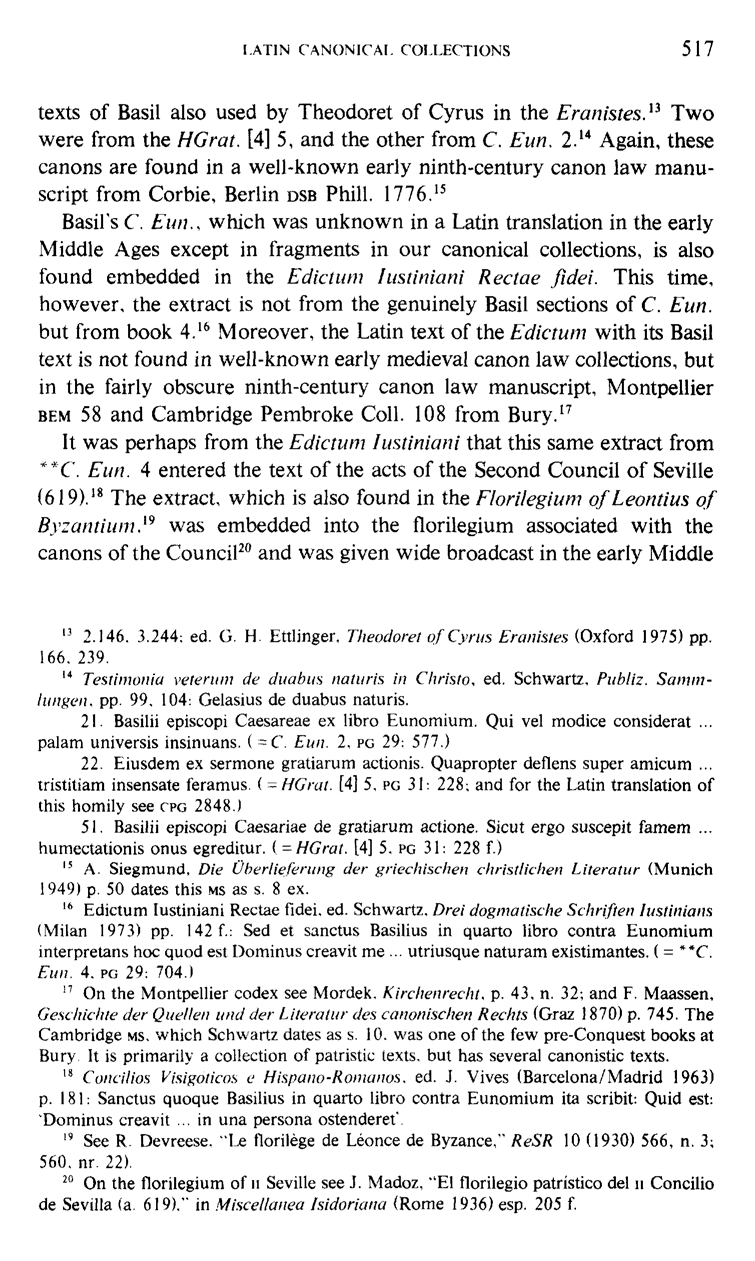
texts of Basil also used by Theodoret of Cyrus in the Eranistes.13 Two were from the HGrat. [4] 5, and the other from C. Eun. 2.14 Again, these canons are found in a well-known early ninth-century canon law manuscript from Corbie, Berlin DSB Phill. 1776.15
Basil's C. Eun., which was unknown in a Latin translation in the early Middle Ages except in fragments in our canonical collections, is also found embedded in the Edictum lustiniani Rectae fidei. This time, however, the extract is not from the genuinely Basil sections of C. Eun. but from book 4.16 Moreover, the Latin text of the Edictum with its Basil text is not found in well-known early medieval canon law collections, but in the fairly obscure ninth-century canon law manuscript, Montpellier
BEM 58 and Cambridge Pembroke Coll. 108 from Bury.17
It was perhaps from the Edictum lustiniani that this same extract from **C. Eun. 4 entered the text of the acts of the Second Council of Seville
(619).18 The extract, which is also found in the Florilegium ofLeontius of Byzantium.19 was embedded into the florilegium associated with the canons of the Council20 and was given wide broadcast in the early Middle
" 2.146. 3.244: ed. G. H. Ettlinger, Theodoret of Cyrus Eranistes (Oxford 1975) pp.
166. 239.
14 Testimonia veterum de duabus naturis in Christo, ed. Schwartz, Publiz. Sammlungen, pp. 99. 104: Gelasius de duabus naturis.
21. Basilii episcopi Caesareae ex libro Eunomium. Qui vel modice considérât ... palam universis insinuans. ( -C. Eun. 2. PG 29: 577.)
22. Eiusdem ex sermone gratiarum actionis. Quapropter deflens super amicum ... tristitiam insensate feramus. ( = HGrat. [A] 5, PG 31: 228; and for the Latin translation of this homily see CPG 2848.) 51. Basilii episcopi Caesariae de gratiarum actione. Sicut ergo suscepit famem ... humectationis onus egreditur. ( = HGrat. [A] 5. PG 31: 228 f.)
15 A. Siegmund, Die Überlieferung der griechischen christlichen Literatur (Munich
1949) p. 50 dates this MS as s. 8 ex.
16 Edictum lustiniani Rectae fidei. ed. Schwartz. Drei dogmatische Schriften Instituons
(Milan 1973) pp. 142 f.: Sed et sanctus Basilius in quarto libro contra Eunomium interpretans hoc quod est Dominus creavit me ... utriusque naturam existimantes. ( = **C.
Eun. A. PG 29: 704.) " On the Montpellier codex see Mordek. Kirchenrecht, p. 43, n. 32; and F. Maassen,
Geschichte der Quellen und der Literatur des canonischen Rechts (Graz 1870) p. 745. The Cambridge MS, which Schwartz dates as s. 10. was one of the few pre-Conquest books at Bury. It is primarily a collection of patristic texts, but has several canonistic texts.
18 Concilias Visigoticos e Hispano-Romanos. ed. J. Vives (Barcelona/Madrid 1963) p. 181 : Sanctus quoque Basilius in quarto libro contra Eunomium ita scribit Quid est:
"Dominus creavit ... in una persona ostenderef " See R. Devreese. "Le florilège de Léonce de Byzance," ReSR 10 (1930) 566, n. 3;
560, nr. 22).
20 On the florilegium of n Seville see J. Madoz, "El florilegio patristico del n Concilio de Sevilla (a. 619)." in Miscellanea Isidoriana (Rome 1936) esp. 205 f.
ROGER Ε. REYNOLDS
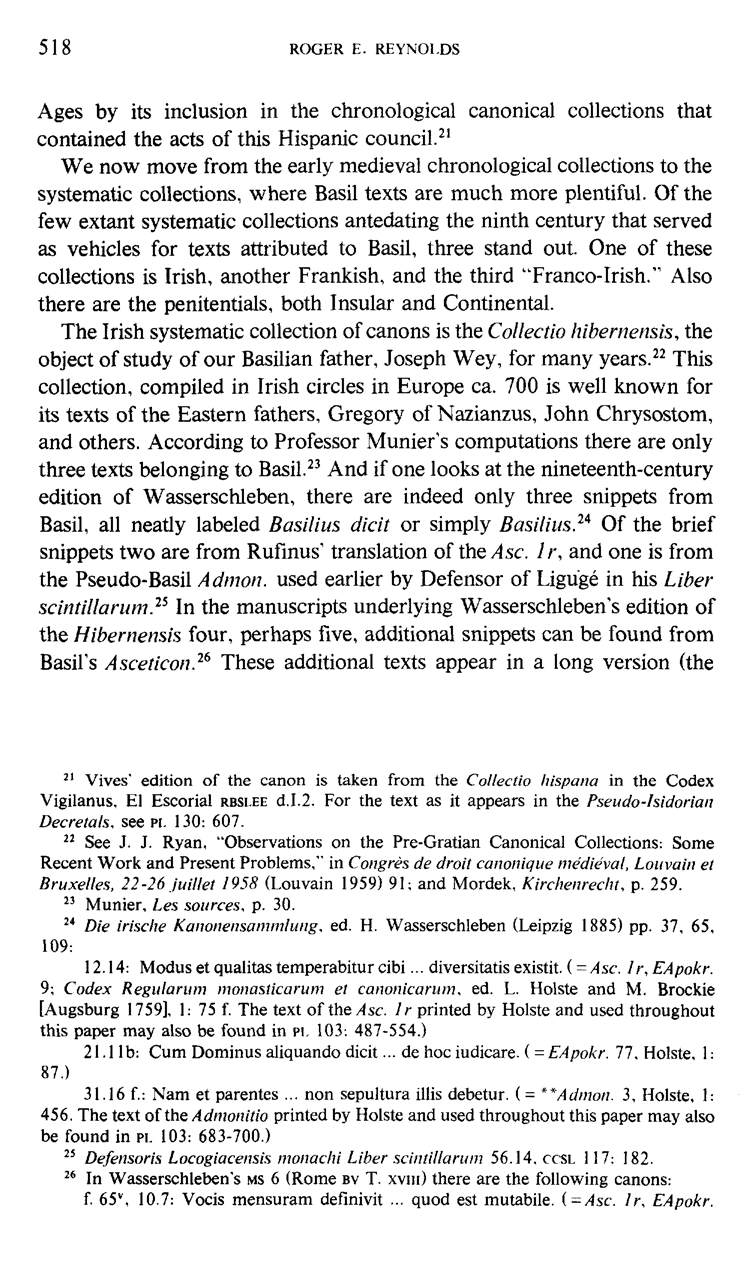
Ages by its inclusion in the chronological canonical collections that contained the acts of this Hispanic council.
We now move from the early medieval chronological collections to the systematic collections, where Basil texts are much more plentiful. Of the few extant systematic collections antedating the ninth century that served as vehicles for texts attributed to Basil, three stand out. One of these collections is Irish, another Frankish, and the third "Franco-Irish." Also there are the penitentials, both Insular and Continental.
The Irish systematic collection of canons is the Collectio hibernensis, the object of study of our Basilian father, Joseph Wey, for many years.
22 This collection, compiled in Irish circles in Europe ca. 700 is well known for its texts of the Eastern fathers, Gregory of Nazianzus, John Chrysostom, and others. According to Professor Munier's computations there are only three texts belonging to Basil.
23 And if one looks at the nineteenth-century edition of Wasserschieben, there are indeed only three snippets from Basil, all neatly labeled Basilius dicit or simply Basilius.
2* Of the brief snippets two are from Rufinus' translation of the Asc. Ir, and one is from the Pseudo-Basil Admon. used earlier by Defensor of Ligugé in his Liber scintillarum.25 In the manuscripts underlying Wasserschleben's edition of the Hibernensis four, perhaps five, additional snippets can be found from Basil's Asceticon.26 These additional texts appear in a long version (the 21 Vives' edition of the canon is taken from the Collectio hispana in the Codex
Vigilanus, El Escorial RBSI.EE d.i.2. For the text as it appears in the Pseudo-Isidorian
Decretals, see PI. 130: 607.
22 See J. J. Ryan, "Observations on the Pre-Gratian Canonical Collections: Some Recent Work and Present Problems," in Congrès de droit canonique médiéval, Louvain el
Bruxelles, 22-26 juillet 1958 (Louvain 1959) 91; and Mordek, Kirchenrecht, p. 259.
23 Munier, Les sources, p. 30.
24 Die irische Kanonensammlung, ed. H. Wasserschieben (Leipzig 1885) pp. 37, 65,
109:
12.14: Modus et qualitas temperabitur cibi... diversitatis existit (=Asc. lr, EApokr.
9; Codex Regularum monasticarum el canonicarum, ed. L. Holste and M. Brockie [Augsburg 1759], L 75 f. The text of the Asc. lr printed by Holste and used throughout this paper may also be found in PL 103. 487-554.)
21.11b: Cum Dominus aliquando dicit... de hoc iudicare. ( = EApokr. 77, Holste, L
87.) 31.16 f.: Nam et parentes ... non sepultura Ulis debetur. ( = * "Admon. 3, Holste, I:
456. The text of the Admonitio printed by Holste and used throughout this paper may also be found in PL 103: 683-700.) 25 Defensoris Locogiacensis monachi Liber scintillarum 56.14, CCSL 117: 182.
26 In Wasserschleben's MS 6 (Rome BV T. XVIH) there are the following canons: f. 65", 10.7: Vocis mensuram definivit ... quod est mutabile. ( = Asc. lr, EApokr.
LATIN CANONICAL COLLECTIONS
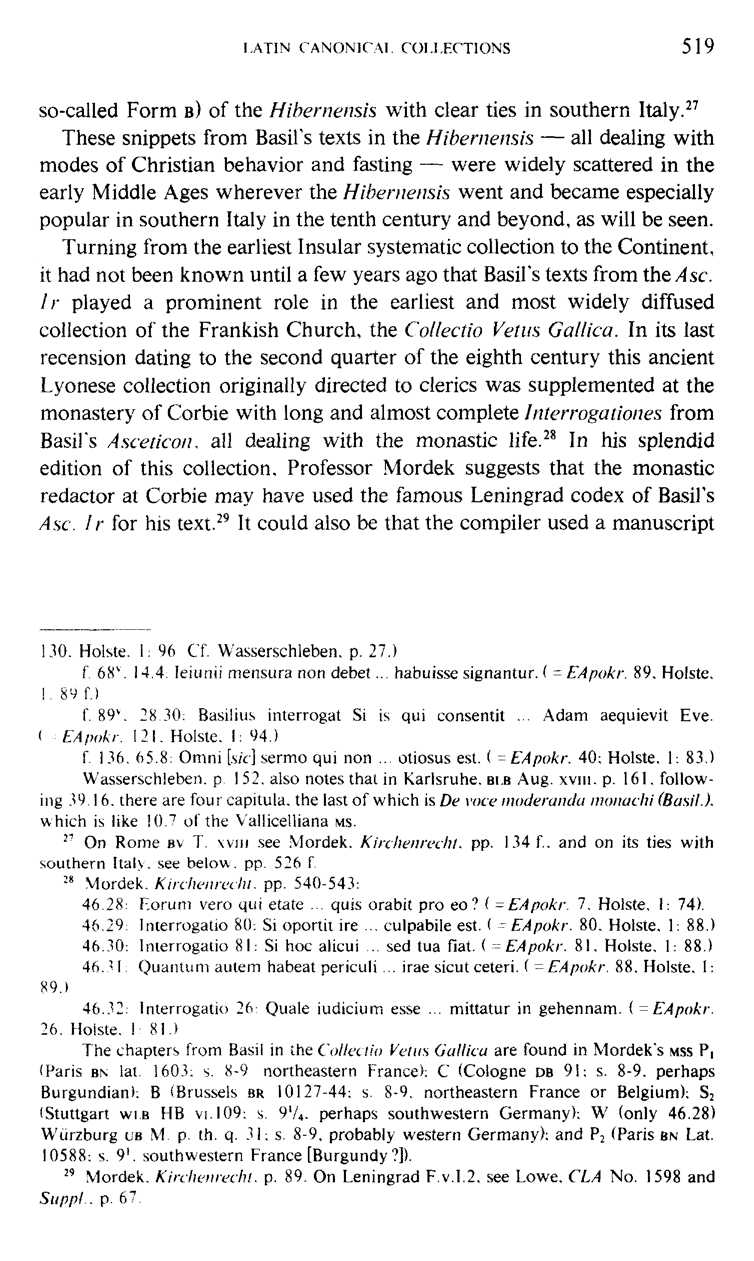
so-called Form B) of the Hibernensis with clear ties in southern Italy.
These snippets from Basil's texts in the Hibernensis — all dealing with modes of Christian behavior and fasting — were widely scattered in the early Middle Ages wherever the Hibernensis went and became especially popular in southern Italy in the tenth century and beyond, as will be seen.
Turning from the earliest Insular systematic collection to the Continent, it had not been known until a few years ago that Basil's texts from the Asc. lr played a prominent role in the earliest and most widely diffused collection of the Frankish Church, the Collectio Vetus Gallica. In its last recension dating to the second quarter of the eighth century this ancient
Lyonese collection originally directed to clerics was supplemented at the monastery of Corbie with long and almost complete Interrogationes from Basil's Asceticon, all dealing with the monastic life.
28 In his splendid edition of this collection. Professor Mordek suggests that the monastic redactor at Corbie may have used the famous Leningrad codex of Basil's
Asc. Ir for his text.
29 It could also be that the compiler used a manuscript 130. Holste. I: 96 Cf. Wasserschieben, p. 27.) f. 68 v. 14.4. leiunii mensura non debet... habuisse signantur. ( = EApokr. 89. Holste.
!. 89 f.) v. 28.30; Basilius interrogat Si is qui consentit ... Adam aequievit Eve.
( EApokr.
121. Holste. I: 94.) f. 136. 65.8: Omni [sic] sermo qui non ... otiosus est. ( = EApokr. 40; Holste. I: 83.)
Wasserschieben, p. 152. also notes that in Karlsruhe. BI.B Aug. xvni. p. 161. follow ing 39,16. there are four capitula, the last of which is De voce nwderanda monachi
(Basil). which is like 10.7 of the Vallicelliana MS. f. 89
27 On Rome BV T. XVIII see Mordek. Kirchenrechl. pp. 134 f.. and on its ties with southern Italy, see below, pp. 526 f 28 Mordek. Kirchenrechl. pp. 540-543:
46.28: F.orum vero qui etate ... quis orabit pro eo? ( = EApokr. 7. Holste. I: 74).
46.29: Interrogate 80: Si oportit ire ... culpabile est. ( = EApokr. 80. Holste. 1: 88.)
46.30: Interrogatio 81: Si hoc alicui ... sed tua fiat ( = EApokr.
81. Holste, 1: 88.) 46.31. Quantum autem habeat periculi ... irae sicut ceteri. ( -EApokr.
88. Holste. I:
89.) 46.32: Interrogatio 26: Quale iudicium esse ... mittatur in gehennam.
(-EApokr 26. Holste. I 81.) The chapters from Basil in the Collectio Velus Gallica are found in Mordek's MSS PI
(Paris BN lat. 1603; s. 8-9 northeastern France): C (Cologne DB 91: s. 8-9. perhaps
Burgundian): Β (Brussels BR 10127-44; s. 8-9. northeastern France or Belgium); S2
(Stuttgart wie HB vi.109; s. 9'/4. perhaps southwestern Germany); W (only 46.28)
Würzburg UB M p. th. q. 31; s. 8-9, probably western Germany): and P2 (Paris BN Lat.
10588; s. 9'. southwestern France [Burgundy ?]).
29 Mordek. Kirchenrechl. p. 89. On Leningrad F.v.1.2, see Lowe. CLA No. 1598 and Suppi. p. 67
ROGER Ε. REYNOLDS
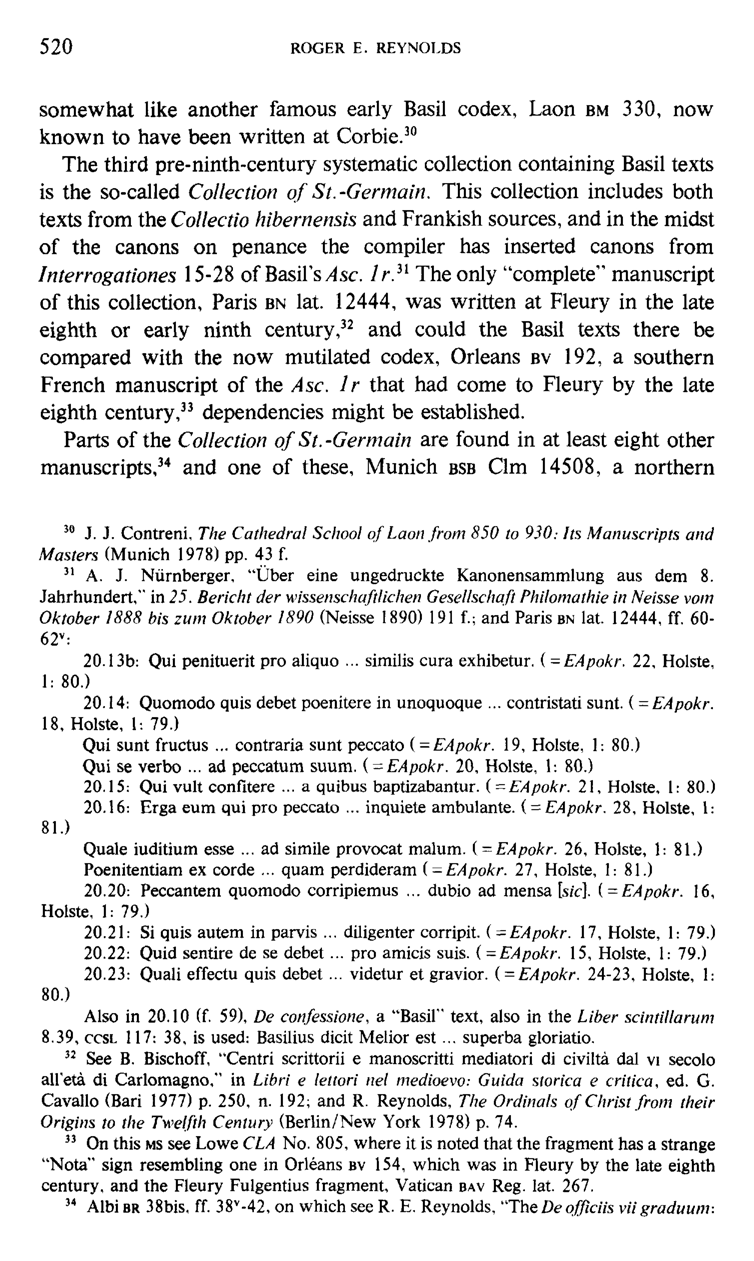
somewhat like another famous early Basil codex, Laon BM 330, now known to have been written at Corbie.
The third pre-ninth-century systematic collection containing Basil texts is the so-called Collection of St.-Germain. This collection includes both texts from the Collectio hibernensis and Frankish sources, and in the midst of the canons on penance the compiler has inserted canons from Interrogationes 15-28 of BasiVsAsc. Ir.
31 The only "complete" manuscript of this collection, Paris BN lat. 12444, was written at Fleury in the late eighth or early ninth century, 32 and could the Basil texts there be compared with the now mutilated codex, Orleans BV 192, a southern
French manuscript of the A sc. Ir that had come to Fleury by the late eighth century, 33 dependencies might be established.
Parts of the Collection of St.-Germain are found in at least eight other manuscripts, 34 and one of these, Munich BSB Clm 14508, a northern
30 J. J. Contreni, The Cathedral School of Laon from 850 to 930.· Its Manuscripts and Masters (Munich 1978) pp. 43 f.
31 A. J. Nürnberger, "Über eine ungedruckte Kanonensammlung aus dem 8.
Jahrhundert," in 25. Bericht der wissenschaftlichen Gesellschaft Philomathie in Neisse vom
Oktober 1888 bis zum Oktober 1890 (Neisse 1890) 191 f.; and Paris BN lat. 12444, ff. 6062v:
20.13b: Qui penituerit pro aliquo ... similis cura exhibetur. ( =EApokr. 22, Holste.
1: 80.) 20.14: Quomodo quis debet poenitere in unoquoque ... contristati sunt. ( = EApokr.
18, Holste, 1: 79.) Qui sunt fructus ... contraria sunt peccato ( = EApokr. 19, Holste, L 80.)
Qui se verbo ... ad peccatum suum. {-EApokr. 20, Holste, 1; 80.) 20.15: Qui vult confitere ... a quibus baptizabantur. (=EApokr. 21, Holste, 1: 80.)
20.16: Erga eum qui pro peccato ... inquiète ambulante. { = EApokr. 28, Holste, 1:
81.) Quale iuditium esse ... ad simile provocat malum. ( = EApokr. 26, Holste, 1: 81.)
Poenitentiam ex corde ... quam perdideram (-EApokr. 27, Holste, 1: 81.) 20.20: Peccantem quomodo corripiemus ... dubio ad mensa [sie]. ( = EApokr. 16,
Holste, L 79.) 20.21: Si quis autem in parvis ... diligenter corripit ( = EApokr. 17, Holste, 1: 79.)
20.22; Quid sentire de se debet... pro amicis suis. (= EApokr. 15, Holste, 1: 79.)
20.23: Quali effectu quis debet ... videtur et gravior. ( = EApokr. 24-23, Holste, 1:
80.) Also in 20.10 (f. 59), De confessione, a "Basil" text, also in the Liber scintillarum
8.39, CCSL 117: 38, is used: Basilius dicit Melior est... superba gloriatio.
32 See B. Bischoff, "Centri scrittorii e manoscritti mediatori di civiltà dal vi secolo all'età di Carlomagno," in Libri e letton net medioevo: Guida siorica e critica, ed. G.
Cavallo (Bari 1977) p. 250, n. 192; and R. Reynolds, The Ordinals of Christ from their
Origins to the Twelfth Century (Berlin/New York 1978) p. 74.
33 On this MS see Lowe CLA No. 805, where it is noted that the fragment has a strange
"Nota" sign resembling one in Orléans BV 154, which was in Fleury by the late eighth century, and the Fleury Fulgentius fragment, Vatican BAV Reg. lat. 267,
34 Albi BR 38bis, ff. 38v-42, on which see R. E. Reynolds, "The De officiis vii graduum-.
LATIN CANONICAL COLLECTIONS
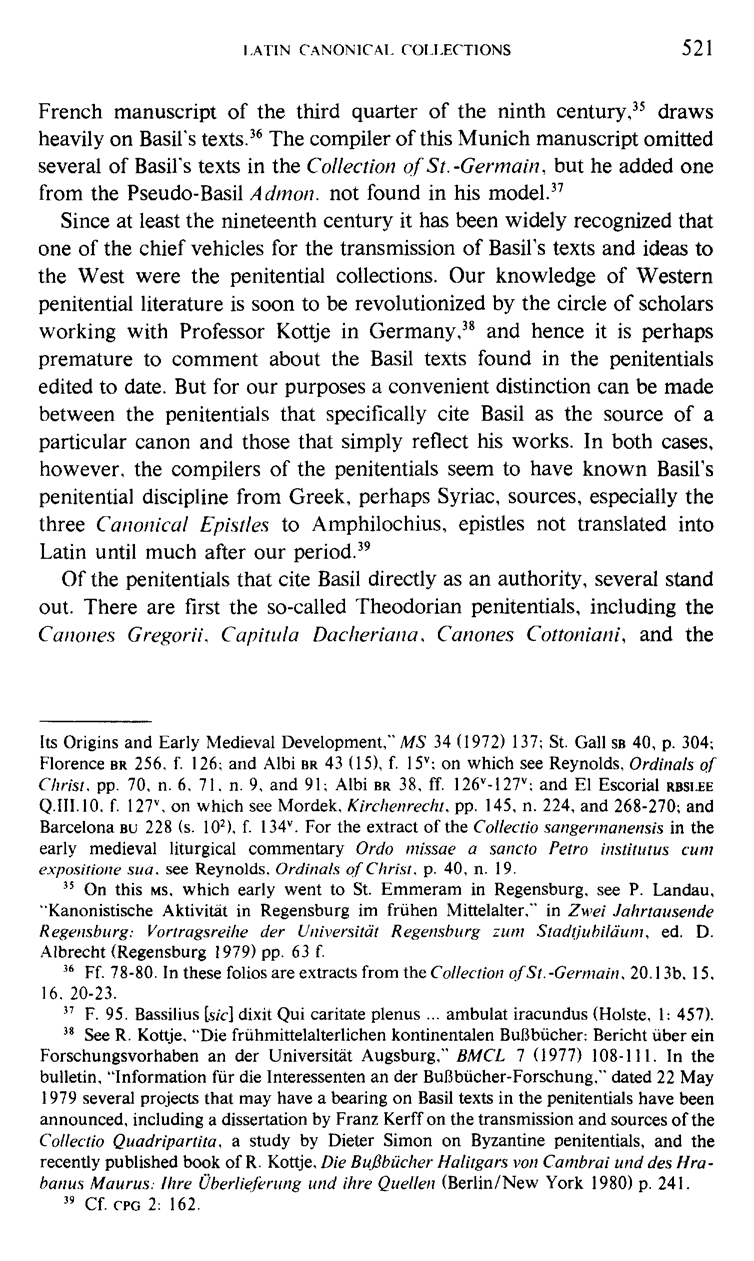
French manuscript of the third quarter of the ninth century,35 draws heavily on Basil's texts.36 The compiler of this Munich manuscript omitted several of Basil's texts in the Collection of St.-Germain, but he added one from the Pseudo-Basil Admon. not found in his model.37
Since at least the nineteenth century it has been widely recognized that one of the chief vehicles for the transmission of Basil's texts and ideas to the West were the penitential collections. Our knowledge of Western penitential literature is soon to be revolutionized by the circle of scholars working with Professor Kottje in Germany,38 and hence it is perhaps premature to comment about the Basil texts found in the penitentials edited to date. But for our purposes a convenient distinction can be made between the penitentials that specifically cite Basil as the source of a particular canon and those that simply reflect his works. In both cases, however, the compilers of the penitentials seem to have known Basil's penitential discipline from Greek, perhaps Syriac, sources, especially the three Canonical Epistles to Amphilochius, epistles not translated into Latin until much after our period.39
Of the penitentials that cite Basil directly as an authority, several stand out. There are first the so-called Theodorian penitentials, including the Conones Gregorii, Capitula Dacheriana, Canones Cottoniani, and the Its Origins and Early Medieval Development," MS 34 (1972) 137; St. Gall SB 40, p. 304;
Florence BR 256, f. 126; and Albi BR 43 (15), f. 15"; on which see Reynolds, Ordinals of Christ, pp. 70, n. 6. 71. n. 9, and 91; Albi BR 38, ff. 126v-127\ and El Escorial RBSI.EE
Q.III.10. f. 127v, on which see Mordek, Kirchenrecht, pp. 145, n. 224, and 268-270; and Barcelona BU 228 (s. 102), f. 134v. For the extract of the Collectio sangermanensis in the early medieval liturgical commentary Ordo missae a sancto Petro institutus cum expositione sua. see Reynolds. Ordinals of Christ, p. 40, n. 19.
35 On this MS, which early went to St. Emmeram in Regensburg, see P. Landau, "Kanonistische Aktivität in Regensburg im frühen Mittelalter," in Zwei Jahrtausende
Regensburg: Vortragsreihe der Universität Regensburg zum Stadtjubiläum, ed. D.
Albrecht (Regensburg 1979) pp. 63 f.
36 Ff. 78-80. In these folios are extracts from the Collection of St.-Germain, 20.13b. 15,
16. 20-23.
37 F. 95. Bassilius [sic] dixit Qui caritate plenus ... ambulat iracundus (Holste, 1: 457).
38 See R. Kottje. "Die frühmittelalterlichen kontinentalen Bußbücher: Bericht über ein
Forschungsvorhaben an der Universität Augsburg," BMCL 1 (1977) 108-111. In the bulletin, "Information für die Interessenten an der Bußbücher-Forschung," dated 22 May
1979 several projects that may have a bearing on Basil texts in the penitentials have been announced, including a dissertation by Franz Kerff on the transmission and sources of the Collectio Quadripartita, a study by Dieter Simon on Byzantine penitentials, and the recently published book of R. Kottje, Die Bußbücher Halitgars von Cambrai und des H rabattus Maurus: Ihre Überlieferung und ihre Quellen (Berlin/New York 1980) p. 241.
" Cf. CPG 2: 162.
ROGER Ε. REYNOLDS
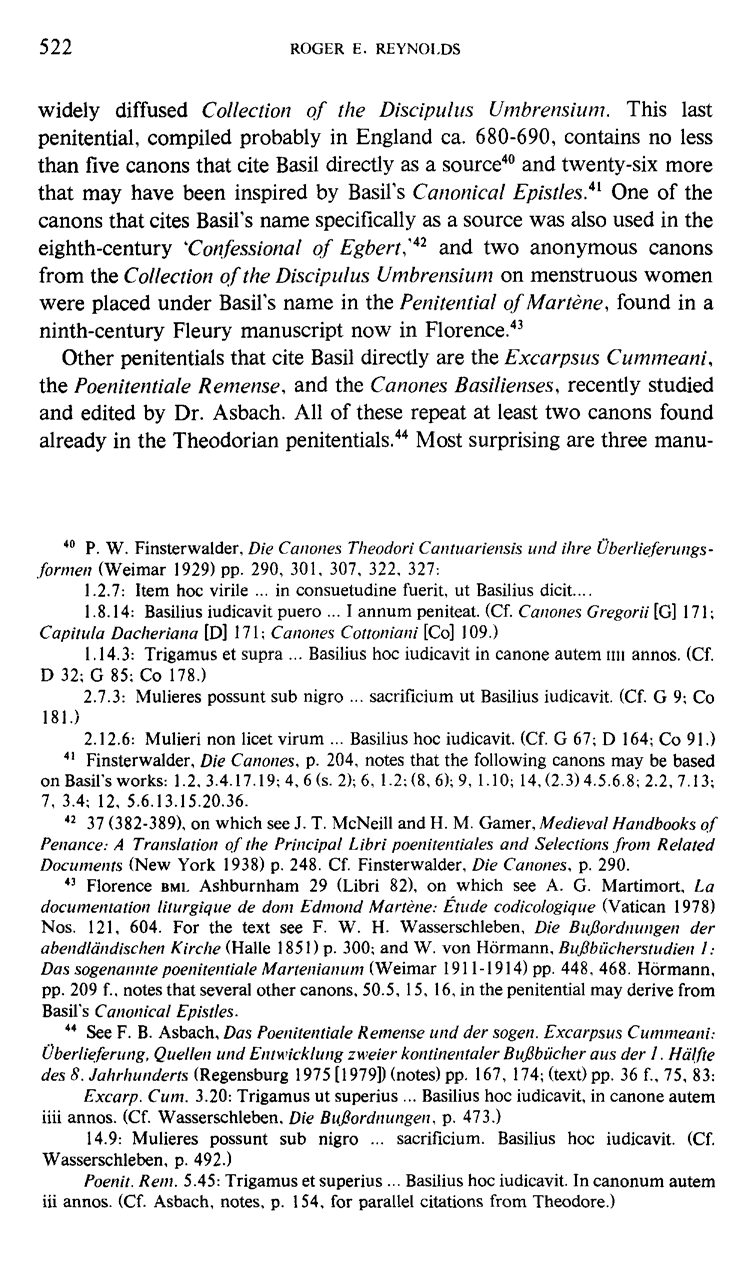
widely diffused Collection of the Discipulus Umbrensium. This last penitential, compiled probably in England ca. 680-690, contains no less than five canons that cite Basil directly as a source
40 and twenty-six more that may have been inspired by Basil's Canonical Epistles.*
1 One of the canons that cites Basil's name specifically as a source was also used in the eighth-century 'Confessional of Egbert,'
42 and two anonymous canons from the Collection of the Discipulus Umbrensium on menstruous women were placed under Basil's name in the Penitential of Marlene, found in a ninth-century Fleury manuscript now in Florence.
Other penitentials that cite Basil directly are the Excarpsus Cummeani, the Paenitentiale Remense, and the Canones Basilienses, recently studied and edited by Dr. Asbach. All of these repeat at least two canons found already in the Theodorian penitentials.
44 Most surprising are three manu40 P. W. Finsterwalder, Die Canones Theodori Cantuariensis und ihre Ùberlieferungsformen (Weimar 1929) pp. 290, 301, 307, 322, 327:
1.2.7: Item hoc virile ... in consuetudine fuerit, ut Basilius dicit...
1.8.14: Basilius iudicavit puero ... I annum peniteat (Cf. Canones Gregorii [G] 171 ;
Capitula Dacheriana [D] 171; Canones Cottoniani [Co] 109.) 1.14.3: Trigamus et supra ... Basilius hoc iudicavit in canone autem mi annos. (Cf.
D 32; G 85; Co 178.) 2.7.3: Mulieres possunt sub nigro ... sacrificium ut Basilius iudicavit. (Cf. G 9; Co
181.) 2.12.6: Mulieri non licet virum ... Basilius hoc iudicavit. (Cf. G 67; D 164; Co 91.)
41 Finsterwalder, Die Canones, p. 204, notes that the following canons may be based on Basil's works: 1.2, 3.4.17.19; 4, 6 (s. 2); 6, 1.2; (8, 6); 9, 1.10; 14,(2.3)4.5.6.8; 2.2, 7.13;
7, 3.4; 12, 5.6.13.15.20.36.
42 37 (382-389), on which see J. T. McNeill and H. M. Gamer, Medieval Handbooks of Penance: A Translation of the Principal Libri poenitentiales and Selections from Related
Documents (New York 1938) p. 248. Cf. Finsterwalder, Die Canones, p. 290.
43 Florence BML Ashburnham 29 (Libri 82), on which see A. G. Martimort, La documentation liturgique de dom Edmond Marlene: Étude codicologique (Vatican 1978)
Nos. 121, 604. For the text see F. W. H. Wasserschieben, Die Bußordnungen der abendländischen Kirche (Halle 1851) p. 300; and W. von Hörmann, Bußbücherstudien I :
Das sogenannte poeniientiale Martenianum (Weimar 1911-1914) pp. 448, 468. Hörmann, pp. 209 f., notes that several other canons, 50.5, 15, 16, in the penitential may derive from Basil's Canonical Epistles.
44 See F. B. Asbach, Das Poenitentiale Remense und der sogen. Excarpsus Cummeani:
Überlieferung, Quellen und Entwicklung zweier kontinentaler Bußbücher aus der 1. Hälfte des 8. Jahrhunderts (Regensburg 1975 [1979]) (notes) pp. 167, 174; (text) pp. 36 f., 75,83:
Excarp. Cum. 3.20: Trigamus ut superius ... Basilius hoc iudicavit, in canone autem iiii annos. (Cf. Wasserschieben, Die Bußordnungen, p. 473.)
14.9: Mulieres possunt sub nigro ... sacrificium. Basilius hoc iudicavit. (Cf.
Wasserschieben, p. 492.) Poenit. Rem. 5.45: Trigamus et superius ... Basilius hoc iudicavit. In canonum autem iii annos. (Cf. Asbach, notes, p. 154, for parallel citations from Theodore.)
LATIN CANONICAL COLLECTIONS
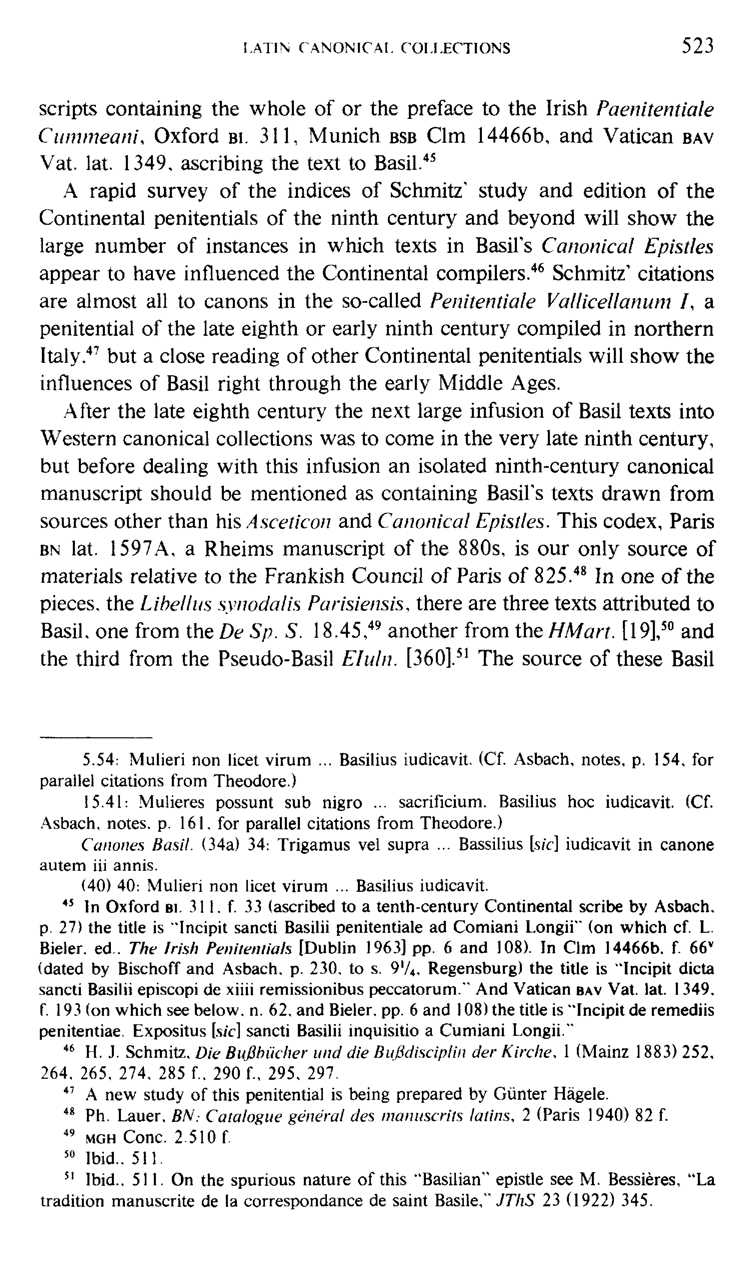
scripts containing the whole of or the preface to the Irish Paenitentiale Cummeani, Oxford BL 311, Munich BSB Clm 14466b, and Vatican BAV
Vat. lat. 1349. ascribing the text to Basil.45
A rapid survey of the indices of Schmitz' study and edition of the Continental penitentials of the ninth century and beyond will show the large number of instances in which texts in Basil's Canonical Epistles appear to have influenced the Continental compilers.46 Schmitz' citations are almost all to canons in the so-called Penitentiale Vallicellanum I, a penitential of the late eighth or early ninth century compiled in northern
Italy,47 but a close reading of other Continental penitentials will show the influences of Basil right through the early Middle Ages.
After the late eighth century the next large infusion of Basil texts into Western canonical collections was to come in the very late ninth century, but before dealing with this infusion an isolated ninth-century canonical manuscript should be mentioned as containing Basil's texts drawn from sources other than his Asceticon and Canonica! Epistles. This codex, Paris
BN lat. 1597A, a Rheims manuscript of the 880s, is our only source of materials relative to the Frankish Council of Paris of 825.48 In one of the pieces, the Li bel I us synodal is Parisiensis, there are three texts attributed to Basil, one from the De Sp. S. 18.45,49 another from the HMart. [19],50 and the third from the Pseudo-Basil Eluln. [360].51 The source of these Basil
5.54: Mulieri non licet virum ... Basilius iudicavit. (Cf. Asbach, notes, p. 154, for parallel citations from Theodore.) 15.41: Mulieres possunt sub nigro ... sacrificium. Basilius hoc iudicavit. (Cf.
Asbach, notes, p. 161. for parallel citations from Theodore.) Canones Basil. (34a) 34: Trigamus vel supra ... Bassilius [sic] iudicavit in canone autem iii annis.
(40) 40: Mulieri non licet virum ... Basilius iudicavit.
45 In Oxford BL 311. f. 33 (ascribed to a tenth-century Continental scribe by Asbach. p. 27) the title is "Incipit sancti Basilii penitentiale ad Comiani Longii" (on which cf. L
Bieler. ed.. The Irish Penitentials [Dublin 1963] pp. 6 and 108). In Clm 14466b. f. 66v
(dated by Bischoff and Asbach. p. 230, to s. 9'/4, Regensburg) the title is "Incipit dicta sancti Basilii episcopi de xiiii remissionibus peccatorum." And Vatican BAV Vat. lat. 1349. f. 193 (on which see below, n. 62, and Bieler. pp. 6 and 108) the title is "'Incipit de remediis penitentiae. Expositus [sic] sancti Basilii inquisitio a Cumiani Longii."
46 H.J. Schmitz, Die Bußbücher und die Bußdisciplin der Kirche, 1 (Mainz 1883) 252,
264. 265, 274, 285 f.. 290 f., 295, 297.
4' A new study of this penitential is being prepared by Günter Hagele.
48 Ph. Lauer, BN: Catalogue général des manuscrits latins, 2 (Paris 1940) 82 f.
49 MGH Conc. 2 510 f 50 Ibid.. 511.
51 Ibid.. 511. On the spurious nature of this "Basilian" epistle see M. Bessières, "La tradition manuscrite de la correspondance de saint Basile," JThS 23 (1922) 345.
ROGER Ε. REYNOLDS
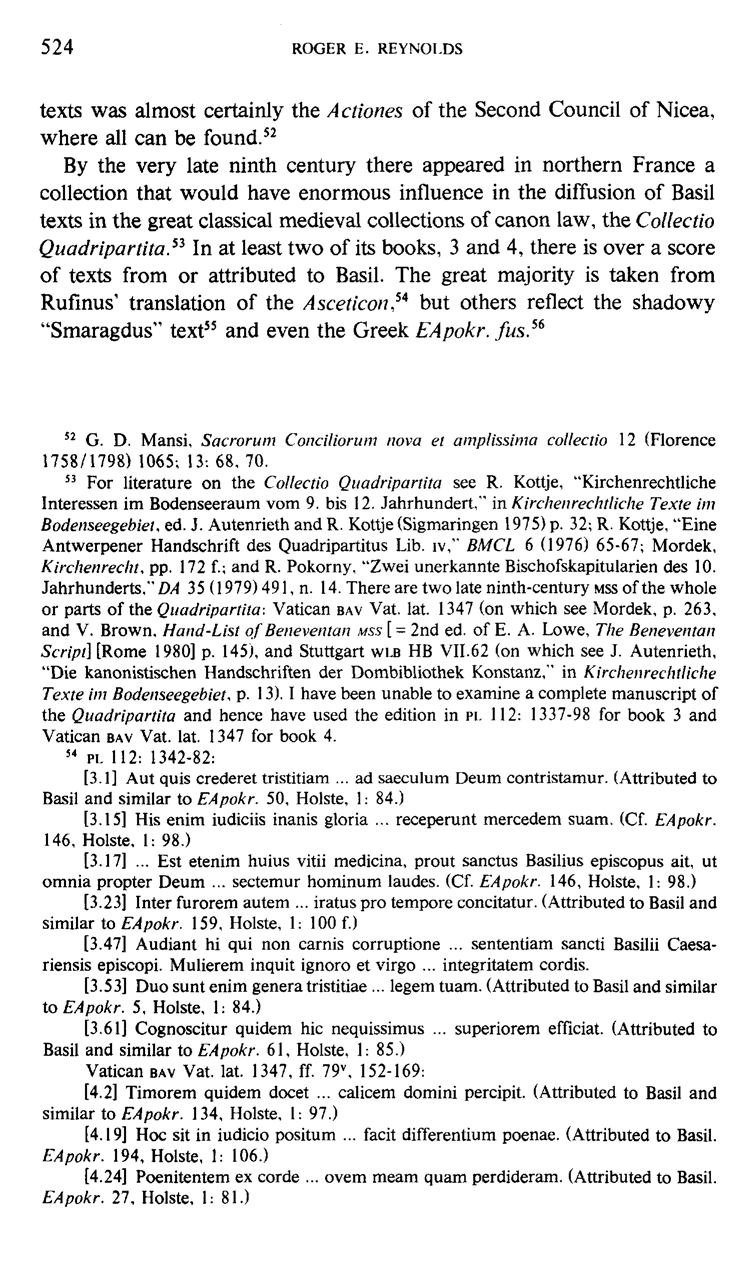
texts was almost certainly the A ctiones of the Second Council of Nicea, where all can be found.
By the very late ninth century there appeared in northern France a collection that would have enormous influence in the diffusion of Basil texts in the great classical medieval collections of canon law, the Collectio
Quadripartita." In at least two of its books, 3 and 4, there is over a score of texts from or attributed to Basil. The great majority is taken from Rufinus' translation of the Asceticon, 5* but others reflect the shadowy "Smaragdus" text 55 and even the Greek EApokr. fus.
52 G. D. Mansi, Sacrorum Conciliorum nova et amplissima collectio 12 (Florence 1758/1798) 1065; 13: 68, 70.
53 For literature on the Collectio Quadripartita see R. Kottje, "Kirchenrechtliche
Interessen im Bodenseeraum vom 9. bis 12. Jahrhundert," in Kirchenrechtliche Texte im
Bodenseegebiel, ed. J. Autenrieth and R. Kottje (Sigmaringen 1975) p. 32; R. Kottje, "Eine
Antwerpener Handschrift des Quadripartitus Lib. iv," BMCL 6 (1976) 65-67; Mordek,
Kirchenrecht, pp. 172 f.; and R. Pokorny, "Zwei unerkannte Bischofskapitularien des 10.
Jahrhunderts," DA 35 (1979)491, n. 14. There are two late ninth-century MSS of the whole or parts of the Quadripartita: Vatican BAV Vat. lat. 1347 (on which see Mordek, p. 263, and V. Brown, Hand-List of Beneventan MSS [ = 2nd ed. of E. A. Lowe, The Beneventan
Script] [Rome 1980] p. 145), and Stuttgart WLB HB VII.62 (on which see J. Autenrieth,
"Die kanonistischen Handschriften der Dombibliothek Konstanz," in Kirchenrechtliche
Texte im Bodenseegebiet, p. 13). I have been unable to examine a complete manuscript of the Quadripartita and hence have used the edition in PL 112: 1337-98 for book 3 and Vatican BAV Vat. lat. 1347 for book 4.
54 PL 112: 1342-82:
[3.1] Aut quis crederet tristitiam ... ad saeculum Deum contristamur. (Attributed to Basil and similar to EApokr. 50, Holste, 1: 84.)
[3.15] His enim iudiciis inanis gloria ... receperunt mercedem suam. (Cf. EApokr.
146, Holste, 1: 98.) [3.17] ... Est etenim huius vitii medicina, prout sanctus Basilius episcopus ait, ut omnia propter Deum ... sectemur hominum laudes. (Cf. EApokr. 146, Holste, 1: 98.)
[3.23] Inter furorem autem ... iratus pro tempore concitatur. (Attributed to Basil and similar to EApokr. 159, Holste, L 100 f.)
[3.47] Audiant hi qui non carnis corruptione ... sententiam sancti Basilii Caesariensis episcopi. Mulierem inquit ignoro et virgo ... integritatem cordis.
[3.53] Duo sunt enim genera tristitiae ... legem tuam. (Attributed to Basil and similar to EApokr. 5, Holste, L 84.) [3.61] Cognoscitur quidem hie nequissimus ... superiorem efficiat (Attributed to Basil and similar to EApokr. 61, Holste, L 85.)
Vatican BAV Vat. lat. 1347, ff. 79\ 152-169:
[4.2] Timorem quidem docet ... calicem domini percipit (Attributed to Basil and similar to EApokr. 134, Holste, 1: 97.) [4.19] Hoc sit in iudicio positum ... facit differentium poenae. (Attributed to Basil.
EApokr. 194, Holste, 1: 106.) [4.24] Poenitentem ex corde ... ovem meam quam perdideram. (Attributed to Basil.
EApokr. 27, Holste, I; 81.)