
9. The other question which needs clarification is from what language did
PAUL J. FEDWICK
The translations of biblical, patristic, canonical, and liturgical texts were derived either directly from the Greek or via the Syriac and the Coptic.228 i. Pre-Tenth-Century Translations For most of the pre-tenth-century translations we possess only indirect evidence.229 Based on the syntaxis, the number of loan words, transliteration of proper names and variants of the biblical quotations,
Abuladze in 1964 concluded that the first Georgian version of the Hex. 1 - 9 made in Palestine in the eighth or ninth century was derived from the Arabic.230 No manuscript of this version has survived. Very recently the Österreichische National-Bibliothek acquired a fifteenth-century manuscript which contains a translation of Hex. 1-9 made in 964 by the Coptic monk Garih Ibn Yuhannes ar-Rarâwi at the monastery of St. Macarius in Wadi Natrun.231 This translation is not mentioned by Graf, and I am not sure if it was known to Abuladze. Otherwise it could be one and the same with the version utilized by the anonymous Georgian translator. Hence we would have one not two pre-tenth-century Arabic versions of Hex. 19. The other question which needs clarification is from what language did
Garih translate Basil's work — Greek, Syriac, or Coptic?
If all the fifty-eight sermons contained in the Georgian collection "Teachings of the Fathers" were translated from the Arabic one would have to presume the existence in Arabic of the two spurious homilies, "De paenitentia," and "De invidia."232 The Georgian work is from the ninth century.
Direct manuscript evidence survives for the existence in Arabic during the ninth century of EGNaz. [2], De perf [22], Asc. Pr3 and Mor. Prl.1" In 228 See Graf, Geschichte, 1: 300-302. Cf. J. M. Saguet, "La version arabe de l'homélie
Sur la trahison de Judas d'Eusèbe d'Alexandrie," Mu 92 (1979) 5-23.
229 Derived chiefly from the study of the Georgian versions. This type of evidence is not used by Gräfin his monumental Geschichte (Vatican 1944/1953).
230 I. Abuladze, Ujvelesi redak'c'iebiBasih Kesarielis "Ek'ust'a dget'aysa" da Grigol
Noselis t'argmanebisa "Kac'isa agebulebisafws," x-xin ss-is khelnacert'a mihedvif gamosc'a (Tiflis 1964). See n. 259 below.
231 Vienna ÖNB ar. 2137 (mixt 1381), acephalous and fragmentary. Origin unknown.
Purchased in 1932.
232 CPG 2991-2992. Such is the contention of B. Outtier, "Les enseignements des Pères, un recueil géorgien traduit de l'arabe," BK 31 (1973) 36-47. Outtier utilizes a method similar to that of Abuladze, the editor of the collection. See I. Abuladze, Mamat'a scavlani χ da xi s.-t'a khelnacerebis mihedvif (Tiflis 1955), esp. xvi-xviii. The MS edited in its entirety is the Mount Sinai MHAî georg. 36 from 925. Pp. 138-151: **SPaen. (CPG 2991);
151-161: **SInv. (CPG 2992).
233 Strasbourg BP Or. 4226, written in the 9th cent, on Mount Sinai. See Graf, Geschichte, 1: 320. His partially erroneous identification has been rectified by Gribomont,
THE TRANSLATIONS BEFORE 1400
the undated manuscript of Vienna ONB Or. 1560, written on Sinai probably before the tenth century, fragments of the De bapt. have been preserved.
234 Because the same items are found in Coptic it is possible that the Vienna manuscript originally contained the **Const, and the Hyp. Pr. as well.
The dogmatic works, De Sp. S. and C. Eun. 1-3, were known chiefly (or perhaps only) through quotations. Habib Ibn Hidma Abu Ra'ita, a Jacobite author who in 813/817 wrote against the Melkites, quotes from HIul. [5], HFide [15], C. Eun. 2 and "EGNys. [38].
235 In the florilegium of Severus Ibn al-Muqaffa' "The Precious Pearl," from the tenth century, there is a quotation from HGrat. [4], from the "De Trinitate," and from another unidentified work.
236 Another florilegium, "The Confession of the Fathers." composed in ί 078, adduces passages fromC. Eun. 1, **C. Eun.
4, HFide [15], an Epistle to Amphilochius (?), and from "Basil's Faith in the First Canons."
ii. Post-Tenth Century Translations 238 the first time in Egypt in the thirteenth century from a text resembling that of A sc.
213a (hence Asc. 2l3a-k). No manuscript has preserved the complete corpus. On the basis of the Beirut USJ 482, from 1694, it is possible to say that it consisted of a. Hyp. Pr.; b. Mor Prl; c. **Const. V; d. De bapt. 1-2; e. Asc. Pr5-, f. Mor. PrF-, g. EApokr. fus. 1-55; h. EApokr. br. 1-313.
After the tenth century Basil's Asceticon was translated twice, 239 The language of this first translation has been assessed as being unsophisticated
Histoire, p. 86. Fragments of Asc. Pr3 survived in Munich BSB ar. 1068, 10th cent, from Mount Sinai. See also Paris BN syr. 239, 15th cent. The Arabic probably depends on the Coptic; see Manchester JRUI.M 62 25, 10/12th cent.
234 Book 1, ch. 2.7; Book 2. ch. 3.9-13. Translation derived from the Coptic; see U.
Neri. Basilio di Cesarea, II ballesimo (Brescia 1976) p. 108.
235 csco 130-131 SA 14/15 (1951) 105, 154, 155. See also 88 (unidentified).
236 See G. Graf, "Zwei dogmatischen Florilegien der Kopten. Α. Die kostbare Perle. Β.
Das Bekenntniss der Väter," OrChrP 3 (1937) 49-77: 345-402. On the new edition of the former by P. Maiberger, "Das Buch der kostbaren Perle'' von Severus Ibn al-Muqaffa'
(Wiesbaden 1972) see K. Samir. "Un traité inédit de Sawîrus Ibn al-Muqaffa' (10e siècle):
Le flambeau de l'intelligence," OrChrP 41 (1975) 167-168.
231 Graf, ibid. For the Ethiopie version of this florilegium see Paris BN or. Ill,
16th cent.
238 See Graf, Geschichte, 1 ; 319-320; Gribomont, Histoire, pp. 82-88. The title of Asc.
213a-k in Arabic is Kitâb lartib waquwânin ar-ruhbân wan-nusâk (i.e., "Book of the Ordinances and Canons of the Monks and Ascetics").
23' It should be noticed that Cairo LCP ar. 315, Theol. 164, 17th cent. (?), 3, 249-345, does not contain thirty homilies of Basil but the **Const. (30 chapters = mimars).
PAUL J. FEDWICK
and hard to understand.240 A second translation made by the Maronite monk Theophilus Fares on the basis of the Garnier-Maran edition was issued in Rome by the Propaganda Fide in 1745.
The Hex. 1 -9 was done into Arabic for the second or maybe the third time241 by Abû-'l Fath Abdallah b. al-Fadl at Antioch in 1052. Graf characterizes this translation as "eine freie, kompilatorische Übersetzung ... vermehrt mit zahlreichen eigenen Glossen."242
The most complete collection of Basil's Moral Homilies in Arabic is contained in one manuscript only, the Paris BN ar. 133, written in Egypt in the fifteenth century. The manuscript is mutilated at both ends. Here are its contents: i. HPs. 1; ii. HPs. 7; iii. HPs. 14a; iv. HPs. 14b; v. HPs. 28a; vi. HPs. 28b; vii. HPs. 29; viii. HPs. 32; ix. HPs. 33; x. HPs. 37; xi. HPs.
44; xii. HPs. 45; xiii. HPs. 48; xiv. HPs. 59; xv. HPs. 61; xvi. HPs. 114; xvii. HPs. 115; xviii. HIeiun. 1; xix. HIeiun. 2; xx. HAtt. [3]; xxi. HDestr.
[6]; xxii. HDiv. [7]; xxiii. HGrat. [4]; xxiv. HIul. [5]; xxv. HMal. [9]·, xxvi.
HEbr. [14]. In other manuscripts are contained four more: xxvii. HChr.
[27]; xxviii. HBapt. [13]; xxix. HMart. [19]; xxx. HFide [15].243 iii. Arabica More widespread than the above authentic homilies were the works carried by the manuscripts of the homiliary type. Pending further investigation about their identity and composition, they all appear to be spurious. Perhaps they were composed originally in Arabic; some if not the majority could be traced back to the Syriac.244 The matter treated in these works not surprisingly is ascetical and moral, devoid of dogmatic speculations. Most of the discourses are assigned for reading on a specific day of the week, month, or year. It should be observed that some of these
240 See Gribomont. Histoire, p. 82 with n. 2.
241 See above p. 486.
242 Geschichte. 2: 56. To the two MSS which bear the name of'Abdallah. Graf. ibid.. adds five more without the translator's name.
243 MSS of the last four: Beirut USJ 954. a. 1739. and Paris BN ar. 258, 15th cent. An excerpt of the Ad adolesc. is found in Vatican BAV Vat. ar. 145, 13/14th cent. In some MSS an "explicatio orationis 'Pater noster'." translated from the Greek, is attributed to Basil; see
Sauget. "L'homéliaire" (η. 15 above), pp. 440-441. Most MSS. however, ascribe this work to John Chrysostom; Sauget, ibid. From Atiya. Catalogue raisonné. 1 (Alexandria 1970)
504 it is unclear what other works of Basil, besides HPs. 1, are contained in Mount Sinai
MHAi ar. 271. copied on 13 June 1233 by Mikhail. According to the colophon (f. 229v). the translations are due to deacon 'Abdallah Ibn al-Fadl Ibn 'Abdallah (same as the above?).
244 See J. M. Sauget. "Une collection arabe d'homélies pour les Fêtes du Seigneur.
Étude comparée des manuscrits Vaticanus arabes 81-82 et Beyrouth 509." AANLR 11 (1974) 405-452; and idem. "La version arabe" (see n. 228 above).
THE TRANSLATIONS BEFORE 1400
works do not claim to be written by Basil; they are simply said to consist "e dictis sancti patris nostri Basilii."245
I will list them all here, according to the subject matter dealt with which is a. fasting: b. penance; c. religious festivities, and d. theological matters.246 a. Sermons for Lent i. ** "Homily on the vanity of the world for Thursday of the fourth week of Lent"; or "Sermon about penance and judgment"; or "Sermon about death and judgment." ii. **"Exhoration to penance for the fifth Sunday of Lent." iii. * * "Homily about the poor Lazarus and the Dives, and about penance for Friday of the seventh week of Lent." iv. * * "Homily on the self-deception of youth and humility of old age for Good Friday"; or "Sermon about youth, old age and death." v. + (?). [Various sermons for Lent?]247
245 See, e.g.. London BL Arund. Or. 21, a. 1252, ff. 18-25: "Sermo e dictis sancti patris nostri Basilii, quern dixit exempla tradens de juventute et senectute et morte." Likewise
London BL Arund Or. 3. written by the presbyter Abu-'l Surur in 1226. See also n. 11 above.
246 On the basis of the incipits I have eliminated several of the homilies listed by Graf,
Geschichte. 1 ; 322-324. For the orientation of the reader I have included all such titles in the list a-d. Because of insufficient information I have put a question mark followed by a * after the homilies on fasting a. v. below. These homilies could well be independent creations or they could simply be translations of the HIeiun. [1-] (see next note). The sermons excluded from my list have been identified as follows: Graf, Geschichte, 1:
322.14: ""Auf das Geburtfest" = HChr. [27]; 322.38: eliminate "Mittwoch," see b. i-ii:
323.3: "'Über das Wort des Moses: 'Ich habe gegen dich gesündigt"" = HAtt. [3]; 323.8-9:
"Über den Tod und das letzte Gericht," see a.i; 323.10: "Über den Jugend und den Tod," see a.iv; 324.29: "Wunder des hl. Georg" = Ps.-Theodot; 324.30: "Lob der 40 Martyren von Sebaste" = HMart. [19]. I wish to express my sincere gratitude to Prof. Khalil Samir,
Rome, for sharing with me so generously the wealth of his knowledge of Arabic literature.
247 Graf. Geschichte. 1: 322.14-21, gives the following information on the homilies on fasting: "Über das Fasten: Bairut 512, S. 125-135. — Zum Käsesonntag und zum
Fastenbeginn: Leningrad, Samml. Gregor iv, Nr. 27, ff. 19-50. Vielleicht dasselbe 'für den
1. Montag der Fastenzeit, d.i. zum Beginn des Fastens': Bairut 512, S. 547-563." I was unable to check the incipits of these works. It seems that neither has Graf checked them out; hence it is possible that at least some of these homilies are translations of HIeiun. 1 and HIeiun. 2. and perhaps also the spurious HIeiun. [32]. In fact, in many Greek MSS of the homiliaries the first two are assigned for the beginning of Lent; see Oxford BL
Cromwell gr. 23. a. 1064/1065. f. 307; HIeiun. Χ,τγι S' τής τυροφάγου; Vatican BAV Vat. gr.
1633, 10/11 cent. ff. 140-143: HIeiun. 2. ff. 143-147: HIeiun. 1. both τή χυριαχή της τυροφάγου. The Arabic could also be derived from the Syriac, see above, p. 488.
PAUL J. FEDWICK
b. Sermons on Penance i. ** "Sermon about Sunday and Friday, and the soul and the body." ii. ** "Sermon about Sunday and Friday, and about the departure of the soul from the body." iii. **"Sermon about penance, mercy, and alms." iv. ** "Sermon about Mary the sinner who wept at the feet of the Lord,
1." v. ** "Sermon about Mary the sinner who wept at the feet of the Lord, 2." c. Festal Sermons i. **"Sermon on the Ascension." ii. **"Homily on the construction and dedication of the church to the Virgin Mary at Philippi (21 Ba'ûna = 15 June)"; or "Homily on the dedication of the church to the Virgin Mary built by Eunomius at Caesarea (21 Ba'üna)"; or "Homily on the construction and dedication of the church to the Virgin Mary (21 Ba'ûna) and account of the miracles that she performed there"; or "Homily pronounced in honour of the Holy Virgin in the new church which Proseidos built east of the town and which the Saint consecrated."248 d. Theological Discourses i. **"Sermon on the trinity and unity of God, 1." ii. **"Sermon on the trinity and unity of God, 2." iii. **"Sermon about the offering of the Mass for the departed." iv. **"Sermon on the parables of the gospel." v. **"Treatise about the church and the priests."249 iv. Canons and Liturgies From early times Christians living under Moslim rule could avail themselves of various canonical collections some of which were purposely prepared to meet the demand of a Christian "state" (milla =
"nation") within the Islamic empire. In these collections there are two 248 Despite their different titles and even incipits these homilies are simply variations of one and the same work derived probably from the Coptic homily "Dedicatio ecclesiae
Mariae virginis" (see No. 2 above p. 484). See also Cairo LCP 661, Hist. 60. 18th cent.
"Mimar by St. Basil on the building of the church dedicated to the Virgin which He consecrated on the 21st of Ba'üna."
249 For d.v. not in Graf, see Mingana ar. 152, 14th cent. It is possible that both d.iv. and v. are extracts from the **Erotapokriseis on which see below.
THE TRANSLATIONS BEFORE 1400
series of Ps.-Basilian canons, one, among the Melkites, with fourteen — or the same, among the Copts, with thirteen canons — and another, larger, for the use of the Copts, with 105 (106) canons.250 The latter, in Coptic, must have been in existence in the tenth century as they were known to the author of the florilegium, "Faith of the Fathers." For the series of 105 (106) canons Riedel claimed a Greek original.
The **LBas. 4 was known in Arabic from at least the thirteenth century. The manuscript recently acquired by M. Frank Kacmarcik of St.
Paul, Minnesota (henceforward called "codex Kacmarcik") was copied in the fourteenth century at the monastery of St. Antony in the desert of Arabah, from a prototype written between 1283/1284.251 The version of LBas. I is also from the thirteenth century, although its use among Copts has been limited, the central stage being occupied by **LBas. 4.152
The "Ordo baptismi." translated from the Greek has been in circulation in various recensions since the eleventh century.253
Before concluding we ought to mention the widespread circulation of the **Erotapokriseis, already very popular in Greek, with Basil in most cases as the respondent and Gregory of Nazianzus (sometimes of Nyssa) as the interpellant.254
250 See n. 224 above. For the collection in use among the Melkites see J. B. Darblade,
La collection canonique arabe des Melkites (xiiie-xnie siècles) (Harissa 1946) pp. 150-153.
On the florilegium. "Faith of the Fathers," referred to next, see n. 236 above.
251 On the "codex Kacmarcik" see W. F. Macomber, "The Kacmarcik codex. A 14thcentury Greek-Arabic Manuscript of the Coptic Mass," Mu 88 (1975) 391-395; idem,
"The Greek Text of the Coptic Mass and of the Anaphoras of Basil and of Gregory According to the Kacmarcik codex," OrChrP 43 (1977) 308-334. For some rectifications and the edition of the Arabic text see K. Samir, "Le codex Kacmarcik et sa version arabe de la Liturgie alexandrine," OrChrP AA (1978) 74-106; idem, "La version arabe du Basile alexandrin (codex Kacmarcik)." OrChrP AA (1978) 342-390. Samir considers the text of "codex Kacmarcik" slightly better than that of Paris BN gr. 324, 14th cent. (cf. Ε.
Renaudot, Liturgiarum orientalium collectio, 1 [Paris 1716] 57-89). For a comparison between "codex Kacmarcik," Paris BN gr. 324. and the "Roman Missal" of 1971 see
Samir. "Le codex," pp. 102-104.
252 The **LBas 4 is the ordinary liturgy of the Copts. There are several thirteenthcentury MSS of the LBas. I: Mount Sinai MHAî ar. 449, Cairo I.CP 33. For the "codex
Bacha," copy of a dated MS from 1260 see C. Bacha, "Notions générales sur les versions arabes de la liturgie de s. Jean Chrysostome suivies d'une ancienne version inédite," in Chrysostomica (Rome 1908) pp. 405-471. It should be noted that LBas. 1 precedes the LChrys. Cf. η. 123 above. In fact, the Greek model of "codex Bacha" seems to be a 9/10th century MS.
253 Vatican BAV Vat. ar. 53, 11th cent; Vatican BAV Vat. ar. 54, 14th cent; Vatican BAV
Vat ar. 41, 14th cent. For the Syriac versions of this "Ordo," see above n. 81.
254 See Graf. Geschichte, 1: 324-327.
PAUL J. FEDWICK
v. Further Remarks on the Works of Basil in Arabic It is quite difficult to say anything definite on translations of Basil's works into Arabic. The manuscript tradition has been described only very insufficiently and hardly at all studied.255 To see clear in the jungle it is necessary to proceed to the systematic classification and study of all the manuscripts. It could well be that some of the Ps.-Basilian homilies listed above are slight variations of one and the same text. The other task is to see if the same text is not attributed elsewhere to another author.
According to Graf, the value of the Arabic translations of the Fathers is negligible on account of the many liberties taken with the original by the translators/adapters, and the concoction of an unlimited number of spuria.256 These works, however, served a practical purpose. Although dwelling sometimes on banalities and trite topics, they provided food for the minds of their readers and/or listeners. The placement of such works under star-like names like Basil added weight to the otherwise unpolished products.
F. GEORGIAN TRANSLATIONS
From its inception and well into the eleventh century Georgian literature has been predominantly religious and theological in character. It was a literature designed to serve primarily the spiritual and intellectual needs of Georgian ascetics at home and abroad. Its other major characteristic is that it was chiefly composed of translations — in the first period, fifth to seventh centuries, mainly from Armenian and Syriac; in the second, 750975, from Arabic, and in the third, 975-1250, from Greek. i. The Second Period, 750-975 Georgian translations of Basil's works appear for the first time during the period of national resurgence, early eighth century. Writes Blake:
The texts produced during this period are the best of which the language can boast. Armenian and Syriac influences are kept to the minimum, while translations from the Arabic, made in Palestinian circles, begin to bulk largely.257
255 The highly promising Catalogue raisonné of A. S. Atiya on the holdings of Mount
Sinai has been published only in part (vol. 1: Alexandria 1970). Somewhat paradoxically the English text is being translated into and published only in Arabic (!).
256 Geschichte, 1: 299-300.
257 W. Blake, "Georgian Theological Literature," JThS 26 (1925) 53.
THE TRANSLATIONS BEFORE 1400
Only a few works of Basil translated during this period survive. The most important is the Hexaemeron. However, there is only indirect evidence to prove this, a cursory reference in a colophon to the effect that when Giorgi At'oneli was working on his translation of the Hexaemeron in the eleventh century he had on hand an older version.258 Abuladze in 1964 tried to corroborate the argument by showing that the translation contained in two Jerusalem manuscripts was in fact derived from the Arabic and that it was made in Palestine in the eighth or ninth century.259
Pending further investigation it is possible that the Arabic version used by the anonymous Georgian translator is none other than the one made by the Coptic monk Garih Ibn Yuhannes ar-Raräwi in 964 at the monastery of St. Macarius in Wadi Natrun (Nitria).260 If this be so the date of the oldest Georgian version of the Hexaemeron would have to be moved to about the tenth or early eleventh century.
Following a similar linguistico-lexicographical method as the one used by Abuladze, Outtier suggested in 1973 that the entire collection known as Mamat'a scavlani ( = "Teachings of the Fathers"), edited for the first time by Abuladze in ] 955 from a tenth-century manuscript, was derived from the Arabic.261 The place of origin of the collection is ninth-century
Palestine. Among the 58 works included there are two attributed to Basil:
**"Sermo de paenitentia et morte," and **"Sermo de invidia, et typus paenitentiae pro fidelibus."262 These works are unparalleled in Greek and Outtier suggested for them an Arabic origin.263
There are two related manuscripts from the ninth century; both are "mravalt'avi," which is the Georgian word for "homiliary." One is the prestigious parchment codex from the monastery of Udabno (in Georgia proper), and the other is the dated manuscript, a. 864, from the monastery
2S" For this colophon quoted by Zhordania see Tarchnisvili, Geschichte (η. 18 above), p. 164.
259 The edition cited n. 230 above is based on Jerusalem PB georg, 44, 12/13th cent, and Jerusalem PB georg, 74. 13/14th cent.
260 See above p. 486.
261 See article cited n. 232 above.
262 See n. 232 above.
263 On the relations between early Christian Arabic and Georgian literature see the judicious remarks of K. Samir (n. 227 above) with reference to the remarkable study of M. van Esbroeck. Les plus anciens homéliaires géorgiens. Étude descriptive et historique
(Louvain-la-Neuve 1975). Most translators from Arabie into Georgian remain anonymous. However, in eighth and ninth-century Palestine two translators in particular distinguished themselves — David and Stephen.
PAUL J. FEDWICK
of Mount Sinai.264 In the first one is found the HIeiun. 1 and in the second HMart. [19]. Another, perhaps even older "mravalt'avi" is the parchment codex from the monastery of Svanet'i in Georgia proper, written probably in the eighth or ninth century.265 It contains some works ascribed to Basil which do not appear in any other Georgian manuscripts such as "Sermo de Ephremo eremita," "Sermo de Petro fratre suo," "Sermo de
Anastasio," and "Sermo de aeternitate poenarum."
The first Georgian translation of Basil's Asceticon ( = Asc. 2/3c-p) was made in the first half of the tenth century by Procopius, a hieromonachus of Mar Saba, otherwise unknown.266 The Greek model used by Procopius was a manuscript closely resembling the current Istanbul BOP HT 105,
264 The codex of Udabno was transferred from the monastery in 1920 and is now in Tiflis SMA A-1109. See its description (codex U) in Van Esbroeck. Les plus anciens, pp. 2937. 133-157. The same older translation of HIeiun. 1, considered by Van Esbroeck. ibid.. p. 250. to be a classic, is found in two tenth-century mravalt'avi, Ayion Oros MI georg. 11 and Tiflis SMA A-95. The latter comes from the scriptorium of Parhal (Georgia proper). In all the catalogues and descriptions of the codex of Udabno it is erroneously indicated that it contains the Pseudo-Basilian HPaen. [28]. If such indeed were the case, this would be the only witness to the existence of such a translation in Georgian. However, as Van
Esbroeck, Les plus anciens, p. 142, correctly points out the work under consideration is not * *HPaen. [28] but a homily of Meletius of Antioch. The MS of Mount Sinai MHAI georg.
32-57-33, from 864, which G. Garitte, "Les récents catalogues des manuscrits géorgiens de Tiflis," Mu 74(1961)412 considers to be the companion of the codex of Udabno, was edited in its entirety by A. Sanidze, Sinuri mravalt'avi 864 clisa (Tiflis 1959), HMart. [19] at pp. 115-123. The same (older) version of this homily is found in the codex of Udabno,
Tiflis SMA A-l 109 (just a short fragment), in the dated (a. 1038) palimpsest of Leningrad
IVAN M 13 (the original writing containing HMart. [19] is from the 8/9th cent; see Van
Esbroeck, Les plus anciens, p. 35), and Tiflis SMA A-95, 10th cent. Both G. Peradze, "Die alt-christliche Literatur in der georgischen Überlieferung," OrChr 3/4 (1929) 283 (based on a similar work of Kekelidze) and Van Esbroeck, Les plus anciens, p. 127, add Oxford
BL georg. 1, from the 11th cent. However, unless their opinion is based on philological arguments, it would seem that the version of the Oxford MS is due to Ewkt'ime At'oneli.
In fact this codex was written in the Georgian monastery of the Holy Cross near Jerusalem by Ewkt'ime's companion and friend Giorgi Prokhoré; see P. Peeters, "De codice hiberico Bibliothecae Bodleianae Oxoniensis,"/4Ä 31 (1912) 306 (by mistake in the Latin translation of the title the HMart. [19] is put under Gregory of Nazianzus' name).
Besides HMart. [19], the codex of Oxford contains "In Georgium" and "In crucem," two works of Andrew of Crete which here as in the Ethika of Ewkt'ime (see below) are attributed to Basil. The "Oratio in illud: Pater si possibile est," probably of Amphilochius
(see CPG 3237), is ascribed to Basil in only one MS, the Tiflis SMA A-144, 10th cent., from the convent of Klardjeth (see Van Esbroeck, Les plus anciens, pp. 160-161).
265 Now at Tiflis SMA A-19. The works listed next, notably the first three, appear to be taken from the Ps.-Amphilochian "Vita et miracula," translated early into Georgian. Also in Greek the aforementioned works (BHG 255, 257, 254) appear sometimes as works of Basil.
266 See Khintibidze, Basili (n. 18 above), pp. 87-89, recensio G.
THE TRANSLATIONS BEFORE 1400
from the tenth or eleventh century, and the Vatican BAV Barb. gr. 476, from the twelfth century. Recensio G consists of a single series of 300
EApokr. br. preceded by the spurious SVit.261 In the only manuscript in which it has survived, the Mount Sinai MHAï georg. 35 from the tenth century, its title is: "Canon constitutus pro monachis qui propter Christum una congregati sunt; sancti et beati Basilii Caesareae Cappadociae episcopi doctrina."268 ii. Greek Age The third period of ancient Georgian literature, which extends from ca.
975 to 1150, marks the acme of Greek or Byzantine influence, and is called by Kekelidze the "Greek age."269 This period is characterized chiefly by the fact that oriental influence falls completely into the background.
The translations of Byzantine authors are no longer made via Armenia, Syria, or Arabian Palestine, but are derived directly from the originals.
The new literary centres shift from Georgia proper to the west, to Ayion Oros (the monastery of Iviron = Georgians), to Palestine (the monasteries of Mar Saba and Holy Cross), to Sinai and to the Black or Admirable
Mountain near Antioch.270
Of the great number of translators from this period, four occupied themselves with the translation of Basil's works as well: a. the Philhellene
Ewkt'ime At'oneli (Euthymius Hagiorites, 11028); b. his disciple and successor, the hellenizer of Liturgy and Scripture, Giorgi At'oneli (t 1065); c. the scholastic Ephrem Mtsiré ( = "the Little," tea. 1110); and d. Arsen
Iqalt'oeli (fl. 11/12 cent). a. Under the instigation of his father John, a nobleman and the founder of the monastery of Iviron, Ewkt'ime whose first language was Greek quickly learned Georgian271 and immediately set about translating a great
267 For the complete concordance of recensio G with the Vulgata see Gribomont, Histoire, pp. 166-169.
268 See G. Garitte, Catalogue des manuscrits géorgiens littéraires du Mont Sinai
(Louvain 1956) p. 117. The usual designation of Basil's Asceticon in Georgian is
Samogwats'eo is'ignis = "Liber asceticus."
269 Kekelidze in Tarchnisvili, Geschichte, p. 35. Some authors call it less properly the "Golden Age." It was certainly a prolific period in which an unprecedented number of patristic and other texts were translated into vernacular most for the first time. However, the linguistic quality of the translations does not always match the purity of style achieved in the previous period.
270 On these and other Georgian monasteries in the diaspora see Tarchnisvili, Geschichte, pp. 69-78, 271 In his biography by Giorgi At'oneli this fact is attributed to a miraculous
PAUL J. FEDWICK
number of biblical, apocryphal, exegetical, dogmatic, ascetical, and hagiographical texts.272 Among his translations of Basil the best known is the collection of moral homilies entitled Ethika.m Ewkt'ime's reputation as a translator was so great that authors still wonder what caused it.274
However, upon closer examination his renderings are not of the literal, word-by-word type, but are rather excerpts and abbreviations, or in some cases expansions of the originals. In other words, he is an adapter as much as, or even more than, a translator. Observes Blake: "His language is good and pure, but somewhat filtered; it lacks the zest and flavour of the earlier period."275
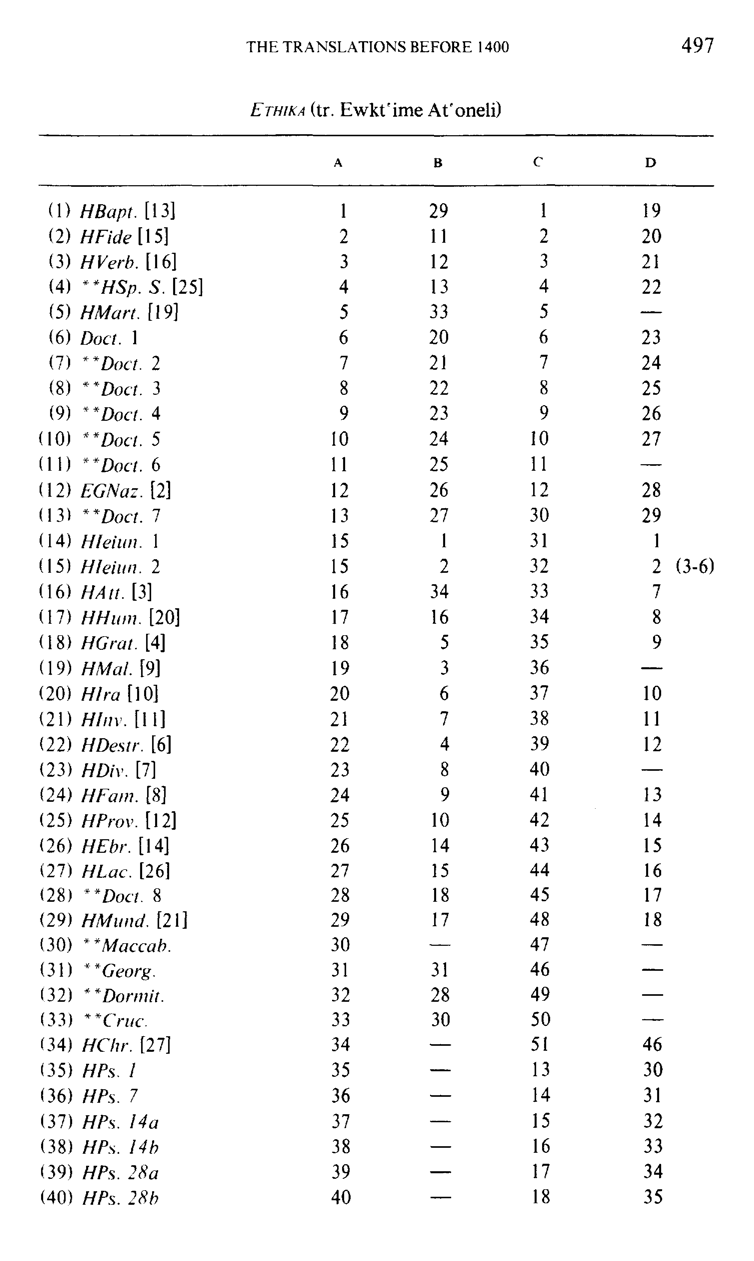
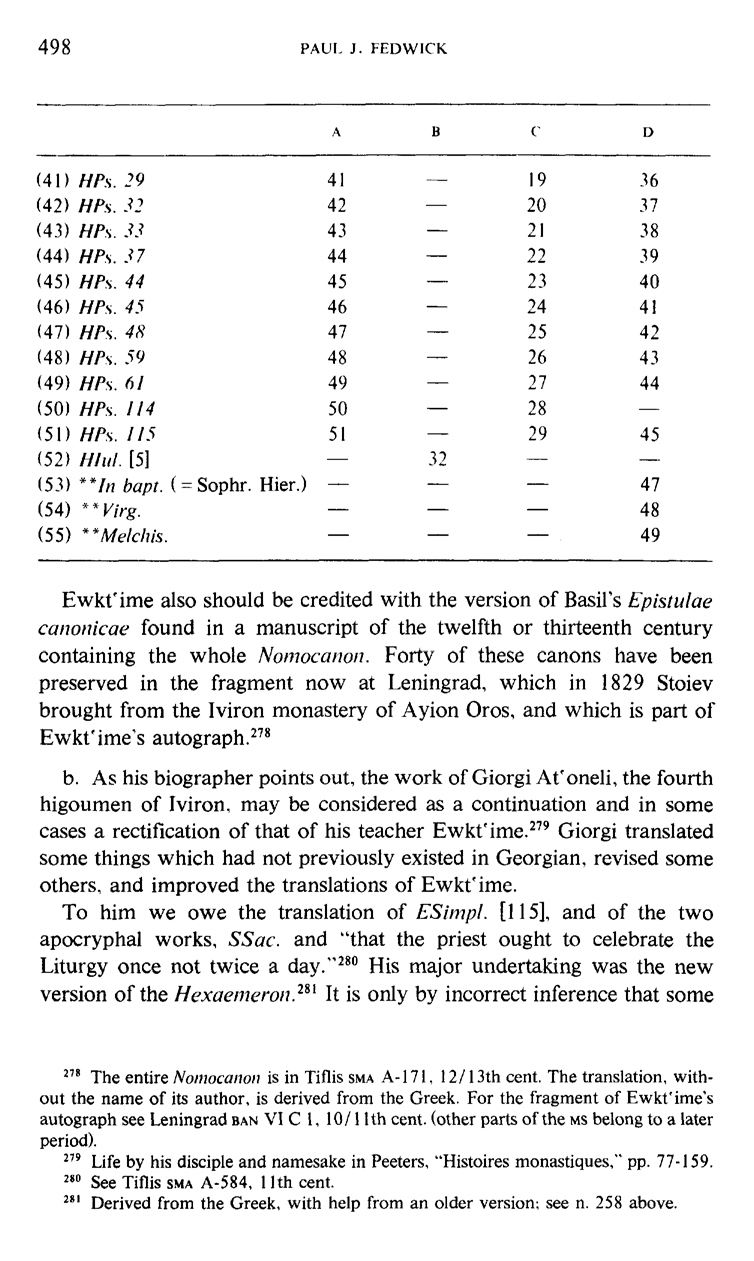
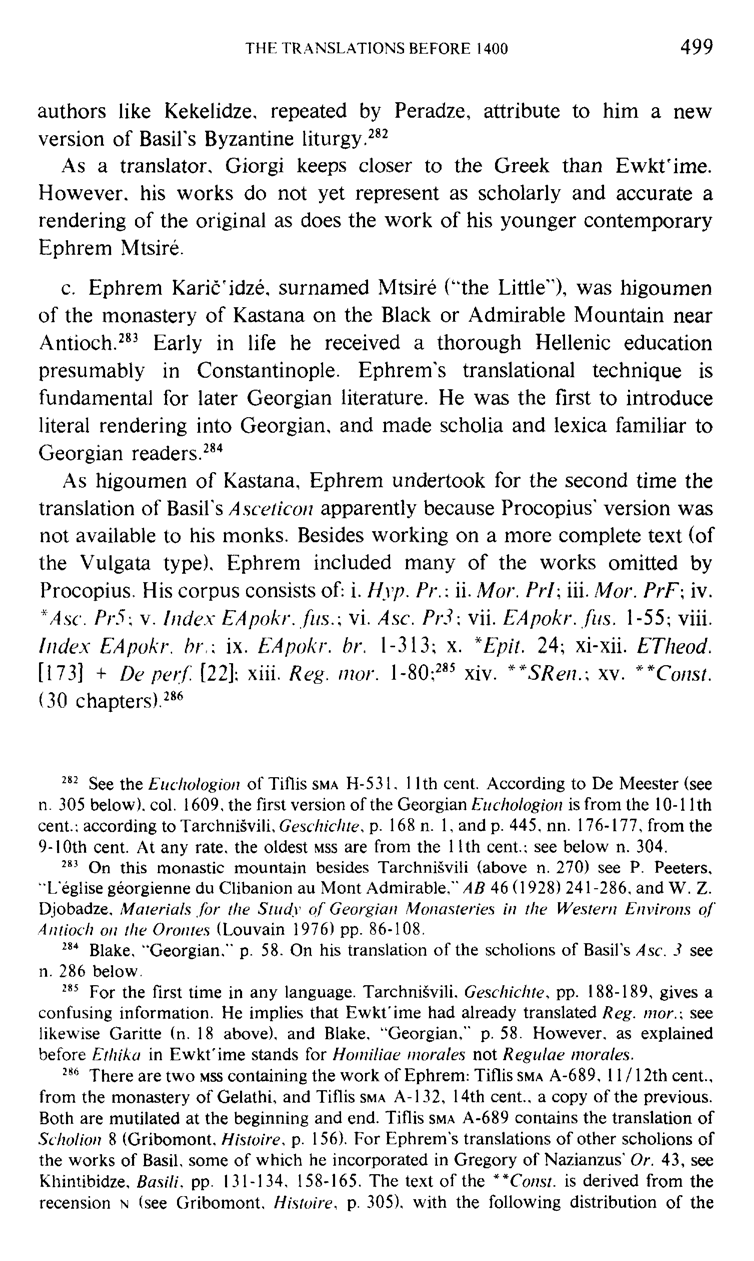
In Georgian there is a special study dealing with the composition and contents of Ewkt'ime's Ethika, which was unavailable to me.276 On the basis of the four most complete manuscripts I have drawn the following comparative table.277 intervention of the Holy Virgin (see the Latin translation of Ewkt'ime's life in P. Peeters,
"Histoires monastiques géorgiennes," AB 36/37 [1917/1919] 13-68).
272 For a complete list of his translations see his biography cited in n. 271.
273 Fifty-one, and in some MSS fifty-two and up to fifty-five works, some spurious. See the table below. For the authors who misinterpret the designation Ethika see n. 18 above and 285 below.
274 See Blake, "Georgian Theological Literature," pp. 55-56 who adds further speculations to those of Kekelidze.
275 Blake, ibid., p. 55. For similar views see G. Peradze, "L'activité littéraire des moines géorgiens au monastère Iviron, au Mont Athos," RHE 23 (1927) 531; J. Karst, Littérature géorgienne chrétienne (Paris 1934) p. 26; J. Kirchmeyer, "Euthyme I'Hagiorite," DSp A (1961) 1722.
276 N. Copurasvili, "K sostavu 'Itiki'," VVONGr 2 (1973) 64-78 (in Georgian).
277 My table is based on A = Tiflis SMA A-100. a. 1713, copy of a MS from before 1000: β = Jerusalem PB georg. 14. a. 1055;c = Tiflis SMA A-181, a. 1816; D = Tiflis SMA A-394.
S.A.. 11/14th cent. (?). In the abbreviation of works Doci. 1 -8 stands for the works listed in Peradze. "Die alt-christliche." p. 284. d. i-viii. Doct. 1 s&Asc. Pr4. No. 30 belongs to Gregory of Nazianzus; 31 and 33 to Andrew of Crete; on 32 see M. Van Esbroeck.
"L'Assomption de la Vierge dans un Transitus pseudo-basilien." AB 92(1974) 125-163; 54 is a work of Gregory of Nyssa; 55 contains the legend about the apparition of Melchizedek. In the work Suphewa (lit. "Basiliana") of the hieromonachus of St. John the Baptist monastery of Parhal (east Georgia). Gabriel Mtsiré ("the Little") from the 18th cent, are reproduced eight works from the Ethika. I will list all twelve chapters of the Suphewa indicating in parenthesis the numbers of Ewkt'ime: i. On faith (2)-, ii. On love: iii.
On the desire of God (8); iv. On humility ( 17); v. On persevering prayer and thankfulness towards God; vi. On generosity towards the poor (22); vii. On avarice; viii. On usury: ix. On anger (20); x. On envy (21 ); xi. On penance (8); xii. On gentleness ( 12). On the Suphewa cf.
Tarchnisvili. Geschichte, pp. 302-303. See also n. 301 below.
THE TRANSLATIONS BEFORE 1400
4 9 7 ETHIKA (tr. Ewkt'ime At'oneli) A B C D
(1) HBapt. [13] (2) HFide [15] (3) HVerb. [16] (4) "HSp.
S. [25] (5) HMart. [19]
— (6) Doct. 1
(7) "Doct. 2
(8) "Doct.
(9) "Doct.
(10) "Doct.
(11) "Doct.
( 12) EGNaz. [2] (13) "Doc/. 7
— (14) HIeiun. 1
(15) ///<?/(„!. 2
(16) /Λ4//. [3]
(17) HHum. [20] (18) //G>a/ [4] ( 19) HMal. [9]
— (20) HIra [10] (21) ///m>. [11] (22) HDestr. [6] (23) HDiv. [7]
— (24)
/ / / ^ / H . [8]
(25) HProv. [12] (26) //fftr. [14] (27) HLac. [26] (28) "Doct.
(29) //Λ/ι/Ηί/. [21] (30) "Maccah.
(31) "6>o/-£.
— — —
(32) "Dormit.
(33)
* * O M C .
(34) //C7;r. [27] — (35) HPs. 1
— (36) HPs. 7
— (37) ///'s. /</a — (38) HPs. 14b — — (39) //As. 28a (40) //As. 2ÄA
PAUL J. FEDWICK
D A Β c — — — — — — — — — — —
— — — —
— — — —
(41 ) HPs. 29
(42) HPs. 32
(43) HPs. 33
(44) HPs. 37
(45) HPs. 44
(46) HPs. 45
(47) HPs. 48
(48) HPs. 59
(49) HPs. 61
(50) HPs. 114
(51) HPs. 115
(52) HIul. [5] (53) **/« topi. ( = Sophr. Hier.) (54) "Virg.
(55) "Melchis.
— — — Ewkt'ime also should be credited with the version of Basil's Epistulae canonicae found in a manuscript of the twelfth or thirteenth century containing the whole Nomocanon. Forty of these canons have been preserved in the fragment now at Leningrad, which in 1829 Stoiev brought from the Iviron monastery of Ayion Oros, and which is part of Ewkt'ime's autograph.
b. As his biographer points out, the work of Giorgi At'oneli, the fourth higoumen of Iviron, may be considered as a continuation and in some cases a rectification of that of his teacher Ewkt'ime.
279 Giorgi translated some things which had not previously existed in Georgian, revised some others, and improved the translations of Ewkt'ime.
To him we owe the translation of ESimpl. [115], and of the two apocryphal works, SSac. and "that the priest ought to celebrate the Liturgy once not twice a day."
280 His major undertaking was the new version of the Hexaemeron.
281 It is only by incorrect inference that some 278 The entire Nomocanon is in Tiflis SMA A-171, 12/13th cent. The translation, with out the name of its author, is derived from the Greek. For the fragment of Ewkt'ime's autograph see Leningrad BAN VI C 1, 10 /11 th cent, (other parts of the MS belong to a later period).
279 Life by his disciple and namesake in Peeters, "Histoires monastiques," pp. 77-159.
280 See Tiflis SMA A-584, 11th cent.
281 Derived from the Greek, with help from an older version; see n. 258 above.
THE TRANSLATIONS BEFORE 1400
authors like Kekelidze, repeated by Peradze, attribute to him a new version of Basil's Byzantine liturgy.282
As a translator, Giorgi keeps closer to the Greek than Ewkt'ime.
However, his works do not yet represent as scholarly and accurate a rendering of the original as does the work of his younger contemporary
Ephrem Mtsiré. c. Ephrem Karic'idzé, surnamed Mtsiré ("the Little"), was higoumen of the monastery of Kastana on the Black or Admirable Mountain near
Antioch.283 Early in life he received a thorough Hellenic education presumably in Constantinople. Ephrem's translational technique is fundamental for later Georgian literature. He was the first to introduce literal rendering into Georgian, and made scholia and lexica familiar to Georgian readers.284
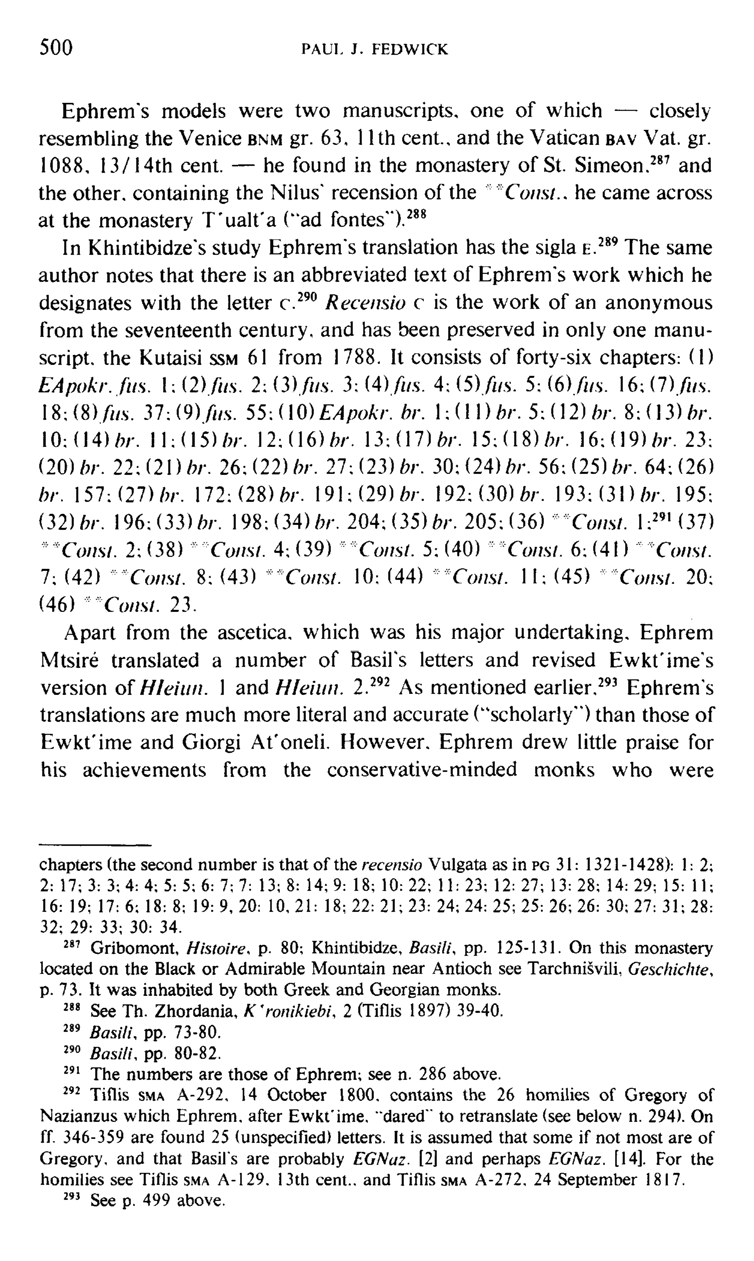
As higoumen of Kastana, Ephrem undertook for the second time the translation of Basil's Asceticon apparently because Procopius' version was not available to his monks. Besides working on a more complete text (of the Vulgata type). Ephrem included many of the works omitted by Procopius. His corpus consists of: i. Hyp. Pr.; ii. Mor. Prl; iii. Mor. PrE; iv.
*Asc. Pr5; v. Index EApokr. fus.; vi. Asc. Pr3-, vii. EApokr. fus. 1-55; viii.
Index EApokr. br.; ix. EApokr. br. 1-313; x. *Epit. 24; xi-xii. ETheod.
[173] + De perf [22]; xiii. Reg. mor. 1-80;285 xiv. "SRen.; xv. "Const.
(30 chapters).286
282 See the Euchologion of Tiflis SMA H-531. 11th cent. According to De Meester (see n. 305 below), col. 1609, the first version of the Georgian Euchologion is from the 10-11th cent; according to Tarchnisvili, Geschichte, p. 168 n. 1, and p. 445. nn. 176-177, from the 9-!0th cent. At any rate, the oldest MSS are from the 11th cent; see below n. 304.
283 On this monastic mountain besides Tarchnisvili (above n. 270) see P. Peeters,
"L'église géorgienne du Clibanion au Mont Admirable," AB 46(1928) 241-286, and W. Ζ.
Djobadze, Materials for the Study of Georgian Monasteries in the Western Environs of Antioch on the Oronles (Louvain 1976) pp. 86-108.
284 Blake, "Georgian," p. 58. On his translation of the scholions of Basil's Asc. 3 see n. 286 below.
285 For the first time in any language. Tarchnisvili. Geschichte, pp. 188-189, gives a confusing information. He implies that Ewkt'ime had already translated Reg. mor.; see likewise Garitte (n. 18 above), and Blake, "Georgian," p. 58. However, as explained before Ethika in Ewkt'ime stands for Homiliae morales not Regulae morales.
286 There are two MSS containing the work of Ephrem; Tiflis SMA A-689, 11/12th cent, from the monastery of Gelathi, and Tiflis SMA A-132, 14th cent, a copy of the previous.
Both are mutilated at the beginning and end. Tiflis SMA A-689 contains the translation of Scholion 8 (Gribomont. Histoire, p. 156). For Ephrem's translations of other scholions of the works of Basil, some of which he incorporated in Gregory of Nazianzus' Or. 43, see
Khintibidze, Basili. pp. 131-134, 158-165. The text of the ""Const, is derived from the recension ν (see Gribomont. Histoire, p. 305). with the following distribution of the
PAUL J. FEDWICK
Ephrem's models were two manuscripts, one of which — closely resembling the Venice BNM gr. 63, 11th cent., and the Vatican BAV Vat. gr.
1088, 13/14th cent. — he found in the monastery of St. Simeon.
287 and the other, containing the Nilus' recension of the '"Const., he came across at the monastery T'ualt'a ("ad fontes").
289 The same author notes that there is an abbreviated text of Ephrem's work which he designates with the letter c.
In Khintibidzes study Ephrem's translation has the sigla E.
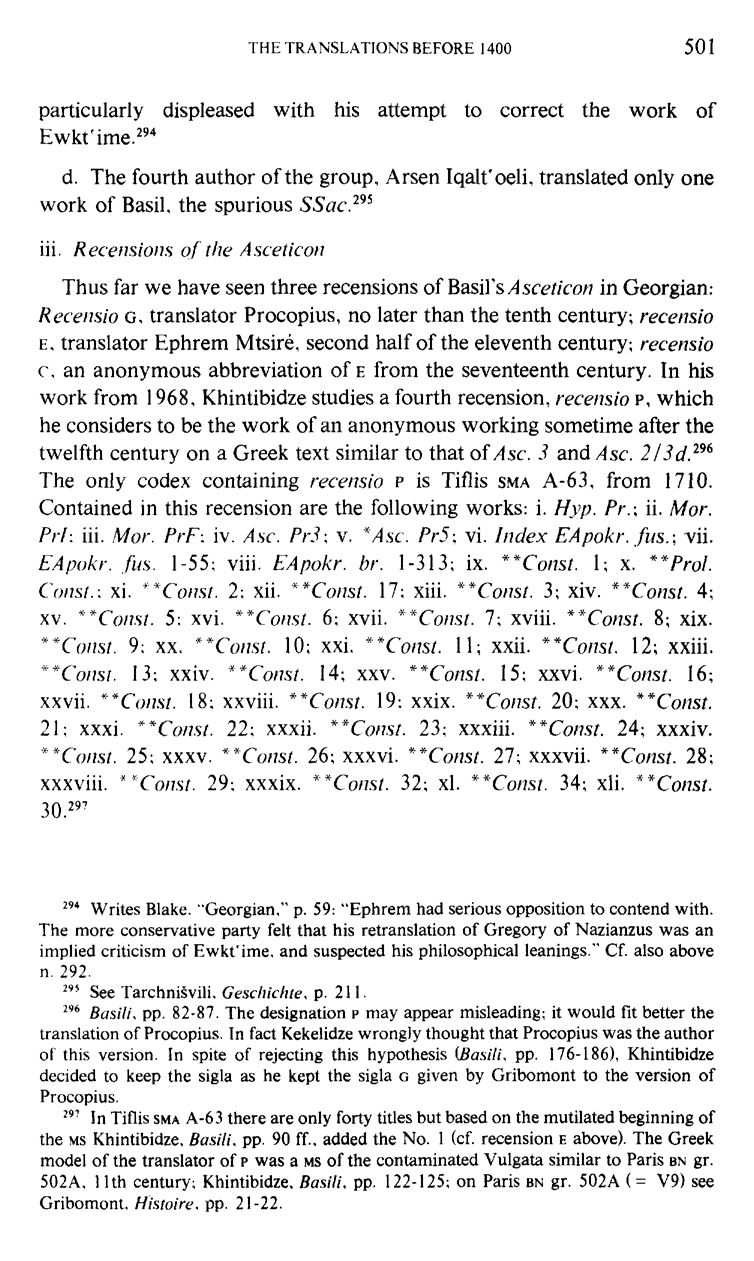
290 Recensio c is the work of an anonymous from the seventeenth century, and has been preserved in only one manu script, the Kutaisi SSM 61 from 1788. It consists of forty-six chapters: (1)
EApokr. fits. I; (2)fits. 2Λ3)fits. 3-, (4)fits. 4-, (5)fits. 5; (6)fits. 16;(7)./i/s. l8;(8)///s. 37:(9)///s. 55:(10)£>1M'/-. br. \;(\\)br. 5;(\2)br. 8:(l3)/»r.
I0;(\4)br. M;(l5)br. \2M6)br. 13:(17)fo·. 15:(18)i>/·. \6A\9)br. 23:
(20) br. 22; (21 ) br. 26; (22) br. 27; (23) br. 30; (24) br. 56: (25) br. 64; (26) br. 157: (27) br. 172: (28) br. 191; (29) br. 192; (30)*/·. 193: (31)/v. 195:
(32)br. \96;(33)br. 198; (34)br. 204; (35) br. 205: (36) "Const. l:
29l(37) "GHIS/. 2; (38) "Const. 4; (39) "Const. 5; (40) "Const. 6; (41) "Const.
7; (42) "Const. 8: (43) "Const. 10; (44) "Const. 11: (45) "Const. 20; (46) "Const. 23.
Apart from the ascetica. which was his major undertaking. Ephrem Mtsiré translated a number of Basils letters and revised Ewkt'ime's version of HIeiun. 1 and HIeiun. 2.292 As mentioned earlier.293 Ephrem's translations are much more literal and accurate ("scholarly") than those of Ewkt'ime and Giorgi At'oneli. However. Ephrem drew little praise for his achievements from the conservative-minded monks who were chapters (the second number is that of the recensio Vulgata as in PG 31: 1321-1428): 1: 2;
2: 17; 3: 3; 4: 4; 5: 5; 6: 7; 7: 13; 8: 14; 9: 18; 10: 22; 11: 23; 12: 27; 13: 28; 14:29; 15: 11;
16: 19; 17: 6; 18: 8; 19: 9, 20: 10, 21: 18; 22: 21; 23: 24; 24: 25; 25: 26; 26: 30; 27: 31; 28:
32; 29: 33; 30: 34.
287 Gribomont, Histoire, p. 80; Khintibidze, Basili, pp. 125-131. On this monastery located on the Black or Admirable Mountain near Antioch see Tarchnisvili, Geschichte, p. 73. It was inhabited by both Greek and Georgian monks.
288 See Th. Zhordania, Κ 'ronikiebi, 2 (Tiflis 1897) 39-40.
289 Basili, pp. 73-80.
2,0 Basili, pp. 80-82.
291 The numbers are those of Ephrem; see n. 286 above.
2»2 Tjfljs S M A A-292, 14 October 1800. contains the 26 homilies of Gregory of Nazianzus which Ephrem, after Ewkt'ime, "dared" to retranslate (see below n. 294). On ff. 346-359 are found 25 (unspecified) letters. It is assumed that some if not most are of Gregory, and that Basil's are probably EGNaz. [2] and perhaps EGNaz. [14]. For the homilies see Tiflis SMA A-129, 13th cent, and Tiflis SMA A-272. 24 September 1817.
2 , 3 See p. 499 above.
THE TRANSLATIONS BEFORE 1400
particularly displeased with his attempt to correct the work of Ewkt'ime.
d. The fourth author of the group, Arsen Iqalt'oeli, translated only one work of Basil, the spurious SSac.
29i iii. Recensions of the Asceticon Thus far we have seen three recensions of Basil's Asceticon in Georgian.·
Recensio G, translator Procopius, no later than the tenth century; recensio ε, translator Ephrem Mtsiré, second half of the eleventh century; recensio c, an anonymous abbreviation of ε from the seventeenth century. In his work from 1968, Khintibidze studies a fourth recension, recensio p, which he considers to be the work of an anonymous working sometime after the twelfth century on a Greek text similar to that of Asc. 3 and Asc. 2 /3d.
The only codex containing recensio ρ is Tiflis SMA A-63, from 1710.
Contained in this recension are the following works: i. Hyp. Pr.; ii. Mor.
Prl-. iii. Mor. PrF: iv. Asc. Pr3; v. *Asc. Pr5; vi. Index EApokr. fus.; vii.
EApokr. fus. 1-55; viii. EApokr. br. 1-313; ix. "Const. 1; x. "Prol.
Const.: xi. "Const. 2; xii. **Const. 17; xiii. **Const. 3; xiv. **Const. 4; xv. **Const. 5; xvi. **Const. 6; xvii. **Const. 7; xviii. **Const. 8; xix.
"Const. 9: xx. **Const. 10; xxi. "Const. 11; xxii. "Const. 12; xxiii.
**Const. 13; xxiv. **Const. 14; xxv. **Const. 15; xxvi. **Const. 16; xxvii. "Const. 18; xxviii. **Const. 19: xxix. **Const. 20; xxx. **Const.
21; xxxi. * "Const. 22; xxxii. **Const. 23; xxxiii. **Const. 24; xxxiv.
"Const. 25; xxxv. **Const. 26; xxxvi. **Const. 27; xxxvii. **Const. 28; xxxviii. "Const. 29; xxxix. **Const. 32; xl. **Const. 34; xii. **Const.
30.
2 9 7 294 Writes Blake. "Georgian," p. 59: "Ephrem had serious opposition to contend with.
The more conservative party felt that his retranslation of Gregory of Nazianzus was an implied criticism of Ewkt'ime, and suspected his philosophical leanings." Cf. also above n. 292.
295 See Tarchnisvili. Geschichte, p. 211.
296 Basili, pp. 82-87. The designation ρ may appear misleading; it would fit better the translation of Procopius. In fact Kekelidze wrongly thought that Procopius was the author of this version. In spite of rejecting this hypothesis (Basili, pp. 176-186), Khintibidze decided to keep the sigla as he kept the sigla G given by Gribomont to the version of Procopius.
297 In Tiflis SMA A-63 there are only forty titles but based on the mutilated beginning of the MS Khintibidze, Basili, pp. 90 ff, added the No. 1 (cf. recension ε above). The Greek model of the translator of ρ was a MS of the contaminated Vulgata similar to Paris BN gr.
502A, 11th century; Khintibidze, Basili, pp. 122-125; on Paris BN gr. 502A (= V9) see
Gribomont. Histoire, pp. 21-22.
PAUL J. FEDWICK
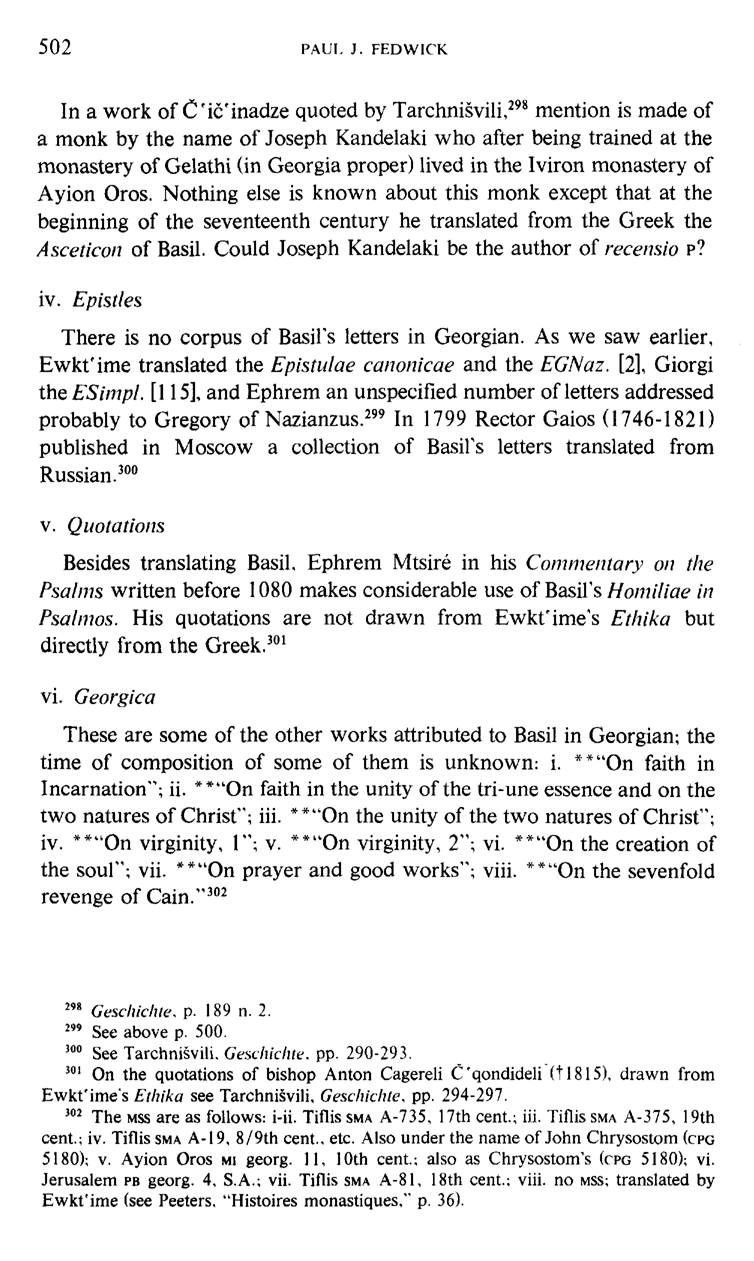
In a work of C'ic'inadze quoted by Tarchnisvili,298 mention is made of a monk by the name of Joseph Kandelaki who after being trained at the monastery of Gelathi (in Georgia proper) lived in the Iviron monastery of Ayion Oros. Nothing else is known about this monk except that at the beginning of the seventeenth century he translated from the Greek the Asceticon of Basil. Could Joseph Kandelaki be the author of recensio P? iv. Epistles There is no corpus of Basil's letters in Georgian. As we saw earlier,
Ewkt'ime translated the Epistulae canonicae and the EGNaz. [2], Giorgi the ESimpl. [115], and Ephrem an unspecified number of letters addressed probably to Gregory of Nazianzus.299 In 1799 Rector Gaios (1746-1821) published in Moscow a collection of Basil's letters translated from Russian.300 v. Quotations Besides translating Basil, Ephrem Mtsiré in his Commentary on the Psalms written before 1080 makes considerable use of Basil's Homiliae in Psalmos. His quotations are not drawn from Ewkt'ime's Ethika but directly from the Greek.301 vi. Georgica These are some of the other works attributed to Basil in Georgian; the time of composition of some of them is unknown: i. **"On faith in Incarnation"; ii. **'Όη faith in the unity of the tri-une essence and on the two natures of Christ"; iii. **"On the unity offne two natures of Christ"; iv. **"On virginity, 1"; v. **'Όη virginity, 2"; vi. **"On the creation of the soul"; vii. **"On prayer and good works"; viii. **"On the sevenfold revenge of Cain."
2 , 8 Geschichte, p. 189 n. 2.
299 See above p. 500.
0 0 See Tarchnisvili. Geschichte, pp. 290-293.
301 On the quotations of bishop Anton Cagereli C'qondideli (tl815), drawn from Ewkt'ime's Ethika see Tarchnisvili, Geschichte, pp. 294-297.
2 The MSS are as follows: i-ii. Tiflis SMA A-735, 17th cent; iii. Tiflis SMA A-375, 19th cent; iv. Tiflis SMA A-19, 8/9th cent, etc. Also under the name of John Chrysostom (CPG
5180); v. Ayion Oros MI georg. 11, 10th cent; also as Chrysostom's (CPG 5180); vi.
Jerusalem PB georg. 4, S.A.; vii. Tiflis SMA A-81, 18th cent; viii. no MSS; translated by Ewkt'ime (see Peeters, "Histoires monastiques," p. 36).
THE TRANSLATIONS BEFORE 1400
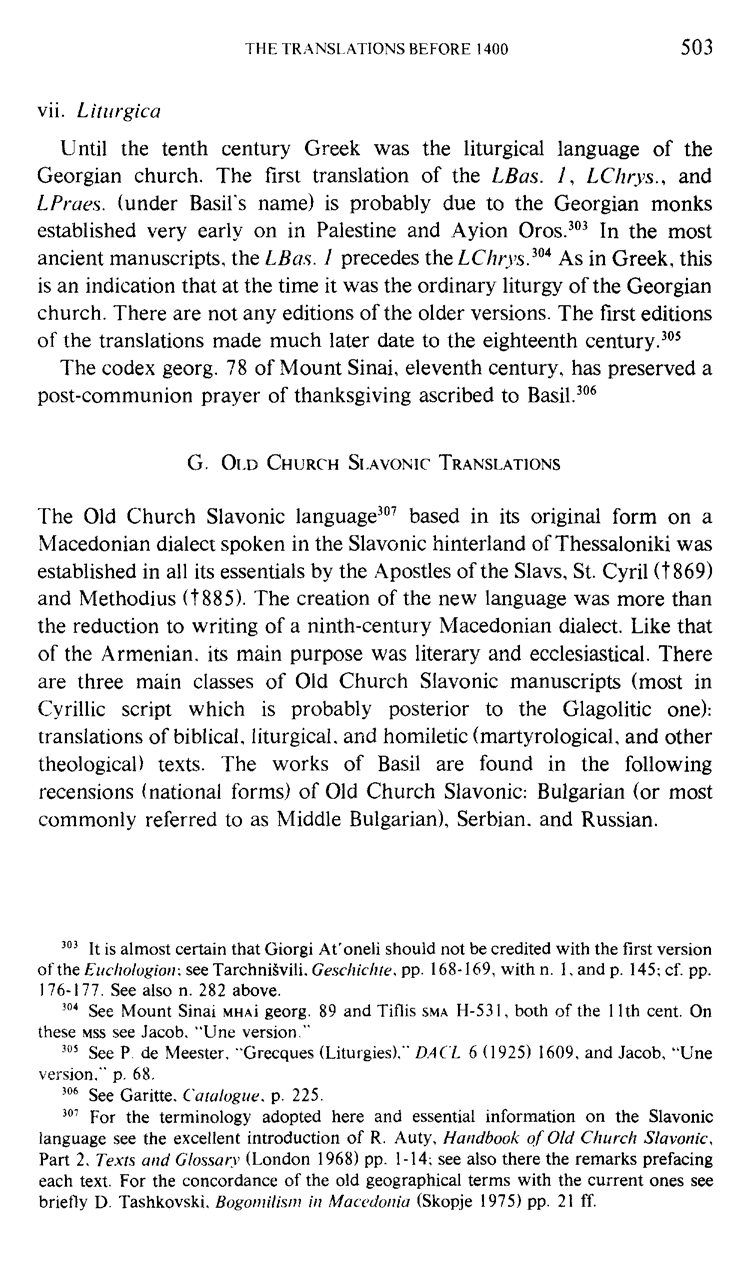
vii. Liturgica Until the tenth century Greek was the liturgical language of the Georgian church. The first translation of the LBas. I, LChrys., and LPraes. (under Basil's name) is probably due to the Georgian monks established very early on in Palestine and Ayion Oros.303 In the most ancient manuscripts, the LBas. 1 precedes the LChrys.m As in Greek, this is an indication that at the time it was the ordinary liturgy of the Georgian church. There are not any editions of the older versions. The first editions of the translations made much later date to the eighteenth century.305
The codex georg. 78 of Mount Sinai, eleventh century, has preserved a post-communion prayer of thanksgiving ascribed to Basil.306
G. OLD CHURCH SLAVONIC TRANSLATIONS
The Old Church Slavonic language307 based in its original form on a Macedonian dialect spoken in the Slavonic hinterland of Thessaloniki was established in all its essentials by the Apostles of the Slavs, St. Cyril (t 869) and Methodius (t885). The creation of the new language was more than the reduction to writing of a ninth-century Macedonian dialect. Like that of the Armenian, its main purpose was literary and ecclesiastical. There are three main classes of Old Church Slavonic manuscripts (most in Cyrillic script which is probably posterior to the Glagolitic one): translations of biblical, liturgical, and homiletic (martyrological, and other theological) texts. The works of Basil are found in the following recensions (national forms) of Old Church Slavonic: Bulgarian (or most commonly referred to as Middle Bulgarian), Serbian, and Russian.
503 It is almost certain that Giorgi At'oneli should not be credited with the first version of the Euchologion; see Tarchnisvili. Geschichte, pp. 168-169, with n. Land p. 145; cf. pp.
176-177. See also n. 282 above.
304 See Mount Sinai MHAI georg. 89 and Tiflis SMA H-531, both of the 11th cent. On these MSS see Jacob, "Une version."
305 See P. de Meester, "Grecques (Liturgies)," DACL 6 (1925) 1609, and Jacob, "Une version." p. 68.
306 See Garitte. Catalogue, p. 225.
307 For the terminology adopted here and essential information on the Slavonic language see the excellent introduction of R. Auty, Handbook of Old Church Slavonic,
Part 2. Texts and Glossary (London 1968) pp. 1-14; see also there the remarks prefacing each text. For the concordance of the old geographical terms with the current ones see briefly D. Tashkovski. Bogomilism in Macedonia (Skopje 1975) pp. 21 ff.
PAUL J. FEDWICK
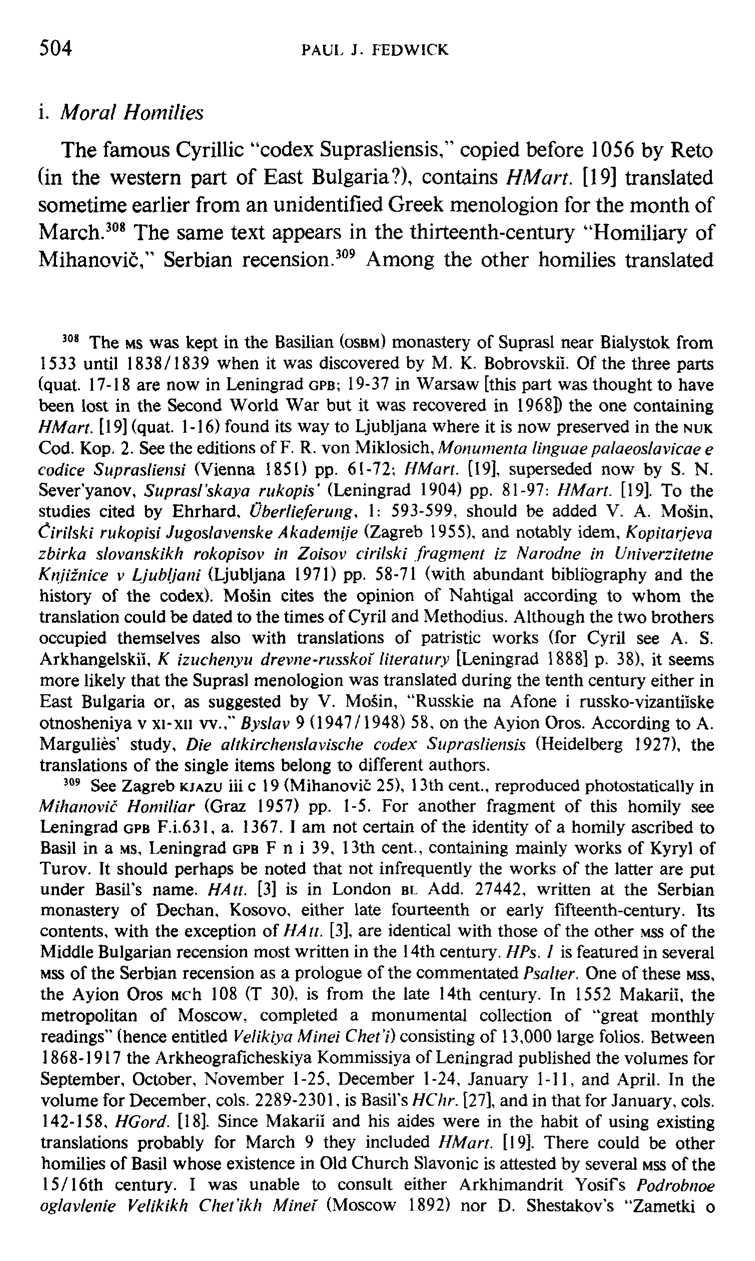
i. Moral Homilies The famous Cyrillic "codex Suprasliensis," copied before 1056 by Reto
(in the western part of East Bulgaria?), contains HMart. [19] translated sometime earlier from an unidentified Greek menologion for the month of March.308 The same text appears in the thirteenth-century "Homiliary of Mihanovic," Serbian recension.309 Among the other homilies translated
308 The MS was kept in the Basilian (OSBM) monastery of Suprasl near Bialystok from 1533 until 1838/1839 when it was discovered by M. K. Bobrovskii. Of the three parts
(quat 17-18 are now in Leningrad GPB; 19-37 in Warsaw [this part was thought to have been lost in the Second World War but it was recovered in 19685 the one containing
HMart. [19] (quat. 1-16) found its way to Ljubljana where it is now preserved in the NUK
Cod. Kop. 2. See the editions of F. R. von Miklosich, Monumenta linguae palaeoslavicae e codice Suprasliensi (Vienna 1851) pp. 61-72; HMart. [19], superseded now by S. N.
Sever'yanov, Suprasl'skaya rukopis' (Leningrad 1904) pp. 81-97: HMart. [19], To the studies cited by Ehrhard, Überlieferung, L 593-599, should be added V. A. Mosin,
Cirilski rukopisi Jugoslavenske Akademije (Zagreb 1955), and notably idem, Kopitarjeva zbirka slovanskikh rokopisov in Zoisov cirilski fragment iz Narodne in Univerzitetne
Knjiznice ν Ljubljani (Ljubljana 1971) pp. 58-71 (with abundant bibliography and the history of the codex). Mosin cites the opinion of Nahtigal according to whom the translation could be dated to the times of Cyril and Methodius. Although the two brothers occupied themselves also with translations of patristic works (for Cyril see A. S,
Arkhangelskiï, Κ izuchenyu drevne-russkoi literatury [Leningrad 1888] p. 38), it seems more likely that the Suprasl menologion was translated during the tenth century either in East Bulgaria or, as suggested by V. Mosin, "Russkie na Afone i russko-vizantiiske otnosheniya ν χι-χιι w.," Byslav 9 (1947/1948) 58, on the Ayion Oros. According to A.
Marguliès' study, Die altkirchenslavische codex Suprasliensis (Heidelberg 1927), the translations of the single items belong to different authors.
309 See Zagreb KJAZU iii c 19 (Mihanovic 25), 13th cent, reproduced photostatically in Mihanovic Homiliar (Graz 1957) pp. 1-5. For another fragment of this homily see
Leningrad GPB F.i.631, a. 1367. I am not certain of the identity of a homily ascribed to Basil in a MS, Leningrad GPB F n i 39, 13th cent, containing mainly works of Kyryl of Turov. It should perhaps be noted that not infrequently the works of the latter are put under Basil's name. HAtt. [3] is in London BL Add. 27442, written at the Serbian monastery of Dechan, Kosovo, either late fourteenth or early fifteenth-century. Its contents, with the exception of HA tt. [3], are identical with those of the other MSS of the Middle Bulgarian recension most written in the 14th century. HPs. 1 is featured in several
MSS of the Serbian recension as a prologue of the commentated Psalter. One of these MSS, the Ayion Oros Mch 108 (T 30), is from the late 14th century. In 1552 Makariï, the metropolitan of Moscow, completed a monumental collection of "great monthly readings" (hence entitled Velikiya Minei Chefi) consisting of 13,000 large folios. Between 1868-1917 the Arkheograficheskiya Kommissiya of Leningrad published the volumes for September, October, November 1-25, December 1-24, January 1-11, and April. In the volume for December, cols. 2289-2301, is Basil's HChr. [27], and in that for January, cols.
142-158, HGord. [18]. Since Makariï and his aides were in the habit of using existing translations probably for March 9 they included HMart. [19]. There could be other homilies of Basil whose existence in Old Church Slavonic is attested by several MSS of the 15/16th century. I was unable to consult either Arkhimandrit Yosifs Podrobnoe ogiavlenie Velikikh Chefikh Minei (Moscow 1892) nor D. Shestakov's "Zametki ο
THE TRANSLATIONS BEFORE 1400
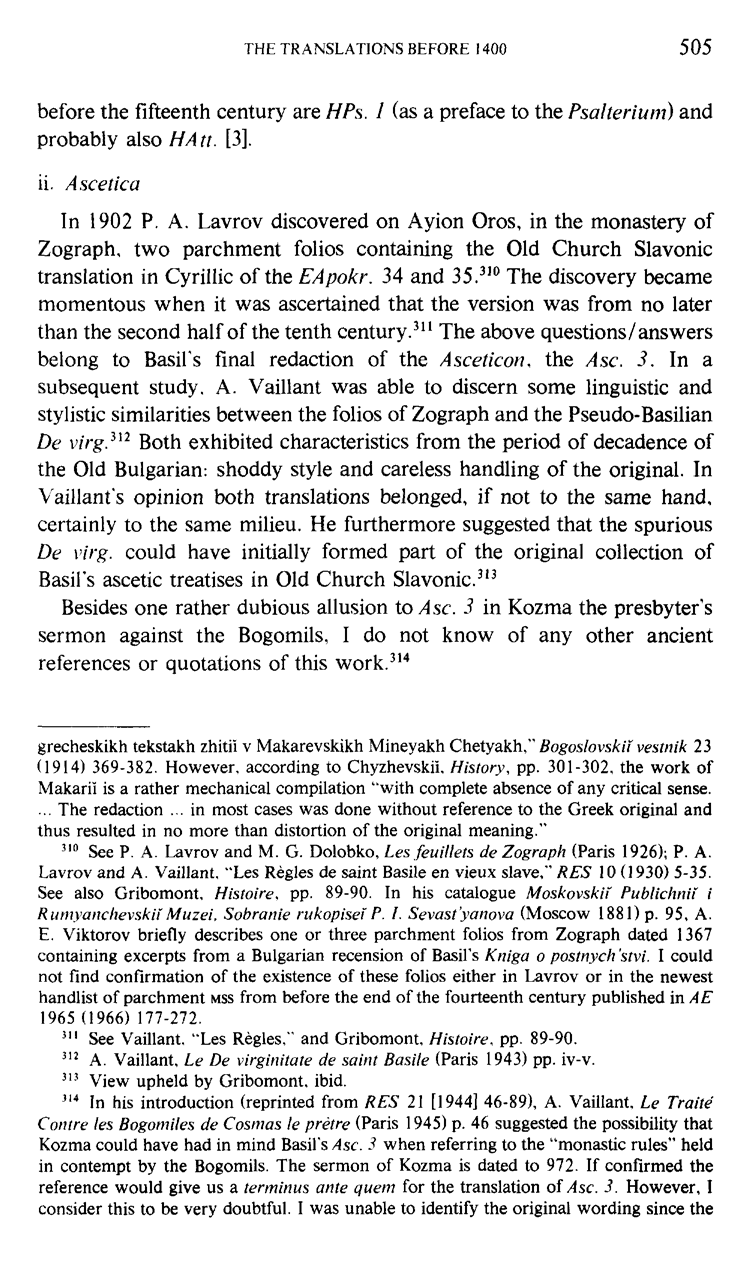
before the fifteenth century are HPs. 1 (as a preface to the Psalterium) and probably also HA tt. [3], ii. Ascetica In 1902 P. A. Lavrov discovered on Ayion Oros, in the monastery of Zograph, two parchment folios containing the Old Church Slavonic translation in Cyrillic of the EApokr. 34 and 35.
310 The discovery became momentous when it was ascertained that the version was from no later than the second half of the tenth century.
311 The above questions/answers belong to Basil's final redaction of the Asceticon, the Asc. 3. In a subsequent study. A. Vaillant was able to discern some linguistic and stylistic similarities between the folios of Zograph and the Pseudo-Basilian
De virg.
112 Both exhibited characteristics from the period of decadence of the Old Bulgarian: shoddy style and careless handling of the original. In Vaillant's opinion both translations belonged, if not to the same hand, certainly to the same milieu. He furthermore suggested that the spurious
De virg. could have initially formed part of the original collection of
Basil's ascetic treatises in Old Church Slavonic.
Besides one rather dubious allusion to Λ sc. 3 in Kozma the presbyter's sermon against the Bogomils, I do not know of any other ancient references or quotations of this work.
grecheskikh tekstakh zhitii ν Makarevskikh Mineyakh Chetyakh," Bogoslovskii vestnik 23
(1914) 369-382. However, according to Chyzhevskii. History, pp. 301-302, the work of Makariï is a rather mechanical compilation "with complete absence of any critical sense.
... The redaction ... in most cases was done without reference to the Greek original and thus resulted in no more than distortion of the original meaning."
310 See P. A. Lavrov and M. G. Dolobko, Les feuillets de Zograph (Paris 1926); P. A.
Lavrov and A. Vaillant, "Les Règles de saint Basile en vieux slave," RES 10 (1930) 5-35.
See also Gribomont, Histoire, pp. 89-90. In his catalogue Moskovskiï Publichnii i RumyanchevskiïMuzei. Sobranie rukopiseïP. L Sevasfyanova (Moscow 1881) p. 95, A.
E. Viktorov briefly describes one or three parchment folios from Zograph dated 1367 containing excerpts from a Bulgarian recension of Basil's Kniga ο postnych 'stvi. I could not find confirmation of the existence of these folios either in Lavrov or in the newest handlist of parchment MSS from before the end of the fourteenth century published in AE
1965 (1966) 177-272.
3,1 See Vaillant. '"Les Règles," and Gribomont, Histoire, pp. 89-90.
312 A. Vaillant, Le De virginitate de saint Basile (Paris 1943) pp. iv-v.
313 View upheld by Gribomont, ibid.
314 In his introduction (reprinted from RES 21 [1944] 46-89), A. Vaillant, Le Traité
Contre les Bogomiles de Cosmas le prêtre (Paris 1945) p. 46 suggested the possibility that Kozma could have had in mind Basil's Asc. 3 when referring to the "monastic rules" held in contempt by the Bogomils. The sermon of Kozma is dated to 972. If confirmed the reference would give us a terminus ante quern for the translation of Asc. 3. However, I consider this to be very doubtful. I was unable to identify the original wording since the
PAUL J. FEDWICK
Both Lavrov and Vaillant maintained that the translation originated in East Bulgaria. However, in view both that the folios were found on Ayion
Oros and that Bulgarian monks lived there since late ninth, early tenth century, it is possible also to suggest that the translation was made there.315 Writes Mosin: "There is no doubt that during the first period of Slavonic literature [i.e., early tenth century] there were Slavs on the Ayion
Oros. They not only lived as hermits in this or that Greek residence but there also existed an important Slavic centre where Greek books were translated and Slavonic MSS copied."316
The version of A sc. 2 was made probably in East Bulgaria between the thirteenth and fourteenth century independently from the previous one.
At any rate the earliest manuscripts are from the fourteenth century. The number of works included in the corpus varies from manuscript to manuscript. I will first enumerate the works contained in the manuscripts of the Middle Bulgarian recension, and then those of the more expanded
Russian recensions A and B. a. Middle Bulgarian recension, four manuscripts ( + 2 of the Serbian recension): i. De perf. [22]; ii. Hyp. Pr.; iii. Mor. Prl; iv. Mor. PrF-, v. *Asc.
Pr5; vi. Asc. Pr3; vii. Asc. 2; viii. **Const. (30 chapters); ix. *SDisc; x.
"SRen.-, xi. EMon. [295]; xii. *Epit. 24; xiii. *Epit. 25; xiv.
"Epit. diversorum SS. de refectorio.311 edition of M. G. Popruzenko, Kozma presviter', bolharskiipysateT x. vyka (Sofia 1936) was not available to me. But even if Kozma had used the word "rule" (pravylo) and not ustav (regulation) he could not have meant Basil'S/tsc. 3. As I explain below, Basil's Asc. 3 or for that matter Asc. 2 is never called or referred to in Old Church Slavonic as rules but as "books" or "sermons on eremitical life." The only "rules" that could have been meant by Kozma would be those of the councils of the church (see above n. 163).
Characteristically enough Metropolitan Fotii, in a letter from 27 June 1418 to the monks of Snitogorsk, refers to the "ustav" of the "Great Basil, in no way inferior to the Apostles" but at the same time mentioning other fathers: PDRKP 1 (1880) 394. The quotations of the EApokr. br. in thelzbornik of Syatoslav of 1073 (copy of an archetype from the latter part of the 10th cent.) are translated directly from the Greek. On the superiority of their literary style see Vaillant, Le De virginitateTwo things may be inferred from this: (a) that the translation of Asc. 3 is posterior to that of the Izbornik (hence later than the tenth century);
(b) that Asc. 3 (because translated on Ayion Oros) was unknown to the translator of the Izbornik or otherwise, he would have followed the general practice and availed himself of the existing translation, 315 See Mosin, "Russkie," pp. 57-58. The monastery of Zograph was founded by the Bulgarian monks in 919; ibid., p. 57.
316 Mosin, "Russkie," p. 57.
317 London BL Add. 27442 adds HAtt. [3]. For details on this and other MSS see my forthcoming "Survey" (n. 3 above).
THE TRANSLATIONS BEFORE 1400
b. Russian recension A, Moscow GIM Uvarov 506, fourteenth century: i. Ps.-Amphilochius, Vita et miracula Basilii; ii. De perf. [22]; iii. *Asc.
Pr5. iv. Hyp. Pr.; v. Asc. 2; vi. **Const. (30 chapters); vii. *SDisc; viii-ix.
"SRen.
+ EMon. [295]; x-? 'Epit. 24 + ?; xi. "SSac.
(CPG 2933.2).318
c. Russian recension B, sixteenth century onward: i. Ps.-Amphilochius, Vita et miracula Basilii; ii-iii. De perf. [22] + ETheod. [173]; iv. Hyp. Pr.; v. Mar. Prl; vi. Mor. PrF; vii. Index, Reg. mor. 1-80; viii. *Asc. Pr5; ix.
Asc. Pr3. x. EApokr. fus. 1 (as a prologue, followed by the Index); xi. Asc.
2-, xii. Index, **Const. (30 chapters, with preface); xiii. *SDisc; xiv.
**SRen.; xv. EMon. [295] (followed by a Scholion); xvi-xvii. *Epit. 11 ( = 24) + **53; xviii. *Epit. 25; xix. **Epit. diversorum SS. de refectorio; xx.
HAtt. [3]; xxi. HIeiun. 1: xxii. HIeiun. 2; xxiii. HGrat. [4].319
Without entering upon details which would take us beyond the scope of this essay, I would like to make one or two remarks regarding this second Old Church Slavonic translation of Basil's Ascetic Hypotyposis. The closest Greek model to a. seems to be the current Vatican BAV Vat. gr. 431, thirteenth century, listed in Gribomont as Sftudita] 4.320 In both cases the Reg. mor. are omitted despite the presence of Hyp. Pr., Mor. Prl and Mor.
PrF. The similarity, however, ends after A sc. 2.
The Russian recension A descends probably from the Middle Bulgarian Moscow GBi. 129. This manuscript was either brought to the TroitseSergieva Lavra by the Serbian monks in the fourteenth century or was written there by the same.321 Unfortunately I do not have a complete description of this manuscript in order to ascertain, among other things, if the Pseudo-Amphilochian Vita was already there. The addition of the spurious SSac. could suggest the presence of priests in the monastic community.
318 Of the six MSS only one, the Uvarov 506, is fully described in the catalogues. The scriptoria are as follows: Troitse-Sergieva Lavra (Zagorsk), founded by Sergiï of Radonezh
(t 1392); monasteries of Andronikov and Chudov, Moscow, both founded by Metropolitan Alekseï (t 1378). Some of the fourteenth-century MSS ended up later on in the monasteries of Sarov and Kirilo-Bilozersk.
319 There are some twelve MSS of this recension. They will be described in my forthcoming "Survey" (see n. 3 above).
320 Histoire, pp. 29-30.
321 See G I. Vzdornov, "Rof slavyanskikh monastyrskikh masterskikh pis'ma Konstantinopolya i Afona ν razvitii knigopisaniya i khudozhestvennego oformleniya russkikh rukopiseï na rubezhe xiv-xv w.," TODRL 23 (1968) 178.
PAUL J. FEDWICK
Recension β falls outside the purview of this paper and I shall not comment on it other than to mention that it has once been printed at Ostrogin 1594.
For the works shared in common all three recensions have basically the same text, with only slight linguistic variations. Rather interesting about this second version is the fact that for the Greek ασχησις it consistently adopts the term "postnych'stvo" rather than "podvyzanie" as in the previous translation.
323 The word "postnych'stvo" and its cognates literally means "fasting."
324 However, it seems more likely that its real meaning was then the same as that of the modern Bulgarian, "eremitical life." This semantic peculiarity is rather revealing and it is confirmed by the history particularly of Russian monasticism where no single set of rules was followed and where eremetical tendencies have always pre dominated.
325 The ideal place for practicing asceticism for the Russian monks was the "pustynya" = desert, not the cenobitic life advocated by Basil. Hence Basil's Asceticon was used, alongside other ascetic treatises, as a book for reading more than as a rule to be obeyed. This explains also the other titles given to his Asceticon in the manuscripts: "Vyprashaniya postnych'ska" = "quaestiones asceticae" (lege: "de vita in eremo"; Middle
Bulgarian recension); "hlavy," "slovesa postnych'skiya" = "capitula, ser mones ascetici," or "Knyha ο postnych'stve" = "liber asceticus" ( = "de ieiunio"; life of continence in solitary confinement).
One final remark about this second version concerns the philological aspect. The translation is so literal and full of hellenisms (lexical, syntactical) that at times it is hard to understand without consultation of the Greek text. This certainly speaks for its archaicity; it was made at the time when Old Church Slavonic did not have all the resources for conveying elaborate and abstract concepts such as those related to ascetic life. On account of the fact that often the order of the Greek sentence is
322 For a full description of this edition see my "Survey" (n. 3 above); also I. P.
Karataev', Opisanie slavyano-russkikh knig' napechatannym' kirillovskimi bukvami, l s
1491 po 1652 g (Leningrad 1883) No. 132, and now Ukrainskie knigi kirillovskoipechati xvi-xvmvv. Katalog izdanii(Moscow 1976) No. 7 with the plates Nos. 241, 354, 358, 374,
407, 655, 660, 722, 803, 809.
323 Cf. Vaillant, Le De virginitate, pp. iv-v, 96.
324 See Slovnik jazyka staroslovinskeho, 2 (Prague 1973) 200; I. I. Sreznevskiï,
Materialy dlya slovarya drevne-russkogo yazyka po pis'menny'im pamyatnikam, 2 (Leningrad 1902) 1263; I. A. Lysaght, Material Towards the Compilation of a Concise Old
Church Slavonic-English Dictionary (Wellington 1978) p. 289.
325 See F. von Lilienfeld, Nil Sorskij und seine Schriften (Berlin 1963) p. 104, with n. 33. Cf. also Fedwick, Svyatyi Vasylii, p. 195.
THE TRANSLATIONS BEFORE 1400
kept and that many of the untranslateable particles have corresponding words, the Old Church Slavonic version of Asc. 2 should be of some importance for the critical establishment of the original text. iii. Hexaemeron The only surviving manuscript of Basil's Hexaemeron in Slavonic is that of the Serbian recension, Ayion Oros MCh. 405, written in late fourteenth and early fifteenth-century.326 That an earlier version of this work of Basil is sometimes asserted in manuals of Slavic literature is due to a twofold error. First, it is believed because of the similar title, that John the Exarch translated into Old Church Slavonic Basil's Hexaemeron in the latter part of the tenth century. However, the so-called Hexaemeron of John the Exarch is not the translation of any particular or single work but an original composition or rather a congeries of texts containing long unacknowledged quotations from at least three authors. First and foremost John draws from Basil's homonymous work. Among his other sources are the In cosmogoniam 1-6 of Severian of Gabala and Theodoret of Cyrus' Graecorum affectuum curatio, 4: De materia et mundo.121 The second cause for the mistaken belief that there was an earlier version of Basil's Hexaemeron stems from some manuscripts in which is ascribed to Basil the above work of Severian translated early into Old Church
Slavonic under the title "Shestodnevnek," i.e., "Hexaemeron."328
The other Slavic versions of the Hexaemeron are those Russian ones from the seventeenth century of Sichkarev, Slavenetskii and Mladenovich'. They all are based on the edition of Erasmus (Basel 15 32) and hence contain eleven homilies. iv. Extracts and Quotations Excerpts from several genuine and spurious works of Basil are extant in various collections and florilegia of which some, the better known, were
326 Besides Basil's Hex. 1-9 the Chilandar MS has Gregory of Nyssa's De horn. opif. (31 chapters with the preface). The last 17 folios are taken up by excerpts from various authors. In her study "Katalog miniatyur," ZOR 22 (1960) 96, n. 33, T. B. Ukhova mentions a fifteenth-century MS of the Hexaemeron apparently of the Russian recension on which I was unable to gather more information.
327 See the photostatic reprint of John's Hexaemeron, with parallels from all the various sources, by R. Aitzemüller, Das Hexaemeron des Exarchen Johannes, 1 v. (Graz
1958-1967).
328 See, e.g.. Kazan NBKU 114.
PAUL J. FEDWICK
translated from the Greek; the Izbornik of Svyatoslav of 1073,329 the Nomocanons,310 and the various homiliary type collections such as Zlatostruî, Izmaragd, Zlataya tsip, and Pchela.331 Other early anthologies using Basil are original, Old Church Slavonic, compositions of which the most widely spread were the Izbornik of Svyatoslav of 1076, the Pouchenie dityam of the Grand Prince Vladymyr Monomakh from 1117, the Mirelo pravednoe from the twelfth or thirteenth century, and the Kormchaya knyha from the thirteenth century.332
329 The Izbornik ( - Collection) of 1073 is a Byzantine miscellany translated from the Greek in Bulgaria in the 9th cent, for Tsar Simeon. In 1073 it was recopied in Kiev by John the Scribe for the Grand Prince Svyatoslav. The original copy is now in Moscow GIM
(slav.) 161. Here are its Basilian contents: f. 4: ""C.Eun. 5; f. IW-.EApokr. br. 61; f. 187: br. 62; f. 190: br. 63; f. 193v: br. 64; f. 198v: br. 65; f. 205v: br. 66; f. 209: br. 67; f. 209v: br. 68; f. 2l0-.br. 69; f. 210v: br. 70; f. 211: br. 128; f. 21 Γ: br. 71, 72; f. 24Γ: ""EApokr.
Basilii el Gregorii.
330 The Synagogue of John Scholasticus (t577) was translated into Old Church Slavonic probably by Methodius in the 9th cent.; see R. Souarn, "Disciplina bizantina, 2;
Bulgari,"cco 8 (1932) 192-193. The translation of the Syntagma xiv titulorum is probably from the 11th cent; see the edition of V. N. Beneshevich, Drevne-slavyanskaya
Kormchaya xiv titulov' bez' tolkovanii(Leningrad 1906), Greek and Old Church Slavonic text, the Canons of Basil (1-93 as in CPG 2901) at pp. 460-531. Both collections were incorporated into the Kormchaya knyha on which see below n. 332.
331 All three florilegia—Zlatostruî = "Golden stream," Izmaragd - "Emerald," and Zlataya Tsip - "Golden Chain" — were done into Old Church Slavonic in Bulgaria in the 9/10th cent. See the study of V. A. Yakovlev, Κ literaturnoi istorii drevne-russkikh sbomikov (Odessa 1893). The author studies chiefly the Izmaragd from the MSS of the 14to
16th centuries (five classes). It should be noted that from the literary point of view the Izmaragd is an expanded form of the Izbornik of 1076. For a good overview of the contents of this as it were lay manual of "normal Christian ethics" see G. P. Fedotov, The Russian Religious Mind (ii). The Middle Ages. The 13th to the 15th Centuries (Belmont,
Mass. 1975) pp. 39-112. The Pchela = "Bee" (μέλισσα) is the Slavonic name for Ps.Maximus' Loci communes, translated in Kiev during the 12th cent; see in particular the edition of V. Semenov cited in P. J. Fedwick, "The Citations of Basil of Caesarea in the Florilegium of Pseudo-Antony Melissa," OrChrP 45 (1979) 33, n. 3. In other prefourteenth-century writers such as Kyryl Turovskiï (1130-1182), Serapion bishop of Vladimir (t 1275), etc., the use of Basil is insignificant. On the painting of Basil by Feofan
Grek (late 14th cent.) see Ocherki russkoi kul'tury xm-xv vekov, 2: Dukhovnaya kul'tura
(Moscow 1970) p. 326.
332 The Izbornik of 1076, partly composed in Greek and partly written in Old Church
Slavonic (in Kiev ?), has a quotation from HEbr. [14] under the name of prophet Joel, see
V. Bobrov, "Fragmente Basilius' des Großen [des Propheten Joël] in der Handschrift
Sbornik Svijatoslava vom Jahre 1076," ArSIPhil 26 (1904) 478-480. Another text, reproduced in Monomakh's "Instruction," is derived from the Pseudo-Amphilochius'
Vita. For this quotation and its similarity with "SDisc. see A. Vaillant, "Une source grecque de Vladimir Monomaque," Byslav 10 (1949) 11-15. See also V. P. AdriyanovPerets, "Aforizmy Izbornika Svyatoslava 1076 g. i russkie poslovitsy," TODRL 25 (1970)
3-19, and the latest edition of V. C. Golyshenko, et al., edd. Izbornik 1076 g. (Moscow
THE TRANSLATIONS BEFORE 1400
v. Liturgy and Letters in Canonical Collections In 1909 Orlov. a protoiereus and professor at the Spiritual Academy of Leningrad, published a bilingual, Greek and Old Church Slavonic edition of the LBas. I based on some twenty-two Slavic manuscripts of which several were from the twelfth to fourteenth century.333 Orlov estimated that the first version of LBas. 1 was to be dated to the times of Cyril and Methodius (second half of the ninth century). Two or three centuries later this translation underwent revisions. In the various manuscripts collated for his edition Orlov identified two recensions, one from the end of the fourteenth century containing the revisions of the Metropolitan of Moscow Kiprian ('''1407). the other, with those of Patriarch Nikon from 1654-1655.334 More than simple revision, Nikon's recension was almost a completely new translation based no longer on the pre-existing Slavic translations (as was the case with Kiprian's recension) but on the Greek manuscripts.
Besides EMon [295], which in Slavic appears continuously as part of Basil's ascetic corpus, a few other letters are featured in canonical collections antedating the fifteenth century. The three canonical letters to Amphilochius [188. 199. 217] withEGreg. pb. [55] appear in Moscow GIM
1965). On Monomakh's Pouchenie dityam ("Instruction for my children"), in addition to the above studies, see A. S. Orlov, Vladimir Monomakh (Moscow/Leningrad 1946) esp. pp. 11 i-118; I. U. Budovnits, "'Izbornik' Svyatoslava 1076 goda 'Pouchenie' Vladimira
Monomakha i ikh mesto v istorii russkoï obshchestvennoï mysli." TODRL 10 (1954) 4475, from whom p. 66, n. 3, I take the date 1117 against Vaillants 1103; and G P.
Fedotov, The Russian Religious Mind (i) Kievan Christianity. The 10th to the 13th
Centuries (Belmont, Mass. 1975) pp. 244-260. The latest reprint of the text can be found in PSRL 1 (1962) 240-247. For the Merilo pravednoe ("Standard of Justice." a manual for judges) and the six quotations from Basil (only one authentic from the canonical epistles) see the photostatic reproduction of Moscow GBI. 15,14th cent., published by the Russian
Academy of Sciences (Moscow 1961 ). The Kormchaya knyha (lit. "Book of the rudder") is a rather curious collection of canonical and polemical (anti-Latin) writings composed entirely on Slavic soil but of works already existing in translation. Included were the two
Nomocanons mentioned above; see n. 330. See I. Zuzek. Kormcaja kniga. Studies on the Chief Code of Russian Canon Law (Rome 1964). The oldest MS is that of Novgorod from ca. 1280. See also p. 512. below.
333 Liturgiya svyatago Vasiliya Velikogo (Leningrad 1909). For useful handlists of Slavic liturgical MSS see also Engberding, Das eucharistische, pp. xxxii, xliv-xlv, lx-lxii
(critical value), and R. Taft, The Great Entrance (Rome 1975) pp. 444-446.
334 Liturgiya, p. xlix. On Kiprian see L. A. Dmitriev, "Roi' i znachenie mitropolita
Kipriana ν istorii drevnerusskoï literatury (k russko-bolgarskim literaturnym svyazam xiv-xv vv.)." TODRL 19 (1963) 215-254; see also G. I. Vzdornov, "Rol" slavyanskikh," pp. 173. 182-183. I omit citing works on Nikon as his activity falls outside the scope of this essay.
PAUL J. FEDWICK
335 with entries from the Kormchaya knyha. Also as part of the Kormchaya (later recensions) is often featured EGNaz. [2].
Khludov 118, 14th century. This codex is a Trebnik, m 335 Slavic for εύχολόγιον, collection of prayers for various occasions.
336 See above nn. 330, 332. For some of the prayers ascribed to Basil see the eleventhcentury Euchologion sinaiticum, PO 24: 758-772 (exorcisms), PO 25: 606 (prayer of the prothesis).
Basil and the Early Medieval Latin Canonical Collections Roger E. Reynolds Pontifical Institute of Mediaeval Studies
Collections of canon law compiled during the early Middle Ages in the West are well known for their paucity of canons drawn from the fathers.
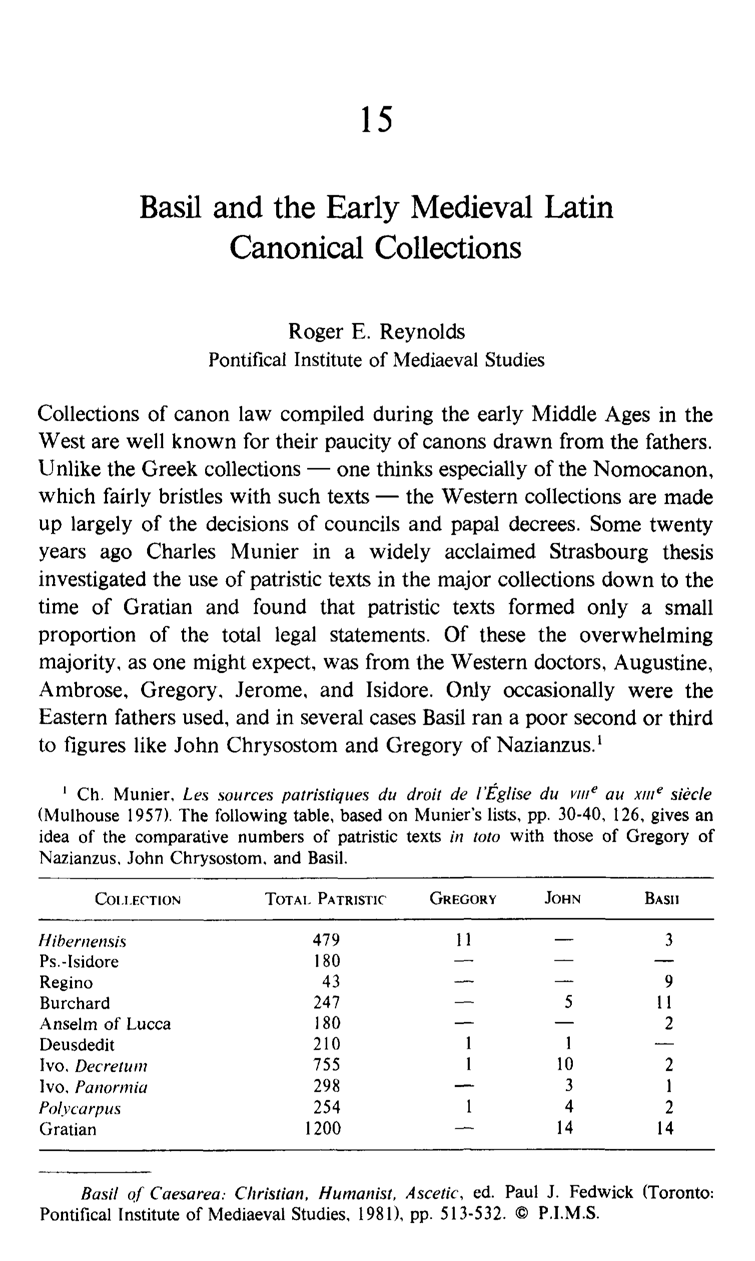
Unlike the Greek collections — one thinks especially of the Nomocanon, which fairly bristles with such texts — the Western collections are made up largely of the decisions of councils and papal decrees. Some twenty years ago Charles Munier in a widely acclaimed Strasbourg thesis investigated the use of patristic texts in the major collections down to the time of Gratian and found that patristic texts formed only a small proportion of the total legal statements. Of these the overwhelming majority, as one might expect, was from the Western doctors, Augustine,
Ambrose, Gregory, Jerome, and Isidore. Only occasionally were the Eastern fathers used, and in several cases Basil ran a poor second or third to figures like John Chrysostom and Gregory of Nazianzus.1
1 Ch. Munier, Les sources patrisiiques du droit de l'Église du viiie au xme siècle
(Mulhouse 1957). The following table, based on Munier's lists, pp. 30-40, 126, gives an idea of the comparative numbers of patristic texts in toto with those of Gregory of Nazianzus, John Chrysostom, and Basil.
JOHN GREGORY BASH
COLLECTION
TOTAL PATRISTIC
— — —
— — — — Hibernensis Ps.-Isidore Regino Burchard Anselm of Lucca Deusdedit Ivo, Decretum Ivo, Panormia Polycarpus Gratian
— Basil of Caesarea: Christian, Humanist, Ascetic, ed. Paul J. Fedwick (Toronto:
Pontifical Institute of Mediaeval Studies, 1981), pp. 513-532. © P.I.M.S.
ROGER Ε. REYNOLDS
Given his monumental task of sifting through and identifying patristic texts scattered through thousands of canons in the collections, Professor
Munier limited his research largely to the collections printed to his time, the Collectio hibernensis, Pseudo-Isidore, Regino, Burchard, Anselm of Lucca, Deusdedit, Ivo, and Gratian.
2 But if one goes to the manuscripts of early medieval Western collections, both major and minor, and some of the collections edited since Munier's thesis, an unexpected number of canons attributed to Basil can be found, enough to show that Basil's role in the formation of Western canon law was not quite as insignificant as a hasty look at the collections might seem to indicate. To anyone familiar with the hundreds of manuscripts of the scores of canonical collections written to the time of Gratian, it will come as no surprise that the present contribution is not based on a complete investigation of all the collections and their manuscripts. But it seems appropriate in a volume dedicated to making better known the influence of Basil on the culture of both East and West that a beginning be made in establishing the place of Basil in the canonical sources of Western Christendom.
Specialists in early medieval canon law collections generally introduce their studies by making a distinction in the types of collections they examine, and in an essay dealing with the appearance of Basil's texts in the scores of early medieval collections one may examine, it is useful to repeat this distinction. There are first the so-called chronologically or historically arranged collections, and second the systematically or topically arranged collections, within which is the subdivision of penitential collections.
3 In the historically arranged collections the decisions of councils and popes are ordered in the temporal sequence in which they were given. Hence, in the eonciliar parts of these collections one starts with the Councils of Aries or Nicea, etc., and in the papal sections one begins with the "decisions" of Clement, Anacletus, Damasus, or whomever. On the face of it, it would seem that to look in a chronological collection for the texts of Basil (or any other Eastern father
2 For the Polycarpus Munier used Paris BN lat. 3881. For his typed thesis, which contains extensive tables not reproduced in the printed version, Munier also used the Collection in 3 Parts, and the Sententiae Magistri A. See Ch. Munier, "À propos des textes patristiques du Décret de Gratien," in Proceedings of the Third International Congress of Medieval Canon Law, Strasbourg, 3-6 September 1968, ed. S. Kuttner (Vatican 1971) p. 43. n. 2.
3 On the distinction between historical and systematic collections see H. Mordek,
Kirchenrecht und Reform im Frankenreich: Die Collectio Vetus Gallica, die älteste systematische Kanonessammhmg des fränkischen Gallien: Studien und Edition (Berlin/
New York 1975) pp. 2-4.
LATIN CANONICAL COLLECTIONS
for that matter) would be futile. This type of patristic canon simply did not fit within the chronological arrangement of papal and eonciliar texts. But as will be seen, texts of Basil did occasionally find their way into the chronological collections as supplements to provide doctrinal support for the decisions of councils and popes.
The second major type of early medieval canonical collection is the systematic collection in which a compiler has arranged the canons he has found in historically arranged collections according to topic. In these collections compilers felt little compulsion to use only papal and eonciliar texts, and, moreover, little compulsion to copy a "pure" text of any canon.
It is in this systematically arranged type of collection where one would expect to find patristic texts supplementing those from popes and councils and where one looks for and indeed finds a great many texts genuinely and not-so-genuinely Basil's.
Before the ninth century most Western canonical collections were historically arranged, but a survey of these collections shows that Basil citations were inserted not so much in the decisions of the councils and popes themselves, but in the florilegia of patristic citations that the canonistic compilers added to lend support to doctrinal statements. One of the first examples of this is in the so-called Collectio Palatino that Schwartz found represented in at least nine manuscripts, two of which have well-known ancient collections, the Collectio Vaticana and the Collectio Hadriana." In the Collectio Palatino a text from De Sp. S. 8 is used once in the Gesta Ephesenas and is repeated in the Florilegium of Cyril of Alexandria6 The same text is cited in the Florilegium ofEutyches found in the Collectio Novariensis of Novara BC 30.7
In another florilegium. with a title Incipiunt testimonia sanctorum patrum duas naturas in Christo confltentium, a Basil text from C. Eun. 1 is connected with the decisions of the Council of Chalcedon. Again this text
4 Schwartz, ACO 1.51, based his edition of the Collectio Palatino on Vatican BAV Pal. lat. 234 (s. 6/7). Oxford BL 102 (s. 6/7), Berlin DSB 1743 (s. 82); the Collectio Vaticana found in Vatican BAV Vat. lat. 1342 (s. 8), Barb. lat. 679 (s. 8/9), Florence BI.M Aedil. 82 (s.
9-,/4); and the Collectio Hadriana aucta found in Vatican BAV Vat. lat. 5845 (s. 10'),
Munich Clm 14008 (s. 92), Rome BV A.5 (s. 93/4). On these collections and MSS see Mordek,
Kirchenrecht, pp. 10, 43, 59.
5 ACO 1.5.1 (p. 94): 21 [xv] Basilii sanctissimi episcopi Caesariae Cappadocie Primae.
Neque tantum caelum et terra ... inpassibilitatem donaret ( =De Sp. S. 8, PG 32: 100.)
6 ACO 1.5.1 (p. 141): Cyrillus Apologeticus contra Orientales (cf. CPG 522).
7 ACO 2.2.1 (p. 75): Basilii episcopi Caesariensis primae Cappadociae. Neque enim tantum caelum et terra et magnitudo pelagi et cetera.
ROGER Ε. REYNOLDS
is incorporated into many ancient canonical collections and manuscripts, including Novara BC 30.
Closely related in the Novara codex to the Testimonia sanctorum patrum with its Basil text is a florilegium of texts under the title Incipit
9 This florilegium is especially well known to Basil textual experts as containing extracts from Basil's HFide [15], exempta sanctorum patrum.
**EGNys. [38], De Sp. S. 18.45, and a canon attributed to a Sermo de incarnatione domini of Basil but in reality from Rufinus' translation of Origen's Peri archon.
10 What has not been fully appreciated by the Basil textual experts is that this Novara manuscript is actually one of the great early medieval compilations of canonical collections and contains not only the third recension of the Collectio Dionysio-Hadriana, but also the ancient Collectio Vaticana and Spanish Collection of Novara.
Another text attributed to Basil but again taken from Rufinus" translation of Origen's Peri archon is included in a letter of another participant in the events surrounding the Council of Chalcedon, Pope Leo i. In his Ep. 165, Leo used this Ps.-Basilian canon, and it came to be included in virtually all of the great chronological collections of canon law in the early Middle Ages, including the Collectio Vaticana, Collectio
Quesnelliana, Collectio Hadriana, Collectio Hispana, and the PseudoIsidorian Decretals.
Another pope, Gelasius i, in a Latin florilegium on the two natures of Christ entitled Testimonia veterum de duabus naturis in Christo cited three
8 ACO 2.3.3 (p. 119): Sancti Basilii ex his quae contra Eunomium scripsit. Ego enim et hoc quod est... sine dubitatione commendat ( -C. Eun. 1, PG 29: 552.) The Basil text in the Gesiorum Chalcedonensium versio a Rustico édita was found by Schwartz in large numbers of MSS including Paris BN lat. 16832 (s. 9), Vatican BAV Reg. lat. 1045, Vat. lat.
1319 (s. 12), Vat. lat. 1322 (s. 6 ex.), Milan BA Ε 147 Sup. (s. 7), Montpellier BEM 58 (s. 9),
Novara BC 30 (s. 9), Leyden BRU VOSS. 122, Verona BC 58 and 59 (s. 6/7).
9 Cf. A. Reifferscheid, Bibliotheca Patrum Latinorum Italica, 2: 251 f.
10 For the texts of these extracts see Exempta sanctorum patrum quod "unum quemlibet" <licet> "Ex beata trinitate" dicere, CCSL 85: 126 f,
" For the date of this MS see Mordek, Kirchenrecht, p. 244; and E. Cau, "Osservazioni sul cod. lat. 1616 (sec. 8 ex.) della Biblioteca Nazionale di Vienna," in Palaeographica diplomatica et archivistica (Rome 1979) p. 90; and for the contents of the MS see G.
Picasso, "I codici canonistici della biblioteca Capitolare di Novara nella récente storiografia," Novarien 5 (1973) 7-9, and literature therein. For the various collections in the MS see Mordek, Kirchenrecht, p. 242; pp. 10 f., nn. 40 f.; p. 43, n. 32, and literature cited therein.
12 ACO 2.4 (p. 125)(cf. PL 54: 1185): xmi Item sancti Basilii episcopi Cappadocis. Cum ergo quaedam in Christo ... inlusa imaginibus aestimentur. ( = Rufinus' translation of Origen's Peri archon 2.6.2, ed. P. Koetschau,GCS [Leipzig 1913]p. 141.) For the collections in which this canon is contained see ACO 2.4 (p. 125), and the Décrétâtes PseudoIsidorianae, ed. P. Hinschius (Leipzig 1863) p. 590.