
3. Basil himself makes no use of the "Creed," though he had ample
BASIL'S "NEOPLATONISM"
314 If this were to prove correct, it might seem that the prima facie likelihood of Basil's being the author of De sp. would increase: the De sp. would appear to be his blend of material later known as the "Creed of Gregory Thaumaturgus" with Plotinus. For it is certain that the first ascription of the Creed that we know to Gregory
Thaumaturgus (together with the first publication of its full text) is made by Gregory of Nyssa way dependent on Basil.
315 after Basil's death. However, if Basil wrote De sp., we have to credit him at some stage of his career with a degree of respect for Plotinus (at least for Ennead 5.1) which we might otherwise never have suspected.
Let us now inspect at least the major points of Abramowski's argument that the "Creed" (if that is the proper rendering) of Gregory Thaumatur gus is dependent on Basil:
1. The first extant complete version of the "Creed" that we have is to be found in Gregory of Nyssa, who is also the first to mention the ascription of this material to Gregory Thaumaturgus. The date of Gregory's Life of Gregory in which this appears is uncertain, but it is between 381 and 395.
2. Gregory of Nazianzus appears to quote from the "last section" of the "Creed" in 380 or 381, 316 but not as the work of Gregory Thaumatur gus, but of "one of the inspired men" (θεοφόρων) of not long ago.
(Caspari, 317 implausibly, thought that this θεόφορος must be Gregory Thaumaturgus, referred to rhetorically.)
3. Basil himself makes no use of the "Creed," though he had ample opportunity to do so, especially in his dispute with Atarbius of Neocaesarea.
318 (In ENeoc. pm. [210] there is mention of Gregory's statement of faith [έκθεσις πίστεως], but Basil denies that it contains an imprecise reference to the relation of the Father and the Son: the real source of this is a dialogue with a pagan named Gelianus, which Basil admits often contains expressions [e.g., κτίσμα, ποίημα] which give comfort to heretics.) From point 3, we may assume that no "Creed of Gregory Thaumatur gus" known to Basil could have contained much material which he could
314 L. Abramowski, "Das Bekenntnis des Gregor Thaumaturgus." ZKG 87 ( 1976) 145166.
315 Ibid.. 145. For the text see Vita Greg. Thaum.. PG 46: 912D-913A.
316 Or. 31.28; Or. 40.42.
317 C. P. Caspari, Alte und neue Quellen zur Geschichte des Taufsymbols und der Glaubensregel (Christiania 1879) p. 27; contra Abramowski, "Das Bekenntnis," p. 150.
318 ENeoc. [204]; ENeoc. cl. [207]; ENeoc. pm. [210],
JOHN M. RIST
use in his own controversies. Behind which lies the more basic fact that at the time of Gregory Thaumaturgus the question of the nature of the Holy
Spirit is not prominent. The great emphasis put on it in Gregory of Nyssa's version of the "Creed of Gregory Thaumaturgus" is in itself suspect; we may detect a late fourth rather than a late third-century hand, as the quotation by Gregory of Nazianzus might also naturally lead us to suppose.
According to Dehnhard, Basil used the authentic "Creed of Gregory Thaumaturgus" when composing De sp. Yet the evidence for such use is thin indeed: it is little more than that the phrases ζωή ζώντων αίτια, πηγή άγια, άγιότης αγιασμού χορηγός and πνεύμα άγιον, έκ θεού τήν ύπαρξιν έχον καί δι' υιού πεφηνός from the "Creed of Gregory Thaumaturgus" — in the version, moreover, of Gregory of Nyssa — resemble certain phrases in De sp. But since there is certainly much material in De sp. which derives neither from Plotinus nor from Gregory Thaumaturgus, these few phrases invite the alternative explanation: namely that they derive not from the authentic "Creed of Gregory Thaumaturgus," but from the ideas, not necessarily the pen, of Basil himself. What then is the truth about the "Creed of Gregory Thaumaturgus"? Basically Abramowski is right: there was such a "Creed" (έκθεσις); Basil refers to it in ENeoc. pm. [210]. He apparently knows its content, though he makes no use of it — presumably because it was related to third century problems and thus no help in his
Trinitarian dealings with Atarbius or anyone else in the fourth century.
The document which Gregory of Nyssa produced and which Dehnhard claims as a source for Basil, is a reworking of the original "Creed" by someone close to Basil; and as Abramowski points out, its material on the Spirit seems to depend on the work of Basil himself.
Where then does this leave us with De sp.? The work is to be seen as a cento composed of Plotinus, Ennead 5.1, and various other texts of largely
Origenist provenance. It need not even come from a Cappadocian milieu, though it probably does; what we know is that it appears at a time and from a milieu where Plotinus, Origen and some Origenists were valued, and where there was a serious concern with the theology of the Holy
Spirit, a concern which clothed itself in language later judged appropriate to Gregory Thaumaturgus. As to date, it is just possibly used by Basil in HFide [15], written after 370; and it is also just possibly a source of parts of De Sp. S. 9.22 and 23, which were written no earlier than 375.
An important question remains: if Basil met De sp. only late in his life, why should he take much interest in it, especially if many of the purely theological ideas to be found there were his own ? The time has come to evaluate the basic thesis of Dehnhard: that Basil used De sp. in De Sp. S. 9.
BASILS "NEOPLATONISM"
Our own investigations have shown that any such use that he might have made is far less than Dehnhard supposed. Of the uses of De sp. by Basil proposed by Dehnhard we are left, as we have seen, with a slight possibility in one passage of HFide [15], and with De Sp. S. 9, 22 and 23.
Before closing this section of the discussion, therefore, we should return to the problem of De sp. or Ennead 6.9.9 (and in particular the phrases ζωής χορηγόν [1.48] and θεόν γενόμενον [1.59]) as possible sources for these chapters of De Sp. S. 9. θεόν γενόμενον, we were earlier inclined to suggest, is perhaps a commonplace, and the use by Basil in De Sp. S. 9.23.25 of θεόν γενέσθαι need not persuade us of direct Plotinian influence. But if it were to look probable that Basil's ζωής χορηγόν is directly Plotinian (from 6.9.9.48) we should have to reconsider.
Dehnhard. of course, invokes De sp. 15: ζωήν παρέχει, τρόπος τής χορηγίας,^ 19 phrases which he thought were dependent on αγιασμού χορηγός, etc., from the "Creed of Gregory Thaumaturgus"; and we allowed that the appearance of αγιασμού (present in "Gregory Thaumatur gus" and reflected by τους άγιους άγιους έποίησε in De sp.) might confirm this. But Gregory Thaumaturgus can now be left aside, and our question reformulated thus: does the presence of αγιασμού in De Sp. S. 9 make it certain that De Sp. S. 9's ζωής χορηγόν derives not from the Enneads
(χορηγός αληθινής ζωής, 6.9.9.49-50), but from De sp., although De sp. has the less close τρόπος τής χορηγίας? It certainly does not; indeed we know that in De Sp. S. 9 Basil used Ennead 5.1 directly, and it is possible that he used 6.9.9 as well. The possibility is slightly increased by his use in the same chapter of the phrase θεόν γενέσθαι, though we have tried to dismiss this as commonplace. Furthermore, if De sp. is not a source of De Sp. S. 9, evidence for its use by Basil has all but evaporated (only a slight possibility remains for HFide [15]), and with it Dehnhard's thesis.
I conclude that before 375 Basil had come across parts of Enneads 5.1 and 4.7 in Eusebius. but he took no interest in them; by 375 or later, when he wrote De Sp. S. 9, he knew Ennead 5.1 directly, and possibly also 6.9. I have already noted that 5.1 is number 10 and 6.9 number 9 in Porphyry's chronological list. I do not, of course, conclude that Basil used
Porphyry's complete edition of the Enneads. The fascinating problem remains, to which I shall return: can we account for Basil's interest in at least a little Plotinus in 375, but not before? To this question may be added a second: is Basil's belated interest in Plotinus in any way related to the appearance of De sp.?
19 Dehnhard, Das Problem, p. 52.
JOHN M. RIST
H. PORPHYRY AND IAMBLICHUS IN BASIL
In view of the very limited use by Basil of Plotinus, as our earlier investigations of the fourth century would have led us to predict, we should not expect to find very much influence of Porphyry or Iamblichus either. But although Iamblichus' influence on fourth century Christianity is generally recognized as minimal, 320 the same, unfortunately, cannot be said of Porphyry. We have already noted how Theiler,
321 revising Henry's attempt to find Ennead 2.8 (on how objects seen from a distance appear small) in Hex. 6.9, preferred to find a school-tradition mediated through Porphyry rather than go back directly to a pre-Plotinian source. Theiler, in his discussion, cites Calcidius, chapter 272, as a parallel for Basil, and I have already discussed the tendency, now unhappily immortalized by Waszink and his pupils, to think that Calcidius must reflect Middle
Platonic (and other) doctrine through Porphyry rather than by direct use of pre-Plotinian sources. But as for Calcidius, so for Basil, the introduction of Porphyry is an unnecessary complication: Occam's razor should be applied.
I have also commented adequately on Theiler's invocation of Porphyry to explain the use of ησυχία in Basil; and similarly scant credence can be given to what appears to be one more attempt of Theiler's to find rules for derivation of doctrine. The parallel between a phrase of Basil's in EGNaz.
[2] 2.55 (ακοής τόν τόνον της ψυχής έκλυούσης and τής ψυχής εκλύει τόν τόνον in Simplicius' commentary on Epictetus' Encheiridion reveals Theiler's method. The parallel points "fast automatisch" to Porphyry, he says, since
Iamblichus has to be ruled out. Of course, it does no such thing. The doctrine is Stoic and found in Simplicius' commentary on a Stoic text.
Basil also uses Stoic material, few would deny it. Furthermore in general Theiler's attempts to see Porphyry's De abstinentia and Sententiae in Basil are vague and quite imprecise. The same can be said of Porphyry's De regressu, and here another feature of Theiler's technique — and not only in dealing with Basil — can be identified. If, he wants to say, a doctrine looks a little nearer to Porphyry's De regressu (as reconstructed) than to Plotinus, it comes from Porphyry. Porphyry or Plotinus? The obsession runs on. At most one might deduce that Porphyry's De regressu influenced the intellectual milieu in these regards more than the Enneads,
320 See H. Dörrie. "Gregors Theologie auf dem Hintergrunde der neuplatonischen Metaphysik," in Gregor von Nyssa und die Philosophie, edd. H. Dörrie et al. (Leiden 1976) p. 29.
321 BZ A] (1941) 171.
BASIL'S 'NEOPLATONISM''
and was thus indirectly more responsible for Basil's (and others') use of Neoplatonic ideas about the return of the soul. But often the ideas are not even purely Neoplatonic. but generally of the Platonic tradition, as Justin
Martyr already knew; and it should be added that because Porphyry perhaps over-emphasized the notion of the return of the soul (in De regressu) in a possibly unplotinian fashion, that fact of that emphasis is insufficient to establish Porphyry as a source whenever such material is found in other writers.
Basil's second letter is, in my view, an excellent example of how "platonically," even "neoplatonically," a Christian can talk, without giving the scholar any reason to believe that he is necessarily following any Neoplatonic source, or possibly any particular source at all. There is nothing of the "platonic" or "ascetic" tradition found there which a careful reading of Origen could not have provided, particularly to a man who presumably read a number of the works of Plato himself when he was a student. Certainly there are "platonic" ideas here; certainly there are
"Stoic" ideas here: that is, ideas with which contemporary Platonists or Stoics (if any) might concur. But to invoke Porphyry, or even Plotinus, for that matter, is to mistake the spirit of the age. Put Epictetus, Origen and Numenius together (exempli gratia) and you have no need here of Plotinus or Porphyry.
It might seem a pointless exercise to go through the unsatisfactory attempts of Theiler to read Porphyry into Basil; one wishes that it were. But it is necessary because the assumption "if not Plotinus, then
Porphyry," can reappear in strange guises. In particular one should beware of an attempt to see in Porphyry's exaggerated version of Plotinus' personal asceticism a mode of neo-Platonism more attractive and therefore more influential on Basil. Here, for example, is E. F. Osborn discussing a passage of Porphyry:322 "Plato chose an unhealthy part of Athens as the place for his Academy. The philosopher meditating on death despises luxury and lives free from want on a slender diet. 'For he who in this way mortifies the body will obtain all possible good through self-sufficiency and be made like the divine.' The worship of the supreme
God can employ neither material sacrifice nor verbal utterance — only silent contemplation is appropriate. This is the kind of Platonism which Basil knows and understands."323
322 Deabst. 1.36. 1.54, 2.33.
323 E. F. Osborn. Ethical Patterns in Early Christian Thought (1976) p. 99. Osborn seems to be influenced by the dated comments of E. Amand de Mendieta, L 'ascèse monastique de S. Basile, Essai historique (Maredsous 1949) pp. 70-74, 344, 351 ff.
Amand. it should be noticed, does not claim to have shown that Basil did use De
JOHN M. RIST
Certainly Basil knew and understood it, but he did not need Porphyry to tell him about it. Much of it had been in Platonism since the Phaedo, and the mixture of Platonic and Pythagorean asceticism (as in Numenius) easily pre-dates Plotinus. What seems to have misled Osborn — and he is quoted only exempli gratia — is the belief that Porphyry's version of these
Platonic themes is not only different from Plotinus', but that it could not predate him. Such a belief largely derives from the overemphasis on the titles and context of Porphyry's De regressu animae and De abstinentia as indicating a novel and unplotinian morality. Doubtless Porphyry emphasized bodily asceticism more than Plotinus (though he may not have practised it more); in this he reverted to earlier strains of Platonism and Pythagoreanism: it is thus misleading for Osborn to say that Basil's
Platonism is more dependent on Porphyry than on Plotinus. It could in these matters be dependent on neither. Perhaps the passage on the unhealthy locale of the Academy tipped the scales in Porphyry's favour.
Basil quotes it in A d adolescentes 9.81. But Basil had been to Athens and the theme is commonplace; it also occurs in Aelian's Varia Historia 9.10, a source, among others, for Basil's Hexaemeron.
Such legendary material may be particularly liable to mislead. Also in Ad adolescentes is to be found a story about a companion of Pythagoras named Cleinias. The story itself is also extant in Iamblichus' Life of Pythagoras.™ Hence, says a modern editor,325 it is possible that Basil knew Iamblichus' work. But the name Cleinias is not given by Iamblichus, and a common source for Iamblichus and Basil is the more likely explanation, for even if Basil could have read Iamblichus, he would have had to read the same material elsewhere to find the name.
We have suggested both in this section and at an earlier stage of our discussion that the influence of Porphyry on Basil is likely to have been abstinentia, but he believes that to be the case. Amand is also followed by P. Courcelle,
"Grégoire de Nysse, lecteur de Porphyre," REG 80 (1967) 406.
324 On Iamblichus' sources in general see Ε. Rohde, "Die Quellen des Iamblichus in seiner Biographie des Pythagoras," RhM 27 (1872) 23-61; also A. J. Festugière, "Sur une nouvelle édition de 'De Vita Pythagorica' de Jamblique," REG 50 (1937) 470-494.
Festugière observes (p. 471 ) that the direct sources of Iamblichus are the Neopythagoreans
Apollonius, Nicomachus, Moderatus.
325 N. G. Wilson, St. Basil on the Value of Greek Literature (London 1975) p. 59 on 7.47-53. Wilson seems to follow R. Reitzenstein (Der Athanasius Werk über das Leben des Antonius [Heidelberg 1914]) in thinking that Athanasius too knew the Life of Pythagoras when he wrote the life of St. Antony. One must admit that this is possible, but Iamblichus' sources might seem more plausible than Iamblichus himself.
BASIL'S "NEOPLATONISM"
minimal; for a variety of reasons that of Iamblichus is almost certain to have been non-existent. Let us finally return to more basic issues.
I. PLOTINUS THE PHILOSOPHER AND BASIL THE BISHOP
In 375, as we have seen, Basil knows Ennead 5.1 and possibly 6.9. In addition, we assume that he knew some of 5.1 long before 375 — though he did not use it — by reason of his acquaintance with Eusebius' Prae paratio evangelica. which quotes 5.1 and 4.7 extensively. 4.7 is also an early work of Plotinus (number 2), so it adds nothing surprising to our view of the circulation of Plotinian treatises separately. We notice that it is the early treatises of Plotinus which first appear in the Christian Fathers.
We have already observed Cyril of Alexandria's use of 5.1 and of 5.1 alone. Have we any external evidence as to why Basil might have become interested in Neoplatonic material not in his student days, but towards the end of his life? To this, two further witnesses might be called: Gregory of Nazianzus and Gregory of Nyssa, and although this is not the place to touch extensively on the influence of Neoplatonism in these authors, a few observations may further our immediate aim to understand the development of Basil.
In fact we do not need to say much of Gregory of Nazianzus. Although he has a certain knowledge of Greek philosophy, especially of Plato, his general attitude is often critical or hostile. And his knowledge is largely limited to the earlier teachers, Pythagoras, Plato, Aristotle (an artificial thinker with poor notions about Providence), the Stoics and Cynics, and the Epicureans; all of these he suggests are worthy of attack and refutation.
326 But he offers no similar comment on contemporary or more nearly contemporary teachers. His knowledge of Plotinus appears to be slight, and of no real help to us at present. Henry and Schwyzer claim that in one of his poems he echoes Ennead 5.2.1,
327 a claim which I am inclined to deny or at least think doubtful. More plausible, however, is their suggestion that in his Third Theological Oration he refers to lines 8 and 9 of the same chapter.
328 Here Gregory actually says that he is citing one of the Greek philosophers who spoke of an ύπέρχυσιν of goodness and of goodness overflowing like a mixing bowl. And Plotinus does write of the One, οίον ύπερρύη καί τό υπερπλήρες αύτοϋ πεποίηκεν άλλο. Not too close, one might suppose; but Gregory says that this occurs in a writing "On the 3 2 6 Or. 27.9 (Theol. 1), PG 36: 19c.
3 2 7 See their editio maior, ad loc. ; Gregory of Nazianzus, Poem. dog. 29.12, PG 37: 508.
328 Or. 29.2. PG 36: 76c.
JOHN M. RIST
First Cause and the Second." This is not Porphyry's name of the treatise 5.2, but we note that Gregory's title is rather nearer the version found in the Arabic,329 where the essay is called "The First Cause and the Things that originate from it."330 So it may be argued that Gregory does quote
Ennead 5.2 here, but not in Porphyry's edition. And that makes his use of Plotinus in the Poem slightly more likely. But in the end all this helps us but little with Basil. The third Theological Oration was delivered after Basil's death while Gregory was at Constantinople, at the Church of the Anastasis; and the poem was almost certainly composed after he had retired from the Capital in 381. Neither composition tells us anything which might clarify Basil's position in 375. The most natural interpretation of Gregory of Nazianzus' use of Ennead 5.2, not in Porphyry's edition, is that he came across it, probably alone or with only a few other
Plotinian essays, when he was in Constantinople. We note that 5.2 is number 11 in Porphyry's chronological list. Basil, as we have seen, knows
5.1 (number 10) and perhaps 6.9 (number 9).
Let us turn to our second witness, Gregory of Nyssa. In fact we have to treat of only one text, since the De virginitate is probably the only major work of Gregory's to have been composed before Basil's death in 379.
Dehnhard suggested that Basil was directly influenced by his younger brother,331 an idea which has not been welcomed,332 since it is generally held — perhaps unjustly — that Basil failed to recognize young Gregory's talents. In favour of Dehnhard's proposal it might be argued that Basil's view of Gregory was at least sufficiently high to secure his promotion to the dignity of bishop. Basil had hopes — in which he was disappointed — that Gregory would be an effective ally in the ecclesiastical struggles in which he, Basil, was engaged. It was also, apparently, at Basil's suggestion that Gregory set about writing the De virginitate — which implies that Basil's opinion of his theological qualities was considerable.
Nonetheless, I have no wish to endorse Dehnhard's thesis, that the De virginitate is a source for Basil's De Spiritu Sancto. We are more aware than was Dehnhard of the chronological problems surrounding the date of the De virginitate itself. As Gribomont has observed,333 the 329 Theol. Arist. 10.10.
330 I quote from the translation of G. Lewis in Henry-Schwyzer's editio maior. I should like to thank Professor Michael E. Marmura for checking the Arabic.
331 Dehnhard, Das Problem, pp. 77-84.
332 See Gribomont, review of Dehnhard, p. 490; and Danielou, review of Dehnhard, pp. 158-160.
333 J. Gribomont, "Le panégyrique de la virginité, oeuvre de jeunesse de Grégoire de
Nysse," RAM 43 (1967)250.
BASIL'S "NEOPLATONISM"
conventional view that dates De virginitate to about 371 depends exclusively on Gregory's reference to Basil as bishop,334 entailing — as is asserted — that he himself did not yet possess a see. But the inference lacks substance: if Gribomont's translation is correct, as I believe it to be,
Basil, when himself a bishop, refers to his uncle as "our most venerable uncle and bishop."335 The De virginitate could have been written at any time between 371 and 378: and it could indeed — pace Dehnhard — be a beneficiary rather than a source of the De Spiritu Sancto.
But even though I do not wish to argue that the De virginitate is a source of De Sp. S.. some consideration of the Plotinian influence in the De virginitate may still be informative. It could be the case, either that it was Gregory who interested Basil in Neoplatonic material or, more cautiously, that the composition of the De virginitate is evidence for a renewed interest in Plotinus during the 370s. To put ourselves in a position to explore these avenues, let us briefly review the state of scholarship on the Plotinian content in the De virginitate. In this matter, as in so many others in the course of our present enquiry, it is necessary to be specific. Vague parallels in the moral-ascetical area are hardly adequate; they may merely point to the spirit of the age. More helpful are fairly precise and repeated verbal echoes, especially if they fall in groups; and for our purposes the Index prepared by Aubineau for his splendid edition provides an adequate guide. At first sight Aubineau's list of references to Plotinus looks impressive; yet in most of them, apart from those to Enneads 1.6 and 6.9, Plotinus is listed among others as offering similar ideas: in other words, in these passages we are not dealing with specifically Plotinian or even Neoplatonic material. Apart from references of this type, Aubineau only provides Enneads 1.2.3.12 and 6.3.4.3 as possibly direct sources for specifically Plotinian material. The first of these is most unlikely, the second more plausible, but not necessary. So with the dubious exception of 6.3 (a late treatise of Plotinus) we are left with Gregory's use, to which Danielou,336 as well as Aubineau, has pointed, of Enneads 1.6 and 6.9, numbers 1 and 9 on Porphyry's chronological list.
We noted that Basil may have used 6.9 in De Sp. S.-. some, as also noted, have detected the influence of 1.6 in the Hexaemeron, though I have
334 De virg.. ed. Aubineau. p. 250.
335 So Gribomont. "Le panégyrique," p. 250; Basil, EGNys. [58], PG 32: 408B; Courtonne, 1: 145.6-7.
336 For J. Danielou. see his communication, "Grégoire de Nysse et Plotin" (résumé), in Actes du Ve congr. de l'Ass. Budé (Paris 1954) pp. 259-262, and his review of Dehnhard, pp. 158-160. See also D. Balâs. Meiousia Theou (Rome 1966) p. 63.
JOHN M. RIST
argued that this is implausible, thus proving a devil's advocate against my own present proposal. Nevertheless, if Basil used 5.1 and 6.9 in De Sp. S.
9, and Gregory of Nyssa used 6.9 and 1.6 in chapters 10 to 12 of the De virginitate, a work composed at roughly the same time, it would not be reckless to suggest that the common use of these early treatises of Plotinus by Basil and Gregory is hardly coincidental. The likelihood that Basil introduced Gregory to Plotinus seems less in view of the reported character, activities and interests of the two brothers. Is it too much to suppose that it is because of Gregory's interest in Plotinus that Basil too grew interested in him at this period ?337 If that is admitted to be at the least plausible, does it offer any help towards identifying the author of the ultra-plotinian text De sp. ? De sp., as we have noted, is often supposed to be an early work of Basil's. I have denied its Basilian authorship. That Basil penned a work of this kind during his episcopate is peculiarly unlikely; still that is no reason why the work could not have been composed in the 370s. The final step confronts us of crediting Gregory of Nyssa with the authorship of De sp.m — and why should we balk at it?
Gregory at this time was interested in Plotinus and shows it in De virginitate. Furthermore De sp. uses material on the Holy Spirit probably dependent on Basil and later drawn up by Gregory as the "Creed of Gregory Thaumaturgus"; the coincidence has weight. For the date of composition, any time after 370 but before 375 will do, for if Gregory wrote De sp. it probably precedes De virginitate. And if Gregory's De sp. came to the attention of Basil, it could be that Basil's satisfaction both impelled him to urge Gregory to write De virginitate and encouraged him to make limited use of Plotinus in chapter 9 of his own De Sp. S. Let me add in conclusion that even if Gregory's authorship of De sp. be rejected, the likelihood of his having interested Basil in Plotinus remains.
337 The question arises whether Gregory used Porphyry's edition. In view of his limited knowledge of Plotinus in De virginitate, I should incline to deny it. Possible evidence for his use of it is offered by Courcelle, who argues, in "Grégoire de Nysse, lecteur de Porphyre," pp. 404-405, that in chapter 23 of De virginitate, Gregory uses the response of Apollo to the question of Amelius about Plotinus quoted by Porphyry in the Vita Plotini (ch. 22). The argument is less than compelling: Courcelle's "parallels" are all of commonplace material in such contexts; and in any case the reply of Apollo was presumably known to others besides Porphyry.
338 Henry (États, p. 168) thought that the phrase γοητευουσών γυναικών in De sp. (ed.
Dehnhard, p. 8, 1.23) for Plotinus' τών γεγοητενχότων (Enn. 5.1.2.13) indicates the monastic preoccupations of the young Basil (ca. 360). It might equally well indicate the comparatively youthful fervour of the anti-matrimonial Gregory of the De virginitate.
BASILS "NEOPLATONISM"
J. EPILOGUE
In discussing Basil of Caesarea I have looked for precise parallels with Neoplatonic texts. My enquiry indicates that for most of his life Basil was uninfluenced by Neoplatonic material; and this is the conclusion predicted by my earlier survey of the fourth century. I would not wish to muddy the waters again by devoting time to the vaguely Platonic commonplaces which Basil (or Athanasius, or Gregory of Nazianzus) shares with Plotinus (or Plutarch or, for the ingenious, Posidonius). Nor do I wish to propose general parallels for Basil in the manner espoused by the Cambridge History of Later Greek and Early Mediaeval Philosophy, where we read of Gregory of Nazianzus that he "adumbrates the synthesis of the Christian revelation with the triadic structure of the Neoplatonic universe which the ps.-Dionysius was later to expound: the triple rhythm of monè, proodos, epistrophei n9 As a result of such a summary — in no way borne out by the text of Gregory of Nazianzus himself — Sheldon-Williams thought himself justified in coming to a conclusion which implicates Basil as well as Gregory, that "Gregory's assimilation of Christianity to Platonism is thus much more profound and has wider implications than
Basil's." I hope at least to have indicated that an analysis of Basil's relation to Plato and Platonism needs to proceed along quite other lines.
In his homily to the young on the merits (and limitations) of Greek literature, written, it is often and probably wrongly assumed, during his tenure as bishop of Caesarea, Basil offers what is essentially a rhetorician's or literateur's view of the Hellenic past, a view which reflects much of the experiences of his own student years and of his abortive career as a professor of rhetoric. It is important to recall yet again that although Basil alludes to the lives and ideas of philosophers, they are philosophers safely distant from his own age and usually, I submit, to be valued as stylists, or at most moralists, rather than as thinkers. Neither Middle Platonic nor Neoplatonic philosophers are offered as models, or used philosophically, though Plutarch in particular is used extensively as a source. It is hard when reading the address to avoid the impression that a literary education is emphasized rather as the background or decoration of a cultured man than as a basis for a Christian understanding. Later on, in EEust. [223],340
339 I. P. Sheldon-Williams, in The Cambridge History, ed. A. H. Armstrong, p. 446; compare also p. 442.
340 EEust. [223] 2, PG 32: 824A; cf. Spidlik, Sophiologie, p. 146.1 am, in fact, inclined to date the A d adolescentes to the period of Basil's teaching in Caesarea, after his return from Athens.
JOHN M. RIST
Basil himself laments the time he wasted on profane studies, and if we view these studies in the light of the treatise, such a stance is very intelligible. They are devoid of contemporary or nearly contemporary issues, even to a remarkable extent in ethics, let alone in metaphysics.
Gregory of Nazianzus and Gregory of Nyssa too, as we have observed, are ambivalent about pagan "culture,"341 and they both share Basil's disinclination to allude directly to current purely philosophical debate. In view of this it is perhaps the more surprising to find Basil stirred in the last years of his life by readings in Plotinus. However, surprise should not lead us to underestimate the evidence of the text of De Sp. S. 9. Despite his neglect of Plotinus in his youth, despite his love of the monastic way with its strongly anti-intellectualist emphases, despite his years as a bishop, wielding authority rather than reading books — almost, we might say, despite himself — Basil was still able — I have suggested under the influence of a younger brother of very different temperament — to profit from one or two of the writings of the greatest of the latter-day Platonists and to put them to the service of the new policy. If the address to the young is datable to Basil's immediately post-student days, we must conclude that shortly afterwards Basil gave up the practice of rhetoric, but later, was "converted" — to however limited a degree — to some more contemporary philosophy. But we should end with a caveat: Basil is a true supporter of the Council of Nicaea and all that that implies. There is not a trace of the influence of Neoplatonic speculation in that area of Trinitarian theology from which the Council had excluded Platonism forever. And it must be admitted that though, in the area of moral/ascetical thought where Platonism was still allowed to flourish, Basil may have become interested, however mildly, in Plotinus towards the end of his life, his utterances might have been very similar in content whether or not he ever read any "original" Plotinus at all. They need not entail more than a synthesizing of earlier versions of Platonism and Stoicism.
341 For Gregory of Nazianzus' traditional-sounding praise of Platonism see especially
Or. 31.5; but this must be juxtaposed with texts which emphasize faith (Or. 28.28. etc.).
See recently Ruether, Gregory of Nazianzus, pp. 167-174.
Saint Basil and the Rhetorical Tradition George L. Kustas State University of New York at Buffalo In a very carefully crafted letter Gregory of Nazianzus seeks the advice of his friend Basil on the dispute regarding the divinity of the Holy Spirit and reports to him the objections that a monk had recently voiced against Basil's stance on the matter.
1 The letter, dated 372/373, includes possibly the earliest reference to the appellation "Great" by which Basil came to be traditionally known.
2 The monk's sarcastic use of the term suggests that it 1 Ep. 58. PG 37: 1 13A-1 17B; Gallay, pp. 73-77. It should be noted that the English translations of Basils works used throughout this article are. for the ascetical and exegetical writings those of M. Wagner. St. Basil, Ascetical Works (New York 1950) and A. C. Way, St. Basil, Exegelic Homilies (New York 1963): for the letters, R. J. Deferrari,
Si. Basil, The Leiters (London/Cambridge. Mass. 1926-1934), and for the Asceticon, W.
K. L. Clarke. The Ascetic Works of St. Basil (London 1925). I have, however, on occasion felt free for purposes of emphasis to prefer either a phrase of my own or one taken from the older translations, sometimes more accurate, by B. Jackson, The Treatise De Spiritu
Sancto, the Nine Homilies of the Hexaemeron and the Letters of St. Basil the Great (New
York 1895; Grand Rapids 1968). Jackson's translation has been used for the De Sp. S.
Where no published translations exist I have supplied my own.
2 Ep. 58.7, PG 37: I 16A: Gallay. p. 75. Ep. 25, PG 37: 60C-61A; Gallay, p. 33, also has the phrase and may be earlier. Gallay puts it between 370 and 373. Ep. 46, PG 37: 98A-B:
Gallay. pp. 59-60. late 370s. addressed to Basil, already is moving in this direction: ή μεγάλη φωνή καί σάλπιγξ, τό τών λόγων βασίλειον ... ή σή μεγαλοφωνία. References to Basil's greatness are subsequently frequent in the documents of the period and pro forma throughout the Byzantine centuries. E.g., Gregory of Nazianzus, Ep. 53 (AD 384-390), PG
37: 109A; Gallay. p. 70. Or. 43.1. PG 36: 493A; 43.10, 505B; 43.70, 601c. In Gregory's autobiographical Poem. 2.1.11.222-225, PG 37: 1044-1045, Basil is σοφώτατος and τό μέγα όφελος of Gregory's life, and in Poem. 2.2.1.302. PG 37: 1473B stands second έξ 'Ααρών μεγάλου. Cf. also Gregory of Nyssa, C. Eun. 1.74, PG 45, 272D. Jaeger, 1: 47.23 and 48.3;
1.76, 273B. Jaeger. 1: 48.25: 1.129, 289D. Jaeger. 1: 66.2; and the encomium by St.
Basil of Caesarea: Christian, Humanist, Ascetic, ed. Paul J. Fedwick (Toronto:
Pontifical Institute of Mediaeval Studies, 1981), pp. 221-279. © P.I.M.S.
GEORGE L. KUSTAS
was already in vogue, in itself a remarkable fact. Except for a few instances of self-evaluation as in the case of Pompey and the Emperor
Caracalla, antiquity had not assigned the epithet to any living person. Both Alexander, whose exploits initiate the tradition, and Constantine ι had had to wait several decades after their death to be so designated.
3 Further, those who had previously been honored were all from the political and military sphere. With Basil we move for the first time to the world of religious culture.
The esteem in which he was held is clear from the opening lines. To Gregory Basil is "the guide of life and teacher of the faith,'" βίου καθηγητής καί δογμάτων διδάσκαλος.
4 His influence on him in both capacities is such Ephraem in its Greek version, S. Ephraem Syri Opera. Monumenta biblica et ecclesiastica
(ed. S. Mercati, Rome 1915). Mercati, 1: 190, thinks that it has its source in an original done in Basil's lifetime and translated soon after his death.
We shall in the notes to this paper cite a large number of parallels from the two
Gregories to Basil's ideas. They are included not in order to establish a possible unity of Cappadocian thought but to help clarify Basilian perceptions and as part of ongoing research into trends in fourth-century rhetorical sentiments.
3 For an excellent historical treatment see P. P. Spranger, "Der Grosse. Untersuchun gen zur Entstehung des historischen Beinamens in der Antike," Saeculum 9 (1958) 22-58.
Interest in size is a marked feature of the fourth century, as one can see from the dimensions of the architecture and statuary, not to mention the voluminous literary productions. Maximus and Magnus are common praenomina of the period. Constantine and others call themselves maximus on their coins, though in the logic of history "Great" is a higher title than "Greatest." Basil himself is given to the terminology. One finds μεγαλόνοια, μεγαλοφυία, μεγαλοψυχία, and μέγεθος as titles of address in the letters. See
Way, pp. 163-164; L. Dinneen, 77//es of Address in Christian Greek Epistoiography to 527
^(Washington, DC 1929) pp. 40, 46,100. Cf. also EArin. ux. [269] 2, PG 32: IOOOC-IOOIB;
Courtonne, 3: 140.27-29; 141.23-24; and the interest in the greatness of God's creation,
Hex. 6.9 ad fin., PG 29: 137C-148A; Giet. pp. 370-389. Basil can also be called πολύς:
Gregory of Nyssa, Vita Macr., PG 46: 965B; Woods-Callahan, 8.1: 377.10; De an., PG 46:
12A. Πολύς xai μέγας: Gregory of Nazianzus, Or. 43.27, PG 36: 533B.
4 Cf. Basil's phrase διδασχάλω xai ήγεμόνι: ENeoc. pm. [204] 7, PG 32: 756B; Courtonne,
2: 180.36. Gregory of Nyssa regularly calls his brother διδάσκαλος, as in C. Eun. 1.81, PG
45: 276A; Jaeger, 1: 50.14 and Ep. 13.4, PG 46: 1049A; Jaeger, 8.2: 45.24. Καθηγητής is very common in late Greek to refer to one's mentor. Somewhat less frequent is χαθηγεμών, which appears to stress leadership more rather than guidance, though the distinction is not pressed. Gregory of Nazianzus calls the city of Caesarea his χαθηγεμών xai διδάσχαλος. Or.
43.13, PG 36: 512A, and speaks of Basil as his χαθηγεμών, ibid., 43.22, PG 36: 525A. In both passages he is talking of his youth. Later in the same oration, when he is measuring his influence on him in maturity, Basil is καθηγητής-, ibid. 33, 541A. Cf. Hesychius: χαθηγεμών • οδηγός, διδάσχαλος. Stephanus explains καθηγητής as dux vitae, adding honestiore nomine dicitur pro διδάσκαλος. In general, χαθηγητήςι'χαθηγεμών emphasizes more the moral suasion of the teacher than the intellectual content of the lessons, if not both together. Δ ιδάσχαλοι and χαθηγηταί in Matthew 2 3.8 -10 are indiscriminately magistri in the Latin Vulgate. Cf. the description of God, HPs. I 3, PG 29: 216B: ό κοινός τοΰ βίου διορθωτής, ό μέγας διδάσκαλος, τα πνεύμα τής αληθείας, σοφώς χαί εντέχνως (on this pair see
BASIL AND THE RHETORICAL TRADITION
that he declares. "I am purely yours." The language is more than the usual captatio benevolentiae. It is rather an announcement of the issue in the letter itself. "Teacher of the faith" has reference to the exact, un compromising statement of the tenets of Christianity as a theologian, assisted by his training in logic and in philosophy generally, might formulate it. "Guide of life," on the other hand, is the application of the standard, adjusted so as to make it effective in human affairs. Its associations are social and political, closer, as we shall see, to rhetoric than to philosophy.
5 The remainder of the letter divides along precisely these lines. Basil's failure to call the Holy Spirit God is an instance of his use of οικονομία. the technical term for adaptation of means to ends. The monk argues for the opposite, categorical definition, what in Patristic writings is called ακρίβεια,'' and Gregory, disturbed that he and his teacher were being n. 176 below) προεβάλετο. Cf. Gregory of Nazianzus, Or. 5.32. PG 35: 705B, where Zeus is described as both counsellor and sovereign of the gods: μήστωρ xai ύπατος. By adding the copula to this Homeric phrase (e.g.. Poem 339) Gregory succeeds in underlining both the conceptual contrast and the unity of the two terms. For God as teacher see also p. 260 below From Gregory of Nyssa we have De virg. 23.3.4. PG 46: 408D; Cavarnos, 8.1:
336.21: καθηγεμόνα τε χαί διδάαχαλον: De perf. PG 46: 253A; Jaeger, 8.1: 174.22: διδασχάλω καί οδηγώ προς τόν βίον: C. Eun. reful. 136, PG 45: 5 2 9 β ; Jaeger, 2: 371.1: διδάσχαλον xai χαθηγεμόνα. Cf. also ibid.. 189: 533A-B; 2: 392.15-22; 212-216. 564A-D; 2: 402.1-403.21;
De α/ν/., PG 46: 312A. The Word is St. Paul's χαθηγεμών xai διδάσκαλος. In subf. PG 44:
1 304A Athanasius is χαθηγητής xai διδάσχαλος. Gregory of Nazianzus, Or. 25.11, PG 35:
121 3A (further described here as μεγάλη φωνή). Scriptural support for the sentiment comes from Matthew 5.19: "Whosoever shall do and teach them, the same shall be called great in the kingdom of heaven.'
5 The contrast may be put m other ways as well, e.g., absolute versus relative (or, perhaps better, relational), or, in more philosophical language, One versus Many. We may note that the Christian term for a monk, μοναχός, is φιλόσοφος. The sarcastic description of the Emperor Julian by Gregory of Nazianzus, Or. 4.112, PG 35: 648D, as ό καινός δογματιστής τε και σοφιστής similarly both contrasts and combines philosophy and rhetoric 6 Cf. the two components of Christian life as presented by Gregory of Nyssa, Ep. 24.2,
PG 46: 1089A; Pasquali, 8.2: 75.13-14: διαιρών εις δύο τήν τών Χριστιανών πολιτείαν, εις τε τό ηθικόν μέρος ( — οικονομία) χαί εις τήν < τών > δογμάτων άκρίβειαν, also De bapt., PG 46:
432A: ή πίστις τήν άδελφήν εαυτής, τήν άγαθήν πολιτείαν, επιζητεί: and for the connection between ακρίβεια and διδασκαλία Fr. 3. PG 46: Π 1 2A ( = John of Damascus, Sacra f'urullela.
PG 96: 509D>: των διδασχάλ.ων ακριβέστεροι. Note also the parallel distinction in Christian theology between God's authority, εξουσία, and his οικονομία, e.g., Gregory of Nazianzus. Or. 4.19. PG 36: i 28B. According to Gregory. Basil was able to assume charge of the church at Caesarea thanks to his benevolence, Or. 43.33, PG 36: 541A: τήν εϋνοιαν είσφερων τήν έξουσίαν άντέλάμβανε, καί ην θαυμαστή ή συμφωνία καί ή πλοκή τού δύνασθαι.
This came about through Basil's knowing the laws both απείθειας and πνευματικής τάξεως, ibid., 540D. Cf. also his remark on the power of φίλτρον combined with εξουσία, Poem.
2.1.11.341, PG 37: 1053: δεινόν δε φίλτρον έστι συν εξουσία. Poem. 2.2.4.2-3, PG 37: 1506, calls attention to the law governing both men and beasts: χάμπτεσθαι φιλότητι, λόγου δ' ίότητι σοφοϊο. In Ep 53. PG 37: 1 0 9 α ; Gallay, p. 70, Basil's greatness lies in his αλήθεια and
GEORGE L. KUSTAS
censured for an excessive use of οικονομία, writes to ask how far the principle should be applied in the present case. He seeks in other words for the relation between the two positions, a relation that in the beginning of the letter is epitomized in the very person of Basil described as both guide of life and teacher of the faith.
Gregory is working with the two meanings that οικονομία carries in Patristic writings. It can stand at one pole against ακρίβεια, but it can also include its opposite in a higher synthesis. God's οικονομία combines his wisdom with his philanthropy.
7 So too Basil's here.
8 It is in the context of questioning Basil's οικονομία that the monk calls him Great. φιλία. On οικονομία in Eastern Orthodox thought see H. Alivisatos, Ή οικονομία κατά τό χανονιχόν Δίκαιον τής 'Ορθοδόξου 'Εκκλησίας (Athens
1949) and J. Kotsonis, Προβλήματα τής εκκλησιαστικής οικονομίας (Athens 1957; French translation by P. Dumont [Gembloux
1971], but without the useful index of the original). Both books treat the subject mainly from the point of view of canon law, but also discuss the wider meaning. Articles on various aspects of the concept are very numerous. See, most recently, J. R. Erickson,
"Oikonomia in Byzantine Canon Law," in Law, Church, and Society. Essays in Honor of Stephan Kuttner, edd. Κ. Pennington and R. Somerville (Philadelphia 1977) pp. 225-236, and the items cited therein. M. Kertsch, "Begriffsgeschichtliches aus den Grabreden Gregors von Nazianz," Jahrbuch der österreichischen Byzantinistik 23 (1974) 11-28, discusses some of the meanings of the term in Gregory as well as his use of compounds with μεγάλο-.
7 Cf. Metaphrastes, Sermo 11.8, PG 32: 1269A: τό παρά τοϋ σοφού χαί αγαπώντας ημάς
[sc. θεού] οίχονομηθέν; EMarit. [203] 1, PG 32, 7 3 7 α ; Courtonne, 2: 167.6: κατά τήν διχαίαν κρίσιν τού πάντα έν σοφία οίχονομοΰντος θεού. Cf. Gregory of Nazianzus, Or. 4.28, PG 35:
556A: κατά τήν άρρητον αυτού σοφίαν τε χαί κυβέρνησιν, καθ' ην ... ωχονόμει. For οικονομία as the resolution of opposites see idem, Or. 6.8, PG 35: 732A: τω έναντίω τό εναντίον οίχονομήσας-. Or. 17.4, PG 35: 9 6 9 β : παιδεύει δια τών εναντίων ημάς ό θεός; God's σοφία knows how διά τών εναντίων τά ενάντια οιχονομεϊσθαι, Or. 24.13, PG 35: 1184c (the passage describes St. Cyprian's conversion to Christianity and compares him to Joseph. Cf. the note ad loc: "sic Joseph per servitutem et ignominiam ad gloriam pervenit"). Poem.
1.2.10.86, PG 37: 686: ό γάρ σοφώ τά πάντα ποιήσας λόγω Ι χαί τήν άφραστον τών όλων άρμονίαν Ι άρμοσάμενος τη τών εναντίων χράσει Ι κόσμον τε τάξας τούτον έξ άχοσμίας, χτλ. In similar fashion Gregory of Nyssa describes οικονομία as uniting opposites through σοφία:
In Cant. 8.4.9, PG 44: 948C-949A; Langerbeck, 6: 255.5-256.5; De mort., PG 46: 524 D; Heil,
9.1: 55.17-18. Cf. also .De horn. opif. 1, PG 44: 129D: ή τού θεού σοφία τώ μέν άεικινήτω τό άτρεπτον τω δέ άκινήτω τήν τροπήν ένεποίησε, προμήθεια τινί τάχα τό τοιούτον οίχονομήσασα.
For the relation between οικονομία and πίστις see 1 Tim. 1.4: οίχονομίαν τήν έν πίστει and cf. Luke 12.42: ό πιστός οικονόμος ό φρόνιμος. The faithfulness of God (πιστός: 1 Cor.
1.9; 10.13) is treated in terms of οικονομία. In Cant. 14.5.14, PG 44: 1069C-D; Langerbeek,
6: 408.14-409.11. For the combination πίστις/βίος, i.e., faith and good works, as marking the true Christian see De inst, ehr., PG 46: 288B-289B; Jaeger, 8.1: 43.8-20; and the celebration of St. Ephraem, Vita, PG 46: 824A-B: ό καλός καί πιστός οικονόμος τής χάριτος, ό τους λόγους τών αρετών αναλόγως τοις όμοδούλοις σιτομετρών, καί τήν δεσποτικήν οίκίαν οίχονομούμενος άριστα. ... εαυτόν περιφανή βίω τε καί λόγω κατεσκεύασεν. Gregory of Nazianzus praises his mother as άριστη οικονόμος καί πιστότατη. Or. 18.21, PG 35: 1009B, and describes his father as follows, ibid., 18.27, 101 7B-C: "While he himself was gentle, if anyone ever was, his energy was in proportion to his gentleness. Although the two
BASIL AND THE RHETORICAL TRADITION
The antithesis οίκονομία-άκρίβεια is but an expression ofthat larger issue that challenges all of antiquity, to wit, the opposition between philosophy and rhetoric, and in its resolution we have the reason for Basil's renown.
Basil is great because he joined in his thought and in his life's work these two main cultural currents of the ancient world.
9 This assessment by his qualities, simplicity and severity, are generally repugnant and opposed to each other, the one naturally implying gentleness without enterprise, the other energy without kindliness, in him they were blended in a marvelous unity. On the one hand, he acted like a severe man. yet he displayed gentleness. On the other, he readily gave way as though a stranger to practical affairs, yet he displayed energy in patronage, in fearlessness of speech, and in every kind of ministry. He combined the wisdom of the serpent in regard to evil with the simplicity of the dove in regard to good, nor did he suffer his wisdom to degenerate into evil action, nor his simplicity into stupidity, but he fashioned and perfected from both, so far as it was possible, one form of virtue": ην ό αυτός ήμερος μέν, ει καί τις άλλος, ενεργός δέ κατά τό ήμερον. δύο γάρ τούτων ώς τά πολλά μαχόμενων άλλήλοις καί άντικαθισταμένων, απλότητας καί τραχύτητος, καί τής μέν τό ήμερον έχούσης μετά τού απράκτου, τής δέ τό πρακτικόν δίχα τού φιλάνθρωπου, έκείνω συνήλθε θαυμασίως αμφότερα: πράττειν μέν ώς αύστηρώ μετά τής ήμερότητος • ύφίεσθαι δέ ώς άπράκτω μετά τής εντέλειας έν προστασίαις, έν παρρησίαις, έν είδει παντί κυβερνήσεως, τό γάρ τού οφεως φρόνιμον περί τό κακόν τω τής περιστεράς άκεραίω περί το καλόν άναμίξας, ούτε τό φρόνιμον εϊασε καχούργον γενέσθαι, ούτε τό απλούν άνόιμον · άλλ ' εν αρετής είδος, ώς μάλιστα ένήν, εξ αμφοτέρων άπηκριβώσατο.
One thinks of Thucydides' famous celebration of the Athenian character in the Funeral
Oration 2 37.2-3: 40.1.4-5.
For the social side of οικονομία and its theological implications see Or. 25.5, PG 35:
1204c: Hero, the Cynic philosopher, chooses the socially responsible form of life. This meets the test of virtue through its outward extension to humanity and is thus close to divine οικονομία, which Gregory describes as both creating the world and binding it in love and. through Christ's association with us in the Incarnation, recalling sinful mankind to the good: τό δέ κοινωνικόν καί έπίμικτον. προς τή βασάνω τής αρετής, έτι χαί εις τους πολλούς διατεϊνον, καί θείας οικονομίας εγγύς, ή καί πεποίηχε τό πάν καί φιλία συνέδησε, καί τό ήμέτερον γένος έκπεσόν τού καλού δια τήν έπεισελθούσαν κακίαν, έκ τής προς ημάς επιμιξίας καί ομιλίας πάλιν άνεκαλέσατο. Cf. also Gregory's poem on the Logos, 1.1.32.21-24, PG 37:
512-513. who is described as having gently arranged the daily interchange of day and night, thus honoring the law of friendship and brotherhood: σύ νύκτα καί ήμέραν άλλήλαις εϊκειν ήπίως εταξας. νόμον τιμών αδελφότητας χαί φιλίας (ήπίως is strategically placed so as to modify both the infinitive and the main verb). In Or. 4.14, PG 35: 544 God has shown his φιλανθρωπία through both ύπύμνησις and ανεσις, admonition and remission.
8 For Gregory of Nazianzus, Basil's theology is the result of καιρός directed by the Holy
Spirit, Or. 43.69. PG 36: 589B: θεολογίαν ην ό καιρός εποίει μετά τού πνεύματος. One observes here the spiritualizing of the old Gorgianic concept and of the process of rhetorical invention itself. Basil is compared to John the Baptist, ibid., 75, 597A-B: both as heralds of Christ and both standing between the two Testaments "abolished the letter of the one by publishing abroad the spirit of the other, and by the dissolution of the visible law. bringing about the realization of the law that was hidden": καί ούτος Χριστού κήρυξ ... χαί ούτος μέσος τών δύο διαθηκών, τής μέν καταλύιυν τό γράμμα, τής δέ δημοσιεύων τό πνεύμα καί ποιών πλήρωσιν τού χρυπτομένου νόμου τήν τού φαινομένου κατάλυσιν. In the anonymous Byzantine
Σύγκρισις of Basil and Gregory Basil is great because he did great things and what could be greater than θεολογεϊνΊ Rhei. Gr., Walz, 1: 635.22-35.
9 Gregory of Nazianzus. Or. 43.62. PG 36: 577A-B describes Basil's synthesis of the solitary and community life in his monastic foundations in similar terms. His purpose was
GEORGE L. KUSTAS
10 is the equivalent of the secular vision of the Roman emperor as both absolute ruler and as kindly monarch solicitous of the welfare of his subjects, contemporaries 1 ' and is reflected also in other contrasts of the time, as we shall see. that neither τό φιλόσοφον άχοινώνητον j5 μήτε τό πρακτικόν άφιλόσοφον. The two principles are then further contrasted as follows: "The one is more tranquil and stable and leads to union with God, but it is not free from pride because its virtue escapes testing and compassion. The other is more practical and useful, but does not escape turbulence. Basil reconciled and united the two in the most excellent way." Ibid., 43.65, 581D, Basil is praised for his dual capacity of power in words and ability to communicate them: τής έν λόγοις τοϋ ανδρός άρετήν καί τό τής διδασκαλίας κράτος τά πέρατα ο'ικειούμενον, "making the ends of the earth his own." Cf. ibid., 43.66, 584c: his δύναμις lies in ή τοϋ λόγου σπορά χαί διάδοσις. For a similar view of the monastic life as a harmonizing of opposites cf. Or. 6.2,
PG 36: 724B-C: μέτρα χατηρείας xai άνέσεως, xai ή δι' αμφοτέρων μίξις καί κράσις, τό άπαλόν τω γενναίω, τό αύστηρόν αίδοϊ σύγχρατον, ώς μηδ' έτερον ύπό τοΰ έτερου παραβλάπτεσθαι άλλα αμφότερα δι' αλλήλων εύδοκιμείν - μέτρα τής εις τό κοινόν επιμιξίας καί ύποχωρήσεως, τής μέν τους άλλους παιδαγωγούσης, τής δέ τώ πνεύματι μυσταγωγούσης, χαί τής έν τω χοινω τό άκοινον φυλαττούσης, της δέ έν τω άμίκτω τό φιλάδελφον καί φιλάνθρωπον, κτλ. Note also his remark in his autobiographical poem, 2.1.11.310, PG 37: 1051, that he chose for himself a balance between the two types of life: μέσην τιν' ήλθον 'ερημικών καί μιγάδων, τών μέν τό σύννουν, τών δέ τό χρηστόν φέρων.
The same claim is made for Athanasius, Or. 21.19-20, PG 35: 1101c-11 04D. Like the great mediator and reconciler that he was. following the example of Christ who made peace through his blood between things at variance, in his sojourn among the desert monks Athanasius harmonized the solitary with the communal life. Thus he showed that priesthood is capable of contemplation and contemplation requires a spiritual guide. He thus combined the two, calm action and active calm, just as the great David did, a man of at once the most active and most solitary life: ο'ι δέ νόμον αγάπης τή κοινωνία στέργοντες, ερημικοί τε ομού καί μιγάδες ... τούτοις όμιλήσας ό μέγας 'Αθανάσιος, ώσπερ τών άλλων απάντων μεσίτης καί διαλλαχτής ην, τόν είρηνοποιήσαντα τω αϊματι τά διεστώτα μιμούμενος ούτω καί τόν έρημικόν βίον τω κοινωνικω καταλλάττει, δεικνύς ότι έστι χαί ίερωσύνη φιλόσοφος χαί φιλοσοφία δεομένη μυσταγωγίας, ούτω γάρ αμφότερα συνηρμόσατο καί εις έν ήγαγε καί πράξιν ήσυχίαν καί ήσυχίαν εμπρακτον ... καθ' δ χαί Δαβίδ ό μέγας πρακτικώτατός τε ην ό αυτός χαί μονώτατος. Later in the same work, the two qualities in Athanasius are described by the symbols of the adamant and the magnet, ibid., 21.31, 1 120A-B: έν χεφαλαίω δέ ειπείν, δύο λίθων μιμείται φύσεις έπαινουμένων - γίνεται γάρ τοις μέν παίουσι άδάμας, τοις δέ στασιάζουσι μαγνήτις, άρρήτω φύσεως βία τόν σίδηρον έλχουσα χαί τό στερρότατον έν ΰλαις οίκειουμένη. (For his interest in magnet and iron cf. also Poem. 1.2.29.97-98, PG 37: 891;
2.1.11.720, 1079.) One notes that David's and Athanasius' greatness rests on the same basis as Basil's. The Athanasian encomium is earlier than the Basilian one and clearly influences its patterns of thought. The two are assigned to the early 80s. See the Introduction to the respective orations, C. G. Browne and J. E. Swallow in NPNCF 7.
Further on the same theme: Athanasius' synodal letter to the Emperor is βασιλικού όντως xai μεγαλοπρεπές, ibid., 33, 1124A. Athanasius resolves the conflict between Latins and Greeks on the issue of Person versus Hypostasis in speaking of the members of the Trinity by dealing with both sides πράως xai φιλανθρώπως while at the same time accurately weighing the meaning of their expressions: τόν νουν τών λεγομένων ακριβώς έξετάσας.
Hence, once he determined that there was no difference in doctrine, he allowed each side to keep its own term and bound them together in unity of action: τά ονόματα συγχωρήσας
BASIL AND THE RHETORICAL TRADITION
At the core of οικονομία is the notion of accommodation to circum stance, whether in the daily management of an estate, as originally, or in church affairs, or in God's providential concern for his creatures as seen συνδεί τοις πράγμασιν. ibid., 35. 1 125A-B. Athanasius is here ώς αληθώς άνθρωπος τού θεού χαί μέγας τών ψυχών οικονόμος. Cf. απλούς τόν τρόπον, πολυειδής τήν κυβέρνησιν, ibid., 36,
I I25c; both "peacable and a peacemaker," είρηναΐον καί διαλλακτήριον, ibid.. 1 1 2 8 α .
Similarly, St. Cyprian showed in his dealings with people τό ύψηλάν τε ομού xai φιλάνθρωπον, ώς Ισον άπέχειν ευτέλειας xai αύθαδείας. Or. 24.13, PG 35: 1 1 8 5 α . In Or. 26.9,
PG 35: 1 240B. φιλοσοφία and φιλανθρωπία stand as opposites. Note also σοφός xai φιλόσοφος.
Or. 26.10, PG 35: 124 IB. i.e.. the same concept seen both in its absolute and in its relative
(φίλο-) value. Φιλόσοφε xai σοφέ. Or. 25.2. PG 35: 1200B: cf. ibid., 25.6, 1205; and note σώφρονες τε xai φάοσώφρονες. Or. 24.9. PG 35: 11 80A. Further on this phenomenon, which is found in both Basil and. in much greater supply, in Gregory, nn. 172 ff. below.
On friendship in general see K. Treu, "Φιλία und 'Αγάπη. Zur Terminologie der Freundschaft bei Basilius und Gregor von Nazianz," StudClas 3 (1961) 421-427, with valuable bibliography, and L. Vischer, "Das Problem der Freundschaft bei den
Kirchvätern Basilius der Grosse. Gregor von Nazianz. und Chrysostomos," ThZ 9 (1953)
17 3-200. Compounds with φίλος proliferate in late antiquity, as one gleans from GEL, and can occur at either end of the unit, as e.g.. φιλόθεος and Θεόφιλος. The habit is no doubt to be seen as part of the extensive contemporary quest for establishing meaningful relationships in a disparate world. See pp. 265-269 below. P. Brown. The Making of Late
Antiquity (Cambridge. Mass. 1978) devotes a whole chapter to the notion of the monk and others as "friends of God."
10 Cf. Gregory of Nazianzus. Or. 43.13. PG 36: 512c: ρήτωρ έν ρήτορσι ... φιλόσοφος έν φιλοσόφοις: 33. 5 4 1 α : σύμβουλος αγαθός, παραστάτης δεξιός, τών θείων εξηγητής, τών πρακτέων καθηγητής (var. υφηγητής), γήρως βακτηρία, πίστεως έρεισμα, τών ένδον ό πιστότατος, τών έχτός ό πραχτιχώτατος. For another such long list see Or. 18.1, PG 35:
985A. Sect. 35.1032c. describes Basil as τόν έπί τών χειρών τού χορίου έζωγραφημένον, τόν έν λόγοις μετά τόν Λόγον, τόν εν φιλοσόφους σοφόν, τόν έν χοσμικοίς ύπερκόσμιον, χτλ., and considers even this applause not enough. Cf. also Ep. 19.6. PG 37: 53B; Gallay, p. 27 (dated
365), in which Gregory calls on Basil's help and. punning on the name, speaks of him as τό πνεύμα Βεσελεήλ, τού σοφού τών τοιούτων αρχιτέκτονας λόγων τε καί δογμάτων, a sentiment repeated in Or. 43.43. PG 36: 553B. The reference is to the architect of the ark of the covenant in Exodus 31.2-3, who is described as filled "with the spirit of God, in wisdom and understanding and in all manner of workmanship."' Cf. also Exodus 35.30-35 on the same theme. All English versions other than the King James take verse 34. καί προβιβάσαι γε έδωκεν αύτω έν τή διάνοια, as having to do with teaching (e.g., RSV: "he has inspired him to teach"; King James: "gave improvement in understanding"). Appreciation for this
Biblical figure is already in Basil. Hex. 1.5, PG 29: 16A; Giet, p. 108. Cf. also Gregory of Nazianzus. Or. 44.2, PG 36: 608B; Gregory of Nyssa. De deil. adv. Evagr., PG 46: 545A-B:
Gebhardt. 7.1: 333.2-10; C. Eun. 3.9.49-50. PG 45: 876C-D; Jaeger. 2: 282.17-29. On σύνεσις. "understanding." see p. 279 below. Note also Basil's phrase regarding creation: τό μέγα τούτο xai ποικίλον ... έργαστήριον. Hex. AA, PG 29: 80B; Giet. p. 246.
Further puns on Basil's name: βασιλισμόν ήμϊν xai φιλιππισμόν (Gregory of Nazianzus coins "Basilizing" on the basis of Demosthenes' "Philippizing," 18.294): Ep. 50.5. PG 37:
104A; Gallay. ρ 65: cf. also Or. 43.77, PG 36: 600A; also n. 2 above; Sozomen, Hist. eccl.
6.16. PG 67: 1332c: τά βασάέως φρονεϊν. referring to Basil's being called upon to adopt
Valens Arianism. Theodoret. Hist. eccL.ec 82: 1 161B, has ό μέγας Βασίλειος χαταλαβών τά βασίλεια, the palace. Cf. also Gregory of Nazianzus, Carm. epit. 119.25, PG 38: 73; Ep. 4.5,
GEORGE L. KUSTAS
in the Incarnation. It is not the imposition of a rule but the exercise of a function and has properly to do not with compromise but with adjustment. Its psychological roots lie in the sense of a plural world conceived ideally as a harmonious interaction among its members,
12 an interaction to be achieved not despite but through their distinctiveness and individuality. The Latin term is of course dispensatio, which with its suggestion of weighing and judgment contains elements that are, at least on the surface, absent from its Greek counterpart. The rhetorical tradition will help us to understand the cluster of associations attaching to these terms.
In the second century BC Hermagoras of Temnos reworked the scheme of the five functions of rhetoric, invention, arrangement, style, memory, and delivery, and substituted his own system. Though his work does not survive, traces of his terminology and structure can be seen in most of the later rhetorical tradition, Greek or Latin. His most radical change was to substitute for τάξις, the second of the functions, a large heading called οικονομία that included τάξις as one of its subdivisions along with κρίσις
(iudicium) and λέξις, style.
13 Arrangement thus becomes not simply a taxonomical exercise and discourse not an inflexible and independent ordering of the fruits of invention as atomic parts, but an active force, a PG 37: 25B; Gallay, p. 4: Gregory of Nyssa, C. Eun. 2.569, PG 45: 1 101B; Jaeger, 1: 392.2122. St. Ephraem's * Encomium adopts many words beginning with beta such as βότρυς, βάσις, βηρύλλιον, and βίβλος in varied celebration of his achievements. The account of the hospice for the poor named Βασιλείας is in Sozomen, Hist. eccl. 6.34, PG 67: 1397A. For the title βασιλεύς λόγων in use among the Sophists see L. Robert, "Epigrammes relatives à des gouverneurs," Hellenica A (1953) 95-96; cf. Gregory of Nazianzus. Ep. 24.1, PG 37: 60B;
Gallay, p. 32 (said of Themistius); cited by C. Jungck, ed. Gregor von Nazianz. De vita sua
(Heidelberg 1974) s.v. line 256, p. 163.
11 Gregory of Nazianzus. Or. 43.80, PG 36: 604A, asks that we regard Basil as νόμος έμψυχος, a common designation at the time of the Roman emperor. See in general U.
Knoche, Magnitude animi. Untersuchungen zur Entstehung und Entwicklung eines römischen Wortgedankens (Leipzig 1935); R. Gautier, Magnanimité. L'idéal de la grandeur dans la philosophie païenne et dans la théologie chrétienne (Paris 1951);
Spranger, "Der Grosse," pp. 43-46. Cf. also Gregory of Nazianzus, Or. 5.27, PG 35: 697B.
The populace, wishing to call down divine wrath upon Julian, invoke the Lord now as master, now as kind father: τα μέν ώς δεσπότην επικαλούμενοι, τά δέ ώς προς πατέρα χρηστόν ποτνιώμενοι; and note the contrast between God's shepherd's crook and His heavy rod of iron: ibid., 5.29, 701A. On Gregory's metal symbolism see further n. 9 above.
12 Not only is it the role of the orator to bring about this harmony through his persuasive faculties, but he is, for Gregory of Nazianzus, harmony personified: αγνός δέ ρήτωρ, εύκρατος αρμονία, Poem. 1.2.32.64, PG 37: 921. On this important text see further n. 210 below.
13 Full discussion in D. Matthes, "Hermagoras von Temnos 1904-1955," Lustrum 3 (1959) 187-213.
BASIL AND THE RHETORICAL TRADITION
true process, and one that is affected by intellectual, moral, and aesthetic impulses as they attach to both judgment and style. Hermagoras was immediately concerned with the practical purpose of producing an effective courtroom speech, but the underlying rationale of the system can at the same time be regarded as a reflection within scholastic rhetoric of the wider thrust in the Hellenistic and Roman age to see man whole, as a complex and unified being, active in time and place. Christianity, with its own reasons for emphasizing the individuality of man before his Creator, could profit in its own definitions of οικονομία from such a development.
There is room here for sympathy before human weakness — hence φιλανθρωπία as a closely related concept
14 — as well as for the recognition of man's potential when integrated into God's cosmos. Further, these values need not refer to man alone as a thinking and speaking personality but might be seen writ large in God's own functions.
Οικονομία, then, in the larger sense has to do with the fittingness of things in a process looking to human benefit. Fittingness, however, could take many forms. In addition to right social relationships and to the coherence of the physical world, there was also an all-important temporal factor. The old Gorgianic καιρός could be interpreted historically as well.
Of the many differences that divide philosophy from rhetoric in antiquity this is one of the most deep-seated. As against Isocrates history is Plato's short suit.
15 Both agreed that the weakness of rhetoric lay in the fact that it could be attacked for opportunism, for exploiting the moment at hand for sometimes nefarious ends, and that the sophists lacked a standard against which to measure and be measured. Being, as they were, the secularists of the time, appeal to deity was for most of them precluded, for others perfunctory. Isocrates' solution as we see it in such works as the Panegyricus and Panathenai'cus is to evoke an Athenian past, in which the tutelary deities play a vital role, as a gauge and inspiration for present action. Mankind is thus fitted into a religiously sanctioned historical continuum that helps to determine the values by which he lives.
The relation between rhetoric and history is codified sometime in the Hellenistic age by the addition of μνήμη, memory, as the fourth item in the 14 See the two articles by J. Kotsonis inAktAthen 18(1955): "Τό 'Φιλάνθρωπον' εις τους
Κανόνας τοϋ Μ. Βασιλείου," 14-20; "Τό Χριστιανιχάν 'Φιλάνθρωπον' καί οι Κανόνες τής εκκλησίας." 289-295.
15 The case of Aristotle is more complex. With his interest in temporal change he is closer to rhetoric and we must not forget that he started his career as a rhetorician. Many of the historians of the succeeding centuries come from the Peripatetic tradition. Still, no one would call Aristotle a historian.
GEORGE L. KUSTAS
16 The immediate reference was probably to the orator who had to memorize his speech in preparation for delivery, and its inclusion must owe much to the fact that, as rhetoric became the educational discipline, memory, that is to say, memorization, became an even more common pedagogical requirement than it had been. Yet the phenomenon should be viewed against a wider background. The period when it is introduced is characterized by a heightened awareness of the classical past, a past that, through the principle of imitation of the ancients
(μίμησις αρχαίων), becomes an ever-present vision in educated society.
When eventually the strong Roman emphasis on the mos maiorum was added to these trends, imperial society was able to rely on a vital historical consciousness as a means of understanding its place in the world order. list of rhetorical functions.
The fifth of the rhetorical functions is delivery. Aristotle knew of discussion of the subject by others, but its formal incorporation into what became the traditional pentad belongs to the Hellenistic age
17 and is, once again, to be viewed as a reflection of the orator seen as a complete psychic and somatic presence who in the moment of his speech gives expression to his personality full and whole.
No one among the Church Fathers is more sensitive to this message from the old pagan world than Basil. It is the ideal discourse of the members of the physical universe in all the beauty of its moral order that makes up the inspiring vision of the Hexaemeron. Of course the inspiration is by no means exclusively rhetorical property. Rhetoric and philosophy interacted in antiquity in more subtle and plastic ways.
Rhetoric sometimes initiated, but its usual role was to formulate and disseminate ideas coming to it from the more fixed philosophical traditions or from the general culture. With its control of the schools rhetoric was the indispensable conduit through which ideas became known and operative. This is especially true in the highly rhetorical culture of the fourth century. Hence what Basil receives from philosophy or elsewhere regularly passes first through a rhetorical filter and is seen by him, as it must also by us, in rhetorical terms.
16 On ancient memory see H. Caplan, "Memoria. Treasure-House of Eloquence," in Of Eloquence. Studies in Ancient and Mediaeval Rhetoric, edd. A. King and H. North (Ithaca,
N.Y. 1970) pp. 196-246.
17 Rhet. Γ. 1.3, 1403b20-1404a24. See the notes to Cicero, AdC. Herennium, ed. and tr.
H. Caplan (Cambridge, Mass. 1954) pp. 188-192.
" Be it noted that we are not speaking here of Hermagoras' influence on Christianity, direct or indirect, but of patterns of thought in the centuries that concern us for which he is on the pagan side a prime representative.
BASIL AND THE RHETORICAL TRADITION
The patterns and perceptions of pagan rhetoric that came to him through the masters of the Second Sophistic, still in full force in his day,
19 The catholicity of his outlook, however, is such that we are not served up simply an updated version of a possible alliance between rhetoric and philosophy. Basil's rhetorical thought may more properly be understood as a theology of the literary logos. Together with Gregory of Nazianzus and, to a lesser degree, Gregory of Nyssa, who learn much from him, Basil succeeded in giving to epideictic, the dominant form of Greek letters in late antiquity, a religious foundation.
There is thus established in the second half of the fourth century a full Christian language that, no longer limited to genre, such as apology or historiography, could evoke and respond to the full beauty of the Christian message as a whole. It is this language that came to serve as a model for all subsequent cultivated Christian speech. In the pages that follow we shall try to define the model and its underlying theory in comparison with what preceded it. he transforms anew.
Basil's contribution, however, is much more than a literary one.
Discourse and social expression for him intertwine as two aspects of a common process in the life of nature herself. His understanding of that process is rooted in Christian principles and demands that direct the morphology not only of speech but also of all cultured Christian life. Basil helped to form a Christian union between culture and politics, taken in the wide sense as social action, that in the intimacy between logos and communal norm that it held forth, marked the definition and the quest of much of the Christian world in aftertime. Let us, as is proper, start with the divine.
Basil had the option in the De Spiritu Sancto of arguing the divinity of the Holy Spirit on the basis of the contemporary shibboleth, ομοούσιος. He adopted instead another term, ομότιμος, "of like honor."
20 The choice was determined to a degree by the ecclesiastical battles of the day. Pruche makes a case that Basil's formulations become sharper as time goes on according to the needs of the church and as circumstances required or 19 One cannot but agree wholeheartedly with R. Ruether, Gregory of Nazianzus.
Rhetor and Philosopher (Oxford 1969) p. 156: "Rhetoric in the ancient world was simultaneously a science, an art, an ideal of life, and the pillar of classical education and culture."
20 Similarly. C Eun. 3 ad init., PG 29: 653A-657C, argues the issue on the basis of the αξίωμα of the members of the Trinity. In EApokr. fus. 1, PG 31: 905B, the question is whether each of the Ten Commandments is ομότιμος with the others. Cf. also HA tt. [3] 7,
PG 31: 196B. on man's potential όμοτιμία with the angels.
GEORGE L. KUSTAS
21 This in itself, due allowance being made for the independent development of Basil's own thought on the issue, is an exercise in οικονομία. There is, however, another element conditioning the selection. allowed.
'Ομότιμος belongs to rhetoric and ομοούσιος to philosophy. The nature of substance is not a rhetorician's concern. Honor, on the other hand, taken as applied ethics, involves a relation. One needs an object to honor, and one must judge when to honor it, how, and to what degree. Indeed, the theme of the glorification of the Holy Spirit appears also in Basil's earlier writings.
22 In our treatise, however, it forms the cornerstone of argument.
The De Spiritu Sancto attempts to justify theologically the re-introduction of an old doxology that reflected in his view the trinitarian formula making up part of the baptismal rite.
23 Basil thus combines faith, doxology, and baptism.
24 It is the λόγος as a particular phrase both fixed in time and forming part of the living liturgical witness of the church that validates his contention and gives substance to his public act.
Further, much of the discussion in the treatise turns on formulas involving the prepositions σύν and μετά. The sense of fellowship of the Spirit with God the Father is what informs the work.
25 It is remarkable how frequently we meet vocabulary having to do with relation in various aspects. Terms such as οίκεϊον, πρόσφορον, σύμμετρον, ίσον, άκόλουθον, δμοιον, ομιλία, ομολογία, and their opposites, as for example, άλλότριον and άνόμοιον, abound.
26 Basil took up his pen against the Anomoeans, whose very name convicts them of what for him is the cardinal sin of unrelatedness, disconnection, or dissociation, not only to advance an allimportant theological issue but because heresy did violence to something fundamental to his nature. How strongly developed the social instinct is in Basil we may see from his outcry against those who accused him of innovation:
21 Pruche. pp. 80-110. esp. 80-82. 104-110.
22 Cf. ETer.fl. [105]. PG 32: 513B; Courtonne, 2: 7.28 (AD 372)-.EEup. [159] 2, PG 32:
620c: Courtonne. 2: 86.7.10-11 (AD 373): cf. alsoEEpiph. [258] 2, PG 32: 949B; Courtonne.
3: 102.17 (AD 377): C. Eun. 3.1. PG 29: 653B (AD 364): et al. See Pruche, pp. 88-89.
23 Based on Matthew 28.19, cited p. 233 below.
24 SeeDeSp. S. 27.68, PG 32: 193C-D; Pruche, p. 490.16-23. Discussion: Pruche. pp.
148-153.
25 Cf. ibid. 27.68. PG 32: 193B; Pruche, p. 488.5-6: ή δέ [φωνή] σύν τήν προς θεόν κοινωνίαν τού πνεύματος εξαγγέλλει.
26 E.g.. άλλότριον. DeSp. S. 10.24. PG 32: 109D (Pruche, p. 332.2); ibid. 15.34. 128c
(364.4): ibid. 16.40. 141c (388.24): άνόμοιον, ibid. 2.14. 73A-B (260); ibid. 10.1 Kbis); ibid.
12.17(bis). Cf. άλλοιότερον. ibid. 10.24. 112B (332.17).
BASIL AND THE RHETORICAL TRADITION
How then can I be an innovator and creator of new terms, when I adduce as originators and champions of the word whole nations, cities, custom going back beyond the memory of man ?
This is a special kind of traditio-, the verdict of society itself in continuous operation across time and space.
The thrust of argument in the De Spiritu Sancto, as Pruche points out, depends on two Scriptural passages in particular: Matthew 28.19,
"baptizing them in the name of the Father and of the Son and of the Holy Spirit," and 1 Corinthians 12.4 on the diversity of gifts given to us by the Holy Spirit. Matthew presents to us the Trinity in its transcendent reality:
Paul the externality of divine action. The one expresses the real order of the three Persons; the other indicates the order according to which we ascend, by steps successively accommodated to our human condition, from the Holy Spirit, who extends his gifts among us, through the Son to the Father. The one text stands, let us say, for rhetorical οικονομία and the other for a kind of philosophical ακρίβεια. Even more to the point is their conjunction. Basil in effect intertwines absolute and relative on the divine level. It would be excessive to assert that ομότιμος was consciously chosen for its rhetorical associations. We may rather be content to allow that the choice that was made has rhetorical content and was colored by a cast of mind that, acutely sensitive to this most prominent of the cultural trends of the day, saw the issue at hand in largely rhetorical terms. A number of scholars have pointed out that ομότιμος and ομοούσιος amount to the same thing.
29 If so, we may perhaps claim that his understanding of the ουσία of the Holy Spirit is framed by rhetorical considerations. Rhetoric, the exoteric, and philosophy, the esoteric disciplines of antiquity, meet here on ideal ground.
From matters purely divine we move to the divine and human. A different application of the principle of accommodation may be seen in Ad virginem lapsam (Ad virg. [46]). The graphic imagery throughout helps evoke a sense of the reality of sin and of the Lord's compassion alike. The 27 De Sp. S. 29.75, PG 32: 208c; Pruche, p. 515.1-5. The point about heresies is that they are antisocial. EAlex. [139] 1, PG 32: 581c; Courtonne, 2: 57.14-15: μισάνθρωπον αϊρεσιν. and cf. ETer. [214] 2. PG 32: 785B; Courtonne, 2: 203.13. where the opposite of truth is not. as one might expect, falsehood, but dissension: φιλονεικότερον μάλλον ή άληθέστερον.
28 P. 376 η. I. See also Neri. pp. 90-91, for parallels in De bapt. and elsewhere.
" K. Holl. Amphilochius von Ikonium in seinem Verhältnis zu den grossen Kappadoziern (Tübingen 1904) p. 126: G. Bardy, Paul de Samosate
(Paris 1923) p. 150. n. 5. quoted by Pruche, p. 81, η. 1: so also G. Florovsky. "The Function of Tradition in the Ancient Church." GOTR 9(1964) 193-194.
GEORGE L. KUSTAS
strong remonstrance in the first half of the work depends for its effect on some of the most vivid of Old Testament imagery. Then, as Basil turns from remonstrance to the hope of repentance and deliverance, we move by slow degrees to quotations from the New. Yet the stern justice of the Hebrew Scriptures is not forgotten in the course of our introduction to God's loving kindness. The work is a unity, and strict adherence to the moral law is integral to its purpose, but the law has its proper locus in the overarching embrace of God's φιλανθρωπία.
The literary technique reinforces the message of Ad virg, [46]. Consider the drumbeat recital of what awaits the sinner in hell:
What strength will [the soul] have to endure those endless and intolerable scourgings in the regions where is the fire unquenched, the worm that administers everlasting punishment, the dark and horrible abyss of Hades, the bitter moans without end. the violent lamentation, the wailing and gnashing of teeth...? and its opposite:
Recall that 'good confession (1 Tim. 6.12)' which you confessed in the sight of God and angels and men.... Remember the solemn assembly, the sacred chorus of virgins, the congregation of the Lord and the Church of saints;... remember the chorus of angels, with the saints, about God; remember the spiritual life in the flesh and the heavenly life on earth; remember the days of calm, the nights of enlightenment, the spiritual songs, the tuneful psalms, the holy prayers, the pure and untarnished bed, the procession of virgins, the temperate board....
We shall have occasion again to comment on the antinomial cast of Basilian thought.
32 Sentences such as these move beyond the usual effect of pleonasm and hyperbole. They are rather the stylistic expression of a deeper instinct, the same that prompts the composition of the Hexaemeron with its paean on the multitudinousness of existence.
33 Basil's feeling for 30 Cf. τό φοβερόν xai φιλάνθρωπον, EAmph. [234] 1, PG 32: 869A; Courtonne, 3: 42.17:
HPs. 61 5, PG 29: 41 8B; HPS. IN 3, PG 29: 489A. See below.
31 Ad virg. [46] 5, PG 32: 380B; Courtonne. 1: 123.45-124.51; ibid. 372B-C; Courtonne
1: 117.11-118.29. Note also the staccato series of rhetorical questions, Sect. 2, 372C-373A;
118.29-44, and interspersed in small groups throughout. Rufinus' translation of this work is in PG 31: 1785B-1790A. For another description of hell cf. HPs. 33 8, PG 29: 372A-B.
32 Seen. 172 below.
33 See Y. Courtonne, S. Basile el l'Hellénisme (Paris 1934) p. 214, who suggests that they help to explain the thought and impose with more force on the attention of the audience. Some indeed are purely redundant, as, e.g., the flat ποιών είρήνην xai είρηνοποιήσας: HPs. 33 10, PG 29: 376c; others, such as τα καθ' εχαστον μέρη προς άλληλα
BASIL AND THE RHETORICAL TRADITION
the multi-faceted plurality of reference of any single event, as here the maiden's transgression, rouses in him the attempt to recreate its fulness through a panoply of sharp images, each distinct yet related to the whole to which they refer. We end the reading of such passages feeling not only his own response to the event but the psychical content of the event itself.
A number of sequences of this sort help keep the theme of Ad virg. [46] before us in all its immediacy. They are reinforced by another technique, equally striking and effective, namely, personification. In an echo of the famous passage in Plato's Crito where the laws address Socrates in prison to remind him of his duty to them, Basil has the laws of God loudly groan, though, as Courtonne notes, they now speak the words of Christ.
34 Then, in the same passage, "the souls of the saints would groan," and John the Baptist, though dead, "may even now be crying out and shouting to us." συναρμάζοντα xai τό πάν όμόλογον έαυτώ χαί σύμφωνον χαί έναρμονίως έχον: Hex. 1.7, PG 29:
2 0 α ; Giet, p. 116, have a much deeper thrust. See W. Hengsberg, De ornatu rhetorico
(Bonn 1957) pp. 84-86; Way, p. 177; J. M. Campbell, The Influence of the Second Sophistic (Washington, DC 1922) pp. 27-28, for additional examples. The habit, however, does not permit us to characterize Basil's style as full. His sentences are neither long nor complex and the Gorgianic figures are kept within bounds. Courtonne, Hellénisme, p. 240, notes that the Hexaemeron shows a preference for both symmetry and asymmetry, a judgment that can be extended to his other works as well and suggests that the standard is rather variety and accommodation to the requirements of the moment. As for the Byzantine verdict, Photius uses such adjectives as pure, clear, and distinct in speaking of the Hexaemeron and remarks on Basil's persuasiveness, pleasantness, and brilliance. The words "flow like a stream gushing forth spontaneously from a spring." Hence one need not consult other models, not even Plato and Demosthenes: Bibliotheca, cod. 141.
Similarly for the other works: codd. 142-144; see also codd. 43, 137, 191. For Basil specifically as a model for epistolography see Photius, Ep. AA, Book 2, PG 102: 861D. John
Siceliotes. eleventh century, speaking more generally, calls the style of Basil, Gregory of Nazianzus, and Chrysostom collectively brilliant and dignified (Pro!. Sylt., Walz, 6:
405.10-12). John Mauropus in the same period speaks of brilliance and clarity, natural suitability, the capacity to represent vividly the nature of things so that one sees rather than hears what is being described, and, in short, Basil's giving life to lifeless words: λαμπρόν xai διάτορον τής γλώσσης xai τό περί πάν είδος λόγου προσφυές καί χατάλληλον ... τάς φύσεις τών όντων έναργώς (on this term see p. 252 below) παριστφ ... τρανώς πάντα διασαφείται ... διαζωγραφεϊται καί δείκνυται, ώς δοχείν τόν άχροατήν ôpifv μάλλον ηπερ άχούε το παρ ' εκείνου λεγόμενον - μόνος γάρ τφ οντι Βασίλειος τοις άψύχοις λόγοις ψυχήν έχαρίσατο
Uohannis Euchailarum metropolitae quae in codice Vaticano 676 supersunt, ed. P. de
Lagarde. AGWG 28 [1882] 113). The measure throughout these texts is the Christian one of the salvation of souls, as, e.g., Photius, Bibliotheca, cod. 191, Bekker, 154al2.
Similarly, Courtonne. Hellénisme, p. 241, speaks of "life" as a principal stylistic quality of the Hexaemeron. Hengsberg, De ornatu, pp. 319-320, quotes similar judgments from two older modern writers, Tillemont and DuPin. See also the anonymous Byzantine Σύγχρισις of Basil and Gregory of Nazianzus, Rhet. Gr., Walz, 1: 630-636.
34 Ad loc. Matthew 5.28: "Whosoever looketh upon a woman to lust after her hath committed adultery with her already in his heart," and Deut. 5.21 : "Thou shalt not covet thy neighbor's wife. "Ad virg. [46] 1, PG 32: 369A; Courtonne, 1: 116.15-20. Crito 50A-54D.
GEORGE L. KUSTAS
There are other instances of this-tactic throughout the work, interspersed with graphic vignettes from Old Testament history. They reach their crescendo at the end in the supremely beautiful personification, presented this time through the sustained poignancy of a narrative sequence, of the Godhead itself:
The Father stands awaiting your return from your wandering. Only come back, and while you are still afar off He will run and throw Himself upon your neck; in embraces of love He will enfold you, already purified by your repentance. He will first put a robe upon you, a soul which has put off the old man and all his works; He will place a ring on the hands which have been cleansed of the blood of death; and He will bind sandals to the feet which have turned away from the road of evil to the path of the Gospel of peace. And he will proclaim a day of happiness and joy for His own, both angels and men, and in every way will celebrate your salvation. For He says, 'Amen, I say to you, that there is joy in heaven before God upon one sinner that doth penance.' And if some one of those who think they stand finds fault because you have been quickly received, the good Father Himself will speak in your defense, saying, 'It was fit that we should make merry and be glad, for this My daughter was dead, and is come to life again; she was lost, and is found.'
Οικονομία here, the joining of man and God, is brought about through the literary instrument of personification, or rather "humanization," of the Deity, who now embraces the repentant maiden. Personification was a time-honored exercise in the schools, under the name ηθοποιία. It is, however, one thing to recreate an episode from the life of Alexander or the Virgin Mary and quite another to do what Basil does here. By an adroit use of the antithetical mode not only are praise and blame, two species of composition traditionally kept distinct, encompassed in one literary vehicle. The Ad virg. [46] is at its most inimitable in collecting the two within the larger union of justice and mercy, past and future, heaven and hell. The intensely concrete presentation of these themes — in, one might add, the epistolary genre, specially given to the conveyance of ethos 36 — makes them all instinct with life. The traditional rhetorical
35 369C-D; 116.22-117.37. Cf. alsoßV/a«. [74] 2, PG 32: 448A; Courtonne, 1; 175.9-11, where "the porticoes ... lament over what is being done"; EAmph. [150] 4, PG 32: 605c;
Courtonne, 2: 75.14-15: "the caves and the rocks will wait for us." \nAsc. Pr3 4 (PG 31:
900D), the words of Scripture stand at Christ's tribunal as so many πρόσωπα and confront us with their admonitions. Cf. also Hex. 7.4, PG 29: 1 57B; Giet, p. 412: άχούσωμεν παρά τών σιωπώντοΜ (i.e., the fish); HPs. 48 10, PG 29: 456A: διαλέγεται ό λόγος (i.e.. Scripture).
36 See Theon (late first or early second century AD), Progymnasmata, von Spengel. 2:
115.20-22, who classes the letter as a form of ηθοποιία.
BASIL AND THE RHETORICAL
TRADITION
materials provided by Basil's schooling attain a new stature. If the mark of a good education is the ability to transcend it, he has used his Christian genius here to remarkable success.
Having examined first the divine and second an instance of its relation to the human, let us look next at man's own world and how rhetoric helped Basil to visualize it. The two habits we have been considering, emphasis on the concrete and the use of sequences, are among the most characteristic features of the Basilian logos. They form what we may perhaps call his cinematographic style, a succession of discrete images animated as parts of a running whole.
37 Such pictorial trains — the best example is the well-known introduction to the commentary on the Psalms, hymnal in quality like the hymns it celebrates
38 — are frequent in his pages. They act as a kind of narrative, but, paradoxically, what they
"narrate" is not a number of events but a single reality that is made to yield its full emotional spectrum of meaning within the moving skein.
Indeed, Basil is little given to historical recital in the ordinary sense. On the few occasions when he is called upon to review the past, as in the 39 or when he gives the background to an ecclesiastical altercation and includes in it an account of his upbringing, homily on Gordius the Martyr,
he does not so much relate as describe. In such passages it is the flow not so much of events as of pathos, or perhaps of both together, that we come to sense. Accordingly, aside from Biblical episodes — he tends not to dwell even on these — we find little specific mention of the more distant past, Christian or pagan, or of those who made it. Nor does history as isolated, corroborating units of experience much interest him. When such notices appear.
41 they are not so much true exempta enfolded within the pattern of thought but serve rather as anecdote, giving a light moral seasoning to the theme.
37 One notes that in De Sp. S. the rarer, active meaning of παράδοσις as transmission or communication appears on a par with the passive sense of the thing transmitted. Details in Pruche, p. 139.
3 8 HPs 1 2. PG 29: 212C-213B: cf. also Eltal. [92]. PG 32: 477A-483A: Courtonne. 1:
198.1-203.47 (and his notes pp. 200-201).
39 HGord. [18], PG 31: 489B-508A.
40 EEust. [223], PG 32: 820c-833c; Courtonne. 3: 8.1-17.26.
41 Pericles and Alexander: Ad adolesc. 7 , P G 3 1 : 576D-577A; Wilson, pp. 27.10-28.44;
Vespasian: Elial. [92] 3. PG 32: 481c: Courtonne. I: 202.26; the unusual mention of the geese that saved the city of Rome, Hex. 8.7, PG 29: 181c; Giet, p. 466; the second-century
Gnostic, Valentinus: ESoz. [261] 2,PG 32: 969c·, Courtonne. 3: 117.16. On the other hand, the mention of Croesus and Cyrus the Great, EAndr. [\ 12] 2, PG 32: 524c; Courtonne, 2:
14.29-31. in a letter addressed to a Roman general is more like an exemplum. Most such notices are in the letters.
GEORGE L. KUSTAS
Basil's emphasis on the nexus of reality has aesthetic overtones as well.
It is the very concatenation of people or things that he finds beautiful, as when in a letter to the Neocaesareans he remarks on the episcopal succession in their church:
The Lord, beginning with Gregory, the great leader of your church, down to the blessed departed one, has added one to the other, ever fitting them together like costly gems to a setting and thus has graced you with the marvelous beauty of your church.
In addition to their function of allowing us to see a topic from all possible perspectives Basil's use of lists helps also to confirm his strong sense of order. Here too, however, one detects a movement away from mere taxonomy to a more organic conception. Hence τάξις is regularly joined to ακολουθία.* 3 In the beginning of the Asceticon, for example, he responds to a query regarding the order and sequence (τάξις καί ακολουθία) of the Ten Commandments. The τάξις, he says, is given by God. The first is the most important, but the second is similar to it, fulfills it, and "is dependent" upon it.
44 In De baptismo 2 παρά τάξιν is one of the types of 42 ENeoc. ec. [28] 2, PG 32: 309A; Courtonne, 1: 69.43-48: similarly, EAnc. [29], PG 32:
312B-C; Courtonne, 1: 71.27-34: "The limbs of the church, knitted together by his superintendence as by a soul, and joined into a union of sympathy and true fellowship [εις μίαν ανμπάθειαν καί ακριβή χοινωνίαν συναρμοσθέντα — on which phrase see η. 179 below], are not only steadfastly preserved by the bond of peace for the spiritual communion but will also be preserved forever, if God will grant us this boon — that all the works of this blessed soul, wherein he labored for God's churches, may rest firm and unshaken."
43 The phraseology is older, but Basil extends it across a broader spectrum of interests.
Τάξις and ακολουθία together: Chrysippus. fr. 920, SVE 2. The terms are to be connected with the Stoic requirement that one live ακολούθως τή φύσει. Chrysippus, fr. 6, SVE 3. Cf.
Clement of Alexandria, Stromal. 2.19.101.1, GCS 1: 168.9: ακολουθία τής φύσεως: Origen.
Horn, in Lucam fr. 15. GCS 49: 233.3: εϊρμώ καί τάξει: applied to the historical record by Eusebius. C. Marcell. 1.1, GCS 2: 26.
44 EApokr. fus. 1, PG 31: 905B-908B: έξ αυτής ήρτημένην. The verb άρτάω has more the notion of dependent and fitting relation rather than subordination; hence is not far from άχολουθία. The issue, as he remarks, is an old one. first aired in Matthew 22.36-39. Τάξις xai αξίωμα (see n. 22 above) is the phrase used in C. Eun. 3.1. PG 29: 653B-656B, in arguing the issue of the Holy Spirit. On the matter of the first two commandments, on which according to Matthew 22.40 hang all the law and the prophets, see also Gregory of Nyssa.
/// Cant. 14.5.15-16. PG 44: 1080A.
1085C-D; Jaeger, 6: 419.3-18: 428.7-17. who understands the άγαπητική σχέσις προς τόν πλησίον, i.e., the Second Commandment, as σννείδησις. "conscience." and considers it along with the first, which he connects with πίστις (cf. 1 Tim. 3.15). as forming one of the two foundations of truth in the soul. No doubt Basil, by placing this discussion at the beginning of the Asceticon, similarly intends the two to stand as a symbol of the harmony between the solitary and the communal life that he will propose for his monks in the pages that follow. It is not amiss to suggest, since the prophets are the orators of the Hebraic tradition, that we have here another analogue with philosophy and rhetoric. See also n. 49 below.
BASIL AND THE RHETORICAL TRADITION
45 yet when he comes to discuss it he does so in terms of ακολουθία. sinful action; 46 The Quaestio to which the discussion is a response is in fact so formulated.
47 Further, from the supporting Scriptural quotation, I Cor.
14.40, "Let all things be done decently and in order" {πάντα εύσχημόνως καί κατά τάξιν γινέσθω), 4* it is clear that aesthetic elements reside in this set of values as well. Clearly, there is in Basil's mind a close connection between beauty and order. Occasionally we find the term ευταξία, "good order," substituted for τάξις,* 9 as in Mor. Prl, 50 where he declares his hope that the "conformity and harmony" (ακολουθία τε καί ευταξία) of nature and of human society "may exist in a pre-eminent degree in the church of God, to which are addressed the words (1 Cor. 12.27), 'Now you are the body of Christ and individually members of it"."
51 Finally, such conformity he regards as ideally inviolate: one notes the not uncommon phrase, άναγκαίον καί άκόλουθον.
Thus order to Basil means in part sequence. In turn, logic is the logic of time and experience.
53 This issues from his use of the term ακολούθως to 45 8.1, PG 31: 1600c: Neri, p. 360.24.
4 6 8.7, PG 31: I608C-D: Neri, pp. 378.196-380.211: cf. De bapt. 1.1.3, PG 31: 1520c;
Neri, pp. 140.143-148; 2.8.7. PG 31: 1608D; Neri. p. 380.211.
47 8.1. PG 31: 1600A; Neri. p. 358.3-4: μή ακολούθως κατ' έντολήν τού Θεού γινόμενον.
48 The prescription of 1 Cor. is to be promoted through αγάπη: EApokr. fus. 21, PG 31 :
976c. Further references to the Pauline text: EApokr. fus. 24, PG 31: 981D-984B (on good order obtained through obedience): 33, 9 9 7 β - γ (on how to address the nuns), EApokr. br.
72, 1 133A: 108, i 156c: 238. 1241c; 276, 1276c etal. See P. J. Fedwick, TheChurch and the Charisma of Leadership in Basil of Caesarea (Toronto 1979) p. 119. The terms πρέπον and εύτακτου appear in some of these passages. See next note. Cf. also EApokr. br. 266, PG
4* The object of life is to imitate the good order of heaven: τήν έν ούρανοϊς εύταξίαν,
HMund. [21] 5. PG 31: 549A. Εϋτακτον καί εύσχήμονα: EApokr. fus. 45.2, PG 31: 1033A. In the monastery the superior provides for the ευταξία καί οικονομία των έργων. EApokr. br.
1 73. PG 31: 1197.A; and in Mor. Prl 2. PG 31: 656B, ευταξία and συμφωνία are seen in the social organization of bees obedient to their leader. The term ακολουθία is also to be connected with knowledge. EApokr. fus. 49, PG 31: 1037D, prescribes that disputed points be referred to the community or superior through some approved person: "In this way the investigation of the question will be more fittingly and intelligently (άκολουθοτέρα καί έπιατημονικωτέρα) carried on, for knowledge and experience (επιστήμη καί εμπειρία) axe nowhere more essential than in matters of this kind " 'Ακόλουθος xai προσήκουσα-. C. Eun.
2.31. PG 29: 645». with άρμόζον: Mor. PrF. 1, PG 3i: 677B-C. See also nn. 118, 161 below.
3. PG 31:
657D-660A.
i ; Rsv. The less literal King James says "members in particular."
" EElp. ep. [205]. PG 32: 7 5 7 λ : Courtonne. 2:181.17-18 (of the right time and place for a meeting); De bapt. 1.2.3. PG 31: 1564c; Neri, p. 264.856; reversed in EApokr. br. 95, PG
31:
11 48D-1 1 49A. Cf. άκόλουθον καί όφειλόμενον. EAndr. ux. [269] 1, PG 32:
1000A; Courtonne. 3: 139.1: De bapt 1.1.1, PG 31: 1513c-15 16A: Neri, p. 124.27-37: άναγκαίον .. τάξιν ... ακολούθως ... πρέπουσαν καί άναγκαίαν τάξιν. See also η. 118 below.
Άκόλουθον is frequent in C. Eun. in the sense of strict syllogistic conclusion ("it follows that ..."). since the treatise is given to close argumentation. See e.g., 2.10, PG 29:
GEORGE L. KUSTAS
interpret Christian traditio. EEup. [159] states forcefully his position on the Holy Spirit. The explanation that he gives, he says, is according to the sense of the Scriptures (ακολούθως): namely, that as we are baptized, so also do we believe; as we believe so also do we recite the Doxology. Since, then, baptism has been given to us by our Saviour in the name of the Father and of the Son and of the Holy Spirit, we offer the confession of our faith in accordance with (ακολούθως) our baptism, and in accordance with (ακολούθως) our faith we also recite the Doxology. glorifying the Holy Spirit along with the Father and the Son, because we are convinced that he is not foreign to the divine nature. For that which had been alienated by its nature would not have shared in the same honors.
The use of the grammatical correlatives, "as ... so" (ώς ... οϋτως), together with the triple insistence of ακολούθως binds this liturgical message within a strong confession of faith.
Τάξις and ακολουθία extend to the universe as well. The whole of creation, human society with its arts and cities, the animals, the air and the sky and the choruses of stars, exhibit their array (τήν εαυτών έπιδείκνυνται τάξιν).
55 So too human bodily development follows the sequence of nature (ή φύσις κατά τήν εαυτής άχολουθίαν).
56 The annual generation of plants is so described:
For, as tops, from the first impulse given to them, produce successive whirls when they are spun, so also the order of nature (ή τής φύσεως ακολουθία), having received its beginning from that first command, continues to all time thereafter, until it shall reach the common consummation of all things.
589c; 2.26, 633A; 3.1. 656A; et al. Cf. ESoz. [261] 3, PG 32: 972A: Courtonne. 3: 117.2-3: τό έν διανοίαις άκόλουθον. Note also his philological requirement that in interpretation we take into account the ειρμός of a passage of Scripture: HPs. 48 9, PG 29: 453A. One may also note that ευταξία is the Stoic term for practical judgment; hence not far from χρίσις. Cf. two basic Stoic definitions: SVF 3: 64.31: εύταξίαν δέ έπιστήμην τού πάτε πρακτέον χαί τι μετά τι καί καθόλου τής τάξεως τών πράξεων ευταξία έστι... δύναμις τεταγμένη βεβαία τών ε άλλήλοις κειμένων έν έργω καλώς αποδοτική, κατ' άρετήν ανυπέρβλητος: 3.67.1: ευταξ εμπειρία καταχωρισμού πράξεων ή περί τάς πράξεις έχουσα τό βέβαιον ή τους χαταχωρισμο πράξεων. It itself is subject to σωφροσύνη: 3.64.22; 73.6, and thus acquires a moral base.
Clearly the conception could also be applied to rhetorical τάξις. Cf. English "tact."
54 PG 32: 620C-621A; Courtonne, 3: 86.5-87.14. See p. 233 above. The phraseology is adopted by Gregory of Nyssa, Ep. 24.8, PG 46: 1092B; Pasquali, 8.2: 77.12-17; Ep. 5.7. PG
46: 1032c; Pasquali. 8.2: 33.18-20.
55 HAtt. [3] 6. PG 31: 212B-C: Rudberg. p. 33.11-17.
56 Hex. 10.13. PG 44: 269D: Smets-van Esbroeck. p. 200.41. Citations from Hex. 10 and 11 will be made henceforth from this edition but without prejudice regarding authenticity. See the praefaiio by H. Hörner, Gregorii Nysseni Opera. Supplementum
(Leiden 1972).
57 Hex. 5.10. PG 29: 116C-D; Giet. p. 322.
BASIL AND THE RHETORICAL TRADITION
In sum. ακολουθία explains not only mental and moral process but the life of nature herself. It acts as operating principle for both φύσις and λόγος in the organic association of their constituent parts.
58 The very nature of the parts of the universe is properly to relate and combine; that is, to form contexts. The world is a social place, a κοινωνία.
59 'Ακολουθία provides Basil with a structural gauge of meaning for its contextual relationships.
He has sought to understand the components of τάξις. As the term supplied by Scripture and other sources he does not spurn it, but his instinct seems to lie rather with the more energetic ακολουθία, and he tends often so to understand it.
Let us look further into φύσις and λόγος. Basil proposes to understand them not as mere correlatives but as fundamentally identical, following the equation between the law of nature and the divine commandment that marked God's creative act.
60 This conception he applies to his own type of creation, the literary logos or homilies of the Hexaemeron, which accordingly become a re-production on the human scale of the divine pattern. Various methods are used for this purpose, of which periodic structure is one. None of the objects visible or perceptible to us in the world, he explains, is unique or simple or pure, but all form a circle and harmonious choir, since "all are in unison and have mutually
S ! Λόγος is for Basil διά-λογος. Even God's creative command in Genesis 1.7 is so described, though, as he points out. there is no question of voice, hearing, even words or audience in the usual sense, but the communication of the will (i.e.. to His Only Begotten) comes from the very thoughts in the mind, as one might say": Hex. 3.2, PG 29: 53c-56c:
Giet. pp. 190-196. Scripture adopts this method of description in keeping with our faculties so as to advance us διεξοδικώς by άδω τινι καί τάξει to Christ. Some of the meanings of ακολουθία that J. Danielou records for Gregory of Nyssa; see his "Akolouthia chez Grégoire de Nysse." ReSR 27 (1953) 219-249 ( = with modifications, chap. 2.
Enchaînement." pp. 18-51 in his L être et le temps chez Grégoire de Nysse [Leiden 1970]) appear already in Basil.
59 Hex 4.5. PG 29: 89C-92A; Giet. pp. 266-268: cf. Hex. 3.9. PG 29: 76c: Giet. pp. 238.
240. This sense of movement should be taken together with the frequent use of road imagery, much of it inspired by Scripture (e.g.. "the road of the Lord." Mark 12.4.
Matthew 22.16: Christ's "I am the road." John 14.6; et al.). Cf. EAmph. [150] 2. PG 32:
604A; Courtonne. p. 73.5-7: "There is only one way leading to the Lord, and all who travel toward Him are companions of one another and travel according to one agreement as to life"; and the effective image. EPatrph. [244] 2,PG 32: 913c; Courtonne. 3: 75.26. of a conclave of people "all beaming with joy and eager like runners on the road to peace"
(Luke 1.79; Rom. 3.17); HPs. I 5. PG 29: 221D-224A; HAtt. [3] 4, PG 31: 205c; Rudberg. p. 29.8-16; HProv. [13] 7. PG 31: 440C-D: and see also the tables in Campbell. The Influence, pp. 106-107, 123-126. for other references.
60 Hex. 5.10. PG 29: 116c; Giet. p. 320: τό μικρόν τούτο πρόσταγμα ευθύς φύσις μεγάλη καί λόγος έντεχνος ην: and see Giet's note for further references. Cf. also κατά τε φύσιν xai λόγον:
EApokr. fus. 37 3. PG 31: 1013A; Hex. 3.10. PG 29: 79A; Giet. p. 240.
GEORGE L. KUSTAS
corresponding elements."61 Similarly, the general movement of the individual homilies in the work is circular, from the word of God to the universe that He has created, then to human society seen ideally in His church, and thence to the individual Christian, who is thereupon connected with his Creator and seen, as it were, sub specie aetemitatis.
Thus the period, one of the oldest habits of Greek prose, acquires a kind of ontological sanction: it is God's own creative style.
The pattern can be seen framed as a group of rhetorical questions in Hexaemeron 6:
Indeed, if transient things are thus, what will be the eternal? And, if visible things are so beautiful, what will be the invisible? If the grandeur of the heavens transcends the measure of the human intellect, what mind will be able to explore the nature of the everlasting? If the sun, subject to destruction, is so beautiful, so great, so swift in its motion, presenting such orderly cycles, possessing a magnitude so commensurate with the universe that it does not exceed its due proportion to the universe; if by the beauty of its nature it is as conspicuous in creation as a radiant eye; if the contemplation of it is incapable of satisfying us, what will be the beauty of the Sun of Justice (Mai. 4.2)? If it is a loss to the blind man to be unable to look upon this, how great a loss is it to a sinner to be deprived of true light?62
In this passage, after the initial contrast between the eternal and the transient has been established, we are taken on a journey by steady degrees from the invisible absolute to the heavens, then with a further limitation to the sun, first the sun in its physical beauty and the orderliness of its course, then the sun beautiful as a symbol of justice, that is, its social dimension, then to the virtuous individual who as a member of the universe is fulfilled in the contemplation of its eternal wonder. In this way the last entry is tied to the first and we are witness to a stylistic periodicity that confirms the unity of creation.
The design of Hexaemeron 4 taken as a whole provides a larger example.63 We are at the start presented with a picture of human community and then quickly lifted across all time to view the whole order of creation. Then, the divine setting having been established, we
61 Hex. 4.5, PG 29: 89C-92A; Giet, pp. 266-268 (see note 59 above). Cf. Hex. 2.8, PG 29:
49c; Giet, p. 180, in which the circle, beginning and ending at the same point, is described as the pattern of eternity.
62 Hex. 6.1-2, PG 29: 120A-B; Giet, pp. 328-330.
63 PG 29: 77c-93c; Giet, pp. 244-276.
BASIL AND THE RHETORICAL TRADITION
concentrate on two elements in it. air and water. Air is the nourishing bond of the physical world. Like water, it is soft and fluid by nature, providing the proper and uninterrupted sustenance to all creatures that breathe, but yielding and parting around bodies in motion ... flowing round to the rear of the objects which cleave it.
The preamble thus joins the physical and social order, not, however, as fixed entities, but in their movement within time and space, a movement that we as individuals through memory, "going back in thought,"
65 reflect and can recapture, and that is based on God's word, for it is the voice of God that makes nature "and the command given at that time to creation provided the future course of action (ακολουθία) for the creatures."
The same functions assigned to air are given to water, "both that which sustains us and is provided for our other needs, and also that orderly gathering of it into the appointed places."
67 Orderly movement, it cannot be said too often, is what excites the Basilian mind. He will concentrate not on water but on the flowing properties of the waters: "At present my discourse is about the moving waters,"
68 he says, and, indeed, most of Hexaemeron 4 sees water in this light. Even when he talks about pools and reservoirs, he is interested rather in the process by which they are formed.
At the end of the homily the same themes are developed, but in reverse order. The reasons why water is good are reviewed, starting this time with its physical properties in combining with other elements, then moving to its social utility and finally ending with the extension of the social reference to the church and its members. The gathering of the waters becomes the gathering of the church itself,
69 still "more beauti ful,"
70 as it sends forth a harmonious prayer, 64 4.1, PG 29: 80B-C: Giet, p. 246.
65 Ibid.
66 Hex. 4.2, PG 29: 81c; Giet, p. 250: θεού φωνή φύσεως έστι ποιητική. Cf. Hex. 2.7, PG
29: 44c; Giet, p. 170. In Hex. AA, PG 29: 88B; Giet, p. 262, ακολουθία τού λόγου refers to the digression into which the flow of his thoughts has taken him.
67 Hex 4.1. PG 29: 80c; Giet, p. 246.
68 Hex. 4.3. PG 29: 81D; Giet, p. 252.
69 'Εκκλησίας τοιαύτης σύλλογος: Hex. 4.7, PG 29: 93c; Giet, p. 274. On the other hand, the gathering of the waters is συναγωγή, used passim in the homily, from the Genesis text.
Obviously he cannot call the Christian church a συναγωγή-, hence σύλλογος here (cf. συλλογιμαϊα already, ibid. 3, 8ID; 252; and συλλογή, ibid., 84D, 256; 4.4, 85A; 256 (bis), though one has also the suspicion that the substitution is made because he finds compounds with λόγος more to his liking, and in keeping with Christian ideas.
70 Hex. 4.7, PG 29: 93c; Giet, p. 274.
GEORGE L. KUSTAS
the mingled voice of men and women and children, as of some wave beating upon the shore. A deep calm preserves it unshaken, since the spirits
(i.e., winds: πνευμάτων) of evil are not able to disturb it with heretical teachings.
Pre-eminent is what water does for man:
It is good before God above all because it encircles the islands, providing them with both ornamentation and safety. Then, too, it joins together through itself mainlands far distant from each other, affording unhindered intercourse to sailors, through whom it bestows also a knowledge of things unknown: it becomes a patron of wealth to merchants, and it easily supplies the needs of life, providing for the exportation of superfluous articles by the prosperous and granting to the needy the remedy for their wants.
We tend to think of the sea as separating one shore from another. To Basil it is rather what conjoins.
73 Thus water becomes an agent for unity, that basic Basilian quest, across a broad application of wealth, commerce, and knowledge.
Water symbolism makes up the second largest single category of imagery in Basil's writings.
74 Clearly, it is a good symbol for the 71 Ibid.
72 Hex. 4.7, PG 29: 93B; Giet, p. 274.
73 A similar sentiment is in Philo, De Provid. 2.65, cited by Courtonne, Hellénisme, p. 136, who also compares Seneca, Quaest. nat. 5.18 and De benef. 4.28. Cf. EMarit. [203]
3. PG 32: 741A; Courtonne, p. 170.4-6: God has separated the islands from the continent by the sea, but has united islanders and mainlanders in love.
74 The first is medical analogies of various sorts, which are in very great supply and which are deliberately omitted from this paper since a special monograph would be required to do them justice. I limit myself to a few observations. First, his chronic illness helped to keep the subject in the foreground of his thought. Second, we know from Gregory of Nazianzus that he had studied medicine extensively while in Athens: Or.
43.28, PG 36: 528B: "Medicine, the result of philosophy and laboriousness, was rendered necessary for him by his physical delicacy and his care of the sick. From these beginnings he attained to a mastery of the art." Third, Christianity emphasized the physical in important ways: witness the doctrine of the resurrection of the flesh, the Incarnation itself, the Church as the body of Christ, the Eucharist, the healing ministry, the common
Patristic images of the "athletes" of Christ, and Basil's own emphasis on the health of the soul (cf. HAtt. [3] 4, PG 31: 205B; Rudberg, pp. 28.23-29.3; HIeiun. [1] 1, PG 31: 164B;
Christianity as the ύγιαίνουσα διδασκαλία: EAtarb. [65], PG 32: 421c; Courtonne, 1: 155.1920; et al.). Scriptural support: 1 Cor. 12.26 and elsewhere. Fourth, medical imagery is common in the Second Sophistic, a large impetus being provided by Aristides' hypochondria, which he turned practically into a literary mode (see G. Bowersock, Greek
Sophists in the Roman Empire [Oxford 1969] pp. 71-75). Fifth, Basil is affected by the strong ancient tradition that included medicine in humanistic pursuits, as we see it exemplified in figures such as Galen and in the iatrosophists. Further, a reading of the Hippocratic writings must have impressed him, as it had Plato and Thucydides, with the emphasis on the body as an organism built up of parts effectively operating at the fulness
BASH AND THE RHETORICAL TRADITION
modulation of physical process, but it can stand for social and political process as well, whether in its stormy violence or its serene flow,
75 and, indeed, for the movement of speech itself, 76 which is thereby seen as reflecting the very rhythms of nature.
77 has many parallels in the literature of the time, pagan and Christian.
This rich aquatic gallery 78 but it is also a distinctive statement of the author's feeling for the flux of experience, the current of existence itself.
He muses.
Our life is a river, flowing ceaselessly and filled with alternating waves, one upon the other. Part has already flowed away; part still follows its course. of their individual capacity, a view which reinforced his understanding of the system of the physical cosmos and of fellowship in the church. Finally, we must make due allowance for the fact that health is a common human concern in all ages and a daily topic of conversation. That it is so prominent in his pages constitutes further proof of how close he is to the basics of life. K. G. Bonis' bibliography in BHP 51: 172-181, lists a considerable number of special studies on the subject. See also Campbell, The Influence, pp. 123-126,
For our purposes it is noticeable that a very large number of the medical references are presented in illustration of the view that the doctor is a wise man through knowing how to judge and treat individual circumstances of disease. His σοφία, in other words, lies in his οικονομία. Cf. Metaphrastes, Sermo 2.1, PG 32: 1 136A: κατά τους σοφούς τών ιατρών. ibid., 8.7, 1229D; ώς ιατρός έμμάής καί φιλάνθρωπος. Cf. *Asc. Pr5 1. PG 31: 884A: one must, as in medicine, find what is σύμμετρον καί εύάρμοστον καί επωφελές; HLac. [26] 3, PG
31:1 4 4 4 α : one seeks medical advice in order to determine what is οικείου τφ σω πάθει. For the theological extensions of the sentiment see De bapt. 1.1, PG 31: 1516B; Neri, pp. 126.47-128.49: we must believe in and obey the Lord as δεσπότη καί βασιλεϊ καί ιατροί καί διδασκάλω αληθείας. In EGNaz. [2] 3, PG 32: 229c: Courtonne, 1: 9.8-9, the Scriptures are compared to a public dispensary where one may find the specific remedy, τό πρόσφορον φάρμαχον. for one's infirmity. So too specifically the Psalms: HPs. / 1, PG 29: 212A. Basil sees the pilot in the same light as the doctor: EAmph. [161] 2. PG 32: 629c: Courtonne, 2:
93.2-6: like a wise helmsman, νοήμων κυβερνήτης, we must rise superior to whatever blasts the winds of heresy may bring; et al. For λόγος itself as ιατρός see Metaphrastes, Sermo
12.1. PG 32: 1280B: τις γάρ λόγος εύρεθείη τοσαύτης συμφοράς ιατρός; cf. 18.2. 1 3 4 0 α - β ,
75 See the extended metaphor, HProv. [12] 17, PG 31: 42 1B-C: "Take care lest the surges of life capsize you...; be a pilot secure of life...; the Spirit will lead you forward into that serene and tranquil harbor of the will of God." (Campbell's translation. For other passages see his The Influence, pp. 105, 116-117.) Note also the description of shipwreck, i.e., ecclesiastical dissension, EAth. [82], PG 32: 460A-B: Courtonne, 1: 184.10-185.1,
76 See pp. 14. 16. Cf. ορμή τού λόγου, EMax. schl. [277], PG 32: 1013o; Courtonne, 3:
150.32.
77 Besides the Hexaemeron a rough count yields 78 references in the rest of the corpus to storms, fountains, pilots, rivers, and the like, serving as both similes and metaphors.
For the sermons alone see the statistics in Campbell, The Influence, pp. 106-107, 125-126, and his remarks, pp. 97, 105, 108. 116, 130-131.
78 See Campbell. The Influence, pp. 98, 145. for Basil's use of metaphor in general, including water images; for Gregory of Nazianzus see Ruether, Gregory of Nazianzus, pp. 92-95. Cf. also the beautiful image in Gregory of Nyssa of the word as living water nourishing the soul (John 4.10; 7.37-39; Cant. 4.15; Jer. 2.13-15) //; Cant. 9.4.15. PG 44:
977A-C; Jaeger. 6: 291.16-294.2.
GEORGE L. KUSTAS
Part has just now gushed forth from its spring: another is about to do so. All of us hurry to the common sea of death.
In a more cheerful vein he will speak of those material goods that give life an "easy flow."
80 Elsewhere, knowledge is like a mighty river, enlarged from streams joining it on many sides, 81 and in another passage we note the parallel with speech:
As a rill of water reveals its true source, so the nature of one's speech shows the character of the heart that brought it forth.
Basil uses other models beside water to describe life's process. The topic of Hexaemeron 5 is the germination of the earth. Note the vegetal symbolism at the end of the homily:
Let us all hasten, full of fruit and good works to this [i.e., the common consummation of all things], in order that, planted in the house of the Lord, we may flower in the courts of our God [cf. Ps. 91.14] in Christ Jesus our
Lord.
In such a passage we have an example of a metaphor actually absorbed, as it were, into the homily and describing its purpose and design. The tactic is used in the peroration of practically all the homilies of the Hexaeme ron.** In the sixth, for example, the homily is seen as itself a form of 79 HMund. [21] 11, PG 31: 561B-C, said in consolation. Cf. just before: "You used to quaff a limpid stream of life. Drink with patient endurance this turbid draught." Cf. "this deep flood of life," τόν βαθύν Ovar, βραχύν) τούτον τοϋ βίου κλύδωνα: EEust. [223] 2, PG 32:
824B; Courtonne, 3: 10.19-20; ENect. cons. [5] 2, PG 32: 241A; Courtonne, 1: 18.36-39. Cf.
Gregory of Nyssa, De benef. 1, PG 46: 469B; VanHaeck, 9.1: 107.17-18: life is like a ρεύμα ποταμού, πάν τό έν αύτφ τυγχάνον ελαύνων προς τό της φθοράς τέλος; In quai., PG 46: 48ID,
484D; Van Haeck, 9.1: 120.29, 122.26.
, 0 Εϋροιαν. EAmph. [236] 7, PG 32: 884D; Courtonne, 3: 54.6. The term is Stoic. Cf.
Metaphrastes, Sermo 4.7,PG32; 1180B. On the other hand, riches run past their possessors like a raging stream that bestows its favors now on one now on another: HPs. 61 5, PG 29:
481A. In another connection stationary wealth for Basil is useless. It must be κινούμενον in commerce to be productive: Metaphrastes, Sermo 5.1, PG 32: Il 68B. Cf. HPs. 44 l, PG 29:
388c; £7V<?cr. cons. [5] 1, PG 32: 240A; Courtonne, 1: 17.21; EAmph. [150] 1, PG 32: 601A;
Courtonne, 2: 72.1; ESophr. [32] 2, PG 32: 317B; Courtonne, 1: 75.16; and note the "spiritual stream," πνευματιχώ νάματι, that flows from a pure heart: EAnt. [168], PG 32:
641A; Courtonne, 2: 103.14; et al.
" Ad adolesc. 8, PG 31: 588B; Wilson, p. 35.4-9; cf. Metaphrastes, Sermo 2.1, PG 32:
1 136B. ECol. cl. [227], PG 32: 853B; Courtonne, 3: 31.44-47, compares the spread of the teaching of the Gospel to a fecundating stream. For Gregory of Nyssa St. Paul is a river who with the waves of his thought crests up to paradise itself. In Cant. 11.5.3, PG 44:
1004B-C; Langerbeck, 6: 326.11-327.7.
12 EPaion. [134], PG 32; 569D; Courtonne, 2; 48.4-6.
PG 29: 116D-I17A; Giet, p. 322.
M Except 1 and 11.
BASH. AND THE RHETORICAL TRADITION
nourishment, however weak, supplied by the speaker and similar to the spiritual food provided by the Lord Himself, which is in fact its theme.
This association of the talk, the talker, and what is talked about reaches its highest refinement in Hexaemeron 9, where the homily acquires a life of its own and is joined to the diurnal rhythm of the world, so that it comes to an end with the coming of the end of the day itself, as the speaker puts his words to rest.
85 To Basil the rhetorician the logos is an actual speech at a specific time from a specific pulpit, which through its concrete particularity and personality has its place in and evidences God's living universe. Homilies come to be in effect biological form, animate like the animate existence they describe. The sentiment no doubt drew in part from the Aristotelian impulses in the Hexaemeron as a whole, but it has even deeper roots in the Basilian habit of viewing any event, including literary expression, as an integer of all the elements that give it its reality and meaning, viz., its form, its content, its function, and its locus in a physical and temporal setting. We come as a result to perceive it holistically, as a thorough and vital, substantive totality. The inspiration for this feeling must derive in the final analysis from the special spiritual dynamism with which he invests the words of Scripture
86 and which acts to give his formulations a freshness that is lacking in their Second
Sophistic counterparts and an immediacy that contrasts also with the more distant presence of the logos in the Origenistic conception, from which he surely draws. Further, the Old Testament habit of personifying the manifestations of nature, as in the Psalms and the Song of Solomon, would assist him in relating the divine utterance to the physical cosmos, so that he can be inspired to declare, "It is the divine word that is the origin of things made."
87 In short, the Hexaemeron is not mere exegesis. It mirrors in unified image God's word and God's world.
85 PG 29: 208B-C; Giet, p. 522. For a different type of integration of nature and person cf. EGNaz. [14], PG 32: 275B-277C; Courtonne, 1: 42.1-45.45, which describes in loving detail his family's retreat in Pontus and the solitude and serenity that it gave him. A close parallel in mood and intention is Pliny the Younger's description of his villa, Ep. 17,
Book 2.
86 EApokr. br. 279, PG 31: 1280A: έάν οΰν τις ούτω συνδιατεθή τήν ψυχήν τη δυνάμει εκάστου ρήματος, i.e., of Scripture. HVerb. [16] 1, PG 31: 472c: τών ρημάτων τήν δύναμιν. Cf. also his citation of John 6.63 (τά ρήματα μου πνεύμα έστι καί ζωή), in which he understands πνεύμα as διδασκαλία: De bapt. 1.2.19, PG 31: 1557c; Neri, p. 242.715-718; HPs. / 1, PG 29:
209A; 1.2, 213B; Z/^s. 44 5. PG 29: 397A; HPS. 14 2.5, PG 29: 477c; et al. See also G. J. M.
Bartelink, "Observations de saint Basile sur la langue biblique et théologique," VigChr 17
(1963) 85-104.
87 Ό θείος λόγος φύσις εστί τών γινομέναιν: Hex. 8.1.PG29: 164D; Giet, p. 430. Cf. Hex.
2.2, PG 29: 33A; Giet, p. 448. See also n. 60 above. For quite another connection between
GEORGE L. KUSTAS
Speech, like life itself in its kinetic energies,88 is the expression of God's creative moral order. The reality of the logos for Basil is so strong and allpervasive that it can be for him not just an analogue of existence but the very term of being. "One indication of life," he declares, "is speech,"89 and the thrust of his description of death is that it is a silence.90 This interpenetration of life and letters can move to the point where words become primary vis-à-vis those who utter them. Thus a messenger can be described as "capable even of taking the place of a letter both because of his truth-loving character and his being in no wise unfamiliar with our affairs."91 Elsewhere, the Apostles are "the lips of Christ,"92 and friends
"living epistles,"93 an expression for which he had the stimulus of 2 Cor.
3.2-6, "Ye are our epistle written in our hearts known and read of all men, forasmuch as ye are manifestly declared to be the epistle of Christ, ministered by us, written not in ink but with the spirit of the living God."
Words as living presence means words as active presence. Hence: "Just deeds are a loud voice before God," issuing from a good heart,94 and one may suppose that the many passages juxtaposing speech and action to which Neri has called attention are not simply the common call to be foursquare in words and deeds but should be more integrally conceived.95
Active presence in turn for Basil means socially active, the highest justification of discourse in his eyes. Words build Christian brotherhood96 speech and nature see the literary conceit EOlymp. [13], PG 32: 276A; Courtonne, 1: 42: conversation (λόγοι) is the fruit of winter, as apples are of autumn, flowers in spring, and wheat in summer.
88 By έργα we mean, he says HPs. 32 8, PG 29: 344c, καί τους λόγους καί τάς έννοιας και πάααν άπαξαπλώς τήν τοϋ άνθρωπου χίνησιν. See η. 94 below.
85 EAnep. [332], PG 32: 1076c; Courtonne, 3: 200.1; cf. ENect. cons. [5] 1, PG 32: 240A;
90 ENeoc. ec. [28] 2, PG 32: 308B-C; Courtonne, 1: 68.15-30.
91 EAmph. [200], PG 32: 733B; Courtonne, 2: 165.16-18. Cf. ECons. [101], PG 32: 505c;
Courtonne, 2: 1.18, where Basil "visits" his correspondent by a letter.
9 2 HPs. 44 A, PG 29: 397A.
93 EElp. ep. [205], PG 32: 356c; Courtonne, 2: 181.8-9. On the other hand, we are also given the opposite, a commonplace, that oral speech is preferable to άψυχα γράμματα, EHil.
[212] l.PG 32; 781A-, Courtonne, 2: 199.4-9, but even here the substitution is not persons themselves speaking but έμψυχοι λόγοι.
94 HPs. 114 2, PG 29: 485c. Note κινήματα καρδίας, ibid., to be taken with Basil's often expressed feeling for movement; also φρενός ... κινούμενης, Ε Anc. [29], PG 32: 312B;
Courtonne, L 71.18-19; et al. See η. 88 above.
95 See his note on 404.17 (De bapt. 2.10.1, PG 31: 1617c), citing γινόμενον - λεγόμενον, λαλείν - ποιεΐν, πράγμα -ρήμα, λόγω - έργω; et al.
96 EAnc. [29], PG 32: 312B-C; Courtonne, L 71.16-31; EZoil. [194], PG 32: 708A; Courtonne, 2: 147.8-11.
BASIL AND THE RHETORICAL TRADITION
97 for silence threatens love.
and he importunes his friends to write Letter-writing is for him an expression of αγάπη. Further, the dictum of the pagan schoolmasters that a letter is a ομιλία with an absent person
99 is retained and often used, but the ομιλία of which he now speaks is Christian fellowship. To be sure, calling a Christian letter a ομιλία would by itself be a simple transfer of motif from the old culture to the new. A Basilian letter, on the other hand, is not only a ομιλία by designation·, it is often about ομιλία, as it seeks to overcome the dissensions and promote the harmony of the church. Similarly, many of the sermons, again όμιλίαι in standard parlance, have ομιλία, fellowship, as their theme, whether the fellowship of the Christian community or, as in the Hexaemeron, of the 97 Commonplaces, however, are regularly upended to suit his needs. The usual requirement that letters be short (* "Demetrius, Περί ερμηνείας, 227; Gregory of Nazianzus.
Ep. 51, PG 37: 105A-108B; Gallay, pp. 66-68; et al.) is dismissed in favor of a request,
"Send many letters and make them as long as you can; for shortness is not a virtue in a letter any more than it is in a man": EPhil. [323], PG 32: 1069B; Courtonne, 3: 195.13-14.
On the other hand, great facility in writing is not a desideratum in the case of heretics.
Apollinarius has disregarded the admonition of Eccl. 12.12, "Avoid making many books"; in garrulity, he points out, quoting Prov. 10.19, "there wanteth not sin. But he that refraineth his lips is wise": EOccid. [263] 4, PG 32: 980c; Courtonne, 3: 124.4-8; cf.
EEulg. [265] 3, PG 32: 988c; Courtonne, 3:131.67-70. For another original twist to an old topos see EEus. [98], PG 32: 497A; Courtonne, 1: 213.19-21. The boast of rhetoric to make great things small and small things great (Isocrates, Panegyr. 8; Plato, Phaedrus 267a7-8; et al.) becomes, "It is the mark of a truly great man not merely to be equal to great things but also to make little things great by his own power." A more subtle use of a classical motif appears in EChalc. [222], PG 32: 817B-820B; Courtonne, 3: 6-8, which borrows from the ancient doctrine of the four elements: he calls a letter from his friends soothing as water against the conflagration that has seized the churches and which may the Lord divert with the breath of his mouth. This is followed by the exhortation that they keep firm the foundation (στερέωμα) of the church, which he describes in terms of the members of the body. Earth equals church.
98 EGreg. plr. [59] 1. PG 32: 409C-412A; Courtonne, 1: 147.1-11; ENeoc. ec. [28] 3, PG
32: 309B-C; Courtonne, 1: 69.11-70.18; EAtarb. [65], PG 32: 421A-C; Courtonne, 1: 155.117: EPetr. [133], PG 32: 569B-C; Courtonne, 2: 47. Silence in the monastery has a distinctive rationale. By keeping silent the novices "will be earnest and attentive in learning, from those who know how to make use of speech, in what manner one ought to ask a question or make reply in particular cases. There is indeed a tone of voice, a moderateness in length, a propriety of time, and a specific appropriateness in the use of words which are especially characteristic of those leading the devout life": EApokr. fus.
13,PG 31: 949B. Thus part of the utility of silence is in teaching us how to speak. Similarly
Gregory of Nazianzus, Epp. 107, 108, PG 37: 208A; Gallay, p. 5. See T. Spidlik. La sophiologie de saint Basile (Rome 1961) pp. 88-91, to be read together with his discussion of Basil's understanding and use of Scripture, ibid., pp. 246-259.
99 See Έπιστολιμαίοι Χαρακτήρες, ed. V. Weichert (Leipzig 1910) p. 14 (fifth century
AD). Cf. EMel. [57], PG 32: 405c: Courtonne. 1: 144.11; Elov. com. [163], PG 32: 633B;
Courtonne, 1: 96.10; EZoil. [194], PG 32: 708A; Courtonne, 2: 147.11; EAdm. [326], PG 32:
1073A: Courtonne. 3: 198.4.
GEORGE L. KUSTAS
membership of the physical world. Thus literary discourse can become for Basil self-exemplifying, even self-realizing, form.
In addition to the larger literary patterns we have been examining we may also consider one of his favorite stylistic figures. Hyperbaton is the transposition of words from their natural order. A common type in the corpus is the separation of the noun from its modifier.
101 The adjective, through its isolation either at the beginning or at the end of the phrase, calls attention to itself. It is through the adjective that the thought is directed or completed. Hyperbaton acts to give periodicity, a wider
100 This Basilian habit is essentially a weaker form of the explicit feeling in Gregory of Nazianzus that discourse can be sacramental in nature, a view that was to appear also in the rhetorical theorists of the Byzantine period. See G. L. Kustas, Studies in Byzantine Rhetoric (Thessaloniki 1973) pp. 122-124. For the background cf. Basil's idea that preaching is a sacred ministry, a λειτουργία, and the phrase οικονομία τοΰ λόγου,
EApokr. br. 45. PG 31: 111 2B. used to describe it. Texts and analysis: Fedwick, The Church, p. 79.
All of his valuable Chap. 3, "The Charisma of the Leader of the Word," should be studied in this connection. See also n. 155 below. For λόγος as θυσία in Gregory see Poem.
2.1.12.807. PG 37: 1225: τούτω (God) τε θύσω νοΰ καθαρά κινήματα; 2.1.20.3, PG 37: 1279: the poet as θύτης to Christ: άρμοσαν με, μή πρόη τόν σαν θύτην; 2.1.38.1-4, PG 37: 1325:
Χριστέ άναξ, σε πρώτον, έπεί λόγον ήέρι δώχα, Ι δηναιόν κατέχων, φθέγξομ' άπό στομάτων Ι αγνότατου ίερήος άγνόν θύος, ε'ι θέμις ειπείν, Ι τόνδε λόγον προχέοΆ/ ημετέρου νόου; 2.1.34.9396. PG 37: 1314; 2.2.1.67. PG 37: 1456; Epitaph.
119.16-17, 44. PG 38: 73-74; O r 4.3, PG 35:
533B: λόγον άναθήσω τω θεώ χαριστήριον, πάσης αλόγου θυσίας ΐερώτερόν τε και καθαρώτερον; 4-5, 533C-536B; Or. 39.20, PG 36: 3 6 0 α : ούδενί τοσούτον χαίρει θεός όσον ανθρώπου διορθώσει και σωτηρίφ, υπέρ ου λόγος άπας xai άπαν μυστήριον: Or. 45.2. PG 36:
6 2 5 β : others will offer other gifts on this Easter Day, ημείς δέ λόγον είσοίσομεν, ών Ιχομεν τό χάλλιστόν τε χαί τιμιώτατον, άλλως τε χαί Λόγον ύμνούντες, έπ ' ευεργεσία τής λογικής φύσεως.
. •. ουδέ γάρ ανέχομαι τους περί τοϋ μεγάλου θύματος καί τής μεγίστης ημερών θύων λόγους μή προς θεόν άναδραμείν χάκείθεν ποιήσασθαι τήν αρχήν; Or. 2.98, PG 35: 500c: μήπω κοινωνήσας τω Λόγω μηδέ μεταλαβών αύτοϋ (both verbs in sacramental sense); Or. 24.18. PG 35: 11 93A;
Ep. 171.3, PG 37: 280c-281 A; Gallay. p. 61: λόγω χαθέλκης τόν Λόγον (of the Eucharist); et al. The development owes a great deal to Origen and his doctrine of prayer. See e.g.. C.
Cels. 8.21. GCS 2: 239.3-7: "εορτή" γάρ, ώς φησί τις χαί τών ελληνικών σοφών καλώς λέγων
(cf. Thuc. 1.70) "ουδέν άλλο εστί ή τό τά δέοντα πράττειν. " χαί εορτάζει γε κατά άλήθειαν ό
"τά δέοντα πράττειν" άεί ευχόμενος, δια παντός θύων τάς αναίμακτους έν ταϊς προς τό θείον εύχαϊς θυσίας; cf. Horn, in Jer. fr. 49.2.7, GCS 6: 257.7-9: ψυχής δέ θυσιαστήριου τόν έν ήμϊν λογιχόν, δι' ούπερ ίερουργεϊται τά πάθη νεχρούμενα; Clement of Alexandria, Stromal, fr., GCS
3: 227.28: αύτη εστίν ιερατεία χαί θυσία αληθινή ή προσευχή. For Origen's influence on Eusebius in this regard see G. L. Kustas. "Literature and History in Byzantium." in Byzantina kai metabyzantina, ed. S. Vryonis (Malibu 1978) 1: 57-60.
101 Discussion: Campbell, The Influence, pp. 65-66; A. C. Way, The Language and Style of the Letters of St. Basil (Washington, DC 1927) p. 190; Hengsberg, De ornatu, pp. 90-97; Courtonne, Hellénisme, pp. 211-214. Campbell's table, p. 26, shows another device, periphrasis, to be especially in evidence in exegetical passages, as one might expect, and Way, pp. 176-177, observes that neither periphrasis nor pleonasm is frequent in the letters, no doubt because of the sharper focus of epistolographical style. Hengsberg, pp. 20-22, 84-86.
BASIL AND THE RHETORICAL TRADITION
102 Thus, not only is a microcosm created, but it is a microcosm defined by its coloration. Hence Basil's interest in the figure. In addition to widening the context for a given particular, the context is seen in terms of its affective value, the style it adopts in entering our consciousness. Basil's universe is a modal one, adjectival, if one will, ever qualified. cyclical range, to a phrase.
103 Another letter to still another friend; an added item in an enumeration meant to evoke the full marvel of the Psalms; a flower in bloom or fish in the sea: these are for him reflections from the great prism of being, which he will make scintillate through the power and beauty of his logos. What he feels and helps us to feel is the rich idiom of things in their individuality and contextuality, a purpose for which not only letters
— Basil's is the first of the great Greek Christian letter collections to come down to us — but also homilies, both with their roots in dialogue and both with their claim to directness and immediacy,
104 are ideal vehicles.
102 See H. Lausberg. Handbuch der literarischen Rhetorik, 1 (Munich 1960) 253, 257. and for some helpful remarks on the nature of this figure. E. B. Stevens. "Uses of Hyperbaton in Latin Poetry." Classical Weekly 46 (1952) 200-205. Pseudo-Longinus. De sublim. 22.1, treats hyperbaton in terms of τάξις and ακολουθία and considers it a true mark of "vehement emotion.'' έναγώνιον πάθος. The adjective well suggests the creative tensions produced by the disjunction. See also L. Méridien L 'influence de la seconde sophistique sur l'œuvre de Grégoire de Nysse (Paris 1906) pp. 181-183.
103 See Neri. p. 32, who comments on the frequent use of adverbs, often two in a phrase, as a feature of De bapt. and the other works.
104 The two genres achieve their effect by the ideal conjunction, as a rhetorician would phrase it, of logos and ethos, character and speech. Basil asks that the style of dialogue be simple, unlabored, and graceful (EDiod. [135] 1, PG 32: 572B; Courtonne, 2: 49.7-11: απλούν xai αχατάσκευον ... διαλογιχαϊς χάρισι κεκομψευμένον), basically the same qualities demanded by Gregory of Nazianzus as epistolographical ideals: Ep. 51,PG 37.105. Further on Basil's literary ideals n. 147 below. 'Απλούν καί αχατάσκευον is also the style of Scripture: Hex. 3.8, PG 29: 73B; Giet p. 232. Eunomius' methods are the reverse: C. Eun.
1.2. PG 29: 504A-B: μηδέν απλώς μηδέ άδόλως ποιοΰντος, because, having no one on whom to vent his attacks, he has produced a drama without characters (άπρόσωπον δράμα). Cf.
Elov. com. [163], PG 32: 633B; Courtonne. 2: 96.14, which also describes verbal expression in dramatic terms: λόγω παραστήσαι τά θεαθένται; and cf. EAsch. [164] 1, PG 32: 633C-637A;
Courtonne, 2: 97-99, where the ability of his correspondent to portray events vividly
(έναργώς; 636c: 98.31) Basil assigns to his love of God and the grace of the Spirit. Letterwriting is the gift of the Lord whereby we perceive the disposition of the soul itself (της ψυχής τήν διάθεσιν): EMax. seht. [277], PG 32: 1013A; Courtonne, 3: 149.1-3. The traditional motif that one shows ones soul through a letter is often aired. Cf. e.g., EAth. [69] 1, PG 32:
432A; Courtonne, 1: 162.38-45; EPaion. [134], PG 32: 569C-D; Courtonne, 2: 48.1-6; Elov. com. [163], EAsch. [164], EEpisc. [165], PG 32: 633A, 633D-636B, 637B; Courtonne, 2: 96.Ι ό. 97.4-98.32, 100.1-5; EAmph. [200], PG 32: 733B; Courtonne, 2: 165.15-17; EElp. ep.
[205], PG 32. 756c; Courtonne, 2: 181.8-9; EBer. [220], PG 32: 813c; Courtonne, 3: 3.1-4.
Biblical support: Matthew 12.34: "Out of the abundance of the heart the mouth speaketh"
(quoted EAmb. [197.1], PG 32: 709B; Courtonne. 2: 150.9-13). True words coming from a good heart are απλούς xai μονότροπος, and the natural virtue of speech is clarity, with nothing περιττόν or μάταιον. Metaphrastes, Sermo 1.7, PG 32: 1129A-B; 2.1. 1133c.
GEORGE L. KUSTAS
Given such a perspective one can appreciate why ενάργεια, vividness, is a key term in his vocabulary, 105 and one can experience with him not the mystery of things sublimated into the One but the equally profound, intense, and affecting mystery of the here and now.
We have so far, taking a cue from Basil's own procedure in the Hexaemeron, considered first some of the theological underpinnings of the Basilian logos and their apposite literary patterns, and have seen how these are designed to reflect, nay, are rooted in, his Christian perceptions of the physical cosmos. We may continue to follow his sequential method and, building on this base, turn our attention next to some of the social and ethical principles and standards that guide his understanding of proper discourse. Just as in the structures of the Hexaemeron man is integrated into God's universe, so the world of human speech functions for him and is justified as part of the ethical order of reality itself.
In order to bring out the "right" relation among the members of his plural universe Basil makes frequent use of the terms οίκείον and πρέπον. In one of those false but revealing etymologies of which antiquity was so fond Cyril of Alexandria, instead of deriving οικονόμος from οίκος, tells us rather that it has to do with τό οίκείον.
101 The same explanation appears in Amphilochius, Basil's friend, 108 and it is not unlikely that it is Basil who is responsible for the definition.
l o s A few of many references: EAmph. [188] 1, PG 32: 668B; Courtonne, 2: 122.45:
EHil. [212] 2, PG 32: 718A; Courtonne, 2: 199.5; EBer. [220], PG 32: 813D; Courtonne, 3:
3.12; Eltal. [242] 2, PG 32: 900c; Courtonne, 3: 66.8; ibid. 3, 901A; 67.1; EOccid. [243] l.
PG 32: 904B; Courtonne, 3: 69.25; EPatrph. [244] 5, PG 32: 917c; Courtonne, 3: 79.18:
EMax. seht. [277], PG 32: 1013A; Courtonne, 3: 149.3; EHosp. [319], PG 32: 1065c:
Courtonne, 3: 192.5; HAtt. [3] 1, PG 31: 200D; Rudberg, p. 24.23; **De sp., PG 29: 769c:
Hex. 3.10, PG 29: 77c; Giet, p. 242; Hex. 5.6, PG 29: 105B; Giet,' p. 300; *Hex. 11.10, PG
44: 288D; Smets-van Esbroeck, p. 254.36. The term is often connected with sight imagery.
Way, The Language, pp. 185-189, and Campbell, The Influence, pp. 22-24, give a full list of the "figures of vivacity" that Basil uses, such as asyndeton, polysyndeton, rhetorical question, litotes, and others. See also Hengsberg, De ornatu, pp. 23-24, 65-84.
106 Giet, p. 163, n. 3 (on Hex. 2.5, PG 29: 40c) comments acutely on Basil's assignment to the angelic world of a kind of spiritualized materiality, in contrast to Gregory of Nyssa, where the spiritual domain and the sensible world are sharply distinguished. One sometimes senses the same fusion, of course reversed, in Basil's treatments of present reality.
107 In Lucam 16, PG 72: 812c: οικονόμοι δέ λέγονται παρά τώ τά οικεία έκάστω νέμειν.
Similarly, Isidore of Pelusium, Epp. 1.269, PG 78: 341c; 2.127, 568C-D. Origen's phrasing is close, but the equation is not explicitly made: C. Cels. 8.52, GCS 2: 267.26-268.1 ; 4.6, GCS
1.279.1-3; 5.15, GCS 2: 17.5; et al.
108 Fr. xvd (Holl, Amphilochius. p. 55): οίκειοΰται δέ ό θείος λόγος τά τοΰ ίδιου ναού ανθρώπινα πάθη ... καί τά άλλα 'όσα περί αυτόν οικονομικώς θεωρείται οίκειοΰται.
109 Cf. ESoz. [261] 1, PG 32: 968C-969A; Courtonne, 3: 116.2, 18: ο'ικονομίαν ... τήν οίχείαν έχαρίσατο έπιδημίαν; EApokr. br. 153, PG 31: 11 8 4 α ; HPS. 7 2, PG 29: 232B; and note
BASIL AND THE RHETORICAL TRADITION
Τό οίκείον has roots deep in Greek culture. It marks a sense of belonging taken at its ideal and could be applied across a broad range of experience.
Language in order To be effective requires the "right" style and the right choice of words; refinement and taste as cultural values depend on a sense of fitness; and, in general, it could point the way for overcoming alienation and resolving conflict. For some Neoplatonists οίκειότης be comes almost an obsession: it helped describe for them the transcendent unity after which they sought.
110 Among Christians it is much in evidence in Origen.
111 Finding equations is after all allegory's stock in trade.
Furthermore, under its aegis individual and society can effectively inter act, as in a monastic community, and in the clash between Christianity and classical culture it could signal the way to cooperation. Indeed, the Ad adolescentes is inspired by this very standard, the selection of what is suitable 112 in the old for the purpose of forming the new Christian learning. In sum, οίκειότης served as a kind of ethical touchstone, as a guide to action. For Basil in particular οικονομία is the right application and realization of τό οίκείον.
A special unit within the complex of thought covered by οίκειότης is τό πρέπον (Latin decorum), which contains an aesthetic component lacking in its counterpart. Τό πρέπον appears already as a rhetorical value in Plato's
Phaedrus and Aristotle's Rhetoric.
113 Like οίκειότης, however, it came to serve as a more general ethical norm and particularly fascinated the Hellenistic and Roman world. The attention given to these concepts has a significant parallel in the fortunes of the Aristotelian Categories during this same period. The terms, in seeking to specify ideal connection between two or more objects, necessarily work in a setting of plurality. his analysis of the Apollinarian view. " EApoli. [362] 1. PG 32: 975B; Courtonne. 3: 120.1920: αύτοϋ τη οικεία θεότητι εις τήν ύλικήν φύσιν μεταβληθέντος. Cf. also the pun on οίκείον and οικουμένη. Gregory of Nazianzus. Or. 2.25, PG 35: 433c: God's Dispensation reconciles the ends of the earth: τα πέρατα οίκειουμέναι.
110 See F. Walsdorff. Die antiken Urteile über Piatons Stil (Leipzig 1927) pp. 101 ad fin.: Kustas. Studies. ΡΡ· 41-42. 144-145. 163-165.
111 E.g.. De oral. 6.3-4. GCS 3: 313.5-314.14. See Kustas. 'Literature.'' p. 61.
112 Ad adolesc. 2. PG 31: S68B: Wilson, p. 21.1-6; ibid.. 3. 569D; 23.36-54. Indeed, epistolography. one of the most vital of the genres of late antiquity, can be regarded as the literary expression of το οίκείον in that a letter establishes a relation between two people and is built on the very notion of interaction and reciprocity. The fact that the recipient would have read it aloud to himself, thus vicariously sensing the presence of a friend, the two. as it were, speaking through one another, would have the added result of increasing the intimacy. Letter-writing thus contributes to the Basilian ideal of an active and unified society.
1 , 5 Phaedrus 264c5, 268d5; Rhei. Γ.2.7. 1404b!-1408b20.
GEORGE L. KUSTAS
Per deßnitionem they describe relation, and it is noteworthy that relation is one of four of the Categories retained by the Stoics. Special monographs on it begin to appear around the first century BC and continue into the later period.114
Our vocabulary appears frequently and effectively in Basil's consolatory letters. Death severs115 the living attachment to friend and relative, οικείος. It disrupts the balance of life and can only be referred to the larger wisdom of the οικονομία of the Lord Himself.
116 Those of us who remain behind can best accept what the Lord has given by reacting "fittingly"
in our grief.
It would not be much of an exaggeration to claim that οίκείον/ πρέπον or synonymous terminology appears on practically every page of Basil's writings. The emphasis is testimony to how deeply ingrained in him is the social instinct, the thirst for context, on which the conception is essentially based.
In the course of adapting this habit of thought to Christian needs Basil turns social cohesion into vital spiritual bond through the agency of Christian αγάπη. Herewith his interpretation of Matthew 5.42, "Give to him that asketh of thee and from him that would borrow of thee turn not away,"
The words summon us to the communal, the mutually loving, and naturally fitting; for man is a political and social animal,"
9 and in community and 114 See P. Moraux. Der Aristotelismus bei den Griechen, 1 (Berlin 1973) 157-185;
Kustas. "Literature." pp. 60-61.
115 Διάζευξις-. EBris. [302], PG 32: 1052A; Courtonne, 3: 179.15.
116 ENect. cons. [5] 2, PG 32: 240B-C; Courtonne, 1: 18.18-20; ECons. [101], PG 32:
505B-C; Courtonne. 2: 1.6-8: we must bear μετά τής πρεπούσης υπομονής ... τά οίχονομούμενα παρά τοϋ Κυρίου (ibid.. 2.26-27); EAndr. ux. [269] 1, PG 32: IOOOB;
Courtonne. 3: 139.14: EPat. [300], PG 32: 1045D; Courtonne, 3: 176.54; EBris. [302], PG
32: 1052A; Courtonne. 3: 180.23.
1 , 7 Cf. προσήχε: EPat. [300], PG 32: 1045B; Courtonne, 3: 175.31; ECons. [301](tris), PG
32: 1048c-1049B: Courtonne, 3: 177.28. 178.51. 179.57; and the frequent advice to bear one's grief μετρίως: ENeoc. ec. [28] I. PG 32: 305c; Courtonne, 1: 67.45; EAndr. ux. [269] 2,
PG 32: 1001B; Courtonne. 3: 141.33; EPat. [300], PG 32: 1045A; Courtonne, 3: 175.23.
118 'Απρεπής, ugliness, he associates with disunity. Cf. Mor. PrF. 2, PG 31: 885A. !n
EApokr. fus. 41.1. PG 31: 102 lc. obedience to the superior is the ready acceptance of his persuasion, εύπειθές-, the opposite, obedience to oneself, in its denial of brotherhood, is άπρεπες. Cf. αίσχρον xai άαύμφωνον, Metaphrastes, Sermo 16.1, PG 32: 1317A. For the connection of τό πρέπον with τάξις cf. Mor. PrF. 2, PG 31: 885c. where we are told that speech aiming for the edification of souls should be done εύτάχτως χατά τόν πρέποντα καιρόν. See also nn. 49. 52 above. The opposite of πειθώ is contradiction: EA mph. [217] 84.
PG 32: 808B; Courtonne. 2: 216.8: άπειθεϊχαί άντάέγοντι. Cf. De Sp. S. 9.5. PG 32: 160B;
119 Aristotle, Pol. Α.2.8, 1253al-2. One cannot by oneself determineTO δέον. One needs
BASIL AND THE RHETORICAL TRADITION
association with his fellows generosity in helping those in need is indispensable. ... God wants you in love and sincerity to be receptive to those who ask of you, and through the exercise of your intelligence in turn to judge the need of each of your petitioners.
The exegesis of the Second Commandment follows similar lines:
The law of God develops and maintains the powers existing in germ within us. — Who does not know that man is a civilized and gregarious animal, neither savage nor a lover of solitude ? Nothing, indeed, is so compatible with our nature as living in society and in dependence upon one another and as loving our own kind. Now the Lord Himself gave to us the seeds of these qualities in anticipation of His requiring in due time their fruits.
Another passage speaks of the need for community, which he likens to the cooperation of the limbs of the body:
I see that none of those things which are accomplished either by nature or by deliberate choice is completed without the union of related forces.
Writing to Ascholius about present difficulties he recalls nostalgically the olden times, when the churches of God flourished, taking root in the faith, united by charity, there being, as in a single body, a single harmony of the various members;'
and he will admonish a bishop who, appropriately enough, is addressed as Your Charity (αγάπη), that it is his duty to give to the good beginning its due sequel (τά εφεξής) and marshal about himself men of like mind
(όμοφύχους) in order that there, by the grace of God, after receiving one another, we may govern (οίκονομήσωμευ) the churches by the old kind of love, admitting as our own members CiSta) those of the brethren who come from each part, friends and advisers: Metaphrastes, Sermo 21.4, PG 32: 1365B: άσυμβούλευτος άνθρωπος πλοϊόν έστι άκυβέρνητυν. m HPs. 14α. 6 PG 29: 261C-264A. Cf. Metaphrastes, Sermo 3.2, PG 32: 1149c.
121 EApokr. fus. 3.1, PG 31. 916D-917A. For God's interest in τό οίκείον see Gregory of Nazianzus. Οι. 4.48, PG 35: 572A: τώ τεχνίτη τής κυβερνήσεως, ημών γε πάντως συνετωτέρω καί άγυντι τό οίκείον δπη και όπως βούλεται • πάντίος δέ προς τό κρεϊττον, κτλ., and for the versatility of the divine, ibid. 54: 577B; πολλάς γαρ mi παραδόξους οδούς σωτηρίας οίδε τό θείον καινοτομεϊν, νεϋον προς τό φιλάνθρωπον.
122 ETyan. [97], PG 32: 4 9 3 β : Courtonne. L 210.23-211.25: άνευ τής τών ομοφύλων σύμπνοιας έπιτελούμενον. The whole letter is devoted to the subject. Cf. also EMarit. [203] 3,
PG 32: 741 A-D; Courtonne, 2: 170.3-171.35; Gregory of Nazianzus, Poem. 2.1.12.714, PG
1 2 ! EAsch.
[164] 1, PG 32: 6 3 6 α ; Courtonne, 2: 97.13-98.16. He is summoned to this vision, he says, by the beauty and love shown by Ascholius in his letter to him, to which he is responding; see 636A-B; 97.5-11, 98.26.
GEORGE L. KUSTAS
sending forth as to intimate friends (οικείους) and receiving in turn as from intimates (παρ' οικείων).
'Αγάπη, presented here as the agency of οικονομία, is understood in terms of settled and harmonious order, as balance and reciprocity.
Likewise, availing himself of 1 Cor. 13.5, "Charity is not puffed up, doth not behave itself unseemly," he regards those who do not have it as beyond the bounds proper to man (υπέρ τά μέτρα).
126 Similarly, the Lord's οικονομία and φιλανθρωπία are matters of proportion.
The exercise of these functions accommodates both the public and the private good, both the community and its membership. "In the continuing unity of the affairs of Nicopolis," he writes to the clergy of Colonia, who were disturbed at the loss of their bishop to that city, "your part will also be preserved"; otherwise, "the part will be destroyed with the head;"
and his vision of monastic society is as follows:
If we are not joined together by union in the Holy Spirit in the harmony of one body ... we would not serve the common good in the ministry (προς τό xoivfi συμφέρον τή οικονομία δουλεύων).... How could we, divided and separated, preserve the status and the mutual service of members or our subordinate relationship to our Head which is Christ?
Let us consider how individuals might serve such an end.
124 EEpisc. [191], PG 32: 701C-704A; Courtonne, 2: 144.15-145.23.
125 Cf. EEuinc. [208], PG 32: 768A; Courtonne. 2: 188.11-12: δίκαιον δέ που τής αγάπης τοις ίσοις άμείβεσθαι τους ύπάρξαντας; EHera [273], PG 32: 1008D1 0 0 9 α ; Courtonne. 3:
146.1-2: ούτως ημάς άγαπφν τήν σήν τιμιότητα ώστε τά ήμϊν διαφέροντα οικεία λογίζεσθαι;
EApokr. fus. 2.1. PG 31: 908B-C (αγάπη with οίχείωσις). For αγάπη as spiritual intensity see pp. 273-276 below. Οίκείωσις is but the active exercise of τό οίκείον, as for example the love of animals and humans for their own kind(7/ex. 8.4, PG 29: 196B-200A: Giet. pp. 496502). our natural disinclination for evil (ibid.). and, ideally through the Dispensation, our communion (οίκείωαις) with God: De Sp. S. 15.35. PG 32: 128c: Pruche. p. 364.1-4. Cf. ibid.. 9.23. 109A; Pruche. p. 326.1-5. Gregory of Nyssa, in a passage dependent on Origen
(//) Cant., GCS 33: 186-189). stresses the importance of propriety and measure in the expression of αγάπη towards God and one's fellow-man: In Cant. 4.2.4, PG 44: 845C-848B:
Langerbeck. 6: 121.6-123.11.
126 EThdt. [130] 2, PG 32: 564C-D; Courtonne, 2: 44.23-26.
127 ESam. cl. [219] 1. PG 32: 812A-B; Courtonne, 3: 1.1-8: ό πάντα μέτρω καί σταθμώ
(Wisdom 11.21) ορίζων ήμϊν κύριος ... έπί τής οικονομίας τής καθ' υμάς τό εαυτού φιλάνθρωπον έφανέρωσε; similarly. Hex. 3.5. PG 29:
6 5 α ; Giet, p. 214: άπαντα σταθμώ χαί μέτρω διαταξάμενος. For αγάπη as a function of the σοφός and φιλόσοφος see Gregory of Nazianzus, Or. 26.10. PG 35: 1241B. See also n. 176 below.
128 ECol. cl. [227]. PG 32: 853A; Courtonne, 3: 30.28-32. The letter is the closest Basil comes to defining οικονομία: οικονομία καλή is αναγκαία τω χαίρω, λυσιτελής χαί τή εχχλησίφ προς ην μετετέθη (in re the transfer of the bishop) χαί ύμϊν αύτοϊς άφ' ών ελήφθη, 852B-C;
30.12-16. That is, both the larger good of the church and that of her individual members are accommodated.
129 EApokr. fus. 7.2, PG 31: 929C-D. "ASC. Pr5, PG 31: 881B-888D as a whole treats the
BASIL AND THE RHETORICAL TRADITION
Likeness to God (όμοίωσις θεφ) is the great Platonic banner adopted by Christianity.
130 In the Theaetetus where it appears 131 it is followed by the phrase, not always cited, κατά τό δυνατόν. Plato, like the good Platonist that he was, was concerned with the goal of life as a principle and less with the infinite variety that approximation to it might take in practice. A translation close to Plato's intent might then be, "to the limits of one's capacity," while an Aristotle, building rather on the notion of δύναμις, might prefer, "with the resources at one's control."
132 There is in fact, in Middle Platonism, as a recent study has shown, just such a development.
In a second-century Alexandrian, Eudorus, who was concerned to isolate the intellect as one of the faculties by which we become like God, the phrase comes to mean, "according to that part of us which is capable of this." an interpretation continued in the Neoplatonic centuries. The phenomenon marks an instance of the links between Academy and Peripatos that features some of the later stages of Greek philosophical thought.
133 Now the general phrase, "insofar as possible." appears in a large number of idiomatic forms and is common to all stages of Greek, so that we need not refer it at any point to the philosophers, of whatever stamp. One is in any case struck with how common an item it is in Basil's vocabulary, how variously expressed, and how wide its application.
134 It same theme. In Poem. 2.2.1.295-304, PG 37: 1472-1473. Gregory of Nazianzus honors
Basil's capacity for acting as a bridge in bringing people together in brotherhood and is reminded of the ultimate joining of humanity to divinity in the Incarnation: Βασιλίω
... τόν έξοχα Χριστός έτισεν. Ι ας μέσος αμφοτέρων ϊσταται, εις έν άγων άκρα φίλων, ξύνω δέ πάθω συνέδησεν άμεινον. Ι ... δεύτερος έξ Ααρών ιστάμενος μεγάλου, Ι καί θεού ύψιμέδοντα καταντών
1 3 0 Basil's definition appears EApokr. fus. 43.1, PG 31: 1028B-C: ούτος όρος Χριστια νισμού, μίμησις Χριστού έν τω μέτρω τής ενανθρωπήσεως κατά τό επιβάλλον τη έκαστου κλήσει, for which he cites 1 Cor. 11.1: μιμηταί μου γίνεσθε, καθώς κάγώ Χριστού; cf. De Sp. S. 1.2.
PG 32: 69B: Pruche. p. 252.11-12: όμοιωθήναι θεώ κατά τό δυνατόν άνθρωπου φύσει.
131 176bl.
1 3 2 I.e.. more in keeping with such a phrase as κατά τήν οίκείαν άρετήν, part of Aristotle's definition of happiness, Eth. Nie. A.6, 1098al5.
1 3 3 See J. M. Dillon, The Middle Platonists (Ithaca 1977) pp. 122-123.
134 There are some 30 odd varieties, many used more than once. Herewith a few: κατά δύναμιν, εις δύναμιν, ώς δυνατόν, όσον δυνατόν, καθ' όσον δυνατόν, όσα δυνατόν, όσον τό έπ' αύτοίς, τά δυνατά, κατά τό μέτρον τής δυνάμεως, τό όσον έφ' έαυτω, ενδεχόμενος. Cf. also such fuller phrases as EAmph.
[233] 1, PG 32: 865c; Courtonne, 3: 40.34-36: όσον ή χάρις ένδίδωσι καί ή κατασκευή αυτού υποδέχεται;
313. 1061 Β; 188.27-28: όσον οϊ τε καιροί συγχωροϋσι καί ή τών πραγμάτων επιδέχεται φύσις; De bapt. 1.2.5, PG 31: 1 5 3 3 α ; Neri, p. 176.169-170: κατά δύναμιν γούν καί ... ώς αν ό θεός ίκανώση; and such parallel expressions as τόγε εις αυτούς ήκον and κατά τό ποσόν γούν. Nor should one forget the first commandment (cf. EApokr. br. 163, PG 31: 11 89A) to love the Lord έξ όλης τής ισχύος σου.
The phenomenon may be taken as another instance of that fascination with multiplicity that is so marked a feature of Basilian thought.
GEORGE L. KUSTAS
135 a monk may be directed by it to strive for an exemplary life; is useful in letters of petition: "Help as much as you can;"
136 and it can also explain for Basil the ordered harmony of the physical world as each segment of it contributes its part.
137 Yet the formula, when one considers it more closely, is curiously double-edged. It can emphasize, as it does in its pagan form, human capacity in terms of the τέλος of life, but implicit in it is also the reverse, incapacity, and when the Christian Basil embraces the concept, one cannot help but feel that he speaks as well out of sympathy for God's fallen creature.
In any case, he does not rely on a pagan phrase alone, however adjusted or conceived, to describe human purpose. Two Scriptural passages in particular, Romans 12.3-8 and 1 Cor. 12.1-11, both dealing with the gifts of grace, are cited often and may be said to inspire directly and indirectly much of his thought in this quarter.
138 Further, they have rhetorical associations. Both the bestowal of the gifts of grace, working to our soul's advantage, 139 and the use that we make of them are properly an exercise of οικονομία.
1™ The fact that the determination ofthat advantage requires judgment (κρίσις: iudicium) 1* 1 makes it evident that for Basil likeness to God has a vital intellectual base.
142 Central among the gifts is 135 E.g., EDiv. [316], PG 32: 1064c; Courtonne, 3: 190.9-10; ECogn. [310], 1060A;
186.9. For Gregory of Nazianzus, Or. 2.33, PG 35: 442AB, spiritual medicine is at its most effective when συμπίπτωσιν οϊ τε καιροί χαί τά πράγματα χαί ό τών θεραπευομένων επιδέχεται τρόπος.
136 EApokr. br. 245, PG 31: 1245c; Reg. mor. 37, PG 31: 757A; cf. HHum. [20] 7, PG 31 :
537c.
137 Hex. 6.5, PG 29: 88c; Giet, p. 262.
1 3 8 Romans: Reg. mor. 60, PG 31: 793A-C; 69.2, 812D-813A; EApokr. fus. 7.3, PG 31:
932A; Hex. 6.11,PG29: 145D-148A; Giet, p. 388; fle bapt. 1.2.20, PG 31: 156U-B; Neri, p.
256.791-795; 2.8.3, 1604B; 366.82-368.95; 2.12.1, 1624c; 420.21-23. 1 Cor.-. De Sp. S.
16.37, PG 32: 133c-D; Pruche, p. 376.23-28; Mor. PrF. A, PG 31: 6$5c-, De bapt. 1.2.20, PG
31: 1561A; Neri, p. 254.779; ENeoc. [204] 5, PG 32: 752Aβ ; Courtonne, 2: 177.27-31. The two texts, Rom. 12.6 and 1 Cor. 12.7-10, are treated together Reg. mor. 58.2, PG 31: 789AB; also De bapt. ibid., 1561B; 254.779-256.795. Cf. also Eph. 4.7, "But unto every one of us is given grace according to the measure of the gift of Christ," De bapt. 2.1.2, PG 31:
1581c; Neri, p. 310.70-71; and the καιρός passages of Eccl. 3.1-7 in EApokr. fus. 37.2, PG
31: 1012B-C; De Sp. S. 29.75, PG 32: 209c; Pruche, p. 518.45. Phraseology such as προς τήν άξίαν έκαστου is very common in the corpus.
139 1 Cor. 12.7: έχάστω δέ δίδοται ή φανέρωσις τού πνεύματος προς τό συμφέρον. See preceding note.
140 De Sp. S. 16.37, PG 32: 133c; Pruche, p. 376.23; HFide [15] 3, PG 31; 472A; cf.
EMel. arch. [193], PG 32: 705c; Courtonne, 2: 147.21-22.
141 We may recall that in Hermagoras' system judgment is a department of οικονομία
(see p. 228 above). The locus classicus on judgment is Plato, Protag. 356d4-357d4. One of the few things Socrates and Protagoras find to agree on is the importance of the art of measurement. Cf. also Politicus 283b-287b.
142 Note the requirement in the Theaetetus passage (see p. 257 above) that likeness to
BASIL AND THE RHETORICAL TRADITION
the art of self-expression and, for him, its essentially suasive content.
Hence he is well served by Psalms 111.5: οικονομήσει τους λόγους αύτοϋ έν κρίσει. ι43 In the EApokr. br. where it appears the text is quoted by way of explaining Matthew 10.16, "Be ye wise as serpents and harmless as doves," in a passage replete with vocabulary that a rhetorician easily recognizes: like a serpent one must weigh the situation, determine what is possible, and so direct one's message as to persuade one's audience, though the purpose now is abstention from sin and return unto the Lord.
144 Bible and rhetorical tradition have forged here a full alliance.
Judgment is based on knowledge, as he informs us in the same passage.
When judging a situation one must consider such matters as time, place, and person. In the De baptismo we are given the longest such list of περιστατικά or "circumstances" incident to any event, together with a discussion of each item.
145 Rhetoric had adopted these Aristotelian God depends on φρόνησις. On Basil's understanding of the term see Spidlik, La sophiologie. pp. 30-32. Cf. Gregory of Nazianzus, Or. 41.9. PG 36: 449c. who regards judgment. διάκρισις. as a special endowment given by the Holy Spirit, required by his bestowal of the diversity of gifts in order that we may distinguish among them.
143 Basil's selection of a Biblical phrase not in use by his Patristic predecessors shows the depth of this commitment to a rhetorical perspective. Not unexpectedly, he chooses to interpret λόγους as oral or written expression. Cf. also EEulg. [265] 3. PG 32: 989B;
Courtonne. 3: 132.28-29. In EApokr. fus. 33.2, PG 31: 1 000A, the verse is used to refer to proper speech among nuns and monks, and in EApokr. fus. 45.2, PG 31: 1033c, to the words of the superior. For its application to literary form see p. 264 below. The King
James version. "He will guide his affairs with discretion." is, I am told, a closer rendering of the Hebrew (Symmachus. πράγματα). The phrase is applied by Gregory of Nazianzus,
Or. 43.68. PG 36: 588A, to Basil for his stance regarding the Holy Spirit. Cf. also Or. 18.3,
PG 35: 988B. again in reference to Basil: άπόδος έκάστω τό πρόσφορου καί οικονόμησαν έν χρίσει τόν λόγον, ϊνα σε χαί μάλλον τής σοφίας θαυμάσωμεν; Or. 2.35, PG 35: 4 4 4 α . In the Byzantine period it becomes the high general compliment by which Photius describes both Basil (Bibliotheca, cod. 230, Bekker. 279b25) and Athanasius (cod. 227, 244bl 8). For the source of judgment seeHPs. 61. 4. PG 29. 480A: "There isa certain balance constructed in the interior of each of us by our Creator, on which it is possible to judge the nature of things."
Origen's phrase, οικονομήσω τόν λόγον, Horn, in Jer. 19.15. GCS 6.173.27 ( = Horn. 18.
PG 1 3: 496B, cited by M. Kertsch. "Begriffsgeschichtliches,'' pp. 15-16) lacks the important
Εν κρίσει and has rather to do with Scripture and its interpretation. It may be a distant echo from the Psalmist, but of another sort.
144 245: PG 31: 1245B-D. Cf. the prescription in Gregory of Nazianzus, Or. 5.34, PG 35:
708c. that we use occasion with prudence: σωφρόνως τόν καιρόν διαθώμεθα; PG 36: 712A-C: μή άπλήστως χρησώμεθα τω καιρώ ... εν άντιδώμεν τώ θεώ χαριστήριον • αύξήσωμεν χρηστότητι τό μυστήριου · εις τούτο τψ καιρφ χρησώμεθα.
143 Place, time, person, thing, measure, order, and attitude. 2.8.1-8, PG 31: 1600c1612A; Neri, p. 360.23-384.265. See Neri's notes ad loc., esp. pp. 361. 371, 373, 377, 379.
Other such lists: EApokr. fus. 40, PG 31: 1020c; EApokr. br. 210, PG 31: 1224A; 220,
1228c; EAmph. [188] 10, PG 32: 680A; Courtonne, 2: 129.5-7; EEulg. [265] 3, PG 32: 989B991A: Courtonne, 3: 132.18 ad fin.; et al. See also n. 166 below.
GEORGE !.. KUSTAS
classifications centuries earlier to do its work. In Basil's time this terminology from the Organon is much in evidence in our rhetorical texts 146 and part of the schooling of the day.
147 We are thus brought to the connection between teaching and rhetoric.
The original definition of rhetoric spoke of it as the artificer of persuasion.
148 By Cicero's day, when it identified itself much more closely 146 Most easily seen in the prolegomena to various rhetorical cursus, most of which date 4th-6th century, ed. H. Rabe, Prolegomenon Sylloge (Leipzig 1931).
147 The technical vocabulary supplied the scholastic underpinning for the acutely developed sense of propriety and form in late antiquity, although the over-reliance on such classifications could also promote the development of stereotypes that would conform to them. By way of reaction, the surfeit may have actually helped put a premium on the exercise of judgment precisely as a way of overcoming sterile excess and recovering individuality. The balance that could be drawn between these two pressures can be seen in Basil's literary analysis of two dialogues submitted to him by his friend
Diodorus (£Ά/Ό</. [135], PG 32: 572B-575B; Courtonne, 2: 49-51). The analysis is essentially based on how well Diodorus has applied his stylistic judgment in composing them. The one he admires because the style chosen for it is in keeping with its purpose, simple and unadorned, as befits a Christian, "who writes not so much for display as for general edification" (49.8-9). The other, he says, palls with its excess of ornamentation and use of digressions that break its unity (49.18-19). Basil's standard is Plato. When dialogues include indefinite characters, as in the Laws, we should be given only their arguments and import nothing of the character into the discussion; when, as in the case of Hippias,
Protagoras, and Thrasymachus, we introduce known characters, we should, like Plato, who at one and the same time attacks opinions and ridicules those who hold them,
"weave something from the quality of the character into the treatise" (50.25). What Basil is asking for is a special union once again of ethos and logos. Further on Basilian literary criticism n. 104 above.
In another letter (ENeoc. [204], PG 32: 744D-756B; Courtonne, 2; 172-180) judgment is seen in a wider context of both pastoral as well as general literary concerns. He rebukes the Neocaesareans for having accepted slanders about him without inquiry, with "no one to distinguish the true from the false" (ibid. 2, 748A; 174.25). "Judge proper judgment"
(John 7.24), he asks (174.35), "for many good things do not seem to be so to those who do not possess a keen judgment in mind.... And so also in the realm of literature ... whenever the critic falls short of the experienced skill of authors. For the critic and the author ought to start out with about the same equipment." Unfortunately, unlike other professions,
"Anyone who chooses will set up for a literary critic, though he cannot tell us where he went to school, or how much time was spent in his education, and knows nothing about letters at all. I see clearly that, even in the case of the words of the Holy Spirit, the investigation of the terms is to be attempted not by everyone, but by him who has the spirit of discernment, as the Apostle taught us on the diversity of gifts" (1 Cor. 12.8-10)
(754A-B; 177.5-26). Further, the exercise of judgment depends on something prior to it.
The letter begins with a quotation of St. Paul's definition of charity (1 Cor. 13.1-3) and ends on the same theme. One would be hard put to it to find in ancient literature a more sympathetic understanding of proper critical response. Finally, let us note Basil's intuitive habit of connecting his immediate theme, whatever it may be (in this case the ecclesiastical world), to the parallel world of the logos. Cf. also EAmph. [188] 10, PG 32; 680A;
Courtonne, 2: 129.6, where proper interpretation of an oath includes a consideration of its form, είδος, and its words, ρήματα, as well as the attitude, διάθεσις, of the person taking it.
148 Plato, Gorgias 453a2: πειθούς δημιουργός. The phrase probably goes back to Corax and Teisias. See J. Martin, Antike Rhetoric (Munich 1974) p. 2.
BASIL AND THE RHETORICAL TRADITION
with the educational system, instruction is understood as one of its purposes.
149 As time went on the teaching function became primary. The apex of this trend can be seen in Saint Augustine, the title of whose treatise on the subject is not De rhetorica but De doctrina Christiana, and a fifth-century author speaks of rhetoric as engaged in two tasks, exegesis and teaching.
Christianity gave wide support to this development, for the ministry of the word put a high premium on rhetorical capacity. "Teach ye all the nations," says Christ in Matthew 28.19, and Basil declares that he speaks not just words but teachings due to pass into deeds to the benefit of those who have accepted them.
151 How effectively this Christian imperative could be combined with his role as teacher, writer, and friend, appears in a letter to Festus and Magnus, two of his ex-students.
152 It is fitting, he asserts, that fathers should provide for their children, farmers for their plants, and teachers for their pupils. His solicitude for them is so much the greater as religion is higher than any art, a religion implanted in young and tender hearts that now through prayers and love of learning can reach full maturity and timely harvest:
Gods favor rests upon your endeavors; for when rightly directed, called or uncalled, God is at hand to further them. Now every man that loves God is prone to teaching, 153 for irresistible is the zeal 154 of those who are able to 149 Docere: along with delectare and movere: De orat. 2.121; Brutus 49.185; Orator
21.69.
Troilus Sophista, Prot. Sylt. 49.26-27. It is unclear whether he is pagan or Christian. See W. Ensslin, s.v.,'RECA
7 (1939) 615.50-53. One may compare the so-called διδασχαλίαι of the Byzantine period written by various clergy as a means of advancing themselves in the hierarchy and consisting in part of sometimes highly rhetorical exegetical tracts. See H. Hunger, Die Hochsprachliche Profane
Literatur der Byzantiner, 1 (Munich 1978) 152-155.
1 5 1 EMon. [295], PG 32: 1037c; Courtonne, 3: 170.6-8. Even likeness to God is based on teaching: De Sp. S. 1.2, PG 32: 69B; Pruche, p. 252.11-13: όμοίωσις δέ ούκ άνευ γνώσεαις · ή δέ γνώσις ούχ εκτός διδαγμάτων · λόγος δέ διδασκαλίας αρχή. Cf. Matthew 5.19, quoted η. 4 above.
1 5 2 EFesi. [294], PG 32: 1036C-1037B; Courtonne, 3: 168-169.
1037A; 169.19. Neri, p. 135, notes a common formula, said of Christ teaching, έδειξεν xai έδίδαξεν: De bapt. 1.1.2, PG 31: 1517A; Neri, p. 134.85; EApokr. br.
162, PG 31: 1188B; 176, 1200B; 188, 1208c; 198. 1213B. Teaching is thus revelation. There is a connection here with epideictic, the dominant literary form of late antiquity, from which Christianity drew heavily in the creation and understanding of its own genres. See
Kustas, "Literature," p. 59.
154 Προθυμία. Neri (consult his Index) cites many passages stressing the importance of zeal (επιμέλεια, σπουδή, επιθυμία, φροντίς) in the practice of Christian virtue. Cf. e.g.,
EApokr. 24, PG 31: 984B (based on Rom. 12.11). Cf. 2 Cor. 8.7: έν παντί περισσεύετε, πίστει xai λόγω xai γνώσει xai πάση σπουδή xai τή εξ υμών έν ήμϊν αγάπη.
GEORGE L. KUSTAS
teach something useful once the souls of those who learn are cleared of obstruction.
Nor need separation in body be a hindrance. God has brought it about that we are able to transmit instruction through letters not only to those who dwell far away, but even to those who will hereafter be born, just as has happened in times past. Significantly, the extension of this function and power of the logos across time he refers to God's wisdom and kindness.
155 Thus, in his recognition of these two prime teaching virtues and assignment of them to the Deity Himself, accordingly presented to us as a teacher, Basil gives divine sanction not only to his own relation with his students and to his own literary gift, seen as expressing that relation, but to all pedagogy and literary endeavor, indeed, to the edifying power of logos itself.
156 Finally, we may remark that these same two qualities conjoined form the intellectual and ethical base that Gregory of Nazianzus saw as marking the greatness of his friend.
158 A connection between οικονομία and οικοδομή, edification, is implicit in the The purpose of Christian teaching is the edification of the faith.
155 Σοφίας xai φιλανθρωπίας: 1037A; 169.23-24. For God as teacher see also n. 4 above.
Cf. Asc. Pr3. 4, PG 31: 900c, in which he prays that his ministry of the word, οικονομία λόγου, be blameless and his teaching fruitful for his audience. See also n. 9 above. Note also the affecting description of teacher and pupil, HPs. 33 8, PG 29: 369B. For a development of the theme οίχονομία-διδασχαλία see already Athanasius, De sent. Dion. 6,
PG 25: 488B-C, cited in the PGL, s.v. οικονομία D.2.
156 Note his description of the barbarism of the Magusaeans, an Arabian tribe; they are asocial, not mingling with other peoples, and have neither books nor teachers of doctrine
(διδάσκαλοι δογμάτων). This he understands to be the work of the devil, EEpiph. [258] 4, PG
32: 952D-953A; Courtonne, 3: 103.4-104.10. Cf. Metaphrastes, Sermo 2.4, PG 32: 1140B: απολιν, άοικον, άφιλέταιρον, ακτήμονα, äßiov, άπράγμονα, άσυνάλλαχτον, άμαθη τών ανθρωπίνων διδαγμάτων, said of the need to reject the affairs of this world in preparation for receiving the divine teaching.
"' See the discussion of his EMel. [58] in the beginning of this paper. For extensive remarks on the teaching function as involving the exercise of οικονομία see Gregory of Nyssa, De cast., PG 46: 313c Here it is οικονομία itself that is varied and adjusts to the character of the student: ό διδασκαλικός λόγος ... ποικίλην επιζητεί τήν τής επιστασίας οίκονομίαν, τοις υποκειμένου; ήθεσιν έαυτήν προσαρμόζουσα. The passage reviews teachers through the ages, starting from Moses and moving through the prophets to Christ, and describes the trials they underwent in their efforts to inculcate virtue, 316A-D.
In emphasizing this integration in Basil between philosophy and rhetoric we would do well to recognize that we are not dealing with any hard and fast equation. The wise words of Ruether, Gregory of Nazianzus, pp. 174-175, regarding Gregory apply to Basil as well: "Insofar as it [i.e., integration of philosophy and culture, by which she understands rhetorical culture] is solved at all, it is solved best on the personal, existential level.... That is, it is solved best, not by absolute criteria and formulas about the relationship between the two, but rather by the individual experience of relating the two, out of which a rich and genuinely viable synthesis arises for a specific individual."
1 5 8 EApokr. br. 266, PG 31: 1264A-B.
GEORGE L. KUSTAS
which is in essence a manifesto on the calling of the Christian preacher Basil announces that whereas previously the object of his zeal was the refutation of heresy, now it is the simple exposition and profession of a sound faith. Hence the same type of discourse is no longer appropriate. just as the instruments for waging war and tilling the soil are not the same.
The λόγος that refutes and that which exhorts represent different genres.
He is but following, he says, the words of the Apostle, Coloss. 4.6, 'That ye may know how ye ought to answer every man," Therefore he will organize his address in judicious fashion.'** The phrase is once again oixvvo/wwTtç τους λόγους ημών έν χρίσει from Psalm 111,5. but λόγους he is not Christian speech in general as recommended to the monks in his other interpretation of the phrase, 1" but specifically literary form. To this end he will employ methods that accord with the safeguarding or deepening of the faith (τοις προς τψ ιρίιλαχήν ή οίκοδομήν ηκ πίστεως ακολούθως χρησαίμεϋα) and, rejecting the habit of invective, will instead expound it more plainly and familiarly (οίκειότερον) to those who desire to be strengthened (οίχοδομάσΰαι) therein. In support of his procedure he cites I Cor. 13,11. "When I was a child I spoke as a child, I understood as a child. I thought as a child."'*'
The strong emphasis on genre shown in this passage was cultivated in the rhetorical schools and is a salient feature of the literary history of the period, Here it takes a new direction The accommodation of his homily
(λόγος) to his audience is seen within the higher unity of the confession of 9 which is its aim.
We have seen how in Basil's hands οικονομία and οικοδομή are applied in tight cooperation to a broad range of experience, social, ethical, literary. faith (όμο-λογία)'* '" this he understands ax the determination of time, place, manner, and the rest, all matters to bc considered in the processοΓedification. Ci. FApakr. br. 220, PG 31: 1227c
See ρ 259 above "' Sec ρ 259 above. Gregory of Nyssa uses the same passage to stress the care that should be taken in ι he interests of justice by those who. like himself, interpret and apply
..iii-.il-, law:£/>. ciiiion.. re 45: 22It", involved here h the secondary meaning of aixavauia as ecctesiasDual jurisprudence. See nn. 6. 128 above.
'" CfEApokr. br 266. PG 31; Ι 2 6 4 λ · β : instead of vain words we should regulate our speech for ihc edification of faith so that, ministering grace to our hearers (Eph. 4,29) by our good use of opportunity and proper order tbey will be more readily persuaded. χαψ# ίύβέτψ xai τάξει άαχήμσνι ( I Cor. 14 40) προς τύ iùxttûtattpevi γενίσϋαι τους άχούοντης. Cf.
Gregory of Nyssa. C. Eun. 2.261. Pc 45: 597D; Jaeger. I: 302.19-24.Scc also pp. 253-254 above. For an extended treatment of σίχαύτχκ in connection with literary form see
Gregory of Nyssa. In s. Paxha. PC 46: 653D-656A-, Gerhardt. 9: 247.11-25. For oixvjoitia a& the opposite of οικοδομή see also Gregory of Naziatuus. Or. 44.9, «j 36: 617* Cf. aj
Or. 235. PC 35: 444*: twàvai xatà xmpôv έχά<ΤΡ[' roi λόγον τό πτομέτριον χαί υϊχονομεΆ έν xpîact τήν άΧΐ)9ιιαν τών ημετέρου δογμάτων. Cf. η. 143 above.
6 8 1 α
BASIL AND THE RHETORICAL TRADITION
Epistle to the Ephesians, where the two terms are used in the same thread of argument.
159 The tie, however, is never actually drawn.
160 Basil is much taken with the association and develops it frequently and at length. There should be no idle prattling in the monastery, so that the workers may as far as possible have silence in which to apply themselves zealously to their work, and that they themselves [i.e., the superiors], who have been entrusted after trial with the dispensation of the word for the upbuilding of the faith (οίκονομεΐν τον λόγον προς οίκοδομήυ τής πίστεως) may speak only good words to the workers, lest God's Holy Spirit be grieved (Eph. 4.29).
In addition to psalmody and prayers the way monks speak to one another can advance them spiritually (οίκοδομήν τών ψυχών).
162 Elsewhere, the communal element comes to the fore:
Would it were possible that... many more communities now established in separate places would be governed (οίκοδομείσθαι) in the unity of the Spirit and in the bond of peace under the combined supervision of superiors who could firmly and wisely look after the interests (οίκονομεΐν) of all.
Οικονομία Ι οικοδομή is effected through knowledge and judgment. l6S The presentation of this ideal comes toward the beginning of Mor. PrF,
159 1.10; 2.19-3.2: 4.12-16.29: cf. 1 Cor. 3.9-42: 1 Tim. 1.4.
160 Athanasius. C. Gentes 46. PG 25: 85c. plays on the two words, but not sensu Iheologico.
161 De perf. [22] I. PG 32: 289A-B; Courtonne. L 53.34-39. Cf. De bapt. 1.3.3, PG 31:
1577B; Neri. p. 298.114. Letters can strengthen the souls of those who fear the Lord:
EUrb. [262] 2. PG 32: 976A; Courtonne. 3: 120.17: οίκονομήσαι τάς ψυχάς. Cf. Gregory of Nyssa, Vila Ephr.. PG 46: 833A: αυτόν [i.e.. Ephraem] πνεύμα προς οίκοδομήν τών πολλών ώκονόμει.
162 EApokr. fus. 39-40. PG 31: 10I7C-1021A. In Hex. 10.20. PG 44: 277c: Smets-van
Esbroeck. ρ 221 1-5. he thinks of the sermon as imaging, however dimly, the "economy" of Scripture. Similarly Hex 9.1. PG 29: 189A; Giet, p. 482: πάντα προς οίκοδομήν καί καταρτισμόν τών ψυχών ημών γραφήναι οίκονομήσαντα (of Scripture). See also pp. 242. 247 above; EApokr. fus. 55 1-2, PG 31: 1044B-I 045D. compares the divine οικονομία to the two arts of medicine and architecture (οικοδομή). The term άποικονομεϊσθαι (1045D) means to rid oneself of what is foreign to one's nature. It appears to be medical in origin. See the entries in GEL and. for some Patristic writers. Sophocles' lexicon.
163 EApokr. fus. 35.3. PG 31: 1008B; also with social reference De bapt. 1.2.22. PG 31:
1564B: Neri. p. 264.840-849 Cf. EApokr. br. 21. PG 31: 1097c. For Gregory of Nyssa the process of edification, operating on the principle of τό οίκείον, can lead not only to the communal ideal but to unity with all creation: In subj., PG 44: 1317C-1320A.
164 EApokr br. 165, PG 31: 1192B: οικονομίας δέ καί ενταύθα επιστημονικής χρεία προς οίκοδομήν πίστεως. Distributions to the poor should be made επιστημονικώς καί οικονομικώς:
Metaphrastes. Sermo 4.6. PG 32: 1161c. Cf. EMax. phi. [9] 1, PG 32: 268c: Courtonne. 1:
37.4-8: the proof of love of God is enthusiasm for knowledge.
1 6 5 PG 31; 680C-681A
BASH. AND THE RHETORICAL TRADITION
This intimacy is all the more remarkable when we observe that the connotations of the two words are radically different. Οικονομία is basically relational. Its terms of reference are αγάπη, φιλανθρωπία, οίκειότης, τό πρέπον, and similar values. Οικοδομή, on the other hand, has to do with the hard, unyielding edifice of faith. In associating the two so often and so closely Basil grasps after a happy synthesis of relative and absolute, of unity and plurality, in effect after that ideal philosophical rhetoric that Plato had held out long ago in the Gorgias and Phaedrus, the same that the contemporary verdict now saw realized in Basil himself.
Ideal speech, says Alexander of Aphrodisias in the second century, voicing the same sentiment, is that which is both proper to us and expresses general truth.
171 Basil is much given to thinking in such seem ingly contrasting ways.
172 Consider "fitting and necessary order,"
173 the 170 Basil certainly would have known the Phaedrus, as he does much of Plato, but whether the parallels noted by Wilson for Ad adolesc. imply the use of a manual or more direct contact, perhaps renewed by a recent re-reading, is moot. Ad adolesc. 3, PG 31:
569B; Wilson, p. 4.29-30 (-Phaedrus 261a8, 259e7-260a4); ibid. 4, 576c; 7.19 (~249a6): ibid. 6, 580D; 8.72-73 (~249a6, containing the very rare term δικαιωτηρίοις). Echoes from the Gorgias are vaguer: ibid. 1. 564D; 1.6 (~450al-2). ibid. 4, 576A; 6.13 (~458b7); cf.
Wilson, note on 1.10. For some Platonic language in the letters see EGNaz. [2] 8, PG 32:
228A-B; Courtonne. esp. 1: 8.58-71; 124, 544C-545A; Courtonne, 1: 29.1-30.25. Platonic expressions in our period have become so much the idiom of Christian theology that one is hard put to choose between literary osmosis and scholarly citation to explain them. On Basil's Platonism see Professor Rist's paper in this volume.
The warning, Metaphrastes, Sermo 6.7, PG 32: 1 196B, that there are no rhetors in heaven, no persuasiveness of words to seduce the judge from the truth on judgment day, is of course in a different category of thought. Rhetoric need have no qualms about using rhetoric to promote its purposes.
171 The formulation is Stoic: In Topica, CAG 2.2: 1.10-12 (SVF 2-. 38.11-13): οι μεν άπό τής Στοάς οριζόμενοι τήν διαλεκτικήν έπιστήμην τού ευ λέγειν, τό δέ ευ λέγειν έν τω τά αληθή καί τά προσήκοντα λέγειν είναι τιθέμενοι. Cf. Dionysius of Alexandria, quoted by Athanasius.
De sent. Dion. 18, PG 25: 505B; 20, 509A. Cf. Reg. mor. 73.5, PG 31: 853A: αληθή καί πρέποντα.
172 For the strong tradition of antinomial expression in Byzantine thought see Kustas,
Studies, pp. 150-151. 170-171. The Cappadocians gave considerable impetus to it. Basil:
"the comprehension of the divine lies in the perception of its incomprehensibility";
EAmph. [234] 2, PG 32: 869c; Courtonne, 3: 43.12-13. Gregory of Nyssa: "the luminous darkness of God"; Vita Moysis, PG 44: 377A; Jaeger, 8.2: 87.10; the swelling of pride is an ascent to the depths, ibid.. 416D; Jaeger, 129.15. Discussion of Gregory's oxymora:
Méridier. L influence, pp 197-207. Gregory of Nazianzus: painted women are uncomely in their comeliness: Or. 18.23, PG 35: 1012B; cf. Poem. 2.1.45.233-234, PG 37: 1369-1370:
Or. 9.2. PG 35: 821B: κατεβλήθημεν έν τω έπαρθήναι (cf. Ps. 82.18); Or. 14.32, PG 35: 901A: δι' άπαιδευσίαν σοφοί, ή διά σοφίαν, ίνα ούτως ε'ίπω, τήν περιττήν, άσοφοι καί ασύνετοι; Or.
15.8, PG 35: 925%: ασώματοι σχεδόν έν σώμασι; Or. 16.5, PG 35: 9 4 0 β : τοις άσόφως σοφοϊς;θΓ.
22.12, PG 35: 11 4 5 α : ακάθαρτος χαθαρότης; Or. 25.15, PG 35: 1 2 2 0 α : τήν πολύθεον άθεϊαν;
Poem. 1.2.29.223. PG 37: 900: άκαλλέϊ κάλλεϊ; ibid. 277, 904: άνδρες άνανδροι; et al. The phenomenon issues from that fascination with antithesis that sometimes overwhelms
GEORGE L. KUSTAS
174 "faithful and prudent,"
175 "clearly and truly," curious "definitely and variously,"
176 as well as the more common "sternness and philantropy"
Greek thought and expression in antiquity. The Second Sophistic was particularly given to such verbal tactics and from there it passes, with special force in Gregory's case, into Christian literature. In the union of related opposites that is involved we have here a kind of linguistic οικονομία. However, this is only a partial explanation, for the same habit could operate on a much higher register. See below.
173 Πρέπουσαν καί άναγχαίαν τάξιν: De bapt. 1.1.1. PG 31: 151 6A: Neri. p. 124.36-37; cf. άναγκαίον καί συμφέρον: EAth. [67], PG 32: 427A-B: Courtonne. 1: 159.16.
174 'Οριστικώς xai πολυτρόπως-. De bapt. 1.1.2. PG 31: 1517A; Neri. p. 134.85; cf. ποικίλης καί απαραιτήτου: HPs. 114. 5. PG 29: 492B. On the distinction between οριστικώς and διά τής σχέσεως. EApokr. fus. 5.2. PG 31: 921A-B. see Spidlik, La sophiologie. pp. 1 Π
Ι 18: "Son précepte. Notre Seigneur l'a donné οριστικώς, c'est-à-dire d'une manière définie, absolue: mais il sera réalisé διά της σχέσεως, c'est-à-dire selon la manière d'être de chacun, selon son caractère, sa nature, son tempérament, sa constitution. ... nous tenons à préciser que le σχέσις indique ... tout ce qui résulte de la disposition interne en relation avec les conditions externes." Thus σχέσις may be said to be related to διάθεσις (see pp. 275-276 be low), the disposition of soul that makes it possible to follow God's commandments.
175 Πιστός καί φρόνιμος: EApokr. fus. 33, PG 31: IOOOA; 45.2, 1033B-C; Metaphrastes,
Sermo 2.3, PG 32: 1140A; in all cases in the context of οικονομία. See Gregory of Nazianzus, Or. 18.20, PG 35; 1008c: ό πάντα καλώς καί ποικίλως οικονόμων θεός, in a passage praising his father as one wise in domestic affairs: τις δέ τά οίκοι φιλοσοφώτερος ;
176 Σαφώς χαί αληθώς: De bapt. 1.2.20, PG 31: 1560D; Neri, p. 252.772-773. This is essentially the same pair as σοφία-*σάφεια discussed in extenso in sixth-century Neoplatonic texts (Asclepius of Tralles, In Metaphys. 3.27-34 [CAG 6.2]; David, Prot. Philos.
46.13-25 [CAG 18.2]; et al.), which take σοφία as φιλοσοφία. Clarity, i.e., before an audience, on the other hand, is the basic rhetorical principle of style: Aristotle: Rhet. Γ.2.1, 1404bl2. Basil's choice of αληθώς may be conditioned in part by the Christian claim to the true religion. As pointed out in Kustas, Studies, p. 118, σοφία-*σάφεια seeks to resolve the difference between the how and the what; on which also see EApokr. fus. 2, PG 31: 908B: ότι μεν γάρ χρή άγαπφν, άκηκόαμεν · πώς δ' άν τούτο κατορθωθείη, κτλ., and note the linguistic analysis, C. Eun. 2.9, PG 29: 588c, regarding words that imply relation, such as υιός and φίλος, and those that do not. Σοφός and σαφής may have a common IndoEuropean root. See H. Frisk, Griechiesches etymologisches Wörterbuch
(Heidelberg 1970) v. 2, s.w. Cf. further αληθές xai σωτήρων. De bapt. 2.4.3, PG 31: 1 589B; Neri, p. 334.79-80; αληθινής xai ομότιμου τοις άγγέλοις δουλείας: HPs. 114. 5, PG 29: 493c; σαφώς καί ασφαλώς:
Debapt. 1.2.22, PG 31: 1564A; Neri, p. 262.828; σοφώς καί έντέχνως-.HPs. 1. 3 , P G 2 9 ; 2 1 6 B ;
Gregory of Nyssa, C. Eun. 2.223 ( = Bk. 12, PG 45: 985A-, Jaeger, 1: 290.23); C. Eun.,
Jaeger, 1: 11.11 (of Gregory's refutation of Eunomius). Cf. the biblical (Eph. 1.8) σοφία καί φρονήσει. For God as σοφός xai εύμήχανος ποιητής see Gregory of Nyssa, In s. Pascha, PG
46: 668A; Gebhardt, 9: 258.1-2; σοφού τε xai τεχνικού λόγου: De an., PG 46: 25A; cf. 28A,
29A, 121C, 124B, 153A. Cf. the revealing definition of the Holy Spirit in Gregory of Nazianzus, Or. 5.29, PG 36: 168A: σοφώτατον καί πολύτροπου καί σαφηνιατικόν πάντων, which thus assigns philosophical as well as rhetorical-relational operation to deity itself.
I append here a passage from Gregory of Nyssa which has the merit of presenting to us in integrated form most of the concepts discussed in this paper: De an., PG 46: 105A: μάτην δυσανασχετείτε ... τώ είρμώ τής αναγκαίας πραγμάτων ακολουθίας, άγνοοΰντες προς σντινα σχοπόν τά καθ' εχαστον έν τω παντί οίχονομούμενα φέρεται, ότι πάντα χρή τάξει τινί χαί ακολουθία κατά τήν τεχνιχήν τοϋ καθηγεμόυος σοφίαν τή θείφ προσοικειωθηναι φύσει, τούτου γάρ ένεκεν ή λογική φύσις ήλθεν εις γένεσιν, κτλ.
BASH. AND THE RHETORICAL TRADITION
178 Such combinations are not to be understood either as redundancies or as independent items in a series. Like κοινωνία καί ενωσις, the unified society for which he hopes, of God and the "wisdom and grace" of a correspondent's letters.
179 and "faith working through charity (Gal. 5.6),"
they are rather forms of hendiadys in the true sense of one-through-two, assertions of unity in and through plurality.
181 These modes of expression, 177 Φοβερόν καί φιλάνθρωπον: EAmph.
[234] 1, PG 32: 869A; Courtonne, 3: 42.17; and note the further pairs (18-19): τό δίκαιον xai δημιουργικού, τό προγνωστιχόν καί τό ανταποδοτιχόν, τό μεγαλειον καί τό προνοητιχόν. Cf. EHes. [72], PG 32: 4 4 0 β ; Courtonne, 1:
Basil's interest in God's justice and mercy is extensive: HPs. 32 passim, PG 29: 324A-349A; HPS. 114passim,
PG 29: 484A-493C;/4SC. Pr3
passim, PG 31: 889A-901A; HGrat. [4]passim, PG 31: 653A-676C; etal. Cf. HPs. 114. 3, PG
29: 489A: ούτε ό έλεος τού θεού άκριτος, ούτε ή κρίσις άνελεήμων; cf. Gregory of Nyssa, De cast., PG 46: 316A: δικάζων έμμελώς, άπλανώς οδηγών. For Gregory of Nazianzus St. Paul's virtue, in which he is a μιμητής Χριστού, lies in the variety of his healing ministry, in which he combines strictness with loving kindness (φιλανθρωπία and τό αύστηρόν), ώς μήτε τη χρηστότητι μαλακίζειν μήτε τραχύνειν τη χαλεπότητι. Or. 2.54, PG 35: 4 6 4 α - 4 6 5 β . In Or.
43.40, PG 36: 549B-C, he tells us that Basil tempered strictness with reasonableness and softness with firmness, so that his opponents came to believe that their salvation resided in their being both "with him and under him": επιείκεια μέν τό άντιτυπές, στερρότητι δέ τό άπαλόν κερασάμενος ... μίαν μέν έαυτοϊς σωτηρίαν ήγεϊσθαι, τό μετ' εκείνου καί ύπ' έκείνω τετάχθαι. See further ibid. 64: 581B. where the opposite of δίκαιον is ακοινώνητον and of σώφρονα, μισάνθρωπον, also nn. 7-10 above.
178 Σόφια xai χάρις-. EMel. [57], PG 32: 405c; Courtonne, 1; 144.10. Wisdom and love as expressions of divine οικονομία, Metaphrastes, Sermo 11.8, PG 32: 1269A. See also n. 7 above. Gregory of Nazianzus says Basil advanced σοφία καί χάριτι with age, just like Christ
(cf. Luke 2.52): Or. 43.38, PG 36: 548B. Cf. εύχάριστον καί φιλόσοφον, Or. 14.34, PG 35:
904c.
179 EAth. [82], PG 32: 460B; Courtonne, 1: 185.24-25; EPetr. [133], 569B; Courtonne, 2:
47.10-11; EPatrph. [244] 2, 913c. Courtonne, 3: 75.23-25; et al. The phrase had already been in use before Basil's day. Consult PGL for both terms. Συμφωνία καί ένωσις: EAth.
[67], PG 32: 428A; Courtonne, 1: 159.4; φιλία xai ένωσις-. ENeoc. [204] 1, PG 32: 745A;
Courtonne, 2: 173.9. Cf. EOccid. [90] 1, PG 32: 473A; Courtonne, 1: 195.27. Cf. the analysis of the meanings of συγκοινωνία De bapt. 2.9.A, PG 31: 1616B-1617B; Neri, pp.
396.95-398.132. On the interesting phrase/ίί'αν συμπάθειαν καί ακριβή κοινωνίαν see η. 42 above. A feature common to practically all the pairs that we have been examining, is the absence of τε, as if to suggest that the two units have a natural affinity which does not require an additional copula to bind them together.
1 8 0 Πίστις δι' αγάπης ενεργούμενη: Reg. mor. 80.22, PG 31: 868c. For the connection with οικονομία cf. 1 Tim. 1.4; Luke 12.42; η. 7 above.
1 , 1 Cf Basil's interest in Eph. 2.1 A. "For he is our peace, who hath made both one and hath broken down the middle wall of partition between us; ... for to make in himself of twain one new man, so making peace; and that he might reconcile both unto God in one body by the cross"; cited and discussed De bapt. 1.2.22, PG 31: 1564A-B; Neri, pp.
262.831-264.844; HPs. 32. 6. PG 29: 340A; HPS. 33. 5, PG 29: 361c; 33.10, 376c;///
5s. 45.
8, PG 29: 432A; Hps 59 3, PG 29: 465c. Remarkable is the exegesis of Psalm 61.11-12:
"God hath spoken once; / Twice have I heard this; / that power belongeth unto God. /
Also unto thee. Ο Lord, belongeth mercy," HPs. 61. 5, PG 29: 481B-C: "Let it not disturb anyone that... God spoke once and the prophet heard two things. ... God is powerful, he
GEORGE L. KUSTAS
182 rely in the final analysis rather on those productive oxymora that are at the core of much of Christian doctrine and consciousness, pre-eminently the Incarnation and its concept of God-man (θεάνθρωπος). though colored no doubt by the old Stoic fascination with paradox,
1* 3 Nor can we but suppose that the burning theological issue of the day, the triune God, also made a contribution. In short, just as in the Hexaemeron, style for Basil not only reinforces thought, but gives substance to it,
184 so through the says, in judgment, and likewise merciful." Divine discourse is singular, but it contains and from it emanates the multiplicity necessary to make it intelligible to the discursive human mind.
182 Cf., e.g., Cicero's Paradoxa Stoicorum. See n. 172 above. There are traces of the terminology already in Plato, Rep. 396c: ασφαλώς τε καί έμφρόνως; Phaedrus 273b: σοφόν άμα καί τεχνιχόν; and the conception lurks also in the ancient contrast between τέχνη and επιστήμη. Philo makes considerable use of the pattern. Given the Platonic Stoicism in much of his work, the Stoa is a clear candidate as the source for much of it. Cf. Quod omn. prob. 59 (a Stoic formulation, to which he objects): ό φρονίμως πάντα ποιών ευ ποιεί πάντα ό δ' ευ ποιών πάντα ορθώς ποιεί πάντα; De sacr. Ab. et Caini 30 (var.): ακριβώς xai ευχερώς;
Quod Deus s/7 immut. 16: ορθώς xai προσηκόντως; De losepho 50: ευχερώς xai άνεξετάστως;
De somit, libr. 2. 103: ακριβώς xai περιεσχεμμένως; De spec. leg. 2. 130: άναγκαίως χαί πρεπόντως; De postent. Caini 171: καίρια καί τέλεια; De opif. 165: προσφυώς χαί εύθυβόλως;
De aetern. 54: έτύμως xai προσφυέστατα; cf. De vita Moys. 1. 49: μήπω τοις τών έπιχωρίων έθεσιν ένωμιληκώς μηδέ ακριβώς επισταμένος; De spec. leg. 1.3: φρονιμώτερον καί σεμνότερον.
Note the parallel idea of καλόν joined to συμφέρον or ωφέλιμου or άρμόζον, as in De congr. erud.quot. 137: καλώς καί συμφερόντως; De spec. leg. I. 320; 2. 12, 166; De decal. 133; De cherub. 13-, De sacr. Ab. et Caini 19.71; De ebriet. 16, 33, 139; Quod Deus sit immut. 25; and cf. καλώς άρμοσθέν χαί έχον ευ: De aetern. 13, quoting Plato, 77m. 41a. Τά χαλά xai συμφέροντα ταΐς ψυχαϊς ημών forms part of one of the prayers in the Liturgy of St.
Chrysostom; F. E. Brightman, Liturgies Eastern and Western (Oxford 1896) p. 381.25.
Clement of Alexandria, Quis div. salv. 2.3, GCS 3: 161.4: ορθώς xai προσήκοντος; Strom.
7.9.54.4, GCS 3: 40.18: όσίως καί προσηκόντως; and note the manuscript confusion between κυρίως and καιρίως, Plotinus, Enn. 6.6.12.
183 J. Plagnieux. Saint Grégoire de Nazianze théologien (Paris 1951) p. 239. has called attention to other pairs, such as perfect virginity and true maternity in Mary, flesh and spirit, transcendence and immanence, literalism and allegory, church and state. They are not all on a par. since the combination of singularity and plurality is not always, at least necessarily or immediately, involved, but they must have served all the same to heighten the awareness of antithesis and thence the need of dealing somehow with it. See also J.
Tyciak. Wege östlicher Theologie. Geistesgeschichtliche Durchblicke (Bonn 1946). cited by Plagnieux, 184 Since figures of speech, indeed, style in general, do not exist in a vacuum, particularly in a Christian context, where the human logos is ideally the reflection of the divine Logos, polyptoton, that is, the use of the same word in two different cases, as e.g., φίλου φίλω, in immediate or close juxtaposition, has a special rationale beyond its popularity among the Sophists. Both Basil and Gregory of Nazianzus make good use of it, the one moderately, the other extensively. The normal pattern combines nominative or accusative, i.e., the predicative cases, with the oblique or "relational" ones, the genitive or dative, the aim apparently being to include within one grammatical formula both aspects of our experience of any given category. We attend thereby the loss of differentiation
BASH. AND THE RHETORICAL TRADITION
distinctive phraseology of these formulas he proposes a special answer to the age-old problem of philosophy versus rhetoric, one based now on his religious perceptions.
between style and content, the erasing of distinction between means and ends. At the very least, the two forms are presented to us in solipsistic, so to speak, interaction. Basilian examples: HPs. 14b. 2. PG 29: 269B: κακόν χακω; EAth. Anc. [25] 2, PG 32: 300c;
Courtonne, 1: 62.3-4: μόνον μόνω διαλεχθήναι; and the effective passage, Hex. 9.2, PG 29:
189c, Giet, p. 484. where the figure is used to illustrate the preservation of species in time precisely through its successive generations: ϊππον μέν γάρ ϊππου ποιείται διάδοχου, καί λέοντα λέοντος χαί άετόν αετού • καί έκαστου τών ζώων ταΐς εφεξής διαδοχαΐς συντηρούμενου μέχρι τής συντέλειας τοϋ παντός παραπέμπει. Of the very many passages in Gregory we may limit ourselves to some of those that show how polyptoton could be used to reinforce theological propositions: Or. 19.10. PG 35: 1054D: δότε τω Λόγω τόν λόγον; Or. 6.2, PG 35:
7 2 4 β : λόγος τω λόγω κινούμενος; Poem. 1.1.6.20-34, PG 37: 430-432: θεός τό παν τάδε Ι έλίσσων καί πλέκων, ώς αν θέλη, Ι τοις αυτός αύτοϋ νεύμασί τε καί λόγοις Ι ... ει δ' αγνοείς τους λόγους, ού καί Λόγος. A parallel practice in both authors is the use not of nouns but of the active and passive forms of the same verb in proximity to one another. The same explanation would hold here as in the other case. Basil: Hex. 2.4, PG 29: 37B; Giet, p. 158: κρατούντων έν μέρει καί κρατουμένων; HDiv. [7] 4. PG 31: 2 9 2 β : ούχ ελεήσας ούχ έλεηθήση.
Gregory: Or. 12.4, PG 35: 8 4 8 α : τούτο ώφελεισθαι, τό ώφελείν αλλήλους άποχτείνη τω θανάτω τόν θάνατον (of Christ): Or. 15.12, PG 35: 933A: γινώσκων τους ιδίους χαί γινωσκόμενος ύπό τών ίδιων, όμολογούμενός τε καί ομολόγων, δοξαζόμενός τε χαί δοξάζων (of God): et al.
Discussion of polyptoton: Campbell, The Influence, pp. 22, 40-41; Way, The Language, p. 182; Hengsberg, De ornatu, pp. 80-84; Courtonne. p. 230; M. Guignet, Saint
Grégoire de Naziunze et la rhétorique (Paris 1911) pp. 90. 97-98. 248-254. One should consider it together with the similar figures, oxymoron and paronomasia.
185 Herewith some further examples from the two Gregories: Gregory of Nyssa, C.
Eun 1.18. PG 45: 253B: Jaeger, 1: 28.2: καλώς καί προσηκόντως, said of Paul's advice;
3.6.12. 773A; Jaeger, 2: 190.6: καλώς καί προσφυώς, of Biblical phrasing; 3.1.132: 612c,
Jaeger, 2: 48.8 : προσφυώς καί κυρίως; and note the claim here made that the names assigned to God fall into two categories, those that refer to His lofty and ineffable glory and those that describe His providential dispensation; cf. also 3.2.55, 637c; Jaeger. 2: 70.24-26;
3.7.40. 816D: Jaeger, 2: 229.19: κυρίως χαί προσφυώς; 3.6.44, 785B; Jaeger. 2: 201.16: κυρίως τε καί προσφυώς; 3.7.15, 805D; Jaeger, 2: 220.5-6: καλόν καί πρέπον.
Gregory of Nazianzus, Or. 2.27, PG 36: 64c: πιθανώτερόν τε xai αληθέστερου; cf. ibid.
4.19, I 28B; 43.68. PG 36: 585D: Gregory claims to speak κυριώτερον καί ααφέστερον, cf. Or.
1.4, PG 35: 3 9 7 β : τιμιώτατον χαί οίκειότατον; Or. 4.22, PG 35: 550C: χρηστότερα ή σοφώτερα;
Or. 18.30. PG 35: 1 0 2 4 β : έτοίμωςκαί φιλάνθρωπους; Or. 4.105, PG 35: 641 Α: φιλανθρωπότερον xai τελείως: ibid. 117. 656c: σοφούς χαί πολυτρόπως; ibid. 118, 6 5 7 α : απλώς καί δικαίως (here δικαίως is to be thought of in terms of οικονομία; normally it marks the opposite, as in justice-mercy); Or. 14.1 7. PG 35: 880A: ευπρεπέστατα τε καί ασφαλέστατα; Or. 19.7, PG 35:
1052v εύπειθή χαί ευγνώμονα. In Or. 43.68, PG 36: 588B-C, the contrast is between using the κυρία φωνή. i.e.. actually calling the Holy Spirit God, and Basil's οικονομία in not doing so. Ibid. 69. the same contrast is expressed as οίχονομία-παρρησία. In Or. 2.33, PG 35: 441AB. success in the curing of souls, just as in medicine, takes into account the basic reality of things in themselves, τά πράγματα, the καιρός, as well as the disposition of the patient.
Through experience, πείρα, based on these factors there is eventually formed an effective
"medical system and medical man," τω θεραπευτή λόγω καί άνδρί (Browne-Swallow translation. NPNF 7). It is easy to imagine the application of the same formula to λόγος as discourse. For the combination άπλυτης/ όρθότης with τό ποικίλον as forming the effective
GEORGE L. KUSTAS
Having examined man in general as social being and seen how interacting theological and rhetorical values help shape and define his social character in a Christian world, let us finally focus on man in particular, as psychological being. We have noted Basil's instinctive propensity for endowing his words with rich psychological content. What is the theoretical basis of his habit?
The second of the functions of rhetoric, following invention, is ar rangement: τάξις in Greek, dispositio regularly in Latin. The strict trans lation of τάξις, however, is not dispositio but or do, and indeed, in what one may perhaps call the right wing of ancient theory, or do appears as the standard category.
186 The Greek equivalent for dispositio is rather διάθεσις.
Now διάθεσις is in point of fact Plato's term for arrangement (for which τάξις came to be the Aristotelian substitute),
187 and is the one preferred by orator see Or. 2.44, PG 35: 452C-453A: εκ πολλών καί διαφόρων χαί ηθών καί λόγων, καθάπερ ενός ζώου συνθέτου καί ανόμοιου, τοϋ κοινού τούτου τής εκκλησίας σώματος, πάσα ανάγκη καί τόν προστάτην απλούν τε είναι τόν αυτόν κατά τήν έν πάαιν ορθότητα - χαί ότι μάλιστα παντοδαπόν χαί ποιχίλον κατά τήν προς εχαστον οϊκείωσιν, καί τό τής ομιλίας προς πάντας έπιτήδειόν τε καί πρόσφορον; and note the combination, ibid., ώς ή φύσις τε χαί ή συνήθεια.
That our juxtaposition has a theological foundation that goes back to a kind of ideal rhetoric in the divine act of Creation itself, in which invention and arrangement occur simultaneously, becomes clear from such a phrase as οΰσιώσαντός τε καί συναρμόσαντος. Or.
14.33, PG 35:901c The phrase may be regarded as a distillation of the extensive treatment of the same subject in Basil's/fee. 2.2, PG 29: 29C-33B; Giet, pp. 142-148. Cf. Or. 24.3, PG
35: 788B: God both makes and through His creative Word transforms all things in season by His wisdom and providence: ευ ποιών τά πάντα και μετασκευάζων τώ τεχνίτη Λόγω κατά καιρόν και ώς αυτός έπίστασαι τφ βάθει τής σής σοφίας χαί διοικήσεως. Cf. Or. 43.64, PG 36:
581c, where Basil is praised for avoiding the excesses (άμετρίαν) of both censure and indulgence and making use of both "fitly and in season," in accordance with the precepts of Solomon, who assigned a season for all things (Eccl. 3.1): άμφοτέροις σύν λόγω καί χαίρω χρώμενον, κατά τους Σολομώυτος νόμους, παντί πράγματι καιρόν διατάξαντος.
Especially interesting is the phrase, Or. 5.39, PG 35: 716B: μέγα τι καί μεγαλοπρεπές.
The same concept, size, is presented to us unified, in both its "pure" and its relational
(-πρεπές) aspect. Cf. Or. 22.9, PG 35: 1141B: μέγιστον ... καί μεγαλοπρεπές. The phrase, έχθρόν καί πολέμιου, though much older Greek (e.g., Sophocles, Philoct. 1302), may perhaps in contemporary usage be affected by the same considerations, the one term describing the fact, the other the act of hostility against an enemy, that is, its application: Or. 4.1, PG 35:
532B; 19.5, 1049A; et al. Cf. έχθρόν xai φιλόνεικον, Or. 21.21, PG 35; 1105B; κακήν καί ολέθρων, Or. 4.33, PG 35: 560c, i.e., what something is in itself plus what it does to others,
The oxymoron. Poem 2.1.11.1205-1206, PG 37: 1111-1112, πειθοί βιαία, "forceful persuasion," is of the same order. (One may wonder whether the ancient choice of δεινότης, "forcefulness," to define the ideal orator was not similarly conditioned.) The context in which the phrase appears has the added value of showing that such a harmonization is ultimately rooted in divine sanction: τό κρατεΐν δέ τιμιώτερον πολύ πειθοί ßiaiq. τψ θεώ προσκτώμενον.
1 8 6 Texts in Martin, Antike Rhetorik, pp. 216-218. On μεγαλοπρεπώς in Gregory see
Kertsch, JOB 23 (1974) 25 n. 26.
187 Phaedrus 236aA-5-, Rhet. ΓA2.6, 1414a30.
BASH AND THE RHETORICAL TRADITION
Hermagoras and his school, who are no doubt the source for the Latin translator and also for the later rhetorical systems that adopt it.
188 In them one notes a clear attempt to give it larger weight within the roster of functions. Arrangement is sometimes split into three and διάθεσις put at its head. Its role, never quite defined, is to control τάξις and οικονομία, which then become first the purely logical order of the parts of a speech, and second the order as adjusted with a view to advantage.
189 Another line of thought makes even style and delivery its subdivisions, 190 so that it acquires as its province the whole of expression,
191 while a third under stands it as discriminating faculty, 192 in which role it becomes convertible with indicium.
This fascination with structure and willingness to assign all of rhetoric to its control go hand in hand with the various philosophical speculations that emerge in the Hellenistic and imperial centuries, each trying to devise a universal system that will somehow explain all the facts. On this reckoning διάθεσις is but the mode adopted by rhetoric by way of seeing the human logos in equivalent scope.
This, however, is only hall the story. The remarkable aggrandizement of function cannot be explained on the basis of διάθεσις in the meaning of arrangement alone. One senses in its broad reach something else as well: the assignment of moral value to discourse, coupled with the attempt to penetrate somehow into its subliminal realm, into the very quality of its being, the affective composition of logos itself.
194 A further look into the history of the term may help uncover the reasons for such a development.
1,8 Cf. Sextus Empiricus. Adv. rhet. 62: Έρμαγόρας τελείου ρήτορος έργον είναι τό τεθέν πολιτικόν ζήτημα διατίθεσθαι κατά τό ένδεχόμενυν πειστικώς; similarly, Rufus (2nd century
AD). Rhet. Gr . Walz, 3: 447.3-4; cf. Hermogenes, De stat.. Rabe. 42.1; et al.
189 Αιαθέσεως δε τό διαθέσθαι τήν τάξιν καί οίκονομίαν ... ή δέ τάξις τής άκουλουθίας εστί τών κεφαλαίων . . ή δέ οικονομία έστι τού συμφέροντος: Athanasius. In Hermog. De stat. (not after fifth century — Rabe). Prot. Sylt 176.4-9: similarly, Excerpia anon.. Pro/. Sylt. 61.6 i5th/6th century): Anonymous. //; Hermog. De star, Prot. Sylt. 201.22-26 (probably same date), and cf. the definition of οικονομία as τάξις άτακτος. Excerpia anon., Prot. Sylt. 236.15
(similar to Pseudo-Longinus' appreciation of Demosthenes' artistry. De sublim., Russell,
20 3: cf. Gregory of Nyssa, De henefl. PG 46: 456D: άτακτα καί ανοικονόμητα.
"" Basically the Stoic view. See L. Spengel. "Die Definition und Einteilung der Rhetorik bei den Alten. kliM 18(1863) 503. See also Martin, Antike Rhetorik, pp. 213216.
151 Already in Dionysius of Halicarnassus διατίθι^μι means fully and simply to deliver a speech: Ad A mm. 1.260.15. 261.6; Ad Pomp., Usener-Radermacher. 2.230.10 et al. Cf. also Plutarch. Demosth. 7.2
193 Cf. Cicero. De oral. 1.142: inventa non solum ordine sed etiam momento quodam atque iudicio dispensare aique componere.
J Cf.. e.g.. Theodorus of Gadara, quoted by Quintilian, 2.15.20.
1,4 Such an interpretation may help account for the practical identification in "
GEORGE I.. KUSTAS
Διάθεσις in Plato has two meanings: rhetorical arrangement, as we have seen, and "disposition" of soul (διάθεσις φυχής), as in Philebtis 1 ld4.
195 It would be tempting to suppose, given Platonic emphasis on the soul, that the two meanings were related in Plato's mind, but there is nothing in the Phaedrus to suggest that the rhetorical term was chosen for its psychological associations, either by Plato or some unknown predecessor, and we may rather assume that for all practical purposes its connotations are the same as those of Aristotle's τάξις. This is not to say that the second meaning does not enter rhetorical consciousness. It does indeed, but only subsequently and largely through Aristotle's adoption of it as part of his ethical terminology.
196 Through Aristotle it became a common item in the baggage of all later discussions of ethics, though we must also take into account the more direct influence of the Platonic original, albeit in interaction with Peripatetic perceptions, once the Platonic dialogues began in late antiquity to receive more intensive scrutiny. We need not trace these two traditions, the one more exclusively structural, the other psychological, through their Stoic and Neoplatonic phases. Suffice it for our purposes to suggest that we have in the rhetorical theorists who adopt the term basically a conflation of the two meanings.
Such a conflation may be seen as a means of accommodating what students of late antiquity have often recognized as two equally compelling demands of the period. Form on the one hand and ethos on the other, the one marking the measure of reason and of collected authority, the other the more free, subtle, and vibrant voice of the soul,
197 find common ground in the idiosyncrasy of the logos itself. In a world made up only of patterns, surrender to stereotype is perforce inevitable, but the solution, by encompassing as well the more subjective sides of rhetoric, such as style and οικονομία, supplied its own corrective. Διάθεσις gave form to ethos and ethos to form and in so doing laid down the challenge that confronts the whole of later Greek literature. The envisioned structure is, at least ideally, organic and sensitive. Basil himself is a good model of the possibilities that it offered, for it is the combination of the firmly contemporary thought of βίος and λόγος (see n. 7 above and pp. 277-278 below), trouble some to the modern reader for being so foreign to our understanding of life and letters.
195 That the same term was chosen to mean two different things is not at issue here.
The accident but attests the Greek habit of seeking to understand all types of experience analytically.
196 Eih. Nicom. B.7.6. 1107bl6; De anima B.5. 417bl5; Polit. 4.2.2. 1324al7; et al.
1 , 7 Fedwick. The Church, p. xv. speaking more of church matters, employs the terms
"institution" and "authority" versus charisma.
BASH. AND THE RHETORICAL TRADITION
modulated and at the same time vitally evocative quality of his work, in other words, the controlled synthesis of form and ethos, that has traditionally drawn the admiration of his readers. Finally, we may note that these two categories are but one more expression of that same issue of freedom and authority that we have seen treated in such a wealthy variety of ways in contemporary thought. In sum, Aristotle's famous ήθος τοϋ λέγοντος^ 9* becomes διάθεσις τού λέγοντος.
199 In the process the notion of character as an instrument of persuasion in a given oration yields to a conception of logos that in its expression naturally contains and conveys a whole cast of personality.
Διάθεσις. however, had still further service to perform. Basil gives it a central role in Christian consciousness, and in so doing provides to his literary success as well its ultimate reference. In a seminal article some years ago Bamberger, basing himself largely on the widespread use of the term in the Asceticon (68 times, mostly as a noun), uncovered a distinctive meaning.
200 Herewith his results: (i) διάθεσις is often connected with the more profound and deep-seated emotions, especially αγάπη-, (ii) it is stable and abiding: (iii) it has moral content: "Basil understood ... that the deepest part of man's emotional life has moral implications which are so farreaching as to indicate his moral relation to God's law and so to God
Himself':
201 (iv) it is often unconscious and thus can profit from a spiritual director who can recognize it and guide it; (v) it has an immediate, dynamic, and mutual relation with the body. Speech gives voice to it, "for what is the propensity to speak with a given accent but a diathesis in its motor function?"
The depth of meaning that Basil has developed for the term does not seem to obtain for any previous Patristic writer.
203 Much more work will 198 Rhel.A.23.
1356a2.
199 For this phrase in Basil see n. 204 below.
200 J. E. Bamberger. "Μνήμη-Διάθεσις. The Psychic Dynamisms in the Ascetical Theology of St. Basil." OCP 34 (1968) 233-251.
201 P. 241.
202 P. 247.
203 Bamberger suggests a close examination of Athanasius and Origen, and, noticing that Basil sometimes explains διάθεσις through medical analogies, is prompted to remark that it is a term in medical texts. However, he hesitates. I think rightly, to draw too close a connection. Cf. EApokr. fus. 33.1, PG 31: 998c: 52, 1041B; EApokr. br. 99, PG 31: 1152A-B:
158. 1185B-C; Reg. mor. 19.1, PG 31: 736A. Διάθεσις is not uncommon in Basil's other works as well. Neri, e.g.. p. 90, points out that the main preoccupation of De bapt. turns on the attitude (διάθεσις) with which we observe the ten commandments. For other passages in this work consult his Index. EMU. [106], PG 32: 513D; Courtonne, 2: 7.7-8, asserts that Christians are marked by their διάθεσις ψυχής. Gregory of Nazianzus, Or. 25.3,
PG 35: 1201c, gives an analogous description of Christian devotion: Χριστιανισμός καί ή
GEORGE L. KUSTAS
need to be done to secure a historical understanding of this as well as of its other uses. For the moment, however, it seems not unreasonable to suppose, given that fact that the term appears often in the Asceticon in contexts having to do with speech, 204 that Basil is building in part from a base in the rhetorical tradition. His large contribution is not so much to have dislodged διάθεσις from the temporal and momentary
205 — its περί τούτο διάθεσις, εκ προαιρέσεως μέν αρχομένη, τή δέ φύσει βεβαιούμενη. A fuller study of the term would have to consider it jointly with the development of the concept of the will. voluntas. For the connection of διάθεσις and αγάπη with God's θέλημα see A sc. Pr4. 3-4. PG
31: 896A-900D.
2 0 4 EApokr. fus. 5.1, PG 31: 920D; 5.3, 924D; 16.3, 960B-C; 30, 992c; 32, 993D-997A;
EApokr.br. 24, PG31: 1100B;274, 1280A. For its connection with οικονομία see Asc. Pr3 A,
PG 31: 900C; EApokr. fus. 9.1, PG 31: 941B; 29, 992A; EApokr. br. 92, PG 31: 1145C-D.
Ένδιάθετος, "heartfelt," sometimes appears in contexts treating διάθεσις: EApokr. br. 11,
PG 31: 1089A; 174, 1197B; 242, 1244c;£Co/. [227], PG 32: 852B; Courtonne, 3: 29.4-30.10.
It derives from the Stoic distinction ένδιάθετος - προφορικός λόγος, immanent reason versus utterance: SVF 2.43.135. See also Spidlik, La sophiologie, pp. 201-203. This helps to explain the double meaning of διάθεσις in some of the letters. It can refer within a single context both to the predisposition of the author towards his correspondent, that is, the sentiment that, arising as λόγος in his heart, has yielded his λόγος, i.e., letter, to him in the first place, and also to the expression of that sentiment in the special form and content of the words themselves. Both the fact that the letter exists and the way it exists mark the διάθεσις of its author. Cf. EOlymp. [12], PG 32: 276A; Courtonne, 1: 42.6; EAsch. [154],
612A; Courtonne, 2: 79.20; EAsch. [164] 1, 636B-C; Courtonne, 2: 98.32. Cf. also EPatrph.
[244] 4, PG 32: 916D; Courtonne, 3: 77.10-11; et al. EThdr. [124], using language Platonic in tenor, speaks of an ερωτική διάθεσις toward the "holy and guileless soul" of a friend, PG
32; 544C-D; Courtonne, 2: 29.8-9; and note the demand, HPs. 7. 6,PG29: 241B, that in the interpretation of a passage one must include a consideration of the διάθεσις τοϋ λέγοντος. In general, διάθεσις is not any psychological state, but the good ones. Παρά διάθεσιν in De bapt. (see n. 203 above) refers to actions done from bad motives. For διάθεσις as a title of address in Christian writers see Dinneen, Titles, pp. 63-64. Unlike those from Athanasius and Chrysostom, the examples given from Basil are not completely convincing: EAsch.
[154], PG 32: 612A; Courtonne, 2: 79.20, 34; EAmph. [200], 735A; Courtonne, 2: 164.12;
EOpt. [260] 1, 956A; Courtonne, 3: 105.7-, EAndr. ux. [269] 1, 1000A; Courtonne, 3: 139.1
(these last two perhaps). One would like, for example, at least one in the nominative case.
At the very least, however, the phrasing is admittedly colored by the contemporary trend.
Since words are a reflection of the διάθεσις of the soul, one could by extension conceive of "well-disposed" discourse as one in which the individual words, cohering in bonds of mutual love and attraction, both among themselves and in relation to their audience, have found their proper partners. This view is not in Basil except perhaps by implication — he does not look upon logos in such purely lexical terms — but the underlying perception recalls the image of the periodic sentence as a dance of words that is found in Pseudo-Longinus, De sublim., Russell, 22.1, and in the Byzantine John Siceliotes,
Rhet. Gr., Walz, 6: 206.30. One thinks also of the conceit of Proclus,/« rempubl. 1.67.1069.19, for whom logos is an analogue of the harmonious "accents" of the universe and its orbiting stars. See Kustas, Studies, pp. 177-179.
205 As in the Aristotelian distinction εξις-διάθεσις, settled habit as against more transient state, Categ. 8b27-9al3; etal.
BASIL AND THE RHETORICAL TRADITION
relation to τάξις had already given it a purchase on stability — but to have transformed it from psychological commitment to spiritual devotion.
Διάθεσις is now the spring of Christian life, defining the constancy of the
Hence the close connection with αγάπη, the central and most rewarding feature in his conception. The unusual, perhaps even strained, phraseology involving the two terms uncovers a desire to relate them as closely as possible short of actual identification. soul in communion with God and fellowman.
207 As a result διάθεσις comes forth not as a state or condition, but as a function, and one that, like αγάπη, is associative by its very nature. We witness once again Basil's dedication to social process.
The διάθεσις/αγάπη to which we should aspire has its base of inspiration in God's own love for humanity, 208 and will stand in imitation of the 2 0 6 Basil's full definition appears EApokr. hr. 157, PG 31: 1185A-B, in answer to the inquiry, with what kind of disposition must one serve God and in general what is this disposition: "I deem a good disposition to be a desire of pleasing God, that is vehement, insatiable, firmly fixed, and unchangeable. It is attained by wise and continuous contemplation of the majesty of the glories of God, by good thoughts, and ceaseless remembrance of the blessings that have come to us from God. From this there is born in the soul fulfilment of the Commandment, 'Thou shalt love the Lord thy God with all thy heart, and with all thy strength, and with all thy mind'" (Mark 12.30): διάθεσιν άγαθήν ηγούμαι είναι έπιθυμίαν της προς θεόν εύαρεστήσεους σφοδράν χαί ακόρεστου χαί πεπηγυίαν χαί άμετάθετον. χατορθούται δέ αΰτη εν θεωρία συνετή χαί διηνεχέϊ της μεγαλειότητος τών δοξών τοϋ θεού, λογισμοϊς τε εύγνώμοσι χαί άδιαλείπτω μνήμη τών ύπαρξάντων ήμϊν παρά θεού αγαθών. άφ ' ών έγγίνεται τη ψυχή τό Ά γαπήσεις Κύριου τόν θεόν σου έξ όλης της καρδίας σου xai έξ όλης τής ισχύος σου χαί έξ όλης της διανοίας σου, κτλ. We see in this passage the connection of διάθεσις with the equally important Basilian notion of the memory of God. Bamberger.
"Μνήμη," devotes half his article to it. Cf. p. 245: the development of spiritual life (διάθεσις) depends on the "activities of the mind-and the memory ... in attending to the actions of God in our lives." For the idea of stability see further DeSp. S. 63, PG 32: 184c; Pruche, p.
474.18-19: διά τό έδραΐον της περί τό χαλάν διαθέσεους. Mor. PrF. [8] 2, PG 31: 884D, tells us that διάθεαις must not be μερική. Cf. also Hex. 6.10, PG 29: 141D; Giet, p. 380.
2 0 7 Cf. Reg. mor. 80.1 7, PG 31: 865c: έν πολλή διαθέσει τής έν Χριστώ αγάπης,
"fervent disposition of love in Christ"; Asc. Pr3 3. PG 31: 896A ( = Metaphrastes, Sermo 7.12. PG 32:
121 6B): έν διαθέσει τής προς θεόν αγάπης, "disposition of love for God"; EApokr. br. 172. PG
31: II 96B : τήν διάθεσιν εις άγάπην τήν τε προς τόν θεόν, κτλ., "a disposition of love both towards God the Father, etc."; 176. 1200B: ή αγάπη έν διαθέσει έστι. translated by Clarke as "love consists in a disposition of the mind." but the Greek has nothing to cover the last three words; 257. 1253c: διαθέσει τής προς θεόν αγάπης. For the idea of benevolence see
272. 1272B: φιλοχρίστου καί φιλαδέλφου διαθέσεως ( = Metaphrastes. Sermo 2.5. PG 32:
1141c). with its coincident reach to Christ and fellowman; 184, 1205B: διαθέσεως χαί εύσπλαγχνίας: HChr. [27] 3. PG 31: 1468A: διαθέσει xai στοργτ).
2 0 8 Supremely in the Incarnation. The subject is eloquently treated EApokr. br. 172, PG
31:1 196A-C. The question asks with what disposition (διάθεσις) we should receive the body and blood of Christ. Following his quotation of Scriptural references, 1 Cor. 11.29,
Luke 22.19, John 1.14, and Phil. 2.6-8, Basil declares, "When therefore the soul, believing these words and others of similar tenor and importance, understands the majesty of the glory, and wonders at the exceeding measure of humiliation and obedience, in that One so
GEORGE L. KUSTAS
divine model. Regulating the discourse of the soul with its Maker, it will not only confirm the true Christian individual, but also the spiritual brotherhood of the Christian society of which he is a part, and finds reflection as well in the φιλία and harmonious "sympathy" (συμπάθεια) that exists among the members of the living physical universe at large.
Discourse is thus for Basil a full organic system, expressive of the meaning of the life of the individual and of the world and of the Christian order, the high affirmation of the very nature of humanity as social, spiritual being.
210 Further, through being organic it is also moral — that is the message of the Hexaemeron — and, in an assertion as profound as it is rare, he conceives that the object of speech is to make men better.
Accordingly, speech is the product and agent of knowledge. In one of his letters a triple word-play impossible to reproduce in English joins orations (λόγοι), gatherings of people (σύλλογοι), and conversations with great obeyed the Father unto death, that we might live, then I think it achieves a disposition of love both towards God the Father (for the Greek see previous note). Who 'spared not His own Son but delivered him up for us all' (Rom. 8.32), and towards His only begotten Son, Who became obedient unto death for our redemption and salvation.
And then he will be able to obey the Apostle who prescribes a good conscience (άγαθήν συνείδησιν) in these matters as a kind of rule for those who are sound in the faith, saying
(there follows a quotation of 2 Cor. 5.14-15) .... Such a disposition and preparation
{διάθεσιν τε χαί έτοιμασίαυ) ought he to have who partakes of the Bread and the Cup."
209 Compare the requirement that the monk show την συμπαθή διάθεσιν xai άγαπητιχήν σχέσιν toward his fellows, Mor. PrF. 2, PG 31: 884D, with Hex. 2.2. PG 29: 33A; Giet, p. 148, regarding God's creation: εις ούσίαν ήγαγεν ώς ό έκαστου λόγος τών γινομένων άπήτει. όλον δέ τόν κόσμον άνομοιομερή τυγχάνοντα άρρήκτω τινί φιλίας δεσμω εις μίαν κοιυωνίαν χαί άρμονίαν συνέδησε - ώστε χαί τά πλείστον αλλήλων τή θέσει διεατηκότα ήνώσθαι δοκεϊν διά τ συμπαθείας (echoing Plato, Tim. 32bcGiet, ibid.). Cf. Hex. 4.5, PG 29: 92A; Giet, p. 268.
210 This unity comes for Gregory of Nazianzus to reside and be expressed in the orator himself as complete presence. Cf. Poem. 1.2.32.63-64, PG 37: 921: ρήτωρ πονηρός τους νόμους λυμαίνεται · Ι αγνός δέ ρήτωρ, εύκρατος αρμονία. The first line appears also in other gnomic collections; the second no. See H. L. Davids, De Gnomologieën van Sint Gregorius van Nazianze (Nijmegen 1940); L. Sternbach, Curae Menandreae (Krakow 1892) p. 40, cited by Davids, p. 64. We have here a significant Christian definition of the ideal orator.
The classical vir bonus dicendi peritus has become in his purity vir spiritualis, both whole and wholesome. Gregory's formula is in part reminiscent of the Neoplatonic vision of man as harmonious microcosm mirroring the happy scheme of the universe at large. One observes also that the definition turns away from practical function in favor of abstract essence, a thrust that seems in keeping with the highly ontological Gregorian perception of logos, seen now in the person of the orator himself.
211 I take this as the point of the compliment in EPatrph. [244] 3, PG 32: 916c;
Courtonne, 3: 77.24-25, that Diodorus' grace of speech was such that those who met him were improved. For the notion of change as a central feature of life, together with the hope of spiritual betterment, see HPs. 44. 1-2, PG 29: 388A-392C.
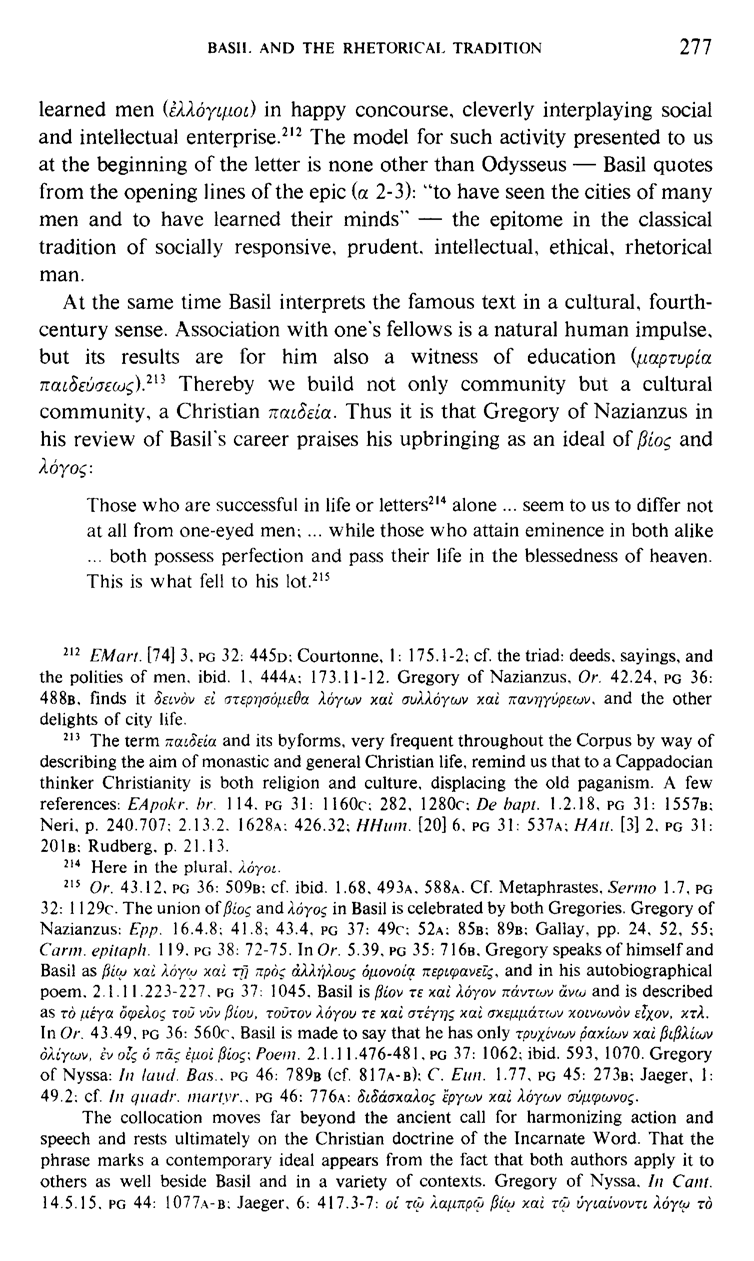
BASIL AND THE RHETORICAL TRADITION
learned men (έλλόγιμοι) in happy concourse, cleverly interplaying social and intellectual enterprise.
212 The model for such activity presented to us at the beginning of the letter is none other than Odysseus — Basil quotes from the opening lines of the epic (a 2-3): "to have seen the cities of many men and to have learned their minds" — the epitome in the classical tradition of socially responsive, prudent, intellectual, ethical, rhetorical man.
At the same time Basil interprets the famous text in a cultural, fourthcentury sense. Association with one's fellows is a natural human impulse, but its results are for him also a witness of education (μαρτυρία παιδεύσεως).
2^ Thereby we build not only community but a cultural community, a Christian παιδεία. Thus it is that Gregory of Nazianzus in his review of Basil's career praises his upbringing as an ideal of βίος and λόγος:
214 alone ... seem to us to differ not at all from one-eyed men;... while those who attain eminence in both alike
... both possess perfection and pass their life in the blessedness of heaven.
This is what fell to his lot.
Those who are successful in life or letters
2 1 2 EMart. [74] 3. PG 32: 445D; Courtonne, 1: 175.1-2; cf. the triad: deeds, sayings, and the polities of men, ibid. 1, 444A; 173.11-12. Gregory of Nazianzus, Or. 42.24, PG 36:
488B, finds it δεινόν ει στερησόμεθα λόγων καί συλλόγων χαί πανηγύρεων, and the other delights of city life.
2 1 3 The term παιδεία and its byforms, very frequent throughout the Corpus by way of describing the aim of monastic and general Christian life, remind us that to a Cappadocian thinker Christianity is both religion and culture, displacing the old paganism. A few references: EApokr. br. 114. PG 31: 1160c; 282, 1280c; De bapt. 1.2.18, PG 31: 1557B;
Neri, p. 240.707: 2.13.2. 1628A: 426.32; HHum. [20] 6, PG 31: 537A; HAtt. [3] 2, PG 31:
201B; Rudberg. p. 21.13.
2 1 4 Here in the plural, λόγοι.
2 1 5 Or. 43.12. PG 36: 509B; cf. ibid. 1.68. 493A. 588A. Cf. Metaphrastes, Sermo 1.7, PG
32:1129c. The union of βίος and λόγος in Basil is celebrated by both Gregories. Gregory of Nazianzus: Epp. 16.4.8: 41.8; 43.4. PG 37: 49c; 52A; 85B; 89B; Gallay, pp. 24, 52, 55:
Carm. epitaph. 119. PG 38: 72-75. In Or. 5.39, PG 35: 716B. Gregory speaksof himself and Basil as βίω χαί λόγω καί τη προς αλλήλους ομόνοια περιφανείς, and in his autobiographical poem. 2.1.11.223-227. PG 37: 1045. Basil is βίον τε καί λόγον πάντων άνω and is described as τό μέγα όφελος τοϋ νϋν βίου, τούτον λόγου τε καί στέγης καί σκεμμάτων κοινωνόν εΐχον, κτλ.
In Or. 43.49, PG 36: 560c, Basil is made to say that he has only τρυχίνων ρακιών xai βιβλίων ολίγων, έν οίς ό πάς έμοί βίος; Poem. 2.1.11.476-481, PG 37: 1062; ibid. 593, 1070. Gregory of Nyssa: In laud Bas., PG 46: 789B (cf. 817A-B); C. Eun. 1.77, PG 45: 273B; Jaeger, 1:
49.2; cf. In quadr. martyr., PG 46: 776A: διδάσκαλος έργων xai λόγων σύμφωνος.
The collocation moves far beyond the ancient call for harmonizing action and speech and rests ultimately on the Christian doctrine of the Incarnate Word. That the phrase marks a contemporary ideal appears from the fact that both authors apply it to others as well beside Basil and in a variety of contexts. Gregory of Nyssa. In Cam
14.5.15. PG 44: 1077A-B; Jaeger, 6: 417.3-7: oi τω λαμπρώ βίω καί τω ύγιαίνοντι λόγω τό
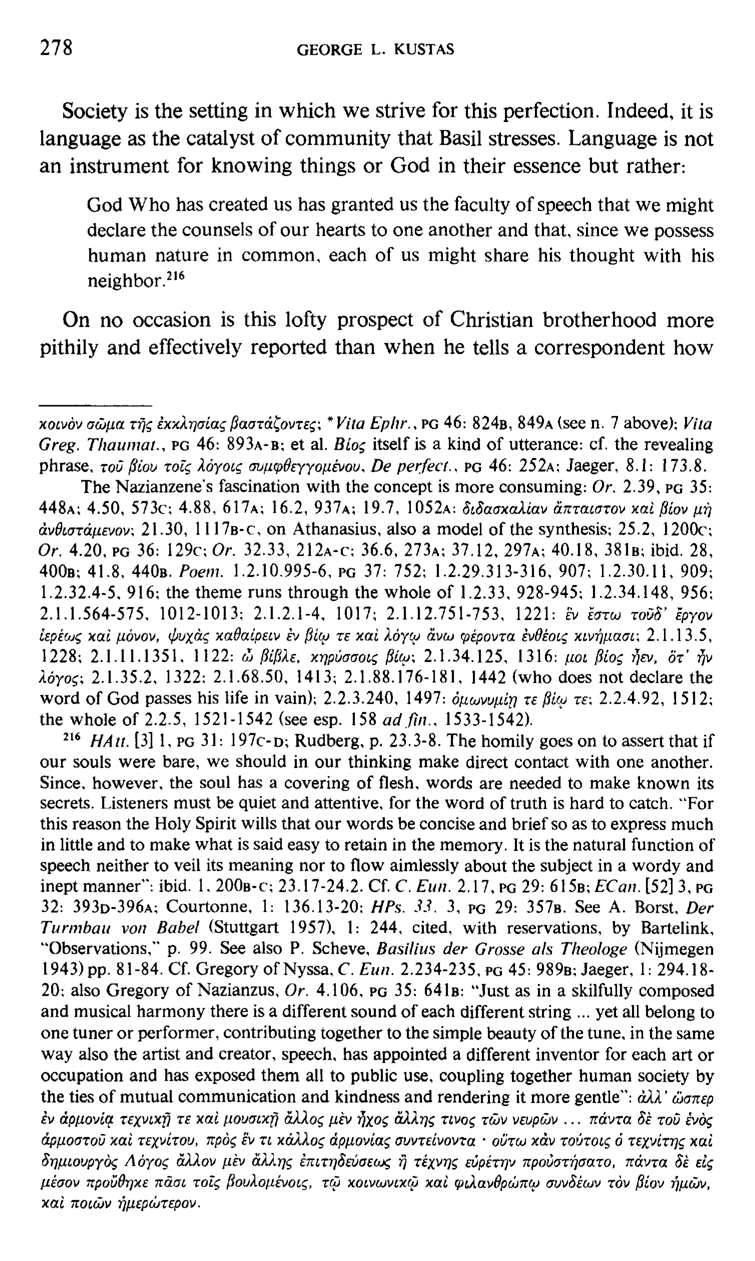
GEORGE L. KUSTAS
Society is the setting in which we strive for this perfection. Indeed, it is language as the catalyst of community that Basil stresses. Language is not an instrument for knowing things or God in their essence but rather:
God Who has created us has granted us the faculty of speech that we might declare the counsels of our hearts to one another and that, since we possess human nature in common, each of us might share his thought with his neighbor.
On no occasion is this lofty prospect of Christian brotherhood more pithily and effectively reported than when he tells a correspondent how κοινόυ σώμα τής εκκλησίας βαστάζοντες; 'Vila Ephr., PG 46: 824B, 849A (see n. 7 above); Vita
Greg. Thaumat., PG 46: 893A-B; et al. Βίος itself is a kind of utterance: cf. the revealing phrase, τοΰ βίου τοις λόγοις συμφθεγγομένου. De perfect., PG 46: 252A; Jaeger, 8.1: 173.8.
The Nazianzene's fascination with the concept is more consuming: Or. 2.39, PG 35:
448A; 4.50, 573c: 4.88, 617A; 16.2, 937A; 19.7, 1052A; διδασκαλίαν άπταιστον καί βίον μή άνθιστάμενον; 21.30, 11 17B-C, on Athanasius, also a model of the synthesis; 25.2, 1200c:
Or. 4.20, PG 36: 129c: Or. 32.33, 212A-C; 36.6, 273A; 37.12, 297A; 40.18, 381B; ibid. 28,
400B; 41.8, 440B. Poem. 1.2.10.995-6, PG 37: 752; 1.2.29.313-316, 907; 1.2.30.11, 909;
1.2.32.4-5, 916: the theme runs through the whole of 1.2.33, 928-945; 1.2.34.148, 956;
2.1.1.564-575, 1012-1013; 2.1.2.1-4, 1017; 2.1.12.751-753, 1221: έν έστω τούδ' έργον ιερέως καί μόνον, ψυχάς καθαίρειν έν βίω τε xai λόγω άνω φέροντα ένθέοις χινήμασι; 2.1.13.5,
1228; 2.1.11.1351. 1122: ω βίβλε, χηρύσσοις βίω-, 2.1.34.125, 1316: μοι βίος ή~εν, οτ' ην λόγος; 2.1.35.2, 1322; 2.1.68.50, 1413; 2.1.88.176-181, 1442 (who does not declare the word of God passes his life in vain); 2.2.3.240, 1497: όμωνυμίη τε βίω τε; 2.2.4.92, 1512; the whole of 2.2.5, 1521-1542 (see esp. 158 ad.fin., 1533-1542).
216 HAtt. [3] 1,PG 31: 197c-D; Rudberg, p. 23.3-8. The homily goes on to assert that if our souls were bare, we should in our thinking make direct contact with one another.
Since, however, the soul has a covering of flesh, words are needed to make known its secrets. Listeners must be quiet and attentive, for the word of truth is hard to catch. "For this reason the Holy Spirit wills that our words be concise and brief so as to express much in little and to make what is said easy to retain in the memory. It is the natural function of speech neither to veil its meaning nor to flow aimlessly about the subject in a wordy and inept manner": ibid. 1. 200B-C; 23.17-24.2. Cf. C. Eun. 2.17, PG 29: 615B; ECan. [52] 3, PG
32: 393D-396A; Courtonne, 1: 136.13-20: HPs. 33. 3, PG 29: 357B. See A. Borst, Der
Turmbau von Babel (Stuttgart 1957), 1: 244, cited, with reservations, by Bartelink,
"Observations," p. 99. See also P. Scheve, Basilius der Grosse als Theologe (Nijmegen
1943) pp. 81-84. Cf. Gregory of Nyssa, C. Eun. 2.234-235, PG 45: 989B; Jaeger, 1: 294.1820: also Gregory of Nazianzus, Or. 4.106, PG 35: 641B: "Just as in a skilfully composed and musical harmony there is a different sound of each different string ... yet all belong to one tuner or performer, contributing together to the simple beauty of the tune, in the same way also the artist and creator, speech, has appointed a different inventor for each art or occupation and has exposed them all to public use, coupling together human society by the ties of mutual communication and kindness and rendering it more gentle": άλλ' ώσπερ έν άρμονίψ τεχνική τε καί μουσική άλλος μέν ήχος άλλης τίνος τών νευρών ... πάντα δε τοϋ ενός άρμοστού και τεχυίτου, προς εν τι κάλλος αρμονίας συντείνοντα · ούτω χάν τούτοις ό τεχνίτης χαί δημιουργός Λόγος άλλον μέν άλλης έπιτηδεύσεως ή τέχνης εύρέτην προύστήσατο, πάντα δέ εις μέσον προϋθηκε πάσι τοις βουλομένοις, τώ κοινωνικω καί φιλανθρώπω συνδέων τόν βίον ημών, καί ποιών ήμερώτερον.
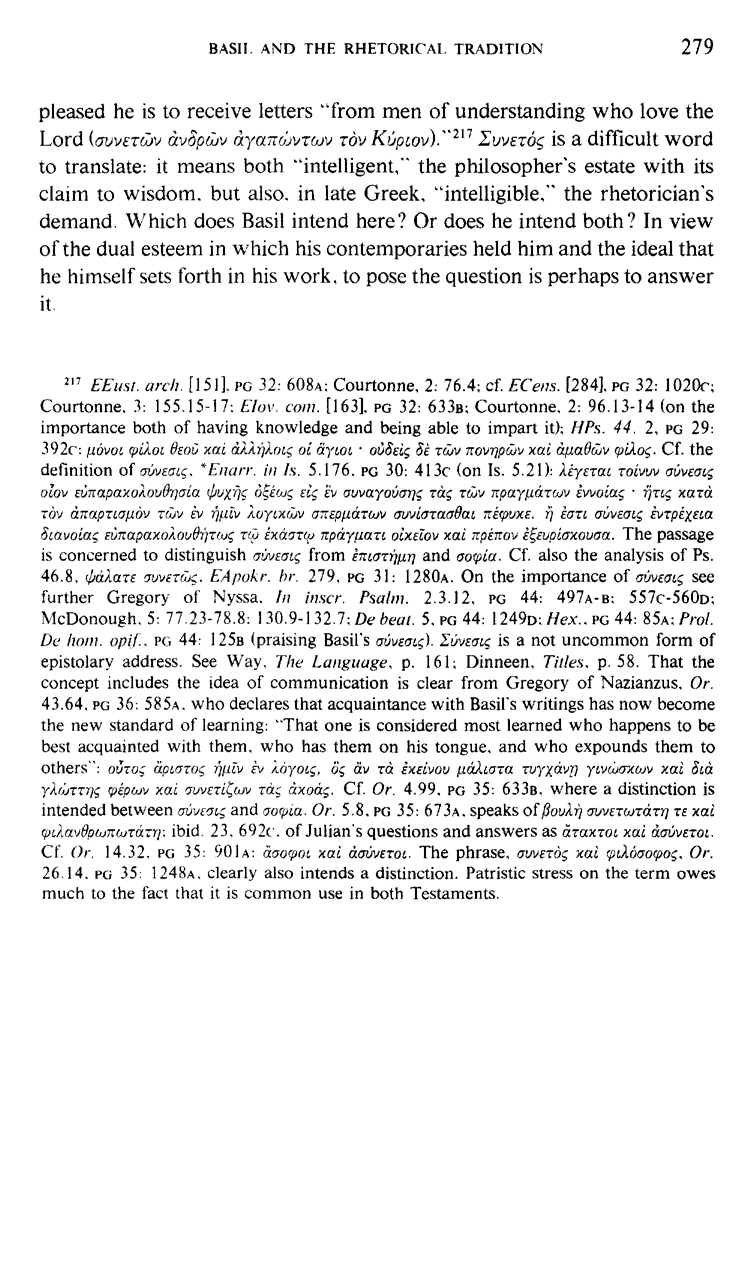
BASIL AND THE RHETORICAL TRADITION
pleased he is to receive letters "from men of understanding who love the Lord (συνετών ανδρών άγαπώντων τόν Κύριον)."
211 Συνετός is a difficult word to translate: it means both "intelligent," the philosopher's estate with its claim to wisdom, but also, in late Greek, "intelligible," the rhetorician's demand. Which does Basil intend here? Or does he intend both? In view of the dual esteem in which his contemporaries held him and the ideal that he himself sets forth in his work, to pose the question is perhaps to answer it 2 1 7 EEust. arch. [151], PG 32: 608A; Courtonne, 2: 76.4; cf. ECens. [284], PG 32: 1020c;
Courtonne, 3: 155.15-17; Elov. com. [163], PG 32: 633B; Courtonne. 2: 96.13-14 (on the importance both of having knowledge and being able to impart it); HPs. 44. 2, PG 29:
392c: μόνοι φίλοι θεού καί άλλήλοις οι άγιοι · ουδείς δέ τών πονηρών καί άμαθων φίλος. Cf. the definition of σύνεσις, * Enarr. in Is. 5.176. PG 30: 413c (on Is. 5.21): λέγεται τοίνυν σύνεσις οίον εύπαραχολουθησία ψυχής οξέως εις εν συναγούσης τάς τών πραγμάτων έννοιας • ήτις κατά τόν άπαρτισμόν τών έν ήμϊν λογικών σπερμάτων συνίστασθαι πέφυχε. ή έστι σύνεσις έντρέχεια διανοίας εύπαρακολουθήτως τω έκάστω πράγματι οίκείον καί πρέπον έξευρίσκουσα. The passage is concerned to distinguish σύνεσις from επιστήμη and σοφία. Cf. also the analysis of Ps.
46.8, ψάλατε συνετώς. EApokr. br. 279, PG 31: 1280A. On the importance of σύνεσις see further Gregory of Nyssa. //; inscr. Psalm.
2.3.12, PG 44:
497A-B: 557C-560D;
McDonough, 5: 77.23-78.8: 130.9-132.7; De beat. 5. PG 44: 1249D; Hex., PG 44: 85A; Pro!.
De horn. opif.. PG 44: 125B (praising Basil's σύνεσις). Σύνεσις is a not uncommon form of epistolary address. See Way, The Language, p. 161; Dinneen, 77//es. p. 58. That the concept includes the idea of communication is clear from Gregory of Nazianzus, Or.
43.64, PG 36: 585A. who declares that acquaintance with Basil's writings has now become the new standard of learning: "That one is considered most learned who happens to be best acquainted with them, who has them on his tongue, and who expounds them to others": ούτος άριστος ήμϊν έν λόγοις, ος άν τά εκείνου μάλιστα τυγχάνη γινώσκων καί διά γλώττης φέρων xai συνετίζων τάς άκοάς. Cf. Or. 4.99. PG 35; 633B. where a distinction is intended between σύνεσις and σοφία. Or. 5.8, PG 35: 673A. speaks οι βουλή συνετωτάτη τε καί φιλανθρωπωτάτη; ibid. 23. 692c. of Julian's questions and answers as άτακτοι καί ασύνετοι.
Cf. Or. 14.32. PG 35; 901A: άσοφοι καί ασύνετοι. The phrase, συνετός καί φιλόσοφος. Or.
26.14. PG 35: 1 2 4 8 α , clearly also intends a distinction. Patristic stress on the term owes much to the fact that it is common use in both Testaments.
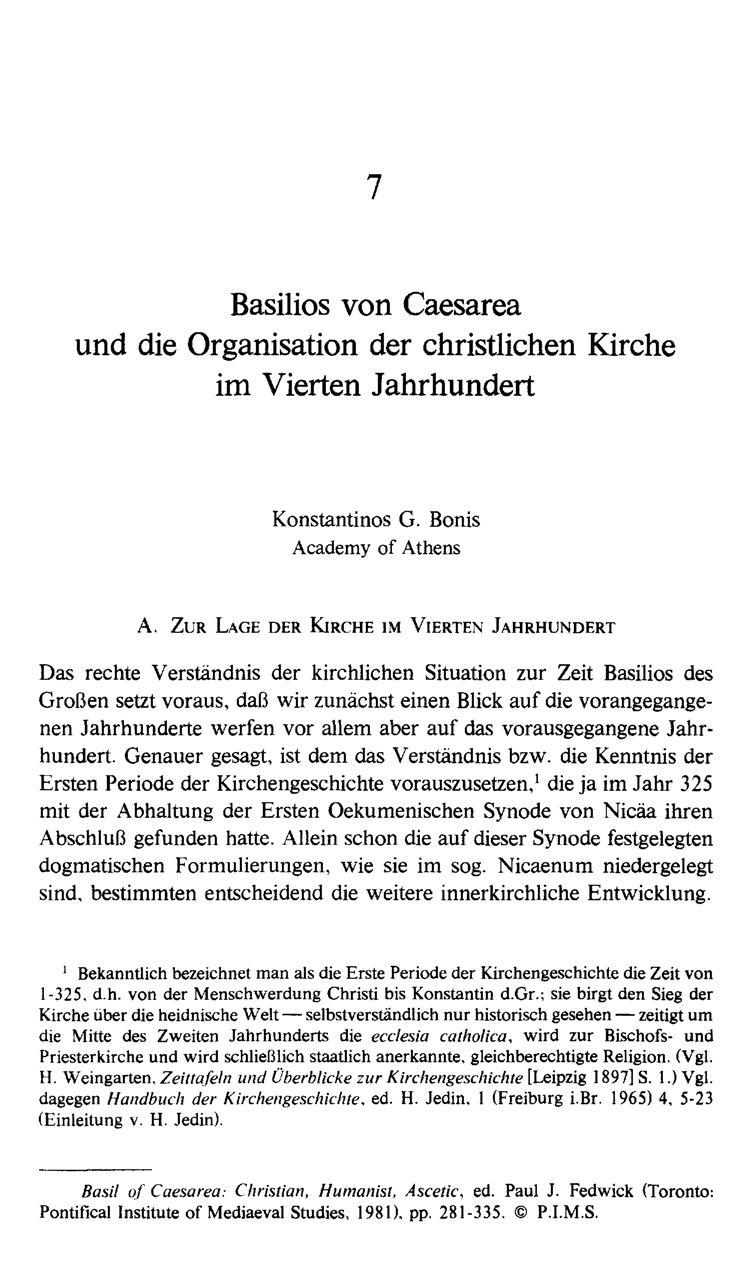
Basilios von Caesarea und die Organisation der christlichen Kirche im Vierten Jahrhundert Konstantinos G. Bonis Academy of Athens
Α. ZUR LAGE DER KIRCHE IM VIERTEN JAHRHUNDERT
Das rechte Verständnis der kirchlichen Situation zur Zeit Basilios des Großen setzt voraus, daß wir zunächst einen Blick auf die vorangegangenen Jahrhunderte werfen vor allem aber auf das vorausgegangene Jahrhundert. Genauer gesagt, ist dem das Verständnis bzw. die Kenntnis der
Ersten Periode der Kirchengeschichte vorauszusetzen,1 die ja im Jahr 325 mit der Abhaltung der Ersten Oekumenischen Synode von Nicäa ihren
Abschluß gefunden hatte. Allein schon die auf dieser Synode festgelegten dogmatischen Formulierungen, wie sie im sog. Nicaenum niedergelegt sind, bestimmten entscheidend die weitere innerkirchliche Entwicklung.
1 Bekanntlich bezeichnet man als die Erste Periode der Kirchengeschichte die Zeit von
1-325. d.h. von der Menschwerdung Christi bis Konstantin d.Gr.; sie birgt den Sieg der
Kirche über die heidnische Welt — selbstverständlich nur historisch gesehen — zeitigt um die Mitte des Zweiten Jahrhunderts die ecciesia catholica, wird zur Bischofsund
Priesterkirche und wird schließlich staatlich anerkannte, gleichberechtigte Religion. (Vgl.
H. Weingarten, Zeittafeln und Überblicke zur Kirchengeschichte [Leipzig 1897] S. 1.) Vgl. dagegen Handbuch der Kirchengeschichte, ed. H. Jedin, 1 (Freiburg i.Br. 1965) 4, 5-23
(Einleitung ν. H. Jedin).
Basil of Caesarea: Christian, Humanist, Ascetic, ed. Paul J. Fedwick (Toronto:
Pontifical Institute of Mediaeval Studies, 1981), pp. 281-335. © P.I.M.S.
KONSTANTINOS G. BONIS
Vorausschickend möchten wir erst einmal klarstellen, daß wir unter "Kirche" die Größe meinen, die als das "vorzeitige"2 Geheimnis3 von jeher vorhanden, mit der Inkarnation Jesu Christi jedoch innerweltlich existent wurde. Das heißt, wir haben es mit der Kirche des Neuen
Testaments zu tun, die sich bereits apostolisch etabliert hatte, aber noch nicht in der gesamten damals bekannten Oekumene4 verbreitet war.
In den drei ersten Jahrhunderten hatte diese Kirche, von der es heißt, daß sie "die Pforten der Hölle nicht überwinden sollten,"5 die grausamsten Verfolgungen erlitten, Verfolgungen, die sie samt ihren Gliedern, gestützt auf das Evangelium und dessen Verheißungen, geduldig ertrug.
Aber für ihr innerweltliches Bestehen6 waren ja eigentlich deren innere Gegner die Ketzer bzw. Schismatiker. Kamen sie zunächst aus judenchristlichen Kreisen, so waren es danach diejenigen, die aus heidenchristlichem oder rein heidnischem Milieu stammten; erinnert sei da vor allem auch an Anhänger nichtchristlicher gnostischer Richtungen. Wir brauchen nicht näher auf jene die Kirche bedrohenden Strömungen dieser
Jahrhunderte einzugehen. Nur sei auch an dieser Stelle die kirchengeschichtlich altbekannte Tatsache vermerkt, daß wohl keine der jeweiligen gegenkirchlichen Strömungen je wirklich je wieder vollkommen erloschen ist, sondern die Zeiten hindurch, vielleicht gar bis auf unsere Tage hin, unter der Oberfläche weitergeschwelt hat. Nein, diese Strömungen wirkten tatsächlich auch späterhin weiter, allerdings stets unter irgendeiner neuen Gewandung, wobei der Inhalt jedoch immer derselbe geblieben ist, um gewissermaßen als Varianten ein und desselben Themas stets von neuem wider die Kirche zu Felde zu ziehen.
2 Das Wort "vorzeitig" ist hier bewußt gesetzt anstelle von "präexistent." Wir verweisen auf Hans Freiherr von Campenhausen, der dieses Epithet in seiner Schrift Die griechischen Kirchenväter (Stuttgart 1956) auf S. 93 als "Gottes vorzeitiger Sohn" gebraucht; es entspräche wohl dem griechischen "προαιώνιος."
' Das "vorzeitige Geheimnis" der Kirche ist thematisch und methodologisch in einer vorerst leider nur auf Griechisch abgefaßten Untersuchung anhand der Vätertexte aus den drei ersten Jahrhunderten dargestellt worden von M. Jordan, Τό προαιώνιου περί
'Εκκλησίας μυστήριου. Συμβολή εις τήν αληθή ενυοιαν χαί όρθήν χατανόησιν τής άϊδίου αρχής τής ουσίας ή φύσεως τής 'Εκκλησίας (Athen 1978).
4 Gemeint ist das gesamtrömische Reich in seinen damaligen Grenzen.
5 Matth. 16.18.
6 Wir sind uns ganz im klaren darüber, daß solche Formulierungen ungewöhnlich erscheinen mögen, aber auch hier liegt es uns daran, die Kirche nicht als irgendwann in der Welt gegründet und in ihrer weiteren Funktion als Heilsinstitut oder etwas dem
Ähnlichen zu sehen, sondern sie als die eine Realität des gottmenschlichen Leibes Jesu
Christi zu erfassen, weswegen ihr nach Tod und Auferstehung ihres Hauptes Jesu Christi im Prinzip keinerlei innerweltliche Gefahr mehr bei ihrem Verbleiben in dieser Welt drohen kann.
DIE ORGANISATION DER KIRCHE
Was wir über die Kirche vorausgeschickt haben, hat den Zweck, gleich zu Anfang unserer Darlegung festzustellen, daß wir die Kirche als den gottmenschlichen Organismus verstehen, in welchem göttliche und menschliche Kräfte der Natur dieses Organismusses gemäß zusammenwirken, so daß sich selbst bei menschlichem Versagen immer noch das
Wirken des Dreieinen Gottes durch die Person Jesu Christi, dessen Leib die Kirche ja ist, und im Walten des Heiligen Geistes durchsetzt.
Wir verwahren uns also, auch in dieser Arbeit die Kirche institutionell zu sehen, schließen uns vielmehr der Ansicht vor allem der frühen Kirchenväter an, wonach die Kirche als der Leib Christi eben einen vorzeitigen Bestand gehabt, da sie als Christi Leib, mit der Menschwerdung des
Gottessohnes in dieser Welt in Erscheinung getreten, an dem innertrinitarischen Leben teilhat.7
Diese Feststellung ist für uns insofern wichtig, weil sich allein deswegen schon erklären läßt, weshalb die Kirche durch ihre Bischöfe vor allem in den ersten Jahrhunderten so eifersüchtig über die Reinhaltung ihrer Lehre gewacht hat. Hätte sie das nämlich nicht getan, so wäre zwar die Kirche an sich nicht verloren gegangen, was bei ihr ja allein schon aufgrund ihrer Natur ausgeschloßen ist, aber es wären doch die Hirten samt ihren Herden der Kirche verlustig gegangen!
Unserer Meinung nach ist dieses Moment bisher nie so ins rechte Licht gerückt worden. Und in diesem Lichte die Kirchenväter betrachten, und zwar besonders jene, die durch ihre Polemik bei so manchem Theologen in Mißkredit geraten sind — denken wir nur an den hervorragenden
Kirchenmann Athanasios von Alexandria, auf den wir weiter unten zu sprechen kommen —, so würde sich wohl manches im Verständnis ihres
Handelns und vor allem ihrer auf uns überkommenen Schriften ändern.
Weiß Gott, wohl kaum entbrannten sie über ihre Gegner aus persönlicher Überheblichkeit, oder was es sonst gewesen sein mag, wir möchten vielmehr glauben, daß es der "heilige" Zorn war, der sie ergriff, wenn ein übler Gnostiker, ein Mani oder Arius samt den ungeheuren Bewegungen, die sie ausgelöst, das Wesen der Kirche zu entstellen versuchte. Sie konnten das ja gar nicht! Was sie aber in Gefahr brachten, war das von der Kirche durch ihre Bischöfe samt ihrer Gliedschaft in Gang gebrachte
Heilswerk zu stören oder gar teilweise zunichte zu machen. Unter diesem Prisma das Weitere unserer Abhandlung betrachtet, wird Vieles erklärlicher erscheinen.
7 Siehe Jordan, Τό προαιώνιον, Kap. 3, S. 50-60, aber auch Kap. 4 u. 5.
KONSTANTINOS G. BONIS
Nachdem also die Kirche die ersten großen Verfolgungszeiten überstanden und somit dem heidnisch römischen Volksgeist und vor allem dem heidnischen römischen Staatsgefüge widerstanden hatte, und nachdem sie den ersten großen geistigen Gegenströmungen wie dem Ebionitismus und Doketismus sowie der Gnosis und dem Montanismus, dem Manichäismus und wie diese -ismusse noch geheißen haben, pariert hatte, war es nun im Vierten Jahrhundert zur "Gründung" der Reichskirche gekommen: Die im Zweiten Jahrhundert in der nachapostolischen Zeit erstandene "ecciesia catholica"8 arrangiert sich nun mit dem Staat.
Ist dem aber wirklich so gewesen ? Ein Profangeschichtler könnte das wohl, von außen betrachtet, so formulieren. Er könnte auch hinzusetzen, daß das Christentum nach dem überwältigenden Sieg Konstantins des
Großen über Maxentius (28. Okt. 312)9 zur "Staatsreligion" erhoben wurde. Aber die Kirche kennt solche Formulierungen nicht. Gewiß, das
Christentum war fürderhin ein Faktor, mit dem der Staat nicht nur zu rechnen hatte, sondern den er in sein Wesen hineinbrachte, so daß die gesamte Staatsstruktur mehr und mehr verchristlicht wurde10 inwieweit das je einem Staat gelungen ist, das bleibt hier dahingestellt. Auch ist hinsichtlich Viertes Jahrhundert bei weitem noch nicht von einer
Theokratie zu reden" geschweige von einem Caesaropapismus — man mißverstehe uns nicht bei Anführung dieses Begriffes an dieser Stelle.
8 Siehe Anm. 1 Mitte. Das Epithet "catholica" ist hier allerdings nicht konfessionell gebunden zu verstehen, sondern in seinem ursprünglichen Sinn des griechischen Analogon.
9 Siehe Weingarten, Zeittafeln, S. 32; vgl. E. von Lasaulx, Der Untergang des Hellenismus und die Einziehung seiner Tempelgüler durch die christlichen Kaiser
(München 1854) S. 21. Vgl. auch J. Burckhardt, Die Zeit Konstantins des Großen (Leipzig
1924) S. 345. — Zur Frage, wie allerdings Maxentius dem Christentum gegenüber eingestellt war; zitieren wir E. Stauffer, Christus und die Caesaren (München u. Hamburg
1966) S. 256: "Maxentius hatte eine gut römische Abneigung gegen die Kaiservergötterung und hat seinem eigenen Vater Maximianus Herkulius die Anbetung verweigert. So mag er dem christlichen Nein zum Kaiserkult ein gewisses Verständnis entgegengebracht haben."
10 Vgl. hierzu besonders G. Ostrogorsky, Geschichte des Byzantinischen Staates (München 1952) das Kapitel "Das christianisierte Imperium Romanum" (S. 22-42).
" An diesem Punkte wären wir eigentlich eine weitergreifende Erläuterung dessen schuldig, was wir unter diesen beiden Begriffen verstehen, und ab wann wir sie als für
Byzanz zutreffend ansetzen, aber wir müssen den geneigten Leser enttäuschen: beides ist für die Geschichte von Byzanz nicht anwendbar, es sei denn, diese Begriffe sind in gewissen außerorthodoxen Geschichtsschreiberkreisen usus geworden. Verweisen möchten wir jedoch auf das gemeinverständlich abgefaßte Werk von E. Orthbandt und D.
H. Teuffen, Ein Kreuz und tausend Wege. Die Geschichte des Christentums im Bild (Konstanz 1962), Kapitel "Staatskirchenprogramm und erste Konfessionskriege"
(S. 194 ff.).
DIE ORGANISATION DER KIRCHE
aber es gehört nun einmal zu den modernen Schlagwörtern, die sich weltweit eingebürgert haben.12
Nein, von alledem kann für die Zeit des Vierten Jahrhunderts noch nicht die Rede sein. Vielleicht ist ein Zeitgenosse Basilios' des Großen als
Kirchenmann jenes Jahrhunderts besonders charakteristisch: wir meinen Athanasios von Alexandria. Als er Bischof wurde, wurde Basilios geboren.13 Da er selbst um 295 geboren, mögen die letzten großen
Verfolgungen unter Diokletian noch seine Jugenderinnerungen überschattet haben. So wurde er, vielleicht gerade aufgrund seiner Kindheitserlebnisse, der Mann der "unbedingten Entscheidungen,"14 er ist der
Mann, der entscheidend die Ordnung der Reichskirche mitgestaltet hat — nicht zuletzt auch in Fragen der Kirchenlehre, wo er sich mit seiner außergewöhnlichen Beharrlichkeit dem Arianismus widersetzte und bei der Bekämpfung desselben kein Mittel gescheut hat.15
Wir führen hier bewußt Athanasius als einen Vorgänger von Basilios an, da er einerseits vieles in der Kirchenordnung gewirkt hat, was hernach für Basilios' Wirken gleichsam den Weg bereitet hat, obgleich diese beiden Kirchenmänner in Charakter und Praktik sich so wenig geähnelt haben. Nur eines war ihnen gemeinsam: beide waren ungeteilten Herzens
12 Der Cäsaitelopapismus, ein im 18. Jahrhundert geprägter Ausdruck, meinte zunächst nur das staatskirchenrechtliche System des Römischen Reiches seit dem 4.
Jahrhundert. Später wurde er, meist in polemischer Absicht, auch auf Regelungen übertragen, in denen die staatliche Gewalt irgendwelche kirchlichen Befugnisse ausübt;
Byzantinische Kirche nach dem Bilderstreit, Russische Kirche bis 1917. Siehe entspr. Art.
Brockhaus-Enzyklopädie. 3 (Wiesbaden 1967). Vgl. zu dieser Frage auch Jedin. Handbuch, 1: 476. Konkreteres siehe bei Ch. Baur, "Die Anfänge des byzantinischen Cäsaropapismus," AKK 111 (1931) 99 ff. Besonders ist aber auf W. Ensslin, "Staat und Kirche von Konstantin bis Theodosius," in Die Kirche angesichts der Konstantinischen Wende, ed. G. Ruhrbach (Darmstadt 1976) S. 81 f. zu verweisen, wo diese Frage eine beachtenswerte Beurteilung findet: "Gegen diesen leider so tief eingewurzelten Begriff sei einmal der Einwand erhoben, daß er zu einem viel geplagten Schlagwort ohne klare Begriffsbestimmung geworden ist und je nachdem von dem unmittelbaren Versuch eines Herrschers, eine eigene theologische Auffassung zum Tragen zu bringen, bis zur Kennzeichnung jedes laikalen Mitbeteiligungsrechtes an kirchlichen Dingen benützt wird. ..."
Vgl. W. Schneemelcher, "Kirche und Staat im 4. Jahrhundert," ibid., S. 123.
13 Vgl. von Campenhausen, Die griechischen, S. 86.
14 ibid.. S. 72.
15 Ibid.. S. 72 ff. W. Schneemelcher. "Athanasius als Theologe und Kirchenpolitiker," in Die Kirche, ed. Ruhbach. S. 285 mag Athanasius wohl überzeichnen, wenn er sagt:
"Dabei scheut dieser Hierarch, der durch und durch machthungrige Persönlichkeit ist, vor keinem Mittel zurück. Seine Bedeutung ist also wenig positiv zu werten. Er ist ein
Kirchenmann, der dem kaiserlichen Regiment, dem aufgeklärten Despotismus und der
Verbindung von Kultur und Christentum Widerstand leistet, um seine Machtposition zu erhalten und zu stärken."
KONSTANTINOS G. BONIS
dem Dienste innerhalb der Einen Kirche ergeben, so daß es für Athanasios ein Gebot der Stunde war, Arius gegenüber die Theologie als entscheidende Waffe polemisch einzusetzen, um vor allem die damals herumgeisternde Lehrmeinung von einem kreatürlichen Logos-Christus niederzukämpfen. Wie wir weiter unten sehen werden, war Basilios der
Große aus ganz anderem Holz, vor allem so ganz Grieche, während Athanasios wohl auch sich Grieche gefühlt und gegeben hat, aber "es ist schwerlich ein Zufall, daß er als erster Theologe von Rang, wie wir heute wissen, auch koptisch gepredigt hat. Es liegt etwas Ungriechisches in seinem Wesen, das in seiner Geradlinigkeit und Strenge durch keinen
Hauch geistiger Anmut und Liebenswürdigkeit verklärt wird. Sein Bildnis, wenn wir eines besässen, würde vielleicht mehr an die alten
Pharaonen und ihre Beamten als an einen griechischen Philosophen erinnern," so die Meinung von von Campenhausen,16 der wir uns getrost anschließen können, und es wäre wirklich der Mühe wert, einmal in einer gesonderten Arbeit diese beiden hervorragenden Kirchenmänner aus dem
Vierten Jahrhundert vergleichend gegenüberzustellen; denn gerade bei Basilios finden wir in Wort und Tat so ganz das Gegenteil, und doch haben beide gegen den Arianismus und für den Bestand der Kirche in ihrem Sprengel zu kämpfen gehabt und beiden war der Erfolg beschieden, denn die Wahrheit war auf ihrer Seite.
Nun fragen wir uns aber, ob das alles war, was die kirchliche Lage zu jener Zeit kennzeichnete, und kommen zur Feststellung: bei weitem nicht, denn das Staat-Kirche-Verhältnis, so wie es sich auf dem Ersten
Oekumenischen Konzil und schlechthin unter dem Zepter Konstantins des Großen manifestiert hatte, blieb unter dessen Nachfolgern durchaus nicht dasselbe, wobei nur an seinen Neffen Julian Apostata zu erinnern ist, unter dessen Herrschaft noch einmal die Christen hart bedrängt wurden und die Kirche die letzte große Verfolgungszeit zu erdulden hatte.17 Daß
Julian während seiner Ausbildung in Athen Mitschüler von Basilios und Gregor von Nazianz gewesen, spielt da keine Rolle, auch nicht seine hohe
16 Vgl. von Campenhausen, Die griechischen, S. 75.
17 Wegen der Hinterlist des Kaisers zur Verführung oder Ausrottung der Christen (Gregorios von Nazianz, Or. A, 62-65) nennt Gregorios von Nazianz (Or. 32.3) seine
Verfolgung die grausamste von allen (vgl. Or. 42.3). Nach ihm (Or. 4.93) war es Julian unwichtig, wenn ein Heide etwa zehn Christen tötete. Aber wir haben auch die andere
Seite zu hören: Bidez, Julian der Abtrünnige (München 1940) S. 257: "Julians leidenschaftlichster Verleumder, Gregor von Nazianz...." Und dies wird von Gregor von
Nazianz ausgesagt, nachdem er zusammen mit seinem Intimus Basilios in Athen mit Julian bekanntgeworden war (vgl. Gregor von Nazianz, Or. 5.23 f. und 7 (Ende); vgl.
Bidez, Julian, S. 129.
DIE ORGANISATION DER KIRCHE
Abkunft, aber sehr wahrscheinlich die grausame Mißhandlung seiner Familie in seiner Kindheit. Bekanntlich war ja sein Vater nebst anderen
Verwandten auf Befehl des Konstantius getötet worden.18 Aber das war sicherlich nicht der einzige Grund, weswegen er sich vom Christentum abgekehrt und wieder dem Heidentum zugewandt hatte. Nachweislich stand er schon sehr zeitig unter dem Einfluß fanatischer Heiden.19
Zum Schluß dieses Kapitels möchten wir doch noch auf die für jene Zeit geistesgeschichtlich auch nicht im Rahmen der Dogmendurchbildung der Kirche unwichtige Frage der letztlichen Krise des Hellenismus zu sprechen kommen.
Worum es am Ausgang der hellenistischen Periode eigentlich ging, darüber unterrichtet uns wohl am besten ihr letzter Vertreter selbst, wenn auch kein echter Hellenist mehr, da sich aufgrund seiner frühen Erziehung bei ihm immerhin recht viel Christliches eingeschlichen hatte; gemeint ist Julian Apostata, der Philosoph und Neuheide auf dem byzantinischen Thron.
Hieronymus sagt von Julian, er habe auf dem Feldzuge gegen die Parther sieben Schmähschriften ausgespien. Es muß sich da um die
Schrift gegen die Christen (Κατά Χριστιανών) handeln, 20 an der er noch auf dem Perserfeldzug gearbeitet haben soll, und die also in sieben Bücher eingeteilt gewesen wäre. Leider ist dies Werk zum Großteil verlorengegangen. Aus den Fragmenten bei Kyrillos von Alexandria ersieht man, daß er in der Kritik und Polemik viel besseres geleistet hat als in seinen
Versuchen, den Glauben an die Götter theoretisch zu rechtfertigen und neu zu begründen. Nach den noch vorhandenen Fragmenten zu urteilen, hat er ohne die Hilfsmittel der modernen Kritik schon die Hauptsache von dem gesagt, was diese Kritik gegen Bibel und Kirche einzuwenden hat. Er gibt zu, daß auch die Griechen unhaltbare und verwerfliche Götterfabeln erdichtet haben.21 meint aber, nicht diese, sondern die Religion eines Plato müsse man mit der des Moses vergleichen, wenn man dem Hellenentum gerecht werden wolle. Plato's Schöpfungsgeschichte im Timäus sei schon
18 Vgl. Franz Dölgers Einführung zu Bidez' Julian, S. 7.
" Eine ganz besondere Rolle hat da sein Erzieher, der Eunuch Mardonios aus Nikomedien gespielt. Julian nennt diesen Heiden "seinen Bildner und Erzieher, der ihn bis zum Vorhof des Tempels der Philosophie geführt habe" (Libanios, Or. 2.58, 1: 257.15 f.) bei Bidez, Julian, S. 24.
20 Siehe Tuscutum Lexikon griechischer und lateinischer Autoren des Altertums und des Mittelalters (Hamburg 1974), Art. Julianus (Flavius Claudius J.) S. 267-268.
21 Siehe C. I. Neumann, luliani Imperatoris Librorum contra Christianos (Leipzig
1880), Λόγος A ', 86A. S. 168.
KONSTANTINOS G. BONIS
deswegen viel befriedigender als die mosaische, weil diese von der Schöpfung einer Geisterwelt gar nichts sage.22 Der Mensch, den der Gott der Bibel erschaffen habe, sei ein stumpfsinniges Wesen, das nicht einmal gut und böse zu unterscheiden vermöge. Diesem Wesen verbiete Gott auch noch den Zugang zur Erkenntnis, und er zeige sich, nachdem die
Schlange dem Menschen dazu verholfen habe, erzürnt darüber und eifersüchtig: "Adam ist geworden wie unsereiner!"23 Wenn nicht jedes
Wort der mosaischen Schöpfungsgeschichte allegorisch gedeutet werde, sei sie die ärgste Gotteslästerung. Die engherzige Auffassung des Alten
Testaments, wonach Gott nur ein Gott seines kleinen Volkes sei und sich um die anderen Völker gar nicht kümmere, habe Jesus bestätigt; Paulus aber, der ärgste aller Betrüger, habe, gleich den Polypen, der die Farbe des
Felsens annimmt, auf dem er sitzt, Gott bald zum Judengott, bald zum Gott aller Völker gemacht. "Wenn er das zweite ist, warum überläßt er sie jahrtausendelang ihrem Schicksal? Euer Gott ist also nichts Wirkliches, sondern ein Erzeugnis der Phantasie eurer Rasse." Und wie grausam ist der Gott des Moses ! Um einer einzigen Verirrung willen läßt er Tausende abschlachten ! Wie mild dagegen sind die Gesetze des Solon, des Lykurg, wie menschenfreundlich ist die Herrschaft der Römer ! Die Nachahmung der Götter, zu der unsere Philosophen ermahnen, schließt alle Leidenschaften aus, die Hebräer dagegen ahmen ihren Gott mit zornmütigem
Wüten nach. Nein, die Heiden sind wahrlich nicht von Gott verlassen gewesen ! Alle Künste und Wissenschaften haben sie erfunden, während die Juden für die Kultur nichts geleistet haben. Sich dann gegen die
Galiläer wendend, meint er, wenn sie wenigstens dem Judenglauben huldigten, so würden sie zwar gegen die humane griechische Religion eine harte und barbarische Religion eingetauscht, aber immerhin mit dieser noch einiges Gutes empfangen haben. Sie hätten aber von den
Juden wie von den Heiden nur das Schlechte behalten, von den Juden den Haß gegen die Götter, von den Heiden die Liederlichkeit, und seien ganz verdorben. Besonders wirft er ihnen die Trinitätslehre als einen Abfall vom jüdischen Monotheismus vor und weist nach, daß die Synoptiker und Paulus (?P* von der Gottheit Christi und von der Logoslehre des
Johannes nichts wüßten.25
Allein aus dieser Kostprobe aus Julians geistigem Vermächtnis läßt sich ersehen, daß, wenn sich lapidare Wirklichkeiten durch Raisonnement aus
22 Ibid., 58A S. 173.
23 Ibid., 93E S. 168.
" Ibid., 100A S. 176.
25 Ibid., 106DS. 178.
DIE ORGANISATION DER KIRCHE
der Welt schaffen Hessen, Julian wohl der Mann dazu gewesen wäre, das Christentum zu vernichten. Das ist nun nicht möglich, und nicht weniger unmöglich ist das, wozu ihn sein Gewissen als Philosoph hätte getrieben haben müssen: er hätte — und das deuten auch seine Briefe an — seine
Untertanen mit Gewalt beglücken und zu tugendhaften Menschen machen müssen. Abgesehen davon, daß das schlechthin unmöglich ist, so war es schon ganz ausgeschlossen bei einem Reich von dem Umfang und der Vielgestaltigkeit seines Byzantinischen Reiches, bei der Verderbtheit der einen und bei der Wildheit der anderen seiner Völker und schließlich auch bei dem unheilbaren Siechtum des Staates. Der passive und der aktive Widerstand, an dem alle seine Maßnahmen zum Scheitern gekommen wären, hätte ihn sicherlich verbittert und zu immer größerer
Strenge genötigt, und leicht hätte es ihm ergehen können wie dem bürgerlichen Gerechtigkeitsschwärmer und Menschheitsbeglücker Robespierre: der zartfühlende, milde und edle Philosoph konnte als ein von allen
Menschen verfluchter Wüterich enden. Die Tragik seines Lebens liegt also nicht in seinem Tode, durch den ihn Gottes Güte vor einem grausamen Schicksal bewahrt hat, und der keine Folge seines großen
Irrtums war.26
Was wir alledem nun für die kirchliche Lage im Vierten Jahrhundert entnehmen können, ist, daß sich in der Person des Kaisers Julian tatsächlich eine letzte entscheidende Auseinandersetzung zwischen zwei grundverschiedenen geistigen Welten, zwischen der alten Welt der stolzen olympischen Götter und der neuen Welt des leidenden Menschensohnes aus Nazareth abspielte. Drei Jahrhunderte hindurch hatte das Christentum einen unglaublichen Siegeszug durch das gesamte römische Weltreich erlebt, bis schließlich Konstantin der Große als hervorragender Staatsmann das Gebot seiner Zeit erkannte und den Gott der Christen an die
Stelle der vielgestaltigen Götter Roms setzte und Christentum und Kirche der Struktur des römischen Reiches einverleibte, ohne dabei den Glauben an die Götter als persönliche Überzeugung bei den ihm untergebenen
Völkerschaften zu unterdrücken. Der alte Glaube der Hellenen war ja schon längst unter dem Einfluß verschiedener orientalischer Religionen und unter Mitwirkung mannigfacher philosophischer Strömungen der neuplatonischen Philosophie in gewissem Sinne zu einer Eingottlehre abgewandelt, die sich in ihren sittlichen Postulaten und in ihrem
Erlösungsglauben nur mehr äußerlich von der christlichen Lehre 26 Diese Ansicht wird auch von Carl Jentsch vertreten; siehe sein Werk Heltenentum und Christentum (Leipzig 1903) Kapitel 9 S. 239 ff. (Ende).
KONSTANTINOS G. BONIS
unterschied. Aber die heidnische Unterströmung war bei einem beachtlichen Teil der Hellenen bestehen geblieben — ein nur allzubekanntes religionsgeschichtliches Phänomen, das sich bei wohl sämtlichen christianisierten Völkern bis auf den heutigen Tag hin nachweisen ließe.
So kennzeichnet diese Zeit eine merkwürdige Atmosphäre: es gab heidnische Philosophen, die ihrer Lehre nach ebensogut Christen hätten sein können, und es gab Christen, die ihrer Bildung und Gesinnung nach ebensogut den Mantel eines hellenischen Philosophen hätten tragen können.
Das Christentum, dem nun durch Julians unerwartetes Ende27 endgültig Macht und Alleinherrschaft zurückgegeben wurden, hatte sich aber auch fürderhin noch mit den Schwierigkeiten seiner inneren Lage zu befassen: die eigenartige Verflechtung heidnischer und christlicher
Geistesströmungen hatte sich ja nicht mit dem Tode des letzten großen Verfolgers sogleich ändern können. Wohl waren die Zeiten der großen
Verfolgungen vergangen, aber die Auseinandersetzungen nach beiden Richtungen hin, d.h. mit judenchristlichen oder auch rein jüdischen und heidenchristlichen oder rein heidnischen Versuchen, die auf dem Ersten
Oekumenischen Konzil festgelegte Kirchenlehre vor allem von der Heiligen Trinität zu untergraben bzw. gar zu verfälschen, gingen weiter.
Direkt in die Hauptzeit des Wirkens von Basilios dem Großen fällt nun im Orient die Herrschaft von Valens (364-378) dem Bruder von Valentinian i. (364-375X28 der ihn zum Mitregenten eingesetzt hatte. Während
Valentinian persönlich nizänisch war, war Valens weit mehr arianisch gesinnt, gab Heiden und Juden volle Religionsfreiheit, nur den Nizänern nicht. Aber das Paradox in seiner Regierungszeit war, daß er Julians
Vertraute, besonders Götzenpriester, Rhetoren und Sophisten verfolgte, aber andere Heiden in Ruhe ließ. Die eigentliche Kraft der Heiden war also bereits zu Valens' Regierungszeit gebrochen, und sein Nachfolger als
Regent im Orient, Theodosios i., auch der Große genannt,29 brach endgültig mit dem Heidentum und erhob das Christentum zur Staatsreligion im römischen Reiche,30 aber das reicht schon über die Zeit Basilios' des
27 Vgl. zur Frage von Julians Ende Bidez, Julian, S. 347 f.; Zonaras, Epitome 13.13.29 f.; Ammianus Marcellinus, "Historia Iuliani" 25.3.6-9; Zosimos, Historia nova
3.29.1.
28 Vgl. Ostrogorsky, Geschichte, S. 42-44. Zu vermerken ist, daß nach Weingarten,
Zeittafeln, S. 42 mit Valentinian i. und Valentinian π. (Augustus orientis) die Zeit der
Religionsfreiheit im Römischen Reich beendet wurde.
29 Siehe Ostrogorsky, Geschichte, S. 44; J. P. Kirsch, Die Kirche in der antiken griechisch-römischen Kulturwelt (Freiburg i.Br. 1930) S. 364 f.
30 Vgl. Kirsch, Die Kirche, S. 365. Erwähnt sei auch sein Edikt von 380: De fide catholica: "cunctos populos, ... in tali volumus religione versari, quam divinum Petrum
DIE ORGANISATION DER KIRCHE
Großen hinaus, und dennoch muß auch das Hernach hier in aller Kürze skizziert werden, damit der Rahmen, in welchem sich Basilios' Wirken mit allen seinen Konsequenzen für die Folgezeit abspielt, klare Umrisse bekommt.
Um das Heidentum zu entkräften, entzog Theodosios denen, die von der Kirche zum Heidentum abfielen, das Testiersowie das Erbrecht31 und verbot jeden Abfall vom wahren Glauben (381 und 383). Auf Betreiben übereifriger Mönche wurden viele heidnische Tempel zerstört oder von
Bischöfen in christliche Kirchen umgewandelt,32 und die Schutzschrift des Libanios blieb ohne Erfolg.33 So wurde 386 die Schließung der Tempel in Asien und Ägypten angeordnet und 391 der Tempelbesuch vollends verboten,34 so daß das alte Heidentum in den klassischen Mittelmeerländern nie wieder seine frühere Macht erlangen konnte; es ging aufgrund seiner nunmehr inneren Haltlosigkeit unter; denn seine sittliche Entartung und sein Aberglaube waren schließlich dem Christentum unterlegen, und die Tätigkeit vieler Bischöfe und Kirchenlehrer verhalf zur geistlichen
Überwindung desselben, womit bereits gesagt wird, daß bei der Durchsetzung des Christentums seitens der weltlichen Obrigkeit durchaus nicht immer so vorgegangen wurde, wie es dem Geiste des Christentums eigentlich hätte entsprochen haben müssen. Erwähnt sei nur die Ermordung der alexandrinischen Philosophin Hypatia (415).35 Aber, wie Johannes Chrysostomos bezeugt,36 hat ein christlicher Kaiser niemals gegen apostolum tradidisse Romanis religio usque nunc ab ipso insinuate déclarât" (bei
Weingarten, Zeiltafeln, S. 43). Dieses Edikt von Thessalonike verbietet den Arianismus im Osten. Der Athanasianismus wird Staatsreligion (Katholizismus), siehe dtv-Atlas zur
Weltgeschichte. 1 (1974) 103. Hierüber näheres bei Ensslin, "Staat und Kirche," der allerdings dieses Edikt äußerst negativ beurteilt, indem er u.a. J. B. Kidd, Documents
Illustrative of the History of the Church, 2 (London 1938) 281, zitiert: "Theodosius thus set himself to secure the unity of the Empire on the basis of the Nicene Faith; and the Church of the Empire now finally and definitely became the Church of the Empire, adopted by its rulers for the Empire's sake" — und Kidd gehörte der High Church an.
31 Unter Testierrecht bzw. — freiheit ist das Recht zu verstehen, über ein Vermögen nach freiem Ermessen durch Testament zu verfügen (vgl. Brockhaus-Enzyklopädie, 18:
586).
52 S. Beissel. "Umwandlung heidnischer Kultstätten in christliche," SML 69 (1905) 2338. 134-143.
53 J. Misson, Recherches sur le paganisme de Libanios (Löwen 1914).
34 Bischof Markellos von Apamea wurde bei einer Tempelzerstörung zu Aulon von den Heiden verbrannt; eine antiochenische Synode (388) verbot seinen Söhnen, den Tod des Vaters zu rächen (Theodoret, Hist, eccles. 5.21).
35 Sokrates, Hist. eccl. 7.14 f. F. Schaefer, "St. Cyril of Alexandria and the Murder of Hypathia," CUB 8 (1902) 441-453. Vgl. auch Tusculum-Lexikon, S. 230, "Hypatia."
36 Johannes Chrysostomos, In s. Babylam, PG 50: 337; vgl. Gregor von Nazianz, Or.
5.33 f.. 36 und Augustinus, Sermones 24, 62.
KONSTANTINOS G. BONIS
die Heiden so tyrannische und grausame Dekrete erlassen, wie sie die Verehrer der Dämonen gegen die Christen erlassen hatten. Die beherrschende Stellung, die bis dahin das Heidentum in der damaligen Oekumene innegehabt hatte, war naturgemäß erschüttert, sobald sich das
Christentum eben frei bewegen und entfalten konnte, und dem vermochte auch menschliche Macht, die noch hie und da Widerstand leistete, nichts mehr anzuhaben.
B. BASILIOS' DES GROSSEN WEG ZUM WIRKEN IN DER KIRCHE
Wie oben bereits erwähnt, ist Basilios ungefähr zur Zeit, da Athanasios zu Alexandria Bischof wurde, etwa zehn Jahre vor dem Ableben von
Eusebios von Caesarea geboren.37 Basilios' gleichnamiger Vater war höchst gebildet und übte im Pontischen Neocaesarea den Beruf eines
Anwaltes bzw. Rhetors aus. Er verehelichte sich mit Emmelia aus dem Kappadokischen Caesarea. Auch sie stammte aus sehr edler und frommer
Familie, und dieser glücklichen Verbindung zweier zutiefst gläubiger Häuser entsprossen neun bzw., anderen Quellen nach, zehn Kinder, von denen späterhin drei Bischöfe wurden, d.h. Basilios der Große, Gregor von Nyssa und Petros von Sebaste.38 Und der dritte Bruder Basilios der
Große, mit Namen Naukratios, wurde zwischen 352 und 354 Anwalt, höchstwahrscheinlich in Neocaesarea, gab sich dann aber auch dem asketischen Leben hin, verstarb jedoch im frühen Alter (358/9). Vor allem haben wir die älteste unter seinen Geschwistern zu erwähnen: Makrina;39 sie weihte sich ganz dem asketischen Leben und übte späterhin nicht nur auf Basilios, sondern auf wohl alle Familienmitglieder im geistlichen Leben einen entscheidenden Einfluß aus; denn bei Neocaesarea im
Pontischen hatte der Vater dieser Familie ein sehr großes und ergiebiges Landgut, wo Makrina ein Frauenkloster einrichtete und zu gewissen
Zeiten die ganze Familie geistliche Ruhe und Erbauung fand — ganz 37 Von Campenhausen, Die griechischen, S. 86; vgl. A. Puech, Histoire de la littérature grecque chrétienne depuis les originesjusqua la fin du ive siècle, 3 (Paris 1930) 237 ff; L.
Duchesne, Histoire ancienne de l'Église, 2 (Paris 1910) 381. K. G. Bonis, Βασίλειος
Καισαρείας ô Μέγας. Βίος χαί έργα, συγγράμματα χαί διδασκαλία (Athen 1975) S. 13 ff., wo auch weitere Literaturangaben. Vgl. zur Charakterisierung des Euseb C. Schmitt,
"Eusebius als der Prototyp politischer Theologie," in Politische Theologie (Berlin 1970), 2:
68-88.
38 Bonis, Βασίλειος, S. 14.
3' Von Campenhausen, Die griechischen, S. 116; s. auch Vita Macr., PG 46: 965B, verfaßt von Gregor von Nyssa; vgl. auch ders., Enc. in Bas., PG 46: 808B und Basilios,
EAux. [36], ESynt. [37].
DIE ORGANISATION DER KIRCHE
besonders Basilios, dessen Gesundheit ob seiner zarten Natur ernstlich angegriffen war.40
Seine akademische Ausbildung empfing Basilios zunächst in der noch sehr jungen, herrlichen Hauptstadt des griechisch-römischen Staates, wo
"ηύδοκίμει σοφιστών τε καί φιλοσόφων τοις τελειωτάτοις."* 1 So muß Basilios auch irgendwie mit dem kaiserlichen Hof in Kontakt gekommen sein, worüber allerdings nichts Näheres bekannt ist. Nur wissen wir, daß er dort mit Libanios, dem berühmten Sophisten und Lehrer der Rhetorik,42 bekannt wurde, bei ihm aber nicht seine Studien beendete, da er wegen eines Streites mit seinem Rivalen Nikokles von diesem samt anderen
Sophisten veranlaßt wurde, die Hauptstadt zu verlassen.43 So fragt man sich, ob Basilios danach, also nach 346 oder 347, in Byzanz an einer anderen Schule seine Studien bis 351 oder 352 fortgesetzt hatte und dann nach Athen sich begeben hatte oder nach Caesarea zurückgekehrt war.44
Um 351, unserer Schätzung nach, beschloß Basilios, den Anforderungen junger Leute aus guten Häusern entsprechend, im berühmten Athen sich weiterzubilden. In Rom und Konstantinopel konzentrierten sich der
Reichtum und die politische Macht des Kaiserreiches. Aber weder die eine noch die andere Stadt vermochte die Stadt der Pallas Athene aus ihrer beherrschenden Stellung, den sie an der Führungsspitze der höchsten akademischen Ausbildung innehatte, zu verdrängen. Denn allein in dieser
Stadt mit ihren alten traditionsreichen philosophischen Schulen herrschte noch im Vierten Jahrhundert n.Chr. ein liberaler und toleranter Geist.
Und zu Basilios' Zeit betrachtete man Athen immer noch als der "Worte"
Boden und als das Eldorado der Rhetorik bzw. der Sophistik.45 Ja, in dieser renommierten Stadt hatte sich bis in jene Tage noch ein Stück unbeschadeter Antike erhalten, so daß gar noch prachtvolle heidnische
40 Lange Zeit war Basilios leberkrank, wie so viele Asketen; vgl. von Campenhausen,
Die griechischen. S. 97.
41 Gregor von Nazianz, Or. 43.12.
42 Hierzu verweisen wir auf W. von Christ. Geschichte der griechischen Literatur, 2
(München 1924) 987 f.
43 K. G. Bonis. Γρηγόριος ö Θεολόγος (Athens 1953) S. 18, Anm. 1 und 2.
44 Darüber sagen die Quellen nichts aus. R. J. Deferrari schreibt in der Einleitung zu seinem Werk Saint Basil, The Letters (Cambridge, Mass./London 1950), L xvii, folgendes: "Libanius indeed, was at Constantinople in 347 and our Saint could have arrived there thus early, according to a closely packed chronology, and could have sat under the Great Master, but the attractive hypothesis of their association even at Constantinople is still only an hypothesis." Und in Anm. 3 (ebenda) betrachtet er die den beiden zugesprochene Korrespondenz für sehr zweifelhaft. Jedenfalls akzeptiert die neuere
Kritik von den 25 Briefen 13 als echt (unter Nr. 335-359 u. 358).
45 Gregor von Nazianz sagt, Athen sei stets "τό τών λόγων έδαφος" gewesen (Or. Ai A A).
KONSTANTINOS G. BONIS
Tempel samt dem zu ihnen gehörenden Kult, kurz gesagt, die ganze antike Atmosphäre intakt war.46 Aber auch Theater, Palästren, Wettkämpfe und religiöse Feste bildeten noch einen wichtigen Bestandteil des öffentlichen
Lebens. Die schöne attizistische Sprache behielt trotz ihrer Vereinfachung und Popularisierung ihre Lieblichkeit und ausdrucksvolle Schönheit in der Rede, besonders allerdings als Schriftsprache.47
Als nun Basilios in Athen eintraf, wurde er von seinem ehemaligen Mitschüler aus der Caesareaer Zeit empfangen: es war Gregor von Nazianz, mit dem ihn fürderhin eine enge Freundschaft verbinden sollte.48
Wie üblich, schlossen sich auch damals in Athen die Studenten je nach dem Lande ihrer Herkunft zu Kreisen zusammen. Einen solchen bildeten auch die Armenier, und diese sahen den kappadokischen Kreis scheel an, aber ganz besonders beneideten sie Basilios. Er vermied jegliche Diskussion mit ihnen. Aber einmal konnte er doch nicht umhin, mit ihnen in ein
Gespräch verwickelt zu werden. Gregorios stand ihm zur Seite, und so besiegte er seine Gegner völlig. Die Folge war, daß Gregorios nun noch mehr seinen geistig so hervorragend starken Freund Basilios schätzte. Von da an mag wohl das gelten, was Gregorios später in seiner Grabrede sagte: die beiden waren "eine Seele in zwei Leibern."49
Besonderer Beachtung verdient es, welche Bekanntschaften Gregorios und sogar auch Basilios mit heidnischen Gelehrten, Kommilitonen und anderen Persönlichkeiten während ihrer Athener Studienzeit gemacht hatten. Außer ihren Lehrern Himerios und Proairesios, den berühmtesten
Sophisten jener Zeit, waren die beiden Freunde sicherlich auch mit Julian (s.o.) bekannt geworden.50 Selbstverständlich lernten sie in Athen unter ihren Kommilitonen nicht nur Studenten aus Armenien und Kappadokien kennen, sondern auch solche aus dem ganzen Hoheitsgebiet des Griechisch-Römischen Reiches, schlossen aber Freundschaft nur mit denen unter ihnen, die aus guten Familien kamen und gläubige Christen waren.
46 Vgl. mehr darüber bei Bonis, Βασίλειος, S. 25 f.
47 J. Burckhardt, Griechische Kulturgeschichte, 3 (Leipzig 1952) 282: "Daß das Griechische in diesem Orient 'gut' gesprochen worden wäre, kann man freilich nicht verlangen. Die Barbaren, die zum Hellenismus gebracht wurden, konnten vielfach so wenig zu einer korrekten Aussprache gelangen als die Hellenen in den asiatischen
Sprachen. Man klagte aber damals selbst in Attika darüber, daß zegen des Verkehrs mit
Makedonien viele in der Sprache makedonisierten," Absichtlich haben wir diese Passage zitiert, da Basilios der Große bekanntlich ein Griechisch gebrauchte, das in etwa der
"Dimotiki," d.h. der griechischen Volkssprache gleichkommt.
48 Siehe Gregor von Nazianz, Or. 43.15-24 von 381.
49 Ibid.
50 Vgl. Gregor von Nazianz, Adv. lui., PG 35: 692A.
DIE ORGANISATION DER KIRCHE
Unter ihnen waren auch Hesychios, Terentios, Sophronios, Eusebios und höchstwahrscheinlich auch andere.51 Schließlich sei vermerkt daß ihr berühmter Lehrer Proairesios ein Christ war, Himerios aber ein Heide.52
Auf eine ausführliche Schilderung des damaligen Athener Studentenlebens können wir hier verzichten,53 nur sei gesagt, daß dieses mit allen heidnischen Ausschweifungen und krankhaften moralischen Manifestationen Basilios sicherlich so tief getroffen und daher für sein ganzes weiteres Leben zum hervorragendsten praktischen Seelsorger und
Mönchsvater geprägt hatten.54 Aber schon zu jener Zeit widmete sich Basilios, abgesehen davon, daß er von Haus aus schon die Heilige Schrift gut kannte, außerhalb seines regulären Studienplans zusammen mit seinem Freund Gregorios dem vertiefenden Studium der Heiligen Schrift, was ihm zur einzigen Quelle der Belehrung und der seelischen Erbauung, zum beglückenden Genuß und geistlichen Gewinn gedieh. Darüberhinaus wurde sie ihm dadurch auch zum sicheren Führer in Theorie und Praxis, der Weg zum gottgefälligen Glauben und Wissen, das Licht zum Leben und Handeln !55
Die Vervollkommnung seines Gesamtwissens verdankt Basilios, abgesehen von seinem unstillbaren Wissensdurst und seiner vollen Hingabe an das Studium, auch den besten Lehrern seiner Epoche. Außer den beiden oben genannten Lehrern der Rhetorik hatten Basilios und Gregorios bestimmt noch andere Kapazitäten in Athen zu ihren Lehrern, deren
Namen uns jedoch nicht überliefert sind.56 Zusammenfassend möchten wir nun annehmen, was wir oben schon andeutungsweise bemerkt haben: ohne konkrete Angaben machen zu können, meinen wir doch, daß sich bei Basilios sogutwie bei seinem Freunde Gregorios gerade in der
Athener Zeit die entscheidenden Prinzipien für ihre spätere kirchliche Tätigkeit herausgebildet haben müssen; denn gerade das noch von der
51 Siehe EHes. [bA],EHes. \12\ETer. [2\A], ESophr. [76], ESophr. [96],EEus. sod. [271], etc.
52 Socrates. Hist. eccl. 4.26, PG 67: 529A; Sozomenos, Hist. eccl. 6.17, PG 67: 1333.
53 Gregor von Nazianz. Or. 43. PG 36: 517; ibid., 520; 16. ibid., 516. Noch heute ist die entsprechende Studie von F X. Eggersdorfer, "Die großen Kirchenväter des 4,
Jahrhunderts auf den heidnischen Hochschulen ihrer Zeit," ThM 13 (1903) 335-345; 426432. aktuell. Siehe auch G. F. Hertzberg, Die Geschichte Griechenlands unter der
Herrschaft der Römer (Halle 1875) S. 345 ff. Eine gelungene Schilderung der "Studien in Athen" bietet Burckhardt. Die Zeil Konstantins, S. 477 ff.
54 Verwiesen sei vor allem auf F. Laun, "Die beiden Regeln des Basilius, ihre Echtheit und Entstehung," ZKG AA (1925) 1-61, wo nicht nur die wesentliche Echtheit derselben nachgewiesen wird, sondern auch interessante Beobachtungen zum Inhalt zu finden sind,
55 Vgl. Gregor von Nazianz. Or. 43. PG 36; 525-528, 56 Vgl. Socrates, Hist. eccl. 4.26, PG 67: 528 f
KONSTANTINOS G. BONIS
Antike zehrende zugleich aber schon von dem Novum der christlichen, sich im Werden befindlichen Reichskultur, wenn man das so nennen darf, überschattete Leben dieser Metropole der Oekumene des Vierten
Jahrhunderts mußte solchen Geistern, die schon von Haus aus das unbändige Ringen des Alten, nun im Vergehen Befindlichen der heidnischen
Welt mit dem Neuen, aber doch auch aus dem Alten sich Emporringenden der neuen, der christlichen Welt Impulse geben, von denen wir heute nur noch etwas ahnen können.
C. BASILIOS' DES GROSSEN ANACHORESE
Nach über vierjähriger Studienzeit in Athen kehrte Basilios zu den Seinen nach Caesarea zurück, inzwischen war aber sein Vater abgeschieden und sein jüngster Bruder Petros geboren.57 Die Familie begab sich nun auf ihre
Besitztümer am Fluß Iris in Pontos. All das läßt sich mit dem Jahre 355 bzw. 356 datieren.58 Aber es hielt ihn nicht lange in Pontos, und er wandte sich wieder nach Caesarea zurück, wo er zunächst, über 25 Jahre alt, den Anwaltsberuf ausübte, wobei ihm ein derartiger Erfolg beschieden war, daß er sogleich zum Lehrer der Rhetorik ernannt wurde.59 Diese Funktion war allerdings zu damaliger Zeit im Römischen
Reich mit ganz besonderen Befugnissen und Rechten verbunden,60 worauf wir hier jedoch nicht näher einzugehen brauchen.61 Und diese hohe Stellung bereitete Basilios nicht nur für sein späteres Amt als
Erzbischof seiner Heimatstadt vor, sondern gab ihm zugleich auch die Gelegenheit, sich praktische Erfahrungen in der Gesellschaft anzueignen und nicht zuletzt die soziale Struktur derselben und auch die der Kirche mit allen ihren Verflechtungen kennenzulernen.62
Aber, obgleich noch sehr jung, konnten alle Ehren und politischen Verpflichtungen, die er in seinem hohen Amt hatte, zu keinem falschen
Ehrgeiz hinreissen. Die tiefere Beschäftigung mit der Philosophie — wir 57 Vgl. Gregor von Nyssa, Vita Macr., PG 46: 972.
58 Bonis, Βασίλειος, S. 26. s' Zu Recht hat Gregor von Nazianz auch dieses Werk Basilios gepriesen, wenn er sagte: Καισαρέων μέγ' άεισμα, φαάντατε ώ Βασίλειε, βροντή σεϊο λόγος, άστεροπή δέ βίος,
Epigr. 118, In Bas., PG 38: 74.
60 Vgl. E. Stein, Geschichte des spätrömischen Reiches, 1 (Wien 1928) 330; P. Wolf,
Vom Schulwesen der Spätantike. Studien zu Libanios (Baden-Baden 1952) S. 75.
61 Zum Ausbildungswesen verweisen wir u.auf Stein, Geschichte, 1: 520-521, 537538; Wolf, Vom Schulwesen; H. Fuchs, Die höheren Schulen von Konstantinopel (München 1926).
63 Siehe hierzu Basilios, ENeoc. pm. [210].
DIE ORGANISATION DER KIRCHE
denken da besonders an die Athener Periode — hatte ihn wahrlich den tieferen Sinn des Lebens gelehrt, und seine religiöse Erziehung, die ihm in der Jugend zuteilgeworden war, beides hatte ihm höhere Ideale in seine
Seele eingeflößt. Sich in einem solchen seelischen Zustand befindend, eilte Basilios zu seinen geliebten Angehörigen, zu dem einsamen Ort bei
Pontus, wo sich der Familienbesitz befand. Seine Mutter Emmelia, seine Schwester Makrina und sein jüngster Bruder Petros waren auch dort.
Aber die geistlich am meisten geprüfte war Makrina. Sie, die Leidgeprüfte,63 erkannte sogleich ihres Bruders inneres Leiden und wußte, daß er weder zum Anwalt noch zum Lehrer der Rhetorik bestimmt war; zu
Höherem war ihr Bruder berufen.
Und Basilios selbst fühlte sich von seiner Schwester Makrina durchschaut, und nach ernster Selbstprüfung fand er den Weg zum Evangelium wieder zurück; er erkannte die Nichtigkeit seiner weltlichen Ambitionen, denen er bisher nachgejagt, ja, nun wußte er um den leeren Wahn der
"Weisheit" dieser Welt, und zu dieser Erkenntnis hatte ihm einzig und allein Makrina seine fromme Schwester verholfen.64 Infolgedessen faßte der weise und willensstarke Basilios auf der Stelle den Entschluß, sich von nun an voll und ganz der Tätigkeit für die Kirche Christi zu widmen und zu einem großen Leuchtturm christlicher Weisheit, Erziehung und
Tugend zu werden. Aber der tiefsinnige Geist des heiligen Vaters ließ es nicht zu. daß er von jugendlicher Begeisterung sich hätte zu Entschlüssen hinreissen lassen, die je heiliger auch desto größere Besonnenheit und
Vorsicht bei der Vorbereitung und in der Methode zur Erlangung des wahren asketischen Ideals erforderten. So entschloß er sich, verschiedene klösterliche Niederlassungen aufzusuchen, die verstreut zwischen der
Cyrenaika bis zur Thebais. zwischen den Bergen von Palästina und den Plateaus von Syrien und Mesopotamien lagen. Zweck dieser seiner großen Reise war. er wollte die großen asketischen Vorbilder kennenlernen und mit eigenen Augen das Leben der asketisierenden Mönche sehen und die von ihnen zu extrem hochgesteckten Ziele bei der Erlangung des zu erstrebenden Guten in der Praxis kennenlernen.
So besuchte Basilios zunächst die Mönchssiedlungen von Ägypten, wo er noch am Leben befindliche namhafte Vertreter des uranfänglichen
Mönchsideals antraf. Es sind Namen wie die der beiden Makarios, der des Bischofs Serapion von Thmuis u.a. Aber auch der Kriegsfurie begegnete er. d.h. den Leuten des "mehr oder weniger arianisch gesinnten" Kaisers
Gregor von Nyssa, Vita Macr., PG 46: 964, 965.
Ibid., 965.
KONSTANTINOS G. BONIS
Konstantios,65 welche die Anhänger der nizänischen Lehre, vor allem die Verteidiger des Homoousios, somit also in Ägypten die Anhänger des
Athanasios von Alexandria,66 die ja die Synode von Sirmion (351) mit ihrem sehr allgemein gehaltenen Symbolum (das vierte antiochenische) und den 27 Anathematismen verworfen hatten,67 nicht nur verfolgten, sondern sie, ob in Klöstern oder auf der Flucht, niedermetzelten, so daß die Leichen nicht selten unbegraben blieben.68 Und all das hinterließ bei
Basilios, der zum Teil zum Augenzeugen dieser furchtbaren Verfolgungen wurde, gewißlich tiefste Spuren, die ihm desgleichen, d.h. wie seine
Athener Erfahrungen, entscheidende Lehren für sein späteres Wirken erteilten. Nur eines ist Basilios während seines Verweilens in Ägypten nicht vergönnt gewesen: es gelang ihm nicht, mit dem unübertrefflichen
Vorkämpfer der Orthodoxie, mit Athanasios dem Großen zusammenzutreffen. Aber sein Beispiel wie das der übrigen Kirchenväter und frommen Mönche, mit denen er in Kontakt gekommen war, blieb sein unerschütterlicher Wegweiser und Führer bei allen seinen späteren dogmatischen und schlechthin theologischen Problemen, zu deren Lösung er mitsamt den anderen großen Kappadokiern bestimmt war.69
Als Basilios um das Jahr 359 nach Caesarea zurückkehrte, war sein Entschluß gereift, das Mönchsgewand anzulegen. Höchstwahrscheinlich übte er aber auch weiterhin seinen Beruf als Anwalt aus.70 Zunächst lernte er jedoch in seinem Lande sich der Askese hingebende Mönche kennen; sie unterstanden der Leitung und dem Priorat des bekannten
Eustathios, des Metropoliten von Sebaste im Pontos (ca. 300 bis ca. 377).
Mit ihm verband Basilios zunächst eine gute Freundschaft. Als Eustathios späterhin aber als "Arianer" verschrien wurde, war auch für Basilios "das
Bekenntnis wichtiger als die alte Freundschaft und die Gemeinsamkeit im Dienst der asketischen Ziele."71 Unbekannt bleibt, wie lange Basilios bei jenen Mönchen, später auch "Eustathianer" genannt,72 sich aufgehalten
65 Zu dem Brief des Kaisers an Athanasios siehe Athanasios, Apol. ad Const. 23; Hist.
Arian. 24. Vgl. Ch. Papadopoulos, Ιστορία τής 'Εκκλησίας 'Αλεξανδρείας (Alexandria
1935) S. 193-194.
66 Vgl. die einzigartige Darlegung der Ereignisse bei H. Lietzmann, Geschichte der alten Kirche (Berlin 1953) S. 217 ff.
67 Zur Synode von Sirmion 351 Athanasios, Ep. de syn. 27; Hilarius, De syn. 38.
68 Vgl. Bonis, Βασίλειος, S. 34; Lietzmann, Geschichte, S. 232 f.
69 Vgl. EEust. [223], um 375.
70 Vgl. Bonis, Βασίλειος, S. 35.
71 Vgl. von Campenhausen, Die griechischen, S. 89; Bonis, ibid.
72 Seine Anhänger, hier als "Eustathianer" bezeichnet, zählten zu den Homöusianern
(s.u.);vgl. F. Loofs, Grundlinien der Kirchengeschichte (Halle 1910) S. 37 f.; siehe auch
DIE ORGANISATION DER KIRCHE
bzw. Kontakte mit ihnen unterhalten hatte. Eines steht aber fest: Basilios' des Großen Prinzipien betreffs mönchisches Leben und schlechthin klösterliche Ordnung sind ganz offensichtlich vom Geist und von der
Praxis der "Eustathianer" geprägt. So betrachtete unser großer Vater des Mönchtums alles, was über Eustathios und seine Getreuen verbreitet wurde, als von arianisch Gesinnten kommende Anschwärzungen und als von böswilligen und streitsüchtigen Leuten ausgestreute Verleumdungen.73 Aber Basilios wollte nicht voreingenommen urteilen, so machte er sich selbst daran, ihre Gesinnung zu erforschen, so daß er später leider bekennen mußte, sich getäuscht zu haben.74 Und Eustathios war in der
Tat ein Schüler von Arius gewesen und zeitlebens hatte er gezögert, das Homousios von Nicäa (325) zu akzeptieren. Wohl hatte er es auf den
Synoden von Ankyra (358) und von Lampsakos (365) verteidigt,75 aber sein eigentliches Interesse war stets auf das klösterliche Leben gerichtet, so daß ihm die Organisation des Mönchslebens in Kleinarmenien ( = Pontos) und Kleinasien besonders am Herzen lag.76 Wir haben uns mit ihm nicht weiter zu befassen, nur sei erwähnt, daß Basilios der Große scheinbar unter dem klösterlichen Einfluß des Eustathios gestanden hatte, und er wirkte anfangs an der Abfassung seiner Mönchsregeln mit,77 aber darüber weiter unten mehr.
Nunmehr entschlossen, sich voll und ganz der Askese hinzugeben, aber auch zutiefst von den Eustathianern enttäuscht,78 ging Basilios daran all seinen ungeheuren Besitz unter die Armen seines Vaterlandes zu verteilen, um sich sodann in die kleinarmenischen Wüsten zurückzuziehen, wo sich auch das väterliche Gut befand und wo sich die Mutter, die
Schwester Makrina und der Bruder Petros aufhielten. Er kam also im Jahre 359 oder anfang 360 nach Pontos und begab sich sofort auf die andere Seite des Iris-Flußes an einen einsamen Ort und ließ sich dort an derselbe. "Eustathius von Sebaste," REPThK 5 (1898) 627 ff. Vgl. auch K. Müller.
Kirchengeschichte, 1 (Tübingen 1941) 548, wo es sich zwar nur um die Feier des Weihnachtfestes handelt, es aber doch von Interesse ist, daß Müller "die Gemeinde der altnicänischen Eustathianer" erwähnt, "die mit Rom, 379 auch die der jungnicänischen
Meletianer, die mit Basilius in naher Verbindung stand. ..."
7J So die Meinung des Verf.; vgl. Bonis Βασίλειος, S. 35 unten.
74 Vgl. EEust. [223].
75 Ibid.
76 Vgl. REPThK 5 (1898) 627 ff.
77 Vgl. Laun, "Die beiden Regeln"; trotz aller textkritischen Sondierungen in puncto
Echtheitsfrage wird nirgendwo von Eustathios etwas in Erwähnung gebracht, es sei denn ganz am Rande-, siehe S. 57 Anm. 1.
78 Vgl. Bonis, Βασίλειος. S. 36 unten.
KONSTANTINOS G. BONIS
einem Berghang, umgeben von der Iris, nieder,79 und nach einem längeren Briefwechsel kam auch sein Freund Gregor von Nazianz dorthin.80 Nun vertieften sich beide in das Studium der Heiligen Schrift und in die Schriften der Kirchenväter, so daß sie auch sämtliche Werke des Alexandriner Interpreten Origenes lasen, und sie kamen zu dem Entschluß, gemeinsam gewissermaßen eine Anthologie aus den Werken dieses großen Schriftstellers zusammenzustellen; sie nannten diese Sammlung "Philokalia".81
So wurde Basilios der Große der Begründer des organisierten zönobitischen Lebens der Asketen. Vor seiner Zeit lebten nämlich die Asketen entweder ganz allein oder gruppenweise, dabei aber gänzlich unorganisiert. Man betrachtet selbstverständlich Pachomios (ca. 290-346) als den eigentlichen Begründer des Zönobitismus. aber Basilios der Große war nicht nur der erste, der das Könobium in ganz Kleinasien verwirklichte, sondern er war zugleich auch der Bahnbrecher und bester Organisator des wahren Könobium, indem er die seither überall für die Asketen verbindlichen Statuten des Könobium festgesetzt hat.82 Was ihn dafür geradezu genial befähigte, war, daß er nicht in erster Linie als Theoretiker an dies große Werk heranging, sondern als erfahrener Praktiker, der die
Mönchssiedlung zu einer "könobitischen Gemeinschaft"83 aufbaute. Zu diesem Zwecke verfaßte er den unerläßlichen "Konstituierenden Kodex."84 der das asketische Leben dieser asketischen Gemeinschaft für die
Gesamtzeit eines Tages von 24 Stunden bis in die letzten Einzelheiten regelte.85 Bekanntlich betrachtet man als den Patriarchen des mönchischen Lebens im Westen den Heiligen Benedikt (ca. 480 bis ca. 550); selbst er empfahl seinen Mönchen, die Kanones des Basilios zu lesen, und meinte, daß der Corpus Asceticum des Basilios einen sicheren Kompaß für Leben und Handeln des Asketen darstelle, der, wenn ihn die Mönche zum Führer hätten, sie alle Tugenden erlangen liesse.86
79 EGNaz. [14], who Basilios selbst seinem Freunde Gregor die Ortschaft wunderschön beschreibt.
80 Gregors Ankunft am Iris fand sehr wahrscheinlich in demselben Jahre, also 360, statt; s. Bonis, Βασίλειος, S. 39.
81 Vgl. Gregor von Nazianz, Ep. 6, PG 37: 29 ff.
82 Zur Echtheitsfrage der **Const., der auch die Kanones Basilios des Großen enthält, s. Laun. "Die beiden Regeln," S. 3 f.
83 Zum Könobium vgl. K. Heussi, Der Ursprung des Mönchtums (Tübingen 1936) S. 85, wo auch weitere Literaturangaben.
14 Gemeint sind damit die * *Const., s.o. Anm. 82.
85 Basilios selbst beschreibt diese seine Déontologie ganz wunderbar in seinem EGNaz.
[2].
86 Vgl. Bonis, Βασίλειος, S. 43, wo auch weitere Literaturangaben über Sankt Benedikt den Reformator des westlichen Mönchtums.
DIE ORGANISATION DER KIRCHE
RüCKKEHR IN DIE WEIT — PRIESTERI.ICH-PASTORAI.ES WIRKEN
Im Jahre 363 bzw. 36487 ließ Basilios sich überzeugen, daß er die ihm teuer gewordene Ruhe seiner Klause verlassen müsse, um der Kirche in seiner Heimat zu dienen. Daraufhin wurde er von Eusebios von Caesarea zum Presbyter geweiht. Seine theologische und kirchliche Ausbildung fand alsbald bei allen aus seiner engeren und weiteren Umgebung lebhaftesten Widerhall. Alle bewunderten seinen Scharfsinn, seine Redegewalt, seine Willenskraft, sein überwältigendes Auftreten, sein höheres Ethos und seine strahlende seelische und geistige Größe. Bei einem Vergleich von Basilios mit seinem Bischof Eusebios gerät letzterer fraglos ins
Hintertreffen. So kam es dahin, daß Basilios' Feinde diesen beim Bischof als hochmutig und Egoisten anschwärzten. Zunächst zeigte sich Eusebius ihm gegenüber recht kühl, dann verweigerte er ihm jedoch jegliches
Vertrauen.88 Basilios wurde hingegen von den Mönchen und Orthodoxen und gleichermaßen von einem Großteil der Priesterschaft in und außerhalb von Kappadokien unterstützt. Für den Augenblick hatte sich die Lage also derart zugespitzt, daß es gar zu einem Schisma hätte kommen können. Aber unser großer Kirchenvater wollte alles andere als das. und so trat er von allen seinen Obliegenheiten zurück und suchte wiederum Zuflucht in seiner Klause in Annesoi am Iris-Fluß in Kleinarmenien.
Nach dem Abgang des mächtigen Basilios begannen in der Kirche wiederum die Streitigkeiten mit den arianisch Gesinnten. Die Arianer nutzten nämlich die Unzufriedenheit der Caesareer ob des Scheidens von
Basilios dahin aus, daß sie ihrem Gesinnungsgenossen, dem Kaiser Valens (364-378), nahelegten, Eusebios unter dem Vorwand zu vertreiben, daß er dadurch Ruhe stiften wolle, und dann sollte er einen Arianer als Bischof von Caesarea einsetzen. Aber das Eingreifen Gregors von Nazianz rettete die Situation: er schrieb Briefe an Eusebios und Basilios; an ersteren gebrauchte er einen etwas barschen Ton, und letzterem empfahl er wärmstens und ermutigte ihn zugleich, wegen der der Kirche drohenden
Gefahren eiligst zurückzukehren.89 Und so geschah es denn auch, und dank der Vermittlung durch Gregor von Nazianz war der Friede wieder hergestellt.90
87 Meist heißt es "um 364"; vgl. z.B. B. Altaner, Patrologie (Freiburg i.Br. 1950) S. 249;
REPThK 2(1897)437.
88 Vgl. Gregor von Nazianzus. Or. A3, PG 36: 533.
89 Vgl. Gregor von Nazianzus. Ep. 16, PG 37: 49; Ep. 19, ibid., 43; vgl. Sozomenus,
Hist. eccl. 6.15, PG 67: 1332.
90 Vgl. Gregor von Nazianzus, Or. 43.33, PG 36: 541.
KONSTANTINOS G. BONIS
Basilios' Präsenz in Caesarea war sogleich spürbar: das orthodoxe Volk fühlte sich wieder sicher; Valens hielt sich in Caesarea vom Juli 365 ab auf.91 Drei Faktoren zwangen den arianisch gesinnten Valens, eiligst diese
Stadt wieder zu verlassen:92 erstens, der Aufstand des Generals Prokopios, der mit Hilfe des Eunuchen Eugenios in Konstantinopel das Palais eingenommen und mit General Markellos ganz Bithynien besetzt hatte;93 zweitens, die drohende Hungersnot, die ganze Provinzen von Kleinasien und auch Kappadokien zu vernichten drohte; und drittens, das Auftreten des Basilios, woraufhin sich alle Orthodoxen zusammentaten, um gegen die Beleidigungen der arianischen Eindringlinge vorzugehen.94 Dies in Erwägung ziehend, mußte Valens anfang 366 aufbrechen, und mit ihm zogen die meisten arianischen Eindringlinge wieder ab.
Von da an widmete Basilios sich als Presbyter derart vielseitigen Aufgaben, daß selbst Gregors begnadete Feder es nicht fertigbrachte, dies gebührend auszumalen. Vieles und Mannigfaltiges bilden das Charakteristische von Basilios' Aktivitäten zur Obsorge und zur Beschützung der
Kirche. Der herrschenden Klasse und den Mächtigen der Stadt gegenüber gab er sich völlig unbefangen und offenherzig. Er griff zugunsten der
Benachteiligten ein und wurde zum Fürsprech und Beschützer der Bedürftigen. Er sorgte für die Vereinigung der Orthodoxen und für die Reorganisierung der Geistlichkeit. Er verfaßte "Gebetsvorschriften,"95 d.h. er gestaltete die Messe96 und verlangte "Ordnung auf der Kanzel."97 Seine pastorale Fürsorge galt ganz besonders den sozialen Anstalten.98 So zeigte
Basilios bei der katastrophalen Hungersnot, von der Kappadokien und Pontos betroffen war (s.o.), wahrhaft vorzügliche Eigenschaften als
Führer. Wo und wie auch immer unter der Bevölkerung Übergriffe bzw. mit Mangelware Mißbrauch getrieben wurde oder sonstiges Unrecht geschah, da ließ er es an Worten und Taten nicht fehlen, um dem Einhalt zu gebieten.99
91 Vgl. O. Bardenhewer, Geschichte der altchristlichen Literatur, 3 (Freiburg i.Br.
1912) 133.
92 Vgl. Sozomenus, Hist. eccl. 15, PG 67: 1332.
93 Über den Aufstand des Markellos, eines Verwandten des Kaisers Julian (361/363) siehe Stein, Geschichte. 1: 222, 270.3; RECA 28 (1930) 1491.
94 Vgl. hierzu Gregor von Nazianzus, Or. 43.33. PG 36: 540.
95 Gemeint sind die ευχών διατάξεις; vgl. Gregor von Nazianzus, Or. 43, PG 36: 541544.
96 D.h. die εύκοσμία τοΰ βήματος; Gregor von Nazianzus, ibid.
97 Ibid., c. 35 und 36.
9 8 Ibid., PG 46: 808A.
99 HFam. [8], PG 31: 277-304, gehalten aus Anlaß der großen Hungersnot und Trockenheitsperiode.
DIE ORGANISATION DER KIRCHE
Um die Mitte des Jahres 370 verschied der greise Bischof von Caesarea Eusebios.100 Die Blicke der Orthodoxen richteten sich sogleich auf
Basilios. Aber eine starke arianisch gesinnte Partei wollte einen Arianer zum Nachfolger auf den verwaisten Thron haben, so daß sie sich der
Nominierung des Basilios widersetzten. Zu vermerken ist, daß sich die Jurisdiktion des Metropoliten von Caesarea in Kappadokien auf 50 Diözesen erstreckte, die sich auf 11 Provinzen verteilten. Caesarea war folglich nicht nur ein kirchliches, sondern auch ein politisches Zentrum von großer Wichtigkeit, wohin sich des Kaisers Blick gerichtet hatte. Und die
Leute des Valens Hessen es an Schikanen nicht fehlen; denn als Arianer war und blieb ihnen Basilios ein Dorn im Auge, so daß sie, einmal ganz abgesehen von ihren böswilligen, gegen die orthodoxe Bevölkerung gerichteten Verwaltungsaktionen, wieder anfingen, Basilios als hochmütig. Tadler. Egoisten oder gar als Superzeloten zu verleumden. Schon schien alles verloren, als der hochbetagte Bischof von Nazianz, Gregor, nach Caesarea kam und die Sachen sich zugunsten von Basilios wandten.
So wurde er schließlich zum Bischof von Caesarea gewählt.101 Obschon er sich, nunmehr 40 Jahre alt, auf der Höhe seines Lebens befunden haben sollte, hat ihn die strenge Askese doch schon frühzeitig altern lassen, ganz besonders trug aber dazu sein chronisches Leberleiden bei. Und doch behinderte dies sein körperliches Leiden keineswegs, so daß er sich als wahres Vorbild eines Hirten und Lehrers, Steuermanns und Sozialreformers, eines Weisen und Theologen mit hohem Gedankenflug, eines
Pädagogen und bahnbrechenden Reformers des Mönchslebens erwies.
Aber es führte uns zu weit, hier aller Qualitäten dieses einzigartigen Kirchenmannes Erwähnung zu tun.102
100 Unter seinem Namen ist die Homilie über das kananäische Weib bekannt; sie ist erhalten in einer koptischen Handschrift in London. Ediert ist sie in Koptisch und
Englisch von Ε A. T. W. Budge. Coptic Homilies in the Dialect of Upper Egypt (London
1910) pp. 133-143; 275-285 Es hat sich aber erwiesen, daß diese Homilie eine Übersetzung der gleichnamigen Homilie des Chrysostomos ist (PG 52: 449-460). Vgl. G.
Mercati. JThS 8 (1907) 114.
101 Vgl. Gregor von Nazianzus, Or. 43.27, PG 36: 538. In Kap. 37 (ibid., 545) beschreibt Gregor die Schwierigkeiten, die sich bei der Wahl ergaben. Zur Stellung des
Bischofs von Caesarea vgl. K. Lübeck. Reichseinteilung und kirchliche Hierarchie des
Orients (Munster 1901 ) S. 189 ff, Demhingegen erkennt J. Schäfer, Basilius' des Großen
Beziehungen zum Abendlande (Münster 1909) dem Metropoliten als Erzbischof nicht die
Stellung eines Exarchen bzw. die Gewalt desselben = die Obermetropolitangewalt dem
Bischof Caesarea zu Zur "Berufung" zum Bischofs. Müller, Kirchengeschichte, 1; 511; als Jahr der "Berufung" wird 370 angegeben.
102 Erwähnenswert ist an dieser Stelle, daß der Titel "der große Basilios" bereits bei
Gregor von Nazianz und Gregor von Nyssa Usus war. Vgl. Gregor von Nazianz, Or.
Ai A 16; Ep. 53-, Gregor von Nyssa. Or. in Bas., PG 46: 800.8013; C, Eun.. PG 45: 272.273.
KONSTANTINOS G. BONIS
Vor allem sorgte sich Basilios um die Einheit der ganzen Kirche, d.h. der des Ostens und der des Westens; während der Orient unter den dogmatischen Streitigkeiten und aufgrund schismatischer Tendenzen und
Parteiungen erbebte, erfreute sich der Okzident der ersehnten Einheit unter den Bischöfen. So kam Basilios auf den Gedanken, daß der Westen seinen Beitrag zur Einheit des Ostens leisten könnte. Darum hatte er mit dem im Westen weilenden Athanasios einen regen Briefwechsel.103 In seinem ersten Brief an Athanasios tut er da Erwähnung des Meletianischen Schismas104 in der Antiochenischen Kirche, worum Athanasios selber sich kümmern solle. Diesen Brief übersandte Basilios durch den
Diakon Dorotheos der Kirche von Antiochia. Zugleich gab er ihm noch einen anderen Brief an Athanasios mit, worin er seine Meinung dahingehend äußerte, daß Meletios anerkannt werden solle und diejenigen, die sich von ihm getrennt, ihm wieder gehorchen sollten.105 Nach Empfang der Briefe entsandte Athanasios zusammen mit Dorotheos seinen
Presbyter Petras an Basilios, damit sie in seinem Namen die nötigen Schritte unternähmen zur Wiederherstellung des Friedens. Daraufhin schickte Basilios Athanasios mit Dortheos einen dritten Brief,106 auf daß seitens der Römischen Kirche zur Beilegung der Häresie des Markellos107 geeignete Männer entsandt würden. Zugleich schrieb er auch an Papst
Damasus108 und ersuchte um Friedensstifter, die bei der Wiederherstellung des Friedens in den Kirchen des Orients behilflich sein sollten.
Gerade dieser Brief ist sehr wichtig, da er wiederum die Frage des päpstlichen "eccletus" aufwarf, was ja die Beziehungen zwischen Ostund
Westkirche besonders zur Zeit des Photios erschüttert hatte. Sämtliche oben angeführten Briefe wurden im Jahre 371 abgefaßt.109 Aber Anscheinend waren die Bemühungen des friedliebenden Basilios um Wiederher103 Siehe PG 31: 424; EAth. [66; 67; 69], m In EAth. [66] (s.o. Anm. 103).
,os In EAth. [67] (s.o. Anm. 103).
106 Ibid.
107 Markellos wurde aufgrund eines Buches verurteilt, das uns nur aus relativ wenigen
Fragmenten bekannt ist, auch sein Titel bleibt unbekannt; doch steht aufgrund der reichen
Fragmente bei Eusebios fest, daß es sich um eine energische Streitschrift gehandelt haben muß. Jedenfalls wurde er durch die Konstantinopler Synode von 336 als Ketzer befunden, weil er in dem besagten Buch den Sohn Gottes mit der Geburt aus der Jungfrau Maria seinen Anfang nehmen ließ und ein Ende seiner Herrschaft annahm; vgl. F. Loofs, "Marcellus von Ancyra," REPThK 12 (1903) 259. Vgl. auch Schneemelcher, "Athanasius," S.
287 f.
108 F5.V/1. [70].
109 Vgl. PG 31: 424 die entspr. Anm.
DIE ORGANISATION DER KIRCHE
Stellung der völligen Einheit unter den Kirchen erfolglos geblieben. Die Westler blieben gehalten, und so wurde der hoch hinaus strebende Plan
Basilios des Großen vereitelt. Und dennoch unterließ auch fürderhin Basilios nichts unversucht, um Eintracht, Frieden und Ordnung in der
Kirche wiederherzustellen. Es verbitterte ihn daher gar sehr, als der arianisch gesinnte Kaiser Valens entweder aus politischer Zweckmäßigkeit oder aber, was näher liegen mag, aus Feindschaft der kirchlich-orthodoxen Politik der Einheit, die Basilios betrieb, Kappadokien in zwei Provinzen teilte; die eine hatte zur Hauptstadt Kappadokia und die andere
Tyana, und letztere hatte Anthimos zum Metropoliten, der die Grenzen seines Sprengeis so weit wie möglich zu Lasten der ersteren Provinz auszudehnen bestrebte. Der Streit kulminierte schließlich in den Ansprüchen des Anthimos auf Erstreckung seiner Jurisdiktion auch auf die beiden
Provinzen, die bereits aus politischen Gründen vom übrigen Gebiet desamaetropolitansprengels von Caesarea abgetrennt waren.110 Genauer gesagt, sind es die Provinzen des Berges Taurus und der Sasimer.111 Damit nun nicht auch der Ort der Sasimer von Anthimos eingenommen werde, weihte Basilios seinen großen Freund Gregor von Nazianz auch zum
Bischof des Ortes Sasima.112 Allerdings hatte Gregor sich anfangs geweigert, diese dürftige Diözese zu übernehmen, gab dann aber auf
Drängen seines greisen Vaters hin nach und ließ sich weihen.
Kaum war Anthimos von der neuen Sachlage in Kenntnis gesetzt, so begehrte er auf und behinderte Gregorios sich nach Sasima zu begeben, indem er meinte, daß er ihm als seinem Metropoliten Gehorsam schulde.
Der von Natur aus milde Gregorios glaubte vielleicht, zur Schlichtung des Streites zwischen beiden Bischöfen etwas tun zu können. Als aber Basilios davon erfuhr, rügte er Gregorios, weil er für Anthimos Partei genommen habe. Gregorios verdroß diese Anklage, und sogleich trat er von der
Diözese Sasima zurück, ohne in ihr auch nur eine Amtshandlung verrichtet zu haben. Von nun an wurde auch das Verhältnis zwischen den beiden Freunden kühl, und Gregorios zog sich enttäuscht in einsamere
Gegenden zurück; das ihm geschehene Unrecht konnte er nie wieder vergessen.113
110 Vgl. Kirsch, Die Kirche, S. 478; hinsichtl. "Metropolitansprengel," REPThK 12
(1903)438.
111 Sasima war ein an sich ganz bedeutungsloses Dorf, das seine musische Beschreibung bei Gregor von Nazianz gefunden hat; s. PG 37: 1059, Vers 439 ff. Vgl,
Bonis, Βασίλειος. S. 56-57.
112 EEust. [98], PG 32: 496.
1,3 Vgl. die Epen De vita sua, Vers 476 ff., PG 37: 1042.
KONSTANTINOS G. BONIS
Aber dieser Freundeszwist war nicht das einzige Übel, das Basilios traf.
Das andere ließ nicht auf sich warten; es kam von seinem zu anderen Zeiten sehr geschätzten Eustathios von Sebaste114 (s.o. S. 298). Plötzlich verwandelte sich die enge Freundschaft beider in eine heftige und erbarmungslose Feindschaft, und die Ursache war folgende: Theodotos,
Bischof von Nikopolis der Hauptstadt von Kleinarmenien, wo auch Sebaste lag, beschuldigte Eustathios des Arianismus und verlangte von
Basilios, mit diesem jegliche Beziehungen abzubrechen. Basilios zögerte, weil er wußte, daß Eustathios in Rom und Tyana bereits ein orthodoxes
Glaubensbekenntnis unterschrieben hatte.115 Aber Theodotos berief eine Synode ein, zu der er Basilios einlud, um über Eustathios zu befinden. Die
Einladung wurde bereitwillig angenommen, aber Basilios hielt es bei seiner Durchfahrt durch Sebaste für seine Pflicht, Eustathios über das
Vorkommnis in Kenntnis zu setzen und von ihm ein orthodoxes Glaubensbekenntnis zu bekommen. Eustathios ließ sich durch Basilios' Argumente dazu überreden, und dann beteten sie zusammen, und Basilios zweifelte keineswegs an der Aufrichtigkeit des Bekenntnisses des Eustathios, verlangte aber keine schriftliche "Confessio," um erst mit Theodotos zu sprechen, damit von ihm mit aller Akribie das "Glaubensbekenntnis" des Eustathios abgefaßt werde. Theodotos erfuhr davon und schloß daraufhin Basilios von der Synode aus.116 Aber dann kam es doch noch zur Abfassung des besagten Glaubensbekenntnisses, das Eustathios auch mit Freuden unterschrieb, inhaltlich war es praktisch eine Bestätigung des Nicaenum, verdammte aber jene, die da sagten, der Heilige Geist sei ein Geschöpf.117 Nun war es Basilios, der daselbst eine Synode sämtlicher Bischöfe von Kappadokien und Armenien einberief, aber zu aller Enttäuschung erschien Eustathios nicht, schickte Basilios nur ein
Billet, sehr liebenswürdig abgefaßt, aber kein Wort von dem was vorgefallen ! Dessen Hypokrisie erkennend, brach nun Basilios seinen Verkehr mit ihm für immer ab. Und nun brach bei Eustathios der ganze Haß mit allen seinen häßlichen Folgen wider Basilios aus, so daß er ihn sogar als
Häretiker und Apollinaristen verleumdete.118 Nach einiger Zeit hatte 1,4 Siehe F. Loofs, Eustathius von Sebaste und die Chronologie der Basiliusbriefe (Halle
1898); idem, "Eustathius von Sebaste," REPThK 5 (1898) 627-630; F. Zucchetti, "Eustazio di Sebaste e Basilio di Cesarea," RR 2 (1926) 17-22.
115 Eltal. [243].
116 ETer. [99].
117 EEust. [125]; der volle Text findet sich in Courtonne, 2: 30-34; Deferrari, 2; 258270.
118 Eustathios gab sogar ein gegen Basilios gerichtetes Buch heraus, voll von Schmähungen und Verleumdungen, wo er auch meinte, er sei hinters Licht geführt
DIE ORGANISATION DER KIRCHE
Eustathios aber wohl doch Gewissensbisse, so daß er Eusebios von Samosata ersuchte, bei Basilios, der sich durch sein Schweigen als so tolerant erwiesen hatte, vermittelnd auf einen Kompromiß hinzuwirken.
Aber Basilios verlangte von Eustathios, öffentlich und mit Freimut den nizänischen Glauben zu verkünden und jene, die da sagten, daß der
Heilige Geist ein Geschöpf sei, in den Kirchenbann zu tun. Und wiederum reagierte Eustathios daraufhin mit Ausflüchten.119 Dies war nunmehr die endgültige Trennung. So schied sich die Kirche von Sebaste in Eustathianer und Basilianer. Wie auch diese Entzweiung der einstigen Freunde beurteilt werden mag,120 so bleibt doch ausschlaggebend, daß Basilios'
Handeln von der Erhaltung der Orthodoxie her bestimmt war und es ihm nicht mehr darum ging, eine nunmehr unnütz gewordene Freundschaft zu erhalten.
Aber die wahrhafte Größe des Basilios trat wohl noch mehr bei seiner Konfrontierung mit den Machthabern seiner Zeit hervor. Um seine
Orthodoxie zu verteidigen, scheute er sich nicht, dem Kaiser und seinen Leuten freiheraus die Wahrheit zu sagen. Und wer Valens in Wirklichkeit war, das sagt uns klipp und klar Gregor von Nazianz,121 d.h. praktisch der
Fortsetzer der Verfolgungen nach Julian dem Abtrünnigen. Trotz seines ersten Mißerfolgs beim Einführen des Arianismus in Kappadokien, und nachdem er die besagte Provinz in zwei geteilt hatte, versuchte er zum zweiten Mal. seine arianische Politik Kappadokien aufzuoktroyieren.122
Diese Politik war in Konstantinopel durch die Wrahl des Demophilos123 durchgesetzt worden, in Ägypten nach dem Tode des Athanasios, in Antiochia durch den Sturz des wahrhaft orthodoxen Patriarchen Meletios und auch schon in den Provinzen Bithynien und Galatien. So glaubte worden, als er das "Credo" unterschreiben habe. Dieses Werk nannte Basilios einen
"Scheidebrief' (s. EGen. [224]). Hinsichtlich seines Kontaktes mit Apollinarios ist zu erwähnen, daß Basilios ihm vor 17 Jahren einmal geschrieben hatte, als beide noch Laien gewesen waren; vgl. EMel. [129], EAmph. [150], EEust. arch. [151].
119 EEus. [128].
120 Siehe Bonis, Βασίλειος, S. 60.
121 Siehe Gregor von Nazianzus, Or. 43.43, PG 36: 536-537.
122 Über die Teilung von Kappadokien in zwei Provinzen durch Valens, siehe W. M.
Ramsay, The Historical Geography of Asia Minor (London 1890) S. 283 ff. Die Teilung geschah im Jahr 371/372, und anfangs wurde als Sitz des Metropoliten das kleine und unbedeutende Dorf Podandos bestimmt, später aber Tyana. Bekannt ist der Zwist des neuen Metropoliten von Tyana Anthimus mit Basilios wegen der Grenzen der Diözese
Sasima, die, wie oben schon angedeutet, als mit denen seiner Provinz koinzidierend betrachtete.
123 Socrates, Hist. eccl. 4.16, PG 67: 500 ff.
KONSTANTINOS G. BONIS
Valens, er könne seine philarianische Politik nun auch der äußerst wichtigen, sich aber hartnäckig derselben widersetzenden Provinz Kappadokien aufzwingen. Er entsandte also Anfang 372 seinen Satrapen Modestes zu Basilios, der sich dem großen Kirchenmann gegenüber recht respektlos benahm, aber dem auch Basilios keine Antwort schuldig blieb.124 Schließlich sah Modestos ein, daß er bei Basilios nichts erreichen konnte, was er auch seinem Herrn dem Kaiser Valens bei seiner Ankunft in Caesarea vermeldete,125 und er schlug ihm vor, Basilios zu verbannen.
Aber der Kaiser konnte sich zu diesem Schritt aus Furcht vor dem Volke nicht entschliessen.126 Und doch: Valens war nicht Herrn seiner Entschlüsse; vor allem mochte er unter seiner arianisierenden Gemahlin
Domnika gestanden haben. So ließ er sich überreden, den unbeugsamen Basilios zu verbannen. Aber da geschah etwas Unerwartetes: die Kaiserin wurde in der darauf folgenden Nacht von bösen Träumen geplagt, und ihr
Sohn lag im Sterben; kein Arzt war in der Lage, das Kind zu retten. Da glaubte Domnika, es sei eine Schickung Gottes als Strafe für Basilios'
Verbannung. So ließ sie nach Basilios schicken, und bei seinem Betreten des kaiserlichen Hofes fiel sogleich das Fieber, wie durch ein Wunder gewirkt. Als der Prinz aber danach doch von arianischen Priestern getauft wurde, verstarb er.127 Nach diesen Ereignissen vernichtete Valens seinen
Erlaß zur Verbannung des Basilios.128
E. Zu BASILIOS' ZEITEN DIE KIRCHE BEDRäNGENDE IRRLEHREN
Das Vierte Jahrhundert ist kirchensowie profangeschichtlich gekennzeichnet vor allem durch den Zerfall der antiken Welt. Wie gesagt, fand diese Entwicklung in ihrem Endstadium seinen Höhepunkt in der Person des Kaisers Julian.129 Der erste Feind der Kirche war also das sich noch
124 Vgl. hierzu Gregor von Nazianzus, Or. 43.43, PG 36: 560-561.
125 Ibid. Näheres über das Verhältnis des Valens zu Basilios siehe G. May, "Die Großen Kappadokier und die staatliche Kirchenpolitik von Valens bis Theodosius," p. 322, vor allem aber S. 327, in G. Ruhbach, ed. Die Kirche (Darmstadt 1976).
126 Vgl. die wunderbare Schilderung dieser Angelegenheit bei Gregor von Nazianzus,
Or. 43.53: vgl. Theodoret, Hist. eccl. 4.19; Socrates, Hist. eccl. 4.26; Sozomenos, Hist. eccl. 6.16. Siehe auch May. "Die Großen Kappadokier," S. 329.
127 Vgl. Gregor von Nazianzus, Or. A3.SA-, Socrates, Sozomenos und Theodoret (oben
Anm. 126).
128 Vgl. hierzu Gregor von Nazianzus, Or. 43.56, 57.
129 Bekanntlich ist die Gestalt Julians des Abtrünnigen sehr umstritten. Eines hat sich aber nach Jahrhunderten der Abklärung und Verjährung jeglichen subjektiven Hasses herausgestellt: Freunde und Feinde bewundern ihn; denn er war die typische Herrschergestalt an der historischen Scheide zwischen hellenischer Antike und griechischem
DIE ORGANISATION DER KIRCHE
einmal wider das sich zum neuen Kulturträger des Reiches entfaltende Christentum aufbäumende Heidentum. Und gerade dieses Moment, d.h. das einerseits hartnäckig um weitere Existenz ringende Heidentum und andererseits das sich an die Führungsstellung durchringende Christentum, dieses Moment kann gar nicht genugsam betrachtet werden. Denn bei
"Heidentum" ist doch nicht nur an Julians beachtlichen Restaurationsversuch zu denken, den man übrigens gar nicht so hätte hochzuspielen brauchen,130 sondern vielmehr an die dem jungen Christentum weit gefährlichere Gnosis in ihren, sei es heidenchristlichen oder gar judenchristlichen, Nuancen; denn viel gefährlicher für die Existenz eines noch nicht völlig gefestigten Gefüges, wie es das Christentum zu jenen Zeiten nur einige Jahrzehnte nach dem im Nicaenum niedergelegten Credo der
Kirche noch darstellte, war der innere und nicht der äußere Gegner! Also nicht Julian, sondern die außerkirchliche Gnosis.131
Bekanntlich war aber der innere Feind zu Zeiten Basilios des Großen weit gefährlicher; wir meinen den von Arius132 und seinen Gefolgsmännern133 begründeten Arianismus. Und die Auseinandersetzung mit den
Christentum. Er war aufrichtig und daher achtbar, aber nicht zuletzt war er eben doch das
Opfer der Verunglückungen innerfamiliärer Geschehnisse, und das nimmt ihm bei allen seinen ihm nicht absprechbaren Fähigkeiten doch den Glanz eines "unsterblichen Helden"
— er litt unter Ressentiments. Aber wir glauben doch, auf die einmalige gute Biographie verweisen zu müssen, die seiner Person wohl doch gerecht wird: Bidez, Julian. Nicht zuletzt sei auch von E. Talbot die Einleitung zu seinen Œuvres complètes de l'Empereur
Julien ... précédée d'une étude sur Julien (Paris 1863) hier angeführt.
130 Vgl. Puech, Histoire, S, 26-33, der in aller Objektivität diesem Manne gerecht zu werden trachtet, 131 Wie wir wissen, zog sie sich die ersten Jahrhunderte hindurch — genau gesagt, bis hin zum sog. Quicumque vult, d.h. zum Athanasianum. Vgl. darüber Opp. Äthan., PG 28:
1567-1604, woselbst auch die verschiedenen Übersetzungen und Formen. DenzingerBannwart. Enchiridion. 16-17. 17-19. Daß es Athanasios allerdings nicht zum Verfasser hat, ist allgemein anerkannt. Es soll im vi. Jht in Spanien aufgekommen sein; vgl. dazu vor allem G Morin, "L'origine du symbole d'Athanase." JThS 12 (1911) 161-190. J.
Stiglmayr schlägt Fulgentius als Verfasser vor: "Das 'Quicunque' und Fulgentius von
Ruspe." ZKTh 49 (1925) 341. Aber, wie dem auch sei, dies Symbol hat den christologischen Streitigkeiten von der einen Kirche aus offiziell ein Ende gesetzt und der außerkirchlichen Gnosis, wie sie sich in den vorangegangenen Jahrhunderten in den sich ständig wiederholenden Kontrastpaaren, d.h. entweder in der Akzentverlagerung zugunsten einer Überbetonung der Gottheit Jesu Christi oder im Gegensatz dazu der Menschheit
Desselben, gezeigt hatte, 132 Zur Person "Arius" verweisen wir auf F. Loofs, "Arianismus," REPThK 2 (1897)
6-7.
133 Zu nennen sind da vor allem die sich besonders hervortuenden Kontrastpaare der vorangegangenen Jahrhunderte, d.h. Doketismus und Ebionitismus im n. Jht.. wodurch sich die Regula-Christologie abzeichnete; Modalismus bzw. Sabellianismus und der
KONSTANTINOS G. BONIS
Irrlehren, die der Arianismus mit sich brachte, machte den Verfechtern des nizänischen Glaubens, also der Orthodoxie, in der Folgezeit weit mehr zu schaffen als das Heidentum, was allein schon daraus zu ersehen ist, daß ihr literarischer Nachlaß fast gar nicht überliefert, sondern im großen und ganzen der Vernichtung anheimgefallen ist. Den Heiden, wie dem Kaiser
Julian, dem Libanios (t393), dem Themistios (tum 390), dem Ammanianos Markellinos (tum 400),134 um nur einige zu nennen, ist es in dieser
Hinsicht besser gegangen als den heterodoxen Christen.135 Bevor wir zu Basilios' Wirken im Rahmen der orthodox kirchlichen Lehre kommen, haben wir noch einen kurzen Blick auf die geschichtliche Entwicklung des Arianismus zu werfen. Praktisch ist diese in drei Abschnitte einzuteilen: der erste liegt an sich schon in der Zeit der theologischen
Schulen von Alexandria, die mit Origenes ihre Glanzzeit erlebt hatten, also eine beachtliche Zeitspanne vor Arius (- 336), und endet mit der i.
Oekumenischen Synode von Nicaea (325); der zweite Abschnitt, und in diesem liegt zum Großteil das Wirken Basilios, beginnt damit, daß die
Anhänger Eusebios' von Konstantinopel,136 die ja das Nicaenum nicht akzeptierten, und dieser Abschnitt endete mit der zweiten Synode von
Sirmion (357). In dieser Periode wurden noch folgende Synoden abgehalten: eine in Tyrus (335), wo Athanasios von Konstantin abgesetzt und nach Gallien verbannt wurde, und sogleich danach eine in Jerusalem, wobei Arius wieder in die Kirchengemeinschaft aufgenommen wurde.
Eine andere Synode wurde im Jahre 341 in Antiochia abgehalten, wobei die versammelten Bischöfe erklärten, daß sie keine Gefolgsmänner des
Arius sein könnten, denn "wie könnten sie schon als Bischöfe Anhänger eines Presbyters sein ?" Auf dieser Synode wurden vier Glaubensbekenntnisse angenommen, in denen man sich bemüht hatte, einen mittleren Kurs zwischen dem nizänischen "Homoousios" und den Definitionen des Arius zu steuern.137 Eine allgemeine Synode wurde wiederum nach Sardika
Adoptianismus der Antiochener Schule, wodurch sich kirchlicherseits die LogosChristologie herausbildete (in. Jht); Apollinarismus und Arianismus im iv. Jht., wodurch sich kirchlicherseits die Homoousios-Christologie durchsetzte; und schließlich waren es
Monophysitismus und Nestorianismus im v. Jht., wodurch sich im Prinzip die Chalcedonense-Christologie herausbildete und somit das christologische Dogma ein für allemal im Athanasianum abschließende Formulierung fand. Zu verweisen ist vor allem auf den
Artikel von J. Ceska, "Die politischen Hintergründe der Homousios-Lehre des Athanasius," S. 301 ff. in G Ruhbach, ed. Die Kirche (Darmstadt 1976).
134 Siehe Loofs, "Arianismus," 2; 7.45-50.
135 Ibid.
136 Vgl. F. Loofs, "Eusebius von Nikomedien und Konstantinopel,'' REPThK 5 (1898)
620.5-20.
137 Diese vier Texte der Symbole bei Athanasios, Ep. de syn. 22-25.
DIE ORGANISATION DER KIRCHE
(Thrakien) einberufen: Konstantius und Konstans machten Anstrengungen, auf derselben die Streiter für östliche und westliche Orthodoxie zu versöhnen — aber vergeblich: die Orientalen zogen sich in die benachbarte Stadt Philippopolis zurück und liessen ihre westlichen
Gegner in Sardika allein. Eusebianismus war im Osten unter Konstantius so siegreich wie der nizänische Glaube im Westen unter Konstans. Die
Eusebianer befürchteten, daß die Homoousios-Orthodoxie zum Sabellianismus138 führen könnte, weswegen sie die Absetzung des Markellos von Ankyra139 bewirkten. Und der Sabellianismus140 seines Schülers war auf der zweiten Synode von Antiochia (343) und auf der von Mailand
(346) verurteilt worden,141 Nach dem Tode des Konstans (350) und nach der Besiegung des Magnentius versuchte Konstantius den Eusebianismus142 im Westen mit Gewalt durchzusetzen, so daß er auf den Synoden
"* Vgl. hierzu A. Harnack, "Monarchianismus 6. Die modalistischen Monarchianer im Morgenland, der Sabellianismus," REPThK 13 (1903) 332 ff. Siehe auch Anm. 107,
Schneemelcher. "Athanasius." S. 287 f.
139 Der eigentliche Grund der Verurteilung des Markellos, ist wohl in einem seiner
Werke zu suchen, das uns nur aus relativ wenigen Fragmenten bekannt ist. Hilarius von
Poitiers (um 315-367) charakterisiert es nicht durch seinen Titel, sondern durch einen
Hinweis auf seine am meisten angegriffene Lehre, wenn er es als einen Liber bezeichnet,
"quem (Marcellus) de subjectione Domini (1 Kor. 15.28) edidederat." Aber die Fragmente und andere Mitteilungen bei Eusebios lassen erkennen, daß es sich da um eine schwerwiegende Streitschrift wider die Antinizäner gehandelt haben muß, dessen
Hauptangriffspunkt die eusebianische Theologie war: unerträglich war ihm vor allem die
Annahme dreier göttlicher Hypostasen — ein ihr und den Arianern gemeinsames origenistisches Erbe; denn er schien in dieser Lehre deren heidnisch-philosophischen
Lirsprung erkannt haben zu wollen. So nach Loofs. "Marcellus," 12: 260.22 ff. Jedenfalls standen auf seiner Seite das Konzil von Sardika (s.o.). Papst Julius i. und Athanasios
(wenigstens bis 344). Aber das Auftreten seines Schülers Photinos wirkte so zu seinem
Ungunsten, daß Basilios der Große, Hilarius, Chrysostomos und Sulpicius Severus gegen ihn waren; Photios d.Gr. rechnet ihn unter die Häretiker (Collât, et demonstr. Q. ι 4 8).
140 Was der Hauptpunkt der sabellianischen Häresie war, war bekanntlich, daß diese antitrinitarische Schule eine Trinität bekannte, die nicht im göttlichen Wesen, sondern in den Beziehungen Gottes zur Welt begründet war. Vater, Sohn und Geist sind für Sabellius nur drei Erscheinungsbzw. Wirkungsarten einer und derselben, göttlichen Person. Siehe auch Schneemelcher. "Athanasius," S. 288.
141 Vgl. Socrates. Hist. eccl. 2.19-20; Sozomenus. Hist. eccl. 3.11; Athanasius, Ep. de syn. 26; Hilarius, Fragm. 5.
142 Gemeint sind selbstverständlich die Gefolgsleute des Eusebios von Nikomedien und deren arianische Einstellung, sie bildeten eine arianisierende Partei, und in den
Verhandlungen mit derselben sahen sich die Väter bald gezwungen, den Sophismen jener die bestimmtesten und unzweideutigsten Ausdrücke zur Bezeichnung der Kirchenlehre entgegenzustellen, nämlich die Lehre, daß der Logos wahrer Sohn Gottes ist, geboren
(γεννηθέντα) aus dem Wesen des Vaters (έκ τής ουσίας τοΰ Πατρός), daß er dem Vater wesensgleich (ομοούσιος τω Πατρί) ist. Mehr über die Partei der Eusebianer, siehe Müller,
Kirchengeschichte, I: 439 ff
KONSTANTINOS G. BONIS
zu Arles (354) und zu Mailand (355) die versammelten Bischöfe zwang, die Verdammung des Athanasios zu unterschreiben. — Die dritte Periode endete jedoch mit der Unterdrückung des Arianismus unter Theodosios i.
(s.o.), und die letzten Spuren von Arianismus lassen sich in einem Gesetz des Theodosios n. (428) nachweisen.143
Aber kommen wir nun zum Wesen des Arianismus; denn nur so können wir die ganze Härte dieses Streites begreifen, mit welcher dieser vor allem auch seitens Basilios ausgetragen wurde, und wir stellen zusammenfassend fest: Arius war persönlicher Freund des Lukianos von
Antiochia;144 er war adoptianischer Monarchianer, Moralist, Rationalist und vor allem Logos-Theologe, und als solcher begann mit ihm ganz unverblümt der Profan-Logos zu existieren.145 Den Logos verstand man als ein Mittelwesen, aber eben als subordinierte Gottheit. Wohl wollte
Arius kein "Radikaler" sein, aber formulierte eben doch rücksichtslos:
Arius' Christus wurde als Geschöpf verkündet — Christus ist anderen Wesens als der Vater, und doch ist er kein bloßer Mensch; ethisch ist er fast vollkommen, also anders als die Menschen, und darum ist er etwas
Anderes als die Menschen. Der arianische Christus ist weder Gott noch Mensch, er ist vielleicht ein Halbgott. Allem Anschein nach war Arius zu spät geboren, denn er konnte die eigentlichen Konsequenzen seiner Lehre nicht mehr in die Tat umsetzen. So ist der Arianismus an sich so etwas wie ein Katechismusstück ohne reale Bedeutung. Vor Jahren fand man in der Bibliothèque Nationale zu Paris einige Homilien des Sophisten
Asterios, eines Schülers des Lukianos146 — natürlich Arianer; seine in diesen Predigten enthaltene Pastoraltheologie belehrt uns einzigartig über die geistliche Armut des Arianismus: danach ist Christus nicht wahrer
Gott; seine Gottheit ist ein belangloses Mittelding; denn die Arianer reden von dieser Gottheit nur unter dem Zwang der Hl. Schrift. So man im
Vierten Jahrhundert noch außerhalb der kirchlichen Tradition seine eigenen Wege einzuschlagen gedachte, verfiel man unwillkürlich in einen inhaltlosen Menschenkultus. Und Arius mochte wohl der gefährlichste
143 Allerdings erhielten sie sich im Orient, wenn auch ohnmächtig und geteilt, bis ins vi. Jht. Quellen dazu: Socrates, Hist. eccl. 5.23 f.; Sozomenus, Hist. eccl. 12.11 ; Theodoret,
Haer. fab. 4.4; Nicephorus Call., Hist. eccl. 14.13, 17; Theodor Lector, Hist. eccl. 2.25.
Vgl. auch May, "Die Großen Kappadokier," S. 335.
144 Lukian (t312 als Märtyrer), Begründer der antiochenischen Exegetenschule vertrat eine stark subordinatianische Logoslehre und wurde so der eigentliche Vater des
Arianismus; vgl. Altaner, Patrologie, S. 178.
145 Vgl. A. Harnack, "Lucian der Märtyrer," REPThK 11 (1902) 654 ff.
146 Siehe hierzu Altaner, Patrologie, S. 230.
DIE ORGANISATION DER KIRCHE
Ketzer aller Zeiten gewesen sein, da er dazu das Zeug hatte, d.h. vor allem den Charme des begabten Ketzers, den Charme mancher modernen
Theologen. Alle Damen von Alexandria schwärmten für ihn, aber hinter dieser Propagandapersönlichkeit steckte gewißlich kein Scharlatan.
Und wie legt die Kirche die Bibel aus — nicht wie Arius oder Athanasios? Die Antwort erteilt das Nicaenum: "genitum, non factum." Dieses
"γεννηθείς" des Nicaenum ist dasselbe wie das "άγέννητος" des Ignatius von Antiochia; ersteres bezieht sich nämlich auf Gott und letzteres auf die
Menschen. Mit dem Taufsymbol der Regula147 hätten sich die Arianer vielleicht abfinden können, mit dem Nicaenum aber nie und nimmer; denn das "Deus de Deo" bedeutet ja die Wesenseinheit, weswegen es auch heißt: "ομοούσιος τω Πατρί εκ τής ουσίας τοΰ Πατρός." Das Nicaenum hat sich kraft seines christlichen Gehaltes gegen die Welt durchgesetzt; es philosophiert nicht. Mit seiner Homoousie geht es weit über das Frühere hinaus. Der Geist um die Inkarnation ist viel fester geworden, allein deswegen schon, weil das Wort dasteht. Auch waren die damaligen
Synoden keine modernen Parlamente, wo die Stimmen gezählt wurden; ihre Beschlüsse waren Kollektivbeschlüsse. Die Minderheit hatte nachzugeben oder die Synode zu verlassen, und die Kirche bekannte sich zu in Jahrhunderten erprobten Dogmen, die sie auf den Synoden neu präzisierte.
Der Christus des Nicaenum ist der des Ignatios: "natus ex Maria virgine." Er ist der vollkommene Mensch und der wahre Gott — der
"perfectus Deus, perfectus (verus) homo" des Melito von Sardes. Er ist die "una persona" des Tertullian. Sachlich betrachtet, ist das Nicaenum also keine Novität. Auch waren die "Prälaten" des Vierten Jahrhunderts durchaus keine schöpferischen Menschen. So könnte man das Nicaenum vielleicht gar als eine, mit Verlaub gesagt, Re-Formation bezeichnen, wo ganz und gar auf das Biblische zurückgegriffen wurde. Das Moment, daß der Schöpfergott mit dem Erlösergott identisch ist, ist zum wesentlichen
Punkt des Credo der Kirche geworden; denn der Gnostiker brauchte ja keinen Erlösergott. auch nicht der Idealist, verkörpert zu jener Zeit im
Ebioniten, um nur ein Beispiel anzuführen. Sonach hat sich erwiesen, daß das Nicaenum nicht als eine Hellenisierung des christlichen Glaubens, präziser gesagt, des Credo der Kirche zu verstehen ist, sondern ganz im
Gegenteil als Abwehr derselben. Das Nicaenum könnte man auch als Bollwerk verstehen, das sich die Kirche um ihren Heiland errichtet hat
Siehe T. Zahn. "Glaubensregel,'' REPThK 6 (1899) 683.1-16.
KONSTANTINOS G. BONIS
und welches zugleich einen Protest gegen Pantheismus und Menschenkultus ausdrückt.
Ja, da wir nun einmal auf das Nicaenum hatten näher eingehen müssen, fragen wir uns zugleich, ob das Dogma an sich in der christlichen
Religion, die doch eine "so geistige" ist, überhaupt eine solche Rolle spielen sollte. Diese Fragestellung klingt recht unorthodox, aber ist in unserer Zeit eben doch gar nicht so fehl am Platz. Und wir werden sie natürlich positiv beantworten; denn schon rein menschlich-sozial gesehen muß die Kirche eine "régula fidei" — das ist ja wohl die eigentliche
Funktion des Dogmas — haben, damit nicht ihre innere Wesenheit verfälscht wird und sie dadurch ihre eben geistliche Validität einbüßt, und nicht zuletzt ist das Dogma der Kirche alleinige Basis, da sie ja keine natürliche besitzt. Ein bekenntnisloses wie auch kirchenloses Christentum hat ja nie existiert. Eine dogmenlose Kirche würde sich zwar immer der
Sympathie dieser Welt erfreuen können, aber sie würde leer und hohl werden. Man griff zu allen Zeiten das Dogma hauptsächlich deswegen an, weil es supernaturalistisch, medizinisch, pharmakologisch usw. sei. Richtig wäre daran allein, daß die Kirchenväter sich nicht damit beschieden haben, von der göttlichen Psychologie zu sprechen, sondern sie reden in ihren Erklärungen von der göttlichen Substanz, von der θεότης bzw. von der θεία φύσις.
Aber da lag eben der springende Punkt: seit ca. 318 hatte Arius gepredigt, daß der Logos nicht dem Vater wesensgleich, nicht wahrlich
Gott sei, sondern nur ein Geschöpf, allerdings viel vollkommener als andere Geschöpfe, der von Gott in seinen darauf folgenden Schöpfungswerken gebraucht wurde. So war der Sohn also niedriger als der Vater und anderen Wesens — die wirkliche Gottheit Christi, der Eckstein der
Christenheit, stand auf dem Spiel.148 Das Erste Oekumenische Konzil von Nikäa (325) verdammte feierlichst diese Irrlehre, aber fünf Jahre später entflammte diese Kontroverse von neuem und dauerte über fünfzig Jahre an, erschütterte die Kirche, denn Kaiser und Bischöfe149 nahmen diese
141 Siehe u.a. H. Schmid, Lehrbuch der Dogmengeschichte (Nördlingen 1877) S. 25 ff., eine kürzer und präziser gefaßte Darlegung der Trinitätslehre läßt sich kaum anderswo finden. Zur Homousios-Lehre vgl. in diesem Zusammenhang auch Ceska, "Die politischen." S. 319-321.
149 Siehe die dramatische Schilderung der Ereignisse auf der Synode zu Mailand (355) bei Kirsch, Die Kirche, S. 396. Selbst Konstantin der Große war ja auf dem Totenbett von einem arianischen Bischof getauft worden. Vgl. auch H. von Campenhausen, "Die ersten
Konflikte zwischen Kirche und Staat," in Die Kirche, ed. G. Ruhbach (Darmstadt 1976)
S. 19. Vor allem aber H. Lietzmanns "Die Anfänge des Problems Kirche und Staat," in ibid., S. 9 ff.
DIE ORGANISATION DER KIRCHE
Ketzerei, bzw. Spielarten derselben, an, und deren Anwendung aus politischer Zweckmäßigkeit verbitterte die Parteien in ihrem Streit und machte alles nur noch verwickelter. Da stand ein Mann unter allen unerschüttert für den wahren Glauben ein: der Heilige Athanasios, Erzbischof von Alexandria (s.o.), und die Auswirkungen dieser Häresie waren so verheerend, daß der Kaiser Konstantius an den Papst Liberius, den er nach Thrakien verbannte, die ungehaltene Frage richten konnte:
"Wer bist du, daß du dich für Athanasios wider die Welt einsetzt?"150
Und dieser Ausspruch ist damals sprichwörtlich geworden. Oder wie der Heilige Hieronymus sagt: "Die ganze Welt lechzte danach und wunderte sich darüber, sich arianisch zu finden."151 Aber, wie gesagt, bestieg ein orthodoxer Kaiser, Theodosios i., den Thron (379), und die Zweite
Oekumenische Synode von Konstantinopel bekräftigte nochmals die Verdammung des Arianismus und nahm das Nicaenum in erweiterter
Form wieder an. Diese Häresie, deren Einfluß seit der Regierungszeit Julians des Abtrünnigen sich ständig verminderte, wurde schließlich besiegt, aber sie blieb doch noch für weitere drei Jahrhunderte eine starke politische Macht und zwar bei den Goten, Vandalen, Langobarden und anderen Barbaren, die in Spanien, Afrika und Italien Königreiche gründeten und deren Religion ein Christentum dieser falschen Façon war.
Dieses Kapitel nun beschliessend, drängt sich uns die Frage auf, warum wir uns eigentlich derart mit dem Arianismus befaßt haben und dabei in keiner Weise auf Basilios den großen Verfechter der Homoousios-Theologie der Nicäner gestossen sind, sondern vielmehr Athanasios erwähnt haben. Und so sind wir dem eine Antwort schuldig; sie wird sich aus dem
Weiteren wohl ergeben, aber vorwegnehmend sei gesagt, daß wir Basilios eben nicht unter den großen Systematikern und Apologeten des Vierten
Jahrhunderts zu suchen haben, sondern wir finden ihn vielmehr als den unvergleichlichen Pastoraltheologen und vor allem als den Lehrer der
Askese und somit unter den Größten, die dem Mönchtum der Kirche im Osten das Gepräge gegeben und daraufhin auch das Mönchswesen der
Kirche im Westen entscheidend beeinflußt haben.152 Wie es allerdings Basilios dazu getrieben hat, das kann schon jetzt beantwortet werden: Die
150 Siehe D. Attwater. Si. Chrysostom Pastor and Preacher (London 1959) S. 15.
151 Ibid.
152 Vor allem ist es "Benedikt von Nursia," REPThK 2 (1897) 577 ff., * um 480. der in seinen Mönchsregeln viel Gemeinsames mit denen hat, die unter dem Namen Basilios überliefert sind. Vgl. auch E. Preuschen und G. Krüger, Handbuch der Kirchengeschichte.
I. Teil. Das Altertum (Tübingen 1923) S. 263.
KONSTANTINOS G. BONIS
Kirche war nämlich durch Konstantin gewissermaßen staatlich anerkannt, d.h. das Christentum war zur Staatsreligion erhoben worden. Das brachte verständlicherweise auch seine negativen Folgen mit sich; die
Kirche drohte nämlich zum Schauplatz eines bloßen "Kulturund Konjunkturchristentums"153 zu entarten, was auch von objektiven
Beobachtern innerhalb und außerhalb der Kirche klagend oder gar spöttisch bemängelt wurde. So kam es, abgesehen von den innerkirchlich sich austobenden Lehrstreitigkeiten, zu der wesentlichen Frage nach den
Glaubensgrundlagen der Kirche, die gerade durch den arianischen Streit aufgeworfen, aber noch immer nicht entschieden war. Während das noch sehr junge Byzantinische Reich materiell und kulturell einem Aufstieg ohnegleichen entgegensah, hatte die ebenfalls noch junge "Reichskirche" kritische Tiefen zu überwinden. Aber obschon allem Anschein nach die
Lage sich zu beruhigen anbahnte, wurde dennoch der Weg der Verantwortung für die weitere Zukunft bedrohlich immer stärker verbaut.
In diesen weit gespannten Rahmen gestellt, ist sich Person und Wirken Basilios des Großen zu vergegenwärtigen. Und wer war nun eigentlich dieser Mann seinem innersten Wesen nach? ganz schlicht und einfach: einer der hervorragendsten Asketen, die die Kirche aufzuweisen hat, und als ihr Hirte ein wahrhaft großer orthodoxer Theologe. Dies gilt für
Basilios in ganz besonderem Maße, da er eben in jeder Hinsicht aus seiner Praxis heraus seine theologischen Aussagen hat verlauten lassen. Als zu den Jungnizänern gehörig, war er nicht nur ein Zeitgenosse des alten
Athanasios, sondern mehr oder weniger auch sein Schüler; in einem anderen Lande focht er denselben "guten Kampf wie jener und führte ihn in einem gemäßigteren, aber dennoch entschiedenen Geiste weiter.
Und dies tat er in einem Gebiet, das einst hettitisch, dann aber eine persische Provinz gewesen war. Das Christentum hatte Kappadokien wohl durch den Origenes-Schüler Gregor den Wundertäter empfangen,154 und so wird er dies Land bereits entsprechend hellenisiert haben. Das
Griechentum wie das Christentum waren nun schon seit geraumer Zeit in der Familie Basilios des Großen Tradition geworden; denn seine Großeltern hatten, da sie bereits Christen gewesen, in der letzten Verfolgung
155 Diese treffende Formulierung ist von Campenhausen, Die griechischen, S. 86, entnommen.
154 Gregorios Thaumaturgus (* um 213, t um 271 in Neocaesarea, Pontus) war späterhin Bischof, Missionär und Organisator des Christentums im Pontos, d.h.
Kappadokiens.
DIE ORGANISATION DER KIRCHE
unter Maximinos155 zeitweise flüchten müssen. So war nun Basilios, wie eingangs gesagt, von Haus aus zwar nizänisch-christlich erzogen worden, genoß dann aber eine höhere Ausbildung im rein hellenischen Geist; denn er sollte nach dem Willen seines Vaters keinen "einäugigen" Unterricht erhalten,156 sondern sich eine vollkommene klassische und philosophische
Bildung erwerben. Und bei den Besitzungen, welche die Familie ihr eigen nennen konnte, ergaben sich zur Verwirklichung dieses Zieles keinerlei äußere Schwierigkeiten. Daß all diese Voraussetzungen das ideale Vorfeld zu Basilios' einmaligem Wirken für die Kirche bildeten, das wird sich aus der nun folgenden Darlegung seiner Lehre erzeigen.
* **
F. BASILIOS DER THEOLOGE
Im Anschluß an alles im ersten Teil Gesagte kommen wir nun zum Kernpunkt unseres Themas, d.h. Basilios und die Organisation der Kirche seiner Zeit. Dabei ist als erstes hervorzuheben, daß er kraft seines bischöflichen Amtes eigentlich schon in sich die Organisation der Kirche verkörperte. Aber das ist ja weiter nichts Besonderes, da dieses Amt eben das Wesen der Kirche beinhaltet. So haben wir einen Schritt weiterzugehen, indem wir sagen, daß dieses Amt drei "Amtsobliegenheiten" hat, nämlich jene, zu denen nicht zuletzt auch das "Lehramt" gehört. Und gerade zu diesem hatte sich Basilios das seinerzeit beste Rüstzeug angeeignet, wir denken nur an seine Studienzeit an der Athener Akademie
(s.o.). Seine philosophischen Kenntnisse sind über jeden Zweifel erhaben.
Aber was ihm im Lehramt als außergewöhnlich hoch entwickeltes Mittel zur Verfügung stand, war seine Redekunst. Gewiß, seine Zeitgenossen
Athanasios von Alexandria, Gregor von Nazianz, Johannes Chrysostomos u.a. standen ihm samt seinem Bruder Gregor von Nyssa an Gelehrsamkeit, Redekunst und Frömmigkeit kaum nach. Aber schon ein Philostorgios zog Basilios dem Athanasios so sehr vor, daß er geschrieben hat, auch der sonst hochbedeutende Mann erscheine im Vergleich mit Basilios wie ein Kind. Und zu Gregor von Nazianz vermerkte er, daß es ihm so vorkäme, als hätte er dasselbe leisten können wie Basilios, wenn er nicht
155 Näheres zu dieser letzlichen Beendung der damaligen Christenverfolgungen bei
Kirsch. Die Kirche, S. 302.
156 Vgl. Gregor von Nazianzus, Or. A3.12. Erwähnt sei in diesem Zusammenhang die
Studie von M. A. Orphanos, "The Influence of Plutarch on St. Basil of Caesarea," EPh 59
(1977) 288-322; denn hier wird ein wahrlich gutes Bild von Basils großzügiger Bildung vermittelt.
KONSTANTINOS G. BONIS
auf so viele Spitzfindigkeiten und Weisheit von draußen aus angewiesen gewesen wäre.157 Aber wir wollen uns hier darüber nicht weiter verbreitern, auch haben wir hier nicht von Basilios' unbestritten einmaliger Redekunst, die unserer Ansicht nach der des Chrysostomos weit überlegen war,158 zu handeln: denn wir haben ihn als den Kirchenmann zu erfassen, da er allein das gewesen ist und innerhalb der kirchlichen Überlieferung für immer bleiben wird. Darum wirkt er auch einerseits als Redner, ohne zu übertreiben, wahrhaft faszinierend, aber als Lehrer — zumindest für einen sensationssüchtigen Theologen — scheinbar enttäuschend, wie wir weiter unten sehen werden. Aber nur scheinbar, denn in Wirklichkeit war er wohl der führende Dogmatiker, den die
Kirche des iv. Jahrhunderts zum Anwalt in Sachen Trinitätslehre und Ethik aufzuweisen hatte. Und das Rätzelhafte bei diesem großen Mann liegt eben gerade darin begründet, daß er in seiner Art der Mann der
Kirche war, also auch der Sprecher der Kirche und nicht seiner eigenen Person in Sachen Kirchenlehre. Und mit derselben ist es etwas Anderes als mit der Lehre eines hervorragenden Theologen, sagen wir ruhig einmal eines Theologen vom Schlage eines Origenes zum Beispiel, wo man von der Theologie des soundso spricht, was aber bei Basilios nun eben nicht zutrifft, weswegen er auch bei so manchem Theologen Enttäuschung bewirken mag.
Da nun die Kirche als die eine, und das kann nicht oft genug wiederholt werden, eine vorzeitliche Größe ist, die auf Erden sogutwie wie in der gesamten Schöpfung die Wirklichkeit des Dreieinen lebendigen Schöpfergottes bezeugt, ist ihr Zeugnis auch wesentlich immer das gleiche: das heißt, sie entwickelt nichts Neues, sondern schöpft vielmehr aus dem ihr anvertrauten Schatz der aus der Gottheit sich ihr übermittelnden ewigen
Wahrheit. Sie spricht also mittels ihrer erwählten Organe nur über das, was von jeher in ihr bekannt, ihrer Substanz also zueigen war. Und dies trifft besonders bei Dingen zu, die das Wesen der Gottheit selbst betreffen; denn, wie gesagt,159 ist die Kirche κατ' εξοχήν innertrinitarischen Ur sprungs und zwar im Zusammenhang mit der Inkarnation der Zweiten
Person Derselben. Demzufolge können auch berufene Kirchenmänner als 157 Vgl. O. Ring, Drei Homilien der Frühzeit Basilius' des Großen (Paderborn 1930)
S, 13.
158 Ring, Drei Homilien, S. 14, beschreibt das mit einem ganz trefflichen Wort: "Aus einer Brust, die voll Heiligkeit und von allen Lüsten der Menschen geläutert ist, strömt schlichte und natürliche Rede...." Vgl. u.a. E. Amand de Mendieta, L'ascèse monastique de saint Basile (Denée 1949) S. 5 f.
159 Siehe Anm. 3, oben.
DIE ORGANISATION DER KIRCHE
erwählte Sprecher der Kirche genau dem in ihren Aussagen entsprechen, was sie zu gegebener Zeit für recht befindet. Wohl gemerkt, solche
Kirchenmänner sind also von keinerlei weltlicher Obrigkeit zu ihrem hohen Amt berufen, sondern von der Kirche selbst, so daß sie "persönlich" als "Persönlichkeit" auch kaum eine außerordentliche Rolle zu spielen brauchen, diese aber als der Mund der Kirche spielen können.
Und das scheint uns gerade bei unserem Basilios der Fall zu sein, so daß er in der Tat die Stimme der Kirche in ihrer Erscheinungsweise des Vierten
Jahrhunderts war. Das mag paradox klingen, wenn man etwa der Ansicht sein sollte, daß die Kirche bei der Offenbarung ihrer Wahrheit eine in etwa evolutionäre Entwicklung durchmache, d.h. also, daß die Wahrheit als solche "Fortschritte mache," also progressiv wäre. Nein, das anzunehmen wäre grundfalsch. Und darin liegt auch das entscheidende Moment begründet, weswegen Basilios bei verbindlichen dogmatischen Aussagen eben sehr vorsichtig gewesen ist. Außerdem mochten ihm als dem praktischen, nicht spekulativen Theologen auch in Lehrentscheidungsfragen innerlich Hindernisse im Wege gestanden haben.
Vielleicht wäre es gar nicht so absurd, einmal zwischen Basilios und Irenäus von Lyon in dieser Hinsicht einen Vergleich anzustellen; denn bei letzterem ist in manchen Punkten in der Methodik seiner Theologie
Ähnliches feststellbar wie bei unserem Basilios: auch er hatte mit dem Bischofssitz in Lugdunum einen wichtigen Sprengel zu betreuen und war, wie Basilios den Arianern, desgleichen einer großen antikirchlichen Bewegung konfrontiert — dem Gnostizismus — und hatte sich als Kirchenmann damit auseinanderzusetzen, damit er nicht die Gläubigen der einen
Kirche abtrünnig machte. Es hat sich also erwiesen, daß auch bei ihm eigentlich von keiner "ihm zueigenen" Theologie kaum die Rede sein kann.160 Aber, dem hier weiter nachzugehen, ist nicht unsere Aufgabe, interessant ist allein, was F. Loofs in seinen Schlußbemerkungen zu seiner
Untersuchung der von Irenäus benutzten Quellen161 hinsichtlich der Theologie des irenäus abschliessend sagt, und diese seine abwertende
Ansicht wird heute wohl kaum noch gehalten werden können, d.h. er spricht ihm jegliche Originalität ab, wenn er u.a. sagt: "Er hat tiefe und schone Gedanken in seinen Quellen, vornehmlich dem Theophilus nachgesprochen: aber sein Verständnis des Tiefsten, das er übernommen
160 So zumindest die Feststellung von F. Loofs, Theophilus von Amiochien adversus
Marcionem und die anderen Quellen bei Irenaeus (Halle 1930) S. 341.
161 Loofs, Theophilus, S. 432 ff., vor allem auch S. 434-435, wo Loofs von der Epideixis spricht.
KONSTANTINOS G. BONIS
hat, ist oft ein recht oberflächliches."162 Nein, soweit können wir Loofs gewißlich nicht folgen, wahr ist allerdings, daß Irenäus, wenn man es so ausdrücken kann, orthodoxer Traditionstheologe war, und in diesem
Punkte mögen sich diese beiden Kirchenmänner treffen, wobei man allerdings Basilios in seinen Hauptschriften wohl kaum die Originalität absprechen dürfte.163 Vor allem wird dies nun nicht in seinem Vertreten der nizänischen Theologie zur Stützung des Dogmas von der Heiligen
Dreieinigkeit der Gottheit in Frage zu stellen sein.
Was bei Basilios aber auf keinen Fall übersehen werden darf, ist, daß er wie kein anderer zwei für das damalige kirchliche Leben vitale Elemente in Einklang zu bringen verstand: das hellenistische und das urchristliche.
Dies waren an sich ja auch die beiden das vierte Jahrhundert auf geistiger Ebene beherrschenden und mit — bzw. gegeneinander ringenden —
Parteien. Während der Hellenist daran interessiert war, daß althergebrachte griechische Gesittung gegenüber der kirchlichen Überlieferung erhalten blieb, rang die urchristliche Richtung darum, daß ihre Maximen sich auch fürderhin behaupteten. Aber, den Gegebenheiten und Anforderungen der sich in jenem Jahrhundert mit der Begründung des Byzantinischen Reiches herausbildenden neuen Oekumene entsprechend, war es einfach ein Gebot der Zeit, daß diese Parteiungen zu einem gemeinsamen
Nenner gelangten. Und der einzigartig weise Vermittler zwischen beiden Richtungen war Basilios. So räumte er den Hellenisten das Recht der
Hochachtung vor der griechischen Bildung ein, und die Urchristlichen bestärkte er in ihrem Festhalten an der heiligen Einfalt ihres schlichten
Glaubens. Zu jedem Kompromiß war Basilios bereit, abgesehen von einem: er ließ keinen Zweifel am Worte Gottes und an den Überlieferungen der Kirche164 zu.165 Ja, in allen seinen Homilien läßt sich klar erkennen, daß er in Fragen Sittlichkeit als einzige Richtschnur die absolute Selbstverleugnung gelten läßt. Also begegnet er den Hellenisten überall, wo er in seinen Homilien auf sie zu sprechen kommt, mit der
Methodik der griechischen Wissenschaft, den Urchristlichen aber mit dem gesunden Menschenverstand, und für diese Redekunst unseres
Kirchenvaters ist Libanios selbst der gegebene Gewährsmann.166
162 Ibid., S. 434.
163 Gemeint sind als solche vor allem C. Eun. 1-3, De Sp. S., Hex. 1-9, und die beiden
Mönchsregeln.
164 Siehe Ring, Drei Homilien, S. 322.
165 Ibid., Anm. 1.
166 Vgl. **ELib. [352], PG 32; 1096B2; Foerster, Libanius, 11: 592, Nr. 17.
DIE ORGANISATION DER KIRCHE
Und nun das Paradox: gerade aufgrund seiner spekulationslosen, dafür aber umso betonter praktischen Theologie war er der große Mann der
Kirche in seinem Jahrhundert. Sein bewußtes und offensichtliches Zögern bei der letztlich gültigen Homousios-Theologie, d.h. bei der Festigung des
Nicaenum ist nicht etwa auf Kräfteverschleiß167 oder auf Unzulänglichkeit zurückzuführen, sondern, wie wir glauben, auf seine pastorale Ausrichtung; denn es ging ihm nicht so sehr um ein Vorwärtstreiben präzisierter dogmatischer Formulierungen als vielmehr um die Heilung von unter Christen entstandenen Zwiespältigkeiten — würden wir hier sagen, daß es um die Einheit der Kirche ging, so wäre das falsch, da es ja im
Wesen derselben begründet liegt, daß sie nur die eine sein kann, was den Kirchenvätern der ersten Jahrhunderte viel geläufiger war, als wir heute vielleicht wahrhaben möchten.168 Was wir allenfalls mit Karl Koll169 für sein Zögern gelten lassen wollen, ist dessen plausible Erklärung, daß es in der ganzen Auseinandersetzung mit den Arianern um die prinzipielle
Frage ging, ob die Kirchenlehre mittels aristotelischer Terminologie überhaupt interpretiert werden kann.170 Nicht zustimmen können wir
Karl Holl, wenn er meint, daß es sich wohl verstehen lasse, warum Basilios vor "diesen verwickeiteren logischen und metaphysischen Fragen" haltmachte:171 denn er fühle, wohin man komme, wenn "man sich auf sie einlasse." Nein, so geht es nun auch wieder nicht. Gewiß, wie oben schon erklärt, ließ sich Basilios nicht leicht zu entscheidenden, das
Dogma der Kirche betreffenden Festlegungen hinreissen, aber sicherlich hat er sich nicht vor logischen und metaphysischen Fragen gescheut! Was wir im vorliegenden Falle vielmehr annehmen möchten, ist, daß er nun eben kein aristotelisierender Theologe gewesen ist, sondern, wie es der schlechthinnigen, ihm damals geläufigen kappadokischen Theologie zueigen war, wie die anderen kappadokischen Theologen auch selbst leichte origenistische Tendenzen hatte.
Nun sei mir erlaubt, noch ein Wort zum Gesamtcharakter der besagten kappadokischen Theologie zu sagen; denn zu Basilios des Großen Zeit war sie zu ihrem Höhepunkt gelangt, mußte also auch einen Anfang
167 Bekanntlich litt er an dem für Mönche typischen Leberleiden, das durch seine ungewöhnlich strenge Askese nur verschlimmert wurde: vgl. weiter oben S. 303.
168 Siehen oben Anm. 3.
169 K. Holl. Amphilochius von Ikonium in seinem Verhältnis zu den Großen Kappadoziern (Tübingen 1904) S. 131, 134. Vgl. auch K. G. Bonis. Άμφιλοχίου 'Ικονίου, "Περί ψευδούς ασκήσεως" (Athens 1979) S. 18.
170 Hol). Amphilochius, S. 134 unten.
171 Holl. Amphilochius. S. 134.
KONSTANTINOS G. BONIS
genommen und eine gewisse Entwicklungszeit durchgemacht haben. Ihr Vater ist eigentlich Gregorios Thaumaturgos (s.o.), nach anderer
Auffassung soll es auch Didymos der Blinde sein, unter dessen Schülern zu Alexandria auch Gregor von Nazianz zu zählen war.172 Aber dem sollte kein übermäßiges Gewicht beigemessen werden, da sich der Nazianzener ja immer nur vorübergehend dort aufgehalten und es in seinen Schriften auch nicht besonders hervorgehoben hat. Was aber doch betont hervorzuheben ist, ist, daß Origenes auf die Kappadokier eine nicht zu übersehende Anziehungskraft ausgeübt hat, sie aber von seinen — um es mit
Holl zu sagen — Extravaganzen sich distanzierten.173 Was Origenes bei ihnen bewirkt hat, ist vor allem ihre Gottesauffassung: Gott als Geist offenbart sich im Geist und ist im Geist zu suchen; die Sehnsucht nach
Befreiung aus den Schranken der rohen Leiblichkeit und der Drang, sich in Gottes mystische Geheimnisse mystisch zu versenken, ist bei den
Kappadokiern zur maßgebenden Ausrichtung geworden. So wurde auch für sie ein durch Gregorios Thaumaturgos initiierter, im Sinne der kirchlichen Orthodoxie abgeschwächter Origenismus zur richtungbestimmenden Voraussetzung, um die sich ihnen aufdrängenden dogmatischen
Fragen im Rahmen der erforderlichen Verteidigung der orthodox kirchlichen Lehre ihren Zeitumständen entsprechend zu behandeln. So sahen sich zunächst Basilios und Gregor von Nazianz dem großen
Problem des iv. Jahrhunderts in der Phase des arianischen Streits mit der vermittelnden Formel "μία ουσία - τρεις υποστάσεις"' konfrontiert. Und so wurden sie zu den eifrigsten Vorkämpfern bzw. Interpreten dieser neuen
Formulierung des Glaubensbekenntnisses. Aber das heißt noch nicht, daß die kappadokische Theologie im iv. Jahrhundert uniform gewesen wäre.
Denn das dogmatische System hatte sich bereits zu einem recht komplizierten herausgebildet. So gab es auch bei den Kappadokiern kein ganz ausgeglichenes Gedankensystem, da ihre dogmatische Darstellungsweise noch in zweierlei Hinsicht erschwert war: zum einen nahmen sie dazu, worum sich damals alles drehte, keine einfache Stellung ein, zum
172 So H. von Schubert, Grundzüge der Kirchengeschichte (Tübingen 1950) S. 501 f.,
511 Anm. 1 ; allerdings deutet er nur vorsichtig an, daß wohl auch Didymos' Einfluß bei der Entstehung der kappadokischen Theologie Pate gestanden habe. Tatsache ist jedoch, daß Gregor von Nazianzus zur Zeit des Didymos in Alexandria studiert hat und somit eine
Verbindung zwischen Origenismus und athanasianischer Theologie und daher zur trinitarischen Terminologie zustandegekommen sein kann (μία ουσία - τρεις υποστάσεις).
Wie dem auch sei, allein ist es von Schuberts beachtliches und bleibendes Verdienst, so entschieden zum ersten Mal auf Didymos' dogmengeschichtliche Bedeutung hingewiesen zu haben.
173 Siehe weiter oben Anm. 171.
DIE ORGANISATION DER KIRCHE
andern war bei ihnen die theoretische Reflexion nicht so vordergründig wie ihr ausgeprägt praktisch pastorales kirchliches Interesse.
Falsch wäre es, so man bei der Charakterisierung der kappadokischen Theologie von den Parteigegensätzen jenes Jahrhunderts ausginge und deren Eigenheit etwa nur von der Entwicklung der homoiusianischen
Partei her verstehen wollte. Würde man so an die Darstellung herangehen, so würde der Standpunkt der Kappadokier als künstlich errechnet erscheinen. Auch könnte man dann nicht ihre sicheres Auftreten begreifen — geschweige wie sie selbst glauben mochten, daß ihre
Anschauung ihnen durch einen natürlichen Entwicklungsprozeß gekommen war.174 Aber die Erklärung dafür läßt sich bald finden, so man nämlich dem Rechnung trägt, daß die Anfänge dieser Theologie ja unter dem
Einfluß einer mächtigen einheimischen Tradition standen. Und diese reichte bis tief in die vornizänische Periode und war im iv. Jahrhundert noch keineswegs erloschen. So wurde besonders in der Familie des
Basilios die Erinnerung an Gregorios den Wundertäter wachgehalten.
Dabei ging es nicht allein um den Legendenkranz, der sich um diesen Heiligen geflochten hatte; auch seine Theologie lebte in diesem Familienkreis kräftig weiter, was gerade das Credo Gregors des Wundertäters eindeutig bezeugt. Denn dieses hatte ihn, wie auch andere, namentlich in seiner Jugend bei der christlichen Unterweisung nachhaltig beeindruckt.175 Und was von dieser Expositio fidei vor allem das dogmatische
Denken der Kappadokier bestimmte, war der Passus: "ούτε ούν κτιστόν τι ή δούλον έν τή Τριάδι ούτε έπείσακτον ... ούτε γάρ ένέλιπέ ποτέ υιός Πατρί ο υίω πνεύμα." Diese Worte tauchen bei den Kappadokiern immer wieder auf; sie werden auch dort benutzt, wo Gregors Bekenntnis nicht ausdrücklich zitiert wird, was eindeutig darauf schließen läßt, daß sie es sich voll und ganz zueigen gemacht hatten.176
Obige Formel diente ihnen nun nicht nur als Schlagworte, sondern hatte vielmehr ihre ganze dogmatische Denkweise bestimmt: ihre Wider174 Vgl. Basilios' Beschreibung seiner inneren Entwicklung in EEust. [223], PG 32:
825c. deren Aufrichtigkeit über jeden Zweifel wohl erhaben sein kann: "... ην έκ παιδός ελαβον εννοιαν περί Θεοϋ παρά τής μακάριας μητρός τής μάμμης Μακρινής, ταύτην αύξηθεΐσαν εσχον έν έμαυτώ. ... ώσπερ γάρ τό σπέρμα αύξανόμενον μείζον μέν από μικρού γίνεται, ταύτόν δέ έστιν έν έαυτώ ού κατά γένος μεταβαλλόμενον. αλλά κατ' αύξησιν τελειούμενον, ούτω λογίζομαι καί έμοί τόν αυτόν λόγον διά τής προκοπής ηύξήσθαι."
175 Vgl. Basilios' ENeoc. [204], PG 32; 752D; EEust. [223], PG 32; 828c.
176 Zum Beleg dafür verweisen wir nur auf gewiße Stellen: PG 32; 589A; "ουδέν γάρ άλως τής θείας καί μακάριας Τριάδος κτιστόν"; PG 29; 665D; C. Eun. 3, "ούδενός χτίσματος ουδέ δούλου πατρί χαί υίω συντεταγμένου, ώς τής θεότητας εν Τριάδι συμπληρουμένης." Vgl. auch Gregor von Nazianzus, PG 36; 236A-B; Of-. 33; PG 36; 441B; Or. Al u.a.
KONSTANTINOS G. BONIS
legungen arianischer un pneumatimachischer Lehrmeinungen und ihr Anwenden des Doppeldilemmas von "κτιστόν - δούλον" oder "άκτιστον δεσποτικόν" zeigt ganz klar, wie sie von den Ausdrücken des besagten
Bekenntnisses abhängig waren. Und in diesem ehrbaren Credo hatten sie ihre Stütze, ihre Kraftquelle,177 und nicht zuletzt betrachteten sie sich aufgrund dessen als die Vertreter der Orthodoxie.178 Aber war es nur das?
Nein, sicher nicht nur "Vertreter der Orthodoxie," wir meinen vielmehr, ohne damit zu weit zu greifen, da sie ja alle Bischöfe der einen Kirche waren, und was das zu damaliger Zeit hieß, dürfen wir wohl als bekannt voraussetzen, wollen es aber dennoch wiederholen: in der geistlichen
Struktur der Kirche — ach, man könnte ja auch sagen, in der Organisation derselben, wobei uns gerade dies Wort "Organisation" im
Zusammenhang mit dem Wesenskern der Kirche geradezu despektierlich klingen möchte, wir es aber im Titel dieser Darlegung festgelegt haben — ist der Bischof aufgrund der Successio apostolica die Verkörperung eben dieser Struktur und somit die Spitze dieses Aufbaus oder, so man will,
Organisation ist und war von Anbeginn der Apostolischen Zeit an eben der Bischof. Und dieses Bewußtsein war von altersher den Bischöfen geläufig. Und wir sind fest davon überzeugt, daß genau dieses Moment der springende Punkt ist, weswegen besonders in jenen Jahrhunderten
Glaubenskämpfe mit solcher Hartnäckigkeit ausgetragen wurden, so daß wir heute im Zeitalter sogenannter Toleranz so etwas kaum noch recht zu werten verstehen. Und wenn wir dazu nicht mehr fähig sein sollten, so wäre das allein schon ein kritisches Kriterium der Validität, besser, der
Würdigkeit zur Gliedschaft an dieser einen Kirche; denn das Kriterium der Validität bzw. Würdigkeit der Gliedschaft an dem einen Leib ist doch wohl die Frage der Identität, d.h. daß wir uns mit den ersten Gliedern dieser einen Kirche identifizieren können. Und dies Kriterium gilt für den
Bischof sogutwie für den Laien. Die Gliedschaft ist eine, wie im Raum der Kirche der ersten Jahrhunderte, genau so auch im Raum der Kirche aller späteren Zeiten bis hin zur Zweiten Parusie ihres Herrn und Hauptes Jesu
177 Vgl. hierzu ENeoc. pm. [210], PG 32; 776A; dem widerspricht es also auch nicht, wenn Basilios an der Theologie Gregors des Wundertäters einiges zu "entschuldigen" hat.
Vgl. hierzu K. Aland, "Kaiser und Kirche von Konstantin bis Byzanz," in Die Kirche, ed.
G. Ruhbach (Darmstadt 1976) S. 63 f.
178 In diesem Zusammenhang ist auch beachtenswert, wie selbstbewußt die Kappadokier ihre Heimat als eine Hochburg der Orthodoxie bezeichnen; vgl. Gregor von
Nazianzus, Or. 43, PG 36: 540c, "μαθόυτες μή ραδίως Καππαδοχώυ χαταφρονεϊν, εί χαί πάντων ανθρώπων • ών ουδέν ούτως Ιδιον ώς τό τής πίστεως αρραγές χαί προς τήν Τριάδα πιστ και γνήαιον," oder: (ή πατρίς) ιερά τε καί πάσιν έτι' ευσέβεια γνώριμος"; Or. 21, PG 35: 1 0 9 7 α .
DIE ORGANISATION DER KIRCHE
Christi. — Und daß sich auch dessen ein Kirchenmann wie Basilios völlig bewußt war, ist unserer Meinung über allen Zweifel erhaben.
Was nun Basilios' Zögern bei der Festlegung verbindlicher Formeln im Credo anbelangt — wir denken da speziell an seine Schwierigkeiten, die ihm in den Auseinandersetzungen mit dem arianischen Trinitätsverständnis, was wir weiter unten näher berühren werden, erstanden waren. Bei aller Hochachtung vor Karl Holls179 wissenschaftlichen Qualifikationen möchten wir uns doch von seiner sicherlich aufgrund seiner konfessionellen Bande, d.h. ausgesprochen lutherisch, nicht aus konfessionellen
Gründen, sondern allein um der Sache willen, von seiner Ansicht, Basilios sei ein Biblizist gewesen, entschieden distanzieren; denn, gingen wir mit seinem Kriterium konform, so hieße das, wir würden aus Basilios dem Großen einen "Protestanten" machen. Nein, ein "ängstlich biblizistisches" Denken,180 weiß Gott, können wir Basilios wahrhaftig nicht unterschieben, und wie Karl Holl diese Entgleisung unterlaufen ist, das können wir nur ahnen; denn "Biblizismus" ist eine theologische Haltung, die allein die Bibel als göttliche Offenbarung gelten lassen will und der besonders charakteristisch für den württembergischen Pietismus war.181
Und wir fragen uns, was ein Basilios mit dem württembergischen Pietismus gemeinsam haben kann ! Immerhin räumt er unserem großen
Kirchenvater seine geistliche Größe ein, die ihm wahrlich zukommt, aber er kann sich doch nicht dazu durchringen, Basilios eben als den Kirchenmann anzuerkennen, der er in Wirklichkeit gewesen ist! Darum ist auch erklärlich, weswegen er in der kirchenpolitisch entscheidenden Frage — so zumindest zu seiner Zeit — sich zu einem klaren Entscheid nicht hat durchringen können, wie es anderen ohne weiteres gelang, nur sei an Gregor von Nazianz, seinen Intimus, erinnert. Ihm lag es nun einmal nicht so daran, in der Kontroverse mit den Arianern neues Öl ins Feuer zu schütten, sondern ihm lag zweifelsohne vielmehr daran, Differenzen aus dem Wege zu schaffen — dies allerdings nicht auf Kosten seines kirchlichen Gewissens, sondern allein aufgrund christlicher Nächstenliebe.
Aber letztlich siegte bei ihm doch das Kirchenbewußtsein; denn es schließt ja. wenn es echt und wahrhaftig ist, die wahre Nächstenliebe in 179 Karl Holl (1866-1926), Professor für Kirchengeschichte zu Berlin, hat sich vor allem durch seine Erforschung des Urchristentums verdient gemacht.
180 Siehe Holl, Amphilochius, S. 135-136.
181 Vielleicht ist von Holl auch das Wort unglücklich gewählt; denn unter "Biblizismus" ist ja eine theologische Haltung zu verstehen, die allein die Bibel als göttliche Offenbarung gelten lassen will; im engeren Sinne eine bes. im württembergischen Pietismus durch Bengel, Oettinger, Beck und Auberlen vertretene Richtung (s. Brockhaus Enzyklopädie, 2 [1967] 694. "Biblizismus").
KONSTANTINOS G. BONIS
sich: kann denn der Mensch wirklich das ewige Heil erlangen, wenn er in Glaubensfragen falsch ausgerichtet ist? wenn er nicht der rechten Kirchengemeinschaft angehört? und schließlich, wenn er nicht an den rechten Gott glaubt, also eine falsche Gottesvorstellung hat?
Ja, solche Fragen sind im Rahmen theologischer Diskussionen an sich nicht üblich. Und doch, so meinen wir, sollten sie nicht übersehen werden; denn gerade diese Fragen bestimmen ja entscheidend die
Funktion, die bei der Ausübung des bischöflichen Amtes bei dem Amtsträger an sich die entscheidende Rolle spielen und worauf sich eigentlich die gesamte geistliche Organisation der Kirche aufbaut und darauf basiert. Darum ist es eine logische Konsequenz, wenn Basilios, ohne deswegen des "Biblizismus" bezichtigt werden zu können, seine
Argumentationen, vor allem in den trinitarischen Auseinandersetzungen mit den Arianern, biblisch fundiert sehen will und vor Philosophemen, die besonders vom Neuplatonismus bzw. auch vom Aristotelismus her in die dogmatische Präzisierung der Trinitätsund schlechthin in die kirchliche Lehre einzudringen bestrebt sind, möglichst Abstand zu nehmen bemüht ist. Dies ist bei ihm ganz augenscheinlich bei der damaligen
Auseinandersetzung betreffs der göttlichen Idiome, die den drei Hypostasen zueigen sein sollen. So widerstrebte er z.B. der Annahme der άγεννησία ηι als hypostatisches Prädikat des Vaters, das im orthodoxen dogmatischen Sprachgebrauch schon ganz geläufig geworden, so daß wir kaum noch verspüren können, was Basilios dagegen hatte einwenden können.183
Und doch vollbrachte er mit seiner Argumentation einen entscheidenden Schlag wider die Arianer; denn ihrem Argument war nun dadurch die
Schärfe genommen, daß er das "άγέννητον" dahin erklärte, daß es nur das "αναρχον τής ζωής" besagen wolle, dabei aber nichts über die Natur des
Existierenden aussage. Basilios blieb aber bei diesem Negativen nicht stehen, sondern gab diesem scheinbar ganz ausgefallenen Prädikat wieder eine derartige Bedeutung, daß er es der Hypostase des Vaters als Idiom
(d.h. Eigenschaft) zuweisen konnte — und dementsprechend konnte er es dann auch als das "γεννητός" der Hypostase des Sohnes bezeichnen. Mit diesen Prädikaten hatte er den Arianern freilich den Wind aus den Segeln
182 Vgl. C. Eun. 1, PG 29: 545B: "ούκ έν τή τοϋ τι έστιν άνερευνήσει ή τοϋ άγεννήτου ήμϊν έννοια υποπίπτει, άλλα μάλλον, ίνα βιασάμενος εϊπω τόν λόγον, έν τή τοϋ όπως εστίν." Dabei würde das "άγέννητος" so viel bedeuten wie "έξ ούδενός" (ibid., 548A).
183 Vgl. C. Eun. 2, PG 29: 637A-B, "ει δ' όπερ εστίν αληθές, γνωριοτικάς τινας ιδιότητας έπιθεωρουμέυας τή ουσία δέχοιτό τις είναι τό γεννητόν καί τό άγέννητον, προς τήν τρανήν καί άαύγχυτον Πατρός χαί Υιού χειραγωγούσας έννοιαν, τόν τε τής ασεβείας διαφώξεται κίνδυνου xai τόν έν λογισμοΐς άκόλουθον διασώσει."
DIE ORGANISATION DER KIRCHE
genommen. Damit war scheinbar den Arianern der Boden ihrer Lehre erschüttert worden; denn für sie war ja das "άγέννητος" die eigentliche
Wesenseigenschaft Gottes. Und trotzdem der Gebrauch der Prädikate "άγέννητος" und "γεννητός" Basilios derartigen Erfolg wider die Arianer einbrachte, hat er diese Begriffe nicht in seine eigene dogmatische
Terminologie aufgenommen — wahrscheinlich waren sie ihm zu unbiblisch; er gebraucht sie daher nur sehr selten, und wenn, dann nur dort, wo er polemisch vorgeht.
184 Und so er im positiven Sinne bei seiner Darlegung der innertrinitarischen Relationen die Ausdrücke "πατήρ" und
"υιός" bzw. "πατρότης" und "υίότης" vorzog, so war für ihn, abgesehen von der biblischen Autorität, das Moment ausschlaggebend, daß nämlich diese Bezeichnungen sogleich auch die inneren Beziehungen der Personen untereinander erkennen lassen.185
Wenn Basilios auch die Termini "πατήρ - υιός" oder "άγεννησία γέννησις" bei seiner Polemik gegen die Arianer ins Feld führte, so blieb doch an der dritten Stelle, d.h. bei der Plazierung des Heiligen Geistes innerhalb seiner Trinitätslehre eine offene Stelle.186 Und einmal hat er diese dritte Stelle auch gänzlich offen gelassen,187 denn hier tat sich für
Basilios tatsächlich ein Problem auf, mit dem er nie fertig geworden war.
Er selbst hat das auch immer ganz offen zugegeben. Und seine Aporie ist zeitlebens die gewesen, daß der Heilige Geist nicht geschaffen, also kein
"κτίσμα," also in der Hl. Dreieinigkeit seine eigene Hypostase besitze.
Und in Contra Eunomium gesteht er, trotz aller Schärfe seiner Polemik, ganz offen ein, daß ihm zur Vervollständigung noch etwas fehle.189 Bei
184 Vgl. Stellen wie HSab. [24], PG 31: 605c f. ; xEGNvs. [38]. PG 32; 340A; EEust.
[125], ibid.; 549c.
185 C. Eun. 1. PG 29: 516D: "εγώ δέ καί τήν τού άγεννήτου προσηγορίαν καν τά μάλιστα δοκή ταΐς έννοίαις ημών συμβαίνειν, άλλ' ούν ώς ούδαμού τής γραφής κειμένην χαί πρώτον στοιχεϋον ούσαν τής βλασφημίας αυτών οιωπάσθαι άν δικαίως άξίαν είναι φήααιμι, τής Πατρός φωνής, ίσον δυναμένης τω άγεννήτω προς τω καί τήν περί τού Υιού έννοιαν συνημμένως εαυτή διά τής σχέσεως συνεισάγειν."
186 Man ziehe nun einmal in Betracht, wie er sich in ETer. [214], PG 32: 789B; EAmph.
[236], ibid.: 8 8 4 A - β mit den ungereimten Ausdrücken "άγιαστική δύναμις" oder "αγιασμός" behilft.
1 , 7 Vgl. Mor.PrF. PG 685C. "περί έκαστου τών ονομαζόμενων πάντως τινών εξαίρετων ιδιωμάτων εύσεβώς θεωρουμένων, τοΰ μέν Πατρός έν τώ ΐδιώματι τού πατρός, τού δέ Υιού έν τω ίδιώματι τού υιού, τού δέ 'Αγίου Πνεύματος έν τω οΐχείω ΐδιώματι."
188 Besonders aufschlußreich ist für Basilios' Konsequenz in der Darstellung die Stelle in C. Eun. 3, PG 29: 669c; "xai μηδείς οΐέσθω άθέτηαιν είναι τής υποστάσεως τήν άρνησιν τού κτίσμα είναι τό Πνεύμα", vgl. auch Hex. 2. PG 29: 44A; C. Eun. 3, ibid.: 665B ff. u.a.
" ' Siehe C. Eun. 3. PG 29: 668B: "τι ούν θαυμαστού, καί περί τού 'Αγίου Πνεύματος ανεπαίσχυντος ημάς τήν άγνοιαν όμολογείν, τήν μέντοι αναντιρρήτως Αύτώ προσμαρτυρουμένην δοξολογία άποδιδόναι ,·"
KONSTANTINOS G. BONIS
dem Sohne ist in der Hl. Schrift nämlich ganz klar gesagt, wie er aus dem Vater hervorgegangen sei, d.h. durch eine "γέννησις." Aber bei dem
Heiligen Geist ist in der Hl. Schrift nichts Entsprechendes aufzufinden; weder ist er ein "κτίσμα" noch ist er durch eine "γέννησις" entstanden.
Und da ihm darüber die Hl. Schrift keinerlei Anhaltspunkte gibt, glaubt er, schweigen zu müssen.190 Aus diesem Grunde nahm er auch zeitlebens davon Abstand, in seine trinitarische Formel ein Merkmal (γνώρισμα) für den Heiligen Geist anzuführen. Auch in seiner Schrift De Spiritu Sancto hat er dies wahrscheinlich bewußt vermieden, wenn er schreibt: "έχ τοΰ θεού είναι λέγεται · ούχ ώς τά πάντα εκ τοϋ θεού, άλλ' ώς εκ τοϋ θεοϋ προελθ ού γεννητώς ώς ό υιός, αλλ' ώς πνεύμα στόματος Αύτοϋ ... τής μέν οίκειότητος δηλούμενης εντεύθεν, τοΰ δέ τρόπου τής υπάρξεως άρρητου φυλασσομένου.
Diese Stelle stimmt völlig mit einer anderen überein, woraus sich schliessen läßt, daß Basilios von dem Trilemma ή άγέννητον ή γεννητόν ή κτιστόν ausgeht, um dadurch den Nachweis zu erbringen, daß keiner dieser drei Modi beim Heiligen Geist zutreffe. Eine andere Stelle zeigt ebenfalls, wie vorsichtig, ja, reserviert Basilios sich zeigte, wenn es etwa darum ging, vielleicht einen neuen Begriff in den dogmatischen
Sprachgebrauch einzuführen, wir haben den der "εκπόρευσις* im Sinn.
Wieder ist es, unserer Ansicht nach, nicht etwa eine Scheu vor dem Formulieren und somit die Ausdrucksmöglichkeit bereichern und die
Glaubenserkenntnis zu vertiefen, nein, es ist wieder das Kirchenbewußtsein dieses großen Kirchenmannes, das ihn daran hinderte, bei der
Widerlegung seiner Gegner neue Barrieren zu errichten, die sodann einer Wiedervereinigung der von der wahren Lehre der Kirche Abgefallenen im Wege stehen würden, und dabei denken wir auch an Basilios' alten
Freund Eustathios von Sebaste und an Eunomios und nicht zuletzt an die anderen Orthodoxen, die allzu heftig vorwärts wollten. Eigentlich liegt genau in diesem Punkte, d.h. in dem einmaligen Kirchenbewußtsein des
Basilios seine wahrhafte Größe — er ließ sich einfach nicht mitreißen, sondern mußte unbeirrt den Weg der biblisch fundierten Mäßigkeit befolgen.192 Deshalb verzichtete er gerade auf Aussagen über die Seinsweise (τρόπος τής υπάρξεως) des Heiligen Geistes. Aber diese Ungewißheit
1,0 Deswegen fühlt Basilios sich auch verpflichtet, zu dieser Frage zu schweigen (vgl.
C. Eun. 3, PG 29: 669c).
191 Vgl. auch HSab. [24], PG 31: 61 2D.
192 Vgl. auch HSab. [24], PG 31: 616c: "επειδή καί ό Υιός παρά τοΰ Πατρός εξήλθε χαί τό
Πνεύμα έχ τοϋ Πατρός εκπορεύεται, άλλ' ό μέν Υιός έχ τοϋ Πατρός γεννητώς, τό δέ Πνεύμα άρρήτως έχ τοϋ θεοϋ"; vgl. 61 3α-Β: "τι ούχϊ μετά πάντων χαί περί τοϋ τρόπου της υπάρξεως τοϋ
DIE ORGANISATION DER KIRCHE
über die Seinsweise des Geistes wollte er nur als einen theologischen Mangel verstanden wissen, der auf keinen Fall die Verehrung des
Heiligen Geistes behindern sollte193 Aber dennoch bezeugen seine, wenn auch erst in seinen späteren Schriften auftretenden trinitarischen
Doxologien,194 daß er eine präzisierte Lehre von der Trinität bereit hatte, die ihm allerdings zunächst von seinen Gegnern den Vorwurf eines
Tritheismus einbrachte,195 den er jedoch damit zurückwies, daß er meinte, seine Formel196 sollte "die rechte Mitte" sein zwischen Sabellianismus
(Judaismus) und Hellenismus.197 Bekanntlich befaßte sich Basilios mit dem Tritheismus besonders in der Schrift "Προς τους συκοφαντοΰντας ημάς, δτι τρεις θεούς λέγομεν."
198 Es ist hier nicht der Ort, Basilios' Trinitätslehre zu demonstrieren, das würde uns auch viel zu weit führen, aber vor allem in dem Punkte zeigt es sich, wie Basilios um die rechte Interpretation der
Trinitätslehre der Kirche bemüht war, da ja von da aus auch die Kirche und das von ihr und durch sie zu vermittelnde Heil recht zu verstehen und wirksam zu erfassen ist. Das Anliegen von Basilios war also die rechte
Darlegung der Hypostasenlehre. Um nun das Mißverständnis gleich im vorhinein zu entkräften: ihm sind da keine Entgleisungen unterlaufen, sondern er hat sich, um dieser Frage bei den jeweiligen Umständen zu begegnen, verschiedener, sich abwechselnder Ausdrucksweisen bedient, die in seinen Schriften ihren Niederschlag gefunden haben und den
Forscher nur allzu leicht in die Irre führen mögen. Und es bleibt eine. vorsichtig ausgedrückt, nicht ganz geklärte Frage, ob in Basilios' System der Hypostasenlehre tatsächlich ein "tiefster Zwiespalt" sich auftut, wie es
Karl Holl darzulegen versucht.199 Und da wird das Argument angeführt, das uns bereits geläufig ist: die Gleichstellung der Hypostase des Heiligen
Geistes mit denen des Vaters und des Sohnes; er versucht nämlich in der "' So sagt er in C. Eun. 3, PG 29: 668B; "τι ούν θαυμαατόν xai περί τοϋ 'Αγίου Πνεύματος άνεπαισχύντως ημάς τήν άγνοιαν όμολογείν, τήν μέντοι αναντιρρήτως Αύτφ προσμαρτυρουμένην δοξολογίαν άποδιδόναι."
"* Vgl. z.B. PG 31: 385c: "έν Χριστψ Ιησού ... μεθ' ού ή δόξα τώ Πατρί σύν τω Άγίφ
Πνεύματι"; HMam. [23], PG 31: 6 0 0 β ; "Αύτώ (Gott und Christus) ή δόξα χαί τό κράτος σύν τω
Άγίω Πνεύματι"; **ECaes. [8], PG 32; 268B; "εύχαριστήσαντες Πατρί xai Υίω καί Άγίω
Πνεύματι πέρας έπιθώμεν τω γράμματι." s Vgl. EOlymp [131], PG 32: 568B; "ECaes. [8], ibid.: 248c; "EEust. arch. [189], ibid.; 685c.
1 . 6 "τώ Θεώ ... μετά τού Υιού σύν τώ Πνεύματι" (PG 32: 72B-C) und die andere: "διά τοϋ
Υιού έν τω Άγιω Πνεύματι" (PG 32: Ι 7 6 β ) ; beide Stellen aus De Sp. S.
1.7 Vgl. HSab. [24], PG 31: 600c; ENeoc. pm. [210], PG 32: 776B.
1 . 8 Zu Unrecht ist damals von der Benediktiner-Reformkongregation der Mauriner dem Basilios die Urheberschaft dieser Schrift abgesprochen worden.
1 . 9 Siehe Holl, Amphilochius. S. 149.
KONSTANTINOS G. BONIS
Bekämpfung des Eunomios,200 d.h. dessen Anomöanismus,201 den Heiligen Geist an Vater und Sohn anzuschliessen, und bildet somit für das
Verhältnis von Sohn und Geist die Formel, daß man nur im Geist den Sohn erkenne.202 So wird bei Basilios der Heilsprozeß zu einem
Aufsteigen durch Geist und Sohn zum Vater.203
Auf diese Weise hat Basilios seine eigene Hypostasenlehre entwickelt.
Dabei polemisierte er unentwegt gegen den Sabellianismus, indem er ständig betonte, daß allein durch die Unterscheidung der drei Hypostasen in dem von ihm präzisierten Sinn die Verwirrung vermieden und Klarheit in die Gottesanschauung gebracht werden könne.204 Und er stützte seine
These darauf, daß die Eigenschaften der drei Hypostasen keine Bestimmung von Gottes Wesen bedeuteten; denn Gottes Wesen ist für uns ja nicht erkennbar. Mit diesem Satz hat Basilios nicht etwa eine nicht einmal durch Ableitung erreichbare Erkenntnis der ουσία Gottes im Sinne, son dern er meint vielmehr, daß Gott in seinen Wirkungsweisen (ένέργειαι) er faßbar ist,205 so daß auch die Namen, die wir Gott zuschreiben nichts anderes sind als Bezeichnungen Seiner Wirkungsweisen. Gerade darum steht bei ihm, allem Anschein nach, die historische Offenbarung nicht so im Mittelpunkt seines Denkens, wie wir es bei Athanasios sehen. Das mag daran liegen, daß bei ihm teils noch Origenistisch.es nachwirkte, teils aber auch sein mönchisch-mystischer Enthusiasmus eine große Rolle spielte.
So braucht es auch nicht befremden, daß Basilios in seinen erbaulichen Reden die Person Jesu Christi sehr selten gebraucht. Aber fraglos legt er natürlich wert darauf, daß der Logos wirklicher Mensch geworden ist.
Deswegen streift er auch nur einmal die Frage, wie Gottheit und Menschheit sich eigentlich vereinigen, und dabei gibt er dem Gesamtproblem weit mehr einen metaphysischen Anstrich.206 Aber insgesamt gesehen hat
200 Vgl. De Sp. S., PG 32: 153 ff.
201 Seine Bekämpfung des Eunomios gipfelt in seinem Argument, daß jener durch seinen Anomöismus "τήν δι' Αύτοϋ (sc. Christus) γενομηένην τής γνώσεως άνοδον τό δσον έπ' αύτω διακόπτει" (C. Eun. 1, PG 29:
5 5 3 α ) .
2 0 2 Hierzu die klassische Stelle, De Sp. S., PG 32: 1 53A: "ώς γάρ ουδείς οίδε τόν Πατέρα ει μή ό Υιός, ούτως ουδείς δύναται ειπείν χύριον Ίησούν ει μή έν Πνεύματι
2 0 3 EAsc. [226], PG 32: 8 6 9 α : "διά τούτο ουδέποτε τής προς τόν Πατέρα χαί Υίόν συνάφειας τόν Παράκλητον άποσπώμεν • ό γάρ νους ημών φωτιζόμενος ύπό τού Πνεύματος προς Υίόν άναβλέπει καί έν Αύτω ώς έν είκόνι θεωρεί τόν Πατέρα."
2 0 4 Vgl. z.B. HSab. [24], PG 31: 6 0 5 α ; EBer. [220], PG 32: 776B.
2 0 5 Vgl. EAmph. [234], PG 32: 8 6 9 α : "ημείς δέ έχ μέν τών ενεργειών γνωρίζειν λέγομεν τόν
Θεόν ημών, τή δέ ουσία αυτή προσεγγίζειν ούχ ύπισχνούμεθα. αϊ μέν γάρ ένέργειαι Αυτού προς ημάς χαταβαίνουσιν, ή δέ ουσία Αυτού μένει απρόσιτος."
2 0 6 Vgl. HChr. [27], PG 31: 1460c; "τίνα τρόπον έν σαρχί ή θεότης ; ώς τό πϋρ έν σιδήρω • ού μεταβατιχώς, άλλα μεταδοτιχώς"; vgl. ibid.: 1 4 6 1 α : "ούτω καί ή ανθρωπινή τοΰ Κυρίου σαρξ αυτή μετέσχε τής θεότητας, ού τή θεότητι μετέδωκε τής οικείας ασθενείας."
DIE ORGANISATION DER KIRCHE
Basilios, wie eingangs schon gesagt, in dogmatischer Hinsicht eigentlich kaum etwas durchschlagend Neues entwickelt. Er hat seine wahre Größe wohl weit mehr auf dem pastoralen Gebiet und somit in der praktischen, vor allem aber kirchlichen Theologie gezeigt.
G. BASILIOS DER KIRCHENMANN
Im Vorangegangenen, haben wir gesehen, daß Basilios wohl entscheidend zur Präzisierung des im Nicaenum formulierten Trinitätsdogmas beigetragen, dabei aber keine spektakuläre neue theologische Linie aufgezeigt hat. Gewiß, er war, wie wir oben gesehen haben, ein bedeutender
Dogmatiker seiner um die Rechtgläubigkeit ringenden Kirche, daran ist gar nicht zu rütteln, aber sein größeres Werk geschah eben doch auf einem anderen Gebiet: er war und bleibt für die Gesamtkirche, besonders aber für den damaligen östlichen Teil derselben, der unübertroffene
Gesetzgeber und somit Organisator des kirchlichen Mönchtums, oder, wie Hans von Schubert urteilt:207 "Hat ihn der durchschlagende Erfolg seiner
'Regeln', im Osten besonders, zum Vater des griechischen Mönchtums gemacht, so reicht seine Bedeutung doch auch nach dieser Seite über die ganze Kirche." Und Tatsache ist, daß über diese bedeutendste Persönlichkeit des östlichen Mönchtums noch immer nicht so hinreichend gearbeitet worden ist, daß man daraus endgültige Schlüsse ziehen könnte. Und dennoch hat ihn Benedikt von Nursia als Quelle für seine von ihm aufgestellten Mönchsregeln erwähnt — und Basilios' Regeln sind für das orthodoxe Mönchtum auch heute noch maßgebend. An ihrer Echtheit ist übrigens kaum mehr zu zweifeln,208 so daß sie in der Tat eine wertvolle
Quelle zur Erforschung von Basilios' einstiger Stellung zum mönchischen Leben und zur Sinngebung desselben wahrhaft einmalige Aufschlüsse für das innere geistliche Leben und dessen Ordnung geben.
Merkwürdig mag es klingen, daß wir gerade von Basilios' Mönchsregeln ausgehen wollen, um so zum Hauptpunkt unserer Darlegung, d.h. zur Frage der Organisation der Kirche im Vierten Jahrhundert zu kommen und wie Basilios dazu Stellung genommen hat. Ja, es mag gar überraschend erscheinen, daß wir da zur Frage des Mönchtums (nolens volens) gelangen, aber so ist es eben: um überhaupt in etwa Basilios verstehen zu können, müssen wir zu dem greifen, was für das Christentum gerade das
Bezeichnendste sein mag, d.h. ein Christ sollte, wenn es sein muß, auch Text aus W, Moeller, Lehrbuch der Kirchengeschichte, 1 (Tübingen 1902) 571.
Vgl. Laun, "Die beiden Regeln," S. 59-60.
KONSTANTINOS G. BONIS
den Mut haben, einmal "unmodern" zu sein. Und so stellen wir zu unserer Überraschung fest, daß eben zu Basilios' Zeiten die Frage des mönchischen Lebens, dessen Fundierung und schließlich auch dessen
Funktion innerhalb des kirchlichen Lebens einen derart wichtigen Platz einnahm, daß Basilios sich genötigt sah, mit seinen Constitutiones
Monasticae,209 über deren Echtheit zu diskutieren, hier wohl nicht hergehört,210 eben an diesem Punkte den Hebel anzusetzen "um Ordnung zu schaffen"; und wenn wir es so formulieren, dann hat es gewißlich seinen guten Grund. Denn im rigoristischen Asketismus der Eustathianer, die zu guter Letzt sogar verheiratete Christen als vom Heilswege ausgeschlossen betrachteten,211 bzw. die Askese im markionitischen oder manichäischen Sinne, die ja am Dualismus212 krankte, hatte Basilios, selbst ein außergewöhnlicher Asket213 — und, wie eingangs erwähnt,214 war sie bei ihm nicht künstlich anerzogenes Gut, sondern dank seines intimen Familienkreises, vor allem durch Einwirken seiner Mutter
Emmelia und seiner Schwester Makrina organisch mit seinem innersten Wesen verwachsen — seinen Widerpart. Nein, bei all seiner asketischen
Strenge hat er zeitlebens dieselbe nie mit dem Wesen der Kirche in Konflikt geraten lassen, d.h. er hat auch das Mönchtum nicht zu einem etwa außerkirchlichen rigoristischen Asketenvereinigung entarten lassen.
Und darin liegt sein wohl größtes Verdienst um die Organisation der Kirche: als deren wahrer Mönchsvater hat er dem Mönchtum seiner Zeit und, da sein Werk "gut" war, demselben für alle Zeiten nicht nur eine neue Richtung verliehen, sondern den mit der Kirche harmonierenden
Rhythmus gegeben. Nicht als Theoretiker entwarf er für seine Schüler die bestimmten Regeln des zönobitischen Lebens, sondern als Priester stand er selbst einem Kloster in Caesarea vor. In den Wüsten des Pontos gründete er mehrere Klöster und förderte in ihnen mit allem Eifer eine strenge und geregelte Zucht,215 die aber eingebettet war in der Gemeinschaft mit der Gesamtkirche. Gewiß, auch Pachomios hat dem Mönchs209 Siehe K. Holl, Enthusiasmus und Bußgewalt im griechischen Mönchtum (Leipzig
1898) S. 157.
210 Siehe Laun, "Die beiden Regeln," wo die Echtheitsfrage erschöpfend behandelt wird.
211 Siehe Loofs, "Eustathius," REPThK 5 (1898) 630; vgl. auch von Campenhausen Die griechischen, S. 89.
212 Vgl. R. H. Grützmacher, "Mönchtum," REPThK 13 (1903) 222.59.
213 Siehe von Campenhausen, Die griechischen, S. 89.
214 Grützmacher, "Mönchtum," col. 222.59 ff.
215 Socrates, Hist. eccl. 4.21; Gregor von Nazianzus, Or. 42.34 f.; Basilios, EApokr. fus. und br.-, "Const.; De perf. [22].
DIE ORGANISATION DER KIRCHE
leben eine Ordnung gegeben, aber sie bezog sich viel mehr auf das äußere Zusammensein der Mönche, während Basilios weit mehr das innere, geistige Leben und seine Förderung als Ausdruck des christlichen
Vollkommenheitsideals im Zönobitismus begründet. So sollten die Mönche absolut besitzlos leben, weswegen Basilios sich auch bemühte, für sie völlige Steuerfreiheit zu erlangen.216 Daher sollten sie auch in Kleidung, Nahrung, Wohnung und Schlaf nur auf das Allernotwendigste
Anspruch haben.217 Dabei sollten sie vor allem aber Reinheit und Keuschheit pflegen,218 in christlicher Liebe miteinander verkehren, sich gegenseitig fördern und sich im Gehorsam üben. Und dieser Punkt lag Basilios wohl auch am meisten am Herzen, d.h. daß die Mönche ihren Willen aufgäben und sich ganz ihren Oberen unterwürfen, so wie sich die Heiligen Gott unterwarfen. Und all dies muß Basilios deswegen so betont haben, weil sich an vielen Orten und an verschiedenen Auswüchsen des
Mönchtums zeigte, daß, wo es an Gehorsam gebrach, auch keine wahre Zucht und Beharrlichkeit im Guten herrschte.219
Nach gewissen Ansätzen zur Kritik des anachoretischen Mönchsideals bei Pachomios hat Basilios das zönobitische Leben im Kloster prinzipiell als das höher stehende erklärt,220 wobei die Nächstenliebe auf den ersten
Blick hin rein innerklösterlich verstanden sein will, da ja die Klöster, nach Auffassung des Hl. Basilios, gewissermaßen ein Refugium darstellen sollten für jene, die einer verbildeten und vergifteten Kultur entronnen in der Einsamkeit der Natur seelisch gesunden und dann den Weg zur
Vervollkommnung beschreiten sollten. Aber dennoch übte das, wenn man so will, basilianische Mönchtum auf Kirche samt Klerus eine sehr tief greifende Wirkung aus: indirekt brachte es ihr nämlich zur rechten
Zeit eine tiefere sittliche Anschauung: an die Stelle der in der damaligen Büßund Beichtpraxis — insofern sie bereits überhaupt üblich war — setzte das Mönchtum seine Lehre von den Hauptsünden, die einem jeden
Menschen innewohnen und deren Bekämpfung eines jeden Lebensaufgabe sein sollte. Diese neue, vom Mönchtum neu erworbene sittliche
Erkenntnis machte sich Basilios zueigen, indem er jede Sünde als Ungehorsam gegen Gott zu einer Todsünde erklärte. Nachdem es schon Pacho216 ECens. [284], PG 32; 1020.
217 Über die Armut vgl. "SRen., PG 31: 632A-C; *SAsc. ibid.: 877-881; vgl. auch PG
32; 225, 1140. 1180.
218 *SAsc. PG 31: 873.
219 Über den Gehorsam siehe u.a. **SRen. 2-3; *SAsc. 3; EApokr. fus. 30, PG 31: 993;
"Const. 19. ibid.: 1388.
220 Siehe REPThK 13 (1903) col. 223.30 ff.
KONSTANTINOS G. BONIS
mios in seinen ihm unterstehenden Klöstern gefordert hatte, verlangte nun Basilios, daß der Mönch seine innersten Gedanken vor den älteren
Brüdern oder vor dem Abt bekenne.221 So ist dann die Beichte aus der klösterlichen Praxis zu einer Institution der Kirche geworden.
** Wenn wir nun zum Schluß ein abgerundetes Bild von der Größe dieses Kirchenmannes geben wollten, so tritt diese erst dann zutage, wenn man
Basilios nicht zuletzt auch im Zusammenhang der Kämpfe seiner Zeit und der kirchlichen Spannungen seines Jahrhunderts wertet. Als Kirchenpolitiker zeigte er nicht ganz dieselbe Entscheidenheit wie sein großer Vorgänger Athanasios; denn auch in dogmatischen Fragen, die ja politischen sogutwie gleich kamen, war er viel gemäßigter, um eben die Einheit der
Kirche auf diese Weise zu erhalten bzw., wo sie gestört, sie wiederherzustellen. Seine leicht miß zu verstehende zögernde Haltung darf darum nicht etwa als Charakterschwäche oder eigenes Unvermögen ausgelegt werden; ganz im Gegenteil: das Gebot der Stunde lautete: Anpassung an die sich ihm entgegenstellenden Schwierigkeiten, die ihn dazu zwangen, seine Bewegungsfreiheit zu behaupten, um sich recht entfalten zu können.
Kirchenpolitisch gestaltete sich für ihn die Lage deshalb so schwierig, weil er nicht nur weitschauender, sondern wohl auch ehrlicher, vielleicht gar auch aufrichtiger war als mancher andere Hierarch zu jener Zeit. So ist es nicht zuletzt sein Verdienst, daß die junge byzantinische Kirche das theologische Leben der vorangegangenen Jahrhunderte vermittelte und
Sorge dafür trug, daß die geistige Freiheit im Raum der Kirche erhalten blieb. Während viele nicht über die Schultheologie, Parteilichkeiten, aber auch nicht über rein materielle Interessen hinauskamen, behielt Basilios stets die Gesamtheit kirchlicher Angelegenheiten im Auge. Die tiefgreifenden Veränderungen, die mit dem Staatskirchenwesen vorsichgingen, blieben ihm nicht verborgen, und es hieß, nun althergebrachtes
Denken im kirchlichen Raum mit dem Neuen in Einklang zu bringen; denn manche Ideale des Urchristentums mußten nun fahren gelassen werden. Vielleicht ist auch das der Grund, weswegen er sich derart für die
Erneuerung bzw. die Durchorganisierung des klösterlichen Gemeinschaftslebens einsetzte: nicht ausgeschlossen, daß er dadurch im kleinen
Kreis urkirchliches Leben realisieren wollte, damit dies sodann auf die Gesamtkirche sich auswirkte. In seinem theologischen Streben legte er sich Beschränkung auf: denn er mied bewußt die Neuerungssucht der
221 EApokr. br. 227, 229.
DIE ORGANISATION DER KIRCHE
Irrlehrer, sie verlangte immer kompliziertere Definitionen; und der müßige Eifer der Berufstheologen, die die "Fallen" nicht um der
Wahrheit, sondern nur um des Disputierens willen aufstellen.222 So gab Basilios unermüdlich allen Christen den Rat, einfach beim Taufbekenntnis, beim Nicaenum stehenzubleiben und sich von dort durch keine spitzfindigen Fragen ablocken und verführen zu lassen.223
222 DeSp. S 1.
223 EAnt. ec. [140]
The "Spiritual Sense" of Scripture The Exegetical Basis for St. Basil's Doctrine of the Holy Spirit Jaroslav Pelikan Yale University Basil of Caesarea stands at the center of one of the most remarkable chapters in the entire history of ancient Christian dogma, the development of the doctrine of the person of the Holy Spirit during the second half of the fourth century. For while the question of the person of the Son of God dominated Christian thought from the conflict with Gnostic Docetism in the second century to the Monotheletist and Monenergist controversies of the seventh century, and even beyond, the question of the Holy Spirit was raised, debated, and settled in two decades or so. Basil's De Spiritu Sancto is one of a small group of treatises (which would also include the writings of Athanasius, Gregory of Nazianzus, Didymus the Blind, and some anonymous authors on the Greek side, together with those of Hilary and Ambrose on the Latin side) that addressed the doctrine of the Holy Spirit directly, determining the form that it was to take in both East and West for a millennium or more.1 Except for the later addition of the Filioque,
1 The most important recent study of De Spiritu Sancto is that of H. Dörries, De Spiritu
Sancto: Der Beitrag des Basilius zum Abschluß des irinilarischen Dogmas (Göttingen
1956); see the review article of W. Jaeger, 77i/Z 83 (1958) 255-258. Among older works, two are especially helpful: H. B. Swete, The Holy Spirit in the Ancient Church (London
1912); and Th. Schermann, Die Gottheit des Heiligen Geistes nach den griechischen Vätern des vierten Jahrhunderts (Freiburg i.Br. 1901). In my investigation of De Sp. S. I have used, in addition to the text of PG 32; 68-217, the editions of C. F. H. Johnston, The Book of St. Basil the Great On die Holy Spirit (Oxford 1892), and B. Pruche, Basile de Césarée,
Sur le Saint-Esprit (Paris 1968) both of which contain helpful notes.
Basil of Caesarea: Christian, Humanist, Ascetic, ed. Paul J. Fedwick (Toronto:
Pontifical Institute of Mediaeval Studies, 1981), pp. 337-360. © P.I.M.S.
JAROSLAV PELIKAN
which was itself cast in the mold of the received doctrines of the Trinity and the Holy Spirit, what Basil and his contemporaries worked out as orthodox teaching is what most of Christendom has gone on confessing.
The surprising haste with which Basil's generation disposed of the problem of the person of the Holy Spirit may conceal the depths of the struggle in which they were engaged. It was a matter of the most serious concern, as Gregory of Nazianzus wrote to Basil in the year 373 or so,
"how far it is appropriate for us to go in speaking of the deity of the Spirit [μέχρι τίνος προϊτεον ήμϊν τής τοϋ Πνεύματος θεολογίας]."
2 And the answers, even ofthose whose Trinitarian orthodoxy was universally acknowledged as impeccable, were anything but uniform. Indeed, as the letter of Gregory of Nazianzus makes clear, Basil himself was accused during his own lifetime of "slighting" the Holy Spirit even while he spoke "most excellently and perfectly" about the Father and the Son; in his rather touchy reply to this accusation Basil denounced it as a slander, but declined to provide a statement of faith about the doctrine of God that would refute the gainsayer.
3 The criticisms persisted, however, eventually compelling Basil, against his will, to spell out his understanding of the relation of the Holy Spirit to the Father and the Son in the Trinity. This he did in the treatise De Spiritu Sancto, composed sometime between the end of 374 and the end of 375. Even in this treatise he was quite chary of calling the Holy Spirit "God" in so many words; the closest he came to doing so was when he referred to the Spirit as "divine in nature [θείον τή φύσει]."* He also promised to go into the matter more fully in a special treatise; 5 whether this promise was fulfilled with his composition of Homilia contra Sabellianos, et Arium, et Anomoeos [24] as C. F. H.
Johnston suggested, or whether Basil never got around to writing such a treatise, we cannot determine with certainty. But it was the De Spiritu
Sancto that became his cardinal statement on the doctrine of the Holy Spirit, upon which Ambrose was to draw so heavily in his own De Spiritu
Sancto of 381 that Jerome accused him of outright plagiarism.
In this study I propose to analyse the "Spiritual sense" of Scripture in Basil's treatise. That phrase, with its play on the word "spiritual," comes, albeit a bit indirectly, from Basil himself. The Pauline antithesis between letter and spirit, whose locus classicus is 2 Corinthians 3.9, was for most
2 Gregory of Nazianzus, Ep. 58, PG 37; 117B.
1 EGNaz. [Ill PG 32: 436-440.
4 DeSp. S. 23.54. PG 32: 169A; Pruche, p. 444.17.
5 DeSp. S. 24.55, PG 32; 172c; Pruche. p. 450.43-44.
6 Jerome. "Praefatio" to Didymus De Sp. S., PG 39; 1032A.
THE "SPIRITUAL SENSE' OF SCRIPTURE
Christian exegetes the justification of their reliance on allegory and typology in the interpretation of the Old Testament. Without challenging that meaning of "spiritual sense," Basil made of the antithesis "an opposition between the ministry of the Law and that of the Holy Spirit."
And therefore Gregory of Nazianzus, writing the year after Basil's death, spoke of him as having "penetrated the letter and looked at the interior" of Scripture, above all in his treatment of the doctrine of the Holy Spirit.
According to Basil there was no "spiritual gift [χάρισμα πνευματικόν]" in Moses, only the Law:
9 but one who was led by the Holy Spirit and who, by conformity to the image of the Son of God, had become a son of God himself was truly called "Spiritual."
10 Those who wrote the books of Scripture had been led by the Holy Spirit in a special manner, so that Scripture was "inspired by the Spirit of God [θεόπνευστος]." η To under stand Scripture properly, therefore, it was necessary to recognize that in Scripture a "Spiritual sense" was frequently conveyed by means of terms derived from physical objects.
It was precisely this "Spiritual sense" of Scripture that was in contention between Basil and his critics. Like the opponents of the homoousion. Basil's adversaries saw themselves as the defenders of Scripture against those who were substituting new-fangled formulas for those of the Bible. Basil's liturgical usage on the Holy Spirit, they charged, was "without evidence and without precedent in Scripture [άμάρτυρον καί αγραφον]." η For their part, they claimed that their view represented the "standard [of teaching]" laid down in Scripture.
14 They insisted that there must be "proof that is based on Scripture" for any doctrine of the Holy
Spirit, 15 and they rejected any formula that did not meet this criterion. For they maintained that "apostolic usage" should be preferred to "following alien [teachers]" in the liturgical formulas employed in the worship of the church.
16 But Basil would not concede to his opponents that they had 7 Pruche, commenting on De Sp. S. 24.55, p. 449.
8 Gregory of Nazianzus, Or. 31.21, PG 36: 156D.
9 DeSp.
S 14.32. PG 32: 125A; Pruche, p. 358.16-17.
10 De Sp. S. 26.61, PG 32: 180c; Pruche, p. 466.9-12.
" DeSp.
S. 21.52, PG 32: 165c; Pruche, p. 438.75.
12 DeSp. S. 26.52; PG 32: 181c; Pruche, p. 470.4-6. It seems desirable, for the purposes of this paper, to capitalize the word "spiritual" when it refers to the person of the Holy
Spirit and therefore to the interpretation of Scripture that is aimed at discovering the "Spiritual sense."
13 Ap. De Sp. S. 27.68, PG 32: 193D-196A; Pruche, p. 490.23-24.
14 Ap. De Sp. S. 25.58, PG 32: 176A; Pruche, p. 456.16-17.
15 Ap. DeSp.
S. 10.25, PG 32; 112c; Pruche, p. 334.13-15.
16 Ap. De Sp. S 4.6, PG 32: 77B-C; Pruche, p. 270.23-26.
JAROSLAV PELIKAN
"apostolic usage" on their side. They supposed that this usage was uniform in its terminology and that fidelity to Scripture meant conformity to its uniform language. In the language of worship, the church was willing to acknowledge more than one "usage," for there were in fact
"diverse manners [πολύτροποι]" of speaking in Scripture.
17 It was, moreover, impossible for anyone to follow biblical usage with complete consistency in his liturgical practice, and Basil's opponents were no exception.
18 Despite their literalism about the usage and language of Scripture, they were, in Basil's judgment, opposed to "what we have been taught by Scripture."
19 Against such theologians, he found, "inspired Scripture is powerless to mediate, the traditions of the apostles cannot suggest terms of arbitration."
20 Despite their protestations about biblical language, they were actually battling against Scripture.
21 The norm of sound doctrine was not "our idea," but "the canon of the Lord's teaching."
22 As "the oracles of the Spirit," Scripture taught theologians how to think about doctrine, including and especially the doctrine of the Holy Spirit.
23 Another term for Scripture was "the word of truth," and "following what has been written" was incumbent on the faithful.
24 But the norm of Scripture was not its specific language, which varied greatly, but its "standard of teaching,"
25 which was expressed in many different ways. Sheer differences of linguistic usage did not of themselves indicate differences within the divine nature.
Because the principal issues in the doctrine of the Trinity had arisen in connection with the relation of the person of the Son to the person of the Father, the forms of argumentation, biblical as well as speculative, that had been worked out for the settlement of those issues were the ones on which theologians relied, even when the ground of battle had shifted and it was the relation of the person of the Spirit to the Father and the Son that was in controversy. About one-fifth of Basil's treatise De Spiritu Sancto,
17 De Sp. S. 7.16, PG 32; 93c; Pruche, p. 298.7-9; De Sp. S. 5.9, PG 32; 84A; Pruche, p. 278.15-17.
18 DeSp. S. 25.58, PG 32: 176A-B; Pruche, p. 458.22-24.
" DeSp. S. 21.52, PG 32; 164A; Pruche, p. 432.1-9.
20 DeSp. S. 30.77, PG 32: 213c; Pruche, p. 524.47-50.
21 DeSp. S. 6.15, PG 32; 89c; Pruche, p. 292.13-14.
22 De Sp. S. 27.68, PG 32; 193A; Pruche, p. 488.9-12.
23 De Sp. S. 9.23, PG 32; 109c; Pruche, p. 330.28.
24 De Sp. S. 4.6, PG 32; 77A; Pruche, p. 268.2; De Sp. S. 10.24, PG 32: 1 12B; Pruche, p. 334.20-21.
25 DeSp. S. 10.26, PG 32; 113A; Pruche, p. 336.6 (quoting Rom. 6.17).
26 DeSp. S. 5.11, PG 32: 85A; Pruche, p. 282.17-20.
THE "SPIRITUAL SENSE" OF SCRIPTURE
beginning at 5.7 and continuing to 8.21, is given over to a rehearsal of the proofs for the deity of the Son as these had been systematized since the earliest years of the defense of the Nicene definition by Athanasius and others, including of course Basil himself in his polemics against Eunomius. At times in these chapters it is necessary for the reader to remind himself that this is intended to be an essay on the Holy Spirit, not just another essay on the Son and Logos. One reason for Basil's continuing preoccupation with the defense of orthodox belief about the Son even in a book about the Spirit would seem to be his Christocentric interpretation of the doctrine of God as Trinity. It was axiomatic for him that "when we name the name of Christ, we confess the whole [Godhead]."
27 Therefore he had recourse to the doctrine of the Son when he was responding to a challenge dealing with the doctrine of the Spirit: if the parallel between Moses and the Spirit proved that the Spirit was not equal to the Father, then the parallel between Moses and the Son (which was far more explicit in the New Testament) would also have to prove that the Son was not equal to the Father.
But Basil's application of the exegetical case for the homoousia of Father and Son to the case for the homoousia of the Spirit went much further. Some of the very passages of Scripture that the defenders of Nicea had interpreted as pertaining directly, or even exclusively, to the Son now became, according to Basil's hermeneutics, part of the "Spiritual sense" instead. These passages belonged to the "metaphysics of light" that had been incorporated into the text of the Nicene Creed and had formed an essential part of Athanasius' brief against the Arians.
29 Elsewhere in his writings Basil, too, applied these passages to Christ, and here in De Spiritu
Sancto he took note of the use that the fathers had made of the metaphor of "light" and "radiance" in Hebrews 1.3 as proof that the Son, who was the "Radiance [απαύγασμα]' of the Father, was one in being with the Father, just as the radiance of a light is one in being with the light itself.
Especially in the thought of Athanasius this metaphor from the first chapter of Hebrews had been a mainstay of the exegetical case for the Nicene definition of the status of the Son of God as homoousios:
"Inasmuch as the Father is eternal," Athanasius insisted, "his Radiance, 27 DeSp. S. 12.28, PG 32: 116c; Pruche, p. 344.7-8.
28 De Sp. S. 14.33, PG 32: 125B; Pruche, p. 360.5-20.
29 I have dealt with this issue in detail in my book, The Light of the World (New York
1962), which is a study of the "metaphysics of light" in Athanasius.
30 C. Eun. 2.16. PG 29: 604B; De Sp. S. 7.16, PG 32: 96A; Pruche, p. 300.35-36.
JAROSLAV PELIKAN
who is his Logos, is eternal."31 According to Basil's exegesis of the creation story in Genesis, these words of the Epistle to the Hebrews made it obvious that the plural in the statement "Let us make man in our image"
(Gen. 1.26) could not refer to any other than the one who was the Radiance of the eternal Light.32 It is likewise evident from the writings of Athanasius that these words from Hebrews were regularly linked with the words of the Psalm, "In thy light [that is, in the Radiance or the Son] we see light [that is, the Light or the Father]" (Ps. 35.10), which suggests that in his mind they were dependent on each other for their meaning as part of the case for the deity of the Son. Yet here in the De Spiritu Sancto of Basil the passage from the Psalms became instead a proof for the deity of the Holy Spirit. Here the light in which believers could see the light of God was not the light of Christ as Son of God and Revealer, but "the illumination of the Spirit."33 And then, carried along by the identification of the Holy Spirit as the Revealer of the true light, Basil even applied to the Spirit the statement of the prologue of the Gospel of John, that the Son of God and Logos was "the true light that enlightens every man" (John 1.9), which had been, for Athanasius and indeed for the consensus of the tradition, a reference exclusively to the special status of the Second Person of the Trinity.
Nor is the use of the Christological analogy confined to such manipulation of biblical passages, for it makes itself even more evident in the method of Basil's exegetical argumentation. One such adaptation was his use of the standard disjunctive syllogism of the fourth-century debates over Christ: either he is God or he is a creature; if he is a creature, it is idolatry to pay him divine worship, which all Christians do; therefore he must belong on God's side of the line that separates Creator and creature.
In the orthodox case against Arianism, that syllogism had been particularly effective, for the Arians, as Newman pointed out, believed that "they might safely confess Him to be perfect God, one with God, the object of worship," and yet they would not concede his oneness in being with God.34 Echoing that mode of argumentation, Basil challenged his opponents to "say whether it is more proper to rank [the Holy Spirit] with God or to relegate him to the status of a creature."35 In another adaptation of earlier methods of using Scripture, Basil sought to justify a doxology
31 Athanasius, C . Ar. 1.7.25, PG 26: 64B.
32 Hex.
9.6, PG 29: 205A.
33 DeSp. S. 18.47, PG 32: 153B; Pruche, p. 412.12-14.
34 J. H. Newman, The Arians of the Fourth Century, 3d ed. (London 1871) p. 217.
35 DeSp. S. 16.37, PG 32; 133B; Pruche, p. 374.13-14.
THE "SPIRITUAL SENSE" OF SCRIPTURE
addressed to the Holy Spirit — which had been the immediate occasion for his writing on the subject of the Holy Spirit at all — by defining the glory of the Spirit as "the enumeration of the wondrous works [θαυμάτων] that he has done."
36 Earlier in the treatise, speaking of Christ, he had said:
"Is it not [true] to say that the recital of his benefits is an appropriate argument in favor of the doxology [addressed to] him ?"
37 But now this method of justifying a liturgical practice, and thus also of drawing out its theological implications (or, as Basil would probably have preferred to say, its theological presuppositions), was called upon to serve the doctrine of the Holy Spirit.
The most obvious repetition of an ealier theological method was enunciated by Basil when he declared that the way to understand the nature of the Holy Spirit was to examine three sets of biblical passages, namely, those that dealt with his "titles [ονόματα]." those that described his
"activities [ένέργειαι]." and those that identified his "gifts [εύεργεσίαι]." η Now each of these three terms, and especially the first two, had been used extensively in the discussions of Christ; indeed, the second of them,
"activity [ενέργεια]," was to go on being a major ingredient of Christological discussion for many centuries after Basil. The argument for the prerogatives of Christ based on "Christological titles of majesty"
39 had been an important part of the Christian apologia since early times, being embedded in the New Testament itself. Because there was little or no direct testimony of the New Testament calling the Holy Spirit "God," other titles that were taken to be tantamount to this assumed even greater importance in the case for the Third Person of the Trinity than they had in the case for the Second Person. On the basis of a concordance study Basil felt able to specify several titles that the Holy Spirit had in common with the Father and the Son, including both "holy" and "Spirit," which proved that the three persons had the divine nature in common.
40 Hilary drew a similar conclusion from the way Scripture used the title "Spirit of God" for each of the three persons of the Trinity,
41 and Gregory of Nazianzus summarized the case by asking: "Which titles belonging to God are not applied to [the Holy Spirit], with the sole exception of 'Unbegotten' and 36 DeSp. S. 23.54, PG 32: 159A-B; Pruche. p. 446.20-21.
37 DeSp. S. 8.17, PG 32: 96c; Pruche, p. 302.15-17.
38 De Sp. S 19.48-49, PG 32: 156-157; Pruche, pp. 416-420.
" Cf. F. Hahn. Christologische Hoheitstitel: Ihre Geschichte im frühen Christentum
(Göttingen 1963) 40 De Sp. S. 19.48, PG 32: 156B-C; Pruche, pp. 416-418.12-32.
41 Hilary. De Trin. 8.23-25, pi. 10; 253-255.
JAROSLAV PELIKAN
42 Basil paid special attention to the title "Lord [κύριος],"* 1 used of the Spirit in such passages as 2 Corinthians 3.17 (to which we shall return later) and applied adjectivally to the Spirit in the Nicene Creed.
'Begotten'?"
One could even extrapolate from such exegetical parallels between the earlier dispute about the Second Person and the more recent dispute about the Third Person and construct a symmetrical formula: "As the Father is made visible in the Son," Basil suggested, "so the Son [is made visible] in the Spirit."
44 This symmetry was more than merely epistemological, for to Basil the relation between the divine persons in revelation was also (and first) their relation in being: epistemology within the "economy" re capitulated ontology within the "theology."
45 Another of the Cappadocians, Basil's brother Gregory of Nyssa, developed this idea in a more thoroughly systematic fashion, basing his argumentation on the title
"Only-begotten," which belonged exclusively to the Second Person of the Trinity and could not be predicated of the Third Person.
46 The solution for Gregory, as Prestige has noted, was that he "conceived the being of the Holy Spirit to be so grounded in the being of the Son, as that in turn is grounded in the being of the Father."
47 That theory was to provide the classic formula for the procession of the Holy Spirit "from the Father through the Son [έχ Πατρός δι' Υιού]," which would surface repeatedly in the controversies between East and West as a mutually acceptable substitute for the offensive doctrine of Filioque. But its persistent failure as a compromise is indicative of a basic structural flaw in this version of Trinitarian doctrine. Attractive though it was to press the exegetical method of the anti-Arian polemic into service against the Pneumatomachians, the language of Scripture about the Holy Spirit made it mandatory to go beyond the methods of interpretation that had been so useful in treating its language about Christ.
For there was an elemental difference between the two ways of speaking in Scripture, as there was between the economy of the Son and the economy of the Spirit. To quote Prestige again, "Christ had appeared on earth and had made history; but the Holy Spirit was now dwelling in Christian hearts and now making history. ... Only when men could look back on historical results of His operation and correlate them with their
42 Gregory of Nazianzus, Or. 31.29, PG 36: 165B.
43 De Sp. S. 21.52, PG 32: 164A-165A; Pruche, pp. 432.10-434.41.
44 DeSp. S. 26.64, PG 32; 185A; Pruche, pp. 474.1-476.2.
45 DeSp. S. 18.47, PG 32; 153B; Pruche, p. 412.17-21.
46 Gregory of Nyssa, C. Eun. 1.42.69, PG 45: 464B-C; Très dii, PG 45; 133B-C, 47 G L. Prestige, God in Patristic Thought, 2d ed. (London 1956) p. 253.
THE "SPIRITUAL SENSE" OF SCRIPTURE
own immediate experience did they become anxious to substitute such a phrase as 'God the Holy Spirit' for 'the holy prophetic Spirit' or 'the Spirit of God', or to state explicitly that He was not only a gift or instrument of grace but its Giver."
48 The patristic modality of speaking about this change was less sophisticated, philosophically and above all historically.
But Gregory of Nazianzus did recognize that there had been successive stages in the disclosure of the Trinity, with the Father being made known in the Old Testament and the Son in the New Testament; but the Spirit was made known only in the history of the church since the New
Testament, for only "now does the Spirit himself dwell among us, and [only now does he] provide us with clearer evidence of himself."
49 Thus Gregory was working with some theory or other of progressive revelation and of the development of doctrine, by which the doctrine of the Holy
Spirit did have to await the experience of the Christian centuries to provide the church with the same kind of data about the Third Person of the Trinity that were provided for the Second Person by the events in the narratives of the Gospels. Basil's version of this insight was to proceed first with a conventional recitation of the exegetical proofs for the homoousia of the Son in chapters 5-8 of De Spiritu Sancto and then to move immediately in chapter 9 to a combination of biblical exegesis with evidence that was "αγραφον," which means in the first instance "not contained in Scripture" but in the liturgy and then, because of how the liturgy was transmitted, "not written down." This was a recognition that a different method of biblical proof was necessary in the doctrine of the Spirit from that employed in the doctrine of the Son.
An obvious difference between the two methods was that while the exegetical evidence for the doctrine of the Son was voluminous, especially because of the practice of finding testimony to him in the Old Testament, the number of biblical passages that could be identified as speaking explicitly about the Holy Spirit was far smaller. Smaller still was the number of places in which it was possible to find data about the relation of the Spirit to the Son and the Father or about the place of the Spirit within the Trinity, even if the Christian exegete laid claim to the entire Old
Testament as a witness to the Trinity. One such proof text on the relation of the Spirit to the Son was John 4.24: "God is Spirit, and those who worship him must worship in Spirit and in Truth." On the basis of the consistent designation of the Son as "truth" in the New Testament,
Prestige, God in Patristic Thought, p. 81.
Gregory of Nazianzus. Or. 31.26, PG 36; 161c.
JAROSLAV PELIKAN
Athanasius had taken this to be a coordination of the Second and Third Persons of the Trinity with the First Person.
50 Basil likewise took it as an indication that "also in worship the Holy Spirit is inseparable from the Father and the Son."
51 But the most important piece of evidence about the relation of the Spirit to the Son was at the same time the most completely
Trinitarian passage in all of Scripture, the great commission of Matthew 28.19-20. When Basil was pressed to specify how the Spirit was related to the Father, whether by "subnumeration [ύπαρίθμησις]" or by "connumeration [συναρίθμησις]" he insisted that the appropriate term was neither of these, but "coordination [συστοιχία]" which he found documented in the baptismal formula of Matthew 28.19-20."
This passage became the cornerstone of Basil's case. To be sure, it has not been absent from earlier discussions, as when Athanasius in his De synodis cited it as a "recapitulation Ιχεφαλαίον]" of the orthodox doctrine of the Trinity.
53 But there were so many other passages in the Scriptures, above all the eighth chapter of the Book of Proverbs and the many verses in the Gospel of John, dealing with the relation of the Son to the Father, that it had not been necessary to base a substantial part of the argument for the Nicene definition on the closing verses from the Gospel of Matthew. Basil's emphasis on it also partook of the intensity of his own existential concern for the doctrine of baptism, for which this passage was fundamental. "As then baptism has been given to us by the Savior," he wrote in one of his letters, "in the name of the Father and of the Son and of the Holy Spirit, so we make confession of the faith in conformity with our baptism and make our doxology in conformity with our faith: we doxologize the Holy Spirit together with the Father and the Son, from the conviction that he is not alien to the divine nature."
54 Echoing that concern here in De Spiritu Sancto, Basil declared his loyalty to "that tradition which brought me to the light" in baptism, and he affirmed his resolve: "I pray that with this confession I may depart hence to the Lord, and I charge [the opponents] to preserve the faith inviolate until the day of Christ, and to keep the Spirit inseparable from the Father and the Son, maintaining, both in the confession of faith and in the doxology, the doctrine imparted through baptism."
50 Athanasius, Ep. Serap. 1.33, PG 26; 608A-B.
51 De Sp. S. 26.64, PG 32: 185B; Pruche, p. 476.12-13.
52 DeSp. S. 17.43, PG 32: 145D-148A; Pruche, p. 398.1-20.
5 3 Athanasius, Ep. de syn. 28, PG 26: 744A.
54 EEup. [159] 2, PG 32: 620-621.
55 DeSp. S. 10.26, PG 32: 113B-C; Pruche, p. 338.24-29.
THE "SPIRITUAL SENSE" OF SCRIPTURE
Near the end of De Spiritu Sancto Basil was led to enumerate the forces that had brought him, somewhat reluctantly, to define his doctrine of the Holy Spirit. In doing so he assigned the first place to the baptismal formula, in which Christ had been willing to associate the Spirit with himself and with the Father.56 That primacy assigned to Matthew 28.1920, which appears also in Hilary,57 was a repeated theme of the treatise.
For example, Basil affirmed the declaration of Acts 5.29, "We ought to obey God rather than men," and then immediately went on to recite the great commission of Matthew 28, in which Christ had not disdained to accept a fellowship with the Holy Spirit.58 The ipsissima verba of the great commission stood as a refutation of any effort to introduce a system of ranking, or of superordination and subordination, into the divine Trinity; for Christ had not said that baptism was to be administered "in the First and the Second and the Third," nor "in One and Two and Three," but "in the name of the Father and of the Son and of the Holy Spirit," thereby revealing through sacred names a knowledge of faith that led to salvation.59 It was from the baptismal formula that the church had evolved the creed, which was not contained in Scripture but was framed in such a way that the church's confession might conform to "the tradition of baptism."60 And if. therefore, someone objected to a particular wording of the creed or the doxology concerning the Trinity and the place of the Holy
Spirit in the Trinity, for instance the use of the prepositional phrase "with the Holy Spirit," Basil suggested, as a basis for agreement, the terminology of the baptismal formula as laid down in the Gospel, "the Father and the Son and the Holy Spirit."61
Although the baptismal formula from Matthew 28.19-20 was the most important single passage of Scripture in Basil's effort to define the "Spiritual sense." he gave a much larger share of attention to another group of texts on the doctrine of the Holy Spirit, namely, those that related the Spirit to the Father and the Son by means of one or another preposition.62 The most obvious explanation for this is the immediate provocation of the treatise itself, which was the criticism of Basil as a 56 De Sp. S 29.75, PG 32: 209A; Pruche, p. 516.24-26.
57 Hilary, De Trin. 2.1, PI. 10: 50c.
58 De Sp. S. 10.24. PG 32; 112A; Pruche, p. 332.4-11.
59 De Sp. S. 18.44, PG 32: 148C-D; Pruche, p. 402.1-5.
60 De Sp. S. 21.61, PG 32: 193A; Pruche, p. 488.4-9.
61 DeSp. S. 25.60. PG 32: 177D-180A; Pruche, p. 462.14-20.
62 For a discussion of the functions performed by prepositions in Gregory of Nazianzus, see T. Mommsen, Beiträge zu der Lehre von den griechischen Präpositionen
(Berlin 1895) pp. 233-237, 314-318. I know of no similar study of Basil's usage.
JAROSLAV PELIKAN
violator of tradition for using the preposition "μετά" rather than "διά" for the Son and the preposition "σύν" rather than "έν" for the Spirit in the doxology.
63 This criticism required him to probe the differences in the connotations of various prepositions as they were used in Scripture and to refute the implications that his opponents wanted to draw from these prepositions. In carrying out this task, he was continuing the prepositional theology of such predecessors as Athanasius, who had endeavored to prove that when the prepositional phrase "έκ τοϋ θεοϋ" was applied to Christ it meant "έκ τής ουσίας τοΰ Πατρός" as the Council of Nicea had specified, whereas such opponents of the Nicene definition as George of Laodicea had urged that "he may be said to be from God in that sense in which all things are said to be 'from God' [1 Cor. 11.12]."
64 Sometimes Basil, ignoring this precedent, objected that the pedantic attention of his opponents to prepositions was the result of their exposure to pagan philosophers, 65 but they were able to counter that all they were doing was adhering to "apostolic usage."
66 That put the exegesis of biblical pre positions into the center of the controversy.
The fundamental point of Basil's exegetical argument on this issue was that Scripture did not use prepositions with absolute consistency, and that therefore it was unwarranted to draw theological conclusions about the place of the Holy Spirit within the divine nature even from the "apostolic usage" of prepositions.
67 The Arian dialectician Aetius had made it axiomatic that "εν" was the only acceptable preposition to use of the Holy
Spirit, while ' εκ" was appropriate to the Father and "διά" to the Son, and he maintained that "this usage of syllables is never interchanged."
Aetius' disciple, Eunomius, against whom Basil had written at great length, followed this axiom in formulating his creed: "We believe in one
God, the Father Almighty, from whom [έξ ου] are all things. And in one only-begotten Son of God, God the Logos, our Lord Jesus Christ, through whom [δι' ου] are all things. And in one Holy Spirit, the Paraclete, in whom [έν ω] a continuance of every grace is granted proportionately to each of the saints for his profit."
69 This triad of prepositions — "έκ," "διά"
63 De Sp. S. 1.3, PG 32: 72B-C; Pruche, pp. 256-258.1-6.
64 Athanasius, Ep. de deer. 19, PG 25: 449c; Ep. de syn. 17, PG 26: 712D-713A.
65 De Sp. S. 3.5, PG 32: 76A-B; Pruche, p. 264.1-13.
66 Ap. De Sp. S. 4.6, PG 32: 77B-C; Pruche, p. 270.23-25.
67 It is interesting to note that most of the entry on "σύν" in PGL, p. 1294, is taken up by quotations from Basil's De Spiritu Sancto.
68 Ap. De Sp. S. 2.4, PG 32: 73B-C; Pruche, p. 262.20-24.
69 Eunomius, Apol. 5, PG 30: 840B-C.
THE "SPIRITUAL SENSE" OF SCRIPTURE
and "έν" — was to determine the relations of Father, Son, and Spirit in the Trinity; for, according to Aetius as quoted by Basil, "whatever, then, is the relation of these terms to one another, such will be the relation of the natures indicated by them, and as the term 'from whom [έξ ου] is unlike the term 'through whom [δι' ου], so is the Father unlike the Son,"
70 and therefore as the term "in whom [έν ω]" was unlike both the other terms, so the Spirit was unlike both the Father and the Son in nature. In defense not only of his own liturgical use of "μετά" and "σύν" for the Son and the Spirit, but of the orthodox doctrine of the Son and especially of the Spirit,
Basil analyzed this triad of prepositions to prove that "the usage is diverse [πολύτροποι αϊ χρήσεις]"
11 and that therefore it would not do to base doctrines on prepositions.
The preposition "έν," which Basil's opponents put forth as the key to the doctrine of the Holy Spirit, was the subject of an extended examination in chapters 25 and 26 of De Spiritu Sancto.
12 Basil saw that the words of John 4.24 that we discussed earlier, "God is Spirit, and those who worship him must worship in Spirit and in Truth," identified the Spirit as the "place [χώρα] of those who were sanctified," paradoxical as that seemed, and he cited other passages where the same way of speaking appeared. He was able to score a point against his opponents by noting that the phrase "in the Spirit" did not in fact appear in any New Testament doxology. But his principal argument was that even if the phrase had been used in doxologies. as it was in other verses of the Bible, it did not in any sense imply a lower status for the Holy Spirit, and he predicted that when they saw how exalted a rank the preposition "έν" conferred on the Holy
Spirit, his opponents would switch their ground and reject it. He did concede that "έν" was more suitable as a description of the relation of the Spirit to the life of grace shared by believers, while "μετά" described more precisely the relation of the Spirit to the Father and the Son in the Trinity, and he found "ένείναι" to be a better term for the first but "συνεΐναι" for the second, which was of course the point at issue; hence the controversial use of "σύν" in Basil's doxology. In his own treatment of prepositions for the Holy Spirit. Hilary sought to identify a special meaning for the phrase
"in Spiritu." as distinguished from "per Spiritum."
73 But any effort to base a precise theological position on the preposition "έν" was bound to fail,
, 0 Ap. De Sp. S. 2.4, PG 32; 73B; Pruche, p. 260.15-18.
71 De Sp. S. 5.9. PG 32: 84A; Pruche, p. 278.16.
72 De Sp. S. 25-26, PG 32: 173c-185c; Pruche, pp. 456-476.
73 Hilary, De Trin. 8.31. PI. 10: 259A.
JAROSLAV PELIKAN
for, as Moulton has said, even by the period of the Koine "it has become so much a maid-of-all-work that we cannot wonder at its ultimate disappearance, as too indeterminate."
Nor was the situation of the other prepositions significantly more promising for such efforts. As earlier disputes over "έκ" had proved, it could be used either of the derivation of creatures "from" God the Creator or of the derivation of the uncreated Son of God "from" the Father, and so Nicea had been obliged to specify that the Son came "from the being of the Father." The ambiguity of "έκ" as a term to specify relations within the Trinity, as well as the latitude of its use as a term not only for God the Father but also for the Son and the Holy Spirit, could be shown by an examination of New Testament passages.
75 Thus the church was said to be "εξ ου [sc. Χριστού]" in Ephesians 4.16 and Colossians 2.19, and the Holy
Spirit was said by Christ to "draw from what is mine [έκ τοϋ έμοΰ]" in John 16.14. But that was not to be taken to mean that the Holy Spirit was subordinate, for sometimes the use of "έκ" could move in the opposite direction. As Basil noted on the basis of the very first chapter of the New
Testament, "The angel said: 'That which has been conceived in her is by [έκ] the Holy Spirit' [Matt, 1.20]." The variations in the English rendering of such instances of "έκ," ranging from "by" to "of to "from," indicate the problems present also in the Latin translation of it as either "ex" or "de." In his De Spiritu Sancto Ambrose observed that the Latin versions used "de," but he thought that "ex" was more literal and precise. There were, however, two senses of "ex": to be "ex substantia," as the Son of God was and as the Spirit was in relation to the Father; and to be "ex potentia," as creatures were.
76 Augustine refined this distinction further by pointing out, against the Manicheans, that "ex" did have both of the meanings given by Ambrose, but that "de" referred more specifically to the first of them.
77 In the Greek Bible, however, as Basil put it, "to the careful reader it will be obvious that the uses of 'έξ ου are manifold
[πολύτροποι]," and that it did not consistently refer to the person of the Father only.
The same was true of the remaining preposition of the triad, "διά" which was supposedly the key to the place of the person of the Son in the Trinity. In 1 Corinthians 8.6, probably the most crucial passage for such
74 J. H. Moulton, A Grammar of New Testament Greek, Prolegomena (Edinburgh 1957) p. 103.
75 De Sp. S. 5.9, PG 32: 81C-84B; Pruche, pp. 278-280.1-26.
7 6 Ambrose, De Sp. S. 2.5.42, PL 16: 751B-752A; CSEL 79: 102.
7 7 Augustine, De nat. bon. 27, PI. 42: 560: CSEL 25: 868.
THE "SPIRITUAL SENSE " OF SCRIPTURE
35 1 distinctions, God the Father was the one "έξ ού τά πάντα καί ημείς εις αυτόν," while Christ the Lord was the one "δι' ού τά πάντα καί ημείς δι' αυτού." In the letter quoted by Basil, Aetius had cited these words in support of his thesis that the difference in nature between the Father and the Son could be decided on the basis of the difference between "έκ" and "διά." η Basil, too, regarded the passage as important, not, however, as "the statement of a legislator" on the correlation between grammar and theology, but as the statement "of one who carefully distinguishes the hypostases" of the Trinity.
79 Therefore he would not accept the argument that only "διά" should be used of the Son and that "μετά" was illegitimate.
Rather, he insisted, "μετά" was the correct preposition to use concerning the person of the Son, as when offering a doxology, while "διά" and "έν" were more fitting as prepositions for the work of the Son as Mediator of grace.
80 His review of how "διά" was used in Scripture established, moreover, that it did not connote a subordinate status when it was applied to the Son, as the Arians argued, for as a matter of fact "Scripture accepts it equally for the Father and the Son and the Holy Spirit."
81 He recited several passages, especially in the epistles of Paul, in which it was the Father "διά" whom something was said or done. Interestingly, as Johnston noted in his edition, the list did not include Hebrews 2.10, where, in a play on the difference between "διά" with the accusative and "διά" with the genitive, the Father is described as the one "δι' ό'ν τά πάντα καί δι' ου τα πάντα." Evidently this was because Basil, following the precedent of Athanasius.
82 regarded it as a reference to the Son rather than to the Father, as his later use of it in this treatise indicates.
83 Whether this was the result of a textual variant in his New Testament or of an exegetical idiosyncrasy, it does serve to illustrate Basil's point about preposition and theology. Briefly stated, the point was that "the usage is diverse":
84 for "εκ" was not confined to the Father, "διά" was not confined to the Son and "έν" was not confined to the Holy Spirit, and hence a conjunction such as "καί" and a preposition such as "σύν" could be used interchangeably.
7? Ap. De Sp S. 2 4. PG 32: 73A-B; Pruche. p. 260.8-18.
79 De Sp. S. 5.7. PG 32: 80A; Pruche, p. 272.7-9.
80 De Sp. S. 7.16, PG 32: 93c; Pruche. p. 298.9-17.
81 De Sp. S. 5.10. PG 32: 84B-C; Pruche, p. 280.1-18.
82 Athanasius, Ep. Aeg. Lib. 15. PG 25: 572B.
83 De Sp. S. 8.19, PG 32: 104A; Pruche, p. 314.49-50.
84 De Sp. S 5.9. PG 32; 84A; Pruche, p. 278.16.
85 De Sp. S. 25.59. PG 32: 176B; Pruche, p. 458.9-10; De Sp. S. 27.68, PG 32: 196A;
Pruche, p. 490.25-27
JAROSLAV PELIKAN
There was one additional passage in the New Testament where both "έκ" and "διά" appeared, together with a third preposition, not "έν" but the closely related (and often identical) "εις." That was Romans 11.36 — "έξ αύτοϋ καί δι' αύτοϋ καί εις αυτόν τά πάντα" — which the New English Bible translates: "Source, Guide, and Goal of all that is." There is no indication in De Spiritu Sancto that Aetius or Eunomius had used it to support their position. Basil himself quoted it here in refutation of the conclusions that Aetius and his party were basing on the relation between "έκ" and "διά" in 1 Corinthians 8.6. In doing so, Basil insisted that the entire sentence in Romans referred to the Second Person of the Trinity, arguing that the reference to the "κύριος" in the words of Isaiah 40.13 quoted just before this sentence identified Christ the Lord as the one meant also in this doxological conclusion. The phrase "έξ αύτοϋ" pertained to him as "the cause of the being" of all things, the phrase "δι' αύτοϋ" identified him as the one through whom all things had "continuity and coherence [διαμονή καί σύστασις]" and the phrase "εις αυτόν" referred to him as the one to whom all things turned with yearning.
86 The only alternative exegesis of the sentence, according to Basil, was to apply all of it to the Father, which would also refute the effort to base Trinitarian theology on prepositional usage. In this exegesis, as in other aspects of his book, Ambrose closely followed Basil's lead by applying Romans 11.36 to the Son and using it to answer the heretical interpretation of the prepositional phrases in 1
Corinthians 8.6.
87 Hilary seems to have gone further and to have applied Romans 11.36 to the Father and the Son, one in nature.
88 It remained for Augustine, in his De Trinitate, to extend the exegesis of this passage to Father, Son, and Spirit, and to make of it a witness to Trinitarian doctrine.
Presumably from Hilary, with whose book on the Trinity he was acquainted, and perhaps from Ambrose or some other source as well,
Augustine knew there were some who preferred to interpret this verse as pertaining only to the Father, 89 but his own preference was decidedly for the Trinitarian interpretation.
90 It was probably on the basis of the Augustinian exegesis of this verse that it would become, in the Middle
Ages, the epistle lesson for the Feast of the Holy Trinity, so that a 86 DeSp. S. 5.7, PG 32: 80A-81A; Pruche, pp. 272-276.15-51.
8 7 Ambrose, De Sp. S. 2.9.89-93, PL 16: 762A-763A; CSEL 79: 121-123.
88 Hilary, De Trin. 8.38, PL 10: 266A.
89 Augustine, De Trin. 1.6.12, PL 42; 827; CCSL 50: 41-42.
90 Augustine, De Trin. 5.8.9,PL42: 837-838; CCSL 50: 216, where the passage is used to prove sentences that are closely parallel to the Athanasian Creed; Augustine, De Trin.
6.10.12, PL 42; 932; CCSL 50; 243.
THE "SPIRITUAL SENSE" OF SCRIPTURE
Trinitarian interpretation of the three prepositional phrases became standard in Western preaching and theology.
Although the baptismal formula from Matthew 28.19-20 and the passages that used prepositions to speak about the Spirit and the Trinity were the most prominent in providing the exegetical basis for Basil's doctrine of the Holy Spirit, there are at least two other biblical arguments in the treatise that bear mention. The most important of all the other passages treated by Basil is 1 Corinthians 12.4-6, in which Spirit, Son, and Father are coordinated, and in that order. Paraphrasing this passage, Basil declared: "In every activity the Spirit is closely conjoined with, and inseparable from, the Father and the Son: while God's activities effect the diversities of actions, and those of the Lord the differences of administrations, it is the Holy Spirit who is present, by his own authority, managing the distribution of spiritual gifts according to the worth of each recipient."
91 The reversal here of the sequence of the persons as given in the baptismal formula and in the traditional doxologies was also not without reason, for it reflected the order in which believers received the blessings of the Trinity, beginning with the Spirit as the immediate source, then proceeding to the Son as the mediate source, and finally coming to the Father as the ultimate source. Although this passage had served others as proof that the distinctions among the hypostases of the Trinity were merely temporal.
92 Basil drew from it the conclusion that these distinctions were eternal and that the unity of the Godhead in the Trinity remained unimpaired. He likewise gave a Trinitarian exegesis to the words of 2 Thessalonians 3.5: "May the Lord direct your hearts to the love of God and to the steadfastness of Christ." The "Lord" spoken of here could only be the Holy Spirit, who, as Lord, guided the hearts of believers to the Father's love and to the Son in his trustworthiness.
That identification of the Holy Spirit as "Lord" was due principally to the language of 2 Corinthians 3.17: "ό δέ κύριος τό πνεύμα έστιν." In his
Contra Eunomium Basil had made "πνεΰμα" a predicate and "κύριος" the subject, quoting this text as applying to the Second Person of the Trinity, who was "spiritual" by nature.
94 In this he was following a tradition represented by Athanasius, who had maintained that "it is the Son who is signified" in this and other passages; 95 Athanasius, in turn, had behind 91 DeSp. S. 16.37, PG 32: 133B-C; Pruche, pp. 374-376.18-27.
93 Ap. 'Athanasius, C. An. 4.25, PG 26: 505c.
93 DeSp. S. 21.52, PG 32: 164A-B; Pruche, p. 432.10-20.
94 C. Eun. 3.3, PG 29: 661A.
95 Athanasius. C. An. 1.4.11, PG 26: 36A.
JAROSLAV PELIKAN
him the widespread use, in the New Testament and in the early fathers, of "πνεϋμα" as a quasi-technical term for the divine nature of Christ.
96 But when that had been taken by Celsus to mean that "God thrust his own Spirit into a body and sent him down here," Origen had quoted 2
Corinthians 3.17 as a reference to the Holy Spirit.
97 Here in De Spiritu Sancto Basil reversed himself and argued that the passage proved that the 98 As the question of the status of the Holy Spirit in the Trinity became an issue of theological controversy, this application of the words "The Lord is the Spirit" to the Third Person grew more appealing. Hilary took them in that sense, making "Lord" a reference to the Godhead; the De Spiritu Sancto of Ambrose repeated the exegesis and the argumentation of the De Spiritu
Sancto of Basil; and Augustine, after showing that "Dominus" could be Holy Spirit was "Lord," that is, divine in nature. used of the Father or of the Son, quoted 2 Corinthians 3.17 as proof that it could be used also of the Holy Spirit.
It remains for us now to place Basil's exegetical proofs for his doctrine of the Holy Spirit into the general context of his theological method in this treatise. Although he did not begin the treatise with a statement of his methodological prolegomena, he did speak out explicitly on the question of method in the course of his argument. It is characteristic of his ability to "help undogmatic piety to attain greater clarity" and at the same time to "carry the speculative urge to the very limits of human knowledge"
10° that he repeatedly took the opportunity to disdain, in principle, the use of rational and philosophical method to achieve his goal, meanwhile accusing his opponents of having adopted an alien metaphysic to subvert the faith. Early in De Spiritu Sancto he attacked them for importing into "the simple and nontechnical doctrine of the Spirit" various "pettifogging rules based on vanity and empty delusion" derived from heathen philosophy.
101 He contrasted "the simplicity and unsophistication of the faith" for which he was contending with the "technical terminology" of his philosophically minded opponents.
102 They had, above all, introduced 96 See the citations collected in J. H. Newman, Select Treatises of S. Athanasius,
Archbishop of Alexandria, in Controversy with the Arians, 1 (Oxford 1842) 196-197, note d.
97 Origen, C. Cels. 6.70, PG 11: 1405B; GCS 2; 139-141.
98 De Sp. S. 21.52, PG 32: 164c-165A; Pruche, p. 434.33-41.
99 Hilary, De Trin. 2.32, PL 10: 72B-73A; Ambrose, De Sp. S. 3.14.101-102, PL 16:
800C-801A; CSEL 79: 192-193; Augustine, De Trin. 2.10.19, PL 42: 857-858; CCSL 50; 105106.
100 Dörries, De Spiritu Sancto, p. 7.
101 De Sp. S. 3.5, PG 32; 76c; Pruche, p. 266.33-37.
102 De Sp. S. 6.13, PG 32; 88B; Pruche, p. 288.20-22.
THE "SPIRITUAL SENSE" OF SCRIPTURE
into the discussion, "from the wisdom of the world," the notions of "subnumeration [ύπαρίθμησις] and "connumeration [συναρίθμησις]," which, when applied to the doctrine of the Trinity and the doctrine of the Holy
Spirit, corrupted the faith.
103 Hans Dehnhard has shown how dependent Basil was upon Plotinus for the language and even the thought of De
Spiritu Sancto, and Professor Rist has given special attention to Basil's involvement with Neo-Platonic philosophy, including the thought of Plotinus, with implications also for this aspect of his theology.
104 But in the light of his persistent aspersions on philosophy it is amusing to discover that he was quite willing, when it suited his purposes, to draw support for the doctrine of the Holy Spirit from the Platonic doctrine of Ideas, since the Spirit was "the one who brings rational beings to their goal, perfecting their excellence."
105 But except for such "obiter dicta,"
Basil did not make a point of articulating a speculative or philosophical method of proof.
Instead, he seems to have defined a theological method in which there were three "principia cognoscendi": "the practice of the pious [ή τών ευλαβών χρήσις]," the changeless "tradition of the fathers [τών πατέρων ...ή παράδοσις]," and "the intention of Scripture [τό βούλημα τής Γραφής]."
Although his own treatment did not follow that order, we shall relate this examination of the third to each of the first two, that is, to "pious practice" and the experience of the devout, and to "the changeless tradition of the fathers" particularly in its unwritten liturgical form as "lex orandi."
There was, as Prestige has said, a "necessarily more subjective method of approaching the subject of [the] personality" of the Holy Spirit,
107 and Basil's treatise, for all its claims of scriptural objectivity, took this subjective dimension of its subject quite seriously. In fact, Basil interpreted the words of 1 Corinthians 2.11 to mean that "the supreme demonstrative proof [τό μέγιστου τεκμήριον]" of the relation of the Holy
Spirit to the Father and the Son was the relation of "the spirit within us to each of us. "
1 0 8 These words authorized an exploration of the human spirit as an analogy for the place of the divine Spirit in the Godhead. Not every such analogy was legitimate, however, for Basil attacked his opponents
103 De Sp. S. 17.41-43. PG 32: 144B-148C; Pruche, pp. 392-400.
104 H. Dehnhard. Das Problem der Abhängigkeit des Basilius von Plotin.- Quellenuntersuchungen zu seinen Schriften De Spiritu Sancto (Berlin 1964); see pp. 190-220 above.
105 De Sp. S 26.61, PG 32: 180B-C; Pruche. p. 466.7-9.
106 De Sp. S 7.16. PG 32: 93B-96B; Pruche. pp. 298-300.
107 Prestige. God in Patristic Thought, p. 80.
108 De Sp. S. 16.40. PG 32: 144A; Pruche, p. 390.43-48.
JAROSLAV PELIKAN
for affronting "the doctrines about the nature of God [τά τής θεολογίας δόγματα] by their use of human examples."
109 Obviously such strictures upon the use of analogy in theology did not apply in the case of the analogy of the human spirit and the divine Spirit, for this had been made a proper part of Christian thought about God by no less an authority than
Scripture itself. The "shadowy description [σκιαγραφία]" provided by these illustrations was indispensable, provided that the reader did not forget the analogical character of such symbols.
Moreover, because the analogy between the divine Spirit and the human spirit was, by scriptural authority, "the supreme demonstrative proof of the deity of the Holy Spirit, consideration of the presence and the effect of the Creator Spirit in the spirits of creatures was a necessary part of the exegetical argument for the doctrine of the Spirit. An important aspect of this effect for Basil was the relation between the Holy Spirit and the creatures that were pure spirit, the angels.
111 He dismissed as a debater's ploy the argument, based on such passages as 1 Timothy 5.21, that because in some passages of Scripture the angels replaced the Holy
Spirit alongside the Father and the Son, the Holy Spirit did not deserve to be addressed by doxology any more than the angels did.
112 On the contrary, the angels, too, stood in special need of the presence and power of the Holy Spirit; since, according to 1 Corinthians 12.3, it was only by the Spirit that men could acknowledge Christ as Lord, it was likewise by the same Spirit that the angels sang their doxology and without the Spirit their life would be "bereft of law, order, and direction [άνομοθέτητος, άτακτος, αόριστος]."
1" Thus the sanctifying power of the Holy Spirit, in angels and in men, was an important reason for identifying him as belonging to the Godhead: "the baptism of redemption, the working of miracles, the indwelling of the saints, the graces conferred on obedience"
— all these were the consequence of his divine activity in the righteous.
Baptism was especially pertinent here because of the Trinitarian formula of Matthew 28.19.
115 Not only for Basil but for the Christian East in 109 De Sp. S. 20.51, PG 32: 160D; Pruche, p. 426.4-5.
110 De Sp. S. 14.31, PG 32: 121B-C; Pruche, p. 354.13-15.
111 See the study of A. Heising, "Der Heilige Geist und die Heiligung der Engel in der
Pneumatologie des Basilius von Caesarea," ZKTh 87 (1965) 257-308.
112 DeSp. S. 13.29, PG 32; 117C-D; Pruche, p. 348.1-13.
113 DeSp.S. 16.38, PG 32; 137B-C; Pruche, p. 382.57-77; seealso/fi/v. Eun. 3.2, PG 29:
660AB.
114 De Sp. S. 24.55, PG 32: 172A; Pruche, p. 450.24-26.
115 De Sp. S. 12.28, PG 32; 117B-C; Pruche, p. 346.28-40.
THE 'SPIRITUAL SENSE" OF SCRIPTURE
general, the most characteristic term for the change brought about in human nature by this activity of the Spirit was "deification [θεόν γενέσθαι]"
116 It was consistent with this conception of the deifying and life-giving activity of the Spirit that Basil, on the basis of Psalm 103.30, ascribed the resurrection of the dead, as well as the gift of glory in eternal life, to the action of the Holy Spirit.
117 Because of the congruence between "theology" and "economy," the method of analogy was an essential part of the doctrine of the Holy Spirit, where it took the special form of an examination of the experience and the "practice of the pious."
Yet the ultimate form of this experience came in the awareness of the transcendence and otherness of God, so that the very name "Spirit" called to mind One who was "by nature unreachable [άπρόσιτον τή φύσει],"
about whom it was most accurate to speak in α-privatives, in apophatic language and in the language of silence. The reality of God belonged to "that which is inaccessible [τα ανέφικτα]" and hence transcended all number; it belonged to "that which is ineffable [τα άρρητα]" and hence transcended all speech. Basil urged his opponents to emulate "the piety of the Hebrews," who did not pronounce the divine name, and to observe a reverent silence.
119 In another attack on the presumption and ambition of self-styled theologians, he urged that silence was preferable to speech in such a setting.
120 It is intriguing to consider the suggestion that in such references to silence in relation to the Holy Spirit we may discern the effects of Basil's experience as a monk, and that in this sense we might call his doctrine of the Holy Spirit a "monastic dogma."
121 But it is more germane to our purposes here to observe how Basil used the idea of the Holy Spirit as transcendent and "unapproachable in thought [προς θεωρίαν δυσέφικτον]" to prove exegetically that the Holy Spirit was equal with the Father and the Son in the Godhead. By skilfully juxtaposing several passages from the closing discourses in the Gospel of John, he showed that the Father was unknowable to the world (John 17.25), that the Son was invisible to the world (John 14.19), and that the Holy Spirit was both unknowable and invisible to the world (John 14.17). Therefore the three hypostases shared in the divine transcendence and thus in the divine
116 De Sp. S. 9.23. PG 32: 109c-, Pruche, p. 328.25.
117 DeSp.S 19.49.PG 32: 1 57B; Pruche, p. 420.24-27; De Sp. S 16.40,PG 32: 141A:
Pruche, pp. 386-388.1-6.
118 De Sp. S. 9.22, PG 32: 108c; Pruche, p. 324.29.
119 De Sp. S. 18.44, PG 32: 149A; Pruche, p. 404.13-19.
120 De Sp. S 30.78, PG 32: 216A-B; Pruche, p. 526.1-3.
121 See Dörries. De Spiritu Sancto, p. 160, who regards the suggestion as "unerlaubt."
JAROSLAV PELIKAN
nature. All of this was hidden from the world, but "known [θεωρητόν] only to the holy through the purity of heart."
Such was the experience and "practice of the pious" in relation to the exegesis of Scripture on the doctrine of the Holy Spirit. Yet it is clear from the context of Basil's reference to "the practice of the pious" that principally he had in mind devotional and liturgical practice, which came to be known in the West, thanks to Prosper of Aquitaine, as the "lex orandi." That was also the principal meaning of what Basil, in the same passage, identified as the changeless "tradition of the fathers." Both the exact content and the dogmatic implications of the liturgy had evoked the De Spiritu Sancto in the first place. Because of their preference for saying
"μετά" for the Son and "σύν" for the Spirit rather than "διά" and "έν," Basil and his associates were attacked as "novelty-mongers, faddists, and phrase-coiners."
123 This was in part, as Gregory of Nazianzus also observed, because there was not, for the person of the Holy Spirit, a continuous and explicit tradition of liturgical observance to match that which the church had for the person of Christ.
124 Yet Basil continued undaunted in his claim that he was serving "that doctrine which through the tradition of the fathers has been preserved by an unbroken sequence of memory to our own day," as he called it in the final paragraph of De
Spiritu Sancto.
125 With his opponents he shared the belief that by virtue of their sheer antiquity ancient teachings had a certain presumptive weight in their favor.
126 Therefore he wanted to be on the side of those who upheld the honor of antiquity against the novelty-mongers, and he laid claim to such antiquity for his liturgical usage.
127 He recognized, moreover, how the authority of tradition could prevail against novelty, even brilliant novelty; for Origen had been obliged by the weight of tradition to express himself on the doctrine of the Holy Spirit in a way that contradicted his own private theories and preferences.
128 What Basil believed he was defending, and what he believed his opponents were attacking, was nothing less than "the apostolic tradition."
The stubborn difficulty was, however, that the records of "the apostolic tradition" that had been preserved did not provide adequate documentary
122 De Sp. S. 22.53, PG 32: 165c-168c; Pruche, pp. 440-442.
123 Ap. DeSp. S. 6.13, PG 32; 88A; Pruche, p. 286.5-7.
124 Gregory of Nazianzus, Or. 31.12, PG 36: 145B-C.
125 De Sp. S. 30.79, PG 32: 217B; Pruche, p. 528.14-16.
126 DeSp. S. 29.71, PG 32: 200c; Pruche, p. 502.21-23. r27 DeSp. S. 7.16, PG 32; 93C-D; Pruche, p. 298.19-21.
128 DeSp. S. 29.73, PG 32: 204A-C; Pruche, pp. 506-508.1-19.
129 DeSp. S. 10.25, PG 32; 112c; Pruche, p. 334.9-12.
THE "SPIRITUAL SENSE" OF SCRIPTURE
evidence in support of Basil's practice and Basil's doctrine. This, too, Basil was obliged to acknowledge, and therefore he had resort to the authority of a tradition that was "άγραφος," which meant "not written down in Scripture" and/or "not written down" at all. His opponents would not accept the authority of such a tradition, and they demanded proof based on what was "έγγραφος," which meant "written down" somewhere, and more specifically "written down in Scripture." Basil's statements in response to this challenge have called forth a substantial body of scholarly literature, dealing with the relation between Scripture and unwritten tradition, some of it shaped by controversies over that relation since the sixteenth century.
130 He did go so far as to declare that "most of the mysteries hold their place among us without written authority," and he recited specific instances of specific practices in the "mysteries" of the church that could not find support in Scripture or even in any other written source.
131 Despite the efforts to identify Basil with one or another of the views of Scripture and tradition that have dominated theological discussion since the Council of Trent, it does seem clear that his statements about unwritten "mysteries," which figured prominently in the debates at Trent in the form in which they had been transmitted by Gratian, referred specifically to items in the liturgy, to what "we have received transmitted to us 'in a mystery' by the tradition of the apostles," not to some quasi-Gnostic "second source" of revelation. "Mystical" meant "liturgical" in his language, and "the silent and mystical tradition" was the "lex orandi." He treated this "mystical" tradition as nothing other than the written and scriptural "apostolic tradition" continued beyond
Scripture in the unwritten form of the liturgy. "I believe," he said, "that it is apostolic also to abide by the unwritten traditions." There could not be contradiction, but only continuity, between the two.
132 For the very fathers from whom the unwritten tradition of the liturgy had come had subjected themselves in turn to the written authority of Scripture, and Basil saw himself as following their precedent in his own exegesis.
Both in principle and in practice, then, Basil's theological method in De Spiritu Sancto was primarily exegetical. The distinctive nature of the 130 For a thorough discussion — with which, as is evident, I disagree sharply — and a bibliography, see E. Amand de Mendieta, The "Unwritten" and "Secret" Apostolic
Traditions in the Thought of St. Basil of Caesarea (Edinburgh 1965).
131 De Sp. S. 29.71, PG 32: 200B; Pruche, p. 500.3-6; De Sp. S. 27.66, PG 32: 188A189A; Pruche, pp. 478-482.1-34.
132 De Sp. S. 9.22, PG 32: 108A; Pruche, p. 322.1-4.
133 De Sp. S. 7.16. PG 32: 96A; Pruche, p. 300.32-35.
JAROSLAV PELIKAN
scriptural evidence concerning the person of the Holy Spirit meant that his exegesis must also follow a distinctive path. The sacrament of baptism — and the formula of baptism "in the name of the Father and of the Son and of the Holy Spirit" (Matt. 28.19) — determined the "standard of teaching"
(Rom. 6.17) in the doctrine of the Holy Spirit.134 This standard of teaching was reinforced both by the "practice of the pious" and by the "tradition of the fathers," and to it a faithful theologian would conform his exegesis of the controverted texts of Scripture, also of the texts in which one or another preposition appeared to teach differently. Using this method, with all of its ambiguities by comparison with the exegetical methods that he and other theologians employed for other doctrines, Basil and his contemporaries established the doctrine of the person of the Holy Spirit as part of the "depositum fidei." It is probably safe to say that this represents his chief contribution to the history of Christian doctrine.
134 De Sp. S. 10.26, PG 32; 113A; Pruche, p. 336.1-6.
L'idéal du monachisme basilien Thomas Spidlik, SJ Pontifical Institute of Oriental Studies
A. UN PROBLèME EN FORME D'OBJECTION
Le point de départ de cette conférence est une accusation moderne contre un législateur dont l'autorité fut intouchable pendant de longs siècles; contre celui qui fut dans l'histoire de l'Église "lumière de piété et clairon de théologie," "empli de toute doctrine, non seulement de celle qui est terrestre et qui doit être foulée aux pieds, mais surtout d'une sagesse meilleure et supérieure," devenu ainsi "la lumière du monde."1
"L'état monastique est celui qui est pleinement conforme aux préceptes de saint Basile," écrivait au xie siècle Nicon de la Montagne Noire.2 Des études récentes justifient à leur manière cet éloge quand elles montrent l'influence profonde des Règles basiliennes sur le monachisme oriental et occidental.3
Quelle est donc la clef d'un succès qu'on est tenté d'appeler unique dans l'histoire de la spiritualité chrétienne? À ses moines Basile promet de réaliser par une vie commune bien ordonnée une vie monotropos, parfaitement centrée en Dieu, cet idéal pour lequel on se croyait obligé à une fuite du monde farouche.4 En outre ses enseignements monastiques se dispen1 Canon de s. Basile. Ode 8. PG 29: cccxcv.
2 Pandecies A. ed. C. de Clercq. Les textes juridiques dans les Pandectes de Nicon de la
Montagne Noire (Venezia 1942) p. 26.
' J. Gribomont. Basilio." DIP 1 (1973) 1101-1109.
4 Apophthegmaia.
Arsène. " PG 65: 92A; I. Hausherr, "L'hésychasme. étude de spiritualité. OrChrP 23 (19561 16 ff.. -Éludes de spiritualité orientale (Roma 1969) pp. 174 ff.
Basil of Caesarea: Christian, Humanist, Ascetic, ed. Paul J. Fedwick (Toronto:
Pontifical Institute of Mediaeval Studies, 1981), pp. 361-374. © P.I.M.S.
THOMAS SPIDLIK.SJ
saient de justificatifs et de preuves puisqu'ils étaient tous basés sur la "méditation des Écritures divinement inspirées."5
Mais en regard — chose étrange — une des premières études modernes sur "L'ascèse monastique de saint Basile" laisse après lecture une impression plutôt négative. L'auteur, E. Amand de Mendieta, ne voile pas sa pensée. "Basile," écrit-il, "est [un] moraliste chrétien profondément imprégné de sagesse hellénique."6 Notons les deux expressions: moraliste chrétien, sagesse hellénique. Car l'auteur a soin d'en préciser lui-même la portée: "Le rude et austère ascète qu'est Basile, est un 'volontariste', un moraliste, un homme hanté par la perspective continuelle des commandements de Dieu qu'il doit personnellement accomplir, sans en omettre le moindre iota."7 Pour lui la Bible est un "recueil de prescriptions et de défenses."8
Pourrions-nous trouver portrait plus défavorable: un malheureux "moraliste," qui se présente comme un chrétien authentique, mais qui est
"profondément imprégné de saggese hellénique"? Le rigorisme excessif dont l'accuse Amand de Mendieta s'expliquerait "par la sympathie secrète qui le porte vers l'éthique rigide et quelque peu inhumaine du Portique.
Comme Chrysippe, Basile est séduit par la beauté, la majesté des grands principes de l'éthique et il excelle à les organiser en un système fortement charpenté...," en bâtissant "une doctrine totalitaire et logiquement liée."9
La question risque de devenir grave. Si de telles accusations sont vraies, que faut-il alors penser du monachisme oriental, et même de l'occidental profondément imbibé de l'esprit basilien? Le souffle rigide de l'ancien totalitarisme légaliste ne se transmet-il pas ici sous le vêtement de la liberté évangélique?
B. LA LOI éCRITE ET LA LOI DES FAITS
Pour prendre une juste position dans ces accusations, arrêtons-nous pour commencer à ce terme devenu de nos jours tellement antipathique: moraliste. Amand de Mendieta en donne une bonne description: celui qui est séduit par la beauté, la majesté des grands principes et bâtit une doctrine totalitaire. De tels moralistes construisent d'abord un système logiquement lié et ensuite tout effort moral consiste à mettre en pratique les principes abstraits, jusqu'aux conséquences généralement cruelles. Ils
5 EGNaz. [2] 3, PG 32: 228B; Courtonne, 1; 8.72-73.
6 E. (D.) Amand de Mendieta, L 'ascèse monastique de saint Basile (Denée 1948) p. xi.
7 Amand de Mendieta, L'ascèse, p. 265.
8 Ibid.
' Amand de Mendieta, L'ascèse, pp. 171 sv.
L'IDÉAL DU MONACHISME BASILIEN
méconnaissent la "loi des faits," le rythme de la réalité concrète. Et si leurs principes sont puisés dans un livre considéré infaillible, la route est ouverte vers une fanatisme que n'arrête aucun obstacle.
Ce que Basile enseigne sur la gravité de tous les péchés et sur la nécessité d'observer tous les commandements de Dieu sans exception, sert à Amand de Mendieta de preuve que l'évêque de Césarée n'est pas exempt d'un tel rigorisme excessif étayé sur des textes de l'Écriture divine interprétés avec une logique abstraite, cérébrale.10
À la tête d'une province ecclésiastique à une époque tourmentée, Basile lui-même pouvait difficilement conserver la rigidité de son système moral.
Mais ceux qui plus tard se formèrent à la vie spirituelle dans son Ascéticon furent exposés au danger en question. Et chez tel ou tel réformateur prêchant le retour à l'authentique monachisme cénobitique dans l'esprit des Règles basiliennes, apparaît de temps à autre et assez nettement un trait de totalitarisme et même de fanatisme. Je pense, par exemple, à un cénobite de la Russie du moyen-âge qui m'est bien connu, Joseph de
Volokolamsk."
Ces réformateurs des siècles passés ont-ils bien compris le véritable esprit des Règles basiliennes? Et les critiques d'aujourd'hui qui accusent le grand patriarche des moines de moralisme farouche, ont-ils bien compris son attitude personnelle vis-à-vis de ses propres règles écrites? C'est ce que nous allons examiner.
Retournons à l'accusation faite: pour Basile la Bible n'est qu'un "recueil de prescriptions et de défenses"; est "moraliste" celui qui ne tient pas compte de la réalité concrète des "lois des faits." Il est hors de doute que pour lui les Écritures sont la voix de Dieu, à laquelle le chrétien doit se soumettre sans réserve. Mais est-ce la voix de Dieu unique et absolument primaire ? La manière de formuler la question est nôtre, mais la question elle-même est posée quand Basile s'interroge sur l'origine et le sens des
Écritures.
Au temps de Basile le problème de l'inspiration des Écritures était des plus vifs et demandait au chrétien lettré une réponse bien réfléchie. Les
Livres sacrés sont écrits, comme les autres, par des auteurs humains. D'où vient leur sagesse et leur autorité? La réponse est simple: en ce qui concerne Moïse, les prophètes et les autres auteurs inspirés, intervient "une véhémente spiration de l'Esprit, qui leur révèle les choses cachées."12
10 Amand de Mendieta, L'ascèse, pp. 169 sv.
11 T. Spidlik. Joseph de Volokolamsk, Un chapitre de la spiritualité russe (Roma 1956).
12 HPs. 44. 9. PG 29: 405c.
THOMAS SPIDLIK, SJ
Sans l'Esprit, pas de vision bienheureuse dans les cieux, pas de sagesse sur la terre. La connaissance de la voix de Dieu est conditionnée par l'Esprit: "Si la nuit tu supprimes chez toi la lumière, les yeux sont aveugles, les puissances inertes, les valeurs indistinctes; l'or aussi bien que le fer est foulé aux pieds par ignorance." Il en est de même dans l'ordre de la vérité divine sans l'illumination de l'Esprit.13 Les auteurs de l'Écriture sont des âmes porteuses de l'Esprit, illuminées par lui, "qui deviennent elles-mêmes spirituelles, pneumatiques, et font rayonner sur les autres la grâce qui leur a été donnée."14
Le fait de l'inspiration divine est donc résolument affirmé. Mais on note avec intérêt que le problème psychologique de l'inspiration ne retient guère Basile. Il n'y voit rien de spécial hors le retour à l'état primitif et naturel de l'homme. Moïse qui s'était adonné pendant quarante ans à la θεωρία τών όντων, "la contemplation naturelle,"
15 a en effet retrouvé cette sagesse primordiale qui était le privilège du premier homme sorti de la main du Créateur. Dans la vie paradisiaque la voix de Dieu se faisait entendre en toute chose et elle était écoutée. "À peine (l'âme d'Adam) lui fut-elle infusée... Dieu lui avait donné le privilège d'entendre de ses oreilles la voix divine elle-même."16
Pas de doute qu'Adam, exemple de l'homme parfait, n'était pas un "moraliste" et n'avait pas besoin des Écritures. Il saisissait la sagesse divine cachée au-dedans de la création et suivait, si nous voulons l'appeler ainsi, la "loi des faits," des événements. Malheureusement il s'est "assoupi" dans le péché et la création cessa d'être pour lui la voix de Dieu "par manque de réflexion" (εξ αβουλίας) et il commença à la considérer comme une chose indépendant de sa vraie signification.17
Nous, fils d'Adam, vivons dans un état déchu. Alors Dieu, dans sa miséricorde, nous donne les Écritures, desquelles l'homme "comme d'une pharmacie à la portée de tous, tirera le remède approprié à son mal."18 La méditation des Écritures est donc "une méthode excellente pour s'initier à la perfection."19
Arrêtons-nous aux expressions: une pharmacie, le remède, s'initier à la perfection. Habituellement l'Écriture est appelée "nourriture,"20 substantif
13 De Sp. S. 16, PG 32, 137C-D; Pruche, p. 384.82 sv.
14 De Sp. S. 9, PG 32: 109c; Pruche, p. 328.18-20.
15 Hex. 1.1, PG 29; 5B; Giet, p. 90.2.
16 HMal. [9], PG 31; 344c.
17 Ibid., 344D.
18 EGNaz. [2] 3, PG 32: 228c; Courtonne, 1; 8.72 sv.
19 Ibid.
20 H. de Lubac, Histoire et Esprit (Paris 1950) p. 355.
L'IDEAL DU MONACHISME BASILIEN
désignant une chose indispensable à la vie. Le terme "remède" qui lui est ici appliqué affaiblit ce sens, désignant une chose bonne pour guérir seulement et, dans le cas présent, pour vaincre P'assoupissement," pour réapprendre à écouter la voix de Dieu dans l'univers. Si nous lisons le récit de la création par Moïse, le grand spectacle du cosmos se présente à nos yeux avec la même magnificence qu'il s'offrit jadis au regard du premier homme dans son innocence.
Origène est sur ce point très explicite: l'âme, l'Écriture et l'univers sont des livres qui doivent être lus ensemble et commentés l'un par l'autre.21
Basile perçoit lui aussi cette liaison étroite: ceux qui ont l'habitude d'entendre la parole divine dans l'Écriture recommencent à comprendre la parole originelle, la nature visible,22 et déchiffrent le sens de l'univers. "Ce monde, écrit-il, n'a pas été conçu au hasard ni en vain, mais à une fin utile, et pour répondre au plus grand besoin des êtres, s'il est vrai que le mode est l'école où s'instruisent les âmes raisonnables, le lieu où elles apprennent à connaître Dieu. En effet, il s'offre à notre esprit pour le guider, par les objets visibles et sensibles, jusqu'à la contemplation des invisibles, selon ce que dit l'Apôtre (Rom. 1.20)."23
Rien de plus suggestif que la comparaison choisie par Basile: il en est qui sont passionnés pour les représentations théâtrales impures, d'autres pour les courses de chevaux. Or, "nous que le Seigneur, le grand auteur et artisan des merveilles du monde invite au spectacle de ses propres œuvres, nous lasserons-nous de les contempler, hésiterons-nous à écouter les enseignements de l'Esprit?"24
Contempler la réalité du monde, c'est "écouter les enseignements de l'Esprit." N'est-ce pas ce que nous pourrions appeler en termes modernes: la "loi des faits," des événements?
C. LA "MORALE DU CONSENTEMENT" ?
Celui qui écoute les logoi de l'Univers évite les dangers d'une morale "abstraite." Mais il tombe facilement dans une autre difficulté. Car suivre la "loi des faits," c'est être lié par les faits et par le déterminisme des lois qui dirigent les faits, c'est être prisonnier de l'ordre du cosmos où il n'y a plus de place pour la liberté. L'évolution de la morale stoïcienne montre
21 De Lubac, Histoire et Esprit, pp. 346 sv.
22 Hex. 5.6, PG 29: 108B; Giet, p. 305.3 sv.
23 Hex. 1.6, PG 29: 16B-C: Giet. p. 110.15 sv.
24 Hex. 4.1. PG 29. 117B.
THOMAS SPIDLIK, SJ
clairement ce danger. Or les dépendances de Basile de cette morale sont, pour Amand de Mendieta, évidentes.
Pour le stoïcisme, la vertu consiste essentiellement dans l'adhésion à l'ordre du monde. La morale stoïcienne prend donc aspect et figure, écrit
A. J. Festugière,25 d'une "mystique du consentement...." La véritable source de la spiritualité d'Épictète jaillit de sa croyance à l'ordre du monde qui est la Providence. Les Entretiens sont remplis d'actes d'abandon et d'assentiment à cette "volonté divine," d'action de grâces à cette divinité.26
Basile parle-t-il autrement? Que l'obéissance totale et parfaite de l'univers entier à la volonté de Dieu serve d'exemple à l'homme, qui doit se soumettre librement à cette même volonté de Dieu qui soutient tout être.
C'est là le thème principal des Homélies sur ΓHexaéméron. Certes nous ne devons pas nous laisser séduire par la simple ressemblance des textes. Le
Dieu chrétien ne s'identifie pas avec la loi stoïcienne du monde. Et sur ce point Basile se distingue expressément des philosophes. La loi de l'univers n'est pas "dieu," mais un commandement de Dieu, sa parole créatrice qui
"devint comme une loi de la nature et demeure en la terre."27
Mais quant à la conclusion pratique, y a-t-il une différence notable entre les deux concepts ? Entre se soumettre à Dieu qui est la loi ou à Dieu qui donne la loi? Pour l'un et pour l'autre, ce qui est supérieur à l'homme c'est l'ordre cosmique. Et l'homme qui se soumet à l'ordre cosmique perd la conscience de sa liberté, qu'il le veuille ou ne le veuille pas. Les religions cosmiques conduisent au déterminisme fataliste. La morale du consentement à la loi universelle restreint le domaine de la liberté à ce qu'on a appelé la libertas ad peccandum. Dans cette morale (selon la pensée de N.
Berdiaeff),28 l'homme oscille entre ces deux possibilités: se soumettre sans résistance à ce qui est en principe déjà accompli, ou tâcher de devenir indépendant et créatif dans la résistance titanique à la loi universelle, dans le péché.
Les considérations cosmiques de Basile suggèrent avec force cette conception restreinte de la liberté humaine. Et, pourquoi ne pas le reconnaître sincèrement: l'ordre des monastères basiliens, basé sur l'obéissance parfaite aux Écritures, dictées par Dieu une fois pour toujours et
25 A. J. Festugière, La révélation d'Hermès Trismégiste, 2. Le Dieu cosmique (Paris
1949) p. 325.
26 A. Jagu, "Épictète," DSp A (1960) 825 sv.
27 Hex. 5.1, PG 29: 96A; Giet, p. 278.7 sv. Cf. T. Spidlik, La sophiologie de saint Basile
(Roma 1961) p. 10.
28 P. Klein. Die kreative Freiheit nach Nikolai Berdjajev in einer gefallenen Welt
(Regensburg 1976).
L'IDÉAL DU MONACHISME BASILIEN
immuables, peut donner la même impression. Il n'y a rien de créatif dans cette vie: tout y est prédéterminé et réglé d'avance, l'homme appelé à y venir et à s'y soumettre. En face de son frère Grégoire de Nysse, le grand docteur de la liberté créative et mystique, Basile peut apparaître comme le
Grand Inquisiteur de Dostoievsky,29 qui concède à l'homme commun une liberté limitée mais lui promet en revanche un ordre bien réglé, où tout se passe εύσχημόνως καί κατά τάξιν, décemment et dans l'ordre (1 Cor.
14.40).30 Les déviationnistes et les contestataires seront exclus de la communauté des frères afin que ce peu de levain ne fasse fermenter toute la pâte (cf. Gal. 5.9).31
Toute morale fondée sur P'ordre" affrontera le poids de cette difficulté, surtout si cet ordre est exprimé en lois générales sur la valeur éternelle des commandements. Que la morale prenne des allures religieuses, alors elle dégénère en pharisaïsme. Et si Basile n'avait pas mis au départ l'accent sur la charité de Dieu.12 l'impression d'un pharisaïsme néotestamentaire serait inévitable, pense Amand de Mendieta.33
Mais si cette charité est elle-même conçue comme une "loi naturelle" des êtres, comme le premier "commandement,"34 le danger est-il suffisamment évité? Pour moi, il ne sera jamais facile de répondre aux objections soulevées tant qu'on persistera à ne voir en Basile que le grand docteur pratique, le grand législateur de la vie cénobitique. L'un des fondements du monachisme est la ferme conviction que la praxis conduit à la theoria, a la contemplation. Si la première est la condition pour arriver à la seconde, la seconde donne son sens à la première. Pour être "pratique" au sens chrétien, Basile devait être aussi contemplatif. Quel est son enseignement sur la theoria ?
D. LE SOUVENIR CONTINUEL DE DIEU
I. Hausherr compte Basile parmi les rares représentants de la spiritualité "primitive" pratique demeurés encore chez les Grecs du ive siècle, en opposition a la spiritualité intellectuelle, contemplative.35 Ce jugement, très répandu d'ailleurs, est souvent étendu à tout ceux qui, à travers les
19 N, Berdiaeff. L'esprit de Dostoïevski (Pans 1929) pp. 223 sv.; T. Spidlik, / grandi mistici russi (Roma 1977) pp. 336 sv.
30 EApokr. br. 276. PG 31: 1280c.
31 EApokr. br. 271. PG 31: 1280B.
32 EApokr. fus. 2, PG 31: 908-916.
53 Amand de Mendieta. L ascèse, pp. 264 sv.
34 EApokr. fus. 2. PG 31: 908.
35 "Les grands courants de la spiritualité orientale." OrChrP 1 (1935) 123.
THOMAS SPIDLIK. SJ
siècles, suivaient fidèlement les Règles basiliennes. La theoria fleurissait parmi les solitaires. Dans les monastères basiliens on cultivait la charité dans une vie partagée entre le travail et la récitation de l'Office divin. Au moine qui entre dans ce cadre de vie, il est prescrit d'"abonder dans l'œuvre de Dieu."36
Du reste le mot theoria trahit si manifestement son origine philosophique que cela lui a valu d'être banni du vocabulaire du législateur fondant toute la vie monastique uniquement sur les Écritures.37 On n'a certainement pas tort d'opposer les deux mentalités grecque et juive, l'une
"visuelle," qui désire voir Dieu, et l'autre "acoustique," qui écoute la voix de Dieu et par conséquent est portée non pas à la contemplation mais à l'observance des commandements.38
Mais jusqu'où faut-il pousser cette opposition ? Quand il s'agit de Dieu la vision matérielle est franchement exclue par les Pères grecs.39 Voir Dieu
"avec l'œil de l'esprit," formule platonicienne, n'est peut-être pas tellement éloigné de l'expression authentiquement biblique: se souvenir de Dieu.40
Israël devait se souvenir de Dieu en tout temps et en tout lieu (Dt 4.9; 8.11 ; 9.7). Le péché, c'est l'oubli de Dieu malgré les nombreuses mises en garde adressées au peuple (Jg 8.34; Jr 2.13; Os 2.15). Le repentir, est la mémoire de Dieu (Ez 16.61 sv.; Ne 1.7 sv.).
L'appel au "souvenir continuel de Dieu" est aussi un des motifs constants de la spiritualité basilienne.41 Malheureusement ce trait n'a pas encore été suffisamment mis en relief. Hausherr42 classe la spiritualité du souvenir de Dieu parmi les formes de contemplation implicite. Serait-ce comme un surrogat pour ceux qui ne réussissent pas à être contemplatif au vrai sens du mot? Si la définition classique de la theoria est "voir Dieu en toute chose,"43 "se souvenir continuellement de Dieu" comporterait-il des nuances très différentes? Comparons les deux formules.
Le mot theoria dérive de θεάν, voir. La theoria traduit le désir impatient des Grecs d'entrer en contact immédiat avec une chose, d'acquérir une
36 EApokr. br. 202, PG 31: 1216; Spidlik, La sophiologie, p. 49.
37 J. Lemaitre ( = I. Hausherr), et al., "Contemplation chez les Grecs et autres orientaux chrétiens," DSp 2 (1953) 1762.
38 T. Spidlik, Grégoire de Nazianze, Introduction à sa spiritualité (Roma 1971 ) pp. 1 sv.
" Hausherr, "Les grands courants," p. 126.
40 J. Corbon, "Mémoire," in Vocabulaire de théologie biblique, ed. X. Léon-Dufour
(Paris 1971) coll. 734-737; A. Solignac, "La mémoire dans l'Écriture,"DSp 10 (1978) 992994.
41 Spidlik, La sophiologie, p. 45.
42 Lemaitre, "Contemplation," coll. 1858 sv.
43 Calliste Cataphyghiotès, De vita contemplativa 2 et 19, PG 147; 836B et 859B; T.
Spidlik, La spiritualité de l'Orient chrétien, Manuel systématique (Roma 1978) p. 311.
L'IDÉAL DU MONACHISME BASILIEN
expérience directe, présente. Au contraire la foi et la piété des Juifs et des chrétiens sont fondées sur des événements historiques, qui demandent à être remémorés dans la prière et commémorés dans le culte. Le contact avec ce qui est absent connote une médiation: on se souvient par un moyen aidé à l'occasion par autre chose. On confesse implicitement qu'on n'a pas de vision directe. Israël se souvient de Dieu en mentionnant, rappelant, conservant et invoquant les grands faits de Dieu: la création, les alliances, tous les événements sauveurs.44
Les Pères du ive siècle retournent consciemment à cette attitude biblique. La polémique contre les rationalistes eunominiens a poussé les Cappadociens à insister avec véhémence sur l'impossibilité d'une vision directe de Dieu, sur l'incompréhensibilité de son essence. Ni Abraham ni les apôtres ne purent jamais prétendre connaître vraiment Dieu en son essence, écrit Basile.45 Ceux qui par une grâce toute spéciale en reçurent une conscience plus profonde, professèrent encore son incompréhensibilité,46 car il dépasse l'intelligence de tout être créé.47
Cette position antirationaliste est devenue, chez Grégoire de Nysse, le fondement de la mystique extatique qui cherche Dieu au-delà des catégories de l'intelligence.48 Et chez Basile? J'oserais dire ceci: le sens profond du mystère divin est devenu chez lui fondement d'une "super-morale." ou d'une morale "extatique" si nous préférons l'appeler ainsi, qui cherche
Dieu au-delà des catégories de la loi. Ce n'est certainement pas dans le sens où l'évêque de Césarée voudrait négliger ou minimiser l'observance des commandements de Dieu. Je ne crois pas qu'il eut l'intention de surpasser le stade moral, au sens de Kierkegaard.49 Certes il faut surpasser les règles morales, en ce sens que l'attention ne reste pas fixée sur la pure exécution ni même sur le seul ordre merveilleux qui est le résultat de la vie dans l'observance du commandement, mais elle doit se concentrer sur celui qui a donné le commandement. En bref: l'observance des commandements est inséparable du souvenir continuel de Dieu.
Et parce que pour Basile, parmi les commandements il faut ranger aussi les lois de l'univers, l'insertion de l'homme dans le cosmos suppose la perception continuelle de la Sagesse divine qui y parle. Une espèce de
"sophiologie"? Nous croyons qu'on peut employer ce terme à propos de Basile.
44 Ibid.
45 EAmph. [234] 3, PG 32: 869C-872A; Courtonne, 3: 43.16.
46 Mor. PrF. 3, PG 31: 684c.
47 C. Eun. 1.14, PG 29: 544A.
48 Lemaitre. "Contemplation," coll. 1830 sv.
49 C. Fabro, "Introduzione," in S. Kierkegaard, Opère (Firenze 1972) p. xxx.
THOMAS SPIDLIK, SJ
E. LA SOPHIOLOGIE
La sophiologie des auteurs russes récents est en recherche de la vie divine et humaine dans la froideur des lois cosmiques. Selon P. Evdokimov, elle
"voit le monde liturgiquement."50 Théories nées devant l'insolubre problème que pose le déterminisme des sciences modernes qui annule les relations personnelles et opprime la liberté en exigeant une soumission impitoyable aux lois cosmiques. L'antique problème grec se répète dans le monde moderne.
Cet effort de voir le monde "liturgiquement,"" apparaît déjà chez Basile. Dans le cours d'eau et les mers, dans la multitude des animaux, se célèbre l'anamnèse de la parole créatrice de Dieu et "la Sagesse primordiale dont les fondements sont jetés dans la fabrication du monde"52 reste vivante et cachée dans toutes les choses.53 La fonction spéciale du monde est "de nous conduire à la connaissance de Dieu."54 Car si "les cieux racontent la gloire de Dieu, et l'œuvre de ses mains le firmament l'annonce" (Ps 18.2), ce n'est pas, commente Basile, de soi-même, αυτομάτως. Il faut que nous commencions au préalable par découvrir la sophia cachée dans les êtres, cette "sagesse qui se manifeste dans le monde des choses visibles, à laquelle il ne manque qu'une voix pour publier qu'elle a été créée par Dieu; une telle sagesse ne convient pas par ellemême (αυτομάτως) aux choses créées."55
Le problème pratique de la vie spirituelle consiste donc à apprendre à écouter la sophia qui "parle sans avoir de voix."56 De même que chez les docteurs en contemplation on distingue plusieurs espèces de vision, dans le vocabulaire "acoustique" on relève des degrés analogues pour l'"audition."
Du point de vue des contemplatifs il y a trois degrés: (1) voir avec les sens, saisir la "surface" des choses; (2) voir avec la raison spéculative et connaître le logos aristotélicien l'essence rationnelle des choses; (3) voir avec l'intelligence spirituelle, saisir le logos theoteles, le sens spirituel de ce qui existe, "voir Dieu en toute chose."57
50 P. Evdokimov, La femme et le salut du monde (Tournai/Paris 1958) p. 65. sl Spidlik, La sophiologie, p. 23.
52 HProv. [1213, PG 31: 392A.
53 Spidlik, La sophiologie, p. 27.
54 HProv. [12] 3, PG 31; 392A.
55 Ibid.
56 Ibid.
57 Spidlik, La spiritualité, pp. 314 sv.
L'IDÉAL DU MONACHISME BAS1LIEN
Quand il s'agit de percevoir la voix de Dieu, les termes basiliens supposent ces mêmes trois niveaux d'écoute: (1) les créatures irraisonnables écoutent la voix de Dieu inconsciemment; (2) l'homme est appelé à saisir cette même voix "en vertu," en comprenant le commandement;
(3) enfin cette voix divine est reçue "en magnificence" comme la parole de la Providence.
C'est dans ce sens que Basile interprète le verset du Psaume 28.4: si c'est "en vertu," la voix de Dieu ne se fait pas entendre dans l'âme faible ou paresseuse, mais dans l'âme qui exécute le bien avec force et courage, dans l'âme qui dit avec sincérité: "Je puis tout en celui qui me rend fort" (Phil.
4.14).58 La voix de Dieu est en outre saisie "en magnificence." "La magnificence est une vertu remarquablement grande. Nous donnons le nom de magnifique à celui qui fait de grandes choses et qui les accomplit d'une manière eminente. Par conséquent, s'il y a une âme libre de tout sentiment charnel, recevant la grandeur et la dignité qui lui conviennent à cause de la conscience, parce qu'elle a reçu ce que Dieu lui a donné, la voix de Dieu s'accomplit en elle. Ceux qui ont sur Dieu de grandes pensées, qui contemplent d'une manière élevée les raisons de la création (τους περί κτίσεως λόγους), qui peuvent en quelque manière comprendre la bonté de la Providence de Dieu ... en ceux-là habite la voix de Dieu."59
Ainsi, soit avec "les raisons de la création" soit avec "la compréhension de la bonté de la Providence" on se trouve déjà transféré dans le vocabulaire des contemplatifs.60 Les deux terminologies fusionnent. Si les termes
"visuels" sont mieux définis, le langage "acoustique" présente aussi ses avantages. Écouter, accueillir et comprendre les paroles, c'est établir un dialogue entre les deux interlocuteurs. Dans le cas présent, ce dialogue entre Dieu et l'homme constitue l'essence de la prière.
En outre la "sophiologie" basilienne comporte un autre avantage. Il y a un principe incontestable que tous les contemplatifs chrétiens admettent: πράξις γάρ θεωρίας άνάβασις, c'est par la pratique des commandements qu'on entre dans la contemplation de Dieu.
61 Si la justesse de l'axiome ne prête pas à contestation, existe le danger de l'interpréter trop en catégories de temps: avant et après, accéder à la vie contemplative après s'être exercé aux vertus dans la vie commune.62
58 HPs. 28a. A. PG 29: 292c-D.
59 Ibid.
60 Lemaitre, "Contemplation," coll. 1818 sv.
61 Spidlik, Grégoire de Nazianze, pp. 117 sv.
62 Grégoire de Nazianze, Or. 38.12, PG 36: 342B-C,
THOMAS SPIDLIK. SJ
Celui qui "écoute et exécute" les commandements divins expérimente certainement un progrès dans leur compréhension, mais il ne sera jamais tenté d'envisager une succession: exécuter avant, comprendre après. La compréhension se fera dans l'exécution. Le souvenir de Dieu ne signifiera pas pour lui se détacher de son œuvre, soustraire son attention et interrompre son travail pour prier, mais prier en travaillant. Pour user de termes modernes, il sera "contemplatif dans l'action."
F. LES EFFETS DU SOUVENIR DE DIEU
Le souvenir évoque le passé et par là prolonge l'efficacité du passé dans le présent. Rendre présent le mystère divin par le moyen d'une anamnèse appartient à l'essence de la liturgie. Nous n'avons pas à entrer ici dans les problèmes qui entourent cette question, cependant nous soulignerons deux points: l'anamnèse liturgique valorise l'esprit humain et en même temps les signes du monde matériel qui servent d'appui au souvenir.
Citons, dans ce contexte, ces lignes de Basile: "Nous ne fournirons au péché aucune occasion, nous ne laisserons à l'ennemi aucune prise sur nos cœurs si par un continuel souvenir nous conservons en nous-mêmes la présence de Dieu" (ένοικον έχοντες εαυτών τον θεόν).
61 Les anciens ne mini misaient pas la valeur de ce qu'on appelle la praesentia intentionalis, par la pensée. Les contemplatifs louent souvent ce grand privilège de l'intelligence: pouvoir devenir, telle une fontaine pure, reflet du ciel, de Dieu.64
Pour atteindre sûrement ce but, la mystique évagrienne suppose que l'intelligence humaine retourne vers sa propre nature, qu'elle devient
"nue" de toutes les impressions sensibles et de tous les concepts partiels.65
Quant à la mentalité du peuple, elle suit une méthode opposée. Elle se sert des "souvenirs" matériels pour tourner souvent sa pensée vers quelqu'un ou un objet. On appelle "souvenirs" des objets de rien mais auxquels est attachée la mémoire d'une personne, d'un voyage.... C'est par ce souvenir que la chose est valorisée.
Le monde entier dans sa multiplicité, dans son rythme et dans son ordre merveilleux, n'a d'autre but, enseigne Basile, que d'être un "souvenir" de nos contacts avec Dieu. Si l'esprit humain a été créé pour se souvenir de
63 Hex. 3.10, PG 29: 77c; Giet, p. 242.16 sv.
64 Grégoire de Nazianze, Or. 28.17, PG 36: 48c.
65 I. Hausherr, "Ignorance infinie," OrChrP 2 (1936) 351-362 = Études, pp. 38-49.
L'IDÉAL DU MONACHISME BASILIEN
Dieu, les choses matérielles ont, à leur tour, été destinées à évoquer ce souvenir. Telle est leur vraie nature.66
"Et telle était la situation dans le Paradis. Car Adam y vivait dans les hauteurs, par la pensée cela s'entend et non quant au lieu..., et regardait le ciel."67 Par le souvenir de Dieu nous parvenons nous aussi à cette "contemplation de la beauté," et nous y demeurons dans la "jouissance des intelligibles," dans L'intimité avec Dieu."68
L'obéissance parfaite et en tout aux commandements divins est quelquefois difficile, alors l'homme a part à la mort du Christ, symbolisée par l'eau baptismale, purificatrice. Mais cette eau est unie à l'Esprit Saint.69 Et
"c'est l'Esprit Saint qui opère le rétablissement dans le paradis, la montée dans le royaume des cieux, le retour dans l'adoption filiale. C'est lui qui donne la confiance de donner à Dieu le nom de 'Père'...."70
G. CONCLUSION
Résumons ces considérations par une réponse aux trois questions suivantes:
Basile est-il un moraliste? Sans doute, en ce sens qu'il insiste avec force sur l'observance des commandements divins. Mais il n'est pas un moraliste abstrait, théorique; il a soin de bien mettre en évidence l'union entre la loi écrite et la réalité concrète de l'univers.
Basile est-il conscient qu'une insistance impitoyable sur le bon ordre met en danger la liberté humaine, la réduit à une "morale de consentement"? D'une part, le problème ne se pose pas à lui explicitement comme une question à discuter. De l'autre, il est bien conscient que l'observance des lois et des préceptes ne peut pas être un but dernier pour l'homme, qui est appelé à connaître Dieu. La morale est donc pour lui une condition et un moyen efficace conduisant au souvenir continuel de Dieu, de la
Providence, et, par conséquent, au dialogue avec le Père en l'Esprit qui restaure l'adoption filiale.
Basile est-il contemplatif? Nous n'hésitons pas à le classer parmi les grands maîtres de la contemplation chrétienne. Il enseigne à "contempler dans l'action" en faisant tout pour la gloire de Dieu.
66 Spidlik, La spiritualité, pp. 317 sv.
67 HMal. [9]7.PG 31: 344c.
48 HMal. [9] 6, PG 31: 344B-C.
69 De Sp. S. 15, PG 32: 129D; Pruche, pp. 56 sv.
70 Ibid.
THOMAS SPIDLIK, SJ
"Car le souvenir de Dieu peut être appelé gloire de Dieu, une fois qu'il est imprimé, scellé pour ainsi dire, dans la partie principale de l'âme et qu'il ne peut s'en détacher. Selon l'exhortation de l'Apôtre, l'homme diligent sera capable de faire tout ce qu'il fait pour la gloire de Dieu; qu'il agisse, qu'il parle ou qu'il pense, il obtiendra toujours la force de louer
Dieu."71
HPs. 33. l.PG 29: 363c.
St. Basil's Social Activity:
Principles and Praxis Ioannes Karayannopoulos University of Thessaloniki The year 369 was not an easy one for the people of Cappadocia and especially for the inhabitants of Caesarea. Famine resulting from the poor harvest had struck the land, and the people suffered the consequences.
The shortage in food supplies and other goods drove prices sky-high, and the black market flourished.
1 These misfortunes gave Basil, a presbyter in the church of Caesarea at that time, the opportunity to demonstrate a most admirable social and spiritual behavior: he gathered around him "all those who were struck by this calamity and collecting all kinds of food, fed them and tried to keep them alive."
2 At the same time, in imitation of Christ, he also cared for the salvation of the souls of those he protected.
1 Cf. Gregory of Nazianzus, Or. 43, PG 36: 541c: "Λιμός ήν, xai τών πώποτε μνημονευομένων ό χαλεπώτατος · έκαμνε δέ ή πόλις, επικουρία δ' ήν ούδαμόθεν, ουδέ τι φάρμακον τής κακώσεως." Cf. ibid.. 5 4 4 α : "τηροϋσι γαρ τους καιρούς, καί καταπραγματεύονται τής ένδειας, καί γεωργούσι τάς συμφοράς." Cf. S. Giet, Les idées et l'action sociales de saint
Basile (Paris 1941) pp. 417 ff.; F. X. Murphy, "Moral and Ascetical Doctrine in St Basil,"
SP 14 ( 1976) 323 f. Cf. L. Vischer, Basilius der Große (Basel 1953) pp. 163 f. Cf. K. Bonis,
Βασίλειος Καισαρείας ό Μέγας (329/30-1 Ιανουαρίου 379). Βίος καί έργα, συγγράμματα καί διδασκαλία (Athens 1975) pp. 51 f.
2 Gregory of Nazianzus, Or. 43, PG 36; 544c. Cf. ibid., 577c. To this activity of Basil we can perhaps attribute the origins of the city of the poor, the Basiliad, as it was called.
Cf. Giet, Les idées, pp. 419 ff.; D. Constantelos, Byzantine Philanthropy and Social Welfare (New Brunswick, N.J 1968) pp. 154 ff. Cf. also Vischer, Basilius, pp. 140 ff;
Bonis. Βασίλειος, pp. 64 f.
' Gregory of Nazianzus. Or. A3, PG 36; 544D-545A: "τήν τοϋ Χριστού διακονίαν ιιιμούμενος ... έθεράπευε μέν τά σώματα τών δεομένων, έθεράπευε δέ τάς ψυχάς."
Basil of Caesarea: Christian, Humanist, Ascetic, ed. Paul J. Fedwick (Toronto:
Pontifical Institute of Mediaeval Studies, 1981), pp. 375-391. © P.I.M.S.
IOANNES KARAYANNOPOULOS
This social activity of Basil has its roots in his deeper convictions and principles regarding the mission and work of the clergy, especially those in leadership. These principles are expressed in an oration he delivered that same year at the funeral of the bishop of Neocaesarea, Musonios. In this oration he outlines epigrammatically all the qualities a bishop must possess. He must be, according to Basil, "κορυφαίος τοϋ ίεροϋ συνεδρίου"
(first in his diocese), "εξηγητής τών φυσικών λόγων" (good theologian), a father to the young and a colleague to those of the same age, leader among leaders, protector of the people, supplier to those in need.
4 Again, in another funeral oration that he delivered in 368, or at the beginning of 369, for the bishop of Ankara, Athanasios, he praises the deceased for having been the pedestal upon which the truth rested, and goes on to lament: to whom shall we entrust from now on the care of the ecclesiastical matters? who is going to share our calamities with us? who shall be delighted in our joy ?
5 Thus, the real ecclesiastical leader ought to be, according to Basil, above all, the herald and the interpreter of the Christian dogma, as well as the good manager of his flock, whose sorrows, anguish and cares he makes his own and tries to comfort and set in order.
It is clear that the first of the above requirements was dictated by the theological and ecclesiastical realities of the time; the years of Basil were the period during which the word of the Gospel was set straight and, therefore, a period full of struggle against the doctrines of heresy.
6 The other requirements were dictated by the social conditions that existed then and still exist, since Christians, as well as the rest of their contemporary society, were, and still are, anything but a society of angels. Therefore, it is only natural that the ecclesiastical leaders would be called upon to assume responsibilities beyond those directly related to their priestly functions.
And indeed, as L. Harmand has observed, very early the Church and her leaders were compelled to undertake the role of the mediator and the defender of the city or their region, in all of those matters which the 4 ENeoc. ec. [28] 2. Courtonne, 1: 68.23-28: "Έχκλησία δέ μέμυχε καί σκυθρωπάζουσι πανηγύρεις καί τό ιερόν συνδριον τόν χορυφαϊον έπιποθεί, λόγοι δέ μυστικοί τόν έξηγητήν άναμένουσιν ο'ι παίδες τον πατέρα, οι πρεσβϋται τόν ήλιχιώτην, οι έν τέλει τόν εξαρχον, ό δήμος τόν προστάτην, οι βίου δεόμενοι τόν τροψέα."
5 EAnc. [29], Courtonne, 1: 71.22-25: "Προς τίνα λοιπόν τάς φροντίδας τών εκκλησιαστικών ύπερθώμετα ,· Τίνα χοινωνόν τών λυπηρών λάβωμεν ,· Τίνα μερίτην τής ευφροσύνης ;"
6 See G. Konidaris, Ό μέγας Βασίλειος πρότυπον οικουμενικού εκκλησιαστικού ήγέτου
(Athens 1970) pp. 16 ff., 28 ff.; Bonis, Βασίλειος, pp. 55 f.
BASIL'S SOCIAL ACTIVITY
bouleutai and other prominent citizens could not successfully bring to an end, or even attempt to undertake.7
All that Basil perceives and declares to be the duties of a bishop, while himself a presbyter, he tries to put to work and make a reality when he himself becomes a bishop. It is then that he fully assumes the role of the caretaker, protector, mediator and defender of his diocese and his flock.
"When I am addressing you, keep in mind that through my voice speaks my whole country," he writes in 373 to the Magister Sophronius,8 and the same year, addressing Praefectus Praetorio Modestus, he emphasizes the fact that "he turns to him full of agony for the needs and the misfortunes of the whole of his country."9
Beyond that, he never stops admonishing and reprimanding those of his fellow citizens who did not practice the social commands of charity, philanthropy. Christian love and who, instead of helping the brethren in need, limit themselves in the selfish enjoyment of their riches. It is necessary to give liberally in order to support those in need, he declares,10 and in another place he emphasizes that the duty of every Christian, and much more of every monk, is to care for the sick, help comfort the needy and support the ptochotropheia and other philanthropic institutions.11 He warns all that wealth to many people is only a way to satisfy their lustful desires,12 and in that case, he declares emphatically, those who possess it are contemptible and pitiful because they use it in an improper way.13
Basil, therefore, appears to be, according to what we have seen so far, an ecclesiastical leader who wants to fulfill in every sense those objectives that he sets as the sole purpose and duty of the dignity of the bishop.
Basil tried in every way to make the principles that we have mentioned above work, by addressing, pleading and even demanding from high officials and other powerful men of his time their intervention, in order to comfort or restore the damage done to those who had requested his help and intervention after they had lost every hope of salvation from elsewhere.
7 See L. Harmand, Le patronat sur les collectivités publiques (Paris 1957) p. 433.
8 ESophr. [96], Courtonne, 1: 209.37-39.
9 EMod. [104], Courtonne, 2: 5.5-6: "υπέρ πατρίδος πάσης άγωνιώντι."
10 HPs. 14α. 6, PG 29: 26 le: "άναγκαίον τό εύμετάδοτον εις έπανόρθωσιν τοΰ ένδέοντος."
" *SDisc. 1, PG 31: 649B.
12 HPs. 45. 1, PG 29: 417A: "χρήματα ήδη τισίν υπηρεσία προς άκολασίαν έγένετο."
13 Hlnv. [11] 5, PG 31: 384c: "ε; μέν γάρ έφόδιον προς άδιχίαν ό πλούτος, ελεεινός ό πλούτων."
lOANNES KARAYANNOPOULOS
The circle of those who received Basil's letters was very wide and included high standing and powerful people. He corresponded with praefecti praetorio,1* commanders of the army,15 former hypatoi16 magistri,11 governors of provinces,18 comités,1* high officials of the imperial treasury,20 other important officials of the financial21 or the civil service,22 chief doctors,23 principals of cities24 and patriciae of the royal court.25 The circle of affairs and matters over which he corresponded with these people is also very wide. We see him defend the bouleutai of the city,26 defend the right of the city or the province,27 fight for his clergymen,28 ecclesiastical property,29 the people of his province,30 and mediate many other administrative matters.31
It is precisely the variety of the subjects that are touched in his letters and the obvious ease with which he corresponded with people of high offices that has created the following question in the minds of the historians: what was it that enabled the bishop of the far-off Caesarea not only to address with such liberty the nobles he conversed with, but even to impose his views and gain their sympathetic ear for his wide-ranging requests ? What was it that gave not only the potential, but also the right to this bishop of the Cappadocian town to intervene with obvious success, as it is made clear from the multitude of his letters of mediation?
The first thought that would cross the mind of the historian confronted with these questions would perhaps be that all of his social activity was dictated to him by the conventional obligations and duties as a bishop.
However, as has already been observed, such duties were not legally 14 EMod. [104; 110; 111; 279: 280; 281].
15 EVict. [152].
16 EVict. [153].
17 ESophr. [177; 180; 192; 272]; EHim. [274].
18 EHel. [94]; EAndr. [112]; EAntip. [137]; EAntip. [186].
19 EHell. [109]; Elov. com. [163]; EMagn. [175]; ETer. [214].
20 EArc. com. [15]; ECom. [303].
21 ECens. [284; 299; 312; 313]: κηνσίτορες. ENum. [142], ENum. al. [143]: νουμεράριοι έπαρχων. ETract. [144]: τρατευκτής έπαρχου. EComm. [286]: κομενταρήσιος.
22 EAburg. [33; 75; 147; 178; 196; 304].
23 EEust. arch. [151]; EMel. arch. [193].
24 EPrinc. [311].
25 ECaes. ptc. [93].
26 E.g., EPraes. [84], 27 EArc. com. [15]; Elur. [85]; EPraes. [86]; EEx. [88]; EMod. [110].
28 EMod. [104]; EDem. [225]; ECens. [284].
29 EPatr. ec. [285].
10 EHel. [94]; EAmph. [150].
31 ELeont. sph. [21]; EEus. [237],
BASIL'S SOCIAL ACTIVITY
anticipated from a bishop.32 Only the jurisdiction of audientia episcopalis gave, although indirectly, the moral justification to the bishops to intervene in other more general problems of litigants, except for those problems for which they took their cases to audientia.33
The fact that the government gave to the church the means to pursue humanitarian works, as well as the tax exemptions and other privileges granted to the clergy in order to help the work of the church in that direction, gave the bishops the moral obligation to take initiative and engage in social activities ofthat nature.34 It must, however, be observed, that these government measures, although meant to attract the interest and activity of the bishops to the social problems, did not legally give them the right to undertake such initiative and even less to demand the officials respond to those initiatives. Therefore, every action taken by the bishops in that direction and especially every vigorous and successful one, cannot be simply attributed to their position in the ecclesiastical hierarchy. It is, therefore, necessary to search elsewhere for the reasons that could satisfactorily explain the many self-confident and effective actions of Basil.
Historians have looked into the social background of Basil in their search for the real reason of the success of his social activities. They have supported the opinion that what helped Basil transform his principles into action and decisively contributed to the success of his attempt was his family's authority and connections that reenforced his personal authority on which depended the final success of the hierarch's actions.35
The historians, therefore, who have worked on Basil, have accepted that he belonged to a family of wealthy landowners. With this in mind they have explained the way that his activities were manifested; "His selfconfident attitude was based on his past, the past of a great family and a region full of old tradition, that has now acceded from end-to-end to the Christian way of life," writes H. von Campenhausen.36 This position, that Basil was the offspring of wealthy landowners, is also accepted by G.
32 See J. Gaudemet, L'Église dans l'Empire romain (Paris 1958) p. 350; B. Treucker.
Politische und sozialgeshichtliche Studien zu den Basilius-Briefen (Frankfurt 1961) p. 32.
33 See Gaudemet, Église, pp. 230 f. Cf. Vischer, Basilius, pp. 145 ff.
34 See J. Karayannopoulos, Das Finanzwesen des frühbyzantinischen Staates (München 1958) pp. 202 f.. 208, and 216 f. with the related sources; Gaudemet, Église, pp. 152 f., 172 f.. 311 f.
35 Cf. here the comparison of the attributes of the bishop and ruler by Jerome, Ep.
60.14.3, CSEI. 54: 567.17-568.5.
36 Die griechischen Kirchenväter (Stuttgart 1956) p. 87.
IOANNES KARAYANNOPOULOS
Krüger,37 Α. Jülicher,38 L. Vischer,39 W. M. Ramsay, who emphatically says, "The typical figures exemplifying the influence of those great landed families on Christian organisation are Basil and Gregory of Nazianzen, who show the effect which the possession of money with the possibility of education at one of the great universities produced in a remote part of Cappadocia,"40 and others, all of them based however, as well as those who followed them, on Maran, according to the assumption of B.
Treucker, without having personally worked on the sources.41 E. Kirsten went one step further saying that Basil came from a family that was not only rich but also noble and thus gave a new explanation to the activity of the hierarch,42 without reference, however, to sources that would support his point of view.
The views of E. Kirsten were repeated by B. Treucker in a more intense and systematic way, however. According to his views, Basil did not simply belong to a well-off family of landowners, or even to a noble family, but was the offspring of a senatorial family.43 To prove his point,
B. Treucker gave special emphasis to the fact, already noticed by E.
Kirsten,44 that the studies and the career of Basil, who started as a teacher of rhetoric and eventually became a bishop, were not unusual for the sons of senators,45 and cited, among others, the example of Ambrosius and of the bishop of Auxerre, Germanus.46
37 "Basilius von Caesarea," REPThK 2 (1897) 436 f.
38 "Basileios (no. 15)," RECA 3 (1897) 52 f.
39 Basilius, p. 17.
40 "A Noble Anatolian Family of the Fourth Century," CR 33 (1919) 1 ff. Ramsay and especially E. Ivanka, Hellenisches und christliches im frühbyzantinischen Geistesleben
(Vienne 1948), developed the hypothesis that the Cappadocian Fathers were direct descendents of an Iranian-Persian "country aristocracy." Concerning this point I think thatTh. A. Kopecek, "The Social Class of the Cappadocian Fathers," CH 42 (1973) 453466, is quite right in writing, p. 464; "the contention that the family of Basil and Gregory of Nyssa emerged from an Iranian-Persian social milieu cannot be sustained." I owe the reference to this article to my distinguished friend and St. John Chrysostom's researcher,
Dr. F. Angleton.
41 Studien, p. 7: "Alle späteren Autoren scheinen aus Maran geschöpft zu haben, ohne sich noch einmal die Mühe zu machen, die Quellen vorzulegen und so vielleicht zu neuen
Gesichtspunkten zu kommen."
42 Cf. "Cappadocia," RAC 2 (1954) 886. On p. 887 he considers noble birth as a sociological prerequisite of the episcopal prestige in the 4th century-, "das Magnatentum als soziologische Voraussetzung der bischöflichen Geltung im 4. Jh."
43 Studien, pp. 9 f.
44 "Cappadocia," p. 886.
45 Treucker, Studien, p. 9. Cf. ibid., p. 17: "Das standesgemäße des Rhetorenberufes für den Senator ist so wohlbekannt...."
46 Treucker, Studien, p. 17 ( = Paulinus Notarius, Vita S. Ambrosii, 5 ff., PL 14:
28A ff.); K. Stroheker, Der senatorische Adel im spätantiken Gallien (Darmstadt 1970) p.
177, no. 178 ( = Germanus).
BASIL'S SOCIAL ACTIVITY
The syllogism of B. Treucker is correct, but does not exclude the possibility of other answers to the problem. It is true that the sons of senators could follow such a career, but this does not mean however that only the sons of senators studied rhetoric and with these studies as a base rose quickly to the higher ecclesiastical and political offices. We know of many orators who have risen to power and fame although they did not belong to the higher class.47 Ausonius, an orator who rose to the offices of hypatus and eparch, was just a humble grammarian and his social and professional rise started only when he was named tutor to the son of Valentinian i.48 Besides that, we know that the sons of senators studied, of course, rhetoric, they did not, however, all become professional orators, either because they did not have to work or simply because they considered the profession of an orator not lucrative enough.49 We must, therefore, draw a line between the classical paideia and education that the rich gave their children, and the study of rhetoric by those who learned it in order to become professional teachers.
There is also another point worth noticing. The argumentation of B.
Treucker is based on Western sources and on studies in the conditions and ways of Western social life.50 In the West, however, the barbaric invasions continually limited the opportunities for education. Eventually only the clergy and the rich could benefit from it, the former in order to be able to carry out, even fundamentally, their mission, the latter for reasons of social prestige. In the East, on the contrary, the ancient classical tradition had not been interrupted. The grammarians, orators, and even the household educated slaves taught, some better and others not so well, the ancient letters. The circle that included those who benefited from classical education, even if it did not comprise the majority of the population of the empire, was widespread and encompassed people from wider social strata than it did in the West. In the East, therefore, it was not necessary for someone to be the child of a senator or another high official in order to get a classical education and become a grammarian or even an orator. Classical paideia in Byzantium was not thought to be, and certainly was not just for the fortunate few.51 but was attainable, in its first steps
47 See P. Petit, Les Étudiants de Libanius (Paris 1957) pp. 158 f.
48 Cf. S. Dill, Roman Society in the Last Century of the Western Empire (1899; reimpr.
New York 1958) p. 158.
49 See Petit. Étudiants, pp. 96 f. Cf. A. Piganiol, L Empire chrétien (Paris 1972) p. 434.
50 Treucker bases his work concerning this point on that of Dill and Stroheker. Cf. also the remarks of S. Giet. "Basile, était-il sénateur?" RHE 40 (1965) 431. and those of Kopecek, "The Social Class." p. 465.
51 As it has almost become once again in our days after the exclusion of classical studies from the high-school program.
lOANNES KARAYANNOPOULOS
anyway, by all those who thirsted for it. The work "how can one profit from Greek paideia," whether written by Basil for his nephews
52 or not, as Father J. Gribomont and recently Prof. Bonis pointed out, was anyway meant for all young men who studied and learned Greek letters.
It is also characteristic that in the West the staff of the secretaries of the courts of the rulers was composed, until even the thirteenth century, of clergymen.
54 In the East however, clerics were never appointed to such positions simply because they were clerics. We must also be aware of something else. The high officials who headed the civil services in the East did not come, and this was the rule, from the higher classes but from the lower for the following reason: the emperor, in his struggle against the great landlords, had to rely on the people and officials that came from the people. Finally, it must be noticed that while the social position of the senators in the West — and especially in Gauls — has been examined to a great extent, 55 we have no such research on their counterparts in the East.
However, to simply assume that conclusions valid for the West could also apply for the East — and this is what is usually done, I am afraid, by the medievalists and historians of late antiquity — is not correct. We must emphasize once more that the two segments of the old Roman Empire, the West and the East, under the influence of different external factors and their different linguistic and cultural bases, followed completely different paths that ended in deep differences, not only cultural but also political, economic and social.
To return to the East, however, we must keep in mind that there, although the senators were usually great landlords, not all the landlords were senators. The landlords of Pontus and Cappadocia, for example, to whom the family of Basil belonged, were of course members of the bouleuterion of the towns near their lands, but not necessarily members of the senate of Constantinople.
52 As he himself says (Ad adolesc, Boulenger, p. 41.8-12), except if it is only an expression of rhetoric. Recently Bonis has proved beyond doubt that his address to the young was not written for the hierarch's nephews (Βασίλειος, pp. 96 ff.). Cf. P. K.
Chrestou, Ό Μέγας Βασίλειος (Thessaloniki 1978) pp. 186 ff.
Cf. F. Boulenger, Saim Basile, Aux jeunes gens (Paris 1935) p. 25: "Il n'est pas interdit de conjecturer que ces pages, écrites pour l'instruction de quelques jeunes gens de la famille, ont été par la suite revues pour être mises à la portée de toute la jeunesse."
54 Cf. S. Duskova, "Rudigerus notarius," Folia Diplomatica 1 (1971) 63.
" Cf. recently Stroheker, Der senatorische Adel.
56 See P. Allard, S. Basile (Paris 1929) pp. 1 f. and especially Kopecek, "The Social
Class," p. 466. Kopecek examines in this exhaustive study all the theories concerning the Cappadocian Fathers and naturally Basil himself. In spite of all that, I think that Basil did not necessarily belong to a family of bouleutae, because his father was an orator and
BASIL'S SOCIAL ACTIVITY
Finally, we must not overlook the fact that Basil originally started out to become an orator and not a bishop. The fact that he rejected oratory to become a bishop must not be thought of as a step motivated by the desire for a higher and more influential social position, but as a result of a personal religious crisis. Basil left the secular profession and a career of worldly wisdom to live an ascetic life and thus receive the wonderful light of the Gospels' truth: '"When I finally woke up as from a deep sleep, I saw the wonderful light of Gospel's truth and realized how useless the wisdom of the transitory archons of this world is. Then I cried bitterly for my pitiful way of life and prayed to find my way towards an understanding of the pious doctrines. Before everything else I longed to change my ways that had been perverted on account of my long association with the wicked. Reading the Gospel and realizing that the basic prerequisites for human completion are the renunciation of one's fortune, the giving to the poor, and also the retiring from all worldly cares and affections, I searched to find someone else who felt the way I did, so that together we could overcome the adversities of human life. And I found many in Alexandria and the rest of Egypt, and others in Palestine and Coele-Syria, and Mesopotamia."57
In the case of Basil therefore, we do not have the normal and programmed career of the type orator-bishop, but we have a sudden change as a result of an unexpected religious crisis.
I hope it is now clear that there is no reason to assert the assumption that Basil was of senatorial descent.58 More than that, we could go one step further and ask if the hypothesis of his high social origin is even necessary to explain his outspokenness, as well as his successful imposition and influence upon high standing and powerful people, who were so very far away from Basil, and whose positions and offices were such that they would allow them to neglect, without fear, the requests of a humble bishop, even if he were the son of "senators." After all, Basil had rejected wealth, honors, and all other worldly glories. Thus, even if his former family's position and his education enabled him to write and talk to influential people, they had no reason whatsoever to be impressed since orators as is well known, were regarded as equal to the bouleutae without having, however, to carry out the real functions of bouleutae. Cf. Cod. Theod. 13.3.1 (a. 321/4);
13.3.3 (a. 333); Cod. lust. 10.53.6; Cod. Theod. 13.3.6 (a. 364); 13.3.7 (a. 369); Cod lust.
10.53.8; Cod. Theod. 13.3.16 (a. 414); Cod. lust. 10.53.11; 10.53.2.
57 EEust. [223] 2. Courtonne. 3: 3-23.
58 Giet. "Basile." p. 444.
lOANNES KARAYANNOPOULOS
Basil no longer had behind him the support of the family wealth and authority.
What was it then that impressed them and made them yield, and accept, and recognize the humble and sickly bishop of Caesarea of Cappadocia?
The answer, of course, can be but one: it was the consistency of his character and the total and complete acceptance and adoption of the Christian principles which he professed and preached. "What have I to lose," he told the Praefectus Praetorio Modestus who was threatening him, "my life? But I will then go sooner to my God. My fortune? But I have only the tunic I wear. My residence? But man is a wanderer and his residence can be anywhere."
These principles that Basil synoptically but so clearly states to Modestus are precisely those that he preaches and tries to make his flock conscious of. In his homilies he constantly emphasizes that none of man's possessions is his own. Tell me, he asks, what is really yours? Where did you get everything that you possess? Did you not come naked to this world ?
60 Furthermore, he proclaims that man is simply the steward of God and ought to give to those who are in need and suffer, whatever exceeds what is absolutely necessary for his own sustenance.
61 He also emphasizes that all men are equal and that their concern should be to limit the inequality that prevails in the world. As he writes, we must recognize natural equality and consider as our equals even those who seem to be somehow inferior.
These principles of Basil, however, as have been stated in brief, bring up another issue. How did Basil, the zealot Christian, the hierarch who was ready to sacrifice himself for his flock, confront the two enormous social problems: one contemporary — the problem of slavery — and the other the eternal problem of humanity, the question of social justice in its most common manifestation — the contrast between great wealth and 59 Gregory of Nazianzus, Or. 43, PG 36; 560B-C: "μή δέ τι πάθω ,· ... δημεύσει μέν ούχ άλωτός, ό μηδέν έχων, πλην ει τούτων χρήσεις τών τρυχίνων μουραχίων. ...
Cf. Socrates, Hist. eccl. 4.26, PG 67: 533A; Sozomen, Hist. eccl. 6.16, GCS 1: 257.1-17. Cf. Giet, Les idées, pp. 358 ff.; Bonis, Βασίλειος, pp. 22 ff.
6 0 HDestr. [6] 7, PG 31: 276B-C: "Ποία, είπε μοι, σαυτού ; πόθεν λαβών εις τόν βίον είσήνεγκας ,· ... Ουχί γυμνός εξέπεσες τής γαστρός ; ... Τά δέ παρόντα σοι πόθεν ,·"
6 1 Reg. mov. 48.1, PG 31: 768C-D: ""Οτι παν όπερ άν εχη τις πλέον τού επιδεομένου τών προς τό ζήν αναγκαίων, οφειλέτης εστίν εκείνον εύεργετήσαι, κατ' έντολήν τού Κυρίου τού καί δεδωκότος ά εχομεν." Cf. HDestr. [6] 7, PG 31; 276B-C.
6 2 EApokr. br. 216, PG 31: 1225B: "τήν δέ Ίσοτιμίαν τής φύσεως γνωρίζειν, καί αγαπάν τό ίαότιμον προς τους έλαττούσθαι δοκούντας έν τισιν." Cf. HFam. [8] 6, PG 31; 320B-D.
BASIL'S SOCIAL ACTIVITY
extreme poverty? For in the final analysis, the way that one would confront these two evils is actually the basic criterion that tests the behavior and sincerity of a man who proclaims that "he is gravely concerned for all his country."
Let us first see how he confronts the problem of slavery. One who studies Basil will notice with surprise that this huge phenomenon, that so obviously goes against fundamental Christian principles, slips into the work of Basil almost without being noticed. Why has this happened?
Basil, as well as almost all Christian thought on the matter of slavery, is under the influence of Paul: "you must submit to the authorities."
However, besides that, he also develops other views and thoughts. He first accepts, following the Stoics 65 and as the other fathers of his time also do, 66 that the institution of slavery is an anomaly in the natural order of things. In human society, he emphasizes, no one is a slave out of his own nature 67 and adds that slavery, in most cases, constitutes a deviation from the natural state of man, 68 although he accepts that at least sometimes divine providence allows slavery so that the "worst" can be educated: according to the wise and mysterious providence the bad children were condemned to serve the wiser and better ones.
69 Consolation for slaves 6 3 See above, n. 9.
6 4 Rom. 13.1. Cf. Ephes. 6.5: "χρή τους δούλους ύπαχούειν." Cf. Reg. mor. 75.1, PG 31:
856B and 79.1. PG 31: 860A. Cf. A. Hadjinicolaou-Marava, Recherches sur la vie des esclaves dans le Monde Byzantin (Athens 1950) pp. 13 ff.
65 For the influence of the Stoic views on natural equality on the subject of slavery see
J. Gaudemet, Institutions de l'antiquité (Paris 1967) p. 546. The influence of Stoic philosophy passed into the laws. Cf. Inst. 1.2.2: "iure enim naturali ab initio omnes homines liberi nascebantur." Cf. J. Karayannopoulos,
6 6 See Gregory of Nazianzus. Or. 14.26. PG 35: 892B: "'Αλλ' σύ βλέπε μοι τήν πρώτην ίσονομίαν, μή τήν τελευταίαν διαίρεσιν • μή τόν τοΰ χρατήσαντος νόμον. άλλα τόν τού κτίσαντος." Ibid., 14.25, PG 35: 8 9 2 α : "... άλλ' ό πλάσας άπ' αρχής τόν ανθρωπον, ελεύθερον άφήκε καί αύτεξούσιον " John Chrysostom. Horn. 40 ad Cor. /, PG 61: 354: "Ουδέ γάρ χρείας ένεκεν τό τών δούλων έπεισήχθη γένος, έπεί μετά τού 'Αδάμ έπλάσθη άν καί δούλος, άλλ' αμαρτίας εστί τό έπιτίμιον, καί τής παρακοής ή κόλασις.
Ό δέ Χριστός παραγενόμενος, καί τούτο έλυσεν • 'Εν γάρ Χριστώ 'Ιησού ούχ έστι δούλος ουδέ ελεύθερος." Cf. Gregory of Nazianzus, Poem. 26. PG 37: 853.27 f.: "εις χους πάντες, ενός πλαστού γένος. Ή δέ τυραννίς εις δύο τά θνητών έσχισεν, ουχί φύσις." Cf. P. Allard, Les esclaves chrétiens (Paris 1910) pp.
211 f. Cf. John Chrysostom, In Ep. ad Ephes. Horn. 22. 2, PG 62: 157: "ή πλεονεξία τήν δουλείαν έτεκεν... "; Giet, Les idées, pp. 84-85. Cf. Hadjinicolaou-Marava, Recherches, pp.
14 ff.
67 De Sp. S. 20.51, PG 32: 1 60D. Cf. ibid.: "παρά μέν άνθρώποις τή φύσει δούλος ουδείς."
6 8 De Sp. S. 20.51. PG 32: 160D-161A: ""H γάρ καταδυναστευθέντες ύπό ζυγόν δουλείας
6 9 De Sp. S. 20.51. PG 32: 161A: "... ή κατά τίνα σοφήν καί απόρρητον οίκονομίαν οι χείρους τών παίδων έκ τής τών πατέρων φωνής τοις φρονιμωτέροις καί βελτίοσι δουλεύειν κατεδικάσθησαν. "
IOANNES KARAYANNOPOULOS
comes out of the fact that all men are equal in the presence of God, and they all are His servants, even if one is called lord and the other slave,
70 as well as the fact that the slave's yoke makes the one who suffers and endures it without anger worthy of the kingdom of heaven.
71 That is why Basil recommends the expulsion of run-away slaves who seek refuge in monasteries, 72 and that is why he emphasizes that slaves are compelled to obey their masters except in cases in which their obedience would result in insulting divine commands.
Basil's position is, therefore, clear: he is not for slavery, but does not think that it is worth the trouble to do anything about abolishing it. He has more important things to worry about. This problem does not seem to exist for him and occupies a very small place in his thinking.
The same contemptuous attitude characterizes Basil's outlook towards property and wealth in general: perfect human society I consider to be the one in which there is no private property, he says in one of his works, although the authenticity ofthat particular work is questioned.
75 He does not even hesitate to characterize the owning of private property as an act of cruelty, 76 and even worse, as a robbery against others: if we call thief him who strips off his fellow man, how else can we name those who do not clothe the naked, although they can ? The bread you possess in excess does not belong to you but to the hungry; the clothes you keep in your closets belong only to the naked; the shoes that rot in your cupboards belong to the barefooted; the money you have stored in your cellars belongs to your brother who is in need. Know that you have wronged all those you could have helped.
Since wealth belongs to no one, it is a good worthy of no special attention, or rather, wealth is not at all a "good" by itself. Its only
7 0 De Sp. S. 2 0 . 5 1 , P G 3 2 : 1 6 1 B : " . . . καν ό μέν δεσπότης, ό δέ οίχέτης λέγηται, άλλ'ούν πάντες χαί κατά τήν προς αλλήλους όμοτιμίαν, καί ώς κτήματα τοΰ πεποιηχότος ημάς, όμόδουλοι."
71 EApokr. fus.
11, PG 31: 9 4 8 α ; "... εύαρέστως τω Κυρίω κατορθούμενος βασιλείας ουρανών άξιον συνίστησι."
7 2 EApokr. fus.
11, PG 31:
9 4 8 α .
7 3 Reg. mor. 75.1, PG 31: 856A; " "Οτι χρή τους δούλους ύπακούειν τοις κατά σάρκα κυρίοις εις δόξαν Θεού μετά πάσης εύνοιας έν οίς άν εντολή Θεοϋ ού λύηται."
7 4 Cf. Giet, Les idées, p. 86: "... on chercherait vainement, dans toute son œuvre, une condamnation de l'esclavage." See also ibid., p. 88. Cf. Vischer, Basilius, pp. 162 ff.
75 "Const.
18.1, PG 31: 1381c. For the authenticity of this work see recently Bonis, Βασίλειος, p. 89.
7 6 HFam. [8] 8, PG 31: 325A: "Μή φανώμεν ο'ι λογικοί τών άλογων ωμότεροι. ... ήμεϊς δέ έγχολιζόμεθα τά κοινά, τά τών πολλών μόνοι εχομεν." Cf. HDestr. [6] 7, PG 31: 2 7 6 β : "τοιούτοι είσι xai οι πλούσιοι. Τά γάρ κοινά προκατασχόντες, 'ίδια ποιούνται διά τήν πρόληφιν."
77 HDestr. [6] 7, PG 31: 276C-277A. Cf. Giet, Les idées, p. 97.
BASILS SOCIAL ACTIVITY
usefulness comes from the fact that good use of it can bring relief to those who have it.
78 Thus, if wealth is not managed well, it is wasted and becomes "a tool of injustice" and he who manages it in this way should be blamed.
79 On the other hand, wealth, or rather the lack of it, is beneficial to the poor, just because the lack of it gives them the opportunity to exercise themselves in obedience and also conform to the commandments of the Lord and receive in due time as a result their proper and just rewards.
80 Beyond that, however, Basil does not do anything to soften the inequality. He does not attempt to provoke state intervention, does not proceed to take measures on behalf of the church against those who so grossly violate the principles of the Christian behavior.
Thus, a great contradiction appears between the Christian principles that Basil professes and his attitude towards the two major problems we have mentioned. How can we explain this contradiction ?
There is a point in the argumentation of Basil that could, perhaps, give us an answer. The hierarch constantly emphasizes that our life on earth is only temporary and we must prepare ourselves for that which lies beyond: our city is in heaven, he tells us, repeating Paul.
82 All the rest — titles, high offices and authority — are temporary and transitory. Where are the high officials, the generals, the satraps, the tyrants?
83 Because, in spite of our wishes, our life is nothing but a continuous road that leads from the day of our birth to the "end which our Lord has determined."
78 HDestr. [6] 7, PG 31: 276c: "... ίνα xai σύ χρηστότητος καί πιστής οικονομίας μισθόν ύποδέξη." Cf. Hlnv. [11] 5. PG 31: 384c: "ει δέ υπηρεσία προς άρετήν (seil, ό πλούτος), ούκ έχει χώραν ή βασκανία, κοινής τής άπ' αυτών ωφελείας άπασι προκειμένης." Cf. HFam. [8] 8-9, PG
31:
325A-328C.
7 9 Hlnv. [11] 5, PG 31: 384c: "E£ μέν γάρ έφόδιον προς άδικίαν ό πλούτος, ελεεινός ό πλούτων." Cf. HDiv [7] 7. PG 31: 3 0 0 α : ""Opa δή ούν μή, μετά μυρίων πόνων τόν πλοϋτον άθροίσας, ΰλην αμαρτημάτων έτέροις παρασχευάσης, είτα ευρέθης διπλά τιμωρούμενος, ών τε αυτός ήδίχησας, καί ών έτερον έφωδίασας."
Cf. ibid. 4, PG 31: 2 9 2 β : "Ούκ ήλέησας, ούχ έλεηθήση ' ούχ ήνοιξας τήν ο'ικίαν, άποπεμφθήση τής βασιλείας
8 0 HDestr. [6] 7. PG 31: 276c: "κάχείνος (seil, the poor) τοις μεγάλοις άθλοις τής υπομονής τιμηθή."
81 Cf. Vischer, Basilius, p. 165.
8 2 Philem. 3.20. Cf. EApokr. fus. 8.3, PG 31: 940c: " 'Ημών γάρ τό πολίτευμα έν ούρανοΐς υπάρχει."
83 Η Α lt. [3] 5. PG 31: 209D. Cf. HDiv. [7] 4, PG 31: 289c: "Πού τοίνυν ή λαμπρά τών έργων κατασκευή : πού δέ ό έπί τή τούτων μεγαλουργία ζηλούμενος ; Ού ταύτα μέν συγκέχυται και ήφάνισται, ώσπερ τά κατά παιδιάν έν ταϊς φάμμοις ύπό τών παίδων φιλοτεχνούμενα, à δέ τω άδη κείται, έπί τή σπουδή τών ματαίων μεταμελόμενος."
8 4 HMund. [21] 2. PG 31: 544c: ""// ουχί καί ήμϊν δοκεϊ συνεχής τις οδός ύφηπλώσθαι ή παρούσα ζωή, καί πορεία διειλημμένη ταϊς ήλικίαις καθάπερ σταθμοΐς. ... Τάς μέν ούν άλλας
IOANNES KARAYANNOPOULOS
For this reason, when he addresses the young, he says that Christians do not assign any importance to the present life and neither consider nor call "good" whatever is useful only in this world. Thus, noble birth, beauty, worldly honors are not worth pursuing or even wishing for.
Christians go one step further hoping and trying to gain everlasting life.
But the road that leads to this life is full of struggle, and pain, and wounds, all of which the true Christian should boldly tolerate if he is to win the wreath of victory.
86 For the hope and purpose of every Christian is, of course, the enjoyment of the eternal life into which he will walk after death, and which will reward him with the "God given glory" and the "eternal rest with angels" from the "sorrows and pains of this world."
With these presuppositions in mind, it is clear that the world and all of its goods are not an end in themselves, but something that man has to go through on his way to the other real life, if, of course, he proves himself worthy during the stage of his earthly existence. Basil, therefore, having this conception of the world, does not consider it his duty to try to change it. The order that prevails in the world is given from above and must, according to Basil, be accepted precisely because it is God-given.
88 The Christian should be interested in political authority and how it is exercised only if this authority interferes with the spiritual relations of men: "We recognize in you the right to demand our obedience in secular matters, because the laws of nature as well as the laws of the state that governs us regard you as the proper authority. The soul of man, however, which has οδούς, οσαι προς πάλιν έκ πόλεως άγουσιν, έστιν έχχλϊναι, χαί μή ύδεϋσαι τόν μή βουλόμενον • αύτη δέ, κάν ημείς άναβάλλεσθαι βουληθώμεν τόν δρόμον, περιλαβούσα προς βίαν, έπί τό τεταγμένον ύπό του Δεσπότου πέρας έλκει τους έπ' αυτής."
8 5 Ad adolesc. 2, PG 31: 565B-C, Boulenger, p. 42.1-13: " 'Ημείς, ω παίδες, ουδέν είναι χρήμα παντάπασι τόν άνθρώπινον βίον τούτον ύπολαμβάνομεν, ούτ' αγαθόν τι νομίζομεν όλως, ούτ' όνομάζομεν, δ τήν συντέλειαν ήμϊν άχρι τούτου παρέχεται. Ούκοΰν ού προγόνων περιφάνειαν, ούκ Ίσχήν σώματος, ού κάλλος, ού μέγεθος, ού τάς παρά πάντων ανθρώπων τιμάς, ού βασιλείαν αυτήν, ούχ δ, τι άν είποι τις τών ανθρωπίνων, μέγα, άλλ' ούδ' ευχής άξιον κρίνομεν, ή τους έχοντας άποβλέπομεν, άλλ' έπί μακρότερον πρόιμεν ταΐς έλπίσι, καί προς έτερου βίου παραακευήν άπαντα πράττομεν.
Ά μέν ούν άν συντελή προς τούτον ήμϊν, αγαπάν τε χαί διώκειν παντί σθένει χρήναί φαμεν, τά δ' ούκ έξικνούμενα προς έκεϊνον ώς ούδενός άξια παροράν." Cf. D. Tsamis, Ή
8 6 HGrat. [4] 3, PG 31: 224B; "... τόν άγωνιστήν τόν καλόν, άπαξ έπί τό τής ευσέβειας στάδιον άποδύντα, φέρειν χρήναι γενναίως τάς πληγάς τών αντιπάλων έλπίδι της δόξης της από τών στεφάνων."
8 7 *SInst. [5], PG 31: 624B: "Kai άπα τοϋ θανάτου μέν προς α'ιώνιον οδεύσεις ζωήν, άπα δέ τής παρά ανθρώπους ατιμίας έπί τήν δόξαν τήν παρά Θεού, καί άπα τών έν κόσμω θλίφεων χαί κολάσεων έπί τάς αιωνίους αναπαύσεις τάς σύν άγγέλοις."
Cf. HGrat. [A] 2, PG 31: 224A.
8 8 Following Paul, he writes to archon Sophronius (ESophr.
[76], Courtonne, 1:
BASIL'S SOCIAL ACTIVITY
divine origin, must obey other laws, among which first is the law of God."
89 This requisit Basil also extends to the administration of the Church, which he demands to be excluded from state controls and autocephalus: "The emperor must let the Church administrate its own matters."
90 These cases, however, are the only ones that can demand and divert the attention of Christians to worldly affairs.
The answer to the question that we have asked before — how can we reconcile the stand that this zealot and beyond any doubt sincere Christian took against the two major problems of his time, the problem of slavery and that of the enormous social injustice between the very rich and the very poor — can and must be therefore found in the Christian ascetic principles with which Basil views the world and everything in it. The dreams — I would say the "presence" — of that eternal life guides the thoughts and convictions of Basil, and determines his stand in those two great social problems. Thus, if slavery and social injustice offer ways and opportunities for the salvation of man, then, although they are deviations from the natural order of things, they must be acceptable and the wise leader must not eliminate the above ways and opportunities but exploit them usefully for the people, in emphasizing to the wealthy that their wealth is only a medium for testing them,
91 and in advising the slaves and the poor that they are the instruments and means of divine wisdom and love and that they should use their misfortunes in the best way possible in order to attain divine rewards.
The conclusion of all that has already been said is clear. Neither the position of Basil as a bishop nor his social background are enough to explain his outspokenness as well as the ability to impose his views on the powerful of his time. Moreover, an important role was certainly played
89 EHarm. [276], Courtonne. 3: 148.6-11 : "... την μέν έν τοις άλλοις ύπακοήν άξιοΰμέν σε άπαιτεϊν - υπεύθυνος γάρ εστίν εις τό σώμα καί τω νόμω τής φύσεως καί τώ πολιτιχώ τούτω καθ' δν ο'ικονομούμεθα. Τήν μέντοι φυχήν, ώς έκ θειοτέρων έχων ηκεν, άλλω νομίζειν ύποκεϊσθαι προσήκον καί Θεώ όφείλεσθαι παρ' αυτής χρέα τά πάντων χρεών πρεσβύτατα." Cf. Reg. mor.
19Α. PG 31: 8 6 0 β : "... δεϊ έξουσίαις ύπερεχούσαις ύποτάσσεσθαι έν αίς άν εντολή Θεού μή έμποδίζηται."
9 0 EHel.
[94]. Courtonne. 1: 205.23-25. Cf. also for the courts EComm.
[286], Courtonne, 3: 157.7-10: "... τά έν ταϊς έκκλησίαις άμαρτανόμενα ύφ' ημών προσήκει τής πρεπούσης τυγχάνειν διορθώσεως, δικαστάς δέ περί τούτων μή παρενοχλεϊσθαι."
" HDestr. [6] 1, PG 31: 261 Α; "καί πολλάκις αύται αϊ εύθηνίαι τοϋ βίου αντί πειρατηρίου γίνονται τοις πολλοίς."
92 HDestr. [6] 1. PG 3 L 2 6 1 α : "... αϊ θλίψεις βασανίζουσι τάς καρδίας, ώσπερ χρυσόν έν καμίνω, διά τής υπομονής τό δοχίμιον αυτών άπελέγχουσαι."
HMund. [21] 11. PG 31: 561c.
HFam. [8] 5, PG 31: 316B: "... εστίν δτε xai κατά πεϊραν ταϊς φυχαϊς αϊ τοιαϋται τοϋ βίου δυσκληρίαι τοις άνθρώποις προσάγονται, ϊν' έπί τής δυσκολίας άπελεγχθώσιν οι δόκιμοι."
lOANNES KARAYANNOPOULOS
by his education, but essentially it was his faith and commitment to the ascetic Christian principles which inspired him with the certainty that ephemeral worldly systems and orders are vain and which supplied him with the frankness and boldness that prevailed and dominated his life.
These are the reasons that make Basil bypass without much attention the fundamental problems that are created from the conflict between the forces of evil and the Christian principle of equality and justice. But this, as we have already mentioned, comes as a result of the inclusion of the problem in a more general framework, since Basil views temporal life from the point of redemption and man's journey towards life everlasting.
According to these views one must pay attention to these problems, only when these phenomena become problems, when and if they block one's way towards salvation. If they do not hinder one's way to everlasting life, no matter how difficult, they should be welcomed, especially those which give a better guarantee of future rewards. Such are the humble positions of the slaves, the poor and the less important brothers who will be first in heaven.
There is a point, however, which must be emphasized: Basil did not preach as a champion and defender of the ruling class and the prevailing social system, nor did he act as an advocate of the establishment. He certainly did not offer the people the opium that would put them to sleep and make them stop fighting social injustice. Basil does not see injustice and inequality as the natural state of things and does not accept them. He only tolerates them as a place and means of contest, just as the cross country runner does not try to make his path smoother but leaps over all obstacles-, just like the runners in the curve of the track: those in the inside lanes would have to run a shorter distance, those in the outside, longer.
The main objective is, however, to reach the desirable finish line, the objective, for which they will submit themselves to all the pains and hardships of the contest.
Those who have studied Basil have tried to show how near to us remains the personality ofthat bodily sick zealot Christian whose spiritual presence links the 1600 years which separate us from the time of his death, and to show how great his contribution is to the eternal struggle for the humanization of mankind. They never stop praising the many sides of his multifarious activities, projecting thus his personality and work into 9 3 HFam. [8] 5, PG 31: 317c: "Κυβερνήτην μέν γάρ ό χειμών, καί τόν άθλητήν τό στάδιον, τόν στρατηγόν ή παράταξις, τόν μεγαλόφυχον ή συμφορά, τόν χριστιανόν δέ πειρασμός δοκιμάζει καί βασανίζει."
BASIL'S SOCIAL ACTIVITY
our time and problems, and emphasizing all of his points that are in agreement with today's views while apologizing for or explaining those which are not.94
It is usually overlooked, however, that the tragedy of man is not due to his refusal to recognize the accepted moral values coming thus in opposition to his environment, but is due rather to the daily conflicts of duties in which he entangles himself involuntarily and which, most of the time, end up destroying his every attempt and initiative, and cast the shadow of doubt on his very principles, especially if he wants to be unbending and unyielding.
If there is, therefore, one point in the actions of Basil, that ought to be honored, in my opinion, it is the success of the bishop of a far-off
Cappadocian town, who having despised wealth, family career and social honors, embraced principles of a transient nature, not to entangle himself in sterile theoretical debates, not to simply preach the law of love for his fellow man and try to reprimand whatever is against it, but in order to apply and make everyone conscious of the fact that Christ is love and that when this axion is applied, the solving of the problem is neither dependent nor related to its theoretical foundation but comes out of the very life which is perfect only when it is possessed and saturated by love.95
Thus viewed and considered does Basil's contribution appear in its full greatness and quality: it is a contribution of measure and modus of living which enables us. even in today's world, to live and to exercise influence in a beneficial way without forsaking or betraying our principles.
94 See Giet. Les idées, pp. 97 f.. 100 ff. about wealth. Ibid., p. 96 η. 5 for former literature. Ibid., pp. 92 f. about slavery. Cf. Vischer, Basilius, p. 167; J. Gribomont, "Les
Règles morales de S' Basile et le Nouveau Testament." SP 2 (1957) 417 f.
95 Convictions like those of Basil certainly resound, since they agree so much with his principles, with the words of the spurious Const, where the monastic society is praised as a living example of philadelphy. See, e.g., *"Const. 18.2, PG 31: 1381D-1382A:
"Άνθρωποι έκ διαφόρων γενών χαί χωρών κινηθέντες εις τοσαυτήν άκρίβειαν ταυτότητος συνηρμόσθησαν, ώστε μίαν φυχήν έν πολλοίς σώμασι θεωρεϊσθαι, καί τά πολλά σώματα μιας γνώμης όργανα δείκνυσθαι. Ό ασθενών τό σώμα πολλούς έχει . •. συγκάμνοντας · ό νοσών καί καταπίπτων τή ψυχή πολλούς έχει τους ίωμένους καί συνδιανιστώντας αυτόν. 'Αλλήλων ϊσόδουλοι, αλλήλων κύριοι, καί έν τή άμάχω ελευθερία τήν άκριβεστέραν δουλείαν άλλήλοις άντεπιδείκνυνται, ήν ούχ ανάγκη περιστάσεως προς βίαν έπήγαγε, πολλήν φέρουσα τοις άλούσι τήν άθυμίαν. άλλα γνώμης τό αύθαίρετον μετ' ευφροσύνης έδημιούργησεν · αγάπης τους ελευθέρους ύποτασσούσης άλλήλοις, καί τώ αυθαιρετώ τό ελεύθερον φυλαττούσης." Cf. ibid. 1384c: "Ούχ έστιν έν άγγέλοις έρις, ού φιλονειχία, ούκ άμφισβήτησις • έκαστος τά πάντων έχει, καί πάντες ολόκληρα παρ' έαυτοϊς τά καλά ταμιεύονται. Ού γάρ έστιν ήλη έμπερίγραπτος ό τών αγγέλων πλούτος, δεομένη τομής, ήνίκα άν αυτήν πλείοσιν έτ.ινέμεσθαι δέη · άλλ' άυλος ή κτήσις καί διανοίας ό πλούτος." Cf. ibid.
Ι 3 8 5 α : "Τούτο γάρ τό κεφάλαιον τής τού Σωτήρας κατά σάρκα οικονομίας, ίνα τήν άνθρωπίνην φύσιν προς έαυτήν τε καί προς εαυτόν συναγάγη, καί τήν πονηράν κατατομήν έξελών, τήν άρχαίαν άνακαλέσηται ένωσιν. Cf. at last ibid. 1385c; " 'Αγάπη συνδεϊ τά άνω • αγάπη καί τούτους προς αλλήλους συνήρμοσεν"
San Basilio y la esclavitud: teoria y praxis Ramon Teja University of Santander El debatido tema de la influencîa de la doctrina y la praxis de la Iglesia sobre la condicion social y economica de los esclavos y sobre la evolucion de la institucion de la esclavitud, en especial a partir de Constantino, ha dado lugar a numerosisimos estudios por parte de historiadores de la antiguedad y romanistas. Las opiniones estàn todavia lejos de haber alcanzado un acuerdo en la mayor parte de los puntos. Nuestro intento no es, ni hacer una historia de la cuestion, ni una puesta al dia del tema.1
Creemos, por el contrario, que se necesitan aun muchos estudios parciales que hagan avanzar la investigacion antes de poder llegar a una sintesis que situe el tema sobre bases nue vas. De acuerdo con este planteamiento creemos que résulta util el anâlisis del pensamiento y la actitud ante el fenomeno esclavista de una de las personalidades eclesiâsticas de la
1 Las divergencia entre los autores modernos se deben fundamentalmente a posturas ideologicas y a diferencias en la concepcion de la historia segun la mayor ο menor importancia que se atribuye al factor ideologico, y en especial al juridico, en el proceso historico. La bibliografia anterior a los anos treinta fué recogida de un modo exhaustivo por Ch. Verlinden. "L'esclavage dans le monde ibérique médiéval," AHDE (1934) 17-18.
Una buena sintesis reciente puede verse en W. L. Westerman, The Slave Systems of Greek and Roman Antiquity (Philadelphia 1955) pp. 149-159. La reciente obra de H. Langenfeld,
Christianisierungspolitik und Sklavengesetzgebung der römischen Kaiser von Konstantin bis Theodosius u (Bonn 1977) se fija casi exclusivamente en los aspectos juridicos.
Basil of Caesarea: Christian, Humanist, Ascetic, ed. Paul J. Fedwick (Toronto:
Pontifical Institute of Mediaeval Studies, 1981), pp. 393-403. © P.I.M.S.
RAMON TEJA
antiguedad que mas se preocuparon por los problèmes sociales y politicos de su tiempo, como fué Basilio de Cesarea.2
La primera impresion que se desprende de la lectura de las obras de Basilio, especialmente de aquellas que reflejan el ambiente social en que se movia de un modo mas directo, las cartas y los sermones, es que los esclavos constituian una realidad viva y actuante en la Capadocia de la segunda mitad del siglo iv. En las descripciones de la forma de vida que llevaban los ricos de su época aparece casi siempre como uno de los elementos mas caracteristicos el gran numéro de esclavos que tenian a su servicio. Asi, por ejemplo, cuando habla de οίκετών πλήθος αριθμόν υπερβαίνον·,* ο de τών άλλων οίκετών αριθμός άπειρος;* ο bien de εσμός έφεπομένων μυρίος.
5 Con todo la posesion de esclavos no estaba limitada exclusivamente a las personas mas ricas; también personas de escasos medios economicos poseian uno ο varios esclavos. Asi, por ejemplo, en
EAux. [36] y ESynt. [37] Basilio da cuenta de que el diâcono Doroteo, que estaba sumido en la pobreza, poseia un numéro indeterminado de esclavos
(άνδραπόδοι), la mayor parte de los cuales le habian sido entregados por los padres de Basilio como pago por los servicios prestados por la madré de
Doroteo como nodriza del proprio Basilio. Igualmente en \aEEg. [309] en que solicita exencion de impuestos en favor de un amigo que se ha hundido en la miseria da como prueba de una total falta de medios economicos el que ahora apenas tiene de que corner y que "del gran numéro de esclavos (άνδραπόδοι) que antes poseia, ahora no tiene ninguno."
2 Sobre la obra y el pensamiento social de S. Basilio, cf. S. Giet, Les idées et l'action sociales de saint Basile (Paris 1941); B. Treucker, Politische und sozialgeschichtliche
Studien zu den Basilius-Briefen (Bonn 1961); J. Bernardi, La prédication des Pères
Cappadociens. Le prédicateur et son auditoire (Paris 1968); Y. Courtonne, Un témoin du ivesiècle oriental. Saint Basile et son temps d'après sa correspondance (Paris 1973),
3 PG 31: 208D.
4 PG 31: 285A.
5 PG 29; 97D. El término utilizado en los dos primeros pasajes οίκετών ofrece pocas dudas de que hace referencia a esclavos: es, por ej., el mismo término con que désigna
Gregorio de Nacianzo a los esclavos a quienes concede la manumision en su testamento: τους ούν οιχέτας, ούς ελευθέρωσα (PG 37: 3 9 2 α ) . LO mismo creemos que se puede decir del mas genérico έφεπομένων: Basilio esta describiendo la amplia servidumbre de que disponen estos ricos para atender a todas sus necesidades, las mas de ellas superfluas; cf. R. Teja,
Organizacion economica y social de Capadocia en el siglo iv (Salamanca 1974).
6 Estos hechos concuerdan con lo que sabemos del resto del Imperio: como senala A.
H. M. Jones, The Later Roman Empire, 284-602 (Oxford 1964) p. 851, "slaves were regarded almost as an essential of life by persons of relatively modest means"; cf. Agustin,
Sermo 356.6.
SAN BASILIO Y LA ESCLAVITUD
Al igual que sobre su abundancia, tampoco falta en Basilio informacion sobre el trato que los esclavos acostumbraban a recibir. Hay que resaltar, en primer lugar, que todos los suplicios tipicos a que los esclavos eran sometidos en el mundo greco-romano parece que continuaban siendo, por lo menos, un hecho algo normal ο no desconocido. Asi parece desprenderse de un pasaje de un sermon en que invita al esclavo a contentarse con su suerte en base al raciocinio de que hay otros que estân en peores condiciones que él: "da gracias, le dice, de que sirves a uno solo, de que no estas atado al molino, de que no eres golpeado; y ni a este le faltan motivos de gratitud, pues ni lleva grilletes, ni esta atado al potro."7
En otro momento se pregunta, poniéndose en la situacion de esclavo:
"l Acaso tengo que dar gracias a Dios por todo? £Tengo que dar gracias cuando soy torturado, azotado, extendido en la rueda del suplicio, cuando me sacan los ojos? i Tengo que dar gracias a Dios cuando soy golpeado vergonzosamente por aquel a quien odio? ^Helado de frio, muerto de hambre, atado al potro...?"8 Aunque estos pasajes tienen un marcado acento retorico, el hecho de que correspondan a un sermon, parece demostrar que, si no eran algo habituai, al menos no eran desconocidos de los oyentes entre los que parece se encontraban esclavos y que éstos podian ser sometidos a estos suplicios. En cualquier caso la brutalidad en el trato no se empleaba solo con los esclavos, sino que era un fenomeno propio de la época y de lo que es fiel refîejo la inhumanidad de las penas que el derecho del siglo iv establece.9 De este hecho es buena muestra la
EAmph. [188], una de las Uamadas canonicas, cuyo objetivo es responder a diversas cuestiones dogmâticas y disciplinarias que Anfiloquio de Iconio le habia planteado. En el can. 8 responde al problema del discernimiento entre acto voluntario y acto involuntario en base a la enumeracion de una larga casuistica. Entre los casos que enumera esta el de la muerte a consecuencia de los castigos infligidos: "involuntario es también, ciertamente, el acto del hombre que queriendo castigar a otro le golpea con un lâtigo ο con varas y muere a causa de los golpes." Aunque Basilio no alude exclusivamente a esclavos, es claro que este debia ser el caso mas frecuente como lo demuestra, por lo demâs, la legislation tanto civil como eclesiâstica.10 Otro hecho que debia de ser relativamente frecuente es el e
7 PG 31: 252B.
8 Ibid., 220c.
9 Esto ha sido bien resaltado por A. Piganiol, L'Empire chrétien (Paris 1972) p. 454.
De la dureza de las leyes con que se castigaban las ofensas de los esclavos a sus duenos da cuenta Basilio en las EHes. [72] y ECall. [73], cf. infra.
10 Constantino habia establecido, a este respecte, una legislacion que se prestaba mas aun que la norma que Basilio propone a faciles subterfugios: si el esclavo moria "después
RAMON TEJA
la violation de las esclavas por parte del dueno: a ello alude también Basilio en otro de los cânones cuando establece que la esclava que ha sido violentada por su propio dueno no debe ser considerada culpable, en base al principio de que los actos deshonestos que han sido cometidos bajo presion no deben ser objeto de acusacion.11
Una consecuencia logica de las dificiles condiciones en que se desenvolvia la vida de muchos esclavos debia ser la fuga y el abandono de la casa del dueno. Del hecho da testimonio Basilio cuando habia de los esclavos que huyen de sus duenos cuando éstos le golpean.12 Asi mismo es significativo que Basilio tenga que ocuparse del tema en sus reglas monâsticas cuando establece, siguiendo la doctrina paulina, que aquellos esclavos que huyen a refugiarse a los monasterios deben ser devueltos a sus duenos.13 La aplicacion de esta doctrina por parte de Basilio parece encontrar su configuration en la EPhil. [323] en que parece darse a entender que, gracias a su mediation, ciertas personas, seguramente esclavos, habian vuelto a casa de su dueno, un tal Filagrio Arceno.14
Una vez expuestas las condiciones en que se desenvolvia la vida de algunos esclavos en la Capadocia que conocio Basilio, se impone el estudio de la postura de este ante el fenomeno esclavista. El primer aspecto que hay que resaltar es que Basilio, lejos de rechazar la institution de" haber recibido malos tratos, el dueno no era culpable; pero lo era si moria "a consecuencia" de estos malos tratos (Cod. lust. 9.14.1). También el Concilio de Elvira
(can. 5) trata de dar solucion a una casuistica semejante: plantea solucion al caso de la mujer que azota llevada de la ira a su esclava de modo que esta muere entre dolores dentro del tercer dia. La solucion no puede ser mas peregrina: "como no se sabe si la muerte sobrevino casual ο intencionadamente," establece penitencias para un caso y para otro.
Del texto se deduce claramente también que si la muerte sobreviene pasados très dias, no hay culpabilidad alguna. ^Seria un criterio temporal de este tipo lo que supone la destincion entre "después de" y "a consecuencia de" de la constitucion de Constantino? Si se tiene en cuenta la presencia de Osio de Cordoba en el Concilio de Elvira y la marcada influencîa de este obispo en la legislacion de Constantino, ello podria ser muy verosimil.
11 EAmph. [199]. can. 49.
12 PG 31; 184A.
13 PG 31; 948A.
14 Un fenomeno paralelo al de la huida debio de ser el de las rebeliones como se desprende de un pasaje de Gregorio de Nisa en que senala como un hecho normal el que los esclavos se rebelen contra sus duenos (PG 46: 65c). No tenemos, sin embargo, noticias de rebeliones masivas para las cuales, sin duda, no se daban condiciones apropiadas. Una posible salida debio ser el unirse a las partidas de bandoleros que en algunas zonas de
Capadocia y regiones limitrofes debieron de abundar en ciertas épocas, cf. Teja,
Organizacion, pp. 139-140, ο bien unirse a los grupos de bârbaros invasores, R. Teja,
"Invasiones de godos en Asia Menor antes y después de Adrianopolis (375-382),"
Hispania Antiqua 1 (1971) 169-177. Es bien conocida, por otra parte, la dureza de la legislacion civil para con los esclavos fugitivos.
SAN BASILIO Y LA ESCLAVITUD
de la esclavitud, parece admitirla como un hecho establecido. Realmente, solo conocemos un pasaje en que Basilio se plantea de un modo teorico el fenomeno de la esclavitud. Su pensamiento es, a este respecto, mucho mas conformista que el de los otros dos grandes padres capadocios, Gregorio de Nisa y Gregorio Nacianceno. La postura de éstos Ultimos refleja que para algunas de las mentes cristianas mas clarividentes de la época la aceptacion de la esclavitud suponia una clara contradiction con algunos principios del cristianismo.15 Asi, p. ejemplo, Gregorio Nacianceno senala que la division de los hombres en libres y esclavos obedece a una vieja tirania (τυραννίς άρχαίη) y a una ley condenable (νόμος άλιτρός).
16 Sin embargo, no va mas alla de esta simple constatation. Mas radical es la postura de Gregorio de Nisa. Para el hermano de Basilio la posesion de esclavos va en contra de las leyes naturales y divinas pues représenta someter a servidumbre a seres humanos cuya naturaleza es libre y duena de si misma (ελευθέρα καί αυτεξούσιος) y legislar en contra de Dios trastocando la ley natural (τόν έπί τή φύσει νόμον). Compléta Gregorio su razonamiento senalando que es incongruente pretender comprar con obolos y estateras — alusion a la compra y venta de esclavos — lo que es imagen de Dios y hecho a su semejanza.17 Sin embargo, ninguno de los dos va mâs alla de los planteamientos teoricos: Gregorio Nacianceno poseia esclavos que conservo de por vida y a los que no manumitio sino en su testamento.18 De Gregorio de Nisa no nos consta positivamente que poseyese esclavos, aunque lo creemos muy probable, pero en cualquier caso ninguno de los dos defendieron una doctrina abolicionista.19
La postura de Basilio es algo diversa. A diferencia de su hermano y de su amigo que senalan lo injuste y antinatural de la esclavitud, si bien en un piano puramente teorico, Basilio parece dejar de lado el problema, al tiempo que intenta una justification: para él, simplemente, la division de los hombres en libres y esclavos responde a los designios inescrutables de
Dios.20 Esta postura de Basilio se encuadra en una doble coordenada. Por un lado, se inserta plenamente en lo que fué la actitud prédominante de la ls El hecho ya habia sido constatado desde antiguo: asi Lactancio, Div. Inst. 5.15 tiene que defender ya el cristianismo de los ataques de los paganos por este motivo.
16 PG 37: 976, w . 79-82.
17 PG 44: 664C-665B.
18 PG 37: 392c.
19 Sumamente significativa es a este respecto una frase de Gregorio Nacianceno en que con motivo de la ordenaciôn como obispo de un esclavo (cf. infra, n. 24) se dirige a la duena de este manifestàndo que "no es de nuestro agrado el lesionar los justes derechos de los duenos" (δεσποτών έπιείκειαν) (Ep. 79.9).
20 PG 29: 336c.
RAMON TEJA
Iglesia: aceptar la esclavitud como un hecho que no se cuestiona pues el hacerlo hubiera supuesto trastocar los fundamentos en que se basaba la sociedad de la época, lo que hizo que el cristianismo no fuese un movimiento abolicionista.21 Pero por otro lado, la teoria de Basilio parece anticiparse a una justification de la esclavitud cuyo principal expositor fue
S. Agustin y que tendra trascendentales consecuencias. S. Agustin explica la esclavitud como una consecuencia del pecado: prima ergo servitutis causa peccatum est; por lo tanto, la sumision de un hombre a otro no adviene sino por juicio de Dios (Deo iudicante). Agustin encuentra asi una nueva justification para conservar el orden establecido, la misma que aduce Basilio, pero mas desarrollada teoricamente. Como senala J.
Modrzejewski parafraseando los argumentes de S. Agustiin "si dans la nature, où Dieu avait primitivement créé l'homme, personne n'était esclave ni de l'homme ni du péché, cette même servitude, rançon du péché (poenalis), trouve sa place dans la loi qui commande de conserver l'ordre naturel et interdit de le troubler (naturalem ordinem conservari iubet pert urban vetat)." Esta séria la razon por la que S. Pablo ordenaba la sumision de los esclavos a sus duenos.22 Las consecuencias de esta teoria agustiniana tuvieron un alcanze trascendental, pues como ha puesto bien de relieve el mismo Modrzejeski, influyo directamente en el Codigo de
Justiniano y de este modo la tesis del origen natural de la esclavitud, que habia sido ya rechazada por los juristas romanos del siglo ui, encontre» un nuevo acomodo en el derecho romano.23 Vemos, pues, como por obra del pensamiento cristiano, los juristas de Constantinopla volvieron a encontrar el camino indicado por Aristoteles mil anos antes. El influjo ulterior de esta nueva justification de la esclavitud como institution de derecho natural fue enorme dado que fue aplicado en la edad media a la servidumbre y sirvio para justificar las desigualdades de la sociedad medieval.
Los planteamientos teoricos de Basilio ante la esclavitud no difierieron, pues, de un modo fundamental de los prédominantes en la Iglesia de su época. Resta por ver la mentalidad y la actitud "social" del gran obispo de
21 El hecho fue ya cumplidamente demostrado por J. J. Koopmans, De Servitute Christiana (Amsterdam 1920) y hoy no es cuestionado; cf. et. J. Imbert, "Réflexions sur le christianisme et l'esclavage en droit romain," RIDA 2 (1949) 465; Westerman, The Slave
System, pp. 149 ss.; J. Gaudemet, L Église dans l'Empire romain (ive-ve siècles) (Paris
1958) p. 565.
22 Agustin, De Civ. Dei, 19.15; J. Modrzejewski, "Aut.flunt aut nascunt: Les schémas des sources de l'esclavage dans la théorie grecque et dans le droit romain," in Actes du
Colloque 1973 sur l'esclavage (Paris 1976) p. 363.
23 Ibid., pp. 364 ss.; cf. Inst. lust. 1.2.2.
SAN BASILIO Y LA ESCLAVITUD
Cesarea con los esclavos. Al igual que sobre el aspecto anterior, solo disponemos de un texte que nos refleje la mentalidad de Basilio a este respecto, pero es sumamente representativo. Se trata de su EEus. [239] donde relata que los arrianos habian consagrado a dos esclavos como obispos de Nisa y de Doara. Basilio califica el hecho con los términos mas duros. Empieza por calificarlo como una prueba del decaimiento profundo de la iglesia: "es sobre hombres miserables (δυστήνους), esclavos hijos de esclavos (οίκοτρίβων οίκότριβας) sobre quienes ha recaido ahora el nombre de obispo." Seguidamente, refiriéndose al obispo que habia sido puesto en Nisa en sustitucion de su hermano Gregorio, dice: "Son estes quienes acaban de expulsar de Nisa a mi hermano, para poner en su lugar a un hombre, ο mas bien a un esclavo (άνδράποδον) que no vale unos cuantos obolos." Por ultimo, respecto al obispo nombrado para Doara se expresa en estos términos: "A la aldea de Doara han enviado a un hombre funeste, un esclavo doméstico del horfanato (όρανών οϊχέτην) que habia huido de sus duenos." Aunque la indignation de Basilio es perfectamente explicable porque el hecho significaba el triunfo del partido arriano en estas iglesias y porque una de las victimas era su propio hermano, no por ello déjà de reflejar el propio desprecio que Basilio sentia en su fuero interno por los esclavos.24 Desprecio que podemos calificar sin ambages
24 El texte parece dar a entender que la ordenacion sagrada de los esclavos fué una practica exclusiva de los arrianos; pero otros textes de la época y de la misma Capadocia reflejan que no era asi. La Ep. 79 de Gregorio Nacianceno, aunque oscura en algunos puntos résulta a este respecto reveladora: otro obispo, al que Gregorio califica como el
"viejo obispo," y él mismo habian consagrado obispo a un esclavo de una cristiana, de nombre Simplicia, sin el consentimiento de esta. Parece que la consagracion fué hecha a peticion de la poblacion del lugar, pero, una vez fallecido el "viejo obispo" y a instancias del pueblo mismo, amedrentado por Simplicia, esta reclama al esclavo amenazando con llevar el caso a los tribunales civiles. Gregorio da a entender que la ordenacion era legal de acuerdo con las leyes eclesiâsticas, aunque ilegal de acuerdo con las civiles y pide a Simplicia que acepte el veredicto de los tribunales eclesiâsticos. No sabemos cuâl era la legislacion de la iglesia oriental a este respecto; posiblemente no existia atin una legislacion uniforme. De todos modos esta carta de Gregorio y el hecho de que Basilio al condenar las ordenaciones de Nisa y Doara no aduzca impedimentos legales parece demostrar que, al menos en Capadocia, no habia en esta época impedimentos legales. En Occidente la prohibicion parece implicita ya en el Concilio de Elvira, can. 80 que prohibe la ordenacion de libertos cuyos patrones son paganos, En la legislacion civil, hasta Arcadio no aparece ninguna disposicion prohibiendo de modo expreso la ordenacion de esclavos (Cod. Theod.
9.45.3 [a. 398]), si bien, como hemos visto, la carta de Gregorio da a entender que existia legislacion anterior en este sentido. En cualquier caso la ley civil y eclesiastica tendieron a unificarse en el sentido de prohibir la ordenacion no solo de los clérigos, sino de toda persona que tenia algun lazo de dependencia respecto a otra, si previamente no se habia roto esta dependencia: la legislacion a este respecte en el siglo v es abundante, cf. E. J.
Jonkers. "Das Verhalten der alten Kirche hinsichtlich der Ernennung zum Priester von
Sklaven, Freigelassenen und Curiales," Mnemosyne 10 (1942) 286-302; Langenfeld,
RAMON TEJA
como un desprecio de clase y que tiene su plena explication en el origen social aristocrâtico del propio Basilio y que sin duda era compartido por otros muchos miembros de la jerarquia eclesiastica de la época.25
Esta mentalidad de Basilio respecto a los esclavos, tipica de un rico propietario romano, no debio ser obice para que la enorme action social que el gran obispo de Cesarea Uevo a cabo en beneficio de todos los grupos sociales, en especial los mas oprimidos, se desarrollase también en favor de los esclavos. Résulta, sin embargo, a primera vista extrano la escasa actividad de Basilio en favor de los esclavos que nos ha quedado documentada. En su predication, solo hemos podido constatar los escasos pasajes que hemos citado al comienzo, por otra parte muy Impersonales y con gran carga retorica, en que deja evidencia de los malos tratos a que podian ser sometidos los esclavos. En su correspondencia, tan rica en intervenciones a favor de personas de toda condition social, solo hay una que haga referencia a esclavos. Se trata de las EHes. [72] y EC all. [73]. En la primera se dirige a Hesiquio solicitando que intervenga ante Calistenes quien habia sido ofendido por los esclavos de un eierte Eustaquio y pretendia imponerles un duro castigo. En la segunda escribe al mismo
Calistenes solicitândole que deponga su ira y afân de venganza y que le deje actuar a él como ârbitro del asunto. Diversos pasajes de la carta dan a entender que la intervention que Basilio solicita para si es como juez en el asunto a fin de que este sea derimido de acuerdo con la legislation eclesiastica y trata de convencer a Calistenes de que esta surtirâ los mismos efectos que la civil: "De cualquier modo, incluso si tu has jurado vengarte de ellos de acuerdo con las leyes, la pena que nosotros imponemos no es un castigo menos eficaz, al igual que la ley divina no es menos digna que las que se observan en el mundo. De este modo, ellos podrân ser castigados aqui de acuerdo con nuestras leyes, leyes en las que tu mismo tienes puesta la esperanza de tu salvation, y tu podrâs al mismo tiempo verte liberado de la obligation de cumplir con tu juramento y ellos recibirân un castigo proporcional a su falta." Creemos que esta carta es un claro documente de la actuation de Basilio como juez eclesiâstico, de acuerdo con los privilegios que Constantino habia concedido a los
Christianisierungspolitik, pp. 11 ss.; Gaudemet, L'Église, pp. 136 ss.; Jones, Later Roman
Empire, p. 920; Imbert, "Réflexions," pp. 461 ss.
25 Es indudable que a las razones de indole practica que provocaron esta legislacion se unieron otras de indole mental y social que quedan bien reflejadas en la carta de Basilio y que recoge posteriormente el papa Leon Magno cuando establece la prohibition de la ordenacion de esclavos a fin de que el ministerio sagrado no se vea mancillado talis consortii vilitate (Ep. 4.1).
SAN BASILIO Y LA ESCLAVITUD
obispos.26 Por otra parte, la carta muestra claramente también la aceptacion por Basilio de la dureza en el castigo de los esclavos ya que con su actuation prétende unicamente que esta sea suavizada.
No déjà, pues, de ser significativo que Basilio desplegase una actividad tan escasa, tanto desde el piano teorico como prâctico, en favor de los esclavos. Creemos que la explicacion no hay que verla en la mentalidad aristocrâtica de Basilio, sino en las condiciones sociales y materiales en que se desenvolvia la vida de los esclavos con quienes con mas frecuencia tenia que tratar el obispo de Cesarea. Estos esclavos debian de ser, fundamentalmente, esclavos domésticos, dedicados a servir en las casas de los ricos aristocratas de Cesarea. En cuanto taies, si nos atenemos a las descripciones de Basilio y de los restantes Padres Capadocios, se trataba de esclavos de confianza con oficios altamente especializados, bien orientados al servicio doméstico, bien a la administration de la hacienda y la casa de sus senores como notarios, contables, etc.27 La vida de la mayor parte de estos esclavos se desarrollaba en estrecho contacte con el dueno, se generaban estrechas afectividades entre ellos y era frecuente incluso que participasen en la herencia de sus senores.28
Es claro, pues, que estos esclavos vivian en unas condiciones envidiables en comparacion con la masa de la poblacion a quienes Basilio califica como "pobres" y que era hacia quienes se orientaron principalmente sus preocupaciones sociales y a los que alude una y otra vez en su predication recabando para ellos la caridad de los "ricos." Se trataba fundamentalmente de los desheredados de las ciudades y en especial de los de la capital. Cesarea, cuya vida dependia en la mayor parte de los casos de la remuneration de trabajos eventuates ο de la "everguesia" de los poderosos. Por el contrario, los pequenos propietarios campesinos, ο los que trabajaban la tierra bajo la dependencia de los grandes posesores, tenian su subsistencia asegurada, aunque fuere a costa de unas minimas
26 Sobre el origen y desarrollo de la audientia episcopalis, cf. Gaudemet, L'Église, pp. 230 ss. Otra actuacion de Basilio como juez, en este caso chocando con la intervention de las autoridades civiles, aparece en la EComm. [286] con motivo del robo de la iglesia de vestidos destinados a los pobres; sobre este caso, cf. Giet, Les idées, pp. 393-394.
27 Cf. Teja, Organization, pp. 126 ss. Uno de estos esclavos era Teodosio, notario de
Gregorio Nacianceno a quien este concede la libertad en su testamento (PG 37; 392c). Este empleo restringido de los esclavos es el que esta subyacente en S. Juan Crisostomo cuando, pesé a ser uno de los Padres que mas propugno la manumision de los esclavos como obra de caridad, reconoce como legitime que cada dueno pueda poseer un esclavo
(PG6I: 353).
28 De ello da testimonio Basilio en PG 31: 304A-B. Un buen ejemplo es el de Gregorio
Nacianceno quien al manumitir en su testamento a algunos de sus esclavos les hace también herederos de parte de sus bienes (PG 37; 389-396).
RAMON TEJA
exigencias. En las mismas condiciones estaba sin duda la mayor parte de los esclavos dedicados al trabajo de la tierra. Este hecho, asi como el que el publico a quien iba dirigida la predication de Basilio fuese principalmente el de Cesarea, creemos que explica adecuadamente la ausencia de preocupacion por la situation social de los esclavos.29 En una época como esta, en que los lazos de dependencia personal jugaban un papel social de primera importancia, era preferible el patrocinio de un poderoso, a una pobreza con la aureola de libertad. Esta protection la tenian asegurada los esclavos pues sus condiciones de vida dependian fundamentalmente del poder economico y social de sus duenos. Por el contrario, los pobres tenian que buscarla en la caridad de los ricos ο de la Iglesia. Estas circunstancias explican suficientemente la escasa preocupacion social por los esclavos, no solo por parte de Basilio, sino por toda la Iglesia en general al final del mundo antiguo y después en la época medieval.
Tras estas consideraciones parece claro que tante la position teorica como la actitud practica de Basilio frente a la esclavitud cuadra perfectamente con lo que fue la ténica prédominante en la teoria y la praxis de la
Iglesia de su época. Unicamente se hecha de menos que el obispo de Cesarea no recomiende nunca la liberation de los esclavos como action acorde con la caridad cristiana. Esta fue una de las constantes en la doctrina de la Iglesia respecto a los esclavos ya desde los primeras siglos y en especial en el contemporâneo de Basilio S. Juan Crisostomo. Es bien sabido, por otra parte, que el Estado romano facilité esta practica al concéder Constantino a la Iglesia el privilegio de la manumissio in ecciesia,™ practica que, por otra parte, parece atestiguar en Capadocia
29 Esta vision de la realidad social en la obra de Basilio creemos que es caracteristica de toda la literatura patristica de la antiguedad tardia: el viejo antagonismo ciudadano no ciudadano y libre-esclavo, es reemplazado a partir del siglo m por el antagonismo pobrerico cuya expresion juridica es la oposicion honestiores-humiliores; cf. R. Teja,
"Honestiores y humiliores en el Bajo Imperio: hacia la configuration en clases sociales de una division juridica," Actas del coloquio 1977. Estructuras sociales durante la antiguedad, Memorias de Historia Antigua 1977, 1 (Oviedo 1978) 115-118; E. Patlagean,
Pauvreté économique et pauvreté sociale à Byzance, 4e'-7e siècles (Paris 1977) pp. 9 ss.
Sobre la oposicion entre ricos y pobres como dos realidades diferentes y hetereogeneas segun se träte de la ciudad y el campo en la sociedad checa medieval, cf. Fr. Graus, "Au bas Moyen Âge; pauvres des villes et pauvres des campagnes," Annales E.S.C. (1961)
1053-1061.
30 Cod Theod. 4.7.1 (a. 316) y Cod. lust. 1.13.2 (a. 323). Sobre los origines de esta practica, cf. R. Danieli, "Sull'origine della manumissio in ecciesia," in Studi economic! giuridici di Cagliari (1928) pp. 263-269; C. G. Mor, "La manumission in ecciesia," RSD1 1
(1928) 80-150; J. Gaudemet, "La législation religieuse de Constantin," RHEF 33 (1947)
38-41; E. J. Jonkers, "De l'influence du Christianisme sur la législation relative à l'esclavage dans l'antiquité," Mnemosyne 3 (1934) 265.
SAN BASILIO Y LA ESCLAVITUD
Gregorio de Nisa.31 No encontramos ninguna explicacion a esta aparente despreocupacion por Basilio en recomendar esta obra piadosa a no ser la simple casuistîca de no haber conservado los textos en que pudo haberla promovido. Pero esta explicacion, en una obra tan amplia como la que se nos ha conservado del obispo de Cesarea résulta dificilmente aceptable.
31 PG 46: 657c-D; cf. Teja, Organization, pp. 130-131.
A Note on Basil's Letters of Recommendation Barnim Treucker Paderborn There is quite a galaxy of high-ranking officials, both civil and military, invoked by Basil on behalf of petitioners. The list of addressees is headed by Modestus, praefectus praetorio Orientis, to be followed by Sophronius, magister officiorum-, Aburgius, a high court official at any rate
1 who probably became praefectus praetorio in 378; Martinianus, vicarius Africae in 358 and possibly, too, in 378 praefectus urhis Romae ;
Arcadius, comes rerum privatarum; Traianus, comes rei militaris in the Orient; and Arinthaeus, magister peditum. Besides these there are several praesides, such as Antipater, praeses of Cappadocia, and Andronicus, praeses of Armenia.
The topics touched upon in these letters are of an equally wide variety.
There are intercessions in matters of property and inheritance or on behalf of calumniated or summoned persons — relatives, friends, priests as well as some ex-praesides of Cappadocia who, after having been recalled, are to be prosecuted. Levies — for instance, of horses or of iron — are asked to be reduced to the benefit of those liable to furnish them. Old immunities from taxation are requested to remain valid in spite of new census registrations. A principalis is introduced as being necessary to work for his city and therefore to be released from the duties of peraequatio. The successful return home of a delegation of atriales is expected from the 1 Aburgius' function cannot be defined with certainty; see B. Treucker, Politische und sozialgeschichtliche Studien zu den Βasilius-Briefen (Frankfurt 1961) p. 47 f., and PLRE. s.v. "Aburgius."
Basil of Caesarea: Christian, Humanist, Ascetic, ed. Paul J. Fedwick (Toronto:
Pontifical Institute of Mediaeval Studies. 1981), pp. 405-410. © P.I.M.S.
BARNIM TREUCKER
official giving audience to them. Basil rises to the peak of his activities in pleading for the whole of his native country, Cappadocia, which is about to be partitioned into two provinces by order of the Emperor, some of the curiales of Caesarea, by the way, having to move to a village destined to become a city.
Testimonials or introductions, indeed, proved indispensable to anyone paying visit to an official of some importance.2 Those coming to a certain official (Basil asserts in EDiv. [316]) have no need of support by letters in view of his virtue. (Of course, the very letter testifies to the contrary.)
A tractator of the prefect is approached as follows:3 "You are surely acquainted with this man through your interview with him in the city, but nevertheless we are introducing and commending him to you also by letter."
Sometimes Basil came to look with suspicion on the number of letters directed to one and the same official. "Under compulsion," he writes in ESynt. [37], "and when I cannot endure the annoyance of insistent petitioners, I am obliged to speak my mind; but nevertheless I do write because I can devise no way of relief other than to give them the letters when they demand them of me. ... For I admit that I have many friends and relatives in my country, and that I myself have been appointed to the position of a father by reason of this station to which the Lord has appointed me.'4
The sample of letters drawn upon so far will have illustrated the importance of gaining the support of high-ranking suffragatores5 and Basil's lucky hand in doing so. Further details as to how these connections were established and maintained may emerge from closer examining
Basil's epistolary proceedings.
EM. [107], EHell. [109], taken together with EMod. [110], show contacts with a great man, this time the greatest of them all, Modestus, tightening gradually. Admittedly Basil never before had written to the prefect about private matters such as, at present, a quarrel about an inheritance, for "men of high station are easily incensed over such matters." He therefore asked of the comes Helladius, "enjoying untold
2 For what follows I frankly draw from observations set forth in my Frankfurt thesis of 1961, cited above.
3 ETract. [144], 4 Cf. ELeont. [35], EMod. [279].
5 On this technical term see A. H. M. Jones, The Later Roman Empire 284-602 (Oxford 1964) p. 391.
BASIL'S LETTERS OF RECOMMENDATION
freedom of speech with the prefect," to co-operate with the messenger sent to Modestus. This restrained attitude is maintained up to EMod. [110] written to have the levy of iron on the miners of the Taurus reduced.
"Now." to quote Basil, "two things — my having received permission from your incomparable Magnanimity to write, and likewise the need of those who are in distress — have constrained me to be bold." Obviously
Modestus came to recognize that a man of Basil's position had to rise to the expectations of his clients and he consented to comply with his rôle of suffragator.
In favour of a summoned friend Basil argues with Modestus:6 "If the man has done no wrong, he may be saved through the influence of the truth itself, but if he has indeed sinned, his sin may be forgiven him through us who make supplication." Compare ECens. [313] written to a censitor: nothing but Basil's friendship is put forward to allow for a reduction of the census. It becomes evident that sometimes letters devoid of any positive argument were calculated to achieve their aims by sheer authority of the προστάτης.
Not rarely does Basil avoid on purpose being outspoken, especially about matters of judicial concern, reserving the essentials to be broached either to the bearer of the letter or to himself, as in EAntip. [137], written on behalf of Palladia, a relative of Basil, to the praeses Antipater: "So, since some trouble has been stirred up concerning her house, we ask your
Magnanimity to postpone your inquiry a little while, and to await our presence, not that justice may be foiled (for I should prefer to die ten thousand times than to ask such a favour of a judge who is a lover of the laws and of justice), but that you may learn from me by word of mouth those things which it does not become me to write."
Another promising way of προστασία was to bypass ostentatiously an official while contacting his superior. Basil complains of the illegal requisition of a priest's property with a chief of tax collectors and at the same time informs him that he has made the matter known to the praeses.
Basil did not shrink from enlisting the support of more than one suffragator. Bishop Amphilochius of Iconium is asked (to continue with Basil's own words) "to send me a reminder as to what dignity we should now use our influence to obtain, that we may begin to ask each of our friends in power for this favour, either gratis or for a small honorarium,
6 EMod. [111].
7 EPraes. [86], EPresb. [87],
BARNIM TREUCKER
8 Presumably a curialis was to profit by the coveted codicillaria dignitas (not all dignities conferring the same degree of fiscal immunity, hence Basil's hesitance). The most outstanding example of combined suffragium are EMart. [74], EAburg.
[75], and ESophr. [76], directed against the partition of Cappadocia and appealing to Martinianus, Aburgius, and Sophronius on the basis of their being fellow Cappadocians. Martinianus, passing the whole of his career in the empire of the West, is expected at least to write to the eastern court while Aburgius and Sophronius had access to the Emperor Valens.
There are other instances of parallel recommendations to Aburgius and Sophronius. according as the Lord may prosper us.'
9 They show Basil relying at any given occasion on what may be called a Cappadocian pressure group which, moreover, could be extended to become empire-wide.
Basil's self-esteem as a προστάτης, on the other hand, is revealed in the concluding passage of EAndr. [112] written to the praeses Andronicus:
"Although he had letters from many who were interceding for him, he considered the one from us to be more valuable than them all, having learned, I know not where, that a word from us was of weight with your Perfection." Recommending a citizen of Tyana to Modestus Basil emphasizes that the petitioner had travelled to Caesarea expressly to secure a letter from Basil.
In ECont. [318] all the favourite motives of recommendation recur condensed into one short passage appropriate to conclude this section of my essay. The petitioner is introduced as coming from Cappadocia, the official's native country, as being in need of help and as someone recommended by Basil. The Lord will reward any good deed. Civic patriotism, 11 philanthropy, the prestige of the προστάτης, and Christian ethics come up side by side.
The well-to-do families of Graeco-Roman antiquity could boast of a long and noble tradition of philanthropy towards their fellow citizens; this humanitarian patronage formed part of Basil's background.
12 Likewise, former centuries were not at all unfamiliar with that patronage of men in 8 EAmph. [190], 9 ESophr. [32], EAburg. [33], ESophr. [177], EAburg. [178].
10 EMod. [279].
1 ' See on that topic the instructive paper of Th. A. Kopecek, "The Cappadocian Fathers and Civic Patriotism," CH 43 (1974) 293-303.
12 Cf. Treucker, Politische, p. 30.
BASILS LETTERS OF RECOMMENDATION
public position for friendship's sake.13 Not only the bulk of letters concerned (and the amount of time involved), but also Basil's striving, ever recurrent, to short-circuit the proper administrative channels is shown as befitting that very epoch of bureaucratic compulsion. Again and again the elaborate regulations devised to ensure administrative authority and to control social permeability were thwarted by any aspirant for office, petitioner, or accused person potent or cunning enough to win "the voice of someone in the inner circle of the court who could press his claims, and it did not matter much what office the suffragator held, or indeed if he had any office at all, so long as he had access to the Emperor."14 If he "did not personally know a great man who would press his claims, he tried to get an introduction to one"15 provided that the writer of the incumbent letters were a man of influence himself.16
Basil's family belonged to that stratum of provincial landowners from whom not only the curiales in the cities but even new members of the senatorial order were chosen. They were men of substance, influence, and culture.17 Basil as an homme de lettres could not but satisfy any standard of his social equals, not forgetting his being familiar with all the intricacies of bureaucracy. On the other hand, the growing position and prestige of the episcopacy is demonstrated by up to then mainly curiales standing as candidates for the episcopal elections, but precisely in Basil's time even senators now and then consenting to be consecrated.18 Basil, then, was rightly expected to play his role in the game of sujfragium.
13 See Plutarch as commented upon by J. H. W. G. Liebeschuetz, Antioch: City and Imperial Administration in the Later Roman Empire (Oxford 1972) p. 192 f.
14 Jones, The Later, p. 392.
15 Ibid.
16 On Libanius' patronage as evidenced by his correspondence the detailed observations of Liebeschuetz. Antioch, pp. 192-197, amount to much the same as those of mine regarding Basil.
17 Cf. Jones, The Later, pp. 362 f., 546.
18 Cf. Jones, ibid., pp. 151, 923 ff. To have applied the fundamental statements of Jones to the Cappadocian evidence is the merit of Th. A. Kopecek, "The Social Class of the Cappadocian Fathers." CH 42(1973) 453-466. By the way, my former assertion of Basil's social influence only to be adequately accounted for by ascribing the clarissimate to his family, has proved unnecessary in the course of subsequent research. There was, indeed, more than just one social position suitable to aristocratic landowners and, albeit to a varying degree, allowing of influence (see above, n. 17). On the other hand, my notion of the Basil family as complacent provincial possessores not bent on a career in the imperial service (Politische, p. 11) is revived in the most recent statement on this topic, P. J.
Fedwick, The Church and the Charisma of Leadership in Basil of Caesarea (Toronto 1979) p. 38 n. 4. Fedwick's subtle approach, for the present to be judged from the work just cited, p. 104 n. 9, is likely to settle, when fully developed in a forthcoming life of Basil, a protracted debate on Basil's social background and its impact upon his activities.
BARNIM TREUCKER
Despite the fact that Basil's social impact is treated in a major contribution to this Symposium I nevertheless think his social activities in the field of προστασία and suffragium, albeit ephemeral in retrospect, to be vital to an all-embracing evaluation of Basil the man in his times. The weight he himself gave to the matter is best betrayed by that astonishing percentage of recommendations preserved in his correspondence.