
4. Jahrhunderts, und das heißt eben: den "reichskirchlichen" Kontext
Statt einer Zusammenfassung Die Theologie des Basileios im Kontext der Reichskirche am Beispiel seines Charismaverständnisses
A Martin Ritter University of Marburg Unter den Hauptvorträgen des Symposiums war ursprünglich auch ein
Referat vorgesehen mit dem Thema "Basil's theology within the context of the imperial church," das dann aus Gründen, über die hier nicht zu reden ist, nicht zustande kam. In meinen Augen handelt es sich dabei weniger um ein Spezialthema unter vielen anderen als vielmehr um einen
Aspekt, der bei jeder geschichtlichen Beschäftigung mit Basileios im Auge behalten werden will. Auch wer "nur" an philologisch-textgeschichtlichen Problemen interessiert oder aber geistesgeschichtlichen Zusammenhängen auf der Spur ist, tut gut daran, sich die kirchliche Wirklichkeit des
4. Jahrhunderts, und das heißt eben: den "reichskirchlichen" Kontext dieses Mannes, wenigstens in Umrissen zu verdeutlichen. Erst recht ist von kirchenund theologiegeschichtlichen Untersuchungen zu Basileios vom heutigen Stand kirchenhistorischer Grundsatzund Methodendiskussion her zu fordern, daß sie sich nicht damit begnügen, etwa theologische Gedanken nachzuzeichnen, ohne die theologische Arbeit ausreichend vorzuführen, d.h. ohne nach der Interrelation von Theorie und Praxis, ohne nach den Motivationen zu fragen. Es mag sein, daß sich hier wie in anderen Fällen gesicherte Forschungsergebnisse in dieser
Richtung im einzelnen nur schwer gewinnen lassen. Aber es müssen wenigstens Verstehensbemühungen der angedeuteten Art unternommen werden, der Versuch, den geschichtlichen "Raum" des untersuchten
Basil of Caesarea: Christian, Humanist, Ascetic, ed. Paul J. Fedwick (Toronto:
Pontifical Institute of Mediaeval Studies, 1981), pp. 411-436. © P.I.M.S.
Α. MARTIN RITTER
Theologen bzw. der untersuchten Theologie erkennbar in das Gesamtbild einzuzeichnen.
Ich verzichte im folgenden wohlweislich darauf, nun im einzelnen nachzuprüfen, wieweit die hier abgedruckten Vorträge diesem Maßstab entsprechen; wie ich auch nicht beabsichtige, in diesem Schlußbeitrag so etwas wie eine Zusammenfassung des Symposiums zu bieten. Für das letztere ist es wohl noch zu früh; auch ist es von einem einzelnen schwerlich zu leisten. Das erstere kann getrost dem Leser überlassen bleiben, vorausgesetzt, er stimmt mit mir im Methodischen wenigstens grundsätzlich überein. Wohl aber soll an einigen der im voraufgehenden behandelten Themen eben rasch der Zusammenhang mit dem "reichskirchlichen" Hintergrund des Lebens und Wirkens Basileios' des Großen angedeutet werden, ehe ich an einem eigenen Beitrag1 exemplifiziere, wie die Behandlung eines "theologiegeschichtlichen" Problems im "kirchengeschichtlichen" Kontext aussehen könnte.
Daß die Biographie des Basileios2 nicht etwa losgelöst vom allgemeinen kirchenund weltgeschichtlichen Hintergrund betrachtet werden kann, liegt auf der Hand. Aber auch Einzelfragen wie die, warum uns von
Basileios wie von den übrigen "großen Kappadoziern" nur verhältnismäßig wenig Predigten überliefert sind,3 lassen sich wenn überhaupt, dann wohl nur unter Berücksichtigung der konkreten geschichtlichen
Situation beantworten. Vielleicht handelte es sich dabei (auch) um etwas spezifisch "Kappadozisches" und hängt es (auch) damit zusammen, daß nach dem öfter zitierten Wort Th. Mommsens die einst hettitische, dann persische Provinz Kappadozien "im Anfang der Kaiserzeit schwerlich mehr griechisch (war) als Brandenburg und Pommern unter Friedrich dem Großen französisch gewesen sind";4 wie umgekehrt der große
Prediger J. Chrysostomos ohne den griechisch-großstädtischen Hintergrund kaum denkbar gewesen sein dürfte. Oder um ein anderes Detailproblem zu nennen: daß Basileios erstaunlicherweise gerade in seinen allerletzten Lebensjahren nach Ausweis seiner Hexaëmeronpredigten
(gehalten wahrscheinlich in der Fastenzeit 378) apologetische Aktivitäten entfaltete5 und sich schroffer als je gegen jede friedliche Koexistenz mit
1 Er geht zurück auf eine in Toronto vorgetragene Communication und auf ein Master
Theme, gehalten auf der Eighth International Conference on Patristic Studies, Oxford, 3-8
September 1979.
2 S.o. S. 21 ff.
5 S.o. S. 27 ff.
4 Th. Mommsen, Römische Geschichte 5, Kap. 8, Abs. "Kappadokien"; zit. bei H. von
Campenhausen Griechische Kirchenväter (Stuttgart 1977) S. 87.
5 S.o. S. 30 ff.
STATT EINER ZUSAMMENFASSUNG
heidnischer Philosophie und Wissenschaft aussprach,6 läßt sich mit Sicherheit nicht rein "immanent," sondern nur als Reaktion auf
Herausforderungen seiner engeren oder weiteren Umwelt, wenn nicht auf vermeintliche oder wirkliche Gefährdungen seiner Gemeinde erklären. Denn im allgemeinen bestand im 4. Jahrhundert die Hauptopposition nicht so sehr zwischen Heidentum und Christentum als zwischen Orthodoxie und Häresie innerhalb des einen wie des anderen!7
Daß Basileios der Frühzeit der Reichskirche angehört, die nicht zufällig zugleich das "goldene Zeitalter der patristischen Literatur" (J. Quasten) war. ist für die handschriftliche Überlieferung seines Schrifttums8 ebenso in Rechnung zu stellen wie für seine Rezeption der rhetorischen9 und der philosophischen Tradition der Antike10 und erst recht natürlich für seinen
Umgang mit der Häresie." Aber auch so "spirituelle" Dinge wie der "geistliche Sinn" der Schrift, die exegetische Basis für die Pneumatologie des Basileios,12 können schwerlich ohne jeden Bezug auf den "real-" und nicht nur "geistesgeschichtlichen" Kontext erörtert werden, zumal die
These im Raum steht, die Dogmatisierung der Gottheit Christi wie diejenige des Hl. Geistes im 4. Jahrhundert sei u.a. mit dem "Absolutheitsanspruch" des "reichskatholischen" Christentums in Verbindung zu sehen, mit dem Bestreben, "die Besonderheit der religiösen Gruppe, in der man lebt, als eine absolute zu formulieren."13 Ich halte diese These zwar für falsch bzw. fur bisher noch nicht annähernd genügend begründet.
Aber der Ansatz, die Fragestellung, die nicht nur den anthropologischen und soteriologischen Wurzeln und Antrieben, sondern auch der Bedeutung gesellschaftlicher Komponenten im Prozeß der Dogmenbildung nachgehen möchte, scheint mir sinnvoll und fruchtbar zu sein.
Der "reichskirchliche" Kontext ist schließlich bei Themen wie der "sozialen Aktivität" des Basileios und seines "Umgangs mit den (staatlichen) Autoritäten im Lichte seines sozialen und christlichen Hintergrun- * Vgl. dazu jetzt vor allem E. Amand de Mendieta, "The Official Attitude of Basil of Caesarea as a Christian Bishop Towards Greek Philosophy and Science." in The Orthodox
Churches and die West. ed. D. Baker (Oxford 1976) S. 25-49.
7 Vgl. G. Dagron. "L'empire romain d'Orient au ivc siècle et les traditions politiques de l'hellénisme: Le témoignage de Thémistios." TM 3 (1968) 1-242
8 S.o. S. 49 ff.
' S.o. S. 221 ff.
10 S.o. S. 137 ff.
" S.o. S. 67 ff.
12 S.o. S. 337 ff.
11 W. D. Hauschild. Gottes Geist und der Mensch. Studien zur frühchristlichen Pneumatologie (München 1972) S. 290 f.
Α. MARTIN RITTER
14 Gegenstand der Fragestellung selbst. Freilich kommt es hierbei auf Zusammenschau an und bleibt in Geltung: "Wer ihn kennenlernen will, muß Basileios ... zuerst als Mönch erkennen.'15 D.h. es ist in diesem Falle in vollem Umfang auch das asketische Schrifttum in die Überlegungen einzubeziehen. Andernfalls entsteht leicht ein zu harmonistisches Bild, in dem so irritierende, um nicht zu sagen: "revolutionäre" Sachverhalte wie der, daß Basileios Privateigentum — in christlicher Perspektive: nicht nur für den "Mönch," sondern für den Christen schlechthin — als ein Greuel erschien, daß ihm der, der auf seine vermeintlichen Eigentumsrechte pochte, als "Räuber" galt und ihm demzufolge eine "kommunistische"
Eigentumsordnung als ein Ideal vorschwebte,16 keinen Platz haben. des"
Doch nun zu meinen eigenen Thema, dem Charismaverständnis des Basileios. Zu seiner Erläuterung folgende Zwischenüberlegung. ι Zu den bemerkenswertesten, um nicht zu sagen aufregendsten, Erschei nungen der jüngsten Kirchengeschichte seit der Zeit des zweiten Weltkrieges gehört in meinen Augen der "renouveau charismatique dans les
Églises chrétiennes"; so der Titel eines im vorvorigen Jahr in Science et Esprit (Montréal) erschienenen Aufsatzes.17 Gemeint sind damit jene neuen Erfahrungen der befreienden Gegenwart des Hl. Geistes, wie sie vor allem in der Entstehung der Pfingstkirchen (Pentecostals) und der zahllosen charismatischen Gruppen innerhalb wie außerhalb der etablierten Kirchen (mit Ausnahme der orthodoxen, wenn ich recht informiert bin)18 ihren institutionellen Niederschlag gefunden haben. Ihnen allen ist
14 S.o. S. 375 ff.
15 Von Campenhausen, Griechische Kirchenväter, S. 89.
16 Vgl. u.a. HDestr. [b] 7, PG 31: 276B-277B. und unten S. 429 mit Anm. 85.
17 J. M. Dufort, "L'émergence du renouveau charismatique dans les églises chrétiennes," Science et Esprit 30 (1978) 143-167. Die Literatur über die charismatische Bewegung der Gegenwart ist Legion. Ich begnüge mich mit folgenden Hinweisen: G. Leich in A. M. Ritter und G. Leich, Wer ist die Kirche ? (Göttingen 1968) S. 168 ff., 278 f. (Lit.);
H. Meyer u.a.. "Wiederentdeckung des Heiligen Geistes. Der Heilige Geist in der charismatischen Erfahrung und theologischen Reflexion," Ökumenische Perspektiven 6
(1974); die Jahrgänge 1977 der Zeitschriften Concilium 13 (1977); One in Christ 13(1977);
Listening. Current Studies in Dialogue 12 (1977), die überwiegend dem Charismenthema gewidmet sind.
18 Sollte dies etwa damit zusammenhängen, daß die orthodoxen Kirchen des Ostens in Frömmigkeit und Theologie "von jeher den Gefahren des Intellektualismus, der rechtlichen Verbildung und kirchlichen Verengung sehr viel weniger ausgesetzt gewesen" sind als die abendländischen (so Meyer, "Wiederentdeckung," S. 9)? Oder wie S. Bulgakow sagen konnte: "Die dritte Person der Heiligen Dreieinigkeit ist in der Orthodoxie so intim.
STATT EINER ZUSAMMENFASSUNG
— unerachtet ihres sehr unterschiedlichen Charakters im einzelnen — dies gemeinsam, daß die Fülle der neutestamentlichen Charismen einschließlich der Prophétie, der Glossolalie und der Krankenheilung neu entdeckt und so der teilweise weit fortgeschrittenen Erschlaffung und
Entmutigung in den großen Kirchen ein Suchen nach neuer Kraft, Freude und Zukunftsoptimismus entgegengestellt wird, "ein Verlangen, wieder als ganze Menschen" aus Leib, Seele und Geist "vor Gott zu stehen ... und
Gottes Liebe nicht bloß als Glaubenssatz anzunehmen.'19
Als eine charismatische Erneuerungsbewegung kann mit vollem Recht auch bereits das frühchristliche Mönchtum angesprochen werden ! Man hat es zwar oft genug anders gesehen und beurteilt, nämlich in erster Linie als Protest, und zwar als Protest gegen den mit der "Konstantinischen
Wende" eingeleiteten Zerfall, die "Verweltlichung" echten Christentums.
Das ist es in irgendeiner Weise sicherlich auch gewesen. Insofern kann die enorme Ausbreitung und Institutionalisierung der Askese in der
Gestalt des Mönchtums20 gerade im Jahrhundert Konstantins unmöglich als ein Zufall betrachtet werden. Dennoch ist das eigentlich Gemeinte und
Erstrebte bei den Vätern des frühchristlichen Mönchtums viel positiver gefaßt. Es geht weniger um Protest als um Erneuerung. Und sosehr diese
Erneuerung beim einzelnen, der von der Frage umgetrieben wird, wie er "gerettet" werden (πώς σωθώ) und die Versuchungen überwinden könne,21 beginnt, so wenig endet sich auch bei ihm. Am nachdrücklichsten und tief und lebendig erkannt, daß diese geradezu ... die Religion des Heiligen Geistes ist. ... Sie ist der Heilige Geist selber, der in der Kirche lebt" (Le ciel sur la terre, Sonderheft
"Ostkirche" der Zeitschrift Una Sancta [1927] S. 48 f.; zit. nach F. Heiler. Die Ostkirchen
[München 1971] S. 119)?
19 M. Parmentier. "Die Gaben des Geistes in der frühen Kirche," 1KZ 68 (1978) 211229 (hier: S. 229). P.s Hauptthese lautet, daß die längst vor der "Konstantinischen Wende" einsetzende "Entcharismatisierung" der Kirche "das notwendige Resultat" der schon in neutestamentliche Zeit zurückreichenden "Enteschatologisierung" im Sinne des Zurücktretens der Naherwartung sei. so wie umgekehrt die Geistesgaben oft genug wiederentdeckt worden seien, wann immer enthusiastische Gruppen oder Einzelpersonen das Weltende ankündigten oder, allgemeiner gesprochen, wie sich der Geist auch heute "vor allem in Krisensituationen und -gebieten" offenbare (a.a.O., S. 227 f.). Daran ist gewiß etwas
Wahres. Zu kritisieren ist jedoch; I. daß P. "charismatisch" einfach mit "paranormal" gleichsetzt, was einem "enthusiastischen" Mißverständnis des Charismatischen entspricht; 2. daß er aus seiner historischen Anaiyse das frühchristliche Mönchtum fast völlig ausgeklammert hat.
20 Ich setze dabei mit der überwiegenden Mehrzahl der Forscher voraus, daß wir von
Mönchtum im eigentlichen Sinne erst da reden können, wo sich Asketen außerhalb der christlichen Gemeinde auf Dauer ihre religiöse Sonderwelt schufen. Dies war allem
Anschein nach ein Entwicklungsprozeß mit fließenden Grenzen, der jedoch etwa um die
Mitte des 3. Jahrhunderts eingesetzt haben muß.
21 Vgl. nur Antonios. Apophth 1. PG 65: 76A-B.
Α. MARTIN RITTER
konsequentesten ist dies, wenn ich recht sehe — unter östlichen Theologen des Mönchtums zumindest — von J. Chrysostomos22 und, wovon im folgenden noch näher die Rede sein wird, von Basileios dem
Großen zur Geltung gebracht worden. Aber auch von Antonios dem Eremiten, für den im übrigen — wie für das Anachoretentum überhaupt
— "ein letztlich individualistisches Verständnis des mönchischen άγων" charakteristisch ist, 23 hat man das schöne Wort überliefert: "Vom
Nächsten gehen [für uns] Leben und Tod aus. Gewinnen wir nämlich den Bruder, so gewinnen wir Gott. Geben wir dagegen dem Bruder Ärgernis, so versündigen wir uns gegen Christus."24 Zu den grundlegenden
Erfahrungen der ersten Mönchsgenerationen gehört schließlich, woran uns jüngst wieder H. Chadwick in seinem Priszillianbuch25 und H.
Dörries in seiner posthum veröffentlichten "Theologie des Makarios/ Symeon"26 erinnert haben, das Wiederaufleben der urchristlichen Charismen, und das heißt, wenn wir noch einen Augenblick den Apophthegmata Patrum folgen dürfen, vor allem der Gabe des inspirierten λόγος
(also der charismatischen Schriftauslegung), 27 ferner des Charismas der διάκρισις = "discretio,"
28 der "Prophétie,"29 der "gratia ministerii," wie sie an einer Stelle der Vitae Patrum genannt wird,30 aber auch visionärer
Fähigkeiten31 samt der Gabe der Krankenheilung32 und der Dämonenaus22 Vgl. dazu A. M. Ritter, Charisma im Verständnis des 1. Chrysostomos und seiner
Zeit (Göttingen 1972) S. 90 ff. (mit weit. Lit.).
23 F. von Lilienfeld, "Basilius der Große und die Mönchsväter der Wüste," ZDMG 2
(1969)418-435 (hier: S. 424).
24 Antonios, Apophlh. 9, PG 65; 77B.
25 H. Chadwick, Priscitlian of A vita. The Occult and the Charismatic in the Early
Church (Oxford 1976).
26 H. Dörries, Die Theologie des Makarios/Symeon (Göttingen 1978).
27 Vgl. besonders Antonios, Apophlh. 26, PG 65: 84c; Ammonas, Apophth. 11, 124A;
Poimen, Apophth. 183, 365D-368A; Vitae Patrum 7.41.2, PI. 73: 1056D-1057A; 5.15.72,
966A-B: dazu H. Dörries, "Die Bibel im ältesten Mönchtum," in idem, Wort und Stunde, 1
(Göttingen 1966)251-276.
28 Vgl. besonders Antonios. Apophth. 8, PG 65; 77B; Agathon, Apophth. 5, 109c; Poimen, Apophth. 170, 364A-B; Rhomaios, Apophth. 1, 385C-389A; Synkletika, Apophth.
17, 428A; Vitae Palrum 3.26, Pl. 73; 754B-755D; 3.182, 799B-C; 5.10.85, 928A-C; 5.10.91,
928D-929A.
25 Hier dürften sich Einzelbelege überhaupt erübrigen, angesichts der "typischen
Situation, die sich in den Apophthegmata Patrum ständig wiederholt: der Mönchsgreis wird gebeten: ε'ιπέ μοι ρήμα, d.h. man bittet ihm um ein geistgetragenes Wort, das Kraft hat, das eigene Leben so umzugestalten, wie es das seine bezeugt," was zeigt, daß "die
Mitwelt in den Mönchen der Wüste die Propheten der eigenen Zeit sah" (F. von Lilienfeld, "Basilius," S. 422 f.).
30 Vitae Patrum 5.13.12, PL 73: 945D-946A.
31 Vgl. Antonios, Apophth. 12, PG 65; 77c-D; Ephraem, Apophth. 1.2, 168B-C; Zenon,
Apophth. 5, 177A-B; Zacharias, Apophth. 4, 180B-C; Joh. Kolobos, Apophth. 14, 208C-D;
STATT EINER ZUSAMMENFASSUNG
treibung.33 Denn wie es in einem dem Abbas Paulos zugeschriebenen Ausspruch heißt: "Wenn einer die Herzensreinheit (καθαρότης) erlangt hat, dann ist ihm alles Untertan, wie dem Adam im Paradiese, bevor er das
Gebot übertrat."34 Kein Zweifel also, daß wir allen Grund haben, im frühen Mönchtum einen Vorläufer der heutigen Charismatischen Bewegung zu sehen. Wie fügt sich dazu das Zeugnis des Basileios?
II Bevor ich darauf unmittelbar eingehe, seien mir zwei Vorbemerkungen gestattet. Die eine, kürzere, betrifft die Quellenbasis, auf der sich meine
Darlegungen bewegen; die andere, notgedrungen etwas weiter ausholende, eine neuerdings wieder umstrittene Frage der Chronologie.
Ad 1. Wie man in der Forschung längst gesehen hat und wie auch in der neuesten mir bekannt gewordenen Buchveröffentlichung zu Basileios,
Paul J. Fedwicks Abhandlung über The Church and the Charisma of Leadership in Basil of Caesarea35 schön und zutreffend zugleich zum
Ausdruck gebracht wird,36 ist für des Basileios Auffassung vom Mönchtum in seinem Verhältnis zur Kirche kennzeichnend, daß seine eigentlichen Mönchsregeln, diejenigen, die er selbst als όροι bezeichnet und ver standen hat, nichts anderes sind als ein Abriß der vita Christiana nach dem
Neuen Testament, daß in ihnen jedes eigentlich "monastische" Vokabular ebenso bewußt vermieden ist wie die Idee der consilia evangelica.
Nirgendwo ist bei Basileios jedenfalls die Rede von einer Masse von Durchschnittschristen, welche dispensiert wäre von der Pflicht zu völligem Gebotsgehorsam, und, im Kontrast dazu, von einer Elite von "Vollkommenen," welcher es frei stünde, sich "Räte" auszusuchen, die für sie von Wichtigkeit sind und fortan verbindlich sein sollen. Vielmehr geht es überall um ein Christentum, das im Einklang steht mit sich selbst. M.a.W. ist Basileios seinem innersten Wesen nach als mönchischer Reformator
Über Abbas Paulos den Einfältigen, 381C-385B; Vitae Patrum 3.36, PL 73: 762c-D; 6.1.9,
13, 994B; 995A-B.
32 Vgl. Longinos. Apophth. 3, PG 65: 256D-257A; Vitae Patrum 5.17.25. PL 73: 977D978A.
33 Vgl. Besarion. Apophth.
5, PG 65: 141A-B; Daniel, Apophth.
3, 153C-156A; Elias, Apophlh. 1, I84D-185A; Theodor Pherm., Apophth. 27, 193C-D; Makarios, Apophth.
13, 2 6 8 γ - 2 6 9 α ; Xanthias. Apophlh. 2, 313B; Sisoes, Apophlh. 12. 296A; Vitae Patrum 5.17.21,
977B.
34 PG 65: 381A.
Erschienen als Band 45 der "Studies and Texts," Toronto 1979.
36 Vgl. besonders S. 12 ff.; 23 ff. sowie den Appendix c, S. 161 ff.
Α. MARTIN RITTER
37 Das aber hat für uns u.a. zur Konsequenz, daß wir uns im folgenden nicht einfach auf das basilianische Corpus asceticum zurückziehen können, sondern sein gesamtes Schrifttum im Auge zu behalten haben, unbeschadet aller Unterschiedlichkeit der Sprachund
Argumentationsebene(n), auf die wir darin treffen, unbeschadet auch aller — m.E. noch immer nicht wirklich gelösten — Interpretationsprobleme, der Kirche zu verstehen ! die sich daraus ergeben.38
Ad 2. Was das Corpus asceticum anlangt, das natürlich für unsere Fragestellung besondere Bedeutung behält, so fehlen, wie es scheint, alle konkreten Anhaltspunkte für eine präzise "absolute Chronologie." Wohl aber legt sich eine "relative Chronologie" nahe, und zwar in der Abfolge:
Moralia (mit dem dazugehörigen Mor. Prl) — Kleines Asketikon — Großes Asketikon — Hypotyposis. So jedenfalls hat es J. Gribomont in seiner Histoire du texte des Ascétiques de s. Basile39 entwickelt, hat er es seither in einer Fülle von Einzelstudien untermauert und damit weitgehende Zustimmung gefunden.40 Indessen macht es das Erscheinen des bereits erwähnten Buches von P. J. Fedwick m.E. erforderlich, das
Problem erneut zu diskutieren. Denn darin wird eine von Gribomont abweichende Datierung der Ascetica des Basileios vertreten.41 Und wie sich zeigt, ist dies von erheblichen Konsequenzen für die Interpretation.
37 So u.a. auch bereits L. Vischer in seiner Baseler Dissertation von 1953, Basilius der
Große. Untersuchungen zu einem Kirchenvater des vierten Jahrhunderts, S. 167 u.ö.
38 Vgl. dazu einstweilen besonders J. Gribomont, "Le renoncement au monde dans l'idéal ascétique de saint Basile," lrénikon 31 (1958) 282-307, 460-475.
39 Louvain 1953.
40 Als Ausnahme ist mir lediglich ein Aufsatz von L. Lèbe, "S. Basile et ses Règles morales," RBen 75 (1965) 193-200 (vgl. auch derselbe, "S. Basile. Note à propos des
Règles monastiques," RBen 76 [1966] 116 ff.) bekannt. Darin wird die These verfochten, daß nicht nur De fide, sondern auch De iudicio Dei aus der Zeit des Episkopats des
Basileios stammt, womit weiterhin entschieden wäre, daß die Moralia nicht dessen
Frühzeit angehören. Hauptbegründung: ein junger Mann und noch dazu ein Laie hätte es niemals wagen können, mit der Kirche seiner Zeit dermaßen ins Gericht zu gehen und ihr einen Spiegel vorzuhalten, wie es in De iudicio und den Moralia geschieht. Als wäre es seine eigene Autorität, die Basileios ins Feld führt, und nicht diejenige des in der Schrift geoffenbarten Gotteswillens, welcher alle ohne Ausnahme unterworfen sind ! Auch sonst erweist sich der Verfasser als mit Quellen und neuerer Forschung nur mäßig vertraut.
Z.B. ist ihm, 9 Jahre nach Erscheinen, ein so grundlegendes Werk wie H. Dörries, De
Spiritu Sancto, Der Beilrag des Basilius zum Abschluß des irinitarischen Dogmas (Göttingen 1956) offenbar noch unbekannt. Andernfalls hätte er kaum ohne weitere Erklärung Mor PrF nach De Spiritu Sancto ansetzen können (S. 195 f.; vgl. dagegen Dörries a.a.O., S. 14 ff). So wird man sich bei seiner Kritik an der nach P. Maran (PG 29; xxvin s.) neuerdings vor allem von J. Gribomont vertretenen Frühdatierung der Moralia samt dem
Mor. Prl nicht weiter aufzuhalten haben.
*' Vgl. besonders im Appendix A die S. 149 ff. sowie etwa noch S. 12 mit Anm. 62; S.
98 und 139.
STATT EINER ZUSAMMENFASSUNG
Dies ist auch der Grund, weshalb wir hier an dieser Kontroverse zumindest nicht einfach vorübergehen können.
Fedwick möchte bei der Analyse der basilianischen Ascetica folgende Chronologie zugrunde gelegt wissen: (1) Kleines Asketikon — aus der
Zeit zwischen 365 und 369; (2) Großes Asketikon — um 370 bis 376; (3) Moralia — begonnen um 360 und in ihre endgültige Gestalt gebracht, in der sie nun auch durch zwei Prologe, Mor. Prl und Mor. PrE eingeleitet werden, im Jahre 376, demselben Jahr, dem (4) die Hypotyposis entstammt, also die von Basileios selbst veranstaltete und für pontische
Mönchsgemeinschaften bestimmte asketische Sammlung, bestehend aus den Moralia (einschließlich der genannten beiden Prologe) und dem 55
"ausführliche" und 287 "kurze" Regeln (samt den jeweiligen Proömien) umfassenden Großen Asketikon. Im Grunde geht also der Streit "nur" um die Datierung der Moralia. Allein, wenn sie. wie Fedwick meint, weit mehr sind als eine Bibelstellensammlung, nämlich ein Werk von ungewöhnlicher theologischer Tiefe und gedanklicher Reife.42 dann hängt von ihrer Einordnung in das Ganze basilianischen Schrifttums in der Tat
Entscheidendes ab und ist Beharrlichkeit hier durchaus am Platze.
Des näheren stellt sich Fedwick, wie wir hörten, die Genese der Moralia. die für ihn in ihrer uns bekannten Gestalt eindeutig kein Frühwerk des Basileios sind und nicht, wie üblich, aus der Situation der frühen
60er Jahre des 4. Jahrhunderts heraus gedeutet werden dürfen, als einen über anderthalb Jahrzehnte währenden Wachstumsprozeß vor, analog der Entwicklung der verschiedenen Sammlungen von Erotapokriseis zunächst zum "Kleinen" und schließlich zum "Großen Asketikon" und beginnend mit einem von Basileios und Gregor von Nazianz während ihrer συνάσκησις in Annesoi (um 361) gemeinsam verfaßten ersten
Entwurf, von dem sich aber keinerlei Kopie erhalten habe. Das ist von ihm deutlich als Kompromiß, als Zugeständnis gemeint. Doch dient das
Zugeständnis m.E. eher der Beschwichtigung und liegt eher auf verbaler Ebene. Denn was die Sache angeht, so besteht für ihn kein Zweifel, daß es sich bei den Moralia ihrem wesentlichen Bestände nach um ein Produkt der letzten Lebensjahre des Basileios handelt. Das gilt nicht nur von den
"Regeln" selbst, die in ihrer Mehrzahl an geistig-geistlichem Gehalt nur mit De Spiritu Sancto. nicht aber mit Contra Eunomium verglichen werden können,43 sondern es gilt auch von den beiden Prologen. Das
42 Fedwick, The Church. S. 151 ("tremendous theological insight and maturity of thought").
43 Ibid., S. 151 f.
Α. MARTIN RITTER
jedoch erscheint mir als im Blick auf Mor. PrE so gut wie ausgeschlossen, im Blick auf Mor. Prl einigermaßen schwierig und im Blick auf die
"Regeln" zwar möglich, aber nicht eben naheliegend oder gar erforderlich. Wie die EAnt. ec. [140] und EMagn. [175] lehren, hat es Basileios nach Ausbruch des Pneumatomachenstreits abgelehnt, ein eigenes
Bekenntnis niederzuschreiben und stattdessen einfach auf das Nicaenum verwiesen,44 obwohl dieses über die neue Streitfrage nichts aussagte und also ergänzungsbedürftig war. Mor. PrE aber enthält ein, wenn auch ganz mit biblischen Wendungen und Begriffen formuliertes Bekenntnis.45 Aus diesem wie aus anderen Gründen kann ich es mir daher am ehesten mit
H. Dörries als "nicht allzu spät nach Adv. Eunomium" abgefaßt vorstellen.46 Und was den Mor. Prl anlangt, so präsentiert er sich ja deutlich genug als Äußerung eines Mannes, der, nach behüteter Kindheit in einem christlichen Elternhaus, als junger Mensch mit der Welt und den weltlichen Geschäften und Künsten so weit Bekanntschaft geschlossen habe, daß es ihm nicht an Vergleichsmöglichkeiten fehle, und der nun fassungslos feststellen müsse, daß nirgendwo auf Erden so viel
Uneinigkeit herrsche wie ausgerechnet in der "Kirche Gottes, für die Christus starb und über die er den Hl. Geist so reichlich ausgoß." Wenn jemals, dann erfülle sich "jetzt, da die Anhomoier emporgekommen" seien (νυν ... τών Ανόμοιων έπιθυέντων [ = Part. Aor. 2 des Mediums oder
Passivs]), was da geschrieben stehe (Acta 20.30): "Aus eurer Mitte werden Männer aufstehen, die da Verkehrtes reden, um die Jünger hinter sich herzuziehen."47 Das führt am ehesten auf die Jahre zwischen 357 und
36148 oder kurz danach. Und wenn ich nichts übersehen habe, dann deutet im Prolog selbst nichts darauf hin, als liege zwischen Berichtsund
44 Vgl. außer EAnt. ec. [140] 2 etwa noch ETars. pb. [113], ETars. [114], EEust. [125],
45 PG 31: 685A-C.
46 Dörries, De Spiritu Sancto, S. 18.
47 PG 31: 653A-B.
48 357 war sowohl das Jahr, in dem Basileios von seiner "geistlichen Bildungsreise" nach Syrien, Mesopotamien, Palästina und Ägypten in die Kappadozische Heimat zurückkehrte, als auch Beginn jener verhältnismäßig kurzen Ära, in der Aëtios, das erste bedeutende Schulhaupt der Anhomoier oder Neuarianer, vom Hof begünstigt, als gesuchter theologischer Lehrer und Disputator in der Öffentlichkeit hervortrat. Schon drei
Jahre später wurde er angesichts des allgemeinen Erschreckens über seine Lehren wieder fallengelassen (Exkommunikation durch das Konzil von Konstantinopel 360, freilich bei gleichzeitiger Erhebung seines Schülers Eunomios zu beschöflichen Würden !), so daß es zur Separation der Neuarianer von der "homöischen" Reichskirche kam, die nie mehr, auch nicht unter Kaiser Valens, rückgängig zu machen war. Damit hatte die kirchenpolitische Entwicklung der "Anhomoier" bereits um 361 ihren Zenit überschritten; was blieb, war ein sehr nachhaltiger theologischer Einfluß (Eunomios).
STATT EINER ZUSAMMENFASSUNG
Abfassungszeit eine längere Spanne. Bleiben noch die "Regeln," die 'Ηθικά selbst. Auch ich liebe sie sehr und halte sie für ein unbezweifelbares Werk der Reife, gebe aber zu bedenken, daß Basileios Anfang der
60er Jahre auch nicht gerade mehr ein Jüngling war, sondern das ominöse "dreißigste Jahr" bereits hinter sich hatte. Wenn man nur berücksichtigt, daß er sich — besonders, aber nicht nur am Anfang seiner
Karriere — auf verschiedenen Sprachund Argumentationsebenen bewegen konnte,49 wenn man ferner damit rechnet, daß bei ihm — anders als bei Goethes "Wilhelm Meister" — die entscheidenden
"Lehrjahre" erst nach den "Wanderjahren" kamen, und es deshalb unterläßt, die Moralia zeitlich unnötig nahe an so unverkennbare Erstlingsprodukte wie die ältesten Briefe mit ihrer z.T. penetranten Coquetterie oder auch Ad adolescentes50 oder die berühmte Φιλοκαλία
51 heran zurücken, macht ihre "Frühdatierung" m.E. nicht die geringsten Schwierigkeiten, während ich mich umgekehrt vor die größten Verstehensprobleme gestellt sähe, falls ich mir die Moralia im Sinne der
Fedwickschen Chronologie als nach dem Großen Asketikon abgefaßt vorzustellen hätte.
Ich erwähne abschließend noch, daß die Ansicht, die Moralia seien erst in einem längeren Wachstumsprozeß zu der Gestalt gelangt, in der sie sich uns heute präsentieren, jeden textkritischen Anhalts entbehrt und somit rein auf "innere Kriterien" angewiesen ist. Auch die — leider nicht ge49 Welche Unterschiede weisen in dieser Hinsicht bereits das Corpus der Predigten
(vgl. dazu jetzt vor allem, auch zu Daüerungsfragen. J. Bernardi. La prédication des Pères cappadociens. Le prédicateur ei son auditoire [Paris 1968D und, noch mehr, das der Briefe auf! Die Briefe sind ja unter all seinen literarischen Erzeugnissen diejenigen, auf die er nicht nur die größte stilistische Sorgfalt verwendete (vgl. dazu etwa A. Puech. Histoire de la litléralure grecque chrétienne. 3 [Paris 1930] 310). sondern in denen er sich auch der
Vorstellungswelt und Fassungskraft seiner Adressaten am meisten anzupassen bestrebt war 50 Mit J. M. Rist (in "Basil's "Neoplatonism': its Background and Nature." oben
S. 137 ff.) bin ich der Meinung, daß die übliche Datierung von Ad adolesc. auf die Zeit des basilianischen Episkopats falsch ist. Basileios bietet in dieser Abhandlung, "what is essentially a rhetoricians or literateur's view of the Hellenic past, a view which reflects much of the experiences of his own student years and of his abortive career as a professor of rhetoric" (S. 219). Das weist am ehesten auf "Basil's immediately post-student days"
(S. 219, Anm. 340).
51 Man kann sich ja schwerlich damit beruhigen, daß es sich bei der "Philokalie" lediglich um eine Kompilation handele, die auf die geistige Verfassung und die Intentionen des Verfassers (oder richtiger der Verfasser) keine unmittelbaren Rückschlüsse erlaube. Denn das wurde der Bedeutung dieses Werkes kaum gerecht. So halte ich es einstweilen für ausgesprochen schwierig anzunehmen, die Moralia seien genau zur selben
Zeit entstanden, zumal beide Schriften — zunächst einmal — in erster Linie für den eigenen Gebrauch der Verfasser bestimmt gewesen sein werden.
Α. MARTIN RITTER
nauer datierbare, aber, wie ich meine, aus inneren Gründen zeitlich und sachlich zwischen Kleinem und Großem Asketikon anzusiedelnde — De perf [22] mit ihren unüberhörbaren Anklängen an die Moralia kann nicht als äußeres Zeugnis hierfür in Anspruch genommen werden. Sie schließt weder aus, daß die Sammlung annähernd in dem uns bekannten Umfang bereits existierte,52 noch enthält sie ein Versprechen, welches erst mit den
Moralia in ihrer Endfassung eingelöst worden wäre.53
Ebenso liegt mir indes daran zu betonen, daß ich den couragierten Vorstoß von P. Fedwick trotz aller geäußerten Kritik für ebenso notwendig wie dankenswert halte. Er sollte als Warnung verstanden werden, die Moralia nur als Vorarbeit statt als theologisches Explikat eigenen
Rechts und eigenen Werts zu betrachten. Und er sollte an die Aufgabe erinnern, sich unter Verzicht auf das — allerdings nicht nur in der Basileiosforschung — übliche "sektorale" Denken wieder mehr um Zusammenschau und Integration zu bemühen, also z.B. den Versuch zu wagen, unter Berücksichtigung aller (sicher, wahrscheinlich oder wenigstens vermutlich) der Frühzeit bis zur endgültigen Übernahme des kirchlichen
Dienstes zugehörigen Schriften den Werdegang des Basileios verständlich zu machen. m Doch nun zurück zu unserem Thema. Wie fügt sich, so fragten wir, zu dem eingangs entworfenen Bild vom frühchristlichen Mönchtum als charismatischer Erneuerungsbewegung, wie es etwa aus den Apophthegmata Pat rum zu gewinnen ist, das Zeugnis des Basileios?
Nun, nach Ausweis seines erhaltenen Schrifttums teilt Basileios mit den übrigen Begründern bzw. Reformern des altkirchlichen Mönchtums ein ausgeprägtes Krisenbewußtsein. Inwieweit bei ihm sozialgeschichtliche
Faktoren auf dieses Krisenbewußtsein ihren Einfluß ausübten, ließe sich immerhin fragen. Zu denken wäre besonders an den Umstand, daß er einer der vornehmsten und reichsten Familien Kappadoziens, wenn auch nicht gerade einem senatorischen Adelsgeschlecht entstammte, wie B.
Treucker in seinen vielzitierten Politischen und sozialgeschichtlichen Stu52 Denn was sollte Basileios davon abhalten, sich von neuem, nun aber in bündigster
Form (εν συντόμω ύπομνήσεί) und bezogen ausschließlich auf die jüngst unter den angeschriebenen Asketen aufgebrochenen Kontroversen sowie unter Verzicht auf umständliche Schriftbelege (μαρτυρία), zu denen die Adressaten selbst das Zeug hatten, zu
Grundfragen der vita communis Christiana zu äußern, "etsi Moralia non darentur"?
" Gegen Fedwick, The Church, S. 150.
STATT EINER ZUSAMMENFASSUNG
dien zu den Basilius-Briefen nachzuweisen suchte.54 Und das bedeutete, mit den Worten Gregors von Nazianz in seiner Gedächtnisrede auf den toten Freund zu reden, daß ihm der Zugang zu militärischen Kommandos, zu hohen und höchsten kommunalen Leitungsund Ehrenämtern, zu "Macht und Ansehen am kaiserlichen Hof, ferner zu Wohlhabenheit, hoher Stellung, öffentlichen Würden, hervorragender Beredsamkeit" offenstand.55 Aber das war nur die eine Seite. Die andere Seite war, daß selbst für einen Mann von dieser Herkunft der politische
Aktionsradius gering war, nicht nur deshalb, weil in der Wirklichkeit des spätantiken Zwangsstaates Leute vom Schlage des Basileios leicht von allerlei Emporkömmlingen ("homines novi"), sofern sie nur über Beziehungen und das nötige Geld verfügten, an die Wand gespielt werden konnten, sondern weil sich überhaupt alle "Politik" dem einen Ziel unterzuordnen hatte, den Staatsapparat möglichst zu perfektionieren und allgegenwärtig zu machen, um so der zunehmenden Bedrohung des Reichs von außen zu wehren und die Aufbringung der nötigen Subsistenzmittel sicherzustellen. Was wunder, wenn sich unter den zahlreichen Geschwistern und nächsten Verwandten des Basileios, soweit wir wissen, niemand zum Staatsdienst hingezogen fühlte und es stattdessen viele zum
Asketenleben drängte! Wie es auch sicher kein Zufall ist, wenn gerade um die Wende vom 4. zum 5. Jh. — und zwar in Ost wie West — der asketisch-monastischen Bewegung spektakuläre Einbrüche in die römische Oberschicht gelangen!56 "Praxis pietatis" als "Ersatz" für geschwundene bzw. als sinnlos, ja mit Widerwillen betrachtete "praxis politica"? Es wäre nicht das letzte Mal in der Geschichte, daß wir auf solche
Zusammenhänge stoßen.57 Daß auf der anderen Seite Basileios seine vornehme Herkunft kaum je verleugnen konnte, ist in der Forschung inzwischen zu unumstritten, als daß es noch länger umständlicher
Beweisführung bedürfte.58
54 (Frankfurt 1961); vgl. dagegen die Rezension von J. Karayannopoulos, BZ 65 (1963)
256-359: S. Giet, "Basile, était-il sénateur?" RHE 60 (1965) 429-444; R. Teja, Organization economica y social de la Capadocia en el siglo iv, segi'm los Padres
Capadocios (Salamanca 1974) S. 89 mit Anm. 2.
S! Gregor von Nazianz. Or. A3.3, PG 36: 497c.
56 Vgl. dazu jetzt etwa den schönen Beitrag von Ch. Piétri zu dem von Ch. Kannengießer herausgegebenen Kolloquiumsband Jean Chrysostome et Augustin (Paris 1975)
5. 283 ff.
57 Zu einer analogen Erscheinung im Zeitalter des Pietismus oder, politisch gesehen, des fürstlichen Absolutismus in Deutschland vgl. H. W. Krumwiede, Geschichte des
Christentums, 3 (Stuttgart 1977) 56 f.
58 Vgl. dazu außer der genannten Arbeit von Treucker und dem älteren Buch von S.
Giet, Les idées et l'action sociales de s. Basile (Paris 1941), etwa noch G. May, "Basilios
Α. MARTIN RITTER
Halten wir uns jedoch an die Aussagen des Basileios selbst, und das ist bei aller Lust an "Motivforschung," "soziologischer Verortung" udgl. m.E. unsere primäre Pflicht als Historiker — in Betracht kommen hier vor allem außer dem schon mehrfach erwähnten Prolog zu den Moralia,
Περί κρίματος θεοϋ ("De iudicio Dei"), das Schlußkapitel von De Spiritu Sancto sowie eine Reihe von Briefen, namentlich aus dem Zusammenhang der mühseligen Einigungsversuche mit Alexandrien und den Bischöfen des Westens — so entzündet sich sein Krisenbewußtsein weniger an eigenen Bedrohtheitsoder gar Verlorenheitsgefühlen — ganz im
Gegenteil, möchte man im Hinblick auf einige Selbstzeugnisse des Basileios59 sagen ! — als an dem beklagenswerten "gegenwärtigen Zustand der
Kirchen," wie es in der Überschrift zu De Sp. S. 3 heißt: daran, daß das παλαιόν τής 'Εκκλησίας σχήμα, die αρχαία κατάστασις, weithin geschwun den ist* 0 und es zur allerwichtigsten Frage wird, wie man die "Bande der alten Liebe (αρχαίας αγάπης θεσμούς)"' erneuern,
61 wie "der Kirche ihre ursprüngliche Überzeugungskraft zurückgeben (την άρχαίαν Ίσχύν άποδοϋναι)" könnte." Bei diesen Klagen spielt gewiß — zumal in den besonders sorgfältig stilisierten Briefen an die westlichen Bischöfe — die
Rhetorik eine wichtige, gelegentlich wohl auch schöpferische Rolle. Im Kern aber sind sie, soweit wir noch zu sehen vermögen, wohlverständlich und wohlbegründet. Hatte doch die "Konstantinische Wende" keineswegs nur — wenigstens für die Christenheit innerhalb der Grenzen des
Imperium Romanum — Entlastung vom Druck der Verfolgung mit sich gebracht, sondern auch neue Probleme geschaffen: die "Welt" ging nur langsam vom Heidentum zu einer oft nur oberflächlichen Christlichkeit über. Die Kirche war auf die neue Situation geistig wie institutionell nicht eben gut vorbereitet. Und die Einpassung in den Organismus des spätantiken Zwangsstaates erweckte in ihr den Geist des Opportunismus und einen gefährlichen Geschmack an der Macht.
Was wäre der Ausweg ? Worin sieht Basileios eine Lösungsmöglichkeit für diese Probleme, die sich, wenn wir ihm Glauben schenken dürfen, in den letzten Jahren der Alleinherrschaft Constantius' 11., während des der Große und der Römische Staat," in Bleibendes im Wandel der Kirchengeschichte, herausg. von B. Moeller und G. Ruhbach (Tübingen 1973) S. 47-70; J. Gribomont, "Un aristocrate révolutionnaire, évêque et moine: saint Basile," Aug. 17 (1977) 179-191.
39 Vgl. außer Mor Prl. 1, PG 31: 653A-B, vor allem noch ENeoc. [204] 6, Courtonne, 2:
178 f.; EEust. [223] 2.3, Courtonne, 3: 10-13.
60 ENeoc. ec. [28], Courtonne, 1: 66.
61 ESyn. [70], Courtonne, 1: 164.
62 EAth. [66], Courtonne, 1: 159.
STATT EINER ZUSAMMENFASSUNG
Intermezzos Julians "des Abtrünnigen" und dann noch einmal, als sich Kaiser Valens in der Nachfolge des Constantius die Durchsetzung seines, des "homoiischen" Glaubensbekenntnisses in der Kirche mit allen Mitteln staatlicher Gewalt vorgenommen hatte, dramatisch zuspitzten ? Nun, wie die betrübliche Lage der Kirche in seinen Augen letzten Endes nicht in kaiserlicher Willkür, sondern in menschlicher "Eigenmächtigkeit (αυθεν τία)" schlechthin, im Ungehorsam gegenüber der "Lehre unseres Herrn
Jesus Christus" begründet liegt,63 so besteht für ihn auch der einzige Ausweg nicht in der "libertas ecclesiae,"64 sondern in der μετάνοια-, in der ungeteilten Hingabe an Gottes Willen als der heilsamen Durchbrechung allen menschlichen "Eigenwillens {'ίδιον βούλημα),"
65 in jenem völligen Gehorsam, wie er im Neuen Testament noch strikter gefordert werde als im Alten,66 einem Gehorsam, von dem schlechterdings nichts ausgenommen sei.67 Dem entspricht es auch völlig, wenn er in den 'Ηθικά der
Kirche seiner Zeit ein "speculum reformationis" vorhält in Form einer "Summe" des geoffenbarten Gotteswillens, eines "Systems," das auf der
Bibel als "Regel" basiert.68 Die unübersehbare Eigenart des basilianischen "Regelbuches" im Vergleich etwa zu den Einzellogien der Wüstenväter resultiert also, wenn ich nicht irre, weniger aus den systematischen
63 Mor. Prl. 2, PG 31: 653B-656C.
64 Vgl. dazu besonders G. F. Reilly, Imperium and Sacerdotium according to Si. Basil the Great (Washington, DC. 1945), sowie etwa noch May, "Basilios." Gewiß hat
Fedwicks Vermutung, The Church, S. 13 f., viel für sich, daß das Intermezzo Julians, der
(wohl im September) 362 höchstselbst in Caesarea erschien, Basileios wie vielen anderen die Augen dafür öffnete, daß die Kirche, um zu überdauern, einer andersartigen Struktur bedürfe und ihre Wohlfahrt nicht länger in dem Maße vom Staat abhängig sein könne.
Wie es auch Julians und Valens' Maßnahmen gewesen seien, die seine aktive Teilnahme an der Rekrutierung und Organisation der asketischen Gemeinschaften und vor allem seine Entscheidung, "to switch from an isolated half-desert type of asceticism (Sarabaitism ?) to one with closer ties with the church ostracized by the state" (ibid., S. 12,
Anm. 63). wesentlich beeinflußt haben dürften. Man wird auf solche "außertheologischen" Faktoren noch viel mehr sein Augenmerk richten müssen. Darin ist m.E.
Fedwick völlig zuzustimmen. Aber es ist doch auch klar, daß Basileios bei aller Distanz kein Befürworter zivilen Ungehorsams der Christen (so auch Fedwick a.a.O.. S. 39, unter
Verweis auf EDem. [225]. EHes. [72], EMart. [74], Elur. [85]) noch einer äußerlich — rechtlichen "Libertät" der Kirche (vorausgesetzt, sie war zu seiner Zeit überhaupt denkbar!) gewesen ist. Das verwehrte ihm schon die Einsicht, daß die "Konstantinische
Wende" keineswegs der Anfang allen Übels war. sondern daß der "Verfall" längst vorher
("200 Jahre und mehr": vgl. ENeoc. ec. [28] 1, Courtonne, 1: 66) eingesetzt hatte.
" Mor. Prl. 4, PG 31: 660c.
66 Ibid., 6. 665C-D.
M Ibid.. 7. 669B.
68 So mit Recht etwa E. Amand de Mendieta, "Le système cénobitique basilien comparé au système cénobitique pachômien," RHR 152 (1957) 31-80 (hier, S. 35 f.).
Α. MARTIN RITTER
69 als aus dem basilianischen Grund verständnis des Christlichen als totalen Gehorsams!
Ambitionen eines Buchgelehrten Wird diese "Regel" zur Richtschnur genommen, zum Maßstab für die vita christiana, wird der Weg des Gehorsams gegenüber Gottes Willen in allen seinen Aspekten und Geboten beschritten — auch in den Dingen, über die die Hl. Schrift schweigt,70 weshalb es nicht blinden, sondern sehenden Gehorsams bedarf! — so stellt sich auch, wie Basileios anscheinend ganz selbstverständlich erwartet, die Fülle der "Geistesgaben," der Charismen ein, über das in der Taufe verliehene χάρισμα τής υιοθεσίας
hinaus. Denn der Geist als Spender und Wirker der Charismen ist nicht müßig, nicht untätig. Wohl aber mangelt es oft genug an Glauben, an Treue, an Gewissenhaftigkeit derer, denen seine Wohltaten zuteil wurden.72 "Bitten wir ihn also, daß er in unseren Seelen wohne und uns keinen Augenblick verlasse....'73 So jedenfalls sollen, wie es in der
Schlußregel der Moralia heißt, Christen der Schrift zufolge beschaffen sein: "Glieder Christi, έν πάοητ) ενεργεία τών εντολών τοϋ Κυρίου ή τών χαρισμάτων τοϋ άγιου πνεύματος κατηρτισμένους, zur Ehre des Hauptes, welches Christus ist."
Der Gedanke, daß alle Glaubenden zur Gliedschaft am Leibe Christi berufen sind, in welchem "jedem das Seine" ("suum cuique"), aber nicht allen das Gleiche75 an Gaben und Aufgaben zuteil wird und doch ein jeder seinen unverwechselbaren Beitrag zum allgemeinen Nutzen zu leisten hat, dieser paulinische Gedanke spielt bei Basileios — anders übrigens als bei den beiden Gregoren, zumal dem Nazianzener76 — eine beträchtliche
" Etwas anders F. von Lilienfeld, "Basilius." S. 428.
70 Wgl.EApokr.br. 1,PG3L 1081B-C mitÄeg. mor. 26.2. PG 31: 745A-B und De Sp. S.
27.66. Pruche, S. 478-486; PG 32: 188A-192B.
71 HPs. 28a. PG 29: 284c; HBapi. [13] 5. PG 31; 433A; vgl. Mor. PrF. 4. 685B-C; Hlul. [5]
7. 253c; HLac. [26] 9. 1457B; De Sp. S. 14.32. Pruche, S. 358-360; PG 32; 124D-125A.
72 EApokr. br. 248 ( =Asc. 1. Fr. 168, PG 31; 1248C-D); vgl. EApokr. br. 306, PG 31:
1300C-1301B); HFide [15] 3. 469C-472A.
73 HFide [15] 3. PG 31; 472A.
74 Reg. mor. 80.4, PG 31; 861A.
75 Vgl. EApokr. br. 235. PG 31 ; 1240c; HPs. 33 13. PG 384B-C; De Sp. S. 9.22. Pruche.
S. 326: PG 32; 108c.
76 Selbst in Gregors von Nazianz Pfingstpredigt (Or. 41, PG 36: 428A-452C) oder in seiner Rede In s. baplisma (Or. 40. PG 36: 360B-425D) ist von den Charismen nur ganz beiläufig (44 lc; 364A; die Taufgabe als χάρισμα-, ebenso 380B und 389A) die Rede, während in seinen fünf "Theologischen Reden" der Befund völlig negativ ist. Zu Gregor von Nyssa siehe A. M. Ritter. "Gregor von Nyssa In suam ordinationem — eine Quelle für die
Geschichte des Konzils von Konstantinopel 381 ?" ZKG 79 (1968) 308-328. sowie die knappe Skizze seiner Charismatik in meiner Mitteilung in Écriture et culture philosophique de Grégoire de Nysse. ed. M. Harl (Leiden 1971) S. 83 f.
STATT EINER ZUSAMMENFASSUNG
Rolle. Ob Gregor von Nazianz zu sehr religiöser Individualist, zu sehr frommer Ästhet war, um sich für diesen Gedanken besonders zu erwärmen ? Ganz anders jedenfalls Basileios. Aus der Fülle in Frage kommender Belege77 aus seinem Schrifttum zitiere ich einen einzigen, Reg. mor. 60.1: "Die Gaben des Geistes sind verschieden. Keiner kann alle empfangen; noch können alle dasselbe haben. So muß denn ein jeder in Besonnenheit und Dankbarkeit bei dem verbleiben, was ihm verliehen ward: und alle sollten einträchtig miteinander leben in der Liebe Christi, wie Glieder an einem Leibe. Wer also weniger Gaben empfangen hat, werde nicht kleinmütig über dem Vergleich mit dem, der mehr hat; noch schaue der reicher Begabte verächtlich auf den herab, der weniger hat.
Denn die untereinander zerspalten und uneins sind, verdienen (nichts besseres als) den Untergang."78
Aus diesem Gedanken der Berufung aller Glaubenden zur Gliedschaft am Leibe Christi gewinnt Basileios bekanntlich auch wesentliche Argumente für die Überlegenheit des gemeinschaftlichen über das einsame
Leben, des koinobitischen über das eremitische Mönchtum, das freilich für Kappadozien, nördlich des Taurus, wegen des dort für gewöhnlich herrschenden rauhen Klimas ohnehin nicht recht geeignet war.79 Aber das spielt in der basilianischen Argumentation keine Rolle. Entscheidend ist für ihn vielmehr, wenn wir uns nur an der Kernstelle, der Antwort auf
Frage 3 des Asc. 1 ( = EApokr. fus. 7)80 orientieren dürfen: "Erstens," daß "keiner von uns imstande ist, allein die Bedürfnisse des Leibes zu befriedigen, zu deren Beschaffung wir einander nötig haben" — ein sicherlich bewußter Anklang an eine Platonstelle.81 "Denn wie," fährt
Basileios fort, "der Fuß das eine vermag, das andere aber nicht, und ohne die Hilfe der anderen Glieder sich sein Vermögen weder stark noch ausdauernd genug zeigt, und auch, was ihm mangelt, nicht aus sich selbst zu ersetzen vermag, so wird auch in dem einsamen Leben (μονήρης ζωή) das, was wir haben, für uns unnütz und das Fehlende unbeschaffbar, da
77 Vgl. u.a. Reg. mor. 58 und 60, PG 31: 788D-792B, 793A-796A; Mor PrF. 1.4, PG 31:
677Α-Β, 685B-C; HAti. [3] 4, PG 31: 205B-208B; ASC. Ir, EApokr. 168 = EApokr. br. 248,
PG 31: 1248C-D; EApokr.
187 = EApokr. br. 179, PG 31: 1201B-C; EApokr.
188 = EApokr. br. 62. PG 31: 1124c; Asc. 3, EApokr. fus. 24, PG 31: 981C-984B; 35, 1004A-D;
EApokr. br. 253, PG 31: 1252B-C; De Sp. S. 16.39, Pruche, S. 386; PG 32: 141A; 26.61,
Pruche, S. 468-470; PG 32: 181A-B.
78 PG 31: 793A-B.
7 9 S. dazu Fedwick, The Church, S. 159, Anm. 12, mit Quellen und Literatur.
8 0 PG 31: 928B-933C-. vgl. dazu etwa noch EEust. [223] 2, Courtonne, 3. 10 f.; EApokr. fus. 24.35. PG 31: 981 ff., 1004A ff.
81 Rep. 2, 369b.
Α. MARTIN RITTER
Gott, der Schöpfer, es so bestimmt hat, daß einer des anderen bedarf, wie geschrieben steht [Pred. 13.20], damit wir uns einander anschlössen. Zum andern ist es mit der Liebe Christi unverträglich, daß ein jeder auf seinen eigenen Vorteil sieht; 'denn die Liebe', heißt es [ 1. Kor. 13.5], 'ist nicht selbstsüchtig'. ... Zudem ist es in der Abgeschiedenheit nicht leicht, seiner eigenen Fehler gewahr zu werden, weil man niemanden hat, der einen zurechtweist. ... Auch werden von mehreren leichter eine Mehrzahl von
Geboten erfüllt, was von einem einzelnen niemals geschehen kann, da das eine Gebot an der Erfüllung des anderen hindert." Damit ist nicht auf den
Bonhoefferschen "Konflikt der Mandate"82 abgehoben, sondern etwas sehr viel Banaleres gemeint, daß wir nämlich, wenn wir z.B. Kranke besuchen, nicht zur selben Zeit Fremde beherbergen können. Das wirkt zweifellos etwas rhetorisch und konstruiert. Aber wichtig ist für uns auch erst das Folgende (7.2). "Wenn wir," heißt es da, "allesamt, in einer
Hoffnung der Berufung aufgenommen, ein Leib sind und zum Haupte Christus haben ...: wie können wir dann [in Einsamkeit lebend und also voneinander] geschieden und getrennt, den wechselseitigen Dienst der
Glieder und die gemeinsame Unterordnung unter unser Haupt, das Christus ist, verwirklichen und aufrechterhalten? ... Da endlich auch einer allein nicht imstande ist, alle geistigen Gaben (πνευματικά χαρίσματα) zu empfangen, sondern der Geist nach dem Maße des Glaubens, der in einem jeden ist, verliehen wird [Rom. 12.6], so wird in dem gemeinsamen
Leben, die einem jeden verliehene Gabe Gemeingut aller (κοινόν τών συμπολιτευμένων).... Denn was ein jeder besitzt, das hat er nicht so sehr um seinetals um der übrigen willen empfangen...."
Um so auffälliger ist freilich, daß sich, sieht man näher zu, die Anklänge an die paulinische "Leib-Christi"-Ekklesiologie bei Basileios als im ganzen formelhaft erweisen und die Vielfalt der Charismen nicht eigentlich Konturen gewinnt, über die eher grundsätzliche Feststellung hinaus, daß innerhalb der αδελφότης der Christen im allgemeinen wie der einzelnen αδελφότητες im besonderen jedem "Amt," jeder Funktion, "wie gering sie auch sein möge, das Charisma zugeordnet ist, welches fähig macht, die Funktion auszuüben.'83 Dagegen wird z.B. die großangelegte
Sozialarbeit des Bischofs von Kaisareia und des von ihm beratenen und 82 D. Bonhoeffer, Ethik (München 1958) S. 70 ff. u.ö.
83 E. Amand de Mendieta, L'ascèse monastique de saint Basile (Denée 1949) S. 142, unter Berufung auf Reg. mor. 7 (PG 31: 712B); ähnlich bereits K. Holl, Enthusiasmus und
Bussgewalt beim griechischen Mönchtum (Leipzig 1898) S. 162 f. Vgl. auch Fedwick, The Church, S. 46, Anm. 37.
STATT EINER ZUSAMMENFASSUNG
geleiteten Koinobions,84 wenn ich recht sehe, niemals ausdrücklich von daher begründet, daß nach Paulus zu den grundlegenden "Versichtbarungen" (φανερώσεις) des Gottesgeistes auch die διακονία, die παράκλησις, das μεταδιδόναι, das προΐστασθαι (falls dies, wie manche Ausleger meinen, im Sinne der Fürsorge für andere zu verstehen ist), das έλεεΐν und endlich die αγάπη ανυπόκριτος gehören (Rom. 12.8 f.). Für ihn genügte anscheinend, daß die praktizierte Nächstenschaft den Hungernden,
Kranken, Aussätzigen, Fremden und Arbeitslosen gegenüber integraler Bestandteil des geoffenbarten Gotteswillens ist, dem es sich ungeteilt hinzugeben gilt. Oder um es mit seinen eigenen Worten zu sagen: "Wer da sagt, daß etwas sein eigen sei, der sondert sich von der Kirche Gottes (!) und von der Liebe des Herrn, welcher durch Wort und Tat gelehrt hat, daß man für seine Freunde sein Leben einsetzen müsse, nicht zu reden von den zeitlichen Gütern."85 Zudem konnte er hier gerade auch an rühmliche Traditionen seiner Familie86 und — möglicherweise — an das
Vorbild seines einstigen Lehrers Eustathios von Sebaste anknüpfen.87
Ebenso wie Hilfeleistungen aller Art, zumal "körperliche Wohltaten," für Basileios jedenfalls nicht zu den χαρίσματα πνευματικά™ zu zählen
84 Vgl. Gregor von Nazianz, Or. 43.63. PG 36: 577c-580c. ss EApokr. br. 85. PG 31: 1144A. Wie Basileios diesen Grundsatz auch in seiner öffentlichen Moralpredigt zur Geltung bringt, zeigen besonders die Homilien 6-8, PG 31:
26 1A-328C. Zum Prinzip einer "doppelten Moral," mit dem nach E. Troeltsch "die Kirche überhaupt den Ausweg aus dem Problem des Verhältnisses von Welt und evangelischer
Moral" und so auch aus der Eigentumsproblematik "fand" (E. Troeltsch, Die Soziallehren der christlichen Kirchen und Gruppen [1922, 2. Neudruck Aalen 1965] S. 117), hat er sich nie bequemen mögen, ohne allerdings die Augen davor zu verschließen, daß, so klar und eindeutig auch Gottes Gebot und Wille zu sein scheint, nur wenige Kraft und
Entschlossenheit genug besitzen, ihm zu folgen. Was aber wird mit den übrigen? Soll man sie einfach gehen lassen 9 Dies konnte für ihn offenbar ebenso wenig in Betracht kommen wie eine Antastung der Freiwilligkeit des Gebotsgehorsams. Aus diesem sehr ernsten Zwiespalt — und nicht aus den von R. Staats, "Deposita pietatis. — Die Alte
Kirche und ihr Geld," ZThK 76 (1979) 1-29 (hier: S. 18. Anm. 50), vermuteten Motiven
— ist am Ende auch die so folgenreiche Idee des "Seelteils," der πρεσβεία τής χληρονομίας für die "Seele." d.h. für Gott bzw. für die Armen, erwachsen, wonach im Erbfall die
"Seele" vor allen übrigen Erbberechtigten aus dem Nachlaß zu befriedigen sei, wie ein
Erstgeborener. Auf den Kanzeln Kappadoziens (und zwar erstmals, soweit wir wissen, von Basileios) verkündet, hat sie in Kulturen und Rechten vieler Länder des Orients und
Okzidents nachgewirkt und die Grundlage gebildet fur ein sich immer weiter ausbildendes kirchlich-soziales Erbrecht (vgl. dazu E. F. Brück. Kirchenväter und soziales Erbrecht.
Wanderungen religiöser Ideen durch die Rechte der östlichen und westlichen Welt [Berlin
1956]).
16 Vgl. von Lilienfeld. "Basilius," S. 431, unter Berufung auf Treucker, Politische,
S. 18 ff.
87 So meint W. D. Hauschild, "Armenfürsorge," TRE 2 (1979) 14-28 (hier: S. 22).
88 Zum Begriffs, u.a. Ε Alex. [139] 3. Courtonne, 2: 59; EEvagr. [156] 2, ibid., S. 83.
Α. MARTIN RITTER
scheinen," so steht in seinem Charismaverständnis auch — anders als bei seinem Bruder, Gregor von Nyssa, der zuweilen wenigstens, in De institute christiano und In suam ordinationem, sehr damit liebäugeln kann90 — alles Wunderhaft-Enthusiastische auffällig im Hintergrund."
Gewiß, er leugnet nicht, daß es die geistgewirkte Kraft (δύναμις), "Zeichen und Wunder" zu tun, daß es die Gabe wunderbarer Krankenheilung, das χάρισμα ίάσεως bzw. ίαμάτων, gegeben hat
92 und noch immer gibt.
93 Aber er rechnet damit für die Gegenwart nicht; und es ist für ihn auch nicht wirklich wesentlich, was m.E., denkt man an die Rolle, die eigene
Krankheiten im Leben des noch vor Erreichen des 50. Lebensjahres seinen Leiden Erlegenen gespielt haben, viel besagen will! Damit, daß dem Mirakulösen bzw. "Paranormalen" ein ganz untergeordneter Stellenwert beigemessen wird, dürfte übrigens auch zusammenhängen, daß
Basileios — im Unterschied etwa zu Augustin94 und den großen Exegeten der antiochenischen Schule95 — niemals auf den Gedanken gekommen zu sein scheint, in der Wirklichkeit des Charismatischen ein Privilegium ecclesiae primitivae zu sehen. Wohl aber teilt für ihn der Geist — heute wie zu allen Zeiten — seine Gaben nicht einfachhin und blindlings, sondern an die "Würdigen" aus:96 die, die sich — in jener brennenden
89 S. besonders Asc. 3, EApokr. br. 257, PG 31: 1253c. Danach wäre Fedwick, The Church, S. 28, zu korrigieren, wonach "Basil expands the Pauline notion of charisma to include earthly goods as well." Hätte das Basileios jedoch getan, so wäre das keine
"Ausweitung" des paulinischen Gedankens gewesen. Aber was die von F. angegebene Belegstelle (Hlnv. [11] 5, PG 31: 384A ff.; vgl. auch EApokr. fus. 9.1, PG 31: 941B ff.; Reg. mor. 48.2, PG 31·. 768D ff.) besagt, ist etwas anderes, nämlich: daß alles, Reichtum, Stärke,
Weisheit usw. zum "Organ" der Liebe und Tugendübung werden könne. Irrig ist m.E. auch die Formulierung auf S. 97 (mit Anm. 136), wonach Basileios in seinen Predigten nirgends so weit gehe, "to exclude temporal occupations from the charismatic realm." An der Belegstelle wenigstens (HAtt. [3] 4, Rudberg, S. 28 f.; PG 31: 205B ff.) geht es einzig um eine Differenzierung innerhalb des Kreises der "Jünger des Worts" (τών μαθητευομένων τώ λόγω), vornehmlich um verschiedene Funktionen und Aspekte des einen "Lehr"- und
Leitungsamtes.
90 Vgl. dazu die oben (Anm. 76) angeführte Literature.
91 So richtig bereits Amand de Mendieta, L ascèse, S. 144 u.ö.
92 Vgl.WF/£fe[15]3,PG31:469c-472A;Di>.S>.S. 16.37, 38, Pruche, S. 374, 382; PG 32;
133A-B, 137c: 19.49, Pruche. S. 418-420; PG 32: 157A; 29.74, Pruche, S. 510; PG 32: 205B.
93 EApokr. fus. 55, bes. 4. PG 31: 1048B ff., bes. 1048C-D; EEusbn. [31]. Courtonne, 1:
73.
94 Vgl. Augustin, De unit. eccl. 19; De catech. rud. 6; Sermo. 187, 188.
95 Vgl. dazu Ritter, Charisma, S. 23 ff, 128 ff., 149 f. Daß dies jedoch nicht alles ist, was die Antiochener zum Thema der Charismen zu sagen haben, und daß schon gar keine
Rede davon sein kann, Chrysostomos (ausgerechnet er!) habe mit 1. Kor. 12-14 "schon nichts mehr" anzufangen gewußt (Parmentier, "Die Gaben," S. 226), wird dort ebenfalls zur Genüge deutlich.
96 DeSp. S. 16.37, Pruche, S. 376; PG 32: 133c; vergl. auch 9.22. Pruche, S. 324-326;
STATT EINER ZUSAMMENFASSUNG
97 — auf den Weg des Gehorsams, in die Schule der έντολαί τοϋ Κυρίου begeben haben.
Gottesliebe, welche er selbst in ihnen geweckt hat Es sind vor allem die "gnostischen," "intellektuellen" Gaben der δύναμις λόγου, besonders das Charisma der Lehre, mit dem wiederum die Lei tungsgabe eng verschwistert ist, wovon Basileios ausführlich redet und wohin seine Charismenlehre gravitiert.98 Dieses Gefälle ist m.E. ebenso unübersehbar und unleugbar, wie sich die schon mehrfach gemachte Beobachtung bestätigt, daß innerhalb der basilianischen Ascetica, von den
Moralia angefangen bis hin zur 2. Redaktion der Erotapokriseis, dem sog.
"Großen Asketikon." sich sowohl die Tendenz zur Ausbildung einer mönchischen Sonderwelt, einer "société particulière" (Gribomont),99 verschärft, als auch das institutionelle Moment ständig an Gewicht gewinnt. Und das heißt nicht zuletzt, daß sich die Betonung einer "statischen," einer vorgegebenen Überund Unterordnung innerhalb der monastischen αδελφότητες Zug um Zug verstärkt,100 bis es am Ende heißen kann, es gebe "zwei allgemeine Stände (δύο καθολικώτερα τάγματα); die einen, denen das Vorsteheramt (προστασία) anvertraut" sei, "die anderen, die zur Fügsamkeit (εύπείθεια) und zum Gehorsam bestimmt" seien, freilich "in verschiedenen Charismen (έν διαφόροις χαρίσμασι)" Wer darum das Vorsteheramt und die Fürsorge für die Menge (επιμέλεια τών πλειόνων) übertragen bekommen habe, der müsse alles wissen und alles in Erfahrung bringen, um alle darüber zu belehren, was Gottes Wille für sie sei (Leitungsamt = Lehramt!); von den übrigen aber solle ein jeder des
Apostelworts (Rom. 12.3) eingedenk sein und also mit Eifer das ihm Auferlegte zu erkennen und zu erfüllen trachten, ohne sich in Dinge zu mischen, die ihn nichts angehen, auf daß er würdig werde, einst vom
PG 32: 108c : 2663. Pruche. S. 4 7 2 ; P G 3 2 : 1 8 4 B ; C Eun. 3.4. PG 29: 664A-B; HPs. 45.
I.PG 29: 416B; ENeoc pin. [210]. Courtonne. 2: 196. Gemeint ist selbstverständlich der Gottes würdige Wandel (HPs 33. 4. PG 29: 360c).
Vgl. EApokr
30. 157. PG 31: 1104A-B. 1185A-B.
9" Vgl. Hlnx. [I115.PG 31: 381C-384B; EChor. [53] 1. Courtonne. 1: \3&, EAmph. [188]
1. Courtonne, 2: 123. EApokr. fus. 32. 45. PG 31: 996r-D, \032D: Asc. Pr 2. PG 31. 1030AB: DeSp S 9.23. Pruche. S 328; PG 32: 109a-c; 26.6!. Pruche. S. 468-470: PG 32: I81A-B;
Hex. 6.Ü. PG 29: ! 4 5 D "
Vgl. etwa EApokr. jus. 2-6 ( = 2 des Asc. Ir.). PG 31: 908B-928B. bes. 925A-928B;
EApokr. br. 97
Asc 1. 87. PG 3L 1149c ; EApokr. fus. 32. PG 31: 996A-B: und dazu vor allem Gribomont. Histoire. S. 299-306: derselbe. "Saint Basile," in Théologie de la vie monastique (Paris i 961 ) S. 106. hier auch mit dem wichtigen Zusatz: "mais c'est là le fait, non le droit. "
100 Vgl. «eg. mor. 70. PG 31; MU; Asc. Prl. PL 103; 487A-488A = PG 31: 1080A-B und
900B-90IA; EApokr. fus 45, 48. PG 31: 1032c 1037A-B; EApokr. br. 235. 303. PG 31:
1240B-C-. I 2 9 6 D - I 2 9 7 D .
Α. MARTIN RITTER
Herrn mit den Worten angeredet zu werden: "Komm her, du guter Knecht; weil du über weniges treu warst, will ich dich über vieles setzen"
(Matth. 25.21).101
IV Es scheint also, als sei vom Gedanken der Vielfalt, wie sie nach Paulus für die Gliedschaft am σώμα Χριστού charakteristisch und konstitutiv ist, bei
Basileios schließlich nicht übermäßig viel übrig geblieben. Und wenn ich mich nicht irre, dann haben dazu nicht nur Erfahrungen ähnlich denjenigen Luthers ("ich habe noch [!] nicht leute und personen dazu"),102 sondern auch standesbedingte Vorurteile beigetragen, speziell ein (in der
Antike allerdings weit verbreitetes!) anti-demokratisches Ressentiment, das sich etwa Luft macht, wenn Basileios im Großen Asketikon davor warnt, daß eine Bruderschaft in Abwesenheit ihres Vorstehers "unter
Aufhebung der Regel (έπί διαλύσει τοϋ κανόνος) und der überlieferten guten Ordnung ein demokratisches Gebahren (δημοκρατικόν τι σχήμα) an nehme."
Indessen mahnen folgende Beobachtungen zur Vorsicht: zum einen wird den υπήκοοι auch am Ende von Basileios keineswegs blinder Ge horsam abverlangt, sondern es bleibt ihnen auferlegt — und also auch zu getraut — zu prüfen, ob in der Stimme des oder der Oberen die Stimme ihres Herren zu hören sei (Joh. 10.27.28) oder aber die des "Mietlings"
(Joh. 10.5).104 Wenn man so will, kann man in der Tat mit D. Amand de Mendieta und P. Humbertclaude,105 aber abweichend vom basilianischen
Sprachgebrauch,106 die διάκρισις als das eigentliche Charisma der υπήκοοι, ihr Pendant zur δύναμις λόγου bezeichnen, verstanden allerdings nicht im
Sinne der "Geisterunterscheidung," wie sie außer den Apophthegmata Patrum auch das athanasianische Antoniusleben beispielsweise dokumentiert,107 sondern im Sinne des sensus Christianus, welcher instinktiv
Anstoß nimmt an allem, was nicht der εντολή τοΰ Κυρίου entspricht. In
101 PG 31: 1240B-C.
102 M. Luther, Vorrede zur "Deutschen Messe" (1526), Weimarer Ausgaben 19: S. 75.
103 EApokr. fus. 45, PG 31: 1032c.
, 0 4 S. besonders EApokr. br. 303, PG31: 1297B-C im Vergleich mit 114 ( =EApokr. 13 des .4sc. lr.), PG 31: 1160A ff. und dazu Fedwick, The Church, S. 32, Anm. 164.
105 P. Humbertclaude, La doctrine ascétique de s. Basile (Paris 1932) S. 317 f.; Amand de Mendieta, L'ascèse, S. 144, Α. 144.
106 S. etwa ENeoc. [204], Courtonne, 2: 177.
1 0 7 Vgl. bes.
Kap. 21, 22, 35, 38, 44, 88, PG 26: 873C-876B, 893B-896B, 897B-900A,
908A-B, 965B-C.
STATT EINER ZUSAMMENFASSUNG
jedem Falle bleibt der Unterschied zwischen Basileios und jenem anderen großen "Lehrer des Gehorsams"108 innerhalb des östlichen Mönchtums, nämlich Pachomios, bemerkenswert.109 Zum andern dürfte ein terminologischer Befund in diesem Zusammenhang Beachtung verdienen, auf den jüngst J. Gribomont110 aufmerksam gemacht hat. Er betrifft das — übrigens für Kirchenwie für Klostergemeinde weitgehend identische111
— "vocabulaire des présidents (proestôtes), des préposés (epitetagmenoi), des responsables à qui les choses sont confiés (pepisteumenoi)" Auffällig daran ist das Vorherrschen von "participes pluriels, non institutionnels et non individualisés." Das aber scheint auf ein nach wie vor eher funktionales Grundverständnis hinzuweisen ! Schließlich steht außerhalb jeden
Zweifels, zumal nach der schönen Monographie von P. J. Fedwick, daß Basileios dies "Amt" der προστασία, das die Funktion des Auges und der
Lippen im σώμα Χριστού, die des Ohres und der Hand zu erfüllen hat,112 auf daß man sehe und tue, was vonnöten ist, als Charisma bezeichnet und verstanden hat. Und das heißt, in größtmöglicher Kürze gesagt, daß die
Befähigung und Beauftragung dazu letztlich durch den Herrn selbst erfolgt;113 daß deshalb auch der "Lehrer" nichts Eigenes zu lehren, sondern sich als "Herold (κήρυξ)" zu verstehen hat;
114 daß endlich nicht, weil einer gewählt worden ist, das Amt ausgeübt werden kann; sondern weil Gott das Charisma gegeben hat, darum wird durch die Wahl der
"Bruderschaft" die Möglichkeit geboten, es auch auszuüben.115 Eins steht 108 Einzig als "Lehrer des Gehorsams" hat Basileios bekanntlich — mit einem einzigen unter seinem Namen laufenden Apophthegma, das jedoch kein Zitat aus seinen Schriften verwendet — Eingang in die Sammlung der Apophthegmata Patrum gefunden, PG 65:
137B-C.
109 Zumal für die Bestimmung der Pachomiosregel (Reg. 82: A. Boon, Pachomiana Latina [Louvain 1932] S. 37). daß sogar der "Privatbesitz" einer mordex parvula zum
Ausziehen von Dornen aus den Füßen "absque praeposito domus et secundo" unerlaubt, ja daß man nicht einmal wagen dürfe, einen Dorn aus dem Fuße eines anderen, "excepto domus praeposito et secundo et alio cui iussum fuerit," herauszuziehen (Reg. 96: ebd.,
S. 40), gibt es bei Basileios keine Entsprechung. Überhaupt geht die Tendenz der neueren
Forschung dahin, und das m.E. ganz zu recht, Pachomios und Basileios selbst im Hinblick auf ihr Gemeinschaftsideal immer mehr auseinander zu rücken; vgl. von Lilienfeld.
"Basilius," S. 424 f., 426 f. (mit weiterer Literatur), dazu Fedwick, The Church, S. 156 ff.
110 "Les Règles épistolaires de s. Basile: Lettres 173 et 22," Ant. SA (1979) 255-287.
'" Vgl. dazu Fedwick, The Church, S. 41, Anm. 22, und 97 mit Belegen.
112 Vgl. Reg. mor. 80.15. PG 31: 865A; HPS. 33. 11, PG 29; 376c; HPs. 44. A, PG 29:
397A; EApokr. fus. 24, PG 31: 984.
113 Vgl. Mor. PrF. 1, PG 31: 677A-B.
114 Vgl HPs.45. 5.HPS.4S. 2, PG 29: 377c, 436A-C; Reg. mor. 80.12-13, PG 31: 864Ac; De Sp. S. 26.62, Pruche, S. 472; PG 32: 184A u.ö.
" s So Fedwick. The Church, S. Al, Anm. 48, unter Berufung auf EApokr. fus. 43.2, PG
31: 1029A; EAmph. [161] 1-2. Courtonne. 2; 92 ff; EAmb. [197.1], Courtonne, 2: 149 f.
Α. MARTIN RITTER
jedenfalls fest, daß bei Basileios Charisma und Funktion innerhalb der Mönchsoder Kirchengemeinde aufs engste zusammengehören,116 so eng, daß er anscheinend promiscue vom "Anvertrauen" einer διακονία
111 einer οικονομία 11* oder eines χάρισμα 119 reden kann, und darf für ihn nur nach eingehender Prüfung (μετά [πολλής] δοκιμασίας)
120 eine Aufgabe "anver traut" (πιστεύεσθαι), "auferlegt" bzw. "anbefohlen" (έπιτάττεσθαι), "übertragen" (έγχειρίζεσθαι), "zubestimmt werden" (τυποΰσθαι) oder wie immer die von Basileios gebrauchten Bestallungstermini lauten mögen. Dabei setzt er wohl voraus, daß Gegenstand der "Prüfung" nicht nur die sittliche
Eignung des Betreffenden, seine "Heiligkeit" ist121 sondern auch seine charismatische Begabung, Dennoch ist, wie mir scheint, das Gesamtgefälle der basilianischen
Charismatik eindeutig und sind Fragen m.E. erlaubt, ja geboten; Fragen übrigens, die nicht nur den Trend zur Konzentration aller wichtigen
Gaben im "Amt" der προϊστάμενοι und — allenfalls noch — der ihnen an "Rang und Verstand Nächststehenden"122 im Auge haben, sondern auch den anderen hervorstechenden Zug, nämlich die Tendenz zur Reduktion des Charismatischen auf die δύναμις λόγου, unter weitgehender Ausschei dung oder wenigstens Zurückdrängung alles Paralogischen und Paranormalen. Mag es sich dabei auch um eine — verständliche — Reaktion auf einen gewissen "Prämessalianismus" im Umkreis des eustathianischen Mönchtums123 oder aber, woran K. Holl und D. Amand de
116 So bereits Holl, Enthusiasmus, S. 162 f., und vor allem Amand de Mendieta, L'ascèse, S. 143: "De fait tout charisme est l'accompagnement d'une charge, d'un office."
Wenn er allerdings fortfährt: "à tel point que, s'il ne précède pas la fonction, il la suit nécessairement," so verstehe ich das letztere weder, noch kann ich dafür einen Beleg bei
Basileios entdecken. Reg. mor. 1, PG 31: 712B jedenfalls, worauf sich A. beruft, sagt schlechterdings nichts dergleichen.
117 De Sp. S. 13.30, Pruche, S. 350; PG 32: 120B-, ASC. Pr2. 1, PG 31: 1080A.
118 EApokr. fus. 45, PG 31: 1033A-B.
1,9 Asc. Pr2. 1, PG 31: 1080A; EApokr. fus. 32, PG 31: 996C-D.
120 Vgl. u.a.EApokr. 21, 31, 92, 186, PG 31; 1284D, 1208B-C, 1172A, 1 145B; De perf.
[22], Courtonne, 1: 53 f.; EApokr. fus. 45, PG 31: 1033A-B.
121 Vgl. dazu Fedwick, The Church, S. 87 f. Aber sind hier die ("donatistischen")
Gefahren gesehen, die Augustin mit seiner Lehre vom character indelebilis zu bannen suchte? Vgl. dazu auch etwa Ritter. Charisma, S. 102, 144 f. Von der durch Handauflegung übertragenen "Amtsgnade," um das scheußliche Wort zu gebrauchen, ist m.W. bei Basileios ausdrücklich nur EAmph. [188] 1, Courtonne, 2: 123 und möglicherweise auch EChor. [53] 1, Courtonne, 1: 138 die Rede. Sie hat also in seinen Überlegungen keine erhebliche Rolle gespielt.
122 EApokr. fus. 48, PG 31: 1037A-B.
123 Vgl. dazu besonders J. Gribomont, "Le monachisme au ive siècle en Asie Mineure: de Gangres au Messalianisme," SP 2 (1957) 400-415. Wenn H. Dörries mit seiner
STATT EINER ZUSAMMENFASSUNG
Mendieta dachten, um eine zwangsläufige Konsequenz seines koinobitischen Ideals handeln; denn "eine Gemeinschaft mit so strenger Zucht konnte nicht bestehen, wenn einer außer den durch die δοκιμασία
Anerkannten und mit einem Amt Betrauten die Rechte eines χάρισμα hätte geltend machen wollen." Allerdings sei es "nicht bloss das Interesse der
Disziplin" gewesen, was Basileios zu solcher Abschwächung des Enthusiasmus veranlaßte: er habe "genug von Jesus und Paulus gelernt, um zu wissen, was in Wahrheit die höchsten Gaben sind."124 Gleichwohl wird man die Sache heute, wie ich meine, differenzierter ansehen müssen, so wenig strittig sein kann, daß eine Festlegung des Charismatischen auf das Paranormale schwerlich in der Linie dessen läge, was von Jesus und
Paulus zu lernen ist. Ich muß mich jedoch mit einem summarischen Hinweis auf den Eingang meines Beitrages begnügen und kann, aus
Raumgründen, hier nur noch einen einzigen — auch sozialgeschichtlich belangvollen — Gesichtspunkt geltend machen. Nahezu in der gesamten
Auslegungsgeschichte von 1. Kor. 12-14 galt als Paradebeispiel dessen, was bei K. Holl u.a. "enthusiastisch" heißt und was wir uns "paranormal" zu nennen angewöhnen, die "Zungenrede," die Glossolalie. Wenn Interpreten wie K. Stendahl, G. Theissen und W. J. Hollenweger recht haben, dann ist darin weniger etwas besonders Exotisches als eine "raw and fresh primary religious experience" zu erblicken, speziell eine Erfahrung derjenigen, "who are not professional in the shaping of words."125 Und in der Tat: wenn "in Zungen reden" eine Art nicht-begrifflichen, vorrationalen Ventils für das machtvolle Aufbrechen von Gefühlen und
Erfahrungen bezeichnet, dann ist wohl einzusehen, wie sehr sich dies zugunsten des "inarticulate man who comes from a non-literate background,"126 auswirken konnte. Wo umgekehrt, wie bei Basileios, der
Nachdruck — einseitig, würde ich meinen — auf dem "Logisch"-KerygDeutung recht hätte, dann ergäbe sich eine erstaunliche Entsprechung zu Symeons
(Makarios-) Kritik am Enthusiasmus, welche seine Zugehörigkeit zum Messalianismus als zweifelhaft erscheinen läßt (s. besonders Dörries, "Die Bibel," S. 289 ff.).
124 Holl, Enthusiasmus, S. 166; fast wörtlich stimmt damit überein Amand de Mendieta, L 'ascèse, S. i 44 bis auf das Bonmot: "'Basile est un homme d'ordre et de gouvernement. Son monastère n'est pas une assemblée de Quakers!"
125 K. Stendahl, Paul Among Jews and Gentiles (London 1977) S. 109-124 (hier: S.
122); vgl. auch G. Theissen, "Soziale Schichtung in der korinthischen Gemeinde. Ein
Beitrag zur Soziologie des hellenistischen Urchristentums," ZVW 64 (1974) 232-272; W.
I. Hollenweger. Konflikt in Korinth und Memoiren eines alten Mannes. Zwei narrative
Exegesen (München 1978).
126 A. C. Thiselton, "The 'Interpretation' of Tongues: A New Suggestion in the Light of Greek Usage in Philo and Josephus," JThS 20 (1979) 15-26 (hier: S. 20).
Α. MARTIN RITTER
matischen lag, was, wie gesagt, schon Gregor von Nyssa Unbehagen be reitet und veranlaßt zu haben scheint, bewußt jene Grenze zu überschreiten, an der das Charismaverständnis des Bruders haltmachte, da war die
Gefahr gegeben, daß die Charismen sich nicht allein — ganz unenthusiastisch — nach den natürlichen Anlagen richteten und sozusagen deren himmlisches Gegenstück abgaben, sondern auch, da sie den Artikulationsfähigen, literarisch Gebildeten bevorzugten, die gesellschaftlichen Differenzierungen jener Zeit getreulich widerspiegelten. Denn literarische Bildung war dazumal weitgehend ein Standesprivileg.
Gibt es also eine Reihe wichtiger Anfragen an Basileios, so steht für mich außer Frage, daß er in der Grundorientierung, im Grundansatz seiner Charismenlehre wie seiner Mönchstheologie auf dem richtigen
Kurs war, darin, daß er den Charismenempfang an den Gehorsam gegenüber dem geoffenbarten Gotteswillen band. Denn wie der Glaube, so kommt der Geist, der Geist Jesu Christi, aus dem Hören (Rom. 10.17), und das heißt auch: aus dem Gehorchen !
BASIL OF CAESAREA: CHRISTIAN. HUMANIST. ASCETIC
A Sixteen-Hundredth Anniversary Symposium edited by Paul Jonathan Fedwick The study of Basil's life, works, teaching and tradition reveals the exceptional qualities of his Christian, humanistic and ascetic upbringing.
Although deeply concerned and involved in the handling of current social and religious affairs. Basil of Caesarea is a truly ecumenical figure belonging to all times and races. These essays commemorating the sixteen-hundredth anniversary of his death have been written by a team of international scholars whose expertise ranges from church history, theology, spirituality, liturgy and iconography to classical studies, palaeography, social history, philosophy and humanities.
The studies open with a new updated chronology of Basil's life and works followed by a penetrating analysis of his writings within the context of his activity as an ascetic and churchman. Since no critical edition is as yet available of his complete works four studies are devoted to the manuscript tradition of his writings in Greek and of all the translations made before 1400 into Latin, Arabic, Armenian, Coptic, Georgian. Slavic and Syriac. Basil's work Contra Eunomium, difficult to read, is here masterfully analyzed and presented to modern readers for the first time.
His relations with classical Greek philosophy, mainly Plotinism. are studied in the general context of third and fourth-century intellectual history; these studies also offer several corrections and insights into the philosophical background of the Christian world in that period. The thorough study of Basil's knowledge and use of rhetoric exhibits a marriage of pagan art with Christian thought, whose offspring are beauty, clarity, and meaning.
It is argued that Basil, when fulfilling the episcopal office, excelled as shepherd, administrator, and teacher, and as the most coherent defender of the faith against the heresies which undermined the unity of the Church. In his works against those who denied the divinity of the Holy
Spirit, Basil examined language, the written teaching in the apostolic tradition, the Bible, and the tradition of the liturgy, in order to argue the equality of the Spirit with the Father and the Son.
What made Basil so effective a leader in the church was not so much his family wealth, his aristocratic background, or his sophisticated education; it was rather his conviction of the power of the Christian life to humanize and civilize, of the strength of moral law, and of the supremacy of spiritual values in circumstances which were materially bad or morally equivocal. Although a strict moralist, Basil never separates morality from understanding. His monasticism, it must be noted, was not so much a protest against existing authority in the church, but a sincere search for spiritual revitalization.
Completing the studies are two essays, one studying Basil's contribution to Western canonical collections, the other focusing on Basil's iconographical representations.
This volume, it is hoped, will be a landmark in Basil studies and will herald renewed and wider interest in a great man who belongs not just to Caesarea and the fourth century, but to the whole world and to all time.
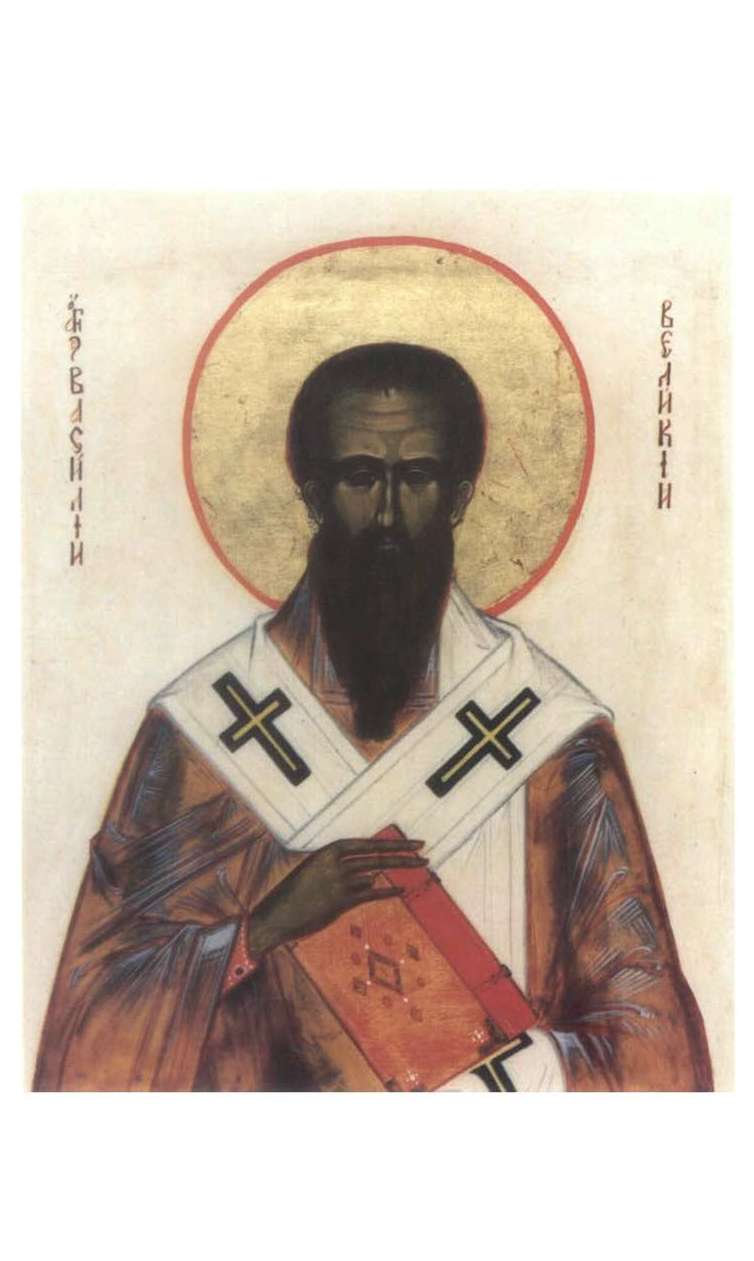
BASIL OF CAESAREA:
CHRISTIAN, HUMANIST, ASCETIC
A Sixteen-Hundredth Anniversary Symposium Part Two edited by
PAUL JONATHAN FEDWICK
PONTIFICAL INSTITUTE OF MEDIAEVAL STUDIES
Acknowledgment The publishing program of the Pontifical Institute is supported by the generosity of the De Rancé Foundation
© 1981 by Pontifical Institute of Mediaeval Studies 59 Queen's Park Crescent East Toronto, Ontario, Canada M5S 2C4
PRINTED BY UNIVERSA, WETTEREN, BELGIUM
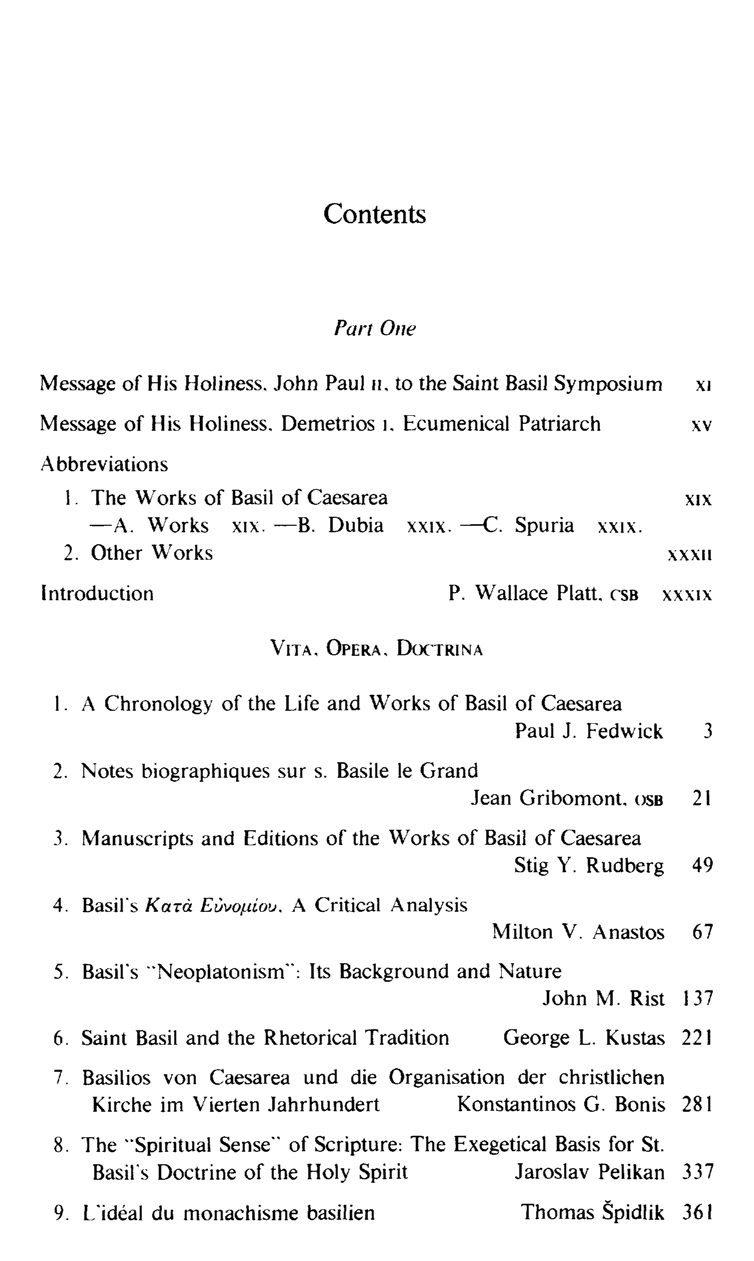
Contents Part One Message of His Holiness, John Paul π, to the Saint Basil Symposium χι Message of His Holiness. Demetrios i. Ecumenical Patriarch xv Abbreviations 1. The Works of Basil of Caesarea xix —A. Works xix. —B. Dubia xxix. —C. Spuria xxix.
2. Other Works xxxn Introduction P. Wallace Piatt, CSB xxxix
VITA, OPERA, DOCTRINA
1. A Chronology of the Life and Works of Basil of Caesarea Paul J. Fedwick
2. Notes biographiques sur s. Basile le Grand Jean Gribomont. OSB
i. Manuscripts and Editions of the Works of Basil of Caesarea Stig Y. Rudberg
4. Basil's Κατά Εύνομίου. A Critical Analysis Milton V. Anastos
5. Basil's "Neoplatonism": Its Background and Nature John M. Rist 137 6. Saint Basil and the Rhetorical Tradition
George L. Kustas 221 7. Basilios von Caesarea und die Organisation der christlichen
Kirche im Vierten Jahrhundert Konstantinos G. Bonis 281 8. The "Spiritual Sense" of Scripture: The Exegetical Basis for St.
Basil's Doctrine of the Holy Spirit Jaroslav Pelikan 337 9. L'idéal du monachisme basilien Thomas Spidlik 361
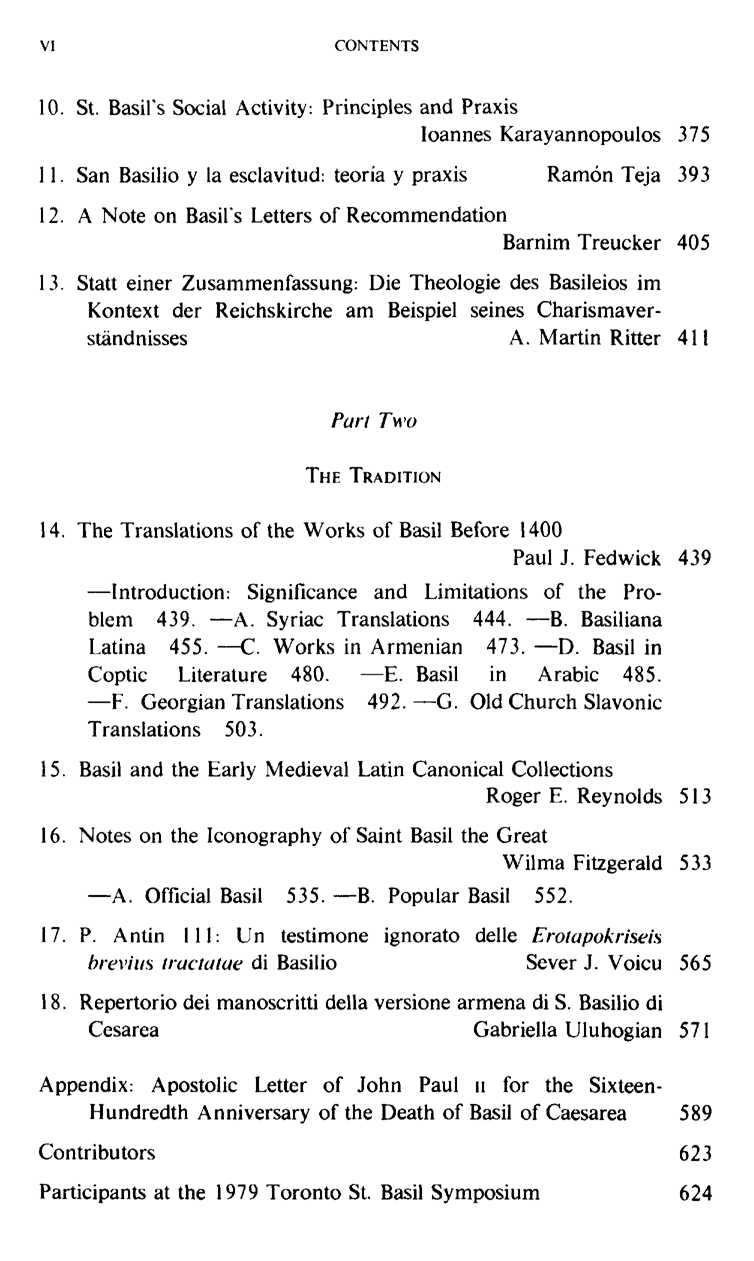
VI CONTENTS 10. St. Basil's Social Activity: Principles and Praxis Ioannes Karayannopoulos 375 11. San Basilio y la esclavitud: teoria y praxis
Ramon Teja 393 12. A Note on Basil's Letters of Recommendation Barnim Treucker 405 13. Statt einer Zusammenfassung: Die Theologie des Basileios im
Kontext der Reichskirche am Beispiel seines Charismaverslandnisses A. Martin Ritter 411 Part Two
THE TRADITION
14. The Translations of the Works of Basil Before 1400 Paul J. Fedwick 439 —Introduction: Significance and Limitations of the Problem
439. —A. Syriac Translations 444. —B. Basiliana Latina 455. —C. Works in Armenian 473. —D. Basil in Coptic Literature 480.
—E. Basil in Arabic 485.
—F. Georgian Translations 492. —G. Old Church Slavonic Translations 503.
15. Basil and the Early Medieval Latin Canonical Collections Roger E. Reynolds 513 16. Notes on the Iconography of Saint Basil the Great
Wilma Fitzgerald 533 —A. Official Basil 535. —B. Popular Basil 552.
17. P. Antin 111: Un testimone ignorato delle Erotapokriseis brevius tractatae di Basilio Sever J. Voicu 565 18. Repertorio dei manoscritti della versione armena di S. Basilio di
Cesarea Gabriella Uluhogian 571 Appendix: Apostolic Letter of John Paul n for the SixteenHundredth Anniversary of the Death of Basil of Caesarea
Contributors
Participants at the 1979 Toronto St. Basil Symposium
CONTENTS VII Bibliography —A. Editions: Basil of Caesarea 627. —Β. Editions: Other Authors 636. —C. Studies 654.
Concordance Between A sc. 1 and Asc. 3
Index of Citations of the Works of Basil of Caesarea
Index of Citations of Other Sources
Index of Biblical References
Index of Manuscripts
Index Graecitatis
General Index

The Tradition
The Translations of the Works of Basil Before 1400 Paul J. Fedwick Pontifical Institute of Mediaeval Studies
INTRODUCTION:
SIGNIFICANCE AND LIMITATIONS OF THE PROBLEM
In one of his letters addressed to two students, Festus and Magnus, Basil of Caesarea shares some memorable thoughts on the far-reaching significance and consequences of the written word; the works of an author prolong and extend, as it were, his existence into space and time.
Separation in the body is no hindrance to instruction. The Creator, in the fulness of his love and wisdom, did not confine our minds within our bodies, nor the power of speaking to our tongues. Ability to profit derives some advantage even from lapse of time; thus we are able to transmit instruction, not only to those who are dwelling far away, but even to those who are hereafter born. And experience proves my words: those who lived many years before teach posterity by instruction preserved in their writings; and we. though so far separated in the body, are always near in thought, and converse together (προσομιλούμεν) with ease. Instruction is bounded neither by sea nor land, if only we have a care for our souls' profit.
The narrow geographical boundaries within which Basil was confined for most of his life 2 had virtually no effect on his thinking. In all of his
1 EFest. [294], Courtonne, 3: 169.22-34.
2 With the exception of the time spent on studies in Athens and his trip to Alexandria, some 2,400 km south of Caesarea, Basil hardly ever crossed the borders that surround the Basil of Caesarea: Christian, Humanist, Ascetic, ed. Paul J. Fedwick (Toronto:
Pontifical Institute of Mediaeval Studies, 1981), pp. 439-512. © P.I.M.S.
PAUL J. FEDWICK
surviving writings,3 Basil's outlook is of a man with broad views, reflecting concerns for "the brotherhood all over the world with the same affection and the same zeal"4 that he showed for his immediate
Cappadocian circle. This ecumenical viewpoint combined with balanced judgment and the ability to express his thoughts clearly and forcibly in writing,5 assured Basil an endurance in space and time which is borne out not only by the history of his works in Greek but also by the translations of his writings which were made in the early Middle Ages into Syriac.
Latin, Armenian, Coptic, Arabic, Georgian and Slavonic.6 We may further add that Basil from the very beginning was such a highly esteemed and revered personality that in addition to the translation of his genuine writings many other works were made to circulate, some belonging to others, some forged deliberately in order to either "domesticate" or "naturalize" him.7
Cappadocian plateau: the Taurus mountains on the south, their extension and the Euphrates river on the east, the Black Sea on the north, and the desert region of Lake Tatta on the west.
! In my forthcoming work "Basil of Caesarea, 330-1985. A Critical Survey of the Direct and Indirect Tradition of His Works: Manuscripts, Translations, Early References,
Editions and Studies" are listed approximately 630 works attributed to him. Of these some
510 are written in Greek, the others are known only in translation.
4 EPetr. [133], Courtonne, 2: 47.18-19. There is nothing provincial or vulgar in the language and contents of Basil's works. He is indeed one of the first to prove wrong all those who thought the Cappadocians incapable of speaking good Greek. Contrast the opinion of Photius about Basil in P. J. Fedwick, The Church and the Charisma of Leadership in Basil of Caesarea (Toronto 1979) p. 173, with that of Philostratus about third-century Cappadocians in A. H. M. Jones, The Cities of the Eastern Roman Provinces
(Oxford 1971) p. 176. Cf. also L. Franck, Sources classiques concernant la Cappadoce
(Paris 1966) pp. 92-93. s See briefly, Fedwick, The Church, pp. 169-173.
6 The reasons for not going beyond the year 1400 are twofold: (a) the enormous output of Basilian and patristic translations notably among the Latin and Slavic-speaking nations beginning with the fifteenth century which even to be properly surveyed would require considerable space; (b) with a few exceptions, most of the translations coming from after 1400 are no longer based on MSS but on the editions of the texts. However excellent, their quality as witnesses diminishes. Nevertheless, with perhaps the exception of Latin and Slavic translations, my treatment of all other translations is almost complete.
7 By "domestication" is meant the attempt of the early monks who unlike Basil favoured eremitism, to attribute to him writings in which eremitism was recommended side-by-side cenobitism. The best example are the **Const., composed probably in Palestine before the end of the fifth century. Other, less conspicuous attempts, are exhibited in the interpolations of his Asc. 3; see the recensions Misogyne and Nilus in J.
Gribomont, Histoire du texte des Ascétiques de s. Basile (Louvain 1953) pp. 222-230.
Cases of "naturalization" are found in many of the adaptations of Basil's works discussed below. See particularly the homiliaries. For examples in Armenian see the work of K. M.
Muradyan, Barsel Kesarac'i ew nra "Vec'oreayn" hay maienagrut'yan mef (Erevan
THE TRANSLATIONS BEFORE 1400
Besides being the testimonial to Basil's survival and popularity, some of the translations considered in this paper possess a value of their own. As we shall presently see some of the manuscripts in which the early medieval translations of Basil's works have been preserved antedate the Greek manuscripts, and what is more, some of these versions bear witness to a text which is closer to the original than that of the Greek codices. In addition, the early Latin and Syriac versions of Basil's Asceticon have preserved a text which in Greek is extant only in small portions. Hence in modern scholarship it is becoming more and more evident that no modern critical edition of any of the Fathers can afford to ignore some of the early translations of their writings.
On the other hand, turning to Basil, in reviewing the translations of his works we should be aware of some of the limiting factors. First, it should be pointed out that between the fourth and fourteenth century Basil was not the only nor even perhaps the most popular writer to attract the attention and engage the services of the early medieval translators who at the time were anxious to enrich with borrowed material their national and in many instances incipient literatures. Little or no indication exists to support the view that he was preferred to other Greek writers such as John Chrysostom or the two Gregories. Furthermore, it should be noted that during the period under consideration many of Basil's works in which he appears at his best (for instance his more than three hundred letters) were virtually unknown to most people who could not read Greek.
The only "lives" in circulation were the encomia of the two Gregories, the 8 By far the most popular was the Pseudo-Amphilochian "Vita et miracula Basilii," a legendary account from the sixth or seventh century bearing little or hardly any resemblance to real facts.
Pseudo-Ephrem, and the Pseudo-Amphilochius.
Such is the context in which we ought to place the early medieval versions of Basil's works. In addition, several other points need to be kept in mind. As we shall see. many translations made during that period were not real translations — word-by-word renderings — but free adaptations and paraphrases of the original.
10 Basil's and other writers" works were 1976), and for Coptic Τ. Orlandi, "Basilio di Cesarea nella letteratura copta, RSO 48(1975)
49-59.
8 BHG 244, 245, 246, 246z.
9 BHG 247-260. Cf. R. Barringer, "The Pseudo-Amphilochian Life of St. Basil:
Ecclesiastical Penance and Byzantine Hagiography," Theologia 51 (1980) 49-61.
10 See below under Georgian literature (Ewkt'ime and Giorgi At'oneli) and Arabic literature; also S. Brock, "Aspects of Translation Technique in Antiquity," GrRoBySt 20
PAUL J. FEDWICK
either lengthened or shortened according to the demands and wishes of the translators/adapters. There was also sometimes applied the literary genre popular among the oriental people, and among the Byzantines as well, whereby a new work was concocted on the basis "of the sayings" of an author." In most instances the procedure adopted was much freer and far-fetched than the one for instance exhibited in the well known
Sermones morales of Simeon Metaphrastes.12 The other type of literary production which affected the homilies in particular was that of the homiliaries. By homiliary, from the Latin "homiliarium," it is understood the Greek "panegyrikon," the Armenian "tônakan," the Georgian
"mravalt'avi," and the Slavonic "torzhestvennyk," that is, a compilation of sermons of various authors either for public (liturgical) or private use.13
What we may suspect, although just suspect and not be a priori sure, is that the text of a work placed in the homiliary may be to a lesser or greater degree altered, i.e., edited ad hoc in order to meet specific requirements.
What we can always be sure of is that those requirements will never be ones of literary nature, but of the kind described by Grégoire as "kerygmatic," that is spiritual and practical meant to edify rather than impress the mind of the users.14 Until more work is done on the individual homiliaries, particularly the very rich oriental ones,15 we can never be a (1979) 69-87; idem, "Greek into Syriac and Syriac into Greek," Journal of the Syriac
Academy 3 (1977)406-422.
" In the approximately 5,000 MSS which contain Basil's works (2,500 of which are
Greek, and the other half non-Greek) it is often noted that a given work is made up "e dictis sancti patris nostri Basilii." See for instance the "Sermo de juventute et senectute et morte" (in Arabic) in London BL Arund. or. 21, a. 1252; the "Sermo perutilis" (in Greek) beginning with the words Τό τελειότατον έργον in Vatican BAV Vat. gr. 733, 14th cent.
These remarks often go unheeded in the studies of the works of Basil. However, they are important for establishing the identity of many of them.
12 See PG 32; 1116-1381. In most cases, all Simeon did was to add one or two words in order to smooth the transition between the various extracts. However, the authors referred to in the previous note often added whole paragraphs and used the works or "sayings" of Basil only as a framework for their own creations.
" I adopt a definition of the homiliary which is much more inclusive than the one proposed by A. Ehrhard, Überlieferung und Bestand der hagiographischen Literatur der griechischen Kirche (Leipzig 1937-1952) passim; see J. Gribomont, "Exploration dans les homéliaires de l'Orient," RSLR 14 (1978) 232.
14 R. Grégoire, "Homéliaires orientaux," DSp 1 (1969) 609. See also Gribomont, "Exploration," p. 233; and T. Orlandi, "Patristica copta e patristica greca," VetChr 10
(1973) 328-341, particularly p. 337.
15 See already J. M. Sauget, "Deux homéliaires syriaques de la Bibliothèque Vaticane,"
OrChrP 27 (1961) 387-424; idem, "L'homéliaire du Vatican Syriaque 253. Essai du reconstitution," Mu 81 (1968) 297-349; idem, "L'homéliaire arabe de la Bibliothèque
Ambrosienne (x. 198 sup.) et ses membra disiecta," AB 88 (1970) 391-475; and briefly
Grégoire, "Homéliaires," 7: 606-617.
THE TRANSLATIONS BEFORE 1400
priori certain if what we have is really a new work, a different redaction of the original, or simply a different arrangement of the same work whereby an exordium is either left out or placed at the beginning of another work.
In the study of the ancient translations attention should also be paid to the titles given to the corpus of Basil's homilies. In the Greek manuscripts the ordinary title is τά ηθικά comprising all the Homiliae in psalmos (no more than eighteen) and the Homiliae diversae (the number varies between twenty-four and forty-eight). Also Ewkt'ime At'oneli adopted this designation for his version of a corpus of some fifty-three to fifty-five works of Basil.
17 Because in some Greek manuscripts the same title is also given to the Regulae morales, many authors have mistakingly thought that Ewkt'ime translated not Basil's homilies (Homiliae morales) but his ascetic rules (Regulae morales).
1* In Armenian, Basil's Moral Homilies are traditionally designated by a title which is derived from the first homily in the series, the HIeiun. 1, in Armenian "Pahoc'," hence the collective name "Girk' Pahoc"' = Liber de ieiunio. How misleading and arbitrary these titles can be appears in the case of the Slavonic manuscripts where the same designation Liber de ieiunio ("Knyha postnych'stva," or also
"Slova postnych'skiya" = Sermones de ieiunio) stands not for Basil's Moral Homilies but for his Ascetic Hypotyposis.
19 In order to avoid such mistakes. I have tried whenever possible to draw my information not only from the manuscripts as described in the catalogues but also from the many specialized studies correcting or completing the catalogue information.
20 In not a few cases I have resorted to the manuscripts themselves, in particular, when such specialized studies were lacking or not available.
16 The homilies in Arabic listed below (p. 490 c.ii.) have only different exordia but the text in all four is the same.
17 See below under Georgian translations.
18 M. Tarchnisvili, Geschichte der kirchlichen georgischen Literatur (Vatican 1955) p.
188; G. Garitte. "Géorgienne (littérature spirituelle)," DSp 6 (1967) 247. These and other authors repeat the mistake of K. Kekelidze; see E. G. Khintibidze, Basili Kapadokielis
"Samogwats'eo ts'ignis" kart'uli redaktsiebi (Tiflis 1968) pp. 162-164.
" In most manuals of Slavic literature which I was able to consult it is wrongly affirmed that Basil's homilies not his ascetica were early translated into Slavic; see e.g., D.
Chyzhevskyi, History of Russian Literature. From the Eleventh Century to the End of the Baroque (The Hague 1971) p. 155; Hr. Luzhnytskyi, "Sv. Vasyliï Velykyï na Ukraini,"
Svitlo 42 (1979) 179. See also below nn. 324, 326.
20 The most valuable contributions are those of Gribomont, Histoire, and S. Y.
Rudberg, Étude sur la tradition manuscrite de saint Basile (Lund 1953). It would be very difficult to list here the other supplementary literature and the reader is referred to my forthcoming study cited in n. 3.
21 This is particularly true of the Slavonic MSS.
PAUL J. FEDWICK
My survey of all the versions that were made between the fourth and the fourteenth century is arranged according to the various languages. As far as possible, I try to indicate the general context in which the translations were carried out, assess the literary value of the version, and also determine the degree to which people knew the "real" Basil and the extent to which they adhered to his teachings. I begin with the Syriac translations (some of which were made during Basil's lifetime), then follow with the Latin, Armenian, Coptic, Arabic, Georgian, and conclude with the Slavonic recensions.22 In no way do I pretend this to be the final word in such a complex and intricate matter. My purpose is rather to bring together the results of most recent scholarship and, hopefully, stimulate further research and study in an area so challenging and to a degree still insufficiently explored.
A. SYRIAC TRANSLATIONS
Throughout his life Basil maintained cordial and friendly relations with many Christians living in the Roman-Byzantine provinces öf Coele-Syria,
Euphratensis, Mesopotamia and Osrhoëne. From his correspondence with Eusebius, bishop of Samosata, survive nineteen letters.23 One or more letters are extant from his correspondence with people living in Antioch,24 Batnae,25 Beroea,26 Carrhes,27 Chalcis,28 Edessa,29 Himmeria,30
Laodicea,31 Perrhes32 and Samosata.33
22 To my knowledge there are no pre-fifteenth-century translations into Ethiopie nor any, at least of the authentic works, into Modern Greek from that period.
23 EEus. [27, 48, 30, 34, 95, 98, 128,100, 127, 145, 138, 141, 136, 162, 198, 237, 239,
241, 268]. Samosata (modern Samsat), some 419 km southeast from Caesarea, was since
359 in the province of Euphratensis (formerly Coele-Syria), diocese of Oriens. See also n. 33 below.
24 EAnt.ec.[lA0],EAnt.pb.[253],EEvagr.[l56].EMel.[51,68,89, 120, 129,216] were written to Meletius while in exile. Antioch (Antakya), in Coele-Syria (after 381 in Syria I.), was the capital of the diocese of Oriens. EFrat. [256] was written to the persecuted monks of Antioch. One of them, Acacius, became bishop of Beroea in 378.
25 EAbr. [132]. Batnae (Sarüg, modern Sürüc) was since 363 in the province of Osrhoëne (formerly Mesopotamia), diocese of Oriens. Abramius, to whom Basil wrote, was its first bishop.
26 EThdt. Ber. [185]; EBer. [220, 221]. Beroea (Haleb) was in Coele-Syria (after 381 in Syria I.), diocese of Oriens. On Acacius the successor of Theodotus see n. 24 above.
27 EVit. [255]. Carrhes (Haran), about 40 km south of Edessa, was in the province of Osrhoëne (Mesopotamia until 363), diocese of Oriens. Until 361 its bishop was Barses (see n. 29 below).
28 EChalc. [222]. Chalcis (Qennesrin, south of Haleb) was until after 381 in Coele-Syria
(then in Syria I.), diocese of Oriens. When Basil wrote this letter bishop Magnus must
THE TRANSLATIONS BEFORE 1400
All such contacts favoured the early penetration of Basil's works into Syriac speaking areas. The first edition of his Asceticon, the Asc. 1, composed before his episcopate, was taken to Syria probably during 34 A translation soon followed.
35 The name of the translator remains unknown. However, one of the oldest manuscripts of the work, the London BL Add. 14544, was written in the fifth or sixth century by Nonnus "the Sinner," a monk belonging to one of the many monasteries in or near Edessa.
Basil's lifetime.
36 The copy was later on sold to Leontius, abbot of the have been dead. In 378 F.usebius of Samosata ordained a namesake to occupy the see. This
Qennesrin (Chalcis) is not (he same as the one mentioned below, p. 449 and η 57 29 EBars [264. 267]. while in exile. Edessa (t'rfa) was the metropolis of the province of Osrhoëne (Mesopotamia until 363). diocese of Oriens. Barses was transferred from Carrhes in 361. If Basil visited Carrhes in 357 he did not meet Barses; cf EBars. [264].
Courtonne. 3 126.6-8.
,n EEu\i. Him [I 84] Himmeria. between Apamea and Carrhes. belonged until 381 to the province of Mesopotamia; afterwards to Osrhoëne. diocese of Oriens
" EPel. [254]: EApall. [361. 363] I.aodicea (Ladiqiyeh) was in the province of CoeleSyria after 381 in Syria I . diocese of Oriens. Basil was well acquainted with its ascetic community which he visited probably more than once.
" £7oi'. ep [118] Perrhes (Perin) belonged after 359 to the province of Euphratensis
(formerly Coele-Syria), diocese of Oriens.
33 ETer [214]: ETer it. [105]: EPuuln. [182]; ESam. cl. [219]: ESam. sen. [183]; EAnt.
[146]: EAnt [158]: EAnt [157]: EAnt. [168] On this location see n. 23 above.
34 The only plausible explanation for the survival of the Asc. 1 in Syriac and Latin is that it must have left Cappadocia or Pontus before the two new enlarged recensions appeared. On the Asc. 3 see above. P. J. Fedwick, "Chronology," pp. 15, 17. It should be noted that both Asc. 2 and Asc. 3 were never known to the Syrians, and to the Latins not until the fourteenth century (Asc. 213a-c).
35 According to A. Baumstark. Geschichte der syrischen Literatur (Bonn 1922) p. 78, and I. Ortiz de Urbina. Patrologia syriaca (Rome 1965) p. 234, all Syriac translations of the fourth-century Greek Fathers antedate the late fifth and early sixth-century religious divisions. After initially favouring the sixth century, Gribomont, Histoire, p. 147, concludes: "II nest pas impossible que la traduction [seil, of the Asc. I] remonte à une époque très proche de saint Basile, qui était en relations suivies avec le monachisme syrien. " See also W. Wright. Catalogue of the Syriac Manuscripts in the British Museum, 3
(London 1872) xix-xx. It could be argued that before the sixth century there was hardly any need for any translations as most Syrians of that time could either understand or speak Greek. In Edessa the study of Greek formed part of the theological curriculum.
Besides, all Basil's correspondence with the Syrians mentioned earlier was handled in Greek and what is most significant none of his letters written to them has ever been translated into the vernacular. However, it is unlikely that the monks and ascetics, the main beneficiaries of such texts, were in such a privileged position as most of the inhabitants of the big towns and cities. Like the Coptic, the Syriac ascetics were recruited for the most part from the villages which were untouched by Hellenic culture.
56 The most likely date of the MS is the sixth century; see C. Moss in Gribomont,
Histoire, p. 108. See also there, pp. 108-109, Gribomont's comparisons with other dated
MSS. all from the sixth century and all written in Edessa. For a list of the Syriac monasteries in the region of Edessa see the homonymous entry in DACL A (1921) 20582110.
PAUL J. FEDWICK
monastery of St. Theodore on the mountain of Siriyan Qastra, north of Palmyra (Tudmur). It remained there until the year 900 when it was purchased and taken by the monks Mark, Maroutha and Athanasius to the monastery of St. Mary Deipara in Wadi Natrun, Egypt.37 In the Syriac version of Basil's Asc. 1 we have one of the two witnesses (the other is the Latin) to the existence of a Basilian work whose Greek original has been lost.38 However, compared with the Latin, the Syriac version is much freer and much less intelligent, and therefore less reliable for the recovery of the Greek text.39 Its main value lies in the biblical text used by the translator — the text antedates the Peshitta — and in the light it sheds on the history of Syrian monasticism.40
A list of the other works of Basil known to the Syrians is contained in the Chronique de Se'ert, written by the Nestorian Iso'denah in Arabic shortly after 1036:
Basile nous laissa, entre autres ouvrages, un livre sur l'Hexaéméron, une explication de quelques psaumes remarquables du prophète David, plusieurs traités sur le jeûne et la prière, un écrit sur la règle de la vie monastique, des lettres et des polémiques avec Eunomius.44
Because none of the works of Basil translated into Syriac has ever been published, I shall list all the translations directly from the manuscripts, according to the above division, citing for each work only the oldest testimony.42 i. Ascetica Chronologically the earliest version is that of the Asc. Is of which we just spoke. No Syriac translation is extant of either the Asc. 2/3 or the Reg. mor. In view that the Asc. Is continued to be copied until the 37 From this famous monastery (on which see briefly P. Peeters. Le tréfonds oriental de l'hagiographie byzantine [Brussels 1950] p. 183) the MS was acquired by the British Library in 1839. For other copies of the Asc. Is see Gribomont. Histoire, pp. 108-114.
38 In Greek only Asc. Pl has survived; see Paris BN Coislin. 193. 1 Ith cent. ff. 96v-97v. now published for the first time in BHP 53: 137-138. Since the text of the Asc. I is in many parts identical with that of Asc. 213c it is possible that the fragments of the papyrus of Antinoopolis studied in this volume by Voicu could just as well be the remnants of the Asc. I.
39 For some comparisons between the two versions see Gribomont. Histoire. pp. 123 ff.
40 Gribomont. Histoire, pp. 141-144.
41 I. 51. K) 5: 280-281. Cf. P. Nautin. "L'auteur de la Chronique de Séert': Iso'denah de Basra." RHR 186 ( 1974) 113-126.
42 For a complete list of all the Syriac and other MSS of Basil's works see my forthcoming work cited above n. 3.
THE TRANSLATIONS BEFORE 1400
thirteenth century, that is virtually until Syriac ceased to be a spoken tongue, one may assume that such translations never existed.43 The dubious SDisc. appears in London BL Add. 14608 from the seventh century; the likewise doubtful Asc. Pr5. which in some Greek manuscripts prefaces the Asc. 3,*4 is in London BL Add. 12167 from 876.
The genuine Asc. Pr3 is found in London BL Add. 14601 from the ninth century, and the dubious Epit. 24 in London BL Add. 14533 from the eighth or ninth century. The only plausible explanation for the existence of these partial versions, and not of the works which they usually accompany in Greek, lies perhaps in the conviction shared by some
Syrians with the author of a colophon according to whom the only difference between the Asc. I and the Asc. 3 consists in the different distribution of the text not in the contents.45 An otherwise unknown
Treatise on virtue'' appears in two manuscripts: London BL Add. 14615. from the tenth or eleventh century, and London BL Rich. 7190. from the thirteenth century.
In a celebrated letter to an otherwise unknown Patricius, Philoxenus of Mabboug (ca. 440-523), exhibits a firsthand knowledge of Basilian spirituality. The entire letter46 revolves around one of the cornerstones of Basilian asceticism — the absolute necessity for every Christian to observe all divine commandments without discrimination.47 However, from the historical point of view more interesting is the fact that at Edessa where
Patricius lived Basil was known as the supporter of both the cenobitic and the eremitic type of asceticism. It is hard to determine with all certainty on 43 The Vatican BAV Vat. syr. 126 is from 1223. See below, n. 45
44 See <PG 2883. and Gribomont. Histoire, pp. 295-297. Here worth mentioning are the contents of Cambridge ui. Or. 2023. 13th cent., which contains mainly but not exclusively ascetic treatises. The works attributed to Basil in it are as follows: Question of the brethren to Basil''; "Extracts from the writings of Basil "; "From the letter to his brother Gregory' (see London BI Rich. 7190. 13th cent.?; if so it would be the same as London BI Add. 14615. 10/11th cent, described next): "From "SDisc": "Questions and answers ": On prayer' (c. 1 of the Consl. as. e.g.. in Ayion Oros MMI. 271. 13th cent.?):
"From the letter to Amphilochius' : "From another letter to the same": "From another letter ; Question put by the brethren to Basil, with his reply"; "Basil and Gregory question and answer 45 The colophon appears in the MS written by Nonnus the Sinner in the fifth or sixth century (see above) and in it allusion is made to the Asc. 3 (368 Questions; the allusion to 360 Questions in Vatican BAV Vat. syr. 122. from a. 769. is probably to Asc 2). However, curiously or rather mistakingly both scribes identify the Asc. Is (which in Syriac has only
183 Questions) with the Asc. 3. See Gribomont. Histoire, pp. 109 and 111 4,1 Text and French translation in PO 30: 725-873. The part dealing with Basil is at 758761 The best study is still that of I. Hausherr. "Contemplation et sainteté. Une remarquable mise au point par Philoxène de Mabboug (1523)." RAM 14 (1933) 171-195.
47 See briefly Fedwick. The Church, pp. 15-23. esp. 16.
PAUL J. FEDWICK
what grounds this knowledge rested. Basil, it is known, not only criticized eremitism but he also bluntly rejected it as incompatible with human nature and God's commandments.
48 In order to account for Patricius misinformation one is tempted to think of the spurious **Const, as being the work circulated under Basil's name even at this early period.
49 The only extant Syriac version of the **Const, is from the tenth or eleventh century, or more likely, from the seventh to ninth centuries.
50 However the whole manuscript which contains twenty-eight works of Basil is said to be a new translation. This clearly indicates that there was another older version of each work now no longer extant.
51 In my opinion the ** Const. in Greek were known in Palestine during or even before the lifetime of Isaias of Scete (t489). Very early on they were translated into Coptic,
and, I believe, also into Syriac. The whole work is a clever forgery whose explicit aim is to portray Basil as the upholder of both the cenobitic and the eremitic monasticism. It is precisely from this source that Patricius drew his confusing notion of Basil's spirituality.
Apart from this rather extreme case, although not altogether isolated, we find only a few early traces of Basil's influence on the course and development of Syrian monasticism. In some cases it is not clear if the references are to the Syriac or the Greek text, as most of the authors could also read Greek.
55 The Asc. Is was evidently in use in the Monophysitic monasteries visited by John bar Aphtonia (t537) at the end of the fifth century.
56 This remarkable ascetic was abbot of the convent of St. Thomas in Seleucia on the Orontes until the beginning of the reign of Justin ι (518527). Banned from his monastery, John settled on the left bank of the 48 See EApokr. fus. 1, and Fedwick, ibid.
49 Nothing impedes us from assigning such an early date for their composition; see below and n. 7 above on Basil's "domestication." so See below, n. 62 and S. Brock, "Basil's Homily on Deut. xv. 9-. Some Remarks on the Syriac Manuscript Tradition" (forthcoming in the Memorial M. Richard). I wish to thank
Prof. Brock, Oxford, not only for making available to me the above article but also for assisting me in many matters related to Syriac MSS. s l For the Moral Homilies see below.
52 See L. Th. Lefort, "Les Constitutions ascétiques de s. Basile," Mu 69 (1956) 5-10.
The translation is from the sixth century.
53 The only other source could be EGNaz. [2], translated into Syriac quite early (see below), and which, among others, was often interpreted in the Latin West as advocating the eremitic life.
54 For other examples see Gribomont, Histoire, p. 146.
55 See Gribomont, ibid. For the quotations (most unidentified) of Dadiso see R.
Draguet, Commentaire du livre d'abba haïe (logoi i-xv) par Dadiso Qatraya (vue s.)
(Louvain 1972)cscoss 326/327; 144/145: 111, 119, 235, 243.
56 See F. Nau, "Histoire de Jean bar Aphtonia," ROC 1 (1902) 97-135.
THE TRANSLATIONS BEFORE 1400
Euphrates and in a locality called Qennesrin ("eagle's nest") he founded the celebrated convent which later became one of the major centres of Syro-Hellenic culture.57 The chief characteristic of Basil's ascetic ideal, the favouring of cenobitic asceticism, is unmistakably borne out by the account of John's life.58 ii. Hexaemeron It is not clear if there has been one or two translations.59 At any rate, a translation was made as early as the fifth century.60 I do not know if the complete text of Mount Sinai, MHAI syr. 9, from the eighth century, belongs to this first version or to the second (sic) of Athanasius n of Balad. iii. Moral Homilies There have been two translations of a corpus of some twenty-eight homilies of Basil. The first one. quite free and almost paraphrastic, was made in the fifth century, before the Christological disputes; the second one. characterized by its literalness. came from the school of Jacob of Edessa. and it is probably to be dated to the seventh century.61 As there is not a complete manuscript from the earlier period. I shall first list the homilies translated for the second time which are found in the Cambridge ui. Add. 3175. probably written in the ninth century.62 Being a "new
57 Thomas of Heraclea, Athanasius n of Balad, Jacob of Edessa, and others graduated from this centre. That this Qennesrin is not the same as the one to whose church Basil wrote EChalc. [222] (above n. 28) see E. Honigmann, Évêques et évéchés monophysites d'Asie antérieure au vi " siècle (Louvain 195 Dp. 191.
58 See Nau cited in n. 56. and Gribomont, Histoire, pp. 145-146 59 In a work published in Syriac in 1967 (see Brock η. 50 above), Ε. Barsaum asserts that Athanasius u of Balad (see above n. 57) translated Basil's Hexaemeron in 666.
According to Brock, this could be either a revision of an older version or a new translation.
60 See the fragments of Hex. 7 in London BI. Add. 17143, 5th cent. Other fragments:
Hex. 1 in London BI. Add. 17124, 7th cent.; Hex. 9 in Milan BA syr. 37, 7/8th cent.
Unspecified quotations in Minganasyr. 69, 7th cent, and London BI. Add. 12155, 8th cent.
Brock (see n. 50 above) adds London BL Or. 8608.
61 See Baumstark. Geschichte, p. 78, and Ortiz de Urbina, Patrologia, p. 234. Both authors place the second version in the ninth century. However, this ought to be considered only as terminus ad quern. The activity of the new translators from the school of Jacob of Edessa (see above n. 56) stretched from the seventh into the ninth century. The title of the corpus in Cambridge Add. 3175. 9th cent, and London BL Add. 17193, a. 874, is 'tyqy d-bsylyws = -ηθικά.
62 The date given by W. Wright. A Catalogue of the Syriac Manuscripts Preserved in the Library of the University of Cambridge (Cambridge 1901) p. 1218 is 10/1 Ith cent
However, Brock (see η 50) favours the 9th cent. See also N. G. Wilson. Si. Basil on the Value of Greek Literature (London 1975) p. 72.
PAUL J. FEDWICK
translation,"63 I believe, that they warrant the conclusion that all of these homilies and maybe some more, owing to the defective state of the manuscript, existed alreads in an older version.
Here are the contents of the Cambridge manuscript: i. HProv. [12]; ii.
HAtt. [3]; iii. HIeiun. 1; iv. HIeiun. 2; v. HEbr. [14]; vi. HFide [15]; vii.
HMart. [19]; viii. H Bapt. [13]; ix. HGord. [18]; x. HGrat. [4]; xi. HI id. ]5]; xii. HPs. I; xiii. HPs. 14a-, xiv. HPs. Nb-, xv. HPs. 59-, xvi. HPs. 61; xvii.
HPs. 114; xviii. HPs. 115-, xix. HMal. [9]; xx. HInv. [11]; xxi. HIra [10]; xxii. HDestr. [6]; xxiii. HDiv. [7]; xxiv. Ad adolesc-, xxv. HVerb. [16]; xxvi.
**"Against those who say that the Son is not like the Father";64 xxvii.
HSab. [24]; xxviii. HTrin. [29].65
Nineteen of these homilies are found in manuscripts containing the older version: i, ii, iii, iv, v, vi, vii, viii, x, xii, xiv, xvii, xix, xx, xxi, xxii, xxiii, xxiv, xxviii. Also in the older version is HChr. [27], On the basis of this comparison one may conclude, first, that the seven homilies missing, although not preserved in the manuscripts, must have existed in the older version;66 second, that HChr. [27] is probably the one missing from the Cambridge manuscript; and third, that the following (authentic) homilies have probably never been translated into Syriac: HFam. [8], H Hum. [20].
HMund. [21], HMam. [23], HLac. [26], HPs. 7, HPs. 28a, HPs. 29, HPs. 32, HPs. 33, HPs. 44, HPs. 45, HPs. 48.
After comparing both translations of HAtt. [3], Brock draws the following conclusion:
From the point of view of the history of the Greek tradition, the original Syriac translation (Syr. i) is, despite its early date, of disappointingly little importance, by reason of its highly paraphrastic character. Its interest — for it has interest — lies elsewhere, in the field of Syriac language and literature.
Syr. n [i.e., the second version], on the other hand, while not achieving the extreme literalness of some seventh-century translations, is of a sufficiently literal nature to render it a witness of potentially much greater value.67
In addition to the above authentic works, the following works appear under Basil's name in the manuscripts (all from before the tenth century)
63 See Wright, A Catalogue, p. 1218.
64 A work otherwise unknown. Not the same as CPG 2950.
65 The last work in the MS is * * Const, (incomplete). According to a note by the scribe xxv-xxviii and the * "Const, are in "another translation." The titles given to HFide [15] and HTrin. [29] are "De fide prima," and "De fide secunda," respectively. For Simeon of the Black Mountain, translator of HPs. 1, see below.
66 HGord. [18], HPs. 14a, HPs. 59, HPs. 61, HPs. 115, HVerb. [16], and also probably
No. xxvi.
67 "Basil's Homily" (see above n. 50), conclusion.
THE TRANSLATIONS BEFORE 1400
of the homiliary type: a. **"Homily on Lent, 1"; b. ''"Homily on Lent, 2": c. **"Homily on Lent, 3"; d. **"Homily on the Martyrs"; e.
""Homily on the xl. Martyrs, 2"; f. **"Homily on Temperance and Chastity": g. *'"Homily on Virginity and Holiness"; h. ** "Funeral
Sermon on a Child of the Imperial Family."68 iv. De Spiritu Sancto Without mentioning the numerous excerpts and quotations from this work.69 there exist two versions both apparently from the fifth and early sixth century.70 The title by which this work of Basil is commonly referred to in Syriac is "Epistula ad Amphilochium."71 v. Contra Eunomium All four books — Book 4 as one work with Book 5 — are quoted as works of Basil by Timothy of Aelurus (1477), Severus of Antioch (t538), and Theodosius of Alexandria (tea. 568).72 However, there is no manuscript tradition in Syriac for all four books as one work. Indeed only the first three books appear with the title "Contra Eunomium," whereas in the above authors and in the manuscripts Book 4 (with the fifth) is commonly referred to by other titles.73 Both works were probably translated for the first time in the eighth century.74 But long before these
68 The MSS for each work are as follows: London BL Add. 17144. 6th cent, (a-d); Vatican BAV Vat. syr 369, 9th cent, (a-c, e); Vatican BAV Vat. syr. 368, 8th cent, (e);
London BL Add. 18814, 9th cent, if); London BL Add. 14531, 7/8th cent, (g); London BL
Add. 18813, 7th cent., and London BI. Add. 14520, 8/9th cent. (h).
69 For some of the references see B. Pruche, Basile de Césarée, Sur le Saint-Esprit
(Paris 1968) pp. 17-37.
70 London BI Add. 17143. 5th cent. (inc. et des. mut), and London BL Add. 14542, a.
509 (without subdivisions into chapters). Both MSS were collated for the edition of C. F. H.
Johnston. The Book of St. Basil the Great, Bishop of Caesarea in Cappadocia, On the Holy
Spirit (Oxford 1892). Cf. also J. M. Sauget, "L'apport des traductions syriaques pour la patristique grecque." RThPh 110 (1978) 139-148.
71 Pruche, Basile, p. 21.
72 For Timothy see K. Ter-Mekerttschian and E. G. Ter-Miniassiantz, Timotheus Aelurus ' des Patriarchen von Alexandrien Widerlegung der auf der Synode zu Chalcedon festgeseizen Lehre (Leipzig 1908) with F. Cavallera, "Le dossier patristique de Timothée
Aelure," BLE 40 (1909) 347, and R. Y. Ebied and L. R. Wickam, "A Collection of Unpublished Syriac Letters of Timothy Aelurus," JThS 21 (1970) 335-355. For Severus see rsco 119/120, 111/112,93/94, 101/102 ad indicem. For Theodosius see csco ss 37.
73 See W. M. Hayes, The Greek Manuscript Tradition of (Ps.) Basil's Adversus Eunomium IV-V (Leiden 1972) pp. 8 ff.
74 Londoner Add. 17145, a. 798 (inc. mut), and London BL Or. 8606, a. 723, written in Edessa. by the priest Gabriel (a "florilegium melkiticum"; see R. W. Thomson, "An
PAUL J. FEDWICK
versions appeared they were known through the many quotations and extracts in the florilegia and "catenae" from the early fifth and sixth centuries.
75 The translations that were made at a later date are rather free adaptations of the original for purposes other than combating Eunomius' teachings.
vi. Epistles What for us today is the best source for studying Basil's ideas and the work in which he appears at his best as an ascetic and church leader — his three hundred and so letters — enjoyed only a limited circulation in antiquity. This is not so true of their tradition in Greek as it is of the early translations. Nonetheless in Syriac Basil's letters are represented more strongly than in any other language.
Although no corpus of Basil's letters is extant in Syriac, there are two collections each containing a number of works from his correspondence notably with Gregory of Nazianzus. The works whose titles are given in full (sometimes more than one) appear only in Syriac. They are without parallel in Greek or in any other language.
London BL Add. 17144, sixth century: i. Eltal. [243]; ii. EMod. [111]; iii. * ""Letter of Basil to the orthodox priests"; iv. EMax. sch. [277]; v.
Ε Anc. [29]; vi. ** "Letter of Basil to our brother the abbot"; vii. ** "Letter of Basil, sent by the hand of the bishop Acacius, when he was a priest, to the convent of Mar Joseph at Teleda"; viii. EGNaz. [14]; ix. EGNaz. [2]; x.
Ad virg. [46]; xi. **"A second letter to the same virgin, on her repentance"; xii. **"Letter to the recluses (in the desert or in the monastery)."
London BL Add. 14549, eighth or ninth century, written by Abraham of Beth-Süräyä: i. ESoz. [261]; ii. *'*"Basil to the priests who were expelled by the heretics"; iii. EGNaz. [71]: iv. **EIuln. [41]; v. EAth. [80]; vi. EMon. vex. [257]; vii. EGNaz. [14]."
Eighth-Century Melkite Colophon from Edessa," JThS 13 [1962] 249-258, and P. J.
Fedwick, "A Commentary of Gregory of Nyssa or the 38th Letter of Basil of Caesarea,"
OrChrP AA [1978] 35-36).
75 See the work of Hayes (n. 73 above).
76 See Thomson, "An Eighth-Century," p. 250. A "Discourse against Apollinaris" in Mingana syr. 69, 7th cent, has not been identified. See nn. 193-194 below.
77 Add. 17144 iii is the same as Add. 14549 ii. The title of Add. 17144 ν is "Basil to the Alexandrians," and of Add. 14549 i, "Basil to the people of Sozopolis, against the Phantasiasts," i.e., the Julianists (see n. 78). Next, on the canonical collections, I quote only one MS. For other 7/8th cent, MSS see A. Vöobus, Syrische Kanonessammlungen, 2
(Louvain 1970), esp. 443 ff.
ΓΗΕ TRANSLATIONS BEFORE 1400
De perf. [22] appears in London BL Add. 14533, from the eighth or ninth century, with the title "A tract of Basil, containing 48 rules."
In Paris BN syr. 62. from the ninth century, are found the Epistulae canonicae. viz. EGreg. ph. [55], EClwr. [54], EDiod. [160], EAmph. [188],
EAmph. [199], EAmph. [217], "Sentences of Basil concerning heretics who persecute the orthodox." and "Epitimia in canonicas" (12 corresponding to the 11 in Greek). According to the colophon, the translation was made from the Greek in 687.
EOpt. [260] and EAmb. [197.1] appear only in extracts. vii.
Liturgien Despite the fact that all the manuscripts are very recent, Rahmani dated on the basis of internal evidence the version of LBas. 2 to no later than the seventh or eighth century, the time when Syriac literature was at its peak.
79 The oldest manuscript of the translation of LBas. I. the London BL Add. 14497. is from the eleventh or twelfth century. The codex is a "Sacerdotal." according to the Melkite rite, and the translation from the Greek should not have been made too much earlier.
78 E.g., in London BL Add. 17191, 9/10th cent. In his works written originally in Greek but which have been preserved only in Syriac (from the 7/8th cent), Severus of Antioch quotes EMax. phi. [9], ETer.,ft. [105], ENeoc. cl. [207], ENeoc. pm. [210], ETer.
[214], EAsc. [226] (not identified by E. W. Brooks, The Sixth Book [London 1902/1904] p. 449), EAmph. [236]. EPatrph. [250], EEvaes. [251] (not identified by Brooks, ibid., p. 343). Etlrb. [262], and EEulg. [265]. It should be noted that in Severus' corpus ENeoc. pm. [210] followed ENeoc. ci. [207]; see csco
296 ss 125: 117.17-28. On Julian of Halicarnassus and his quotations from Basil (chiefly from ESoz. [261], see R. Draguet,
Julien d'Halicarnasse ei sa controverse avec Sévère d'Antioche sur l'incorruptibilité du corps du Christ (Louvain 1924) and the edition of Severus' anti-julianistic treatises by Hespel in csco 224/245, 295, 301, 318. An extensive use of Basil's EDiod. [160] is made by the Nestorian patriarch Timothy ι (t823); see rsco ss 67: 59-62. On this letter which forms part of the Canons of Basil see also the West Syrian Synodicon edited by Vööbus, csco 368 ss 162: 178-182 (the MS on which this edition is based was written before 5 May 1204).
The same Synodicon quotes also EChor. [53], ibid., 187. Further on the Canons of Basil in Syriac see previous note. For Timothy Aelurus quotations from EOccid. [90], EAnt. ec.
[140], EAsc. [226]. and EEulg. [265], see Ter-Mekerttschian and Cavallera cited in n. 72.
79 See Ignace F'phraem n Rahmani. Les Liturgies orientales et occidentales étudiées séparément et comparées entre elles (Beirut 1929) p. 403. See also the edition of LBas. 2 in Missale Syrorum (Sharfeh 1922) pp. 172-196. For the MSS and the Latin translation of A.
Masius see H. Engberding. Das eucharislisclw Hochgebele der Basileiosliiurgie (Münster
1931) pp. xxxiv-xxxv On the critical value of Masius' work (1569) see Engberding, ibid., p. lxx; for the text see E. Renaudot, Liturgiarum orientalium coltectio, 2 (Frankfurt 1847)
543-566. I. E. Rahmani in / fasti della Chiesa Patriarcale Antiochena (Rome 1920)p. xxv mentions a sixth-century version of the so-called Liturgia Neslorii, whose text is actually quite similar to LBas. 2.
80 The Syriac version of LBas. I is probably also found in Vatican BAV Borg. syr. 13,
12th cent, of the Melkitic rite.
PAUL J. FEDWICK
In addition to the LBas. 1, the same codex contains an "Ordo baptismi," ascribed to Basil.81 Another "Sacerdotal," from the tenth century has "The Benediction of the Chalice of Basil" followed by a prayer under his name.82 viii. A uthors and Places Although not exclusively,83 the authors and major beneficiaries of the translations were the Monophysites (moderate wing). Just in what places
Basil's works were transcribed and available is shown by the colophons of some of the manuscripts now either in the Vatican or in London.84
Vatican BAV Vat. syr. 103, from 861, was written at the monastery of St.
Barbara, on the mountain (westside rocks) of Edessa. From Edessa also hails London BL Add. 14544, written by Nonnus the Sinner in the fifth or sixth century. From St. Jacob, Edessa, comes Vatican BAV Vat. syr. 126, copied by the hieromonachus Simeon in 1223. London BL Add. 14545 is either from Mabbug or Sarmin, fifth or sixth century. According to Vatican BAV Vat. syr. 135, S.A., Simeon of the Black Mountain did the translation of HPs. I at the monastery of Licinius in the fifth or sixth century. Also the scriptorium of Nisibis (modern Nusaybin; Mesopotamia) supplied copies of Basil's works. A colophon written later but found
81 In Syriac there are three works with this title, two derived from the Greek, and one indigenous (a shorter version in use among the Maronites; Latin translation in H. J. D.
Denzinger, Ritus orientalium, l [Würzburg 1863] 358-359). For the first one see G. L.
Assemani, Codex liturgicus ecclesiae universae, 1 (Rome 1749) 130-140; 2: 139 ff., and for the second (in use among the Melkites) see Denzinger, Ritus orientalium, 1: 318-327
(reprint from Assemani). See also S. Brock, "A New Syriac Baptismal Ordo Attributed to Timothy of Alexandria," Mu 83 (1970) 367-431.
82 See London BL Add. 14496, 10th cent. There are not in Syriac any canonical collections of the kind found in Coptic and Arabic, on which see below. On the translation of the Epistulae canonicae see above.
83 On Timothy i, a Nestorian, see n. 78 above. Another Nestorian, Sahdona (Martyrios), a spiritual writer from the 7th cent., quotes only once from Gregory of Nazianzus. But as seen from his writings edited only recently for the first time (csco ss
200/201, 86/87, 214/215, 90/91) with Basil he shares many ideas related to the advantages of the cenobitic asceticism. For a seventh or eighth-century Nestorian collection containing a series of "chapitres de conseils pour la formation, utiles dans toute condition et tout état, par Mar Basile," see J. M. Vosté, "Recueil d'auteurs ascétiques nestoriens du vne et vme siècle," Angelicum 6 (1929) 143-206. This collection, otherwise unknown, is attributed in a MS of Berlin to Evagrius. Besides Al Qosh BCNDS 237, a. 1289. see Vatican BAV Vat syr. 509, a. 1928.
84 On the history of the London and Vatican collections (the most complete today) acquired chiefly from the Syrian monastery of S. Mary Deipara in Wadi Natrun, see
Wright's preface to the v. 3 of his catalogue of the BL (London 1872,3: i-xxxix) and v. 2-3 of Assemani (n. 81 above).
THE TRANSLATIONS BEFORE 1400
in a manuscript from 509. London BL Add. 14542. written by Jacob of Amida (Diyarbakir), states that 250 manuscripts were purchased in 932 at Nisibis by Abbot Moses, who took them to the monastery of St. Mary
Deipara. in Wadi Natrun (Egypt).
Without attaching undue significance to the mere (physical) presence of Basil's works in a place, one cannot help noticing that his works were not just "sitting there on the shelves." but that they were also read and assiduously studied. In confirmation of the latter it should suffice to mention the Cambridge manuscript, ui. 3175. dealt with earlier, which contains many marginal notes made by the readers who tried to either correct or improve the already quite literal translation prepared by the school of Jacob of Edessa. Also the many quotations found in the dogmatic and ascetic florilegia are witnesses to the popularity and veneration of Basil on the part of the Syriac speaking Christians of various denominations.85
BASILIAN A LATIN A
Unlike his sometime spiritual adviser and friend Eustathius of Sebaste or his hero Athanasius of Alexandria. Basil of Caesarea never travelled to the West. During his lifetime the bishop of Caesarea was known there chiefly through his efforts at restoring peace in the church of Antioch.86 and through his letters of communion with the churches of Italy. Spain. Gaul.
Northern Africa. Sicily. Rome, and Milan.87
There is evidence that in less than forty years after Basil's death, manuscripts of his works were available in Italy, France, and Northern Africa.
Confronted with a quotation in Latin from HIeiun. 1 which he thought to be rendered inaccurately. Augustine of Hippo in 423 was able to look up the original and even to attempt a more "literal" translation of his own.88
In the course of the same treatise Contra lulianum, Augustine makes "' A great number of florilegia are described in the catalogue of Wright (n. 35 above).
See in particular London BL Add. 12155. 8th cent. London BL Add. 12156. 6th cent.
(edited by I Rucker. Florilegium Edessenum anonynnun [syriace ante 562] [Munich 1933] cf. pp. 29. 30. 45. 78-79) to which should be added Mingana syr. 69. written in 650. For the Hisioriu Josephi, composed originally in Syriac. see CPG 2987 All the MSS are from the 17-18th cent, with the exception of Paris BN syr. 234 from the 13th cent. However, it remains to be ascertained whether or not the Paris MS contains the Historia Josephi.
86 See ESyn. [70]. EOccid. [90. 263]: Eltal. [92. 243]. For a survey of Basil's negotiations with the West in the years 371-377 see lastly Fedwick. The Church, pp. 101-113.
87 See ENeoc. [204] 7: Courtonne. 2: 179. See also EVal. ep. [91]. and EAmb. [197.1].
88 C lui 1.5.18. PI 44: 652.
PAUL J. FEDWICK
another quotation, this time from H Bapt. [13], but under the name of John Chrysostom.89
It is quite certain that Prosper of Aquitaine possessed or at least had access to some manuscripts of Basil's Moral Homilies in Greek as his translation of a passage from HAtt. [3] differs considerably from that of Rufinus.90 The same is true of Niceta of Remesiana and Facundus of Hermiane."
" C. lui. 2.6.17, PL 44: 685. P. Courcelle, Late Latin Writers and Their Greek Sources
(Cambridge, Mass. 1969) p. 104 thinks that Augustine's MS contained works by both Basil and John Chrysostom, and that the disappearance of the incipit did not allow him to identify the author of H Bapt. [13]. It should be noted, however, that once or twice this homily appears in the Greek MSS of Chrysostom under his name. Augustine could not but quote from a Greek MS. B. Altaner, Kleine patristische Schriften (Berlin 1967) p. 275 who thinks otherwise appeals to the collection of thirty-eight homilies of the Chrysostom translated into Latin in the early fifth century; see A. Wilmart, "La collection des 38 homélies latines de saint Jean Chrysostome," JThS 19 (1918/1919) 412-421. However,
HBapt. [13] is not among the homilies of John Chrysostom found in that collection. Only the doubtful SInst. is. In a recent study S. Poque, "L'expression de l'anabase plotinienne dans la prédication de saint Augustin et ses sources," RechAug 10(1975) 205-215 has put forward the suggestion that Augustine might have had access to HVerb. [16] in Greek.
Augustine's Tract, in loan. 20 in which such borrowings would occur is from 418/419.
She also thinks that Augustine could have used HFide [15], in Rufinus' translation, in his
Sermo Denis ii and xi from 399/400. Other possible sources of Augustine's teaching could be, according to the same author, HAtt. [3], and the two homilies On Fasting. On Augustine's quotations from an otherwise unknown Adversus Manichaeos see below n. 117.
90 Liber senlentiarum, Sent. 392, CCSL 58A: 364.1-14; quotation of HAtt. [3] 5, PG 31:
209-212.
" In his De vigiliis. written probably after 379 (and not before as in A. E. Burns.
Niceta of Remesiana [Cambridge 1905] p. 66; see C. H. Turner, "'Niceta of Remesiana De vigiliis." JThS 22 [1921] 319). Niceta adduces the following passage from "vir quidam inter pastores eximius: "Sicut fumus inquit fugat apes, sic indigesta ructatio avertit et abicit
(lege-, abigit) spiritus sanctus charismata'" (ed. Turner, p. 312.7-9; see 319 ad 9; ed. Burn. p. 66.11-13). This is not a quotation from the Latin homily on fasting (on which see further in this note) as M. Huglo thought in "Les anciennes versions latines des homélies de saint Basile." RBen 64 (1954) 131 (the reference in η. 1 to De psalmodiae bono is erroneous). The quotation instead is from the Greek HIeiun. 1. 11. PG 31 ; 1 84B. which Niceta undoubtedly read in the original. It should further be noted that throughout this section on the Latin translations all references to the homilies on fasting are to a text which is different from that found in PG 31: 164-197. In my forthcoming work cited in n. 3. I list these homilies under a separate entry as a work different from the Greek
HIeiun. 1 and 2.1 think that the Coptic text should also be considered as a different work: see below, η 218. See also the homilies on fasting in Syriac and Arabic. Finally, it should be noted that the Ps.-Augustine's Sermo 144 (PI. 47: 1142-1144). which is the same as Ps Maximus' Sermo 21 (PI. 57: 575-578). consists of borrowings from the (Greek) HIeiun. I (PG 31: 169-181: see CPI 368) and not from the above Latin recension. Huglo. "Les anciennes versions." p. 131 n. 1 mistakenly refers to the Latin version. See also below n. 104. Facundus of Hermiane in his work Pro defensione Triam Capilulorum from 547/
THE TRANSLATIONS BEFORE 1400
As is shown by extensive borrowings, references and allusions, Ambrose of Milan, the recipient of Basil's EAmb. [197.1], had at his disposition copies of the Hex. 1-9, the De Sp. S., and of several Moral
Homilies, such as HIeiun. 1, HDestr. [6], HDiv. [7], H Bapt. [13], HEbr. [14], and HPs. I. i. The Translations of Rufinus Among the westerners, Rufinus and Jerome are the most prolific translators of Greek authors. After spending close to twenty-five years in the East, Rufinus brought back a considerable number of Greek manuscripts. Among them several contained works of Basil which he almost immediately set about translating. The translation of the Asc. I was made in Italy ca. 396/397, a year or so after Rufinus' return from the East. At the request of Abbot Urseius, Rufinus undertook the task with an apparent pragmatic purpose in mind: through his translation he hoped to give certain uniformity to the otherwise amorphous monastic movement in the West.92 The model to be followed were the Basilian monasteries of Cappadocia and the means of achieving it was the work of Basil called by Rufinus "Instituta monachorum." The reference to the monasteries of Cappadocia could suggest a firsthand acquaintance on the part of Rufinus with the province in which Basil lived. However, as there is no other evidence indicating that he indeed went there, the most plausible explanation is that Rufinus learned about Basil's work from some of the Cappadocian ascetics such as Palladius living on Mount of Olives.93 From these ascetics he very likely obtained also a copy of the Asc. 1 and some of the other works which he later translated.94
548 quotes and translates from the Greek EPatrph. [244] 3, EDiod. [135] 1-2, and ENeoc. pm. [210] 5; see Pro def. 4.2, rcsi. 90A: 111.181 - ! 85; 111.186-112.202; and 10.6, CCSL 90A:
319.10-320.26.
92 Tyrann Rufini opera. Praefationes, ccsi. 20: 241.15-20.27/28. Cf. C. P. Hammond
Bammel. "A Product of a Fifth-Century Scriptorium Preserving Conventions Used by Rufinus of Aquileia. i. Rufinus and Western Monastic Libraries and Scriptoria," JThS 29
(1978) 370-371.
93 See EPall. in. [259]; also EEpiph. [258].
94 Gribomont, Histoire, pp. 260-261, alludes to the possibility that Rufinus could have obtained his copy of the Asc. 1 from Evagrius Ponticus, former disciple of Basil. As Gribomont notes "such hypothesis appears tempting." However, it should be observed that Evagrius left Basil because of serious disagreement concerning the principles of ascetic life; besides if he had indeed had a copy of the Asc. 1 he would have made some use of it in his writings. For the only quotation of Basil in Evagrius from an unknown sources see Gribomont, Histoire, p. 261. All considered, it seems more natural to suggest that Rufinus obtained his copy of the A sc. 1 from one of Basil's disciples such as Palladius
PAUL J. FEDWICK
Despite the title "Regula" given to Basil's A sc. Irin the West there is no indication whatsoever that the monks followed it to the exclusion of any other rule. Along with other so called "Rules" such as the "Regula
Macarii," "Pachomii," etc., Basil's Asc. Ir formed part of the "Codex regularum" and its main beneficiaries were the abbots not the monks.95 It is important, however, to notice some of the places in which Basil's Asc.
Ir was available.
One of the earliest witnesses is the so-called Regula Eugippli from the sixth century.96 Evgippius was the abbot of a monastery situated in Lucullanum near Naples. Some seventeen excerpts from Basil's work are found in his Rule, preserved only fragmentarily. The most significant is the excerpt from the EApokr. fus. 3 in which Basil discusses the superiority of the cenobitic form of asceticism and opposes it to the eremitic one.
The complete text of the Asc. Ir has been preserved in the MS Sessorianus 55, written near Rome in the sixth century. Other manuscripts from between the seventh and tenth century include:-Milan BA C
26 Sup., from Bobbio the monastery founded by St. Columban; Leningrad GPB F v. I 2, from Corbie; Orléans BM 192, from Fleury-sur-Loire; Laon
BM 330, from the Cathédrale Notre-Dame; Paris BN lat. 12238, from SaintGermain-des-Prés; El Escorial BM S III 32, from Olivares; Munich BSB Clm
28118, from Saint-Maximin de Treves-, Lambach SB 31, from Münsterschwarzach; Metz BM 395, from the basilica of St. Arnoul; Saint Gallen SB
926, written in the abbey; Wolfenbüttel HAB 4127, from the abbey of Wissenbourg; Rouen BM 758, from Jumièges, and Tours BM 615, provenance unknown. In addition to the places in which the Asc. Ir was copied we should add the names of these other locations in which it is
(see n. 93) who lived on Mount Olives from the early 370s, that is, approximately the time before the new revised edition of the Asceticon was published between 370 and 376.
(Evagrius did not depart from Pontus until after Basil's death; see D. J. Chitty, The Desert a City [London 1966] p. 49. On the whole question see also P. J. Fedwick, Sv. Vasyly'i Velyky'i i khrystyanske asketychne zhyttya [Rome/Toronto 1978] pp. 128-129.)
95 See PL 103 for the "Codex regularum" compiled by Benedict of Aniane. On the significance of such "codices," see A. Mundo, "Il monachesimo nella penisola iberica fino al sec. vu. Question! ideologichc e letterarie," in // monachesimo nell'alto medioevo e la formazione della civiltà occidentale (Spoleto 1957) p. 94; and Ch. Courtois, "L'évolution du monachisme en Gaule de St. Martin à St. Columban," ibid., p. 59 with n. 38.
" Editio princeps from Paris BN lat 12634, 6th cent., in CSEL 87 (Vienna 1976), prepared by F. Villegas and A. De Vogué. See in particular De Vogue's pioneering studies of this "Rule" cited in the Introduction.
THE TRANSLATIONS BEFORE 1400
known to have been during the first millenium: Arras, Autun, Jura, Limoges, and Reichenau.97
Rufinus' version has been edited several times.98 Unfortunately none of the editions is satisfactory. The new critical edition in preparation, when completed, will be helpful for making the Greek retroversion of a very important work of Basil the Greek text of which has not been preserved.99
Rufinus translated the Moral Homilies partly in Rome in 398, and partly in Aquileia the next year. Included were eight works: HPs. 1, HAtt.
[3], HDestr. [6], HInv. [11], HProv. [12], HFide [15], HPs. 59, and Ad virg.
[46], the latter as a homily, with a final doxology. Rufinus dedicated his translation to Apronianus, his literary agent, for the use of the ascetic
Eunomia, daughter of Apronianus.100 ii. The Translation of Eustathius A year or so after Rufinus gave the Latin readers Basil's Asc. Ir and some of his Moral Homilies, another Italian, a nobleman by the name of Eustathius (ca. 400) dedicated to his sister Syncleticia the translation of Hex. 1-9.101 This translation executed in an elegant and Ciceronian style was widely used beginning with the fifth century not only on account of its literary value but also on account of Basil's polemic against the astrologers in Hex. 6.102 Augustine and Bede, however, resorted to it for 97 For these locations see the excellent study of F. Prinz, Frühes Mönchtum im
Frankreich. Kultur und Gesellschaft in Gallien, den Rheinlanden und Bayern am Beispiel der monastischen Entwicklung (4. bis 8. Jahrhundert) (Munich/ Vienna 1965) p. 97 with map IVA. On Reichenau see the Catalogue from 821/822 in MBDS 1: 246.35. citing
"Regula ad monachos," "Liber necessariae admonitionis," and also HPs. I, HInv. [11],
HIeiun.. etc. On Pinetum as the source for the diffusion of the Asc. Ir see Hammond
Bammel. "A Product," pp. 370-371.
98 See Gribomont, Histoire, pp. 100-102, and K. Zelzer, "Die Rufinusübersetzung der
Basiliusregel im Spiegel ihrer ältesten Handschriften," in Latinitäl und die alte Kirche.
Festschrift für Rudolf Hanslik (Vienna 1977) pp. 341-350. Zelzer is finalizing the long awaited new critical edition of the A sc. I r.
99 It is mainly on the Latin version of Rufinus that one will have to rely since the Syriac translation is of a lesser value; see Gribomont, Histoire, pp. 123-141.
100 See Praefatio, ccsi. 20: 237, and Hammond Bammel, "A Product," p. 371.
101 See Altaner, Kleine Schriften, pp. 437-447 for this date and the identification of Eustathius as an Italian. Most authors before thought that Eustathius was an African and that he translated Basil's Hex. 1-9 in ca. 440.
102 The part dealing with astrology of Hex. 6 is extensively reproduced by Cassiodorus in his library-catalogue of Vivarium; see Instil, div. el saec. litierarum (ed. R. A. B.
Mynors, Oxford 1937) 156.19-157.3. On the whole question see E. Amand de Mendieta,
Fatalisme et liberté dans l'antiquité grecque. Recherches sur la survivance de l'argumentation morale antifataliste de Carnéade chez les philosophes grecs et les
PAUL J. FEDWICK
exegetical purposes.103 An indication of the tremendous success of Eustathius' accomplishment is the fact that even after three new translations were issued in the thirteenth to fifteenth centuries, his translation continued to predominate.104 iii. Anonymous Translations During the same period — the end of the fourth and beginning of the fifth century — an anonymous translator rendered into Latin two homilies on fasting. The text of the homilies is different from the Greek
HIeiun. 1 and HIeiun. 2, and it was probably taken from a homiliary. It is not known if it bears any resemblance to the analogous clusters of "sermons on fasting" existing in other languages.105 It does not seem likely that Rufinus should be credited with the translations of these works.106
Likewise from a homiliary (in Greek) seems to be derived the version of HMart. [19]. The text is considerably shorter than the Greek.107
Another anonymous person translated HGrat. [4] and HIul. [5] in Rome in the first part of the fifth century.108 The translation follows quite closely, although not slavishly, the Greek text, and seems to have been théologiens chrétiens des quatre premiers siècles (Louvain 1945) pp. 393-398. and R.
Riedinger. Die heilige Schrift im Kampf der griechischen Kirche gegen die Astrologie. Von
Origenes bis Johannes von Damaskus (Innsbruck 1956) p. 47. The best study of Eustathius' translation from the literary point of view remains that of K. H. von Paucker. Vorarbeiten zur lateinischen Sprachgeschichte. 3 (Berlin 1884) 103-1 17. See also the Introduction to the new critical edition of Eustathius' Hexaemeron by E. Amand de Mendieta and S.
Rudberg. Eusialhius. Ancienne version latine des neuf homélies sur l'Hexuéméron de
Basile de Césarée (Berlin 1958) pp. xi-xvii. On Scotus Eurigena's independent translations of some passages of Hex. 1-9 see J. Dräseke. Johannes Scot us Erigena und dessen Gewährsmänner in seinem Werke De divisione naturae libri 5" (Leipzig 19021
103 Augustine. De Gen. ad Uli. 1.18.36. PL 34: 260. drawn from Hex. 2.6. PG 30: 888c;
Amand-Rudberg. pp. 26.14-26. Cf. Bede. Hex.. Ep. ad Accam. PL 9L 9A-IO.A.
104 The latest MS is Vienna öNB lat 1076, 15th cent Argyropoulos' translation edited in 1515 ranks second.
105 See above η. 91. The first Latin homily on fasting corresponds roughly to paragraphs 1 -4 of the Greek HIeiun. 1.
106 See below for a further discussion of this matter.
107 This homily (see BHI 7541) seems to have circulated mainly in Spain. The MSS are from the tenth and eleventh centuries. London BL Add. 25600 was written in Cardena by Gomes, "dictus Peccator." in 919. The contents of HMart. [19] were also known in the West, through the lengthy paraphrase of Gaudentius of Brescia, CSEL. 68: 145-151.
Gaudentius in the early 380s visited Caesarea of Cappadocia. A comparison between his summary and the above abbreviated version would be most useful.
108 Editio princeps and study by E. Amand de Mendieta. "Une ancienne version latine inédite de deux homélies de saint Basile."' RBen 57 (1947) 12-81.
THE TRANSLATIONS BEFORE 1400
issued by someone interested in the ideas of Basil, quite possibly a Pelagian.
A collection of five letters, ranging over questions of dogma and asceticism, made its appearance very likely in Northern Italy (Milan ?) at quite an early period. Included were EAmph. [236], ETer. [214], EAmb.
[197.1], ETheod. [173], and ECan. [52].109 The only surprises are EAmph.
[197.1] and ETheod. [173]; all the others are concerned with Basil's views on the hypostasis-ousia. I do not know if Ambrose could be credited with these versions but the presence of the otherwise unimportant letter addressed to him seems to betray a circle close to him or his Milan. I had the chance of studying only the translation of EAmph. [236] and found it extremely literal. It is a truly word-by-word rendition, with many Greek terms kept in the text.
According to Wilmart, Anianus, the deacon of Celeda who was a specialist in the translations of the works of John Chrysostom, had also translated in the fifth century the dubious SInst. but as a work of the Chrysostom.110
Likewise from the fifth century comes the anonymous translation of the dubious SDisc.111 Both translations of these ascetic treatises are quite faithful to the original.
Fragments of the Enarr. in Isaiam of likewise dubious authorship have been preserved in a twelfth-century Beneventan codex of Montecassino.112
The translation is quite literal.
Although it is not my intention to discuss the spurious works, mention should be made of the **Admon., composed probably in Egypt in the 109 These letters remain unedited, CPG 2900 wrongly identifies ETer. [214] as EA th. pt.
[24]; 24 was the old number of the letter to Count Terentius. A. M. Bandini, Catalogus codicum latinorum Bibliothecae Laurentianae. 1 (Florence 1774) 356 suggests Rufinus as the possible translator. But this does not seem likely. After checking the Florence codex I found the vocabulary and translational technique in the letters quite different from those of Rufinus. The Florentian MS is from Bobbio; see G. Mercati, Codici latini Pico Grimani
Pio (Vatican 1938) p. 187. Mercati notices that all the items are numbered and thinks that originally they formed part of a collection. According to the same author, Facundus of Hermiane would use from this collection the translation of Athanasius in his work Pro defensione Trium Capitulorum from 547/548. On Facundus' quotations of Basil see above.
110 See "La collection" cited above n. 89.
1,1 Editio princeps by A. Wilmart, "Le discours de saint Basile sur l'ascèse en latin,"
RBen 27 (1910) 226-233. For another translation of *SDisc. see Brussels BSB 27, a. 1461.
112 See Monte Cassino BA 246, pp. 85-148, published in Bibliotheca Casinensis, A (Monte Cassino 1880) 391-434. I am grateful to Dr. Sever J. Voicu for verification of this reference.
PAUL J. FEDWICK
fourth century, and translated very early into Latin. It was known already to Benedict of Nursia but I do not think as a work of Basil.
113 At any rate, quite early it played a predominant role in casting the image of Basil in the West. In most "codices regularum" it accompanies Basil's Asc. Ir.
11* The manuscript tradition is unanimous in ascribing it to Basil. However, its style and composition are very foreign to that of the authentic works of Basil.
In some early manuscripts originated in Italy is ascribed to Basil a "Sermo de incarnatione Domini," which is nothing else than chapter six of book two from Origen's De principiis, in Latin.
115 Excerpts from this work as Basil's are found in the fifth-century florilegium Exempta sanctorum Patrum and in a letter of Leo ι. Quotations from the spurious
EGNys. [38], along with quotations from the authentic HFide [15] and De Sp. S., are found in the same Exempta Patrum.
Augustine of Hippo quotes two excerpts from a treatise Adversus Manichaeos, otherwise unknown.
117 Also in the scholions of Victor of Capua (1554) are quoted two passages, one from the sermon "Ignem veni mittere," and the other from "De dogmatibus" ("Simul rapiamur cum
Ulis"), about which nothing else is known.
113 On the ** Admon. see the study and critical edition of P. L. Lehmann, Die A dmonitio
S. Basilii ad filium spirilualem (Munich 1955). To no avail Lehmann tries to show that the **Admon. is a work of Basil. See also in the same vein (considering it to be a genuine work) E. Manning, "L'Admonitio S. Basilii ad filium spiritualem et la Règle de saint
Benoit" RAM 42 (1966) 475-479. Nevertheless, both authors have definitely established the dependence of the Regula Benedicti (its preface mainly) on the "'Admon. H. M.
Rochais, "Les prologues du Liber scintillarum," RBen 59 (1949) 137-156, published from Paris BN lat. 133, 11/12th cent., a different recension of the * *A dmon. which Defensor of Ligugé (late 7th cent.) utilized as a prologue for his work. Cf. also the critical edition by Rochais of the Liber scintillarum in CCSL 117: 1-308. For the early Anglo-Saxon translation of the **Admon. see the new edition superseding that of Norman from 1848 of L. E. Mueller, "Aelfric's Translation of St. Basil's Admonitio ad filium spiritualem. An Edition" (Washington, D.C. 1974). See also CPL 1555a.
114 See PL 103: 683-700.
115 See Paris BN lat. 10593, 6/7th cent, Italy, ff. 109-115v. See also the edition of De principiis in GCS 22: 139-147.
116 Exempta sanctorum Patrum. CCSL 85: 127.993-128.1003. This florilegium was compiled in Constantinople ca. 519/520 by a Scythian monk. Leoi.£p. 165. ACO 2.4: 125.
For DeSp.S. 18.45. PG 32: I49B-C; **EGNyss. [38] 4. PG 32: 332A-B: and HFide[\5] 3. PG
31: 469A. see Exempta, ccsi. 85: 126.975-127.981. 127982-986. and 127.987-992. respectively.
117 SeeC. lid. 1.16. PL 44: 650.31-49: ibid.. 1-17. PI 44: 651.25-40.
118 See J. B. Pitra. Spicilegium Solesmense. 1 (Paris 1852) 269. For the quotations of John the Deacon (6th cent.) of these texts see Pitra. ibid., 291.
THE TRANSLATIONS BEFORE 1400
The short treatise "De remissione xiiii peccatorum," found under this title in only one codex, the Munich BSB Clm 14446b, from the first half of the ninth century, is a patristic florilegium, more commonly known as 'Praefatio Cummeani."119
A twelfth-century manuscript, the Troyes BM 1234, carries a "Liber sancti Basilii episcopi de divina dispensatione et beneficio nostre salutis."
In a fourteenth-century codex, Vatican BAV Chigi lat. A V 130, we find a treatise "Basilii, De claustro materiali; de claustro spirituali; super
Deuteronomio." and much more frequently in other manuscripts, "De consolatione in adversis" and "De laude vitae solitariae."120 iv. Three Translations of the LBas. I In addition to an excerpt known through a Latin quotation of the fifth or sixth century, we have the translation of a prayer which the priest recites before the "Pater noster" in the Sacramentary of Fulda from the "' L. Bieler. 77i<? Irish Penitentiais (Dublin 1963) p. 6 identifies Cumianus Longus with Cummaine Fota (590-662), bishop of Clonfert, author of the so-called Penitential of Cummean. The Paenitentiale Cummeani has survived in two MSS. the Vatican BAV Palat lat. 485, 9th cent, from Lorsch, ff. 101-107v, and Oxford BL 311, 10th cent, continental minuscule, ff. 37v-50v; see the edition of Bieler, ibid., pp. 108-135. The Prologue has also been preserved separately under the name of Caesarius of Aries in Milan BA L 28 sup.,
10th cent. 5. 48: "De remediis uulnerum Caesarii episcopi," and Dijon BM 42, 12th cent, ff. 171r-v: see also the edition in PI 67: 1075; cf. CCSL 104: 980-981. Under the name of Cummean it appears in St. Gall SB 150. 9th cent, pp. 285-287, and Monte Cassino BA 372. in Beneventan script, early 11th cent, from S. Nicola della Cicogna, 5, 56-58:
Excommunicatio abbati lscotti. Medicina anime." To Basil it is ascribed in Vatican BAV
Vat. lat. 1349, Beneventan script. 11th cent. ff. 193r~v: "Incipit de remediis paenitentiae.
Expositus (sic) sancti Basilii inquisitio a Cumiani Longii. De remediis uulnerum..."; also in Milan BA C 79 sup., 12th cent, ff. 110v-l 11. and in Munich BSB Clm 14446b, early 9th cent., from Regensburg, ff. 66v-67: "Incipit dicta sancti Basilii episcopi de xiiii remissionibus peccatorum. i. De milite Christi, ii. Itaque est remissio peccatorum qua baptizemur in aqua" (follows as in Bieler, pp. 108-110: the number 14 seems to have been obtained by adding item i. and by subdividing the No. 1 of the Prologue into ii. and iii.; the codex of Munich has not been noticed by Bieler). For the sources of the Prologue see
Origen. //; Levit. 2.4. Cassian, Conl. 20.8. and for Munich Clm 14446b probably Ps.BasiVs Admon. For further on the Paenitentiale Cummeani see Bieler and R. E. Reynolds' study in this volume.
110 On the last two see CPI 999 ("De consolatione" is not a work of Victor of Cartenna, ibid.. 854) and Peter Damian, Opusc. 11.19, PL 145: 246A-251B, also titled "De cella," e.g.. in Bern BB A-76, 14-15th cent. For more information on the works mentioned here and others ascribed to Basil see my forthcoming work cited in n. 3 above. Perhaps two further works should be added: "Omelia sancti Basilii episcopi. Sanctum evangelium audivit nobiscum caritas vestra. ..." (Madrid BN lat. 78, 12th cent., f. 356 in the style of the Sermones Pseudo-Caesarii Arelatensisl), and "Monita Basilii, Inc. Similiter quoque et tempore agendi" (Cambridge TC 1133, 13th cent, 8, 92).
PAUL J. FEDWICK
tenth century.121 However, the complete text of the LBas. 1 was done into Latin only between the tenth and the thirteenth centuries.
The first translation is by an anonymous and is found in one manuscript only, Paris BN nouv. acq. lat. 1791 written at the Cistercian monastery of Vauluisant (diocese of Sens) in the twelfth century.122 The translation itself is from an earlier period and originated in Southern Italy.
What is significant is that the LBas. 1 precedes that of John Chrysostom — an indication that at the time it was the ordinary liturgy.123 The rubrics are scanty and little developed, very much like those found in nine Greek manuscripts which carry the older Constantinopolitan recension of both liturgies.124
In 1546 Georg Witzel published at Mainz the Latin version of the LBas.
I from a manuscript which is no longer extant and which he found in a monastery of Johannisberg (near Mainz).125 The origin and date of this version are not known, but its detailed rubrics are those of the patriarchal church of Constantinople in use in the tenth and eleventh centuries. A Greek text closely resembling this version was printed by Goar in 1647 from a manuscript, now lost, which Goar obtained from Isidore
Pyromalus, deacon of the monastery of St. John the Theologian at Patmos.126
Nicola d'Otranto, abbot of the Basilian monastery of Casole (near Otranto; T2/2/1235) is the translator of the third Latin version of LBas.
121 For the excerpt see Fulgentius, Ep. 16, PL 65: 442-451, written ca. 519. On this letter see CPL 663 and 817. Altaner, Kleine Schriften, p. 506, thought that the text was unparalleled in Greek. However, it is derived from the "Prayer of Intercession" of the LBas. 1. The prayer found in the Sacramentary of Fulda was edited by A. Jacob, "La traduction de la liturgie de saint Basile par Nicolas d'Otrante," BBR 38 (1967) 49-51. See also the literature cited there. For an eucharistie fragment attributed to Basil in a 14th cent.
MS of Assisi and its possible sources see A. Wilmart, Auteurs spirituels et textes dévots du
Moyen Âge latin (Paris 1971) p. 413.
122 Edited by A. Strittmatter, '"Missa graecorum'. 'Missa sancti Iohannis Crisostomi'.
The Oldest Latin Version Known of the Byzantine Liturgies of St. Basil and of St. John
Chrysostom," EL 55 (1941) 2-73; reprinted in Traditio 1 (1943) 79-137 (the references are to the latter).
125 See P. De Meester, "Grecques (Liturgies)," DACL 6 (1925) 1598-1599; Strittmatter,
'"Missa graecorum'," pp. 81-82, n. 5; A. Jacob, "Une version géorgienne inédite de la liturgie de saint Jean Chrysostome," Mu 77 (1974) pp. 72-74. To the twenty-five MSS of Jacob I am adding over fifty more in my forthcoming "Survey" (see n. 3 above).
124 Jacob. "La traduction." p. 52.
125 For a complete description of this several times reprinted edition and for that of J.
Cochlaeus (Mainz 1549) see my forthcoming work cited in n. 3 above.
126 J. Goar. Εύχολόγιον sive Rituale graecorum (Paris 1647) pp. 180-184: 2nd ed.
(Venice 1730) pp. 153-157.
THE TRANSLATIONS BEFORE 1400
/.127 His translation has been preserved in two manuscripts, with slightly different texts, of which Paris BN lat. 1002, 13/14th century, contains the original text, and Karlsruhe E.M. 6, from the thirteenth century, has the revised text.128 v. Studies of the Early Latin Translations.
We lack a comprehensive treatment of the early Latin versions of Basil's works. Neither have we a critical study based on literary and philological arguments to determine the identity of some of the translators. Here I shall summarize the opinions of some modern scholars, particularly Altaner and Huglo, who dealt at least partly with the problem.129
Augustine cannot be considered a translator of Basil, although he does attempt to obtain, as we saw, a more accurate rendering of some of the passages from his works dealing notably with original sin. It has been demonstrated quite convincingly that apart from these rather exceptional cases, Augustine, as a rule, when appealing to the opinions of the eastern authors resorts to existing translations. The same goes for the compilers of early Latin florilegia who like Augustine either translated only the passages in question or made recourse to existing versions of patristic and other texts.130
The position of Ambrose is somewhat unique in the Latin West as he applies in the handling of Greek writers a method which combines unacknowledged borrowings from several authors with material of his own. By using texts from more than one author he differs for instance from Ewkt'ime or Giorgi At'oneli and other eastern translators/ adapters.131 However, the lengthy passages that he takes from Basil (and other authors) would deserve in the near future a more detailed study of his method of work.
Rufinus is by far the most prolific translator of Greek authors. He also translated more than anyone else works of Basil, namely his Asc. Ir and several Moral Homilies. I shall not deal here with the Asc. Ir as its trans127 See Jacob, "La traduction," p. 54, who dates it to the years 1174/1178 to 1198.
128 Edition of both recensions in Jacob, "La traduction," pp. 58-107.
129 Altaner's various articles are conveniently reprinted in the collection of 1967 (see n. 89 above). I shall quote from this edition also because it has some additional notes and revisions made by the author before his death in 1964. For Huglo's study see n. 91 above.
130 Altaner, Kleine Schriften, pp. 498-502. I take exception only to one quotation of Augustine; see n. 89 above.
131 On Ewkt'ime and Giorgi see below under Georgian translations. See also on Abû-'l
Fath 'Abdallah under Arabic versions.
PAUL J. FEDWICK
lation does not pose particular problems. From early times Rufinus appears as its uncontested author.132
The question that calls for some further comment because treated incompletely in modern scholarship is the one regarding the number of homilies translated by Rufinus. Garnier in his edition of Paris 1722/1730 printed the text of eight homilies which he found in two Parisian manuscripts.133 From Paris BN lat. 3701 he adopted the following order: HPs. 1,
HAtt. [3], HDestr. [6], HInv. [11], HProv. [12], HFide [\5],Ad virg. [46] and HPs. 59. It should be noted that this order is found in no other manuscript containing the homilies translated by Rufinus. Recently Huglo, noticing that only the first six homilies were found in a sixth or seventh-century manuscript written in Italy, suggested that Rufinus probably issued two editions of his work — one containing the first six homilies, the other the remaining two.134 Although this is only a matter of small detail, may I point to my difficulty in accepting this theory. Huglo nowhere in his article mentions that before the last item in the Parisian manuscript, the HPs. 1, there is the complete text of Rufinus' preface to Apronianus in which Rufinus speaks of eight, not six, homilies.135 Had this preface been written in 398, as Huglo implies by claiming that it is this-type of edition that the scribe of the Parisian manuscript had, it would make no sense. If it was written in 399, then Paris BN lat. 10593 does not descend from any earlier (shorter) edition but from the last and only one which originally contained all eight homilies, two of which — Ad virg. [46] and HPs. 59 — were simply discarded by the copyist.
Let us now turn to the question as to how many homilies did Rufinus in fact translate: only the eight above or more? Whereas in his preface to Apronianus Rufinus speaks of eight works, later on in his Historia ecclesiastica he states that he translated "approximately ten brief discourses" ("ferme denas oratiunculas") of Basil.136 Based on this discrepancy Tillemont, and most recently Engelbrecht, followed by Altaner, claimed that Rufinus should be credited with the translations of some of the other homilies of which we spoke earlier.137 Two works in lî2 See Gribomont. Histoire, p. 107.
133 Paris BN lat 3701. 12th cent, from the Oratory of Troyes, and lat. 1701. 12/13th cent. Cf. Huglo. "Les anciennes versions," pp. 129-1 30,
134 Huglo. "Les anciennes versions." pp. 130-131. The MS in question is Paris BN lat.
10593. 6/7th cent., written in Italy.
139 Simonetti in his critical edition (see n. 92) based on all the oldest MSS containing
Rufinus' preface nowhere indicates a variant reading for "octo."
136 Hist. eccl. xi.9. GCS 9.2: 1017.
137 See above pp. 457-459. Altaner. Kleine Schriften, pp. 409-415.
THE TRANSLATIONS BEFORE 1400
particular would have to be ascribed to him, the translation of the two Homilies on Fasting. Discarding the Ad virg. [46] as not a homily but a letter, Altaner thought he could reach the number nine by adding the above two works to the seven ones mentioned earlier.
I consider factitious the argument of Engelbrecht repeated by Altaner that in order to prove that Rufinus translated more than eight homilies one should assume that the original "viiii" was changed in the manu scripts to "viii."
139 As far as I was able to ascertain, none of the manu scripts carrying the text of Rufinus' preface, including the above Parisian from the sixth or seventh century, uses numerals but letters. I would also dismiss as unwarranted the allegation that Ad virg. [46] could not have been meant by Rufinus when he spoke in his Historia ecclesiastica of "almost ten" homilies. As Prof. Rudberg points out elsewhere in this volume, the work Ad virg. [46] is given in the manuscripts as many times as a homily as it is as a letter.
As far as attributing to Rufinus the translation of the two homilies on fasting, this is a matter that can only be resolved on the basis of internal evidence. The testimony of the manuscripts is ambiguous. The only manuscripts known to Engelbrecht and Altaner were the Vatican and the Florentine.
141 In the Vatican the two homilies are placed at the end of a corpus of the works of Gregory of Nazianzus and Basil translated by Rufinus. Apart from many other manuscripts which are copies of the Vatican one, we should add the seventeen manuscripts of Zeno of Verona which carry the Homily on Fasting 1 together with three other works translated by Rufinus.
142 The Homily on Fasting 1 appears in third place, between HAtt. [3] and Destr. [6]. The Fratres Ballerini who edited these four homilies from the manuscripts of Zeno seem to have been convinced that the vocabulary and translational technique displayed in the Homily on Fasting 1 were very much the same as those exhibited in the other translations of Rufinus.
143 Independent perhaps from their arguments, one could claim that Julian of Eclanum, a Pelagian involved in the control3« Altaner. Kleine Schriften, pp. 412-413.
139 Α. Engelbrecht. Tyranii Rufini Orationum Gregorii Nazianzeni novem interpretalio
(Vienna 1910). CSFI 46: xiii-xiv: Altaner. Kleine Schriften, p. 412.
140 See above p. 55.
141 Vatican BAV Reg. lat. 141. 9th cent, (in France?), and Florence BLM Fesole 14.
15th cent.
142 Most of the MSS of Zeno have been studied by B. Löfstedt. Zenonis Veronensis Tractants (Turnhout 1971) CTSI. 22: l3*-45*. The other works of Basil contained in those
MSS are HInv. [II]. HAtt. [3]. and HDesir. [6].
143 See PI 11: 529-531
PAUL J. FEDWICK
versy with Augustine over original sin, knew and availed himself of this translation.144 On the other hand, it is well established that Rufinus championed not only Origenism but that he was also a close friend of Pelagius and other exponents of the same doctrine whose main tenets are very much akin to some of the views held by Basil particularly in his A sc.
Ir.1*5 However plausible these arguments may be they cannot generate certainty unless supported by philological evidence. But this has not been done yet, and hence the whole question is still sub iudice. vi. Some Remarks on the Older Quotations and Use of Basil's Works in Latin.
I would like to conclude my brief discussion of the Basiliana Latina with a word about the meaning and significance attached to Basil's words by those quoting them. A comprehensive list of all the Basilian quotations in antiquity will be found in my forthcoming "Survey."1461 intend here to be rather selective, limiting myself to a few names. The purpose is to determine to what extent we can speak of Basil's influence on the shaping of western theology and to what degree his presence may be considered only as one of the crowd.
I shall begin with Augustine.147 Some authors have claimed that 144 See above pp. 460-461.
145 See W. Jaeger. Two Rediscovered Works of Ancient Christian Literature: Gregory of Nyssa and Macarius (Leiden 1954) pp. 89-98; R. Lorenz. "Die Anfänge des abendländischen Mönchtums im 4. Jahrhundert, " ZKG 77 (1966) 35-38; P. Brown. Religion and Society in die Age of Saint Augustine (London 1972) pp. 219-220.
146 As far as I know there are no early medieval quotations of the moral homilies or the letters of Basil. The Hexaemeron is the only work which is quoted quite frequently.
Already in the catalogue of the library of Vivarium compiled by Cassiodorus we have a long summary of Hex. 6. It is precisely this sixth homily devoted to the rebuttal of fatalism and astrology which made Basil's Hexaemeron so popular during the early Latin Middle
Ages. I know of only two early authors — Augustine and Bede — who quote Basil's Hexaemeron for exegetical purposes. Also in his work "De opère sex dierum." Erasmus, a Benedictine of Monte Cassino from the 13th cent, often quotes Basil's Hexae meron: seeT.
Leccisotti. "Il trattato "De opère sex dierum' del codice Cassinese 832." Benedictina 25
(1978) 49-67. It should be noted that the Anglo-Saxon work. Be Godes Six Daga Weorcum. attributed to Aelfric. is not a translation of Basil's Hexaemeron as it is sometimes asserted (see. e.g.. Henry W. Norman's edition of 1848) but a congeries of texts drawn mainly from Bede, Basil (via Bede), and other Hexaemeral authors. (In Bulgaria in the 10th century a similar "Hexaemeron" was compiled by John the Exarch to which not a few modern authors refer as the Hexaemeron of Basil.) For the quotations in the canonical collections see R. Reynolds, below, pp. 513-532.
14' The purpose of the following remarks is not to criticize or belittle the incomparable genius of Augustine. Nevertheless, because of his failure to integrate into his thought the eastern "tradition." Augustine from the historical viewpoint remains responsible for the
THE TRANSLATIONS BEFORE 1400
Augustine read most of Basil's works in Greek, and that Basil's influence is most prominent in Augustine's discussion of the Trinitarian relations.148
Recently Callahan claimed that Basil is the source of Augustine's notion of time.149 Undoubtedly Augustine knew Basil, not too well but better than any other Greek Father with the exception of John Chrysostom. As was mentioned earlier Augustine had access to some of Basil's works in Greek.
However, from two certain instances it is unwarranted to infer that "he read all of Basil's works in the original."150 As a matter of fact, it appears quite certain that Augustine in general did not read any of the Greek
Fathers in the original but only in translations.151 Surrounded by other, especially pastoral, duties "Augustine had the utmost difficulty in keeping abreast of Greek ecclesiastical literature. In 405 he was still extremely ignorant of this literature and was not capable of contending with St.
Jerome on the basis of ecclesiastical knowledge."152 Afterwards he collected a library which, however, consisted mainly of translations. It was only in the heat of the Pelagian controversy in the 420s that he felt the need of obtaining the original texts of Basil and John Chrysostom.
All this in a way bears upon the quality of Augustine's use of Basil in a twofold manner. First. Augustine does not resort to Basil's teaching spontaneously as some of the Pelagians did who sought in Basil and other
Greek Fathers an inspiration for their thinking.153 Augustine in the development of his theology tries for the most to make sure that Basil and the Greeks do not interfere with his personal views, e.g., on grace, the original sin, etc. Second, Augustine's use of Basil is hampered by his limited knowledge of Basil's life and theological convictions. For his information on Basil and other Greek Fathers Augustine drew mainly almost complete ignorance of the eastern authors on the part of many of his followers. See however n. 89 above.
148 See K. Adam, Die Eucharistielehre des hl. Augustinus (Paderborn 1908) pp. 39-40;
I. Chevalier, S. Augustin et la pensée grecque. Les relations trinitaires (Fribourg 1940) pp. 127-140.
149 Indirectly, through the statement of Eunomius reported in C. Eun. 1.21; Augustine. Conf. xi.23. See J. F. Callahan, "Basil of Caesarea. A New Source for St.
Augustine's Theory of Time," HarvClassPhil 63 (1958) 437-454. See also Poque cited in n. 89 above li0 Such is the claim made by the authors cited in n. 148.
151 See above nn. 130 and 89. and Courcelle, Late Latin, p. 208
152 Courcelle, Late Latin, p. 207.
153 See n. 145 above; J. De Ghellinck. Patristique et Moyen Âge. Études d'histoire littéraire et doctrinale, 3 (Gembloux 1948) 247-310 and F. Refoulé, "Julien d'Éclane, théologien et philosophe." RSR 52 (1964) 42-84, 233-247.
PAUL J. FEDWICK
from Jerome's De viris inlustribus and Rufinus' Historia ecclesiastica.Xi* From such encyclopedic-type sources he was unable to clear some of the misinformed rumours spread about the orthodoxy of some of the Fathers.
In Basil's own case, although Augustine respected Basil as a saint, he was unable to counter the allegations of his friend Orosius who accused Basil of Origenism.
In the case of Ambrose the matter is different. Ambrose whom Basil congratulated on his elevation to the see of Milan knew Greek well.
Besides, Ambrose was a man eager to learn. Between 378 and 390 he applied himself to a thorough and systematic study of Basil's works imitating and even plagiarizing some of them just as Jerome did with Origen.155 In all the works written in that period, that is, in his De Spiritu
Sancto from 381, Exameron from 386/387, De Helia et ieiunio after 388, Enarratio in Ps. 1 after 386, De Tobia and De Nabuthae from the same time,156 Ambrose draws heavily on the Greek text of Basil's De Sp. S.,
Hex. 1-9, C. Eun. 1-3, HIeiun. 1, HIeiun. 2, HBapt. [13], HEbr. [14], HDestr. [6], HDiv. [7], HPs. 1, and HPs. 14b. In the treatment of his source material he follows no fixed method. "He now translates literally, now paraphrases, now combines elements of the original in a different order, now condenses, now amplifies." In a word "he adapts Basil's material to suit his own immediate purposes."157 Or put differently, unlike Augustine,
Ambrose draws his inspiration from Basil in an unsurpassable manner.
From these two theologians, let us now turn to some of the monastic authors. About the Regula Augustini and its relation to eastern sources I have nothing to add to what Lorenz has found.158 His conclusion about the coincidental (no more) similarities between the Regula Augustini and 154 Courcelle, Late Latin, p. 207.
155 On Jerome as plagiarizer of Origen see J. N. D. Kelly, Jerome, His Life, Writings, and Controversies (London 1975) pp. 145-146. On Jerome's accusations of Ambrose see ibid., 143-144.
156 On these dates see W. Wilbrand, "Zur Chronologie einigen Schriften des hl.
Ambrosius." HJ 41 (1921) 1-19. See also M. R. P. McGuire, 5. Ambrosii De Nabuthe
(Washington DC 1927) p. 3.
157 M. J. A. Buck, S. Ambrosii De Helia et ieiunio (Washington DC 1929) pp. 7, 8.
158 Lorenz, "Die Anfänge," pp. 46-56, records twenty-three similarities between the Regula Augustini (written ca. 423), the Regula Pachomii, and the Asc. 3. (He does not think that the compiler of the Regula A ugustini knew the Asc. I r.) Only in one instance he admits that the Regula Augustini depends on the Asc. 3, EApokr. br. 180. However, I would not think directly but via Cassian, Inst. 4.17,CSEL 17: 58.13-15. For Nos. 13and 16
Lorenz quotes the Asc. Ir and I do not see any reason for affirming that the compiler of the Regula A ugustini was ignorant of the .4sc. / r. See also L. Verheijen, La Règle de saint
Augustin. I. Tradition manuscrite (Paris 1967) p. 382.
THE TRANSLATIONS BEFORE 1400
Basil's Asc. 3 (he excludes any influence of the Asc. Ir) could only be proved wrong if evidence were found that Augustine indeed had access to the Greek text of Basil's work. However, this is unlikely due to the scarcity of the information available about the early manuscript tradition of Basil's Asceticon.159
On the subject of the Regula Benedict!, now that the storm has subsided and everyone seems to agree that it is posterior to the Regula Magistri, I shall compare two opposing views. On the one side Butler,160 and all who followed him. represent the view that Benedict is enormously indebted to Basil, that from him he takes all the most characteristic ideas of his own monastic conceptions. On the other side stand such authors as De
Vogué161 who for the first time profited from the critical studies, particularly by Gribomont, concerning the history and final formation of Basil's Asceticon. De Vogué is inclined to attribute little to Basil's direct influence on Benedict. Most of the analogies and textual approximations he considers either to be taken from a common source or to be quite uncharacteristic and thus insufficient for asserting any direct dependence on the part of Benedict vis-à-vis Basil.
159 That is to say, in the opinion of Lorenz Augustine could not have known Basil's
Asc. 3. Evidently at issue is the Greek text, as no Latin translations existed before the 14th cent. Although Greek MSS existed in Italy probably in the fifth century, it is possible that the compiler of the Rule availed himself of the text of Cassian (see preceding note). For possible relations between the Rule of Aurelian and Basil's Asc. Ir, especially EApokr. 15,
67, see A. Schmidt. "Zur Komposition der Mönchsregel des heiligen Aurelian von Arles."
StMon 17 ( 1975) 237-256. at pp. 252, 247. On the Regula Pauli et Stephani (late 6th cent
Italy; no direct quotations) see J. E. Vilanova, Regula Pauli et Stephani (Montserrat 1959) p. 214 For the parallels between Asc. Ir and the "Regula cuiusdam Patris," see F.
Villegas, "La 'Regula cuiusdam Patris ad monachos'. Ses sources littéraires et ses rapports avec la "Regula monachorum' du Columban," RHS ( = RAM) 49 (1973) 135-144, at 142
(some thirty-three passages). The few early references have been brought together by H.
Ledoyen. "Saint Basile dans la tradition monastique occidentale," Irénikon 53 (1980) 4344. Cf. also Gribomont Histoire, pp. 100, 262-263.
160 E. C. Butler. Benedictine Monachism. Studies in Benedictine Life and Rule (London/New York 1924) is the champion of the view that prevailed unchallenged until the 1960s. See lastly O. Rousseau, Monachisme et vie religieuse d'après l'ancienne tradition de l'Église (Chevetogne 1957) criticized by A. De Vogué (following note).
161 See the various writings of A. De Vogue but mostly his La communauté et l'abbé dans la Règle de saint Benoit (Rome 1961) esp. pp. 22-26. 103-107, 109-119, 524-530, and La Règle de saint Benoit, v. 4-7 (Paris 1971, 1977). Although it is true that Butler's opinion was over-optimistic, the truth seems to lie somewhere in the middle. One cannot avoid noticing the contradictions in which De Vogué falls by trying to over-minimize Basil's influence on Benedict. This influence should, however, be placed in the historical framework and the context of the times; see below. For a complete list of Benedict's references to Basil see J T. Lienhard, "Index of Reported Patristic and Classical Citations,
Allusions and Parallels in the Regula Benedict!'," RBen 89 (1979) 239-240, 260.
PAUL J. FEDWICK
The problem of dependence and influence in general but among ancient authors in particular is a very delicate and elusive one. All one knows about the period is conditioned and restricted by the meagre evidence, in most cases preserved fortuitously. Hence in most instances there is not sufficiently compelling evidence to prefer one solution to the other.
However, it can be helpful to place the problem in the right perspective and context. I believe that the context in which Basil's so called "Regula," but in fact his Asc. Ir, circulated in the early medieval period was characterized by two circumstances: (a) the early ascetics and monks East and West never followed one set of rules to the exclusion of any other;
(b) if they were not already bound by the decrees of regional but most of all ecumenical councils, such as Chalcedon in the East,
163 in practice they were ordinarily subordinated almost completely to the will and oral dispositions of their superiors. The "Codex regularum" was a compilation meant to assist the abbot in the government of his community more than to serve as practical guidance to the monks under his command.
Undoubtedly Basil's and other authors' works were also read by the subjects but never as rules in the juridical sense.
In conclusion, I would be inclined to recognize a Basilian influence in monastic matters mediated through the will and ability of interpretation of the various superiors — hence limited and not overpowering, of a measure to be determined in each single case individually without un necessary generalizations. vii. Asc. 2/3a-c.
Whereas the A sc. Irin the translation of Rufinus was the Regula Basilii in the West from the early fifth through the fifteenth/sixteenth century,
Angelo Clareno's version of Basil's Asceticon, along with other secondary pieces, remained an isolated event.
164 Produced probably during the 162 See Mundo, "Il monachesimo" (η. 95 above), pp. 94-97; K. Hallinger, "Papst
Gregor der Große und der hl. Benedikt," in Commentationes in Regulam S. Benedict!, ed.
B. Steidle (Rome 1957) pp. 231-320.
143 See L. Ueding, "Die Kanones von Chalkedon in ihrer Bedeutung für Mönchtum und Klerus," in Das Konzil von Chalkedon. Geschichte und Gegenwart, ed. A. Grillmeier and H. Bacht (Würzburg 1953) 2: 569-676.
164 On Angelo Clareno, a Franciscan Spiritual, persecuted by church authorities see L.
Öliger, Expositio Regulae Fr. Minorum, auctore Fr. Angelo Clareno (Quaracchi 1912) esp. xxxiv-lv; idem, "AngeClareno,"DHGE 3 (1924) 17-19; idem, "Spirituels,"DTC 14(1941)
2530-2531; Gribomont, Histoire, pp. 91-94; and Cl. Schmitt, "Angelo da Chiarino ο
Clareno," DIP 1 (1974) 638-640, with other literature, to which now should be added L. von Auw, Angelo Clareno et les spirituels italiens (Rome 1979).
THE TRANSLATIONS BEFORE 1400
Franciscan's exile in Thessalia, his translation has survived in five manu scripts only.
165 The composite picture of the corpus of Basil's ascetica translated by Clareno is as follows: i. Hyp. Pr; ii. Mor Prl (as one work with the preceding); iii. Ps.-Macarius, Horn. 25 ( = Prol. 9); iv. EGNaz. [2], followed immediately by the conclusion of v. **Prol. Const.; vi.
**Const.; 166 vii. **SRen.; viii. *Asc. Pr5-, ix. Asc. Pr3; x. Asc. Pr4; xi.
EApokr. 1-314; xii. *SAsc. (following John Chrysostom, Ep. 125); xiii.
*Epit. 24; xiv. "Epit. 26; xv. 'Epit. 25; xvi-xvii. ETheod. [173] and De perf [22]; xviii. De bapt. 1-2; xix. **Admon.;
161 xx. EMon. comm. [23]; xxi.
EAmph. [150]; xxii. * SDisc.
1™ Gribomont has determined that the Greek text utilized by Clareno belonged to the recensio ο with some contaminations from recensio N.
1 6 9 Hence it is difficult to know if Angelo worked on his translation while in Thessalia in 1300/1305 or after his return to Italy in 1305, and more precisely at Subiaco in 1318/1334.
C. WORKS IN ARMENIAN
It is believed that in about 363/365 Basil assisted Eusebius, bishop of Cae sarea, in the consecration of Nerses, the newly acclaimed Catholicos of Armenia.
171 In any event we see Basil relating more directly to the church of Armenia in 372/373. Nerses had just been poisoned by King Pap and Emperor Valens was most anxious to secure Roman influence over Armenia. He personally delegated Basil to visit the area and to appoint a new Catholicos. Basil describes his mission in terms that are not flattering
16! Subiaco ASS 227, 14th cent, (probably autograph of Angelo Clareno); Vatican BAV
Vat. lat. 304, 14th cent: Florence BNC D-2745, 14th cent; Vatican BAV Urb. lat. 521, 15th cent: and Urb. lat. 59, 15th cent.
166 As in Athens EB 223, a. 1195, from the monasteries of Meteora, where Clareno probably saw it; see Gribomont, Histoire, pp. 56-57.
167 In the older fifth-century version, see PI 103: 683-700. Here ends the Ms-autograph.
The following works are found only in the other MSS. ETheod. [173] and De perf. [22] were printed by G C. Amaduzzi and G L. Bianconi, Anecdola litteraria. 1 (Rome 1773) 29-40.
8 In the older translation edited by Wilmart (see n. 111 above).
' " Gribomont, Histoire, p. 92.
170 Most MSS of Asc. 213b could be found only in Italy.
171 See L. Duchesne, The Early History of the Christian Church, 3 (London 1924) 372;
S. Vailhé, "Formation de l'Église arménienne," EO 16 (1913) 200. The date 353 is given by mistake in H. Nersoyan's delightful A History of the Armenian Church, with thirty five stories (New York 1963) p. 66. That Nerses was consecrated by Eusebius see Faustus quoted in the incomparable work (with substantial revisions by N. G. Garsoian) of N.
Adontz, Armenia in the Period of Justinian (Lisbon 1970) p. 475, n. 76.
PAUL J. FEDWICK
to the moral qualities of the leaders of the church of Armenia.172 Basil's attempt to make Cyril instead of Faustus the successor to Nerses met with strong opposition from the local clergy and also from the king who in the end prevailed by resorting to Anthimus, the self-proclaimed Metropolitan of Cappadocia n.173
The fact that the church of Armenia depended on Caesarea explains the adoption in the former of a liturgical formulary ascribed in the oldest
Armenian manuscripts to Gregory the Illuminator but which in fact comes from Cappadocia.174 Its translation follows shortly the invention of a script for Armenians by Mashtots, under the catholicate of Sahak (388/
389-439), son of the ill-fated Nerses. Until then Armenians in respect of books were tributaries of the Greeks and Syrians: they preached in Armenian, but all writings were either in Greek or Syriac. With the assistance of Mashtots, the Catholicos Sahak ushered in what is known as the "Golden Age" (Oskear) of Armenian letters. This period, referred to also as the "Age of Translators," brought about versions of the entire
Bible, the liturgy, the canons, and the works of a great number of Greek Fathers. A considerable number of Basil's works were also translated during this period.175 I shall review the Armenian translations of Basil's works according to the tripartite division which was known already to the thirteenth-century compiler of the first bibliography of Armenian literature (ï) Asc. 2h (Girk' Harc'olac', literally "Liber interrogationum");
(ii) Hexaemeron; and (iii) Moral Homilies (Girk' Pahoc', i.e., "Liber de ieiunio"). i. Asc. 2h and Other Ascetica One of the earliest versions of the Asc. 2 made before the tenth century is the Armenian. It was completed only a few decades after the death of Basil from a manuscript found in the hospital of Caesarea in which all 360 questions were counted consecutively without distinction between longer
172 ETer. [99] 4: Courtonne. I: 217-218. Vailhé. "Formation." p. 202 suggests that Basil is referring to the bishops of Armenia proper and not Roman Armenia or Armenia
Minor.
173 EThdt. [121]; Courtonne. 2: 26-27.
174 On the anaphora of LBas. 3 see below, p. 479.
175 Most of the works contained in the three categories described below were translated between the fifth and the eighth century. In that period, the following translators in particular occupied themselves with the works of Basil; Khozrov "the Translator." 5th cent, a disciple of Mashtots and Sahak: David "the Translator." 7th cent; and Stephen Siunetse. 8th cent.