
2. Asceticon
MANOSCRITTI DELLA VERSIONE ARMENA
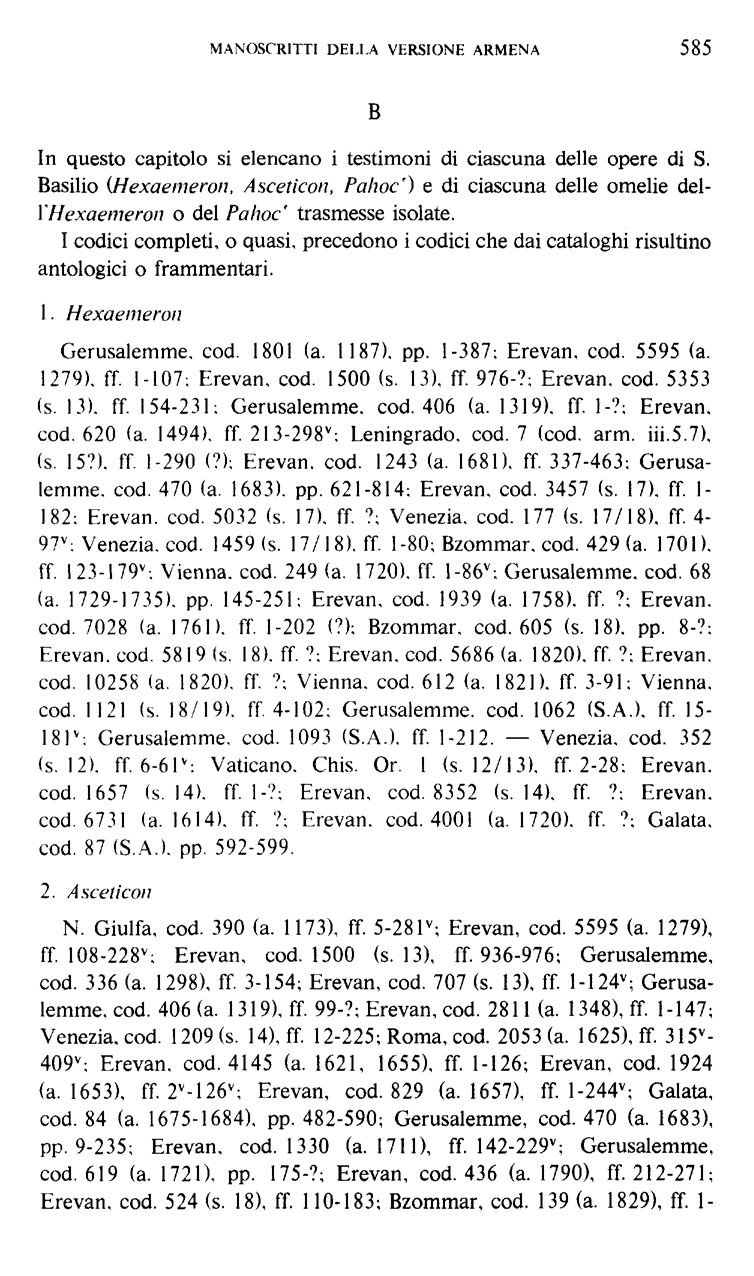
Β In questo capitolo si elencano i testimoni di ciascuna delle opere di S.
Basilio (Hexaemeron, Asceticon, Pahoc') e di ciascuna delle omelie del1 'Hexaemeron ο del Pahoc' trasmesse isolate.
I codici completi, ο quasi, precedono i codici che dai cataloghi risultino antologici ο frammentari.
1. Hexaemeron Gerusalemme. cod. 1801 (a. 1187). pp. 1-387; Erevan, cod. 5595 (a.
1279). ff. 1-107; Erevan, cod. 1500 (s. 13), ff. 976-?; Erevan, cod. 5353
(s. 13). ff. 154-231: Gerusalemme. cod. 406 (a. 1319). ff. 1-?; Erevan, cod. 620 (a. 1494), ff. 213-298"; Leningrado, cod. 7 (cod. arm. iii.5.7),
(s. 15?). ff. 1-290 (?); Erevan, cod. 1243 (a. 1681). ff. 337-463: Gerusa lemme. cod. 470 (a. 1683). pp. 621-814: Erevan, cod. 3457 (s. 17). ff. 1182: Erevan, cod. 5032 (s. 17). ff. ?; Venezia. cod. 177 (s. 17/18). ff. 497": Venezia. cod. 1459 (s. 17/18), ff. 1-80; Bzommar. cod. 429 (a. 1701). ff. 123-179"; Vienna, cod. 249 (a. 1720). ff. 1-86"; Gerusalemme. cod. 68
(a. 1729-1735). pp. 145-251; Erevan, cod. 1939 (a. 1758). ff. ?; Erevan, cod. 7028 (a. 1761). ff. 1-202 (?); Bzommar. cod. 605 (s. 18). pp. 8-?:
Erevan, cod. 5819 (s. 18). ff. ?; Erevan, cod. 5686 (a. 1820), ff. ?; Erevan, cod. 10258 (a. 1820), ff. ?; Vienna, cod. 612 (a. 1821). ff. 3-91; Vienna, cod. 1121 (s. 18/19). ff. 4-102; Gerusalemme, cod. 1062 (S.A.). ff. 15181": Gerusalemme, cod. 1093 (S.A.). ff. 1-212. — Venezia. cod. 352
(s. 12). ff. 6-61": Vaticana Chis. Or. 1 (s. 12/13). ff. 2-28: Erevan, cod. 1657 (s. 14). ff. 1-?; Erevan, cod. 8352 (s. 14), ff. ?; Erevan, cod. 6731 (a. 1614). ff. ?; Erevan, cod. 4001 (a. 1720). ff. ?; Galata. cod. 87 (S.A.). pp. 592-599.
2. Asceticon N. Giulfa. cod. 390 (a. 1173), ff. 5-281"; Erevan, cod. 5595 (a. 1279), ff. 108-228"; Erevan, cod. 1500 (s. 13), ff. 936-976; Gerusalemme, cod. 336 (a. 1298), ff. 3-154; Erevan, cod. 707 (s. 13), ff. 1-124"; Gerusa lemme, cod. 406 (a. 1319), ff. 99-?; Erevan, cod. 2811 (a. 1348), ff. 1-147;
Venezia. cod. 1209 (s. 14), ff. 12-225; Roma, cod. 2053 (a. 1625), ff. 315"- 409"; Erevan, cod. 4145 (a. 1621, 1655), ff. 1-126; Erevan, cod. 1924
(a. 1653), ff. 2"-126"; Erevan, cod. 829 (a. 1657), ff. 1-244"; Galata, cod. 84 (a. 1675-1684), pp. 482-590; Gerusalemme, cod. 470 (a. 1683), pp. 9-235; Erevan, cod. 1330 (a. 1711), ff. 142-229"; Gerusalemme, cod. 619 (a. 1721), pp. 175-?; Erevan, cod. 436 (a. 1790), ff. 212-271;
Erevan, cod. 524 (s. 18), ff. 110-183; Bzommar, cod. 139 (a. 1829), ff. 1-
GABRIELI.A ULUHOGIAN
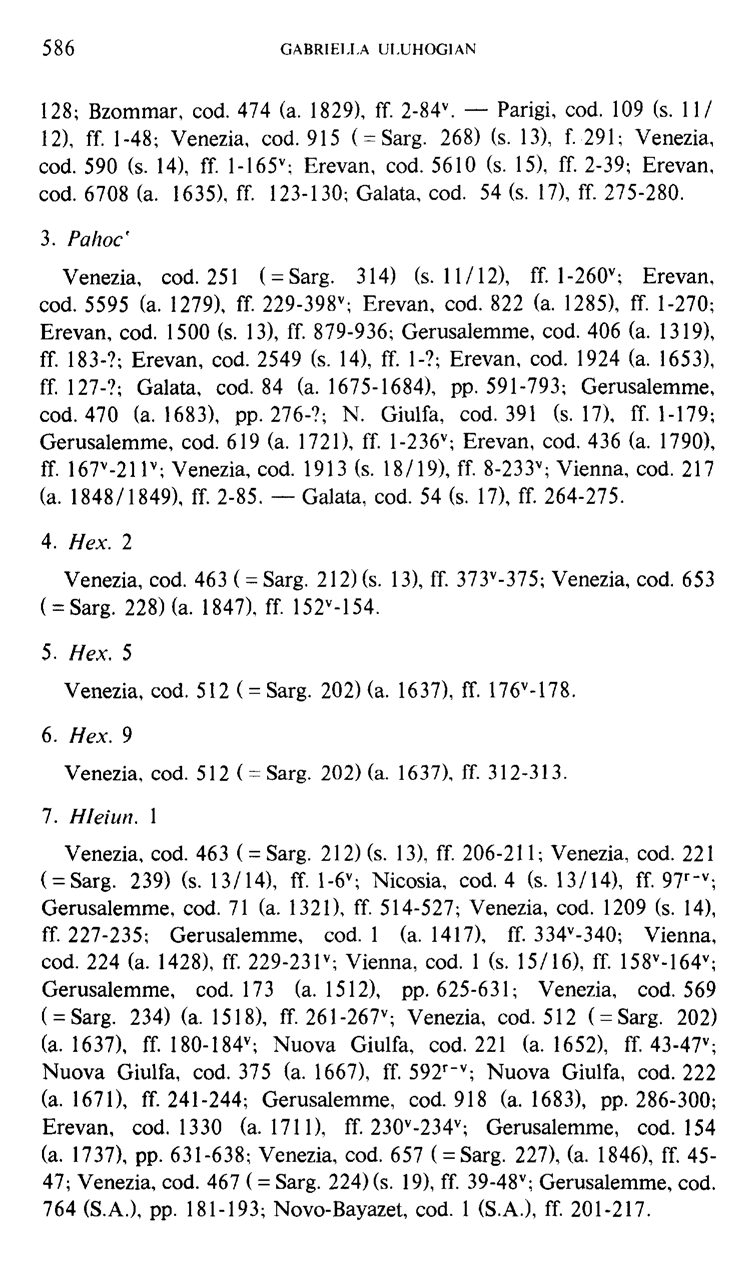
128; Bzommar, cod. 474 (a. 1829), ff. 2-84". — Parigi, cod. 109 (s. 11/ 12), ff. 1-48; Venezia, cod. 915 ( = Sarg. 268) (s. 13), f. 291; Venezia, cod. 590 (s. 14), ff. 1-165"; Erevan, cod. 5610 (s. 15), ff. 2-39; Erevan, cod. 6708 (a. 1635), ff. 123-130; Galata, cod. 54 (s. 17), ff. 275-280.
3. Pahoc'
Venezia, cod. 251 ( = Sarg. 314) (s. 11/12), ff. 1-260"; Erevan, cod. 5595 (a. 1279), ff. 229-398"; Erevan, cod. 822 (a. 1285), ff. 1-270;
Erevan, cod. 1500 (s. 13), ff. 879-936; Gerusalemme, cod. 406 (a. 1319), ff. 183-?; Erevan, cod. 2549 (s. 14), ff. 1-?; Erevan, cod. 1924 (a. 1653), ff. 127-?; Galata, cod. 84 (a. 1675-1684), pp. 591-793; Gerusalemme, cod. 470 (a. 1683), pp. 276-?; N. Giulfa, cod. 391 (s. 17), ff. 1-179;
Gerusalemme, cod. 619 (a. 1721), ff. 1-236"; Erevan, cod. 436 (a. 1790), ff. 167"-211"; Venezia, cod. 1913 (s. 18/19), ff. 8-233"; Vienna, cod. 217
(a. 1848/1849), ff. 2-85. — Galata, cod. 54 (s. 17), ff. 264-275.
4. Hex. 2
Venezia, cod. 463 ( = Sarg. 212) (s. 13), ff. 373"-375; Venezia, cod. 653
( = Sarg. 228) (a. 1847). ff. 152"-154.
5. Hex. 5
Venezia, cod. 512 ( = Sarg. 202) (a. 1637), ff. 176M78.
6. Hex. 9
Venezia, cod. 512 ( = Sarg. 202) (a. 1637), ff. 312-313.
7. HIeiun. 1
Venezia, cod. 463 ( = Sarg. 212) (s. 13), ff. 206-211; Venezia, cod. 221
( = Sarg. 239) (s. 13/14), ff. 1-6"; Nicosia, cod. 4 (s. 13/14), ff. 97 v; Gerusalemme, cod. 71 (a. 1321), ff. 514-527; Venezia, cod. 1209 (s. 14), ff. 227-235; Gerusalemme, cod. 1 (a. 1417), ff. 334"-340; Vienna, cod. 224 (a. 1428), ff. 229-231"; Vienna, cod. 1 (s. 15/16), ff. 158"-164";
Gerusalemme, cod. 173 (a. 1512), pp. 625-631; Venezia, cod. 569
( = Sarg. 234) (a. 1518), ff. 261-267"; Venezia, cod. 512 ( = Sarg. 202) (a. 1637), ff. 180-184"; Nuova Giulfa, cod. 221 (a. 1652), ff. 43-47";
Nuova Giulfa, cod. 375 (a. 1667), ff. 592 r"
Γ~"; Nuova Giulfa, cod. 222
(a. 1671), ff. 241-244; Gerusalemme, cod. 918 (a. 1683), pp. 286-300; Erevan, cod. 1330 (a. 1711), ff. 230"-234"; Gerusalemme, cod. 154
(a. 1737), pp. 631-638; Venezia, cod. 657 ( = Sarg. 227), (a. 1846), ff. 4547; Venezia, cod. 467 ( = Sarg. 224) (s. 19), ff. 39-48"; Gerusalemme, cod.
764 (S.A.), pp. 181-193; Novo-Bayazet, cod. 1 (S.A.), ff. 201-217.
MANOSCRITTI DELLA VERSIONE ARMENA
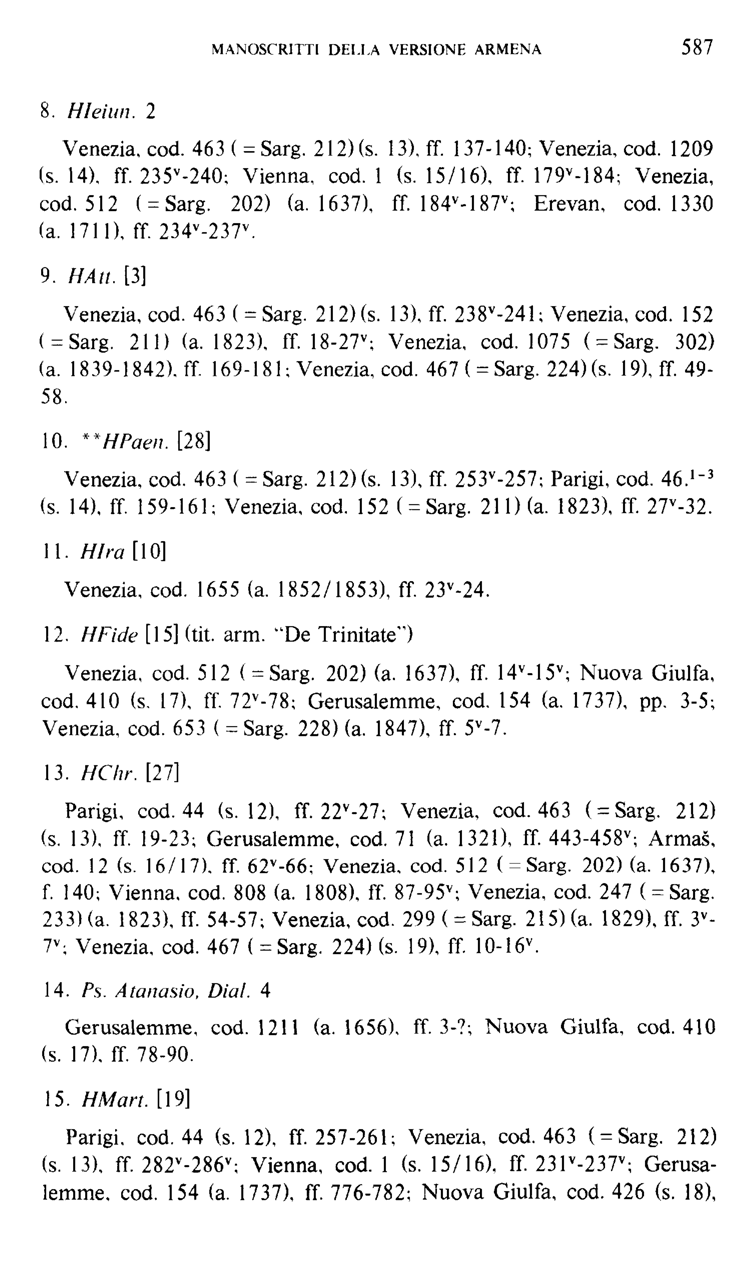
8. HIeiun. 2
Venezia. cod. 463 ( = Sarg. 212)(s. 13), ff. 137-140; Venezia, cod. 1209
(s. 14), ff. 235"-240; Vienna, cod. 1 (s. 15/16), ff. 179"-184; Venezia, cod. 512 ( = Sarg. 202) (a. 1637), ff. 184"-187"; Erevan, cod. 1330
(a. 1711), ff. 234"-237".
9. HAtt. [3] Venezia, cod. 463( = Sarg. 212)(s. 13), ff. 238"-241; Venezia, cod. 152
(=Sarg. 211) (a. 1823). ff. 18-27"; Venezia, cod. 1075 ( = Sarg. 302) (a. 1839-1842). ff. 169-181; Venezia, cod. 467 ( = Sarg. 224) (s. 19), ff. 4958.
10. **HPaen. [28] Venezia, cod. 463 ( = Sarg. 212)(s. 13), ff. 253"-257; Parigi, cod. 46.1"3
(s. 14), ff. 159-161; Venezia, cod. 152 ( = Sarg. 211) (a. 1823), ff. 27"-32.
11. HIra [10] Venezia, cod. 1655 (a. 1852/1853), ff. 23"-24.
12. HFide [15] (tit. arm. "De Trinitate") Venezia, cod. 512 ( = Sarg. 202) (a. 1637), ff. 14"-15"; Nuova Giulfa, cod. 410 (s. 17), ff. 72"-78; Gerusalemme, cod. 154 (a. 1737), pp. 3-5;
Venezia, cod. 653 ( = Sarg. 228) (a. 1847), ff. 5"-7.
13. HChr. [27] Parigi, cod. 44 (s. 12), ff. 22"-27; Venezia, cod. 463 ( = Sarg. 212)
(s. 13), ff. 19-23; Gerusalemme, cod. 71 (a. 1321), ff. 443-458"; Armas, cod. 12 (s. 16/17). ff. 62"-66; Venezia, cod. 512 ( = Sarg. 202) (a. 1637), f. 140; Vienna, cod. 808 (a. 1808), ff. 87-95"; Venezia, cod. 247 ( = Sarg.
233) (a. 1823), ff. 54-57; Venezia, cod. 299 ( = Sarg. 215) (a. 1829), ff. 3"- 7"; Venezia, cod. 467 ( = Sarg. 224) (s. 19), ff. 10-16".
14. Ps. Atanasio, Dial. 4
Gerusalemme, cod. 1211 (a. 1656), ff. 3-?; Nuova Giulfa, cod. 410
(s. 17). ff. 78-90.
15. HMart. [19] Parigi. cod. 44 (s. 12), ff. 257-261; Venezia, cod. 463 ( = Sarg. 212)
(s. 13), ff. 282"-286"; Vienna, cod. 1 (s. 15/16). ff. 23P-237"; Gerusalemme. cod. 154 (a. 1737), ff. 776-782; Nuova Giulfa, cod. 426 (s. 18),
GABRIELLA ULUHOGIAN
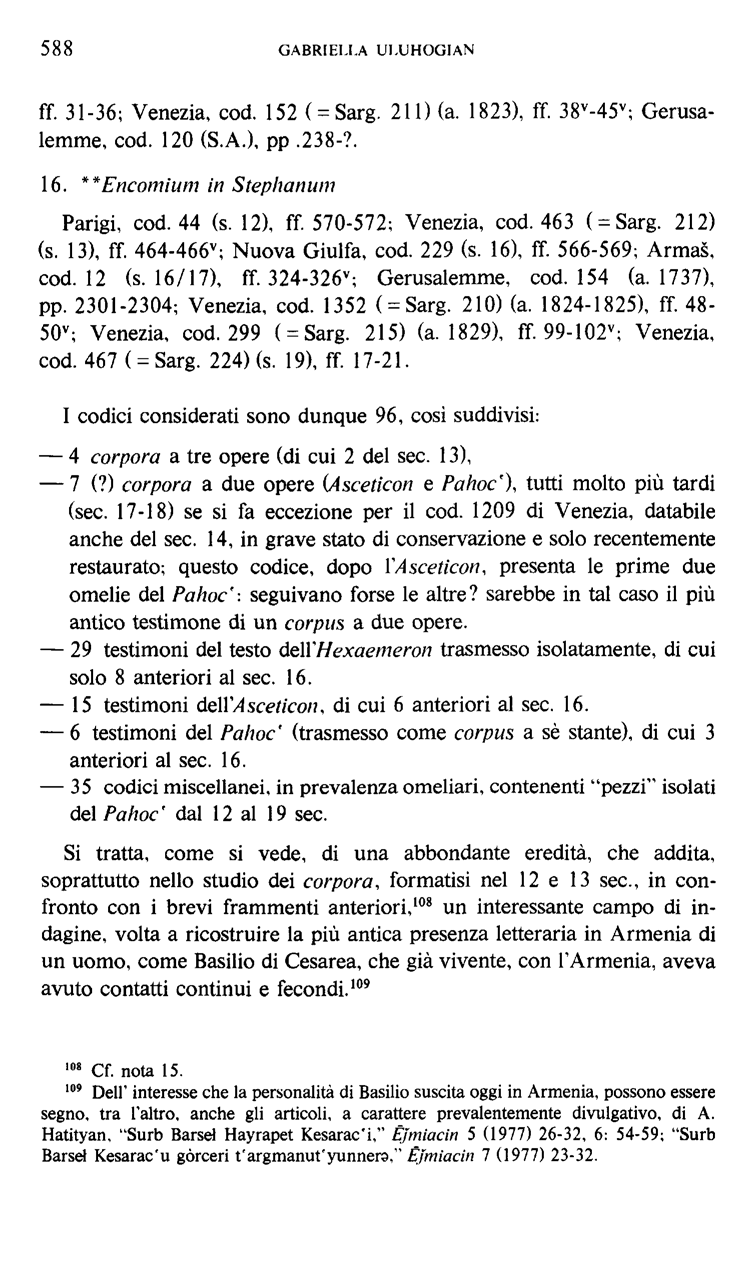
ff. 31-36; Venezia, cod. 152 ( = Sarg. 211) (a. 1823), ff. 38"-45"; Gerusalemme, cod. 120 (S.A.), pp .238-?.
16. **Encomium in Stephanum Parigi, cod. 44 (s. 12), ff. 570-572; Venezia, cod. 463 ( = Sarg. 212)
(s. 13), ff. 464-466"; Nuova Giulfa, cod. 229 (s. 16), ff. 566-569; Armas, cod. 12 (s. 16/17), ff. 324-326"; Gerusalemme, cod. 154 (a. 1737), pp. 2301-2304; Venezia, cod. 1352 ( = Sarg. 210) (a. 1824-1825), ff. 4850"; Venezia, cod. 299 ( = Sarg. 215) (a. 1829), ff. 99-102"; Venezia, cod. 467 ( = Sarg. 224) (s. 19), ff. 17-21.
I codici considerati sono dunque 96, cosi suddivisi:
— 4 corpora a tre opere (di cui 2 del sec. 13), — 7 (?) corpora a due opere {Asceticon e Pahoc'), tutti molto più tardi
(sec. 17-18) se si fa eccezione per il cod. 1209 di Venezia, databile anche del sec. 14, in grave stato di conservazione e solo recentemente restaurato; questo codice, dopo VAscéticon, présenta le prime due omelie del Pahoc'; seguivano forse le altre? sarebbe in tal caso il più antico testimone di un corpus a due opere.
— 29 testimoni del testo delVHexaemeron trasmesso isolatamente, di cui solo 8 anteriori al sec. 16.
— 15 testimoni delYAsceticon, di cui 6 anteriori al sec. 16.
— 6 testimoni del Pahoc' (trasmesso come corpus a se stante), di cui 3 anteriori al sec. 16.
— 35 codici miscellanei, in prevalenza omeliari, contenenti "pezzi" isolati del Pahoc ' dal 12 al 19 sec.
Si tratta, come si vede, di una abbondante eredità, che addita, soprattutto nello studio dei corpora, formatisi nel 12 e 13 sec, in confronto con i brevi frammenti anteriori,108 un interessante campo di indagine, volta a ricostruire la più antica presenza letteraria in Armenia di un uomo, come Basilio di Cesarea, che già vivente, con l'Armenia, aveva avuto contatti continui e fecondi.109
108 Cf. nota 15.
109 Dell' interesse che la personality di Basilio suscita oggi in Armenia, possono essere segno, tra l'altro, anche gli articoli, a carattere prevalentemente divulgativo, di A.
Hatityan, "Surb Barsel Hayrapet Kesarac'i," Ejmiacin 5 (1977) 26-32, 6: 54-59; "Surb
Barsel Kesarac'u gorceri t'argmanut'yunnera," Êfmiacin 1 (1977) 23-32.
Appendix Apostolic Letter of John Paul n for the Sixteen-Hundredth Anniversary of the Death of Basil of Caesarea
IOANNES PAULUS PP. IP
VENERABILES FRATRES AC DILECTI FlLII.
SAi.uTEM ET APOSTOLICAM
BENEDICTIONEM
I. Patres Ecclesiae illi merito appellantur Sancti, qui primis vertentibus saeculis fidei suae virtute doctrinarumque excelsitate et ubertate earn novo vigore donarunt et magnopere adauxerunt.1 Re quidem vera sunt
Ecclesiae "patres," cum ab illis per Evangelium ipsa acceperit vitam.2 Sunt pariter eius aedificatores, quoniam super una ab Apostolis lacta fundamenta, scilicet Christum,3 primoribus formis Ecclesiam Dei construxerunt. Ex vita autem sic a suis Patribus recepta vivit etiam hodie
Ecciesia; atque in ipsa compage, quam primi condiderunt Uli structures, adhuc hodie aedificatur Ecciesia inter secundas res adversasque itineris sui et cotidiani laboris. Patres igitur fuerunt eruntque semper, qui ipsi stabilem quasi strueturam Ecclesiae efficiunt ac per temporis saeeula cuncta implent pro Ecciesia perpetuum munus. Ita enim contingit, ut omnis Evangelii nuntiatio et magisterium subsequens, si modo verum esse voluerit, aequari debeat cum ipsorum nuntiatione et magisterio utque omne charisma ac ministerium haurire debeat vivo ex fonte illorum paternitatis et tandem ut omnia petra nova, quae ad aedifieium accesserit cotidie crescens seque amplificans,4 locari debeat intra compagem ab eis constitutam cum ipsaque conglutinari et copulari. Certis proinde his rebus ducta non intermittit Ecciesia ad illorum decurrere opera — sapientiae plena perennisque iuventutis — ac semper eorum renovare memoriam.
Eximia ergo cum laetitia per liturgicum annum patribus nostris totiensque roboramur in fide in speque firmamur. Magis vero etiam gaudium nostrum augescit, quotiens peculiares nos occasiones invitant, ut eosdem patres diutius cognoscamus et plenius. Huiusmodi autem opportunitatem affert hoc anno celebratio decimi sexti exacti saeculi a patris nostri Basilii, episcopi Caesariensis, obitu.
* Reprinted from Acta Apostoiicae Sedis 72 (1980) 5-23, and the weekly English edition of the L'Osservatore Romano, 25 February 1980, p. 609 with corrections.
1 Cf. Gal. 4.19; Vincentius Lirinensis, Commonitorium
1.3, PI. 50: 641.
JOHN PAUL II
REVERED BROTHERS AND BELOVED SONS
HEALTH AND THE APOSTOLIC BLESSING
I. Fathers of the Church is the name rightly given to those saints who, by the power of their faith, the depth and riches of their teachings, gave her new life and great increase in the course of the first centuries.1
They are indeed "fathers" of the Church, because from them, by means of the Gospel, she received life.2 They are likewise its builders because they set up the main structures of the Church of God on the one foundation laid by the Apostles, which is Christ.3
The Church still lives today by the life received from her fathers; and on the structures erected by her first constructors, she is still built today, in the joy and sorrow of her journeying and of her daily toil.
They were, therefore, fathers, and fathers they remain for ever. They themselves, in fact, are a stable structure of the Church, and they fulfil a perennial function for the Church of all centuries. Thus every subsequent proclamation and magisterium, if it is to be authentic, must be compared with their proclamation and their magisterium. Every charism and every ministry must draw from the vital source of their fatherhood; and every new stone, added to the sacred edifice that grows and expands every day,4 must be set in the structure already placed by them, and be welded and joined to it.
Guided by these certainties, the Church never tires of returning to their writings — full of wisdom and incapable of ageing — and of renewing their memory continually. It is with great joy, therefore, that in the course of the liturgical year we always meet our Fathers again: and every time we are strengthened in faith and encouraged in hope.
Our joy is even greater when particular circumstances call for a longer and deeper meeting with them. This year's anniversary, which marks the 16th centenary of the death of our Father Basil, Bishop of Caesarea, is precisely of this nature.
2 Cf. 1 Cor. 4.15.
3 Cf. 1 Cor. 3.11
4 Cf. Eph. 2.21
APPENDIX II. Inter Patres Graecos "Magnus" ipse nominatus Basilius liturgicis in libris Byzantinorum invocatur ut "lux pietatis" et "Ecclesiae lumen."
Quippe earn vere illuminavit etiamque nunc illustrât non minus quidem ex vitae suae integritate quam ex doctrinae suae exeellentia. Primum enim maximumque Sanctorum praeceptum est ipsius vitae eorum exemplum.
In familia autem Sanctorum natus, fruebatur praeterea Basilius praestantis institutionis bénéficia apud honoratissimos Constantinopoli Athenisque magistros. Attamen tunc solum visus est sibi ipse vitam incohavisse pleno et certo modo, cum Christum cognoscere potuerat suum ut Dominum: id est cum ab eo vehementissime tractus, se cunctis rebus penitus disiunxit
— quod dein vitae principium erat magnopere docendo inculcaturus5 — eiusque factus est discipulus. Sequelae igitur se Christi addixit, cui soli conformari cupiebat, ipsum unum respiciens unumque audiens,6 in omnibus ei oboediens "uti Domino et régi et medico et doctori veritatis."7
Sine ulla ergo cunctatione studia deseruit ilia, quae tantopere dilexerat ex quibusque tantos hauserat scientiae thesaurus;8 cum enim Deo soli inservire decrevisset, nihil iam scire praeter Christum volebat9 universamque aliam quam crucis sapientiam esse censebat vanitatem. Hisce verbis exeunte vita memoravit conversionis suae eventum: "Ego cum multum temporis impendissem vanitati, totamque fere iuventutem meam perdidissem inani labore, quern in discendis infatuatae a Deo sapientiae10 disciplinis occupatus suscipiebam, ubi tandem aliquando velut ex alto somni expergefactus, respexi ad lumen admirabile veritatis Evangelii, ac vidi inutilitatem sapientiae principum huius saeculi, qui destruuntur;11 miserabilem meam vitam plurimum deflens, optabam dari mihi disciplinam."12 Suam proin vitam deflevit, quamquam secundum sancti
Gregorii Nazianzeni testificationem, qui studiorum fuerat socius, mores eius fuerant humana ratione perfecti;13 nihilo minus tarnen "miserabilis" videbatur ei vita, cum non tota et intégra, ceteris exclusis, dicaretur Deo, qui unus est Dominus. Cum intolerantia invicta interpellavit studia suscepta ac, derelictis sapientiae Graecae doctoribus, "multum telluris ac pelagi"14 peragrans, alios conquirebat magistros: videlicet "stultos" miserosque illos, qui exercebant in desertis aliam plane sapientiam.
5 Cf. EApokr. fus. 8, PG 31: 933C-941A.
6 Reg. mor. 80.1, PG 31: 860B-C.
7 De bapt. 1.1, PG 31; 1516B.
8 Cf. Gregorius Nazianzenus, Or. 43, PG 36: 525C-528C.
9 Cf. 1 Cor. 2.2.
10 Cf. 1 Cor. 1.20.
11 Cf. 1 Cor. 2.6.
12 EEust. [223] 2, PG 32; 824A.
APOSTOLIC LETTER OF JOHN PAUL 11
[THE LIFE AND MINISTRY OF ST BASIL]
II. Basil, who among the Greek Fathers is called the "Great," is invoked in Byzantine liturgical texts as "light of piety" and "luminary of the Church." He did, in fact, illuminate her, and still does: no less because of "the purity of his life" than for the excellence of his doctrine. For the first and greatest teaching of the saints is always their life.
Born into a family of saints, Basil had also the benefit of an excellent education by the most famous teachers of Constantinople and Athens.
But it seemed to him that his life really began only when it was granted to him to know Christ as his Lord, in a fuller and decisive way: namely, when irresistibly attracted by him, he radically detached himself from all things — a principle of life which he was later to inculcate so much in his teaching5 — and became his disciple.
He then began to follow Christ, wishing to conform himself to him alone: looking only to him, listening to him only,6 and considering him completely as his only "sovereign, king, physician and teacher of truth."7
Without hesitating, therefore, he abandoned those studies which he had loved so much and from which he had drawn immense treasures of knowledge.8 Having decided to serve God only, he did not want to have anything to do with anything except Christ,9 and he deemed vanity any wisdom that was not that of the cross. The following are his words, in which, towards the end of his life, he recalled the event of his conversion.
"I had wasted a great deal of time in vanity, losing nearly all my youth in the empty work to which I applied myself to learn the teachings of that wisdom which God has made foolish;10 until one day, as if waking up from a deep sleep, I looked at the wonderful light of the truth of the Gospel, and considered the uselessness of the wisdom of the princes of this world who are reduced to helplessness." Then I wept a great deal over my wretched life and prayed for guidance."12
He wept over his life, although already before — according to the testimony of Gregory of Nazianzus, his companion in studies — he was, from a human point of view, exemplary.13 Nevertheless, he regarded his life as "wretched," because it was not completely and exclusively consecrated to God, who is the only Lord.
So with irresistible impatience, he interrupted the studies undertaken and, abandoning the teachers of Greek wisdom, "crossed many lands and many seas"14 in search of other teachers: those "foolish" and poor persons who were practising a very different wisdom in the deserts.
13 Or. 43. PG 36; 521C-D.
14 ENeoc. [204] 6. PG 32; 753A.
APPENDIX Animo sic comprehendere coepit ea, quae numquam in cor hominis ascenderant,15 vera nimirum, quae nee rhetores nee philosophi eum docere umquam potuissent16 Qua nova in sapientia is cotidie magis adolescebat tamquam mirabili in gratiae curriculo: per preeationem et mortificationem, per caritatis exercitationem continuamque frequentationem Sacrarum Litterarum et Patrum doctrinae.17
Cito exin ad ministerium est vocatus. Sed in famulatu etiam animarum prudenti cum moderatione componebat indefatigabilem praedicandi industriam cum solitudinis intervallis crebroque precationis interioris usu.
Pernecessarium enim hoc arbitrabatur principium esse "expurgationis animae,"18 ut ipsa verbi nuntiatio confirmaretur semper per vitae "evidens exemplum."19 Pastor ita Basilius evasit fuitque simul secundum principalem nominis vim monachus; quin immo numeratus sine dubitatione est maximos inter Ecclesiae pastores-monachos: species episcopi singulariter perfecta et insignis fautor legumque lator monasticae vitae. Sua namque ipsius experientia valens plurimum contulit ad christianorum communitates efficiendas "divino servitio"20 omnino consecratorum atque in se onus recepit et officium easdem saepius invisendi et sustinendi.21 Ad suam vero earumque utilitatem mirandos seruit cum eis sermones, quorum plures Dei ex beneficio scripti ad nos devenerunt.22 Iisdem postea ex sermonibus plures legum latores monachatus — in primis autem ipse sanctus Benedictus, qui Basilium suum habet magistrum23 — praecepta derivaverunt; ex illis similiter scriptis — recta obliquave via cognitis — moti sunt magnam partem ii, qui turn in oriente tum in occidente monasticam sunt vitam amplexi. His de causis existimant plerique institutum principale istud, quod monastica est vita in totius Ecclesiae compage, stabilitum multa esse in saeeula potissimum a sancto Basilio aut saltem non secundum propriam suam naturam definitum esse sine praecipuis illius partibus.
Ob mala vero et incommoda, ex quibus tunc temporis populus Dei laborabat,24 permultum Basilio patiendum fuit. Ea tamen ipse candide indicavit eorumque causas lucide amanterque denotavit, ut immensum reformationis opus fortiter aggrederetur. opus — omni ceteroquin tempore persequendum omnique novandum aetate — quod illuc nempe
15 Cf. 1 Cor. 2.9.
16 Cf. EEust. [223] 2, PG 32: 824B-D.
17 Cf. praesertim EGNaz. [2] et De perf. [22].
18 EGNaz. [2] 2, PG 32; 228A; cf. ENeoc. pm. [210] I, ibid., 769A. [Principum amended to principium] 19 EApokr. fus. 43.1, PG 31: 1028A-1029B. Cf. Reg. mor. 70.10, ibid., 824D-825B.
APOSTOLIC LETTER OF JOHN PAUL II
In this way he began to learn things that had never occurred to man's heart, 15 truths that rhetoricians and philosophers would never have been able to teach him.
16 He grew in this new wisdom from day to day, along a marvellous path of grace: by means of prayer, mortification, the practice of charity, continual reading of the Scriptures and of the teachings of the Fathers.
He was very soon called to the ministry. But also in the service of souls, he was able to balance wisely indefatigable preaching with periods of solitude and frequent recourse to interior prayer. He regarded this, in fact, as the absolutely necessary beginning for the "purification of the soul,"
so that the proclamation of the word might always be confirmed by the "evident example" of life.
In this way he became a pastor and was at the same time, in the real sense of the term, a monk. Indeed, he was certainly among the greatest of the pastor-monks of the Church: a singularly perfect figure of a bishop, and a great promoter and legislator of monasticism.
On the strength of his own personal experience, Basil contributed greatly to the formation of communities of Christians completely consecrated to "divine service,"
20 and he assumed the task and the duty of visiting them frequently and of supporting them.
21 For his own and their edification, he conversed with them in admirable talks, many of which, by God's grace, have been handed down to us in writing.
22 Various legislators of monasticism have drawn on these writings, not least of all St Benedict himself, who considers Basil his teacher.
23 Likewise, these writings — directly or indirectly known — have inspired most of those who embraced the monastic life, in the East as in the West.
For this reason many people think that that essential structure of the life of the Church, monasticism, was established, for all time, mainly by St Basil; or that, at least, it was not defined in its more specific nature without his decisive contribution.
Basil suffered a great deal on account of the evils and misfortunes under which the people of God groaned, in that hour.
24 He denounced them frankly and, with lucidity and love, detected their causes, in order courageously to set about the vast work of reform. That work — to be carried on at all times and to be renewed with every generation — aimed
20 Regula Benedict!, Prologus.
21 Cf. Gregorius Nazianzenus, Or. A3, PG 36: 536B.
22 Cf. Asc. Prl. PG 31; 1080A-B.
23 Cf. Regula Benedict!, 13.5.
24 Cf. Mor. Prl Λ. PG 31; 653B.
APPENDIX spectabat, ut Domini Ecciesia, "pro qua Christus mortuus est, et super quam large Spiritum sanctum effudit,"25 suam ad primigeniam redigeretur formam, ad illam videlicet directoriam ipsius imaginem, pulchram quidem et puram, quam nobis Christi verba Apostolorumque Acta tradiderunt. Quotiens meminit cum ardore efficacique desiderio sanctus
Basilius temporis illius, quo "multitudinis credentium erat cor unum, et anima una."26 Industria autem eius ad reformationem attinens convenienter simul perfecteque dirigebatur ad universas rationes ac partes et ambitus vitae christianae.
Ex ipsa ministerii sui natura episcopus in primis est proprii populi pontifex; ac populus ipse Dei ante omnia populus est sacerdotalis. Nullo igitur pacto neglegere licet episcopo, rêvera Ecclesiae bonum curanti, liturgiam sacram eiusque vim et ubertatem, pulchritudinem et "veritatem." Immo vero intra totum pastorale opus cura liturgiae congruenter obtinet supremum locum ipsumque occupât quasi culmen ceterorum quorumlibet coeptorum; etenim, quemadmodum Concilium Vaticanum n commonet, "liturgia est culmen ad quod actio Ecclesiae tendit et simul fons unde omnis eius virtus emanat,"27 ipsiusque proin "efficacitatem eodem titulo eodemque gradu nulla alia actio Ecclesiae adaequat."28
Quarum rerum singularum plane sibi conscius erat Basilius; et sic monasticarum legum institutor29 esse pariter sciebat precum descriptor.30
Ex cunctis vero illius operibus hac in provincia peractis superest velut hereditas pretiosa Ecclesiae omnium temporum anaphora et merito, quae nomen ipsius habet: insignis nimirum prex eucharistica, quae ab illo retractata ac locupletata censetur pulcherrimarum omnium ipsa pulcherrima. Nee tamen istud sufficit. Nam primaria etiam compositio psalmodicae precis ad eum refertur tamquam ad maiorem inter alios suum auctorem et artificem.31 Itaque propter impetum, quern dederat Basilius, psalmodia — "spirituale thymiama" Spiritus populi Dei ac solacium32 — plurimum in Ecclesiae a fidelibus est amata innotuitque pueris et iuvenibus, doctis atque indoctis;33 prout ipse Basilius narrât, "de nocte siquidem consurgit apud nos populus ad domum precationis, ... in psalmodiae varietate nocte traduxere intermistis precibus."34 Psalmos ideo, qui in templis non secus ac tonitruo quodam personuerunt,35 "et domi modulantur, et in forum circumferunt"36
25 Ibid.
26 Act. 4.32; cf. Mor. Prl.A, PG 31: 660c; EApokr. fus. 7.4, ibid., 933c; HFam. [8] 8, ibid., 325A-B.
27 Sacrosanctum Concilium, 10.
28 Ibid., 7.
29 Gregorius Nazianzenus, Or. 43, PG 36; 541c.
APOSTOLIC LETTER OF JOHN PAUL II
at restoring the Church of the Lord, "for which Christ died and on which he poured forth his Spirit abundantly,"25 to its original form: to that normative image, beautiful and pure, that the words of Christ and of the Acts of the Apostles transmit to us. How often Basil recalls, with passion and constructive nostalgia, the time in which "the multitude of believers were one heart and one soul!"26
His reform effort was directed, with harmony and completeness, at practically all aspects and spheres of Christian life.
By the very nature of his ministry, the bishop is in the first place the pontiff of his people; and the people of God is first of all a priestly people.
Therefore the liturgy — its power and riches, its beauty, its "truth" — cannot be neglected in any way by a bishop who is really concerned about the good of the Church. In pastoral work, in fact, it is fitting that concern for the liturgy holds the first place and occupies it as the summit, as it were, of all other undertakings. The liturgy, indeed — as the Second
Vatican Council recalls — is "the summit toward which the activity of the Church is directed; it is also the fount from which all her power flows,"27 so that "no other action of the Church can equal its efficacy."28
Basil was perfectly aware of this: and the "legislator of the monks"29 was also a wise "liturgical reformer."30
Of his work in this field there remains, as a very precious heritage for the Church of all times, the Anaphora which legitimately bears his name: the great eucharistie prayer which, revised and enriched by him, is regarded as the most beautiful even among those that are outstanding for their beauty.
Moreover, he was one of the greatest inspirers and architects of the fundamental arrangement of psalmodie prayer.31 Thus, particularly owing to the impulse given by him, psalmody — "spiritual incense," the breath and comfort of the people of God32 — was greatly loved by the faithful in his Church, and became known to children and adults, to the learned and the uneducated.33 As Basil himself says: "Here the people get up at night to go to the house of prayer, ... and spend the night singing psalms and praying in turn."34 The psalms, which resounded in the churches like thunder,35 could be heard ringing out also in the houses and squares.36
30 Ibid.
" Cf. EGNaz. [2] et EApokr. fus. 37.3-5. PG 31: 1013B-1016C.
32 Cf. HPs. 1.1-2, PG 29: 212A-213C.
33 Ibid.
34 ENeoc. cl. [207] 3, PG 32: 764A-B.
35 Cf. Gregorius Nazianzenus, Or. 43, PG 36: 561C-D.
36 Cf. HPs. 1.1, PG 29; 212c.
APPENDIX Studioso amore Basilius diligebat Ecclesiam cumque sciret virginitatem eius ipsam esse illius fidem, vigilantissimus fidei eiusdem integritatem custodiebat.37 Idcirco et debuit fortiter contendere et potuit non adversus homines verum contra adultérantes ipsum Dei verbum,38 id est omnem veritatis depravationem et depositi sancti violationem39 a Patribus transmissi. Pugna autem eius nihil prae se ferebat violentiae. cum vis esset amoris; perspicuitas ipsius nihil secum ferebat arrogantiae, cum mansuetudo esset amoris. A principio itaque ad finem ministerii sui nisus est. ut intégra significatio formulae Nicenae conservaretur de divinitate Christi
"consubstantialis" Patri;40 item vero pugnabat, ne Spiritus gloria minueretur. qui. cum crederetur "complere Trinitatem sanctam ... particeps esse divinae ac beatae naturae."41 numerandus erat cum Pâtre et Filio necnon conglorificandus.42
Etsi gravissimis se obiciebat vitae periculis, firmiter tamen vigilabat, ut Ecclesiae libertas custodiretur; verus cum episcopus esset, principibus adversari nihil dubitabat, ut suum populique Dei ius defenderet veritatis confitendae atque Evangelio obtemperandi.43 Sanctus Gregorius Nazianzenus, qui illius contentionis narrât memorabilem quidem eventum, probe nobis ostendit arcanam vim Basilii potentiae repositam sola esse in ipsa nuntii eius simplicitate, in testificationis claritate, in maiestate dignitatis sacerdotalis.44
Haud minore autem asperitate, quam adversus haereses adhibuerat ac tyrannos, Basilius se gessit contra ambiguitates morumque deformitates intra Ecclesiam, praesertim vero contra affectationem saecularem bonorumque cupiditatem. Movebatur tunc, uti antea semper, eodem erga veritatem et Evangelium amore; nam, quamvis rationibus diversis, ipsum tamen semper Evangelium negabatur et repudiabatur tarn per errores haeresiarcharum quam per divitum cupiditates. Hac de re notabiles in exemplum sunt loci quorundam illius sermonum: "'Vende quae habes et da paupberibus';45 ... si non occidisti, ut ais, neque adulterium commisisti, neque furatus es, neque contra quempiam falsum testimonium dixisti; nihilominus tamen adhibitam in his agendis diligentiam tibi infructuosam efficis, qui quod reliquum est non adicias, quo solo possis in Dei regnum ingredi."46 Qui enim secundum Dei praeceptum cupit proximum amare
37 Cf. 2 Cor. 11.2.
38 Cf. 2 Cor. 2.17.
39 Cf. 1 Tim. 6.20; 2 Tim. 1.14.
40 Cf. EMax. phi. [9] 3, PG 32: 272A; ECan. [52] 1-3. ibid., 392B-396A: C. Eun. 1.20, PG
29; 556c.
41 Eltal. [243] 4, PG 32; 909A.
42 Cf. DeSp. S. 29, PG 32: 117c.
APOSTOLIC LETTER OF JOHN PAUL II
Basil loved the Church with a jealous love,37 and knowing that her virginity is her faith itself, he was an extremely watchful guardian of the purity of this faith.
For this reason he had to, and did, fight courageously: not against men, but against every falsification of the Word of God,38 any distoirtion of truth, any tampering with the holy deposit39 handed down by the Fathers.
His battle, however, had nothing of violence about it: it was the power of love: and his clarity nothing of arrongance: it was the delicacy of love.
Thus, from the beginning to the end of his ministry, he fought to preserve intact the full meaning of the Nicaean formula regarding the divinity of Christ "consubstantial" with the Father;40 and at the same time he fought to prevent the glory of the Spirit from being diminished, for since He "is complemental of the Holy Trinity and participant in the divine and blessed nature,"41 He must be numbered and glorified with the Father and Son.42
With firmness, and exposing himself personally to very serious dangers, he kept watch and fought also for the freedom of the Church: as a true bishop, not hesitating to oppose rulers to defend his right and that of the people of God to profess the truth and obey the Gospel.43 St Gregory
Nazianzen, who reports a striking episode of this struggle, shows clearly that the secret of his power lay only in the very simplicity of his proclamation, the clarity of his testimony, and the majesty of his priestly dignity.44
Basil's severity against heresies and tyrants was not exceeded by his severity against ambiguities and abuses within the Church: in particular, against wordliness and attachment to property.
He was actuated, then as always, by the same love of truth and of the Gospel. It was, indeed, though in a different way, the Gospel that was always denied and contradicted: both by the error of heretics and by the selfishness of the rich.
The texts of some of his addresses are memorable in this connection, and remain exemplary: "Sell what you have and give it to the poor;45 ... because, even if, as you say, you have not killed or committed adultery or stolen or borne false witness, it will be of no use to you if you do not also do the rest: only in this way will you be able to enter the Kingdom of God."46 In fact, he who in accordance with God's commandment, wishes
43 Cf. Gregorius Nazianzenus, Or. 43, PG 36. 557c-561c.
44 Cf. ibid., 561C-564B.
4' Mt. 19.22.
46 HDiv. [7] 1, PG 31; 280B-281A.
APPENDIX suum,47 "nihil amplius quam proximus possidet."48 Ac multo quidem vehementius in tempore famis et siccitatis cohortatur, "ne brutis animantibus videamur immaniores...; quae sunt communia abdimus in sinu, ea quae multorum sunt possidemus soli."49 Hoc est acerrimum Studium eius, animos simul turbans et pulcherrimum, et haec cohortatio, ad
Ecclesiam omnium aetatum directa, ut ipsa serio animo Evangelium amplectatur! De quo Evangelio, unde praecipitur amor et ministerium pauperum, Basilius non solum verbis istis testimonium reddidit, verum etiam permagnis caritatis operibus, qualis fuit aedificatio ante moenia
Caesareae immensi hospitii reeipiendis egenis;50 quin immo vera ilia fuit misericordiae civitas, quae ab ipso nomen Basiliadis recepit,51 atque germanum documentum unius evangelici nuntii.
Idem praeterea Christi amor eiusque Evangelii fecit, ut tantopere sanctus Basilius cruciaretur ob Ecclesiae discidia utque tanta cum perseverantia, sperans contra spem, conquireret efficaciorem manifestioremque communionem universis cum Ecclesiis.52 Etenim Christianorum discordia ipsam obscurat Evangelii veritatem Christumque ipsum lacerat.53 Credentium partitio opponitur unius baptismi virtuti,54 qui in Christo nos unum quiddam efficit, immo unicam quandam mysticam personam;55 opponitur etiam supremae Christi auctoritati, qui unicus est rex et cui omnes pariter subici debent; opponitur tandem potestati et coniungenti efficacitati ipsius verbi Dei, quod unica restât lex, cui credentes universi concorditer pareant oportet.56 Quapropter Ecclesiarum divisio sic liquido directoque adversatur turn ipsi Christo tum biblicae doctrinae, ut, e sancti Basilii sententia, sola via redintegrandae unitatis esse possit nova omnium conversio ad Christum eiusque verbum.57
Per multiplicem igitur ministerii sui exercitationem factus est Basilius idem ille, quern fieri aliquando iussit omnes verbi nuntiatores: videlicet apostolus et minister Christi, mysteriorum Dei dispensator, praeco regni caelorum, forma et régula pietatis, oculus in corpore Ecclesiae, pastor ovium Christi, medicus cum multa commiseratione, pater et nutrix, Dei adiutor, plantator palmitum Dei, aedificator templi Dei.58 Et in hac
47 Cf. Lev. 19.18; Mt. 19.19.
48 HDiv. [1] l.PG 31: 281B.
49 HFam. [8] 8, PG 31: 325A. so Cf. EHel. [94], PG 32: 488B-C.
51 Cf. Sozomenus, Hist. eccl. 6.34, PG 67: 1397A.
52 Cf. ESyn. [70] et Eltal. [243].
53 Cf. 1 Cor. 1.13.
54 Cf. Eph. 4.4.
55 Cf. Gal. 3.28.
APOSTOLIC LETTER OF JOHN PAUL II
to love his neighbour as himself,47 "must not possess anything more than his neighbour possesses."48
Even more passionately, in time of famine, he exhorted people "not to be more cruel than animals, ... by keeping for themselves what is common property, and possessing for themselves alone what belongs to everyone."49
This is his strenuous endeavour, disturbing to souls yet ennobling, and his appeal that the Church of all times seriously take into consideration the Gospel !
Basil paid testimony to the Gospel, which orders love and service of the poor, not only with these words, but with immense works of charity; such as the construction, outside the city walls of Caesarea, of a gigantic hospice for the needy:50 a real city of mercy which was named Basiliade after him,51 and which was also an authentic part of the one evangelical proclamation.
It was the same love for Christ and his Gospel that made him suffer so much because of the divisions in the Church and made him seek, so perseveringly. hoping against hope for a more effective and manifest communion with all the Churches.52
It is the very truth of the Gospel, in fact, that is obscured by the discord of Christians, and it is Christ himself who is lacerated by it.53 The division of believers contradicts the power of the one baptism,54 which in Christ becomes one thing, nay more, one mystical person.55 It contradicts the sovereignty of Christ, the one king to whom all must equally be subject; it contradicts the authority and unifying power of the word of God, the one law which all believers must obey in concord.56
The division of the Churches is therefore so clearly and directly opposed to Christ and to biblical teaching that, according to Basil, the way to the recomposition of unity can only be the reconversion of all to Christ and to his word.57
In the multiform exercise of his ministry Basil became, therefore, as he prescribed for all those who proclaimed the word, "an apostle and minister of Christ, dispenser of the mysteries of God, herald of the Kingdom, model and rule of piety, eye of the body of the Church, shepherd of Christ's sheep, a compassionate physician, a father and nurse, cooperator of God, a planter of God's vineyard, a builder of God's temple."58
56 Cf. Mor. Prl. 1-2. PG 31; 653A-656C.
57 Cf. ibid., 660B-661A.
58 Cf. Reg. mor. 80.12-21, PG 31: 864B-868B.
APPENDIX industria atque pugna — aspera aerumnosa perpétua — suam Basilius obtulit vitam59 seque velut holocaustum confecit. Obiit namque annos natus quinquaginta, laboribus ac disciplina ascetica absumptus.
III. Summatim ita breviterque commemoratis vitae Basilii praecipuis partibus ac rationibus eius christianae actionis necnon episcopalis operis, convenire prorsus videtur, ut ex uberrima ipsius scriptorum hereditate saltem maxima quaedam delibentur praecepta. Si quis enim ad illius se scholam contulerit, lucem forsitam inde hauriat, quo melius quaestiones diffieultatesque huius nostri temporis tractet auxiliumque etiam afferat nobis in praesens ac futurum tempus.
Non autem praeter rem agere nos videmur, si ab iis proficiscimur quae de sanctissima Trinitate Basilius docuit. Quin immo nullum certe melius inveniri potest principium, se persequi studemus ipsam eius cogitationem.
Quid praeterea magis vitae nostrae prodesse potest quam mysterium ipsius vitae Dei? Num aliud ullum argumentum maioris esse potest momenti maiorisque gravitatis in vita cuiuslibet hominis? Loquimur de homine novo, qui ex intima sua natura ac vita huic mysterio conformatur; loquimur de omni homine, sive novit istud sive minus; nam hominum nemo est, qui a Christo Verbo aeterno et a Spiritu et in Spiritu vocatus sit ad Patrem glorificandum.
Hoc est mysterium primordiale, id est sanctissima Trinitas, siquidem nihil aliud est quam ipsum mysterium Dei, Dei unici, vivi et veri.
Real ita tern huiusce mysterii sanctus Basilius firmiter enuntiat: trias nominum divinorum, ut ipse affirmât, très hypostases distinctas certo significat60 Sed non minore cum firmitudine asserit absolutam earum inaccessibilitatem. Quam dilucide conscius erat summus hie theologus infirmitatis et insufficientiae cuiusvis tractationis theologicae! Nemo, ut ait ipse, potest id faeere pro rei dignitate, atque mysterii magnitudo superat omnem sermonem, ita ut ne linguae quidem angelorum eo pertingere valeant.61
Est ergo Deus vivus realitas immensa ut abyssus et inscrutabilis !
Nihilominus sanctus Basilius persuasum habet se "debere" loqui de ea ac quidem ante omnia et magis quam de ceteris cunctis; et quippe qui credat loquitur;62 idque agit vi ductus irrefrenabili amoris, obtemperatione iussis
Dei, in aedificationem Ecclesiae, quae non "satiatur eiusmodi auditionibus."63
59 Cf. Reg. mor. 80.18, PG 31: 865c.
60 Cf. C. Eun. 1.8, PG 29; 529A.
61 Cf. HFide [15] 1, PG 31: 464B-465A.
APOSTOLIC LETTER OF JOHN PAUL II
In this work and this struggle — arduous, painful, without respite — Basil offered his life59 and wore himself out in sacrifice.
He died before reaching the age of fifty, exhausted by toil and asceticism.
[THE MAGISTERIUM OF ST BASIL]
III. After having thus briefly recalled outstanding aspects of Basil's life and his commitment as a Christian and a bishop, it seems only right to try to draw, from the very rich heritage of his writings, at least some highly important precepts. To place ourselves in his school again, can provide light to deal better with the problems and difficulties of this present time, and so help us now and in the future.
Let it not seem pointless to begin with what Basil taught with regard to the Most Holy Trinity. It is certain, indeed, that there cannot be a better beginning, if we wish to follow his thought.
Then, too, what is more important or of greater profit for life than the mystery of God's life? Can there be a more significant and vital reference point than this, in the life of every man ?
We are speaking of the new man, who is conformed to this mystery in his intimate nature and life; and of every man, whether he knows it or not: since there is not anyone who has not been created for Christ, the eternal Word, and there is not anyone who is not called, by the Spirit and in the Spirit, to glorify the Father.
The Holy Trinity is the primordial mystery: since it is nothing other than the very mystery of God, the one living and true God.
Basil firmly proclaims the reality of this mystery: the triad of the divine names, he says, certainly indicates three distinct hypostases.60 But equally firmly he confesses their absolute inaccessibility.
How clearly aware, supreme theologian that he was, of the weakness and inadequacy of all theological exposition !
No one, he said, is capable of doing so in a worthy way, and the greatness of the mystery transcends all discourse, so that not even the tongues of angels can reach it"
The living God, therefore, is an unfathomable and inscrutable reality !
But nevertheless Basil knows that he "must" speak about it, before everything and more than all other things. And so, believing, he speaks:62 out of irrepressible love, out of obedience to God's command, and for the building up of the Church, which "never tires of hearing such things."63
62 Cf. 2 Cor. 4.13.
63 HFide [15] 1, PG 31: 464c-D.
APPENDIX Sed fortasse rectius dicitur Basilius, cum verus sit "theologus" potius cantare hoc mysterium quam de eo loqui. Cantat Patrem; qui est
"omnium principium, eorum quae exsistunt causa, radix viventium,"64 et potissimum "Pater Domini nostri Jesu Christi."65 Quomodo autem Pater praecipue ad Filium refertur, ita Filius — Verbum, quod in sinu beatae
Mariae Virginis factum est caro — imprimis ad Patrem refertur. Hoc sane modo ilium Basilius contemplatur et cantat quasi "lucem inaccessam, potentiam ineffabilem, magnitudinem finibus nullis circumscriptam, gloriam supermicantem 'mysterii sanctissimae Trinitatis, Deum apud
Deum',66 imaginem bonitatis Patris, aequalis figurae signaculum."67
Solummodo hac ratione, confitens sine ambiguitate Christum tamquam "unum sanctae Trinitatis,"68 Basilius eum aspicere valet — ex rei veritate prorsus considerans — in exinanitione humanitatis ipsius. Ille, raro quidem exemplo, inducit nos, ut quaerendo perpendamus infinitum spatium, quod Christus emensus est; raro exemplo mentes nostras intendit in profundum humiliationis eius, "qui, cum in forma Dei esset, semetipsum exinanivit formam servi accipiens."69
In sancti Basilii doctrina Christologia gloriae nullatenus efficit, ut Christologia humiliationis attenuetur; quin immo ilia maiore cum vi déclarât argumentum illud primarium Evangelii, id est verbum crucis70 et scandalum crucis.71
Haec profecto sunt lineamenta, illi assueta, sermonis de re christologica, quatenus lumen gloriae sensum humiliationis revelat.
Obtemperatio Christo est verum "evangelium," videlicet prorsus singularis effectio redimentis amoris Dei, propter hoc ipsum quod — et solum eatenus — is, qui oboedit est "unigenitus Dei Filius Dominus et
Deus noster ... per quern omnia facta sunt";72 atque ita eadem obtemperatio infringere valet obstinatam inoboedientiam nostram. Dolores Christi, agni immaculati, qui non aperuit os suum coram percutientibus se,73 momentum habent et vim aeternam et universalem, quia scilicet is, qui passus est talia, est "caeli terraeque conditor ac dominus, qui a creatura omni tarn spirituali quam in sensum cadendi adoratur, portans omnia verbo virtutis suae";74 hoc sane modo passio
Christi violentiae nostrae moderatur iramque lenit nostram.
64 Ibid., 465c.
65 LBas. I, Anaphora.
66 HFide [15] 1-2, PG 31; 465cD.
67 Cf. LBas. /.Anaphora.
68 LChrys.
69 Phil. 2.6 s.
APOSTOLIC LETTER OF JOHN PAUL II
But perhaps it is more exact to say that Basil, as a true "theologian," rather than speak about this mystery, sings it.
He sings of the Father: "the beginning of everything, the cause of what exists, the root of the living beings,"64 and above all "Father of our Lord,
Jesus Christ"65 Just as the Father is primarily in relationship with the Son, so the Son — the Word that became flesh in Mary's womb — is primarily in relationship with the Father.
In this way, therefore, Basil contemplates him and sings of him as "inaccessible light, ineffable power, infinite greatness, resplendent glory of the 'mystery of the Trinity, God with God,'66 the image of the Father's goodness and the seal of form equal to him."67
Only in this way, confessing Christ without ambiguity as "one of the Holy Trinity,"68 can Basil then see him with full realism in the selfabasement of his humanity. And he incites us, as few others do, to ponder the infinite space Christ has travelled in search of us; he reveals, as few do. the abyss of the humiliation of Him who "though he was in the form of God, ... emptied himself, taking the form of a servant."69
In Basil's teaching, the Christology of glory does not weaken in any way the Christology of humiliation: on the contrary, it serves to proclaim with even greater power that central content of the Gospel which is the word of the cross70 and the scandal of the cross.71
This is. actually, a habitual schema of his Christological discourse: it is the light of glory that reveals the depth of humiliation.
Christ's obedience is true "Gospel," that is, the paradoxical realization of God's redeeming love, precisely because — and only if — he who obeys is "the Only-begotten Son of God, our Lord and God ... through whom all things were made";72 and thus that obedience can subdue our obstinate disobedience. The sufferings of Christ, the immaculate lamb who did not open his mouth against those who struck him,73 have an infinite scope and an eternal and universal value, precisely because he who suffered in this way is "the creator and Lord of heaven and earth, who is adored by every creature both spiritual and corporal, bearing all things by the word of his power";74 and it is in this way that Christ's passion restrains our violence and mollifies our anger.
70 Cf. 1 Cor. 1.18
11 Cf. Gal. 5.11.
72 Mor. Prl.A, PG 31; 660B.
73 Cf. Is. 53.7.
74 Cf. Hebr. 1.3; HIra [10] 7, PG 31; 369B.
APPENDIX Crux demum reapse est nostra "spes unica,"75 non clades, sed eventus salvificus, "exaltatio"76 et mirabilis triumphus tantummodo propterea quod is, qui ei est affixus in eaque mortuus, "est Dominus noster et omnium,"77 "per quern omnia tum visibilia tum invisibilia facta sunt, qui vitam habet quemadmodum habet qui ei dedit Pater, qui potestatem omnem a Patre accepit";78 quo fit, ut mors Christi nos liberet a "timoré mortis," cui omnes fuimus obnoxii.79
A Christo "Spiritus sanctus processit, Spiritus veritatis, gratia adoptionis, arrha futurae hereditatis, primitiae aeternorum bonorum, vivifica potentia, fons sanctificationis, a quo omnis creatura ratione ac mente praedita, viribus acceptis confirmata Patrem colit et aeternam ei tribuit glorificationem. ' '80
Qui quidem hymnus Anaphorae sancti Basilii egregie et compendiaria ratione partes Spiritus indicat in oeconomia salutis.
Spiritus enim, qui unicuique baptizato datur, in singulis charismata operatur singulisque in memoriam revocat praecepta Domini;81 Spiritus ipse universam animât Ecclesiam, disponit et vivificat donis suis eamque totam in corpus "spirituale" et charismaticum redigit82
Exinde sanctus Basilius ad serenam contemplationem "gloriae" Spiritus, arcanam et ineomprehensibilem, ascendit, confitens eum esse supra omnem humanam creaturam,83 Regem ac Dominum, quia ab eo transformamur, ut consortes fiamus divinae naturae,84 et Sanctum, quia ab eo sanctificamur.85 Basilius ergo, quoniam hoc modo contulit ad fidem trinitariam enuntiandam Ecclesiae, etiamnum ad huius cor loquitur eamque solatur, praesertim luculenta confessione Consolatoris eius.
Splendidissima vero lux mysterii sanctae Trinitatis non sane officii hominis gloriae; quin immo quam maxime earn exaltât atque revelat.
Nam homo non est Dei aemulus, cui ineptus opponatur; neque Deo caret atque in solitudine sua degit desperans; sed est repercussa Dei imago.
Quapropter quo magis Deus splendet, eo magis lumen eius in homine refulget-, et quo magis Deus celebratur, eo magis hominis dignitas
75 Lit. Hör., Hebdomada Sancta, hymnus ad Vesperas.
76 Cf. Ιο. 8.32 s., et alibi.
77 Cf. Act. 10.36; De bapt. 2.12, PG 31: 1624B.
78 De bapt. 2.13, PG 31: 1625c.
79 Cf. Hebr. 2.15.
80 Cf. LBas. 1, Anaphora.
8 1 Ci. De bapt. 1.2, PG 31: 1561A.
8 2 Cf. De Sp. S. 61, PG 32; 181A-B; Mor. Prl.3, PG 31: 657C-660A.
APOSTOLIC LETTER OF JOHN PAUL II
Finally, the cross is really our "only hope"75 — not a defeat, therefore, but the event of salvation, an "exaltation"76 and stupendous triumph — only because he who was nailed to it and died on it is "our Lord and the Lord of all":77 "he by means of whom all things, visible and invisible, were made, he who possesses life as the Father who gave it to him possesses it, he who has received all power from the Father."78 It is in this way that Christ's death frees us from that "fear of death" of which we were all slaves.79
From Christ "the Holy Spirit proceeded, the Spirit of truth, the gift of filial adoption, the pledge of the future inheritance, the first fruits of eternal goods, vivifying power, the source of sanctification, from which every rational and intelligent creature receives power to worship the Father and repeat to him the eternal doxology."80
This hymn of Basil's Anaphora expresses well, in synthesis, the role of the Spirit in the economy of salvation.
It is the Spirit, given to every baptized person, who is active in the charisms of each one and recalls to each one the teachings of the Lord.81
The Spirit himself animates the whole Church, regulates and vivifies it with his gifts, and makes of it entirely a "spiritual" and charismatic body.82
From here, Basil ascended to serene contemplation of the "glory" of the Spirit, mysterious and incomprehensible, confessing that he is above every creature.83 King and Lord, because we are transformed by him so that we become sharers of the divine nature,84 and also that he is Holy because we are sanctified by him.85 Having thus contributed to the formulation of the trinitarian faith of the Church, Basil still speaks to her heart and solaces her, particularly with the luminous confession of her
Comforter.
The dazzling light of the mystery of the Trinity certainly does not put man's glory in the shade: on the contrary, it exalts it supremely and reveals it.
Man, indeed, is not God's rival, foolishly opposed to him; nor is he without God, abandoned to the despair of his own solitude. But he is the reflection of God and his image.
Therefore, the more God shines forth, the more his light is reflected by man-, the more God is exalted, the more man's dignity is extolled.
83 Cf. De Sp. S., c. 22.
84 Cf. ibid., c. 20 s.
, s Cf. ibid.. c. 9 et 18.
APPENDIX extollitur. Atque eadem hac ipsa ratione sanctus Basilius praedicavit hominis dignitatem: considerans videlicet earn totam tamquam cum Deo coniunctam, id est ad suum finem spectantem.
Namque homo in primis ad Deum cognoscendum intellectum accepit; ad legem vero eius implendam est libertate donatus. Atque solummodo tamquam imago Dei homo naturae universae ordinem transeendit, "magis caelo, magis sole, magis stellarum choreis honoratus (ecquod enim caelorum imago Dei altissimi dictum est?"86
Hanc autem ipsam ob rem, gloria hominis tota in hac ipsius coniunctione cum Deo est posita. Quapropter homo hanc dignitatem suam "regalem" eatenus plene tuetur, quatenus imaginem Dei expressam in se retinet; atque idcirco reapse suus solummodo erit, si cognoscat atque diligat eum, a quo intellectum atque libertatem accepit.
Ante Basilium vero haec habet sanctus Irenaeus omnino egregia:
"Gloria Dei vivens homo, vita hominis visio Dei,"87 quasi dicati homo vivens est in se ipse Dei glorificatio, utpote pulchritudinis illius radius; sed nullam habet "vitam," nisi quatenus a Deo hauserit, personali quidem cum illo necessitudine. Quodsi huic deest officio, homo vocationem suam praecipuam irritam facit, atque dignitatem suam opere negat atque dehonestat.88
Quid autem est aliud peccatum nisi hoc? Nonne Christus venit, ut gloriam huius Dei imaginis, id est hominis, repararet atque restitueret, quam homo peccando obscuraverat,89 corruperat,90 confregerat.91 Ob id ipsum, affirmât S. Basilius, vocibus sacrarum Litterarum usus: "Verbum caro factum est, et habitavit in nobis,92 et usque adeo se ipsum depressit, ut factus sit obediens usque ad mortem, mortem autem crucis."93 Quare, homo, "ex persoluto pro te pretio, qualemcumque dignitatis tuae notionem accipe; ad pretium illud quo commutatus es respice, tuamque agnosce dignitatem."94
Dignitas ergo hominis tum Dei tum crucis mysterio continetur; atque haec est doctrina Basilii circa homines seu "humanismus" vel, quo simplicius dicamus, "humanismus" christianus.
Quare imaginis restauratio per unius crucis Christi virtutem fieri potest.
Nam eius "usque ad mortem obedientia ... facta nobis est redemptio peccatorum, liberatio mortis in peccato, quod a saeculo est, regnantis, reconciliatio cum Deo, virtus qua grati efficimur Deo et accepti, iustitiae
HPs. 48.8, PG 29: 449c.
Adv. haer. 4.20.7.
Cf. HPs. 48.8, PG 29; 449D-452A.
APOSTOLIC LETTER OF JOHN PAUL 11
In this way Basil celebrated man's dignity: seeing it completely related to God, that is. derived from him and ordered to him as its end.
Man received intelligence, essentially to know God, and to live in accordance with his law, he has received freedom. And it is only as the image of God that man transcends the whole order of nature, "more honoured than the sky, more than the sun, more than the choirs of the stars (what heaven, in fact, has been called the image of the most high
God 9)."
Precisely for this reason, man's glory depends radically on his relationship with God: man fully reaches his "royal" dignity only by realizing in himself the image of God, and he really becomes himself only by knowing and loving him through whom he has reason and freedom.
Already before Basil, St Irenaeus expressed himself admirably as follows: "The glory of God is the living man; but man's life is the vision of God,"
87 as if to say. living man is in himself the glorification of God, as a ray of his beauty; but he has no "life" unless by drawing it from God, in a personal relationship with him. To fail in this task would mean for man a betrayal of his own essential vocation, and therefore a denial and degradation in practice of his own dignity.
What is sin but this? Did not Christ come to renew and restore the glory of this image of God, that is, of man, which man, through sin, had darkened, 89 corrupted, 90 shattered?
Precisely for this reason, Basil affirms in the words of Scripture: "The Word became flesh and dwelt among us, 92 and humbled himself and became obedient unto death, even death on a cross."
93 Therefore, Ο man, "realize your greatness, considering the price paid for you: look at the price of your redemption, and recognize your dignity!"
Man's dignity, therefore, is contained in the mystery of God and of the cross; this is Basil's "humanism," or — we could say more simply —
Christian humanism.
The restoration of the image, therefore, can be carried out only by virtue of Christ's cross. "For his obedience unto death ... became for us redemption of sinners, freedom from death which, owing to sin reigned for centuries, reconciliation with God, the power of pleasing God, the gift
8 9 HMal. [9] 3. PG 31: 333A.
9 0 HPs. 32.*. PG 29; 344B.
9 1 De bapt. 1.2. PG 31: 1537A.
9 2 lo. 1.14.
9 3 Cf. Phil. 2.8; HPs. 48.%. PG 29; 452A-B.
9 4 Ibid.. 452B.
APPENDIX donum, societas sanctorum in aeterna vita regni caelorum hereditas."95
Atqui hoc, secundum Basilii mentem, idem est ac dicere omnia haec perfici est aliud quam salvifieus eventus mortis Christi, in quern inserimur celebratione mysterii? Etenim sacramentale mysterium, quod est mortis eius "imitatio," nos in eius mortem demergit, ut Paulus scribit "An ignoratis quia quicumque baptizati sumus in Christo, in mortem ipsius baptizati sumus?"96
Innixus igitur in arcana identitate baptismi et paschalis Christi eventus, Basilius, Pauli vestigia sequendo, docet baptizari nihil aliud esse quam vere crucifigi, id est cum Christo cruci unicae eius affigi, vere eandem ipsius obire mortem, sepeliri ipsius sepelitione et idcirco resurgere ipsius resurrectione.97
Merito igitur ille ad baptismum eadem gloriae nomina transfert, quibus crucem célébrât. Quare "baptismus captivis est redemptionis pretium, debitorum condonatio, mors peccati, regeneratio animae, indumentum lucidum, sigillum quod conatu nullo frangi potest, vehiculum ad caelum, regni conciliator, adoptionis donum."98 Sane per ilium homo conglutinatur cum Christo, per quern in intimam vitam trinitariam inseritur; atque ita fit Spiritus, quia ex Spiritu generatus,99 et filius, quia Filium induit, artissima necessitudine cum Unigeniti Patre coniunctus, qui vere exinde eius pater factus est.100
Tam acriter mysterium baptismale consideranti clarior fit Basilio ipse sensus christianae vitae. Ceterum, quomodo comprehendamus hoc novi hominis mysterium, nisi animum intendendo in nitidissimam hanc ipsius novam nativitatem divinamque virtutem, quae per baptismum eum genuit? "Quid proprium Christiani?", quaerit Basilius; qui et respondet
"Generari denuo et aqua et Spiritu Sancto per baptismum."101 Nam solum eo, unde sumus, percipi potest quid simus atque illud pro quo simus.
Cum sit nova creatura, Christianus etiam tum cum non est de re plane conscius, novam vivit vitam; atque in imo sui, tametsi id in agendo neget, in novam patriam transmigrât, quasi caelestis in terris,102 siquidem Dei opus est quam maxime et quam certissime efficax, atque semper aliquo modo excedit quidquid homo potest aut repugnare aut contra dicere.
95 De bapt. 1.2, PG 31: 1556B.
96 Rom. 6.3.
97 Cf. De bapt. 1.2.
98 HBapt. [13]5,PG 31: 433A-B.
99 Cf. Reg. mor. 20.2, PG 31: 736D; ibid., 80.22, 869A.
100 Cf. De bapt. 1.2, PG 31: 1564c-1565B.
101 Reg. mor. 80.22, PG 31: 868D.
APOSTOLIC LETTER OF JOHN PAUL II
of justice, the communion of the saints in eternal life, the inheritance of the Kingdom of Heaven."95
But this, for Basil, is equivalent to saying that everything is accomplished by virtue of baptism.
What is baptism, in fact, if not the salvific event of the death of Christ, in which we are inserted by means of the celebration of the mystery? The sacramental mystery, an "imitation" of his death, immerses us in his death; as Paul writes.· "Do you not know that all of us who have been baptized into Christ Jesus were baptized into his death?"9*
On the basis, therefore, of the mysterious identity of baptism with Christ's paschal event, Basil, following Paul, teaches that to be baptized is nothing other than to be really crucified, that is, to be nailed with Christ to his same cross, really to undergo his death, to be buried in his burial, and consequently to rise with him in his resurrection.97
Rightly, therefore, can he attribute to baptism the same titles of glory with which he extols the cross. Wherefore, "baptism is the ransom of captives, the remission of debts, the death of sin, the regeneration of the soul, the garment of light, the inviolable seal, the vehicle to heaven, the title for the kingdom, the gift of adoption."98 It is through baptism, indeed. that the union between man and Christ is welded, and through Christ man is inserted into the intimate life of the Trinity: becoming a spirit because born of the Spirit99 and a son because he has put on the Son, united in the closest relationship with the Father of the Only Begotten, who has thereby truly become his Father.100
In the light of such a penetrating consideration of the baptismal mystery, the very meaning of Christian life is more clearly unveiled to Basil. Moreover, how else can this mystery of the new man be understood, unless by fixing one's gaze on the luminous point of his new birth, and on the divine power that has generated him in baptism ?
"What is proper to the Christian?" — Basil asks himself; and he answers: "He who is generated anew by water and the Holy Spirit in baptism."101 Only in that from which we are, is revealed what we are, and that for which we are.
A new creature, the Christian, even when he is not fully aware of it, lives a new life; and in his deepest reality, even if he denies it in his actions, he transmigrates to a new homeland, as a heavenly being upon the earth:102 because God's operation is infinitely and infallibly efficacious, and always exceeds to some extent man's opposition or contradiction.
102 Cf. De Sp. S. 49, PG 32: 157c: HBapt. [13] 3, PG 31: 429B.
APPENDIX Sine dubio officium est hominis — est autem ipsius christianae vitae sensus, necessario cum baptismate necessitudinem habens — ut id fiat ille, quod ipse est; ut nempe se adaequet cum nova ratione "spirituali" atque eschatologiea personalis sui mysterii, sicut sanctus Basilius dilucide, ut moris est ei, ait: "Quae sit ratio aut vis baptismatis? Nempe ut baptizatus et mente et sermone et actione mutetur, atque per virtutem sibi datam fiat id ipsum, quod est illud ex quo natus est."103
Eucharistiam, qua Christiana initiatio perficitur, sanctus Basilius semper reputat artissime cum baptismate coniunctam. Unicus enim cum sit cibus novae baptizati condicioni conveniens, ad eius novam vitam sustinendam aptus novasque vires alendas,104 cultus in spiritu et veritate, novi sacerdotii exercitatio et perfectum novi Israel sacrificium,105 sola Eucharistia novam creationem, quae in baptismate fit, plene efficit et absolvit.
Quare mysterium est maximae laetitiae — nonnisi cantando licet eius participes esse106 — et infinitae, tremendae sanctitatis. Quomodo corpus
Domini tractet, qui in peccato est?107 Oportet sane Ecciesia, quae sacram communionem ministrat, sit "sine macula et ruga, sancta et Immaculata";108 semper nempe, mysterii quod célébrât bene conscia, se exploret,109 quo magis ac magis "ab omni inquinamento et immunditia"110 se mundet.
Ceterum non licet ei a communione ministranda abstinere; nam et ipsum baptisma ad Eucharistiam, quae est ad vitam aeternam necessaria,111 refertur, et baptizatorum populus ideo debet esse purus, ut sit
Eucharistiae particeps. ' '2
Accedit quod una Eucharistia, paschalis Christi mysterii verum memoriale, efficere potest, ut memoria eius amoris in nobis vigeat. Ea igitur causa est, cur Ecciesia vigilet; siquidem, nisi divina efficacitas huius incitamenti, continui et blandissimi, earn moveret, nisi oculorum Sponsi sui in se defixorum vim acutam sentiret, facillime ipsa immemor, torpida, infidelis evaderet. Eo igitur consilio Eucharistia instituta est secundum
Domini verba: "Hoc facite in meam commemorationem,"113 eoque consilio est celebranda.
Reg. mor. 20.2, PG 31: 736D.
Cf. De bapt. 1.3, PG 31: 1573B.
Cf. ibid., 2.2 s. et 8, 1601c; ECaes. ptc. [93], PG 32: 485A.
Cf. Reg. mor. 21.4, PG 31: 741A.
Cf. De bapt. 2.3, PG 31: 1585A-B.
Eph. 5.27; Reg. mor. 80.22, PG 31: 869B.
Cf. 1 Cor. 11.28; Reg. mor. 21.2, PG 31: 740A-B.
De bapt. 2.3, PG 31: 1585A-B.
APOSTOLIC LETTER OF JOHN PAUL II
There remains, certainly, the task — and it is, in essential relationship with baptism, the very meaning of Christian life — of becoming what one is, adapting oneself to the new "spiritual" and eschatologieal dimension of one's own personal mystery. As St. Basil says, with his usual clarity:
"What is the significance and the power of baptism ? It is that the baptized person should be transformed in thoughts, words and deeds, and that by the power conferred on him he should become that from which he has been generated."103
The Eucharist, the completion of Christian initiation, is always considered by Basil in very close relationship with baptism. The only food suitable for the new condition of the baptized person and capable of sustaining his new life and nourishing his new energies,104 worship in spirit and truth, exercise of the new priesthood and perfect sacrifice of the new Israel,105 only the Eucharist realizes in fullness and perfects the new baptismal creature.
Therefore, it is a mystery of immense joy — only by singing can one participate in it106 — and of infinite, tremendous holiness. How could one, in a state of sin, handle the body of the Lord?107 The Church which administers Holy Communion, should really be "without spot or wrinkle, holy and without blemish";108 that is, well aware of the mystery she celebrates, she should always examine herself well,109 to purify herself more and more "from all contamination and impurity."110
On the other hand, she may not abstain from administering communion; for baptism itself is ordained, to the Eucharist, which is necessary for eternal life,111 and the people of the baptized must be pure precisely to partake in the Eucharist.112
Only the Eucharist, moreover, the true memorial of Christ's paschal mystery, is capable of keeping alive in us the memory of his love. It is, therefore, the secret of the vigilance of the Church: it would be too easy for her, otherwise, without the divine efficacy of this continual and very sweet incentive, without the penetrating power of this look of her
Bridegroom fixed on her, to fall into forgetfulness, insensitivity and unfaithfulness. The Eucharist was instituted for this purpose, according to the Lord's words: "Do this in remembrance of me";113 and consequently it must be celebrated for this purpose.
111 Cf. Reg. mor. 21.1, PG 31: 737c.
112 Cf. Reg. mor 80.22, ibid., 869B.
113 1 Cor. 11.24 s. et par.
APPENDIX Id dictare sanctum Basilium non taedet: "in commemorationem,"114 immo in perpetuam commemorationem, "ad indelebilem memoriam,"115 ut "efficaciter memoriam illius, qui pro nobis mortuus est et resurrexit," exprimamus.116
Solummodo ergo Eucharistia, Deo providente et donante, potest in cordibus custodire "sigillum"117 illius Christi memoriae, quae urgens nos et refrenans, impedit ne peccemus; eamque ob causam sanctus Basilius ad
Eucharistiam praecipue refert haec Pauli Apostoli verba. "Caritas Christi urget nos, aestimantes hoc quoniam, si unus pro omnibus mortuus est, ergo omnes mortui sunt; et pro omnibus mortuus est, ut et, qui vivunt, iam non sibi vivant, sed ei, qui pro ipsis mortuus est et resurrexit."118 At quid est pro Christo vivere — seu "Deo ex toto vivere" — nisi res ipsa foederis baptismatis?119 Idcirco hac quoque ratione Eucharistia exsistit baptismatis consummatio, cum sola det ex eo fideliter vivere eiusque gratiae virtutem ad effectum continenter adducat.
Inde sanctus Basilius non dubitat frequentem, quin etiam cotidianam communionem suadere: "Singulis enim diebus communicare. ac participem esse sancti corporis et sanguinis Christi, bonum est et utile, cum ipse dicat: 'Qui comedit meam carnem et bibit meum sanguinem, habet vitam aeternam.' 12° Quis enim dubitat quin vitae continenter esse participem nihil aliud sit quam multiplici ratione vivere."121
Verus "vitae aeternae cibus," novae baptizati vitae nutriendae aptus, est, aeque ac Eucharistia, "orane verbum quod procedit de ore Dei."122
Ipse sanctus Basilius hanc verbi Dei cum corporis Christi mensa fundamentalem necessitudinem graviter statuit;123 nam et Scriptura, etsi aliter, est, ut Eucharistia, divina, sancta et necessaria. Est vere divina, ita insolita cum vi asseverat Basilius, "Dei" videlicet sensu vero proprioque. Earn
Deus ipse inspiravit,124 Deus confirmavit,125 Deus pronuntiavit per hagiographos126 — Moysen, prophetas, evangelistas, apostolos127 — et praesertim per Filium suum128 ipsum, unum Dominum: sive in Vetere,
114 Reg. mor. 21.3, PG 31: 740B.
" s Ibid.. 1576D.
116 Reg. mor. 80.22, ibid., 869B.
117 Cf. EApokr. fus. 5.2, PG 31: 921B.
118 2 Cor. 5.14 s.
119 Ci. De bapt. 2.1, PG 31: 1581A.
120 lo. 6.54.
121 ECaes. ptc. [93], PG 32: 484B.
122 Mt. 4.4; cf. Dt. 8.3; De bapt. 1.3, PG 31: 1573B-C 123 Cf. Dei Verbum 21.
APOSTOLIC LETTER OF JOHN PAUL II
Basil never tires of repeating it: "In remembrance;"114 in fact, for a perpetual remembrance, "for an indelible memory,"115 that we may express "efficaciously the memory of him who died for us and arose again.""6
Only the Eucharist, therefore, according to God's providence and gift, can really guard in the heart "the seal"117 of Christ's memory which, urging and restraining us. prevents us from sinning. For this reason St Basil applies especially to the Eucharist these words of the Apostle Paul:
"The love of Christ controls us, because we are convinced that one has died for all; therefore all have died. And he died for all, that those who live might live no longer for themselves but for him who for their sake died and was raised."118 What, then, is this living for Christ — or "living completely for God" — but the very essence of the baptismal covenant?119
For this reason, therefore, the Eucharist is seen as the fullness of baptism, since it alone makes it possible to live faithfully in accordance with one's baptismal obligations and continually to put into effect the power of its grace.
So St Basil does not hesitate to recommend frequent, or even daily, communion: "To communicate even every day receiving the holy body and blood of Christ is a good and useful thing; for Christ himself says clearly: 'he who eats my flesh and drinks my blood has eternal life.'120
Who will doubt, therefore, that to participate continually in life is to live more fully. "121
"Every word that proceeds from the mouth of God,"122 is also like the Eucharist, the true "food of eternal life," capable of nourishing the new life of the baptized person like the Eucharist.
St Basil himself forcefully establishes this fundamental connection of God's word with the table of Christ's body;123 for Scripture, though in a different way, is. like the Eucharist, divine, holy and necessary.
It is truly divine, Basil affirms with unusual energy: that is, "of God" in the most specific sense. God himself inspired it,124 God confirmed it,125
God spoke it by means of the sacred writers126 — Moses, the prophets, the evangelists, the apostles127 — and above all by means of his Son;128 He, the 124 Cf. Mor. Prl 5. PG 31: 664D; Mor. PrF.I. ibid., 677A, etc.
125 Cf. Mor. PrF.I. va 31: 680B.
126 Cf. EApokr. br. 13, PG 31. 1092A; C. Eun. 2.14, PG 29: 597c, etc.
127 Cf. De bapt. 1.1. PG 31: 1524D.
128 Cf. De bapt. 1.2. ibid.. 1561c.
APPENDIX sive in Novo Testamento;129 varia quidem vehementia variaque revelationis plenitudine,130 sine ulla tamen contradictione.131
Scriptura igitur, cum sit re divina, etsi humanis verbis expressa, summae est auctoritatis: fidei fons, secundum Pauli verbum,132 certitudinis plenae, non dubiae, non instabilis est fundamentum.133 Cum tota ex
Deo sit, tota est, minimis quoque ex partibus, immensi ponderis et digna, quae maxime observetur.134
Quam ob rem Scriptura merito etiam sancta dicitur; quemadmodum enim Eucharistiam profanare horribile est sacrilegium, ita et sacrilegium est aliquid in integritatem et puritatem verbi Dei moliri. Non est ideo secundum humanas rationis categorias intellegenda, sed ex sua ipsius doctrina, veluti "Dominum ipsum de eorum quae ab ipso dicta sunt interpretatione interrogando";135 nee de Ulis divinis scriptis, Ecclesiae traditis in omne aevum, licet quodquam demere, neque quidquam iisdem addere; de iis videlicet Sanctis verbis loquimur, quae Deo semel in tempora cuncta sunt enuntiata.136
Prorsus necesse est animus in verbum Dei semper feratur adorans et fidelis et amans. Ex ea potissimum et Ecciesia haurire debet ad suum nuntium edicendum,137 ipsis Domini verbis ducta,138 ne forte "humana faciat pietatis verba."139
Ad Scripturam denique Christianus quisque "semper et ubique," quodcumque init consilium,140 se revocare debet, "parvulus factus,"141 efficacissima ex eo sumens infirmitatum suarum remédia,142 neque ullum quasi gradum faeere audens, nisi illorum verborum lumine collustratus.143
Totum sancti Basilii magisterium est, ut diximus, vere christianum "evangelium," laetus nuntius salutis. Nonne gaudii plena atque ipse fons gaudii est gloriae Dei confessio, quae in homine, eiusdem imagine, refulget? Nonne mirabilis crucis victoriae nuntius, qua, "in magnitudine misericordiae et multitudine miserationum Dei,"144 peccata nostra condonata sunt, antequam ea nos patraremus?145 Quid iueundius quam
129 Cf. EApokr. br. 47, PG 31: 1113A.
130 Cf. EApokr. br. 276, PG 31: 1276C-D; De bapt. 1.2, ibid., 1545B.
131 Cf. Mor. PrF.6, ibid., 692B.
132 Cf. Rom. 10.17; Reg. mor. 80.22, PG 31: 868c.
133 Ibid.
134 Cf. Hex. 6.11, PG 29: 144c; Hex. 8.8, ibid., 184c.
135 De bapt. 2.4, PG 31: 1589B.
136 Cf. Mor. PrF. I, ibid., 680A-B; Reg. mor. 80.22, ibid., 868c.
137 Cf. HPs. 115.2-3, PG 30: 105c, 108A.
138 Ci. De bapt. 1.2, PG 31: 1533c.
139 EAnt. ec. [140] 2, PG 32: 588B.
APOSTOLIC LETTER OF JOHN PAUL II
one Lord: both in the Old and in the New Testament;129 certainly with different degrees of intensity and different fullness of revelation,130 but without the slightest contradiction.131
Of divine reality although expressed in human words, Scripture is therefore infinitely authoritative. It is a source of faith, according to Paul's words,132 it is the foundation of a certainty that is full, sure, not hesitating.133 As it is completely from God, it is entirely, even in its slightest parts, of immense importance and worthy of the most careful observance.134
For this reason, too, the Scripture is rightly called holy. Just as it would be a terrible sacrilege to profane the Eucharist so too it would be a sacrilege to tamper with the integrity and purity of the word of God.
It is not to be understood, therefore, according to human categories, but in the light of its own teachings, as if "asking the Lord himself for the interpretation of the things he said."135 Nothing can be taken from or added to those divine texts consigned to the Church for all times, those holy words spoken by God once and for all.136
It is vitally necessary, in fact, that one's approach to the word of God should always be worshipful, faithful and loving. The Church must draw essentially from it for her proclamation,137 letting herself be guided by the very words of her Lord,138 in order not to run the risk of "reducing to human words the words of religion."139
Every Christian must refer "always and everywhere" to the Scriptures for all his choices,140 becoming "like a child" before it,141 seeking in it the most effective remedy against all his various weaknesses,142 and not daring to take a step without being illuminated by the divine rays of those words.143
The whole magisterium of St Basil is, as we have said, truly Christian "gospel," the joyful proclamation of salvation.
Is not the confession of the glory of God reflected in man, his image, full of joy and a source of joy? Is it not stupendous, the proclamation of the victory of the cross, whereby, "owing to the greatness of the piety and the multitude of the mercies of God,"144 our sins have been forgiven even before we committed them ?145 What announcement is more consoling
140 Cf. EApokr br. 269. PG 31: 1268c.
141 Cf. Mc. 10.15; EApokr. br. 217, PG 31: 1225B-C; De bapt. 1.2, ibid., 1560A-B.
142 Cf. HPs. /.1, PG 29: 209A.
143 Cf. EApokr. br. 1, PG 31: 1081A.
144 EApokr. br. 10, ibid., 1088c.
145 Cf. EApokr. br. 12, ibid., 1089B.
APPENDIX nuntius baptismatis, quo regeneramur, vel Eucharistiae, qua nutrimur, vel
Verbi, cuius lumine perfundimur? Sed ob hoc praesertim quod nee neglexit nee minuit potentiam salutiferam atque transformationem operis
Dei et "virtutum saeculi venturi,"146 ab omnibus sanctus Basilius firmissime postulat absolutum amorem in Deum, plenum absque ulla exceptione famulatum, perfectam vitam iuxta modum doctrinamque
Evangelii.147
Namque, si baptismus est gratia — quin immo singularis gratia! — quotquot earn sunt adepti, reapse acceperunt "facultatem ac potestatem placendi Deo,"148 et ideo "omnes pariter debent eandem baptismatis rationem sequi," videlicet "secundum Evangelium vivere."149
"Omnes pariter," ait; non enim sunt Christiani secundi ordinis, quippe cum non sint baptismata diversa et ipsa christianae vitae ratio in uno baptismali foedere penitus contineatur.150
"Secundum Evangelium vivere," dicit ipse; quid rêvera est hoc secundum sanctum Basilium ? Hoc idem est ac contendere vehementi desiderio151 omnibusque novis viribus, quibus quis praeditus est, ad conciliandam "Dei gratiam."152 Hoc, exempli causa, idem est ac "non ... divitem esse, sed pauperem, iuxta Domini sententiam,"153 ut praecipua condicio efficiatur eum sequendi,154 sine vinculis155 et ut manifestetur, contra vigentem vivendi rationem mundi, Evangelii novitas.156 Hoc idem est ac verbo Dei se omnino submittere, respuendo "proprias voluntates,"157 dum oboeditur, Christi exemplo, "usque ad mortem."158
Sanctus Basilius profecto haud erubescebat Evangelium, sed persuasum sibi habens id esse Dei virtutem in salutem omni credenti,159 illud integerrime160 annuntiabat, ut plene verbum esset gratiae atque fons vitae.
Praeterea Nos iuvat memorare sanctum Basilium, etiamsi moderatius fratre sancto Gregorio Nysseno atque amico sancto Gregorio Nazianzeno,
Mariae virginitatem celebrare,161 earn "prophetissam"162 appellare eiusque desponsationem cum sancto Ioseph egregiis verbis ita comprobare; id accidisse "ut et virginitas honori esset et matrimonium non contemneretur."163
146 Cf. Hebr. 6.5.
147 Cf. Reg. mor. 80.22, PG 31: 869c.
148 EApokr. br. 10, ibid., 1088c.
149 De bapt. 2.1, ibid., 1580A-C.
150 Ibid.
151 Cf. EApokr. br. 157, PG 31: 1185A.
152 Cf. Reg. mor. 1.5, ibid., 704A et passim.
153 Cf. Reg. mor. 48.3, ibid., 769A.
154 Cf. EApokr. fus. 10.1, ibid., 944D-945A.
155 Cf. EApokr. fus. 8.3, ibid., 940B-C; EApokr. br. 237, ibid., 1241B.
APOSTOLIC LETTER OF JOHN PAUL II
than that of baptism which regenerates us, of the Eucharist which nourishes us, or of the Word which enlightens us?
But precisely for this reason, that he did not pass over in silence or diminish the salvific and transforming power of God's work and of the "powers of the age to come,"
146 St Basil can require from everyone, with great firmness, complete love of God, unreserved dedication, perfection of evangelical life.
For. if baptism is grace — and what grace! — all those who have obtained it have really received "the power and strength to please God,"
and are therefore "all equally bound to conform to this grace," that is, to "live in conformity with the Gospel."
"All equally": there are no second-class Christians, since there are not different baptisms, and the Christian way of life is completely contained in the one baptismal covenant.
"To live in conformity with the Gospel": what does this mean, in practice, according to St Basil? It means aiming, with one's whole being
and with all the new energies at one's disposal, at "pleasing God."
It means, for example, "not being rich, but poor, according to the word of the Lord,"
153 as a fundamental condition to be able to follow him
155 and so that there be manifested, as compared with the ruling norm of worldly life, the newness of the Gospel. with freedom.
156 It means submitting completely to the word of God, renouncing "one's own will"
157 and becoming obedient, in imitation of Christ, "unto death."
Certainly. St Basil was not embarrassed by the Gospel: but, knowing that it is the power of God for the salvation of whoever believes,
160 which makes it really a word of grace and a source of life. proclaimed it with that integrity We are happy, finally, to point out that St Basil, even if more moderately than his brother St Gregory of Nyssa and his friend St Gregory Nazianzen, celebrates the virginity of Mary.
161 He calls Mary a "prophetess"
162 and with a felicitous expression motivates Mary's engagement to Joseph as follows: "That happened in order that virginity should be honoured and that marriage should not be despised."
156 Cf. De bapt. 1.2, ibid.. 1544D.
157 Cf. EApokr. fus. 6.1. ibid., 925c; EApokr. fus. ΑΙΑ, ibid., 1021A.
158 Cf. Phil. 2.8; EApokr. fus. 28.2, PG 31: 989B; EApokr. br. 119, ibid., 1161D, et passim.
159 Cf. Rom. 1.16.
160 Cf Reg. mor. 80.12. PG 31: 864B.
161 Cf. HChr. [27] 5. ibid.. 1468B.
162 Cf. "Enarr. in Is. 208, PG 30: 477B.
163 Cf. HChr. [27] 3. PG 31: 1464A.
APPENDIX In Anaphora sancti Basilii, quam supra diximus, laudes praeclarissimae continentur adhibitae "sanctissimae, illibatae, super omnes benedictae, gloriosae dominae Deiparae et semper Virgini Mariae"; "Mulieri gratiae plenae totiusque universi laetitiae...."
IV. Huius tarn magni sancti Caelitis atque magistri nos omnes in Ecciesia discipulos atque filios esse gloriamur; quapropter exempla eius iterum meditemur eiusque praecepta reverentes audiamus, omnino parati eius praecepta, consolationes, hortationes suscipere.
Hunc quidem nuntium praesertim ad nonnullos Ordines religiosos virorum et mulierum dirigimus, qui sancti Basilii nomine et patrocinio honestantur eiusque Regulam sequuntur, eos in hac fausta memoria monentes, ut novo animorum ardore ad vitam asceticam et ad divinarum rerum contemplationem incumbant, unde opera sancta abunde proficiscantur ad omnipotentis Dei gloriam et Sanctae Ecclesiae aedificationem.
Haec ut féliciter eveniant, beatissimae etiam Virginis Mariae maternum auxilium imploramus, dum, supernorum auspicem donorum ac benevolentiae Nostrae pignus, Apostolicam Benedictionem vobis peramanter in Domino impertimus.
Datum Romae, apud Sanctum Petrum, die n mensis Ianuarii, in memoria Ss. Basilii Magni et Gregorii Nazianzeni, episcoporum et
Ecclesiae doctorum, anno MCMLXXX, Pontificatus Nostri secundo.
APOSTOLIC LETTER OF JOHN PAUL II
St Basil's Anaphora mentioned above contains outstanding praises of the "entirely holy, immaculate, blessed above others, and glorious Lady
Mother of God and ever virgin Mary"; "A woman full of grace, the joy of all creation...."
[CONCLUSION]
IV. All of us, in the Church, are proud to be disciples and sons of this great saint and teacher. Let us again consider his example, therefore, and listen to his teachings with veneration, letting ourselves, with deep availability, be admonished, comforted and exhorted.
We entrust this message of ours particularly to those religious Orders — male and female — who glory in the name and the protection of St Basil and follow his Rule, urging them on this happy anniversary to resolutions of new fervour in a life of asceticism and contemplation of divine things, which will also abound in sacred works for the glory of God and the building up of the Holy Church.
For the successful attainment of these aims, let us also implore the motherly aid of the Virgin Mary. As an auspice of heavenly gifts and token of our benevolence, we impart the Apostolic Blessing to you with great affection.
Given at St Peter's, Rome, on 2 January, in the memory of Saints Basil the Great and Gregory Nazianzen, Bishops and Doctors of the Church, in the year 1980, the second of the Pontificate.
Contributors Milton Vasil ANASTOS is Professor Emeritus of Byzantine Theology. Dumbarton
Oaks. Church History. Harvard University, and Byzantine Greek and History. University of California.
Konstantinos Georgiou BONIS is Professor Emeritus of Patrology and Patristic Hermeneutics. University of Athens, member of the Academy of Athens. and current editor of "Ekklesia." "Ephemerios." and "Theologia."
Paul Jonathan FEDWICK is Fellow of the Pontifical Institute of Mediaeval Studies.
Wilma Louis FITZGERALD, SP. is Director of the Microfilm Collection and Senior Fellow of the Pontifical Institute of Mediaeval Studies.
Jean GRIBOMONT. OSB. is Director of the new critical edition of the Vulgata at the Abbazia San Gerolamo and Professor at the University of S. Anselmo. loannis KARAYANNOPOULOS is Professor of Byzantine History at the University of Thessaloniki George L. KUSTAS is Professor in the Department of Classics at the State
University of New York. Buffalo.
Jaroslav PELIKAN is Sterling Professor of History and Religious Studies at Yale University.
Philip Wallace Pi ATT. CSB. is Professor at the University of St. Thomas. Houston.
Roger Edward REYNOLDS is Professor of Liturgy and Senior Fellow of the Pontifical Institute of Mediaeval Studies.
John Michael RIST is Regius Professor of Classics at the LIniversity of Aberdeen.
Adolf Martin RITTER is Professor of Church History at the Philipps University of Marburg.
Stig Yngve RUDBERG is Professor of Greek Language and Literature at Lund University.
Thomas SPIDLIK. SJ. is Professor and Dean at the Pontifical Institute of Oriental
Studies in Rome Ramon TEJA is Professor of Ancient History and Dean at the University of Santander.
Barnim TREUCKER is head of the Library's academic staff at the University of Paderborn.
Gabriella ULUHOGIAN is Professor of Armenian Language and Literature at the Institute of Glottology in the University of Bologna.
Sever Juan Voicu is currently Librarian at the Ecumenical Library of the "Centro pro Unione." Rome.
Participants at the 1979 Toronto St. Basil Symposium Daniel Donovan. Toronto Mary Ann Donovan. Berkeley Richard Donovan, Toronto John P. Egan, Toronto Gerard H. Ettlinger, Fordham Eugene R. Fairweather. Toronto James K. Farge, Houston Luise Abramowski. Tübingen Diane Alexander. Toronto Elliott B. Allen. Toronto Milton V. Anastos. Los Angeles Claude Arnold. Toronto Mary Arthur. Toronto Sister Athanasius. Philadelphia David L. Balâs. Irving Timothy D. Barnes. Toronto Robert Barringer, Toronto Frank W. Beare. Toronto George S. Bebis. Brookline Constantine P. Belisarius. Toronto Angel Benito y Durân. Valencia Petro B. T. Bilaniuk. Toronto Thomas E. Bird. New York Paul Blomenkamp. Meerbusch Konstantinos G. & Mrs. Bonis. Athens Most Rev. Isidore Borecky, Toronto Leonard E. Boyle. Toronto Leo D. Burns. Sudbury Paul C. Burns. Vancouver Willian S. Bush. London. Ont.
Jane F. Carney. Toronto Paul J. & June Fedwick. Toronto Serge Fedyniak, Hamtramck Ann Fedyszak. Uniontown William O. Fennell. Toronto Leo C. & Mrs. Ferrari. Fredericton Donald F. Finlay. Toronto Robert Finn. Kelowna J. J. Francis Firth. Edmonton Wilma Fitzgerald. Toronto His Emin. Card. George B. Flahiff.
Winnipeg Marcella & Mr. Forlin Patrucco. Turin Arthur G. Gibson. Toronto Basil F. Glavin. Owen Sound Jean Gribomont. Rome Thomas Halton. Washington. D.C.
T. James Hanrahan. Toronto Conrad L. Harkins. St. Bonaventure Most Rev. James M. Hayes. Halifax Walter M. Hayes. Toronto Michael Haykin. Toronto Most Rev. Henry Hill. Kingston Elizabeth Hudson. Toronto Martin A. Hyatt. Methuen Janusz A. Ihnatowicz, Houston His Eminence Card. Gerald E. Carter.
Toronto Wanda Cizewski. Toronto Robert D. Crouse. Halifax Agnes Cunningham, Mundelein James Daley. Toronto Roman Danylak, Toronto Adelbert Davids, Nijmegen Georges M. De Durand. Montreal Joanne Dewart. Toronto William Irwin. Toronto Janurius Izzo. Toronto Mary Jarratt. Hamilton Ben Johnson. Columbus Bruce Dickey, Toronto Martin Dimnik, Toronto
PARTICIPANTS
Joseph Owens. Toronto Claude J. Peifer. Peru. 111.
Jaroslav Pelikan. New Haven Gabinus Petta. Toronto Vital Pidskalny. Winnipeg P. Wallace Piatt. Houston Charles J. Principe. Toronto Cecilia Jurasinski. Philadelphia loannes Karayannopoulos. Thessalo niki Serge R. Keleher. Toronto John M. Kelly. Toronto David Kennedy. Toronto Rosemary Kirk. Toronto Uwe W. Knorr. Stuttgart George L. Kustas. Buffalo Gerhart B. Ladner. Los Angeles Robert E. Lamb. Houston Charles Leland. Toronto Joseph T. Lienhard. Milwaukee John F. Long. Rome Thomas A. & Mrs. Losoncy. Villanova Walter H. Principe. Toronto M. Emellia Prokopik. Rome J. Ambrose Raftis. Toronto Leo A. Reilly. Toronto Roger E. & Ruth Reynolds. Toronto John M. & Anna Rist. Toronto A. Martin Ritter. Marburg Louis Roberts. Syracuse Jerome Roman. Philadelphia Terence J. Rowland. Madison Stig Y. Rudberg. Lund William G. Rusch. Philadelphia Most Rev. Michael Rusnak. Toronto Joseph J. Ryan. Brighton Daniel Sahas. Waterloo Leo R. Sands. Toronto Richard J. Schiefen. Toronto M. Annunciata Schott. Uniontown Robert J. Scollard. Toronto Michael M. Sheehan. Toronto Vladimir Shewchuk. Thornhill Laurence K. Shook. Toronto Robert D. Sider. Washington. D.C.
Richard Skowronski. Merrickville M. Romayne Slaboda. Uniontown Meletius M. Solovey. Ottawa Eleanor Soroka. Uniontown M. Evangelista Soroka. Uniontown His Grace Bishop Sotirios. Toronto Thomas Spidlik, Rome Reinhart & Mrs. Staats. Heidelberg Jeffrey J. Steenson. Wenham Emero Stiegman, Halifax Brian Stock. Toronto Peter J. M. Swan. Toronto Irenea Sweda. Uniontown Louis J. Swift. Lexington M. Theodosia Lukiw. Philadelphia Edward M. Macierowski. Toronto Sid Macauly. Decatur John F. Madden. Houston Robert Madden. Toronto Christopher Malcovsky. Uniontown Leokadia Malunowicz. Lublin Willian Marceau. Rochester Richard Marshall. Toronto Thomas R. Martland. Albany Armand Α. Maurer. Toronto Giorgio Mazzanti. Pesaro Gerald F. McGuigan. Toronto H. Marshall McLuhan. Toronto Harry McSorley. Toronto Corinne Meraw. Toronto Attila Mikloshâzy. Toronto Paul Moore. Toronto Neil Moran. Montreal Leo J. Munnelly. Houston J. Reginald O'Donnell. Toronto Donald O'Gorman. Toronto Oliver M. T. O'Donovan. Toronto Raphael O'Loughlin. Mexico City Seraphim Olsafsky. Uniontown Glenn W. Olsen. Salt Lake City Mechtilde O'Mara. Toronto Barbara E. Organ. Toronto Philip O'Shea. St Bonaventure
PARTICIPANTS
Edward Synan. Toronto Most Rev. Joseph Tawil. Newton Ramon Teja. Santander Bruno Tesolin. Amherstburg Barnim Treucker. Paderborn Constantine N. & Mrs. Tsirpanlis.
N. Michael Vaporis. Brookline Jacob Vellian. Kerala Anselm Walker. Houston Joseph C. Wey. Toronto His Eminence Card. Jan Willebrands.
Rome Ulster Park
Bibliography Only works to which reference is made in the present volumes are listed in this bibliography. Works entered under one section (e.g.. Editions) are not repeated in the others. See also the Abbreviations. For unpublished material see the Index of Manuscripts and the Index of Authors.
Names beginning with a prefix (e.g., de, la, van, von) are entered under that prefix. In Sections A and β editors are listed under the works of the authors published; under their own names if the works are anonymous.
EDITIONS.· BASIL OF CAESAREA
Opera. Ed. Desiderius Erasmus. En amice lector, thesaurum damns inaeslimabilem D. Basilium vere magnum sua lingua disertissime loquentem quern hactenus habuisti Latine balbutieiitem. ... Basel: Ex officina Frobeniana. mense martii 1532.
. Edd. Reginald Pole, et al. Opera quaedam bead Basilii Caesariensis episcopi. Tractatus ethicoram, Regula sive τά ασκητικά, De virginitate.
Contra Eunomium, item Sermones et Epistolae nomiullae insertae in Regula: Quae omnia diligenter recognita nunc primum impresso sunt.
Venice: Apud Stephanum Sabium, 1535.
. Ed. Ianus Cornarius [ - Johann Haynpul]. "Απαντα τά τοΰ θείου xai μεγάλου καλουμένου Βασιλείου τής έν irj Καππαδοκία Καισαρείας αρχιεπισκόπου. Divi
Basilii Magni Opera graeca quae ad nos extant omnia. Basel: Apud Hieronymum Frobenium, 1551.
. Ed. and Latin tr. Fronton Du Duc [Ducaeus] — Fédéric Morel. Sancti Patris nostri Basilii Magni Caesareae Cappadociae archiepiscopi, Opera omnia quae reperiri potuerunt nunc primum Graece et Latine coniunctiin édita, in duos tomos distributa, et doctissimorum virorum industria cum manuscriptis codicibus, praecipue Bibliothecae Christianissimi Regis, collata.- Cum in Graeco textu, turn in Latina versione correcta et illustrata, ac ducentis quatitordecim Epistolis aucta. Accessit Appendix, quae seorsim Condones a Symeone Magistro excerptas, et Notas conlinet, quibus varia eiusdem auctoris loca emendantur.
3 vols. Paris: S. Nivelle/C. Morel, 1618. Rpt.
Paris: Sumptibus Aegidii Morelli et Sebastiani Cramoisy, 1637 (vol. 2), 1638.
. Edd. and Latin tr. Julien Gamier - Prudentius Maran. Τοΰ έν άγίοις πατρός ημών Βασιλείου, αρχιεπισκόπου Καισαρείας Καππαδοκίας, τά ευρισκόμενα πάντα. S.P.N. Basilii, Caesareae Cappadociae archiepiscopi, Opera omnia
BIBLIOGRAPHY
quae exstant, vel quae sub eius nomine circumferuntur ad MSS. codices Gallicanos, Vaticanos, Florentinos et Anglicos, necnon ad aniiquiores edittones castigata, multis aucta.- Nova interpretatione, criticis praefationibus, noil's, variis lectionibus illusirata, nova Sancti Doctoris vita et copiosissimis indicibus locupletata. Opera et studio Monachorum ordinis sancti Benedict! e congregatione S. Mauri. 3 vols. Paris: Typis et sumptibus
Joannis Baptistae Coignard, 1721, 1722, 1730.
. Ed. Gabriel Rudolf Ludwig De Sinner, 6 vols., Paris: Gaume frères.
1839.
. Ed. Jean Paul Migne, PG 29-32, Paris: J. P. Migne, 1857. Rpts. Paris:
Gamier, 1886; Turnhout: Brepols, 1959-1961 (with critical introductions).
. Edd. Konstantinos Georgiou Bonis - Helias D. Moutsoulas Kimon G. Papachristopoulos. Βασίλειος ό Μέγας. 7 vols. Βιβλιοθήκη
NB. Wherever modern editions are not available this edition reprints the text of the Maurines. Critical apparatuses are omitted; featured are biblical and analytical indexes, and a "Life of Basil" by Bonis (see Studies).
Ad adolesc. Ed. and Eng. tr. Roy Joseph Deferrari - Martin Rawson Patrick McGuire, 5/. Basil, The Letters, 4 (1934) 363-435.
. Ed. and French tr. Fernand Boulenger, Saint Basile, A ux jeunes gens sur la manière de tirer profit des lettres helléniques. CUFr. Paris: Les Belles
Lettres, 1935. Several rpts.
. Ed. Nigel Guy Wilson, Saint Basil, On the Value of Greek Literature.
London: Gerald Duckworth, 1975.
Ad virg. [46]. Latin tr. Rufinus Tyrannius, PG 31: 1785-1790.
Asc. I. Latin tr. Rufinus Tyrannius, ed. Holste, L 65-108. Rpt PL 103: 483-554.
Asc. 2. Old Church Slavonic tr., ed. Knyha izhe vo svyatykh ottsya nasheho Vasyliya Velykoho, arkhiepyskopa Kesariya Kappadokiyskiya. Ostrog: Ζ drukarni Ostros'koi, 3 March 1594.
. Ed. of EApokr. fus.
34-35 in Petr Aleksievich Lavrov - Milii Gerasimovich Dolobko, Les feuillets de Zograph. Textes publiés par l'Institut d'études slaves, 1. Paris: Institut d'études slaves, 1926.
. Also Petr Aleksievich Lavrov - André Vaillant, "Les Règles de saint Basile en vieux slave," RES 10 (1930) 5-35.
A se. 3, Mor. Eng. tr. William Kemper Lowther Clarke, The Ascetic Works of Saint Basil; Translated into English with Introduction and Notes. Translations of Christian Literature. Series 1: Greek Texts. London·, SPCK, 1925.
. Eng. tr. Monica Wagner, St. Basil, Ascetical Works. The Fathers of the Church, 9. New York. The Fathers of the Church, Inc., 1950.
Includes translations of De bapt. 1 -2, HA it. [3], HIra [10], HInv. [11], HHum.
[20], HMund. [21], "HMis. [34].
. French tr. Léon Lucien Lèbe, Saint Basile, Les Règles monastiques. Avantpropos par Olivier Rousseau. Denée: Éditions de Maredsous, 1969. Idem,