
8. The "Spiritual Sense" of Scripture: The Exegetical Basis for St.
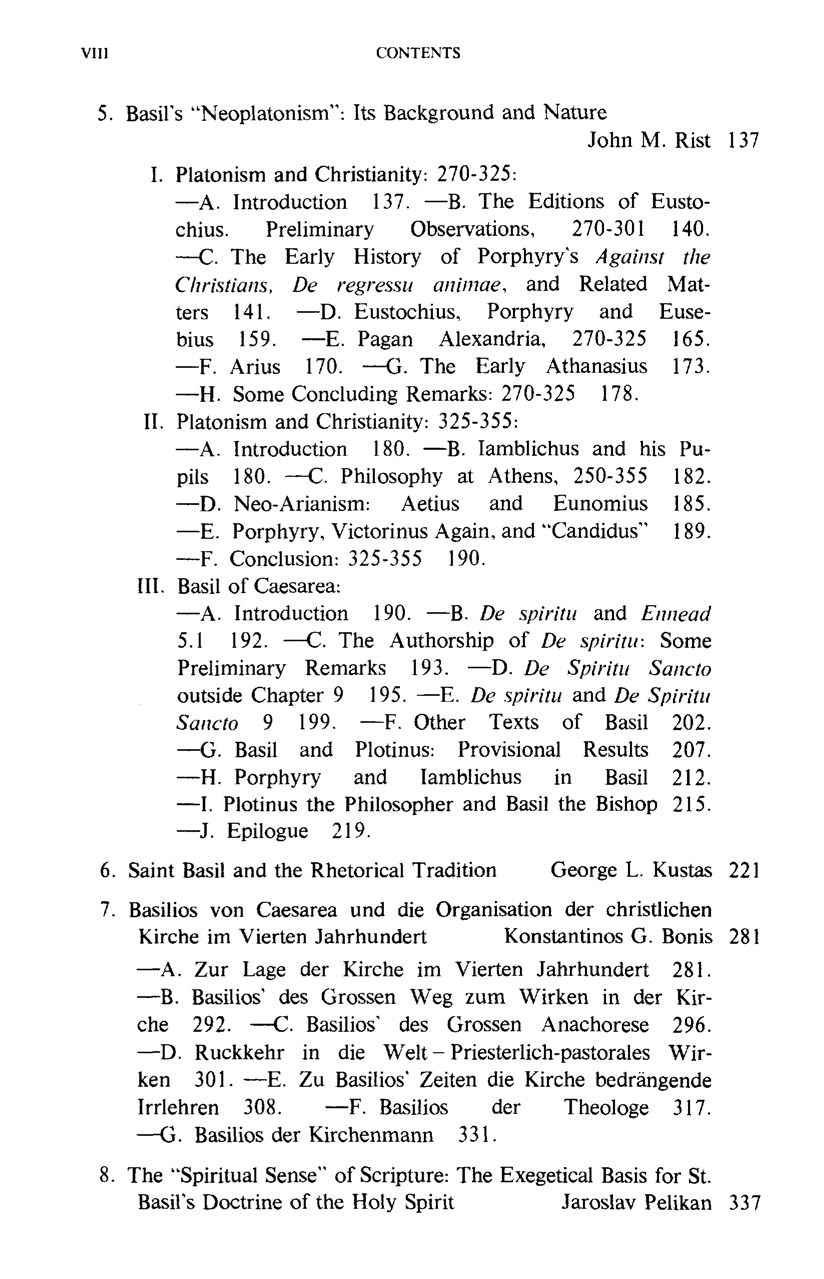
VIII CONTENTS 5. Basil's "Neoplatonism": Its Background and Nature John M. Rist 137 I. Platonism and Christianity: 270-325:
—A. Introduction 137. —B. The Editions of Eustochius.
Preliminary Observations, 270-301 140.
—C. The Early History of Porphyry's Against the Christians, De regressu animae, and Related Mat ters 141.
—D. Eustochius, Porphyry and Eusebius 159.
—E. Pagan Alexandria, 270-325 165.
—F. Arius 170. —G. The Early Athanasius 173.
—H. Some Concluding Remarks: 270-325 178.
II. Platonism and Christianity: 325-355:
—A. Introduction 180. —B. Iamblichus and his Pu pils 180. —C. Philosophy at Athens, 250-355 182.
—D. Neo-Arianism:
Aetius and Eunomius 185.
—E. Porphyry, Victorinus Again, and "Candidus"
189.
—F. Conclusion: 325-355 190.
III. Basil of Caesarea:
—A. Introduction 190. —B. De spiritu and Ennead 5.1
192. —C. The Authorship of De spiritu: Some Preliminary Remarks 193. —D. De Spiritu Sancto outside Chapter 9 195. —E. De spiritu and De Spiritu Sancto
199.
—F. Other Texts of Basil 202.
—G. Basil and Plotinus: Provisional Results 207.
—H. Porphyry and Iamblichus in Basil 212.
—I. Plotinus the Philosopher and Basil the Bishop 215.
—J. Epilogue 219.
6. Saint Basil and the Rhetorical Tradition George L. Kustas 221 7. Basilios von Caesarea und die Organisation der christlichen
Kirche im Vierten Jahrhundert Konstantinos G. Bonis 281 —Α. Zur Lage der Kirche im Vierten Jahrhundert
281.
—B. Basilios' des Grossen Weg zum Wirken in der Kir che 292. —C. Basilios' des Grossen Anachorese
296.
—D. Ruckkehr in die Welt - Priesterlich-pastorales Wir ken 301. —E. Zu Basilios' Zeiten die Kirche bedrängende
Irrlehren 308.
—F. Basilios der Theologe 317.
—G. Basilios der Kirchenmann 331.
8. The "Spiritual Sense" of Scripture: The Exegetical Basis for St.
Basil's Doctrine of the Holy Spirit Jaroslav Pelikan 337
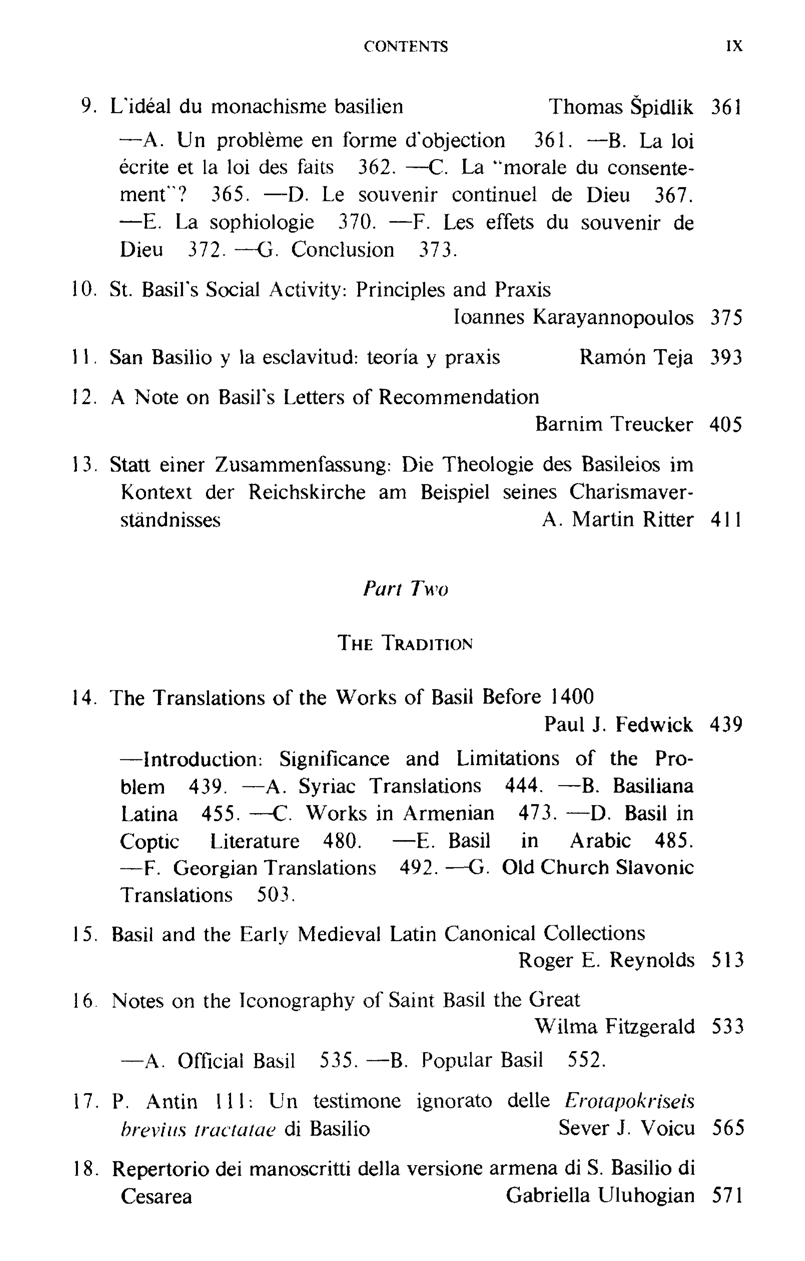
CONTENTS IX 9. L'idéal du monachisme basilien Thomas Spidlik 361 —A. Un problème en forme d'objection 361. —B. La loi écrite et la loi des faits 362. —C. La "morale du consentement"?
365. —D. Le souvenir continuel de Dieu 367.
—E. La sophiologie 370. —F. Les effets du souvenir de Dieu 372. —G. Conclusion 373.
10. St. Basil's Social Activity: Principles and Praxis Ioannes Karayannopoulos 375 11. San Basilio y la esclavitud: teoria y praxis
Ramon Teja 393 12. A Note on Basil's Letters of Recommendation Barnim Treucker 405 13. Statt einer Zusammenfassung: Die Theologie des Basileios im
Kontext der Reichskirche am Beispiel seines Charismaverstandnisses A. Martin Ritter 411 Part Two
THE TRADITION
14. The Translations of the Works of Basil Before 1400 Paul J. Fedwick 439 —Introduction: Significance and Limitations of the Problem
439. —A. Syriac Translations 444. —B. Basiliana Latina 455. —C. Works in Armenian 473. —D. Basil in Coptic Literature 480.
—E. Basil in Arabic 485.
—F. Georgian Translations 492. —G. Old Church Slavonic Translations 503.
15. Basil and the Early Medieval Latin Canonical Collections Roger E. Reynolds 513 16 Notes on the Iconography of Saint Basil the Great
Wilma Fitzgerald 533 —A. Official Basil 535. —B. Popular Basil 552.
17. P. Antin 111·. Un testimone ignorato delle Erotapokriseis brevius tractatae di Basilio Sever J. Voicu 565 18. Repertorio dei manoscritti della versione armena di S. Basilio di
Cesarea Gabriella Uluhogian 571
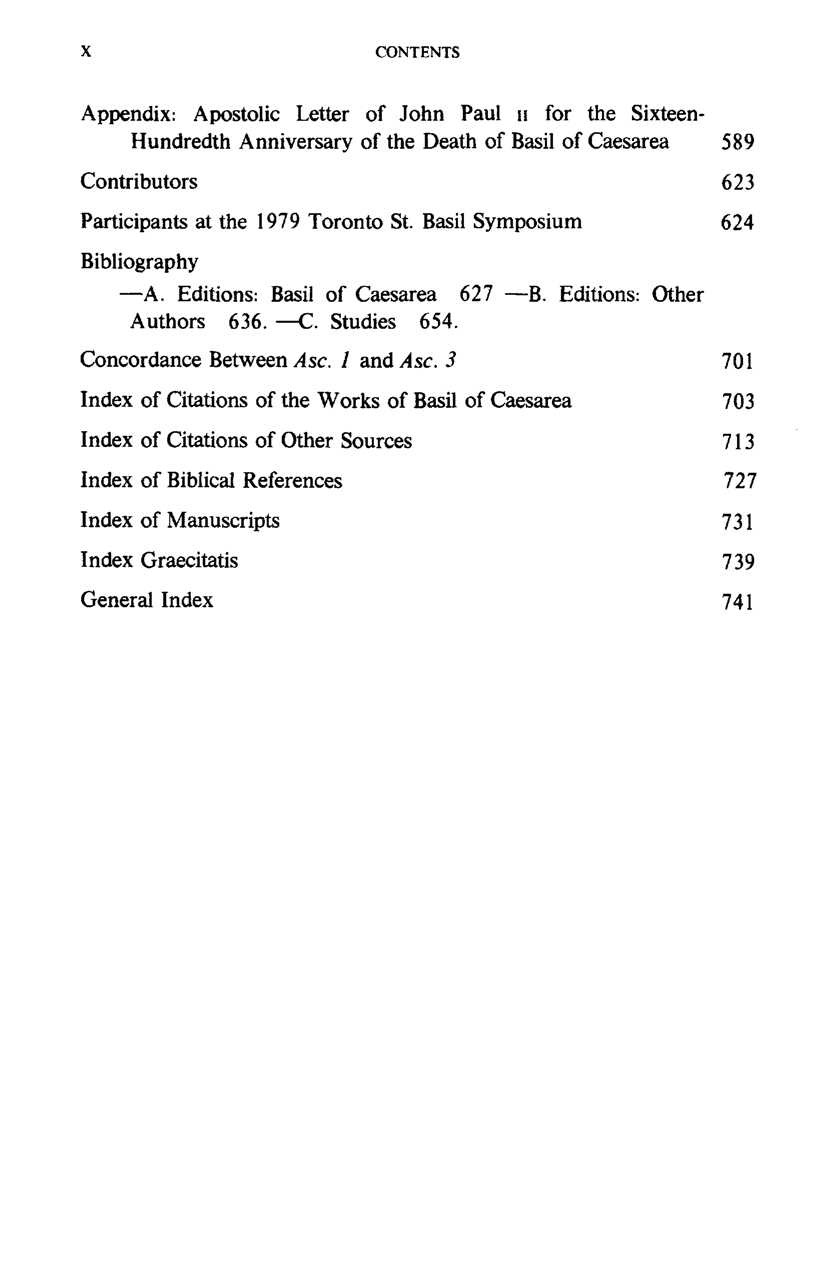
χ CONTENTS Appendix: Apostolic Letter of John Paul u for the SixteenHundredth Anniversary of the Death of Basil of Caesarea
Contributors
Participants at the 1979 Toronto St. Basil Symposium
Bibliography —A. Editions: Basil of Caesarea 627 —Β. Editions: Other Authors 636. —C. Studies 654.
Concordance Between Asc. 1 and Asc. 3
Index of Citations of the Works of Basil of Caesarea
Index of Citations of Other Sources
Index of Biblical References
Index of Manuscripts
Index Graecitatis
General Index
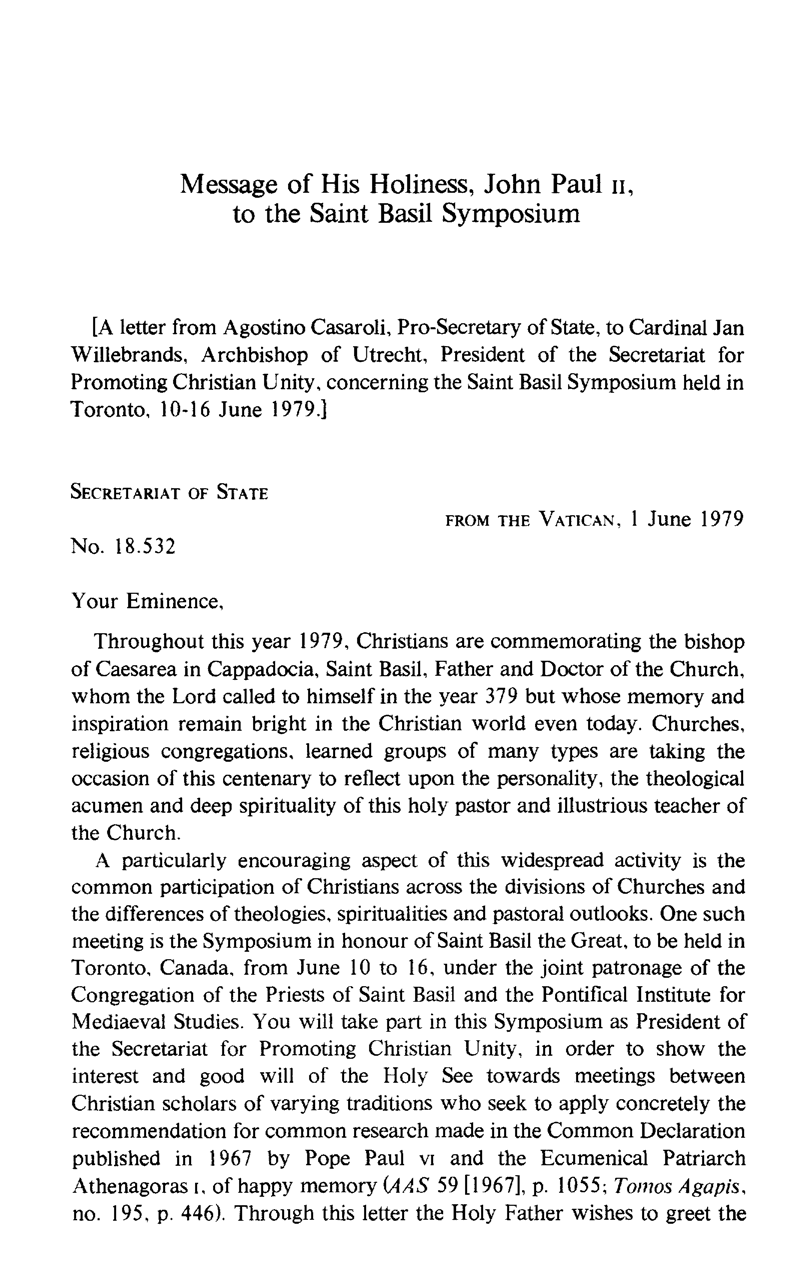
Message of His Holiness, John Paul π, to the Saint Basil Symposium [A letter from Agostino Casaroli, Pro-Secretary of State, to Cardinal Jan
Willebrands, Archbishop of Utrecht, President of the Secretariat for Promoting Christian Unity, concerning the Saint Basil Symposium held in Toronto, 10-16 June 1979.]
SECRETARIAT OF STATE
FROM THE VATICAN, 1 June 1979 No. 18.532
Your Eminence, Throughout this year 1979, Christians are commemorating the bishop of Caesarea in Cappadocia, Saint Basil, Father and Doctor of the Church, whom the Lord called to himself in the year 379 but whose memory and inspiration remain bright in the Christian world even today. Churches, religious congregations, learned groups of many types are taking the occasion of this centenary to reflect upon the personality, the theological acumen and deep spirituality of this holy pastor and illustrious teacher of the Church.
A particularly encouraging aspect of this widespread activity is the common participation of Christians across the divisions of Churches and the differences of theologies, spiritualities and pastoral outlooks. One such meeting is the Symposium in honour of Saint Basil the Great, to be held in Toronto, Canada, from June 10 to 16, under the joint patronage of the Congregation of the Priests of Saint Basil and the Pontifical Institute for Mediaeval Studies. You will take part in this Symposium as President of the Secretariat for Promoting Christian Unity, in order to show the interest and good will of the Holy See towards meetings between Christian scholars of varying traditions who seek to apply concretely the recommendation for common research made in the Common Declaration published in 1967 by Pope Paul vi and the Ecumenical Patriarch
Athenagoras i, of happy memory (AAS 59 [1967], p. 1055; Tomos Agapis, no. 195, p. 446). Through this letter the Holy Father wishes to greet the
XII
HIS HOLINESS, JOHN PAUL II
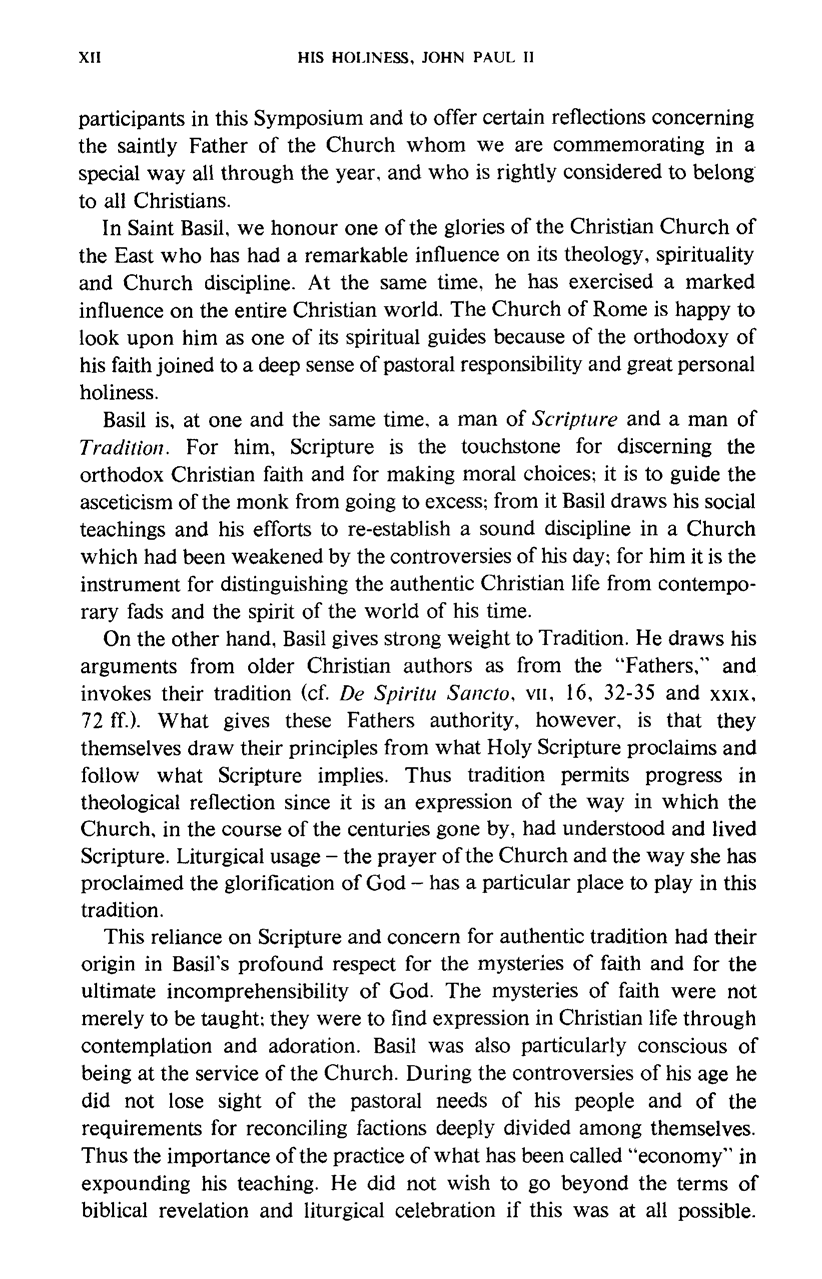
participants in this Symposium and to offer certain reflections concerning the saintly Father of the Church whom we are commemorating in a special way all through the year, and who is rightly considered to belong to all Christians.
In Saint Basil, we honour one of the glories of the Christian Church of the East who has had a remarkable influence on its theology, spirituality and Church discipline. At the same time, he has exercised a marked influence on the entire Christian world. The Church of Rome is happy to look upon him as one of its spiritual guides because of the orthodoxy of his faith joined to a deep sense of pastoral responsibility and great personal holiness.
Basil is, at one and the same time, a man of Scripture and a man of Tradition. For him, Scripture is the touchstone for discerning the orthodox Christian faith and for making moral choices; it is to guide the asceticism of the monk from going to excess; from it Basil draws his social teachings and his efforts to re-establish a sound discipline in a Church which had been weakened by the controversies of his day; for him it is the instrument for distinguishing the authentic Christian life from contemporary fads and the spirit of the world of his time.
On the other hand, Basil gives strong weight to Tradition. He draws his arguments from older Christian authors as from the "Fathers," and invokes their tradition (cf. De Spiritu Sancto, vu, 16, 32-35 and xxix,
72 ff.). What gives these Fathers authority, however, is that they themselves draw their principles from what Holy Scripture proclaims and follow what Scripture implies. Thus tradition permits progress in theological reflection since it is an expression of the way in which the Church, in the course of the centuries gone by, had understood and lived
Scripture. Liturgical usage - the prayer of the Church and the way she has proclaimed the glorification of God - has a particular place to play in this tradition.
This reliance on Scripture and concern for authentic tradition had their origin in Basil's profound respect for the mysteries of faith and for the ultimate incomprehensibility of God. The mysteries of faith were not merely to be taught; they were to find expression in Christian life through contemplation and adoration. Basil was also particularly conscious of being at the service of the Church. During the controversies of his age he did not lose sight of the pastoral needs of his people and of the requirements for reconciling factions deeply divided among themselves.
Thus the importance of the practice of what has been called "economy" in expounding his teaching. He did not wish to go beyond the terms of biblical revelation and liturgical celebration if this was at all possible.
TO THE SAINT BASIL SYMPOSIUM
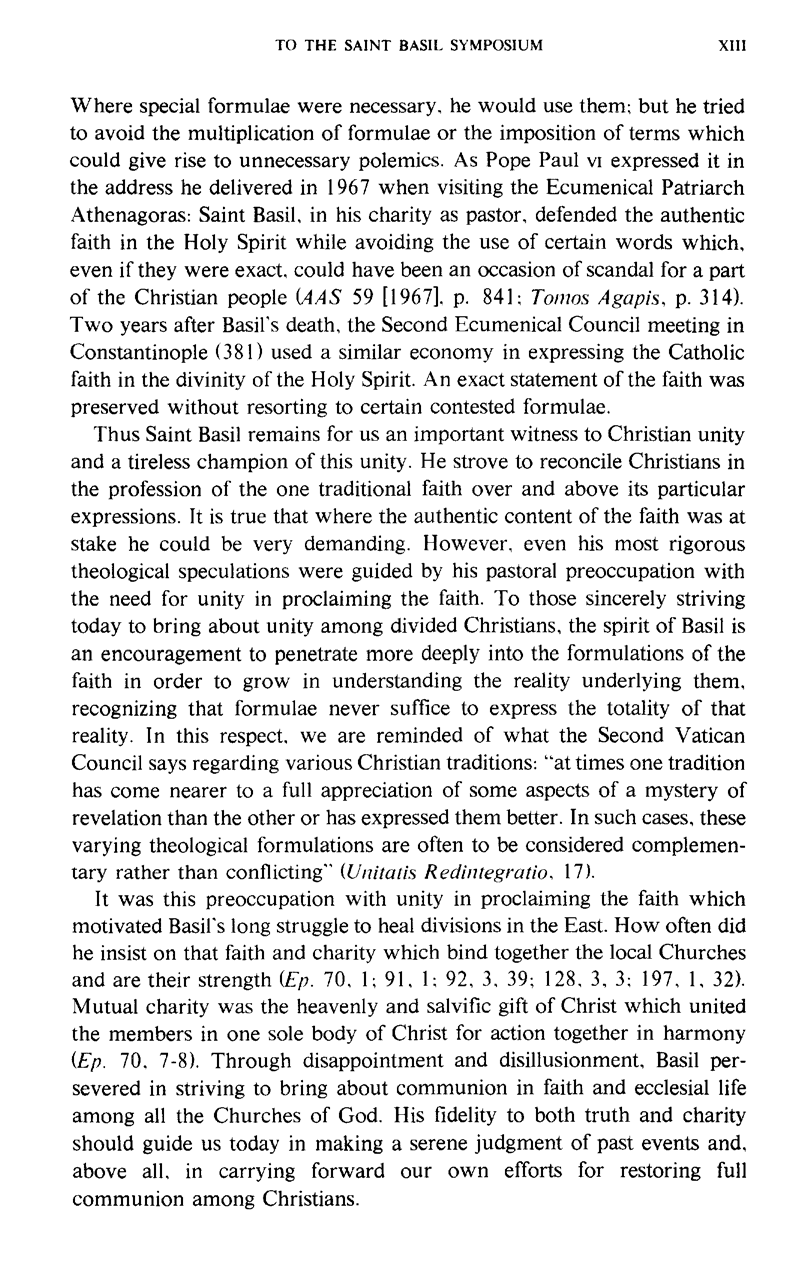
XIII Where special formulae were necessary, he would use them; but he tried to avoid the multiplication of formulae or the imposition of terms which could give rise to unnecessary polemics. As Pope Paul vi expressed it in the address he delivered in 1967 when visiting the Ecumenical Patriarch
Athenagoras: Saint Basil, in his charity as pastor, defended the authentic faith in the Holy Spirit while avoiding the use of certain words which, even if they were exact, could have been an occasion of scandal for a part of the Christian people (AAS 59 [1967], p. 841; Tomos Agapis, p. 314).
Two years after Basil's death, the Second Ecumenical Council meeting in Constantinople (381) used a similar economy in expressing the Catholic faith in the divinity of the Holy Spirit. An exact statement of the faith was preserved without resorting to certain contested formulae.
Thus Saint Basil remains for us an important witness to Christian unity and a tireless champion of this unity. He strove to reconcile Christians in the profession of the one traditional faith over and above its particular expressions. It is true that where the authentic content of the faith was at stake he could be very demanding. However, even his most rigorous theological speculations were guided by his pastoral preoccupation with the need for unity in proclaiming the faith. To those sincerely striving today to bring about unity among divided Christians, the spirit of Basil is an encouragement to penetrate more deeply into the formulations of the faith in order to grow in understanding the reality underlying them, recognizing that formulae never suffice to express the totality of that reality. In this respect, we are reminded of what the Second Vatican
Council says regarding various Christian traditions: "at times one tradition has come nearer to a full appreciation of some aspects of a mystery of revelation than the other or has expressed them better. In such cases, these varying theological formulations are often to be considered complementary rather than conflicting" (Unitatis Redintegratio, 17).
It was this preoccupation with unity in proclaiming the faith which motivated Basil's long struggle to heal divisions in the East. How often did he insist on that faith and charity which bind together the local Churches and are their strength (Ep. 70, 1; 91, 1; 92, 3, 39; 128, 3, 3; 197, 1, 32).
Mutual charity was the heavenly and salvific gift of Christ which united the members in one sole body of Christ for action together in harmony
(Ep. 70. 7-8). Through disappointment and disillusionment, Basil persevered in striving to bring about communion in faith and ecclesial life among all the Churches of God. His fidelity to both truth and charity should guide us today in making a serene judgment of past events and, above all, in carrying forward our own efforts for restoring full communion among Christians.
XIV
HIS HOLINESS, JOHN PAUL 11
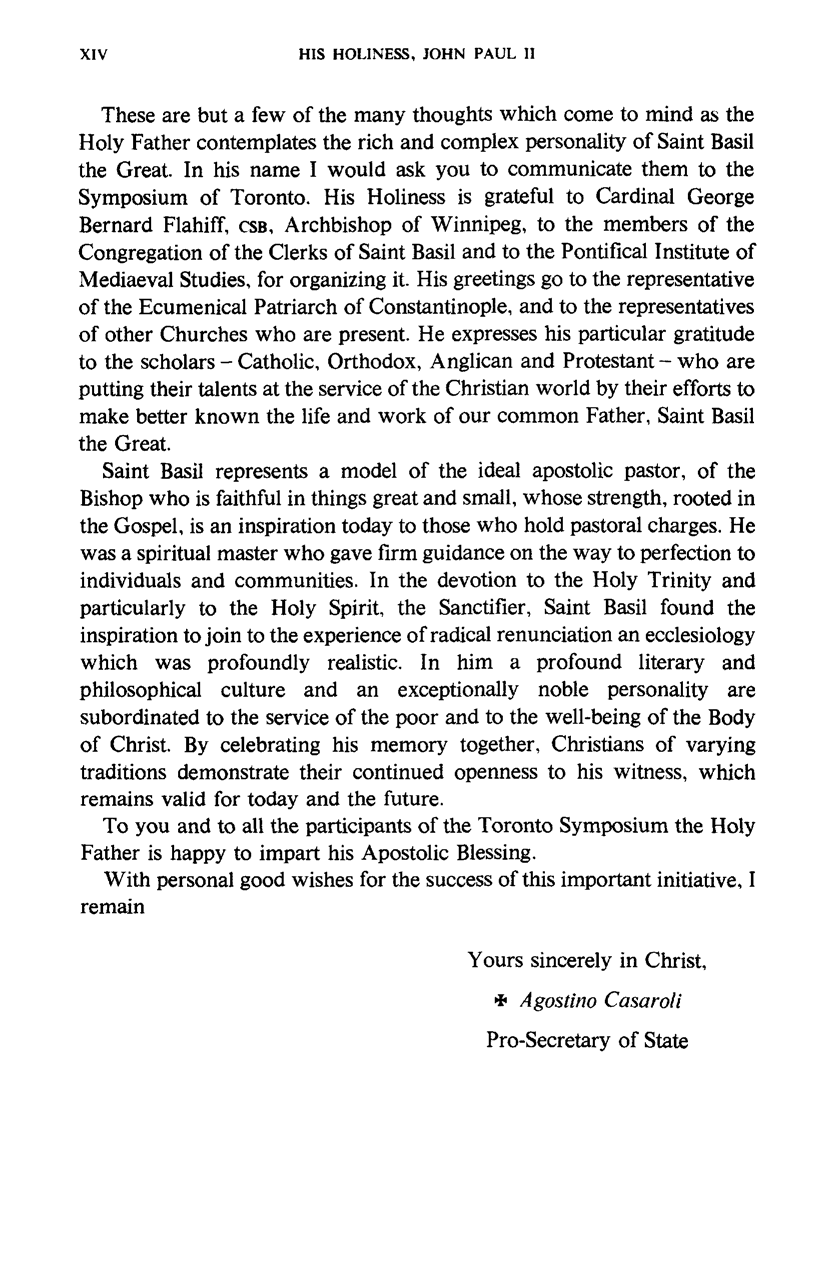
These are but a few of the many thoughts which come to mind as the Holy Father contemplates the rich and complex personality of Saint Basil the Great. In his name I would ask you to communicate them to the Symposium of Toronto. His Holiness is grateful to Cardinal George
Bernard Flahiff, CSB. Archbishop of Winnipeg, to the members of the Congregation of the Clerks of Saint Basil and to the Pontifical Institute of Mediaeval Studies, for organizing it. His greetings go to the representative of the Ecumenical Patriarch of Constantinople, and to the representatives of other Churches who are present. He expresses his particular gratitude to the scholars - Catholic, Orthodox, Anglican and Protestant - who are putting their talents at the service of the Christian world by their efforts to make better known the life and work of our common Father, Saint Basil the Great.
Saint Basil represents a model of the ideal apostolic pastor, of the Bishop who is faithful in things great and small, whose strength, rooted in the Gospel, is an inspiration today to those who hold pastoral charges. He was a spiritual master who gave firm guidance on the way to perfection to individuals and communities. In the devotion to the Holy Trinity and particularly to the Holy Spirit, the Sanctifier, Saint Basil found the inspiration to join to the experience of radical renunciation an ecclesiology which was profoundly realistic. In him a profound literary and philosophical culture and an exceptionally noble personality are subordinated to the service of the poor and to the well-being of the Body of Christ. By celebrating his memory together, Christians of varying traditions demonstrate their continued openness to his witness, which remains valid for today and the future.
To you and to all the participants of the Toronto Symposium the Holy Father is happy to impart his Apostolic Blessing.
With personal good wishes for the success of this important initiative, I remain Yours sincerely in Christ, * Agostino Casaroli Pro-Secretary of State
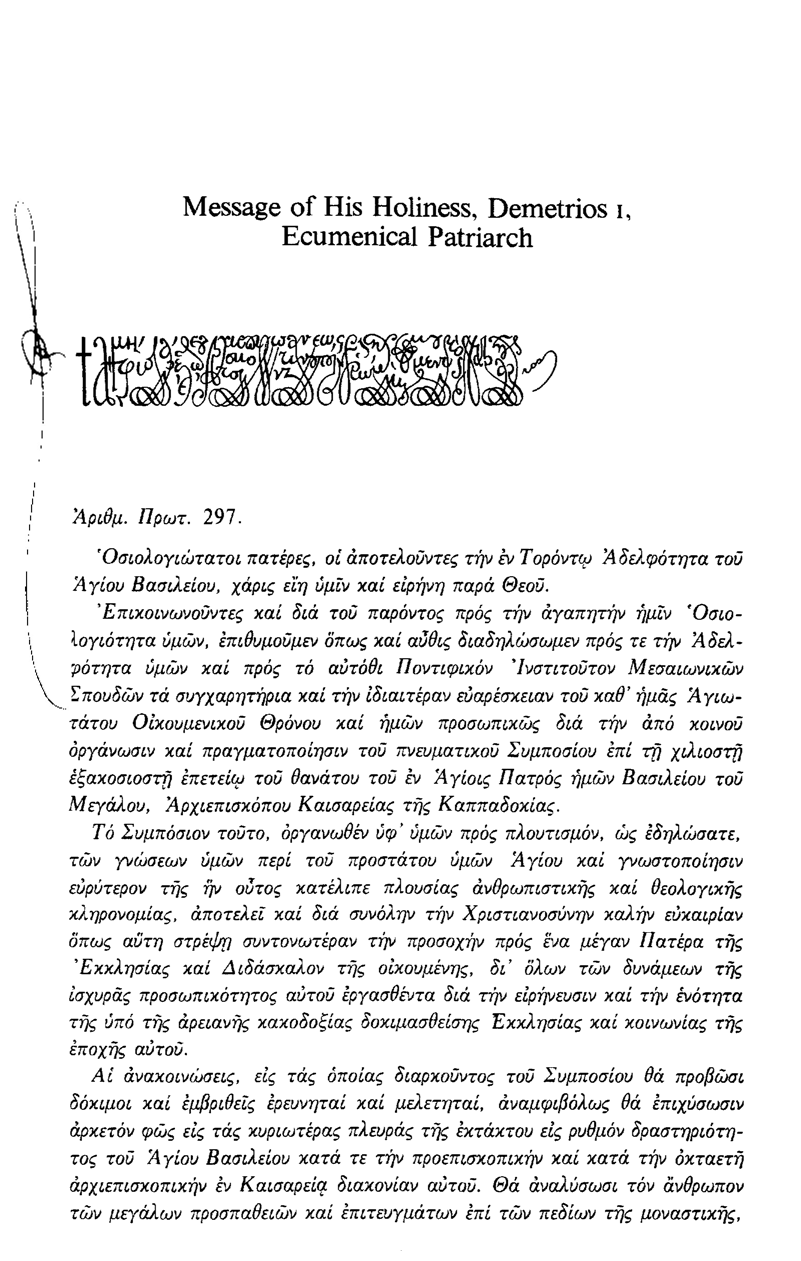
Message of His Holiness, Demetrios i, Ecumenical Patriarch 6Ho VP Αριθμ. Πρωτ. 297.
Όσιολογιώτατοι πατέρες, οι αποτελούντες τήν εν Τορόντω 'Αδελφότητα τοϋ 'Αγίου Βασιλείου, χάρις εΐη ύμϊν χαί ειρήνη παρά Θεοΰ.
'Επικοινωνούντες χαί διά τοΰ παρόντος προς τήν άγαπητήν ήμΐν Όσιολογιότητα υμών, έπιθυμοΰμεν όπως χαί αύθις διαδηλώσωμεν προς τε τήν 'Αδελ φότητα υμών χαί προς τό αυτόθι Ποντιφιχόν
Ίνστιτοΰτον Μεσαιωνικών Σπουδών τά συγχαρητήρια και τήν ίδιαιτέραν εύαρέσχειαν τοΰ καθ' ημάς Άγιωτάτου Οικουμενικού Θρόνου χαί ημών προσωπικώς διά τήν από κοινού όργάνωσιν χαί πραγματοποίησιν τοϋ πνευματικού Συμποσίου επί τη χιλιοστή έξακοσιοστή έπετείω τοΰ θανάτου τοΰ εν Άγίοις Πατρός ημών Βασιλείου τοΰ
Τό Συμπόσιον τοΰτο, όργανωθέν ύφ' υμών προς πλουτισμόν, ως έδηλώσατε, τών γνώσεων υμών περί τοΰ προστάτου υμών Άγιου και γνωστοποίησιν εύρύτερον της ήν ούτος χατέλιπε πλούσιας ανθρωπιστικής χαί θεολογικής κληρονομιάς, αποτελεί και διά συνόλην τήν Χριστιανοσύνης καλήν εύκαιρίαν δπως αΰτη στρέψβ συντονωτέραν τήν προσοχήν προς ενα μέγαν Πατέρα της
'Εκκλησίας και Διδάσκαλον της οικουμένης, δι' όλων τών δυνάμεων τής Ισχυρός προσωπικότητας αύτοϋ εργασθέντα διά τήν είρήνευσιν χαί τήν ενότητα τής υπό τής άρειανής κακοδοξίας δοχιμασθείσης Εκκλησίας χαί κοινωνίας τής εποχής αυτού.
Αϊ ανακοινώσεις, εις τάς όποιας διαρχοΰντος τοΰ Συμποσίου θά προβώσι δόκιμοι και εμβριθείς έρευνηταϊ και μελετηταί, αναμφιβόλως θά έπιχύσωσιν άρκετόν φώς εις τάς κυριωτέρας πλευράς τής εκτάκτου εις ρυθμόν δραστηριότη τος τοϋ Άγιου Βασιλείου κατά τε τήν προεπισκοπικήν και κατά τήν οκταετή άρχιεπισκοπικήν έν Καισαρεία διαχονίαν αύτοϋ. Θά άναλύσωσι τόν ανθρωπον τών μεγάλων προσπαθειών χαί επιτευγμάτων έπί τών πεδίων τής μοναστικής,
XVI
HIS HOLINESS, DEMETRIOS I
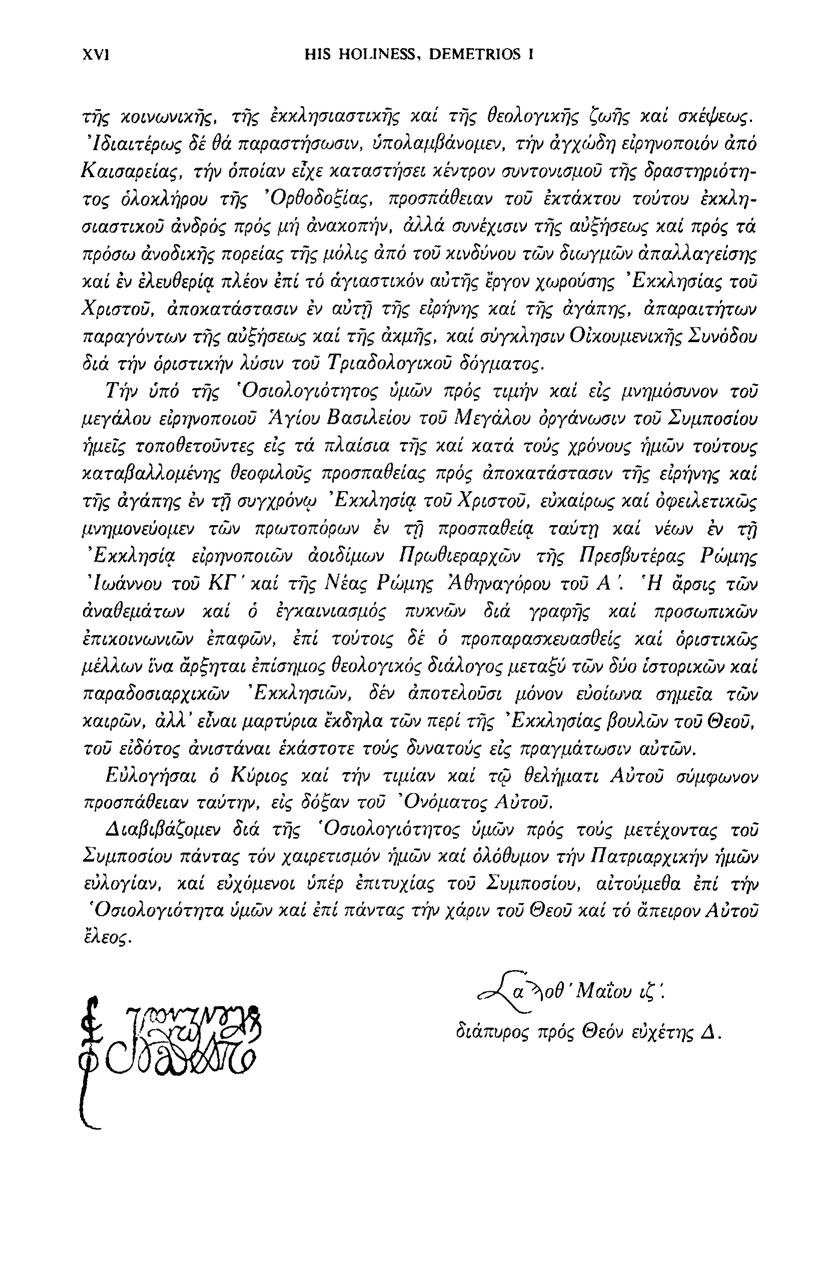
'Ιδιαιτέρως δέ θά παραστήσωσιν, ύπολαμβάνομεν, τήν αγχώδη είρηνοποιόν από Καισαρείας, τήν οποίαν είχε καταστήσει κέντρον συντονισμού τής δραστηριότη τος ολοκλήρου τής 'Ορθοδοξίας, προσπάθειαν τοΰ εκτάκτου τούτου εκκλη σιαστικού ανδρός προς μή άνακοπήν, άλλα συνέχισιν τής αυξήσεως και προς τά πρόσω ανοδικής πορείας τής μόλις από τοϋ κινδύνου τών διωγμών άπαλλαγείσης και εν ελευθερία πλέον επί τό άγιαστικόν αυτής 'έργον χωρούσης 'Εκκλησίας τοΰ
Χριστού, άποκατάστασιν εν αυτή τής ειρήνης και τής αγάπης, απαραιτήτων παραγόντων τής αυξήσεως και τής ακμής, και σύγκλησιν Οικουμενικής Συνόδου διά τήν όριστικήν λύσιν τοϋ Τριαδολογικού δόγματος.
Τήν ύπό τής Όσιολογιότητος υμών προς τιμήν και εις μνημόσυνον τοϋ μεγάλου εϊρψοποιοϋ Άγιου Βασιλείου τοϋ Μεγάλου όργάνωσιν τοϋ Συμποσίου ημείς τοποθετοϋντες εις τά πλαίσια τής και κατά τους χρόνους ημών τούτους καταβαλλομένης θεοφιλούς προσπάθειας προς άποκατάστασιν τής ειρήνης και τής αγάπης εν τή συγχρόνω 'Εκκλησία τοϋ Χριστού, εύκαίρως και όφειλετιχώς μνημονεύομεν τών πρωτοπόρων εν τή προσπάθεια ταύτη και νέων εν τή
'Εκκλησία ειρηνοποιών άοιδίμων Πρωθιεραρχών τής Πρεσβυτέρας Ρώμης 'Ιωάννου τοϋ ΚΓ ' χαί τής Νέας Ρώμης Άθηναγόρου τοϋ Α '. Ή άρσις τών αναθεμάτων και ό έγκαινιασμός πυκνών διά γραφής και προσωπικών επικοινωνιών επαφών, επί τούτοις δέ ό προπαρασκευασθείς και οριστικώς μέλλων ϊνα άρξηται επίσημος θεολογικός διάλογος μεταξύ τών δύο ιστορικών χαί παραδοσιαρχικών 'Εκκλησιών, δεν άποτελοϋσι μόνον ευοίωνα σημεία τών καιρών, αλλ' εΐναι μαρτύρια έκδηλα τών περί τής 'Εκκλησίας βουλών τοϋ Θεοϋ, τοΰ εϊδότος άνιστάναι εκάστοτε τους δυνατούς εις πραγμάτωσιν αυτών.
Εύλογήσαι ό Κύριος και τήν τιμίαν και τω θελήματι Αύτοϋ σύμφωνον προσπάθειαν ταύτην, εις δόξαν τοϋ 'Ονόματος
Διαβιβάζομεν διά τής Όσιολογιότητος υμών προς τους μετέχοντας τοΰ Συμποσίου πάντας τόν χαιρετισμόν ημών και όλόθυμον τήν Πατριαρχικήν ημών εύλογίαν, καί ευχόμενοι υπέρ επιτυχίας τοϋ Συμποσίου, αίτούμεθα επί τήν Όσιολογιότητα υμών καί επί πάντας τήν χάριν τοϋ Θεού καί τό άπειρον Αυτού έλεος.
TO THE SAINT BASIL SYMPOSIUM
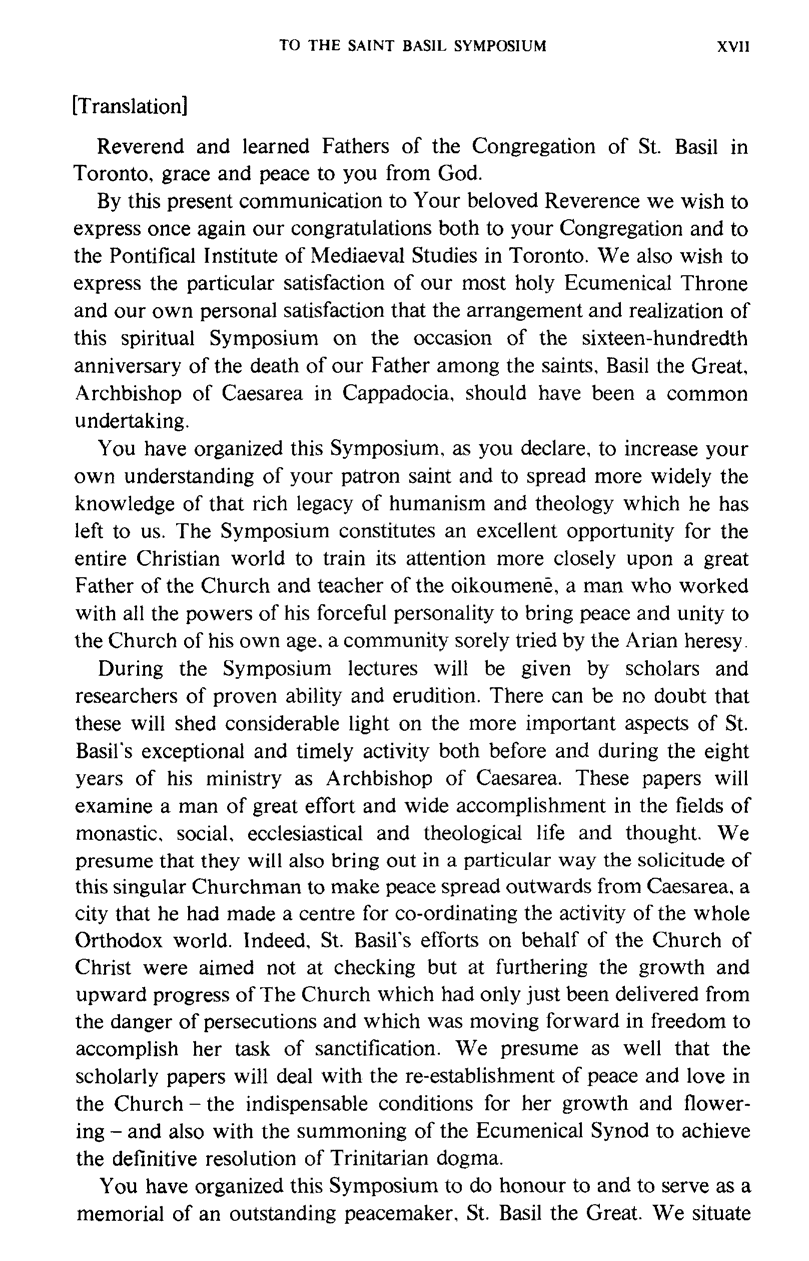
XVII [Translation] Reverend and learned Fathers of the Congregation of St. Basil in Toronto, grace and peace to you from God.
By this present communication to Your beloved Reverence we wish to express once again our congratulations both to your Congregation and to the Pontifical Institute of Mediaeval Studies in Toronto. We also wish to express the particular satisfaction of our most holy Ecumenical Throne and our own personal satisfaction that the arrangement and realization of this spiritual Symposium on the occasion of the sixteen-hundredth anniversary of the death of our Father among the saints, Basil the Great,
Archbishop of Caesarea in Cappadocia, should have been a common undertaking.
You have organized this Symposium, as you declare, to increase your own understanding of your patron saint and to spread more widely the knowledge of that rich legacy of humanism and theology which he has left to us. The Symposium constitutes an excellent opportunity for the entire Christian world to train its attention more closely upon a great
Father of the Church and teacher of the oikoumenè, a man who worked with all the powers of his forceful personality to bring peace and unity to the Church of his own age, a community sorely tried by the Arian heresy.
During the Symposium lectures will be given by scholars and researchers of proven ability and erudition. There can be no doubt that these will shed considerable light on the more important aspects of St.
Basil's exceptional and timely activity both before and during the eight years of his ministry as Archbishop of Caesarea. These papers will examine a man of great effort and wide accomplishment in the fields of monastic, social, ecclesiastical and theological life and thought. We presume that they will also bring out in a particular way the solicitude of this singular Churchman to make peace spread outwards from Caesarea, a city that he had made a centre for co-ordinating the activity of the whole
Orthodox world. Indeed, St. Basil's efforts on behalf of the Church of Christ were aimed not at checking but at furthering the growth and upward progress of The Church which had only just been delivered from the danger of persecutions and which was moving forward in freedom to accomplish her task of sanctification. We presume as well that the scholarly papers will deal with the re-establishment of peace and love in the Church - the indispensable conditions for her growth and flowering - and also with the summoning of the Ecumenical Synod to achieve the definitive resolution of Trinitarian dogma.
You have organized this Symposium to do honour to and to serve as a memorial of an outstanding peacemaker, St. Basil the Great. We situate
XVIII
HIS HOLINESS, DEMETRIOS I
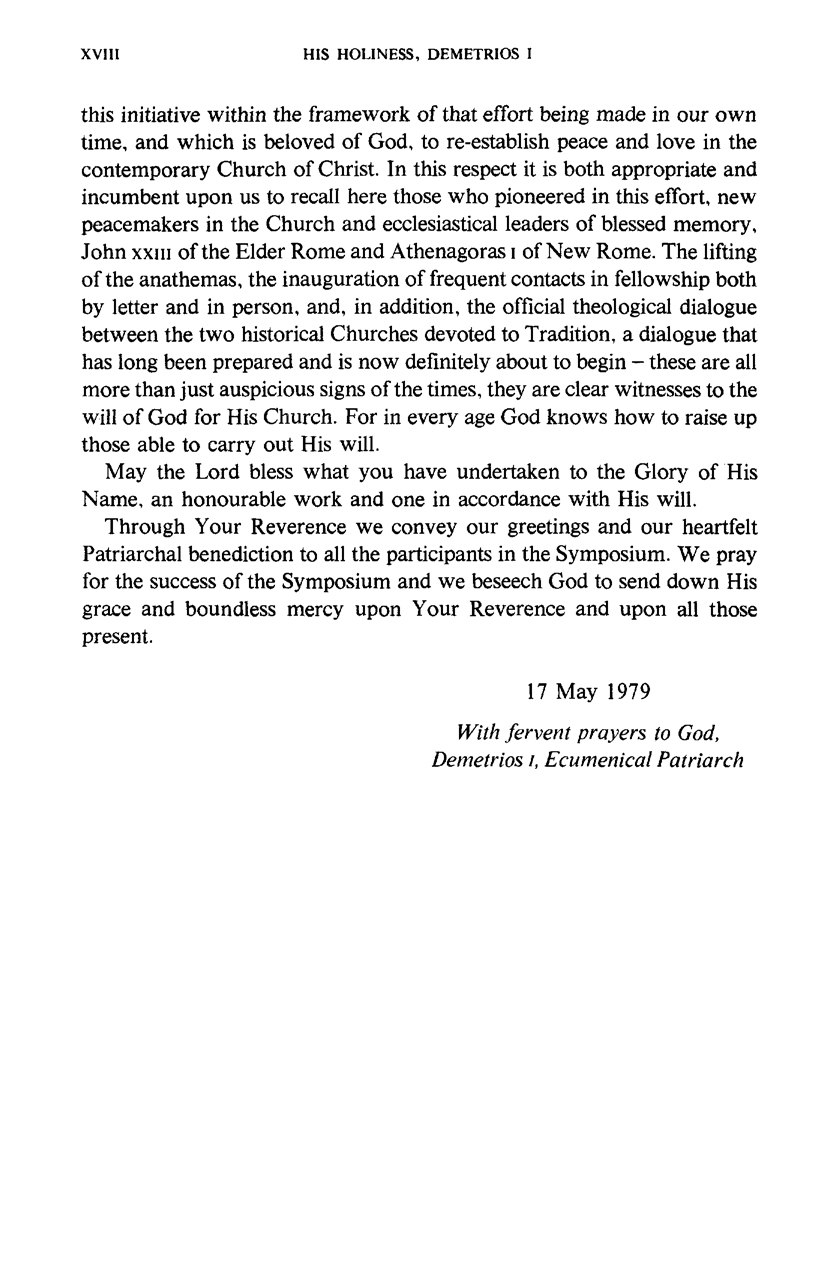
this initiative within the framework of that effort being made in our own time, and which is beloved of God, to re-establish peace and love in the contemporary Church of Christ. In this respect it is both appropriate and incumbent upon us to recall here those who pioneered in this effort, new peacemakers in the Church and ecclesiastical leaders of blessed memory,
John XXIII of the Elder Rome and Athenagoras ι of New Rome. The lifting of the anathemas, the inauguration of frequent contacts in fellowship both by letter and in person, and, in addition, the official theological dialogue between the two historical Churches devoted to Tradition, a dialogue that has long been prepared and is now definitely about to begin - these are all more than just auspicious signs of the times, they are clear witnesses to the will of God for His Church. For in every age God knows how to raise up those able to carry out His will.
May the Lord bless what you have undertaken to the Glory of His Name, an honourable work and one in accordance with His will.
Through Your Reverence we convey our greetings and our heartfelt Patriarchal benediction to all the participants in the Symposium. We pray for the success of the Symposium and we beseech God to send down His grace and boundless mercy upon Your Reverence and upon all those present.
17 May 1979 With fervent prayers to God, Demetrios i, Ecumenical Patriarch