
28. Holste. 1 8 1 )
LATIN CANONICAL COLLECTIONS
Not too long after the Quadripartita was compiled, no less than eight of its Basil canons were included in the Libri duo de synodalibus causis of Regino of Prüm (ca. 906).57 Most of these canons were later to find their
[4.25] Affectum ilium in se reciptat ... sicut Zacheus fecit (Attributed to Basil.
EApokr. 18. Holste. L 79.) [4.26] Erga eum qui pro peccato ... tradidimus vobis. (Attributed to Basil. EApokr.
28. Holste. 1 8 1 ) [4.32] Si quis semel notatus ... cura similis adhibetur. (Attributed to Basil. EApokr.
22. Holste. 1; 80.) [4.42] Id [sic] omnimodis observari ... non est qui erigat eum. (Attributed to Basil.
EApokr 174. Holste. 1 103.) [4.109] Si quis preventus ... in irritum revocetur. (Attributed to Basil and similar to EApokr. br. 60. PG 31: 1121.) [4 152] Apostolus dicit Omnia facite ... et opus eius abiciatur. (Attributed to Basil.
EApokr. 71. Holste. 1; 87.) [4.153] Si quis murmurans extiterit ... sacerdotis iudicio paeniteat (Attributed to Basil and similar to EApokr. 93. Holste, 1: 90.)
[4.157] Si quis detrahit ... detraxit Moysi poeniteat (Attributed to Basil and similar to EApokr 43 f. Holste. I: 83.) [4.210] Si is qui praeest ... evangelizavimus vobis anathema sit. (Attributed to Basil.
Snippet from EApokr 13. Holste. 1: 78.) [4.211] Si quis prohibet nos facere ... qui diligunt Deum. (Attributed to Basil.
Snippet from EApokr 13, Holste. I: 78 f.) [4 212] Is qui praeest si praeter voluntate ... aut sacrilegus habeatur. (Attributed to Basil and similar to EApokr 15. Holste. 1: 79.)
[4.221] Firma autem tunc erit ... deputari ac perfecta. (Attributed to Basil. Snippet from EApokr 1. Holste. L 74.) [4.225] Oportet tarnen infantes ... excludatur hominum pessimorum. (Attributed to Basil. Snippet from EApokr. 1. Holste. L 74.)
[4.240] Qui consentit peccantibus ... culpabilem iudicandum. (Attributed to Basil, but on the source see n. 55.) [4.251] Qui alterius consentit peccato ... consentit contrahat poenam. (Attributed to Basil.) The texts of these canons are in E. L. Richter. Antiqua canonum collectio, qua in libris de synodalibus causis contpilandis usus est Regino Prumiensis... (Marburg 1844) pp. 3-43. ss 4.240. Cf. Sinaragdi abbatis Expositio in Régulant s. Benedicti. ed. Α. Spannagel
(Siegburg 1974) ρ 329 (3.68.1 = Regula Pachomii, Praecepla atque ludicia, clxxvi
[Pachontiana lalina. Règle et épitres de s. Pachonte. Epitre de s. Théodore el "Liber" de s.
Orsiesius. Texte laiin de s. Jérôme, ed. A. Boon (Louvain 1932) p. 69] = Concordia
Regularum 72.2, PL 103: 1360 f.).
56 4.78 (Vat lat. 1347. f. 157, with no attribution): Si quis vult coniugatus ... voluntate castitatis consensum. The canon is taken from the Regula Isidori A, as found in the Codex
Regularum (Holste. 1: 189; pi 103: 559). But cf. PI. 83: 872, where it is lacking. It may be based on the EApokr. fus. 12. PG 31: 948 f. In Regino and other collections this canon is often attributed to Basil. s? Reginonis abbatis Prumiensis Libri duo de synodalibus causis el disciplinis ecclesiasticis. ed. F G. A Wasserschieben (Leipzig 1840) pp. 91. 154 f., 256 f., 315:
ROGER Ε. REYNOLDS
way into Burchard, Ivo, and Gratian, but there are two other Basil canons, later added in the appendices to Regino, whose influence would have repercussions in theological debate even into the present century.
These canons, dealing with the "secret tradition" of the church and studied a dozen years back by Dom Gribomont,
58 were drawn from Basil's De Sp. S. 27, 29.
59 We have already come upon fragments of the De Sp. S. in ninth-century manuscripts, 60 and hence cc. 27, 29 in Regino's appendix may well have come from a now lost early Latin translation of the tract, but it is also possible that a Greek source available in northern
France in the early tenth century was used.
By the early eleventh century there were two flourishing traditions of Basil texts in our systematic canonical collections, one stemming from the Collectio hibernensis found especially in southern Italian manuscripts, and another in the Quadripartita and Regino's collection. The Hibernensis tradition as found in the Roman manuscript, BV T. xvm, written in Beneventan territories, 61 quickly transmitted its Basil canons into the tenth-century Beneventan Collection in Nine Books of Vatican BAV Vat. lat.
1.166: Apostolus dicit Omnia facite ... opus eius abiiciatur. ( -EApokr. 71, Holste,
L 87.) 1.167: Si quis murmurans exstiterit ... sacerdotis iudicio peniteat (Similar to EApokr. 93, Holste, 1: 90.) 1.168: Si quis detraxerit... detraxit Moysi peniteat. (Similar to EApokr. A3 f., Holste,
1: 83.) 1.325: Penitentem ex corde ... ovem meam quam perdideram. (=EApokr. 27, Holste, L 81.) 1.326: Affectum ilium in se ... et abominatus sum. ( = EApokr. 18, Holste, L 79.)
1.328: Erga eum qui pro peccato ... quam tradidimus vobis. (-EApokr. 28, Holste.
1: 81.) 2.109: Si quis vult coniugatus ... castitatis consensum. ( =Quadripartitus 4.78.)
2.259; Clericus vel monachus adolescentium ... deinceps iuvenibus coniungendus.
(This canon, which Regino attributes to Basil, bears no attribution in the Quadripartitus,
4.81 [Vat. lat. 1347, f. 157 v]. It derives from the Regula Fructuosi 16, Holste, 1 ; 205; PL 87:
1107.) 58 See J. Gribomont, "Ésotérisme et tradition dans le Traité du Saint-Esprit de saint
Basile," Oecumenica 2 (1967) 23.
" Wasserschieben, pp. 447 f.:
Append. 2.36: Ecclesiasticarum institutionum ... publicata scripto. ( -De Sp. S. 27,
PG 32: 188.)
Append. 2.37: Deficit me dies ... persuasibilius eruditis clarescat ( -De Sp. S. 29,
PG 32: 200.)
60 See above, pp. 515-523. The texts in Append. 2 are found in Wolfenbüttel HAB Aug.
83-21 (written in the late tenth century) and Stuttgart WLB HB vi.l 14 (written in the late tenth century), on which see Autenrieth. "Die kanonistischen Handschriften." p. 14.
61 See Brown, Hand-List of Beneventan MSS, p. 131.
LATIN CANONICAL COLLECTIONS
1349, 62 and then on to the eleventh-century southern Italian Collection in Five Books 63 These latter collections also shared canons from penitentials perhaps inspired by Basil's Canonical Epistles.
6* They may have come from earlier Continental penitentials or Greek sources. That Greek sources were being used in some form in these collections is highly likely because the Collection in Five Books also contains an extract from the Vita
Basilii of Amphilochius (the story of the Conversion of the Jew) in a recension quite unlike the only known Latin versions of the Amphilochian Vita listed by the Bollandists.
During the course of the eleventh century the tradition in the Collection in Five Books with its Basil texts worked a significant influence on a number of minor southern Italian collections. Of these the Collection of 66 but he Vatican Vat. lat. 4977 was noted by Paul Fournier long ago
62 F. 126; 6.83: Cum Dominus aliquando ... de hoc iudicare. ( = Coll. hib. 21.11b.) f. 135; 6.189: Nam et parentes ... sepultura ei debetur. ( = Coll. hib. 31.16f.) f. 140 v; 6.250: Omnis sermo ... otiosus est. ( = Coll. hib. 65.8 in Vallicelliana
T. xvm.) v; 7.198: Ieiunii mensura ... habuisse signantur. (-Coll. hib. 14.4 in Vallicelliana T. xvm.) f. 171
On this MS see Brown, Hand-List of Beneventan MSS.. p. 145: and Mordek, Kirchenrechl, p. 138. n. 185. who points out that although the MS itself was written in the eleventh century, the collection seems, according to Fournier, to have been compiled in the early tenth century. There is also in this MS, f. 193, the preface to Cummean's
Penitential ascribed to Basil, on which see n. 45 above.
" 1.220.3: Cum Dominus aliquando ... de hoc iudicare. (-Coll. hib. 21.11b.) 3.242.4: Omnis sermo ... otiosus est. ( -Coll. hib. 65.8 in Vallicelliana T. xvm.)
3.254.2; Scire debemus quia rationem ... opus Dei negligenter. (The text of these canons is found in Collectio canonum in ν libris [Lib. /-////, CCCM 6: 135, 433. 439.)
4.69: Si quis sacerdos palam ... peregrinando finiat 4.99: Si his qui consentit ... Adam acquievit Evae. (-Coll. hib. 28.30 in Vallicelliana Τ. xvm.) 4.176: Nam et parentes ... eis detur honor. ( = Coll. hib. 31.16f.)
4.271 : Plurimi namque homines ... vestra de celo debere. ( = ""Admon. 14, Holste,
I: 462.) 4.348: Modus et qualitas temperabitur cibi ... aliqua diversa existit ( = Coll. hib.
12.14.) (The text of these canons in Lib. 4 may be found in Vatican BAV Vat. lat. 1339, ff.
181. 186 v. 200. 215, 227; on which MS see Manuscripta 21 [1977] 13, and Reynolds,
Ordinals of Christ, p. 92.) 64 In the Collection in Nine Books, Vat. lat. 1349, ff. 197-205\ there are a number of penitential periods of fifteen years, a favorite in the works of Basil, on which see P.
Fournier. "Un groupe de recueils canoniques italiens des x e siècles," MAIBL 40 (1915) 153-155. e et xi 65 3.220.2: Quidam hebreus venit... nostrum Ihesum Christum; CCCM 6: 421. Cf. the editions listed in BHI 1: 153 f. (Nos. 1022-1027).
66 On this collection see Reynolds, Ordinals of Christ, p. 92.
ROGER Ε. REYNOLDS
67 Less well known are three other collections with Basil texts, the Collection of Vatican Arch. San Pietro Η 58, missed its four Basil canons.
68 the Collection of Rieti 10 Of special interest in this last collection is a Basil text from a Greek Vita Basilii like the one Combefis edited in which the ages of the world are described.
and the Farfa Liber multiloquiorum.
Much more important for the transmission of Basil texts in Western canon law than these southern Italian collections were the transalpine collections and their derivatives. From Regino, Basil texts passed into Burchard's Decretum, 12 and from Burchard they were filtered down to 67 F. 44 v: Scire debemus quia rationem ... opus Dei neglegenter. (-Coll. VL, 3.254.2.) f. 47 v: Si quis sacerdos palam ... peregrinando finiat ( = Coll. VL, 4.69.) f. 52 v: Si hisque consentit... Adam acquievit JE\ae (=Coll. VL, 4.99.) f. 69 v: Qui consentit peccatibus et défendit ... iudicandum et excommunicandum.
(On this canon, which bears the attribution Ex dictis Basilii episcopi, see above, n. 54, and below, n. 77.) 68 F. 52v: Vocis mensuram diffinit... quod est notabile. ( = Coll. hib. 10.7 in Vallicelliana T. xvm.)
On f. 148\ there is a reference to Basil, "Basilius episcopus Cesariensis clarus
Cappadocie habetur [sic] qui multa continentiae et ingenii bona uno superbiae malo perdidit." On this liturgico-canonical collection see R. E. Reynolds, "Excerpta from the Collectio Hibernensis in Three Vatican Manuscripts," BMCL 5 (1975) 4-9; P. Salmon,
"Un 'Libellus officialis' du xie siècle," RBen 87 (1977) 257-288; idem, "Un témoin de la vie chrétienne dans une église de Rome au xie siècle: le Liber officialis de la basilique des
Saints-Apôtres," RSCI 33 (1979) 65-73; Kottje, Die Bußbücher Halitgars von Cambrai esp. pp. 65-69; and for Professor Bischoffs dating of the manuscript see D. Sicard, La liturgie de la mort dans l'église latine des origines à ia réforme carolingienne (Münster 1978) pp. xiv, 115, n. 33.
69 Rieti AC 5, f. 36v: Nam et parentes nostras ... sepultura ei debetur. ( = Coll. VL,
4.176.) f. 42: Plurimi namque homines ... vestra de celo debere. ( = Coll. VL, 4.271.) f. 73: Si quis sacerdos palam ... peregrinando finiat. ( = Coll. VL, 4.69.)
On this collection, for which I am preparing a short study, see F. A. Ferretti, L 'archivio e l'antica Biblioteca della Cattedrale di Rieti: La Lipsanoteca Episcopate (Rieti
1939) p. 23 with pl.; and Brown, Hand-List of Beneventan MSS. , p. 120.
70 Vatican BAV Vat. lat. 4317, ff. 171 v-l72: xxxn. De etatibus mundi in vita sancti
Basilii. Basilius. A primo plasto homine cui nomen ... ducenti nonaginta Septem. Item
Basilius. In prima vero die ... quadrupedia et reptilia. f. 197v: Si quis sacerdos palam ... pergrinando finiat. ( = ColI. VL, 4.69.)
On this MS see R. E. Reynolds, "The 'Isidorian' Epistula ad Leudefredunv. An Early
Medieval Epitome of the Clerical Duties," MS 41 (1979) 306 f.
71 Ff. 171M72. Cf. Acta Sanctorum 23: 420B.
72 3.127: Ecclesiasticarum institutionum ... publicata scripta. (Attributed to Basil in PL
140: 698.) 8.9: Monacho non liceat votum ... frangendum erit (-Coll. Disc. Umb. 2.6.9
[Finsterwalder, p. 321]. Cf. Munier, Les sources, p. 213. In PL 140: 794 attributed to Basil.)
9.45: Si quis vult coniugatus ... voluntate castitatis consensum. (Attributed to Basil in PL 140: 822.)
LATIN CANONICAL COLLECTIONS
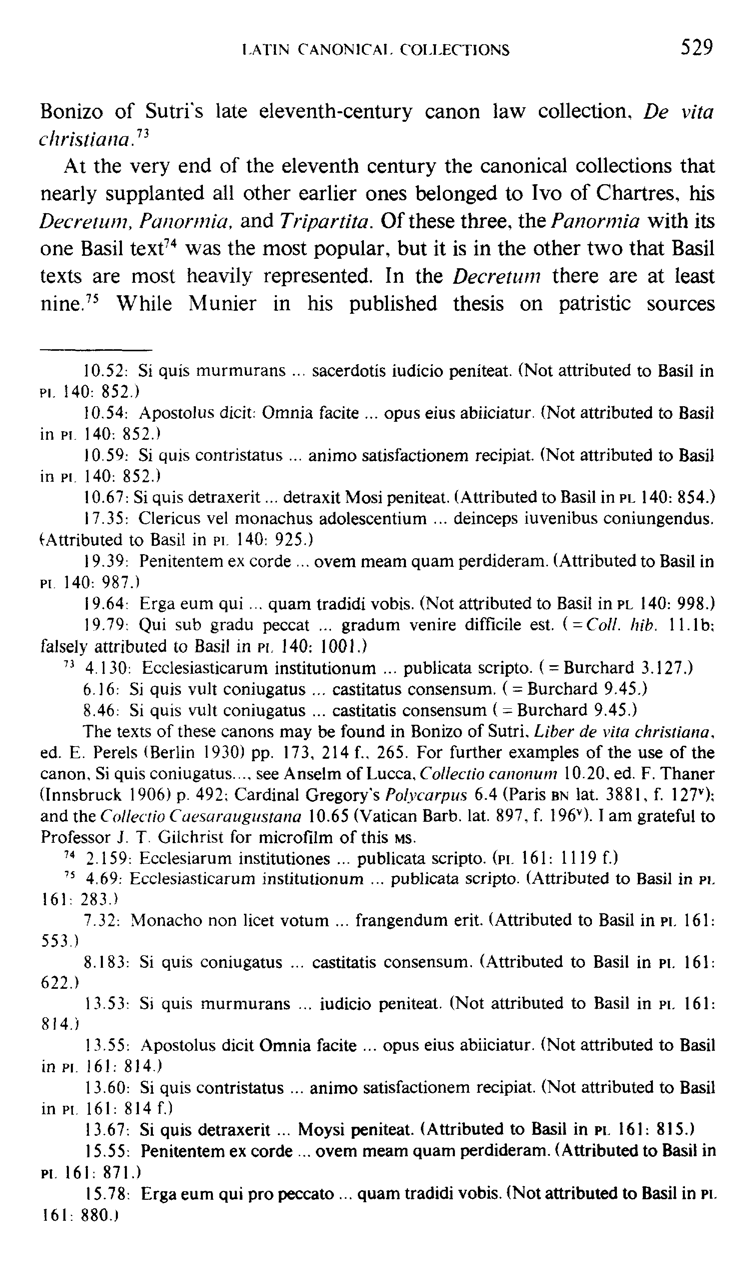
Bonizo of Sutri's late eleventh-century canon law collection, De vita Christiana.
At the very end of the eleventh century the canonical collections that nearly supplanted all other earlier ones belonged to Ivo of Chartres, his
Decretum, Panormia, and Tripartita. Of these three, the Panormia with its 74 was the most popular, but it is in the other two that Basil texts are most heavily represented. In the Decretum there are at least nine. one Basil text 75 While Munier in his published thesis on patristic sources
10.52: Si quis murmurans ... sacerdotis iudicio peniteat. (Not attributed to Basil in
PI. 140: 852.)
10.54: Apostolus dicit: Omnia facite ... opus eius abiiciatur. (Not attributed to Basil in PI 140: 852.) 10.59: Si quis contristatus ... animo satisfactionem recipiat (Not attributed to Basil in PL 140: 852.) 10.67: Si quis detraxerit... detraxit Mosi peniteat. (Attributed to Basil in PL 140: 854.)
17.35: Clericus vel monachus adolescentium ... deinceps iuvenibus coniungendus, (Attributed to Basil in pi. 140: 925.) 19.39: Penitentem ex corde ... ovem meam quam perdideram. (Attributed to Basil in
PI 140: 987.)
19.64: Erga eum qui... quam tradidi vobis. (Not attributed to Basil in PL 140: 998.)
19.79: Qui sub gradu peccat ... gradum venire difficile est. ( = Coll. hib. 11.1b: falsely attributed to Basil in PI. 140: 1001.)
73 4.130: Ecclesiasticarum institutionum ... publicata scripta. ( = Burchard 3.127.)
6.16: Si quis vult coniugatus ... castitatus consensum. ( = Burchard 9.45.) 8.46: Si quis vult coniugatus ... castitatis consensum ( = Burchard 9.45.)
The texts of these canons may be found in Bonizo of Sutri. Liber de vita Christiana, ed. E. Perels (Berlin 1930) pp. 173, 214 f., 265. For further examples of the use of the canon. Si quis coniugatus.... see Anselm of Lucca, Collectio canonum 10.20, ed. F. Thaner
(Innsbruck 1906) p. 492; Cardinal Gregory's Polycarpus 6.4 (Paris BN lat. 3881, f. 127 v); and the Collectio Caesaraugustana 10.65 (Vatican Barb. lat. 897, f. 196 v). I am grateful to Professor J. Τ Gilchrist for microfilm of this MS.
74 2.159: Ecclesiarum institutiones ... publicata scripta, (PI. 161: 1119 f.) 75 4.69. Ecclesiasticarum institutionum ... publicata scripto. (Attributed to Basil in pi.
161: 283.) 7.32: Monacho non licet votum ... frangendum erit. (Attributed to Basil in PI. 161:
553.) 8.183: Si quis coniugatus ... castitatis consensum. (Attributed to Basil in PI. 161:
622.) 13.53: Si quis murmurans ... iudicio peniteat. (Not attributed to Basil in PI. 161:
814.) 13.55: Apostolus dicit Omnia facite ... opus eius abiiciatur. (Not attributed to Basil in PI. 161; 814.) 13.60: Si quis contristatus ... animo satisfactionem recipiat. (Not attributed to Basil in PI 161: 814 f.) 13.67. Si quis detraxerit ... Moysi peniteat. (Attributed to Basil in PI. 161: 815.)
15.55: Penitentem ex corde ... ovem meam quam perdideram. (Attributed to Basil in
PI. 161: 871.)
15.78. Erga eum qui pro peccato ... quam tradidi vobis. (Not attributed to Basil in PL
161: 880.)
ROGER Ε. REYNOLDS
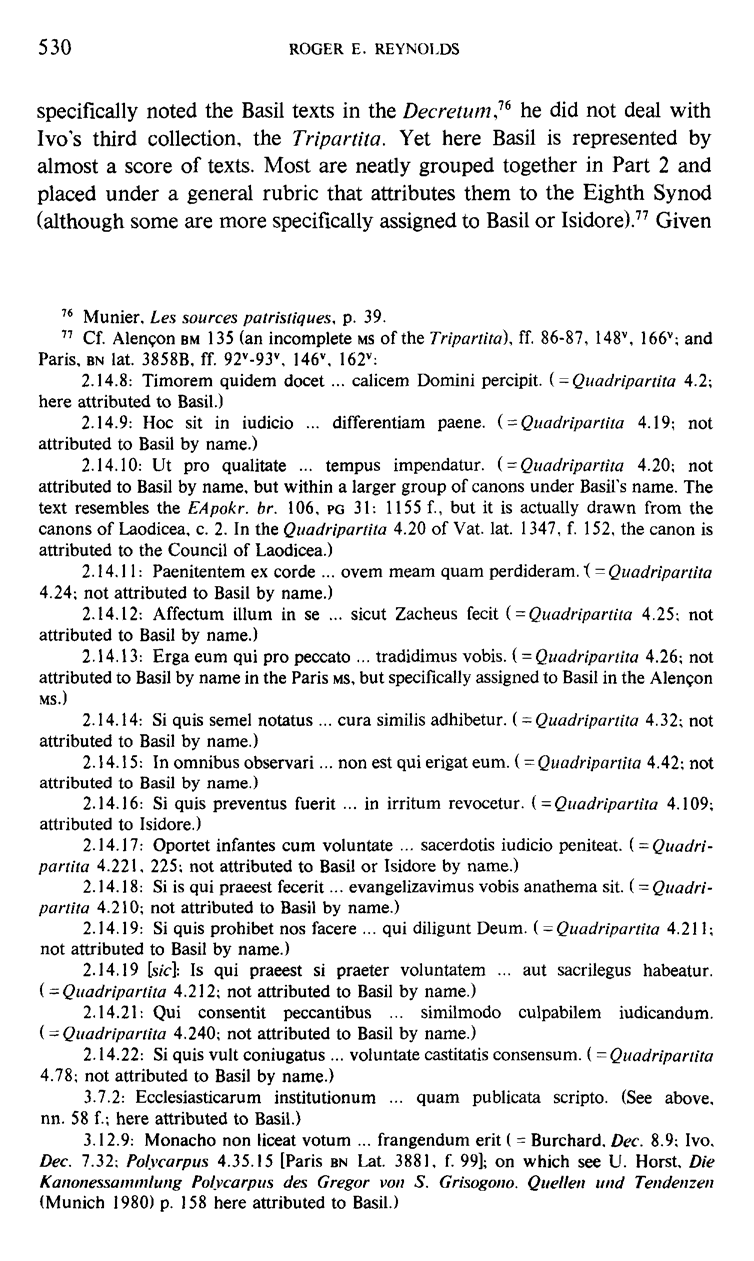
76 he did not deal with Ivo's third collection, the Tripartita. Yet here Basil is represented by almost a score of texts. Most are neatly grouped together in Part 2 and placed under a general rubric that attributes them to the Eighth Synod
(although some are more specifically assigned to Basil or Isidore). specifically noted the Basil texts in the Decretum,
77 Given 76 Munier, Les sources patristiques, p. 39.
77 Cf. Alençon BM 135 (an incomplete MS of the Tripartita), ff. 86-87, 148\ 166\ and Paris, BN lat. 3858B, ff. 92v-93\ 146\ 162v;
2.14.8: Timorem quidem docet ... calicem Domini percipit (-Quadripartita 4.2; here attributed to Basil.) 2.14.9: Hoc sit in iudicio ... differentiam paene. ( = Quadripartita A. 19; not attributed to Basil by name.) 2.14.10; Ut pro qualitate ... tempus impendatur. ( = Quadripartita 4.20; not attributed to Basil by name, but within a larger group of canons under Basil's name. The text resembles the EApokr. br. 106, PG 31: 1155 f., but it is actually drawn from the canons of Laodicea, c. 2. In the Quadripartita 4.20 of Vat. lat. 1347, f. 152, the canon is attributed to the Council of Laodicea.) 2.14.11 : Paenitentem ex corde ... ovem meam quam perdideram. t = Quadripartita
4.24; not attributed to Basil by name.) 2.14.12: Affectum ilium in se ... sicut Zacheus fecit (= Quadripartita 4.25; not attributed to Basil by name.) 2.14.13: Erga eum qui pro peccato ... tradidimus vobis. ( = Quadripartita 4.26; not attributed to Basil by name in the Paris MS, but specifically assigned to Basil in the Alençon
MS.) 2.14.14: Si quis semel notants ... cura similis adhibetur. (-Quadripartita 4.32; not attributed to Basil by name.) 2.14.15: In omnibus observari... non est qui erigat eum. ( = Quadripartita 4.42; not attributed to Basil by name.) 2.14.16: Si quis preventus fuerit ... in irritum revocetur. (= Quadripartita 4.109; attributed to Isidore.) 2.14.17: Oportet infantes cum voluntate ... sacerdotis iudicio peniteat. ( = Quadripartita 4.221, 225; not attributed to Basil or Isidore by name.)
2.14.18: Si is qui praeest fecerit... evangelizavimus vobis anathema sit. ( = Quadripartita 4.210; not attributed to Basil by name.)
2.14.19: Si quis prohibet nos facere ... qui diligunt Deum. ( = Quadripartita 4.211; not attributed to Basil by name.) 2.14.19 [sic]-. Is qui praeest si praeter voluntatem ... aut sacrilegus habeatur.
(-Quadripartita 4.212; not attributed to Basil by name.) 2.14.21: Qui consentit peccantibus ... similmodo culpabilem iudicandum.
( -Quadripartita 4.240; not attributed to Basil by name.) 2.14.22: Si quis vult coniugatus ... voluntate castitatis consensum. ( = Quadripartita
4.78; not attributed to Basil by name.) 3.7.2: Ecclesiasticarum institutionum ... quam publicata scripta. (See above, nn. 58 f.; here attributed to Basil.) 3.12.9: Monacho non liceat votum ... frangendum erit ( = Burchard. Dec. 8.9; Ivo,
Dec. 7.32; Polycarpus 4.35.15 [Paris BN Lat. 3881, f. 99]; on which see U. Horst, Die
Kanonessammtung Polycarpus des Gregor von S. Grisogono. Quellen und Tendenzen (Munich 1980) p. 158 here attributed to Basil.)
LATIN CANONICAL COLLECTIONS
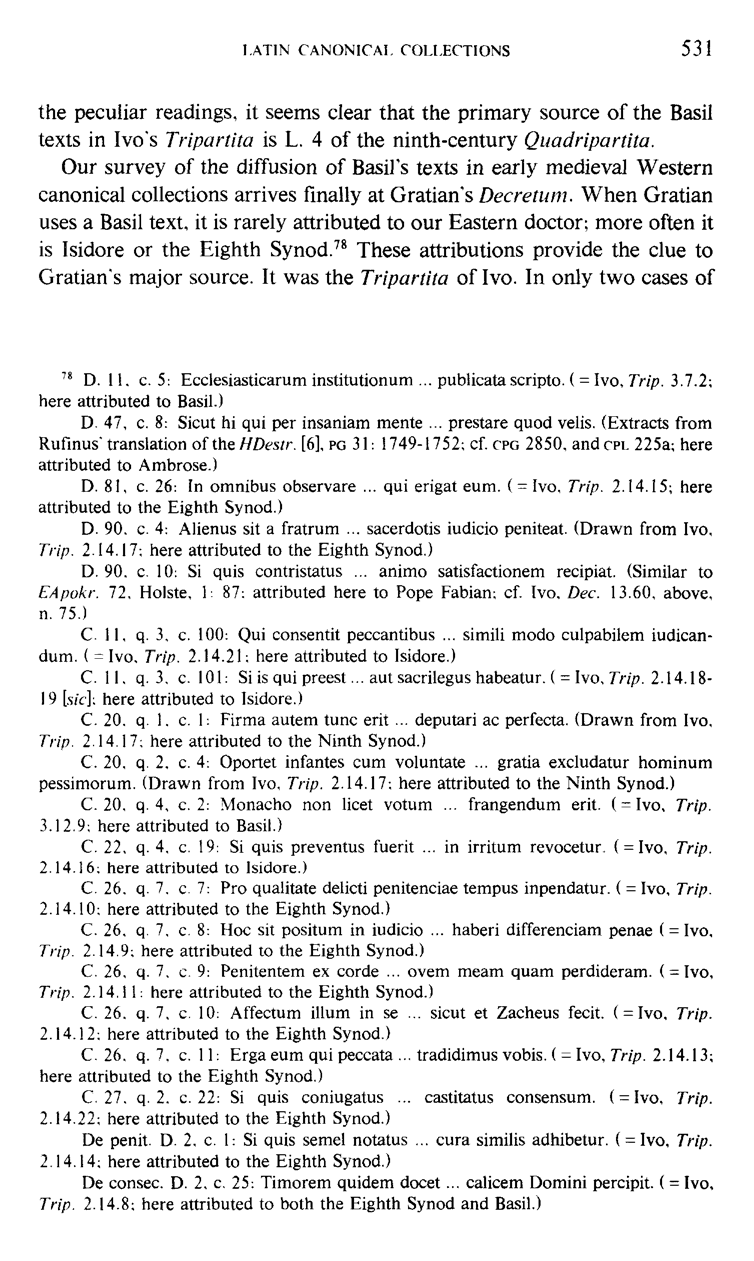
the peculiar readings, it seems clear that the primary source of the Basil texts in Ivo's Tripartita is L. 4 of the ninth-century Quadripartita.
Our survey of the diffusion of Basil's texts in early medieval Western canonical collections arrives finally at Gratian's Decretum. When Gratian uses a Basil text, it is rarely attributed to our Eastern doctor; more often it is Isidore or the Eighth Synod.78 These attributions provide the clue to Gratian's major source. It was the Tripartita of Ivo. In only two cases of 78 D. 11. c. 5: Ecclesiasticarum institutionum ... publicata scripta. ( = Ivo, Trip. 3.7.2; here attributed to Basil.) D. 47, c. 8: Sicut hi qui per insaniam mente ... prestare quod velis. (Extracts from Rufinus' translation of the HDestr. [6], PG 31: 1749-1752; cf. CPG 2850, and CPL 225a; here attributed to Ambrose.) D. 81, c. 26: In omnibus observare ... qui erigat eum. ( = Ivo, Trip. 2.14.15; here attributed to the Eighth Synod.) D. 90. c. 4: Alienus sit a fratrum ... sacerdotis iudicio peniteat. (Drawn from Ivo,
Trip. 2.14.17; here attributed to the Eighth Synod.) D. 90. c. 10: Si quis contristatus ... animo satisfactionem recipiat. (Similar to EApokr. 72, Holste, 1: 87: attributed here to Pope Fabian; cf. Ivo. Dec. 13.60, above, n. 75.) C. 11, q. 3, c. 100: Qui consentit peccantibus ... simili modo culpabilem iudicandum. ( = Ivo. Trip. 2.14.21 ; here attributed to Isidore.)
C. 11. q. 3. c. 101: Si is qui preest... aut sacrilegus habeatur. ( = Ivo, Trip. 2.14.1819 [SIC]: here attributed to Isidore.) C. 20. q. 1. c. L Firma autem tunc erit ... deputari ac perfecta. (Drawn from Ivo,
Trip. 2.14.17; here attributed to the Ninth Synod.) C. 20, q. 2. c. 4: Oportet infantes cum voluntate ... gratia excludatur hominum pessimorum. (Drawn from Ivo, Trip. 2.14.17; here attributed to the Ninth Synod.)
C. 20, q. 4, c. 2: Monacho non licet votum ... frangendum erit. ( = Ivo, Trip.
3.12.9; here attributed to Basil.) C. 22, q. 4, c. 19: Si quis preventus fuerit ... in irritum revocetur. ( = Ivo, Trip.
2.14.16; here attributed to Isidore.) C. 26. q. 7. c 7: Pro qualitate delicti penitenciae tempus inpendatur. ( = Ivo, Trip.
2.14.10; here attributed to the Eighth Synod.) C. 26. q. 7. c. 8: Hoc sit positum in iudicio ... haberi differenciam penae ( = Ivo,
Trip. 2.14.9; here attributed to the Eighth Synod.) C. 26, q. 7. c. 9: Penitentem ex corde ... ovem meam quam perdideram. ( = Ivo,
Trip. 2.14.11: here attributed to the Eighth Synod.) C. 26. q. 7, c. 10: Affectum ilium in se ... sicut et Zacheus fecit. ( = Ivo, Trip.
2.14.12; here attributed to the Eighth Synod.) C. 26. q. 7. c. 11: Erga eum qui peccata ... tradidimus vobis. (- Ivo, Trip. 2.14.13; here attributed to the Eighth Synod.) C. 27. q. 2. c. 22: Si quis coniugatus ... castitatus consensum. ( = Ivo, Trip.
2.14.22; here attributed to the Eighth Synod.) De penit D. 2, c. L Si quis semel notatus ... cura similis adhibetur. ( = Ivo, Trip.
2.14.14; here attributed to the Eighth Synod.) De consec. D. 2, c. 25: Timorem quidem docet... calicem Domini percipit ( = Ivo,
Trip. 2.14.8; here attributed to both the Eighth Synod and Basil.)
ROGER Ε. REYNOLDS
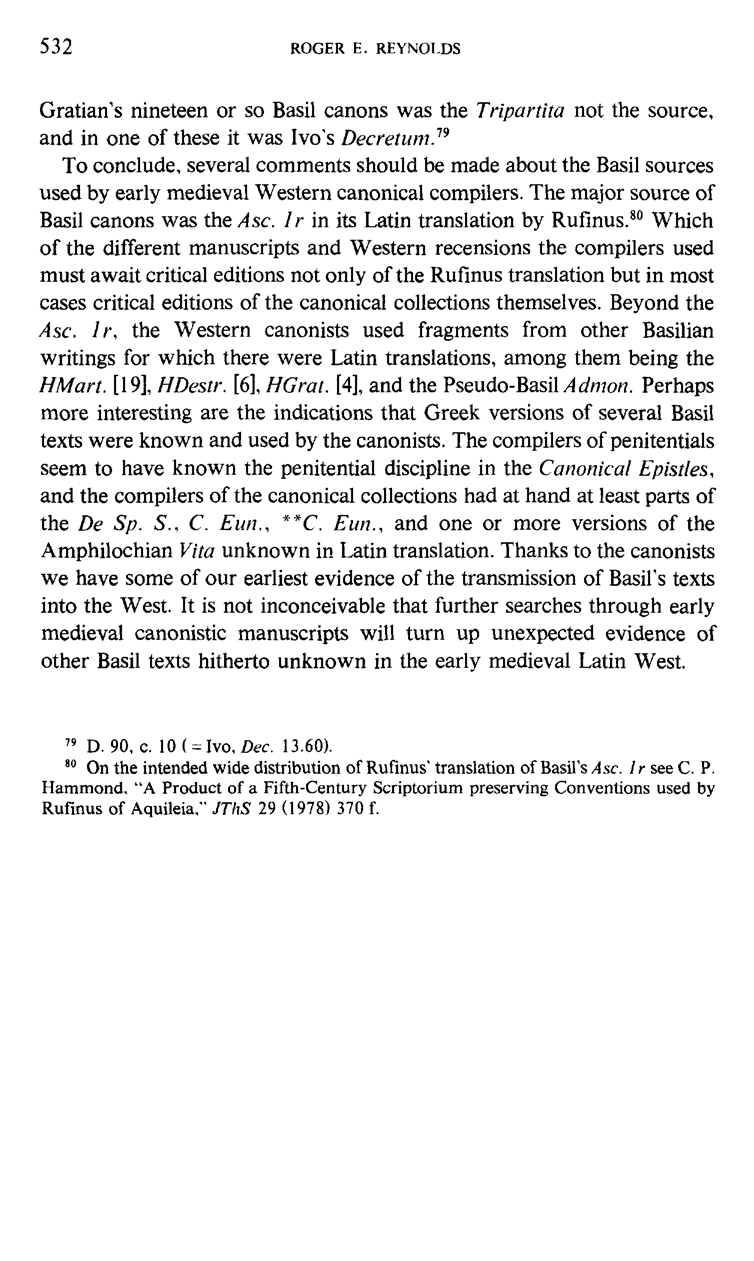
Gratian's nineteen or so Basil canons was the Tripartita not the source, and in one of these it was Ivo's Decretum.
To conclude, several comments should be made about the Basil sources used by early medieval Western canonical compilers. The major source of Basil canons was the Asc. Ir in its Latin translation by Rufinus.
80 Which of the different manuscripts and Western recensions the compilers used must await critical editions not only of the Rufinus translation but in most cases critical editions of the canonical collections themselves. Beyond the Asc. Ir, the Western canonists used fragments from other Basilian writings for which there were Latin translations, among them being the HMart. [19], HDestr. [6], HGrat. [4], and the Pseudo-Basil Admon. Perhaps more interesting are the indications that Greek versions of several Basil texts were known and used by the canonists. The compilers of penitentials seem to have known the penitential discipline in the Canonical Epistles, and the compilers of the canonical collections had at hand at least parts of the De Sp. S., C. Eun., **C. Eun., and one or more versions of the Amphilochian Vita unknown in Latin translation. Thanks to the canonists we have some of our earliest evidence of the transmission of Basil's texts into the West. It is not inconceivable that further searches through early medieval canonistic manuscripts will turn up unexpected evidence of other Basil texts hitherto unknown in the early medieval Latin West.
79 D. 90, c. 10 ( = Ivo, Dec. 13.60).
10 On the intended wide distribution of Rufinus' translation of Basil's Asc. lr see C. P.
Hammond, "A Product of a Fifth-Century Scriptorium preserving Conventions used by Rufinus of Aquileia," /77iS 29 (1978) 370 f.
Notes on the Iconography of Saint Basil the Great Wilma Fitzgerald Pontifical Institute of Mediaeval Studies
For the occasion of the Saint Basil Symposium sponsored by the Pontifical Institute of Mediaeval Studies and the Congregation of Saint Basil of Toronto, I elected to find representations of Saint Basil which could be obtained from published sources, that is without visiting museums, manuscript collections or art galleries, but relying solely on immediate library information. The wealth of material available indicated that whereas few minor and no comprehensive studies have yet appeared of the iconography of Basil the Great, a future major study would be beneficial to both the historian of hagiographical art and to the scholar seeking an understanding of Basil's not inconsiderable moral influence.
Compliance with a time restriction encouraged me to make the Symposium presentation of Basil images, although chronologically arranged, general, and vastly simplified without specific consideration for type, school, national origin or genre. To discuss the spiritual, historical, and artistic motivation behind each image was not possible. The purpose of this paper is to reconstruct the outlines of that presentation, indicate areas for future studies and provide a bibliography of sources.
Images of Basil in both Eastern and Western art exist in such abundance in every genre ranging from the larger than life apse programmes of church mosaic and fresco through manuscript illuminations, icons, embroideries, metalwork, ivories, postal stamps,1 and 1 Two postal stamps known to me are those of the Greek National Government,
21 August 1959. honouring the Red Cross by showing St. Basil, one of the earliest
Basil of Caesarea: Christian, Humanist, Ascetic, ed. Paul J. Fedwick (Toronto; Pontifical Institute of Mediaeval Studies, 1981), pp. 533-563. © P.I.M.S.
WILMA FITZGERALD, SP
popular holy pictures that in order to accommodate a small percentage of these likenesses some classification had to be designed. A convenient division, offering broad categories, was to arrange the images under the terms Official Basil and Popular Basil. In the first division would be portrait-type images to be associated with Basil's writing; the liturgy, primarily the Liturgy ascribed to St. Basil; supplementary liturgical texts such as menologia, homilies; liturgical vestments; Basil in the role of Church Father; and the occasional icon for a specific festal occurence or liturgical theme. In the second division would be biographical vitae images for Basil was fortunate in having Gregory of Nazianzus compose a detailed funeral encomium2 and perhaps less fortunate in having a demotic miraculous life emerge shortly after his death.3
How did Basil appear? In his letters, Basil tells us that he was frail and subject to illness. His brother, Gregory of Nyssa, describes him as an ascetic. Gregory of Nazianzus, fellow student in Athens and constant friend, writes that while Basil was "still young and had not yet tamed his flesh by philosophy"4 he was the equal of others in strength, beauty and size. At the same time he emphasizes that Basil's beauty was of virtue, strength of character, and moral excellence.
Basil's known iconography from the seventh century has been remarkably constant in depicting a slight man with brown pointed beard, brown hair combed low over a high, often furrowed brow; he is dressed in bishop's vestments according to current or archaized fashion and is accorded, where applicable, the position of Church Father. This type of image is affirmed by two artists' guide books which delineate the way
Basil is customarily to be depicted. Dionysius of Fourna (ca. 1670) advises in the late Byzantine Hermeneia that painters show Basil as a bishop, (gray haired) with a long beard and pointed eyebrows.5 He further states that by custom in churches with a dome, the holy Bishops Basil on the right, John champions of organized charity, and that of the Vatican City, 25 July 1979, honouring the sixteenth centenary of the death of St. Basil. Dr George Kustas contributed the Greek stamp to our collection and Dr Paul J. Fedwick, the Vatican.
2 Gregory of Nazianzus, Or. 43, PG 36: 493-606.
3 Ps.-Amphilochius, Vita Sancti Basilii, in SS. Patrum Amphilochli tconiensis, Methodii Patarensis et Andreae Cretensis Opera omnia, ed. F. Combefis (Paris 1644) pp. 155-177.
4 Or. 43.10. The translation is that found in P. McCauley, et al., tr. Funeral Orations by St. Gregory Nazianzen and St. Ambrose (New York 1953). In this context "philosophy" means the discipline which comes in the practice of Christian perfection.
5 P. Hetherington. The "Painter's Manual" of Dionysius of Fourna (London 1974) p. 54.
THE ICONOGRAPHY OF BASIL
Chrysostom on the left, accompanied by Gregory Theologus (Nazianzenus), Athanasius and Cyril of Alexandria, and Nicholas of Myra are to be painted in the sanctuary in a circle around the altar, and that in monastic refectories below a representation of the Mystic Supper the same bishops in ecclesiastical robes are to be depicted with scrolls in their hands.
Dionysius suggests the text for Basil's scroll: the good soul will be guarded safely: God will seek it among mortal men.
A twentieth century Western volume, compiled to explain ecclesiastical art productions for craftsmen, instructs us that Basil is portrayed as a bishop with church in hand, or behind him; with a dove perched on his arm. and a hand giving him a pen-, or with a column of fire beside him and a dove flying near his head.
A. OFFICIAL BASIL
A consideration of the first division: official Basil must begin with the oldest known image of the saint, a portrait icon from St. Catherine's
Monastery in the Sinai dated from the seventh century, the period of iconoclasm.
8 A thin wooden panel, the left wing of a now lost triptych, shows two bust portraits, the upper St. Athanasius of Alexandria, the lower St. Basil. The portraits are named to give greater authenticity to the exactness of the images. The dark hair, the furrowed brow, the long beard are the prototypes of later images. Basil wears a carmine phelonion
(chausable) and a short omophorion, the garment resembling the Western pallium. This is adorned with one surviving thin spiked cross on the right shoulder. Basil holds a closed book ornamented with red and white stones in a thick square format with his covered left hand supporting its weight
6 Ibid., pp. 85-86. It would be well to note that the inscribed texts pictured with St.
Basil have varying messages. In the refectory of the Stavronikita monastery of Ayion Oros
( 1546). SS. Basil and Nicholas appear clad as monks; see G. Millet, Monuments de ΙΆ thos,
1: Les peintures (Paris 1927) pl. 166.
7 M. and W. Drake, Saints and Their Emblems (London 1916) p. 17. An excellent representation of Basil with all these symbols is a seventeenth-century engraving found in Oxford. Christ Church gr. 48, containing Nili epistolae. In the foreground is St. Basil in western episcopal garb holding an open book, his right hand raised in blessing; above his head a dove hovers: over his left shoulder a pillar of fire rises from a cloud; in the background to his right stands a church (perhaps a monastery church) surrounded by a wall with open gate. On his left an angel offers an episcopal headdress and on his right another offers a baculus.
8 The icon is reproduced in K. Weitzmann, The Monastery of Saint Catherine al Mount
Sinai: The Icons, I : From the Sixth to the Tenth Century (Princeton 1976) pp. 48-49, pl. xx, lxxii-lxxiii. No. B-24.
WILMA FITZGERALD, SP
with his right hand. Not only the physical type, but the attributes to be associated with Basil as an orthodox church leader are present here, the ecclesiastical robes, the Gospels indicating a defender and teacher of Christ's teaching without exception.
Portraits of writers whose works are preserved in manuscript are often found, lending an aura of authenticity and authority, as frontispieces to their writings. The custom can be traced to pagan antiquity; one of the oldest examples is that of a fifth-century portrait of Vergil seated near copies of his writings.9 These secular portraits of classical times with the author holding his written roll or codex, or in the act of writing, or reading became first the model Christian artists used for depicting evangelist portraits which in turn provided the model for other Christian writers. Basil is not, despite the numerous manuscripts extant of his works, very frequently portrayed in this manner. An Oxford frontispiece to a manuscript of Basil's homilies10 written at Constantinople in the tenth century shows the saint in the author portrait manner. He is seated, his body turned toward the left, his feet resting on a footstool, he faces forward, with his left hand he supports a closed Gospels on his knees and his right hand is raised in an attitude of teaching for at Basil's left is a group of attentive young men. This model scene of evangelist has been enlarged to include disciples whom Basil is obviously teaching and who listen in a spirit of reverence.
At Tiflis in Georgia, USSR, a later (fourteenth-century) addition to a ninth-century manuscript of Basil's homilies11 shows the saint in bishop's attire, seated before a desk, holding an open book on his knees and a pen in his right hand. Basil is not concentrating on writing, although the pen by conventualized symbolism indicates an author, but on the people who come before him. The crowd includes men, women, clerics, dignitaries, wise men, and humble people, some of whom kneel in reverence while others stand. The scene depicted in this badly flaked miniature is similar in style and spiritual content to that found in a frescoed pendentive of Archangels Church, Lesnovo, Yugoslavia. In the four vaulting sections, images of the Three Hierarchs, Basil, John Chrysostom, Gregory of 9 Vatican BAV Vat. lat. 3867, f. 3\ 10 Oxford BL Canon, gr. 77, f. 2. Reproduced in I. Hutter, Corpus der byzantinischen
Miniaturenhandschriften (Stuttgart 1977), frontispiece.
11 Tiflis SMA gr. 48. For a description see S. Y. Rudberg, L'homélie de Basile de Césarée sur le mot "Observe-toi toi-même" (Stockholm 1962) pp. 120-125 [and now also Ε. Ε.
Granstrem, "Neizvestnyi grecheskiï sbornik besed Vasiliya Velikogo," MATSNE 1 (1971)
173-178; slightly different foliation from Rudberg's (Ed.)]. The MS bears the arms of the Tsereteli family.
THE ICONOGRAPHY OF BASIL
Nazianzus are joined by one of Athanasius. Each dressed as a bishop is seated before a lectern supporting an open book, at the feet of each is a cruciform fountain, emblematic of the living water of truth embodied in the teaching of these four holy men of the Church. The attention of each bishop is on the people, monks, learned men, people, who await their turns to draw water of salvation. G. Millet calls this subject the "Enseignement de l'Église."12 Irina Danilova terms this "A Doctrine of the Three Church Fathers" scene13 and writes that in the three lunettes over the south, west, and north arches supporting the drum of Pherapont,
Nativity of the Virgin Cathedral are frescoed figures of the Three Hierarchs surrounded by figures of people accepting true doctrine, drinking from goblets, while the heretics stand about holding scrolls and arguing.
Basil's ascetical treatise found in a Copenhagen manuscript14 has a frontispiece in which Basil is depicted clothed as a bishop with monks to the left and right, in the foreground the scribe, also clad as a monk, prostrates himself holding out his hands in a gesture of supplication.
Frontispieces from two printed volumes ought to be considered for their historical value although one does not appear as an author portrait while assuming that particular status. An engraving of Basil brought before the Prefect Modestus appears in Julian Garnier's 1721 Greek and Latin Opera omnia of Basil.15 In this Basil stands before the prefect elevated on a throne and surrounded by his councilors and two lictors with fasces. Basil garbed in flowing episcopal robes carries a gospel in his left hand and gestures as if teaching with his right arm. The scene is of an event in Basil's life described by Gregory of Nazianzus16 when Basil was
12 G. Millet, La peinture du Moyen Age en Yougoslavie (Serbie, Macédoine et Monténégro) (Paris 1954) p. 36. See also on the "Fountain of Life" theme T. Velmans,
"L'iconographie de la 'Fontaine de vie' dans la tradition byzantine à la fin du Moyen Âge,"
Synthronon 2(1968) 119-134.
" I. Danilova and A. Simonov, Freski Ferapontova monastyrya Dionisiya Feraponlovskogo (Moscow 1970). V. Lazarev, Old Russian Murals and Mosaics from the 11th to the 16th Century (London 1966) p. 206 designates this treatment as "conversations of three bishops." See also V. Georgiyevsky, Freski Ferapontova Monastyrya (Leningrad
1911), and I. Danilova. "Ikonograficheskii sostav fresok Rozhdestvenskoi tserkvi
Ferapontova Monastyrya." in Iz istorii russkogo i zapadnoevropeiskogo iskusstva (Moscow 1960) p. 120.
14 Copenhagen KB Gl. Kongl. Saml. 1343. See description in Ch. Walter. "Biographical
Scenes of the Three Hierarchs," REB 36 (1978) 233-260, at 243.
15 J. Gamier and P. Maran, edd. Basilii Caesareae archiepiscopi Opera omnia (Paris
1721-1730).
16 Or. 43.48-50.
WILMA HTZCtRM.D, SP
brought before the prefect on a charge of not honoring the emperor's Arian belief, The second frontispiece is an author portrait" ultimately derived from an evangelist model. Basit is shown turning the pages of an open book on a reading stand before him. Unlike other representations this one shows Basil wearing a turban in Arabian style. This portrait engraving by André Thevct reappears in what would seem a most unlikely place, the medallion frieze of the Picture Gallery in the Bodleian
Library Upper Reading Room, Basil, head and shoulders only, occupies the fifth position from the left on the north wall in a total scheme of two hundred painted portraits representing saints, Fathers, scholars, reformers, and schoolmen according to the scheme of Thomas James, librarian until 1620."
If only rarely portraits of Basil accompany his own writings, any neglect is rectified by the proportion of illuminations found in manuscripts containing the LBas. I, one of the three great Byzantine liturgies, most probably the oldest and the only one to have an author ascribed in the manuscripts. Individual liturgies were written on scrolls for the use of the celebrant a few of these from the ninth century have survived. When collected together, the formal for the three liturgies was chat of the codex. Frequently an "author"' frontispiece was included either as a full page illumination or as a headpiece above the initial words. The majority of these are simple portraiture of a standing bishop wearing phelonion, omophorion and holding a gospel in the left hand, the right either supporting this volume or raised in blessing. Occasionally an opened scroll rephices the gospel. The figure may be enclosed in an ornamental frame, may be half-figure or full length.
Whereas the oldest representations show Basil clothed in the simplest garments in the model of the ML Sinai portrait with the omophorion
" In S. Giet, Let idées el faction sociales de saint Basile (Paris 1941). but taken from A. Thevet. fourlraits el vies des hommes Illustres, grecs, taitns rf paytfU (Paris 1584) p. 3
" The two-foot high medallions, restored ill 1949, were begun after 1615; s « W. D.
Macray. Annuls of the Bodleian Library, Oxford (Oxford 1890) p. 55 which states that the Convocation Register for 25 November 1615 records an outlay of pounds slerline 2497 and 10s. for the building of the third story of the Schools Quadrangle, called "the Picture
Gallery," See also J.N L Myres. "The Painted Frieze in the Picture Gallery," BodlR 3
(1950) 82-91, idem, "Thomas James and in« Painied Frieze," BodlR 3 (1952) 30-5U E. C.
Rouse. "The Repair of the Painted Frieic in the Picture Gallery," BodlR 3 ( 1951) 201-207;
J. NU Myers and E. C. Rouse. "Further Notes on the Painted Frieze and Other Discoveries in the Upper Reading Room and [he Tower Room," BodlR 511956) 290-308.
I am indebted Lo P. Osmund Lewry UP. Blackfriars. Oxford, for confirming my suspicion that the Bodleian portrait and the Thevct engraving were related and for providing me with ihe proper references.
THE ICONOGRAPHY OF BASH.
being the most significant garment, the majority of portraits preserved in liturgical works show the saint in the attire of a post twelfth-century bishop or in current even splendid vestments, that is, he will be wearing not a phelonion but the polystaurion. Once the exclusive dress of the patriarch, this chasuble embroidered or woven with a quantity of crosses was then the vestment of the metropolitan, and finally adopted for all bishops. Sometime before the thirteenth century, sleevelets were added to the liturgical vestments for the celebration of the eucharistie sacrifice.
Liturgical manuscripts will also show Basil wearing in addition to the garments mentioned an enchirion (shown in bishops' attire from the eighth century), a rectangular cloth hung over the belt and extending down to the right knee, which often is replaced by the epigonation, a diamond shaped, decorated square of cloth which hung at the knee. This last, a vestment reserved to bishops in 1193, according to the vesting prayer typifies the two-edged sword of Christ and is a mark of authority.
Its mystical signification is that of the almsbag used by the apostles. About the same time the epitrachelion, the Western stole, began to be worn about the neck beneath the phelonion. Customarily its two decorated ends show below the phelonion hem.
When the polystaurion ceased to be the exclusive garment of the patriarchs, a short tunic, sleeveless or with half-sleeves, slit at the sides, and often highly embroidered, was introduced for patriarchs. In origin it was the emperor's tunic who first permitted it to patriarchs and later to bishops deserving special honor. Sometime about the fourteenth century, this sakkos became a vestment for worthy archbishops and the right to wear it was extended to all bishops after the Turkish conquest of Constantinople in 1453. Basil does appear in the sakkos to which is attributed the mystical meaning of the purple robes of Christ's passion.
These the episcopal vestments worn by Basil in manuscript illumination are the same garments worn in images of other genre of the same place and period of time.
19 An example of such attire may be seen in Ayion Oros MI 1436, f. 135. Reproduced in S. M. Pelekanidis, et al., edd. The Treasures of Mount Athos, 2 (Athens 1975) 134.
20 For liturgical MS miniatures see illuminations in Jerusalem PB Taphou 334 and Staurou 109; London BI. Add. 40755, f. 21; London BL Egerton 2392, f. 23 v and Egerton 3155, f. 21 v; Ayion Oros MD 438, f. 32 v; Meteora MM 221, f. 54 v; Meteora MM 298, f. 21 v v and Ayion Oros MD 471, f. 25
(here Basil holds a scroll rather than a book as he does in Meteora MM 223, f. 26 v). For the Ayion Oros MSS see reproductions in Pelekanidis, The Treasures, and for the Meteora MSS see N. Bees, Τά χειρόγραφα τών Μετέωρων (Athens
1967). The others I have examined either from the codex or on microfilm.
21 Ayion Oros MI 1424, f. 20\ Meteora MM 223, f. 26 v.
WILMA FITZGERALD, SP
In several liturgical rolls surviving, Basil is portrayed in the act of celebrating the divine liturgy as in the headpiece of an Athenian National
Library manuscript22 where Basil is portrayed officiating with John Chrysostom. They are attended by four deacons and they stand at an altar over which is a ciborium illustrated in a church section. Marble slabs cover the iconostasis; above the corners are busts of the apostles Peter and Paul. A representation of the Virgin decorates the apse. Five cupolas crown the architectural section which has birds perched on outside spirelets. Another roll of the thirteenth century at Patmos23 shows Basil in a sanctuary celebrating the liturgy at an altar without ciborium. He is assisted by two deacons with fans. In the apse a half-figure of the Virgin is shown. Square roofed, windowed structures replace the cupolas depicted in the preceding roll. A lavishly decorated altar with four columns supporting a conical roof showing enshrined on the altar an icon image of St. Basil is the headpiece for a Mt. Athos roll.24 In a different liturgical context and representing Basil more as Church Father than liturgy author is an image in an Exultet roll from South Italy. In the border near the central Wind Rose figure are medallion busts of Basil "with the other
Greek Fathers John Chrysostom, Gregory of Nazianzus and Nicholas.25
Supplementing the liturgical texts of the eucharistie sacrifice, other para-liturgical volumes came to be: menologia, synaxaria, the Psalter as distinct from the Old and New Testament readings, collections of homilies and moral sayings. For the hagiographie writings, the menologia and synaxaria especially, individual portraits began to be placed at an early
(tenth-century examples survive) date before each saint's life. Representative of a majority of these images would be that found in a Vatican
Euchologion manuscript26 where the saint is shown dressed in the customary bishop's attire holding in his left hand a gospel which he supports with his right or raises in blessing. This is the typical, constant image and will abide even into the biographical scenes. In general the 22 Athens EB 2759; see Byzantine An, 9th Exhibition of the Council of Europe (Athens
1964) No. 358 and the bibliography included there.
23 Patmos MHITh 707 (roll 1); see Byzantine An. No. 359 with bibliography.
24 Ayion Oros MD 105. Reproduction in Pelekanidis. The Treasures, 1: 137.
25 Reproduced in G. Cavallo. Rotoli di Exultet dell'/talia méridionale (Bari 1973) pl. 7.
26 Vatican BAV Vat. gr. 1554, f. 22v; see A. Grabar, Les manuscrits grecs enluminés de provenance italienne (ix e-xie siècles) (Paris 1972) fig. 282. Two other representations are found in a Synaxarion at Tiflis SMA A-648; see G. Alibegachvili, Miniatures des manuscrits géorgiens des xie début xme siècles (Tiflis 1973) and in a Leningrad Menologion,
Leningrad AN gr. 1 described by V. Likhacheva. Iskusstvo knigi (Moscow 1976) pp. 79-81.
THE ICONOGRAPHY OF BASIL
miniatures, about two inches in height, are enclosed in simple frames. The portrait may be half-figure as in the margin of a Paris Sacra Parallela manuscript 27 where Basil is shown with other authors of spiritual texts.
The excellence of Basil's commentaries on the psalms 28 makes it appropriate that his image be included among the narrative elements found in the margins of several of that select group of manuscripts known as the Marginal Psalters because of the miniatures appearing in their margins. Again in size a scant two inches, one of the finest of these images appears in the British Library's Theodore Psalter.
29 In the lower margin Basil is painted standing before a lectern on which reposes an open book.
He appears in an attitude of teaching with one hand raised. Behind him is the form of a church building. This psalter has two other images of Basil, one (f. 20 v) showing him standing before a clepeus image of Christ the author, source and inspiration of Basil's teaching, the other (f. 35 v) in company with John Chrysostom and Gregory Theologus: the Three
Hierarchs. A recently identified marginal psalter at Baltimore Walters Art Gallery (with folia missing at the beginning) also shows (f. 14 v at Ps. 39) Basil standing, hands raised in prayer toward an image of Christ and (f. 3
V) an image of Basil in the Three Hierarch grouping.
A Septuagint manuscript has in the portion of psalms, before Psalm 93 (f. 294) full length portraits of Basil together with Nicholas, John
Chrysostom and the two Gregories.
31 In the same manuscript at the introduction of Psalm 11, Basil and John Chrysostom head two groups of hierarchs facing each other. In other psalters, Basil is pictured with John
Chrysostom and Nicholas of Myra, which grouping George Galavaris
v; see Grabar. Les manuscrits, fig. 21.
" Paris BN gr. 923. f 159 28 Homiliae in Psalmos. PG 29: 209-494; 30: 71-118.
29 London BI Add. 19352. f. 4; see D. Der Nersessian. L illustration des psautiers grecs du Moyen Age, 2: Londres Additional 19352 (Paris 1970).
, 0 Baltimore WAG W-733; see D. Miner. "The Monastic' Psalter of the Walter Art Gallery.'' in Late Classical and Medieval
Studies in Honor of A. M. Friend, ed. K.
Weitzmann (Princeton 1955) pp. 232-253. This monastic psalter closely resembles Leningrad GPB 1252 F VI (ca. 1397); London BI Add. 19352 (a. 1066) and Vatican BAV
Barb. gr. 372 (ca. 1092).
Ε de Wald. The Illustrations in the Manuscripts of the Septuagint.
3: Psalms and Odes. 2: Vaticanus graecus 752 (Princeton 1942) pl. xii. xix.
52 G. Galavaris. The Illustrations of the Liturgical Homilies of Gregory Nazianzenus (Princeton 1969) p. 26. See Berlin SM 3807, f. I described by G. Stuhlfauth, "A Greek
Psalter with Byzantine Miniatures." ABull 15 (1933) 311-326: and Washington, DC. DO gr.
3 (olim Pantokrator 49) discussed by S. Der Nersessian. "A Psalter and New Testament
Manuscript at Dumbarton Oaks." DOP 19 (1965) 153-185. The form of these representations is similar to that found in Paris BN gr. 550. f. 4. and Mount Sinai MHAi
41 8, f. 2. a MS of the works of John Climacus
WILMA FITZGERALD, SP
writes may be attributed to the diptychs of the κεχοίμημένων in the liturgy mentioning all three saints.
A great number of Basil images are found in the manuscripts containing the homilies of Gregory of Nazianzus, particularly in the special liturgical collection of sixteen homilies which includes Oration 43, the encomium of Basil by his friend. The miniatures occuring here are of two types, the illustrative miniatures of events in the text and the funeral scene. I prefer to discuss the illustrative miniatures with the vita re presentations rather than at this point, although strictly speaking the funeral scene also belongs with the life sequence and not with liturgical books.
Gregory delivered his eulogy of Basil two years after his death a fact which provided the miniaturist opportunity to depict two scenes of Basil's death, one with Gregory of Nyssa (Basil's brother) present, the other without this Gregory but with friend Gregory speaking in praise of their long friendship. The artist of a Paris, Bibliothèque Nationale manuscript33 in a full page illumination shows two scenes. In the upper register is the funeral of Basil. On a bier below a baldachin or ciborium, Basil's body lies·, his brother Gregory prostrates himself at Basil's feet. Bishops attend at head and foot of the bier. In the lower register, Gregory of Nazianzus delivers his funeral oration before a sarcophagus sheltered below a ciborium. He also is attended by bishops.
More frequently the miniaturist solved the problem of two scenes by conflation, that is by combining the two events and having both Gregories present. Such a scene is found in an Oxford manuscript from eleventhcentury Constantinople.34 Before a background of an ornamented ciborium supported by three columns, three figures only are shown.
Gregory embraces his dead friend's body and Gregory of Nyssa kneels in what must be recognized as a traditional position at Basil's feet. A Florence manuscript35 depicts the bier of Basil attended at head and foot by ecclesiastics and dignitaries. Two angels hover above the bishop figure on the bier. Architectural forms frame the scene on both sides. Two
Gregories are present, the brother standing near the saint's feet, the friend in reverence at Basil's head. In a Jerusalem manuscript,36 a similar scene is found. A ciborium with pointed roof replaces the angels and the 33 Paris BN gr. 543, f. 130.
34 Oxford BL Canon, gr. 103, f. 90v; 35 Florence BMI. Plut. VII.32, f. 70.
36 Jerusalem PB Taphou 14, f. 114.
THE ICONOGRAPHY OF BASIL
architectural forms are simplified. Gregory embraces his friend and Gregory of Nyssa also is shown bending low in an embrace of his brother's feet. Attendent are dignitaries and clerics. The illumination of a twelfth-century manuscript on Ayion Oros
37 is in a certain way more accurate in showing only one Gregory who is painted embracing the dead saint's body. But this by type is Gregory the friend who was not present for the death and burial. The artist has chosen to picture Gregory's encomium rather than the fact recorded by history. This is the scene of another manuscript 38 where the saint's body lies on a bier before a ciborium flanked by two architectural structures, flat roofed with windows. In the foreground Gregory of Nazianzus embraces his friend's body. Two stiffly erect bishops stand one at the head, one at the foot of the bier. Both hold gospels. The one at the foot extends his free hand toward the bier. Only the one bishop, Gregory, is nimbed.
39 Basil may be pictured in an Oecumenical Council scene where rather than attempting historical accuracy the artist frequently commemorates a council event by depicting the most famous Church Fathers.
In another type of manuscript illumination, 40 This is the case in a Pierpont Morgan
Lectionary (f. 42) of the eleventh century from Studion Monastery where illustrating the lection of the sixth Sunday after Easter commemorating the Nicaean Fathers and the Council of 325, eight busts of bishops form the letter "T." Four from their distinctive types may be identified as John
Chrysostom, Gregory of Nazianzus. Basil and Athanasius. Below the initial, two figures are shown in proskynesis and identified by inscription as Arius and Nestorius who belong properly and historically to the Councils of Nicaea (325) and of Ephesus (431).
" Ayion Oros MHP 6. f. 100: see Pelekanidis. The Treasures, 2: 352-358. pl. 306-308.
! e Tiflis SMA A-109: see Alibegachvili. Miniatures, fig. 44. The χοίμησις illuminations cited by Galavaris. The Illustrations, include the following: Athens EB 2254, f. 69 v; Istanbul PB 16. f. 89 v; Milan BA G 88 sup., f. 105; Moscow GIM VI. 146. f. 81: Ayion Oros
MD6l.f. 35; Ayion Oros MV 107. f. 135\ Oxford BI Roe 6. f. 38; Oxford BI. Seiden B-54. f.
36; Paris BN Coislin 239. f. 74; Paris BN gr. 550. f. 94 v; Paris BN gr. 533. f. 91: Mount Sinai MHAi 339. f. 109; Mount Sinai MHAi 346, f. 61; Turin BN C.1.6, f. 89 v; Vatican BAV Vat. gr. 463. f. 22; Vatican BAV Vat. gr. 1947. f. 52 v.
39 Such representations are not restricted to MS illumination. The church cycle of paintings featured scenes of the major Councils on walls of churches; see Ch. Walter,
L'iconographie des Conciles dans la tradition byzantine (Paris 1970); S. Salaville, "L'iconographie des 'Sept Conciles Œcuméniques'." EO 25 (1926) 144-176.
40 New York PML M-639; see K. Weitzmann, "The Constantinopolitan Lectionary Morgan 639," in Studies in Art and Literature for Belle d'Costa Greene, ed. D. Miner (Princeton 1954) pp. 358-374, fig. 306. Basil appears again in the menologion portion of this MS in frontal pose as the stem portion of the letter " T "
WILMA FITZGERALD, SP
A miniature designed to represent the Sixth Oecumenical Council (680) is found in a Vatican Lectionary and Menologion.41 On folio 253, the illuminator shows a fine disregard for history joined with respect for the great fathers of the church by painting a group of bishops, six in the first row, five in the second. Easily recognized are the four fathers mentioned above. A similar although more elaborate gathering is found in a Mt.
Athos manuscript.42 Four bishops with gospels and two fathers with crosses are in the first row. In the second row stand five figures, one of whom is dressed in bishop's attire and has dark hair and a dark pointed beard (perhaps Gregory of Nyssa), the others wear the dark garments associated with fathers. Three additional rows of halos complete the group portrait.43
It is a short step from representations of Basil in liturgical books to images of Basil on the objects devoted to liturgical use: embroidered vestments and veils, vessels for the sacrifice, covers for liturgical books, reliquaries, processional crosses, festal and private devotional icons. These are too numerous for other than a notation of their existence44 and a 41 Vatican BAV Vat. gr. 1156.
42 Ayion Oros MD 587, f. 126.
43 See reproduction in Pelekanidis, The Treasures, L 197. Walter, L'iconographie, p.
40 includes in this type a miniature in Ayion Oros MKout 412, f. 250v. J. Spatharakis, 77;<?
Portrait in Byzantine Illuminated Manuscripts (Leiden 1976) adds Vatican BAV Vat. gr.
666, f. lv and Moscow GIM gr. 387, f. 5V. In the first (Spatharakis, fig. 78) nine named
Church Fathers appear. Among them are John Chrysostom, Basil, Gregory of Nazianzus, and Athanasius, and in the second row, between his brother Basil and the other Gregory, appears Gregory of Nyssa. The second illumination (fig. 83) shows the same nine Fathers not in frontal pose but turned slightly to their left.
44 One has only to examine books such as the following to realize the wealth of this material. Byzantine Arts, lists: Plaque of an ivory casket border, Bologna MC 787, 10th cent., containing portraits of SS. Basil, John Chrysostom, Nicholas, Gregory of Nazianzus, Cosmas and Damian; a silver cross in Athens MB B-799, 10th cent., in which Basil is portrayed in the looped terminals with other saints; Reliquary of Venice, Treasury of San Marco 4, on the ten enamel medallions on inside of case represents Basil among other saints; Epitrachélion (stole) of Patmos MHITh (?), 15th cent., has bust portraits in embroidery of Christ, the Virgin, John Baptist, SS. Peter and Paul, the Three Hierarchs and St. Nicholas; Gospel cover, Venice BNM gr. 1.55, 13th cent., contains on the back cover twelve enameled silver plaques and in the centre the Hetoimasia surrounded by prophets and the great bishops, among them Basil, and the archangels Gabriel and Michael.
Furthermore, S. Amiranashvili, Georgian Meta /work from Antiquity to the 18th Century
(London 1971) pl. 57, has an eleventh-century Martvili Processional Cross, a silver repoussé work, with busts of John Baptist, Basil and Gregory of Nazianzus. Again, a Sion with bust of Basil on the dome is shown in G Ν. Bocharov, Prikladnoe iskusstvo
Novgoroda Velikogo (Moscow 1969) pl. 5, 6, 7. Eucharistie veils from Khilandari monastery are among the embroideries described by G. Millet, Broderies religieuses de style byzantin (Paris 1947) pl. clviii, clix. The one shows Christ between two angels
THE ICONOGRAPHY OF BASIL
reminder that the majority include Basil either as author of the liturgy or Church Father.
Byzantine liturgy, text and implements occasioned numerous represen tations of Basil; his own writings furnished more. These examples of the Official Basil we might call the Liturgical Basil and the Magister Basil as it were and from their fusion find the origin for Basil in a Church Father iconography specifically found on the walls of many Byzantine churches.
This is not the Oecumenical Council Father although surely magister, nor the author of Liturgy portrait but, in developed form, an official human representative embodying man's acceptance and obedience to the creation and Christ's redemptive sacrifice. If a type name be given, this would be
Officiant Basil.
A common-place of art historians is the dictum: Cathedrals are the Biblia pauperum. Eastern rite churches no less than Western are Biblla and from the fourth century church walls were decorated. Early GrecoRoman landscape art was replaced by Oram figures; then as the need to instruct a growing catechumenate pressed, a tradition grew up of portraying narrative events from biblical history. St. Nilus
45 wrote to the Prefect Olympiodorus that in decorating a church he "should fill the holy place on both sides with pictures from the Old and New Testaments executed by a Master painter, so that the illiterate, unable to read the Sacred Scriptures, might by contemplating the pictures become mindful of virtuous deeds and be roused to emulate those glorious feats." Gradually the repertoire of paintings became standardized and a precise formulation of a theory and practice of religious iconography was confirmed during the iconoclastic period. The Seventh Oecumenical Council
46 decreed that the "composing of religious images is not the privilege of painters but depends on the approved legislation of the church. ... Art is for the painter, arrangement and theme for the fathers." Moreover, an image blessing SS. Basil and John Chrysostom. The other depicts Christ the Amnos worshipped by two saints. Fine liturgical veils from Russian collections in Moscow, Leningrad and Zagorsk museums with medallions of Basil among them are described by N. Maiassova,
Drevnerusskoe shitye (Moscow 1971). One must not ignore the vestments from the Stavronikita monastery in the book of Ch. Patrinelis, et al., edd. Μονή Σταυρονιχήτα.
Ιστορία, εικόνες, χρυσοχεντήματα (Athens 1974). At San Marco in Venice, Basil is portrayed in one of the panels of the south portal door of St. Clement made in Constantinople ca. 1080; see M. Frazer, "Church Doors and the Gates of Paradise;
Byzantine Bronze Doors in Italy," DOP 27 (1973) 145-163.
45 PG 79: 577-580.
46 G. D. Mansi. Sacrorum Conciliorum nova et amplissima collectio, 13 (Florence 1767) 252.
WILMA FITZGERALD, SP
regarded as a symbol reproducing by virtue of resemblance the person of the model allowed of little change from a recognized prototype.
The narrative cycle of the Old Testament magnificently depicted at Palermo and Monreale gradually yielded to the more liturgically conscious narratives of the New Testament emphasizing the mysteries of Christ and the Virgin. The feasts of the ecclesiastical calendar year directed man's attention to the act of redemption signified by the Eucharistie Sacrifice, commemorated at the altar and expressed pictorially by the Pantocrator of the dome above the altar, the Christ offering himself in the Mystic Supper as Victim and Redeemer, the Virgin as intercessor, the last sinner in the judgment scene. Near the altar, the place of sacrifice, it was natural to depict great priests of the Old Dispensation — Abraham,
Melchisedech — and the bishops of the New — Gregory of Nazianzus, John Chrysostom, Basil and the holy Deacons Lawrence and Stephen.
Before the pictorial theme of Officiant Bishops in the lowest range of the bema at the altar level became frequent, images of the great Eastern prelates had no fixed position in churches. At Phocian Hagios Loukas, they, and Basil, occupy positions in arches. At Palermo, in the Capella
Palatina, probably the most famous of all Byzantine mosaics of Basil, finds him in company with two Gregories, John Chrysostom and Nicholas in the lower register of the north wall of the north transept47 and at Monreale the apse window is adorned with medallions set between scrolls containing busts of Basil, Lycurgus, Saturninus, Gregory and Vincent.
Cefalu Cathedral Presbytery (ca. 1130) has Bishops Nicholas, Basil, John Chrysostom and Gregory Theologus below mosaics of the Warrior Saints.
At both Cefalu and Palermo the bishops are pictured on foot, in formal frontal pose holding books in their left hands, the right either raised in blessing or supporting the volume. The Cefalu Basil figure is clothed in a gray tunic, brown pehlonion, omophorion, sleevelets, and enchirion. At Palermo, the end of the omophorion is tucked under the book Basil holds and an ornamented edge of the epitrachelion shows below the phelonion.
Kiev's Hagia Sophia (ca. 1037) shows in the lowest, fifth, row of the apse one of the earliest examples of Church Fathers portrayed in the apse position now commonly associated with them. Basil occupies the second place on the right beside the Deacon Lawrence who holds with his left hand a pyx resting on a cloth. Basil wears a dark phelonion; his other vestments are as at Cefalu and Palermo. Even without the inscriptions accompanying the mosaics, there is no doubt of Basil's identity. The 47 O. Demus, The Mosaics of Norman Sicily (London 1949) p. 43.
THE ICONOGRAPHY OF BASIL
iconographie type for the major Greek Fathers by this century was fixed not only for the Byzantine world but for those areas under its influence.
Lydie Hadermann-Misguich48 discusses at length the chronological development of a new thematic type of apse decoration which beginning in the eleventh century is demonstrated in churches such as Kurbinovo,
St. George, Perachorio in Cyprus and far away at Spas Nereditsa in Russia. In this new liturgical era, the Church Fathers are no longer exclusively authority figures of orthodox doctrine; they are portrayed as taking an active part in the Liturgy and its symbolism depicted on the walls of churches.49 Veljusa in Yugoslavian Macedonia is one of the transition churches (ca. 1080). Frescoed images in the apse present Basil and John Chrysostom in standing position but inclined toward the empty throne of the Hetoimasia; in place of books they hold rolls inscribed with the words of the liturgy. Beside them Gregory of Nazianzus and Athanasius are depicted in full frontal attitude.
At Nerezi. St. Panteleimon Church (1164) shows eight prelates inclined toward the apse center toward the throne of the Hetoimasia, the Dove of the Spirit, the closed gospels and the Passion symbols. Two deacon angels with ceremonial fans flank the throne. Within the short space of less than a century the transition from full frontal to inclined pose was completed.
The object worshipped might be the final judgment throne or the Virgin Intercessor between man and the final judge. In the Enkleistra Church of St. Neophytus at Paphos the officiant bishops turn toward a Virgin Orans, symbol of the Incarnation50 and Redemption. The same theme is existant at Eski Gümüs51 in Cappadocia but for an earlier date, most probably eleventh century, for the apse fathers — ten in number — are posed in strict frontal view. Moreover, while Basil is easily identified by type, the gathering of Fathers here is an unusual one representing more a local than a universal cult. The identified fathers are: George, Blaise, Amphilochius,
48 L. Hadermann-Misguich, Kurbinovo, Les fresques de saint Georges et la peinture byzantine du xue siècle, 1 (Brussels 1975)67-90.
49 G. Babic. "Les discussions christologiques et le décor des églises byzantines au xme siècle. Les évêques officiant devant l'Hetimasie et devant l'Amnos," FMSl 2 (1968) 368386. so See C. Mango and E. Hawkins, "The Hermitage of St. Neophytos and Its Wall
Paintings," DOP 20 (1966) 119-206, pl. 60, 69, 70, 107. In the tomb chamber of the monastery a small niche shows a seated Virgin supporting the Child with her left hand. A bishop to her left, John Chrysostom, faces away from her to a representation of the crucifixion. St. Basil painted at her right faces an Anastasis scene.
51 M. Gough, "The Monastery of Eski Gümüs. A Preliminary Report," AnSi 14(1964) 147-164.
WILMA FITZGERALD, SP
Gregory of Nazianzus, Basil, Athenogenes, Jason Epiphanius and Nicholas. Basil is at the left of the Virgin. His counterpart on the right side is totally destroyed. One would expect it to be John Chrysostom from its position and the customary schema.
Towards the beginning of the thirteenth century, a painted altar appears between the two files of bishops, Liturgical vessels appear painted on the altar table. At Castoria, Saints Anagyres Church (12-13th cent), the fathers bend toward the altar, showing liturgical vessels, in their hands they have scrolls.
52 A further developed mystical iconographie formula for the officiant bishops is that in which, displaying scrolls inscribed with the silent sacerdotal prayers of the Eucharistie celebrant, they turn
toward the altar (painted) on which reposes the A m nos, the Lamb of God in the guise of Christ-Infant. Kurbinovo, St. George Church
54 is among the first dated churches to display this mystical theme. Eight bishops, Basil and John Chrysostom the first on either side of the altar, adore the ChristInfant clothed in a single cloth lying on the altar table. A similar disposition is found at the Church of the Virgin, Radoslav Narthex in Studenica (ca. 1235) where Basil and John Chrysostom with rolled scrolls in their left hand extend their right hands in benediction over an Amnos figure on the altar. A vessel with bread before Basil, one of wine before John Chrysostom adds to the symbolism of the scene.
55 In its most extravagant form, the Adoration of the Amnos extended to an actual piercing of the Infant with a liturgical lance. The scene designated
Melismos occurs at Ljuboten (fourteenth century) and at Castoria, Saint John the Theologian Church (1552).
The Church Father theme is continued in almost every decorated Eastern rite church from the age of iconoclasm to the present time.
52 S. Pelekanidis, Καστοριά, 1: Βυζαντιναί τοιχογραφίαι (Thessalonike 1953); Hader mann-Misguich, Kurbinovo, 2-. 24, 25, 28.
53 The figures are actually never turned more than a quarter way and faces are only slightly less than full frontal.
54 Hadermann-Misguich, Kurbinovo, 1; 69.
55 M. Malefic, Studenica (Beograd 1968) pl. 81, 84.
56 Pelekanidis, Καστοριά, pl. 204a.
57 For someone wanting to examine reproductions of earlier paintings the following books may be of use. For Backovo, Monastery church, V. Lazarev, Storia della pittura bizantina (Turin 1967); for Istanbul, Khora monastery, K. Papaioannou, La peinture byzantine et russe (Lausanne 1965); for Istanbul, Kariye, P. Underwood, "The Frescoes in the Kariye Camii," DOP 11 (1957) 211-215, pl. 45, 48, and idem, The Kariye Djami (New
York 1966), v. 1-4; for Ayion Oros, Khilandari Katholikon, Lavra Katholikon and St.
Nicholas church, G. Millet, Monuments de l'Athos, L Les peintures (Paris 1927) pl. 62.4,
THE ICONOGRAPHY OF BASIL
By the fifteenth century it had already long been customary to have an iconostasis, a screen, frequently bearing icons separating the people from the place of sacrifice. When the celebrants entered the sanctuary after the preliminary didactic parts of the liturgy, they did so by way of the Royal, center doorway of the screen. An image of the Virgin as Mother of God was often placed on these doors, recalling the mystery of the Annunciation in salvation history. Accompanying the Annunciation scene might be images of the four evangelists, announcers of the Mystery of Salvation, or Basil and John Chrysostom, chief formulators of the liturgy and representatives of the ecclesiastical hierarchy. The two fathers are customarily shown partially inclined toward each other out of reverence for the mystery of the altar behind the doors and the Angelic
Visitation pictured above them.58
Perhaps as early as the fifth century the icon in the sense of image, any image, even in the later Russian ikona sense of a religious picture of a portable kind, became popular. Certainly the early fathers of Cappadocia approved Christian art as a didactic aid. Religious, political and economic climates of the ninth and following centuries after the period of iconoclasm favored the development of art and although a wider distribution of wealth often curtailed the building of fabulous structures it allowed for the fabrication of privately owned pieces of value. Smaller, poorer churches and monasteries as well as individuals could secure these lesser art forms, and. as Festal occasions in the ecclesiastical calendar occured. selected images could be honored by public display in prominent positions. In this form of icon, although the themes are not restricted to the portable. Basil appears for the occasion celebration. Two types may be considered: the Circumcision of Christ, and the Three Hierarchs.59
257.2. 118.2; for the church of the Holy Apostles at Perachorio, Cyprus, see A. H. S.
Megraw and E. J. W. Hawkins, "The Church of the Holy Apostles at Perachorio, Cyprus, and Its Frescoes," DOP 16(1962) 279-348, pl. 2. 26, 27; for Trebizond, Cave chapels of St.
Savas (ca. 1411 ). G. Millet and D. T. Rice, Byzantine Painting at Trebizond (London 1936) pl. xxiv. xxxii, xxxix; for Vatra Moldavita, see P. Henry, Les églises de la Moldavie du
Nord (Paris 1930) pl. 21 ; finally, for Volotova, church of the Dormition in the Field and Staraya Ladoga, and St. George church, see V. Lazarev, Old Russian Murals and Mosaics from the I lilt to the 16th Century (London 1966).
58 See M. Alpatov. Kraski drevnerusskoi ikonopisi (Moscow 1974) pl. 92; M. Alpatov and 0. Dacenko. Art Treasures of Russia (New York 1968) and H. P. Gerhard, The World of Icons (London 1970) p. 139 for fifteenth-century Russian examples of Royal Doors.
" Although the feast icons include the portrait type such as the Mount Sinai, St.
Catherine monastery one. I will not include a discussion of them because of their great number. Where available a portrait icon of Basil would have been displayed on his 1
January feast day.
WILMA FITZGERALD, SP
Whereas the Western Church honors Basil on June 14, the Eastern Church celebrates his death day, i.e., his nativity into heaven on January 1 which traditionally is a major feast day commemorating Christ's circumcision and first presentation to the Jewish community. Festal icons for this day, particularly in recent centuries, will often have a representation of Basil included. An elaborate icon in Olympiotissa
Monastery (nineteenth century) 60 near Elassona, Greece, shows a group gathered around a table altar on which the Child lies, at the left stands the high priest Simeon and at the right Joseph and Mary. Curtains form a background over the altar and a pillar divides the scene marking a separation from church interior to exterior. On the right of the pillar, Basil is shown full length before a church. He is dressed in a gold sakkos, carries the customary gospels and blesses with his right hand. At Venice, a St. George of the Greeks icon portrays a mitred priest Simeon surrounded by other ministers. The Child is presented on the altar by his parents
Joseph and Mary. Basil is shown at the bottom of the icon, half-figured in an inset.
January 30th offers another feast day celebrating the Three Hierarchs or Oecumenical Doctors, Basil in company with Gregory of Nazianzus and John Chrysostom. Metropolitan Johannes Mauropus is considered the founder of this feast. Tradition records
62 that in the reign of Emperor Alexius Commenus about the year 1100, a great dissension arose in Constantinople among learned men regarding which one was the greatest of the three doctors. Eventually the quarrelers came before Johannes whom the three saints advised in a vision that they were equally great before God and that one feast should be established for them to indicate their oneness. Johannes established the feast and an icon was made for the occasion portraying an ascetic John, an austere Basil and a mild Gregory.
So true to their type images is this representation of the Three Hierarchs that they are recognizable and symbolic of all the great fathers, doctors, and bishops of the church whenever they need to be portrayed. This is evident in a Russian theme called the Virgin's Protection or the Intercession of the Virgin. The center of interest in these icons is the Virgin as intermediary between man and God. A typical one is that in Moscow's Tretyakov Gallery* 3 where the Virgin is pictured standing on a 60 See E. Skouvaras, Όλυμπιώησσα (Athens 1967) pl. 5.
61 See M. Chatzidakis, Icônes grecques à Venise: Icônes de saint Georges des Grecs et de la collection de l'Institut (Venice 1962).
62 PG 29: cccxc-ccccxciii, and Menaion 30 January.
63 E. Trubetskoï, Icons: Theology in Color (Evanston 1973).
THE ICONOGRAPHY OF BASH.
cloud above the Royal doors in an architectural section of a five domed church. Over her head two angels hold a veil which covers and shelters all those within the church below. At the lower level of the galleried church outside the Royal doors are gathered holy people and in the first gallery above, right, are two angels worshipping the Virgin. In the left gallery the Three Hierarchs representatives official of the church stand behind an altar on which are shown the vessels of the Sacrifice. They raise their hands in an act of petition as does the Virgin to the Christ portrayed in the church dome.64
Representations of the Three Hierarchs are also portrayed in some Last Judgment scenes which are commonly pictured on church walls or in icons after the eleventh century. In its matured form, evolving from catacomb symbolic paintings, allegorical representations65 and simple compositions with Christ as Judge, the fully grandiose compositions of the twelfth century reflected a strong Byzantine influence even in some
Western churches.66 Patristic literature, the Apocalypse, eschatologieal writing, lives of the saints added detailed materials to the theme of Christ
Judge. The artist's model included the Advent of the Christ-Judge; erection of the Throne of Judgment; the accounting of bishops, kings, queens, dignitaries, religious, and laity; on one side the bliss of heaven, on the other side the torments of sinners in hell.
In these compositions the Three Hierarchs often precede the great fathers and doctors and may replace them altogether. A not well known but marvelous fragmentary icon is that from the church in Krajnâ
Bystra.67 At the top a chorus of elect approach the Hetoimasia on which the Dove or Holy Spirit reposes. Adam and Eve, Mother and Father of mankind, kneel beside the throne. Near Eve stands Moses slightly removed from the figures of unbelievers behind him. After Adam are the Hierarchs led by the great Three, the prophets, martyrs, and Paul the 64 Similar icons are described from Novgorod and Leningrad collections in E.
Smirnova, Zltivopis Velikogo Novgoroda (Moscow 1976) and idem, Zhivopis drevneiRusi
(Leningrad 1970).
65 At Ravenna. Galla Placidia mosaics show a resurrected Christ with lambs and rams about him. A century later the sixth-century San Apollinare Nuovo represents Christ as judge.
66 In western art the judgment scene was more commonly portrayed by sculpture especially on the tympana of great cathedrals. A notable exception to this practice is found in Apocalyptic MSS such as the Beatus of St. Sever, Paris BN lat. 8878, and the Gerona
Beatus at Gerona ct 7.
61 Now preserved at Svidnik, Museum of Ukrainian Culture 1141/60, 16th century; see H. Skrobucha. Icons in Checoslovakia (London 1971) pl. 15.
WILMA FITZGERALD, SP
Apostle. Below in a second tier are monks, nuns, female martyrs; below them, Abraham, Isaac and Jacob caressing in their laps the souls of the just, sit in a walled Paradise. Beneath the throne, God's hand with righteous souls in His palm holds a scale for weighing out good and evil.
A fiery river within which can be found the damned souls issues out of the base of the throne.
B. POPULAR BASIL
In the eschatologieal order. Final Judgment sets a public and permanent seal of approbation or condemnation on a man's life. In that spirit we turn to the second major category of Basil images; the Popular Basil, that is, the peoples" Basil, the one delineated for us in Gregory of Nazianzus' funeral homily and the one described in the marvelous life. This latter, drawing heavily on miraculous, even superstitious events probably originated in fifth-century Cappadocia and was encouraged by monastic and devout
Christian groups in the East and West. At one time portions of the life were attributed to Helladius, who followed Basil in the see of Caesarea; later other portions were attributed to Amphilochius, a younger contemporary friend and bishop of Iconium. Modern hagiographers insist that neither man was responsible for this composite life
68 which in Latin translations was made available to the Western world before the ninth century. Gregory's homiletic life is most frequently illuminated in the manuscripts by a burial scene. Several famous and early manuscripts of the homilies have more extensive biographical cycles. The best of these manuscripts include Paris, BN gr. 510 from ninth-century Constantinople written between the years 880-886 for Basil ι the Macedonian which has forty-one full page miniatures of which one full page and several scenes on others are devoted to Basil. Another — the second Paris manuscript — also from Constantinople but of the twelfth century is Paris, BN Coislin
239. At Mount Athos Panteleimon Monastery is a twelfth-century manu script (no. 6) with excellent miniatures, and at Milan's Ambrosian Library is the eleventh-century manuscript Ε 49-50 inf. Also at Paris, BN gr. 923
— the third Paris manuscript — containing John Damascene's Sacra Parallela written in ninth-century southern Italy has one miniature.
Gregory relates that Basil's parents during the persecution of Maximinus took refuge in the mountains of Pontus.
69 There, despite See Combefis, SS. Patrum, pp. 155-177.
Gregory of Nazianzus, Or. 43.5-8.
THE ICONOGRAPHY OF BASIL
hardhips, they fared well on wild game which abounded in the surrounding forests. The initial scene in the first Paris manuscript70 with a full page tiered illumination shows Basil with his parents Emmelia and Basil of Neocaesarea in a mountain cave. Nearby are hinds. Another variation of this scene found in the Milanese manuscript shows only his parents nourished by wild birds71 in their exile.72 The family returned home in a more peaceful time and Basil having been instructed at home by his father was then sent off to school at Antioch and Athens. One of his schoolmates in Athens was Gregory of Nazianzus who says that although he knew him before, they became fast friends at Athens. The first Paris manuscript shows, against an architectural background decorated with statues, the two youths, labeled, and their teacher.73 Gregory notes that several of Basil's sisters became consecrated virgins, an event commemorated by the Milanese manuscript illuminator showing Basil's parents standing before two clipea portraits of Virgins.74
Basil on his return from Athens was ordained priest and advanced to the episcopate. In both these offices he wrote explaining and confirming orthodox doctrine, particularly against the Arian heresy from whose advocates he was to suffer greatly.75 The first Paris manuscript depicts this scene.76 Basil is shown dressed as a bishop seated on a cushioned bench before a writing desk. An ink pot is set at his feet. Unfortunately, Basil's defense of orthodoxy did not rest well with the prefect during the Arian
Emperor Valens' reign and the bishop was summoned for questioning.
This same manuscript has two scenes showing Basil brought by a servant before the prefect. The prefect, unconverted but impressed, related the results of his interview with Basil to the emperor. An illuminator in the second Paris manuscript pictures the emperor where he stands outside his palace door waiting to greet the prefect.77 In his turn the emperor was impressed and, Gregory continues,78 went so far as to approach Basil at 70 Paris BN gr. 510. f. 104. See BN, Byzance et la France médiévale (Paris 1958) pp. 5-7, pl. iv-vi.
" Milan BA Ε 49/50 inf., p. 220; see A. Martini and D. Bassi, Catalogus codicum graecorum Bibliothecae Ambrosianae, 2 (Milan 1906) 1084-1086.
72 A third variation shows only a marginal display of hinds at this paragraph, see
Ayion Oros MHP 6. f. 105, Pelekanidis, The Treasures, 2-. 352-358, pl. 306-308.
73 Paris BN gr. 510, f. 104; Or. 43.13-24.
74 Milan BA Ε 49/50 inf., p. 221; Or. 43.9.
75 Or. 43.25-37.
76 Paris BN gr. 510, f. 104.
77 Paris BN Coislin 239, f. 10Γ.
78 Or. 43.52.
WILMA FITZGERALD, SP
the feast of the Epiphany. With his retinue he entered the church and even approached the altar to offer gifts. Such a meeting of Basil and the emperor is found in the second tier of the illumination in the first Paris manuscript79 where Basil assisted by a deacon holding a censer stands at the entrance of a church (that is, by convention, within the church), and the emperor attended by one servitor approaches him. However, the reconciliation did not endure and exile was decreed for Basil at the insistence of his enemies.80 In the Athos manuscript a scene does show
Basil crowded into a small boat with five oarsmen being rowed into exile.81
But this time exile was deterred for, as Gregory tells us,82 the emperor's hand was stayed by his son's fever. The father distraught by the sickness of his son sought the child's health through Basil's faith. Basil presented himself at the sickbed and the child grew better, but because, as Gregory also says, the emperor mixed salt water with fresh by petitioning Arian prayers with orthodox succor the child died. In the Athos manuscript just below the voyage into exile we find Basil pictured beside the child's bed while his father watches anxiously from a window at the "head of the bed.
The first Paris manuscript83 has a curious juxtaposition of events pictured.
Immediately after the Epiphany scene we find the child lying on a bed and at the right his father, not in an attitude of concern, but busily writing a scroll on his lap. His pen is broken. At his left a servant strips Basil of his mantle. Gregory tells us only that the hand of the emperor was stayed in the order of exile by the child's illness. The sequence is abrupt although correct: the sick child, the stopping of the exile despite an attempt being made. The broken pen must have an explanation outside Gregory's homily.84 Later, Gregory says, the prefect himself became ill and Basil was summoned to pray for his recovery. This scene is depicted in the customary sick bed manner in the Athos manuscript.85
79 Paris BN gr. 510, f. 104; see K. Weitzmann, "Illustration for the Chronicles of Sozomenos, Theodoret and Malalas," Byzantion 16 (1942/1943) 87-134.
80 Or. 43.53.
81 Ayion Oros MHP 6, f. 138.
82 Or. 43.54.
83 Paris BN gr. 510, f. 104.
84 Weitzmann, "Illustration," pp. 121-122 believes that this episode of the broken pen derives from a miniature from an earlier historical work and identifies it closely with Theodoretus, Hist. eccl. 4.17, PG 82: 1159-1163, where the emperor's pen breaks three times before the signing is complete. In Latin works the account of the pen is found in Cassiodorus, Hist. trip. 7.36, PL 69: 1095-1097, and in both the Pseudo-Amphilochian
Greek and Latin texts, chapter 10.
85 Ayion Oros MHP 6, f. 138v.
THE ICONOGRAPHY OF BASH.
Basil was well known for his personal virtue and for his willingness to assist those in need. A widow being compelled to marry against her wishes sought refuge in Basil's church. This event was well appreciated by spiritual writers and was excerpted by St. John Damascene for inclusion in the Sacra Parallela. This third Paris manuscript pictures the scene thus-. Basil standing before a church addresses her and his accusers, while the woman gazes from an upper window with great anxiety on the scene below.86
The second attempt at exile in the Gregorian account follows this episode of the widow.87 Basil is again brought before the prefect and in this questioning the exasperated official demands that Basil's mantle be torn from him. Basil offered his tunic also. The second Paris manuscript shows Basil, the emperor and the attendant grasping the mantle.88 The first Paris manuscript89 depicts the emperor seated and writing the decree of exile while an attendant attempts to remove the mantle. However, official behavior against Basil outrages the populace and they take up sticks, torches, stones and the women their brooch pins against him.90
The final earthly episode in Basil's life, the burial scene is most frequently portrayed with the variations as discussed above.
One event attributed to the life of Basil and depicted in the first Paris manuscript but not described in Gregory's homily refers to the death of the Emperor Julian.91 In the upper register of three, the Emperor Julian the Apostate sets off with his army to attack the city of Ctesiphon. In the middle register. Basil, another Bishop (Gregory?) and the populace are shown in prayer before a church. In the lower register the fleeing emperor is unhorsed and slain by Mercurius. There is considerable discussion92 on 86 Paris BN gr. 923. f. 300; see BN, Byzance, pp. 34-37, pl. xxi. There is an abbreviated scene in an initial letter in Turin BN C.I.6, f. 89v and a full scene in Paris BN gr. 510, f. 104.
Here Basil stands behind an altar in a church, the woman outside kneels at his feet and her aggressor grasps her cloak with one hand.
87 Or. A3.57.
88 Paris BN Coislin 239, f. 104v.
89 Paris BN gr. 510, f. 104.
90 Ayion Oros MHP 6, f. 140v shows the prefect seated before a building being attacked by two groups of people. In Paris BN Coislin 239, f. 105 there is only one group of angry citizens.
91 Paris BN gr. 510, f. 409v.
92 The miniature precedes Gregory's second Invectiva contra lulianum, although it has no historical relation with the text. Weitzmann. "Illustration," p. 114 believes this is a migrated miniature from one of the historical chronicles, most likely Johannes Malalas,
Chronographia. PG 97: 65-717, c. 13. It may also have been developed for the PseudoAmphilochian life which in chapter nine describes how Basil saw in a dream the Virgin
WILMA FITZGERALD, SP
this event which may reasonably have developed from the PseudoAmphilochian life (chapter nine) describing how Basil saw in a dream the Virgin summon St. Mercurius against the Emperor Julian on his campaign. Basil awakening took Eubulus with him into the city to the martyr Mercurius' shrine and found the saint's arms gone. Then summoning the people, he told them of his dream and exhorted them to give thanks for their newly found freedom.
For the Pseudo-Amphilochian life, although there are hundreds of manuscripts with the Greek text and in the translations attributed to Ursus, Euphemius, and Anastasius, no recorded pictorial cycles for these exist. And while the so called vita icons showing a figure of a saint surrounded by biographical miniatures of his life are common for many saints, of Basil vita icons I know about four only. To manuscript and icon representations based on the Pseudo-Amphilochian life may be added frescoed scenes from five churches.
Two of the churches are in Cappadocia, Basil's homeland, near Goremé.93 After an early twentieth-century expedition, de Jerphanion described his findings at Tokali Kilise n in great detail. Although only traces remained of the pictures on the exterior wall, the lettering still intact indicated five scenes were present representing the quarrel between the Arians and the Orthodox Christians over the church at Nicea, the meeting between Basil and Ephraem the Syrian, and the episode of the Woman
Sinner. In a 1978 article, Walter94 published for the first time the description of three scenes from nearby Balkan Dere 4 which were wholly or partially intact at the time of de Jerphanion's expedition. In one scene, Basil standing to the left baptizes a man standing naked in a font.
The man is attended by one person, perhaps the acolyte who would carry his garments. In Pseudo-Amphilochian Basil baptizes two Jews, one95 who wished to become a Christian with his entire family after he secretly attended the liturgical sacrifice and saw the bread and wine changed into summon St. Mercurius from the heavenly throng to defend her Son from the Emperor.
Basil awakening took Eubulus with him into the city to the martyr's shrine and found the arms placed there gone. Then summoning the populace, he told them of his dream and exhorted them to give thanks for their deliverance.
93 G. de Jerphanion, Les églises rupestres de Cappadoce, 1.1 (Paris 1925-1934) 262265. In ibid., 2: 358-365 he discusses Tokali Kilise 2. All my later information on Balkan
Dere 4 (de Jerphanion vol. 3) is from Walter, "Biographical Scenes." See also G. de
Jerphanion, "Histoires de saint Basile dans les peintures cappadociennes et dans les peintures romaines du Moyen Âge," Byzantion 6 (1931) 535-538.
94 Walter, "Biographical Scenes," pp. 245-247.
95 Ps.-Amphilochius, Vita 7, pp. 177-178.
THE ICONOGRAPHY OF BASIL
real body and real blood, the other the physician Joseph who while attending Basil in his last illness vowed that if Basil did not die that very night he would become a Christian.96 Basil rising from his bed in the morning accompanied the man to church and baptized him. The second scene represents a death: Basil lying in state, figures behind the bier as well as at head an foot. The foreground is partially deteriorated and whatever figures were once there, if any, are missing. Scene three shows
Basil's body being carried out for entombment. Regarding these two scenes, Walter97 observes that for this period two death scenes are not common in the same cycle and, therefore, the second scene is conceivably that of the Woman Sinner.
Pseudo-Amphilochius98 records that a repentant woman brought Basil a scroll listing all her sins. Basil after prayer, absolved her of all but one sin, the most grievous, which remained inscribed on the roll, and sent her off to the hermit Ephraem. While she was journeying to Ephraem, who sent her back to Basil, the saint died. Arriving home she met the funeral cortege at the city gates and in desperation threw the scroll onto the bier.
A cleric motivated by curiosity picked it up, only to find the scroll blank.
This probably is the scene at Balkan Dere 4 and is the one found at Santa Maria in Gradellis (Rome, ninth century) in two frescoes.99 In the first the woman kneeling at the left kisses Basil's foot. Basil holding a book with his left hand extends his right in blessing. Attendants accompany him at the right. A small portion of the funeral procession is the only part surviving of the second scene.
In the sanctuary of Ochrid, St. Sophia Church (ca. 1056),100 Basil is shown before an altar beneath a ciborium on which are the eucharistie vessels. He holds a scroll and is pictured at the Proskomide prayer. At the altar to the right before Basil are two deacons with ceremonial fans.
Behind Basil is a group of people, heads bowed in prayer, and again behind them in the church entrance another newcomer group of people in an attitude of respectful awe. The scene recalls the revelation of Christ to Basil of the words for the liturgy, Basil's celebration of the eucharist, and 96 Vila 17. pp. 220-225.
97 Walter. "Biographical Scenes." p. 247.
98 Vila 16. pp. 215-220.
99 J. Lafontaine. Peintures médiévales dans le temple dit de la Fortune Virile à Rome
(Brussels 1959) pp. 35-40, pl. xi. xii.
100 R. Hamann-MacLean. Die Moiiumenlahnalerei in Serbien und Makedonien (Giessen 1963) pl. 24. 25: D. Obolensky. The Byzantine Commonwealth
(London 1971) pl. 12.
WILMA FITZGERALD, SP
his reservation of a portion of the sacred species against the time of his death.101
Basil's visit to the holy priest Anastasius is found painted on the Diaconicon wall of Annunciation Cathedral, Moscow (ca. 1508).102 In the Life, Basil takes his clerics for a walk to the home of the priest Anastasius who knowing of the impending visit sends his wife Theognia to greet his bishop. Basil celebrates the liturgy with Anastasius and then compels him to admit that the holy couple have secretly cared for an invalid in their home for years. Basil after spending the night in prayer miraculously heals the man. In the Cathedral fresco which represents the greeting after Theognia has summoned her husband to meet his bishop, Basil is attended by deacons at the left, Theognia kneels in the right foreground at Basil's feet, her husband bowing stands beside her.
At Sanok, Poland103 is a fifteenth-century Ukrainian Vita icon of Basil, showing the saint in the center and four miniature scenes at each side. The icon is damaged at the bottom and the saints' feet and the lower portion of two scenes is missing. The saint portrait shows Basil in tunic, polystaurion cut short in front to the waist (or at least gathered up) to allow the arms to extend free in an orans gesture, omophorion, sleevelets, epitrachelion and an epigonation swinging freely at the belt. The scenes shown are standard vita events for almost any bishop saint except the last two scenes which refer definitely to events recorded in Pseudo-Amphilochius. Scene one, left top, is a nativity, the mother reclining on a couch, the child being washed by a single attendant. At the top right, Basil wearing a white phelonion and omophorion is ordained bishop by a fellow bishop clad in a polystaurion. Below the nativity is Basil's baptism in a river before a rocky cliff. In the Life, Basil is baptized in the river Jordan. Here the figure of the candidate for baptism stands naked without any attendant and is represented smaller in size than the other figures. Unless the artist supposed Basil to be baptized as a youth, the size must refer to the lesser status of the unbaptized.104 Below the ordination, Basil is shown healing a sick man lying on a mattress and covered with a single cloth. A demon
101 Vita 6. pp. 175-177.
102 G. Sokolova, Rospis' Blagoveshchenskogo sobora (Leningrad 1971); Vita 12, pp.
197-202.
103 H. Lohvyn, et al., Ukrainskyiseredn'ovichnyizhyvopys (Kiev 1976) pl. xxxiv.
104 Vita A, pp. 172-173. A sculptured treatment of this scene (although there is some question that perhaps it represents the baptism of Christ) can be found on the tympanum of the twelfth-century crypt chapel of St. Basil in the church of the Precious Blood in Brugge.
THE ICONOGRAPHY OF BASIL
issues from the sick man's mouth. The reference may be to the healing of the emperor's son, of the prefect, or of the invalid cared for by Anastasius.
It may also commemorate Basil's known concern for the poor and infirm.
Below the baptism a death scene with, at the foot of the bier, a single nimbed figure wearing a white tunic and a red deacon's stole. At the head a single nimbed bishop figure holds a scroll. Gregory of Nazianzus or Gregory of Nyssa? The type portrait for this bishop is unclear; and who is the saintly deacon ? Facing this miniature is one in which two tunic clad attendants carry a coffin out for entombment. In the lower left corner is found a half figure bishop clearly recognizable as Basil. Facing him in the framed right corner a winged black devil unfurls a scroll. This could only refer to the story of the youth who exchanged his soul's salvation for the opportunity to marry a senator's daughter. The contract written out on a scroll was returned by the devil with great annoyance into Basil's hands after the youth fasted and Basil and the populace prayed.105 The matching scene in the left corner shows Basil placed in a coffin. At his head a gray haired nimbed bishop with scroll stands watching a tunic clad figure close the coffin lid. Apparently there are on the icon two death scenes. Does
Gregory of Nyssa preside at one and Gregory of Nazianzus at the other or does one of them preside at both ? The last is obviously a burial scene and not an anniversary of death picture. Perhaps it is the real burial and the Woman Sinner was meant to be in the missing half miniature thus balancing the miraculous event portrayed in the frame opposite.
Walter106 describes a biographical icon of Basil of about the twelfth century in the Eric Bradley Collection, England. There are twelve scenes, three at top and bottom with three on each side between them. Because the icon is badly damaged, Walter identifies only four scenes and two of these tentatively. They are two (center top), Basil's ordination and five
(right top side), Basil's consecration as bishop. He tentatively designates eight (lower left side), a bishop figure before an altar with a second figure to the right as Basil reciting the Proskomide Prayer and ten (left bottom row), with a bishop before an altar as Basil giving thanks for Julian's death. I should like to suggest that the first miniature is a nativity scene.
Both the position in the sequence is right for such a scene and the heads which are visible seem correctly placed. ms yjm 9 pp 188-197. The story is turned into Latin verse by the German nun
Hrotsuita (ca. 935-1002), PI. 137: 1109-1116.
106 Walter. "Biographical Scenes," pp. 248-250 and plate.
WILMA FITZGERALD, SP
George C. Hann's collection in Pennsylvania has a late fifteenthcentury icon which Tamara Talbot Rice is tempted to ascribe "to a Novgorodian artist working in the capital at a time when the Muscovites were being influenced by the art of the Vladimir-Suzdalian area."107 (See plate 1.) The center full length portrait of Basil, arms raised in or ans position shows the saint clad in polystaurion, omophorion, sleevelets, epitrachelion, and epigonation. He holds a closed gospels in his left hand and his right hand is raised in blessing. Near his head at left and right are small medallions of Christ and the Virgin. The icon miniatures are well conceived and the scenes, fourteen in number, move easily one into the other without hesitation even when on opposite sides of the center panel.
There is sufficiant differentiation from the typical biographical miniatures to indicate that this sequence was chosen for Basil's life and that most probably a model existed before this icon came to be.
In the first miniature, Basil's mother wrapped in a red covering lies on a bed. She is attended by a female assistant while another waits in a separate room in the background. In the foreground two women sit beside the child's bath; the one at the right holds the infant on her lap. The next scene shows the young Basil seated, his feet on a footstool, holding an open book. Another open book on a lectern is between the youth and his teacher also seated and holding a wand in his right hand. The third scene shows two dark clad travelers (only Basil is nimbed) who stand before a mountain cave in which hovers a dove and above which is a flash of lightning;108 a river issues from the cave mouth. According to the Life,
Eubulus the Sophist accompanied Basil to Jerusalem and baptism. A flash of lightning occurred and a dove appeared from the heavens at the moment of Basil's baptism recalling the event of Christ's own baptism by John in the river Jordan.109 The last scene in the top row shows Basil kneeling, clad in a tunic, being ordained. He is accompanied by Eubulus.
The bishop clad in white holds a book open in his right hand and extends his left to touch Basil's brow. He has two dark clad fathers standing behind him.
In the next miniature on the left, Basil clad in a polystaurion bends in a reverent attitude before a church and monastery walls. A scroll is held over his head by a deacon on the left and a bishop, attended by another bishop, on the right. The miniature commemorates Basil's consecration as T. T. Rice, Russian Icons (London 1963) p. 35, pl. xxviii.
Vita 4, p. 172.
Vita 4, p. 173.
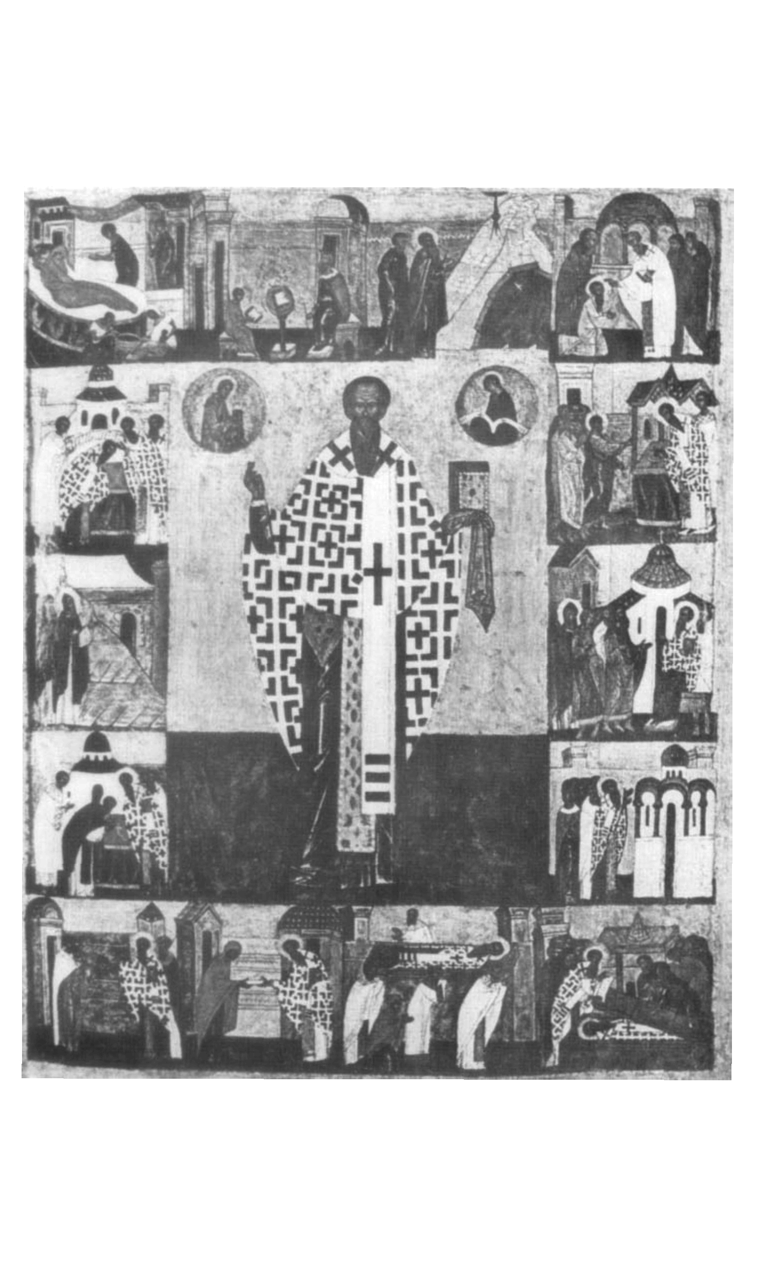
THE ICONOGRAPHY OF BASIL
bishop.110 The next right miniature portrays Christ accompanied by his apostles instructing Basil in the words of the liturgy. Basil with one deacon stands bowed over an altar on which a eucharistie plate lies.
The two scenes shown next, one on each side of the central panel, refer to the story of Ephraem the Desert Father. Ephraem is shown in his traditional dark attire and headcovering; near him are two other desert hermits. In the background there is a mountain and a monastery wall. To the right is a fiery colored pillar111 for the holy hermit in a vision saw Basil as a fiery pillar reaching up to the heavens. Inspired by the vision to visit
Basil, Ephraem set out for Basil's church where he watched the saint from a distance. Basil sent for him to come, and their meeting is recorded in the next picture. Basil seated before a church has one deacon beside him. He extends his right hand in greeting toward Ephraem who approaches from a position behind his followers.
Back on the left side, the scene is again before a church at an altar. Basil and the holy priest Anastasius, each accompanied by a deacon greet each other over the altar table. Basil's contention with the Arians concerning the church in Nicaea is the subject of the next, right-hand, miniature. Basil accompanied by another bishop, clerics, and laity stands before a church, arms raised in prayer. The scene represents the debate in which Basil intervened to secure a church Valens had taken from the orthodox and given to the Arians. By the agreement, the church doors were locked and the Arians were to be allowed three nights and days of prayer to get them opened. Should they be successful the church was theirs. Should they not, then the orthodox Christians had one day and night to attempt the same feat.112
In the first episode of the bottom row of pictures, a deacon pours oil over the head of a young man in an attitude of reverence. Basil with one companion dressed in dark attire extends his hand to touch the young man's head. The scene is perhaps an ordination; it may be a baptism. And possibly it is a greatly simplified version of the youth who bartered his soul because the next scenes are of the Woman Sinner. A respectful but upright woman hands Basil the scroll containing the list of her sins. In the following miniature she is shown kneeling as Basil's bier is carried out by two bishop figures and a deacon while a third bishop figure is behind the bier, his hands extended before him. The final scene which in its simplest
110 Vita A. 5. pp. 173-175.
111 Vila 13, pp. 202-206.
112 Vita 14, pp. 206-211.
WILMA FITZGERALD, SP
form resembles the Sanok icon shows a tunic clad figure placing the cover on Basil's coffin. There are people gathered both at head and foot of the coffin, one of whom, a dark bearded bishop at the head, reads from a scroll. This dark bearded bishop is closer to the iconographie type of Gregory of Nyssa who was present for his brother's death, but it may be the other Gregory who hastened to come at his friend's death according to the Life.113
Semyon Spiridonov in 1674 painted the fourth vita icon that I know about.114 In this elaborate, highly detailed icon it is interesting to note that figures of the nativity scene are in approximately the same position as in the Pennsylvania icon. The mother lying on a bed is served by one woman, two female servants wash the child in the foreground. The second background figure in the separate room is no longer of a woman but that of a seated man, surely the child's father. In the second scene more details are added than other of the education episodes show. The child Basil is introduced by his parents to an elderly school master seated at the left. In the center before a series of buildings is a table on which are books and at which two other youths study. The third scene shows Basil, dressed in episcopal robes seated on a bolster pillow before a desk, writing. These are the only episodes of Spiridonov's icon I have seen, nor do I know which others are represented.
Latin translations of the Pseudo-Amphilochian life may also have a picture cycle. This seems to be limited to one image appearing at the beginning or end of the manuscript texts. For example, the Stuttgart
Passionale115 contains the translation according to Euphemius116 and has a marvelous representation of a sectional church with a youthful, beardless
Basil vested, wearing a round mitre, holding a crozier in his right hand and grasping with his left the wrist of a young man standing in the vestibule of the church. A hairy devil, naked, with slightly webbed feet and a short tail seizes the youth's left shoulder. The devil's right hand grasps his own beard and his donkey head opens its mouth wide in frustration.
Jacobus de Voragine in the thirteenth century wrote lives of the saints for admiration and emulation. His Legenda aurea drawn from many
113 Vila 17, p. 225.
114 S. I. Maslenitsyn, Yaroslavskaya ikonopis' (Moscow 1973). No. i.648 in the Jaroslavian Art Museum. Three scenes only are shown in reproduction. u s Stuttgart WI.B 57 (56, 58), f. 183; see A. Boeckler, Der Stuttgarter Passionale
(Augsburg 1923) pl. 11.
116 BHI. 1023 printed in Surius, Vitae Patrum, 1 (Paris 1570) 4-19.
THE ICONOGRAPHY OF BASIL
sources has selected episodes from the Pseudo-Amphilochian life for the account of Basil. He chose the tales of Ephraem, the contest with the Arians, Valen's attempt to send Basil into exile and the broken pens (from Cassiodorus Historia Tripartita), the young man and the devil, the Woman Sinner, and Joseph the Physician. A Legenda aurea manuscript in California of English origin has117 (f. 25) a single miniature showing
Basil baptizing the Jew Joseph in a font. Joseph wears the traditional cap associated with representations of Jews in the Middle Ages. The beardless and tonsured Basil pours water over Joseph's head. A second bishop figure lies, arms crossed, on the ground at the left of the font. Perhaps this recumbant figure represents the almost lifeless Basil who recovered for the time required for the baptism.
Of all the existing images of Basil the Official and Basil the Popular only a surface reporting has been made here. Omissions are numerous. Among them must be noted the frescoed Basil in eighth-century Santa Maria
Antiqua in Rome;118 the bas-relief sculpture at Jurjev;119 the Prado Basil, School of El Greco; the Louvre's Basil of Francisco de Herrera and the Harbaville Ivory;120 Ivan Monidze's Shemokmedi portrait;121 Greco-Italian frescoes in southern Italy;122 and icons in many churches and museum collections.'23
It is my hope that this listing may be of inspiration for someone to continue the search, document the findings and ensure that the spirit of Basil of Caesarea remain a compelling and inspiring power for as Basil himself said regarding the Forty Martyrs of Sebaste and the use of images:
"Orators and painters often express the brave deeds accomplished in war, the former by word, the latter by painting and both excite not a few. For what is presented to the ears by a story is placed before the eyes by a picture in silence. Thus we recall the virtues of men and having seen their deeds, the more generous will emulate them."124
117 San Marino HI HM-3027.
118 W. de Grüneisen, Sainte Marie Antique (Rome 1911) pl. ic-xxi-A, ic-xxxi.
119 J. Maksimovic. "La sculpture byzantine du xiiie siècle," in L'art byzantin du xiiie siècle. Symposium de Sopocani 1965 (Beograd 1967) pp. 23-34, fig. 10.
120 D. T. Rice, The An of Byzantium (London 1959).
121 Amiranashvili, Georgian Metalwork, pl. 48.
122 A. Medea. Gli affreschidélie cripte eremilichepugliesi (Rome 1939); C. D. Fonseca,
Civiltà rupestre in terra jonica (Milan 1970).
123 Ikonen 13 bis 19 Jahrhundert (Munich 1970); Les icônes dans les collections suisses
(Stein am Rhein 1968); Icônes Melkites. Exposition organisée par Le Musée Nicolas
Sursock du 16 mai au 15 juin 1969 (Beirut 1969).
124 HMart. [19] 2. PG 31: 510.
P. Antin. 111
Un testimone ignorato délie Erotapokriseis brevius tractatae di Basilio Sever J. Voicu Rome Barns e Zilliacus,1 nel pubblicare il papiro Antinoopoli 111, lo attribuiscono, con formula dubitativa, a Crisostomo. La loro ipotesi, ripresa dal prezioso repertorio di van Haelst,2 mi ha incuriosito, poiché mi è parso singolare che si potesse ragionevolmente assegnare un frammento adespoto all'arcivescovo di Costantinopoli senza pero riuscire ad identificarlo, e senza nemmeno segnalare dei paralleli convincenti tratti dalle sue opère.
In realtà, l'unico argomento avanzato in merito dagli editori è la presenza di una citazione neotestamentaria (Mt 12.47-48p; cf. frammento
1 [a] ii) la cui esegesi crisostomiana sarebbe caratteristica. Ma il contesto della citazione non si ritrova né fra le opère autentiche, né fra quelle spurie, e nemmeno in un brano pseudo-crisostomico che gli editori non potevano ancora conoscere.3
Un tentativo di identificare il papiro al difuori del corpus crisostomico è stato coronato da successo: non è stato difficile rintracciare alcune délie numerose citazioni bibliche del papiro nelle Erotapokriseis brevius tractatae di Basilio.
1 J. W. B. Barns e H. Zilliacus, The Aminoopolis Papyri, Part 3 (London 1967) 1-7.
2 J. van Haelst. Catalogue des papyrus littéraires juifs et chrétiens (Paris 1976) p. 632, no. 633.
3 S. J. Voicu, "Il florilegio crisostomico del Vat. gr. 790," in Studia codicologica, ed. K.
Treu (Berlin 1977) p. 496 § B.
Basil of Caesarea: Christian, Humanist, Ascetic, ed. Paul J. Fedwick (Toronto; Pontifical Institute of Mediaeval Studies, 1981), pp. 565-570. © P.I.M.S.
SEVER J. VOICU
Ma l'aspetto piu interessante di questo testimone del s. vi-vii è che non rappresenta la "Volgata" (V), trasmessa dalla maggior parte dei codici greci, bensi l'ordine della cosiddetta collezione X,4 quasi del tutto scomparsa in greco e tramandata soprattutto da alcune antiche versioni.
La successione stessa dei frammenti basta per rendere sicuro questo fatto, anche se non ho trovato tracce di un qualsiasi sistema di numerazione delle regole, che sono indicate semplicemente da una coronis, posta entro le linee di scrittura accanto al testo della domanda.
Dei 24 frammenti del papiro, 18 sono stati identificati e ci restituiscono parzialmente 10 fogli di un codice scritto a 30 righe piene per pagina, con una media di 23-26 lettere a riga (ma, apparentemente, con oscillazioni molto forti di quest'ultimo valore).
Due dei fogli superstiti sono isolati. Gli altri appartengono a tre diverse sequenze, di varia consistenza. Abbiamo cosi cinque gruppi di fogli: A (4 ff), Β (2 ff.), C (un f.), D (un f.) ed Ε (2 ff). Da notare peraltro che probabilmente vi è un solo foglio completamente perso fra le série D ed Ε.
5 In altri casi il tenore del testo edito mal si concilia con quello del papiro.
Non tutte le identificazioni proposte sono certissime.
Nell'analizzare il contenuto di ogni frammento abbiamo tentato di delimitarne accuratamente l'inizio e la fine. Poiché la recensione X è tuttora inedita, tutti in rinvii sono stati fatti alla "Volgata," pubblicata su
PG 31. Una apposita tabella permette di passare senza particolari diffïcoltà da un ordine all'altro.
Abbiamo altresi segnalato le varianti di rilievo rispetto al testo della PG (notevoli i due omoioteleuti a ff. A/2r e B/lr), e anche tutti i casi in cui questo fa presumere un errore di lettura da parte degli editori (il che, owiamente, non suona a critica del loro operato: è ben noto quanto sia difficile districarsi tra fibre scurite di papiro, inchiostro sbiadito, sporcizia e mutilazioni di vario génère, soprattutto se non si ha avuto modo di identificare preventivamente il testo in questione).
Se un presunto errore degli editori riguarda la prima ο l'ultima linea leggibile di un frammento, il fatto viene sottolineato dall'aggiunta di un asterisco (*); quando l'integrazione di una parola potrebbe appartenere ad una riga diversa da quella in questione, il passaggio da una riga all'altra viene indicato con un tratto diagonale (/).
4 J. Gribomont, Histoire du texte des Ascétiques de saint Basile (Louvain 1953) pp. 165-170.
5 Vedi i frammenti 7, 8, 9.
6 Vedi il frammento 12 (a) a f. A/4V.
P. ANTIN 111
Un'ultima awertenza: tutti i rinvii al volume 31 della PG riguardano l'edizione del 1857, che, seppur meno diffusa, ha il pregio di essere leggibile. Le differenze possono talvolta essere sensibili rispetto alia ristampa del 1885.
CONCORDANZA TRA ι FOGLI DEL PAPIRO, L'ORDINE X
(Gribomont, pp. 165-170) ε L'ORDINE V (PG 31)
V.X 11-28( = V289, 99, [158], 159, 7, [8-9], 85, [86], 187, 188, 189,
A/1-4 21, 22, 160, 161, [162], 163); B/1-2
V: X 71-77 ( = V 121, [199], 166, [167], 200, 97, 128);
C/l v: X 106-107 ( = V 10, 89); D/l rv: X 112-1 14 ( = V 16, 204, 205); E/1-2 r"
V: X 116-123 ( = V 207, 17, 90, [151], 152, [153], 122, 172).
CONTENUTO DEL PAPIRO
A/1 ( = fr. 16. 10. 13) r (—; qq. 289. 99): l — 16 (a), inc. εύτελε]στερο[ις, des. θεραπευσ]αι (1285B 13-14);
2-1 152A 12);
— 13 (a), inc. ?, des.* τους επ[ιτιμωμενους (11 52B 2). l v (1; qq. 159, 7):
—16 (b), inc.* χι]ν8υν[ον, des. χαι μ[αλίστα (1185c 11); — 10 (b), inc. ε[ί]πο[ντι, des. παι]δευ[σει (1185c 13-D 2);
— 13 (b), inc. αμαρτανον]τας, - 2 οιμαι πε[ρι, des. OVLXOJç π[ερι (1085c 7-11).
Α/2 ( = fr. 1)
r (1; q. 85):
— 1 (b) ii, inc. π]ρα[ξεσιν.
- 4: ιδ[ιον. ίδιον-ίδων PG, - 5 άλλο] Ι τρων της, - 1 δι]ΐδαξαντος, des.* εχίτος (1 1 4 4 α 4-11).
ν (—; q. 187):
— 1 (a) i. inc. ?, - 2 διαφερει[ν ?. - 3 επαρσεΙ[ως ?: πολλαχι,ς add. PG. - προσελ]θοντων. des. πίστ]ος χαί φίροΐνιμως
( 1 2 0 8 β 713).
Α/3 ( = fr. 11, Ι) 3Μ—; qq. 187, 188, 189):
SEVER J. VOICU
— 1 (a) ii, inc. απηγγ]ελη,
απα[γαγείν, - 15 μεν δια οίίχοδομην, des. ?* ο δυνίαμενος (1208c 1 2 - 1 2 0 9 α 5).
V (I; qq. 189, 21):
— 11 (b), inc. πεμπεσθ[ω, - 3 πρ]ος τον ειποντ[α, des. ? ( 1 2 0 9 α 68); — 1 (b) i, inc. ?, - 2* α]πο αρίγιας hou,
επ[ιστευε]ν, - 1 προειρημενον. εφημενον PG, - 10 ο δε τ[ο]υ[το ? ... το[υ/τω, - 14 αγαίθον, des. αρε]σχοντ[ων (1097B 8-e 5).
A/4( = fr. 24+12 + 17, 21)
Γ(1; qq. 22, 160):
— 24 (b) + 12 (b) + 17 (b): è sembrato più semplice ripubblicare insieme i tre frammenti, che occupano pressappoco la stessa porzione di testo; 12 (b) è il fr. di sinistra (linn. 2-5); al centro si sovrappongono 24 (b) ( = linn. 1-2) e 17 (b) ( = linn. 3-5). Il testo differisce solo in due punti dalla edizione del papiro: -2 at, - 3 των: πόθεν αι]νυχ[τεριναι φαντασιαί at α[πρε]πεις γινο[νταί γινονταίί με]ν εχ τω/ν μετά ημεραν αλλοχοτίων] της φίυχης χινημα 5 των εα/ν δ[ε εν τ]η σχο[λη των του θυ (1097c 8-12); — 21 (b), inc. σπουδ[αωτερον, -2* ψιλοσ]ωματ[οι, des. ? ( 1 1 8 8 α 11).
ν ( — ; qq. 161, 163):
— 24 (a) + 12 (a) + 17 (a): come già per il recto, i tre frammenti vengono presentati insieme; 12 (a) è a destra (linn. 1-5); al centro si sovrappongono 24 (a) ( = lin. 2) e 17 (a) ( = linn. 3-5).
In 12 (a) la lin. 3 {προ]σειπω αμ[... ) è assolutamente incompatibile con il tenore di PG {του χυ υπηρετούντος); nemmeno lo ξ alla prima linea dello stesso frammento ha una corrispondenza soddisfacente nel testo edito: s Î2g δούλος πάρα] δεσπ[οτο]υ xm OLOVJ [ε δείξε πετρος ]ο αποστίολος ? ? ? ? ? ? ?
? ? ? ? ? ? ? ?]εφ ου [xat] τον χιν[δυ 5 νον των μη χα]ταδεχ[ομε]νω[ν (1188B 5-7); — 21 (a), inc. δυνηθ]η τι[ς, - 2 π]ρος το/ν, des. ? (1188c 9).
Ρ. ANTIN 111
Β/1 ( = fr. 4) r ( — . q. 121): l — 4 (a), inc. αυτός τ/ω, - 6 .. ,]ομενος; επιλανθανομενος-επεχτεινομενοςΡΰ, des. εχ/ων (1164c 14-1 1 6 5 α 1). l v ( I ; q . 166):
— 4 (b), inc. παίδίων, - 8 ζ]ωη, des. ? (1192B 11-C 3).
B/2( = fr. 2, 9, 7. 18)
r (1; qq. 200, 97):
— 2 (b), inc.* προσωπ]ω (χαί add. PG) παν[τι,
πληροφίοριαν τη[ς, des. πα]ντα στ[εγει ( 1 2 1 6 α 1 5 - β 8); — 9 (b): le linn. 9-12 del fr. 2 (b), a sinistra, potrebbero essere contigue aile linn. 3-6 del fr. 9 (b), a destra, ma di quest'ultimo la sola lezione compatibile con PG è: - 6* π/αντα.
— 7 (b), ?; — 18 (b), -2ε]χβαλω(1149Β 8).
2M—;qq. 97, 128):
— 2 (a), inc.* ? τω βίω,
αλλοιοτερα]ς ίσως π[ερι, des. ωφε]ληθησεταί η (1149c 2-8); — 9 (a): le linn. 1-3. a sinistra, potrebbero essere contigue aile linn. 10-12 del fr. 2 (a): inc.* αδια]φο[ρι]ας, des. ωφε[ληθησεται;
— 7 (a), inc. πε[ποιημενον, - 2 ου/]χ εν, des. ? ιΙ]διων (1168c 13-D 3); — 18 (a), inc. αναχω[ρησει, des. θελημ]ατω[ν (11 68D 3).
C/l ( = fr. 5) r (—; q. 10): l — 5 (a), inc. ? π]ρ[οτερον, - 2 αυτ]ης {αυτήν PG) σιχχαιΙ [νουσαν,
- Ί απειλ]ην της, des. ? xaipojv (1088c 3-9). l v (1; q. 89):
— 5 (b), inc. ει μεν, des. α/]φη[χαμεν (1144c 13-D 2).
D/1 ( = fr. 3) r ( — ; q . 16): l — 3 (a), ine. ?, - 4 προ]ς α βουλεται ελευ/ίθεριαζειν, - 5 επιτ]ρεπομενην, -11, des. πε]πρα[μενος ( 1 0 9 3 α 7-10).
1Μ1; qq. 204. 205):
— 3 (b), inc.* εντ]ολα[ς, des. εγω (1217B 12-C 5).
E/l ( = fr. 6) r ( — ; q q . 207, 17): l — 6 (a), inc. ? επ]α[γγελλομενου, des. μνηΠμη (1221A 10-1093B 12).
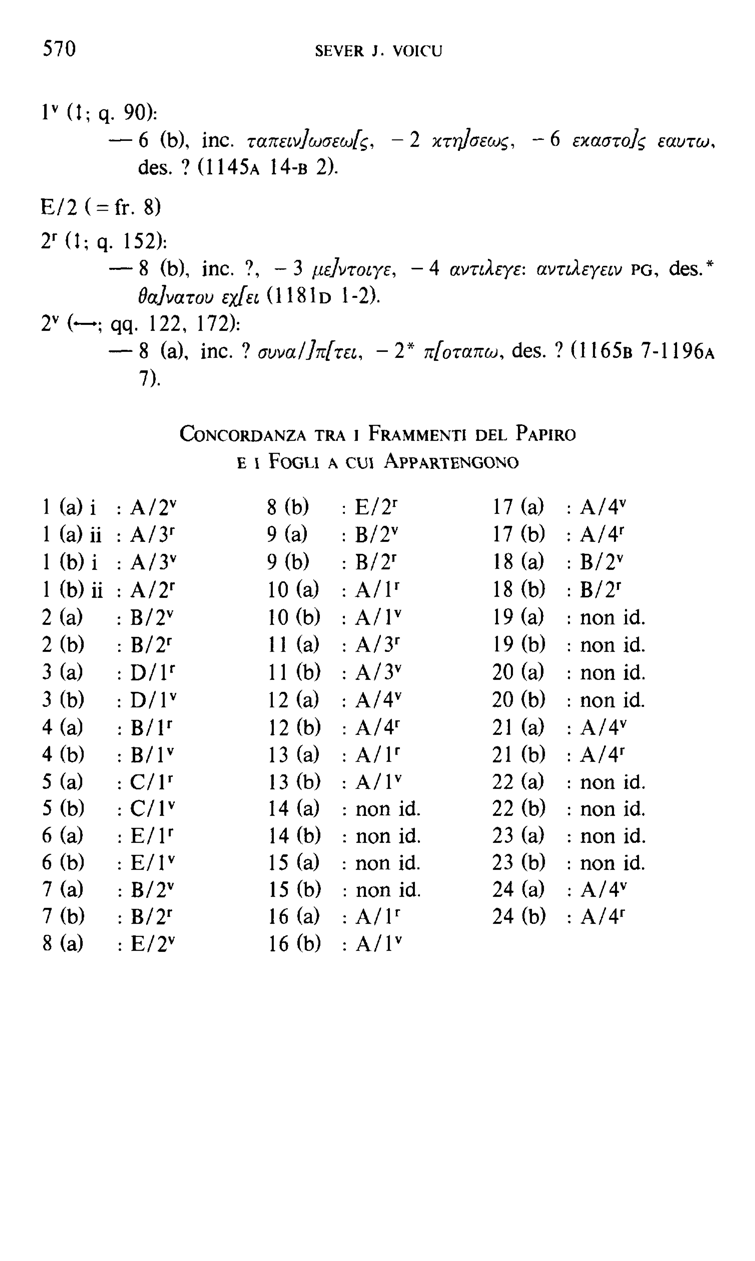
SEVER J. VOICU
v ( l ; q. 90): l — 6 (b), inc. ταπειν]ωσεω[ς, - 2 χτη]σεως, - 6 εχαστο]ς εαυτω, des. ? ( 1 1 4 5 α 1 4 - β 2).
Ε/2 ( = fr. 8)
r ( l ; q. 152):
— 8 (b), inc. ?, - 3 με]ντοιγε, - 4 αντίλεγε: αντιλεγειν PG, des.* θα]νατου εχ[ει { 1 \ % \ ό 1-2).
V ( ~ ;qq. 122, 172):
— 8 (a), inc. ? συνα/Μτει, - 2* π[οταπω, des. ? (1 165B 7-1 1 9 6 α 7).
CONCORDANZA TRA I FRAMMENTI DEL PAPIRO
E I FOGLI A CUI A P P A R T E N G O N O
r V V 8(b) 9(a) 9(b) 10(a) 10(b) 11(a) 1Kb) 12(a) 12(b) 13(a) 13(b) 14(a) 14(b) 15(a) 15(b) 16(a) 16(b) E/2 A/4 17(a) 17(b) 18(a) 18(b) 19(a) 19(b) 20(a) 20(b) 21 (a) 21 (b) 22(a) 22(b) 23(a) 23(b) 24(a) 24(b) 1 (a)i 1 (a) ii 1 (b)i 1 (b) ii 2(a) 2(b) 3(a) 3(b) 4(a) 4(b) 5(a) 5(b) 6(a) 6(b) 7(a) 7(b) 8(a) A/2 V r r B/2 A/4 A/3 V r V A/3 B/2 B/2 r r r A/l B/2 A/2 v V non id. non id. non id. non id.
A/4 A/l B/2 r r A/3 B/2 V r A/3 D/l v V D/l A/4 r V r A/4 B/l r r v A/l A/4 B/l r v C/l A/l non id. non id. non id. non id.
A/4 v non id. non id. non id. non id.
A/l C/l r E/l v E/l V V B/2 r r r A/4 B/2 v V A/l E/2
Repertorio dei manoscritti della versione armena di S. Basilio di Cesarea Gabriella Uluhogian University of Bologna Il centenario basiliano, che ricorre quest'anno, ci offre l'occasione per mettere a punto lo stato degli studi sulla versione armena e, in particolare, per presentare aggiornati i dati della tradizione manoscritta.1
Già nelle prime ricerche su questo tema,2 era apparsa chiara l'opportunità di distinguere nettamente, da una parte preghiere, liturgie e canoni, che devono essere studiati nell'ambito della complessa tradizione liturgiea e canonica della chiesa,3 dall'altra le opère più strettamente letterarie.
Noi intendiamo occuparci di queste ultime, che, corne è noto, sono state tramandate in armeno con i seguenti titoli:
(1) Yalags Vec'öreay Awurc'n Ararc'ut'ean {- "Dei sei giorni della creazione"): sono le nove omelie sui primi capitoli del Genesi, universalmente note col nome di Hexaemeron*
1 Importantissima è, a questo proposito, la voce "Barsel Kesarac'i," in Haykakan
Matenagitui'yun (dd. 5-18) (Erevan 1976) 2: 1344-1405 di H. A. Anasyan, che ha, tra l'altro. il merito di descrivere minuziosamente il contenuto dei codici del Matenadaran di
Erevan, che risulta invece assai stringato nell'attuale Catalogo (v. sotto).
2 Cf. I. W. Driessen. ""Les recueils manuscrits arméniens de saint Basile," Mus 65
(1953)65-95.
3 I canoni sono stati pubblicati in Kanonagirk' Hayoc' (a cura di V. Hakobyan) (Erevan 1964) pp. 329-362.
4 II testo complete deW'Hexaemeron armeno ha avuto una sola edizione: Srboy Barsti episkoposi Kesaru Kapadovkac'voc' Cark' vasn vec'öreay ararc'ufeann (a cura di A.
Bagratuni) (Venezia 1830). Alla preparazione dell'edizione critica è da tempo impegnato, a Basil of Caesarea: Christian, Humanist, Ascetic, ed. Paul J. Fedwick (Toronto:
Pontifical Institute of Mediaeval Studies, 1981), pp. 571-588. © P.I.M.S.
GABRIELLA ULUHOGIAN
(2) Girk' Harc'olac' {- "Libro delle domande"), che comprende, in una série unica, le 361 ο 362 domande e risposte, corrispondenti alle
Erotapokriseis fusius e brevius tractatae, cui si accompagnano di norma i *Asc. Pr5 e Asc. Pr3 e un numéro variabile di Epitimie finali. Seguendo l'esempio di J. Gribomont,5 noi chiameremo questa sezione Asceticon.6
(3) Girk' Pahoc' { = "Libro del digiuno"), raccolta che trae il nome dalla HIeiun. I.7 Questo libro comprende una série di omelie, alcune lettere e dialoghi, dall'attribuzione non sempre sicura,8 che costituiscono un blocco unico, un vero e proprio corpus, che citeremo per brevità
Pahoc', termine restrittivo in apparenza, ma più significante del troppo generico Homiliae. Di questo fanno parte i "pezzi" dei codici veneziani ampiamente descritti dal Driessen,9 che si ritrovano, pur con qualche diversité di disposizione ο di numéro (variabile da 26 a 35) in altri document! della tradizione armena.10 Lo studio della formazione di questa
Erevan. K. Muradyan, che ha fatto conoscere alcuni risultati delle sue ricerche nel volume
Barset Kesarac'iew nra "Vec'ôreayn" hay matenagruf van me} (Erevan 1976). preceduto da una nutrita série di articoli. a carattere più generale, anche su S. Basilio e i suoi rapport! con l'Armenia. fra i quali citiamo: (1) "Barsel Kesarac'in ew Hayere." Lraber
Hasarakakan Gitut'yunneri 9 (1968) 49-61; (2) "Barsel Kesarac'u 'Vec'awrean'." Lraber
Has. Gil. 1 (1970) 79-88; (3) "Barsel Kesarac'u "Vec'ôreayi" ew Anania Sirakac'u oros erkeri tek'stabanakan arnc'akc'ut'yuns," Lraber Has. Gil. 3 (1971) 99-107; (4)
"Srbagrut'yunner Barsel Kesarac'u Vec'oreay'-um." Banber Matenadarani 10(1971)4353; (5) "Grc'agir vkayut'yunner Kesarac'u gorceri hayeren t'argmanut'yunneri masin."
Lraber Has. Git. 10(1972) 49-57; (6) "Vec'öreay'-i hayeren t'argmanut'yan zamanakn u bnagir." Patina-banusirakan Handes 3 (1973) 161-173; (7) "snt'hanur hatvacner u srbagrut'yunner Kesarac'u ew Sirakac'u gorcerum," Lraber Has. Gil. 1 (1975) 55-72; (8)
"Kesarac'u 'Vec'ôreay'-n Sirakac'u tiezeragitakan asxatut'yunneri albyur." Lraber Has.
Gil. 3 (1975) 95-114; (9) "Barsel Kesarac'u 'Vec'ôreayi' nor srbagrut'iwnner." HA 1-12
(1976) 577-590. s J. Gribomont. Histoire du texte des Ascétiques de saint Basile (Louvain 1953).
6 II testo armeno deWAscelicon è tuttora inédite; chi scrive. ha già collazionato i più importanti codici. in vista di una future edizione.
7 A designare le singole omelie e le altre parti del Pahoc'. useremo, anche in seguito. il titolo latino come in PG 30-31.
8 Già G. Zarbhanalean. Matenadaran haykakan t'argmamtf eanc' naxneac' (Venezia 1889) p. 330. osservava che il dialogo intitolato Tesut'iwn i marmnaworitl'iwn P'rkc'in,
Barsll episkoposi ew Apotinari herjuac'oti corrisponde. nella tradizione greca. a Ps.
Atanasio. Dialoghi A ( - PG 28; 1249) (cf. anche Driessen. "Les recueils," p. 79).
Aggiungiamo che la lettera Ewsebi episkoposi. incipit: Yorzam ar irsn hayimk' ew zdzuaruTiwns tesanemk'.... corrisponde aWEAth. [82]( = PG 32; 457). incipit: "Οταν μεν προς τά πράγματα βλέφωμεν χαί τάς δυσχολίας χατίδωμεν...
9 Cf. "Les recueils," pp. 70-86.
10 Cf. ancora Driessen. "Les recueils." tabella riassuntiva p. 86. Ai codd. 924 e 907 di
Ëjmiacin corrispondono attualmente i codd. 1500 e 822 di Erevan. A titolo di esempio elenchiamo i "pezzi" del Pahoc' del cod. 5595 di Erevan (cf. G. Uluhogian. "Contributi allô studio della tradizione manoscritta del Basilio armeno: 1) Il mscr. 5595 di Erivan."
MANOSCRITTI DELLA VERSIONE ARMENA
raccolta, non ancora affrontato nella sua interezza," sembra promettere risultati particolarmente interessanti in ordine all'epoca della traduzione in armeno e all'identità del/dei traduttore/i. L'indagine potrà portare utili chiarimenti anche sui rapporti con un eventuale analogo corpus greco e sulla relazione intercorrente tra alcune omelie, inserite nel Pahoc' e le stesse ο altre diverse che, sempre sotto il nome di S. Basilio, sono state invece trasmesse isolatamente, in omeliari e codici miscellanei.
In questo contributo, che dériva dallo spoglio dei cataloghi13 dei manoscritti armeni e dall'esame diretto di una parte di essi,14 noi ci proponiamo di classificare tutti i manoscritti delVHexaemeron, delVAsceticon e del Pahoc', distribuendo il materiale in due capitoli.
Nel primo capitolo presenteremo i codici in ordine cronologico, partendo dai corpora completi delle tre opere, fino a quelli che comprendono una sola opera ο anche soltanto una consistente parte di essa; nel secondo capitolo elencheremo invece i testimoni di ciascuna opera e per quel che riguarda il Pahoc', anche dei singoli pezzi in esso contenuti.
RILSL 109 [1975] 210-225); (i) HIeiun. 1; (ii) HIeiun. 2: (iii) HEbr. [14]: (iv) HAu. [3]-. (v)
HPaen. [28]: (vi) HDestr. [6]; (vii) HDiv. [1\. (viii) HIra [10]: (ix) HPs. Nb; (x) HInv. [11]:
(xi)HPs. IAxii)HPs. 59: (xiii) HPs. 61. (xi\) HPs. I I4-Ax\) HPs. 115 -. (xvi) HFide [15] (in arm. De Trinitate"); (xvii) HVerb. [16]; (xviii) HChr. [27]: (xix) Ps.-Athanasius. Dial. A I = PG 28; I 249 sgg.); (xx) Ad Gregorium theologum (non identificato); (xxi) EOpt. [260]; lxxii)£X(/7. [82] lin arm. "Ad Eusebium praedecessorem suum"); (xxiii) EGNaz. [2]; (xxiv)
Ad Gregorium theologum (passi dalle ETheod. [173] e De perf. [22]): (xxv) EDiod. [160];
(xxvi)HGral. [A]-, (xxvii) HIul. [5]; (xxviii) HMart. [19]; (xxix) HGord. [18]; (xxx) HMal. [9];
(xxxi)HBapl. [13]. Queste sono le parti che. piu ο meno. si ritrovano nei codici che citiamo con il nome di Pahoc'. senza alcun'altra specificazione.
" II Girk ' Pahoc' è inédite; delle sue parti sono state pubblicate soltanto; (i) HFide [15] e Ps. Atanasio. Dial. A in Knik' Hawaloy (a cura di Kar. Ter Mkrtc'ean) (Ëjmiacin 1914) pp. 78-98: (ii) HChr. [27] (a cura di P. Ter Pötosean). in HA 82 ( 1968) 419-438; (iii) EDiod.
[160]. in Hakobyan. Kanonagirk'. 1; 620-621. [Cf. also above p. 478. n. 193. Ed]
12 Su questo problema. cosi come sul reste della tradizione manoscritta armena di S.
Basilio. cf lo studio di P. Ter Pölosean. 'S. Barsel Kesarac'i ew ir grut'iwnnere hayeren t'argmanut'eamb." HA 10-12(1968) 385 sgg.: 4-6(1969) 129 sgg.; 7-9: 259 sgg.: 10-12:
385 sgg.
13 Ε forse opportuno ricordare che i cataloghi sono compilati con criteri molto different! e mentre alcuni sono accurati e minuziosi nella descrizione dei codici e del loro contenuto. altri sono. per cause diverse, molto concisi e vaghi. In questi casi ο è possibile integrare con altre fond bibliografiche (cf. Anasyan. "Barsel") oppure ci si deve accontentare di qualche dato incomplete ο insicuro.
14 Abbiamo esaminato direttamente ο in microfilm i MSS del)'Asceticon del Matenada ran di Erevan e. in generale, i codici basiliani di S. Lazzaro. Al Direttore del Matenadaran e ai PP. Mechitaristi di Venezia va il nostra più vivo ringraziamento per la libéralité e la cortesia con cui hanno facilitate la nostra ricerca.
" Nel présente lavoro non teniamo conto dei numerosi brevi frammenti di codici
GABRIELLA ULUHOGIAN
A I codici vengono presentati in quest' ordine: (i) codici contenenti le tre opere; (ii) codici contenenti due opere; (iii) codici con una sola opera.
All'interno di ogni sezione, i codici completi precedono quelli antologici ο frammentari.
Nella doppia numerazione, il primo numéro si riferisce alla posizione del codice nella sezione, l'altro, tra parentesi, numera progressivamente tutti i codici presi in esame.
1 (1). Erevan Maten. 5595, ch., 170x120 mm, 400 ff., a. 1279, script.: Eliazaru vank'; ser.: Step'anos, Esayi (?); bolorgir.16 ff. 1-107: Hexaemeron; ff. 108-228v: Asceticon; ff. 229-398v: Pahoc'.
2 (2). Erevan Maten. 1500, eh., 357 x 265 mm, 1189 ff., s. 13, script:
Gelarday vank'; ser.: Mxit'ar Ayrivanec'i; bolorgir.17
Omeliario. ff. 879-936: Pahoc'-, ff. 936-976: Asceticon-, ff. 976-?:
Hexaemeron.
3 (3). Gerusalemme SVH 406. ch.. 230 x 160 mm, 382 ff., a. 1319. script.: Sis; ser.: Israyèl Arewelc'i; bolorgir.18 f. 1: Hexaemeron; f. 99: Asceticon; f. 183: Pahoc'.
4 (4). Gerusalemme SHV 470. ch.. 230 x 170 mm, 946 pp., a. 1683. script.: Sebastia (?): ser.: Mik'ayêl; nötragir.19 pp. 9-235: Asceticon: pp. 276-?: Pahoc'; pp. 621-814: Hexaemeron.
1 (5). Erevan Maten. 1924, ch., 250 x 195 mm, 351 ff., a. 1653, ser.:
Awët, Abraham; bolorgir.20
Miscellanea, ff. 2V-126V: Asceticon; ff. 127-?: Pahoc'.
2 (6). GalataMH 84, ch., 213 x 160 mm, 898 pp., a. 1675-1684, script.:
S. Giacomo (Gerusalemme); ser.: Eremia erèc'; nötragir.21
Miscellanea, pp. 482-590: Asceticon-, pp. 591-793: Pahoc'. basiliani, risalenti ai secc. 10-11, che non compaiono con regolarità nei cataloghi e abbisognano quindi di un'indagine tutta particolare.
16 Cf. Uluhogian, "Contributi."
" Cf. O. Eganyan, C'uc'akjeragrac' Mastoc' anvan Matenadarani (Erevan 1965-70) 1: 568 ( = Eganyan, Erevan).
18 Cf. N. Polarean, Mayr c'uc'ak jeragrac' Srboc' Yakobeanc', 8 w. (Jerusalem 1966-1977) 2: 338 ( = Bogharian, Gerusalemme).
19 Cf. Bogharian, Gerusalemme, 2: 456.
20 Cf. Eganyan, Erevan, 1: 676.
21 Cf. Babgen Kat'otikos (Kiwleserean), C'uc'ak jeragrac' Lalat'ioy azgayin Matenadarani Hayoc' (Antilias 1961) 1; 555 ( = Babgen, Galata).
MANOSCRITTI DELIA VERSIONE ARMENA
3 (7). Gerusalemme SHv 619, ch., 215 x 160 mm, xvi, 252, 4, 432 pp., a. 1721, script.: Costantinopoli; nötragir.22 pp. l-236v: Pahoc'-, pp. 175 (nuova numerazione)-?: Asceticon.
4 (8). Erevan Maten. 436, ch., 280 χ 205 mm, 390 ff., a. 1790, script.:
Costantinopoli, Ëjmiacin (?); ser.: Brabion, Georg: nötragir.23
Miscellanea, ff. 167v-211v: Pahoc'; ff. 212-271: Asceticon.
5 (9). VeneziaBsi, 1209.24 eh., 220 χ 154 mm, 242 ff., s. 14, bolorgir. ff. 12-225 v: Asceticon; ff. 227-240: Pahoc' (due omelie).
6 (10). Erevan Maten. 1330, ch., 285x220 mm, 239 ff.. a. 1711. script.: Sorot'; ser.: Sargis; bolorgir.
v: Pahoc' (due omelie).
7 (11). Galata MH 54, ch., 245 χ 170 mm, 484 ff, s. 17 (?); bolorgir.
v: Asceticon; ff. 229 v-237 Miscellanea, ff. !42-229 Miscellanea, ff. 264-275: Pahoc' (antologia); ff. 275-280: Asceticon
(antologia).
1 (12). Gerusalemme SHV 1801, ch.. 255x165 mm, ii, 560 pp., a. 1187. script.: Horomosi vank'; ser.: Yovhannes k'ahanay; bolorgir.
pp. 1-387: Hexaemeron.
2(13). Erevan Maten. 5353, ch., ? mm, 231 ff, s. 13, ser.: Awag (?) sarkawag; bolorgir.
Miscellanea, ff. 154-231: Hexaemeron (manca Hex. 9).
3 (14). Erevan Maten. 620, ch., 217x160 mm, 298 ff., a. 1494, script.: Erznka; ser.: Malak'ia Baberdac'i; bolorgir.
v: Hexaemeron.
4 (15). Leningraado (?) AN iv 7 (cod. arm. iii.5.7), ch.. 190> 125 mm.
290 ff. s. 15 (?); bolorgir.
Miscellanea, ff. 213-298 7). Hexaemeron.
5 (16). Erevan Maten. 1243. ch.. 200 χ 135 mm. 466 ff. a. 1681. ff. 1-290 C 22 Cf. Bogharian, Gerusalemme, 3: 19.
23 Cf. Eganyan. Erevan, 1; 319.
24 I codd. di Venezia vengono citati col numéro antico, cui si accompagna, tra parentesi. il nuovo numéro, se già siano inseriti nel catalogo a stampa; B. Sargisean e G.
Sargsean. Mayr c 'uc'ak hayeren jeragrac' Matenadarani Mxit'areanc' i Venetik, w. 2-3
(Venezia 1924. 1966) ( = Sarkisian, Venezia).
25 Cf. Eganyan, Erevan, 1: 527.
26 Cf. Babgen, Galata. col. 323.
27 Cf. Bogharian, Gerusalemme. 6: 161.
28 Cf. Eganyan, Erevan, 2: 89.
29 Cf. Eganyan. Erevan. 1: 365.
30 Cf. H. Oskean, C'uc'ak jeragrac' or i Handês Amsoreay (Vienna 1976) p. 159
( = Oskian. H.A.).
GABRIELI.A ULUHOGIAN
1721, script.: Zmiwrnia (ι), T'omay Arak'eali vank' (n); ser.: Polos C'lnec'i d), Step'anos C'lnec'i (n); nötragir.31
Miscellanea, ff. 337-463 d): Hexaemeron.
6 (17). Erevan Maten 3457, ch., 150x101 mm, 321 ff., s. 17; nötragir.32
Miscellanea, ff. 1-182: Hexaemeron.
7 (18). Erevan Maten. 5032, ch„ 200x150 mm, 221 ff., s. 17; nötragir, : bolorgir.33
Miscellanea, ff. ?; Hexaemeron.
8 (19). Venezia BSL 177, ch., 228x168 mm, 102 ff„ s. 17/18; nötragir. ff. 4-97v: Hexaemeron.
9 (20). Venezia BSL 1459, ch., 252x185 mm, 80 ff., s. 17/18; nötragir. ff. 1-80: Hexaemeron.
10 (21). Bzommar VM (Fondo Antoniani) 429, ch., 287 x 212 mm, 279 ff., a. 1701, script.: Amida; ser.: Polos k'ahanay; nötragir.34
Miscellanea, ff. 123-179v: Hexaemeron (lacunoso Hex. 9).
11 (22). Vienna MB 249, ch., 245 x 190 mm, 320 ff., a. 1720, script:
Costantinopoli; nötragir.35
Miscellanea, ff. l-86v: Hexaemeron.
12 (23). Gerusalemme SHV 68, ch., 330x210 mm, xxiv, 880 pp., a.
1729-1735, script.: Cesarea; ser.: Yarut'iwn Trovat'ac'i; bolorgir.36 pp. 145-251 : Hexaemeron.
13 (24). Erevan Maten. 1939, ch., 213x157 mm, 99 ff, a. 1758, script.: T'eodopolis; ser.: Yakob sarkawag; nötragir.37 ff. 1-99 (?): Hexaemeron.
31 Cf. Eganyan, Erevan, 1; 508.
32 Cf. Eganyan, Erevan, 1; 1016.
33 Cf. Eganyan, Erevan, 2: 20.
34 Cf. Ν. Akinean e Y. Oskean, C'uc'ak hayeren jeragrac' Zmmari vank'i Matenada· ranin (Vienna 1971) 2; 14 ( = Akinian, Bzommar).
35 Y. Tasean, C'uc'ak hayeren jeragrac' Matenadarani Mxit'areanc' i Vienna (Vienna 1895) p. 638 ( = Dashian, Vienna). Vale la pena di ricordare che nel 2 vol. del
Catalogo di Vienna, H. Oskean, C'uc'ak hayeren jeragrac' Mxit'arean Matenadaranin i Vienna (Vienna 1963) ( = Oskian, Vienna), a p. 742, a proposito del cod. 1075, si dice che non si tratta di un vero manoscritto dell'Hexaemeron, ma di una copia della edizione veneziana del 1830, sulla quale, a mano, sono state riportate le varianti di un codice ricopiato nel 1720, che sembra di poter identificare appunto col cod. 249 (cf. anche
Muradyan, Barsel, p. 139).
36 Cf. Bogharian, Gerusalemme, 1; 220.
37 Cf. Eganyan, Erevan, 1: 679.
MANOSCRITTI DELLA VERSIONE ARMENA
14 (25). Erevan Maten. 7028, eh., 145 x 100 mm, 202 ff., a. 1761, scr.: Yakob Kesarac'i; bolorgir.38 ff. 1-202 (?): Hexaemeron.
15 (26). Bzommar VM (Fondo Antoniani) 605, eh., 107 x 79 mm, 292 pp., s. 18; nötragir.39 p. 8: Hexaemeron.
16 (27). Erevan Maten. 5819, eh., 210x150 mm, 38 ff., s. 18; bolorgir.40 ff. 1-38: Hexaemeron (le prime quattro omelie e parte della 5).
17 (28). Erevan Maten. 5686, eh., 240x192 mm, 94 ff., a. 1820. script.: Costantinopoli; nötragir.41 ff. 1-94 (?): Hexaemeron.
18 (29). Erevan Maten. 10258, eh., 246 χ 190 mm, 90 ff., a. 1820, scr.: Serovbè Petrosean Aknec'i; nötragir.42 ff. 1-90 (?): Hexaemeron.
19 (30). Vienna MB 612, eh., 240 x 185 mm, 91 ff., a. 1821, script:
Costantinopoli; scr.: Serovbè Petrosean Aknec'i; nötragir.43 ff. 3-91: Hexaemeron.
20 (31). Vienna MB 1121, eh., 240x200 mm, 102 ff., s. 18/19; nötragir.44 ff. 4-102: Hexaemeron.
21 (32). Gerusalemme SHV 1062, eh., 200x140 mm, 196 ff.; nötragir.45 ff. 15-18lv: Hexaemeron.
22 (33). Gerusalemme SHV 1093, eh., 195x150 mm, 214 pp.; nötragir.46 pp. 1-212: Hexaemeron.
23 (34). Venezia BSL 352, eh., 260 x 165 mm, 397 ff.,47 s. 12, script:
Haibat; scr.: Grigor; bolorgir.
Miscellanea, ff. 6-61v: Hexaemeron (antologia).
38 Cf. Eganyan, Erevan, 2: 445.
35 Cf. Akinian. Bzommar. p. 212.
40 Cf. Eganyan, Erevan, 2: 190.
41 Cf. Eganyan, Erevan, 2: 164.
42 Cf. Eganyan, Erevan, 2; 1080.
43 Cf. Oskian, Vienna, p. 82.
44 Cf. Oskian, Vienna, p. 784.
43 Cf. Bogharian, Gerusalemme, A: 89.
46 Cf. Bogharian, Gerusalemme. A: 139.
47 Qualche discordanza, tra i dati del Driessen e i nostri, dipende dal fatto che recentemente è stata fatta una nuova numerazione dei ff. dei codici da inserire nel prossimo catalogo, alla quale noi ci atteniamo.
GABR1ELI.A ULUHOGIAN
24 (35). Vaticano BAV Chis. Or. 1 m., 175 x 125 mm, ii, 128 ff., s. 12/ 13.48
Lezionario. ff. 2-28: Hexaemeron (antologia).
25 (36). Erevan Maten. 1657, eh., 170x125 mm, 305 ff., s. 14. script: Glajor; scr.: Grigorës Erznkac'i, Barsel erêc'; bolorgir.49
Miscellanea, ff. l-227v (?): Hexaemeron (lacunoso).
26 (37). Erevan Maten. 8352, m. palinsesto, 167 x 115 mm, 282 ff„ s.
14; bolorgir.50 ff. ?: Hexaemeron (lacunoso).
27 (38). Erevan Maten. 6731, eh., 200 x 154 mm, 305 ff., a. 1614, script.: Lvov; scr.: Grigor Tomazirski, K'ristap'or Mrguz, Yovhannes
Mokac'i; nötragir.51
Miscellanea, ff. ?: Hexaemeron?2
28 (39). Erevan Maten. 4001, eh., 200x150 mm, 121 ff., a. 1720, script.: Costantinopoli; scr.: Esayi; nötragir.53
Miscellanea, ff. ?: Hexaemeron.
29 (40). Galata MH 87, eh., 207x153 mm, 750 pp., scr.·. Lrimc'i Sargis.54
Miscellanea, pp. 592-599: Hexaemeron.
1 (41). Parigi BN arm. 109, eh., 260x170 mm, 48 ff., s. 11/12; erkat'agir.55 ff. l-48v: Asceticon {EApokr. br. 227-325).
2 (42). N. Giulfa AV 390, eh., 235 x 148 mm, 283 ff., a. 1173, script:
Cilicia (?); scr.: Atom krönawor; bolorgir.56 ff. 5-28lv: Asceticon.
48 Cf. Ε. Tisserant. Codices arment Bybliothecae Vaticanae Borgiani Valicani Barberiniani schedis Frederic! Comwallis Conybeare adhibitis (Romae 1927) p. 357 ( — Tisserant,
Vaticana).
49 Cf. Eganyan, Erevan, 1; 602.
30 Cf. Eganyan, Erevan, 2: 726. Si tratta senza dubbio del cod. 89 della Biblioteca dell'Istituto Sanasarean di Karin (cf. Oskian, H.A., p. 22), che, come molti altri codici provenienti da località diverse (Tiflis, Nor Naxijevan, ecc.) venne portato in Armenia RSS, dopo il 1922, a costituire il cosiddetto Fondo di Erevan, che passo poi al Matenadaran nel
1938 (cf. Eganyan. Erevan. 1: 147 sgg.).
51 Cf. Eganyan, Erevan, 2: 382.
52 Muradyan, Barsel, p. 144, awerte che questo e il codice successivo (n. 4001 Erevan) presentano un testo dell'Hexaemeron abbreviato: il copista ha trascelto frasi ο periodi perfettamente coincidenti col testo tradito, trascurandone altri.
53 Cf. Eganyan, Erevan, 1: 1128.
54 Cf. Babgen, Galata, col. 511.
55 Cf. F. Macler, Catalogue des manuscrits arméniens et géorgiens de la Bibliothèque
Nationale (Paris 1908) p. 48 (= Macler, Parigi).
56 Cf. S. Ter Avetisean, C'uc'ak hayeren jeragrac' Nor Julayi Amenap'rkic' vank'i (Vienna 1970) p. 591 ( = Der Avedissian, N. Giulfa).
MANOSCRITTI DELIA VERSIONE ARMENA
3 (43). Gerusalemme SHV 336. ch., 250 χ 180 mm, 287 ff.. a. 1298. script.: Gayl vank'; scr.: Sargis sarkawag. Yovhannes krönawor. Markos hayrapet, Ewdok's-Ewt'im k'ahanay; bolorgir.57
Miscellanea, ff. 3-154: Asceticon.
4 (44). Erevan Maten. 707. ch.. 147 x 110 mm. 126 ff. s. 13, scr.:
Kirakos: bolorgir.58 ff. 1 -124v: Asceticon (mutilo all'inizio, con qualche lacuna).
5 (45). Erevan Maten. 2811, ch.. 245 x 162 mm. 165 ff.. a. 1348. scr.:
Yovhannes; bolorgir.59 ff. l-147v: Asceticon.
6 (46). Venezia BSL 590, ch., 165 x 120 mm, 178 ff., s. 14; bolorgir. ff. l-165v: Asceticon (153 EApokr. e Asc. Pr3).
I (47). Erevan Maten. 4145, ch., 250x190 mm, 340 ff., a. 1621, 1655, script.: Norasèn anapat (i), Tat'ew (u); scr.: Mkrtic' (i), Grigor dpir
(II); bolorgir.60
Miscellanea, ff. 1-126: Asceticon.
8 (48). Roma BC 2053. ch., 410 ff.. a. 1625; bolorgir.
Miscellanea, ff. 315v-409v: Asceticon.
9 (49). Erevan Maten. 829. ch., 196x125 mm, 416 ff., a. 1657, script.: Salmosavank'; scr.: Karapet; bolorgir.61
Miscellanea, ff. l-244v: Asceticon.
10 (50). Erevan Maten. 524, ch., 248x175 mm, 188 ff., s. 18; nötragir.62
Miscellanea, ff. 110-183: Asceticon.
II (51). Bzommar VM 139, ch., 236 x 180 mm, 128 ff., a. 1829, script:
Roma; scr.: Ter Yovsèp' Pahtiarean; corsivo.63 ff. 1-128: Asceticon.
12 (52). Bzommar VM (Fondo Antoniani) 474, ch., 220 χ 160 mm, 84 ff, a. 1829, script.: Roma; scr.: Yovsëp' vardapet; corsivo.64 ff. 2-84: Asceticon.
57 Cf. Bogharian, Gerusalemme, 2: 217'.
58 Cf. Eganyan, Erevan, 1: 388.
" Cf. Eganyan. Erevan, 1: 880.
60 Cf. Eganyan, Erevan. 1: 1157.
61 Cf. Eganyan, Erevan, 1; 420.
62 Cf. Eganyan. Erevan, 1: 340.
63 Cf. M. K'esisean, C'uc'ak hayeren jeragrac' Zinmari vank' Matenadaranin (Vienna 1964) p. 295 ( = Keshishian, Bzommar).
64 Cf. Akinian. Bzommar, p. 69.
GABRIELLA ULUHOGIAN
13 (53). Venezia BSL 915 ( = Sarg. 268), ch., 165x 118 mm, 311 ff., s.
13, script: Mus; scr.: Rstakës, Step'annos; bolorgir.65 ff. 291 v-291v: Asceticon (frammento minimo).
14 (54). Erevan Maten. 5610, eh., 185 x 130 mm, 207 ff., s. 15; scr.:
Karapet Pullarac'i; bolorgir.66
Miscellanea, ff. 2-39: Asceticon {excerpta delle EApokr. fus. 20-25).
15 (55). Erevan Maten. 6708, eh., 205 x 144 mm, 318 ff., a. 1635; bolorgir.67
Miscellanea, ff. 123-130: Asceticon {EApokr. fus. 16).68
1 (56). Venezia BSL 251 ( = Sarg. 314), m., 375x280 mm, 262 ff., s.
11/12, script.: Halbat; scr.: Sargis; erkat'agir.69 ff. 1-262: Pahoc'.
2 (57). Erevan Maten. 822, ch., 167 x 120 mm, 270 ff., a. 1285, scr.:
Ezek'iel sarkawag; bolorgir.70 ff. 1-270: Pahoc'.
3 (58). Erevan Maten. 2549, ch„ 173 x 123 mm, 313 ff., s. 14, scr.:
Yohan Erznkayec'i; bolorgir.71
Miscellanea, ff. 1-?: Pahoc'.
4 (59). N. Giulfa AV 391, eh., 160 x 112 mm, 179 ff., s. 17, scr.:
Step'anos k'ahanay; nötragir.72 ff. 1-179: Pahoc'.
5 (60). Venezia BSL 1913, eh., 211x168 mm, 264 ff, s. 18/19; nötragir. ff. 8-223v; Pahoc'.
6 (61). Vienna MB 217, ch., 345x210 mm, 321 ff., a. 1848-1849, script.: Ëjmiacin; scr.: Serobê Petrosean; nötragir.73
Miscellanea, ff. 2-85: Pahoc'.
65 Cf. Sarkissian, Venezia, 2-. 873.
66 Cf. Eganyan, Erevan, 2; 145.
67 Cf. Eganyan, Erevan, 2: 377.
68 A differenza di Anasyan, Barsel, non prendiamo in considerazione i codd. 1130,
1952, 6590 del Matenadaran di Erevan, perché non contengono il testo dell'/4scei/co;î, ma il testo, più ο meno completo, del trattato dogmatico-morale, condotto per domande e risposte, il Girk' Harc'manc', del famoso filosofo Grigor Tat'ewac'i (sec. 14).
69 Cf. Driessen, "Les recueils," pp. 70-86.
70 Cf. Eganyan, Erevan, 1; 418.
71 Cf. Eganyan, Erevan, 1-. 824.
72 Cf. Der Avedissian, N. Giulfa, p. 592.
73 Cf. Dashian, Vienna, p. 548.