
1. Cyril Lucaris: the Calvinist patriarch?
Cyril Lucaris: the Calvinist patriarch?
1. Cyril's early days Cyril Lucaris (pronounced loo-ka-rees) 1 is often called the greatest patriarch of Constantinople in the modern era. If greatness is measured by religious devotion, intellectual gifts, heroic striving against the odds, and the capacity to generate deep-seated controversy long after one is dead, he certainly qualifies.
Cyril was born in Crete, at that time a colony of the Italian republic of Venice. But its inhabitants were largely Greek, and even the Venetian ruling class had "gone native" and embraced Greek culture. (Cyril's baptismal name was Constantine, but we shall call him by the more famous name he took on becoming a monk prior to his ordination as an unmarried priest.)
We know virtually nothing of Cyril's parents, although he described them as "prominent both in the state and in the Church". Cyril's father seems to have been a prosperous butcher, with a solid commitment to his son's education. The greatest Cretan centre of Orthodox spiritual life and learning was the monastery of St Catherine in the town of Candia, which ran a school for boys, with high academic standards. Here the young Cyril found a mentor and lifelong friend in the schoolteacher Meletios Blastos.
After Cyril's schooling at St Catherine's, in 1584 his father sent him to a more advanced school for Greek boys in Venice. The school was attached to the Greek Orthodox church in Venice, which had a thriving Greek enclave.
The inquisition hardly functioned in Venice; the republic was jealous of its political liberties and commercial enterprise, and would not allow the Church to interfere in such matters. Hence Venice has been called the most intellectually free city in Europe at that epoch. Some have traced Cyril's
(alleged) adult freedom and independence of thought to his time in Venice.
Certainly he always looked back with immense affection to his four years of study there.
After a year back in Crete, young Cyril returned in 1589 to Italy, this time to the University of Padua, an international centre of academic excellence. Padua was famous for medicine and law; later generations would remember it as the university where the great Galileo taught maths.
Here Cyril studied the "humane" subjects, especially philosophy, graduating with honours in 1595.
His future was by now set for a church career, owing to the influence of his uncle, Meletios Pegas (d.1601), Patriarch of the Orthodox Church in the Egyptian city of Alexandria. This meant that Pegas was head of one of the four historic patriarchates of the East, the other three being Constantinople, Antioch, and Jerusalem.
Most Egyptian Christians belonged to the Coptic Orthodox Church, which was Monophysite2 in its theology.
Cyril's uncle headed the Chalcedonian or Byzantine Orthodox community in Egypt, a much smaller body than the Coptic Orthodox, and marked by its fidelity to the Creed of Chalcedon (451 AD), which was the touchstone of what we call "Eastern Orthodoxy" throughout the old Byzantine world. Pegas had the warmest affection and admiration for his nephew, thinking of him as his "son in the Lord"; he expected great things of Cyril in the Church. So around 1595, Cyril was ordained priest in Constantinople. His uncle ordained him; Pegas was then administering Constantinople's vacant patriarchal throne, and indeed spent much of his time in Constantinople—his flock in Alexandria was not numerically large.
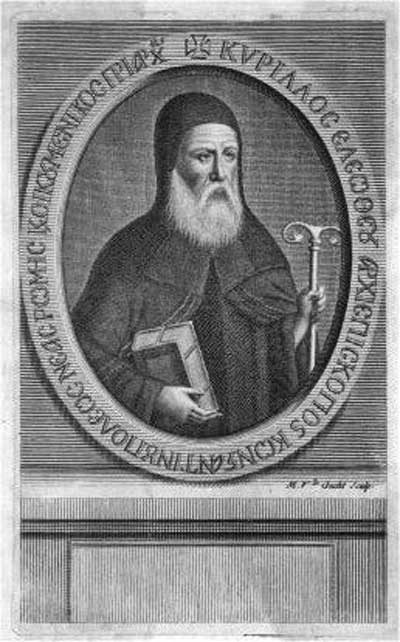
Cyril Lucaris (1572–1638) Portrait by an unknown artist
2. Cyril in Poland-Lithuania In 1596, Cyril was sent by his uncle to minister to the minority Orthodox population within the Roman Catholic kingdom of Poland-Lithuania. Cyril was accompanied by another priest, Nicephorus Cantacuzinos (dates unknown). They walked into an explosive situation that requires some explanation.
The king of Poland at this time was Sigismund III, an ardent Roman Catholic who threw the whole weight of the Polish state behind the Catholic
Counter-Reformation and its "shock troops", the Jesuits. This made life very difficult for Poland's Orthodox population. These were Ukrainians.
Ukraine (or "Little Russia") was the heartland of old Kievan Russia, including the city of Kiev itself, but it had been absorbed into PolandLithuania in the later Middle Ages. This created an anomalous situation: a Catholic kingdom with a large Orthodox minority. The Polish monarchy assumed autocratic powers over the Ukrainian Orthodox Church, appointing its bishops, often for political rather than religious reasons.
In the wake of the Catholic Counter-Reformation, and the harassment inflicted on the Ukrainian Orthodox in Poland by King Sigismund III, a pro-Rome movement emerged among the Ukrainian Orthodox leadership. It was spearheaded by Michael, metropolitan of the Ukrainian Orthodox
Church in Poland, and Bishop Ignatius of Vladimir. They conducted secret negotiations with Rome to submit to the pope on the terms laid down by the 15th century Council of Florence.3 In December 1595, at a council of the Ukrainian Orthodox Church held in Brest-Litovsk, six of the eight
Orthodox bishops voted to submit to Rome. This brought about a very bitter schism in Ukrainian Orthodoxy. Many followed the lead of the six bishops
(they became known as the "Greek Catholics"), but others were outraged and remained defiantly Orthodox. The Greek Catholics were permitted to retain their Orthodox liturgy, married clergy, the old Julian calendar,4 and holy communion in both kinds (the wine as well as the bread given to the laity), but they accepted papal supremacy, purgatory, and the filioque clause.5 The Greek Catholics were also known as the Uniates (Greeks united with Rome).
The remnant Orthodox in Poland now underwent a previously unknown degree of persecution. It served, however, to quicken their energies, and led to an unusual outcome: Ukrainian Orthodoxy acquired a new lay character,
as the laity more than the clergy rallied to defence of Orthodoxy (most of the higher clergy had become Uniates). These lay religious leaders were organized as bratsva (brotherhoods); they produced literature to counter
Jesuit propaganda, and organized Orthodox schools to check the influence of Jesuit schools.
Among the greatest lay defenders of Orthodoxy in Poland was Prince Andrei Kurbskii (1528–83). Kurbskii set up a school to translate the Latin fathers into Russian. He was also a great Byzantinist; that is, he wanted to bring riches of Byzantine Orthodox theology into Ukrainian Orthodox life.
Another lay champion of Ukrainian Orthodoxy was Prince Konstantin Ostrozhskii (1526–1608), who established a school at Ostrog, where Latin,
Greek, and Slavonic were all taught. Ostrozhskii was responsible for the first printed translation of the whole Bible into Church Slavonic. This is still the standard text for most Russian translations. Under Ostrozhskii's influence, schools and printing presses were created to aid the work of the Orthodox brotherhoods of Lviv and Vilnius. These taught in Latin and Polish, and unwittingly began to bring Western intellectual influences into Ukrainian Orthodoxy. It would not be long before the Ukrainian Orthodox were fighting Rome with weapons forged in Roman workshops: the Latin language, Jesuit educational methods, and medieval scholastic theology, with unforeseen results for Orthodox theology and spirituality (see next section).
Cyril and his companion Nicephorus arrived in Poland just after the first council of Brest-Litovsk, where the majority of Orthodox bishops had submitted to Rome. A second council met in October 1596 to ratify the decision of the first, now that the six bishops had been to Rome and been absolved of their erstwhile Orthodoxy by Pope Clement VIII. The second council was a furious affair; the anti-Uniates, led by Prince Ostrozhskii, now outnumbered the Uniates, and the council split into two, each anathematizing the other. Cyril and Nicephorus were present as antiUniates.
Cyril spent a good part of the next four years in Poland, trying to build up the Orthodox in their faith, and fight off the belligerent evangelism of the Jesuits. Cyril diagnosed the greatest problem as the ignorance of the Orthodox clergy: they were poorly educated in their own religion, and could offer little depth of teaching or argument to offset the brilliant Jesuit propaganda. Cyril dedicated himself to improving Orthodox schools and
establishing an Orthodox printing press, first in Vilnius, then Lviv. It was a dangerous life; Cyril's companion Nicephorus was arrested and killed by the Polish police in 1598, and Cyril himself only escaped the same fate by being smuggled out of Poland and fleeing to Constantinople. (He was able to return later.) It was undoubtedly his experiences in Poland that made
Cyril a lifelong and uncompromising enemy of Rome. This in turn was a factor that disposed him to look positively on Rome's other implacable enemy, the Protestant Reformation. Indeed, Orthodox and Protestants had suffered alike in Poland under Roman Catholic persecution, and in the Polish city of Vilnius, Cyril had enjoyed courteous relations with Lutherans.
3. Patriarch of Alexandria At this point, Cyril's life again intersected that of his uncle Meletios,
Patriarch of Alexandria. Meletios was dying; he sent for Cyril, who arrived in Alexandria in September 1601, and two days later, Meletios was dead.
On his dying recommendation, the Alexandrian Church instantly elected Cyril as their new leader. Cyril's patriarchal regime seems to have been outstandingly efficient and benign. Among other things, he relocated the residence of the patriarch from Alexandria (a moribund port) to the vibrant capital city of Cairo, put his Church's finances on a sound footing, and continued to pursue the educational vision he had embraced in Poland, reorganizing the Greek schools under his jurisdiction.
It was in Alexandria, as far as we know, that Cyril first undertook a serious study of the Protestant Reformation. This was made possible by a member of the Dutch Reformed Church, Cornelius van Haag, whom Cyril had met when van Haag was a traveller in the Middle East—he was now
Dutch ambassador to the Ottoman Empire in Constantinople. Cyril himself was back in Constantinople in 1602, where he renewed acquaintance with van Haag, and asked the Dutchman to supply him with theology texts written by Protestants. This request was passed back to Holland, and Cyril received his books. Through van Haag, Cyril became acquainted with the Dutch Arminian theologian, Jan Uytenbogaert, supporter of Arminius and his successor as head of the "Remonstrant" (Arminian) party in Holland.6
Cyril and Uytenbogaert corresponded for many long years. In 1617 Cyril met another Dutch theologian, David le Leu de Wilhelm, who was visiting
Middle East, and kept up a lively correspondence with him too. He also corresponded with the Archbishop of Canterbury, George Abbot, whose theology was Reformed. Abbot initiated the contact, inviting Cyril to send some Greek youths to be theologically educated in England, all costs met by its king, James I. Cyril sent Metrophanes Critoboulos, who would succeed Cyril as Patriarch of Alexandria.
Over these Alexandrian years, Cyril assiduously compared Orthodox and Reformed theology. The outcome, especially in Cyril's famous Confession of Faith (1629), has been a subject of vigorous debate ever since. Some historians—Orthodox, Reformed, and those of other persuasions—think that Cyril really abandoned Orthodoxy altogether, and became a Calvinist in Orthodox robes.7 This, however, does not seem wholly convincing to the
present writer; it would convict Cyril of dire hypocrisy or gross imbecility (there is little evidence of either) in thinking that a pure Genevan Calvinist could be an Orthodox patriarch. Others have accused him of an unprincipled theological adaptability ("all things to all men" in the worst sense), continually tailoring his beliefs to whichever person or group he was trying to impress or mollify.8 But this would merely paint Cyril as a different sort of hypocrite, and it fails to explain his uncompromising hostility to Roman Catholicism—no adaptability there! Within Orthodoxy, some have argued strongly that Cyril remained impeccably Orthodox in his theology, as testified by his other public writings, and that the 1629
Confession was a mischievous forgery either by Calvinists or Jesuits. This view, however, seems to sit light to the evidence of Cyril's large private correspondence with Protestant friends, where he clearly expresses keen sympathy with various aspects of Protestantism, and also says that he is the author of the Confession.9
4. Cyril, Orthodoxy, and Calvinism: a possible perspective The controversy over Cyril's "Calvinism" will probably never die away.
Still, at the risk of introducing even more confusion, the present writer will offer an interpretation different to the three mentioned above.
It seems plausible to me that Cyril was at heart Orthodox, but that he saw in Protestantism both a powerful ally against Counter-Reformation
Catholicism, and also a practical model for reforming and renewing church life that could be "baptized" into an Orthodox context. This twin perception of Protestantism goes a long way towards explaining Cyril's attitude and conduct as an Orthodox church leader. At a more deeply personal level, it is credible that Cyril increasingly found considerable elements in Orthodoxy and Reformed theology to be compatible, perhaps even complementary.
The result was that he incorporated some facets of a Reformed outlook into his expression of Orthodoxy, both in concept and in terminology. Probably one of his purposes in doing so—arguably his chief purpose—was to cement alliances with powerful Reformed countries, especially Britain and the Dutch Republic. Their ambassadors in Constantinople gave Cyril invaluable support against all too effective Roman Catholic attempts to subvert Orthodoxy in the Ottoman Empire, as it had been subverted in Poland.
None of this means that Cyril was a Calvinist in Orthodox robes. It is clear that on some key issues, his beliefs remained firmly within an Orthodox template. For example, Cyril remained trenchantly Orthodox in his utter rejection of Western views of the Trinity; the filioque clause was simply anathema to him, and his Protestant friends could never get him to budge on this point. His high views of the sacramental efficacy of baptism and the eucharist were also typically Orthodox: a robust belief in baptismal grace and in the real eucharistic presence of Christ's body and blood.10 He never deviated from the patristic and Orthodox belief in the perpetual virginity of Mary.11 Cyril also retained an Orthodox faith in the lawfulness of icons, albeit admitting to Protestant friends that their veneration was open to grave abuse. It would appear that, in Cyril's pastoral judgment, some Orthodox folk never got beyond a superstitious veneration of icons to an appreciation of the heavenly realities depicted—especially "the true and spiritual worship and adoration which are due to God alone" (to quote
Cyril). But he never actually condemned icon-veneration; what he explicitly
condemned was the worship of icons. The distinction between veneration and worship was well-known within Orthodox theology. Cyril was probably saying to his Protestant friends that he feared the distinction sometimes failed to filter down into popular Orthodox practice. His understanding of church government also seems to have kept within an Orthodox Episcopal standpoint.12
Alongside this Orthodox structure of belief and piety, however, it seems undeniable that Cyril had also developed a sympathetic attitude to various aspects of Reformed theology. For example, he recognized value in the Reformed stress on man's need of grace—the humanly incurable state of sin, articulated in the Reformed view of man's total spiritual inability to respond to God apart from grace—"total depravity", in popular Reformed parlance. This assimilation of an Augustinian perspective on sin and grace was the most awkward aspect of Cyril's attempt at stating Orthodoxy in Reformed language, since Orthodoxy traditionally has held to "synergism"—the cooperation of divine grace and human free will.
And yet even at this point, some caution may be needed in evaluating Cyril's position. We must keep in mind that he numbered among his friends and correspondents, not only Reformed Protestants, but Arminians too, especially Jan Uytenbogaert. Arminian theology was a variety of Protestantism whose doctrine of salvation aligned itself with the traditional synergism of Orthodoxy. Uytenbogaert remained a close lifelong friend and supporter of Cyril. This could of course be taken as evidence for the "all things to all men" interpretation of the patriarch. It may be suggested, however, that it could instead be seen as mitigating somewhat the "pure
Genevan Calvinist" interpretation. Perhaps Cyril's use of Augustinian language in speaking of the incompetence of the human will and the sovereignty of divine grace did not represent some absolute "fundamentalist" stance. It may have functioned more as a stern reactive protest against the perceived Pelagianism which the Jesuits were at that time busy enthroning within Roman Catholic theology—and hence within Orthodoxy too, under its relentless assault and infiltration by Jesuit-inspired
Catholicism.13 When Pelagianism is the enemy, Augustinian language and models of salvation can appear the most attractive and effective way of trumping it.14
Cyril expressed the Protestant formulation of salvation in terms of "justification by faith", although he was equally insistent that true faith will
always do good works. His view here was not unOrthodox; it was more a case of stating the faith-works-salvation complex in a theological framework not particularly utilized by Orthodoxy. Cyril also appreciated the Reformed stress on the place of Scripture in theology, as the supreme source and norm of doctrine. It has been thought that Cyril here abandoned the Orthodox coordination of Scripture with Church and tradition, but it seems more likely that he simply resonated with the Magisterial
Reformation's "Tradition 1" view of tradition in the life of the Church— critical rather than authoritarian reverence for tradition15—and that this illuminated his own interpretation of the Orthodox view. It is certain that Cyril did not regard himself as a freelance Bible interpreter, accountable to none; when France's Roman Catholic ambassador interrogated him in 1631 about the Confession, the patriarch replied:
I am under no obligation to give an account of my beliefs to the pope. There are the metropolitans and bishops of the Greek Church, and to these, assembled in council, I am ready to justify my position, by reference to the Word of God and the Fathers of the Church.
Even Cyril's seemingly unOrthodox view that the Church on earth may err is quite conceivably a way of expressing Orthodoxy in Reformed language: for it is counterbalanced, in the same breath, by an affirmation that this
Church "is sanctified and instructed by the Holy Spirit" sent by the Father through the Son "to teach the truth and expel darkness from the understanding of the faithful". In other words, the Church is capable of error considered from its human side, as a company of sinful human beings, but is preserved from error considered from its divine side, as the body of Christ and temple of the Holy Spirit.16
Cyril's theology, then, should perhaps be seen neither as Calvinism masquerading deceitfully in Orthodox dress, nor as cynical opportunism which varied according to his audience, nor as pure and simple Orthodoxy which others have mischievously misrepresented as Reformed. Rather, it may have been a deeply personal exploration of common ground between Orthodox and Reformed attitudes and formulas, quite possibly intended more for Protestant than home consumption—an honest attempt by Cyril to restate aspects of Orthodoxy in a form that Protestants could understand and accept. This is not to deny that Cyril himself may have found the attempt congenial. Cyril's restatements of Orthodoxy in Protestant terms may also perhaps have been underpinned in his own mind by an Eastern "apophatic"
perspective on the inability of human language to express spiritual truth in ways that could avoid paradox.17
In the present writer's opinion, what will strike the Orthodox eye as strange and suspicious in Cyril's Confession of Faith (apart from his
Augustinian-leaning formulations of sin and grace) is not so much what it says, as what it leaves unsaid. Cyril puts "up front" an interpretation of Orthodoxy consisting in all the points where it is most obviously compatible with Reformed theology, and downplays everything else. This, coupled with Cyril's fairly numerous uses of a Reformed terminology with which most Orthodox were then unacquainted, probably accounts for the anxious rejection his Confession encountered in his own day from the majority of theologically trained Orthodox (apart from Cyril's little team of devoted supporters). What Cyril's critics could not have anticipated, however, was the huge flourishing in the 18th century of a virtually identical style of Protestant-friendly "Cyrillian" theology in Orthodox
Russia (see below).
5. Patriarch of Constantinople By the time Cyril was called to the patriarchate of Constantinople in November 1621 (1620, according to some), his personal interpretation of Orthodox-Reformed congruity seems to have been complete. He was now in the highest office in the Orthodox Church, which has traditionally accorded primacy of honour to the Patriarchs of Constantinople (hence their title, "ecumenical patriarch"). His patriarchal reign is perhaps second only to that of the medieval giant Photius the Great in its religious interest and dramatic colour.18
The driving force behind Cyril's 17 years as patriarch was, in a sense, negative: the conflict with an aggressive Counter-Reformation Roman
Catholicism. We must remember that Constantinople was no longer a Christian city; it was now the capital of the Islamic Ottoman Empire, which controlled all four of the historic Eastern patriarchates (Constantinople,
Antioch, Jerusalem, and Alexandria). As Patriarch of Constantinople, therefore, Cyril was caught in a complex set of power-relationships. He owed allegiance to the Ottoman Sultan, an Islamic despot; but the Sultan and his ministers were susceptible to the influence of the Western world's stronger states through their ambassadors. And through the French and Austrian ambassadors in Constantinople, the Roman Catholic Church was expending every effort to win over the Greek Orthodox population of the Ottoman Empire, either by conversion, or (more subtly) by persuading
Orthodox to embrace a Roman Catholic type of theology within Orthodoxy.
Cyril's experiences in Poland, with Rome successfully splitting off many Ukrainian Orthodox into a Uniate Church, had given him a very negative slant on all things papal. He found this all too relevant as leader of the Greek Orthodox in Constantinople. The agents of Rome—the papacy itself, the Jesuits, the French and Austrian ambassadors—saw Cyril as a menace of the highest order who had to be overthrown at all costs. Pope Urban VIII (1623–44), Cyril's archenemy, described him as "that son of darkness, that athlete of hell, the pseudo-patriarch Cyril".
The Jesuits were already active in Constantinople prior to Cyril's arrival.
Protected by the French ambassador, they ran a school offering free education to Greek children. Jesuit schools were the most efficient and successful in Europe, and the Constantinople school was an instrument for converting Greeks to Roman Catholicism. The children were a hook to
draw in the parents. One Jesuit commented, "Through these children, we have reconciled many of their parents and even whole families with the Roman Church." The Orthodox women of Constantinople proved especially susceptible to Jesuit methods. An Orthodox contemporary, Chrysosculos the Logothete, lamented:
The women were easily influenced by the eloquence and the charming manners of these new guides of conscience [the Jesuits], who succeeded in persuading them to come to them for hearing confession of their sins, without intimidating them and without imposing any rigorous penance or severe fasting.
A partisan report, perhaps, but it was grounded in fact.
There was also, among the Orthodox clergy, a party favourable to Rome.
It owed its greatest impetus to the College of Saint Athanasius in Rome, founded by Pope Gregory XIII in 1577 for the express purpose of educating young Greeks and imbuing them with Roman sympathies (see Volume
Three, Chapter 9, section 3). As a result, there were now Greek Orthodox clergy who had "unionist" sentiments: they supported Orthodox reunion with Rome, along the lines of the Uniate Church in Poland. One of these unionists, in the period 1603–1608, had managed to become Patriarch of Constantinople—Raphael II, a graduate of the Saint Athanasius College, who did all he could to advance crypto-Romanism within Greek Orthodoxy.
The context of Cyril's work, then, was dictated by this contest with a militant Counter-Reformation Catholicism.
Cyril's initiatives as patriarch to defend and build up Orthodoxy within the Ottoman Empire included the following. He gathered a group of Orthodox scholars in Constantinople to spearhead a sort of intellectual rearmament of Orthodox theology. One of these scholars, Theophilus
Corydalleus (1563–1645), was appointed head of the patriarchal academy; the aim was to reform the academy, in order to offset the influence of the Jesuit school. Corydalleus was a good choice; he was one of Greek
Orthodoxy's most celebrated and brilliant thinkers and teachers, who had been principal of a philosophical college in his native Athens. Corydalleus also sympathized warmly with Cyril's attitude towards Orthodox-Reformed rapprochement against Rome. A successful head of the patriarchal academy,
Corydalleus raised it to standards of excellence, especially in science, that made it the equal of any Western university.
Convinced that religious ignorance among the Orthodox was a chief cause of Jesuit success, Cyril tried to reinstate preaching as a tool for
raising Orthodox consciousness. Contemporary testimony tells us that preaching had fallen into widespread neglect in the Orthodox Middle East
—"the custom of preaching had been abolished," according to the French traveller Pitton de Tournefort. We do not know what large-scale success
Cyril enjoyed in reviving the art of preaching, but we do know he appointed the eloquent Archbishop of Ephesus, Meletios Pantogalos (1596–1646), as a sort of missionary preacher. In his preaching tours, Pantogalos bore with him a commendatory letter of authority from Cyril, in which the patriarch addressed all clergy and laity, comparing Pantogalos to a good physician who must not be limited to one locality. Pantagolos, like Corydalleus, supported the Cyrillian Orthodox-Reformed alliance.
Another aspect of Cyril's attempt to dispel ignorance was the publication of good literature. An Orthodox printing press was set up in Constantinople in June 1627, under the protection of the British ambassador, Sir Thomas
Roe. This was the first ever printing press in the Greek world. Its first production was a work by Cyril's uncle, Meletios Pegas of Alexandria—a polemic against the supremacy of the pope. This shows with naked clarity the anti-Roman thrust of Cyril's strategy. The press also turned out two further books on the subject by Nilus of Thessalonica and Gabriel of Philadelphia, and other items aimed against Rome. The Ottoman government intervened, however, incited by Constantinople's Jesuits, and destroyed the press in January 1628; the Jesuits had persuaded the Grand
Vizier (prime minister to the Sultan) that a book by Cyril against Judaism had insulted Islam. The judgment was later reversed, but by then it was too late; the precious printing machinery had been wrecked.
This incident, however, brought one great benefit to Cyril: it resulted in the expulsion of the Jesuits from Constantinople. After the destruction of the press, the Grand Vizier had been shaken by the solemn judgment of Ottoman religious experts that Cyril's book had not in fact insulted Islam.
An alarmed Vizier now felt he had been manipulated and conned by the Jesuits. This, coupled with the outrage of Sir Thomas Roe, the British ambassador, who had provided a house for the printing press, moved the Vizier to wrath against the Jesuits, and they were driven from Constantinople. From that point, Rome had to rely on members of the Capuchin order in its campaign against Cyril.
Cyril also authorized a translation of the New Testament into modern Greek (rather different to New Testament Greek). The translator was Cyril's
friend, the monk Maximos Callioupollites; Cyril wrote a preface, vindicating the right and duty of all Christians to read the New Testament in a language they could comprehend. The new translation was published in 1638. It contained the original Greek text and the modern version in parallel columns, with some uncontroversial marginal comments. Some years after the death of Cyril, the prominent Greek Orthodox monk-theologian,
Meletios Syrigos (d.1667), vigorously denounced the translation as a Protestant perversion, but he was silenced and banished to the island of Chios by Patriarch Parthenios II, who sympathized with certain aspects of Cyril's work. The new translation seems to have achieved some popularity; forty years after Cyril's death, an English diplomat in Smyrna reported that Cyril's New Testament was being used for public readings in some
Orthodox churches. There are still signs of the work in 1714, when the Greek writer Alexander Halladios urged Orthodox to burn any copies of the book they found. Thereafter, it fades from view. Greek Orthodox opposition to the new translation was rooted largely in reverence for the ancient Greek in which the New Testament was written. Any tampering with this venerable old Greek was seen as a kind of sacrilege.
While we are on the topic of the Greek New Testament, it should be noted that it was Cyril who, in 1627, donated the illustrious Codex
Alexandrinus to the British government, in recognition of all the help he had received from the ambassador Sir Thomas Roe. Codex Alexandrinus is one of the most important manuscripts of the Bible in Greek, dating from the 5th century. It contains the Greek Old Testament (the Septuagint), and an almost complete New Testament, lacking only portions of Matthew,
John, and 1 Corinthians. It also has the two Epistles of the apostolic father Clement of Rome, from which the earliest English editions were taken.
The last aspect of Cyril's activities to note is the publication of his Confession of Faith in 1629 in Geneva, initially in Latin. It was published in Geneva, not because of the Confession's "Calvinism", but because by then, Cyril's own printing press in Constantinople had been destroyed. At this period in Orthodox history, apart from the brief six months when
Cyril's press functioned, all Orthodox literature had to be printed in the West. Geneva was simply one of several good international printing centres.
A second edition of the Confession, both Latin and Greek, followed in 1631. Questions of authorship and content have already been considered; we will see its fate after Cyril's death. It is almost impossible to assess its
diffusion and influence within the Orthodox world, unless we judge that its planned condemnation in a pan-Orthodox council or synod in Jassy (in Moldavia), and its actual condemnation in a council in Jerusalem, indicate a pervasive awareness of the Confession. In Europe, it was widely translated: for example, into English twice, and into French four times.
6. Cyril's final downfall and death Cyril's patriarchate was stormy. Through the scheming of Jesuits,
Capuchins, and the French and Austrian ambassadors, often in conspiracy with Romanizing Orthodox clerics, Cyril was deposed from office and then reinstated no fewer than five times. At last, however, a plot by the Austrian ambassador, Schmid-Schwarzenhorn, and the ardently Romanizing
Orthodox Bishop of Aleppo, Cyril Contari (who had been trained by Jesuits), brought about Cyril's deposition for the last time in 1638. SchmidSchwarzenhorn and Contari persuaded the Ottoman sultan, Murad IV (1623–40), that Cyril was plotting with Murad's military enemies, the Cossacks. Murad, a notoriously savage despot, had Cyril arrested, condemned without trial, and—on the evening of June 27th—strangled to death by imperial troops in a remote spot near the port of Saint Stephanos, south of Constantinople. When the news of Cyril's execution became public, the Greek Orthodox population of Constantinople almost rioted in protest against Contari; they congregated outside the Romanizing bishop's house, crying, "Pilate, give us the body!" This indicates the high level of affection in which Cyril was held by his flock, and their contempt for his betrayer.
Cyril's death brought an end to his experiment in enlisting Reformed support for Orthodoxy against Rome. His team of co-workers dispersed.
For example, Theophilus Corydalleus, head of the patriarchal academy, was sacked, and retired from Constantinople. But he was soon appointed Bishop of Artos and Naupactos by Patriarch Parthenios I, who had a high personal regard for Cyril, despite not sharing his "ecumenism" towards Protestants.
It seems, however, that Corydalleus' Cyrillian views got him into trouble as bishop, and led to his disgrace. He died in abject poverty. The Archbishop of Ephesus, Meletios Pantogalos, Cyril's missionary preacher, ended up in the Dutch Republic at the University of Leyden, where he enjoyed great esteem. In Pantogalos, at least, the Orthodox-Reformed amity lived on.
7. Controversy continues Cyril's enemies within Greek Orthodoxy were determined to blacken his memory. Contari, who overthrew Cyril and then succeeded him as Patriarch of Constantinople, summoned a council in September 1638, at which both
Cyril himself and his Confession were anathematized. The 13 anathemas were signed not only by Contari, but also by the patriarchs of Jerusalem and Alexandria, as well as 24 archbishops and bishops. However, Contari was
(as we have seen) motivated by ardent pro-Roman sympathies, and when in December that year he actually submitted to Pope Urban VIII as head of the Church, the Holy Synod—the governing body of Constantinople's church— was outraged. So was sultan Murad, and Contari was deposed and banished.
Controversy over Cyril rumbled on, however. Among Cyril's enemies were Peter Moghila, leader of the Ukrainian Orthodox (see next section), and Meletios Syrigos (he who denounced Cyril's New Testament). Moghila and Syrigos were working closely with Basil the Wolf (1634–53), king of the independent Slavic domain of Moldavia, by the western shores of the Black Sea. Basil saw himself as a latter-day Byzantine emperor, the lay head of Orthodoxy; the patriarchate of Constantinople was now deeply in his debt, since he had personally restored its solvency after Cyril's death.
Basil, Moghila, and Syrigos pressurized Patriarch Parthenios I into convening a new council in Jassy, Basil's capital city, in 1642.
Made up of both Greek and Slavic representatives, the council's overall purpose was to define Orthodox doctrine in response to the challenges of Counter-Reformation Catholicism and Cyril's perceived cryptoProtestantism. Top of the agenda, in fact, was the condemnation of Cyril's
Confession. The Russian delegates, however, scuppered the plan by insisting that the Confession was (a) probably a forgery, (b) if not a forgery, a purely personal statement by Cyril, which thus had no actual authority for Orthodoxy at large and therefore did not need to be condemned. Basil,
Moghila, and Syrigos were forced to rest content with a condemnation of a catechism written by one of Cyril's supporters (although ascribed to Cyril); nothing was said about Cyril himself. Ironically, the Council of Jassy has itself been judged by most later Orthodox as leaning too far towards Rome, especially in the confession of faith it adopted, authored by Peter Moghila
(see next section).
The story was still not over. Cyril's Confession was condemned 30 years later in 1672, at a synod in Jerusalem, summoned by its patriarch,
Dositheos II (1669–1707). Here Cyril himself was vindicated: the Council of Jerusalem declared the good patriarch not to be the author of the bad
Confession.19 The furthest the Council of Jerusalem would go in casting aspersions on Cyril was to say in its fifth decree that if he really wrote the Confession, he was a heretic worthy of eternal anathema and excommunication. But the Council left the world in no doubt that the Confession itself was bad. The Council's own statement of faith, written by Dositheos, has (like that of Peter Moghila) been regarded by later generations of Orthodox as rather too laden with Roman ideas and terms, although less so than Moghila's.
8. Epitaph So ends our treatment of Cyril Lucaris. The extremely varying interpretations his life and work have provoked may mean that he remains ultimately an enigma to many. The verdict of this book is that he was a fundamentally Orthodox theologian, with an ecumenical vision (in the best sense of the much abused word) enabling him to appreciate the Christian virtue of spiritually-minded Protestants, to recognize value in the Protestant
Reformation as a model for church renewal, and to exploit whatever theological and practical armaments the Reformation had to offer the East, in the common struggle with an aggressive Counter-Reformation
Catholicism. He went as far as he could in restating Orthodoxy in a way his Reformed supporters could understand, even to the point of insufficiently guarded formulations that gave hostages to his foes, particularly among the Romanizing Orthodox.
Whatever view one takes of Cyril's theological stance, however, through all of his personality and labour there shines a single-minded, energetic commitment to build up Orthodox people in the understanding and practice of their faith. Religious ignorance was his enemy, education was his weapon. Much of this endeavour had nothing to do with an OrthodoxReformed rapprochement. And there was one thing Cyril would never countenance: compromise with Rome. For this, he paid with his life.