
1. Of presbyters and kings: from Andrew Melville to the union of crowns
Of presbyters and kings: from Andrew Melville to the union of crowns 1. The death of Knox John Knox had done his work. The titanic figure had yielded up his soul in 1572, leaving a reformed Scotland under the government of James
Douglas, Earl of Morton (c.1525–81). He ruled as regent in the name of a young King James VI (born 1566, reigned 1567–1625), who was only six years old. Morton's church policy flowed from the so-called "Concordat of Leith", a religious settlement hammered out between Morton and the Kirk's general assembly in August 1572. Knox's participation in this meeting had been his last act of public significance.
The purpose of the meeting was to settle the question of the Scottish bishoprics that had survived the Reformation. Morton wanted to model the Scottish Kirk on the English Church, with the crown having supreme power, and appointing bishops as royal servants. Knox, however, had weighty objections. A compromise agreement provided that as Episcopal vacancies arose, qualified candidates at least 30 years old should be nominated by the crown, and then examined by a committee of ministers who had the right to accept or reject the nominee. When elected, the bishop was to swear allegiance to the general assembly in spiritual matters, and to the crown in civil matters. Knox acquiesced in this compromise settlement; he probably felt that it was the only practical way to secure finance for providing the spiritual oversight of certain areas of Scotland, previously visited by temporary commissioners of the general assembly. (Other areas had full-time "superintendents".) Morton enforced the Concordat of Leith vigorously. Within four years, he had filled all vacant bishoprics with his own nominees. They were not, however, very popular; the contempt in which they were held is shown by their nickname—"tulchan" bishops. A tulchan was a dummy calf used to persuade a cow to give milk more freely. This was applied to Morton's bishops because their incomes were used to provide pensions for Morton's friends!
2. Andrew Melville and the Second Book of Discipline Opposition to Morton's self-interested policies soon found a mighty champion in Andrew Melville (1545–1622), sometimes called Scotland's second Reformer (after Knox). If anyone other than Knox shaped the Reformed faith in Scotland, it was undoubtedly Melville. He was less rugged, more scholarly, than his predecessor, but no less intrepid, and probably no less influential. Born at Baldovie in Angus, Melville studied at a variety of Europe's academic centres—Saint Andrews, Paris, Poitiers, and Geneva. By the time he returned to Scotland in 1574, still a young man, he was one of the foremost scholars of the age: a brilliant linguist, fluent in Latin, Greek, Hebrew, Chaldee, and Syriac; a Ramist philosopher who used
Ramist methods to liberate the teachings of Aristotle from what he considered medieval misinterpretations (Melville's mastery of Aristotle in the original Greek was unequalled);1 and an erudite Reformed theologian, trained by the illustrious Theodore Beza.2 His personality had both infectious fire and large-minded generosity. Certainly no one could accuse him of lacking the courage of his Reformed convictions, as we shall see.
On returning to his native land, Melville was (at the surprisingly youthful age of 29) appointed principal of Glasgow University, which he radically reorganized. He especially demoted the medieval version of Aristotle in favour of Ramist thinking. His educational reforms extended far beyond
Glasgow; he helped restructure teaching at Aberdeen University in 1575, and in 1580 he moved to Saint Andrews University, carrying out similar changes there. Saint Mary's at Saint Andrews became a divinity college, with Melville as principal. His ideals also shaped Edinburgh University when it was created in 1583. So gifted a figure could hardly remain obscure in the Kirk; he was elected moderator of its general assembly four times (in 1578, 1582, 1587, and 1594).
Melville was soon involved in a bold new movement to promote a more fully Presbyterian model of church government for Scotland. The Concordat of Leith was becoming obnoxious to some of the best minds in the Kirk, especially the way that regent Morton was taking advantage of it with his tulchan bishops. In the general assembly of 1575, the Edinburgh minister John Durie (c.1537–1600), a strong Calvinist and opponent of Episcopacy, sparked a debate on whether bishops were warranted by Scripture. By "bishops" he meant "diocesan bishops"—those who ruled a
diocese, having a whole region of congregations and pastors under their authority. (This was the traditional Roman Catholic and Eastern Orthodox pattern, inherited and perpetuated by the Anglican Church, and now halfpresent in the Scottish Kirk.) Melville responded to Durie's overture with a forceful speech arguing for the full-blooded Presbyterian scheme of church government, as it had been conceived by Martin Bucer and John Calvin in the previous generation, and fleshed out in Calvin's Geneva. In the New
Testament, Melville maintained, the "bishop" was equivalent to a simple congregational pastor or minister, and all ministers were equal in rank and dignity.
Melville's speech was well received: Presbyterian sentiment clearly had a following among Scottish ministers and elders. Consequently the assembly appointed a committee of six, including Melville, to investigate the question. The committee finally reported that "the name of bishop is common to all that have a particular flock over which they have charge to preach the word, minister the sacraments, and execute the ecclesiastical discipline with consent of the elders". The committee accepted that the Kirk might appoint some ministers as superintendents, with a wider oversight above local congregational level; but this, contended the committee, was a special commission which required the consent of the ministers over whom the superintendent was appointed, and the consent of his own congregation that their minister should take on this extra duty.
The general assembly of 1576 debated and approved this report, encouraged at this point by regent Morton, who perhaps did not quite grasp how serious Melville and his colleagues were in their ideals and commitment. The assembly appointed another committee to submit draft proposals on the proper constitution of the Kirk. Morton's initial flexibility, however, turned into angry hostility when the assembly opposed the regent's chosen candidate (Patrick Adamson) for the vacant archbishopric of Saint Andrews. When Morton went ahead and appointed Adamson over the assembly's head, the assembly charged Adamson with unlawfully intruding himself into the archbishopric. Morton was incandescent with rage. As a result of this rupture between the regent and the general assembly, the latter's proposals on the constitution of the Kirk, drafted chiefly by Melville, were stillborn; Morton was now in no mood to be conciliatory to a Kirk that had snubbed him by rejecting "his" man for the archbishopric. The proposals, however, did win the allegiance of a large
party in the Kirk, and are of colossal historical significance as the manifesto of Scottish Presbyterianism—or at least Melvillean Presbyterianism, as it is often known. The manifesto took the shape of the Second Book of Discipline.3
The Second Book of Discipline made a clear distinction between Church and state. Each had its own God-given sphere of authority: they were distinct but should cooperate. (In modern terms this is the doctrine of "sphere sovereignty".) The godly magistrate had the power to reform a corrupt Church; but once the Church was Reformed, the magistrate must then support it in its functions, and submit to its discipline if he sinned.
Within the Church, the Second Book of Discipline distinguished four offices: pastor, minister, or bishop; doctor or teacher; presbyter or elder; and deacon.
Pastors preached the word, administered the sacraments, and oversaw the spiritual life of the congregation.
Doctors were chiefly theology tutors in the universities, although the title could include catechizers and locally appointed lecturers.
Elders cooperated with the pastor in church discipline; they were to be elected for life (a change from the Reformation settlement of 1560, where elders were elected annually). Pastors and elders together formed the assemblies of the Kirk, which were of four kinds—congregational (the kirk session), provincial (presbyteries and synods), national (general assembly), and ecumenical (a theoretical global assembly for Presbyterians of all nations).
Deacons made sure the Kirk's income was collected, and distributed it to the pastors, the schools, and the poor.
The Second Book of Discipline ended with a list of abuses to be corrected: bishops must be pastors of particular congregations, and should not be distracted by holding political office (hence they should have no seat in parliament); the general assembly should be free to meet and determine all Kirk affairs without any interference by the state; the system of patronage—ministers being chosen by local landowners—should be abolished so that congregations could elect their own pastors.
3. King versus Kirk: the wheel of fortune Regent Morton refused to enact the Second Book of Discipline in any way, shape, or form. But his days were numbered; he had made too many enemies. Ironically these included not just the Reformed Kirk, with Melville as its spokesman, but also two powerful Roman Catholic nobles, the Earl of Argyll and the Earl of Atholl. With no one left to support him, an isolated Morton was compelled by his foes to resign in 1578. However,
Scotland was almost plunged into civil war by Morton's successful bid to regain power by sheer brute force (he kidnapped the young King James, who was to have more than his fair share of kidnappings); but after two more precarious years of regency, Morton's adversaries toppled him for good. The disgraced earl was executed in 1581—ironically, by a guillotine he had himself brought to Scotland because he had been so impressed by its efficiency. The regency now passed into the eager hands of the youthful monarch's new favourite, Esmé Stewart, soon elevated to be Duke of Lennox.
The year of Morton's execution witnessed a far more important event for Scotland's Kirk—a new confession of faith, not supplanting but supplementing the Scots Confession of 1560. This new confession was known as the King's Confession (or sometimes the Negative Confession). It was a specifically anti-Roman Catholic confession of faith, the product of an anti-Catholic panic that had seized the country: from king to peasant, everyone seemed suddenly to be seeing murderous papist conspirators hiding under every bed. The panic grew from Scottish fears of the increasing militancy in Europe of the Catholic Counter-Reformation, especially the aggressive anti-Protestant policies of King Philip II of Spain;
Philip was at that time waging a savage war against Dutch Protestants, and within seven years would launch an invasion of England. In Scotland itself, these anti-Catholic anxieties were focused on the figure of regent Lennox, an ex-Catholic whose conversion to Protestantism many thought was insincere.
The King's Confession was an attempt to flush out Scottish Catholics and solidify the nation's Protestant faith. It was written by John Craig (c.1512–
1600), one of the royal chaplains and an old friend of John Knox (he had served as Knox's co-pastor in Edinburgh's Saint Giles Kirk). As well as the
King's Confession, Craig wrote a famous catechism (also in 1581), which would be widely used in our period.
The King's Confession came in four parts:
1. It reaffirmed the theology of the Scots Confession.
2. It denounced in detail various distinctive Roman Catholic doctrines and practices.
3. It imposed an oath disowning any inclination towards Roman Catholicism.
4. It imposed a declaration of fidelity to king, country, and the Protestant religion.
The King's Confession became a colourful symbolic flag for future Scottish Presbyterians to rally around. It came to be seen as a national oath, perpetually binding on the Scottish people; when the Covenanting movement arose in the mid-17th century (see section 3), this was to be one of their most powerful and persuasive arguments—they were simply practising a godly loyalty to the King's Confession.
The King's Confession, however, failed spectacularly in its most immediate aim, because the dubious Lennox signed it. So some nobles decided on more direct action. In 1582, the Earls of Gowrie, Mar, and Glencairn—Protestant zealots and extreme opponents of Lennox—lured
King James to Ruthven castle (it belonged to Gowrie), took him prisoner, and for 10 months ruled the country in his name. They forced James to banish Lennox, who sailed away to France, where he died a few months later. James' lamentation was passionate, outpoured in a poem A Tragedy of the Phoenix. Most Reformed ministers approved of the "Ruthven Raid", as it was called, and the general assembly hailed the three earls as Protestant heroes. Queen Elizabeth of England also gave them her backing. The Godfearing government of the three earls did not last, however; in 1583, James managed to escape from their clutches, re-establishing his authority through his old ally James Stewart, Earl of Arran (d.1595), who saw this as his opportunity to make himself master of Scotland. Gowrie was arrested and executed for treason.
James' new administration, headed by a dictatorial Arran, did not look kindly on a Kirk that had extolled the king's kidnappers as spiritual heroes.
In February 1584, Andrew Melville was summoned before the Privy
Council,4 charged with preaching treason; he refused to accept the council's authority over his pulpit utterances, and was given a prison sentence in the notorious Blackness Castle, on the Firth of Forth. Rather than enjoy the king's hospitality in Blackness, Melville fled to Berwick-upon-Tweed, just over the border with England.
In May, at Arran's bidding, a subservient parliament passed a series of anti-Kirk acts, which Presbyterians deplored as the "Black Acts". These statutes decreed the king's supreme authority in all matters both spiritual and civil. His subjects were forbidden to gather in assemblies (including those authorized by the Kirk) without the king's command. Preachers were forbidden to say anything in sermons detrimental to the king or his policies.
Finally, the bishops—dependent on royal patronage—were given greater legal authority to examine and discipline ministers. All parish ministers were required to subscribe to the Black Acts on pain of deposition. Most subscribed; some subscribed with the reservation "as far as the Word of God allows"; Andrew Melville and a minority of steadfast Presbyterians refused to subscribe at all, and went into exile in England. There they joined a group of refugee Protestant nobles who had supported the Ruthven raid; they were being treated cordially by Queen Elizabeth.
In 1585, these nobles marched back victoriously into Scotland with an army. The wheel of fortune had turned again. The anti-Presbyterian Arran was deposed (he fled), and a new Presbyterian government was formed under Sir John Maitland of Thirlstane (1543–95), a good friend of the Kirk for political reasons. The synod of Fife excommunicated Archbishop
Adamson of Saint Andrews for his part in passing the godless Black Acts.
Preachers became bold again, and administered a verbal lashing to the unfortunate King James in their sermons.
4. No bishop, no king!
In the aftermath of this latest Presbyterian triumph, James and the Kirk— perhaps surprisingly—made various attempts at compromise; maybe both sides were weary of the wheel of fortune. Bishops, however, proved a sticking point. James was now 19 years old, a prodigy of scholarly learning, and more than capable of forming independent and sophisticated policies of his own. He wanted bishops of the old Catholic and new Anglican type: powerful figures in the Kirk, but owing their power to royal favour— instruments, effectively, of the royal will. Elizabeth of England had them: why shouldn't James? The general assembly, scenting an attempt to subordinate Kirk to monarchy, was not willing to accept anything more than someone already in the parish ministry being made a special commissioner of the assembly. James backed down. In July 1587 he got parliament to pass the Act of Annexation, whereby the landed properties of bishoprics were taken over by the crown. This enriched the king, but it weakened the prospects of Episcopacy in Scotland.
There seemed to be a more emotional kind of rapprochement between James and the Kirk after his marriage to Anne of Denmark in 1589. The king even lavished approval on Andrew Melville, publishing a poem of Melville's celebrating Anne's coronation in 1590. At the general assembly of that year,
James referred to the Scottish Kirk as "the sincerest [purest] Kirk in the world", and even made disparaging remarks about the Church of England. In 1592 a parliamentary act—the "Golden Act"—was passed at the bidding of Sir John Maitland. The Act confirmed the Presbyterian character of the Kirk, incorporating statements from the Second Book of Discipline. The general assembly was accorded the right to meet annually, in the presence of the king or his commissioner who were to appoint the time and place of the next meeting. If neither king nor commissioner were present, the assembly had the right to fix the next time and place. The powers of bishops were transferred to presbyteries.
With the Golden Act, the future now seemed set for harmony between James and the Kirk. But this fair prospect proved deceptive. Popular suspicions began to be inflamed against the king by his conciliatory attitude to Roman Catholics. For example, the Catholic Earls of Huntly, Errol, and Angus had entered into treasonable correspondence with King Philip of Spain, the European champion of intolerant Catholicism; James merely
banished them, and soon allowed them to return. This scandalous leniency led to public criticism of James in the general assembly of March 1596. This was the famous or infamous occasion when Andrew Melville plucked James by the sleeve, called him "God's silly vassal" (God's feeble servant), and informed him pointedly:
Sir, as diverse times before, so now again I must tell you, there are two kings and two kingdoms in Scotland; there is Christ Jesus and His kingdom the Kirk, whose subject King James the Sixth is, and of whose kingdom he is not a king, nor a head, nor a lord, but a member; and they whom
Christ has called and commanded to watch over His Kirk, and govern His spiritual kingdom, have sufficient power of Him and authority so to do, both together and severally, the which no Christian king nor prince should control and discharge, but fortify and assist, otherwise they are not faithful subjects nor members of Christ.
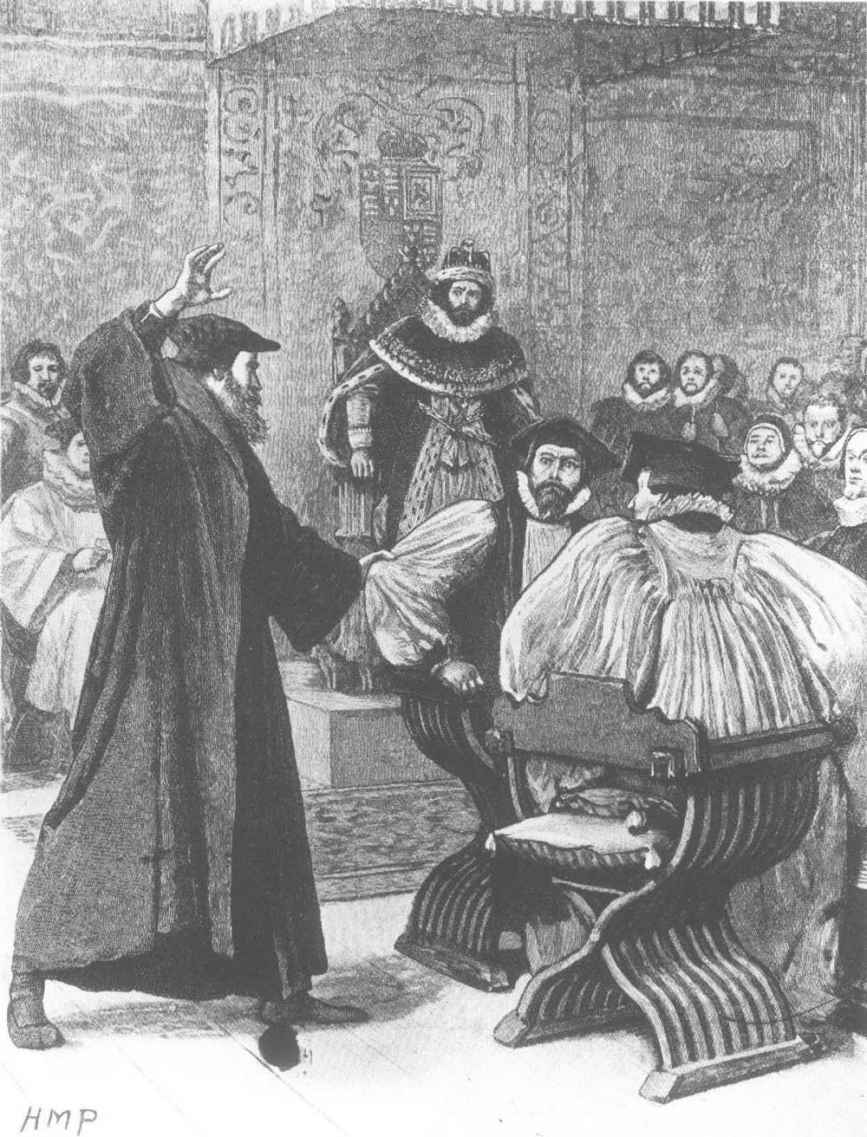
Andrew Melville (1545–1622) Andrew Melville upbraids a bishop at the court of James VI
Unknown Victorian artist Probably no Scottish king had ever been given such a lecture by any of his subjects. Following Melville's intrepid lead, preachers once again used their pulpits to denounce James for his lack of loyalty to the Reformed faith.
This was the last straw for James. He now conceived an absolute, lifelong hostility towards Presbyterianism. It "as well agreeth with a monarchy as God and the devil", he declared bitterly. Royal government in the state demanded bishops in the Kirk: "No bishop, no king!" James also began ever more fervently advocating and practising the theory of "the divine right of kings"—the view that monarchs are accountable only to God, not to their subjects, and certainly not to any Church. James published his divine right theory to the world in 1598 in his The True Law of Free Monarchies; or, The Reciprocal and Mutual Duty Betwixt a Free King and His Natural Subjects, a learned and eloquent statement of monarchical absolutism.
In his indignation against Melville, and Melville's apparent belief in a clergyman's right to lecture his sovereign, a newly militant James decided to make a sacrificial victim of one of the Presbyterian leader's foremost disciples, David Black (c.1550–1603), minister of Saint Andrews. Black was cited before the Privy Council for preaching sedition. As Melville had done in 1584, Black refused to recognize the council's authority over ministers' pulpit utterances; he was backed by many other ministers who signed a petition in his favour. The trial went on for months. Eventually Black was found guilty and sentenced to "internal exile" in the area beyond North Esk river (in Angus and Aberdeenshire). Popular support for Black spilled over into a riot in Edinburgh, inflamed by rumours of a Catholic plot. Faced with mob violence, James moved swiftly; seizing the moral and legal high ground, he threatened to strip Edinburgh of its status as Scottish capital unless it made a complete submission to his will, and demanded the arrest of its obnoxious Melvillean ministers. The ministers fled in panic, leaving the field in James' hands. Flushed with triumph, he took severe punitive measures against the overawed city; from now on, none of its clergy or magistrates could be appointed without royal consent.
This dramatic event marked the effective end of Andrew Melville's ascendancy in the Kirk. James now deliberately isolated Melville, deposing him from his office as Rector of Saint Andrews University, and forcibly preventing him from attending any ecclesiastical gatherings (other than
Sunday worship). It was an unlawful use of royal power, but it was
successful. The king also began to implement a single-minded programme of consolidating his personal authority over the Kirk; his weapon was a crafty use of the right granted him in the Golden Act to fix the time and place for each new general assembly. James chose venues like Perth, Dundee, and Montrose, where he could secure the attendance of ministers from the north of Scotland. They were more open to royal manipulation; James could persuade them to feel ill-will towards southern clergy, who had until then dominated the general assembly when it had met in Edinburgh. In pursuit of this policy, James launched a campaign of systematic flattery toward the northern ministers. It paid rich dividends in the general assembly at Dundee in 1597: the assembly agreed to set up a commission of 14, with a broad range of powers, to confer with James on all ecclesiastical matters.
Before the close of 1597, the commission recommended that the Kirk be represented in parliament—a gross violation of the Melvillean ideal of sphere sovereignty (see above). The proposal played into James' hands, because it meant he would be able to control which churchmen were represented in parliament, who could then claim to be the Kirk's parliamentary voice when in reality they were the king's voice. Through these churchmen in parliament, James could guide legislation affecting the Kirk. And of course, why not designate these churchmen as bishops? Here was James' perfect opportunity to smother Presbyterianism and smuggle in Episcopacy by the back door. Accordingly parliament passed an act that those ministers whom the king appointed to the rank of bishop (or equivalent) should have a seat in parliament. This was fiercely debated in the general assembly in Dundee in 1598, but the motion passed by a small majority. James barred Andrew Melville from taking part in the assembly, even though he was a properly elected delegate.
Although Melville had now been shunted to the sidelines, effectively isolated by James, one of Melville's most intimate disciples who had not been quite so marginalized was doing what he could to promote his master's ideals. This was Robert Bruce (1554–1631). If Melville was Knox's successor, Bruce was Melville's: the spiritual lineage passed directly from one to another of these giants of Scottish Presbyterianism.
Bruce was a native of Kinnaird, near Stirling, son of a Catholic mother and a Reformed father. After studying law, he decided to devote his life and talents to the Kirk, feeling an irresistible inward call of God to preach; he became minister of Saint Giles in Edinburgh in 1587. Bruce rapidly came to
be held in outstandingly high regard by the Kirk for his piercingly eloquent sermons and his saintly character. At first he even enjoyed the favour of King James, who was intimidated by the majesty and authority of Bruce's preaching and the sanctity of his person. However, as relations progressively broke down between James and the Kirk in the 1590s, so the king increasingly withheld his smile from Bruce.
The final rupture between monarch and preacher came in 1600. In a white heat of Reformed zeal, the young Earl of Gowrie (son of the Gowrie who had been executed for the Ruthven Raid) tried to emulate his father by kidnapping James, or even killing him—the accounts are confused. The outcome, however, was that Gowrie and his brother were slain. Many suspected a conspiracy by King James to murder the brothers. James ordered the five ministers of Edinburgh—which included Bruce—to read from their pulpits the royal version of what had happened; they refused, on the grounds that their business in the pulpit was solely to proclaim the Word of God. The king was incensed, and banished Bruce and the other four ministers. The four eventually relented and read out James' account from the pulpit. Bruce however remained obstinate, and fled from the king's wrath to France. He was allowed to return in 1601 but kept under house arrest. It was time, James decided, to isolate Bruce as he had isolated Melville. The next stage was to send Bruce far away from the southern centres of Scottish power, yet keep him in Scotland where he would still be within the king's reach; so James dispatched Bruce to "internal exile" in the extreme northern town of Inverness from 1605 to 1613. However, he was allowed to preach, and his ministry was by all accounts marked by great spiritual power. Scotland had not heard the last of Robert Bruce.5
5. Other key figures George Buchanan George Buchanan (1506–82) was Scotland's foremost humanist, generally hailed as the most vividly eloquent writer of Latin in 16th century Europe.
His life was mostly lived in the timeframe covered by Volume Three of this series, but his supremely enduring achievement fell in our period—which no doubt highlights the artificiality of human divisions of time. However, there can be no history without them, and it is here that we must explore
Buchanan's significance.
Born near Killearn, Stirlingshire, Buchanan studied at Saint Andrews and Paris universities. Back in Scotland he was imprisoned for his Protestant sympathies by Cardinal Beaton, who then ruled the land; but Buchanan managed to escape to France. He ended up teaching in Portugal at the University of Coimbra—but was again charged with heresy, and imprisoned in a Lisbon monastery. Finally acquitted for lack of evidence in 1552, he returned to several teaching posts in France, finally finding employment as tutor to a young Mary Queen of Scots. Buchanan returned to Scotland with her 1561. He and Mary remained good friends until the murder of Darnley; then Buchanan turned violently against his one-time pupil, becoming more hostile to her even than John Knox was.6 Now an openly declared
Protestant, he was accorded the unusual honour for a layman of being elected moderator of the general assembly in 1567. He was also appointed tutor to the young King James VI, for whose royal person he showed little tenderness. The story is told that one day, screams of agony were heard coming from the room where Buchanan was teaching the young monarch.
A concerned member of the royal court burst in and saw the youthful king laid out over Buchanan's lap, receiving a thorough dose of corporal punishment. "What are you doing to his majesty?" the courtier asked in horror. Buchanan replied, "I am skelping his majesty's backside," and carried on.7
Buchanan wrote a brilliant and fact-packed history of Scotland (published 1582), but his most influential work was his masterpiece of political philosophy, De Jure Regni apud Scotos ("On the Right of Kingship among the Scots"), published in 1579. It proved a prophetic work: the 17th century would see the fulfilment of virtually all Buchanan's political ideas,
in the struggle of Scottish Covenanters and English Puritans against the Stuart monarchy, and its eventual overthrow. Buchanan taught that kings were elected by the people, and subject both to God's law and to human law. The Scots, he maintained, had always claimed and exercised the right to call wicked kings to account, rather than merely passively suffer under their misrule. Buchanan also justified tyrannicide—a tyrant was a public enemy, he argued, and could be lawfully slain by any citizen whose conscience would permit him to do the deed.
Not surprisingly, the De Jure Regni apud Scotos made Buchanan abhorrent to King James;8 in 1584, during the virtual dictatorship of the pro-James, anti-Presbyterian Earl of Arran, the book was condemned by special act of the Scottish parliament. Nonetheless, in the 17th century
Buchanan's political philosophy was taken up, and successfully popularized, by the eminent Covenanting theologian Samuel Rutherford, the sublime English poet John Milton, and the epoch-making English philosopher John Locke. When the Stuart monarchy was restored after the turmoil of 1637–60, Buchanan's book was once again condemned by act of parliament in 1664. It was granted the singular honour of being publicly burnt by Oxford University in 1683.
Robert Rollock Robert Rollock (1555–99), a native of Powis near Stirling and graduate of Saint Andrews, was the first principal of Edinburgh University, founded in 1583 according to Andrew Melville's academic ideals. He also preached every Sunday morning in Edinburgh's East Kirk. Rollock's fame, however, rests not on his educational activities, but on his theological writings—five volumes of sermons and nine biblical commentaries. These were highly prized in the age of Reformed Orthodoxy, continuously in print in Britain and on the Continent between 1590 and 1634. Rollock had a particular significance in being one of the first Scottish exponents of a full-blooded covenant or federal theology.9 He taught that in paradise, God had entered into a "covenant of works" with Adam, as representative-head of all humankind, promising eternal life on condition of obedience. After Adam transgressed, God appointed Christ as the Second Adam to succeed where the First Adam failed; Christ obeyed perfectly, thus securing eternal life for His people, the elect, who entered into the covenant of grace by faith alone.
This faith was a condition of the covenant from the human side, but a gift of effectual grace from the divine side.
Federal theology was to be systematized and made normative for Scottish Presbyterianism the following century in the Westminster Confession.10