
1. Reformed Orthodoxy
Reformed Orthodoxy 1. Scholasticism and Ramism In the chapter on Lutheranism, section 2, we considered the way that Lutheran theologians, after the Formula of Concord (1577), allied themselves with a revived Aristotelian philosophy. The result, we saw, is generally known as Lutheran Orthodoxy or Lutheran scholasticism. There was a parallel development in Reformed theology. We will therefore spare ourselves from covering the same ground again; the account already given of Lutheran theology, and its relationship with Aristotle, applies in essence to Reformed theology as well. The result was Reformed Orthodoxy or Reformed scholasticism (sometimes called "scholastic Calvinism"). It developed slightly earlier than its Lutheran counterpart, perhaps because
Reformed theology never had quite the same animus that early Lutheranism had against Aristotle, or against his great medieval Christian interpreter,
Thomas Aquinas. After all, one of the most influential "founding fathers" of the Reformed tradition, Peter Martyr Vermigli, was himself a highly accomplished professional Aristotelian philosopher.2
One complicating factor in Reformed Orthodoxy was the presence, not only of a reinvigorated Aristotelianism, but a newly fashioned tool of thought: Ramism. It was named after a French Reformed thinker, Peter
Ramus (1515–72). Ramus developed a system of logical analysis that relied on "dichotomy"—breaking concepts down into pairs, and then dividing each pair into another pair, until one finally arrived at basic axioms that could not be further divided. A good many Reformed thinkers embraced
Ramism as their method for examining and explaining theological concepts.
Others (like Theodore Beza—see below) rejected Ramism in favour of a pristine Aristotelianism. However, it would be too simplistic to set up
Ramism and Aristotelianism as stark alternatives; a good many Reformed theologians could and did blend the two. It is also a matter of debate whether Ramism is strictly an alternative to Aristotelian thinking, or whether it is best to see Ramism as itself a form of Aristotelianism—
Aristotle redesigned for 16th century Reformed humanism.
Debates about the nature, origins, and consequences of Reformed Orthodoxy or scholastic Calvinism are legion, and will no doubt continue.
By locating most of my own discussion under the previous heading of Lutheran Orthodoxy, I am gently suggesting that Reformed students should not get too imprisoned in their own Reformed universe, but think about the far wider dimensions of how theological method evolved across the board in the second part of the 16th century.
Let us now meet some of the representative figures of Reformed Orthodoxy—giants who made their mark on the history of Calvinist theology after the pioneers had passed from the scene.
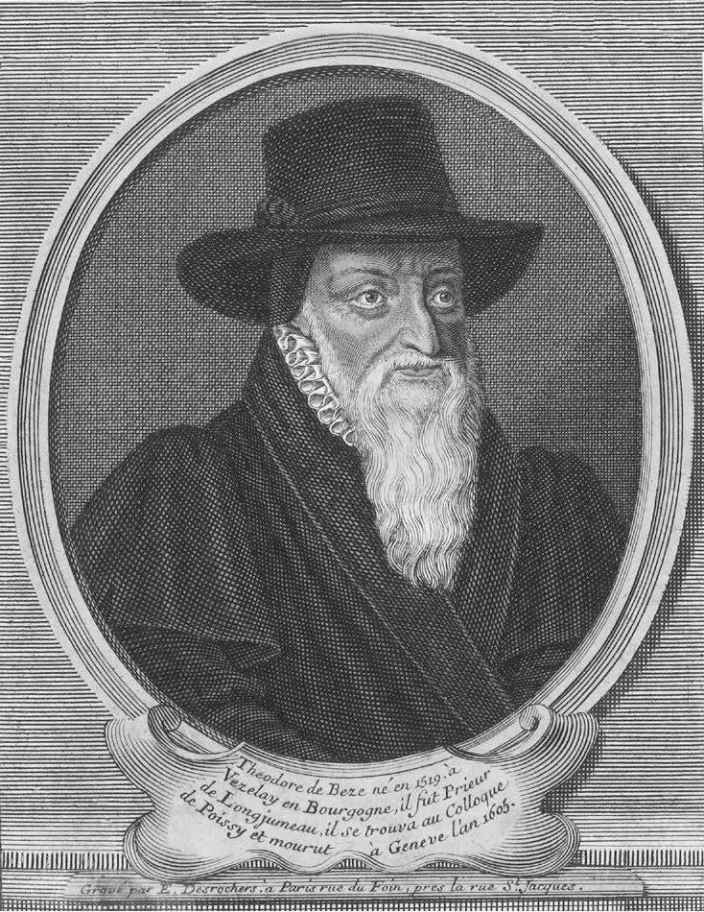
2. Theodore Beza Theodore Beza (1519–1605) was John Calvin's most distinguished disciple, and indeed Calvin's successor as spiritual leader of Geneva. Born to an aristocratic family at Vézelay in Burgundy, France, he received a first class education from the German humanist Melchior Wolmar (1497–1561), one of the foremost Greek scholars of that time (he had also taught Greek to Calvin, who dedicated his commentary on 2 Corinthians to Wolmar).
Wolmar had embraced Reformation views, and these deeply influenced the young Beza. However, he remained outwardly a Roman Catholic for many years, living in Paris as a carefree noble with a private income, and dedicating his energies to classical literature. It was not until recovering from a near-death experience through illness in 1548 that Beza became serious about being a Protestant. He now fled from Paris to the Swiss
Reformed city of Lausanne, where he taught Greek for the next nine years at its university. In 1558, the rulers of the powerful Swiss canton of Berne imposed a new religious settlement on Lausanne; although the Bernese were Reformed, Beza objected to the state dictating doctrine and worship to a Reformed Church. So he left in protest, relocating to Calvin's Geneva.
Beza soon became Calvin's closest friend and co-worker; Calvin put him in charge of the Genevan academy in 1559, a position he held for the rest of his life. As well as his general duties running the academy, Beza taught systematic theology there. His devotion to the academy made it one of the most successful Reformed educational bodies of the 16th century, with distinguished lecturers and a huge international student body. From the academy a steady flow of Reformed pastors, evangelists, and churchplanters streamed out into the rest of Europe. On Calvin's death in 1564,
Geneva naturally looked to Beza for continued leadership, which he provided for the next 40 years.
Beza not only supervised the academy; he was also, after Calvin died, Geneva's chief pastor and chairman of the "company of pastors", which supervised ministerial training and ordination. Much of Beza's energy as a church leader was given to the roller-coaster fortunes of the French
Calvinists or Huguenots during France's "wars of religion" (1562–98).3 He advised the Huguenot nobles; he gave guidance to Huguenot pastors and theologians, especially over matters of church government, where he upheld
Presbyterianism (under Peter Ramus' influence, some preferred a more
Congregational model, which Beza considered destructive to French Reformed unity).
His political philosophy evolved in a more radical direction under the impact of the massacre of Saint Bartholomew's day in 1572, when some 20,000 Huguenots were slaughtered. The French crown's participation in the massacre (through the young King Charles IX's domineering mother, Catherine de Medici), inspired Beza to write Concerning the Power of Magistrates (1574). Here, Beza argued that if monarchs behaved tyrannically, the lesser political authorities of the realm could lawfully restrain them, by force if necessary. This became the standard Reformed view, acted on not just by Huguenots in France, but also by Dutch Calvinists in revolt against King Philip II of Spain, and by Scottish
Covenanters and English Puritans in revolt against King Charles I.
Martin Chemnitz (1522–86) Portrait by an unknown artist Beza's contribution to Reformed worship was notable. In 1562, he published a complete French metrical psalter. It had been translated in part by Clement Marot (1497–1544)—Beza finished it. He was poetically talented, and the new psalter instantly captured the affections of Frenchspeaking Calvinists across Europe. It formed the basis for English, German, and Dutch Reformed psalters.
Beza was also a notable textual scholar. He published his own critical edition of the Greek New Testament in 1565, intended as a replacement for Erasmus' text which Beza considered inadequate. Beza's version made use of other Greek manuscripts unknown to Erasmus, including one named after Beza, the codex Bezae; of French origin, it was given to Beza for safekeeping during the French wars of religion, and he in turn donated it to England's Cambridge University. Beza's edition of the Greek New
Testament went through five editions in his lifetime, and had widespread
influence on Protestant textual scholarship; it would be a key text used by the translators of the King James Bible.4
Beza was the most influential early Reformed theologian to state the doctrine of predestination in its "supralapsarian" form.5 Most Reformed theologians have been "infralapsarian".6 The difference lies in the logical order of God's purposes or decrees. According to the majority infralapsarian view, in His predestination of the elect to blessedness, God contemplates them in His foreknowledge as fallen in Adam and in need of salvation.
Election is therefore a decree to save from sin. According to the supralapsarian view, by contrast, in God's predestination of the elect to blessedness, He contemplates them simply as persons capable of being created. Election therefore has no link with sin; in His eternal mind, God has chosen the elect "before" He foresees them as sinning and needing salvation. Beza championed this supralaparian view. Perhaps a diagram will make the difference clear (Beza himself produced a famous diagram that was far more detailed):
THE LOGICAL ORDER OF GOD'S DECREES
Infralapsarian order of decrees Supralapsarian order of decrees God decrees to create humanity.
God decrees to give eternal blessedness to some (the decree of election).
He decrees to permit the fall of humanity.
He decrees to create the elect and the non-elect.
He decrees to save some sinners out of fallen humanity (the decree of election), and to leave the rest in their sins.
He decrees to permit the fall of the elect and non-elect.
He decrees the mission of Christ to save the elect.
He decrees the mission of Christ to save the elect.
Criticism of Beza's "scholasticism" has often focused on his supralapsarian views. Since, however, most Reformed scholastics were infralapsarian, yet no less scholastic, it would seem that a consistent criticism of Reformed scholasticism must reject all idea of a logical order in God's decrees, whether supralapsarian, infralapsarian, or any other sequence (see section 3 for the Amyraldian sequence). There was certainly nothing in the scholastic methodology of Reformed Orthodoxy that bound it to Beza's supralapsarianism. The only confession of faith with an international
character to be produced by scholastic Calvinism was actually infralapsarian (the canons of Dort—see section 2).
Beza's deepest impact was the way he helped consolidate a distinctive Reformed theological identity post-Calvin. Through his writings, he put clear blue water between the Reformed faith and its competitors in the latter half of the 16th century, engaging with Roman Catholics, Lutherans,
Socinians, and even his fellow-Reformed in the shape of Zwinglians (on the Lord's Supper, where Beza rejected the Zwinglian "memorialism" still favoured by a few in favour of the "spiritual real presence" view that Martin
Bucer, Peter Martyr, and John Calvin had championed). Beza articulated his theology most fully in his Confession of the Christian Faith, originally published in French (1559), then translated into Latin (1560) and other languages (e.g. English in 1563). It was a Europe-wide best-seller.
3. Amandus Polanus Amandus Polanus (1561–1610) was born into an aristocratic family at Opole in Silesia (a region now mostly in Poland, but partly in Germany: in Polanus' time it belonged to the Austrian crown). His spiritual life is a fascinating case-study in the cross-currents of Lutheranism and Calvinism during the doctrinal conflicts that ravaged Lutheranism prior to the Formula of Concord in 1577. Polanus was originally a Lutheran; while studying at Breslau (also in Silesia), we find him adhering to a "Philippist" form of Lutheranism, otherwise nicknamed "Crypto-Calvinism" by strict Lutherans for its embrace of a Reformed understanding of Christ's presence in the eucharist.7 Polanus continued his studies in the Lutheran University of Tubingen, but had soon abandoned Lutheranism entirely (he embraced a more Reformed understanding of election). Leaving Tubingen in 1583, he pursued his education at Basel, Geneva, and Heidelberg. In Geneva he fell deeply under the spell of Theodore Beza. After spending two years with the Bohemian Hussites, Polanus returned to the Swiss city of Basel as a private tutor to an aristocratic family. In 1596, he became professor of Old
Testament at Basel University.
Here, Polanus' outspokenly Reformed views got him into trouble with Lutheran sympathizers. Basel had gone through several decades of intense religious friction over whether it would remain in the Reformed camp or go over to Lutheranism. Many of its city clergy had favoured Lutheranism, especially Simon Sulzer (1508–85), the antistes (chief pastor) of Basel from 1553. Selzer had introduced Lutheran forms of worship (e.g. musical instruments—organ, flute, and kettle-drum), and got all the clergy to subscribe to the Wittenberg Concordat of 1536, a carefully-worded statement on the Lord's Supper which had crafted a Lutheran-Reformed unity on the topic. The only factor that had finally prevented Basel becoming fully Lutheran was (ironically) Lutheranism's 1577 Formula of Concord; the Formula's explicit condemnations of Calvinism proved too strong for most of Basel's clergy and magistrates. When Sulzer died in 1585, the next antistes was the robustly Reformed John Jacob Grynaeus
(1540–1617), who undid most of Sulzer's work.
Still, there remained Lutheran-inclined people in Basel, and Polanus' lectures antagonized them. He was accused of teaching doctrines in the university he would not dare preach in a pulpit—specifically his
understanding of predestination. Polanus defended himself by appealing to Martin Luther himself: had not Luther, in his Bondage of the Will, been a full-blooded predestinarian? He also denied teaching anything in the university that he would not preach in a pulpit, although conceding that academic and pulpit methodology was very different. Polanus was successful in vindicating his views, and this seems to have been the last gasp of the Lutheranizers in Basel, which thereafter was solidly Reformed, due in some measure to Polanus' own teaching.
Polanus wrote various treatises, but his masterwork was his System of Christian Theology (1609). This was the most comprehensive systematic theology yet written by a Reformed theologian, and exercised great influence. It had a strong anti-Catholic emphasis, championing Reformed teaching against the Roman alternative; Polanus' chief sparring partner was
Italian Cardinal Robert Bellarmine, the supreme theologian of the Catholic Counter-Reformation.8 The extent of Polanus' historic impact on future
Reformed thought can be gauged from the great "Neo-Orthodox" movement of the 1920s and 1930s, which revived interest in the theologians of Reformed Orthodoxy. The movement's dominant thinker Karl Barth, in his colossal Church Dogmatics, devoted more space to discussing the views of Amandus Polanus than of any other Reformed Orthodox theologian.
Polanus' theological method was a strong synthesis of Aristotelianism and Ramism; he accepted Aristotle's analysis of causation, but also made extensive use of Ramus' dichotomy technique.9 (This demonstrates that Aristotelianism and Ramism could be combined in Reformed Orthodoxy.)
He also, following Ramus' lead, stressed the practical "use" of each doctrine, which gave a new impetus to the moral dimensions of theology. In addition he helped advance the cause of covenant or "federal" theology; his impact as a systematic theologian gave immense credence to the view that the original relationship between God and humanity in Eden had been mediated through a covenant. (See Cocceius below for more on federal theology.) Polanus was a huge admirer of Theodore Beza, under whom he studied in Geneva, and in some ways he followed his master in giving a more logical, structured shape to theology. He insisted that wholesome theology could not merely be biblical exegesis; it equally required a rigorous philosophical method, which was supplied largely by Aristotle. However, in taking this stance Polanus was no slavish follower of Beza. He clearly blended his
Aristotelianism with Ramism, which Beza rejected, and he was far less enthusiastic about the supralapsarian view of predestination than Beza, allowing for the possibility of an infralapsarian understanding.
Polanus' lecturing so impressed the rulers of Basel that after his death, they created in the university a new department of systematic theology in memory of Polanus (previously there had only been departments of Old and New Testament).
4. William Ames William Ames (1576–1633) was born at Ipswich in Suffolk, England. He studied theology at Cambridge, where he became a close friend of his tutor, the celebrated William Perkins, greatest of the Elizabethan Reformed theologians.10 The English establishment, however, prevented Ames from following an academic career, owing to his strong Puritan objections to aspects of the Anglican Church, e.g. the wearing of clerical vestments.
Eventually Ames left England altogether, deciding that its religious climate had become too hostile to his advanced Puritan outlook; he settled in the Dutch Republic in 1610, and the following year became chaplain to the English émigré community in The Hague, location of the Dutch government. He was supported financially by Puritan sympathizer Sir
Horatio Vere, who led an English contingent helping the Dutch in their long war with Spain. The English government was still hostile to Ames, however, and forced Sir Horatio to dismiss him in 1618. He therefore had no official position recognized by the English Church or monarchy when they sent delegates to the illustrious Synod of Dort, convened to settle the Arminian controversy—the Synod began meeting in November 1618 (see section 2). Despite this, Ames was held in such high esteem by the Dutch
Reformed that they paid him to attend the Synod, where he acted as advisor to its chairman, Johannes Bogerman. Ames was not so hard-line against the Arminians as many Reformed Orthodox; while he admitted that the Arminian view of grace was an error, he refused to classify it as a heresy.
In 1622, Ames became professor of theology at the newly created Franeker University on the Dutch Republic's northern coastland. Here he produced the bulk of his literary output: his Marrow of Theology (1627),
Bellarmine's Sinews Removed (1628),11 Criticisms of the Synod by Remonstrant Writers (1629), and Concerning Conscience, Its Power and Cases (1632). His lectures secured him a Europe-wide renown; students flocked from all quarters to hear the great Ames. In recognition of his reputation, the university made him its rector in 1626. However, he found the university's Orthodox intellectualism rather stifling; too many, he felt, treated theology as a purely academic discipline, without any obvious impact on lifestyle. It is reported of one of Ames' theological colleagues that he would sometimes drink too much in the evenings, and that his students would then—on the pretext of carrying him home—cart him off to
the gates of a different town altogether, so that he could not get back to Franaeker in time for his lecture the next morning.12 With his insistence on the practical nature of theology, Ames became disheartened.
For whatever reason, Ames tried to leave Franaeker. He made an abortive attempt to emigrate to America, whose Congregational churches in the new
Massachusetts colony entreated his pastoral services, and whose climate he hoped would cure his asthma.13 Then in 1632 he became co-pastor of a Congregationalist church in Rotterdam, where he died a year later at the age of 57. It is interesting to reflect that of the English theologians who achieved international acceptance as a Reformed scholastic, none was more renowned in the 17th century than Ames—and Ames was a Congregationalist. The Continental scholastics, almost all of whom were all
Presbyterian (apart from a few influenced by the more Congregational views of Peter Ramus), do not seem to have held against Ames his minority views on church government.
Ames' masterwork, the Marrow of Theology, was hugely influential on subsequent generations of Reformed thinkers. Its attraction lay partly in its method; Ames organized its theological content on a radical, thoroughgoing
Ramist model. Ramism was very fashionable at that time, and the Marrow's approach must have seemed cutting-edge. Also appealing was Ames' pervasive insistence on the practical nature of theology. Here too he was following Ramus, and his old mentor William Perkins who had defined theology as "the science of living blessedly for ever".
Ames was also influential in his extended exploration of the ethical dimensions of theology, found especially in his Concerning Conscience. No Reformed theologian prior to this had so fully analyzed the moral dilemmas of faith. Ames' work was long admired and imitated as a model of its kind.
On the Continent, Ames was known by his Latinized name, Amesius.
5. Johannes Wollebius Johannes Wollebius (1586–1629) was born in the Swiss canton of Basel, the son of a city councillor. Here he studied philosophy and theology, and was particularly influenced by Amandus Polanus. Wollebius had a solid clerical career in the city of his birth: ordained in 1606, he became pastor of Basel's Saint Elizabeth Church in 1611; in 1618, he was appointed preacher in the city's cathedral church, at the same time taking up the post of Old
Testament lecturer in the university. He was also the city's antistes or chief pastor, the first native of Basel to hold the post (it was created during the Swiss Reformation). His 1619 doctorate On Divine Predestination took an infralapsarian view. Wollebius died of plague in 1629 at the young age of 42, leaving two sons who were both pastors in Basel.
Wollebius was clearly a man of one city; he was also a man of few treatises. Other than a handful of sermons and his doctoral dissertation, his contribution to Reformed literature was his one-volume Compendium of Christian Theology, published in 1626. It was enough, however, to assure his fame; this single work was used throughout the Reformed world for a hundred years and more as a basic textbook of theology. In addition to six
Latin editions between 1626 and 1760, the Compendium was translated in English in 1650, and into Dutch in 1651. Its popularity in Puritan England is illustrated in the life of John Milton, best known to us as the author of the epic poem Paradise Lost, but quite as much a political and theological pamphleteer in his own day, pursuing a highly personalized vision of a Puritan society. When Milton wrote his own systematic theology to undergird his vision, he drew heavily on Wollebius' Compendium—it was arguably Milton's chief inspiration, albeit he departed from the Swiss divine's Trinitarian orthodoxy. Often Milton's Concerning Christian
Doctrine is simply Wollebius, word for word.14 A generation later and a continent away, we find Wollebius still going strong in Puritan America. In Connecticut's Yale College, founded in
mainly to train Congregationalist pastors, a student remarked (rather sardonically) of Wollebius' Compendium in 1714 that it was "considered with equal or greater veneration than the Bible itself".
The Compendium earned its place in Reformed theology by its orderly arrangement of topics, its crystal lucidity of expression, its precise treatment of issues, its brevity, and its non-speculative character. Much of
its content was taken from Polanus' System of Christian Theology, but masterfully condensed. Divided into two parts, the first dealt with the knowledge of God, and the second with the worship or service of God. For Wollebius the one flowed into the other: all theological knowledge was for the purpose of worship and service. It would be hard to imagine anything more different from the ice-cold, abstract metaphysics that has too often been attributed to the Reformed scholastics. Some historians have detected in the famous catechisms of the Westminster Assembly the direct influence of Wollebius's twofold approach to God's knowledge and service.15
6. Gisbert Voetius Gisbert Voetius (1589–1676) (pronounced Foot-ius or Foosh-ius) was a Dutch Reformed theologian, arguably the greatest of them in our period.
Born at Heusden near Utrecht, as a child he displayed a phenomenal memory, learning by heart vast chunks of Greek and Latin poetry. He developed these linguistic skills at Leyden University, where he also studied theology during the Arminian controversy; he followed the teachings of Arminius' chief critic, Francis Gomarus (see section 2). Voetius was then ordained as pastor of the Dutch Reformed congregation in Vlymen in 1611; in 1617 he accepted a call back to the congregation of his childhood in Heusden. He attended the Synod of Dort as a delegate for six months in 1619.
Voetius' international fame flowed from his time as a lecturer in the University of Utrecht. He was invited to this post in 1634, although the university was not yet built; in the interim, he moved into the city and took charge of one of its churches. The university opened for business in 1636;
Voetius delivered the inaugural address. He taught theology and Oriental languages there for the next 30 years till his death in 1676, and was recognized throughout Europe as one of the foremost Reformed Orthodox thinkers of his day. His literary masterpiece and legacy to the Reformed world was his Select Theological Disputations, published in five volumes between 1648 and 1669. The 19th century German theologian and Bible commentator, Johannes Ebrard (1818–88), said of these volumes that they contained "an unbelievably clear and precise exposition of Reformed theology, such as one finds nowhere else".
Voetius comes across as a sort of Reformed Abraham Calov:16 always fighting someone or something, always seeing truth about to be crushed by its host of adversaries, a gladiator for correct doctrine—and yet at the same time, like Calov, a man with a pious heart who wanted true spirituality as well as true doctrine to flourish. Among the enemies he combated were
Roman Catholics, Arminians, atheists, mystics (like Jean de Labadie),17 philosophers (like Descartes—see below), Erastians (those who wanted the Dutch state to control the Church), and fellow Reformed theologians (like
Cocceius—see below). Amid the endless controversial writings, however, Voetius penned some devotional gems too, such as Proof of the Power of Godliness (1627), Meditation on the True Practice of Godliness or Good
Works (1628), and Discipline, or the Exercise of Piety (1644). The title of Voetius' inaugural address at Utrecht University summed up his ideal: On Piety Joined with Knowledge. He was much influenced in this by Thomas a Kempis' Imitation of Christ and by English Puritan literature.18 Voetius' practical Christianity sometimes had political dimensions, e.g. his advocacy of interest-free government loans to the poor. Less politically, he favoured small group meetings for the nurture of practical godliness, and was at the centre of a movement in the Dutch Reformed Church that has usually been compared with English Puritanism—the so-called "Second Dutch
Reformation" (or "Further Reformation"). The other great spiritual writer in the Second Dutch Reformation, a generation later, was Wilhelmus a Brakel
(1635–1711), whose The Christian's Reasonable Service (1700) proved an enduring masterpiece of piety.
Two controversies in which Voetius was involved have attracted the particular interest of students.
First, he was a vehement opponent of the new and fashionable philosophy of the highly influential French Catholic thinker René Descartes
(1596–1650). Descartes is often regarded as the first truly modern philosopher, and was undoubtedly a trailblazer in scientific thinking.
Voetius, however, fought relentlessly against Descartes. This was partly because the French intellectual's philosophy was a deliberate and provocative alternative to Aristotelianism, and Voetius was an ardent disciple of Aristotle in matters of philosophy. (For the same reason, he opposed Ramism.) Voetius was convinced that Descartes' philosophical method would lead people into atheism, and indeed he actually accused
Descartes himself of being a closet atheist. This was because Descartes' worldview was grounded in radical doubt. The French thinker famously set out to doubt the truth and reality of everything that could possibly be doubted; he discovered that the only thing immune to this universal acid of doubt was his own existence. Hence Descartes' statement, one of the most celebrated in the history of philosophy: "I think, therefore I am." In other words, if I doubt everything, there must at the very least be an "I" who does the doubting; therefore I, the doubter, must exist, even if nothing else does.
Descartes, a Roman Catholic, reintroduced God into his universe by a version of the "ontological argument", pioneered by Anselm of Canterbury in the 11th century. Voetius, however—like probably all Aristotelians— failed to find the ontological argument remotely convincing (it had been the
medieval Christian Aristotelian, Thomas Aquinas, who in the 13th century had so devastated Anselm's argument that it had ceased to be taken seriously until Descartes revived it 350 years later). It is not hard to see, then, how Descartes' ultra-sceptical approach was, for Voetius, merely the back door to atheism. Equally problematic for Voetius was Descartes' rejection of Aristotelian physics (although here, modern science would follow neither the Dutch nor the French thinker, but the Englishman, Sir
Isaac Newton). Descartes further gave an account of natural causation that seemed, to Voetius, to leave no room for God's causal interaction with creation. In 1642, Voetius succeeded in getting the senate of Utrecht
University to issue an official condemnation of Descartes' philosophy.
Descartes was living in the Dutch Republic at the time, through fear (it would seem) of what the Catholic authorities in his native France would make of his work; the controversy with Voetius dragged unpleasantly on, and was a primary factor in Descartes' departure to Sweden in 1649.
In his own mind, Voetius' all-out war with Descartes was an aspect of a larger war with atheism, which he believed to be gaining ground in Dutch society. His 1639 book Disputations on Atheism shows the level of his concern. Together with this, however, we should also take Voetius' general interest in non-Christian worldviews. Although he did not organize any missionary activity, he paved the way for it by extensive writing on what we would call comparative religion, and on how Christianity related to the other (known) faiths of the world.
Voetius' conflict with Descartes fed directly into his second captivating controversy—with a fellow Reformed theologian, Johannes Cocceius— which takes us to our next entry…
7. Johannes Cocceius and covenant theology Johannes Cocceius (1603–69) (pronounced Cok-say-uss) was born at Bremen, in north-western Germany. He studied in Bremen University under the early "covenant" theologians Matthias Martini and Ludwig Crocius (see below). Then in 1626 he went to Franeker University in the Dutch
Republic, where he sat under the teaching of William Ames. Cocceius' career as an educator was lifelong; he began by lecturing on biblical languages in Bremen in 1630. In 1636 he moved to Franeker, teaching
Hebrew and Oriental languages, adding on theology in 1643. In 1650, he moved to Leyden University as professor of theology, remaining there till his death in 1669. The extent of Cocceius' learning was astonishing; as well as the Bible in Hebrew and Greek, and Christian theology from a Reformed perspective, he had a thorough knowledge of the Jewish Talmud, and of the Qur'an which he read in the original Arabic. By all accounts, Cocceius was also distinguished by a warm, earnest piety; we know that one reason why he left Germany for the Dutch Republic was (according to his own testimony) his discomfort over poor standards of personal godliness that he found in the German universities.
Cocceius' most famous, influential, and controversial work was his Doctrine of the Covenant and Testament of God, first published in 1648, with revised editions in 1653 and 1660. This eloquently presented his
"covenant theology" (or "federal theology"). In the process he managed to divide the Dutch Reformed Church into ardent admirers and fierce critics, for reasons explored below.
Understanding God's dealings with humanity in terms of successive covenants was not in itself a novelty coined by Cocceius. It goes back at least as far as Augustine (see City of God 16:27—God's covenant with Adam). However, it was given a whole new lease of life by Reformed theologians in the 16th century. There is debate about how early it appeared in the Reformed tradition, and what exactly counts as "covenant theology"—a mere use of the word or concept would not suffice. A key point would probably be whether a particular theologian interpreted God's original relationship with humanity in Adam in covenant terms. In that respect, Cocceius' tutors at Bremen, Matthias Martini and Ludwig Crocius, were certainly among the more influential proponents. A little earlier,
Zacharius Ursinus (1534–83), chief author of the Heidelberg Catechism,
had pioneered the idea of a pre-fall covenant between God and humankind ("the covenant of nature"), and organized his entire Summary of Theology
Expounded through Questions and Answers (written 1561–2) around the theme of covenant.19 Wolfgang Musculus (1497–1563) and Andreas
Hyperius (1511–64) were also early developers of covenant thinking.
Again, the English Puritan theologian Dudley Fenner (c.1558–87) was significant; he was among the first to describe God's relationship with Adam as a "covenant of works", setting it off against the "covenant of grace" using the Ramist logic of dichotomy (see section 1). Such thinkers began to follow Ursinus in employing "covenant" as an organizing concept for the entire content of their theology. By the mid-17th century, this covenantal way of doing theology had become common currency among the Reformed. It was also called "federal" theology from the Latin for covenant, foedus.
The basic idea of federal theology was that human history revolved around two covenants: an original covenant between God and the human race in Adam (variously named: the covenant of nature, the covenant of life, the covenant of innocence, the covenant of works), and the covenant of grace in which Christ played the role of a Second Adam. Through these covenants, God bound Himself to the communities represented by Adam and Christ as heads—all humankind in Adam, the new humanity in Christ.
Life and blessedness flowed through the covenant-keeping of the two federal heads; their communities participated in the consequences of their actions. Through union with Adam, humanity fell, because Adam broke the covenant; through union with Christ, the new humanity is redeemed, because Christ kept the covenant.
Cocceius invented none of this. But in his Doctrine of the Covenant and Testament of God, he magnified covenant thinking to intense new levels of meaning for the Bible and theology. Federal theology had put the spotlight on the historical outworking of God's purposes, and has often been interpreted as a corrective to forms of Reformed Orthodoxy where the emphasis had been on God's eternal decrees. Cocceius carried this
"historicizing" impulse into the covenant of grace itself. It could not be seen as a static entity, he insisted; it was progressive within history, developing from a primitive Old Testament seed into a mature New Testament organism. In modern terms, one can see Cocceius here seeking to express a "biblical theology" against what he felt was an unduly abstract "systematic
theology" among other Reformed scholastics. For Cocceius, the overriding reality in the Bible was what 19th century German theologians would call heilsgeschichte—salvation history (in other words, the unfolding history of God's saving acts in Israel and the Church).
The controversial aspect of Cocceius' federalism was the way it highlighted differences between the Old and New Testaments. Two such differences in Cocceius' thinking became particular storm-centres of contention:
First, Cocceius saw the Sabbath as a distinctively Old Testament ordinance, rooted not in creation but in God's covenant with Israel at Sinai.
It was a sign of the coming Messianic kingdom, he argued, just like other ceremonial ordinances; it foreshadowed the spiritual rest that Christ would procure from the laborious existence of sin. In the New Testament church, he maintained, a day of rest and worship was observed, not from obedience to an obsolete Sabbath command, but simply because Christ's people had always found it edifying to have such a day.
Second, Cocceius made a distinction between the salvation enjoyed by believers under the Old and New Testaments. Before Christ actually atoned for sin by His death, he argued, God "passed over" sin rather than forgave it. So the justification of the Old Testament saints was inferior that of the New; prior to Christ, justification was by way of "promise", whereas now in Christ it is by way of "fulfilment". Cocceius' exegetical stronghold was
Romans 3:25 and Hebrews 10:18. He accused his opponents of flattening out justification into a single unchanging fact, ignoring its historical development between the Testaments—an inbuilt flaw of "systematic theology", he felt, which he was trying to remedy with his exegesis-rich
"biblical theology".
The opposition to Cocceius was spearheaded by Gisbet Voetius. It did not help matters that Cocceius and his followers tended to be hospitable to the scientific philosophy of Descartes, which Voetius opposed with such energy. So fierce did the theological warfare become, it threatened to rip apart the Dutch Reformed Church into two mutually exclusive factions, the Cocceians and the Voetians. The Voetians portrayed the Cocceians as merely Arminians in disguise, and did everything possible to discredit and destroy them. But the Cocceians fought back ardently. Where one party gained the ascendancy in a university, the other party was expelled. The Dutch state had to intervene to tell the theologians to calm down and
practise a little more Christian forbearance; in fact, to make sure they did, the government coerced the universities into appointing equal numbers of Cocceians and Voetians, so that neither could vote the other out of their places. The dispute between the factions continued for many years after both Cocceius and Voetius had died. It dissipated at last through a combination of sheer exhaustion and the marginalizing of both sides by a new, more liberal Enlightenment theology, which regarded Cocceians and Voetians as equally old-fashioned and irrelevant. Fortunately both parties had their share of men who valued piety as well as doctrine, and the "pious"
Cocceians and Voetians coalesced in the 18th century to fight together against the new liberalism.
It should be said that there were important Dutch Reformed theologians who did not fully identify with either side in the Cocciean-Voetian war. The most significant were Samuel des Marets (1599–1673),20 Balthasar Bekker
(1634–98), and Hermann Witsius (1636–1708). Witsius was the most influential; his now classic Economy of the Covenants between God and Man (1677) was Witsius' deliberate and brilliant attempt to blend into one all that was best in Cocceius and Voetius, whose warfare he deplored. The Economy was translated into English in 1803.21
8. Francis Turretin Francis Turretin (1623–87) was born in Geneva to a distinguished
Reformed family of Italian origin. His pursued his education in a mindboggling variety of places—Geneva itself, Leyden, Utrecht, Paris, Saumur,
Montauban, and Nismes. His aim was to sample as much of the Reformed theological universe as he could by visiting its centres of influence. Among the famous Reformed teachers at whose feet he sat were fellow-Italian
Giovanni Diodati (1576–1649), who translated the Bible into Italian; the distinguished German Friedrich Spanheim (1600–49); Gisbert Voetius; and controversial Huguenot thinker Moise Amyraut, and his supporter Jean
Daillé (see section 3).
Turretin became pastor of the Italian church in Geneva in 1648 (at the age of 25); although he was by now a naturalised French-Swiss, Turretin still spoke Italian fluently. His preaching, we are told, was full of heartfelt pleading that his hearers should truly embrace Christ for salvation. (It should be clear by now that neither the Lutheran nor Reformed
"scholastics" had anything in their makeup that impeded a warm, experiential piety, despite caricatures to the contrary.) In 1653 he was appointed professor of theology in the Genevan academy, stepping into his father's shoes—Turretin Senior had taught theology at the academy from 1618 to 1631. Turretin Junior spent the rest of life and career doing the same, but with far greater distinction.
Turretin's enduring fame rests on Institutes of Elenctic Theology, published in three volumes between 1679 and 1685. Within a 50 year period, there were no fewer than six further editions, the last being in 1734.
Elenctic comes from a Greek word meaning "to refute". The elenctic method in logic was also known as the Socratic method, after Socrates, the most influential Pagan philosopher of Athens. Socrates brought people to a deeper knowledge of truth by asking them to state their beliefs, then subjecting them to relentless questioning; eventually they realized their original belief must have been wrong, once its inconsistencies and absurdities had been exposed by Socrates' inquisition.
This was Turretin's approach. His Institutes, rather than construct an allembracing system, moved through a vast range of specific disputed questions. He covered 20 topics, each divided into distinct questions, sometimes as many as 34. Each question stated a controversy between
Reformed Orthodox theology and its critics—Roman Catholics, Lutherans, Amyraldians, Arminians, Socinians, and others. Turretin carefully examined alternatives, refuted them to his own satisfaction, and established the Reformed view. The method is identical to the one used by Thomas Aquinas in his Summa Theologiae, and Aquinas indeed was a strong influence on Turretin, including the admiration for Aristotle as a supremely perceptive philosopher. The result is a masterpiece of clarity. To know what the mainstream Reformed view was on any significant issue in the period of Reformed Orthodoxy, and see it stated and defended with a massive and calm rationality, the student cannot do better than read Turretin. It is little wonder his Institutes were used as the textbook of choice in many seminaries throughout the Reformed world. In America's famous citadel of Reformed theology, Princeton Seminary in New Jersey, Turretin was the key text far into the 19th century, until finally replaced by Charles Hodge's
Systematic Theology in 1872.
Turretin's most distinctive contribution to his day was his opposition to Amyraldianism, the system of theology articulated by Moise Amyraut in the French Reformed Church (see section 3 below). After bitter internal controversy, Amyraldianism won the day among French Calvinists; Turretin was determined to exhibit its errors, in case any other Reformed Church felt tempted to follow the French example. Amyraldianism never had a more incisive critic than Turretin. It may have been due to him, more than any other single individual, that popular Calvinism outside France usually had five rather than four points set in its theological concrete.22
9. Johann Heinrich Heidegger Johann Heinrich Heidegger (1633–98) was born in the canton of Zurich at Baretswil, a village just outside the city walls. The son of a Swiss Reformed clergyman, he studied in Zurich under Johann Heinrich Hottinger (1620–
67), one of the foremost linguists of the day. Heidegger later wrote Hottinger's biography. Then he pursued further study at Marburg and Heidelberg. In the latter he became professor of Hebrew in 1656, and then philosophy too. In 1659, Heidegger moved to Steinfurt in north-eastern
Germany to teach theology and church history. However, in 1660 the troops of the Catholic prince-bishop of Munster occupied Steinfurt, in what must have been a fearful reminder of the Thirty Years' War, which had ended only a dozen years previously. Heidegger returned to Zurich, where he married an Italian lady, descended from Protestant refugees from Locarno
(a Catholic Italian-speaking district of Switzerland) who had settled in Zurich in 1555.
After his marriage Heidegger spent some time in the Dutch Republic, where he got acquainted with Johannes Cocceius (see above). He went back to Zurich again in 1665 to become professor of moral philosophy; he then succeeded his old mentor Hottinger as theology professor in 1667, on the latter's death. Heidegger's growing fame as a theologian brought him invitations from other centres of Reformed academic life, e.g. to take over from Cocceius at Leyden on the German-Dutch divine's death in 1669.
Heidegger, however, turned down all invitations and remained in Zurich for the rest of his life.
Heidegger combined a complex theology with a remarkable spiritual breadth of sympathy: he defended his own detailed beliefs, but in a noncontroversial spirit. His stricter side was shown in his authorship of the Helvetic Consensus of 1675,23 designed to safeguard the Swiss Reformed
Churches against Amyraldianism (see section 3). After a consultation between Swiss Reformed theologians, Heidegger was chosen as the one to draft the document. As well as rejecting Amyraldianism and several other perceived errors, the Consensus affirmed a full-blooded federal theology, which had by then become the universal Reformed framework for understanding God's dealings with humanity. The Consensus was adopted in all the Reformed cantons; all prospective preachers had to sign it. It began to be dropped, however, after the Edict of Nantes was revoked in
1685 and the floodtide of French Reformed refugees flowed into Switzerland and elsewhere, many of whom held Amyraldian views (the Swiss Reformed canton of Berne abandoned the Consensus as early as 1686).24
Heidegger's broader side was shown in his championship of religious refugees from various regions of Europe where an intolerant Catholicism was making life unbearable for Protestants, e.g. France, Hungary, and Poland. Heidegger may have been opposed theologically to French
Amyraldians, but in their hour of darkness he extended the arms of brotherhood to them. He took a special interest in the plight of Hungarian
Protestants, both Reformed and Lutheran; the Holy Roman Emperor Leopold I (1658–1705) had annexed most of Hungary, and in the 1670s oppressed Protestants ever more harshly. Heidegger's house in Zurich became a centre for information about persecution in Hungary, and acted as an agency through which contacts with Hungarians were made, monetary aid channelled, and testimonials written as letters of safe-conduct. From Heidegger's abode accommodation for refugees was also organised, and dangerous journeys back to Hungary planned and financed. He sometimes personally sheltered refugees; we know that two Hungarians lodged with Heidegger for 17 months. Not surprisingly, Heidegger has been called both
"Professor of Protestantism and Protector of Protestants".
Heidegger also displayed his breadth of spirit in his approach to Lutherans. Despite his disagreements with them, he refused to take up the strongly polemical attitude to Lutheranism that he took towards Roman
Catholicism. As we have just seen, he gave practical help to Hungarian Lutheran refugees. In his 1686 treatise, Direction: A Pathway towards
Protestant Ecclesiastical Concord, he emphasized the common Reformation ground of Lutherans and Calvinists, although without neglecting the differences between them.
Heidegger was a prolific theological author, but his masterworks were his Marrow of Christian Theology (1696), and his Body of Christian Theology
(1700). These were regarded as models of clarity, summing up Reformed Orthodoxy in a supremely calm, careful way. The admiration the Reformed world had for Heidegger as a theologian was shown in the funeral oration given by Benedict Pictet for Francis Turretin in 1687, in which Pictet referred to Heidegger as "the esteemed Johann Heinrich Heidegger, the most radiant light not just of Switzerland, but of all Europe."
10. Peter van Mastricht Peter van Mastricht (1630–1706) was a Dutch-German theologian. Born at Cologne, one of Germany's most important cities (its prince was one of the seven electors of the Holy Roman empire), his family were of ethnic Dutch origin. His name derives from the Dutch city of Maastricht, which between 1579 and 1632 was part of the Spanish Catholic empire in the Netherlands; to escape persecution, the van Mastricht family fled and settled in Cologne.
There they became staunch members of the local German Reformed church.
Peter van Mastricht returned to his ancestral Holland to study theology at Utrecht under the celebrated Voetius, whose blend of orthodoxy and piety made a lifelong impact on him. He then studied further in the Dutch
University of Leyden, and the south German University of Heidelberg; he also spent some time in England (during the English Civil War). In 1652 he was ordained a pastor in the Dutch Reformed Church, serving congregations in Xanten and Gluckstadt. The call of academic life then beckoned, and he returned to Germany to teach Hebrew and practical theology at the university of Frankfurt-on-the-Oder in 1662.25 He moved to the university at Duisberg in 1669, a city that had recently become part of Brandenburg-Prussia. In 1677 he returned to teach at Utrecht, remaining there for the next 30 years.
Van Mastricht's greatest contribution to Reformed Orthodoxy was his Theoretical and Practical Theology, first published in two volumes in 1682 and 1687; a new enlarged edition appeared in 1698–99. This comprehensive exposition of Reformed theology was probably second only to Turretin's in impact, and in some quarters it even surpassed Turretin to take pride of place. The illustrious Jonathan Edwards (1703–58), who would be
America's most original and influential theologian in the 18th century and beyond, famously praised Van Mastricht's work as simply the best:
Turretin is [excellent] on polemical divinity, on the five points and all other controversial points, and is much larger in these than Mastricht, and is better for one that desires only to be thoroughly versed in controversies. But take Mastricht for divinity in general, doctrine, practice, and controversy, or as an universal system of divinity; and it is much better than Turretin or any other book in the world, excepting the Bible, in my opinion.
Others voiced similar high opinions. The qualities in van Mastricht's work that provoked such praise were its comprehensiveness, its orderly structure,
its fair-mindedness to other viewpoints, and the rich vein of piety that ran through its theologizing.
Van Mastricht wrote other treatises, notably against the two greatest philosophers of the 17th century—Descartes (see the previous treatment of Gisbert Voetius), and the Dutch Jew Benedict de Spinoza (1632–77). His basic problem with both Descartes and Spinoza was the way he felt they made human philosophy independent of divine revelation, and effectively gave philosophy the superior place as source and arbiter of all truth, including truth about God. Within theology itself, Van Mastricht regarded
Cocceius as an almost equal danger, and wrote strenuously against his views (see the previous treatment of Cocceius), although he disapproved of the party-spirit that had polarized many into Voetians and Cocceians.