
3. Key figures
Key figures In this section we look at significant figures in the Catholic history of our period—theologians, spiritual writers, preachers—of whom I have not given an extended account in the narrative of different movements and controversies.
1. Robert Bellarmine Robert Bellarmine (1542–1621) was in many ways the greatest theologian of the Catholic Counter-Reformation: an intellectual giant by any benchmark. Born at Montepulciano, Italy, into an aristocratic family, his mother (sister of Pope Marcellus II who reigned a mere three weeks in 1555) wanted him to become a Jesuit, despite his father's more secular ambitions for his son. The mother was triumphant; Bellarmine entered the Jesuit order in 1560. He was then sent to study theology at the universities of Padua in 1567 and Louvain in 1569. At Louvain he was ordained to the priesthood; he also became one of the university's lecturers, its first Jesuit—he taught on the Summa Theologiae of Thomas Aquinas. His preaching attracted huge audiences.
In 1576 Bellarmine returned to Italy, partly in hope of finding better health in its sunnier climate. Pope Gregory XIII (1572–85), recognizing his brilliance, appointed him lecturer in polemical theology in a new papal college in Rome (now the Pontifical Gregorian University). Bellarmine devoted himself to reading and refuting Protestant writings. His particular
"sparring partner" was the great Anglican theologian William Whitaker (c.1547–95) of Cambridge University, whose portrait hung in Bellarmine's study. When asked why he had a picture of a heretic in his study, Bellarmine said, "He may be a heretic, but he is a brilliant heretic." Bellarmine's studies in Protestant thought bore fruit in his Disputations on Controversies about the Christian Faith, published between 1581 and 1593. Here was the definitive Roman Catholic response to all Protestant arguments. Catholic
Europe glowed with admiration; Protestant Europe immediately made the Disputations the standard against which any true Protestant theologian must test his mettle.
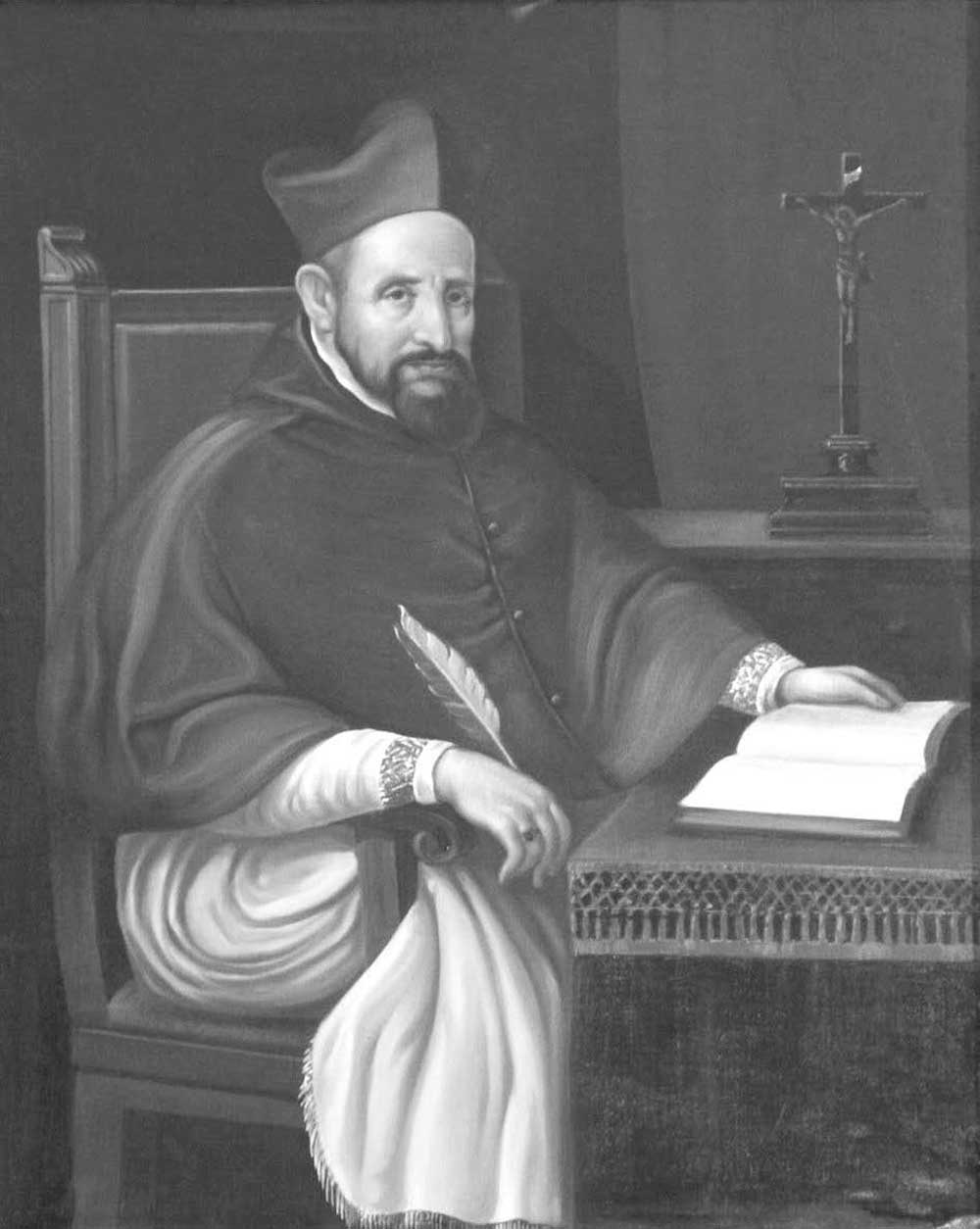
Robert Bellarmine (1542–1621) 16th century portrait from the "Italian school")
Meanwhile Bellarmine rose ever higher in his Church's hierarchy: He became rector of his college in 1592, a cardinal in 1598, and Archbishop of Capua in 1602. He took his spiritual responsibilities as archbishop very seriously, devoting himself to the care of his diocese. His later life was famous or infamous for the part he played in the controversy surrounding the pioneer scientist Galileo and his championship of a sun-centred theory of the solar system (heliocentrism). Acting as representative of Pope Paul V (1605–
21), Bellarmine ordered Galileo in 1616 to stop teaching heliocentrism.
However, Bellarmine's personal views on the issue were more flexible; he believed in the need for further research before heliocentrism could be definitely rejected or confirmed.
Bellarmine spent his last years in retirement in the Roman College, where he wrote a number of devotional treatises for ordinary Catholics, notably The Art of Dying Well (1619).
Although Bellarmine became the supreme theological enemy in the eyes of Protestant theologians, they also gave him a certain respect. This was not only owing to his intellectual stature. They observed with approval
Bellarmine's rejection of the pope's direct authority in the political sphere, an opinion that had earned him the wrath of Pope Sixtus V (1585–90).
Bellarmine was, however, a strong defender of the pope's supreme authority in spiritual matters. Protestants also admired Bellarmine's concessions on the doctrine of grace; in his treatise on justification, he concluded the whole matter by saying, "because of the uncertainty of our own righteousness and the danger of vainglory, it is safest to place one's entire confidence in the mercy and kindness of God alone." In keeping with this, in Bellarmine's last will and testament he begged God "not as the valuer of merit, but as a giver of pardon, to admit me among His saints and elect".2
2. Pierre de Bérulle Pierre de Bérulle (1575–1629) was one of the giants of Roman Catholic spirituality in our period; his personal or literary influence had a deep impact on many other leading figures, e.g. Vincent de Paul, Saint-Cyran,
Pascal, and Bossuet. Indeed, every person given his own pen-portrait below was, in one way or another, a disciple of Bérulle. He stands at the fountainhead of that rich harvest of Catholic spirituality which so marked
France in the 17th century.
Born into an aristocratic family in Cérilly, north-west France, Bérulle was educated by the Jesuits, studied theology at the Sorbonne, and was ordained priest in 1599. He was introduced to the writings of the great
Catholic mystics by his female cousin, herself a distinguished mystic, Barbe Jeanne Acarie (1566–1618), later known as "Mary of the Incarnation". With Bérulle's help, she transplanted Teresa of Avila's Reformed Carmelite order from Spain into the soil of France in 1604.
Bérulle's deepest attachment, however, was not to the Carmelites, but to Philip Neri's Oratorian movement.3 The Oratorians were one of the important new religious orders that flourished in Italy as part of the Catholic Counter-Reformation in the 16th century. Bérulle established an Oratory in Paris in 1611, and acted as its superior-general. The Oratory became a wellspring of reforming influences that eventually reached out into almost all sectors of the French Catholic clergy. However, Bérulle's activities extended far beyond the Oratory; he was involved in the highest levels of French politics. In particular he was instrumental in supervising the marriage between Henrietta, sister of Louis XIII, and King Charles I of England, in 1625, as a result of which Roman Catholicism enjoyed a brief renaissance in the English court. He alienated Richelieu, however, by opposing his foreign policy (aiding the German Protestants against the Roman Catholic Habsburgs in the Thirty Years' War). Pope Urban VIII recognized Bérulle's spiritual and political services to his Church by making him a cardinal in 1627.
Bérulle's literary legacy was large and impressive. His most enduring work was his Discourse on the Greatness and Glories of Jesus (1623), which helped foster a new and potent stream of French Catholic spirituality.
Its twin focal points were the awesome majesty of God, before whom we are as nothing, and our access to Him in Jesus Christ alone, God-in-the-
flesh. By becoming man, God the Son had bridged the otherwise infinite gulf between deity and humanity, redeeming and sanctifying human nature in Himself as God-Man; the supreme duty and privilege of the Christian was to know God in Christ (Bérulle emphasized the historical Jesus of the Gospels), and be conformed to Him in every aspect of the believer's life.
This involved the destruction of all self-will, so that God's interests became the Christian's sole concern. Flowing out of Bérulle's profound attachment to the Redeemer's human life and personality as the medium of revelation and salvation, he conceived a special interest in, and devotion to, the child
Jesus.
The glory of the incarnation, then, dominated Bérulle's mind and heart, and positively glowed in his writings. It was therefore very apt when Pope
Urban VIII described him as "the apostle of the incarnate Word". The title well expresses Bérulle's Christ-centred spirituality, which was to have such a far-reaching influence on French Catholicism in his own lifetime and in the decades following his death in 1629.
3. Francis de Sales In Francis de Sales (1567–1622), we meet perhaps the most influential
Roman Catholic spiritual writer of our period, whose impact has been felt far beyond the bounds of his own Church—that is, if we discount the writings of Fénelon and Madame Guyon, who came under censure for their
Quietism, and may therefore be said not to represent their Church's fully authentic voice. Francis, by contrast, was entirely orthodox in his Roman
Catholicism, and was canonized (declared a saint) in 1665, and recognized as a "Doctor (teacher) of the Universal Church" by Pope Pius IX in 1877.
Francis was born to a high-ranking Catholic family at Sales in what was then the independent duchy of Savoy, nestling between Italy, Switzerland, and France (the inhabitants were French-speaking). He studied at the Jesuit college of Clermont in Paris in the 1580s, followed by a legal training at Padua University. The young Francis seems to have undergone a spiritual crisis while at Paris, his peace temporarily shattered by anxieties over the doctrine of predestination. He feared he might be one of the reprobate. A decisive experience of self-abandoning trust in God's love freed him from this torment.
In 1593 he was ordained to the priesthood—nominally to a position in Geneva, although the city was of course in reality the citadel of Reformed
Protestantism. Francis worked as a Catholic evangelist in Chablais, a province of Savoy, bordering on Geneva. Although part of Catholic Savoy in Francis' day, Chablais had once belonged to the Swiss Reformed canton of Berne. The Duke of Savoy had gained it back from Berne, only on condition that its people be left in peace to practise their Reformed faith.
When Berne broke this treaty by a fresh invasion (which failed), the duke now set about re-Catholicizing the province.
Francis was appointed to spearhead this enterprise as a street preacher.
He proved outstandingly effective, and won many back to Roman Catholicism, braving considerable physical danger from Calvinist zealots who threatened him with violence (it is said that Francis twice miraculously escaped being murdered!). Among his evangelistic strategies was holding public debates with Reformed ministers. To judge by his phenomenal success in winning converts, Francis must have given most of his opponents in these debates a serious drubbing. Another strategy was distributing religious tracts. If Calvinists were unwilling to talk with him, he would slip
the tracts under their doors. We should not, however, idealize Francis' evangelism in Chablais. It was backed by military force: the troops of the duke of Savoy were not necessarily too gentle in their treatment of the Reformed population, which may help explain why some over-zealous
Calvinists tried to murder Francis!
The most famous encounter between Francis and a Reformed minister took place in 1597, when he paid several visits to Theodore Beza, Calvin's successor in Geneva.4 By all accounts these were friendly meetings, where the two men—a youthful Francis and an aged Beza—discussed theology in a civilized manner in Beza's home. Francis at first seems to have had high hopes of converting Beza, but the Reformed patriarch was his match in debate, and Francis left disappointed.
In 1599 Francis became assistant Bishop of Geneva (since the Reformation, the Catholic bishops of Geneva had resided in Annecy,
France). His bishop sent him to Paris on business in 1602; here he fell under the spiritually fertilizing influence of Bérulle. In 1603 he was appointed
Bishop of Geneva. As bishop, he earned a reputation for captivating preaching, skilful personal direction of souls, and championship of the poor.
Together with Jane Frances de Chantal, whose spiritual director he was, he founded in 1610 the Visitandine order of nuns (the Order of the Visitation of Holy Mary), a "contemplative" order (devoted to prayer rather than to good works in the wider community).5
Francis' widest and most lasting impact came through his spiritual writings, especially the classic Introduction to the Devout Life. This was originally a series of letters of spiritual advice, written to Madame Louise de Charmoisy, but rewritten in a more general format and addressed to the imaginary Philothea ("lover of God"). The collection was first published in 1609, and was a runaway bestseller. Francis revised it several times; the Introduction known today is the final 1619 edition.
The Introduction was a novelty in being directly applicable to Christians living in the world: a handbook of lay piety (although there was nothing to prevent its use by a monk or nun). Its more famous predecessor, Thomas a Kempis' Imitation of Christ, had been written specifically for those living in religious communities. Francis' work transplanted the piety of the monastery and nunnery into the soil of the world.6 Louise de Charmoisy, the original recipient of the work, was the wife of one of the Duke of Savoy's ambassadors, concerned about living out her faith in her secular
life. Francis' advice struck a loud chord with many lay Christians throughout Europe who shared those aspirations. The Introduction was translated into all the major European languages, in editions both authorized and unauthorized. Many Protestant translations were produced, which omitted and adapted some of Francis' advice to make it more acceptable to Protestant readers. The work has endured to the present day as one of the most loved classics of spirituality in Christian history.
Another classic by Francis, not so well-known, was his Treatise on the Love of God (1616).
The example of Francis' life is treasured today in a special way, and his writings promoted, by a religious order named after him, the Salesians. The order, however, was not founded until 1859.
4. Vincent de Paul If we judge people by their embodiment of a lovable humanity, as well as their influence on others, Vincent de Paul (c.1581–1660)7 was probably the greatest Roman Catholic saint of the 17th century.
Vincent de Paul was born in south-west France, in the tiny village of Pouy, near Dax. Of peasant stock, he was at first a shepherd, but wanting to escape his tedious surroundings, embarked on a career in the Church when he was 15. After studying at Toulouse University, he was ordained priest in 1600. Remaining in Toulouse as a tutor, by his own account he was captured by Muslim pirates in 1605 during a sea journey from Marseilles.
For two years he was a slave in Tunisia, before escaping back to France in 1607 with his master, a French Christian apostate to Islam whom Vincent re-converted. (Some historians dispute this story, arguing that Vincent made the whole thing up to conceal less respectable adventures at this time.)
The spiritual turning point in Vincent's life came in 1608. That year in Paris he met and fell profoundly under the spell of Bérulle, who became
Vincent's role-model for the rest of his life. It was Bérulle who in 1611 sent Vincent to his first parish, as priest of Clichy in Paris's northern district. A year later Bérulle removed him to serve as tutor to the Gondis, a wealthy
Italian banking family that had settled in France. Here began Vincent's practical commitment to evangelism; at the urging of the pious
Mademoiselle Françoise de Gondi, he conducted effective preaching missions among the peasants on the lands owned by the Gondis in northeastern France.
After five years of this, however, at Vincent's own request, Bérulle sent him back into parish ministry, at Chatillon-les-Dombes. It seems that Vincent felt uneasy at the comfort of his circumstances in the Gondi household; he must share the hardships of the ordinary parish priesthood.
Although he served at Chatillon only five months, it had a profound impact on Vincent in two respects. First, he learned to think charitably of Protestants, several of whom made him feel welcome in his geographically and morally rugged parish—and in turn were so impressed by Vincent's life and teaching that they became Roman Catholics. Hereafter Vincent would always think of Protestants as "separated brethren" to be reconciled with Rome by kindness, rather than monsters to be despised and persecuted.
Second, it was in Chatillon that Vincent founded his first "Congregation of
Ladies of Charity".8 This was a lay society devoted to the relief of the destitute, governed by a detailed code drawn up by Vincent (similar to a monastic rule, although the ladies were not nuns). The idea would soon blossom and bear abundant fruit in the remainder of Vincent's life.
In 1617, Vincent returned to the Gondis, at the insistent plea of Mademoiselle Françoise, who wanted him to resume his preaching missions. Bérulle added his voice, now convinced that Vincent's place was not in the settled parish ministry, but on a wider stage. So he returned to his itinerant evangelism on the Gondi estates, also founding Congregations of Charity in many places. It was a year later, in 1618, that he met Francis de
Sales; the two men became spiritually close, and the foundation laid in Vincent's soul by Bérulle was now crowned by the influence of Francis.
When dying in 1622, Francis entrusted to Vincent the spiritual care of the Visitandine order of nuns he had founded in 1610.
Vincent's commitment to the poor had by this time possessed him as a mission from heaven. In Paris, where the Congregations of Charity were first established in 1629, he pioneered a momentous new development; to aid the Ladies of Charity, Vincent helped create a movement that became the Sisters of Charity (he preferred to call them Daughters of Charity, but "Sisters" was the name that stuck). What set them apart from the Ladies of Charity was that the Sisters were all recruited young, and lived together in community—in the house, initially, of Mademoiselle Louise de Marillac
(1591–1660), who with Vincent was cofounder of the movement. The widow of Antoine Le Gras, a middle-class lawyer, she was known by his name, Mademoiselle Le Gras. Antoine had died in 1625, and Louise had been a close disciple of Vincent from 1626. The nucleus of the Sisters of Charity was formed under her immediate direction in 1633.
Nurtured by the preaching of Vincent, the Sisters grew in number, and became the greatest single agency of social welfare in France, at work in hospitals, orphanages, prisons, schools for the poor, charity-houses for beggars, asylums for the insane, homes for the old, and in providing general relief for the destitute. The relief work was not just for the poor, but included (for example) the victims of war. North-eastern France was ravaged in the Thirty Years' War by an Austrian invasion in 1636, leaving desolation and anarchy in its wake that lasted for years. Paris and its provinces were devastated by civil war in 1648–53, when the French nobility in alliance with parlement rebelled against the young King Louis
XIV and his chief minister, Cardinal Mazarin. Wherever social need cried out, the Sisters of Charity rushed in to help.
In 1642, the Sisters began to take the traditional vows of a religious order (poverty, chastity, and obedience), yet without "enclosure"—their daily work was outside the community, in the world. This was a novelty that caused difficulties, since nuns were supposed to live strictly within the walls of a convent. Vincent, however, who drew up the movement's religious rule, managed to persuade the Archbishop of Paris to give his approval in 1646. Louis XIV granted royal authorization in 1657. Finally, soon after the death of Vincent and Mademoiselle Le Gras, Pope Clement
IX gave the whole movement papal endorsement in 1668. As a religious order, the Sisters of Charity were nicknamed "the Grey Sisters" from the colour of their garments.
Although Mademoiselle Le Gras must be commemorated as the practical organizer of the Sisters of Charity, their spiritual inspiration always remained Vincent de Paul, whose preaching, example, and influence in high places, carried the movement forward. "Visit the poor instead of praying", he advised the Sisters. "In this way, you are leaving God in order to serve
God." By the time of Vincent's death in 1660, there were 40 communities in France; by the time of the French Revolution in 1789, there were 426. The movement spread into other Roman Catholic countries—Italy, Spain,
Portugal, Austria, Poland, and the Catholic cantons of Switzerland. It is still active today, a living monument to Vincent's humanitarian commitment.
This is how he is remembered in his native France: not so much as the Catholic saint, as the friend of the poor and the orphan. Yet it has been remarked that it was not charity that made Vincent a saint, but his saintliness that made him truly charitable. Vincent's works were the fruits of his faith.
Vincent's other great contribution to French Catholic spirituality lay in the training of the priesthood. Seminaries were at a low ebb in France in the early decades of the 17th century. The 40 years of civil war ("the French wars of religion") in the previous century had devastated Catholic seminaries. In 1625, there were only ten throughout the country. Emergency measures were necessary; the Bishop of Beauvais asked Vincent in 1628 to prepare some candidates by means of a short ten-day "retreat". Vincent's methods of instruction were a huge success (a combination of his own inspirational personality and a ruthless focus on giving what he considered
the bare essentials a priest needed to know). Further retreats followed, and as they gained in popularity, they became longer and longer: from ten days, to two or three months, and finally to two or three years. The retreats were soon being transformed into actual seminaries, staffed initially by those whom Vincent had personally trained.
Even before the Bishop of Beauvais launched him on this path, Vincent had already, in 1625, founded a community of "secular" priests (not bound by monastic vows) at the priory of Saint-Lazare in Paris. He had intended them to extend his practice of preaching missions throughout France, but the Lazarists (their popular nickname: technically the Congregation of the Mission) were soon hugely active in training men for the priesthood through Vincent's retreats and seminaries. Vincent also held special conferences for clergy at Saint-Lazare to provide ongoing spiritual input into their lives and ministries; he organized retreats there for pious laymen as well. These conferences and retreats attracted hundreds every year. Not quite single-handedly, but as the fountainhead of inspiration, Vincent raised up a whole new generation of dedicated, successful parish priests for Catholic France, and spread a lively Catholic piety to myriads of ordinary
Catholics.
He also made an impact through the Council of Conscience, the body that advised the court on Church affairs, including the choice of bishops and abbots. Vincent was secretary of the Council for nine years, during which he exerted himself to improve the spiritual quality of the Church's men and ministries. On one occasion, his refusal to bestow a bishopric on a young aristocratic drunkard led to a stormy interview with the lad's mother, which ended with her throwing a wooden stool at Vincent's head, causing the blood to gush. But the drunkard was not given the bishopric. Unfortunately for Vincent's reforming endeavours, the Council of Conscience eventually ceased to meet, owing to the hostility of Cardinal Mazarin, who then controlled the French court and regarded Vincent as an interfering busybody. Mazarin preferred to hand out bishoprics as political bribes.
Time would fail to tell of Vincent's other activities. By his death in 1660, aged around 80, he had won a deep and enduring place in Catholic affections. Even Voltaire, arch-critic of Christianity in the following century, exempted Vincent from his bitterness—"my favourite saint is
Vincent de Paul." He especially endeared himself to his native land of
France, where the memory of "Monsieur Vincent" lingers on today, with something of the flavour of a French Francis of Assisi.
5. Jacques-Bénigne Bossuet Jacque-Bénigne Bossuet (1627–1704) enjoys an exalted reputation, not only as the most brilliant pulpit orator of 17th century France, but as one of the greatest orators of all the Christian centuries—perhaps the greatest, in terms of his sheer mastery of majestic language in the service of spiritual truth. The Sanders Theatre in Harvard has busts of the eight supreme orators of all time, and Bossuet is among them, alongside such Pagan titans as Demosthenes and Cicero, and Christian giants like Chrysostom and Augustine.
Born at Dijon, the son of a judge, Bossuet was educated in his youth by the Jesuits (although, ironically, they would later regard him as an enemy because of his leniency towards Jansenism). He then went to Paris to train for the priesthood. Here, at the age of 21, Bossuet underwent the great religious crisis of his life, from which he emerged as a serious, committed
Christian man. He then became a disciple of Vincent de Paul, under whose direction he flourished spiritually. The other great influence on him was the writings of de Paul's own mentor, Cardinal Bérulle. After Bossuet's ordination as priest in 1652, he spent some years attached to the cathedral of Metz, where his intellectual powers matured in controversies with Protestants and Jews. It was at Metz that Bossuet conceived his lifelong dream of winning Protestants back into the Roman Catholic Church. Most unusually for his day, Bossuet did not regard Protestants as loathsome adversaries to be crushed, but separated brothers to be reconciled—a generosity he absorbed, perhaps, from his master Vincent de Paul, who held the same rare view.
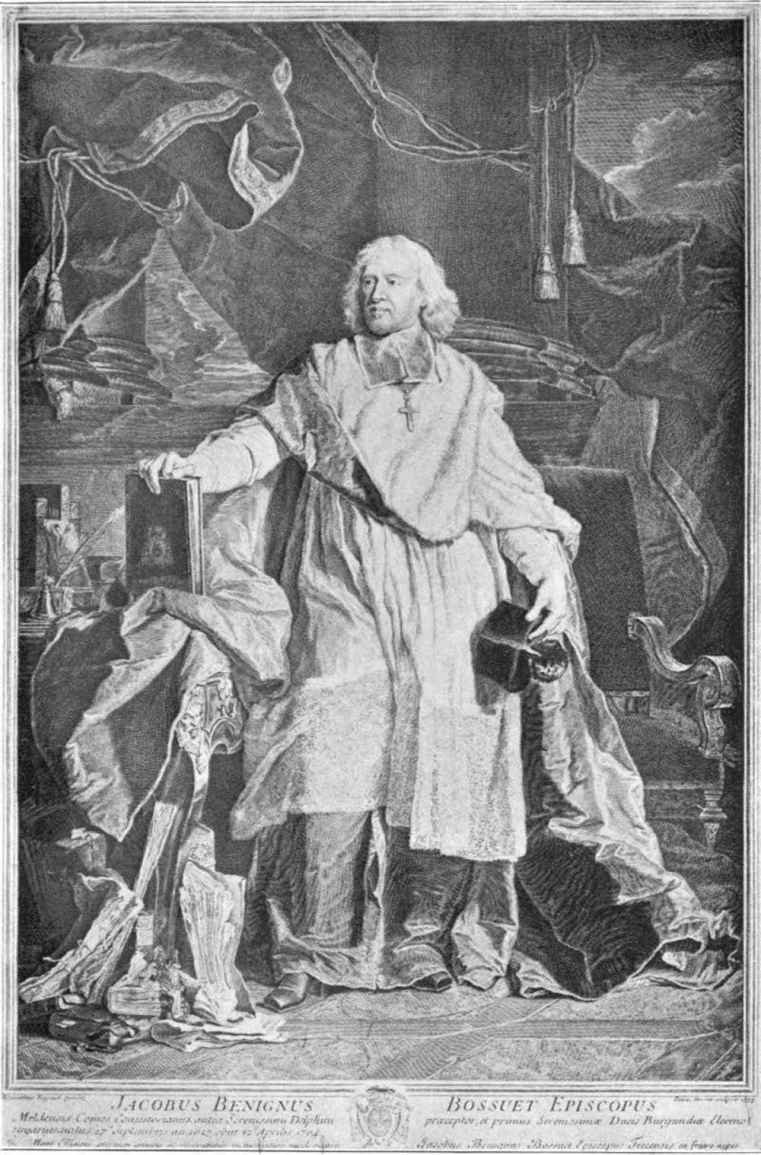
Jacques-Bénigne Bossuet (1627–1704) A 1723 engraving by Pierre Imbert Drever (1697–1739))
In 1657, de Paul persuaded Bossuet to settle in Paris, where his ability in the pulpit would receive wider exposure and be put to better use. He was soon the celebrity preacher of the age—audiences hung entranced on his every word—and often preached to the court in the royal chapel. Louis XIV was sufficiently impressed to make Bossuet the personal tutor of his son from 1670–81. Then in 1681 Bossuet was appointed Bishop of Meaux, a position he held for the rest of his life, from which comes his nickname,
"the Eagle of Meaux".
Bossuet was now on the centre stage of French Catholic life, and took part in all the great religious and political events of the day: the Gallican crisis (see Chapter 7, section 1), the Jansenist controversy (see section 4, below), the Quietist controversy (see Chapter 7, section 2), and the running sore of Protestantism within Catholic France. On the last point, Bossuet approved of the revocation of the Edict of Nantes; he wished to see a religiously united France—"one king, one Christ, one Church", as he put it.
But he did not support the more brutal methods employed by royal troops to force Huguenots to convert to Rome (see Chapter 7, section 3). Peaceful reunion between Roman Catholics and Protestants remained Bossuet's deepest aspiration, and to that end he engaged in a 17 year long friendly correspondence (1683–1700) with the great German Lutheran thinker and pioneer ecumenist, Gottfried Wilhelm Leibniz (1646–1716).
In this brief cameo of Bossuet, we may perhaps focus a special gaze on two aspects of his life and work: Bossuet the preacher, and Bossuet the writer.
As a preacher, Bossuet was without any serious rival in his combination of superb gifts. His physical presence was noble, his voice a well-tuned trumpet; his sermons blended depth of doctrinal knowledge, luminous clarity of thought, piercing scrutiny of the human heart and its motives, an unsurpassed musical command of French prose which never became contrived or hollow, and a fiery ardour of soul that was never melodramatic or out of control. In a Catholic France which was, at that time, passionately addicted to sermons, Bossuet was in endless demand to fill pulpits. Even the despotic Louis XIV acknowledged the power of his preaching; although the king might feel no affection for the Eagle of Meaux, he was compelled to reverence him. Bossuet particularly excelled in delivering set-piece
sermons on great occasions; his masterworks are considered to be his funeral orations on Henrietta of France (1669), Henrietta of England
(1670), and the Prince of Condé (1687). Other great examples of his pulpit splendour include his sermons on Death, Ambition, Providence, The Dignity of the Poor, and Submission to the Law of God.
Bossuet's literary legacy is perhaps best seen in the following two treatises:
Discourse on Universal History (1679). Generally acknowledged as Bossuet's greatest work, this was his equivalent to Augustine's City of God: a Christian philosophy of history. Bossuet argued that the proper concept of God was not simply as Creator of the universe, but also providential ruler of history. All history was shaped by divine sovereignty, and found its culmination in the incarnation of God's Son, which brought the Church into being as the new humanity. However, God normally governed history through secondary agencies. In the political sphere His agent was the state, especially in the shape of the king (Bossuet believed passionately that monarchy was the true and divinely sanctioned form of government). In the spiritual sphere, His agent was the Catholic Church. Rebellion against either of these bodies was tantamount to rebellion against God Himself.
Bossuet's belief that God usually worked through secondary causes impelled him to try to discern patterns in history. Rather than a random series of unconnected scenes, history was a process of development, working according to God-given laws; the perceptive historian could see how the elements of each era gave birth to its successor.
History of the Variations of the Protestant Churches (1688). This was Bossuet's masterpiece of anti-Protestant argument. He traced the evolution of Protestantism from its origins, and sought to show that it had no principle of unity—that without the guidance provided by Roman Catholic tradition and teaching, Protestantism was doomed to helpless instability and endless change. The book was especially challenging to Protestants because
Bossuet, rather than highlight the differences between Protestantism and Roman Catholicism, made every possible religious concession to his opponents, in order that their real errors (as he saw them) might stand out all the more starkly. In fact, rather remarkably, he reduced the ultimate difference between Roman Catholics and Protestants to a single point—the doctrine of transubstantiation. Protestants recognized in Bossuet one of
their fairest and most moderate, yet most intellectually formidable, Roman Catholic critics.