
1. Charles II: the Restoration regime
Charles II: the Restoration regime 1. The return of the king Oliver Cromwell's death in 1658 plunged Britain into two years of political chaos (see under John Owen in the previous Chapter for some details). Out of the plots and counter-plots of different factions, one dominant power emerged: General George Monck (1608–70), a royalist who had switched sides and was Cromwell's military governor of Scotland. Monck now switched sides again, marched his army down into London in February
1660, and restored the Long Parliament, including the Presbyterians who had been excluded by Pride's Purge. The Presbyterians, true to their understanding of the Solemn League and Covenant, had opposed the execution of Charles I, and now favoured the restoration of the monarchy, as Monck himself did. Their only condition was that the exiled Charles II (born 1630; reigned 1660–85) would guarantee religious freedom for Presbyterians. After convincing the MPs of his purpose to bring back
Charles II, Monck then persuaded the Long Parliament to dissolve itself legally and authorize fresh elections, in order that a new, contemporary
House of Commons might give legitimacy to a restored monarchy.
To the horror of Presbyterians, however, Anglican royalists did extremely well in the general election, and the resulting "Convention Parliament" was evenly divided between the two parties. From his exile in the Dutch
Republic, Charles played his hand well; on Monck's advice, he issued the "Declaration of Breda"1 in April 1660, promising religious toleration and an amnesty for all acts committed in the Civil War. Charles was probably sincere in his declaration of intent; he had no stomach for religious persecution, or religious controversy, or indeed religion, and was determined simply to get back on the throne, where he was to become chiefly famous for his extra-marital affairs. The Earl of Rochester allegedly said of Charles: We have a pretty witty king,
Whose word no man relies on; He never said a foolish thing, And never did a wise one.
If political policy required it, however, Charles could be as intolerant as any religious zealot; note his fairly brutal approach to the Covenanters in Scotland (see Chapter 5, section 4).
On receiving the Declaration of Breda, the Convention Parliament passed the Act of Indemnity and Oblivion, granting the suggested amnesty with a few exceptions (the "regicides"—those responsible for Charles I's execution). Then the MPs invited Charles home; he arrived amid huge popular rejoicing in May. Monck was suitably rewarded by being made
Duke of Albemarle. (This re-establishment of the Stuart monarchy is generally known as the Restoration.) Some of the regicides were arrested and executed, including the celebrated Independent preacher Hugh Peters, who had been chaplain to the Republic's council of state; Peters had not signed Charles I's death warrant, but had expressed warm approval of the deed in his preaching, and was widely detested as the embodiment of Puritan fanaticism.
2. The Cavalier Parliament and the Clarendon Code Parliament was again dissolved in December; new elections produced in May 1661 the "Cavalier Parliament", which was overwhelmingly Anglicanroyalist in membership, with hardly a Presbyterian in sight. The head of Charles II's new administration was Edward Hyde, Earl of Clarendon
(1609–74), a devout Anglican who had led the royalist MPs against John Pym in the House of Commons, after the original unity of the Long
Parliament had broken down back in 1641. Clarendon is also important as a historian; his History of the Rebellion and Civil Wars in England (first published in three volumes at Oxford, 1702–4) is our most detailed account of the Civil War period from a contemporary royalist.
Under Clarendon's guidance, the Cavalier Parliament proceeded to enact a new religious settlement for the country. The fiercely Episcopalian nature of this settlement, and its oppressive character toward non-Episcopalians, derived from parliament rather than from the king. Charles was prepared to be more tolerant, but the Anglican-royalist MPs were in no mood to be generous to the Presbyterians, Independents, and Baptists who had humiliated them on the battlefield, killed their king, and outlawed their worship. Charles had no choice but to fall in with this vengeful mood; he could rule only through his parliamentary supporters. The whole country indeed seemed to be in an anti-Puritan state of mind, a strange amalgam of Episcopalian religious fervour and sheer licentious rejection of moral restraint. The Puritanism of the Civil War period was now merely a subject for hilarity and ridicule, well captured by satirist Samuel Butler (1612–80) in his poem Hudibras (1664). The Puritan "hero" of the poem, a Civil War warrior, was held up to devastating mockery: For his Religion, it was fit
To match his learning and his wit; 'Twas Presbyterian true blue; For he was of that stubborn crew Of errant saints, whom all men grant To be the true Church
Militant; Such as do build their faith upon The holy text of pike and gun; Decide all controversies by Infallible artillery; And prove their doctrine orthodox By apostolic blows and knocks;
Call fire and sword and desolation A godly, thorough reformation, Which always must be carried on, And still be doing, never done;
As if religion were intended For nothing else but to be mended.
A sect, whose chief devotion lies In odd perverse antipathies; In falling out with that or this, And finding somewhat still amiss; Compound for sins they are inclin'd to By damning those they have no mind to: Still so perverse and opposite,
As if they worshipp'd God for spite.
The Cavalier Parliament, reflecting more the religious side of this antiPuritan frenzy, legally re-established the Church of England as a fully
Episcopal Church, worshiping according to a slightly revised Anglican Prayer Book,2 with the monarch as supreme governor. The Solemn League and Covenant was burned in public by order of parliament—
Presbyterianism was now a lost cause. The Act of Uniformity in May 1662 required all parish clergy to renounce the Covenant, submit unconditionally to the doctrine and worship of the restored Anglican Church, promise never to attempt any change to the status quo in church or state, and to receive
Episcopal ordination if they lacked it.
The Act came into effect on Saint Bartholomew's Day (24th August).
When it did, almost a thousand clergy left the established Church. The figure is often given as two thousand; but this larger number is obtained by adding on a further 700 or so clergy who had already left under the provisions of the September 1660 Act for Confirming and Restoring of Ministers (which among other things required an acknowledgment of royal supremacy over the Church), plus some 200 university lecturers (ordained men) also expelled for their Puritanism. In the Anglican Church in Wales, another 120 clergy lost their livings. In all, between 1660 and 1662, the established Church lost roughly one fifth of its ministers.
The 1662 Act of Uniformity did not occur in a vacuum. Prior to the election of the Cavalier Parliament, there had been various attempts, often politically driven, to find some middle way that would allow Presbyterians to remain in the established Church. These efforts reached their high noon in the Savoy Conference of April-July 1661, where 12 Anglican bishops met with 12 Presbyterian divines to discuss the possibility of a national ecclesiastical settlement embracing both Episcopalians and Presbyterians.
The Presbyterian delegates included Edward Reynolds, John Conant, and John Wallis (who all conformed to the Anglican Church when the conference failed—see below), and Richard Baxter, Edmund Calamy, and Thomas Manton (who did not conform and were expelled in 1662).
Both sides exhibited a certain inflexibility. The leading Anglican, Gilbert Sheldon (1598–1677), the Bishop of London, was a survivor from the days of William Laud, an uncompromising High Church Arminian, deeply averse to Presbyterianism and all other forms of non-Episcopal Protestantism.
Sheldon wanted to keep the Presbyterians out of the Church, not to
accommodate them. He threw the Presbyterian delegates on the defensive by asking what changes they wished to see in the Church before they would conform. The Presbyterians obligingly walked straight into his trap and produced a list of 99 necessary changes, which of course made them look insufferably provocative and pedantic in the eyes of the other bishops (just what Sheldon wanted). The conference fizzled out into futility. The only positive fruit it bore was Richard Baxter's Reformed Liturgy, which Baxter offered as an example of how worship might be conducted acceptably to all
Reformed consciences. A commendable model of Reformed worship, it nonetheless antagonized the Anglican bishops, since Baxter seemed to be saying that he could whip up a liturgy at a moment's notice that was superior to the venerable Prayer Book.
Reconciliation failed, then, and the Act of Uniformity duly took effect on August 24th 1662. The Church of England thereby lost the majority of its ministers with any kind of Puritan leanings toward reform. It would not be true, however, to say that all spiritually-minded Calvinists left the established Church. A number of such men, including some who in the period 1640–60 had merited the name "Puritan",3 stayed within the Anglican establishment. Richard Baxter in his autobiography made it clear that there were a good many such men, and that (along with Arminians who were not High Church) they were "laudable preachers and the honour of the conformists".
The most well-known of the Calvinist conformists included Edward Reynolds (1599–1676), one of the most highly respected and influential of the Westminster divines, who had already been given the bishopric of Norwich in 1660;4 the Presbyterian John Conant (1608–94), Rector of Exeter College, Oxford, who married Edward Reynolds' daughter, and after much boggling conformed to Anglicanism in 1670; Robert Crosse (1606–
83), another Westminster divine, minister at Chew Magna in Somerset, an expert on the early church fathers and medieval scholastic theologians; John
Wallis (1616–1703), a brilliant mathematician (still revered today), one of the Westminster Assembly's scribes, who had several pastorates in London before becoming Savilian Professor of Geometry at Oxford; and most famously William Gurnall (1617–79), minister at Lavenham in Suffolk, whose Christian in Complete Armour (three volumes, 1655–62) has become one of the most universally esteemed and popular classics of Reformed
practical divinity ever published.5 Men like this ensured there would still be a Calvinist, evangelical group within the Anglican Church.
The Puritan-minded clergy who left the established Church between 1660 and 1662 were not the only ones to suffer. The Cavalier Parliament enacted a series of repressive measures affecting all non-Anglicans, both ministers and laity—Independents, Baptists, Quakers, and every other brand of nonconforming Protestant in addition to the Presbyterians. Together they made up around 10% of the English population. We can summarize the repressive legal measures against them as follows: The Corporation Act of 1661 required all who held any kind of public office, from the lowest to the highest, to disown the Solemn League and Covenant, and to take part in holy communion in the Anglican Church within one year of appointment to office. This made it virtually impossible for devout non-Anglican laymen to be MPs, magistrates, university tutors, etc.
The Conventicle Act of 1664 made meetings for unauthorized (nonAnglican) worship illegal, if there were more than five people present who did not belong to the same household. When this Act was reaffirmed and more rigidly enforced in 1670, the Puritan-sympathizing MP and poet
Andrew Marvell (1621–78), close friend of John Milton, famously denounced it as "the quintessence of arbitrary malice".
The Five Mile Act of 1665 prohibited non-Anglican ministers from living or even temporarily lodging within five miles of any city, or corporate town, or indeed any town where they had functioned as ministers or theological lecturers. There was a get-out clause: the Act no longer applied if the minister swore that it was never, under any circumstances, lawful to take up arms against the king or his government, and that he would never attempt any change to the status quo in church or state (as specified in the 1662 Act of Uniformity).
Together with the Act of Uniformity, these parliamentary enactments have (since the 19th century) collectively been called the "Clarendon
Code", after the Earl of Clarendon. This is probably unfair to Clarendon; he was rather less dogmatic and intolerant than the Cavalier Parliament itself, or than Gilbert Sheldon who became Archbishop of Canterbury in 1663 and pushed hard for the absolute legal suppression of all non-Anglicans. The penalties for violating the Code were severe: crippling fines or imprisonment, including (for a breaking the Code a third time) being shipped out as slave labour to an American or Caribbean plantation for
seven years. The overall result was a gruelling persecution of Protestants by a Protestant state that was almost unique in 17th century Europe.6
3. Protestant Nonconformists under the Clarendon Code The next 25 years were to be a long, dark night of the soul for non-Anglican
Protestants—Nonconformists or Dissenters, as they were called (Richard Baxter uses both terms in his autobiography). They were now in a worse position than they had ever experienced in English history. All prospect of reforming the Church of England was gone; all prospect of toleration for those outside her precincts was likewise gone. The heady hopes of the Civil
War lay in ruins around the heroes of yesterday.
One possible response was violent rebellion. Only a few took this course.
In January 1661 there was a Fifth Monarchist uprising in London to replace King Charles with King Jesus, but only some 50 men took part; most were killed by government forces, and the survivors were executed. In March
1663 at Muggleswick Park in Durham, a meeting of Nonconformist conspirators plotted an insurgency, but were betrayed by a Baptist plotter who had second thoughts; many were arrested, many fled. But the conspiracy rumbled on, and the same essential group were still planning an armed revolution when government agents swooped on them in October, arresting some 90 men. A score of them were executed in January 1664.
Still the plotting continued, and it only really fizzled out when the Great Plague hit the country in 1665.7 These Nonconformist plots and uprisings were the work of a small minority, but they hardened the attitude of a nervous and vengeful government against all Nonconformists; the innocent many suffered for the crimes of the reckless few. The Conventicle Act of 1664 was almost certainly a reaction to these insurrectionary plots.
How did peaceful Nonconformists respond to the Clarendon Code?
Some, while retaining their personal convictions, renounced its expression in worship, and attended their parish church. Others sought ingenious ways of complying with the Code without abandoning Nonconformity. Adam
Martindale (1623–86), for instance, a Lancashire Presbyterian, preached the same sermon throughout the week to a succession of tiny groups, so that the Conventicle Act was not violated.
Others disobeyed the Code but took precautions to conceal their disobedience. Some congregations met in the thick of night, sometimes in forests or caves. At Olney, in Buckinghamshire, there was an area called
Three Counties Point that bordered on Buckinghamshire, Bedfordshire, and Northamptonshire; a Nonconformist group led by John Gibbs (1627–99)
worshiped in this area, so that if county officers arrived to arrest them from one county, they could simply slip across the boundary-line into a different county. Others fitted out the house where they met with elaborate escape routes in case government agents turned up: concealed trap-doors into cellars, concealed side-doors into other rooms (e.g. through a cupboard).
The government agents could burst into the room where they believed the illegal worship was taking place, only to find it mysteriously deserted. The Independent minister Thomas Jollie (1629–1703) of Wymondhouses,
Lancashire, preached in a room from a desk that was really a folded door to a back staircase. If government agents were spotted, Jollie pulled a cord which raised the top half of the desk, recreating the door. Consequently, agents entering the room from the front would find a group of people but no Jollie, who exited by the staircase.
Informers were a constant danger. The Clarendon Code awarded them a third of the fine imposed on convicted Nonconformists, so there was a strong financial incentive to infiltrate and betray illegal worship meetings.
In the Calvinistic Baptist congregation at Broadmead, Bristol, whose pulpit was filled by a variety of preachers, the speaker gave the sermon from behind a curtain, so that any visiting informer could hear the preaching (and hopefully be converted!) but not be able to see or identify the preacher.
Despite all these dexterous methods of obeying the Clarendon Code or concealing disobedience, however, many Nonconformists were arrested, convicted, and punished. Over 200 of the clergy expelled from the national
Church in 1660–62 ended up in prison. Between 1682 and 1686, we know that in London alone, over 3,800 Nonconformists were arrested and tried for attending illegal worship. It has been estimated that a total number of between 5,000 and 8,000 Nonconformists may have died in prison under the Clarendon Code (17th century prisons were unhygienic places).
How did the three main groupings of Nonconformists—Presbyterians, Independents, and Baptists—each respond collectively to the long ordeal?
Many Presbyterians continued to hope that the government might have a change of heart to the extent, at least, of allowing them back into a broader
Anglican Church. There were conferences on this between Presbyterian and Anglican divines in 1668, 1674, and 1680, and one last time in 1689 after the Stuart dynasty had once again been toppled from the throne. But the conferences bore no fruit, and Presbyterians remained outside a national established Church that did not want them. In addition, the paralyzing
restrictions placed on Presbyterian religious activity by the Clarendon Code meant that Presbyterians could not function as a genuinely Presbyterian
Church. Each congregation was forced in practice to act as though it were an autonomous Independent church. English Presbyterianism therefore lost its distinctive identity during the years of repression, becoming virtually
Independent in practice.
The leading Presbyterian of this period was Richard Baxter.8 Another who came to prominence was John Flavel (1627–91) of Dartmouth in Devonshire; diehard Anglicans of the Restoration era sometimes spoke of an unholy trinity of Richard Baxter, John Owen, and John Flavel as the three great upholders of Nonconformity. Flavel enjoyed unsurpassed success as an evangelistic preacher, and his writings on doctrinal and practical divinity were treasured for their rare marriage of plain speaking and imaginative power. The Fountain of Life Opened (1672) was perhaps his most significant work, an extended meditation in 42 sermons on the person and work of Christ. Another Presbyterian who now attained full spiritual stature was John Howe (1630–1705); he had had a brief stint as Cromwell's chaplain, but it was in the Restoration period that Howe's theological maturity produced works of enduring value that appealed far beyond the Nonconformist constituency, notably The Living Temple (2 vols., 1675–1702) and The Redeemer's Tears Wept Over Lost Souls (1684).
Intriguingly, Howe had been trained at Cambridge under Henry More and Ralph Cudworth, two of the "Cambridge Platonists" (see below), and some have found Howe's thought a unique bridge between the worlds of Platonism and Puritanism.
The Independents may have profited from the Presbyterians' loss of ethos. Or at least, a significant number of Presbyterian ministers ejected from the national Church between 1660 and 1662 are known to have become Independents. Certainly the Independent-Presbyterian animosities of the Civil War died away; the two great parties were drawn together in a spirit of unity as fellow-sufferers under the Clarendon Code. As Presbyterians lost their church government distinctives, there seemed little to keep the two groups apart. Some Independents drew so close to the Presbyterians that they embraced their desire to return into England's national Church, and joined with Presbyterians in seeking this when the persecution was finally over and a friendly monarch (William of Orange— see below) once again sat on the throne. Perhaps they were harking back to
Cromwell's decentralized, live-and-let-live national Church of the 1650s, in which Independents had been given freedom to minister according to their own ideals. But it was not to be, and the sense that some Independents had acquired of being Anglicans-in-exile was doomed to frustration. Many other
Independents, however, were glad enough that it should be so; they had held on resolutely to their belief in strict Congregationalism, and saw no way of melding it with the Anglican system.
Until his death in 1683, John Owen was by far the most influential Independent. Thereafter, leading figures in Independency were Thomas
Cole, Isaac Chauncey (or Chauncy), and Richard Davis. Thomas Cole (1627–97) was minister of Silver Street Independent church in London, which Philip Nye had pastored. He was notable for defending Reformed
Orthodoxy against some of Richard Baxter's more debatable ideas on the atonement, imputed righteousness, and the nature of faith and repentance.
Isaac Chauncey (1632–1712) ministered to the congregation at Mark Lane in London, the capital's most distinguished Independent church; John Owen had been the previous pastor, and the church was full of members who had played a prominent part in the government of Oliver Cromwell, or at least had married into families connected with the old Cromwellian regime.
Richard Davis (1658–1714) was minister of Rothwell, Northamptonshire; his theology ignited controversy (he was accused of antinomianism), but there could be no denying his passionate commitment to preaching with an evangelistic note. His congregation grew hugely over his 25 year ministry
(795 people coming into membership), and he preached regularly to a circle of some 50 Independent churches within an 80 mile radius of Rothwell.
Baptists were also drawn closer to Presbyterians and Independents in the furnace of the Clarendon Code. This probably helps explain why in 1677, during the period of persecution, the Calvinistic Baptists adopted a slightly modified form of the Westminster Confession (Presbyterian) and Savoy
Declaration (Independent) as their own doctrinal statement: a self-conscious assertion of pan-Reformed brotherhood. Surprisingly, the Arminian Baptists of Bedfordshire, Buckinghamshire, Hertfordshire, and Oxfordshire, did something similar in 1679 with their Orthodox Creed: Or a Protestant
Confession of Faith, where they emphasized what they had in common with all Reformation Protestants, rather than Arminian distinctives. The Orthodox Creed used the framework of Reformed covenant theology, and veered so close to Calvinism (teaching perseverance, for instance) that
some have seen it as less an Arminian confession, more an ArminianCalvinist synthesis. It testified to the desire of at least some Arminian
Baptists to join the world of Reformed thought-patterns and language. Their motive was stated in the subtitle of the Creed: "being an essay [attempt] to unite and confirm all true Protestants in the fundamental articles of the Christian religion, against the errors and heresies of Rome". The moving spirit behind the Orthodox Creed was Thomas Monck (active 1654–79), who was concerned about the appearance of Christological errors among Arminian Baptists (the old Anabaptist "heavenly flesh" Christology).9
The Baptist leadership in this period were mostly the same men we have already considered in Chapter 3 section 6. Still, a few new figures emerged.
The most important by far was Benjamin Keach (1640–1704), pastor of the Calvinistic Baptist church at Horsleydown in Southwark (south London). A prolific writer, his Tropologia, or a Key to open Scripture Metaphors (1682) was long in print as a popular favourite. He is credited with writing the slightly amended Westminster Shorter Catechism for Calvinistic Baptists,
"Keach's Catechism", but the attribution is doubtful—William Collins (d.1702) seems a more likely candidate. Keach's place in Baptist history, however, is assured by his lively championship of hymn-singing in corporate worship. He published a hymnbook in 1691, and his was probably the first English congregation of any kind to sing hymns, rather than simply psalms and other Bible passages. There were others who argued in favour of hymn-singing—Thomas Manton, Richard Baxter, John Bunyan—but Keach's church took the plunge, setting a precedent that would be largely followed by English Protestants in the 18th century.
One last development provoked by the Clarendon Code should be mentioned. Because the Code excluded Nonconformists from the Anglicancontrolled universities (Oxford and Cambridge, the only two at that time), some alternative method had to be found for educating the sons of nonAnglicans. Nonconformists therefore began establishing "academies".
These academies were colleges of higher education, usually run by one tutor—often a minister with no church. The tutor would gather 20 or 30 young men in his home, and put them through four years of fairly intensive study. Typical subjects taught in a Dissenting academy were Latin, Greek,
Hebrew, maths, history, geography, biology, rhetoric, ethics, philosophy, anatomy, law, and theology. Many of the academies were so effective,
Anglicans began complaining that Nonconformists were receiving a
superior education than Oxford or Cambridge could provide! The most famous academy was based in Stoke Newington, London, and run by the Independent minister Thomas Rowe (1657–1705).
4. The Church of England: currents of thought The Church of England in this period had by no means ceased to be a repository of religious life. By this, I mean that it was not just staffed by a bunch of time-servers who had no real beliefs, but were only interested in their salaries. Anglicanism was full of serious faith. Let us consider the strands of thought that were present in the Restoration Church.
The High Church Arminians were certainly there, represented by men like Gilbert Sheldon of Canterbury; John Cosin, Bishop of Durham; John
Pearson (1612–86), Bishop of Chester; Herbert Thorndike (1598–1672), Canon of Westminster Abbey; and George Bull (1634–1710), who held various posts before becoming Bishop of Saint David's in his old age.
Calvinists and Nonconformists thought that such men had an insufficiently Protestant faith, but it would be futile to deny that they were devout and sincere in their spirituality. When they were not combating Nonconformity,
High Church Arminians were usually combating Roman Catholicism or Socinianism with learned and hard-hitting treatises that all Protestants could admire, e.g. Cosin's History of Popish Transubstantiation (1676), or Bull's
Defence of the Nicene Faith (1685). Pearson's Exposition of the Creed (1659) enjoyed a long popularity among Trinitarian believers of all denominations.
Then there were the conforming Calvinists, like Edward Reynolds and William Gurnall. Since we looked at them in the previous section, we will not repeat ourselves here. One point worth making, however, is that conformity to the Church of England was not necessarily painful to Calvinists, and that some not only conformed gladly, they even combined their conformity with high views of the Anglican Church and its Episcopal government. In the case of George Morley (1597–1684), Bishop of Winchester from 1662, one can only use the term "High Church Calvinist".
The conforming Calvinists, however, did not exercise much influence over the Church as a whole. Their very Calvinism was now suspect, since it allied them theologically with the disgraced Puritans.
A more novel group that emerged in the Civil War period, but exercised real influence in the national Church only after 1660, was the Cambridge
Platonists. Their leading figures were Benjamin Whichcote (1609–83), Henry More (1614–87), Nathaniel Culverwell (d.c.1651), John Smith
(1618–52), and Ralph Cudworth (1617–88). These men studied and/or
taught at Cambridge University. All but More were trained in the Puritan seminary of Emmanuel College; More trained in the Puritan-dominated
Christ's College. Yet they all moved away from the Puritanism of their youth. Partly this was a reaction against what they perceived to be its intolerance and party-spirit, a charge they levelled equally against the High
Churchmen. Never were theologians more devoted to toleration and liberty of conscience than the Cambridge Platonists. Partly it was also a reaction against what they believed was a corrosive irrationality at the heart of much
Puritan faith (and non-Puritan Calvinism too), whereby it never really laid any solid foundations for why a person should be a Christian or even a theist. They saw, or thought they saw, far too much lawless subjectivity in Puritan religion—"enthusiasm", in the jargon of the time (emotional fanaticism). They came especially to object to the Calvinist understanding of God's sovereignty, believing it to be destructive of human responsibility and morality, a recipe for a ripe antinomianism.
The positive agenda of the Cambridge Platonists was to cultivate a vision of reason as the essence of religion. By "reason", they did not mean either common sense or the law of non-contradiction; they meant an interior light, a capacity for world-transcending vision, which saw and grasped the basic truths of morality and theism in an immediate way. No religion could be right if it did not validate this vision, enhance it, and foster a morally wholesome character and life. In matters of Christian doctrine, the theologians of this group looked more to the Greek fathers of the early church than to Augustine or the Reformers. They also found lofty inspiration in the Platonist and Neoplatonist philosophers of antiquity
(hence the group's nickname, Cambridge "Platonists"); their Christianity was permeated by a sense of the worth and relevance of ancient philosophy for the vital issues of their own day. They took a keen interest in the pioneering work in science that characterized the second half of their century, and sought to correct what they regarded as some of the young scientific enterprise's unhelpful philosophical underpinnings, tending to materialism—notably in the writings of the French Catholic René
Descartes, and the English atheist Thomas Hobbes (1588–1679).
Many found the writings and preaching of the Cambridge Platonists captivating; with its synthesis of faith, reason, conscience, and philosophy, it seemed to breathe a freer, nobler spirit than what was often found elsewhere. It was tragic that their heartfelt commitment to religious
toleration was not heeded in 1662 by the Church to which they gave their allegiance. The most celebrated treatise to emerge from Cambridge
Platonism was probably Nathaniel Culverwell's An Elegant and Learned Discourse of the Light of Nature (1652). The most comprehensive philosophical statement by a Cambridge Platonist was Ralph Cudworth's
The True Intellectual System of the Universe (1678). The most accessible work, however, was Benjamin Whichcote's Moral and Religious
Aphorisms, collected from his other writings and published in 1703.
The Cambridge Platonists helped to give birth to another new school of thought in the next generation of Restoration Anglicanism, the Latitudinarians (or "Latitude-Men", as they were also called in the jargon of the day). The leading Latitudinarians were Simon Patrick (1626–1707),
Edward Stillingfleet (1635–1699), Joseph Glanville (1636–80), Thomas Tenison (1636–1715), John Tillotson (1639–94), and Gilbert Burnet
(1643–1715). Trained or inspired by the Cambridge Platonists, they all rose to top positions in the Anglican hierarchy.10
Their "Latitudinarian" nickname stemmed from their insistence that a person needed to believe very little in order to be a Christian: one could tolerate a wide latitude of beliefs, as long as the bare fundamentals were accepted. The Latitudinarians themselves were orthodox enough in their personal beliefs, some even inclining to a mild Calvinism; but their promotion of a minimal approach to fundamental doctrines (sometimes as minimal as "Jesus is the Messiah") was allied to a focus on the moral life as the true heart of Christianity. This view was reflected in their preaching, which often lacked theological depth and risked turning morality into moralism. In the Latitudinarians, the spiritual richness and profundity of their mentors, the Cambridge Platonists, and their almost mystical concept of reason, had rather evaporated; it was replaced by something more like a middle-of-the-road reasonableness. In a famous phrase, Simon Patrick extolled the Church of England as keeping to a "virtuous mediocrity between the meretricious gaudiness of the Church of Rome and the squalid sluttery of fanatick conventicles". "Virtuous mediocrity" summed up what critics felt about Latitudinarians. More positively, their pragmatic view of reason made them strong supporters of the new scientific thought.
The doctrinal tolerance of the Latitudinarians extended to Nonconformity, in the sense that they wished the Anglican Church to be inclusive enough to embrace Nonconformists. At the same time, however,
they feared what they perceived as the tendency of Nonconformity to fanaticism ("fanatick conventicles"), and did not exactly protest at the legal restrictions placed on Nonconformists by the Clarendon Code.
Latitudinarians were equally opposed to High Church narrowness, and they succeeded in dislodging the High Churchmen from centre stage in Anglicanism. The victory of Latitudinarians over High Churchmen was cemented by the Glorious Revolution of 1688–9, when too many High
Church Anglicans refused to give allegiance to William of Orange, whereas Latitudinarians welcomed him with open arms. They were the founders of what became known as "Broad Church" Anglicanism.11
5. The Exclusion Crisis The fate of Nonconformists became deeply entangled with a constitutional crisis between Charles II and parliament that drove the country to the brink of another civil war. This was owing to Charles' clandestine alliance with the French King Louis XIV, whose Catholic France was now the dominant power in Europe.12 The two monarchs pledged their allegiance to each other in the secret Treaty of Dover in June 1670. Louis agreed to pay
Charles £160,000 a year; Charles in turn would support Louis' foreign policy (by joining him in a war against the Dutch Republic), and would convert to Roman Catholicism as soon as it was politically expedient. In fact Charles was not to convert till his deathbed.13 But he almost immediately began using royal authority to improve the condition of English Catholics. They were as legally oppressed as Protestant
Nonconformists, and had been since Elizabeth I's reign. To disguise his proCatholic motives, however, Charles promoted freedom for all nonAnglicans, Catholic and Nonconformist alike. He did this by using his alleged power as king to suspend the discriminatory laws passed against non-Anglicans by parliament. This plunged Charles into prolonged conflict with his MPs over his supposed right to suspend laws properly enacted by parliament.14
Charles' suspension of the discriminatory laws came in March 1672, in his "Declaration of Indulgence". Nonconformists were allowed to worship in public, on applying for a license (many did so, despite doubts about the legality of Charles' methods); Roman Catholics were allowed to worship in private. The Indulgence lasted a year. Charles was forced to cancel it in March 1673, however, because of parliament's outrage at what they saw as his gross violation of their constitutional authority by his "suspending power". MPs also suspected the king's motives, fearing that he was leaning towards Rome (as he was). Despite his secret "pension" from Louis XIV,
Charles was still desperate for cash (he was in debt, and the Dutch war cost ten times more than the pension), and needed parliament's cooperation to raise money legally. So against his wishes, he had to agree to parliament's demand for even stronger anti-Catholic measures. The result was the Test
Act of 1673, which required all who held any position of public responsibility to swear an oath denying transubstantiation, and to take part in holy communion in the Anglican way within three months of
appointment to office. (This was stricter than the Clarendon Code, which required participation in Anglican communion within one year.)
This anti-Catholic Act was in fact merely the prelude to an outburst of anti-Catholic mania that convulsed the nation, fuelled by the public conversion to Catholicism of Charles' brother James, Duke of York, in 1676. The hysteria reached a pitch of almost insane intensity with the "revelation" of the Popish Plot in 1678. This was an alleged Jesuit conspiracy to assassinate Charles, replace him on the throne with Catholic
James, and then massacre untold thousands of Protestants. No such plot existed, save in the twisted mind of Titus Oates (1649–1705), who exposed the imaginary plot for reasons best known to himself. For three years,
England was gripped by a paranoia probably unique in its history; scores of innocent Catholics were executed virtually on the say-so of Oates, who was now installed in Whitehall and receiving a handsome salary for his endless perjuries. The paranoia finally burned itself out in 1681. Senior judges reasserted the reign of common sense, and Oates' fall from public favour was spectacular—deserted by everyone, he was arrested, convicted of perjury, and sentenced to life imprisonment. One of his more enduring legacies was a 1678 Act that explicitly prohibited any Catholic from sitting in the House of Commons or the House of Lords. It would not be repealed until 1829.
It was in this atmosphere that the Exclusion Crisis pushed England once again towards civil war. Charles had no legitimate sons (many illegitimate ones, but they did not count). This meant that should he die, his Catholic brother James would inherit the throne. The very idea of a Catholic monarch struck dread into many an English heart: people remembered the persecution of Protestants by the last Catholic monarch, Mary Tudor. A majority of MPs were therefore determined to exclude James from the throne by passing a special parliamentary act to that effect. We shall not follow the political story in detail. Charles dissolved parliaments, summoned new ones, and dissolved them again between 1679 and 1681, trying to fend off an Exclusion Bill; he was adamant that James must be king, partly to give credence to Charles' own secret decision to become
Catholic, albeit he was postponing the conversion as long as possible.
The parliamentary leader who masterminded the campaign for excluding James was Anthony Ashley Cooper, Earl of Shaftesbury (1621–83), a selfconscious champion of Protestantism and parliament against popery and
royal tyranny. A wealthy Dorset landowner with strong business interests, Shaftesbury exploited the hysteria of the Popish Plot for all it was worth in his attempt to keep James from the crown. Shaftesbury had a majority in the various parliaments that sat in 1679–81; his pro-Exclusion party was nicknamed the "Whigs". The name probably derived from the Scottish
"whiggamore", a cattle thief; it had been applied insultingly to the faction of Covenanters headed by the Marquis of Argyll, whose "Whiggamore
Raid" on Edinburgh in 1648 had ejected the faction allied to Charles I and put Argyll in power.15 Shaftesbury's Whigs were not only opposed to Roman Catholicism and unchecked kingly authority, they also championed the rights of Nonconformists to freedom of worship. In the anti-Catholic fever that shook England because of the Popish Plot, some Nonconformists were able to elude the Clarendon Code and get themselves elected to the House of Commons as Whig MPs. So was forged the intimate alliance of Whigs and Nonconformists that would play so long and influential a part in English politics.16
Opponents of the Exclusion Bill that the Whigs were pushing through parliament were nicknamed the "Tories". The word Tory derived from an Irish word for an outlaw; originally it described Irish insurgents against the British. But opponents of James, Duke of York, and his claim to the English crown, applied it to his supporters, perhaps because Catholic James was seen as a natural ally of the Catholic Irish against the Protestant English.
Tories were more devoted to the monarchy than Whigs were, and would not let parliament interfere with the line of succession to England's throne.
No matter what Charles II did—suspending parliament, dissolving parliament, new elections—he could not break the grip that Shaftesbury and the Whigs had on the House of Commons. The Exclusion Bill looked as though it would keep getting passed by the MPs. But Charles refused to accept it. As king and parliament confronted each other in an increasingly explosive atmosphere, people muttered that it was "1642 all over again".
Charles finally dissolved parliament for the third time, calling a new one in Oxford rather than London. His purpose was to overawe the MPs with a show of force, and for that he had to get them away from the dangerous
London mob that supported Exclusion.
In Oxford, Charles summoned the new MPs (still overwhelmingly Whig) into his presence, where—backed by royal troops—he once more rejected the Exclusion Bill, and dissolved parliament again. With no London mob to
back them, the Whig MPs were powerless. They dispersed. Charles would never again hold a general election for the rest of his reign. Shaftesbury was arrested and charged with treason. He was acquitted by a Whig jury, but fled the country, dying three years later as an exile in the Dutch Republic.
Charles had made it clear by stationing those royal troops in Oxford that he was ready for violent conflict rather than exclude James from the throne.
Were the Whigs ready? Faced with the question, the great majority preferred to bide their time. A small minority of extremists plotted to assassinate Charles (the Rye House Plot of 1683), but the plot was leaked, and several leading Whigs were arrested and executed on flimsy evidence, including Lord William Russell (1639–83), who died with Christian dignity and was hailed by Whigs as a martyr. An anti-Whig reign of terror was unleashed by Charles in his last two years of life, which destroyed the Whigs' legal basis of power by stripping towns and cities of their right to elect magistrates without the king's consent. Although the Triennial Act required a new parliament for 1684, Charles ignored the Act. He was now ruling as an absolute monarch. Nonconformists were persecuted more bitterly than ever, tainted in Charles' eyes by their alliance with the Whigs.
As he lay dying from a stroke, Charles was received into the Roman Catholic Church in February 1685. On his death, his Catholic brother James succeeded to the throne.
6. Other key figures Jeremy Taylor The life of Jeremy Taylor (1613–67) straddled the reigns of Charles I and Charles II. However, since his work really "came into its own" during the Restoration, it seems fitting to deal with him here. Born and educated at Cambridge, Taylor impressed Archbishop Laud in the 1630s, and became a chaplain to King Charles I. He then served for several years as chaplain to royalist troops in the Civil War, but was taken prisoner by parliamentary forces at the siege of Cardigan Castle in February 1645. Details are obscure, but that same year Taylor retired from the war, becoming chaplain to Richard Vaughan, the royalist Earl of Carbery, at Golden Grove in Carmarthenshire (south-west Wales). Just before the Restoration, he spent two years in Ireland at Lisburn under the patronage of the royalist viscount of Conway, where he was a "lecturer" (a preacher whose salary came from voluntary subscriptions—royalists were now using the method Puritans had used to find work for their unemployed ministers).
It was during this period of obscurity that Taylor wrote many of the theological and spiritual works for which he would be renowned. The Liberty of Prophesying (1647) was a noble appeal for religious toleration.
Taylor argued that persecution for religious opinions was utterly inappropriate; human minds were incurably fallible, and endlessly liable to interpret Scripture in conflicting ways. The state should punish people only for criminal behaviour, not for belief; indeed, the best way to judge beliefs was to see what ethical fruit they bore in the lives of those who believed them. The treatise offended King Charles I (not noted for his commitment to freedom of worship), but Taylor had proved with conviction and clarity that one could be a High Church royalist and devoted to liberty.
More influential and celebrated were Taylor's Holy Living (1650) and Holy Dying (1651), destined to be hailed as classics of non-Puritan
Anglican spirituality. Holy Living achieved an oddly modern tone in the unsqueamish honesty with which it dealt with lust and chastity. Its companion volume, Holy Dying, saw Taylor's prose mature into the dazzling elegance and pregnancy of meaning for which, as an author, he became so famous. It is doubtful whether any other writer in English has scaled such heights of moving eloquence in meditating on death and what lies beyond death. The Golden Grove (1655) was, as its subtitle said, "a
manual of daily prayers", containing (among other things) an exposition of the Lord's Prayer and a collection of hymns for "younger and pious persons". There were also two volumes of sermons, a comprehensive tome on casuistry, a controversial account of original sin (Unum Necessarium,
1655) that seemed vague even to some of Taylor's friends, and a treatise against the Roman Catholic doctrine of transubstantiation, robustly defending a more Reformed-Anglican view of Christ's presence in the eucharist.
At the Restoration, Taylor was immediately honoured by the new regime for his royalism; Charles II made him Bishop of Down and Connor in the Irish Anglican Church, and vice-chancellor of Dublin University, in 1660.
The following year, Charles also gave him the bishopric of Dromore.
Taylor's Episcopal reign was not a happy one; he met with strong opposition from both Irish Catholics and Scottish Presbyterians who had settled in Ireland. Somehow the "liberty of prophesying" did not seem to find much room to flourish. The Presbyterian ministers treated Taylor with contempt, refusing in any way to recognize his position as bishop; Taylor rapidly lost patience, referring to them as "Scotch spiders", and declaring that he would rather "be a poor curate in a village church than a bishop over such intolerable persons". He ended up deposing many Presbyterians from the ministry of the Irish established Church for refusing to accept his authority. The only result was a popular body of Irish Nonconformist
Presbyterians, who had the loyalty of the Protestant middle classes.
Miserable and harassed, Taylor asked the king to bring him back to England, but Charles turned a deaf ear.
Still, Taylor had done his true work in his writings. He ranks as one of the masters of the English language—a "spiritual Shakespeare", as he has often been called. Occasionally his richness of style has (for some) obscured his meaning, but few have disputed the enchanting quality of his image-laden poetic prose, flowing forth in the service of practical Christian truth.
John Milton John Milton (1608–74) is usually remembered as a poet—England's "number two" after Shakespeare. Before he published Paradise Lost in 1667, however, his own generation knew him as a devastatingly eloquent political and ecclesiastical propagandist, and a dedicated servant of the
English Republic. Milton's father was a prosperous London scrivener (someone who drew up legal and financial documents on behalf of clients) who gave his eldest son financial independence. Milton Senior was a Puritan convert from Roman Catholicism, and transmitted his faith to Milton Junior. The future poet had a private tutor, the Puritan theologian
Thomas Young (1587–1655), later one of the Westminster divines. After studying at the Puritan Christ's College, Cambridge, Milton launched out into a long period of private study, which included a tour of the Continent where he visited famous intellectuals like Galileo. He wrote several great poems during this early period—Ode upon the Morning of Christ's Nativity,
Comus, and Lycidas—but they did not establish his reputation.
Everything changed with the collapse of Charles I's government and the Civil War. Milton emerged as a triumphant pamphleteer, pouring out a stream of treatises, first in defence of parliament and Presbyterianism, but then switching his allegiance to the New Model Army and Independency.
Milton was horrified and outraged at the religious intolerance of parliament's Presbyterian majority, and scornful of the Scottish
Covenanters. His most famous treatise from this period is Areopagitica (1644), an animated plea against censorship. When the Army purged parliament and executed the king, the new English Republic found its most brilliant defender in Milton, whose two 1640 treatises The Tenure of Kings and Magistrates and Eikonoklastes ("Image-breaker", written in response to Eikon Basilike) vindicated with a scathing splendour the actions of the Army and the Rump Parliament. Milton argued as George Buchanan and Samuel Rutherford had, that rulers are accountable to the ruled, that tyrants may be lawfully resisted and deposed, and that Charles had been a tyrant.
The English Republic also faced the wrath of almost all Europe, both Catholic and Protestant. At the close of 1649 the erudite French Calvinist,
Claude Salmasius, mounted a fierce attack on the Republic, in his Defensio regia pro Carolo I ("Royal Defence on behalf of Charles I"). Milton's response in 1651—Defensio pro Populo Anglicano ("Defence on behalf of the English People")—demolished Salmasius. The educated European world was amazed to see so learned a defender of the new Republic, and impressed by his arguments and eloquence.
Milton was now appointed "secretary of foreign tongues" to the Republic's council of state, which meant that he translated all diplomatic letters and documents. He remained in this post under Cromwell, whom
Milton admired intensely; he expressed his admiration in his 1652 sonnet Cromwell, our chief of men. When Cromwell became Lord Protector,
Milton wrote:
…nothing in the world is more pleasing to God, more agreeable to reason, more politically just, or more generally useful, than that the supreme power should be vested in the best and the wisest of men. Such, O Cromwell, all acknowledge you to be.
Milton fought hard to prevent the restoration of the monarchy; once Charles II was back on the throne, it was only the intercession of powerful friends that saved Milton from being hanged. Even so, he had to pay a crippling fine, and his writings were publicly burned. To add to his misery, he was now blind (he had lost his sight, after a period of deterioration, in 1654).
However, in his blindness Milton produced the stunning epic poem Paradise Lost, dictated to his daughters17 and published in 1667. With overwhelming grandeur and dynamic characterization, Milton all but sings the story of humanity's creation and fall, and the hope of redemption, expressing many of the themes of Puritan theology and spirituality. The poem was almost immediately adapted for the stage by John Dryden in 1671 (although the royalist Dryden made Satan bear a remarkable resemblance to a certain Oliver Cromwell). By the end of the 17th century,
Paradise Lost was being published with explanatory notes, a "first" in English literature. By the early 18th century, it had been accepted as a classic, celebrated as such in a series of essays by foremost critic Joseph
Addison in The Spectator magazine in 1712;18 Addison evaluated Milton's achievement as the equal (if not the superior) of Homer's Iliad and Virgil's
Aeneid.
Milton followed up his success with Paradise Regained (the story of Christ's threefold temptation in the wilderness) and Samson Agonistes
(Samson's final hours), both published in 1671: not quite as great as his original epic, but poetry of a high order. Despite the secularization of Anglo-Saxon culture, the deeply religious Milton has never gone away from the literary universe, and books and articles about his work are still legion.
Milton's theology, however, was extremely atypical for one so shaped by Puritan ideals. Some time in the 1640s, Milton abandoned Calvinism for Arminianism. That put him outside the Puritan mainstream, but he was not unique in being a "Puritan Arminian". Far more surprising, a little after this,
Milton gave up believing in the eternal pre-existence of Christ. The Son, he thought, was generated from the Father in time, so that only the Father was
eternal. In other words, Milton embraced a Christology that radically subordinated the Son to the Father.19 He also held that God created the universe, not out of nothing, but out of His own essence, a view verging on pantheism. These views are found most clearly expressed in his De
Doctrina Christiana ("Concerning Christian Doctrine"), a systematic theology he wrote based on Wollebius (see Chapter 2, section 1) but never published in Milton's lifetime. His unorthodox Christology, however, is not found in the great post-1660 poems, which have been read and wondered at by orthodox Christian believers for nearly 350 years.
John Bunyan John Bunyan (1628–88) is often labelled a Puritan, but he was never a Puritan as this book defines the term; he was a Separatist. It remains true, however, that Puritan literature was central in nourishing Bunyan's faith, especially Lewis Bayly's Practice of Piety.20 The details of Bunyan's early life are obscure and matters of debate. We know he was born at Elstow in Bedfordshire of poor parents, that he was a tinker and/or brazier by trade,21 and that he fought in the Civil War (it is not certain on which side). His marriage to a godly woman (we do not know her name) in 1649 brought him new spiritual impulses; his wife gave him Bayly's book to read, and another Puritan classic, Arthur Dent's Plain Man's Pathway to Heaven (1601). By 1653, Bunyan had experienced assurance of salvation, after a frightful struggle described in his autobiography; he was (probably) baptized, by John Gifford, pastor of an Independent church in Bedford, which Bunyan joined. The church seems to have tolerated both infant baptism and believers' baptism; its theology was generally Calvinist, and Bunyan himself was a Calvinistic Baptist.22
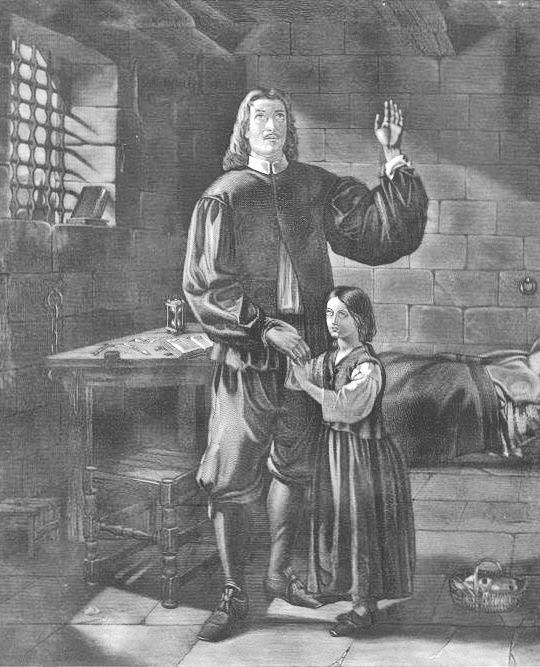
John Bunyan (1628–88) John Bunyan in prison with his blind daughter
In 1655 Bunyan began preaching; few could equal him in captivating his listeners. The restoration of the monarchy and the Anglican Church in 1660, however, brought persecution, and Bunyan was imprisoned for unlicensed preaching. He spent most of the period 1660–72 in Bedford prison.
Conditions, however, were sufficiently tolerable for Bunyan to write, and it was from the prison that he produced his first masterpiece, Grace
Abounding to the Chief of Sinners (1666). This was a vivid, graphic account of his pilgrimage to Christ, and a classic in the genre of spiritual autobiography. If he had written nothing else, he might be remembered for this.
But in 1678 he published Pilgrim's Progress, and English literature would never be the same again. Bunyan's allegory of the soul's journey through the wilderness of this world to heaven was a phenomenal bestseller; between 1678 and 1688 (the year Bunyan died), more than 11 authorized editions of the book appeared in Britain. It was also published in America, and translated into Welsh, French, and Dutch. It owed its popularity in part to the simplicity, immediacy, and descriptive power of its prose, in part to the succession of colourful characters that populate its pages, and the way Bunyan captures the style of ordinary speech in what he makes them say. Beyond that, of course, the very figure of the individual struggling to fulfil his destiny in an uncomprehending world has a universal human appeal. The story is also imbued with orthodox Protestant theology, seeping out sometimes in direct statement, sometimes in symbol and parable.
Bunyan wrote other godly fiction: a second part of Pilgrim's Progress (1684)—parts one and two were always published separately until 1728;
The Life and Death of Mr Badman (1680); and The Holy War (1682). Most of his writings, however, were works of doctrinal and practical divinity in a more typical mould.
When Bunyan died, he had already achieved literary immortality. What John Owen said of Bunyan's preaching has found its echo in the response of millions to Bunyan's writing: "Could I possess that tinker's abilities for preaching, I would gladly relinquish all my learning."