
2. Lutheran Orthodoxy
Lutheran Orthodoxy 1. The reign of Aristotle The period in Lutheranism after peace had been restored by the Formula of Concord is known as the age of Lutheran Orthodoxy. This is because the Formula provided a fairly detailed standard of orthodox teaching for the Lutheran Churches which they had previously lacked. Lutheran Orthodoxy is also known as Lutheran scholasticism, for reasons that will soon become apparent. Historians usually reckon the Orthodox era to have lasted until around 1730, when Lutheranism entered its Enlightenment phase.13
However, there were other distinguishing characteristics of Lutheran Orthodoxy. We can note the following two: i. Systematic theology. This was the era of the great Lutheran systematic theologians. Philip Melanchthon had, of course, already written the first Lutheran theology textbook in the Loci Communes as early as 1521. However, the age of Lutheran Orthodoxy gave a new scientific precision and exhaustive scope to the task of theology. Each theological topic was examined with the utmost logical rigour and comprehensiveness; all topics were (often) arranged into an overarching pattern, a "system" of truth that would explain everything important. (I am not using the word "system" here in a negative sense to imply something cold and impersonal; it was the term employed by the Orthodox theologians themselves. It derives from a Greek word meaning "an organized whole".) This emphasis on systematic theology is one reason why Lutheran Orthodoxy has been called "scholastic", in imitation of the medieval Catholic scholastics who delighted in systematic presentations of truth.14 ii. Aristotelian methodology. The theologians of Lutheran Orthodoxy, unlike their predecessors, extensively used the philosophy of the preChristian Greek thinker Aristotle as a tool for organizing their thoughts. Those thoughts were not limited to theology; the spokesmen of Orthodoxy were just as likely to include metaphysics in their writings (in other words, the rational study of creation's ultimate
principles like existence, time, space, causation, the structure of the human mind, and so forth). Both in metaphysics and in theology,
Orthodoxy generally embraced Aristotle's way of analysing and discussing subjects. Here is another reason for the "scholastic" label, this time reflecting the tradition of medieval scholasticism stemming from Thomas Aquinas, with his high esteem for Aristotle.
This use of Aristotle by Lutherans may seem strange, given Luther's wellknown hostility both to Aristotle himself, and to Thomas Aquinas, whose
Aristotelian theology formed so massive a segment of the medieval Catholicism Luther rejected. However, some careful distinctions are needed. What Luther objected to was not Aristotle per se, but the way
Luther believed the medieval Church had allowed Aristotelian philosophy to dictate the content of Christian theological and moral teaching. As for Thomas Aquinas, it is not clear how far Luther actually knew Aquinas' theology first-hand, or the extent to which his hostility was really targeted at Aquinas' later disciples (one was Cardinal Cajetan, with whom Luther did not exactly have a sparkling relationship15).
Lutheran Aristotelianism had a number of pioneers in the 16th century, but the principal figure was Cornelius Martini (1568–1621) of Helmstedt
University in Lutheran Brunswick. With intellectual power and eloquence, Martini disseminated in Helmstedt the more global revival of interest in Aristotle's philosophy that was blossoming in Europe's universities. It provoked bitter controversy with another Helmstedt professor, Daniel
Hoffmann (1538–1611), a Gnesio-Lutheran who (out of a perceived loyalty to Luther) denounced Aristotle and all his works as a poisoned well of falsehood. In fact Hoffmann said much the same about all philosophy, not just Aristotle. Martini by contrast vindicated Aristotle as a generally sound guide in matters philosophical, although not in theology where divine revelation was the only pure source of knowledge. Aristotelian philosophy and biblical theology could live together as complementary partners,
Martini claimed.
Many Lutherans felt torn between Hoffmann and Martini, seeming to sense the voice of Luther in the first and of Melanchthon in the second. It was Johann Gerhard (see below) who captured the middle ground, and persuaded Lutheran theologians that there was a right and fruitful way of using Aristotle without becoming uncritically enslaved to him. In essence,
Gerhard argued, this consisted in embracing two basic aspects of Aristotle's thought: i. Aristotle's empiricism—his belief that experience, not abstract reasoning, was the correct path to knowledge and understanding of all things in the earthly realm. Luther had distinguished between the human sphere, where reason reigned, and the divine sphere, where reason was unreliable and God's revelation reigned. Gerhard convinced Lutherans that in the human sphere, the "reason" that should be followed was an Aristotelian reason. ii. Aristotle's way of analysing causes. Aristotle dissected causation into a fourfold scheme: material cause, formal cause, efficient cause, and final cause. To illustrate: let us imagine a leather football. Its material cause is the matter, the stuff, it is made of: leather. Its formal cause is the form, essence, or idea that makes the football what it is: a spherical object capable of being kicked about by human beings. Its efficient cause is whoever or whatever produced it: presumably a football factory, or maybe it was handmade. Its final cause is the purpose for which it exists: to make a particular game (football or soccer) possible, thereby giving entertainment to those who play. Gerhard successfully argued that this Aristotelian scheme of analysing causes was both legitimate and illuminating, and could be applied in theology as well as metaphysics. A theological application might be baptism. Its material cause: water. Its formal cause: the act of immersing a believer or a believer's child in the water.16 Its efficient cause: Christ who ordained baptism in Matthew 28:19. Its final cause: in order that the Holy Spirit might implant the seed of faith in a child, or seal the faith of an adult.17
Almost as influential as Gerhard in promoting the synthesis of Luther and Aristotle was Balthasar Meisner (1587–1626) of Wittenberg. He did not, like Gerhard, write a systematic theology pervaded by Aristotelianism, but produced a specific treatise on the right use of philosophy in theology, the Philosophia Sobria ("Sober Philosophy"), published in 1611. Meisner's arguments, essentially the same as Gerhard's, were a milestone in the theology-philosophy interface in Lutheran Orthodoxy. All it needed was the
imprimatur of Gerhard's epoch-making Loci Theologici (1610–22) for the Lutheran world to be convinced.
Here, then, was the Aristotelianism of the Lutheran Orthodox theologians. They did not take the content of their theology (or not much of it) from Aristotle, or from Aquinas. For example, Lutherans had little to say in their apologetics about the rational proofs for God's existence. What they did was to utilize Aristotle's methods for analysing, categorizing, and discussing their views of metaphysics and theology. It is certainly unjust to characterize Lutheran Orthodoxy as little better than a dry, unbiblical
Aristotelian philosophy with a thin Christian varnish, as is sometimes alleged. One can hardly read the actual works of men like Gerhard, Calov, or Quenstedt, and conclude that one is on non-Christian or non-biblical ground.
Let us now consider some representative figures from the ranks of Lutheran Orthodoxy.
2. Martin Chemnitz "If the second Martin had not come, the first Martin would scarcely have endured." This 17th century epigram sums up how Lutherans in our period
(and later) felt about Martin Chemnitz (1522–86). He, the second Martin, by his encyclopaedic learning, brilliant writings, and key role in the Formula of Concord, did more than any other man to preserve the legacy of the first Martin (Luther), and ensure it would be transmitted to future generations. Chemnitz stands in the borderlands between the Formula of Concord, which he had a pivotal role in creating, and the age of Orthodoxy.
We could say that he was the last of the original Lutherans and the first of the Orthodox.
Chemnitz was born at Treuenbritzen in Brandenburg. In his youth he studied theology at Wittenberg under Philip Melanchthon, whom he always regarded as his mentor despite not following him into CryptoCalvinism or synergism (see previous section). Oddly to the modern student, he did share Melanchthon's fascination with astrology, at least for a time, but this soon dissipated into an all-absorbing passion for theology.18
At Wittenberg Chemnitz sometimes stood in for Melanchthon if the master was unavailable for a lecture; he also gave his own lectures on Lutheran theology, using Melanchthon's famous Loci Communes as his textbook. The worsening controversies that were beginning to tear Lutheranism apart, involving even Melanchthon's views on some issues, convinced Chemnitz that Lutheran unity was an urgently necessary goal to strive after, especially in the face of an increasingly aggressive Roman Catholic revival in the Counter-Reformation.
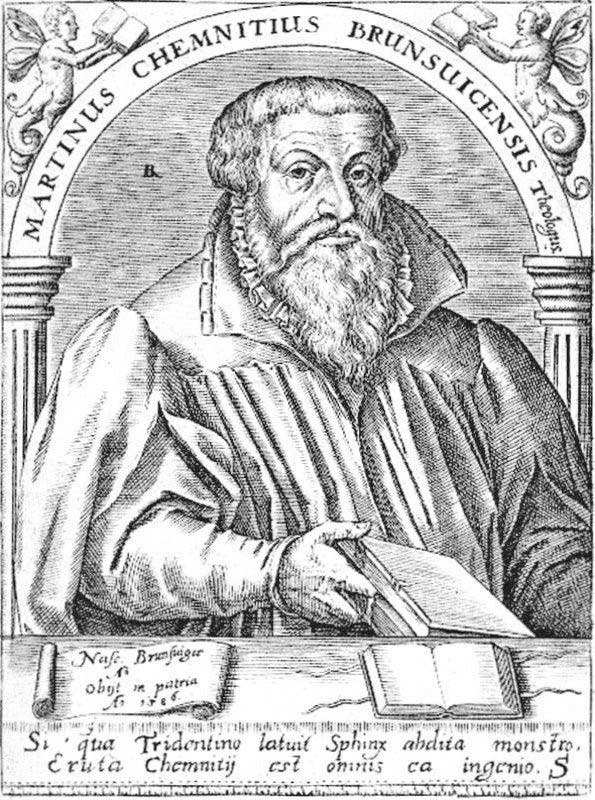
Martin Chemnitz (1522–86) Portrait by an unknown artist
At the close of 1554, Chemnitz left Wittenberg to become assistant to the distinguished theologian Joachim Morlin (1514–71), superintendent of the Lutheran churches in Brunswick-Wolfenbüttel. Morlin stepped down from office in 1567 to become Bishop of Samland in Prussia; Chemnitz took over as superintendent of Brunswick-Wolfenbüttel, a position he held for the remainder of his life. In that capacity, he presided at a gathering of Brunswick's pastors twice a month, where church issues were discussed, particularly cases of discipline. He gave lectures at these meetings from Melanchthon's Loci Communes. He also (slowly) won a reputation in Brunswick's churches as a fine preacher, although his early efforts were unpromising—he improved over time.
Chemnitz was instrumental, too, in setting up the University of Helmstedt in 1575–6, the first Protestant university in that region of northern Germany. It rapidly developed into a large institution; its most famous theological professor would be Georg Calixtus (see below).
Ironically, the Formula of Concord, which Chemnitz had done so much to help create as a bond of Lutheran unity, was not officially adopted in Brunswick; its duke Julius (1568–89) refused to endorse the Formula, having been personally offended by criticism from Chemnitz. (Chemnitz had rebuked the duke for having his three sons ordained as Roman Catholic priests in order to get his hands on the Catholic bishopric of Halberstadt.
The duke's revenge on Chemnitz was to refuse to ratify the Formula in Brunswick.) We have already considered Chemnitz' part in drafting the Formula of Concord. His theology could be described as broadly
Melanchthonian, in spirit, method, and content, but keeping Melanchthon's teaching closer to that of Luther, notably on the eucharist and divine sovereignty in regeneration. Chemnitz' powerful influence flowed out to the Lutherans of his own and following times through his weighty treatises, marked by massive learning, sincere but modest piety, a concern to demonstrate the catholic nature of Lutheran faith (that it had continuity with the faith of the early church fathers), and a strong sense that theology existed to serve the Church.
Probably Chemnitz's most accessible work for modern readers is his Examination of the Council of Trent, which appeared in four parts between 1565 and 1573. It has been extolled as one of the finest defences of historic
Protestantism ever penned. Here Chemnitz exposed the decrees of Trent to a probing critique, especially by comparing Trent's teaching with the beliefs
and practices of the patristic era, and pointing out the frequent lack of harmony between the two. His knowledge of the early church fathers was encyclopaedic. Of course, Chemnitz also carefully expounded the Bible to demonstrate Trent's errors; but we should remember that the original
Lutheran and Reformed pioneers were not simplistic "Bible alone" people —they were almost as concerned to establish continuity with the early church. This was in order to ward off the otherwise annihilating Catholic accusation that the Protestant faith was a 16th century novelty, unknown to the Christians of the previous 1,500 years. The idea that Christianity had effectively vanished after the death of the apostles, to be miraculously reborn in the 16th century, was an Anabaptist, not a Lutheran or Reformed, view.
Other classic and influential treatises by Chemnitz included his Repetition of the Wholesome Doctrine of the True Presence (1561), a defence of Luther's eucharistic views; his Concerning the Two Natures in Christ (1570), a defence of Lutheran Christology; his systematic theology textbook, the Loci Theologici, published posthumously in 1591 (it was incomplete, based on his Brunswick lectures on Melanchthon's Loci
Communes); and his Harmony of the Four Gospel-writers, completed after his death by Polycarp Leyser (1552–1610) and Johann Gerhard (see below) and published in 1626–7—extraordinarily popular among serious Bible students in the 17th century.
3. Johann Gerhard Johann Gerhard (1582–1637) was the first of the great Lutheran
"scholastics" (see introduction to this section), who persuaded most Lutheran theologians to accept a selective use of Aristotle in philosophy and in theological method. Next after Luther and Chemnitz, he was the third genuinely great theologian of the Lutheran tradition. Popular mythology would probably expect a scholastic thinker who specialized in systematic theology to have been a rather dry and dusty figure; but Gerhard early on absorbed a vibrant spiritual vitality from his pastor in his native
Quedlinburg, the famous Johann Arndt, ultimate wellspring of the Pietist movement (see section 4). It was Arndt's influence that inspired the young
Gerhard to study theology at Wittenberg and Jena. He immersed himself in the Bible and the early church fathers.
Gerhard then became a lecturer in Marburg University in 1604 while continuing his own studies there. His presence at Marburg coincided with the reign of a new prince of Hesse (where Marburg was located), Maurice the Learned (1592–1627), who in 1605 converted to the Reformed faith and proceeded to "Calvinize" his lands. Gerhard, a principled Lutheran, left rather than embrace Calvinism. His piety and learning had (despite his youth—he was only 24) attracted the eye of Duke John Casimir of SaxeCoburg (1596–1633), who made him superintendent of Heldburg in 1606.
This gave Gerhard authority over a large swathe of Lutheran churches in John Casimir's lands; he used his authority to reform them in accord with both his pastoral and doctrinal ideals.
In 1616, John Casimir allowed Gerhard to take up an academic post at Jena University, where he taught for the rest of his life—not just systematic theology, but exegetical classes on many New Testament books. The Thirty
Years' War (1618–48) was now raging across Germany (see section 3), and on one occasion Gerhard saved the city of Jena from destruction by pleading with the great Catholic general Tilly, commander of the Holy
Roman Empire's army. Gerhard visited Tilly as his troops were poised to sack Jena; when Tilly put his fingers in his ears to resist Gerhard's pleas, the Lutheran divine simply drew closer and shouted, "I don't want you to listen to me now; I want you to listen to God!" Tilly was moved, and in consequence, Jena was not destroyed, merely pillaged in a relatively minor way.
Gerhard's masterpiece was his Loci Theologici, published in nine volumes between 1610 and 1622. For the rest of the 17th century this would be probably the most influential of all Lutheran systematic theologies (still influential among conservative Lutherans today). For the first time in Lutheran theology, we find in Gerhard a full-blooded use of Aristotelian methodology to analyse and organize the subject matter. It has been said that in comparison with Chemnitz, Gerhard's approach has greater logical clarity, but is less vivid and readable.
However, Gerhard did produce eminently readable treatises, notably his Sacred Meditations (1606). This was a work of piety that won international renown, translated at length into most of the world's chief languages (there was an English edition as early as 1627). The Daily Exercise of Piety was another popular spiritual treatise (1612). Other important writings included his Theological Disputes (1631–3) against Cardinal Bellarmine, most brilliant of the Counter-Reformation theologians,19 and his Catholic
Confession (1634–7): together these two works were weighty statements of Lutheran orthodoxy against Roman Catholicism.
4. Jesper Rasmus Brochmand Jesper Brochmand (1585–1652) is one of the few non-German Lutherans generally regarded as an outstanding theologian from our period. Born at Koge in Zealand, Denmark's largest island, he studied at several Danish and Lutheran universities. Thereafter he spent most of his life in Copenhagen, teaching theology in its university from 1610 to 1639. That year he was appointed Bishop of Zealand; in this capacity, he carried out a number of worship reforms, such as getting rid of Latin choirs.
Much of Brochmand's life was consumed in controversy with Roman Catholicism. His Controversiae Sacrae (1626–8) was a three-volume reply to Cardinal Bellarmine; his Concerning the Roman Pontificate (1628) was a massive and erudite examination of the history and theological underpinnings of the papacy; and he delivered a series of lectures against the Jesuits, published posthumously in 1653. His reward from the Jesuits was the alarming description "the boldest despiser of the Catholic rulers, a poisonous spider, and a degenerate Absalom." As well as smiting Rome,
Brochmand was equally severe against Calvinists, whom he considered to be as deluded and as dangerous as papists. Brochmand also had a tragic controversy with his old friend and tutor Holger Rosenkrantz (1574–1642), a leading Danish noble and member of the king's council, who in 1627 abandoned politics to devote himself to religious writing. A disciple of Erasmus and Johann Arndt, Rosenkrantz taught that justification was initially by faith alone but subsequently by the grace-empowered works that flowed from faith. Brochmand too was influenced by Arndt, but he bitterly condemned Rosenkrantz's teaching as a betrayal of the Reformation.
In the field of systematic theology, Brochmand's masterwork was his System of Universal Theology (1633). He brought out an abridged edition in 1649 which became the standard theology textbook in the training of Danish Lutheran clergy for the next hundred years. Brochmand's theology was a blend of the Bible, the Formula of Concord, and the methodology of Aristotle. A fourth ingredient was a concern for practical application; the System devoted considerable time to solving ethical dilemmas and showing how doctrine made a difference in practice.
Brochmand wrote a number of devotional-type treatises, notably his commentary on James (1640) and a collection of sermons, Huspostil
(1635), which retained a huge popularity among spiritually-minded Danes for the following two centuries.
5. Georg Calixtus Georg Calixtus (1586–1656) was an unusual figure among Lutheran theologians in our period, and hardly deserves the name Orthodox; in fact, he was the most articulate voice among Lutherans of a different vision.
Still, because of Calixtus' Lutheranism (he thought the Lutheran Church was the purest and best), and his intimate involvement in the world of Lutheran Orthodoxy (albeit as a critic), this is the best place to consider his life. He is of captivating interest, often hailed as one of the trailblazers of ecumenism.
Born at Medelby in Schleswig, a Lutheran duchy bordering on Denmark, Calixtus studied at the University of Helmstedt (founded by Martin
Chemnitz). There he found in the writings of Philip Melanchthon the inspiration for his theology—his father had been a pupil and admirer of Melanchthon. From 1609 to 1613 he travelled in Germany, the Spanish
Netherlands, France, and England, where he learned as much as he could about Roman Catholicism and the Reformed faith, both generally despised by Lutherans as perversions of Christianity. In the spirit of Melanchthon, however, Calixtus saw Catholics and Calvinists as "separated brethren" rather than mere heretics.
In London Calixtus had a life-changing encounter with Isaac Casaubon (1559–1614), a Genevan Calvinist who had discovered a spiritual home in Anglicanism. Casaubon was one of the most learned theologians and church historians of the 17th century, a formidable critic of the Catholicism of the Council of Trent. He envisaged a Christian unity based on the few doctrines essential to salvation, either taught clearly in Scripture, or confessed by the early church fathers as necessary interpretations of Scripture. Casaubon's influence on Calixtus matched that of Melanchthon. Later on, he would also particularly warm (among the Reformed) to the teaching of Johannes
Cocceius (1603–69) and his covenant theology.20
Returning to Helmstedt, he became professor of theology in the university from 1614 to his death in 1656. Here he developed his ecumenical outlook in many treatises, such as his Concerning the True
Christian Religion and Church (1633), and Judgment Concerning the Theological Controversies Agitated between Lutherans and Reformed
(1650). His basic argument was that Western Europe could resolve its religious strife between Catholic, Lutheran, and Reformed (horrifyingly
visible in the Thirty Years' War) by agreeing to work within "the consensus of the first five centuries". This of course embraced the formative period of the Church's creedal theology—the Apostles' Creed, the Nicene Creed, the Creed (or Formula) of Chalcedon, which all three of the warring "branches" of Western Christianity professed.
Calixtus also vigorously advocated colloquies (face-to-face discussions and debates) among Catholics, Lutherans, and Reformed. He was convinced that each of the different traditions simply did not understand what the others were saying, and caricatured their teachings; only free exchange of ideas in a non-confrontational setting could bring real understanding of what it really meant to a Catholic to be Catholic, to a Lutheran to be Lutheran, and to a Calvinist to be Reformed. Calixtus' hand of friendship extended to Eastern Orthodoxy too; he made contact with patriarch Cyril Lucaris of Constantinople, himself a Protestant sympathizer.21
Calixtus' position was condemned by most Lutheran theologians as "Syncretism" (a relativistic mingling of contradictory faiths), and he spent much of his life defending himself against accusations of heresy. The next theologian we shall consider, Abraham Calov, was a zealous opponent.
Calixtus probably did not help matters by developing a distaste for theologizing (we remember the dying Melanchthon's sigh to be delivered from the fury of the theologians), and stressing Christian life as the best basis for the reunion of shattered Christendom. Amazingly, however,
Calixtus succeeded in not being dismissed from his post at Helmstedt; he had enough supporters to keep him in place. One thing that helped him was the fact that the Formula of Concord, the standard of Lutheran Orthodoxy, did not operate in Brunswick, where Helmstedt was located.
Calixtus took part in the Colloquy of Thorn in Prussia in 1645, where Lutherans, Catholics, and Calvinists discussed their differences while the Thirty Years' War was lurching to its bloody and exhausted close. The colloquy achieved nothing, partly because of the in-fighting among the Protestants—Lutherans and Reformed quarrelled with each other, while
Lutherans also managed to quarrel among themselves (Orthodox against Syncretists).
The Syncretist controversy continued after Calixtus' death; his son Friedrich Ulrich Calixtus (1622–1701) energetically advocated his father's ideas. So did others. Although Lutheran Orthodoxy was the reigning pattern
of thought in the 17th century, the Syncretist alternative was serious, and meant that Orthodoxy never had its way unchallenged among Lutherans.
6. Abraham Calov Abraham Calov (1612–86) was Calixtus' most formidable opponent and one of Lutheran Orthodoxy's most militant and learned advocates in the second part of the 17th century. He was born in 1612 at Mohrungen in East
Prussia (now in Poland, but part of Brandenburg-Prussia in Calov's day).
He studied at Konigsberg University (modern-day Kaliningrad in Russia, but again part of Brandenburg-Prussia in Calov's day), joining its teaching staff as a philosopher in 1632. It seems that Calov was destined to be plunged in theological controversy for the whole of his life; we soon find him attacking the Reformed view of holy communion, and defending the Lutheran view, in response to Brandenburg's court preacher, Johann
Bergius (1587–1658). The ruling house of Brandenberg-Prussia, the Hohenzollerns, had embraced the Reformed faith under Prince John
Sigismund (1608–19), so that the court both favoured and propagated Calvinism.22 Many of Brandenburg's nobility, however, remained staunchly
Lutheran; impressed by Calov's vindication of their eucharistic beliefs, some of them financed the young theologian to further his studies at Rostock University.
After three years at Rostock, where he published several notable works of philosophy, Calov returned to teach theology at Konigsberg, where he rapidly became a hugely popular lecturer. In 1641 he was also made superintendent of Konigsberg's churches and schools. In 1643, however, he moved to Danzig (modern Gdańsk) to teach in its academy and preach in the Holy Trinity Church. Danzig was an unusual city; theoretically part of Poland, it enjoyed a large measure of autonomy, and its population was multi-ethnic—mostly Poles, Germans, Dutch, and a Jewish community. Not surprisingly, the city had no official confession of faith. Calov found himself among Lutherans who were divided between Orthodoxy and Syncretism, jostling with Calvinists, Roman Catholics, and Jews. Perhaps this helps explain why Calov became such a controversialist; he had to defend Lutheran Orthodoxy against so many alternatives. Still, Calov reserved his chief energies for combating Syncretism, since this was so close to home—a threat from within the bosom of Lutheranism. The Syncretist controversy occupied Calov for the rest of his life.
In 1650, Calov moved again, this time to Wittenberg University; in 1652, he was also appointed superintendent of Saxony's churches. His lectures
were so popular, but so anti-Reformed, that the Calvinist court of Brandenburg-Prussia prohibited its citizens from studying at Wittenberg!
Calov lived the rest of his life in Wittenberg, teaching the Lutheranism of the Formula of Concord, and defending it against its various enemies (e.g.
Calvinists, Catholics, Socinians). But even now Calov directed most of his firepower against Syncretism. He and the Wittenbergers led the hard-line
Lutheran response to Syncretism, wishing Lutherans to adopt a new antiSyncretist confession of faith, but they were defeated by the more moderate opponents of Syncretism, led by Johannes Musäus (1613–81) and the theologians of Jena, who thought that such a response would be overkill.
Although Calov came half-way through the development of Lutheran Orthodoxy, he had a big impact on its future course, especially through his understanding of the ordo salutis (the order of salvation—the sequence of saving events or experiences in human life). Previous Lutheran theologians had dealt with the subject, but Calov set out his view with such lucidity and learning that it dominated Lutheran thought thereafter. Calov's ordo salutis was calling, illumination, regeneration, conversion, justification, repentance, mystical union with Christ, sanctification, and glorification.
Calov's scholastic theology is most fully expounded in his Systema Locorum Theologicorum, published in 12 parts between 1655 and 1677.
This multi-volume systematic theology has been called the brightest zenith of Aristotelian Lutheranism (or its darkest midnight, if one disapproves of Protestant scholasticism).
Calov has an unenviable reputation as the most fiercely intolerant gladiator of Lutheran Orthodoxy, who spent all his time outpouring the vials of wrath on anyone who disagreed with him. His critics called him the Lutheran Grand Inquisitor. Certainly he wrote voluminously against everything and everyone he regarded as deviating from the strictest
Lutheranism, and some of his polemics now look patently absurd (especially perhaps his fervent defence of the verbal inspiration of the vowel points in the Hebrew Old Testament).23
However, it would be unfair to paint so one-sided a picture of Calov. He was no icy academic theologian, obsessed with correct doctrine and lacking a human soul. Calov was concerned for piety as well as polemics; in his writings, this concern found fullest expression in an edition of the Bible
(1682) to which Calov attached a running commentary drawn from the works of Luther. This proved a popular devotional Bible; it made a deep
impression on Johann Sebastian Bach (see below), Lutheranism's greatest musical genius. At least equally important was Calov's Biblia Illustrata, published in four volumes between 1672 and 1676. This was a complete
Bible commentary in which Calov displayed his considerable talents as an exegete. The commentary would keep its hold on Lutheran affections for the next two hundred years.
Finally we should note that Calov, for all his polemical vigour, was an early supporter of Philip Jacob Spener and the spiritual renewal movement that came to be known as Pietism.24 Calov warmly endorsed Spener's Pia
Desideria (1675), the manifesto of Pietism: an unimaginable act, had Calov really been all grim head and no gracious heart.
7. Johann Conrad Dannhauer Johann Conrad Dannhauer (1603–66) was born at Köndrigen in Baden, the son of a Lutheran pastor. He studied theology at Strasbourg, Marburg,
Altdorf, and under Johann Gerhard at Jena. In 1628 he was invited to take charge of theological studies at Strasbourg, where he lectured on systematic theology and ethics. In 1633 he became pastor of Strasbourg cathedral, and later the president of the church assembly with wider responsibilities for the Lutheran congregations of Strasbourg. In this latter capacity, Dannhauer established a new scheme of pastoral visitation for the churches under his care, developed the effectiveness of catechizing the young, and strove to improve standards of godliness and learning among the Lutheran pastors.
Dannhauer was also the most celebrated preacher of Lutheran Orthodoxy; his 10 volumes of sermons were very influential.
Dannhauer, like most Lutheran Orthodox, turned his hand to polemics against the adversaries of his faith—Roman Catholics, Reformed, and (above all) the Lutheran Syncretists. Unlike Calov, however, Dannhauer produced works of Orthodox apologetics distinguished by their fairness and irenic spirit, remarkably lacking in vitriol. His supreme contribution in this vein was his Mystery of Syncretism Detected (1648). The Reformed faith received the same treatment in his Foolishness of the Calvinist Spirit
(1654), where Dannhauer set out the differences between Lutheran and Reformed theology calmly and clearly, stating his disagreements with Calvinism, and his reasons for disagreeing, without vilifying his opponents.
Dannhauer's masterpiece, however, was his Way of Christian Wisdom or Positive Theology (1649), a work of striking originality. It synthesized a rich meditation on biblical imagery with doctrinal teaching about salvation.
Dannhauer examined 12 images found in Scripture—e.g. light, pilgrim, path, candlestick, goal, home, stumbling block—and used each image to communicate some aspect of the sinner's ascent to heaven. One commentator has described it as resembling a systematic theology set out in the form of Pilgrim's Progress.
There were many other literary works by Dannhauer (he was amazingly prolific), but the final aspect of his life we should consider is his profound impact on Philip Jacob Spener, the "father of Pietism" (see section 4).
Spener was born in the Alsace region, where Strasbourg was situated, and in 1663–6 he was based in Strasbourg itself. He therefore came within the
sphere of Dannhauer's activities as president of the Strasbourg church assembly. It was Dannhauer who ordained Spener, and Spener may have helped prepare the second edition of the Way of Christian Wisdom.
Certainly Spener later paid tribute to Dannhauer as his teacher in a poem dedicated to his memory. Here, then, is one of the many surprising connections between Lutheran Orthodoxy and Pietism.
8. Johannes Andreas Quenstedt Johannes Quenstedt (1617–88) was the nephew of Johann Gerhard. Born at Quedlinburg, he always hoped to study theology under his uncle at Jena, but Gerhard died before this could happen. Quenstedt studied instead at Helmstedt and Wittenberg. Appointed a lecturer in Wittenberg in 1644 while still completing his studies, he spent the remainder of his life teaching there: he became professor of logic and metaphysics in 1649, gained his theology doctorate in 1650, was appointed theology professor in 1660, and then senior theology professor in 1687. Quenstedt was based at Wittenberg at the same time as the redoubtable Calov. The two giants of Lutheran
Orthodoxy, however, had nothing in common at the level of personality; Quenstedt was a quiet, meek, physically weak individual, in contrast to the swashbuckling Calov. They did, however, acquire a family bond, when
Calov married Quenstedt's fourth daughter in 1684.
Quenstedt's placid and uneventful life as a lecturer leaves us simply with his literary legacy to consider. This was immense, even though it really consisted of a single work, his Didactic-Polemic Theology or Theological
System, published just three years before his death in 1685. Together with his uncle Gerhard's Loci Theologici, Quenstedt's work ranks as the supreme achievement of Lutheran Orthodoxy in print. In fact, so brilliant was
Quenstedt's textbook, such a marvel of clarity and comprehensiveness, that some have said it destroyed the activity of systematic theology among Lutherans, since no one could ever write anything to compete with Quentstedt's work!
The strength of Quenstedt's systematic theology did not lie in any original development of doctrine, but in the masterly way it expounded
Lutheran Orthodoxy. Alongside its crystal lucidity and exhaustive scope, it breathed an overwhelmingly calm tone; no opponent of Lutheranism could ever claim that Quenstedt had handled him intemperately. The supporting biblical exegesis occupied fully one third of the volume, and was of a high order: this was a systematic theology that united philosophy and biblical studies.
Quenstedt's work was printed five times within a 30 year period.
Lutheran clergy regarded it as the theological textbook of choice.
9. Musical interlude: Lutheran worship Before ending this section on Lutheran Orthodoxy, we should take note of the musical flowering of Lutheran worship in the same period. It abounded in hymn-writers and composers who left an imperishable mark on Lutheran piety. Among the great Lutheran hymn-writers were Philipp Nicolai (1556–
1608), Johann Heermann (1585–1647), and Paul Gerhardt (1607–1676).
Gerhardt in particular has become a universal favourite, far beyond the borders of Lutheranism. Often regarded as Germany's most gifted hymnwriter, English versions of Gerhardt (many by John Wesley) include O sacred head now wounded, Jesus Thy boundless love to me, Commit thou all thy griefs, Extended on a cursèd tree, Holy Ghost, dispel our sadness, and All my heart this night rejoices. Gerhardt, whose theology was shaped by conscientious adherence to the Formula of Concord, proved that Lutheran Orthodoxy could be expressed in heart-warming poetry and song.
It is fascinating to reflect that Gerhardt was a preacher in BrandenburgPrussia's capital Berlin, at the Church of Saint Nicholas, when LutheranReformed controversy there was at its height. The ruling house of Hohenzollern had converted to the Reformed faith under Prince John
Sigismund (1608–19), but the population of Brandenburg-Prussia remained largely Lutheran. The prince in Gerhardt's day was Frederick William I (1640–88), who was becoming impatient with Lutheran polemics against Calvinism, and eventually barred all preachers from attacking each other's beliefs in the pulpit. Since this seemed to many Lutherans incompatible with their allegiance to the Formula of Concord, it resulted in a good number of Lutheran clergy being deprived of their ministries. Yet despite the intensity of the Lutheran-Reformed quarrel, it is on record that many
Calvinists attended Gerhardt's church, so impressed and edified were they by his preaching. His admirers included Louisa Henrietta (1627–67), the Dutch Calvinist wife of Prince Frederick William; Louisa was herself an accomplished hymn-writer, and treasured Gerhardt's hymns. But it did not save Gerhardt. His loyalty to the Formula of Concord was unwavering, and he lost his post at the Saint Nicholas Church in 1666. He was back in the pulpit, however, at Lubbën in Saxe-Merseburg in 1668, after two years of poverty.
Among the celebrated Lutheran musical composers of our period were Michael Praetorius (c.1571–1621), Heinrich Schütz (1585–1672), and
Dieterich Buxtehude (c.1637–1707). These were not merely musicians who had religious significance for their own day; they are all considered to have permanent importance in the history of European music. We can hardly omit the greatest of them all, Johann Sebastian Bach (1685–1750), even though the latter part of his life takes him outside our timeframe. Bach is not only Lutheranism's supreme musical genius, but of course one of the most captivating and influential makers of music of all time. He was a deeply committed Lutheran believer—under Abraham Calov we saw
Bach's personal study and appreciation of Calov's devotional Bible—and Bach's Lutheran faith inspired much of his music. We have only to think of his Magnificat, Christmas Oratorio, Saint Matthew Passion, Saint John
Passion, Mass in B Minor, and the many cantatas he wrote for Lutheran worship. Bach always began his compositions with INJ ("In the name of Jesus"), and always ended with SDG ("Soli deo gloria"—to the glory of God alone). Once again, however, the Lutheran-Reformed interface confronts us. Bach spent some time (1717–23) as musical director at the court of Anhalt-Köthen, which was Reformed; hence it required no elaborate church music for its worship. Here Bach concentrated on "secular" music, and produced his six Brandenburg concertos, generally appraised as among the most brilliant compositions from the whole
Baroque period (c.1600–1750) of European music.