
6. The English Revolution: the world turned upside down
The English Revolution: the world turned upside down 1. Parliament and its Army fall out Although the alliance between parliamentarians and Covenanters had smashed King Charles' battalions on the field, at Marston Moor (July 1644) and Naseby (June 1645), it had not led to the desired parliamentary triumph. This was because a third force had emerged to challenge both king and parliament—the parliamentary army.
In the light of previous defeats and problems of strategic coordination, parliament had reorganized its infantry and cavalry into a more centralized, streamlined force in January 1645, known as the New Model Army.
Through the "Self-Denying Ordinance", it had also dismissed all members of the House of Commons and the House of Lords from military command; this Army would be run by full-time professional soldiers. Its commanderin-chief was Sir Thomas Fairfax (1612–71), but the dominant figure was his second-in-command, the brilliant cavalry leader Oliver Cromwell (1599–
1658). (He was in fact an MP in the Commons, but had been exempted from the Self-Denying Ordinance on account of his unique military genius.)
Cromwell was a fervent Puritan of the Independent type; a spiritual crisis in his youth had been resolved by a dramatic conversion that he described thus:
Blessed be His Name for shining on so dark a heart as mine! You know what my manner of life hath been. Oh, I lived in and loved darkness, and hated light; I was a chief, the chief of sinners.
This is true: I hated godliness, yet God had mercy on me.
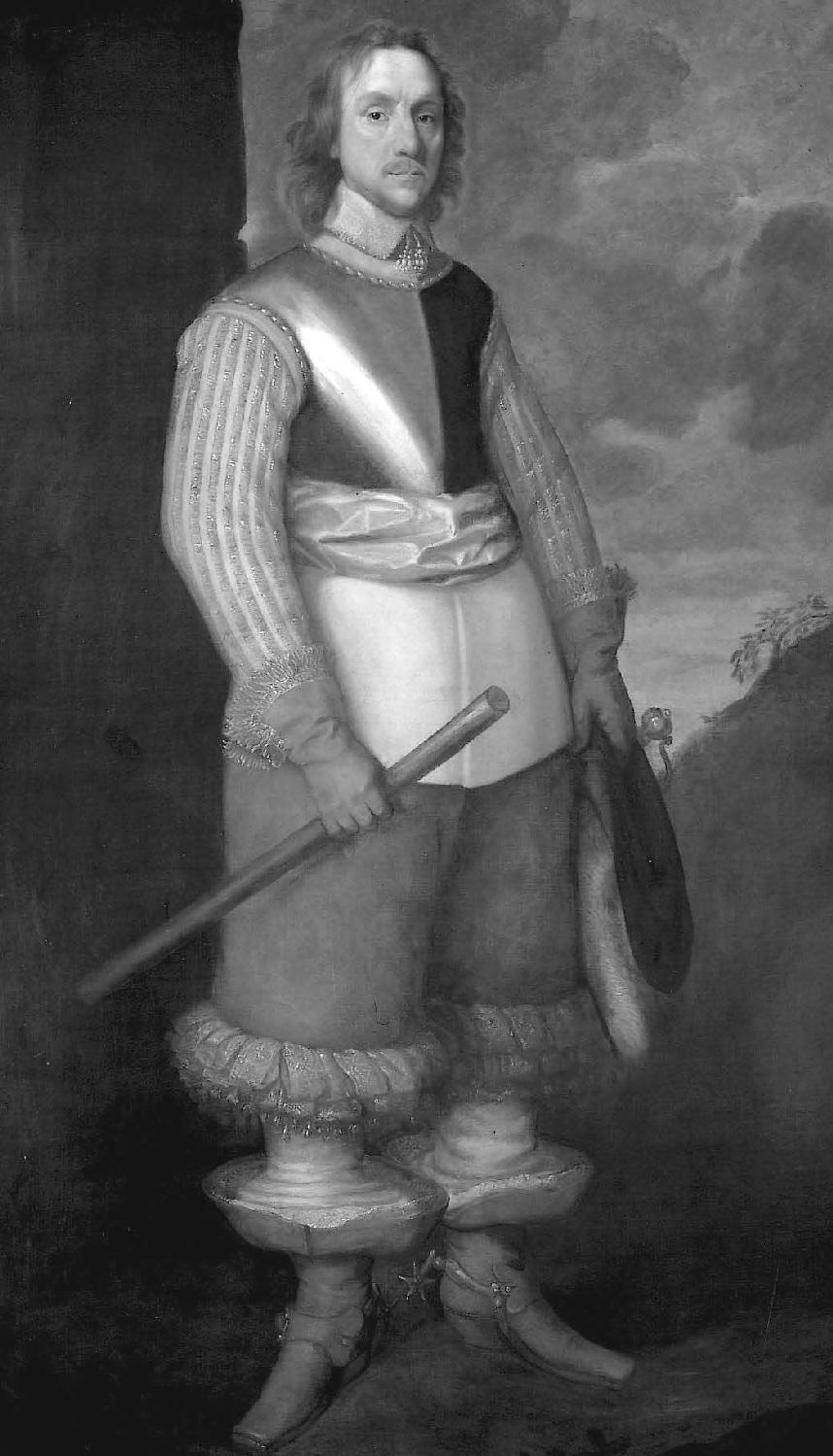
Oliver Cromwell (1599–1658) Portrait by Robert Walker (1599–1658) Used by permission from The Cromwell Museum, Huntingdon
Cromwell's conversion propelled him into the front rank of Puritan laymen.
Once the Long Parliament was in session, he was from the start (as MP for Cambridge) a zealous partisan of John Pym, joining the assault on King
Charles' prerogatives and the Episcopal structures of the Anglican Church.
When the Grand Remonstrance was debated in November 1641, and passed by a whisker, Cromwell commented, "If the Remonstrance had been rejected, I would have sold all I had the next morning, and never seen
England more."
Politically passionate as he was, the driving force in Cromwell's life and personality was his religion. It had a strong vein of mysticism in it; he felt himself to be in immediate contact with God, and sought guidance that often came in the shape of extraordinary providences. Once the Civil War broke out, he not only discovered a dazzling talent for cavalry warfare, but also an exhilaration on the battlefield that made his victories, and the men who won them, seem nothing less than embodiments of God's will on earth.
As he exclaimed amid his triumph at the battle of Langport in July 1645, "To see this, is it not to see the face of God?"
Cromwell's radical approach to military training undermined parliament's control of its own troops. He insisted on recruiting religiously and politically motivated soldiers, who would fight for absolute victory without being hampered by the social respect for aristocracy and monarchy that made others half-hearted in attacking royalists on the battlefield. In consequence, Cromwell's men (the backbone of the New Model Army) were largely Independent and Baptist in religion—Presbyterians were more socially conservative. Further, the New Model Army was no longer really fighting for the same goal as its parliamentary masters. The Presbyteriandominated parliament wanted a single established Church, Presbyterian in structure and theology, with no room for dissent; all who refused to conform would be punished by the "godly magistrate". The New Model
Army soldiers, by contrast, were fighting for liberty of conscience: the freedom for all Protestants to practise their faith without interference or coercion by king, bishops, parliaments, or presbyters. Cromwell himself thoroughly sympathized with his men; he too was fighting for religious freedom. These ideals of liberty and toleration were most forthrightly
expressed by the Separatist Roger Williams (c.1603–83), who had emigrated to America, but returned briefly to England in 1643 to get legal status for his new colony, Rhode Island. Horrified by the Presbyterian intolerance he discovered in parliament and the Westminster Assembly,
Williams produced his classic treatise The Bloody Tenent of Persecution for Cause of Conscience, published in London in 1644.41
To most MPs, this was a recipe for anarchy, and Williams' book was burned in public. Presbyterians were scandalized by the variety of religious opinions that flourished in the Army: Independents, Baptists, Arminians,
Antinomians, Fifth Monarchists, Seekers, Levellers, and (it seemed) everything between A and Z in the theological encyclopedia.42 As Richard
Baxter, then a military chaplain, commented of the Army:
Independency and Anabaptism were most prevalent; Antinomianism and Arminianism equally distributed.
Independents and Baptists, then, were the most ardent supporters of religious toleration; Presbyterians shunned the very idea. So the opening gulf over freedom of worship roughly matched divisions over church government, which in turn roughly matched the Army-parliament divide.
The New Model Army did have some allies in parliament—the so-called Independent MPs (not necessarily Congregationalists, but committed to a more politically and religiously radical agenda). But they were in a minority.
Once the fighting was over in 1646, parliament tried to disband the New Model Army without giving the considerable amount of back-pay it owed the soldiers. The Army refused to disband, supported by its leaders, Fairfax and Cromwell, who were indignant at the shabby treatment they thought their battle-scarred men were getting. Parliament also debated a fierce
Blasphemy Ordinance, which not only prescribed the death penalty for all who denied the Trinity or incarnation, but also life imprisonment for all who held to believers' baptism, Arminianism, antinomianism, soul-sleep, or anti-sabbatarianism, or rejected Presbyterian church government, or denied that the parish churches were true churches of Christ. (The Ordinance was actually enacted as law in May 1648.) Since all these views were widespread in the Army, most of the soldiers would have ended up dead or in prison. With parliament so hostile to religious liberty, it looked as though
Cromwell's warriors had fought for nothing.
So a three-cornered power struggle now gripped England, as King Charles, the Presbyterian parliament, and the New Model Army all jockeyed for position. Charles had surrendered to the Scottish Covenanting army; but finding him stubbornly unwilling to sign the Covenants, they had eventually delivered him into the English parliament's custody in 1647 at Holmby House in Northamptonshire. The New Model Army, however, seized Charles to be their "guest". Charles exasperated everybody by playing off Army against parliament, making contradictory promises; he appears to have believed that under duress, a person might promise anything to anyone with no obligations. Ultimately, he betrayed both Army and parliament by entering into a secret agreement with a faction of the Covenanters; they invaded England in July 1648 to restore the king, who had promised to impose Presbyterianism on his southern kingdom for a three-year trial period.43 The royalists also rose up in a series of insurgencies across England and Wales.
The New Model Army proved superior to all these challenges. The various royalist risings were all crushed; Cromwell annihilated the Covenanter army in a three-day battle at Preston on 17th-19th August. Then
Charles' day of reckoning came. The triumphant Army, burning with anger over the renewed slaughter, decided that the king must pay for all the blood that had been shed. The Presbyterian parliament, however, reopened negotiations with Charles. It was the last straw. The Army marched on London, and on December 6th purged parliament of all Presbyterian MPs.
The military coup was known as "Pride's Purge", because Colonel Thomas Pride was in charge of the action. He stood at the top of the staircase leading into the House of Commons with a list of Presbyterian MPs; the radical aristocrat, Lord Grey of Groby (the Earl of Stamford's son), pointed out the MPs as they arrived, and Pride's troops arrested them. By the time
Pride had done his work, 45 MPs were under arrest, and a further 96 had been excluded. The much reduced House of Commons now had only around 80 MPs, all Independents and in agreement with the Army's purposes. The remnant parliament earned the derisive nickname "the Rump". They proceeded towards the New Model Army's implacable goal: the execution of the king.
It should be noted that Cromwell played no part in this military coup. He was not in London when the purge began, but on the way there from the siege of Pontefract castle. The coup was not planned by Cromwell, but by
the other Army officers and the Independent MPs. Still, Cromwell arrived on the night of the purge, and accepted what had happened. He now threw himself with all the force of his titanic personality behind the need to destroy, not just King Charles, but the Stuart monarchy itself: "I tell you, we will cut of his head with the crown upon it!"
2. The English Republic The execution of Charles followed with almost indecent haste. It was, of course, quite illegal. There was no court that could try the monarch; the monarch was the very authority the courts represented, from whom they derived their existence and legitimacy. Besides, the court that tried Charles was not really a court at all, merely a group of men nominated by the Army and the Rump. Still, the Army radicals pressed ahead; they were determined that the king must die, partly for religious reasons. One colonel, the Calvinistic Baptist republican Edmund Ludlow (c.1617–92), quoted
Numbers 35:33, "blood defiles the land: and the land cannot be cleansed of the blood that is shed therein, except by the blood of him that shed it." In other words, many held Charles guilty of the bloodshed that had "defiled the land", especially in the Second Civil War of 1648. He must die to atone for the defilement.
The decision to try the king in public, however, backfired badly. Charles may have been a disastrous king; he was a stunningly effective martyr. The affections of the London mob were captured by his calm, dignified bearing.
Even his usual stammer had miraculously vanished. When he was beheaded on January 30th 1649, there were no cheers from the spectators, only a long, unearthly groan. Charles had virtually destroyed the monarchy by his politically imprudent life; by his heroic death, he sanctified it with the blood of royal martyrdom. The new regime would never recover from the blow the defeated king dealt it by dying so well on January 30th. It did not help the Rump or the Army that a mere 10 days after Charles' execution, a book entitled Eikon Basilike ("image of the king") was published, claiming to be
Charles' own thoughts on his reign and his approaching martyrdom. The book was a deeply moving portrait of a suffering Christian king, and it was a runaway success, going through 36 editions in its first year. Scholars still debate the extent to which Eikon Basilike really was written by Charles.
There can be no doubt it was a huge propaganda triumph for royalism.
Having disposed of Charles, the Rump now abolished both the monarchy and the House of Lords, and declared England a republic (for the first and last time in its history). The new English Republic, however, had many enemies. Royalists and Presbyterians alike denounced it at home; this royalist-Presbyterian axis would be responsible, 10 years later, for restoring the monarchy. Royalists denounced the Republic for obvious reasons;
Presbyterians denounced it because they perceived the killing of Charles as a violation of the Solemn League and Covenant, which had pledged MPs and Army officers "to preserve and defend the king's majesty's person and authority".
English Royalists and Presbyterians did not, however, present a military threat. The Irish royalists and the Scottish Covenanters did. With aweinspiring efficiency, the New Model Army dealt with both threats.
Cromwell was now commander-in-chief of the Army since Sir Thomas Fairfax had resigned (he opposed Charles' execution). In Ireland, many
English and Scottish settlers had united with native Catholics in rejecting the English Republic and proclaiming Charles' son, the Prince of Wales, king (the future Charles II). Cromwell utterly overwhelmed the Irish and beat them into abject submission in a campaign extending from August
1649 to May 1652. English Protestants were now the all-powerful masters of Ireland. Cromwell returned from Ireland in May 1650 to deal with the Scottish menace; his lieutenants completed the Irish conquest. The Scottish
Covenanters had also proclaimed the Prince of Wales as their king. Over the next year, however, Cromwell shattered the Covenanters on the battlefield at Dunbar and Worcester, destroying their military and political power for ever. Scotland became an English province, governed by English soldiers and English judges.44
In 1653, Cromwell dissolved the Rump, indignant at its plans for perpetuating its power without meaningful elections. The last shreds of constitutional government were gone; the only real power left in the land was Cromwell and the Army. Cromwell ended up ruling Britain as the "Lord Protector" under a written constitution drawn up by the leading Army officers. Once again, we shall not tell the complex political story, but focus rather on religious developments in the 1650s. For in the aftermath of the Rump's Toleration Act of September 1650, which abolished any legal requirement to attend one's parish church, this was a period of unparalleled and intoxicating freedom in English history for people to experiment with religion.
3. Religion under Cromwell We should begin, however, by reflecting that it was a grim time for traditional Anglicans. The parish structures of Anglicanism remained intact, but prior to Pride's Purge and the overthrow of the monarchy, the Long
Parliament had set up religious committees that ejected something like 2,000 Anglican clergy (around 20–25% of the total number) from their parishes, either for High Church theology, political royalism, or scandalous morals. Parliament also abolished the Book of Common Prayer, replacing it with the Westminster Directory for Public Worship. Further, it made illegal the celebration of Easter, Christmas, and other traditional festivals in Anglican worship. The Civil War therefore may have brought religious liberty for Puritans and Separatists (and anyone who did not wish to attend his or her parish church), but it brought legal repression for traditional
Anglicans and physical hardship for many clergy. Some Anglicans openly defied parliament and continued using the Prayer Book; others conducted secret Prayer Book worship in the houses of those gentry and aristocracy who remained loyal to the old ways.
The plans of the Long Parliament to reform the national Church through the Westminster Assembly came to nothing because of parliament's progressive loss of power to the Army. The intended "Presbyterian Church of England" therefore never materialized on a nationwide basis, although the great capital city of London itself and the county of Lancashire did have a fully functioning Presbyterian system. Despite the failure of a national
Presbyterian Church to get established, however, many illustrious Presbyterian pastors and preachers were active in this period: William
Gouge (1578–1653), Stephen Marshall (c.1594–1655), Richard Vines (1600–56), Edmund Calamy (1600–66), Obadiah Sedgwick (c.1600–58),
Thomas Manton (1620–77), Thomas Watson (c.1620–86), and Lazarus Seaman (died 1675)—names that would have to appear in any roll-call of the Puritan heroes of faith.
Meanwhile, outside the boundaries of Anglicanism or Presbyterianism, a variety of other groups flourished. This was the summertime of the Independents, since many Army officers had Independent convictions, and Cromwell was more associated with this than with any other party.
Independents could now form churches and worship in public without fear of persecution, and they did so in many parts of the country. When they met
at the Savoy assembly in 1658, there were over a hundred congregations.
Great Independent pastors and preachers of the period included Philip Nye (c.1595–1672), Hugh Peters (1598–1660), William Bridge (1600–70),
Thomas Goodwin (1600–80), Joseph Caryl (1602–73), Thomas Brooks (1608–80), Peter Sterry (1613–72), and John Owen who will be given separate treatment (see below). These were all Calvinists; the writings of Bridge, Goodwin, Caryl, Brooks, and Owen continue to edify believers today. The outstanding Arminian Independent pastor was London-based
John Goodwin (1594–1665), a radical supporter of the Army. Some of these Independent divines played leading roles in Cromwellian politics.
Baptists also prospered. The Arminian Baptists became numerous, and in 1651 thirty of their churches met in the Midlands, probably in Leicester, and adopted a confession of faith. In 1654 they held a nationwide assembly in London, and began functioning much as a "denomination". By the time the monarchy was restored in 1660, there were around 115 Arminian
Baptist churches. Important Arminian Baptist pastors and theologians of this period were Henry Denne (c.1605–66), William Jeffrey (or Jeffery/Jeffreys) (born c.1616, died after 1660), Thomas Lambe (died
1660s), Edward Barber (died c.1674), and Thomas Grantham (died 1692).
The Calvinistic Baptists were less enthusiastic about becoming a denomination, more devoted to the autonomy of the individual congregation; but they too grew in numbers, forming local associations in London, the Midlands, and Wales. These associations met throughout the 1650s and exchanged information with each other. There were about 130
Calvinistic Baptist churches by 1660. Among the prominent Calvinistic Baptist pastors and theologians of the period were Hanserd Knollys
(c.1598–1691), Henry Jessey (1601–63) (the second J in the JLJ church), John Tombes (c.1603–76), Christopher Blackwood (c.1607–70), William
Kiffin (1616–1701), and John Bunyan who will be given separate treatment.45
Other groups also sprang up. There were the Fifth Monarchists, who looked for the imminent establishment of Christ's kingdom on earth, perhaps with the Army as His instrument.46 There were the Ranters, an anarchist movement that espoused pantheism and antinomianism, and were fond of using nudity as a form of social and religious protest. There were the Seekers, not an organized body, but a fairly widespread movement that withdrew from active church involvement to pursue a fuller truth through
personal searching; at a local level, however, Seekers commonly met together, often waiting in silence until someone felt inspired to speak. But the most enduring of these alternative groups was the Quakers.
The Quakers probably arose from the Seekers. Their formative figure was George Fox (1624–91) of Drayton-in-the-Clay in Leicestershire, where
Puritanism reigned. A deeply troubled young man, Fox abandoned his job as a shepherd, and wandered the country, seeking a truth he could never find in Puritanism or in anything else on offer. There was no one who could
"speak to his condition", as he put it. His salvation came through a mystical experience in around 1646: "I heard a voice which said, 'There is one, even
Christ Jesus, that can speak to thy condition'; and when I heard it my heart did leap for joy." Thereafter Fox became the centre of a new movement, drawn largely at first from among Seekers (the Seeker style of worship carried over into Quakerism). The nickname Quaker originated in an incident in 1650 in Derby, where Fox was on trial for alleged blasphemy; a judge sneered at his exhortation to "tremble at the word of the Lord", calling Fox and his followers "quakers" (tremblers). Their earliest name, however, was "Children of the Light", then "Friends of the Truth". As a name for his movement, Fox finally settled on "Friends".
Fox's central teaching was that "every man had received from the Lord a measure of light which, if followed, would lead him to the Light of Life"
(as Fox expressed it). This exaltation of the "inner light" as the supreme revelation led to many bruising conflicts between Quakers and orthodox
Protestants of all sorts, who held that Scripture was supreme. It did not help matters that Quakers were prone to disruptive interruptions of non-Quaker worship. Quaker spirituality grew out of Seeker practice: no sacraments, no Bible exposition, indeed no formal structure other than the silence of the gathered meeting, broken only when a brother or sister felt moved to share some insight. Quaker mysticism was also allied to social radicalism: a message of absolute equality between the classes and the sexes, and a vociferous demand for justice now (which often aroused violent hostility from people of money and property).
Apart from Fox, the earliest outstanding Quaker was James Nayler (1618–60), famous for his virtual martyrdom and his dying confession of faith. A charismatic and possibly eccentric figure (even by Quaker standards), Nayler outraged public opinion by re-enacting Jesus' entry into Jerusalem: in October 1656, he rode into Bristol on horseback, while his
followers cried "Holy, holy, holy!" and scattered their garments in his path.
For this apparent impersonation of Jesus, Nayler was arrested, convicted of blasphemy, and brutally punished: whipped through the streets, his forehead branded, his tongue pierced. The religious toleration even of Cromwellian
England had limits. Nayler was physically wrecked by his ordeal. The day before his death in October 1660, however, he penned a confession of faith that has become a treasured classic among Quakers:
There is a spirit which I feel that delights to do no evil, nor to revenge any wrong, but delights to endure all things, in hope to enjoy its own in the end. Its hope is to outlive all wrath and contention, and to weary out all exaltation and cruelty, or whatever is of a nature contrary to itself. It sees to the end of all temptations. As it bears no evil in itself, so it conceives none in thoughts to any other. If it be betrayed, it bears it, for its ground and spring is the mercies and forgiveness of God. Its crown is meekness, its life is everlasting love unfeigned; it takes its kingdom with entreaty and not with contention, and keeps it by lowliness of mind. In God alone it can rejoice, though none else regard it, or can own its life. It's conceived in sorrow, and brought forth without any to pity it, nor doth it murmur at grief and oppression. It never rejoiceth but through sufferings; for with the world's joy it is murdered. I found it alone, being forsaken. I have fellowship therein with them who lived in dens and desolate places in the earth, who through death obtained this resurrection and eternal holy life.
By 1660, there were something like thirty or forty thousand Quakers in England, Wales, Scotland, and Ireland. It was clear that the movement was now a permanent part of the religious landscape. A vigorous apostle,
George Fox spread his message to Germany, the Dutch Republic, and America; the American colony of Pennsylvania was founded in 1681 by a Quaker, William Penn (1644–1718), and gave refuge to Penn's fellow believers from the persecution they often experienced elsewhere from Episcopalian and Puritan alike. Fox's Journal (1694) became a landmark document of Quakerism and English mysticism; the theology of Quakerism, to the extent that so subjective a movement had a theology, was given classic form by Scottish Quaker Robert Barclay (1648–90) in his An Apology for the True Christian Divinity (1676).47
The religious scene in the English Republic was not quite the free-for-all the above portrayal may suggest. Cromwell was concerned to provide spiritual nourishment for the English people, and to encourage cooperation between non-royalist Protestants. The result was a scheme established in March 1654, in which Cromwell appointed a commission of "Triers" and (later) "Ejectors" to examine candidates for parish ministry. The Triers were a central body in London, assessing potential pastors, whereas each county had its own body of Ejectors who examined existing pastors. The London
committee of 38 Triers was taken mostly from the Independents and Presbyterians. Almost half were Independents, and included famous names like Joseph Caryl, Thomas Goodwin, Philip Nye, John Owen, and Hugh
Peters. The slightly fewer Presbyterians included Thomas Manton, Stephen Marshall, and Obadiah Sedgwick. A few Baptists even became involved, notably Henry Jessey and John Tombes. The Triers and Ejectors allowed many Anglican ministers to remain in their parishes as long as they were not politically active royalists, gave evidence of godliness, and promised to refrain from using the Book of Common Prayer. If Presbyterians or Independents were appointed to a parish, they were free to model it along the lines of their own church ideals. Richard Baxter, an opponent of the scheme, nonetheless testified to its benefit:
The truth is, though some few over-rigid and over-busy Independents among them were too severe against all that were Arminians, and too particular in inquiring after evidences of sanctification in those whom they examined, and somewhat too lax in admitting of unlearned and erroneous men that favoured Antinomianism or Anabaptism; yet, to give them their due, they did abundance of good in the church They saved many a congregation from ignorant, ungodly, drunken teachers,—that sort of men who intend no more in the ministry then to read a sermon on Sunday, and all the rest of the week go with the people to the alehouse and harden them in sin; and that sort of ministers who either preached against a holy life, or preached as men who were never acquainted with it. These they usually rejected, and in their stead admitted of any that were able, serious preachers, and lived a godly life, of what tolerable opinion soever they were; so that, though many of them were a little partial for the Independents, Separatists,
Fifth-monarchy Men, and Anabaptists, and against the Prelatists [Episcopalians] and Arminians, yet so great was the benefit above the hurt which they brought to the church, that many thousands of souls blessed God for the faithful ministers whom they let in, and grieved when the Prelatists afterwards cast them out again.
4. Other key figures Richard Baxter Richard Baxter (1615–91) is probably the most famous Puritan of all. Born at Rowton, Shropshire, he never studied at university; his schoolmaster advised against it, and sent him to study under a friend at Ludlow Castle.
Consequently Baxter was largely self-taught. What he lacked in university education, he more than compensated for in the vast extent of his private reading (which included the medieval scholastic theologians) and the subtle genius of his intellect. A spiritual awakening in his teens, partly through reading Richard Sibbes' The Bruised Reed, turned Baxter's thoughts at length to the ministry, and he was ordained by the Bishop of Worcester in 1638. From 1641 he was in charge of Kidderminster parish church in Worcestershire. When the Civil War broke out, Baxter's mild Puritanism put him on the parliamentary side, but Worcester was royalist, and Baxter had to flee. He ended up a chaplain in the parliamentary army, where he strove to mitigate the radical religious and political views that were spreading among the soldiers. Ever the moderate, he opposed the Solemn
League and Covenant, the execution of the king, and the rise to power of Oliver Cromwell. His verdict on Cromwell was mixed:
I did in open conference declare Cromwell and his adherents to be guilty of treason and rebellion, aggravated by perfidiousness and hypocrisy. But yet I did not think it my duty to rave against him in the pulpit, or to do this so unseasonably and imprudently as might irritate him to mischief. And the rather because, as he kept up his approbation of a godly life in general, and of all that was good, except that which the interest of his sinful cause engaged him to be against; so I perceived that it was his design to do good in the main, and to promote the Gospel and the interests of godliness, more than any had done before him; except in those particulars which were against his own interest.
Baxter finally returned to Kidderminster around 1647; his preaching and pastoral visitation over the following decade revolutionized the moral and spiritual state of the parish. His preaching had a matchless power; a 19th century biographer commented that by his sermons Baxter "drew more hearts to the great Broken Heart than any single Englishman of his age".
When the monarchy was restored in 1660 (with Baxter's influential voice assisting), Charles II offered Baxter the bishopric of Hereford, but he declined owing to dissatisfaction with Anglican Episcopacy. He was driven from the Church and from Kidderminster, becoming a leading
Nonconformist. Often classed as a Presbyterian, Baxter's views on church government were in fact too eclectic to fit into any system. He suffered grievous persecution for his Nonconformity, especially under the infamous
Judge Jeffreys in 1685.48 He lived to see the overthrow of James II by William of Orange, and rejoiced it in. His autobiography, the Reliquiae
Baxterianae (1696), is one of the most important (and readable) primary sources for the whole period of the Civil War and Restoration.
Baxter's legacy is huge. He wrote more than any other Puritan, perhaps more than any other English author (a "collected works" would fill 60 volumes); penned in plain, vigorous English, his spiritual writings have been richly prized from that day to this—Call to the Unconverted, Causes and Danger of Slighting Christ and His Gospel, The Divine Life, The Life of Faith, Now or Never, A Saint or a Brute, A Treatise of Conversion, A Treatise of Self-Denial… These are the finest flower of Puritan practical divinity. Three of Baxter's works merit particular mention: The Reformed
Pastor (1656) is the universally acknowledged Puritan classic on the work of the ministry; The Christian Directory (1673) is the masterpiece of Puritan casuistry; and The Saints' Everlasting Rest (1650), composed after Baxter had almost died of a nosebleed, is an extended meditation on heaven which ranks among the most affecting treatments of the subject ever written.
Baxter's more doctrinally-oriented works have proven more problematic for most mainstream Calvinists because of Baxter's massive independence of thought. As often as he expounded Reformed Orthodoxy, he just as often stepped outside of it, offering his own "Baxterian" interpretation of Law and Gospel, the nature and extent of the atonement, assurance, perseverance, and other themes.49
John Owen John Owen (1616–83) is the most well-known doctrinal theologian among the Puritans. Born at Stadhampton in Oxfordshire, he studied at Queen's
College, Oxford, receiving his Master of Arts degree in 1635. He was then ordained as an Anglican deacon and began studying theology, but left the university in 1637, disillusioned with the High Church Arminian theology and worship it was embracing. Once the Civil War broke out, Owen (a parliamentarian) became in 1642 minister of Fordham parish in Essex, moving in 1646 to Coggeshall. By the time he went to Coggeshall, his
views on church government had developed from Presbyterianism to Independency. He continued, however, to function within the parish system
(now controlled by parliament). His preaching, and the theological writings that had begun to flow from his pen, brought him increasingly into the public eye; as an Independent, he was appreciated by the leaders of the New
Model Army. When Charles I was put to death, the Rump Parliament chose Owen to preach to them the following day. Although he did not specifically mention the king's execution, the sermon was entitled Righteous Zeal
Encouraged by Divine Protection.
Owen enjoyed high favour throughout the period of the English Republic. He accompanied Cromwell as chaplain on his Irish expedition of 1649 and his invasion of Scotland in 1650. In 1651 Cromwell made Owen
Dean of Christ Church Cathedral in Oxford, and in 1652 he became vicechancellor of the university. He was one of Cromwell's Triers in the ecclesiastical settlement of 1654, and a dominating figure at the Savoy
Assembly of 1658, where English Independents adopted a modified Westminster Confession as their own doctrinal statement.
When Oliver Cromwell died in 1658, Owen acted as an intermediary between Oliver's son Richard (the new Lord Protector) and the leaders of the New Model Army, who preferred a pure republic under the old Rump
Parliament. The republicanism of the Army prevailed and Richard Cromwell was forced to resign. Many blamed Owen as the chief villain in Richard Cromwell's fall; it might be better to say that he played a part.
Eventually, however, it was not the English Republic but the Stuart monarchy that was restored in 1660, and Owen was stripped of his civil and ecclesiastical offices. He spent the rest of his life as a nonconforming
Independent, ministering from 1666 to a London congregation where many old officers of the New Model Army worshiped.
Owen's theology filled 24 volumes, 16 on doctrinal or practical divinity, the other eight an exhaustive commentary on Hebrews. He was probably the supreme English representative of mature Reformed Orthodoxy; although he wrote no systematic theology, his treatment of different topics was comprehensive and cogent (although his style is generally criticized as cumbersome). Much of Owen's writing is in the key of controversy with others, notably Richard Baxter, Anglicans, Roman Catholics, Arminians, and Socinians, thereby giving an illuminating insight into Puritanism's selfunderstanding in the post-1640 era. Owen's practical divinity has been as
cherished as his doctrine; the two are fused to beautiful effect in his Of Communion with God the Father, Son and Holy Ghost (1657). After the monarchy was restored in 1660, amidst persecution Owen offered a nationwide leadership to Independents that was crucial in preserving their faith and morale in a dark time.