
Part 9
extending the metaphor of the emperor's new clothes." American Review of Public Administration, 27(2), 181-198. Connell, R. W. (1994). "The state, gender and sexual politics: Theory and appraisal."
In H. L. Radtke & H. J. Stam (Eds.), Power/gender: Social relations in theory and practice. Thousand Oaks, CA: Sage Publications. Denhardt, R. B. & Perkins, J. (1976). "The coming death of administrative man."
Public Administration Review, 379-384. Dolan, J. (2004). "Gender equity: Illusion or reality for women in the federal executive service?" Public Administration Review, 64(3), 299-308. Duerst-Lahti, G. & Kelly, R. M. (1995). Gender power, leadership, and governance.
Ann Arbor: The University of Michigan Press. Eagly, A. H., & Carli, L. L. (2007). Through the labyrinth: The truth about how women become leaders. Cambridge: Harvard Business Review Press. Eagly, A. H., & Johannesen-Schmidt, M. (2001). "The Leadership Styles of Women and Men." Journal of Social Issues. 57(4), 781-97. Gilligan, C. (1993). In a different voice: psychological theory and women's development. Cambridge: Harvard University Press Helgesen, S. (1995). The female advantage : women's ways of leadership. New York: Doubleday Currency. Højgaard, L. (2002). "Tracing Differentiation in Gendered Leadership: An Analysis of Differences in Gender Composition in Top Management in Business." Politics and the Civil Service" Gender, Work & Organisation, 9(1), 15-38. Hutchinson, J. R. (2001). "Multi-gendering PA: Anti-administration, anti-blues."
Administrative Theory & Praxis, 23(4), 589-604. Kanter, R. M. (1977). Some effects of proportions on group life: Skewed sex ratios and responses to token women. American Journal of Sociology, 82, 965-990 Moran, B. B. (1992). "Gender differences in leadership." Library trends, 40(3), 475-
Morley, Louise & Crossouard, Barbara. (2016). "Gender in the neoliberalised global academy: the affective economy of women and leadership in South Asia." British Journal of Sociology of Education. 37(1), 149-68. Olsson, S. (2000). "Acknowledging the female archetype: Women managers' narratives of gender." Women in Management Review, 15(5/6), 296-302. Powell, G. N. (1990). One More Time: Do Female and Male Manager Differ. The Executive, August, 68-75 Rosener, J. B. (1990). "Ways women lead." Harvard Business Review, 68(6), 119–125. Sargent. A. G. (1981). The androgynous manager. New York: Amacom. Shlain, L. (1998). The alphabet versus the goddess: The conflict between word and image. New York: Penguin Putnam. Stivers, C (2002). Gender Images in Public Administration (2nd ed.). Thousand Oaks,

CA: Sage Publications.

Paper No. : Women and Governance ; Issues and Challenges
Module : Mainstreaming Gender in Governance

Development Team
Prof. Sumita Parmar Allahabad University, Allahabad
Principal Investigator
Prof. Chandrakala Padia Maharaja Ganga Singh Univesity, Bikaner
Paper Coordinator
Dr. Bulbul Dhar-James, Former Director, SNCWS, JMI Mr. Vijender Singh Beniwal, ICSSR Fellow, New Delhi
Content Writer
Prof. Chandrakala Padia Maharaja Ganga Singh Univesity, Bikaner
Content Reviewer
Mainstreaming Gender in Governance, Bulbul Dhar-James
Description of Module
Subject Name Women's Studies
Paper Name WOMEN AND GOVERNANCE: ISSUES AND CHALLENGES
Module Name/Title

MAINSTREAMING GENDER IN GOVERNANCE
Module Id
Pre-requisites The reader is expected to have the knowledge of key debates in Women Gender and Work, discourse on Good Governance, the UN and International Financial Institutions - the content of the earlier modules in this paper
Objectives To make the reader understand the concept of mainstreaming gender in the macro perspective of governance and its significance in policy making and implementation.
Keywords Gender Roles, Gender Equality and Inequality, Gender impact assessment, International Initiatives and Conventions towards gender justice.
Introduction
With some 5,000 representatives from 192 countries, coming together along with about 30,000 women and men representing 3,000 non-governmental organizations, gathered in Beijing in September, 1992, for the Fourth World Conference on Women, and adopting a far-reaching "Platform for Action" - that the concern for "mainstreaming" gender issues across the policy process was iterated with such a resounding aplomb. Although the idea of mainstreaming gender issues across the policy process had antecedents in the previous two decades, the official recognition and endorsement of mainstreaming as a formal goal of all UN member states has provided a global mandate for change, and an outline against which to judge both national and international policies. But with the Beijing "Platform for Action" his was radicalized with gender issues becoming a core consideration not simply for specific
Mainstreaming Gender in Governance, Bulbul Dhar-James departments or ministries dealing with women, but rather for all state and non state actors across a range of issue-areas and at all stages in the policy process from conception and legislation to implementation and evaluation. The 'rapid and nearly universal acceptance of gender mainstreaming seems at first glance to approximate the sociological concept of "institutional isomorphism," whereby a norm, once adopted in a particular institutional setting, diffuses quickly to a wide range of other institutions whose members accept the legitimacy of that norm.' (ADB Group, July 2009)

Gender: There are still uncertainties concerning its meaning and application but broadly Gender refers to the array of socially constructed roles and relationships, personality traits, attitudes, behaviours, values, relative power and influence that society ascribes to the two sexes on a differential basis. Gender roles are determined by the social, cultural and economic organisation of a society as well as by dominant religious, moral and legal conceptions. Most incorrectly it is used as synonymous with woman / women. Margreat Mead's anthropological study concluded that gendered behaviour was determined by custom rather than nature. Academics have however used the term to refer to differences between men and women leading to different roles for each sex and to differentials in power and influence. It signifies cultural hierarchy where men are more valued than women. Another facet of looking at these differences as constructed or artificial most eloquently manifest in Simone de Beouvoir statement in the Second Sex that " one is not born, one is made a women". Gender as a fabrication, inauthentic identity although it was said to be a natural condition. Further in a tussle between gender versus sex, Judith Butler believes that both are culturally determined and defined.
Gender and Sex Dichotomy:: Gender roles are individually learned. Whereas biological sex is determined by genetic and anatomical characteristics and might also change, gender is an acquired identity that is learned, changes over time, and varies widely within and across cultures. Gender roles are also influenced by social and family status, ethnic and religious belonging. Gender is relational and refers not simply to either women or men, but to the social relationships between them. Apropos transgender, used as an umbrella term for persons whose gender identity, gender expression or behavior does not conform to that typically associated with the sex to which they were assigned at birth also needs to be considered. Thus Gender roles are not neutral, but connected with different options, rights and decision-making possibilities. In most cases these tend to be in favour of men.
Mainstreaming Gender in Governance, Bulbul Dhar-James
Approaches to Gender Issues
There could be three ideal-typical approaches to gender issues (Rees, 1998):
Equality of Access :
Equality of Access or Equal treatment: 'implies that no individual should have fewer human rights or opportunities than any other,' and the application of such a policy involves the creation and enforcement of formally equal rights for men and women, such as the right to equal pay for equal work amongst others. But Rees points out that such an equal treatment approach fails to address the fundamental causes of sexual inequality in the informal "gender contracts" among women and men. In contrast positive action, is highlighted which alters the focus from equality of access (Equal treatment ) to creating conditions more likely to result in equality of outcome" is an essential element in any equal opportunities policy but is however flawed in focusing exclusively on the formal rights of women as workers.

Equality of Action :
The Positive action involves the adoption of specific actions on behalf of women, in order to overcome their unequal starting positions in a male-dominated or patriarchal society. At the extreme, positive action may also take the form of positive discrimination, which seeks to increase the participation of women (or other under-represented groups) through the use of affirmative-action preferences or quotas. Positive discrimination finds many supporters among women's rights activists or equal representation of women and men, among candidates for political office–but throughout most of the world it remains a controversial and divisive approach, raising questions about fairness and the individual rights of men who are thus discriminated against.
Mainstreaming
'Gender mainstreaming is the (re)organization, improvement, development and evaluation of policy processes, so that a gender equality perspective is incorporated in all policies at all levels and at all stages, by the actors normally involved in policy-making.' In this sense, gender mainstreaming is a radical input bringing a gender dimension into international governance and is particularly challenging a concept, that introduces the espousal of a gender perspective by all the vital actors in the policy process, most of whom may have little experience or interest in gender issues!
Mainstreaming Gender in Governance, Bulbul Dhar-James
Understanding the terminology of Gender Mainstreaming: "Mainstreaming gender perspective is the process of assessing the implications for women and men of any planned action, including legislation, policies or programs, in all areas and at all levels. It is a strategy for making women's as well as men's concerns and experiences an integral dimension of the design, implementation, monitoring and evaluation of policies and programs in all political, economic and societal spheres so that women and men benefit equally and inequality is not perpetuated. The ultimate goal is to achieve gender equality. But it is a critical strategy not only in the pursuit of gender equality – a development goal in its own right – but also in the achievement of other development goals, including economic ones. Indeed, overlooking relevant gender factors in macroeconomic policies and institutions can undermine the successful outcome of those very same policies and institutions". Central in mainstreaming a gender perspective is achieving :

"Mainstreaming" is a process rather than a goal that consists in bringing what can be seen as marginal into the core business and main decision making process of an organization. UNIFEM's experience in mainstreaming, Gender awareness Gender sensitivity Gender equality Development goals, including economic ones
Gender awareness is the ability to view society from the perspective of gender roles and how this has affected women's needs in comparison to the needs of men. Gender sensitivity is translating this awareness into action in the design of development policies, programs and budgets.
Efforts to integrate gender concerns into existing institutions of the mainstream have little value for their own sake. A gender perspective is being mainstreamed to achieve gender equality and improve the relevance and effectiveness of development agendas as a whole, for the benefit of all women and men.
Mainstreaming Gender in Governance, Bulbul Dhar-James
GENDER EQUALITY does not mean that women and men will become the same, but rather implies equal treatment of women and men in laws and equal access to resources and services within families, communities and society at large. To achieve this goal, a two pronged approach of GM is often required: 1) systematically analyzing and addressing in all initiatives the specific needs of both women and men; and 2) targeted interventions to enable women and men to participate in – and benefit equally from – development efforts. A full understanding of gender roles within a society, and consideration of women's and men's specific interests, needs, and priorities is necessary to achieve and sustain the goals of any project. Gender equality is not solely a women's issue; in fact, it seeks to tailor activities to the beneficiaries of the project from both sexes. Gender equality should serve to the advantage of both men and women and cannot be achieved without the full engagement of both.[ UNDP, 2007, Gender Mainstreaming: Key Driver of Development in Environment & Energy – Conceptual Overview, New York

The Origins of Gender Mainstreaming:
The origins of gender mainstreaming predate the Beijing conference by at least a decade, and lie in the efforts of women activists and entrepreneurs to increase the visibility of women and the importance of gender in the policies, programs and projects of international development agencies. Prior to the 1970s, the issue of gender had played at best a marginal role in international governance, limited largely to a little-invoked reference in the 1948 UN Declaration, which reaffirmed the equal rights of women and men, and an occasional reference to women in the context of the UN's support for economic and social development.
Equality of rights for women is a basic principle of the United Nations and by the terms of the Charter, the first international instrument to refer specifically to human rights and to the equal rights of men and women, all members of the United Nations are legally bound to strive towards the full realization of all human rights and fundamental freedoms. The status of human rights, including the goal of equality between women and men, is thereby elevated: a matter of ethics becomes a contractual obligation of all Governments and of the UN.
The International Bill of Human Rights, combined with related human rights treaties, places a comprehensive set of rights to which all persons, including women, are entitled. However, the fact of women's humanity proved insufficient to guarantee them the enjoyment of their internationally agreed rights. Since its establishment, the Commission
Mainstreaming Gender in Governance, Bulbul Dhar-James on the Status of Women (CSW) has sought to define and elaborate the general guarantees of non-discrimination in these instruments from a gender perspective. The work of CSW has resulted in a number of important declarations and conventions that protect and promote the human rights of women. Between 1949 and 1959, the Commission elaborated the Convention on the Political Rights of Women, adopted by the General Assembly on 20 December 1952, the Convention on the Nationality of Married Women, adopted by the Assembly on 29 January 1957, the Convention on Consent to Marriage, Minimum Age for Marriage and Registration of Marriages adopted on 7 November 1962, and the Recommendation on Consent to Marriage, Minimum Age for Marriage and Registration of Marriages adopted on 1 November 1965. Each of these treaties protected and promoted the rights of women in areas in which the Commission considered such rights to be particularly vulnerable. But it was believed that, except in those areas, women's rights were best protected and promoted by the general human rights treaties. But instruments and, the approach they reflected was fragmentary, as they failed to deal with discrimination against women in a comprehensive way. In addition, there was concern that the general human rights regime was not, in fact, working as well as it might to protect and promote the rights of women.

The General Assembly, on 5 December 1963, adopted its resolution 1921 (XVIII), in which it requested the Economic and Social Council to invite the CSW to prepare a draft declaration that would combine in a single instrument international standards articulating the equal rights of men and women. Drafting of the declaration, by a committee selected from within the CSW, began in 1965, with the Declaration on the Elimination of Discrimination against Women ultimately being adopted by the GA on 7 November 1967. Article 6, concerning equality in marriage and the family, and article 10, relating to employment, proved to be particularly controversial, as did the question of whether the Declaration should call for the abolition of the customs and laws perpetuating discrimination or for their modification or change.
The 1960s and 70s saw the emergence, in many parts of the world, of a new consciousness of the patterns of discrimination against women and a rise in the number of organizations committed to combating the effect of such discrimination. The adverse impact of some development policies on women also became apparent. In 1974, at its twenty-fifth session and in the light of the report of this working group, the Commission decided, in principle, to prepare a single, comprehensive and internationally binding instrument to eliminate discrimination against women. This instrument was to be prepared without prejudice to any future recommendations that might be made by the United Nations or its specialized agencies with respect to the preparation of legal instruments to eliminate discrimination in specific fields.
Mainstreaming Gender in Governance, Bulbul Dhar-James
CEDAW ;Convention on the Elimination of all Forms of Discrimination Against Women
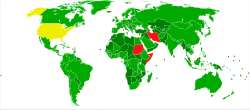
CEDAW (1979) provides the basis for realizing equality between women and men through affirming & ensuring
Party through Signature and ratification
Party through accession or succession Unrecognized state, abiding by treaty
women's equal access to,

and equal opportunities in, political and public life -- including the right to vote and to stand for election -- as well as education, health and employment. States parties agree to take
Only signed Non-signatory
Signed 18 December 1979
Location New York City
Effective 3 September 1981
Condition 20 ratifications all appropriate measures, including legislation and temporary special measures, so that women can enjoy all their human rights and fundamental freedoms. women's rights to acquire, Signatories 99
Parties 189 (Complete List)
Depositary Secretary-General of the United Nations
Languages Arabic, Chinese, English, French, Russian and Spanish change or retain their nationality and the nationality of their children. States parties also agree to take appropriate measures against all forms of traffic in Convention on the Elimination of All Forms of Discrimination Against Women at Wikisource women and exploitation of women.
Consisting of a preamble and 30 articles, it defines what constitutes discrimination against women and sets up an agenda for national action to end such discrimination
The Convention is the only human rights treaty which affirms the reproductive rights of women and targets culture and tradition as influential forces shaping gender roles and family relations.
Mainstreaming Gender in Governance, Bulbul Dhar-James
Countries that have ratified or acceded to the Convention are legally bound to put its provisions into practice. They are also committed to submit national reports, at least every four years, on measures they have taken to comply with their treaty obligations.
It was the 1984 creation of UNIFEM, the UN agency for women, which was given an explicit mandate to promote the mainstreaming of gender issues across the full range of UN activities, that initial instances of mainstreaming language can be found.
Beijing Platform for Action (1995) : flagged 12 key areas where urgent action was needed to ensure greater equality and opportunities for women and men, girls and boys. It also laid out 12 Critical Areas and concrete ways for countries to bring about change.


(1) Women and environment (2) Women in decision making (3) Girl Child (4) Women and Economy (5) Human Rights of Women (6) Education and Training of Women (7) Violence against Women (8) Women and Poverty (9) Institutional Mechanism (10) Women and Health (11) Women & armed conflict (12) Women and media
Mainstreaming Gender in Governance, Bulbul Dhar-James
Major progress was reached in determining the strategic objectives for gender equality: women's rights were confirmed as human rights, women's right to sexual self-determination was recognised for the first time and violence against women and girls clearly condemned, the principle of equality between women and men as opposed to the concept of equity was enforced, governments gave an undertaking to register and assess unpaid work so as to elucidate the economic equity of the performance of women and men, GENDER MAINSTREAMING WAS ADOPTED AS AN OVERARCHING PRINCIPLE.

Apart from CEDAW, and the Beijing Platform for Action the state and non state actors and stakeholders can refer to the following documents: Millennium Development Declaration (2000) UN-Resolution 1325 on Women, Peace and Security (2000) Solemn Declaration on Gender Equality (2004) BMZ Concept for the Promotion of Equal Participation by Women and Men in Development Process (2001/05), Followed by BMZ Genderaktionsplan (2009) UN-Resolution 1820 on Sexual Violence against Civilians in Conflict (2008) Accra Agenda for Action (2008) The term "mainstreaming" emerged in the early 1980s when in the midst of the United Nations Decade for Women, the international women's movement was concerned that the women specific programme strategies had not achieved significant results. Women units and national machineries established during this period had too often been understaffed and marginalized from real decision-making and policy formulation within UN entities and governments.
The profile of women in governance was, of course, substantially increased by the UN decision to declare 1975 the International Women's Year, and the declaration of the following decade (1976-1985) as the United Nations Decade for Women, which witnessed the rise of an international women's movement, most notably in the area of economic development even though officially the focus was threefold - peace, equality, and development. The Decade began in 1975 with the First World Conference on Women in Mexico City, and then Stockholm (1980), followed by the Third World Women's Conference in Nairobi, Kenya and the parallel NGO forum, giving gender mainstreaming advocates the first foundations of a policy platform from which to pressure government agencies and states.
Mainstreaming Gender in Governance, Bulbul Dhar-James
Women in Development (WID) to Gender and Development (GAD): United Nations Decade for Women, (1976-1985) which witnessed the rise of an international women's movement, most notably in the area of economic development ( even though officially the focus was threefold - peace, equality, and development) and specifically Women in Development (WID).
This was movement forward from the precedingthe 1950s and 1960s, gender-blind development course when the national development agencies in countries like Netherlands and the Scandinavian countries, USA, Canada amongst others focused on WID. But in retrospect one can see that the WID programs frequently implied in practical terms, the creation of narrowly targeted projects focused primarily on Maternal and childhealth to provide specific, targeted actions aimed at women in developing countries.
Table 1: Developing Countries' Policy approaches

& Women Origin
Growth/Economic development model Original WID approach
UN Decade for Women
Redistribution with
Growth and Basic Needs Stabilization and SAP
Women's Eco
Contribution to development Associated with Equity Contemporary MDG's and the current
SDGs approach to Gender & development
The International development agencies like the UNDP and the World Bank followed suit. Thus the stress remained women's 'reproductive' role. Women continue to bear a disproportionate share of the domestic workload and that this uneven division of labor in the home is implicated in divisions of labor in the paid work force (primarily taking the form of gendered segregation). The productive activities performed by women got sidetracked and "left the vast majority of "mainstream" projects untouched".
Scholars point to the creation of a "WID ghetto" by the end of the decade (Jahan 1995; Reanda 1999) and in theoretical terms, this change was articulated in terms of a shift from WID (Women in Development) to GAD (Gender and Development). "While WID identifies women as a special, or separate interest group, GAD identifies gender as an integral part of a development strategy. Under GAD the situation of women is no longer analyzed independently of, but rather in relation to, that of men" (World Bank 1998).
Mainstreaming Gender in Governance, Bulbul Dhar-James
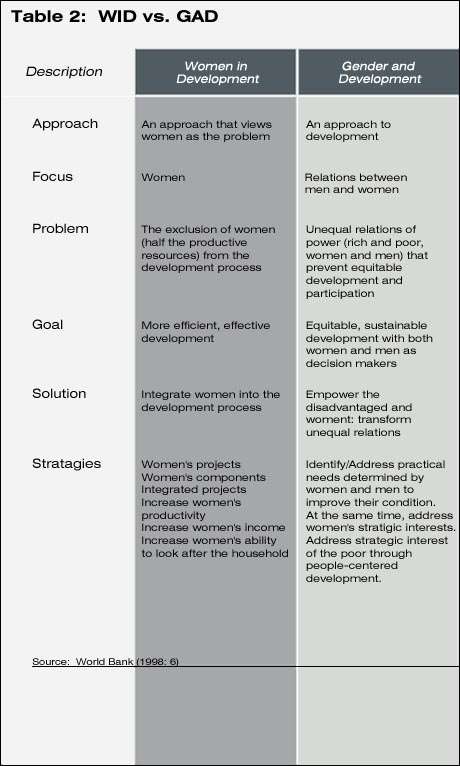

In operational terms, the shift manifested itself in the transition from relatively isolated WID to mainstreaming approaches and language which sought to diffuse gender analysis and gender procedures. A clear instance was the UNIFEM (1984), the UN agency for women, which was given an explicit mandate to promote the mainstreaming of gender issues across the full range of UN activities.
Mainstreaming Gender in Governance, Bulbul Dhar-James
The Nairobi Forward Looking Strategies - UN report of the World Conference to review and appraise the achievements of the United Nations decade for women: Equality, Development And Peace, Nairobi, 15-26 July 1985 (United Nations, New York, 1986 ) unambiguously called for mainstreaming a decade prior to the Beijing Platform.
It is vital that the link between the advancement of women and socio-economic and political development be emphasized for the effective mobilization of resources for women. (Paragraph 119).

Nairobi Forward Looking Strategies, (paragraph 114) explicitly calls for mainstreaming viz : " Effective participation of women in development should be integrated in the formulation and implementation of mainstream programs and projects, and should not be confined solely to statements of intent within plans or to small-scale, transitory projects relating to women" "Women should be an integral part of the process of defining the objectives and modes of development, as well as of developing strategies and measures for their implementation. The need for women to participate fully in political processes and to have an equal share of power in guiding development efforts and in benefiting from them should be recognized. Organizational and other means of enabling women to bring their interests and preferences into the evaluation and choice of alternative development objectives and strategies should be identified and supported. This would include special measures designed to enhance women's autonomy, bringing women into the mainstream of the development process on an equal basis with men, or other measures designed to integrate women fully in the total development effort." (Paragraph 111 ) This idea of socio-economic and political development not being possible without ' advancement of women ' was taken up by women's advocates in NGOs, in international development agencies, and at the various UN "social summits" held during the first half of the decade. It was over the course of the decade between Nairobi and Beijing, that a definitive shift from WID to GAD was attempted with an additional momentum by the official endorsement of mainstreaming at the Beijing Conference in September of 1995. This has since the MDGs (2000) and now the SDG's incorporated the environment as a significant dimension.
Mainstreaming Gender in Governance, Bulbul Dhar-James
International development community ; A Policy Frame of Gender mainstreaming: From a Political Economy perspective, what emerges is the logic that people, states and organizations can be placed along a continuum in terms of their support for either a neoliberal frame ( World Bank and other International Financial Organizations) emphasizing the efficiency of market mechanisms, or a more interventionist frame, (UN

Organizations like the UNDP, UNIFEM amongst others), which accepts the intervention of states and international organizations in the marketplace in pursuit of social goals— including the goal of sexual equality. (Hafner-Burton & Pollack; 2000).
However, if gender mainstreaming is an extraordinarily promising principle, it is also an extraordinarily demanding one, which requires international organizations and state governments to alter their policy-making procedures in fundamental ways.
Gender mainstreaming, is a potentially revolutionary concept, which promises to change the way in which "mainstream" policies are formulated, decided upon, implemented and evaluated, and which promises to put all the policy tools of states and international organizations at the service of gender.
A mixture of political opportunities, mobilizing structures, and strategic framing explains the rise of social movements and their impact on both domestic and international governance. These are "consistent—but not necessarily formal or permanent—dimensions of the political environment that provide incentives for collective action by affecting people's expectations for success or failure" and often begin with a discussion of political opportunities. (Tarrow,1998). The political opportunity structure is distinguished by Kitschelt (1986), as two aspects of input structures, which determine the openness of a political system to social movements seeking change; and output structures, which determine the capacity of a given state to implement its own policies.
With change of governments, Political opportunities, may change over time as new organizations are formed, and new access points and elite allies create "windows of opportunity" for social movements. In the case of the international women's movement, Mainstreaming Gender in Governance, Bulbul Dhar-James the turning point was undoubtedly the declaration of the UN Decade for Women (1976-
1985), and the convocation of a series of increasingly large and ambitious World
Conferences on Women in Mexico City (1975), Copenhagen (1980), Nairobi (1985), Beijing (1995), and New York (2000). These conferences, and the parallel NGO forums that have become a staple of all major UN conferences, offered women's groups from both North and South the opportunity to lobby governments for concrete international policies on behalf of women, as well as the chance to form transnational networks across borders, while the

creation of new UN bodies such as UNIFEM and the UN Division on the Advancement of Women (UNDAW) provided new elite allies for women's NGOs.
As Keck and Sikkink (1998) point out, the various UN conferences have allowed women's
NGOs to meet regularly, exchange information, and adopt a common agenda to overcome the North-South quarrels that had created severe divisions at the Mexico City and Copenhagen conferences. By the time of the Beijing Conference in 1995, the international women's movement had grown to include thousands of NGOs from the developed and developing world, with support from sympathetic governments and international organizations, and increasingly sophisticated communications networks taking advantage of the internet and other advances in communications technology. NGO's however, are not the only members of the international women's movement, nor the only advocates of gender mainstreaming. In the international arena, for example Keck and Sikkink (1998) have suggested that women's groups successfully re-framed the issue of violence against women in terms of the broader, existing frame of human rights, thereby making it possible for the UN system to address an issue previously defined as "private" or "domestic."
Challenges in implementation of gender mainstreaming
The central problem in gender mainstreaming is that of operationalization and measurement. (Hafner-Burton Emilie and Mark A. Pollack; 2000).Generally
Development organizations tend to consider any program as gender-related that mentions women or gender. It is debatable whether these programs are actually guided by a gender perspective, contain specific gender-related projects, or have a positive impact "on the Mainstreaming Gender in Governance, Bulbul Dhar-James ground." To circumvent this, studies focus on internal processes for the diffusion and mainstreaming of gender issues, on the assumption that such processes will, eventually, manifest themselves in terms of policy outputs.
The problems of measurement are amplified, finally, by the fundamental distinction in the literature between: Integrationist : essentially introduces a gender perspective into existing policy

processes, but does not challenge existing policy paradigms.
Agenda-setting versions of the concept is more radical and involves a fundamental rethinking, not simply of the means or procedures of policymaking, but of the ends or goals of policy from a gender perspective. In this approach, "Women not only become part of the mainstreaming, they also reorient the nature of the mainstream"
Ceteris paribus, each of the following tools amongst others should be engaged to streamline the policy process and ensure that gender issues are incorporated into the planning of policies (not simply added as an afterthought).
Collection of gender-disaggregated statistics and other indicators. The identification of gender inequality–the first phase in the process of creating policies and programs to mainstream gender–requires the reliable and replicable collection of sex-disaggregated data. Without separate data divided by sex for all indicators, it is impossible to comparatively assess the status of important variables that may shape inequalities between men and women's living conditions, such as differences in education, access to health care, income, or the division of labor. Unfortunately, pertinent data are often not available by sex breakdown because gender has rarely been considered an important indicator for analysis during the data collection stage or because some aspects of gender inequality are difficult to quantitatively measure. Such measurement is important in both the recognition of gender inequalities, which form the basis of an organization's gender mainstreaming projects, and with respect to implementation, where sex-disaggregated data is a crucial component to the evaluation of gender mainstreaming progress.
Mainstreaming Gender in Governance, Bulbul Dhar-James
Gender Training of personnel is an essential component before an organization can actualize a gender mainstreaming mandate, all personnel must not only understand and accept the importance of gender equality as an ultimate goal, but must also have the necessary skills with which to create, implement, and evaluate gender mainstreaming programs.
Gender impact assessment and gender-proofing - allows for the screening of a given policy proposal, in order to detect and assess its differential impact or effects on women and

men, so that these imbalances can be redressed before the proposal is endorsed. With its roots in the environmental sectors it draws a very accurate picture of the effects of a given policy and is a relatively less detailed review of policy proposals to identify unintended sexist language or differential effects of policy on women and men. The drawback of course is the fact that they constitute an essentially reactive process, in which gender is taken into account before implementation, but after the conceptualization and planning of policy.
Checklists, manuals, and handbooks are additional, commonly used tools besides guidelines, terms of reference, manuals, and handbooks–may provide additional, and more detailed, information instructing staff on ways to integrate a gender perspective into their work.
Monitoring and evaluation is necessary to ensure organizational and governmental compliance and to assess the effectiveness of a given policy or method.
Conclusion:
Despite the initiatives undertaken, more needs to be done to mainstream gender issues in good governance initiatives in a more systematic way. The link between gender and good governance is significant. Concentration on the following (Gender And Development Group, The World Bank, April
2006) amongst other areas requires special attention: Ensuring gender sensitivity in public expenditures. Public financial management policies, e.g., public expenditure reviews (PERs), can be effective instruments to monitor the use of Mainstreaming Gender in Governance, Bulbul Dhar-James public funds and link them to performance outcomes, including gender-specific ones.
However, more quantitative and qualitative studies of sexdisaggregated benefit incidence are needed. Such tools can assess the gender impacts of public spending and link findings to specific policy actions.
Promoting gender equality in citizenship rights. Citizenship, constitutional, and other rights determine the ways in which women and men participate as citizens and access and

utilize the potential resources and services necessary for the well-being of families and societies. Significant untapped potential exists to study how gender inequalities in citizenship affect access to rights and resources, and countries' growth and poverty reduction prospects.
Creating an enabling governance environment to strengthen women's voices. The Bank's governance agenda is increasingly emphasizing effective and transparent political processes to ensure effective participation, representative systems of government and the effective delivery of services, especially at the local level. This creates a need to better understand the link between gender issues and the politics of reform. Special attention needs to be placed on reviewing policy options to enhance the ability of national, sub-regional, district and municipal level policy and administrative bodies to effectively represent and give voice to women's and men's different priorities.
A central element of good governance is the responsiveness of policies and public institutions to the needs of all citizens. Policies and institutions must represent the interests of trans people, women and men and promote equal access to resources, rights, and voice.This module sought to explain both the origins of gender mainstreaming as a `policy frame' in Domestic and International
Relations, as well as the capricious realization of mainstreaming over time and across various organizations and levels of government. Even though mainstreaming has been endorsed almost universally, the rhetorical recognition of mainstreaming obscures considerable diversity and variation in both the timing and the nature of mainstreaming. that can be explained in terms of the categories of political opportunity, mobilizing structures, social movements and strategic framing.
Mainstreaming Gender in Governance, Bulbul Dhar-James
Paper-11 Module-25
Concept of Citizenship
Personal Details
Role Name Affiliation
Principal Investigator Prof. Sumita Parmar
Allahabad University, Allahabad
Paper Coordinator Prof Chandrakala Padia
Chairperson ,IIAS, Shimla and Vice Chancellor MGS University Bikaner

Dr. Manjeet Bhatia Centre for Women's Studies.
Content Writer/Author (CW)
Delhi University
Content Reviewer (CR) Prof Chandrakala Padia
Chairperson ,IIAS, Shimla and Vice Chancellor MGS University Bikaner
Language Editor (LE) Prof. Sumita Parmar
Allahabad University, Allahabad
(B) Description of Module Items Description of Module Subject Name Women's Studies Paper Name Women, Governance and Politics Module Name/ Title, description
Concept of Citizenship
Module ID Paper-11 Module-25 Pre-requisites Student should be aware of the concepts of democracy and citizenship Objectives To contextualize gender into these concepts
Keywords Citizen, concept, history, private, public
Concept of Citizenship
Introduction
The concept
Citizenship is a complex and contested concept. Its theoretical trajectory itself indicates the context in which it is shaped out. Aristotle linked it with active participation in the polis from which both slaves and women were kept out; as women and slaves were considered legally equivalent to children (Barbara Einhorn. 2013).
Citizenship is critically analysed in two categories - active and passive (Rajiv Bhargav, 2005). Passive citizen enjoys certain benefits from the state but hardly play any active role in the public sphere. Their private space is protected by the state. Whereas active citizens also get rights from the state but they actively engage with it to negotiate by way of participation in deciding the distribution of collective burdens, benefits and obligations. An active citizen is an important entity for a dynamic public sphere since she/he carries significant responsibilities.

Roy (2005) argues that the idea of citizenship in specific historical contexts remains a terrain of conflict and struggle, 'where a multitude of social and political forces and ideological formulations exist in unequal and often conflicting relationships' and on the other it is potentially emancipatory as at different times in history becoming a citizen has been either an extension of status to people or has provided liberty to replace oppressing structures with more egalitarian and inclusive ones.
Conceptually it does not easily give in to definition as 'its constituent elements are uncertain and often contradictory'. It is difficult to say with certainty what the arena of operation of Citizenship is. Is it political and state activity or culture, economic, and social ?
So to understand the historical development of the concept of citizenship, the pertinent questions to be asked according to Roy (2005) are, who are the citizens? Who are excluded and what is the process and basis of exclusion? What is the nature of citizenship? Is it legal as a sign of some entitlements or is it political indicating active participation in political life? Further, what are the avenues of participation to build responsible citizens?
Historical Overview
Roy (2005) puts the development of the concept of citizenship in four broad historical periods:
1. classical and republican Citizenship, Greek republics or city states (fifth century BC onwards) 2. The late medieval and early modern periods that ' combined the classical connotation of citizenship as civic participation with modern liberal individualism, civic republicanism, French and American revolutions 3. The 19th and 20th centuries , corresponding to the growing influence of liberalism and capitalism; and 4. New contexts: Globalisation and Multiculturalism.
Classically, citizenship was connected to freedom and the capacity to actively participate and get governed. Greek citizenship was limited to 'free native-born men'. In polis, citizenship was a privileged category of men excluding, women, children, slaves and resident aliens.
Thus it was based on a hierarchy and the exclusion of family and economic affairs. The legacy of citizenship as a sphere of freedom and participation was also linked with privilege and exclusion.
As the Roman imperialism developed and many empires had to be integrated, the expansion of citizenship became necessary for both administrative purposes and the consolidation of power. Citizenship, as it has existed earlier had to be broadened and could no more be restricted to active participation in governance alone. Gradation within the framework of Greek citizenship was introduced, which brought into existence the notion of passive citizenship as legal status. Legal status involved certain rights and equal protection of the law. This change also added hierarchy of statusa second class category of citizens who did not have political rights, (without franchiselegal but not political). Governance was left to a small category of citizens. Active participation however, remained the predominant idea. Citizens were expected to develop the civic virtues of performing military duty, patriotism and devotion to law. Women and the lowest category of the population was still kept out of any kind of citizenship.

By the sixteenth century it was the legalpassive strand of the graded citizenship that became the dominant mode. Absolute state controlling a heterogeneous population gave the context in which individual freedom and protection on equal terms got the sanction of early liberals, (Hobbes, Bodin, Montesquieu and Locke). With the French revolution though, the early concept of modern passive citizenship was challenged. In its place, the Revolution tried to resurrect the republican ideals of participation as against the imperial or monarchical or liberal state. One of the most important contribution of the French Revolution was the introduction of the idea of individual rights on equal terms. 'Thus the conception of the citizenship established by the French Revolution combined the classical connotation of citizenship as civic participation with modern liberal individualism.' (Roy, 2005, p.10)
With the development of capitalist markets, and the influence of liberalism in the nineteenth century, this combination of civic participation with modern liberalism became weakened. Citizens having individual rights got precedence over the common good.
Broad Theoretical Constructs
Broadly, the citizenship discourse can be placed under two traditions, (Roy, 2005) – civic republicanism and liberal citizenship. Republics are concerned about active participation of citizens in civic life; holding the ideas of public spirit, common good and political participation as civic virtues. Such a terrain of citizenship also gets connected with status. The more important area of how communities are formed is overlooked by such a tradition. According to its critiques, Republican tradition does not offer an adequate theory of citizenship, ( Faulks , 2000) because such a conception is based on an abstract approach to politics.
The liberal tradition's starting point is that all citizens are equal, have the same status and equal rights and duties. Thus discrimination based on gender, class and caste have no place in this discourse. Citizenship is concerned with the benefits for the individual to be part of the political community and the validating process thus involved. Important questions of power in the formation of such a community are out of purview of the liberals.
It is also important to note that due to social conditions (Jayal, 1999) citizenship is enjoyed differentially by different citizens.
Liberals, true to this tradition, concerned themselves with normative theories that would advance individuals rights and duties without taking into consideration the social conditions of constraints posed by gender, class and ethnicity. Kymlicka and Norman (1994) argue that possession of rights is the prevalent idea of citizenship in political theories. They also observe rightly that the liberal idea of citizenship is that of a passive citizen who is focussed on her entitlements rather than participation in public sphere. Faulks (2000) gives the right twist to the discourse by bringing attention on the power involved in giving citizenship rights. Since rights involve distribution of resources and social contexts in which obligations are exercised, power is implicit in giving these rights. Any discussion on citizenship is therefore also consideration of power –an intersection of recourses, responsibilities and their interplay vis a vis the larger social context.
Liberals in their zeal of ensuring individual rights have failed to pay attention to the power structures that obstruct or facilitate the exercise of citizens' rights or obligations. Republicans criticize the liberal understanding of citizenship as of an amoral community in which the notion of the common good is a-priori, given.

Citizenship as rights
T H Marshall (1950) in his influential account of citizenship in Britain over two centuries sees its growth in a typical relationship of conflict and collusion with capitalism. The basis of his widely accepted definition of citizenship 'as full and equal member of a political community' is citizenship as a process of expanding equality against the inequality of social class. Marshall (1950) distinguishes three strands of rights, viz., civil, political, and social.
Civil rights are in a way negative rights against the power of the State over the freedom of speech, movement, equality before law and right to own property. Political rights i.e.the right to vote, contest election and the right to hold public office give the individual right to participate in the political life of the polity. Social rights ensure a minimum social status to live a life with dignity and provide the enabling basis for the individual to enjoy the other two categories of rights. Social rights are guaranteed by the active intervention of the state.
These rights had different historical trajectories in different parts of world. Before most of the European States ensured civil rights, for instance, America guaranteed these rights to its citizens. At the same time America excluded people of Negro descent—the blacks, as they were referred to in common parlance. While political rights were expanding in Europe, colonization was underway and ran parallel to the growth of the imperialism of European nations. Colonized peoples were inevitably excluded from full citizenship of the parent states of the colonised regime. Yet, in modern states globalization has provided a context that has the potential to close this historical gap.
Citizenship had become synonymous with individual freedom which logically opened the possibility of further expansion of rights. For instance, equality before the law without choosing law makers would have been void. Marshall noted that the principle of civil rights contained the 'drive' for further equality. Thus the concept of civil rights was antithetical to the idea of grounding them in any hierarchical structure. In fact, civil rights paved the way for subverting the idea of basing political rights on social class. Political rights in Great Britain caught up with civil, as more and more people got the right to vote including women.
Of course women had to wage a long and hard battle to win the right to vote. Their struggle met with fierce opposition. The very idea of women being equal to men was not only a novel one but an unpleasant one. Socially embedded values of women being nurturers and essentially homemakers, quite unfit for the more "serious" responsibilities of governance were not easy to remove. However, it must also be noted that in their struggle for political emancipation, women had the support of many enlightened men. Parallel to such developments was an important development of the Labour Party entering the Parliament. However the trajectory from civil and political rights to social had not been that clearly logical. Marshall though noted that to fulfil the responsibilities of a citizen, citizens have to be provided with opportunities to enhance their capacities by education and have a sense of security to enjoy their civil and political rights. Without education, a citizen cannot distinguish between the various grades and shades of the quality of a strong leadership and is unable to make the correct choices that are so necessary for a good government. Without enhanced capacities and education, a citizen also cannot contribute to the national economy. .

Marxian critique
Generally speaking, for Marx, citizenship as claims to rights of equality and freedom were incompatible with capitalism. This incompatibility lay in the conflict of interest of a bourgeois state with that of individual freedom. For Marx, the bourgeois state is made of capitalist structures that are not capable of offering promised citizenship. That is why citizenship as status is a garb in the context of capitalism. 'political man is only the abstract fictional man' (McLellan, 1977,p.56)1. Without addressing the inequality in attributes, needs, social contexts, formulations of rights as right to equality only reinforces inequality that is inherent in the capitalist system. Political and civil rights in this analysis are only superficial without content, they do not translate to actual day to day living. Essentially, the inequalities remain embedded in the system and the dominant classes retain their privileges and working classes remain subjugated and exploited.
Some writers have pointed out the discomfort of Marxists with citizenship2. Marxism lacks the basic 'theoretical vocabulary to represent conditions of choice, individual liberty and dignity' (Roy, 2005, p.23). Marxism cannot believe in rights as it sees rights as representing egoism of bourgeoisie society and sees them as abstract and decontextualized. However, Roy (2005) sees ambivalence in Marx, in so far as he also sees Citizenship as progressive. Though, he finds mere political emancipation as inadequate, unless persons are free from 'determining power of private property and its associated institutions'. Distinction on the basis of status emanating from wealth and ownership in civil society, for instance is not addressed by political rights. Such rights subordinate the rights of a person. Men and women who occasionally imagine themselves as citizens, actually have their daily actions dictated by market imperatives. Rights though are possible only in a community, so one has to belong to a community to have any kind of right.
1 Mc Lellan, D, ed. (1971): Karl Marx, Selected Writings, Oxford: Oxford University Press, as referred by Anupama Roy, (2005): Gendered Citizenship: Historical and Conceptual Explorations Hyderabad: Orient Longman. 2 Michel Walzer, 'Citizenship' in Political Innovation, eds. Ball, Farr and Hanson (1989), and 'The Civil Society Argument' in Dimensions of Radical Democracy, ed. Chantal Mouffe (1992), as referred by Roy (2005), Ibid.
Cultural pluralist intervention
Contemporary debates on citizenship have questioned the assumption in the conception of universal rights of citizens contending that such rights can be enjoyed detached from the context to which s/he belongs. A significant terrain of contestation was recognised by 1980(Roy, 2005) in the citizenship theory owing to multiculturalism, plurality, diversity, and difference as terms of reference. Cultural pluralists invite our attention to difference. Citizenship to them is a sign of identity. In modem multicultural societies, the specific context of ethnic, religious, cultural, linguistic, etc. have gained significance in determining citizenship. The notion of 'differentiated citizenship'3 thus gained currency as some theorists felt that the common rights of citizenship , originally defined by and for white men could not accommodate the needs of specific cultural groups. Such theoretical interventions are based on two assumptions, viz., relating to excluded groups' political rights and second to their special needs which can be addressed only through group-differentiated policies. Critics of differentiated citizenship (Kymlicka and Norman, 1994), worry that such movements when grown inwards may be a hurdle in expanding fraternity.

With changing contexts of the late twentieth century i.e. globalization, migration and multicultural national population, citizenship is redefined. The concept of citizenship is now seen as a multi-tier construct (Yuval-Davis, 1997b) by way of linking the membership of a community to that of citizenship rights. Individuals may belong to local, regional, national and international groups. In the era of globalization individuals are fast adopting global outlooks, working and transiting different cultural spaces and belong to different groups. National bodies such as the EU that takes over many functions that were earlier the prerogative of the individual state's opens possibilities of yet another context in which citizenship rights are claimed and obligations administered and Neo-liberal states redefine their roles.
Conclusion
The idea of citizenship has been moulded by political, social and economic forces in the course of the world's history. In the Greek polis it was the prerogatives of a few men, free to actively participate in the governance of polis. They were free because they had assigned slaves for economic activity and women for family responsibilities. Citizenship thus was based on exclusion of many and the privilege of a few. Various, political, social, economic developments have challenged such a concept of citizenship through political exigencies (expansion of empires), socio-political upheavals (French Revolution), economic changes (globalization) and social movements ( Left, Plural, Feminist).
The liberal tradition is egalitarian and begins with the assumption that all citizens are equal, have same status and equal rights and duties. Republicans are critiqued for advocating abstract notion of politics and liberals for the zeal of advocating equality of rights, overlooking differences and special needs.
With the growing capitalism and influence of liberalism, the combination of the two traditionsrepublicanism and liberalism got weak. The notion of citizen as an individual with private rights got precedence over the common good. The virtue of public service and active political participation got out of fashion. It got replaced with less committed liberal citizenship that was loosely controlled by the State.
3 The term used by Iris Marion Young in 1989- 'polity and Group Difference: A Critique of the ideal of Universal Citizenship'(1989)
Citizenship predominantly remained rights based. T H Marshall has listed three bundles of rights: political, civil and social. Rights grew in a peculiar relationship of conflict and collusion with Capitalism in the history of 250 years of Britain. Such rights though grew in different counties and geographical regions at different time periods, population of colonised regions/states were invariably denied these rights.
Marxian and multiculturalists challenged such a conception of citizenship. Marx felt that political freedom is not emancipatory till such time when personal freedom from suppression by structures based on private property and ownership were not addressed. The context to which one belongs needs to be taken on board while we take citizenship as epitome of equality. With modern societies comprised of multicultural populations, scholars have criticised the liberal notion of equal citizenship that perpetuates contextual inequalities as such notions of equality cloaks them. Multiculturalists also advocated for special needs of groups and policies to accommodate their specific identities.

References
Einhorn, Barbara, (2013), Citizenship in Gender: The Key Concepts, by Mary Evans and Carolyn H. Willams, Routledge, special Indian print, 2015. Bhatia M. (2012),Domestic Violence in India: Cases Under the Protection of Women from Domestic Violence Act, 2005. South Asia Research, 32(2), Sage Chari, Anurekha (2009) Gendered Citizenship and Women's Movement, Vol - XLIV No. 17, April 25, Review Issues Yuval-Davis, N (1997): "Women, Citizenship and Difference", Feminist Review, No 57, pp 4-27. Faulks, K (2000): Citizenship (London: Routledge). Roy, A (2005): Gendered Citizenship: Historical and Conceptual Explorations (Hyderabad: Orient Longman ePathshala: Women's Studies
Gender and Citizenship
A. Concept of Citizenship
The concept
Citizenship is a complex and contested concept. Its theoretical trajectory itself indicates the context in which it is shaped out. Aristotle linked it with active participation in the polis to which both slaves and women were kept out; as women and slaves were considered as legally equivalent to children (Barbara Einhorn. 2013).
Citizenship is critically analysed in to active and passive categories (Rajiv Bhargav, 2005). Passive citizen enjoys certain benefits from the state but hardly plays any active role in the public sphere. Her private space is protected by the state. Whereas active citizen also gets rights from the state but she actively engages with it to negotiate byway of participating in deciding the distribution of collective b urdens, benefits and obligations. Active citizen is an important entity for dynamic public sphere.

Roy (2005) argues that idea of citizenship in specific historical context remains a terrain of conflict and struggle, 'where a multitude of social and political forces and ideological formulations exist in unequal and often conflicting relationships' and on the other it is potentially emancipatory as at different times in history becoming citizen has been either extension of status to more people or liberty to replace oppressing structures with more egalitarian and inclusive ones.
Conceptually it does not easily give in to definition as 'its constituent elements are uncertain and often contradictory'. It is difficult to say with certainty what the arena of operation of Citizenship is. Is it political and state activities or culture, economic, and society?
So to understand the historical development of the concept of citizenship, pertinent questions to be asked according to Roy (2005) are who are the citizens? Who are excluded and what is the process and basis of exclusion? What is the nature of citizenship? Is it legal as a sign of some entitlements or is it political indicating active participation in political life? Further, what are the avenues of participation to build responsible citizens?
Historical Overview
Roy (2005) puts the development of the concept of citizenship in four broad historical periods: (1) classical and republican Citizenship, Greek republics or city states (fifth century BC onwards); (2) The late medieval and early modern periods that ' combined the classical connotation of citizenship as civic participation with modern liberal individualism the civic republicanism, French and American revolutions; (3) The 19th and 20th centuries , corresponding to the growing influence of liberalism and capitalism; and (4) New contexts Globalisation and Multiculturalism.
Classically citizenship was connected to freedom and capacity to actively participate and get governed. Greek citizenship was limited to 'free native-born men'. In polis citizenship was a privileged category of men excluding, women, children, slaves and resident aliens. Thus it was based on subordination and exclusion of family and economic affairs. Legacy of citizenship as a sphere of freedom and participation was also linked with privilege and exclusion.
As the Roman imperialism developed and many empires had to be integrated, it necessitated expansion of citizenship. It could no more be restricted to active participation in governance. Gradation within the framework of Greek citizenship was introduced, that introduced the notion of passive citizens as legal status. Legal status involved certain rights and equal protection of the law. This change also added hierarchy of statusa second class category of citizens who did not have political right, (without franchiselegal but not political). Governance was left to a small category of citizens. Active participation however, remained the predominant idea. Citizens were expected to develop civic virtues of performing military duty, patriotism and devotion to law. Women and lowest category of population was still kept out of any kind of citizenship.
By Sixteenth century it was the legalpassive strand of the graded citizenship that became the dominant mode. Absolute state controlling heterogeneous population gave the context in which individual freedom and protection on equal terms got the sanction of early liberals, (Hobbes, Bodin, Montesquieu and Locke). With French revolution though, this early modern passive citizenship faced revolt. It tried to resurrect republican ideals of participation as against the empire or monarchical or liberal state. French revolution introduced individual rights on equal terms. 'Thus the conception of the citizenship established by French Revolution combined the classical connotation of citizenship as civic participation with modern liberal individualism.' (Roy, 2005, p.10)

With development of capitalist market relations and influence of liberalism in nineteenth century, this combination of civic participation with modern liberalism got weak. Citizen having individual rights got precedence over the common good.
Broad Theoretical Constructs;
Broadly the citizenship discourse can be placed under two traditions, (Roy, 2005) – civic republicanism and liberal citizenship. Republics are concerned about active participation of citizens in civic life; Holding the ideas of public spirit, common good and political participation as civic virtues. Such a terrain of citizenship also gets connected with status. The more important area of how communities are formed is overlooked by such a tradition. According to its critiques, Republic's tradition does not offer an adequate theory of citizenship, ( Faulks , 2000) because such a conception is based on abstract approach to politics.
The liberal tradition's starting point is that all citizens are equal, have same status and equal rights and duties. Thus discrimination based on gender, class and caste have no place in this discourse. Citizenship is concerned with the benefits for the individual to be part of the political community and the validating process thus involved. Important questions of power in formation of such a community are out of purview of the liberals.
It is also important to note that due to social conditions (Jayal, 1999) citizenship is enjoyed differentially by different citizens.
Liberals true to this tradition concerned themselves with normative theories that would advance individuals rights and duties without taking in to consideration the social conditions of constraints posed by gender, class and ethnicity. Kymlicka and Norman (1994) argue that Possession of rights is the prevalent idea of citizenship in political theories. They also observe rightly that liberal idea of citizenship is that of a passive citizen who is focussed on her entitlements rather than participation in public sphere. Faulks (2000) gives the right twist to the discourse by bringing attention on the power involved in giving citizenship rights.
Since rights involve distribution of resources and social contexts in which obligations are exercised, power is implicit in giving these rights. Any discussion on citizenship is also consideration of power.
Liberals in their zeal of ensuring individual rights have failed to pay attention to the power structures that obstruct or facilitate exercise of citizens' rights or obligations. Republicans criticise liberal understanding of citizenship as of an amoral community in which notion of the common good is a-priori, given.
Citizenship as rights
T H Marshall (1950) in its influential account of citizenship in Britain over two centuries sees its growth in a typical relationship of conflict and collusion with capitalism. The basis of his widely accepted definition of citizenship 'as full and equal member of a political community' is citizenship as a process of expanding equality against the inequality of social class. Marshall (1950) distinguishes three strands of rights, viz., civil, political, and social. Civil rights are in way negative rights against the power of the State over the freedom of speech, movement, equality before law and right to own property. Political rights i.e. that to vote, contest election and the right to hold public office gave the individual right to participate in political life of the polity. Social rights ensure a minimum social status to live a life with dignity and provided the enabling basis for individual to enjoy the other two categories of rights. Social rights are guaranteed by active intervention of the state.

These rights had different historical trajectory in different parts of world. Before most of the European States ensured Civil rights, for instance, American guaranteed these rights to its citizen. At the sometime American excluded blacks from these rights. While political rights were expanding in Europe, colonisation was underway. Colonised peoples without fail were excluded from full citizenship of the parent states of the colonised regime. Yet in modern states globalisation has provided a context that has potential to close this historical gap.
Citizenship had become synonymous with individual freedom which logically opened the possibility of further expansion of rights. For instance, equality before the law without choosing law makers would have been void. Marshall noted that principle of civil rights contained 'drive' for further equality. Thus civil rights paved the way for subverting the idea of basing political rights on social class. Political rights in Great Britain caught up with civil, more and more people got right to vote including women. Parallel to such developments was an important development of labour party entering the parliament. However the trajectory from civil and political rights to social had not been that clearly logical. Marshall though noted that to fulfil once responsibilities of a citizen, citizens have to be provided with opportunities to enhance their capacities by education and security to enjoy their civil and political rights. Without education, a citizen cannot make choice of good government or contribute to the national economy. .
Marxian critique
Generally speaking, for Marx citizenship as claims to rights of equality and freedom were incompatible with capitalism. This incompatibility lied in the conflict of interest of a bourgeois state with that of individual freedom. For Marx, bourgeois state is made of capitalist structures that are not capable of offering promised citizenship. That is why citizenship as status is a garb in the context of capitalism. 'political man is only the abstract fictional man' (McLellan, 1977,p.56)1. Without addressing the inequality in attributes, needs, social context, formulations of rights as right to equality only reinforces inequality that is inherent in the capitalism. Political and civil rights in this analysis are only superficial without content. Dominant classes retain their privileges and working classes remain dominated.
Some writers have pointed out the discomfort of Marxists with citizenship2. Marxism lacks the basic 'theoretical vocabulary to represent conditions of choice, individual liberty and dignity' (Roy, 2005, p.23). Marxism cannot believe in rights as it sees rights representing egoism of bourgeoisie society and sees rights as abstract and decontextualised. However, Roy (2005) sees ambivalence in Marx, in so far he also sees Citizenship as progressive. Though, he finds mere political emancipation as inadequate unless persons are free from 'determining power of private property and its associated institutions'. Distinction on the basis of status emanating from wealth and ownership in civil society, for instance is not addressed by political rights. Such rights subordinate rights of a person. Men and women who occasionally imagine themselves as citizens, their daily actions are dictated by market imperatives. Rights though are possible only in a community, so one has to belong to a community to have any kind of right.

Cultural pluralist intervention
Contemporary debates on citizenship have questioned the assumption in the conception of universal rights of citizens that such rights can be enjoyed detached from the context to which s/he belongs. A significant terrain of contestation by 1980 is recognised (Roy, 2005) in the citizenship theory owing to multiculturalism, plurality, diversity, and difference as terms of reference. Cultural pluralists invite our attention to difference. Citizenship to them is sign of identity. In modem multicultural societies, the specific context of ethnic, religious, cultural, linguistic, etc. have gained significance in determining citizenship. The notion of 'differentiated citizenship'3 thus gained currency as some theorist felt that common rights of citizenship , originally defined by and for white men could not accommodate the needs of specific cultural groups. Such theoretical interventions are based on two assumptions, viz., relating to excluded groups' political rights and second to their special needs which can be addressed only through group-differentiated policies. Critics of differentiated citizenship (Kymlicka and Norman, 1994), worry that such movement when grown inwards may be hurdle in expanding fraternity.
With changing contexts of late twentieth century i.e. globalisation, migration and multicultural national population citizenship is redefined. Concept of citizenship is now seen as a multi-tier construct (Yuval-Davis, 1997b) byway of linking membership of a community to that of citizenship rights. Individual may belong to local, regional, national and international groups. In the era of globalisation individual are fast adopting global outlook working and transiting different cultural spaces and belong to different groups. Sapura national bodies such as EU that takes over many functions that was prerogative of the individual state opens
1 Mc Lellan, D, ed. (1971): Karl Marx, Selected Writings, Oxford: Oxford University Press, as referred by Anupama Roy, (2005): Gendered Citizenship: Historical and Conceptual Explorations Hyderabad: Orient Longman. 2 Michel Walzer, 'Citizenship' in Political Innovation, eds. Ball, Farr and Hanson (1989), and 'The Civil Society Argument' in Dimensions of Radical Democracy, ed. Chantal Mouffe (1992), as referred by Roy (2005), Ibid. 3 The term used by Iris Marion Young in 1989- 'polity and Group Difference: A Critique of the ideal of Universal Citizenship'(1989) possibilities of yet another context in which citizenship rights are claimed and obligations administered and Neo-liberal states redefine their roles.
Conclusion
Idea of citizenship has been moulded by political, social and economic forces in the course of world's history. In the Greek polis it was prerogatives of a few men, free to actively participate in the governance of polis. They were free because they had subordinated slaves for economic activity and women for family responsibilities. Citizenship thus was based on exclusion of many and privilege of few. Various, political, social, economic development have challenged such a concept of citizenship through political exigencies (expansion of empires), Socio-political upheavals (French Revolution), economic changes (globalisation) and social movements ( Left, Plural, Feminist).
Broadly the citizenship discourse can be placed under two traditions, (Roy, 2005) – civic republicanism and liberal citizenship. Republics attribute citizenship to those who active participations in civic life; Holding the ideas of public spirit, common good and political participation as civic virtues. The liberal tradition's on the other hand is egalitarian and begin with the assumption that all citizens are equal, have same status and equal rights and duties. Republicans are critiqued for advocating abstract notion of politics and liberals for the zeal of advocating equality of rights, overlooking difference and special needs.

With the growing capitalism and influence of liberalism, the combination of the two traditionsrepublicanism and liberalism got weak. The notion of citizen as an individual with private rights got precedence over the common good. The virtue of public service and active political participation got out of fashion. It got replaced with less committed liberal citizenship that was loosely controlled by the State.
Citizenship predominantly remained rights based. T H Marshall has listed three bundles of rights: political, civil and social. Rights grew in a peculiar relationship of conflict and collusion with Capitalism in the history of 250 years of Britain. Such rights though grew in different counties and geographical regions at different time periods. Population of colonised regions/states were invariably denied these rights.
Marxian and multiculturalists challenged such a conception of citizenship. Marx felt that political freedom is not emancipator till such time when personal freedom from suppression by structures based on private property and ownership is not addressed. Context to which one belongs needs to be taken on board while we take citizenship as epitome of equality.
With modern societies comprised of multicultural population, scholars have criticised the liberal notion of equal citizenship that perpetuates contextual inequalities as such notions of equality cloaks them. Multiculturalists also advocated for special needs of groups and policies to accommodate their specific identities.

Paper No. :Gender and Citizenship
Module : Civil Society : A Gender Analysis
Development Team
Principal Investigator

Paper Coordinator
Paper Coordinator
Prof. Sumita Parmar Allahabad University, Allahabad
Principal Investigator
Prof. Chandrakala Padia Maharaja Ganga Singh Univesity, Bikaner
Paper Coordinator
Dr. Bulbul Dhar-James, JMI, N Delhi. & Ms. Savita Sagar, Pol Sc Deptt, JMI
Content Writer
Prof. Chandrakala Padia Maharaja Ganga Singh Univesity, Bikaner
Content Reviewer
Description of Module
Subject Name Women's Studies
Paper Name Gender and Citizenship
Module Name/Title Civil Society : A Gender Analysis – Meaning of Civil Society, What is Gender Analysis, Various Framework of Gender Analysis, Reasons of gender analysis in civil society, Difference Between Gender Equity and Gender Equality, Relationship between Civil Society and Gender, Theoretical perspectives of Civil Society and Gender Analysis, Indian Context; History of Civil Society, Describing Civic Association such as PRIA,SEWA, Action India, Global Context; Understanding role of international organization in context of Gender

Module Id
Pre-requisites The student is expected to have the knowledge of importance of civil society and gender analysis.
Objectives To make the reader understand the concept of civil society in terms of gender analysis and sensitize them about its political participation and sensitize them about its significance for women for the foundation of a gender-equal society.
Keywords Civil Society, NGOs,Gender Analysis, Gender equality, Gender Equity, International Organisation.
CIVIL SOCIETY: A GENDER ANALYSIS
Dr. Bulbul Dhar-James Former Director, SNCWS, JMI Email : [email protected] &
Ms. Savita Sagar UGC Senior Research Fellow, Department of Political Science, Jamia Millia Islamia, New Delhi 110025
Email : [email protected]
1.1 Meaning of civil society
Civil society is an ambiguous concept. There is no consensus on its meaning. Theorists and organization has defined it in various perspectives. The World Bank has adopted a definition of civil society developed by a number of leading research centers; "The term civil society to refer to the wide array of non-governmental and not-for-profit organizations that have a presence in public life, expressing the interests and values of their members or others, based on ethical,

cultural, political, scientific, religious or philanthropic considerations".
Thus, Civil society can be found as a associational life such as professional associations, charities, universities, interest groups, NGOs,civil communities, media outlets, book clubs, and public gathering in movements, demonstration, and concerts etc.
1.2 Gender Analysis "One way to interpret Beauvoir's claim that one is not born but rather becomes a woman is to take it as a claim about gender socialization: females become women through a process whereby they acquire feminine traits and learn feminine behavior. Masculinity and femininity are thought to be products of nurture or how individuals are brought up".