
Part 7
The debate within the committee on the issue of reservations for women in legislatures and parliament, anticipated most of the arguments raised during debates on reservations for women today. Arguments made against reservations ranged from 'preserving male support in improving status of women', to other theoretical issues. These included- (a) It was thought that it would contradict the principle of equality enshrined in the Constitution. 6 Towards Equality, Report of Committee on the Status of Women in India, Ministry of Education and Social Welfare, Government of India, New Delhi, 1975, Chapter 7. 7 Mazumdar, Vina, "Historical Soundings", in Dhanda, Meena (ed.), Reservations for Women, Women Unlimited, 2008, p 18. 8 Ibid., p. 19. 9 Ibid., p. 18. 10 Siriskar V.M., 'Political Awareness and Participation of Women in India', a three State Survey commissioned for the CSWI; cited in Mazumdar, Vina, "Political Ideology of the Women's Movement's Engagement with Law", CWDS Occasional Paper No. 16, CWDS, 2000, p. 28.
(b) There was reluctance to equate women with the socially backward and minority groups on grounds that 'women are not a community but a category', and are not a socially homogenous group. It was emphasized that women do not form a caste, do not occupy a region; rather they are across caste, class, regions etc. It was rather, feared that even as a transitory measure, reservations for women would get translated into privilege for a few women from upper class and caste.
(c) It was asserted that 'women must come up on the strength of their abilities and not through special provisions'. An acceptance of special provisions was believed to be retrogressive for women, as an admission of their inferiority and reinforcement of the common belief that women are weaker. An emphasis was made on 'competing with men as equals'.
(d) A danger was sensed regarding 'ghettoizing of women's issues', projection of women as only women's leaders, and 'reinforcing the concept of separate identities'; which could have threatened the integration of women in society.
(e) It was also emphasized that women are neither the only inhabitants of any constituency nor do they represent any specific social group. Sex being the basis of selection of a candidate is therefore, not logical.
(f) It was also emphasized that although some of women's interests might be different from men's in some ways; women's interests cannot be completely seen in isolation from the social, political and economic interests of the society at large.
(g) It was feared that once granted, reservations would be difficult to withdraw and in the long term, may promote 'a sort of vested interest in backwardness'.
Arguments made in favour of reservations included- (a) There was a concern regarding the number of women legislators which was abysmally low. 1952 onwards, 'the percentage of women among contestants remained virtually stagnant at 3.2%'. 11 The success ratio of women also declined. Under such circumstances, women legislators remained a minority, confining the role played by them in the legislatures and the parliament. The inhibition regarding further continuation of this trend adding to the limitations on role of women legislators, was cited as one of the arguments in favour of reservations for women.
(b) It was argued that as a 'transition provision', reservation for women would 'break through' the existing structures of inequality, and would serve the long term objectives of equality and democracy better than the present system.
11 Mazumdar, Vina, "Political Ideology of the Women's Movement's Engagement with Law", CWDS Occasional Paper No. 16, CWDS, 2000, p 27.
(c) As a transition provision, reservation was advocated 'as an integral aspect of the necessity of broadening the political elite structure'. It was believed that it would bring a qualitative change in the very character of Indian legislature and the process of representation.
(d) It was believed that it would help increase women's participation and 'motivate them to shoulder their political responsibilities'.
(e) It was believed it would check the earlier 'tokenism', and would help improve rural women's material, social and political conditions.
For over a decade, the committee's recommendations remained unheeded, and it was only in the late 1980s that the debate was reopened with the recommendations of the Core Group appointed by the then Government of India, to prepare the National Perspective Plan (19882000). The National Perspective Plan (NPP) recommended 30% reservation of seats for women in panchayats and municipalities. The 73rd and 74th Constitution Amendments provided for 30% reservation of seats for women in panchayati raj institutions nationwide. The enthusiasm that followed among women's organizations culminated in the joint demand made by them to all the political parties before the general elections of 1996, for one-third reservation in the state assemblies and parliament. All the major parties accepted the demand and it appeared in their manifestoes. As Menon points out, however, this was in spite that 'they themselves gave less than 15 percent of their total number of tickets to women'.12 The Common Minimum Program of the coalition government of the United Front included the Women Reservation Bill, and after assuming office, introduced the 81st Amendment Bill in 1996. This Bill proposed reservation of 33% of the seats in the Lok Sabha, as well as in the state assemblies. This implied that in those constituencies for which seats would be reserved, all contesting parties shall run only women candidates.
In spite of the fact that every party had a section of people in favour of the Bill, it ran into an inconclusive debate. It was then referred to a Joint Select Committee, which had women MPs constituting one-third of its members. However, the Bill was caught in the conflict emerging out of demands for special quotas for women of Other Backward Classes and minorities. Even though the Joint Select Committee submitted its report in an year, it could not be proceeded for vote.
The Bill was again introduced by the BJP government as the 84th Amendment Bill in July 1998. However, it met strong opposition again and the discussion had to be stalled without the Bill going to an initial vote. Particularly notable is that the Bill "provoked a stormy session in the House, featuring "unprecedented scenes of snatching of papers from the Speaker and the law minister and the virtual coming to blows of members…"13 Introduced the third time as the 85th Amendment Bill in December 2000, the Bill met a similar fate. Another time the Bill was 12 Menon, Nivedita, "Elusive Women", ': Feminism and Women's Reservation Bill", Economic and Political Weekly, Vol. 35, No. 43/44 (Oct. 21Nov. 3, 2000), p. 3836. 13 Randall, Vicky, "Legislative Gender Quotas and Indian Exceptionalism: The Travails of the Women's Reservation Bill", Comparative Politics, Vol. 39, No. 1 (Oct., 2006), p. 63. introduced in May 2003. Again, noisy protests were staged and the Parliamentary session had to be adjourned.
While the Bill suffered multiple derailments, the problem of under-representation of women in the parliament and state legislatures continues. The following section presents a picture of women's representation, thereby building up a case for as to why it is necessary to rethink on the issue of women's reservation, as well as analyze the causes for the derailment of the Women's Reservation Bill.
1.2 WOMEN'S REPRESENTATION IN PARLIAMENT/ STATE LEGISLATURES
Lok Sabha
The first Lok Sabha of independent India had 22 women, which constituted less than 4.4% of the total number of representatives in the House. Table 1 shows that it increased marginally over the years till the fourteenth Lok Sabha, except in the Sixth Lok Sabha, when there were only 19 women members in the House. In the fifteenth Lok Sabha, the number of women members was 58, constituting 11% of the total. The sixteenth Lok Sabha featured the highest number of women members, i.e., 62 women members, constituting 11% of the total.
Table 1: Number of Women Elected to the Lok Sabha
General Elections Number of Women Elected Percentage First 22 4.4 Second 27 5.4 Third 34 6.7 Fourth 31 5.9 Fifth 22 4.2 Sixth 19 3.4 Seventh 28 5.1 Eighth 44 8.1 Ninth 28 5.29 Tenth 39 7.02 Eleventh 40 7.36 Twelfth 44 8.07 Thirteenth 49 9.02 Fourteenth 51 9.51 Source: Who's Who Lok Sabha
Even though touching the highest mark in the sixteenth Lok Sabha, which evoked optimism; the number is abysmally low. Reaching the 33% demanded in the Women's Reservation Bill, based on the 'critical mass theory', is still a far cry.
Rajya Sabha
In the Rajya Sabha, in 1952, the number of women members was merely 15, constituting 6.94 per cent of the membership of the House. Over the years, the percentage of women has increased and by 2008, the figure reached to 23 out of 242 members, constituting 9.50 per cent of the House.
Representation of women in state legislatures also has been abysmal.
However, this is not specific to India alone and represents a picture which is true for most of the countries in the world. In spite of commitment by the international community to gender equality, gender gap in politics still exists. According to the United Nations Development Programme (UNDP) Report (2005), the international community reinforced the Convention on Elimination of All Forms of Discrimination against Women (CEDAW) and the Beijing Platform of Action, but only twelve countries had women who held 33% or more seats in their parliaments. Different countries have adopted preferential treatment, positive discrimination, quotas etc. to reinforce their commitment to gender equality and ensure women's political participation. 1.3 WOMEN'S RESERVATION BILL: PROVISIONS The Bills for women's reservation were introduced in Parliament in 1996, 1998 and 1999, respectively, but could never be passed in the wake of strong opposition and intense controversy. Introduced the fourth time, as the Constitution (Eighty-first Amendment) Bill, 1996, on 12 September, 1996; it carried the following significant points:-
(i) One-third of the total number of seats filled by direct elections in the House of the People and in Legislative Assemblies of the States shall be reserved for women. (ii) One-third of seats shall be reserved for women belonging to the Scheduled Castes and the Scheduled Tribes from amongst the seats reserved for the Scheduled Castes and the Scheduled Tribes under clause (1) of article 330 and clause (1) of article 332 of the Constitution. (iii) No reservation of seats in Lok Sabha for women from a State having less than three seats in the Lok Sabha. (iv) If the number of seats reserved for the Scheduled Castes or the Scheduled Tribes was less than three in any State, no reservation for women belonging to the Scheduled Castes and the Scheduled Tribes was provided for in the State. (v) The seats were to be reserved for women by rotation in the manner laid down by law of Parliament. (vi) No time limit up to which reservation for women was to continue. (vii) It did not provide for reservation of seats for women belonging to the Other Backward Classes. (viii) It did not provide reservation of seats for women in the Rajya Sabha and the Legislative Councils of the States. The Bill was referred to a Joint Committee of Parliament consisting of 31 members from both Houses of Parliament, after intense debate and heated dissent in the House that followed its introduction. The Committee presented its report on 9 December 1996. The Committee in its report, inter alia, recommended as under— (i) The words 'not less than one-third' occurring in the Bill should be replaced with 'as nearly as may be, one-third'. (ii) The Legislative Assembly of the National Capital Territory of Delhi should also be brought under the purview of the Bill. (iii) The provision for reservation of seats for women should also be made in respect of nominations made under Articles 331 and 333 of the Constitution. (iv) The provision of reservation for women should cease to have effect on the expiry of a period of fifteen years from the commencement of the Constitution (Eighty-first Amendment) Act, 1996. (v) The issue of extending the benefit of reservation to Other Backward Classes may be considered by the Government at the appropriate time. (vi) The Government should work out the modalities for providing reservation of seats for women in Rajya Sabha and in the Legislative Councils and bring out suitable legislation in this regard at the appropriate time. The Constitution (Eighty-first Amendment) Bill, 1996, as reported by the Joint Committee of Parliament, lapsed with the dissolution of the Eleventh Lok Sabha. A similar Bill, the Constitution (Eighty-fourth Amendment) Bill, 1998 was introduced on 14 December 1998. This Bill also lapsed on the dissolution of Twelfth Lok Sabha. Yet another attempt was made by introducing the Constitution (Eighty fifth Amendment) Bill, 1999 in Lok Sabha on 23 December 1999. But due to lack of consensus amongst the political parties, even this Bill could not be carried further. The Bill was introduced twice in the Parliament in 2003 but could not be passed. On May 6, 2008, the Bill was again introduced as the 108th Constitutional Amendment Bill. Highlights of the 108th Amendment Bill
The Constitution (One Hundred and Eighth Amendment) Bill, 2008 seeks to reserve onethird of all seats for women in the Lok Sabha and the state legislative assemblies. The allocation of reserved seats shall be determined by such authority as prescribed by Parliament. One third of the total number of seats reserved for Scheduled Castes and Scheduled
Tribes shall be reserved for women of those groups in the Lok Sabha and the legislative assemblies. Reserved seats may be allotted by rotation to different constituencies in the state or union territory. One third of the total number of constituencies to be reserved for women candidates shall be determined through a draw of lots. Reservation of seats for women shall cease to exist 15 years after the commencement of this Amendment Act. Table 1: Key recommendations of the Joint Committee on the 1996 Bill and provisions of the 2008 Bill Key Recommendations of the Joint Committee on the Constitution (81st Amendment) Bill, 1996
2008 Bill
Reservation should be extended to Rajya Sabha and the Legislative Councils.
The reservation should be extended in the first instance for 15 Yes (no years then reviewed to decide whether it should be continued. provision for review) Reservation should be provided for women from Other Backward Classes after the Constitution extends reservation to OBCs.
Reservation to be extended to women of the Anglo-Indian community.
Yes
Provision should be made to reserve seats in cases where a state has less than three seats in the Lok Sabha or less than three seats are reserved for SC/STs.
Yes
Legislative Assembly of Delhi should be included. (Reservation in Puducherry Assembly requires only an ordinary Act).
Yes
Substitute the words 'not less than one-third' with 'as nearly as may be, one-third'.
Yes
Source: Report of the Joint Committee on the Constitution (Eighty First Amendment) Bill, 1996, December 9, 1996; PRS. Amidst raging controversy and high drama, which resulted in suspension of seven members who violently disrupted meetings,14 the Bill was passed in the Rajya Sabha on March 9, 2010. Although this was considered as a historic moment in the protracted history of the Bill which met severe roadblocks, the Bill remained pending in the 15th Lok Sabha and lapsed with its dissolution. 1.4 CRITICISM OF THE BILL AND SUGGESTED ALTERNATIVES The failure of the Bill to get passed in spite of concerted efforts from the women's movement, and support for it from various political parties, has been attributed to several conceptual flaws in it. Kishwar calls it 'a seriously flawed piece of legislation'.15 The basic shortcoming is seen to be the reservation of seats through rotating lottery system, which according to Kishwar, 'will automatically result in two-thirds of the incumbents being forcibly unseated in every general election', while doing no good to the women legislators as well, as they would get no time to 'nurse their constituencies on a long term basis'.16 Other grounds on which Kishwar criticizes what she calls the Government's Women's Reservation Bill (GWRB), include 'putting an artificial freeze of 33 percent on women representation and ghettoization of women's politics'. Further she contends that 'leadership acquired in this manner would be construed as acquired in a manner which will be seen as 'unnatural, artificial and foisted on the electorate'.17
14 Times of India, March 9, 2010. 15 Kishwar, Madhu, "Equality of Opportunities vs Equality of Results: Improving Women's Reservation Bill", Economic and Political Weekly, Vol. 35, No. 47 (Nov. 18-24, 2000), p. 4151. 16 Ibid., p. 4152. 17 Ibid.
Nanivadekar also writes that rotation of reserved seats may reduce the incentive for an MP to work for his constituency as he could be ineligible to seek re-election from that constituency.18 A study by Ministry of Panchayati Raj recommended that rotation of constituencies should be discontinued at the panchayat level because almost 85% women were first-timers and only 15% women could get re-elected because the seats they were elected from were de-reserved.19 Accordingly, some alternatives have been suggested. However, the biggest show-downs on the Bill have been staged on the issue of quotas within quota, from the leaders of political parties like Sharad Yadav, Mulayam Singh Yadav and others. Alternatives to the Bill Two alternatives have been suggested to the Women's Reservation Bill: reservation for candidates within political parties; and dual member constituencies where some constituencies shall have two candidates, one being a woman. The most noticeable intervention has come from Madhu Kishwar, who proposed an Alternative Women's Reservation Bill (AWRB), advocated by the Forum for Democratic Reforms; the other authors of the AWRB including Jayprakash Narayan, Yogendra Yadav, and Dhirubhai Sheth. Shetkari Sangathana leader Sharad Joshi is a staunch supporter of this proposal. The AWRB got the status of a private member's bill, and subsequently got the support of the Chief Election Commissioner himself. The distinct features of this Bill include:
(a) It recommended amendment to the Representation of People Act 1951, making it mandatory for every recognized political party to nominate women candidates for election in one-third of the constituencies; instead of reserving constituencies exclusively for women as suggested in the Women's Reservation Bill. (b) For the shortfall of every single woman candidate, two male candidates of the party shall lose party symbol and affiliation and all the recognition-related advantages. According to Nanivadekar, 'The second point that provides for the penalty clause is the most problematic provision in Alternate Bill.'20 The other proposal is the suggestion of conversion of all constituencies into dual-member constituencies by Rami Chhabra.21 The proposal aimed at facilitating greater representation of women without disrupting the present balance among the different states, by linking women's representation with the issue of delimitation of constituencies. Table 2: Pros and cons of reservation in political parties and dual member constituencies Advantages Disadvantages Political Parties
Provide more democratic choice to voters.
No guarantee that a significant number of women would get elected.
18 Nanivadekar, Medha, "Dual-Member Constituencies: Resolving Deadlock on Women's Reservation," Economic and Political Weekly, Vol. 38, No. 43 (Oct. 25-31, 2003), p. 4506. 19 PRS Legislative Brief, The Constitution (One Hundred and Eighth Amendment) Bill, 2008. 20 Nanivadekar, Medha, "Dual-Member Constituencies: Resolving Deadlock on Women's Reservation," Economic and Political Weekly, Vol. 38, No. 43 (Oct. 25-31, 2003), p 4507. 21 Chhabra, Rami, "Alternative Strategies", India International Centre Quarterly, Vol. 36, No. 1 (Summer 2009), pp. 132-149.
Allow more flexibility to parties to choose candidates and constituencies depending on local political and social factors.
Political parties may assign women candidates to constituencies where they are weak.
Can nominate women from minority communities in areas where this will be an electoral advantage.
Might lead to resentment if a woman is accommodated to the disadvantage of a stronger male candidate.
Allow flexibility in the number of women in Parliament.
Dual-member constituencies
Sitting members may have to share their political base. Does not discriminate against male candidates.
Does not decrease the democratic choice for voters.
Women may become secondary persons or add-ons. Might make it easier for members to nurture constituencies whose average size is about 2 million people.
To fulfill criteria of 33% women, half of the seats need to be dual constituencies. This would increase the total number of MPs by 50%, which could make deliberation in Parliament more difficult.
Source: PRS Legislative Brief, The Constitution (One Hundred and Eighth Amendment) Bill, 2008.
1.5 SUMMARY
The question of reservations for women first surfaced in the 20th century before the Constituent Assembly. However, it was rejected by the leaders of the Women's Movement themselves on the plea that this kind of preferential treatment is to underestimate the strength of women to compete as equals. The question surfaced again before the Committee on the Status of Women in India (CSWI) constituted in 1971. The Committee was unanimous in making the recommendation of establishment of statutory women's panchayats. The CSWI, however, rejected the reservation of seats for women in parliament and state assemblies. The National Perspective Plan (NPP) (1988-2000) recommended 30% reservation of seats for women in panchayats and municipalities. The 73rd and 74th Constitution Amendments provided for 30% reservation of seats for women in panchayati raj institutions nationwide. The Common Minimum Program of the coalition government of the United Front introduced the 81st Amendment Bill in 1996, proposing reservation of 33% of the seats in the Lok Sabha, as well as in the state assemblies.
The Bills for women's reservation were introduced in Parliament in 1996, 1998 and 1999, respectively, but could never be passed in the wake of strong opposition and intense controversy. On May 6, 2008, the Bill was again introduced as the 108th Constitutional Amendment
Bill. The following were the main features of this Bill- It sought to reserve one-third of all seats for women in the Lok Sabha and the state legislative assemblies. One third of the total number of seats reserved for Scheduled Castes and Scheduled Tribes shall be reserved for women of those groups in the Lok Sabha and the legislative assemblies. Reserved seats may be allotted by rotation to different constituencies in the state or union territory. Reservation of seats for women shall cease to exist 15 years after the commencement of this Amendment Act. The Bill was passed in the Rajya Sabha on March 9, 2010, although remained pending in
the 15th Lok Sabha and lapsed with its dissolution. Two alternatives have been suggested to the Women's Reservation Bill: reservation for candidates within political parties; and dual member constituencies where some constituencies shall have two candidates, one being a woman. The most noticeable intervention has come from Madhu Kishwar, who proposed an Alternative Women's Reservation Bill (AWRB), advocated by the Forum for Democratic Reforms; the other authors of the AWRB including Jayprakash Narayan, Yogendra Yadav, and Dhirubhai Sheth. The other proposal is the suggestion of conversion of all constituencies into dualmember constituencies by Rami Chhabra. The proposal aimed at facilitating greater representation of women without disrupting the present balance among the different states, by linking women's representation with the issue of delimitation of constituencies.
PAPER-11 MODULE-16
Debate on Quota within Quota
(A) Personal Details
Role Name Affiliation Principal Investigator Prof. Sumita Parmar Allahabad University, Allahabad Paper Coordinator Prof Chandrakala Padia Chairperson ,IIAS, Shimla and Vice Chancellor MGS University Bikaner Content Writer/Author (CW) Dr.Vinita Chandra Assistant Professor-cum-Assistant Director Centre for Study of Social Exclusion and Inclusive Policy Faculty of Social Sciences BHU VARANASI Content Reviewer (CR) Prof Chandrakala Padia Chairperson ,IIAS, Shimla and Vice Chancellor MGS University Bikaner Language Editor (LE) Prof. Sumita Parmar Allahabad University, Allahabad
Description of Module
Subject Name Women's Studies
Paper Name Women Governance and Politics.
Module Name/Title
Debate on Quota within Quota
Module Id PAPER-11 MODULE-16
Pre-requisites The reader shall have an interest in understanding the issue of women's representation.
Objectives To make the reader aware of the meaning and debates surrounding the issue of sub-quota in women's reservation Keywords quota, sub quota, reservation, women's reservation, women's reservation bill, gender
INTRODUCTION
In simple words, a quota within quota means, 'sub-reservation for SCs, STs, OBCs and Minority communities within the 33 percent quota' demanded by the Women's Reservation Bill. This amounts to the demand that other marginalized entities too should have representation within the women's quota. Besides the divergent and often, conflicting views on the issue of women's reservation in legislatures, including debates on the provisions of the Bill; the biggest debate that surrounds the issue and has been instrumental in the successive derailments of the Bill, is the issue of quota within quota (sub-quota). The Bill introduced multiple times in the Lok Sabha, met fierce opposition from several political leaders, who have seen the Women's Reservation Bill as an 'upper caste ploy to stem the rising tide of lower caste men in politics'.1
ARGUMENTS OF THE OBC AND MINORITY LEADERS
It is argued that a blanket reservation policy would only bring in the privileged upper caste and upper caste women. Consequently, it is the advocates of the backward castes in particular, who have raised the biggest hue and cry against the Bill. The critiques of the Bill have demanded sub-quotas for OBC women. They were soon joined by Muslim and later Dalit leaders demanding sub-quotas for Muslim and Dalit women respectively.
The lobby opposing the Bill on account of demand for quota within quota consisted of politicians, maximum of whom were male, belonging to the Janata Dal, the Bahujan Samaj Party,the Samajwadi Party,one faction of the Bharatiya Janata Party led by Uma Bharati, and the Shetkari Sangathana women's front, the Shetkari Mahila Aghadi. Mulayam Singh Yadav of the Samajwadi Party, Sharad Yadav of the Janata Dal, and Laloo Prasad Yadav of the Rashtriya Janata Dal refused to let the bill be introduced in parliament unless it provides for 20 percent sub-quota within the 33 percent, for women of backward castes. They argued that if women from OBC category were not granted a sub-quota, the benefits of reservation will be appropriated by the "women of the elite class" who will not promote the interests of the lower classes/castes. The opposition of the aforementioned leaders was coupled with the reluctance of the same political parties towards the issue, who had earlier supported reservation for women in local bodies. Mary E. John argues that it is the silence of the supporters rather than the opposition to the Bill that has gone a long way in stalling it. She writes, "It is the silent subversion of the 'ayes', and not the noisy disruption of the 'nays', that has been responsible for the fourteen years of exile endured by this Bill."2 She refers back to the media demonizing the backward caste and Muslim politicians opposing the Bill, while serving to "obscure the unspoken patriarchies that are at work in every political party."3 She further writes that "a 1 Rajshekhar, P.T. (ed.), Dalit Voice (The Voice of the Persecuted Nationalities Denied Human Rights), Vol. 17, No. 18, August 1-15, 1998, pp. 3-5, cited in Dhanda, Meena, "Representation for Women: Should Feminists Support Quotas?", Economic and Political Weekly, Vol. 35, No. 33 (Aug. 12-18, 2000), p 2971. 2 John, Mary E., "The Politics of Quotas and the Women's Reservation Bill in India", in Tsujimura, Miyoko and Steele, Jackie F. (eds.), Gender Equality in Asia: Policies and Political Participation, Tohoku University Press, Sedai, 2011, p. 187. 3Ibid. feminist perspective on the question of 'reservations for women' today would have to take account of subjugated or dominated patriarchies."4
THEORETICAL ISSUES
Menon further places the debate on another ground based on "a defence of abstract citizenship against any kind of affirmative action. That is, an anti-reservation position in general."5 She notes that even though this position interestingly was not taken by any political party, but was voiced out by individual writers.
Wandana Sonalkar says that the bringing up of the issue of reservations for non-upper caste women in parliament and state legislatures by the opponents of the 81st Amendment Bill, has brought to the fore the question of caste and gender as aspects of the citizen-subject'.6 Sakuntala Narasimhan also writes, "Among feminist issues worldwide, perhaps few typify class– caste–gender alignments as eloquently as the curious case of India's Women's Reservation Bill (WRB), which has been the subject of uproarious arguments in parliament for the last five years."7 Thus, the issue of who represents whom, or more categorically who can represent whom became central in the debate theoretically.
VIEWS FROM FEMINISTS/ WOMEN'S ORGANISATIONS
The most common feminist stance to the question of sub-quota was that of asserting the commonality of women's interests, and therefore no need for sub-quota for OBC or Muslim women. They even saw the demand for sub-quota as an attempt at dividing women with the objective of diluting the demand for women's reservation. In that sense it was seen as a male chauvinist ploy of the male politicians. Narasimhan says that the demand for sub-quota raises three questions, one of which is 'does gender divide (on the basis of class-and-caste, as the Yadavs claim)or does gender unite women as a group, across class–caste divisions?'8 However, there were debates regarding this stand taken by feminists. Kishwar writes, "By polarising the issue on gender lines, the pro-reservationists have actually exposed the weakness in their own ranks. They claim to speak on behalf of all of India's women. Yet OBC and Muslim women prefer to go along with their men's politics, no matter how chauvinist, no matter how dishonest, than with the feminist lobby. When the bill suffered a humiliating defeat in Parliament amidst very ugly scenes by OBC and Muslim MPs, none of the OBC or Muslim women leaders stood up to defend the bill or claim solidarity with the pro-women's reservation
4 John, Mary E., "Alternate Modernities? Reservations and Women's Movement in 20th Century India", Economic and Political Weekly, Vol. 35, No. 43/44 (Oct. 21Nov. 3, 2000), p 3829. 5 Menon, Nivedita, "Elusive 'Woman': Feminism and Women's Reservation Bill", Economic and Political Weekly, Vol. 35, No. 43/44 (Oct. 21-Nov. 3, 2000), p. 3838. 6 Sonalkar, Wandana, "An Agenda for Gender Politics", Economic and Political Weekly, Vol.34, No. 1/ 2 (Jan. 2-15, 1999), p. 24. 7 Narasimhan, Sakuntala, "Gender, Caste and Class Schisms in Affirmative Action Policies: The Curious Case of India's Women's Reservation Bill", Feminist Economics, Vol. 8, No. 2, p. 184. 8Ibid. lobby."9 While challenging the ability of the feminist groups to speak on the behalf of all women of the country, Kishwar also challenged the notion of quota itself in proving a sufficient way for ensuring representation of groups in Indian society. She writes, "This demand for reservations within reservations demonstrates how the very logic of reservations can be stretched endlessly, especially given a situation of high fragmentation within our society, existence of gross inequalities within every group and the general dysfunctionality of democratic institutions so that virtually every group feels aggrieved."10 She stresses that if the logic of sub quota is that the oppressed groups among women should have special provisions, why just talk of the OBC women? The list of marginalised groups is indeed endless and may include physically handicapped women, women afflicted with leprosy, beggars, prostitutes, and so on. She says that the women's organizations have taken up the debate on sub quota for OBC and Muslim women only because men of these communities have put the issue on the agenda.11 She rejected the idea of caste and communal quotas within a women's quota, as this would amount to essentially delegitimise the idea that women as a group have common interests; rendering the very demand for a women's quota infructuous.12 At another place, Kishwar also rejects the demand for sub-quotas on grounds that within the backward castes, the few women to get benefitted would include women from the upper castes. She writes, "But the chances are that we will be saddled with more 'biwi-beti' brigades because OBC leaders are likely to resort to fielding their mothers or sisters or wives to ensure that the women's quota stays within their caste control and women legislators do not pose any challenge to their power."13
John makes a case for the defense of sub quotas for OBC women. She argues that interlocking structures of exclusion prevent the emergence of representative women politicians. Patriarchies are diverse and unequal and OBC women are trapped within low levels of education, absence of property rights, and powerful ideologies of domesticity.14 Thus subquotas are required for their greater political presence.
In response to the OBC leaders' opposition to the Bill on account of demand for sub-quota, questions have been raised regarding their intention to really promote the cause of OBC or minority women. It has been contended that the real agenda is not to help OBC and minority women come to the forefront, but to forestall the issue of women's reservation itself. Narasimhan writes, "That the insistence on sub-quotas is not born of any special concern for OBC women, is evidenced by the report that Mulayam and Sharad Yadav are willing to accept a 9 Kishwar, Madhu, "The Logic of Quotas: Women's Movement Splits on the Reservation Bill", Manushi, No. 107, p. 37. 10Ibid., p. 38. 11Ibid. 12Ibid., p. 39. 13 Kishwar, Madhu, "Women and Politics: Beyond Quotas", Economic and Political Weekly, Vol. 31, No. 47, October 26, 1996, p 2872. 14 John, Mary E., "The Politics of Quotas and the Women's Reservation Bill in India", in Tsujimura, Miyoko and Steele, Jackie F. (eds.), Gender Equality in Asia: Policies and Political Participation, Tohoku University Press, Sedai, 2011, p. 191. deal that cuts the quota to 10 or15 percent, without a sub-quota for OBCs. Since women's representation in parliament is already 9 percent, this would be no big deal."15 She further questions the silence of the ruling party leaders including the then Prime Minister's refusal to concede to the demand for sub-quotas when it could have ensured the passage of the Bill. She infers that, "Curiously, then, both sides of male players are engaged in tactics that will enable them to project themselves as "champions of women's progress" without having to actually yield ground towards gender equity. Gender, then, is the crucial determinant, and class–caste factors get used as excuses to strengthen male dominance. Class-and-caste are not red herrings, but strong, powerful emotional arsenal, used for sexist ends. This then, is the crux. Between political priorities and social equity, the former ends up winning – because politics is dominated by males (a typical Catch-22 situation)."16 There were few others who accepted the need for reservations for OBC and minority women, but wished to take that demand up at a later stage. Few others articulated the demand for quota for women within the broader context of demand for OBC reservations in India. Vasanth and Kalpana Kannibaran write, "Nobody who firmly believes in affirmative action would oppose reservations for OBCs. Further, when women are today asking for proportionate representation, to deny it to backward classes would be a gross self-contradiction. The struggle for reservations for the OBCs in general is yet to make significant headway, unlike SC/ST reservations which are already guaranteed by the Constitution and hence become operative within the women's quota as well. Right now, the urgency is to articulate a demand for OBC reservations in parliament, which will then automatically become operative in the women's quota."17 They further say that women may have to demand for reservation within the OBC quota and find a difficult way there. They write, "The test will be when, if OBC quota is granted, how easily it will include 33 per cent reservation for women within that quota. And that really is the key question that nobody against the 81st amendment is even thinking about. What Uma Bharati and Phoolan Devi, the latter still too young in politics, will soon realise is that they too, in their defence of the rights of the OBCs, will very soon have to shift their gaze to think of how women's interests can be contained in the arguments of the OBC lobby which is far too overwhelmingly and self-centredly male."18
Thus, it was being contended by most of the feminists and women's organizations that the issue of sub-quota was only raised as a ploy to stem the tide of mounting support for the Women's Reservation Bill and to catch it in controversy, as also to seek to divide women amongst themselves. Also, the non-acceptance of the demand may have stalled chances of any reconciliation.
However, there is lack of consensus around the issue of quota within quota. The demand has been construed to be unconstitutional as the Constitution neither grants reservations for OBCs, 15 Narasimhan, Sakuntala, "Gender, Caste and Class Schisms in Affirmative Action Policies: The Curious Case of India's Women's Reservation Bill", Feminist Economics, Vol. 8, No. 2, p. 188. 16Ibid. 17 Kannibaran, Vasanth and Kannibaran, Kalpana, "From Social Action to Political Action: Women and the 81st Amendment", Economic and Political Weekly, Vol. 32, No. 5 (Feb. 1-7, 1997), p 196. 18Ibid. nor on the basis of religion. Vidhu Verma has highlighted this point that the demand for subquotas for OBCs and Muslims has not been within the original mandate of the Constitution. Thus if it is to be granted in case of OBC and minority women, it will have to be accompanied by constitutional modification. She also points out that the OBC community is not in general politically and electorally marginalized. Thus as of now, there has been no demand for reservations for the OBCs in legislature. Being a diverse category, the demand for the reservations for OBC women, thus, needs to have sound factual details of who OBC women are. She further writes, "The arguments over sub-quotas prove that gender as a legitimate political category is less than religion, caste, class and tribe and these group identities would have to be negotiated before pressing for reservations for women…"19
Regarding demand for SC women's quota, Kishwar points out that they were "unmindful of the fact that the provision for the latter already exists in the proposed bill. Or perhaps it is a strategy to corner extra seats for SCs from the women's quota rather than yield seats for women of their communities from the existing SC quota."20 Although having mixed responses on the issue, most women's groups accept the principle of quotas within quotas, but while some groups are prepared for a redrafting of the present Bill to include such quotas, others, like the Left groups, continue to insist that the Bill must be passed first, and further quotas can be worked out later.21 A quandary which women's groups find themselves in with respect to caste quotas 'within quotas', is well exemplified by Manasa.22 Finding itself unable to decide whether or not to support the Women's Reservation Bill, they contend that raising the demand for reservations for OBC within reservation for women might put the Bill 'into the freezer for another 20 years'; while endorsing it as it is without sub-quotas leaves the problem 'how do we plan to lobby for later amendments so that OBC women get adequate representation in politics?'23
Lama-Rewal writes that the claim for sub-quotas for OBC and Muslim women stalled the Bill in three respects24From a legal angle, the introduction of a sub quota for OBC and Muslim women would require beforehand the implementation of quotas for OBCs and for Muslims as a whole in political assemblies. From a political angle, if OBC and Muslim women were granted a sub-quota, then other 'more backward' communities could also claim specific provisions for their women. Lastly, and perhaps most importantly, the very mention of quotas for Muslim
19 Verma, Vidhu, Non-discrimination and Equality in India: Contesting Boundaries of Social Justice, Routledge, London, 2012, p 175. 20 Kishwar, Madhu, "The Logic of Quotas: Women's Movement Splits on the Reservation Bill", Manushi, No. 107, p. 37. 21 Menon, Nivedita, "Elusive Women: Feminism and Women's Reservation Bill", Economic and Political Weekly, Vol. 35, No. 43/44 (Oct. 21-Nov. 3, 2000), p 3838. 22 Dhanda Meena, "Introduction", in Dhanda, Meena (ed.), Reservations for Women, Women Unlimited, New Delhi, 2008, p xxiv. 23 Manasa, 2000, p. 3453. 24 Lama-Rewal, Stephanie Tawa, "Fluctuating, Ambivalent Legitimacy of Gender as Poltical Category", Economic and Political Weekly, Vol. 36, No. 17 (Apr. 28May 4, 2001), p. 1439. women makes the WRB appear as a potential Pandora box of the division of the electorate on communal grounds, which renders it taboo. It might be difficult as it implies finding a legally and politically defensible strategy to 'turn the idea into a workable model of representation'. Rai writes, "The Indian example critically points to the importance of the recognition of difference between women and women's groups. Because women's groups arguing for quota did not think it strategically necessary to proactively raise the issue of difference among women based on caste, they were wrong-footed politically."25 However, Gail Omvedt, an opponent of 'quotas within quotas', points out, by now the stark antagonism between OBC and feminist leaders is easing.26
However, what is interesting about the WRB is not only the overt oppositions from advocates of the backward classes but also the reluctance of the same political parties that had earlier supported reservation for women in local bodies. It may be concluded that the demand for sub quota was one of the defining factors behind the stalling of the Bill.
SUMMARY
A quota within quota means, 'sub-reservation for SCs, STs, OBCs and Minority communities within the 33 percent quota' demanded by the Women's Reservation Bill. The issue of sub-quota has been one of the major hindrances in the passage of the Women's Reservation Bill. The Bill introduced in the Lok Sabha multiple times, met derailments due to fierce opposition on this count. It is argued that a blanket reservation policy would only bring in the privileged upper caste and upper caste women. It were mainly the OBC, Muslim and SC leaders who opposed the Bill on this count. The lobby opposing the Bill on account of demand for quota within quota consisted of politicians, maximum of whom were male, belonging to the Janata Dal, the Bahujan Samaj Party, the Samajwadi Party, one faction of the Bharatiya Janata Party led by Uma Bharati, and the Shetkari Sangathana women's front, the Shetkari Mahila Aghadi. They argued that if women from OBC category were not granted a sub-quota, the benefits of reservation will be appropriated by the "women of the elite class" who will not promote the interests of the lower classes/castes. The debate was also placed on the theoretical ground of anti-reservation position in general. The most common feminist stance to the question of sub-quota was that of asserting the commonality of women's interests, and therefore no need for sub-quota for OBC or Muslim women. They even saw the demand for sub-quota as an attempt at dividing women with the objective of diluting the demand for women's reservation.
25 Rai, Shirin M., "Democratic Institutions, Political Representation and Women's Empowerment", in Dhanda, Meena (ed.), Reservations for Women, Women Unlimited, New Delhi, 2008, p 129. 26 Omvedt, Gail, "Women and PR", The Hindu, September 12, 2000.
It has been contended that the real agenda is not to help OBC and minority women come to the forefront, but to forestall the issue of women's reservation itself. The demand has been construed to be unconstitutional as the Constitution neither grants reservations for OBCs, nor on the basis of religion.
PAPER-11 MODULE-18
Reservation for Women and Women's Empowerment: Ground Realities.
(A) Personal Details
Role Name Affiliation
Principal Investigator Prof. Sumita Parmar Allahabad University, Allahabad
Paper Coordinator Prof Chandrakala Padia
Chairperson ,IIAS, Shimla and Vice Chancellor MGS University Bikaner
Content Writer/Author (CW) Dr.Vinita Chandra Assistant Professor-cum AssistantDirector Centre for Study of Social Exclusion and Inclusive Policy Faculty of Social Sciences.
Content Reviewer (CR) Prof Chandrakala Padia
Chairperson ,IIAS, Shimla and Vice Chancellor MGS University Bikaner
Language Editor (LE) Prof. Sumita Parmar Allahabad University, Allahabad
Description of Module
Subject Name Women's Studies
Paper Name Women, Governance and Politics
Module Name/Title
Reservation for Women and Women's Empowerment: Ground Realities
Module Id Paper-11 Module-18.
Pre-requisites The reader shall have an interest in understanding the issue of women's representation.
Objectives To develop an analytical approach towards the understanding of empowerment and how far it is achievable through reservations. Keywords empowerment, reservation, women's reservation, women's reservation bill, gender
Women's Studies as an Academic Discipline Patriarchy, Rise of Patriarchy and Subversion of Matriarchal Ethos in Indian Society, Femininity, Masculinity, Sexual Division of Labour
Women's Studies
Reservation for Women and Women's Empowerment: Ground Realities
INTRODUCTION
Reservation of seats is a basic, consistent and logical step towards both women's emancipation and inclusive development - particularly for a government which promised that the "equal access to participation and decision making of women in the social, political and economic life of the nation" would be at the heart of its agenda (National Policy for the Empowerment of Women, 2001).
Concern for women in post-independence India has evolved through three phases: welfare, development and empowerment. The early Five Year Plans, till the Fifth Five Year Plan, had an emphasis on welfarism. The Sixth Plan marked a shift from welfare to development in the context of policy framework for women. In the Seventh Plan (1985-90), the concern with women's development became more pronounced. However, it was the National Perspective Plan for Women (1988-2000) which sought to project women as partners in development and not merely as beneficiaries of development processes. Along with women's development, another perspective that has emerged in the contemporary discourse on the modalities of gender equity is women's empowerment.1 Following the Beijing Conference, the women's empowerment perspective became central to policy discourse. Since then, the idea of empowerment has taken hold over the minds of increasing number of persons in the last few years.2 There have been talks regarding empowerment of the poor, disadvantaged, backward communities, as also women. Empowerment has been seen as the panacea for the variety of problemsexploitation, injustice, subjugation, suppression, oppression faced by various communities or groups in India. Since women have been envisaged as one of the disadvantaged groups of the society, a need for women's empowerment has received great emphasis. However, as Beteille has said, "…It means different things to different persons, and in some cases even to the same person. It bears the risk of being put to too many uses by too many persons to serve the requirement of systematic social analysis."3 The buzz associated with the empowerment of women as dire necessity needs to be contextualized within the maze of meanings attached to empowerment. First, it implies the admission that women have been un-empowered. Moving from the paradigm of disadvantage to un-empowerment, marks a shift from the economic to the political. This implies that power has been centered in the hands of men in Indian society and in order to empower women, the distribution of power must be re-worked upon. In this sense, where 'empowerment' is seen as a derivative of 'power', defining power becomes central to the understanding of empowerment. 1 Sharma, S.L., "Empowerment without Antagonism: A Case for Reformulation of Women's Empowerment Approach", Sociological Bulletin, Vol. 49, No. 1 (March 2000), p. 19. 2 Beteille, Andre, "Empowerment", Economic and Political Weekly, Vol. 34, No. 10/11 (March 6-19, 1999), p 589. 3Ibid.
Women's Studies as an Academic Discipline Patriarchy, Rise of Patriarchy and Subversion of Matriarchal Ethos in Indian Society, Femininity, Masculinity, Sexual Division of Labour
Women's Studies
Further, with increasing talks about women's participation and representation in politics, women's reservation is seen as one of the most effective ways to empower women. The 1996 Beijing Declaration of the United Nations provides a link between political participation and empowerment4: 'The empowerment and autonomy of women and the improvement of women's social, economic and political status is essential for the achievement of both transparent and accountable government and administration and sustainable development in all areas of life.'
Empowerment of women is also one of the Millenium Development Goals. Even the National Policy for the Empowerment of Women (2001) has pronounced this while emphasizing upon the need to ensure women's equality in power sharing and active participation in decision making, including decision making in political process at all levels for the achievement of the goals of empowerment.5It further says that affirmative action such as reservations/quotas, including in higher legislative bodies, will be considered whenever necessary on a time bound basis.
1.2 WHAT IS EMPOWERMENT?
Before moving towards analyzing whether the reservation for women can be translated into empowerment or not; it would be worthwhile to have a glance on the meaning of the concept of empowerment.
Scholars such as Beteille (1999) and Shirin M. Rai (1999) have noted the absence of the term empowerment in glossaries and dictionaries of Political Theory. However, the term empowerment encompasses and is encompassed in a wide range of social, political and economic scenarios. This is why numerous interpretations of empowerment abound across inter-disciplinary scholarly circles. It has also caught the attention of Feminists and is used in several feminist writings.
As mentioned earlier, in the sense of being a derivative of power, the term empowerment presupposes the primacy of power over other dimensions. Recent interpretations of empowerment have therefore understandably focused mainly on the power dimension.6 Griffen defines women's empowerment as 'adding to women's power'.7 Kabeer also interprets it as a radical transformation of 4 United Nations, Platform for Action and The Beijing Declaration, 1996, p. 109; cited in Rai, Shirin M., "Democratic Institutions, Political Representation and Women's Empowerment: The Quota Debate in India", Democratisation, Vol. 6, No. 3, 1999, p. 85. 5National Policy for the Empowerment of Women, Department of Women and Child Development, Ministry of Human Resource Development, Government of India, 2001. 6 Sharma, S.L., "Empowerment without Antagonism: A Case for Reformulation of Women's Empowerment Approach", Sociological Bulletin, Vol. 49, No. 1 (March 2000), p 23. 7 Griffen, V. (ed.), Women, development and empowerment: A Pacific Feminist Perspective, Asia and Pacific Development Centre, Kuala Lumpur, 1989.
Women's Studies as an Academic Discipline Patriarchy, Rise of Patriarchy and Subversion of Matriarchal Ethos in Indian Society, Femininity, Masculinity, Sexual Division of Labour
Women's Studies power relations between men and women.8 Beteille also concedes that empowerment seeks to change society through rearrangement of power.9 While referring to the notion of power in sociological theory, Beteille refers to two conceptions of powerthe anarchist and the populist.10 The former conception talks of a social arrangement where power may be abolished and human life may be reconstituted in a way that the exercise of power becomes redundant. The latter emphasizes on the redistribution of power rather than abolition of it. In this sense, empowerment is concerned with the second view. As Beteille points out, in such a redistribution of power, if empowerment implies gain of power by some, it also implies at the same time, loss of corresponding amount of power by some others.
This may be seen in the context of Weber's definition of power: "In general, we understand by 'power' the chance of a man or a number of men to realize their own will in a social action even against the resistance of others who are participating in the action."11 According to Shils, such a conception includes coercion, domination and manipulation.12 Beteille calls this approach to powerthe zero-sum approach, where some have the power to the extent others do not have it; the more power some have, the less others have of it.13 Kabeer also refers to the fact that, "As long as women's empowerment was argued for as an end in itself, it tended to be heard as a 'zero-sum' game with politically weak winners and powerful losers.14 Kabeer also defines empowerment within the framework of power. She writes, "One way of thinking about power is in terms of the ability to make choices: to be disempowered, therefore, implies to be denied choice. My understanding of the notion of empowerment is that it is inescapably bound up with the condition of disempowerment and refers to the processes by which those who have been denied the ability to make choices acquire such an ability.15 She further differentiates between being 'powerful' and 'empowered'- "In other words, empowerment entails a process of change. People who exercise a great deal of choice in their lives may be very powerful, but they are not empowered in the sense in which I am using the word, because they were never disempowered at the first place.16
Parsons is one of those who propose an alternative approach to power, which has been termed as positive sum approach by Beteille, where power may be viewed as a resource of the community as a 8 Kabeer, Naila, "Gender, development and training: Raising awareness in development planning", GAADU Newspack, No. 14, 1990, p. 8. 9 Beteille, Andre, Op.Cit., p. 591. 10Ibid. 11 Weber, Economy and Society, 2 Vols., University of California Press, Berkeley, 1978, p. 926. 12 Shils, E., Centre and Periphery, University of Chicago Press, Chicago, 1975, pp. 239-248. 13 Beteille, Andre, Op.Cit., p. 592. 14 Kabeer, Naila, "Resources, Agencies, Achievements: Reflections on the Measurement of Women's Empowerment", Development and Change, Vol. 30, 1999, p. 436. 15Ibid., pp. 436-437. 16Ibid., p. 437.
Women's Studies as an Academic Discipline Patriarchy, Rise of Patriarchy and Subversion of Matriarchal Ethos in Indian Society, Femininity, Masculinity, Sexual Division of Labour
Women's Studies whole which it may use more or less effectively in the attainment of its goals.17 In this conception, there may an overall increase in the power of a society. With reference to the question of women's empowerment, perhaps it is the second approach which may be found more tenable. Implicit in the conception of empowerment is the assumption that power, which is otherwise believed to have a corrupting influence, may be used as a source of all the good. In that sense, empowerment may have a transformative potential.
Empowerment is defined by Bystydzienski as 'a process by which oppressed persons gain some control over their lives by taking part with others in development of activities and structures that allow people increased involvement in matters which affect them directly. '18
However, as noted by Rai, feminist preference of the term empowerment over power is because of various reasonsthe focus on those who are oppressed, rather than the oppressors, its emphasis on 'power to' rather than the assumption of 'power over' as well as its insistence on power as enabling and competence rather than power as dominance. What explains the growing concerns over underrepresentation of women in political institutions is the expansion of the term empowerment to include institutional strategies for empowerment.19 Kabeer also writes, "The second dimension of power relates to agencythe ability to define one's goals and act upon them… Agency has both positive and negative meanings in relation to power. In the positive sense of the 'power to', it refers to people's capacity to define their own life-choices and to pursue their own goals, even in the face of opposition from others. Agency can also be exercised in the more negative sense of 'power over', in other words, the capacity of an actor or category of actors to override the agency of others, for instance, through the use of violence, coercion and threat.20 Agency, in relation to empowerment, therefore, implies not only actively exercising choice, but also doing this in ways that challenge power relations.21
It is in this sense that empowerment has also been defined as a process that enables women to gain access to, and control of, material, intellectual and human resources. Political empowerment of women is part of the overall empowerment process in this context. Political participation is considered to help women gain such access and control. Participation in the decision-making processes, leading to increased decision-making power is hoped to lead to women's empowerment.
17Ibid., p. 593. 18 Bystydzienski, J.M. (ed.), Women Transforming Politics: Worldwide Strategies for Empowerment, Indiana University Press, Bloomington, IN, 1992, p. 3; Cited in Rai, Shirin M., Op.Cit., p. 85. 19 Rai, Shirin M., Op. Cit., p. 85. 20 Kabeer, Naila, "Resources, Agencies, Achievements: Reflections on the Measurement of Women's Empowerment", Development and Change, Vol. 30, 1999, p. 438. 21 Kabeer, Naila, "Gender Equality and Women's Empowerment: A Critical Analysis of the Third Millenium Development Goal", Development and Change, Vol. 13, No. 1, March 2005, p. 14.
Women's Studies as an Academic Discipline Patriarchy, Rise of Patriarchy and Subversion of Matriarchal Ethos in Indian Society, Femininity, Masculinity, Sexual Division of Labour
Women's Studies
1.3 POLITICAL PARTICIPATION, REPRESENTATION AND WOMEN'S EMPOWERMENT
Such an exposition of women's empowerment sets before women the task of increasing their participation by becoming actively involved in the process of decision-making. For ensuring participation in political decision making, legislation to this effect has been seen as an imperative by the advocates of women empowerment. Quotas for women have been considered to be one of the most effective tools in this regard. It is also believed that women's increasing representation may lead to better decision-making and evolution of gender-sensitive legal framework, which may further strengthen women and empower them.
However, the belief in the potential of representation to really empower women has been challenged by various scholars.
Beteille writes, "So in the end, the Indian way of securing empowerment for the unempowered seems to be by the safe way of providing, as extensively as possible, quotas on the basis of community, caste and gender."22 Beteille further writes that, "In this way, the burden of empowerment comes to be placed on the system of quotas; it is a very heavy burden for such a system to bear.23 He further says that such a system can at best only touch the upper fringes of the redistribution of power in a large and complex society as the Indian society. He believes that the faith that they can by themselves bring about radical or even a perceptible redistribution of power, is nothing more than 'wishful thinking' implying a social cost.
Nanivadekar also points towards the fact that 'so far the Women's Movement has not been successful in inducting their spokesperson into the positions of formal power.24 While she accepts that reservations do ensure effective participation of women, however, absence of overall conducive environment has instead led to trends counter-productive to genuine empowerment of women.25 Based on the study of implementation of reservation in Municipal Corporations in Maharashtra, she contends that the counter-productive trends may be contained by introducing effective mechanisms charting a way for reaching the goals of the reservation policy.26
1.4 EXPERIENCES OF RESERVATION FOR WOMEN IN PANCHAYATI RAJ
However, some scholars cite the success of the 73rd and 74th Amendment Acts in empowering women as the justification for further reservations for women in Parliament and state legislatures. It has been said that with the introduction of reservation or quota system in the Panchayati Raj institutions, a 22Ibid., p. 597. 23Ibid. 24 Nanivadekar, Medha, "Reservations for Women: Challenge of Tackling Counter-Productive Trends", Economic and Political Weekly, Vol. 33, No. 28 (Jul. 11-17, 1998), pp. 1815-1819, p. 1815. 25Ibid. 26Ibid., p. 1819.
Women's Studies as an Academic Discipline Patriarchy, Rise of Patriarchy and Subversion of Matriarchal Ethos in Indian Society, Femininity, Masculinity, Sexual Division of Labour
Women's Studies great beginning has been made in the direction of legislative empowerment of women and it is hoped that along with women's empowerment through collective voicing and participation in the development stream, it should go a long way in the real empowerment of women. Mathew writes, "…the 73rd and 74th Amendments providing for reservation of not less than one-third of the total seats for women in all the three tiers of Panchayat system have set in motion a silent revolution in the country towards promoting women's empowerment."27 Mohanty also sees it as a silent revolution in the country, however, opines that if reservations have to lead to women's empowerment in real terms; then social, economic and political conditions which facilitate and encourage their participation need to be created.28
Reservations at the Panchayati Raj or the village governance level are generally perceived as successful methods to draw out women, particularly the rural population, into a political space. However, as many people pointed out that in such large numbers, there are both successful and unsuccessful stories. In many cases, women are merely puppet representatives of their men folk and return to their household activities as soon as their terms are over. Thus, the critical question is as to how far reservation for women has been really effective in involving women in the decision making process and raising the issues related with women community and getting them integrated with the mainstream of decision making? Has it really worked in solving the basic issues and problems faced by women in the society?
DN writes, "Reservation for women, and that too only in very minor political bodies, touches merely the surface of the problem of women. But this surface too is determined by the basic structures. An analysis of these basic structures of women's exploitation and oppression is essential for taking a historical stand even on issues that are manifested on the surface."29
While analyzing the role of political participation and representation in empowering women in one of her papers, Kabeer refers to one of the most serious problems in the way of such an empowerment. This is the problem of what she calls the abuse of reservations.30 She further refers to it while she writes, "There has been much discussion in India about the possibility that women are merely proxies for their husbands or powerful men within their families or caste.31 She further alludes to the allegation that women are made to spend funds not in the interest of other women, but as directed by the men. Nevertheless, she also refers to studies from India, which showed that many of the elected women in panchayats were gaining confidence; while they also questioned the priorities of 27 Mathew, George, "Beginning of a Silent Revolution", The Hindu, 18 December 1993. 28 Mohanty, Bidyut, "Panchayati Raj, 73rd Constitution Amendment and Women", Economic and Political Weekly, Vol. 30, No. 52 (Dec. 30, 1995), p 3346. 29 D.N., "Reservations for Women in Panchayats", Economic and Political Weekly, Vol. 24, No. 23 (Jun. 10, 1989), p 1270. 30 Kabeer, Naila, "Gender Equality and Women's Empowerment: A Critical Analysis of the third Millenium Development Goal", Development and Change, Vol. 13, No. 1, March 2005, p. 22. 31Ibid.
Women's Studies as an Academic Discipline Patriarchy, Rise of Patriarchy and Subversion of Matriarchal Ethos in Indian Society, Femininity, Masculinity, Sexual Division of Labour
Women's Studies panchayat development programs, emphasized local issues affecting women's lives such as fuel and water.32 Thus she concludes that reservations for women granting them participation and representation in political structures, can result in the fulfillment of the objective of women's empowerment only if such a participation and representation brings grassroots women to the fore. She writes, "Women's presence in the governance structures of society clearly carries the potential to change unjust practices, but if the women in question are drawn from the narrow elite, if they have been invited rather than elected, and if they have no grassroots constituency to represent and answer to, their presence will only be a token one."33
It has been said that 'from early on debates about participatory politics at the local levels have been important within feminist politics.'34 While most of the feminists have supported the cause of reservations for women in the form of quotas, some are opposed to this move on grounds of tokenism. Such a thinking is grounded in apprehension regarding women seeking inclusive spaces within an overwhelmingly male space, in the backdrop of the elitist character of parliamentary democracy in India. Kishwar is opposed to the idea of reserving constituencies for women as she believes forcing women to contest against women only will ghettoize women.35 This contention is consistent with the idea of empowerment based on the zero-sum approach. In the case of reserved constituencies for women, some women might gain power at the expense of not the men, but other women. Such a system may not result in real empowerment of women.
Rai writes that the concerns about co-optation and elitism remain real for many feminist and women's groups in India,36 while she cites Menon- "the link between reservations in Parliament and 'empowerment' of women is at best tenuous, and may even be a way of closing off possibilities of further radicalization of Indian politics…If we attempt to recover feminist politics as subversion,… we would need to move away from politics as merely seeking space within already defined boundaries of power."37
Some others find the reservations as an inadequate method for challenging the gender hierarchy, and thus empowering women. Hoskyns and Rai say that 'the selective inclusion of women in the political process is importantbut inadequate in challenging the established hierarchy of power relations.38
32Ibid. 33Ibid., p. 24. 34 Phillips, Anne, Engendering Democracy, Polity Press, Cambridge, 1991. 35 Kishwar, Madhu, "Do we need 'Biwi Brigades' in Parliament", The Times of India, 22 December 1996, Review Section, p. 2. 36 Rai, Shirin M., Op. Cit., p. 89. 37 Menon, Nivedita, "Reservations and Representation", Seminar, Special Issue on 'Empowering Women', No. 457 (Sept. 1997), p. 41; cited in Ibid. 38 Hoskyns, C. and Rai, S., "Gender, Class and Representation: India and the European Union", European Journal of Women's Studies, Vol. 5 (Nov. 1998), pp. 345-65.
Women's Studies as an Academic Discipline Patriarchy, Rise of Patriarchy and Subversion of Matriarchal Ethos in Indian Society, Femininity, Masculinity, Sexual Division of Labour
Women's Studies
Thus, the issue of whether or not reservations pave the way for empowerment of women is a debated one. Nevertheless, it may be argued that at least some connections may be drawn between representation, participation, reservation and empowerment.
1.5 SUMMARY
Concern for women in post-independence India has evolved through three phases: welfare, development and empowerment. Along with women's development, another perspective that has emerged in the
contemporary discourse on the modalities of gender equity is women's empowerment. Following the Beijing Conference, the women's empowerment perspective became central to policy discourse. With increasing talks about women's participation and representation in politics, women's reservation is seen as one of the most effective ways to empower women. Empowerment of women is also one of the Millenium Development Goals. Even the National Policy for the Empowerment of Women (2001) has pronounced this while emphasizing upon the need to ensure women's equality in power sharing and active participation in decision making, including decision making in political process at all levels for the achievement of the goals of empowerment. In the sense of being a derivative of power, the term empowerment presupposes the primacy of power over other dimensions. Empowerment has also been defined as a process that enables women to gain access to, and control of, material, intellectual and human resources. Political participation is considered to help women gain such access and control. Participation in the decision-making processes, leading to increased decision-making power is hoped to lead to women's empowerment. However, the belief in the potential of representation to really empower women has been challenged by various scholars. While most of the feminists have supported the cause of reservations for women in the form of quotas, some are opposed to this move on grounds of tokenism.
Women's Studies as an Academic Discipline Patriarchy, Rise of Patriarchy and Subversion of Matriarchal Ethos in Indian Society, Femininity, Masculinity, Sexual Division of Labour
Women's Studies

Paper-11 Module-20
Concept of Governance
Personal Details
Role Name Affiliation

Principal Investigator Prof. Sumita Parmar Allahabad University, Allahabad
Paper Coordinator Prof Chandrakala Padia
Chairperson ,IIAS, Shimla and Vice Chancellor MGS University Bikaner
Content Writer/Author (CW) Dr. Bulbul Dhar James Former Director, Sarojini Naidu
Centre for Women';s Studies, Jamia Millia Islamia,N. Delhi Content Reviewer (CR) Prof Chandrakala Padia
Chairperson ,IIAS, Shimla and Vice Chancellor MGS University Bikaner
Language Editor (LE) Prof. Sumita Parmar Allahabad University, Allahabad
Description of Module
Subject Name Women's Studies
Paper Name Women, Governance and Politics
Module Name/Title
Concept of Governance
Module Id PAPER-11 MODULE-20
Pre-requisites The Reader is expected to have the knowledge of Indian social structure
Objectives To make the reader understand the concept of good governance
Keywords Governance ; Gender; Women
Concept of Governance, Bulbul Dhar-James

Concept of Governance
Introduction
We often come across the term "Governance" in newspapers or TV programmes or in public

meetings and so on these days. For example, in the first report of 2nd ARC deals with 'RTI – Master
Key to Good Governance' or just recollect that you might have come across Prime Minister
Narendra Modi had promised 'Minimum Government, Maximum Governance' during his successful election campaign of 16th Lok Sabha. So this brings us to the question, what does the 'governance' mean? What does it refers to? This module attempts to provide a comprehensive analysis of the concept of governance, it's various dimensions and the development in contemporary times to the Dr. Bulbul Dhar-James, Former Director, Sarojini Naidu Centre for Women';s Studies, Jamia Millia Islamia,N. Delhi . notion of 'good' governance.
Conceptions of Governance: Like many other concepts of political theory, the meaning of the term
Principal Investigator civil society has undergone several changes in the history and there is no consensus in the meaning of governance among its contemporary users and proponents. Governance is frequently defined as Prof. Chandrakala Padia Maharaja Ganga Singh Univesity, Bikaner
Paper Coordinator the exercise of power or authority by political leaders for the well-being of their country's citizens or subjects. It is the complex process whereby some sectors of the society wield power, and enact and disseminate public policies which directly affect human and institutional interactions, and
Content Writer economic and social development. The power exercised by the participating sectors of the society is always for the common good, as it is essential for demanding respect and cooperation from the Prof. Chandrakala Padia Maharaja Ganga Singh Univesity, Bikaner
Content Reviewer citizens and the state. In this sense it extended to mean "GOOD Governance and is about the proper and effective utilization of resources.
History of the Contemporary concept of Governance :The term came into use from the late 1980's and early 1990's and the first significant usage was probably the World Development Report which borrowed it from a 1989 Berg report identifying an African 'crisis of governance' (World Bank 1992).
This was a time when established models of governing were being questioned after the political-
Concept of Governance, Bulbul Dhar-James

economic crises of the late 1970s
and early 1980s (Goldthorpe
1984).The collapse of the Soviet
empire, the 'third wave' of
democratization, and globalization
were the backdrop to the rise of
governance. Governance was also

applied to states whose kleptocratic
and authoritarian bureaucracies
were identified as obstacles to
growth (Charap and Harm 1999;
Hyden 1991).
The outcome was a 'global
revolution in governance'
Source; Bulbul Dhar-James; 2008
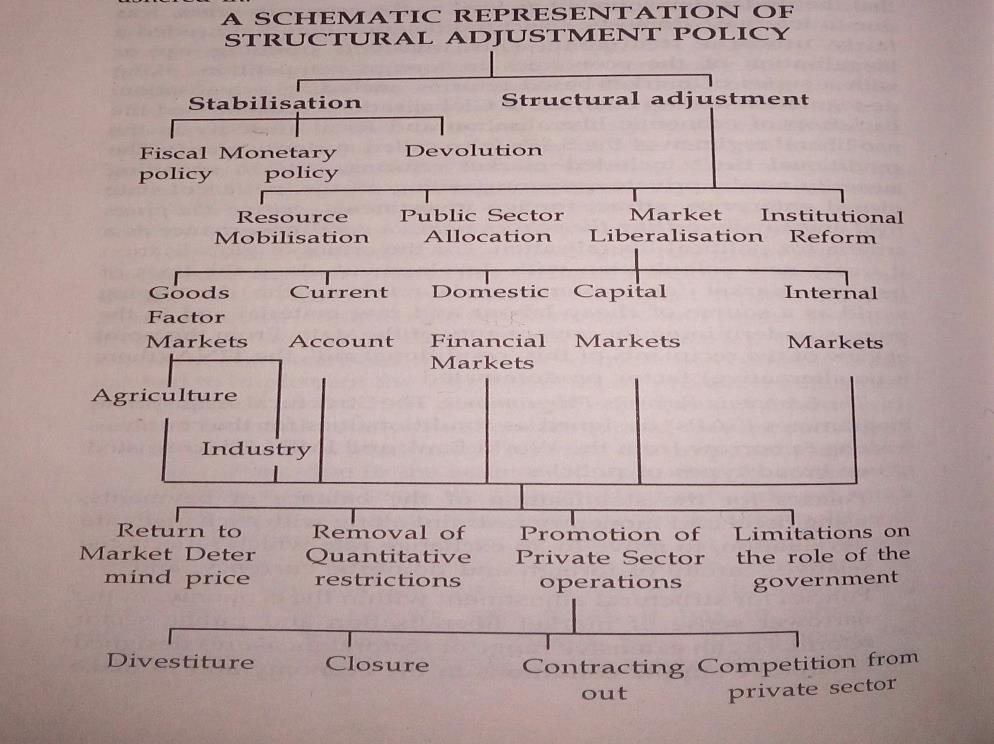
legitimizing neoliberal ideas because of a broad distrust of the state's capability in the light of the economic crisis worldwide that economically translated to Economic Liberalization in the form of Economic reform or Structural Adjustment programmes (SAPs). These were designed as conditionalities for the countries wishing to borrow from the World
Bank and the IMFconsisting of two broad type of policies Stabilization measures (for Balance of payments using fiscal and monetary exchange, exchange rate devaluation amongst other measures) and longer term Structural Adjustment. The latter involved market liberalization and public sector reforms ie a range of sectoral measures designed to improve supply side conditions in the economy, de-regulate the product and factor markets, to make domestic prices correspond to shadow prices and Institutional reforms especially of the government.
With the centrality of the state lost in Political analysis and doubts being cast on the state's role in fulfilling economic and political activitiesthere was a blossoming non-formal activities and a movement between the unofficial and Official, public and private, rural and urban - resulting in a
Concept of Governance, Bulbul Dhar-James