
Part 5
The Way forward
It has been often been discussed that the liberalization policy in India has been favorable towards participation of women in the Indian political arena. Opening up of the Indian economy has resulted in the emergence of private media houses and competition among them which, though unintentionally, have been agents for creating awareness among women about their political as well as electoral rights. Based on this, many women's networks and groups started lobbying for gender quotas within the Parliament and the state legislative bodies.
There is a strong need to increase not only the level of female literacy but level of female education. While female literacy points towards how many women have been going to the educational institutions, levels of female education indicate the independence of minds of women. Female education could contribute to more women making independent choices about the kind of profession they would like to be into. This, again, could go a long way into facilitating women's choices to be people's political representative in the legislative bodies.
However, increasing the quantity and quality of women in legislative bodies would require changes beyond mere policies. It must begin with changing the traditional societal mindset that ties women to the 'private' sphere making them repository of family dignity and community honor. In this context, civil society groups, advocacy organizations have played a very significant role in gradually breaking this notion. Even government-sponsored researches and centers for research on women both within and outside universities have acted as agents of change in this regard.
What is also important is to dispel the notion that politics is a dirty game of corruption and muscle power. Therefore, it is not meant for women. These notions could be changed only if the rules of the game of politics could be changed. Here, the election commission has a very important role to play in conducting free, fair and violence-free elections where women could feel comfortable to participate in the political process both as voters and contestants. Initiatives of the election commission in the 1990s towards this have been found to have resulted in larger turnout of female voters.
Political parties also have an important role to play in cleaning the mess in the political arena through encouraging the more women members in decision-making positions. Voluntary gender quotas within political parties could actually go a long way in opening gates for a better representation of women in the legislative bodies. Besides, parties must ensure that women's demands must be included in the electoral manifestoes. Political parties should also take a deliberate decision not to distribute tickets to candidates who are in any manner involved in gender-based violence or have any history of making sexist comments.
Most importantly, the strongest need is to cultivate leadership qualities among women. In addition to education, they need to be given capacity-building training programmes irrespective of whichever field they are from. This could facilitate the creation of a large pool of women leaders from various backgrounds. In conclusion, parliamentary and electoral reforms along with attitudinal change can facilitate more representation of women in legislative bodies.
Summary
In democracies, the roles legislative bodies are extremely critical for establishing an inclusive polity and society. Increase in the representation of the poor and the marginalized section of the society in legislative bodies would not only make them inclusive but would also create spaces for the marginalized voices. The under-representation of women in legislative bodies is a major handicap in inclusive polity. Women remain under-represented in legislative bodies across the globe. Gender roles of women that tie them to the private sphere serve an important cause of their under-representation in the legislative bodies. Existing values, nature, and structure of political institutions also do not favour women's political participation and consequently, their representation in the legislative bodies. Parliamentary, electoral reforms and attitudinal changes can facilitate women's representation in the legislative bodies.
References
- Inter-Parliamentary Union compilation of data on National Parliaments 2016 accessed on Dt. 02/08/2016 from http://www.ipu.org/wmn-e/classif.htm.
- Karam, Azza (ed.). 1998. Women and Parliament: Beyond Numbers, Stockholm: International IDEA.
- Rao, Bhanupriya. 2016.Women in Parliament: Where does India figure among the rest of the world?, accessed on dt.02/08/2016 from http://factly.in/women-in-parliament-where-does-india-figure-among-therest-of-the-world/
- Rathod, Apoorva (2014). Women's Political participation and representation in India, Delhi Policy Group, Issue Brief, New Delhi: Delhi Policy Group.
- Rukmini, S. & Byatnal, A. 2014. Fewer Muslims and More Women in the New House, The Hindu, Dt.17/05/2014.
- Shvedova, Nadezhda.(1998) Obstacles to Women's participation in Paliament (Chapter-2), pp. 33-50 in Azza Karam, Women in Parliament: Beyond Numbers, Stockholm: International IDEA.
- UNWOMEN, 2016 accessed on dt.02/08/2016 from http://www.unwomen.org/en/what-we-do/leadershipand-political-participation/facts-and-figures.
- Nanda, Swati S. & Alam, S. 2013. Linking Gender and Poverty: Evidences from India Agriculture, in A. Chattopadhyay (Ed.), Poverty and Social Exclusion in India, New Delhi: Rawat Publications.
- Fifteenth Anniversary Charter on Panchayati Raj -''Inclusive Growth through Inclusive Governance'', April 2008, cited in Reservation of Seats for Women in Legislative Bodies: Perspectives, Occasional paper Series-1/2008, Rajya Sabha Secretariat, New Delhi, 2008.
Paper-11 Module-12
Women's Representation in Executive bodies
Personal Details
Role Name Affiliation
Principal Investigator Prof. Sumita Parmar Allahabad University, Allahabad
Paper Coordinator Prof Chandrakala Padia Chairperson ,IIAS, Shimla and Vice Chancellor MGS University Bikaner
Content Writer/Author (CW) Dr. Swati Sucharita Nanda
DAV PG College, Varanasi
Content Reviewer (CR) Prof Chandrakala Padia Chairperson ,IIAS, Shimla and Vice Chancellor MGS University Bikaner
Language Editor (LE) Prof. Sumita Parmar Allahabad University, Allahabad
Description of Module
Subject Name Women's Studies
Paper Name Women, Governance and Politics.
Module Name/Title Women's Representation in Executive bodies.
Module Id Paper-11 Module-10
Pre-requisites The Reader is expected to have a basic understanding of different governmental structures prevalent across the globe.
Objectives To facilitate understanding of the reader about the challenges to representation of women in political executive posts with special reference to India. Keywords Government ; Executive; Political Parties
Women's Representation in Executive bodies
Introduction
Executive bodies have very important constitutional roles to play in democracies. The primary function of the executive is to enforce the laws made by the legislative bodies. As enforcement authorities, they are responsible for formulating policies, programmes and making the citizens aware of the laws. They are also accountable for the daily administration and maintenance of law and order within the territory.
In presidential systems such as the United States of America, the president serves as the constitutional head of the government assisted by a group of ministers or secretaries while in parliamentary systems the structure of executive is a little more complex. Parliamentary systems such as England and India have nominal executives who serve as the constitutional heads while the Prime minister exercises all the executive authority in reality. The Prime minister is at the same time not as independent and powerful as the chief executive of the presidential system. This is because he is constitutionally a part of the council of ministers with which he must share his power. States or constituent units of federations follow similar patterns as their centres.
Besides such political executives, democracies also have non-political executives such as the bureaucrats who, in reality, are the actual administrators. While the political executives come to power for a short time period, non-political executives such as the bureaucrats work as administrators till their retirement. As the term suggests, bureaucrats are, by the very nature of their job, independent and impartial towards political parties and political executives. The present unit looks at the representation of women in political executive positions.
Representation of women at various levels
Data from Inter-Parliamentary Union show that there were just over a dozen women serving as heads of state or government around the world in 1911.1 Five years later, the scenario had not changed a lot. As per data from the UN, only 17 per cent of government ministers during 2014-15 around the world were women. But when compared to the 1960s and 1970s, the data does paint a brighter picture. There were only 3 heads serving as heads of state in the 1960s that was upgraded to 6 in the 1970s and to 7 in the 1980s. Data from the 1990s shows a swift rise to 26 while the first decade of the twenty-first century witnessed 29 women serving as chief executives of governments across the globe. The UNWOMEN data found majority of these ministers to be overseeing social sectors such as education, family welfare and women development ministry.
South Asia is often taken as example with a focus on Sirimavo Bandaranaike, Indira Gandhi, Benazir Bhutto, Sheikh Hasina and Begum Khaleda Zia. However, the truth remains that all the above leaders came from influential political families. For a woman from non-political family, contesting elections is no easy job even in the twenty first century. However, the present Government has seven women ministers at the center.
Need for representation of women in executive bodies
1Data presented in the paragraph have been gathered from Inter-Parliamentary Union, UNWOMEN and Bauer & Tremblay (2011)
A natural question that arises is 'how are things going to change if women are given political executive positions'? While there is no strong evidence to back any claim that shattering the 'glass ceiling' for women in politics necessarily makes a difference, it would be concealing the achievements of many women leaders across the globe if we respond in negative. Whether women can or cannot make difference depends largely upon their level of education, networking capability and strategic ability influence situations. There are a number of examples where women political executives have acted very decisively in adverse situations (Caprioli & Boyer, 2001).These include Indira Gandhi during India's clash with Pakistan in 1971, Golda Meir's handling of attacks on Israel between 1969 and 1973 and Margaret Thatcher's response to Falklands war in 1982. Female representatives not only advance women's rights, but also advance the rights of children. In all these cases, the respective leaders have reacted to the adverse situations in a very decisive way.
Many feminists such as Carol Gilligan (1982) and Sara Ruddick (1995) have established that women and men have different perspectives over the same life situation owing to the gendered nature of child-rearing. This logic could very well be extended to the political realm. Thus, women political executives can bring in their viewpoints to resolving political challenges and in formulating policies which could result in a holistic approach to various problems.
A report of the UNICEF (2006: 50) has stated that "a growing body of evidence suggests that women in politics have been especially effective advocates for children at all levels, sponsoring legislation and fostering tangible changes in policy outcomes that reflect the rights, priorities, experiences and contributions of women, children and families".
Women Gram Panchayat leaders who have come to power due to the reservation accorded to women through the 73rd constitutional amendment act have been lauded to have made differences to the lives of many people in local communities. One such example was documented by Pushpa Achanta (2013: WFS REF NO: INDM917H) in Attibele Gram Panchayat of Anelak block located in Bangalore urban district of Karnataka.The population of Anekal block, which falls in Bangalore Urban district - some 40 kilometres to the southeast of Karnataka's capital, Bengaluru - is largely dalit, although it has a Muslim and adivasi (tribal) presence as well. Of its three lakh people, around 35,000 live in the eight wards of the Attibele Gram Panchayat, which is the site of a quiet revolution. The women in Panchayati Raj institutions have been able to make a considerable difference to the lives of the local community. They have been able especially reach out to women from marginalised communities who were otherwise outside the loop. They have done this in spite of the fact that many men are not comfortable with the presence of women in the gram panchayat and have sometimes resorted to talking ill about them. But the women have persevered and what is striking is that there have been no instances of financial irregularities in the Attibele Gram Panchayat.
The Road ahead for women aspirants for political executive posts
For an ordinary woman from non-influential, non-political family, the road to the position of political executive goes via: - Self: she has to have awareness, belief and confidence in her own capability to lead
- Family: Her family must believe in her and support her decisions. This is important as women in almost all societies are tied to gendered roles within families.
- Community: Being a political executive implies not only representing interests of community but also leading them. Community support base is very important for a woman (as much as a man) in order to go ahead.
- Political Party: Political parties are the medium through which representatives get larger ideological support base. It is very important for women aspirants of political executive posts to gain support of the political party that she is a part of.
Challenges to representation of women in executive bodies
While discussing challenges for representation of women into political executive positions, one is forced to turn attention towards two aspects. First, there are certain challenges that are faced by women on account of their gender. Gender ensures that they remain tied to the societal stereotypes while choosing careers and trying to succeed. The second aspect of the challenge faced by women is the political parties that mediate the road between the political executive aspirants and the executive positions within the government. The discussion below is based on these two aspects.
Gender Roles: Women's traditional gender roles as nurturers and caregivers within family tie them to household and childcare responsibilities either as a choice or as a necessity. This certainly implies higher costs of entering into 'public spaces' that demand a lot of time, energy and attention.
In most societies, women are not allowed to explore their potentials as they are traditionally tied to gender stereotypes. Though educated, most women prefer to go into professions that are approved by their societies as feminine. That is why one finds more women in sectors such as education, healthcare, interior decoration and fashion designing. Considered as a masculine realm, politics is one of the lesser attractive professional option for women in most societies. As a result, many women may not enter into politics even if gender quota is enforced political realm. In India, for example, gender quota in Panchayati Raj institutions has led to rise of women candidates who act as proxy for their male family members.
Need to prove more: It is held in popular imagination across societies that women are not made for tougher jobs. Women, in most societies, are seen as the softer and milder sex who should be given jobs that nurture and serve. This is ironical given the fact that women are now are not only performing many jobs requiring rigorous physical labour but also have proved to be influential decision-makers. Yet, in most societies, both developing and developed, the standards set for women are higher than those for men. This is especially true for women who wish to run for political decision-making posts. Such women are held to higher standards than men and are always have to face critical scrutiny. This is, indeed, ironical as the world has been witness to many influential women leaders.
Lack of preparation for political activity: Disproportionately burdened with family and households chores, women naturally prefer non-competitive environments for professional options. This may restrict their drive to participate in highly competitive race such as elections for political executive posts. Result of a series of experiments to determine how women and men perform in non-competitive environments showed women are less successful than men in tournament-based environments (Gneezy, Niederle & Rustichini, 2003).This effect is strongest when women compete against men, rather than only women.
This may present an additional challenge to women competing in largely male-dominated winner-takes-all environments.
Discriminatory system of selection: Existing systems of selection of candidature may not favour women's political participation as candidates to political executive positions. Parties take into account a host of factors such as ability to mobilize financial resources, public opinions, popular support and close association with the party leaders while deciding the candidature for political executive posts. It is not easy for women to prove themselves on these counts. Research has shown that proportional representation systems lead to greater representation of women versus other systems (Matland, 1998).
A study conducted by the Center for Social Research for the UN found that women in a number of South Asian Countries had to confront both discrimination and violence (CSR, 2014). This was found more in case of women who were first generation politicians. Considered as having less ability to take decisions, most women struggle hard to get sufficient space within political parties. This implies fewer women getting tickets to contest elections. Very often, the logic of 'winnability' is used against women. The same study found women leaders being provided inappropriate election symbols that, at times, is used to humiliate them. They also risk harassment and violence both by their own and opposition party members while campaigning.
Prevalence of sexism in political domain: Sexism is a widely found phenomenon in politics across the globe. This could be seen if one analyses the speeches of male political candidates during election time. Be it India's Lok Sabha elections 2014 or the ongoing campaigns for American presidential elections 2016, women candidates have to face personalized and sexualized comments from the male counterparts. To cite an example, the comment by a male leader for a female leader of his opposition party- "I don't understand how I should look at her --- as a sister, a wife or a virgin daughter"- is a case in point. Even in the US presidential elections 2016, female presidential candidate Hillary Clinton had to face an internet campaign called 'Iron my shirt Hillary'.
What needs to be done?
The following measures can be adopted to improve the visibility of women in political arena.
Breaking gender stereotypes in societies and political parties: Political arena demands the representative to be an 'agency'. The World Bank's World Development Report on Gender Equality and Development (WDR2012) defines agency as 'the ability to use endowments to take advantage of opportunities to achieve desired outcomes'. (Markham, 2013) The main focus was on five "expressions" of agency such as women's access to and controls over resources; freedom of movement; freedom from the risk of violence; decision-making over family formation; and having voice in society and influencing policy (Markham, 2013).
Achieving such agency would require women to break the gender stereotypes created and accentuated by societies through norms and rules that expect women to be subservient to men within families.
Training & Capacity–building programmes for women: There is a strong need to cultivate leadership qualities among women through training and capacity-building programmes. Many women manage daily affairs of homes and lead households in the absence of men even without much education. Education certainly is an important but not a necessary condition for leadership. But what certainly is an essential attribute for leadership is an awareness of self and one's own capacities. This is where training and capacity-building can act as facilitators for future political executives. Such capacity-building programmes held by both governmental and non-governmental agencies have been supporting many women Panchayat leaders.
Making sexism accountable: Sexist comments should not be tolerated by any political party within democracy. Such comments should be made punishable offence within the parties so that female members of the parties feel confident enough to aspire for both positions within the party and to contest for political executive positions.
Gender quota: Gender quotas or reservation is widely seen as an important medium to get more women into higher political positions. Success of reservation policy for women in Panchayati Raj institutions in India have encouraged many from the women's movement to consider such quotas for the political executive positions at the central and state level. There could be three types of quota that could help increase representation of women in executive bodies. First, political parties could adopt voluntary party quotas committing themselves to nominate a certain percentage of female candidates for electoral lists. This could be done by making sure that every second entry on the list must be a woman. Second, law could be passed making candidate quotas constitutional that reserves a certain number of candidate positions for women. Third, certain percentage of constituencies or seats could be reserved only for women thus making women only contests in those seats. Many countries the South Asian region have adopted the system of quotas. Summary
In democracies, executive bodies play the most significant role in establishing an inclusive polity. There is a strong need to increase representation of women in executive bodies. However, women remain under-represented in executive bodies across the globe. Besides gender stereotypes set by societies, existence of sexism within the political parties and the larger society serve as important causes of their under-representation in the executive bodies. Gender quotas are seen as one of the most significant ways to increase women's representation in the executive bodies.
References
Achanta, Pushpa. 2013. Women in Charge, Karnataka's quiet revolution, WFS REF NO: INDM917H, accessed on dated 12/08/2016 from http://www.wfsnews.org/thp20%20yearsempowerment-2013.html
Bauer, Gretchen, Tremblay, Manon, 2011. (eds.) Women in Executive Power: A global Overview. New York/Oxon, Routledge. • Caprioli, Mary & Boyer, Mark A. 2001. Gender, Violence and International Crisis. Journal of Conflict Resolution, 45 (4): 503-518.
Country Report, State of women in urban local government: India. • CSR. 2014. Violence against women in politics: A study conducted in India, Nepal and Pakistan. New Delhi, UNWOMEN.
Deshpande, Rajeshwari 2004. How Gendered Was Women's Participation Women in Election 2004.Economic & Political Weekly, 39 (51), pp. 5431-36. • Gilligan, Carol. 1982. In a Different Voice. Cambridge: Harvard University Press. • Gneezy, U., Niederle, M., & Rustichini, A. 2003. Performance in Competitive Environments: Gender Differences. Quarterly Journal of Economics, 118(3): 10491074.
Inter-Parliamentary Union (IPU), 1989. Reports and Conclusions of the InterParliamentary Symposium on the Participation of Women in the Political and Parliamentary Decision-Making Process. Reports and Documents No. 16, Geneva, IPU • Karam, Azza 1998. (ed.) Women and Parliament: Beyond Numbers, Stockholm: International IDEA.
Kishwar, Madhu, 1996. Women and Politics: Beyond Quotas. Economic &Political Weekly, 31 (3), p. 2871. • Markham, Susan, 2013.Gender, Equity and Development: Women as agents of change: having voice in Society and influencing policy. World Bank: Women's Voice, Agency, & Participation Research Series No. 5.
Markham, Susan. 2013. Women as agents of change: having voice in society and influencing policy, Women's Voice, Agency, & Participation Research Series 2013 No.5.
Matland, R. 1998. Enhancing Women's Political Participation: Legislative Recruitment and Electoral Systems. In Azza Karam, ed. Women in Parliament: Beyond Numbers, pp. 99-110. Stockholm: International IDEA.
Matland, Richard E., 1998a. 'Women's Representation in National Legislatures: Developedand Developing Countries'. Legislative Studies Quarterly, 23 (1), pp. 109– 25.
Menon, Nivedita, (ed.) 1999. Themes in Politics. Gender and Politics in India, Oxford University Press, New Delhi. • Narayana, Jayaprakash, Sheth Dhirubai, YadavYogendra, Keshwar Madhu, 2000. Enhancing Women'sRepresentation in Legislatures. An Alternative to the Government Bill for Women's Reservation. Manushi, pp-1167. • Pande, Rohini, and Ford, Deanna, 2011. Background paper: Gender quotas and female leadership. World Development Report 2012: Gender Equality and Development • Rai, Praveen, 2011. Electoral Participation of Women in India: Key Determinants and Barriers.Economic & Political Weekly, 46 (3), pp. 47-55. • Randall, V. 1987.Women and Politics: an International Perspective. Basingstoke, Macmillan, 2nd Edition 1994. • Ruddick, Sara.1995. Maternal Thinking: Towards a Theory of Peace. New York: Beacon Press. • Siwal B.R, 2001. Political Empowerment of Women. Women's Link, April-June, 2001, pp. 23. • State of world's Children 2007, New York: UNICEF, 2006,
Vibuthi Patel, 2005. Getting a Foot Hold in Politics, Women in Political Decision Making Process. Social Action, 65 (1), pp.40. • Vissandjée Bilkis, Abdool Shelly, Apale Alisha and Dupéré Sophie. 2006. Women's Political Participation in Rural India: Discerning Discrepancies through a Gender Lens. Indian Journal of GenderStudies, 13. 425. • Vyasulu, P. and V. Vyasulu, 1999.Women in Panchayati Raj: Grassroots Democracy in India, Experience in Malgudi.Background Paper No. 4, New Delhi, United Nations Development Programme.
Paper-11 Module-11
Women Representation in Local Bodies
Personal Details
Role Name Affiliation
Principal Investigator Prof. Sumita Parmar
Allahabad University, Allahabad
Paper Coordinator Prof Chandrakala Padia
Chairperson ,IIAS, Shimla and Vice Chancellor MGS University Bikaner
Dr. Deepak Kumar Pandey
Content Writer/Author (CW)
Assistant Professor Govt. Post Graduate College, Bazpur (US Nagar), Uttarakhand Content Reviewer (CR) Prof Chandrakala Padia
Chairperson ,IIAS, Shimla and Vice Chancellor MGS University Bikaner
Language Editor (LE) Prof. Sumita Parmar
Allahabad University, Allahabad
Description of Module
Subject Name Women Studies
Paper Name Women, Governance and Politics.
Module Name/Title Women Representation in Local Bodies.
Module Id Paper-11 Module-11
Pre-requisites The reader is expected to have knowledge about Indian socio-political conditions.
Objectives To make the reader understand the evolution of the demand of women representation in Indian Polity, constitutional provisions of Panchayati Raj and status of Women representation in India, comparative assessment with other states, challenges of women representation in local bodies. Keywords Women representation, Local bodies, Panchayati raj, Feminist rights, 73rd & 74th Amendment, Gender responsive governance (GRG), Development Administration, Elected Women Representatives (EWRs), Gender Quota, Women Component Plan (WCP).
Women Representation in Local Bodies
Introduction
The quest for women's rights in India during the decades of the70s ran parallel with the global quest for women rights. The demand for gender sensitive politics with adequate representation of women and their issues was the main agenda of their movement. The Indian feminist rights movement has striven for women's status in the political and economic field along with addressing the issues of socio-cultural barriers. The new wave of feminism in the 1970s was in response to gender inequality issues and the stagnation of development in India.i The Committee on the Status of Women in India released a report in 1974, and had a significant influence on the re-emergence of activism for gender equality. The report highlighted the significant differences between men and women in India, including the disparity in the sex ratio, mortality rates as well as employment, literacy, and wage discrimination. The report fuelled the women's movement by underscoring the ongoing discrimination towards women in India. ii Gender inequality has remained the focus of the women's movement with specific emphasis on issues such as the Uniform Civil Code, Women's Reservation Bill, and sexual violence against women.iii
The Women's movement in India has been successful in the sense that it has been successful in drawing attention to and addressing the many issues of women, especially in the form of domestic and structural violence law, dowry law, laws related to abolition of female foetus and many more along with the remarkable constitutional provision (through the 73rd & 74th amendment) of one third women representationn in local bodies. This very provision which provides substantial women representation in local bodies is gradually and slowly changing the course of Indian polity on many fronts. This amendment has opened a new chapter in the history of women's struggle for empowerment and a result of the relentless women's efforts against formidable odds. iv Though women's representation in local bodies has brought significant changes in the self esteem and status of women, there are still miles to go for the arrival of a gender sensitive egalitarian structure, in which women may play a greater role. The following figure shows the evolution of Indian women in political societyv:
Initiation of greater role in Indian polity.
Early 70s
• Fight for Equal representation in democratic politics.
Early 80s
New Dimension of Indian women emerged through social and political changes.
Early 90s
Fig.1 Evolution of Women's role in Political Society.
The Preamble to the Constitution assured political justice and economic empowerment to all, increasing their quality of life. Political justice means having a say in decisionmaking and participation at different levels of the political system. Political participation in itself is a very wide term which includes and relates to participation in decision making, political awareness along with electoral involvement and consciousness. Despite the constitution assuring political justice and participation of everyone in the political system in legal terms, constitution writers were quite aware of the fact that mere legal assurance of equality in any aspect will not be realized in real terms, unless and until the social milieu also changes in accordance to assure equality to everyone. Because of this reason, despite the notion of equality, provisions of some positive discrimination has been made to counter social imbalances. Any political structure grows in its social milieu and vice-versa, the social milieu also gets affected and evolves through its political structures and its outcomes.
Women being the most important centre of the any society, determining its socio-cultural and even economic growth, have been denied their due role in the political structure and decision-making. Our constitution makers were both progressive and broadminded in their attitudes to give equal rights and space to women who were largely confined behind the big walls of their aangans, covered by their ghoonghats.
In order to make accessible the political space for the people at the periphery, a big social leap is required and in the case of women, this leap has to cross many barriers too, which are due to the prevailing socio-cultural ethos and value system. Even in the contemporary scenario the rationality and intelligence of women is questioned and there is a tendency to use them as rubber stamps in political decision-making. Gender responsive and sensitive policies are to be realized which are direly missing from our institutions and structures. They can be realized only through gender responsive governance in which every structure and institution must be sensitized towards the specific needs and issues of women, bridging the gap between men and women. Gender Responsive Governance (GRG) is a process that embodies measures, attitudes and practices of different stakeholders, both men and women, at different levels of governance with a clear purpose to impact issues that foster women's empowerment and promote gender equity and social justice. It is a process that promotes and sustains the ability of women to fully participate in the governance and development process, enhances their ability to raise critical questions about inequity and collectivise without fear and pressure, and ensures gains from services.vi
In order to cross the barriers (whether imposed by social order or by them) women need special training. The preamble and various articles contained in part III and part IV of the constitution of India, promotes social justice, so that life of every individual and women in particular becomes meaningful in general. This long cry of adequate women representation gets realized through Panchayati Raj Amendment Act in the constitution. Efforts since independence to institutionalize Panchayati Raj system as one of the Holy Grail of Gandhian ideology and part of the directive principles of state get realized in constitutional and institutional form through this historic Panchayati Raj Act. Through this amendment, not only does the system of local self government get established for rural (three tier) and urban local administration as Panchayati Raj, but the long awaited provision for women representation is also incorporated in this system. For the first time the share of women representation has been included as a legal and constitutional part. Though this was a turning point for women representation and for local administration, yet it was not easy to get it realized in the true sense. Socio-cultural hurdles are still hindering their path, confining them to only rubber stamp roles the de-facto power centre being others, especially those whose control is in the household decision-making. Despite their crucial role in household management, women in general have been relegated to a secondary position in each matter. Likewise they have been excluded in every decision making process making a mockery of their constitutional and legal status. The irony is that it has been accepted not only by socio-cultural structures but institutional structures too.
The Panchayati Raj system has been accepted as a tool of administrative development in which participation at local level or grass root level is envisioned for the formation and effective implementation of policies. It has been accepted that direct participation of affected people in their development policies and administration will lead to speedy and transparent development; women being the most and worst affected at local level, whether it is availability of safe drinking water, availability of nutritional foods, sanitation, road, health, education etc., their involvement will affect the policy and its implementation at ground level. Women empowerment is considered as integral part of the development administration. In the words of of Richard Young, "initiation and entry of women into political and legal structures are expected to transform the process and institutions of governance."vii
Though it cannot be denied that women's participation and role is symbolic in most of the cases, but it is equally true that this representation of women in local bodies is gradually empowering and enabling them to take appropriate decisions, changing their roles in sociopolitical matrix slowly. Elected Women Representatives (EWRs) are making need based development schemes, which is the core of development administration. From listeners and followers, women are now turning themselves into leaders and decision makers.
According to the World Economic Forum's annual global gender gap index studies, India has ranked in the top 20 countries worldwide for many years coming 9th best in 2013 - a score reflecting more women's participation in India's political process than Denmark, Switzerland, Germany, France and United Kingdom.viii This is great achievement in many senses not only for democratic values, but for the sake of gender equity too. The faith of Indian constitution makers, who in the form of universal adult suffrage (Art 326), provided equal status to women in the political domain, gets strengthened through their active participation at the grass root level. In more than one hundred countries, women representation has been promoted through statutory measures, but not realized in its spirit in many of them. Their representation in different countries could be classified under three broad categoriesix:
Classification of Quotas
Nature of Reservation Characteristics Reserved Seats A certain portion of seats are exclusively for female candidates according to convention Party Quota Discretionary power of a party to nominate a certain number of women candidates Legislative Quota A certain portion of seats are exclusively for female candidates according to constitutional sanction as it is found in women representation in local bodies in India.
In countries with gender quotas, female representations on average stand at twenty two percent, in contrast with countries with no gender quota, where female representation stands at just thirteen percent.x The Indian scenario is even better than many of the developed countries as per the World Economic Forum's annual global gender gap index studies (2013). Many states in India go beyond the limit of one third reservations (as provision made in the Panchayati Raj Act) for women in local bodies, stretching it from thirty three to fifty percent. Bihar was the first state to make such provision; other states which followed this line are Madhya Pradesh Uttarakhand, Himachal Pradesh, Orissa, Karnataka, Andhra Pradesh, Chhattisgarh, Jharkhand, Kerala, Maharashtra, Rajasthan and Tripuraxi. This is remarkable in its own sense, because Bihar is considered one of the least developed states and statistically far behind on the scores of development in comparison to many other states, but the share of women representation in its local bodies and their involvement is indoubtedly a great achievement. Encouraged from making provision of fifty percent reservations by different states, the Union Cabinet of the Government of India approved 50% reservation for women in PRIs (Panchayati Raj Institutions) on August 27, 2009. The Following table will show the details of representation in different states:
Number of Panchayats and Elected Representatives in All the Three Tiers of Panchayats (As on March, 31, 2008)
All Panchayts, No. of Elected Representatives Gen. (Non SC/St)
S. No State/UT No. of Panchayats
SC ST OBC Total Women
State No % No % No. No No % 1 Andhra Pradesh
22945 172136 34025 15.19 17842 7.97 N.A. 224003 74019 33.04
2 Arunanchal Pradesh
1789 0 0 0 8260 100 N.A. 8260 3183 38.54
3 Assam 2431 23206 1344 5.284 886 3.48 N.A. 25436 9903 38.93 4 Bihar 9040 109767 19440 14.94 884 0.68 N.A. 130091 70400 54.12 5 Chhatisgarh 9982 76062 17553 10.93 66933 41.69 N.A. 160548 54159 33.73 6 Goa 191 844 0 0 181 11.61 N.A. 1559 534 34.25 7 Gujarat 14068 83982 7970 6.98 22235 19.47 N.A. 114187 38068 33.34 8 Haryana 6325 36578 7724 11.07 0 0.00 N.A. 69805 25503 36.53 9 Himachal Pradesh
3330 16706 6575 26.75 1300 5.29 N.A. 24581 9552 38.86
10 Jharkhand 3979 0 0 0 0 0 N.A. 0 0 0 11 Karnataka 5833 67920 17859 18.59 10311 10.73 N.A. 96090 41210 42.89 12 Kerala 1165 10629 2005 10.85 226 1.22 N.A. 18482 5614 30.38 13 Madhya Pradesh
23412 231246 59106 14.91 106350 26.82 N.A. 396516 136196 34.35
14 Maharashtra 28277 176874 25269 11 27597 12.01 N.A. 229740 76581 33.33 15 Manipur 169 1556 39 2.247 41 2.36 N.A. 1736 758 43.66 16 Odisha 6578 52333 16007 17.31 24114 26.08 N.A. 92454 33630 36.37 17 Punjab 12604 62614 28349 31.17 0 0 N.A. 90963 31809 34.97 18 Rajasthan 9457 22858 25385 21.16 21415 17.85 50245 119975 42434 35.37 19 Sikkim 258 483 57 5.781 446 45.23 N.A. 986 394 39.96 20 Tamil Nadu 13031 91958 23653 20.31 877 0.75 N.A. 116488 39364 33.79 21 Tripura 540 3914 1509 26.32 310 5.41 N.A. 5733 1986 34.64 22 Uttar Pradesh 52890 578984 191950 24.87 727 0.09 N.A. 771661 299025 38.75 23 Uttarakhand 7335 44450 11077 19.26 1973 3.43 N.A. 57500 21517 37.42 24 West Bengal 3713 37434 17112 29.09 4282 7.28 N.A. 58828 21351 36.29 UTs 25 A & N Islands 75 856 0 0 0 0.00 N.A. 856 296 34.58
26 Chandigarh 19 153 34 18.18 0 0.00 N.A. 187 62 33.10 27 D & N Haveli 12 7 3 2.4 115 92.00 N.A. 125 49 39.2 28 Daman & Diu 15 81 2 2.062 14 14.43 N.A. 97 37 38.14 29 Lakshdweep 11 4 0 0 106 96.36 N.A. 110 41 37.27 30 Puducherry 108 784 237 23.21 0 0.00 N.A. 1021 370 36.24 Total 239582 1904419 514284 18.25 317425 11.26 50245 2818018 1038045 36.84 Table: 1 Source:GOI, Panchayati Raj, Annual Report, 2007-08
The bove data clearly shows that women representation is highest in Bihar and even higher than one third ratio in a state like Haryana. The overall ratio of women representation at the national level is higher than one third. This is a very welcome and positive sign not only for women's representation and their role in the socio-political structure but also as a sign of change in mindset and value patterns. Dispensation of social justice and achievement of the goals set forth in the constitution are not possible without the abolition of social evils like gender discrimination. Reservation for women in local bodies may prove an effective tool not only to eradicate gender discrimination and other associated social evils, but will also help in realizing an egalitarian society in true sense. As per the data available on the website of Panchayati Raj, about three million elected representatives are managing these local bodies and are involved in planning for economic development and social justice in rural areas. Amongst these three million elected representatives in local bodies about 12.70 lakhs are women representatives.xii
In this era, where cases of sexual and physical harassment of women is frequently visible in public and inside the household, it is a great challenge for society to create an atmosphere, where women at large would feel safe and secure. Domestic and societal violence against women despite so many legal provisions and the inactive involvement of so many structures and institutions for their safeguard, especially media, reflects that more concrete steps are needed to be taken especially towards building the sensitivity and respect towards women keeping in mind their dignity. Women's representation and their de-facto role in decision making may change the nature and mindset of society. Women's representation in local bodies is not related to merely representing women in numbers, its goal is to enhance their capacity and make them confident and increase their self esteem, so that they may move in tandem with other parts of society. Even in Plato's view, society should not be bereft of its half of potentialities embedded in women, rather they should be granted equal status in all spheres of life which ultimately benefits society at large. In the case of women's representation, this is very much true that, women with their active participation are going not only to benefit themselves individually but will prove beneficial for society in their different capacities. Indian society is still waiting for that grand day, when the bill of one third reservations for women in legislative bodies will be realized and become a turning point for both Indian polity and society. It is very pathetic that, despite their high status in the Vedic ages; their reduction to almost commodities (in mindsets) indicates our fallen value system. India ranks 20th rank from the bottom in terms of representation of women in Parliamentxiii There are many examples, where women representatives while realizing their real power of decision making did exceptionally well not only for their own community but society at large too. The tribal-dominated Jhabua district of Madhya Pradesh stands out for high representation of women in the local administration and politics.xiv
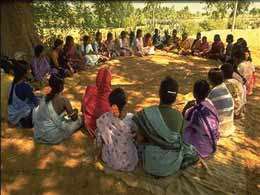
Fig.2
Women representation can be seen roughly in these stages: First Stage: Initiation of women representation in form of quota system in local bodies, through 73rd & 74th amendment in 1994. Period of Symbolic Representation.
Second Stage: Period of Slightly Active Participation. Impact of many socioeconomic changes, especially Structural Adjustment Programmes after economic liberalization.
Third Stage: Period of active Participation. Involvement in decision making, impact of communication and technology along with economic growth. Several rules and laws like RTI and promoting transparency and accountability. Women turnout during India's 2014 parliamentary general elections was 65.63%, compared to 67.09% turnout for menxv which show that how women in general are now ready to take the polity with status of equality.
Fourth Stage: Leap Forward Stage. Independent role in decision making, proactive participation. Leading from the front. This stage is yet to come.
These stages and their characteristics may vary from society to society and space to space in the diverse Indian culture. But largely in case of women representation Indian society is in transition and now between the second and third stage. As per answer responded to for starred question no 152 put up in Lok Sabha, the Honourable Union Minister for Panchayati Raj Shri Chaudhary Birender Singh said that, as per study on Elected Women Representatives (EWRs) commissioned by the Ministry of Panchayati Raj published in 2008, it has been found that; elected women representatives had made efforts to encourage girls' enrolment in schools and mitigate domestic violence.xvi In many media reports it has been reported that elected women representatives played pro active roles preventing sex determination (through selection of male foetus and abortion of female), thus trying to bridge the imbalance not only of sex ratio but also changing societal mindsets.
Challenges of Women Representation:
The extent to which women members have addressed the needs of women and children is crucial as this would give an idea as to whether women's entry into local politics and leadership position holds promise for socio-economic transformation of society on equitable terms with wider opportunities to the marginalized sections or not? It is equally true that, barring few examples, many of the EWRs are unable to impact even the local polity and leadership. Women have been walking on the tightrope as because of the power relations with their male counterparts (whether inside the household or outside), in which men generally tend to subjugate and exclude the women despite their legal positions. There is usually a deep conflict between their ingrained social conditioning on one side and their aspirations on the other. This conflict often impacts their capacity of decision-making and leadership. In the view of Richard Young, "Women's entry and productive role in governance are constrained by a number of factors like lack of gender sensitivity of those concerned, poor access to basic social services like education, unfriendly legal structures and absence of mechanisms which can ensure women's active participation in developmental and political processes for advancement and which can facilitate community support to assurance of the rights of women and children."xvii There are many challenge ahead for EWRs, which hinders the realization of their true leadership, which could be seen as following:
SocioCultural Atmosphere: The main hindrance before the EWRs is the socio-cultural matrix in which they have to work. The general impression and feeling is that, women's roles are inside their home and their main duty is to look after the household management and their children. Male Dominant Society: Another major hurdle is inherent in the nature of society, in which male dominance (patriarchy) is a common phenomenon. In this societal structure, despite the election of women as legal compulsion, control and decision remains in the hands of the male. This could be visualized in election campaign too, where poster and other mode of advertisement is dominated by the name of the men. Separate identity and leadership of women is not accepted positively by these societal structures. Character Assassination and Sexual Violence: Related to the above mindset is the character assassination of women along with direct/indirect form of sexual violence against women at different levels if they establish their independent identity and pose a challenge to established leadership status. Household Management (Double Burden): household management is supposed to be the responsibility only of women and despite their new role and function, they have not been given free time and space to cope up and manage the new situation and demands. In most of the cases, women have to carry a double burden and because of their conditioning. they consider their roles of housewives as their prime responsibility, avoiding or giving very little time to their new role. Family support: In general women do not get their family's support, if they wish to make politics their career. Economic dependency: Women are generally economically dependent, so their decisions and roles are conditioned by this barrier too. It also affects their persona. Lack of Self Confidence: If elected, Women generally feel aliens in the arena of polity. They lack self esteem and confidence to run the polity. Education and Capacity Building: Though it's not an essential condition, but the educational standard (most of the EWRs are illiterate) which affects the capacity building too; is another major hindrance to come over. Subjects under the control: Apart from the above; despite continuous promises, states show some kind of unwillingness and hesitation in allocating those subjects to Panchayats, which are related to women because of their. In this scenario, EWRs do not get proper opportunities to work .
Budget: Budget is another major and important constraint in realizing the goals of EWRs.
Need and demand for gender based budgeting is continuously floating in the political arena. The Panchayati Raj Act calls for setting up of the finance commission to propose new ways to mobilize the funds and resources for the effective implementation of Panchayati Raj. Though problems of resources and funds are main hurdles in the way the of effective implementation many states like Kerala, which earmarked 40 percent of the budgetary allotment for the panchayats and urban local bodiesxviii is a positive sign in the development of these institutions through need based policy making and its implementation. In the people's campaign for the Ninth plan, cost-benefit assessment of the projects, a gender impact statement was made mandatory in Kerala. The local bodies were advised to set apart 10 percent of the grant-in aid under women component plan (WCP) for projects directly targeting women.xix These efforts were aimed for economic empowerment of women at the grass root level which has the potential to change the dynamics of polity at the core level, enhancing the capacity of half of its population.
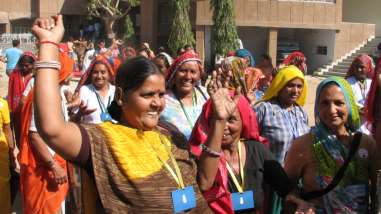
Fig. 3
One third Women representation in local bodies is a very welcome and positive step for women rights. Despite having many odds at different level, the participation and role of EWRs is gradually increasing in the right direction. Change at policy and societal level is going on to accommodate their issues and needs. Though goal of Panchayati Raj is still far away, yet the movement is moving in the right direction, in which women are its carriers. In Kodassery Panchayat in Kerala 100% of elected members are Womenxx which is a great achievement in its own way, setting very high standards of women participation. Efforts like WCP are not only empowering women but are making them capable of thinking beyond the horizon. The world's largest democratic country can attain its real democratic values only through de facto participation and role of women in the polity, which is initiated through substantial women representation in local bodies. Women should no longer be left behind in utilizing their energy and potential in the field of polity, in which they have proved themselves. There exclusion from decision-making at all levels must come to an end and for this women representation is the first step.
References: i Agnihotri, Indu; Vina Mazumdar (July 22, 1995). "Changing Terms of Political Discourse: Women's Movement in India, 1970s-1990s". Economic and Political Weekly. 30 (29): 1869–1878. ii Guha, Phulrenu; et al. (December 1974). "Towards Equality: Report of the Committee on the Status of Women in India" (PDF). Government of India. Ministry of Education and Social Welfare. Retrieved 25 March 2014. iii Phadke, Shilpa (October 25, 2003). "Women' Studies Reflects on the Women's Movement". Economic and Political Weekly: 4567. Retrieved 25 March 2014. iv Chowdhury, Radha S and Roy Bulu, "Women in Local Bodies" published by Kerala Research Programme on Local Level Development (KPLLD), 2002, p. 5 v Basu, Anindya & Shukla Bhaduri, "Role of Women Elected Representatives in Local Area Development: ACase Study of Kolkata Municipal Corporation" International Journal of Research in Humanities and Social Studies, Vol.2, issue 6, june 2015 p. 2 vi Ibid. vii Young Richard, paper in state level Conference on Women in panchayati raj 'Issues and Strategies, 1999. C.f. Chowdhury, Radha S and Roy Bulu, "Women in Local Bodies" published by Kerala Research Programme on Local Level Development (KPLLD), 2002, p. 8 viii The Global Gender Gap Report 2012, World Economic Forum, Switzerland, page 16 and The Global Gender Gap Report 2013, World Economic Forum, Switzerland, Table 3b and 5, page 13 and 19, source: Wikipedia. ix Basu, Anindya & Shukla Bhaduri, "Role of Women Elected Representatives in Local Area Development: ACase Study of Kolkata Municipal Corporation" International Journal of Research in Humanities and Social Studies, Vol.2, issue 6, june 2015 p. 2 x ibid xii According to answer submitted by honourable Cabinet minister of Panchayati Raj Shri Chaudhary Birender Singh in response to the starred question no 152. in loksabha on dated 05.03.2015 xiii The Global Gender Gap Report 2012, World Economic Forum, Switzerland, page 16 xiv http://post.jagran.com/Women-for-more-representation-in-local-bodies-in-Jhabua-district xv State-Wise Voter Turnout in General Elections 2014 Government of India (2014) xvi According to answer submitted by honourable Cabinet minister of Panchayati Raj Shri Chaudhary Birender Singh in response to the starred question no 152. in loksabha on dated 05.03.2015. xvii Young Richard, paper in state level Conference on Women in panchayati raj 'Issues and Strategies, 1999. C.f. Chowdhury, Radha S and Roy Bulu, "Women in Local Bodies" published by Kerala Research Programme on Local Level Development (KPLLD), 2002, p. 8 xviii Chowdhury, Radha S and Roy Bulu, "Women in Local Bodies" published by Kerala Research Programme on Local Level Development (KPLLD), 2002, p. 5 xix Ibid. p.14
Paper-11 Module-14
Women's Representation in Political Parties
Personal Details
Role Name Affiliation
Principal Investigator Prof. Sumita Parmar Allahabad University, Allahabad
Paper Coordinator Prof Chandrakala Padia
Chairperson ,IIAS, Shimla and Vice Chancellor MGS University Bikaner
Content Writer/Author (CW) Dr. Meenakshi Jha Research Officer, CWSD, BHU, Varanasi.
Content Reviewer (CR) Prof Chandrakala Padia
Chairperson ,IIAS, Shimla and Vice Chancellor MGS University Bikaner
Language Editor (LE) Prof. Sumita Parmar Allahabad University, Allahabad
Description of Module
Subject Name Women Studies
Paper Name Women, Governance and Politics
Women's Representation in Political Parties.
Module
Name/Title
Module Id Paper-11 Module-14
Pre-requisites The Reader is expected to have the knowledge of issues relating to women's political participation. And to have understanding of issues relating to women's political participation both within and outside India.
Objectives To make the reader understand the role and importance of women in political parties for successful representative government and for creating gender equal society.
Keywords Political Parties; Women's Representation; Development; Quota system; Gender
Auditing
Women's Representation in Political Parties
Introduction
Definition, Role and Functions of Political Parties
"Countries should not become fit for Democracy, but fit through Democracy".(Amartya Sen) "Modern democracy is unthinkable save in terms of parties" (E.E – Schattschneider).
A well-known definition of political parties comes from the American political scientist Antony Downs, who wrote: "A political party is a team of men seeking to control the governing apparatus by gaining office in a duly constituted election".
The 2002 Human Development Report, Deepening Democracy in a Fragmented World, emphasizes, "A well-functioning democracy depends on wellfunctioning political parties responsive to people".
In many countries today, Political Parties are an essential part of the apparatus of governance. Ideally, they play a fundamental role in the exercise of democracy. A political party is basically a group of dedicated and sincere people who believe in a common ideology and come together to form the government, formulate policies and protect the interests of all segments of society in a country.
Kay Lawson analyses the role of parties 'as agencies for forging links between citizens and policymakers."(Kay Lawson, 1980).Lawson identifies four types of links: Participatory linkage in which parties serve as agencies through which citizens can participate in government. Policy-responsive linkage in which parties "serve as agencies for ensuring that government officials will be responsive to the views of rank-and-file-voters"; linkage by reward in which parties act primarily as channels for the exchange of voters for favours'; and directive linkage which parties "are used by governments as aids to maintain coercive control over their subjects (Kay Lawson ,1980).
Main Functions of Political Parties:
The most important function of a political party is organizing and running elections "A political party is first of all an organized attempt to get power. Power here is defined as control of the government". (E.E. Schattschneider, 1942). Political parties play a fundamental role in the democratic process in selecting and socializing prospective political representatives and leaders, as well as in advancing a gender equality perspective within the political party system. Political Parties formulate public policies, represent the views and perspectives of citizens – both men and women and channel these into appropriate public policies. Political Parties educate, formulate and organize public opinion. They also help in the growth of the level of political consciousness of common citizens.
Thus political parties are an important instrument and institution of politics in a modern democratic system which represent the will and the interests of the citizens as authentically as possible and articulate and integrate different interests, visions and opinions.
Need for Women's Representation
Theoretically, democracy should be positively linked to increased women's participation in politics. Democracies generally (1) include gender equality in their constitutions, (2) allow women's groups and movements to mobilize in pushing for gender equality, and (3) reduce formal and informal barriers that deny women access to political power. (Daniel Stockemer, 2015).
However, even in the early twenty-first century, the goal of achieving meaningful gender equality in politics continues to remain elusive. Today, women cast ballots in equal or even greater numbers than men. Yet women continue to lag behind men as party members and campaign activists, as candidates running for legislative office; as elected members and leaders of local councils, regional assemblies and national parliament; as members of the judiciary and top civil service; and in the highest positions as cabinet ministers and heads of government and state for elected office. The empirical evidence suggests that women are still under-represented in the parliaments all over the world except for a few countries. As of September 2013, women constitute only just in excess of a fifth of legislators in lower houses across the world. This is widely viewed as a 'democratic deficit', given that women constitute 50 percent of world's population. The severe under-representation of one-half of the population not only limits the diversity of parliaments but also contradicts one of the central tenets of representative democracy. (Miki Caul, 1999).This situation persists in spite of the fact that equal rights for women, including rights to citizenship and suffrage, are guaranteed in the constitutions of all modern democracies. (Ann Towns, 2010). Thus to make democracy more gender balanced and to enable women to participate in the national decision-making process, there is a need to include more and more women's representative at every level of government.
Electing greater number of women to public office will build confidence among women, contribute to strengthening legislative and policy agenda, and increase trust by the electorate in the political system. The presence of women in elected office may lead to broader positive changes in the social and cultural perceptions of women's capacity. The presence of strong, capable women in public office can result in changes in societal perceptions, and can help combat gender-based stereotypes and discriminatory attitudes. (Handbook on Promoting Women's Participation in Political Parties, 2014).
A range of studies have found that female politicians often serve as role models who inspire other women to become politically involved, as citizens, party members and political activists. Evidence suggests that the inclusion of women's voices – especially when addressing complex challenges – broadens the diversity of viewpoints, experiences, interests and expertise brought into parliamentary debates. Electing more women from different backgrounds and political parties can further enhance these positive effects by allowing women's views to be channelled into public policy discussions.
Women's inclusion in decision making process will also lead to the advancement of policy issues that are important to women, such as childcare, equal pay, and protection against violence.
Women and Political Parties
Though women's representation in elected office in any given country is determined and influenced by a number of factors such as the design of political and electoral systems, the degree to which decision-making processes are institutionalized and the broader economic and cultural developments in society make the political parties – and the process by which they are governed – play a key role in determining the degree to which women participate in political and public life.
Referred to as the gatekeepers of democracy and of women's political participation in particular, political parties have failed to provide adequate representation of women. In view of this in its 2012 Resolution on women and political participation, the UN General Assembly urged all states parties to:
aStrongly encourage political parties to remove all barriers that directly or indirectly discriminate against the participation of women, bDevelop their capacity to analyse issues from a gender perspective and cAdopt policies to promote the ability of women to participate fully at all levels of decision-making (UN Resolution of the G.A. 66/130 on women and political participation, 2012)
Given the important role of political parties, it is essential that political parties should develop and apply different voluntary measures to promote women's participation as party members, decision makers and candidates for public offices.
Challenges to Women
Candidate Recruitment/Selection
Candidate recruitment and selection processes that are not formalized or written down can be easily manipulated or ignored by party leadership, to the detriment of potential women candidates. Thus a party should promote more transparent, fair and suitable process for candidate recruitment and/or selection. The number of women selected as candidates by party leaders can give a clear indication of whether or not a party is biased against women. For example if a political party claims that half its members are female and that its female members hold leadership positions, but selects less than 20 percent of women to make up its candidate list then it may be an indication of gender-based bias in the party's candidate-selection process.
Promotion Procedure
Procedures for party promotions that are not institutionalized in party documents may result in political advancement based on connections rather than merit. Unequal Access to and Distribution of Party Resources
One key obstacle to increasing women's participation is unequal access to and distribution of party resources. This is due to inadequate funding of women candidates, on the one hand, and the high cost of campaigning, on the other. Thus unequal access to, as well as allocation of, party resources disproportionately affect women, who often have less access to external patrons and support networks, and less experience in fund raising.
Party Culture
Party culture-including traditional means of communicating, socializing and campaigning-can be reminiscent of "old boys clubs" that marginalize or openly discriminate against women, or perpetrate gender-based stereotypes and double standards.
Party Operations and Functioning
Modes of party operating-including working hours, holding meetings on the evenings and weekends and other social requirements-can conflict with women's other responsibilities, particularly if there is a lack of balance in family roles. Party culture can be particularly discriminatory when it reflects the prevailing norms of the broader political culture. For example, the qualities deemed necessary for political success are often viewed positively in men (authoritative, ambitious, driven, tenacious, principled) but are viewed negatively in women, or are transformed into negative traits (aggressive, power hungry, belligerent, passive-aggressive, stubborn).
Patriarchal Society and Male Chauvinism
One of the most important barriers that women face within a party is gender blind party regulations. The founding documents of political parties often do not include measures to support women's advancement, and can be written in a language that directly or indirectly discriminates against women.
Other Institutional Aspects
Long and late working hours, unenforceable rules, informal practices and unwritten customs, serve as further constraints.
Measures to be adopted by parties for increased participation of women: Quota System Recent Studies show that quotas: legally binding quotas and party quotas, are significant means of increasing women's participation in politics and decision making bodies. While the legally binding quota is either guaranteed by the constitution or by statute law, political party quota are adopted by individual parties and incorporated into their rules. Generally, legally binding quotas take either the form of reserved seats or candidate quotas that participate in a given election. In general such quotas are very efficient, as they guarantee a certain number of seats in parliament or on a candidate list. In addition to this direct effect, legally regulated quota rules should also have an indirect and more psychological effect, encouraging women to seek political involvement because they know they might succeed.
Similarly, political parties also have dual influence on women's representation. On the one hand they have a direct influence on higher women's representation; on the other, if parties make sure through their rules and regulations (to nominate a set number of women for parliamentary positions), these will definitely increase the overall percentage of women in elected office. In addition, if parties pledge to nominate 30, 40, or 50 percent women on their lists, other parties with no quota rules may be influenced to follow suit by nominating more women.
Following classical sociological approaches and modernization theory, governments and parties in post-materialist countries might respond to pressure from women's movements to implement quota rules to provide for a more equal representation of women in politics. Further, developed and affluent countries might also have the means and control mechanism necessary to enforce this quota provision. In contrast, party structures and political institutions tend to be developed in less affluent countries, making the implementation and supervision of quota provision more difficult (Leys, 2010).
Encouraging the Creation and/or Strengthening of the Role of Women's Sections/ Wings or other Gender-Equality Bodies within Parties
Party leaders alone do not always have the expertise, resources or time to introduce the changes to party statutes, by-laws, policies and strategies that are necessary to promote women's political advancement and encourage greater gender equality. An efficient and effective means of capitalizing on the gender expertise of party members (where it exists) is to support the establishment or strengthening of women's sections within parties. Women's sections, also referred to as women's wings, are internal party bodies established to facilitate women's participation in the party. They can play a key role in promoting women's political advancement by advocating on issues of concern to members, supporting women's leadership development and helping to select potential new members and candidates, as well as providing resources and/or support to women running for public office. Institutionalizing Gender Equality within Party Structures, Processes and Practices It focuses on strategies to introduce gender equality as a principle and gender balance as a goal in party documents, processes and procedures. Undertaking a gender audit is an important first step in identifying gaps in party statutes, processes and practices related to gender equality. A political party gender audit or "self-assessment" is a methodology for assessing party processes, procedures, structures, culture and activities from a gender perspective, with the aim of identifying discriminatory practices. Gender audits are not meant to be undertaken as ends in themselves but, rather, to provide the necessary information a party needs to improve its policies, strategies, procedures, structures and activities in favour of greater gender equality It is a tool to equip political party leaders with the necessary information to adjust its political party policies, programmes and campaign strategies as regards gender equality. A party can establish an internal working group comprised of party activists, decision makers and gender experts to undertake a gender audit within a specified period of time. Develop Gender Action For the effective implementation of the suggestions of gender audit a party should develop gender action plan which may include different components such as Conduct a gender audit of internal party procedures, Develop and build party leadership support for a Gender Equality Action Plan, Strengthen party founding documents, Include women's sections in party statutes/by-laws, gender equality mechanism/ women's section, Enhance internal party democracy by making party processes more transparent and fair, Adopt internal party measures to promote women as leaders and candidates, Conduct internal party awareness raising, Develop concrete party platform positions on gender equality-related issues, Link party recruitment and promotion to gender equality efforts of prospective and actual members Providing Skills Based Training to Women Research shows that providing skills based training, specifically enhancing women's skills in campaigning, media management, public speaking, meeting procedures, fund raising etc is beneficial for women candidates. Recently in British Conservative Party, women have initiated campaign with the goal of providing women with the skills to wage effective political campaigns. All women receive training in Australian Labour Party.
Providing Financial Incentive and Aid to Women Candidates
Political parties should adopt certain measures to provide financial incentive and aid to women candidates during campaigns and while they hold public office. Some Political Parties offer women candidates breaks on membership dues, registration forms, and other campaign expenses to increase women's participation in the political process.
Fund Raising For Women
Another important issue for women candidates is fund raising, which has become particularly important as the cost of political campaigns have increased. Political Parties can play an instrumental role by providing women with equal access to public funds and creating special funds raising networks for women candidates.
Providing Women a Forum for Policy Lobbying and Discussion
Political parties should provide women forums for policy lobbying and discussions as it may be critical in putting women's issues on political agendas and creating intra-party alliances to advance women in politics. Austrian Labour Party's Labour Women's Organization (LWO) holds its own conference every year to give women an opportunity to discuss policy issues, to lobby on specific issues, and to network with each other. ALP also has a women's policy committee that influences party policy.
Bringing Effective Changes in Party's Organizational Structure and Ideology
Party's organization structure, ideology, the proportion of women party activists, party's genderrelated representation rules, and party's leadership affect the proportion of women's participation. Party with left orientation may be more likely to support women candidates because left parties espouse egalitarian ideologies. Traditionally the women's movement has been linked to left parties (Jenson, 1995). However, the rise of a New Politics cleavage adds a new dimension to our conceptualization of ideology. New set of issues like environmental equality, alternative lifestyles, minority rights, participation, and social equality (Dalton, 1986) add new dimension to left ideology. Thus new left parties may be even more closely linked to the women's movement and may encourage women to run for office. With more and more women active at different levels within a party especially at high level may encourage more women in parliament, may lead to the adoption of candidate rules and can add the direct pressure necessary to create and implement gender quotas and goals.
Thus political parties as the gatekeepers to parliamentary office, through direct and indirect efforts can increase the proportion of underrepresented women in parliament. However, these measures need to be accompanied by initiatives to actively encourage and support women within parties to advance their political careers.
Global Experiment:
In the last few decades, in many countries the adoption of party quota has become very popular. Quotas for women candidates contesting elections which started in Argentina in early 1990s (30 percent) has been rapidly adopted by other countries.
Legislated quotas (percentage) for women candidate in political parties have increased up to 50 percent in countries like
France - 50
Panama - 50
Korea – 50
Mauritania – 50
Nepal – 50
Costa Rica – 50
Belgium – 50
Bolivia – 50
Tunisia – 50
In many other countries it varies from 20 percent to 40 percent. (International IDEA,Stockholm). Countries such as Argentina, Mexico and Costa Rica through legislated party quotas have over 36 percent female representation in their national legislatures. South Africa, Germany, and Sweden have successfully achieved similar levels of female representation through voluntary quotas by political parties. With women comprising 44.8 percent of its current National Assembly, South Africa serves as an excellent example of a successful experiment with voluntary party quotas (Quota Project).The important thing is that the voluntary quotas for women in South Africa emerged largely from the women's organization within the African National Congress itself. Global experimentation with different forms of women's reservation is both inspirational and an early warning for India.
IDEA has summarized the global experience with quotas in following words: "In almost all political systems no matter what electoral regime, it is the political parties, not the voters that constitute the real gatekeepers to elected offices" (IDEA: Stockholm).
Women's Wing: A success Story
Creating women's wings of political parties is not a new phenomenon and has been promoted by parties and women activists since the last century. The social Democratic Party of Sweden established its women's branch in 1920, and now includes over 300 local women's clubs throughout the country. (iknow Politics, 2007).Another good example is the women's League of the African National Congress (ANC) in South Africa. The advocacy efforts organized by the ANC women's League against all forms of discrimination and gender imbalance led to the ANC resolution that one third of its representatives in parliament must be women, which had a far reaching effect in transforming the newly-elected democratic parliament of South Africa. Mexico's Partido de Accion Nacional (PAN, National Action Party) is yet another example. It transformed its women's wing from a women's social organization into an effective base for promoting women's entry into mainstream leadership positions.