
Part 3
1) Voting at the polls 2) Supporting possible pressure groups by being a member of them 3) Personally communicating directly with legislators 4) Participation in political party activity, thus acquiring a claim on legislators and 5) Engaging in habitual dissemination of political opinions through word-of-mouth communications to other citizens.
Milbrath's classification tends to show that political participation basically is of two types – active and passive. This distinction is a necessary outcome of the most common fact that political participation in every society has a cost that involves time, energy and resources.
Political participation may further be classified in terms of its purpose as instrumental and expressive. Instrumental political participation is essentially directed to the achievement of concrete
Women, Governance and Politics
Women's Political Participation: Theories and DebatesUnit-II – Defining Political Participation goals like securing a party victory or the passage of a bill or just a rise in one's status or influence. Expressive political participation does not aim at the realization of any concrete goal. It is concerned with some immediate satisfaction or a mere release of feeling. Thus, some vote not because they are really interested in the political results flowing from the elections or any material gain for themselves, but because they just have a feeling of satisfaction in exercising their voting right. In actual practice, however, instrumental participation often gets mixed up with expressive participation.
In case of women, there is a huge vacuum between procedural and substantive participation of women in politics. The question arises as to what are the reasons for lack of substantive participation of women? The reason behind the insufficient participation of women in electoral politics, both at citizen and elite levels, is the male domination in the family and patriarchal mindset of society. In this system, in "him" was vested the authority to represent his family's interests in the "outside" world. The opponents of women's suffrage argue that how could it be possible for a woman to have an opinion, separate and different from that of her husband.
1.4 Defining political participation
Verba and Nie define political participation as behavior designed to affect the choice of governmental personnel and/or policies.
They exclude passive forms, civil disobedience and political violence, efforts to change or maintain the form of government, behavior outside the sphere of government, behavior mobilized by the government and unintended political outcomes.
Barnes, Kase et al. (1979) define Political Participation as "all voluntary activities by individual citizens intended to influence either directly or indirectly political choices at various levels of the political system."
It is their contention that a conceptualization of political participation must include protest and violence to present an adequate view of politics in the United States and Western Europe.
Nelson defines Political Participation as an "action by private citizens intended to influence the actions or the composition of national or local governments."
Women, Governance and Politics
Women's Political Participation: Theories and DebatesUnit-II – Defining Political Participation
Firstly, it includes illegal and violent actions intended to influence the government.
Secondly, attention can be focused on the form of government.
Third, the definition includes political action by the urban poor which is mobilized or manipulated by others. To Nelson, most political participation by the poor is at least partly prompted and more or less successfully guided by elites or middle-class groups. Much political participation combines an element of manipulation by others with some degree of independent choice and judgment. This is particularly true with respect to the poor, dependent, and insecure.
Broadly, political participation can be understood as behavior influencing or attempting to influence the distribution of public goods (roads, schools, health centers provided by government).
Concept of Political Participation
Essential variables working behind political participation can be categories as: a) Psychological b) Social and c) Political
Psychological Variable :- Political participation tends to meet one's psychological needs of overcoming loneliness. Politics may offer to the lonely man, new opportunities for association with others. It is the conscious psychological grounds of political participation.
Participation may also be attributed to unconsciously operative psychological elements. For example, political participation is likely to provide relief to a man's intra-psychic tensions growing mostly at the unconscious level and generated either by a conflict of his impulses or by a conflict between his impulses, on the one hand, and his mental control mechanisms, on the other – the external background of this conflict being provided by either the familial sphere or the social sphere. Men are always psychologically motivated by a kind of power-seeking. The needs for self-esteem are to a large extent gratified by political participation.
Social Variable – An individual's social environment contains diverse elements that have a clear bearing on the nature and extent of his political participation. The most important among these elements are education, occupation, income, sex, age, residence, mobility, religion, race and group influence. Political participation is relatively high in case of the better educated, members of the higher occupation and income groups, male members of the society, settled residents, urban dwellers and members of voluntary associations. People holding higher occupations usually reveal a greater willingness for participation. The manual or clerical workers who usually have to work long regular hours and who have less security in their work cannot be expected to have a high political participation.
Extensive data from various countries like the U.S.A., Great Britain, Italy, France, Germany, Mexico, Sweden, Norway and Japan confirm that men participate more than women who are found to be more conservative, less liable to heterodoxy, less well-informed about political issues and public
Women, Governance and Politics
Women's Political Participation: Theories and DebatesUnit-II – Defining Political Participation figures, give less attention to the diverse points of view and, therefore, have less interest in politics. Sometimes, women's major pre-occupation with home and family may account for their low participation. Women are more submissive to the general culture that usually emphasizes moral, dependent and politically less competent images of women which, in effect, reduce their partisanship and sense of political efficacy and, thus fix for them a less active political role.
Generally, life conditions of the middle age, including property ownership, increased family responsibilities, acceptance of group status and more homogenous social environment, tend to promote greater political participation.
Political Variable - Political participation is not natural; it has, in fact, to be learnt. An individual derives an important part of this learning from the members of the group to which he belongs and it is in this way that group membership especially the membership of voluntary associations – increases a person's political interest.
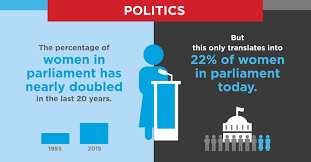
http://www.unwomen.org/en/what-we-do/leadership-and-political-participation/facts-and-figures
If the political map of a country is too large, if the machineries of political communication do not properly function, people are likely to develop somewhat a feeling of remoteness that seriously affects the rate of their political participation. On the contrary, the more open is the competition for power in a society and the more open is the competition based on established and accepted forms of procedure; the greater will be the tendency to participate.
http://www.openthemagazine.com/article/nation/kejriwal-is-no-match-for-me
Women, Governance and Politics
Women's Political Participation: Theories and DebatesUnit-II – Defining Political Participation
The government's effort to encourage and instruct the potential voters is also a factor to count, although this kind of effort is more to be found in the newly independent territories like India rather than in the established democracies of the West. Among all the political influences or participation, the party is surely the most important. Since, it is a very significant vehicle for conveying the wishes of the people to the government. Party campaigns have a great impact on political participation.
However, women's experiences and ideas about politics are rarely admitted in the mainstream discipline. In International context, Cythia Enloe has put up the question, "Where are the women"? Women are often underrepresented in formal politics, as heads of state or representatives in parliament. The women's movement has pursued the goals that range from the sanction of women suffrage to an increase in the number of women in responsible positions in public life .The concept of women empowerment especially in the field of politics has achieved momentum in view of certain women reaching new heights in state administration. Some have performed well in industrial management and span of research. One can find few cases in high administrative politics. Although, this has encouraged new thinking but what about the real practices? Gender inequality is in itself a form of violence which contributes to the insecurity of all individual. Prof. J.Ann Tickner expresses her concern, "Why are there so few women in my discipline of International Relations?'' The disciples such as International Relations focus on the 'high politics' that is related to diplomacy, war and statecraft and gives emphasis on the world of statesmen and soldiers, who were male. Until very recently, and still in many states, women are prohibited from securing the commanding levels.
Concluding Observations
Political participation is any action (or inaction) of an individual or collectively by individuals who intentionally or unintentionally oppose or support changes or maintain some features of a government or community. At most, awareness is a precondition for political participation. It is an action at the national or local level that supports or opposes state structures, authorities, and decisions regarding allocation of public goods.
Participation is an indication as well as a condition of women's status and power. It is a vital requirement for influencing the decisions, for promoting women's rights and development. A direct and effective participation helps to enlarge the freedom of women as it is the process to empower them. The representation of women in a political system is a good test of its claims to democracy. The women's liberation movements that began in the 1960s were, in many countries, ambivalent about
Women, Governance and Politics
Women's Political Participation: Theories and DebatesUnit-II – Defining Political Participation formal political representation. However, by the end of the twentieth century women's movements, were active to secure equality of representation throughout the world.
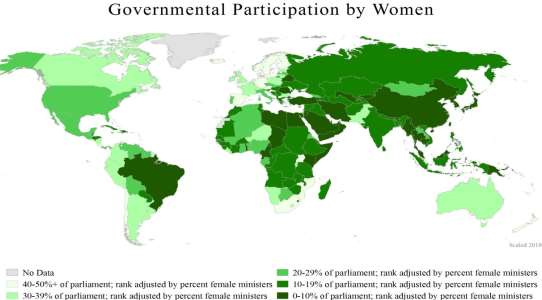
Suffrage campaigns over right to education, to paid work, to equal pay, to personal dignity and security, to sexual autonomy were also concerned about the inclusion of women's interests in policymaking. Later movements for representation in legislatures and assemblies were movements for presence that challenged political arrangements and sought to insert women's interest into policymaking by ensuring they were amongst the policy-makers. Since the nineteenth century women's movement, activists have demanded state action on a range of issues that include anti-discrimination policies, anti-violence policies, reproductive rights, childcare and political equality. Making women more vital to government concerns is partly about electing and appointing more women to public office that is descriptive representation. It is also about incorporating women's concerns into the policy process, that is, substantive representation. Whilst increasing women's descriptive representation may lead to the inclusion of women's concerns, it is only one of the several ways of enhancing women's representation.
Coral Cohn takes us inside the world of strategic planners, who were mostly men and examines their modes of discourse, which she describes as loaded with masculine imagery. It is difficult for anyone involved in national security planning to express ideas marked as "feminine" ( for instance, a preference for negotiations over coercive threatening). Women have always been active agents in international politics; their participation has more often taken place in non-governmental settings such as social movements rather than in inter-state policy making.
Women, Governance and Politics
Women's Political Participation: Theories and DebatesUnit-II – Defining Political Participation
If we have to break the current political stalemate, we have to change the mindset, keeping in view the gap between the myth and reality of women's participation in politics.
References
Andermahr, Sonya et al. 1997. A Glossary of Feminist Theory. London, Arnold.
Barnes, Kaase et. al. 1979. Political Action: Mass Participation in Five Western Democracies.
Bevely Hills, Sage Publications. Bellows, T.J., Erikson, S & Winter H.R. (eds.) 1971. Political Science: Introductory Essays and Readings. California, Duxbury Press, Belmont.
Conge, P.J. 1998. The Concept of Political Participation: toward a Definition in Comparative
Politics. Vol. 20, No. 2, The City University of New York. Dahl, R.A. 1965. Modern Political Analysis. New Delhi, Prentice – Hall of India (Pvt.) Ltd.
Foskett, J.M. 1955. "Social Structure and Social Participation" in American Sociological
Review, Vol. 20
Hawkesworth, M and Kogan, M (eds.) 1992. Encyclopaedia of Government and Politics.
London, Routledge. Heywood, A. 2005. Politics. New York, Palgrave.
Lipset, S.M. 1973. Political Man. New Delhi, Arnold – Heinemann.
Lovenduski, J. (ed.) 2005. State Feminism and Political Representation. Cambridge, Cambridge University Press. McClosky H. 1968. "Political Participation" in International Encyclopaedia of Social Sciences, New York, Collier – Macmillan.
Milbrath, L. 1985. Political Participation. Chicago, Rand McNally.
Nelson, B.J. & Choudhary, N (ed.) 1997. Women and Politics Worldwide. Delhi, Oxford
University Press.
Nelson, J.M. 1979. Access to Power: Politics and the Urban Poor in Developing Nations.
Princeton, Princeton University Press. Phillips, Anne (ed.) 1998. Feminism and Politics. New Delhi, Oxford University Press. Phillips, Anne. 1995. The Politics of Presence. Oxford, Clarendon Press. Pietila, H & Vickers, J. 1994. Making Women Matter: The Role of the United Nations. London, Zed Books Ltd.
Pettman, J.J. 2008. Gender Issues, in J Baylis et. al. (eds.) The Globalization of World Politics: An Introduction to International Relations.- New Delhi, Oxford University Press.
Women, Governance and Politics
Women's Political Participation: Theories and DebatesUnit-II – Defining Political Participation
Paper No. : Women, Governance and Politics
Module : Political Participation as tool of Women's Empowerment Role Name Affiliation Principal Investigator Prof.Sumita Parmar University of Allahabad Paper Coordinator Prof. Chandrakala Padia
Vice Chancellor, MGS University, Bikaner & Chairperson, IIAS, Shimla. Content Writer/Author (CW)
Vasanta College for Women, Varanasi
Ms. Manisha Misra
Content Reviewer (CR) Prof. Chandrakala Padia
Vice Chancellor, MGS University, Bikaner & Chairperson, IIAS, Shimla. Language Editor (LE) (B) Description of Module
Items Description of Module Subject Name Women's Studies Paper Name Women, Governance & Politics Module Name/ Title, description
Political Participation as tool of Women's Empowerment
Module ID Paper-11, ModulePre-requisites The Reader is expected to have the preliminary knowledge of Political Participation and Women Empowerment Objectives To study the current status of women empowerment and transformation through participation politically. Keywords Empowerment, Participation, Authority, Citizenship, Development, Decentralization
Women, Governance and Politics
Women's Political Participation: Theories and DebatesUnit-II –Political Participation as tool of Women's Empowerment
POLITICAL PARTICIPATION AS TOOL OF WOMEN'S EMPOWERMENT
2.1 Participation as a tool
Political Participation can be understood as actions on the part of individuals which either directly or indirectly affect the authoritative allocation of scarce resources, either material or symbolic,
in their community or between communities either within or outside their society.
Within a wide range of countries there is a uniformly high correlation between citizen's socioeconomic resources and their psychological involvement with politics-that is their interest in politics and their inclination to discuss political questions. But there is a much lower and more variable correlation between 'citizens' socio-economic resources and their actual, physical participation.
Conversely, particular groups may be legally excluded from the franchiselike conscientious objectors after the First World War in Britain for instance, or women in Spain before 1977.
Although 'the women questions' has often figured as a political issue since the middle of the nineteenth century, the question of the political significance of gender only became an issue in the study of politics in the 1970s.
Women, Governance and Politics
Women's Political Participation: Theories and DebatesUnit-II –Political Participation as tool of Women's Empowerment
Psychological involvement with
Personal SocioEconomic resources
politics
Legal incentives or restrictions
Other institutional incentives or restrictions (esp. partisanship)
Actual participation in voting, campaigning, lobbying and protesting
Fig. 1 A general model of participation
It arose partly in response to the women's studies movement which first emerged as part of the Women's Liberation Movement (WLM) which began in the 1960s. Prior to that, the study of women and politics was not regarded as important enough to warrant any special attention. During the 1970s these prevailing views were challenged and a wide-ranging debate was generated which continued
Women, Governance and Politics
Women's Political Participation: Theories and DebatesUnit-II –Political Participation as tool of Women's Empowerment throughout the 1980s. It has evolved from an initial and modest concern with mapping women's political behavior using traditional categories of analysis –the 'add women and stir' approach to a challenging critique of the very basis of political science. Women have played key roles in national liberation struggles and in the great political revolutions of modern times. There is a robust and growing women liberation movement in India. There are also data which indicate that women who are
in paid employment, full or part time, participate more frequently than full-time housewives. This suggests that where women are economically integrated they are more likely to be politically integrated, a finding that has been replicated in a number of countries.
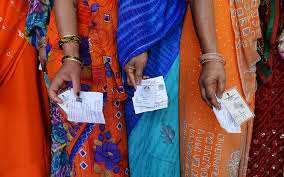
The Danish political scientist, Drude Dahlerup, studied the changes brought about when women became a sizable minority in a national legislature. She tested the notion that only when the minority of women in legislatures reaches a certain size (critical mass) the presence of women makes a difference.
She hypothesized that one would expect to find six different kinds of change:
1. In reactions to women politicians
2. In the performance and efficiency of the women politicians
3. In the political culture
Women, Governance and Politics
Women's Political Participation: Theories and DebatesUnit-II –Political Participation as tool of Women's Empowerment
4. In the political discourse
5. In policy (Political decisions)
6. In the empowerment of women
Women should be able to act on the strength of being women and not merely despite being women.
Democracy and the constitutions have provided women in most of the countries with political freedom
and rights to plan for their own future and pursue their own interests. According to the Jakarta
Declaration, "Involvement of women in the political arena and in decision-making roles is an important tool for empowerment as well as monitoring standards of political performance."
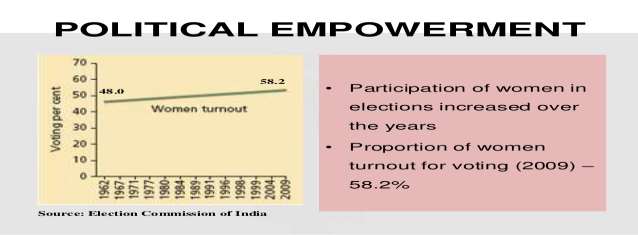
Election commission of India-http://www.slideshare.net/raghurh/women-empowerment-2
2.2 Understanding Empowerment
Before coming to the theme of Women Empowerment, let us understand the concept of Empowerment.
Women, Governance and Politics
Women's Political Participation: Theories and DebatesUnit-II –Political Participation as tool of Women's Empowerment
Empowerment means 'to invest within power'. 'Empowerment' has become a frequently used and buzz word. If essentially means, decentralized of authority and power. In other word giving voice to voiceless. Empowerment aims at getting participation of deprived sections of people in decisionmaking process. Unless capacity is built in these sections in reality the power is used by others rather than the section for which they are meant.
Activists want government to empower poor people including women by legislative measures
and welfare programmes. Empowerment is the process by which the disempowered or powerless people can change their circumstances and begin to have control over their lives. It results in a change in the balance of power, in the living conditions and it the relationships.
2.3 Women Empowerment and Political participation
Women empowerment means equal status to women, opportunity and freedom to develop herself. The focus of empowerment is equipping women to economically independent, self-reliant, have a positive self esteem to enable them to face any difficult situation and they should be able to participate in the process of decision-making.
Women's Empowerment as a phenomenon is not something new. It has been present throughout history in almost all societies for various reasons. What is recent is the increasing realization and
Women, Governance and Politics
Women's Political Participation: Theories and DebatesUnit-II –Political Participation as tool of Women's Empowerment recognition that empowering women is absolutely essential rather significant, for familial, societal, national and international development and progress.
The term 'Women empowerment' has become popular in the development field since 1980s. It is vividly recognized that women empowerment is essential for sustainable economic growth and reduction in poverty in developing countries. 'Empowering' women has become a frequently cited goal of development interventions. Women empowerment is central to human development. Targeted
actions aimed at empowering women and righting the gender inequalities in the social and economic share, as well as in terms of social and political rights, must be taken alongside effort to en-gender the development process.
The extent of women empowerment in a country is largely determined by three factors:-
1. Economic
2. Social and
3. Political identity
The term 'empowerment' denotes women's increased control over their own lives, bodies and environment. In discussion of women's empowerment, emphasis is often placed on Women's decision making roles, their economic self-reliance and their legal rights to equal treatment, inheritance and protection against all forms of discrimination. The popular UNESCO slogan should be considered as an ideal for not only empowerment but also development of women: "Educated a man and you educate an individual, educate a women and you educate a family".
Women, Governance and Politics
Women's Political Participation: Theories and DebatesUnit-II –Political Participation as tool of Women's Empowerment
It has been accepted that genuine commitment and efforts have to be made by each country at the government, non-government and individual levels to work, towards establishing women's empowerment as nationally and internationally discussed in UN World Conference on Women and agreed upon in the Plan of Action. A general awareness of the exploitation of women on various fronts like social, cultural, political and economic fronts has led to strong protests manifested in women's liberation movement, which emerged in the United States since the early 1970s.
Some prominent organizations associated with this movement were: National Organization for Women (NOW), Boston's Bread and Roses, Berkeley Women Liberation Group, Women's Radical Action
Project, Women's Equity Action League (WEAL), National Women's Political Caucus (NWPC) and others. According to Peterson and Runyan, 'A gender-sensitive lens enables us to 'see' how the world is shaped by gendered concepts, practices and institutions…'
Feminists assert that until the condition of equal participation of women in public life is fulfilled, the concept of citizenship cannot be brought to its logical conclusion. In India a beginning in this direction has been made by making reservation of one-third of the seats in Panchayats for women.
This will encourage women to join politics at grass-root level.
By and by their representation at this level can be increased to one-half, and provision can also be made for their adequate representation in legislative assembles and parliament. The opening up of vast opportunities of higher education would prove to be instrumental to their larger representation in administration and high-profile professions. In this way the idea of equal citizenship can be fully realized from the feminist point of view.
Women, Governance and Politics
Women's Political Participation: Theories and DebatesUnit-II –Political Participation as tool of Women's Empowerment
Access to Resources
Autonomy (Power of Decision Making)
Empowerment
Agency (Power to Act upon one's own defining goal)
Well Being (Achievement)
Fig.2 Four Components of Empowerment
However in practice, famous few women can be mentioned in politics such as Indira Gandhi and Margaret Thatcher. Such personalities acquiring women were strong leaders, who showed no hesitation to take firm decisions and also to use force in international conflicts. This led some to say that the only difference between men and women is that women are rarely in power, if they are, they behave like men. Similarly, men who appear compassionate or seek to negotiate away from conflict may accuse of
Women, Governance and Politics
Women's Political Participation: Theories and DebatesUnit-II –Political Participation as tool of Women's Empowerment being 'women' like. The 'public-private dichotomy' has played a vital role for suppression of women's rights.
2.4 International Scenario
At the International Conference on Population and Development in Cairo (1994), Women's empowerment was recognized as a cornerstone for effective policies. Empowerment of women in
all spheres, in particular the political sphere is critical for their advancement and the foundation of a gender-equal society.
Text Box (i):
Women's political empowerment is premised on "three fundamental and nonnegotiable principles: (a) The equality between women and men; (b) Women's right to the full development of their potentials; and (c) Women's right to self-representation and self-determination."
In empowerment, the key indeed is 'power', it is power to 'access', 'control' and make 'informed choices.' In the sphere of international politics the participation of women is still meager. However some instances can be given of outstanding women internationally, who are renowned for their achievements in politics: Margaret Thatcher was the first women Prime Minister of Great Britain. She has been called the 'Iron Lady' for her strong decisions.
Sirimavo Bandaranaike became the Prime Minister of Srilanka in 1960 and was the first women
Prime Minister of the World. Her daughter Chandrika Bandaranaike Kumartunga is the first women president of Srilanka.
Golda Meir was one of the founders and the fourth Prime Minister of the state of Israel.
Women, Governance and Politics
Women's Political Participation: Theories and DebatesUnit-II –Political Participation as tool of Women's Empowerment
Hillary Clinton is a leading candidate for the presidential election in United States in present time and earlier in 2008. She is also a famous lawyer and served as foreign secretary in US government.
Aung San Su Kyi, is the leader of the movement for democracy in Myanmar. She has spent many years under house arrest. In 1991, she is awarded with the Nobel Peace Prize for her non-
violent resistance to the military dictatorship in Myanmar. She has been released from her house arrest as a result of constant pressure from the general public.
Benazir Bhutto was the Prime Minister of Pakistan and the first women to be elected head of a Muslim country in modern times. She was killed before an election in December, 2007 to remove her from the national politics of Pakistan.
Begaum Khaleda Zia is the first women Prime Minister of Bangladesh.
German Chancellor Angela Merkel is also one of the strong women in contemporary international politics. By the end of 2005, Germany had elected its first women chancellor.
Happily, by the beginning of 2006, Chile and Liberia had elected their women presidents. Then in 2007 India and Argentina had the distinction of having women presidents. Srilanka, Israel, India
Pakistan and Bangladesh have the record of having women Prime Minister or Head of Government.
Thus, in Indian-subcontinent from ancient time, women have played important role in leadership and statesmanship. Some women have excellent record of performance in various important positions, like those in legislatures, cabinets, bureaucracy, diplomacy, journalism, legal profession, fine arts, academics and scientific research etc. This record is enough proof of the potential of women's power.
Women, Governance and Politics
Women's Political Participation: Theories and DebatesUnit-II –Political Participation as tool of Women's Empowerment
2.5 Indian context
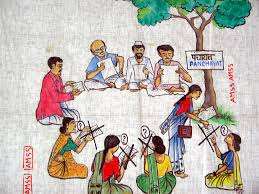
In our country though we find anomalies in Panchayati Raj, where a women is selected as sarpanch, it is possible that her way of working is mostly influenced by a male member of her family.
However this tendency should not be taken for granted. Looking back to the Indian history, one can find that women have played a vital role in politics. Though, before independence Indian politics is not formally well structured as it exists in contemporary period, still for understanding the journey of political empowerment of women in India, we have to take into account the contribution of the earlier empowered women. Symbolically some instances can be given in this context: Razia Sulatana, who ruled over Indian from 1236 to 1240 AD, was the very first ruler in Muslim history. She became one of the most powerful rulers of the Delhi Sultanate.
Rani Lakshmibai of Jhansi organized her fight against the British conspiracy and torture. She lived a short life of 23 years only, gave arousing call to the free-princely states to be united for
Women, Governance and Politics
Women's Political Participation: Theories and DebatesUnit-II –Political Participation as tool of Women's Empowerment the freedom of motherland. She moved the British Queen by her fierce leadership, lead the movement of 1857, but did not surrender. She died while fighting against the British rulers.
Similarly, Rani Durgavati and Rani Ahilyabai had also played significant role in preindependence period.
Indira Gandhi, at age 12, she had already joined the fight for India's independence and at an
advance age became the first women Prime Minister of India. But she was brutally killed by terrorists.
In modern times, the place of women in Indian politics reflects the opportunities and constraints that are associated with its democracy. Women have been key actors in the numerous social movements and non-governmental organizations that underlie India's vibrant civil society.
India's most influential, Prime Minister was Indira Gandhi, and her daughter-in-law, Sonia Gandhi, is the major force within the Congress party today. India's former president Pratibha Patil and several state leaders have been women, including Mayawati, who served four times as Chief
Minister of Uttar Pradesh.
Women, Governance and Politics
Women's Political Participation: Theories and DebatesUnit-II –Political Participation as tool of Women's Empowerment
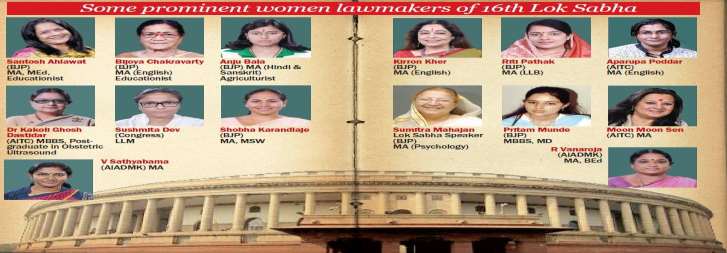
http://www.newindianexpress.com/thesundaystandard/It%E2%80%99s-Official-Women-are-Smarter-
Than-Men-Even-in-the-LokSabha/2014/11/16/article2524932.ece
In India, numerous steps have been undertaken to provide constitutional safeguards and institutional framework for activities of women welfare. There have been various shifts in policy approaches during the last 40 years from the concept of 'welfare', in the 1970s to 'development' in 1980s, now to 'empowerment' in the '1990s and afterwards.
The Government of India has declared the year 2001 as year for the Empowerment of women. The concern for women's political equality in India first emerged as political issue during the national movement in which women were active participants. Act of 1935, provided with the right to vote to all women over 21 years if they fulfilled the conditions of property and education.
In Post-Independence period, women continued to play a significant role in less conventional political activities such as environmental movement, anti-alcohol agitation and peace movements.
It was only with the setting up of the Committee on the Status of Women in India (CSWI) in September, 1971 that the demand for greater representation of women in political institutions in India was taken up in a systematic way.
Women, Governance and Politics
Women's Political Participation: Theories and DebatesUnit-II –Political Participation as tool of Women's Empowerment
The CSWI Report "Towards Equality" (1974) reveals that political parties have "tended to see the women voters and citizens as appendages of the males...." It also refers to the 'tokenism' involved in having a few women's rights on account of their dependent and minority status.
In Indian scenario, with women's concerns gaining prominence in both governmental and nongovernmental organizations during eighties (1980s), women's issues became an important agenda for all political parties. While the subjugation of women is gaining attention everywhere, women's
organizations will be forced to choose their political allies within the existing political set up.
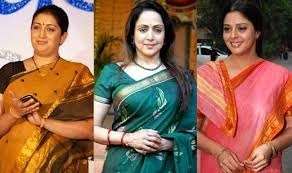
Over a million women are represented in the three-tiered panchayats. With the growth of a multi-party system since the early 1990s, political parties have increasingly sought women's electoral support. And yet most women continue to lack effective political power in parties and the state.
Women's access to power is still mediated by their relationship to male kin, and is often indirect and symbolic. Parties have done little to provide women access to the networks and resources that would enable them to ascent the ranks of party hierarchies.
Hopefully, the continued administrative decentralization through programs like NRHM, have demonstrated the Government of India's commitment to increasing the political participation of marginalized groups, especially poor women. The bureaucratic structure of India is very complex and
Women, Governance and Politics
Women's Political Participation: Theories and DebatesUnit-II –Political Participation as tool of Women's Empowerment messy and because of that we find lot of departmentalization in ministries and various administrative posts. Women here can play a very effective role and in fact women have been doing so but the level of participation has decreased.
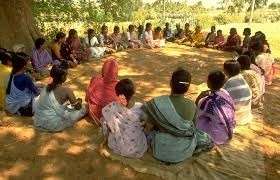
Further the 73rd and 74th amendments to the Indian Constitution in 1992 and 1993, provided with 33 percent reservation for women in panchayats and urban local bodies. Women have acquired resources and the development of skills, which have enabled them to excel in managing development.
They have been able to articulate their priorities for basic needs and amenities such as food, drinking water, schools, healthcare centres, roads, and security. Some instances can be given to prove that how political participation works as tool of women's empowerment: Two detailed village surveys carried out in two districts, Birbhum in West Bengal and Udaipur in Rajasthan; found that women invest more than men in projects that meet community needs, which are water and roads in West Bengal and water in Rajasthan. In West Bengal, the panchayats are authorized to establish informal education centres. In Rajasthan, the panchayats can spend money on local infrastructure.
Women, Governance and Politics
Women's Political Participation: Theories and DebatesUnit-II –Political Participation as tool of Women's Empowerment
In rural Punjab, over 4500 women heading 2446 panchayats have a common minimum programme: to work for uplift of weaker sections of society, adult literacy, pensions for aged and the poor, better education and healthcare facilities, and the development of their villages in their five-year term.
Another success story is the Belandur gram panchayat in Karnataka, where six out of
twelve members are women. It is estimated that collections of taxes have risen more than seven times. With the devolution of responsibility to the panchayats, the cost of the delivery of government services has gone down significantly, and a system of transparency and accountability has developed.
Women panchayat members have also taken up questions of gender inequality in many places. In UP, 100 village leaders have banned the practice of giving or demanding dowry.
In Akola district in Maharashtra, an all-women panchayat had the only liquor shop of the village closed down as it was resulting in the men of the village returning home drunk and beating their wives.
In Madhya Pradesh, the Institute of Social Sciences, New Delhi, awarded a woman sarpanch in the Jamunia taluk in district Sehore the "Outstanding Woman
Panchayat Leader Award" for 2003. Her achievements included providing women with land rights, distributing land to ninety-five couples under a housing scheme, and ensuring that the documents were in woman's name.
In Orissa, the Narayanpur gram panchayat under the leadership of its sarpanch
Rajehwari Rao passed a resolution banning child marriage. Even families who had
Women, Governance and Politics
Women's Political Participation: Theories and DebatesUnit-II –Political Participation as tool of Women's Empowerment performed child marriages before the ban was put in place were not sparedthe adults responsible were required to pay a fine of Rs. 1000, to be used for the children's education.
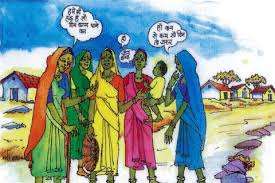
The enactment of the 73rd and 74th Constitutional Amendments represented a milestone in the process of decentralization. The 73rd Amendment Act made the Gram Sabha, comprising all adult villagers, the
pillar stone of village governance. The amendments contain provisions for the reservations of 33 percent of elective seats for women in the village, block and district councils and an equal number in the urban municipal councils. Consequently, an estimated five million women entered local politics directly or indirectly in the last ten years. India's population consists of 15% Scheduled Castes and 7.5%, Scheduled Tribes. As a result, 22.5% of seats are reserved for them, out of which one-third are for women. The reservation of seats in each state is proportional to their population. The reservation of seats for women, SCs and STs applies also to office bearers, so that one-third of sarpanch must be women. These amendments, as a strategy of affirmative action, served as a major breakthrough towards ensuring women's equal access and increased participation in political power structures.
Women, Governance and Politics
Women's Political Participation: Theories and DebatesUnit-II –Political Participation as tool of Women's Empowerment
2.6 Conclusion
Women empowerment is one of the momentous issues of contemporary development policies in developing countries. Society should take initiative to create climate in which there is no gender discrimination and women have full opportunities of self-decision making and participating in political life of the country with the sense of equality. The past two decades have witnessed two new patterns:
1. Attempts by political parties to foster closer ties to social movements and non-governmental organizations.
2. Attempt by some feminists to work with parties and the state.
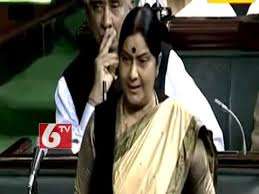
The most significant example of collaboration between women's organizations and the state has occurred around the issue of reservations for women in local government. For increasing women's political participation, gender quotes has been recognized as a significant measure. In this context, statement made by Sushma Swaraj can be quoted here, 'We have tried reserved parliamentary seats for village panchayats, and from my experience, this is a very effective measure. We have reserved 33% of the seats in panchayats for women. Before this policy, we did not have women prepared for leadership positions, but as a result of the policy, political parties have to search for women. We got a mixed response. Some men did not want women to come forward, so they put forward their wives, sisters-in-law and mothers. But talented, educated women also came forward. Now the old argument that there are no able women to become candidates for legislature assemblies no longer holds. Because now the women serving as mayors and as chairman of the municipal committees will be groomed as prospective candidates for parliament. More and more
Women, Governance and Politics
Women's Political Participation: Theories and DebatesUnit-II –Political Participation as tool of Women's Empowerment women have been elected to panchayats and this is a valuable pool of women for legislative assemblies. Thus the reservation of seats is a very effective measure, especially in countries such as India where there is such meager representation of women in parliament. In India, only 6.5 percent of parliamentarians, 39 members of a house of 543, are women. A bill for reservation of seats for women in parliament is also pending; discussions are going. It was not yet passed, but I think it will see the
light of day.'
Women empowerment which is declared as Millennium Development Goal by UNDP could be achieved only when all concerned bodies will work in cooperation. Empowering Women politically is an important end in itself not only as human right but also as having the potential to enhanced human wellbeing.
Women, Governance and Politics
Women's Political Participation: Theories and DebatesUnit-II –Political Participation as tool of Women's Empowerment
2.7 Summary
The question of the political significance of gender became an issue in the study of politics in the 1970s.
The extent of women empowerment in a country is largely determined by three factors: Economic, Social and Political identity.
Empowerment aims at getting participation of deprived sections of people in decision-making process.
Women Empowerment means equal status to women, opportunity and freedom to develop herself.
Empowerment of women in all spheres, particularly in the political sphere is critical for their advancement and foundation of a gender-equal society.
73rd and 74th Constitutional Amendments have strengthened women's political participation and democracy in India.
At the International Conference on Population and Development in Cairo (1994), Women's empowerment was recognized as a cornerstone for effective policies.
For increasing women's political participation, gender quotes has been recognized as a significant measure.
Women, Governance and Politics
Women's Political Participation: Theories and DebatesUnit-II –Political Participation as tool of Women's Empowerment
Paper-11 Module-6 Political Participation as mere symbolism. Role Name Affiliation Principal Investigator Prof.Sumita Parmar University of Allahabad Paper Coordinator Prof. Chandrakala Padia
Vice Chancellor, MGS University, Bikaner & Chairperson, IIAS, Shimla. Content Writer/Author (CW)
Vasanta College for Women, Varanasi
Ms. Manisha Misra
Content Reviewer (CR) Prof. Chandrakala Padia
Vice Chancellor, MGS University, Bikaner & Chairperson, IIAS, Shimla. Language Editor (LE) Prof.Sumita Parmar University of Allahabad (B) Description of Module
Items Description of Module Subject Name Women's Studies Paper Name Women, Governance & Politics Module Name/ Title, description
Political Participation as mere symbolism.
Module ID Paper-11 Module-6 Pre-requisites The Reader is expected to have preliminary perception about the myth and reality of women political participation persisting in our society. Objectives To raise the reader's critical consciousness to make him understood the actual scenario of women's political participation. Keywords Democracy, Representation, Reservation, Election, Public life, Leadership
Women, Governance and Politics
Women's Political Participation: Theories and DebatesUnit-III –Political Participation as mere symbolism
Political participation as mere symbolism
Introduction
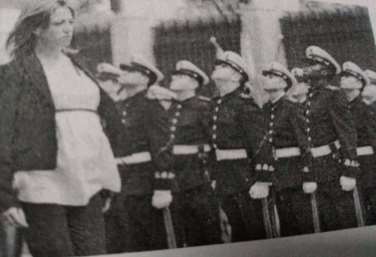
On the 14th of April 2008 a seven-month pregnant Minister of Defense shows the Spanish troops for the first time; first time not only for her, but also for other women, all citizens, the army and democracy in Spain. Carme ChaconThe first women to have inspected the troops in Spainwas appointed minister within the Spanish socialist cabinet of President Rodriguez Zapatero.
(Emanuela Lombardo & Petra Meier, The symbolic representation of gender: an introduction, Paper for delivery at the XXII IPSA World Congress of Political Science, Madrid, 8-12 July, 2012, p.1)
The sight of Minister Chacon inspecting the troops on her first day in office with her rounded belly covered by a white maternity blouse is a picture that Spaniardsand other people outside Spainwill not easily forget. It occupied the front page of several national and international newspapers. Why is that picture so powerful to attract people and media's attention? At a first glance, it shows, maternity, symbol of womanhood, in an unusually represented position of leadership and command, and, the army, symbol of masculinity as associated with physical strength and defense, this time in an also unusually represented situation of subordination and obedience towards a woman in a position of supreme authority. The pregnant minister is 'invading a space' that tends to be associated with men. This picture could also attract people's attention due to the suggestion of a possible clash between life, as symbolized by maternity, and death, as symbolized by the army. It turned upside down socially ingrained expectations about the role of women and men and the respective hierarchy between the sexes that are still very much present and perpetuated through dominant cultural codes.
After this illustration now the question arises, have democracies become more representative in the sense that they have incorporated women in ways
Women, Governance and Politics
Women's Political Participation: Theories and DebatesUnit-III –Political Participation as mere symbolism which ensure that their interests are advocated and considered? What mechanisms exist to facilitate gender – balanced policies and how effective are those mechanisms? Anne Phillips (1995) points out that post-industrial democracy are deficient because they fail to represent women's interests and needs adequately. They neither include women in positions of power nor routinely incorporate gender perspectives in the policy process.
geekfeminism.org
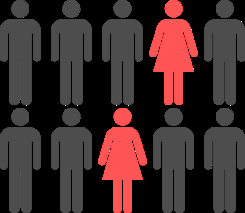
Comparative research shows that there is generally a pattern of decreasing number of women as decision-making hierarchies are ascended. There is a functional division of labour between women and men representatives whereby women are more likely to specialise in 'soft' and less prestigious policy areas such as health, cultural affairs, education and social welfare while men dominate the traditionally more prestigious areas of economic management, foreign affairs and home affairs. The patterns raise the important question of what if any influence women representatives have and where and how they are able to exercise it.
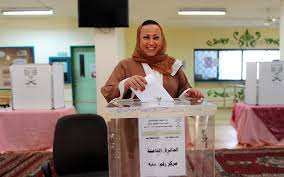
www.radionz.co.nz
Women, Governance and Politics
Women's Political Participation: Theories and DebatesUnit-III –Political Participation as mere symbolism
In practice, the opportunities for exercising rights are limited and women's access to decide their own future is restricted due to the lack of free movement, exposure, patriarchal forces and values.
This is similar to and is an extension of the situation obtained in home where women are consulted rarely in important economic matters like purchase and sale of property or spending patterns of the income. Even in the public sphere women's participation making level is only marginal.
3.2 Women Presence in Assemblies Women are often more likely than men to face practical barriers to entering politics, including a paucity of financial resources, lower levels of education, less access to information, greater family responsible, and a deprivation of rights that has left them with fewer opportunities to acquire political experience. With the exception of the close relatives of male politicians, women generally lack the political networks necessary for electoral success. However, political participation and grassroots democracy have been strengthened considerably by the 73rd and 74th constitutional amendments that have created new democratic institutions for local governance. Of the 28 lakh elected Panchayat representatives, around 10 lakh are estimated to be women. The average of women representation in panchayats across the country is 36.94 percent. On the other hand, a few states have gone beyond the mandated 33 percent and provided more reservation for women. For example Bihar, Madhya Pradesh, Uttarakhand and Rajasthan have reserved 50 percent seats for women in panchayats. The constitution's 110th Amendment Bill 2009 provides reservation for women from 33 percent to 50 percent in Panchayati Raj Institutions.
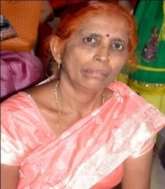
Mrs. Shailja Singh, Gram Pradhan, Masuriya Village, Ballia, Uttar Pradesh
Nevertheless, the matter of concern is that women representation have always been criticised as the representation is only a puppet show and the master is 'Pradhanpati' (Husband of female representative), or the 'Pradhanputra' (Son of female representative). On this issue, Mrs. Shailja Singh (Gram Pradhan, Masuriya Village, Ballia, Uttar Pradesh) stated that, "It is not
Women, Governance and Politics
Women's Political Participation: Theories and DebatesUnit-III –Political Participation as mere symbolism possible that suddenly women will have full command on all the power-structures and decisionmaking processes. So, assistance of her husband or son is of real representation of UN Women's Campaign- 'He for She'. Gradually women will achieve full command in this respect."
In India, women have not found adequate representation in Lok Sabha. The percentage of elected women Lok Sabha members has never exceeded 12 percent.
Table 1 : Women presence in the Lok Sabha
Year Seats Women MPs % of women MPs 1996 543 39 7.18 1998 543 43 7.92 1999 543 49 9.02 2004 543 45 8.03 2009 543 59 10.86 2014 543 61 11.23 Average 531.06 36.87 6.91
First woman speaker of Lok Sabha - Meira Kumar
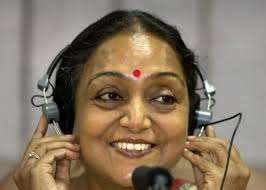
Women politicians
Munmunsen and Dimple yadav
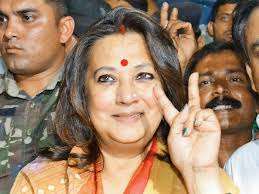
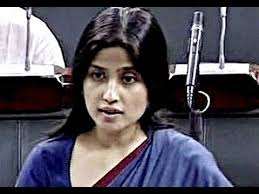
Women, Governance and Politics
Women's Political Participation: Theories and DebatesUnit-III –Political Participation as mere symbolism
The presence of women in the Upper House has been only slightly higher overall, probably due to indirect elections and nomination of some women members. It was highest in 1990 at 15.5 percent and shows a declining trend thereafter.
Table: 2 Women Presence in the Rajya Sabha
Year Total Seats No. of Women % of women 1990 245 38 15.5 1996 223 20 9.0 1998 223 19 8.6 2004 245 27 11.1 2009 245 22 8.97 2014 245 29 11.83 Average 238.21 22.92 9.62
It is significant to note that the Deputy Chairperson of the Rajya Sabha at least for more than 25 years has been a women yet women face increasing competition from male politicians for nomination. The number of women contesting election has always been low. The highest number of women contestants has been merely 636 in 2014. The losing seats are offered to women candidates by the respective political parties. This scenario is also typical at the state level. Sources reveal that the highest percentage of women in the State Legislative Assemblies has been 10.8 percent in 1957 in Madhya Pradesh. Generally, there seems to be no correlation between literacy and female representation. Kerala, with its high literacy rate, has a low state average of 3.6 percent. The representation of women in the Union Council of Ministers has also remained very low.
Table : 3 Representation of Women in the Union Council of Minister (2001-2014)
Year Number of Minister Number of Women Minister Cabinet Minister Minister of State Deputy Minister Cabinet Minister Minister of State Deputy Minister 2001 30 7 35 3 2 4 2002 31 45 0 2 5 0 2004 28 38 0 1 6 0 2009 34 45 0 3 5 0 2014* 23 23 0 6 1 0 * First phase of Narendra Modi's Council of Ministers which took oath on May 26, 2014
Thus, the representation of women at various levels in services, representative bodies and judiciary remain grossly inadequate.
3.3 Reservation of Women in Parliament and State legislatures
Initially, most political parties agreed to introduce 33 percent reservation for women in Parliament and State Legislatures. But soon doubts surfaced. The objections focused around two main issues: (i) The issue of overlapping quotas for women in general and those for women of the lower castes. (ii) The issue of elitism.
Women, Governance and Politics
Women's Political Participation: Theories and DebatesUnit-III –Political Participation as mere symbolism
The bill was first introduced by Dev Gowda led United front Government. The Bill has already been introduced five times, but is stalled each time. However, the Rajya Sabha on March 9, 2010 took a 'historic step' by voting (191 for and 1 against) to amend the constitution, providing one-third reservation in Parliament and State Assemblies for women. Till today bill is not passed by the Lok Sabha and ratified by one-half of the states before it comes into effect. Barriers to women's political participation are often magnified in post-conflict societies, which may be characterized by militarism, a volatile security situation, the political dominance of a small group of elites, the absence of well-established political parties, the failure to include women in peace negotiations, and other limiting factors which confirm that political participation by women has become mere symbolism.
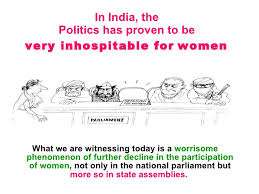
www.slideshare.net 3.4 Women and Political Parties In Indian politics, women continue to lack effective, political power in parties and the state. Women's access to power is still mediated by their relationship to male kin, and is often indirect and symbolic. Parties have done little to provide women access to the networks and resources that would enable them to ascend the ranks of party hierarchies. One of the significant questions arises concerning the relationship between women's electoral support for particular parties and these parties' commitments to eradicate gender inequality. Parties have increasingly directed their appeals at women by addressing their distinctive interests and identities, and by involving women in electoral campaigns. The Bharatiya Janata Party (BJP), Telugu Desam Party (TDP) and Dravida Munnetra Kazhagam (DMK) have not only viewed women as vote banks, but also made them figureheads and spokespersons for their parties, and often very militant ones. And yet they have generally not offered them lasting institutional power, nor rights that would increase their autonomy from their families. The BJP has mobilized women around Hindu nationalist themes, but has interspersed these with displays of its secular commitments. As a centrist party with historically secular, socialist leanings, Congress has claimed women support through its commitment to minority rights and secularism. However, these parties' ideologies have not determined their positions on gender inequality. For women's rights activists, the major failure of the Congress Party resulted from its ambivalent stance towards secularism. When Congress tried to pass the Hindu Code Bill providing equal rights to men and women within the family in 1944, it encountered deep-rooted opposition from
Women, Governance and Politics
Women's Political Participation: Theories and DebatesUnit-III –Political Participation as mere symbolism conservative religious groups, which viewed secular law as undermining religions and patriarchal authority. The Bill Congress passed in the mid1950s was deeply compromised by concessions to this opposition.
During the early period of its ascent, BJP was especially keen to distinguish itself from the Congress Party. Its support for the Uniform Civil Code in the 1990s was in part a response to Rajiv Gandhi's handling of the Shah Bano issue. Like all political parties, BJP also makes certain promises that it does not keep. For instance, it did not implement reservations for women, which it pledged to do at election time.
The relatively small number of women in political office is a reflection of biases on the part of parties than that of the electorate. It may be that parties only ran women in elections they considered winnable. If they felt that the electorate was less likely to vote for a woman, all else being equal, it made sense to run women in seats where victory was more likely. Venkaiah Naidu claimed, 'We want to field more women candidates but there are few of them.' However the data does not bear out Naidu's contention that women do not win elections. The percentage of women candidates who were elected was 51.9% in 1996, 46.9% in 1998 and 60% in 1999.The Congress Party nominated more women than the BJP in every election. However, a larger proportion of women candidates were elected from the BJP than from the Congress.
Three successive governments dating back to 1996 have supported the EightyFirst Amendment Bill guaranteeing at least 33% reserved seats for women in parliament and the legislative assembly. However, although most political parties have endorsed the bill in their election manifestos, they have not supported its passage in Parliament.
3.5 Elections and Women's Leadership
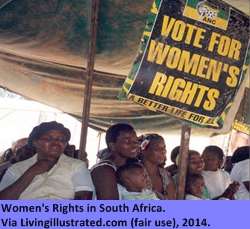
Feminists argue that even after getting full citizenship in law, women continue to suffer from subjection in their social life. From 1960s and 1970s the status of women in society and politics has become the centre of attention.
www.africafiles.org
Women, Governance and Politics
Women's Political Participation: Theories and DebatesUnit-III –Political Participation as mere symbolism
Earlier it was usually thought that after establishing legal equality of men and women, women were not left with any issue of complaint. After the extension of right to vote to women, there were some studies on voting behaviour. It was found that women's participation in voting was lower in comparison to men. To explain this situation it was argued that women were largely interested in private and domestic affairs; they were less interested in politics and public affairs and probably they had no time to attend to these matters.
In the sphere of international politics the representation of women is still meager. In November 1990, thirty-four Heads of Government of European countries gathered to sign the historic charter of Paris for the New Europe. The gathering marked the end of the cold War. In newspaper headlines it was described as the end of an era. But feminists ask. "Which era had come to an end?" in any case, it was not an end of the patriarchal era. In the group-photo of these thirty-four heads of government, only two women could be spotted after a thorough search. These are: Gro Brundtland, Prime Minister of Norway, and Margaret Thatcher, Prime Minister of Britain. Two days after this Conference, Mrs. Thatcher also resigned, and a man replaced her as Prime Minister. In this situation, what is the consequence of granting full political rights to women if their representation in public life remains so negligible?
In countries outside Europe and America, Women's representation is very insignificant at the level of political authority. Opportunities are not open to women as their share in these positions continues to be very inadequate.
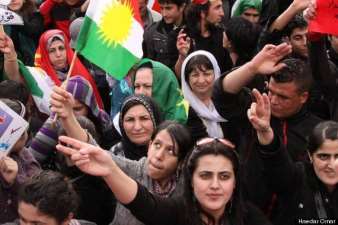
alternative.net/social-movements/indiatogether.org
In India, women's voting rates increased from 37% in 1952 to a high of 68% in 1984; they fell to 47% in 1991. Women's participation in the panchayats is constrained by a dearth of financial resources, the lack of independent staffing, and reliance on an uncooperative bureaucracy. Opposition to the Eighty first Amendment Bill guaranteeing at least 33% reserved seats for women in Parliament and the Legislative Assembly, from some segments of the women's movement partly reflects a distrust of political parties. These include,
Women, Governance and Politics
Women's Political Participation: Theories and DebatesUnit-III –Political Participation as mere symbolism
Quotas could form a ceiling rather than a minimum;
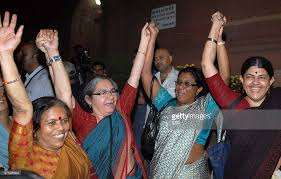
Women candidates might be malleable because of their dependence on male party leaders.
Reservations treat women like a homogeneous group, which increase the likelihood of the 'biwi (wife) brigade' of educated, upper-class, upper-caste women being elected, particularly because the bill does not provide for sub-quotas of OBCs. Similar trend of successful 'unmarried women in politics' can be visualized. While looking at women's leadership, one could find that woman who have been elected to parliament without the support of an organized constituency have been few in number, and relatively ineffective in challenging gender inequality.
The power of women MPs (Member of Parliament) is generally very limited. They are expected to strictly adhere to party policy, and none of them have placed questions concerning gender inequality high on their agendas. Although they have regular contact with women's wings of political parties and with the party leadership on issues regarding the family, they do not have much to do with autonomous women's organizations.
Consider the roles of some women who have emerged as power brokers within Indian politics today. They include the Italian-born Sonia Gandhi, who was positioned to become Prime Minister in 2004, Jayaram Jayalalitha, who heads the regionally based AIADMK and is the former Chief Minister of the southern state of Tamil Nadu; Sheila Dikshit, former Chief Minister of Delhi, Vasundhara Raje, former Chief Minister of Rajasthan and Rabri Devi, the former Chief Minister of Bihar.
Women, Governance and Politics
Women's Political Participation: Theories and DebatesUnit-III –Political Participation as mere symbolism
All these women rose to power as appendages to men rather than through movements or institutional channels. Rabri Devi only emerged from her role as housewife when her husband was imprisoned, and she replaced him as the Chief Minister of Bihar.
Sheila Dikshit rode to power on the coat-tails of her powerful father-in-law, Uma Shankar Dikshit. Vasundhara Raje Scindia is the daughter of Vijayaraje Scindia and is of royal ancestry; Jayalalitha is the mistress of actor-turned-politician M.G. Ramachandran, whom she succeeded as Chief Minister of Tamil Nadu. Sonia Gandhi is the widow of former Prime Minister Rajiv Gandhi and the daughter-in-law of former Prime Minister Indira Gandhi. Hence, in our country these illustrations reflect mere symbolism of women political participation. One can utter the names of 'famous few' who hold the higher positions due to their political family background or any other type of influential political support. However, women experience more constraints than men in gaining political power.
India's women leaders may be important symbols of the nation; in the absence of support from organized movements they have not become powerful in their own right. In such a realm, their connections to male family members assume paramount importance. Nor do these women share common values, ideals, or agendas. Their role in bringing down governments may be as close as they will ever come to collaborating.
Their deepest commitments are to their parties and to themselves, not to the collective interests of women. At the present time, the question of how to engage in elections selectively and creatively possesses important challenge for the women's movement.
Conclusion
Symbolism here is used in the sense of not being effective. There is a marginal achievement in this regard. While analyzing the term "symbolism" one can refers to Mazur's writings. In Mazur's analysis of French equal employment policies, symbolic reform occurs when policies designed to address certain social problems fail to effectively solve those problems. Symbolic policies would serve a symbolic purpose of 'image making' for politicians, but they appear destined to have little real impact. Symbolism is then seen as the opposite of substantial, which focuses on the fact that something really substantial is (being) achieved.
There is absence of a concerted and assertive women's movement, focusing precisely at the ascertainment of equitable political participation of women in all segments of the political life in our country. It proved congenial for the custodians of Indian politics, immediately after independence, to gloss over the gender perspective of the government and politics in the country without being held accountable for this act of omission. So, they have introduced some of the reforms to increase women's political participation. Political Participation in particular seems to be limited for at least two reasons:
1. The tone and substance of the constitutional provisions apparently remain confined to only those aspects of the women's development which would have probably been dovetailed to them in the course of increased awakening amongst the people.
Women, Governance and Politics
Women's Political Participation: Theories and DebatesUnit-III –Political Participation as mere symbolism
2. The constitutional provisions happen to be of foundational nature acting as the signpost for the politicians and the policy makers to evolve suitable and innovative measures to ensure greater role and participation of the women in the decision making institutions and processes in the country.
On the other hand, the long years of enjoyment of domination over the women by men is probably dissuading the dominant section of the society to cease from emanating any innovative law or taking any path breaking decision sanctioned by the constitution to catapult the women in the mainstream of the India politics.
Two contemporary issues, Uniform Civil Code and Reservation of seats for women in National Parliament and State Legislatures, have redefined the contours of feminist politics in India. The controversy over the uniform civil code began with the 1985 Supreme Court judgment granting financial support to Shah Bano (who once divorced, demanded maintenance from her husband) under a provision in secular criminal law. This verdict provoked the Muslims who characterized this interference by the Supreme Court as having fiddled with their personal law. Law could be an aid, once the decision is negotiated at the political level. Otherwise, a mere intervention of the court is too weak to bypass the hegemonic patriarchal social structure. The issue of reservation of seats for women has been already discussed above. The urge towards uniform civil code continues to remain a mere slogan unless it is debated at the grass roots level. Similarly, the reservation bill cannot ensure political equality for all; it simply seeks to expand the number of women in the political decision making.
www.livemint.com/politics/zrgmalFAEkdD89ak7GYdbN/political-parties-yet-to-move-beyondsymbols-on-womens-empo.html
Summary-
Anne Phillips points out that post-industrial democracy are deficient because they fail to represent women's interests and needs adequately.
Political participation and grassroots democracy have been strengthened by the 73rd and 74th constitutional amendments.
The percentage of elected women Lok Sabha members has never exceeded 12 percent.
There seems to be no correlation between literacy and female representation in India.
Women, Governance and Politics
Women's Political Participation: Theories and DebatesUnit-III –Political Participation as mere symbolism
The relatively small number of women in political office is a reflection of biases on the part of parties than that of the electorate.
81st Amendment Bill is associated with guaranteeing at least 33% reserved seats for women in parliament and the legislative assembly.
Women's participation in voting was lower in comparison to men.
Women's participation in the Panchayats is constrained by a dearth of financial resources, the lack of independent staffing and reliance on an uncooperative bureaucracy.
Women, Governance and Politics
Women's Political Participation: Theories and DebatesUnit-III –Political Participation as mere symbolism
References-
1. Chakrabarty, Bidyut and Pandey, R.K. 2008. Indian Government and Politics, New Delhi, Sage Publications India Pvt. Ltd.
2. Election Commission of India. Election Statistics Pocket Book 2014: Election Commission of India.
3. Gauba, O.P. 2013. An Introduction to political Theory. New Delhi, Macmillan.
4. Ghosh, Peu. 2014. International Relations, Delhi, PHI Learning Pvt. Ltd.
5. Heywood, A. 2005. Politics. New York, Palgrave.
6. Jayal, N.G. and Mehta, P.B. 2010. The Oxford companion to Politics in India. New Delhi, Oxford University Press.
7. Kapur Promilla. 2001. Empowering the Indian Women. New Delhi, Publications Division.
8. Khullar, M (ed.) 2005. Writing the Women's Movement: A Reader. New Delhi, Zubaan.
9. Lombardo, Emanuela and Meier, Petra. 2012. The symbolic representation of gender: An Introduction. Madrid, Paper for delivery at the XXII IPSA World Congress of Political Science.
10. Mohanty, Manorajan (ed.) 2004. Class, Caste, Gender. New Delhi, Sage Publications.
11. Pease, Kelly Kate S. 2000. International Organizations, Perspectives on Governance in the Twenty First Century. Upper Saddle River, Nj, Prentice Hall.
12. Sinha, M, Guy, D and Wollacott, A. 1999. Feminisms and Internationalism. Oxford, Blackwell Publishers.
Women, Governance and Politics
Women's Political Participation: Theories and DebatesUnit-III –Political Participation as mere symbolism
Paper No. : Women, Governance and Politics
Module : Approaches to Increase Women's Democratic Participation & Recommendations made at Different Global Meets regarding Women's Political Participation
Development Team
Prof. Sumita Parmar Allahabad University, Allahabad
Principal Investigator
Prof. Chandrakala Padia, V.C., MGS University, Bikaner
Paper Coordinator
Manisha Misra, Assistant Professor, Vasanta College for Women, Varanasi
Content Writer
Prof. Chandrakala Padia, V.C., MGS University, Bikaner
Content Reviewer
Women, Governance and Politics
Approaches to Increase Women's Democratic Participation &
Recommendations made at Different Global Meets regarding Women's Political Participation
Description of Module
Subject Name Women's Studies
Paper Name Women, Governance and Politics
Module Name/Title Women's Political Participation : Theories and Debates - Recommendations made at different Global Meets regarding Women's Political Participation: Beijing Conference, South Asia Watch, Asia Pacific Women's Watch, Inter-Parliamentary Union, UNDP & Commonwealth & Approaches to Increase Women's Democratic Participation
Module Id
Pre-requisites The student is expected to have the insight of understanding gender issue as a global issue of contemporary period.
Objectives To make the reader understand the gist of major recommendations made for women's political participation at global level and possible efforts which can be taken to enhance women's democratic participation.
Keywords Human Right, Equality, Decision Making, Platform For Action, Organization and Parliament
Approaches to Increase Women's Democratic Participation & Recommendations made at different Global Meets regarding Women's Political Participation: Beijing Conference, South Asia Watch, Asia Pacific Women's Watch, Inter-Parliamentary Union, UNDP and Commonwealth
By Ms. Manisha Misra
Assistant Professor
Department of Political Science
Vasanta College for Women,
Rajghat, Varanasi-221001
Email : [email protected]
Women, Governance and Politics
Approaches to Increase Women's Democratic Participation &
Recommendations made at Different Global Meets regarding Women's Political Participation
4. Approaches to Increase Women's Democratic Participation
The contemporary democratic ideal is based on the concept that political power has its roots in sovereign people. Therefore, there can be no democracy without involvement, without participation of the people in political life. Under International standards, men and women have an equal right to participate fully in all aspects of the political process. In practice, it is often harder for women to exercise this right.
However mere participation is not enough; to be meaningful and capable of bringing about the necessary changes in the society, such participation has to be at the effective level of decision making and implementation, that is at the managerial or leadership levels. It is then that it can lead to the empowerment of womena process and a target that equip women with the capacity to act and impact.
Empowerment is thus a long term process; it does not happen overnight or with government legislation like the one third reservations in Panchayati Raj or with a series of policies and programmes. Centuries of patriarchal subordination and internalization of inherited values cannot be overcome in a short span.
Constitutional provisions, legislations, policies, and social actions are the necessary instruments for the process of empowerment.
Political parties are among the most important institutions affecting women's political participation.
Women's networks, trade unions, non-governmental organizations and the media can provide avenues for women's political participation.
Post-conflict countries frequently offer unique opportunities to institute changes in the political structure and political culture that ensure the recognition of women's right to participate fully and equally in politics.
Women, Governance and Politics
Approaches to Increase Women's Democratic Participation &
Recommendations made at Different Global Meets regarding Women's Political Participation
Text Box: (i.) He For She
The movement for gender equality was originally conceived as a struggle led only by women for women. In recent years men have begun to stand-up in addressing inequalities and discrimination faced by women and girls. He For She is a solidarity movement for gender equality that brings together one half of humanity in support of the other half of humanity, for the benefit of all. All over the world, men are taking a stand for gender equality. It is the programme initiated and run by UN Women.
Advancing women's political participation requires determined efforts not only by women themselves, but also by Governments, the international community and civil society. Some strong steps that can be taken by prominent social and political groups are as following: 4.1 Political Parties
Political Parties should adopt internal democratic structure. In proportional systems, they place women contenders high enough on the candidate lists to ensure they will be elected, including through such mechanisms as "zippered" lists, and consider voluntary quotas for women candidates.
In the majority systems parties should establish voluntary targets to ensure a specified minimum number of women are put forward as candidates. They should provide support and resources to ensure the election of women candidates. Make certain that women are fully represented in party leadership and policy committees.
Women, Governance and Politics
Approaches to Increase Women's Democratic Participation &
Recommendations made at Different Global Meets regarding Women's Political Participation
Clearly identify the advancement of women and issues of special concern to women as priorities in their platforms. In the worst cases, parties in some countries require women to submit pre-signed letters of resignation when they are nominated so that they can be replaced with new if they are elected. This type of situation can be avoided if the law specifies that any woman removed from a candidate list or resigning from office must be replaced by another woman.
Parties may also adopt a code of conduct that includes requirements regarding participation by women and gender equality. These approaches require a serious commitment.
4.2 Governmental Actors
Governmental actors should ensure that political party laws and other election-related legislation do not indirectly disadvantage women. They should consider legislation requiring political parties to adopt democratic procedures for their internal operations. Further, consider temporary special measures requiring political parties to include a substantial proportion of women high on their candidate lists. Provide incentives for political parties to promote women candidates, including resources, training and increased access to broadcast time. 4.3 International Actors International actors should provide advice on legislation, electoral systems and best practices that can advance women's participation in the electoral process. Assist in the training of women candidates. Provide training to political parties, journalists, security forces and others to convey the significance of women's political participation and gender sensitivity.
Women, Governance and Politics
Approaches to Increase Women's Democratic Participation &
Recommendations made at Different Global Meets regarding Women's Political Participation
Help to establish and support cross-party cooperation among women. Provide support and training to women who have been elected to office to enable them to function more effectively in their new roles.
Text Box : (ii.) UN WOMEN
UN WOMEN (The United Nations Entity for Gender Equality and the Empowerment of Women) is a United Nations Organization dedicated to gender equality and the empowerment of women. UN
Women became operational in January 2011. As with UNIFEM previously, UN Women is a member of the United Nations Development Group.
4.4 Civil Society Civil Society actors should identify women willing to run the offices. Provide training and other types of support for women candidates. They can make Lobby for legislative changes to advance women's empowerment. Develop cross-party networks of women. Further, develop and disseminate gender-sensitive messages for voters. Advocate improved media coverage of women's issues and women candidates. Persuade international donors to support projects aimed at advancing women's political participation.
4.5 Media
The Media should provide gender-sensitive coverage of elections, avoiding negative stereotypes and presenting positive images of women as leaders.
Provide women candidates with at least as much airtime and print space as that given to men.
Women, Governance and Politics
Approaches to Increase Women's Democratic Participation &
Recommendations made at Different Global Meets regarding Women's Political Participation
Focus attention on issues of special concern to women in news programming.
Undertake voter and civic education programmes aimed specifically at women. The portrayal of women in the media as active political participants and leaders can greatly boost their political participation.
Text Box: (iii) Planet 50-50 by 2030
Planet 50-50 by 2030: 'Step It up for Gender equality' is a new programme launched on