
SERMON VIII
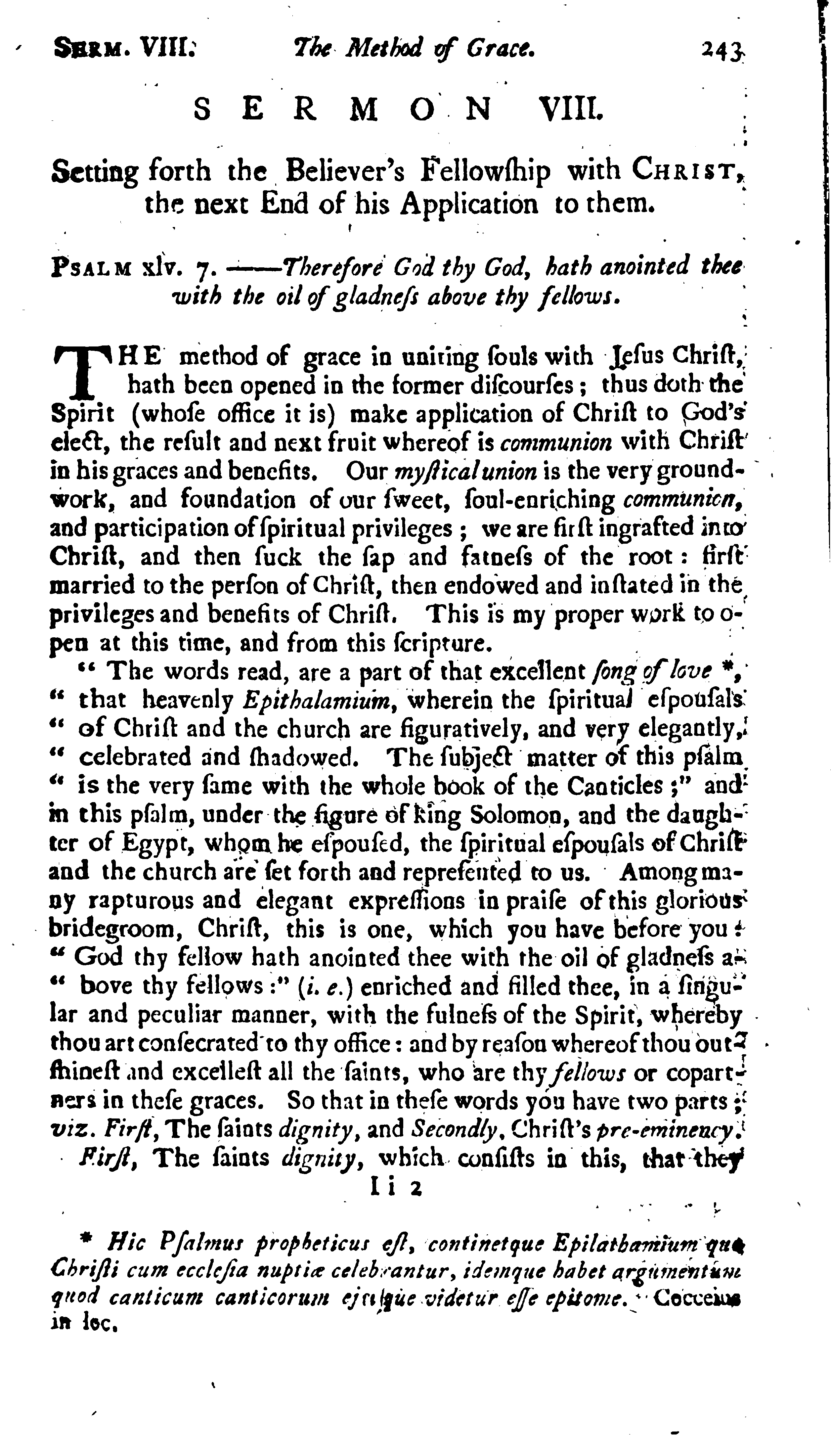
SERM. VIII.
The Method of Grace.
SERMON VIII.
Setting forth the Believer's Fellowship with CHRIST, the next End ofhis Application tothem.
PSALM XIV. 7.
Therefore God thy God, hath anointed thee with the oil ofgladness above thy fellows.
THE method of grace inuniting ſouls with Jefus Chriſt, hath been opened in the former diſcourſes ; thusdoth the Spirit (whoſe office it is) make application of Chrift to God's elect, the refult and next fruitwhereof is communion with Chrift inhis graces andbenefits.
Our mysticalunion is theverygroundwork, and foundation ofour ſweet, foul-enriching communion, andparticipationofſpiritual privileges ; we are firſt ingrafted into Chrift, and then fuck the ſap and fatneſs of the root : firſt married to the perſon ofChriſt, then endowed and inſtatedin the privileges and benefits ofChriſt.
This is my properworktoopen at this time, and from this ſcripture.
" The words read, are a part ofthat excellentfong oflove *, " that heavenly Epithalamium, wherein the ſpiritual eſpoufals
" of Chriſt and the church are figuratively, and very elegantly, " celebrated andſhadowed. The ſubject matter of this pfalm
" isthe very fame with the whole book ofthe Canticles ;" and in this pſalm, under the figure ofking Solomon, and the daughter ofEgypt, whom he eſpouſed, the ſpiritual eſpouſals ofChrift and the church are ſet forth and repreſented to us. Amongmany rapturous and elegant expreffions inpraise ofthis glorious bridegroom, Chriſt, this is one, which you have before you :
"God thy fellow hath anointedthee with the oil of gladneſs a- " bove thy fellows : " (i. e.) enriched and filled thee, inafingular and peculiar manner, with the fulness of the Spirit, whereby thouartconfecrated to thy office : andbyreaſonwhereofthou out ſmineſt and excelleft all the faints, who are thyfellows or copartners in theſe graces. Sothat in theſe words you have two parts; viz. First, The ſaints dignity, and Secondly, Chriſt's pre-eminency.
First, The faints dignity, which confifts in this, that they Ii 2 * Hic Pfalmus propheticus eft, continetque Epilathamium quo
Chrifti cum ecclefia nuptiæ celebrantur, idemque habet argumentum quod canticum canticorum ejuſque videtur effe epitome.
Cocceius inloc.
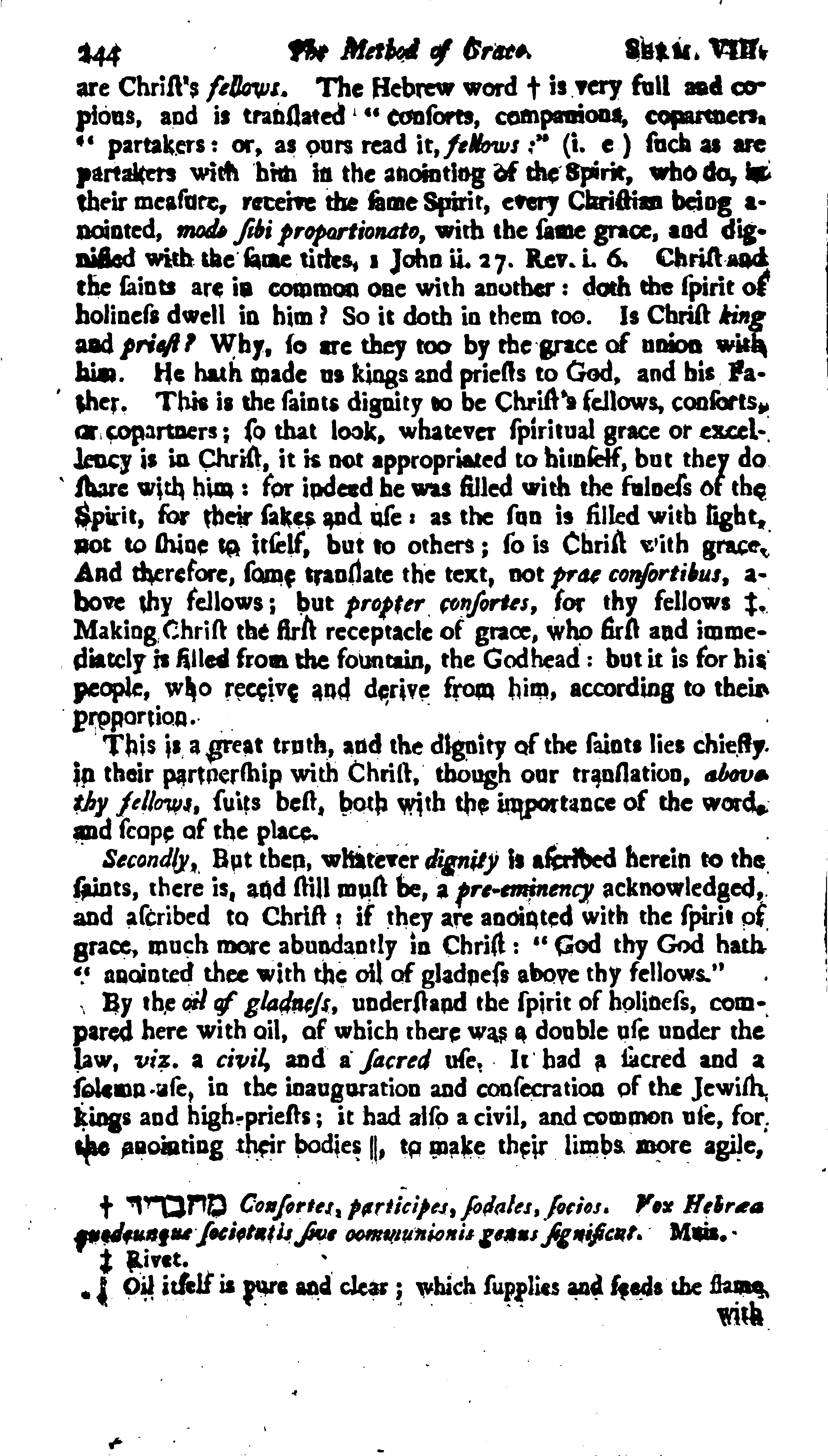
The Method ofGrace.
SERM. VIII.
are Chriſt's fellows.
The Hebrew word † is very full and copious, and is tranſlated " conforts, companions, copartners,
" partakers : or, as ours read it,felows :" (i. e ) ſuch as are partakers with him inthe anointing ofthe Spirit, whodo, in theirmeafure, receive the fameSpirit, every Chriſtian being anointed, modo fibi proportionato, with the ſamegrace, and dignified with the ſame titles, 1John ii. 27. Rev. i. 6.
Chriſtand the ſaints are in common onewith another : doth the ſpiritof holineſs dwell in him ? So it doth inthem too.
Is Chriſt king andpriest ? Why, ſo are they too bythe grace of union with him. He hathmade us kings and prieſts toGod, and his Father.
This is the faintsdignitytobe Chriſt's fellows, conforts, or copartners ; ſo that look, whatever ſpiritual grace or excellency is in Chriſt, it is not appropriated tohimself,but theydo ſhare with him: for indeedhewas filledwith the fulness ofthe
Spirit, for their ſakes and uſe: as the fun is filledwith light, not to ſhine to itſelf, but to others; ſo is Chriſt with grace.
Andtherefore, fome tranſlate the text, notprae confortibus, above thy fellows; but propter confortes, for thy fellows ‡.
MakingChriſt the firſt receptacle of grace, who firſt and immediately is filledfromthe fountain, theGodhead: but it is for his people, who receive and derive from him, according to their proportion.
This is agreat truth, andthedignity ofthe faints lies chiefly in their partnerſhip with Chriſt, though our tranſlation, above thyfellows, ſuits beſt, both with the importance of the word, andſcope oftheplace.
Secondly, But then, whateverdignity isaſcribedhereintothe ſaints, there is, and ſtillmuſt be, apre-eminency acknowledged, and aſcribed to Chrift: if they are anointed with the ſpiritof grace,muchmore abundantly in Chriſt: "God thyGod hath
"anointed thee with the oil ofgladness abovethy fellows."
By the oil ofgladness, understand the ſpirit ofholiness, comparedherewith oil, ofwhich there was adouble uſe under the law, viz. a civil, and afacred uſe, It had a facred and a folemn uſe, in the inauguration and confecration ofthe Jewish kings and high-prieſts; it had alſoacivil, andcommonuſe, for the anointing their bodies||, to make their limbs more agile,
+ וירבחמ Confortes,participes,fodales,focios. VoxHebraa quodcunquefocietatisfive communionisgenusfignificat. Muis.
‡ Rivet.
Oilitſelfispure pureandclear ; which ſupplies andfeedsthe flame, with
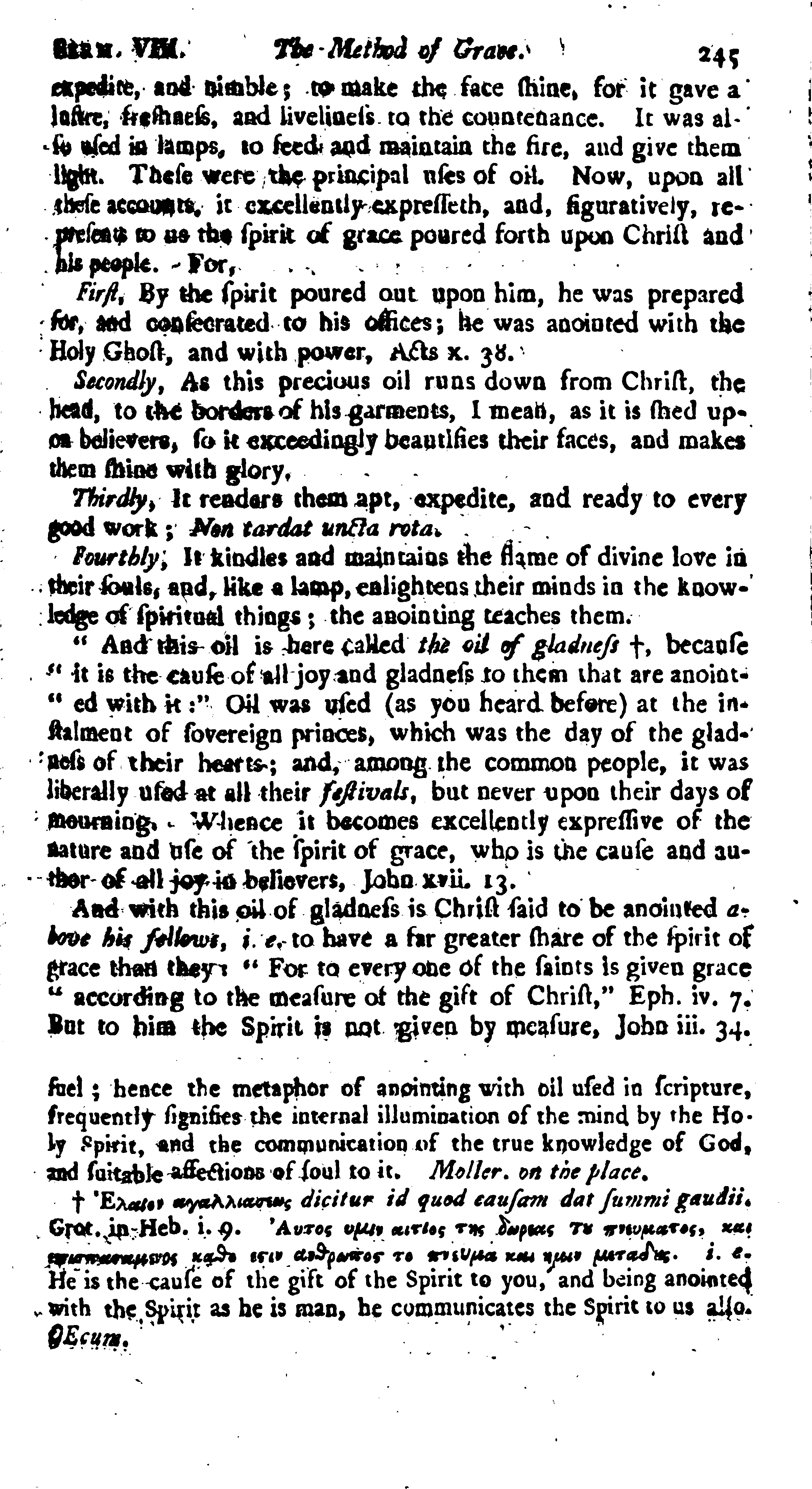
SERM. VIII.
The Method of Grace. expedite, and nimble; to make the face ſhine, for it gave a luftre, freſhneſs, and livelineſs to the countenance.
Itwas alſo uſed in lamps, to feed and maintain the fire, and give them light.
Theſe were the principal uſes of oil. Now, upon all theſe accounts, it excellently expreſſeth, and, figuratively, repreſentstousthe ſpirit ofgracepouredforthuponChrift and hispeople.
For, First, By the ſpirit poured out uponhim, he was prepared for, and confecrated to his offices; he was anointed with the HolyGhoſt, andwith power, Actsx. 38.
Secondly, As this precious oil runsdown from Chriſt, the head, to theborders ofhisgarments, I mean, as it is ſhedupi onbelievers, ſo itexceedinglybeautifies their faces, andmakes them shinewith glory.
Thirdly, It renders them apt, expedite, and readyto every good work ; Non tardat uncta rota.
Fourthly, It kindles and maintains the flame ofdivine love in their fouls, and, like alamp, enlightens their minds in the knowledgeof ſpiritual things; the anointing teaches them.
"And this oil is here called the oil of gladness †, becauſe "it is the cause ofalljoyand gladneſs to them that are anoint- " edwith it: " Oil was used (as you heard before) at the inſtalment of fovereign princes, whichwas the dayof the gladnefs of their hearts; and, among the common people, itwas liberallyufed at all their festivals, but never upon theirdays of mourning.
Whence itbecomes excellently expreſſive of the natureand use of the ſpirit of grace, who is the cauſe andauthor of alljoyin believers, John xvii. 13.
Andwith this oil of gladness is Chriſt ſaid to be anointed above his fellows, i. e, tohave a far greater ſhare of the fpiritof grace thanthey: " For to everyone ofthe faints isgivengrace according to the meaſure ofthe gift of Chrift," Eph. iv. 7.
But to him the Spirit is not given by meaſure, John iii. 34. fuel; hence the metaphor of anointingwith oilufed in ſcripture, frequently ſignifies the internal illumination ofthe mind by the Holy Spirit, and the communication of the trueknowledge of God, and ſuitable affections offoulto it.
Moller. on theplace.
†Ελαίον αγαλλιασεως dicitur id quod caufam datfummigaudii.
Grot. inHeb. i. 9.
᾿Αυτος υμιν αιτίος της δωρεας το πνευματος, και επισπασαμενος καθο εσιν ανθρωπος το πνεύμα και ημιν μεταδες. έ. ε.
Heisthe cause of the gift ofthe Spirit to you, andbeing anointed with the Spirit as he is man, he communicates the Spirittous allo.
Ecum.
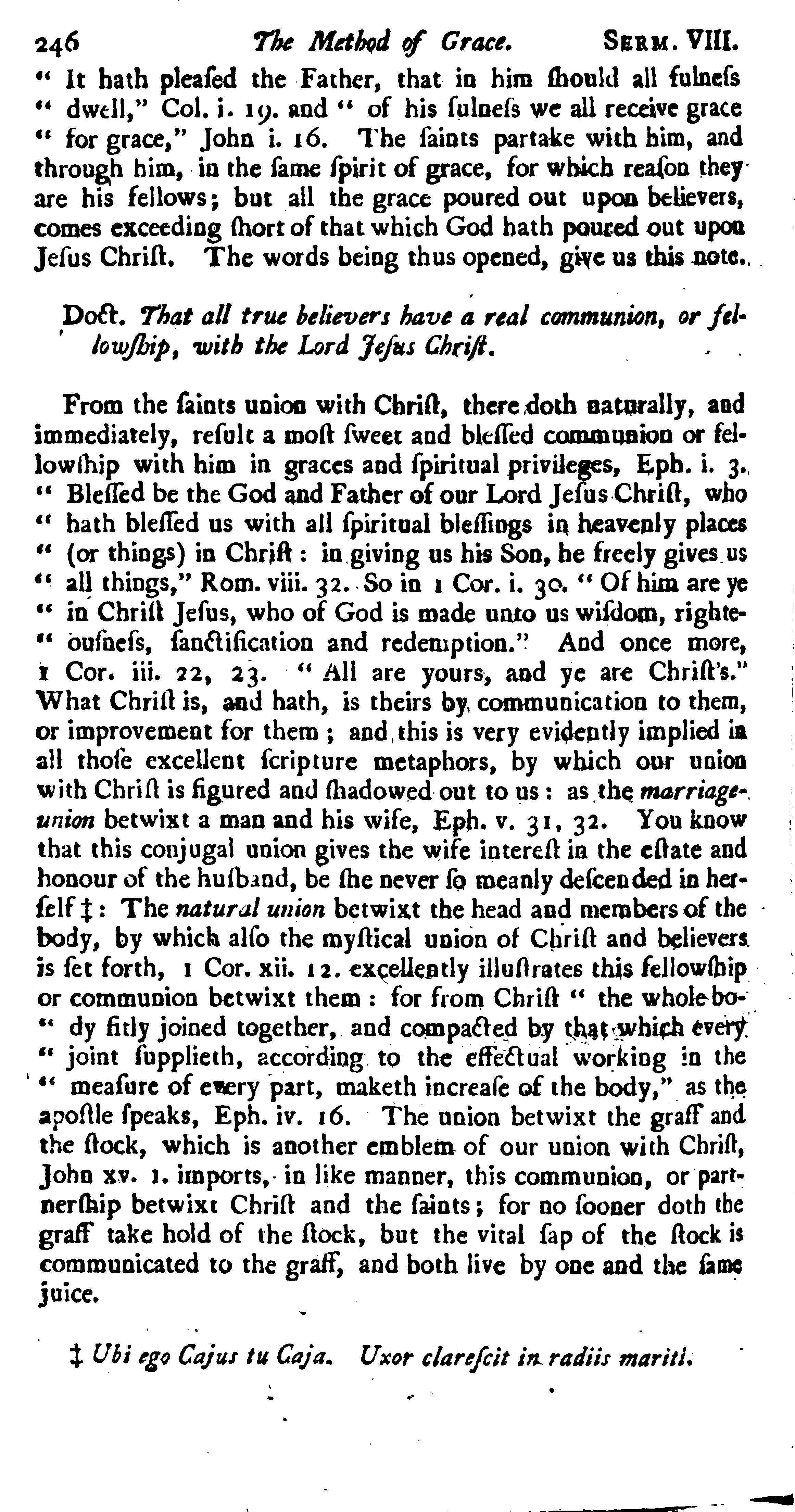
The Method of Grace.
SERM . VIII.
" It hath pleaſed the Father, that in him ſhould all fulneſs dwell," Col. i . 19. and " of his fulneſs we all receive grace
" for grace," John i. 16.
The faints partake with him, and through him, in the ſame ſpirit ofgrace, forwhich reaſonthey are his fellows; but all the grace poured out upon believers, comes exceeding ſhortofthatwhichGodhath pouredout upon Jeſus Chriſt.
The words being thus opened, give us this note...
Doct. That all true believers havea real communion, or fellowship, with the Lord Jesus Chrift.
From the faints unionwithChriſt, theredoth naturally, and immediately, reſult a moſt ſweet and bleſſed communion or fellowſhip with him in graces and ſpiritual privileges, Eph. i. 3.
" Bleſſedbe theGod and Father of our LordJesus Chriſt, who " hath bleſſed us with all ſpiritual bleſſings inheavenly places
(or things) in Chrift : in giving us his Son,he freely gives us " allthings," Rom. viii. 32. So in 1 Cor. i. 30. " Of him are ye
" in Chrift Jeſus, who ofGod is made unto uswisdom, righte- " ouſneſs, fanctification and redemption." And once more,
I Cor. iii. 22, 23. "All are yours, and ye are Chriſt's."
What Chriſt is, and hath, is theirs by communication tothem, or improvement for them ; and this is very evidently implied in all thoſe excellent ſcripture metaphors, by which our union with Chriſt is figured and ſhadowed out tous : as themarriageunion betwixt a man and his wife, Eph. v. 31, 32.
You know that this conjugal union gives the wife intereſt inthe eſtate and honourofthehusband,be ſhe never ſo meanlydeſcended in herſelf
: The natural union betwixt the head and members ofthe body, by which alſo the mystical union of Chrift and believers is fet forth, 1 Cor. xii. 12. excellently illuftrates this fellowſhip or communion betwixt them : for from Chriſt " the wholebo61 dy fitly joined together, and compacted by that which every
" joint ſupplieth, according to the effectual working in the " meaſure ofevery part, maketh increaſe ofthe body," as the apoſtle ſpeaks, Eph. iv. 16.
The union betwixt the graff and the ſtock, which is another emblem of our union with Chrift,
John xv. 1. imports, in like manner, this communion, or partnerſhip betwixt Chriſt and the faints; for no fooner doth the graff take hold of the ſtock, but the vital ſap of the ſtock is communicated to the graff, andboth live by one and the ſame juice.
†Ubi ego Cajus tu Gaja.
Uxor clarefcit in radiis mariti.
SERM. VIII.
The Method of Grace.
Now, that the ſcope of this diſcourſe be not miſtaken, let the readerknow that Iam not here treatingofthe faints communion, or fellowshipwithGod inhis duties, as in prayer, hearing, facraments, &c. but of that intereſt which believers have in the good things of Chriſt, by virtue of the mystical union betwixt themthrough faith: there is atwofoldcommunion ofthe faints withChrift.
The firſt is an act.
The ſecond is astate.
There is an actual fellowship, orcommunion the faints have with Chriſt in holy duties, wherein Chriſtians let forth their hearts to God by defires, andGod lets forth his comforts and refreshments again into their hearts ; they open their mouths wide, and he fills them: this communion withGod is thejoy and comfort of abeliever's life, but Iam not to ſpeak of that here.
It is not any act of communion, but the ſtate of communion, from which all acts of communion flow, and upon which they alldepend, thatI amnow to treat of; which is nothingelse but thejoint intereſt that Chriſt and the faints havein thefame things : as when a ſhip, an houſe, or eſtate, is among many partners, orjoints heirs, every one ofthemhath aright to it, and intereſt in it, though some of them have agreater, and others a leffer part.
So it is betwixt Chriſt and his people ; there is a κοινωνία, (i. e.) a fellowship or joint intereſt betwixt them, upon whichground they are called coheirs with Chrift,
Rom viii. 17.
This communion or participation in Chrift's benefits, depends upon the hypoftaticalunionofour nature, and themyſtical union of our perfons with the Son ofGod : in the firſt he partakes with us, in the ſecond we partake with him : the former is the remote, the latter the next cauſe thereof.
In the explication of this point, I ſhall ſpeak to theſe four things :
1. What are thoſe things inwhich Chriſt and believers have fellowship.
2. By what means theycome tohave fuch a fellowſhip with Chriſt.
3. Howgreat adignity this is to have fellowship with Jefus Chrift.
4. And then apply the whole in divers practical inferences.
First, What are thoſe things inwhich Chriſt and believers have fellowship, to which I muſt ſpeak both negatively andpofitively.
1. Negatively, The faints have no fellowship with Jeſus Chriſt in thoſe things thatbelong tohim as God; ſuch as his
The Method of Grace.
SERM. VIII,
conſubſtantiality, coequality, and coeternity with the Father :
It is theblafphemy of the wicked Familifts to talkofbeinggodded intoGod, and chriſted into Chriſt.
Neither men or angels partake in theſe things; they are the proper and incommunicableglory of the Lord Jeſus.
2. The faints have nocommunion or fellowship in the họ nour and glory of his mediatory works, viz. his fatisfaction ta
God, or redemption of the elect.
It is true, we have the benefit and fruit of his mediation and fatisfaction ; his righteousneſs alſo is imputed to us for our perſonaljuſtification, but we thare not in the least with Chriſt in thegloryof this work : nor have we an inherentrighteouſneſs in us as Chriſt hath ; norcan we juſtify and ſave others as Chriſt doth : we have nothing to do with his peculiar honour,and praise in theſe things.
Tho' wehave the benefit of being ſaved, we maynot pretend to the honour of being Saviours, as Chriſt is to ourſelves or others,
" || Chrift's righteouſneſs is not made ours as to its univerfal value,butas to our particular neceſſity; nor is itimputed to " us as to ſo manycauſes of ſalvation to others, but as to ſo many fubjects tobe savedby itourſelves."
Secondly, But then there are many glorious and excellent things, which are incommon betwixt Chriſt and believers, tho' inthem allhe hath the pre-eminence, he ſhines inthe fulness of them, as the fun, and wewith aborrowed and leſſer light, but ofthe famekind and nature as the ſtars.
Some of theſe I ſhall particularly, and briefly, unfold inthe following particulars.
First, Believers have communionwith Chriſt in his namesand titles; theyare called Chriftians from Chriſt, Eph. iii. 15. from himthe whole family in heaven and earth is named : this is that worthy name the apostle ſpeaks of, James ii. 7. He is the Son ofGod, and they alſo, by their union with him, have power or authority to become the SonsofGod,John i. 12. He isthe heirofall things, and theyare joint-beirs with him, Rom . viii.
17. He is both king and prieſt, and he hath made them kings and prieſts, Kev. i. 6.
But they denot only partake in the names and titles, but this communion conſiſts inthings aswell astitles.
And therefore, Secondly, They have communionwithhim inhis righteoufness, ( i. e.) the righteouſneſs ofChriſt is made theirs, 2 Cor. v.
21. andhe is " the Lord ourrighteouſneſs," Jer. xxiii. 6.
It Juftitia Chrifti fit noſtra, non quoad univerſalemvaloremfed particularem neceffitatem,et imputatur nobis nonut caufisfalva tionis, fed utfubjectisfalvandis. Bradshaw de juftificatione.
SERM. VIII.
The Method of Grace.
istrue, the righteousness ofChriſt is not inherent in us, as it is in him ; but it is ours by imputation,Rom. iv. 5, 11. and our unionwith him is the ground ofthe imputation of his righteouſneſs to us, 2 Cor. v. 21. " We are made the righteouſneſs
" ofGod in him," Phil. iii. 9. for Chrift and believers are confidered as one perfon, in conſtruction of law ; as aman and his wife, adebtor and furety, are one : and ſo his payment or fatisfaction is in our name, or uponour account.
Now, this is a moſt inestimable privilege, the very ground of all our other bleſſings and mercies .
O what a benefit is this to a poor finner, thatowes toGod infinite morethan he isever able topay, by doing or fuffering; tohaveſuch arich treaſure ofmerit as lies inthe obedience of Chriſt, to discharge, in one entire payment, allhis debts to the laſt farthing ? " Surelyſhall one ſay,
" in the Lord Ihave righteouſneſs," Iſa. xlv. 24. even as a poor womanthatowes more than ſhe isworth, inone moment is difchargedof all herobligations, byhermarriage toawealthyman.
Thirdly, Believers have communion with Chriſt in his holiness or ſanctification, for ofGod he is made unto them, not only righteouſneſs, but fanctification alſo; and as in the former privilegethey have a ſtock of merit in thebloodof Chriſt tojustify them, fohere they have the Spirit of Chriſt to ſanctify them,
1Cor. i. 30. and therefore we are ſaid of his fulneſs to receive " grace for grace,"John i. 16. (i. e.) ſayſome, graceupongrace, manifold graces, or abundance of grace; or grace for grace, that is, grace anſwerable to grace: as in the feal and wax, there is line for line, and cut for cut, exactly anſwerable to each other; or grace for grace, that is, ſayothers, the free grace of God in Chriſt, for the fanctification or filling of our fouls with grace; be it inwhich ſenſe it will, it ſhews the communion believers havewith Jeſus Chriſt in grace and holineſs. Now, holiness is the moſt precious thing in theworld, it is the image ofGod, and chiefexcellency ofman : it is our evidence forglory, yea, and the firſt-fruits of glory.
In Chriſtdwells the fulneſs ofgrace, and from him, our head, it is derived and communicatedto us: thus he that ſanctifieth, and they that are ſanctified, are all ofone, Heb. ii. 11.
You would think it no ſmall privilege to havebags of gold togo to, and enrich yourſelveswith, andyet that were but avery trifle in comparifon to have Chriſt's righteouſneſs and holineſs togo to foryour justification, and fanctification. More particularly,
Fourthly, Believers have communionwith Chriſt in his death: theydie with him, Gal. ii. 20. " I am crucified with Chrift,"
VOL. II.
The Method of Grace.
SERM . VIII.
(i. e.) thedeath ofChriſthath a real killingand mortifyinginfluence upon the lufts, and corruptions ofmyheart and nature : true it is, hedied for fin one way, andwe die to fin anotherway: he died to expiate it, we die to it, whenwe mortify it: the death ofChriſt is the death of ſin in believers : and this isa very glorious privilege ; for the death of ſin is the lite of your fouls: if fin do notdie in you by mortification, you must die for finby eternal damnation : ifChrift had not died, the Spirit ofGod, by whichyounow mortify thedeeds of thebody, could nothave beengivenuntoyou ; thenyou must have lived vaſſals toyour fins, anddied at laſt inyour fins; but the fruit, efficacy, and benefit of Chrift's death is your's for the killing thoſe fins in you, which elſe had been your ruin.
Fifthly, Believers have communion with Chriſt in his life, and refurrection from the dead: as he roſe from the dead, fo do they; andthat by the power and influence of his vivification and refurrection: it is the Spirit oflife which is in Chrift Jefus that makes us free from the law of ſin and death, Rom. viii. 2. our fpiritual life is from Chriſt, Eph . ii. 1. " Andyou hath he
" quicknedwho were dead in treſpaſſes and fins :" andhence Chrift is faidto live in the believer, Gal. ii. 20. "Now, I live,
66 yet not I; but Chriſt liveth in me:" andit is no fmall privilege to partake ofthe very life ofChriſt, which is the moſt ex. cellent life that ever any creature can live; yet ſuch is the happineſsofallthe faints, the life ofChrift is manifeſt inthem, and fuch a life as ſhall never fee death .
Sixthly, To conclude, believers have fellowship with Jeſus Chrift in his glory, which they ſhallenjoy in heaven with him : they " ſhallbe ever with the Lord," I Thef. iv. 17. and thatis not all, (though, as one faith, it were a kind of heaven but to look through the key-hole, and have but aglimpse of Chrift's bleſſed face) but they ſhall partake of the glory which the Father hath givenhim; for ſo he ſpeaks, John xvii. 22, 24. and more particularly, they ſhall fit withhim in his throne,Rev.iii.
21. andwhen he comes tojudge the world, he will come tobe glorified in the faints, 2Thef. i. 10.
So that you fee what gloriousandinestimablethings are, andwillbe in common betwixt
Chriſt and thefaints. His titles, his righteouſneſs, his holiness, his death, his life, his glory.
I do not saythat Chriſt will make any faint equal with him in glory; that is impoſſible, he willbe knownfrom allthe faints inheaven, as the fun is diftin guished from the ftars ; but they ſhall partake of his glory, and be filledwithhisjoy there; and thusyou fee what thoſethings are thatthe faints have fellowship with Chrift in.
SERM. VIII.
The Method ofGrace.
Secondly, Next Iwould open theway andmeans by which we come to have fellowship with Jeſus Chrift, in theſe excellent privileges ; and this I ſhalldo, briefly, in the following poſitions.
Pofition 1 .
Firſt, Noman hath fellowship with Chriſt in anyspecialfavingprivilege by nature, howsoever it be cultivatedor improved; but only by faith uniting him to the Lord Jesus Chrift : It is not theprivilege ofourfirst, butfecondbirth,
* This is plain from John i. 12, 13. " But to as manyas received him, tothemgave
" he power to become the fons ofGod, even to as many as be- " lievedon his name, who are born not of fleſh, nor ofblood, nor of the will of man, but of God."
We are by nature children ofwrath, Eph. ii. 3. we have fellowship with Satan in fin and mifery : the wild branch hath no communication ofthe fweetneſs and fatneſs of amore noble and excellent root, until it be ingrafted upon it, andhave immediate union andcoalition with it, John xv. 1 , 2 .
Pofition 2 .
Believers themselves have not an equalſhare, one with another, in allthe benefits and privileges of their union with Christ, but infomethere isan equality, and in others an inequality ; according to themeasure andgift of Christ, to every one.
In juftification they are allequal: the weak and the ſtrong believer are alike juſtified, becauſe it isone andthe fame per-. fect righteouſneſs of Chriſt, which is applied to the one and to theother, ſothat there are no different degrees ofjuftification, but all that believe are justified from all things, Acts xiii. 39. and " there is no condemnation to them that are in Chriſt Je- " fus," Rom. viii. 1. be they never ſoweak in faith, or defective indegrees ofgrace. But there is apparent difference in the meaſures of their ſanctification, ſome are ſtrong men, and others
are babes in Chriſt, 1 Cor. iii. 1. The faith offome flourishes andgrows exceedingly, 2 Theſ. i. 3. the things thatare in others are ready to die, Rev. iii. 2.
It is a plain cafe, that there is great variety found in the degrees ofgrace, and comfort among them that are jointly intereſted in Chriſt, and equally juſtified by him .
Kk 2 * The truly faithful onlyare members ofChriſt, not as they are men,but as they are Chriſtians ; notby their firft,but fecondbirth.
Polan. Syntag, book 6. chap. 35 .
SERM. VIII.
The Method ofGrace.
Pofition 3 .
Thefaints havenot fellowship and communionwith Chrift, in thefore mentionedbenefits andprivileges by oneand thesame medium, but by various mediums andways, according tothenature of the benefits, inwhich they participate.
For instance, they have partnerſhip and communion with Chriſt, as hath been ſaid, in his righteouſneſs, holineſs, and glory, but they receive theſe diſtinct bleſſings bydivers mediums of communion : we have communion with Chrift in his righteouſneſs, by the way of imputation; we partake of his holineſs, by the way of infuſion ; and of his glory in heaven, by thebeatifical viſion. Our juſtification is a relative change, our ſanctification a real change, our glorification a perfect change, by redemption, from allthe remainsboth of ſin and mifery.
Thus hath the Lord appointed ſeveralbleſſings for believers in Chriſt, and ſeveral channels of conveying them from himto us; by imputed righteouſneſs, we are freed from the guilt of ſin; by imparted holineſs, we are freed from thedominionof fin, and by our glorification with Chriſt, we are freed from all the relics and remains both ofſin andmiſery, let in by ſin upon our natures.
Position 4.
That Jefus Christ imparts to allbelievers, all theſpiritual bleffings that he isfilledwith,andwithholds nonefrom any thathave unionwith him; be theſebleffings neversogreat, ortheythatre ceive them neverso weak, mean, andcontemptible in outward respects, Gal. iii. 27. " Ye are all the children ofGod by faith
" inJeſus Chriſt"
The ſalvationthat comes byChriſt is ſtiled thecommonfalvation, Jude 3.and heaven the inheritance of the faints in light, Col. i. 12. " There is neither Greek nor Jew,
(faith the apostle) circumcifion nor uncircumſion, Barbarian, Scythian, bond or free, but Chriſt is all and in all," Col. iii. 11. He means, there isnoprivilege in theone tocommend them to God, and no want of any thing in the other to debar them from God; let men have or want outward excellencies, as beauty, honour, riches, nobility, gifts of the mind,
" ſweetneſs of nature, and all fuch like ornaments, what is that to God ? He looks not at theſe things, but reſpects them, and communicates his favour tothem as they are in Chrift : Heis all, and in all.
The gifts and bleſſings ofthe Spirit aregiven tomen as they are in Chriſt, and without reſpect to any exter nal differences made in this world amongmen: hencewe find excellenttreaſures ofgrace in meanandcontemptible perfons in
SERM. VIII.
The Method of Grace. the world; poor in the world, and rich in faith, and heirs of thekingdom; and as all believers, without difference, receive from Chriſt, ſo they are not debarred from any bleſſing that is in Chriſt: " All is yours, for ye are Chriſt's,"
1 Cor. iii . ult.; with Chrift, God " freelygives us all things," Rom. viii. 32.
Position 5.
The communion believers havewith Chrift, infpiritual benefits, isaverygreat mystery, far above the understanding of natural men. There are no footſteps ofthis thing in allthe works of creation, therefore the apostle calls it " The unſearchable riches
" of Chriſt," Eph. iii. 8. ανεξιχνιασον πλετον τεΧρι58: The word fignifies, that which hath no footſteps totrace it by: yea, itis
-ſo deep a mystery, that the angels themselves ſtoopdown to look into it, I Pet. i. 12. " Eye hath not feen, nor ear heard,
" neitherhave it entered into theheartofman the thingswhich "Godhath prepared for them that love him: but God hath
"revealed them unto us by his Spirit,"
I Cor. ii. 9, 10.
Thirdly, and lastly, I ſhall, in a few particulars, open the dignityand excellency of this fruit of our union with Chriſt, and ſhew you, that a greaterglory and honour cannot be put upon man, than to be thus in fellowship with Jeſus Chriſt,
John xvii . 22. " The glory which thou gaveſt me, I havegiv- " en them, that they maybe one, as we are one:" And therefore, more particularly, letitbe confidered,
First, With whom we are aſſociated; even the Son ofGod; withhim that is over all, God bleſſedfor ever. Our afſſociation with angels is anhigh advancement, for angels and ſaints are fellow-fervants in the ſame family, Rev. xix. 10. and through Chriſt we are come to an innumerable companyof angels, Heb . xii . 22. But what is all this to our fellewſhip with Jeſus Chriſt himſelf, and that in another manner than angels have ? For though Chriſt be to them anhead ofdominion, yet not an head of vital influences, as he is to his myſtical bodythe church : this therefore is to them a great mystery, which they greatly affect to ſtudy and pry into.
Secondly, What we are that are dignified with this title, the fellowsor co-partners with Jeſus Chrift : Not only duſt bynature, (Dust thou art), but finful duſt; ſuch wretched ſinners, as, bynature, and the ſentence ofthe law, ought to be aſſociatedwith devils, and partakers with them of the wrath of the almighty God to all eternity.
Thirdly, The benefits we are partakers of, in and with the Lord Jesus Chrift; and, indeed, they are wonderful and aftoniſhingthings, fo far as they do already appear, but yetwe fee
The Method of Grace.
SERM . VIII.
but littleofthem, comparatively, towhatwe shall fee, 1 John Hì. 1, 2. " Now are we the fons of God, and it doth not yet 64 appear what we shall be, but we know that when he ſhall
" appear, we shall be like him, for we shall ſee him as he is."
Owhatwill thatbe! tosee him as he is, and tobe transformed into his likenels.
Fourthly, The way and manner inwhich we are brought into this fellowship with Chrift : which is yet more admirable.
The apoſtle gives us a ſtrange accountof it in 2 Cor. viii. 9.
" For you know the grace of our Lord Jesus Chrift, that ** though hewas rich, yet for your fakeshe became poor, that ye through his poverty might be rich;" he empties himſelf ofhis glory, thatwe might be filled; he is made a curſe, that we might enjoy the bleffing; he ſubmits to be crowned with thorns, thatwe might be crowned with glory and honour; he puts himselfintothenumber of worms, Plal. xxii. 6., that we might be made equal to the angels. O the unconceivablegrace ofChrift!
Fifthly, The reciprocal nature of that communion which is betwixt Chriſt and believers : We do not only partake ofwhat is his, but he partakes ofwhat is ours : he hath fellowship with us in all ourwants, ſorrows, miſeries, and afflictions ; and we have communion with him inhis righteousness, grace, fonſhip and glory : he takes part of our misery, and we take part of his bleſſedneſs; our fufferings are his fufferings, Col. i. 24. O what anhonour is it to thee, poor wretch, towhom a great many would not turn aſide to ask how thou doft ; to have a King, yea, the Prince of all the kings ofthe earth, to pity, relieve, ſympathize, groan and bleed with thee, to fit by thee in all thy troubles, and give thee his cordials, to ſay thy troubles are my troubles, and thy afflictions are my afflictions : whatever toucheth thee, toucheth me alfo.
O what name ſhallwe giveunto ſuchgrace as this is?
Sixthly, and lastly, Confider the perpetuity ofthis privilege:
Your fellowshipwith Chriſt isinterminable, and abides for ever.
Chriſt and the ſaints ſhall beglorified together, Rom. viii. 17. while he hath anyglory they ſhall partakewith him.
It is faid indeed, 1 Cor. xv. 24. that there ſhall be a time when Chrift willdeliverup the kingdom to his Father; but the meaning is notthat ever he willcease to be an Head tohis faints, or they from being his members: No, no, the relation never ceafes; juftification, ſanctification, and adoption, are everlasting things, andwe can never be diveſted of them .
Infer. 1. Are the faint's Chrift's fellows ? What honourable
SERM. VIII.
The Method of Grace. perfons thenarethey ! andhowshould they be esteemedandvalued in the world ! If a king, who is the fountain ofhonour, dobut raiſe aman by his favour, and dignify himby beſtowingſome honourable titleuponhim,what reſpect and obſervance is pre ſently paid him by all perfons ? But what are all the vain and emptytitles ofhonour, tothe glorious and ſubſtantial privileges with which believers aredignified, andraiſed above all other men by Jeſus Chriſt ? He is the Son ofGod, and theyare the fon's ofGod alſo : he is the heir of allthings, andthey arejoint-heirs with Chrift: he reigns inglory, and they ſhallreignwith him : he fits uponthethrone, andthey ſhall fit withhim inhis throne.
Othat this vile worlddid but know the dignity of believers, theywould never flight, hate, abuſe, and perfecute them as they do.
AndO that believers did but underſtand their own happineſs, and privileges by Chriſt, theywould neverdroop, and fink under every ſmall trouble at that ratetheydo.
Infer. 2. How abundantly hathGodprovidedfor all the ne ceffities andwants of believers ! Chriſt isa ſtorehouſe filledwith bleſſings and mercies, and it is all for them from him they " receive abundance ofgrace, and ofthe gift ofrighteouſneſs,"
Rom. v. 17. " Ofhis fulness they all receive grace for grace,"
John i. 16. All the fulness of Chriſt is made over to them for the fupply of their wants: " MyGod ſhall ſupply all your need
" (faith the apostle), according to his riches in glory by Jefus " Chrift," Phil. iv. 19.
Ifall the richesofGod can fupplyyour needs, thenthey ſhallbe ſupplied.
Say not, Chrift is in the poffeffion of confummate glory, and I am a poor creature, ftruggling with many difficulties, and toiling in the midst of manycares and fears in the world ; for care is taken for all thy wants, and orders given from heaven for their ſupply : MyGod
Shallfupply allyour need. O ſaywith a melting heart, I have afull Chriſt, andhe is filled for me: I have his pure and perfect righteouſneſs to justify me, his holiness toſanctify me, his wisdom toguideme, his comforts to refreſh me,his power to protect me, andhis all-fufficiency tofupply me. Obechearful, bethankful, you have all yourhearts can with; andyetbehumble; itisallfromfree-grace toempty and unworthycreatures.
Infer. 3. How abfurd, diſingenuous, and unworthy of a ChriStian, is it todeny, or withholdfrom Chriſt any thinghehath, or bywhich hemay beferved, or honoured? Doth Chrift commu, nicateall he hath toyou, and can you withholdany thing from Chrift ? On Chriſt's part it is not mine, and thine, but ours, or mine and yours ; John xx. 17. " I aſcend to my Father, and " yourFather; to myGod, andyour God."
But this cur
The Method ofGrace.
SERM.VIII.
fed idolfelf! which appropriates all to its own deſigns anduſes How liberal is Chriſt ! and how penurious arewe tohim ! Some will not part with their credit for Chriſt, when yet Chriſt abafed himself unspeakably for them. Some will not partwith a drop ofblood for Chriſt, when Chriſt ſpentthe whole treafure ofhisblood freely for us; yea, how loth are we to part with a shilling for Chriſt, to relieve him in his diſtreſſed members, when as yet we know the grace of our Lord Jesus Chriſt,
" that though he was rich, yet for our fakes he became poor, " that we through his poverty might be rich !" O ungrateful return ! O baſe and diſingenuous ſpirits ! The things Chriſt gives us are great, andthe things we denytohim are ſmall : he parts with the greatest, and yet is denied the leaſt.
The things hecommunicates to us, are none of ours, we have no right nor titleby nature, or any defert ofours to them ; the thingswedeny or grudge to Chriſt, are by all titles his own, andhe hath the fullest and moſt unquestionable title to them all: what hegives to us, he gives to them that never deſerved it; what we withhold from him, we withhold from one that hath deſerved that, and infinitely more from us, thanwe have, or are.
He intereſted you freely in all his riches when you were ene mies ; you ſtand upon trifles with him, and yet call him your beſt and dearest friend: he gave himself, and alt hehath toyou, when you could claim nothing from him; you deny to part with theſe things to Chriſt, who may not onlyclaim themupon thehighest title, hisown ſovereignty,and abſolute property, but by your own act, who profeſs tohave given all in covenant to him : what he gives you, returns no profit to him ; but what yougive or part with for him, is your greateſt advantage. O thatthe confideration oftheſe things might shame and humble yourfouls.
Infer. 4. Then certainly noman is, orcanbefupposed to be a loferby converfion, feeingfrom that day, whatever Chrift is, or hath, becomes his.
Owhat an inheritance are men poſſeſſed ofbytheir new birth ! Some men cryout, Religion will undoyou; but with what eyes do theſe men fee ? Surely, you could never fo reckon, except your fouls were fo incarnated, as to reckon pardon, peace, adoption, holiness, and heaven, for nothing ; that inviſibles are non-entities, andtemporals the only realities.
It is true, theconverted foul may loſe his eſtate, his liberty, yea, his life for Chriſt; but what then ? Are they loſers that exchange braſs for gold? or part with their prefentcomforts for
SERM. VIII.
The Method of Grace.
anhundred-fold advantage ? Markx. 29.
So that none need be frightned at religion, for the loffes that attend it, whilſt
Chrift and heaven are gained by it : they that count religion their lofs, have their portion inthis life.
Infer. 5. How fecurely is the faints inheritance fettled upon them, feeing they are in common with Jesus Christ ? Chriſt and hisſaints are joint-heirs, and the inheritance cannot be alienated,butbyhis conſent; he must loſe his intereſt, if you loſe yours.
Indeed, Adam's inheritance was by a ſingle title, and moreover, itwas in his own hand, and ſo he might, (as indeed he foon did) diveſt himself and his poſterity ofit; but it is not fo betwixt Chriſt and believers, we are ſecured in our inheritance by Chriſt our co-heir, who will never alienate it: and therefore it was truly obſerved by the father, Foelicior Job inſterquilinio, quam Adamus in paradiso : Job was happier upon the dunghill, thanAdamwas in paradiſe.
The covenant ofgrace is certainly thebeſt tenure ; as ithath the beſt mercies, ſo itgives the fulleft ſecurity to enjoy them.
Infer. 6. How rich andfull is Jesus Chriſt, who communicates abundantly to all thefaints, andyet hath infinitelystill more in himself, than hath ever been received by them all.
Take all the faith ofAbraham, all the meekness ofMofes, all the patience of Job, all the wisdom ofSolomon, all the zeal of David, allthe induſtry ofPaul, and allthe tender-heartedneſs of Joſiah; add to this, all the grace that ispoured, (tho' in leſſer meaſure), into all the elect veſſels in the world, yet ſtill it is far ſhortofthatwhich remains in Chriſt ; " He is anointed with the " oil ofgladneſs above his fellows :" And in allthings hehath, andmuſt ever have the pre-eminence. There are many thousand ftars glittering above your heads, and one ſtar differs from another ſtar in glory, yet there is more light and glory in one fun, than in the many thouſand ſtars. Grace beautifies the children ofmen exceedingly, but ſtill that is true of Chriſt, Pfal. xlv. 2.
" Thou art fairer than the childrenofmen, grace is poured into " thy lips." For allgrace is ſecondarily, and derivatively in the faints, but it is primitively and originally in Chriſt, Johnv. 16.
Grace is imperfect and defective inthem, butin him it is in its moſt abſolute perfection and fulneſs, Col. i. 19.
In the faints it is mixedwith abundance ofcorruption,but in Chriſt it is altogether unmixed, and excluſive of its oppoſite, Heb. vii. 26.
So that as the Heathen faid of moral virtue, I may much more ſay of Chrift, Thatwere he tobe ſeenwith mortaleyes, hewould compel love and admiration from all men, for " he is altogether
" lovely," Cant. v. 16.
VOL. II.
The Method of Grace.
SERM. VIII.
Infer. 7. What delight, andfingularadvantage must needs be in the communion of thefaints,whohave communionwith Jesus Chrift in all his graces andbenefits.
" That which we have ſeen and heard, declare we unto you, *" that ye alſo may have fellowship with us: And trulyour fel- " lowſhip is with the Father, and with his Son Jefus Chrift,"
1 John i. 3. O it is ſweet to have fellowship with thoſe that have tellowſhip withGodin Jefus Chriſt.
Chriſt hath communicated to the faints, varieties ofgraces, in different meaſures and degrees ; and as they all receive from Chrift the fountain,
Yo it is ſweet and moſtdelightful to be improving themselves by ſpiritual communion onewith another : Yea, for that end one is furnished with one grace more eminently than another, that the weak may be affitted by the ſtrong, as a modern divine * well obſerves.
Athanafius was prudent, and active, Bafil of an heavenly, ſweet temper, Chryfoftome laborious, without affectation, Ambroſe reſolved, and grave, Luther couragious, and Calvin acute, and judicious.
Thus every one hath his proper gift from Chriſt, the fountain ofgifts andgraces, 1 Cor.
م vii. 7. One hath quickness of parts, another folidity of judg. ment, but not ready and preſential ; one is zealous, but ungrounded; anotherwell principled, buttimerous ; one iswary, and prudent ; another openand plain; one is trembling, and melting; another chearful and joyous ; one must impart his light, another his heat: The eye, the knowing man, cannot
Tay to the hand, the active man, I have no need ofthee. And Ohow sweet would it be, if gifts, graces, and experiences were frequently, and humbly imparted ! But idle notions, earthIv-mindedness, ſelf-intereſts, andwantof more communion with Chriſt, have, almoſt, deſtroyed the comfort of Chriftian fel.
Jowſhip every where in the world.
Infer. 8. In a word, thoſe onlyhave groundto claim intereft in Chrift, who do really participate of his graces, and in whom are found the effects and fruits of their union and communion with him.
If you have intereſt inChriſt, you have communion in his graces and benefits ; and if you have fuch communion, itwill appear in your maintaining daily actual communion with God in duties; whereby will be produced, First, The increaſe ofyour fanctification, by freſh participa. tions from the fountain ; as cloth which is oftendipt into the fat receives thedeeperdye, and livelier tincture; fo will your
* Mr. Torſnel.
SERM . IX.
The Method of Grace.
fouls-by affiduous communion with God.
It will alſo be dif cerned, Secondly, In your deeper humiliation, and ſpiritual ſenſe of your own vileneſs : The more anyman partakes ofGod, and is acquainted with him, and aſſimilated tohim, the more baſe and vile inhis own fight he ſtill grows, Job xlii. 5, 6. Hạ. vi. 5.
Thirdly, It will appear in your more vehement longings after the full enjoymentofGod in heaven, 1 Pet. i. 8. and Rom. viii.
23. You that have the firſt fruits, will groan within yourſelves after the full harvest, and fatisfying fruition ; you will not be ſotaken with things below, as to be content with the beſt lot on earth for your everlasting portion. O ! if theſe communi cateddrops be ſo ſweet, what is there in Chriſt the fountain ?
And thus I have opened the method of grace inbringing home Chriſt and his benefits to God's elect by union, in order tocommunion with him.
Thanks be to Godfor Jesus Christ.
SERMON IX.
Containing the firſt generalUse ofExhortation, inviting allMen to apply JESUS CHRIST .
MATTH . xi. 28. Come unto me, allye that labour, and are heavy laden, and I willgive you reft .
THE impetration of ourredemptionby Jeſus Chrift, be ing finiſhedin the firſt part, and the way and meansby whichChrift is applied to finners in the foregoing part ofthis
A treatise; I am now orderly come to the general use of the whole ; which in the firſt place ſhallbe by way of exhortation, to invite and perfuade all men to come to Chrift ; who in all the former fermons, hath been repreſented in his garments of falvation, red in his apparel, prepared andofferedto finners as their all-fufficient and only remedy: And in the following fermonswill be repreſented in his perfumed garments coming out ofhis ivorypalaces, Pfalm xlv. 8. to allure and draw all men untohim.
For ageneral headto this uſe, which will be large, I have choſenthis fcripture, " Come unto me all ye that labour, and " areheavy laden, and I willgive you reſt."
L12
SERM . IX.
The Method of Grace.
Theſe words are the voice of our LordJesus Chriſt himself, inwhich there is a vital, raviſhing found: Itis your mercy to have ſuch ajoyful found inyour earsthis day. And inthem I will confider their dependance, parts, andscope.
Asto theirdependance, it is manifeſttheyhave an immediate relation to the foregoing verſe, wherein Chriſt opens his commiffion, and declares the fulness of this authority and ſaving power, and the impoſſibility ofcoming to God any other way.
" All things are delivered to me of my Father, andno man " knoweth the Sonbut the Father : Neither knoweth any man
" the Father fave the Son, and he to whomsoever the Sonwill.
" reveal him," ver. 27.
This 28th verſe is broughtin prolepticallytoobviate the dif couragements of any poor, convinced, andhumbled foul, who might thus object : Lord, I am fully fatisfied of the fulness of thy ſaving power, but greatly doubt whether ever I ſhall have the benefit thereof; for I fee ſo much ſin and guilt in myſelf, ſo great vileneſs andutter unworthiness, that I am overweighed, and even fink under the burden of it: My foul isdiſcouraged becauſe of fin.
This objection is prevented in the words of my text, " Come unto me all ye that labour, and are heavy laden," q. d. Let not the ſenſe ofyour ſin andmiſerydrive you fromyour only remedy : Be your fins never ſo many, andthe ſenſe and burden of them never ſo heavy, yet, for all that,
Comeunto me : You are the perſons whom I invite and call.
I came not to call therighteous, but finners to repentance.
In the words, three things are eſpecially remarkable.
1. The foul's ſpiritual diſtreſs andburthen : Weary and heavyladen.
2. Its invitation to Chriſt under that burthen : Come untome.
3. Its encouragementto thatgreat duty : Iwillgiveyou reft.
First, The foul's ſpiritual diſtreſs and burthen, expreffed in "Ye twoveryemphatical words *, οι κοπιωντες και πεφορτισμενοι.
" that labour andare heavy laden."
The word whichwe tran- * Οι κοπιωντες, i. e. They who labour even to fainting andtiring, for this Greek word το κοπιαν differs by this emphaſis from the word πονειν, which ſignifies only in generalto labour.
Piscator on theplace, explains itthus, Yewho feelthe burden of your fins, and yet do not fink under the weight thereof.
Chryfoftome expounds it ofthoſe whoareburdenedwith the legal ritesand ceremonies; butwe understand itin general,ofall those who being preffed withthe burdenoftheir fins, and the ſenſe ofthe malignity oftheir corrupt natures. do ſtrive with all their might to throw offthis de pravity, andtoobtain righteouſneſs.
Musculus on theplace.
SERM. IX.
The Method of Grace.
flate labour, ſignifies alabouring even to faintneſs and tiring, totheconſumption andwaste of the ſpirits; and the otherword fignifies fuch a preſſure by a burthen that is too heavy to be borne, that we do even fink down under it.
There is ſomedifference among expoſitors about the quality ofthis burthen.
Chryfoftome, and ſome others after him, expound itoftheburthen ofthe legal rites and ceremonies, which was aheavy burthen indeed, ſuch as neither they, nor their fathers, could bear.
Under the taſk and burthen of theſe legal obſervances, theydid ſweat and toil to obtain a righteouſneſs to juſtify them before God, and all in vain; and this is a pious ſenſe: But others expound it of the burthen of fin in general; the corruptionofnature, and evils of practice, which fouls are convincedhavebrought them under the curſe, and will bring them tohell, and therefore labour, and ſtrive, all that inthem lies, by repentance, and reformation, to clear themselves from it: but all invain, whilst they ſtrive in their own ſtrength.
Such are they that are here called to come to Chrift, which is the ſecond thing ; namely, Secondly, The invitation of burthened fouls to Chriſt :
" Comeunto me all ye that labour, and are heavy laden : Come " unto me," i. e. believe in me, lean and reſt your burthened foulsupon me.
I am able to eaſe all your burthens; in me is thatrighteouſneſs and peace whichyou ſeek invain in allthe legal ritesandceremonies ; or inyour repentance, reformations, and duties; butitwill giveyou no eaſe, itwill be nobenefit to
you except you come unto me.
Faith is often expreſſed under this notion, ſee John vi. 37. and John vii. 37. and it is to be further noted, that [all] burthened fouls are invited tocome,
"Allye that labour."
Whateveryour fin or guilthave been, whatever your fears or diſcouragements are, yet come, (i. e.)believe in me.
Thirdly, Here is the encouragement Chriſtgives to thisduty, And Iwill give you reft : αναπαυσω υμας .
* I will refreſh you, I willgive you reſt from your labour, your confciences ſhall be pacified, your heart atreſt andquiet inthatpardon, peace, and favour of God, which I will procure for you by my death.
Buthere it must be heedfully noted, that this promife of reſt inChriſt is not made to men ſimply, as they are ſinners, nor yet as they are burthened, and heavyladen ſinners, but as they come to Chrift ; i. e. as they are believers.
For let a man break * Why doſt thou ſeek that where thou canſt not find it ? I am heonlythat canhelp thee. Muf. on theplace.
The Method of Grace.
SERM. IX.
his heart for fin, lethim weep out his eyes, let him mourn as adove, and ſhed as many tears for fin (if it were poſſible) as ever there fell drops of rain upon the ground, yet if he come not to Chriſtby faith, his repentance ſhallnot ſave him, norall his forrows bring him to true reſt.
Hence note, Doct. 1. That somefouls are heavy laden withthe burthenfomesense offin.
Doct. 2. That allburthened fouls arefolemnly invited to come toChrift.
Doct. 3. That there is rest in Christfor allthat come tohimun derthe heavyburthen offin.
Doct. 1. Somefouls areheavy ladenwith the burthenſomefenfe offir .
Doct. 1. Ido not ſay all are ſo, for " fools make a mock at " fin," Prov. xiv. 9.
Itis ſo far from being burthenſome to ſome, that it is aſport to them, Prov. x. 23.
But when a man's eyes are opened to see the evil that is in fin, and the eternal miſery that follows it, (fin and hell being linked together with fuch ſtrong chains as nothing but theblood ofChrift can
Jooſe) then no burden is like that of fin: " A wounded con- " ſcience who can bear ?" Prov. xviii. 14.
For let us but confider the efficacy that the law ofGod hath upon the confciences ofmen, when itcomes inthe ſpiritualityand power of it, toconvinceandhumble the foulofa finner.
For then, First, The memory offin, longsince committed, What inward is refreshed and revived, as if it had been but troubles for yesterday : There are freſh recognitions of fin finare. long fince acted and forgotten, as if theyhad never been : What was done in our youth is fetchedback again,andby a new impreſſion of fear, and horror, ſethomeuponthetremblingconfcience.
Job xiii. 26. " Thou " writeft bitter things against me, and makeſt me topoffefs the " ſins of myyouth."
Conſcience cancall backthe days that are paſt, anddraw up a new charge upon the ſcore ofold fins,
Gen. xlii. 21.
Allthat ever wedid is recorded, and entered intothebookofconfcience,andnow is the time toopen thatbook, whenthe Lordwill convince, and awaken ſinners.
We read in Job xiv. 17. of fealingup iniquities in abag, which isan allufion tothe Clerk ofthe offizes, that takes allthe indictments that aremade againſt perſons at the affizes, and feals them up in a bag, inorder to a trial.
This is the firſt office andwork of confcience; upon which
SERM . IX.
The Method of Grace.
Thefecond, namely, its accusations, dodepend. Theſe accuſationsofconfcience are terrible things ; who can ſtandbefore them? They are full, they are clear, and all of them referring to the approachingjudgment of the great and terribleGod.
Conſcience dives into all fins †, ſecret as well as open, and into all the circumstances and aggravations of fin, as being committed against light, against mercy, against the ſtrivings, warnings, and regrets of confcience. So that we may ſay of the efficacy of confcience, as it is ſaid, Plalm. xix. 6. of the influence of thesun, " nothing is hid from the heatand power
" thereof." " Come(faith the woman ofSamaria) ſee a man " that hath told me all that ever I did," John iv. 29. Chriſt convinced her but of one fin, bythis diſcourſe,but confcience, by thatone, fetched in, and charged all the reſt uponher. And asthe accufations ofconfcience are full, ſo they are clear and undeniable : A manbecomes felf-convinced, and there remains no ſhift, excuſe, or plea, todefend himself: A thouſand witneſſescannotprove any pointmore clearlythan one teftimony of confcience doth.
Matth. xxii. 12. " The man was ſpeechleſs, 66 amute ;" muzzled (as the word ſignifies †) by the clear teſtimonyof his own confcience : Theſe accufations are the ſecond work or office of confcience, and they makeway for the third,
Dameły, Thirdly, The fentence and condemnation ofconfcience : And truly this is an infupportable burthen: The condemnation of conſcience is nothing elſe but its applicationofthe condemning ſentence of the law to a man's perfon : The law curſeth every onethat tranfgreſſeth it,Gal. iii. 10. Conſcience applies this curſe to the guilty ſinnner. So that itfentences the finner inGod's nameand authority,fromwhence thereis noappeal : The voice of confcience is the voice of God, and what it pronounces in God's name andauthority,he will confirmand ratify, i John iii.
20. " If our hearts, (i. e.) our confciences, condemn us,God is " greater thanour hearts, and knoweth allthings:" This is that torment which no man can endure. See theeffects ofit in Cain, in Judas, and in Spira ; it is a real foretaſte of hell-torments :
This is that Worm that never dies, Mark ix. 44. For look, asa worm in thebodyis bred ofthe corruption thatis there, ſothe accufations and condemnations ofconfcience are bred in the foul bythe corruption and guilt that is there: As the worm inthe
+ This is the first punishment of fin, that noguilty perfon canbe acquittedin his own confcience.
Juv. lib. 13. 1. 2.
† Ο δε εφιμωθη, et ille capistratus eft..
The Method of Grace.
SERM . IX.
bodypreys andbitesuponthe tender, ſenſible, inward parts, fo doth confcience touch the very quick.
This is its third effect, orwork, tofentence and condemn; and this alſomakes way for afourth, namely, Fourthly, To upbraidandreproach thefinnerunderhis miſery ; and this makes a man a very terror to himself: To be pitied in mifery is ſome relief, but to be upbraided, and reproached, doubles our affliction : You know it was one ofthe aggravations of Chrift's fufferings, to be reproached by the tongues ofhis enemies, whilft he hanged in torments upon the curſed tree; butall the ſcoffs and reproaches, the bitterjeers andfarcasms in theworld, are nothing to thoſe of a man's own confcience; which will cut to the very bone.
O! when a man's confcience ſhall ſay tohim in adayof trou. ble, as Reuben tohis afflicted brethren,Gen. xliii. 22. " Spake I
notuntoyou, ſaying,do not fin against the child, andye would "
" not hear ; therefore behold alſo his blood is required."
So conſcience ; did I not warn you, threaten you, perfuade you, in time, against theſe evils; butyouwould nothearken to me, therefore behold now you muſt ſuffer to all eternity for it.
The wrath of God is kindled against thy foul for it : This is the fruit of thy own wilful madness and obſtinacy.
Now thou ſhaltknow the price of ſinning againstGod, againſt light, and confcience. O this is terrible ! every bite of confcience makes
a poor foul to ſtartle, and in a terrible fright to cry, O the worm! O the bitter foretaſte of hell! Awounded ſpirit who can bear ?
This is a fourth wound ofconfcience, and it makes way for afifth; for here it is as the pouring out ofthe vials, and the founding of thoſe woe-trumpets in Revelations ; one woe is paſt, and another cometh.
After all thefe deadly blows ofconſcience upon the veryheart ofafinner, coines another as dread. ful as any that is yet named; and that is,
Fifthly, The fearful expectations of wrath tocome, which itbegets in the foul of a guilty ſinner : Ofthis you read, Heb.
Χ. 27. " A fearful looking for of judgment, and fiery indigna- " tion:" And this makes the ſtouteft finner faint and fink under theburthenof fin.
For thetongueofmancannotdeclare what it is to lie down, andriſe with thoſe fearful expectations :
The case offuch finners is ſomewhat like that which is defcribed inDeut. xxviii. 65, 66, 67. " The Lord ſhall give thee
" there a trembling heart, andfailing of eyes, and forrow of " mind. And thy life ſhall hang indoubtbefore thee, and " thouſhalt fearday and night, and ſhallhaveno afſurance of
SERM. IX.
The Method of Grace.
" thy life.
In the morning thou ſhalt ſay, wouldGod it were " even : And at even thou shalt fay, would God it were mor- " ning: For the fear of thine heart, wherewiththou ſhalt fear,"
&c. Only in this it differs, in this ſcriptureyouhave the terror of thoſe deſcribed, whofe temporal life hangs in doubtful ſuſpence, but in the perfons I am ſpeaking of, it is a trembling under the apprehenfions andexpectationsofthevengeance of eternal fire.
Believe it, friends, words cannot expreſs what thoſe poor creatures feel, that lie down, and riſe up under theſe fears, and frights of confcience.
Lord, what will become of me ! I am free amongthe dead, yea, among the damned.
I hang by the frail thread of a momentary life, which will, and muſt, break ſhortly, and may break the next moment, over the everlasting burnings : No pleaſant bread is tobe eaten in theſe days, but what is like the bread of condemned men.
And thus you fee what the burden of ſin is, whenGod makes it to bear upon the conſciences ofmen, no burden of affliction is like it: Loſſes ofdearest relations, forrows for an only fon, are not ſopungent, and penetrating as theſe : For,
First, No creature enjoyment is pleasant under theſe inward troubles : In other troubles they may fignify ſomething to a man's relief ; but here they are nothing; the wound is too deep to be healedby any thing but the bloodof Jesus Chrift : confcience requires as much to fatisfy it, as God requires to fatisfyhim. WhenGod is at peace with thee, (faithconfcience) thenwill I be at peace with thee too; but till then, expect no reſtnor peace from me: All the pleaſures and diverſions in the world ſhall never ſtop my mouth : Go where thou wilt, I will
T follow thee like thy ſhadow : Be thy portion in the world as ſweet as it will, I will drop in gall andwormwood into thy cup, that thou ſhait taſte no ſweetneſs in any thing, till thou hast got thypardon.
Theſe inward troubles for fin alienate the mindfromall former pleaſures and delights ; there is no more taſte or favour in them, thanthe white ofan egg. Muſic is out oftune ; all inſtruments jar and groan.
Ornaments have no beauty ; what heart hath a poor creature todeck that body, in whichdwelis ſucha miferable foul ! to feedand pamper that carcaſe thathath been the foul's inducement to, and inſtrument in fin, and muft be its companion in everlasting misery.
Secondly, Theſe inward troubles for fin, put a dread into death, beyondwhatever the foul ſaw in itbefore. Now it looks like the King of terrors indeed. You read inHeb. ii. 15. of VOL. II.
The Method of Grace.
SERM. IX.
fomethat through fear ofdeath are all their life longſubject to bondage.
O what a lively comment is a foul in this caſe able to make upon fuch a text! They would not ſcare at the pale horſe, nor at him that fits on him, though his name be called
Death, if it were not for what follows him, Rev. vi. 8. butwhen they confider that hell follows, they trembleat the very name, or thoughts ofdeath .
Thirdly, Such is the nature of theſe inward troubles of fpirit, that they ſwallow up the ſenſe of all outward troubles :
Alas! theſe are all loft in the deeps of foul-forrows, as the little rivulets are in the vaſt ſea; he that is wounded at the heart, will not cry Oh, atthe bite of the ſmalleſt inſect.
And furely no greater is the proportion betwixt outward and inward forrows. A small matter formerly would diſcompoſe a man, andput him into a fret ; nowten thouſand outwardtroubles are lighter than a feather : For, faith he, "why doth the " living man complain ?" Am I yet on this ſide eternal burnings ! O let me not complain, then, whatever my condition be :
Have I lofſſes inthe world, orpains upon my body ? Alas ! theſe are not to be named with the loss ofGod, andthe feelingof his wrath and indignation for evermore.
Thus you fee what troubles, inward troubles for fin be.
Secondly, If you aſk, in the ſecondplace, how itcomes to paſs that any foul is fupportHow fouls are fupported under fuch troubles. ed under ſuch ſtrong troubles of ſpirit, that all that feel them do not ſink under them; that all that go down into theſe deep waters of forrow, are not drowned in them ? The answer is,
First, Though this be a very ſad time with the foul (much like that ofAdam, betwixt the breach of the firſt covenant, and the firſt promiſe of Chriſt made to him) yet the fouls that are thus heavy laden, do not fink, becauſe Godhath a moſt tender care over them, and regard to them ; underneath them are the everlasting arms, andthence it is they ſink not: Were they left to grapple with theſe troubles in theirown ſtrength, theycould never ſtand.
ButGod takes care of theſe mourners, that their ſpirits do not fail before him, and the fouls that he hath made ;
I mean thoſe of his elect, whom he is this way preparing for, and bringing unto Chriſt.
Secondly, The Lord is pleaſed to nouriſh ſtill ſome hope in the foul under the greatest fears and troubles of ſpirit : Though it haveno comfort or joy, yet it hath ſome hope, and that keeps up the heart.
The afflicted foul doth, inthis cafe, as the afflictedchurch, Lam. iii. 29. "He puttethhis mouthin theduft,
SERM. IX.
The Method ofGrace.
" ifyet there may be hope :" He faith, " It is good for aman " tohope, and quietly to wait for the ſalvation ofGod." There are uſually fome glimmerings or dawnings of mercy through Chriſt, inthemidnight darkness of inwardtroubles ; nondantur purae tenebrae.
In hell, indeed, there is no hope to enlighten thedarkneſs, but it is not foupon earth.
Thirdly, The experiences of others, who have been in the ſamedeeps oftrouble, are alſo ofgreat uſe to keep up the foul abovewater.
The experienceofanother isofgreat uſe toprop upadeſpondingmind, whilſt, as yet, ithath none ofits own; and, indeed, for the ſupport of fouls in ſuch cafes, they were recorded.
1 Tim. i. 16. " For this cauſe I obtained mercy, " that in me firſt Jesus Chriſt might ſnewforth all long-fuffer- " ing, for a pattern to them which ſhould hereafterbelieve on " him to life everlasting :" For an encouraging * Pattern, an eminent precedent to all poor finners thatwere to come after him, thatnone might abſolutelydeſpairoffinding mercy through Chriſt.
You know ifa man be taken ſick, and none can tell what the diſeaſe is, none canſaythat ever they heard of fuch a diſeaſe before, it is exceeding frightful ; but if one and another, it may be twenty, come to the fick man's bed-fide, and tell him, fir, be not afraid, I have been inthe very ſame cafe that you now are, and ſohave many more, and alldid well at laſt ; why this is half acure to the fickman.
So it is here a great ſupport to hear the experiences ofother ſaints.
Fourthly, As the experiences ofothers ſupport the foul under theſeburdens, ſo the riches of free grace through Jeſus Chrift uphold it : It isrich and abundant, Pfal. cxxx. 7, 8. plenteous redemption: andit is free, andtothe worſt offinners, Ifa. i. 18.
Andunder theſe troubles it finds itſelf in the way, and proper method of mercy, for ſo my text (a text thathath upheld many thouſanddrooping hearts) ſtates it: Allthis gives hope and encouragement under trouble.
Fifthly, and Lastly, Though the ſtate of the soul be fad and finking, yet Jeſus Chriſt usually makes haſte in the extremity oftrouble to relieve it, by ſweet and ſeaſonable diſcoveries of Mm.2
* Theword Ὑποτύπωσις as well as τυπος (which is theword renderedPattern in 1 Tim. 16.) fignifies the firſtdraught of a picture, it is here taken for example, that men might fee what they might expect fromGod : That grace much more abounds, and is more powerful than fin, andthat no believer maybe diffident ofthe forgiveneſs provided for him.
Pol. Synopf. on thePlace.
The Method of Grace.
SERM. IX.-
hisgrace; cumduplicantur lateres, venitMoſes, in the mount ofthe Lord it ſhallbe ſeen.
It is with Chriſt as it was with Joſeph, whoſe bowels yearned towards his brethren, and he was in pain till he had told them, I am Joſeph your brother."
This is ſweetly exhibited to us in that excellent parable of the prodigal, Luke xv. when his father ſaw him, being yet agreat wayoff, he ran and fell upon his neck, and kiſſed him.
Mercy runs nimbly to help, when ſouls are ready to fallunder the preffure of fin.
And thus you see bothhow they are burthened, andhow upheld under theburthen.
WhydothGodmake the Thirdly, If it be enquired, in the laſt place, why God makes the bur. den of fin preſs ſo heavy upon the hearts of poor finners? It is anſwered, First, Hedoth it to divorce their hearts from fin, by giving them an experimental taſte ofthe bitterness and evil that is in burden of fin lie so heavy upon the fouls offomefinners? ſin: Men's hearts are naturallyglewed with delight to their finful courſes; all the perfuafions and arguments in the world are tooweak to ſeparate them and their beloved lufts. The morſels of fingodown ſmoothly and ſweetly, they roll themwith much delectation under their tongues, and it is butneed that fuch bitter potions as theſe ſhould be adminiſtred " to make their
" ſtomachs riſe againſt ſin," as that + word uſed by the apoftle in 2 Cor. vii. 11. ſignifies, in that ye forrowed after a godly fort, what indignation it wrought ? It notes the rifing of the ſtomach with rage, a being angry evenunto ſickness; and this is the way, the best and most effectual way to ſeparate the foul ofa finner fromhis luſts ; for intheſe troubles, confcience faith, as it is in Jer, iv. 18. " Thy way and thydoings have procured
" theſe things untothee; this is thy wickedneſs, becauſe it is " great, becauſe it reacheth unto thy heart."
Secondly, the Lord doth this to make Jeſus Chriſt moſtwelcome and defirable to the ſoul,
Chriſt is notsweet, till fin be made bitter to us.
Matth, ix. 12. " They thatbe whole need " not a phyſician, but they that are ſick."
If once God wounds the heart of a finner, with the ſtinging ſenſe of fin, thennothing in the world is ſo precious, ſo neceſſary, ſo vehemently defired, and panted for, as Jeſus Chriſt ! O that I had
Chriſt, if I did go in rags, ifIdid feed upon no other food all my days, but the bread and water of affliction ? this is the language ofa foul filledwiththe ſenſe ofthe eviloffin.
†'Αγανακτησις, indignatio, stomachatio. Leigh's Critica, in verb,
SERM. IX.
The Method of Grace.
Thirdly, The Lord doth this to advance the riches of his freegrace in the eyes of ſinners.
Grace never appears grace till fin appears tobe fin.
The deeper our ſenſe of the evil of fin is, the deeper our apprehenfions of the free grace of God in Chriſt willbe.
The louder our groans have been under the burden of fin, the louder will our acclamations and praiſes be for our ſalvation from itby Jeſus Chrift. " To me(faith Paul)
" the chiefeſt of ſinners, was this grace given,"
I Tim. i. 15.
Never doth the grace of a prince ſo melt the heart ofa traitor, as when trial, ſentence, and all preparations for his execution havepaſſed, beforehis unexpected pardoncomes.
Fourthly, The Lord doth this to preventrelapſes into fin :
" In that ye forrowed after a godly fort, what carefulness it " wrought ! " 2 Cor. ii. 7.
The burnt childdreads the fire, the bird that is delivered out of the talons of the hawk, trembles afterward at the noiſe of his bells.
" After fuch a delive- " rance as this, ſhould we again break thy commandments ?"
Ezra ix. 13, 14.
Aſk a poor penitent ſoul, that hath been in thedeeps of forrow for fin, Willyou return to your former courſe of fin again ? And itfounds in his ears, as ifyou should i. aſk him, Willyou run into the fire, will ye go to the rack again ? O no, it hath coſt him dear already *.
Fifthly, Laſtly, This the Lord doth, to make themboth ſkilfulandcompaffionate in relieving others that are under like inwardtroubles. None can speak ſo judiciously, ſo pertinently, fo feelingly to another's cafe, ashe thathathbeen in the fame cafe himself † ; this furnishes them with the tongue of the learned, to ſpeak a word in ſeaſon to the weary foul ; by this means they are able to " comfort others with the ſame comforts
" wherewith they themselves have been comforted of God,"
2Cor. i. 4.
Thus you have had a briefaccount, what the burden of fin is, how fouls are ſupported under that burden, and why the Lord cauſes ſin to lie ſo heavyupon the fouls of ſome ſinners.
The improvement ofall will be inadouble uſe, viz .
Ofinformation, and direction.
First use for information.
Infer. 1. Is there ſuch a load and burden in fin ? What then * Nolo tanti emere pænitentiam. i. e. I will not purchaſe repentance at ſodear a rate.
† Haud ignara mali, miferisfuccurere dico.
Virg.
Like you, an alien in aland unknown, Ilearn topitywoes, fo like mineowo. Dryden.
The Method of Grace.
SERM. IX.
was the burden that our Lord Jesus Chriſt felt andbare for us, uponwhom thewhole weight of all the fins ofallGod's elect lay !
Ila. liii. 6. " He hath made the iniquities of us all to meet on " him."
Our burden is heavy, but nothing to Chriſt's. O there is a vaſt difference betwixt that which Chriſt bare, and thatwhichwe bear. We feel but the ſingleweight of our own fins; Chrift felt the whole weight ofall our fins. You do not feel the whole weight that is in any one fin ; alas, it would fink you, ifGod ſhould let itbear in all its aggravations and effects uponyou.
Pfal. cxxx. 2, 3. " If thou, Lord, ſhouldſt mark " iniquity, O Lord who ſhall ſtand !" You would fink preſently, you can no more ſtand under it, than under the weight ofa mighty mountain.
ButChriſt bare all the burdenuponhimself; his underſtanding was deep and large ; he knew the extent of its evil, which we do not : we have many reliefs and helps underourburden, he had none; we have friends to counſel, comfort, and pity us ; all his friends and familiars forſook him, and fied in the day of his trouble : we have comforts from heaven, he had frowns from heaven : "My God, myGod, (faith he in *" that doleful day) why haft thou forſaken me ?" There is no compare betwixt our load and Chriſt's .
Infer. 2. Ifthere be ſuch a burdenin fin, then certainlyfinners will pay dearfor allthe pleasure theyfind infin, in thedays of theirvanity. " What ‡ one faith of crafty counſels, we
" may ſay of all fins; though they feem pleaſant in their firſt appearance, they will be found ſad in the event: " they are honey in the mouth, but the gall of afps in the belly; they tickle the fancy; but rend the confcience. O finner, thy mirth will certainlybe turned into mourning, as ſure as thou liveſt ; that vain and frothy breast of thine ſhall be wounded ; thou ſhalt feel the ſting and pain, as well as reliſh the ſweet, and pleaſure of fin. O that thou wouldst but give thyself the leifure feriouſly to ponder thoſe|| fcriptures in the margin ; methinks they ſhould have the ſame effect that the hand-writing upon the plaiſter of the wall had upon that jovial king in the height of a frolic, Daniel v. 5.
Reaſon thus with thine own heart, and thou wilt find the concluſion unavoidable ; either I fhall repent for fin, or I ſhall not: If I shall not, then muſt I howl under the wrath ofGod for fin, in the lowest hell for e- † Confilia callida prima ſpecie laeta ; tractatu dura ; eventu triftia.
Livy.
Prov. xx. 7. Ibid. xxiii . 31, 32. Job xx. 12, 13, 14. James i.
15. Rom. vi. 21.
SERM . IX.
The Method of Grace.
vermore.
If I ſhall, then by what I have now read, of the throbsand wounds ofconscience, I fee what this heart of mine, this vain heart ofmine, muſt feel inthis world. O how much wifer was the choice that Moſes made, Heb. xi. 25. the worſt of fufferings, rather than thebeſt of fin, the pleaſures of fin, whicharebut for a ſeaſon !
Infer. 3. Is there ſuch aburden in fin, then the most tender compaffion is a debt due tofouls afflicted andheavy laden withfin.
Theircondition cries forpity, whatever their tongues do; they ſeem to call uponyou, as Job upon his friends ; " Have pity,
" have pity upon me, O ye my friends, for the hand of God " hath touched me," Job xix. 21.
And O let all that have felt the wounds, and anguiſh of an afflicted confcience themſelves, learn from their own experience tenderlytopityand help others. Gal. vi. 1. "You that are ſpiritual, reſtore (* or fet him
" injoint again) in the ſpiritofmeekneſs, conſidering thyſelf."
Iſrael was commanded tobe kind to ſtrangers, for, faithGod, you know theheart of a ſtranger. And ſurely ifany cafe in theworld require help, pity, and all compaffionate tenderneſs, this doth ; and yet how do fome flight ſpiritual troubles upon others ? Parents flight them in their own children, maſters in their fervants ; the more brutiſh and wickedthey. O had you but felt yourſelves what they feel,you wouldnever treat them as youdo.
But let this comfort ſuch poor creatures, Chriſt hath feltthem, and will pityand help them; yea,he therefore would feel themhimself, thathe might have compaſſion upon you.
If men will not, God will pity you ; ifmen be ſo cruel to perfecutehimwhom Godhath ſmitten,God will be ſo kind topour balm into thewounds that fin hath made: ifthey pull away the ſhoulder from you, and will not be concerned about your troubles, except itbe to aggravate them,God will not ſerve you ſo : but certainlyyou thathave paſſed through the ſamedifficulties, you cannot bewithout compaſſion to them that are now grapplingwiththem.
Infer. 4. How unexpreſſibly dreadfulis thestate ofthe damned, who must bear the burden ofall theirfins upon themselves, without relief, or hope ofdeliverance ! Mark. ix. 44. "where their worm
" dieth not, and the fire is not quenched."
O! If fin upon the foul that is coming to Chriſt for deliverance, be ſo burdenſome, what is it upon the foul that is ſhut out from Chriſt, and allhopes ofdeliverance for ever ! For, do but ponder theſe differences betwixt theſe two burdens .
* Καταρτιζής, laxta membra infuum locum reftituere.
The Method of Grace.
SERM. IX.
First, No foul is ſo capacious now, totake in the fulness of the evil and mifery of fin, as they are who are gone down to the place of torments.
Even as the joys ofGod's face above are much unknown to them that have the foretaſtes and firstfruits ofthem hereby faith, ſo the miſery ofthe damned is much unknown,evento them that have in their confciences now, the bittereſt taſte and ſenſe ofſin in this world : as we have the vifions of heaven, ſo we have the viſions ofhell alſo, but darkly throughaglaſs.
Secondly, No burden of fin preſſeth ſo continually upon the foulhere as itdoth there.
Afflicted fouls, on earth, have intermiſſions, and breathing-times ; butin hell there are no lucid intervals, thewrath ofGod there is ſtill flowing ; it is influxu continuo, Ifa. xxx. 33. a ſtream ofbrimstone.
Thirdly, No burden of fin lies upon any ofGod's elect ſo long ason thedamned, who do, and muſt bear it : our troubles about fin arebut (hort, though they ſhould run parallel with the line oflife; but the troubles of the damned are parallel with the endless line of eternity.
Fourthly, Under theſe troubles, the foul hath hope, butthere, all hope is cut off: all the goſpel is fullofhope, it breathes nothing but hope to finners that are moving Chriſt-ward under their troubles ; but in hellthe pangs of defperation rendtheir confciences for ever.
So that, upon all accounts, the ſtate of the damned is inexpreſſibly dreadful.
Infer. 5. If the burden offin beso heavy, howsweet then must thepardon offin be to afin-burdenedfoul ! Is it a refreshment to aprifoner, to have his chains knocked off? Acomfort to adebtor tohave hisdebts paid, and obligations cancelled? What joy muſt itthen be to a fin-burthened foul, to hear the voice of pardonandpeace in his trembling confcience ! Is the lightofthemorning pleasant to a man after aweary tireſome night ? the ſpring oftheyearpleafant after a hard and tedious winter ? They are ſo, indeed; but nothing ſo ſweetas the favour, peace, and pardon ofGod, to a foul that hath been long reſtleſs, and anxious, under the terrors and fears ofconfcience.
For, though after pardon and peace a manremembers ſin ſtill, yet it is as one that remembers the dangerous pits, and deep waters, fromwhich he hathbeen wonderfully delivered, andhada narrow eſcape. O the unconceiveable ſweetness of a pardon ! Who canread it, without tearsofjoy? Are we glad when the grinding pain of the ftone, or racking fits of the cholic are over ? And ſhallwe not be tranſported,whenthe accufations and condemnations of confcience are over ? Tongue cannot expreſs what theſe things
SERM. IX.
The Method of Grace.
are; hisjoy is ſomething that nowords canconvey to the underſtandingofanother, that never felttheanguiſh offin .
Infer. 6. Laſtly, Inhowfadacase are those that neverfelt any burdeninfin, that neverwere kept waking and restless one night forfin?
There is a burdened confcience, and there is abenumbed conſcience. The firſt is morepainful,but the last more dangerous.
Oit isafearfulblow ofGod upon aman's ſoul, to ſtrike it ſenſeleſs and ſtupid, ſo that though mountains ofguilt lieupon it, itfeelsno painor preſſure : and this is ſo much more ſad,becauſeitincapacitates the foul forChriſt, and is apreſageandforerunner of hell.
It would grieve the heart ofa man, to fee a deliriousperfon inthe rage andheight of a fever, to laugh at thoſe thatare weeping for him,callthemfools, andtellingthem he is as well as any of them: muchſo is the case ofmany thoufand fouls; theGod of mercy pity them.
Second usefor counsel.
The only further uſe I ſhall makeofthis point here, ſhall be todirect and counſel fouls that are weary, and heavy ladenwith theburden of fin, in order to their obtainingtrue reſt andpeace.
And firſt, First counsel.
Satisfy not yourselves in fruitless complaints tomen. Many doſo, but it isneverthenearer.
Igrant it is lawful in ſpiritual diſtreſſes to complain tomen, yea, and itis agreatmercy ifwe haveanynear us intimes of trouble, that are judicious, tender and faithful, intowhoſeboſomswe maypour out our troubles; but to reſt in this, ſhort of Chriſt, is no better thana fnare ofthe devil todeſtroy us.
Is there not aGod to go to in trouble ? The beſt of men, in the neglect of Chriſt, are but phyſicians of no value. Be wife andwary in your choice of Chriſtian friends, to whom you open your complaints ; fome are not clear themselves in the doctrine of Chriſt, and faith, others are of a dark and troubled ſpirit, asyou are, and will but entangleyou more. "As for me (faithJob) ismy complaint to " man, and if it were ſo,why ſhould notmyſpiritbe troubled ?"
Job xxi. 4.
One hour betwixtChriſt andthy foul in ſecret, willdo more, to thy true relief, than allothercounſellors, and comforters in the world can do.
Second counsel.
Bewareofafalsepeace, whichis moredangerousthanyourtroubleforfincan be. Many men are afraid of their troubles, but Ithink they have more cauſe to fear their peace, agreat deal.
VOL. II.
The Method of Grace.
SERM . IX.
There is a twofold peace that ruins moſtmen, peace in fin, and peace with fin : O how glad are fome perſons when their troubles are gone; but Idare not rejoice with them.
It is like him thatrejoices his ague isgone, though it hath lefthim in a deep confumption .
You are got rid ofyour troubles, butGod knows howyou have left them ; your wounds are ſkinned over, better they were kept open.
Surely they have much to anſwer for, thathelp on theſe deluſions, healing the hurt of fouls flightly, by crying, Peace, peace, whenthere is no peace.
The falſe peace you beget in them, willbe a real trouble to yourſelves in the iſſue, Jer. vi. 14.
Third counsel.
Let all that are under inward troubles for fin, take heed of drawing defperate concluſions against themselves, and thefinal ftate oftheir ownfouls.
Though your cafe be ſad, it is not defperate; though the night be troubleſome and tedious, keep on in the way to Chriſt, and light will ſpring up. To mourn for fin is your duty ; to conclude there is nohope for you in Chriſt, is your fin.
You have wronged God enough already, do not adda farther andgreaterabuſe toallthe reft,byan abſolute deſpair of mercy.
It was your fin, formerly, to prefume beyond anypromise, it is your fin, now, to despair againstmany commands.
I would ſay as the apostle in another cafe, I would not have you mourn as men that have no hope your condition is ſad as it is, but yet it is much better than once itwas. were once full of fin, and void of fenfe; now you have the ſenſe
You of fin, which is no ſmall mercy.
You were once quite out of theway and method of mercy, now you are in that very path wherein mercy meets the elect ofGod.
Keep hope, therefore, at the bottom of allyour troubles.
Fourth counsel.
Obſerve whetheryour troublesforfin, producefuch fruits and effects in yourfouls, as theirs do, which end, at last, in Christ and everlasting peace.
First, One that is truly burdened with fin, will not allow himſelfto live inthe ſecret practice of fin: either your trouble will put an end to your courſe of finning, or your finning will putan end toyour troubles.
Conſult 2 Cor. vii. 11 .
Secondly, True forrow for fin will give you very low, and vile thoughts of yourſelves ; as you were covered with pride before, fo you willbe covered with shame, afterGod hath convinced, andhumbledyou, Rom. vi. 21 .
Thirdly,A foul really burdened with fin, will never ftand in
SERM . IX.
The Method of Grace. his ownjuftificationbeforeGod, nor extenuate and mince itin his confeffions to him, Pfal. li. 3, 4.
Fourthly, The burdens of ſin will make a man ſet lightby all other burdens of affliction, Lam. iii. 22. Micah vii. 9.
The moreyou feel fin, the leſs you feel affliction .
Fifthly, A foul truly burdened for fin, will take no hearty joy or comfort in any outward enjoyment of this world, till
Chriſtcome and ſeek peace to the foul, Lam. iii. 28.
Juſt ſo the foul fits alone, and keepeth ſilence; merry company is a burden, and muſic is but howling to him.
Fifth counsel.
Beware of those things that make your troubles longer than they ought to be.
There be ſeveral errors and miſtakes thathold poor fouls much longer in their fears and terrors, than elſe they might be : and ſuch are, First, Ignorance of the nature of ſaving faith, and the neceſſity of it.
Till you come tobelieve, you cannot have peace; and while you miſtake the nature, or apprehend not the neceſſity of faith, you are not like tofind that path ofpeace.
Secondly, Labouring to heal the wounds that the lawhath made upon your confciences, by a more ſtrictobedience to itfor the future, inthe neglect ofChriſt and his righteouſneſs.
Thirdly, In obſervance of what God hath already done for you, in theſe preparatory works of the law, in order to your falvation by Jeſus Chriſt. O ! ifyou wouldbut compare what you now are, with what you lately were, it would give fome relief.
But the laſt and principal thing is this :
Sixth counsel, Haften to Christ in the way of faith, andyou shall find rest ; and, till then, allthe world cannot give you reſt.
The fooner you tranſact with Chriſt, inthewayoffaith, the fooner you ſhall beat peace, and enter into his reſt ; for those that believe, do now enter into reſt.
You may labour and ſtrive, look this way and that, but all in vain ; Chriſt and peace come together. No ſooner do you come to him, and roll your burden on him, receive him as he offers himself, but the foul feels itſelfeaſed on aſudden; " beingjustifiedby faith, we have peace withGod,"
Rom. v. 1. And thus in finiſhing the firſt, we are brought home to the ſecond obſervation .
Doct. 2. Thatfin-burthened fouls arefolemnly invited to come to Christ .
This point ſounds ſweetly inthe ear of a diſtreſſed ſinner; it is the moſt joyful voice that ever the foul heard : the voice of Nn 2
The Method ofGrace.
SERM. IX.
bleſſing from mountGerizim, the raviſhing voice frommount Sion, "Ye are come to Jeſus the Mediator."
Inopeningofit, Iwill ſhew, 1. What it is to come to Chriſt .
2. How Chriſt invites men to come to him.
3. Why his invitation is directedtoburdenedſouls.
First, We will enquire what it is to come toChrift, andhow manythings are included in it.
Ingeneral, tocome to Chrift, is a phraſe equipollent, or of the ſame amount with believing in Chriſt.
Itisan expreffion that carries the nature and neceffityoffaith init, andis reciprocatedwith believing. John vi. 35. "He that cometh to me,
" ſhall neverhunger; andhethatbelieveth inme, ſhall never " thirst."
Coming to Chrift, isbelieving in Chrift ; and be lieving inChriſt, is comingtoChriſt: they areſynonyma's, and import the ſelf fame thing. Onlyinthis notion of faith, there aremanyrichandexcellentthingshinted to us,which no other word can fo aptly convey to our minds. As,
First,It hints this tous, That the fouls of convinced and burdened finnersdo not only difcern the reality of Chrift, or that he is, but alſo the neceffity of applying Chriſt, andthat their eternal life is in their union with him for this is moſt certain, that the object offaith must be determinate and fixed; the foul muſt believe that Chriſt is, orelſe there canbe no emotionsofthefoul afterhim : all coming preſuppoſes a fixed term
towhich wecome.
Heb. xi. 6. " He that cometh to God, mult " believe thatGod is."
Take away this, andallmotions after Chriſt preſently ſtop. No wonder,then, that ſouls, in their firſt motions to Chriſt, findthemselves clogged with fomanyathei ſtical temptations, ſhaking their afſent tothe truthofthegoſpel at the very root and foundation of it; but they thatcome to Chriſt, do fee thathe is, and that their life andhappiness lie in theirunionwith him; elſe they wouldnever come to him upon fuch terms as they do.
Secondly, Coming to Chriſt implies the ſoul's deſpair offalvation any other way.
The way offaith is aſupernaturalway, and fouls will notattempt it, until theyhave tried allnatural ways to help, and fave themselves, and finditall in vain : thereforethe textdeſcribes theſe comers toChriſt asweary perfons,that havebeenlabouring and ftriving in allother ways for reſt, but can findnone; and ſo are forcedtorelinquish all their fond expectations of ſalvation in anyother way,andcometo Chrift as their laſt and only remedy.
Thirdly, Coming to Chriſt notes a ſupernatural and almighty
SERM. IX.
TheMethod ofGrace. power, acting the foul quiteabove its own natural abilities in this motion. John vi. 44. " No mancan comeuntome, except my Father which hath fent me drawhim."
It is as poffible fortheponderous mountains to ſtart from theirbafesandcentres, mount themſelves aloft into the air, and there fly likewandering atoms hither and thither; as it is foranyman,ofhimself, i. c. bya purenatural powerofhis own, tocome toChrift.
Itwas nota ſtranger thing for Peter tocome to Chrift, walking upon thewavesofthe fea, than for his, or any man's foul, to come to Chrift in thewayof faith.
Fourthly, ComingtoChriſt, notesthe voluntarineſs ofthe foul in itsmotion to Chriſt.
It is true, there is no comingwithout the Father's drawing; butthatdrawing hath nothingofcoactioninit; itdothnotdeſtroy,butpowerfully, and with anovercomingfweetneſs, perfuade thewill.
It is notforced ordriven, butitcomes ; being made" willing in theday ofGod's power, "
Pfal. cx. 3.
Aſka poordiſtreſſed ſinner, in that ſeaſon,Areyou willing to come to Chriſt ? O rather than live! life is not fo neceſſary as Chriſt is ! O ! withall myheart,ten thousandworld's for Jeſus Chrift, ifhe couldbepurchased,were nothing anfwerable to his value in mine eyes ! The foul's motion to Chriſt is freeand voluntary, it is coming.
Fifthly, It implies this in it, That no duties, or ordinances, (which arebut theways or meansbywhich we come to Chrift), are, or ought to be, central, and terminative to the foul : i. e. the foulofa believer is not to fit down, and reſt inthem, but tocome, bythem, or through them, to Jefus Chrift, and take uphis reſt inhim only. No duties, no reformations, no ordinances ofGod, how excellent foever theſe things are in themſelves, and how neceſſary foever theyare in their proper place, anduſe, can give reſt to theweary and heavy laden foul: it. cannot centre in any of them, and you may fee it cannot, becauſe it ſtill gravitates, and inclines to another thing, even
Chriſt, andcannot terminate inits motiontillitbe come tohim.
Chriſt is the term to which a believer moves, and therefore he cannot fit down by the way; or be as well fatisfied as if he were athisjourney's end.
Ordinances and duties have the nature anduſe of means tobring us to Chriſt, butnot tobeto any man inſtead ofChriſt.
Sixthly, * Coming toChriſt, implies an hope or expectation from Chriſt in the comingfoul. Ifhehath no hope, whydoth
* Come unto me, i. e. with the graces of faith, religious hope, anddesire.
Brugenfis on theplace.
The Method ofGrace.
SERM. IX .
it move forward ? As good fit ſtill, and refolve to periſh where it is, as to come to Chriſt, if there is noground to expect ſalvation by him.
Hope is the ſpring of motion and induſtry ; if you cutoff hope, you hinder faith : it cannot move to Chriſt, except itbe ſatisfied, at least, of the poſſibility of mercy and falvationby him.
Hence it is, that when comers to Chriſt are ſtruggling with thedoubts and fears of the iſſue, the Lord is pleaſed to enliven theirfainthopes, by ſettinghome ſuchſcriptures as theſe, John vi. 37.
He that cometh to me, I will in 66 no wife caſt out."
And Heb. vii. 25. " He is able to fave to " the uttermoft, allthat comeuntoGod by him."
This puts life intohope, and hope puts life into induſtry and motion.
Seventhly, Coming to Chriſt for reſt, implies, that believers have, and lawfully may have an eye to their own happineſs, in cloſingwith the Lord Jesus Chriſt.
The poor foul comes for reft; it comes for ſalvation ; its eye and aim are upon it ; and this aim of the foul, at its own good, is legitimated, and allowed by that expreſſion of Chriſt, John v. 40.
Ye will not
comeunto me, that ye may have life."
IfChriſt blame them for notcoming to him, that they might have life, ſure he would notblame them, hadthey come to him for life,
Eightly, but Lastly, and which is the principal thing in this expreſſion; Coming toChriſt, notes the all-fufficiency of Chriſt , to answer all the needs and wants of diſtreſſed ſouls, and their betaking themſelves, accordingly, to him only, for relief, beingcontent tocome to Chriſt for whatever they need, and live uponthat fulness that is in him.
Ifthere were not an all-fufficiency in Chrift, no foul would come to him; for this is the very ground upon which men come. Heb. vii. 25. "He is
" able to fave to the uttermoft, all that come toGod by him :"
Εις το παντελες, to the uttermoft: In the greatest plunges, difficulties, and dangers. He hath afulness of ſaving power in him, and this encourages fouls to comeunto him. One beggar uſes not to wait at the door of another, but all at the doors of them they conceive able to relieve them. And as this notes the fulness of Chriſt as our Saviour, ſoit must needs note the emptineſs and humility of the foul as acomer to him.
Thisis called ſubmiſſion, in Rom. x. 3.
Proud nature must be deeply diſtreſſed, humbled, and moulded into another temper, before it will beperfuaded to liveupon thoſe terms, to come toChriſt for every thing itwants, to live upon Chriſt's fulness in the way of grace and favour, and have no ſtock of its own to live upon. O! this is hard, but it is theway of faith.
Secondly, Inthe nextplace,let us fee how Chriſt invitesmen
SERM . IX.
The Method of Grace.
tocome tohim, and you ſhall findthe means employed inthis work, are either internal, and principal, namely, the Spirit of God, who is Chriſt's vicegerent, and comes to us in his name and room, to perfuade us to believe, John xv. 26.; or external, namely, the preachingofthegoſpelby commiſſionated ambaſſadors, who, in Christ'sstead, beseech men to be reconciled to God, i. e. to come to Chriftby faith, in order to their reconciliation and peace with God.
But all means and inſtruments, employed inthis work of bringing men to Chrift, entirelydependuponthe bleſſing and concurrence of the Spirit ofGod, withoutwhom they ſignify nothing. How long may miniſters preach before one foul comes to Chriſt, except the Spirit cooperate inthat work ! Now as to the manner inwhich men are perfuaded, and their wills wrought upon to come to Chrift, I will briefly note ſeveral acts of the Spirit, in order thereunto.
First, There is an illustrating work of the Spirit, upon the minds of finners, opening their eyes, to fee their danger and miſery ; till this be discovered, noman ſtirs from his place : It is ſenſe of danger that rouzes the ſecure finner, that diſtreſſes him, and makes him look about for deliverance, crying, What
Shall Ido tobefaved? And it is the diſcovery of Chriſt's ability to fave, which is the ground and reaſon, (as was obſerved above), of its motion to Chriſt. Hence, feeing the Son, is joined with believing, or coming tohim, inJohn vi. 40.
Secondly, Thereis theauthoritative call, or commanding voice ofthe Spirit in the word; a voice that is full of awful majeſty andpower.
1 John iii. 23. " This is his commandment, that we should believe on the name of his Son Jeſus Chriſt. "
This call ofthe Spirit tocome to Chriſt, removes one great obſtruction, namely, the fear ofpreſumption out ofthe foul's way to Chrift, and, inſtead ofpreſumptionincoming, makes it rebellion, and inexcuſable obſtinacy, to refuſe to come. This anſwers all pleas against coming to Chrift, from our unworthineſs and deep guilt, and mightily encourages the foul to come to Chrift, whatever ithath been, or done.
Thirdly, There are foul-encouraging, conditionalpromises, to allthat do come to Chrift in obedience to the command.
Such is thatin my text, Iwillgiveyou reft : Andthat inJohn vi. 37.
" Him that cometh to me, I will in nowife caft out."
And theſe breathe life and encouragement into poor fouls, that fear, and are daunted through their own unworthiness.
Fourthly, There are dreadful threatnings, denouncedby the Spirit in the word, againſt all that refuſe or neglect to come to Chrift, which are ofgreat use to engage and quicken fouls in
The Method of Grace.
SERM. IX.
theirway to Chriſt.
Mark xvi. 16. " Hethat believes not,ſhall " bedamned.
Die in his ſins." John. viii. 14. "The wrath of "God ſhall remain on him," John iii. ult.
Which is as if the Lord had faid, Sinners, do notdally with Chriſt, donot be always treating, and never concluding, or refolving: for ifthere bejuſtice inheaven, or fire inhell,every foul that comes notto
Chriſt, must, and ſhall periſh to all eternity. Upon your own heads let the blood and deſtruction of your own fouls be for ever, if you willnotcome unto him.
Fifthly, There are moving examples ſetbefore ſouls in the word, to prevail with them to come, alluring and encouraging examples offuch as have come to Chriſt, under the deepest guilt anddiſcouragement, and yet found mercy.
1 Tim. i. 15, 16, " This is a faithful ſaying, and worthy ofall acceptation, that " Jeſus Chrift came into the world to ſave ſinners, ofwhomI
" am chief: howbeit, (or nevertheless) for this cauſe I have " obtained mercy, thatin me firſt Jeſus Chriſt might ſhew forth
" alllong-fuffering, for apattern to them which ſhould here- " after believe in him to life everlasting."
Who wouldnot come to Chrift after fuch an example as this ? And ifthis will not prevail, there are dreadful examples recorded in the word, fetting before us the miferable condition ofallſuch as refuſethe calls of the word to come to Chrift .
1 Pet. iii. 19, 20. "By " which alſo he went and preached to the ſpirits which are
" in prifon, which fometime were diſobedient, when once the " long-fuffering of God waited in the days of Noah ."
The meaning is, the ſinners that livedbefore the flood, butnow are inhell, claptup inthatpriſon,had theoffers ofgracemade them, butdeſpiſed them, and now lie for their diſobedience inprifon, under the wrath ofGod forit, inthe lowest hell.
Sixthly, and lastly, There is an effectual perfuading, over. coming, and victorious work of the Spiritupon the hearts and wills of finners, under which they come to Jeſus Chrift.
Of this I have ſpoken at large before, in the fourthfermon, and therefore ſhall not addany thing more here.
This is the way and manner in which fouls are prevailed with tocome to Jeſus Chrift.
Thirdly, In the laſt place, if you enquire why Chriſt makes his invitations towearyand heavyladen fouls, and tono other, the answer is briefly this :
First, Becauſe in ſo doing, he follows thecommiffion which hereceived from his Father ; for ſo you will find itruns, in Ha.
Ixi. 1. " The Spirit of the Lord is uponme, becauſe the Lord "hathanointed me topreachgoodtidings tothe meek,he hath
SERM. IX.
The Method of Grace.
" ſent me tobind up thebroken-hearted, to proclaim liberty to the captives, andthe opening ofthe prison to them that are
" bound."
You ſee here how Chriſt's commiſſion directs him : his Father ſent him to poor broken-hearted finners, and he will keep cloſe to his commiffion.
"He came not to call the righ- " teous, but finners, (i. e. ſenſible burdened ſinners) to repen- " tance."
Matth ix. 13. " I am not fent, (faith he), but unto " the loft ſheep of the houſe of Ifrael."
Thus his inſtructions andcommiſſions from the Father, limithim only tofenfible and burdened fouls, and he will be faithful to his commiſſion.
Secondly, The very order of the Spirit's work in bringing men toChriſt, ſhews us towhom the invitation and offers ofgrace in Chriſt are tobe made.
For none are convinced ofrighteouſneſs, i. e. of complete and perfect righteouſneſs, which is in Chrift for their juftification, until firſt theybe convinced of fin ; and, conſequently, no man will, or cancome to Chriſt by faith, till convictions of ſin have awakened anddiſtreſſedthem, John xvi.
8, 9.
This being the due order of the Spirit's operation, the fame order muſt be obſerved in goſpel-offers and invitations.
Thirdly, It behoves, that Chriſt ſhould provide for his own glory, as well as for our ſafety ; and not expoſe one, to ſecure the other ; but ſave us in that way which will bring him moſt honour and praiſe. And certainly ſuch a way is this, by firſt convincing, humbling, and burdening the fouls ofmen, and then bringingthem home to reft in himself.
Alas! let thoſe that never faw, or felt the evil offin, be told ofreſt, peace, and pardon inChriſt, they willbut deſpiſe it, as athingofnovalue.
Luke v. 31. " The whole need not a phy- " ſician, but thoſe that are ſick."
Bida man that thinkshim . felffoundandwhole, go to the phyſician, and he willbut laugh atthe motion; ifyou offerhim the richest compoſition, hewill refuſe it, flight it, and, it maybe, ſpill it upon the ground : Ay, but ifthe fame mandid once feel an acute diſeaſe, and were madeto ſweat and groanunder ſtrong pains, ifever he come to know what fick days, and reſtleſs nights are, and to apprehend his life to be inimminent hazard ; then meſſengers are ſent, one after another, in poſt-haſte tothe phyſician ; then he begs him, with tears, todowhat in him lies for his relief: he thankfully takes the bittereſt potions, and praiſes the care and ſkill ofhis phyſician, with tears ofjoy. Andſo the patient's ſafety andthe phyſician's honour are both fecured.
So is it in this Method of grace.
The uſes follow.
Infer. 1. If fin-burdened fouls are folemnly invited tocome
VOL . II.
The Method of Grace.
SERM. IX.
to Chriſt, Then it follows, that whateverguilt lies upon theconfience of a poor humbledfinner, it is no presumption, but his duty, tocome to Christ, notwithstanding his own apprehended vile nefs, and great unworthiness.
Let it be carefully obſerved, how happily that univerſal particle all, is inferted in Chriſt's invitation, for the encouragement offinners : "Come unto me, [all] ye that labour :" q. d. Let nobroken-hearted finner exclude himself, when as he is notby me excluded from mercy: mygrace is my own, I may befłow it where Iwill, and uponwhom I will.
It is not I, but Satan, that impales and incloſes my mercy fromhumbled fouls that are madewilling tocome untome : he calls thatyourprefumption, which my invitation makesyour duty.
Object. 1. But I doubt my cafe isexceptedby Chrift himself, in Matth. xii. 31. where blafphemy against the HolyGhoſt is exempted from pardon ; and I have had many horrid blafphe. mous thoughts injected intomy foul.
Sol. Art thou a burdened, andheavy ladenſoul ? If ſo, thy cafe isnotinthat, or any other ſcripture exempted from mer cy; for the unpardonable fin is always found in an impenitent heart : as that fin finds nopardonwithGod, ſo neither is itfol lowed with contrition and forrow in the foul that commits it.
Object. 2. But if I am not guilty of that fin, I am certainly guilty ofmanygreat and heinous abominationsofanother kind, too great for me to expect mercy for; and therefore I dare not go toChrift.
Sol. The greater your ſins have been, the more needyouhave togo to Jeſus Chriſt.
Let not a motive to Chrift be made an obstacle in your way to him. Great ſinners are exprefly called,
Ifa . i. 18. great ſinners have come to Chriſt, and found mercy, 1 Cor. vi. 7. and, toconclude, itis an high reproach, and diſmo nour to thebloodofChrist, and mercy ofGod, which flows fo freelythrough him, to object the greatneſsof fin to either of them.
Certainlyyou havenot finnedbeyondthe extent ofmer cy, orbeyond the efficacy ofthe blood ofChrift ; but pardon and peacemay be had, ifyouwill thus come to Chriſt for it.
Object. 3. Oh ! but it is now too late ; I have had many thou ſand calls by the goſpel, and refuſedthem ; many purpoſes in myheart togo to Chriſt, and quenched them : my time, there fore, is paſt, andnow it is tonopurpoſe.
Sol. If the timeof grace be paft, andGod intends no mercy for thee, how comes ittopaſs thy foul is now filled with troubleanddiſtreſs for fin ? Is this the frame ofaman's heart that is paſt hope ? Do fuch ſignsas theſe appearin men thatare hope
SERM. IX.
The Method ofGrace.
leſs ? Beſide, the time ofgrace is afecret hid in the breast of God; butcoming to Chriſt is a duty plainly revealed in the text : Andwhy willyou object a thing that is ſecret and uncertain, against a duty that is ſoplain andevident ? Nor do you yourſelves believe what you object; for at the ſame time that you ſayyour ſeaſons are over, it is too late, you are, notwithſtanding, found repenting, mourning, praying, and ſtriving to come to Chriſt.
Certainly, ifyouknew itwere too late, you would not be found labouring in the uſe of means. Go on, therefore,andthe Lordbe with you.
It is notpreſumption,but obedience, to come when Chriſt calls, as here he doth; " Come
" unto me, allye that labour, and are heavy laden."
Infer. 2. Hence it follows,That nonehave cauſe to be troubled, whenGodmakes thefouls oftheirfriends or relationsfick with the Senseoffin.
Itwas the ſaying (as I remember) of Hierom to Sabinian, Nothing (faid he) makes my heart ſadder, than that nothing can make my heart ſad.
It is matter of joy, to all that rightly underſtand the matter, whenGod ſmites the heart of any man with the painful ſenſe of fin; of ſuch fickness itmay be faid, " This ſickness is not untodeath, but for the " glory ofGod."
Yet how do manycarnal relations lament and bewail this, as a miſery, as anundoing to their friends and acquaintance; as ifthenthey must be reckoned loſt, and never till then, that Chriſt is finding and ſaving them. O ! if your hearts were ſpiritual, andwife, theirgroans for fin would be as mufic inyour ears. Whentheygoalone tobewail their fin, you would go alone, alſo, to bleſsGod for ſuch amercy ; that ever you ſhould live to ſuch ahappyday: You would fay, Now is my friend in the bleſſed pangs of the new birth; now is he in the very way of mercy: never in ſo hopeful a condition, as now.
I had rather he ſhould groan now, at the feet of Chriſt, thangroan hereafter, under the wrath of God, for ever . parents, beware, as you love the fouls of your children, that youdo not dampanddifcourage them, temptor threatenthem. divert or hinder them, in ſuch caſes as this; left you bring the Ο ! blood of theirfouls uponyour ownheads.
Infer. 3. It alfo follows, from hence, That those to whomfin was neverany burthen, are not yet come to Christ, norhave any interest in him. We may as well ſuppoſe a child to be born without anypangs, as a foul tobe born again, and united to Chriſt, without any ſenſe or forrow for fin.
I know many havegreatfrights of conscience, that never were made duly ſenſible of the eviloffin; many are afraid ofburning, that never
The Method ofGrace.
SERM. IX.
were afraid offinning.
Slight and tranfient troubles ſome have had, but they vaniſhed like an early cloud, or morning dew.
Few men are without checks and throbs of conscience, at one time or other ; but, inſtead ofgoing to thecloſet, they run to the alehouse or tavern, for a cure.
If their forrow for fin had beenright, nothing but the ſprinkling of theblood of Chriſt couldhave appeaſed their confciences, Heb. x. 22. How cold ſhouldthe confideration of this thing ſtrike tothe hearts offuch perſons ! Methinks, reader, if this be thy cafe, it should send thee away with an aking heart; thou hast not yet taſted the bitterness of fin, and ifthou donot, then ſhalt thounever taſte the ſweetneſs ofChriſt, his pardons, and peace.
Infer. 4. How great a mercy is it forfin-burthened fouls to be within the found and call ofChrist in the gospel!
There be many thouſands in the Pagan and Popiſh parts of the world, that labour under diſtreſſes ofconſcience, as well as we, buthave no ſuch reliefs, or means of peace and comfort, as we have, that live within thejoyful found ofthe goſpel.
If the confcience ofa Papiſt be burdenedwith guiit, all the relief he hath, is, to afflict his body, to quiet his foul ; apenance, or pilgrimage, is all the relief they have: If a Paganbe in trouble for fin, he hath no knowledge of Chriſt, nor notion of aſatisfaction made by him ; the voice of nature is, Shall Igive my first born for my tranfgreffion, the fruit ofmy body for the fin of my foul ? The damned endure the terrible blows and wounds of confcience, for ſin ; they roar under that terrible
laſh, but no voice of peace, or pardon is heard amongthem.
It is not, " Come unto me, ye that labour, and are heavy " laden;" but " depart from me, ye curſed."
Bleſſed are your ears, for you hear the voice of peace ; you arecome toJeſus the Mediator, and to the blood of ſprinkling.
Oyou can never ſet a due value upon this privilege.
Infer. 5. How sweet, and unspeakably relieving, is the clofing ofa burthenedfoulwith Jesus Christ, byfaith ! It is reft to the wearyfoul.
Soul-troubles are ſpending, waſting troubles; the pains ofa diſtreſſed confcience are the moſt acute pains. A poor foul would fain be at reſt,but knows notwhere; he tries this duty, and that, but finds none: At laſt, in a way of believing, he casts himself, with his burthen of guilt and fear, upon Chriſt, and there is the reſt his foul defired, Chriſt and reſt come together; till faith bring you to the boſom of Jeſus, you can findnotrue reſt : The foul is rollingandtoſſing, fick andweary, upon the billows ofits own guiltand fears. Now the foul
SERM. IX.
The Method ofGrace. is come like a ſhip toſſed with ſtorms and tempefts, out of a raging ocean, into the quiet harbour ! or like a loftfbeep that hath been wandering in wearineſs, hunger, and danger, into thefold.
Is a ſoft bed, inaquiet chamber, ſweet, to one that is ſpent, and tired with travel ? Is the fight of a ſhore ſweet to the shipwrecked mariner, that looks for nothing but death ?
Muchmore ſweet is Chriſt to a foul that comes to him preſſed
in confcience, and broken in ſpirit, under the ſinking weight offin.
Howdid the Italians rejoice, aftera long anddangerous voyage, to fee Italy again ! crying, with loud and united voices, which made the very heavens ring again, * Italy ! Italy ! But noſhore is ſo ſweet, to the weather-beaten paſſenger, as Chrift is to abroken-hearted ſinner : This brings the foul to a ſweet repoſe. Heb . iv. 3.
We which have believed, do enter into " reſt." And this endears theway of faith totheir fouls, ever after.
Infer. 6. Learn hence, the usefulness of the law to bringfouls to Jesus Christ.
It is utterly uſeleſs, as a covenant tojustify us ; but exceeding ufeful, toconvince andhumble us : It cannot relieve, nor eaſe us; but it can, and doth awaken, and rouze us.
It is a fair glaſs, to ſhew us the face offin, and, till we have feen that, we cannot fee the face ofJefus Chrift.
The law, like thefieryferpent, ſmites, ſtings, and torments the confcience ; this drives us to the Lord Jeſus, lifted up in the gofpel, likethe brazenferpent inthe wilderness, toheal us.
The uſe ofthe law, is, tomake us feel ourfickness ; this makes us look out for a Physician : " I was alive once, without the " law, (faith Paul) butwhen thecommandment came, ſin re- "vived, and I died," Rom. vii. 9.
The hard, vain, proud hearts, of men, require ſuch an hammer, to break them to pieces..
Infer. 7. It is the immediate duty of weary and heavy-laden finners to come to Christ, byfaith, and notstand offfrom Chrift, or delay to accept him, upon anypretence whatsoever.
Chriſt invites, and commandsſuch to come unto him ; it is therefore your ſin toneglect, drawback, or defer, whatever feeming reasons, andpretences, there maybe to the contrary.
WhentheGoalerwas brought(where Iſuppoſe thee now tobe) toapinching diſtreſs, that made him cry,
Sirs, what muſt I " do tobe faved?" the verynextcounſel the apostles gave him, Was, " Believe on the Lord Jesus Chriſt, and thou shalt be
* Italiam, Italiam, lato clamorefalutant. Virg.
The Method of Grace.
SERM. IX.
" ſaved," Acts xvi. 30, 31. And, for your encouragement, know, he that calleth you tocome, knows your burthen, what your ſins have been, and troubles are, yet he calls you : If your ſin hinder not Chriſt from calling, neither ſhould it hinder you from coming. He that calls you, is able to ease you, "to " ſave, to the uttermoft, all that come toGod by him," Heb, vii. 25.
Whatever fulness of fin be inyou, there is a greater fulness ofſaving power in Chriſt.
Moreover, he that calls you to come, never yet rejected any poor burthened foul that came tohim; and hath ſaid he never will.
John vi. 37. " He that " cometh unto me, Iwill in no wiſe caſt out." Fear not, there, fore,he willnot beginwith thee, or make thee the firſt inſtance andexample ofthe feared rejection.
And, Lastly, Bethink thyself, what wilt thou do, andwhither wilt thou go, inthis caſe, ifnot to Jeſus Chriſt ? Nothing ſhall eaſe, orrelievethee, till thoudoſt come to him.
Thou art under anhappy neceſſity to go to him : with him, only, is found reft for theweary soul. Which bringsus to thethird and laſt obſervation.
Doct. 3. That thereis rest in Christ,for allthat come unto him, under theheavy burthen ofin.
Reft, is a ſweet word, to a weary foul; allſeek it, butnone, but believers, find it.
We which have believed, (faith the apoſtle) *do enter into reſt, Heb. iv. 3. " Hedoth not ſay, they
"shall, but theydo, enter into reſt: notingtheir ſpiritual reſt " to be alreadybegun, by faith, onearth, inthetranquility of " confcience, and ſhallbeconfummated in heaven, in the full
" enjoyment ofGod."
There is a ſweet calm upon the troubled foul after believing, aneaſe,or rest ofthe mind, which is an unspeakable mercy to awearypoor foul.
Chriſt is to it, as the Arkwas to the Dove, when ſhe wandered over the watery world, and found no place to reſt the foal ofher foot.
Faith centers the unquiet ſpirit of man in Chriſt, brings it to repofe itſelf, and its burthen, on him.
Itisthe foul'sdropping anchor in a ſtorm, which ſtays and fettles it.
Thegreat debate, which coſt ſo many anxious thoughts, is now iſſued into this reſolution ; I will venture my all upon Chriſt, lethimdowith me as ſeemeth him good.
Itwas impofſiblefor thefoul tofind reſt, whilſt itknewnot where tobeſtow itſelf, or how tobeſecuredfrom the wrath tocome ; but when
* Non dicit εισηλθομεν, ingreſſifumus, sed εισερχομεθα, ingredimur, fignificans, initia quietisfideles nunc habere : Plenam quietemfuo temporeconfecuturos.
Pareus inloc.
SERM . IX.
The Method ofGrace.
all is embarked, in Chriſt, for eternity, and the foul fully refol. ved toleanuponhim, and to truſt to him, now it feels the very initialsofeternalreſt in itſelf: It finds anheavy burthenunloaded from its ſhoulders ; itis come, as it were, into a new world; the cafe is ſtrangely altered. The word reft, inthisplace, notes
†, (and is ſo rendered by ſome) a recreation; it is reſtored, renewed, and recreated, as itwere, by that ſweet repoſe it hath upon Chrift.
Believers, know, that faith is the ſweetest recreation youcan take.
Others ſeek to divert and loſe their troubles, by finful recreations, vain company, and the like ; but they littleknow what the recreation, and ſweet reſtoring reſt, that faith gives the foul, is.
You find, in Chrift, what theyſeek, in vain, among the creatures. Believing is the highest recreationknownin this world. But toprevent miſtakes, three
Cautionsneedtobepremiſed, leſt wedo, in ipſo limineimpingere, ſtumble at the threshold,andſoloſe ourwayallalongafterward.
Caution 1 .
You are not toconceive, that all thefoul'sfears, troubles, and forrows,arepresently over, andat anend, asfoon as it iscome to Chrift, by faith.
† They will havemany troubles inthe world, after that, it may be, more than ever they had in their lives :
" Our flesh (faith Paul)hadnoreſt," 2 Cor. vii. 5. They willbe infeſted with manytemptations, after that; that, it may be, the affaults offatanmaybe more violent,upontheir ſouls, than ever.
HorribiliadeDeo, terribiliadefide: injections thatmake thevery bones to quake, and the belly to tremble ; They will not be freed from fin: that reſt remains for the people ofGod; nor from inward trouble, and griefoffoul,about fin; Theſe things are not to be expected preſently.
Caution 2.
Wemay not thinkall believers do immediately enterintothefull, actualsense of rest and comfort, but theypresently enterintothe
Stateof reft. " Beingjustifiedbyfaith, we have peacewithGod,"
Rom. v. 1. i. e. we enter into the ſtate of peace immediately.
" Peace is ſown for the righteous, andgladness for the upright " in heart," Pfal. cxvii. 11.
Andhe is a rich man, that hath a thouſand acres ofcornin theground, as wellas he thathath fo much in his barn, or the money in his purſe.
They have reſt and peace in the feed of it, when theyhave it not in the fruit ; + I will giveyou recreationfrom wearineſs,troubles, and burdens.
Vatab.et Erafm.
† Luther, upon his converfion, was ſo buffetedby Satan, that neither heat, blood,ſenſation,or ſpeech remained.
The Method of Grace.
SERM . IX.
theyhave reſt inthe promise, whenthey have it not in poffefſion: and he is a rich man thathath good bouds, and bilis, for agreat fun ofmoney, ifhe have not twelvepence in his pocket.
All believers have the promise, have reſt, and peace, granted them, under God's own hand, in many promiſes, which faith brings them under; and weknowthatthe truth and faithfulneſs ofGod ſtands engaged to make good every line, and word, of the promiſe, to them.
So that though theyhave not a full, and clear actual ſenſe and feeling of reſt, they are, nevertheless, by ! faith, come into the ſtate of reft .
Caution 3.
Wemay not conceive, thatfaith itselfis thefoul's rest, but the means and instrument of it only. We cannot findreſt in any work, or duty of our own, but we may find itin Chriſt, whom
: faith apprehends for juſtification and ſalvation.
Havingthus regarded the point againſt miſapprehenſions, by theſe needful cautions, I ſhall next ſhew you, how our coming toChriſt, by faith, brings us toreſt in him.
And here let it be confidered, what those things are, that burden, grieve and dif quiet the foul, before its coming to Chriſt; and how it is relievedandeaſed in all thoſe reſpects, by its coming to the Lord
Jefus: Andyou thall find, First, That one principal ground of trouble, is the guilt of finuponthe confcience, ofwhich I ſpake in the former point.
The curse of the law lies heavyupon the foul, foheavy, that nothing is found, inall the world, able to relieve it, under that burden; as you fee ina condemned man, ſpread a table inprifon, with the greatestdainties, and fend for the rareft muſicians, allwill not charm his forrow : but if you can produce an authentic pardon, you eaſe him preſently. Juſt ſoit is here; faith plucks the thorn out ofthe confcience,which ſo grieved it, unites the foul with Chriſt, and then that ground of trouble is removed : for " there is no condemnation to them that are in " Chriſt Jeſus," Rom. viii. 1.
The fame moment the foul comes to Chrift, it is paſſed fromdeath to life, is no moreunder the law, but grace.
If a man'sdebt be paidby this ſurety, heneed not fear to ſhew his face boldly abroad; he may freely meetthe ferjeant atthe prison-door.
Secondly, The foul ofa convinced finner is exceedingly bur dened with the uncleanneſs and filthiness, wherwith fin hath defiled and polluted it.
Convictiondiſcovers the univerſal pollutionofheart and life, ſo that a manloaths and abhors himself, byreaſonthereof: ifhedo not look into his own corruptions, he cannotbe fafe; and if hedo, hecannot bearthe fight of
SERM. IX.
The Method of Grace.
them; he hathnoquiet; nothingcangive reſt, but whatgives reliefagainst this evil : And this, only, is doneby faith, uniting the foul with Jeſus Chriſt.
For though itbe true, that the pollutionof finbe not preſently, and perfectly taken away, by coming to Chriſt; yet theburden thereof is exceedingly eaſed : for, upon our believing, there is an heart-purifying principle planted in the foul, which doth, by degrees, cleanſe that fountainofcorruption, and will, at last, perfectly free the foul from it.
Acts xv. 9. "Purifying their hearts by faith;" and being once inChriſt, heis concerned for the foul, as a member, now, ofhis own myſtical body, to purify and cleanſe it, that, at laſt, hemaypreſent it perfect to the Father, without ſpotor wrinkle, or any ſuch thing, Eph. v. 26.
The reigning power of it is gone, immediately, upon believing,and the very exiſtence and being of it ſhall at laſt be destroyed. O ! what reſt muſt this give, under thoſe troubles for fin ?
Thirdly, It was anintolerable burden tothe foul, tobe under the continual fears, alarms, and frights ofdeath, and damnation; its life hath been a lifeofbondage, upon this account, ever ſince the Lord opened his eyes to ſee his condition.
Poor fouls liedown with tremblings, for fear what a night maybring forth.
It is a ſad life, indeed, to live in continual bondage to ſuch fears; but faith ſweetly relieves the trembling confcience, by removing the guilt which breeds its fears.
The ſting of death is fin.
When guilt is removed, fears vaniſh. "Smite, 66 Lord, ſmite, ſaid Luther, for my fins are forgiven *." Now, if ſickneſs come, it is another thing than it was wont to be.
Ifa. xxxiii. 24. "The inhabitant ſhall not ſay, I am fick, the people that dwell therein ſhallbe forgiven their iniquities."
Amanſcarce feels his ſickneſs, in comparison to what he did, whilft he was without Chriſt and hope ofpardon.
Fourthly, A convinced ſinner, out of Chriſt, ſees every thing against him ; nothing yields any comfort, yea, every thing increaſes and aggravateshis burden, when he looks to things paſt, preſent, or tocome .
If he reflects upon things paſt, his foul is filled with anguiſh, to remember the fins committed, and the ſeaſons neglected, and the precious mercies that have been abuſed: ifhe looks upon things preſent, the cafe isdoleful and miſerable; nothingbut trouble anddanger, Chriſtleſs and comfortless ; and ifhe looks forward, to things tocome, that gives him adeeper cut, to the heart, thananything else; for though
† Feri, Domine, feri, nama peccatis meis abfolutusfum. Luth.
VOL. II .
The Method of Grace.
SERM. IX.
itbe fad and miferable, for the preſent, yethe fears it will be much worſe hereafter; all theſe arebut the beginning of forrows. Andthus the poor, awakened ſinner, becomes aMagor
Miffabib ; fear round about.
But, upon his coming to Chriſt, all things are marvellouſly altered; aquite contrary face of things appear to him; every thing gives him hope and comfort, which way ſoever he looks.
So fpeaks the apostle, 1 Cor. iii. 22, 23. "All things are yours, "
(faithhe) whether life or death, or things preſent, or things tocome; all isyours,andye are Chriſt's, and Chrift is God's:"
They are ours, i. e. for our advantage, benefit, and comfort.
More particularlyupon ourcoming to Chriſt, First, Things paft are ours, they conduce to our advantage and comfort. Nowthe foul canbeginto read the graciousend and deſign of God, in all its preſervations and deliverances; whereby it hath been referved for ſuch aday as this. O ! it melts his hearttoconfider, his companions in fin and vanity are cut off, and he ſpared; and that for aday of fuch mercy, as the day ofhis eſpouſals with Chriſt, is. Now allhis paft forrows, and deep troubles ofſpirit, whichGod hath exerciſed him with, begin to appear the greatest mercies that ever he received ; being all neceſſary and introductive to this bleſſed union with Chrift.
Secondly, Things preſent are ours, though it be notyet with us as we would have it; Chriſt is not fure enough, the heart is not pure enough; fin is too ftrong, andgrace is tooweak ; many things are yet out of order; yet can the foul blefs God, for this, with tears ofjoy and praiſe, being fullof admiration and holyastonishment, thatit is as it is; and that he iswhere he is, though he be not yet where he would be. O ! it is a bleſſed life to live as a poor recumbent, by acts of trust and affiance, though, as yet, it have but little evidence; that it is refolved to truſt all with Chriſt, though itbe not yetcertain ofthe iſſue.
Othis is acomfortable ſtation,aſweetcondition, towhat it was, either when it wallowed in fin, inthedays before conviction, or was fwallowed up in fears and troubles for fin, after conviction : now ithath hope, though itwant afſurance; andhope is ſweet, toa foul coming out of fuch deep diſtreſſes. Now it fees the remedy, and is applying it; whereas, before, the wound feemeddeſperate. Now all hefitations, anddebates, are at anend in the foul ; it is no longer unresolvedwhat todo; all things have been deeply confidered, and, after confideration, iſſued into this refolve, or decree of the will.
Iwill go to Chriſt ; I willventure all, upon his command and call; Iwill embark my
SERM. IX.
The Method of Grace.
eternal intereſts in that bottom ; here I fix, and here I refolve to live and die.
O ! how much better, is this, than that floating life it lived before, rolling upon thebillowsof inward fears, and troubles, not able to drop anchor any where, nor knowing where to find an harbour ?
Thirdly, Things to come are ours; and this is the beſt, and fweetest of all : Man isa proſpecting creature, his eye is much upon things to come, and it will not fatisfy him, that it is well at preſent, except he have a proſpect that it ſhall be fo hereafter.
But now the foul hath committed itſelf, and all its concernments, to Chriſt, for eternity, and this being done, it is greatly relieved against evils to come.
I cannot (faith the believer) think all my troubles over, and that I ſhall never meet any more afflictions ; it were a fond vanity todream ofthat; but I leave all theſe things where I have leftmy foul: he that hath ſupported me under inward, will carry me through outward troubles, alſo.
I cannot think all my temptations, to fin, paſt ; O ! I may yet meet with fore affaults from Satan, yet it is infinitely better to be watching, praying, and ſtriving againſt ſin,than itwas when I was obey-
ing it in the lufts of it. God, that hath delivered me from the love offin, will, I truſt, preſerve me from ruinby fin.
Iknow, alſo, death is to come ; I muſt feel the pangs and agonies of it: but yet the aſpect ofdeath is much more pleasant than itwas.
I come, Lord Jeſus, to thee, who art the death of death, whoſe deathhathdifarmed death of its ſting ; for I fear not its dart, ifI feel not its ſting. And thusyou fee, briefly, how by faith, believersenterinto reſt ; how Chriſt gives reſt, even at preſent, to them that come to him, and all this but as a beginning of their everlasting reſt.
Infer. 1. Is there reſt in Chriſt for weary souls that come unto him ? Then, certainly, it is a design of Satan against the peace andwelfare ofmen'sfouls, to discourage themfrom coming to Chrift in the way offaith.
He is a reſtleſs ſpirit himſelf, and would make us ſo too; it isanexcellent note of † Minutius Felix, " Thoſe deſperate and " reſtleſs ſpirits (faith he) haveno other pleaſure, but in bring- " ingus to the ſame miſerythemselves are in:" He goeth about as a roaring lion, ſeekingwhom he may devour.
It frets andgrates his proud and envious mind, to ſee others find reſt, Pp2 +Ad folamen calamitatis fuae, nan definunt perditi perdere.
Minut. Felix.
The Method of Grace.
SERM. IX.
when he can findnone ; an effectual plaiſter, applied to heal our wound, when his own muſt bleed to eternity: And he obtains his end fully, if he can but keep off ſouls from Chriſt.
Look, therefore, upon all thoſe objections, and diſcouragements, raiſed in your hearts against coming toChriſt, as ſomany artifices, and cunning devices of the devil, to deſtroy and ruin your fouls.
'Tis true, they have a very ſpecious and colourableappearance; they are gildedoverwith pretences of the JufticeofGod, the heinous nature of ſin, thewant of due and befitting qualifications for fo holy and pure aGod, the lapſing of the ſeaſon of mercy, and an hundred others, of like nature : but, I beſeech you, laydown this as a ſure concluſion, and hold it faſt; that whatever itbe that diſcourages and hinders you from coming to Chriſt, is directly against the intereſt of your fouls, and the hand ofthe devil is certainly in it.
Infer. 2. Hence, alſo, it follows, that unbelief is the true reason ofall that disquietness, and trouble, by which theminds ofpoorfinners areso rack'd and tortur'd.
If you will not believe, you cannot be eſtabliſhed ; till you come to Chriſt, peace cannot come to you : Chriſt and peace are undivided. Good fouls, conſider this; you have tried all other ways, you have tried duties, and no reſt comes ; you have tried reformation, reſtitution, anda ſtricter course oflife ; yet your wounds are ſtill open, and freſhbleeding : theſe things,
I grant, are, in their places, both good, and neceſſary; but, ofthemselves, without Chriſt, utterly inſufficient to give what you expect from them : why will you not try the way of faith ?
Whywillyou not carryyour burthen to Chriſt ? O! that you would be perfuaded to it, how foon would you find, whatſo long you have been ſeeking in vain! How long will you thus oppoſe your own good ? How longwillyou keep yourſelves uponthe rackofconfcience? Is iteaſyto go under the throbs and wounds of an accuſing and condemning confcience ; You know it is not : you look for peace, but no good comes ; for a time ofhealing, and behold trouble. Alas! it must, and willbe ſo, ſtill, until you are inthe wayof faith, which is the true and onlymethod to obtain reſt.
Infer. 3. What cause have we all to admire the goodness of God, in providing for us a Chrift, inwhom wemayfind reft to
ourfouls!
How hath the Lord filled and furnished Jeſus Chriſt with all that is ſuitable to a believer's wants ! Doth the guilt of fin terrify hisconfcience ? Lo, inhim is perfect righteouſneſs, to remove that guilt, ſo that it ſhall neitherbe imputed tohis per
SERM. IX.
The Method ofGrace.
fon, nor reflected by his confcience, inthe wayof condemnation, as itwas before. Inhim, alſo, is a fountain opened, for waſhingand for cleanſing the filth of fin from our fouls ; inhim isthe fulneſsboth of merit, andofspirit, two ſweet ſprings of peace tothe fouls ofmen: well might the apoſtle ſay, " Chrift,
" thewisdom ofGod," I Cor. i. 30. an andwellmight theChurch ſay, " He is altogether lovely," Cant. v. 16. Had notGod provided Jeſus Chriſt for us, we had never known one hour's reft to all eternity.
Infer. 4. How unreasonable, and wholly inexcufable, in believers, is thefin of backsliding from Christ ! Have you found reſt in him, when you could not find it inany other ! Did he receive, andeaſe your fouls, when all other perſons and things werephysicians ofno value? And willyou, after this, backſlide from him again ? O what madness is this! " Will a man
" leave the ſnow of Lebanon, which cometh from the rock of " the field ? Or ſhall the cold, flowingwaters, that come from " another place, be forſaken ? " No man, that is in his wits, would leave the pure, cold, refreſhing ſtream, of a cryſtal fountain, to go to a filthy puddle, lake, or an empty ciſtern ; ſuch thebeſt enjoyments ofthis worldare, incomparison with Jeſus
Chrift.
Thatwas ameltingexpoſtulation ofChriſt'swith thediſciples, John vi. 67, 68. whenſomehad forſaken him, " will ye, alſo,
" go away ?" Andit wasavery fuitable return, theymade, Lord, whither away from thee ſhouldwe go ! q. d. From thee, Lord!
No, no; where canwe mend ourſelves? be ſure of it, when everyou go from Chriſt, ye go from reſt to trouble. Had Judas reſt ? HadSpira reſt? anddoyouthink you shallhave reſt?
No, no, " The backſlider in heart ſhall be filled with his " ownways," Prov. xiv. 14. "Curſed be the man thatdepart- " eth from him, he ſhall be as the heath in the defart, that " ſeeth notwhen good cometh, and ſhall inhabit the parched
" places ofthe wilderness," Jer. xvii.5. Iffearof fufferings, and worldly temptations, ever drawyou off from Chrift, you may cometo thoſe ſtraits, and terrors ofconfcience, that willmake you wish yourſelves back again with Chriſt in a priſon, with Chriſt at a ſtake.
Infer. 5. Let all that come to Christ, learn to improve him, to the restandpeace oftheir ownfouls, inthe midst ofall thetroubles, andoutward diſtreſſes, they meet with in the world.
Surely reſt may be found in Chriſt, in any condition ; he is able to give you peace in the midst of all your troubles here.
Sohe tellsyou in John xvi. 33. "Theſethings have Iſpokento
SERM. X.
The Method of Grace.
" you, that in meyou might have peace; inthe worldye ſhall " have tribulation." By peace, he means not adeliverance from troubles, by taking offaffliction from them, or taking them away, by death, from all afflictions ; but itis ſomething theyenjoyfrom Chrift, in the very midst of troubles, and amidst all their afflictions, that quiets, and gives them reſt,ſo that troubles cannot hurt them.
Certainly, believers,you have peace in Chriſt, when there is little inyour own hearts ; andyour hearts mightbe filled with peace, too, ifyou would exerciſe faithupon
Chriftfor that end.
'Tis your own fault, ifyou be without reft, in any condition, inthis world.
Set yourſelves to ſtudy thefulness of Chriſt, and to clear your interest in him ; believe what the ſcriptures reveal ofhim, and live as you believe, and you will quickly find the peace ofGod filling your hearts and minds.
Bleffedbe God for Jesus Christ.
SERMONX.
Wherein the general Exhortation is enforced, by one Motive drawn from the firſt Title of CHRIST.
MATTH. ix . 12. But whenJesus heard that, hesaidunto them, They that be whole need not a physician, but they that arefick.
HAVING AVING opened, intheformerdiſcourſes, the nature, and method, of the application ofChrift to ſinners ; itremains, now, that I preſs it upon every foul, as it expects peace, and pardon fromGod, to apply and put on Jesus Christ ; (i. e.)to getunion withhim, by faith, whilst he is yet held forth inthe free, and gracious tenders of the goſpel. To which purpoſe, I ſhall now labour, in this general use of exhortation in which my laſt ſubject engaged me; whereindivers arguments willbe further urged, both from 1. The titles , and 2. The privileges, ofJeſus Chrift.
The titles ofChrift areſo many motives,or arguments, fitted toperfuademento comeunto him.
Amongst which, Christ, as thephysician offouls, comes under our firſt conſideration, in the textbefore us .
The occaſion oftheſe words of Chriſt, was the call ofMatthew the publican, who having firſt openedhis heart, next o-
SERM . X.
The Method of Grace.
pened his houſe to Chriſt, and entertains him there.
This trange and unexpected change,wrought uponMatthew, quickly brings in all the neighbourhood, and many Publicans and finners reſorted thither; at which the ſtomachs of the proud
Phariſees began to ſwell.
From this occafion, they took offence at Chrift, and, in this verfe, Chriſt takes off the offence,byfuch an anſwer as was fitted, both for their conviction, and his own vindication.
But when Jefus heard that, he faid unto them, The whole have no need ofa phyſician, but they that are fick."
He gives it, faith one, as a reason why he converſed ſo much with Publicans and finners, and fo little among the Pharifees, becauſe there was more work for him ; Chrift came tobe a phyſician to fick fouls ; Pharifees were fo well, in their own conceit, that Chrift faw theywould have little to do with him ; and fo he applied himself to thoſe who were more fenfible of their fickneſs .
In thewords, wehave an account ofthe temper, andstate, both of, 1. The fecure and unconvinced finner.
2. The humbled and convinced finner.
And, 3.Of the carriage of Chriſt, and his different reſpect toboth.
First, The ſecure ſinner is here deſcribed, both with reſpect to hisown apprehenfions ofhimself, asone that is whole, and alfoby his low value and eſteem for Chriſt,hefees noneedofhim ;
" The whole have no need ofthe phyſician."
Secondly, The convinced and humbled finner, is here, alſo, deſcribed, andthat both by his ſtate and condition, he isfick ; andby his valuation ofJesus Chrift, hegreatly needs him: they that are fick need the physician.
Thirdly, We have here Chrift's carriage, and different reſpect toboth; the former he rejects, and paſſeth by, as thoſe with whomhe hath no concernment; the latter he converſes with, in order to their cure.
Thewords, thus opened,are fruitfulinobſervations.
I ſhall neithernote, nor infiſtupon any,beſide this one, which ſuits the ſcope ofmydiſcourſe, viz.
Doct. That the LordJesus Chriſt is the onlyphysicianforfick Souls.
The world is a great hospital, full of fick anddying fouls, all wounded by one and the fame mortal weapon, fin.
Some are ſenſeleſs oftheir miſery, feel not theirpains,value not a phyſician; others are full ofſenſe, as well as danger; mourn underthe apprehenfion oftheircondition,and ſadlybewail it.
The mercifulGod hath, in his abundant compaſſion to the periſhing
The Method of Grace.
SERM . X.
world, fent a phyſician from heaven, andgiven him his orders, under the great ſeal of heaven, for his office, Ifa. Ixi. 1 , 2. which he opened, and read, in the audience of the people.
Luke iv. 18. " The Spirit ofthe Lord is upon me, becauſe he " hath anointed meto preach good tidings unto the meek, he
" hath fent me to bind up the broken-hearted," &c.
He is the tree of life, whoſe leaves are for the healing ofthe nations : he is Jehovah Rophe, the Lord that healeth us ; and that as he is Jehovah Tzidkenu, the Lord our righteouſneſs.
The brazen ferpentthat healed the Ifraelites in the wilderneſs, was an excellenttypeofour great phyſician Chriſt, and is expreſly applied tohim, John iii. 14. He rejects none that come, and heals all whomhe undertakes ; but, more particularly, I will,
First, Point at thoſe diſeaſes which Chriſt heals in fick fouls, and by what means he heals them.
Secondly, The excellency of this phyſician above all others : there isnone like Chrift, he is the only phyſician for wounded fouls.
First, We will enquire into the diſeaſes which Chriſt, the phyſician, cures ; and they are reducible to two heads, viz.
1. Sin ; and, 2. Sorrow.
First, The disease offin ; in which three things are found ex-, ceeding burdenſfome to fick fouls.
1. The guilt, 2. The dominion, 3.The inherence of fin; all curedby this phyſician, andhow.
First, The guilt of fin; this is a mortal wound, a ſtab in the very heart of a poor ſinner.
It is a fond, and groundleſs diſtinction, that Papiſts make of ſins mortal and venial; all fin, in its own nature, is mortal ; Rom. vi. 23. " The wages of " ſin is death."
Yet though it be ſo in its own nature, Chriſt can, anddoth cure it, by the ſovereign balſam ofhis own preciousblood ; Eph. i. 7. " Inwhomwe have redemption, through " his blood, the forgiveness of ſins, according to the riches of " his grace."
This is the deepest, and deadliest wound, the foul ofman feels in this world : What is guilt, but the obligationofthe foul to everlasting punishment and miſery ? It puts the foul under the ſentence ofGod to eternal wrath; the condemning ſentence of the great and terribleGod; than which, nothing is found more dreadful, and inſupportable : put all pains, all poverty, all afflictions, all miſeries, in one ſcale, and God's condemnation in the other, and you weigh but ſo many feathers, against atalentoflead.
SERM. X.
TheMethod of Grace.
This diſeaſe, our great phyſician, Chriſt, cures, by remiſſion, which is the diffolving of the obligation to punishment; the loofing of the foul that was bound over to the wrath and condemnation ofGod, Col. i. 13, 14. Heb. vi. 12. Micah vii.
17, 18, 19.
This remiſſion being made, the foul is immediately clearedfrom allits obligations topunishment. Rom. viii.
1. " There is no condemnation."
All bonds are cancelled, theguilt of all fins ishealed, or removed, original and actual, great and ſmall.
This cure is performed upon ſouls, by the blood of Chrift : nothing isfound, inheaven, or earth, beſides his blood, that is able to heal this diſeaſe.
Heb. ix. 22.
" Without ſhedding of blood there isno remiffion; " nor is it anyblood that will do it, but that, only, which dropped from the wounds of Chriſt.
Ifa. liii. 5.
By his ſtripes we are " healed." His blood, only, is innocent, and precious blood,
1Pet. i. 19. blood of infinite worth, and value; blood ofGod, Actsxx. 18. blood prepared for this very purpoſe, Heb. x. 5.
This is the blood that performs the cure; andhow great a cure is it! for this cure, the fouls of believers ſhall be praiſing and magnifying their great phyſician in heaven, to all eternity; Rev. i. 5, 6. " To him that lovedus, and waſhed us from our fins,
" in his own blood, &c. to him be glory and dominion, for " ever and ever."
Secondly, The nextevil in ſincured byChriſt, is thedominion ofit over the fouls ofpoor finners.
Where ſin is indominion, the foul is inavery fadcondition; for it darkens the underſtanding, depraves the confcience, ſtiffens the will, hardens theheart, miſplaces anddiſorders all the affections ; andthus e very facultyis wounded,by the power anddominion of finover the foul. How difficult is the cureofthisdiſeaſe ! it paſſes the ſkill of angels, or men, toheal it; but Chriſt undertakes it, andmakes a perfect cure ofit, at last, and this he doth by his
Spirit.
As he cures the guilt of fin by pouring out his blood for us; fohe cures thedominion of fin,by pouring out hisSpirit upon us.
Juſtification is the cure of guilt, ſanctification thecure ofthedominion of fin.
For, First, As the dominion of ſin darkens the understanding, 1 Cor. ii. 14.ſo the Spirit ofholiness, which Chriſt ſheds upon hispeople, cures the darkness and blindness ofthatnoble facul ty, andreſtores it again, Eph. v. 8.
They that weredarkneſs, are hereby light in the Lord ; the anointingofthe Spirit, teacheththem all things, 1 John ii. 27 . i Secondly, As the dominion of ſin depraved and defiled the
The Method of Grace.
SERM . X.
confcience, Tit. i. 15. wounded it to that degree, as to diſable it to the performances of all its offices, and functions ; ſo that itwas neither able toapply, convince, or tremble at the word :
So, when the Spirit of holiness is ſhed forth, O what a tender ſenſe fills the renewed confcience! For what ſmall things will it check, ſmite, and rebuke ! How ſtrongly will itbind to duty, andbar againſt ſin !
Thirdly, As thedominionof ſin ſtiffened thewill, and made it ſtubborn, and rebellious ; ſo Chrift, byfanctifying it, brings ittobe pliant, and obedient to the will ofGod. " Lord(faith
" the finner,) what wilt thou have me todo!" Acts ix. 6.
Fourthly, As the power of finhardeneth the heart, ſo that nothing could affect it, or make any impreſſion upon it; when fanctification comes upon the ſoul, it thaws, and breaks it, as hard as it was, andmakes it diffolve, in the breast ofa finner, in godly forrow, Ezek. xxxvi. 26. " I will take away the heart
" of stone out of your flesh, and I willgive you an heart of " fleſh."
It willnow melt, ingenuously,under the threatnings of the word, 2 Kings xxii. 19. or the strokes of the rod, Jer. xxxi. 18. or the manifestations ofgrace and mercy, Luke vii. 38.
Fifthly, As thepower of fin miſplaced anddiſordered all the affections, ſo fanctification reduces them again, and fets them right, Pfal. iv. 6, 7. And thus you ſeehow fanctificationbecomes the rectitude, health, andduetemper ofthe foul, fo far as it prevails, curing the diſeaſes that ſin, in its dominion, filled the foul with.
True it is, this cure is not perfected in this life ; there are ſtill ſome remains of the old diſeaſes, in the holieſt fouls, notwithstanding fin bedethroned from its dominion over them: but the cure is begun, and daily advances towards perfection, and at last willbe compleat, as will appear in the cureofthe next evil of fin; namely, Thirdly, The inherence of fin in the ſoul: this is a fore difeafe, the verycore and root of all ourothercomplaints and ailes.
This made theholy apostlebemoanhimself, and wail ſo bitterly, Rom. vii. 17. becauſe of" ſinthat dwelt in him:" And the fame miſery is bewailedby all fanctified perfons, allthe world over.
Tis a wonderful mercytohave the guilt anddominionoffin "cured, but we shall never be perfectly found, andwell, till the exiſtence, or in-dwelling of fin, in our natures, be cured too: when once that is done, thenwe shall feel nomore pain, nor forrows for fin : andthis ourgreat physician will at laft perform for us , and upon us. But as the cure ofguilt wasby ourjuſtification, thecure of thedominion of finbyourfanctification ;
SERM. X.
The Method of Grace..
ſothe third and laſt, which perfects the whole cure, willbe by our glorification; and, till then, it is not to be expected.
For it is a clear cafe, that fin, like ivy in the old walls, will never be gotten out tillthe walls be pulleddown, and then it is pulled up by the roots.
This cure Chriſt will perform in a moment, upon our diffolution.
For it is plain, First, That nonebut perfected fouls, freed from all fin, are admitted into heaven, Eph. v. 27. Heb. xii. 23. Rev. xxi. 27.
Secondly, It is as plain, that no fuch perſonal perfection, and freedom is found in any man, on this fide death, and the grave,
1 John i. 8. 1 Kings viii. 46. Phil. iii. 12. a truth, ſealedby the fadexperience ofall the faints on earth.
Thirdly, If ſuch freedom, and perfection must be before we canbe perfectly happy,and no ſuch thing be done in this life; itremainsthat it must be done immediately upon their diffolution, and at the very time of their glorification : as fin came in atthe timeofthe union oftheir fouls and bodies in thewomb, fo it will go out at the time of their ſeparationby death ; then will Chriſt put the laſt hand to this glorious work, and perfect thatcurewhichhath been ſo long under his hand, inthis world : and thenceforth ſin ſhallhave no power upon them, it hall never tempt them more, it ſhall never defile them more, it ſhall never grieve and ſadden their hearts any more : henceforth it ſhall nevercloud their evidences, darken their underſtandings, or give the leaſt interruption to their communion withGod.
When fin is gone, all theſe, its miſchievous effects, are gone with it. So that I may ſpeak it to the comfort ofall gracious hearts, according to what the Lord told the Ifraelites, inDeut. xii. 8, 9. (to which I allude, for illuſtration of this moſt comfortable truth) " Ye shall not do after all the things thatye do
" here thisday, everyman whatsoever isright in his own eyes, " for yeare not as yet come to the reſt, and to the inheritance
" which the Lord your God giveth you."
Whilftyou are under Chrift's cure upon earth, but not perfectly healed, your underſtandings mistake, your thoughts wander, your affections are dead, and your communion with God isdaily interrupted; but itſhall not be ſo in heaven,where the cure is perfect : you ſhall notthereknow, love, or delight inGod, inthe manner you do this day ; for you are not, as yet, come to the reſt, and to the inheritancewhich the LordyourGodgivethyou. And ſomuch as to the diſeaſes offin, and Chriſt's method of curing them.
Secondly, As Sin is the diſeaſe ofthe faints, fo, alſo, is for row; the beſtfaints muſt paſs thro' the valley of Bacha, ta
Qq2
The Method ofGrate.
SERM .X. heaven. How manytears fallfrom the eyes of thefaints,upon the account of outward, as well as inward troubles ; even after their reconciliation withGod ? "Through much tribula- " tionwe must enter intothekingdom ofGod," Acts xiv. 22.
Itwouldbe too greatadigreſſion, in this place, tonotebut the moregeneral heads, under which almoſt infinite particulars, of troubles and afflictions, are found: it ſhall fuffice only to thew, thatwhatever diſtreſs, or trouble, any poor foul is in,upon anyaccountwhatsoever; ifthat foulbelongs to Jefus Chrift, he will takecare of it, for the present, and deliver it, at laſt,by a completecure.
First, Chriſt cures troubles, byfanctifying them to the fouls of his, that are under affliction, andmakes their very troubles medicinal, andhealingto them.
Trouble isaſcorpion, andhath adeadly ſting; but Chriſt is a wifephysician, and extracts a ſovereignoiloutof thisſcorpion, thatheals the wounditmakes. By afflictions,ourwife phyſician purges ourcorruptions,and ſoprevents, or cures, greater troubles, by leſſer ; inward forrows, by outward ones.
Ha. xxvii. 9. "By this, therefore, ſhallthe ini- " quityofJacobbe purged; and this is all the fruit, totake
"wayhis fin."
Secondly, Chriſt cures outward troublss, by inward confolations,which are made toriſe inthe inner man, as high as thewatersof afflictiondo upon the outward man, 2Cor. i. 5. One dropofſpiritual comfort, is ſufficient to ſweeten a whole ocean of outward trouble.
It was an high expreſſion ofan afflicted father, whomGod comforted, juſtupon thedeathof his dear and only fon, † with ſome clearermanifeſtations ofhis lovethan was usual : "O, ſaid he, might I but have ſuch confolations as " theſe, I could be willing (were it poſſible) to lay anonly fon
" intothe grave everydayIhavetolivein thisworld." Thus all the troubles of the world are curedby Chriſt.
John xvi.
33. " In the world ye ſhall have trouble, butinmeye ſmall "havepeace."
Thirdly, Chrift cures all outward forrows and troubles inhis people bydeath,which is theirremovalfromthe place offorrows, topeace and reſt for evermore. NowGod wipes all tears from their eyes, andthe days oftheir mourning areatan end ; the then putoffthegarments and ſpiritof mourning, and enter intopeace, Iſa. lvii. 2. They come to that place, and ſtate, where tears and fighs are things unknown to the inhabitants ;
Nihil corpusfentit innervo, cum animafit incalo. i. e. The bodyhas no feeling,when the foul is in heaven.
SERM. X.
The Method of Grace.
one ſtepbeyondthe ſtate of thismortality,brings us quite out of the fight and hearing, of all troubles and lamentations.
Theſeare the diſeaſes offouls; fin, andforrow ; and thus they are curedby Chriſt, the physician.
Secondly, Next 1 ſhall ſhew you, that Jesus Chriſt is the only physician of fouls, none likehim fora fickfinner : And this willbe evident, indivers reſpects.
First, None fo wife, and judicious, asJeſus Chriſt, to underſtand, and comprehend the nature, depth, anddanger offouldiſeaſes. Ohow ignorant and unacquainted are men with the ſtate and cafe of afflicted fouls ! But "Chriſt hath the tongue
" ofthe learned, thathe ſhould know how to fpeak aword in " ſeaſon tohim that isweary," Ifa. 1. 4. Heonly underſtands the weight of fin, anddepth ofinward troubles of fin.
Secondly, None fo able to cure, and heal the wounds of afAicted fouls, as Chriſt is; he, only, hath thoſe medicines that can curea fick foul. The blood ofChrift, and nothing else, inheaven or earth, is able to cure the mortal wounds which guilt inflicts uponatrembling confcience: letmentry all other receipts, and coſtlyexperience ſhallconvincethem of their inſufficiency.
Confcience may be benumbedby ſtupefactivemedicines, prepared bythedevil for that end; but pacified it can never be, butby thebloodofChriſt, Heb. xvi . 22.
Thirdly, None ſo tender-hearted, and ſympathizing with fick fouls, as Jefus Chrift ; he is full ofbowels and tender compaſſions to afflictedfouls: he isone that canhave compaffion, becauſehehathhad experience, Heb.v. 2.
If I must come into the chirurgeon's hands with broken bones, givemefuch anone, tochuſe, whoſe ownbones havebeenbroken, who hath felt the anguiſh in himself.
Chriſt knows what it is, by experience, having felt the anguiſh ofinward troubles,theweight ofGod's wrath, and the terrors ofa forſakingGod, more than any, or all the fons of men : this makes him tender over diſtreſſed ſouls.
Iſa. xlii. 3. "Abruiſed reedhe will not break, and ſmoking flax " he will not quench."
Fourthly, None cures, in fowonderful a method, as Chrift doth; he heals us by his ſtripes, Ifa. liii. 5.
The phyſician dies, that the patient may live; his wounds muſt bleed, that pursmaybe cured: he feels theſmart andpain, thatwe might have eaſe and comfort. No phyſician, but Chrift, will cure othersatthisrate.
Fifthly, None ſo readyto relieve a fick foul, as Chriſt ; he is withinthe call of a diſtreſſed ſoul at all times. Art thou fick for fin, wearyoffin,andmadetruly willing topart with fin ?
The Method of Grace.
SERM . X.
lift up but thy fincere cry to the Lord Jeſus for help, and he will quickly be with thee. When the prodigal, the emblem of aconvinced, humbled ſinner, ſaid, inhimself, I will return tomy father, the father ran to meet him, Luke xv. 20. Hecan be with thee in a moment.
Sixthly, Noneſo willing to receive and undertake all diſtreſ ſedand afflicted ſouls, as Jefus Chriſt is : he refuſes none that come tohim.
John vi. 37. " He that cometh unto me, Iwill " innowiſe caſt out."
Whatever their ſins have been, or their forrows are ; however theyhave woundedtheir own souls with the deepest gaſhes of guilt; howdeſperate and helpleſs ſoever their caſe appears, intheir own, or others eyes ; he never puts themoff, or difcourages them, if they be but willing tocome,
Ifa. i. 18, 19.
Seventhly, None ſohappyand ſucceſsful, as Chriſt ; he never fails of performing aperfect cure upon thoſe he undertakes: never was it known that anyfoul miſcarried in his hands, John iii. 15, 16. , Other phyſicians, by mistakes, by ignorance, or careleſſneſs, fill church yards, and caſt away the lives of men; butChriſt ſuffers none toperiſh,thatcommit themselves tohim.
Eightly, None ſo free and generous, as Chriſt ; he doth all gratis: he fellsnot his medicines, though they be of infinite value; but freelygives them; Ha. lv. 1." He that hath nomo
" ney, let him come."
If anybe ſent away, it is the rich, Luke i. 53. not the poor andneedy: thoſe that will not accept their remedyas a free gift, but willneeds purchase itat a price.
Ninthly, and lastly, None rejoice in the recovery of fouls, more than Chriſtdoth. O ! it is unspeakablydelightful to him tofee theefficacy of hisblood upon our fouls ; Iſa.liii. 11. "He
" ſhall fee the travail of his foul, (i.e. the ſucceſs ofhis death " and ſufferings) and ſhallbe fatisfied." Whenhe foreſawthe fucceſs ofthe gospel upontheworld, it isfaid, Luke x. 21. " In " that hour Jeſus rejoiced in Spirit." Andthus you fee, there is nophyſician like Chriſt, for fick fouls.
Theuſes ofthis point are, For information and direction"
First, From whencewe are informedofmanygreatand neceſſary truths, deducible from this : As,
Infer. 1. How inexprefſſible is thegrace ofGod, in providing fuch a physician as Chrift,for thefick and dyingfouls offinners!
ObleſſedbeGod, that there isabalm in Gilead, andaphysician there! thattheir cafe is notdefperate, forlorn and remedileſs, as that the devils anddamned is.
There isbutonecafe except ed fromcure, andthat, ſuch as is not incident toany fenfible,
SERM . X.
The Method of Grace.
afflicted foul, Mat. xii. 31. and this only excepted, all manner of fins and diſeaſes are capable ofa cure. Though there be fuch adiſeaſe as is incurable, yettake this for thy comfort, never any foul was fick (i. e.) ſenſibly burthenedwith it, and willing to come to Jefus Chriſt for healing: for under that ſin the will is ſowounded, thattheyhave no defire to Chriſt. O ineſtimablemercy ! that the ſickeſt ſinner is capable ofa perfect cure !
Therebethousands, and tenthouſands, now inheavenandearth, who faid once, Never was any cafe like theirs; ſo dangerous, fo hopeleſs.
The greateſtoffinners have been perfectlyrecovered by Chriſt, 1 Tim. i. 15. 1 Cor. vi. 11. O mercy, never to be dulyeſtimated!
Infer. 2. What a powerful restraintfromfin, isthe very methodordainedbyGodfor thecure ofit ! Ifa. liii. 5. " By his ſtripes we are healed."
The phyſician muſt die, that the patient might live; no otherthingbut theblood,theprecious blood of Chriſt, is found in heaven or earth able to heal us, Heb. ix. 22,
26. Thisblood of Chriſt must be freſhlyapplied to every new wound finmakes upon our fouls, 1 John ii. 1, 2. every new fin wounds him afreſh, opens thewounds ofChrift anew. Othink ofthis, again and again, you that ſoeasilyyieldto thefolicitationsofSatan : Is it ſo eaſy, and ſocheap, to fin, asyou feemto make it ? Doth the cure offouls coſt nothing? True, it is free tous, butwas it ſo to Chriſt ? No, no, itwas not; heknows thepriceofit, though you do not: Hath Chriſt healed you by his ſtripes, andcanyou put him under freſh ſufferings for you fo eaſily? Have you forgot alſo your own fickdays and nights for fin, that you are careleſs in refifting and preventing it ? Sure it
'is not easy for faints towound Chriſt, and their own fouls, at one ſtroke.
Ifyou renew your fins, you muſt alſo renewyour forrows and repentance, Pfal. li.title. 2Sam. xii. 13.you must feelthe anguiſh and painof a troubled ſpirit again, things with whichthe faints are not unacquainted ; ofwhich theymayſay, as the church, " Remembring my affliction,the wormwood and " the gall, my soul hath them ſtillinremembrance," Lam. iii.
19.
Yea, and ifyou will yet be remiſs in your watch, and fo eafily incur new guilt, though apardon intheblood ofChrift may heal your fouls,yetsome rod or other, inthe hand ofadiſpleaſed father, ſhall afflict yourbodies, or ſmiteyou in your outward comforts, Pfal. lxxxix. 23.
Infer. 3. IfChrist be theonlyphysician offickfouls, whatfin andfolly is itfor men to take Christ's work out ofhishands, and attempt to be theirownphysician ?
TThus do thoſe that fuperftitiouſly endeavour to heal their
The Method ofGrace.
SERM.X. fouls, by afflicting their bodies; not Chriſt's blood, but their own, muſt be the plaiſter and as blind Papiſts, ſo, many carnal and ignorant Proteſtants ſtrive,byconfeſſion, reſtitution, reformation, and ſtricter courſe of life, toheal thoſe wounds that fin hathmade upon their fouls, without any reſpect to the blood of Chriſt: but this courſe ſhall not profit them at all.
It may, for a time, divert, but can never heal them : the wounds, ſo ſkinned over, will open andbleed again. God grant itbe not when our fouls ſhall be out of the reach of the true andonly remedy.
Ipfer. 4. Howfadis the case ofthoſefouls, towhom Chrift hath not yet been a physician ? They are mortally wounded, by fin, andare like to die of their ſickness ; no ſaving, healing applications have hitherto been made unto their fouls : and this is the cafeofthe greatest partofmankind, yea, ofthem that live under thediscoveries ofChriſt in the gospel.
Whichappearsby theſe fad ſymptoms.
First, In that their eyes have notyetbeenopened, to fee their fin and mifery; in which illumination,the cure offoulsbegins,
Acts xxvi . 18.
To this day he hath not given them eyes to ſee, Deut. xxix. 4. butthat terrible ſtroke ofGod, which blinds andhardens them, is too viſibly upon them, mentionedin Ifa. vi. 9, 10. No hope ofhealing, till the finner's eyes be opened to ſeehis fin and miſery.
Secondly, In that nothing will divorce and ſeparatethem fromtheir lufts ; a fure ſign theyare not under Chrift's cure, nor wereever made fick of fin. O if ever Chriſt be a phyſician to thy foul, he will make thee loathe what now thou loveſt, and ſay to thy moſt pleasant and moſt profitable lufts,Getye hence,
Ifa. xxx. 22.
Tillthen, there is no ground to think thatChrift is a phyſician to you.
Thirdly, In that they haveno ſenſible andpreſſing needof Chriſt, nor make any earneſt enquiry afterhim, as, moft certainly,youwoulddo, ifyou wereinthewayofhealingandrecovery.
Theſe, andmany other fad ſymptoms, do too plainly diſcover thediſeaſe of fin, to bein its full ſtrength uponyour fouls; and ifit ſocontinue, howdreadful willthe iſſuebe? See Ifa. vi. 9,
10.
Infer. 5. What cause have they to be glad, that areunder the hand and care of Christ, in order toa cure, andwho do find, or may, upon due examination, find their fouls are in a very hopeful way of recovery ! Can we rejoice when the ſtrength ofa natural diſeaſe is broken, andnaturebegins to recover cafe and vigour again? And ſhall we not much more re-
SERM . X.
The Method of Grace.
joice, whenour fouls begin tomend, andrecover ſenſibly, and allcomfortable ſigns ofhealth and life appear upon them ? particularly, whenthe understanding, which was ignorant and dark, haththe lightof life beginning todawn into it; fuch is that in 1 John ii. 27. When the will, which was rebellious and inflexible to thewill ofGod, isbrought tocomply with that holy will, ſaying, " Lord, what wiltthou have me todo ?" Acts ix. 6.
When the heart, which was harder than an adament, is now brought tocontrition for fin, and canmourn as heartily over it, as ever a father did for a dead ſon, a beloved, and only fon ; when its averſations fromGod are gone, atleast have no fuch power as once they had; but the thoughts are now fixed much upon God, and ſpiritual things begin to grow pleaſant to the foul; when times ofduty come to be longed for, andthe foul never better pleaſed than in ſuch ſeaſons : when the hypocriſy ofthe heart is purged out, ſo that we begin to do all that we do hear. tily,asunto the Lord, and not unto men, Col. iii. 23. 1 Theff. ii. 4.: when we begin to make confcience offecret fins, Pfal. cxix. 113., and of fecret duties, Matth. vi. 5, 6.: when we have anequal reſpect to all God's commandments, Pfal. cxix.
8., and our hearts are under the holy, and awful eye ofGod, which doth, indeed, over-awe our fouls, Gen. xvii. 1. Owhat ſweet ſigns of a recovering foul are theſe ! Surely fuch are in the ſkilful hand of the great Phyſician, who will perfect what yet remains tobe done.
Second use for direction .
In the laſt place, this point yields us matterof advice anddirection topoor fouls that are under the diſeaſe of fin; andthey are of two forts, which I will diſtinctly speak to : viz. First,
Such as are under their firſt ſickness of ſpiritual forrow for fin, and know not what courſe to take : or, Secondly, Such as have been longer in the hands of Chriſt the Phyſician, but are troubled to fee the cure advance ſo ſlowly upon them, and fear the iſſue.
First, As to thoſe that are in their firſt troubles for fin, and knownot what courſe to take for eaſe and ſafety ; Iwould addreſs to them theſe following counſels.
First, Shut yourears against thedangerous counſels ofcarnal perfons, or relations; for as they themselves are unacquainted with theſe troubles, ſo alſo are they with all proper remedies : and it is very uſual with the devil to convey his temptations to diſtreſſed fouls, by ſuchhands; becauſe, by them, he cando it with leaft fufpicion.
It was Auguſtine's complaint, that his VOL. II.
The Method of Grace.
SERM . X own father took little care for his foul ; and many parents act, in this cafe, as ifthey were employed by Satan.
Secondly, Be not too eager toget outof trouble, but becontent to take God's way, and wait his time.
No woman that is wife, would defire tohave her travail haftened one day before theduetime; nor will it be your intereſt tohaften too foon out oftrouble.
It istrue, times of trouble are apt toſeem tedious ; but a falfe peace will endanger you more than a long trouble : aman may lengthen his own troubles to the loss of his own peace, andmay ſhorten them to the hazard ofhis own foul.
Thirdly, Open your cafe to wife, judicious, andexperienced Chriſtians, and eſpecially the ministers of Chriſt, whoſe office it is to counfel and direct you in theſe difficulties ; and let not your troubles lie, like a fecret, ſmothering fire, always in your own breafts.
Iknow men are more ashamed toopen their fins under convictions, than they were to commit them before conviction : but this is your intereſt, and the true way to your reftand peace.
If therebe with you, or near you, an interpreter, one ofa thousand, to ſhew you yourrighteouſneſs, and remedy, as it lies in Chriſt; neglect not your own fouls, in a finful concealment ofyour cafe : itwillbe thejoy of their hearts tobe employed in fuch work as this.
Fourthly, Be much withGod in ſecret, open your hearts to him, and pour out complaints into his boſom. The eii . Pfalm bears a title very fuitable to your caſe and duty; yea, you will findifyour troubles work kindly, and God intend a cure upon your souls, that nothing willbe able to keep God andyour fouls afunder : whatever your incumbrances in the world be, fome timewillbedaily redeemed, to be ſo ſpent betwixtyou andGod.
Fifthly, PleadhardwithGod, inprayer, for help and healing.
" Heal my foul, (faith David) for Ihave finned against thee,"
Pfal. xli. 4.
Tell him Chriſt hath his commiſſion ſealed for fuch as you are: he was ſent to " bind up the broken-hearted,"
Tell him he came into the world, " to feek and " fave that which was loft," and fo are you now, in your own account and apprehenfions.
Lord, what profit is there inmy blood? Wilt thou pursue adried leaf? And why is my heart wounded with the fenfe of fin, and mine eyesopen to ſeemy danger and mifery? Are not theſe the firſt dawnings ofmercy upon finners ? O let it appear, that the timeofmercy, even the fet time, is nowcome.
Sixthly, Understand your peace tobe in Chriſt only, and faith tobe the onlyway to Chriſt and reft; letthe great enquiry of your fouls be after Chriſt and faith; ſtudy the nature andne-
SERM . XI.
The Method ofGrace." ceffityoftheſe, andcry toGod, day and night, for ſtrength to carry you to Chrift in the way of faith .
Secondly, As to thoſe that have been longer under the hands ofChriſt, andyet are ſtill in troubles, and cannot obtain peace, buttheirwoundsbleed ſtill, and alltheyhear infermons, ordo in the way ofduty, will not bring them to reft; to ſuch Ionly add two or three words for a clofe.
First, Confider whether you ever rightly cloſed with Chrift finceyour firſt awakening, and whether there be not fome way offin, inwhich you ſtill live: if ſo, no wonderyourwounds are kept open, and your souls are ſtrangers to peace.
Secondly, If you be confcious ofno fuch flaw in the foundation, conſiderhow much ofthis trouble may arife fromyour conſtitution andnatural temper, which being melancholy, will be doubtfuland fufpicious; you mayfind it ſo in othercafes of lefs moment, and be ſure Satan will notbewanting to improve it.
Thirdly, Acquaint yourſelves more with the nature of true jullifying faith; a mistake in thathath prolonged the troubles ofmany: ifyou look for it inno other actbut affurance, you may easily overlook it, as it lies, in the meantime, in your affiance or acceptance. A true and proper conception of ſaving faithwouldgo far in thecure ofmany troubled fouls.
Fourthly, Bemore thankfultofhun fin, than to get yourſelves clear oftrouble : it is ſad to walk indarkness, but worſe to lie underguilt.
Say, Lord, Iwouldrather be grieved myself, than bea grief to thy Spirit. Okeep mefrom fin,how long foever thou keep me underforrow.
WaitonGod in thewayoffaith, and in a tender ſpirit towards fin, and thywounds ſhall behealedatlaſt bythy great Phyſician .
Thanks be to God for Jesus Christ .
SERMON XI.
Containing the Second Motive to enforce the general Exhortation, from a fecond Title of CHRIST.
Luke i. 72. To perform the mercy promised to ourfathers, and remember his holy covenant.
THIS fcripture is part of Zechariah's prophecy, at the rifingof that bright ſtarJohn, the harbinger and foreRr2
The Method ofGrace.
SERM . XI.
runner of Chriſt : They are fome ofthe firſt words he ſpake afterGod had loofed his tongue, which, for a time, was ſtruck dumb for his unbelief. His tongue is nowunbound, and at liberty to proclaim to all the world, the unspeakable riches of mercy through Jeſus Chriſt, ina fongof praise. Wherein note,
The mercy celebrated, viz. redemption by Chriſt, ver. 68.
Thedeſcription of Chriſt by place and property, ver. 69.
The faithfulness ofGod in our redemption thisway, ver. 70.
The benefit of being ſo redeemed by Chriſt, ver. 71 .
The exact accomplishment of all the promises made to the fathers in fending Chriſt, the mercy promiſed into the world, ver. 72. " To perform the mercy promised toour fathers," &c.
In theſe words we find two parts, viz.
1. A mercy freely promiled.
2. The promised mercyfaithfully performed.
First, You have a mercy freely promised, viz. by God the Father, from the beginning of the world, and often repeated and confirmed in ſeveral ſucceeding ages, to the fathers, in his covenant-transactions.
This mercy is Jeſus Chriſt, ofwhom he ſpeaks in this prophecy; the fame which he ſtiles " An horn of falvation in the " houſe ofDavid," ver. 69.
The mercy ofGod in fcripture, is put either for, 1. His free favour to the creature.
Or, 2. The effects and fruits of that favour.
It is put for the free and undeſerved favour ofGod to the creature, and this favour ofGod may reſpect the creature two ways, either as undeserving, or as ill-deferving.
It reſpected innocent man, as undeferving ; forAdam could putnoobligationuponhisbenefactor.
Itreſpectethfallenman, as ill-deferving.
Innocent man couldnot merit favour, and fallenmandidmeritwrath: the favour or mercy ofGod to both is everyway free; and that is the firſt acceptation ofthe word mercy: but then it is alſo taken for the effects and fruits of God's favour, and theyare either 1. Principal and primary : or, 2. Subordinate and ſecondary.
Of ſecondary and ſubordinate mercies, there are multitudes, both temporal, reſpecting thebody,and ſpiritual, reſpecting the ſoul; but the principal and primary mercy is but one, and that is Chriſt, the first born of mercy; the capital mercy, the comprehenfive root-mercy, from whom are all other mercies ; and therefore called by a fingular emphasis in my text, The mercy, is the mercy of all mercies ; withoutwhomnodrop ofſaving
SERM. XI.
The Method of Grace. mercy can flow toany ofthe ſons ofmen ; and in whom are all the tender bowels ofdivine mercy yearning upon poor finners.
Themercy,and the mercy promised.
The firſt promise ofChrift was made toAdam, Gen. iii. 15. andwas frequently renewed afterwards, to Abraham, to David, and, as the text ſpeaks, unto thefathers, in their respective generations.
Secondly, We find here alſo, the promised mercy faithfully performed : " To perform the mercy promised."
What mercy foeverthe loveofGod engagedhim to promiſe, the faithfulness of God ſtands engaged for the performance thereof.
Chriſt, the promiſedmercy, isnot only performed, truly, but he is alſo performed, according to the promise in all the circumstances thereof, exactly.
Sohe was promiſed to the fathers, and juſt ſo performed to us their children : Hence the note is,
Doct. That Jesus Christ, the mercy ofmercies, was graciously promised, and faithfully performedbyGod to hispeople.
Threethings are here tobe opened :
First, Why Chriſt is ſtiled the mercy.
Secondly, Whatkind of mercy Chriſt is to his people.
Thirdly, Howthis mercy was performed.
First, Chriſt is the mercy, emphatically fo called ; the peerleſs, invaluable, and matchless mercy : Becauſehe is the prime fruit of the mercyofGod to finners. The mercies ofGod are
▼ infinite ; mercy gave theworld, and us, ourbeing ; allour protections, proviſions,andcomforts, inthis world,are the fruitsof mercy, the free gifts of divine favour : But Chriſt is the firſt andchief; all othermercies, comparedwith him, are but fruits from that root, and ſtreams from that fountain of mercy ; the verybowels of divine mercy are in Chriſt, as in ver. 78. according to the tender mercies, or, as the Greek, the yearning bowels ofthe mercy ofGod.
Secondly, Chriſt is the mercy, becauſe allthe mercy ofGod tofinners, isdiſpenſed, and conveyed through Chriſt to them,
John i. 16. Col. ii. 3. Eph. iv. 7.
Chriſt is the medium of all divine communications, the channel of grace; through him are both the decurfus et recurfus gratiarum; the flows of mercy from God to us, and the returns of praiſe from us toGod.
Fond and vain, therefore, are all the expectations of mercy out ofChriſt ; no drop ofſaving mercy runs beſide this channel.
Thirdly, Chriſt is the mercy, becauſe all inferior mercies derive both their nature, value, sweetness, and duration from Chriſt, the fountain-mercyofall other mercies.
First, Theyderive their nature from Chriſt ; for out ofhim, thoſethingswhichmen call mercies, are rather traps, and ſnares,
SERM . XI
The Method of Grace. than mercies tothem, Prov. i. 32.
The time will come, when the rich, that are chriſtleſs, willwith, O thatwe had been poor !
And nobles, that are not ennobled by the new birth, O that we hadbeenamong the low rank of men! Allthese things that paſs for valuable mercies, like cyphers, ſignify much when fuch an important figure as Chriſt ſtands before them, elſe they fig. nify nothing to any man's comfort or benefit.
Secondly, They derive their value, as well as nature, from Chrift : For how little, I pray you, doth it ſignify to any man to be rich, honourable, politic,and ſucceſsful in all his deſigns in the world, if, after all, he must lie down in hell ?
Thirdly, All other mercies derive theirsweetness from Chriſt, and are but infipid things without him.
There is a twofold fweetneſs inthings ; one natural, anotherſpiritual: Thoſe that are out of Chrift can reliſh the firſt, believers only relish both :
They have the natural ſweetneſs that is in mercy itſelf, and a ſweetneſs ſupernatural, from Chrift and the covenant, the way in which they receive them.
Hence it is, that fome men taſte more ſpiritual ſweetneſs in their daily bread, than others do in the Lord's Supper; and the fame mercy, by this means, becomes afeaſt to foulandbodyatonce.
Fourthly, All mercies have their duration, and perpetuity, from Chrift ; all chriſtleſs perſonsholdtheir mercies upon the greatest contingencies,and terms ofuncertainty; iftheybe con. tinuedduring this life, thatisall: Thereisnotonedrop ofmer. cy after death.
But the mercies ofthe faints are continued to eternity; the end of their mercies on earth, is thebeginning of their better mercies inheaven.
There is a twofold end ofmer cies, one perfective, another deftruclive ; the death of the faints perfects and completes their mercies, the death of the wicked deſtroys and cuts off their mercies: For theſe reafons, Chrift is called the mercy.
Secondly, In the next place, let usenquire what manner of mercy Chriſt is ; and we shall find many lovely, andtranſcendent properties to commend him to our fouls.
First, He is a free, and undeſerved mercy, calledupon that account, Thegift ofGod, Johniv. 10. And to ſhew how free this giftwas,Godgave him touswhenwewere enemies, Rom. v. 8.
Needs muſt that mercy be free, which is given, not only to the undeſerving, but to the ill-deſerving; the benevolence ofGod was the fole, impulfive cauſeofthis gift, John iii. 16.
Secondly, Chriſt is afullmercy, replenishedwith all that anſwers to the wishes, or wants of finners ; inhim, alone, isfoundwhatever thejuftice ofan angryGod requires for fatisfaction, or the
SERM . XI.
The Method of Grace.
neceſſities offouls require for their fupply.
Chriſtisfull ofmercy, both extensively, and intensively in him are allkinds, and forts of mercies ; and inhim are the highest and most perfect. degrees ofmercy; " For itpleaſedtheFather, thatinhim thould
" all fulneſs dwell," Col. i. 19.
Thirdly, Chrift is theseasonable mercy, given by the Father to usindue time, Rom. v. 6. Inthe fulnessoftime, Gal. iv. 4 . a ſeaſonable mercy in his exhibition to the world ingeneral, and aſeaſonable mercy in his application to the ſoul in particular; the wisdom ofGod pitched upon the beſttime for his incarnation, and ittakes the very propereft for his application.
When a poor foul is diſtreſſed, loſt, at its wits end, and ready to perich ; then comes Chrift : AllGod's works aredone in ſeaſon, but nonemore feaſonable than this great work ofſalvationby
Chrift.
Fourthly, Chriſt is the neceffary mercy, there is an abſolute neceffity of Jeſus Chrift; hence in ſcripture he is called the " bread of life," John vi. 48. he is bread to the hungry ; he is the" water of life," John vii. 37. as cold water to the thirſty foul.
He is a ranſom for captives, Mat. xx. 28. a garment to the naked, Rom. xiii. ult.
Bread is not ſo neceſſary to the hungry, nor water to the thirity, nor a ranſom tothe captive, nor agarment to the naked; as Chriſt is to the foul of a finner: The breath of our noftriis, the life ofour fouls, is in JefusChriſt .
Fifthly, Chrift is afountain-mercy, and all other mercies flow from him: A believer may ſay with Chriſt, " All my
" ſprings are in thee;" from his merit, and from his ſpirit, flow our redemption, juſtification, ſanctification, peace, joy in the Holy Ghost, and bleſſedneſs in the world to come : " In that day ſhall there be a fountain opened, Zech. xiii. 1.
Sixthly, Chrift is afatisfying mercy; he that is full ofChriſt, can feel the want of nothing.
I defire to know nothing, " but Jeſus Chriſt, and him crucified,"
1 Cor. ii. 2.
Chrift bounds and terminates the vaſt defires of the foul: He is the very fabbath of the foul. How hungry, empty, and ſtraitned, on every fide, is the foul ofman, in the abundance and fulness of all outward things, till it come to Chriſt ? the weary mo. tionsofa refileſs ſoul, like thoſe ofariver, cannot be at reſt till theypour themselves into Chriſt, the ocean ofbleſſedneſs.
Seventhly, Chriſt is a peculiar mercy, intended for, and applied toa remnant amongmen; fome would extend redemption as large as the world, but the goſpel limits it to thoſe, only, that believe; and thoſebelievers are, upon that account, called
The Method of Grace.
SERM . XI.
apeculiar people, 1 Pet. ii. 9. The offers ofChriſt, indeed, are large, and general ; but the application ofChriſt isbut too few,
Ifa. liii. 1. The greater cauſe have they, towhom Chriſt comes, to liewith their mouths in the dust, astonished,and overwhelmedwith the ſenſe of ſo peculiar and distinguiſhing a mercy.
Eightly, Jeſus Chriſt is a fuitable mercy, fitted, in every reſpect, to all our needs and wants, 1 Cor. i. 20. wherein the admirable wisdom of God is illustriouslydiſplayed; " Ye are
" complete in him," (faith the apoſtle) Col. ii. 20. Arewe enemies ? He is reconciliation : Are we fold to fin and Satan ? He is redemption : Are we condemned bythe law ? He is the Lord our righteouſneſs: Hath fin polluted us ? He is a fountain openedfor fin, and for uncleanneſs : Are we loſt, by departing fromGod ? he is the way to the Father. Reſt is not ſo ſuitable to theweary, nor bread tothehungry, as Chriſt is to the fenfible finner
Ninthly, Chriſt is an astonishing and wonderful merey ; his Name is called wonderful, lia. ix. 6. and as his name is, ſo is he, a wonderful Chriſt : His Perſon is awonder.
1 Tim. iii. 16.
" Great is the mystery of godliness, God manifeſted in the ", fleſh:"
His abaſement wonderful, Phil. ii. 6. His love is a wonderful love; his redemption full ofwonders; angels defire to look into it. He is, and will be admiredby angels andfaints toall eternity.
Tenthly, Jefus Chriſt is an incomparable, and matchless mercy; " as the apple-tree among the trees of the wood, ſo is my be- " loved among the fons," (faith the enamoured ſpouſe) Cant. ii. 3.
Draw the comparison how you will, betwixt Chriſt and all other enjoyments, you will find none, in heaven or earth, to equalhim : He is more than all externals, as the light of the fun is more than that of a candle : Nay, eventhe worst ofChrift is better than the best of the world; his reproaches are better than the world's pleaſures, Heb. xi. 25. He is more than all fpirituals, as thefountain is more thanthestream.
He is more than justification, as the cauſe is more than the effect ; more than fanctification, as theperfon himtelf is more than the image, or picture.
He is more than all peace, all comfort, alljoys, as the tree is more than thefruit. Nay, drawthe comparisonbetwixtChrift and things external, andyou will findhim better than they; for what is heaven without Chriſt ? Pfal. Ixxiii. 25.
" Whom have I in heaven but thee ? " IfChriſt mould say to the faints take heavenamongyou, but asfor me Iwillwithdraw myſelffromyou ; the faintswouldweep, even inheaven itſelf,
SERM. XI.
The Method ofGrace.
and ſay, Lord, heaven will be no more heavento us, except thou be there ; who art by far the better half ofheaven .
Eleventhly, Chriſt is an unfearchable mercy; who can fully expreſs his wonderful name ? Prov. xxx. 4.
Who can tell over his unſearchable riches ? Eph. iii. 8.
Hence it is, that fouls never tire in the ſtudy or love of Chrift, becauſe new wonders are eternally riſing out of him : He is a deep which no line of any created understanding, angelical or human, can fathom.
Twelfthly, and lafily, Chriſt is an everlasting mercy ; "the " fame yesterday, to day, and for ever," Heb. xiii. 8.
All other enjoyments are perishable, time-eaten things ; time, like a moth, will fret them out: But the riches of Chriſt are durable riches, Prov. viii. 18.
The graces of Chrift are durable graces, Joho iv. 14.
All the creatures are flowers, that appear and fade intheir month; but this Rofe of Sharon, this Lilly ofthe
Valley never withers. Thusyousee the mercy performed, with its defirable properties .
Thirdly, The last thing tobe opened,is the manner of God's performing his mercy to his people; which the Lord did,
1. Really, and truly, as he had promiſed him .
2. Exactly agreeable to the promiſes and predictions ofhim.
First, Really, andtruly: as he had promiſed, ſo he made good the promise. Acts ii. 36. " Let all the house of Ifrael know affuredly, thatGodhath madethe fame Jeſus,whom ye cruci
" fied, both Lord and Chriſt."
The manifeſtation ofChriſt in the fleſh, was no phantaſm, or delufion, but a moſt evident and palpable truth. 1Johni. 1.
" Thatwhich wehaveheard,whichwe have ſeen with our eyes, " which we have looked upon, and ourhands have handled."
A truth ſo certain,that the affertors of it appealed to the very enemies of Chrift for the certainty thereof, Acts ii. 22.
Yea, not only the facred, butprophane writers,witneſs to it; noton ly the evangelists and apostles, buteven the heathen writers of thoſetimes, both roman andjewish, as Suetonius, Tacitus, Plinius the younger, and Joſephus thejewiſh antiquary, do all ac knowledge it.
Secondly, AsGoddid really,and trulyperformChriſtthepromiſed mercy, ſo he performed this promiſed mercy exa&tly, agreeable to the promises, types, and predictions made of him to the fathers, even the moſt minute circumstances thereof.
This is a greattruth for our faith to be eſtabliſhed in : Let us therefore caſt our eyes, both upon the promises, and performances of God,with reſpecttoChriſt, the mercy ofmercies. See howhe
VOL . II.
The Method of Grace.
SERM . XI.
was repreſented to the fathers, long before his manifeſtation in the flesh ; and what an one he appeared to be when he was really exhibited in it..
First, As to his perfon and qualifications, as it wasforetold, ſo itwas fulfilled.
His original was faid tobe unſearchable, and eternal, Micah v. 2. and fo he affirmed himself to be, Rev. i. 11 .
" I am Alpha and Omega, the firſt and the laſt." John vi. 31, 32.
" Before Abraham was, I am."
His two natures, united into one perſon, were plainly foretold, Zech. xiii. 7. The man my
Fellow; and fuch a oneGod performed, Rom ix.5. His immaculate purity and holineſs were foretold Dan. ix. 24.
To a-
noint the moſt Holy;" fome render it, the great Saint, the Prince of Saints ; and fuch a one he was indeed, when he lived
in this world.
John viii. 46, " Which of you convinceth me of " fin?" His Offices were foretold, the prophetical Office predicted, Deut. xviii. 15. and fulfilled inhim, John i. 18. His priestly Office foretold, Pfal. cx. 4. fulfilled, Heb. ix. 14. his kingly
Office foretold, Micah v. 2. and in him fulfilled ; his very ene mies beingjudges, Matth. xxvii. 37 .
Secondly, As to his birth, the time, place, and mannerthereof were foretold to the fathers, and exactly performed, to a tittle.
First, The time prefixed, more generally in Jacob'sprophecy, Gen. xliv. 10
When the Scepter ſhould depart from Judah, as, indeed, it did in Herod the Idumean : More particulary in Daniel's ſeventy weeks, from the decree of Darius, Dan. ix. 24. anſwering exactly to the time of his birth ; fo cogent, and full ofproof, that Porphyry, the great enemy of Chriſtians, hadnoother evafion, butthat thisprophecy was deviſed after the event : Which yet the Jews (as bitter enemies to Chrift, as himself) will by no means allow to be true. And, laſtly, the timeof his birth was exactly pointed at in Haggai's prophecy,
Hag. ii . 7, 9, compared with Mal. iii 1. He must come whilft the ſecond temple ſtood ; at that time was a general expectation ofhim, John i. 19. and at thatvery timehe came, Luke ii. 38, Secondly, The place ofhis birth was foretold tobe Bethlehem
Ephrata, Micah v. 2. and ſo it was Mat. ii. 5, 6. to be brought up in Nazareth , Zech . vi . 12. " Behold the manwhoſe name is
" the branch. " The word is Netzer, whenceis the word Nazarite. And there, indeed, was our Lord brought up, Mat. ii.
23.
Thirdly, His parent was to be a virgin, Iſa, vii. 14. punctually fulfilled, Mat. i. 20, 21, 22, 23.
SERM. XI.
The Method of Grace.
Fourthly, His ſtock, or tribe, was foretold tobe Judah, Gen. xlix. 10. and it is evident (faith the apoſtle) " that our Lord
66 ſprang out ofJudah," Heb. vii. 14.
Fifthly, His harbinger, or forerunner, was foreteld, Mal . iv.
5, 6. fulfilledinJohn the Baptift, Luke i. 16, 17 .
Sixthly, The obfcurity, and meanneſs of his birth were predicted, Ifa. liii. 2. Zech. ix. 9. to which the event anſwered,
Luke ii . 12 .
Thirdly, His doctrine, and miracles were foretold, Ifa. xvi . 1 , 2. Ib. xxxv. 4, 5. the accomplishment whereof in Chrift, is evident in the hiſtoryof all the evangelists.
Fourthly, His death for us was foretoldby the prophets, Dan. ix. 26. " The Meſſiah ſhall be cut off, butnot for himself :"
Ifa. liii. 5. " He was wounded for our tranfgreffions." And fo he was, John xi. 50.
The very kind, andmanner of his death, was prefiguredin the brazenferpent, his type; and answered in hisdeath uponthe croſs, John iii. 14.
Fifthly, His Burial in the tomb of a rich man, was foretold, Ifa. liii. 9. and accomplished moſt exactly, Mat. xxvii. 59, 60.
Sixthly, His refurrection from the dead was typed out in Jonah, and fulfilled in Chriſt's abode three days and nights in the grave, Mat. xii. 49.
Seventhly, The wonderful ſpreading of the goſpel in the world, even to the Ifles of the Gentiles, was prophefied of,
Ifa. xlix. 6. to the truth whereofwe are not only the witneſſes, but the happy inſtances andexamples of it. Thus thepromised inercy was performed.
Infer. 1. IfChrist be the mercy ofmercies, the medium ofconveying all other mercies, from God to men : then, in vain, do men expect, and hope formercy ofGod, out of Jesus Christ.
Iknow many poor ſinners comfort themselves with this, when theycome upon a bed of fickness ; I am finful, butGod is merciful: and it is very true, God is merciful; plenteous in mercy; his mercy is great above the heavens ; mercy pleaſeth him : andall this they that are in Chriſt ſhall find experimentally, to their comfort and ſalvation.
But what is all this to thee, if thou art Chriſtleſs ? There is notone drop of faving mercy that comes in anyother channel than Chriſt, to the foul ofany man .
But must I then expect no mercy out of Chriſt ? This is a hard caſe ; very uncomfortable doctrine.
Yes, thou mayeſt be a Chriſtleſs, and covenantleſs ſoul, and yet have variety of temporal mercies, as Ishmael had, Gen. xvii. 20, 21. Godmay give thee the fatneſs of the earth, riches, honours, pleafures,
Sf2
The Method of Grace.
SERM . XI.
anumerous and prosperous poſterity; willthat content thee?
Yes, yes, if I may have heaven too: No, no, neither heaven, nor pardon, nor any other ipiritual, or eternal mercy, may be expected out of Chriſt, Jude, ver. 21. O deceive not yourſelves in this point ; there are two bars betwixt you and all ſpiritual mercies, viz. the guilt of fin, and the filth offin: and nothing, butyour own union with Chriſt, can remove theſe, and ſo open the paſſage for ſpiritual mercies to your fouls.
Why, but I will repent of fin, ſtrive to obey the commands ofGod, make reſtitution for the wrongs I have done, cryto
God for mercy, bindmy soul with vows, and ſtrong reſolutions against fin, for time to come will not all this lay a ground. work for hope ofmercy to my foul? No, no, this will not, this cannotdo it.
First, All your forrows, tears, andmournings for fin, cannot obtain mercy: could you ſhedas many tears for any one fin that ever you committed, as all the children ofAdam have ſhed upon any account whatsoever, ſince the creation of the world; they will not purchaſe the pardon of that one fin: for the law accepts no ſhort payment ; it requires plenary fatisfaction, and will not discharge any foul without it : nor can it acknowledge, or own your fouls to be ſuch.
The repentance ofa foul finds, through Chrift, acceptance with God, but out of him 'tisno thing.
Secondly, All your trivings to obey the commands ofGod, and live more ſtrictly for time tocome, will not obtain mercy.
Mat. v. 20. " Except your righteouſneſs ſhall exceed the righte " ouſneſs of the Scribes and Phariſees, ye ſhall in nocafe enter
" into the kingdom ofheaven."
Thirdly, Your reftitution, and reparation of wrongs you have done, cannot obtain mercy: Judas reſtored, andyet was damned. Man is repaired, butGod is not.
Remiffion is the act ofGod, 'tis he must loose your confciences from the boud of guilt, or theycan never be looſed, Fourthly, All your cries toGodfor mercy, will not prevail for mercy, ifyou be out ofChriſt, Mat. vii. 22. Job xxvii. 29.
Arighteous judge will not reverſe the juſt ſentence ofthelaw, though the prisoner at the bar fall upon his knees, and cry,
Mercy, mercy, Fiftbly, Your vows and engagements toGod for time to come, cannotobtain mercy ; for they being made in your own ſtrength, 'tis impoffibleyou ſhouldkeep them; andifyoucould, yet it is impoſſible they ſhould obtain remiffion and mercy: ſhouldyou never fin more for time tocome, yet how ſhallGod
SERM . XI .
The Method ofGrace.
be fatisfied for ſins paſt ? Juſticemusthave fatisfaction, or you can,never have remiſſion, Rom. iii. 25, 26. and no work wroughtby man can fatisfy divine juſtice; nor is the fatisfaction of Chriſt made over to any for their difcharge, but to fuch, only, asare inhim ; therefore, never expect mercy out of Chrift.
Infer. 2. Is Christ, the mercy of mercies, greater, better, andmore neceffary than all other mercies; then let no inferior mercyfatisfyyouforyourportion.
Godhath mercies ofall forts to give, but Chriſt is the chief, the prime mercy of all mercies : O be not satisfied without that mercy.
When * Luther had arich preſent ſent him, "hepro- " teftedGod ſhouldnot put him off ſo: " and Davidwas of the famemind, Pfal. xvii. 14.
Ifthe Lord ſhould give any ofyou the deſires of yourhearts in thegood things of this life, letnot that fatisfyyou, whilst you are Chriſtleſs.
For, First, What is there in theſe earthly enjoyments, whereof the vileſt men have not a greater fulneſs than you ? Job xxi. 7,
8, 9, 10, 11. Pfal. xvii. 10. and lxxiii. 3, 12.
Secondly, What comfort can all theſe things give to a foul already condemned, as thou art ? John iii. 18 .
Thirdly, What ſweetness can be in them, whilst they are all unſanctified things to you ? enjoyments, and ſanctification, are two distinct things, Pfal. xxxvii. 16. Prov. x. 22.
Thousands ofunſanctified enjoyments will not yieldyour fouls onedrop of folid ſpiritual comfort.
Fourthly, What pleaſure can you take in theſe things, of which death muſt, ſhortly, ſtrip you naked ? You must die, you muſt die; and whoſe then ſhall all thoſe things be, for which you have laboured ? Be not ſo fond, tothink of leaving a great name behind you ; 'tis but a poor felicity (as Chryfoftome well obſerves) to be tormented where thou art, and praiſed where thou artnot f : the ſweeteryour portion hath beenon earth, the more intolerable willyour condition be in hell; yea, theſe earthlydlights do not only increaſe the torments ofthe damned, but alfo prepare (asthey are inſtruments of fin) the fouls ofmen for damnation, Prov. i. 32. " Surely the profperity of fools ſhall
" deſtroythem."
Be reſtleſs, therefore, till Chriſt, the mercy of mercies, be the root and fountain, yielding and fanctifying allother mercies to you.
Infer. 3. 1s.Christ, the mercy ofmercies, infinitely better than * Valdeproteſtatus fum, me nolleficab eofatiari.
Luth.
+For then thedevouringflame burns up thoſewhom carnal pleaforepollutes.
The Method of Grace.
SERM . XI.
allother mercies ; then let all that be in Chriſt be content, andwell fatisfied, whatever other inferior mercies thewisdom of God fees fit to deny them.
You have a Benjamin's portion, a plentiful inheritance in Chrift; will you yet complain ? Others have houſes, ſplendid and magnificent upon earth; but you have
" an houſe made without hands, eternal in the heavens,"
2 Cor. v. I.
Others are cloathed with rich and coſtly apparel, your fouls are clothed with the white, pure robes of Chriſt's righteousness .
Ifa. Ixi. 10. " I will greatly rejoice in the Lord, ८८my foul ſhall be joyful in myGod: for hehath cloathed me
" with the garment of falvation, he hath covered me with the " robe of righteouſneſs, as a bridegroom decketh himſelfwith ornaments, and as a bride adorneth herself with jewels."
Let thoſe that have full tables, heavy purfes, rich lands, but no Chriſt ; be rather objects of your pity, than envy : it is better, like ftore-cattle, to be kept lean and hungry ; than, with •the fatted ox, to tumble in flowery meadows, thence to be led away to the ſhambles. God hath not a better mercy to give than Chriſt, thy portion; in him all neceſſary mercies are ſecured to thee, and thy wants and ſtraits ſanctified to thy good.
O! therefore, never open thy mouth to complain against the bountiful God.
Infer. 4. Is Chriſt the mercy, (i. e.) he inwhom all the tender mercies ofGod towards poor finners are ; then let none bedifcouraged in going to Christ, by reason of thefin and unworthiness that are in them : his very name ismercy, and as his name is, ſo is he.
Poor drooping finner,encourage thyself in the way of Faith; the Chriſt to whom thou art going, is mercy itſelf to broken-hearted finners, moving towards him in the way of faith: doubt not that mercy will repulſe thee; it is againft both its name, and nature, ſo to do.
Jeſus Chriſt is ſo merciful to poor fouls, that come to him, that he hath received and pardoned the chiefeſt of finners ; men that ſtood as remote from mercy, as any in the world, 1Tim. i. 15. 1 Cor. vi. 11. Those that ſhed the blood of Chriſt, have yet been waſhed in that blood from their fin, Acts ii. 36, 37.
Mercy receives finners, without exception of great and heinous ones.
John vii 37.
" If any man thirſt, let him come to me and drink."
Goſpel invitations run, in general terms, to all ſinners that are heavy laden, Mat. xi. 28.
When Mr. Bilney, the martyr, heard a minifter preaching at this rate, O thou old finner, who haft been ferving the devil theſe fifty or fixty years; doſt thou think that Chrift will receivethee now ? O! faid he, what a preachingof
Chrift is here ? HadChrift beenthus preached tome intheday
SERM. XI .
The Method of Grace. ofmy trouble for fin, what had become of me ? But, bleſſed be
God, there is a fufficiency, both of merit, and mercy, in Jefus Chrift, for all finners, for the vileſt among finners, whoſe hearts thall be made willing to come unto him. So merciful is the LordJesus Chriſt, thathe moves firſt, Iſa. lxii. 1, 2. ſo merciful, that he upbraids none, Ezek . xviii. 22. ſo merciful, that he will not deſpiſe the weakeſt, if fincere, defires offouls, Ifa. xlii. 3. fomerciful, that nothing more grieves him, than our unwillingneſs tocome unto him for mercy, John'v. 40. ſo merciful, that hewaiteth, to the laſt, upon ſinners, to thew them mercy, Rom. x. 21. Mat. xxiii. 37. in a word, ſo merciful, that it is his
- greatest joy when finners come unto him, that he may ſhew
them mercy, Luke xv. 5, 22.
Object. But yet itcannot enter intomy thoughts that I ſhould obtain mercy.
Sol. First, You meaſureGod byyourſelves, I Sam. xxiv. 19.
" Ifaman find his enemy, willhe lethim go well away ? " Man willnot, but the mercifulGod will, upon the fubmiffion of the enemies to him.
Secondly, You are difcouraged, becauſe you have not tried.
Go to Jeſus Chriſt, poor diſtreſſed ſinners ; try him, and then report what a Chriſt thou findeſt him to be.
Object. But I have neglected the time ofmercy, and now itis too late.
Sol. How know you that ? Have youſeenthe book of life, or turned over the records of eternity ? Or do you not unwarrantably intrude into the fecrets ofGod, which belong not to you ?
Beſides, if the treaty were at an end, how is it that thy heart is now diſtreſſedfor fin, and follicitous after deliverance from it ?
Object . But I have waited long, andyet ſeeno mercy forme.
Sol. May not mercy be coming, andyou not fee it ? Or have you not waited at the wrong door ? Ifyou wait for the mercy ofGod through Chriſt, in the way of humiliation and faith, and continuewaiting; aſſuredly mercy ſhall come at last.
Infer . 5. Hath God performed the mercy promised to the Fathers, the great mercy, the capital mercy, Jesus Christ ; then let no man distrust Godfor theperformance of leffer mercies, contained in any other promises ofthe fcripture. The performance of this mercy ſecures the performance of all other mercies to us.
For, First , Chriſt is a greater mercy than any other which yet remains to be performed, Rom. viii. 32.
Secondly, This mercy virtuallycomprehends allother mercies, I Cor . iii. 21, 22, 23.
The Method of Grace.
SERM . XII
Thirdly, Thepromises that contain allother mercies, are ratified and confirmed to believers in Chriſt, 2. Cor. i. 20.
Fourthly, It was much more improbable that God would be. ſtow his own Sonupon the world, than that he ſhouldbeſtow any other mercy upon it.
Wait, therefore, in acomfortable expectation of the fulfilling of all the rest of the promises in their ſeaſons.
Hath he given thee Chriſt ? He willgive thee bread to eat, raiment to put on, ſupport in troubles, and what. foever else thy foul or body ſtands in needof: The bleſſings contained in allother promiſes, are fully ſecuredby the perfor mance of this great promiſe; thy pardon, peace, acceptance withGod now, and enjoyment ofhim for ever, thall be fulfilled: The great mercy, Chriſt, makes way for all other mercies to the fouls of believers.
Infer. 6. Laſtly, How mad are they that part withChrift, the best ofmercies, tosecure andpreserve any temporal leffermercies tothemselves ! Thus Demas andJudas gave up Chrift to gain a little ofthe world ; O foul-undoing bargain ! Howdeardothey pay for the world, that purchase it with the loss of Chrift, and their own peace for ever !.
Bleffed be Godfor Jesus Christ, the mercy of mercies.
** SERMON XII.
Containing a third Motive to enliven the general Exhortation, from a third Title of CHRIST .
CANT. v. Part of Verſe 16.--Yea, Heis altogether lovely.
T the ninth verſe of this chapter, you have a query pro A pounded to the spouse, by the daughters of Jerufalem;
" What is thy beloved more than another beloved ?" To this queſtion the ſpouſe returns her anſwer in the following verfes, wherein the afferts his excellency in general. Ver. 10. "Heis
" the chiefeft among tenthousands;" confirms that general af ſertion, by anenumeration ofhis particular excellencies, to ver.
16. where the cloſes up her character and encomium of her beloved, with an elegant epiphonema, inthewords thatI haveread;
Yea, he is altogether lovely."
The words, you fee, are an affirmative propoſition, fetting forth the tranfcendent loveliness of the Lord JesusChrifl; and naturallyrefolvethemselves into three parts, viz.
SERM. XII.
The Method ofGrace.
1. The ſubject.
2. The predicate.
3. The manner ofpredication.
First, Thesubject, He, viz. the LordJesus Chriſt, afterwhom ſhehad been ſeeking, for whom she was ſick of love ; concerningwhom theſe daughters of Jerufalem had enquired : whom ſhehad endeavoured fographically to describe in his particular excellencies.
This is the great and excellentfubject of whom thehere ſpeaks .
Secondly, The predicate, or what ſhe affirmeth, or faith of him, viz. Thathe is alovely one, Machamaddim, defires; according to the import of the * original, " which ſignifies earnestly
" to defire, covet ; or long after thatwhich is moſt pleasant, " grateful, delectable, and admirable ;" The original word is bothin the abstract, and of the pluralnumber, which ſpeaks Chrift to be the very effence ofall delights andpleaſures; the very foul and ſubſtance of them. As all the rivers are gathered into the ocean, which is the congregation or meeting-placeof all the waters in the world : fo Chriſt is that ocean in which all true delightsand pleaſures meet.
Thirdly, The manner ofpredication : Heis [altogether] lovely, Totus, totus defiderabilis ; lovely in all, and in every part : as if ſhehad faid, Look onhim, inwhat reſpector particularyou will ; caft your eye upon this lovely object, and view him any way ; turnhim in your ſerious thoughts, which wayyou will; confiderhis perfon, his offices, his works, or any otherthing belonging tohim ; you ſhall findhim altogether lovely : There is nothingungrateful in him; there is nothing lovely without him.
Hencenote, Doct. That Jesus Christ is the loveliest perſonſouls canset their eyes upon. Pfal. xlv. 2." Thou art fairer than the children
" of men ."
That is faid ofJeſus Chriſt, whichcannot be ſaidofany creature; that he is " altogether lovely."
Inopening this lovely point, I thall, 1. Weigh the importance of this phrafe, " altogether lovely."
2. Shew you in what reſpects Chriſt is fos First, Let us weigh this excellent expreſſion, and particularly confiderwhat iscontained init, andyou shall find this expref fion, " Altogether lovely:"
* Significat appetere, expetere quod jocundum, gratum, volup VOL. II. tuofum, utile et amabile eſt. Pag.
SERM . XII.
The Method of Grace.
First, That it excludes all unlovelineſs, anddiſtaſtefulness, from JesusChriſt.
So + Vatablus ; " There is nothing in him " which is not amiable :" The excellencies ofJeſus Chrift are perfectly excluſive of all their oppoſites ; there is nothing of a contrary nature, or quality found in him, to alloy, or debaſe his excellency.
Andin this reſpect Chriſt infinitely tranſcends the moſt excellent and loveliest creatures .
For whatsoever lovelineſs is found in them, it is not withouta diſtaſtefultang; the faireſt pictures must have theirshadows : The moſt orient, and tranfplendent stones, muſthave theirfoils to ſetofftheir beauty; the beft creature is but a bitter ſweet, at beft: Ifthere be ſomewhat pleaſing, there is alſo ſomewhatdiſtaſting; ifthere be gracious and natural excellencies in the ſame perſon, to delight us, yet there is, alſo, ſome natural corruption intermixed with it, to diftafte us.
But it is not ſo in our altogether lovely Chriſt ; his excellencies are pure, and unmixed; he is a fea of ſweetness, withoutonedrop of gall.
Secondly, Altogether lovely, (i.e.)asthere isnothingunlovelyfound inhim, foallthat is in him is wholly lovely ; as every ray ofGod is precious, ſo every thing that is in Chriſt is precious : Who can weigh Chriſt in a pair of balances, and tell you what his worth is ? " His price is above rubies, andall that thou
" canſtdefire is not tobe compared with him," Prov. viii. 11.
Thirdly, Altogether lovely, (i. e.) He is comprehenfive of all things that are lovely; he ſeals up the fum of all loveliness :
Quae faciunt diviſa beatum, in hoc mixta fluunt ; Things that thine as ſingle ſtars, with a particular glory, all meet in Chriſt, as a glorious conſtellation.
Col. i. 19. " It pleaſed the Father " that in him ſhould allfulness dwell."
Caft your eyes among all created beings, furvey the univeric, obſerve ſtrength in one, beauty in a ſecond, faithfulneſs in a third, wisdom in a fourth ; but you ſhall findnone excelling in them all, as Chrift doth.
Bread hath one quality, water another, raiment another, phyfic another; but nonehath all in itſelf, as Chriſt hath : He isbread tothe hungry, water to the thirsty, a garment to the naked, healing tothe wounded; andwhatever afoulcandefire, is found in him, I Cor. i. 30.
Fourthly, Altogether lovely, (i. e.) Nothing is lovely in oppofition to him, or in ſeparation from him.
If he be altogether lovely,thenwhatsoever isoppofite to,orfeparate from him, can
+ Nihil in eo quodnon est amabile.
†Themore excellenthe is, the more is he tobe fought after by earneſt prayers anddefires.
Brightman.
SERM. XII.
The Method of Grace.
have no lovelineſs in it; take away Chriſt, andwhere is the loveliness of any enjoyment ? The beſt creature-comfort out of Chriſt, is but a broken ciſtern ; it cannot hold onedrop oftrue comfort, Pfal. Ixxiii. 26.
It is with the creature, the ſweetest and loveliest creature, as with a beautiful image in the glaſs : turn away the face, and where is the image? Riches, honours, and comfortable relations, are ſweet, when the face of Chrift ſmiles upon us through them ; but without him, what empty trifles are they all ?
Fifthly, Altogether lovely, (i. e.) Tranſcending all created excellencies, in beauty and loveliness; ſo much it ſpeaks.
If you compare Chriſt and other things, be they never ſo lovely, never ſo excellent, and deſirable; Chriſt carries away all lovelineſs from them : " He is (faith the apostle) before all things,"
Col. i. 17.
Not only before all things, intime, nature and order; butbefore allthings, indignity,glory, andtrue excellency :
In all things he must have the pre-eminence.
For let us but compare Chriſt's excellency with thecreatures, in afew particulars, andhow evidently will the tranſcendent loveliness ofJefus
Chriſt appear ! For, First, All other lovelineſs is derivative and ſecondary; but the loveliness of Chriſt is original and primary.
Angels and men, the world, and all the deſirables in it, receive what excel. ency they have from him ; they are ſtreams from the fountain :
But as the waters, in the fountain itſelf, are more abundant; fo more pure and|| pleasant than the ſtreams : And the farther any thing departs and is removed from its fountain and original, the leſs excellency there is in it.
Secondly, The lovelineſs and excellency of all other things, is but relative, and respective, confifting in its reference toChriſt, and ſubſerviency to his glory ; but Chriſt is lovely, confidered abfolutely in himself : He is defirable for himself, other things are ſo for him .
Thirdly, The beauty and lovelineſs of all other things, is fading and periſhing; butthe loveliness of Chriſt is freſh to all eternity: the ſweetneſs ofthe beſt creatures is afading flower ; if not before, yet certainlyat death, it must fade away. Job iv. 21 .
Doth not their excellency,which is in them,go away ?" Yes, yes,whethernatural excellenciesofthe body, or acquiredendowments ofthe mind, lovely features, amiable qualities, attracting
Tt2 Dulcius ex ipfofonte bibuntur aque.
Waters drink morepleafantly from the fountain itſelf.
The Method of Grace.
SERM. XII.
excellencies ; alltheſe, likepleaſantflowers, are withered, faded, anddestroyed, bydeath ; "but Chriſt is ſtill the fame, yeſter- " day, to day, and for ever," Heb . xiii. 8 .
Fourthly, Thebeautyand lovelinessofcreatures are ensnaring, anddangerous ; aman may make an idolthereof, and dote, beyond the bounds of moderation,upon them ; but there is no danger of exceſs in the love of Chrift : The soul is then in the healthieſt frameandtemper,when itis molt fickof love toChrift,
Cant. v. 8 .
Fifthly, The loveliness of every creature is ofa cloyingand glutting nature; our eſtimation ofit abates, and finks by our nearer approach to it, or longer enjoyment ofit; creatures, like pictures, are faireſt at a due diſtance: but it is not fo with Chriſt; the nearer the foul approacheth him, and the longer it lives inthe enjoymentofhim, ſtill the moreſweet and defirable ishe.
Sixthly, and Lastly, All other loveliness is unsatisfying, and ſtraitening to the foulofman; there is not room enough in any one, or in all the creatures, for the foul of man to dilate and expatiate itſelf; but it fſtill feels itſelf confined, and narrowed within thoſe ſtrait limits * : And this comes to pafs from the inadequateneſs , and unſuitableness ofthe creature, to the nobler and more excellent foul of man; which like a ſhip in a narrow river, hath not room to turn; and, besides, is ever, and anon, ſtriking ground, and foundering in thoſe ſhallows.
ButJefus Chrift is every wayadequate to the vaſt defires of the foul ; in him it hath ſea room enough ; there itmay ſpread all its fails, po fear oftouching the bottom. And thus you fee what is the importance of this phrase, Altogether lovely
Secondly, Next I promised to ſhewyou in what reſpects Je ſus Chriſt is altogether lovely. And, First, He is altogether lovely in his person ; a Deity dwel ling in flesh, John i. 14.
The wonderful unionand perfection ofthedivine andhuman nature in Chriſt, render him an object ofadmiration, andadoration to angels and men,
Tim, iii. 16.
Godnever preſented to the world ſuch a viſion ofglory before :
And then, conſider how the human nature of our Lord Jefus Chriſt is replenished with all the graces ofthe Spirit, ſo as never
*Unus Pellaojuveni non fufficit orbis ; Eftuat infelix angufto in limitemundi.
Oneworldisnot fufficient for the Macedonian youth; (viz.Alex ander) hefrets for being confinedwithin the narrowboundary of theworld.
SERM. XII.
The Method ofGrace.
any of all the faints was filled; O how lovely doth this render him! John iii. 34. "God giveth not the Spirit by meaſure un- " to him:" This makes him fairer thanthe children of men, gracebeing poured intohis lips, Pfal. xlv. 2.
Ifa ſmall meafure ofgrace in the faints, makes them fuch ſweet and defirable companions; what must the riches and fulness of the Spirit of grace, filling Jeſus Chriſt without meaſure, make him in the eyes of believers ? Owhat a gloryanda luſtre muſt it ſtampupon him !
Secondly, He is altogether lovely inhis offices: for let us but confider the fuitableness, fulneſs, and comfortableness of them.
First, Thefuitableness ofthe offices ofChrift tothe miſeries andwants of men; andwecannotbut adore the infinite wifdom ofGod in his inveſtiture with them, we are, by nature, blind and ignorant, at best but groping in the dim light of nature afterGod, Acts xvii. 27.
Jeſus Chriſt isa light to lighten the Gentiles, Ifa. xlix. 6.
When this great prophet came into the world, thendid theday-ſpring from on high visit us, Luke i.
78.
The ſtate ofnature is a ſtate of alienation from, and enmity against God; Chriſt comes into the world an attoning facrifice, making peaceby the blood ofhis croſs, Col. i. 20. All the world, by nature, are inbondage and captivity to Satan, a lamentable thraldom ; Chriſt comes, with a kingly power, to refcue ſinners, as aprey from themouth of the terrible one.
Secondly, Let thefulness of his offices be alſo confidered, by reaſon whereofhe is able " to fave to the uttermoft, all that 66 come toGodby him," Heb. vii. 25. The three offices, compriſing inthem all that our fouls doneed, become an univerfal relief to all our wants; and therefore, Thirdly, Unspeakably comfortable muft the offices of Chrift be tothefouls of finners. If lightbe pleasant toour eyes, how pleaſant is that light of life ſpringing from theSun ofrighteoufneſs! Mal. iv. 2.
If apardon be ſweet toa condemned male factor, how ſweet muſt the ſprinkling the bloodof Jeſus be to thetremblingconfcience ofalaw-condemned ſinner ? Ifarescue from a cruel tyrant be ſweet to a poor captive, how sweet muft it be to the ears ofenſlaved ſinners, tohear the voice ofliberty and deliverance proclaimed by Jeſus Chriſt ? Out of the feveral offices ofChrift, as out of fo many fountains, all the promifes ofthe new covenant flow, as ſo manyfoul-refreshing ſtreamsof peace andjoy : all the promises ofillumination, counsel anddirection howout ofthe prophetical office ; all the promiſes of reconciliation, peace, pardon and acceptation flow out of the priestly office, withthe ſweet ſtreamsof joy, and ſpiritualcom
The Method ofGrace.
SERM . XII.
forts dependingthereupon: all the promiſes of converting, increaſing, defending, directing, and ſupplying grace, flow out of the kingly office of Christ; indeed, all promiſes may be reduced to the three offices : ſo that Jesus Chriſt must needs be altogether lovely in his offices.
Thirdly, Jeſus Chriſt is altogether lovely in his relations.
First, He is a lovely Redeemer.
Ifa. lxi. 1. He came to open the prifon-doors to them that are bound.
Needs muſt this Redeemer be a lovely one, if we conſider the depth of misery from which he redeemed us, even " from the wrath to come,"
I Theff. i. 10. How lovely was Titus, in the eyes of the poor enthralled Greeks, whom he delivered from their bondage ! this endeared him tothem untothatdegree, thatwhen their liberty was proclaimed, they even trod one another todeath to ſee the herald that proclaimed it; and all the night following, with inſtruments of music, danced about his tent, crying with united voices , " aSaviour, a Saviour." Or, whether we confiderthe numbers redeemed, and the means oftheir redemption.
Rev. va 9. " And they ſang a new song, ſaying, Thou art worthy to " take the book, and to open the ſeals thereof : for thou walt
" fſlain, and haft redeemed us to God by thy blood, out of every kindred and tongue, and people, and nation." He redeemed us not with filver andgold, but with his own precious blood, by way of price, 1 Pet. i. 18, 19. with his out-ſtretched and glorious arm, by way ofpower, Col. i. 13. he redeemed us freely, Eph. i. 7. fully, Rom. viii. 1.feafonably, Gal. iv. 4. and outof ſpecial and peculiar love, John.xvii. 9.
In a word, he hath redeemed us for ever, never more to come into bondage, i Pet. i. 5. John x. 28. O how lovely is Jeſus Chrift in the relation of a Redeemer to God's elect !
Secondly, He is a lovely bridegroom toall that he eſpouſes to himſelf. How doth the church glory in him, in the words following in my text; " This is my Beloved, and this is my
Friend, O ye daughters of Jerufalem !" q. d. Heaven and earth cannot ſhew fuch another: which needs no fuller proof than the following particulars.
First, That he eſpouſes to himself, in mercy and in lovingkindness, fuch deformed, defiled, and altogether unworthy fouls as we are; who have no beauty, no excellency to make us defirable in his eyes: all the ſprings ofhis love to us are in his own breaſt, Deut. vii. 7. he chuſeth us, not becauſe we were, but thathe might make us lovely, Eph. v. 27. he paſſed by us when we lay in ourblood, and faid unto us, Live; and that wasthe time of love, Ezek. xvi. 5.
SERM . XII.
The Method of Grace.
Secondly, He expects nothing withus, and yetbeſtows himfelf, and all that he hath, upon us.
Our poverty cannot enrich him, but he made himselfpoor to enrich us, 2 Cor. viii. 9.
1 Cor.iii. 22.
Thirdly, No husband loves the wife of his boſom, as Chrift loved his people, Eph. v. 25. He loved the church, and gave himſelf for it .
Fourthly, None bears with weakneſſes and provocations as Chrift doth; the church is ſtiled " the Lamb's wife," Rev. xix. 9.
Fifthly, No husband is ſo immortal and everlasting a hufband as Chriſt is; death ſeparates all other relations, but the foul's union with Chriſt is not diſſolved in the grave : yea, the day of a believer's death, is his marriage day, the day of his fulleſt enjoymentof Chriſt. No huſband can say to his wife, what Chriſt ſaith to the believer, " I will never leave thee, nor " forlake thee," Heb. xiii. 5.
Sixthly, No bridegroom advanceth his bride toſuch honours by marriage,as Chriſt doth; he relates them toGod as their father, andfrom thatday the mighty and glorious angels think it nodiſhonour tobe their ſervants, Heb. i. 14. they are brought in admiring the beauty andglory of the ſpouſe of Chriſt, Rev. xxi. 9.
Seventhly, and laſtly,No marriagewas everconfummatedwith that triumphal folemnity, as the marriage of Chriſt and believers ſhall be in heaven, Pfal. xlv. 14, 15. " She ſhall be brought
" to theking in raiment of needle-work, the virgins, her companions that follow her, ſhall be brought unto thee ; with gladneſs and rejoicing ſhall theybebrought ; they ſhall enter
" into the king's palace." Among theJews the marriage-houſe was called Bethillula, the houſe of praiſe; there was joy upon allhands, butnone like thejoy that will be in heaven, when believers, the ſpouſe of Chriſt, ſhall be brought thither : God the Father willrejoice, tobehold thebleſſedaccomplishment and confummationof thoſe glorious deſigns of his love. Jesus Chrift,
" i the Bridegroom, will rejoice, to ſee the travail of his ſoul, the bleſſedbirth and iſſue of all hisbitter pangs and agonies, Iſa . liii. 11.
The Holy Spirit will rejoice, to see the completion and perfection of that ſanctifying deſignwhichwas committed tohis hand, 2 Cor. v. 5. to see thoſe ſouls whom he once found as rough ftones, now to shine as the bright, poliſhed ſtones of the ſpiritual temple.
Angels will rejoice: great was the joy when the foundation of this deſign was laid, in the incarnation of Chriſt, Luke ii. 13. great therefore muſt theirjoy be, when the
The Method of Grace.
SERM. XII,
top-ftone is ſet upwith ſhouting, crying, Grace, grace.
The Saints themselves ſhall rejoice unspeakably,when they ſhall enter into the King's palace, and be for ever with the Lord,
I Theff. iv. 17.
Indeed there willbejoy on all hands, except among the devils anddamned; who ſhallgnaſh their teethwith envy, atthe everlasting advancement,andglory of believers .
Thus Chriſt is altogether lovely, in the relation ofa Bride. groom.
Thirdly, Chriſt is altogether lovely, inthe relation ofan Advocate.
1 John ii. 1. " Ifany man fin, we have an advocate " with the Father,JeſusChriſt therighteous,and he is thepro66 pitiation ;" it is he that pleads the cause ofbelievers in heaven; appears forthem in the presence ofGod,toprevent allnew breaches, and continues the ſtate of friendſhip and peace be. twixtGod and us.
In this relation Chriſt is altogether lovely.
For, First, He makes our cauſe his own, and acts for us inheaven, as forhimself, Heb. iv. 15. He is touchedwith the tender ſenſe ofour troublesand dangers, and is not onlyonewithus, byway ofrepreſentation, but alsoonewith us in reſpect of fympathy and affection.
Secondly, Chriſt our Advocate, follows our fuit and bufineſs inheaven, as hisgreatand maindeſign andbuſineſs; therefore, in Heb. vii. 25. he is faid to " live for ever to make in- " terceffion for us ;" as if our concernments were ſo mindedby him there, as togive up himself wholly to that work, as ifall the glory and honourwhich is paidhim in heaven, would not fatisfy him, or divert him one moment from our buſineſs.
Thirdly, He pleads thecause ofbelievers by his blood; it fatisfies him not, as other advocates, to be at the expence of words andoratory, which is a cheaper way of pleading; but he pleads for us by the voice ofhis own blood, Heb. xii. 24. wherewe are faid to be come " to the blood of sprinkling, that " ſpeaketh better things than that ofAbel:" Every wound he receivedfor us on earth, is a mouth openedto pleadwithGod on our behalfin heaven ; Quot vulnera, tot ora. And hence it is, that in Rev. v. 6. he is repreſented ſtanding beforeGod, as a lamb that badbeenflain : as it were, exhibiting, and opening, inheaven, thoſe deadlywounds received onearth, from the justice ofGod, on our account.
Other advocates ſpend their breath, Chrift his blood.
Fourthly, Hepleads the cause ofbelievers freely.
Other ad vocates plead for reward, and exhaust the purſes, while they pleadthe cauſes of their clients.
SERM XII .
The Method of Grace.
Fifthly, In a word, he obtaineth for us all the mercies for which hepleads; nocauſe miſcarries in his hand, which he undertakes, Rom. viii. 33, 34.
Owhat a lovelyAdvocate is Chrift for believers !
Fourthly, Chriſt is altogether lovelyin therelation ofafriend, for in thisrelationhe is pleaſed toownhis people, Luke xii. 4,
There are certain things in which one friend manifeſts his affectionand friendſhip to another, but none like Chriſt .
For, First,Nofriend is ſo open-hearted to his friend, as Chriſt is to his peopie: he reveals the verycounſels and ſecrets of his heart to them.
John xv. 15. "Henceforth I call you not ſervants, " for the fervant knoweth not what his Lord doth ; but I have
" called you friends ; for all things that I have heard of my " Father, I have made known untoyou."
Secondly, Nofriend inthe world is ſo generous and bountiful tohis friend, as Jeſus Chriſt is tobelievers; John xvi. 13. he parts with his very blood for them ; "Greater love (faithhe)
" hath noman than this, that aman laydown his life for his " friends." Hehath exhausted the precious treaſures ofhis invaluable blood, to pay ourdebts. O what a lovely friend is Jefus Chrift to believers !
Thirdly, No friendſympathizes ſo tenderly with his friend in affliction, as Jeſus Chriſt doth with his friends : "In all our af66 Aictions he is afflicted," Heb. iv. 15. He feels all our forrows, wants, and burthens, as hisown .
Whence it is, that the fufferings ofbelievers are called thefufferingsofChriſt, Col.i. 24.
Fourthly, Nofriend in the world takes that complacency in his friend, asJeſus Chriſtdoth inbelievers.
Cant. iv. 9. " Thou " haſt raviſhed my heart, (faith he to the ſpouſe) thou hast ra- " viſhed my heartwith one of thine eyes, with one chain of " thy neck."
The Hebrew, here rendered ravished, fignifies topuffup, or to make one proud: how is the LordJeſus pleafed toglory in his people ! how is he taken and delighted with thoſe gracious ornaments, which himself beſtows upon them !
No friend ſolovely as Chriſt.
Fifthly,No friendinthe worldloves his friendwith ſo fervent and strong affection, as Jeſus Chriſt loves believers.
Jacob lovedRachel, and endured for her fake, theparching heat of fummer, andcoldof winter : but Chriſt endured the ſtorms of the wrathofGod, theheat ofhis indignation, for our fakes. Davidmanifeſtedhis love to Abfalom, inwiſhing, " O that I had
" diedfor thee !" Chriſt manifeſted his love tous,notinwishes thathehaddied,butindeath itſelf, inourſtead, andfor our fakes.
VOL. II.
The Method of Grace.
SERM. XII.
Sixthly, No friend in the world is ſo conſtant and unchangeable in friendſhip, as Chrift is.
John xiii. 1. "Havingloved his 66 own which were in the world, he loved them unto the end."
He bears with millionsof provocations and injuries, and yet will not break friendſhip with his people.
Peter denied him, yet he will not diſown him ; but after his refurrection he faith,
66 Go, tell the difciples, and tell Peter," q. d. Lethim not think he hath forfeited, by that fin ofhis,his intereſt in me ; though hehave denied me, I will not diſown him, Mark xvi. 7. O how lovely is Chriſt in the relation ofa friend ! I might farther ſhew you the loveliness of Chriſt in his ordinances, and in his providences, in his communion with us, and communications to us; but there is no end ofthe account of Chriſt's loveliness : I will rather chuſe to preſs believers to their duties towards this altogether lovely Chrift, which I shallbrieflydiſpatch in afew words.
Ufe. First, Is Jefus Chriſt altogether lovely, then I beſeech you fet yourfouls upon this lovely Jesus.
Methinks fuchanobject as hath been here reprefented, ſhould compel love fromthe coldest breaſt, and hardest heart. Away with thoſe empty nothings, away withthis vain, deceitful world, which deferves not the thousandth partof the love you give it ; let all ſtand afide and giveway to Chriſt. O did you butknow his worth andexcellency, what he is in himself, what he hath done for, anddeſerved from you ; you would need noargumentsofmine to perfuade you tolove him.
Secondly, Esteem nothing lovely, but as it is enjoyed in Christ, or improved for Chrift : Affect nothing for itſelf, love nothing feparate from Jeſus Chriſt.
In two things we all fin in love of creatures, viz. in the excess of our affections, loving them above the rate and value of creatures ; and in the inordinacy of our affections, (i. e.) in loving them out oftheir proper płaces.
Thirdly, Let us all be humbled for the baseness of our hearts, that aresofree of their affections to vanities, and trifles ; andfo hard to be perfuaded to the love of Christ, who is altogether lovely. Ohowmanypour out ſtreams of love anddelight upon thevain and empty creature ; whilſt no arguments can draw forth one drop of love from their obdurate and unbelieving hearts to Jefus Chriſt ! Ihave read ofone Joannes Mollius, who was obſerved togo often alone, and weep bitterly ; and being preſſed by a friend to know the cause ofhis troubles ; O ! faid he, it grieves me that I cannot bring this heart of mine to love
Jeſus Chrift more fervently.
Fourthly, Represent Christ, as he is, to the world, by your carriage towards him. Ishe altogether lovely; letalltheworld
SERM . XII.
The Method ofGrace. fee, and know that he is ſo, by yourdelights in him, and communion with him ; zeal for him, and readiness to part with any other lovely thing upon his account; proclaim his excellencies to theworld, as the ſpouſe heredid ; convince them how much your beloved is better than any other beloved; diſplay his glorious excellencies in yourheavenlyconverſations; holdhim forth to others, as he is in himself, altogether lovely.
See that you " walk worthy of him unto all well-pleaſing," Col. i. 10.
" Shew forth the praises of Chriſt,"
1 Pet. ii. 19.
Let not that " worthy name be blafphemed through you," James ii. 7.
He is glorious in himself, and will put glory upon you ; take heedye put not ſhame and diſhonour upon him : he hath committed his honour to you, do not betray that truſt.
Fifthly, Never be ashamed to own Chriſt : he is altogether lovely ; he can never be a ſhame to you ; it will be your great fin, to be ashamed of him. Some menglory in their ſhame ; be not you afhamed of your glory : if you be ashamed of Christ now, he willbe ashamed of you when heshall appear in his own glory, and theglory of all his holy angels. Be ashamed of nothing but fin ; and among other ſins, be ashamed, eſpecially for this fin, that you have no more love for him who is altogether lovely.
Sixthly, Be willing to leaveevery thing that is lovely upon earth, that you may be with the altogether lovely Lord Jesus
Christ, in heaven.
Lift up your voices with the ſpouſe, Rev.
XX. 20. " Come Lord Jeſus, come quickly."
It is true, you must pass through the pangs ofdeath into his boſom and enjoyment; but fure it is worth ſuffering much more than that, to be with this lovely Jeſus .
" The Lord directyour hearts into " the love ofGod, and the patient waiting for Jefus Chrift,"
2 Thef. iii. 5 .
Seventhly, Strive to be Chrift-like, as everyou would be lovelyinthe eyes ofGod and man.
Certainly, my brethren, it is the Spirit of Chriſt within you, and the beauty ofChrift upon you, whichonlycanmakeyou lovely perſons; the more you refemblehim inholiness, the more will youdiscover of true excellency and loveliness : and the more frequent and ſpiritual your converſe and communion with Chrift is, the more of the beauty and loveliness of Chriſt will stillbe ſtamped upon your ſpirits, changing you into the ſame image from glory to glory.
Eightly, Let the loveliness of Chrift draw all men to him.
Is loveliness in the creature ſo attractive ? And can the tranſcepdent loveliness of Chrift draw none ? O the blindness of man !
Uu2
332, The Methad ofGrace.
SERM. XIII.
Ifyou fee nobeauty in Chriſt,whyyou should defirehim, itis becauſe the god of this worldhath blinded your minds.
SERMON XIII, Alluring the Hearts of Men to come to CHRIST, bya fourth Motive contained in another Title of CHRIST.
HAGGAI ii. 7. --And the desire of all nationsſball come.
HE former chapter is mainly ſpent, inreproving the ne Tgligere heroin totime, had delayed the rebuilding the temple : and, in the mean time, employedtheir care and coſt inbuilding andadorn ing their own houſes: but, at last,being perfuaded to ſet about the work, they meetwith thisdiſcouragement, that ſuchwas the poverty ofthe preſent time, thatthe ſecond ſtructure wouldno wayanfwer the magnificence andſplendor ofthe firſt.
InSolo mon's days the nation was wealthy, now drained; ſo that there wouldbe no proportion betwixt the fecond and the firſt. To this granddiſcouragement, the prophetapplies this relief; that whatsoever ſhouldbewantinginexternalpomp andglory, ſhould bemore than recompenſed by the prefence of Jeſus Chriftin this second temple.
For Chriſt, " the defire of all nations, faith he, ſhall come into it.
Which, by the way, maygiveus this useful note ; That the presence ofJeſus Chriſt gives a mora real andexcellent glory to the places of his worship, thanany external beauty, or outward ornaments, whatsoever, can beſtow upon them. Our eyes, like the diſciples, areapt to be dazzled withthegoodly stones ofthe temple, and, in the meantime,to neglect and overlookthatwhichgives it thegreatesthonourand beauty.
Butto return.
In theſe words we haveboth the deſcription of Chriſt, and an index pointingat the time of his incarnation: he is called, " the defire of all nations;" and the time ofhis coming, in the flesh, isplainly intimated to be whilst the ſecond temple ſhould be ſtanding. Where, by the way, we find just caule to admire at, and bemoan the blindneſs that is happened to theJews ; whoowning the truth ofthis prophecy, and not able to deny the deftruction ofthe ſecond temple, many hundred years paſt, willnotyet be brought to acknowledge the incarna tion ofthe trueMeffiah, notwithstanding.
SERM . XIII.
The Method of Grace.
But to the point.
The character, or defcription of Chriſt, ſtined thedefire ofallnations, who was tocome into theworld inthe timeof the ſecond temple, Mal. iii. 12. and that, after grievous concuffions, and shakings ofthe world, whichwere to make way for his coming; for ſo our prophet here ſpeaks, "[.
" will shake all nations, and the desire of all nations ſmall " come," to which the apostle alludes, in Heb, xii. 26. applying thisprophecyto Jeſus Chriſt, here called the " defire of all
" nations:" purting the act for the object, defire for the thing defired; as in Ezek.xxiv. 16. " The defire ofthine eyes," that is, the defirable wife of thy boſom ſo here, the " defire of " all nations," that is, Chriſt, the object of the defires ofGod's elect, in all nations ofthe world : aSaviour infinitely defirable
; in himself, and actually deſired by all the people of God, difperſed among all kindreds, tongues, and nations of the world.
From whence this note is, Doct. That the desires ofGod's Elect, in allkingdoms, andamong all people of the earth, are, andshallbe drawn out after, andfixedupon the Lord Jesus Chrift.
The merciful God beholding the univerſal ruins, of the worldby fin, hath provided an univerſal remedy for his own elect, in every part of the earth.
Chriſt is not impropriated toanyone kingdom, or nation in the world; but intended to beGod's falvation to the ends of the earth; and accordingly, ſpeaks the apostle, Col. ii. 11. " There is neither Greek, nor "
Jew, Barbarian, Scythian, bond nor free; but Chriſt is all " and in all." Inthe explication of this point, two things muſt be enquired into.
1. WhyChriſt is called the defire ofall nations.
2. Uponwhat account the people ofGod, in all nations, defire him.
First, Why he is called the deſire of all nations; and what thatphrafe may import and there are divers things that are ſuppoſed, or included in it, First, ThatGodthe Father hath appointed him as a common remedy, for the fins and miſeries ofhis people, in all parts and quarters of the world.
So in the covenant ofredemption, betwixt the Father and the Son, the Lordexpreſſeth himself, Ifa, xlix. 6. and he said, " It is a light thing that thou ſhouldeſtbe
" my ſervant, to raiſe up the tribes ofJacob, and torestore the " preſerved of Ifrael: I will alſo give thee for a light to the " Gentiles, that thou mayeſt be my falvation unto the endof
The Method of Grace.
SERM . XIII.
" the earth."
Suitable whereunto, is that prophecy, Ifa. lii15." He shallſprinkle many nations."
IfGodhadnot appointedhim for, he could not be defired by all nations.
And, indeed, herein the grace ofGod doth admirably ſhine forth in the freeneſs of it, thateven the moſt barbarous nations are not excluded from the benefit of redemption by Chriſt.
This is what the apoſlle admires, that Chriſt ſhouldbe preached to the Gentiles, I Tim. iii. 16. a people that ſeemed to be loft in thedarknessofidolatry; yet even for them, Chriſt was given by the Father, "Afk of me(faith he) andIwill give thee the "Heathen for thine inheritance, andthe uttermost parts ofthe
" earth for thy poffeffion."
Secondly, Chrift, the desire ofallnations, plainlynotes the fufficiency that is inhim, to ſupply the wants ofthe whole world : as thefun in the heavens ſuffices all nations, for light, and influence, ſodoth the Sunofrighteouſneſs ſuffice for the redemption, juftification, fanctification, and falvation of the people of God, all over the world ; Ifa. xlv. 22. " Look unto me, and be
66 ye faved, all ye ends of the earth ."
Thirdly, It implies the reality that is ingodliness.
It ſhews you, that religion isno fancy, as the atheiſtical world would perfuade us; and this evidently appears, in the uniform effects of it upon the hearts ofall men, in all nations of the world, that are truly religious: all their defires, like ſo many needles touched by one and the fame loadſtone, move towards Jeſus Chrift, and all meet together inone and the ſame bleſſed object Chrift.
Were it poſſible for the people ofGod to come out of all nations, kindreds, and languages inthe world, into one place, and there confer, and compare the defires and workings of their hearts; though they never faweach other's faces, nor heardof each other's names; yet, as face answers toface in a glaſs, fo would their defires after Chriſt anſwer to each other. All hearts work after him in the ſame manner ; what one faith, all fay :
Theſe are my troubles andburdens, theſemywantsand miſeries ; thefamethings, mydefires and fears : one and the fame Spirit works in all believers throughout the world ; which could never be, if religion werebut afancy, as ſomecall it ; or a combination,or confederacy, as others call it : fancies are as various as faces; and confederacies preſuppoſe mutual acquaintance and conference.
Fourthly, Chrift, the defire ofall nations, implies the vaſt extent his kingdom hath, and ſnall have in the world, out ofevery nation, under heaven, fome ſhallbe brought to Chriſt, and toheavenbyhim and though thenumberofGod's elect, com
SERM . XIII.
The Method of Grace.
pared with the multitudes of the ungodly in all nations, is but a remnant, a little flock ; and, in that comparative ſenſe, there are few that ſhall be faved: yet confidered abſolutely, and in themſelves, they are a vaſtnumber, which no mancan number,
Mat. viii. II . "Many ſhall come from the East, and from the " Weſt, and ſhall fit down with Abraham, and Ifaac, andJacob,
" in the kingdom ofheaven."
In order whereunto, thegoſpel, like the fun in the heavens, circuits the world.
It aroſe in the Eaſt, and takes its courſe towards the western world: rifing, by degrees, uponthe remote, idolatrous nationsof the earth : outof allwhich a number is to be ſaved, even Ethiopia ſmall ſtretch
" out her hands to God," Pfal. lxviii. 31. And this confideration ſhould move us topray earnestly for the poorHeathens, whoyet fit in darkness, and the ſhadow ofdeath ; there is yet hope forthem.
Fifthly, It holds forth this, thatwhenGod opens the eyes of mento fee their fin and danger by it ; nothing but Chriſt can give them fatisfaction ; it is not the amenity, fertility, riches and pleaſures, the inhabitants of any kingdom ofthe worlddo enjoy, that canfatisfy the desiresoftheir fouls : when onceGod touches their hearts with the ſenſe offin and mifery : thenChriſt, and none but Chrift, is defirable, and neceſſary, in the eyes of fuchperſons.
Many kingdoms ofthe world abound with riches and pleaſures ; the providence ofGod hath carved liberal por tions of the good things of this life to many of them, and ſcarce left any thing to their defires that the world can afford.
Yet all this can give no fatisfaction, without Jeſus Chriſt, the defire ofall nations, the one thing neceffary, when once theycome to ſee the neceffity and excellency ofhim: then take the world, whowill, ſo they may have Chriſt, the defireof their fouls . Thus we fee upon what grounds, and reasons, Chriſt is ſtiled the defire ofall nations.
Object. But there lies one great objection against this truth, which must be ſolved ; viz. If Chriſt be the defire ofall nations, howcomes it to paſs, that Jeſus Chriſt finds no entertainment inſomanynationsof the world, amongwhom Chriſtianity is hiffed at, and Chriſtians not tolerated to live among them ? Who ſee nobeauty in him that they ſhould defire him.
Sol. First, We must remember, the nations ofthe world have theirtimes and ſeaſons of converſion ; thoſe that once embra. ced Chriſt, have now loft him, and idols are now fet up, in the places where he oncewas ſweetly worſhipped.
The fun ofthe goſpel is gonedown upon them, andnow thines in another Hemisphere; andſo the nations ofthe world are to have their
The Method of Grace.
SERM . XIII.
distinct days, and feaſons of illumination.
The goſpel, like the ſea, gaineth inone place, what it loſeth in another ; and in the timesand ſeaſons appointed by the Father, they come fucceffively tobe enlightened in the knowledge of Chriſt ; and then ſhall that promiſe be fulfilled, Ifa. xlix. 7. " Thus faith the " Lord, the Redeemer of Ifrael, and his holy One, to him
" whom man deſpiſeth, tohim whom the nation abhorreth, to a ſervant of rulers; kings ſhall fee and ariſe, princes alſo
" ſhall worship, becauſe ofthe Lord that is faithful. "
Secondly, Let it alſo be remembred, that altho' Chriſt be rejected by the rulers andbody of many nations ; yet he is the defire of all the elect of God, diſperſed, and ſcattered among thoſe nations.
In the next place, Secondly, we are toenquire, upon what account Chriſt becomes the defire of all nations, (i. e.) of all thoſe, inallthe nations of the world, thatbelong to the election ofgrace. Andthe true ground, and reaſon thereof, is, becauſe Chrift, only, hath that in himself, which relieves their wants, and answers to all their need.
As , First , They are all, by nature under condemnation, Rom. v.
16, 18. under the curſe of the law; against which, nothing is foundinheaven or earth, able to relieve their confciences, but theblood of ſprinkling, the pure and perfect righteouſneſs of the Lord Jesus : and hence it is, that Chriſt becomes ſo defirable in the eyes of poor finners, all the world over .
If any thing innature couldbe found to pacify and purge the confciences ofmen from guilt and fear, Chriſt would never be defirable intheir eyes; but finding no other remedy but theblood ofJeſus, to him, therefore, ſmall all the ends of the earth look forrighteouſneſs, and for peace.
Secondly, All nationsoftheworld are polluted with the filth of fin, both in nature andpractice, which they ſhall fee, and bitterly bewail, when the light ofthe goſpel ſhall ſhine amongst them; and the ſame light, by whichthis ſhall be diſcovered, will, alſo, diſcover the only remedy of this evil to lie in the ſpirit ofChrift, the only fountain opened toall nations for fanctification, and cleanſing: andthis willmake the Lord Jeſus incomparably defirous in their eyes. O how welcome will he be thatcometh untothem, notbyblood only, butby water alſo !
John i. 5, 6.
Thirdly, When the light of the goſpel ſhall ſhine upon the nations, they ſhall then ſee, that, by reaſon of the guilt and filth of fin, they are all barred out of heaven ; thoſe doors are chained up against them, and that none but Chrift can openan
SERM . XIII.
The Method of Grace.
2 337 entrance for them, into thatkingdom ofGod: that " no man " cometh to the Father butby him," John xiv. 6. " Neither
" is there any name under heaven given among men, whereby " theymust be ſaved, but the name of Chriſt," Acts iv. 12.
Hence the hearts of finners ſhall pant after him, as a hart panteth for the water-brooks. Andthus we fee upon what grounds
Chriſt becomes the desire of all nations.
The improvement of all followeth, in five ſeveral uſes of the point; viz.
1. For information.
2. For examination.
3. Forconfolation.
4. For exhortation.
5. For direction.
First use, for information.
First, Is Chrift thedefire of all nations ; how vileafin is it, then, inany nation, upon whom the light ofthe gospel hathShined, to reject Jesus Christ ? And ſay, as thoſe in Jobxxi. 14.
"Depart from us, we defire not the knowledge of thy ways."
To thruſt awayhis worſhip, government, and ſervants, from amongst them ; and, in effect, to ſay, as it is Luke xix. 14.
" We will not have this man to reign over us."
Thus did the Jews, Acts xiii . 46. they put away Chriſt from among them, andthereby judged themselves unworthyof eternal life.
This is, at once, a fearfulfin, and a dreadfulfign. How foondid vengeance overtake them, like the overthrow ofSodom ? O let it befor a warning unto all nations, to the end of the world.
Hewould have gathered the children of Ifrael under his wings, as a hen doth her brood, evenwhen the Roman Eaglewas hovering over them, butthey would not; therefore their houſes wereleft unto them deſolate, their city and temple made anheap.
Secondly, If Jeſus Chriſt be the defire of all nations, how incomparably happy, then, must that nation be, that enjoys Chrift, in thepower, andpurity of his gospel-ordinances ! If Chriſt, under a veil, made Canaanaglorious land (as it is called) Dan. xi.
41. what aglorious place muſt that nationbe, that beholds him with open face, in the bright fun-ſhine of the goſpel ! OEngland, know thy happiness, and the day ofthy viſitation ; what others defire, thou enjoyeſt : provoke not the Lord Jeſus todepart from thee, by corrupting his worſhip, longing after idolatry, abuſing his meſſengers, and oppreffing hispeople, leſt hisfouldepart fromthee.
Second use, for examination.
If Chriſt be the defire of all nations, examine whether hebe VOL. II.
The Method of Grace.
SERM. XIII,
the defire of your fouls, in particular; elſeyou ſhall have no benefit by him.
Areyour defires, after Chriſt, true, ſpiritual detires ? Reflect, I beleech you, upon the frames and tempers of your hearts.
Can you fay, of your defires after Chrift, as Peter did of his love to Chriſt ? Lord, thou knoweſt allthings ; thou knoweft that Idefire thee.
Try your defires, as to their fincerity, by the following characters :
First, Are they vehement, and ardent ? Hath Chriſt the fupreme place, in your defires ? Do you eſteem all things tobe butdroſs, anddung, incomparison of the excellencies of Jefus
Chrift your Lord ? Phil. iii. 8. Is he to you, as the refuge-city to the man-flayer ? Heb. vi. 18, 19. As a ſpring of water in a dry place, as the ſhadow of a great rock in a weary land ? Ifa. xxxii. 2.
Such vehement defires are true defires.
Secondly, Are your defires after Chriſt univerſal; (i. e.)Is every thing in Chriſt desirable in your eyes ? The hypocrite, like the harlot, is for a divided Chrift; they would be called by his name, but live upon their own ſtock, Ifa. iv. 1.
Ifhis holiness, and government, his crols, and fufferings, be defirable for his fake ; fuch univerfal defires are right defires.
Thirdly, Are your defires after Chrift, industrious defires, uſing all the means of accomplishingwhat you defire ! You ſay you defire Chriſt, butwhat will you do to obtain your defires?
Ifyou feek him carefully, and inceffantly, in all the ways ofdu ty ; if you will strive in prayer, labour to believe, cut offright hands, and pluck out right eyes, fi. 8.) be content to part with the moſt profitable, and pleasant ways of fin, that youmay enjoy Chrift, the defire ofyour fouls ; then are your defires right defires.
Fourthly, Are your defires after Chrift permanent defires, or only a fudden motion, or fit which goes off again, withouteffect! Ifyour defires after Chriſt abide upon your hearts; ifyour longings be after him at all times, though not inthe fame height anddegree; then are your defires, right defires. Chriſt always dwells in the defires of his people; they can feel him intheir defires, when theycannotdifcern him in their love or delight.
Fifthly, Will your defires after Chriſt admit no fatisfaction, nor find reſt any where, but in the enjoyment of Chrift ? Thea are your defires right defires.
The foul thatdefires Chriſt, can never be at reft, till it come home to Chriſt, 2 Cor. v. 2, 6.
Phil. i. 23. The devil can fatisfy others with the riches and pleaſures of this world, as children are quieted with rattles ; but if nothing but Chriſt canreſt, and terminate your defires; furely fuch reltleis defires are rightdefires.
SERM . XIII.
The Method of Grace.
Sixthly, Do your defires after Chriſt ſpring from adeep ſenſe ofyour needand want ofChrift ? Hath conviction opened your eyes to fee your misery, to feel your burthens, and to make you fenfible thatyour remedy lies only in the LordJefus ? Ther
- are your defires right defires. Bread and water are made neceffary and defirable, by hunger and thirſt: by theſe things try the truth ofyour defires after Chrift.
Third use, for confolation .
Doyou indeed, upon ferious trial, find ſuch deſires after Chrift, as were deſcribed above ? O bleſs the Lord for that day
*wherein Chriſt, the defire of all nations, became the defire of your fouls ; and, for your comfort, know that you are happy andbleffed fouls at preſent.
First, Bleſſed in this, thatyour eyes have been opened to fee both the want and worth of Chrift. Had not Chriſt applied his precious eye-falve to the eyes of your mind, you could never havedefired him; you would have said, with them in Ifa. iii 2, 3. " He hath no form norcomelinefs, andwhenwe shall
" ſee him, there is no beauty that we should defire him : " Or,
as they to the ſpouſe, Cant. v. 9. "What is thy beloved more " than another beloved ?" O bleſſed ſouls, enlightened of the Lord ; to fee those things that are hid from them that periſh !
Secondly, You are bleffed inthis, that your defires after Chrift are a fure evidence that the defire of Chriſt is towards you : had he not firſt defiredyou, you could never have defired him. We may ſay of defires, as it is faid of love, we defire him becauſe he first defired us : your defires after Chriſt are inflamed from the defires ofChrift after you.
Thirdly, Bleffed in this, thatyour defires ſhall furely be fatisfied; Mat. v. 6. " Bieffed are they that hunger and thirſt af-
ter righteouſneſs, forthey ſhallbe filled."
Prov.x. 24. "The " defires of the righteous thall be granted." God never raifed fuch defires as theſe inthe fouls ofhis people, tobe a torment tothem for ever.
Fourthly, Bleffed in this, that God hath guidedyour defires tomake the best choice that ever was made in the world : whilft the defires ofothers are hunting after riches, pleaſure, andhonours in the world; toiling themselves, like children, in purfuit ofa paintedbutter-fly, which, when they have caught, dothbut daub their fingers : God, mean while, hath directedyour defires to Chriſt, the moſt excellent object in heaven or earth .
Any good will fatisfy fome men ; O happy foul, if none but Chrift can fatisfythee ! Pfal. iv. 6.
Xx 2
The Method ofGrace.
SERM . XIII.
Fifthly,Bleſſed inthis, that there is awork ofgrace certainly wrought upon thyfoul ; and theſe very defires after Chrift, are apart thereof, Sixthly, Bleſſed in this, that theſe defires after Chrift, keep thy ſoul active, andworkingafterhim continually in the waysof duty ; Pfal. xxvii. 4. " One thing have I defired, that will I " ſeek after."
Defire willbe a continual ſpring to diligence andinduſtry, in the ways ofduty: the defire ofthe end, quick. ens to the use ofmeans, Prov. xviii. 1.
Others may fall afleep, and caſt off duty; but it will be hard for you to do fo, whoſe ſouls burn with defire after Chrift.
Seventhly, Bleſſed in this, thatyour defires after Chriſt will make death much the ſweeter and easier to you ; Phil . i. 23.
" I deſire to be diſſolved, and to be with Chriſt, which is far " better."
When a Chriſtian was once asked, Whether he waswilling todie ? He returned this anſwer *, " Let him be
" unwilling to die, who is unwilling to go to Chriſt."
And much like it, was thatofanother, Vivererenuo,ut Chriſto vivam; I refuſe this life, to live with Chriſt.
Fourth use, for exhortation.
Inthe fourth place, let me exhort and perfuade all to make Jeſus Chriſt the defire and choice of their ſouls. And here ! fall in with the main ſcope and deſign of the goſpel.
AndO that I could effectually preſs home this exhortation upon your hearts: let me offer ſome moving confiderations to you, and may the Lord accompany them to your hearts.
First, Every creature naturallydefires its own preſervation; donot you defire the preſervation ofyour precious and immor tal fouls ! Ifyou do, then make Chriſt your defire and choice, without whom, they can never be preferved, Jude, ver. 1 .
Secondly, Do not your fouls earnestly desire the bodies they live in ? How tender are they over them, how careful to pro vide for them? though they payadear rent for thoſe tenements they live in. And is not union with Chriſt infinitelymore de firable than the union of foul and body ? O covet unionwith him ! then ſhall your fouls be happy, whenyourbodiesdrop off fromthem, atdeath, 2 Cor. v. 1, 3. yea, foul andbody shallbe happy inhim, and with him, for evermore .
Thirdly, Howdo the men of this world defire the enjoyments ofit ? They pant afterthe duſt of the earth ; theyriſe early, fit up late, eat the bread ofcarefulness; and all this for very vani y: Shall aworldling do more for earth, thanyou for heaven!
* Illius eft nolle mori, qui nolle ire ad Chriftum.
SERM. XIII.
The Method ofGrace.
Shall the creature be ſo earnestly defired, and Chriſt neglected ?
Fourthly, Whatdo all your defires in this world benefityou , ifyou go chriftteſs ? Suppoſeyou had the defire ofyour hearts in thele things, how long ſhall youhave comfort in them, ifyou mifs Chrift ?
Fifthly, Doth Chriſt defire you, who have nothing lovely or defirable in you ? Andhaveyou no defires after Chriſt, the moſt lovely, and desirable one inboth worlds ? " Hisdefires are to- " wards you," Prov. viii. 31.
O make him the defire and choice ofyour fouls.
Sixthly, How abſolutely neceſſary is Jeſus Chriſt to your fouls ? Bread and water, breath and life, are not ſo neceſſary as Chriſt is ; " One thing is neceſſary," Luke x. 42. and that one thing is Chrift.
If you miss your defires in other things, you may yet be happy ; but if you miſs Chriſt you are undone for ever.
Seventhly, How ſuitable agood is Chriſt to your fouls ? compriſing whatsoever they want, I Cor. i. 30.
Set your hearts where you will, none will be found to match and fuit them, as Chrift doth, Eigthly, How great are the benefits that will redound toyou by Jesus Chriſt ! In him you shall have a rich inheritance fettled upon you ; all things ſhall be yours, when you are Chriſt's,
1 Cor. iii. 22.
And is not ſuch a Chriſt worth defiring ?
Ninthly, Allyour well-grounded hopes of glory are built upon your union with Chriſt, I Cor. i. 21.
If you miſs Chriſt, you must die without hope.
Willnot thisdraw yourdefires to him?
い Tenthly, Suppoſe you were at the judgment-feat of God, where you muſt ſhortly ſtand, and faw the terrors of the Lord in that day; the ſheep divided from the goats; the ſentences of abſolution and condemnation paſſed, by the great and awful
Judge, upon the righteous and wicked: wouldnot Chriſt be then defireable in your eyes ? As ever you expect to ſtand with comfort at that bar, let Chriſt be the defire and choice of your fouls now.
Fifth use, for direction.
Do these, or anyother confiderations, put theeupon this enquiry; how ſhall I get my defires kindled and enflamed towards Chriſt ? Alas ! my heart is cold and dead, not a ferious defire ſtirring in it after Chriſt.
To ſuch I ſhall offer the following directions.
Direct . 1. Redeem ſome time every day for meditation; get out ofthe noiſe and clamour of theworld, Pfal. iv. 4. and feri
SERM. XIII,
The Method of Grace. ouſly bethink yourſelves how the preſent ſtate of your foul ſtands, and how it is like to go with you for ever : here allfound converfion begins, Plal. cxix. 59.
Direct. 2. Confider ſeriously of that lamentable ſtate, inwhich you came into the world; children of wrath by nature, under the curſe andcondemnation ofthe law: ſo that either your ſtate must be changed, or you inevitably damned, John iii. 3.
Direct. 3. Confider the way and courſe you have taken ſince you came into the world, proceeding from iniquity to iniquity.
What command ofGodhave you not violated a thousand times over? What ſiniscommittedin the world, thatyou are not, one way or other, guilty ofbeforeGod ? How many ſecret fins uponyour ſcore, unknown to the moſt intimate friendyou have inthe world?Either thisguilt mustbeſeparatedfrom your fouls, or your fouls fromGod to all eternity.
Direct. 4. Think upon the ſevere wrath ofGod due to every fin; "The wages of ſin is death," Rom. vi, 23. Andhow intolerable the fulness ofthat wrath muſt be, when a few drops ſprinkled upon the confciencein this world, isſounſupportable, thathath made ſome tochuſe ſtrangling, rather than life ; and yetthis wrathmuſt abide for everupon you, ifyou getnotintereſt in Jeſus Chriſt, John iii. 36 .
Dirett. 5. Ponder well thehappy ſtateand condition theyare inwho have obtained pardon, and peace by Jeſus Chriſt, Pfal. xxxii. 12. And feeing thegrace ofGod is free, and you are fet under the means thereof; why may not you be as capablethereofas others ?
Direct. 6. Seriously confider the greatuncertainty of your time, and preciouſneſs ofthe opportunityof falvation, neverto be recovered, when they are once paſt, John ix. 4. let this provoke you to lay hold upon thoſe golden ſeaſons whilst thy are yet with you ; that you may not bewail your folly and madness, when they are out ofyour reach.
Direct. 7. Aſſociate yourſelves with feriousChriſtians ; get into their acquaintance,and beg their afſiſtance; befeech them to pray for you; and fee that you reſt nothere, but be frequently upon your knees, begging of the Lord a new heart, anda new ſtate.
In conclufion of the whole, let me beſerch andbeg all the people ofGod, as upon my knees, to take heed, and beware, left by the careleſneſs and ſcandal of their lives, they quench the weak defires beginning to kindle in the hearts of others.
Youknow what the law of God awards for ſtriking a woman with child, fo thather fruitgo from her,Exod. xxi: 22, 23.0