
The Saints coming Home to God, by Reconciliation,
The Method of Grace.
SERM. XIX.
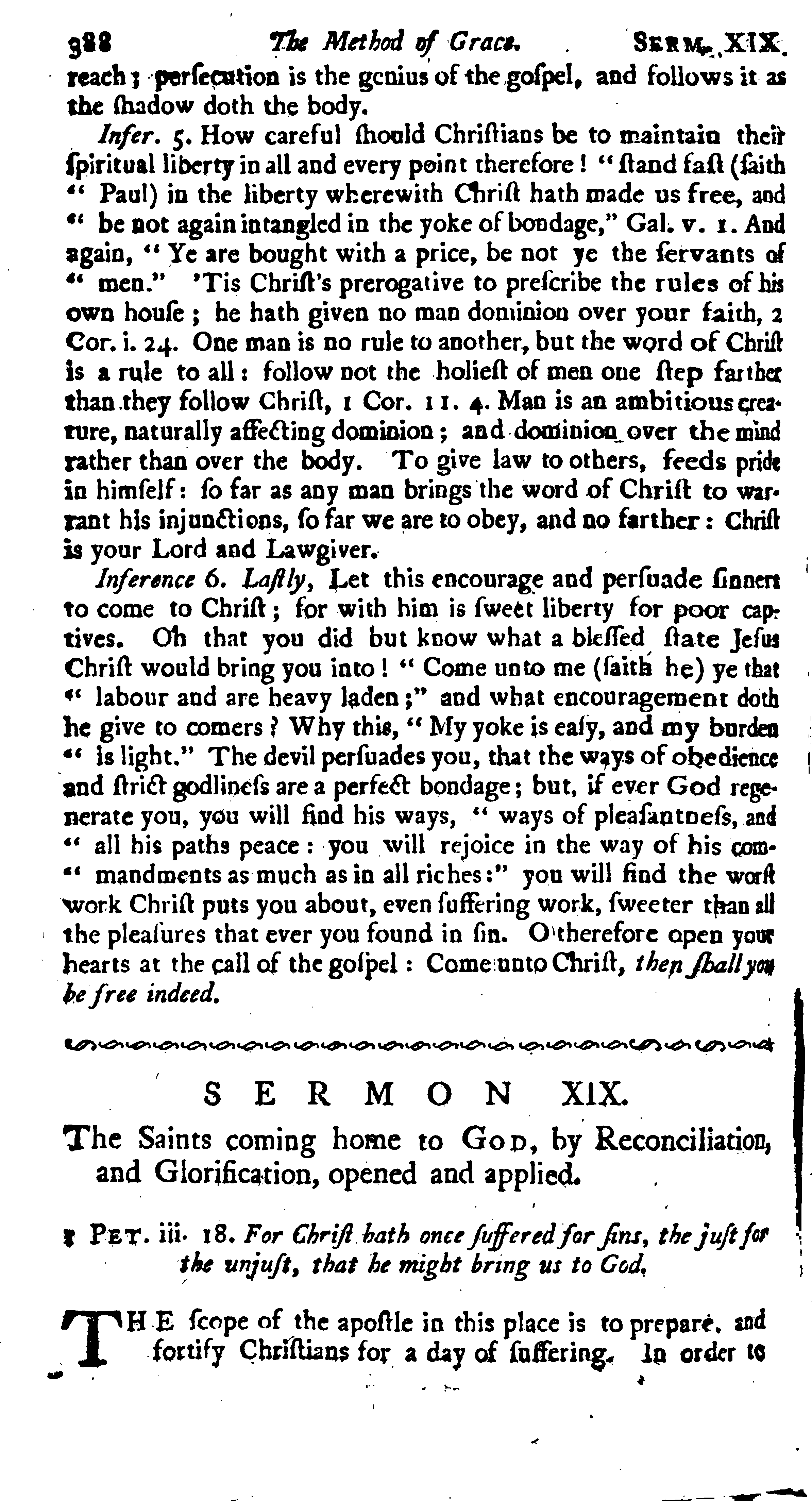
reach; persecution is the genius of the gospel, and follows it as the shadow doth the body.
Infer. 5. How careful should Christians be to maintain their spiritual liberty in all and every point therefore ! " stand fast(faith
" Paul) in the libertywherewith Christ hath made us free, and " be not againintangled in theyoke of bondage," Gal. v. 1. And again, " Ye are bought with a price,be not ye the servants of " men."
'Tis Christ's prerogative to prescribe the rules of his own house ; he hath given no man dominion over your faith, 2
Cor. i. 24. Oneman is no rule to another,but the word of Christ is a rule to all: follow not the holiest of men one step farther than they follow Christ, 1 Cor. 11. 4.Man is anambitiouscreature, naturallyaffectingdominion; and dominion over the mind rather than over the body. To give law to others, feeds pride in himself: fo far as any man brings the word of Christ to warrant his injunctions, so far we are to obey, and no farther: Christ is your Lord and Lawgiver. i Inference 6. Lastly, Let this encourage and persuade sinners to come to Christ ; for with him is sweet liberty for poor captives. Oh that you did but know what a blessed state Jesus
Christ wouldbringyou into ! " Come unto me(faith he) ye that " labour and are heavy laden;" and what encouragement doth he give to comers ? Why this, " Myyoke is easy, and my burden
" is light." The devil perfuadesyou, that the ways of obedience and strictgodliness area perfect bondage; but, ifeverGod regenerate you, you will find his ways, " ways of pleasantness, and " all his paths peace : you will rejoice in the way of his com- " mandments as much as in all riches:" you will find the worst workChrift puts you about, even suffering work, sweeter than all the pleasures that ever you found in fin. Otherefore open your hearts at the call of the gospel : Come unto Christ, thenfhallyou be free indeed.
SERMON ΧΙΧ.
The Saints coming home to GOD, by Reconciliation, and Glorification,opened and applied.
PET. iii. 18. For Christ bath oncefufferedforfins, the just for the unjust, that he might bring us to God,
HE scope of the apostle in this place is to prepare, and day of suffering.
In order to TH fortify Christians for a
SERM XIX.
The Method of Grace.
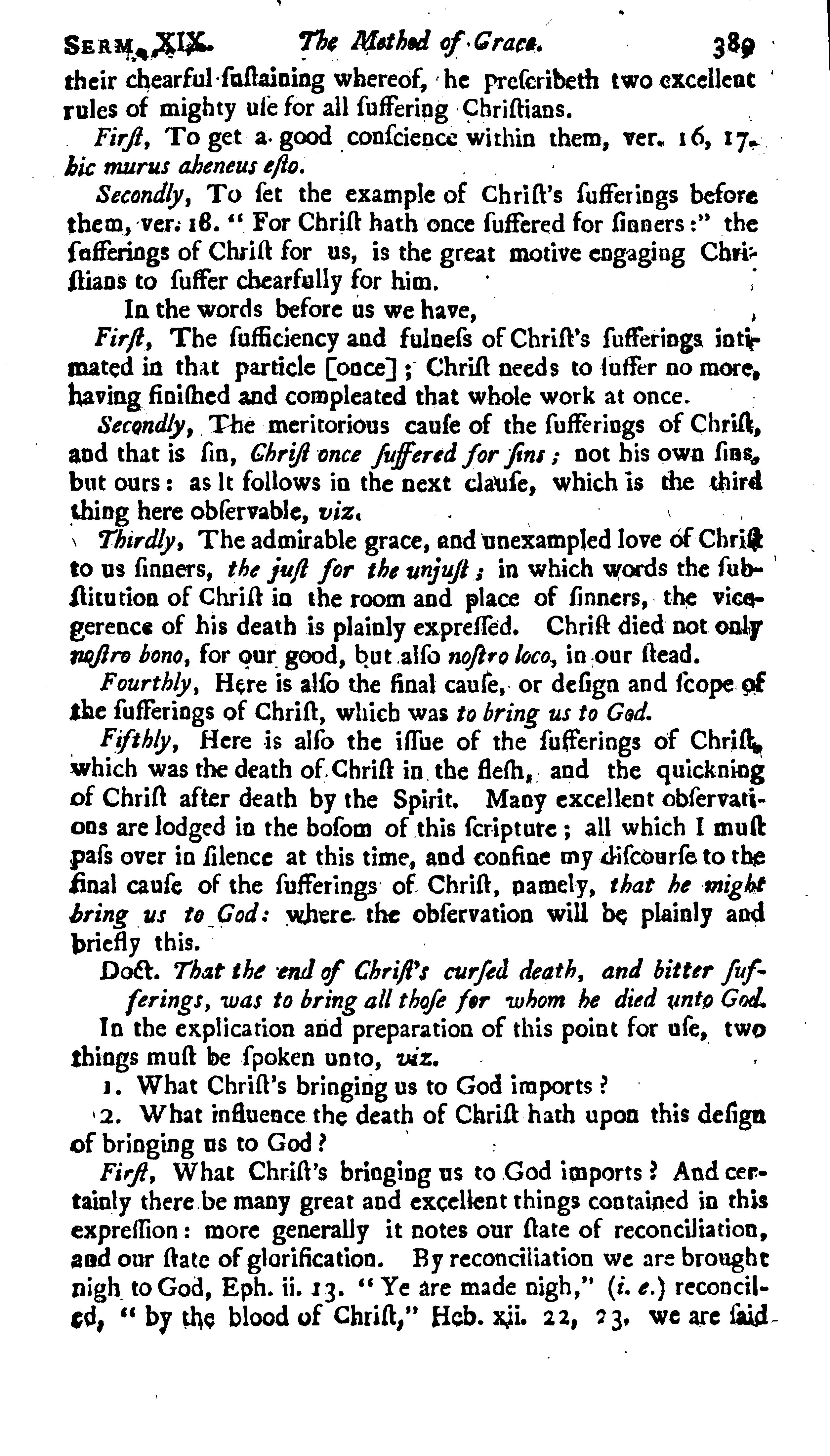
their chearful sustaining whereof, he prescribeth two excellent rules of mighty use for allfuffering Christians .
First, To get a good conscience within them, ver. 16, 17. hicmurus aheneus esto.
Secondly, To set the example of Christ's sufferings before them, ver. 18. " For Christ hath once suffered for sinners:" the sufferings of Christ for us, is the great motive engaging Chri stians to suffer chearfully for him.
In the words before us we have, First, The sufficiency and fulness of Christ's sufferings intimated in that particle (once) ; Christ needs to suffer no more, having finished and compleated that whole work at once.
Secondly, The meritorious cause of the sufferings of Christ, and that is fin, Christ once fufferedforfins; not his own fins, but ours : as it follows in the next clause, which is the third thing here observable, viz.
Thirdly, The admirable grace, andunexampled love of Christ to us sinners, the just for the unjust; in which words the substitution of Christ in the room and place of sinners, the vicegerence of his death is plainly expressed.
Christ died not only nostro bono, for our good, but also nostro loco, in our stead.
Fourthly, Here is also the final cause, or design and scope of thefufferings of Christ, which was to bring us to God.
Fifthly, Here is also the issue of the sufferings of Christ, which was the death of Christ in the flesh, and the quickning of Christ after death by the Spirit. Many excellent observations are lodged in the bosom of this scripture; all which I must pass over in silence at this time, and confine my discourse to the final cause of the sufferings of Christ, namely, that he might bring us to God: where the observation will be plainly and briefly this.
Doct. That the end of Christ's cursed death, and bitterfufferings, was to bring all those for whom he died unto God.
In the explication and preparation of this point for use, two things must be spoken unto, viz.
1. What Christ's bringing us to God imports ?
2. What influence the death of Christ hath upon this design of bringing us to God ?
First, What Christ's bringing us to God imports ? And certainly there be many great and excellent things contained in this expression: more generally it notes our state of reconciliation, and our state ofglorification.
By reconciliation we are brought nigh to God, Eph. ii. 13. " Ye are made nigh," (i. e. ) reconciled, "by the blood of Christ," Heb. xii. 22, 23, we are said
The Method of Grace.
SERM . XIX,
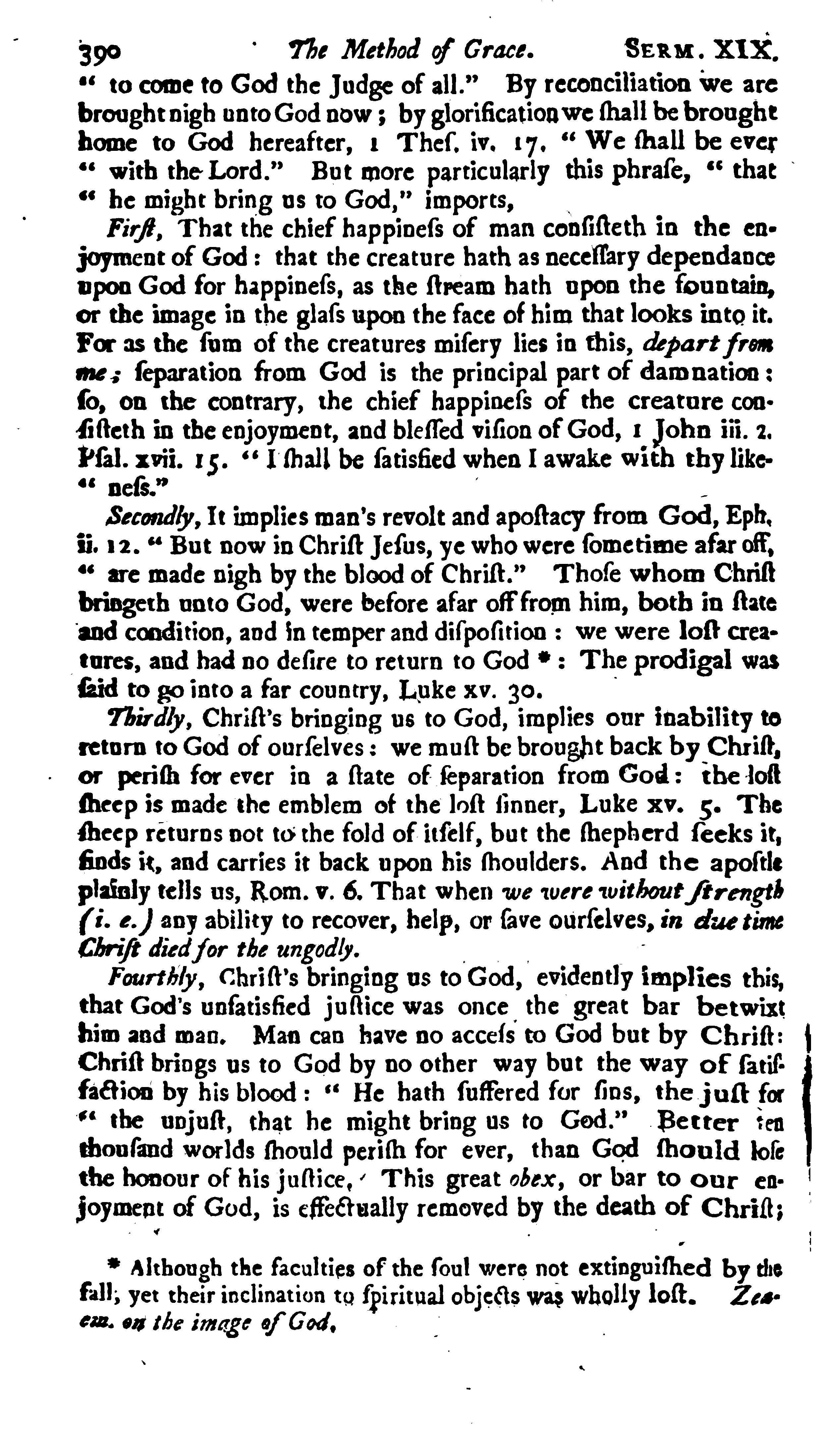
to come to God the Judge of all."
By reconciliation we are broughtnigh untoGodnow; byglorificationwe shall be brought home to God hereafter, 1 Thef, iv. 17. " We shall be ever
" with the Lord."
But more particularly this phrase, "that " he might bring us to God," imports, First, That the chief happiness of manconsisteth in the enjoyment of God: that the creature hath as neceffarydependance upon God for happiness, as the stream hath upon the fountain, or the image in the glass upon the face of him that looks into it.
For as the sum of the creatures misery lies in this, depart from me; separation from God is the principal part of damnation : so, on the contrary, the chief happiness of the creature confifteth in the enjoyment, andblessedvisionofGod, 1 John iii. 2.
Psal. xvii. 15. " I shall be fatisfiedwhen I awake with thy like- " ness."
Secondly, It implies man's revolt andapostacy from God, Eph. ii. 12. " But now in Christ Jesus, ye who were sometime afar off,
" are made nigh by the blood of Christ."
Those whom Christ bringeth unto God, were before afar off from him, both in state and condition,and intemperanddisposition: we were loft creatures, and had no desire to return to God * : The prodigal was said togointo a far country, Luke xv. 30.
Thirdly, Christ's bringing us to God, implies our inability to return to God of ourselves : we must bebroughtbackbyChrift, or perish for ever in a state of separation from God : the loft sheep is made the emblem of the lost sinner, Luke xv. 5. The theepreturnsnot to the fold of itself,but the shepherd seeks it, finds it, and carries it back upon his shoulders. And the apostle plainly tells us, Rom. v. 6. That when we were withoutftrength
(i. e.) any ability to recover, help, or save ourselves,in due time Chriftdiedfor the ungodly.
Fourthly, Christ'sbringing us to God, evidently implies this, that God's unsatisfied justice was once the great bar betwixt him and man. Man can have no access to God but by Christ:
Christ brings us to God by no other way but the way of fat if faction by his blood: " He hath suffered for sins, the just for " the unjust, that he might bring us to God."
Better ten thousand worlds should perish for ever, than God should lose thehonour of his justice, This great obex, or bar to our enjoyment of God, is effectually removed by the death of Christ;
* Although the faculties of the soul were not extinguished by the fall,yet their inclination to spiritual objects was wholly loft.
Zea em. on the image of God.
SERM . XIX.
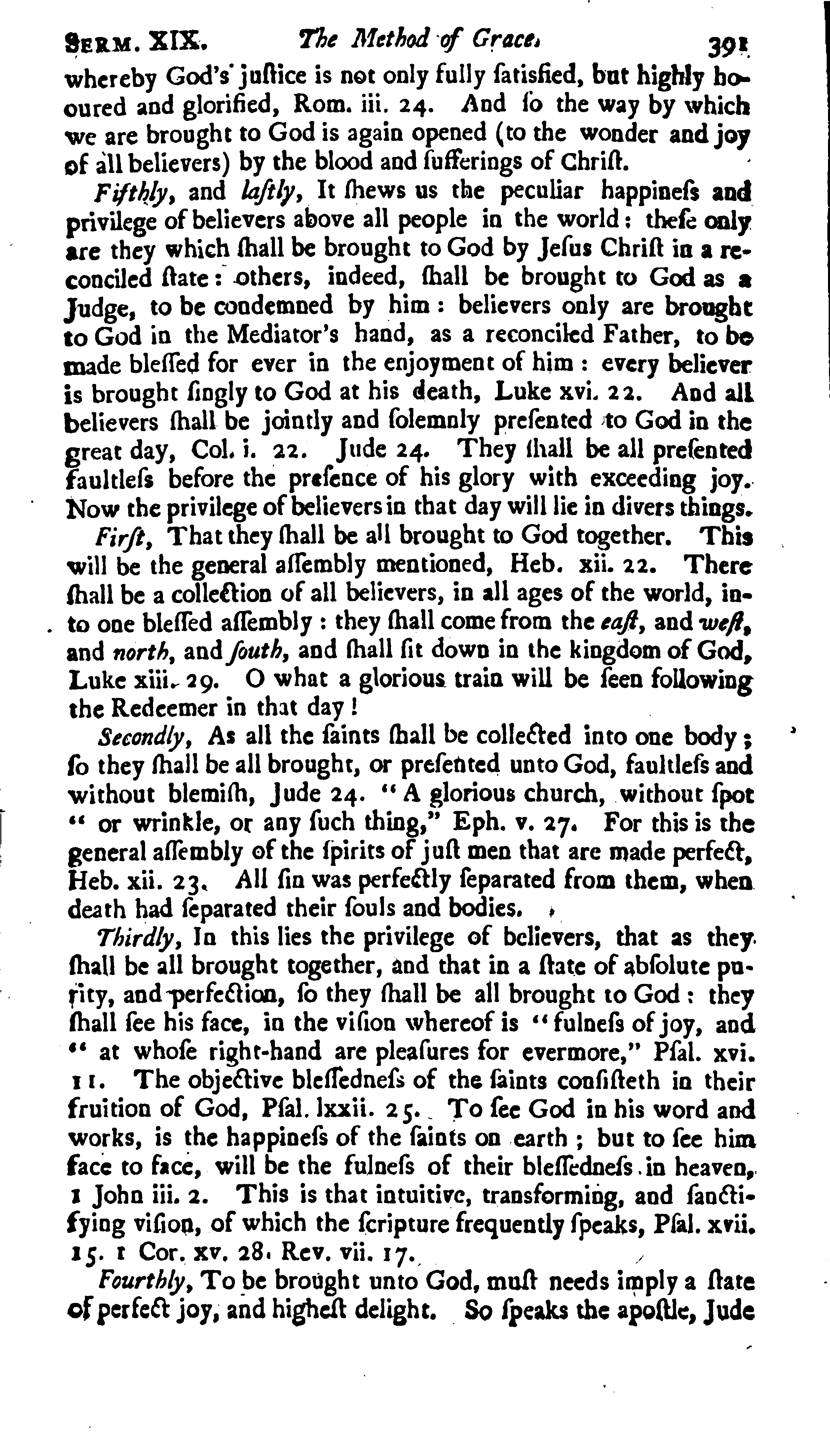
The Method of Graces whereby God's justice is not only fully satisfied, but highly hooured and glorified, Rom. iii. 24. And so the way by which we are brought to God is again opened(to the wonder and joy of all believers) by the blood and sufferings of Christ.
Fifthly, and lastly, It shews us the peculiar happiness and privilege of believers above all people in the world; these only are they which shall be brought to God by Jesus Christ in a reconciled state: others, indeed, shall be brought to God as a Judge, to be condemned by him: believers only are brought
! to God in the Mediator's hand, as a reconciled Father, to be made blessed for ever in the enjoyment of him : every believer is brought singly to God at his death, Luke xvi. 22.
And all believers shall be jointly and solemnly presented to God in the great day, Col. i. 22.
Jude 24.
They shall be all presented faultless before the presence of his glory with exceeding joy.
Now the privilege of believers in that day will lie indiversthings.
First, That they shall be all brought to God together.
This There will be the general assembly mentioned, Heb. xii. 22. shall be a collection of all believers, in all ages of the world, intoone blessed assembly: they shall come from the east, and west, and north, and south, and shall fit down in the kingdom of God,
Luke xiii. 29. O what aglorioustrainwill be seen following the Redeemer in that day !
Secondly, As all the saints shall be collected intoone body; so they shall be all brought, or presented unto God, faultlefs and without blemish, Jude 24. "A glorious church, without spot
د 66 or wrinkle, or any such thing," Eph. v. 27.
For this is the general assembly of the spirits of just men that are made perfect, Heb. xii. 23. All fin was perfectly separated from them,when death had separated their souls and bodies.
Thirdly, In this lies the privilege of believers, that as they shall be all brought together, and that in a state of absolute purity, and perfection, so they shall be all brought to God : they shall see his face, in the vision whereof is " fulness of joy, and " at whose right-hand are pleasures for evermore," Psal. xvi.
11 .
The objective blessedness of the saints consisteth in their fruition of God, Psal. lxxii. 25. To see God in his word and works, is the happiness of the saints on earth ; but to see him face to face, will be the fulness of their blessedness in heaven,
1 John iii. 2.
This is that intuitive, transforming, and sanctifying vision, of which the scripture frequently speaks, Psal. xvii.
15. 1 Cor. xv. 28. Rev. vii. 17.
Fourthly, To be brought unto God,must needs implya state of perfect joy, and highest delight.
So speaks the apostle, Jude
The Method of Grace.
SERM . XIX.
14.
Christ shall present,or bring them to God with exceeding joy. And more fully thejoyofthis day is expressed, Psal. xlv.
15. "With joy and rejoicing shall they be brought ; they shall " enter into the king's palace."
It will be a day of universal joy, when all the faints are brought home to God in a perfected state.
For, 1.God the Father will rejoice when Christ brings home that precious number of his elect, whom he redeemed by his blood : he rejoiceth in them now, though imperfect, and under many distasteful corruptions and weaknesses, Zeph. iii. 17. How much more will herejoiceinthemwhen Christ presents them without fpotor wrinkle to him, Eph. v. 27.
2. Jesus Christ will exceedingly rejoice; it will be the day of the gladness, andfatisfactionofhis heart : for now, and not till now, he receives his mystical fulness, Col. i. 24. beholds all the blessed issues of his death, which connotbutgive him unspeakable contentment, Ifa. liii. 11. "He shall fee of the travail of " his soul, and shall be satisfied."
3. The day in which believers are brought home to God, will be a day ofunspeakablejoy to the Holy Spirit of God himself.
For unto this, all his fanctifying designs, in this world, had respect: to this day he sealed them: towards this day he stirred up desires, and groanings that cannot be uttered, in their hearts, Eph. iv. 30.
Rom. viii. 26.
Thus the great and blessed persons, Father, Son, and Spirit, will rejoice in the bringing home of the elect to God.
For as it is the greatest joytoaman to see the designs which his heart hath been long projecting, and intently set upon, by an orderly conduct, at laftbrought to the happy issue he first aimed at ; much more will it be so here: the counsel, and hand of each person being deeply concerned in this blessed design.
4. The angels of God will rejoice at the bringing home of believers to him : the spirits of just men made perfect, will be united in one general assembly, with an innumerable company of angels, Heb. ii. 22. Great is the affection and love of angels to redeemed ones : they greatly rejoiced at the incarnation of Christ for them, Luke ii. 13.
They greatly delighted to pry into the mystery of their redemption, I Pet. i. 12.
They were marvellouslydelighted at their conversion, which was the day of their efpousals to Christ, Luke xv. 10. They have been tender and careful over them, and very serviceable to them in this world, Heb. i. 14. and therefore cannot but rejoice exceedingly, to fee them all brought home in safety to their father's house.
5.To conclude,Christ'sbringing home all believers unto God,
SERM . XIX.
The Method of Grace. will be matter of unspeakable joy to themselves: for, whatever knowledge andacquaintancethey had with God here,whatever fights of faith they had of heaven, and the glory to come, in this world; yet the fight of God and Christ the redeemer, will be an unspeakable surprize to them in that day.
This will be the day of relieving all their wants, the day of satisfaction to all their desires ; for now they are come where they would be, arrived at the very desires of their souls.
Secondly, In the last place, let it be considered, what influence the death of Christ hath upon this design, and you shall find it much every way.
In two things especially, the death of Christ hath a blessed causality and influence in this matter, viz.
1. It effectually removes all obstacles to it.
2. It purchaseth (as a price) their title to it.
First, The death of Christ removes all obstacles out of the way of his mercy: such were the bars hindering our access to Godasnothing but the death of Christ could remove, and thereby open a way for believers to come to God.
The guilt of fin barred us from his gracious presence, Rom. i. 2, 3. Hos. xiv. 2.
The filth of fin excluded us from God, Hab. i. 23. Heb. xii.
14. The enmity of our nature perfectly stopped up our way to God, Col. i. 21. Rom. viii. 7. by reason hereof fallen man hath no desire tocomeuntoGod, Job xxi. 14.
The justice of God, like a flaming sword, turning every way, kept allmen from access to God. And Lastly, Satan, that malicious and armed adversary, lay as a lion in the way to God, 2 Pet. v. 8.
Ohwith what strong bars were the gates of heaven shut against our souls ! The way of God was chained up with such difficulties, as none but Christ was able to remove; and he by death hath effectually removed them all : The way is now open, eventhenew and the living way,consecrated for us by his blood.
The death of Christ effectually removes the guilt of fin, 1 Pet. ii. 24. washes off the filth off in, 1 Johnv. 6. takes away the enmity of nature, Col. i. 20, 21. satisfies all the demands ofjuttice,
Rom. iii . 25, 26. hath broken all the power of Sat an, Col. ii. 15.
Heb. ii. 14. and consequently the way to God is effectually and fully opened to believers by the blood of Jesus,Heb. x. 20.
Secondly, The blood of Christ purchased for believers their rightandtitletothis privilege,Gal. iv.4, 5. " But when the ful- " ness of time was come,God sent forth his Son, made of awo- " man, made under the law ; to redeem them that were under " the law, that we might receive the adoption offons," i. e. both the relation and inheritance offons.
There was value and VOL. II.
Eee
The Method of Grace.
SERM . XIX.
worth enough in the precious blood of Christ, not only to pay all our debts to justice, but, over and above the payment of our debts, to purchase for us this invaluable privilege. We must put this unspeakable mercy of being brought to God, as my text puts it, upon the account, and to the score of the death of Christ : no believer had ever tasted the sweetness of such a mercy, if Christ had not tasted the bitterness of death for him.
The use of all you will have in the following deductions of truth.
Deduction 1. Great is the preciousness and worth offouls, that the life of Chriftshould be given to redeem and recover them to God: As God laid out his thoughts and counsel, from eternity, upon them, to project the way and method of their salvation ; fo the Lord Jesus in pursuanceofthat blessed design, came from the bosom of the Father, and spilt his invaluable blood, to bring them to God.
No wife man expends vast sums to bring home trifling commodities : how cheap soever our souls are in our ef timation, it is evident by this they are of precious esteem in the eyes of Christ.
Deduction 2. Redeemed fouls must expect no rest, or satisfaction on this side heaven, and the full enjoyment of God.
The life of a believer in this world, is a life of motion and expectation : they are nowcomingtoGod, I Pet. ii . 4. God,you see, is the centre and rest of their souls, Heb. iv. 9. As the rivers cannot rest till they pour themselves into the bosom of the sea, so neither can renewed fouls find rest till they come into the bosom of God *.
There are four things which do, and will break the rest, and disturb the souls of believers in this world; afflictions, temptations, corruptions, and absence from God.
If the three former causes of disquietness were totally removed, fo that a believer were placed in such a condition upon earth, where no affliction should disturb him, no temptation trouble him,no corruption defile or grieve him, yet his very absence from God must still keep him restless and unsatisfied ; 2 Cor. v. 6. " Whilst we are at home in the body, yet ab- " sent from the Lord."
Deduction 3. Whatfweet and pleasant thoughts should all be. lievershave of death ! When they die, and never till they die, shall they be fullybroughthome to God.
Death to the saints, is the door by which they enter into the enjoyment of God: the dying Christian is almost at home, yet a few pangs and agonies more, and then he is come to God, in whose presence
* Thou hast made us for thyself, and our hearts are unsatisfied till they reft in thee. Aug. Confef. lib. 1. c. 1.
SERM . XIX .
The Method of Grace.
is the fulness of joy. " I desire, faith Paul, to depart, and to be with Christ, which is far better," Phil. i. 23.
It should not affright us to be brought to death, the king of terrors, so long as it is the office ofdeathtobringus to God.
Thatdreamingopinion of the soul sleeping after death, is as ungrounded as it is uncomfortable : the fame day we loose from this shore, we shall be landed upon the blessed shore, were we shall fee and enjoy God for ever. O, if the friends of dead believers did but understand where, and with whom their souls are, whilst they are mourning over their bodies, certainly a few believing thoughts of this would quickly dry up their tears, and fill the house of mourning with voices of praise and thanksgiving !
Deduction 4. How comfortable and sweet should the converses and communication of Christians be with one another, in this world! Christ is bringing them all to God, through this vale of tears ; they are now in the way to him ; all bound for heaven; going home to God, to their everlasting rest in glory : everyday, every hour, every duty brings them nearer and nearer to their journey's end ; Rom. xiii. 11. " Now,
(faith the " apostle), is our salvation nearer than when we believed." O what manner of heavenly communications, andravishingdifcour-
ses should believers have with each other, as they walk by the way ! Owhat pleasant and delightful converse should they have with one another about the place and state whither Christ is bringing them, and where they shall shortly be ! What ravishing transporting, transforming visions they shall have that day they are brought home to God! How surprizingly glorious to them the fight of Jesus Christ will be,who died for them to bring them unto God ! how should such discourses as these, shorten and sweeten their passage through this world; strengthen and encouragethedejected and feeble-minded, and exceedingly honour and adorntheirprofession ! Thus lived the believers of old ; Heb. xi.
9, 10. " By faith he sojourned in the land of promise, as in a " strange country, dwelling in tabernacles with Isaac andJacob,
" the heirs with him of the fame promise; for he looked for " a city which hath foundations, whose builder and maker is
" God."
But, alas ! most Christians are either entangled in the cares and troubles, or fo ensnared by the delights and pleasures which almost continually divert and take up their thoughts by the way, that there is but little room for any difcourses of Christ and heaven, among many of them: but certainly this would be as much your interest as your duty.
When the apostle had entertained the Theffalonians with a lovely discourse of their meet
Ece2
The Method of Grace.
SERM . XIX,
ing the Lord in the air, and being ever with the Lord, he charges it upon them as their great duty, to comfort one another with those words, I Theff. iv. 17, 18 .
Deduction 5. How unreasonable are the dejections of believers, upon the account of those troubles which they meet with in this world! It is true, afflictions of all kinds do attend believers in their way to God; through many tribulations we must enter in. to that kingdom, But what then; must wedespondanddroop under them asothermen ? Surely no : If afflictions be the way through which you must come to God, then never be discou. raged at affliction; troubles and afflictions are of excellent use, under the blessings of the Spirit, to further Christ's great design ofbringingyou to God. Howoftenwouldyou turn out of that way which leads to God, if he did not hedge up your way with thorns, Hofea ii. 6.
Doubtless when you come home to God, you shall find you havebeenmuch beholden, (it may be a great deal more), to your troubles than to your comforts, for bringing you thither; however, the sweetness of the end will infinitely more than recompense the sorrows and troubles of the way : nor are they worth to be compared with the glory that shall be revealed in you, Rom. viii. 18.
Deduction 6. How much are all believers obliged, in paint of interest, to follow Jesus Christ whitherfoever he goes ! Thus are the saints described, Rev. xiv. 4. " These are they which follow
" the Lamb whithersoeverhe goeth: these were redeemed from " amongmen, being the first-fruits unto God, and to the Lamb."
If it be the design of Christ to bring us to God, then certainly it is our duty to follow Christ in all the paths of active and passive obedience through which he now leads us, as ever we expect to be brought home to God at last : "We are inade par- " takers of Christ, if we hold the beginning of our confidence
" stedfastunto the end," Heb. iii. 14.
If we have followed him, through many sufferings and troubles, and shall turn away from him at last, we lose all that we have wrought, and suffered in religion, and shall never reach hometoGodat last. The crown of life belongs only to them who are faithfultothedeath.
Deduction 7. Let all that desire, or expect to comeuntoGod hereafter, come to Christ by faith now.
There is no other way to the Father, but by Christ ; no other way to Christ but faith,
How vain therefore are the hopes and expectations ofallunbelievers ? Be assured of this great truth, Death shall bring you to God as an avenging Judge, if Christ do not bring you now to God as a reconciled Father: without holiness no man shall fee
God: the door of hope is shut againstallchristless persons, Joha
SERM. XX.
The Method of Grace.
xiv. 6. " No mancomethunto the Father but by me." O what a sweet voice cometh down from heaven to your souls this day, saying, As ever you expect or hope to come to God, and enjoy the blessing that is here, come unto Christ, obey his calls, give upyourselves to his conduct and government, and you shall certainly be brought to God ! As sure as you shall now be brought to Jesus Christ by spiritual union, so sure shall you be brought to God in full fruition.
Blessed be God for Jesus Christ, the new and living way to the Father.
And thus I have finished the motives drawn from the titles and benefits of Christ, serving to enforce and quicken the great gospel exhortation of coming to, and effectually applying the Lord Jesus Christ in the way of faith. O that the blessings of the Spirit might follow these calls, and fix these considerations as nails in sure places ! But seeing the great hindrance and obstruction to faith is the false opinion andperfuafion of most unregenerate men, that they are already in Christ ; my next work therefore shall be, inafecond use of conviction, to undeceive men in that matter ; and that, by shewing them the undoubted certainty of these two things :
First, That there is no coming, ordinarily, to Christ without theapplicationofthe law to our consciences, in away of effectualconviction.
Secondly, Nor by that neither, without the teachings of God, in the way of spiritual illumination.
The first of these will be fullyconfirmedand opened in ** * SERMON XX.
The great usefulness of the Law or Word of God, in order to the Application of CHRIST.
Rom . vii . 9. For I was alive without the law once, but when the commandment came, fin revived, and I died.
THE scope of the apostle inthisepistle,andmoreparticuParly in this chapter, is to state the due use and excellency of the law, which he doth accordingly.
First, By denying to ita power to justify us, which is the peculiar honour of Christ.
SERM . XX.
The Method of Grace.
Secondly, By afcribing to it a power to convince us, and so prepare us for Christ.
Neither attributing to it more honour than belongeth to it, nor yet detracting from it that honour and usefulness which God hath given it.
It cannot make us righteous, but it can convince us that we are unrighteous; it cannot heal, but it can open and discover the wounds that finhath given us ; which he proves in this place by an argument drawn from his own experience, confirmed also by the general experience of believers, in whoseperfonsand names we must here understand him to speak ;
" For I was alive without the law once; but when the com- " mandment came, fin revived, and I died."
Wherein three particulars are very observable.
First, The opinion Paul had, and all unregenerate men have of themselves before conversion: I was alive once. By life, understand here liveliness, chearfulness, and confidence of his good estate and condition : he was full of vain hope, false joy, and presumptuous confidence, avery brisk and jovial man.
Secondly, The sense and opinion he had, and all others will have of themselves, if ever they come under the regenerating work of the Spirit in his ordinary method of working : I died.
The death he here speaks of, stands opposed to that life before mentioned; and signifies the sorrows, fears, and tremblings thatfeized upon his soul, when his state and temper were upon the change: the apprehenfions he then had of his condition struck him home to the heart, anddamped all his carnal mirth : I died.
Thirdly, The ground and reason of this wonderful alteration and change of his judgment, and apprehension of his own condition ; the commandment came, and fin revived : The commandment came, i. e. it came home to myconfcience, it was fixed with a divine and mighty efficacy upon my heart : the commandment was come before by way of promulgation, and the literal knowledge of it: but it never came, till now, in the spiritual sense, and convincing power to his soul: though he had often read, and heard the law before, yet he never clearly understood the meaning and extent, he never felt the mighty efficacy thereof upon his heart before; it so came at this time, as it never came before.
From hence the observations are, Doct. 1. That unregenerateperfons aregenerallyfull of groundless confidence, and chearfulness, though their condition be fadandmiferable.
Doct. 2. That there is a mighty efficacy in the wordorlaw of God, to kill vain confidence, and quench carnalmirth in the hearts of men, when Godfets it home upon their consciences.
SERM. XX.
The Method of Grace.
We shall take both these points under consideration, and improve them to the design in hand.
Doct. 1. That unregenerate persons are generally full of groundless confidence, and chearfulness, though their conditionbefad and miserable ; Rev. iii. 17. Because thou sayest
I am rich, and increased with goods, and have need of nothing ; and knowest not that thou art wretched, and miserable, and poor, and blind, and naked : This is the very life that unregenerate men do live.
In opening whereof, I shall shew you, 1. What is the life of the unregenerate.
2. What maintains that life.
3. How it appears that this is the life the generality of the world do live.
4. the danger of living such a life as this: and then apply it.
First, What is the life of the unregenerate, and wherein it consists ? Now there being, among others, three things in which the life of the unregenerate doth principally consist, viz.
Carnal security, Presumptuous hope, and False joy, Of these briefly in their order.
First, There is in unregeneratemenagreatdealofcarnal security; they dread no danger; Luke xi. 21. " When a strong
" man armed keepeth his palace, his goods are at peace :"
There is generally a great stillness and silence in the consciences offuchmen : when others, in a better condition, are watching and trembling, they sleep securely; so they live, and so of times they die, Psal. Ixxiii. 4. " They have no bonds in their death,"
[Hebrew, no knots], no difficulties that puzzle them. It is true, the consciences of few men are so perfectly stupified, but that, some time or other, they twing and gird them; but it seldom works to that height, or continues with them so long, as to give anyconfiderable interruption to their carnal peace andquietness.
Secondly, The life of the unregenerate consisteth inpresumptuoushope : this is the very foundation of their carnal security.
So Christ tells the Jews, John viii. 54, 45. " Of whom ye fay " that he is your God, and yetyehave not known him." The world is full of hope without a pronise, which is but as a spider's web, when a stress comes to be laid upon it, Job xxvii. 8.
Unregenerate men are said indeed to be without hope, Ephef. ii. 12. but the meaning is, they are without any solid, well grounded hope; for in scripture-account, vain hope is no hope, except it be a lively hope, 1 Pet. i. 3. A hope flowing fromu
The Method of Grace.
SERM . XX.
nionwith Christ, Col. i. 27. A hope nourished by experience, Rom. v. 4. A hope for which a man can give a reason, 1 Pet, iii. 15. A hope that puts men upon heart-purifying endeavours,
1 John iii. 3.
It is in the account of God a cypher, a vanity, not deserving the name of hope; and yet such a groundless, dead, Christless, irrational, idle hope is that which the unregenerate live upon.
Thirdly, The life of the unregenerate consisteth in false joy, the immediate offspring of ungrounded hope, Mat. xiii. 20.
The stony ground receive the word with joy.
There are two forts of joy upon which the unregenerate live, viz.
1. A sensitive joy in things carnal.
2. A delusivejoy in things spiritual .
They rejoice in corn, wine, and oil, in their estates and children, in the pleasant fruitions of the creature; yea, and they rejoice also in Christ and the promises, in heaven and in glory: with all which they have just such a kind of communion, as a man hath in a dream with a full feast, and curious music; and just so their joy will vanish when they awake. Now these three, security,hope, and joy, make up the livelihood of the carnal world.
Secondly, Next it concerns us to enquire what are the things that maintain and support this security, hope and joy in the hearts of unregenerate men; and if we consider duly, we shall find church-privileges, natural ignorance, false evidences of the love of God, flight workings of the gospel, self-love, comparing themselves with the more profane, and Satan's policy managing all these in order to their eternal ruin, are so many springs to feed and maintain this life of delusion in the unregenerate.
1. First, Church privileges lay the foundation to this strong delusion. Thus the Jews deceived themselves, saying in their hearts,
" We have Abraham for our father," Mat. iii. 9. This proptup the vain hopes that Abraham's blood ran in their veins, though
Abraham's faith and obedience never wrought in their hearts.
2. Secondly, Natural ignorance; this keeps all in peace: they that fee not, fear not.
There are but two ways to quiet the hearts of men about their spiritual and eternal concernments, viz. the way of assurance and faith, or, the way of ignorance and self-deceit : by the one we are put beyond danger, by the other beyond fear, though the danger be greater.
Satan could never quiet men, if he did not first blind them.
3. Thirdly, False evidences of the love of God is another spring feeding this security, vain hope and false joy in the hearts of men: fee the power of it to hush and still the conscience,
SERM . XX .
The Method of Grace.
Mat. vii. 22. " Many will say to me in that day, Lord, Lord, " have we not prophesied in thy name ?" &c.
The things upon which they built their evidence and confidence, were external things in religion ; yet they had a quieting power upon them, as if they had been the best evidences in the world.
4. Fourthly, Slight workings of the gospel; such are transient motions of the affections under the word, Heb. vi. 8. the working of their desires about spiritual objects, John vi. 34.
Mat. xxv. 8. the external change, and reformation of their ways, Mat. xii. 43. all which serve to nourish the vain hopes of the unregenerate.
Fifthly, Self-love is an apparent reason and ground of security and false hope, Mat. vii. 3. It makes a man to overlook great evils in himself, whilst he is sharp-sighted to discover and censure lesser evils in others: self-love takes away the fight of fin, by bringing it too near the eye.
6. Sixthly, Mens comparing themselves with those that are more profane and grosly wicked than themselves, serves notably to quiet and hush the conscience asleep; " God, I thank thee,
66 (taid the Pharifee), I am not as other men, or as this publi- " can."
O what a faint did he seem to himself, when he stood by those that were more externally wicked.
7. Seventhly, and lastly, The policy of Sat an to manage all these things to the blinding and ruining of the souls of men, is another great reason they live so securely and pleasantly as they do, in a state of so much danger and misery, 2 Cor. iv. 3, 4.
" The God of this world hath blinded the minds of them that " believe not ."
Thirdly, You have seen what the life of the unregenerate is, and what maintains that life.
In the next place, I shall give you evidence that this is the life the generality of the world do live; a life of carnal security, vain hope, and false joy : this will evidently appear, if we confider, First, The activity and liveliness of mens spirits in pursuit of the world. Ohow lively and vigorous are their hearts in the the management of earthly designs ! Psal. vi. 4. "Who will
" shew us any good ? " The world eats up their hearts, time, and strength.
Now this could never be, if their eyes were but opened to fee the danger, and misery their souls are in. How few designs for the world run in the thoughts ofa condemned man ? O if God had ever made the light of conviction to shine into their consciences, certainly the temptations would lie the quitecontraryway, even in too great a neglect of things of this
VOL . II .
Fff
SERM .XX.
The Method of Grace. life! But thisbriskness and liveliness plainly shew the great security which is upon most men.
Secondly, The marvellous quietnessand stillness that is in the thoughts and consciences of men, about their everlasting concernments, plainly shews this to be the life of the unregenerate :
How few scruples, doubts, or fears shall you hear from them ?
How many years may a man live in carnal families, before he shall hear such a question as this seriously propounded,
What " shall I do to be saved ?" There are no questions in their lips, because no fear or sense of danger in their hearts.
Thirdly, The general contentedness, and profest willingness of carnal men to die, give clear evidence that such a life of security, and vain hope is the life they live ; " Like sheep they are laid in the grave, Psal. xlix. 14. O how quiet and still are their consciences, when there are but a few breaths more between them and everlasting burnings ! Had God opened their eyes to apprehend the consequences of death, and what follows the pale horse, Rev. vi. 8. it were impossible but that every unregenerateman should makethatbed on which he dies, shake and tremble under him .
Fourthly, and Lastly, The low esteem men have for Christ, and the total neglect of, at least the mere triffing with, those duties in which he is to be found, plainly discover this stupid, secure life to be the life that the generalityof the world do live : for were men sensible of the disease of fin, there could be no quieting them without " Christ the physician," Phil. iii. 8. All the business they have to do in this world could never keep them from their knees, or make them strangers to their closets : all which, and much more that might be taidof like nature, gives too full and clear proof to this sad assertion, that this is the life theunregenerate world generally lives.
Fourthly, In the last place, I would speak a few words to dis. coverthedanger of such a life, as hath been described ; to which purpose, let the following brief hints be seriously minded.
First, By these things fouls are inevitably betrayed into hell, and eternal ruin; this blinding is in order to damning, 2 Cor. iv. 3, 4. " If our gospel be hid, it is hidtothem that are loft;
"whose eyes thegodofthisworldhath blinded." Those that are turned over into eternal death, are thus generallyhoodwinkedandblinded in order thereunto, Ifa. vi. 9, 10. " And he said goand tell this people, hearye indeed, but understand not :
" and see ye indeed, but perceive not. Make the hearts of this " people fat, and make their ears heavy, and shut their eyes ;
" left they fee with their eyes, and hear with their ears, and
SERM . XX.
The Method of Grace.
" understand with their hearts, and convert, and be healed."
Secondly, As damning is the event of blinding, so nothing makes hell a more terrible surprize to the soul than this doth :
By this means the wrath of God is felt before its danger be apprehended; am an is past all hope, before he begins to have any fear: his eternal ruin, like a breach ready to fall, swelling out in ahighwall, cometh fuddenlyat an instant, Isa. xxx. 13. and as it damns surely, and surprizingly, fo,
Thirdly, Nothing more aggravates a man's damnation than to fink suddenly into it, from amidst so many hopes, and high confidence of safety : For a man to find himself in hell, when he thought and concluded himself within a step of heaven, Owhat a hell will it be to such men ! The higher vain hopes lifted them up, the more dreadful must their fall be, Mat. vii. 22. And as itdamns surely, surprizingly, and with highest aggravations, so,
Fourthly, This life of security, and vain hope, frustrates all the means of recovery, and salvation in the only season wherein they can be useful and beneficial to us : Byreasonofthese things the word hath no power to convince mens consciences, nothing can bring them to a fight and sense of their condition : Therefore Christ told the self-confident, and blind Jews, Mat. xxi. 21.
" That the publicans and harlots go into the kingdom of God " before them:" And the reason is, because their hearts lie more open, and fair to the strokes of conviction, and compunction for fin than those do, who are blinded by vain hopes, and confidences.
Infer. 1. Is this the life that the unregenerate world lives?
Then it is not to be wondered at, that the preaching of the gospel hathfo littlefuccefs : " Who hath believed our report? (faith the " prophet) and to whom is the arm of the Lord revealed ?" la. liii . 1.
Ministers study for truths apt to awaken, and convince the consciences of them that hear them, but their words return again to them: They turn to God,and mourn over the matter; we have laboured in vain, and spent our strength for nought : And this security is the cause of all ; vain hopes bar fast the doors ofmens hearts against all the convictions and perfuafions of the word. The greater cause have they to admire the grace of God, who have found, or shall find the convictions of the word sharper than any two-edged sword, piercing to the dividing asunder of the soul and spirit; to whose hearts
God brings home the commandment, by an effectual application.
Infer. 2. If this be the life of the unregenerate world ; what Fff2
SERM. XX.
The Method of Grace. deadly enemies are they that nourish, and strengthen the groundless confidences, and vain hopes offalvation in men ? This the scripture calls the healing of the hurt offouls slightly, by crying
" Peace, peace, when there is no peace," Jer. vi. 14.
The sewing of pillows under their arm-holes, Ezek. xiii. 18.
That they may lie soft and easy under the ministry : And this is the doctrine which the people love ; but oh, what will the end of these things be! And what an account have those men to give to God for the blood of those souls by them betrayed to the everlasting burnings ! Such flattery is the greatest cruelty : Those whom you bless upon earth, will curse you in hell, and the day in which they trusted their souls to your conduct .
Infer. 3. How great a mercy is it to be awakened out of that generalfleep, and security which is fallen upon the world!
You cannot estimate the value of that mercy, for it is a peculiar mercy.
O that ever the Spirit of the Lord should touch thy soul under the ministry of the word, startle, and rouse thy conscience, whilst others are left in the dead sleep of security round about thee ! When the Lord dealt with thy soul much after the fame manner he did with Paul in the way toDamafcus, who not only saw a light shining from heaven,which those that travelled with him saw as well as he, but heard that voice from heaven which did the work upon his heart, though his companions heard it not.
Besides, it is not onlyapeculiar mercy, but it isa leading, introductive mercy, to all other spiritual mercies that follow it to all eternity. If God had not done this for thee, thou hadst never been brought to faith, to Christ, or heaven : from this act of the spirit all other saving acts take their rife.
So that you have cause for ever to admire the goodness of God, in in such a favour as this is .
Infer. 4. Lastly, Hence it follows, that thegenerality of the world are in the direct way to eternal ruin ; and whatever their vain confidences are, they cannot be saved : "Narrow is the " way, and strait is the gate that leadeth unto life, and few
" there be that find it."
Hear me all you that live this dangerous life ofcarnalsecurity, and vain hope, whatever yourperfuafions and confidences are, except you give them up, and get better grounds for your hope, you cannot be saved.
For, First, Such hopes and confidences, as yours, are directly contradictory to the established order of the gospel, which requires repentance, Acts v. 31. Faith, Acts xiii. 39. and regeneration,
John iii. 3. in all that shall be saved: And this order shall never be altered for any man's fake.
Secondly, Iffuch as you be saved, all the threatnings in scrip