
The Teachings of God opened, in their Nature and
SERM . XXII.
The Method of Grace.
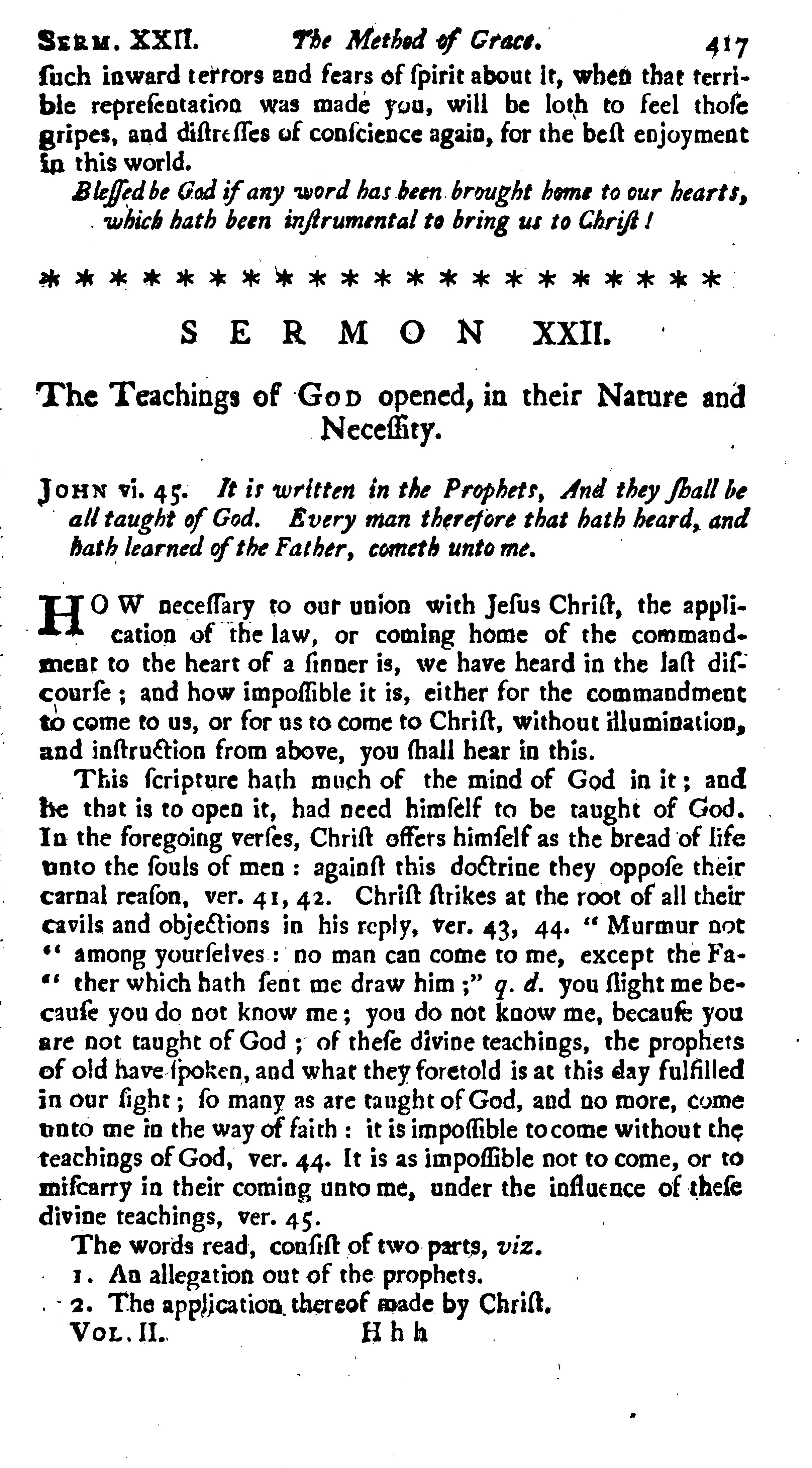
such inward terrors and fears of spirit about it, when that terrible representation was made you, will be loth to feel those gripes, and distresses of conscience again, for the best enjoyment in this world.
BleffedbeGodifany word has been brought home to our hearts, which hath been instrumental to bring us to Christ!
** SERMON ΧΧΙΙ .
The Teachings of God opened, in their Nature and Necessity.
JOHN vi. 45.
It is written in the Prophets, And they shall be all taught of God.
Every man therefore that hath heard, and hath learned of the Father, cometh unto me.
HOW necessary to our union with Jesus Christ, the application of the law, or coming home of the commandment to the heart of a sinner is, we have heard in the last discourse; and how impossible it is, either for the commandment to come to us, or for us to come to Christ, without illumination, and instruction from above, you shall hear in this .
This scripture hath much of the mind of God in it ; and he that is to open it, had need himself to be taught of God.
In the foregoing verses, Christ offers himself as the bread of life unto the fouls of men : against this doctrine they oppose their carnal reason, ver. 41, 42.
Christ strikes at the root of all their cavils and objections in his reply, ver. 43, 44. " Murmur not " among yourselves : no man can come to me, except the Fa- " therwhichhath sent me draw him ;" q. d. you flightmebecause you do not know me ; you do not know me, because you are not taught of God ; of these divine teachings, the prophets of old have spoken, and what they foretold is at this day fulfilled in our fight ; so many as are taughtofGod, and no more, come unto me inthewayoffaith: it is impossible tocomewithout the teachings of God, ver. 44. It is as impossible not to come, or to mifcarry in their coming unto me, under the influence of these divine teachings, ver. 45 .
The words read, consist of two parts, viz.
1. An allegation out of the prophets.
2. The application thereofmadeby Christ.
VOL. II .
Hhh !
SERM . XXII .
The Method of Grace.
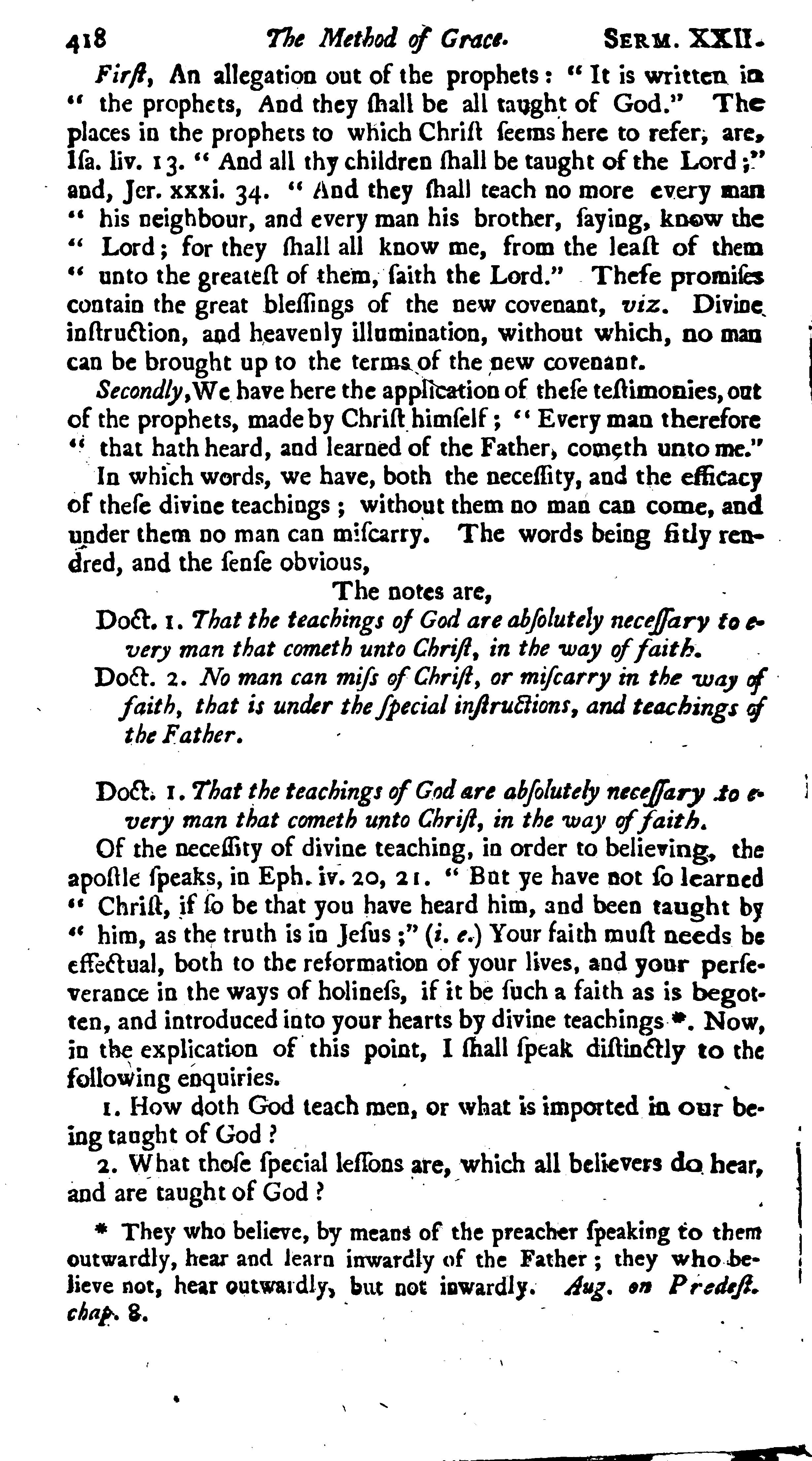
First, An allegation out of the prophets : "It is written in " the prophets, And they shall be all taught of God."
The places in the prophets to which Christ seems here to refer, are, Isa. liv. 13. " And all thy children shall be taught of the Lord ;" and, Jer. xxxi. 34. " And they shall teach no more every man
" his neighbour, and everyman his brother, saying, know the "
Lord; for they shall all know me, from the least of them unto the greatest of them, faith the Lord."
These promises contain the great blessings of the new covenant, viz. Divine " instruction, and heavenly illumination, without which, no man can be brought up to the terms of the new covenant.
Secondly,We have here the application of these testimonies,out of the prophets, made by Christ himself ; " Every man therefore
" that hath heard, and learned of the Father, cometh unto me."
In which words, we have, both the necessity, and the efficacy of these divine teachings ; without them no man can come, and under them no mancanmiscarry.
The words being fitly rendred, and the sense obvious, The notes are, Doct. 1. That the teachings of God are absolutely necessary to every man that cometh unto Christ, in the way of faith.
Doct. 2. No man can miss of Christ, or miscarry in the way of faith, that is under the special instructions, and teachings of the Father .
Doct. 1. That the teachings of God are absolutely necessary to e very man that cometh unto Christ, in the way of faith.
Of the necessity of divine teaching, in order to believing, the apostle speaks, in Eph. iv. 20, 21. " But ye have not so learned
" Christ, if so be that you have heard him, and been taught by " him, as the truth is in Jesus ;" (i. e.) Your faith must needs be effectual, both to the reformation of your lives, and your perseverance in the ways of holiness, if it be such a faith as is begotten, and introduced into your hearts by divine teachings *. Now, in the explication of this point, I shall speak distinctly to the following enquiries.
1. How doth God teach men, or what is imported in our being taught of God ?
2. What those special lessons are, which all believers do hear, and are taught of God ?
* They who believe,by means of the preacher speaking to them outwardly, hear and learn inwardly of the Father ; they who believe not, hear outwardly, but not inwardly.
Aug. on Predeft. chap.8.
SERM . XXII.
The Method of Grace.
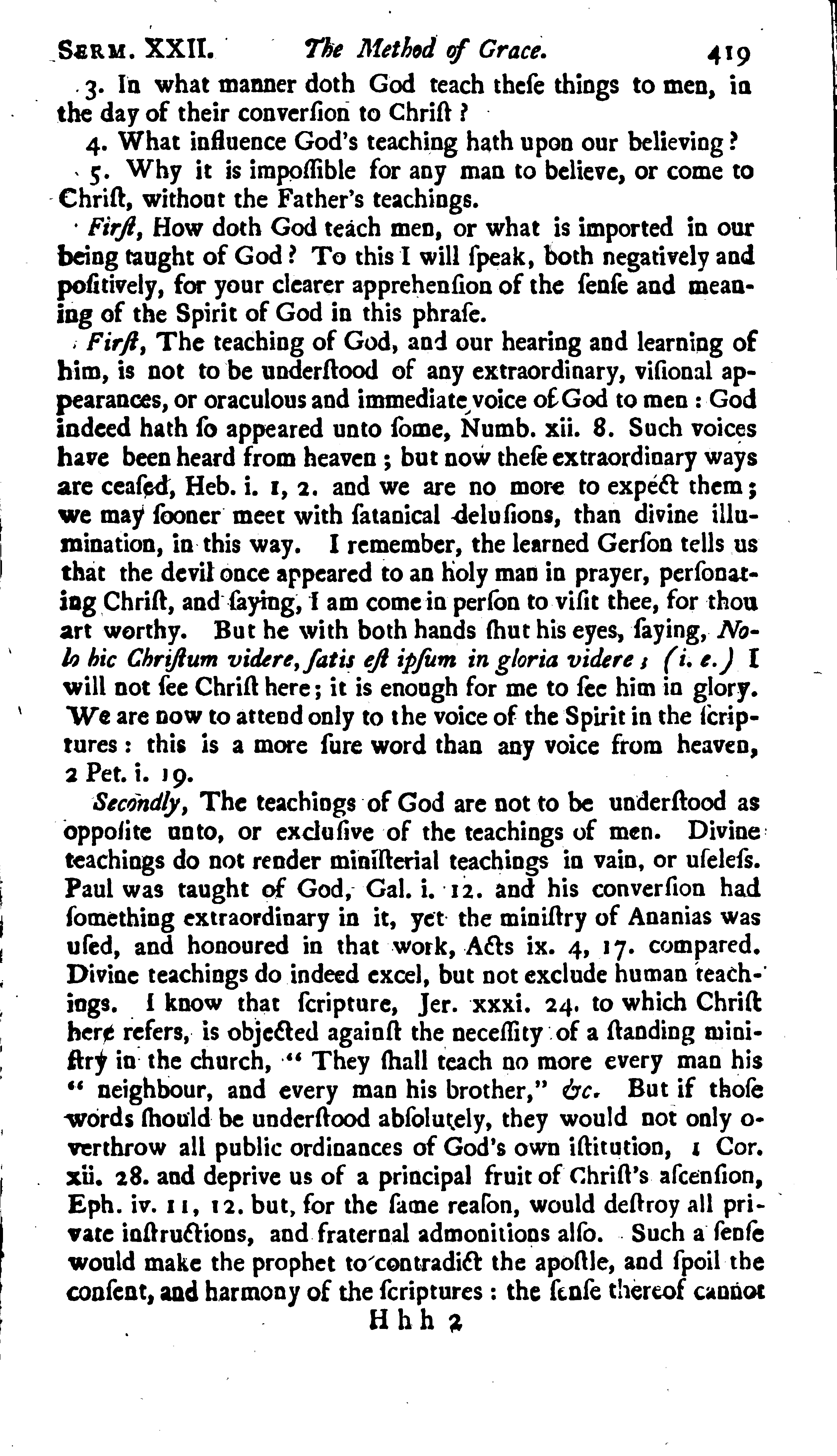
3. In what manner doth God teach these things to men, in the day of their conversion to Christ ?
4. What influence God's teaching hath upon our believing ?
5. Why it is impossible for any man to believe, or come to Christ, without the Father's teachings.
First, How doth God teach men, or what is imported in our being taught of God ? To this I will speak, both negatively and positively, for your clearer apprehension of the sense and meaning of the Spirit of God in this phrase.
First, The teaching of God, and our hearing and learning of him, is not to be understood of any extraordinary, visional appearances, ororaculousand immediate voice ofGodtomen:God indeed hath so appeared unto some, Numb. xii. 8. Such voices have been heard from heaven ; but now these extraordinary ways are ceased, Heb. i. 1, 2. and we are no more to expect them ; we may sooner meet with fatanical delusions, than divine illumination, in this way.
I remember, the learnedGerson tells us that the devil once appeared to an holy man in prayer, personating Christ, and saying, I am come in person to visit thee, for thou art worthy.
But he with both hands shut his eyes, saying, Nolohic Christum videre,fat is eft ipfum in gloria videre ; (i. e.) I will not see Christ here; it is enough for me to fee him in glory.
We are now to attend only to the voice of the Spirit in the scriptures: this is a more sure word than any voice from heaven,
2Pet. i. 19.
Secondly, The teachings of God are not to be understood as opposite unto, or exclusive of the teachings of men. Divine
teachings do not render ministerial teachings in vain, or useless.
Paulwas taught of God, Gal. i. 12. and his conversion had something extraordinary in it, yet the ministry ofAnanias was used, and honoured in that work, Acts ix. 4, 17. compared.
Divine teachings do indeed excel, but not exclude human teachings.
I know that scripture, Jer. xxxi. 24. to which Christ here refers, is objected against the necessity of a standing ministry in the church, " They shall teach no more every man his
" neighbour, and every man his brother," &c.
But if those words should be understood absolutely, they would not only o-
verthrow all public ordinances of God's own istitution, 1 Cor. xii. 28. and deprive us of a principal fruit of Christ's ascension,
Eph. iv. 11 , 12. but, for the fame reason, would destroy all private instructions, and fraternal admonitions also.
Such a sense would make the prophet to contradict the apostle, and spoil the consent,and harmony of the scriptures : the sense thereof cannot
Hhh 2
The Method of Grace.
SERM . XXII .
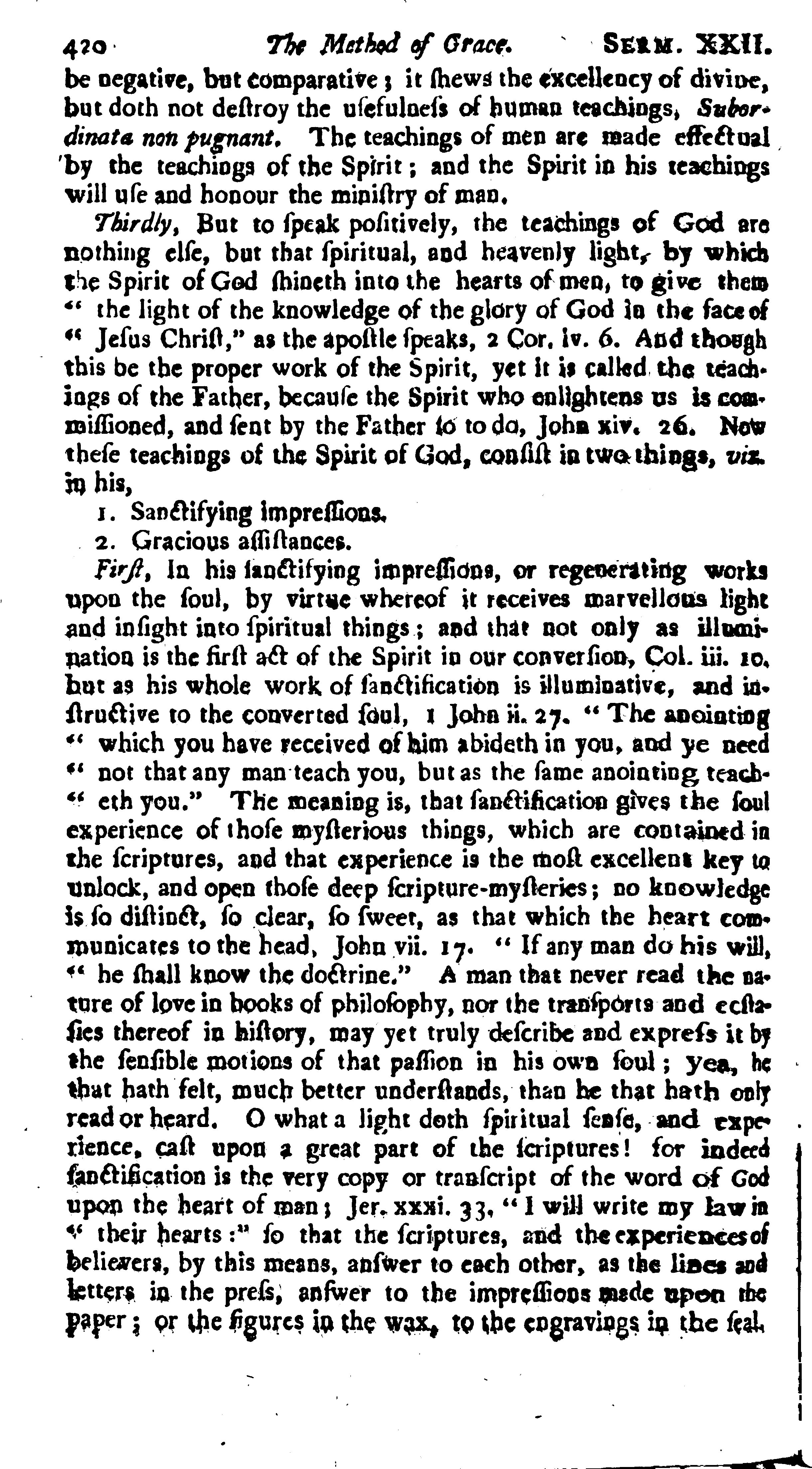
be negative, but comparative; it shews theexcellencyofdivine, but doth not destroy the usefulness ofhumanteachings, Subordinata non pugnant. The teachings of men are made effectual
'by the teachings of the Spirit; and the Spirit in his teachings will use and honour the ministry of man, Thirdly, But to speak positively, the teachings of God are nothing else, but that spiritual, and heavenly light, by which the Spirit of God shineth into the hearts of men, to give them
" the light of the knowledge of the glory of God in the face of " Jesus Christ," as the apostle speaks, 2Cor. iv. 6. And though this be the proper work of the Spirit, yet it is called the teachings of the Father,because the Spirit who enlightens us iscommiffioned, and sent by the Father to to do, John xiv. 26. Now these teachings of the Spirit of God, consist in two things, viz. in his, 1. Sanctifying impressions.
2. Gracious assistances .
First, In his fanctifying impressions, or regenerating works upon the soul, by virtue whereof it receives marvellous light and insight into spiritual things; and that not only as illumination is the first act of the Spirit in our conversion, Col. iii. 10. but as his whole work offanctification is illuminative, and instructive to the converted foul, 1 John ii. 27. "The anointing
" which you have received of him abideth in you, and ye need " not that any man teach you, but as the fame anointing teach- " eth you." The meaning is, that fanctificationgives the soul experience of those mysterious things, which are contained in the scriptures, and that experience is the most excellent key to unlock, and open those deep scripture-mysteries; no knowledge is so distinct, so clear, so sweet, as that which the heart com. municates to the head, John vii. 17. " Ifanymando his will,
" he shall know the doctrine." A man that never read the nature of love in books of philosophy,nor the transports and ecstafies thereof in history, may yet truly describe and express it by the sensible motions of that passion in his own foul; yea, he that hath felt, much better understands, than he that hath only readorheard. O what a light doth spiritual sense, and expe rience, cast upon a great part of the scriptures! for indeed fanctification is the very copy or transcript of the word of God upon the heart of man; Jer. xxxi. 33, " I will write my law in
" their hearts:" so that the scriptures, and the experiences of believers, by this means, answer to each other, as the lines and letters in the press, answer to the impressions made upon the paper; or the figures in the wax, to the engravings in the feal.
SERM. XXII.
The Method of Grace.
When a sanctified man reads David's Plalms, or Paul's episiles, how is he surprized with wonder to find the very workings of his own heart, so exactly decyphered, and fully expressed there !
O, faith he, this is myverycafe; theseholymen speak what my heart hath felt.
Secondly, The Spirit of God teacheth us, as by his sanctifying impressions, so by his gracious assistances, which he gives us pro re nata, as our need requires, Mat. x. 19. " It shall be
" given you in that same hour what ye shall speak," John xiv.
26. " He shall bring all things to your remembrance :" he afsisteth, both the understanding indue apprehenfions of truth, and the heart in the spiritual improvements of truth. And fo much briefly of the first particular.
Secondly, In the next place, we are to enquire what those special truths are which believers hear, and learn of the Father, when they come to Christ .
And there are divers great, and necessary truths, wherein the Spirit enlightens men in that day.
I cannot say they are all taught every believer in the same degree and order ; but it is certain they are taught of God such lessons as these are, which they never so understood before.
Lesson 1. First, They are taught of God that there is abundantly more evil intheirfinfulnatures, and actions, than ever they discerned, or understood before : " the Spirit when he
" cometh shall convince the world of fin," Johnxvi. 8, 9. Men have a general notion off in before; fo had Paul, when a Pharifee: but how vastly different were his apprehenfions of fin, from all that ever he had in his natural state,whenGodbrought home the commandment to his very heart ! There isa threefold knowledge of fin, viz. traditional, discussive, and intuitive. The first is in the more rude, and illiterate multitude.
The second in more rational and knowing men.
The third is only found in those that are enlightened, and taught of God. And there is as great a difference betwixt this intuitive knowledge of fin, whereby God makes a soul todifcernthenature, and evil of it, ina spiritual light, and the two former, as there is betwixt the fight of a painted lion upon the wall, and the fight of a living lion that meets us roaring in the way. The intuitive fight of fin is another thing thanmen imagine it to be: 'tis such a fight as wounds am an to the very heart, Acts ii. 37. forGoddoth not only shew am an this, or that particular fin, but, in the day of convictions, he sets all his fins in order before him. Psal. 1. 21. yea, the Lord shews him the sinfulnessofhis nature, as well as practice.
Conviction digs to the root, shews, and lays open
The Method of Grace.
SERM. XXII.
that original corruption, from whence the innumerable evils of the life do spring, James i. 14, 15. and, which is yet more, the Lord shews the man, whom he is bringing to Christ, the sinful and miserable estate which he is in by reason of both,
John xvi. 9. And now all excuses, pleas, and defences of fin are gone, he shews them " how their iniquities have exceeded,"
Job xxxvi. 8, 9. exceeded in number, and in aggravation of finfulness ; exceeding many, and exceeding vile ; no such sinner in the world as 1 : can such fins as mine be pardon'd? The greatness of God greatens my fin; the holiness of God makes it beyond measure vile; the goodness of God puts unconceivable weight into my guilt. O can there be mercy for such a wretch as 1 ! If there be, then there will not be a greater example of the riches of free grace in all the world than I am.
Thus God teacheth the evil of fin.
Lesson 2. Secondly, God teacheth the soul, whom he is bringing to Christ, what that wrath, and misery are which hang over it in the threatnings, because off in.
Scripture-threatnings were formerly flighted; now the soul trembles at them : They once apprehended themselves safe enough, Isa. xxviii. 15. Psal. 1. 21 .
They thought, because they heard no more of their fins, after the commision of them, that therefore they should never hear more ; that the effect had been as transient athing as the act of fin was; or if trouble must follow fin, they should speed no worse than others, the generality of the world being in the same case; and besides, they hoped to find God more merciful, than fowre and precise preachers represented him. But when a light from God enters into the soul, to discover the nature of God, and of fin, then it fees, that whatever wrath is treasured up for sinners, in the dreadfulthreatnings of the law, is but the just demerit of fin, therecompence that is meet : " The wages
" of fin is death," Rom. vi. 23.
The penal evil of damnation is but equal to the moral evil of fin : So that in the whole ocean of God's eternal wrath, there is not one drop of injustice ; yea, the foul doth not only fee the justice of God in its eternal damnation, but the wonderful mercy of God in the suspensionthereofso long. O what is it that hath with-held God from damning me all this while ! How is it that I am not in hell! Now do the fears and awful apprehenfions of eternity seize the soul, and the worst of sensitive creatures is supposed to be in a better condition than such a soul.
Never do men tremble at the threatnings of God, nor rightly apprehend the danger of their condi tion, until fin, and wrath, and the wages of sin be discovered to them by a light from heaven.
SERM . XXII .
The Method of Grace.
Lesson 3. Thirdly,God teaches thefoulwhomhebrings to Christ, that deliverance fromfin, and wrath to come, is the greatest and most important business it hath to do in this world.
Acts xvi. 30.
" What must I do to be saved ? " q. d. O direct me to some effectual way (if there be any) to secure my poor wretched soul from the wrath of God.
Sin, and the wrath that follows it, are things that swallow up the souls, and drink up the very spirits of men : Their thoughts never conversed with things of more confessed truth and awful solemnity : these things float not upon their fancies as matters of mere speculation, but fettleupon their hearts day and night, as the deepest concernment in all the world : They now know much better than any mere scholar, the deep sense of that text, Mat. xvi. 26. " What is a man
" profited, if he should gain the whole world, and losehisown " foul ? or what shall a man give in exchange for his soul?"
Five things thew how weighty the thoughts and cares of falvationareupon their hearts.
First, Their continual thoughtfulness, and follicitude about these things; if earthly affairs divert them for awhile, yet they a still returning again to this solemn business.
Secondly, Their careful redeeming of time, and saving the very moments thereof to employ about this work : Those that were prodigal of hours, and days before, look upon every momentoftime as a precious and valuable thing now.
Thirdly, Their fears, and tremblings, left they should miscarry, and come short at last, shew how much their hearts are set uponthiswork.
Fourthly, Their inquisitiveness, and readiness to embrace all the help and assistance that they can get from others, evidently discovers this to be their great design .
Fifthly, and lastly, The little notice they take of all other troubles, and afflictions, tells you, their hearts are taken up about greater things.
This is the third lesson they are taught of God.
Lesson 4. Fourthly, The Lord teaches the soul that is coming to Christ, that though it be their duty to fstrive to the uttermostfor salvation ; yet allstrivings, in their own strength, are insufficient to obtain it.
This work is quite above the power of nature :
" It is not of him that willeth, nor of him that runneth, but of " God that sheweth mercy."
The soul is brought to a full conviction of this, by the discovery of the heinous nature off in, and of the rig our and severity of the law of God. No repentance, nor reformation, can possibly amount unto a just satisfaction, nor are they within the compass and power of our will.
It was asayingthatDr.Hill often used to his friends, speaking
The Method of Grace.
SERM. XXII.
about the power of man's will ; he would lay his hand upon his breast, and say, " Every man hath something here to confute
" the Arminian doctrine :" This fully takes off the soul from all expectations of deliverance that way; it cannot but firive, that is its duty; but to expect deliverance, as the purchase of its own strivings, that would be its fin.
Lesson 5. Fifthly, The foul that is coming to Christ by faith, is taught of God, that though the case it is in befad, yet it is not defperateand remediless : There is a door of hope, a way of escape for poor sinners, how black and fearful soever their own thoughts and apprehenfions are : there is usually at this time, a dawning light of hope in the soul that is under the Father's teachings : and this commonly arises from the general, and indefinite encouragements, and promises of the gospel, which though they do not presently secure the foul from danger, yet they prop, and mightily support it against despair : For though they be not certain that deliverance shall be the event of their trouble; yet the possibilities, and much more the probabilities of deliverance are a great stay to the sinking foul : The troubled foul cannot but acknowledge itself to be in a far better case than the damned are, whose hopes are perished from the Lord, and a death-pang of despair hath seized their consciences. And herein the merciful and compassionate nature of God is eminently discovered, in hasting to open the door of hope, almost as soon as the evil of sin is opened.
It was not long, afterAdam's eyes were opened to fee his misery, that God opened Christ, his remedy, in that first promise, Gen. iii. 15. And the same method of grace is still continued to his elect offspring, Gal.iii.
21 , 22. Rom. iii. 21 , 22.
These supporting hopes, the Lord fees necessary to encourage industry in the use of means : it is hope that sets all the world a work : if all hope were cut off, every foul would fit down ina fullendespair, yielding itself for hell.
Lesson 6. Sixthly, The Lord teaches those that come to Christ, that there is a fulness of saving power in him, whereby any foul, that duly receives him, may be perfectly delivered from allitsfin and misery, Heb. vii. 25. Col. i. 19. Mat. xxviii. 18 .
This is a great and necessary point, for every believer to learn and hear from the Father ; for unless the foul be satisfied of the fulness of Christ's saving power, it will never move forwardstowardshim: and herein also the goodness of God is most sweetly, and feafonably manifested; for, at this time, it is the great design of Satan, to fill the soul with despairing thoughts ofapar don; but all those black, and heart-finking thoughts, vanish
SERM. XXII.
The Method of Grace.
before the discovery of Christ's all-fufficiency. Now the fin-sick foul faith with that woman, Mat. ix. 21. " If I may but touch thehem of his garment, I shall be healed:" How deep soever the guilt and stain of fin be, yet the soul which acknowledges the infinite dignity of the blood of Christ, the offering it up to God in our room, and God's declared satisfaction in it, must needs be satisfied that Christ is " able to save, to the uttermost,
"all that come unto God by him ;" which is the sixth effon believers are taught of God.
Lesson 7. Seventhly,Every man that cometh to Christ is taught of God, that it can never reap any benefit by the blood of Christ, except ye have union with the person of Christ, i Johnv. 12.
Eph. iv. 16.
Time was, when men fondly thought nothing was necessary to their salvation, but the death of Christ'; but now the Lord shews them that their union with Christ by faith, is as necessary in the place of an applying cause, as the death of Christ is, in the place of a meritorious cause : The purchase of salvation is an act of Christ without us, whilst we are yet sinners : the application thereof, is by a work wrought within us, when we are believers, Col. i. 27.
In the purchase, all the elect are redeemed together, by way of price : In the application, they are actually redeemed, each person, bywayofpower.
Look, as the fin of the first Adam could never hurt us, unless he had been our head, byway of generation; so the righteousness of Christ can never benefit us, unless he be our head, by way of regeneration. In teaching this lesson,the Lord, in mer cy, unteaches and blots out that dangerous principle, by which the greatest part of the Chriftianized world do perish, viz . that the death of Christ is, in itself, effectual to salvation, though a man be never regenerated, or united to him by saving faith.
Lesson 8. Eighthly, God teaches thefou', whom he is bringing to Christ, that whatever is necessary to be wrought in us, or done by us, in order to our union with Christ, is to be obtained from him in the way of prayer, Ezek. xxxvi. 37. And it is observable, that the soul no sooner comes under the effectual teachings of God, but the Spirit of prayer begins to breath in it, Acts ix.
8. " Behold, he prayeth:" Those that were taught to pray by men before, are now taught of the Lord to pray : to pray did I fay ? yea, and toprayfervently too, asmenconcerned for their eternal happiness ; to pray not only with others, but to pour out their souls before the Lord in secret : for their hearts are as bottles full ofnewwine, which must vent or break. Now the soul returns upon itsGodoften in the fame day; now it can
VOL. II. lii
The Method of Grace.
SERM . XXII,
express its burdens, and wants, in words and groans which the Spirit teacheth : They pray, and will not give over praying, till
Christ come with complete salvation.
Lesson 9. Ninthly, All that come to Christ, are taught of God, to abandon their former ways,and companions in fin, as ever they expect to be received unto mercy, Ifa. Iv. 7. 2 Cor. v. 17. Sins that were profitable, and pleasant, that were as the right hand, and right eye, must now be cut off.
Companions in fin, who were once the delight of their lives must now be cast off. Christ faith to the soul concerning these, as he said in another case,
John xviii. 8. " If therefore ye seek me, let these go their way: "
And the soul faith unto Christ, as it is, Plal. cxix. 115. " De- " part from me ye evil-doers, for I will keep the command- " ments of my God:" And now pleasant fins, and companions in fin, become the very burden, and shame of a man's foul :
Objects of delight are become objects of pity and compassion :
No endearments, no union of blood, no earthly intereits whatsoever, are found strong enough to hold the soul any longer from Christ : Nothing but the effectual teachings of God, are found sufficient to diffolvesuch bonds of iniquity as these.
Lesson 10. Tenthly, All that come unto Christ are taught of God, that there is such a beauty and excellency in the ways and people of God, as is not to be equalled in the whole world,
Psal. xvi . 3.
When the eyes of strangers to Christ begin to be opened, and enlightened in his knowledge, you may fee what a change of judgment is wrought in them, with respect to the people of God : and towards them especially, whom God hath anyway made instrumental for the good of their souls, Cant. v.
9. theythencalled the spouse of Christ, " the faire among women."
The convincing holiness of the bride then began to enamour and affect them, with a desire of nearer conjunction and communion : We willfeek him with thee ; with thee, that hast so charged us; that haft taken so much pains for the good of our souls : now, and never before, the righteous appeareth more excellent than his neighbour.
Change of heart is always accompanied with change of judgment, with respect to the peopleofGod: thus the jaylor, Acts xvi. 33. wathed the apostle's stripes, to whomhehadbeen so cruel before.
The godly now seem to be the glory of the places where they live; and the glory of any place seems to be darkned by their removal ; as one said of holy Mr. Barring ton, " Methinks the town is not at 66 home, when Mr. Barring ton is out of town."
They esteem it a choice mercy to be in their company and acquaintance ; Zech. viii. 23. " We will go with you, for we have heard that
SERM . XXII .
The Method of Grace.
" God is with you." No people like the people of God now ; as one said, when he heard of two faithful friends, Utinam tertius effem ! O that I might make the third ! Whatever vile or low thoughts they had of the people ofGodbefore, to be sure now they are the excellent of the earth, in whom is all their delight : the holiness of the saints might have some interest in. their consciences before, but they never had such an interest in their estimations and affections, till this lesson was taught them by the Father .
Lesson 11. Eleventhly, All that come to Christ are taught of God, that whatever difficulties they apprehend in religion, yet they must not, upon pain of damnation, be discouraged thereby, or return again to fin, Luke ix. 62. " No man having put his
" hand to the plough, and looking back, is fit for the kingdom " of God."
Ploughing-work ishardwork ; aftrongand steady hand is required for it: he that ploughs, must keep on, and make no balks of the hardest and toughestgroundhe meets with.
Religion also is the running of a race, 1 Cor. ix. 24.; there is no standing still, much less turning back, i fever we hope to wintheprize.
The devil, indeed, labours everyway to discourage anddaunt the soul, by representing the insuperable difficulties of religion to it; and young beginners are but too aptto be discouraged, and fall under despondency; but the teachings of the Father are encouraging teachings ; they are carried on from strength to strength against all the oppositions they meet with from without them, and the manydiscouragements they find within them.
To this conclusion they are brought by the teaching of God, We must have Christ, we must get a pardon, we muststrivefor
Salvation, let the difficulties, troubles, and sufferings in the way beneversogreat or many. Ashe said, Neceffe est ut eam, non ut vivam ; it is necessary that I goon, it is not necessary that 1 live : So faith the foul that is taught of God; it is easier for me to dispense with ease, honour, relations, yea, with life itself, than to part with Christ, and the hopes of eternal life.
Lesson 12. Twelfthly, They that come to Christ, are taught of God, that whatever guilt and unworthiness they discover in themselves, and whatever fears and doubts are upon their hearts, as to pardon and acceptance ; yet, as the cafestands, it is their wisdom and great interest, to venture themselves in the way of faith, upon Jesus Christ, whatever the issue thereof be.
Three greatdiscouragments are usuallyfounduponthe hearts of those that come to Christ in the way of faith.
Iii 2
SERM . XXI
The Method of Grace.
First, The sensible greatness of guilt and fin. How can I go to Christ that am in such a case, that have been so vile a wretch ?
And here measuring the grace and mercyofChrist, by what it finds in itself, or in other creatures, I Sam. xxiv. 19. the soul is ready to fink under the weight of its own discouraging, and misgiving thoughts.
Secondly, The sense they have of their own weakness, and inability to do what God requires, and must of neceffitybe done, i fever they be saved. My heart is harder than an adamant, how can I break it ? My will is stubborn, and exceeding obstinate, I am no way able to bow it ; the frame and temper of my spirit is altogether carnal, and earthly; and it is not in the power of my hand to alter and change it; alas ! I cannot subdue any one corruption, nor perform one spiritual duty, nor bear one of those sufferings and burdens, which religion lays upon all that follow Christ : this also proves a great discouragement in the way of faith.
Thirdly, And, which is morethanall, the soul that is coming to Jesus Christ, hath no assurance of acceptance with him, if it should adventure itself upon him : it is a great hazard, a great adventure ; it is much more probable, if I look to myself, that Christ will shut the door of mercy against me.
But under all these discouragements the soul learns this lesson from God, That, as ungodly as it is, nevertheless it is every way its great duty and concernment to go on in the way of faith, and make that great adventure ofitselfuponJesus Christ : and of this the Lord convinceth the soul by two things, viz.
1. From the absolute necessity of coming.
2. From the encouraging probabilities of speeding.
First, The soul seeth an absolute necessity of coming: necessity is laid upon it, there isnootherway, Acts iv. 12. God hath shut it up by a blessed necessity to this only door of escape, Gal . iii. 23. Damnation lies in the neglect of Christ, Heb. ii. 3. The soul hath no choice in this case; angels, ministers, duties, repentance, reformation cannot save me; Christ, and none but Christ candelivermefrom present guilt, and the wrath to come. Why do I dispute, demur, delay, when certainruinmust inevitably follow the neglect or refusal of gospel-offers ?
Secondly, The Lord sheweth those that are under his teaching, the probabilities of mercy, for their encouragement in the way of believing. And these probabilities the soul is enabled to gather from the general and free invitations of the gospel, Isa. lv. 1, 7. Rev. xxii. 17. from the conditional promises of the gospel, John vi. 37. Math.xi. 28. Ifa. i. 18. from the vast ex
SERM . XXIII.
The Method of Grace.
tent of grace, beyond all the thoughts and hopes of the creatures, Ifa. Iv.8, 9. Heb. vii. 25. from the encouraging examplesofother sinners, who have found mercy in as bad a condition as they, 1Tim. i. 13. 2Chron. xxxiii. 3. 2 Cor. vi. 10, 11. from the command of God, which warrants the action, and answers all the objections of unworthiness and presumption in them that come to Christ, I John iii. 23. and lastly, from the sensible changes already made upon the temper and frame of the heart.
Time was,when I had no sense of fin, nor sorrow for fin; nodefire after Christ, nor heart to duties. But it is not so with me now; I now fee the evil of sin; so as I never saw it before; my heart is now broken in the sense of that evil; mydefires begin to be enflamed after Jesus Christ ; I am not at rest, norwhere I would be, till I am in secret mourning after the Lord Jesus; surely these are thedawnings of the day of mercy; letmegoon in this way.
It faith, as the lepers at the siege of Samaria, 2Kings vii. 3, 4. " If I stay here, I perish : " If I go to Christ, I can but perith. Hence believers bear up against all objecteddiscouragements, certum exitium commutemus incerto ; it is the dictate of wisdom,the vote of reason, to exchange a certain for an uncertain ruin. And thus you have herewhatthose excellent lessons are, which all that come to Christ are taught by the Father.
SERMON XXIII.
JOHN vi. 45.
It is written in the Prophets, And they shall be all taught of God.
Every man therefore that hath heard, and bath learned of the Father, cometh unto me.
IN the former sermon, you have been taught this great truth ; Doct. That the teachings of God are absolutely necessary to everyfoulthat cometh unto Christ, in the way of faith.
What the teachings of God import, hath been formerly opened; and what those special lessons are, which all believers hear and learn of the Father, was the last thing discoursed : that which remains to be further cleared about this subject, before I come to the applicationofthewhole, will be toshewyou,
1. What are the properties of divine teachings.
2. What influence they have in bringing fouls to Christ.
SERM . XXIIL
The Method of Grace.
3. Why it is impossible for any man to come to Christ without these teachings of the Father.
First, What are the properties of divine teachings? Concerning the teachings of God,we affirm in general, that, though they exclude not, yet they vastly differ from all human teach. ings : as the power of God in effecting transcends all human power, so the wisdom of God in teaching,transcends all human wisdom.
For, 1.God teacheth powerfully; he speaketh to the soul with a ftronghand; when the word cometh accompanied with the Spirit, it is " mighty through God, to cast down all imaginations,"
2Cor. x. 4.
Now the gospel " comes not in word only, (as " it was wont to do), but in power," I Thef. i. 4, 5. a power that makes the soul fall down before it, and acknowledge that God is in that word, 1 Cor. xiv. 25 .
2. The teachings of God are sweet teachings. Men never relish the sweetness ofa truth, till they learn it from God, Cant. i. 3. "His name is as ointment poured forth ."
Cant. v. 16.
" His mouth is most sweet." O how powerfully and how sweetly doth the voice of God slide into the hearts of poor melting sinners! howjejune, dry, and tasteless are the discourses of men, compared with the teachings of the Father !
3.Godteacheth plainly and clearly : He not only opens truths to the understanding, but he openeth the understanding also to perceive them, 2 Cor. iii. 16. In that day the vail is taken away from the heart ; alight shineth into the soul ; a clear beam from heaven is darted into the mind, Luke xxiv. 45.
Divine teachings are fully satisfying ; the soul doubts no more, staggers and hesitates no more,butacquiefces in that which God teaches ; it is so satisfied, that it can venture all upon the truth of what i hath learned from God; as that martyr said, I cannot dispute, but Icandiefor Christ.
SeeProv. viii. 8, 9 .
Fourtbly, The teachings of God are infallible teachings. The wisest and holiest of men may mistake, and lead others into the same mistakes with themselves ; but it is not fo in the teachings of God.
If we can be sure that God teacheth us, we may be as fureof the truth of what he teacheth ; for his Spiritguideth us into all truth, John xvi. 13. and into nothing but truth.
Fifthly, The teachings of God are abiding teachings ; they make everlasting impressions upon the soul, Psal. cxix. 98. they
"are ever with it : The words of men vanish from us ; but the words of God abide by us : whatGodteacheth,he writeth upon the heart, Jer. xxxi. 33. and that will abide ; literafcriptamanet.
*Tis ufualwith fouls, whose understandings have been opened
SERM . XXIII.
The Method of Grace. by the Lord, many years afterward to say, I shall never forget such a scripture that once convinced, such a promise that once encouraged me.
Sixthly, The teachings of God arefaving teachings ; they make the soul wise unto salvation, 2 Tim. iii. 15. There is a great deal of other knowledge that goes to hell with men : The pavementofhell (as one speaks) is pitched with the skulls of many great scholars, but eternal life is in the teachings of God,
John xvii. 3. " This is eternal life, to know thee the only true 66 God, and Jesus Christ, whom thou hast sent."
This is deservedly stiled the light of this life, John viii. 12. " In this light we shall fee light," Psal. xxxvi . 9.
Seventhly, The teachings of God make their own way into the dullest, and weakest capacities, Isa. xxxii. 4. " The heart al- " so of the rash shall understand knowledge, and the tongue of " the stammerers shall be ready to speak plainly : " Upon this account Christ said, Mat. xi. 25." I thank thee, O Father, Lord
" of heaven and earth,because thou hast hid these things from " the wife and prudent, and hast revealed them unto babes :"
'Tis admirable to see what clear illuminations some poor illite. rate Christians have in the mysteries of Christ and salvation,which others, of great abilities, deep and searching heads, can never discover with all their learning and study.
Eightly,To conclude, The teachings of God are transforming teachings, 2 Cor . iii. 18. they change the soul into the fame image : God casts them, whom he teacheth, into the very mould of those truths which they learn from him,Rom. vi. 17. These are the teachings of God, and thus he instructeth those that come to Christ.
Secondly, Next let us fee what influence divine teachings have upon fouls, in bringing them to Christ; and we shall find a three-fold influence in them.
1. They have an influenceuponthe external means, by which they come to Christ .
2. They have an influence upon the mind, to remove what hindred it from Christ .
3. They have an influence upon the will, to allure and draw it to Christ.
First, They have an influence upon the means, by which we come to Christ: the best ordinances are but a dead letter except the Spirit, the teaching and quickening Spirit of God, work in fellowship with them, 2 Cor. iii. 6. The best ministers, like the disciples, cast forth the net, but take nothing,win not one soul to God, till God teach as wellasthey. Paulis nothing, and A
The Method of Grace.
SERM . XXIII.
pollos nothing, but God that giveththe increase, 1 Cor. iii. 7.
Let the most learned, eloquent, and powerful orator be in the pulpit, yet no man's heart is persuaded, till it hears the voice of God; Gathedram in coelis habet, qui cord a docet.
Secondly, They have influence upon the mind, to remove what hindred it from Christ.
Except the minds of men be firstuntaught those errors, by which they are prejudiced against Christ, they will never be persuaded to come unto him ; and nothing but the Father's teachings can unteach those errors, and cure those evils of the mind.
The natural mind of man flights the truths of God, until God teach them; and then they tremble with an awful reverence of them.
Sin is but a trifle, till God shews us the face of it in the glass of the law, and then it appears exceeding sinful, Rom. vii. 13. We think
God to be such a one as ourselves, Psal. 1. 21. until he discover himself unto us in his infinite greatness, awful holiness, and severe justice ; and then we cry, who can stand before this great and dreadful God ! We thought it was time enough hereafter, to mind the concernments of another world, until the Lord open our eyes, to see in what danger we stand upon the very brink of eternity; and then nothing alarms us more, than the fears that our time will be finished before the great work of Salvation be finished. We thought ourselves in a converted state before, till God made us to see the necessity of another manner of conversation, upon pain of eternal damnation. We readily caughtholdupon the promises before, when we had no right to them; but the teachings of God make the presumptuous sinner let go his hold, that he may take abetter and furerhold of them in Christ. We once thought that the death of Christ, in itself, had been enough to secure our salvation ; but under the teachings of God, we discern plainly the necessity of a change of heart and state ; or else the blood of Christ can never profit us .
Thus the teachings of God remove the errors of the mind, by which men are with-held from Christ.
Thirdly, The teachings of God powerfully attract, and allure the will ofa sinner to Christ, Hos. ii. 14. But of these drawings of the father I have largely spoken before, and therefore shall fay no more of it in this place, but hasten to the lastthing pro pounded, viz.
Thirdly, Why it is impossible for any man to come to Christ, without the Father's teachings ; and the impoffibilities hereof will appear three ways.
1. From the power of fin.
2.From the in disposition of man.
SERM. XXIII.
The Method of Grace.
3. From the nature of faith.
By all which, the lastpointdesigned to be spokentofromthis scripture, will be fully cleared, and the whole prepared for application.
First, the impossibility of coming to Christ without the teachings of the father, will appear from the power of fin, which hath so strong an holdfast upon the hearts, and affections of allunregenerate men, that no human arguments, or perfuafions whatsoever, can divorce or separate them ; for,
First, Sin is connatural with the soul, 'tis born and bred with am an; Psal . li. 4. Ifa. xlviii. 8.
It is as natural for fallen man to fin, as it is to breathe.
Secondly, The power of fin hath been strengtheningitselffrom the beginning, bya long continued custom, which gives it the force of a second nature, and makes regeneration and mortification naturally impossible, Jer. xv. 23. " Can the Ethiopian change
" his skin, or the leopard his spots ? Then may he also do good " that is accustomed to do evil ."
Thirdly, Sin is the delight of the sinner: " it is a sport to a " fool to do mischief," Prov. x. 23. Carnal men have no other pleasure in this world, but what arises from their lusts ; to cut off their corruptions by mortification, were at once to deprive them of all the pleasure of their lives .
Fourthly, Sin being connatural, customary, and delightful, doth therefore bewitch their affections, and in chant their hearts, to that degree of madness and fascination, that they rather chuse damnation by God, than separation from sin : " Their hearts
66 are fully set in them to do evil," Ecclef. viii. 11. they rush into fin, as the " horse rusheth into the battle," Jer. viii. 6.
And now, what, think you, can separate a man from his beloved lust, except the powerful and effectual teachings of God ? Nothing but a light from heaven can rectify, and reduce the in chanted mind; no power, but that of God, can change and alter the sinful bent, and inclination of the will ; ' tis a task above all the power of the creature .
Secondly, The impossibility of coming to Christ, without the Father's teachings, evidently appears from the indifpofedness of man, the subject of this change : " The natural man receives not " the things which are of God," 1 Cor. ii. 14.
Three things must be wrought upon man, before he can come to Christ : his blind understanding must be enlightned; his hard and rocky heart must be broken, and melted; his stiff, fixed, and obstinate will must be conquered and subdued: but all these are effects
VOL . II.
Kkk
The Method of Grace.
SERM . XXIII .
ofa supernatural power.
The illumination of the mind is the peculiar work of God, 2 Cor. iv. 6. Rev. iii. 17. Eph . v. 8.
The breaking and melting of the heart is the Lord's own work ; 'tis he that giveth repentance, Acts v. 31.
'Tis the Lord that " takes away the heart of stone, and giveth an heart of flesh,"
Ezek . xxxvi . 26.
'Tis he that poureth out the spirit of contritionuponman, Zech. xii . 10.
The changing of the natural bent, and inclination of the will, is the Lord's sole prerogative,
Phil. ii. 13.
All these things are effectually done in the foul of man, when God teacheth it, and never till then.
Thirdly, The nature of faith, by which we come to Christ, plainly shews the impossibility of coming without the Father's teaching.
Every thing in faith is supernatural; the implantation of the habit of faith is so, Eph. ii. 8.
'Tis not of ourselves, but the gift of God; 'tis not an habit acquired by industry, but infused by grace, Phil. i. 29.
The light of faith, by which spiritual things are discerned, is supernatural ; Heb xi. 1, 27.
It feeth things that are invisible. The adventures of faith are supernatural; for " against hope, a man believeth in hope, giving
66 glory to God," Rom. iv. 18.
By faith a man goeth unto Christ, against all the dictates, and discouragements of natural sense and reason.
The self-denial of faith is supernatural ; the cutting off the right-hand, and plucking out of right-eye-fins, must needs be so, Mat. v. 29.
The victories and conquests of faith do all speak it to be supernatural : it overcomes the strongestoppofitions from without,Heb. xi. 33, 34.
It fubdueth and purgeth the most obstinate and deep-rooted corruptions within, Acts xv. 9. Itovercometh alltheblandishments, and charming allurements of the bewitching world, I John v. 4.
All which considered, how evident is the conclusion, that none can come to Christ without the Father's teachings ? The uses follow.
First use for information.
Infer. I. How notoriously false and absurd is that doctrine, which afferteth the possibility of believing without the efficacy offupernaturalgrace ? The desire of self-fufficiency was the ruin of Adam, and the conceit of self-fufficiency is the ruin of multitudes of his posterity.
This doctrine is not only contradictory to the current stream of scripture, Phil. ii. 13. 1 John i. 13. with many other scriptures; but it is also contradictory to the common sense and experience of believers : yet the pride of nature will strive to maintain what scripture and experience plainly contradict and overthrow.
Infer. 2. Hence we may also inform ourselves, how it cometh to pass that many rational, wife and learned men, miss Christ ; whilst
SERM . XXIII .
The Method of Grace.
the simple and illiterate, even babes in natural knowledge, obtain interest in him, and salvation by him.
The reason here of is plainly given us by Christ, in Mat. xiii. 11. " To you it is given to " know the mysteries of the kingdomofheaven, but to them it
" is not given."
It is the dropping and dews of divine teaching upon one, and not upon another, that dryeth up the green tree, andmaketh the dry tree to flourish.
Many natural men have very fine brains, searching wits, solid judgments, nimble fancies, tenacious memories ; they can search out the mysteries of nature, solve the phoenomena, satisfy the enquiries of the most curious ; they can measure the earth, discover the motions of the heavens : but after all take up their place in hell,when, in the mean time, the statutes of the Lord (by the help of his teachings) make wife the simple, Psal. xix. 17. It is no matter how dull and incapable the scholar be, if God undertake to be the teacher.
I remember, Austin speaks of one who was commonly reputed a fool, and yet he could not but judge him to be truly godly, and that by two signs of grace which appeared in him ; one was, his seriousness when he heard any discourses of Christ : the other was, his indignation manifested against sin.
It was truly faidby those two Cardinals (who, riding to the council of Constance, overheard a poor shepherd in the fields with tears bewailing his fins)
Surgent indocti et rapient coelum ; The unlearned will rise and take heaven, whilst we with all our learning shall descend into hell.
Here Infer. 3. This also informs us of the true reason of the strange and various successes of the gospel upon the souls of men. we fee why the ministry of one man becomes fruitful, and another's barren ; yea, why the labours of the fame man prosper exceedingly at one time, and not at another ; these things are according as the teachings of God do accompany our teachings.
We often fee a weaker and plainer discourse blessed with success, whilst that which is more artificial, neat and laboured, comes to nothing.
St. Austin hath a pretty fimilitude to illustrate this; Suppose, faith he, two conduits, the on every plain, the other curiously carved and adorned with images of lions, eagles,
&c. the water doth not refresh, and nourish, as it cometh from such a curious conduit, but as it is water.
Where we find most of man, we frequently find least of God.
I speak not this to encourage carelessness and laziness, but to provoke the dispensers of the gospel to more earnestness, and frequent prayer for the assistance, and blessing of the Spirit upon their labours, and to make men less fond of their own gifts and abilities : blearKkk 2
The Method of Grace..
SERM . XXIII.
eyed Leah may bear children, when beautiful Rachel proves barren.
Infer. 4. Learn hence the transcendent excellency of saving,spiritual knowledge, above that which is merely literal and natural.
One drop of knowledge taughtbyGod, is more excellent, than the whole ocean of human knowledge, and acquired gifts, Phil. iii. 8. John xvii. 3. 1 Cor. ii. 2. Let no man therefore be dejected at the want of those gifts, with which unfanctified men are adorned.
If God have taught thee the evil of fin, the worth of Christ, the necessity of regeneration, the mystery of faith, the way of communion with God in duties ; trouble not thyself because of thine ignorance in natural, or moral things : thou haft that, reader, which will bring thee to heaven ; and he is a truly wife man that knows the way of salvation, though he be ignorant and unskilful in other things : thou knowest those things which all the learned doctors, and libraries in the world could never teach thee, but God hath revealed them to thee : others have more feience, thou hast morefavour and sweetness: bless God, and be notdifcouraged.
Second use for examination.
If there be no coming to Christ without the teachings of the Father; then it greatly concerns us to examine our own hearts, whether ever we have been under the saving teachings of God, during the many years we have fat under the preaching of the gospel.
Let not the question be mistaken, Ido not ask what books you have read, what ministers you have heard, what stock of natural, or speculative knowledge you have acquired; but the question is,whether ever God spake to your hearts, and hath effectually taught you suchleffons, as were mentioned in our last discourse ? O there is a vast difference betwixt that notional, speculative, and traditional knowledge which learneth from men, and that spiritual,operative, and transformman ing knowledge which a man learneth from God.
If you ask how the teachings of God maybe discerned, from all other mere human teachings ; I answer, they may be discerned, and diftinguishedby these fix signs,
Sign 1. The teachings of God are very humbling to the foul that is taught. Human knowledge puffeth up, 1 Cor. viii. 1. but the teachings of God do greatly abase the soul, Job xlii. 5. " Г
" have heard of thee by the hearing of the ear, but now mine " eye feeth thee ; wherefore I abhor myself, and repent in dust
" andasnes :" the fame light which discovers to us the holiness, justice, greatness, and goodness of God, discovereth also the vile.
SERM . XXIII.
The Method of Grace.
ness, baseness, emptiness, and totalunworthinessofmen; yea, of the best and holiest of men, Ifa. vi. 5.
Sign 2. The teachings of God are deeply affecting, andimprfefive teachings; they fully reach the heart of man, Hos. ii.
14. " I will allure her, and bring her into the wilderness, and speak comfortably unto her :" or, as it is in the Hebrew, I will speak to her heart. When God sheweth unto man the evil off in,he so convinceth the soul, that no creature-comforts have any pleasure, or fsweetness in them; and when he sheweth untoman his righteousness, pardon, and peace in Christ, the so comforteth, and refresheth the heart, that no outward afflictions have any weight, or bitterness in them : one drop of consolation from heaven, sweetens a sea of trouble upon earth,
Psal. xciv. 19. " In the multitude of my thoughts within me, thy comforts delight my soul."
Sign 3. The teachings of God are fanctifying and renewing teachings ; they reform and change the heart, Eph. iv. 21 , 22,
23. " If so be that you have heard him, and been taught by " him, as the truth is in Jesus; that ye put off concerning
" the former conversation the old man, which is corrupt, ac- " cording to the deceitful lusts ; and be renewed in the spirit
- " of your mind," &c. See here what holiness, and purity is the effect of divine teaching ! Holiness, both external and internal, negative and positive: holiness of every kind follows the Father's teachings : all the discoveries God makes to us of himself in Christ have an affimilatingquality, and change the soul into their own likeness, 2 Cor. iii. 18.
Sign 4. All God's teachings are practical, producing obedience.
Idle notions and useless speculations are not learned from God.
As God's creating words, so his teaching words are with effect : as when he said, " Let there be light, and there was light ;" so when he faith to the soul, Be comforted, be humbled; it is effectually comforted, Isa lxvi. 13. it is humbled, Job xl. 4, 5.
As God hath in nature made no creature in vain, so he speaks no word in vain: everything which men hear, or learn from the
Father, is for use, practice, and benefit to the soul.
Sign 5. All the teachings of God are agreeable with the written word : The Spirit of God, and the word of God do never jar,
John xiv . 26. " He shall take of mine, and shew it unto you."
When God fpeaketh unto the heart of man, whether in away of conviction, consolation, or instruction in duty, he always either maketh use of the express words of scripture, or speaks to the heart in language every way confentaneous and agreeable to scripture: So that the written word becomes the standard to
The Method of Grace.
SERM. XXIII/
weigh, and try all divine teachings, Ifa. viii. 20. "To the law, " and to the testimony : If they speak not according to this
" word, it is because there is no light (or morning) in them."
Whatever is disagreeing, or jarringwith the scripture, must not pass for an inspiration of God, but a deluding fophifm, and insinuation of Satan.
Sign 6. The teachings of God are very satisfying teachings to the soul of man : The understanding faculty, like a dial, is en.lightened with the beams of divine truth shining upon it : this, no man's teachings can do : Men can only teach objectively, by propounding truth to the understanding; but they cannot enlighten the faculty itself, as God doth,
1 Johnv. 20. He giveth man understanding, as well as instructions, to be understood; he opens the eyes of the understanding, as well as propoundeth the object, Eph. i. 18.
And thus we may discern and distinguish the teachings of God, from all other teachings.
3. Use ofexhortation.
The last use I shall make of this point, shall be a word of exhortation, both to them that never were yet effectually taught of God, and to them also that have heard his voice, and are come to Christ .
First, To those that never yet heard the voice of God speaking to their hearts ; and truly this is the general case of most men and women, in the professingworld: They have heard the found of the gospel, but it hath been a confused, empty, and ineffectual found in their ears : we have heard the voice of man, but have never yet heard the voice of God. The gifts and abilities of preachers have, ina notional and mere human way, improved their understandings, and sometimes slightly touched their affections: All this is but the effect of man upon man. O thatyouwould look for something which is beyond all this : satisfy not yourselves with what is merely natural, and human in ordinances ; come to the word with higher ends and more spiritual designs, than to get some notions of truth which you had not before, or to judge the gifts and abilities of the speaker : If God speak not to your hearts, all the ordinances in the world candoyouno good, I Cor. iii. 7.
O remember what a solemn and awful thing it is to come to those ordinances, and attend upon that ministration,in and by which the eternal decrees of heaven are to be executed upon your souls, which must be to you the " favour of life unto life, or of death unto death :" Wrestle with God, by prayer, for a blessing upon the ordinances.
Say, 66 Lord, speak thyself to my heart, let me hear thy voice, and " feel thy power in this prayer, or in this sermon : Others have
SERM . XXIII.
The Method of Grace.
" heard thy voice, cause me to hear it: It had beenmuchbetter for me if I had never heard the voice of preachers, except
" I hear thy voice in them."
Secondly, Let all those that have heard the voice of God, and are come to Christ in the virtue of his teachings, admire the wonderful condescension of God to them.
O that God should speak to thy soul,and be silent to others ! There be many thousands living at this day under ordinances, to whom the Lord hath not given anear to hear, or an heart to obey, Deut. xxix.
4. " To you it is given to know the mysteries of the kingdom " of heaven, but to them it is not given," Mat. xiii. 11. And I beseech you walk as men and women that have been taught of God.
When Satan and your corruptions tempt you to fin, and , to walk in the ways of the carnal, and careless world ; remember then that scripture, Eph. iv. 20, 21. " But ye have not fo
" learned Christ, if so be that you have heard him, and have " been taught by him, as the truth is in Jesus." To con. clude, see that you be exceeding humble, and lowly in spirit .
Humility qualifies you for divine teachings, Psal. xxv. 9. " The " meek he will teach;" and the more ye are taught of God, the more humble you will still be.
And thus you fee, that no man can come to Christ without the application of the law, and the teachings of the Father : which being considered, may be very useful to convince us,
(which indeed is the design of it) that among the multitudes of men and women, living under the ordinances of God, and the general profession of religion, there are but few, very few to be found, who have effectually received the Lord Jesus Christ by saving faith .
And now, reader, I suppose by this time thou art desirous to know by what signs and evidences thy union with Christ by faith may be cleared up, and made evident to thee; and how that great question, whether thou hast yet effectually applied
Christ to thy soul, or no, may be clearly decided; which brings me to the third general use of the whole, viz.
The examination of our interest in Christ, by 1. The donation of the Spirit, from I John iii. 24.
2. The new creation, from 2 Cor. v. 17.
3. The mortification of fin, from Gal. v. 24.
4.The imitation of Christ, from 1 John ii. 6.
Of each of these trials of our interest in Christ I shall speak in their order : And, first, of the donation of the Spirit.